EP0095259B1 - Fluid loss control additive for a well drilling fluid - Google Patents
Fluid loss control additive for a well drilling fluid Download PDFInfo
- Publication number
- EP0095259B1 EP0095259B1 EP19830302439 EP83302439A EP0095259B1 EP 0095259 B1 EP0095259 B1 EP 0095259B1 EP 19830302439 EP19830302439 EP 19830302439 EP 83302439 A EP83302439 A EP 83302439A EP 0095259 B1 EP0095259 B1 EP 0095259B1
- Authority
- EP
- European Patent Office
- Prior art keywords
- water
- process according
- solution
- organic liquid
- polymer
- Prior art date
- Legal status (The legal status is an assumption and is not a legal conclusion. Google has not performed a legal analysis and makes no representation as to the accuracy of the status listed.)
- Expired
Links
Classifications
-
- C—CHEMISTRY; METALLURGY
- C09—DYES; PAINTS; POLISHES; NATURAL RESINS; ADHESIVES; COMPOSITIONS NOT OTHERWISE PROVIDED FOR; APPLICATIONS OF MATERIALS NOT OTHERWISE PROVIDED FOR
- C09K—MATERIALS FOR MISCELLANEOUS APPLICATIONS, NOT PROVIDED FOR ELSEWHERE
- C09K8/00—Compositions for drilling of boreholes or wells; Compositions for treating boreholes or wells, e.g. for completion or for remedial operations
- C09K8/50—Compositions for plastering borehole walls, i.e. compositions for temporary consolidation of borehole walls
- C09K8/502—Oil-based compositions
Definitions
- the present invention relates to a process for the plugging of a porous formation.
- the process entails plugging of the porous formation which may be encountered during the drilling of a well by means of a polymeric solution containing pseudo-emulsion spheres. These particles penetrate the pore structure within a formation. Eventually, sufficient numbers of the spheres will accumulate within the pores, blocking further flow through the formation by both the pseudo-emulsion particles and any aqueous solutions.
- the pseudo-emulsion system is formed by mixing a polymer solution containing low levels of polymer with an aqueous solution.
- the pseudo-emulsion system is formed by a process which comprises the steps of forming a solvent system of an organic liquid and a polar cosolvent, the polar cosolvent being less than 15 weight percent of the solvent system, the viscosity of the solvent system being less than 1000 mPas preferably less than 100 mPas; dissolving a water insoluble neutralised sulphonated polymer in the cosolvent system to form a solution, the concentration of the neutralised sulphonated polymer in the solution being at least 0.01 and less than 0.5 weight percent, the viscosity of the solution being less than 200 mPas.
- the solution is admixed or contacted with 5 to 500 volume percent water, the water being immiscible with the organic liquid and with the polar cosolvent wherein the neutralised sulphonated polymer transfers from the organic liquid to the water phase, thereby causing the water phase to gel (i.e. thicken).
- the solution of the polymer, organic liquid and polar cosolvent into the well this solution penetrates into the pores of the porous formations in the well.
- gelation of the water occurs, thereby plugging the porous formation of the well.
- the gelled aqueous phase (containing the pseudo-emulsion particles) having a viscosity greater than 50 mPas is formed by contacting the water insoluble solution having a viscosity less than 200 mPas with water wherein the water insoluble solution comprises an organic liquid, a polar cosolvent and a neutralised sulphonated polymer and the concentration of neutralised sulphonated polymer in the water insoluble solution is at least 0.01 and less than 0.5 weight percent.
- the polar cosolvent and water insoluble, neutralised sulphonated polymer rapidly transfer from the organic liquid to the aqueous water which undergoes immediate gelation.
- the gelation i.e.
- thickening of the water to a viscosity of at least 50 mPas can be quite rapid of the order of 1 minute to 24 hours, more preferably 1 minute to 30 minutes, and most preferably 1 minute to 10 minutes; however, this depends on temperature, shear, solvent type, etc.
- the formed pseudo-emulsion system readily and rapidly plugs the pores of the porous formation in the well.
- the component materials of the present process include a water insoluble, neutralized sulfonated polymer at a critical concentration level of at least 0.01 and less than 0.5 weight percent in solvent, a nonpolar organic liquid, a polar cosolvent and water containing in specific instances, an acid or a salt.
- Gelation of an aqueous phase does not occur, if one employs a conventional unsulfonated polymer or a water soluble, neutralized sulfonated polymer in place of the water insoluble, neutralized sulfonated polymer, but rather only classical phase separation occurs.
- the gelation of the aqueous phase occurs by the formation of geometrically shaped spheres of the water insoluble, neutralized sulfonated polymer within the aqueous phase, wherein the water is encapsulated within these geometrically shaped spheres.
- approximately 10 weight percent of the nonpolar organic liquid also transfers to the aqueous phase and is encapsulated within these geometrically shaped spheres.
- the sulfonated polystyrenes which are the preferred embodiment of this invention lose their effectiveness (i.e., as a water-in-water pseudo-emulsion former) in salt water. More specifically, it has been found that a suitable nonionic surfactant must be employed with the water insoluble, sulfonated polystyrene to give formulations which are effective in producing these water-in-water pseudo-emulsions in high concentrations of salt water.
- the water insoluble ionomeric (sulphonated) polymer will comprise from 10 to 200 meq. pendant ionomeric groups per 100 grams of polymer, more preferably from 10 to 100 meq. pendant ionomeric groups.
- the ionomers utilised in the present invention are neutralised with the basic materials selected from Groups IA, IIA, IB and IIB of the Periodic Table of Elements and lead, tin and antimony, as well as ammonium and amine counterions.
- Ionic polymers which are used in the process of the present invention are illimitable and include both plastic and elastomeric polymers.
- Specific polymers include sulphonated polystyrene, sulphonated poly t-butyl styrene, sulphonated polyethylene (substantially non-crystaiiine), sulphonated ethylene copolymers, polypropylene (substantially non- crystalline), sulphonated propylene copolymers, sulphonated styrene/acrylonitrile copolymers, sulphonated polyvinyl toluene, sulphonated polyvinyl toluene copolymers, sulphonated styrene/methyl methacrylate copolymers, sulphonated block copolymers of styrene/ethylene oxide, sulphonated polyisobutylene, sulphonated ethylene-propylene terpolymers, sulphonated polyisoprene and sulphonated elastomers and their copolymers.
- Neutralisation of the cited polymers with appropriate metal hydroxides, metal acetates, metal oxides, or ammonium hydroxide etc. can be conducted by means well-known in the art.
- the sulphonation process as with Butyl rubber containing a small 0.3 to 1.0 mole percent unsaturation can be conducted in a suitable solvent such as toluene, with acetyl sulphate as the sulphonating agent, such as described in US Patent 3,836,511.
- the resulting sulphonic acid derivative can then be neutralised with a number of different neutralisation agents such as a sodium phenolate and similar metal salts.
- the amounts of such neutralisation agents employed will normally be equal stoichiometrically to the amount of free acid in the polymer plus any unreacted agent which is still present. It is preferred that the amount of neutralizing agent be equal to the molar amount of sulfonating agent originally employed plus 10 percent more to ensure full neutralization. The use of more of such neutralization agent is not critical. Sufficient neutralization agent is necessary to effect at least 50 percent neutralization of the sulfonic acid groups present in the polymer, preferably at least 90 percent, and most preferably essentially complete neutralization of such acid groups should be effected.
- the degree of neutralization of said ionomeric groups may vary from more than zero (free acid) to greater than 100 mole percent, preferably 50 to 100 percent. With the utilization of neutralized ionomers in this present invention, it is preferred that the degree of neutralization be substantially complete, that is with no substantial free acid present and without substantial excess of the base other than that needed to ensure neutralization.
- the neutralized ionomers possess greater thermal stability compared to its acid form.
- the ionomeric polymers of the present invention may vary in number average molecular weight from 1,000 to 10,000,000 preferably from 5,000 to 500,000, most preferably from 10,000 to 200,000. These polymers may be prepared by methods known in the art, for example, see U.S. Patent 3,642,728.
- the preferred ionic copolymers for use in the present invention e.g., sulfonated polystyrene and substituted derivatives thereof, may be prepared by the procedures described in U.S. Patent 3,870,841, filed October 2, 1972, in the names of H. S. Makowski, R. D. Lundberg and G. H. Singhal.
- the ionic polymers are incorporated into the solvent system at a level of at least 0.01 but less than 0.5 weight percent and more preferably from 0.01 to 0.4 weight percent, based on the organic liquid and the polar cosolvent.
- the sulphonated polymers of the present invention may be prepared prior to incorporation into the organic solvent, or by neutralization of the acid form in situ.
- the acid derivative may be neutralized immediately after preparation.
- the neutralized polymer may then be isolated by means well-known to those skilled in the art, i.e., coagulation, steam stripping, or solvent evaporation, because the neutralized polymer has sufficient thermal stability to be dried for employment at a later time in the process of the present invention. It is well-known that the unneutralized sulfonic acid derivatives do not possess good thermal stability and the above operations avoid that problem.
- the organic liquids which may be utilized in the present invention, are selected with relation to the ionic polymer and vice-versa.
- the organic liquid may be selected from aromatic hydrocarbons, cyclic aliphatic ethers, aliphatic ethers, organic aliphatic esters and mixtures thereof.
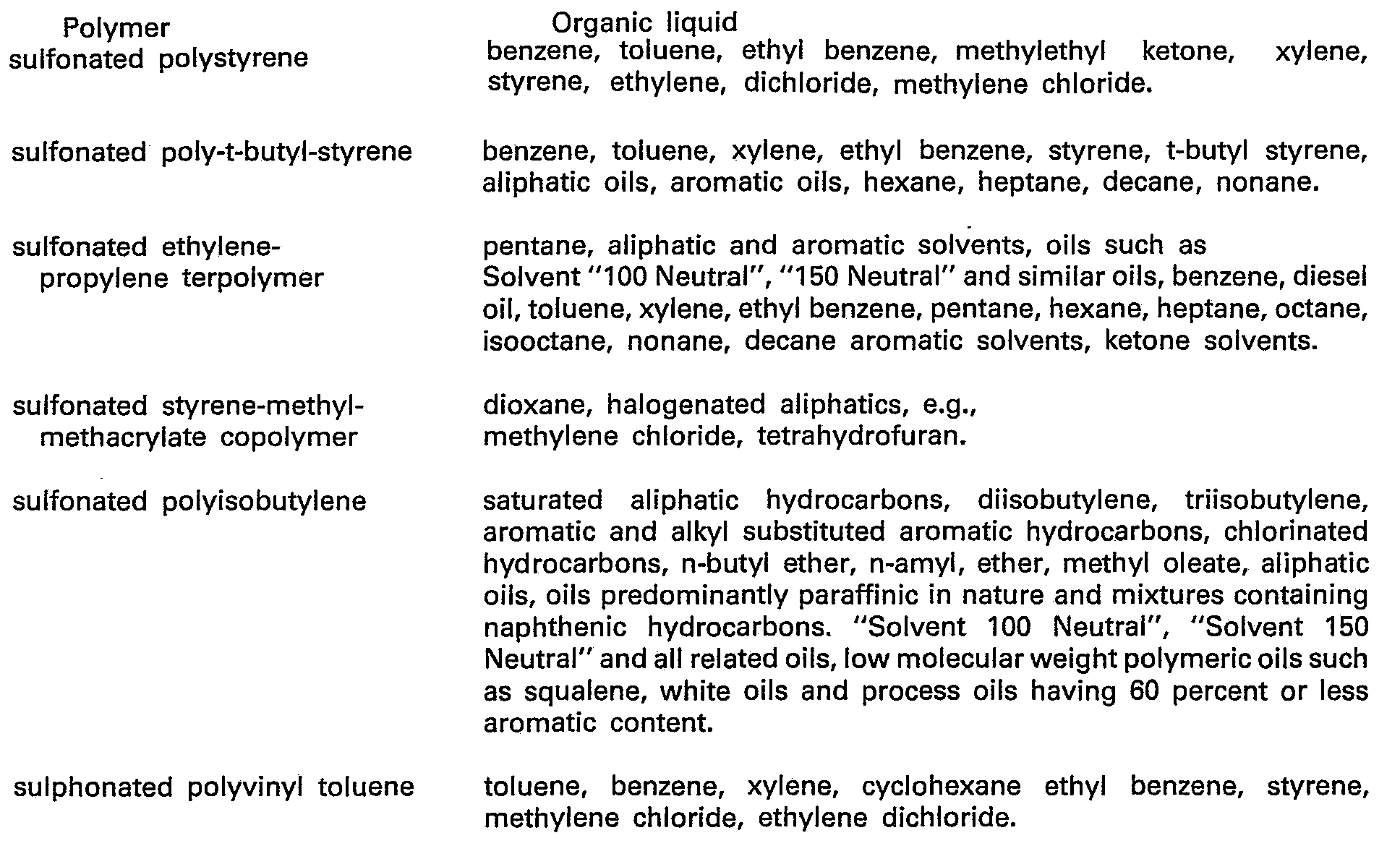
- organic liquids to be employed with the various types of polymers are:
- the method of the present invention includes incorporating a polar cosolvent, for example, a polar cosolvent in the mixture of organic liquid and water insoluble ionomer to solubilise the pendant ionomeric groups.
- a polar cosolvent for example, a polar cosolvent in the mixture of organic liquid and water insoluble ionomer to solubilise the pendant ionomeric groups.
- the polar cosolvent will preferably have a solubility parameter of at least 10.0, more preferably at least 11.0 and is water miscible and may comprise from 0.1 to 10.0 weight percent, preferably 0.1 to 5.0 weight percent of the total mixture of organic liquid, ionomeric polymer, and polar cosolvent.
- the solvent system of polar cosolvent and organic liquid in which the neutralised sulphonated polymer is dissolved preferably contains less than about 10.0 weight percent of the polar cosolvent, more preferably 0.1 to 5.0 weight percent, and most preferably 1.0 to 5.0 weight percent.
- the viscosity of the solvent system is less than 1,000 mPas, more preferably less than 800 and most preferably less than 500 mPas e.g. less than 100 mPas.
- the polar cosolvent will be a liquid at room temperature; however, this is not essential. It is preferred, but not required, that the polar cosolvent be soluble or miscible with the organic liquid at the levels employed in this invention. Also it is preferred that the polar solvent has a greater polarity than the organic liquid.
- the polar cosolvent may be selected from water-soluble alcohols, including di- or trifunctional alcohols, amides, amines, acetamides, phosphates, lactone and mixtures thereof.
- polar cosolvents are aliphatic alcohols such as methanol, ethanol, n-propanol, isopropanol, 1,2-propane diol, monoethyl ether of ethylene glycol, and n-ethylformamide.
- the amount of water contacted with the solution of neutralized sulfonated polymer, organic liquid and polar cosolvent having a viscosity of less than 200 mPas is 5 to 500 volume percent of water, more preferably 10 to 300 volume percent water, most preferably 10 to 200 volume percent water.
- Aqueous solutions containing pseudo-emulsion spheres based on sulphonated polystyrene were tested as a fluid loss additive using Millipore filters (Millipore Corporation-Bedford, Massachusetts) possessing a range of pore sizes (0.2, 1.0 and 5.0 pm). This test is based on the ability of an aqueous solution containing a large number of pseudozemulsion spheres to completely prevent the aqueous phase from percolating through the filter.
- 20 ml of a pseudo-emulsion system is placed in a funnel containng the appropriate filter.
- the maximum amount of fluid which can pass through is measured. We observe only a small volume of fluid ( ⁇ 0.5 ml) passed through the 0.2 pm and 1.0 ⁇ m filters, while less than 1 ml of solution came through the 5 ⁇ m filter. However, complete plugging of the filter occurs in all instances.
- pseudo-emulsion spheres are capable of plugging the pores within a filter which, in turn, completely inhibits flow of the aqueous phase.
- the filter pore sizes are comparable to pore sizes found in a variety of underground formations.
Landscapes
- Chemical & Material Sciences (AREA)
- Life Sciences & Earth Sciences (AREA)
- General Life Sciences & Earth Sciences (AREA)
- Oil, Petroleum & Natural Gas (AREA)
- Engineering & Computer Science (AREA)
- Materials Engineering (AREA)
- Organic Chemistry (AREA)
- Addition Polymer Or Copolymer, Post-Treatments, Or Chemical Modifications (AREA)
- Lubricants (AREA)
Description
- The present invention relates to a process for the plugging of a porous formation.
- The process entails plugging of the porous formation which may be encountered during the drilling of a well by means of a polymeric solution containing pseudo-emulsion spheres. These particles penetrate the pore structure within a formation. Eventually, sufficient numbers of the spheres will accumulate within the pores, blocking further flow through the formation by both the pseudo-emulsion particles and any aqueous solutions. The pseudo-emulsion system is formed by mixing a polymer solution containing low levels of polymer with an aqueous solution. In particular, the pseudo-emulsion system is formed by a process which comprises the steps of forming a solvent system of an organic liquid and a polar cosolvent, the polar cosolvent being less than 15 weight percent of the solvent system, the viscosity of the solvent system being less than 1000 mPas preferably less than 100 mPas; dissolving a water insoluble neutralised sulphonated polymer in the cosolvent system to form a solution, the concentration of the neutralised sulphonated polymer in the solution being at least 0.01 and less than 0.5 weight percent, the viscosity of the solution being less than 200 mPas. The solution is admixed or contacted with 5 to 500 volume percent water, the water being immiscible with the organic liquid and with the polar cosolvent wherein the neutralised sulphonated polymer transfers from the organic liquid to the water phase, thereby causing the water phase to gel (i.e. thicken). Upon injection of the solution of the polymer, organic liquid and polar cosolvent into the well this solution penetrates into the pores of the porous formations in the well. Upon contact of the water with the solution e.g. within the porous formation in the well, gelation of the water occurs, thereby plugging the porous formation of the well.
- The gelled aqueous phase (containing the pseudo-emulsion particles) having a viscosity greater than 50 mPas is formed by contacting the water insoluble solution having a viscosity less than 200 mPas with water wherein the water insoluble solution comprises an organic liquid, a polar cosolvent and a neutralised sulphonated polymer and the concentration of neutralised sulphonated polymer in the water insoluble solution is at least 0.01 and less than 0.5 weight percent. Upon contacting the water insoluble solution with water, the polar cosolvent and water insoluble, neutralised sulphonated polymer rapidly transfer from the organic liquid to the aqueous water which undergoes immediate gelation. The gelation (i.e. thickening) of the water to a viscosity of at least 50 mPas can be quite rapid of the order of 1 minute to 24 hours, more preferably 1 minute to 30 minutes, and most preferably 1 minute to 10 minutes; however, this depends on temperature, shear, solvent type, etc. The formed pseudo-emulsion system readily and rapidly plugs the pores of the porous formation in the well.
- The component materials of the present process include a water insoluble, neutralized sulfonated polymer at a critical concentration level of at least 0.01 and less than 0.5 weight percent in solvent, a nonpolar organic liquid, a polar cosolvent and water containing in specific instances, an acid or a salt.
- Gelation of an aqueous phase does not occur, if one employs a conventional unsulfonated polymer or a water soluble, neutralized sulfonated polymer in place of the water insoluble, neutralized sulfonated polymer, but rather only classical phase separation occurs.
- In the present invention, the gelation of the aqueous phase occurs by the formation of geometrically shaped spheres of the water insoluble, neutralized sulfonated polymer within the aqueous phase, wherein the water is encapsulated within these geometrically shaped spheres. During the process, approximately 10 weight percent of the nonpolar organic liquid also transfers to the aqueous phase and is encapsulated within these geometrically shaped spheres.
- The sulfonated polystyrenes which are the preferred embodiment of this invention lose their effectiveness (i.e., as a water-in-water pseudo-emulsion former) in salt water. More specifically, it has been found that a suitable nonionic surfactant must be employed with the water insoluble, sulfonated polystyrene to give formulations which are effective in producing these water-in-water pseudo-emulsions in high concentrations of salt water.
- In general, the water insoluble ionomeric (sulphonated) polymer will comprise from 10 to 200 meq. pendant ionomeric groups per 100 grams of polymer, more preferably from 10 to 100 meq. pendant ionomeric groups. In most instances, the ionomers utilised in the present invention are neutralised with the basic materials selected from Groups IA, IIA, IB and IIB of the Periodic Table of Elements and lead, tin and antimony, as well as ammonium and amine counterions. Ionic polymers which are used in the process of the present invention are illimitable and include both plastic and elastomeric polymers. Specific polymers include sulphonated polystyrene, sulphonated poly t-butyl styrene, sulphonated polyethylene (substantially non-crystaiiine), sulphonated ethylene copolymers, polypropylene (substantially non- crystalline), sulphonated propylene copolymers, sulphonated styrene/acrylonitrile copolymers, sulphonated polyvinyl toluene, sulphonated polyvinyl toluene copolymers, sulphonated styrene/methyl methacrylate copolymers, sulphonated block copolymers of styrene/ethylene oxide, sulphonated polyisobutylene, sulphonated ethylene-propylene terpolymers, sulphonated polyisoprene and sulphonated elastomers and their copolymers. The preferred polymers of the present invention are ethylene-propylene terpolymers (EPDM) and polystyrene, wherein polystyrene is most preferred.
- Neutralisation of the cited polymers with appropriate metal hydroxides, metal acetates, metal oxides, or ammonium hydroxide etc. can be conducted by means well-known in the art. For example, the sulphonation process as with Butyl rubber containing a small 0.3 to 1.0 mole percent unsaturation can be conducted in a suitable solvent such as toluene, with acetyl sulphate as the sulphonating agent, such as described in US Patent 3,836,511. The resulting sulphonic acid derivative can then be neutralised with a number of different neutralisation agents such as a sodium phenolate and similar metal salts. The amounts of such neutralisation agents employed will normally be equal stoichiometrically to the amount of free acid in the polymer plus any unreacted agent which is still present. It is preferred that the amount of neutralizing agent be equal to the molar amount of sulfonating agent originally employed plus 10 percent more to ensure full neutralization. The use of more of such neutralization agent is not critical. Sufficient neutralization agent is necessary to effect at least 50 percent neutralization of the sulfonic acid groups present in the polymer, preferably at least 90 percent, and most preferably essentially complete neutralization of such acid groups should be effected.
- The degree of neutralization of said ionomeric groups may vary from more than zero (free acid) to greater than 100 mole percent, preferably 50 to 100 percent. With the utilization of neutralized ionomers in this present invention, it is preferred that the degree of neutralization be substantially complete, that is with no substantial free acid present and without substantial excess of the base other than that needed to ensure neutralization. The neutralized ionomers possess greater thermal stability compared to its acid form. Thus, it is clear that the polymers which are normally utilized in the present invention comprise substantially neutralized pendant groups, and in fact, an excess of the neutralizing material may be utilized without defeating the objects of the present invention.
- The ionomeric polymers of the present invention may vary in number average molecular weight from 1,000 to 10,000,000 preferably from 5,000 to 500,000, most preferably from 10,000 to 200,000. These polymers may be prepared by methods known in the art, for example, see U.S. Patent 3,642,728.
- The preferred ionic copolymers for use in the present invention, e.g., sulfonated polystyrene and substituted derivatives thereof, may be prepared by the procedures described in U.S. Patent 3,870,841, filed October 2, 1972, in the names of H. S. Makowski, R. D. Lundberg and G. H. Singhal.
- The ionic polymers are incorporated into the solvent system at a level of at least 0.01 but less than 0.5 weight percent and more preferably from 0.01 to 0.4 weight percent, based on the organic liquid and the polar cosolvent.
- The sulphonated polymers of the present invention may be prepared prior to incorporation into the organic solvent, or by neutralization of the acid form in situ. Thus, the acid derivative may be neutralized immediately after preparation. For example, if the sulfonation of polystyrene is conducted in solution, then the neutralization of that acid derivative can be conducted immediately following the sulfonation procedure. The neutralized polymer may then be isolated by means well-known to those skilled in the art, i.e., coagulation, steam stripping, or solvent evaporation, because the neutralized polymer has sufficient thermal stability to be dried for employment at a later time in the process of the present invention. It is well-known that the unneutralized sulfonic acid derivatives do not possess good thermal stability and the above operations avoid that problem.
- It is also possible to neutralize the acid form of these polymers in situ; however, this is not a preferred operation, since in situ neutralization requires preparation of the sulfonic acid in the organic liquid which is to be subjected to the present process, or the acid form of the ionic polymer must be dissolved in said organic liquid. The latter approach may involve handling of an acid form of an ionic polymer which has limited thermal stability. Therefore, it is quite apparent that the preparation and isolation of a neutralized ionic polymer affords the maximum latitude in formulation, less problems in handling polymers of limited thermal stability and maximum control over the final mixture of ionic polymer, polar cosolvent and organic liquid.
- The organic liquids, which may be utilized in the present invention, are selected with relation to the ionic polymer and vice-versa. The organic liquid may be selected from aromatic hydrocarbons, cyclic aliphatic ethers, aliphatic ethers, organic aliphatic esters and mixtures thereof.
- Specific examples of organic liquids to be employed with the various types of polymers are:
- The method of the present invention includes incorporating a polar cosolvent, for example, a polar cosolvent in the mixture of organic liquid and water insoluble ionomer to solubilise the pendant ionomeric groups. The polar cosolvent will preferably have a solubility parameter of at least 10.0, more preferably at least 11.0 and is water miscible and may comprise from 0.1 to 10.0 weight percent, preferably 0.1 to 5.0 weight percent of the total mixture of organic liquid, ionomeric polymer, and polar cosolvent. The solvent system of polar cosolvent and organic liquid in which the neutralised sulphonated polymer is dissolved preferably contains less than about 10.0 weight percent of the polar cosolvent, more preferably 0.1 to 5.0 weight percent, and most preferably 1.0 to 5.0 weight percent. The viscosity of the solvent system is less than 1,000 mPas, more preferably less than 800 and most preferably less than 500 mPas e.g. less than 100 mPas.
- Normally, the polar cosolvent will be a liquid at room temperature; however, this is not essential. It is preferred, but not required, that the polar cosolvent be soluble or miscible with the organic liquid at the levels employed in this invention. Also it is preferred that the polar solvent has a greater polarity than the organic liquid. The polar cosolvent may be selected from water-soluble alcohols, including di- or trifunctional alcohols, amides, amines, acetamides, phosphates, lactone and mixtures thereof. Especially preferred polar cosolvents are aliphatic alcohols such as methanol, ethanol, n-propanol, isopropanol, 1,2-propane diol, monoethyl ether of ethylene glycol, and n-ethylformamide.
- The amount of water contacted with the solution of neutralized sulfonated polymer, organic liquid and polar cosolvent having a viscosity of less than 200 mPas, is 5 to 500 volume percent of water, more preferably 10 to 300 volume percent water, most preferably 10 to 200 volume percent water.
- Aqueous solutions containing pseudo-emulsion spheres based on sulphonated polystyrene were tested as a fluid loss additive using Millipore filters (Millipore Corporation-Bedford, Massachusetts) possessing a range of pore sizes (0.2, 1.0 and 5.0 pm). This test is based on the ability of an aqueous solution containing a large number of pseudozemulsion spheres to completely prevent the aqueous phase from percolating through the filter. In this example, 20 ml of a pseudo-emulsion system is placed in a funnel containng the appropriate filter. The maximum amount of fluid which can pass through (priorto any plugging) is measured. We observe only a small volume of fluid (≤0.5 ml) passed through the 0.2 pm and 1.0 µm filters, while less than 1 ml of solution came through the 5 µm filter. However, complete plugging of the filter occurs in all instances.
- This example shows that pseudo-emulsion spheres are capable of plugging the pores within a filter which, in turn, completely inhibits flow of the aqueous phase. The filter pore sizes are comparable to pore sizes found in a variety of underground formations.
- Moreover, we observe that the aqueous solution (without pseudo-emulsion spheres) passes rapidly and uninhibitedly through the filter paper, regardless of pore size.
Claims (10)
Applications Claiming Priority (2)
| Application Number | Priority Date | Filing Date | Title |
|---|---|---|---|
| US37425282A | 1982-05-03 | 1982-05-03 | |
| US374252 | 1989-06-30 |
Publications (3)
| Publication Number | Publication Date |
|---|---|
| EP0095259A2 EP0095259A2 (en) | 1983-11-30 |
| EP0095259A3 EP0095259A3 (en) | 1984-10-03 |
| EP0095259B1 true EP0095259B1 (en) | 1987-02-25 |
Family
ID=23475945
Family Applications (1)
| Application Number | Title | Priority Date | Filing Date |
|---|---|---|---|
| EP19830302439 Expired EP0095259B1 (en) | 1982-05-03 | 1983-04-29 | Fluid loss control additive for a well drilling fluid |
Country Status (4)
| Country | Link |
|---|---|
| EP (1) | EP0095259B1 (en) |
| JP (1) | JPS58201880A (en) |
| CA (1) | CA1204280A (en) |
| DE (1) | DE3369857D1 (en) |
Family Cites Families (2)
| Publication number | Priority date | Publication date | Assignee | Title |
|---|---|---|---|---|
| US4183406A (en) * | 1978-08-01 | 1980-01-15 | Exxon Production Research Company | Method of treating a borehole using gellable polymers |
| NO153007C (en) * | 1978-08-01 | 1986-01-08 | Exxon Research Engineering Co | PROCEDURE FOR PREPARING A POLYMER SOLUTION OR GEL |
-
1983
- 1983-04-28 CA CA000426900A patent/CA1204280A/en not_active Expired
- 1983-04-29 DE DE8383302439T patent/DE3369857D1/en not_active Expired
- 1983-04-29 EP EP19830302439 patent/EP0095259B1/en not_active Expired
- 1983-05-02 JP JP7813483A patent/JPS58201880A/en active Granted
Also Published As
| Publication number | Publication date |
|---|---|
| CA1204280A (en) | 1986-05-13 |
| DE3369857D1 (en) | 1987-04-02 |
| EP0095259A3 (en) | 1984-10-03 |
| JPS58201880A (en) | 1983-11-24 |
| JPH059475B2 (en) | 1993-02-05 |
| EP0095259A2 (en) | 1983-11-30 |
Similar Documents
| Publication | Publication Date | Title |
|---|---|---|
| CA1196489A (en) | Drilling mud viscosification agents based on sulfonated ionomers | |
| Lundberg et al. | Solution behavior of ionomers. I. Metal sulfonate ionomers in mixed solvents | |
| US5110486A (en) | Breaker chemical encapsulated with a crosslinked elastomer coating | |
| US5187011A (en) | Composition comprising encapsulated substrate with thermoplastic polymer overcoating | |
| EP0157504B1 (en) | Porous polymers | |
| CA2098620A1 (en) | Encapsulated breaker chemical with a multi-coat layer urea | |
| US4322329A (en) | Process for controlled gelation of polymeric solution (C-971) | |
| US4282130A (en) | Process for controlled gelation of polymeric solution (C-669) | |
| US4510998A (en) | Fluid loss additive for well drilling | |
| US4465801A (en) | Interfacial viscosification of aqueous system utilizing sulfonated ionomers | |
| US4412028A (en) | Conversion of polymer solutions into solids or more viscous solution | |
| US4537919A (en) | Gelation of hydrocarbon solutions of blends of associating and non-associating polymers | |
| CA1205283A (en) | Drilling fluids based on a mixture of a sulfonated thermoplastic polymer and an amine-treated clay | |
| US4647603A (en) | Controlled gelation of hydrocarbon solutions containing interpolymer complexes | |
| US4737541A (en) | Thickening agents for industrial formulations | |
| EP0095259A2 (en) | Fluid loss control additive for a well drilling fluid | |
| US4304702A (en) | Process for controlled gelation of polymeric solution | |
| US4942189A (en) | Interfacial viscosification of aqueous solutions utilizing interpolymer complex | |
| EP0007815B1 (en) | Process of well control by means of gel formation | |
| US4427812A (en) | Interfacial viscosification of salt water systems utilizing sulfonated ionomers | |
| US4615393A (en) | Hydrocarbon soluble polymer complexes useful as viscosifiers in fracturing operations | |
| EP0541869A1 (en) | Polyethylene reinforced elastomeric blend compositions | |
| US4313862A (en) | Process for gelation of polymeric solution (C-1042) | |
| US4426473A (en) | Interfacial viscosification of aqueous acid systems utilizing sulfonated ionomers | |
| US3969265A (en) | Novel liquid membrane formulations and use thereof |
Legal Events
| Date | Code | Title | Description |
|---|---|---|---|
| PUAI | Public reference made under article 153(3) epc to a published international application that has entered the european phase |
Free format text: ORIGINAL CODE: 0009012 |
|
| AK | Designated contracting states |
Designated state(s): BE DE FR GB IT NL |
|
| PUAL | Search report despatched |
Free format text: ORIGINAL CODE: 0009013 |
|
| AK | Designated contracting states |
Designated state(s): BE DE FR GB IT NL |
|
| 17P | Request for examination filed |
Effective date: 19850306 |
|
| GRAA | (expected) grant |
Free format text: ORIGINAL CODE: 0009210 |
|
| AK | Designated contracting states |
Kind code of ref document: B1 Designated state(s): BE DE FR GB IT NL |
|
| ITF | It: translation for a ep patent filed | ||
| REF | Corresponds to: |
Ref document number: 3369857 Country of ref document: DE Date of ref document: 19870402 |
|
| ET | Fr: translation filed | ||
| PLBE | No opposition filed within time limit |
Free format text: ORIGINAL CODE: 0009261 |
|
| STAA | Information on the status of an ep patent application or granted ep patent |
Free format text: STATUS: NO OPPOSITION FILED WITHIN TIME LIMIT |
|
| 26N | No opposition filed | ||
| ITTA | It: last paid annual fee | ||
| PGFP | Annual fee paid to national office [announced via postgrant information from national office to epo] |
Ref country code: FR Payment date: 19930309 Year of fee payment: 11 |
|
| PGFP | Annual fee paid to national office [announced via postgrant information from national office to epo] |
Ref country code: DE Payment date: 19930311 Year of fee payment: 11 |
|
| PGFP | Annual fee paid to national office [announced via postgrant information from national office to epo] |
Ref country code: GB Payment date: 19930318 Year of fee payment: 11 |
|
| PGFP | Annual fee paid to national office [announced via postgrant information from national office to epo] |
Ref country code: BE Payment date: 19930323 Year of fee payment: 11 |
|
| PGFP | Annual fee paid to national office [announced via postgrant information from national office to epo] |
Ref country code: NL Payment date: 19930430 Year of fee payment: 11 |
|
| PG25 | Lapsed in a contracting state [announced via postgrant information from national office to epo] |
Ref country code: GB Effective date: 19940429 |
|
| PG25 | Lapsed in a contracting state [announced via postgrant information from national office to epo] |
Ref country code: BE Effective date: 19940430 |
|
| BERE | Be: lapsed |
Owner name: EXXON RESEARCH AND ENGINEERING CY Effective date: 19940430 |
|
| PG25 | Lapsed in a contracting state [announced via postgrant information from national office to epo] |
Ref country code: NL Effective date: 19941101 |
|
| NLV4 | Nl: lapsed or anulled due to non-payment of the annual fee | ||
| PG25 | Lapsed in a contracting state [announced via postgrant information from national office to epo] |
Ref country code: FR Effective date: 19941229 |
|
| PG25 | Lapsed in a contracting state [announced via postgrant information from national office to epo] |
Ref country code: DE Effective date: 19950103 |
|
| GBPC | Gb: european patent ceased through non-payment of renewal fee |
Effective date: 19940429 |
|
| REG | Reference to a national code |
Ref country code: FR Ref legal event code: ST |