EP0095163B1 - 2-oxo-imidazolidine compounds, a process for preparing the same and a pharmaceutical composition - Google Patents
2-oxo-imidazolidine compounds, a process for preparing the same and a pharmaceutical composition Download PDFInfo
- Publication number
- EP0095163B1 EP0095163B1 EP83105024A EP83105024A EP0095163B1 EP 0095163 B1 EP0095163 B1 EP 0095163B1 EP 83105024 A EP83105024 A EP 83105024A EP 83105024 A EP83105024 A EP 83105024A EP 0095163 B1 EP0095163 B1 EP 0095163B1
- Authority
- EP
- European Patent Office
- Prior art keywords
- oxo
- imidazolidine
- benzyl
- amino
- methyl
- Prior art date
- Legal status (The legal status is an assumption and is not a legal conclusion. Google has not performed a legal analysis and makes no representation as to the accuracy of the status listed.)
- Expired
Links
- 0 **(*)N*(*)*N(C(CN1*)C(O)=O)C1=O Chemical compound **(*)N*(*)*N(C(CN1*)C(O)=O)C1=O 0.000 description 2
Classifications
-
- C—CHEMISTRY; METALLURGY
- C07—ORGANIC CHEMISTRY
- C07K—PEPTIDES
- C07K5/00—Peptides containing up to four amino acids in a fully defined sequence; Derivatives thereof
- C07K5/02—Peptides containing up to four amino acids in a fully defined sequence; Derivatives thereof containing at least one abnormal peptide link
- C07K5/022—Peptides containing up to four amino acids in a fully defined sequence; Derivatives thereof containing at least one abnormal peptide link containing the structure -X-C(=O)-(C)n-N-C-C(=O)-Y-; X and Y being heteroatoms; n being 1 or 2
- C07K5/0222—Peptides containing up to four amino acids in a fully defined sequence; Derivatives thereof containing at least one abnormal peptide link containing the structure -X-C(=O)-(C)n-N-C-C(=O)-Y-; X and Y being heteroatoms; n being 1 or 2 with the first amino acid being heterocyclic, e.g. Pro, Trp
-
- A—HUMAN NECESSITIES
- A61—MEDICAL OR VETERINARY SCIENCE; HYGIENE
- A61P—SPECIFIC THERAPEUTIC ACTIVITY OF CHEMICAL COMPOUNDS OR MEDICINAL PREPARATIONS
- A61P35/00—Antineoplastic agents
-
- A—HUMAN NECESSITIES
- A61—MEDICAL OR VETERINARY SCIENCE; HYGIENE
- A61P—SPECIFIC THERAPEUTIC ACTIVITY OF CHEMICAL COMPOUNDS OR MEDICINAL PREPARATIONS
- A61P43/00—Drugs for specific purposes, not provided for in groups A61P1/00-A61P41/00
-
- A—HUMAN NECESSITIES
- A61—MEDICAL OR VETERINARY SCIENCE; HYGIENE
- A61P—SPECIFIC THERAPEUTIC ACTIVITY OF CHEMICAL COMPOUNDS OR MEDICINAL PREPARATIONS
- A61P9/00—Drugs for disorders of the cardiovascular system
- A61P9/12—Antihypertensives
-
- C—CHEMISTRY; METALLURGY
- C07—ORGANIC CHEMISTRY
- C07D—HETEROCYCLIC COMPOUNDS
- C07D233/00—Heterocyclic compounds containing 1,3-diazole or hydrogenated 1,3-diazole rings, not condensed with other rings
- C07D233/04—Heterocyclic compounds containing 1,3-diazole or hydrogenated 1,3-diazole rings, not condensed with other rings having one double bond between ring members or between a ring member and a non-ring member
- C07D233/28—Heterocyclic compounds containing 1,3-diazole or hydrogenated 1,3-diazole rings, not condensed with other rings having one double bond between ring members or between a ring member and a non-ring member with hetero atoms or with carbon atoms having three bonds to hetero atoms with at the most one bond to halogen, e.g. ester or nitrile radicals, directly attached to ring carbon atoms
- C07D233/30—Oxygen or sulfur atoms
- C07D233/32—One oxygen atom
-
- A—HUMAN NECESSITIES
- A61—MEDICAL OR VETERINARY SCIENCE; HYGIENE
- A61K—PREPARATIONS FOR MEDICAL, DENTAL OR TOILETRY PURPOSES
- A61K38/00—Medicinal preparations containing peptides
Definitions
- This invention relates to novel 2-oxo-imidazolidine derivatives, a process for preparing the same and a pharmaceutical composition. More particularly, it relates to a compound of the formula: wherein R 1 is lower alkyl or phenyl-lower alkyl, R 2 is lower alkyl, R 3 is alkyl of one to 12 carbon atoms or phenyl-lower alkyl and R 4 is hydrogen or lower alkyl, or a pharmaceutically acceptable salt thereof.
- renin splits a leucyl-leucine bond of angiotensinogen to produce angiotensin I.
- Angiotensin I is converted by angiotensin-converting enzyme (ACE) to angiotensin II which is an active pressor substance and causative of various forms of hypertension in mammalian species.
- ACE angiotensin-converting enzyme
- ACE decomposes and inactivates bradykinin, thereby serving to increase blood pressure.
- the novel 2-oxo-imidazolidine derivative (I) of the present invention shows potent inhibitory activity against ACE and is useful to reduce or relieve angiotensin-related hypertension.
- ACE-inhibitory activity was estimated in vivo by the use of rats which were administerd angiotensin I intravenously, (4S) - 1 - methyl - 3 - ⁇ (2S) - 2 - [N - ((1S) -1 -ethoxycarbonol -3 -phenylpropyl)amino]propionyl ⁇ -2 -oxo -imidazolidine -4 - carboxylic acid at a dose of 1.0 mg/kg showed about 60% inhibition of ACE-activity.
- R 1 include lower alkyl of one to four carbon atoms such as methyl, ethyl, n-propyl, isopropyl, n-butyl or isobutyl; and phenyl-lower alkyl such as benzyl, phenethyl, phenylpropyl or phenylbutyl.
- R 2 include lower alkyl of one to four carbon atoms such as methyl, ethyl, n-propyl, isopropyl, n-butyl or isobutyl.
- R 3 include alkyl of one to 12 carbon atoms such as methyl, ethyl, n-propyl, isopropyl, n-butyl, isobutyl, n-pentyl, isopentyl, n-hexyl, isohexyl, n-heptyl, isoheptyl, n-octyl, isooctyl, n-nonyl, isononyl, n-decyl, isodecyl, n-undecyl, isoundecyl, n-dodecyl or isododecyl; and phenyl-lower alkyl such as benzyl, phenethyl, phenylpropyl or phenylbutyl.
- R 4 include hydrogen; lower alkyl of one to four carbon atoms such as methyl, ethyl, n-propyl, isopropyl, n-butyl or isobutyl.
- R 1 is alkyl of one to four carbon atoms or benzyl
- R 2 is alkyl of one to four carbon atoms
- R 3 is straight or branched alkyl of 4 to 8 carbon atoms
- R 4 is hydrogen or alkyl of one to four carbon atoms.
- Another preferred subgenus is the compound of the formula (I) in which R 1 is methyl, n-butyl or benzyl, R 2 is methyl or ethyl, R 3 is isobutyl, isopentyl, n-octyl, benzyl or phenethyl and R 4 is hydrogen, ethyl or n-butyl.
- R 1 is methyl, R 2 is methyl, R 3 is n-octyl or phenethyl and R 4 is hydrogen or ethyl.
- the compound (I) of the present invention can exist in the form of four diastereoisomers or eight optical isomers due to the three asymmetric carbon atoms involved therein, all of these optical isomers or a mixture thereof are included within the scope of the invention.
- the compound (I) in which the carbon atoms at the 4th-position of oxoimidazolidine ring and at the 2nd-position of the amino acid moiety of the formula: ⁇ NH ⁇ CH(R 3 )COOR 4 have S-configuration is preferred for medicinal use.
- the compound (I) of the invention can be used for pharmaceutical use either as the free acid (and/or base) or a salt thereof, and can form salts with either organic and inorganic acids or organic and inorganic bases.
- Pharmaceutically acceptable acid addition salts of the compound (I) include, for example, organic acid addition salts such as succinate, maleate, fumalate and methanesulfonate and inorganic acid addition salts such as hydrochloride, hydrobromide, sulfate and phosphate.
- pharmaceutically acceptable salts of the compound (I) with organic or inorganic bases include, for example, sodium, potassium, calcium and magnesium salts; or lysine, ornithine and dicyclohexylamine salts.
- a daily dose of the compound (I) of the present invention will vary depending on severity of disease, age, weight or conditions of patients and other factors.
- a suitable daily dose of the compound (I) or a salt thereof may be about 1 to about 1000 mg, especially 10 to 500 mg, per body of patients.
- the compound (I) or a salt thereof may be used in the form of a pharmaceutical preparation containing the same compound in conjunction or admixture with a pharmaceutical excipient suitable for oral or parenteral administration.
- suitable excipients include, for example, starch, lactose, glucose, potassium phosphate, corn starch, arabic gum, stearic acid and other known medicinal excipients.
- the pharmaceutical preparations may be in solid form such as tablets, pills, capsules or suppositories; or in liquid form such as solutions, suspensions or emulsions. They may be sterilized and/or may further contain auxiliaries such as stabilizing, wetting or emulsifying agent.
- the compound (I)] can be prepared by subjecting the compound of the formula: wherein R 5 is a protecting group capable of being removed by acid treatment or catalytic hydrogenation, R 6 is lower alkyl or a protecting group capable of being removed by acid treatment or catalytic hydrogenation and R 1 , R 2 and R 3 are the same as defined above, to acid treatment and/or catalytic hydrogenation.
- protecting group (R 5 and/or R 6 ) examples include tert.-butyl and benzyl. If tert.-butyl is used as the protecting group, the removal of said protecting group (R 5 and/or R 6 ) can be easily accomplished.
- said removal of the protecting group is preferably carried out by contacting the compound (II) with an acid in an inert solvent.
- the acid include hydrogen chloride, hydrogen bromide, hydrogen fluoride, trifluoroacetic acid and the like. Dioxane, tetrahydrofuran and ethyl acetate are suitable as the inert solvent.
- the reaction it is preferred to carry out the reaction at a temperature between 0°C and 50°C, especially at a temperature of 20°C to 30°C.
- the protecting group R 5 and/or R 6
- the removal of said protecting group can be effected by catalytic hydrogenation.
- This catalytic hydrogenation is carried out in the presence of a catalyst in a hydrogen gas atmosphere in a solvent.
- the catalyst include palladium black, palladium-carbon, platinum oxide and the like.
- Lower alkanols such as methanol, ethanol and propanol are suitable as the solvent. It is preferred to carry out the reaction at a temperature of about 20°C to 40°C under one to 5 atmospheric pressure and under shaking. For example, said reaction proceeds smoothly at about 25°C under atmospheric pressure.
- the compound (II) may be used in the form of either optically active isomer or a mixture thereof. Since said reactions proceed without racemization, the compound (I) is readily obtained either in the form of optically active isomer or a mixture thereof by the use of the corresponding optically active isomer of the compound (II) or a mixture thereof.
- the compound (I) of the present invention may be readily converted into a pharmaceutically acceptable salt thereof in conventional manner, for example, by neutralization with a base or an acid.
- the compound (II) which is used in the process of the present invention is also novel and can be prepared according to the methods shown by the following reaction scheme: wherein x is halogen, alkyl sulfonyloxy or aryl sulfonyloxy and R 1 , R 2 , R 3 , R 5 and R 6 are the same as defined above.
- the compound (III) can be prepared, for example, by condensing 3 - benzyloxy - carbonyl - 2 - oxo - imidazolidine - 4 - carboxylic acid (cf. Justus Liebich's.
- the starting compound i.e., 3 - benzyloxycarbonyl - 2 - oxo - imidazolidine - 4 - carboxylic acid
- the compound (III) in an optically active form may be readily obtained by the use of the corresponding optically active isomer of 3 - benzyloxycarbonyl - 2 - oxo - imidazolidine - 4 - carboxylic acid because all these reactions proceed without racemization.
- the compound (II) is prepared by condensing the compound (III) with a reactive derivative of the compound (IV).
- the condensation reaction of the compound (III) with the reactive derivative of the compound (IV) can be conducted in the presence of a base in a solvent.
- Suitable examples of the reactive derivative of the compound (IV) include the corresponding active esters (e.g., succinimide ester, benzotriazole ester). Tetrahydrofuran, dioxane, and methylene chloride are suitable as the solvent.
- suitable examples of the base include alkali metal alkoxides (e.g., potassium tert.-butoxide, sodium ethoxide) and alkali metal hydrides (e.g., sodium hydride). It is preferred to carry out the reaction at a temperature between -60°C and 20°C, especially at a temperature of -40°C to 0°C.
- alkali metal alkoxides e.g., potassium tert.-butoxide, sodium ethoxide
- alkali metal hydrides e.g., sodium hydride
- the compound (III) and the reactive derivative of the compound (IV) may be used in the form of either optically active isomer or a mixture thereof.
- the optically active isomer of the compound (II) is obtained from the corresponding optically active isomer of the compounds (III) and (IV) without racemization.
- the compound (IV) may be prepared by reacting an amino acid ester of the formula: NH 2 ⁇ CH(R 2 ) ⁇ COOR 7 (VIII) (wherein R 7 is tert.-butyl or benzyl and R 2 is the same as defined above) with a compound of the formula: X ⁇ CH(R 3 ) ⁇ COOR 6 (IX) (wherein X is halogen, alkyl sulfonyloxy or aryl sulfonyloxy and R 3 and R 6 are the same as defined above), or reacting a halogeno-alkanoic acid ester of the formula: R 7 OOC ⁇ CH(R 2 ) ⁇ X (X) (wherein R 2 , R 7 and X are the same as defined above) with a compound of the formula: NH 2 ⁇ CH(R 3 ) ⁇ COOR 6 (VII) (wherein R 3 and R 6 are the same as defined above) in a manner known per se, and then removing the protecting group
- the compound (XI) obtained in this reaction is a mixture of two isomers, said isomers may be separated into each isomers thereof by silica gel chromatography and/or fractional crystallization.
- the fractional crystallization is carried out by forming the salt of the compound (XI) with maleic acid, and recovering the less soluble isomer from the reaction mixture.
- the compound (XI) having S-configuration at both of the 2nd-position of the alkanoic moiety and the 2nd-position of the amino acid moiety forms the less soluble diastereomeric salt.
- the removal of the protecting group from the compound (XI) can be easily conducted by subjecting the compound (XI) to acid treatment or catalytic hydrogenation.
- the compound (II) is prepared by condensing the compound (III) with the reactive derivative of the compound (V) to give the compound (VI), and condensing said compound (VI) with the compound (VII).
- the condensation reaction of the compound (III) with the reactive derivative of the compound (V) can be conducted in the presence of an acid acceptor in a solvent.
- Suitable examples of the reactive derivative of the compound (V) include the corresponding acid halide (e.g., acid chloride, acid bromide).
- suitable examples of the group X in the compound (V) include halogen such as chlorine, bromine or iodine; alkyl sulfonyloxy such as methanesulfonyloxy or ethanesulfonyloxy; and aryl sulfonyloxy such as p-toluene-sulfonyloxy.
- suitable examples of the acid acceptor include alkali metal alkoxides (e.g., potassium tert.-butoxide, sodium ethoxide) and alkali metal hydrides (e.g., sodium hydride).
- Tetrahydrofuran, dioxane, methylene chloride, chloroform and acetonitril are suitable as the solvent. It is preferred to carry out the reaction at a temperature between -60°C and 20°C, especially at a temperature of -40°C to 0°C.
- the second step i.e., the condensation reaction of the compound (VI) with the compound (VII) can be conducted in the presence of an acid acceptor in a solvent.
- the acid acceptor include alkali metal carbonate such as potassium carbonate, sodium carbonate; alkali metal hydrogen carbonate such as sodium bicarbonate; organic tertiary amine such as 1,8 - diazabicyclo[5.4.0.]undecene - 7. Hexamethylphosphoric triamide, dimethylformamide and tetrahydrofuran are suitable as the solvent. It is preferred to carry out the reaction at a temperature between 0°C and 80°C, especially at a temperature of 20°C to 50°C.
- the compounds (III), (V) and (VII) may be used in the form of either racemic modification or optically active isomer thereof.
- the compound (II) obtained in these reactions is a mixture of isomers
- said compound (II) may be separated into each isomers thereof by silica gel column chromatography.
- the amino acid of the formula (VII) in which R 3 is phenethyl and n-octyl are obtained according to the method described in J. Med. Chem., 11, 1258, (1968) and J. Org. Chem., 41, 3491, (1976), and an optically active isomer of said amino acid may be obtained by enzymic resolution of the racemic modification thereof with an aminoacylase.
- ACE angiotensin-converting enzyme
- Normotensive rats and normotensive cats were anesthetized with urethane (1.2 g/kg, s.c.), and angiotensin I (rat: 300 ng/kg, cat: 600 ng/kg) was injected into the jugular vein of the rats and the femoral vein of the cats.
- the pressor response to angiotensin I was measured with a pressure transducer connected to the carotid artery.
- a test compound was injected intravenously thereto at a dose of 10 y/kg, and angiotensin I (rat: 300 ng/kg, cat: 600 ng/kg) was further injected intravenously at intervals.
- the ACE-inhibitory activity of the test compound was estimated by dose-response curve measured from the pressor responses to angiotensin I which were obtained before and after intravenous injection of the test compound. The results are shown in the following Table 2.
- Normotensive rats were anesthetized with urethane (1.2 g/kg, s.c.), and angiotensin I (300 ng/kg) was injected into the jugular vein of the rats.
- the pressor response to angiotensin I was measured with a pressure transducer connected to the carotid artery.
- a test compound was administered orally thereto at a dose of 1 mg/kg, and angiotensin I (300 ng/kg) was further injected intravenously at intervals.
- the ACE-inhibitory activity of the test compound was estimated from the pressor responses to angiotensin I which were obtained before and after oral administration of the test compound. The results are shown in the following Table 3.
- test compound suspended in an aqueous carboxymethyl-cellulose solution was administered orally (dose: 3 mg/kg) to spontaneously hypertensive rats (SHR) fasted overnight.
- SHR spontaneously hypertensive rats
- the systolic blood pressure of the rats was measured by the tail plethysmographic technique (The Journal of Laboratory and Clinical Medicine 78 (1971), page 957).
- the hypotensive activity of the test compound was estimated from the decreased level of blood pressure. The results are shown in the following Table 4.
Landscapes
- Chemical & Material Sciences (AREA)
- Organic Chemistry (AREA)
- Health & Medical Sciences (AREA)
- Life Sciences & Earth Sciences (AREA)
- Medicinal Chemistry (AREA)
- General Health & Medical Sciences (AREA)
- Veterinary Medicine (AREA)
- Public Health (AREA)
- Animal Behavior & Ethology (AREA)
- Pharmacology & Pharmacy (AREA)
- Nuclear Medicine, Radiotherapy & Molecular Imaging (AREA)
- Chemical Kinetics & Catalysis (AREA)
- General Chemical & Material Sciences (AREA)
- Genetics & Genomics (AREA)
- Proteomics, Peptides & Aminoacids (AREA)
- Molecular Biology (AREA)
- Biophysics (AREA)
- Biochemistry (AREA)
- Engineering & Computer Science (AREA)
- Bioinformatics & Cheminformatics (AREA)
- Cardiology (AREA)
- Heart & Thoracic Surgery (AREA)
- Pharmaceuticals Containing Other Organic And Inorganic Compounds (AREA)
- Pyrrole Compounds (AREA)
- Plural Heterocyclic Compounds (AREA)
Description
- This invention relates to novel 2-oxo-imidazolidine derivatives, a process for preparing the same and a pharmaceutical composition. More particularly, it relates to a compound of the formula:

- It is known that the enzyme renin splits a leucyl-leucine bond of angiotensinogen to produce angiotensin I. Angiotensin I is converted by angiotensin-converting enzyme (ACE) to angiotensin II which is an active pressor substance and causative of various forms of hypertension in mammalian species. It is also known that ACE decomposes and inactivates bradykinin, thereby serving to increase blood pressure. Thus, intensive studies have been made in recent years to investigate ACE-inhibitors because such inhibitors may be used for the treatment of patient with high blood pressure.
- As a result of various investigations, we have now found that the novel 2-oxo-imidazolidine derivative (I) of the present invention shows potent inhibitory activity against ACE and is useful to reduce or relieve angiotensin-related hypertension. For example, when the ACE-inhibitory activity was estimated in vivo by the use of rats which were administerd angiotensin I intravenously, (4S) - 1 - methyl - 3 - {(2S) - 2 - [N - ((1S) -1 -ethoxycarbonol -3 -phenylpropyl)amino]propionyl} -2 -oxo -imidazolidine -4 - carboxylic acid at a dose of 1.0 mg/kg showed about 60% inhibition of ACE-activity. Moreover, when a test compound was administered orally to spontaneously hypertensive rats, (4S) - 1 - methyl - 3 - {(2S) - 2 - [N - ((1 S) - 1 - ethoxy - carbonyl - 3 - phenylpropyl)amino]propionyl} - 2 - oxo - imidazolidine -4 carboxylic acid at a dose of 3 mg/kg showed a decrease of about 45 mmHg in blood pressure and said hypotensive activity of the test compound lasted for more than 6 hours. Further, the toxicity of the compound (I) of the invention is remarkably low. For example, when (4S) - 1 - benzyl - 3 - {(2S) - 2 - [N - ((1S) - 1 - carboxy - 3 - phenylpropyl)amino]propionyl} - 2 - oxo - imidazolidine - 4 - carboxylic acid and (4S) - 1 - methyl - 3 - {(2S) -2 -[N -((1S) -1 -carboxy -n -nonyl)amino]propionyl} -2 -oxo -imidazolidine -4 -carboxylic acid were administered intravenously to mice at the dose of 1000 mg/kg, no mice died 7 days after the administration. Thus, angiotensin-dependent hypertension in mammals can be alleviated by administration of the compound (I) of the present invention or a pharmaceutically acceptable salt thereof.
- In the compound (I) of the present invention, representative examples of R1 include lower alkyl of one to four carbon atoms such as methyl, ethyl, n-propyl, isopropyl, n-butyl or isobutyl; and phenyl-lower alkyl such as benzyl, phenethyl, phenylpropyl or phenylbutyl. On the other hand, representative examples of R2 include lower alkyl of one to four carbon atoms such as methyl, ethyl, n-propyl, isopropyl, n-butyl or isobutyl. Representative examples of R3 include alkyl of one to 12 carbon atoms such as methyl, ethyl, n-propyl, isopropyl, n-butyl, isobutyl, n-pentyl, isopentyl, n-hexyl, isohexyl, n-heptyl, isoheptyl, n-octyl, isooctyl, n-nonyl, isononyl, n-decyl, isodecyl, n-undecyl, isoundecyl, n-dodecyl or isododecyl; and phenyl-lower alkyl such as benzyl, phenethyl, phenylpropyl or phenylbutyl. Representative examples of R4 include hydrogen; lower alkyl of one to four carbon atoms such as methyl, ethyl, n-propyl, isopropyl, n-butyl or isobutyl. Among the compounds of the present invention, a preferred subgenus is those of the formula (I) in which R1 is alkyl of one to four carbon atoms or benzyl, R2 is alkyl of one to four carbon atoms, R3 is straight or branched alkyl of 4 to 8 carbon atoms, benzyl or phenethyl and R4 is hydrogen or alkyl of one to four carbon atoms. Another preferred subgenus is the compound of the formula (I) in which R1 is methyl, n-butyl or benzyl, R2 is methyl or ethyl, R3 is isobutyl, isopentyl, n-octyl, benzyl or phenethyl and R4 is hydrogen, ethyl or n-butyl. Other preferred subgenus is the compound of the formula (I) in which R1 is methyl, R2 is methyl, R3 is n-octyl or phenethyl and R4 is hydrogen or ethyl.
- While the compound (I) of the present invention can exist in the form of four diastereoisomers or eight optical isomers due to the three asymmetric carbon atoms involved therein, all of these optical isomers or a mixture thereof are included within the scope of the invention. Among said optical isomer, however, the compound (I) in which the carbon atoms at the 4th-position of oxoimidazolidine ring and at the 2nd-position of the amino acid moiety of the formula: ―NH―CH(R3)COOR4 have S-configuration is preferred for medicinal use. The compound (I) of the invention in which the carbon atoms at the 4th-position of oxoimidazolidine ring, at the 2nd-position of the alkanoyl moiety of the formula: -COCH(R2)- and at the 2nd-position of the amino acid moiety of the formula: ―NH―CH(R3)COOR4 have S-configuration is most preferred for medicinal use.
- The compound (I) of the invention can be used for pharmaceutical use either as the free acid (and/or base) or a salt thereof, and can form salts with either organic and inorganic acids or organic and inorganic bases. Pharmaceutically acceptable acid addition salts of the compound (I) include, for example, organic acid addition salts such as succinate, maleate, fumalate and methanesulfonate and inorganic acid addition salts such as hydrochloride, hydrobromide, sulfate and phosphate. On the other hand, pharmaceutically acceptable salts of the compound (I) with organic or inorganic bases include, for example, sodium, potassium, calcium and magnesium salts; or lysine, ornithine and dicyclohexylamine salts.
- A daily dose of the compound (I) of the present invention will vary depending on severity of disease, age, weight or conditions of patients and other factors. A suitable daily dose of the compound (I) or a salt thereof may be about 1 to about 1000 mg, especially 10 to 500 mg, per body of patients.
- Further, the compound (I) or a salt thereof may be used in the form of a pharmaceutical preparation containing the same compound in conjunction or admixture with a pharmaceutical excipient suitable for oral or parenteral administration. Suitable excipients include, for example, starch, lactose, glucose, potassium phosphate, corn starch, arabic gum, stearic acid and other known medicinal excipients. The pharmaceutical preparations may be in solid form such as tablets, pills, capsules or suppositories; or in liquid form such as solutions, suspensions or emulsions. They may be sterilized and/or may further contain auxiliaries such as stabilizing, wetting or emulsifying agent.
- According to the present invention, the compound (I)] can be prepared by subjecting the compound of the formula:

- In the above-mentioned compound (II), representative examples of the protecting group (R5 and/or R6) include tert.-butyl and benzyl. If tert.-butyl is used as the protecting group, the removal of said protecting group (R5 and/or R6) can be easily accomplished. For example, said removal of the protecting group is preferably carried out by contacting the compound (II) with an acid in an inert solvent. Suitable examples of the acid include hydrogen chloride, hydrogen bromide, hydrogen fluoride, trifluoroacetic acid and the like. Dioxane, tetrahydrofuran and ethyl acetate are suitable as the inert solvent. It is preferred to carry out the reaction at a temperature between 0°C and 50°C, especially at a temperature of 20°C to 30°C. On the other hand, if benzyl is used as the protecting group (R5 and/or R6), the removal of said protecting group can be effected by catalytic hydrogenation. This catalytic hydrogenation is carried out in the presence of a catalyst in a hydrogen gas atmosphere in a solvent. Preferred examples of the catalyst include palladium black, palladium-carbon, platinum oxide and the like. Lower alkanols such as methanol, ethanol and propanol are suitable as the solvent. It is preferred to carry out the reaction at a temperature of about 20°C to 40°C under one to 5 atmospheric pressure and under shaking. For example, said reaction proceeds smoothly at about 25°C under atmospheric pressure.
- In the above-mentioned reactions, the compound (II) may be used in the form of either optically active isomer or a mixture thereof. Since said reactions proceed without racemization, the compound (I) is readily obtained either in the form of optically active isomer or a mixture thereof by the use of the corresponding optically active isomer of the compound (II) or a mixture thereof.
- The compound (I) of the present invention may be readily converted into a pharmaceutically acceptable salt thereof in conventional manner, for example, by neutralization with a base or an acid.
- The compound (II) which is used in the process of the present invention is also novel and can be prepared according to the methods shown by the following reaction scheme:


- In the above-mentioned reaction scheme, the compound (III) can be prepared, for example, by condensing 3 - benzyloxy - carbonyl - 2 - oxo - imidazolidine - 4 - carboxylic acid (cf. Justus Liebich's. Annalen der Chemie., 529, 1, (1937)) with an alcohol of the formula: R5-OH (wherein R5 is the same as defined above) to give 3 - benzyloxycarbonyl - 2 - oxo - imidazolidine - 4 - carboxylate, reacting said ester with a halogeno compound of the formula: R1-x' (wherein x' is a halogen and R1 is the same as defined above) to give 1 - substituted - 3 - benzyloxycarbonyl - 2 - oxo - imidazolidine - 4 - carboxylate, and then subjecting the product to catalytic hydrogenation. The starting compound, i.e., 3 - benzyloxycarbonyl - 2 - oxo - imidazolidine - 4 - carboxylic acid, may be used in the form of either racemic modification or optically active isomer thereof. Moreover, the compound (III) in an optically active form may be readily obtained by the use of the corresponding optically active isomer of 3 - benzyloxycarbonyl - 2 - oxo - imidazolidine - 4 - carboxylic acid because all these reactions proceed without racemization.
- According to Method A, the compound (II) is prepared by condensing the compound (III) with a reactive derivative of the compound (IV). The condensation reaction of the compound (III) with the reactive derivative of the compound (IV) can be conducted in the presence of a base in a solvent. Suitable examples of the reactive derivative of the compound (IV) include the corresponding active esters (e.g., succinimide ester, benzotriazole ester). Tetrahydrofuran, dioxane, and methylene chloride are suitable as the solvent. Moreover, suitable examples of the base include alkali metal alkoxides (e.g., potassium tert.-butoxide, sodium ethoxide) and alkali metal hydrides (e.g., sodium hydride). It is preferred to carry out the reaction at a temperature between -60°C and 20°C, especially at a temperature of -40°C to 0°C.
- In this reaction, the compound (III) and the reactive derivative of the compound (IV) may be used in the form of either optically active isomer or a mixture thereof. The optically active isomer of the compound (II) is obtained from the corresponding optically active isomer of the compounds (III) and (IV) without racemization. Moreover, the compound (IV) may be prepared by reacting an amino acid ester of the formula: NH2―CH(R2)―COOR7 (VIII) (wherein R7 is tert.-butyl or benzyl and R2 is the same as defined above) with a compound of the formula: X―CH(R3)―COOR6 (IX) (wherein X is halogen, alkyl sulfonyloxy or aryl sulfonyloxy and R3 and R6 are the same as defined above), or reacting a halogeno-alkanoic acid ester of the formula: R7OOC―CH(R2)―X (X) (wherein R2, R7 and X are the same as defined above) with a compound of the formula: NH2―CH(R3)―COOR6 (VII) (wherein R3 and R6 are the same as defined above) in a manner known per se, and then removing the protecting group (R7) from the resultant compound of the formula: R7OOC―CH(R2)―NH―CH(R3)―COOR6 (XI). If the compound (XI) obtained in this reaction is a mixture of two isomers, said isomers may be separated into each isomers thereof by silica gel chromatography and/or fractional crystallization. The fractional crystallization is carried out by forming the salt of the compound (XI) with maleic acid, and recovering the less soluble isomer from the reaction mixture. In this fractional crystallization procedure, the compound (XI) having S-configuration at both of the 2nd-position of the alkanoic moiety and the 2nd-position of the amino acid moiety forms the less soluble diastereomeric salt. The removal of the protecting group from the compound (XI) can be easily conducted by subjecting the compound (XI) to acid treatment or catalytic hydrogenation.
- On the other hand, according to Method B, the compound (II) is prepared by condensing the compound (III) with the reactive derivative of the compound (V) to give the compound (VI), and condensing said compound (VI) with the compound (VII). The condensation reaction of the compound (III) with the reactive derivative of the compound (V) can be conducted in the presence of an acid acceptor in a solvent. Suitable examples of the reactive derivative of the compound (V) include the corresponding acid halide (e.g., acid chloride, acid bromide). Moreover, suitable examples of the group X in the compound (V) include halogen such as chlorine, bromine or iodine; alkyl sulfonyloxy such as methanesulfonyloxy or ethanesulfonyloxy; and aryl sulfonyloxy such as p-toluene-sulfonyloxy. Suitable examples of the acid acceptor include alkali metal alkoxides (e.g., potassium tert.-butoxide, sodium ethoxide) and alkali metal hydrides (e.g., sodium hydride). Tetrahydrofuran, dioxane, methylene chloride, chloroform and acetonitril are suitable as the solvent. It is preferred to carry out the reaction at a temperature between -60°C and 20°C, especially at a temperature of -40°C to 0°C.
- The second step, i.e., the condensation reaction of the compound (VI) with the compound (VII), can be conducted in the presence of an acid acceptor in a solvent. Suitable examples of the acid acceptor include alkali metal carbonate such as potassium carbonate, sodium carbonate; alkali metal hydrogen carbonate such as sodium bicarbonate; organic tertiary amine such as 1,8 - diazabicyclo[5.4.0.]undecene - 7. Hexamethylphosphoric triamide, dimethylformamide and tetrahydrofuran are suitable as the solvent. It is preferred to carry out the reaction at a temperature between 0°C and 80°C, especially at a temperature of 20°C to 50°C.
- In the above-mentioned reactions, the compounds (III), (V) and (VII) may be used in the form of either racemic modification or optically active isomer thereof. When the compound (II) obtained in these reactions is a mixture of isomers, said compound (II) may be separated into each isomers thereof by silica gel column chromatography. Concomitantly, the amino acid of the formula (VII) in which R3 is phenethyl and n-octyl are obtained according to the method described in J. Med. Chem., 11, 1258, (1968) and J. Org. Chem., 41, 3491, (1976), and an optically active isomer of said amino acid may be obtained by enzymic resolution of the racemic modification thereof with an aminoacylase.
- Practical and presently-preferred embodiments of the present invention are illustratively shown in the following Examples. Throughout the specification and claims, the term "lower alkyl" should be interpreted as referring to alkyl of one to four carbon atoms and the term "alkyl" should be interpreted as referring to alkyl of one to 12 carbon atoms.
- 50 pl of a solution containing 0.01 mole/liter of hippuryl - histidyl - leucine (substrate) and 0-100 pl of a test compound solution were added to 300 III of a 0.2M tris-hydrochloric acid buffer solution containing 0.2 mole/liter of sodium chloride. The total volume of said mixture was adjusted to 450 pl with water. Then, 50 µl of angiotensin-converting enzyme (ACE) isolated from pig's renal cortex were added to the mixture, and the mixture was allowed to stand at 37°C for 20 minutes. The amount of histidyl-leucine produced from the substrate by the action of ACE was assayed microbiologically by the use of Leuconostoc mesenteroides P-60, and the ACE-inhibitory activity of the test compound was estimated therefrom. The results are shown in the following Table 1.

- Normotensive rats and normotensive cats were anesthetized with urethane (1.2 g/kg, s.c.), and angiotensin I (rat: 300 ng/kg, cat: 600 ng/kg) was injected into the jugular vein of the rats and the femoral vein of the cats. The pressor response to angiotensin I was measured with a pressure transducer connected to the carotid artery. Then, a test compound was injected intravenously thereto at a dose of 10 y/kg, and angiotensin I (rat: 300 ng/kg, cat: 600 ng/kg) was further injected intravenously at intervals. The ACE-inhibitory activity of the test compound was estimated by dose-response curve measured from the pressor responses to angiotensin I which were obtained before and after intravenous injection of the test compound. The results are shown in the following Table 2.

- Normotensive rats were anesthetized with urethane (1.2 g/kg, s.c.), and angiotensin I (300 ng/kg) was injected into the jugular vein of the rats. The pressor response to angiotensin I was measured with a pressure transducer connected to the carotid artery. Then, a test compound was administered orally thereto at a dose of 1 mg/kg, and angiotensin I (300 ng/kg) was further injected intravenously at intervals.
- The ACE-inhibitory activity of the test compound was estimated from the pressor responses to angiotensin I which were obtained before and after oral administration of the test compound. The results are shown in the following Table 3.

- A test compound suspended in an aqueous carboxymethyl-cellulose solution was administered orally (dose: 3 mg/kg) to spontaneously hypertensive rats (SHR) fasted overnight. The systolic blood pressure of the rats was measured by the tail plethysmographic technique (The Journal of Laboratory and Clinical Medicine 78 (1971), page 957). The hypotensive activity of the test compound was estimated from the decreased level of blood pressure. The results are shown in the following Table 4.

-
- (1) 2.4 g of (2S) - 2 - [N - ((1S) - 1 - ethoxycarbonyl - 3 - phenyl - propyl)amino]propionic acid and 0.99 g of 1 - hydroxysuccinimide are dissolved in 40 ml of tetrahydrofuran, and 1.77 g of dicyclohexylcarbodiimide are added thereto at ―5°C to 0°C under stirring. The mixture is stirred at the same temperature for 30 minutes and further stirred at room temperature overnight. Insoluble materials are filtered off, and the filtrate is concentrated under reduced pressure. 3.24 g of (2S) - 2 - [N - ((1S) - 1 - ethoxycarbonyl - 3 - phenylpropyl)amino]propionic acid succinimde ester are thereby obtained as the residue. 2.01 g of benzyl (4S) -1 - methyl - 2 - oxo - imidazolidine -4 carboxylate are dissolved in 30 ml of tetrahydrofuran, and 0.97 g of potassium tert.-butoxide is added thereto at about -40°C. The mixture is stirred at the same temperature for about 5 minutes. A solution of 3.24 g of (2S) - 2 - [N - ((1S - 1 - ethoxy - carbonyl 3 - phenylpropyl)amino)propionic acid succinimide ester in 10 ml oftetrahydrofuran is added to said mixture at -40°C to -30°C. The mixture is stirred at -30°C to -10°C for one hour. 200 ml of ether and 100 ml of water are added to the reaction mixture and the ether layer is collected from the mixture. The ether solution is washed with a saturated sodium chloride solution, dried and concentrated to remove solvent. The residue obtained is purified by silica gel chromatography (solvent, chloroform: ethyl acetate =6:1), whereby 1.87 g of benzyl (4S -1 methyl - 3 - {(2S) - 2 - [N - ((1S) -1 ethoxycarbonyl - 3 - phenypropyl)amino]propionyl} - 2 - oxo - imidazolidine - 4 - carboxylate are obtained as colorless viscous oil. Yield: 44.0%.
- IR

- Mass (m/e): 495 (M+).
- IR
- (2) 1.65 g of benzyl (4S) - 1 - methyl - 3 - {(2S) - 2 - [N - ((1S) - 1 - ethoxycarbonyl - 3 - phenylpropyl)amino]propionyl} - 2 - oxo - imidazolidine - 4 - carboxylate are dissolved in 30 ml of ethanol, and 40 mg of palladium black are added thereto. The mixture is shaken at room temperature in hydrogen gas atmosphere for two hours under an atmospheric pressure. Insolunle materials are filtered off, and the filtrate is concentrated under reduced pressure to remove solvent. The residue is triturated with water, whereby 1.24 g of (4S) - 1 - methyl - 3 - {(2S) - 2 - [N - ((1S) - 1 - ethoxycarbonyl - 3 - phenylpropyl)amino]propionyl} - 2 - oxo - imidazolidine - 4 - carboxylic acid are obtained as colorless crystals. Yield: 91.9%.
- M.p. 139-140°C (recrystallized from a mixture of ethyl acetate and n-hexane).
-

- IR

- Mass (m/e): 405 (M+).
- Hydrochloride of the product:
- M.p. 205-206°C (decomp.).
-

-
- (1) 560 mg of (2S) - 2 - [N - ((1S) - ethoxycarbonyl - 3 - phenyl - propyl)amino]propionic acid, 230 mg of 1 - hydroxysuccinimide, 413 mg of dicyclohexyylcarbodiimide and 400 mg of tert.-butyl (4S) - 1 - methyl - 2 - oxo - imidazolidine - 4 - carboxylate are treated in the same manner as described in Example 1―(1), where by 650 mg of tert.-butyl (4S) - methyl - 3 - {(2S) - 2 - [N - ((1S) -1 ethoxy - carbonyl - 3 - phenylpropyl)amino]propionyl} - 2 - oxo - imidazolidine - 4 - carboxylate are obtained as colorless viscous oil. Yield:70.4%.
- IR

- Mass (m/e): 461 (M+).
- IR
- (2) 15 ml of a 13% hydrogen chloride - dioxane solution are added to 462 mg of tert.-butyl (4S) - 1 - methyl - 3 - {(2S) - 2 - [N - ((1S) - 1 - ethoxycarbonyl - 3 - phenylpropyl)amino]propionyl} - 2 - oxo - imidazolidine - 4 - carboxylate, and the mixture is allowed to stand at room temperature overnight. The mixture is concentrated under reduced pressure to remove solvent. Ethyl acetate is added to the residue, and the mixture is adjusted to pH 6 with an aqueous sodium bicarbonate solution. The ethyl acetate layer is collected from the mixture, washed with a saturated sodium chloride solution and dried. The ethyl acetate solution is concentrated under reduced pressure to remove solvent. The residue obtained is triturated with n-hexane, whereby 276 mg of (4S) - methyl - 3 - {(2S) - 2 - [N - ((1S) - 1 - ethoxycarbonyl - 3 - phenylpropyl)amino]propionyl} - 2 - oxo - imidazolidine - 4 - carboxylic acid are obtained as colorless crystals. Yield: 68.1%.
- The physico-chemical properties of this product are identical with those of the sample obtained in Example 1-(2).
-
- (1) 2.87 g of (2S) - 2 - [N - ((1S) -1 ethoxycarbonyl - n - nonyl) - amino]propionic acid, 1.15 g of 1 - hydroxysuccinimide, 2.06 g of dicyclohexylcarbodiimide and 2.34 g of benzyl (4S) - 1 - methyl - 2 - oxo - imidazolidine - 4 - carboxylate are treated in the same manner as described in Example 1―(1), whereby 2.2 g of benzyl (4S) - 1 - methyl - 3 - {(2S) - 2 - [N - ((1S) - 1 - ethoxycarbonyl - n - nonyl)amino]-propionyl} - 2 - oxo - imidazolidine - 4 - carboxylate are obtained as colorless viscous oil. Yield: 43.7%.
- IR

- Mass (m/e): 503 (M+).
- IR
- (2) 1.95 g of benzyl (4S) - 1 - methyl - 3 - {(2S - 2 - [N - ((1S) - 1 - ethoxy - carbonyl - n - nonyl)-amino]propionyl} - 2 - oxo - imidazolidine - 4 - carboxylate and 50 mg of palladium black are treated in the same manner as described in Example 1-(2), whereby 1.49 g of (4S) - 1 - methyl - 3 - {(2S) - 2 - [N - ((1S) - 1 - ethoxycarbonyl - n - nonyl)amino] - propionyl} - 2 - oxo - imidazolidine - 4 - carboxylic acid are obtained as colorless crystals. Yield: 93.1%.
- M.p. 85-86°C (recrystallized from a mixture of ethyl acetate and n-hexane).
-

- IR

- Mass (m/e): 413 (M+).
-
- (1) 4.78 g of (2S) - 2 - [N - ((1S) - 1 - benzyloxycarbonyl - 3 - phenyl - 25 propyl)amino]propionic acid, 1.61 g of 1 - hydroxysuccinimide, 2.89 g of dicyclohexylcarbodiimide and 3.28 g of benzyl (4S) - 1 - methyl - 2 - oxo - imidazolidine - 4 - carboxylate are treated in the same manner as described in Example 1―(1).The residue is purified by silica gel chromatography (solvent, toluene: ethyl acetate = 4:1), whereby 4.7 g of benzyl (4S) - 1 - methyl - 3 - {(2S) - 2 - [N - ((1S) -1 - benzyloxycarbonyl - 3 - phenyl - propyl)-amino]propiony} - 2 - oxo - imidazolidine - 4 - carboxylate are obtained as colorless viscous oil. Yield: 60.2%.
- IR

- Mass (m/e): 557 (M+).
- IR
- (2) 4.7 g of benzyl (4S) - 1 - methyl - 3 - {(2S) - 2 - [N - ((1S) - 1 - benzyloxycarbonyl - 3 - phenylpropyl)amino]propionyl} - 2 - oxo - imidazolidine - 4 - carboxylate and 300 mg of palladium black are treated in the same manner as described in Example 1-(2), whereby 2.54 g of (4S) - 1 - methyl - 3 - {(2S) - 2 - [N - ((1S) - 1 - carboxy - 3 - phenyl - propyl)amino]propionyl} - 2 - oxo - imidazolidine - 4 - carboxylic acid are obtained as colorless crystals. Yield: 79.9%.
- M.p. 239-241°C (decomp.).
-

- IR

-
- (1) 4.54 g of (2S) - 2 - [N - ((1S) - 1 - benzyloxycarbonyl - n - nonyl) - amino]propionic acid, 1.5 g of 1 - hydroxysuccinimide, 2.68 g of dicyclohexylcarbodiimide and 3.05 g of benzyl (4S) - 1 - methyl - 2 - oxo - imidazolidine - 4 - carboxylate are treated in the same manner as described in Example 1―(1). The residue is purified by silica gel chromatography (solvent, toluene: ethyl acetate = 20:1), whereby 5.25 g of benzyl (4S) - 1 - methyl - 3 - {(2S) - 2 - [N - ((1S) - 1 - benzyloxycarbonyl - n - nonyl)amino]-propionyl} - 2 - oxo - imidazolidine - 4 - carboxylate are obtained as colorless viscous oil. Yield: 71.3%.
- IR

- Mass (m/e): 565 (M+).
- IR
- (2) 5.17 g of benzyl (4S - 1 - methyl - 3 - {(2S) - 2 - [N - ((1S) - 1 - benzyloxcarbonyl - n - nonyl)-amino]propionyl} - 2 - oxo - imidazolidine - 4 - carboxylate and 200 mg of palladium black are treated in the same manner as described in Example 1-(2), whereby 3.26 g of (4S) - 1 - methyl - 3 - {(2S) - 2 - [N - ((1S) - 1 - carboxy - n - nonyl)amino] - propionyl} - 2 - oxo - imidazolidine - 4 - carboxylic acid are obtained as colorless crystals. Yield: 92.5%.
- M.p. 204―205°C (decomp.) (recrystallized from methanol).
-

- IR

-
- (1) 2.4 g of (2S) - 2 - [N - ((1S) - 1 - ethoxycarbonyl - 3 - phenyl - propyl)amino]propionic acid, 0.99 g of 1 - hydroxysuccinimide, 1.77 g of dicyclohexylcarbodiimide and 2.67 g of benzyl (4S) -1 - benzyl - 2 - oxo - imidazolidine - 4 - carboxylate are treated in the same manner as described in Example 1―(1). The residue is purified by silica gel chromatography (solvent, toluene: ethyl acetate = 6:1), whereby 2.97 g of benzyl (4S) - 1 - benzyl - 3 - {(2S) - 2 - [N - ((1S) - 1 - ethoxycarbonyl - 3 - phenylpropyl)amino]-propionyl} - 2 - oxo - imidazolidine - 4 - carboxylate are obtained as colorless viscous oil. Yield: 60.4%.
- IR

- Mass (m/e): 571 (M+).
- IR
- (2) 2.6 g of benzyl (4S) - 1 - benzyl - 3 - {(2S) - 2 - [N - ((1S) - 1 - ethoxycarbonyl - 3 - phenyl - propyl)amino]propionyl} - 2 - oxo - imidazolidine - 4 - carboxylate and 100 mg of palladium black are treated in the same manner as described in Example 1-(2), whereby 1.97 g of (4S) - 1 - benzyl - 3 - {(2S) - 2 - [N - ((1S) - 1 - ethoxycarbonyl - 3 - phenylpropyl)amino]propionyl} - 2 - oxo - imidazolidine - 4 - carboxylic acid 1/4 hydrate are obtained as colorless crystals. Yield: 89.1%
- M.p. 56―57°C.
-

- IR

- Mass (m/e): 481 (M+).
-
- (1) 2.87 g of (2S) - 2 - [N - ((1S) -1 ethoxycarbonyl - n - nonyl) - amino]propionic acid, 1.15 g of 1 - hydroxysuccinimide, 2.06 g of dicyclohexylcarbodiimide and 3.1 g of benzyl (4S) - 1 - benzyl - 2 - oxo - imidazolidine - 4 - carboxylate are treated in the same manner as described in Example 1―(1). The residue is purified by silica gel chromatography (solvent, toluene: ethyl acetate = 6:1), whereby 2.97 g of benzyl (4S) - 1 - benzyl - 3 - {(2S) - [N - ((1S) - 1 - ethoxycarbonyl - n - nonyl)amino]propionyl} - 2 - oxo - imidazolidine - 4 - carboxylate are obtained as colorless viscous oil. Yield: 51.3%.
- IR

- Mass (m/e): 579 (M+).
- IR
- (2) 2.7 g of benzyl (4S) -1 - benzyl - -3 - {(2S) - -2 - [N - ((1S) -1 - ethoxycarbonyl - n - nonyl)amino]-propionyl} - 2 - oxo - imidazolidine - 4 - carboxylate and 100 mg of palladium black are treated in the same manner as described in Example 1-(2), whereby 2.05 g of (4S) - 1 - benzyl - 3 - {(2S) - 2 - [N - ((1S) - 1 - ethoxycarbonyl - n - nonyl)amino]propionyl} - 2 - oxo - imidazolidine - 4 - carboxylic acid are obtained as colorless crystals. Yield: 89.9%.
- M.p. 86-88°C.
-

- IR

- Mass (m/e): 489 (M+).
-
- (1) 4.1 g of (2S) - 2 - [N - ((1S) - 1 - benzyloxycarbonyl - 3 - phenyl - propyl)amino]propionic acid, 1.38 g of 1-hydroxysuccinimide, 2.48 g of dicyclohexylcarbodiimide and 3.72 g of benzyl (4S) - 1 - benzyl - 2 - oxo - imidazolidine - 4 - carboxylate are treated in the same manner as described in Example 1―(1). The residue is purified by silica gel chromatography (solvent, toleune: ethyl acetate = 8:1), whereby 5.47 g of benzyl (4S) - 1 - benzyl - 3 - {(2S) - 2 - [N - ((1S) - 1 - benzyloxycarbononyl - 3 - phenylpropyl)-amino]propionyl} - 2 - oxo - imidazolidine - 4 - carboxylate are obtained as colorless viscous oil. Yield: 71.9%.
- IR

- Mass (m/e): 633 (M+)
- IR
- (2) 5.4 g of benzyl (4S) - 1 - benzyl - 3 - {(2S) - 2 - [N - ((1S) - 1 - benzyloxycarbonyl - 3 - phenyl - propyl)amino]propionyl} - 2 - oxo - imidazolidine - 4 - carboxylate and 300 mg of palladium black are treated in the same manner as described in Example 1-(2), whereby 3.23 g of (4S) - 1 - benzyl - 3 - {(2S) - 2 - [N - ((1S) -1 carboxy - 3 - phenyl - propyl)amino]propionyl} - 2 - oxo - imidazolidine -4 - carboxylic acid are obtained as colorless crystals. Yield: 83.6%.
- M.p. 223-225°C (decomp.).
-

- IR

-
- (1) 3.5 g of (2S) - 2 - [N - ((1S( - 1 - benzyloxycarbonyl - n - nonyl) - amino]propionic acid, 1.5 g of 1-hydroxysuccinimide, 2.06 g of dicyclohexylcarbodiimide and 3.01 g of benzyl (4S) - 1 - benzyl - 2 - oxo - imidazolidine - 4 - carboxylate are treated in the same manner as described in Example 1―(1). The residue is purified by silica gel chromatography (solvent, toluene: ethyl acetate = 20:1), whereby 4.5 g of benzyl (4S) - 1 - benzyl - 3 - {(2S) - 2 - [N - ((1S) - 1 - benzyloxycarbonyl - n - nonyl)amino]propionyl} - 2 - oxo - imidazolidine - 4 - carboxylate are obtained as colorless viscous oil. Yield: 70.2%.
- IR

- IR
- (2) 4.3 g of benzyl (4S) - 1 - benzyl - 3 - {(2S) - 2 - [N - ((1S) - 1 - benzyloxycarbonyl - n - nonyl)-amino]propionyl} - 2 - oxo - imidazolidine - 4 - carboxylate and 200 mg of palladium black are treated in the same manner as described in Example 1-(2), whereby 2.81 g of (4S) 1 - benzyl - 3 - {(2S) - 2 - [N - ((1S) - 1 - carboxy - n - nonyl)amino]propionyl} - 2 - oxo - imidazolidine - 4 - carboxylic acid are obtained as colorless crystals. Yield: 90.9%.
- M.p. 211-215°C (decomp.) (recrystallized from methanol).
-

- IR

-
- (1) 7.5 g of tert.-butyl (4S) - 1 - benzyl - 2 - oxo - imidazolidine - 4 - carboxylate are dissolved in 70 ml of tetrahydrofuran, and 3.1 g of potassium tert.-butoxide are added thereto at about -40°C. The mixture is stirred at the same temperature for 10 minutes. A solution of 6.7 g of 2 - bromopropionyl chloride in 10 ml of tetrahydrofuran is added dropwise to said mixture and stirred at -40°C to -20°C for about 1.5 hours. Ether is added to the reaction mixture, and the mixture is washed with an aquaeous diluted acetic acid solution, an aqueous sodium bicarbonate solution and a saturated sodium chloride solution succesively. The resultant solution is dried and concentrated to remove solvent, whereby 9.5 g of tert.-butyl (4S) - 1 - benzyl - 3 - (2 - bromopriopionyl) - 2 - oxo - imidazolidine - 4 - carboxylate are obtained as colorless crystalline residue. Yield: 85.1%.
- IR

- IR
- (2) A mixture of 8.9 g of tert.-butyl (4S) - 1 - benzyl - 3 - (2 - bromopropionyl) - 2 - oxo - imidazolidine - 4 - carboxylate, 5.9 g of benzyl (2S) - 2 - amino - 4 - phenylbutyrate, 3.0 g of anhydrous potassium carbonate and 20 ml of hexamethylphosphoric triamide is vigorously stirred at room temperature for 2 days. Ethyl acetate and water are added to the reaction mixture. The organic layer is collected therefrom, dried and concentrated to remove solvent. The residue is chromatographed on silica gel column (solvent, toluene: ethyl acetate = 6:1). whereby tert.-butyl (4S) - 1 - benzyl - 3 - {(2S) - 2 - [N - ((1S) - 1 - benzyl - oxycarbonyl - 3 - phenylpropyl)amino]propionyl} - 2 - oxo - imidazolidine - 4 - carboxylate (a-isomer) and tert.-butyl (4S) - 1 - benzyl - 3 - {(2R) - 2 - [N - ((1S) - 1 - benzyl - oxycarbonyl - 3 - phenylpropyl)amino]propionyl} - 2 - oxo - imidazolidine - 4 - carboxylate (β-isomer) are obtained respectively.
- a-isomer:
- colorless viscous oil. Yield: 1.4 g (10.1%).
- IR

- Mass (m/e): 599 (M+).
- (β-isomer:
- colorless viscous oil. Yield: 8.4 g (60.4%).
- IR

- Mass (m/e): 599 (M+).
- a-isomer:
- (3) 20 ml of a 13% hydrogen chloride-dioxane solution are added to 1.2 g of tert.-butyl (4S) - 1 - benzyl - 3 - {(2S) - 2 - [N - ((1S) - 1 - benzyloxycarbonyl - 3 - phenylpropyl)amino]propionyl} - 2 - oxo - imidazolidine - 4 - carboxylate, and the mixture is allowed to stand at room temperature overnight. The mixture is concentrated under reduced pressure to remove solvent. Ethyl acetate and water are added to the residue and the mixture is adjusted to pH 5 to 6 with an aqueous sodium bicarbonate solution. The ethyl acetate layer is collected therefrom, washed with a saturated sodium chloride solution and dried. The resultant solution is concentrated under reduced pressure to remove solvent, whereby 1.0 g of (4S) - 1 - benzyl - 3 - {(2S) - 2 - [N - ((1S) - 1 - benzyloxycarbonyl - 3 - phenylpropyl)amino]propionyl} - 2 - oxo - imidazolidine - 4 - carboxylic acid is obtained as colorless viscous oil. Yield: 91.9%.
- (4) 100 ml of a 13% hydrogen chloride-dioxane solution are added to 8.0 g of tert.-butyl (4S) - 1 - benzyl - 3 - {(2S) - 2 - [N - ((1S) - 1 - benzyloxycarbonyl - 3 - phenylpropyl)amino]propionyl} - 2 - oxo - imidazolidine - 4 - carboxylate, and the mixture is allowed to stand at room temperature overnight. The mixture is concentrated under reduced pressure to remove solvent. The residue is triturated with ether, whereby 7.2 g of (4S) - 1 - benzyl - 3 - {(2R) - 2 - [N - ((1S) - 1 - benzyloxycarbonyl - 3 - phenyl - propyl)amino]propionyl} - 2 - oxo - imidazolidine - 4 - carboxylic acid hydrochloride are obtained as colorless crystals. Yield: 93.0%.
- M.p. 202-203°C.
- IR

- (5) 1.0 g of (4S) - 1 - benzyl - 3 - {(2S) - 2 - [N - ((1S) - 1 - benzyloxycarbonyl - 3 - phenylpropyl)-aminolpropionyl} - 2 - oxo - imidazolidine - 4 - carboxylic acid is dissolved in 20 ml of methanol, and 50 mg of palladium black are added thereto. The mixture is shaken at room temperature in hydrogen gas atmosphere for two hours under an atmospheric pressure. Insoluble materials are filtered off, and the filtrate is concentrated under reduced pressure to remove solvent. The residue is triturated with ether, whereby 0.7 g of (4S) - 1 - benzyl - 3 - {(2S) - 2 - [N - ((1S) - 1 - carboxyl - 3 - phenylpropyl)amino]-propionyl} - 2 - oxo - imidazolidine - 4 - carboxylic acid is obtained as colorless crystals. Yield: 83.9%. The physico-chemical properties of this product are identical with those of the sample obtained in Example 8-(2).
- (6) 3.5 g of (4S) - 1 - benzyl - 3 - {(2R) - 2 - [N - ((1S) - 1 - benzyloxycarbonyl - 3 - phenylpropyl)-amino]propionyl} - 2 - oxo - 4 - carboxylic acid hydrochloride are dissolved in 50 ml of methanol, and 100 mg of palladium black are added thereto. The mixture is shaken at room temperature in hydrogen gas atmosphere for two hours under an atmospheric pressure. Insoluble materials are filtered off, and the filtrate is concentrated under reduced pressure to remove solvent. The residue is triturated with water, whereby 2.65 g of (4S) - 1 - benzyl - 3 - {(2R) - 2 - [N - ((1 S) - 1 - carboxyl - 3 - phenylpropyl)amino]-propionyl} - 2 - oxo - 4 - carboxylic acid hydrochloride are obtained as colorless crystals. Yield: 89.6%.
- M.p. 164-165°C (decomp.).
-

- IR

-
- (1) A mixture of 3.7 g of tert.-butyl (4S) - 1 - benzyl - 3 - (2 - bromopropionyl) - 2 - oxo - imidazolidine - 4 - carboxylate, 2.5 g of benzyl (2) - 2 - amino - n - decanoate, 1.4 g of anhydrous potassium carbonate and 8 ml of hexamethylphosphoric triamide is treated in the same manner as described in Example 10―(2). The residue is chromatographed on silica gel column (solvent, chloroform: ethyl acetate = 25:1), whereby tert.-butyl (4S) - 1 - benzyl - 3 - {(2S) - 2 - [N - ((1S) - 1 - benzyloxycarbonyl - n - nonyl) - amino]propionyl} - 2 - oxo - imidazolidine - 4 - carboxylate (a - isomer) and tert.-butyl (4S) - 1 - benzyl - 3 - {(2R) - 2 - [N - ((1S) 1 - benzyloxycarbonyl - n - nonyl) - amino]propionyl} - 2 - oxo - imidazolidine - 4 - carboxylate (β-isomer) are obtained, respectively.
- a-isomer:
- colorless viscous oil. Yield: 0.6 g (11.0%).
- IR

- Mass (m/e): 607 (M+).
- β-isomer:
- colorless viscous oil. Yield: 4.5 g (82.3%).
- IR

- Mass (m/e): 607 (M+).
- a-isomer:
- (2) 0.5 g of tert.-butyl (4S) - 1 - benzyl - 3 - {(2S) - 2 - [N - ((1S) - 1 - benzyloxycarbonyl - n - nonyl) - amino]propionyl} - 2 - oxo - imidazolidine - 4 - carboxylate and 20 ml of a 13% hydrogen chloride-dioxane solution are treated in the same manner as described in Example 10―(3), whereby 0.4 g of (4S) - 1 - benzyl - 3 - {(2S) - 2 - [N - ((1S) - 1 - benzyloxycarbonyl - n - nonyl) - amino]propionyl} - 2 - oxo - imidazolidine - 4 - carboxylic acid is obtained as colorless viscous oil. This oil (0.4 g) and 15 mg of palladium black are treated in the same manner as described in Example 10―(5), whereby 0.2 g of (4S) - 1 - benzyl - 3 - {(2S) - 2 - [N - ((1S) - 1 - carboxy - n - nonyl) - amino]propionyl} - 2 - oxo - imidazolidine - 4 - carboxyllic acid is obtained as colorless crystals. The physico-chemical properties of this product are identical with those of the sample obtained in Example 9-(2).
- (3) 3.5 g of tert.-butyl (4S) - 1 - benzyl - 3 - {(2R) - 2 - [N - ((1S) - 1 - benzyloxycarbonyl - n - nonyl) - amino]propionyl} - 2 - oxo - imidazolidine - 4 - carboxylate and 40 ml of a 13% hydrogen chloride-dioxane solution are treated in the same manner as described in Example 10―(3), whereby 2.9 g of (4S) - 1 - benzyl - 3 - {(2R) - 2 - [N - ((1S) - 1 - benzyloxycarbonyl - n - nonyl) - amino]propionyl} - 2 - oxo - imidazolidine - 4 - carboxylic acid are obtained as colorless viscous oil. This oil (2.9 g) and 100 mg of palladium black are treated in the same manner as described in Example 10-(5), whereby 2.2 g of (4S) - 1 - benzyl - 3 - {(2R) - 2 - [N - ((1S) - 1 - carboxy - n - nonyl) - amino]propionyl} - 2 - oxo - imidazolidine - 4 - carboxylic acid are obtained as colorless crystals. Yield: 82.8%.
- M.p. 123-127°C.
-

- IR

-
- (1) A mixture of 5.2 g of tert.-butyl (4S) - 1 - benzyl - 3 - (2 - bromopropionyl) - 2 - oxo - imidazolidine - 4 - carboxylate, 2.8 g of benzyl (2S) - 2 - amino - 4 - methyl - pentanoate, 1.8 g of anhydrous potassium carbonate and 8 ml of hexamethylphosphoric triamide is treated in the same manner as described in Example 10-(2). The residue is chromatographed on silica gel column (solvent, chloroform: ethyl acetate = 15:1), whereby tert.-butyl (4S) - 1 - benzyl - 3 - {(2S) - 2 - [N - ((1S) - 1 - benzyloxycarbonyl - isopentyl) - amino]propionyl} - 2 - oxo - imidazolidine - 4 - carboxylate (a-isomer) and tert.-butyl (4S) - 1 - benzyl - 3 - {(2R) - 2 - [N - ((1S) - 1 - benzyloxycarbonyl - isopentyl) - amino]-propionyl} - 2 - oxo - imidazolidine - 4 - carboxylate (β-isomer) are obtained, respectively.
- a-isomer:
- colorless viscous oil. Yield: 0.75 g (10.8%).
- IR

- Mass (m/e): 551 (M+).
- β-isomer:
- colorless viscous oil. Yield: 4.6 g (65.9%).
- IR

- Mass (m/e): 551 (M+).
- a-isomer:
- (2) 0.7 g of tert.-butyl (4S) - 1 - benzyl - 3 - {(2S) - 2 - [N - ((1S) - 1 - benzyloxycarbonyl - isopentyl) - amino]propionyl} - 2 - oxo - imidazolidine - 4 - carboxylate and 20 ml of a 13% hydrogen chloride-dioxane solution are treated in the same manner as described in Example 10-(3), whereby 0.55 g of (4S) 1 - benzyl - 3 - {(2S) - 2 - [N - ((1S) - 1 - benzyloxycarbonyl - isopentyl) - amino]propionyl} - 2 - oxo - imidazolidine - 4 - carboxylic acid is obtained as colorless viscous oil. This oil (0.55 g) and 20 mg of palladium black are treated in the same manner as described in Example 10-(5), whereby 0.35 g of (4S) - 1 - benzyl - 3 - {(2S) - 2 - [N - ((1S) - 1 - carboxy - isopentyl) - amino]propionyl} - 2 - oxo - imidazolidine - 4 - carboxylic acid is obtained as colorless crystals. Yield: 68%. This product begins to gradually decompose at about 141°C.
- IR

- IR
- (3) 3.2 g of tert.-butyl (4S) - 1 - benzyl - 3 - {(2R) - 2 - [N - ((1S) - 1 - benzyloxycarbonyl - isopentyl) - amino]propionyl} - 2 - oxo - imidazolidine - 4 - carboxylate and 50 ml of a 13% hydrogen chloride-dioxane solution are treated in the same manner as described in Example 10-(3), whereby 2.3 g of (4S) - 1 - benzyl - 3 - {(2R) - 2 - [N - ((1S) - 1 - benzyloxycarbonyl - isopentyl) - amino]propionyl} - 2 - oxo - imidazolidine - 4 - carboxylic acid are obtained as colorless viscous oil. This oil (2.3 g) and 80 mg of palladium black are treated in the same manner as described in Example 10-(5), whereby 1.5 g of (4S) - 1 - benzyl - 3 - {(2R) - 2 - [N - ((1S) - 1 - carboxy - isopentyl) - amino]propionyl} - 2 - oxo - imidazolidine - 4 - carboxylic acid are obtained as colorless crystals. Yield: 63.8%. This product begins to gradually decompose at about 140°C.
- IR

- IR
-
- (1) A mixture of 5.0 g of tert.-butyl (4S) - 1 - benzyl - 3 - (2 - bromopropionyl) - 2 - oxo - imidazolidine - 4 - carboxylate, 2.9 g of benzyl (2S) - 2 - amino - 5 - methyl - n - hexanoate, 2.0 g of anhydrous potassium carbonate and 8 ml of hexamethylphosphoric triamide is treated in the same manner as described in Example 10-(2). The residue is chromatographed on silica gel column (solvent, chloroform: ethyl acetate = 15:1), whereby tert.-butyl (4S) - 1 - benzyl - 3 - {(2S) - 2 - [N - ((1S) - 1 - benzyloxycarbonyl - 4 - methyl - n - pentyl) - amino]propionyl} - 2 - oxo - imidazolidine - 4 - carboxylate (a-isomer) and tert.-butyl (4S) - 1 - benzyl - 3 - {(2R) - 2 - [N - ((1S) - 1 - benzyloxycarbonyl - 4 - methyl - n - pentyl) - amino]propionyl} - 2 - oxo - imidazolidine - 4 - carboxylate (β-isomer) are obtained, respectively.
- a-isomer:
- colorless viscous oil. Yield: 1.3 g (18.9%)
- IR

- Mass (m/e): 607 (M+).
- β-isomer:
- colorless viscous oil. Yield: 4.8 g (69.8%).
- IR

- Mass (m/e): 607 (M+).
- a-isomer:
- (2) 1.2 g of tert.-butyl (4S) - 1 - benzyl - 3 - {(2S) - 2 - [N - ((1S) - 1 - benzyloxycarbonyl - 4 - methyl - n - pentyl) - amino]propionyl} - 2 - oxo - imidazolidine - 4 - carboxylate and 30 ml of a 13% hydrogen chloride-dioxane solution are treated in the same manner as described in Example 1G-(3), whereby 1.0 g of (4S) - 1 - benzyl - 3 - {(2S) - 2 - [N - ((1S) - 1 - benzyloxycarbonyl - 4 - methyl - n - pentyl) - amino]propionyl} - 2 - oxo - imidazolidine - 4 - carboxylic acid is obtained as colorless viscous oil. This oil (1.0 g) and 50 mg of palladium black are treated in the same manner as described in Example 10―(5), whereby 0.75 g of (4S) - 1 - benzyl - 3 - {(2S) - 2 - [N - ((1S) - 1 - carboxy - 4 - methyl - n - pentyl) - amino]propionyl} - 2 - oxo - imidazolidine - 4 - carboxylic acid is obtained as colorless crystals. Yield: 84.3%.
- M.p. 208-209°C (decomp.).
- IR

- (3) 3.2 g of tert.-butyl (4S) - 1 - benzyl - 3 - {(2R) - 2 - [N - ((1S) - 1 - benzyloxycarbonyl - 4 - methyl - n - pentyl) - amino]propionyl} - 2 - oxo - imidazolidine - 4 - carboxylate and 50 ml of a 13% hydrogen chloride-dioxane solution are treated in the same manner as described in Example 10―(3), whereby 2.6 g of (4S) - 3 - {(2R) - 2 - [N - ((1S) - 1 - benzyloxycarbonyl - 4 - methyl - n - pentyl) - amino]propionyl} - 2 - oxo - imidazolidine 4 - carboxylic acid are obtained as colorless viscous oil. This oil (2.6 g) and 120 mg of palladium black are treated in the same manner as described in Example 10-(5), whereby 2.05 g of (4S) - 1 - benzyl - 3 - {(2R) - 2 - [N - ((1 S) - 1 - carboxy - 4 - methyl - n - pentyl) - amino]propionyl} - 2 - oxo - imidazolidine - 4 - carboxylic acid are obtained as colorless crystals. Yield: 86.4%.
- M.p. 129-130°C (decomposed gradually).
- IR

-
- (1) 5.5 g of tert.-butyl (4S)-1-benzyl-2-oxo-imidazolidine-4-carboxylate, 2.54 g of 2-chloropropionyl chloride, 2.25 g of potassium tert.-butoxide and 60 ml of tetrahydrofuran are treated in the same manner as described in Example 10―(1),whereby 5.0 g of tert.-butyl (4S) - 1 - benzyl - 3 - (2 - chloropropionyl) - 2 - oxo - imidazolidine - 4 - carboxylate are obtained as colorless crystals. Yield: 68.5%.
- IR

- IR
- (2) A mixture of 4.5 g of tert.-butyl (4S) - 1 - benzyl - 3 - (2 - chloropropionyl) - 2 - oxo - imidazolidine - 4 - carboxylate, 3.2 g of benzyl (2S) - 2 - amino - 3 - phenylpropionate, 2.5 g of anhydrous potassium carbonate, 20 ml of hexamethylphosphoric triamide and 20 mg of potassium iodide is treated in the same manner as described in Example 10―(2). The residue is chromatographed on silica gel column (solvent, toluene:ethyl acetate = 10:1), whereby tert.-butyl (4S) - 1 - benzyl - 3 - {(2S) - 2 - [N - ((1S) - 1 - benzyloxycarbonyl - 2 - phenylethyl)amino]propionyl} - 2 - oxo - imidazolidine - 4 - carboxylate (a-isomer) and tert.-butyl (4S) - 1 - benzyl - 3 - {(2R) - 2 - [N - ((1S) - 1 - benzyloxycarbonyl - 2 - phenylethyl)amino]propionyl} - 2 - oxo - imidazolidine - 4 - carboxylate (β-isomer) are obtained, respectively.
- a-isomer:
- colorless viscous oil. Yield: 0.7 g (9.7%).
- IR

- Mass (m/e): 585 (M+).
- β-isomer:
- colorless viscous oil. Yield: 3.9 g (54.3%).
- IR

- Mass (m/e): 585 (M-).
- a-isomer:
- (3) 0.6 g of tert.-butyl (4S) 1 - benzyl - 3 - {(2S) - 2 - [N - ((1S) - 1 - benzyloxycarbonyl - 2 - phenylethyl)amino]propionyl} - 2 - oxo - imidazolidine - 4 - carboxylate and 20 ml of a 20% hydrogen chloride-dioxane solution are treated in the same manner as described in Example 10-(3), whereby 0.47 g of (4S) - 1 - benzyl - 3 - {(2S) - 2 - N - ((1S) - 1 - benzyloxycarbonyl - 2 - phenylethyl)amino]propionyl} - 2 - oxo - imidazolidine - 4 - carboxylic acid is obtained as colorless viscous oil. This oil (0.47 g) and 30 mg of palladium black are treated in the same manner as described in Example 10-(5), whereby 0.32 g of (4S) - 1 - benzyl - 3 - {(2S) - 2 - [N - ((1S) - 1 - carboxy - 2 - phenylethyl)amino]propionyl} - 2 - oxo - imidazolidine - 4 - carboxylic acid is obtained as colorless crystals. Yield: 71.1%.
- M.p. 184-185°C (decomp.).
-

- IR

- (4) 3.6 g of tert.-butyl (4S) - 1 - benzyl - 3 - {(2R) - 2 - [N - ((1S) - 1 - benzyloxycarbonyl - 2 - phenylethyl)amino]propionyl} - 2 - oxo - imidazolidine-4-carboxylate and 40 ml of a 10% hydrogen chloride-dioxane solution are treated in the same manner as described in Example 10-(5), whereby 2.6 g of (4S) - 1 - benzyl - 3 - {(2R) - 2 - [N - ((1S)-1-benzyloxycarbonyl-2-phenylethyl)amino]propionyl}-2-oxo-imidazolidine-4-carboxylic acid are obtained as colorless viscous oil. This oil (2.6 g) and 100 mg of palladium black are treated in the same manner as described in Example 10―(5), whereby 1.85 g of (4S) - 1 - benzyl - 3 - {(2R) - 2 - [N - ((1S) - 1 - carboxy - 2 - phenylethyl)amino]propionyl} - 2 - oxo - imidazolidine - 4 - carboxylic acid are obtained as colorless crystals. Yield: 68.5%.
- M.p. 125-130°C (decomp.).
-

- IR

-
- (1) 7.5 g of tert.-butyl (4S) - 1 - benzyl - 2 - oxo - imidazolidine - 4 - carboxylate, 5.1 g of 2 - bromo - n - butyryl chloride, 3.1 g of potassium tert.-butoxide and 80 ml of tetrahydrofuran are treated in the same manner as described in Example 10―(1), whereby 8.0 g of tert.-butyl (4S) - 1 - benzyl - 3 - (2 - bromo - n - butyryl) - 2 - oxo - imidazolidine - 4 - carboxylate are obtained as colorless crystals. Yield: 69.3%.
- M.p. 105-107°C.
- IR

- (2) A mixture of 5.0 g of tert.-butyl (4S) - 1 - benzyl - 3 - (2 - bromo - n - butyryl) - 2 - oxo - imidazolidine - 4 - carboxylate, 3.3 g of benzyl (2S) - 2 - amino - n - decanoate, 2.0 g of anhydrous potassium carbonate and 15 ml of hexamethylphosphoric triamide is treated in the same manner as described in Example 10-(2). The residue is chromatographed on silica gel column (solvent, chloroform:ethyl acetate = 30:1), whereby tert.-butyl (4S) - 1 - benzyl - 3 - {(2S) - 2 - [N - ((1S) - 1 - benzyloxycarbonyl - n - nonyl)amino] - n - butyryl} - 2 - oxo - imidazolidine - 4 - carboxylate (a-isomer) and tert.-butyl (4S) - 1 - benzyl - 3 - {(2R) - 2 - [N - ((1S) - 1 - benzyloxycarbonyl - n - nonyl)amino] - n - butyryl} - 2 - oxo - imidazolidine - 4 - carboxylate (β-isomer) are obtained, respectively.
- a-isomer:
- colorless viscous oil. Yield: 0.25 g (3.4%).
- IR

- β-isomer:
- colorless viscous oil. Yield: 4.4 g (60.2%).
- IR

- a-isomer:
- (3) 0.2 g of tert.-butyl (4S) - 1 - benzyl - 3 - {(2S) - 2 - [N-((1S) - 1 - benzyloxycarbonyl - n - nonyl)amino] - n - butyryl} - 2 - oxo - imidazolidine - 4 - carboxylate and 10 ml of a 13% hydrogen chloride-dioxane solution are treated in the same manner as described in Example 10-(3), whereby 0.17 g of (4S) -1 - benzyl - 3 - {(2S) - 2 - [N - ((1S) -1 - benzyloxycarbonyl - n - nonyl)amino] - n - butyryl} - 2 - oxo - imidazolidine - 4 - carboxylic acid is obtained as colorless viscous oil. This oil (0.17 g) and 8 mg of palladium black are treated in the same manner as described in Example 10-(5), whereby 0.13 g of (4S) - 1 - benzyl - 3 - {(2S) - 2 - [N - ((1S) - 1 - carboxy - n - nonyl)amino] - n - butyryl} - 2 - oxo - imidazolidine - 4 - carboxylic acid is obtained as colorless crystals. Yield: 85%.
- M.p. 175-185°C (decomp.).
- IR

- (4) 4.0 g of tert.-butyl (4S) - 1 - benzyl - 3 - {(2R) - 2 - [N - ((1S) - 1 - benzyloxycarbonyl - n - nonyl)amino] - n - butyryl} - 2 - oxo - imidazolidine - 4 - carboxylate and 50 ml of a 13% hydrogen chloride-dioxane solution are treated in the same manner as described in Example 10―(3), whereby 3.0 g of (4S) -1 benzyl - 3 - {(2R) - 2 - [N - ((1S) -1 benzyloxycarbonyl - n - nonyl)amino] - n - butyryl} - 2 - oxo - imidazolidine - 4 - carboxylic acid are obtained as colorless viscous oil. This oil (3.0 g) and 150 mg of palladium black are treated in the same manner as described in Example 10-(5), whereby 1.85 g of (4S) - 1 - benzyl - 3 - {(2R) - 2 - [N - ((1S) - 1 - carboxy - n - nonyl)amino] - n - butyryl} - 2 - oxo - imidazolidine - 4 - carboxylic acid are obtained as colorless crystals. Yield: 60.5%.
- M.p. 95-105°C (decomp.).
-

- IR

-
- (1) 5.0 g of tert.-butyl (4S) -1 - methyl - 2 - oxo - imidazolidine - 4 - carboxylate, 4.7 g of 2 - bromo - n - butyryl chloride, 2.8 g of potassium tert.-butoxide and 60 ml of tetrahydrofuran are treated in the same manner as described in Example 10―(1), whereby 7.0 g of tert.-butyl (4S) - 1 - methyl - 3 - (2 - bromo - n - butyryl) - 2 - oxo - imidazolidine - 4 - carboxylate are obtained as colorless crystals. Yield: 80.3%.
- M.p. 61-62°C.
- (2) A mixture of 6.7 g of tert.-butyl (4S) - 1 - methyl - 3 - (2 - bromo - n - butyryl) - 2 - oxo - imidazolidine - 4 - carboxylate, 5.4 g of benzyl (2S) - 2 - amino - n - decanoate, 3.0 g of anhydrous potassium carbonate and 15 ml of hexamethylphosphoric triamide is treated in the same manner as described in Example 10-(2). The residue is chromatographed on silica gel column (solvent, chloroform:ethyul acetate = 30:1), whereby tert.-butyl (4S) - 1 - methyl - 3 - {(2S) - 2 - [N - ((1S) - 1 - benzyloxycarbonyl - n - nonyl)amino] - n - butyryl} - 2 - oxo - imidazolidine - 4 - carboxylate (a-isomer) and tert.-butyl (4S) - 1 - methyl - 3 - {(2R) - 2 - [N - ((1S) - 1 - benzyloxycarbonyl - n - nonyl)amino] - n - butyryl} - 2 - oxo - imidazolidine - 4 - carboxylate (β-isomer) are obtained, respectively.
- a-isomer:
- colorless viscous oil. Yield: 0.15 g (1.4%).
- IR

- Mass (m/e): 545 (M+).
- β-isomer:
- colorless viscous oil. Yield: 2.2 g (21.0%).
- IR

- Mass (m/e): 545 (M+).
- a-isomer:
- (3) 0.12 g of tert.-butyl (4S) - 1 - methyl - 3 - {(2S) - 2 - [N - (1S) - 1 - benzyloxycarbonyl - n - nonyl)amino] - n - butyryl} - 2 - oxo - imidazolidine - 4 - carboxylate and 10 ml of a 13% hydrogen chloride-dioxane solution are treated in the same manner as described in Example 10―(3). Then, the resultant product and 5 mg of palladium black are treated in the same manner as described in Example 10-(5), whereby 0.08 g of (4S) - 1 - methyl - 3 - {(2S) - 2 - [N - ((1S) - 1 - carboxy - n - nonyl)amino] - n - butyryl} - 2 - oxo - imidazolidine - 4 - carboxylic acid is obtained as colorless crystals. Yield: 91.1 %.
- M.p. 90-110°C (decomp.).
- IR

- (4) 2.0 g of tert.-butyl (4S) - 1 - methyl - 3 - {(2R) - 2 - [N - ((1S) - 1 - benzyloxycarbonyl - n - nonyl)amino] - n - butyryl} - 2 - oxo - imidazolidine - 4 - carboxylate and 20 ml of a 13% hydrogen chloride-dioxane solution are treated in the same manner as described in Example 10-(3). Then, the resultant product and 100 mg of palladium black are treated in the same manner as described in Example 10-(5), whereby 1.0 g of (4S) - 1 - methyl - 3 - {(2R) - 2 - [N - ((1S) - 1 - carboxy - n - nonyl)amino] - n - butyryl} - 2 - oxo - imidazolidine - 4 - carboxylic acid is obtained as colorless crystals. Yield: 68.3%.
- M.p. 115-140°C (decomp.).
-

- IR

-
- (1) A mixture of 6.8 g of tert.-butyl (4S) - 1 - benzyl - 3 - (2 - bromo - n - butyryl) - 2 - oxo - imidazolidine - 4 - carboxylate, 4.3 g of benzyl (2S) - 2 - amino - 4 - phenyl - n - butyrate, 2.4 g of anhydrous potassium carbonate and 12 ml of hexamethylphosphoric triamide is treated in the same manner as described in Example 10-(2). The residue is chromatographed on silica gel column (solvent, chloroform:ethyl acetate = 30:1), whereby tert.-butyl (4S) - 1 - benzyl - 3 - {(2S) - 2 - [N - ((1S) - 1 - benzyloxycarbonyl - 3 - phenylpropyl)amino] - n - butyryl} - 2 - oxo - imidazolidine - 4 - carboxylate (a-isomer) and tert.-butyl (4S) - 1 - benzyl - 3 - {(2R) - 2 - [N - ((1S) - 1 - benzyloxycarbonyl - 3 - phenylpropyl)amino] - n - butyryl} - 2 - oxo - imidazolidine - 4 - carboxylate (β-isomer) are obtained, respectively.
- a-isomer:
- colorless viscous oil. Yield: 0.2 g (2.0%).
- IR

- Mass (m/e): 613 (M+).
- β-isomer:
- colorless viscous oil. Yield: 2.4 g (24.5%).
- IR

- Mass (m/e): 613 (M+).
- a-isomer:
- (2) 0.15 g of tert.-butyl (4S) - 1 - benzyl - 3 - {(2S) - 2 - [N - ((1S) - 1 - benzyloxycarbonyl - 3 - phenylpropyl)amino] - n - butyryl} - 2 - oxo - imidazolidine - 4 - carboxylate and 10 ml of a 13% hydrogen chloride-dioxane solution are treated in the same manner as described in Example 10-(3), whereby 0.13 g of (4S) - 1 - benzyl - 3 - {(2S) - 2 - [N - ((1S) - 1 - benzyloxycarbonyl - 3 - phenylpropyl)amino] - n - butyryl} - 2 - oxoimidazolidine - 4 - carboxylic acid is obtained as colorless viscous oil. This oil (0.13 g) and 8 mg of palladium black are treated in the same manner as described in Example 10―(5), whereby 0.1 g of (4S) - 1 - benzyl - 3 - {(2S) - 2 - [N - ((1S) - 1 - carboxy - 3 - phenylpropyl)amino] - n - butyryl} - 2 - oxo - imidazolidine - 4 - carboxylic acid is obtained as colorless crystals. Yield: 87.7%. The product is gradually decomposed at about 175°C.
-

- IR

-
- (3) 2.3 g of tert.-butyl (4S) -1 benzyl - 3 - {(2R) - 2 - [N - ((1S) -1 benzyloxycarbonyl - 3 - phenylpropyl)amino] - n - butyryl} - 2 - oxo - imidazolidine - 4 - carboxylate and 40 ml of a 13% hydrogen chloride-dioxane solution are treated in the same manner as described in Example 10―(4), whereby 1.8 g of (4S) - 1 - benzyl - 3 - {(2R) - 2 - [N - ((1S) - 1 - benzyloxycarbonyl - 3 - phenylpropyl)amino] - n - butyryl} - 2 - oxo - imidazolidine - 4 - carboxylic acid hydrochloride are obtained as colorless crystals. Yield: 80.9%.
- M.p. 177-178°C (decomp.).
- IR

- (4) 1.65 g of (4S) - 1 - benzyl - 3 - {(2R) - 2 - [N - ((1S) - 1 - benzyloxycarbonyl - 3 - phenylpropyl)amino] - n - butyryl} - 2 - oxo - imidazolidine - 4 - carboxylic acid hydrochloride are suspended in ethyl acetate, and the suspension is neutralized with an aqueous sodium bicarbonate solution. The ethyl acetate layer is collected from the mixture, and the aqueous layer is extracted with ethyl acetate. The ethyl acetate layer and said extract are combined, washed with water, and then dried. The ethyl acetate solution is concentrated under reduced pressure to remove solvent. The residue thus obtained is dissolved in 20 ml of methanol, and 50 mg of palladium black are added thereto. The mixture is treated in the same manner as described in Example 10―(5), whereby 1.2 g of (4S) 1 - benzyl - 3 - {(2R) - 2 - [N - ((1S) -1 carboxy - 3 - phenylpropyl)amino] - n - butyryl} - 2 - oxo - imidazolidine - 4 - carboxylic acid are obtained as colorless crystals. Yield: 92.4%.
- M.p. 140-145°C. (The product begins to gradaully decompose at 103°C).
-

- IR

-
- (1) 6.0 g of tert.-butyl (4S) - 1 - methyl - 2 - oxo - imidazolidine - 4 - carboxylate, 5.2 g of 2-bromopropionyl chloride, 3.4 g of potassium tert.-butoxide and 80 ml of tetrahydrofuran are treated in the same manner as described in Example 10―(1), whereby 7.3 g of tert.-butyl (4S) - 1 - methyl - 3 - (2 - bromopropionyl) - 2 - oxo - imidazolidine - 4 - carboxylate are obtained as colorless crystals. Yield: 72.7%.
- IR

- IR
- (2) A mixture of 6.2 g of tert.-butyl (4S) - 1 - methyl - 3 - (2 - bromopropionyl) - 2 - oxo - imidazolidine - 4 - carboxylate, 5.0 g of benzyl (2S) - 2 - amino - 4 - phenyl - n - butyrate, 2.6 g of anhydrous potassium carbonate and 15 ml of hexamethylphosphoric triamide is treated in the same manner as described in Example 10-(2). The residue is chromatographed on silica gel column (solvent, toluene:ethyl acetate = 4:1), whereby tert.-butyl (4S) - 1 - methyl - 3 - {(2S) - 2 - [N - ((1S) - 1 - benzyloxycarbonyl - 3 - phenylpropyl)amino]propionyl} - 2 - oxo - imidazolidine - 4 - carboxylate (a-isomer) and tert.-butyl (4S) - 1 - methyl - 3 - {(2R) - 2 - [N - ((1S) 1 - benzyloxycarbonyl - 3 - phenylpropyl)amino]propionyl} - 2 - oxo - imidazolidine - 4 - carboxylate (β-isomer) are obtained, respectively.
- a-isomer:
- colorless viscous oil. Yield: 1.3 g (13.4%).
- IR

- Mass (m/e): 523 (M+).
- β-isomer:
- colorless crystals. Yield: 5.0 g (51.6%).
- M.p. 91-92°C.
- IR

- Mass (m/e): 523 (M+).
- a-isomer:
- (3) 1.2 g of tert.-butyl (4S) - 1 - methyl - 3 - {(2S) - 2 - [N - ((1S) - 1 - benzyloxycarbonyl - 3 - phenylpropyl)amino]propionyl} - 2 - oxo - imidazolidine - 4 - carboxylate and 20 ml of a 13% hydrogen chloride-dioxane solution are treated in the same manner as described in Example 10-(3), whereby 0.9 g of (4S) - 1 - methyl - 3 - {(2S) - 2 - [N - ((1S) - 1 - benzyloxycarbonyl - 3 - phenylpropyl)amino]propionyl} - 2 - oxo - imidazolidine - 4 - carboxylic acid is obtained as colorless viscous oil. This oil (0.9 g) and 50 mg of palladium black are treated in the same manner as described in Example 10-(5), whereby 0.7 g of (4S) - 1 - methyl - 3 - {(2S) - 2 - [N - ((1S) - 1 - carboxy - 3 - phenylpropyl)amino]propionyl} - 2 - oxo - imidazolidine - 4 - carboxylic acid is obtained as colorless crystals. Yield: 80.9%. The physico-chemical properties of this product are identical with those of the sample obtained in Example 4―(2).
- (4) 4.8 g of tert.-butyl (4S) - 1 - methyl - 3 - {(2R) - 2 - [N - ((1S) - 1 - benzyloxycarbonyl - 3 - phenylpropyl)amino]propionyl} - 2 - oxo - imidazolidine - 4 - carboxylate and 50 ml of a 13% hydrogen chloride-dioxane solution are treated in the same manner as described in Example 10-(4), whereby 4.3 g of (4S) - 1 - methyl - 3 - {(2R) - 2 - [N - ((1S) - 1 - benzyloxycarbonyl - 3 - phenylpropyl)amino]propionyl} - 2 - oxo - imidazolidine - 4 - carboxylic acid hydrochloride are obtained as colorless crystals. Yield: 93.1%.
- M.p. 198-199°C (decomp.).
- (5) 2.7 g of (4S) - 1 - methyl - 3 - {(2R) - 2 - [N - ((1S) - 1 - benzyloxycarbonyl - 3 - phenylpropyl)amino]propionyl} - 2 - oxo - imidazolidine - 4 - carboxylic acid hydrochloride and 100 mg of palladium black are treated in the same manner as described in Example 10-(6), whereby 1.8 g of (4S) - 1 - methyl - 3 - {(2R) - 2 - [N - ((1S) - 1 - carboxy - 3 - phenylpropyl)amino]propionyl} - 2 - oxo - imidazolidine - 4 - carboxylic acid hydrochloride are obtained as colorless crystals. Yield: 81.2%.
- M.p. 124-125°C.
-

- IR

-
- (1) A mixture of 4.5 g of tert.-butyl (4S) - 1 - methyl - 3 - (2 - bromopropionyl) - 2 - oxo - imidazolidine - 4 - carboxylate, 3.8 g of benzyl (2S) - 2 - amino - n - decanoate, 2.0 g of anhydrous potassium carbonate and 15 ml of hexamethylphosphoric triamide is treated in the same manner as described in Example 10-(2). The residue is chromatographed on silica gel column (solvent, chloroform:ethyl acetate = 20:1), whereby tert.-butyl (4S) - 1 - methyl - 3 - {(2S) - 2 - [N - ((1S) - 1 - benzyloxycarbonyl - n - nonyl)amino]propionyl} - 2 - oxo - imidazolidine - 4 - carboxylate (a-isomer) and tert.-butyl (4S) - 1 - methyl - 3 - {(2R) - 2 - [N - ((1S) - 1 - benzyloxycarbonyl - n - nonyl)amino]propionyl} - 2 - oxo - imidazolidine - 4 - carboxylate (β-isomer) are obtained, respectively.
- a-isomer:
- colorless viscous oil. Yield: 1.0 g (14.0%).
- IR

- Mass (m/e): 531 (M+).
- β-isomer:
- colorless viscous oil. Yield: 4.6 g (64.4%).
- IR

- Mass (m/e): 531 (M+).
- a-isomer:
- (2) 0.8 g of tert.-butyl (4S) - 1 - methyl - 3 - {(2S) - 2 - [N - ((1S) - 1 - benzyloxycarbonyl - n - nonyl)amino]propionyl} -2 -oxo -imidazolidine -4 carboxylate and 20 ml of a 13% hydrogen chloride-dioxane solution are treated in the same manner as described in Example 10-(3), whereby 0.65 g of (4S) - 1 - methyl - 3 - {(2S) - 2 - [N - ((1S) - 1 - benzyloxycarbonyl - n - nonyl)amino]propionyl} - 2 - oxo - imidazolidine - 4 - carboxylic acid is obtained as colorless viscous oil. This oil (0.65 g) and 20 mg of palladium black are treated in the same manner as described in Example 10-(5), whereby 0.5 g of (4S) - 1 - methyl - 3 - {(2S) - 2 - [N - ((1S) - 1 - carboxy - n - nonyl)amino]propionyl} - 2 - oxo - imidazolidine - 4 - carboxylic acid is obtained as colorless crystals. Yield: 86.2%. The physico-chemical properties of this product are identical with those of the sample obtained in Example 5-(2).
- (3) 60 ml of a hydrogen chloride-dioxane solution are added to 4.4 g of tert.-butyl (4S) - 1 - methyl - 3 - {(2R) - 2 - [N - ((1S) - 1 - benzyloxycarbonyl - n - nonyl)amino]propionyl} - 2 - oxo - imidazolidine - 4 - carboxylate, and the mixture is allowed to stand at room temperature overnight. The mixture is concentrated under reduced pressure to remove solvent. The residue is triturated with ether, whereby 3.5 g of (4S) - 1 - methyl - 3 - {(2R) - 2 - [N - ((1S) - 1 - benzyloxycarbonyl - n - nonyl)amino]propionyl} - 2 - oxo - imidazolidine - 4 - carboxylic acid hydrochloride are obtained as colorless crystals. Yield: 88.9%.
- M.p. 169-170°C.
- (4) 2.4 g of (4S) - 1 - methyl - 3 - {(2R) - 2 - [N - ((1S) - 1 - benzyloxycarbonyl - n - nonyl)amino]propionyl} - 2 - oxo - imidazolidine - 4 - carboxylic acid hydrochloride and 100 mg of palladium black are treated in the same manner as described in Example 10-(6), whereby 1.5 g of (4S) - 1 - methyl - 3 - {(2R) - 2 - [N - ((1S) - 1 - carboxy - n - nonyl)amino]propionyl} - 2 - oxo - imidazolidine - 4 - carboxylic acid hydrochloride are obtained as colorless powder. Yield: 70.5%.
- M.p. 135-136°C.
-

- IR

-
- (1) 750 mg of (2S) - 2 - [N - ((1S) - 1 - n - butoxycarbonyl - 3 - phenylpropyl)amino]propionic acid, 280 mg of 1-hydroxysuccinimide, 530 mg of dicyclohexylcarbodiimide and 575 mg of benzyl (4S) - 1 - methyl - 2 - oxo - imidazolidine -4 - carboxylate are treated in the same manner as described in Example 1―(1).The residue is purified by silica gel chromatography (solvent, toluene:ethyl acetate = 4:1), whereby 704 mg of benzyl (4S) - 1 - methyl - 3 - {(2S) - 2 - [N - ((1S) - 1 - n - butoxycarbonyl - 3 - phenylpropyl)amino]propionyl} - 2 - oxo - imidazolidine - 4 - carboxylate are obtained as colorless viscous oil. Yield: 55%.
- IR

- Mass (m/e): 523 (M-).
- IR
- (2) 670 mg of benzyl (4S) - 1 - methyl - 3 - {(2S) - [N - ((1S) - 1 - n - butoxycarbonyl - 3 - phenylpropyl)amino]propionyl} - 2 - oxo - imidazolidine - 4 - carboxylate, 20 ml of methanol and 20 mg of palladium black are treated in the same manner as described in Example 1-(2). The residue is crystallized with n-hexane, whereby 480 mg of (4S) - 1 - methyl - 3 - {(2S) - 2 - [N - ((1S) - 1 - n - butoxycarbonyl - 3 - phenylpropyl)amino]propionyl} - 2 - oxo - imidazolidine - 4 - carboxylic acid are obtained as colorless crystals. Yield: 86.5%.
- M.p. 77-79°C.
-

- IR

- Mass (m/e): 433 (M+).
-
- (1) 520 mg of (2S) - 2 - [N - ((1S) - 1 - benzyloxycarbonyl - 3 - phenylpropyl)amino]propionic acid, 176 mg of 1-hydroxysuccinimide, 316 mg of dicyclohexylcarbodiimide and 420 mg of benzyl (4S) - 1 - n - butyl - 2 - oxo - imidazolidine - 4 - carboxylate are treated in the same manner as described in Example 1-(1). The residue is purified by silica gel chromatography (solvent, chloroform:ethyl acetate = 20:1), whereby 350 mg of benzyl (4S) - 1 - n - butyl - 3 - {(2S) - 2 - [N - ((1S) - 1 - benzyloxycarbonyl - 3 - phenylpropyl)amino]propionyl} - 2 - oxo - imidazolidine - 4 - carboxylate are obtained as colorless viscous oil. Yield: 38.4%.
- IR

- Mass (m/e): 599 (M+).
- IR
- (2) 200 mg of benzyl (4S) - 1 - n - butyl - 3 - {(2S) - 2 - [N - ((1S) - 1 - benzyloxycarbonyl - 3 - phenylpropyl)amino]propionyl} - 2 - oxo - imidazolidine - 4 - carboxylate, 10 ml of methanol and 10 mg of palladium black are treated in the same manner as described in Example 1-(2). The residue is crystallized with ether, whereby 125 mg of (4S) - 1 - n - butyl - 3 - {(2S) - 2 - [N - ((1S) - 1 - carboxy - 3 - phenylpropyl)amino]propionyl} - 2 - oxo - imidazolidine - 4 - carboxylic acid are obtained as colorless crystals. Yield: 89%.
- M.p. 192-195°C (decomp.).
- [a]J4 -74.7° (C = 1, aqueous 5% sodium bicarbonate solution).
- IR

-
- (1) 5.1 g of (4S) - 3 - benzyloxycarbonyl - 2 - oxo - imidazolidine - 4 - carboxylic acid (Liebich's Annalen der Chemie 529 (1937), page 1) are dissolved in 20 ml of pyridine, and 50 ml of tert.-butanol are added thereto. The solution is cooled to a temperature below -5°C, and 3.5 g of phosphorous oxychloride are added dropwise thereto. The mixture is stirred at the same temperature for about 30 minutes and then at room temperature for 3 hours. The reaction mixture is poured into 200 ml of ice-water, and extracted with ethyl acetate. The extract is washed with 1% hydrochloric acid, an aqueous sodium bicarbonate solution and water, successively. Then, the extract is dried and evaporated to remove solvent. The residue obtained is crystallized with a mixture of ether and n-hexane. 5.5 g of tert.-butyl (4S) - 3 - benzyloxycarbonyl - 2 - oxo - imidazolidine - 4 - carboxylate are obtained as colorless crystals. Yield: 89.0%.
- M.p. 138-139°C.
- IRvnujol max (cm-1): 3270, 1790, 1760, 1740.
- (2) 9.6 g of tert.-butyl (4S) - 3 - benzyloxycarbonyl - 2 - oxo - imidazolidine - 4 - carboxylate are dissolved in 200 ml of dimethylformamide, and 14.0 g of silver oxide are added thereto. 42.6 g of methyl iodide are added to the mixture at room temperature under stirring, and the mixture is further stirred for 2 days in the dark. The reaction mixture is filtered to remove insoluble materials, and the filtrate is concentrated under reduced pressure. The residue obtained is dissolved in ethyl acetate. Then, the ethyl acetate solution is washed with water, dried and concentrated under reduced pressure. The residue thus obtained is washed with n-hexane. 8.45 g of tert.-butyl (4S) - 1 - methyl - 3 - benzyloxycarbonyl - 2 - oxo - imidazolidine - 4 - carboxylate are thereby obtained as colorless crystals. Yield: 84.3%.
- M.p. 102-103°C.
- IR

- (3) 8.5 g of tert.-butyl (4S) - 1 - methyl - 3 - benzyloxycarbonyl - 2 - oxo - imidazolidine - 4 - carboxylate are dissolved in 200 ml of methanol, and 0.1 g of palladium black is added thereto. The mixture is shaken at room temperature in hydrogen gas atmosphere under atmospheric pressure. After the reaction the catalyst is removed by filtration, and the filtrate is concentrated under reduced pressure. The residue obtained is washed with n-hexane. 5.0 g of tert.-butyl (4S) - 1 - methyl - 2 - oxo - imidazolidine - 4 - carboxylate are obtained as colorless crystals. Yield: 98.2%.
- M.p. 135-136°C.
- IR

- 9.6 g of tert.-butyl (4S) - 3 - benzyloxycarbonyl - 2 - oxo - imidazolidine - 4 - carboxylate are dissolved in 200 ml of acetone, and 8.3 g of anhydrous potassium carbonate and 14.2 g of methyl iodide are added thereto. The mixture is stirred at room temperature for 6 days. The reaction mixture is treated in the same manner as described in Preparation 1-(2), whereby 9.0 g of tert.-butyl (4S) - 1 - methyl - 3 - benzyloxycarbonyl - 2 - oxo - imidazolidine - 4 - carboxylate are obtained as colorless crystals. Yield: 89.8%. The physico-chemical properties of this product are identical with those of the sample obtained in Preparation 1-(2).
-
- (1) A mixture of 9.6 g of tert.-butyl (4S) - 3 - benzyloxycarbonyl - 2 - oxo - imidazolidine - 4 - carboxylate, 8.3 g of potassium carbonate, 20 g of benzyl bromide and 200 ml of acetone is stirred at room temperature for 3 days. Then, the reaction mixture is treated in the same manner as described in Preparation 1-(2). 9.3 g oftert.-butyl (4S) 1 - benzyl - 3 - benzyloxycarbonyl - 2 - oxo - imidazolidine - 4 - carboxylate are obtained as colorless viscous oil. Yield: 75.6%.
- IR

- IR
- (2) 7.4 g of tert.-butyl (4S) - 1 - benzyl - 3 - benzyloxycarbonyl - 2 - oxo - imidazolidine - 4 - carboxylate, 0.1 g of palladium black and 200 ml of methanol are treated in the same manner as described in Preparation 1-(3). 4.7 g of tert.-butyl (4S) - 1 - benzyl - 2 - oxo - imidazolidine - 4 - carboxylate are obtained as colorless crystals. Yield: 94.3%.
- M.p. 96-98°C.
- IR

- Recrystallization of this product from n-hexane gives colorless crystals melting at 105 to 108°C.
-

-
- (1) A mixture of 40 g of (4S) - 3 - benzyloxycarbonyl - 2 - oxo - imidazolidine - 4 - carboxylic acid, 40 g of benzylalcohol, 6 g of p-toluenesulfonic acid monohydrate and 400 ml of benzene is refluxed for 16 hours under heating. After cooling, the mixture is washed with an aqueous sodium bicarbonate solution, dried and then concentrated under reduced pressure to remove solvent. The residue is triturated with n-hexane, whereby 45.7 g of benzyl (4S) - 3 - benzyloxycarbonyl - 2 - oxo - imidazolidine - 4 - carboxylate are obtained as colorless crystals. Yield: 85.2%.
- M.p. 109-110°C.
- (2) 30 g of benzyl (4S) - 3 - benzyloxycarbonyl - 2 - oxo - imidazolidine - 4 - carboxylate, 35.2 g of anhydrous potassium carbonate, 72.4 g of benzyl bromide and 240 ml of acetone are vigorously stirred at room temperature for 4 days. The mixture is concentrated under reduced pressure to remove solvent. Ethyl acetate and water are added to the residue, and the ethyl acetate layer is collected therefrom. The ethyl acetate solution is washed with water, dried and then concentrated under reduced pressure to remove solvent. The residue is crystallized with n-hexane and recrystallized from a mixture of ethyl acetate and n-hexane, whereby 34.0 g of benzyl (4S) 1 - benzyl - 3 - benzyloxycarbonyl - 2 - oxo - imidazolidine - 4 - carboxylate are obtained as colorless crystals. Yield: 90.4%.
- M.p. 102―103°C.
- (3) 26.8 g of benzyl (4S) - 1 - benzyl - 3 - benzyloxycarbonyl - 2 - oxo - imidazolidine - 4 - carboxylate are dissolved in 120 ml of a 25% hydrogen bromide-acetic acid solution, and the solution is stirred at room temperature for 20 minutes. The reaction solution is concentrated under reduced pressure to remove solvent. Ethyl acetate is added to the residue, and the mixture is neutralized with an aqueous sodium bicarbonate solution. The ethyl acetate layer is collected therefrom, washed with water, dried and then concentrated under reduced pressure to remove solvent. The residue obtained is recrystallized from a mixture of ethyl acetate and isopropyl ether, whereby 15.2 g of benzyl (4S) - 1 - benzyl - 2 - oxo - imidazolidine - 4 - carboxylate are obtained as colorless flakes. Yield: 81.1 %.
- M.p. 116-117°C.
- IR

- Mass (m/e): 310 (M+).
-
- (1) A mixture of 25 g of benzyl (4S) - 3 - benzyloxycarbonyl - 2 - oxo - imidazolidine - 4 - carboxylate, 29.3 g of anhydrous potassium carbonate, 50 g of methyl iodide and 200 ml of acetone is vigorously stirred at room temperature for 5 days. The mixture is concentrated under reduced pressure to remove solvent. Ethyl acetate and water are added to the residue, and the ethyl acetate layer is collected therefrom. The ethyl acetate solution is dried and concentrated under reduced pressure. The residue obtained is purified by silica gel chromatography and then triturated with ether. 18.2 g of benzyl (4S) - 1 - methyl - 3 - benzyloxycarbonyl - 2 - oxo - imidazolidine - 4 - carboxylate are thereby obtained as colorless crystals. Yield: 60.7%.
- M.p. 12D-122°C.
- (2) 10g ofbenzyl (4S) -1 -methyl -3 -benzyloxycarbonyl -2 -oxo -imidazolidine -4 -carboxylate and 40 ml of a hydrogen bromide-acetic acid solution are treated in the same manner as described in Preparation 4-(3), whereby 5.3 g of benzyl (4S) - 1 - methyl - 2 - oxo - imidazolidine - 4 - carboxylate are obtained as colorless crystals. Yield: 83.3%.
- M.p. 94^95°C.
- IR

- Mass (m/e): 234 (M-).
-
- (1) A mixture of 21.7 g of L-alanine benzyl ester, 33.0 g of ethyl 2-bromo-4-phenyl-n-butyrate, 20.2 g of anhydrous potassium carbonate and 60 ml of hexamethylphosphoric triamide is stirred at room temperature for 3 days. Ether is added to the reaction mixture, and the ether layer is collected therefrom. The ether solution is washed with water, dried and then concentrated to remove solvent. The residue is chromatographed on silica gel column (solvent, toluene:ethyl acetate = 10: 1). The fractions containing the objective compound are collected and concentrated under reduced pressure. The residue and 11.0 g of maleic acid are dissolved in ethyl acetate, and isopropyl ether is added thereto. The crystalline precipitates are collected by filtration, whereby 21.2 g of benzyl (2S) - 2 - [N - ((1S) - 1 - ethoxycarbonyl - 3 - phenylpropyl)amino]propionate maleate are obtained. Yield: 36.1%.
- (2) An aqueous potassium carbonate solution is added to 21.2 g of benzyl (2S) - 2 - [N - ((1S) - 1 - ethoxycarbonyl -3 - phenylpropyl)aminolpropionate maleate, and the mixture is extracted with ether. The extract is washed with an aqueous sodium chloride solution, dried and concentrated under reduced pressure to remove solvent. The residue is dissolved in 250 ml of ethanol, and 200 mg of palladium black are added thereto. The mixture is shaken at room temperature in hydrogen gas atmosphere for 2 hours under atmospheric pressure. Insoluble materials are filtered off, and the filtrate is concentrated under reduced pressure to remove solvent. The residue is crystallized with ether, whereby 9.86 g of (2S) - 2 - [N - ((1S) - 1 - ethoxycarbonyl - 3 - phenylpropyl)amino]propionic acid are obtained as colorless crystals. Yield: 80.8%.
- M.p. 150-152°C.
-

- IR

- Mass (m/e): 279 (M+).
-
- (1) A mixture of 20.4 g of L-alanine benzyl ester, 32.0 g of ethyl 2-bromo-n-decanoate, 19 g of anhydrous potassium carbonate, 60 ml of hexamethylphosphoric triamide and 10.6 g of maleic acid are treated in the same manner as described in Preparation 6-(1), whereby 16.8 g of benzyl (2S) - 2 - [N - ((1S) - 1 - ethoxycarbonyl - n - nonyl)amino]propionate maleate are obtained. Yield: 29.9%.
- (2) 16.8 g of benzyl (2S) - 2 - [N - ((1S) - 1 - ethoxycarbonyl - n - nonyl)amino]propionate maleate and 200 mg of palladium black are treated in the same manner as described in Preparation 6-(2). The residue is crystallized with a mixture of ether and n-hexane. 7.42 g of (2S) - 2 - [N - ((1S) - 1 - ethoxycarbonyl - n - nonyl)amino]propionic acid are obtained as colorless crystals. Yield: 75.9%.
- M.p. 127-128°C.
-

- IR

- Mass (m/e): 287 (M+).
-
- (1) A mixture of 6.05 g of L-alanine benzyl ester, 10.1 g of n-butyl 2-bromo-4-phenyl-n-butyrate, 4.9 g of potassium carbonate and 20 ml of hexamethylphosphoric triamide is stirred at room temperature for 3 days. 100 ml of ether and 40 ml of water are added to the mixture, and ether layer is collected therefrom. Ether solution is washed with water, dried, and then concentrated to remove solvent. The residue is chromatographed on silica gel column (solvent, toluene:ethyl acetate = 13:1), whereby 2.6 g of benzyl (2S) - 2 - [N - ((1S) - 1 - n - butoxycarbonyl - 3 - phenylpropyl)amino]propionate are obtained as colorless viscous oil. Yield: 19.4%.
- IR

- Mass (m/e): 397 (M+).
- IR
- (2) 2.6 g of benzyl (2S) - [N - ((1S) - 1 - n - butoxycarbonyl - 3 - phenylpropyl)amino]propionate are dissolved in 40 ml of methanol and 50 mg of palladium black are added thereto. The mixture is shaken at room temperature in hydrogen gas atmosphere under atmospheric pressure. Insoluble materials are filtered off, and the filtrate is concentrated under reduced pressure to remove solvent. The residue is purified by silica gel chromatography (solvent, chloroform:ethanol = 15:1), whereby 1.29 g of (2S) - 2 - [N - ((1S) - 1 - n - butoxycarbonyl - 3 - phenylpropyl)amino]propionic acid are obtained as colorless crystals. Yield: 64.2%.
- M.p. 156-158°C.
-

- IR

- Mass (m/e): 307 (M+).
-
- (1) A mixture of 5.5 g of benzyl (4S) - 3 - benzyloxycarbonyl - 2 - oxo - imidazolidine - 4 - carboxylate, 14.3 g of n-butyl iodide, 6.4 g of potassium carbonate and 11 ml of hexamethylphosphoric triamide is stirred at room temperature for 4 days. 150 ml of ether and 100 ml of water are added to the mixture, and ether layer is collected therefrom. Ether solution is dried and concentrated to remove solvent. The residue is purified by silica gel chromatography (solvent, toluene:ethyl acetate = 4: 1), whereby 1.92 g of benzyl (4S) - 1 - n - butyl - 3 - benzyloxycarbonyl - 2 - oxo - imidazolidine - 4 - carboxylate are obtained as colorless viscous oil. Yield: 30.1 %.
- IR

- Mass (m/e): 410 (M+).
- IR
- (2) 15 ml of 25% hydrogen bromide-acetic acid solution are added to 1.46 g of benzyl (4S) - 1 - n - butyl - 3 - benzyloxycarbonyl - 2 - oxo - imidazolidine - 4 - carboxylate, and the mixture is stirred at room temperature for 30 minutes. The mixture is concentrated under reduced pressure to remove solvent. 30 ml of ethyl acetate are added to the residue, and the mixture is neutralized with an aqueous saturated sodium bicarbonate solution. Ethyl acetate layer is collected from the mixture, washed with water, dried, and then concentrated to remove solvent. The residue is purified by silica gel chromatography (solvent, chloroform :ethyl acetate = 6: 1), whereby 560 mg of benzyl (4S) - 1 - n - butyl - 2 - oxo - imidazolidine - 4 - carboxylate are obtained as colorless crystals. Yield: 57%.
- M.p. 53-54°C.
- IR

- Mass (m/e): 276 (M+).
Claims (11)


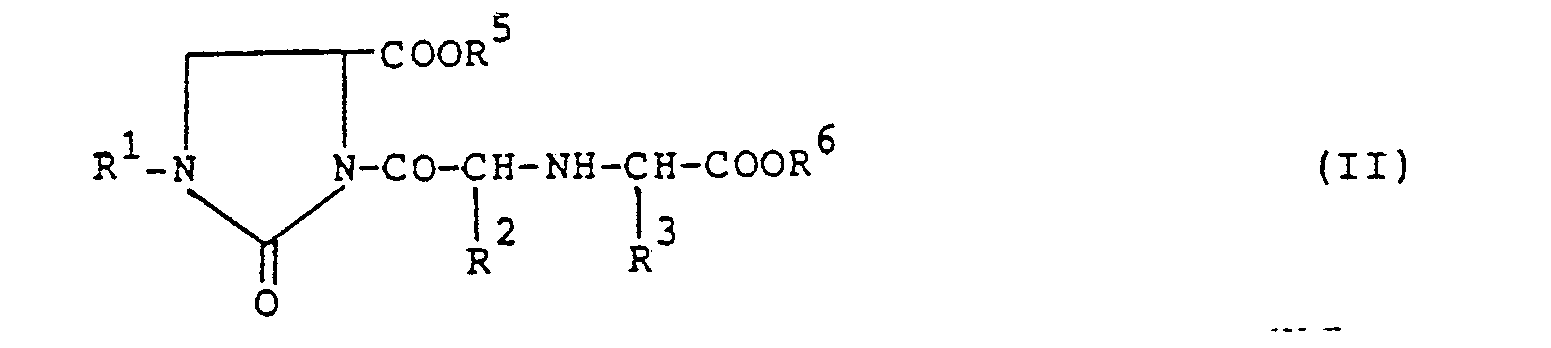


Applications Claiming Priority (2)
| Application Number | Priority Date | Filing Date | Title |
|---|---|---|---|
| JP88637/82 | 1982-05-24 | ||
| JP57088637A JPS6058233B2 (en) | 1982-05-24 | 1982-05-24 | 2-oxoimidazolidine derivative and its production method |
Publications (3)
| Publication Number | Publication Date |
|---|---|
| EP0095163A2 EP0095163A2 (en) | 1983-11-30 |
| EP0095163A3 EP0095163A3 (en) | 1984-09-12 |
| EP0095163B1 true EP0095163B1 (en) | 1987-08-19 |
Family
ID=13948325
Family Applications (1)
| Application Number | Title | Priority Date | Filing Date |
|---|---|---|---|
| EP83105024A Expired EP0095163B1 (en) | 1982-05-24 | 1983-05-20 | 2-oxo-imidazolidine compounds, a process for preparing the same and a pharmaceutical composition |
Country Status (8)
| Country | Link |
|---|---|
| US (1) | US4508727A (en) |
| EP (1) | EP0095163B1 (en) |
| JP (1) | JPS6058233B2 (en) |
| DE (2) | DE19975013I1 (en) |
| ES (2) | ES522678A0 (en) |
| HK (1) | HK32689A (en) |
| MY (1) | MY100095A (en) |
| SG (1) | SG5989G (en) |
Families Citing this family (21)
| Publication number | Priority date | Publication date | Assignee | Title |
|---|---|---|---|---|
| JPS61293538A (en) * | 1985-06-24 | 1986-12-24 | Shinto Paint Co Ltd | Dissolving method for solid or semisolid solute by solvent |
| KR930004646B1 (en) * | 1986-12-09 | 1993-06-02 | 다나베 세이야꾸 가부시끼가이샤 | Pharmaceutical composition for prophylaxis and treatment of cardiac hypertrophy |
| US4804672A (en) * | 1986-12-12 | 1989-02-14 | Tanabe Seiyaku Co., Ltd. | 2-oxo-imidazolidine derivatives as agents for treatment of kidney diseases |
| FR2620700B1 (en) * | 1987-09-17 | 1990-06-01 | Adir | PROCESS FOR THE SYNTHESIS OF ALPHA AMINO ACIDS N ALKYLS AND THEIR ESTERS. APPLICATION TO THE SYNTHESIS OF CARBOXYALKYL DIPEPTIDES |
| JPH0645603B2 (en) * | 1988-12-16 | 1994-06-15 | 田辺製薬株式会社 | Process for producing optically active 2-oxoimidazolidine derivative |
| JPH07121916B2 (en) * | 1993-12-10 | 1995-12-25 | 田辺製薬株式会社 | Optically active 3-acyl-2-oxoimidazolidine-4-carboxylic acid derivative and process for producing the same |
| EP1545519B1 (en) | 2002-08-19 | 2011-03-23 | Pfizer Inc. | Combination therapy for hyperproliferative diseases |
| CL2004000366A1 (en) * | 2003-02-26 | 2005-01-07 | Pharmacia Corp Sa Organizada B | USE OF A COMBINATION OF A QUINASA P38 INHIBITING DERIVED COMPOUND OF PIRAZOL, AND AN ACE INHIBITOR TO TREAT RENAL DYSFUNCTION, CARDIOVASCULAR AND VASCULAR DISEASE, RETINOPATHY, NEUROPATIA, EDOTEL, INSOTUNATIO OPINION. |
| US20050037063A1 (en) * | 2003-07-21 | 2005-02-17 | Bolton Anthony E. | Combined therapies |
| JP4780437B2 (en) * | 2004-12-08 | 2011-09-28 | 大原薬品工業株式会社 | Process for producing 2-oxoimidazolidine derivatives |
| JP4799085B2 (en) * | 2005-09-02 | 2011-10-19 | 株式会社カネカ | Process for producing optically active N-substituted aminoacyl cyclic urea derivative |
| US7741317B2 (en) | 2005-10-21 | 2010-06-22 | Bristol-Myers Squibb Company | LXR modulators |
| US7888376B2 (en) | 2005-11-23 | 2011-02-15 | Bristol-Myers Squibb Company | Heterocyclic CETP inhibitors |
| JP5498168B2 (en) | 2006-12-01 | 2014-05-21 | ブリストル−マイヤーズ スクイブ カンパニー | N-((3-Benzyl) -2,2- (bis-phenyl) -propan-1-amine derivatives as CETP inhibitors for the treatment of atherosclerosis and cardiovascular disease |
| JP5206926B2 (en) * | 2007-07-30 | 2013-06-12 | 株式会社Dnpファインケミカル宇都宮 | Method for producing imidapril hydrochloride |
| US9446032B2 (en) | 2011-08-26 | 2016-09-20 | Wockhardt Limited | Methods for treating cardiovascular disorders |
| SG11201507496UA (en) | 2013-04-17 | 2015-11-27 | Pfizer | N-piperidin-3-ylbenzamide derivatives for treating cardiovascular diseases |
| CN104119424B (en) * | 2014-07-01 | 2018-12-18 | 上海天慈生物谷生物工程有限公司 | The preparation method of (4S) -3- [(2S) -2 [(1S) -1- ethoxycarbonyl-3-phenylpropyl] aminopropionyl] -1- methyl -2- oxoimidazolinium -4- carboxylic acid |
| WO2016055901A1 (en) | 2014-10-08 | 2016-04-14 | Pfizer Inc. | Substituted amide compounds |
| CN105713068B (en) * | 2014-12-04 | 2021-04-20 | 湖南九典制药股份有限公司 | A kind of method for preparing key intermediate of imidapril and derivative thereof |
| US11248001B2 (en) | 2019-01-18 | 2022-02-15 | Astrazeneca Ab | PCSK9 inhibitors and methods of use thereof |
Family Cites Families (5)
| Publication number | Priority date | Publication date | Assignee | Title |
|---|---|---|---|---|
| IL58849A (en) * | 1978-12-11 | 1983-03-31 | Merck & Co Inc | Carboxyalkyl dipeptides and derivatives thereof,their preparation and pharmaceutical compositions containing them |
| EP0048159A3 (en) * | 1980-09-17 | 1982-05-12 | University Of Miami | Novel carboxyalkyl peptides and thioethers and ethers of peptides as antihypertensive agents |
| US4296110A (en) * | 1980-10-28 | 1981-10-20 | E. I. Du Pont De Nemours And Company | Antihypertensive I-substituted cyclic lactam-2-carboxylic acids |
| JPS5788165A (en) * | 1980-11-21 | 1982-06-01 | Tanabe Seiyaku Co Ltd | 2-oxoimidazolidine-4-carboxylic acid derivative and its preparation |
| JPS5835114A (en) * | 1981-08-21 | 1983-03-01 | ザ・ユニバ−シイテイ・オブ・マイアミ | Antihypertensive |
-
1982
- 1982-05-24 JP JP57088637A patent/JPS6058233B2/en not_active Expired
-
1983
- 1983-05-20 DE DE1999175013 patent/DE19975013I1/en active Pending
- 1983-05-20 DE DE8383105024T patent/DE3373100D1/en not_active Expired
- 1983-05-20 EP EP83105024A patent/EP0095163B1/en not_active Expired
- 1983-05-24 US US06/496,877 patent/US4508727A/en not_active Expired - Lifetime
- 1983-05-24 ES ES522678A patent/ES522678A0/en active Granted
-
1984
- 1984-09-17 ES ES535980A patent/ES8603427A1/en not_active Expired
-
1987
- 1987-06-09 MY MYPI87000783A patent/MY100095A/en unknown
-
1989
- 1989-02-03 SG SG59/89A patent/SG5989G/en unknown
- 1989-04-20 HK HK326/89A patent/HK32689A/en not_active IP Right Cessation
Also Published As
| Publication number | Publication date |
|---|---|
| MY100095A (en) | 1989-10-10 |
| HK32689A (en) | 1989-04-28 |
| SG5989G (en) | 1989-06-09 |
| US4508727A (en) | 1985-04-02 |
| DE19975013I1 (en) | 2003-09-04 |
| DE3373100D1 (en) | 1987-09-24 |
| EP0095163A3 (en) | 1984-09-12 |
| JPS58203971A (en) | 1983-11-28 |
| ES535980A0 (en) | 1985-12-16 |
| ES8503667A1 (en) | 1985-03-16 |
| ES522678A0 (en) | 1985-03-16 |
| ES8603427A1 (en) | 1985-12-16 |
| JPS6058233B2 (en) | 1985-12-19 |
| EP0095163A2 (en) | 1983-11-30 |
Similar Documents
| Publication | Publication Date | Title |
|---|---|---|
| US4508727A (en) | Antihypertensive 2-oxo-imidazolidine derivatives | |
| US4294832A (en) | Tetrahydroisoquinoline compounds and a pharmaceutical composition thereof | |
| EP0012845B1 (en) | Tetrahydroisoquinoline compounds, process for preparing same and pharmaceutical compositions containing them | |
| EP0595610B1 (en) | Benzo-fused lactams | |
| KR890003603B1 (en) | Process for preparing renin inhibitors containing 5-amino-2,5-disubstituted-4-hydroxypentanoic acid residues | |
| EP0711280B1 (en) | Perhydroisoindole derivatives as p substance antagonists | |
| US4562202A (en) | N-Acyl hexahydroindole-2-carboxylic acids and anti-hypertensive use thereof | |
| EP0643072B1 (en) | 2-Piperazinone compounds and their use | |
| KR100311166B1 (en) | Novel mercaptoacetylamide bicyclic lactam derivatives and preparation method thereof | |
| FI76555B (en) | FOR EXAMINATION OF THERAPEUTIC ACID THERAPEUTIC ANVAENDBARA 2- (2-BENZYL-3-MERCAPTOPROPIONYLAMINO) -1-ALKANOL OR 2- (2-BENZYL-3-MERCAPTOPROPIONYLAMINO) -4-METHYLTERIO-SMYL | |
| JPH0841061A (en) | 2- (2-Amino-1,6-dihydro-6-oxo-purin-9-yl) methoxy-1,3-propanediol derivative | |
| US4757069A (en) | Pyridazodiazepine derivatives | |
| EP0068173B1 (en) | Perhydro-1,4-thiazepin-5-one and perhydro-1,4-thiazocin-5-one derivatives, process for preparing and pharmceutical composition containing the same | |
| EP0728746B1 (en) | Azepinone compounds useful in the inhibition of ACE and NEP | |
| DE69610145T2 (en) | Benzo-condensed azepinone and piperidinone compounds, useful as ACE and NEP inhibitors | |
| EP0061684A1 (en) | Urea compounds as antihypertensives | |
| RO104347B1 (en) | Production method of amids acids cyclomethylen - 1,2 - dicarboxylic | |
| US4380644A (en) | 2-Oxoimidazolidine derivatives | |
| US4400511A (en) | 2-Substituted octahydropyrrolo(1,2-A)-pyrazine-3-carboxylic acids | |
| EP0059966B1 (en) | Substituted thiazolidine carboxylic acid analogs and derivatives as antihypertensives | |
| JPS6115874A (en) | Benzene ring-condensed lactam useful as antihypertensive andcholecystokinin antagonist | |
| EP0682023B1 (en) | Imidazopyridine derivatives and process for preparing the same | |
| EP0156455A2 (en) | Condensed seven-membered ring compounds, their production and use | |
| MXPA04006937A (en) | Intermediates for preparing glycogen phosphorylase inhibitors. | |
| KR100277094B1 (en) | Pyrimidine Nucleoside Derivatives |
Legal Events
| Date | Code | Title | Description |
|---|---|---|---|
| PUAI | Public reference made under article 153(3) epc to a published international application that has entered the european phase |
Free format text: ORIGINAL CODE: 0009012 |
|
| AK | Designated contracting states |
Designated state(s): BE CH DE FR GB IT LI |
|
| PUAL | Search report despatched |
Free format text: ORIGINAL CODE: 0009013 |
|
| AK | Designated contracting states |
Designated state(s): BE CH DE FR GB IT LI |
|
| 17P | Request for examination filed |
Effective date: 19841123 |
|
| 17Q | First examination report despatched |
Effective date: 19860422 |
|
| GRAA | (expected) grant |
Free format text: ORIGINAL CODE: 0009210 |
|
| AK | Designated contracting states |
Kind code of ref document: B1 Designated state(s): BE CH DE FR GB IT LI |
|
| REF | Corresponds to: |
Ref document number: 3373100 Country of ref document: DE Date of ref document: 19870924 |
|
| ET | Fr: translation filed | ||
| ITF | It: translation for a ep patent filed | ||
| PLBE | No opposition filed within time limit |
Free format text: ORIGINAL CODE: 0009261 |
|
| STAA | Information on the status of an ep patent application or granted ep patent |
Free format text: STATUS: NO OPPOSITION FILED WITHIN TIME LIMIT |
|
| 26N | No opposition filed | ||
| REG | Reference to a national code |
Ref country code: CH Ref legal event code: PFA Free format text: TANABE SEIYAKU CO., LTD |
|
| ITTA | It: last paid annual fee | ||
| REG | Reference to a national code |
Ref country code: GB Ref legal event code: CTFF Free format text: GBCTFFSPC/GB98/001, 19980106 |
|
| REG | Reference to a national code |
Ref country code: GB Ref legal event code: CTFG Free format text: GBCTFGSPC/GB98/001, 19980901, EXPIRES: 20080519 |
|
| REG | Reference to a national code |
Ref country code: FR Ref legal event code: CP Free format text: PRODUCT NAME: CHLORYDRATE D IMIDAPRIL; NAT. REGISTRATION NO/DATE: NL23787 19980928; FIRST REGISTRATION: GB - PL116480026 19971112 Spc suppl protection certif: 99C0011 Filing date: 19990309 |
|
| REG | Reference to a national code |
Ref country code: FR Ref legal event code: CR Free format text: FRCR 99C0011, 19990309 |
|
| REG | Reference to a national code |
Ref country code: FR Ref legal event code: CY Free format text: FRCY 99C0011, 990309, EXPIRES: 20080519 |
|
| REG | Reference to a national code |
Ref country code: FR Ref legal event code: CP |
|
| CCPV | Be: grant of a complementary protection certificate |
Free format text: 2000C/025, EXPIRES: 20080520 |
|
| REG | Reference to a national code |
Ref country code: GB Ref legal event code: IF02 |
|
| PGFP | Annual fee paid to national office [announced via postgrant information from national office to epo] |
Ref country code: FR Payment date: 20020417 Year of fee payment: 20 |
|
| PGFP | Annual fee paid to national office [announced via postgrant information from national office to epo] |
Ref country code: GB Payment date: 20020419 Year of fee payment: 20 |
|
| PGFP | Annual fee paid to national office [announced via postgrant information from national office to epo] |
Ref country code: CH Payment date: 20020514 Year of fee payment: 20 |
|
| PGFP | Annual fee paid to national office [announced via postgrant information from national office to epo] |
Ref country code: BE Payment date: 20020524 Year of fee payment: 20 |
|
| PGFP | Annual fee paid to national office [announced via postgrant information from national office to epo] |
Ref country code: DE Payment date: 20020529 Year of fee payment: 20 |
|
| PG25 | Lapsed in a contracting state [announced via postgrant information from national office to epo] |
Ref country code: LI Free format text: LAPSE BECAUSE OF EXPIRATION OF PROTECTION Effective date: 20030519 Ref country code: GB Free format text: LAPSE BECAUSE OF EXPIRATION OF PROTECTION Effective date: 20030519 Ref country code: CH Free format text: LAPSE BECAUSE OF EXPIRATION OF PROTECTION Effective date: 20030519 |
|
| BE20 | Be: patent expired |
Owner name: *TANABE SEIYAKU CO., LTD Effective date: 20030520 |
|
| REG | Reference to a national code |
Ref country code: GB Ref legal event code: PE20 |
|
| REG | Reference to a national code |
Ref country code: CH Ref legal event code: PL |
|
| REG | Reference to a national code |
Ref country code: GB Ref legal event code: CTFE Spc suppl protection certif: SPC/GB98/001 Filing date: 20030525 Expiry date: 20080519 |
|
| REG | Reference to a national code |
Ref country code: BE Ref legal event code: CCRE Free format text: PRODUCT NAME: CHLORHYDRATE D'IMIDAPRIL (EQUIVALENT A IMIDAPRIL BASE); NAT. REGISTRATION NO/DATE: 914 IS 237 F3 20000508; FIRST REGISTRTION: GB 116 48/00 30 19971112 Spc suppl protection certif: 2000C/025 Filing date: 20001025 Expiry date: 20030520 Extension date: 20080520 |
|
| REG | Reference to a national code |
Ref country code: GB Ref legal event code: SPCE Spc suppl protection certif: SPC/GB98/001 Filing date: 19980106 Expiry date: 20030525 Extension date: 20080519 |