EP0091305B1 - Method for producing vicinal, heterogeneous dihalogenated products, their use, and novel products - Google Patents
Method for producing vicinal, heterogeneous dihalogenated products, their use, and novel products Download PDFInfo
- Publication number
- EP0091305B1 EP0091305B1 EP83301882A EP83301882A EP0091305B1 EP 0091305 B1 EP0091305 B1 EP 0091305B1 EP 83301882 A EP83301882 A EP 83301882A EP 83301882 A EP83301882 A EP 83301882A EP 0091305 B1 EP0091305 B1 EP 0091305B1
- Authority
- EP
- European Patent Office
- Prior art keywords
- mass
- ion
- ions
- products
- intensity
- Prior art date
- Legal status (The legal status is an assumption and is not a legal conclusion. Google has not performed a legal analysis and makes no representation as to the accuracy of the status listed.)
- Expired
Links
- 238000004519 manufacturing process Methods 0.000 title claims abstract description 11
- 238000000034 method Methods 0.000 claims abstract description 54
- -1 halide ions Chemical class 0.000 claims abstract description 38
- 150000001336 alkenes Chemical class 0.000 claims abstract description 32
- 150000001345 alkine derivatives Chemical class 0.000 claims abstract description 28
- 239000007800 oxidant agent Substances 0.000 claims abstract description 8
- 239000000047 product Substances 0.000 claims description 116
- 238000006243 chemical reaction Methods 0.000 claims description 33
- MHAJPDPJQMAIIY-UHFFFAOYSA-N Hydrogen peroxide Chemical group OO MHAJPDPJQMAIIY-UHFFFAOYSA-N 0.000 claims description 22
- 239000000126 substance Substances 0.000 claims description 18
- VEXZGXHMUGYJMC-UHFFFAOYSA-M Chloride anion Chemical compound [Cl-] VEXZGXHMUGYJMC-UHFFFAOYSA-M 0.000 claims description 17
- CPELXLSAUQHCOX-UHFFFAOYSA-M Bromide Chemical compound [Br-] CPELXLSAUQHCOX-UHFFFAOYSA-M 0.000 claims description 13
- 229910001868 water Inorganic materials 0.000 claims description 12
- XLYOFNOQVPJJNP-UHFFFAOYSA-N water Substances O XLYOFNOQVPJJNP-UHFFFAOYSA-N 0.000 claims description 11
- WKBOTKDWSSQWDR-UHFFFAOYSA-N Bromine atom Chemical compound [Br] WKBOTKDWSSQWDR-UHFFFAOYSA-N 0.000 claims description 9
- KRHYYFGTRYWZRS-UHFFFAOYSA-M Fluoride anion Chemical compound [F-] KRHYYFGTRYWZRS-UHFFFAOYSA-M 0.000 claims description 9
- XXROGKLTLUQVRX-UHFFFAOYSA-N allyl alcohol Chemical compound OCC=C XXROGKLTLUQVRX-UHFFFAOYSA-N 0.000 claims description 8
- 150000001875 compounds Chemical class 0.000 claims description 6
- GYHXZJZEMRNWEK-UHFFFAOYSA-N 2-bromo-3-chlorobutane-1,4-diol Chemical compound OCC(Cl)C(Br)CO GYHXZJZEMRNWEK-UHFFFAOYSA-N 0.000 claims description 5
- 108010023244 Lactoperoxidase Proteins 0.000 claims description 5
- 102000045576 Lactoperoxidases Human genes 0.000 claims description 5
- 241000222118 Leptoxyphium fumago Species 0.000 claims description 5
- 229940057428 lactoperoxidase Drugs 0.000 claims description 5
- 244000005700 microbiome Species 0.000 claims description 5
- ORTVZLZNOYNASJ-UPHRSURJSA-N (z)-but-2-ene-1,4-diol Chemical compound OC\C=C/CO ORTVZLZNOYNASJ-UPHRSURJSA-N 0.000 claims description 4
- VGGSQFUCUMXWEO-UHFFFAOYSA-N Ethene Chemical compound C=C VGGSQFUCUMXWEO-UHFFFAOYSA-N 0.000 claims description 4
- 238000011065 in-situ storage Methods 0.000 claims description 4
- 229910052740 iodine Inorganic materials 0.000 claims description 4
- ZCYVEMRRCGMTRW-UHFFFAOYSA-N 7553-56-2 Chemical compound [I] ZCYVEMRRCGMTRW-UHFFFAOYSA-N 0.000 claims description 3
- 235000011330 Armoracia rusticana Nutrition 0.000 claims description 3
- 240000003291 Armoracia rusticana Species 0.000 claims description 3
- 239000005977 Ethylene Substances 0.000 claims description 3
- 108010001336 Horseradish Peroxidase Proteins 0.000 claims description 3
- DGAQECJNVWCQMB-PUAWFVPOSA-M Ilexoside XXIX Chemical class C[C@@H]1CC[C@@]2(CC[C@@]3(C(=CC[C@H]4[C@]3(CC[C@@H]5[C@@]4(CC[C@@H](C5(C)C)OS(=O)(=O)[O-])C)C)[C@@H]2[C@]1(C)O)C)C(=O)O[C@H]6[C@@H]([C@H]([C@@H]([C@H](O6)CO)O)O)O.[Na+] DGAQECJNVWCQMB-PUAWFVPOSA-M 0.000 claims description 3
- 238000006251 dihalogenation reaction Methods 0.000 claims description 3
- 229910052731 fluorine Inorganic materials 0.000 claims description 3
- 239000011737 fluorine Substances 0.000 claims description 3
- 238000010348 incorporation Methods 0.000 claims description 3
- 239000011630 iodine Substances 0.000 claims description 3
- 239000003507 refrigerant Substances 0.000 claims description 3
- 239000002904 solvent Substances 0.000 claims description 3
- OSDWBNJEKMUWAV-UHFFFAOYSA-N Allyl chloride Chemical compound ClCC=C OSDWBNJEKMUWAV-UHFFFAOYSA-N 0.000 claims description 2
- 241000195493 Cryptophyta Species 0.000 claims description 2
- VEXZGXHMUGYJMC-UHFFFAOYSA-N Hydrochloric acid Chemical compound Cl VEXZGXHMUGYJMC-UHFFFAOYSA-N 0.000 claims description 2
- WHXSMMKQMYFTQS-UHFFFAOYSA-N Lithium Chemical class [Li] WHXSMMKQMYFTQS-UHFFFAOYSA-N 0.000 claims description 2
- ZLMJMSJWJFRBEC-UHFFFAOYSA-N Potassium Chemical class [K] ZLMJMSJWJFRBEC-UHFFFAOYSA-N 0.000 claims description 2
- 229910052794 bromium Inorganic materials 0.000 claims description 2
- DLDJFQGPPSQZKI-UHFFFAOYSA-N but-2-yne-1,4-diol Chemical compound OCC#CCO DLDJFQGPPSQZKI-UHFFFAOYSA-N 0.000 claims description 2
- 239000003795 chemical substances by application Substances 0.000 claims description 2
- 239000002316 fumigant Substances 0.000 claims description 2
- 150000004694 iodide salts Chemical class 0.000 claims description 2
- 210000000265 leukocyte Anatomy 0.000 claims description 2
- 229910052744 lithium Chemical class 0.000 claims description 2
- 210000004080 milk Anatomy 0.000 claims description 2
- 239000008267 milk Substances 0.000 claims description 2
- 235000013336 milk Nutrition 0.000 claims description 2
- 230000000361 pesticidal effect Effects 0.000 claims description 2
- 229910052700 potassium Inorganic materials 0.000 claims description 2
- 239000011591 potassium Chemical class 0.000 claims description 2
- 239000013535 sea water Substances 0.000 claims description 2
- 229910052708 sodium Inorganic materials 0.000 claims description 2
- 239000011734 sodium Substances 0.000 claims description 2
- 239000006283 soil fumigant Substances 0.000 claims description 2
- 210000001685 thyroid gland Anatomy 0.000 claims description 2
- 150000002118 epoxides Chemical class 0.000 claims 2
- RNFJDJUURJAICM-UHFFFAOYSA-N 2,2,4,4,6,6-hexaphenoxy-1,3,5-triaza-2$l^{5},4$l^{5},6$l^{5}-triphosphacyclohexa-1,3,5-triene Chemical compound N=1P(OC=2C=CC=CC=2)(OC=2C=CC=CC=2)=NP(OC=2C=CC=CC=2)(OC=2C=CC=CC=2)=NP=1(OC=1C=CC=CC=1)OC1=CC=CC=C1 RNFJDJUURJAICM-UHFFFAOYSA-N 0.000 claims 1
- PXGOKWXKJXAPGV-UHFFFAOYSA-N Fluorine Chemical compound FF PXGOKWXKJXAPGV-UHFFFAOYSA-N 0.000 claims 1
- GDTBXPJZTBHREO-UHFFFAOYSA-N bromine Substances BrBr GDTBXPJZTBHREO-UHFFFAOYSA-N 0.000 claims 1
- AXCZMVOFGPJBDE-UHFFFAOYSA-L calcium dihydroxide Chemical compound [OH-].[OH-].[Ca+2] AXCZMVOFGPJBDE-UHFFFAOYSA-L 0.000 claims 1
- 229910001861 calcium hydroxide Inorganic materials 0.000 claims 1
- 235000011116 calcium hydroxide Nutrition 0.000 claims 1
- 239000000920 calcium hydroxide Substances 0.000 claims 1
- 239000007795 chemical reaction product Substances 0.000 claims 1
- 108010017796 epoxidase Proteins 0.000 claims 1
- 239000003063 flame retardant Substances 0.000 claims 1
- 150000003944 halohydrins Chemical class 0.000 claims 1
- 102000004190 Enzymes Human genes 0.000 abstract description 16
- 108090000790 Enzymes Proteins 0.000 abstract description 16
- 239000003153 chemical reaction reagent Substances 0.000 abstract description 4
- 230000002140 halogenating effect Effects 0.000 abstract description 4
- 238000006911 enzymatic reaction Methods 0.000 abstract description 3
- CDQSJQSWAWPGKG-UHFFFAOYSA-N butane-1,1-diol Chemical class CCCC(O)O CDQSJQSWAWPGKG-UHFFFAOYSA-N 0.000 abstract 1
- BDERNNFJNOPAEC-UHFFFAOYSA-N propan-1-ol Chemical compound CCCO BDERNNFJNOPAEC-UHFFFAOYSA-N 0.000 abstract 1
- 150000002500 ions Chemical class 0.000 description 114
- 150000001793 charged compounds Chemical class 0.000 description 71
- 238000004817 gas chromatography Methods 0.000 description 53
- 230000014759 maintenance of location Effects 0.000 description 50
- 239000012634 fragment Substances 0.000 description 38
- 238000001819 mass spectrum Methods 0.000 description 38
- 230000008569 process Effects 0.000 description 20
- 238000002290 gas chromatography-mass spectrometry Methods 0.000 description 19
- 108010035722 Chloride peroxidase Proteins 0.000 description 17
- 239000011541 reaction mixture Substances 0.000 description 17
- 229940088598 enzyme Drugs 0.000 description 15
- 125000001309 chloro group Chemical group Cl* 0.000 description 13
- 229910052801 chlorine Inorganic materials 0.000 description 12
- IOLCXVTUBQKXJR-UHFFFAOYSA-M potassium bromide Chemical compound [K+].[Br-] IOLCXVTUBQKXJR-UHFFFAOYSA-M 0.000 description 10
- NLKNQRATVPKPDG-UHFFFAOYSA-M potassium iodide Chemical compound [K+].[I-] NLKNQRATVPKPDG-UHFFFAOYSA-M 0.000 description 9
- LFQSCWFLJHTTHZ-UHFFFAOYSA-N Ethanol Chemical compound CCO LFQSCWFLJHTTHZ-UHFFFAOYSA-N 0.000 description 8
- 238000004458 analytical method Methods 0.000 description 8
- 239000000203 mixture Substances 0.000 description 8
- AOJDZKCUAATBGE-UHFFFAOYSA-N bromomethane Chemical compound Br[CH2] AOJDZKCUAATBGE-UHFFFAOYSA-N 0.000 description 7
- 238000002347 injection Methods 0.000 description 7
- 239000007924 injection Substances 0.000 description 7
- BRLQWZUYTZBJKN-UHFFFAOYSA-N Epichlorohydrin Chemical compound ClCC1CO1 BRLQWZUYTZBJKN-UHFFFAOYSA-N 0.000 description 6
- WCUXLLCKKVVCTQ-UHFFFAOYSA-M Potassium chloride Chemical compound [Cl-].[K+] WCUXLLCKKVVCTQ-UHFFFAOYSA-M 0.000 description 6
- HEMHJVSKTPXQMS-UHFFFAOYSA-M Sodium hydroxide Chemical compound [OH-].[Na+] HEMHJVSKTPXQMS-UHFFFAOYSA-M 0.000 description 6
- 229940006460 bromide ion Drugs 0.000 description 6
- 239000012153 distilled water Substances 0.000 description 6
- 239000001307 helium Substances 0.000 description 6
- 229910052734 helium Inorganic materials 0.000 description 6
- SWQJXJOGLNCZEY-UHFFFAOYSA-N helium atom Chemical compound [He] SWQJXJOGLNCZEY-UHFFFAOYSA-N 0.000 description 6
- 239000000243 solution Substances 0.000 description 6
- GKCVODKDNAKHIA-UHFFFAOYSA-N 1-bromo-1-chloropropan-1-ol Chemical compound CCC(O)(Cl)Br GKCVODKDNAKHIA-UHFFFAOYSA-N 0.000 description 5
- WQZGKKKJIJFFOK-GASJEMHNSA-N Glucose Natural products OC[C@H]1OC(O)[C@H](O)[C@@H](O)[C@@H]1O WQZGKKKJIJFFOK-GASJEMHNSA-N 0.000 description 5
- 229910052736 halogen Inorganic materials 0.000 description 5
- XMBWDFGMSWQBCA-UHFFFAOYSA-M iodide Chemical compound [I-] XMBWDFGMSWQBCA-UHFFFAOYSA-M 0.000 description 5
- 229940006461 iodide ion Drugs 0.000 description 5
- PNDPGZBMCMUPRI-UHFFFAOYSA-N iodine Chemical compound II PNDPGZBMCMUPRI-UHFFFAOYSA-N 0.000 description 5
- 229920000642 polymer Polymers 0.000 description 5
- IBYHHJPAARCAIE-UHFFFAOYSA-N 1-bromo-2-chloroethane Chemical compound ClCCBr IBYHHJPAARCAIE-UHFFFAOYSA-N 0.000 description 4
- CABFGDAZBRMVBA-UHFFFAOYSA-N 1-chloro-1-iodopropan-1-ol Chemical compound CCC(O)(Cl)I CABFGDAZBRMVBA-UHFFFAOYSA-N 0.000 description 4
- ZXCYIJGIGSDJQQ-UHFFFAOYSA-N 2,3-dichloropropan-1-ol Chemical compound OCC(Cl)CCl ZXCYIJGIGSDJQQ-UHFFFAOYSA-N 0.000 description 4
- FVBQMFMFJMTVNH-UHFFFAOYSA-N 2-fluoro-3-iodopropan-1-ol Chemical compound OCC(F)CI FVBQMFMFJMTVNH-UHFFFAOYSA-N 0.000 description 4
- LJLIUTYYJCIZLT-UHFFFAOYSA-N 3-fluoro-2-iodopropan-1-ol Chemical compound OCC(I)CF LJLIUTYYJCIZLT-UHFFFAOYSA-N 0.000 description 4
- 235000008733 Citrus aurantifolia Nutrition 0.000 description 4
- RTZKZFJDLAIYFH-UHFFFAOYSA-N Diethyl ether Chemical compound CCOCC RTZKZFJDLAIYFH-UHFFFAOYSA-N 0.000 description 4
- FAPWRFPIFSIZLT-UHFFFAOYSA-M Sodium chloride Chemical compound [Na+].[Cl-] FAPWRFPIFSIZLT-UHFFFAOYSA-M 0.000 description 4
- 235000011941 Tilia x europaea Nutrition 0.000 description 4
- 125000001246 bromo group Chemical group Br* 0.000 description 4
- 239000000872 buffer Substances 0.000 description 4
- WBLIXGSTEMXDSM-UHFFFAOYSA-N chloromethane Chemical compound Cl[CH2] WBLIXGSTEMXDSM-UHFFFAOYSA-N 0.000 description 4
- 230000000694 effects Effects 0.000 description 4
- 230000002255 enzymatic effect Effects 0.000 description 4
- 239000011521 glass Substances 0.000 description 4
- 150000002367 halogens Chemical class 0.000 description 4
- 239000004571 lime Substances 0.000 description 4
- 230000003068 static effect Effects 0.000 description 4
- AGIBHMPYXXPGAX-UHFFFAOYSA-N 2-(iodomethyl)oxirane Chemical compound ICC1CO1 AGIBHMPYXXPGAX-UHFFFAOYSA-N 0.000 description 3
- WQTCNBWIWNNMFO-UHFFFAOYSA-N 2-bromo-3-chloropropan-1-ol Chemical compound OCC(Br)CCl WQTCNBWIWNNMFO-UHFFFAOYSA-N 0.000 description 3
- 229920001817 Agar Polymers 0.000 description 3
- PEDCQBHIVMGVHV-UHFFFAOYSA-N Glycerine Chemical compound OCC(O)CO PEDCQBHIVMGVHV-UHFFFAOYSA-N 0.000 description 3
- CPELXLSAUQHCOX-UHFFFAOYSA-N Hydrogen bromide Chemical compound Br CPELXLSAUQHCOX-UHFFFAOYSA-N 0.000 description 3
- KFZMGEQAYNKOFK-UHFFFAOYSA-N Isopropanol Chemical compound CC(C)O KFZMGEQAYNKOFK-UHFFFAOYSA-N 0.000 description 3
- OKKJLVBELUTLKV-UHFFFAOYSA-N Methanol Chemical compound OC OKKJLVBELUTLKV-UHFFFAOYSA-N 0.000 description 3
- 101100450563 Mus musculus Serpind1 gene Proteins 0.000 description 3
- ZMXDDKWLCZADIW-UHFFFAOYSA-N N,N-Dimethylformamide Chemical compound CN(C)C=O ZMXDDKWLCZADIW-UHFFFAOYSA-N 0.000 description 3
- VYPSYNLAJGMNEJ-UHFFFAOYSA-N Silicium dioxide Chemical compound O=[Si]=O VYPSYNLAJGMNEJ-UHFFFAOYSA-N 0.000 description 3
- 235000002595 Solanum tuberosum Nutrition 0.000 description 3
- 244000061456 Solanum tuberosum Species 0.000 description 3
- 239000008272 agar Substances 0.000 description 3
- 229910052799 carbon Inorganic materials 0.000 description 3
- 238000009903 catalytic hydrogenation reaction Methods 0.000 description 3
- 210000004027 cell Anatomy 0.000 description 3
- 125000004122 cyclic group Chemical group 0.000 description 3
- GKIPXFAANLTWBM-UHFFFAOYSA-N epibromohydrin Chemical compound BrCC1CO1 GKIPXFAANLTWBM-UHFFFAOYSA-N 0.000 description 3
- 239000008103 glucose Substances 0.000 description 3
- 150000004820 halides Chemical class 0.000 description 3
- 125000005843 halogen group Chemical group 0.000 description 3
- 239000001257 hydrogen Substances 0.000 description 3
- 229910052739 hydrogen Inorganic materials 0.000 description 3
- 239000002609 medium Substances 0.000 description 3
- 230000003647 oxidation Effects 0.000 description 3
- 238000007254 oxidation reaction Methods 0.000 description 3
- 239000001103 potassium chloride Substances 0.000 description 3
- 235000011164 potassium chloride Nutrition 0.000 description 3
- WSLDOOZREJYCGB-UHFFFAOYSA-N 1,2-Dichloroethane Chemical compound ClCCCl WSLDOOZREJYCGB-UHFFFAOYSA-N 0.000 description 2
- PAAZPARNPHGIKF-UHFFFAOYSA-N 1,2-dibromoethane Chemical compound BrCCBr PAAZPARNPHGIKF-UHFFFAOYSA-N 0.000 description 2
- HUXDTFZDCPYTCF-UHFFFAOYSA-N 1-chloropropane-1,1-diol Chemical class CCC(O)(O)Cl HUXDTFZDCPYTCF-UHFFFAOYSA-N 0.000 description 2
- FSTQRRAQHOOEQL-UHFFFAOYSA-N 1-iodopropane-1,1-diol Chemical class CCC(O)(O)I FSTQRRAQHOOEQL-UHFFFAOYSA-N 0.000 description 2
- QWVCIORZLNBIIC-UHFFFAOYSA-N 2,3-dibromopropan-1-ol Chemical compound OCC(Br)CBr QWVCIORZLNBIIC-UHFFFAOYSA-N 0.000 description 2
- YAEIGIBCYKSALO-UHFFFAOYSA-N 2,3-diiodopropan-1-ol Chemical compound OCC(I)CI YAEIGIBCYKSALO-UHFFFAOYSA-N 0.000 description 2
- YUSQMINRWVELMY-UHFFFAOYSA-N 2-chloro-3-iodopropan-1-ol Chemical compound OCC(Cl)CI YUSQMINRWVELMY-UHFFFAOYSA-N 0.000 description 2
- VOBIHUAWDXUCPH-UHFFFAOYSA-N 2-chloro-5,5-dimethylcyclohexane-1,3-dione Chemical compound CC1(C)CC(=O)C(Cl)C(=O)C1 VOBIHUAWDXUCPH-UHFFFAOYSA-N 0.000 description 2
- DYPJJAAKPQKWTM-UHFFFAOYSA-N 2-chloropropane-1,3-diol Chemical compound OCC(Cl)CO DYPJJAAKPQKWTM-UHFFFAOYSA-N 0.000 description 2
- UQTRRWUQXIOVPL-UHFFFAOYSA-N 2-iodopropane-1,3-diol Chemical compound OCC(I)CO UQTRRWUQXIOVPL-UHFFFAOYSA-N 0.000 description 2
- TWADJGWUKGOPFG-UHFFFAOYSA-N 2-methoxy-5-methyl-1,3-diphenylbenzene Chemical compound COC1=C(C=2C=CC=CC=2)C=C(C)C=C1C1=CC=CC=C1 TWADJGWUKGOPFG-UHFFFAOYSA-N 0.000 description 2
- GYDGVDCCKGTKNW-UHFFFAOYSA-N 3-bromo-2-chloropropan-1-ol Chemical compound OCC(Cl)CBr GYDGVDCCKGTKNW-UHFFFAOYSA-N 0.000 description 2
- WIJPKFKPVUTGHY-UHFFFAOYSA-N 3-chloro-2-iodopropan-1-ol Chemical compound OCC(I)CCl WIJPKFKPVUTGHY-UHFFFAOYSA-N 0.000 description 2
- SSZWWUDQMAHNAQ-UHFFFAOYSA-N 3-chloropropane-1,2-diol Chemical compound OCC(O)CCl SSZWWUDQMAHNAQ-UHFFFAOYSA-N 0.000 description 2
- GLJRUXJFSCIQFV-UHFFFAOYSA-N 3-iodopropane-1,2-diol Chemical compound OCC(O)CI GLJRUXJFSCIQFV-UHFFFAOYSA-N 0.000 description 2
- 108010025188 Alcohol oxidase Proteins 0.000 description 2
- 239000004215 Carbon black (E152) Substances 0.000 description 2
- IAZDPXIOMUYVGZ-UHFFFAOYSA-N Dimethylsulphoxide Chemical compound CS(C)=O IAZDPXIOMUYVGZ-UHFFFAOYSA-N 0.000 description 2
- 241000589564 Flavobacterium sp. Species 0.000 description 2
- YCKRFDGAMUMZLT-UHFFFAOYSA-N Fluorine atom Chemical compound [F] YCKRFDGAMUMZLT-UHFFFAOYSA-N 0.000 description 2
- NTYJJOPFIAHURM-UHFFFAOYSA-N Histamine Chemical compound NCCC1=CN=CN1 NTYJJOPFIAHURM-UHFFFAOYSA-N 0.000 description 2
- UFHFLCQGNIYNRP-UHFFFAOYSA-N Hydrogen Chemical compound [H][H] UFHFLCQGNIYNRP-UHFFFAOYSA-N 0.000 description 2
- 102000003896 Myeloperoxidases Human genes 0.000 description 2
- 108090000235 Myeloperoxidases Proteins 0.000 description 2
- 102000003992 Peroxidases Human genes 0.000 description 2
- PPBRXRYQALVLMV-UHFFFAOYSA-N Styrene Chemical compound C=CC1=CC=CC=C1 PPBRXRYQALVLMV-UHFFFAOYSA-N 0.000 description 2
- 239000012736 aqueous medium Substances 0.000 description 2
- 125000003118 aryl group Chemical group 0.000 description 2
- 239000002585 base Substances 0.000 description 2
- INLLPKCGLOXCIV-UHFFFAOYSA-N bromoethene Chemical compound BrC=C INLLPKCGLOXCIV-UHFFFAOYSA-N 0.000 description 2
- 239000006172 buffering agent Substances 0.000 description 2
- 239000012141 concentrate Substances 0.000 description 2
- 239000012225 czapek media Substances 0.000 description 2
- 238000001514 detection method Methods 0.000 description 2
- 239000000706 filtrate Substances 0.000 description 2
- 239000005350 fused silica glass Substances 0.000 description 2
- 239000006481 glucose medium Substances 0.000 description 2
- 125000005842 heteroatom Chemical group 0.000 description 2
- 229930195733 hydrocarbon Natural products 0.000 description 2
- 150000002430 hydrocarbons Chemical class 0.000 description 2
- 239000000543 intermediate Substances 0.000 description 2
- 230000004048 modification Effects 0.000 description 2
- 238000012986 modification Methods 0.000 description 2
- 150000002924 oxiranes Chemical class 0.000 description 2
- 108040007629 peroxidase activity proteins Proteins 0.000 description 2
- 229920003023 plastic Polymers 0.000 description 2
- 239000004033 plastic Substances 0.000 description 2
- 239000008057 potassium phosphate buffer Substances 0.000 description 2
- 150000003254 radicals Chemical class 0.000 description 2
- 229920006395 saturated elastomer Polymers 0.000 description 2
- 229930195734 saturated hydrocarbon Natural products 0.000 description 2
- 239000011780 sodium chloride Substances 0.000 description 2
- PUZPDOWCWNUUKD-UHFFFAOYSA-M sodium fluoride Chemical compound [F-].[Na+] PUZPDOWCWNUUKD-UHFFFAOYSA-M 0.000 description 2
- 235000011121 sodium hydroxide Nutrition 0.000 description 2
- 239000000758 substrate Substances 0.000 description 2
- LWIHDJKSTIGBAC-UHFFFAOYSA-K tripotassium phosphate Chemical compound [K+].[K+].[K+].[O-]P([O-])([O-])=O LWIHDJKSTIGBAC-UHFFFAOYSA-K 0.000 description 2
- 229930195735 unsaturated hydrocarbon Natural products 0.000 description 2
- AWBKCLQLLNHFHT-ONEGZZNKSA-N (E)-2-bromo-3-chlorobut-2-ene-1,4-diol Chemical compound OC\C(Cl)=C(/Br)CO AWBKCLQLLNHFHT-ONEGZZNKSA-N 0.000 description 1
- MELXIJRBKWTTJH-ONEGZZNKSA-N (e)-2,3-dibromobut-2-ene-1,4-diol Chemical compound OC\C(Br)=C(/Br)CO MELXIJRBKWTTJH-ONEGZZNKSA-N 0.000 description 1
- WBEJYOJJBDISQU-UHFFFAOYSA-N 1,2-Dibromo-3-chloropropane Chemical compound ClCC(Br)CBr WBEJYOJJBDISQU-UHFFFAOYSA-N 0.000 description 1
- 229940100682 1,2-dibromo-3-chloropropane Drugs 0.000 description 1
- GBBZLMLLFVFKJM-UHFFFAOYSA-N 1,2-diiodoethane Chemical compound ICCI GBBZLMLLFVFKJM-UHFFFAOYSA-N 0.000 description 1
- RYHBNJHYFVUHQT-UHFFFAOYSA-N 1,4-Dioxane Chemical compound C1COCCO1 RYHBNJHYFVUHQT-UHFFFAOYSA-N 0.000 description 1
- ODNBVEIAQAZNNM-UHFFFAOYSA-N 1-(6-chloroimidazo[1,2-b]pyridazin-3-yl)ethanone Chemical compound C1=CC(Cl)=NN2C(C(=O)C)=CN=C21 ODNBVEIAQAZNNM-UHFFFAOYSA-N 0.000 description 1
- RPVDFCUXXDIZCH-UHFFFAOYSA-N 1-bromo-1,1-dichloropropane Chemical compound CCC(Cl)(Cl)Br RPVDFCUXXDIZCH-UHFFFAOYSA-N 0.000 description 1
- TVDCSPSRGSLXOV-UHFFFAOYSA-N 1-bromo-3-chloropropan-2-ol Chemical compound ClCC(O)CBr TVDCSPSRGSLXOV-UHFFFAOYSA-N 0.000 description 1
- QFFFXGJRVBTPCW-UHFFFAOYSA-N 1-bromopropane-1,1-diol Chemical class CCC(O)(O)Br QFFFXGJRVBTPCW-UHFFFAOYSA-N 0.000 description 1
- PAOHAQSLJSMLAT-UHFFFAOYSA-N 1-butylperoxybutane Chemical class CCCCOOCCCC PAOHAQSLJSMLAT-UHFFFAOYSA-N 0.000 description 1
- JTWWWQGSFTWWDL-UHFFFAOYSA-N 1-chloro-2-iodoethane Chemical compound ClCCI JTWWWQGSFTWWDL-UHFFFAOYSA-N 0.000 description 1
- WPUWNCWLDZMYSC-UHFFFAOYSA-N 1-fluoropropan-2-ol Chemical compound CC(O)CF WPUWNCWLDZMYSC-UHFFFAOYSA-N 0.000 description 1
- SODQFLRLAOALCF-UHFFFAOYSA-N 1lambda3-bromacyclohexa-1,3,5-triene Chemical group Br1=CC=CC=C1 SODQFLRLAOALCF-UHFFFAOYSA-N 0.000 description 1
- OXYNQEOLHRWEPE-UHFFFAOYSA-N 2,3-dibromobutane-1,4-diol Chemical compound OCC(Br)C(Br)CO OXYNQEOLHRWEPE-UHFFFAOYSA-N 0.000 description 1
- OIFAHDAXIUURLN-UHFFFAOYSA-N 2-(fluoromethyl)oxirane Chemical compound FCC1CO1 OIFAHDAXIUURLN-UHFFFAOYSA-N 0.000 description 1
- RTWQDVOBRUXYLE-UHFFFAOYSA-N 2-bromo-3-iodopropan-1-ol Chemical compound OCC(Br)CI RTWQDVOBRUXYLE-UHFFFAOYSA-N 0.000 description 1
- LDLCZOVUSADOIV-UHFFFAOYSA-N 2-bromoethanol Chemical compound OCCBr LDLCZOVUSADOIV-UHFFFAOYSA-N 0.000 description 1
- HULFLYYUFHXCLJ-UHFFFAOYSA-N 2-bromopropane-1,3-diol Chemical compound OCC(Br)CO HULFLYYUFHXCLJ-UHFFFAOYSA-N 0.000 description 1
- SZIFAVKTNFCBPC-UHFFFAOYSA-N 2-chloroethanol Chemical compound OCCCl SZIFAVKTNFCBPC-UHFFFAOYSA-N 0.000 description 1
- QSECPQCFCWVBKM-UHFFFAOYSA-N 2-iodoethanol Chemical compound OCCI QSECPQCFCWVBKM-UHFFFAOYSA-N 0.000 description 1
- PZHWTYVTEBVXBE-UHFFFAOYSA-N 3-bromo-2-iodopropan-1-ol Chemical compound OCC(I)CBr PZHWTYVTEBVXBE-UHFFFAOYSA-N 0.000 description 1
- SIBFQOUHOCRXDL-UHFFFAOYSA-N 3-bromopropane-1,2-diol Chemical compound OCC(O)CBr SIBFQOUHOCRXDL-UHFFFAOYSA-N 0.000 description 1
- RZVAJINKPMORJF-UHFFFAOYSA-N Acetaminophen Chemical compound CC(=O)NC1=CC=C(O)C=C1 RZVAJINKPMORJF-UHFFFAOYSA-N 0.000 description 1
- QTBSBXVTEAMEQO-UHFFFAOYSA-M Acetate Chemical compound CC([O-])=O QTBSBXVTEAMEQO-UHFFFAOYSA-M 0.000 description 1
- 229920000936 Agarose Polymers 0.000 description 1
- 102000016893 Amine Oxidase (Copper-Containing) Human genes 0.000 description 1
- GUNJVIDCYZYFGV-UHFFFAOYSA-K Antimony trifluoride Inorganic materials F[Sb](F)F GUNJVIDCYZYFGV-UHFFFAOYSA-K 0.000 description 1
- 108010073997 Bromide peroxidase Proteins 0.000 description 1
- KRKNYBCHXYNGOX-UHFFFAOYSA-K Citrate Chemical compound [O-]C(=O)CC(O)(CC([O-])=O)C([O-])=O KRKNYBCHXYNGOX-UHFFFAOYSA-K 0.000 description 1
- RGHNJXZEOKUKBD-SQOUGZDYSA-M D-gluconate Chemical compound OC[C@@H](O)[C@@H](O)[C@H](O)[C@@H](O)C([O-])=O RGHNJXZEOKUKBD-SQOUGZDYSA-M 0.000 description 1
- 229920002307 Dextran Polymers 0.000 description 1
- 108030000926 Diamine oxidases Proteins 0.000 description 1
- ZFIVKAOQEXOYFY-UHFFFAOYSA-N Diepoxybutane Chemical compound C1OC1C1OC1 ZFIVKAOQEXOYFY-UHFFFAOYSA-N 0.000 description 1
- 229910005390 FeSO4-7H2O Inorganic materials 0.000 description 1
- 229910005444 FeSO4—7H2O Inorganic materials 0.000 description 1
- BDAGIHXWWSANSR-UHFFFAOYSA-M Formate Chemical compound [O-]C=O BDAGIHXWWSANSR-UHFFFAOYSA-M 0.000 description 1
- 108010093096 Immobilized Enzymes Proteins 0.000 description 1
- 108010036012 Iodide peroxidase Proteins 0.000 description 1
- 108010008292 L-Amino Acid Oxidase Proteins 0.000 description 1
- FFEARJCKVFRZRR-UHFFFAOYSA-N L-Methionine Natural products CSCCC(N)C(O)=O FFEARJCKVFRZRR-UHFFFAOYSA-N 0.000 description 1
- 102000007070 L-amino-acid oxidase Human genes 0.000 description 1
- FFEARJCKVFRZRR-BYPYZUCNSA-N L-methionine Chemical compound CSCC[C@H](N)C(O)=O FFEARJCKVFRZRR-BYPYZUCNSA-N 0.000 description 1
- 229930195722 L-methionine Natural products 0.000 description 1
- 101710086439 Pyranose 2-oxidase Proteins 0.000 description 1
- 235000019764 Soybean Meal Nutrition 0.000 description 1
- 102000009843 Thyroglobulin Human genes 0.000 description 1
- 108010034949 Thyroglobulin Proteins 0.000 description 1
- 102000014267 Thyroid peroxidases Human genes 0.000 description 1
- BZHJMEDXRYGGRV-UHFFFAOYSA-N Vinyl chloride Chemical compound ClC=C BZHJMEDXRYGGRV-UHFFFAOYSA-N 0.000 description 1
- 239000003905 agrochemical Substances 0.000 description 1
- 229910052783 alkali metal Inorganic materials 0.000 description 1
- 150000001340 alkali metals Chemical class 0.000 description 1
- 229910052782 aluminium Inorganic materials 0.000 description 1
- XAGFODPZIPBFFR-UHFFFAOYSA-N aluminium Chemical compound [Al] XAGFODPZIPBFFR-UHFFFAOYSA-N 0.000 description 1
- PYKYMHQGRFAEBM-UHFFFAOYSA-N anthraquinone Natural products CCC(=O)c1c(O)c2C(=O)C3C(C=CC=C3O)C(=O)c2cc1CC(=O)OC PYKYMHQGRFAEBM-UHFFFAOYSA-N 0.000 description 1
- 150000004056 anthraquinones Chemical class 0.000 description 1
- 239000011324 bead Substances 0.000 description 1
- 230000000975 bioactive effect Effects 0.000 description 1
- 230000004071 biological effect Effects 0.000 description 1
- 230000031709 bromination Effects 0.000 description 1
- 238000005893 bromination reaction Methods 0.000 description 1
- CODNYICXDISAEA-UHFFFAOYSA-N bromine monochloride Chemical compound BrCl CODNYICXDISAEA-UHFFFAOYSA-N 0.000 description 1
- 230000003139 buffering effect Effects 0.000 description 1
- 229910000019 calcium carbonate Inorganic materials 0.000 description 1
- 239000001913 cellulose Substances 0.000 description 1
- 229920002678 cellulose Polymers 0.000 description 1
- 238000005660 chlorination reaction Methods 0.000 description 1
- 239000000460 chlorine Substances 0.000 description 1
- 239000003245 coal Substances 0.000 description 1
- 238000007796 conventional method Methods 0.000 description 1
- 238000001816 cooling Methods 0.000 description 1
- 229920001577 copolymer Polymers 0.000 description 1
- PQANGXXSEABURG-UHFFFAOYSA-N cyclohex-2-en-1-ol Chemical group OC1CCCC=C1 PQANGXXSEABURG-UHFFFAOYSA-N 0.000 description 1
- 239000006185 dispersion Substances 0.000 description 1
- 229940079593 drug Drugs 0.000 description 1
- 239000003814 drug Substances 0.000 description 1
- 150000002148 esters Chemical class 0.000 description 1
- 239000012259 ether extract Substances 0.000 description 1
- 125000001495 ethyl group Chemical group [H]C([H])([H])C([H])([H])* 0.000 description 1
- 239000000284 extract Substances 0.000 description 1
- 238000000605 extraction Methods 0.000 description 1
- 239000000835 fiber Substances 0.000 description 1
- 239000012467 final product Substances 0.000 description 1
- 239000007789 gas Substances 0.000 description 1
- 229940050410 gluconate Drugs 0.000 description 1
- 238000000227 grinding Methods 0.000 description 1
- 229960001340 histamine Drugs 0.000 description 1
- 150000002431 hydrogen Chemical class 0.000 description 1
- XMBWDFGMSWQBCA-UHFFFAOYSA-N hydrogen iodide Chemical compound I XMBWDFGMSWQBCA-UHFFFAOYSA-N 0.000 description 1
- 238000011081 inoculation Methods 0.000 description 1
- 229910001502 inorganic halide Inorganic materials 0.000 description 1
- 230000026045 iodination Effects 0.000 description 1
- 238000006192 iodination reaction Methods 0.000 description 1
- PDJAZCSYYQODQF-UHFFFAOYSA-N iodine monofluoride Chemical compound IF PDJAZCSYYQODQF-UHFFFAOYSA-N 0.000 description 1
- 229940063718 lodine Drugs 0.000 description 1
- 229910052943 magnesium sulfate Inorganic materials 0.000 description 1
- 239000000463 material Substances 0.000 description 1
- 238000005259 measurement Methods 0.000 description 1
- 125000005395 methacrylic acid group Chemical group 0.000 description 1
- 229960004452 methionine Drugs 0.000 description 1
- 125000002496 methyl group Chemical group [H]C([H])([H])* 0.000 description 1
- 238000002156 mixing Methods 0.000 description 1
- 150000001451 organic peroxides Chemical class 0.000 description 1
- 239000003791 organic solvent mixture Substances 0.000 description 1
- 150000002978 peroxides Chemical class 0.000 description 1
- 238000006303 photolysis reaction Methods 0.000 description 1
- 230000015843 photosynthesis, light reaction Effects 0.000 description 1
- 229920002401 polyacrylamide Polymers 0.000 description 1
- 229920001184 polypeptide Polymers 0.000 description 1
- 239000005373 porous glass Substances 0.000 description 1
- 229910000160 potassium phosphate Inorganic materials 0.000 description 1
- 235000011009 potassium phosphates Nutrition 0.000 description 1
- 239000002244 precipitate Substances 0.000 description 1
- 102000004196 processed proteins & peptides Human genes 0.000 description 1
- 108090000765 processed proteins & peptides Proteins 0.000 description 1
- 239000013014 purified material Substances 0.000 description 1
- 108010001816 pyranose oxidase Proteins 0.000 description 1
- 239000005297 pyrex Substances 0.000 description 1
- 239000000376 reactant Substances 0.000 description 1
- 230000009257 reactivity Effects 0.000 description 1
- 230000000979 retarding effect Effects 0.000 description 1
- 239000004576 sand Substances 0.000 description 1
- 239000013049 sediment Substances 0.000 description 1
- 239000011775 sodium fluoride Substances 0.000 description 1
- 235000013024 sodium fluoride Nutrition 0.000 description 1
- VWDWKYIASSYTQR-UHFFFAOYSA-N sodium nitrate Inorganic materials [Na+].[O-][N+]([O-])=O VWDWKYIASSYTQR-UHFFFAOYSA-N 0.000 description 1
- 239000001488 sodium phosphate Substances 0.000 description 1
- 229910000162 sodium phosphate Inorganic materials 0.000 description 1
- 239000004455 soybean meal Substances 0.000 description 1
- 230000000638 stimulation Effects 0.000 description 1
- 125000001424 substituent group Chemical group 0.000 description 1
- 239000006228 supernatant Substances 0.000 description 1
- 239000010414 supernatant solution Substances 0.000 description 1
- 239000000725 suspension Substances 0.000 description 1
- 238000003786 synthesis reaction Methods 0.000 description 1
- 238000005979 thermal decomposition reaction Methods 0.000 description 1
- 229960002175 thyroglobulin Drugs 0.000 description 1
- LLZRNZOLAXHGLL-UHFFFAOYSA-J titanic acid Chemical compound O[Ti](O)(O)O LLZRNZOLAXHGLL-UHFFFAOYSA-J 0.000 description 1
- 231100000331 toxic Toxicity 0.000 description 1
- 230000002588 toxic effect Effects 0.000 description 1
Classifications
-
- C—CHEMISTRY; METALLURGY
- C07—ORGANIC CHEMISTRY
- C07C—ACYCLIC OR CARBOCYCLIC COMPOUNDS
- C07C31/00—Saturated compounds having hydroxy or O-metal groups bound to acyclic carbon atoms
- C07C31/34—Halogenated alcohols
- C07C31/36—Halogenated alcohols the halogen not being fluorine
-
- C—CHEMISTRY; METALLURGY
- C07—ORGANIC CHEMISTRY
- C07C—ACYCLIC OR CARBOCYCLIC COMPOUNDS
- C07C31/00—Saturated compounds having hydroxy or O-metal groups bound to acyclic carbon atoms
- C07C31/34—Halogenated alcohols
-
- C—CHEMISTRY; METALLURGY
- C07—ORGANIC CHEMISTRY
- C07C—ACYCLIC OR CARBOCYCLIC COMPOUNDS
- C07C31/00—Saturated compounds having hydroxy or O-metal groups bound to acyclic carbon atoms
- C07C31/34—Halogenated alcohols
- C07C31/42—Polyhydroxylic acyclic alcohols
-
- C—CHEMISTRY; METALLURGY
- C12—BIOCHEMISTRY; BEER; SPIRITS; WINE; VINEGAR; MICROBIOLOGY; ENZYMOLOGY; MUTATION OR GENETIC ENGINEERING
- C12P—FERMENTATION OR ENZYME-USING PROCESSES TO SYNTHESISE A DESIRED CHEMICAL COMPOUND OR COMPOSITION OR TO SEPARATE OPTICAL ISOMERS FROM A RACEMIC MIXTURE
- C12P17/00—Preparation of heterocyclic carbon compounds with only O, N, S, Se or Te as ring hetero atoms
- C12P17/02—Oxygen as only ring hetero atoms
-
- C—CHEMISTRY; METALLURGY
- C12—BIOCHEMISTRY; BEER; SPIRITS; WINE; VINEGAR; MICROBIOLOGY; ENZYMOLOGY; MUTATION OR GENETIC ENGINEERING
- C12P—FERMENTATION OR ENZYME-USING PROCESSES TO SYNTHESISE A DESIRED CHEMICAL COMPOUND OR COMPOSITION OR TO SEPARATE OPTICAL ISOMERS FROM A RACEMIC MIXTURE
- C12P5/00—Preparation of hydrocarbons or halogenated hydrocarbons
- C12P5/02—Preparation of hydrocarbons or halogenated hydrocarbons acyclic
-
- C—CHEMISTRY; METALLURGY
- C12—BIOCHEMISTRY; BEER; SPIRITS; WINE; VINEGAR; MICROBIOLOGY; ENZYMOLOGY; MUTATION OR GENETIC ENGINEERING
- C12P—FERMENTATION OR ENZYME-USING PROCESSES TO SYNTHESISE A DESIRED CHEMICAL COMPOUND OR COMPOSITION OR TO SEPARATE OPTICAL ISOMERS FROM A RACEMIC MIXTURE
- C12P7/00—Preparation of oxygen-containing organic compounds
- C12P7/02—Preparation of oxygen-containing organic compounds containing a hydroxy group
- C12P7/04—Preparation of oxygen-containing organic compounds containing a hydroxy group acyclic
- C12P7/18—Preparation of oxygen-containing organic compounds containing a hydroxy group acyclic polyhydric
Definitions
- This invention relates generally to an enzymatic process for making useful commercial products from alkenes and alkynes, to the uses of such products and to certain novel products of such a process.
- the invention relates to an improved process for the production of vicinally, heterogeneously dihalogenated products from alkenes and alkynes wherein an enzyme is used to effect the reaction. Also more particularly, the invention relates to an improved process for the production of fluorinated products from alkenes and alkynes wherein an enzyme is used to effect the reaction.
- Vicinal chloroiodo compounds (I) and vicinal bromochloro compounds (11) have found application in the agricultural chemical field as soil fumigants and pesticidal agents (U.S. Patent No. 3,576,893, Baird Jr. et al, 1971; Roth et al, J. Economic Entomology 63, 496 (1970)).
- the vicinal bromochloro group (II) imparts flame retarding capability into plastics and fibers (Pol. Patent No. 105,589, Dul et al, 1980).
- 1,2,Chlorofluorethane (III) is useful both as a refrigerant and as a solvent for recovering coal from mixtures (U.S. Patent No. 4,147,733, Fiske et al, 1979; U.K. Patent Application No. 2,028,173 A, Keller et al, filed Aug. 3, 1979).
- one halogen atom may be selectively removed either chemically or enzymatically from these vicinal, heterogeneous dihalogenated products.
- Thermal decomposition or photolysis of 1,2-bromochloroethane (IV) preferentially yields vinyl chloride (V) over vinyl bromide (VI) (Johnson et al, J. Physical Chemistry 71,4366 (1967)):
- Fluorine imparts biological effects useful in drugs and other bioactive compounds.
- An improved process is provided by the present invention for producing vicinally, heterogeneously dihalogenated products from alkenes and alkynes.
- the enzymatic halogenating process of the present invention has several advantages over the present state of the art for producing vicinally, heterogeneously dihalogenated products from alkenes and alkynes, including the following: The use of inexpensive, less dangerous, inorganic halides, rather than elemental halogen or expensive reagents, i.e., chloride ion plus bromide ion rather than bromine chloride, fluoride ion plus iodide ion rather than iodine fluoride or antimony trifluoride and iodine; the use of ambient temperature; and the use of standard or close to standard atmospheric pressure.
- this enzymatic process involves the use of dilute H 2 0 2 , not necessarily purified.
- the H 2 0 2 may be added directly or generated in situ by an enzymatic or chemical reaction. This reduces the cost of the H 2 0 2 as compared to the cost of concentrated, purified material; increases the safe usage of the substance; and extends the life of the halogenating enzyme.
- the low cost method of the invention produces vicinally, heterogeneously dihalogenated products from alkenes and alkynes by providing in a reaction vessel a mixture of haloperoxidase, an oxidizing agent and two different halide ions, both halide ions being capable of being used by the haloperoxidase and the total concentration of both halide ions being greater than 2000 mM.
- An alkene or alkyne susceptible to dihalogenation by the haloperoxidase is introduced into the vessel and maintained in contact with the reaction mixture for a sufficient period of time to convert the alkene or alkyne to the desired vicinally, heterogeneously dihalogenated product.
- the present invention is based on the discovery that the group of enzymes classified as haloperoxidases acts upon alkenes and alkynes to produce vicinally, heterogeneously dihalogenated products. These products are characterized by the structural formula: where X and X, are selected from a group consisting of either fluoride, chloride, bromide or iodide, but where X ⁇ X 1 .
- the present invention includes the new compounds 2 - bromo - 3 - iodo - 1 - propanol; 3 - bromo - 2 - iodo - 1 - propanol; 3 - fluoro - 2 - iodo - 1 - propanol; 2 - fluoro - 3 - iodo - 1 - propanol and 2 - bromo - 3 - chloro - 1,4 - butanediol.
- alkenes useful in the process of the invention can be broadly defined as any hydrocarbon containing a carbon-to-carbon double bond, represented by the following structural formula: wherein each of R 1 , R 2 , R 3 and R 4 is selected from a group consisting of:
- alkenes are:
- alkenes includes alkenes where R 1 , R 2 , R 3 , and/or R 4 can be an aromatic or heteroatom-containing group, provided that the substituents are inert to the prescribed reaction conditions, or do not deactivate the normally reactive carbon-to-carbon double bond.
- alkenes containing such aromatic or heteroatom groups are:
- the R groups can also be connected to form a cyclic ring.
- a representative cyclic alkene is 2-cyclohexen-1-ol (VII).
- alkynes useful in the process of the invention can be broadly defined as any hydrocarbon containing a carbon-to-carbon triple bond, represented by the following structural formula: wherein each of R' and R 2 is selected from a group consisting of:
- alkynes are:
- the present invention makes use of haloperoxidase enzymes.
- haloperoxidase enzymes include chloroperoxidase derived from the microorganism Caldariomyces fumago, bromoperoxidase derived from algae, lactoperoxidase derived from milk, thyroid peroxidase derived from thyroid, myeloperoxidase derived from leukocytes, and horseradish peroxidase derived from horseradish. Certain of these haloperoxidases are commercially available.
- the preferred haloperoxidase depends upon the products desired.
- the halides that the given haloperoxidases can use are listed below: (where X ⁇ X 1 - ).
- the microorganism, Caldariomyces fumago may be grown as a static or agitated, submerged culture in Czapek-Dox medium at room temperature for 3 to 10 days by conventional methods.
- the halogenating enzyme, chloroperoxidase is prepared from an aqueous homogenate of the mycelial pads of the microorganism grown under static conditions or from the filtrate of the microorganism grown under static or agitated submerged culture conditions.
- the haloperoxidase may also be used in an immobilized form.
- Processes for enzyme immobilization are familiar to those skilled in the art, and include reacting either a solution of the enzyme or a suspension of enzyme containing cells with one of a broad range of organic or inorganic supports. Included among these are polyacrylamide, ethylene-maleic acid copolymers, methacrylic-based polymers, polypeptides, styrene-based polymers, agarose, cellulose, dextran, porous glass beads, and aluminum or titanium hydroxide. Enzymes in this form have increased stability, extended life and usefulness, and recoverability. Reactions employing immobilized enzymes may be run in columns or reaction tanks.
- an oxidizing agent is required in the reaction mixture.
- a preferred oxidizing agent is hydrogen peroxide, which may be added directly to the mixture in a single batch addition, or in a continuous slow feed. It may alternatively be generated as a slow feed in situ by the use of a hydrogen peroxide-producing enzyme system.
- Such enzyme systems are well known in the art, and include glucose-1-oxidase in the presence of D-glucose, pyranose-2-oxidase or glucose-2-oxidase in the presence of D-glucose, D- and L-amino acid oxidases in the presence of D- and L-methionine, methanol oxidase in the presence of methanol, and diamine oxidases in the presence of histamine.
- the hydrogen peroxide-generating system may be present in the non-immobilized or immobilized state as with the haloperoxidase.
- the hydrogen peroxide may also be generated by chemical reaction, such as by anthraquinone or isopropyl alcohol oxidation processes.
- the hydrogen peroxide is present preferably in molar ratio of from about 0.5:1 to about 50:1, most preferably in a ratio of about 1:1 or less with respect to the alkene or alkyne.
- the molar ratio preferences refer to the average presence of hydrogen peroxide during the reaction. The actual molar ratio will usually vary during the reaction and the molar ratio at any particular time may be above or below the ranges cited.
- Other suitable oxidizing agents include organic peroxides, such as methyl, ethyl, or butyl peroxides.
- a source of two different water-soluble halide salts is required in the reaction mixture.
- the preferred halide salts are the fluoride, chloride, bromide and iodide salts of the alkali metals, sodium, potassium and lithium. Seawater or other natural brines which contain molar amounts of halide salts can be used.
- the total halide ion is present at a concentration greater than 2000 mM.
- the proportion of each halide ion (X- and X l -) in the reaction mixture is as follows: X- is preferably present at a concentration of about the stoichiometric amount required for incorporation into product (mM amounts). X, - is preferably in major excess (M amounts).
- the halide ion that is not directly incorporated by haloperoxidase or that has the higher oxidation potential of the two halide ions, is assigned to be X l -.
- the halide ion that is directly incorporated by haloperoxidase or that has the lower oxidation potential of the two halide ions, is assigned to be X-.
- the reaction is usually conducted with the pH range of from about 2.2 to about 8.0.
- the pH of the reaction may be maintained within the desired range by use of a buffering agent.
- Suitable buffers include sodium or potassium phosphate, gluconate, citrate, formate, and acetate based systems. Other suitable techniques besides buffering may be used for pH control and adjustment.
- the reaction may be conducted in an aqueous medium. While some of the alkenes and alkynes that can be converted by the process are substantially insoluble in an aqueous medium, the reaction, nevertheless, proceeds satisfactorily under conditions of mixing, or other modes of dispersion, which provide sufficient substrate solubility for the reaction.
- the reaction can also be conducted in the presence of aqueous organic solvent mixtures, such as water solutions containing lower aliphatic alcohols, dioxane, dimethylformamide, dimethylsulfoxide or glycerol, in order to increase substrate solubility.
- aqueous organic solvent mixtures such as water solutions containing lower aliphatic alcohols, dioxane, dimethylformamide, dimethylsulfoxide or glycerol
- the reaction is preferably conducted under aerobic conditions and in the temperature range of 15° to about 50°, preferably at 20° to about 30°.
- the components of the reaction mixture namely the alkene or alkyne, the haloperoxidase, the oxidizing agent, the two different halide ions, and the buffering agent, are simply mixed together in water or mixed aqueous or organic media, and agitated for a period of from about 30 seconds to about 1 hour to obtain the vicinally, heterogeneously dihalogenated products.
- the products were quantitated by gas chromatography (GC) using flame ionization detection (FID).
- 5 ui of the reaction mixture was injected into a Varian 3700 GC, equipped with a 6 footx4 mm coiled, glass column packed with Tenax-GC (80/100 mesh). Flow rate through the column was set at 40 ml/minute of helium.
- the column temperature was operated isothermally (specific temperature given in each example); the injection temperature was set at 240°C; and the detector temperature was set at 240°C.
- the products were identified by gas chromatography-mass spectrometry (GCMS). 10 pl of the reaction mixture was injected into a Finnigan 4021 GCMS, equipped with a 6 footx4 mm coiled, glass column packed with Tenax-GC (80/100 mesh). Flow rate through the column was set at 30 ml/minute of helium.
- the column temperature was operated isothermally (specific temperature given in each example); the injection temperature was set at 240°C; and the jet separator was set at 240°C.
- the mass spectrometer was operated at 70 eV, electron impact ionization.
- This Example demonstrates the control of the ratio of heterogeneous dihalogenated product to homogeneous dihalogenated product by controlling the proportions of the two different halide salts in the reaction.
- Bromide ion and chloride ion can each be utilized individually by chloroperoxidase.
- the haloperoxidase enzyme, chloroperoxidase (0.4 ml) was then added. The reaction was concluded 15 minutes after the addition of the last reagent.
- the chloroperoxidase was prepared as follows:
- the organism was inoculated on the potato agar slants, produced in accordance with the above procedure, and was grown for about one week at room temperature. The organism was then used to inoculate a soybean-glucose medium (50 ml).
- the soybean-glucose medium was prepared by adding, to 1 liter of distilled, extraction process soybean meal (30 g), glucose (30 g), and CaC0 3 (7 g). The medium was sterilized at 121°C for 30 minutes and was then inoculated with the organism after cooling.
- the organism was grown for 4-5 days on a rotary shaker at 25°C. 5 ml of this material was used to inoculate a 500 ml Erlenmeyer flask containing 100 ml of a modified Czapek-Dox medium prepared by adding the following to 1 liter of distilled water: NaN0 3 (3 g), KH 2 PO I (1 g), KCI (0.5 g), MgS0 4 - 7H 2 0 (0.5 g), FeSO 4 -7H 2 O (10 mg), and glucose (40 g). The medium was sterilized at 121°C for 20 minutes prior to inoculation with the organism.
- the organism was grown under static conditions at room temperature for 5-7 days.
- the black mycelial pads which formed were collected, rinsed with distilled water, and stored in plastic bags in a freezer at -10°C for subsequent use.
- the halo peroxidase was prepared by grinding 6 mycelial pads (prepared in accordance with the above procedures) with 60 g acid-washed sand and 60 ml distilled water for 2 minutes in a Virtis 45 homogenizer. The homogenate was centrifuged while cold and the supernatant solution was used as the source of the haloperoxidase, chloroperoxidase.
- the final chloroperoxidase supernatant was filtered through Whatman@ No. 1 paper at room temperature.
- the filtrate was concentrated about 10-fold using a rotary film evaporator at reduced pressure and temperature ( ⁇ 35°C).
- the concentrate was chilled at 0°C in an ice bath, and prechilled (0°) ethanol was added until 45% ethanol (v/v) was reached.
- the mixture was stirred vigorously for 15 minutes, and then centrifuged at -10°C (at 15,000 g) with a 55-34 rotor in a Sorval RC-5 Superspeed for 15 minutes. The black sediment was discarded.
- the mixture was slowly stirred for 30 minutes at 0°C, and then centrifuged as before. The centrifugate was discarded, and the precipitate containing the chloroperoxidase activity was dissolved in 1 ml of 0.05 M potassium phosphate buffer (pH 7). The enzyme solution was stored at -20°C.
- the products were quantitated by gas chromatography (GC) using flame ionization detection (FID).
- 5 ⁇ l of the reaction mixture was injected into a Varian 3700 GC, equipped with a 6 footx4 mm coiled, glass column packed with Tenax-GC@ (80/100 mesh). Flow rate through the column was set at 40 ml/minute of helium.
- the column temperature was set at 190°C, isothermal; the injection temperature was set at 190°C, isothermal; the injection temperature was set at 240°C; and the detector temperature was set at 240°C.
- the products were identified by gas chromatography-mass spectrometry (GCMS). 10 ⁇ l of the reaction mixture was injected into a Finnigan 4021 GCMS, equipped with a 6 footx4 mm coiled, glass column packed with Tenax-GC@ (80/100 mesh). Flow rate through the column was set at 30 ml/minute of helium. The column temperature was set at 190°C, isothermal; the injection temperature was set at 240°C; and the jet separator was set at 240°C; the mass spectrometer was operated at 70 eV, electron impact ionization.
- GCMS gas chromatography-mass spectrometry
- One product had a GC retention time of 6 minutes and showed the mass spectrum diagnostic for 2,3-dichloro-1-propanol: molecular mass ion not detected; major fragment mass ions at mass 92 and 94 (3:1 in intensity; loss of HCI from molecular ion), and at mass 62 and 64 (3:1 in intensity; the CH 2 CHCI + ion).
- This product had an identical GC retention time and mass spectrum with that of an authentic sample of 2,3-dichloro-1-propanol (purchased from Aldrich Chemical Company).
- the product having an 8 minute retention time was identified as 2-chloro-1,3-propanediol: molecular mass ion not detected; major fragment mass ions at mass 92 and 94 (3:1 in intensity; loss of H 2 0 from molecular ion), and at mass 62 and 64 (3:1 in intensity; the CH 2 CHCI + ion).
- Another product had a GC retention time of 10 minutes, and showed the mass spectrum diagnostic for bromochloro-1-propanol: molecular mass ion at mass 172, 174 and 176 (3:4:1 in intensity) indicating one chlorine atom and one bromine atom on the molecule; major fragment mass ions at mass 136 and 138 (1:1 in intensity; loss of HCI from molecular ion), at mass 106 and 108 (1:1 in intensity; the CHCH 2 Br + ion), and at mass 92 and 94 (3:1 in intensity; loss of HBr from molecular ion).
- the product having a 12 minute retention time was identified as 2-bromo-1,3-propanediol: molecular mass ion not detected; major fragment mass ions at mass 136 and 138 (1:1 in intensity; loss of H 2 0 from molecular ion), and at mass .106 and 108 (1:1 in intensity; the CH 2 CHBr + ion).
- a final product had a GC retention time of 16 minutes and showed the mass spectrum diagnostic for 2,3-dibromo-1-propanol: molecular mass ion at mass 216, 218 and 220 (1:2:1 in intensity) indicating 2 bromine atoms on the molecule; major fragment mass ions at 137 and 139, and 136 and 138 (both sets 1: 1 in intensity; loss of Br and HBr, respectively, from molecular ion) and at mass 106 and 108 (1:1 in intensity; the CH 2 CHBr + ion).
- This product had an identical GC retention time and mass spectrum with that of an authentic samples of 2,3-dibromo-1-propanol (purchased from Aldrich Chemical Company).
- Reaction C thus demonstrates the proportions of the two halide ion levels needed for this heterogeneous, dihalogenated product reaction.
- 2-Bromo-3-chloro-1-propanol had a GC 2 retention time of 3.6 minutes, and showed the following diagnostic mass spectrum: molecular mass ion not detected; major fragment mass ions at mass 136 and 138 (1:1 in intensity; loss of HCI from molecular ion), mass 106 and 108 (1:1 in intensity; the CH 2 CHBr + ion), and at mass 57 (loss of HBrCI from molecular ion).
- 3-Bromo-2-chloro-1-propanol had a GC 2 retention time of 3.8 minutes, and showed the following diagnostic mass spectrum: molecular mass ion at mass 172, 174 and 176 (3:4:1 in intensity) indicating one chlorine atom and one bromine atom on the molecule; major fragment mass ions at mass 93 and 95 (3:1 in intensity; loss of Br from molecular ion), at mass 92 and 94 (3:1 in intensity; loss of HBr from molecular ion), and at mass 57 (loss of HBrCI from molecular ion).
- the ratio of product formed was 1:1.2; 2-bromo-3-chloro-1-propanol: 3-bromo-2-chloro-1-propanol.
- bromochloro-1-propanol products were converted to epichlorohydrin and epibromohydrin by addition of lime to the aqueous reaction mixture until the pH was greater than 10.
- identity of epichlorohydrin and epibromohydrin was confirmed by gas chromatography-mass spectrometry comparison with authentic samples (purchased from Aldrich Chemical Company).
- bromochloro-1-propanol products were converted to epichlorohydrin and epibromohydrin by addition of Flavobacterium sp. whole cells to the aqueous reaction mixture, as set forth in U.S. Patent No. 4,247,641 (Neidleman et al, 1981).
- This example demonstrates control of the ratio of heterogeneous dihalogenated product to homogeneous dihalogenated product by adjusting the proportions of the two different halide salts in the reaction.
- Bromide ion can be utilized by lactoperoxidase individually but chloride ion cannot.
- Example 1 The procedure of Example 1 was followed, except 1) sodium chloride was substituted for potassium chloride, 2) lactoperoxidase (purchased from Sigma Chemical Company, St. Louis, MO; Catalog No. L-7129; 0.5 ml used per reaction) was substituted for chloroperoxidase, and 3) the buffer pH was set at 6.5 rather than 3.5.
- Example 1 The procedure of Example 1 was followed, except potassium iodide was substituted for potassium bromide. Chloride ion and iodide ion can each be utilized individually by chloroperoxidase.
- Example 1 Analysis of products by GC and GCMS was as outlined in Example 1.
- the GC column temperature was set at 210°C, isothermal. Seven products were detected.
- One product had a GC retention time of 28 minutes and showed the mass spectrum diagnostic for 2,3-diiodo-1-propanol: molecular mass ion not detected; major fragment mass ions at mass 254 (the l 2 + ion), at mass 185 (loss of I from molecular ion), at mass 127 (the I + ion), and at mass 57 (loss H1 2 from molecular ion).
- the product having a 11 minute retention time was identified as 2-iodo-1,3-propanediol: molecular mass ion at mass 202; major fragment mass ions at mass 154 (loss of CH 2 0H+OH from molecular ion) at mass 127 (the l + ion) and at mass 75 (loss of I from molecular ion).
- Another product had a GC retention time of 7 minutes, and showed the mass spectrum diagnostic for chloroiodo-1-propanol: molecular mass ion at mass 220 and 222 (3:1 in intensity) indicating one chlorine atom on the molecule; major fragment mass ions at mass 127 (the I + ion), at mass 93 and 95 (3:1 in intensity; loss of I from molecular ion), and at mass 57 (loss of HCII from molecular ion).
- Another product had a GC retention time of 2 minutes and showed the mass spectrum diagnostic for 2,3-dichloro-1-propanol: molecular mass ion not detected; major fragment mass ions at mass 92 and 94 (3:1 in intensity; loss of HCI from molecular ion), and at mass 62 and 64 (3:1 in intensity; the CH 2 CHCI + ion).
- This product had an identical GC retention time and mass spectrum with that of an authentic sample of 2,3-dichloro-1-propanol (purchased from Aldrich Chemical Company).
- the product having a 4 minute retention time was identified as 2-chloro-1,3-propanediol: molecular mass ion not detected; majorfragment mass ions at mass 92 and 94 (3:1 in intensity; loss of H 2 0 from molecular ion), and at mass 62 and 64 (3:1 in intensity; the CH 2 CHCI + ion).
- 2-Chloro-3-iodo-1-propanol had a GC 2 retention time of 6.4 minutes, and showed the following diagnostic mass spectrum: molecular mass ion at mass 220 and 222 (3:1 in intensity) indicating one chlorine atom on the molecular; major fragment mass ions at mass 127 (the l + ion), at mass 93 and 95 (3:1 in intensity; loss of I from molecular ion), and at mass 57 (loss of HCII from molecular ion).
- 3-Chloro-2-iodo-1-propanol had a GC 2 retention time of 6.2 minutes, and showed the following diagnostic mass spectrum: molecular mass ion at mass 220 and 222 (3:1 in intensity) indicating one chlorine atom on the molecule; major fragment mass ions at mass 93 and 95 (3:1 in intensity; loss of I from molecular ion), and at mass 57 (loss of HCII from molecular ion).
- the ratio of product formed was 1:1; 2-chloro-3-iodo-1-propanol: 3-chloro-2-iodo-1-propanol.
- chloroiodo-1-propanols were converted to epichlorohydrin and epiiodohydrin by addition of lime to the aqueous reaction mixture until the pH was greater than 10.
- identity of epichlorohydrin and epiiodohydrin was confirmed by gas chromatography-mass spectrometry comparison with authentic samples (purchased from Aldrich Chemical Company).
- chloroiodo-1-propanols were converted to epichlorohydrin and epiiodohydrin by addition of Flavobacterium sp. whole cells to the aqueous reaction mixture, as set forth in U.S. Patent No. 4,247,641 (Neidleman et al, 1981).
- Example 1 The procedure of Example 1 was followed, except 1) potassium iodide and sodium fluoride were substituted for potassium bromide and potassium chloride, 2) horseradish peroxide (2 mg; purchased from Sigma Chemical Company, Catalog No. P-8375) was substituted for chloroperoxidase, and 3) the buffer pH was set at 6.5 rather than 3.5. lodine ion can be utilized by horseradish peroxidase individually but fluoride ion cannot.
- Example 1 Analysis of products by GC and GCMS was as outlined in Example 1.
- the GC column temperature was set at 210°C, isothermal. Five products were detected.
- One product had a GC retention time of 28 minutes and showed the mass spectrum diagnostic for 2,3-diiodo-1-propanol: molecular mass ion not detected; major fragment mass ions at mass 254 (the l 2 + ion), at mass 185 (loss of I from molecular ion), at mass 127 (l + ion), and at mass 57 (loss of H1 2 from molecular ion).
- the product having a 11 minute retention time was identified as 2-iodo-1,3-propanediol: molecular mass ion at mass 202; major fragment mass ions at mass 154 (loss of CH 2 0H+OH from molecular ion) at mass 127 (the I + ion) and at mass 75 (loss of I from molecular ion).
- Another product had a GC retention time of 5 minutes, and showed the mass spectrum diagnostic for 2-fluoro-3-iodo-1-propanol: molecular mass ion at mass 204; major fragment mass ions at mass 127 (the l + ion), and at mass 77 (loss of I from molecular ion).
- This procedure thus provides a method for the production of 2-fluoro-3-iodo-1-propanol and 3-fluoro-2-iodo-1-propanol, both of which are new compositions of matter.
- 3-Fluoro-2-iodo-1-propanol may be treated with a base such as lime or caustic soda, as shown below, to form epifluorohydrin, an epoxide having known utility in the polymer industry.
- 2-Fluoro-3-iodo-1-propanol may be converted by catalytic hydrogenation, as shown below, to form propylenefluorohydrin, the structure of which indicates utility as an intermediate for producing fluorinated esters useful in the polymer industry.
- Example 2 The procedure of Example 2 was followed, except: 1) the final potassium bromide and sodium chloride levels were 20 mM and 2000 mM, respectively, and 2) in situ generation of hydrogen peroxide was made by adding Q-D-glucose (25 mg) and glucose-1-oxidase (0.05 ml; purchased from Sigma Chemical Company, Catalog No. G-6500). The reaction was allowed to proceed for 2 hours.
- Example 1 Analysis of products by GC and GCMS was as outlined in Example 1.
- the GC column temperature was set at 210°C, isothermal. Two products were detected.
- the other product had a GC retention time of 15 minutes and showed the mass spectrum diagnostic for 2-bromo-3-chloro-1,4-butanediol: molecular mass ion at mass 202, 204 and 206 (3:4:1 in intensity) indicating one bromine atom and one chlorine atom on the molecule; major fragment mass ions at mass 154, 156 and 158 (3:4:1 in intensity; loss of CH 2 0H+OH from molecular ion), at mass 167 and 169 (1:1 in intensity; loss of CI from molecular ion), at mass 123 and 125 (3:1 in intensity; loss of Br from molecular ion), and at mass 105 and 107 (3:1 in intensity; loss of Br+H 2 0 from molecular ion).
- This procedure thus provides a method for the production of 2-bromo-3-chloro-1,4-butanediol, a new composition of matter.
- 2-bromo-3-chloro-1,4-butanediol may be reacted over an extended time with a base such as lime or caustic soda to form butadiene diepoxide, an epoxide having known utility in the polymer industry.
- the GC column temperature was set at 210°C, isothermal.
- Example 6 The procedure of Example 6 was followed, except ethylene was substituted for 2-butene-1,4-diol.
- the GC column temperature was set at 170°C, isothermal.
- One product had a GC retention time of 7 minutes and showed the mass spectrum diagnostic for 1,2-dibromo ethane: molecular mass ion at mass 186, 188 and 190 (1:2:1 in intensity) indicating two bromine atoms on the molecule; major fragment mass ions at 107 and 109 (1:1 in intensity; loss of Br from molecular ion), and at mass 93 and 95 (1:1 in intensity; the CH 2 Br + ion).
- This product had an identical GC retention time and mass spectrum with that of an authentic sample of 1,2-dibromo ethane (purchased from Aldrich Chemical Company).
- Another product had a GC retention time of 5 minutes and showed the mass spectrum diagnostic for 2-bromo ethanol; molecular mass ion at mass 124 and 126 (1:1 in intensity) indicating one bromine atom on the molecule; major fragment mass ions at mass 123 and 125 (1:1 in intensity; loss of H from molecular ion) and at mass 93 and 95 (1:1 in intensity; the CH 2 Br + ion).
- a third product had a GC retention time of 4 minutes and showed the mass spectrum diagnostic for 1-bromo-2-chloro ethane: molecular mass ion at mass 142, 144 and 146 (3:4:1 in intensity) indicating one bromine atom and one chlorine atom on the molecule; major fragment mass ions at mass 93 and 95 (1:1 in intensity; the CH 2 Br + ion), at mass 79 and 81 (1:1 in intensity; the Br + ion) and at mass 63 and 65 (3:1 in intensity; loss of Br from molecular ion).
- Another product had a GC retention time of 2 minutes and showed the mass spectrum diagnostic for 1,2-dichloro ethane: molecular mass ion at mass 98, 100 and 102 (10:6:1 in intensity) indicating two chlorine atoms on the molecule; major fragment mass ions at mass 62 and 64 (3:1 in intensity; loss of HCI from molecular ion), and at mass 49 and 51 (3:1 in intensity; the CH 2 CI + ion).
- This product had an identical GC retention time and mass spectrum with that of an authentic sample of 1,2-dichloro ethane (purchased from Aldrich Chemical Company).
- Example 8 The procedure of Example 8 was followed, except 1) lactoperoxidase (0.5 ml) was substituted for chloroperoxidase, 2) potassium iodide was substituted for potassium bromide, and 3) the buffer pH was set at 6.5 rather than 3.5.
- the GC column temperature was set at 180°C, isothermal.
- Another product had a GC retention time of 15 minutes and showed the mass spectrum diagnostic for 1,2-diiodo ethane: molecular mass ion at mass 282; major fragment mass ions at mass 254 (the l 2 + ion), at mass 155 (loss of I from molecular ion), and at mass 127 (the l + ion).
- Example 1 Analysis of products by GC and GCMS was as outlined in Example 1.
- the GC column temperature was set at 190°C, isothermal. Four products were detected.
- Another product had a GC retention time of 15 minutes and showed the mass spectrum diagnostic for 1,2-dibromo-3-chloropropane: molecular mass ion not detected; major fragment mass ions at mass 185, 187 and 189 (1:2:1 in intensity; loss of CH 2 CI from molecular ion), at mass 155, 157 and 159 (3:4:1 in intensity; loss of Br from molecular ion), at mass 75 and 77 (3:1 in intensity; loss of HBr 2 from molecular ion), at mass 93 and 95 (1:1 in intensity; the CH 2 Br + ion), and at mass 49 and 51 (3:1 in intensity; the CH 2 Cl + ion).
- the two other products had GC retention times of 9 and 11 minutes, respectively, and showed the mass spectra diagnostic for bromochloropropanols.
- the product having an 11 minute retention time was identified as 2-bromo-1-chloro-3-propanol: molecular mass ion at mass 172,174 and 176 (3:4:1 in intensity) indicating the presence of one bromine atom and one chlorine atom on the molecule; major fragment mass ions at mass 136 and 138 (1:1 in intensity; loss of HCI from molecular ion), at mass 106 and 108 (1:1 in intensity; the CH 2 CH ⁇ Br + ion), and at mass 49 and 51 (3:1 in intensity; the CH 2 Cl + ion).
- the product having a 9 minute retention time was identified as 1-bromo-3-chloro-2-propanol: molecular mass ion at mass 172, 174 and 176 (3:4:1 in intensity) indicating the presence of one bromine atom and one chlorine atom on the molecule; major fragment mass ions at mass 123 and 125 (1:1 in intensity; loss of CH 2 CI from molecular ion), and at mass 79 and 81 (3:1 in intensity; loss of CH 2 Br from molecular ion).
Landscapes
- Organic Chemistry (AREA)
- Chemical & Material Sciences (AREA)
- Wood Science & Technology (AREA)
- Life Sciences & Earth Sciences (AREA)
- Engineering & Computer Science (AREA)
- Zoology (AREA)
- Health & Medical Sciences (AREA)
- General Engineering & Computer Science (AREA)
- General Chemical & Material Sciences (AREA)
- Chemical Kinetics & Catalysis (AREA)
- Biotechnology (AREA)
- Biochemistry (AREA)
- Bioinformatics & Cheminformatics (AREA)
- Microbiology (AREA)
- General Health & Medical Sciences (AREA)
- Genetics & Genomics (AREA)
- Organic Low-Molecular-Weight Compounds And Preparation Thereof (AREA)
- Pharmaceuticals Containing Other Organic And Inorganic Compounds (AREA)
- Polyesters Or Polycarbonates (AREA)
- Transition And Organic Metals Composition Catalysts For Addition Polymerization (AREA)
- Preparation Of Compounds By Using Micro-Organisms (AREA)
Abstract
Description
- This invention relates generally to an enzymatic process for making useful commercial products from alkenes and alkynes, to the uses of such products and to certain novel products of such a process.
- More particularly, the invention relates to an improved process for the production of vicinally, heterogeneously dihalogenated products from alkenes and alkynes wherein an enzyme is used to effect the reaction. Also more particularly, the invention relates to an improved process for the production of fluorinated products from alkenes and alkynes wherein an enzyme is used to effect the reaction.
- Vicinally, heterogeneously dihalogenated products are useful as solvents, chemical intermediates, refrigerants, fumigants, and in many other ways. Vicinal chloroiodo compounds (I) and vicinal bromochloro compounds (11) have found application in the agricultural chemical field as soil fumigants and pesticidal agents (U.S. Patent No. 3,576,893, Baird Jr. et al, 1971; Roth et al, J. Economic Entomology 63, 496 (1970)). In addition, the vicinal bromochloro group (II) imparts flame retarding capability into plastics and fibers (Pol. Patent No. 105,589, Dul et al, 1980). 1,2,Chlorofluorethane (III) is useful both as a refrigerant and as a solvent for recovering coal from mixtures (U.S. Patent No. 4,147,733, Fiske et al, 1979; U.K. Patent Application No. 2,028,173 A, Keller et al, filed Aug. 3, 1979).

- Owing to differences in chemical reactivity of the different carbon-halogen bonds, one halogen atom may be selectively removed either chemically or enzymatically from these vicinal, heterogeneous dihalogenated products. Thermal decomposition or photolysis of 1,2-bromochloroethane (IV) preferentially yields vinyl chloride (V) over vinyl bromide (VI) (Johnson et al, J. Physical Chemistry 71,4366 (1967)):

- Catalytic hydrogenation preferentially dehydrohalogenates in the following order: 1>:Br>:CI>F; thus, permitting the production of fluorine-containing products from the vicinal, heterogeneous dihalogenated products (Rylander, Catalytic Hydrogenation in Organic Synthesis, 235 (1979)):

- Fluorine imparts biological effects useful in drugs and other bioactive compounds.
- Known processes for producing the vicinal dihalogenated products from alkenes and alkynes typically involve the addition of alkene or alkyne and free heterogeneous halogen in a reactor under controlled conditions. The use of free heterogeneous halogen in these processes requires expensive control procedures and equipment to prevent loss of this toxic and corrosive reactant. Also, the use of free heterogeneous halogen is now preferably avoided because of the energy-intensive process employed for its production.
- An improved process is provided by the present invention for producing vicinally, heterogeneously dihalogenated products from alkenes and alkynes. The enzymatic halogenating process of the present invention has several advantages over the present state of the art for producing vicinally, heterogeneously dihalogenated products from alkenes and alkynes, including the following: The use of inexpensive, less dangerous, inorganic halides, rather than elemental halogen or expensive reagents, i.e., chloride ion plus bromide ion rather than bromine chloride, fluoride ion plus iodide ion rather than iodine fluoride or antimony trifluoride and iodine; the use of ambient temperature; and the use of standard or close to standard atmospheric pressure.
- In addition to proceeding favourably at room temperature, this enzymatic process involves the use of dilute H202, not necessarily purified. The H202 may be added directly or generated in situ by an enzymatic or chemical reaction. This reduces the cost of the H202 as compared to the cost of concentrated, purified material; increases the safe usage of the substance; and extends the life of the halogenating enzyme.
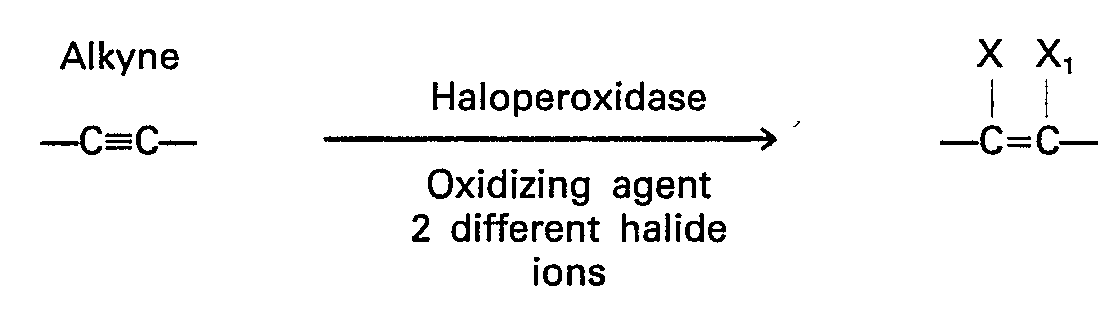
- Very generally, the low cost method of the invention produces vicinally, heterogeneously dihalogenated products from alkenes and alkynes by providing in a reaction vessel a mixture of haloperoxidase, an oxidizing agent and two different halide ions, both halide ions being capable of being used by the haloperoxidase and the total concentration of both halide ions being greater than 2000 mM. An alkene or alkyne susceptible to dihalogenation by the haloperoxidase is introduced into the vessel and maintained in contact with the reaction mixture for a sufficient period of time to convert the alkene or alkyne to the desired vicinally, heterogeneously dihalogenated product.
- . The present invention is based on the discovery that the group of enzymes classified as haloperoxidases acts upon alkenes and alkynes to produce vicinally, heterogeneously dihalogenated products. These products are characterized by the structural formula:

- Prior art processes teach that haloperoxidase produces vicinal, homogeneous dihalogenated products from alkenes and alkynes (U.S. Patent Application Serial No. 330,157, filed December 14,1981, Geigert et al US-A-4426449).


- However, prior art processes do not teach that vicinal, heterogeneous dihalogenated products can be produced from alkenes and alkynes by haloperoxidase:

- Moreover, from these prior art processes it was not obvious to run the alkene and alkyne reactions in the presence of two different halide ions. Morrison et al (Ann. Rev. Biochem. 45, 861 (1976)) state that chloroperoxidase is the only one of the haloperoxidases studied that is known to be influenced by the presence of halide ion mixtures. Both chloride and bromide in concentrations up to 0.1 M greatly enhance iodination of thyroglobulin. Although this stimulation was observed, only homogeneous monohalogenated product was observed. Hager et al (J. Biol. Chem. 241, 1769 (1966)) state that fluoride ion when present with chloride ion inhibits the chlorination of monochlorodimedon by chloroperoxidase. Bakkenist et al (Biochim. Biophys. Acta 613, 337 (1980)) reported the same effect of fluoride ion on the bromination of monochlorodimedon by myeloperoxidase. But in none of these reports was there any evidence presented for heterogeneous dihalogen addition. Therefore, it was not obvious that haloperoxidase would produce vicinal, heterogeneous dihalogenated products from alkenes and alkynes . when the enzymatic reactions were run in the presence of two different halide ions.
- In accordance with this invention, a process has been developed for the production of vicinally, heterogeneously dihalogenated products.
- Prior art teaches that haloperoxidases can incorporate only certain halides (Morrison et al, Ann. Rev. Biochem. 45, 861 (1976)):

- In accordance with this invention, a process has been developed for the production of vicinally, heterogeneously dihalogenated products that contain halogen atoms not previously demonstrated to be incorporated by haloperoxidases.
- The present invention includes the new compounds 2 - bromo - 3 - iodo - 1 - propanol; 3 - bromo - 2 - iodo - 1 - propanol; 3 - fluoro - 2 - iodo - 1 - propanol; 2 - fluoro - 3 - iodo - 1 - propanol and 2 - bromo - 3 - chloro - 1,4 - butanediol.
- The alkenes useful in the process of the invention can be broadly defined as any hydrocarbon containing a carbon-to-carbon double bond, represented by the following structural formula:

- (1) hydrogen
- (2) a straight chain
- (3) a branched chain saturated or unsaturated hydrocarbon radical
- (4) a cyclic
- Representative alkenes are:
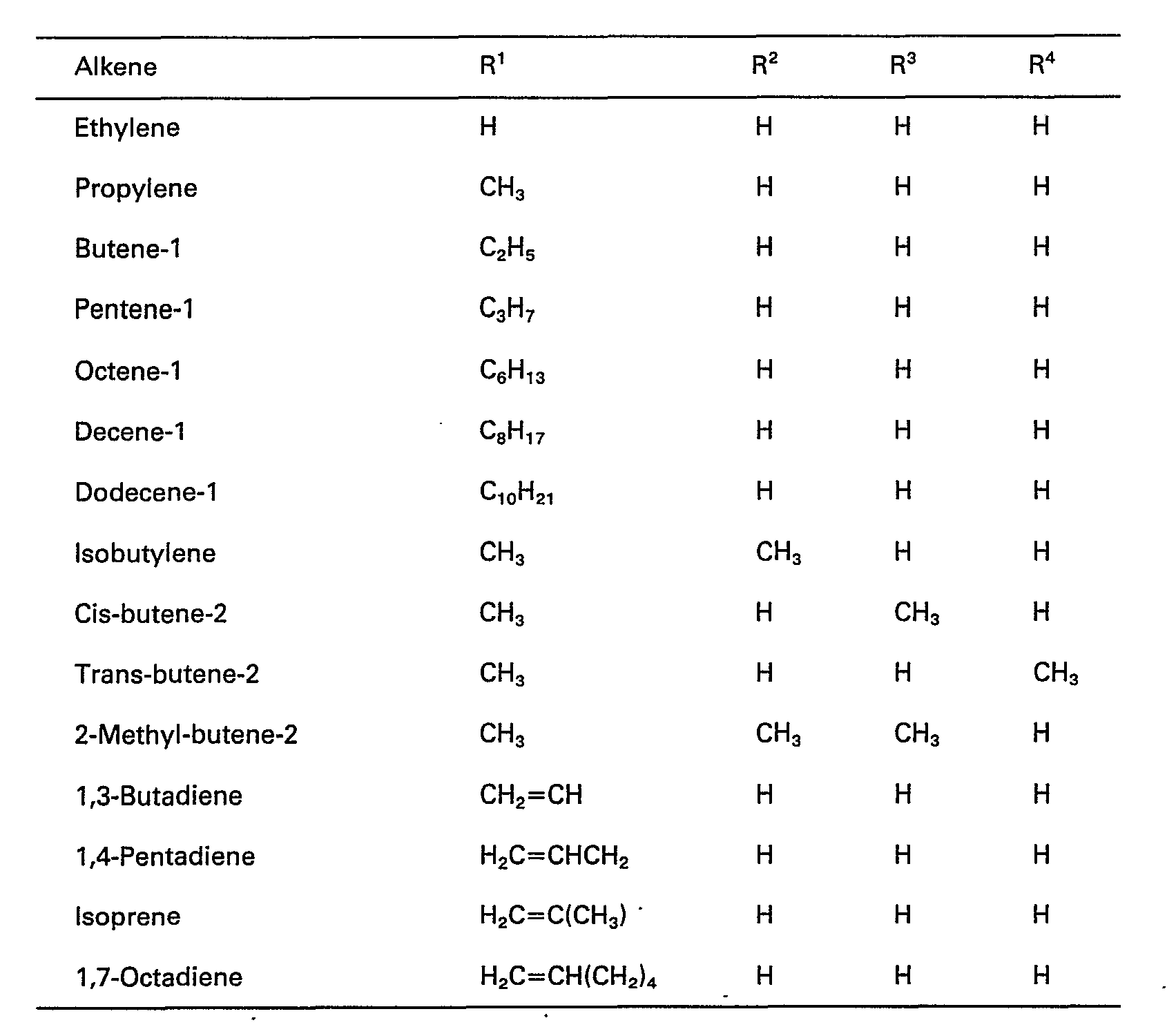
- The broad definition of alkenes includes alkenes where R1, R2, R3, and/or R4 can be an aromatic or heteroatom-containing group, provided that the substituents are inert to the prescribed reaction conditions, or do not deactivate the normally reactive carbon-to-carbon double bond.
- Representative alkenes containing such aromatic or heteroatom groups are:

- The R groups can also be connected to form a cyclic ring. A representative cyclic alkene is 2-cyclohexen-1-ol (VII).

- The alkynes useful in the process of the invention can be broadly defined as any hydrocarbon containing a carbon-to-carbon triple bond, represented by the following structural formula:
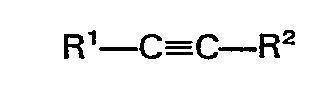
- (1) hydrogen
- (2) a straight chain
- (3) a branched chain saturated or unsaturated hydrocarbon radical
- (4) a cyclic.
- Representative alkynes are:

- The present invention makes use of haloperoxidase enzymes. Such enzymes include chloroperoxidase derived from the microorganism Caldariomyces fumago, bromoperoxidase derived from algae, lactoperoxidase derived from milk, thyroid peroxidase derived from thyroid, myeloperoxidase derived from leukocytes, and horseradish peroxidase derived from horseradish. Certain of these haloperoxidases are commercially available.
- The preferred haloperoxidase depends upon the products desired. The halides that the given haloperoxidases can use are listed below:

- For ease of discussion, various aspects of the present invention are described below particularly, but not exclusively, in connection with the use of the preferred peroxidase, chloroperoxidase, derived from Caldariomyces fumago (ATCC 16373). The microorganism, Caldariomyces fumago, may be grown as a static or agitated, submerged culture in Czapek-Dox medium at room temperature for 3 to 10 days by conventional methods. The halogenating enzyme, chloroperoxidase, is prepared from an aqueous homogenate of the mycelial pads of the microorganism grown under static conditions or from the filtrate of the microorganism grown under static or agitated submerged culture conditions. Detailed descriptions for preparing chloroperoxidase can be found in the following articles and patent: (1) U.S. Patent No. 4,247,641, Neidleman et al, 1981; (2) Morris et al, J. Biol. Chem. 241, 1763, (1966); and (3) Cooney et al, Biotech. Bioeng. 16, 1045, (1974).
- The haloperoxidase may also be used in an immobilized form. Processes for enzyme immobilization are familiar to those skilled in the art, and include reacting either a solution of the enzyme or a suspension of enzyme containing cells with one of a broad range of organic or inorganic supports. Included among these are polyacrylamide, ethylene-maleic acid copolymers, methacrylic-based polymers, polypeptides, styrene-based polymers, agarose, cellulose, dextran, porous glass beads, and aluminum or titanium hydroxide. Enzymes in this form have increased stability, extended life and usefulness, and recoverability. Reactions employing immobilized enzymes may be run in columns or reaction tanks.
- In addition to the haloperoxidase, an oxidizing agent is required in the reaction mixture. A preferred oxidizing agent is hydrogen peroxide, which may be added directly to the mixture in a single batch addition, or in a continuous slow feed. It may alternatively be generated as a slow feed in situ by the use of a hydrogen peroxide-producing enzyme system. Such enzyme systems are well known in the art, and include glucose-1-oxidase in the presence of D-glucose, pyranose-2-oxidase or glucose-2-oxidase in the presence of D-glucose, D- and L-amino acid oxidases in the presence of D- and L-methionine, methanol oxidase in the presence of methanol, and diamine oxidases in the presence of histamine. The hydrogen peroxide-generating system may be present in the non-immobilized or immobilized state as with the haloperoxidase. The hydrogen peroxide may also be generated by chemical reaction, such as by anthraquinone or isopropyl alcohol oxidation processes.
- The hydrogen peroxide is present preferably in molar ratio of from about 0.5:1 to about 50:1, most preferably in a ratio of about 1:1 or less with respect to the alkene or alkyne. The molar ratio preferences refer to the average presence of hydrogen peroxide during the reaction. The actual molar ratio will usually vary during the reaction and the molar ratio at any particular time may be above or below the ranges cited. Other suitable oxidizing agents include organic peroxides, such as methyl, ethyl, or butyl peroxides.
- Also, a source of two different water-soluble halide salts is required in the reaction mixture. The preferred halide salts are the fluoride, chloride, bromide and iodide salts of the alkali metals, sodium, potassium and lithium. Seawater or other natural brines which contain molar amounts of halide salts can be used. The total halide ion is present at a concentration greater than 2000 mM. The proportion of each halide ion (X- and Xl-) in the reaction mixture is as follows:

- The reaction is usually conducted with the pH range of from about 2.2 to about 8.0. The pH of the reaction may be maintained within the desired range by use of a buffering agent. Suitable buffers include sodium or potassium phosphate, gluconate, citrate, formate, and acetate based systems. Other suitable techniques besides buffering may be used for pH control and adjustment.
- The reaction may be conducted in an aqueous medium. While some of the alkenes and alkynes that can be converted by the process are substantially insoluble in an aqueous medium, the reaction, nevertheless, proceeds satisfactorily under conditions of mixing, or other modes of dispersion, which provide sufficient substrate solubility for the reaction.
- The reaction can also be conducted in the presence of aqueous organic solvent mixtures, such as water solutions containing lower aliphatic alcohols, dioxane, dimethylformamide, dimethylsulfoxide or glycerol, in order to increase substrate solubility.
- The reaction is preferably conducted under aerobic conditions and in the temperature range of 15° to about 50°, preferably at 20° to about 30°.
- As previously indicated, the components of the reaction mixture, namely the alkene or alkyne, the haloperoxidase, the oxidizing agent, the two different halide ions, and the buffering agent, are simply mixed together in water or mixed aqueous or organic media, and agitated for a period of from about 30 seconds to about 1 hour to obtain the vicinally, heterogeneously dihalogenated products.
- The reaction for alkenes is represented by the following equation:

- The reaction for alkynes is represented by the following equation:

- The products were quantitated by gas chromatography (GC) using flame ionization detection (FID). 5 ui of the reaction mixture was injected into a Varian 3700 GC, equipped with a 6 footx4 mm coiled, glass column packed with Tenax-GC (80/100 mesh). Flow rate through the column was set at 40 ml/minute of helium. The column temperature was operated isothermally (specific temperature given in each example); the injection temperature was set at 240°C; and the detector temperature was set at 240°C.
- The products were identified by gas chromatography-mass spectrometry (GCMS). 10 pl of the reaction mixture was injected into a Finnigan 4021 GCMS, equipped with a 6 footx4 mm coiled, glass column packed with Tenax-GC (80/100 mesh). Flow rate through the column was set at 30 ml/minute of helium. The column temperature was operated isothermally (specific temperature given in each example); the injection temperature was set at 240°C; and the jet separator was set at 240°C. The mass spectrometer was operated at 70 eV, electron impact ionization.
- Resolution and measurement of certain isomeric, vicinally, heterogeneously dihalogenated products was obtained by capillary gas chromatography-mass spectrometry (GCZMS). The concentrate of the ethyl ether extract of the reaction mixture was injected (10 µl) into a Finnigan 4021 GCMS, equipped with a 25 mxO.25 mm I.D. fused silica capillary column coated with SE-54 (purchased from J and W Scientific Company). Flow rate through the column was set at 2 ml/minute of helium. Samples were injected at 200°C with a 200:1 split injection. The column temperature was programmed from 60°C to 200°C at 5°C/minute. The mass spectrometer was operated at 70 eV, electron impact ionization. The capillary column was directly inserted into the ion source.
- The following Examples are intended only further to illustrate the invention and not to limit the same.
- This Example demonstrates the control of the ratio of heterogeneous dihalogenated product to homogeneous dihalogenated product by controlling the proportions of the two different halide salts in the reaction. Bromide ion and chloride ion can each be utilized individually by chloroperoxidase.
- Potassium bromide, potassium chloride, potassium phosphate buffer at pH 3.5 (10 ml, 0.3 M), hydrogen peroxide (4.1 mg; 137 yl of a 3% solution; 12 mM final) and allyl alcohol (7.0 mg; 12 mM final; HOCH2CH=CH2; purchased from Aldrich Chemical Company, Milwaukee, WI) were mixed together in a 25 ml Pyrex flask at room temperature and room pressure. The haloperoxidase enzyme, chloroperoxidase (0.4 ml) was then added. The reaction was concluded 15 minutes after the addition of the last reagent.
- The following levels of bromide ion and chloride ion were used:

- The chloroperoxidase was prepared as follows:
- Mycelial pads of Caldariomyces fumago (ATCC 16373) were grown on potato agar slants. Sliced potato (200 g) was cooked in distilled water (500 ml) for 40 minutes and then strained. A solution of glucose (21 g) and agar (20 g) in distilled water (500 ml) was added to the strained solution. The pH was adjusted to 6.8 and the volume was brought to 1 liter with distilled water. The medium was sterilized at 121°C for 15 minutes.
- The organism was inoculated on the potato agar slants, produced in accordance with the above procedure, and was grown for about one week at room temperature. The organism was then used to inoculate a soybean-glucose medium (50 ml). The soybean-glucose medium was prepared by adding, to 1 liter of distilled, extraction process soybean meal (30 g), glucose (30 g), and CaC03 (7 g). The medium was sterilized at 121°C for 30 minutes and was then inoculated with the organism after cooling.
- The organism was grown for 4-5 days on a rotary shaker at 25°C. 5 ml of this material was used to inoculate a 500 ml Erlenmeyer flask containing 100 ml of a modified Czapek-Dox medium prepared by adding the following to 1 liter of distilled water: NaN03 (3 g), KH2POI (1 g), KCI (0.5 g), MgS04 - 7H20 (0.5 g), FeSO4-7H2O (10 mg), and glucose (40 g). The medium was sterilized at 121°C for 20 minutes prior to inoculation with the organism.
- The organism was grown under static conditions at room temperature for 5-7 days. The black mycelial pads which formed were collected, rinsed with distilled water, and stored in plastic bags in a freezer at -10°C for subsequent use.
- The halo peroxidase was prepared by grinding 6 mycelial pads (prepared in accordance with the above procedures) with 60 g acid-washed sand and 60 ml distilled water for 2 minutes in a Virtis 45 homogenizer. The homogenate was centrifuged while cold and the supernatant solution was used as the source of the haloperoxidase, chloroperoxidase.
- The final chloroperoxidase supernatant was filtered through Whatman@ No. 1 paper at room temperature. The filtrate was concentrated about 10-fold using a rotary film evaporator at reduced pressure and temperature (<35°C). The concentrate was chilled at 0°C in an ice bath, and prechilled (0°) ethanol was added until 45% ethanol (v/v) was reached. The mixture was stirred vigorously for 15 minutes, and then centrifuged at -10°C (at 15,000 g) with a 55-34 rotor in a Sorval RC-5 Superspeed for 15 minutes. The black sediment was discarded. To the centrifugate, cooled at 0°C, was added additional prechilled ethanol to give 65% ethanol (v/v). The mixture was slowly stirred for 30 minutes at 0°C, and then centrifuged as before. The centrifugate was discarded, and the precipitate containing the chloroperoxidase activity was dissolved in 1 ml of 0.05 M potassium phosphate buffer (pH 7). The enzyme solution was stored at -20°C.
- The products were quantitated by gas chromatography (GC) using flame ionization detection (FID). 5 µl of the reaction mixture was injected into a Varian 3700 GC, equipped with a 6 footx4 mm coiled, glass column packed with Tenax-GC@ (80/100 mesh). Flow rate through the column was set at 40 ml/minute of helium. The column temperature was set at 190°C, isothermal; the injection temperature was set at 190°C, isothermal; the injection temperature was set at 240°C; and the detector temperature was set at 240°C.
- The products were identified by gas chromatography-mass spectrometry (GCMS). 10 µl of the reaction mixture was injected into a Finnigan 4021 GCMS, equipped with a 6 footx4 mm coiled, glass column packed with Tenax-GC@ (80/100 mesh). Flow rate through the column was set at 30 ml/minute of helium. The column temperature was set at 190°C, isothermal; the injection temperature was set at 240°C; and the jet separator was set at 240°C; the mass spectrometer was operated at 70 eV, electron impact ionization.
- Seven products were detected.
- One product had a GC retention time of 6 minutes and showed the mass spectrum diagnostic for 2,3-dichloro-1-propanol: molecular mass ion not detected; major fragment mass ions at mass 92 and 94 (3:1 in intensity; loss of HCI from molecular ion), and at mass 62 and 64 (3:1 in intensity; the CH2CHCI+ ion). This product had an identical GC retention time and mass spectrum with that of an authentic sample of 2,3-dichloro-1-propanol (purchased from Aldrich Chemical Company).
- Two other products had GC retention times of 7 and 8 minutes, and showed the mass spectra diagnostic for chloropropanediols. The product having an 7 minute retention time was identified as 1-chloro-2,3-propanediol: molecular mass ion not detected; major fragment mass ions at mass 79 and 81 (3:1 in intensity; loss of CH20H from the molecular ion), and at mass 61 (loss of CH2CI from molecular ion). The product having an 8 minute retention time was identified as 2-chloro-1,3-propanediol: molecular mass ion not detected; major fragment mass ions at mass 92 and 94 (3:1 in intensity; loss of H20 from molecular ion), and at mass 62 and 64 (3:1 in intensity; the CH2CHCI+ ion).
- Another product had a GC retention time of 10 minutes, and showed the mass spectrum diagnostic for bromochloro-1-propanol: molecular mass ion at mass 172, 174 and 176 (3:4:1 in intensity) indicating one chlorine atom and one bromine atom on the molecule; major fragment mass ions at mass 136 and 138 (1:1 in intensity; loss of HCI from molecular ion), at mass 106 and 108 (1:1 in intensity; the CHCH2Br+ ion), and at mass 92 and 94 (3:1 in intensity; loss of HBr from molecular ion).
- Two other products had GC retention time of 11 and 12 minutes, and showed the mass spectra diagnostic for bromo-propanediols. The product having an 11 minute retention time was identified as 1-bromo-2,3-propanediol: molecular ion not detected; major fragment mass ions at mass 123 and 125 (1:1 in intensity; loss of CH20H from molecular ion), and at mass 61 (loss of CH2Br from molecular ion). The product having a 12 minute retention time was identified as 2-bromo-1,3-propanediol: molecular mass ion not detected; major fragment mass ions at mass 136 and 138 (1:1 in intensity; loss of H20 from molecular ion), and at mass .106 and 108 (1:1 in intensity; the CH2CHBr+ ion).
- A final product had a GC retention time of 16 minutes and showed the mass spectrum diagnostic for 2,3-dibromo-1-propanol: molecular mass ion at mass 216, 218 and 220 (1:2:1 in intensity) indicating 2 bromine atoms on the molecule; major fragment mass ions at 137 and 139, and 136 and 138 (both sets 1: 1 in intensity; loss of Br and HBr, respectively, from molecular ion) and at mass 106 and 108 (1:1 in intensity; the CH2CHBr+ ion). This product had an identical GC retention time and mass spectrum with that of an authentic samples of 2,3-dibromo-1-propanol (purchased from Aldrich Chemical Company).
- The following summarizes the products obtained:

- Reaction C thus demonstrates the proportions of the two halide ion levels needed for this heterogeneous, dihalogenated product reaction.
- Further analysis of the bromochloro-1-propanol product was made using capillary gas chromatography-mass spectrometry (GCZMS). The reaction mixture was extracted with ethyl ether, and this extract when concentrated was injected (10 µl) into a Finnigan 4021 GCMS, equipped with a 25 mxO.25 mm I.D. fused silica capillary column coated SE-54. Flow rate through the column was set at 2 mi/minute of helium. Sample was injected at 200°C with a 200:1 split injection. The column temperature was programmed from 60°C to 150°C at 5°C/minute. The mass spectrometer was operated at 70 eV, electron impact ionization. The capillary column was directly inserted into the ion source.
- 2-Bromo-3-chloro-1-propanol had a GC2 retention time of 3.6 minutes, and showed the following diagnostic mass spectrum: molecular mass ion not detected; major fragment mass ions at mass 136 and 138 (1:1 in intensity; loss of HCI from molecular ion), mass 106 and 108 (1:1 in intensity; the CH2CHBr+ ion), and at mass 57 (loss of HBrCI from molecular ion).
- 3-Bromo-2-chloro-1-propanol had a GC2 retention time of 3.8 minutes, and showed the following diagnostic mass spectrum: molecular mass ion at mass 172, 174 and 176 (3:4:1 in intensity) indicating one chlorine atom and one bromine atom on the molecule; major fragment mass ions at mass 93 and 95 (3:1 in intensity; loss of Br from molecular ion), at mass 92 and 94 (3:1 in intensity; loss of HBr from molecular ion), and at mass 57 (loss of HBrCI from molecular ion).
- The ratio of product formed was 1:1.2; 2-bromo-3-chloro-1-propanol: 3-bromo-2-chloro-1-propanol.
- In addition, the bromochloro-1-propanol products were converted to epichlorohydrin and epibromohydrin by addition of lime to the aqueous reaction mixture until the pH was greater than 10. Identity of epichlorohydrin and epibromohydrin was confirmed by gas chromatography-mass spectrometry comparison with authentic samples (purchased from Aldrich Chemical Company).
- Further, the bromochloro-1-propanol products were converted to epichlorohydrin and epibromohydrin by addition of Flavobacterium sp. whole cells to the aqueous reaction mixture, as set forth in U.S. Patent No. 4,247,641 (Neidleman et al, 1981).
-


- This example demonstrates control of the ratio of heterogeneous dihalogenated product to homogeneous dihalogenated product by adjusting the proportions of the two different halide salts in the reaction. Bromide ion can be utilized by lactoperoxidase individually but chloride ion cannot.
- The procedure of Example 1 was followed, except 1) sodium chloride was substituted for potassium chloride, 2) lactoperoxidase (purchased from Sigma Chemical Company, St. Louis, MO; Catalog No. L-7129; 0.5 ml used per reaction) was substituted for chloroperoxidase, and 3) the buffer pH was set at 6.5 rather than 3.5.
- The following levels of bromine ion and chloride ion were used:
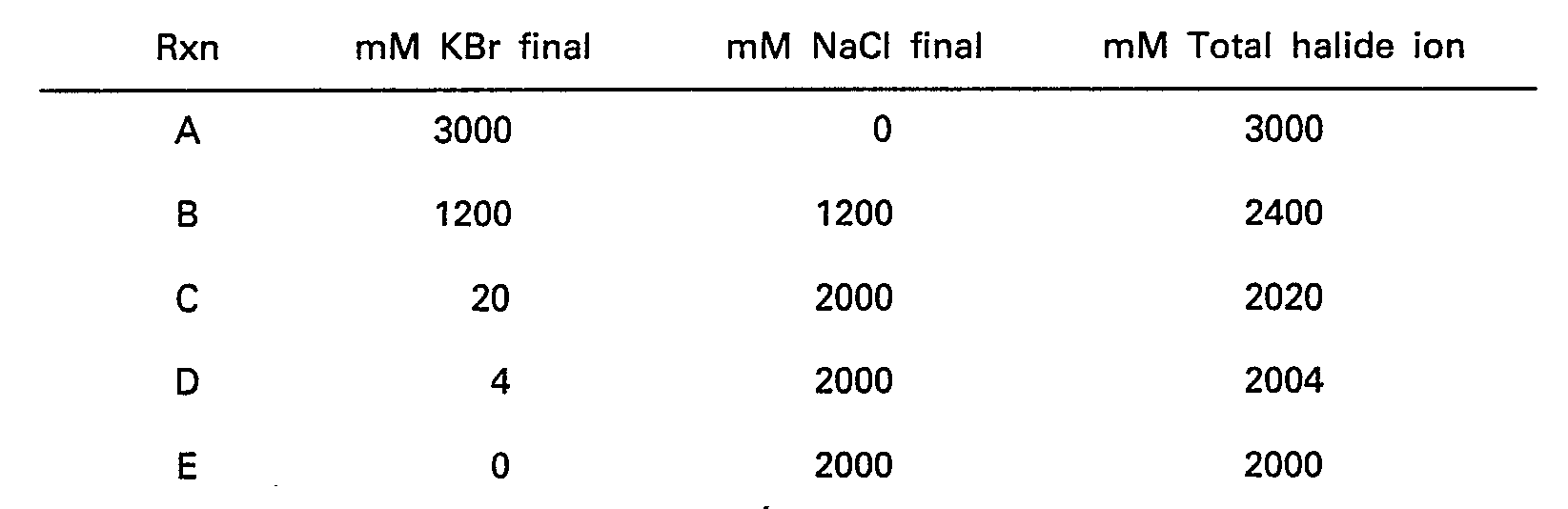
- Analysis of products by GC and GCMS was as outlined in Example 1.
- The following summarizes the products obtained as a function of halide concentrations in the reaction mixture:

- Reactions C and D thus demonstrate the proportions of the two halide ion levels needed for this heterogeneous, dihalogenated product reaction.
- The procedure of Example 1 was followed, except potassium iodide was substituted for potassium bromide. Chloride ion and iodide ion can each be utilized individually by chloroperoxidase.
- The following level of chloride ion and iodide ion was used:

- Analysis of products by GC and GCMS was as outlined in Example 1. The GC column temperature was set at 210°C, isothermal. Seven products were detected.
- One product had a GC retention time of 28 minutes and showed the mass spectrum diagnostic for 2,3-diiodo-1-propanol: molecular mass ion not detected; major fragment mass ions at mass 254 (the l2+ ion), at mass 185 (loss of I from molecular ion), at mass 127 (the I+ ion), and at mass 57 (loss H12 from molecular ion).
- Two other products had GC retention times of 9 and 11 minutes, and showed the mass spectra diagnostic for iodopropanediols. The products having a 9 minute retention time was identified as 1-iodo-2,3-propanediol: molecular mass ion at mass 202; major fragment mass ions at mass 171 (loss of CH20H from molecular ion) and at mass 75 (loss of I from molecular ion). The product having a 11 minute retention time was identified as 2-iodo-1,3-propanediol: molecular mass ion at mass 202; major fragment mass ions at mass 154 (loss of CH20H+OH from molecular ion) at mass 127 (the l+ ion) and at mass 75 (loss of I from molecular ion).
- Another product had a GC retention time of 7 minutes, and showed the mass spectrum diagnostic for chloroiodo-1-propanol: molecular mass ion at mass 220 and 222 (3:1 in intensity) indicating one chlorine atom on the molecule; major fragment mass ions at mass 127 (the I+ ion), at mass 93 and 95 (3:1 in intensity; loss of I from molecular ion), and at mass 57 (loss of HCII from molecular ion).
- Another product had a GC retention time of 2 minutes and showed the mass spectrum diagnostic for 2,3-dichloro-1-propanol: molecular mass ion not detected; major fragment mass ions at mass 92 and 94 (3:1 in intensity; loss of HCI from molecular ion), and at mass 62 and 64 (3:1 in intensity; the CH2CHCI+ ion). This product had an identical GC retention time and mass spectrum with that of an authentic sample of 2,3-dichloro-1-propanol (purchased from Aldrich Chemical Company).
- And two other products had GC retention times of 3 and 4 minutes, and showed the mass spectra diagnostic for chloropropanediols. The product having a 3 minute retention time was identified as 1-chloro-2,3-propanediol: molecular mass ion not detected; major fragment mass ions at mass 79 and 81 (3:1 in intensity; loss of CH20H from the molecular ion), and at mass 61 (loss of CH2CI from molecular ion). The product having a 4 minute retention time was identified as 2-chloro-1,3-propanediol: molecular mass ion not detected; majorfragment mass ions at mass 92 and 94 (3:1 in intensity; loss of H20 from molecular ion), and at mass 62 and 64 (3:1 in intensity; the CH2CHCI+ ion).
- Molecular iodine (12) was also formed.
- The following summarizes the products obtained:

- Further analysis of the chloroiodo-1-propanol product was made using capillary gas chromatography-mass spectrometry (GCZMS) as described in Example 1.
- 2-Chloro-3-iodo-1-propanol had a GC2 retention time of 6.4 minutes, and showed the following diagnostic mass spectrum: molecular mass ion at mass 220 and 222 (3:1 in intensity) indicating one chlorine atom on the molecular; major fragment mass ions at mass 127 (the l+ ion), at mass 93 and 95 (3:1 in intensity; loss of I from molecular ion), and at mass 57 (loss of HCII from molecular ion).
- 3-Chloro-2-iodo-1-propanol had a GC2 retention time of 6.2 minutes, and showed the following diagnostic mass spectrum: molecular mass ion at mass 220 and 222 (3:1 in intensity) indicating one chlorine atom on the molecule; major fragment mass ions at mass 93 and 95 (3:1 in intensity; loss of I from molecular ion), and at mass 57 (loss of HCII from molecular ion).
- The ratio of product formed was 1:1; 2-chloro-3-iodo-1-propanol: 3-chloro-2-iodo-1-propanol.
- In addition, the chloroiodo-1-propanols were converted to epichlorohydrin and epiiodohydrin by addition of lime to the aqueous reaction mixture until the pH was greater than 10. Identity of epichlorohydrin and epiiodohydrin was confirmed by gas chromatography-mass spectrometry comparison with authentic samples (purchased from Aldrich Chemical Company).
- Further, the chloroiodo-1-propanols were converted to epichlorohydrin and epiiodohydrin by addition of Flavobacterium sp. whole cells to the aqueous reaction mixture, as set forth in U.S. Patent No. 4,247,641 (Neidleman et al, 1981).


- The procedure of Example 1 was followed, except 1) potassium iodide and sodium fluoride were substituted for potassium bromide and potassium chloride, 2) horseradish peroxide (2 mg; purchased from Sigma Chemical Company, Catalog No. P-8375) was substituted for chloroperoxidase, and 3) the buffer pH was set at 6.5 rather than 3.5. lodine ion can be utilized by horseradish peroxidase individually but fluoride ion cannot.
- The following level of iodide ion and fluoride ion was used:

- Analysis of products by GC and GCMS was as outlined in Example 1. The GC column temperature was set at 210°C, isothermal. Five products were detected.
- One product had a GC retention time of 28 minutes and showed the mass spectrum diagnostic for 2,3-diiodo-1-propanol: molecular mass ion not detected; major fragment mass ions at mass 254 (the l2 + ion), at mass 185 (loss of I from molecular ion), at mass 127 (l+ ion), and at mass 57 (loss of H12 from molecular ion).
- Two other products had GC retention times of 9 and 11 minutes, and showed the mass spectra diagnostic for iodopropanediols. The product having a 9 minute retention time was identified as 1-iodo-2,3-propanediol: molecular mass ion at mass 202; major fragment mass ions at mass 171 (loss of CH20H from molecular ion) and at mass 75 (loss of I from molecular ion). The product having a 11 minute retention time was identified as 2-iodo-1,3-propanediol: molecular mass ion at mass 202; major fragment mass ions at mass 154 (loss of CH20H+OH from molecular ion) at mass 127 (the I+ ion) and at mass 75 (loss of I from molecular ion).
- Another product had a GC retention time of 5 minutes, and showed the mass spectrum diagnostic for 2-fluoro-3-iodo-1-propanol: molecular mass ion at mass 204; major fragment mass ions at mass 127 (the l+ ion), and at mass 77 (loss of I from molecular ion).
- And another product had a GC retention time of 4 minutes, and showed the diagnostic mass spectrum for 3-fluoro-2-iodo-1-propanol: molecular mass ion at mass 204; major fragment mass ions at mass 154 (the CH2CHl+ ion) at mass 127 (the I+ ion), and at mass 77 (loss of I from molecular ion).
- Molecular iodine (12) was also formed.
- The following summarizes the products obtained:
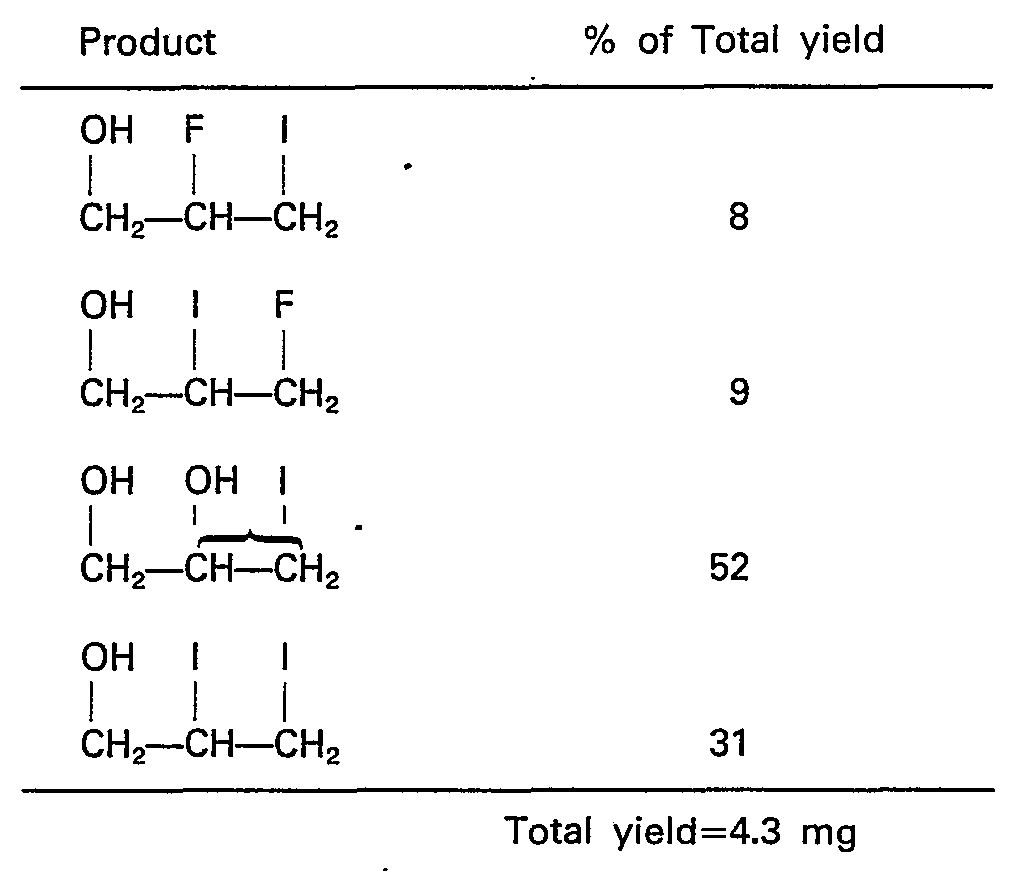
- This procedure thus provides a method for the production of 2-fluoro-3-iodo-1-propanol and 3-fluoro-2-iodo-1-propanol, both of which are new compositions of matter. 3-Fluoro-2-iodo-1-propanol may be treated with a base such as lime or caustic soda, as shown below, to form epifluorohydrin, an epoxide having known utility in the polymer industry. 2-Fluoro-3-iodo-1-propanol may be converted by catalytic hydrogenation, as shown below, to form propylenefluorohydrin, the structure of which indicates utility as an intermediate for producing fluorinated esters useful in the polymer industry.


- The procedure of Example 2 was followed, except: 1) the final potassium bromide and sodium chloride levels were 20 mM and 2000 mM, respectively, and 2) in situ generation of hydrogen peroxide was made by adding Q-D-glucose (25 mg) and glucose-1-oxidase (0.05 ml; purchased from Sigma Chemical Company, Catalog No. G-6500). The reaction was allowed to proceed for 2 hours.
- The following summarizes the products obtained:
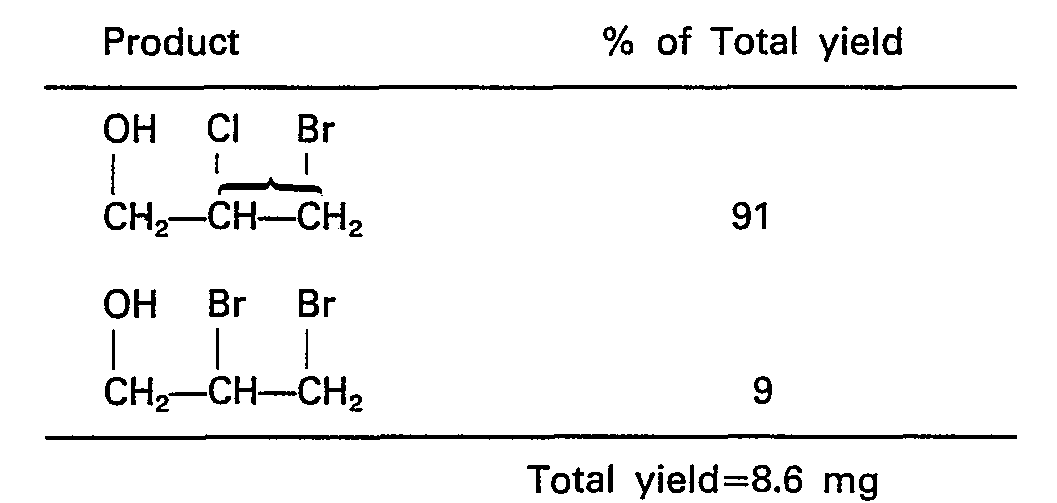
- The procedure of Example 1 was followed, except 2-butene-1,4-diol (11 mg; 12 mM final; HOCH2CH=CHCH20H; purchased from Aldrich Chemical Company) was substituted for allyl alcohol.
- The following level of bromide ion and chloride ion was used:

- Analysis of products by GC and GCMS was as outlined in Example 1. The GC column temperature was set at 210°C, isothermal. Two products were detected.
- One product had a GC retention time of 19 minutes and showed the mass spectrum diagnostic for 2,3-dibromo-1,4-butanediol: molecular mass ion not detected; major fragment mass ions at mass 198, 200 and 202 (1:2:1 in intensity; loss of CH20H+OH from molecular ion), mass 167 and 169 (1:1 in intensity; loss of Br from molecular ion), and at mass 149 and 151 (1:1 in intensity; loss of Br+H20 from molecular ion).
- The other product had a GC retention time of 15 minutes and showed the mass spectrum diagnostic for 2-bromo-3-chloro-1,4-butanediol: molecular mass ion at mass 202, 204 and 206 (3:4:1 in intensity) indicating one bromine atom and one chlorine atom on the molecule; major fragment mass ions at mass 154, 156 and 158 (3:4:1 in intensity; loss of CH20H+OH from molecular ion), at mass 167 and 169 (1:1 in intensity; loss of CI from molecular ion), at mass 123 and 125 (3:1 in intensity; loss of Br from molecular ion), and at mass 105 and 107 (3:1 in intensity; loss of Br+H20 from molecular ion).
- The following summarizes the products obtained:

- This procedure thus provides a method for the production of 2-bromo-3-chloro-1,4-butanediol, a new composition of matter. As shown below, 2-bromo-3-chloro-1,4-butanediol may be reacted over an extended time with a base such as lime or caustic soda to form butadiene diepoxide, an epoxide having known utility in the polymer industry.

- The procedure of Example 6 was followed except 2-butyne-1,4-diol (10.3 mg; 12 mM final; HOCH2C=CCH20H; purchased from Aldrich Chemical Company) was substituted for 2-butene-1,4-diol.
- Two products were detected. The GC column temperature was set at 210°C, isothermal.
- One product had a GC retention time of 13 minutes, and showed the mass spectrum diagnostic for 2-bromo-3-chloro-2-butene-1,4-diol: molecular ion at mass 200, 202 and 204 (3:4:1 in intensity) indicating one bromine atom and one chlorine atom on the molecule; major fragment mass ions at mass 182,184 and 186 (3:4:1 in intensity; loss of H20 from molecular ion), at mass 165 and 167 (1:1 in intensity; loss of CI from molecular ion), and at mass 147 and 149 (1:1 in intensity; loss of Cl+H2O from molecular ion).
- And the other product had a GC retention time of 17 minutes, and showed the mass spectrum diagnostic for 2,3-dibromo-2-butene-1,4-diol: molecular mass ion at mass 244, 246 and 248 (1:2:1 in intensity) indicating two bromine atoms on the molecule; major fragment mass ions at mass 226, 228, 230 (1:2:1 in intensity; loss of H20 from molecular ion), at mass 165 and 167 (1:1 in intensity; loss of Br from molecular ion), at mass 147 and 149 (1:1 in intensity; loss of Br+H20 from molecular ion).
- The following summarizes the products obtained:

- The procedure of Example 6 was followed, except ethylene was substituted for 2-butene-1,4-diol.
- Ethylene (CH2=CH2; purchased from Matheson Gas Products, Lyndhurst, NJ), a gaseous alkene, was slowly (10 ml/min) and continuously bubbled through the reaction mixture. After 15 minutes, the haloperoxidase enzyme chloroperoxidase (0.4 ml), was then added. Finally hydrogen peroxide (4.1 mg; 12 mM final) was added. The reaction was concluded 15 minutes after the addition of the last reagent.
- Five products were detected. The GC column temperature was set at 170°C, isothermal.
- One product had a GC retention time of 7 minutes and showed the mass spectrum diagnostic for 1,2-dibromo ethane: molecular mass ion at mass 186, 188 and 190 (1:2:1 in intensity) indicating two bromine atoms on the molecule; major fragment mass ions at 107 and 109 (1:1 in intensity; loss of Br from molecular ion), and at mass 93 and 95 (1:1 in intensity; the CH2Br+ ion). This product had an identical GC retention time and mass spectrum with that of an authentic sample of 1,2-dibromo ethane (purchased from Aldrich Chemical Company).
- Another product had a GC retention time of 5 minutes and showed the mass spectrum diagnostic for 2-bromo ethanol; molecular mass ion at mass 124 and 126 (1:1 in intensity) indicating one bromine atom on the molecule; major fragment mass ions at mass 123 and 125 (1:1 in intensity; loss of H from molecular ion) and at mass 93 and 95 (1:1 in intensity; the CH2Br+ ion).
- A third product had a GC retention time of 4 minutes and showed the mass spectrum diagnostic for 1-bromo-2-chloro ethane: molecular mass ion at mass 142, 144 and 146 (3:4:1 in intensity) indicating one bromine atom and one chlorine atom on the molecule; major fragment mass ions at mass 93 and 95 (1:1 in intensity; the CH2Br+ ion), at mass 79 and 81 (1:1 in intensity; the Br+ ion) and at mass 63 and 65 (3:1 in intensity; loss of Br from molecular ion).
- Another product had a GC retention time of 2 minutes and showed the mass spectrum diagnostic for 1,2-dichloro ethane: molecular mass ion at mass 98, 100 and 102 (10:6:1 in intensity) indicating two chlorine atoms on the molecule; major fragment mass ions at mass 62 and 64 (3:1 in intensity; loss of HCI from molecular ion), and at mass 49 and 51 (3:1 in intensity; the CH2CI+ ion). This product had an identical GC retention time and mass spectrum with that of an authentic sample of 1,2-dichloro ethane (purchased from Aldrich Chemical Company).
- And the other product had a GC retention time of 3 minutes and showed the mass spectrum diagnostic for 2-chloro ethanol: molecular mass ion at mass 80 and 82 (3:1 in intensity) indicating one chlorine atom on the molecule; major fragment mass ions at mass 49 and 51 (3:1 in intensity; the CH2CI+ ion), and at mass 44 (loss of HCI from molecular ion).
- The following summarizes the products obtained:

- The procedure of Example 8 was followed, except 1) lactoperoxidase (0.5 ml) was substituted for chloroperoxidase, 2) potassium iodide was substituted for potassium bromide, and 3) the buffer pH was set at 6.5 rather than 3.5.
- The following level of chloride ion and iodide ion was used:

- Three products were detected. The GC column temperature was set at 180°C, isothermal.
- One product had a GC retention time of 9 minutes and showed the mass spectrum diagnostic for 1-chloro-2-iodo ethane: molecular mass ion at mass 190 and 192 (3:1 in intensity) indicating one chlorine atom on the molecule; major fragment mass ions at mass 155 (loss of CI from molecular ion), at mass 127 (the l+ ion), and at mass 63 and 65 (3:1 in intensity; loss of I from molecular ion).
- Another product had a GC retention time of 15 minutes and showed the mass spectrum diagnostic for 1,2-diiodo ethane: molecular mass ion at mass 282; major fragment mass ions at mass 254 (the l2 + ion), at mass 155 (loss of I from molecular ion), and at mass 127 (the l+ ion).
- And the other product had a GC retention time of 10 minutes and showed the mass spectrum diagnostic for 2-iodo ethanol: molecular mass ion at mass 172; major fragment mass ions at mass 142 (the CH21+ ion), and at mass 127 (the I+ ion).
- Molecular iodine was also detected.
- The following summarizes the products obtained:

- The procedure of Example 2 was followed, except allyl chloride (9.1 mg, 12 mM final; CICH2CH=CH2; purchased from Aldrich Chemical Company) was substituted for allyl alcohol.
- The following level of bromide ion and chloride ion was used:

- Analysis of products by GC and GCMS was as outlined in Example 1. The GC column temperature was set at 190°C, isothermal. Four products were detected.
- One product had a GC retention time of 8 minutes and showed the mass spectrum diagnostic for bromochloro-1-chloropropane: molecular mass ion at mass 190, 192 and 194 (6:10:5 in.intensity) indicating 1 bromine atom and 2 chloride atoms on the molecule; major fragment mass ions at mass 155, 157 and 159 (3:4:1 in intensity; loss of CI from molecular ion), at mass 141, 143 and 145 (3:4:1 in intensity; loss of CH2Cl from molecular ion), at mass 111, 113 and 115 (10:6:1 in intensity; loss of Br from molecular ion), at mass 93 and 95 (1:1 in intensity; the CH2Br+ ion), and at mass 49 and 51 (3:1 in intensity; the CH2Cl+ ion).
- Another product had a GC retention time of 15 minutes and showed the mass spectrum diagnostic for 1,2-dibromo-3-chloropropane: molecular mass ion not detected; major fragment mass ions at mass 185, 187 and 189 (1:2:1 in intensity; loss of CH2CI from molecular ion), at mass 155, 157 and 159 (3:4:1 in intensity; loss of Br from molecular ion), at mass 75 and 77 (3:1 in intensity; loss of HBr2 from molecular ion), at mass 93 and 95 (1:1 in intensity; the CH2Br+ ion), and at mass 49 and 51 (3:1 in intensity; the CH2Cl+ ion).
- The two other products had GC retention times of 9 and 11 minutes, respectively, and showed the mass spectra diagnostic for bromochloropropanols. The product having an 11 minute retention time was identified as 2-bromo-1-chloro-3-propanol: molecular mass ion at mass 172,174 and 176 (3:4:1 in intensity) indicating the presence of one bromine atom and one chlorine atom on the molecule; major fragment mass ions at mass 136 and 138 (1:1 in intensity; loss of HCI from molecular ion), at mass 106 and 108 (1:1 in intensity; the CH2CH―Br+ ion), and at mass 49 and 51 (3:1 in intensity; the CH2Cl+ ion). The product having a 9 minute retention time was identified as 1-bromo-3-chloro-2-propanol: molecular mass ion at mass 172, 174 and 176 (3:4:1 in intensity) indicating the presence of one bromine atom and one chlorine atom on the molecule; major fragment mass ions at mass 123 and 125 (1:1 in intensity; loss of CH2CI from molecular ion), and at mass 79 and 81 (3:1 in intensity; loss of CH2Br from molecular ion).
- The following summarizes the products obtained:

- Analysis of products by GC and GCMS was as outlined in Example 1.
- Various modifications in addition-to those shown and described herein will become apparent to those skilled in the art from the foregoing description. Such modifications are intended to fall within the scope of the invention.
-

- 330,157 12/1981 Geigert et. al.=US-A-4426449 1/1984
-

-

-
- 1. Johnson, R. L. and D. W. Setser, Journal of Physical Chemistry, Vol. 71, 1967, pp. 4366―4383.
- 2. Roth, H. and H. R. Richardson, Journal of Economic Entymology, Vol. 63, 1970, pp. 496-499.
- 3. Rylander, P., Catalytic Hydrogenation in Organic Synthesis, Ch. 13, 1979, pp. 235-250.
- 4. Morrison, M. and G. R. Schonbaum, Annual Reviews of Biochemistry, Vol. 45, 1976, pp. 861-888.
- 5. Hager, L. P., D. R. Morris, F. S. Brown and H. Eberwein, Journal of Biological Chemistry, Vol. 241, 1966, pp. 1769-1777.
- 6. Bakkenist, A. R. J., J. E. G. DeBoer, J. Plat and R. Wever, Biochimica et Biophysica Acta, Vol. 613, 1980, pp. 337-348.
- 7. Morris, D. R. and L. P. Hager, Journal of Biological Chemistry, Vol. 241, 1966, pp. 1763-1768.
- 8. Cooney, C. L. and J. Hueter, Biotechnology and Bioengineering, Vol. 16, 1974, pp. 1045-1053.
Claims (17)

Priority Applications (1)
| Application Number | Priority Date | Filing Date | Title |
|---|---|---|---|
| AT83301882T ATE30337T1 (en) | 1982-04-02 | 1983-03-31 | PROCESS FOR THE MANUFACTURE OF HETEROGENOUS NEIGHBORHOOD DIHALOGENATED PRODUCTS, THEIR APPLICATIONS AND NEW PRODUCTS. |
Applications Claiming Priority (2)
| Application Number | Priority Date | Filing Date | Title |
|---|---|---|---|
| US36492082A | 1982-04-02 | 1982-04-02 | |
| US364920 | 1982-04-02 |
Publications (3)
| Publication Number | Publication Date |
|---|---|
| EP0091305A2 EP0091305A2 (en) | 1983-10-12 |
| EP0091305A3 EP0091305A3 (en) | 1983-11-09 |
| EP0091305B1 true EP0091305B1 (en) | 1987-10-21 |
Family
ID=23436681
Family Applications (1)
| Application Number | Title | Priority Date | Filing Date |
|---|---|---|---|
| EP83301882A Expired EP0091305B1 (en) | 1982-04-02 | 1983-03-31 | Method for producing vicinal, heterogeneous dihalogenated products, their use, and novel products |
Country Status (7)
| Country | Link |
|---|---|
| EP (1) | EP0091305B1 (en) |
| JP (1) | JPS58198295A (en) |
| AT (1) | ATE30337T1 (en) |
| CA (1) | CA1189809A (en) |
| DE (1) | DE3374137D1 (en) |
| DK (1) | DK140483A (en) |
| ES (1) | ES8503027A1 (en) |
Families Citing this family (3)
| Publication number | Priority date | Publication date | Assignee | Title |
|---|---|---|---|---|
| DE4119611A1 (en) * | 1991-06-14 | 1992-12-17 | Bayer Ag | AGENTS FOR CONTROLLING PESTS BASED ON SUBSTITUTED OXAZOLIDINONE, NEW SUBSTITUTED OXAZOLIDINONE, THEIR PRODUCTION AND USE |
| US5605819A (en) * | 1995-05-19 | 1997-02-25 | Merck & Co., Inc. | Quantitative conversion of indene to (1S,2R) indene oxide and (1S,2R)-indandiol by combination of haloperoxidase bioconversion and chemical steps |
| CN114397382A (en) * | 2021-12-20 | 2022-04-26 | 石家庄四药有限公司 | Method for detecting potential genotoxic impurities in pentoxifylline |
Family Cites Families (2)
| Publication number | Priority date | Publication date | Assignee | Title |
|---|---|---|---|---|
| IL50065A0 (en) * | 1976-07-19 | 1976-10-31 | Mersel M | An enzymatic process for the substitution addition cleavage and polymerization of organic compounds |
| ES481444A1 (en) * | 1978-06-12 | 1980-02-01 | Cetus Corp | Method for producing epoxides and glycols from alkenes. |
-
1983
- 1983-03-28 DK DK140483A patent/DK140483A/en not_active Application Discontinuation
- 1983-03-30 ES ES521142A patent/ES8503027A1/en not_active Expired
- 1983-03-31 DE DE8383301882T patent/DE3374137D1/en not_active Expired
- 1983-03-31 CA CA000425102A patent/CA1189809A/en not_active Expired
- 1983-03-31 AT AT83301882T patent/ATE30337T1/en not_active IP Right Cessation
- 1983-03-31 EP EP83301882A patent/EP0091305B1/en not_active Expired
- 1983-04-01 JP JP58057728A patent/JPS58198295A/en active Pending
Also Published As
| Publication number | Publication date |
|---|---|
| EP0091305A3 (en) | 1983-11-09 |
| DE3374137D1 (en) | 1987-11-26 |
| DK140483D0 (en) | 1983-03-28 |
| EP0091305A2 (en) | 1983-10-12 |
| CA1189809A (en) | 1985-07-02 |
| ES521142A0 (en) | 1984-06-01 |
| JPS58198295A (en) | 1983-11-18 |
| ES8503027A1 (en) | 1984-06-01 |
| ATE30337T1 (en) | 1987-11-15 |
| DK140483A (en) | 1983-10-03 |
Similar Documents
| Publication | Publication Date | Title |
|---|---|---|
| US4247641A (en) | Method for producing epoxides and glycols from alkenes | |
| Thomas et al. | Mineralization of biphenyl and PCBs by the white rot fungus Phanerochaete chrysosporium | |
| Takada et al. | Degradation of polychlorinated dibenzo-p-dioxins and polychlorinated dibenzofurans by the white rot fungus Phanerochaete sordida YK-624 | |
| Janssen et al. | Purification and characterization of a bacterial dehalogenase with activity toward halogenated alkanes, alcohols and ethers | |
| Joshi et al. | Oxidation of dibenzo-p-dioxin by lignin peroxidase from the basidiomycete Phanerochaete chrysosporium | |
| Geigert et al. | Haloperoxidases: enzymatic synthesis of α, β-halohydrins from gaseous alkenes | |
| US9834794B2 (en) | Method for producing retinoid from microorganism | |
| van den Wijngaard et al. | Degradation of 2-chloroethylvinylether by Ancylobacter aquaticus AD25 and AD27 | |
| EP0042221B1 (en) | Production of 2-keto-d-gluconic acid and hydrogen peroxide | |
| Weightman et al. | Microbial dehalogenation of trichloroacetic acid | |
| US4426449A (en) | Method for producing vicinal dihalogenated products | |
| US4284723A (en) | Preparation of epoxides and glycols from gaseous alkenes | |
| Wu et al. | Two anaerobic polychlorinated biphenyl-dehalogenating enrichments that exhibit different para-dechlorination specificities | |
| CA1116543A (en) | Method for producing epoxides and glycols from alkenes | |
| US4587217A (en) | Vicinal heterogeneous dihalogenated products and method | |
| EP0091305A2 (en) | Method for producing vicinal, heterogeneous dihalogenated products, their use, and novel products | |
| Kayano et al. | Hydrogen evolution by co-immobilized Chlorella vulgaris and Clostridium butyricum cells | |
| US4503153A (en) | Method for producing aldehydes from primary alcohols | |
| van der Waarde et al. | Degradation of 2-chloroallylalcohol by a Pseudomonas sp | |
| Small et al. | Characterization of a new pathway for epichlorohydrin degradation by whole cells of Xanthobacter strain Py2 | |
| Geigert et al. | Halonium ion-induced biosynthesis of chlorinated marine metabolites | |
| EP0090652A2 (en) | A method for producing aldehydes and the industrial use of aldehydes thus-produced | |
| US4546080A (en) | Manufacture of halogenated ketones and aldehydes | |
| Schwartz et al. | Enzymatic epoxidation: synthesis of 7, 8-epoxy-1-octene, 1, 2-7, 8-diepoxyoctane, and 1, 2-epoxyoctane by Pseudomonas oleovorans | |
| EP1550730B1 (en) | Method for producing optically active 3-chloro-2-methyl-1,2-propanediol taking advantage of microorganism |
Legal Events
| Date | Code | Title | Description |
|---|---|---|---|
| PUAI | Public reference made under article 153(3) epc to a published international application that has entered the european phase |
Free format text: ORIGINAL CODE: 0009012 |
|
| PUAL | Search report despatched |
Free format text: ORIGINAL CODE: 0009013 |
|
| AK | Designated contracting states |
Designated state(s): AT BE CH DE FR GB IT LI LU NL SE |
|
| AK | Designated contracting states |
Designated state(s): AT BE CH DE FR GB IT LI LU NL SE |
|
| 17P | Request for examination filed |
Effective date: 19840504 |
|
| RAP1 | Party data changed (applicant data changed or rights of an application transferred) |
Owner name: CETUS CORPORATION |
|
| ITF | It: translation for a ep patent filed | ||
| GRAA | (expected) grant |
Free format text: ORIGINAL CODE: 0009210 |
|
| AK | Designated contracting states |
Kind code of ref document: B1 Designated state(s): AT BE CH DE FR GB IT LI LU NL SE |
|
| REF | Corresponds to: |
Ref document number: 30337 Country of ref document: AT Date of ref document: 19871115 Kind code of ref document: T |
|
| REF | Corresponds to: |
Ref document number: 3374137 Country of ref document: DE Date of ref document: 19871126 |
|
| ET | Fr: translation filed | ||
| PG25 | Lapsed in a contracting state [announced via postgrant information from national office to epo] |
Ref country code: LU Free format text: LAPSE BECAUSE OF NON-PAYMENT OF DUE FEES Effective date: 19880331 Ref country code: AT Effective date: 19880331 |
|
| PG25 | Lapsed in a contracting state [announced via postgrant information from national office to epo] |
Ref country code: SE Effective date: 19880401 |
|
| PLBE | No opposition filed within time limit |
Free format text: ORIGINAL CODE: 0009261 |
|
| STAA | Information on the status of an ep patent application or granted ep patent |
Free format text: STATUS: NO OPPOSITION FILED WITHIN TIME LIMIT |
|
| 26N | No opposition filed | ||
| PGFP | Annual fee paid to national office [announced via postgrant information from national office to epo] |
Ref country code: BE Payment date: 19910226 Year of fee payment: 9 |
|
| PGFP | Annual fee paid to national office [announced via postgrant information from national office to epo] |
Ref country code: GB Payment date: 19910301 Year of fee payment: 9 |
|
| PGFP | Annual fee paid to national office [announced via postgrant information from national office to epo] |
Ref country code: FR Payment date: 19910305 Year of fee payment: 9 |
|
| PGFP | Annual fee paid to national office [announced via postgrant information from national office to epo] |
Ref country code: DE Payment date: 19910307 Year of fee payment: 9 |
|
| PGFP | Annual fee paid to national office [announced via postgrant information from national office to epo] |
Ref country code: CH Payment date: 19910311 Year of fee payment: 9 |
|
| PGFP | Annual fee paid to national office [announced via postgrant information from national office to epo] |
Ref country code: NL Payment date: 19910331 Year of fee payment: 9 |
|
| PG25 | Lapsed in a contracting state [announced via postgrant information from national office to epo] |
Ref country code: LI Effective date: 19920331 Ref country code: GB Effective date: 19920331 Ref country code: CH Effective date: 19920331 Ref country code: BE Effective date: 19920331 |
|
| BERE | Be: lapsed |
Owner name: CETUS CORP. Effective date: 19920331 |
|
| PG25 | Lapsed in a contracting state [announced via postgrant information from national office to epo] |
Ref country code: NL Effective date: 19921001 |
|
| NLV4 | Nl: lapsed or anulled due to non-payment of the annual fee | ||
| GBPC | Gb: european patent ceased through non-payment of renewal fee | ||
| PG25 | Lapsed in a contracting state [announced via postgrant information from national office to epo] |
Ref country code: FR Effective date: 19921130 |
|
| REG | Reference to a national code |
Ref country code: CH Ref legal event code: PL |
|
| PG25 | Lapsed in a contracting state [announced via postgrant information from national office to epo] |
Ref country code: DE Effective date: 19921201 |
|
| REG | Reference to a national code |
Ref country code: FR Ref legal event code: ST |
|
| EUG | Se: european patent has lapsed |
Ref document number: 83301882.3 Effective date: 19890726 |