EP0089243B1 - Resin composition suitable for use in medical devices - Google Patents
Resin composition suitable for use in medical devices Download PDFInfo
- Publication number
- EP0089243B1 EP0089243B1 EP83301467A EP83301467A EP0089243B1 EP 0089243 B1 EP0089243 B1 EP 0089243B1 EP 83301467 A EP83301467 A EP 83301467A EP 83301467 A EP83301467 A EP 83301467A EP 0089243 B1 EP0089243 B1 EP 0089243B1
- Authority
- EP
- European Patent Office
- Prior art keywords
- weight
- ethylene
- resin composition
- acid
- copolymer
- Prior art date
- Legal status (The legal status is an assumption and is not a legal conclusion. Google has not performed a legal analysis and makes no representation as to the accuracy of the status listed.)
- Expired
Links
- 0 CN(C)N(C)**N(C)N(*)C=C Chemical compound CN(C)N(C)**N(C)N(*)C=C 0.000 description 4
Classifications
-
- C—CHEMISTRY; METALLURGY
- C08—ORGANIC MACROMOLECULAR COMPOUNDS; THEIR PREPARATION OR CHEMICAL WORKING-UP; COMPOSITIONS BASED THEREON
- C08L—COMPOSITIONS OF MACROMOLECULAR COMPOUNDS
- C08L27/00—Compositions of homopolymers or copolymers of compounds having one or more unsaturated aliphatic radicals, each having only one carbon-to-carbon double bond, and at least one being terminated by a halogen; Compositions of derivatives of such polymers
- C08L27/02—Compositions of homopolymers or copolymers of compounds having one or more unsaturated aliphatic radicals, each having only one carbon-to-carbon double bond, and at least one being terminated by a halogen; Compositions of derivatives of such polymers not modified by chemical after-treatment
- C08L27/04—Compositions of homopolymers or copolymers of compounds having one or more unsaturated aliphatic radicals, each having only one carbon-to-carbon double bond, and at least one being terminated by a halogen; Compositions of derivatives of such polymers not modified by chemical after-treatment containing chlorine atoms
- C08L27/06—Homopolymers or copolymers of vinyl chloride
-
- G—PHYSICS
- G01—MEASURING; TESTING
- G01N—INVESTIGATING OR ANALYSING MATERIALS BY DETERMINING THEIR CHEMICAL OR PHYSICAL PROPERTIES
- G01N23/00—Investigating or analysing materials by the use of wave or particle radiation, e.g. X-rays or neutrons, not covered by groups G01N3/00 – G01N17/00, G01N21/00 or G01N22/00
- G01N23/20—Investigating or analysing materials by the use of wave or particle radiation, e.g. X-rays or neutrons, not covered by groups G01N3/00 – G01N17/00, G01N21/00 or G01N22/00 by using diffraction of the radiation by the materials, e.g. for investigating crystal structure; by using scattering of the radiation by the materials, e.g. for investigating non-crystalline materials; by using reflection of the radiation by the materials
-
- C—CHEMISTRY; METALLURGY
- C08—ORGANIC MACROMOLECULAR COMPOUNDS; THEIR PREPARATION OR CHEMICAL WORKING-UP; COMPOSITIONS BASED THEREON
- C08K—Use of inorganic or non-macromolecular organic substances as compounding ingredients
- C08K5/00—Use of organic ingredients
- C08K5/04—Oxygen-containing compounds
- C08K5/15—Heterocyclic compounds having oxygen in the ring
- C08K5/151—Heterocyclic compounds having oxygen in the ring having one oxygen atom in the ring
- C08K5/1515—Three-membered rings
-
- C—CHEMISTRY; METALLURGY
- C08—ORGANIC MACROMOLECULAR COMPOUNDS; THEIR PREPARATION OR CHEMICAL WORKING-UP; COMPOSITIONS BASED THEREON
- C08L—COMPOSITIONS OF MACROMOLECULAR COMPOUNDS
- C08L73/00—Compositions of macromolecular compounds obtained by reactions forming a linkage containing oxygen or oxygen and carbon in the main chain, not provided for in groups C08L59/00 - C08L71/00; Compositions of derivatives of such polymers
Definitions
- This invention relates to a resin composition
- a resin composition comprising a vinyl chloride-type polymer as a base, which is suitable for making medical devices, especially bags for storing transfusion fluids, receptacles for storing blood, and tubes for a blood circuit in artificial kidneys.
- blood bags have been used to transport or store blood, and in performing dialysis by artificial kidneys on patients with renal disorders, blood circuit tubes have been used. These medical devices are required to be pliable and free from degeneration, and even upon long contact with blood, not to degenerate blood or permit migration of foreign materials into the blood.
- the blood circuit tubes should also possess transparency which enables the blood passing inside to be observed from outside, pliability which permits free deformation, repulsive elasticity which enables the tube to regain its original shape rapidly when the tube is clamped from outside or released from clamping and enables this operation to step or pass the blood stream as desired, and surface non-tackiness which prevents the tube from adhering to itself when the tube is wound or laminated.
- a flexible vinyl chloride resin composition prepared by adding a large amount of a plasticizer such as di-2-ethylhexyl phthalate to a vinyl chloride resin has been used as a material for these medical devices such as blood bags or blood circuit tubes.
- This resin composition has excellent pliability and transparency, but has the defect that a small amount of the plasticizer dissolves and is absorbed and accumulated in the body through the blood stream.
- the blood bags or blood circuit tubes are sterilized by contact with ethylene oxide gas, or by exposure to pressurized steam in an autoclave. In the case of the former, this composition may absorb ethylene oxide. In the case of the latter, it is difficult to completely avoid the defect that blocking occurs in a molded article from the resin composition or adhesion occurs at the contacting surface between the molded article and an instrument, transparency is lost, or deformation is likely to occur.
- a method for providing a flexible formulation of a vinyl chloride resin without substantially using a plasticizer comprises blending the vinyl chloride resin with a terpolymer of ethylene, carbon monoxide and vinyl acetate (see U.S. Patent No. 3,780,140 or British Patent No. 1,403,773).
- the present inventors therefore, actually mixed a vinyl chloride resin with this terpolymer to form a uniform composition and examined its properties. Consequently, they knew that this composition had satisfactory transparency and pliability, but showed undesirable results in a test for hemolysis or a test for cytotoxin.
- the present inventors investigated the cause of this, and found that the ethylene/carbon monoxide/vinyl acetate copolymer contains acetic acid resulting from the decomposition of this copolymer, and when a medical device is molded by using a resin composition containing this copolymer, the resulting medical device becomes hemolytic and cytotoxic.
- a resin composition for medical devices comprising a vinyl chloride resin, an ethylene/carbon monoxide/vinyl acetate copolymer and calcium oxide or magnesium oxide as an acetic acid scavenger (see Japanese Laid-Open Patent Publication No. 41240/1981). It was found however that although acetic acid can be scavenged by a fine powder of calcium oxide or magnesium oxide in the composition if the amount of acetic acid is very small, a large amount of acetic acid cannot be completely scavenged by the fine powder of calcium oxide or magnesium oxide, and a molded article prepared from the composition inevitably becomes hemolytic and cytotoxic. If the amount of the fine powder of calcium oxide or magnesium oxide is increased to scavenge acetic acid, a molded article prepared from the resulting composition has reduced transparency and an increased ignition loss, and is likely to fall outside the range of standards set for medical devices.
- the present inventors have now found that by including a glycerin ester having a specified chemical structure into a mixture of a vinyl chloride resin and an ethylene/carbon monoxide/vinyl acetate copolymer, there can be obtained a resin composition being free from the aforesaid defect of hemolysis and cytotoxin and having excellent pliability and transparency, and that by using a vinyl chloride/ethylene copolymer having a specified ethylene content, degree of polymerization and molecular weight distribution as the vinyl chloride resin, there can be provided a resin composition which can be melt-molded at relatively low temperatures, does not cause the aforesaid defects during sterilization by pressurized steam in an autoclave, and shows a further improvement in transparency, mechanical properties, hemolysis and cytotoxin.
- X, Y and Z are not hydrogen atoms at the same time.
- the resin composition of this invention contains a vinyl chloride/ethylene copolymer having an ethylene content of 3 to 12%, preferably 4 to 11 %, more preferably 5 to 10%, based on the weight of the copolymer as the vinyl chloride resin component. If the ethylene content of the vinyl chloride/ethylene copolymer is less than 3%, it does not uniformly dissolve mutually in the ethylene/carbon monoxide/vinyl chloride copolymer. If it exceeds 12%, the characteristics of the copolymer as the vinyl chloride resin are reduced, and the resulting resin composition tends to have reduced mechanical strength and transparency.
- the vinyl chloride/ethylene copolymer can be composed only of two monomers, vinyl chloride and ethylene.
- a copolymerizable third monomer for example an a-olefin such as propylene, a vinyl ester such as vinyl acetate, a vinyl ether such as methyl vinyl ether, a vinyl halide such as vinyl bromide, an unsaturated acid such as maleic acid and fumaric acid, an ester of the unsaturated acid, styrene, acrylonitrile, or vinylidene chloride, in an amount which does not substantially affect the properties of the copolymer adversely.
- the amount of the third monomer is usually up to 20%, preferably up to 10%.
- the degree of polymerization of the vinyl chloride/ethylene copolymer is too low, the mechanical durability, such as creep, of the resin composition is reduced or the resin composition develops surface stickiness, although this depends upon the amount of the copolymer blended. In addition, its heat resistance is reduced, and there is a likelihood of formation of a heat decomposition product, which may be toxic on the living body, during melt molding.
- the degree of polymerization is too high, uniform mixing with the ethylene/carbon monoxide vinyl acetate copolymer described hereinbelow tends to be difficult. It is important that the vinyl chloride/ethylene copolymer should have an average degree of polymerization in the range of 700 to 2900, preferably 900 to 2800, more preferably 1000 to 2500.
- the ratio of the weight average molecular weight Mw to the number average molecular weight Mn, which has closely to do with the molecular weight distribution of the copolymer should be within the range of from 2.5:1 to 5.5:1, preferably from 2.4:1 to 5.3: 1, more preferably from 2.3:1 to 5.2: 1. If the above ratio becomes,lower outside the above range, the compatibility of the vinyl chloride/ethylene copolymer with the ethylene/carbon monoxide/vinyl acetate copolymer becomes poor, and the resulting resin composition has reduced transparency. If, on the other hand, the ratio exceeds the upper limit specified above, the occurrence of fish eyes in the resin composition generally increases.
- the vinyl chloride/ethylene copolymer having the aforesaid specified ethylene content, degree of polymerization and molecular weight distribution can be produced by suspension polymerization or emulsion polymerization in the presence of ordinary radical polymerization catalysts.
- One specific method of polymerization is as follows: An autoclave equipped with a stirrer is charged with water and a dispersing agent, and then oxygen present inside the autoclave is removed by evacuation. With stirring, vinyl chloride and ethylene are introduced into the autoclave. At an elevated pressure, a polymerization initiator is added, and with continued stirring, the temperature of the contents of the autoclave is raised to 20 to 70°C. While the reaction mixture is stirred at this temperature for 5 to 15 hours, polymerization proceeds.
- Examples of useful dispersing agents are partially saponified polyvinyl alcohols, cellulose derivatives such as methyl cellulose, hydroxymethyl cellulose and carboxy methyl cellulose, and surface-active agents such as polyvinyl pyrrolidone.
- the dispersing agent is used in an amount of usually 0.05 to 1.0% by weight based on the total weight of vinyl chloride and ethylene.
- the kind of the polymerization initiator differs depending upon whether the polymerization is carried out in suspension or in emulsion.
- peroxide compounds such as diisobutyryl peroxide, di-2-methylpentanoyl peroxide, 3,5,5-trimethylhexanoyl peroxide, lauroyl peroxide, and benzoyl peroxide, perester compounds such as cumyl peroxyneodecanoate, and peroxydicarbonate compounds such as diisopropyl peroxydicarbonate, dicetyl peroxydicarbonate, di-2-ethylhexyl peroxycarbonate and diisobutyl peroxydicarbonate.
- ammonium persulfate, potassium persulfate, etc. are used.
- the amount of the polymerization initiator used is generally 0.02 to 0.3% by weight based on the total weight of vinyl chloride and ethylene.
- the starting vinyl chloride and ethylene are added to the reaction system in an amount exceeding the amount of the resulting polymer by 5 to 50% by weight.
- the ratio of the total weight of vinyl chloride and ethylene used at the time of polymerization to water used at the time of polymerization is selected from the range of from 1:1.2 to 1:3.
- the end point of the polymerization can be empirically presumed from the relation between the internal pressure of the polymerization vessel and the yield of the polymer, which is obtained by preliminary experiments.
- the unreacted monomers are removed, and the suspension or emulsion in the autoclave is filtered to remove water and to obtain polymer particles. The polymer particles are then washed with water and dried.
- ethylene/carbon monoxide/vinyl acetate copolymers used together with the vinyl chloride/ethylene copolymer in accordance with this invention are already known (see, for example, U.S. Patent No. 3,780,140), and can be produced by methods known per se.
- a copolymer is available commercially under the trademark "ELVALOY 741 R " from E. I. du Pont de Nemours & Co., U.S.A.
- the monomer ratio in the ethylene/carbon monoxide/vinyl acetate copolymer is not strictly restricted, and can be varied according to the properties required of the copolymer.
- suitable copolymers are those obtained by copolymerizing 1 part by weight of ethylene, 0.03 to 0.5 part by weight, preferably 0.06 to 0.4 part by weight, more preferably 0.09 to 0.3 part by weight, of carbon monoxide, and 0.1 to 0.9 part by weight, preferably 0.2 to 0.8 part by weight, more preferably 0.3 to 0.7 part by weight, of vinyl acetate in the presence of a radical polymerization catalyst by a method known per se.
- the molecular weight of the ethylene/carbon monoxide/vinyl acetate copolymer is not critical, and can be varied depending upon the kind of the vinyl chloride/ethylene copolymer used. It is advantageous, however, that this copolymer has a weight average molecular weight of generally about 100,000 to about 2,000,000, preferably about 150,000 to about 1,000,000.
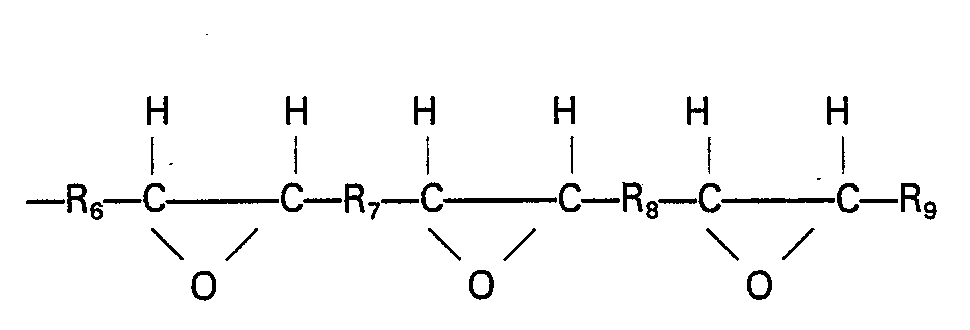
- the residue of an epoxidized aliphatic carboxylic acid represented by X, Y and Z is selected from the following groups wherein R 1 , R 3 , R 4 , R 6 , R 7 and R 8 , independently from each other, represent a saturated or unsaturated, linear or branched divalent hydrocarbon group having 1 to 25 carbon atoms, and R 2 , R 5 and R 9 , independently from each other, represent a saturated or unsaturated, linear or branched monovalent hydrocarbon group having 1 to 25 carbon atoms.
- saturated or unsaturated linear or branched divalent hydrocarbon group having 1 to 25 carbon atoms examples include alkylene groups such as methylene, ethylene, propylene, isopropylene, butylene, pentylene, hexylene, heptylene, nonylene and decylene, and alkenylene groups such as butenylene, pentenylene, hexenylene, heptenylene, nonenylene and decenylene.
- saturated or unsaturated linear or branched monovalent hydrocarbon group having 1 to 25 carbon atoms examples include alkyl groups such as methyl, ethyl, propyl, butyl, pentyl, hexyl, heptyl, nonyl, and decyl, and alkenyl groups such as vinyl, allyl, butenyl, pentenyl, hexenyl, heptenyl, octenyl, nonenyl and decenyl.
- Saturated aliphatic hydrocarbon groups having 1 to 18 carbon atoms are preferred.
- the carboxylic acid residues of formulae (a), (b) and (c) are derived from epoxidized aliphatic carboxylic acids which can be produced by epoxidizing the double bonds of unsaturated aliphatic carboxylic acids of the following formulae wherein R 1 , R 2 , R 3 , R 4 , R 5 , R 6 , R 7 , R 8 and R 9 are as defined hereinabove.
- the above residues may contain generally 4 to 40 carbon atoms, preferably 5 to 30 carbon atoms, in total.
- Examples of the unsaturated aliphatic carboxylic acid of formula (a') are 3-hexenoic acid, 4-hexenoic acid, 4-decenoic acid, 9-undecenoic acid, 4-dodecenoic acid, 5-dodecenoic acid, 9-octadecenoic acid and 13-docosenoic acid.
- Examples of the unsaturated aliphatic carboxylic acid of formula (b') are 9,12-hexadecadienic acid, 9,12-octadecadienic acid, eicosadienic acid, docosadienic acid and hexacodienic acid.
- Examples of the unsaturated aliphatic carboxylic acid of formula (c') are hexadecatrienoic acid, 9,12,15-octadecatrienoic acid, 6,9,12-octadecatrienoic acid, eicosatrienoic acid and docosatrienoic acid.
- the glycerin ester of formula (I) can be easily produced by esterifying glycerin with at least one of the unsaturated aliphatic carboxylic acids of formulae (a'), (b') and (c') and then oxidizing the esterification product.
- the glycerin ester may be a monoester or a diester, but is preferably a triester.
- Glycerin esters preferably used in this invention are an epoxidized triglyceride of 9-octadecenoic acid, 9,12-octadecadienic acid and 9,12,15-octadecetrienoic acid; an epoxidized triglyceride of 13-docosenoic acid 9-octadecenoic acid and 9,12,15-octadecatrienoic acid; an epoxidized triglyceride of 9-octadecenoic acid and 9,12,15-octadecatrienoic acid an epoxidized triglyceride of 9-octadecenoic acid and 9,12-octadecadienic acid; and an epoxidized triglyceride of 9-octadecenoic acid and 9,12-octadecadienic acid. They may be used as a mixture of two or more.
- the glycerin esters described above desirably contain 5 to 10% by weight, preferably 6 to 9.5% by weight, based on the weight of the ester, of oxirane oxygen. Desirably, they have an iodine value, as a measure of the degree of saturation, of generally not more than 10, preferably not more than 8, more preferably not more than 5.
- the oxirane oxygen content is the weight percent of oxygen in which is present in one mole of the glycerin ester. If the oxirane oxygen content is less than 5% by weight, the resulting composition tends to show only an insufficient improvement in hemolytic and cytotoxic properties. If it exceeds 10% by weight, the ester in the composition dissolves in the blood or transfusion fluids, and the resulting resin composition loses its suitability for medical devices.
- the iodine value is the grams of iodine absorbed per 100 g of the glycerin ester. If it is larger than 10, the glycerin ester tends to change with time.
- the resin composition of this invention obtained by blending the specified vinyl chloride/ethylene copolymer, the ethylene/carbon monoxide/vinyl acetate copolymer and the glycerin ester represented by the above-specified chemical formula has excellent transparency and pliability and is free from hemolytic and cytotoxic properties. These properties are desirable for use in making medical devices.
- the resin composition of this invention can be prepared by uniformly melting and kneading the vinyl chloride/ethylene copolymer, the ethylene/carbon monoxide/vinyl acetate copolymer and the glycerin ester by a method known per se.
- a powder or pellets of the vinyl chloride/ethylene copolymer, a powder or pellets of the ethylene/carbon monoxide/vinyl acetate copolymer, and the glycerin ester are fed into a mixing roll, a Banbury mixer, an extrusion-type kneader, etc., and can be uniformly melted and kneaded therein.
- the melt-kneading temperature is generally 110 to 180°C, preferably 120 to 165°C.
- the proportions of the vinyl chloride/ethylene copolymer, the ethylene/carbon monoxide/vinyl acetate copolymer, and the glycerin ester can be varied widely according to the properties required of the final resin composition. Generally, it is preferred to blend the ethylene/carbon monoxide/vinyl acetate copolymer and the glycerin ester in the following proportions per 100 parts by weight of the vinyl chloride/ethylene copolymer.
- the resin composition of this invention may further include a stabilizer such as calcium stearate, zinc stearate, calcium oxide or magnesium oxide, an antioxidant such as a phenol compound or a phosphorous acid ester, a plasticizer such as di-2-ethylhexyl phthalate, diethyl hexyl adipate and dioctyl adipate, and a lubricant such as polyethylene, acid amides and esters in amounts which does not substantially affect the desirable properties of the resin composition of this invention adversely. This can lead to an improvement in the heat stability, oxidation resistance, melt flow characteristics during molding, mold adhesion, etc. of the resin composition.
- a stabilizer such as calcium stearate, zinc stearate, calcium oxide or magnesium oxide
- an antioxidant such as a phenol compound or a phosphorous acid ester
- a plasticizer such as di-2-ethylhexyl phthalate, diethyl hexyl adipate and di
- the ethylene/carbon monoxide/vinyl acetate copolymer is treated, prior to melt kneading, with a liquid in which the copolymer is substantially insoluble and which substantially dissolves acetic acid.
- substantially insoluble means that the material in question is not soluble at all, or is soluble only slightly.
- substantially dissolves means that the liquid dissolves acetic acid even slightly. More specifically, the term “substantially insoluble” means that the solubility at room temperature is less than 10 g/100 ml. The term “substantially dissolves” means that the solubility of acetic acid at room temperature is at least 10 g/100 ml.
- This treatment makes it possible to remove at least partly acetic acid which may exist in the ethylene/carbon monoxide/vinyl acetate copolymer and could be a hemolysis- and cytotoxin-causing substance. It is possible therefore to provide a resin composition which has very little hemolytic and cytotoxic properties and is more suitable as a material for medical devices.
- Water is suitable as the liquid which can be used in the above treatment.
- the following liquids may be used singly or as a mixture of two or more.
- the selected liquid when it has solubility in the copolymer, it can be used as a.mixture with a liquid having no ability to dissolve the copolymer, such as water or methanol.
- the treatment of the copolymer with the above liquid is effected by dipping the copolymer, either as granules or in the pulverized state, in the liquid.
- the ratio of the copolymer to the liquid in this case is generally within the range of between 1:1 and 1:20.
- the temperature at which the copolymer is treated with the liquid is adjusted to temperatures lower than the melting point of the copolymer, preferably temperatures between room temperature and about 50°C.
- the suitable contact time is several minutes to several hours depending upon the temperature, etc.
- Whether acetic acid is fully dissolved is determined by actually molding the resulting resin composition and preforming a hemolysis test and a cytotoxin test on the resulting molded article.
- the pH of the washing liquid is measured, and its correlation with the hemolysis test and the cytotoxin test is determined. Hence, rough estimation can be made from the pH value of the washing liquid.
- the resin composition provided by this invention consists essentially of the vinyl chloride/ethylene copolymer, the ethylene/carbon monoxide/vinyl acetate copolymer, and the glycerin ester represented by the above chemical formula. Since it has excellent pliability, transparency and antiblocking property and is substantially free from hemolytic and cytotoxic properties, it is very suitable as a material for producing medical devices.
- the resin composition of this invention can be suitably used by molding it into medical devices, such as catheters, tubes for transfusion, blood bags, transfusion fluid bags, and blood circuit tubes in artificial dialysis.
- the resin composition of this invention is molded into any desired shapes such as a film, sheet, plate, container, tube, hollow cylinder, rod and bag.
- the molding can be performed by usual molding means such as extrusion molding, injection molding, casting, press forming and blow moulding.
- the molding temperature is generally about 110 to 180°C.
- the molding is carried out at a temperature of 110 to 160°C in order to inhibit the best decomposition of the vinyl chloride/ethylene copolymer and the ethylene/carbon monoxide/vinyl acetate copolymer.
- the molded article so obtained can be conveniently used as medical devices such as catheters, transfusion tubes, blood bags, transfusion fluid bags, and blood circuit tubes in artificial dialysis.
- hemolysis test and the cytotoxin test were carried out as follows:
- a plastic to be tested was finely cut, and one gram of the cut plastic was added to MEM medium (Eagle-Minimum Essential Medium with Earle's Salt (a tissue culture medium suggested by Eagle)], and extracted in an autoclave at 121°C for 20 minutes.
- the extracted culture medium was diluted with a control culture medium, and cells are introduced into it and cultivated at 37°C for 5 days while maintaining the concentration of C0 2 at 5%.
- the number of cells and the number of dead cells were counted five days later by using a microscope. The results were compared with those obtained with a control liquid, and the toxicity was evaluated.
- Vinyl chloride and ethylene were copolymerized at a temperature of 40°C using diisopropyl peroxydicarbonate as a polymerization catalyst and partially saponified polyvinyl alcohol as a polymerization dispersing agent.
- vinyl chloride/ethylene copolymers having different ethylene contents in molecular weight distributions as shown in Table I were obtained. These copolymer had an average degree of polymerization of 1,000.
- a powdery ethylene/vinyl acetate/carbon monoxide copolymer (ethylene content 65% by weight: vinyl acetate content 25% by weight; carbon monoxide content 10% by weight; molecular weight 250,000; acetic acid content 100 ppm) and 300 parts by weight of water were stirred at room temperature for 60 minutes in a receptacle equipped with a stirrer. The mixture was dehydrated and dried, and then tested in accordance with Testing Method for Plastic Containers for transfusion fluids. It was found to have a pH value of 5.5 and an acetic acid content of less than 30 ppm. The amount of materials dissolved in water during the above washing was 0.1% by weight based on the copolymer.
- the temperature of the resin at the die section during the extrusion was 160°C.
- Vinyl chloride and ethylene were copolymerized at 30°C. using cumyl peroxyneodecanoate and sodium bisulfite as a polymerization catalyst and partially saponified polyvinyl alcohol as a dispersing agent.
- the copolymers shown in Table I were obtained. These copolymers had an average degree of polymerization of 2,200.
- a powdery ethylene/vinyl acetate/carbon monoxide copolymer (ethylene content 60% by weight; vinyl acetate content 30% by weight; carbon monoxide content 10% by weight; molecular weight 280,000) and 200 parts by weight of methanol were stirred in a receptacle equipped with a stirrer at room temperature for 60 minutes, and dried.
- the product was tested in accordance with Testing Method for Plastic Containers for Transfusion Fluids. It was found to have a pH of 6.0 (acetic acid content less than 30 ppm), and the amount of materials dissolved in methanol was 10% by weight based on the copolymer.
- Each of the sheets was transparent and pliable, does not show hemolytic and cytotoxic actions, and scarcely contained materials which dissolved. Thus, it meets the requirements stipulated in the standards for blood-contacting medical devices. Accordingly, it was suitable for making blood bags.
- Vinyl chloride and ethylene were copolymerized at 25°C using diisobutyryl peroxide as a polymerization catalyst and hydroxypropyl methyl cellulose as a dispersing agent.
- the copolymers shown in Table I were obtained. These copolymers had an average degree of polymerization of 2,800.
- One hundred parts by weight of a powdery ethylene/vinyl acetate/carbon monoxide copolymer (ethylene content 65% by weight; vinyl acetate content 25% by weight, carbon monoxide content 10% by weight; molecular weight 300,000; acetic acid content 100 ppm) and a mixed liquid of 200 parts by weight of water and 10 parts by weight of acetone were stirred in a receptacle equipped with a stirrer at 25°C for 60 minutes.
- the mixture was dried, and tested in accordance with Testing Method for Plastic Containers for Transfusion Fluids, and found to have a pH of 6.1 and an acetic acid content of less than 30 ppm.
- the amount of materials which dissolved was 0.8% based on the weight of the copolymer.
- extruded sheets were formed under the same conditions as in Examples 1 to 4 except that vinyl chloride/ethylene copolymers having the ethylene contents, average degrees of polymerization and the Mw/Mn ratios shown in Table II were used.
- the properties of the compostions and the acceptability of the extruded sheets as a material for medical devices were evaluated in the same way as in Examples 1 to 4. The results are shown in Table II.
- extruded sheets were formed under the same conditions as in Examples 5 to 8 except that vinyl chloride/ethylene copolymers having the ethylene contents, average degrees of polymerization and the Mw/Mn ratios shown in Table II were used.
- the properties of the compositions and the acceptability of the extruded sheets as a material for medical devices were evaluated in the same way as in Examples 5 to 8. The results are shown in Table II.
- extruded sheets were formed under the same conditions as in Examples 9 to 13 except that vinyl chloride/ethylene copolymers having the ethylene contents, average degrees of polymerization and the Mw/Mn ratios shown in Table II were used.
- the properties of the compositions and the acceptability of the extruded sheets as a material for medical devices were evaluated in the same way as in Examples 9 to 13. The results are shown in Table II.
- the vinyl chloride/ethylene copolymers shown in Table III were produced, and molded into extruded sheets under the conditions shown in Table III. The acceptability of these sheets as a material for medical devices was evaluated, and the results shown in Table III were obtained.
- Example 1 For comparison with Examples 1 to 4, a sheet-like molded article was produced in the same way as in Example 1 except that the same ethylene/vinyl acetate/carbon monoxide copolymer as in Example 1 was used except that it was not washed with water.
- This sheet-like molded article had excellent transparency and pliability, but showed strong hemolytic activity and was cytotoxic. It had poor antiblocking property.
Landscapes
- Chemical & Material Sciences (AREA)
- Health & Medical Sciences (AREA)
- Chemical Kinetics & Catalysis (AREA)
- Medicinal Chemistry (AREA)
- Polymers & Plastics (AREA)
- Organic Chemistry (AREA)
- Life Sciences & Earth Sciences (AREA)
- Physics & Mathematics (AREA)
- Crystallography & Structural Chemistry (AREA)
- Analytical Chemistry (AREA)
- Biochemistry (AREA)
- General Health & Medical Sciences (AREA)
- General Physics & Mathematics (AREA)
- Immunology (AREA)
- Pathology (AREA)
- Materials For Medical Uses (AREA)
- Medical Preparation Storing Or Oral Administration Devices (AREA)
- Compositions Of Macromolecular Compounds (AREA)
Description
- This invention relates to a resin composition comprising a vinyl chloride-type polymer as a base, which is suitable for making medical devices, especially bags for storing transfusion fluids, receptacles for storing blood, and tubes for a blood circuit in artificial kidneys.
- Heretofore, blood bags have been used to transport or store blood, and in performing dialysis by artificial kidneys on patients with renal disorders, blood circuit tubes have been used. These medical devices are required to be pliable and free from degeneration, and even upon long contact with blood, not to degenerate blood or permit migration of foreign materials into the blood. The blood circuit tubes should also possess transparency which enables the blood passing inside to be observed from outside, pliability which permits free deformation, repulsive elasticity which enables the tube to regain its original shape rapidly when the tube is clamped from outside or released from clamping and enables this operation to step or pass the blood stream as desired, and surface non-tackiness which prevents the tube from adhering to itself when the tube is wound or laminated.
- A flexible vinyl chloride resin composition prepared by adding a large amount of a plasticizer such as di-2-ethylhexyl phthalate to a vinyl chloride resin has been used as a material for these medical devices such as blood bags or blood circuit tubes. This resin composition has excellent pliability and transparency, but has the defect that a small amount of the plasticizer dissolves and is absorbed and accumulated in the body through the blood stream. The blood bags or blood circuit tubes are sterilized by contact with ethylene oxide gas, or by exposure to pressurized steam in an autoclave. In the case of the former, this composition may absorb ethylene oxide. In the case of the latter, it is difficult to completely avoid the defect that blocking occurs in a molded article from the resin composition or adhesion occurs at the contacting surface between the molded article and an instrument, transparency is lost, or deformation is likely to occur.
- It was desired therefore to provide a resin composition for making a blood bag or a blood circuit tube which is free from these defects.
- The present inventors noted that the aforesaid vinyl chloride resin containing di-2-ethylhexyl phthalate, in spite of its some defects, has actually been used, and found to be acceptable in accordance with test standards stipulated in Japanese Pharmacopoeia and Notifications of the Ministry of Health and Welfare, Japan; TSS/B/320008 (Specification for a Plastic Cellapsible Container for Blood and Blood Components) in Britain; DIN, 58368 Blatt, 2 in Germany; U.S. Pharmacopoeia XIX, 644 (1975) in U.S.A.; and Swiss Pharmacopoeia Subsidia Pharmaceutica, II, 5 (1961). They attempted to remove the aforesaid defects by improving the vinyl chloride resin and providing a vinyl chloride resin composition not containing di-2-ethylhexyl phthalate.
- A method for providing a flexible formulation of a vinyl chloride resin without substantially using a plasticizer was reported which comprises blending the vinyl chloride resin with a terpolymer of ethylene, carbon monoxide and vinyl acetate (see U.S. Patent No. 3,780,140 or British Patent No. 1,403,773). The present inventors, therefore, actually mixed a vinyl chloride resin with this terpolymer to form a uniform composition and examined its properties. Consequently, they knew that this composition had satisfactory transparency and pliability, but showed undesirable results in a test for hemolysis or a test for cytotoxin. The present inventors investigated the cause of this, and found that the ethylene/carbon monoxide/vinyl acetate copolymer contains acetic acid resulting from the decomposition of this copolymer, and when a medical device is molded by using a resin composition containing this copolymer, the resulting medical device becomes hemolytic and cytotoxic.
- Previously, the present inventors, based on this finding, proposed a resin composition for medical devices, comprising a vinyl chloride resin, an ethylene/carbon monoxide/vinyl acetate copolymer and calcium oxide or magnesium oxide as an acetic acid scavenger (see Japanese Laid-Open Patent Publication No. 41240/1981). It was found however that although acetic acid can be scavenged by a fine powder of calcium oxide or magnesium oxide in the composition if the amount of acetic acid is very small, a large amount of acetic acid cannot be completely scavenged by the fine powder of calcium oxide or magnesium oxide, and a molded article prepared from the composition inevitably becomes hemolytic and cytotoxic. If the amount of the fine powder of calcium oxide or magnesium oxide is increased to scavenge acetic acid, a molded article prepared from the resulting composition has reduced transparency and an increased ignition loss, and is likely to fall outside the range of standards set for medical devices.
- On further investigations, the present inventors have now found that by including a glycerin ester having a specified chemical structure into a mixture of a vinyl chloride resin and an ethylene/carbon monoxide/vinyl acetate copolymer, there can be obtained a resin composition being free from the aforesaid defect of hemolysis and cytotoxin and having excellent pliability and transparency, and that by using a vinyl chloride/ethylene copolymer having a specified ethylene content, degree of polymerization and molecular weight distribution as the vinyl chloride resin, there can be provided a resin composition which can be melt-molded at relatively low temperatures, does not cause the aforesaid defects during sterilization by pressurized steam in an autoclave, and shows a further improvement in transparency, mechanical properties, hemolysis and cytotoxin.
- Thus, according to this invention, there is provided a resin composition comprising
- (a) a vinyl chloride/ethylene copolymer having an ethylene content in the range of 3 to 12% by weight, an average degree of polymerization in the range of 700 to 2900 and a ratio of weight average molecular weight to number average molecular weight in the range of from 2.5:1 to 5.5:1,
- (b) an ethylene/carbon monoxide/vinyl acetate copolymer, and
- (c) a glycerin ester of the following formula


- provided that X, Y and Z are not hydrogen atoms at the same time.
- The novel and improved resin composition provided by this invention will be described below in greater detail.
- One characteristic feature of the resin composition of this invention is that it contains a vinyl chloride/ethylene copolymer having an ethylene content of 3 to 12%, preferably 4 to 11 %, more preferably 5 to 10%, based on the weight of the copolymer as the vinyl chloride resin component. If the ethylene content of the vinyl chloride/ethylene copolymer is less than 3%, it does not uniformly dissolve mutually in the ethylene/carbon monoxide/vinyl chloride copolymer. If it exceeds 12%, the characteristics of the copolymer as the vinyl chloride resin are reduced, and the resulting resin composition tends to have reduced mechanical strength and transparency. The vinyl chloride/ethylene copolymer can be composed only of two monomers, vinyl chloride and ethylene. As required, however, it may contain a copolymerizable third monomer, for example an a-olefin such as propylene, a vinyl ester such as vinyl acetate, a vinyl ether such as methyl vinyl ether, a vinyl halide such as vinyl bromide, an unsaturated acid such as maleic acid and fumaric acid, an ester of the unsaturated acid, styrene, acrylonitrile, or vinylidene chloride, in an amount which does not substantially affect the properties of the copolymer adversely. The amount of the third monomer is usually up to 20%, preferably up to 10%.
- If the degree of polymerization of the vinyl chloride/ethylene copolymer is too low, the mechanical durability, such as creep, of the resin composition is reduced or the resin composition develops surface stickiness, although this depends upon the amount of the copolymer blended. In addition, its heat resistance is reduced, and there is a likelihood of formation of a heat decomposition product, which may be toxic on the living body, during melt molding. On the other hand, if the degree of polymerization is too high, uniform mixing with the ethylene/carbon monoxide vinyl acetate copolymer described hereinbelow tends to be difficult. It is important that the vinyl chloride/ethylene copolymer should have an average degree of polymerization in the range of 700 to 2900, preferably 900 to 2800, more preferably 1000 to 2500.
- Furthermore, in order to provide a resin composition which is industrially quite satisfactory as a material for medical devices, it has been found important that the ratio of the weight average molecular weight Mw to the number average molecular weight Mn, which has closely to do with the molecular weight distribution of the copolymer, should be within the range of from 2.5:1 to 5.5:1, preferably from 2.4:1 to 5.3: 1, more preferably from 2.3:1 to 5.2: 1. If the above ratio becomes,lower outside the above range, the compatibility of the vinyl chloride/ethylene copolymer with the ethylene/carbon monoxide/vinyl acetate copolymer becomes poor, and the resulting resin composition has reduced transparency. If, on the other hand, the ratio exceeds the upper limit specified above, the occurrence of fish eyes in the resin composition generally increases.
- The vinyl chloride/ethylene copolymer having the aforesaid specified ethylene content, degree of polymerization and molecular weight distribution can be produced by suspension polymerization or emulsion polymerization in the presence of ordinary radical polymerization catalysts. One specific method of polymerization is as follows: An autoclave equipped with a stirrer is charged with water and a dispersing agent, and then oxygen present inside the autoclave is removed by evacuation. With stirring, vinyl chloride and ethylene are introduced into the autoclave. At an elevated pressure, a polymerization initiator is added, and with continued stirring, the temperature of the contents of the autoclave is raised to 20 to 70°C. While the reaction mixture is stirred at this temperature for 5 to 15 hours, polymerization proceeds.
- Examples of useful dispersing agents are partially saponified polyvinyl alcohols, cellulose derivatives such as methyl cellulose, hydroxymethyl cellulose and carboxy methyl cellulose, and surface-active agents such as polyvinyl pyrrolidone. The dispersing agent is used in an amount of usually 0.05 to 1.0% by weight based on the total weight of vinyl chloride and ethylene.
- The kind of the polymerization initiator differs depending upon whether the polymerization is carried out in suspension or in emulsion. In order to perform suspension polymerization, there may be used peroxide compounds such as diisobutyryl peroxide, di-2-methylpentanoyl peroxide, 3,5,5-trimethylhexanoyl peroxide, lauroyl peroxide, and benzoyl peroxide, perester compounds such as cumyl peroxyneodecanoate, and peroxydicarbonate compounds such as diisopropyl peroxydicarbonate, dicetyl peroxydicarbonate, di-2-ethylhexyl peroxycarbonate and diisobutyl peroxydicarbonate. In order to perform emulsion polymerization, ammonium persulfate, potassium persulfate, etc. are used. The amount of the polymerization initiator used is generally 0.02 to 0.3% by weight based on the total weight of vinyl chloride and ethylene.
- The starting vinyl chloride and ethylene are added to the reaction system in an amount exceeding the amount of the resulting polymer by 5 to 50% by weight. The ratio of the total weight of vinyl chloride and ethylene used at the time of polymerization to water used at the time of polymerization is selected from the range of from 1:1.2 to 1:3.
- The end point of the polymerization can be empirically presumed from the relation between the internal pressure of the polymerization vessel and the yield of the polymer, which is obtained by preliminary experiments. After the polymerization, the unreacted monomers are removed, and the suspension or emulsion in the autoclave is filtered to remove water and to obtain polymer particles. The polymer particles are then washed with water and dried.
- At least some of the ethylene/carbon monoxide/vinyl acetate copolymers used together with the vinyl chloride/ethylene copolymer in accordance with this invention are already known (see, for example, U.S. Patent No. 3,780,140), and can be produced by methods known per se. For example, such a copolymer is available commercially under the trademark "ELVALOY 741R" from E. I. du Pont de Nemours & Co., U.S.A.
- The monomer ratio in the ethylene/carbon monoxide/vinyl acetate copolymer is not strictly restricted, and can be varied according to the properties required of the copolymer. Generally, suitable copolymers are those obtained by copolymerizing 1 part by weight of ethylene, 0.03 to 0.5 part by weight, preferably 0.06 to 0.4 part by weight, more preferably 0.09 to 0.3 part by weight, of carbon monoxide, and 0.1 to 0.9 part by weight, preferably 0.2 to 0.8 part by weight, more preferably 0.3 to 0.7 part by weight, of vinyl acetate in the presence of a radical polymerization catalyst by a method known per se. The molecular weight of the ethylene/carbon monoxide/vinyl acetate copolymer is not critical, and can be varied depending upon the kind of the vinyl chloride/ethylene copolymer used. It is advantageous, however, that this copolymer has a weight average molecular weight of generally about 100,000 to about 2,000,000, preferably about 150,000 to about 1,000,000.
- Another characteristic feature of the present invention is that a specified glycerin ester of the following formula

- wherein X, Y and Z are as defined above, is combined with the aforesaid vinyl chloride/ethylene copolymer and ethylene/carbon monoxide/vinyl acetate copolymer.
- It has been found that the use of this specified glycerin ester leads to a marked improvement in the hemolytic and cytotoxic properties of the resin compositions without imparting its transparency and pliability.
- The residue of an epoxidized aliphatic carboxylic acid represented by X, Y and Z is selected from the following groups


- Examples of the saturated or unsaturated linear or branched divalent hydrocarbon group having 1 to 25 carbon atoms include alkylene groups such as methylene, ethylene, propylene, isopropylene, butylene, pentylene, hexylene, heptylene, nonylene and decylene, and alkenylene groups such as butenylene, pentenylene, hexenylene, heptenylene, nonenylene and decenylene. Preferred are saturated aliphatic hydrocarbon groups having 1 to 19 carbon atoms.
- Examples of the saturated or unsaturated linear or branched monovalent hydrocarbon group having 1 to 25 carbon atoms include alkyl groups such as methyl, ethyl, propyl, butyl, pentyl, hexyl, heptyl, nonyl, and decyl, and alkenyl groups such as vinyl, allyl, butenyl, pentenyl, hexenyl, heptenyl, octenyl, nonenyl and decenyl. Saturated aliphatic hydrocarbon groups having 1 to 18 carbon atoms are preferred.
- The carboxylic acid residues of formulae (a), (b) and (c) are derived from epoxidized aliphatic carboxylic acids which can be produced by epoxidizing the double bonds of unsaturated aliphatic carboxylic acids of the following formulae


- The above residues may contain generally 4 to 40 carbon atoms, preferably 5 to 30 carbon atoms, in total.
- Examples of the unsaturated aliphatic carboxylic acid of formula (a') are 3-hexenoic acid, 4-hexenoic acid, 4-decenoic acid, 9-undecenoic acid, 4-dodecenoic acid, 5-dodecenoic acid, 9-octadecenoic acid and 13-docosenoic acid. Examples of the unsaturated aliphatic carboxylic acid of formula (b') are 9,12-hexadecadienic acid, 9,12-octadecadienic acid, eicosadienic acid, docosadienic acid and hexacodienic acid.
- Examples of the unsaturated aliphatic carboxylic acid of formula (c') are hexadecatrienoic acid, 9,12,15-octadecatrienoic acid, 6,9,12-octadecatrienoic acid, eicosatrienoic acid and docosatrienoic acid.
- The glycerin ester of formula (I) can be easily produced by esterifying glycerin with at least one of the unsaturated aliphatic carboxylic acids of formulae (a'), (b') and (c') and then oxidizing the esterification product. The glycerin ester may be a monoester or a diester, but is preferably a triester.
- Glycerin esters preferably used in this invention are an epoxidized triglyceride of 9-octadecenoic acid, 9,12-octadecadienic acid and 9,12,15-octadecetrienoic acid; an epoxidized triglyceride of 13-docosenoic acid 9-octadecenoic acid and 9,12,15-octadecatrienoic acid; an epoxidized triglyceride of 9-octadecenoic acid and 9,12,15-octadecatrienoic acid an epoxidized triglyceride of 9-octadecenoic acid and 9,12-octadecadienic acid; and an epoxidized triglyceride of 9-octadecenoic acid and 9,12-octadecadienic acid. They may be used as a mixture of two or more.
- Generally, the glycerin esters described above desirably contain 5 to 10% by weight, preferably 6 to 9.5% by weight, based on the weight of the ester, of oxirane oxygen. Desirably, they have an iodine value, as a mesure of the degree of saturation, of generally not more than 10, preferably not more than 8, more preferably not more than 5.
- The oxirane oxygen content is the weight percent of oxygen in

- The resin composition of this invention obtained by blending the specified vinyl chloride/ethylene copolymer, the ethylene/carbon monoxide/vinyl acetate copolymer and the glycerin ester represented by the above-specified chemical formula has excellent transparency and pliability and is free from hemolytic and cytotoxic properties. These properties are desirable for use in making medical devices.
- The resin composition of this invention can be prepared by uniformly melting and kneading the vinyl chloride/ethylene copolymer, the ethylene/carbon monoxide/vinyl acetate copolymer and the glycerin ester by a method known per se. For example, a powder or pellets of the vinyl chloride/ethylene copolymer, a powder or pellets of the ethylene/carbon monoxide/vinyl acetate copolymer, and the glycerin ester are fed into a mixing roll, a Banbury mixer, an extrusion-type kneader, etc., and can be uniformly melted and kneaded therein. The melt-kneading temperature is generally 110 to 180°C, preferably 120 to 165°C.
- The proportions of the vinyl chloride/ethylene copolymer, the ethylene/carbon monoxide/vinyl acetate copolymer, and the glycerin ester can be varied widely according to the properties required of the final resin composition. Generally, it is preferred to blend the ethylene/carbon monoxide/vinyl acetate copolymer and the glycerin ester in the following proportions per 100 parts by weight of the vinyl chloride/ethylene copolymer.

- As required, the resin composition of this invention may further include a stabilizer such as calcium stearate, zinc stearate, calcium oxide or magnesium oxide, an antioxidant such as a phenol compound or a phosphorous acid ester, a plasticizer such as di-2-ethylhexyl phthalate, diethyl hexyl adipate and dioctyl adipate, and a lubricant such as polyethylene, acid amides and esters in amounts which does not substantially affect the desirable properties of the resin composition of this invention adversely. This can lead to an improvement in the heat stability, oxidation resistance, melt flow characteristics during molding, mold adhesion, etc. of the resin composition.
- According to a preferred aspect of this invention, the ethylene/carbon monoxide/vinyl acetate copolymer is treated, prior to melt kneading, with a liquid in which the copolymer is substantially insoluble and which substantially dissolves acetic acid.
- The term "substantially insoluble" means that the material in question is not soluble at all, or is soluble only slightly. The term "substantially dissolves" means that the liquid dissolves acetic acid even slightly. More specifically, the term "substantially insoluble" means that the solubility at room temperature is less than 10 g/100 ml. The term "substantially dissolves" means that the solubility of acetic acid at room temperature is at least 10 g/100 ml.
- This treatment makes it possible to remove at least partly acetic acid which may exist in the ethylene/carbon monoxide/vinyl acetate copolymer and could be a hemolysis- and cytotoxin-causing substance. It is possible therefore to provide a resin composition which has very little hemolytic and cytotoxic properties and is more suitable as a material for medical devices.
- Water is suitable as the liquid which can be used in the above treatment. In addition, the following liquids may be used singly or as a mixture of two or more. In this case, when the selected liquid has solubility in the copolymer, it can be used as a.mixture with a liquid having no ability to dissolve the copolymer, such as water or methanol.

- Preferably, the treatment of the copolymer with the above liquid is effected by dipping the copolymer, either as granules or in the pulverized state, in the liquid. The ratio of the copolymer to the liquid in this case is generally within the range of between 1:1 and 1:20. Preferably, the temperature at which the copolymer is treated with the liquid is adjusted to temperatures lower than the melting point of the copolymer, preferably temperatures between room temperature and about 50°C. The suitable contact time is several minutes to several hours depending upon the temperature, etc.
- As a result of contacting the copolymer with the liquid, acetic acid present in the copolymer dissolves in the liquid, and consequently, the copolymer does not show hemolytic and cytotoxic properties.
- Whether acetic acid is fully dissolved is determined by actually molding the resulting resin composition and preforming a hemolysis test and a cytotoxin test on the resulting molded article. As a rough measure, the pH of the washing liquid is measured, and its correlation with the hemolysis test and the cytotoxin test is determined. Hence, rough estimation can be made from the pH value of the washing liquid.
- The resin composition provided by this invention consists essentially of the vinyl chloride/ethylene copolymer, the ethylene/carbon monoxide/vinyl acetate copolymer, and the glycerin ester represented by the above chemical formula. Since it has excellent pliability, transparency and antiblocking property and is substantially free from hemolytic and cytotoxic properties, it is very suitable as a material for producing medical devices.
- The resin composition of this invention can be suitably used by molding it into medical devices, such as catheters, tubes for transfusion, blood bags, transfusion fluid bags, and blood circuit tubes in artificial dialysis. Depending upon the type of the desired medical device, the resin composition of this invention is molded into any desired shapes such as a film, sheet, plate, container, tube, hollow cylinder, rod and bag. The molding can be performed by usual molding means such as extrusion molding, injection molding, casting, press forming and blow moulding.
- Preferably, the molding temperature is generally about 110 to 180°C. Especially preferably, the molding is carried out at a temperature of 110 to 160°C in order to inhibit the best decomposition of the vinyl chloride/ethylene copolymer and the ethylene/carbon monoxide/vinyl acetate copolymer.
- The molded article so obtained, either as such or after being further processed, can be conveniently used as medical devices such as catheters, transfusion tubes, blood bags, transfusion fluid bags, and blood circuit tubes in artificial dialysis.
- The following examples illustrate the present invention more specifically.
- In these examples, the hemolysis test and the cytotoxin test were carried out as follows:
- In accordance with a testing method for plastic containers for transfusion fluids described in the "General Testing Methods" in Japanese Pharmacopoeia.
- A plastic to be tested was finely cut, and one gram of the cut plastic was added to MEM medium (Eagle-Minimum Essential Medium with Earle's Salt (a tissue culture medium suggested by Eagle)], and extracted in an autoclave at 121°C for 20 minutes. The extracted culture medium was diluted with a control culture medium, and cells are introduced into it and cultivated at 37°C for 5 days while maintaining the concentration of C02 at 5%. The number of cells and the number of dead cells were counted five days later by using a microscope. The results were compared with those obtained with a control liquid, and the toxicity was evaluated.
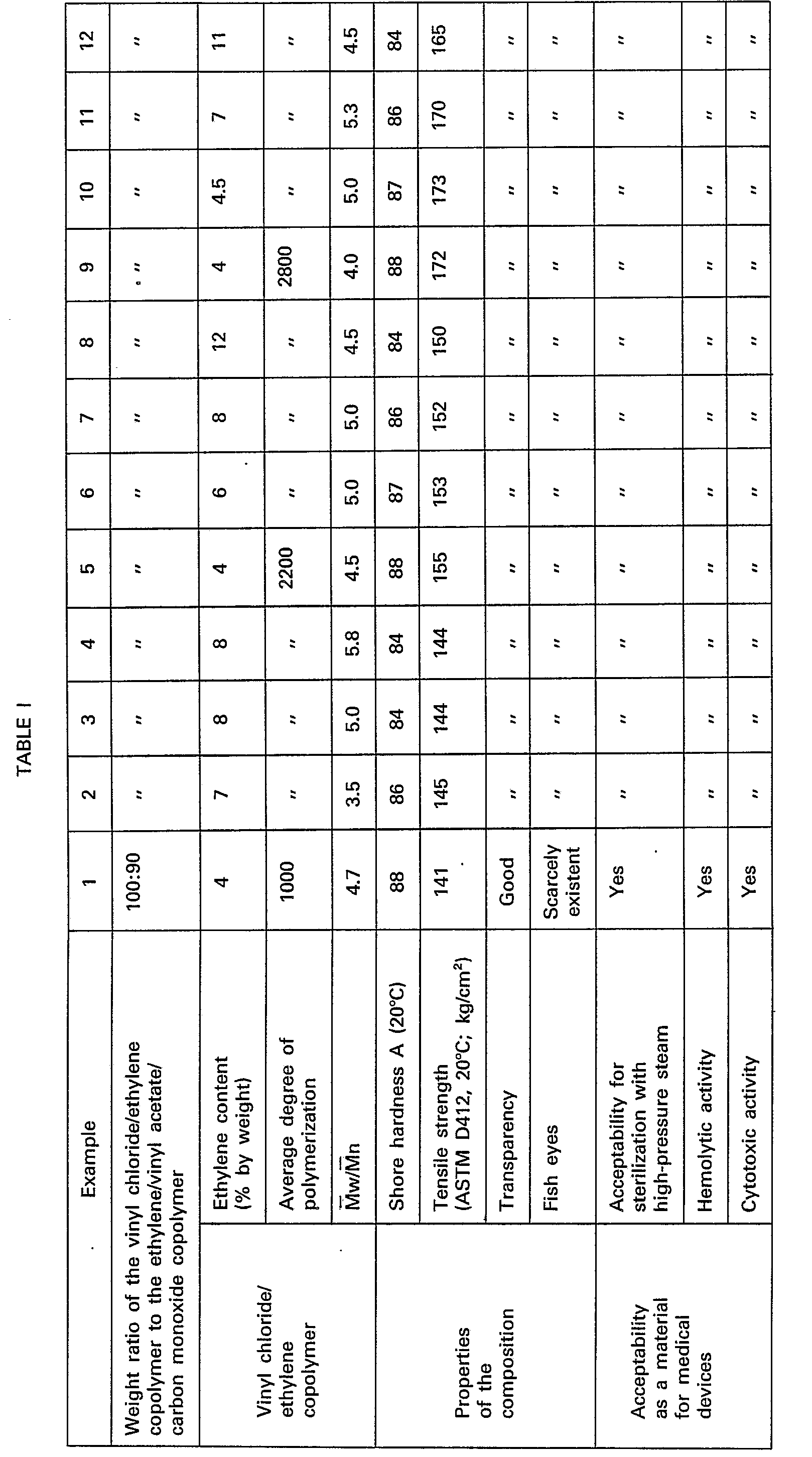
- Vinyl chloride and ethylene were copolymerized at a temperature of 40°C using diisopropyl peroxydicarbonate as a polymerization catalyst and partially saponified polyvinyl alcohol as a polymerization dispersing agent. By varying the amount of the ethylene monomer, vinyl chloride/ethylene copolymers having different ethylene contents in molecular weight distributions as shown in Table I were obtained. These copolymer had an average degree of polymerization of 1,000.
- One hundred parts by weight of a powdery ethylene/vinyl acetate/carbon monoxide copolymer (ethylene content 65% by weight: vinyl acetate content 25% by weight; carbon monoxide content 10% by weight; molecular weight 250,000; acetic acid content 100 ppm) and 300 parts by weight of water were stirred at room temperature for 60 minutes in a receptacle equipped with a stirrer. The mixture was dehydrated and dried, and then tested in accordance with Testing Method for Plastic Containers for transfusion fluids. It was found to have a pH value of 5.5 and an acetic acid content of less than 30 ppm. The amount of materials dissolved in water during the above washing was 0.1% by weight based on the copolymer.
- A composition composed of 90 parts by weight of the copolymer pre-treated as above, 100 parts by weight of the vinyl chloride/ethylene copolymer, 7 parts by weight of a liquid product having an oxirane oxygen content of 7% by weight and an iodine value of 2 and prepared by epoxidizing a triglyceride resulting from the esterification of glycerin with a mixture consisting of 50% by weight of 9,12-octadecadienic acid, 45% by weight of 9-octadecenoic acid and 5% by weight of 9,12,15-octadecatrienoic acid, and 0.5 part by weight of a lubricant of the oxidized polyethylene type was kneaded on a two-roll mill at 140°C for 3 minutes to form a roll sheet. The roll sheet was pelletized by a pelletizer to form cubic pellets.
- The cubic pellets were extruded by a 30 mm single-screw extruder (UD=20; compression ratio=3.0) to form a sheet-like extrudate. The temperature of the resin at the die section during the extrusion was 160°C.
- The properties of the resulting extruded sheets are shown in Table I under the headlines "Properties of the composition" and "Acceptability as material for medical devices".
- Vinyl chloride and ethylene were copolymerized at 30°C. using cumyl peroxyneodecanoate and sodium bisulfite as a polymerization catalyst and partially saponified polyvinyl alcohol as a dispersing agent. By varying the amount of the ethylene monomer, the copolymers shown in Table I were obtained. These copolymers had an average degree of polymerization of 2,200.
- One hundred parts by weight of a powdery ethylene/vinyl acetate/carbon monoxide copolymer (ethylene content 60% by weight; vinyl acetate content 30% by weight; carbon monoxide content 10% by weight; molecular weight 280,000) and 200 parts by weight of methanol were stirred in a receptacle equipped with a stirrer at room temperature for 60 minutes, and dried. The product was tested in accordance with Testing Method for Plastic Containers for Transfusion Fluids. It was found to have a pH of 6.0 (acetic acid content less than 30 ppm), and the amount of materials dissolved in methanol was 10% by weight based on the copolymer.
- A composition composed of 90 parts by weight of the copolymer pre-treated as above, 100 parts by weight of the vinyl chloride/ethylene copolymer, and 10 parts by weight of a liquid product having an oxirane oxygen content of 9% by weight and an iodine value of 4 and prepared by epoxidizing a triglyceride resulting from the esterification of glycerin with a mixture consisting of 47% by weight of 9-octadecenoic acid, 25% by weight of 9,12-octadecadienic acid and 28% by weight of 9,12,15-octadecatrienoic acid was well kneaded on a two-roll mill at 150°C, and molded into a sheet having a thickness of 0.4 mm by an inverted L-shaped calender roll.
- The properties of the resulting extruded sheets are shown in Table I.
- Each of the sheets was transparent and pliable, does not show hemolytic and cytotoxic actions, and scarcely contained materials which dissolved. Thus, it meets the requirements stipulated in the standards for blood-contacting medical devices. Accordingly, it was suitable for making blood bags.
- Vinyl chloride and ethylene were copolymerized at 25°C using diisobutyryl peroxide as a polymerization catalyst and hydroxypropyl methyl cellulose as a dispersing agent. The copolymers shown in Table I were obtained. These copolymers had an average degree of polymerization of 2,800.
- One hundred parts by weight of a powdery ethylene/vinyl acetate/carbon monoxide copolymer (ethylene content 65% by weight; vinyl acetate content 25% by weight, carbon monoxide content 10% by weight; molecular weight 300,000; acetic acid content 100 ppm) and a mixed liquid of 200 parts by weight of water and 10 parts by weight of acetone were stirred in a receptacle equipped with a stirrer at 25°C for 60 minutes. The mixture was dried, and tested in accordance with Testing Method for Plastic Containers for Transfusion Fluids, and found to have a pH of 6.1 and an acetic acid content of less than 30 ppm. The amount of materials which dissolved was 0.8% based on the weight of the copolymer.
- A composition composed of 90 parts by weight of the copolymer pre-treated as above, 100 parts by weight of the vinyl chloride/ethylene copolymer, and 15 parts by weight of a liquid product having an oxirane oxygen content of 6% by weight and an iodine value of 1.5 and prepared by epoxidizing a triglyceride resulting from the estrification of glycerin with a mixture consisting of 60% by weight of 9-octadecenoic acid, 20% by weight of erucic acid (cis-13-docosenoic acid) and 20% by weight of 9,12-octadecenoic acid was extrusion-molded under the same conditions as in Example 1.
- The properties of the extruded sheets are shown in Table I.
- For comparison with Examples 1 to 4, extruded sheets were formed under the same conditions as in Examples 1 to 4 except that vinyl chloride/ethylene copolymers having the ethylene contents, average degrees of polymerization and the Mw/Mn ratios shown in Table II were used. The properties of the compostions and the acceptability of the extruded sheets as a material for medical devices were evaluated in the same way as in Examples 1 to 4. The results are shown in Table II.
- For comparison with Examples 5 to 8, extruded sheets were formed under the same conditions as in Examples 5 to 8 except that vinyl chloride/ethylene copolymers having the ethylene contents, average degrees of polymerization and the Mw/Mn ratios shown in Table II were used. The properties of the compositions and the acceptability of the extruded sheets as a material for medical devices were evaluated in the same way as in Examples 5 to 8. The results are shown in Table II.
- For comparison with Examples 9 to 13, extruded sheets were formed under the same conditions as in Examples 9 to 13 except that vinyl chloride/ethylene copolymers having the ethylene contents, average degrees of polymerization and the Mw/Mn ratios shown in Table II were used. The properties of the compositions and the acceptability of the extruded sheets as a material for medical devices were evaluated in the same way as in Examples 9 to 13. The results are shown in Table II.
- The vinyl chloride/ethylene copolymers shown in Table III were produced, and molded into extruded sheets under the conditions shown in Table III. The acceptability of these sheets as a material for medical devices was evaluated, and the results shown in Table III were obtained.
- For comparison with Examples 1 to 4, a sheet-like molded article was produced in the same way as in Example 1 except that the same ethylene/vinyl acetate/carbon monoxide copolymer as in Example 1 was used except that it was not washed with water. This sheet-like molded article had excellent transparency and pliability, but showed strong hemolytic activity and was cytotoxic. It had poor antiblocking property.


Claims (14)


Applications Claiming Priority (6)
| Application Number | Priority Date | Filing Date | Title |
|---|---|---|---|
| JP41889/82 | 1982-03-16 | ||
| JP57041889A JPS58157469A (en) | 1982-03-16 | 1982-03-16 | Resin composition for medical device |
| JP57094582A JPS58212449A (en) | 1982-06-01 | 1982-06-01 | Resin composition for medical device |
| JP94582/82 | 1982-06-01 | ||
| JP57183501A JPS5971355A (en) | 1982-10-18 | 1982-10-18 | Resin composition for medical appliance |
| JP183501/82 | 1982-10-18 |
Publications (2)
| Publication Number | Publication Date |
|---|---|
| EP0089243A1 EP0089243A1 (en) | 1983-09-21 |
| EP0089243B1 true EP0089243B1 (en) | 1987-03-18 |
Family
ID=27290990
Family Applications (1)
| Application Number | Title | Priority Date | Filing Date |
|---|---|---|---|
| EP83301467A Expired EP0089243B1 (en) | 1982-03-16 | 1983-03-16 | Resin composition suitable for use in medical devices |
Country Status (5)
| Country | Link |
|---|---|
| US (1) | US4495312A (en) |
| EP (1) | EP0089243B1 (en) |
| KR (1) | KR910008581B1 (en) |
| CA (1) | CA1207489A (en) |
| DE (1) | DE3370348D1 (en) |
Families Citing this family (16)
| Publication number | Priority date | Publication date | Assignee | Title |
|---|---|---|---|---|
| JPS6133661A (en) * | 1984-02-02 | 1986-02-17 | テルモ株式会社 | Medical instrument |
| JPS60206860A (en) * | 1984-03-30 | 1985-10-18 | Du Pont Mitsui Polychem Co Ltd | Polymer composition |
| US5248531A (en) * | 1987-01-13 | 1993-09-28 | Terumo Kabushiki Kaisha | Hemolysis depressant and plasticizer |
| JPS63172756A (en) * | 1987-01-13 | 1988-07-16 | Terumo Corp | Medical vinyl chloride resin compositions and medical devices |
| WO1988005302A1 (en) * | 1987-01-13 | 1988-07-28 | Terumo Kabushiki Kaisha | Hemolysis inhibitor and plasticizer |
| GB9517106D0 (en) * | 1995-08-21 | 1995-10-25 | Bp Chem Int Ltd | Polymer blends |
| BE1009969A3 (en) * | 1996-01-25 | 1997-11-04 | Solvay | METHOD FOR AQUEOUS SUSPENSION POLYMERIZATION OF VINYL CHLORIDE TO dialkylperoxydicarbonates OPERATION. |
| AU5680499A (en) * | 1998-08-27 | 2000-03-21 | Advanced Cardiovascular Systems Inc. | Aliphatic polyketone containing balloon catheter |
| US6458867B1 (en) | 1999-09-28 | 2002-10-01 | Scimed Life Systems, Inc. | Hydrophilic lubricant coatings for medical devices |
| US6913056B2 (en) * | 2002-01-31 | 2005-07-05 | Baxter International Inc. | Apparatus and method for connecting and disconnecting flexible tubing |
| US7275543B2 (en) * | 2002-09-20 | 2007-10-02 | Baxter International Inc. | Coupler member for joining dissimilar materials |
| US7722733B2 (en) * | 2004-03-29 | 2010-05-25 | Baxter International Inc. | Method for sterile connection of tubing |
| EP2398960B1 (en) * | 2009-02-20 | 2014-04-09 | Storaenso AB | Process for increasing the drying capacity |
| US20120046411A1 (en) * | 2010-08-20 | 2012-02-23 | Becton, Dickinson And Company | Recycled Resin Compositions And Disposable Medical Devices Made Therefrom |
| US8337734B2 (en) * | 2010-09-10 | 2012-12-25 | Carefusion 303, Inc. | Non-stick medical tubing |
| CN116144125B (en) * | 2023-02-25 | 2023-08-01 | 杭州金泰塑业有限公司 | Preparation method of high-toughness corrosion-resistant PVC pipeline |
Family Cites Families (14)
| Publication number | Priority date | Publication date | Assignee | Title |
|---|---|---|---|---|
| CA589227A (en) * | 1959-12-22 | Food Machinery And Chemical Corporation | Plasticized polyvinyl resin composition | |
| GB815301A (en) * | 1954-08-30 | 1959-06-24 | Rohm & Haas | Process of improving the plasticizing properties of epoxidized esters and new epoxidized ester products |
| US3047415A (en) * | 1959-02-26 | 1962-07-31 | Swift & Co | Vinyl resin-epoxy fatty acid coating composition, method and article |
| US3055778A (en) * | 1960-03-23 | 1962-09-25 | Swift & Co | Method for applying a mixture of a vinyl halide polymer and an epoxidized triglyceride on a wire and the resulting article |
| US3231529A (en) * | 1960-11-18 | 1966-01-25 | Grace W R & Co | Gasket compositions comprising polyvinyl chloride and vinyl ester interpolymers |
| BE639322A (en) * | 1962-11-02 | 1900-01-01 | ||
| US3501427A (en) * | 1966-04-21 | 1970-03-17 | Johnson & Johnson | Thermoplastic splints comprising vinyl chloride vinyl acetate copolymer and epoxidized oil |
| US3780140A (en) * | 1971-08-06 | 1973-12-18 | Du Pont | Ethylene/carbon monoxide polymer compositions |
| US3948832A (en) * | 1974-09-25 | 1976-04-06 | Atlantic Richfield Company | Stabilized ethylene-carbon monoxide copolymers containing an epoxy compound |
| US3943070A (en) * | 1974-10-15 | 1976-03-09 | Universal Oil Products Company | Manufacture of spheroidal alumina particles |
| US4137382A (en) * | 1977-09-12 | 1979-01-30 | National Distillers And Chemical Corporation | Process for copolymerizing ethylene, vinyl acetate and carbon monoxide to provide copolymers of reduced melt flow rate |
| JPS5829338B2 (en) * | 1979-09-10 | 1983-06-22 | 積水化学工業株式会社 | Resin composition for medical equipment construction |
| JPS56136833A (en) * | 1980-03-31 | 1981-10-26 | Mitsui Toatsu Chem Inc | Modified polypropylene resin composition |
| JPS57177042A (en) * | 1981-04-23 | 1982-10-30 | Sekisui Chem Co Ltd | Resin composition for medical equipment |
-
1983
- 1983-03-11 US US06/474,349 patent/US4495312A/en not_active Expired - Lifetime
- 1983-03-11 CA CA000423467A patent/CA1207489A/en not_active Expired
- 1983-03-12 KR KR1019830000996A patent/KR910008581B1/en not_active Expired
- 1983-03-16 DE DE8383301467T patent/DE3370348D1/en not_active Expired
- 1983-03-16 EP EP83301467A patent/EP0089243B1/en not_active Expired
Also Published As
| Publication number | Publication date |
|---|---|
| KR840004136A (en) | 1984-10-06 |
| KR910008581B1 (en) | 1991-10-19 |
| CA1207489A (en) | 1986-07-08 |
| EP0089243A1 (en) | 1983-09-21 |
| DE3370348D1 (en) | 1987-04-23 |
| US4495312A (en) | 1985-01-22 |
Similar Documents
| Publication | Publication Date | Title |
|---|---|---|
| US4495312A (en) | Resin composition suitable for use in medical devices | |
| CA1154342A (en) | Medical apparatus for parenteral liquids | |
| US4273894A (en) | Thermoplastic composition comprising chlorinated polyolefin and acrylate polymer | |
| JPS6351032B2 (en) | ||
| US5382636A (en) | Internally plasticized vinyl chloride polymers and process for their manufacture | |
| US4954649A (en) | Method for producing citrates | |
| JPH048061B2 (en) | ||
| JPH0728917B2 (en) | Resin composition for medical equipment | |
| JPS6351028B2 (en) | ||
| JP2516996B2 (en) | Vinyl chloride resin composition for infusion containers | |
| JPH02209150A (en) | Blood or transfusion treating member | |
| JPS6351030B2 (en) | ||
| JPS5971355A (en) | Resin composition for medical appliance | |
| JPH03203932A (en) | Melt molding of water-soluble vinyl alcoholic polymer | |
| JPH0728919B2 (en) | Resin composition for medical equipment | |
| JPS6157783B2 (en) | ||
| JPS5927774B2 (en) | Vinyl chloride resin composition and its manufacturing method | |
| EP0001788B1 (en) | Use of thermoplastic masses based on chlorinated polyolefins for the manufacture of medical devices and medical devices obtained thereby | |
| JPS6351026B2 (en) | ||
| JPH04327858A (en) | Container for enema | |
| JPS6351027B2 (en) | ||
| CA1294087C (en) | Formation of non-toxix medical articles from citrate plasticized pvc | |
| JPS6041944B2 (en) | Resin composition for medical equipment | |
| JPS6350018B2 (en) | ||
| JPS6350019B2 (en) |
Legal Events
| Date | Code | Title | Description |
|---|---|---|---|
| PUAI | Public reference made under article 153(3) epc to a published international application that has entered the european phase |
Free format text: ORIGINAL CODE: 0009012 |
|
| AK | Designated contracting states |
Designated state(s): DE FR GB IT NL |
|
| 17P | Request for examination filed |
Effective date: 19840206 |
|
| RAP1 | Party data changed (applicant data changed or rights of an application transferred) |
Owner name: SEKISUI KAGAKU KOGYO KABUSHIKI KAISHA |
|
| ITF | It: translation for a ep patent filed | ||
| GRAA | (expected) grant |
Free format text: ORIGINAL CODE: 0009210 |
|
| AK | Designated contracting states |
Kind code of ref document: B1 Designated state(s): DE FR GB IT NL |
|
| REF | Corresponds to: |
Ref document number: 3370348 Country of ref document: DE Date of ref document: 19870423 |
|
| ET | Fr: translation filed | ||
| PLBE | No opposition filed within time limit |
Free format text: ORIGINAL CODE: 0009261 |
|
| STAA | Information on the status of an ep patent application or granted ep patent |
Free format text: STATUS: NO OPPOSITION FILED WITHIN TIME LIMIT |
|
| 26N | No opposition filed | ||
| ITTA | It: last paid annual fee | ||
| PGFP | Annual fee paid to national office [announced via postgrant information from national office to epo] |
Ref country code: GB Payment date: 19970307 Year of fee payment: 15 |
|
| PGFP | Annual fee paid to national office [announced via postgrant information from national office to epo] |
Ref country code: FR Payment date: 19970313 Year of fee payment: 15 |
|
| PGFP | Annual fee paid to national office [announced via postgrant information from national office to epo] |
Ref country code: DE Payment date: 19970321 Year of fee payment: 15 |
|
| PGFP | Annual fee paid to national office [announced via postgrant information from national office to epo] |
Ref country code: NL Payment date: 19970327 Year of fee payment: 15 |
|
| PG25 | Lapsed in a contracting state [announced via postgrant information from national office to epo] |
Ref country code: GB Free format text: LAPSE BECAUSE OF NON-PAYMENT OF DUE FEES Effective date: 19980316 |
|
| PG25 | Lapsed in a contracting state [announced via postgrant information from national office to epo] |
Ref country code: FR Free format text: THE PATENT HAS BEEN ANNULLED BY A DECISION OF A NATIONAL AUTHORITY Effective date: 19980331 |
|
| PG25 | Lapsed in a contracting state [announced via postgrant information from national office to epo] |
Ref country code: NL Free format text: LAPSE BECAUSE OF NON-PAYMENT OF DUE FEES Effective date: 19981001 |
|
| GBPC | Gb: european patent ceased through non-payment of renewal fee |
Effective date: 19980316 |
|
| NLV4 | Nl: lapsed or anulled due to non-payment of the annual fee |
Effective date: 19981001 |
|
| PG25 | Lapsed in a contracting state [announced via postgrant information from national office to epo] |
Ref country code: DE Free format text: LAPSE BECAUSE OF NON-PAYMENT OF DUE FEES Effective date: 19981201 |
|
| REG | Reference to a national code |
Ref country code: FR Ref legal event code: ST |