EP0086438A1 - Process and intermediates for preparing 4-hydroxymethyl-1-phthalazone derivatives - Google Patents
Process and intermediates for preparing 4-hydroxymethyl-1-phthalazone derivatives Download PDFInfo
- Publication number
- EP0086438A1 EP0086438A1 EP83101163A EP83101163A EP0086438A1 EP 0086438 A1 EP0086438 A1 EP 0086438A1 EP 83101163 A EP83101163 A EP 83101163A EP 83101163 A EP83101163 A EP 83101163A EP 0086438 A1 EP0086438 A1 EP 0086438A1
- Authority
- EP
- European Patent Office
- Prior art keywords
- phthalazone
- dimethyl
- represented
- equivalents
- alkoxycarbonyl
- Prior art date
- Legal status (The legal status is an assumption and is not a legal conclusion. Google has not performed a legal analysis and makes no representation as to the accuracy of the status listed.)
- Withdrawn
Links
- 238000000034 method Methods 0.000 title claims abstract description 21
- 239000000543 intermediate Substances 0.000 title abstract description 6
- 238000006243 chemical reaction Methods 0.000 claims abstract description 41
- 150000001875 compounds Chemical class 0.000 claims description 41
- 239000002904 solvent Substances 0.000 claims description 40
- VZGDMQKNWNREIO-UHFFFAOYSA-N tetrachloromethane Chemical compound ClC(Cl)(Cl)Cl VZGDMQKNWNREIO-UHFFFAOYSA-N 0.000 claims description 32
- RIOQSEWOXXDEQQ-UHFFFAOYSA-N triphenylphosphine Chemical compound C1=CC=CC=C1P(C=1C=CC=CC=1)C1=CC=CC=C1 RIOQSEWOXXDEQQ-UHFFFAOYSA-N 0.000 claims description 27
- OAKJQQAXSVQMHS-UHFFFAOYSA-N Hydrazine Chemical compound NN OAKJQQAXSVQMHS-UHFFFAOYSA-N 0.000 claims description 22
- 239000002253 acid Substances 0.000 claims description 14
- 238000009835 boiling Methods 0.000 claims description 14
- XEAUADZODHCJBP-UHFFFAOYSA-N ethyl 1-(dichloromethylidene)-4,6-dimethyl-3-oxo-2-benzofuran-5-carboxylate Chemical compound CCOC(=O)C1=C(C)C=C2C(=C(Cl)Cl)OC(=O)C2=C1C XEAUADZODHCJBP-UHFFFAOYSA-N 0.000 claims description 7
- 125000000217 alkyl group Chemical group 0.000 claims description 6
- 125000004432 carbon atom Chemical group C* 0.000 claims description 5
- 238000004519 manufacturing process Methods 0.000 claims description 5
- 230000003301 hydrolyzing effect Effects 0.000 claims description 4
- 125000001495 ethyl group Chemical group [H]C([H])([H])C([H])([H])* 0.000 claims description 3
- 125000002496 methyl group Chemical group [H]C([H])([H])* 0.000 claims description 2
- QTBSBXVTEAMEQO-UHFFFAOYSA-N Acetic acid Chemical compound CC(O)=O QTBSBXVTEAMEQO-UHFFFAOYSA-N 0.000 description 24
- ZMXDDKWLCZADIW-UHFFFAOYSA-N N,N-Dimethylformamide Chemical compound CN(C)C=O ZMXDDKWLCZADIW-UHFFFAOYSA-N 0.000 description 21
- 238000002329 infrared spectrum Methods 0.000 description 20
- 239000000203 mixture Substances 0.000 description 20
- 238000000655 nuclear magnetic resonance spectrum Methods 0.000 description 20
- 239000000243 solution Substances 0.000 description 19
- OKKJLVBELUTLKV-UHFFFAOYSA-N Methanol Chemical compound OC OKKJLVBELUTLKV-UHFFFAOYSA-N 0.000 description 18
- 238000001228 spectrum Methods 0.000 description 18
- 238000006722 reduction reaction Methods 0.000 description 14
- 238000010992 reflux Methods 0.000 description 14
- 238000002844 melting Methods 0.000 description 13
- 230000008018 melting Effects 0.000 description 13
- CSCPPACGZOOCGX-UHFFFAOYSA-N Acetone Chemical compound CC(C)=O CSCPPACGZOOCGX-UHFFFAOYSA-N 0.000 description 12
- UHOVQNZJYSORNB-UHFFFAOYSA-N Benzene Chemical compound C1=CC=CC=C1 UHOVQNZJYSORNB-UHFFFAOYSA-N 0.000 description 12
- XEKOWRVHYACXOJ-UHFFFAOYSA-N Ethyl acetate Chemical compound CCOC(C)=O XEKOWRVHYACXOJ-UHFFFAOYSA-N 0.000 description 12
- HEDRZPFGACZZDS-MICDWDOJSA-N Trichloro(2H)methane Chemical compound [2H]C(Cl)(Cl)Cl HEDRZPFGACZZDS-MICDWDOJSA-N 0.000 description 12
- XBDQKXXYIPTUBI-UHFFFAOYSA-N dimethylselenoniopropionate Natural products CCC(O)=O XBDQKXXYIPTUBI-UHFFFAOYSA-N 0.000 description 12
- XLYOFNOQVPJJNP-UHFFFAOYSA-N water Substances O XLYOFNOQVPJJNP-UHFFFAOYSA-N 0.000 description 12
- 239000000126 substance Substances 0.000 description 11
- WYURNTSHIVDZCO-UHFFFAOYSA-N Tetrahydrofuran Chemical compound C1CCOC1 WYURNTSHIVDZCO-UHFFFAOYSA-N 0.000 description 10
- 229910052751 metal Inorganic materials 0.000 description 10
- 239000002184 metal Substances 0.000 description 10
- YXFVVABEGXRONW-UHFFFAOYSA-N Toluene Chemical compound CC1=CC=CC=C1 YXFVVABEGXRONW-UHFFFAOYSA-N 0.000 description 9
- 0 Cc(cc1CC(O2)=O)c(*)c(C)c1C2=O Chemical compound Cc(cc1CC(O2)=O)c(*)c(C)c1C2=O 0.000 description 8
- IAZDPXIOMUYVGZ-UHFFFAOYSA-N Dimethylsulphoxide Chemical compound CS(C)=O IAZDPXIOMUYVGZ-UHFFFAOYSA-N 0.000 description 8
- 235000011054 acetic acid Nutrition 0.000 description 8
- 239000003054 catalyst Substances 0.000 description 8
- 239000007858 starting material Substances 0.000 description 8
- FDABSWHOINDTOM-UHFFFAOYSA-N 3-(dichloromethylidene)-2-benzofuran-1-one Chemical class C1=CC=C2C(=C(Cl)Cl)OC(=O)C2=C1 FDABSWHOINDTOM-UHFFFAOYSA-N 0.000 description 7
- LFQSCWFLJHTTHZ-UHFFFAOYSA-N Ethanol Chemical compound CCO LFQSCWFLJHTTHZ-UHFFFAOYSA-N 0.000 description 7
- VEXZGXHMUGYJMC-UHFFFAOYSA-N Hydrochloric acid Chemical compound Cl VEXZGXHMUGYJMC-UHFFFAOYSA-N 0.000 description 7
- 239000013078 crystal Substances 0.000 description 7
- 239000012046 mixed solvent Substances 0.000 description 7
- NWZSZGALRFJKBT-KNIFDHDWSA-N (2s)-2,6-diaminohexanoic acid;(2s)-2-hydroxybutanedioic acid Chemical compound OC(=O)[C@@H](O)CC(O)=O.NCCCC[C@H](N)C(O)=O NWZSZGALRFJKBT-KNIFDHDWSA-N 0.000 description 6
- RYHBNJHYFVUHQT-UHFFFAOYSA-N 1,4-Dioxane Chemical compound C1COCCO1 RYHBNJHYFVUHQT-UHFFFAOYSA-N 0.000 description 6
- WEVYAHXRMPXWCK-UHFFFAOYSA-N Acetonitrile Chemical compound CC#N WEVYAHXRMPXWCK-UHFFFAOYSA-N 0.000 description 6
- HEDRZPFGACZZDS-UHFFFAOYSA-N Chloroform Chemical compound ClC(Cl)Cl HEDRZPFGACZZDS-UHFFFAOYSA-N 0.000 description 6
- LGRFSURHDFAFJT-UHFFFAOYSA-N Phthalic anhydride Natural products C1=CC=C2C(=O)OC(=O)C2=C1 LGRFSURHDFAFJT-UHFFFAOYSA-N 0.000 description 6
- 239000012043 crude product Substances 0.000 description 6
- IKDUDTNKRLTJSI-UHFFFAOYSA-N hydrazine monohydrate Substances O.NN IKDUDTNKRLTJSI-UHFFFAOYSA-N 0.000 description 6
- BDAGIHXWWSANSR-UHFFFAOYSA-N methanoic acid Natural products OC=O BDAGIHXWWSANSR-UHFFFAOYSA-N 0.000 description 6
- 235000019260 propionic acid Nutrition 0.000 description 6
- IUVKMZGDUIUOCP-BTNSXGMBSA-N quinbolone Chemical compound O([C@H]1CC[C@H]2[C@H]3[C@@H]([C@]4(C=CC(=O)C=C4CC3)C)CC[C@@]21C)C1=CCCC1 IUVKMZGDUIUOCP-BTNSXGMBSA-N 0.000 description 6
- 239000011541 reaction mixture Substances 0.000 description 6
- ZWEHNKRNPOVVGH-UHFFFAOYSA-N 2-Butanone Chemical compound CCC(C)=O ZWEHNKRNPOVVGH-UHFFFAOYSA-N 0.000 description 5
- DKPFZGUDAPQIHT-UHFFFAOYSA-N Butyl acetate Natural products CCCCOC(C)=O DKPFZGUDAPQIHT-UHFFFAOYSA-N 0.000 description 5
- CTQNGGLPUBDAKN-UHFFFAOYSA-N O-Xylene Chemical compound CC1=CC=CC=C1C CTQNGGLPUBDAKN-UHFFFAOYSA-N 0.000 description 5
- VYPSYNLAJGMNEJ-UHFFFAOYSA-N Silicium dioxide Chemical compound O=[Si]=O VYPSYNLAJGMNEJ-UHFFFAOYSA-N 0.000 description 5
- 235000014113 dietary fatty acids Nutrition 0.000 description 5
- -1 dimethylformamide Natural products 0.000 description 5
- 239000000194 fatty acid Substances 0.000 description 5
- 229930195729 fatty acid Natural products 0.000 description 5
- 150000004665 fatty acids Chemical class 0.000 description 5
- 229910052987 metal hydride Inorganic materials 0.000 description 5
- 150000004681 metal hydrides Chemical class 0.000 description 5
- 238000002360 preparation method Methods 0.000 description 5
- BDERNNFJNOPAEC-UHFFFAOYSA-N propan-1-ol Chemical compound CCCO BDERNNFJNOPAEC-UHFFFAOYSA-N 0.000 description 5
- JUJWROOIHBZHMG-UHFFFAOYSA-N pyridine Substances C1=CC=NC=C1 JUJWROOIHBZHMG-UHFFFAOYSA-N 0.000 description 5
- 239000000741 silica gel Substances 0.000 description 5
- 229910002027 silica gel Inorganic materials 0.000 description 5
- YLQBMQCUIZJEEH-UHFFFAOYSA-N tetrahydrofuran Natural products C=1C=COC=1 YLQBMQCUIZJEEH-UHFFFAOYSA-N 0.000 description 5
- 239000008096 xylene Substances 0.000 description 5
- QPFMBZIOSGYJDE-UHFFFAOYSA-N 1,1,2,2-tetrachloroethane Chemical compound ClC(Cl)C(Cl)Cl QPFMBZIOSGYJDE-UHFFFAOYSA-N 0.000 description 4
- KFZMGEQAYNKOFK-UHFFFAOYSA-N Isopropanol Chemical compound CC(C)O KFZMGEQAYNKOFK-UHFFFAOYSA-N 0.000 description 4
- AFVFQIVMOAPDHO-UHFFFAOYSA-N Methanesulfonic acid Chemical compound CS(O)(=O)=O AFVFQIVMOAPDHO-UHFFFAOYSA-N 0.000 description 4
- FXHOOIRPVKKKFG-UHFFFAOYSA-N N,N-Dimethylacetamide Chemical compound CN(C)C(C)=O FXHOOIRPVKKKFG-UHFFFAOYSA-N 0.000 description 4
- VMHLLURERBWHNL-UHFFFAOYSA-M Sodium acetate Chemical compound [Na+].CC([O-])=O VMHLLURERBWHNL-UHFFFAOYSA-M 0.000 description 4
- QAOWNCQODCNURD-UHFFFAOYSA-N Sulfuric acid Chemical compound OS(O)(=O)=O QAOWNCQODCNURD-UHFFFAOYSA-N 0.000 description 4
- 150000001408 amides Chemical class 0.000 description 4
- 239000002585 base Substances 0.000 description 4
- 238000010531 catalytic reduction reaction Methods 0.000 description 4
- BEYZLMGWFUWLTL-UHFFFAOYSA-N ethyl 4,6-dimethyl-1,3-dioxo-2-benzofuran-5-carboxylate Chemical compound CCOC(=O)C1=C(C)C=C2C(=O)OC(=O)C2=C1C BEYZLMGWFUWLTL-UHFFFAOYSA-N 0.000 description 4
- 125000002485 formyl group Chemical class [H]C(*)=O 0.000 description 4
- 238000002955 isolation Methods 0.000 description 4
- 150000007524 organic acids Chemical class 0.000 description 4
- 239000003960 organic solvent Substances 0.000 description 4
- 239000000047 product Substances 0.000 description 4
- 239000001632 sodium acetate Substances 0.000 description 4
- 235000017281 sodium acetate Nutrition 0.000 description 4
- OSWFIVFLDKOXQC-UHFFFAOYSA-N 4-(3-methoxyphenyl)aniline Chemical compound COC1=CC=CC(C=2C=CC(N)=CC=2)=C1 OSWFIVFLDKOXQC-UHFFFAOYSA-N 0.000 description 3
- RTZKZFJDLAIYFH-UHFFFAOYSA-N Diethyl ether Chemical compound CCOCC RTZKZFJDLAIYFH-UHFFFAOYSA-N 0.000 description 3
- SJRJJKPEHAURKC-UHFFFAOYSA-N N-Methylmorpholine Chemical compound CN1CCOCC1 SJRJJKPEHAURKC-UHFFFAOYSA-N 0.000 description 3
- KDLHZDBZIXYQEI-UHFFFAOYSA-N Palladium Chemical compound [Pd] KDLHZDBZIXYQEI-UHFFFAOYSA-N 0.000 description 3
- HEMHJVSKTPXQMS-UHFFFAOYSA-M Sodium hydroxide Chemical compound [OH-].[Na+] HEMHJVSKTPXQMS-UHFFFAOYSA-M 0.000 description 3
- ZMANZCXQSJIPKH-UHFFFAOYSA-N Triethylamine Chemical compound CCN(CC)CC ZMANZCXQSJIPKH-UHFFFAOYSA-N 0.000 description 3
- 229910052783 alkali metal Inorganic materials 0.000 description 3
- RTEXIPZMMDUXMR-UHFFFAOYSA-N benzene;ethyl acetate Chemical compound CCOC(C)=O.C1=CC=CC=C1 RTEXIPZMMDUXMR-UHFFFAOYSA-N 0.000 description 3
- MDHYEMXUFSJLGV-UHFFFAOYSA-N beta-phenethyl acetate Natural products CC(=O)OCCC1=CC=CC=C1 MDHYEMXUFSJLGV-UHFFFAOYSA-N 0.000 description 3
- VNWKTOKETHGBQD-YPZZEJLDSA-N carbane Chemical compound [10CH4] VNWKTOKETHGBQD-YPZZEJLDSA-N 0.000 description 3
- 238000004440 column chromatography Methods 0.000 description 3
- 150000002148 esters Chemical class 0.000 description 3
- 150000002170 ethers Chemical class 0.000 description 3
- 238000001914 filtration Methods 0.000 description 3
- 235000019253 formic acid Nutrition 0.000 description 3
- 125000000956 methoxy group Chemical group [H]C([H])([H])O* 0.000 description 3
- 150000007522 mineralic acids Chemical class 0.000 description 3
- 239000011259 mixed solution Substances 0.000 description 3
- VLKZOEOYAKHREP-UHFFFAOYSA-N n-Hexane Chemical compound CCCCCC VLKZOEOYAKHREP-UHFFFAOYSA-N 0.000 description 3
- 235000005985 organic acids Nutrition 0.000 description 3
- DUQOOLBWGUKRAJ-UHFFFAOYSA-N oxagrelate Chemical compound OCC1=NNC(=O)C2=C(C)C(C(=O)OCC)=C(C)C=C21 DUQOOLBWGUKRAJ-UHFFFAOYSA-N 0.000 description 3
- 229950004599 oxagrelate Drugs 0.000 description 3
- UMJSCPRVCHMLSP-UHFFFAOYSA-N pyridine Natural products COC1=CC=CN=C1 UMJSCPRVCHMLSP-UHFFFAOYSA-N 0.000 description 3
- UOCLXMDMGBRAIB-UHFFFAOYSA-N 1,1,1-trichloroethane Chemical compound CC(Cl)(Cl)Cl UOCLXMDMGBRAIB-UHFFFAOYSA-N 0.000 description 2
- SCYULBFZEHDVBN-UHFFFAOYSA-N 1,1-Dichloroethane Chemical compound CC(Cl)Cl SCYULBFZEHDVBN-UHFFFAOYSA-N 0.000 description 2
- LBLYYCQCTBFVLH-UHFFFAOYSA-N 2-Methylbenzenesulfonic acid Chemical compound CC1=CC=CC=C1S(O)(=O)=O LBLYYCQCTBFVLH-UHFFFAOYSA-N 0.000 description 2
- ZAFNJMIOTHYJRJ-UHFFFAOYSA-N Diisopropyl ether Chemical compound CC(C)OC(C)C ZAFNJMIOTHYJRJ-UHFFFAOYSA-N 0.000 description 2
- UFHFLCQGNIYNRP-UHFFFAOYSA-N Hydrogen Chemical compound [H][H] UFHFLCQGNIYNRP-UHFFFAOYSA-N 0.000 description 2
- XEEYBQQBJWHFJM-UHFFFAOYSA-N Iron Chemical compound [Fe] XEEYBQQBJWHFJM-UHFFFAOYSA-N 0.000 description 2
- NTIZESTWPVYFNL-UHFFFAOYSA-N Methyl isobutyl ketone Chemical compound CC(C)CC(C)=O NTIZESTWPVYFNL-UHFFFAOYSA-N 0.000 description 2
- UIHCLUNTQKBZGK-UHFFFAOYSA-N Methyl isobutyl ketone Natural products CCC(C)C(C)=O UIHCLUNTQKBZGK-UHFFFAOYSA-N 0.000 description 2
- LRHPLDYGYMQRHN-UHFFFAOYSA-N N-Butanol Chemical compound CCCCO LRHPLDYGYMQRHN-UHFFFAOYSA-N 0.000 description 2
- NBIIXXVUZAFLBC-UHFFFAOYSA-N Phosphoric acid Chemical compound OP(O)(O)=O NBIIXXVUZAFLBC-UHFFFAOYSA-N 0.000 description 2
- XBDQKXXYIPTUBI-UHFFFAOYSA-M Propionate Chemical compound CCC([O-])=O XBDQKXXYIPTUBI-UHFFFAOYSA-M 0.000 description 2
- 239000004280 Sodium formate Substances 0.000 description 2
- KXKVLQRXCPHEJC-UHFFFAOYSA-N acetic acid trimethyl ester Natural products COC(C)=O KXKVLQRXCPHEJC-UHFFFAOYSA-N 0.000 description 2
- 150000001298 alcohols Chemical class 0.000 description 2
- 150000004945 aromatic hydrocarbons Chemical class 0.000 description 2
- SLUNEGLMXGHOLY-UHFFFAOYSA-N benzene;hexane Chemical compound CCCCCC.C1=CC=CC=C1 SLUNEGLMXGHOLY-UHFFFAOYSA-N 0.000 description 2
- SRSXLGNVWSONIS-UHFFFAOYSA-N benzenesulfonic acid Chemical compound OS(=O)(=O)C1=CC=CC=C1 SRSXLGNVWSONIS-UHFFFAOYSA-N 0.000 description 2
- 229940092714 benzenesulfonic acid Drugs 0.000 description 2
- 150000004649 carbonic acid derivatives Chemical class 0.000 description 2
- 150000001735 carboxylic acids Chemical class 0.000 description 2
- ZJULYDCRWUEPTK-UHFFFAOYSA-N dichloromethyl Chemical compound Cl[CH]Cl ZJULYDCRWUEPTK-UHFFFAOYSA-N 0.000 description 2
- CCIVGXIOQKPBKL-UHFFFAOYSA-M ethanesulfonate Chemical compound CCS([O-])(=O)=O CCIVGXIOQKPBKL-UHFFFAOYSA-M 0.000 description 2
- 150000008282 halocarbons Chemical class 0.000 description 2
- 238000010438 heat treatment Methods 0.000 description 2
- 229910052739 hydrogen Inorganic materials 0.000 description 2
- 239000001257 hydrogen Substances 0.000 description 2
- 230000007062 hydrolysis Effects 0.000 description 2
- 238000006460 hydrolysis reaction Methods 0.000 description 2
- 150000004679 hydroxides Chemical class 0.000 description 2
- 230000002401 inhibitory effect Effects 0.000 description 2
- 150000002576 ketones Chemical class 0.000 description 2
- 239000000463 material Substances 0.000 description 2
- 229940098779 methanesulfonic acid Drugs 0.000 description 2
- SHXOCGFLGQKFEL-UHFFFAOYSA-N methyl 1-(dichloromethylidene)-4,6-dimethyl-3-oxo-2-benzofuran-5-carboxylate Chemical compound COC(=O)C1=C(C)C=C2C(=C(Cl)Cl)OC(=O)C2=C1C SHXOCGFLGQKFEL-UHFFFAOYSA-N 0.000 description 2
- YNKNBIGHTVXTNX-UHFFFAOYSA-N methyl 4,6-dimethyl-1,3-dioxo-2-benzofuran-5-carboxylate Chemical compound COC(=O)C1=C(C)C=C2C(=O)OC(=O)C2=C1C YNKNBIGHTVXTNX-UHFFFAOYSA-N 0.000 description 2
- 150000007530 organic bases Chemical class 0.000 description 2
- BASFCYQUMIYNBI-UHFFFAOYSA-N platinum Chemical compound [Pt] BASFCYQUMIYNBI-UHFFFAOYSA-N 0.000 description 2
- SCVFZCLFOSHCOH-UHFFFAOYSA-M potassium acetate Chemical compound [K+].CC([O-])=O SCVFZCLFOSHCOH-UHFFFAOYSA-M 0.000 description 2
- 239000000376 reactant Substances 0.000 description 2
- 239000012279 sodium borohydride Substances 0.000 description 2
- 229910000033 sodium borohydride Inorganic materials 0.000 description 2
- HLBBKKJFGFRGMU-UHFFFAOYSA-M sodium formate Chemical compound [Na+].[O-]C=O HLBBKKJFGFRGMU-UHFFFAOYSA-M 0.000 description 2
- 235000019254 sodium formate Nutrition 0.000 description 2
- JXKPEJDQGNYQSM-UHFFFAOYSA-M sodium propionate Chemical compound [Na+].CCC([O-])=O JXKPEJDQGNYQSM-UHFFFAOYSA-M 0.000 description 2
- 239000004324 sodium propionate Substances 0.000 description 2
- 235000010334 sodium propionate Nutrition 0.000 description 2
- 229960003212 sodium propionate Drugs 0.000 description 2
- VNRNDBRNCIKCCC-UHFFFAOYSA-N 1-methoxy-2-(2-methoxyethoxyperoxy)ethane Chemical compound COCCOOOCCOC VNRNDBRNCIKCCC-UHFFFAOYSA-N 0.000 description 1
- AGULWIQIYWWFBJ-UHFFFAOYSA-N 3,4-dichlorofuran-2,5-dione Chemical compound ClC1=C(Cl)C(=O)OC1=O AGULWIQIYWWFBJ-UHFFFAOYSA-N 0.000 description 1
- OYPRJOBELJOOCE-UHFFFAOYSA-N Calcium Chemical compound [Ca] OYPRJOBELJOOCE-UHFFFAOYSA-N 0.000 description 1
- IVOMOUWHDPKRLL-KQYNXXCUSA-N Cyclic adenosine monophosphate Chemical compound C([C@H]1O2)OP(O)(=O)O[C@H]1[C@@H](O)[C@@H]2N1C(N=CN=C2N)=C2N=C1 IVOMOUWHDPKRLL-KQYNXXCUSA-N 0.000 description 1
- DGAQECJNVWCQMB-PUAWFVPOSA-M Ilexoside XXIX Chemical compound C[C@@H]1CC[C@@]2(CC[C@@]3(C(=CC[C@H]4[C@]3(CC[C@@H]5[C@@]4(CC[C@@H](C5(C)C)OS(=O)(=O)[O-])C)C)[C@@H]2[C@]1(C)O)C)C(=O)O[C@H]6[C@@H]([C@H]([C@@H]([C@H](O6)CO)O)O)O.[Na+] DGAQECJNVWCQMB-PUAWFVPOSA-M 0.000 description 1
- GRYLNZFGIOXLOG-UHFFFAOYSA-N Nitric acid Chemical compound O[N+]([O-])=O GRYLNZFGIOXLOG-UHFFFAOYSA-N 0.000 description 1
- 102000004861 Phosphoric Diester Hydrolases Human genes 0.000 description 1
- 108090001050 Phosphoric Diester Hydrolases Proteins 0.000 description 1
- 206010040026 Sensory disturbance Diseases 0.000 description 1
- 208000006011 Stroke Diseases 0.000 description 1
- ATJFFYVFTNAWJD-UHFFFAOYSA-N Tin Chemical compound [Sn] ATJFFYVFTNAWJD-UHFFFAOYSA-N 0.000 description 1
- XSTXAVWGXDQKEL-UHFFFAOYSA-N Trichloroethylene Chemical group ClC=C(Cl)Cl XSTXAVWGXDQKEL-UHFFFAOYSA-N 0.000 description 1
- IVOMOUWHDPKRLL-UHFFFAOYSA-N UNPD107823 Natural products O1C2COP(O)(=O)OC2C(O)C1N1C(N=CN=C2N)=C2N=C1 IVOMOUWHDPKRLL-UHFFFAOYSA-N 0.000 description 1
- HCHKCACWOHOZIP-UHFFFAOYSA-N Zinc Chemical compound [Zn] HCHKCACWOHOZIP-UHFFFAOYSA-N 0.000 description 1
- YKIOKAURTKXMSB-UHFFFAOYSA-N adams's catalyst Chemical compound O=[Pt]=O YKIOKAURTKXMSB-UHFFFAOYSA-N 0.000 description 1
- 229910052784 alkaline earth metal Inorganic materials 0.000 description 1
- 229910000147 aluminium phosphate Inorganic materials 0.000 description 1
- 150000008064 anhydrides Chemical class 0.000 description 1
- 230000003466 anti-cipated effect Effects 0.000 description 1
- 239000007864 aqueous solution Substances 0.000 description 1
- UORVGPXVDQYIDP-UHFFFAOYSA-N borane Chemical class B UORVGPXVDQYIDP-UHFFFAOYSA-N 0.000 description 1
- 229910010277 boron hydride Inorganic materials 0.000 description 1
- JHIWVOJDXOSYLW-UHFFFAOYSA-N butyl 2,2-difluorocyclopropane-1-carboxylate Chemical class CCCCOC(=O)C1CC1(F)F JHIWVOJDXOSYLW-UHFFFAOYSA-N 0.000 description 1
- 229910052791 calcium Inorganic materials 0.000 description 1
- 239000011575 calcium Substances 0.000 description 1
- BVKZGUZCCUSVTD-UHFFFAOYSA-N carbonic acid Chemical class OC(O)=O BVKZGUZCCUSVTD-UHFFFAOYSA-N 0.000 description 1
- 239000003795 chemical substances by application Substances 0.000 description 1
- 238000001816 cooling Methods 0.000 description 1
- 229940095074 cyclic amp Drugs 0.000 description 1
- SBZXBUIDTXKZTM-UHFFFAOYSA-N diglyme Chemical compound COCCOCCOC SBZXBUIDTXKZTM-UHFFFAOYSA-N 0.000 description 1
- FBPWNVQUVXSXKS-UHFFFAOYSA-N ethyl 2,4-dimethyl-6-oxopyran-3-carboxylate Chemical compound CCOC(=O)C=1C(C)=CC(=O)OC=1C FBPWNVQUVXSXKS-UHFFFAOYSA-N 0.000 description 1
- 239000000706 filtrate Substances 0.000 description 1
- FUZZWVXGSFPDMH-UHFFFAOYSA-N hexanoic acid Chemical compound CCCCCC(O)=O FUZZWVXGSFPDMH-UHFFFAOYSA-N 0.000 description 1
- 125000004435 hydrogen atom Chemical group [H]* 0.000 description 1
- 125000004029 hydroxymethyl group Chemical group [H]OC([H])([H])* 0.000 description 1
- 239000012442 inert solvent Substances 0.000 description 1
- 150000007529 inorganic bases Chemical class 0.000 description 1
- 229910052742 iron Inorganic materials 0.000 description 1
- 125000000959 isobutyl group Chemical group [H]C([H])([H])C([H])(C([H])([H])[H])C([H])([H])* 0.000 description 1
- 125000004491 isohexyl group Chemical group C(CCC(C)C)* 0.000 description 1
- 125000001972 isopentyl group Chemical group [H]C([H])([H])C([H])(C([H])([H])[H])C([H])([H])C([H])([H])* 0.000 description 1
- 125000001449 isopropyl group Chemical group [H]C([H])([H])C([H])(*)C([H])([H])[H] 0.000 description 1
- UKVIEHSSVKSQBA-UHFFFAOYSA-N methane;palladium Chemical compound C.[Pd] UKVIEHSSVKSQBA-UHFFFAOYSA-N 0.000 description 1
- 125000004108 n-butyl group Chemical group [H]C([H])([H])C([H])([H])C([H])([H])C([H])([H])* 0.000 description 1
- 125000001280 n-hexyl group Chemical group C(CCCCC)* 0.000 description 1
- 125000000740 n-pentyl group Chemical group [H]C([H])([H])C([H])([H])C([H])([H])C([H])([H])C([H])([H])* 0.000 description 1
- 125000004123 n-propyl group Chemical group [H]C([H])([H])C([H])([H])C([H])([H])* 0.000 description 1
- 229910017604 nitric acid Inorganic materials 0.000 description 1
- 230000001590 oxidative effect Effects 0.000 description 1
- 230000000144 pharmacologic effect Effects 0.000 description 1
- 229910052697 platinum Inorganic materials 0.000 description 1
- 235000011056 potassium acetate Nutrition 0.000 description 1
- 239000000843 powder Substances 0.000 description 1
- UIVZWPNKOUWDJR-UHFFFAOYSA-N propyl 4,6-dimethyl-1,3-dioxo-2-benzofuran-5-carboxylate Chemical compound CCCOC(=O)C1=C(C)C=C2C(=O)OC(=O)C2=C1C UIVZWPNKOUWDJR-UHFFFAOYSA-N 0.000 description 1
- 238000011160 research Methods 0.000 description 1
- 229910052703 rhodium Inorganic materials 0.000 description 1
- 239000010948 rhodium Substances 0.000 description 1
- MHOVAHRLVXNVSD-UHFFFAOYSA-N rhodium atom Chemical compound [Rh] MHOVAHRLVXNVSD-UHFFFAOYSA-N 0.000 description 1
- 229910052708 sodium Inorganic materials 0.000 description 1
- 239000011734 sodium Substances 0.000 description 1
- 208000010110 spontaneous platelet aggregation Diseases 0.000 description 1
- 150000003460 sulfonic acids Chemical class 0.000 description 1
- 229910052718 tin Inorganic materials 0.000 description 1
- 239000011135 tin Substances 0.000 description 1
- CMMXCVYESRODNH-UHFFFAOYSA-N trichloroepoxyethane Chemical class ClC1OC1(Cl)Cl CMMXCVYESRODNH-UHFFFAOYSA-N 0.000 description 1
- UBOXGVDOUJQMTN-UHFFFAOYSA-N trichloroethylene Natural products ClCC(Cl)Cl UBOXGVDOUJQMTN-UHFFFAOYSA-N 0.000 description 1
- 239000011701 zinc Substances 0.000 description 1
- 229910052725 zinc Inorganic materials 0.000 description 1
Classifications
-
- C—CHEMISTRY; METALLURGY
- C07—ORGANIC CHEMISTRY
- C07D—HETEROCYCLIC COMPOUNDS
- C07D307/00—Heterocyclic compounds containing five-membered rings having one oxygen atom as the only ring hetero atom
- C07D307/77—Heterocyclic compounds containing five-membered rings having one oxygen atom as the only ring hetero atom ortho- or peri-condensed with carbocyclic rings or ring systems
- C07D307/87—Benzo [c] furans; Hydrogenated benzo [c] furans
- C07D307/88—Benzo [c] furans; Hydrogenated benzo [c] furans with one oxygen atom directly attached in position 1 or 3
-
- C—CHEMISTRY; METALLURGY
- C07—ORGANIC CHEMISTRY
- C07D—HETEROCYCLIC COMPOUNDS
- C07D237/00—Heterocyclic compounds containing 1,2-diazine or hydrogenated 1,2-diazine rings
- C07D237/26—Heterocyclic compounds containing 1,2-diazine or hydrogenated 1,2-diazine rings condensed with carbocyclic rings or ring systems
- C07D237/30—Phthalazines
- C07D237/32—Phthalazines with oxygen atoms directly attached to carbon atoms of the nitrogen-containing ring
Definitions
- This invention relates to a process for preparing 4-hydroxymethyl-l-phthalazone derivatives represented by the general formula (I): wherein R is a lower alkyl group having 1 to 6 carbon atoms, and intermediates therefor. More specifically, the invention relates to a process for preparing 4-hydroxymethyl-l-phthalazone derivatives represented by the above formula (I) which comprises the steps of:
- the invention also relates to intermediates therefor, that is, compounds represented by the general formulae (III) and (IV).
- the one having an ethyl group for R in said formula (I) is generally called phthalazinol.
- This compound has pharmacological activities such as cyclic AMP phosphodiesterase inhibiting action and platelet aggregation. inhibiting action and its medicinal application for the treatment of sensory disturbance caused by cerebral stroke or central pain is anticipated.
- the present invention was attained on the basis of these findings.
- the 4-formyl-l-phthalazone derivatives represented by formula (V) have been hitherto synthesized by oxidizing 4-hydroxymethyl-1-phthalazone derivatives represented by formula (I) (U.S. Patent Specification No. 4,182,876), so that they were of no value at all as an intermediate in the-preparation of the compounds of formula (I) including phthalazinol.
- the present invention has afforded them a usefulness as an intermediate for the first time.
- the process of this invention is a sequence of reactions represented by the following scheme: where R's in formulae (I) to (V) are each an alkyl group having 1 to 6 carbon atoms such as methyl, ethyl, n-propyl, isopropyl, n-butyl, isobutyl, n-pentyl, isopentyl, n-hexyl, isohexyl and the like.
- step (a) in the process of this invention is accomplished by reacting triphenylphosphine with a phthalic anhydride derivative of formula (II) in carbon tetrachloride or in a solvent containing the same.
- organic solvent which takes no.part in the reaction.
- organic solvents usable for this purpose are aromatic hydrocarbons such as xylene, toluene, or benzene, ethers such as diethyl ether, diisopropyl ether, tetrahydrofuran, or dioxane, esters such as ethyl acetate, butyl acetate, or methyl acetate, halogenated hydrocarbons such as chloroform, dichloroethane, trichloroethane, tetrachloroethane, or trichloroethylene, amides such as dimethylformamide, or dimethylacetamide, and dimethyl sulfoxide.
- triphenylphosphine used in step (a) is not subject to any specific restrictions except that it should not be less than 2 equivalents to the phthalic : anhydride derivative of formula (II), but it is desirable that triphenylphosphine is used in an amount of 2 to 4 equivalents to said phthalic anhydride derivative.
- the amount of carbon tetrachloride may be also arbitrarily selected provided that it is not less than one equivalent to the compound of formula (II), but it is desirable that the amount of carbon tetrachloride used is at least 5 equivalents, more preferably 5 to 100 equivalents to the compound of formula (II).
- the reaction can be accomplished at a temperature between room temperature and the boiling point of a solvent used, but it is preferred to perform the reaction at a temperature from 50°C to the boiling point of the solvent used.
- the reaction is usually completed in 3 to 24 hours.
- step (b) in the process of this invention is performed by reacting a hydrazine with a 3-dichloromethylenephthalide derivative of formula (III) obtained in step (a) in a solvent.
- Examples of compounds of formula (III) used as a starting material in this step (b) are those mentioned above.
- the hydrazine used as another starting material no specific restrictions are imposed to this reactant and it is possible to use either hydrazine or a hydrazine hydrate or a hydrous hydrazine hydrate.
- the solvent used in this step (b) is also not subject to any particular restrictions provided that it is an inert solvent.
- the following substances may be used as the solvent in step (b): aromatic hydrocarbons such as benzene, toluene, or xylene, halogenated hydrocarbons such as chloroform, carbon tetrachloride, dichloroethane, trichloroethane, tetrachloroethane, or trichloroethylene, ethers such as diisopropyl ether, tetrahydrofuran, or dioxane, esters such as ethyl acetate or n-butyl acetate, ketones such as acetone, ethyl methyl ketone, or isobutyl methyl ketone, amides such as dimethylformamide or dimethylacetamide, dimethyl sulfoxide, acetonitrile and the like.
- the amount of the hydrazine used in this step may be arbitrarily selected provided that it is at least one equivalent to 3-dichloromethylenephthalide derivative of formula (III), but usually it is desirable that the hydrazine is used in an amount of 2 to 10 equivalents.
- the reaction can be conducted at a temperature between room temperature and the boiling point of a solvent used, but usually it is preferred to conduct the reaction around the boiling point of a solvent by using a solvent having a boiling point of 80°C or higher.
- the reaction is usually completed in 3 to 24 hours.
- a 4-dichloromethyl-1-phthalazone derivative of formula (IV) may be isolated from the reaction mixture - by concentrating the mixture under reduced pressure, dissolving the residue in a small quantity of a mixed solvent of benzene and ethyl acetate, passing the mixed solution through a silica gel column, eluting it with a benzene-ethyl acetate mixed solvent, collecting a fraction containing the objective substance and concentrating the fraction under reduced pressure.
- step (c) of this invention is accomplished by reacting an acid or a base with the 4-dichloromethyl-l-phthalazone derivative of formula (IV) obtained in step (b) in a solvent.
- the acid used in this step may be either an inorganic or an organic acid.
- the inorganic acids usable in this step are hydrochloric acid, sulfuric acid, nitric acid, phosphoric acid and the like
- the organic acids are lower fatty acids such as formic acid, acetic acid, or propionic acid
- sulfonic acids such as benzenesulfonic acid, toluene sulfonic acid, methanesulfonic acid, or ethanesulfonic acid, and the like.
- the base used in this step may be also either an inorganic or an organic base.
- the inorganic bases usable are hydroxides, carbonates or hydrogen carbonates of sodium andpotassium, oxides, hydroxides and carbonates of calcium, and the like
- the organic bases are triethylamine, - pyridine, N-methylmorpholine, alkali metal salts of lower fatty acids such as sodium formate, sodium acetate, potassium acetate, or sodium propionate, and the like.
- the solvent used in this step may be of any type provided that the compounds of formula (IV) are soluble therein if slightly, but it is desirable to use water or an organic solvent or a mixture thereof. Any type of organic solvent may be used provided that it is miscible with water.
- alcohols such as methanol, ethanol, propanol, isopropanol or n-butanol
- ketones such as acetone, methyl ethyl ketone or isobutyl methyl ketone
- ethers such as tetrahydrofuran or dioxane
- amides such as dimethylformamide or dimethylacetamide, dimethyl sulfoxide, acetonitrile
- lower fatty acids such as formic acid, acetic acid or propionic acid, pyridine, and the like.
- the amount of the acid used is not specifically defined provided that it is at least 0.1 equivalent to the compound of formula (IV), but preferably it is 1 to 100 equivalents to said compound.
- the base is also not specified in its amount provided that it is at least 2 equivalents to the compound of formula (IV). It is however desirable that the base is used in an amount of 2 to 100 equivalents to the compound of formula (IV).
- the reaction can be accomplished at a temperature between room temperature and the boiling point of a solvent used, and it is usually completed in 30 minutes to 24 hours.
- the step (d), or the reduction, in the process of this invention can be accomplished by employing a known method for converting an aldehyde into an alcohol, for example, catalytic reduction by use of a metal catalyst, reduction by a metal hydride or reduction by an acid and a metal.
- the catalytic reduction by use of a metal catalyst can be conducted in a solvent in the presence of a metal catalyst in a hydrogen atmosphere under normal pressure or under pressure.
- a metal catalyst Any type of metal catalyst may be used as far as it can reduce the formyl group to a hydroxymethyl group, but preferred catalysts are palladiums such as palladium black, palladium carbon, palladium/barium sulfate, or palladium/calcium carbonate, various types of active Raney nickels, platinum or its compounds such as platinum dioxide, rhodium and its derivatives.
- the amount of the catalyst to be used is not specifically defined, but if is preferred that the amount is 0.01 to 100 % based on the weight of the material to be reduced.
- the solvent used in this reduction step may be arbitrarily selected provided that such solvent takes no part in the reaction and is capable of dissolving the material to be reduced.
- the preferred solvents are lower alcohols such as methanol, ethanol, n-propanol or isopropanol, ethers such as tetrahydrofuran, dioxane or bis(2-methoxyethoxy)ether (diglyme), esters such as methyl acetate, ethyl acetate or n-butyl acetate, carboxylic acids such as acetic acid or propionic acid, amides such as dimethylformamide or dimethylacetamide, dimethyl sulfoxide and the like, or a mixture of any of said solvents with water.
- the reduction temperature is not specified but preferably selected from the range of 0 to 100°C.
- the reaction is usually completed in one to 24 hours.
- the isolation of a 4-hydroxymethyl-l-phthalazone derivative represented by the general formula (I) from the reaction mixture can be easily accomplished by filtering off the catalyst, concentrating the filtrate under reduced pressure and, if necessary, recrystallizing the product from a'suitable solvent, for example, 50 % aqueous acetone.
- the reduction by use of a metal hydride can be attained by the action of a metal hydride on a compound of formula (V) in a solvent.
- a metal hydride No specific restrictions are imposed on the metal hydride to be used for the reduction, but alkali metal salts or alkaline earth metal salts of boron hydride are preferred and, among them, sodium borohydride is particularly preferred.
- the amount of the metal hydride to be used for the reduction may be arbitrarily selected provided that it is not less than the theoretical amount for the substance to be reduced, but usually it is desirable that the amount is 1.2 to 2 times the theoretical.
- the reaction temperature may be arbitrarily selected between 0°C and the boiling point of a solvent used, and the reaction is completed in usually 1 to 24 hours.
- the isolation of a 4-hydroxymethyl-l-phthalazone of formula (I) from the reaction mixture can be easily accomplished by concentrating the mixture under reduced pressure, adding dilute hydrochloric acid to the residue, filtering out precipitated crystals and, if necessary, recrystallizing them with a suitable solvent such as 50 % aqueous acetone.
- the reduction by use of an acid and a metal can be accomplished by adding a metal powder in a solvent containing an acid.
- Both inorganic and organic acids may be used for this reduction.
- Preferred examples of the inorganic acids are hydrochloric acid, sulfuric acid and the like
- preferred examples of the organic acids are acetic acid, propionic acid, benzenesulfonic acid, toluenesulfonic acid, methanesulfonic acid, ethanesulfonic acid and the like.
- the acid amount needs be enough for maintaining the acidity of the reaction solution but is not specifically defined otherwise. Any metal that is capable of producing hydrogen upon reaction with the acid may be used, but zinc, iron, tin and the like are preferred.
- the amount of the metal to be used for the reduction may be arbitrarily selected above the theoretical amount, but it is desirable that the amount is 2 to 100 times the theoretical for bringing the reaction to completion.
- the solvent used for this reduction all the solvents cited as usable in the catalytic reduction may be employed.
- the reaction temperature may be arbitrarily selected preferably between 0°C and the boiling point of a solvent used, and the reaction is completed usually in 1 to 24 hours.
- the isolation of a 4-hydroxymethyl-l-phthalazone of formula (I) from the reaction mixture can be accomplished in the same way as in the case of reduction using a metal catalyst.
- the phthalic anhydride derivatives of formula (II) usable as a starting material in this invention are known compounds (see Japanese Patent Laid-Open No. 27153/1980) and can be easily synthesized from ethyl isodehydroacetate and dichloromaleic anhydride.
- I R spectrum 2 9 8 0 , 17 6 0 , 1 725 , 1 6 00 , 1280 , 1185, 1150, 1020, 940.
- Example 16 The process of Example 16 was repeated by using 10 ml of tetrahydrofuran instead of dimethylformamide and heating the mixture under reflux for 2 hours, followed by otherwise the same treatment as in Example 16 to obtain 75 mg of 4-formyl-7-ethoxycarbonyl-6,8-dimethyl-l-phthalazone (yield: 90 %). This compound completely agreed with that obtained in Example 9 in melting point, IR spectrum, NMR spectrum and MS spectrum.
- Example 16 The'process of Example 16 was repeated by using 60 mg (0.79 mmol) of propionic acid and 10 ml of pyridine instead of 250 mg of sodium acetate and 10 ml of dimethylformamide to obtain 75 mg of 4-formyl-7- ethoxycarbonyl-6,8-dimethyl-l-phthalazone (yield: 90 %).
- This compound agreed completely with that obtained in Example 9 in melting point, IR spectrum, NMR spectrum and MS spectrum.
- 4-Hydroxyrnethyl-7-methoxycarbonyl-6,8-dimethyl-1-phthalazone was likewise synthesized from 4-formyl-7-methoxycarbonyl-6,8-dimethyl-l-phthalazone. It had a melting point of 202-203°C and completely agreed with a separately synthesized standard preparation in IR spectrum and NMR spectrum.
Landscapes
- Chemical & Material Sciences (AREA)
- Organic Chemistry (AREA)
- Furan Compounds (AREA)
- Plural Heterocyclic Compounds (AREA)
Abstract
The present invention relates to a novel process and intermediates for preparing 4-hydroxymethyl-1-phthalazone derivatives represented by the following reaction scheme:
Description
- This invention relates to a process for preparing 4-hydroxymethyl-l-phthalazone derivatives represented by the general formula (I):
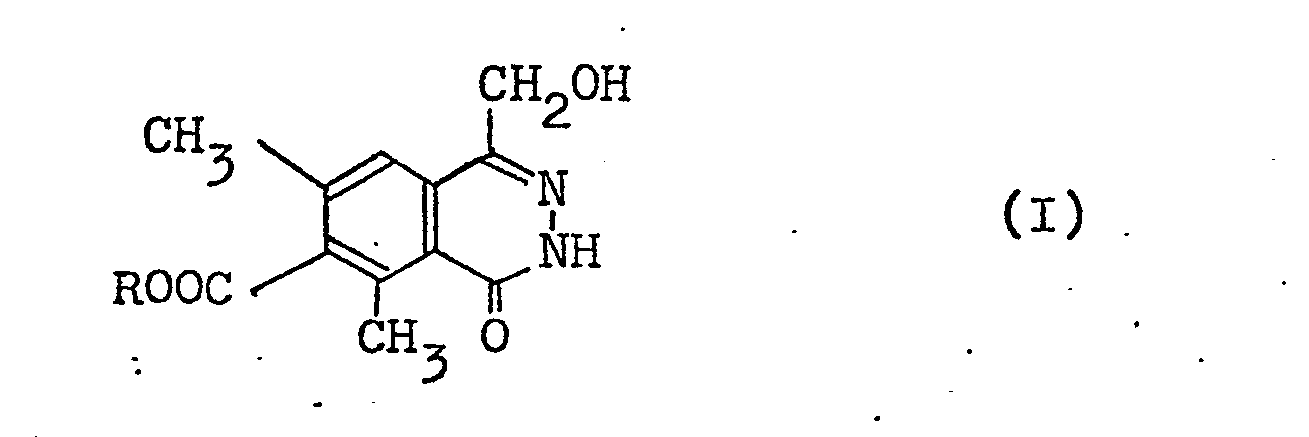
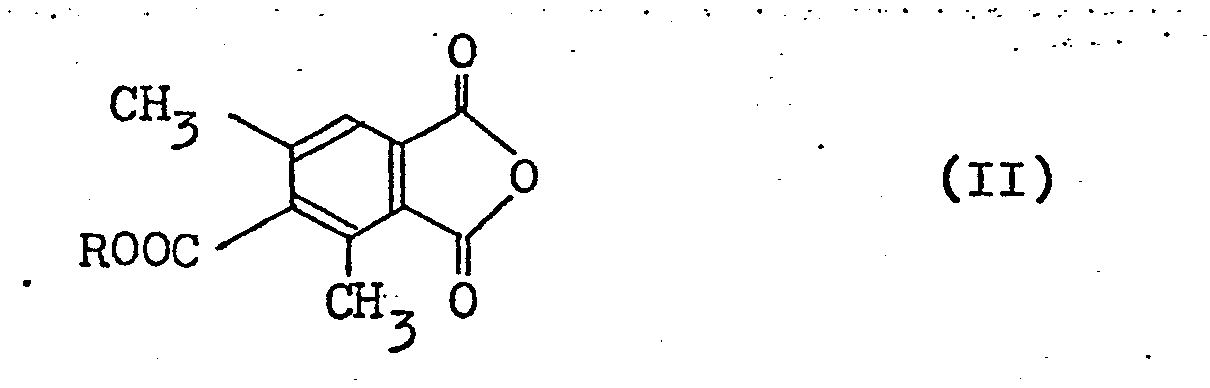
and intermediates therefor. More specifically, the invention relates to a process for preparing 4-hydroxymethyl-l-phthalazone derivatives represented by the above formula (I) which comprises the steps of: - (a) reacting carbon tetrachloride and triphenylphosphine with a 4-alkoxycarbonyl-3,5-dimethylphthalic anhydride (hereinafter referred to as phthalic anhydride derivative) represented by the general formula:

- (b) reacting a hydrazine with the compound (III) obtained in the above step (a) to produce 7-alkoxycarbonyl-4-dichloromethyl-6,8-dimethyl-1-phthalazone (hereinafter referred to as 4-dichloromethyl-l-phthalazone derivative) represented by the general formula:

- (c) and hydrolyzing the above compound (IV) to form 7-alkoxycarbonyl-6,8-dimethyl-4-formyl-l-phthalazone represented by the general formula (V):

- The invention also relates to intermediates therefor, that is, compounds represented by the general formulae (III) and (IV).
- Among compounds of the general formula (I) obtainable according to the process of this invention, the one having an ethyl group for R in said formula (I) is generally called phthalazinol. This compound has pharmacological activities such as cyclic AMP phosphodiesterase inhibiting action and platelet aggregation. inhibiting action and its medicinal application for the treatment of sensory disturbance caused by cerebral stroke or central pain is anticipated.
- The 3-dichloromethylenephthalide derivatives of the general formula (III) and the 4-dichloromethyl-1-phthalazone derivatives of the general formula (IV) obtained according to this invention are novel compounds not found in the literature.
- As a result of extensive researches for a more advantageous preparation process for phthalazinol, the present inventors had previously developed a method using as starting materials a compound of formula (II) and a triphenylphosphorane derivative (U.S. Patent Specification No. 4,350,813).
- Further studies have led the present inventors to the findings that a 3-dichloromethylenephthalide derivative of formula (III) can be obtained in a high yield, with substantially no by-production of a positional isomer, i.e., 5-alkoxycarbonyl-4,6-dimethylphthalide represented by the general formula:

by reacting a phthalic anhydride derivative of formula (II) with triphenylphosphine in carbon tetrachloride; that a reaction of said 3-dichloromethylenephthalide derivative with a hydrazine can easily afford a 4-dichloromethylphthalazone derivative of formula (IV) in a high yield; that this 4-dichloromethylphthalazone derivative, when hydrolyzed, is easily converted into a 4-formyl-l-phthalazone derivative of formula (V); and that this 4-formyl-l-phthalazone derivative can be reduced to give a 4-hydroxymethyl-l-phthalazone derivative of the general formula (I). - The present invention was attained on the basis of these findings.
- According to the process of this invention, it is possible to obtain objective compounds of formula (I) from compounds of formula (II) in four steps and all the starting materials necessary for the process are easily available, so that this process is an excellent industrial method for the preparation of said'objective compounds.
- The 4-formyl-l-phthalazone derivatives represented by formula (V) have been hitherto synthesized by oxidizing 4-hydroxymethyl-1-phthalazone derivatives represented by formula (I) (U.S. Patent Specification No. 4,182,876), so that they were of no value at all as an intermediate in the-preparation of the compounds of formula (I) including phthalazinol. The present invention has afforded them a usefulness as an intermediate for the first time.
- The process of this invention is a sequence of reactions represented by the following scheme:

- The step (a) in the process of this invention is accomplished by reacting triphenylphosphine with a phthalic anhydride derivative of formula (II) in carbon tetrachloride or in a solvent containing the same.
- As typical examples of the phthalic anhydride derivatives of formula (II) used as a starting material in step (a), the following may be cited:
- 4-ethoxycarbonyl-3,5-dimethylphthalic anhydride
- 4-methoxycarbonyl-3,5-dimethylphthalic anhydride
- 4-n-propoxycarbonyl-3,5-dimethylphthalic anhydride
- 4-n-butoxycarbonyl-3,-5-dimethylphthalic anhydride
- As the solvent used for the reaction in step (a), it is most desirable to use carbon tetrachloride which serves as a reactant at the same time, but one may also use an organic solvent which takes no.part in the reaction. Among the organic solvents usable for this purpose are aromatic hydrocarbons such as xylene, toluene, or benzene, ethers such as diethyl ether, diisopropyl ether, tetrahydrofuran, or dioxane, esters such as ethyl acetate, butyl acetate, or methyl acetate, halogenated hydrocarbons such as chloroform, dichloroethane, trichloroethane, tetrachloroethane, or trichloroethylene, amides such as dimethylformamide, or dimethylacetamide, and dimethyl sulfoxide.
- The amount of triphenylphosphine used in step (a) is not subject to any specific restrictions except that it should not be less than 2 equivalents to the phthalic : anhydride derivative of formula (II), but it is desirable that triphenylphosphine is used in an amount of 2 to 4 equivalents to said phthalic anhydride derivative.
- The amount of carbon tetrachloride may be also arbitrarily selected provided that it is not less than one equivalent to the compound of formula (II), but it is desirable that the amount of carbon tetrachloride used is at least 5 equivalents, more preferably 5 to 100 equivalents to the compound of formula (II).
- The reaction can be accomplished at a temperature between room temperature and the boiling point of a solvent used, but it is preferred to perform the reaction at a temperature from 50°C to the boiling point of the solvent used. The reaction is usually completed in 3 to 24 hours.
- To isolate a 3-dichloromethylenephthalide derivative of formula (III) from the reaction mix-: ture, the mixture is concentrated under reduced pressure and the residue is dissolved in a small quantity of a mixed solvent consisting of benzene and hexane. The obtained solution is passed through a silica gel column and eluted with a benzene-hexane mixed solvent. The fraction containing the objective substance is collected and concentrated under reduced pressure.
- The step (b) in the process of this invention is performed by reacting a hydrazine with a 3-dichloromethylenephthalide derivative of formula (III) obtained in step (a) in a solvent.
- Examples of compounds of formula (III) used as a starting material in this step (b) are those mentioned above. As for the hydrazine used as another starting material, no specific restrictions are imposed to this reactant and it is possible to use either hydrazine or a hydrazine hydrate or a hydrous hydrazine hydrate.
- The solvent used in this step (b) is also not subject to any particular restrictions provided that it is an inert solvent. The following substances may be used as the solvent in step (b): aromatic hydrocarbons such as benzene, toluene, or xylene, halogenated hydrocarbons such as chloroform, carbon tetrachloride, dichloroethane, trichloroethane, tetrachloroethane, or trichloroethylene, ethers such as diisopropyl ether, tetrahydrofuran, or dioxane, esters such as ethyl acetate or n-butyl acetate, ketones such as acetone, ethyl methyl ketone, or isobutyl methyl ketone, amides such as dimethylformamide or dimethylacetamide, dimethyl sulfoxide, acetonitrile and the like.
- The amount of the hydrazine used in this step may be arbitrarily selected provided that it is at least one equivalent to 3-dichloromethylenephthalide derivative of formula (III), but usually it is desirable that the hydrazine is used in an amount of 2 to 10 equivalents.
- The reaction can be conducted at a temperature between room temperature and the boiling point of a solvent used, but usually it is preferred to conduct the reaction around the boiling point of a solvent by using a solvent having a boiling point of 80°C or higher. The reaction is usually completed in 3 to 24 hours.
- A 4-dichloromethyl-1-phthalazone derivative of formula (IV) may be isolated from the reaction mixture - by concentrating the mixture under reduced pressure, dissolving the residue in a small quantity of a mixed solvent of benzene and ethyl acetate, passing the mixed solution through a silica gel column, eluting it with a benzene-ethyl acetate mixed solvent, collecting a fraction containing the objective substance and concentrating the fraction under reduced pressure.
- Typical examples of the 4-dichloromethyl-l-phthalazone derivatives of formula (IV) obtainable in the manner described above are:
- 7-ethoxycarbonyl-4-dichloromethyl-6,8-dimethyl-l-phthalazone
- 7-methoxycarbonyl-4-dichloromethyl-6,8-dimethyl-l-phthalazone
- 7-n-propoxycarbonyl-4-dichloromethyl-6,8-dimethyl-1-phthalazone
- 7-n-butoxycarbonyl-4-dichloromethyl-6,8-dimethyl-l-phthalazone.
- The hydrolysis constituting step (c) of this invention is accomplished by reacting an acid or a base with the 4-dichloromethyl-l-phthalazone derivative of formula (IV) obtained in step (b) in a solvent.
- Examples of compounds (IV) used as a starting material for step (c) are those mentioned above.
- The acid used in this step may be either an inorganic or an organic acid. Examples of the inorganic acids usable in this step are hydrochloric acid, sulfuric acid, nitric acid, phosphoric acid and the like, and examples of the organic acids are lower fatty acids such as formic acid, acetic acid, or propionic acid, and sulfonic acids such as benzenesulfonic acid, toluene sulfonic acid, methanesulfonic acid, or ethanesulfonic acid, and the like.
- As for the base used in this step, it may be also either an inorganic or an organic base. Exemplary of the inorganic bases usable are hydroxides, carbonates or hydrogen carbonates of sodium andpotassium, oxides, hydroxides and carbonates of calcium, and the like, and examples of the organic bases are triethylamine, - pyridine, N-methylmorpholine, alkali metal salts of lower fatty acids such as sodium formate, sodium acetate, potassium acetate, or sodium propionate, and the like.
- The solvent used in this step may be of any type provided that the compounds of formula (IV) are soluble therein if slightly, but it is desirable to use water or an organic solvent or a mixture thereof. Any type of organic solvent may be used provided that it is miscible with water. For instance, one may use alcohols such as methanol, ethanol, propanol, isopropanol or n-butanol, ketones such as acetone, methyl ethyl ketone or isobutyl methyl ketone, ethers such as tetrahydrofuran or dioxane, amides such as dimethylformamide or dimethylacetamide, dimethyl sulfoxide, acetonitrile, lower fatty acids such as formic acid, acetic acid or propionic acid, pyridine, and the like.
- When an alkali metal salt of a fatty acid is used as a hydrolyzing agent and a fatty acid as a solvent, part of the 4-dichloromethyl-l-phthalazone derivative of formula (IV) used as a starting material is converted into a 4-(diacyloxy)methyl-7-alkoxycarbonyl-6,8-dimethyl-l-phthalazone represented by the general formula:

- wherein R1 is a hydrogen atom or a lower alkyl group, and R is as defined above,
- The amount of the acid used is not specifically defined provided that it is at least 0.1 equivalent to the compound of formula (IV), but preferably it is 1 to 100 equivalents to said compound.
- The base is also not specified in its amount provided that it is at least 2 equivalents to the compound of formula (IV). It is however desirable that the base is used in an amount of 2 to 100 equivalents to the compound of formula (IV).
- The reaction can be accomplished at a temperature between room temperature and the boiling point of a solvent used, and it is usually completed in 30 minutes to 24 hours.
- Since usually crystals of the objective substance are precipitated in the reaction mixture, the isolation of the compound of formula (V) from the mixture can be easily effectuated by filtering out the crystals.
- The 4-formyl-l-phthalazone derivatives of formula (V) which can be obtained in the manner described above include the following:
- 7-ethoxycarbonyl-6,8-dimethyl-4-formyl-l-phthalazone
- 7-methoxycarbonyl-6,8-dimethyl-4-formyl-l-phthalazone
- 7-n-propoxycarbonyl-6,8-dimethyl-4-formyl-l-phthalazone
- 7-n-butoxycarbonyl-6,8-dimethyl-4-formyl-1-phthalazone
- The step (d), or the reduction, in the process of this invention can be accomplished by employing a known method for converting an aldehyde into an alcohol, for example, catalytic reduction by use of a metal catalyst, reduction by a metal hydride or reduction by an acid and a metal.
- The catalytic reduction by use of a metal catalyst can be conducted in a solvent in the presence of a metal catalyst in a hydrogen atmosphere under normal pressure or under pressure. Any type of metal catalyst may be used as far as it can reduce the formyl group to a hydroxymethyl group, but preferred catalysts are palladiums such as palladium black, palladium carbon, palladium/barium sulfate, or palladium/calcium carbonate, various types of active Raney nickels, platinum or its compounds such as platinum dioxide, rhodium and its derivatives. The amount of the catalyst to be used is not specifically defined, but if is preferred that the amount is 0.01 to 100 % based on the weight of the material to be reduced.
- The solvent used in this reduction step may be arbitrarily selected provided that such solvent takes no part in the reaction and is capable of dissolving the material to be reduced. The preferred solvents are lower alcohols such as methanol, ethanol, n-propanol or isopropanol, ethers such as tetrahydrofuran, dioxane or bis(2-methoxyethoxy)ether (diglyme), esters such as methyl acetate, ethyl acetate or n-butyl acetate, carboxylic acids such as acetic acid or propionic acid, amides such as dimethylformamide or dimethylacetamide, dimethyl sulfoxide and the like, or a mixture of any of said solvents with water.
- The reduction temperature is not specified but preferably selected from the range of 0 to 100°C. The reaction is usually completed in one to 24 hours.
- The isolation of a 4-hydroxymethyl-l-phthalazone derivative represented by the general formula (I) from the reaction mixture can be easily accomplished by filtering off the catalyst, concentrating the filtrate under reduced pressure and, if necessary, recrystallizing the product from a'suitable solvent, for example, 50 % aqueous acetone.
- The reduction by use of a metal hydride can be attained by the action of a metal hydride on a compound of formula (V) in a solvent. No specific restrictions are imposed on the metal hydride to be used for the reduction, but alkali metal salts or alkaline earth metal salts of boron hydride are preferred and, among them, sodium borohydride is particularly preferred. The amount of the metal hydride to be used for the reduction may be arbitrarily selected provided that it is not less than the theoretical amount for the substance to be reduced, but usually it is desirable that the amount is 1.2 to 2 times the theoretical.
- As for the solvent used for this reduction, it is possible to employ all the solvents cited as usable in the catalytic reduction except for the carboxylic acids. The reaction temperature may be arbitrarily selected between 0°C and the boiling point of a solvent used, and the reaction is completed in usually 1 to 24 hours. The isolation of a 4-hydroxymethyl-l-phthalazone of formula (I) from the reaction mixture can be easily accomplished by concentrating the mixture under reduced pressure, adding dilute hydrochloric acid to the residue, filtering out precipitated crystals and, if necessary, recrystallizing them with a suitable solvent such as 50 % aqueous acetone.
- The reduction by use of an acid and a metal can be accomplished by adding a metal powder in a solvent containing an acid. Both inorganic and organic acids may be used for this reduction. Preferred examples of the inorganic acids are hydrochloric acid, sulfuric acid and the like, and preferred examples of the organic acids are acetic acid, propionic acid, benzenesulfonic acid, toluenesulfonic acid, methanesulfonic acid, ethanesulfonic acid and the like. The acid amount needs be enough for maintaining the acidity of the reaction solution but is not specifically defined otherwise. Any metal that is capable of producing hydrogen upon reaction with the acid may be used, but zinc, iron, tin and the like are preferred. The amount of the metal to be used for the reduction may be arbitrarily selected above the theoretical amount, but it is desirable that the amount is 2 to 100 times the theoretical for bringing the reaction to completion. As for the solvent used for this reduction, all the solvents cited as usable in the catalytic reduction may be employed.
- The reaction temperature may be arbitrarily selected preferably between 0°C and the boiling point of a solvent used, and the reaction is completed usually in 1 to 24 hours. The isolation of a 4-hydroxymethyl-l-phthalazone of formula (I) from the reaction mixture can be accomplished in the same way as in the case of reduction using a metal catalyst.
- " The phthalic anhydride derivatives of formula (II) usable as a starting material in this invention are known compounds (see Japanese Patent Laid-Open No. 27153/1980) and can be easily synthesized from ethyl isodehydroacetate and dichloromaleic anhydride.
- The present invention will now be described in further detail by way of the examples thereof.
- 20 mf of carbon tetrachloride was added to 1.00 g (4.03 mmol) of 4-ethoxycarbonyl-3,5-dimethylphthalic anhydride and 3.38 g (12.1 mmol) of triphenylphosphine and the mixture was heated under reflux for 15 hours. The reaction mixture was concentrated under reduced pressure and carbon tetrachloride was distilled off to obtain a crude product. This crude product was subjected to column chromatography by using 70 g of silica gel and a hexane-benzene mixed solvent as a developing solvent, and the fractions containing the objective substance were collected and concentrated under reduced pressure. Thus, 1.11 g of 3-dichloromethylene-6- ethoxycarbonyl-5,7-dimethylphthalide was obtained (yield: 87 %).
- Mp: 115-116°C.
- IR spectrum:

- NMR spectrum (CDCℓ3):
- δ = 1.42 (3H, t, J = 7 Hz, OCH2CH3), 2.48,
- 2.67 (3H, 3H, s, s, phenyl-CH3x2),
- 4.46 (2H, q, J = 7 Hz, OCH2CH3),
- 7.82 (lH, s, phenyl-H).
- MS spectrum: m/e = 315 (M+).
- 1.24 g (8.06 mmol) of carbon tetrachloride and 10 mℓ of toluene were added to 1.00 g (4.03 mmol) of 4-ethoxycarbonyl-3,5-dimethylphthalic anhydride and 2.64g(10.1 mmol) of triphenylphosphine and the mixture was heated under reflux for 15 hours. The reaction solution was then treated in the same manner as in Example 1 to obtain 1.01 g of 3-dichloromethylene-6- ethoxycarbonyl-5,7-dimethylphthalide (yield: 85 %). This product completely agreed with that of Example 1 in melting point, IR spectrum, NMR spectrum and MS spectrum.
- 3.10 g (20.2 mmol) of carbon tetrachloride and 10 mℓ of dioxane were added to 1.00 g (4.03 mmol) of 4-ethoxycarbonyl-3,5-dimethylphthalic anhydride and 2.32 g ( 8.87 mmol ) of triphenylphosphine and the mixture was heated under reflux for 15 hours and then treated in the same way as in Example 1 to obtain 1.05 g of 3-dichloromethylene-6-ethoxycarbonyl-5,7-dimethylphthalide (yield: 83 %). This substance completely agreed with the product of Example 1 in melting point, IR spectrum, NMR spectrum and MS spectrum.
- 3.28 g (21.4 mmol) of carbon tetrachloride and 10 mℓ of chloroform were added to 1.00 g (4.27 mmol) of 4-methoxycarbonyl-3,5-dimethylphthalic anhydride and 2.79 g (10.68 mmol) of triphenylphosphine and the mixture was heated under reflux for 15 hours. The same treatment as in Example 1 afforded 1.14 g of 3-dichloromethylene-6-methoxycarbonyl-5,7-dimethyl- phthalide (yield: 89 %).
- Mp: 137-139°C
- IR spectrum:
-
- NMR spectrum (CDCℓ3):
- δ = 2.46, 2.63 (3H, 3H, s, s, phenyl-CH3x2), 3.97 (3H, s, OCH3), 7.77 (1H, s, phenyl-H).
- MS spectrum: m/e = 301 (M+).
- 200 mg (0.64 mmol) of 3-dichloromethylene-6-ethoxycarbonyl-5,7-dimethylphthalide was dissolved in 20 mℓ of xylene and 80 mg (1.3 mmol) of an 80 % hydrazine hydrate solution was added thereto. The resulting solution was heated under reflux for 12 hours and then concentrated under reduced pressure and xylene was distilled off to obtain a crude product. This crude product was subjected to column chromatography by using 20 g of silica gel and a benzene-ethyl acetate mixed solvent as a developing solvent and the fractions containing the objective substance were collected and concentrated under reduced pressure to obtain 173 mg of 4-dichloromethyl-7-ethoxycarbonyl-6,8-dimethyl-1-phthalazone (yield: 82 % ).
- Mp: 187-189°C.
- IR spectrum:

- NMR spectrum (CDCℓ3) :
- δ = 1.41 (3H, t, J = 7 Hz, OCH2CH3), 2.52,
- 2.90 (3H, 3H, s, s, phenyl-CH3X2),4.47 (2H,
- q, J = 7 Hz, OCH2CH3), 6.83 (1H, s, CHCℓ2),
- 8.13 (lH, s, phenyl-H), 11.04 (lH, s, NH).
- MS spectrum: m/e = 329 (M+) .
- 200 mg (0.64 mmol) of 3-dichloromethylene-6- ethoxycarbonyl-5,7-dimethylphthalide was dissolved in 20 mℓ of n-propanol, followed by addition of 80 mg (1.3 mmol) of an 80 % hydrazine hydrate solution and heating under reflux for 20 hours. The reaction solution was then treated in the same way as in Example 5 to obtain 168 mg of 4-dichloromethyl-7-ethoxycarbonyl-6,8-dimethyl-l-phthalazone (yield: 80 %). This substance completely agreed with the product of Example 5 in melting point, IR spectrum, NMR spectrum and MS spectrum.
- 200 mg (0.64 mmol) of 3-dichloromethylene-6- ethoxycarbonyl-5,7-dimethylphthalide was dissolved in 20 mℓ of dioxane, to which was then added 200 mg (3.2 mmol) of an 80 % hydrazine hydrate solution and the mixed solution was heated under reflux for 20 hours. The reaction solution was then treated according to the process of Example 5 to obtain 164 mg of 4-dichloromethyl-6-ethoxycarbonyl-6,8-dimethyl-l-phthalazone (yield: 78 %). This substance showed a complete agreement with that obtained in Example 5 in melting point, IR spectrum, NMR spectrum and MS spectrum.
- 200 mg (0.66 mmol) of 3-dichloromethylene-6-methoxycarbonyl-5,7-dimethylphthalide was dissolved in 20 mℓ of xylene, to which was then added 83 mg (1.32 mmol) of an 80 % hydrazine hydrate solution and the mixed solution was heated under reflux for 12 hours. The resulting reaction solution was subjected to the same treatment as in Example 5 to obtain 175 mg of 4-dichloromethyl-7-methoxycarbonyl-6,8-dimethyl-l-phthalazone (yield: 83 %).
- Mp: 226-228°C.
- IR spectrum:
-

- NMR spectrum (CDCℓ3) :
- 6 = 2.50, 2.88 (3H, 3H, s, s, phenyl-CH3X2),
- 4.0 (3H, s, OCH3) , 6.85 (1H, s, CHCℓ2) ,
- 8.15 (1H, s, phenyl-H), 10.73 (lH, s, NH).
- MS spectrum: m/e = 315 (M+).
- To 500 mg (1.52 mmol) of 4-dichloromethyl-7- ethoxycarbonyl-6,8-dimethyl-l-phthalazone were added 20 mℓ of acetic acid and 20 mℓ of water and the mixture was heated under reflux for.2 hours. Upon completion of the reaction, the reaction solution was cooled and precipitated crystals were filtered out, washed with water and dried to obtain 400 mg of 4-formyl-7-ethoxycarbonyl-6,8-dimethyl-l-phthalazone (yield: 96 %).
- Mp: 219-223°C .
- IR spectrum:
-

- NMR spectrum (CDCℓ3) :
- δ = 1.43 (3H, t, J = 7 Hz, OCH2CH3), 2.53, 2.90 (3H, 3H, s, s, phenyl-CH3X2), 4.48
- (2H, q, J = 7 Hz, OCH2CH3), 8.83 (lH, s, phenyl-H), 9.87 (lH, s, CHO), 10.7 (lH, s, NH).
- MS spectrum: m/e 274 (M+).
- 8.0 mℓ of methanol and 2.0 mℓ of 1N hydrochloric acid were added to 100 mg (0.304 mmol) of 4-dichloromethyl-7-ethoxycarbonyl-6,8-dimethyl-l-phthalazone and the mixture was heated under reflux for 24 hours. The reaction solution was concentrated under reduced pressure and the solvent was distilled off to obtain a crude product. This crude product was subjected to column chromatography using 10 g of silica gel and a benzene-ethyl acetate mixed solvent as a developing solvent, and the fractions containing the objective substance were collected and concentrated under reduced pressure to obtain 41.7 mg of 4-formyl-7-ethoxycarbonyl-6,8-dimethyl-1-phthalazone (yield: 50 %). This compound completely agreed with that obtained in Example 9 in melting point, IR spectrum, NMR spectrum and MS spectrum.
- 8,0 mℓ of methanol and 2 mℓ of an aqueous solution of 1N sodium hydroxide were added to 100 mg (0.304 mmol) of 4-dichloromethyl-7-ethoxycarbonyl-6,8-dimethyl-1-phthalazone and the mixture was heated under reflux for 15 hours. The reaction solution was treated in the same manner as in Example 10 to obtain 29.2 mg of 4-formyl-7-ethoxycarbonyl-5,8-dimethyl-1-phthalazone (yield: 35 %). This compound was in complete agreement with that obtained in Example 9 in melting point, IR spectrum, NMR spectrum and MS spectrum.
- 4 mℓ of acetic acid and 4 mℓ of water were added to 100 mg (0.317 mmol) of 4-dichloromethyl-7-methoxycarbonyl-6,8-dimethyl-1-phthalazone and the mixture was heated under reflux for 2 hours. The same treatment as in Example 9 afforded 78.4 mg of 4-formyl-7-methoxycarbonyl-6,8-dimethyl-l-phthalazone (yield: 95 %).
- Mp: 237-241°C.
- IR spectrum:
-

- NMR spectrum (CDCℓ3):
- δ = 2.48, 2.85 (3H, 3H, s, s, phenyl-CH3x2).
- 3.98 (3H, s, OCH3), 8.88 (1H, s, phenyl-H),
- 9.88 (lH, s, CHO), 10.7 (lH, s, NH).
- MR spectrum: m/e = 260 (M+).
- 250 mg (3.04 mmol) of sodium acetate and 10 mℓ of acetic acid were added to 100 mg (0.304 mmol) of 4-dichloromethyl-7-ethoxycarbonyl-6,8-dirlethyl-1-phthalazone and the mixture was heated under reflux for 2 hours. 10 mℓ of water was added to this reaction solution and precipitated crystals were filtered out, washed with water and dried to obtain 80 mg of 4 formyl-7-ethoxycarbonyl-6,8-dimethyl-l-phthalazone (yield: 96 %). This compound completely coincided with that obtained in Example 9 in melting point, IR spectrum, NMR spectrum and MS spectrum.
- 206 mg (3.04 mmol) of sodium formate and 10 mℓ of formic acid were added to 100 mg (0.304 mmol) of 4-dichloromethyl-7-ethoxycarbonyl-6,8-dimethyl-l-phthalazone and the mixture was stirred at room temperature for 3 hours. After the reaction, the reaction solution was treated according to Example 13 to obtain 80 mg of 4-formyl-7-ethoxycarbonyl-6,8-dimethyl-1-pnthalazone (yield: 96 %). This compound was in complete accord with that obtained in Example 9 in melting point, IR spectrum, NMR spectrum and MS spectrum.
- 292 mg (3.04 mmol) of sodium propionate and 10 mℓ of propionic acid were added to 100 mg (0.304 mmol) of 4-dichloromethyl-7-ethoxycarbonyl-6,8-dimethyl-l-phthalazone and the mixture was stirred at room temperature for 3 hours. After the reaction was completed, the reaction solution was treated in the same manner as in Example 13 to obtain 78 mg of 4-formyl-7- ethoxycarbonyl-6,8-dimethyl-l-phthalazone (yield: 94 %). This compound completely agreed with that obtained in Example 9 in melting point, IR spectrum, NMR spectrum and MS spectrum.
- 250 mg (3.04 mmol) of sodium acetate and 10 mℓ of dimethylformamide were added to 100 mg (0.304 mmol) of 4-dichloromethyl-7-ethoxycarbonyl-6,8-dimethyl-l-phthalazone and the mixture was stirred at room temperature for 2 hours. After the reaction, the reaction solution was concentrated under reduced pressure and the solvent was distilled off. 20 mℓ of water was added to the residue and stirred for 30 minutes and precipitated crystals were filtered out, washed with water and dried to obtain 76 mg of 4-formyl-7-ethoxycarbonyl-6,8-dimethyl-1-phthalazone (yield: 91 %). This compound completely agreed with that obtained in Example 9 in melting point, IR spectrum, NMR spectrum and MS spectrum.
- The process of Example 16 was repeated by using 10 mℓ of tetrahydrofuran instead of dimethylformamide and heating the mixture under reflux for 2 hours, followed by otherwise the same treatment as in Example 16 to obtain 75 mg of 4-formyl-7-ethoxycarbonyl-6,8-dimethyl-l-phthalazone (yield: 90 %). This compound completely agreed with that obtained in Example 9 in melting point, IR spectrum, NMR spectrum and MS spectrum.
- The'process of Example 16 was repeated by using 60 mg (0.79 mmol) of propionic acid and 10 mℓ of pyridine instead of 250 mg of sodium acetate and 10 mℓ of dimethylformamide to obtain 75 mg of 4-formyl-7- ethoxycarbonyl-6,8-dimethyl-l-phthalazone (yield: 90 %). This compound agreed completely with that obtained in Example 9 in melting point, IR spectrum, NMR spectrum and MS spectrum.
- 100 mg (0.365 mmol) of 4-formyl-7-ethoxycarbonyl-6,8-dimethyl-l-phthalazone was suspended in 20 mℓ of methanol, to which was then added 27.6 mg (0.730 mmol) of sodium borohydride under ice cooling and the mixture was stirred at room temperature for 2 hours. After the reaction, the reaction solution was concentrated under reduced pressure and methanol was distilled off. The residue was dissolved in 20 mℓ of water and the pH was adjusted to 3.5-5.0 with acetic acid. Precipitated crystals were filtered out, washed with water and dried to obtain 96.2 mg of 4-hydroxymethyl-7-ethoxycarbonyl-6,8-dimethyl-l-phthalazone (yield: 95 %). Mp:. 171-1730C. This compound completely agreed with a separately synthesized standard preparation in IR spectrum and NMR spectrum.
- 4-Hydroxyrnethyl-7-methoxycarbonyl-6,8-dimethyl-1-phthalazone was likewise synthesized from 4-formyl-7-methoxycarbonyl-6,8-dimethyl-l-phthalazone. It had a melting point of 202-203°C and completely agreed with a separately synthesized standard preparation in IR spectrum and NMR spectrum.
and this compound is in turn converted into a 4-formyl-l-phthalazone derivative of formula (V) in the course of the hydrolysis.
Claims (9)
1. A process for preparing 4-hydroxymethyl-l-phthalazone derivatives represented by the general formula:

which comprises the steps of:
wherein R is an alkyl group having 1 to 6 carbon atoms,
which comprises the steps of:
(a) reacting carbon tetrachloride and triphenylphosphine with a 4 alkoxycarbonyl-3,5-dimethylphthalic anhydride represented by the general formula:
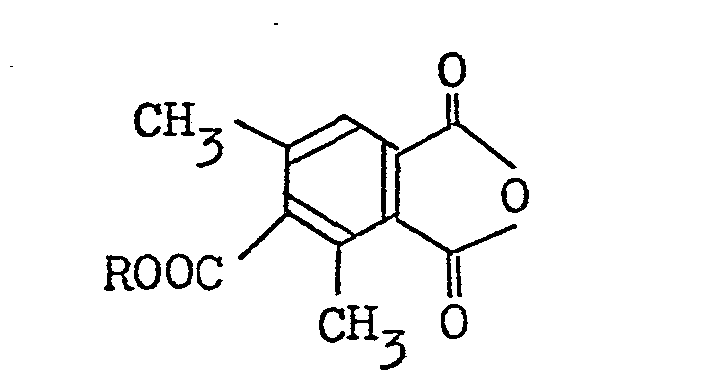
to produce a corresponding 6-alkoxycarbonyl-3-dichloromethylene-5,7-dimethylphthalide represented by the general formula: 
wherein R is as defined above,
wherein R is as defined above,
to produce a corresponding 6-alkoxycarbonyl-3-dichloromethylene-5,7-dimethylphthalide represented by the general formula:
(b) reacting this compound with a hydrazine to produce a corresponding 7-alkoxycarbonyl-4-dichloromethyl-6,8-dimethyl-l-phthalazone represented by the general formula:

wherein R is as defined above,
(c) hydrolyzing this compound in the presence of an acid or a base to form a corresponding 7-alkoxycarbonyl-6,8-dimethyl-4-formyl-l-phthalazone represented by the general formula:

wherein R is as defined above, and
(d) reducing this compound.
2. The process according to Claim 1, wherein R in the general formulae is a methyl or ethyl group.
3. The process according to Claim 1 or 2, wherein the amount of carbon tetrachloride and that of triphenylphosphine used in step (a) are at least 1 equivalent and at least 2 equivalents, respectively, to the 4-alkoxycarbonyl-3,5-dimethylphthalic anhydride, and the amount of the hydrazine used in step (b) is at least 1 equivalent to the 6-alkoxycarbonyl-3-dichloro- methylene-5,7-dimethylphthalide, and the amount of the acid or base used in step (c) is at least 0.1 equivalent in the case of the acid and at least 2 equivalents in the case of the base to the 7-alkoxycarbonyl-4-dichloromethyl-6,8-dimethyl-l-phthalazone.
4. The process according to Claim 1 or 2, wherein the amount of carbon tetrachloride and that of triphenylphosphine used in step (a) are at least 5 equivalents and 2 to 4 equivalents, respectively, to the 4=alkoxycarbonyl-3,5-dimethylphthalic anhydride, and the amount of the hydrazine used in step (b) is 2 to 10 equivalents to the 6-alkoxycarbonyl-3-dichloromethylene-5,7-dimethylphthalide, and the amount of the acid or base - used in step (c) is 1 to 100 equivalents in the case of the acid and 2 to 100 equivalents in the case of the base to the 7-alkoxycarbonyl-4-dichloromethyl-6,8-dimethyl-l-phthalazone.
5. The process according to any of Claims 1 to 4, wherein the reaction is conducted at a temperature within the range from room temperature to the boiling point of the solvent in any of steps (a) to (c).
6. The process according to any of Claims 1 to 5, wherein the reaction is conducted at a temperature from 50°C to the boiling point of the solvent in step (a) and from 80°C to the boiling point of the solvent in step (b).
7. A process for preparing-the 4-hydroxymethyl-1-phthalazone derivative represented by the formula:

which comprises the steps of:
(a) reacting at least 5 equivalents of carbon tetrachloride and 2 to 4 equivalents of triphenylphosphine with 4-6thoxycarbonyl-3,5-dimethylphthalic anhydride represented by the formula:

at a temperature between 50°C and the boiling point of the solvent used to produce 6-ethoxycarbonyl-3-dichloromethylene-5,7-dimethylphthalide represented by the formula:

(b) reacting 2 to 10 equivalents of a hydrazine with this compound at a temperature between 80°C and the boiling point of the solvent used to produce 7-ethoxycarbonyl-4-dichloromethyl-6,8-dimethyl-l-phthalazone represented by the formula:

(c) hydrolyzing this compound by using 1 to 100 equivalents of an acid or 2 to 100 equivalents of a base at a temperature between room temperature and the boiling point of the solvent used to form 7-ethoxycarbonyl-6,8-dimethyl-4-formyl-1-phthalazone represented by the formula:

and,
(d) reducing this compound.
8. 6-Alkoxycarbonyl-3-dichloromethylene-5,7-dimethylphthalide represented by the general formula:

wherein R is an alkyl group having 1 to 6 carbon atoms.
9. 7-Alkoxycarbonyl-4-dichloromethyl-6,8-dimethyl-1-phthalazone represented by the general formula:

wherein R is an alkyl group having 1 to 6 carbon atoms.
Applications Claiming Priority (2)
| Application Number | Priority Date | Filing Date | Title |
|---|---|---|---|
| JP20685/82 | 1982-02-13 | ||
| JP2068582A JPS58140077A (en) | 1982-02-13 | 1982-02-13 | Preparation of 4-hydroxymethyl-1-phthalazone derivative and its intermediate |
Publications (1)
| Publication Number | Publication Date |
|---|---|
| EP0086438A1 true EP0086438A1 (en) | 1983-08-24 |
Family
ID=12034016
Family Applications (1)
| Application Number | Title | Priority Date | Filing Date |
|---|---|---|---|
| EP83101163A Withdrawn EP0086438A1 (en) | 1982-02-13 | 1983-02-08 | Process and intermediates for preparing 4-hydroxymethyl-1-phthalazone derivatives |
Country Status (2)
| Country | Link |
|---|---|
| EP (1) | EP0086438A1 (en) |
| JP (1) | JPS58140077A (en) |
Cited By (2)
| Publication number | Priority date | Publication date | Assignee | Title |
|---|---|---|---|---|
| EP2132989A2 (en) | 2005-06-09 | 2009-12-16 | Bayer CropScience AG | Agent combinations |
| EP2255648A2 (en) | 2005-06-09 | 2010-12-01 | Bayer CropScience AG | Agent combinations |
Citations (1)
| Publication number | Priority date | Publication date | Assignee | Title |
|---|---|---|---|---|
| GB2055825A (en) * | 1979-07-31 | 1981-03-11 | Nippon Kayaku Kk | Process for producing 7-alkoxycarbonyl-6,8-dimethyl-4-hydroxymethyl-1-phthalazone |
-
1982
- 1982-02-13 JP JP2068582A patent/JPS58140077A/en active Pending
-
1983
- 1983-02-08 EP EP83101163A patent/EP0086438A1/en not_active Withdrawn
Patent Citations (1)
| Publication number | Priority date | Publication date | Assignee | Title |
|---|---|---|---|---|
| GB2055825A (en) * | 1979-07-31 | 1981-03-11 | Nippon Kayaku Kk | Process for producing 7-alkoxycarbonyl-6,8-dimethyl-4-hydroxymethyl-1-phthalazone |
Cited By (33)
| Publication number | Priority date | Publication date | Assignee | Title |
|---|---|---|---|---|
| EP2132989A2 (en) | 2005-06-09 | 2009-12-16 | Bayer CropScience AG | Agent combinations |
| EP2253210A1 (en) | 2005-06-09 | 2010-11-24 | Bayer CropScience AG | Agent combinations |
| EP2253212A1 (en) | 2005-06-09 | 2010-11-24 | Bayer CropScience AG | Agent combinations |
| EP2253211A1 (en) | 2005-06-09 | 2010-11-24 | Bayer CropScience AG | Agent combinations |
| EP2253213A1 (en) | 2005-06-09 | 2010-11-24 | Bayer CropScience AG | Agent combinations |
| EP2255652A2 (en) | 2005-06-09 | 2010-12-01 | Bayer CropScience AG | Agent combinations |
| EP2255648A2 (en) | 2005-06-09 | 2010-12-01 | Bayer CropScience AG | Agent combinations |
| EP2255654A2 (en) | 2005-06-09 | 2010-12-01 | Bayer CropScience AG | Agent combinations |
| EP2255651A2 (en) | 2005-06-09 | 2010-12-01 | Bayer CropScience AG | Agent combinations |
| EP2255656A2 (en) | 2005-06-09 | 2010-12-01 | Bayer CropScience AG | Agent combinations |
| EP2255657A1 (en) | 2005-06-09 | 2010-12-01 | Bayer CropScience AG | Agent combinations |
| EP2255649A2 (en) | 2005-06-09 | 2010-12-01 | Bayer CropScience AG | Agent combinations |
| EP2255644A2 (en) | 2005-06-09 | 2010-12-01 | Bayer CropScience AG | Agent combinations |
| EP2255650A2 (en) | 2005-06-09 | 2010-12-01 | Bayer CropScience AG | Agent combinations |
| EP2255647A2 (en) | 2005-06-09 | 2010-12-01 | Bayer CropScience AG | Agent combinations |
| EP2255653A2 (en) | 2005-06-09 | 2010-12-01 | Bayer CropScience AG | Agent combinations |
| EP2255645A2 (en) | 2005-06-09 | 2010-12-01 | Bayer CropScience AG | Agent combinations |
| EP2255646A2 (en) | 2005-06-09 | 2010-12-01 | Bayer CropScience AG | Agent combinations |
| EP2255659A2 (en) | 2005-06-09 | 2010-12-01 | Bayer CropScience AG | Agent combinations |
| EP2255658A1 (en) | 2005-06-09 | 2010-12-01 | Bayer CropScience AG | Agent combinations |
| EP2255655A2 (en) | 2005-06-09 | 2010-12-01 | Bayer CropScience AG | Agent combinations |
| EP2258196A2 (en) | 2005-06-09 | 2010-12-08 | Bayer CropScience AG | Combination of active agents |
| EP2258197A1 (en) | 2005-06-09 | 2010-12-08 | Bayer CropScience AG | Agent combinations |
| EP2258198A1 (en) | 2005-06-09 | 2010-12-08 | Bayer CropScience AG | Agent combinations |
| EP2260710A1 (en) | 2005-06-09 | 2010-12-15 | Bayer CropScience AG | Agent combinations |
| EP2260709A1 (en) | 2005-06-09 | 2010-12-15 | Bayer CropScience AG | Agent combinations |
| EP2260711A2 (en) | 2005-06-09 | 2010-12-15 | Bayer CropScience AG | Agent combinations |
| EP2263462A1 (en) | 2005-06-09 | 2010-12-22 | Bayer CropScience AG | Agent combinations |
| EP2263463A1 (en) | 2005-06-09 | 2010-12-22 | Bayer CropScience AG | Agent combinations |
| EP2269460A1 (en) | 2005-06-09 | 2011-01-05 | Bayer CropScience AG | Agent combinations |
| EP2272368A1 (en) | 2005-06-09 | 2011-01-12 | Bayer CropScience AG | Agent combinations |
| EP2272369A1 (en) | 2005-06-09 | 2011-01-12 | Bayer CropScience AG | Agent combinations |
| EP2279664A1 (en) | 2005-06-09 | 2011-02-02 | Bayer CropScience AG | Agent combinations |
Also Published As
| Publication number | Publication date |
|---|---|
| JPS58140077A (en) | 1983-08-19 |
Similar Documents
| Publication | Publication Date | Title |
|---|---|---|
| US7414136B2 (en) | Method for producing 3-substituted 2-chloro-5-fluoro-pyridine or its salt | |
| EP0418925B1 (en) | Method of producing (S)-4-hydroxymethyl-gamma-lactone | |
| JP3351563B2 (en) | Method for producing 3-hydroxybutyric acid derivative | |
| US2785163A (en) | Process for the formylation of a 5-nitrosouracil | |
| EP0094769B1 (en) | Preparing 7-alkoxybenzofurans and intermediates used therein | |
| CN102421782B (en) | Process for preparing tetrahydropyran compounds and intermediates thereof | |
| US4021478A (en) | Preparation of carboxylic acids from glycidonitriles with ionic lewis acids | |
| GB2036744A (en) | Eburnane derivatives | |
| US4521616A (en) | Method for the preparation of fluoroanthranilic acids | |
| KR19990008411A (en) | Improvement method of 4-hydroxy-2-pyrrolidone | |
| JP3010264B2 (en) | Method for producing isocoumarins | |
| JPH0680048B2 (en) | Otro acid manufacturing method | |
| KR920001564B1 (en) | Tetrahydroisoquinoline derivatives | |
| US3155673A (en) | Process for preparing vitamin b | |
| JP3382681B2 (en) | Fluorine-containing compound and method for producing the same | |
| JP2871778B2 (en) | Method for producing 5-arylhydantoins | |
| US5225578A (en) | 2-(1-alkylaminoalkyl)-3-hydroxy-1,4-naphthoquinone, process for its production and processes for producing 2-(1-alkenyl)-3-hydroxy-1,4-naphthoquinone and 2-alkyl-3-acyloxy-1,4-naphthoquinone by using it | |
| JPH0692916A (en) | Production of 3'-amino-2'-hydroxyacetophenone | |
| JP2784920B2 (en) | 1,3-cyclohexanedione derivative | |
| KR100371087B1 (en) | A process for preparing 2-acetyl nicotinic acid | |
| JPH072809A (en) | New process for producing aminothiazoleacetic acid derivative | |
| JPS58140077A (en) | Preparation of 4-hydroxymethyl-1-phthalazone derivative and its intermediate | |
| JPH085880B2 (en) | Antibiotic diazaquinomycin A derivative | |
| EP0127079A1 (en) | Process for preparing 2-fluoro-5-nitroaniline | |
| JPH08165280A (en) | Process for producing 3,4-substituted-2,3-cycloheptenopyridine N-oxides |
Legal Events
| Date | Code | Title | Description |
|---|---|---|---|
| PUAI | Public reference made under article 153(3) epc to a published international application that has entered the european phase |
Free format text: ORIGINAL CODE: 0009012 |
|
| AK | Designated contracting states |
Designated state(s): CH DE FR GB IT LI |
|
| 17P | Request for examination filed |
Effective date: 19840215 |
|
| STAA | Information on the status of an ep patent application or granted ep patent |
Free format text: STATUS: THE APPLICATION IS DEEMED TO BE WITHDRAWN |
|
| 18D | Application deemed to be withdrawn |
Effective date: 19850902 |
|
| RIN1 | Information on inventor provided before grant (corrected) |
Inventor name: MASHIBA, AKIHIRO Inventor name: TAKEI, YUKIO Inventor name: YOSHIDA, MASAO Inventor name: NISHIZAWA, RINZO |