EP0083426B1 - Aromatic, melt-processible (co)polyesters - Google Patents
Aromatic, melt-processible (co)polyesters Download PDFInfo
- Publication number
- EP0083426B1 EP0083426B1 EP82111400A EP82111400A EP0083426B1 EP 0083426 B1 EP0083426 B1 EP 0083426B1 EP 82111400 A EP82111400 A EP 82111400A EP 82111400 A EP82111400 A EP 82111400A EP 0083426 B1 EP0083426 B1 EP 0083426B1
- Authority
- EP
- European Patent Office
- Prior art keywords
- polyester
- polyester according
- polyesters
- acid
- hydroxy
- Prior art date
- Legal status (The legal status is an assumption and is not a legal conclusion. Google has not performed a legal analysis and makes no representation as to the accuracy of the status listed.)
- Expired
Links
- 229920000728 polyester Polymers 0.000 title claims description 107
- 125000003118 aryl group Chemical group 0.000 title claims description 19
- 239000000835 fiber Substances 0.000 claims description 42
- 150000001261 hydroxy acids Chemical group 0.000 claims description 20
- 239000000203 mixture Substances 0.000 claims description 17
- QMKYBPDZANOJGF-UHFFFAOYSA-N benzene-1,3,5-tricarboxylic acid Chemical compound OC(=O)C1=CC(C(O)=O)=CC(C(O)=O)=C1 QMKYBPDZANOJGF-UHFFFAOYSA-N 0.000 claims description 16
- 125000004432 carbon atom Chemical group C* 0.000 claims description 15
- -1 hydrocarbyl radicals Chemical class 0.000 claims description 13
- KKEYFWRCBNTPAC-UHFFFAOYSA-N Terephthalic acid Chemical compound OC(=O)C1=CC=C(C(O)=O)C=C1 KKEYFWRCBNTPAC-UHFFFAOYSA-N 0.000 claims description 8
- 239000002253 acid Substances 0.000 claims description 8
- 125000000217 alkyl group Chemical group 0.000 claims description 8
- 238000006068 polycondensation reaction Methods 0.000 claims description 8
- 150000003254 radicals Chemical class 0.000 claims description 8
- 150000002009 diols Chemical class 0.000 claims description 7
- 125000001997 phenyl group Chemical group [H]C1=C([H])C([H])=C(*)C([H])=C1[H] 0.000 claims description 7
- WQGWDDDVZFFDIG-UHFFFAOYSA-N pyrogallol Chemical compound OC1=CC=CC(O)=C1O WQGWDDDVZFFDIG-UHFFFAOYSA-N 0.000 claims description 6
- 125000001140 1,4-phenylene group Chemical group [H]C1=C([H])C([*:2])=C([H])C([H])=C1[*:1] 0.000 claims description 5
- 150000005840 aryl radicals Chemical class 0.000 claims description 5
- 229910052736 halogen Inorganic materials 0.000 claims description 5
- QIGBRXMKCJKVMJ-UHFFFAOYSA-N Hydroquinone Chemical compound OC1=CC=C(O)C=C1 QIGBRXMKCJKVMJ-UHFFFAOYSA-N 0.000 claims description 4
- 125000003545 alkoxy group Chemical group 0.000 claims description 4
- 125000004122 cyclic group Chemical group 0.000 claims description 4
- 150000002367 halogens Chemical class 0.000 claims description 4
- 125000001989 1,3-phenylene group Chemical group [H]C1=C([H])C([*:1])=C([H])C([*:2])=C1[H] 0.000 claims description 2
- 229920000642 polymer Polymers 0.000 description 20
- 150000001875 compounds Chemical class 0.000 description 19
- 238000000034 method Methods 0.000 description 16
- QTBSBXVTEAMEQO-UHFFFAOYSA-N acetic acid Substances CC(O)=O QTBSBXVTEAMEQO-UHFFFAOYSA-N 0.000 description 12
- 238000002360 preparation method Methods 0.000 description 11
- 239000000155 melt Substances 0.000 description 10
- 239000003054 catalyst Substances 0.000 description 9
- 239000000178 monomer Substances 0.000 description 8
- 229920001225 polyester resin Polymers 0.000 description 8
- 239000004645 polyester resin Substances 0.000 description 8
- 229920005989 resin Polymers 0.000 description 8
- 239000011347 resin Substances 0.000 description 8
- 229920001634 Copolyester Polymers 0.000 description 7
- 238000010438 heat treatment Methods 0.000 description 7
- 238000000576 coating method Methods 0.000 description 6
- 230000008569 process Effects 0.000 description 6
- 239000002904 solvent Substances 0.000 description 6
- 229920001400 block copolymer Polymers 0.000 description 5
- 238000006243 chemical reaction Methods 0.000 description 5
- 239000002131 composite material Substances 0.000 description 5
- 238000006116 polymerization reaction Methods 0.000 description 5
- 150000001491 aromatic compounds Chemical class 0.000 description 4
- 229920001577 copolymer Polymers 0.000 description 4
- 238000002844 melting Methods 0.000 description 4
- 230000008018 melting Effects 0.000 description 4
- 229920005862 polyol Polymers 0.000 description 4
- 239000000047 product Substances 0.000 description 4
- CYIDZMCFTVVTJO-UHFFFAOYSA-N pyromellitic acid Chemical compound OC(=O)C1=CC(C(O)=O)=C(C(O)=O)C=C1C(O)=O CYIDZMCFTVVTJO-UHFFFAOYSA-N 0.000 description 4
- 239000000376 reactant Substances 0.000 description 4
- XBNGYFFABRKICK-UHFFFAOYSA-N 2,3,4,5,6-pentafluorophenol Chemical compound OC1=C(F)C(F)=C(F)C(F)=C1F XBNGYFFABRKICK-UHFFFAOYSA-N 0.000 description 3
- ZMANZCXQSJIPKH-UHFFFAOYSA-N Triethylamine Chemical compound CCN(CC)CC ZMANZCXQSJIPKH-UHFFFAOYSA-N 0.000 description 3
- 239000012298 atmosphere Substances 0.000 description 3
- 239000011248 coating agent Substances 0.000 description 3
- 150000001993 dienes Chemical class 0.000 description 3
- 238000009826 distribution Methods 0.000 description 3
- 238000001125 extrusion Methods 0.000 description 3
- 125000002887 hydroxy group Chemical group [H]O* 0.000 description 3
- 239000004615 ingredient Substances 0.000 description 3
- 238000002156 mixing Methods 0.000 description 3
- IZUPBVBPLAPZRR-UHFFFAOYSA-N pentachloro-phenol Natural products OC1=C(Cl)C(Cl)=C(Cl)C(Cl)=C1Cl IZUPBVBPLAPZRR-UHFFFAOYSA-N 0.000 description 3
- 150000003077 polyols Chemical class 0.000 description 3
- RNFJDJUURJAICM-UHFFFAOYSA-N 2,2,4,4,6,6-hexaphenoxy-1,3,5-triaza-2$l^{5},4$l^{5},6$l^{5}-triphosphacyclohexa-1,3,5-triene Chemical compound N=1P(OC=2C=CC=CC=2)(OC=2C=CC=CC=2)=NP(OC=2C=CC=CC=2)(OC=2C=CC=CC=2)=NP=1(OC=1C=CC=CC=1)OC1=CC=CC=C1 RNFJDJUURJAICM-UHFFFAOYSA-N 0.000 description 2
- GDBUZIKSJGRBJP-UHFFFAOYSA-N 4-acetoxy benzoic acid Chemical compound CC(=O)OC1=CC=C(C(O)=O)C=C1 GDBUZIKSJGRBJP-UHFFFAOYSA-N 0.000 description 2
- NFTLBCXRDNIJMI-UHFFFAOYSA-N 6-acetyloxynaphthalene-2-carboxylic acid Chemical compound C1=C(C(O)=O)C=CC2=CC(OC(=O)C)=CC=C21 NFTLBCXRDNIJMI-UHFFFAOYSA-N 0.000 description 2
- UFWIBTONFRDIAS-UHFFFAOYSA-N Naphthalene Chemical compound C1=CC=CC2=CC=CC=C21 UFWIBTONFRDIAS-UHFFFAOYSA-N 0.000 description 2
- 150000007513 acids Chemical class 0.000 description 2
- 150000001266 acyl halides Chemical class 0.000 description 2
- 150000008064 anhydrides Chemical class 0.000 description 2
- 230000001588 bifunctional effect Effects 0.000 description 2
- 125000003178 carboxy group Chemical group [H]OC(*)=O 0.000 description 2
- 238000009833 condensation Methods 0.000 description 2
- 230000005494 condensation Effects 0.000 description 2
- 238000001816 cooling Methods 0.000 description 2
- 229920006037 cross link polymer Polymers 0.000 description 2
- 238000000354 decomposition reaction Methods 0.000 description 2
- 238000000113 differential scanning calorimetry Methods 0.000 description 2
- 239000002657 fibrous material Substances 0.000 description 2
- 239000003063 flame retardant Substances 0.000 description 2
- 230000004927 fusion Effects 0.000 description 2
- 239000011521 glass Substances 0.000 description 2
- 239000003999 initiator Substances 0.000 description 2
- 238000001746 injection moulding Methods 0.000 description 2
- QQVIHTHCMHWDBS-UHFFFAOYSA-L isophthalate(2-) Chemical compound [O-]C(=O)C1=CC=CC(C([O-])=O)=C1 QQVIHTHCMHWDBS-UHFFFAOYSA-L 0.000 description 2
- 239000011159 matrix material Substances 0.000 description 2
- 238000005259 measurement Methods 0.000 description 2
- YDSWCNNOKPMOTP-UHFFFAOYSA-N mellitic acid Chemical compound OC(=O)C1=C(C(O)=O)C(C(O)=O)=C(C(O)=O)C(C(O)=O)=C1C(O)=O YDSWCNNOKPMOTP-UHFFFAOYSA-N 0.000 description 2
- 239000003607 modifier Substances 0.000 description 2
- WXZMFSXDPGVJKK-UHFFFAOYSA-N pentaerythritol Chemical compound OCC(CO)(CO)CO WXZMFSXDPGVJKK-UHFFFAOYSA-N 0.000 description 2
- YNPNZTXNASCQKK-UHFFFAOYSA-N phenanthrene Chemical compound C1=CC=C2C3=CC=CC=C3C=CC2=C1 YNPNZTXNASCQKK-UHFFFAOYSA-N 0.000 description 2
- ISWSIDIOOBJBQZ-UHFFFAOYSA-N phenol group Chemical group C1(=CC=CC=C1)O ISWSIDIOOBJBQZ-UHFFFAOYSA-N 0.000 description 2
- 239000004033 plastic Substances 0.000 description 2
- 229920003023 plastic Polymers 0.000 description 2
- 239000002685 polymerization catalyst Substances 0.000 description 2
- 230000000379 polymerizing effect Effects 0.000 description 2
- 229920001343 polytetrafluoroethylene Polymers 0.000 description 2
- 239000004810 polytetrafluoroethylene Substances 0.000 description 2
- 229920002545 silicone oil Polymers 0.000 description 2
- 239000000126 substance Substances 0.000 description 2
- JOXIMZWYDAKGHI-UHFFFAOYSA-N toluene-4-sulfonic acid Chemical compound CC1=CC=C(S(O)(=O)=O)C=C1 JOXIMZWYDAKGHI-UHFFFAOYSA-N 0.000 description 2
- ARCGXLSVLAOJQL-UHFFFAOYSA-N trimellitic acid Chemical compound OC(=O)C1=CC=C(C(O)=O)C(C(O)=O)=C1 ARCGXLSVLAOJQL-UHFFFAOYSA-N 0.000 description 2
- VLDPXPPHXDGHEW-UHFFFAOYSA-N 1-chloro-2-dichlorophosphoryloxybenzene Chemical compound ClC1=CC=CC=C1OP(Cl)(Cl)=O VLDPXPPHXDGHEW-UHFFFAOYSA-N 0.000 description 1
- BZGTZHTYIVQCJO-UHFFFAOYSA-N 3-(4-acetyloxybenzoyl)benzoic acid Chemical compound C1=CC(OC(=O)C)=CC=C1C(=O)C1=CC=CC(C(O)=O)=C1 BZGTZHTYIVQCJO-UHFFFAOYSA-N 0.000 description 1
- ZOXJGFHDIHLPTG-UHFFFAOYSA-N Boron Chemical compound [B] ZOXJGFHDIHLPTG-UHFFFAOYSA-N 0.000 description 1
- OKTJSMMVPCPJKN-UHFFFAOYSA-N Carbon Chemical compound [C] OKTJSMMVPCPJKN-UHFFFAOYSA-N 0.000 description 1
- 239000004215 Carbon black (E152) Substances 0.000 description 1
- FYYHWMGAXLPEAU-UHFFFAOYSA-N Magnesium Chemical compound [Mg] FYYHWMGAXLPEAU-UHFFFAOYSA-N 0.000 description 1
- 239000004952 Polyamide Substances 0.000 description 1
- 239000004642 Polyimide Substances 0.000 description 1
- 150000001242 acetic acid derivatives Chemical class 0.000 description 1
- 238000013019 agitation Methods 0.000 description 1
- 239000010425 asbestos Substances 0.000 description 1
- 125000004429 atom Chemical group 0.000 description 1
- 230000004888 barrier function Effects 0.000 description 1
- 239000011230 binding agent Substances 0.000 description 1
- 229910052796 boron Inorganic materials 0.000 description 1
- 239000006227 byproduct Substances 0.000 description 1
- VSGNNIFQASZAOI-UHFFFAOYSA-L calcium acetate Chemical compound [Ca+2].CC([O-])=O.CC([O-])=O VSGNNIFQASZAOI-UHFFFAOYSA-L 0.000 description 1
- 239000001639 calcium acetate Substances 0.000 description 1
- 229960005147 calcium acetate Drugs 0.000 description 1
- 235000011092 calcium acetate Nutrition 0.000 description 1
- 238000005266 casting Methods 0.000 description 1
- 230000001143 conditioned effect Effects 0.000 description 1
- 230000003750 conditioning effect Effects 0.000 description 1
- 239000007822 coupling agent Substances 0.000 description 1
- 239000002178 crystalline material Substances 0.000 description 1
- 238000002425 crystallisation Methods 0.000 description 1
- 230000008025 crystallization Effects 0.000 description 1
- 238000004821 distillation Methods 0.000 description 1
- 230000000694 effects Effects 0.000 description 1
- 238000011067 equilibration Methods 0.000 description 1
- 150000002148 esters Chemical group 0.000 description 1
- 230000002349 favourable effect Effects 0.000 description 1
- 239000007789 gas Substances 0.000 description 1
- 230000009477 glass transition Effects 0.000 description 1
- 239000010439 graphite Substances 0.000 description 1
- 229910002804 graphite Inorganic materials 0.000 description 1
- 125000005843 halogen group Chemical group 0.000 description 1
- 229930195733 hydrocarbon Natural products 0.000 description 1
- 125000001183 hydrocarbyl group Chemical group 0.000 description 1
- 230000006872 improvement Effects 0.000 description 1
- 239000011261 inert gas Substances 0.000 description 1
- 239000012784 inorganic fiber Substances 0.000 description 1
- 230000003993 interaction Effects 0.000 description 1
- QQVIHTHCMHWDBS-UHFFFAOYSA-N isophthalic acid Chemical group OC(=O)C1=CC=CC(C(O)=O)=C1 QQVIHTHCMHWDBS-UHFFFAOYSA-N 0.000 description 1
- 229910052749 magnesium Inorganic materials 0.000 description 1
- 235000011285 magnesium acetate Nutrition 0.000 description 1
- 239000011654 magnesium acetate Substances 0.000 description 1
- 238000002074 melt spinning Methods 0.000 description 1
- 229910052751 metal Inorganic materials 0.000 description 1
- 239000002184 metal Substances 0.000 description 1
- 229910044991 metal oxide Inorganic materials 0.000 description 1
- 150000004706 metal oxides Chemical class 0.000 description 1
- 238000000465 moulding Methods 0.000 description 1
- RXOHFPCZGPKIRD-UHFFFAOYSA-N naphthalene-2,6-dicarboxylic acid Chemical compound C1=C(C(O)=O)C=CC2=CC(C(=O)O)=CC=C21 RXOHFPCZGPKIRD-UHFFFAOYSA-N 0.000 description 1
- 239000012299 nitrogen atmosphere Substances 0.000 description 1
- 239000003973 paint Substances 0.000 description 1
- 239000012071 phase Substances 0.000 description 1
- 150000002989 phenols Chemical class 0.000 description 1
- 239000000049 pigment Substances 0.000 description 1
- 229920002647 polyamide Polymers 0.000 description 1
- 229920001721 polyimide Polymers 0.000 description 1
- 238000000746 purification Methods 0.000 description 1
- 238000010791 quenching Methods 0.000 description 1
- 230000000171 quenching effect Effects 0.000 description 1
- 239000011541 reaction mixture Substances 0.000 description 1
- 230000035484 reaction time Effects 0.000 description 1
- 230000002787 reinforcement Effects 0.000 description 1
- 230000003014 reinforcing effect Effects 0.000 description 1
- 239000012783 reinforcing fiber Substances 0.000 description 1
- 230000000979 retarding effect Effects 0.000 description 1
- 238000000518 rheometry Methods 0.000 description 1
- 229910052895 riebeckite Inorganic materials 0.000 description 1
- 239000005060 rubber Substances 0.000 description 1
- 239000007790 solid phase Substances 0.000 description 1
- 239000000243 solution Substances 0.000 description 1
- 239000007858 starting material Substances 0.000 description 1
- 230000003068 static effect Effects 0.000 description 1
- 125000001424 substituent group Chemical group 0.000 description 1
- KKEYFWRCBNTPAC-UHFFFAOYSA-L terephthalate(2-) Chemical compound [O-]C(=O)C1=CC=C(C([O-])=O)C=C1 KKEYFWRCBNTPAC-UHFFFAOYSA-L 0.000 description 1
- 150000003512 tertiary amines Chemical class 0.000 description 1
- 229920001169 thermoplastic Polymers 0.000 description 1
- 239000004416 thermosoftening plastic Substances 0.000 description 1
- 238000005809 transesterification reaction Methods 0.000 description 1
- 238000004804 winding Methods 0.000 description 1
- 239000002759 woven fabric Substances 0.000 description 1
Classifications
-
- C—CHEMISTRY; METALLURGY
- C08—ORGANIC MACROMOLECULAR COMPOUNDS; THEIR PREPARATION OR CHEMICAL WORKING-UP; COMPOSITIONS BASED THEREON
- C08G—MACROMOLECULAR COMPOUNDS OBTAINED OTHERWISE THAN BY REACTIONS ONLY INVOLVING UNSATURATED CARBON-TO-CARBON BONDS
- C08G63/00—Macromolecular compounds obtained by reactions forming a carboxylic ester link in the main chain of the macromolecule
- C08G63/02—Polyesters derived from hydroxycarboxylic acids or from polycarboxylic acids and polyhydroxy compounds
- C08G63/60—Polyesters derived from hydroxycarboxylic acids or from polycarboxylic acids and polyhydroxy compounds derived from the reaction of a mixture of hydroxy carboxylic acids, polycarboxylic acids and polyhydroxy compounds
- C08G63/605—Polyesters derived from hydroxycarboxylic acids or from polycarboxylic acids and polyhydroxy compounds derived from the reaction of a mixture of hydroxy carboxylic acids, polycarboxylic acids and polyhydroxy compounds the hydroxy and carboxylic groups being bound to aromatic rings
Definitions
- the present invention relates to aromatic copolyesters. More specifically, the invention relates to branched aromatic copolyesters which are fiber-forming, melt-processible, and in some instances are star-branched and/or capable of forming anisotropic melts.
- anisotropic thermotropic
- mesogenic have the same meaning and are used interchangeably herein.
- U.S. Patent 4,066,620 issued to Kleinschuster et al on January 3, 1978, discloses anisotropic-melt- forming copolyesters of fiber-forming molecular weight consisting essentially of units derived from specified dihydric phenols and terephthalic acid or naphthalene-2,6-dicarboxylic acid.
- Dihydric phenol units of two different specified types are present in a mole ratio within the range of from about 85/15 to 60/ 40.
- the total of dihydric phenol units is present in a substantially equimolar amount with the acid units.
- U.S. Patent 4,118,372 issued to Schaefgen on October 3, 1978, discloses a fiber-forming, melt spinnable (co)polyester capable of forming an optically anisotropic melt and consisting essentially of recurring units selected from and/or wherein units I and II, if present, are present in substantially equimolar amounts;
- R" R z and R 3 are radicals selected from (1) single and fused 6-membered aromatic carbocyclic ring systems wherein the chain extending bonds of the ring system, if attached to the same ring, are positioned 1,4- to each other, and if attached to different rings, are in positions parallel and oppositely directed, and (2) multiple six-membered aromatic carbocyclic ring systems in which the individual rings are joined by a chemical bond or a trans- vinylene group and in which chain extending bonds of each ring are in the 1,4-positions.
- U.S. Patent 4,161,470 issued to Calundann on July 17, 1979, discloses a melt-processible wholly aromatic polyester capable of forming a thermotropic melt phase at a temperature below approximately 350°C consisting essentially of the recurring moieties I and II wherein I is and II is and wherein said polyester comprises approximately 10 to 90 mole percent of moiety I and approximately 10 to 90 mole percent of moiety II.
- the reference discloses copolymers of p-acetoxybenzoic acid and 6-acetoxy-2-naphthoic acid.
- U.S. Patent 4,217,440 issued to Barkey on August 12,1980, discloses a method for preparing branched polyesters in melt or solid phase comprising (1) forming a condensation polymer by reacting together a diol, a diacid, and a polyfunctional modifier having at least three functional radicals, and (2) polycondensing said polymer in the presence of transesterification catalyst at a reaction temperature and reaction pressure effective to form a polyester of linear extension and branching, the improvement comprising polycondensing said polymer while correlating the activity of said catalyst, said temperature and said pressure to restrain the extent of reaction for said linear extension to within about 0.1 % of the extent of reaction for said branching.
- Suitable acids include terephthalic acid and naphthalene dicarbuxytic acid and suitable modifiers include trimesic acid, trimellitic acid, pyromellitic acid, and pentaerythritol.
- U.S. Patents 4,248,980 - 4,248,982 disclose star-block copolymers having good impact properties and clarity and containing 60-90% by weight of a monovinyl aromatic compound and 40-10% by weight of a conjugated diene of 4-8 carbon atoms, which, in each case, have an average structure of a specified general formula.
- the copolymers are made by a process which requires the use of (a) hydrocarbyllithium initiator to form linear segments which are ultimately coupled to a polyfunctional coupling agent, such as pyromellitic dianhydride and mellitic acid chloride.
- U.S. Patent 4,248,983 issued to Bi et al on February 3, 1981, discloses transparent, impact-resistant, thermoplastic star-block copolymers having good impact resistance at low temperature (-20° to -40°C) as well as at room temperature, said copolymer containing 60-95% by weight of a monovinyl aromatic compound and 40-5% by weight of a conjugated diene having 4-8 carbon atoms.
- the copolymers have a specified general formula and are made by a process which requires the use of a hydrocarbyllithium initiator.
- U.S. Patent 4,248,984 discloses similar star-block copolymers containing 60-90% by weight of a monovinyl aromatic compound and 40-10% by weight of a conjugated diene and having a different general formula.
- U.S. Patent 4,232,144 discloses fiber-forming copolyesters consisting essentially of four different units I to IV, the units III and IV being diol and diacid units and being used in equimolar amount.
- the polyesters of the reference invariably contain 1 -OH end group and 1 -C0 2 H end group.
- British Patent Specification 1,579,779 discloses a flame retardant composition having improved melt strength for molding comprising (a) a branched, high molecular weight poly(alkylene terephthalate or isophthalate) resin having a melt viscosity of at least 1500 Pa ⁇ s (15,000 poise), comprising a high molecular weight poly(alkylene terephthalate or isophthalate) and from 0.05 to 3 mole percent, based on the terephthalate or isophthalate units, of a branching component which contains at least three ester-forming groups; and (b) a flame retarding amount of a flame retardant as defined therein.
- Suitable branching components include trimesic acid, pyromellitic acid, and pentaerythritol.
- thermotropic polyesters which are especially useful for the preparation of high-strength fibers suitable for applications, such as tire cord, cable and the like, are substantially linear, crystalline materials the strength of which can usually be improved in the fiber direction by heat-treating the unrestrained as-spun fibers. Such fibers are usually weak in the transverse direction. Thus, there is a need for polyesters which form fibers having significantly improved transverse strength properties in addition to fiber-direction properties substantially equivalent to those of conventional linear polyesters.
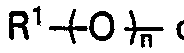
- the present invention provides an aromatic, melt-processible, fiber-forming (co)polyester having the general formula QX n wherein
- R 1 and R 2 are n-valent hydrocarbyl radicals of 4-20 carbon atoms and n is an integer from 2-10;
- X consists of 2-4 different recurring hydroxy acid units ( ⁇ OR 3 -CO) ⁇ wherein R 3 for each different acid unit is independently a divalent aryl radical of 6-30 carbon atoms selected from the group consisting of
- Branched (co)polyesters of the invention form fibers having significantly improved transverse strength properties while also having fiber-direction properties substantially equivalent to those of linear polyesters.
- the polyesters of this invention are comprised of two or more, preferably at least three, linear polyester chains radiating from a single nucleus (atom, single aromatic ring or fused ring system).
- a polyfunctional compound i.e. a polycarboxylic acid or polyol, or derivative thereof, containing 2 to 10, preferably 3 to 5, carboxyl or hydroxyl groups provides the nucleus or tie-point from which the linear polyester chains radiate.
- the number of such chains radiating from a tie-point is equal to the number of functions present in the polyfunctional compound, i.e. the value of n in the general formula.
- n is 3 or more, the polyesters of the invention are termed "star-branched".
- Providing the polyfunctional tie-point compound contains only hydroxyl or only carboxyl functions, as described herein, additional branch points do not occur.
- hydrocarbyl as used herein means hydrocarbon radical.
- Preferred (co)polyesters of the invention are those of the general formula wherein n is from 3 to 10, most preferably from 3 to 5; said (co)polyesters are star-branched. Also, preferred are (co)polyesters of the invention wherein m is from about 100 to about 2000. Most preferred are polyesters of the invention which are capable of forming optically anisotropic (mesogenic) melts.
- (co)polyesters wherein the divalent aryl radical constituting R 3 is substituted with one or more substituents selected from the group consisting of halogen, alkyl of 1-4 carbon atoms, alkoxy of 1-4 carbon atoms and phenyl.
- the invention further includes (co)polyester mixtures consisting essentially of (1) at least two (co)polyesters of the formula QX n where Q is different for each (co)polyester and preferably n is 2 for one of the (co)polyesters and at least 3 for another; or (2) a (co)polyester made from polycondensation of a diacid and a diol and at least 75 mole percent of a (co)polyester of the formula QX n , preferably at least 90 mole percent.
- Polyesters of the invention havino hvdroxv-acid units derived frnm 1.4-phenylene, 2,6-naphthalene and are preferred; those having hydroxy acid units derived from 1,4-phenylene and 2,6-naphthalene are most preferred.
- X of the general formula is comprised of from 2 to 4, preferably 2, different recurring hydroxy acid units.
- One of these units is present in from about 20 to about 80 mole percent, preferably from about 30 to about 70 mole percent, and the other different recurring hydroxy acid units are present in a total of from about 80 to about 20 mole percent, preferably from about 70 to about 30 mole percent, said mole percentages being based on the total moles of hydroxy acid units in the polyester QX n .
- Polyfunctional tie-point compounds which provide Q in the general formula are aromatic polyols of the formula R'(OH) n or aromatic polycarboxylic acids of the formula R 2 (CO 2 H) n where R 1 , R 2 and n are as defined above, or are operable derivatives thereof; for example lower alkyl or phenyl esters of polyols or polyacids, or anhydrides or acyl halides of polyacids.
- the degree of polymerization, and hence the molecular weight, of star-branched polyesters is largely determined by the concentration and functionality of tie-point compound(s) present in relation to hydroxy acid monomer units.
- Mixtures of polyesters of the general formula QX n may be prepared by adding more than one polyfunctional tie-point comp 9 und, provided each such compound has the same functionality type (A or B).
- the (co)polyesters of this invention and mixtures thereof with conventional linear polyesters, have flow temperatures of from about 200°C to about 375°C and a sufficiently high molecular weight to exhibit fiber and film-forming properties.
- inherent viscosities of at least 1 dl/g, preferably at least 2 dl/g, measured as described hereinafter, are useful for fibers and shaped articles. It should be understood that not all combinations of reactants mentioned herein will produce useful polyesters. Those producing polymers with flow temperatures in excess of 375°C should be avoided, as such high melting products are difficult to process, e.g., spin into useful fibers.
- rapid decomposition of the (co)polyesters occurs at higher temperatures, i.e., about 375°C.
- linear aromatic (co)polyesters consisting of X units can be prepared by polymerizing AB-type monomers, i.e. aromatic hydroxy acids in the absence of AA or BB bifunctional compounds.
- these conventional polyesters are not star-branched; indeed the art strongly teaches the desirability of linear polymers in the preparation of high strength fibers.
- the conventional polyesters differ from the polyesters of general formula QX n wherein n is 2 in at least two ways: polyesters QX 2 , prepared by polymerizing AB-type monomers in the presence of AA or BB bifunctional compounds, have end-groups which are either all A or all B and the molecular weight distribution is generally relatively narrow, theoretical Mw/Mn is 1.5.
- co-linear aromatic ring system means that all of the rings of the system have their centers on approximately the same line.
- hydroxy acids derived from aromatic compounds such as phenanthrene and the like are not included among hydroxy acids usable in the present invention.
- two to four aromatic hydroxy acids, or suitable derivatives thereof, e.g. lower alkyl or phenyl esters, anhydrides or acyl halides are (co)polymerized (polycondensed) in the presence of one or more tie-point compounds, as defined herein, in appropriate concentration.
- one of the functions in the hydroxy acids and the same function, when present, in the tie-point compound(s) are first converted to a derivative, such as an ester function, to facilitate purification of these starting materials.
- the hydroxyl functions are so converted.
- Melt polymerization as described, for example, in U.S. Patents 4,118,372 and 4,161,470, is preferred.
- Molar ratios of total AB units to tie-point compounds can vary from about 30,000:1 to about 20: 1, preferably from about 20,000:1 to about 300:1.
- a polymerization catalyst may optionally be employed.
- Suitable catalysts known in the art include p-toluene sulfonic acid, tertiary amines such as triethylamine, metal oxides such as Sb 2 0 3 or As 2 0 3 , metal acetates such as magnesium or calcium acetate, alkyl titanates and the like.
- Another method of preparing polyesters of general formula QX n is to contact one or more prepolymerized conventional linear aromatic polyesters comprised of X units with an appropriate tie-point compound under polycondensation reaction conditions, which are preferably melt polymerization conditions, optionally including a catalyst as previously described. If polycondensation is allowed to proceed to completion, i.e. until equilibrium is attained, the product will consist essentially of QX " polyester. If equilibrium is not attained, the product will comprise QX n polyester admixed with residual conventional polyester(s). Such mixtures are often desirable and may be “tailored” by control of polycondensation conditions, especially time, temperature, and, if a catalyst has been used, its type and concentration. Such control methods will be obvious to an artisan of ordinary skill. Temperatures will be in the range between polyester melting point and decomposition point, preferably 10° to 50° above the melt point. Reaction time may vary from about 1 second to several hours.
- a catalyst as described previously, may be added to the pre-formed linear polyester(s) and polyfunctional compound(s) reaction mixture to increase polycondensation or equilibration rate, or such catalysts may, optionally, be present in the pre-formed polyester(s), after the catalyst was used in the preparation of the pre-formed polyester(s). If a catalyst is employed in the polycondensation reaction, its concentration should not normally exceed about 1 part per hundred parts of total reactants and should also not exceed 10 wt% of the star-branching compound present.
- Polycondensation of conventional linear polyesters and polyfunctional tie-point compound as described herein is conveniently carried out in heated equipment suitable for melt-blending, such as a twinscrew extruder, extruder equipped with a static mixer, injection-molding machine and the like, or in stirred reactor or polymerization flask.
- heated equipment suitable for melt-blending such as a twinscrew extruder, extruder equipped with a static mixer, injection-molding machine and the like, or in stirred reactor or polymerization flask.
- Mixtures (blends) of QX n polyesters or mixtures of one or more QX " polyesters with one or more conventional linear polyesters can also be prepared by conventional blending of the appropriate polymerized components under mild, non-reactive conditions. Removal of any polymerization catalysts present in the components will minimize chemical interaction. Blending in a suitable solvent such as pentafluorophenol is convenient, especially where coating applications are contemplated.
- the (co)polyesters and blends of the invention can be spun into filaments by conventional melt- spinning techniques such as those described in U.S. Patents 4,066,620, 4,118,372 and 4,161,470.
- a melt of the polymer(s) is extruded through a spinneret into a quenching atmosphere, e.g. air or N 2 at room temperature, and wound up.
- An extrusion rate of about 0.1 g/min is convenient.
- the term "as-spun" fiber refers to a fiber which has not been drawn or heat-treated after extrusion and normal windup.
- the as-spun fibers of this invention may be subjected to heat treatment in an oven while relaxed or under mild restraint to provide high strength fibers useful for a variety of industrial applications such as plastic and rubber reinforcement.
- fiber samples as skeins or on bobbins (preferably collapsible polytetrafluoroethylene-coated bobbins) are usually heated in an oven having an inert atmosphere, N 2 , that is continuously purged by flow of inert gas through the oven to remove byproducts from the vicinity of the fiber.
- N 2 inert atmosphere
- Temperatures approaching the fusion point, but sufficiently below to prevent interfilament fusion, are employed.
- maximum temperature is reached in a stepwise fashion.
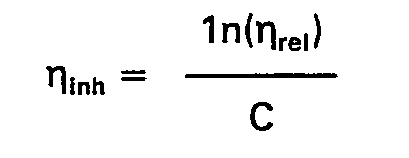
- Inherent viscosity ( ⁇ inh ) is defined by the following equation: wherein (n rej ) represents the relative viscosity and C represents a concentration of 0.1 gram of the polymer in 100 ml of solvent.
- the relative viscosity ( '1 , el ) is determined by dividing the flow time in a capillary viscometer for a solution of concentration C by the flow time for the pure solvent. Flow times are determined at 60°C using pentafluorophenol as a solvent.
- Tenacity (breaking tenacity) (T), elongation (breaking elongation) (E), and initial modulus (M,) are obtained from breaking a single filament on an Instron tester (Instron Engineering Corp., Canton, Mass.).
- the denier of a single filament (dpf) is calculated from its functional resonant frequency, determined by vibrating a 7 to 9 cm length of fiber under tension with changing frequency (ASTM D1577-66, part 25, 1968). This filament is then used for 1 break.
- the tenacity [cN/dtex (grams/denier)], elongation (percent), and initial modulus [cN/dtex (grams/ denier)] as defined in ASTM D2101, part 25, 1968 are obtained from the load-elongation curve and the measured denier.
- filament properties All properties given herein were obtained from single filaments (filament properties). It should be noted that filament properties may differ from those obtained from multifilament strands of the same sample.
- Additional fiber properties measured relating to fiber strength in the transverse direction include loop strength (LS) and knot strength (KS), determined by ASTM D-3217-79, part 33, 1979.
- Polymer melting behavior was determined by Differential Scanning Calorimetry (DSC); three properties are reported:
- TOT The Thermooptical Test
- the (co)polyesters and polyester mixtures of this invention are useful when fabricated into fibers, films, molded objects, or as the major component of a paint or coating.
- polyesters QX 2 have end-groups which are either all A or all B, these polyesters are polymeric diacids or diols which can be used as monomers condensable with diols or diacids, respectively, to prepare block copolymers, chain-extended polymers, cross-linked polymers, and the like. Polyesters QX n where n is 3 or above are similarly useful for preparing block copolymers and cross-linked polymers.
- Fibers prepared from QX n polyesters wherein n is 3 or above are equivalent to fibers prepared from conventional polyesters in fiber-direction properties, e.g. strength and high modulus, but are distinctly superior in transverse direction properties exemplified by knot and loop strength.
- the fibers can be spun in ordinary equipment at high wind-up speeds and may be used in ropes, cables, tire-cord, and the like.
- Their improved transverse properties as measured by their added strength when stressed after knotting or looping, for example, make them suitable for end uses such as reinforcing fiber for structural composites.
- Structural composites may also contain other fibrous materials, as for example, other polyesters, polyamides, polyimides and inorganic fibers such as glass, asbestos, graphite, boron, and the like.
- Composites will normally contain other, non-fibrous materials such as polymeric binders or matrix polymers, pigments and the like.
- fibers may be added in chopped form or as woven fabric.
- the QX " polyesters are also useful in structural composites in non-fiber form as melt-processible matrix polymers to which reinforcing QX, polyester fibers and/or other fibers such as those recited above are added.
- Plastic articles and films may be fabricated from the polyesters of the invention by extrusion, injection molding, etc., with ordinary equipment. Higher speeds or cycle times can be realized with the preferred QX n mesogenic polyesters because of especially favorable rheology inherent therein.
- Films and coatings may be fabricated by dissolving the polyester in a suitable solvent, such as pentafluorophenol, and allowing the solvent to evaporate after casting or coating.
- a suitable solvent such as pentafluorophenol
- Films, molded objects, and coatings prepared from the preferred mesogenic star-branched polyesters of the invention are generally more uniform than those prepared from conventional linear, mesogenic polyesters of the art. Films and coatings have good gas and moisture barrier properties together with high strength, stiffness, and hardness. Molded objects are more uniform and less wood-like in appearance.
- the flask is placed in a silicone oil bath and is equipped with a stirrer and a distillation head-condenser.
- the temperature of the silicone oil bath is slowly increased from room temperature to 258° over 1 h and 48 min.
- a clear monomer melt is obtained which at 255° begins evolving acetic acid that is removed by the condenser.
- the temperature is raised to 328° over 2 h and 50 min; then the stirrer is removed and vacuum applied. After cooling the resulting polymer to room temperature under vacuum overnight, the molten polymer mass is heated at 282-314° (12 Pa, 0.09 mm pressure) for 3 h and 5 min.
- Flow temperature is 290°C.
- Polyester resins B-H are prepared using a procedure similar to that described in Example 1. The monomers, polyfunctional compounds and resin properties are given in.Table 1. Resins B and E are controls.
- Polyester resin A prepared in Example 1 and polyester resins B-G prepared in Example 2 are spun into fibers by extruding their evacuated melts through a one-hole (9 mil, 0.23 mm) spinneret at about 0.1 g/min at various temperatures and wind-up rates.
- the as-spun fibers are heat-treated by back- winding a sample onto a polytetrafluoroethylene-coated bobbin and heating under mild restraint in an atmosphere of N 2 at 270° for 24 h.
- the preparation of part A is repeated except that the final vacuum/heat cycle is reduced to 30 min.
- the polyester resin thus obtained has an ⁇ inh of 1.0, is anisotropic by the TOT test, and has a flowtemperature of 318°.
- the resin is spun into high modulus fibers at 298-286° at wind-up rates of 1200-1300 m/min.
- As-spun filament properties [cN/dtex (gpd)] are:
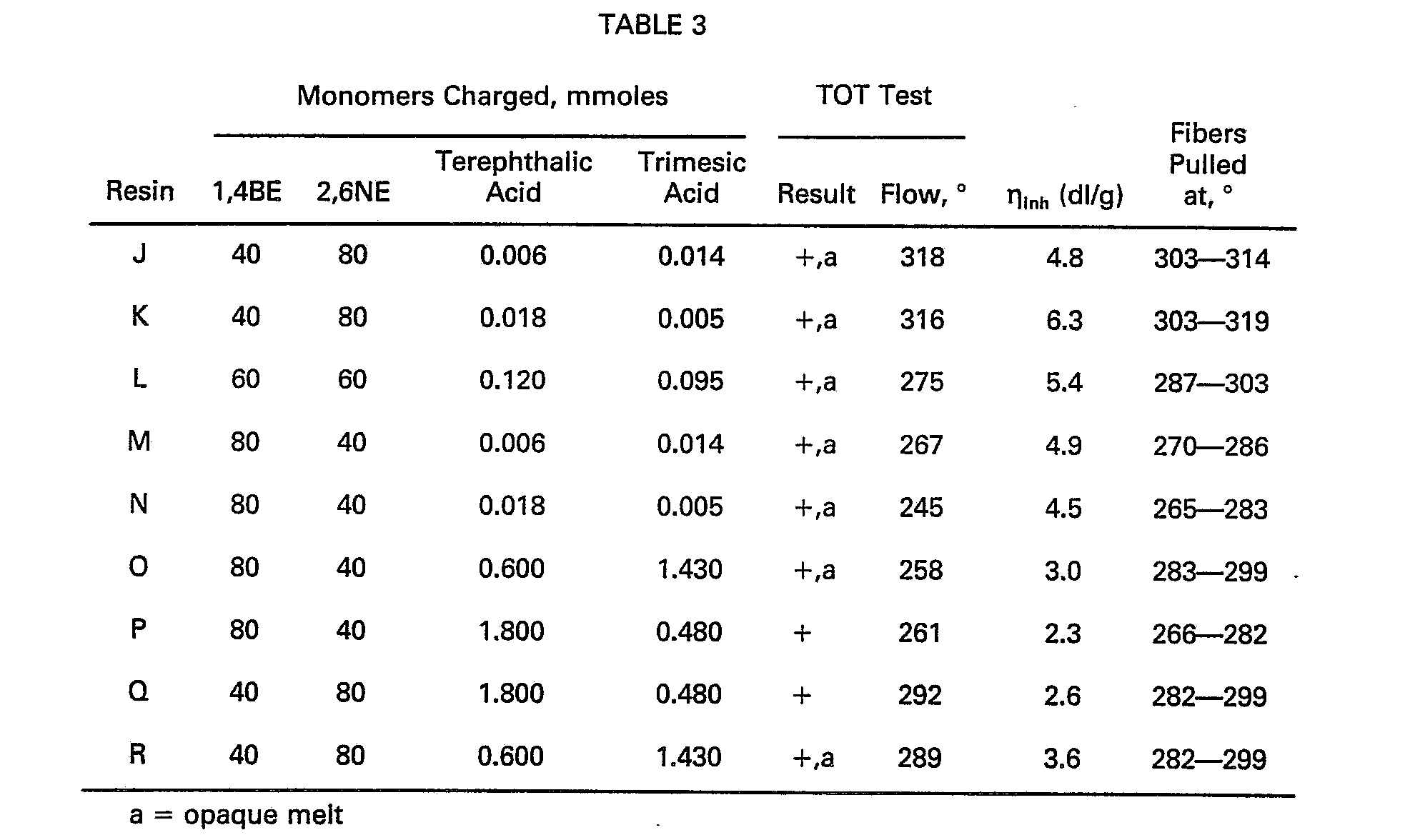
- Polyester resins J-R are prepared using a procedure similar to that described in Example 4, Part B. Fibers are pulled from the melt on a hot bar and/or spun using a procedure similar to that described in Example 2. Reactants used and resin properties obtained are given in Tables 3 and 4.
- Two star-branched copolyesters, S, T, and a mixture of star-branched and linear copolyester, U, are prepared using a procedure similar to that described in Example 3, part A. Fibers are pulled from the melt on a hot bar and/or spun using a procedure similar to that described in Example 2. Reactants and resin properties obtained are set forth in Tables 5 and 6.
Landscapes
- Chemical & Material Sciences (AREA)
- Health & Medical Sciences (AREA)
- Chemical Kinetics & Catalysis (AREA)
- Medicinal Chemistry (AREA)
- Polymers & Plastics (AREA)
- Organic Chemistry (AREA)
- Polyesters Or Polycarbonates (AREA)
- Artificial Filaments (AREA)
Description
- The present invention relates to aromatic copolyesters. More specifically, the invention relates to branched aromatic copolyesters which are fiber-forming, melt-processible, and in some instances are star-branched and/or capable of forming anisotropic melts. The terms "anisotropic", "thermotropic" and "mesogenic" have the same meaning and are used interchangeably herein.
- U.S. Patent 4,066,620, issued to Kleinschuster et al on January 3, 1978, discloses anisotropic-melt- forming copolyesters of fiber-forming molecular weight consisting essentially of units derived from specified dihydric phenols and terephthalic acid or naphthalene-2,6-dicarboxylic acid. Dihydric phenol units of two different specified types are present in a mole ratio within the range of from about 85/15 to 60/ 40. The total of dihydric phenol units is present in a substantially equimolar amount with the acid units.
- U.S. Patent 4,118,372, issued to Schaefgen on October 3, 1978, discloses a fiber-forming, melt spinnable (co)polyester capable of forming an optically anisotropic melt and consisting essentially of recurring units selected from



- U.S. Patent 4,161,470, issued to Calundann on July 17, 1979, discloses a melt-processible wholly aromatic polyester capable of forming a thermotropic melt phase at a temperature below approximately 350°C consisting essentially of the recurring moieties I and II wherein I is


- U.S. Patent 4,217,440, issued to Barkey on August 12,1980, discloses a method for preparing branched polyesters in melt or solid phase comprising (1) forming a condensation polymer by reacting together a diol, a diacid, and a polyfunctional modifier having at least three functional radicals, and (2) polycondensing said polymer in the presence of transesterification catalyst at a reaction temperature and reaction pressure effective to form a polyester of linear extension and branching, the improvement comprising polycondensing said polymer while correlating the activity of said catalyst, said temperature and said pressure to restrain the extent of reaction for said linear extension to within about 0.1 % of the extent of reaction for said branching. Suitable acids include terephthalic acid and naphthalene dicarbuxytic acid and suitable modifiers include trimesic acid, trimellitic acid, pyromellitic acid, and pentaerythritol.
- Other patents which disclose anisotropic aromatic polyesters include U.S. Patents 4,184,996; 4,188,476; 4,219,461; 4,242,496; 4,256,624; 4,267,304; 4,279,803; and 4,285,852.
- U.S. Patents 4,248,980 - 4,248,982 disclose star-block copolymers having good impact properties and clarity and containing 60-90% by weight of a monovinyl aromatic compound and 40-10% by weight of a conjugated diene of 4-8 carbon atoms, which, in each case, have an average structure of a specified general formula. The copolymers are made by a process which requires the use of (a) hydrocarbyllithium initiator to form linear segments which are ultimately coupled to a polyfunctional coupling agent, such as pyromellitic dianhydride and mellitic acid chloride.
- U.S. Patent 4,248,983, issued to Bi et al on February 3, 1981, discloses transparent, impact-resistant, thermoplastic star-block copolymers having good impact resistance at low temperature (-20° to -40°C) as well as at room temperature, said copolymer containing 60-95% by weight of a monovinyl aromatic compound and 40-5% by weight of a conjugated diene having 4-8 carbon atoms. The copolymers have a specified general formula and are made by a process which requires the use of a hydrocarbyllithium initiator.
- U.S. Patent 4,248,984 discloses similar star-block copolymers containing 60-90% by weight of a monovinyl aromatic compound and 40-10% by weight of a conjugated diene and having a different general formula.
- U.S. Patent 4,232,144 discloses fiber-forming copolyesters consisting essentially of four different units I to IV, the units III and IV being diol and diacid units and being used in equimolar amount. As a consequence and contrary to the present invention, the polyesters of the reference invariably contain 1 -OH end group and 1 -C02H end group.
- British Patent Specification 1,579,779 discloses a flame retardant composition having improved melt strength for molding comprising (a) a branched, high molecular weight poly(alkylene terephthalate or isophthalate) resin having a melt viscosity of at least 1500 Pa·s (15,000 poise), comprising a high molecular weight poly(alkylene terephthalate or isophthalate) and from 0.05 to 3 mole percent, based on the terephthalate or isophthalate units, of a branching component which contains at least three ester-forming groups; and (b) a flame retarding amount of a flame retardant as defined therein. Suitable branching components include trimesic acid, pyromellitic acid, and pentaerythritol.
- Conventional thermotropic polyesters which are especially useful for the preparation of high-strength fibers suitable for applications, such as tire cord, cable and the like, are substantially linear, crystalline materials the strength of which can usually be improved in the fiber direction by heat-treating the unrestrained as-spun fibers. Such fibers are usually weak in the transverse direction. Thus, there is a need for polyesters which form fibers having significantly improved transverse strength properties in addition to fiber-direction properties substantially equivalent to those of conventional linear polyesters.
- The present invention provides an aromatic, melt-processible, fiber-forming (co)polyester having the general formula QXn wherein
- Q is

- X consists of 2-4 different recurring hydroxy acid units (̵OR3-CO)̵ wherein R3 for each different acid unit is independently a divalent aryl radical of 6-30 carbon atoms selected from the group consisting of
- 1) a single aromatic ring or fused, co-linear, aromatic ring system of 2-3 six-membered rings wherein chain extending bonds of the ring system are
- (a) in 1,4- or 1,3-positions if said bonds are attached to the same ring or-in 1,2-, 1,3- or 1,4-positions if the divalent aryl radical has a single ring;
- (b) in 1,5-, 2,6- or 2,7-positions if said bonds are attached to different rings of a fused two-ring or three- ring system; and
- 2) an aromatic two-ring system in which individual rings are joined by a single bond or a divalent radical selected from

- Branched (co)polyesters of the invention form fibers having significantly improved transverse strength properties while also having fiber-direction properties substantially equivalent to those of linear polyesters.
- The polyesters of this invention are comprised of two or more, preferably at least three, linear polyester chains radiating from a single nucleus (atom, single aromatic ring or fused ring system). As described herein, a polyfunctional compound, i.e. a polycarboxylic acid or polyol, or derivative thereof, containing 2 to 10, preferably 3 to 5, carboxyl or hydroxyl groups provides the nucleus or tie-point from which the linear polyester chains radiate. The number of such chains radiating from a tie-point is equal to the number of functions present in the polyfunctional compound, i.e. the value of n in the general formula. When n is 3 or more, the polyesters of the invention are termed "star-branched". Providing the polyfunctional tie-point compound contains only hydroxyl or only carboxyl functions, as described herein, additional branch points do not occur. The expression hydrocarbyl as used herein means hydrocarbon radical.
- Preferred (co)polyesters of the invention are those of the general formula wherein n is from 3 to 10, most preferably from 3 to 5; said (co)polyesters are star-branched. Also, preferred are (co)polyesters of the invention wherein m is from about 100 to about 2000. Most preferred are polyesters of the invention which are capable of forming optically anisotropic (mesogenic) melts.
- included in the invention are (co)polyesters wherein the divalent aryl radical constituting R3 is substituted with one or more substituents selected from the group consisting of halogen, alkyl of 1-4 carbon atoms, alkoxy of 1-4 carbon atoms and phenyl.
- The invention further includes (co)polyester mixtures consisting essentially of (1) at least two (co)polyesters of the formula QXn where Q is different for each (co)polyester and preferably n is 2 for one of the (co)polyesters and at least 3 for another; or (2) a (co)polyester made from polycondensation of a diacid and a diol and at least 75 mole percent of a (co)polyester of the formula QXn, preferably at least 90 mole percent.
- Two essential requirements must be met to achieve exclusive star-branching in polyesters (and in condensation polymers generally): (i) the main chain monomer units comprising X in the general formula QX" are all of the AB type, i.e. hydroxy acids, rather than diacids and diols which are AA and BB types; (ii) the polyfunctional compound from which the tie-point Q is derived contains only functions which are either all A or all B-type; i.e. such species must be exclusively polyacids or polyols, or operable derivatives thereof: Failure to meet either requirement may result in additional and/or randomized branching.
- Hydroxy-acid units which comprise X in the polyesters OXn include, but are not limited to, the following:


- In the (co)polyester of the invention X of the general formula is comprised of from 2 to 4, preferably 2, different recurring hydroxy acid units. One of these units is present in from about 20 to about 80 mole percent, preferably from about 30 to about 70 mole percent, and the other different recurring hydroxy acid units are present in a total of from about 80 to about 20 mole percent, preferably from about 70 to about 30 mole percent, said mole percentages being based on the total moles of hydroxy acid units in the polyester QXn.
- Polyfunctional tie-point compounds which provide Q in the general formula are aromatic polyols of the formula R'(OH)n or aromatic polycarboxylic acids of the formula R2(CO2H)n where R1, R2 and n are as defined above, or are operable derivatives thereof; for example lower alkyl or phenyl esters of polyols or polyacids, or anhydrides or acyl halides of polyacids.
- R1 includes, but is not limited to, the radicals:



- R2 includes, but is not limited to, the radicals:


- The degree of polymerization, and hence the molecular weight, of star-branched polyesters is largely determined by the concentration and functionality of tie-point compound(s) present in relation to hydroxy acid monomer units. Mixtures of polyesters of the general formula QXn may be prepared by adding more than one polyfunctional tie-point comp9und, provided each such compound has the same functionality type (A or B).
- The (co)polyesters of this invention, and mixtures thereof with conventional linear polyesters, have flow temperatures of from about 200°C to about 375°C and a sufficiently high molecular weight to exhibit fiber and film-forming properties. For soluble polymers, inherent viscosities of at least 1 dl/g, preferably at least 2 dl/g, measured as described hereinafter, are useful for fibers and shaped articles. It should be understood that not all combinations of reactants mentioned herein will produce useful polyesters. Those producing polymers with flow temperatures in excess of 375°C should be avoided, as such high melting products are difficult to process, e.g., spin into useful fibers. Depending on structure, rapid decomposition of the (co)polyesters occurs at higher temperatures, i.e., about 375°C.
- It is well known that linear aromatic (co)polyesters consisting of X units can be prepared by polymerizing AB-type monomers, i.e. aromatic hydroxy acids in the absence of AA or BB bifunctional compounds. However, these conventional polyesters are not star-branched; indeed the art strongly teaches the desirability of linear polymers in the preparation of high strength fibers. Moreover, the conventional polyesters differ from the polyesters of general formula QXn wherein n is 2 in at least two ways: polyesters QX2, prepared by polymerizing AB-type monomers in the presence of AA or BB bifunctional compounds, have end-groups which are either all A or all B and the molecular weight distribution is generally relatively narrow, theoretical Mw/Mn is 1.5. Conventional linear AB polyesters comprised of X units will have both A and B-type end groups and a broader molecular weight distribution wherein the statistically most-probable MwlMn is 2.0. Molecular weight is effectively controlled in the QX2 polymerization system by controlling the relative molar amounts of hydroxy-acid monomer units and tie-point compound(s).
- The expression "co-linear aromatic ring system" as used herein means that all of the rings of the system have their centers on approximately the same line. Thus, hydroxy acids derived from aromatic compounds such as phenanthrene and the like are not included among hydroxy acids usable in the present invention.
- In the process of preparing the polyesters QXn of this invention, two to four aromatic hydroxy acids, or suitable derivatives thereof, e.g. lower alkyl or phenyl esters, anhydrides or acyl halides, are (co)polymerized (polycondensed) in the presence of one or more tie-point compounds, as defined herein, in appropriate concentration. Preferably, one of the functions in the hydroxy acids and the same function, when present, in the tie-point compound(s) are first converted to a derivative, such as an ester function, to facilitate purification of these starting materials. Preferably, the hydroxyl functions are so converted. Melt polymerization, as described, for example, in U.S. Patents 4,118,372 and 4,161,470, is preferred. Molar ratios of total AB units to tie-point compounds can vary from about 30,000:1 to about 20: 1, preferably from about 20,000:1 to about 300:1.
- A polymerization catalyst may optionally be employed. Suitable catalysts known in the art include p-toluene sulfonic acid, tertiary amines such as triethylamine, metal oxides such as Sb203 or As203, metal acetates such as magnesium or calcium acetate, alkyl titanates and the like.
- Another method of preparing polyesters of general formula QXn is to contact one or more prepolymerized conventional linear aromatic polyesters comprised of X units with an appropriate tie-point compound under polycondensation reaction conditions, which are preferably melt polymerization conditions, optionally including a catalyst as previously described. If polycondensation is allowed to proceed to completion, i.e. until equilibrium is attained, the product will consist essentially of QX" polyester. If equilibrium is not attained, the product will comprise QXn polyester admixed with residual conventional polyester(s). Such mixtures are often desirable and may be "tailored" by control of polycondensation conditions, especially time, temperature, and, if a catalyst has been used, its type and concentration. Such control methods will be obvious to an artisan of ordinary skill. Temperatures will be in the range between polyester melting point and decomposition point, preferably 10° to 50° above the melt point. Reaction time may vary from about 1 second to several hours.
- A catalyst, as described previously, may be added to the pre-formed linear polyester(s) and polyfunctional compound(s) reaction mixture to increase polycondensation or equilibration rate, or such catalysts may, optionally, be present in the pre-formed polyester(s), after the catalyst was used in the preparation of the pre-formed polyester(s). If a catalyst is employed in the polycondensation reaction, its concentration should not normally exceed about 1 part per hundred parts of total reactants and should also not exceed 10 wt% of the star-branching compound present.
- Polycondensation of conventional linear polyesters and polyfunctional tie-point compound as described herein is conveniently carried out in heated equipment suitable for melt-blending, such as a twinscrew extruder, extruder equipped with a static mixer, injection-molding machine and the like, or in stirred reactor or polymerization flask.
- Mixtures (blends) of QXn polyesters or mixtures of one or more QX" polyesters with one or more conventional linear polyesters can also be prepared by conventional blending of the appropriate polymerized components under mild, non-reactive conditions. Removal of any polymerization catalysts present in the components will minimize chemical interaction. Blending in a suitable solvent such as pentafluorophenol is convenient, especially where coating applications are contemplated.
- The (co)polyesters and blends of the invention can be spun into filaments by conventional melt- spinning techniques such as those described in U.S. Patents 4,066,620, 4,118,372 and 4,161,470. A melt of the polymer(s) is extruded through a spinneret into a quenching atmosphere, e.g. air or N2 at room temperature, and wound up. An extrusion rate of about 0.1 g/min is convenient.
- As used herein, the term "as-spun" fiber refers to a fiber which has not been drawn or heat-treated after extrusion and normal windup.
- The as-spun fibers of this invention may be subjected to heat treatment in an oven while relaxed or under mild restraint to provide high strength fibers useful for a variety of industrial applications such as plastic and rubber reinforcement. In the heat-treating process, fiber samples, as skeins or on bobbins (preferably collapsible polytetrafluoroethylene-coated bobbins) are usually heated in an oven having an inert atmosphere, N2, that is continuously purged by flow of inert gas through the oven to remove byproducts from the vicinity of the fiber. Temperatures approaching the fusion point, but sufficiently below to prevent interfilament fusion, are employed. Preferably, maximum temperature is reached in a stepwise fashion.
- Inherent viscosity (ηinh) is defined by the following equation:
- Methods described in U.S. Patent 3,827,998 are used. Filament properties are measured on fibers that have been conditioned at 21°C and 65% relative humidity (R.H.) for at least 16 hours unless otherwise specified. All measurements are made in the fiber conditioning environment.
- Tenacity (breaking tenacity) (T), elongation (breaking elongation) (E), and initial modulus (M,) are obtained from breaking a single filament on an Instron tester (Instron Engineering Corp., Canton, Mass.).
- Single filaments are broken with a gage length (distance between jaws) of 2.5 cm (1.0 inch). The results on 3 or more filaments are averaged. All samples are elongated at a constant rate of extension (10% elongation/minute for fibers having an E of under 8%) until the sample breaks.
- The denier of a single filament (dpf) is calculated from its functional resonant frequency, determined by vibrating a 7 to 9 cm length of fiber under tension with changing frequency (ASTM D1577-66, part 25, 1968). This filament is then used for 1 break.
- The tenacity [cN/dtex (grams/denier)], elongation (percent), and initial modulus [cN/dtex (grams/ denier)] as defined in ASTM D2101, part 25, 1968 are obtained from the load-elongation curve and the measured denier.
- All properties given herein were obtained from single filaments (filament properties). It should be noted that filament properties may differ from those obtained from multifilament strands of the same sample.
- Additional fiber properties measured relating to fiber strength in the transverse direction include loop strength (LS) and knot strength (KS), determined by ASTM D-3217-79, part 33, 1979.
- Polymer melting behavior was determined by Differential Scanning Calorimetry (DSC); three properties are reported:
- Tm = crystalline melting point;
- Tg = glass transition temperature;
- Tc = height of cooling crystallization peak.
- - The Thermooptical Test (TOT) used herein is described in U.S. Patents 4,066,620 and 4,118,372. Polymers and blends which pass this test (TOT = +) are considered to be optically anisotropic or mesogenic.
- The (co)polyesters and polyester mixtures of this invention are useful when fabricated into fibers, films, molded objects, or as the major component of a paint or coating.
- OXn polyesters wherein n is 2 are equivalent in many properties to conventional, linear aromatic polyesters of the art, however, the narrower molecular weight distribution and uniformity of end groups of the QX2 polyesters can confer additional benefits in processing and use. Since polyesters QX2 have end-groups which are either all A or all B, these polyesters are polymeric diacids or diols which can be used as monomers condensable with diols or diacids, respectively, to prepare block copolymers, chain-extended polymers, cross-linked polymers, and the like. Polyesters QXn where n is 3 or above are similarly useful for preparing block copolymers and cross-linked polymers. Fibers prepared from QXn polyesters wherein n is 3 or above are equivalent to fibers prepared from conventional polyesters in fiber-direction properties, e.g. strength and high modulus, but are distinctly superior in transverse direction properties exemplified by knot and loop strength. The fibers can be spun in ordinary equipment at high wind-up speeds and may be used in ropes, cables, tire-cord, and the like. Their improved transverse properties, as measured by their added strength when stressed after knotting or looping, for example, make them suitable for end uses such as reinforcing fiber for structural composites.
- Structural composites may also contain other fibrous materials, as for example, other polyesters, polyamides, polyimides and inorganic fibers such as glass, asbestos, graphite, boron, and the like. Composites will normally contain other, non-fibrous materials such as polymeric binders or matrix polymers, pigments and the like. In preparing composites, fibers may be added in chopped form or as woven fabric. The QX" polyesters are also useful in structural composites in non-fiber form as melt-processible matrix polymers to which reinforcing QX, polyester fibers and/or other fibers such as those recited above are added.
- Plastic articles and films may be fabricated from the polyesters of the invention by extrusion, injection molding, etc., with ordinary equipment. Higher speeds or cycle times can be realized with the preferred QXn mesogenic polyesters because of especially favorable rheology inherent therein.
- Films and coatings may be fabricated by dissolving the polyester in a suitable solvent, such as pentafluorophenol, and allowing the solvent to evaporate after casting or coating.
- Films, molded objects, and coatings prepared from the preferred mesogenic star-branched polyesters of the invention are generally more uniform than those prepared from conventional linear, mesogenic polyesters of the art. Films and coatings have good gas and moisture barrier properties together with high strength, stiffness, and hardness. Molded objects are more uniform and less wood-like in appearance.
- The invention is further illustrated by the following examples in which all temperatures are in degrees Celsius unless otherwise stated.
- The following ingredients are charged into a 200 ml round-bottom flask under a N2 atmosphere:
- 7.20 g (40 mmole) 4-acetoxybenzoic acid (1,4BE),
- 18.40 g (80 mmole) 6-acetoxy-2-naphthoic acid (2,6NE),
- 0.042 g (0.2 mmole) trimesic acid.
- The flask is placed in a silicone oil bath and is equipped with a stirrer and a distillation head-condenser. The temperature of the silicone oil bath is slowly increased from room temperature to 258° over 1 h and 48 min. During this heating cycle a clear monomer melt is obtained which at 255° begins evolving acetic acid that is removed by the condenser. A few minutes later the melt becomes cloudy as polymer forms. The temperature is raised to 328° over 2 h and 50 min; then the stirrer is removed and vacuum applied. After cooling the resulting polymer to room temperature under vacuum overnight, the molten polymer mass is heated at 282-314° (12 Pa, 0.09 mm pressure) for 3 h and 5 min. The resulting product, Resin A, is cooled and is recovered by breaking the reaction flask [yield = 17.6 g, 111nh = 4.8 dl/g]. Resin A has a Tg of 89.5°, Tm of 285.5°, and Tc of 228°, and is anisotropic (TOT = +). Flow temperature is 290°C. An additional sample of Resin A is obtained by charging similar amounts of ingredients into a polymer tube agitated by a N2- capillary bubbler and heating at vapor bath temperatures of 259° for 2 h, 305° for 2 h, and 305° for 2 h and 30 min under vacuum to remove acetic acid (ηinh = 3.6 dl/g).
- Polyester resins B-H are prepared using a procedure similar to that described in Example 1. The monomers, polyfunctional compounds and resin properties are given in.Table 1. Resins B and E are controls.

- Polyester resin A prepared in Example 1 and polyester resins B-G prepared in Example 2 are spun into fibers by extruding their evacuated melts through a one-hole (9 mil, 0.23 mm) spinneret at about 0.1 g/min at various temperatures and wind-up rates. In some cases, the as-spun fibers are heat-treated by back- winding a sample onto a polytetrafluoroethylene-coated bobbin and heating under mild restraint in an atmosphere of N2 at 270° for 24 h.
- Average single-filament fiber properties are given in Table 2.

- The following ingredients are charged into a glass polymer tube:
- 12.00 g 1,4BE (66.7 mmole)
- 9.47 g 4-acetoxy-3'-carboxybenzophenone (33.3 mmole)
- 0.042 g trimesic acid (0.2 mmole).
- The preparation of part A is repeated except that the final vacuum/heat cycle is reduced to 30 min. The polyester resin thus obtained has an ηinh of 1.0, is anisotropic by the TOT test, and has a flowtemperature of 318°. The resin is spun into high modulus fibers at 298-286° at wind-up rates of 1200-1300 m/min. As-spun filament properties [cN/dtex (gpd)] are:

- Polyester resins J-R are prepared using a procedure similar to that described in Example 4, Part B. Fibers are pulled from the melt on a hot bar and/or spun using a procedure similar to that described in Example 2. Reactants used and resin properties obtained are given in Tables 3 and 4.

- Two star-branched copolyesters, S, T, and a mixture of star-branched and linear copolyester, U, are prepared using a procedure similar to that described in Example 3, part A. Fibers are pulled from the melt on a hot bar and/or spun using a procedure similar to that described in Example 2. Reactants and resin properties obtained are set forth in Tables 5 and 6.


A N2-capillary is employed to maintain agitation. The tube is heated in a vapor bath for 1 h and 46 min at 259° (acetic acid is distilled out a side-arm) and for 1 h and 55 min at 305°. At this point, a strong fiber is pulled from the melt. Vacuum is applied (13 to 3 Pa, 0.1 to 0.02 mm of Hg) and heating is continued for 2.5 h at 305°. The resin is cooled and then isolated by breaking the tube (yield, 14.7 g; DSC: Tg, 82°, 98.5°; Tm, 209.5 and 290°; Tc, 204°; ηinh, 1.6). The resin is spun at a 400 m/min wind-up. As-spun properties are: T/E/M,, 3.2(3.6)/2.3/184(208). Properties after heat-treatment at 280° for 16 h are: T/E/M,/KS, 9.8(11.1)/5.1/214(243)/ 5.7(6.4). A knot strength (KS) of 5.7(6.4) cN/dtex (gpd) is an outstanding value.
Claims (20)


with the proviso that one of the different recurring units is present in from about 20 to about 80 mole percent and the other different recurring unit(s) are present in a total of from about 80 to about 20 mole percent, based on the total hydroxy acid units; and the total number, m, of said units per X moiety is from about 10 to about 3000;
said (co)polyester having a flow temperature of from about 200°C to about 375°C.


Applications Claiming Priority (2)
| Application Number | Priority Date | Filing Date | Title |
|---|---|---|---|
| US328841 | 1981-12-09 | ||
| US06/328,841 US4410683A (en) | 1981-12-09 | 1981-12-09 | Aromatic, melt-processible (co)polyesters |
Publications (2)
| Publication Number | Publication Date |
|---|---|
| EP0083426A1 EP0083426A1 (en) | 1983-07-13 |
| EP0083426B1 true EP0083426B1 (en) | 1987-03-18 |
Family
ID=23282682
Family Applications (1)
| Application Number | Title | Priority Date | Filing Date |
|---|---|---|---|
| EP82111400A Expired EP0083426B1 (en) | 1981-12-09 | 1982-12-09 | Aromatic, melt-processible (co)polyesters |
Country Status (5)
| Country | Link |
|---|---|
| US (1) | US4410683A (en) |
| EP (1) | EP0083426B1 (en) |
| JP (1) | JPS58104924A (en) |
| CA (1) | CA1188847A (en) |
| DE (1) | DE3275726D1 (en) |
Families Citing this family (14)
| Publication number | Priority date | Publication date | Assignee | Title |
|---|---|---|---|---|
| JPS59120626A (en) * | 1982-12-27 | 1984-07-12 | Sumitomo Chem Co Ltd | Production of aromatic polyester |
| US4540737A (en) * | 1983-02-07 | 1985-09-10 | Celanese Corporation | Method for the formation of composite articles comprised of thermotropic liquid crystalline polymers and articles produced thereby |
| EP0129372A3 (en) * | 1983-06-20 | 1987-04-15 | Imperial Chemical Industries Plc | Improved optical fibre cable |
| GB8328204D0 (en) * | 1983-10-21 | 1983-11-23 | British Telecomm | Optical fibres |
| JPH0686594B2 (en) * | 1985-09-20 | 1994-11-02 | 日本石油株式会社 | Process for producing monodomain cholesteric liquid crystalline polyester film or sheet |
| US4767183A (en) * | 1986-05-12 | 1988-08-30 | Westinghouse Electric Corp. | High strength, heavy walled cable construction |
| IT1223401B (en) * | 1987-12-02 | 1990-09-19 | Montedison Spa | THERMOTROPIC CRYSTALLINE LIQUID AROMATIC POLYESTERS |
| NL8803182A (en) * | 1988-12-28 | 1990-07-16 | Stamicarbon | MELTING PROCESSABLE POLYMER. |
| NL8803181A (en) * | 1988-12-28 | 1990-07-16 | Stamicarbon | POLYMER COMPOSITION BASED ON POLYMER AND A POLYESTERAMIDE. |
| US5196502A (en) * | 1991-11-05 | 1993-03-23 | Eastman Kodak Company | Method for the preparation of multiply-branched aromatic polyesters |
| US5306800A (en) * | 1992-11-09 | 1994-04-26 | Hoechst Celanese Corp. | Pseudo network condensation polymers |
| USRE39827E1 (en) | 1999-05-18 | 2007-09-11 | Helen Of Troy Limited | Vessel with measuring capability |
| KR101351165B1 (en) * | 2006-03-30 | 2014-01-14 | 도레이 카부시키가이샤 | Dendritic polyester, method for producing the same, and thermoplastic resin composition |
| CN116003746A (en) * | 2022-11-29 | 2023-04-25 | 金发科技股份有限公司 | LCP resin, preparation method thereof and LCP fiber |
Family Cites Families (25)
| Publication number | Priority date | Publication date | Assignee | Title |
|---|---|---|---|---|
| US3772250A (en) * | 1970-12-08 | 1973-11-13 | Carborundum Co | Branched aromatic polyesters containing cyanuryl nucleus radicals |
| JPS4928678A (en) * | 1972-07-06 | 1974-03-14 | ||
| JPS50108392A (en) * | 1974-02-04 | 1975-08-26 | ||
| PH15509A (en) * | 1974-05-10 | 1983-02-03 | Du Pont | Improvements in an relating to synthetic polyesters |
| JPS5125400A (en) * | 1974-08-26 | 1976-03-01 | Kiichi Ishimaru | Kosotatemono niokeru hijojikinkyuhinansopi |
| US4066620A (en) * | 1975-04-29 | 1978-01-03 | E. I. Du Pont De Nemours And Company | Copolyester capable of forming anisotropic melt and shaped articles thereof |
| JPS6016962B2 (en) * | 1976-09-14 | 1985-04-30 | 日立化成工業株式会社 | New and useful aromatic polyesters |
| GB1579779A (en) | 1976-12-20 | 1980-11-26 | Gen Electric | Flame-retardant branched polyester compositions |
| US4184996A (en) * | 1977-09-12 | 1980-01-22 | Celanese Corporation | Melt processable thermotropic wholly aromatic polyester |
| US4161470A (en) * | 1977-10-20 | 1979-07-17 | Celanese Corporation | Polyester of 6-hydroxy-2-naphthoic acid and para-hydroxy benzoic acid capable of readily undergoing melt processing |
| US4242496A (en) * | 1978-12-21 | 1980-12-30 | Eastman Kodak Company | Liquid crystal copolyesters containing phenylhydroquinone |
| ATE227T1 (en) * | 1978-07-31 | 1981-10-15 | Imperial Chemical Industries Limited | AROMATIC COPOLYESTERS, WHICH CAN FORM AN ANISOTROPIC MELT, AND MOLDINGS MADE THEREOF. |
| US4248983A (en) * | 1979-02-05 | 1981-02-03 | Arco Polymers, Inc. | Clear impact resistant thermoplastic star-block copolymers |
| US4188476A (en) * | 1979-04-06 | 1980-02-12 | E. I. Du Pont De Nemours And Company | Aromatic polyester consisting essentially of p-oxybenzoyl units, terephthaloyl units, 2,6-dioxynaphthalene or 2,6-dioxyanthraquinone units and m-oxybenzoyl or 1,3-dioxyphenylene units |
| US4219461A (en) * | 1979-04-23 | 1980-08-26 | Celanese Corporation | Polyester of 6-hydroxy-2-naphthoic acid, para-hydroxy benzoic acid, aromatic diol, and aromatic diacid capable of readily undergoing melt processing |
| US4248982A (en) * | 1979-04-30 | 1981-02-03 | Arco Polymers, Inc. | Clear impact resistant thermoplastic star-block copolymers |
| US4248980A (en) * | 1979-04-30 | 1981-02-03 | Arco Polymers, Inc. | Clear impact resistant thermoplastic star-block copolymers |
| US4248981A (en) * | 1979-04-30 | 1981-02-03 | Arco Polymers, Inc. | Clear impact resistant thermoplastic star-block copolymers |
| US4248984A (en) * | 1979-05-11 | 1981-02-03 | Arco Polymers, Inc. | Clear impact resistant thermoplastic star-block copolymers |
| US4256624A (en) * | 1979-07-02 | 1981-03-17 | Celanese Corporation | Polyester of 6-hydroxy-2-naphthoic acid, aromatic diol, and aromatic diacid capable of undergoing melt processing |
| US4217440A (en) * | 1979-08-20 | 1980-08-12 | Eastman Kodak Company | Method for making branched polyesters reproducibly |
| US4269965A (en) * | 1979-09-17 | 1981-05-26 | E. I. Du Pont De Nemours And Company | Aromatic polyester which forms optically anisotropic melts and filaments thereof |
| US4232144A (en) * | 1979-09-17 | 1980-11-04 | E. I. Du Pont De Nemours And Company | Polyester which exhibits anisotropy in the melt containing p-oxybenzoyl units and 4-oxy-3'-carbonylbenzophenone units or methyl and chloro derivatives of said units |
| US4285852A (en) * | 1980-01-04 | 1981-08-25 | Celanese Corporation | Anisotropic wholly aromatic polyester derived from 4-hydroxy-4'-carboxy azobenzene and process for preparation |
| US4279803A (en) * | 1980-03-10 | 1981-07-21 | Celanese Corporation | Polyester of phenyl-4-hydroxybenzoic acid and 4-hydroxybenzoic acid and/or 6-hydroxy-2-naphthoic acid capable of forming an anisotropic melt |
-
1981
- 1981-12-09 US US06/328,841 patent/US4410683A/en not_active Expired - Lifetime
-
1982
- 1982-12-07 CA CA000417173A patent/CA1188847A/en not_active Expired
- 1982-12-07 JP JP57213489A patent/JPS58104924A/en active Granted
- 1982-12-09 DE DE8282111400T patent/DE3275726D1/en not_active Expired
- 1982-12-09 EP EP82111400A patent/EP0083426B1/en not_active Expired
Also Published As
| Publication number | Publication date |
|---|---|
| US4410683A (en) | 1983-10-18 |
| JPH0518853B2 (en) | 1993-03-15 |
| CA1188847A (en) | 1985-06-11 |
| EP0083426A1 (en) | 1983-07-13 |
| JPS58104924A (en) | 1983-06-22 |
| DE3275726D1 (en) | 1987-04-23 |
Similar Documents
| Publication | Publication Date | Title |
|---|---|---|
| US4330457A (en) | Poly(ester-amide) capable of forming an anisotropic melt phase derived from 6-hydroxy-2-naphthoic acid, dicarboxylic acid, and aromatic monomer capable of forming an amide linkage | |
| US4351917A (en) | Poly(ester-amide) capable of forming an anisotropic melt phase derived from 6-hydroxy-2-naphthoic acid, aromatic monomer capable of forming an amide linkage, and other aromatic hydroxyacid | |
| US5015722A (en) | Melt-processable polyester capable of forming an anisotropic melt which exhibits a highly attractive balance between its molding and heat deflection temperatures | |
| EP0067032B1 (en) | Poly(ester-amide) capable of forming an anisotropic melt phase derived from p-hydroxybenzoic acid, 2,6-dihydroxynaphthalene, carbocyclic dicarboxylic acid, aromatic monomer capable of forming an amide linkage and, optinally, additional aromatic diol | |
| US4256624A (en) | Polyester of 6-hydroxy-2-naphthoic acid, aromatic diol, and aromatic diacid capable of undergoing melt processing | |
| US4375530A (en) | Polyester of 2,6-naphthalene dicarboxylic acid, 2,6-dihydroxy naphthalene, terephthalic acid, and hydroquinone capable of forming an anisotropic melt | |
| US4473682A (en) | Melt processable polyester capable of forming an anisotropic melt comprising a relatively low concentration of 6-oxy-2-naphthoyl moiety, 4-oxybenzoyl moiety, 4,4'-dioxybiphenyl moiety, and terephthaloyl moiety | |
| US4522974A (en) | Melt processable polyester capable of forming an anisotropic melt comprising a relatively low concentration of 6-oxy-2-naphthoyl moiety-4-benzoyl moiety, 1,4-dioxyphenylene moiety, isophthaloyl moiety and terephthaloyl moiety | |
| EP0095938B1 (en) | Aromatic polyesters and high strength filaments thereof | |
| US4410683A (en) | Aromatic, melt-processible (co)polyesters | |
| EP0063881A1 (en) | Poly(ester-amide) derived from p-hydroxybenzoic acid, 2,6-naphthalene-dicarboxylic acid and aromatic monomer capable of forming an amide linkage | |
| JPS6315938B2 (en) | ||
| EP0049615A1 (en) | Polyester of 6-hydroxy-2-naphthoic acid, aromatic diol and 1,4-cyclohexanedicarboxylic acid capable of undergoing melt processing | |
| EP0067618A2 (en) | Wholly aromatic polyester capable of forming an anisotropic melt phase at an advantageously reduced temperature | |
| US4238599A (en) | Polyester of para-hydroxy benzoic acid, 1,2-bis(para-carboxy phenoxy)ethane, terephthalic acid and substituted hydroquinone capable of forming an anisotropic melt which readily undergoes melt processing | |
| US5171823A (en) | Melt processable thermotropic wholly aromatic polyester containing 6-hydroxy-2-naphthoic acid moieties | |
| EP0595814A1 (en) | Copolyesters for high modulus fibers | |
| EP0018709B1 (en) | Thermotropic polyesters of 2,6-dihydroxy-anthraquinone, the production thereof, moulding powders, fibres and melts produced from these polyesters | |
| US4265802A (en) | Polyester of para-hydroxy benzoic acid, 1,4-bis(para-carboxyphenoxy) benzene, aromatic diol and aromatic diacid capable of undergoing melt processing | |
| EP0102160B1 (en) | Anisotropic melt processable polyester comprising relatively low concentration of 6-oxy-2-naphthoyl moiety | |
| US5453321A (en) | High molecular weight copolyesters for high modulus fibers | |
| EP0237358B1 (en) | Melt-moldable wholly aromatic polyester | |
| US4285852A (en) | Anisotropic wholly aromatic polyester derived from 4-hydroxy-4'-carboxy azobenzene and process for preparation | |
| US5006631A (en) | Aromatic polyester carbonate from diphenol mixture |
Legal Events
| Date | Code | Title | Description |
|---|---|---|---|
| PUAI | Public reference made under article 153(3) epc to a published international application that has entered the european phase |
Free format text: ORIGINAL CODE: 0009012 |
|
| AK | Designated contracting states |
Designated state(s): DE FR GB IT LU NL SE |
|
| 17P | Request for examination filed |
Effective date: 19840105 |
|
| GRAA | (expected) grant |
Free format text: ORIGINAL CODE: 0009210 |
|
| AK | Designated contracting states |
Kind code of ref document: B1 Designated state(s): DE FR GB IT LU NL SE |
|
| ITF | It: translation for a ep patent filed | ||
| REF | Corresponds to: |
Ref document number: 3275726 Country of ref document: DE Date of ref document: 19870423 |
|
| ET | Fr: translation filed | ||
| PLBE | No opposition filed within time limit |
Free format text: ORIGINAL CODE: 0009261 |
|
| STAA | Information on the status of an ep patent application or granted ep patent |
Free format text: STATUS: NO OPPOSITION FILED WITHIN TIME LIMIT |
|
| 26N | No opposition filed | ||
| R20 | Corrections of a patent specification |
Effective date: 19880209 |
|
| PGFP | Annual fee paid to national office [announced via postgrant information from national office to epo] |
Ref country code: SE Payment date: 19910904 Year of fee payment: 10 |
|
| PGFP | Annual fee paid to national office [announced via postgrant information from national office to epo] |
Ref country code: LU Payment date: 19910925 Year of fee payment: 10 |
|
| ITTA | It: last paid annual fee | ||
| PGFP | Annual fee paid to national office [announced via postgrant information from national office to epo] |
Ref country code: NL Payment date: 19911231 Year of fee payment: 10 |
|
| EPTA | Lu: last paid annual fee | ||
| PG25 | Lapsed in a contracting state [announced via postgrant information from national office to epo] |
Ref country code: LU Free format text: LAPSE BECAUSE OF NON-PAYMENT OF DUE FEES Effective date: 19921209 |
|
| PG25 | Lapsed in a contracting state [announced via postgrant information from national office to epo] |
Ref country code: SE Effective date: 19921210 |
|
| PG25 | Lapsed in a contracting state [announced via postgrant information from national office to epo] |
Ref country code: NL Effective date: 19930701 |
|
| NLV4 | Nl: lapsed or anulled due to non-payment of the annual fee | ||
| EUG | Se: european patent has lapsed |
Ref document number: 82111400.6 Effective date: 19930709 |
|
| PGFP | Annual fee paid to national office [announced via postgrant information from national office to epo] |
Ref country code: FR Payment date: 19980915 Year of fee payment: 17 |
|
| PG25 | Lapsed in a contracting state [announced via postgrant information from national office to epo] |
Ref country code: FR Free format text: LAPSE BECAUSE OF NON-PAYMENT OF DUE FEES Effective date: 20000831 |
|
| REG | Reference to a national code |
Ref country code: FR Ref legal event code: ST |
|
| PGFP | Annual fee paid to national office [announced via postgrant information from national office to epo] |
Ref country code: GB Payment date: 20011212 Year of fee payment: 20 |
|
| REG | Reference to a national code |
Ref country code: GB Ref legal event code: IF02 |
|
| PGFP | Annual fee paid to national office [announced via postgrant information from national office to epo] |
Ref country code: DE Payment date: 20020109 Year of fee payment: 20 |
|
| PG25 | Lapsed in a contracting state [announced via postgrant information from national office to epo] |
Ref country code: GB Free format text: LAPSE BECAUSE OF EXPIRATION OF PROTECTION Effective date: 20021208 |
|
| REG | Reference to a national code |
Ref country code: GB Ref legal event code: PE20 Effective date: 20021208 |