EP0082184B1 - Nutritional composition for management of hepatic failure - Google Patents
Nutritional composition for management of hepatic failure Download PDFInfo
- Publication number
- EP0082184B1 EP0082184B1 EP82902222A EP82902222A EP0082184B1 EP 0082184 B1 EP0082184 B1 EP 0082184B1 EP 82902222 A EP82902222 A EP 82902222A EP 82902222 A EP82902222 A EP 82902222A EP 0082184 B1 EP0082184 B1 EP 0082184B1
- Authority
- EP
- European Patent Office
- Prior art keywords
- composition
- amino acids
- histidine
- tryptophan
- threonine
- Prior art date
- Legal status (The legal status is an assumption and is not a legal conclusion. Google has not performed a legal analysis and makes no representation as to the accuracy of the status listed.)
- Expired
Links
Classifications
-
- A—HUMAN NECESSITIES
- A61—MEDICAL OR VETERINARY SCIENCE; HYGIENE
- A61K—PREPARATIONS FOR MEDICAL, DENTAL OR TOILETRY PURPOSES
- A61K38/00—Medicinal preparations containing peptides
- A61K38/01—Hydrolysed proteins; Derivatives thereof
-
- A—HUMAN NECESSITIES
- A61—MEDICAL OR VETERINARY SCIENCE; HYGIENE
- A61K—PREPARATIONS FOR MEDICAL, DENTAL OR TOILETRY PURPOSES
- A61K31/00—Medicinal preparations containing organic active ingredients
- A61K31/33—Heterocyclic compounds
- A61K31/395—Heterocyclic compounds having nitrogen as a ring hetero atom, e.g. guanethidine or rifamycins
- A61K31/41—Heterocyclic compounds having nitrogen as a ring hetero atom, e.g. guanethidine or rifamycins having five-membered rings with two or more ring hetero atoms, at least one of which being nitrogen, e.g. tetrazole
- A61K31/415—1,2-Diazoles
Definitions
- This invention relates to compositions and methods for nutritional management of hepatic (liver) failure.
- the invention is directed at novel amino acid compositions designed to meet the altered metabolic needs of patients suffering from hepatic failure and the attendant derangements of normal amino acid metabolism characterized by this clinical condition.
- Hepatic failure has numerous potential causes. Included among these causes are traumatic injuries to the organ and metabolic causes of a chronic (e.g., alcoholism) or acute nature (e.g., hepatitis, sepsis).
- traumatic injuries to the organ and metabolic causes of a chronic (e.g., alcoholism) or acute nature e.g., hepatitis, sepsis.
- the liver is the site of detoxification of numerous substances, in particular those nitrogenous wastes associated with protein metabolism. Especially important is the toxic by-product, ammonia (NH 3 ).
- the liver normally will detoxify ammonia by forming the nitrogen-containing substance urea (ureagenesis), which is then excreted via the kidneys.
- hepatic coma When the liver is in various degrees of failure its ability to detoxify ammonia can become compromised. As a result ammonia can accumulate in the blood (hyperammonemia). It is a widely accepted belief among clinicians and researchers that hyperammonemia is dangerous, since ammonia is believed to be extremely toxic to the brain. A potential result of hyperammonemia is the onset or deepening of coma. When such coma is associated with hepatic failure it is termed "hepatic coma" or "hepatic encephalopathy".
- ammonia can be a contributory factor.
- some of the non-nutritional therapeutic modalities employed in the clinical management of hepatic failure include treatments which have as their goal the reduction or elimination of ammonia input into the patient.
- administration of the antibiotic, neomycin, and the synthetic carbohydrate, lactulose are directed at reducing the production of ammonia by intestinal bacteria. It is known that the intestinal bacteria are the source of a substantial amount of ammonia, which reaches the blood-stream by intestinal absorption. Neomycin and lactulose are administered to reduce or eliminate this source of ammonia.
- amino acids the L-forms of threonine, serine, tryptophan, glutamine, histidine, and glycine, hereafter termed “ammonotelic” amino acids
- amino acids are catabolized by the body with the release of ammonia.
- ammonotelic amino acids to other essential and nonessential amino acids must be carefully balanced. We believe that this proportion is critical to the successful therapy of the hepatic failure patient. Sufficient essential ammonotelic amino acids must be present to provide the required nutrients, but an excess of ammonotelic amino acids will exacerbate the clinical syndromes associated with liver disease, in particular hyperammonemia. Thus it is important that the proportion of ammonotelic amino acids not be reduced to a level at which nutrition is compromised, but that the level be sufficiently low as to not unnecessarily contribute to hyperammonemia.
- compositions of this invention will contain the essential amino acids L-leucine, L-isoleucine, L-valine, L-lysine, L-threonine, L-methionine, L-phenylalanine and L-tryptophan. They may also contain the nonessential amino acids L-tryosine, L-arginine, L-proline, L-alanine and glycine. L-histidine is considered semi-essential, and in fact may be essential for neonates. For the purposes of nutrition in liver disease and this application, histidine will be denominated an essential amino acid.
- L-serine and L-glutamine are the ammonotelic amino acids which are most readily absent from the compositions of this invention, even though serine has heretofore been included as a required amino acid in certain prior art nutritional amino acid compositions for liver disease, e.g., those of Fischer et al, U.S. Patent 3,950,529.
- Glycine is generally reduced to a low proportion of the total amino acids, ordinarily less than 8 mole % and preferably from 2 to 6 mole %. Glycine may be entirely absent from the compositions of this invention, but this is not preferred.
- the essential ammonotelic amino acids histidine, threonine, and tryptophan are present in a proportion of from 6 to 16 mole %, ordinarily from 6 to 10 mole % and preferably 8 mole %. They are not entirely eliminated from the composition as this would be incompatible with the balanced nutritional objectives of the compositions described herein.
- a typical composition of this invention will contain amino acids in the following proportions:
- the relative proportions of the amino acids in the above schedule may vary by as much as 15% of the mole percent ranges given, although in the most satisfactory composition the ranges will vary by no more than 5%.
- the ratio of essential amino acids to nonessential amino acids by weight should range from 5:1 to 1:1.
- the essential amino acids should compromise from 60 to 75% by weight of the total amino acids in the composition.
- the aromatic amino acids L-phenylalanine, L-tyrosine and L-tryptophan are ordinarily present at less than 8 mole %, preferably less than 3 mole % and optimally from 1 to 3 mole %.
- the branched chain amino acids L-leucine, L-isoleucine and L-valine are present in a total of from 40-55% of the composition by weight, and preferably 50% by weight.
- Cysteine is not included in the compositions of this invention since it has been found, contrary to the teachings of Ghadami (U.S. Patent 3,832,465), that the sulfur requirements of hepatic-diseased patients may be met by supplying L-methionine.
- amino acid composition is administered parenterally or enterally will depend upon the clinical condition of the patient. If the gastrointestinal tract is sound the preferred administration route is enteral. Severely comatose patients will generally be fed parenterally. In non-comatose patients the composition may be administered as a supplement to normal oral nutrition. The suitable mode of administration will be within the skill of the ordinary artisan.
- composition may be supplemented with other nutrients such as vitamins, minerals, and biologically available, assimilable carbohydrates and fats. Supplementation may occur concomitantly with administration by premixing the additional nutrients with the amino acids and then administering, or by simultaneously supplying the nutrients by a separate administration route.
- other nutrients such as vitamins, minerals, and biologically available, assimilable carbohydrates and fats. Supplementation may occur concomitantly with administration by premixing the additional nutrients with the amino acids and then administering, or by simultaneously supplying the nutrients by a separate administration route.
- Parenteral compositions will ordinarily contain monosaccharides such as dextrose at typical infusion concentrations, e.g., from 10 to 40 percent by weight. Other carbohydrates such as oligosaccharides will be satisfactory.
- the solutions will be sterile and may contain stabilizers such as malate or sodium bisulfite.
- the concentration of amino acids in solutions for parenteral administration may range from 1 to 10 grams/dl (0.1 to 1.0 g/cm'), and preferably is from 6 to 7 grams/dl (0.6 to 0.7 g/cm 3 ).
- the concentration is not critical, although as recognized by those skilled in the art the osmolarity of the solution should be compatible with the administration route (central or peripheral venous), and excessive water should not be given as carrier for the nutrients if elimination is perceived by the clinician to be a problem.
- the enteral compositions are formulated particularly to provide the total nutritional requirements of the patient.
- the Recommended Daily Dietary Allowances for water and fat soluble vitamins and for minerals are provided in a typical daily dosage of amino acids (1 g protein/day/kg of patient body weight) and calories (20 kcal/day/kg).
- This contemplated example illustrates the use of an embodiment of the invention in an enteral feeding mode.
- composition to be administered to this patient had the following approximate analysis:
- amino acid, vitamin and mineral constituents were as follows:
- the 96 g packet of the above composition is mixed with 270 ml of water to yield approximately 350 ml.
- the solution is administered via a nasogastric tube.
- composition was diluted to half strength and fed for two days, working up to a feeding rate of full strength of approximately 20-24 grams of protein/hour in a total fluid volume of approximately 2,000 milliliters/day. Feeding was continuous over each 24-hour period.
- the patient's serum ammonia values decreased to a greater degree than ordinarily would be expected when compared to a diet containing a greater amount of ammonotelic amino acids.
- This contemplated example illustrates the use of an embodiment of the invention in a parenteral feeding mode.
- the patient had a history of encephalopathy and was unable to tolerate enteral feedings.
- the parenteral amino acid composition to be administered contained the following:
- the solution contained 20 mEq acetate and 11 mEa of chloride per liter.
- the pH was about 6.0 (by adjustment with acetic acid).
- About 3 mEq/I of sodium bisulfite was, added as a stabilizer.
- Concomitant administration of electrolytes and glucose for injection to provide approximately 40 kcal/kg (1500 ml of 50% Dextrose) completed the nutritional regimen.
- the rate of administration was 125 ml/hour by central venous catheter.
- the duration of this support was 10 days.
Landscapes
- Health & Medical Sciences (AREA)
- Life Sciences & Earth Sciences (AREA)
- Animal Behavior & Ethology (AREA)
- Chemical & Material Sciences (AREA)
- Veterinary Medicine (AREA)
- Public Health (AREA)
- Medicinal Chemistry (AREA)
- Pharmacology & Pharmacy (AREA)
- General Health & Medical Sciences (AREA)
- Epidemiology (AREA)
- Bioinformatics & Cheminformatics (AREA)
- Proteomics, Peptides & Aminoacids (AREA)
- Immunology (AREA)
- Engineering & Computer Science (AREA)
- Acyclic And Carbocyclic Compounds In Medicinal Compositions (AREA)
- Pharmaceuticals Containing Other Organic And Inorganic Compounds (AREA)
Abstract
Description
- This invention relates to compositions and methods for nutritional management of hepatic (liver) failure. In particular the invention is directed at novel amino acid compositions designed to meet the altered metabolic needs of patients suffering from hepatic failure and the attendant derangements of normal amino acid metabolism characterized by this clinical condition.
- Hepatic failure has numerous potential causes. Included among these causes are traumatic injuries to the organ and metabolic causes of a chronic (e.g., alcoholism) or acute nature (e.g., hepatitis, sepsis).
- Of the numerous functions performed by the liver, one in particular has importance as the subject of the invention described below. The liver is the site of detoxification of numerous substances, in particular those nitrogenous wastes associated with protein metabolism. Especially important is the toxic by-product, ammonia (NH3). The liver normally will detoxify ammonia by forming the nitrogen-containing substance urea (ureagenesis), which is then excreted via the kidneys.
- When the liver is in various degrees of failure its ability to detoxify ammonia can become compromised. As a result ammonia can accumulate in the blood (hyperammonemia). It is a widely accepted belief among clinicians and researchers that hyperammonemia is dangerous, since ammonia is believed to be extremely toxic to the brain. A potential result of hyperammonemia is the onset or deepening of coma. When such coma is associated with hepatic failure it is termed "hepatic coma" or "hepatic encephalopathy".
- Although the exact or immediate cause(s) of hepatic coma are not known with certainty, it is widely believed that ammonia can be a contributory factor. This is reflected in the fact that some of the non-nutritional therapeutic modalities employed in the clinical management of hepatic failure include treatments which have as their goal the reduction or elimination of ammonia input into the patient. Specifically, administration of the antibiotic, neomycin, and the synthetic carbohydrate, lactulose, are directed at reducing the production of ammonia by intestinal bacteria. It is known that the intestinal bacteria are the source of a substantial amount of ammonia, which reaches the blood-stream by intestinal absorption. Neomycin and lactulose are administered to reduce or eliminate this source of ammonia.
- Current therapies for hepatic failure, with or without the complication of coma, are not generally nutritional in nature.
- However, nutritional compositions which are disclosed to be tailored for hepatic failure are known. For example, see Ghadimi, U.S. Patent 3,832,405, Fischer et al, U.S. Patent 3,950,529 and West German Offenlegungsschrift 26 36 828.
- It is known that certain amino acids (the L-forms of threonine, serine, tryptophan, glutamine, histidine, and glycine, hereafter termed "ammonotelic" amino acids) are catabolized by the body with the release of ammonia. (J. Rudman: Am. J. Clin. Nutrition; 26, p. 916-925 (1973)).
- It is an object of this invention to supply an amino acid composition which will reduce the ammonia produced endogenously (by the body, rather than by bacterial flora) by reducing the proportion of ammonotelic amino acids present in the nutritional source.
- It is another object to ameliorate the hyperammonemia which accompanies hepatic dysfunction, thereby reducing the likelihood of a lapse into hepatic coma or a deepening of the comatose state.
- It is an additional object to provide adequate nutrition to the hepatic diseased patent without compromising the foregoing two objects.
- These and other objects will become apparent from the specification as a whole.
- We have discovered that the proportion of ammonotelic amino acids to other essential and nonessential amino acids must be carefully balanced. We believe that this proportion is critical to the successful therapy of the hepatic failure patient. Sufficient essential ammonotelic amino acids must be present to provide the required nutrients, but an excess of ammonotelic amino acids will exacerbate the clinical syndromes associated with liver disease, in particular hyperammonemia. Thus it is important that the proportion of ammonotelic amino acids not be reduced to a level at which nutrition is compromised, but that the level be sufficiently low as to not unnecessarily contribute to hyperammonemia. This is most readily accomplished by severely reducing or by eliminating L-serine, L-glycine and L-glutamine from mixtures of essential and nonessential amino acids to be used for nutritional support of liver diseased patients. The essential or semi-essential ammonotelic amino acids histidine, threonine and tryptophan are reduced to the lowest proportion compatible with effective nutritional support. The proportion of ammonotelic amino acids meeting these requirements has been found to be from 8 to 16 mole percent of the total amino acid composition.
- The compositions of this invention will contain the essential amino acids L-leucine, L-isoleucine, L-valine, L-lysine, L-threonine, L-methionine, L-phenylalanine and L-tryptophan. They may also contain the nonessential amino acids L-tryosine, L-arginine, L-proline, L-alanine and glycine. L-histidine is considered semi-essential, and in fact may be essential for neonates. For the purposes of nutrition in liver disease and this application, histidine will be denominated an essential amino acid.
- L-serine and L-glutamine are the ammonotelic amino acids which are most readily absent from the compositions of this invention, even though serine has heretofore been included as a required amino acid in certain prior art nutritional amino acid compositions for liver disease, e.g., those of Fischer et al, U.S. Patent 3,950,529. Glycine is generally reduced to a low proportion of the total amino acids, ordinarily less than 8 mole % and preferably from 2 to 6 mole %. Glycine may be entirely absent from the compositions of this invention, but this is not preferred.
- The essential ammonotelic amino acids histidine, threonine, and tryptophan are present in a proportion of from 6 to 16 mole %, ordinarily from 6 to 10 mole % and preferably 8 mole %. They are not entirely eliminated from the composition as this would be incompatible with the balanced nutritional objectives of the compositions described herein.
- A typical composition of this invention will contain amino acids in the following proportions:

- The relative proportions of the amino acids in the above schedule may vary by as much as 15% of the mole percent ranges given, although in the most satisfactory composition the ranges will vary by no more than 5%.
- The ratio of essential amino acids to nonessential amino acids by weight should range from 5:1 to 1:1. The essential amino acids should compromise from 60 to 75% by weight of the total amino acids in the composition.
- The aromatic amino acids L-phenylalanine, L-tyrosine and L-tryptophan are ordinarily present at less than 8 mole %, preferably less than 3 mole % and optimally from 1 to 3 mole %.
- The branched chain amino acids L-leucine, L-isoleucine and L-valine are present in a total of from 40-55% of the composition by weight, and preferably 50% by weight.
- Cysteine is not included in the compositions of this invention since it has been found, contrary to the teachings of Ghadami (U.S. Patent 3,832,465), that the sulfur requirements of hepatic-diseased patients may be met by supplying L-methionine.
- Whether the amino acid composition is administered parenterally or enterally will depend upon the clinical condition of the patient. If the gastrointestinal tract is sound the preferred administration route is enteral. Severely comatose patients will generally be fed parenterally. In non-comatose patients the composition may be administered as a supplement to normal oral nutrition. The suitable mode of administration will be within the skill of the ordinary artisan.
- The composition may be supplemented with other nutrients such as vitamins, minerals, and biologically available, assimilable carbohydrates and fats. Supplementation may occur concomitantly with administration by premixing the additional nutrients with the amino acids and then administering, or by simultaneously supplying the nutrients by a separate administration route.
- Parenteral compositions will ordinarily contain monosaccharides such as dextrose at typical infusion concentrations, e.g., from 10 to 40 percent by weight. Other carbohydrates such as oligosaccharides will be satisfactory. The solutions will be sterile and may contain stabilizers such as malate or sodium bisulfite. The concentration of amino acids in solutions for parenteral administration may range from 1 to 10 grams/dl (0.1 to 1.0 g/cm'), and preferably is from 6 to 7 grams/dl (0.6 to 0.7 g/cm3). The concentration is not critical, although as recognized by those skilled in the art the osmolarity of the solution should be compatible with the administration route (central or peripheral venous), and excessive water should not be given as carrier for the nutrients if elimination is perceived by the clinician to be a problem.
- The enteral compositions are formulated particularly to provide the total nutritional requirements of the patient. Thus the Recommended Daily Dietary Allowances for water and fat soluble vitamins and for minerals are provided in a typical daily dosage of amino acids (1 g protein/day/kg of patient body weight) and calories (20 kcal/day/kg).
- The composition and methods of this invention will be more fully understood by reference to the subsequent examples.
- This contemplated example illustrates the use of an embodiment of the invention in an enteral feeding mode.
- A 50 year old, 60 kg male with an exacerbation of hepatic failure due to acute cirrhosis of the liver from chronic alcohol ingestion, and with significant weight loss due to under-nutrition, exhibited protein intolerance, characterized in part by elevated serum ammonia values (>100 µg/dl; >10 µg/cm3). The patient had a history of episodes of coma.
- The composition to be administered to this patient had the following approximate analysis:
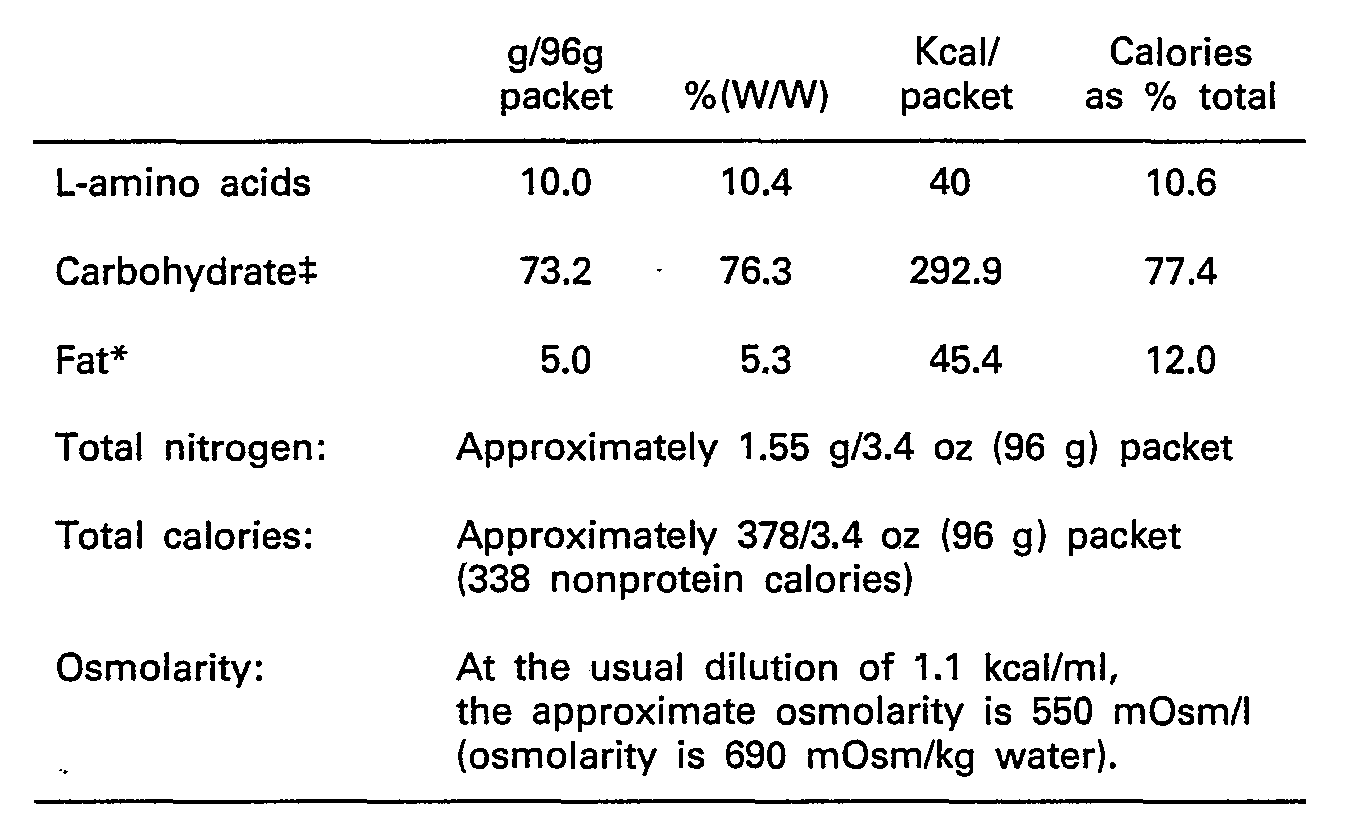
- *Sunflower oil, medium chain triglycerides (fractionated coconut oil).
- ‡Glucose oligosaccharides, sucrose.
- The amino acid, vitamin and mineral constituents were as follows:


- The 96 g packet of the above composition is mixed with 270 ml of water to yield approximately 350 ml.
- The solution is administered via a nasogastric tube.
- The composition was diluted to half strength and fed for two days, working up to a feeding rate of full strength of approximately 20-24 grams of protein/hour in a total fluid volume of approximately 2,000 milliliters/day. Feeding was continuous over each 24-hour period. The patient's serum ammonia values decreased to a greater degree than ordinarily would be expected when compared to a diet containing a greater amount of ammonotelic amino acids.
- The patient resumed taking meals after one week of enteral feeding with the above composition, after which the composition was used occasionally for supplementary nutrition.
- This contemplated example illustrates the use of an embodiment of the invention in a parenteral feeding mode. A 50 year old, 55 kg male with an acute exacerbation of hepatic failure due to cirrhosis of the liver secondary to chronic alcohol ingestion, and with significant weight loss due to under-nutrition, exhibited protein intolerance characterized in part by elevated serum ammonia (>100 pg/dl; >10 µg/cm3). The patient had a history of encephalopathy and was unable to tolerate enteral feedings.
- The parenteral amino acid composition to be administered contained the following:

- In addition the solution contained 20 mEq acetate and 11 mEa of chloride per liter. The pH was about 6.0 (by adjustment with acetic acid). About 3 mEq/I of sodium bisulfite was, added as a stabilizer. Concomitant administration of electrolytes and glucose for injection to provide approximately 40 kcal/kg (1500 ml of 50% Dextrose) completed the nutritional regimen. The rate of administration was 125 ml/hour by central venous catheter. The duration of this support was 10 days.
Claims (12)

Applications Claiming Priority (2)
| Application Number | Priority Date | Filing Date | Title |
|---|---|---|---|
| US27891481A | 1981-06-29 | 1981-06-29 | |
| US278914 | 1981-06-29 |
Publications (3)
| Publication Number | Publication Date |
|---|---|
| EP0082184A1 EP0082184A1 (en) | 1983-06-29 |
| EP0082184A4 EP0082184A4 (en) | 1985-04-11 |
| EP0082184B1 true EP0082184B1 (en) | 1989-01-18 |
Family
ID=23066927
Family Applications (1)
| Application Number | Title | Priority Date | Filing Date |
|---|---|---|---|
| EP82902222A Expired EP0082184B1 (en) | 1981-06-29 | 1982-05-28 | Nutritional composition for management of hepatic failure |
Country Status (4)
| Country | Link |
|---|---|
| EP (1) | EP0082184B1 (en) |
| CA (1) | CA1184499A (en) |
| DE (1) | DE3279361D1 (en) |
| WO (1) | WO1983000085A1 (en) |
Families Citing this family (14)
| Publication number | Priority date | Publication date | Assignee | Title |
|---|---|---|---|---|
| CA2105881A1 (en) | 1992-09-14 | 1994-03-15 | Willem Jacob Serfontein | Compositions for the treatment and prophylaxis of metabolic disturbances in infants |
| GB9416921D0 (en) * | 1994-08-22 | 1994-10-12 | Conway Gitta C | A nutritional preparation |
| US6043259A (en) * | 1998-07-09 | 2000-03-28 | Medicure Inc. | Treatment of cardiovascular and related pathologies |
| EP1169322B8 (en) | 1999-03-08 | 2006-09-13 | Medicure Inc. | Pyridoxal analogues for the treatment of disorders caused by a deficiency in vitamin b6 |
| US6649746B1 (en) | 1999-05-07 | 2003-11-18 | University Of Virginia Patent Foundation | Biological production of stable glutamine, poly-glutamine derivatives in transgenic organisms and their use for therapeutic purposes |
| AU5840200A (en) | 1999-07-13 | 2001-01-30 | Medicure Inc. | Treatment of diabetes and related pathologies |
| EP1872797A3 (en) | 1999-08-24 | 2008-04-02 | Medicure International Inc. | Treatment of cardiovascular and related pathologies |
| EP1268498B1 (en) | 2000-02-29 | 2005-04-13 | Medicure International Inc. | Cardioprotective phosphonates |
| US7442689B2 (en) | 2000-02-29 | 2008-10-28 | Medicure International Inc. | Cardioprotective phosphonates and malonates |
| US6586414B2 (en) | 2000-03-28 | 2003-07-01 | Medicure International Inc. | Treatment of cerebrovascular disease |
| US6897228B2 (en) | 2000-07-07 | 2005-05-24 | Medicure International Inc. | Pyridoxine and pyridoxal analogues: new uses |
| JOP20190146A1 (en) | 2016-12-19 | 2019-06-18 | Axcella Health Inc | Amino acid compositions and methods for the treatment of liver diseases |
| SG11202001142VA (en) | 2017-08-14 | 2020-03-30 | Axcella Health Inc | Amino acid compositions for the treatment of liver disease |
| US10596136B2 (en) | 2018-06-20 | 2020-03-24 | Axcella Health Inc. | Compositions and methods for the treatment of fat infiltration in muscle |
Family Cites Families (6)
| Publication number | Priority date | Publication date | Assignee | Title |
|---|---|---|---|---|
| US3832465A (en) * | 1971-12-09 | 1974-08-27 | H Ghadimi | Injectable amino acid composition commensurate to the anabolic need of the body and method of using same |
| US3950529A (en) * | 1975-02-03 | 1976-04-13 | Massachusetts General Hospital | Amino acid formulations for patients with liver disease and method of using same |
| US4053589A (en) * | 1975-11-24 | 1977-10-11 | Control Drug Inc. | Method of treating nutritional deficiency during cardiac cachexia, diabetes, hypoglycemia, gastroenterology, lipid, cell glycogen and keratin-related skin conditions and alcoholism |
| US4025650A (en) * | 1975-11-24 | 1977-05-24 | Control Drug, Inc. | Method and composition for preventing nutritional deficiency |
| DE2750159C3 (en) * | 1977-11-09 | 1980-05-22 | Lentia Gmbh, Chem. U. Pharm. Erzeugnisse - Industriebedarf, 8000 Muenchen | Infusion solution for the treatment of hepatic encephalopathy and a process for the manufacture thereof |
| JPS5536457A (en) * | 1978-09-08 | 1980-03-14 | Ajinomoto Co Inc | Amino acid infusion |
-
1982
- 1982-03-31 CA CA000400055A patent/CA1184499A/en not_active Expired
- 1982-05-28 DE DE8282902222T patent/DE3279361D1/en not_active Expired
- 1982-05-28 EP EP82902222A patent/EP0082184B1/en not_active Expired
- 1982-05-28 WO PCT/US1982/000742 patent/WO1983000085A1/en not_active Ceased
Non-Patent Citations (1)
| Title |
|---|
| Am.J.Clin.Nutrition 26, 916-925 (1973) * |
Also Published As
| Publication number | Publication date |
|---|---|
| EP0082184A4 (en) | 1985-04-11 |
| DE3279361D1 (en) | 1989-02-23 |
| WO1983000085A1 (en) | 1983-01-20 |
| CA1184499A (en) | 1985-03-26 |
| EP0082184A1 (en) | 1983-06-29 |
Similar Documents
| Publication | Publication Date | Title |
|---|---|---|
| US4357343A (en) | Nutritional composition for management of renal failure | |
| US4898879A (en) | Nurtitional composition for management of hepatic failure | |
| US4499076A (en) | Elemental diets for liver diseases | |
| US5728678A (en) | Method and composition for providing nutrition to a renal failure patient | |
| CA1184499A (en) | Nutritional composition for management of hepatic failure | |
| US5462924A (en) | Product containing growth factor and glutamine and use of growth factor for the treatment of intestinal mucosa | |
| US4438144A (en) | Amino acid preparation and therapy for treatment of stress and injury | |
| EP0176094A1 (en) | Parenteral alimentation solution | |
| Blackburn et al. | Criteria for choosing amino acid therapy in acute renal failure | |
| US5276018A (en) | Composition comprising amino acids and methods for decreasing muscle breakdown | |
| Bergstrom et al. | Factors affecting the nitrogen balance in chronic uremic patients receiving essential amino acids intravenously or by mouth | |
| EP0549660A4 (en) | Enhancement of glutathione levels with glutamine | |
| Kahler et al. | Parenteral nutrition in propionic and methylmalonic acidemia | |
| Yoshida et al. | Effect of glutamine supplementation on protein metabolism and glutathione in tumor‐bearing rats | |
| Fleming et al. | Subject review: total parenteral nutrition | |
| Silk | Towards the optimization of enteral nutrition | |
| Lanza-Jacoby | Effect of continuous and discontinuous intravenous or intragastric total parenteral nutrition in rats on serum lipids, liver lipids and liver lipogenic rates | |
| Abras et al. | Nitrogen utilization in uremic patients fed by continuous nasogastric infusion | |
| US20160235103A1 (en) | Intradialytic parenteral nutrition compositions | |
| CA1320441C (en) | Use of growth hormone for nitrogen retention under hypocaloric conditions | |
| JP3182564B2 (en) | Nutrition composition | |
| JPS61501558A (en) | Parenteral nutritional supplementation of medium and long chain triglycerides | |
| Meguid et al. | Effect of elemental diet on albumin and urea synthesis: comparison with partially hydrolyzed protein diet | |
| EP0057209A1 (en) | Novel amino acid preparation and therapy for treatment of stress and injury | |
| WO1982003552A1 (en) | Improved solution for parenteral nutrition |
Legal Events
| Date | Code | Title | Description |
|---|---|---|---|
| PUAI | Public reference made under article 153(3) epc to a published international application that has entered the european phase |
Free format text: ORIGINAL CODE: 0009012 |
|
| 17P | Request for examination filed |
Effective date: 19830225 |
|
| AK | Designated contracting states |
Designated state(s): BE DE FR GB SE |
|
| 17Q | First examination report despatched |
Effective date: 19860618 |
|
| R17C | First examination report despatched (corrected) |
Effective date: 19870604 |
|
| RAP1 | Party data changed (applicant data changed or rights of an application transferred) |
Owner name: BAXTER INTERNATIONAL INC. |
|
| GRAA | (expected) grant |
Free format text: ORIGINAL CODE: 0009210 |
|
| AK | Designated contracting states |
Kind code of ref document: B1 Designated state(s): BE DE FR GB SE |
|
| REF | Corresponds to: |
Ref document number: 3279361 Country of ref document: DE Date of ref document: 19890223 |
|
| ET | Fr: translation filed | ||
| PLBI | Opposition filed |
Free format text: ORIGINAL CODE: 0009260 |
|
| 26 | Opposition filed |
Opponent name: FRESENIUS AG Effective date: 19891017 |
|
| PLBN | Opposition rejected |
Free format text: ORIGINAL CODE: 0009273 |
|
| STAA | Information on the status of an ep patent application or granted ep patent |
Free format text: STATUS: OPPOSITION REJECTED |
|
| 27O | Opposition rejected |
Effective date: 19920307 |
|
| REG | Reference to a national code |
Ref country code: GB Ref legal event code: 732E |
|
| REG | Reference to a national code |
Ref country code: FR Ref legal event code: TP |
|
| PGFP | Annual fee paid to national office [announced via postgrant information from national office to epo] |
Ref country code: FR Payment date: 19940317 Year of fee payment: 13 |
|
| PGFP | Annual fee paid to national office [announced via postgrant information from national office to epo] |
Ref country code: SE Payment date: 19940321 Year of fee payment: 13 |
|
| PGFP | Annual fee paid to national office [announced via postgrant information from national office to epo] |
Ref country code: GB Payment date: 19940324 Year of fee payment: 13 |
|
| PGFP | Annual fee paid to national office [announced via postgrant information from national office to epo] |
Ref country code: BE Payment date: 19940415 Year of fee payment: 13 |
|
| PGFP | Annual fee paid to national office [announced via postgrant information from national office to epo] |
Ref country code: DE Payment date: 19940630 Year of fee payment: 13 |
|
| EAL | Se: european patent in force in sweden |
Ref document number: 82902222.7 |
|
| PG25 | Lapsed in a contracting state [announced via postgrant information from national office to epo] |
Ref country code: GB Effective date: 19950528 |
|
| PG25 | Lapsed in a contracting state [announced via postgrant information from national office to epo] |
Ref country code: SE Effective date: 19950529 |
|
| PG25 | Lapsed in a contracting state [announced via postgrant information from national office to epo] |
Ref country code: BE Effective date: 19950531 |
|
| BERE | Be: lapsed |
Owner name: CLINTEC NUTRITION CY Effective date: 19950531 |
|
| GBPC | Gb: european patent ceased through non-payment of renewal fee |
Effective date: 19950528 |
|
| PG25 | Lapsed in a contracting state [announced via postgrant information from national office to epo] |
Ref country code: DE Effective date: 19960201 |
|
| EUG | Se: european patent has lapsed |
Ref document number: 82902222.7 |
|
| PG25 | Lapsed in a contracting state [announced via postgrant information from national office to epo] |
Ref country code: FR Effective date: 19960229 |
|
| REG | Reference to a national code |
Ref country code: FR Ref legal event code: ST |
|
| REG | Reference to a national code |
Ref country code: FR Ref legal event code: ST |