EP0078992B1 - Thermoplastic polyurethane compositions of improved flame retardance - Google Patents
Thermoplastic polyurethane compositions of improved flame retardance Download PDFInfo
- Publication number
- EP0078992B1 EP0078992B1 EP82109962A EP82109962A EP0078992B1 EP 0078992 B1 EP0078992 B1 EP 0078992B1 EP 82109962 A EP82109962 A EP 82109962A EP 82109962 A EP82109962 A EP 82109962A EP 0078992 B1 EP0078992 B1 EP 0078992B1
- Authority
- EP
- European Patent Office
- Prior art keywords
- diisocyanate
- thermoplastic
- thermoplastic polyurethane
- denotes
- phenylene
- Prior art date
- Legal status (The legal status is an assumption and is not a legal conclusion. Google has not performed a legal analysis and makes no representation as to the accuracy of the status listed.)
- Expired
Links
Classifications
-
- C—CHEMISTRY; METALLURGY
- C08—ORGANIC MACROMOLECULAR COMPOUNDS; THEIR PREPARATION OR CHEMICAL WORKING-UP; COMPOSITIONS BASED THEREON
- C08L—COMPOSITIONS OF MACROMOLECULAR COMPOUNDS
- C08L69/00—Compositions of polycarbonates; Compositions of derivatives of polycarbonates
-
- C—CHEMISTRY; METALLURGY
- C08—ORGANIC MACROMOLECULAR COMPOUNDS; THEIR PREPARATION OR CHEMICAL WORKING-UP; COMPOSITIONS BASED THEREON
- C08L—COMPOSITIONS OF MACROMOLECULAR COMPOUNDS
- C08L75/00—Compositions of polyureas or polyurethanes; Compositions of derivatives of such polymers
- C08L75/04—Polyurethanes
-
- C—CHEMISTRY; METALLURGY
- C08—ORGANIC MACROMOLECULAR COMPOUNDS; THEIR PREPARATION OR CHEMICAL WORKING-UP; COMPOSITIONS BASED THEREON
- C08L—COMPOSITIONS OF MACROMOLECULAR COMPOUNDS
- C08L85/00—Compositions of macromolecular compounds obtained by reactions forming a linkage in the main chain of the macromolecule containing atoms other than silicon, sulfur, nitrogen, oxygen and carbon; Compositions of derivatives of such polymers
- C08L85/02—Compositions of macromolecular compounds obtained by reactions forming a linkage in the main chain of the macromolecule containing atoms other than silicon, sulfur, nitrogen, oxygen and carbon; Compositions of derivatives of such polymers containing phosphorus
Definitions
- the present invention is directed to polymer blends and more particularly to polyblends of thermoplastic polyurethane and certain polyphosphonates.
- thermoplastic polyurethanes (hereinafter TPU) have been extensively used in a variety of molding applications. Articles molded therefrom have met the stringent engineering criteria governing applications in the automotive, electrical, mechanical equipment and footwear industries.
- TPU thermoplastic polyurethanes
- the flammability rating of TPU (UL-94 1/8", V-2) limits their utility in certain applications where a greater resistance to flame is required.
- Halogenated fire retardants, singly or in combination with antimony oxide have been reported to improve the flame retardance of these resins but are known to be unsuitable for some applications where corrosion upon evolution of hydrogen halides attended upon combustion is a determining factor.
- thermoplastic polyphosphonates are characteristically of exceptionally high rating of flame resistance - see, for instance, German DOS 29 44 093. Due in part to their level of mechanical properties, however, thermoplastic polyphosphonates are beneficially used in a narrower field of application.
- thermoplastic polyphosphonates desirable as components in a blend with TPU are not compatible therewith and the resulting blinds are inhomogenous, poorly dispersed mixtures which are unsuited for molding applications (e.g. US-A-3 956 431
- polyphosphonates namely, polyarylphosphonates and polyarylphosphonate carbonates are compatible components in blends comprising thermoplastic polyurethanes.
- the blend thus produced is characteristically of improved flammability rating.
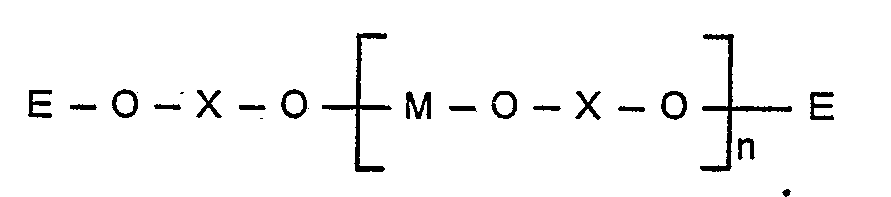
- thermoplastic molding composition comprising thermoplastic polyurethane and a polyarylphosphonate characterized by the recurring structural units wherein R 1 is C 6 -C 30 aryl and X is an aromatic residue of a dihydroxy compound or a polyarylphosphonatocarbonate characterized by the recurring structural units wherein E denotes H or ⁇ M ⁇ 0 ⁇ Ar and where Ar is a C 6 -C 14 aryl radical and M denotes having a molar ratio of between 5:95 to 95:5 and R denotes a C 6 to C 30 aryl and X denotes a residue of a dihydroxy compound.
- thermoplastic polyurethanes are those generally prepared from a diisocyanate, a polyester or polyether and a chain extender. These thermoplastic polyurethanes are substantially linear and maintain thermoplastic processing characteristics.
- thermoplastic polyurethanes may be synthesized by methods disclosed in U.S. Patent 3,214,411, incorporated herein by reference.
- a particularly useful polyester resin which may be used as a starting material for the thermoplastic polyurethanes is produced from adipic acid and a glycol having at least one primary hydroxyl group.
- the adipic acid is condensed with a suitable glycol or mixture of glycols.
- the condensation is stopped when an acid number of from about 0.5 to about 2.0 is reached.
- the water formed during the reaction is removed simultaneously therewith or subsequently thereto so that the final water content is from about 0.01 to about 0.20%, preferably from about 0.01 to 0.05%.
- Any suitable glycol may be used in reaction with the adipic acid such as, for example, ethylene glycol, propylene glycol, butylene glycol, hexanediol, bis-(hydroxymethylcyclohexane), 1,4-butanediol, diethylene glycol, 2,2-dimethyl propylene glycol, 1,3-propylene glycol and the like.
- a small amount of trihydric alcohol up to about 1%, may be used along with the glycols such as, for example trimethylolpropane, glycerine, hexanetriol and the like.
- the resulting hydroxyl polyester may have a molecular weight of at least about 600, a hydroxyl number of about 25 to about 190 and preferably between about 40 and about 60, an acid number of between about 0.5 and about 2 and a water content of about 0.01 to about 0.2%.
- the organic diisocyanate to be used in the preparation of the elastomer is preferably 4,4'-diphenylmethane diisocyanate. It is desired that the 4,4'-diphenyl methane diisocyanate contain less than about 5% of 2,4'-diphenylmethane diisocyanate and less than about 2% of the dimer of diphenylmethane diisocyanate. It is further desired that the acidity calculated as HCI be from about 0.0001 to 0.2%.
- the acidity calculated as percent HCI is determined by extracting the chloride from the isocyanate in a hot aqueous methanol solution or by liberating the chloride on hydrolysis with water and titrating the extract with a standard silver nitrate solution to obtain the chloride ion concentration present.
- diisocyanates may be used in preparing the thermoplastic polyurethanes such as ethylene diisocyanate, ethylidene diisocyanate, propylene diisocyanate, butylene diisocyanate, cyclopentylene-1,3-diisocyanate, cyclohexylene-1,4-diisocyanate, cyclohexylene-1,2-diisocyanate, 2,4-tolylene diisocyanate, 2,6-tolylene diisocyanate, 2,2-diphenylpropane-4,4'-diisocyanate, p-phenylene diisocyanate, m'-phenyiene diisocyanate, xylylene diisocyanate, 1,4-naphthylene diisocyanate, 1,5-naphthylene diisocyanate, diphenyi-4,4'-diisocyanate, azobenzene-4,4'-diiso
- Any suitable chain extending agent having active hydrogen containing groups reactive with isocyanate groups may be used such as, for example, diols including ethylene glycol, propylene glycol, butylene glycol, 1,4-butanediol, butenediol, bytynediol, xylylene glycols, amylene glycols, 1,4-phenyiene-bis-p-hydroxy ethyl ether, 1,3-phenylene-bis-p-hydroxy ethyl ether, bis-(hydroxymethylcyclohexane), hexanediol, thiodiglycol and the like; diamines including ethylene diamine, propylene diamine, butylene diamine, hexamethylene diamine, cyclohexylene diamine, phenylene diamine, tolylene diamine, xylylene diamine, 3,3'-dichlorobenzidine, 3,3'-dinitrobenzidine and the like; alkanol
- difunctional chain extenders mentioned in U.S. Patents 2,620,516; 2,621,166; and 2,729,618, all incorporated herein by reference, may be used. If desirable, a small amount of polyfunctional material may be utilized. This polyfunctional chain extender, however, should not be present in an amount greater than about 1% by weight. Any suitable polyfunctional compound may be used in this application such as, for example, glycerine, trimethylolpropane, hexanetriol, pentaerythritoi and the like.
- the polyester, the organic diisocyanate and the chain extender may be individually heated preferably to the temperature of from about 60°C to about 135° and then the polyester and chain extender may be substantially simultaneously mixed with the diisocyanate.
- the chain extender and the polyester, each of which has been previously heated are first mixed and the resulting mixture is mixed with the heated diisocyanate. This method is preferred for the reason that the extender and the polyester will hot react prior to the introduction of diisocyanate and rapid mixing with the diisocyanate is thus facilitated.
- the mixing of the polyester, the chain extender and diisocyanate may be suitably carried out by using any mechanical mixer such as one equipped with a stirrer which results in intimate mixing of the three ingredients in a short period of time. If the material begins to become too thick, either the temperature may be lowered or a small amount of citric acid or the like of from about 0.001 to 0.050 parts by weight based on 100 parts of the polyester may be added to slow down the reaction. Of course, to increase the rate of reaction, any suitable catalyst may be added to the reaction mixture such as tertiary amines and the like as set forth in U.S. Patent Nos. 2,620,516; 2,621,166 and 2,729,618, all incorporated herein by reference.
- thermoplastic polyurethanes useful in the context of the present invention are disclosed in the text Polyurethanes: Chemistry and Technology, Vol. II, pages 299-452, by J. H. Saunders and K. C. Frisch, Interscience Publishers, New York, 1964, and in the pamphlet A Processing Handbook for Texin Urethane Elastoplastic Materials, Mobay Chemical Corporation, Pittsburgh, Pennsylvania, both incorporated by reference herein.
- polyesters which are based on succinic acid, suberic acid, sebacic acid, oxalic acid, methyl adipic acid, glutaric acid, pimelic acid, azelaic acid, phthalic acid, terephthalic acid, isophthalic acid and the like may be used.
- thermoplastic polyurethanes also include those based on polymerization products of lactones, for example, caprolactones.
- a polyether may be used instead of the polyester in the preparation of the thermoplastic polyurethane, preferably polytetramethylene glycol, having an average molecular weight between about 600 and 2000 and, preferably, about 1000.
- Other polyethers such as polypropylene glycol, polyethylene glycol and the like may be used providing their molecular weight is above about 600.
- thermoplastic polyurethanes such as disclosed in U.S. Patents 2,621,166; 2,729,618; 3,214,411; 2,778,810; Canadian Patents 754,233, 733,577 and 842,325, all incorporated herein by reference, may be used to produce the thermoplastic polyurethanes which are suitable in the context of the present invention.
- Thermoplastic polyurethane as used herein may alternatively be defined as block polymers that are prepared from a diisocyanate, a polyester or polyether, and a chain extender and that are processable by all the standard techniques of compression or injection molding or by extrusion.
- thermoplastic polyaryl phosphonates may be either branched or non-branched resins of a number average molecular weight between 4,000 and 220,000, preferably 11,000 to 200,000, as determined by membrane osmosis using membranes which are permeable to particles having a molecular weight of up to 3,000, characterized in that their molecular structure may be represented by the recurring units of and and in that the terminal members bound to phosphorus atom in structures A and B are any of and in that the terminal members bound to the oxygen above are any of The proportion of B relative to the sum A + B may be from 0.001 to 3 mol percent.
- R 1 denotes at least one of C 6 -C 30 aryl where the aryl group may be either unsubstituted or substituted by 1 to 5 C 1 -C 4 alkyl groups or by 1 to 5 halogen atoms (fluorine, chlorine or bromine) or by both alkyl groups and halogen atoms;
- thermoplastic, branched, aromatic polyarylphosphonates may be prepared by a process whereby diaryl phosphonates and optionally triaryl phosphates are transesterified, with an aromatic dihydroxy compound and optionally an aromatic trihydroxy or tetrahydroxy compound, in the melt in accordance with a process more fully described in U.S. Patent Application Serial Nos. 160,646 (LeA 19,491) and 201,254 (LeA 19,968) both incorporated by reference herein, respectively German DOS 2925207 and 2944093.
- polyarylphosphonate carbonates have an average molecular weight - number average - of at least 11,000, preferably of 11,000 to 200,000 and most preferably of 20,000 to 80,000 and correspond to the formula wherein E denotes H or ⁇ M ⁇ 0 ⁇ Ar where Ar is an aryl radical of 6 to 14 carbon atoms, preferably phenyl which may be substituted by C 1 -C 4 alkyl and/or any of F, CI or Br and M denotes such that the molar ratio between these is between 5:95 and 95:5, preferably between 15:85 and 85:15 and R denotes a C 6 -C 30 aryl which may be either unsubstituted or substituted by 1 to 5 C 1 -C 4 alkyl groups or by 1-5 fluorine, chlorine or bromine atoms or by both alkyl groups and the halogen atoms mentioned and where X is the residue of a dihydroxy compound and denotes a member selected from the group com
- thermoplastic molding compositions comprising thermoplastic polyurethane and a member selected from the group consisting of polyaryl phosphonates and polyaryl phosphonatocarbonates are blended upon melting of these components such as by co-extrusion, resulting in a homogeneous well dispersed blend which in a preferred embodiment is halogen free.
- a preferred ratio between the thermoplastic polyurethane and said polyphosphonate is from 99:1 to 1:99 more preferably from 80:20 to 60:40.
- compositions according to the invention may be carried out in any suitable equipment known in the art of thermally assisted blending of thermoplastic resins. Typically, extrusion blending is among the preferred methods. In preparing the compositions according to the invention care should be taken to thoroughly dry the resins especially the polyurethanes prior to co-extrusion.
- Monomeric or polymeric'additives or fillers of any type may be added to the compositions.
- thes6 are dyestuffs, pigments, mold release agents, hydrolytic and UV stabilizers and glass particulates or metal powders and fibers of any type.
- the polyphenylphosphonatocarbonate was extrusion-blended with dried thermoplastic polyurethane in a MPM H" extruder under the conditions: Rear zone 254°C, front 163°C, die 241°C to produce a homogeneous, well dispersed composition containing 80 percent (by weight) polyurethane and 20 percent of the polyphenylphosphonatocarbonate. 0.15 of a lubricating agent (Acrawax C) was added to the blend upon co-extrusion.
- a lubricating agent Acrawax C
- the polyphosphonate component is the polyphenylphosphonatocarbonate which detailed properties were described above and the TPU is hexanedioic acid polymer with 1,4-butanediol and 1,1'-methylenebis [4-isocyanatobenzene]. The amounts of the components are shown as percent by weight.
Landscapes
- Chemical & Material Sciences (AREA)
- Health & Medical Sciences (AREA)
- Chemical Kinetics & Catalysis (AREA)
- Medicinal Chemistry (AREA)
- Polymers & Plastics (AREA)
- Organic Chemistry (AREA)
- Compositions Of Macromolecular Compounds (AREA)
- Polyurethanes Or Polyureas (AREA)
Description
- The present invention is directed to polymer blends and more particularly to polyblends of thermoplastic polyurethane and certain polyphosphonates.
- Because of their unique combination of mechanical properties, thermoplastic polyurethanes (hereinafter TPU) have been extensively used in a variety of molding applications. Articles molded therefrom have met the stringent engineering criteria governing applications in the automotive, electrical, mechanical equipment and footwear industries. However, the flammability rating of TPU (UL-94 1/8", V-2) limits their utility in certain applications where a greater resistance to flame is required. Halogenated fire retardants, singly or in combination with antimony oxide have been reported to improve the flame retardance of these resins but are known to be unsuitable for some applications where corrosion upon evolution of hydrogen halides attended upon combustion is a determining factor.
- Thermoplastic polyphosphonates are characteristically of exceptionally high rating of flame resistance - see, for instance, German DOS 29 44 093. Due in part to their level of mechanical properties, however, thermoplastic polyphosphonates are beneficially used in a narrower field of application.
- Polyblends of TPU and certain thermoplastic polyphosphates purposed at combining their individually useful properties have been reported. It has been, however, the experience of those skilled in the art that certain thermoplastic polyphosphonates desirable as components in a blend with TPU are not compatible therewith and the resulting blinds are inhomogenous, poorly dispersed mixtures which are unsuited for molding applications (e.g. US-A-3 956 431
- It has now surprisingly and unexpectedly been found that certain polyphosphonates, namely, polyarylphosphonates and polyarylphosphonate carbonates are compatible components in blends comprising thermoplastic polyurethanes. The blend thus produced is characteristically of improved flammability rating.
- Therefore the object of the present invention is. a thermoplastic molding composition comprising thermoplastic polyurethane and a polyarylphosphonate characterized by the recurring structural units


- In the context of the present invention, thermoplastic polyurethanes are those generally prepared from a diisocyanate, a polyester or polyether and a chain extender. These thermoplastic polyurethanes are substantially linear and maintain thermoplastic processing characteristics.
- The thermoplastic polyurethanes may be synthesized by methods disclosed in U.S. Patent 3,214,411, incorporated herein by reference. A particularly useful polyester resin which may be used as a starting material for the thermoplastic polyurethanes is produced from adipic acid and a glycol having at least one primary hydroxyl group. The adipic acid is condensed with a suitable glycol or mixture of glycols.
- The condensation is stopped when an acid number of from about 0.5 to about 2.0 is reached. The water formed during the reaction is removed simultaneously therewith or subsequently thereto so that the final water content is from about 0.01 to about 0.20%, preferably from about 0.01 to 0.05%.
- Any suitable glycol may be used in reaction with the adipic acid such as, for example, ethylene glycol, propylene glycol, butylene glycol, hexanediol, bis-(hydroxymethylcyclohexane), 1,4-butanediol, diethylene glycol, 2,2-dimethyl propylene glycol, 1,3-propylene glycol and the like. In addition to the glycols, a small amount of trihydric alcohol, up to about 1%, may be used along with the glycols such as, for example trimethylolpropane, glycerine, hexanetriol and the like. The resulting hydroxyl polyester may have a molecular weight of at least about 600, a hydroxyl number of about 25 to about 190 and preferably between about 40 and about 60, an acid number of between about 0.5 and about 2 and a water content of about 0.01 to about 0.2%.
- The organic diisocyanate to be used in the preparation of the elastomer is preferably 4,4'-diphenylmethane diisocyanate. It is desired that the 4,4'-diphenyl methane diisocyanate contain less than about 5% of 2,4'-diphenylmethane diisocyanate and less than about 2% of the dimer of diphenylmethane diisocyanate. It is further desired that the acidity calculated as HCI be from about 0.0001 to 0.2%. The acidity calculated as percent HCI is determined by extracting the chloride from the isocyanate in a hot aqueous methanol solution or by liberating the chloride on hydrolysis with water and titrating the extract with a standard silver nitrate solution to obtain the chloride ion concentration present.
- Other diisocyanates may be used in preparing the thermoplastic polyurethanes such as ethylene diisocyanate, ethylidene diisocyanate, propylene diisocyanate, butylene diisocyanate, cyclopentylene-1,3-diisocyanate, cyclohexylene-1,4-diisocyanate, cyclohexylene-1,2-diisocyanate, 2,4-tolylene diisocyanate, 2,6-tolylene diisocyanate, 2,2-diphenylpropane-4,4'-diisocyanate, p-phenylene diisocyanate, m'-phenyiene diisocyanate, xylylene diisocyanate, 1,4-naphthylene diisocyanate, 1,5-naphthylene diisocyanate, diphenyi-4,4'-diisocyanate, azobenzene-4,4'-diisocyanate, diphenyl suifone-4,4'-diisocyanate, dichloro- hexamethylene diisocyanate, tetramethylene diisocyanate, pentamethylene diisocyanate, hexamethylene diisocyanate, 1-chlorobenzene-2,4-diisocyanate, furfurylidene diisocyanate and the like.
- Any suitable chain extending agent having active hydrogen containing groups reactive with isocyanate groups may be used such as, for example, diols including ethylene glycol, propylene glycol, butylene glycol, 1,4-butanediol, butenediol, bytynediol, xylylene glycols, amylene glycols, 1,4-phenyiene-bis-p-hydroxy ethyl ether, 1,3-phenylene-bis-p-hydroxy ethyl ether, bis-(hydroxymethylcyclohexane), hexanediol, thiodiglycol and the like; diamines including ethylene diamine, propylene diamine, butylene diamine, hexamethylene diamine, cyclohexylene diamine, phenylene diamine, tolylene diamine, xylylene diamine, 3,3'-dichlorobenzidine, 3,3'-dinitrobenzidine and the like; alkanol amines such as, for example, ethanol amine, aminopropyl alcohol, 2,2-dimethyl propanol amine, 3-amihocyciohexyi alcohol, p-amino- benzyl alcohol and the like. The difunctional chain extenders mentioned in U.S. Patents 2,620,516; 2,621,166; and 2,729,618, all incorporated herein by reference, may be used. If desirable, a small amount of polyfunctional material may be utilized. This polyfunctional chain extender, however, should not be present in an amount greater than about 1% by weight. Any suitable polyfunctional compound may be used in this application such as, for example, glycerine, trimethylolpropane, hexanetriol, pentaerythritoi and the like.
- The polyester, the organic diisocyanate and the chain extender may be individually heated preferably to the temperature of from about 60°C to about 135° and then the polyester and chain extender may be substantially simultaneously mixed with the diisocyanate. Preferably, the chain extender and the polyester, each of which has been previously heated, are first mixed and the resulting mixture is mixed with the heated diisocyanate. This method is preferred for the reason that the extender and the polyester will hot react prior to the introduction of diisocyanate and rapid mixing with the diisocyanate is thus facilitated.
- The mixing of the polyester, the chain extender and diisocyanate may be suitably carried out by using any mechanical mixer such as one equipped with a stirrer which results in intimate mixing of the three ingredients in a short period of time. If the material begins to become too thick, either the temperature may be lowered or a small amount of citric acid or the like of from about 0.001 to 0.050 parts by weight based on 100 parts of the polyester may be added to slow down the reaction. Of course, to increase the rate of reaction, any suitable catalyst may be added to the reaction mixture such as tertiary amines and the like as set forth in U.S. Patent Nos. 2,620,516; 2,621,166 and 2,729,618, all incorporated herein by reference.
- Other techniques for the production of thermoplastic polyurethanes useful in the context of the present invention are disclosed in the text Polyurethanes: Chemistry and Technology, Vol. II, pages 299-452, by J. H. Saunders and K. C. Frisch, Interscience Publishers, New York, 1964, and in the pamphlet A Processing Handbook for Texin Urethane Elastoplastic Materials, Mobay Chemical Corporation, Pittsburgh, Pennsylvania, both incorporated by reference herein.
- Although adipate polyesters are preferred in producing suitable thermoplastic polyurethanes, polyesters which are based on succinic acid, suberic acid, sebacic acid, oxalic acid, methyl adipic acid, glutaric acid, pimelic acid, azelaic acid, phthalic acid, terephthalic acid, isophthalic acid and the like may be used.
- Suitable polyesters for the production of thermoplastic polyurethanes also include those based on polymerization products of lactones, for example, caprolactones.
- A polyether may be used instead of the polyester in the preparation of the thermoplastic polyurethane, preferably polytetramethylene glycol, having an average molecular weight between about 600 and 2000 and, preferably, about 1000. Other polyethers such as polypropylene glycol, polyethylene glycol and the like may be used providing their molecular weight is above about 600.
- The above and other thermoplastic polyurethanes such as disclosed in U.S. Patents 2,621,166; 2,729,618; 3,214,411; 2,778,810; Canadian Patents 754,233, 733,577 and 842,325, all incorporated herein by reference, may be used to produce the thermoplastic polyurethanes which are suitable in the context of the present invention.
- "Thermoplastic polyurethane" as used herein may alternatively be defined as block polymers that are prepared from a diisocyanate, a polyester or polyether, and a chain extender and that are processable by all the standard techniques of compression or injection molding or by extrusion.
- In the context of the present invention, thermoplastic polyaryl phosphonates may be either branched or non-branched resins of a number average molecular weight between 4,000 and 220,000, preferably 11,000 to 200,000, as determined by membrane osmosis using membranes which are permeable to particles having a molecular weight of up to 3,000, characterized in that their molecular structure may be represented by the recurring units of


- X represents one or more of the radicals selected from the group consisting of phenylene





- Y represents a trifunctional or tetrafunctional residue of a trifunctional mononuclear or trifunctional or tetrafunctional polynuclear phenol from which the phenolic hydroxyl groups have been removed (in the case of the polynuclear phenol), the aromatic nuclei carrying one or two phenolic hydroxy groups are connected by an aliphatic C1-C7 hydrocarbon radical or by at least one benzene radical;
- Y represents X where c = 0, a = 1, b = 1 and, at the same time, R2 = Y' (-O-X-O-)c, or R2 = X with. y' = Y and c' is either 1 or 2;
- a = 0 or the number 1;
- b = 0 or the number 1';
- c = 0 or one of the numbers 1 or 2, preferably c = 1 or 2;
- R2 = R1 where a and b are each 0, in which case Y must represent a trifunctional or tetrafunctional radical, as defined above;
- R2 represents

- R2 represents X or Y'(-0-X-0)c, where a and b are each the number 1;
- D represents the same or different groups and represents a C1-C4 alkyl group or halogen (F, CI or Br) and p = 0 or a number of from 1 to 5 preferably p = 0.
- The above definitions preferably have the following meaning:
- R1 represents phenyl, and
- X represents at least one of the radicals phenylene, biphenylene, C1-C4 alkylene bis-phenylene, in which case each phenyl nucleus may be substituted by 1 to 2 methyl groups, cyclohexylene-bis-phenylene, oxy-bis-phenylene, thio-bis-phenylene, sulphonyl-bis-phenylene, particularly C1―C4 alkylene-bis- phenylene, in which case each phenyl nucleus may be substituted by one or two methyl groups;
- Y represents a trifunctional or tetrafunctional residue of a trifunctional mononuclear or trifunctional or tetrafunctional polynuclear phenol from which the phenolic hydroxyl groups have been removed; in the case of the polynuclear phenol, the aromatic nuclei carrying one or two phenolic hydroxy groups may be connected by aliphatic C1―C7 hydrocarbon radicals or by at least one benzene radical;
- a = 0 or the number 1;
- b = 0 or the number 1;
- c = one of the numbers 1 or 2;
- R2 = R1 where a and b are each 0;
- R2 represents

- R2 represents X or Y'(-0―X―0―)c' where a and b are each the number 1;
- D represents the same or different groups and represents a C1-C4 alkyl group and p = o or a number of from 1 to 5, more particularly p = 0.
- The thermoplastic, branched, aromatic polyarylphosphonates may be prepared by a process whereby diaryl phosphonates and optionally triaryl phosphates are transesterified, with an aromatic dihydroxy compound and optionally an aromatic trihydroxy or tetrahydroxy compound, in the melt in accordance with a process more fully described in U.S. Patent Application Serial Nos. 160,646 (LeA 19,491) and 201,254 (LeA 19,968) both incorporated by reference herein, respectively German DOS 2925207 and 2944093.
- In the context of the present invention polyarylphosphonate carbonates have an average molecular weight - number average - of at least 11,000, preferably of 11,000 to 200,000 and most preferably of 20,000 to 80,000 and correspond to the formula


phenylene


- Preferably
- R is phenyl
- X is at least one of the radicals phenylene, biphenylene, C2-C4-alkylenebisphenylene or C1-CS- alkylidenebisphenylene, it being possible for each phenylene nucleus to be substituted by 1 to 4 methyl groups, or cyclohexylene-bisphenylene, cyclohexylidenebisphenylene, thiobisphenylene or sulphonylbisphenylene, in particular C1-C4-alkylidenebisphenylene in which each phenyl nucleus can be substituted by one or two methyl groups, and Ar = phenyl or p-tolyl.
- A more detailed description of the polyarylphosphonato-carbonates suitable in the context of the invention is found in the copending applications U.S. Serial Numbers 160,644 (LeA 19,605) and 224,077 (LeA 20,000) both incorporated herein by reference, respectively German DOS 2925208 and 3001863.
- In the practice of the invention, thermoplastic molding compositions comprising thermoplastic polyurethane and a member selected from the group consisting of polyaryl phosphonates and polyaryl phosphonatocarbonates are blended upon melting of these components such as by co-extrusion, resulting in a homogeneous well dispersed blend which in a preferred embodiment is halogen free. Although any weight ratio between these compounds is suitable in the practice of the invention a preferred ratio between the thermoplastic polyurethane and said polyphosphonate is from 99:1 to 1:99 more preferably from 80:20 to 60:40.
- The preparation of the compositions according to the invention may be carried out in any suitable equipment known in the art of thermally assisted blending of thermoplastic resins. Typically, extrusion blending is among the preferred methods. In preparing the compositions according to the invention care should be taken to thoroughly dry the resins especially the polyurethanes prior to co-extrusion.
- Monomeric or polymeric'additives or fillers of any type may be added to the compositions. Among thes6 are dyestuffs, pigments, mold release agents, hydrolytic and UV stabilizers and glass particulates or metal powders and fibers of any type.
- A polyphenylphosphonatocarbonate having a relative viscosity, measured at 25°C in 0.5% solutions in CH2CI2, of 1.326 and a glass transition temperature of 108°C (measured by DTA) having a phosphorous content of 9.71 % and conforming generally to the structure


- The polyphenylphosphonatocarbonate was extrusion-blended with dried thermoplastic polyurethane in a MPM H" extruder under the conditions: Rear zone 254°C, front 163°C, die 241°C to produce a homogeneous, well dispersed composition containing 80 percent (by weight) polyurethane and 20 percent of the polyphenylphosphonatocarbonate. 0.15 of a lubricating agent (Acrawax C) was added to the blend upon co-extrusion.
- Several blends ofTPU and polyphosphonates were prepared and theirflammability ratings, measured as oxygen index per ASTM D2863, were determined. In the table below the polyphosphonate component is the polyphenylphosphonatocarbonate which detailed properties were described above and the TPU is hexanedioic acid polymer with 1,4-butanediol and 1,1'-methylenebis [4-isocyanatobenzene]. The amounts of the components are shown as percent by weight.

- Although the invention has been described in detail in the foregoing for the purpose'of illustration, it is to be understood that such detail is solely for that purpose and that variations can be made therein by those skilled in the art without departing from the spirit and scope of the invention except as it may be limited by the claims.
Claims (5)


Applications Claiming Priority (2)
| Application Number | Priority Date | Filing Date | Title |
|---|---|---|---|
| US06/318,730 US4413101A (en) | 1981-11-06 | 1981-11-06 | Thermoplastic polyurethane compositions of improved flame retardance |
| US318730 | 2002-12-13 |
Publications (2)
| Publication Number | Publication Date |
|---|---|
| EP0078992A1 EP0078992A1 (en) | 1983-05-18 |
| EP0078992B1 true EP0078992B1 (en) | 1986-12-17 |
Family
ID=23239377
Family Applications (1)
| Application Number | Title | Priority Date | Filing Date |
|---|---|---|---|
| EP82109962A Expired EP0078992B1 (en) | 1981-11-06 | 1982-10-28 | Thermoplastic polyurethane compositions of improved flame retardance |
Country Status (5)
| Country | Link |
|---|---|
| US (1) | US4413101A (en) |
| EP (1) | EP0078992B1 (en) |
| JP (1) | JPS5884853A (en) |
| CA (1) | CA1206291A (en) |
| DE (1) | DE3274745D1 (en) |
Families Citing this family (14)
| Publication number | Priority date | Publication date | Assignee | Title |
|---|---|---|---|---|
| JPS58144434U (en) * | 1982-03-24 | 1983-09-29 | 熊井 「さだ」臣 | desk with dust box |
| US4690964A (en) * | 1983-01-26 | 1987-09-01 | Mobay Corporation | Thermoplastic polyurethane compositions having improved flame resistance |
| US5162461A (en) * | 1989-05-02 | 1992-11-10 | The Dow Chemical Company | Thermoplastic polyblends of aromatic polycarbonates and thermoplastic polyurethanes |
| US5219933A (en) * | 1991-03-25 | 1993-06-15 | The Dow Chemical Company | Blends of polycarbonate and thermoplastic polyurethane resins containing an impact modifier |
| US6602224B1 (en) * | 1999-12-22 | 2003-08-05 | Advanced Cardiovascular Systems, Inc. | Medical device formed of ultrahigh molecular weight polyolefin |
| US6428506B1 (en) * | 1999-12-22 | 2002-08-06 | Advanced Cardiovascular Systems, Inc. | Medical device formed of ultrahigh molecular weight polyethylene |
| US6743388B2 (en) | 2001-12-31 | 2004-06-01 | Advanced Cardiovascular Systems, Inc. | Process of making polymer articles |
| KR20090067663A (en) * | 2007-12-21 | 2009-06-25 | 루브리졸 어드밴스드 머티어리얼스, 인코포레이티드 | Non-halogen flame-retardant thermoplastic polyurethane composite resin composition |
| ES2646276T3 (en) | 2011-03-01 | 2017-12-13 | Lubrizol Advanced Materials, Inc. | Flame retardant thermoplastic polyurethane compositions |
| TWI638005B (en) * | 2011-08-19 | 2018-10-11 | 法克斯聚合物股份有限公司 | Thermoplastic polyurethanes with exceptional fire resistance |
| WO2015057717A1 (en) * | 2013-10-14 | 2015-04-23 | Frx Polymers, Inc. | Flame retardant thermoplastic elastomers for extrusion or injection molding |
| JP6355123B2 (en) * | 2014-03-31 | 2018-07-11 | ジャパンコーティングレジン株式会社 | Urethane resin and its emulsion |
| KR101725272B1 (en) | 2015-06-26 | 2017-04-26 | 태광산업주식회사 | Manufacturing method of uninflammable polyurethaneurea fiber in continuous polymerization |
| CN108164984A (en) * | 2018-01-03 | 2018-06-15 | 广东柏胜新材料科技有限公司 | A kind of flame retardant polyurethane/polycarbonate elastomer material |
Family Cites Families (6)
| Publication number | Priority date | Publication date | Assignee | Title |
|---|---|---|---|---|
| US4156663A (en) * | 1974-05-18 | 1979-05-29 | Kanebo, Ltd. | Flame resistant polymer composition containing phosphorus and bromine containing polymer |
| US3956431A (en) * | 1974-06-10 | 1976-05-11 | Stauffer Chemical Company | Process for forming phosphonate polymers |
| US4017257A (en) * | 1974-09-11 | 1977-04-12 | Stauffer Chemical Company | Textiles fire-retardant treated with copolycondensed vinylphosphonates and process |
| DE2944093A1 (en) | 1979-10-31 | 1981-05-14 | Bayer Ag, 5090 Leverkusen | METHOD FOR PRODUCING THERMOPLASTIC AROMATIC POLYPHOSPHONATES OF IMPROVED THERMAL AGING RESISTANCE AND USE THEREOF |
| DE3001863A1 (en) * | 1980-01-19 | 1981-07-23 | Bayer Ag, 5090 Leverkusen | METHOD FOR PRODUCING THERMOPLASTIC AROMATIC POLYPHOSPHONATOCARBONATES OF IMPROVED THERMAL AGING RESISTANCE AND THE USE THEREOF |
| US4350799A (en) * | 1981-09-16 | 1982-09-21 | Mobay Chemical Corporation | Thermoplastic ternary molding composition of polyurethane polyphosphonates and polycarbonate resins |
-
1981
- 1981-11-06 US US06/318,730 patent/US4413101A/en not_active Expired - Fee Related
-
1982
- 1982-10-18 CA CA000413632A patent/CA1206291A/en not_active Expired
- 1982-10-28 DE DE8282109962T patent/DE3274745D1/en not_active Expired
- 1982-10-28 EP EP82109962A patent/EP0078992B1/en not_active Expired
- 1982-11-02 JP JP57192005A patent/JPS5884853A/en active Granted
Also Published As
| Publication number | Publication date |
|---|---|
| CA1206291A (en) | 1986-06-17 |
| JPS5884853A (en) | 1983-05-21 |
| US4413101A (en) | 1983-11-01 |
| EP0078992A1 (en) | 1983-05-18 |
| JPH0357927B2 (en) | 1991-09-03 |
| DE3274745D1 (en) | 1987-01-29 |
Similar Documents
| Publication | Publication Date | Title |
|---|---|---|
| US4034016A (en) | Ternary polyblends prepared from polybutylene terephthalates, polyurethanes and aromatic polycarbonates | |
| EP0074594B1 (en) | A thermoplastic ternary molding composition of polyurethane polyphosphonates and polycarbonate resins | |
| US4413101A (en) | Thermoplastic polyurethane compositions of improved flame retardance | |
| US4179479A (en) | Thermoplastic polyurethane blends containing a processing aid | |
| US4229347A (en) | Liquid diphenylmethane diisocyanate compositions | |
| AU2003236415B2 (en) | Thermoplastically processable polyurethanes (TPU) with self-extinguishing properties, a process for their preparation and their use | |
| JPH0242855B2 (en) | ||
| US4748195A (en) | Flame-resistant, thermoplastic polyurethane elastomers, process for their preparation, and their use | |
| CA1248266A (en) | Thermoplastic polyurethane compositions having improved flame resistance | |
| AU2007237229B2 (en) | Process for the preparation of self-extinguishing thermoplastic polyurethanes | |
| US5723544A (en) | Polyolefin ionomer as processing aid for thermoplastic polyurethane | |
| EP0052377A1 (en) | Polyarylate blends with ethylene-alkyl acrylate copolymers | |
| CA2645587A1 (en) | Self-extinguishing thermoplastic polyurethanes, their use, and processes for their preparation | |
| DE2744617A1 (en) | THERMOPLASTIC COPOLYESTER | |
| US5973074A (en) | Transparent thermoplastic composition | |
| EP0618266B1 (en) | Thermoplastic moulding compositions from polyalkylene terephthalate, thermoplastic polymethane and rubber elastic polymer | |
| US5726227A (en) | Polymer moulding compositions stabilised with phosphorous acid esters | |
| CA1111984A (en) | Polybutylene terephthalate/thermoplastic polyurethane molding compositions | |
| JPH0493352A (en) | Thermoplastic polyurethane having improved flowing | |
| DE4341459A1 (en) | Thermoplastic moulding compositions comprising polyalkylene terephthalate and thermoplastic polyurethane | |
| EP0396244A2 (en) | Thermoplastic polyblends of aromatic polycarbonates and thermoplastic polyurethanes | |
| JP3357152B2 (en) | Polyurethane | |
| US3385833A (en) | Process for preparing polyurethanes | |
| DE4309981A1 (en) | Flameproofed thermoplastic moulding compositions having good heat resistance, flow behaviour and toughness | |
| DE4314041A1 (en) | Flameproofed thermoplastic moulding compositions having good heat resistance, flow behaviour and toughness |
Legal Events
| Date | Code | Title | Description |
|---|---|---|---|
| PUAI | Public reference made under article 153(3) epc to a published international application that has entered the european phase |
Free format text: ORIGINAL CODE: 0009012 |
|
| 17P | Request for examination filed |
Effective date: 19821028 |
|
| AK | Designated contracting states |
Designated state(s): DE FR GB IT NL |
|
| RAP1 | Party data changed (applicant data changed or rights of an application transferred) |
Owner name: MOBAY CORPORATION |
|
| GRAA | (expected) grant |
Free format text: ORIGINAL CODE: 0009210 |
|
| AK | Designated contracting states |
Kind code of ref document: B1 Designated state(s): DE FR GB IT NL |
|
| ITF | It: translation for a ep patent filed | ||
| REF | Corresponds to: |
Ref document number: 3274745 Country of ref document: DE Date of ref document: 19870129 |
|
| ET | Fr: translation filed | ||
| PLBE | No opposition filed within time limit |
Free format text: ORIGINAL CODE: 0009261 |
|
| STAA | Information on the status of an ep patent application or granted ep patent |
Free format text: STATUS: NO OPPOSITION FILED WITHIN TIME LIMIT |
|
| 26N | No opposition filed | ||
| ITTA | It: last paid annual fee | ||
| PGFP | Annual fee paid to national office [announced via postgrant information from national office to epo] |
Ref country code: DE Payment date: 19920914 Year of fee payment: 11 |
|
| PGFP | Annual fee paid to national office [announced via postgrant information from national office to epo] |
Ref country code: FR Payment date: 19920929 Year of fee payment: 11 |
|
| PGFP | Annual fee paid to national office [announced via postgrant information from national office to epo] |
Ref country code: GB Payment date: 19921016 Year of fee payment: 11 |
|
| PGFP | Annual fee paid to national office [announced via postgrant information from national office to epo] |
Ref country code: NL Payment date: 19921031 Year of fee payment: 11 |
|
| PG25 | Lapsed in a contracting state [announced via postgrant information from national office to epo] |
Ref country code: GB Effective date: 19931028 |
|
| PG25 | Lapsed in a contracting state [announced via postgrant information from national office to epo] |
Ref country code: NL Effective date: 19940501 |
|
| NLV4 | Nl: lapsed or anulled due to non-payment of the annual fee | ||
| GBPC | Gb: european patent ceased through non-payment of renewal fee |
Effective date: 19931028 |
|
| PG25 | Lapsed in a contracting state [announced via postgrant information from national office to epo] |
Ref country code: FR Effective date: 19940630 |
|
| PG25 | Lapsed in a contracting state [announced via postgrant information from national office to epo] |
Ref country code: DE Effective date: 19940701 |
|
| REG | Reference to a national code |
Ref country code: FR Ref legal event code: ST |