EP0078880B1 - Method of making a condensed aluminium phosphate - Google Patents
Method of making a condensed aluminium phosphate Download PDFInfo
- Publication number
- EP0078880B1 EP0078880B1 EP82105094A EP82105094A EP0078880B1 EP 0078880 B1 EP0078880 B1 EP 0078880B1 EP 82105094 A EP82105094 A EP 82105094A EP 82105094 A EP82105094 A EP 82105094A EP 0078880 B1 EP0078880 B1 EP 0078880B1
- Authority
- EP
- European Patent Office
- Prior art keywords
- hours
- temperature
- phosphate
- heating
- grams
- Prior art date
- Legal status (The legal status is an assumption and is not a legal conclusion. Google has not performed a legal analysis and makes no representation as to the accuracy of the status listed.)
- Expired
Links
- ILRRQNADMUWWFW-UHFFFAOYSA-K aluminium phosphate Chemical compound O1[Al]2OP1(=O)O2 ILRRQNADMUWWFW-UHFFFAOYSA-K 0.000 title claims description 17
- 238000004519 manufacturing process Methods 0.000 title claims description 7
- 229910000147 aluminium phosphate Inorganic materials 0.000 title description 10
- 229940001007 aluminium phosphate Drugs 0.000 title 1
- 239000004568 cement Substances 0.000 claims description 30
- 239000004848 polyfunctional curative Substances 0.000 claims description 30
- 238000010438 heat treatment Methods 0.000 claims description 22
- 238000000034 method Methods 0.000 claims description 22
- 239000000203 mixture Substances 0.000 claims description 21
- MNNHAPBLZZVQHP-UHFFFAOYSA-N diammonium hydrogen phosphate Chemical compound [NH4+].[NH4+].OP([O-])([O-])=O MNNHAPBLZZVQHP-UHFFFAOYSA-N 0.000 claims description 18
- 235000019353 potassium silicate Nutrition 0.000 claims description 17
- NTHWMYGWWRZVTN-UHFFFAOYSA-N sodium silicate Chemical compound [Na+].[Na+].[O-][Si]([O-])=O NTHWMYGWWRZVTN-UHFFFAOYSA-N 0.000 claims description 16
- 239000004254 Ammonium phosphate Substances 0.000 claims description 14
- 229910000148 ammonium phosphate Inorganic materials 0.000 claims description 14
- 235000019289 ammonium phosphates Nutrition 0.000 claims description 14
- DLYUQMMRRRQYAE-UHFFFAOYSA-N phosphorus pentoxide Inorganic materials O1P(O2)(=O)OP3(=O)OP1(=O)OP2(=O)O3 DLYUQMMRRRQYAE-UHFFFAOYSA-N 0.000 claims description 14
- WNROFYMDJYEPJX-UHFFFAOYSA-K aluminium hydroxide Chemical compound [OH-].[OH-].[OH-].[Al+3] WNROFYMDJYEPJX-UHFFFAOYSA-K 0.000 claims description 12
- LFVGISIMTYGQHF-UHFFFAOYSA-N ammonium dihydrogen phosphate Chemical compound [NH4+].OP(O)([O-])=O LFVGISIMTYGQHF-UHFFFAOYSA-N 0.000 claims description 10
- 229910000387 ammonium dihydrogen phosphate Inorganic materials 0.000 claims description 6
- 229910000388 diammonium phosphate Inorganic materials 0.000 claims description 5
- 235000019837 monoammonium phosphate Nutrition 0.000 claims description 5
- 239000006012 monoammonium phosphate Substances 0.000 claims description 5
- 238000003746 solid phase reaction Methods 0.000 claims description 5
- 238000010671 solid-state reaction Methods 0.000 claims description 5
- ZRIUUUJAJJNDSS-UHFFFAOYSA-N ammonium phosphates Chemical compound [NH4+].[NH4+].[NH4+].[O-]P([O-])([O-])=O ZRIUUUJAJJNDSS-UHFFFAOYSA-N 0.000 claims description 4
- PNEYBMLMFCGWSK-UHFFFAOYSA-N aluminium oxide Inorganic materials [O-2].[O-2].[O-2].[Al+3].[Al+3] PNEYBMLMFCGWSK-UHFFFAOYSA-N 0.000 claims description 3
- 238000007580 dry-mixing Methods 0.000 claims description 2
- 238000000227 grinding Methods 0.000 claims description 2
- NBIIXXVUZAFLBC-UHFFFAOYSA-N Phosphoric acid Chemical compound OP(O)(O)=O NBIIXXVUZAFLBC-UHFFFAOYSA-N 0.000 description 20
- VYPSYNLAJGMNEJ-UHFFFAOYSA-N silicon dioxide Inorganic materials O=[Si]=O VYPSYNLAJGMNEJ-UHFFFAOYSA-N 0.000 description 16
- 239000000463 material Substances 0.000 description 13
- 238000006243 chemical reaction Methods 0.000 description 10
- 235000011007 phosphoric acid Nutrition 0.000 description 10
- 239000000047 product Substances 0.000 description 10
- QGZKDVFQNNGYKY-UHFFFAOYSA-N Ammonia Chemical compound N QGZKDVFQNNGYKY-UHFFFAOYSA-N 0.000 description 9
- 239000000945 filler Substances 0.000 description 8
- XLYOFNOQVPJJNP-UHFFFAOYSA-N water Substances O XLYOFNOQVPJJNP-UHFFFAOYSA-N 0.000 description 8
- 239000002253 acid Substances 0.000 description 7
- 229910052573 porcelain Inorganic materials 0.000 description 6
- 239000000843 powder Substances 0.000 description 6
- 150000001875 compounds Chemical class 0.000 description 5
- 239000004570 mortar (masonry) Substances 0.000 description 5
- 239000005696 Diammonium phosphate Substances 0.000 description 4
- DGAQECJNVWCQMB-PUAWFVPOSA-M Ilexoside XXIX Chemical compound C[C@@H]1CC[C@@]2(CC[C@@]3(C(=CC[C@H]4[C@]3(CC[C@@H]5[C@@]4(CC[C@@H](C5(C)C)OS(=O)(=O)[O-])C)C)[C@@H]2[C@]1(C)O)C)C(=O)O[C@H]6[C@@H]([C@H]([C@@H]([C@H](O6)CO)O)O)O.[Na+] DGAQECJNVWCQMB-PUAWFVPOSA-M 0.000 description 4
- 239000006004 Quartz sand Substances 0.000 description 4
- 238000002441 X-ray diffraction Methods 0.000 description 4
- 235000019838 diammonium phosphate Nutrition 0.000 description 4
- 229910052708 sodium Inorganic materials 0.000 description 4
- 239000011734 sodium Substances 0.000 description 4
- ZLMJMSJWJFRBEC-UHFFFAOYSA-N Potassium Chemical compound [K] ZLMJMSJWJFRBEC-UHFFFAOYSA-N 0.000 description 3
- 229910021529 ammonia Inorganic materials 0.000 description 3
- 238000000498 ball milling Methods 0.000 description 3
- 239000004615 ingredient Substances 0.000 description 3
- 229910052700 potassium Inorganic materials 0.000 description 3
- 239000011591 potassium Substances 0.000 description 3
- 239000011541 reaction mixture Substances 0.000 description 3
- 239000000377 silicon dioxide Substances 0.000 description 3
- RLQWHDODQVOVKU-UHFFFAOYSA-N tetrapotassium;silicate Chemical compound [K+].[K+].[K+].[K+].[O-][Si]([O-])([O-])[O-] RLQWHDODQVOVKU-UHFFFAOYSA-N 0.000 description 3
- CURLTUGMZLYLDI-UHFFFAOYSA-N Carbon dioxide Chemical compound O=C=O CURLTUGMZLYLDI-UHFFFAOYSA-N 0.000 description 2
- KRHYYFGTRYWZRS-UHFFFAOYSA-N Fluorane Chemical compound F KRHYYFGTRYWZRS-UHFFFAOYSA-N 0.000 description 2
- ZHNUHDYFZUAESO-UHFFFAOYSA-N Formamide Chemical compound NC=O ZHNUHDYFZUAESO-UHFFFAOYSA-N 0.000 description 2
- 150000007513 acids Chemical class 0.000 description 2
- 229910052783 alkali metal Inorganic materials 0.000 description 2
- 229910000272 alkali metal oxide Inorganic materials 0.000 description 2
- 150000001340 alkali metals Chemical class 0.000 description 2
- 238000003556 assay Methods 0.000 description 2
- TZCXTZWJZNENPQ-UHFFFAOYSA-L barium sulfate Chemical compound [Ba+2].[O-]S([O-])(=O)=O TZCXTZWJZNENPQ-UHFFFAOYSA-L 0.000 description 2
- 239000007795 chemical reaction product Substances 0.000 description 2
- 230000001627 detrimental effect Effects 0.000 description 2
- 238000001704 evaporation Methods 0.000 description 2
- 230000008020 evaporation Effects 0.000 description 2
- 238000005187 foaming Methods 0.000 description 2
- 239000003517 fume Substances 0.000 description 2
- 239000013067 intermediate product Substances 0.000 description 2
- BASFCYQUMIYNBI-UHFFFAOYSA-N platinum Chemical compound [Pt] BASFCYQUMIYNBI-UHFFFAOYSA-N 0.000 description 2
- 231100000614 poison Toxicity 0.000 description 2
- 230000007096 poisonous effect Effects 0.000 description 2
- 239000010453 quartz Substances 0.000 description 2
- VHUUQVKOLVNVRT-UHFFFAOYSA-N Ammonium hydroxide Chemical compound [NH4+].[OH-] VHUUQVKOLVNVRT-UHFFFAOYSA-N 0.000 description 1
- XEEYBQQBJWHFJM-UHFFFAOYSA-N Iron Chemical compound [Fe] XEEYBQQBJWHFJM-UHFFFAOYSA-N 0.000 description 1
- 238000007792 addition Methods 0.000 description 1
- 238000013019 agitation Methods 0.000 description 1
- 229910052910 alkali metal silicate Inorganic materials 0.000 description 1
- 229910052782 aluminium Inorganic materials 0.000 description 1
- XAGFODPZIPBFFR-UHFFFAOYSA-N aluminium Chemical compound [Al] XAGFODPZIPBFFR-UHFFFAOYSA-N 0.000 description 1
- 239000000908 ammonium hydroxide Substances 0.000 description 1
- 239000001569 carbon dioxide Substances 0.000 description 1
- 229910002092 carbon dioxide Inorganic materials 0.000 description 1
- 239000003054 catalyst Substances 0.000 description 1
- 239000000919 ceramic Substances 0.000 description 1
- 239000003795 chemical substances by application Substances 0.000 description 1
- 238000001816 cooling Methods 0.000 description 1
- 238000000354 decomposition reaction Methods 0.000 description 1
- 230000007812 deficiency Effects 0.000 description 1
- 230000001419 dependent effect Effects 0.000 description 1
- 230000000694 effects Effects 0.000 description 1
- 235000013312 flour Nutrition 0.000 description 1
- 239000006260 foam Substances 0.000 description 1
- 239000011521 glass Substances 0.000 description 1
- 239000003779 heat-resistant material Substances 0.000 description 1
- 238000002844 melting Methods 0.000 description 1
- 230000008018 melting Effects 0.000 description 1
- 238000002156 mixing Methods 0.000 description 1
- 230000009972 noncorrosive effect Effects 0.000 description 1
- 239000004033 plastic Substances 0.000 description 1
- 229910052697 platinum Inorganic materials 0.000 description 1
- 229920000642 polymer Polymers 0.000 description 1
- CHWRSCGUEQEHOH-UHFFFAOYSA-N potassium oxide Chemical compound [O-2].[K+].[K+] CHWRSCGUEQEHOH-UHFFFAOYSA-N 0.000 description 1
- 229910001950 potassium oxide Inorganic materials 0.000 description 1
- 239000002244 precipitate Substances 0.000 description 1
- 239000011435 rock Substances 0.000 description 1
- 238000012216 screening Methods 0.000 description 1
- 239000012056 semi-solid material Substances 0.000 description 1
- 229910052709 silver Inorganic materials 0.000 description 1
- 239000004332 silver Substances 0.000 description 1
- 235000019351 sodium silicates Nutrition 0.000 description 1
- 239000007787 solid Substances 0.000 description 1
- 239000008259 solid foam Substances 0.000 description 1
- 239000007921 spray Substances 0.000 description 1
- 229910001220 stainless steel Inorganic materials 0.000 description 1
- 239000010935 stainless steel Substances 0.000 description 1
- 238000003756 stirring Methods 0.000 description 1
- -1 tantalam Chemical compound 0.000 description 1
Classifications
-
- C—CHEMISTRY; METALLURGY
- C01—INORGANIC CHEMISTRY
- C01B—NON-METALLIC ELEMENTS; COMPOUNDS THEREOF; METALLOIDS OR COMPOUNDS THEREOF NOT COVERED BY SUBCLASS C01C
- C01B25/00—Phosphorus; Compounds thereof
- C01B25/16—Oxyacids of phosphorus; Salts thereof
- C01B25/26—Phosphates
- C01B25/38—Condensed phosphates
-
- C—CHEMISTRY; METALLURGY
- C04—CEMENTS; CONCRETE; ARTIFICIAL STONE; CERAMICS; REFRACTORIES
- C04B—LIME, MAGNESIA; SLAG; CEMENTS; COMPOSITIONS THEREOF, e.g. MORTARS, CONCRETE OR LIKE BUILDING MATERIALS; ARTIFICIAL STONE; CERAMICS; REFRACTORIES; TREATMENT OF NATURAL STONE
- C04B22/00—Use of inorganic materials as active ingredients for mortars, concrete or artificial stone, e.g. accelerators or shrinkage compensating agents
- C04B22/08—Acids or salts thereof
- C04B22/16—Acids or salts thereof containing phosphorus in the anion, e.g. phosphates
Definitions
- This invention relates generally to the field of hardeners for cements and mortars and more specifically to a method of making a condensed aluminum phosphate.
- Water glass cements and mortars consist of mixtures of water glass (which in this connection may be understood as amorphous, water soluble alkali metal silicates, mostly sodium and potassium silicates with a mole ratio of Si0 2 to M 2 0 of greater than one and for all practical purposes, greater than two, where M represents the alkali metal) and acid resistant fillers, such as quartz sands, clays, barium sulfate, etc.
- the water glass is usually added as a solution; however, it can also be added as a dry powder with water being added to the dry mixture to make up the cement.
- Water glass cements have been used since late in the last century. At that time, such cements consisted mainly of a mixture of sodium water glass solutions and quartz flours and sands. The hardening of these cements took weeks and months and depended to a great extent on the reaction of the carbon dioxide in the air with the water glass as follows: where M is the alkali metal. Water glasses are polymers with the molecular weight in solution dependent upon concentration, temperature, and the ratio of M 2 0 to Si0 2 . The absolute value of X can be anywhere from 4 to more than 100. Of significance is only the ratio of Y to X which normally is >_2.
- Insoluble silica is precipitated by the reaction which holds the fillers together.
- These cements were highly resistant to acids, but were very porous and not resistant to water.
- the first water glass cements with additions of hardeners were prepared by adding sodium or potassium fluosilicates to the fillers. Theoretically, any acid bearing material will precipitate silica from a water glass solution as follows: and specifically However, most acid materials react much too fast to be of any practical value because the cements would set the very moment the ingredients are mixed together.
- the sodium and potassium fluosilicates proved themselves very practical over the years and are still used in many places. However, these compounds possess some inherent drawbacks. Besides being poisonous, they will release hydrofluoric acid fumes when used in acid service. These fumes are highly corrosive to otherwise acid resistant equipment, including stainless steel, glass and ceramics.
- the reaction products of sodium and potassium fluosilicates with the water glass are also 85% water soluble, which tends to increase the porosity of the cement which is another undesirable side effect.
- a different type of hardener is based on condensed aluminum phosphates.
- US-A-3,445,257 and US-A-3,943,231 disclose the manufacturing and use of such hardeners.
- These types of hardeners are superior to any other hardener used at the present time, because they are non-poisonous, very stable in storage, and result in cements and mortars with superior properties. These hardeners are widely used.
- US-A-3,801,704 discloses a process for preparing condensed aluminum phosphate for catalysts, heat-resistant materials and antirusting agents using a two stage process.
- Ammonium phosphate and aluminum hydroxide can be used.
- the first stage is carried out with agitation at temperatures of 90°C to 400°C, and preferably 250°C to 300°C for 1 to 2 hours.
- the second stage is carried out between about 200 ⁇ 400°C for more than 3 hours.
- the subject of our present invention is an improved method of preparing condensed aluminum phosphate cement hardeners which has advantages over the methods which were previously known. We have found that these materials can be prepared by an energy efficient, non-corrosive, solid state reaction of aluminum hydroxide with ammonium phosphate powders to provide an easily friable product without the need for expensive equipment.
- a method of making a condensed aluminum phosphate comprising dry mixing aluminum hydroxide with an ammonium phosphate and heating the mixture in stages so as to form by a solid state reaction a condensed aluminum phosphate which is useful as a hardener for water glass cements.
- a solid state reaction is meant a reaction in which partial melting or liquefaction of the reaction mixture is avoided so that the mixture remains dry and does not become wet or semisolid.
- the time and temperature of the first stage must be sufficient to decompose the ammonium phosphate to form anhydrous phosphoric acid, which reacts with the aluminum hydroxide, while avoiding any liquefaction and minimizing foaming of the mixture either at this stage or later in the process. This is accomplished by heating at a temperature below 250°C for longer than 2 hours.
- the mixture is then heated in stages to a temperature of at least about 400°C to form the condensed aluminum phosphate hardener.
- an ammonium phosphate is heated at an elevated temperature sufficient to cause it to decompose to form ammonia gas and anhydrous phosphoric acid.
- the monoammonium phosphate is preferred because less ammonia is generated.
- the phosphoric acid formed reacts immediately with the aluminum hydroxide present. It is important that the first heating step is performed at a relatively low temperature, i.e. about 215°C or below (preferably from 190°C to 210°C) and the duration of the first step lasts for more than two hours.
- orthophosphoric acid loses water and forms condensed acids and two fast a heat-up results in partial liquefaction and foaming of the batch. The result is materials which are hard to pulverize and which have inferior hardening properties. Although it may be possible to obtain satisfactory results at heating temperatures somewhat above 215°C, we have found that the temperature must be kept below 250°C in the first heating step. A heating cycle of 16 hours at 200°C for the first heating step provides excellent results. We have found that extending the heating at 200°C beyond 16 hours does not have a detrimental effect but is unnecessary. The actual minimum time necessary at any particular temperature depends on batch size and the type of furnace used.
- the temperature stages include heating at from about 190 ⁇ 210°C for from longer than about 2 hours to about 16 hours, heating at about 250°C for 1.5 to 4 hours, and heating at from about 400 to 550°C for 1.5 to 4 hours.
- the temperature stages include heating for 1.5 to 4 hours at a temperature of about 300°C and for 1.5 to 4 hours at a temperature of about 390°C.
- the furnace should be of a closed type (i.e.: muffle furnace) with an outlet for the ammonia gas and an inlet for forced air in order to flush the furnace chamber.
- the ammonia can be absorbed in water to form ammonium hydroxide solution, which can be used elsewhere or recycled by reaction with phosphoric acid to make more ammonium phosphate.
- Further heating is done in several steps. For example, 250°C as the second step, 300°C as the third step and 400°C as the final step.
- the 250°C step assures that the batch is sufficiently reacted so that decomposition of aluminum hydroxide and phosphoric acid will not occur when the temperature is raised to 300°C.
- aluminum hydroxide decomposes and phosphorus pentoxide would sublimate from the phosphoric acid if the components were not reacted sufficiently beforehand.
- the last step stabilizes the hardener and determines the work life and set time when the material is used to harden a cement mix.
- about 400°C is the minimum temperature required to obtain a good hardener and 500°C is the maximum temperature necessary. Higher temperatures are apparently not detrimental, but little difference in properties was noted in batches made at 500°C and 550°C.
- a premix of 52 grams of AI (OH) 3 (66.3% A1 2 0 3 ) and 148 grams NH 4 H 2 PO 4 was prepared by ball milling the ingredients together for three hours and then screening through a 150 ⁇ m size sieve. The P 2 O 5 to AI 2 O 3 ratio was 2.5. Similarly, 36.3 grams of AI(OH) 3 and 163.7 grams of NH 4 H 2 PO 4 were ground and sifted in the same way. The P 2 0, to A1 2 0 3 ratio of this sample was 3.0. Forty gram portions of each premix were placed in porcelain crucibles, put in a muffle furnace and heated according to the following schedule:
- the finished batches were ground by hand in a mortar and sifted through a 150 ⁇ m sieve.
- Cement sample batches were prepared using each hardener product.
- the first batch included a mixture of 96.2 grams of quartz sand filler with 3.8 grams of the 2.5 ratio product and 37.5 grams of a potassium water glass solution having a concentration of 40-42% and a mole ratio of Si0 2 to K 2 0 of 2.8.
- 95.6 grams of quartz sand filler, 4.4 grams of the 3.0 ratio product and 37.5 grams of the 2.8 ratio water glass solution were mixed.
- a third batch was mixed using: 96.2 grams of fillers, 3.8 grams of a commercial condensed aluminum phosphate hardener and 37.5 grams of the 2.8 ratio water glass solution.
- Example 2 The remainder of the 2.5 ratio premix prepared in Example 1 was placed in a porcelain crucible, put in the furnace and heated according to the following schedule: After the 200°C cycle, the weight in the crucible was reduced to 77.6% of charge, after the 390°C cycle, to 70.0% of charge and after the 450°C cycle, to 63.2% of charge. The available acidity of the product was 10.7 milliequivalents/gram. After grinding and sifting through a 150 pm sieve, another cement sample batch was prepared exactly as before. The cement had an open work life of 20-25 minutes and a somewhat faster set time than the control using the commercial hardener.
- a premix of NH 4 H 2 PO 4 with AI(OH) 3 at a ratio of P 2 O 5 to AI z O 3 of 2.5 was prepared by ball milling the ingredients together for three hours and sifting them through a 150 pm sieve. Fifty gram amounts of the premix were placed into each of the seven porcelain crucibles. The crucibles were put into the furnace and heated according to the following schedule:
- the furnace was equipped with a microprocessor to increase the temperature for each step automatically. After each step, the heat was increased to the next level linearly within 0.8 hours for Batch A, and within 0.4 hours for the remaining batches. After heating, the batches were ball milled for one hour, except for Batch F, which was ball milled for two hours, and sifted through a 150 ⁇ m sieve. A small part of each batch was also screened through a series of finer mesh sieves. Surprisingly, most of the ball milled material was finer than 44 pm.
- a premix was prepared by thoroughly mixing 39.5 grams of finely powdered monoammonium phosphate and 10.5 grams of aluminum hydroxyde powder with 66.3% A1 2 0 3 assay and placing the mixture in a porcelain crucible. Also, 40.6 grams of finely powdered diammonium phosphate were mixed with 9.4 grams of the same assay aluminum hydroxide and placed into a porcelain crucible. The mole ratio of P 2 0 5 to A1 2 0 3 was 2.5 in both cases. The crucibles were placed in a furnace and heated according to the following schedule:
- the batch was heated according to the following schedule: After the first hour of the 200°C cycle, the contents of the crucible foamed considerably and partly went over the edge. After the batch had cooled at the end of the 500°C cycle, it consisted of a fused foamy mass. The product was ground and sifted through a 150 ⁇ m sieve. Available acidity was 7.7 milliequivalents/gram. A cement sample batch, using 5.6% of the product to adjust for the lower available acidity, was mixed the same as the previous examples. The material did not perform at all. Even after 20 hours, the cement was still soft.
- the process of the invention has a number of advantages: First, it does not require the energy consuming step of water evaporation; second, the hardener is prepared in relatively soft cakes that can be powdered by simply ball milling which results in less coarse material in the powder; third, because there is no wet or semi-solid material formed during the reaction, the reaction mixture is not corrosive and inexpensive reaction vessels and equipment can be used, such as Armco iron and porcelain crucibles. Further, in spite of the fact that multiple temperature heating steps are used in the reaction, the reaction mixture does not have to be ground at an intermediate stage and the entire reaction can take place in the same vessel without removing it from the furnace.
Landscapes
- Chemical & Material Sciences (AREA)
- Organic Chemistry (AREA)
- Inorganic Chemistry (AREA)
- Engineering & Computer Science (AREA)
- Ceramic Engineering (AREA)
- Materials Engineering (AREA)
- Structural Engineering (AREA)
- Curing Cements, Concrete, And Artificial Stone (AREA)
Description
- This invention relates generally to the field of hardeners for cements and mortars and more specifically to a method of making a condensed aluminum phosphate.
- Water glass cements and mortars consist of mixtures of water glass (which in this connection may be understood as amorphous, water soluble alkali metal silicates, mostly sodium and potassium silicates with a mole ratio of Si02 to M20 of greater than one and for all practical purposes, greater than two, where M represents the alkali metal) and acid resistant fillers, such as quartz sands, clays, barium sulfate, etc. The water glass is usually added as a solution; however, it can also be added as a dry powder with water being added to the dry mixture to make up the cement.
- Water glass cements have been used since late in the last century. At that time, such cements consisted mainly of a mixture of sodium water glass solutions and quartz flours and sands. The hardening of these cements took weeks and months and depended to a great extent on the reaction of the carbon dioxide in the air with the water glass as follows:

- Insoluble silica is precipitated by the reaction which holds the fillers together. These cements were highly resistant to acids, but were very porous and not resistant to water. In the mid 1920's, the first water glass cements with additions of hardeners were prepared by adding sodium or potassium fluosilicates to the fillers. Theoretically, any acid bearing material will precipitate silica from a water glass solution as follows:


- The sodium and potassium fluosilicates proved themselves very practical over the years and are still used in many places. However, these compounds possess some inherent drawbacks. Besides being poisonous, they will release hydrofluoric acid fumes when used in acid service. These fumes are highly corrosive to otherwise acid resistant equipment, including stainless steel, glass and ceramics. The reaction products of sodium and potassium fluosilicates with the water glass are also 85% water soluble, which tends to increase the porosity of the cement which is another undesirable side effect.
- Therefore, other materials were tried, for instance, such as disclosed in US-A-2,662,022. One compound mentioned in this patent, formamide, is still used commercially. However, these materials also have some deficiencies, including poor storability.
- A different type of hardener is based on condensed aluminum phosphates. US-A-3,445,257 and US-A-3,943,231 disclose the manufacturing and use of such hardeners. These types of hardeners, to our knowledge, are superior to any other hardener used at the present time, because they are non-poisonous, very stable in storage, and result in cements and mortars with superior properties. These hardeners are widely used.
- As good as these condensed aluminum phosphate hardeners are, the known methods used to make them are tedious and require large amounts of energy. First, an aluminum orthophosphate solution is prepared by dissolving aluminum hydroxide in phosphoric acid. Then, the solution has to be heated until all the water has been removed. This step alone requires more than 52.8 MJ for every 45.4 kg of material. US-A-3,445,257 advises to dry and heat the reaction mass either in bulk or in a spray dryer. Either method produces a rock hard intermediate product which has to be ground in heavy duty equipment such as a hammer mill or an edge runner mill. Although US-A-3,943,231 discloses a one-step manufacturing process, this process consumes even more energy and the reaction parameters are hard to control. Because a 100-200% excess of phosphoric acid has to be used in these known processes, the mixture attacks the equipment it is contained in at the high temperatures necessary for the evaporation. Only a few rather costly materials can withstand hot concentrated phosphoric acid (e.g.: tantalam, silver, platinum).
- US-A-3,801,704 discloses a process for preparing condensed aluminum phosphate for catalysts, heat-resistant materials and antirusting agents using a two stage process. Ammonium phosphate and aluminum hydroxide can be used. The first step produces a wet, semisolid intermediate product which is dehydrated to form a crystalline product having an x-ray diffraction pattern with a high peak at 28=11.2°. The first stage is carried out with agitation at temperatures of 90°C to 400°C, and preferably 250°C to 300°C for 1 to 2 hours. The second stage is carried out between about 200―400°C for more than 3 hours.
- The subject of our present invention is an improved method of preparing condensed aluminum phosphate cement hardeners which has advantages over the methods which were previously known. We have found that these materials can be prepared by an energy efficient, non-corrosive, solid state reaction of aluminum hydroxide with ammonium phosphate powders to provide an easily friable product without the need for expensive equipment. The x-ray diffraction pattern does not show a peak at 29=11.2° so that the product differs from the materials described in US-A-3,801,704. The x-ray diffraction pattern has a high peak at about 2θ=16.1° and is similar to commercial condensed aluminum phosphate hardeners in this respect although the overall patterns are different.
- In accordance with this invention, there is provided a method of making a condensed aluminum phosphate comprising dry mixing aluminum hydroxide with an ammonium phosphate and heating the mixture in stages so as to form by a solid state reaction a condensed aluminum phosphate which is useful as a hardener for water glass cements. By a solid state reaction is meant a reaction in which partial melting or liquefaction of the reaction mixture is avoided so that the mixture remains dry and does not become wet or semisolid. The time and temperature of the first stage must be sufficient to decompose the ammonium phosphate to form anhydrous phosphoric acid, which reacts with the aluminum hydroxide, while avoiding any liquefaction and minimizing foaming of the mixture either at this stage or later in the process. This is accomplished by heating at a temperature below 250°C for longer than 2 hours. The mixture is then heated in stages to a temperature of at least about 400°C to form the condensed aluminum phosphate hardener.
- In the process of the invention, an ammonium phosphate is heated at an elevated temperature sufficient to cause it to decompose to form ammonia gas and anhydrous phosphoric acid. Although all three ammonium phosphates, i.e. mono-, di-, and triammonium phosphate will work, the monoammonium phosphate is preferred because less ammonia is generated. The phosphoric acid formed reacts immediately with the aluminum hydroxide present. It is important that the first heating step is performed at a relatively low temperature, i.e. about 215°C or below (preferably from 190°C to 210°C) and the duration of the first step lasts for more than two hours. At temperatures above about 215°C orthophosphoric acid loses water and forms condensed acids and two fast a heat-up results in partial liquefaction and foaming of the batch. The result is materials which are hard to pulverize and which have inferior hardening properties. Although it may be possible to obtain satisfactory results at heating temperatures somewhat above 215°C, we have found that the temperature must be kept below 250°C in the first heating step. A heating cycle of 16 hours at 200°C for the first heating step provides excellent results. We have found that extending the heating at 200°C beyond 16 hours does not have a detrimental effect but is unnecessary. The actual minimum time necessary at any particular temperature depends on batch size and the type of furnace used.
- According to a preferred embodiment of the inventive process, the temperature stages include heating at from about 190―210°C for from longer than about 2 hours to about 16 hours, heating at about 250°C for 1.5 to 4 hours, and heating at from about 400 to 550°C for 1.5 to 4 hours.
- According to a further preferred embodiment of the inventive process, the temperature stages include heating for 1.5 to 4 hours at a temperature of about 300°C and for 1.5 to 4 hours at a temperature of about 390°C.
- Because of the ammonia generated, the furnace should be of a closed type (i.e.: muffle furnace) with an outlet for the ammonia gas and an inlet for forced air in order to flush the furnace chamber. The ammonia can be absorbed in water to form ammonium hydroxide solution, which can be used elsewhere or recycled by reaction with phosphoric acid to make more ammonium phosphate.
- Further heating is done in several steps. For example, 250°C as the second step, 300°C as the third step and 400°C as the final step. The 250°C step assures that the batch is sufficiently reacted so that decomposition of aluminum hydroxide and phosphoric acid will not occur when the temperature is raised to 300°C. At a temperature of 300°C, aluminum hydroxide decomposes and phosphorus pentoxide would sublimate from the phosphoric acid if the components were not reacted sufficiently beforehand. The last step stabilizes the hardener and determines the work life and set time when the material is used to harden a cement mix. At the heating times employed, about 400°C is the minimum temperature required to obtain a good hardener and 500°C is the maximum temperature necessary. Higher temperatures are apparently not detrimental, but little difference in properties was noted in batches made at 500°C and 550°C.
- After the initial step in the heating process, 1.5 to 4 hour time durations are sufficient for each of the remaining steps. After the mixture is reacted and has cooled, it is ground, for example, in a ball mill, and sifted. The amounts of aluminum hydroxide and ammonium phosphate are chosen to provide ratios of AI203 to P205 of from about 2:1 to 3:1 with a ratio of about 2.5 to 1 being preferred. The hardeners are mixed with water glass and fillers to form water glass cement mixtures.
- The invention is further illustrated by, but is not intended to be limited to, the following examples wherein percents are percents by weight unless otherwise indicated.
- A premix of 52 grams of AI (OH)3 (66.3% A1203) and 148 grams NH4H2PO4 was prepared by ball milling the ingredients together for three hours and then screening through a 150 µm size sieve. The P2O5 to AI2O3 ratio was 2.5. Similarly, 36.3 grams of AI(OH)3 and 163.7 grams of NH4H2PO4 were ground and sifted in the same way. The P20, to A1203 ratio of this sample was 3.0. Forty gram portions of each premix were placed in porcelain crucibles, put in a muffle furnace and heated according to the following schedule:

- Yield for 2.5 ratio batch: 25.1 grams=62.8% of charge
- Yield for 3.0 ratio batch: 23.9 grams=59.8% of charge
- Available acidity for 2.5 ratio batch:
- 10.7 milliequivalents/gram
- Available acidity for 3.0 ratio batch:
- 9.2 milliequivalents/gram
- The finished batches were ground by hand in a mortar and sifted through a 150 µm sieve.
- An x-ray diffraction pattern was obtained on the 2.5 ratio product showing a high peak at about 2θ=16.1° and other peaks characteristic of AI(PO3)3 Form B along with a peak at about 14.2°. There was no peak at 11.2°.
- Cement sample batches were prepared using each hardener product. The first batch included a mixture of 96.2 grams of quartz sand filler with 3.8 grams of the 2.5 ratio product and 37.5 grams of a potassium water glass solution having a concentration of 40-42% and a mole ratio of Si02 to K20 of 2.8. Similarly, 95.6 grams of quartz sand filler, 4.4 grams of the 3.0 ratio product and 37.5 grams of the 2.8 ratio water glass solution were mixed.
- As a control, a third batch was mixed using: 96.2 grams of fillers, 3.8 grams of a commercial condensed aluminum phosphate hardener and 37.5 grams of the 2.8 ratio water glass solution.
- In the first four hours, the sample with the commercial hardener had set slightly faster than the 2.5 ratio sample, but after five hours, they were equal. However, the 3.0 ratio hardener containing sample stayed soft much longer. After 24 hours, all three samples were hard.
- A small amount of the 2.5 ratio condensed aluminum phosphate was sifted through a 45 pm sieve and another cement sample batch was prepared as before. This time, the cement set slightly faster than a control cement batch containing the commercial hardener.
- The remainder of the 2.5 ratio premix prepared in Example 1 was placed in a porcelain crucible, put in the furnace and heated according to the following schedule:

- A premix of NH4H2PO4 with AI(OH)3 at a ratio of P2O5 to AIzO3 of 2.5 was prepared by ball milling the ingredients together for three hours and sifting them through a 150 pm sieve. Fifty gram amounts of the premix were placed into each of the seven porcelain crucibles. The crucibles were put into the furnace and heated according to the following schedule:


- The furnace was equipped with a microprocessor to increase the temperature for each step automatically. After each step, the heat was increased to the next level linearly within 0.8 hours for Batch A, and within 0.4 hours for the remaining batches. After heating, the batches were ball milled for one hour, except for Batch F, which was ball milled for two hours, and sifted through a 150 µm sieve. A small part of each batch was also screened through a series of finer mesh sieves. Surprisingly, most of the ball milled material was finer than 44 pm.

- Twenty grams of each batch were mixed with a quartz sand filler mixture at a weight ratio of 3.8 to 96.2. Cement sample batches were prepared using a commercial potassium water glass solution of 42°C Baume density and a weight ratio of silica to potassium oxide of 1.8. For each 280 grams of sand-hardener mixture, 100 grams of water glass solution were used. 2.54 cm right test cylinders (2.54 cm in diameter and 2.54 cm in height) were cast from each cement sample for determination of the compressive strength. Also, the work life and set time were determined according to ASTM-C414. The results are listed in Table I:

- In order to illustrate the need to avoid too high an internal temperature and too fast a heat-up cycle, a premix was prepared by thoroughly mixing 39.5 grams of finely powdered monoammonium phosphate and 10.5 grams of aluminum hydroxyde powder with 66.3% A1203 assay and placing the mixture in a porcelain crucible. Also, 40.6 grams of finely powdered diammonium phosphate were mixed with 9.4 grams of the same assay aluminum hydroxide and placed into a porcelain crucible. The mole ratio of P205 to A1203 was 2.5 in both cases. The crucibles were placed in a furnace and heated according to the following schedule:

- Shutdown overnight, restarted next morning.
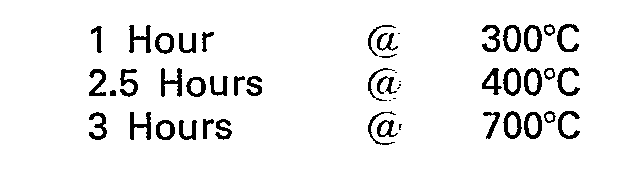
- As a control, 280 grams of a quartz sand mixture, containing 3.8% by weight of a commercial condensed aluminum phosphate hardener having an available acidity of 10.5 milliequivalents/gram, were mixed by hand stirring with 100 grams of a potassium water glass solution having a concentration of 40-42% and a mole ratio of Si02 to K20 of 2.8.
- Similarly, 380 gram cement batches were mixed using the two hardener compounds prepared above. Because the commercial hardener had a higher available acidity of 10.5 milliequivalents/gram, the amounts of the compounds used were adjusted accordingly to 5.4% and 6.1% percent respectively.
- As a further control, a 380 gram cement batch was mixed the same way, but without a hardener.
- All four cement batches were left in covered plastic beakers. After two days, the batch made with the commercial hardener was completely hardened, while the two batches with the prepared compounds needed three days. The cement batch with no hardener was still soft after one week.
- In order to investigate whether phosphorus pentoxide (P205) could be used directly in the solid state reaction the same way as the ammonium phosphates, the following was tried: 27.9 grams of P205 powder was mixed with 12.1 grams of AI(OH)3 (66.3% A1203) giving a mole ratio of P205 to A1203 of 2.5.
- After placing the mixture in a crucible and putting the crucible into the furnace, the batch was heated according to the following schedule:

- The process of the invention has a number of advantages: First, it does not require the energy consuming step of water evaporation; second, the hardener is prepared in relatively soft cakes that can be powdered by simply ball milling which results in less coarse material in the powder; third, because there is no wet or semi-solid material formed during the reaction, the reaction mixture is not corrosive and inexpensive reaction vessels and equipment can be used, such as Armco iron and porcelain crucibles. Further, in spite of the fact that multiple temperature heating steps are used in the reaction, the reaction mixture does not have to be ground at an intermediate stage and the entire reaction can take place in the same vessel without removing it from the furnace.
Claims (11)
Applications Claiming Priority (2)
| Application Number | Priority Date | Filing Date | Title |
|---|---|---|---|
| US310559 | 1981-10-13 | ||
| US06/310,559 US4395387A (en) | 1981-10-13 | 1981-10-13 | Method for manufacturing water glass cement hardeners |
Publications (2)
| Publication Number | Publication Date |
|---|---|
| EP0078880A1 EP0078880A1 (en) | 1983-05-18 |
| EP0078880B1 true EP0078880B1 (en) | 1985-09-25 |
Family
ID=23203070
Family Applications (1)
| Application Number | Title | Priority Date | Filing Date |
|---|---|---|---|
| EP82105094A Expired EP0078880B1 (en) | 1981-10-13 | 1982-06-11 | Method of making a condensed aluminium phosphate |
Country Status (6)
| Country | Link |
|---|---|
| US (1) | US4395387A (en) |
| EP (1) | EP0078880B1 (en) |
| JP (1) | JPS5864207A (en) |
| CA (1) | CA1178023A (en) |
| DE (1) | DE3266518D1 (en) |
| DK (1) | DK449682A (en) |
Families Citing this family (18)
| Publication number | Priority date | Publication date | Assignee | Title |
|---|---|---|---|---|
| US4473663A (en) * | 1983-03-31 | 1984-09-25 | Union Carbide Corporation | Crystalline aluminophosphate compositions |
| US4833576A (en) * | 1987-09-29 | 1989-05-23 | General Electric Company | Aluminum phosphate cement compositions and lamp assemblies containing same |
| US4918353A (en) * | 1987-09-29 | 1990-04-17 | General Electric Company | Reflector and lamp combination |
| US5486232A (en) * | 1994-08-08 | 1996-01-23 | Monsanto Company | Glass fiber tacking agent and process |
| DE10113287A1 (en) * | 2001-03-16 | 2002-10-02 | Bk Giulini Chem Gmbh & Co Ohg | Use of polymeric aluminum phosphates in plaster formulations |
| BRPI0403713B1 (en) * | 2004-08-30 | 2021-01-12 | Universidade Estadual De Campinas - Unicamp | manufacturing process of a white pigment based on the synthesis of hollow particles of aluminum orthophosphate or polyphosphate |
| US7763359B2 (en) * | 2004-08-30 | 2010-07-27 | Bunge Fertilizantes S.A. | Aluminum phosphate, polyphosphate and metaphosphate particles and their use as pigments in paints and method of making same |
| PT2066585T (en) | 2006-08-11 | 2017-02-03 | Bunge Amorphic Solutions Llc | Preparation of aluminum phosphate or polyphosphate particles |
| US9023145B2 (en) * | 2008-02-12 | 2015-05-05 | Bunge Amorphic Solutions Llc | Aluminum phosphate or polyphosphate compositions |
| AR075381A1 (en) * | 2009-02-10 | 2011-03-30 | Unicamp | USE OF PARTICLES OF PHOSPHATE, POLYPHOSPHATE AND METAPHOSPHATE, OF ALUMINUM IN PAPER COATING APPLICATIONS. |
| US9005355B2 (en) | 2010-10-15 | 2015-04-14 | Bunge Amorphic Solutions Llc | Coating compositions with anticorrosion properties |
| US9371454B2 (en) | 2010-10-15 | 2016-06-21 | Bunge Amorphic Solutions Llc | Coating compositions with anticorrosion properties |
| US9155311B2 (en) | 2013-03-15 | 2015-10-13 | Bunge Amorphic Solutions Llc | Antimicrobial chemical compositions |
| US9611147B2 (en) | 2012-04-16 | 2017-04-04 | Bunge Amorphic Solutions Llc | Aluminum phosphates, compositions comprising aluminum phosphate, and methods for making the same |
| US9078445B2 (en) | 2012-04-16 | 2015-07-14 | Bunge Amorphic Solutions Llc | Antimicrobial chemical compositions |
| EP2860235B1 (en) * | 2012-06-08 | 2017-09-06 | Denka Company Limited | Method for treating surface of phosphor, phosphor, light-emitting device, and illumination device |
| CN115504445A (en) * | 2022-11-08 | 2022-12-23 | 南木纳米科技(北京)有限公司 | A kind of aluminum phosphate material and preparation method thereof |
| CN117303332B (en) * | 2023-09-20 | 2025-12-26 | 陕西科技大学 | Aluminum phosphate powder material with radiation cooling properties and its preparation method |
Family Cites Families (17)
| Publication number | Priority date | Publication date | Assignee | Title |
|---|---|---|---|---|
| US1617098A (en) * | 1925-05-08 | 1927-02-08 | Stockholders Syndicate | Process of making metal phosphates |
| US2266486A (en) * | 1939-04-10 | 1941-12-16 | Monsanto Chemicals | Preparation of aluminum metaphosphate |
| US2662022A (en) * | 1949-12-20 | 1953-12-08 | Hoechst Ag | Self-hardening water-glass compositions |
| LU41108A1 (en) * | 1961-01-28 | 1963-01-17 | ||
| GB960198A (en) * | 1961-08-20 | 1964-06-10 | Makhtsavei Israel | Improvements in or relating to the manufacture of magnesium phosphate |
| BE642990A (en) * | 1963-02-02 | |||
| US3361523A (en) * | 1963-03-19 | 1968-01-02 | Monsanto Co | Method for producing phosphates |
| DE1252835B (en) * | 1964-05-21 | 1967-10-26 | Farbwerke Hoechst Aktiengesellschaft vormals Meister Lucius &. Brüning, Frankfurt/M | Use of condensed aluminum phosphates to harden water glass cement |
| DE1767460C3 (en) * | 1968-05-13 | 1978-05-18 | Hoechst Ag, 6000 Frankfurt | Process for the production of condensed aluminum phosphates |
| GB1322722A (en) * | 1969-06-12 | 1973-07-11 | Ici Ltd | Complex aluminium phosphates |
| US3801704A (en) * | 1971-03-15 | 1974-04-02 | Teikoku Kako Co Ltd | Aluminum phosphate and a producing method therefor |
| ES413746A1 (en) * | 1972-06-21 | 1976-01-16 | Knapsack Ag | Process for making condensed aluminum phosphates |
| DE2403707A1 (en) * | 1974-01-26 | 1975-08-14 | Hoechst Ag | METHOD OF MANUFACTURING ALH LOW 3 (PO LOW 4) LOW 2. 3H LOW 2 O |
| US4014813A (en) * | 1974-02-04 | 1977-03-29 | Rca Corporation | Hafnium pyrophosphate phosphors and methods of preparation |
| DE2621170A1 (en) * | 1976-05-13 | 1977-11-24 | Hoechst Ag | PROCESS FOR THE PRODUCTION OF ALUMINUM POLYPHOSPHATE |
| US4329327A (en) * | 1980-11-26 | 1982-05-11 | Ppg Industries, Inc. | Method for making B-form aluminum trimetaphosphate from powder reactants |
| US4312844A (en) * | 1980-11-26 | 1982-01-26 | Ppg Industries, Inc. | Trimetaphosphate compounds of trivalent metals |
-
1981
- 1981-10-13 US US06/310,559 patent/US4395387A/en not_active Expired - Fee Related
-
1982
- 1982-06-11 DE DE8282105094T patent/DE3266518D1/en not_active Expired
- 1982-06-11 EP EP82105094A patent/EP0078880B1/en not_active Expired
- 1982-07-16 JP JP57123080A patent/JPS5864207A/en active Pending
- 1982-08-09 CA CA000409004A patent/CA1178023A/en not_active Expired
- 1982-10-12 DK DK449682A patent/DK449682A/en not_active Application Discontinuation
Also Published As
| Publication number | Publication date |
|---|---|
| US4395387A (en) | 1983-07-26 |
| EP0078880A1 (en) | 1983-05-18 |
| DK449682A (en) | 1983-04-14 |
| CA1178023A (en) | 1984-11-20 |
| JPS5864207A (en) | 1983-04-16 |
| DE3266518D1 (en) | 1985-10-31 |
Similar Documents
| Publication | Publication Date | Title |
|---|---|---|
| US4395387A (en) | Method for manufacturing water glass cement hardeners | |
| US3397035A (en) | Ammonium polyphosphates | |
| US4138261A (en) | Hardeners for use in water-glass cement compositions and process for making them | |
| US3361523A (en) | Method for producing phosphates | |
| US4482380A (en) | Hardener for water glass cements | |
| US4401471A (en) | Inorganic cellular material and process for the manufacture thereof | |
| US3353908A (en) | Process for the manufacture of dicalcium phosphate | |
| EP0135773B1 (en) | Low temperature bonding of refractory aggregates and refractory products of improved cold strength | |
| US3932590A (en) | Process for preparing medium density granular sodium tripolyphosphate | |
| CA1262029A (en) | Process for the preparation of asbestiform crystalline calcium sodium metaphosphate fibers | |
| HU176544B (en) | Process for preparing ignited phosphate fertilizers containing alkali | |
| US2680679A (en) | Manufacture of fertilizers | |
| EP0361986A1 (en) | Process for manufacturing tetrasodium pyrophosphate | |
| JPH0243708B2 (en) | ||
| US3473889A (en) | Method for producing phosphates | |
| CA1135291A (en) | Method of preparing gypsum articles | |
| US4997634A (en) | Preparation of medium density, fast-dissolving, tetrasodium pyrophosphate | |
| US3851086A (en) | Defluorinated phosphate feed supplement production | |
| JP2523182B2 (en) | Method for producing phosphate | |
| US4175944A (en) | Removal of fluorine during production of fertilizer | |
| JPS63100008A (en) | Preparation of tricalcium phosphate | |
| RU1773894C (en) | Method of hydrothermal processing of phosphates into fertilizers | |
| RU2191755C1 (en) | Process of production of phosphate glasses | |
| JPH10194882A (en) | Granular fertilizer composition, liquid fertilizer composition, pasty fertilizer composition, and methods for producing them | |
| JP3503750B2 (en) | Method for producing iron dihydrogen tripolyphosphate or dihydrate thereof |
Legal Events
| Date | Code | Title | Description |
|---|---|---|---|
| PUAI | Public reference made under article 153(3) epc to a published international application that has entered the european phase |
Free format text: ORIGINAL CODE: 0009012 |
|
| AK | Designated contracting states |
Designated state(s): DE FR GB NL SE |
|
| 17P | Request for examination filed |
Effective date: 19830921 |
|
| GRAA | (expected) grant |
Free format text: ORIGINAL CODE: 0009210 |
|
| AK | Designated contracting states |
Designated state(s): DE FR GB NL SE |
|
| REF | Corresponds to: |
Ref document number: 3266518 Country of ref document: DE Date of ref document: 19851031 |
|
| ET | Fr: translation filed | ||
| PLBE | No opposition filed within time limit |
Free format text: ORIGINAL CODE: 0009261 |
|
| STAA | Information on the status of an ep patent application or granted ep patent |
Free format text: STATUS: NO OPPOSITION FILED WITHIN TIME LIMIT |
|
| 26N | No opposition filed | ||
| PGFP | Annual fee paid to national office [announced via postgrant information from national office to epo] |
Ref country code: NL Payment date: 19870630 Year of fee payment: 6 |
|
| PG25 | Lapsed in a contracting state [announced via postgrant information from national office to epo] |
Ref country code: GB Effective date: 19880611 |
|
| PG25 | Lapsed in a contracting state [announced via postgrant information from national office to epo] |
Ref country code: SE Effective date: 19880612 |
|
| PG25 | Lapsed in a contracting state [announced via postgrant information from national office to epo] |
Ref country code: NL Effective date: 19890101 |
|
| NLV4 | Nl: lapsed or anulled due to non-payment of the annual fee | ||
| GBPC | Gb: european patent ceased through non-payment of renewal fee | ||
| PG25 | Lapsed in a contracting state [announced via postgrant information from national office to epo] |
Ref country code: FR Free format text: LAPSE BECAUSE OF NON-PAYMENT OF DUE FEES Effective date: 19890228 |
|
| PG25 | Lapsed in a contracting state [announced via postgrant information from national office to epo] |
Ref country code: DE Effective date: 19890301 |
|
| REG | Reference to a national code |
Ref country code: FR Ref legal event code: ST |
|
| EUG | Se: european patent has lapsed |
Ref document number: 82105094.5 Effective date: 19890220 |