EP0078680B1 - Recirculating document handler - Google Patents
Recirculating document handler Download PDFInfo
- Publication number
- EP0078680B1 EP0078680B1 EP82305769A EP82305769A EP0078680B1 EP 0078680 B1 EP0078680 B1 EP 0078680B1 EP 82305769 A EP82305769 A EP 82305769A EP 82305769 A EP82305769 A EP 82305769A EP 0078680 B1 EP0078680 B1 EP 0078680B1
- Authority
- EP
- European Patent Office
- Prior art keywords
- document
- path
- duplex
- stack
- copying
- Prior art date
- Legal status (The legal status is an assumption and is not a legal conclusion. Google has not performed a legal analysis and makes no representation as to the accuracy of the status listed.)
- Expired
Links
- 230000003134 recirculating effect Effects 0.000 title claims description 24
- 238000003384 imaging method Methods 0.000 claims description 51
- 230000004087 circulation Effects 0.000 claims description 14
- 230000002441 reversible effect Effects 0.000 claims description 6
- 230000005484 gravity Effects 0.000 claims description 2
- 230000032258 transport Effects 0.000 description 9
- 238000011084 recovery Methods 0.000 description 4
- 230000003287 optical effect Effects 0.000 description 3
- 238000005286 illumination Methods 0.000 description 2
- 230000013011 mating Effects 0.000 description 2
- 108091008695 photoreceptors Proteins 0.000 description 2
- 239000000463 material Substances 0.000 description 1
- 239000000203 mixture Substances 0.000 description 1
- 239000013307 optical fiber Substances 0.000 description 1
- 238000004064 recycling Methods 0.000 description 1
- 238000000926 separation method Methods 0.000 description 1
- 230000007704 transition Effects 0.000 description 1
- 238000011144 upstream manufacturing Methods 0.000 description 1
Images

Classifications
-
- G—PHYSICS
- G03—PHOTOGRAPHY; CINEMATOGRAPHY; ANALOGOUS TECHNIQUES USING WAVES OTHER THAN OPTICAL WAVES; ELECTROGRAPHY; HOLOGRAPHY
- G03B—APPARATUS OR ARRANGEMENTS FOR TAKING PHOTOGRAPHS OR FOR PROJECTING OR VIEWING THEM; APPARATUS OR ARRANGEMENTS EMPLOYING ANALOGOUS TECHNIQUES USING WAVES OTHER THAN OPTICAL WAVES; ACCESSORIES THEREFOR
- G03B27/00—Photographic printing apparatus
- G03B27/32—Projection printing apparatus, e.g. enlarger, copying camera
- G03B27/52—Details
- G03B27/62—Holders for the original
- G03B27/6207—Holders for the original in copying cameras
- G03B27/625—Apparatus which relate to the handling of originals, e.g. presence detectors, inverters
- G03B27/6257—Arrangements for moving an original once or repeatedly to or through an exposure station
Definitions
- the present invention relates to a circulating document handler for recirculating original document sheets from a stack thereof to an imaging station of a copier for copying with selected document recirculation loop paths depending on the copying mode selected, and in particular for providing such a document handling system with both immediate duplex and common side duplex precollation copying modes of operation.
- a known desirable feature for an automatic document handling system for a copier is to provide document recirculations for precollation copying.
- Such precollation copying systems provide a number of important advantages.
- the copies exit the copier into a set collector already in precollated sets, and do not require subsequent sorting in a sorter or collator.
- On-line finishing and/or removal of completed copy sets may be provided while additional copy sets are being made from the same document set.
- a complete copy proof set is available from the first document set circulation. Any desired number of such copy sets may be made by making a corresponding number of recirculations of the document set in collated order past a copying station and copying each document once each time it recirculates. Examples of such systems are further described in the patent literature cited hereinbelow.
- precollation copying systems a disadvantage of precollation copying systems is that the documents must all be repeatedly recirculated and repeatedly individually copied a number of times equivalent to the desired number of copy sets. For example, to make 10 copy sets of a 5 page document set or book, one copy at a time can be made of each of the 5 document pages in this order: pages 1, 2, 3, 4, 5; 1, 2, 3, 4, 5; (or the reverse page order) repeated a total of 10 times to make the desired 10 copy sets.
- increased document recirculations are necessitated for a precollation copying system, with consequent increased likelihood of document jams and document wear, image smearing, or damage, particularly if the document feeding paths are lengthy, interrupted, or excessively arcuate.
- the type of document transport and registration system is affected by the type of copier optics, i.e., the copying system.
- CVT constant velocity transport
- a moving document is copied with a stationary optics system.
- the document sheet is fed by wheels or belts at a constant velocity over a narrow transparent scanning slit, window or platen of a copier. This is desirable for a small copier since the overall system can be much more compact.
- CVT system can also be combined into a copier also providing a full size stationary platen by using a part of the full platen to provide the CVT scanning slit.
- the document is registered overlying a full document sized (full frame) platen, and either optically scanned by moving scanning optics while it is held stationary over the platen or optically stopped by flash illumination and imaging of the entire document when the document is driven by the document transport to the registration position over the platen.
- U.S. Patent No. 4158500 discloses a recirculating document handler with simplex and immediate duplex copying modes of operation as recited in the precharacterizing portion of present claim 1, but this reference does not teach a common duplex copying mode.
- a recirculating document handler for plurality recirculating simplex or duplex documents sheets to and from a stack thereof to and from the imaging station of a copier for providing both simplex and duplex document sheet precollation copying, comprising plural-mode document recirculation loop path means and selectively movable path selector means in said plural-mode document recirculation loop path means for selecting partially different document recirculation loop paths therein for providing different selectable recirculative document copying modes, wherein in one said selected recirculation loop path and copying mode one side of duplex document sheets are copied at said imaging station and then said document sheets are immediately returned directly but inverted to the same imaging station for immediately copying the opposite sides thereof and thereafter returning these duplex document sheets to said stack in their original sheet orientation in said stack, to' provide an immediate duplex document pre- collation copying mode in which both sides of all of said duplex documents are copied in each circulation of the duplex document
- recirculating document handler includes those in which said document re- circulatng loop path means provides a completed single inversion document recirculation loop path from and back to and over said imaging station in said immediate duplex copying mode, and provides a single inversion path from said imaging station back to said stack in said common side duplex precollation copying mode, or
- duplex document sheets are fed separately from the bottom of the stack of sheets in a stack support adjacent the side of said imaging station, fed by the same constant velocity transport means over a narrow scanning slit at said imaging station without inversion; and thereafter in said immediate duplex copying mode the duplex documents are then inverted once in a first inversion path and refed to said imaging station for copying the opposite side of the same sheet, and then fed back to the top of the stack of sheets in said stack support with one additional inversion in a second inversion path so that the sheet returns to the same stack in its same, original, orientation in said stack and may be refed to recopy both sides of the same sheet in the same page sequence;
- an exemplary constant velocity transport (CVY) document handling unit 10 is mounted on an exemplary copier 11.
- the unit 10 feeds individual original document sheets 12 seriatim from the bottom of a stack 13 in a constant velocity movement path over the transparent copying window or platen 14 of the copier 11.
- the unit 10 also transports documents from the platen 14 back to the top of the stack 13.
- the stack 13 is in a stack holder or tray 16 adjacent one side of the platen 14.
- the documents are loaded face down and generally fed in 1-N or forward serial page order in a short and substantially linear path directly from the bottom of the stack 13 to the platen 14.
- each document sheet 12 is preferably conventionally exposed on the platen 14 by an illumination lamp 17 or lamps and a light reflector therefor under the platen.
- the flowing slit image of that portion of the document thus uniformly illuminated which is within an imaging or viewing area 18 (in a central portion of platen 14) is conventionally focused onto the copier photoreceptor 19 through a stationary lens 20.
- the lens 20 is a self-focusing linear optical fiber array as described, for example, in U.S. Patent No. 3,977,777.
- This flowing light image on the photoreceptor 19 may then be conventionally developed and transferred to a registered copy sheet, as further described in the above-cited references.
- the lamp 17 and lens 20 may be permanently fixed, or may be only temporarily locked in this position and otherwise movable to scan a full size platen contiguous or adjacent the imaging area 18. Here a portion (one edge) of such an adjacent full platen 21 is shown.
- the side of the document parallel the direction of document motion may be initially registered against, and guided along, an edge guide 22 in the stack holder 16.
- the initial registration of the lead edge of document to the other (orthogonal) axis, an imaginary line transverse the direction of document motion can be done in several ways. Here it is conventionally accomplished simply by aligning (abutting) the lead edge of the document sheet with sheet feed rollers, that is, against a plural roller transverse nip line.
- a document sheet lead edge detector switch may be activated as this is done to initiate the operation of both the document handler 10 and copier 11 in a known manner.
- This initial separation and feed-in of each document sheet 12 from the stack 13 may be done by a corrugating vacuum belt bottom feeder 24 .assisted by an air knife system 26, shown in U.S. Patent No. 4,284,270 issued August 18,1981 to M. Silverberg, for example.
- the transport 10 provides a CVT with no changes in driving velocity while the document is being driven over the optical scan slit 18.
- the constant velocity line nip from aligned rubber rolls 28 and mating idler rollers thereunder catches and drives the lead edge of the document upstream of (before) the document enters the scan slit 18.
- This nip drives the document over the scan slit 18.
- On the other side of the imaging area 18 is a similar set of equal speed rollers 30 which continue the document sheet movement until it is all imaged.
- Switch 32 connected to the copier microprocessor controller 36, is activated by the document lead edge slightly before the document enters the imaging area 18. That, and/or paper path switches, including conventional set counter (bail) and stack sensor switches 34, may be used to initiate the operation of the copier as well as counting the number of documents copied. Switch 32 may also be used to sense the passage of the trail edge of the document through the imaging station for other controls, including the timing of document reversal in certain operating modes as described below.
- the unit 10 comprises a very compact and short path racetrack or flattened oval looped path baffle and feeder unit.
- a complete or closed loop racetrack path 38 is provided enabling continuous recirculation of a sheet in one direction from and back to the imaging slit 18. It provides a total racetrack path length preferably less than twice the document sheet dimension in its feeding direction.
- the racetrack path 38 includes two 180° (semi-cylindrical) sheet inverting loop paths 42 and 44 at opposite ends of the racetrack.
- a diagonal cross-path 40 In addition to this outside or racetrack path 38 there is provided here a diagonal cross-path 40; internally bisecting and connecting with the outer racetrack path 38.
- the cross-path 40 connects between the bottom entrance of loop path 42 and the top entrance of loop path 44.
- an output (restack) path 46 from path 38 connects (at the opposite side of the top of path 44) with path 40.
- the path 42 here provides an integral inverter/return loop path in which the same, common, path 42 provides in certain copying modes a compact, curved, sheet reversing and non-inverting temporary storage chute for sheets fed in and out of one end thereof; and in other copying modes the same path 42 provides a non-reversing and inverting document path therethrough.
- the above-described paths and their associated feed rollers provide a recirculating document handler 10 for recirculating document sheets to and from the stack 12 thereof to and from the imaging station 18 of the copier 11 with a selection of document recirculation loop paths to provide a plurality of modes of operation, i.e., plural document circulation modes, as illustrated in Figs. 2A-2D. That is, different ones of interconnecting integral, short, document recirculation looped paths may be selected, and in different sequences, depending on the desired copying mode selected.
- the overall document recirculating path unit 10 thus provides not only a completed contiguous oval document recirculation loop 38 directly over the imaging station 18, but also reversing means and an alternative transverse intersecting bypass path 40. It may be utilized for selectably recirculating a document sheet in the recirculation loop 38, or reversing a document sheet at one side 42 of the loop 38 and/or feeding it into the selectable bypass path 40 for recirculation through path 44 back to the imaging station 18, or ejection through path 46.
- the copier imaging station is only a narrow optical scanning slit underlying only a minor portion of the document recirculation loop path 38, adjacent the one end 42 thereof.
- the document feeding wheels 28, 30 for feeding document sheets over the imaging station at a constant speed for imaging same are also an integral part of, and provide part of the sheet movement in, the recirculation path 38.
- rollers 28 With the exception of only feed rollers 30 when they reverse in the operating modes in which sheet movement reversal there is selected, all of the other document feeding rollers disclosed in unit 10 may be commonly and unidirectionally driven.
- this includes rollers 28, rollers 48 (at the upper end of loop path 42) rollers 50 (at the top of paths 40 and 44 and the entrance to path 46) and rollers 52 (centrally of path 44). All these rollers are within less than one sheet length (or width) of one another so that a sheet is constantly engaged by at least one set of driven rollers and its mating idler rollers.
- rollers 48 There its idler rollers 54 are engageable and disengageable by a solenoid 56.
- path 42 where path 42 is serving as a compact reversing (non-inverting) chute, then the solenoid 56 is temporarily actuated to open the nip with driven rollers 48 and allow slippage (non-engagement) with the document sheet. That allows the reversal of rollers 30 to reverse the direction of document motion un- obstructedly.
- reversal when selected, occurs after the trail edge of the document has passed a pivotable deflector gate 58.
- This is an automatic one-way gate. It allows document sheets to feed in one direction from the imaging station 18 into the loop path 42 by the lead edge of the document deflecting the gate 58 up out of the way.
- a solenoid actuable two-way pivotable gate 62 At the opposite (downstream) end of bypass path 40 (and also in the loop 38 portion connecting between the upper (downstream) end of path 42 and the entrance to path 44) is a solenoid actuable two-way pivotable gate 62.
- the gate 62 if left down in the solid line position shown, causes sheets fed out from the downstream ends of either of paths 42 or 40 to be deflected into output path 46 and thereby restacked on stack 13, via the higher speed restack ejector rollers 64 in path 46.
- gate 62 when gate 62 is raised to its illustrated dashed-line position it deflects all sheets down into return loop path 44 leading directly back to the imaging station 18 with an inversion, via registration and feeding rollers 28, for recopying of the same sheet.
- FIGs. 2A through 2D illustrate schematically the document sheet paths for four different selectable modes of operation of the document handling unit 11. (These and additional copying modes and their respective advantages are further described in the above-cited patents.)
- FIG. 2A illustrates a mode of operation for pre-collation of a set or stack of simplex (one-sided) original document sheets.
- Fig. 2B illustrates one mode of pre- collation copying of a set of duplex (two-sided) document sheets. (See, e.g., above cited 4,229,101 for further copying details.)
- Fig. 2C illustrates a known mode of making N (any selected plural number of) copies in direct sequence by the repeated circulation of a single document fed manually (or one document at a time) fed from a stack by the same feeder. In the latter case this will produce non-collated copies.
- a single document there is, of course, no difference between pre-collation and post-collation copying, i.e., no collation is required;
- This Fig. 2C mode can be automatically selected by the tray set counter and sensor switch detecting that there is only a single document present in the document tray.
- the dashed line in Fig. 2C indicates the return or ejection of the document after the desired number of recirculation loops (solid line) has been completed.
- Fig. 2D illustrates another mode of pre-collation copying of a set of duplex document sheets.
- This copying mode is known as immediate duplex (see, e.g., above cited 4,176,945 or 4,158,500 for further copying details) in that the first and second sides of each document sheet are copied immediately one after the other, rather than all of the first sides of each sheet in the whole set being copied at a time and then all of the other sides being copied, as in the Fig. 2B mode.
- each document is reversed after copying one side and inverted and immediately returned to the imaging station for copying the second side (as shown in the solid lines) and then returned (as shown in the dashed line) to the tray for re- stacking.
- the increased selectivity of operating modes provided with the document handling unit 10 also provides increased job recovery capabilities.
- the document to be recopied may be directly recycled in the Fig. 2C or Fig. 2D path modes to make an additional copy therefrom.
- certain of the illustrated copying modes even though not normally utilized for copying with a particular copier processor, may be specially utilized in the event of a document jam for making up additional copy sheets which are needed to complete incomplete copy sets, i.e., to replace sheets removed from the copier during the job recovery (jam clearance).
Landscapes
- Physics & Mathematics (AREA)
- General Physics & Mathematics (AREA)
- Exposure Or Original Feeding In Electrophotography (AREA)
- Conveyance By Endless Belt Conveyors (AREA)
Description
- The present invention relates to a circulating document handler for recirculating original document sheets from a stack thereof to an imaging station of a copier for copying with selected document recirculation loop paths depending on the copying mode selected, and in particular for providing such a document handling system with both immediate duplex and common side duplex precollation copying modes of operation.
- Especially for the faster xerographic and other document copiers now in commercial use, it is increasingly desirable to provide for the automatic handling of the individual original document sheets being copied, in order to more fully utilize the higher copying speed capabilities of these copiers. It is particularly desirable to rapidly automatically feed, register and copy document sheets of a variety or mixture of sizes, types, weights, materials, conditions and susceptibility to damage, yet with minimal document jamming, wear or damage by the document handling apparatus. Yet it is also desirable that the document handling units be as compact, simple and lightweight as possible. This is especially desirable where, as conventionally practiced, the entire document handling unit is pivotally mounted over the existing copier platen to be liftable by the operator to facilitate alternative manual document placements on the platen.
- A known desirable feature for an automatic document handling system for a copier is to provide document recirculations for precollation copying. Such precollation copying systems provide a number of important advantages. The copies exit the copier into a set collector already in precollated sets, and do not require subsequent sorting in a sorter or collator. On-line finishing and/or removal of completed copy sets may be provided while additional copy sets are being made from the same document set. Also, a complete copy proof set is available from the first document set circulation. Any desired number of such copy sets may be made by making a corresponding number of recirculations of the document set in collated order past a copying station and copying each document once each time it recirculates. Examples of such systems are further described in the patent literature cited hereinbelow.
- However, a disadvantage of precollation copying systems is that the documents must all be repeatedly recirculated and repeatedly individually copied a number of times equivalent to the desired number of copy sets. For example, to make 10 copy sets of a 5 page document set or book, one copy at a time can be made of each of the 5 document pages in this order:
pages 1, 2, 3, 4, 5; 1, 2, 3, 4, 5; (or the reverse page order) repeated a total of 10 times to make the desired 10 copy sets. Thus, increased document recirculations are necessitated for a precollation copying system, with consequent increased likelihood of document jams and document wear, image smearing, or damage, particularly if the document feeding paths are lengthy, interrupted, or excessively arcuate. - The type of document transport and registration system is affected by the type of copier optics, i.e., the copying system. In the known constant velocity transport (CVT) system a moving document is copied with a stationary optics system. The document sheet is fed by wheels or belts at a constant velocity over a narrow transparent scanning slit, window or platen of a copier. This is desirable for a small copier since the overall system can be much more compact. However, such a CVT system can also be combined into a copier also providing a full size stationary platen by using a part of the full platen to provide the CVT scanning slit. This has been used to provide for alternative CVT document "stream feeding", or for feeding documents which are larger than the platen, e.g., the Xerox "3100 LDC" copier (e.g., U.S. Patents Nos. 3,900,258 and 4,017,172).
- It is generally preferable in such a CVT system to preregister the document to its transport just before the document is transported over the copying window. Examples are disclosed in the above patents or in U.S. Patent 3,536,320 issued October 27, 1970 to D. R. Derby.
- In contrast, in many other copying systems or modes, the document is registered overlying a full document sized (full frame) platen, and either optically scanned by moving scanning optics while it is held stationary over the platen or optically stopped by flash illumination and imaging of the entire document when the document is driven by the document transport to the registration position over the platen.
- Of particular interest as disclosing a recirculating document handler for a copier with a stack at one side of an imaging station and means for returning the document through alternative paths to the stack inverted or not inverted for common side duplex or simplex precollation copying, is U.S. Patent No. 4,238,126.
- U.S. Patent No. 4158500 discloses a recirculating document handler with simplex and immediate duplex copying modes of operation as recited in the precharacterizing portion of
present claim 1, but this reference does not teach a common duplex copying mode. - Conventional simple software instructions in the copier's general microprocessor logic circuitry and software of document handler and copier-control functions and logic, as taught by the above and other patents and various commercial copiers, are well known and preferred. However, it will be appreciated that the document feeding functions and controls described herein may be alternatively conventionally incorporated into a copier utilizing any other suitable or known simple software or hard wired logic systems, cam-bank switch controllers, etc. With the present system, both document feeding and copying thereof can be initiated simply by a known document lead edge detector switch actuated as the document sheet is being inserted. See, e.g., the above-cited U.S. Patent No. 4,132,401 issued January 2, 1979 to J. F. Gauranski et al. and the references cited therein.
- The present invention overcomes or reduces various of the above-discussed problems. According to the present invention there is provided a recirculating document handler for plurality recirculating simplex or duplex documents sheets to and from a stack thereof to and from the imaging station of a copier for providing both simplex and duplex document sheet precollation copying, comprising plural-mode document recirculation loop path means and selectively movable path selector means in said plural-mode document recirculation loop path means for selecting partially different document recirculation loop paths therein for providing different selectable recirculative document copying modes, wherein in one said selected recirculation loop path and copying mode one side of duplex document sheets are copied at said imaging station and then said document sheets are immediately returned directly but inverted to the same imaging station for immediately copying the opposite sides thereof and thereafter returning these duplex document sheets to said stack in their original sheet orientation in said stack, to' provide an immediate duplex document pre- collation copying mode in which both sides of all of said duplex documents are copied in each circulation of the duplex document set, and wherein in another said selected document recirculation loop path and copying mode simplex document sheets are recirculated and copied on only one side thereof and directly returned to said stack without inversion, characterised in that in a further said selected document recirculation loop path and copying mode duplex document sheets are copied on only one side at said imaging station and then directly returned to said stack inverted from their original orientation in said stack, before copying any of the opposite sides thereof, to provide a common side duplex document precollation copying mode in which all of only one side of the duplex documents are copied in each circulation of the duplex document set and the opposite sides thereof are copied in a subsequent set circulation.
- Further features which may be provided by the recirculating document handler disclosed herein include those in which said document re- circulatng loop path means provides a completed single inversion document recirculation loop path from and back to and over said imaging station in said immediate duplex copying mode, and provides a single inversion path from said imaging station back to said stack in said common side duplex precollation copying mode, or
- in both said duplex document precollation copying modes the duplex document sheets are fed separately from the bottom of the stack of sheets in a stack support adjacent the side of said imaging station, fed by the same constant velocity transport means over a narrow scanning slit at said imaging station without inversion; and thereafter in said immediate duplex copying mode the duplex documents are then inverted once in a first inversion path and refed to said imaging station for copying the opposite side of the same sheet, and then fed back to the top of the stack of sheets in said stack support with one additional inversion in a second inversion path so that the sheet returns to the same stack in its same, original, orientation in said stack and may be refed to recopy both sides of the same sheet in the same page sequence;
- and wherein in said common side duplex document copying mode the duplex document sheets are returned from the same imaging station inverted once through a return inversion path to the top of the stack in said stack support, so that the document sheets are inverted from their previous orientation in the stack and may be refed to the imaging station to recopy the opposite sides of the sheets in a different page sequence, or
- the return path for a document sheet from said imaging station back to the top of the stack including said return inversion path in said common side duplex copying mode is the same as that for a document sheet in said immediate duplex copying mode after the second side has been copied, including said second inversion path.
- In order that the invention may be better understood reference will now be made to the following description of a specific example thereof, with reference to the accompanying drawings, in which:
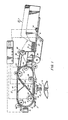
- Fig. 1 is a cross-sectional side view of an exemplary document handling apparatus in accordance with the present invention on an exemplary copier (partially shown); and
- Fig. 2A-2D schematically show the document paths for four different modes of operation of the document handling unit of Fig. 1.
- Referring to the embodiment of Fig. 1 and 2, an exemplary constant velocity transport (CVY)
document handling unit 10 is mounted on an exemplary copier 11. Theunit 10 feeds individualoriginal document sheets 12 seriatim from the bottom of astack 13 in a constant velocity movement path over the transparent copying window orplaten 14 of the copier 11. Theunit 10 also transports documents from theplaten 14 back to the top of thestack 13. Thestack 13 is in a stack holder or tray 16 adjacent one side of theplaten 14. The documents are loaded face down and generally fed in 1-N or forward serial page order in a short and substantially linear path directly from the bottom of thestack 13 to theplaten 14. - Since the copier 11 may be any of various known types such as those in the patents cited above, its example here is disclosed only to the extent of the document handler 10 optical interface therewith. Here each
document sheet 12 is preferably conventionally exposed on theplaten 14 by anillumination lamp 17 or lamps and a light reflector therefor under the platen. The flowing slit image of that portion of the document thus uniformly illuminated which is within an imaging or viewing area 18 (in a central portion of platen 14) is conventionally focused onto thecopier photoreceptor 19 through a stationary lens 20. Here the lens 20 is a self-focusing linear optical fiber array as described, for example, in U.S. Patent No. 3,977,777. This flowing light image on thephotoreceptor 19 may then be conventionally developed and transferred to a registered copy sheet, as further described in the above-cited references. As discussed above, thelamp 17 and lens 20 may be permanently fixed, or may be only temporarily locked in this position and otherwise movable to scan a full size platen contiguous or adjacent the imaging area 18. Here a portion (one edge) of such an adjacentfull platen 21 is shown. - The side of the document parallel the direction of document motion may be initially registered against, and guided along, an
edge guide 22 in thestack holder 16. The initial registration of the lead edge of document to the other (orthogonal) axis, an imaginary line transverse the direction of document motion, can be done in several ways. Here it is conventionally accomplished simply by aligning (abutting) the lead edge of the document sheet with sheet feed rollers, that is, against a plural roller transverse nip line. As discussed above, a document sheet lead edge detector switch may be activated as this is done to initiate the operation of both thedocument handler 10 and copier 11 in a known manner. - This initial separation and feed-in of each
document sheet 12 from thestack 13 may be done by a corrugating vacuumbelt bottom feeder 24 .assisted by anair knife system 26, shown in U.S. Patent No. 4,284,270 issued August 18,1981 to M. Silverberg, for example. - The
transport 10 provides a CVT with no changes in driving velocity while the document is being driven over the optical scan slit 18. Here the constant velocity line nip from alignedrubber rolls 28 and mating idler rollers thereunder catches and drives the lead edge of the document upstream of (before) the document enters the scan slit 18. This nip drives the document over the scan slit 18. On the other side of the imaging area 18 is a similar set of equal speed rollers 30 which continue the document sheet movement until it is all imaged. -
Switch 32, connected to the copier microprocessor controller 36, is activated by the document lead edge slightly before the document enters the imaging area 18. That, and/or paper path switches, including conventional set counter (bail) and stack sensor switches 34, may be used to initiate the operation of the copier as well as counting the number of documents copied.Switch 32 may also be used to sense the passage of the trail edge of the document through the imaging station for other controls, including the timing of document reversal in certain operating modes as described below. - Considering now the overall configuration of the
document handling unit 10, it may be seen that other than theseparable stack tray 16 andinput feeder assembly unit 10 comprises a very compact and short path racetrack or flattened oval looped path baffle and feeder unit. A complete or closedloop racetrack path 38 is provided enabling continuous recirculation of a sheet in one direction from and back to the imaging slit 18. It provides a total racetrack path length preferably less than twice the document sheet dimension in its feeding direction. Theracetrack path 38 includes two 180° (semi-cylindrical) sheetinverting loop paths racetrack path 38 there is provided here adiagonal cross-path 40; internally bisecting and connecting with theouter racetrack path 38. The cross-path 40 connects between the bottom entrance ofloop path 42 and the top entrance ofloop path 44. Further an output (restack)path 46 frompath 38 connects (at the opposite side of the top of path 44) withpath 40. Thepath 42 here provides an integral inverter/return loop path in which the same, common,path 42 provides in certain copying modes a compact, curved, sheet reversing and non-inverting temporary storage chute for sheets fed in and out of one end thereof; and in other copying modes thesame path 42 provides a non-reversing and inverting document path therethrough. All of these paths are short and interconnecting for rapid document circulation without requiring high velocity document movements. Further, all document sheet movements are gentle transitions, i.e., there are no undesirable sharply arcuate (small radius) turns or inversions in any of these document paths, even though the overall size of the unit is quite small. - The above-described paths and their associated feed rollers provide a
recirculating document handler 10 for recirculating document sheets to and from thestack 12 thereof to and from the imaging station 18 of the copier 11 with a selection of document recirculation loop paths to provide a plurality of modes of operation, i.e., plural document circulation modes, as illustrated in Figs. 2A-2D. That is, different ones of interconnecting integral, short, document recirculation looped paths may be selected, and in different sequences, depending on the desired copying mode selected. - The overall document recirculating
path unit 10 thus provides not only a completed contiguous ovaldocument recirculation loop 38 directly over the imaging station 18, but also reversing means and an alternative transverseintersecting bypass path 40. It may be utilized for selectably recirculating a document sheet in therecirculation loop 38, or reversing a document sheet at oneside 42 of theloop 38 and/or feeding it into theselectable bypass path 40 for recirculation throughpath 44 back to the imaging station 18, or ejection throughpath 46. - It will be noted that here the copier imaging station is only a narrow optical scanning slit underlying only a minor portion of the document
recirculation loop path 38, adjacent the oneend 42 thereof. Further, thedocument feeding wheels 28, 30 for feeding document sheets over the imaging station at a constant speed for imaging same are also an integral part of, and provide part of the sheet movement in, therecirculation path 38. - With the exception of only feed rollers 30 when they reverse in the operating modes in which sheet movement reversal there is selected, all of the other document feeding rollers disclosed in
unit 10 may be commonly and unidirectionally driven. Here this includesrollers 28, rollers 48 (at the upper end of loop path 42) rollers 50 (at the top ofpaths rollers 48. There its idler rollers 54 are engageable and disengageable by asolenoid 56. When the document is to be reversed inpath 42, wherepath 42 is serving as a compact reversing (non-inverting) chute, then thesolenoid 56 is temporarily actuated to open the nip with drivenrollers 48 and allow slippage (non-engagement) with the document sheet. That allows the reversal of rollers 30 to reverse the direction of document motion un- obstructedly. Here that reversal, when selected, occurs after the trail edge of the document has passed apivotable deflector gate 58. This is an automatic one-way gate. It allows document sheets to feed in one direction from the imaging station 18 into theloop path 42 by the lead edge of the document deflecting thegate 58 up out of the way. However, on the reversed movement of the document sheet from theloop path 42 back towards the imaging station 18, the sheet is automatically deflected up into the entrance of bypass document path 40 (leading away from the imaging station) by the upper surface ofgate 58, which has dropped down into the sheet path (its illustrated solid line position). This automatic one-way deflection gate 58 is gravity operated, i.e.,gate 58 swings down about its pivot axis 60 into said deflecting position except when it is pushed up by a sheet passing thereunder from the imaging station 18. - At the opposite (downstream) end of bypass path 40 (and also in the
loop 38 portion connecting between the upper (downstream) end ofpath 42 and the entrance to path 44) is a solenoid actuable two-waypivotable gate 62. Thegate 62, if left down in the solid line position shown, causes sheets fed out from the downstream ends of either ofpaths output path 46 and thereby restacked onstack 13, via the higher speed restackejector rollers 64 inpath 46. In contrast, whengate 62 is raised to its illustrated dashed-line position it deflects all sheets down intoreturn loop path 44 leading directly back to the imaging station 18 with an inversion, via registration and feedingrollers 28, for recopying of the same sheet. However, whether the same side of the same sheet is so copied depends on whether the sheet was fed topath 44 by returning throughpath 42, or was reversed inpath 42 and returned throughpath 40 instead. The former (as in Fig. 2C) return provides two sheet inversions (inpaths 42 and 44) for recopying the same side of a document, whereas the latter (as in Fig. 2D) return to the imaging station provides only one inversion (in path 44) for copying the opposite side of the document. - Referring now particularly to Figs. 2A through 2D, these illustrate schematically the document sheet paths for four different selectable modes of operation of the document handling unit 11. (These and additional copying modes and their respective advantages are further described in the above-cited patents.)
- Respectively, as so labeled, Fig. 2A illustrates a mode of operation for pre-collation of a set or stack of simplex (one-sided) original document sheets. Fig. 2B illustrates one mode of pre- collation copying of a set of duplex (two-sided) document sheets. (See, e.g., above cited 4,229,101 for further copying details.)
- Fig. 2C illustrates a known mode of making N (any selected plural number of) copies in direct sequence by the repeated circulation of a single document fed manually (or one document at a time) fed from a stack by the same feeder. In the latter case this will produce non-collated copies. In the case of a single document, there is, of course, no difference between pre-collation and post-collation copying, i.e., no collation is required; Thus, such immediate and direct recirculating loop copying of a single document is preferable, to as opposed to returning the document back to the stack support and back for each copy. This Fig. 2C mode can be automatically selected by the tray set counter and sensor switch detecting that there is only a single document present in the document tray. The dashed line in Fig. 2C indicates the return or ejection of the document after the desired number of recirculation loops (solid line) has been completed.
- Fig. 2D illustrates another mode of pre-collation copying of a set of duplex document sheets. This copying mode is known as immediate duplex (see, e.g., above cited 4,176,945 or 4,158,500 for further copying details) in that the first and second sides of each document sheet are copied immediately one after the other, rather than all of the first sides of each sheet in the whole set being copied at a time and then all of the other sides being copied, as in the Fig. 2B mode. In the Fig. 2D mode each document is reversed after copying one side and inverted and immediately returned to the imaging station for copying the second side (as shown in the solid lines) and then returned (as shown in the dashed line) to the tray for re- stacking.
- Heretofore, the selection between a stack circulation duplex pre-collation mode, as in Fig. 2B, and an immediate duplex mode, such as in Fig. 2D, has not been practically achievable in a single integral document handler because of the different document paths required and the difficulty of providing such paths with appropriately short yet sufficiently large radius inversion loops so that the document handler can keep up with the copying rate of the copier and yet provide acceptable feeding with sufficiently low jam rates, and jam clearance accessibility of the document transport.
- In that regard it will be noted that the increased selectivity of operating modes provided with the
document handling unit 10 also provides increased job recovery capabilities. For example, in the event of a document jam during copying, instead of recycling through the entire document set back to the particular document to be recopied for job recovery, the document to be recopied may be directly recycled in the Fig. 2C or Fig. 2D path modes to make an additional copy therefrom. That is, certain of the illustrated copying modes, even though not normally utilized for copying with a particular copier processor, may be specially utilized in the event of a document jam for making up additional copy sheets which are needed to complete incomplete copy sets, i.e., to replace sheets removed from the copier during the job recovery (jam clearance). - It may be seen that the selection of any of the above-described modes of operation, and others, can be accomplished, as exemplified here, simply by the actuation or non-actuation of the
deflector gate 62 and the reversal or non-reversal of the feed wheels 30 (together with the actuation of the solenoid 56). This selection can provide for the alternatives of returning the document sheet through selected loop paths directly back to the copying station, either inverted or not inverted, or further alternatively returning the document sheet directly back to the top of thestack 13, again, either inverted or not inverted, after copying only one side thereof, or after having copied both sides thereof, and after copying the document sheet once, or after the document sheet has been copied a plural number of times. Thus it may be seen that further and additional copying modes and/or job recovery modes are available in addition to those disclosed in Figs. 2A through 2D. - Note, for example, that the Fig. 2B copying mode with its single natural inversion on
path 42, will leave thestack 13 of documents inverted at the end of an odd number of document set circulations. By automatically switching to the Fig. 2A copying mode for the last document set circulation that can be avoided, i.e., the documents will restack in their initial orientation (face down).
Claims (10)
Applications Claiming Priority (4)
| Application Number | Priority Date | Filing Date | Title |
|---|---|---|---|
| US316209 | 1981-10-29 | ||
| US06/316,209 US4456236A (en) | 1981-10-29 | 1981-10-29 | Plural mode recirculating document handler |
| US06/316,694 US4456237A (en) | 1981-10-30 | 1981-10-30 | Plural mode recirculating document handler |
| US316694 | 1994-09-30 |
Publications (2)
| Publication Number | Publication Date |
|---|---|
| EP0078680A1 EP0078680A1 (en) | 1983-05-11 |
| EP0078680B1 true EP0078680B1 (en) | 1986-04-30 |
Family
ID=26980307
Family Applications (1)
| Application Number | Title | Priority Date | Filing Date |
|---|---|---|---|
| EP82305769A Expired EP0078680B1 (en) | 1981-10-29 | 1982-10-29 | Recirculating document handler |
Country Status (2)
| Country | Link |
|---|---|
| EP (1) | EP0078680B1 (en) |
| DE (1) | DE3270891D1 (en) |
Families Citing this family (6)
| Publication number | Priority date | Publication date | Assignee | Title |
|---|---|---|---|---|
| US4727398A (en) * | 1983-07-22 | 1988-02-23 | Canon Kabushiki Kaisha | Automatic original feeding apparatus |
| US4693464A (en) * | 1984-12-20 | 1987-09-15 | Laurel Bank Machines Co., Ltd. | Apparatus for arranging the obverse and reverse sides of the bills or the like |
| JPS61110664U (en) * | 1984-12-22 | 1986-07-12 | ||
| GB2178411B (en) * | 1985-07-02 | 1990-03-14 | Konishiroku Photo Ind | Document feeding apparatus |
| US4954847A (en) * | 1987-05-22 | 1990-09-04 | Konica Corporation | Recirculating automatic document feeder |
| NL8901873A (en) * | 1989-07-20 | 1991-02-18 | Oce Nederland Bv | DEVICE FOR RECIRCULATING ORIGINAL SHEETS. |
Citations (1)
| Publication number | Priority date | Publication date | Assignee | Title |
|---|---|---|---|---|
| EP0021514A1 (en) * | 1979-06-27 | 1981-01-07 | Océ-Nederland B.V. | Original feeding procedure for a copying machine and device for carrying out said procedure |
Family Cites Families (9)
| Publication number | Priority date | Publication date | Assignee | Title |
|---|---|---|---|---|
| US3615129A (en) * | 1968-08-12 | 1971-10-26 | Xerox Corp | Duplexing xerographic reproducing machine with a copy sheet reversing station |
| DE2521932A1 (en) * | 1975-05-16 | 1976-11-25 | Agfa Gevaert Ag | COPY DEVICE |
| CA1105980A (en) * | 1977-02-14 | 1981-07-28 | Alphonse B. Difrancesco | Apparatus for producing collated copies in page sequential order |
| US4187024A (en) * | 1977-03-09 | 1980-02-05 | Ricoh Company, Ltd. | Electrostatic copying machine |
| US4176945A (en) * | 1978-07-12 | 1979-12-04 | Eastman Kodak Company | Sheet feeding apparatus for use with copier/duplicators or the like |
| US4179215A (en) * | 1978-07-24 | 1979-12-18 | Eastman Kodak Company | Recirculating document feeder |
| US4229101A (en) * | 1979-07-02 | 1980-10-21 | Xerox Corporation | Duplex/simplex precollation copying system |
| US4238126A (en) * | 1979-08-31 | 1980-12-09 | Xerox Corporation | Recirculating simplex/duplex document handler |
| US4284270A (en) * | 1979-10-03 | 1981-08-18 | Xerox Corporation | Stack for bottom sheet feeder |
-
1982
- 1982-10-29 EP EP82305769A patent/EP0078680B1/en not_active Expired
- 1982-10-29 DE DE8282305769T patent/DE3270891D1/en not_active Expired
Patent Citations (1)
| Publication number | Priority date | Publication date | Assignee | Title |
|---|---|---|---|---|
| EP0021514A1 (en) * | 1979-06-27 | 1981-01-07 | Océ-Nederland B.V. | Original feeding procedure for a copying machine and device for carrying out said procedure |
Also Published As
| Publication number | Publication date |
|---|---|
| EP0078680A1 (en) | 1983-05-11 |
| DE3270891D1 (en) | 1986-06-05 |
Similar Documents
| Publication | Publication Date | Title |
|---|---|---|
| US4456236A (en) | Plural mode recirculating document handler | |
| US4456237A (en) | Plural mode recirculating document handler | |
| US4229101A (en) | Duplex/simplex precollation copying system | |
| US4884794A (en) | Duplex document handler | |
| CA1245707A (en) | Document edge registration system | |
| CA1245706A (en) | Document registration system | |
| CA1140171A (en) | Recirculating document handler configuration | |
| US4731637A (en) | Automatic "two-up" document registration and feeding for copiers | |
| CA1115301A (en) | Duplex/simplex precollation copying system | |
| US4166614A (en) | Jogging and normal force for sheet feeding | |
| US4238126A (en) | Recirculating simplex/duplex document handler | |
| CA1197869A (en) | Recirculation document handling methods and apparatus and copiers incorporating such apparatus | |
| US4553828A (en) | Recirculative document inverter | |
| US4881729A (en) | Recirculating document handler with integral SADH | |
| JPS5921552B2 (en) | Two-way pre-collation copying device | |
| CA1327816C (en) | Automatic dual mode document registration and edge guide | |
| US4794429A (en) | Automatic dual mode sheet and web document transport for copiers | |
| EP0078680A1 (en) | Recirculating document handler | |
| GB2056954A (en) | Registering documents | |
| CA1128970A (en) | Duplex/simplex precollation copying system | |
| CA1117154A (en) | Duplex/simplex precollation copying system | |
| CA1164484A (en) | Document show-around diminisher | |
| JP2695686B2 (en) | Document feeder | |
| JPH0423776A (en) | Sheet body supplying device | |
| JPH02261746A (en) | Sheet conveyor |
Legal Events
| Date | Code | Title | Description |
|---|---|---|---|
| PUAI | Public reference made under article 153(3) epc to a published international application that has entered the european phase |
Free format text: ORIGINAL CODE: 0009012 |
|
| AK | Designated contracting states |
Designated state(s): DE GB |
|
| 17P | Request for examination filed |
Effective date: 19831103 |
|
| GRAA | (expected) grant |
Free format text: ORIGINAL CODE: 0009210 |
|
| AK | Designated contracting states |
Kind code of ref document: B1 Designated state(s): DE GB |
|
| REF | Corresponds to: |
Ref document number: 3270891 Country of ref document: DE Date of ref document: 19860605 |
|
| PLBE | No opposition filed within time limit |
Free format text: ORIGINAL CODE: 0009261 |
|
| STAA | Information on the status of an ep patent application or granted ep patent |
Free format text: STATUS: NO OPPOSITION FILED WITHIN TIME LIMIT |
|
| 26N | No opposition filed | ||
| PGFP | Annual fee paid to national office [announced via postgrant information from national office to epo] |
Ref country code: GB Payment date: 19991027 Year of fee payment: 18 |
|
| PGFP | Annual fee paid to national office [announced via postgrant information from national office to epo] |
Ref country code: DE Payment date: 19991102 Year of fee payment: 18 |
|
| PG25 | Lapsed in a contracting state [announced via postgrant information from national office to epo] |
Ref country code: GB Free format text: LAPSE BECAUSE OF NON-PAYMENT OF DUE FEES Effective date: 20001029 |
|
| GBPC | Gb: european patent ceased through non-payment of renewal fee |
Effective date: 20001029 |
|
| PG25 | Lapsed in a contracting state [announced via postgrant information from national office to epo] |
Ref country code: DE Free format text: LAPSE BECAUSE OF NON-PAYMENT OF DUE FEES Effective date: 20010703 |