EP0078616B1 - Process for preparing ethylene glycol - Google Patents
Process for preparing ethylene glycol Download PDFInfo
- Publication number
- EP0078616B1 EP0078616B1 EP82305348A EP82305348A EP0078616B1 EP 0078616 B1 EP0078616 B1 EP 0078616B1 EP 82305348 A EP82305348 A EP 82305348A EP 82305348 A EP82305348 A EP 82305348A EP 0078616 B1 EP0078616 B1 EP 0078616B1
- Authority
- EP
- European Patent Office
- Prior art keywords
- cobalt
- process according
- germanium
- containing compound
- ethylene glycol
- Prior art date
- Legal status (The legal status is an assumption and is not a legal conclusion. Google has not performed a legal analysis and makes no representation as to the accuracy of the status listed.)
- Expired
Links
- LYCAIKOWRPUZTN-UHFFFAOYSA-N Ethylene glycol Chemical compound OCCO LYCAIKOWRPUZTN-UHFFFAOYSA-N 0.000 title claims description 108
- 238000004519 manufacturing process Methods 0.000 title claims description 8
- WSFSSNUMVMOOMR-UHFFFAOYSA-N Formaldehyde Chemical compound O=C WSFSSNUMVMOOMR-UHFFFAOYSA-N 0.000 claims description 45
- 239000010941 cobalt Substances 0.000 claims description 42
- 229910017052 cobalt Inorganic materials 0.000 claims description 42
- GUTLYIVDDKVIGB-UHFFFAOYSA-N cobalt atom Chemical compound [Co] GUTLYIVDDKVIGB-UHFFFAOYSA-N 0.000 claims description 39
- 238000000034 method Methods 0.000 claims description 34
- 150000001875 compounds Chemical class 0.000 claims description 27
- 239000003054 catalyst Substances 0.000 claims description 19
- 238000006243 chemical reaction Methods 0.000 claims description 18
- 229910052732 germanium Inorganic materials 0.000 claims description 17
- 239000002904 solvent Substances 0.000 claims description 17
- GNPVGFCGXDBREM-UHFFFAOYSA-N germanium atom Chemical compound [Ge] GNPVGFCGXDBREM-UHFFFAOYSA-N 0.000 claims description 16
- 239000001257 hydrogen Substances 0.000 claims description 15
- 229910052739 hydrogen Inorganic materials 0.000 claims description 15
- UGFAIRIUMAVXCW-UHFFFAOYSA-N Carbon monoxide Chemical compound [O+]#[C-] UGFAIRIUMAVXCW-UHFFFAOYSA-N 0.000 claims description 13
- 229910002091 carbon monoxide Inorganic materials 0.000 claims description 13
- 239000000203 mixture Substances 0.000 claims description 12
- ATJFFYVFTNAWJD-UHFFFAOYSA-N Tin Chemical compound [Sn] ATJFFYVFTNAWJD-UHFFFAOYSA-N 0.000 claims description 9
- 239000011541 reaction mixture Substances 0.000 claims description 8
- SLAJUCLVZORTHN-UHFFFAOYSA-N triphenylgermanium Chemical compound C1=CC=CC=C1[Ge](C=1C=CC=CC=1)C1=CC=CC=C1 SLAJUCLVZORTHN-UHFFFAOYSA-N 0.000 claims description 7
- WYURNTSHIVDZCO-UHFFFAOYSA-N Tetrahydrofuran Chemical compound C1CCOC1 WYURNTSHIVDZCO-UHFFFAOYSA-N 0.000 claims description 6
- USIUVYZYUHIAEV-UHFFFAOYSA-N diphenyl ether Chemical compound C=1C=CC=CC=1OC1=CC=CC=C1 USIUVYZYUHIAEV-UHFFFAOYSA-N 0.000 claims description 6
- 229930195733 hydrocarbon Natural products 0.000 claims description 6
- 150000002430 hydrocarbons Chemical class 0.000 claims description 6
- GVPFVAHMJGGAJG-UHFFFAOYSA-L cobalt dichloride Chemical compound [Cl-].[Cl-].[Co+2] GVPFVAHMJGGAJG-UHFFFAOYSA-L 0.000 claims description 5
- MQIKJSYMMJWAMP-UHFFFAOYSA-N dicobalt octacarbonyl Chemical group [Co+2].[Co+2].[O+]#[C-].[O+]#[C-].[O+]#[C-].[O+]#[C-].[O+]#[C-].[O+]#[C-].[O+]#[C-].[O+]#[C-] MQIKJSYMMJWAMP-UHFFFAOYSA-N 0.000 claims description 5
- CULSIAXQVSZNSV-UHFFFAOYSA-N germanium(4+) Chemical compound [Ge+4] CULSIAXQVSZNSV-UHFFFAOYSA-N 0.000 claims description 5
- ILEXMONMGUVLRM-UHFFFAOYSA-N tetraphenylgermane Chemical compound C1=CC=CC=C1[Ge](C=1C=CC=CC=1)(C=1C=CC=CC=1)C1=CC=CC=C1 ILEXMONMGUVLRM-UHFFFAOYSA-N 0.000 claims description 5
- DBGVGMSCBYYSLD-UHFFFAOYSA-N tributylstannane Chemical group CCCC[SnH](CCCC)CCCC DBGVGMSCBYYSLD-UHFFFAOYSA-N 0.000 claims description 5
- 239000004215 Carbon black (E152) Substances 0.000 claims description 4
- WMFCXPWEKRAKMH-UHFFFAOYSA-N bromo(trimethyl)germane Chemical compound C[Ge](C)(C)Br WMFCXPWEKRAKMH-UHFFFAOYSA-N 0.000 claims description 4
- 150000001868 cobalt Chemical class 0.000 claims description 4
- YJTKZCDBKVTVBY-UHFFFAOYSA-N 1,3-Diphenylbenzene Chemical group C1=CC=CC=C1C1=CC=CC(C=2C=CC=CC=2)=C1 YJTKZCDBKVTVBY-UHFFFAOYSA-N 0.000 claims description 3
- 239000002253 acid Substances 0.000 claims description 3
- RBXJUAXJPPYIMY-UHFFFAOYSA-N bromo(triphenyl)germane Chemical compound C=1C=CC=CC=1[Ge](C=1C=CC=CC=1)(Br)C1=CC=CC=C1 RBXJUAXJPPYIMY-UHFFFAOYSA-N 0.000 claims description 3
- CZKMPDNXOGQMFW-UHFFFAOYSA-N chloro(triethyl)germane Chemical compound CC[Ge](Cl)(CC)CC CZKMPDNXOGQMFW-UHFFFAOYSA-N 0.000 claims description 3
- TZWGXFOSKIHUPW-UHFFFAOYSA-L cobalt(2+);propanoate Chemical compound [Co+2].CCC([O-])=O.CCC([O-])=O TZWGXFOSKIHUPW-UHFFFAOYSA-L 0.000 claims description 3
- QAHREYKOYSIQPH-UHFFFAOYSA-L cobalt(II) acetate Chemical compound [Co+2].CC([O-])=O.CC([O-])=O QAHREYKOYSIQPH-UHFFFAOYSA-L 0.000 claims description 3
- IVMYJDGYRUAWML-UHFFFAOYSA-N cobalt(ii) oxide Chemical compound [Co]=O IVMYJDGYRUAWML-UHFFFAOYSA-N 0.000 claims description 3
- FJDJVBXSSLDNJB-LNTINUHCSA-N cobalt;(z)-4-hydroxypent-3-en-2-one Chemical compound [Co].C\C(O)=C\C(C)=O.C\C(O)=C\C(C)=O.C\C(O)=C\C(C)=O FJDJVBXSSLDNJB-LNTINUHCSA-N 0.000 claims description 3
- POLCUAVZOMRGSN-UHFFFAOYSA-N dipropyl ether Chemical compound CCCOCCC POLCUAVZOMRGSN-UHFFFAOYSA-N 0.000 claims description 3
- 229910052500 inorganic mineral Inorganic materials 0.000 claims description 3
- 239000011707 mineral Substances 0.000 claims description 3
- QQXSEZVCKAEYQJ-UHFFFAOYSA-N tetraethylgermanium Chemical compound CC[Ge](CC)(CC)CC QQXSEZVCKAEYQJ-UHFFFAOYSA-N 0.000 claims description 3
- YLQBMQCUIZJEEH-UHFFFAOYSA-N tetrahydrofuran Natural products C=1C=COC=1 YLQBMQCUIZJEEH-UHFFFAOYSA-N 0.000 claims description 3
- CRHIAMBJMSSNNM-UHFFFAOYSA-N tetraphenylstannane Chemical compound C1=CC=CC=C1[Sn](C=1C=CC=CC=1)(C=1C=CC=CC=1)C1=CC=CC=C1 CRHIAMBJMSSNNM-UHFFFAOYSA-N 0.000 claims description 3
- GCTFWCDSFPMHHS-UHFFFAOYSA-M Tributyltin chloride Chemical compound CCCC[Sn](Cl)(CCCC)CCCC GCTFWCDSFPMHHS-UHFFFAOYSA-M 0.000 claims description 2
- 150000001732 carboxylic acid derivatives Chemical class 0.000 claims description 2
- UFMZWBIQTDUYBN-UHFFFAOYSA-N cobalt dinitrate Chemical compound [Co+2].[O-][N+]([O-])=O.[O-][N+]([O-])=O UFMZWBIQTDUYBN-UHFFFAOYSA-N 0.000 claims description 2
- AVWLPUQJODERGA-UHFFFAOYSA-L cobalt(2+);diiodide Chemical compound [Co+2].[I-].[I-] AVWLPUQJODERGA-UHFFFAOYSA-L 0.000 claims description 2
- FMHAUDKGLSPVPQ-UHFFFAOYSA-N 1,3-dioxane;1,4-dioxane Chemical group C1COCOC1.C1COCCO1 FMHAUDKGLSPVPQ-UHFFFAOYSA-N 0.000 claims 1
- 229940011182 cobalt acetate Drugs 0.000 claims 1
- 229910001981 cobalt nitrate Inorganic materials 0.000 claims 1
- 229910000428 cobalt oxide Inorganic materials 0.000 claims 1
- 229940044175 cobalt sulfate Drugs 0.000 claims 1
- 229910000361 cobalt sulfate Inorganic materials 0.000 claims 1
- KTVIXTQDYHMGHF-UHFFFAOYSA-L cobalt(2+) sulfate Chemical compound [Co+2].[O-]S([O-])(=O)=O KTVIXTQDYHMGHF-UHFFFAOYSA-L 0.000 claims 1
- 125000004435 hydrogen atom Chemical class [H]* 0.000 claims 1
- 239000007789 gas Substances 0.000 description 18
- 238000003786 synthesis reaction Methods 0.000 description 18
- 230000015572 biosynthetic process Effects 0.000 description 16
- -1 glycol aldehydes Chemical class 0.000 description 16
- 239000012263 liquid product Substances 0.000 description 13
- WGCNASOHLSPBMP-UHFFFAOYSA-N Glycolaldehyde Chemical compound OCC=O WGCNASOHLSPBMP-UHFFFAOYSA-N 0.000 description 11
- UFHFLCQGNIYNRP-UHFFFAOYSA-N Hydrogen Chemical compound [H][H] UFHFLCQGNIYNRP-UHFFFAOYSA-N 0.000 description 10
- 238000004458 analytical method Methods 0.000 description 10
- RYHBNJHYFVUHQT-UHFFFAOYSA-N 1,4-Dioxane Chemical compound C1COCCO1 RYHBNJHYFVUHQT-UHFFFAOYSA-N 0.000 description 8
- IJGRMHOSHXDMSA-UHFFFAOYSA-N Atomic nitrogen Chemical compound N#N IJGRMHOSHXDMSA-UHFFFAOYSA-N 0.000 description 8
- OKKJLVBELUTLKV-UHFFFAOYSA-N Methanol Chemical compound OC OKKJLVBELUTLKV-UHFFFAOYSA-N 0.000 description 7
- 239000000047 product Substances 0.000 description 7
- 229930040373 Paraformaldehyde Natural products 0.000 description 5
- 229920002866 paraformaldehyde Polymers 0.000 description 5
- 238000003109 Karl Fischer titration Methods 0.000 description 4
- 238000013019 agitation Methods 0.000 description 4
- 150000001299 aldehydes Chemical class 0.000 description 4
- 150000002170 ethers Chemical class 0.000 description 4
- WSFSSNUMVMOOMR-NJFSPNSNSA-N methanone Chemical compound O=[14CH2] WSFSSNUMVMOOMR-NJFSPNSNSA-N 0.000 description 4
- 229910052757 nitrogen Inorganic materials 0.000 description 4
- 238000011084 recovery Methods 0.000 description 4
- 229910021580 Cobalt(II) chloride Inorganic materials 0.000 description 3
- RTZKZFJDLAIYFH-UHFFFAOYSA-N Diethyl ether Chemical compound CCOCC RTZKZFJDLAIYFH-UHFFFAOYSA-N 0.000 description 3
- PEDCQBHIVMGVHV-UHFFFAOYSA-N Glycerine Chemical compound OCC(O)CO PEDCQBHIVMGVHV-UHFFFAOYSA-N 0.000 description 3
- 125000002915 carbonyl group Chemical group [*:2]C([*:1])=O 0.000 description 3
- 150000002431 hydrogen Chemical class 0.000 description 3
- 239000000463 material Substances 0.000 description 3
- 239000012071 phase Substances 0.000 description 3
- 229920005862 polyol Polymers 0.000 description 3
- 150000003077 polyols Chemical class 0.000 description 3
- 239000000376 reactant Substances 0.000 description 3
- 229910052703 rhodium Inorganic materials 0.000 description 3
- 239000010948 rhodium Substances 0.000 description 3
- MHOVAHRLVXNVSD-UHFFFAOYSA-N rhodium atom Chemical compound [Rh] MHOVAHRLVXNVSD-UHFFFAOYSA-N 0.000 description 3
- 239000012265 solid product Substances 0.000 description 3
- 238000001179 sorption measurement Methods 0.000 description 3
- ZWEHNKRNPOVVGH-UHFFFAOYSA-N 2-Butanone Chemical compound CCC(C)=O ZWEHNKRNPOVVGH-UHFFFAOYSA-N 0.000 description 2
- XNWFRZJHXBZDAG-UHFFFAOYSA-N 2-METHOXYETHANOL Chemical compound COCCO XNWFRZJHXBZDAG-UHFFFAOYSA-N 0.000 description 2
- KWOLFJPFCHCOCG-UHFFFAOYSA-N Acetophenone Chemical compound CC(=O)C1=CC=CC=C1 KWOLFJPFCHCOCG-UHFFFAOYSA-N 0.000 description 2
- XKRFYHLGVUSROY-UHFFFAOYSA-N Argon Chemical compound [Ar] XKRFYHLGVUSROY-UHFFFAOYSA-N 0.000 description 2
- OKTJSMMVPCPJKN-UHFFFAOYSA-N Carbon Chemical compound [C] OKTJSMMVPCPJKN-UHFFFAOYSA-N 0.000 description 2
- CURLTUGMZLYLDI-UHFFFAOYSA-N Carbon dioxide Chemical compound O=C=O CURLTUGMZLYLDI-UHFFFAOYSA-N 0.000 description 2
- LCGLNKUTAGEVQW-UHFFFAOYSA-N Dimethyl ether Chemical compound COC LCGLNKUTAGEVQW-UHFFFAOYSA-N 0.000 description 2
- ATUOYWHBWRKTHZ-UHFFFAOYSA-N Propane Chemical compound CCC ATUOYWHBWRKTHZ-UHFFFAOYSA-N 0.000 description 2
- 150000001298 alcohols Chemical class 0.000 description 2
- RDOXTESZEPMUJZ-UHFFFAOYSA-N anisole Chemical compound COC1=CC=CC=C1 RDOXTESZEPMUJZ-UHFFFAOYSA-N 0.000 description 2
- QVGXLLKOCUKJST-UHFFFAOYSA-N atomic oxygen Chemical compound [O] QVGXLLKOCUKJST-UHFFFAOYSA-N 0.000 description 2
- 238000009835 boiling Methods 0.000 description 2
- 229910052799 carbon Inorganic materials 0.000 description 2
- 150000007942 carboxylates Chemical class 0.000 description 2
- 239000012018 catalyst precursor Substances 0.000 description 2
- IUYLTEAJCNAMJK-UHFFFAOYSA-N cobalt(2+);oxygen(2-) Chemical compound [O-2].[Co+2] IUYLTEAJCNAMJK-UHFFFAOYSA-N 0.000 description 2
- JHIVVAPYMSGYDF-UHFFFAOYSA-N cyclohexanone Chemical compound O=C1CCCCC1 JHIVVAPYMSGYDF-UHFFFAOYSA-N 0.000 description 2
- 238000004821 distillation Methods 0.000 description 2
- 238000002474 experimental method Methods 0.000 description 2
- 150000004820 halides Chemical class 0.000 description 2
- ZSIAUFGUXNUGDI-UHFFFAOYSA-N hexan-1-ol Chemical compound CCCCCCO ZSIAUFGUXNUGDI-UHFFFAOYSA-N 0.000 description 2
- QNVRIHYSUZMSGM-UHFFFAOYSA-N hexan-2-ol Chemical compound CCCCC(C)O QNVRIHYSUZMSGM-UHFFFAOYSA-N 0.000 description 2
- FUZZWVXGSFPDMH-UHFFFAOYSA-M hexanoate Chemical compound CCCCCC([O-])=O FUZZWVXGSFPDMH-UHFFFAOYSA-M 0.000 description 2
- 150000004678 hydrides Chemical class 0.000 description 2
- 238000005984 hydrogenation reaction Methods 0.000 description 2
- VNWKTOKETHGBQD-UHFFFAOYSA-N methane Chemical compound C VNWKTOKETHGBQD-UHFFFAOYSA-N 0.000 description 2
- QPJVMBTYPHYUOC-UHFFFAOYSA-N methyl benzoate Chemical compound COC(=O)C1=CC=CC=C1 QPJVMBTYPHYUOC-UHFFFAOYSA-N 0.000 description 2
- SJWFXCIHNDVPSH-UHFFFAOYSA-N octan-2-ol Chemical compound CCCCCCC(C)O SJWFXCIHNDVPSH-UHFFFAOYSA-N 0.000 description 2
- 239000001301 oxygen Substances 0.000 description 2
- 229910052760 oxygen Inorganic materials 0.000 description 2
- 125000004430 oxygen atom Chemical group O* 0.000 description 2
- XNLICIUVMPYHGG-UHFFFAOYSA-N pentan-2-one Chemical compound CCCC(C)=O XNLICIUVMPYHGG-UHFFFAOYSA-N 0.000 description 2
- 150000003839 salts Chemical class 0.000 description 2
- 239000000126 substance Substances 0.000 description 2
- XOLBLPGZBRYERU-UHFFFAOYSA-N tin dioxide Chemical compound O=[Sn]=O XOLBLPGZBRYERU-UHFFFAOYSA-N 0.000 description 2
- JTDNNCYXCFHBGG-UHFFFAOYSA-L tin(ii) iodide Chemical compound I[Sn]I JTDNNCYXCFHBGG-UHFFFAOYSA-L 0.000 description 2
- QHGNHLZPVBIIPX-UHFFFAOYSA-N tin(ii) oxide Chemical compound [Sn]=O QHGNHLZPVBIIPX-UHFFFAOYSA-N 0.000 description 2
- BGJSXRVXTHVRSN-UHFFFAOYSA-N 1,3,5-trioxane Chemical compound C1OCOCO1 BGJSXRVXTHVRSN-UHFFFAOYSA-N 0.000 description 1
- VDFVNEFVBPFDSB-UHFFFAOYSA-N 1,3-dioxane Chemical compound C1COCOC1 VDFVNEFVBPFDSB-UHFFFAOYSA-N 0.000 description 1
- DURPTKYDGMDSBL-UHFFFAOYSA-N 1-butoxybutane Chemical compound CCCCOCCCC DURPTKYDGMDSBL-UHFFFAOYSA-N 0.000 description 1
- PZHIWRCQKBBTOW-UHFFFAOYSA-N 1-ethoxybutane Chemical compound CCCCOCC PZHIWRCQKBBTOW-UHFFFAOYSA-N 0.000 description 1
- UHOPWFKONJYLCF-UHFFFAOYSA-N 2-(2-sulfanylethyl)isoindole-1,3-dione Chemical compound C1=CC=C2C(=O)N(CCS)C(=O)C2=C1 UHOPWFKONJYLCF-UHFFFAOYSA-N 0.000 description 1
- QNVRIHYSUZMSGM-LURJTMIESA-N 2-Hexanol Natural products CCCC[C@H](C)O QNVRIHYSUZMSGM-LURJTMIESA-N 0.000 description 1
- CRWNQZTZTZWPOF-UHFFFAOYSA-N 2-methyl-4-phenylpyridine Chemical compound C1=NC(C)=CC(C=2C=CC=CC=2)=C1 CRWNQZTZTZWPOF-UHFFFAOYSA-N 0.000 description 1
- LFSAPCRASZRSKS-UHFFFAOYSA-N 2-methylcyclohexan-1-one Chemical compound CC1CCCCC1=O LFSAPCRASZRSKS-UHFFFAOYSA-N 0.000 description 1
- CPELXLSAUQHCOX-UHFFFAOYSA-M Bromide Chemical compound [Br-] CPELXLSAUQHCOX-UHFFFAOYSA-M 0.000 description 1
- DKPFZGUDAPQIHT-UHFFFAOYSA-N Butyl acetate Natural products CCCCOC(C)=O DKPFZGUDAPQIHT-UHFFFAOYSA-N 0.000 description 1
- 229910021584 Cobalt(II) iodide Inorganic materials 0.000 description 1
- UDSFAEKRVUSQDD-UHFFFAOYSA-N Dimethyl adipate Chemical compound COC(=O)CCCCC(=O)OC UDSFAEKRVUSQDD-UHFFFAOYSA-N 0.000 description 1
- OTMSDBZUPAUEDD-UHFFFAOYSA-N Ethane Chemical compound CC OTMSDBZUPAUEDD-UHFFFAOYSA-N 0.000 description 1
- VGGSQFUCUMXWEO-UHFFFAOYSA-N Ethene Chemical compound C=C VGGSQFUCUMXWEO-UHFFFAOYSA-N 0.000 description 1
- 239000005977 Ethylene Substances 0.000 description 1
- IAYPIBMASNFSPL-UHFFFAOYSA-N Ethylene oxide Chemical compound C1CO1 IAYPIBMASNFSPL-UHFFFAOYSA-N 0.000 description 1
- WVRPFQGZHKZCEB-UHFFFAOYSA-N Isopropyl 2-methylpropanoate Chemical compound CC(C)OC(=O)C(C)C WVRPFQGZHKZCEB-UHFFFAOYSA-N 0.000 description 1
- XOBKSJJDNFUZPF-UHFFFAOYSA-N Methoxyethane Chemical compound CCOC XOBKSJJDNFUZPF-UHFFFAOYSA-N 0.000 description 1
- 238000005481 NMR spectroscopy Methods 0.000 description 1
- OAICVXFJPJFONN-UHFFFAOYSA-N Phosphorus Chemical compound [P] OAICVXFJPJFONN-UHFFFAOYSA-N 0.000 description 1
- 229910021623 Tin(IV) bromide Inorganic materials 0.000 description 1
- 229910021627 Tin(IV) chloride Inorganic materials 0.000 description 1
- CNNYQGIUGXJEJJ-UHFFFAOYSA-N [Ge+2].C[O-].C[O-] Chemical compound [Ge+2].C[O-].C[O-] CNNYQGIUGXJEJJ-UHFFFAOYSA-N 0.000 description 1
- PUZPSEGLMUDFOY-UHFFFAOYSA-N [O-]CCCC.[Ge+2].[O-]CCCC Chemical compound [O-]CCCC.[Ge+2].[O-]CCCC PUZPSEGLMUDFOY-UHFFFAOYSA-N 0.000 description 1
- 238000010521 absorption reaction Methods 0.000 description 1
- 125000002015 acyclic group Chemical group 0.000 description 1
- 150000003998 acyclic ketones Chemical class 0.000 description 1
- 125000001931 aliphatic group Chemical group 0.000 description 1
- 150000001336 alkenes Chemical class 0.000 description 1
- 230000002528 anti-freeze Effects 0.000 description 1
- 229940058905 antimony compound for treatment of leishmaniasis and trypanosomiasis Drugs 0.000 description 1
- 150000001463 antimony compounds Chemical class 0.000 description 1
- 229910052786 argon Inorganic materials 0.000 description 1
- 229910052785 arsenic Inorganic materials 0.000 description 1
- RQNWIZPPADIBDY-UHFFFAOYSA-N arsenic atom Chemical compound [As] RQNWIZPPADIBDY-UHFFFAOYSA-N 0.000 description 1
- 125000004429 atom Chemical group 0.000 description 1
- 229940043232 butyl acetate Drugs 0.000 description 1
- SXFKVISSIVIALX-UHFFFAOYSA-N butyl(iodo)germanium;tin Chemical compound [Sn].CCCC[Ge]I SXFKVISSIVIALX-UHFFFAOYSA-N 0.000 description 1
- 239000006227 byproduct Substances 0.000 description 1
- 125000004432 carbon atom Chemical group C* 0.000 description 1
- 239000001569 carbon dioxide Substances 0.000 description 1
- 229910002092 carbon dioxide Inorganic materials 0.000 description 1
- 150000001735 carboxylic acids Chemical class 0.000 description 1
- 239000007795 chemical reaction product Substances 0.000 description 1
- VPBWRWUFTQNEAU-UHFFFAOYSA-N chloro(diphenyl)germanium Chemical compound C=1C=CC=CC=1[Ge](Cl)C1=CC=CC=C1 VPBWRWUFTQNEAU-UHFFFAOYSA-N 0.000 description 1
- ZZBNZZCHSNOXOH-UHFFFAOYSA-N chloro(trimethyl)germane Chemical compound C[Ge](C)(C)Cl ZZBNZZCHSNOXOH-UHFFFAOYSA-N 0.000 description 1
- KWTSZCJMWHGPOS-UHFFFAOYSA-M chloro(trimethyl)stannane Chemical compound C[Sn](C)(C)Cl KWTSZCJMWHGPOS-UHFFFAOYSA-M 0.000 description 1
- ONQMBYVVEVFYRP-UHFFFAOYSA-N chloro(triphenyl)germane Chemical compound C=1C=CC=CC=1[Ge](C=1C=CC=CC=1)(Cl)C1=CC=CC=C1 ONQMBYVVEVFYRP-UHFFFAOYSA-N 0.000 description 1
- 238000004587 chromatography analysis Methods 0.000 description 1
- 150000001869 cobalt compounds Chemical class 0.000 description 1
- DDHRUTNUHBNAHW-UHFFFAOYSA-N cobalt germanium Chemical compound [Co].[Ge] DDHRUTNUHBNAHW-UHFFFAOYSA-N 0.000 description 1
- WDHWFGNRFMPTQS-UHFFFAOYSA-N cobalt tin Chemical class [Co].[Sn] WDHWFGNRFMPTQS-UHFFFAOYSA-N 0.000 description 1
- XLJKHNWPARRRJB-UHFFFAOYSA-N cobalt(2+) Chemical compound [Co+2] XLJKHNWPARRRJB-UHFFFAOYSA-N 0.000 description 1
- XZXAIFLKPKVPLO-UHFFFAOYSA-N cobalt(2+);dinitrate;hydrate Chemical compound O.[Co+2].[O-][N+]([O-])=O.[O-][N+]([O-])=O XZXAIFLKPKVPLO-UHFFFAOYSA-N 0.000 description 1
- UBEWDCMIDFGDOO-UHFFFAOYSA-N cobalt(II,III) oxide Inorganic materials [O-2].[O-2].[O-2].[O-2].[Co+2].[Co+3].[Co+3] UBEWDCMIDFGDOO-UHFFFAOYSA-N 0.000 description 1
- PFQLIVQUKOIJJD-UHFFFAOYSA-L cobalt(ii) formate Chemical compound [Co+2].[O-]C=O.[O-]C=O PFQLIVQUKOIJJD-UHFFFAOYSA-L 0.000 description 1
- LBFUKZWYPLNNJC-UHFFFAOYSA-N cobalt(ii,iii) oxide Chemical compound [Co]=O.O=[Co]O[Co]=O LBFUKZWYPLNNJC-UHFFFAOYSA-N 0.000 description 1
- ATMPMEZIXCBUHT-UHFFFAOYSA-N cobalt;triphenylphosphane Chemical compound [Co].C1=CC=CC=C1P(C=1C=CC=CC=1)C1=CC=CC=C1 ATMPMEZIXCBUHT-UHFFFAOYSA-N 0.000 description 1
- 239000002826 coolant Substances 0.000 description 1
- 125000004122 cyclic group Chemical group 0.000 description 1
- 150000003997 cyclic ketones Chemical class 0.000 description 1
- HPXRVTGHNJAIIH-UHFFFAOYSA-N cyclohexanol Chemical compound OC1CCCCC1 HPXRVTGHNJAIIH-UHFFFAOYSA-N 0.000 description 1
- 230000001419 dependent effect Effects 0.000 description 1
- DTYWIPLKZHQUMW-UHFFFAOYSA-N dibutyl(diphenyl)stannane Chemical compound C=1C=CC=CC=1[Sn](CCCC)(CCCC)C1=CC=CC=C1 DTYWIPLKZHQUMW-UHFFFAOYSA-N 0.000 description 1
- PKKGKUDPKRTKLJ-UHFFFAOYSA-L dichloro(dimethyl)stannane Chemical compound C[Sn](C)(Cl)Cl PKKGKUDPKRTKLJ-UHFFFAOYSA-L 0.000 description 1
- IAGYEMVJHPEPGE-UHFFFAOYSA-N diiodogermanium Chemical compound I[Ge]I IAGYEMVJHPEPGE-UHFFFAOYSA-N 0.000 description 1
- 239000000539 dimer Substances 0.000 description 1
- WNVQCJNZEDLILP-UHFFFAOYSA-N dimethyl(oxo)tin Chemical compound C[Sn](C)=O WNVQCJNZEDLILP-UHFFFAOYSA-N 0.000 description 1
- PEGCFRJASNUIPX-UHFFFAOYSA-L ditert-butyltin(2+);dichloride Chemical compound CC(C)(C)[Sn](Cl)(Cl)C(C)(C)C PEGCFRJASNUIPX-UHFFFAOYSA-L 0.000 description 1
- 238000000921 elemental analysis Methods 0.000 description 1
- 238000005516 engineering process Methods 0.000 description 1
- 125000004185 ester group Chemical group 0.000 description 1
- 239000004210 ether based solvent Substances 0.000 description 1
- 125000001033 ether group Chemical group 0.000 description 1
- 238000000605 extraction Methods 0.000 description 1
- 238000005194 fractionation Methods 0.000 description 1
- 239000008246 gaseous mixture Substances 0.000 description 1
- 150000002290 germanium Chemical class 0.000 description 1
- 229940093920 gynecological arsenic compound Drugs 0.000 description 1
- VKFMYOVXGQWPHE-UHFFFAOYSA-N heptoxybenzene Chemical compound CCCCCCCOC1=CC=CC=C1 VKFMYOVXGQWPHE-UHFFFAOYSA-N 0.000 description 1
- 125000000623 heterocyclic group Chemical group 0.000 description 1
- 230000007062 hydrolysis Effects 0.000 description 1
- 238000006460 hydrolysis reaction Methods 0.000 description 1
- 125000002887 hydroxy group Chemical group [H]O* 0.000 description 1
- 239000011261 inert gas Substances 0.000 description 1
- 150000002484 inorganic compounds Chemical class 0.000 description 1
- 229910010272 inorganic material Inorganic materials 0.000 description 1
- 229940024423 isopropyl isobutyrate Drugs 0.000 description 1
- 239000007788 liquid Substances 0.000 description 1
- 239000007791 liquid phase Substances 0.000 description 1
- 229910052751 metal Inorganic materials 0.000 description 1
- 239000002184 metal Substances 0.000 description 1
- UZKWTJUDCOPSNM-UHFFFAOYSA-N methoxybenzene Substances CCCCOC=C UZKWTJUDCOPSNM-UHFFFAOYSA-N 0.000 description 1
- 229940095102 methyl benzoate Drugs 0.000 description 1
- 125000002950 monocyclic group Chemical group 0.000 description 1
- 239000000178 monomer Substances 0.000 description 1
- GEMHFKXPOCTAIP-UHFFFAOYSA-N n,n-dimethyl-n'-phenylcarbamimidoyl chloride Chemical compound CN(C)C(Cl)=NC1=CC=CC=C1 GEMHFKXPOCTAIP-UHFFFAOYSA-N 0.000 description 1
- QQZOPKMRPOGIEB-UHFFFAOYSA-N n-butyl methyl ketone Natural products CCCCC(C)=O QQZOPKMRPOGIEB-UHFFFAOYSA-N 0.000 description 1
- 229910052754 neon Inorganic materials 0.000 description 1
- GKAOGPIIYCISHV-UHFFFAOYSA-N neon atom Chemical compound [Ne] GKAOGPIIYCISHV-UHFFFAOYSA-N 0.000 description 1
- KPSSIOMAKSHJJG-UHFFFAOYSA-N neopentyl alcohol Chemical compound CC(C)(C)CO KPSSIOMAKSHJJG-UHFFFAOYSA-N 0.000 description 1
- JRZJOMJEPLMPRA-UHFFFAOYSA-N olefin Natural products CCCCCCCC=C JRZJOMJEPLMPRA-UHFFFAOYSA-N 0.000 description 1
- 150000002894 organic compounds Chemical class 0.000 description 1
- 125000000082 organogermanium group Chemical group 0.000 description 1
- 230000003647 oxidation Effects 0.000 description 1
- 238000007254 oxidation reaction Methods 0.000 description 1
- VPPWQRIBARKZNY-UHFFFAOYSA-N oxo(diphenyl)tin Chemical compound C=1C=CC=CC=1[Sn](=O)C1=CC=CC=C1 VPPWQRIBARKZNY-UHFFFAOYSA-N 0.000 description 1
- 239000003208 petroleum Substances 0.000 description 1
- UBOGEXSQACVGEC-UHFFFAOYSA-K phenyltin(3+);trichloride Chemical compound Cl[Sn](Cl)(Cl)C1=CC=CC=C1 UBOGEXSQACVGEC-UHFFFAOYSA-K 0.000 description 1
- 229910052698 phosphorus Inorganic materials 0.000 description 1
- 239000011574 phosphorus Substances 0.000 description 1
- 238000003969 polarography Methods 0.000 description 1
- 229920000728 polyester Polymers 0.000 description 1
- 229920000642 polymer Polymers 0.000 description 1
- 238000002360 preparation method Methods 0.000 description 1
- 239000001294 propane Substances 0.000 description 1
- 230000035484 reaction time Effects 0.000 description 1
- 230000000630 rising effect Effects 0.000 description 1
- 238000000926 separation method Methods 0.000 description 1
- 229940108184 stannous iodide Drugs 0.000 description 1
- 239000007858 starting material Substances 0.000 description 1
- VJHDVMPJLLGYBL-UHFFFAOYSA-N tetrabromogermane Chemical compound Br[Ge](Br)(Br)Br VJHDVMPJLLGYBL-UHFFFAOYSA-N 0.000 description 1
- HDVLQIDIYKIVRE-UHFFFAOYSA-N tetrabutylgermane Chemical compound CCCC[Ge](CCCC)(CCCC)CCCC HDVLQIDIYKIVRE-UHFFFAOYSA-N 0.000 description 1
- AFCAKJKUYFLYFK-UHFFFAOYSA-N tetrabutyltin Chemical compound CCCC[Sn](CCCC)(CCCC)CCCC AFCAKJKUYFLYFK-UHFFFAOYSA-N 0.000 description 1
- IEXRMSFAVATTJX-UHFFFAOYSA-N tetrachlorogermane Chemical compound Cl[Ge](Cl)(Cl)Cl IEXRMSFAVATTJX-UHFFFAOYSA-N 0.000 description 1
- GXMNGLIMQIPFEB-UHFFFAOYSA-N tetraethoxygermane Chemical compound CCO[Ge](OCC)(OCC)OCC GXMNGLIMQIPFEB-UHFFFAOYSA-N 0.000 description 1
- ZRLCXMPFXYVHGS-UHFFFAOYSA-N tetramethylgermane Chemical compound C[Ge](C)(C)C ZRLCXMPFXYVHGS-UHFFFAOYSA-N 0.000 description 1
- VXKWYPOMXBVZSJ-UHFFFAOYSA-N tetramethyltin Chemical compound C[Sn](C)(C)C VXKWYPOMXBVZSJ-UHFFFAOYSA-N 0.000 description 1
- IUTCEZPPWBHGIX-UHFFFAOYSA-N tin(2+) Chemical compound [Sn+2] IUTCEZPPWBHGIX-UHFFFAOYSA-N 0.000 description 1
- LTSUHJWLSNQKIP-UHFFFAOYSA-J tin(iv) bromide Chemical compound Br[Sn](Br)(Br)Br LTSUHJWLSNQKIP-UHFFFAOYSA-J 0.000 description 1
- HPGGPRDJHPYFRM-UHFFFAOYSA-J tin(iv) chloride Chemical compound Cl[Sn](Cl)(Cl)Cl HPGGPRDJHPYFRM-UHFFFAOYSA-J 0.000 description 1
- PWBHRVGYSMBMIO-UHFFFAOYSA-M tributylstannanylium;acetate Chemical compound CCCC[Sn](CCCC)(CCCC)OC(C)=O PWBHRVGYSMBMIO-UHFFFAOYSA-M 0.000 description 1
- FVRKTAOFDKFAMI-UHFFFAOYSA-M tributylstannanylium;bromide Chemical compound [Br-].CCCC[Sn+](CCCC)CCCC FVRKTAOFDKFAMI-UHFFFAOYSA-M 0.000 description 1
- FEFXFMQVSDTSPA-UHFFFAOYSA-N trichloro(methyl)germane Chemical compound C[Ge](Cl)(Cl)Cl FEFXFMQVSDTSPA-UHFFFAOYSA-N 0.000 description 1
- YFRLQYJXUZRYDN-UHFFFAOYSA-K trichloro(methyl)stannane Chemical compound C[Sn](Cl)(Cl)Cl YFRLQYJXUZRYDN-UHFFFAOYSA-K 0.000 description 1
- CIWQSBMDFPABPQ-UHFFFAOYSA-N trichloro(phenyl)germane Chemical compound Cl[Ge](Cl)(Cl)C1=CC=CC=C1 CIWQSBMDFPABPQ-UHFFFAOYSA-N 0.000 description 1
- IDZOEUNVBFFQNV-UHFFFAOYSA-N triethyl(iodo)germane Chemical compound CC[Ge](I)(CC)CC IDZOEUNVBFFQNV-UHFFFAOYSA-N 0.000 description 1
- KQPIFPBKXYBDGV-UHFFFAOYSA-M triethylstannanylium;bromide Chemical compound CC[Sn](Br)(CC)CC KQPIFPBKXYBDGV-UHFFFAOYSA-M 0.000 description 1
- MZGUIAFRJWSYJJ-UHFFFAOYSA-M trimethylstannanylium;bromide Chemical compound C[Sn](C)(C)Br MZGUIAFRJWSYJJ-UHFFFAOYSA-M 0.000 description 1
- CCRMAATUKBYMPA-UHFFFAOYSA-N trimethyltin Chemical compound C[Sn](C)C.C[Sn](C)C CCRMAATUKBYMPA-UHFFFAOYSA-N 0.000 description 1
- NXHORDQDUDIXOS-UHFFFAOYSA-N triphenylgermane Chemical compound C1=CC=CC=C1[GeH](C=1C=CC=CC=1)C1=CC=CC=C1 NXHORDQDUDIXOS-UHFFFAOYSA-N 0.000 description 1
- ULRQISXVXNUQSP-UHFFFAOYSA-N triphenylgermyl acetate Chemical compound C=1C=CC=CC=1[Ge](C=1C=CC=CC=1)(OC(=O)C)C1=CC=CC=C1 ULRQISXVXNUQSP-UHFFFAOYSA-N 0.000 description 1
- LSBFRYCHYLHPSU-UHFFFAOYSA-M tripropylstannyl acetate Chemical compound CCC[Sn](CCC)(CCC)OC(C)=O LSBFRYCHYLHPSU-UHFFFAOYSA-M 0.000 description 1
- 238000005292 vacuum distillation Methods 0.000 description 1
- 238000005406 washing Methods 0.000 description 1
Classifications
-
- C—CHEMISTRY; METALLURGY
- C07—ORGANIC CHEMISTRY
- C07C—ACYCLIC OR CARBOCYCLIC COMPOUNDS
- C07C29/00—Preparation of compounds having hydroxy or O-metal groups bound to a carbon atom not belonging to a six-membered aromatic ring
- C07C29/36—Preparation of compounds having hydroxy or O-metal groups bound to a carbon atom not belonging to a six-membered aromatic ring increasing the number of carbon atoms by reactions with formation of hydroxy groups, which may occur via intermediates being derivatives of hydroxy, e.g. O-metal
- C07C29/38—Preparation of compounds having hydroxy or O-metal groups bound to a carbon atom not belonging to a six-membered aromatic ring increasing the number of carbon atoms by reactions with formation of hydroxy groups, which may occur via intermediates being derivatives of hydroxy, e.g. O-metal by reaction with aldehydes or ketones
-
- Y—GENERAL TAGGING OF NEW TECHNOLOGICAL DEVELOPMENTS; GENERAL TAGGING OF CROSS-SECTIONAL TECHNOLOGIES SPANNING OVER SEVERAL SECTIONS OF THE IPC; TECHNICAL SUBJECTS COVERED BY FORMER USPC CROSS-REFERENCE ART COLLECTIONS [XRACs] AND DIGESTS
- Y02—TECHNOLOGIES OR APPLICATIONS FOR MITIGATION OR ADAPTATION AGAINST CLIMATE CHANGE
- Y02P—CLIMATE CHANGE MITIGATION TECHNOLOGIES IN THE PRODUCTION OR PROCESSING OF GOODS
- Y02P20/00—Technologies relating to chemical industry
- Y02P20/50—Improvements relating to the production of bulk chemicals
- Y02P20/52—Improvements relating to the production of bulk chemicals using catalysts, e.g. selective catalysts
Definitions
- This invention relates to a process for the preparation of ethylene glycol by the reaction of synthesis gas and formaldehyde using a specific catalyst system and in the presence of a substantially inert, oxygenated hydrocarbon solvent.
- Ethylene glycol is an important chemical with many important industrial uses. For example, large quantities of ethylene glycol are used as antifreeze or coolant, as a monomer for polyester production, as a solvent, and as an intermediate in the production of commercial chemicals etc. In conventional processes, ethylene glycol and the corresponding polyol homologues are generated from ethylene via oxidation of the latter to ethylene oxide followed by hydrolysis. Since the cost of materials derived from petroleum sources has been rising rapidly, research efforts are now underway to find new processes for producing ethylene glycol which do not utilize an olefin as the starting material. One of the newer methods of preparing ethylene glycol is by reacting carbon monoxide and hydrogen with formaldehyde.
- formaldehyde, carbon monoxide and hydrogen can be reacted, as described in U.S. 2,451,333, over a cobalt catalyst to produce a mixture of polyhydroxy compounds which includes ethylene glycol, higher polyols, glycerol etc.
- Ethylene glycol has also been prepared by reaction of synthesis gas and formaldehyde with a cobalt catalyst containing trivalent phosphorus, arsenic and antimony compounds (see Japanese Patent 76-128903).
- Rhodium or rhodium-containing compounds have also been used for the production of ethylene glycol by reaction of formaldehyde, carbon monoxide and hydrogen. This technology is illustrated in U.S. 4,144,401.
- One of the objects of this invention is to provide a novel process for preparing ethylene glycol by means of a unique catalyst steam in which the feedstock utilized comprises formaldehyde and synthesis gas.
- Another object of this invention is to provide a process for producing ethylene glycol with a high degree of selectivity from formaldehyde and synthesis gas under moderate conditions of temperature and pressure.
- the present invention provides a process for preparing ethylene glycol by reacting a mixture of hydrogen, carbon monoxide and formaldehyde in the presence of a catalyst comprising a cobalt-containing compound in the presence of a substantially inert hydrocarbon solvent at a superatmospheric pressure of at least 35 bars, characterized in that the reaction is conducted in the presence of a tin-containing compound or a germanium-containing compound as catalyst promoter.
- the catalyst is one or more inexpensive cobalt-containing compounds in combination with a tin or germanium promoter.
- relatively low pressures in the reaction system result in a liquid product consisting essentially of ethylene glycol with methanol as the only major organic by-product.
- Catalysts that are suitable for use in the practice of this invention contain cobalt.
- the cobalt-containing compounds may be chosen from a wide variety of organic or inorganic compounds, complexes, etc., as will be shown and illustrated below. It is only necessary that the catalyst precursor actually employed contain said metal in any of its ionic or complexed states in conjunction with carbon monoxide and hydrogen.
- the cobalt-containing catalyst precursors may take many different forms.
- the cobalt may be added to the reaction mixture in an oxide form, as in the case of, for example, cobalt(II) oxide (CoO) or cobalt(II, III) oxide (C 03 Op).
- it may be added as the salt of a mineral acid, as in the case of cobalt(II) chloride (CoCl 2 ), cobalt(II) chloride hydrate (CoCI 2 . 6H 2 0), cobalt(II)) bromide (CoBr 2 ), cobalt(II) iodide (Col 2 ) and cobalt(II) nitrate hydrate (Co(N0 3 ) 2 .
- cobalt(II) formate cobalt(II) acetate, cobalt(II) propionate, cobalt naphthenate, cobalt acetylacetonate, etc.
- the cobalt compound may also be added to the reaction zone as a carbonyl or hydrocarbonyl derivative or as a compound capable of forming a cobalt carbonyl.
- Suitable examples of carbonyl and hydrocarbonyl compounds which may be employed under reaction conditions include dicobalt octacarbonyl (Co2(CO)$), cobalt hydrocarbonyl (HCo(CO) 4 ) and substituted carbonyl species such as the triphenylphosphine cobalt tricarbonyl dimer, etc.
- cobalt-containing compounds include oxides of cobalt, cobalt salts of a mineral acid, cobalt salts of organic carboxylic acids and cobalt carbonyl or hydrocarbonyl derivatives.
- cobalt(II) chloride cobalt acetylacetonate
- cobalt(II) acetate cobalt(II) propionate
- dicobalt octacarbonyl particularly preferred are cobalt(II) chloride, cobalt acetylacetonate, cobalt(II) acetate, cobalt(II) propionate, and dicobalt octacarbonyl.
- the tin-containing promoter compound which may be utilized with the cobalt-containing compounds in this process may also take many different forms.
- the tin may be added to the reaction mixture in elemental form, or in the form of a halide, such as stannic chloride, stannous iodide, stannic bromide, as a hydrocarbyl tin compound such as tetraphenyltin, tetra-n-butyltin, hexamethylditin, tetramethyltin and dibutyl diphenyltin, as an organic-halide tin compound such as trimethyltin chloride, di-t-butyltin dichloride, dimethyltin dichloride, methyltin trichloride, phenyltin trichloride, triethyltin bromide, trimethyltin bromide and tributyltin bromide, as an organotin hydride such as tribut
- the preferred tin-containing promoter compounds are the hydrocarbyl tin compounds, organotin hydrides and the organo-halide tin compounds. Among these, particularly preferred are tetraphenyltin, tributyltin chloride and tributyltin hydride.
- the germanium-containing compounds which may be utilized with the cobalt-containing compounds in this process may also take many different forms.
- the germanium may be added to the reaction mixture in the form of a halide, such as germanium tetrachloride, germanium diiodide and germanium tetrabromide, or as a hydrocarbylgermanium compound such as tetra-n-butylgermane, tetraethylgermane, tetraphenylgermane and tetramethylgermane, or an organohalide germanium compound such as diphenylgermanium chloride, methylgermanium trichloride, phenylgermanium trichloride, tin-n-butylgermanium iodide, triethylgermanium chloride, triethylgermanium iodide, trimethylgermanium chloride, triphenylgermanium bromide and triphenylgermanium
- the preferred germanium-containing promoter compounds are the organo-halide germanium compounds, the hydrocarbyl germanium compounds, and the organogermanium hydrides.
- organo-halide germanium compounds particularly preferred are triphenylgermanium bromide, trimethylgermanium bromide, triphenylgermanium hydride, tetraphenylgermane, tetraethylgermane and triethylgermanium chloride.
- the cobalt-containing compounds and the tin- or germanium-containing promoter may be added separately to the reaction mixture in the synthesis of the desired ethylene glycol (eq. 1), or they may be added as one or more preformed complexes.
- the preferred preformed complexes are the trialkyl (tetracarbonylcobalt)tin, trialkyl (tetracarbonylcobalt) germanium and triaryl(tetracarbonylcobalt)germanium complexes.
- Illustrative examples of such preformed complexes are triphenyl(tetracarbonylcobalt)germanium (IV), trimethyl(tetracarbonylcobalt)germanium (IV) and tributyl(tetracarbonylcobalt)tin (IV).
- These complexes are prepared by standard literature methods such as described by D. J. Patmore and W. A. C. Graham, Inorg. Chem. 5, 981 (1967).
- the amount of the tin- or germanium-containing compound employed in this invention can be varied widely and is generally in the range of 0.01 to 100 and preferably from 0.1 to 5 gram moles per gram atom of cobalt.
- the quantity of cobalt catalyst employed in the instant invention is not critical and may vary over a wide range.
- the novel process is desirably conducted in the presence of a catalytically effective quantity of one or more of the active cobalt species together with one or more of the tin- or germanium-containing promoters which gives the desired products in reasonable yields.
- the reaction proceeds when employing as little as 1 x 10- 6 weight percent and even lesser amounts of cobalt, basis the total weight of the reaction mixture.
- the upper concentration is dictated by a variety of factors including the particular promoter utilized, the catalyst cost, partial pressures of carbon monoxide and hydrogen, operating temperature, etc.
- a cobalt catalyst concentration of from 1 x10- 5 to 10 weight percent cobalt, based on the total weight of reaction mixture, is generally desirable in the practice of this invention.
- aldehyde polymers including paraformaldehyde and trioxane
- aldehyde polymers including paraformaldehyde and trioxane
- the preferred aldehydes are formaldehyde and a paraformaldehyde.
- the solvents useful in the process of this invention are one or more oxygenated hydrocarbons, i.e., a compound composed only of carbon, hydrogen and oxygen and one in which the only oxygen atoms present are in ether groups, ester groups, ketone carbonyl groups or hydroxyl groups of alcohols.
- the oxygenated hydrocarbon will contain 3 to 12 carbon atoms, and preferably a maximum of 3 oxygen atoms.
- the solvent must be substantially inert under reaction conditions, and it must be one which has a normal boiling point of at least 40°C at atmospheric pressure, and preferably the solvent will have a boiling point greater than that of methanol and other oxygen-containing reaction products so that recovery of the solvent by distillation is facilitated.
- ester-type solvents are the aliphatic and acrylic carboxylic acid monoesters as exemplified by butyl acetate, methyl benzoate, isopropyl isobutyrate, and propyl propionate as well as dimethyl adipate.
- Useful alcohol-type solvents include monohydric alcohols such as cyclohexanol, 1-hexanol, 2-hexanol, neopentanol, 2-octanol, etc.
- Suitable ketone-type solvents include, for example; cyclic ketones such as cyclohexanone, and 2-methylcyclohexanone, as well as acyclic ketones such as 2-pentanone, butanone, acetophenone, etc.
- Ethers which may be utilized as solvents include cyclic, acyclic and heterocyclic materials.
- Preferred ethers are the heterocyclic ethers as illustrated by 1,4-dioxane and 1,3-dioxane.
- Suitable ether solvents include di-n-propyl ether, diethylene glycol dibutyl ether, dibutyl ether, ethyl butyl ether, diphenyl ether, heptyl phenyl ether, anisole, tetrahydrofuran, etc.
- the most useful solvents of all of the above groups include the ethers as represented by monocyclic, heterocyclic ethers such as 1,4-dioxane, etc.
- the temperature range which can usefully be employed in these syntheses is a variable dependent upon other experimental factors, including the choice of the aldehyde, the pressure, and the concentration and choice of particular species of the cobalt-containing compound and the tin- or germanium-containing promoter among other things.
- the range of operability is from 50° to 300°C when superatmospheric pressures of syngas are employed.
- a narrower range of 100° to 250°C represents the preferred temperature range.
- Superatmospheric pressures of 35 bars or greater lead to substantial yields of ethylene glycol by the process of this invention.
- a preferred operating range is from 70 to 350 bars, although pressures above 350 bars also provide useful yields of the desired ethylene glycol.
- the pressures referred to here represent the total pressure generated by all the reactants, although they are substantially due to the carbon monoxide and hydrogen fractions in these examples.
- the relative amounts of carbon monoxide and hydrogen which may be initially present in the syngas mixture are variable, and these amounts may be varied over a wide range.
- the mole ratio of CO:H 2 is in the range from 20:1 up to 1:20, preferably from 5:1 to 1:5, although ratios outside these ranges may also be employed.
- the carbon monoxide-hydrogen gaseous mixtures may also be used in conjunction with up to 50% by volume of one or more other gases.
- gases may include one or more inert gases such as nitrogen, argon, neon and the like, or they may include gases that may, or may not, undergo reaction under CO hydrogenation conditions, such as carbon dioxide, hydrocarbons such as methane, ethane, propane and the like, ethers such as dimethyl ether, methylethyl ether and diethyl ether.
- inert gases such as nitrogen, argon, neon and the like
- gases that may, or may not, undergo reaction under CO hydrogenation conditions such as carbon dioxide, hydrocarbons such as methane, ethane, propane and the like, ethers such as dimethyl ether, methylethyl ether and diethyl ether.
- the amount of carbon monoxide, hydrogen, and the aldehyde in the reaction mixture should be sufficient to at least satisfy the stoichiometry of eq. (1). Excess carbon monoxide and/or hydrogen or any of the reactants over the stoichiometric amounts may be present, if desired.
- the novel process of this invention can be conducted in a batch, semi-continuous or continuous fashion.
- the catalyst may be initially introduced into the reaction zone batchwise, or it may be continuously or intermittently introduced into such a zone during the course of the synthesis reaction. Operating conditions can be adjusted to optimize the formation of the desired ethylene glycol, and said material may be recovered by methods well known in the art, such as distillation, fractionation, extraction and the like. A fraction rich in cobalt catalyst components may then be recycled to the reaction zone, if desired, and additional products generated.
- the product liquid was then distilled in vacuo and the ethylene glycol recovered as a distillate fraction.
- the residual cobalt catalyst was returned to the 450 ml glass-lined reactor by washing with 1,4-dioxane (15.0 g).
- Fresh formaldehyde (0.1 mole) was also added at this stage, the reactor sealed, flushed with synthesis gas, pressured to 187.2 bars with Co/H 2 (1:2 molar) and heated to 160°C with agitation for 4 hours.
- the synthesis of ethylene glycol was repeated successfully, and the latter recovered from the crude liquid product (23.6 g) by vacuum distillation as outlined above. Analysis of the liquid product showed it to contain:
- the 450 ml glass-lined pressure reactor was charged with a mixture of triphenyl(tetracarbonylcobalt) germanium(IV) (3.0 mmole) and formaldehyde (0.1 mole) in 1,4-dioxane (15.0 g).
- the mixture was flushed with nitrogen, the reactor sealed, flushed with synthesis gas, pressured to 187.2 bars with 2:1 molar H 2 /CO and heated to 160°C with agitation. After four hours, the reaction was allowed to cool, the gas pressure (161.3 bars) noted, the excess gas sampled and vented, and the red amber liquid product (21.3 g) recovered.
- cobalt-germanium and cobalt-tin complexes i.e., the trimethyl(tetracarbonylcobalt)germanium(lV) and tributyl(tetracarbonylcobalt)tin(lV) complexes, are effective catalysts for the desired glycol synthesis (eq. 1).
Landscapes
- Chemical & Material Sciences (AREA)
- Organic Chemistry (AREA)
- Chemical Kinetics & Catalysis (AREA)
- Organic Low-Molecular-Weight Compounds And Preparation Thereof (AREA)
- Low-Molecular Organic Synthesis Reactions Using Catalysts (AREA)
Description
- This invention relates to a process for the preparation of ethylene glycol by the reaction of synthesis gas and formaldehyde using a specific catalyst system and in the presence of a substantially inert, oxygenated hydrocarbon solvent.
- Ethylene glycol is an important chemical with many important industrial uses. For example, large quantities of ethylene glycol are used as antifreeze or coolant, as a monomer for polyester production, as a solvent, and as an intermediate in the production of commercial chemicals etc. In conventional processes, ethylene glycol and the corresponding polyol homologues are generated from ethylene via oxidation of the latter to ethylene oxide followed by hydrolysis. Since the cost of materials derived from petroleum sources has been rising rapidly, research efforts are now underway to find new processes for producing ethylene glycol which do not utilize an olefin as the starting material. One of the newer methods of preparing ethylene glycol is by reacting carbon monoxide and hydrogen with formaldehyde. For example, formaldehyde, carbon monoxide and hydrogen can be reacted, as described in U.S. 2,451,333, over a cobalt catalyst to produce a mixture of polyhydroxy compounds which includes ethylene glycol, higher polyols, glycerol etc. Ethylene glycol has also been prepared by reaction of synthesis gas and formaldehyde with a cobalt catalyst containing trivalent phosphorus, arsenic and antimony compounds (see Japanese Patent 76-128903). Rhodium or rhodium-containing compounds have also been used for the production of ethylene glycol by reaction of formaldehyde, carbon monoxide and hydrogen. This technology is illustrated in U.S. 4,144,401.
- A two-stage process for manufacturing ethylene glycol from formaldehyde, carbon monoxide and hydrogen has been described in U.S. 4,200,765, wherein, in the first stage, glycol aldehyde is generated at elevated temperature and superatmospheric pressure in the presence of a rhodium catalyst. Subsequent reduction of the glycol aldehyde intermediate yields ethylene glycol as the substantially exclusive polyol product. Other methods for preparing glycol aldehydes are set forth in U.S. 3,920,753, in German 2,741,589 and in European 0,002,908A.
- All of these prior art processes for preparing ethylene glycol and glycol aldehydes suffer from one or more disadvantages. Usually a mixture of a wide variety of products is formed thus leading to the necessity of time-consuming separation techniques. In addition, the selectivity of these processes to the desired ethylene glycol in most of the process disclosed is low.
- One of the objects of this invention is to provide a novel process for preparing ethylene glycol by means of a unique catalyst steam in which the feedstock utilized comprises formaldehyde and synthesis gas.
- Another object of this invention is to provide a process for producing ethylene glycol with a high degree of selectivity from formaldehyde and synthesis gas under moderate conditions of temperature and pressure.
- The present invention provides a process for preparing ethylene glycol by reacting a mixture of hydrogen, carbon monoxide and formaldehyde in the presence of a catalyst comprising a cobalt-containing compound in the presence of a substantially inert hydrocarbon solvent at a superatmospheric pressure of at least 35 bars, characterized in that the reaction is conducted in the presence of a tin-containing compound or a germanium-containing compound as catalyst promoter.
- The process of this invention is shown in the following equation:

- A high degree of selectivity to ethylene glycol is exhibited by the reaction of this invention. Advantageously, in this process the catalyst is one or more inexpensive cobalt-containing compounds in combination with a tin or germanium promoter. Further, relatively low pressures in the reaction system result in a liquid product consisting essentially of ethylene glycol with methanol as the only major organic by-product.
- In carrying out the reaction of this invention selectively to produce high yields of the desired ethylene glycol it is necessary to supply sufficient carbon monoxide, hydrogen and formaldehyde to at least satisfy the stoichiometry of equation (1) above, although an excess of one or more of the reactants over the stoichiometric amounts may be present.
- Catalysts that are suitable for use in the practice of this invention contain cobalt. The cobalt-containing compounds may be chosen from a wide variety of organic or inorganic compounds, complexes, etc., as will be shown and illustrated below. It is only necessary that the catalyst precursor actually employed contain said metal in any of its ionic or complexed states in conjunction with carbon monoxide and hydrogen.
- The cobalt-containing catalyst precursors may take many different forms. For instance, the cobalt may be added to the reaction mixture in an oxide form, as in the case of, for example, cobalt(II) oxide (CoO) or cobalt(II, III) oxide (C03Op). Alternatively, it may be added as the salt of a mineral acid, as in the case of cobalt(II) chloride (CoCl2), cobalt(II) chloride hydrate (CoCI2. 6H20), cobalt(II)) bromide (CoBr2), cobalt(II) iodide (Col2) and cobalt(II) nitrate hydrate (Co(N03)2. 6H20), etc., or as the salt of a suitable organic carboxylic acid, for example, cobalt(II) formate, cobalt(II) acetate, cobalt(II) propionate, cobalt naphthenate, cobalt acetylacetonate, etc. The cobalt compound may also be added to the reaction zone as a carbonyl or hydrocarbonyl derivative or as a compound capable of forming a cobalt carbonyl. Suitable examples of carbonyl and hydrocarbonyl compounds which may be employed under reaction conditions, include dicobalt octacarbonyl (Co2(CO)$), cobalt hydrocarbonyl (HCo(CO)4) and substituted carbonyl species such as the triphenylphosphine cobalt tricarbonyl dimer, etc.
- Preferred cobalt-containing compounds include oxides of cobalt, cobalt salts of a mineral acid, cobalt salts of organic carboxylic acids and cobalt carbonyl or hydrocarbonyl derivatives. Among these, particularly preferred are cobalt(II) chloride, cobalt acetylacetonate, cobalt(II) acetate, cobalt(II) propionate, and dicobalt octacarbonyl.
- The tin-containing promoter compound which may be utilized with the cobalt-containing compounds in this process may also take many different forms. For instance the tin may be added to the reaction mixture in elemental form, or in the form of a halide, such as stannic chloride, stannous iodide, stannic bromide, as a hydrocarbyl tin compound such as tetraphenyltin, tetra-n-butyltin, hexamethylditin, tetramethyltin and dibutyl diphenyltin, as an organic-halide tin compound such as trimethyltin chloride, di-t-butyltin dichloride, dimethyltin dichloride, methyltin trichloride, phenyltin trichloride, triethyltin bromide, trimethyltin bromide and tributyltin bromide, as an organotin hydride such as tributyltin hydride, as an organotin oxide such as dimethyltin oxide and diphenyltin oxide, as a carboxylate such as tin(II) caproate, tributyltin acetate and tri-n-propyltin acetate, or as an oxide such as stannous oxide and stannic oxide.
- The preferred tin-containing promoter compounds are the hydrocarbyl tin compounds, organotin hydrides and the organo-halide tin compounds. Among these, particularly preferred are tetraphenyltin, tributyltin chloride and tributyltin hydride.
- The germanium-containing compounds which may be utilized with the cobalt-containing compounds in this process may also take many different forms. For instance, the germanium may be added to the reaction mixture in the form of a halide, such as germanium tetrachloride, germanium diiodide and germanium tetrabromide, or as a hydrocarbylgermanium compound such as tetra-n-butylgermane, tetraethylgermane, tetraphenylgermane and tetramethylgermane, or an organohalide germanium compound such as diphenylgermanium chloride, methylgermanium trichloride, phenylgermanium trichloride, tin-n-butylgermanium iodide, triethylgermanium chloride, triethylgermanium iodide, trimethylgermanium chloride, triphenylgermanium bromide and triphenylgermanium chloride, or as an organogermanium hydride, such as triphenylgermanium hydride, or as an organogermanium oxide or carboxylate such as triphenylgermanium acetate, or as a germanium alkoxide such as germanium butoxide, germanium ethoxide and germanium methoxide.
- The preferred germanium-containing promoter compounds are the organo-halide germanium compounds, the hydrocarbyl germanium compounds, and the organogermanium hydrides. Among these, particularly preferred are triphenylgermanium bromide, trimethylgermanium bromide, triphenylgermanium hydride, tetraphenylgermane, tetraethylgermane and triethylgermanium chloride.
- The cobalt-containing compounds and the tin- or germanium-containing promoter may be added separately to the reaction mixture in the synthesis of the desired ethylene glycol (eq. 1), or they may be added as one or more preformed complexes. The preferred preformed complexes are the trialkyl (tetracarbonylcobalt)tin, trialkyl (tetracarbonylcobalt) germanium and triaryl(tetracarbonylcobalt)germanium complexes. Illustrative examples of such preformed complexes are triphenyl(tetracarbonylcobalt)germanium (IV), trimethyl(tetracarbonylcobalt)germanium (IV) and tributyl(tetracarbonylcobalt)tin (IV). These complexes are prepared by standard literature methods such as described by D. J. Patmore and W. A. C. Graham, Inorg. Chem. 5, 981 (1967).
- The amount of the tin- or germanium-containing compound employed in this invention can be varied widely and is generally in the range of 0.01 to 100 and preferably from 0.1 to 5 gram moles per gram atom of cobalt.
- The quantity of cobalt catalyst employed in the instant invention is not critical and may vary over a wide range. In general, the novel process is desirably conducted in the presence of a catalytically effective quantity of one or more of the active cobalt species together with one or more of the tin- or germanium-containing promoters which gives the desired products in reasonable yields. The reaction proceeds when employing as little as 1 x 10⁻⁶ weight percent and even lesser amounts of cobalt, basis the total weight of the reaction mixture. The upper concentration is dictated by a variety of factors including the particular promoter utilized, the catalyst cost, partial pressures of carbon monoxide and hydrogen, operating temperature, etc. A cobalt catalyst concentration of from 1 x10⁻⁵ to 10 weight percent cobalt, based on the total weight of reaction mixture, is generally desirable in the practice of this invention.
- In addition to formaldehyde, compounds capable of releasing formaldehyde under reaction conditions such as aldehyde polymers including paraformaldehyde and trioxane may be utilized in the process of this invention. The preferred aldehydes, however, are formaldehyde and a paraformaldehyde.
- The solvents useful in the process of this invention are one or more oxygenated hydrocarbons, i.e., a compound composed only of carbon, hydrogen and oxygen and one in which the only oxygen atoms present are in ether groups, ester groups, ketone carbonyl groups or hydroxyl groups of alcohols. Generally, the oxygenated hydrocarbon will contain 3 to 12 carbon atoms, and preferably a maximum of 3 oxygen atoms. The solvent must be substantially inert under reaction conditions, and it must be one which has a normal boiling point of at least 40°C at atmospheric pressure, and preferably the solvent will have a boiling point greater than that of methanol and other oxygen-containing reaction products so that recovery of the solvent by distillation is facilitated.
- Preferred ester-type solvents are the aliphatic and acrylic carboxylic acid monoesters as exemplified by butyl acetate, methyl benzoate, isopropyl isobutyrate, and propyl propionate as well as dimethyl adipate. Useful alcohol-type solvents include monohydric alcohols such as cyclohexanol, 1-hexanol, 2-hexanol, neopentanol, 2-octanol, etc. Suitable ketone-type solvents include, for example; cyclic ketones such as cyclohexanone, and 2-methylcyclohexanone, as well as acyclic ketones such as 2-pentanone, butanone, acetophenone, etc. Ethers which may be utilized as solvents include cyclic, acyclic and heterocyclic materials. Preferred ethers are the heterocyclic ethers as illustrated by 1,4-dioxane and 1,3-dioxane. Other suitable ether solvents include di-n-propyl ether, diethylene glycol dibutyl ether, dibutyl ether, ethyl butyl ether, diphenyl ether, heptyl phenyl ether, anisole, tetrahydrofuran, etc. The most useful solvents of all of the above groups include the ethers as represented by monocyclic, heterocyclic ethers such as 1,4-dioxane, etc.
- The temperature range which can usefully be employed in these syntheses is a variable dependent upon other experimental factors, including the choice of the aldehyde, the pressure, and the concentration and choice of particular species of the cobalt-containing compound and the tin- or germanium-containing promoter among other things. The range of operability is from 50° to 300°C when superatmospheric pressures of syngas are employed. A narrower range of 100° to 250°C represents the preferred temperature range.
- Superatmospheric pressures of 35 bars or greater lead to substantial yields of ethylene glycol by the process of this invention. A preferred operating range is from 70 to 350 bars, although pressures above 350 bars also provide useful yields of the desired ethylene glycol. The pressures referred to here represent the total pressure generated by all the reactants, although they are substantially due to the carbon monoxide and hydrogen fractions in these examples.
- The relative amounts of carbon monoxide and hydrogen which may be initially present in the syngas mixture are variable, and these amounts may be varied over a wide range. In general, the mole ratio of CO:H2 is in the range from 20:1 up to 1:20, preferably from 5:1 to 1:5, although ratios outside these ranges may also be employed. Particularly in continuous operations, but also in batch experiments, the carbon monoxide-hydrogen gaseous mixtures may also be used in conjunction with up to 50% by volume of one or more other gases. These other gases may include one or more inert gases such as nitrogen, argon, neon and the like, or they may include gases that may, or may not, undergo reaction under CO hydrogenation conditions, such as carbon dioxide, hydrocarbons such as methane, ethane, propane and the like, ethers such as dimethyl ether, methylethyl ether and diethyl ether.
- In all these syntheses in order to achieve a high degree of selectivity the amount of carbon monoxide, hydrogen, and the aldehyde in the reaction mixture should be sufficient to at least satisfy the stoichiometry of eq. (1). Excess carbon monoxide and/or hydrogen or any of the reactants over the stoichiometric amounts may be present, if desired.
- The novel process of this invention can be conducted in a batch, semi-continuous or continuous fashion. The catalyst may be initially introduced into the reaction zone batchwise, or it may be continuously or intermittently introduced into such a zone during the course of the synthesis reaction. Operating conditions can be adjusted to optimize the formation of the desired ethylene glycol, and said material may be recovered by methods well known in the art, such as distillation, fractionation, extraction and the like. A fraction rich in cobalt catalyst components may then be recycled to the reaction zone, if desired, and additional products generated.
- The products have been identified in this work by one or more of the following analytical procedures, via, gas-liquid phase chromatography (glc), infrared (ir), polarography, Karl Fischer titration, nuclear magnetic resonance (nmr) and elemental analysis, or a combination of these techniques. Analyses have, for the most part, been by parts in weight; all temperatures are in degrees centigrade and all pressures in bars.
- The following Examples which illustrate various embodiments of the invention are to be considered not limitative.
- To a 450 ml glass-lined pressure reactor was charged a mixture of dicobalt octacarbonyl (3.0 mole Co), triphenylgermanium hydride (1.5 mole) and paraformaldehyde (0.1 mole) in 1,4-dioxane (15.0 g). The mixture was flushed with nitrogen, the reactor sealed, flushed with synthesis gas, pressured to 187.2 bars with 2:1 molar HZ/CO mixture, and heated to 160°C with agitation. After four hours, the reactor was allowed to cool, the gas pressure 164.8 bars) noted, the excess gas sampled and vented, and the red liquid product (21.7 g) recovered.
- Analysis of the liquid product by glc and Karl Fischer titration showed it to contain:


- Analysis of the liquid product by atomic absorption showed it to contain >98% of the cobalt originally charged. There is no solid product phase. Typical off-gas samples contained:

- Following the general procedure of Example 1, cobalt octacarbonyl and various tin and germanium promoters were employed in Examples 2-10. The results are summarized in Table 1 which follows.
- It may be noted that:
- 1) Cobalt octacarbonyl coupled with a variety of tin and germanium promoters are effective catalysts for the low pressure synthesis of ethylene glycol from syngas plus formaldehyde.
- 2) Ethylene glycol is the predominant organic fraction in many of these experiments. The glycol-to-methanol ratio is 1.6:1, for example in Example 1.
- 3) Typical syntheses are conducted under moderate conditions of temperature and pressure.
- 4) Cobalt recovery in solution after CO hydrogenation to glycol is essentially quantitative.
- 5) The most effective promoters, in terms of glycol productivity and cobalt recovery in solution, were:
- Triphenylgermanium hydride (Example 1)
- Trimethylgermanium bromide (Example 4)
- Tetraphenylgermane (Example 6)
- Tributyltin hydride (Example 7).Examples 11-29

- Following the general procedure of Example 1, cobalt octacarbonyl coupled with various tin and germanium promoters were evaluated in a variety of different ethereal solvents over a range of operating temperatures, pressures, reaction times and at different initial formaldehyde and cobalt concentrations. Also varied were the initial Co/Ge atomic ratios. The results are summarized in Table 2 which follows.
- It may be noted that:
- 1) In Example 13 the product solution contains 4.6 wt. % ethylene glycol and 1.9 wt. % ethylene glycol monomethyl ether. The total glycol content was estimated thereby to be 6.5 wt. %, the methanol-to-glycol weight ratio was 1:3.3 and cobalt recovery in solution was >98 wt. %.
- 2) Glycol formation was observed over a wide range of operating temperatures, pressures and hold times. Conversion of paraformaldehyde was essentially complete for these batch runs.
- 3) A variety of etheral solvents, including 1,4-dioxane, diphenyl ether, dipropyl ether, tetrahydrofuran and aqueous 1,4-dioxane, were employed as solvents in this ethylene glycol. synthesis.


- To a 450 ml glass-lined pressure reactor was charged a mixture of dicobalt octacarbonyl (2.0 mmole Co), triphenylgermane (2.0 mmole) and paraformaldehyde (0.1 mole) in 1,4-dioxane (15.0 g). The mixture was flushed with nitrogen, the reactor sealed, flushed with syngas, pressured to 187.2 bars with 2:1 H2/CO, and heated to 160°C with agitation. After four hours, the reactor was allowed to cool, the gas pressure (144.8 bars) noted, the excess gas sampled and vented, and the red liquid product (21.6 g) recovered.
- Analysis (glc and Karl Fischer titration) of the liquid product showed it to contain:


- Analysis of the liquid product by atomic adsorption shows it to contain >98% of the cobalt originally charged. There was no solid product phase.
- The product liquid was then distilled in vacuo and the ethylene glycol recovered as a distillate fraction. The residual cobalt catalyst was returned to the 450 ml glass-lined reactor by washing with 1,4-dioxane (15.0 g). Fresh formaldehyde (0.1 mole) was also added at this stage, the reactor sealed, flushed with synthesis gas, pressured to 187.2 bars with Co/H2 (1:2 molar) and heated to 160°C with agitation for 4 hours. In this manner the synthesis of ethylene glycol was repeated successfully, and the latter recovered from the crude liquid product (23.6 g) by vacuum distillation as outlined above. Analysis of the liquid product showed it to contain:
-
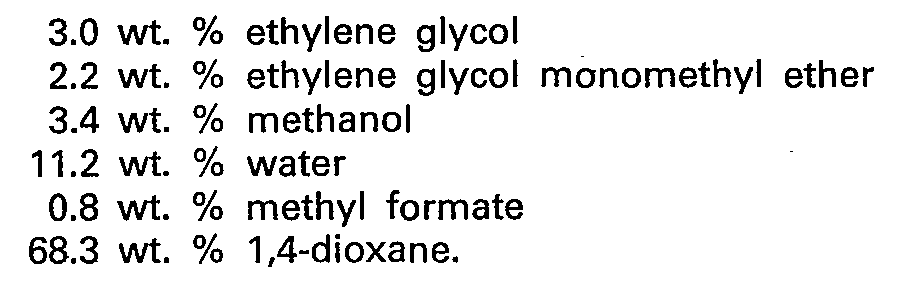
- Analysis of the liquid product by atomic adsorption showed it to contain >98% of the cobalt originally charged. There was no solid product phase.
- Following the procedures of Example 1, the 450 ml glass-lined pressure reactor was charged with a mixture of triphenyl(tetracarbonylcobalt) germanium(IV) (3.0 mmole) and formaldehyde (0.1 mole) in 1,4-dioxane (15.0 g). The mixture was flushed with nitrogen, the reactor sealed, flushed with synthesis gas, pressured to 187.2 bars with 2:1 molar H2/CO and heated to 160°C with agitation. After four hours, the reaction was allowed to cool, the gas pressure (161.3 bars) noted, the excess gas sampled and vented, and the red amber liquid product (21.3 g) recovered.
- Analysis (glc and Karl Fischer titration) of the liquid product showed it to contain:

- Analysis of the liquid product by atomic adsorption shows it to contain 86% of the cobalt originally charged.
- Following the procedure of Examples 1 and 31, a series of trialkyl(tetracarbonylcobalt)germanium(lV), trialkyl(tetracarbonylcobalt)tin(lV), and triaryl(tetracarbonylcobalt)tin(lV) complexes (3.0 mmole) were evaluated for the synthesis of ethylene glycol and ethylene glycol monomethyl ether from synthesis gas plus formaldehyde. The results are summarized in Table 3 below.
- It may be noted that the preformed cobalt-germanium and cobalt-tin complexes, i.e., the trimethyl(tetracarbonylcobalt)germanium(lV) and tributyl(tetracarbonylcobalt)tin(lV) complexes, are effective catalysts for the desired glycol synthesis (eq. 1).

Claims (9)
Applications Claiming Priority (2)
| Application Number | Priority Date | Filing Date | Title |
|---|---|---|---|
| US06/316,197 US4356332A (en) | 1981-10-29 | 1981-10-29 | Process for preparing ethylene glycol |
| US316197 | 1981-10-29 |
Publications (3)
| Publication Number | Publication Date |
|---|---|
| EP0078616A2 EP0078616A2 (en) | 1983-05-11 |
| EP0078616A3 EP0078616A3 (en) | 1983-08-10 |
| EP0078616B1 true EP0078616B1 (en) | 1985-04-03 |
Family
ID=23227964
Family Applications (1)
| Application Number | Title | Priority Date | Filing Date |
|---|---|---|---|
| EP82305348A Expired EP0078616B1 (en) | 1981-10-29 | 1982-10-07 | Process for preparing ethylene glycol |
Country Status (9)
| Country | Link |
|---|---|
| US (1) | US4356332A (en) |
| EP (1) | EP0078616B1 (en) |
| JP (1) | JPS6015607B2 (en) |
| KR (1) | KR860000447B1 (en) |
| AU (1) | AU554007B2 (en) |
| CA (1) | CA1184944A (en) |
| DE (1) | DE3262893D1 (en) |
| ES (1) | ES8308822A1 (en) |
| ZA (1) | ZA827462B (en) |
Families Citing this family (11)
| Publication number | Priority date | Publication date | Assignee | Title |
|---|---|---|---|---|
| US4356332A (en) * | 1981-10-29 | 1982-10-26 | Texaco Inc. | Process for preparing ethylene glycol |
| EP0110666B1 (en) * | 1982-11-27 | 1987-09-16 | The British Petroleum Company p.l.c. | Process for the production of ethylene glycol |
| US4608444A (en) | 1984-04-05 | 1986-08-26 | The Halcon Sd Group, Inc. | Process and accompanying catalysts for the hydroformylation of formaldehyde to glycol-aldehyde |
| US4565896A (en) * | 1984-10-22 | 1986-01-21 | Texaco Inc. | Process for low pressure synthesis of ethylene glycol from synthesis gas |
| EP0228484A1 (en) * | 1985-11-29 | 1987-07-15 | Texaco Development Corporation | Production of mixtures containing ethylene glycol from synthesis gas |
| US4616097A (en) * | 1984-10-22 | 1986-10-07 | Texaco Inc. | Process for low pressure synthesis of ethylene glycol from synthesis gas plus formaldehyde |
| US4568780A (en) * | 1984-10-22 | 1986-02-04 | Texaco Inc. | Process for low pressure synthesis of ethylene glycol from synthesis gas plus 1,3-dioxolane |
| US4609768A (en) * | 1984-10-22 | 1986-09-02 | Texaco Inc. | Process for synthesis of ethylene glycol from synthesis gas plus 1,3-dioxolane using 1,3-dioxolane as a solvent |
| JPS6384501U (en) * | 1986-11-25 | 1988-06-02 | ||
| WO2019030117A1 (en) * | 2017-08-09 | 2019-02-14 | L'air Liquide, Societe Anonyme Pour L'etude Et L'exploitation Des Procedes Georges Claude | Ge-CONTAINING Co-FILM FORMING MATERIAL, Ge-CONTAINING Co FILM AND FILM FORMING METHOD THEREOF |
| JP7143124B2 (en) * | 2017-08-09 | 2022-09-28 | レール・リキード-ソシエテ・アノニム・プール・レテュード・エ・レクスプロワタシオン・デ・プロセデ・ジョルジュ・クロード | Ge-containing Co film forming material, Ge-containing Co film and method for forming the same |
Family Cites Families (7)
| Publication number | Priority date | Publication date | Assignee | Title |
|---|---|---|---|---|
| DE875802C (en) * | 1941-03-07 | 1953-05-07 | Basf Ag | Process for the production of organic compounds containing oxygen |
| US2451333A (en) * | 1945-04-28 | 1948-10-12 | Du Pont | Synthesis of polyhydroxy compounds |
| US2587576A (en) * | 1950-12-02 | 1952-03-04 | Standard Oil Co | Higher alcohols from aldehydes |
| US4200765A (en) * | 1976-09-17 | 1980-04-29 | National Distillers And Chemical Corporation | Glycol aldehyde and ethylene glycol processes |
| US4079085A (en) * | 1976-10-21 | 1978-03-14 | Chevron Research Company | Process for preparing ethylene glycol and ethylene glycol ether |
| GB1568427A (en) * | 1976-10-21 | 1980-05-29 | Chevron Res | Process for preparing glycol and methanol |
| US4356332A (en) * | 1981-10-29 | 1982-10-26 | Texaco Inc. | Process for preparing ethylene glycol |
-
1981
- 1981-10-29 US US06/316,197 patent/US4356332A/en not_active Expired - Fee Related
-
1982
- 1982-10-07 DE DE8282305348T patent/DE3262893D1/en not_active Expired
- 1982-10-07 EP EP82305348A patent/EP0078616B1/en not_active Expired
- 1982-10-12 ZA ZA827462A patent/ZA827462B/en unknown
- 1982-10-20 AU AU89626/82A patent/AU554007B2/en not_active Ceased
- 1982-10-22 CA CA000414013A patent/CA1184944A/en not_active Expired
- 1982-10-26 JP JP57186893A patent/JPS6015607B2/en not_active Expired
- 1982-10-28 KR KR8204860A patent/KR860000447B1/en not_active Expired
- 1982-10-28 ES ES516929A patent/ES8308822A1/en not_active Expired
Also Published As
| Publication number | Publication date |
|---|---|
| KR860000447B1 (en) | 1986-04-26 |
| KR840001941A (en) | 1984-06-07 |
| ZA827462B (en) | 1984-02-29 |
| EP0078616A2 (en) | 1983-05-11 |
| ES516929A0 (en) | 1983-10-01 |
| DE3262893D1 (en) | 1985-05-09 |
| JPS5888329A (en) | 1983-05-26 |
| JPS6015607B2 (en) | 1985-04-20 |
| AU554007B2 (en) | 1986-08-07 |
| AU8962682A (en) | 1983-05-05 |
| EP0078616A3 (en) | 1983-08-10 |
| US4356332A (en) | 1982-10-26 |
| ES8308822A1 (en) | 1983-10-01 |
| CA1184944A (en) | 1985-04-02 |
Similar Documents
| Publication | Publication Date | Title |
|---|---|---|
| US4409405A (en) | Production of ethanol from methanol and synthesis gas | |
| US4476326A (en) | Process for the synthesis of ethanol and acetaldehyde using cobalt compounds with novel promoters | |
| US4647691A (en) | Process for preparing ethyl and n-propyl esters of carboxylic acids from methanol, syngas and carboxylic acid using a new catalyst system | |
| US4308403A (en) | Process for preparing glycol ethers | |
| US4357477A (en) | Process for preparing ethylene glycol monoalkyl ethers | |
| US4484002A (en) | Process for producing methyl acetate from methanol and carbon monoxide using a novel catalyst system | |
| US4356320A (en) | Preparation of carboxylic acids | |
| US4356332A (en) | Process for preparing ethylene glycol | |
| US4134912A (en) | Process for preparing carboxylic acids | |
| US4356327A (en) | Process for preparing propylene glycol monoalkyl ethers and alkoxyacetones | |
| US4424384A (en) | Process for homologation of methanol to ethanol | |
| JPH0321531B2 (en) | ||
| US4371724A (en) | Ethanol synthesis by homologation of methanol | |
| KR860000448B1 (en) | Method for preparing alkanol from syngas | |
| EP0078615B1 (en) | Process for preparing glycol ethers | |
| US4409404A (en) | Process for producing ethanol using said novel catalyst system | |
| NL7905114A (en) | PROCESS FOR THE SIMULTANEOUS PREPARATION OF ALCOHOL AND VICINAL GLYCOL ESTERS. | |
| KR860000449B1 (en) | Production of alkanols from synthesis gas | |
| US4519956A (en) | Process for selectively preparing acetic anhydride by carbonylation of methyl acetate in the presence of an iodide-free catalyst system | |
| US4414410A (en) | Process for preparing alkyl esters by homologation of the next lower alkyl ester | |
| CA1192226A (en) | Process for preparing ethylene glycol and lower monohydric alcohols from syngas using a novel catalyst system | |
| US4423257A (en) | Process for producing ethanol | |
| US4436837A (en) | Preparation of alkanols from synthesis gas | |
| US4433178A (en) | Process for preparing acetaldehyde from methanol and synthesis gas using a novel catalyst composition | |
| EP0134324B1 (en) | Production of ethanol from methanol and synthesis gas |
Legal Events
| Date | Code | Title | Description |
|---|---|---|---|
| PUAI | Public reference made under article 153(3) epc to a published international application that has entered the european phase |
Free format text: ORIGINAL CODE: 0009012 |
|
| AK | Designated contracting states |
Designated state(s): BE DE FR GB IT NL SE |
|
| PUAL | Search report despatched |
Free format text: ORIGINAL CODE: 0009013 |
|
| AK | Designated contracting states |
Designated state(s): BE DE FR GB IT NL SE |
|
| 17P | Request for examination filed |
Effective date: 19831018 |
|
| GRAA | (expected) grant |
Free format text: ORIGINAL CODE: 0009210 |
|
| AK | Designated contracting states |
Designated state(s): BE DE FR GB IT NL SE |
|
| PG25 | Lapsed in a contracting state [announced via postgrant information from national office to epo] |
Ref country code: NL Effective date: 19850403 Ref country code: IT Free format text: LAPSE BECAUSE OF FAILURE TO SUBMIT A TRANSLATION OF THE DESCRIPTION OR TO PAY THE FEE WITHIN THE PRESCRIBED TIME-LIMIT;WARNING: LAPSES OF ITALIAN PATENTS WITH EFFECTIVE DATE BEFORE 2007 MAY HAVE OCCURRED AT ANY TIME BEFORE 2007. THE CORRECT EFFECTIVE DATE MAY BE DIFFERENT FROM THE ONE RECORDED. Effective date: 19850403 Ref country code: FR Free format text: THE PATENT HAS BEEN ANNULLED BY A DECISION OF A NATIONAL AUTHORITY Effective date: 19850403 Ref country code: BE Effective date: 19850403 |
|
| PG25 | Lapsed in a contracting state [announced via postgrant information from national office to epo] |
Ref country code: SE Effective date: 19850430 |
|
| REF | Corresponds to: |
Ref document number: 3262893 Country of ref document: DE Date of ref document: 19850509 |
|
| NLV1 | Nl: lapsed or annulled due to failure to fulfill the requirements of art. 29p and 29m of the patents act | ||
| EN | Fr: translation not filed | ||
| PLBE | No opposition filed within time limit |
Free format text: ORIGINAL CODE: 0009261 |
|
| STAA | Information on the status of an ep patent application or granted ep patent |
Free format text: STATUS: NO OPPOSITION FILED WITHIN TIME LIMIT |
|
| 26N | No opposition filed | ||
| PG25 | Lapsed in a contracting state [announced via postgrant information from national office to epo] |
Ref country code: DE Effective date: 19870701 |
|
| GBPC | Gb: european patent ceased through non-payment of renewal fee | ||
| PG25 | Lapsed in a contracting state [announced via postgrant information from national office to epo] |
Ref country code: GB Effective date: 19881121 |