EP0078465A1 - Fluorocarbon polymer gasket and method of manufacturing such - Google Patents
Fluorocarbon polymer gasket and method of manufacturing such Download PDFInfo
- Publication number
- EP0078465A1 EP0078465A1 EP82109771A EP82109771A EP0078465A1 EP 0078465 A1 EP0078465 A1 EP 0078465A1 EP 82109771 A EP82109771 A EP 82109771A EP 82109771 A EP82109771 A EP 82109771A EP 0078465 A1 EP0078465 A1 EP 0078465A1
- Authority
- EP
- European Patent Office
- Prior art keywords
- fluorocarbon polymer
- sheet
- gasket
- recited
- compressed
- Prior art date
- Legal status (The legal status is an assumption and is not a legal conclusion. Google has not performed a legal analysis and makes no representation as to the accuracy of the status listed.)
- Withdrawn
Links
- 229920002313 fluoropolymer Polymers 0.000 title claims abstract description 74
- 238000004519 manufacturing process Methods 0.000 title claims description 7
- 230000006835 compression Effects 0.000 claims abstract description 4
- 238000007906 compression Methods 0.000 claims abstract description 4
- 238000001816 cooling Methods 0.000 claims description 10
- BFKJFAAPBSQJPD-UHFFFAOYSA-N tetrafluoroethene Chemical group FC(F)=C(F)F BFKJFAAPBSQJPD-UHFFFAOYSA-N 0.000 claims description 9
- 238000010438 heat treatment Methods 0.000 claims description 7
- 238000000034 method Methods 0.000 claims description 7
- 230000001105 regulatory effect Effects 0.000 claims description 3
- 229910000831 Steel Inorganic materials 0.000 claims description 2
- 238000004513 sizing Methods 0.000 claims description 2
- 239000010959 steel Substances 0.000 claims description 2
- XLYOFNOQVPJJNP-UHFFFAOYSA-N water Substances O XLYOFNOQVPJJNP-UHFFFAOYSA-N 0.000 claims description 2
- 238000007493 shaping process Methods 0.000 claims 4
- 238000005520 cutting process Methods 0.000 claims 2
- 239000000499 gel Substances 0.000 description 10
- 239000010425 asbestos Substances 0.000 description 8
- 229910052895 riebeckite Inorganic materials 0.000 description 8
- 230000008901 benefit Effects 0.000 description 3
- NBVXSUQYWXRMNV-UHFFFAOYSA-N fluoromethane Chemical compound FC NBVXSUQYWXRMNV-UHFFFAOYSA-N 0.000 description 3
- 229920000642 polymer Polymers 0.000 description 3
- 230000008569 process Effects 0.000 description 3
- 230000006870 function Effects 0.000 description 2
- 239000000463 material Substances 0.000 description 2
- 230000008439 repair process Effects 0.000 description 2
- 238000007789 sealing Methods 0.000 description 2
- 206010058467 Lung neoplasm malignant Diseases 0.000 description 1
- 230000006978 adaptation Effects 0.000 description 1
- 230000000711 cancerogenic effect Effects 0.000 description 1
- 231100000315 carcinogenic Toxicity 0.000 description 1
- 239000007799 cork Substances 0.000 description 1
- 238000005260 corrosion Methods 0.000 description 1
- 230000007797 corrosion Effects 0.000 description 1
- 230000000694 effects Effects 0.000 description 1
- 230000008030 elimination Effects 0.000 description 1
- 238000003379 elimination reaction Methods 0.000 description 1
- 239000000835 fiber Substances 0.000 description 1
- 239000012530 fluid Substances 0.000 description 1
- 231100000206 health hazard Toxicity 0.000 description 1
- 239000010985 leather Substances 0.000 description 1
- 201000005202 lung cancer Diseases 0.000 description 1
- 208000020816 lung neoplasm Diseases 0.000 description 1
- 230000004048 modification Effects 0.000 description 1
- 238000012986 modification Methods 0.000 description 1
- 238000013021 overheating Methods 0.000 description 1
- 239000004033 plastic Substances 0.000 description 1
- 238000011084 recovery Methods 0.000 description 1
- 230000004044 response Effects 0.000 description 1
- 230000000717 retained effect Effects 0.000 description 1
- 239000005060 rubber Substances 0.000 description 1
- 239000000126 substance Substances 0.000 description 1
Images
Classifications
-
- F—MECHANICAL ENGINEERING; LIGHTING; HEATING; WEAPONS; BLASTING
- F16—ENGINEERING ELEMENTS AND UNITS; GENERAL MEASURES FOR PRODUCING AND MAINTAINING EFFECTIVE FUNCTIONING OF MACHINES OR INSTALLATIONS; THERMAL INSULATION IN GENERAL
- F16L—PIPES; JOINTS OR FITTINGS FOR PIPES; SUPPORTS FOR PIPES, CABLES OR PROTECTIVE TUBING; MEANS FOR THERMAL INSULATION IN GENERAL
- F16L23/00—Flanged joints
- F16L23/16—Flanged joints characterised by the sealing means
- F16L23/18—Flanged joints characterised by the sealing means the sealing means being rings
- F16L23/22—Flanged joints characterised by the sealing means the sealing means being rings made exclusively of a material other than metal
-
- B—PERFORMING OPERATIONS; TRANSPORTING
- B29—WORKING OF PLASTICS; WORKING OF SUBSTANCES IN A PLASTIC STATE IN GENERAL
- B29C—SHAPING OR JOINING OF PLASTICS; SHAPING OF MATERIAL IN A PLASTIC STATE, NOT OTHERWISE PROVIDED FOR; AFTER-TREATMENT OF THE SHAPED PRODUCTS, e.g. REPAIRING
- B29C61/00—Shaping by liberation of internal stresses; Making preforms having internal stresses; Apparatus therefor
- B29C61/04—Thermal expansion
-
- B—PERFORMING OPERATIONS; TRANSPORTING
- B29—WORKING OF PLASTICS; WORKING OF SUBSTANCES IN A PLASTIC STATE IN GENERAL
- B29C—SHAPING OR JOINING OF PLASTICS; SHAPING OF MATERIAL IN A PLASTIC STATE, NOT OTHERWISE PROVIDED FOR; AFTER-TREATMENT OF THE SHAPED PRODUCTS, e.g. REPAIRING
- B29C61/00—Shaping by liberation of internal stresses; Making preforms having internal stresses; Apparatus therefor
- B29C61/06—Making preforms having internal stresses, e.g. plastic memory
-
- B—PERFORMING OPERATIONS; TRANSPORTING
- B29—WORKING OF PLASTICS; WORKING OF SUBSTANCES IN A PLASTIC STATE IN GENERAL
- B29C—SHAPING OR JOINING OF PLASTICS; SHAPING OF MATERIAL IN A PLASTIC STATE, NOT OTHERWISE PROVIDED FOR; AFTER-TREATMENT OF THE SHAPED PRODUCTS, e.g. REPAIRING
- B29C67/00—Shaping techniques not covered by groups B29C39/00 - B29C65/00, B29C70/00 or B29C73/00
- B29C67/0011—Shaping techniques not covered by groups B29C39/00 - B29C65/00, B29C70/00 or B29C73/00 for shaping plates or sheets
-
- F—MECHANICAL ENGINEERING; LIGHTING; HEATING; WEAPONS; BLASTING
- F16—ENGINEERING ELEMENTS AND UNITS; GENERAL MEASURES FOR PRODUCING AND MAINTAINING EFFECTIVE FUNCTIONING OF MACHINES OR INSTALLATIONS; THERMAL INSULATION IN GENERAL
- F16J—PISTONS; CYLINDERS; SEALINGS
- F16J15/00—Sealings
- F16J15/02—Sealings between relatively-stationary surfaces
- F16J15/06—Sealings between relatively-stationary surfaces with solid packing compressed between sealing surfaces
- F16J15/10—Sealings between relatively-stationary surfaces with solid packing compressed between sealing surfaces with non-metallic packing
- F16J15/104—Sealings between relatively-stationary surfaces with solid packing compressed between sealing surfaces with non-metallic packing characterised by structure
- F16J15/106—Sealings between relatively-stationary surfaces with solid packing compressed between sealing surfaces with non-metallic packing characterised by structure homogeneous
-
- B—PERFORMING OPERATIONS; TRANSPORTING
- B29—WORKING OF PLASTICS; WORKING OF SUBSTANCES IN A PLASTIC STATE IN GENERAL
- B29L—INDEXING SCHEME ASSOCIATED WITH SUBCLASS B29C, RELATING TO PARTICULAR ARTICLES
- B29L2031/00—Other particular articles
- B29L2031/26—Sealing devices, e.g. packaging for pistons or pipe joints
-
- B—PERFORMING OPERATIONS; TRANSPORTING
- B29—WORKING OF PLASTICS; WORKING OF SUBSTANCES IN A PLASTIC STATE IN GENERAL
- B29L—INDEXING SCHEME ASSOCIATED WITH SUBCLASS B29C, RELATING TO PARTICULAR ARTICLES
- B29L2031/00—Other particular articles
- B29L2031/26—Sealing devices, e.g. packaging for pistons or pipe joints
- B29L2031/265—Packings, Gaskets
-
- Y—GENERAL TAGGING OF NEW TECHNOLOGICAL DEVELOPMENTS; GENERAL TAGGING OF CROSS-SECTIONAL TECHNOLOGIES SPANNING OVER SEVERAL SECTIONS OF THE IPC; TECHNICAL SUBJECTS COVERED BY FORMER USPC CROSS-REFERENCE ART COLLECTIONS [XRACs] AND DIGESTS
- Y10—TECHNICAL SUBJECTS COVERED BY FORMER USPC
- Y10S—TECHNICAL SUBJECTS COVERED BY FORMER USPC CROSS-REFERENCE ART COLLECTIONS [XRACs] AND DIGESTS
- Y10S277/00—Seal for a joint or juncture
- Y10S277/924—Deformation, material removal, or molding for manufacture of seal
Definitions
- This invention relates to the field sealing joints, more particularly, to the field of gaskets and methods for manufacturing them.
- a superior replacement for asbestos gaskets are gaskets made from fluorocarbon polymers, for example, tetrafluoroethy- lene (TFE).
- TFE tetrafluoroethy- lene
- the properties of fluorocarbon polymer gaskets are greatly enhanced when manufactured by hot coining.
- One of the advantages imparted to hot coined fluorocarbon polymer gaskets is their "living memory", a term which describes the gasket's expansion at elevated temperatures and the subsequent return to coined dimensions when cooled. At lowered temperatures, hot coined fluorocarbon polymer gaskets substantially retain their coined dimensions and flexibility.
- creep or cold flow _defined as the total deformation of the gasket under stress after a period of time in a given environment beyond that initial strain that occurs immediately upon loading, is virtually eliminated.
- creep or cold flow _defined as the total deformation of the gasket under stress after a period of time in a given environment beyond that initial strain that occurs immediately upon loading.
- fluorocarbon polymer gaskets Another advantage of hot coined fluorocarbon polymer gaskets is their ease of repair and reusability. A damaged fluorocarbon polymer gasket can be simply heated to its fluorocarbon polymer gel temperature after which it is hot coined anew. Also, since fluorocarbon gaskets experience no brittleness or deformation as a result of successive compression and recovery, they may be used repeatedly.
- fluorocarbon polymer gaskets are ideally suited for chemical applications since fluorocarbon polymers are corrosion resistant, nonsoluble, nonadhesive and nonflam- mable.
- the present invention includes fluorocarbon polymer gaskets, which are blank-formed from a pre-determined thickness of a fluorocarbon polymer sneet, depending on the thickness of gasket desired.
- the fluoro-carbon polymer sheet is heated to a pre-determined elevated temperature, depending on the particular species of fluorocarbon polymer which is being used, then hot coined to a thickness which is less than that of the sheet used to blank-form the gasket.
- the hot coining operation can also impart a particular surface configuration or cross sectional shape to the gasket as desired.
- the hot coining operation serves to hold the formed gasket in its molecularly deformed configuration while it is being cooled below the fluorocarbon polymer gel temperature.
- the resulting hot coined gasket has a "living memory", seeking to expand to the thickness of the fluorocarbon polymer sheet from which it was hot coined when exposed to elevated temperatures below the fluorocarbon polymer gel temperature, yet returning to its coined dimensions upon being cooled. Coined dimensions and flexibility are virtually retained at low temperatures. Such characteristics are especially useful in gaskets which seal fittings subject to variable temperatures.
- a method for the manufacture of fluorocarbon polymer gaskets which expand when heated to temperatures above ambient and return to preheated dimensions when cooled. Additionally, the gaskets of the present invention retain their ambient temperature dimensions when cooled substantially below ambient temperature.
- Fluorocarbon polymer gaskets having the above described characteristics may be produced by first selecting a sheet of fluorocarbon polymer. Tetrafluoroethylene polymers have been found to be most suitable for the hot coin manufacture of gaskets having the properties described.
- the thickness of the fluorocarbon polymer sheet to be selected is necessarily greater than the thickness of the gasket to be ' coined for a particular application. For example, a sheet of about 5/16 inch thickness may be hot coined to form a gasket having approximately a 5/32 inch thickness. This 5/32 inch gasket may then be used in any application where a conventional gasket of equal thickness is specified.
- the fluorocarbon polymer sheet of desired thickness is preferably heated to within a temperature range at which the fluorocarbon polymer enters a gel state.
- Tetrafluoroethylene for example, enters the gel state when heated within the approximate temperature range-of 650°F to 740°F, although it may begin to degrade at higher temperatures.
- Heating of the fluorocarbon polymer sheet is accomplished in the preferred embodiment using platten heaters.
- a platten heater consists essentially of a vertically adjustable surface on which the sheet to be heated is placed. The adjustable surface is then raised to bring the supported sneet in contact pressure with a fixed, heat regu- lated surface.
- electric heater elements bring the fixed surface within the gel temperature range which in turn heats the abutting fluorocarbon polymer sheet, although other sources of heat may also be used.
- the fluorocarbon polymer sheet generally enters the gel state after a few minutes in the platten heater. For example, a 5/16 inch tetrafluoroethylene sheet gels within approximately five minutes in a platten heater which generates a temperature . in the range of approximately 640°F to 700°F.
- the fluorocarbon polymer sheet is preferably positioned between opposing dies of a coining press.
- the coining press of the preferred embodiment consists of oppositely positioned dies mounted for vertical movement on a hydraulic press.
- the hydraulic press functions to bring the oppositely positioned dies together to exert pressure on the gelled fluorocarbon polymer sheet.
- a 500 ton capacity coining press apply pressure to the dies for approximately one to one and one-half minutes in order to coin the gelled fluorocarbon polymer sheet into the desired gasket.
- the dies are maintained at room temperature by circulating water through them although the die temperature may be regulated by other means. In some instances, it may be desirable to maintain the dies at temperatures other than ambient.
- the fluorocarbon polymer sheet is cooled under pressure of the dies to below its gel temperature, preferably somewhat below 500°F, thereby becoming molecularly stable.
- the dimensions and particular shape distortion i.e. the coin imparted to the sheet by heat and pressure, is "set" or maintained, after which the sheet may be removed from the coining press.
- the coined sheet has preferably cooled to near ambient temperature, that coined portion of the fluorocarbon sheet may be removed from the coining press and then sized by suitable means into the desired size gasket.
- Steel ruled sizing dies have been found to be adequate for this purpose.
- a particular surface configuration is imparted to the hot coined portion of the fluorocarbon polymer sheet.
- a most advantageous configuration is that of concentric circular grooves 11 which form a gasket 17 comprised essentially of what appears to be a series of spaced, circularly parallel projections in the form of ribs 12 as best shown in Figures 1 and 2.
- Each rib 12 is circular with a round cross-section.
- the ribs are arranged in order of increasing circumference, the rib having the least circumference 19 defining the central gasket aperture 13.
- the outermost rib 18 having the greatest circumference defines the gasket's outer perimeter.
- Each rib 12 functions, in effect, as an expandable "0" ring.
- gaskets having the "0" ring configuration preferably need at least three abutting ribs to be maximally effective.
- the gasket 17 When the gasket 17 is placed within, for example, a pipe fitting 20, having an axial conduit 16, as shown in Figure 3, it laterally compresses somewhat due to the initial torquing of the flange bolts 21, functioning effectively as a conventional gasket.
- the gasket ribs Upon heating, however, the gasket ribs expand, seeking to return to the thickness of the fluorocarbon polymer sheet from which the gasket was hot coined.
- each rib 12 of the gasket 17 expands, it presses against adjacent ribs and the confines of the abutting flange faces 14 and 15, taking on a cross-sectional shape somewhat akin to a square with rounded edges, thereby sealing the fitting 20 with greater integrity than was heretofore possible using conventional gaskets.
- the gasket Upon cooling, the gasket exhibits its "living memory” by returning to its preheated, coined dimensions, again serving as a conventional gasket, without the need to retorque flange bolts.
- the gasket 17 When the gasket 17 is cooled to temperatures below ambient, it retains coined dimensions and elastic qualities present at ambient temperatures. For tetrafluoroethylene polymer gaskets, one can expect continuous service from within a temperature range of approximately -320°F to +500°F.
- Fluorocarbon polymer gaskets are further characterized by their repair potential. Gaskets which have been damaged, for example, by overheating within a pipe flange, can be easily returned to original specifications by heating the gasket to within the fluorocarbon polymer gel temperature range, which restores the gasket to a flat disc having the thickness of the sheet from which it was originally hot coined. This re-expanded gasket disc may then be coined anew by simply repeating the coining process already discussed.
- fluorocarbon polymer gaskets of the present invention may be returned to service following dismantling of a pipe fitting.
- the economic benefit of such a reusable gasket is obvious.
Landscapes
- Engineering & Computer Science (AREA)
- General Engineering & Computer Science (AREA)
- Mechanical Engineering (AREA)
- Physics & Mathematics (AREA)
- Thermal Sciences (AREA)
- Sealing Material Composition (AREA)
- Gasket Seals (AREA)
- Casting Or Compression Moulding Of Plastics Or The Like (AREA)
- Treatments Of Macromolecular Shaped Articles (AREA)
- Shaping Of Tube Ends By Bending Or Straightening (AREA)
Abstract
A fluorocarbon polymer gasket is disclosed which has been compression formed from a fluorocarbon polymer sheet heated to its gel state; cooled in its compressed state, and shaped into a gasket. The gasket so manufactured has a "living memory" thus enabling it to tend to return to its pre-compression form when exposed to elevated temperatures.
Description
- This invention relates to the field sealing joints, more particularly, to the field of gaskets and methods for manufacturing them.
- Various materials, such as cork, leather, rubber, plastic, and asbestos are used for the manufacture of gaskets. Of these materials, asbestos is most widely used for gaskets subject to extreme temperatures. However, asbestos gaskets tend to compress and laterally flatten under high temperature and pressure, resulting in leakage at the fitting which the gasket was intended to seal. To avoid leakage, the bolts of abutting flanges must be retorqued periodically to insure a fluid tight seal with the gasket, a time consuming process, especially where flanges are numerous and awkwardly located. More importantly, microscopic asbestos fibers which are inhaled are known to cause lung cancer. Thus, elimination of asbestos from the work environment is most desirable.
- A superior replacement for asbestos gaskets are gaskets made from fluorocarbon polymers, for example, tetrafluoroethy- lene (TFE). However, by virtue of the present invention, the properties of fluorocarbon polymer gaskets are greatly enhanced when manufactured by hot coining. One of the advantages imparted to hot coined fluorocarbon polymer gaskets is their "living memory", a term which describes the gasket's expansion at elevated temperatures and the subsequent return to coined dimensions when cooled. At lowered temperatures, hot coined fluorocarbon polymer gaskets substantially retain their coined dimensions and flexibility. Further, creep or cold flow, _defined as the total deformation of the gasket under stress after a period of time in a given environment beyond that initial strain that occurs immediately upon loading, is virtually eliminated. Thus, the need for retorquing flange bolts, loosened by gasket elongation or flattening between the flange faces in response to extremes in temperature and pressure, is eliminated by using hot coined fluorocarbon polymer gaskets having a "living memory".
- Another advantage of hot coined fluorocarbon polymer gaskets is their ease of repair and reusability. A damaged fluorocarbon polymer gasket can be simply heated to its fluorocarbon polymer gel temperature after which it is hot coined anew. Also, since fluorocarbon gaskets experience no brittleness or deformation as a result of successive compression and recovery, they may be used repeatedly.
- Additionally, fluorocarbon polymer gaskets are ideally suited for chemical applications since fluorocarbon polymers are corrosion resistant, nonsoluble, nonadhesive and nonflam- mable.
- Finally, the carcinogenic asbestos health hazard is eliminated by substituting asbestos gaskets with fluorocarbon polymer gaskets.
- The present invention includes fluorocarbon polymer gaskets, which are blank-formed from a pre-determined thickness of a fluorocarbon polymer sneet, depending on the thickness of gasket desired. The fluoro-carbon polymer sheet is heated to a pre-determined elevated temperature, depending on the particular species of fluorocarbon polymer which is being used, then hot coined to a thickness which is less than that of the sheet used to blank-form the gasket. The hot coining operation can also impart a particular surface configuration or cross sectional shape to the gasket as desired. The hot coining operation serves to hold the formed gasket in its molecularly deformed configuration while it is being cooled below the fluorocarbon polymer gel temperature. After cooling, the coining press and dies are opened, the sheet removed, and the finished gasket punched from the sheet. The resulting hot coined gasket has a "living memory", seeking to expand to the thickness of the fluorocarbon polymer sheet from which it was hot coined when exposed to elevated temperatures below the fluorocarbon polymer gel temperature, yet returning to its coined dimensions upon being cooled. Coined dimensions and flexibility are virtually retained at low temperatures. Such characteristics are especially useful in gaskets which seal fittings subject to variable temperatures.
-
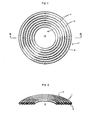
- Fig. 1 is a side view of the gasket showing the concentric arrangement of the ribs.
- Fig. 2 is a cross-sectional end view of the gasket along line 2-2.
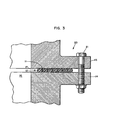
- Fig. 3 is a cross sectional end view of the gasket in an expanded condition between bolted pipe flanges.
- According to the present invention, a method is provided for the manufacture of fluorocarbon polymer gaskets which expand when heated to temperatures above ambient and return to preheated dimensions when cooled. Additionally, the gaskets of the present invention retain their ambient temperature dimensions when cooled substantially below ambient temperature.
- Fluorocarbon polymer gaskets having the above described characteristics may be produced by first selecting a sheet of fluorocarbon polymer. Tetrafluoroethylene polymers have been found to be most suitable for the hot coin manufacture of gaskets having the properties described. In general, the thickness of the fluorocarbon polymer sheet to be selected is necessarily greater than the thickness of the gasket to be 'coined for a particular application. For example, a sheet of about 5/16 inch thickness may be hot coined to form a gasket having approximately a 5/32 inch thickness. This 5/32 inch gasket may then be used in any application where a conventional gasket of equal thickness is specified.
- Once the fluorocarbon polymer sheet of desired thickness has been selected, it is preferably heated to within a temperature range at which the fluorocarbon polymer enters a gel state. Tetrafluoroethylene, for example, enters the gel state when heated within the approximate temperature range-of 650°F to 740°F, although it may begin to degrade at higher temperatures. Heating of the fluorocarbon polymer sheet is accomplished in the preferred embodiment using platten heaters. A platten heater consists essentially of a vertically adjustable surface on which the sheet to be heated is placed. The adjustable surface is then raised to bring the supported sneet in contact pressure with a fixed, heat regu- lated surface. In the preferred embodiment, electric heater elements bring the fixed surface within the gel temperature range which in turn heats the abutting fluorocarbon polymer sheet, although other sources of heat may also be used. The fluorocarbon polymer sheet generally enters the gel state after a few minutes in the platten heater. For example, a 5/16 inch tetrafluoroethylene sheet gels within approximately five minutes in a platten heater which generates a temperature . in the range of approximately 640°F to 700°F.
- Once gelled, the fluorocarbon polymer sheet is preferably positioned between opposing dies of a coining press. The coining press of the preferred embodiment consists of oppositely positioned dies mounted for vertical movement on a hydraulic press. The hydraulic press functions to bring the oppositely positioned dies together to exert pressure on the gelled fluorocarbon polymer sheet. It is preferred that a 500 ton capacity coining press apply pressure to the dies for approximately one to one and one-half minutes in order to coin the gelled fluorocarbon polymer sheet into the desired gasket. During coining in the preferred embodiment, the dies are maintained at room temperature by circulating water through them although the die temperature may be regulated by other means. In some instances, it may be desirable to maintain the dies at temperatures other than ambient.
- During the coining process in the preferred embodiment, the fluorocarbon polymer sheet is cooled under pressure of the dies to below its gel temperature, preferably somewhat below 500°F, thereby becoming molecularly stable. By maintaining pressure on the fluorocarbon polymer sheet while it cools, the dimensions and particular shape distortion, i.e. the coin imparted to the sheet by heat and pressure, is "set" or maintained, after which the sheet may be removed from the coining press. Once the coined sheet has preferably cooled to near ambient temperature, that coined portion of the fluorocarbon sheet may be removed from the coining press and then sized by suitable means into the desired size gasket. Steel ruled sizing dies have been found to be adequate for this purpose.
- In the preferred embodiment of the gasket, a particular surface configuration is imparted to the hot coined portion of the fluorocarbon polymer sheet. A most advantageous configuration is that of concentric circular grooves 11 which form a
gasket 17 comprised essentially of what appears to be a series of spaced, circularly parallel projections in the form ofribs 12 as best shown in Figures 1 and 2. Eachrib 12 is circular with a round cross-section. The ribs are arranged in order of increasing circumference, the rib having theleast circumference 19 defining thecentral gasket aperture 13. Theoutermost rib 18 having the greatest circumference defines the gasket's outer perimeter. Eachrib 12 functions, in effect, as an expandable "0" ring. It has been found that gaskets having the "0" ring configuration preferably need at least three abutting ribs to be maximally effective. When thegasket 17 is placed within, for example, a pipe fitting 20, having anaxial conduit 16, as shown in Figure 3, it laterally compresses somewhat due to the initial torquing of theflange bolts 21, functioning effectively as a conventional gasket. Upon heating, however, the gasket ribs expand, seeking to return to the thickness of the fluorocarbon polymer sheet from which the gasket was hot coined. As eachrib 12 of thegasket 17 expands, it presses against adjacent ribs and the confines of the abutting flange faces 14 and 15, taking on a cross-sectional shape somewhat akin to a square with rounded edges, thereby sealing the fitting 20 with greater integrity than was heretofore possible using conventional gaskets. Upon cooling, the gasket exhibits its "living memory" by returning to its preheated, coined dimensions, again serving as a conventional gasket, without the need to retorque flange bolts. When thegasket 17 is cooled to temperatures below ambient, it retains coined dimensions and elastic qualities present at ambient temperatures. For tetrafluoroethylene polymer gaskets, one can expect continuous service from within a temperature range of approximately -320°F to +500°F. - Fluorocarbon polymer gaskets are further characterized by their repair potential. Gaskets which have been damaged, for example, by overheating within a pipe flange, can be easily returned to original specifications by heating the gasket to within the fluorocarbon polymer gel temperature range, which restores the gasket to a flat disc having the thickness of the sheet from which it was originally hot coined. This re-expanded gasket disc may then be coined anew by simply repeating the coining process already discussed.
- Still further, fluorocarbon polymer gaskets of the present invention may be returned to service following dismantling of a pipe fitting. The economic benefit of such a reusable gasket is obvious.
- While the invention has been described in connection with specific embodiments thereof, it will be understood that it is capable of further modification, and this application is intended to cover any variations, uses, or adaptations of the invention. It will, therefore, be recognized that the invention is not to be considered as limited to the precise embodiments shown and described but is to be interpreted as broadly as permitted by the appended claims.
Claims (21)
1. A method of manufacturing fluorocarbon polymer gaskets which comprises:
(a) heating a fluorocarbon polymer sheet of predetermined thickness to about its gel state;
(b) compressing said heated sheet to a thickness less than said sheet's predetermined thickness; .
(c) cooling said sheet in its compressed state; and
(d) shaping said sheet, cooled in its compressed state, into a gasket.
2. The invention as recited in claim 1, wherein said fluorocarbon polymer is tetrafluoroethylene.
3. The invention as recited in claim 1, wherein said heated fluorocarbon polymer sheet is compressed between opposing dies of a coining press.
4. The invention as recited in claim 3, wherein pressure is exerted on said heated fluorocarbon polymer sheet by opposing dies of at least about a 500 ton capacity coining press.
5. The invention as recited in claim 1, wherein the heated fluorocarbon polymer sheet is compressed for approximately one to one and one-half minutes.
6. The invention as recited in claim 1, wherein said heated and compressed fluorocarbon polymer sheet is cooled to ambient temperature.
7. A method of manufacturing fluorocarbon polymer gaskets which comprises:
(a) heating a fluorocarbon polymer sheet of predetermined thickness to within the temperature range at which the fluorocarbon polymer of said sheet enters the gel state;
(b) compressing said heated fluorocarbon polymer sheet, which has entered the gel state, between opposing dies of a coining press;
(c) cooling said compressed fluorocarbon polymer sheet, while holding said compressed fluorocarbon polymer sheet under compression between coining press dies, to a temperature below the temperature at which said fluorocarbon polymer enters the gel state;
(d) releasing said coining press dies from compressing said cooled and compressed fluorocarbon polymer sheet,
(e) removing said cooled and compressed fluorocarbon polymer sheet from between the dies of the coining press; and
(f) shaping said removed cool fluorocarbon polymer sheet into a gasket.
8. The invention as recited in claim 7, wherein the opposing dies of the coining press include regulatable cooling means.
9. The invention as recited in claim 8, wherein the opposing dies of the coining press are regulated to cool said compressed fluorocarbon polymer sheet to ambient temperature.
10. The invention as recited in claim 9, wherein said regulatable cooling means includes means to circulate water through said dies.
11. The invention as recited in claim 7, wherein the heated,. fluorocarbon polymer sheet is compressed between opposing dies of at least about a 500 ton capacity a coining press of at least 500 ton capacity.
12. The invention as recited in claim 7, wherein the heated fluorocarbon polymer sheet is compressed between the coining press dies for approximately one to one and one-half minutes prior to said cooling.
13. The invention as recited in claim 7, wherein said compressed and cooled fluorocarbon polymer sheet is shaped into a gasket of the desired size by cutting means.
14. The invention recited in claim 13 wherein said cutting means includes steel rule sizing die means.
15. A fluorocarbon polymer gasket manufactured by the method which comprises:
said gasket comprising a hot coined disc of fluorocarbon polymer having a central aperture and a plurality of spaced projections which extend from upper and lower surfaces of the disc.
(a) heating a fluorocarbon polymer sheet of predetermined thickness to about its gel state;
(b) compressing said heated sheet to a thickness less than said sheet's predetermined thickness;
(c) cooling said sheet in its compressed state; and
(d) shaping said sheet, cooled in its compressed state, into a gasket;
said gasket comprising a hot coined disc of fluorocarbon polymer having a central aperture and a plurality of spaced projections which extend from upper and lower surfaces of the disc.
16. A gasket as recited in claim 14, wherein said projections being capable of expanding when heated and contracting upon cooling.
17. A gasket as recited in claim 14, wherein said projections comprise spaced circularly parallel ribs.
18. A gasket as recited in claim 16, wherein said ribs are circular in cross section.
19. A gasket as recited in claim 17, wherein said fluorocarbon polymer is tetrafluoroethylene.
20. A fluorocarbon polymer gasket manufactured by the method which comprises:
said gasket comprising a hot coined disc of fluorocarbon polymer having a central aperture about which are spaced a plurality of circularly parallel ribs, said ribs being circular in cross section and, said ribs being capable of expanding when heated and returning to coined dimensions when cooled.
(a) heating a fluorocarbon polymer sheet of predetermined thickness to within the temperature range at which the fluorocarbon polymer enters the gel state;
(b) compressing said heated fluorocarbon polymer sheet which has entered the gel state between opposing dies of at least about a 500 ton capacity coining press;
(c) cooling said heated and compressed fluorocarbon polymer sheet while held under pressure between coining press dies to a temperature below the temperature at which the fluorocarbon polymer enters the gel state;
(d) removing said cooled fluorocarbon polymer sheet from between the dies of the coining press; and
(e) shaping said removed cool fluorocarbon polymer sheet into a gasket;
said gasket comprising a hot coined disc of fluorocarbon polymer having a central aperture about which are spaced a plurality of circularly parallel ribs, said ribs being circular in cross section and, said ribs being capable of expanding when heated and returning to coined dimensions when cooled.
21. The gasket as recited in claim 19, wherein the fluorocarbon polymer is tetrafluoroethylene.
Applications Claiming Priority (2)
| Application Number | Priority Date | Filing Date | Title |
|---|---|---|---|
| US314186 | 1981-10-23 | ||
| US06/314,186 US4388259A (en) | 1981-10-23 | 1981-10-23 | Fluorocarbon polymer gasket and method of manufacturing such |
Publications (1)
| Publication Number | Publication Date |
|---|---|
| EP0078465A1 true EP0078465A1 (en) | 1983-05-11 |
Family
ID=23218922
Family Applications (1)
| Application Number | Title | Priority Date | Filing Date |
|---|---|---|---|
| EP82109771A Withdrawn EP0078465A1 (en) | 1981-10-23 | 1982-10-22 | Fluorocarbon polymer gasket and method of manufacturing such |
Country Status (8)
| Country | Link |
|---|---|
| US (1) | US4388259A (en) |
| EP (1) | EP0078465A1 (en) |
| JP (1) | JPS58131037A (en) |
| KR (1) | KR840001878A (en) |
| AU (1) | AU554876B2 (en) |
| CA (1) | CA1183560A (en) |
| ES (1) | ES516756A0 (en) |
| ZA (1) | ZA827470B (en) |
Cited By (4)
| Publication number | Priority date | Publication date | Assignee | Title |
|---|---|---|---|---|
| GB2155122A (en) * | 1984-03-02 | 1985-09-18 | Dana Corp | Cylinder head gasket seal |
| WO1986005440A1 (en) * | 1985-03-14 | 1986-09-25 | Wirsbo Pex Platzer Schwedenbau Gmbh | Process for the working of semi-finished products from cross-linked plastic materials |
| EP0241776A1 (en) * | 1986-04-14 | 1987-10-21 | RXS Schrumpftechnik-Garnituren GmbH | Method for producing plastic parts with a form memory, apparatus for carrying out this method, and plastic parts produced by this method |
| EP0284165A3 (en) * | 1987-03-27 | 1988-12-14 | Asahi Kasei Kogyo Kabushiki Kaisha | A shaped article of a tetrafluoroethylene polymer |
Families Citing this family (12)
| Publication number | Priority date | Publication date | Assignee | Title |
|---|---|---|---|---|
| EP0238076B1 (en) * | 1986-03-18 | 1992-10-21 | Asahi Kasei Kogyo Kabushiki Kaisha | A shaped article of an oriented tetrafluoroethylene polymer |
| US4817969A (en) * | 1987-11-20 | 1989-04-04 | Fel-Pro Incorporated | Gasket and method of making same |
| US5228702A (en) * | 1992-05-01 | 1993-07-20 | Fel-Pro Incorporated | Molded plastic gasket having a combination sealing bead |
| US5362115A (en) * | 1992-06-05 | 1994-11-08 | Carr Ronald L | Multi-ring gasket |
| US6948717B1 (en) | 1994-07-13 | 2005-09-27 | Kc Multi-Ring Products, Inc. | Joint assembly employing multi-ring gasket |
| US5716083A (en) * | 1994-11-25 | 1998-02-10 | Kc Multi-Ring Products, Inc. | Joint assembly and backing mechanism therefor |
| US5792525A (en) * | 1995-03-31 | 1998-08-11 | W. L. Gore & Associates, Inc. | Creep resistant shaped article of densified expanded polytetrafluoroethylene |
| CN101535702B (en) | 2006-11-06 | 2011-11-09 | 卡勒克密封技术有限责任公司 | Low stress molded gasket and method of manufacture |
| US20090179388A1 (en) | 2008-01-15 | 2009-07-16 | Uhlenkamp Brian J | Hygienic Coupling and Fitting Seal System |
| US9206902B2 (en) * | 2009-09-03 | 2015-12-08 | Christiaan Phillipus Strydom | Flange sealing system |
| US9212775B2 (en) * | 2013-02-04 | 2015-12-15 | Forge Tech, Inc. | Valve, pipe and pipe component repair |
| USD893685S1 (en) * | 2019-03-08 | 2020-08-18 | Garlock Sealing Technologies, Llc | Gasket |
Citations (5)
| Publication number | Priority date | Publication date | Assignee | Title |
|---|---|---|---|---|
| CH350158A (en) * | 1956-02-01 | 1960-11-15 | Hoechst Ag | Process for the solvent-proof sealing of metal surfaces |
| US3151869A (en) * | 1961-12-11 | 1964-10-06 | Dow Chemical Co | Fragile lined pipe coupling and gasket therefor |
| DE1917326A1 (en) * | 1968-04-05 | 1969-10-23 | Robert Ford | Sealing ring washer provided with annular protuberances (21-27) around the washer hole (20) these being concentrically and alternatingly arranged on each side |
| US3526683A (en) * | 1968-03-22 | 1970-09-01 | Raychem Corp | Method for dual crosslinking |
| US3563973A (en) * | 1965-03-04 | 1971-02-16 | Radiation Applic Inc | Articles with polymeric memory and method of constructing same |
Family Cites Families (2)
| Publication number | Priority date | Publication date | Assignee | Title |
|---|---|---|---|---|
| US3531133A (en) * | 1968-11-08 | 1970-09-29 | Res Eng Co | Seal |
| US4052502A (en) * | 1975-01-17 | 1977-10-04 | Federal-Mogul Corporation | Method for manufacturing bidirectional hydrodynamic polytetrafluoroethylene seals |
-
1981
- 1981-10-23 US US06/314,186 patent/US4388259A/en not_active Expired - Fee Related
-
1982
- 1982-10-13 ZA ZA827470A patent/ZA827470B/en unknown
- 1982-10-21 JP JP57183824A patent/JPS58131037A/en active Pending
- 1982-10-22 KR KR1019820004748A patent/KR840001878A/en not_active Withdrawn
- 1982-10-22 ES ES516756A patent/ES516756A0/en active Granted
- 1982-10-22 AU AU89700/82A patent/AU554876B2/en not_active Ceased
- 1982-10-22 CA CA000414033A patent/CA1183560A/en not_active Expired
- 1982-10-22 EP EP82109771A patent/EP0078465A1/en not_active Withdrawn
Patent Citations (5)
| Publication number | Priority date | Publication date | Assignee | Title |
|---|---|---|---|---|
| CH350158A (en) * | 1956-02-01 | 1960-11-15 | Hoechst Ag | Process for the solvent-proof sealing of metal surfaces |
| US3151869A (en) * | 1961-12-11 | 1964-10-06 | Dow Chemical Co | Fragile lined pipe coupling and gasket therefor |
| US3563973A (en) * | 1965-03-04 | 1971-02-16 | Radiation Applic Inc | Articles with polymeric memory and method of constructing same |
| US3526683A (en) * | 1968-03-22 | 1970-09-01 | Raychem Corp | Method for dual crosslinking |
| DE1917326A1 (en) * | 1968-04-05 | 1969-10-23 | Robert Ford | Sealing ring washer provided with annular protuberances (21-27) around the washer hole (20) these being concentrically and alternatingly arranged on each side |
Cited By (5)
| Publication number | Priority date | Publication date | Assignee | Title |
|---|---|---|---|---|
| GB2155122A (en) * | 1984-03-02 | 1985-09-18 | Dana Corp | Cylinder head gasket seal |
| WO1986005440A1 (en) * | 1985-03-14 | 1986-09-25 | Wirsbo Pex Platzer Schwedenbau Gmbh | Process for the working of semi-finished products from cross-linked plastic materials |
| EP0241776A1 (en) * | 1986-04-14 | 1987-10-21 | RXS Schrumpftechnik-Garnituren GmbH | Method for producing plastic parts with a form memory, apparatus for carrying out this method, and plastic parts produced by this method |
| US5008059A (en) * | 1986-04-14 | 1991-04-16 | R X S Schrumpftechnik-Garnituren Gmbh | Method for manufacturing a plastic part having a shape memory |
| EP0284165A3 (en) * | 1987-03-27 | 1988-12-14 | Asahi Kasei Kogyo Kabushiki Kaisha | A shaped article of a tetrafluoroethylene polymer |
Also Published As
| Publication number | Publication date |
|---|---|
| ES8308912A1 (en) | 1983-10-01 |
| ZA827470B (en) | 1983-09-28 |
| CA1183560A (en) | 1985-03-05 |
| ES516756A0 (en) | 1983-10-01 |
| AU554876B2 (en) | 1986-09-04 |
| AU8970082A (en) | 1983-04-28 |
| JPS58131037A (en) | 1983-08-04 |
| US4388259A (en) | 1983-06-14 |
| KR840001878A (en) | 1984-06-07 |
Similar Documents
| Publication | Publication Date | Title |
|---|---|---|
| US4388259A (en) | Fluorocarbon polymer gasket and method of manufacturing such | |
| US4664423A (en) | Polybutylene tube coupling and method for making it | |
| CA2875487C (en) | Gasket material, gaskets, and related methods | |
| JP6005250B2 (en) | Manufacturing method of gasket for secondary battery | |
| EP0284165B1 (en) | A shaped article of a tetrafluoroethylene polymer | |
| CN101535702B (en) | Low stress molded gasket and method of manufacture | |
| DE2558381A1 (en) | METHOD OF MANUFACTURING A CURVED REVERSION DISC | |
| US4820787A (en) | Shaped article of an oriented tetrafluoroethylene polymer | |
| US4512586A (en) | Seal with preformed V-shaped packing rings and method | |
| US11280410B2 (en) | Non-metal gasket | |
| CA1138691A (en) | Production of thick welded steel pipe and apparatus thereof | |
| DE1525498A1 (en) | Shaft seal and process for its manufacture | |
| DE1704661B1 (en) | METHOD AND DEVICE FOR MANUFACTURING AN ELBOW TUBE FROM THERMOPLASTIC PLASTIC | |
| KR19980703480A (en) | Air bearing assist in pneumatic formation of thin foil material | |
| US3172928A (en) | Method for deep forming fluorocarbon polymer sheet material | |
| US3179979A (en) | High pressure die | |
| US5320331A (en) | Method and apparatus for forming corrugations in tubing and a corrugated tube produced thereby | |
| US4796351A (en) | Gaskets | |
| JPH08112626A (en) | Opposed hydraulic forming method, hydraulic forming die device, press machine and bulge hydraulic forming method | |
| DE2151544A1 (en) | Process for the production of molded articles from polytetrafluoroethylene | |
| DE2354731A1 (en) | TUBULAR OBJECT MADE OF POLYTETRAFLUORAETHYLENE WITH A METAL INSERT | |
| US3659987A (en) | Apparatus for forming and curing continuous elastomeric strip | |
| CA2694063A1 (en) | A one-piece victaulic.tm. shaped aluminum half fitting for an insulated pipe | |
| EP1694461B1 (en) | Large diameter polytetrafluoroethylene of like seals | |
| KR830002401B1 (en) | Globular black playing iron pipe |
Legal Events
| Date | Code | Title | Description |
|---|---|---|---|
| PUAI | Public reference made under article 153(3) epc to a published international application that has entered the european phase |
Free format text: ORIGINAL CODE: 0009012 |
|
| AK | Designated contracting states |
Designated state(s): AT BE CH DE FR GB IT LI LU NL SE |
|
| 17P | Request for examination filed |
Effective date: 19831109 |
|
| RAP1 | Party data changed (applicant data changed or rights of an application transferred) |
Owner name: KENNECOTT CORPORATION |
|
| STAA | Information on the status of an ep patent application or granted ep patent |
Free format text: STATUS: THE APPLICATION IS DEEMED TO BE WITHDRAWN |
|
| 18D | Application deemed to be withdrawn |
Effective date: 19880503 |
|
| RIN1 | Information on inventor provided before grant (corrected) |
Inventor name: PATARCITY, ADAM J. Inventor name: JEWELL, WALTER E.B. |