EP0077849B1 - Resin-forming material and restorative material suitable for medical or dental use - Google Patents
Resin-forming material and restorative material suitable for medical or dental use Download PDFInfo
- Publication number
- EP0077849B1 EP0077849B1 EP81109117A EP81109117A EP0077849B1 EP 0077849 B1 EP0077849 B1 EP 0077849B1 EP 81109117 A EP81109117 A EP 81109117A EP 81109117 A EP81109117 A EP 81109117A EP 0077849 B1 EP0077849 B1 EP 0077849B1
- Authority
- EP
- European Patent Office
- Prior art keywords
- formula
- resin
- weight
- compound
- composition
- Prior art date
- Legal status (The legal status is an assumption and is not a legal conclusion. Google has not performed a legal analysis and makes no representation as to the accuracy of the status listed.)
- Expired
Links
- 239000000463 material Substances 0.000 title claims description 72
- 150000001875 compounds Chemical class 0.000 claims description 45
- 239000000203 mixture Substances 0.000 claims description 40
- 239000000945 filler Substances 0.000 claims description 37
- 229910052739 hydrogen Inorganic materials 0.000 claims description 16
- 239000001257 hydrogen Substances 0.000 claims description 16
- 239000011256 inorganic filler Substances 0.000 claims description 16
- 229910003475 inorganic filler Inorganic materials 0.000 claims description 16
- TXBCBTDQIULDIA-UHFFFAOYSA-N 2-[[3-hydroxy-2,2-bis(hydroxymethyl)propoxy]methyl]-2-(hydroxymethyl)propane-1,3-diol Chemical compound OCC(CO)(CO)COCC(CO)(CO)CO TXBCBTDQIULDIA-UHFFFAOYSA-N 0.000 claims description 15
- 150000004767 nitrides Chemical class 0.000 claims description 11
- 125000002496 methyl group Chemical group [H]C([H])([H])* 0.000 claims description 10
- UFHFLCQGNIYNRP-UHFFFAOYSA-N Hydrogen Chemical compound [H][H] UFHFLCQGNIYNRP-UHFFFAOYSA-N 0.000 claims description 9
- 150000002431 hydrogen Chemical class 0.000 claims description 7
- 125000001495 ethyl group Chemical group [H]C([H])([H])C([H])([H])* 0.000 claims description 6
- 239000000126 substance Substances 0.000 claims description 6
- 229910052581 Si3N4 Inorganic materials 0.000 claims description 4
- 239000002245 particle Substances 0.000 claims description 3
- 229910052582 BN Inorganic materials 0.000 claims 1
- PZNSFCLAULLKQX-UHFFFAOYSA-N Boron nitride Chemical compound N#B PZNSFCLAULLKQX-UHFFFAOYSA-N 0.000 claims 1
- NRTOMJZYCJJWKI-UHFFFAOYSA-N Titanium nitride Chemical compound [Ti]#N NRTOMJZYCJJWKI-UHFFFAOYSA-N 0.000 claims 1
- SKKMWRVAJNPLFY-UHFFFAOYSA-N azanylidynevanadium Chemical compound [V]#N SKKMWRVAJNPLFY-UHFFFAOYSA-N 0.000 claims 1
- PMHQVHHXPFUNSP-UHFFFAOYSA-M copper(1+);methylsulfanylmethane;bromide Chemical compound Br[Cu].CSC PMHQVHHXPFUNSP-UHFFFAOYSA-M 0.000 claims 1
- HQVNEWCFYHHQES-UHFFFAOYSA-N silicon nitride Chemical compound N12[Si]34N5[Si]62N3[Si]51N64 HQVNEWCFYHHQES-UHFFFAOYSA-N 0.000 claims 1
- 239000000178 monomer Substances 0.000 description 102
- 239000000805 composite resin Substances 0.000 description 85
- 239000006072 paste Substances 0.000 description 65
- 238000005299 abrasion Methods 0.000 description 42
- XLYOFNOQVPJJNP-UHFFFAOYSA-N water Substances O XLYOFNOQVPJJNP-UHFFFAOYSA-N 0.000 description 28
- 238000000034 method Methods 0.000 description 24
- 210000001519 tissue Anatomy 0.000 description 22
- AMFGWXWBFGVCKG-UHFFFAOYSA-N Panavia opaque Chemical compound C1=CC(OCC(O)COC(=O)C(=C)C)=CC=C1C(C)(C)C1=CC=C(OCC(O)COC(=O)C(C)=C)C=C1 AMFGWXWBFGVCKG-UHFFFAOYSA-N 0.000 description 20
- 238000005259 measurement Methods 0.000 description 20
- 241000283690 Bos taurus Species 0.000 description 15
- 239000003054 catalyst Substances 0.000 description 15
- 239000002131 composite material Substances 0.000 description 15
- 238000002360 preparation method Methods 0.000 description 14
- 239000012190 activator Substances 0.000 description 13
- -1 methylol group Chemical group 0.000 description 13
- 230000000704 physical effect Effects 0.000 description 13
- 238000002156 mixing Methods 0.000 description 12
- 239000011347 resin Substances 0.000 description 10
- 229920005989 resin Polymers 0.000 description 10
- 229910052751 metal Inorganic materials 0.000 description 9
- 239000002184 metal Substances 0.000 description 9
- VYPSYNLAJGMNEJ-UHFFFAOYSA-N silicon dioxide Inorganic materials O=[Si]=O VYPSYNLAJGMNEJ-UHFFFAOYSA-N 0.000 description 9
- 210000003298 dental enamel Anatomy 0.000 description 8
- 239000011521 glass Substances 0.000 description 8
- 230000007794 irritation Effects 0.000 description 8
- 238000012360 testing method Methods 0.000 description 8
- HWSSEYVMGDIFMH-UHFFFAOYSA-N 2-[2-[2-(2-methylprop-2-enoyloxy)ethoxy]ethoxy]ethyl 2-methylprop-2-enoate Chemical compound CC(=C)C(=O)OCCOCCOCCOC(=O)C(C)=C HWSSEYVMGDIFMH-UHFFFAOYSA-N 0.000 description 7
- OKKRPWIIYQTPQF-UHFFFAOYSA-N Trimethylolpropane trimethacrylate Chemical compound CC(=C)C(=O)OCC(CC)(COC(=O)C(C)=C)COC(=O)C(C)=C OKKRPWIIYQTPQF-UHFFFAOYSA-N 0.000 description 7
- 229910052681 coesite Inorganic materials 0.000 description 7
- 229910052906 cristobalite Inorganic materials 0.000 description 7
- 239000011342 resin composition Substances 0.000 description 7
- 229910052682 stishovite Inorganic materials 0.000 description 7
- 229910052905 tridymite Inorganic materials 0.000 description 7
- JUDXBRVLWDGRBC-UHFFFAOYSA-N [2-(hydroxymethyl)-3-(2-methylprop-2-enoyloxy)-2-(2-methylprop-2-enoyloxymethyl)propyl] 2-methylprop-2-enoate Chemical compound CC(=C)C(=O)OCC(CO)(COC(=O)C(C)=C)COC(=O)C(C)=C JUDXBRVLWDGRBC-UHFFFAOYSA-N 0.000 description 5
- 239000007767 bonding agent Substances 0.000 description 5
- 210000004268 dentin Anatomy 0.000 description 5
- 229910001651 emery Inorganic materials 0.000 description 5
- 239000003469 silicate cement Substances 0.000 description 5
- 239000000243 solution Substances 0.000 description 5
- 238000001179 sorption measurement Methods 0.000 description 5
- BLRPTPMANUNPDV-UHFFFAOYSA-N Silane Chemical compound [SiH4] BLRPTPMANUNPDV-UHFFFAOYSA-N 0.000 description 4
- 238000004040 coloring Methods 0.000 description 4
- 239000005548 dental material Substances 0.000 description 4
- 238000004898 kneading Methods 0.000 description 4
- 229910044991 metal oxide Inorganic materials 0.000 description 4
- 150000004706 metal oxides Chemical class 0.000 description 4
- 150000002978 peroxides Chemical class 0.000 description 4
- 229910000077 silane Inorganic materials 0.000 description 4
- QTBSBXVTEAMEQO-UHFFFAOYSA-N Acetic acid Chemical compound CC(O)=O QTBSBXVTEAMEQO-UHFFFAOYSA-N 0.000 description 3
- 239000004342 Benzoyl peroxide Substances 0.000 description 3
- OMPJBNCRMGITSC-UHFFFAOYSA-N Benzoylperoxide Chemical compound C=1C=CC=CC=1C(=O)OOC(=O)C1=CC=CC=C1 OMPJBNCRMGITSC-UHFFFAOYSA-N 0.000 description 3
- 235000019400 benzoyl peroxide Nutrition 0.000 description 3
- 230000015572 biosynthetic process Effects 0.000 description 3
- 210000000988 bone and bone Anatomy 0.000 description 3
- 238000002845 discoloration Methods 0.000 description 3
- 150000002148 esters Chemical class 0.000 description 3
- 239000007788 liquid Substances 0.000 description 3
- 238000006116 polymerization reaction Methods 0.000 description 3
- 238000004321 preservation Methods 0.000 description 3
- 239000010935 stainless steel Substances 0.000 description 3
- 229910001220 stainless steel Inorganic materials 0.000 description 3
- OZAIFHULBGXAKX-UHFFFAOYSA-N 2-(2-cyanopropan-2-yldiazenyl)-2-methylpropanenitrile Chemical compound N#CC(C)(C)N=NC(C)(C)C#N OZAIFHULBGXAKX-UHFFFAOYSA-N 0.000 description 2
- XFCMNSHQOZQILR-UHFFFAOYSA-N 2-[2-(2-methylprop-2-enoyloxy)ethoxy]ethyl 2-methylprop-2-enoate Chemical compound CC(=C)C(=O)OCCOCCOC(=O)C(C)=C XFCMNSHQOZQILR-UHFFFAOYSA-N 0.000 description 2
- JUVSRZCUMWZBFK-UHFFFAOYSA-N 2-[n-(2-hydroxyethyl)-4-methylanilino]ethanol Chemical compound CC1=CC=C(N(CCO)CCO)C=C1 JUVSRZCUMWZBFK-UHFFFAOYSA-N 0.000 description 2
- 229940044192 2-hydroxyethyl methacrylate Drugs 0.000 description 2
- WOBHKFSMXKNTIM-UHFFFAOYSA-N Hydroxyethyl methacrylate Chemical compound CC(=C)C(=O)OCCO WOBHKFSMXKNTIM-UHFFFAOYSA-N 0.000 description 2
- JLTDJTHDQAWBAV-UHFFFAOYSA-N N,N-dimethylaniline Chemical compound CN(C)C1=CC=CC=C1 JLTDJTHDQAWBAV-UHFFFAOYSA-N 0.000 description 2
- NIXOWILDQLNWCW-UHFFFAOYSA-N acrylic acid group Chemical group C(C=C)(=O)O NIXOWILDQLNWCW-UHFFFAOYSA-N 0.000 description 2
- 238000013019 agitation Methods 0.000 description 2
- ISAOCJYIOMOJEB-UHFFFAOYSA-N benzoin Chemical compound C=1C=CC=CC=1C(O)C(=O)C1=CC=CC=C1 ISAOCJYIOMOJEB-UHFFFAOYSA-N 0.000 description 2
- 239000006059 cover glass Substances 0.000 description 2
- 238000004132 cross linking Methods 0.000 description 2
- 231100000263 cytotoxicity test Toxicity 0.000 description 2
- ZQMIGQNCOMNODD-UHFFFAOYSA-N diacetyl peroxide Chemical compound CC(=O)OOC(C)=O ZQMIGQNCOMNODD-UHFFFAOYSA-N 0.000 description 2
- 230000000694 effects Effects 0.000 description 2
- 239000003112 inhibitor Substances 0.000 description 2
- RZXMPPFPUUCRFN-UHFFFAOYSA-N p-toluidine Chemical compound CC1=CC=C(N)C=C1 RZXMPPFPUUCRFN-UHFFFAOYSA-N 0.000 description 2
- 239000003504 photosensitizing agent Substances 0.000 description 2
- 238000005498 polishing Methods 0.000 description 2
- 239000010453 quartz Substances 0.000 description 2
- 150000003254 radicals Chemical class 0.000 description 2
- 238000001356 surgical procedure Methods 0.000 description 2
- WRXCBRHBHGNNQA-UHFFFAOYSA-N (2,4-dichlorobenzoyl) 2,4-dichlorobenzenecarboperoxoate Chemical compound ClC1=CC(Cl)=CC=C1C(=O)OOC(=O)C1=CC=C(Cl)C=C1Cl WRXCBRHBHGNNQA-UHFFFAOYSA-N 0.000 description 1
- KIZCNUWGIVQQBK-UHFFFAOYSA-N (2-hydroxy-4-methylphenyl)-phenylmethanone Chemical compound OC1=CC(C)=CC=C1C(=O)C1=CC=CC=C1 KIZCNUWGIVQQBK-UHFFFAOYSA-N 0.000 description 1
- SWFHGTMLYIBPPA-UHFFFAOYSA-N (4-methoxyphenyl)-phenylmethanone Chemical compound C1=CC(OC)=CC=C1C(=O)C1=CC=CC=C1 SWFHGTMLYIBPPA-UHFFFAOYSA-N 0.000 description 1
- PAOHAQSLJSMLAT-UHFFFAOYSA-N 1-butylperoxybutane Chemical group CCCCOOCCCC PAOHAQSLJSMLAT-UHFFFAOYSA-N 0.000 description 1
- XKNLMAXAQYNOQZ-UHFFFAOYSA-N 2,2-bis(hydroxymethyl)propane-1,3-diol;2-methylprop-2-enoic acid Chemical compound CC(=C)C(O)=O.CC(=C)C(O)=O.CC(=C)C(O)=O.CC(=C)C(O)=O.OCC(CO)(CO)CO XKNLMAXAQYNOQZ-UHFFFAOYSA-N 0.000 description 1
- JGBAASVQPMTVHO-UHFFFAOYSA-N 2,5-dihydroperoxy-2,5-dimethylhexane Chemical compound OOC(C)(C)CCC(C)(C)OO JGBAASVQPMTVHO-UHFFFAOYSA-N 0.000 description 1
- AFTBJQDQENGCPC-UHFFFAOYSA-N 2,5-ditert-butyl-4-methylphenol Chemical compound CC1=CC(C(C)(C)C)=C(O)C=C1C(C)(C)C AFTBJQDQENGCPC-UHFFFAOYSA-N 0.000 description 1
- SMZOUWXMTYCWNB-UHFFFAOYSA-N 2-(2-methoxy-5-methylphenyl)ethanamine Chemical compound COC1=CC=C(C)C=C1CCN SMZOUWXMTYCWNB-UHFFFAOYSA-N 0.000 description 1
- HXCWOOAEAHVMBJ-UHFFFAOYSA-N 2-(n,4-dimethylanilino)ethanol Chemical compound OCCN(C)C1=CC=C(C)C=C1 HXCWOOAEAHVMBJ-UHFFFAOYSA-N 0.000 description 1
- DMTMWMUHQLDCKP-UHFFFAOYSA-N 2-[n-(2-hydroxyethyl)-3,4-dimethylanilino]ethanol Chemical compound CC1=CC=C(N(CCO)CCO)C=C1C DMTMWMUHQLDCKP-UHFFFAOYSA-N 0.000 description 1
- JWQRYFYKHVZIDQ-UHFFFAOYSA-N 2-[n-(2-hydroxyethyl)-3,5-dimethylanilino]ethanol Chemical compound CC1=CC(C)=CC(N(CCO)CCO)=C1 JWQRYFYKHVZIDQ-UHFFFAOYSA-N 0.000 description 1
- KMNCBSZOIQAUFX-UHFFFAOYSA-N 2-ethoxy-1,2-diphenylethanone Chemical compound C=1C=CC=CC=1C(OCC)C(=O)C1=CC=CC=C1 KMNCBSZOIQAUFX-UHFFFAOYSA-N 0.000 description 1
- WFUGQJXVXHBTEM-UHFFFAOYSA-N 2-hydroperoxy-2-(2-hydroperoxybutan-2-ylperoxy)butane Chemical compound CCC(C)(OO)OOC(C)(CC)OO WFUGQJXVXHBTEM-UHFFFAOYSA-N 0.000 description 1
- BQZJOQXSCSZQPS-UHFFFAOYSA-N 2-methoxy-1,2-diphenylethanone Chemical compound C=1C=CC=CC=1C(OC)C(=O)C1=CC=CC=C1 BQZJOQXSCSZQPS-UHFFFAOYSA-N 0.000 description 1
- FRIBMENBGGCKPD-UHFFFAOYSA-N 3-(2,3-dimethoxyphenyl)prop-2-enal Chemical compound COC1=CC=CC(C=CC=O)=C1OC FRIBMENBGGCKPD-UHFFFAOYSA-N 0.000 description 1
- UGVRJVHOJNYEHR-UHFFFAOYSA-N 4-chlorobenzophenone Chemical compound C1=CC(Cl)=CC=C1C(=O)C1=CC=CC=C1 UGVRJVHOJNYEHR-UHFFFAOYSA-N 0.000 description 1
- NIXOWILDQLNWCW-UHFFFAOYSA-M Acrylate Chemical compound [O-]C(=O)C=C NIXOWILDQLNWCW-UHFFFAOYSA-M 0.000 description 1
- 229910001316 Ag alloy Inorganic materials 0.000 description 1
- 229910000497 Amalgam Inorganic materials 0.000 description 1
- 229910001312 Amalgam (dentistry) Inorganic materials 0.000 description 1
- 239000004593 Epoxy Substances 0.000 description 1
- YIVJZNGAASQVEM-UHFFFAOYSA-N Lauroyl peroxide Chemical compound CCCCCCCCCCCC(=O)OOC(=O)CCCCCCCCCCC YIVJZNGAASQVEM-UHFFFAOYSA-N 0.000 description 1
- CERQOIWHTDAKMF-UHFFFAOYSA-N Methacrylic acid Chemical compound CC(=C)C(O)=O CERQOIWHTDAKMF-UHFFFAOYSA-N 0.000 description 1
- 229910019142 PO4 Inorganic materials 0.000 description 1
- 244000028419 Styrax benzoin Species 0.000 description 1
- 235000000126 Styrax benzoin Nutrition 0.000 description 1
- NINIDFKCEFEMDL-UHFFFAOYSA-N Sulfur Chemical class [S] NINIDFKCEFEMDL-UHFFFAOYSA-N 0.000 description 1
- 235000008411 Sumatra benzointree Nutrition 0.000 description 1
- ATJFFYVFTNAWJD-UHFFFAOYSA-N Tin Chemical compound [Sn] ATJFFYVFTNAWJD-UHFFFAOYSA-N 0.000 description 1
- GSEJCLTVZPLZKY-UHFFFAOYSA-N Triethanolamine Chemical compound OCCN(CCO)CCO GSEJCLTVZPLZKY-UHFFFAOYSA-N 0.000 description 1
- ZJCCRDAZUWHFQH-UHFFFAOYSA-N Trimethylolpropane Chemical compound CCC(CO)(CO)CO ZJCCRDAZUWHFQH-UHFFFAOYSA-N 0.000 description 1
- DAKWPKUUDNSNPN-UHFFFAOYSA-N Trimethylolpropane triacrylate Chemical compound C=CC(=O)OCC(CC)(COC(=O)C=C)COC(=O)C=C DAKWPKUUDNSNPN-UHFFFAOYSA-N 0.000 description 1
- ULQMPOIOSDXIGC-UHFFFAOYSA-N [2,2-dimethyl-3-(2-methylprop-2-enoyloxy)propyl] 2-methylprop-2-enoate Chemical compound CC(=C)C(=O)OCC(C)(C)COC(=O)C(C)=C ULQMPOIOSDXIGC-UHFFFAOYSA-N 0.000 description 1
- 239000006096 absorbing agent Substances 0.000 description 1
- 239000002253 acid Substances 0.000 description 1
- 150000007513 acids Chemical class 0.000 description 1
- 150000001252 acrylic acid derivatives Chemical class 0.000 description 1
- 125000003545 alkoxy group Chemical group 0.000 description 1
- 229910000323 aluminium silicate Inorganic materials 0.000 description 1
- 239000007864 aqueous solution Substances 0.000 description 1
- 229910052788 barium Inorganic materials 0.000 description 1
- DSAJWYNOEDNPEQ-UHFFFAOYSA-N barium atom Chemical compound [Ba] DSAJWYNOEDNPEQ-UHFFFAOYSA-N 0.000 description 1
- 239000011324 bead Substances 0.000 description 1
- 229960002130 benzoin Drugs 0.000 description 1
- 150000008366 benzophenones Chemical class 0.000 description 1
- QUZSUMLPWDHKCJ-UHFFFAOYSA-N bisphenol A dimethacrylate Chemical compound C1=CC(OC(=O)C(=C)C)=CC=C1C(C)(C)C1=CC=C(OC(=O)C(C)=C)C=C1 QUZSUMLPWDHKCJ-UHFFFAOYSA-N 0.000 description 1
- 239000002639 bone cement Substances 0.000 description 1
- 239000005388 borosilicate glass Substances 0.000 description 1
- UPIWXMRIPODGLE-UHFFFAOYSA-N butyl benzenecarboperoxoate Chemical group CCCCOOC(=O)C1=CC=CC=C1 UPIWXMRIPODGLE-UHFFFAOYSA-N 0.000 description 1
- 150000001728 carbonyl compounds Chemical class 0.000 description 1
- 125000003178 carboxy group Chemical group [H]OC(*)=O 0.000 description 1
- 238000006243 chemical reaction Methods 0.000 description 1
- 239000003795 chemical substances by application Substances 0.000 description 1
- 239000011248 coating agent Substances 0.000 description 1
- 238000000576 coating method Methods 0.000 description 1
- HWVKIRQMNIWOLT-UHFFFAOYSA-L cobalt(2+);octanoate Chemical compound [Co+2].CCCCCCCC([O-])=O.CCCCCCCC([O-])=O HWVKIRQMNIWOLT-UHFFFAOYSA-L 0.000 description 1
- 230000000052 comparative effect Effects 0.000 description 1
- 239000011162 core material Substances 0.000 description 1
- 239000000448 dental amalgam Substances 0.000 description 1
- 208000002925 dental caries Diseases 0.000 description 1
- 239000003479 dental cement Substances 0.000 description 1
- 239000011350 dental composite resin Substances 0.000 description 1
- 238000011161 development Methods 0.000 description 1
- 230000018109 developmental process Effects 0.000 description 1
- 239000012933 diacyl peroxide Substances 0.000 description 1
- 238000007865 diluting Methods 0.000 description 1
- 239000003085 diluting agent Substances 0.000 description 1
- HNPSIPDUKPIQMN-UHFFFAOYSA-N dioxosilane;oxo(oxoalumanyloxy)alumane Chemical compound O=[Si]=O.O=[Al]O[Al]=O HNPSIPDUKPIQMN-UHFFFAOYSA-N 0.000 description 1
- ROOKZAOKJQNELK-UHFFFAOYSA-N diphenylmethanone;3-hydroxybutan-2-one Chemical compound CC(O)C(C)=O.C=1C=CC=CC=1C(=O)C1=CC=CC=C1 ROOKZAOKJQNELK-UHFFFAOYSA-N 0.000 description 1
- 239000012153 distilled water Substances 0.000 description 1
- FWDBOZPQNFPOLF-UHFFFAOYSA-N ethenyl(triethoxy)silane Chemical compound CCO[Si](OCC)(OCC)C=C FWDBOZPQNFPOLF-UHFFFAOYSA-N 0.000 description 1
- 239000012530 fluid Substances 0.000 description 1
- 239000001963 growth medium Substances 0.000 description 1
- 235000019382 gum benzoic Nutrition 0.000 description 1
- 238000010438 heat treatment Methods 0.000 description 1
- 150000002432 hydroperoxides Chemical class 0.000 description 1
- 125000002887 hydroxy group Chemical group [H]O* 0.000 description 1
- 229910052588 hydroxylapatite Inorganic materials 0.000 description 1
- 239000007943 implant Substances 0.000 description 1
- 230000002401 inhibitory effect Effects 0.000 description 1
- 238000002347 injection Methods 0.000 description 1
- 239000007924 injection Substances 0.000 description 1
- 230000007774 longterm Effects 0.000 description 1
- 239000012567 medical material Substances 0.000 description 1
- 239000002609 medium Substances 0.000 description 1
- QSHDDOUJBYECFT-UHFFFAOYSA-N mercury Chemical compound [Hg] QSHDDOUJBYECFT-UHFFFAOYSA-N 0.000 description 1
- 229910052753 mercury Inorganic materials 0.000 description 1
- 150000002734 metacrylic acid derivatives Chemical class 0.000 description 1
- 150000002736 metal compounds Chemical class 0.000 description 1
- GYVGXEWAOAAJEU-UHFFFAOYSA-N n,n,4-trimethylaniline Chemical compound CN(C)C1=CC=C(C)C=C1 GYVGXEWAOAAJEU-UHFFFAOYSA-N 0.000 description 1
- GEMHFKXPOCTAIP-UHFFFAOYSA-N n,n-dimethyl-n'-phenylcarbamimidoyl chloride Chemical compound CN(C)C(Cl)=NC1=CC=CC=C1 GEMHFKXPOCTAIP-UHFFFAOYSA-N 0.000 description 1
- 230000000399 orthopedic effect Effects 0.000 description 1
- TWNQGVIAIRXVLR-UHFFFAOYSA-N oxo(oxoalumanyloxy)alumane Chemical compound O=[Al]O[Al]=O TWNQGVIAIRXVLR-UHFFFAOYSA-N 0.000 description 1
- NWVVVBRKAWDGAB-UHFFFAOYSA-N p-methoxyphenol Chemical compound COC1=CC=C(O)C=C1 NWVVVBRKAWDGAB-UHFFFAOYSA-N 0.000 description 1
- XYJRXVWERLGGKC-UHFFFAOYSA-D pentacalcium;hydroxide;triphosphate Chemical compound [OH-].[Ca+2].[Ca+2].[Ca+2].[Ca+2].[Ca+2].[O-]P([O-])([O-])=O.[O-]P([O-])([O-])=O.[O-]P([O-])([O-])=O XYJRXVWERLGGKC-UHFFFAOYSA-D 0.000 description 1
- 229940059574 pentaerithrityl Drugs 0.000 description 1
- WXZMFSXDPGVJKK-UHFFFAOYSA-N pentaerythritol Chemical compound OCC(CO)(CO)CO WXZMFSXDPGVJKK-UHFFFAOYSA-N 0.000 description 1
- 150000004978 peroxycarbonates Chemical class 0.000 description 1
- NBIIXXVUZAFLBC-UHFFFAOYSA-K phosphate Chemical compound [O-]P([O-])([O-])=O NBIIXXVUZAFLBC-UHFFFAOYSA-K 0.000 description 1
- 239000010452 phosphate Substances 0.000 description 1
- 230000003863 physical function Effects 0.000 description 1
- 125000002924 primary amino group Chemical group [H]N([H])* 0.000 description 1
- 230000003014 reinforcing effect Effects 0.000 description 1
- 239000002631 root canal filling material Substances 0.000 description 1
- 150000003377 silicon compounds Chemical class 0.000 description 1
- 239000000377 silicon dioxide Substances 0.000 description 1
- 238000013112 stability test Methods 0.000 description 1
- 239000003381 stabilizer Substances 0.000 description 1
- 150000003512 tertiary amines Chemical class 0.000 description 1
- CIHOLLKRGTVIJN-UHFFFAOYSA-N tert‐butyl hydroperoxide Chemical compound CC(C)(C)OO CIHOLLKRGTVIJN-UHFFFAOYSA-N 0.000 description 1
- 150000003609 titanium compounds Chemical class 0.000 description 1
- JOXIMZWYDAKGHI-UHFFFAOYSA-N toluene-4-sulfonic acid Chemical class CC1=CC=C(S(O)(=O)=O)C=C1 JOXIMZWYDAKGHI-UHFFFAOYSA-N 0.000 description 1
- 239000000606 toothpaste Substances 0.000 description 1
- 229940034610 toothpaste Drugs 0.000 description 1
- 231100000419 toxicity Toxicity 0.000 description 1
- 230000001988 toxicity Effects 0.000 description 1
- 229910001428 transition metal ion Inorganic materials 0.000 description 1
- UAXOELSVPTZZQG-UHFFFAOYSA-N trimethyl acrylic acid Chemical class CC(C)=C(C)C(O)=O UAXOELSVPTZZQG-UHFFFAOYSA-N 0.000 description 1
Classifications
-
- A—HUMAN NECESSITIES
- A61—MEDICAL OR VETERINARY SCIENCE; HYGIENE
- A61K—PREPARATIONS FOR MEDICAL, DENTAL OR TOILETRY PURPOSES
- A61K6/00—Preparations for dentistry
- A61K6/80—Preparations for artificial teeth, for filling teeth or for capping teeth
- A61K6/884—Preparations for artificial teeth, for filling teeth or for capping teeth comprising natural or synthetic resins
- A61K6/887—Compounds obtained by reactions only involving carbon-to-carbon unsaturated bonds
Definitions
- the dental amalgam consisting of silver alloy and mercury, and silicate cement have hitherto been used as restorative filling materials.
- the amalgam shows a low degree of seal to the margins of a tooth cavity because of its inferior impact strength in addition to its inferior bonding property to teeth, and also there is the fear that it will exert an unfavourable influence on the human body because of toxicity.
- the silicate cement is readily soluble and entails such shortcomings as pulpal irritation, in addition to a low degree of bonding property to teeth and inferior marginal seal.
- the specimens were placed in a cylindrical metal ball mill with an inner capacity of 500 ml and inner diameter of 10 cm and simultaneously, 20 stainless steel balls of 1 mm diameter and 200 ml of polishing paste prepared by adding 900 parts by weight of distilled water to 200 parts by weight of powdered Si 3 N 4 passing through a 325 mesh sieve, as a polishing material, were loaded the ball mill was, sealed and then rotated at a rate of 100 r.p.m. for 78 hours. After it was finished, the specimens were washed with water, dried in the hot air dryer held at 100°C for 24 hours and cooled in the desiccator for another one hour and weighed. Abrasion loss was calculated according to the following eauation:
- Pastes A 6 ⁇ 1, B 6 ⁇ 1, A 6 ⁇ 2, B 6 ⁇ 2, A 6 ⁇ 3, B 6 ⁇ 3, A 6 ⁇ 4 and B 6 ⁇ 4 of the following compositions were prepared using, as the composite resin-forming monomer, mixed monomers prepared by incorporating a given amount of DPE-5A(11)/DPE-6A(9) belonging to the present invention or of conventionally known TEGDMA or NPEDMA into a given amount of conventionally known Bis-GMA or TMPT. Following the same procedure as that of Example 1 these pastes were mixed and kneaded together for the preparation of composite resins.
- the composite resin using the mixed monomer prepared by incorporating NPGDMA of very low viscosity into the low viscosity resin-forming monomer, such as TMPT is liable to cause the setting of filler and is no good in homogeneity of paste, but in the case of incorporating with the resin-forming monomer of relatively high viscosity belonging to the present invention, the homogeneity of paste is improved.
Landscapes
- Health & Medical Sciences (AREA)
- Oral & Maxillofacial Surgery (AREA)
- Plastic & Reconstructive Surgery (AREA)
- Epidemiology (AREA)
- Life Sciences & Earth Sciences (AREA)
- Animal Behavior & Ethology (AREA)
- General Health & Medical Sciences (AREA)
- Public Health (AREA)
- Veterinary Medicine (AREA)
- Dental Preparations (AREA)
Description
- The present invention relates to a restorative material for medical or dental use consisting predominantly of a resin-forming material for medical or dental use and a restorative implant material, and more particularly, to a restorative material for medical or dental use applicable in the field of repairing bones and teeth which is extremely excellent in physical properties, such as hardness, compressive strength, and abrasion resistance as well as in bonding to the hard tissue of the human body.
- Explanation will be given hereinafter of the restorative material for medical or dental use of the present invention. Of the medical or dental restorative materials, particularly of the dental restorative materials, the dental amalgam consisting of silver alloy and mercury, and silicate cement have hitherto been used as restorative filling materials. The amalgam, however, shows a low degree of seal to the margins of a tooth cavity because of its inferior impact strength in addition to its inferior bonding property to teeth, and also there is the fear that it will exert an unfavourable influence on the human body because of toxicity. Further, the silicate cement is readily soluble and entails such shortcomings as pulpal irritation, in addition to a low degree of bonding property to teeth and inferior marginal seal.
- Whereupon, for anterior teeth, developments have been made of a material consisting predominantly of bisphenol A diglycidyl methacrylate (hereinafter called "Bis-GMA" for short) and an inorganic filler, such as a-quartz (hereinafter called the Bis-GMA type composite resin), as a new restorative filling material useful as a substitute for conventional silicate cement (refer, for instance, to the United States Patents 3,539,533; 3,066,112; 3,926,906, etc.
- This material has improved properties such as compressive strength, water resistance, pulpal irritation and so on as compared to conventional materials, such as said silicate cement, and it is widely used. But that material is still far from satisfactory in the aspects of physical properties, such as hardness, compressive strength, abrasion resistance and so on, or bonding to teeth and the like. In the case of Bis-GMA, it is not completely satisfactory even for anterior teeth, not to mention that it is next to impossible to apply it to molars which are subjected to higher occlusal pressures than anterior teeth.
- With the Bis-GMA type composite resin, as the reason why said physical functions are not sufficient it can be said that Bis-GMA is insufficient in physical properties as a resin, because it is low in cross-linking and it has a high viscosity. Even if diluents were jointly used therewith, the amount of the inorganic filler which is jointly used for the purpose of improving the physical properties of restorative filling material is restricted.
- In order to improve the various shortcomings of the Bis-GMA type composite resin, attempts were made to increase the cross-linking of the resin and increase the amount of inorganic filler used therewith by using such low viscosity multifunctional monomers as trimethylolpropane trimethacrylate (hereinafter called "TMPT" for short) instead of Bis-GMA as disclosed in the United States Patent No. 3,835,090, for instance. But the case of TMPT, bonding to teeth is hardly shown because it has no polar groups and the viscosity of TMPT is too low, which gives rise to such problems as a lack in the surface curability of the composite resin and setting of the inorganic filler in a paste condition.
- The instant inventors studied for the purpose of solving said various drawbacks of conventional dental materials, in consequence of which it was found that by using a resin-forming material consisting predominantly of the hereinafter-described acrylic monomer of the specified structure, there could be obtained a material for medical or dental use which is excellent in various physical properties, such as hardness, compressive strength, and abrasion resistance, weak in tissue irritation and in addition, excellent in bonding to the hard tissue of the human body.
- The present invention is designed to provide a resin-forming material suitable for medical or dental use which is excellent in various physical properties, such as hardness, compressive strength, and abrasion resistance, weak in the tissue irritation and added to this, extremely good in the bonding to the hard tissue of the human body.
- Another purpose of the present invention is to provide resin-forming material suitable for medical or dental use which is excellent in various physical properties, tissue irritation and bonding to the hard tissue and good in operation in its practical use.
- The other purposes and merits of the said resin-forming material of the present invention will be clear from the explanations which follow.
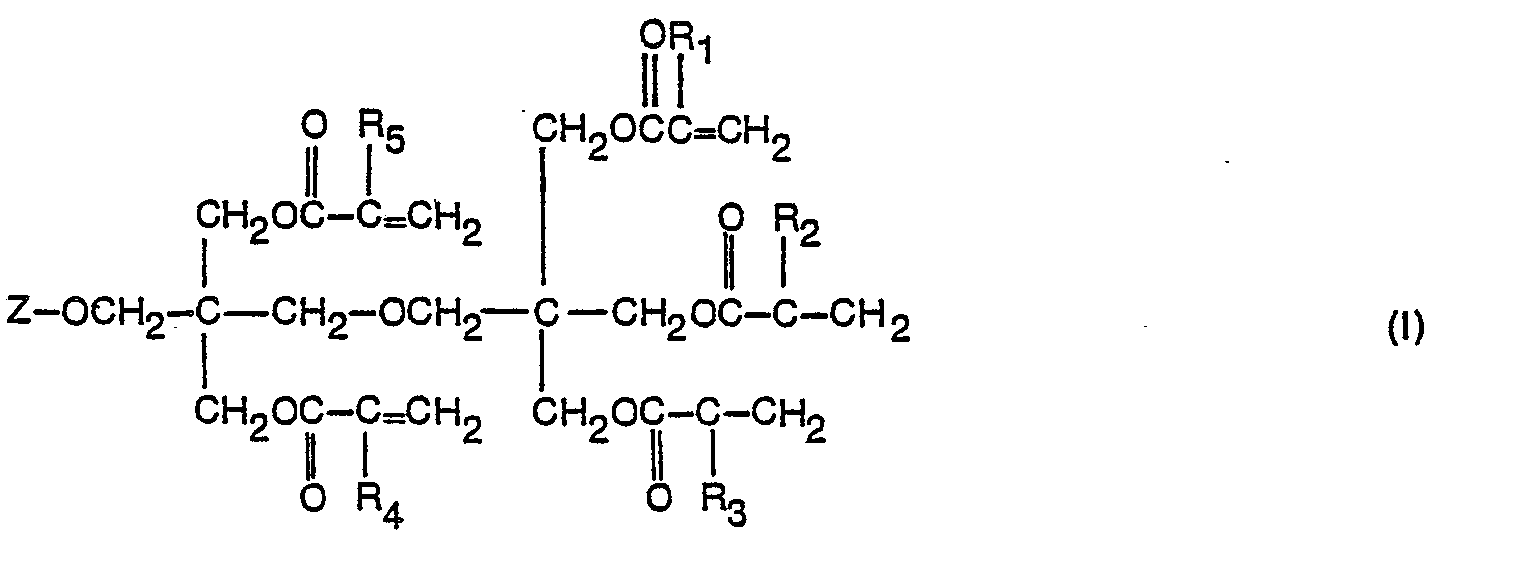
- According to the present invention, the said purposes and merits could be achieved by a resin-forming material suitable for medical or dental use comprising at least one compound having the formula (I):


- Compounds represented by the said formula (I) divide broadly into two classes, one is compounds represented by the following formula (II) and the other is compounds having the formula (III). Formula (II):


- According to the present invention at least one compound represented by the formula (II) or (III) can be used as a resin-forming material suitable for medical or dental use.
- In the present invention it is preferred to use, as the medical or dental resin-forming material, compositions comprising
- (1) 30-100% by weight of at least one compound having the following formula (II):

- (2) 0-70% by weight of at least one compound having the following formula (III):

- With the resin-forming material of the present invention the compound represented by the formula (II) should advantageously be mixed in proportions of preferably 30-95% by weight, more preferably 40―80% by weight and most preferably 45―70% by weight and the compound represented by the formula (III) in proportions of preferably 5-70% by weight, more preferably 20-60% by weight and most preferably 30-55% by weight. If the compound represented by the formula (II) is less than 30% by weight, viz., the compound represented by the formula (III) is in excess of 70% by weight, in the case, in particular, of using same as a dental filling material or restorative for a crown bridge, it tends to deteriorate in the bonding to teeth and operation.
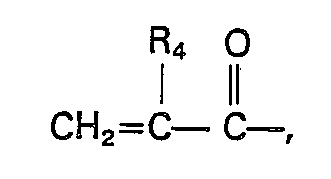
- In the instant invention, the said formulae (I), (II) and (III) wherein R1, R2, R3, R4, R5 and R6 are hydrogen or methyl, in particular, are preferred. In this case, most typically the respective R1, R2 and R3 in the formula (II) or the respective R1, R2, R3, R4, R5 and R6 in the formula (III) represent hydrogen or methyl. Not only that, but also those in which part of R1, R2, R3, R4, R5 and R6 represents hydrogen, whereas another part of them represents methyl, viz., mixed esters of acrylic acid and methacrylic acid, are also preferred.
- As typical examples of compounds represented by the formula (II) there are cited dipentaerythritol pentacrylate (DPE-5A) and dipentaerythritol pentamethacrylate (DPE-5M), for instance. As typical examples of compounds represented by the formula (III) there are cited dipentaerythritol hexacrylate (DPE-6A) and dipentaerythritol hexamethacrylate (DPE-6M), for instance.
- Conventionally, as already mentioned, it is known to use triacrylate or trimethylacrylate esters of trimethylolpropane, but the compound of the said formula (II) used in the present invention is characterized by possessing another methylol group (-CH20H), compared to those pentacrylate or pentamethacrylate esters, and the compound of the said formula (II) is characterized in that it is a hexafunctional acrylate or methacrylate ester.
- The compound of the said formula (III) is excellent in bonding to the hard tissue of the human body caused by the effect of the four methylol groups and by using such compound of the formula (II) and compound of the formula (III) in combination. In particular, a resin for medical or dental use can be advantageously formed which is excellent in bonding to the hard tissue of the human body as well as in the compressive strength.
- In the case, further, of using a combination of the compound of formula (II) and the compound of formula (III), the composite resin formed therefrom is excellent in water resistance and slight in tissue irritation besides the aforementioned characteristics and show very excellent operation on the occasion of its practical use.
- On top of that, the compounds of the present invention represented by the formulae (II) and (III) can be used in combination with other polymerizable monomers, such as conventionally known resin-forming monomers for medical or dental use. In this case, the amount in which the other monomers are incorporated is 0-90% by weight, more preferably 60% by weight or less and most preferably 20% by weight or less. Other monomers, however, may be present in the amount of 60-90% by weight on the occasion that the compounds of the formulas (II) and (III) are used for the purpose of reinforcing physical properties of cured products or of improving operation as a reactive dilulent or viscosity controller for other monomers. In this connection, as typical examples of the polymerizable monomers referred to here, there can be cited not only the known monomers, such as bismethacryloxyethoxydiphenylpropane, bis-GMA, bisphenol-A dimethacrylate, neopentylglycol dimethacrylate, diethyleneglycol dimethacrylate, triethyleneglycol dimethacrylate, and 2-hydroxyethyl methacrylate but also the compounds which are represented by the following formula (IV):


- The tetramethylolmethane tri- or tetra-acrylate or -methacrylate represented by the above formula IV, as mentioned in the said United States Patent Application Serial No. 138,814 and European Patent Application No. 80101964.7 specifications, is very superior as the dental resin-forming monomer. The monomer of the formula IV, however, is, in itself, generally low in viscosity, entailing such drawbacks as to cause the setting of a part of the filler when preserved in admixture with inorganic fillers.
- On the other hand, a blend of 60-90% by weight of the monomer of the formula IV and 40-10% by weight of the monomer (dipentaerythritol penta- or hexa-acrylate or -methacrylate) having the aforesaid formula I of the present invention, as the hereinafter-described Table 7 shows, does not cause the setting of the filler even if preserved, with its much better operation, due to its adequate viscosity and a very excellent dental resin-forming material is formed from this blended monomer composition.
- In the case of using the monomer of the formula I of the present invention in combination with the monomer of the said formula IV in this manner, it is particularly preferred to use a mixture of 45-70% by weight of the monomer of the formula II and 55-30% by weight of the monomer of the formula III. If such mixture of monomers of the formula II and of the formula III is used in admixture with the monomer of the formula IV, besides the aforesaid advantages, there can be gained such advantage that when it is cured, the uncured percentage of the monomer concerned in the surface portion where such cured product comes in contact with air is reduced to a much lower value.
- The resin-forming material of the present invention, in its practical use, should usually be used as a composition in admixture with a catalyst for causing the polymerization of the compound of the formula (II) and/or compound of the formula (III) and an activator for accelerating the formation of free radicals by the reaction with such a catalyst.
- Furthermore, the compounds of the formula (II) and/or formula (111) can be used in combination with any inorganic fillers for medical or dental use which are non-toxious to the human body and have a great hardness, such as powdered quartz, powdered glass, glass beads, powdered aluminum oxide, borosilicate glass, barium glass, hydroxy apatite and alumino silicate, in addition to the catalyst and activator. These inorganic fillers, although it differs according to use, should preferably have a Mohs' scale of hardness of at least 5 and, preferably, at least 6. In this case, however, the physical properties, as a material for medical or dental use, are much better if the resin-forming material is used in combination with metal nitride. The said inorganic filler should preferably account for 30-95% by weight, more preferably 50-90% by weight, and most preferably 70-90% by weight, based on the total amount of the composition of the filler and the resin-forming compound (monomer) such as compound of the formula (II) or (III).
- If the inorganic filler is pretreated with a keying agent, such as y-methacryloxypropyltrimethoxysilane, vinyltriethoxysilane and so forth, the bond between the formed resin and the inorganic filler will be intensified and the physical properties as a material for medical or dental use will be further improved.
- The monomer of the present invention represented by the said formula (II) or (III) is readily polymerized and cured by means of a catalyst. On this occasion, the application of heat often does harm to the human body and it is preferred to divide the said monomer, into two, liquid portions, one containing a catalyst and the other containing an activator, in such a manner that the monomer can be cured at normal temperature by mixing both liquids immediately prior to use.
- As the catalyst, peroxide is preferred and it should preferably be used in combination with the activator. As the peroxide catalyst, there can be cited, for instance, diacyl peroxides, such as benzoyl peroxide, parachlorobenzoyl peroxide, 2,4-dichlorobenzoyl peroxide, acetyl peroxide, and lauroyl peroxide, hydroperoxides, such as tertiary butyl hydroperoxide, cumene hydroperoxide, and 2,5-dimethylhexane-2,5-dihydroperoxide, ketone peroxides, such as methyl ethyl ketone peroxide, peroxycarbonates, such as tertiary butyl peroxybenzoate.
- These peroxide catalysts should preferably be used in proportions of 0.1-2.5% by weight based on the total weight of the polymerizable monomers of the present invention represented by the said formula (11) or (III).
- As the activator capable of use in combination with the peroxide, there can be cited, for instance, tertiary amines, such as N,N - bis - (2 - hydroxyethyl) - 4 - methylaniline, N,N - bis - (2 - hydroxyethyl) - 3,4-dimethylaniline, N,N - bis - (2 - hydroxyethyl) - 3,5 - dimethylaniline, N - methyl - N - (2 - hydroxyethyl) - 4-methylaniline, 4 - methylaniline, N,N - dimethyl - p - toluidine, N,N - dimethylaniline, and triethanolamine, and in addition, transition metal ions, such as cobalt naphthenate, and cobalt octanate, amine salts of p-toluenesulphonic acids and sulphinic acids.
- These activators can generally be used in proportions of 0:1 to 2.5% by weight based on the total weight of the said polymerizable monomers.
- The monomer of the present invention can also be polymerized and cured by irradiation of ultraviolet rays. In this case, it is not necessary to formulate the composition into the said two-liquid form and it is preferred to use a photosensitizer in the amount of 0.1-10% by weight based on the total weight of the polymerizable monomers. As the photosensitizer, there can be cited, for instance, carbonyl compounds, such as benzoin, benzoin methyl ether, benzoin ethyl ether, acetoin benzophenone, p-chlorobenzophenone, and p-methoxybenzophenone, sulphur compounds, such as tetramethylthiuranium monosul- phide, and tetramethylthiuranium disulphide, azo compounds, such as azobisisobutyronitrile, and azobis-2,4-dimethylvaleronitrile peroxide compounds, such as benzoyl peroxide, and tertiary butyl peroxide.
- For the enhancement of the preservability of the resin composition, it is effective to add an UV absorber such as benzophenone type compound, such as 2-hydroxy-4-methylbenzophenone, in an amount of 0.5-2.0 parts by weight, based on 100 parts by weight of the resin composition, or a stabilizer generally called a free radical inhibitor, such as p-methoxyphenol, and 2,5-ditert.-butyl-4-methylphenol, in an amount of 0.05-0.20 part by weight, based on 100 parts by weight of the resin composition.
- For a method of using such resin compositions, it is very convenient to prepare in advance a first paste- like substance (paste A) comprising an inorganic filler, resin composition and activator and a second paste- like substance (paste B) comprising an inorganic filler, resin composition and catalyst, for instance, since the polymerization is initiated upon mixing these two pastes when used by doctors.
- In the case of using such material in the restoration of the hard tissue of the human body, such as teeth and bones, the said material possesses sufficient bonding to the hard tissue, but it is also effective to apply the said material after precoating the hard tissue with a bonding agent in ordinary use, such as 2-hydroxy ethylmethacrylate, for the purpose of improving the bonding to the hard tissue. As the said bonding agent, the subject matter of another co-pending Patent Application filed claiming the priorities based on Japanese Patent Application No. 54-44751, United States Patent No. 138814 and European Patent No. 80101965.4 discovered by the instant inventors, can be very effectively used, which bonding agent consists predominantly of a composition comprising 50-99.5% by weight of polymerizable acrylate esters and/or methacrylate esters having hydrophilic groups comprising carboxyl, epoxy, amino or hydroxyl, and 0.5-50% by weight of at least one member of organic metal compounds selected from the group consisting of alkoxy-containing titanium compounds and silicon compounds.
- Thus, according to the present invention there can be obtained resin compositions suitable for medical or dental use which are extremely excellent in various physical properties after curing, such as hardness, compressive strength, abrasion resistance, weak in tissue irritation and good in bonding to the hard tissue of the human body and on top of that, excellent in operation in practical use.
- Further, the resin-forming material of the present invention can be advantageously used, in medical or dental use, not only as a material for bone cement and artificial bones in the orthopedic surgery and restorative surgery field, but also as a restorative material for crown bridges, core material for crowns, dental cement, filling material, cavity lining material, root canal filling material and so on, in the operative dentistry and prosthetic dentistry field in particular.
- The present invention will be specifically explained with the reference to working examples as follows. Unless otherwise specified, "part" and "%" in the examples mean "part by weight" and "% by weight." Further, in the examples the composition of the resin-forming material (monomer) and filler prior to curing treatment is called the "composite resin" for short for convenience's sake.
- In this connection, in the examples the method for the preparation of the composite resin and methods for the measurement of compressive strength, abrasion, water sorption, hardness, toothbrush abrasion, coloring, linear thermal expansion coefficient, and tensile strength follow the hereinafter-described procedures.
- 100 gr. of powdery filler classified to a particle size of 50 microns or less was mixed in an aqueous solution obtained by vigorously mixing 10 g of y-methacryloxypropyltrimethoxysilane and 1 ml of acetic acid with agitation by addition of 200 ml of water and the powdery filler was separated after agitation. Powdery filler so separated was dried in a hot air dryer held at 105°C for 24 hours whereby a silane-treated filler was prepared.
- In the Examples, the fillers were all treated with silane and then used.
- Monomer was divided into two equal parts, one monomer was incorporated with a polymerization activator and the filler prepared by the procedure of (1 )-1 above (hereinafter called Paste A for short) and the other monomer was incorporated with a catalyst and a filler prepared by the procedure of (1 )-1 (hereinafter called Paste B for short).
- In the Examples, N,N-bis-(2-hydroxyethyl)-4-methylaniline was used as the activator and=benzoyl peroxide was used as the catalyst.
- For the amount in which the activator was mixed to Paste A and the amount in which the catalyst was mixed to Paste B, they were formulated in such a manner that curing should occur about 3 minutes after mixing Paste A and Paste B.
- Paste A and Paste B were taken each in equal amounts, mixed and kneaded together on a kneading paper at room temperature for 30 seconds whereby a composite resin was prepared.
(2) Measurement of compressive strength: - Based on American Dental Association (ADA) Specification No. 9 for Dental Silicate Cement, compressive strength was measured by the following procedures.
- Composite resin was loaded in a mould, sealed with sheeted glass, then placed in a pressure vessel and left to stand under an atmosphere of 37°C and relative humidity of 100% for 15 minutes. The cured composite resin was taken out from the mould and immersed in water held at 37°C for 24 hours whereby specimens were prepared. By using an Instron tester, the specimens were pressed at conditions of press rate of 0.2 mm/min. to determine their compressive strength.
- Cured composite resin loaded in and taken out from the mould by following the procedures set forth in section of "(2) Measurement of compressive strength" was used as specimens for measurement of abrasion loss. The specimens were dried in a hot air dryer held at 100°C for 24 hours and then cooled in a desiccator for one hour and weighed. The specimens were placed in a cylindrical metal ball mill with an inner capacity of 500 ml and inner diameter of 10 cm and simultaneously, 20 stainless steel balls of 1 mm diameter and 200 ml of polishing paste prepared by adding 900 parts by weight of distilled water to 200 parts by weight of powdered Si3N4 passing through a 325 mesh sieve, as a polishing material, were loaded the ball mill was, sealed and then rotated at a rate of 100 r.p.m. for 78 hours. After it was finished, the specimens were washed with water, dried in the hot air dryer held at 100°C for 24 hours and cooled in the desiccator for another one hour and weighed. Abrasion loss was calculated according to the following eauation:

- Based on American Dental Association (ADA) Specification No. 27 for Direct Filling Resins, the amount of water absorbed was measured by the following procedure.
- Composite resin was cured to prepare a disk specimen 20 mm across and 1 mm thick. The specimen was left to stand in a constant temperature dryer held at 37°C, then placed in the desiccator, cooled for one hour and weighed. Value when a constant quantity was reached with repetition of this operation was set as dry weight. Then, the specimen was immersed in water held at 37°C for 7 days, then taken out, the water on the surface was wiped off with soft gauze and the specimen was weighed to determine the weight of water absorbed. The amount of water absorbed was calculated by the following equation:
-

- Measurement was made of Knoop hardness by means of a microhardness tester of Shimazu make. Composite resin was cured to prepare a columnar specimen 10 mm across and 5 mm high and a load of 900 g was applied on the flat surface of the specimen for 15 minutes. The length of the dent formed on the surface of the specimen was measured to determine the Knoop hardness.
- Composite resin was cured to prepare and fix a columnar specimen 13 mm across and 4 mm high. A commercially available toothbrush with a load of 200 g was applied to the flat portion of the specimen and this toothbrush was reciprocated at a stroke of 2 reciprocations/second to polish the specimen surface. In the meantime, a solution prepared by diluting 150 g of commercially available toothpaste to 1/2 with water was continuously added dropwise. After 8 hours the specimen was washed with water, dried and weighed. Rate of toothbrush abrasion loss was calculated by the following equation.

- Disked test pieces 13 mm across and 4 mm high were surface-polished with No. 800 emery paper and then immersed in commercially available aqueous coffee solution (solution obtained by dissolving 2.5 g of powdered coffee in 100 ml of water) at 37°C for 4 days. The specimens were washed with water, dried and then their color was measured by means of a colorimeter, a product of Nippon Denshoku Kogyo Company, to read the values L, a and b. Likewise, the values Lo, ao and bo, which were the measured color values of the specimen surfaces prior to immersing into the coffee solution, were read, the degree of discoloration AE was calculated by the following equation and AE was set as a basis for coloring. The greater is the value of AE, the greater is the degree of discoloration. This test was also effected on the surface of the unpolished specimen.

- Composite resin was enclosed in a glass tube 5 mm in diameter and 20 mm in length, the opening of the tube was sealed with a cover glass for microscope, left to stand at room temperature for 15 minutes and then the cured composite resin was taken out from the glass tube whereby specimens for measurement were prepared.
- Measurement was made of the linear thermal expansion coefficient of the specimens so prepared by means of linear thermal expansion measuring instrument, a product of Rigaku Denki Company. In making the measurements, the heating and temperature raising rate was set at 5°C/min.
- Based on pressure tear test according to ADA Specification No. 27 for the diametrial method, the tensile strength was measured by the following procedure.
- Composite resin was loaded in a stainless steel mould 6 mmin inner diameter and 3 mm in height and the opening of the mould was sealed with a cover glass for a microscope. The mould was left to stand under an atmosphere of 37°C and relative humidity of 95% for 15 minutes. After that, the cured composite resin was taken out from the mould. This cured composite resin was polished by use of powdered SiC and then immersed in the water held at 37°C for 24 hours whereby specimens for measurement were prepared.
- Tensile strength of the specimens so prepared was measured by means of an Instron tension tester. In making the measurements, the head press rate was set at 1 cm/min.
- A fresh anterior bovine tooth implanted into a square rod made of acryl resin was polished with emery paper until the dentin was exposed, and further polished and finished with No. 800 emery paper for the formation of a contact surface whereby there was prepared a testpiece of material for the bonding test with the bovine dentin. This bonding testpiece was stored in water. It was taken out from the water immediately before the measurement was made. The surface of the testpiece was well wiped off and further dried in a weak air stream. Then, the bonding surface of the bovine dentin was coated with composite resin and the square rod made of acryl resin was stuck and pressed against the coated surface. It was left to stand at room temperature for 15 minutes and then immersed in water held at 37°C for 24 hours. Both ends of the acryl resin square rods of the specimen were pulled apart at a rate of 1 mm/min. to determine the bonding strength. The bonding strength was indicated by the maximum value and the minimum value of measured numericals when measuring the respective specimens for every 20 testpieces.
- A fresh anterior bovine tooth implanted in a square rod made of acryl resin was polished and leveled with emery paper, and further polished and finished with No. 800 emery paper for the formation of a bonding surface whereby there was prepared a testpiece of material for the bonding test with the bovine enamel. This bonding testpiece was stored in water. It was taken out from the water immediately before the measurement was made. The surface of the testpiece was well wiped off and etched with 50% aqueous phosphate solution for one minute. It was successively washed with water and air dried using a weak air stream. Using the testpiece of material for the bonding test with the bovine enamel so prepared, its bonding strength was measured following the same procedure as in the case of the measurement of the bonding strength with the bovine dentin and the measured values were indicated in the same manner.
- Silane-treated α-SiO2 was prepared following the procedure for the preparation offiller in section (1)-1. Then, using mixed monomers, as the monomer component, prepared by mixing dipentaerythritol pentacrylate (DPE-5A) and dipentaerythritol hexacrylate (DPE-6A) in proportions of 55:45 (by weight ratio), silane-treated a-Si02, catalyst and activator, the mixed monomer was divided into two equal parts for the preparation of Paste AI-1 and Paste BI-1 of the following compositions according to the procedure for the preparation of monomer paste in section (1)-2.
- Paste AI-1 and Paste BI-1 so prepared were taken each in equal amounts, mixed and kneaded together on kneading paper at room temperature for 30 seconds whereby a composite resin was prepared.
- This composite resin was loaded in a stainless steel pipe with inner diameter of 10 mm and height of 5 mm at one end and the excess part was removed off with sheeted glass. An injection needle was stuck into the surface of the composite resin at intervals of 10 seconds at room temperature to measure the curing time. It was about 3 minutes long.


- Compressive strength, abrasion loss and bonding strength were measured of the composite resin and results were shown in Table 1.
- Paste A's and Paste B's of following compositions were formulated using various monomers conventionally known as resin-forming material for medical or dental use instead of the mixed monomer of DPE-5A and DPE-6A.


- These Paste A's and Paste B's corresponding to sub-numbers were taken each in equal amounts and various composite resins were prepared following the same procedures as the above. Compressive strengths, abrasion loss and bonding strengths were measured of these cured composite resins. Results were shown in Table 1:

- It follows from the above table that the composite resin (Run No. 1) comprising the monomer composition of DPE-5A(55)/DPE-6A(45) belonging to the present invention should be excellent in compressive strength, abrasion loss and bonding strength as compared to the composite resins of Run Nos. 2-5 comprising the monomer compositions of Bis-GMA/TEGDMA, Bis-MEPP/TEGDMA, NPGDMA or TMPTA conventionally known as resin-forming monomers for medical or dental use.
- Using, as the monomer, mixed monomers prepared by mixing DPE-5A and DPE-6A in various such proportions as indicated in Table 2, Paste A2 and Paste B2 of following compositions were prepared. Paste A2 and Paste B2 were mixed and kneaded together following the same procedure as set forth in Example 1 whereby composite resins were prepared.


- Compressive strength, abrasion loss, amount of water sorption and bonding to bovine tooth were measured of these cured composite resins. Results were shown in Table 2.

- It is noted from the above table that either pentacrylate (DPE-5A) or hexacrylate (DPE-6A) will suffice for the monomer constituting the composite resin of the present invention. The bonding strength value increases in proportion to the increased amount of DPE-5A mixed. For this reason it is conceived that because DPE-5A possesses one more methylol group (-CH20H) than the pentacrylate ester, this additional methylol group contributes to the bonding with the hard tissue of the human body.
- In the case of the mixed monomer using a combination of DPE-5A and DPE-6A and the mixed monomer prepared by mixing them together in proportions of 30-70 parts by weight of DPE-5A and 70-30 parts by weight of DPE-6A, in particular dental composite resin could be advantageously formed which is excellent in the bonding with the hard tissue of the human body with excellent compressive strength.
- In the case, further, of using DPE-5A and DPE-6A in combination, composite resin formed therefrom is found to show excellent water resistance besides the said characteristics.
- Composite resins were prepared following the same procedures of Example 1 except that there were used the mixed monomer of DPE-5A(551/DPE-6A(45) belonging to the present invention or conventionally known mixed monomer of BisGMA(80)/TEG(20) as the resin-forming monomer, given amounts of various inorganic metal oxides conventionally known as the dental inorganic filler listed in Table 3 below as the filler, catalyst and activator in such amounts as set forth in the Table 3. Comparative strength and abrasion loss were measured of these cured composite resins. Results were tabulated in Table 3.

- It is noted from the above table that if various metal oxides conventionally known as dental inorganic filler are used in combination with conventionally known Bis-GMA type monomers, they will not be fully satisfactory in the point of compressive strength and abrasion resistance, whereas the monomer belonging to the present invention, even if used in combination with these metal oxides, will show fully satisfactory compressive strength and abrasion resistance.
- Using, as the composite resin-forming monomer, DPE-5A(55)/DPE-6A(45) or dipentaerythritol pentamethacrylate (DPE-5M)(55)/dipentaerythritol hexamethacrylate (DPE-6M)(45) Paste A 4-1, B 4-1 and Paste A 4-2 and B 4-2 of following compositions were prepared. Following the same procedure as that of Example 1 these pastes were mixed for the preparation of composite resins.


- Compressive strength, abrasion loss and amount of water sorption were measured of these cured composite resin results were tabulated in Table 4.

- It follows from the above table that if DPE-5M(55)/DPE-6M(45) is to be substituted for DPE-5A(55)/DPE-6A(45) as the composite resin-forming monomer, the dental material obtained will have equally excellent physical properties in the compressive strength, abrasion loss and amount of water sorption. That is, it is noted there that not only dipentaerythritol penta- or hexa-acrylate, but also dipentaerythritol penta- or hexa-methacrylate should be preferred as the composite resin-forming monomer of the present invention.
- Using, as the composite resin-forming monomer, mixed monomers comprising a combination of DPE-5A and DPE-6A belonging to the present invention and conventionally known dental resin-forming monomers Paste A 5-1, B 5-1 and Paste A 5-2 and B 5-2 were prepared. Following the same procedure as that of Example 1 these pastes were mixed for the preparation of composite resins.


- Compressive strength and abrasion loss were measured of these cured composite resins and results were tabulated in Table 5.
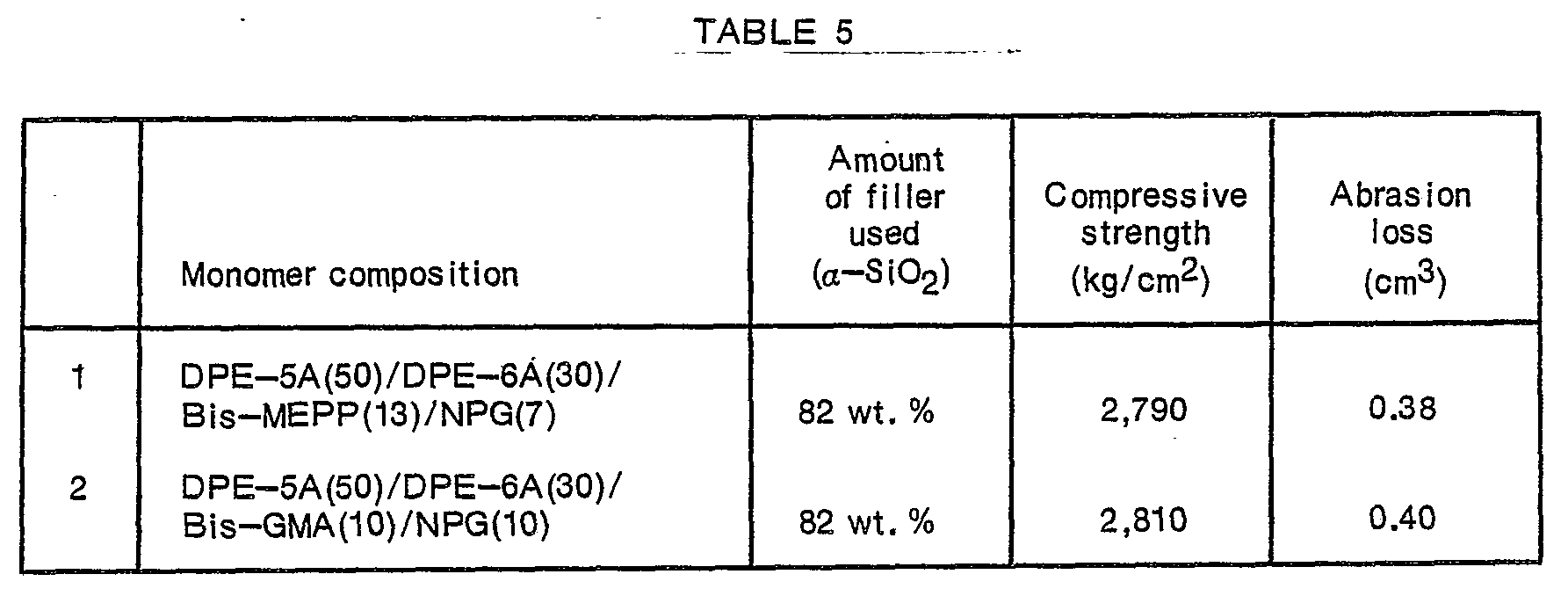
- It is noticed from the above table that the cured composite resins using mixed monomers prepared by mixing about 20% by weight of conventionally known dental resin-forming monomers, such as Bis-MEPP, NPG, Bis-GMA and so on, to the composite resin-forming monomer belonging to the present invention should also be valuable as dental material in terms of their physical property values. They did not give rise to any compatibility problem.
- Pastes A 6―1, B 6―1, A 6―2, B 6―2, A 6―3, B 6―3, A 6―4 and B 6―4 of the following compositions were prepared using, as the composite resin-forming monomer, mixed monomers prepared by incorporating a given amount of DPE-5A(11)/DPE-6A(9) belonging to the present invention or of conventionally known TEGDMA or NPEDMA into a given amount of conventionally known Bis-GMA or TMPT. Following the same procedure as that of Example 1 these pastes were mixed and kneaded together for the preparation of composite resins.


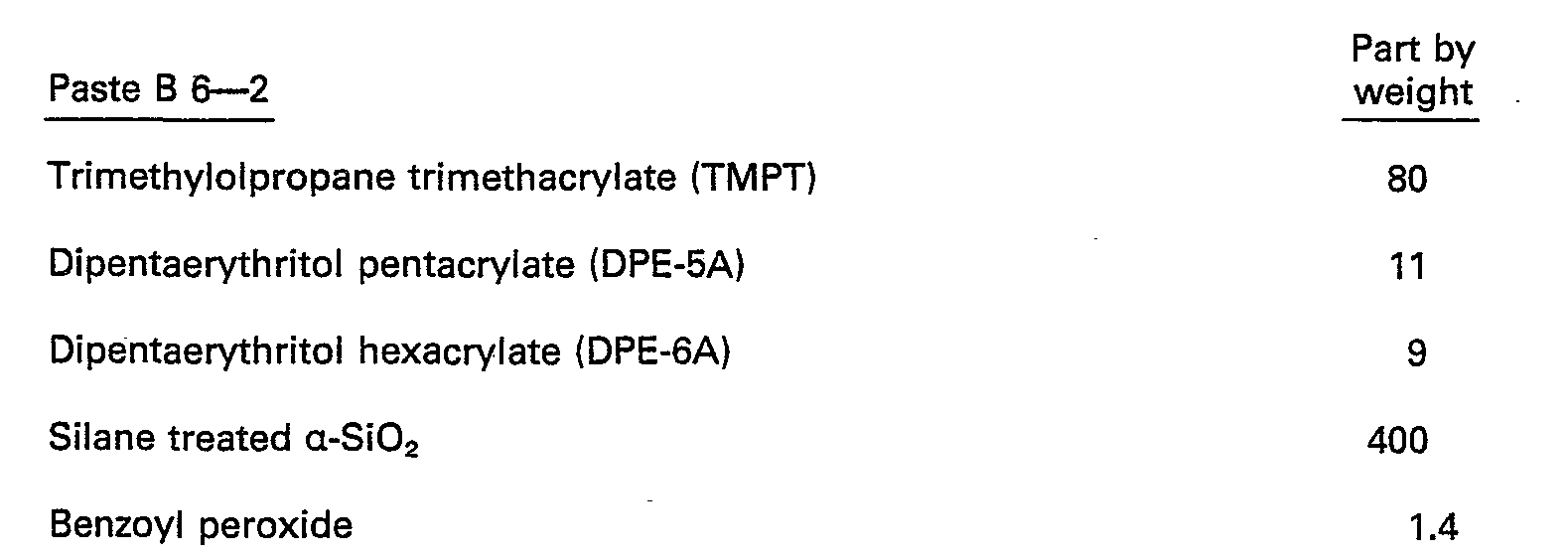


- Compressive strength, abrasion loss and bonding strength to bovine enamel were measured of these cured composite resins. Results were tabulated in Table 6.
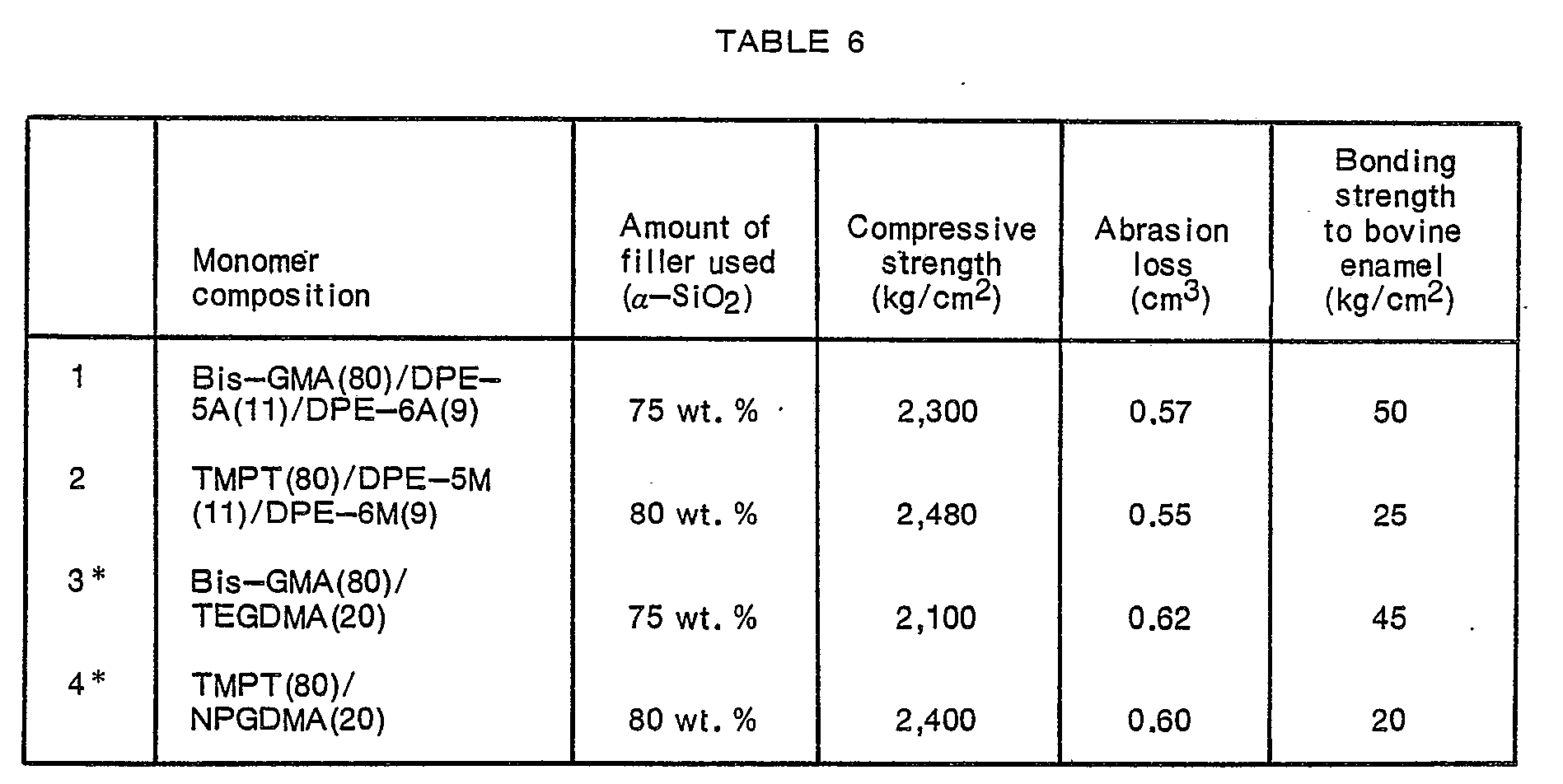
- It is noted from the above table that the composite resins using mixed monomers prepared by mixing the resin-forming monomers belonging to the present invention in the order of 20% by weight as the reactive viscosity controller to the conventionally known dental resin-forming monomers, such as Bis-GMA and TMPT and so on, produce reinforced effects in the aspects of compressive strength, abrasion resistance and bondability to teeth as compared with the composite resins using the same amounts of the conventionally known reactive viscosity controllers, TEGDMA and NPGDMA. Further, the composite resin using the mixed monomer prepared by incorporating NPGDMA of very low viscosity into the low viscosity resin-forming monomer, such as TMPT, is liable to cause the setting of filler and is no good in homogeneity of paste, but in the case of incorporating with the resin-forming monomer of relatively high viscosity belonging to the present invention, the homogeneity of paste is improved.
- Pastes A 7-1, B 7-1, A 7-2, B 7-2, A 7-3, B 7-3, A 7-4, B 7-4 , A 7-5 and B 7-5 of the following compositions were prepared using, as the composite resin-forming monomer, mixed monomers prepared by mixing a given amount of DPE-5A(45)/DPE-6A(55) belonging to the present invention to mixture of tetramethylolmethane trimethacrylate (TMM-3M) and tetramethylolmethane tetramethacrylate (TMM-4M) in mix proportions of TMM-3M/ TMM-4M = 45/55, belonging to the resin-forming monomer in another copending application filed by the instant inventors. Further, 2,5-di-tert-butyl-4-methylphenol (BHT) was incorporated, as a polymerisation inhibitor, into the respective pastes B.
- By following the same procedure as that of Example 1 these pastes were mixed and kneaded together for the preparation of composite resins.


- Compressive strength and abrasion loss were measured of these cured composite resins while at the same time, preservation stability tests were attempted for the respective pastes. That is, observations were made of filler setting condition after it was preserved at room temperature for three months. Results were tabulated in Table 7.

- It is noted from the above table that by incorporating at least 10% by weight of DPE-5A(45)/DPE-6A(55) belonging to the present invention into TMM-3M(45)/TMM-4M(55) belonging to the resin-forming monomer in another copending application, discovered by the instant inventors a long-term preservation stability could be achieved in paste condition without impairing high compressive strength and superior abrasion resistance which are observed in the composite resin using TMM-3M(45)/TMM-4M(55) alone.
- Using, as the composite resin-forming monomer, mixed monomer prepared by mixing DPE-5A and DPE-6A belonging to the present invention is proportions of 55:45 (by weight ratio) and as the powdery filler, conventionally known metal oxide or metal nitride belonging to the present invention in such given amounts as indicated in the following Table 8 Paste A 8 and Paste B 8 of following compositions were prepared.


- Compressive strength and abrasion loss were measured of these cured composite resins. Results were tabulated in Table 8.

- It follows from the above table that when making comparisons of compressive strength and abrasion loss between the cured composite resins (Run Nos. 2, 3, 11 and 12) prepared by combining a-Si02 or AI203, being conventionally known filler, with DPE-5A(55)/DPE-6A(45), being the monomer of the present invention, and the cured composite resins (Run Nos. 1, 4-10) in combination with the metal nitride with a Mohs' scale of hardness of 7 or more, the filler of the present invention, the latter ones should be better in the compressive strength and abrasion loss.
- It is also noted there that with the cured composite resins using, as the filler, the metal nitride BN, NV and Si3N4 with a Mohs' scale of hardess of 9 or more show exceptionally high compressive strength and abrasion resistance and that they should be suited to use as crown bridge restoratives or filling materials in molars.
- It also follows from comparisons between Run Nos. 1 and 4, between Run Nos. 2 and 11 between Run Nos. 3 and 12 that the compressive strength and abrasion resistance both are enhanced in proportions to the amount of filler used.
- Composite resins were prepared by using as the composite resin-forming monomer, DPE-5A(55)/DPE-6A(45) belonging to the present invention, conventionally known Bis-GMA(80)/TEGDMA(20) and DPE-5A(44)/DPE-6A(36)/Bis-MEPP(20), as the powdery filler, those fillers mentioned in the following Table 9 in given amounts and further, the activator and the catalyst each in given amounts mentioned in the Table 9. Compressive strength and abrasion loss were measured of these cured composite resins. Results were tabulated in Table 9.

- In the comparisons of the compressive strength as well as the abrasion loss with the cured composite resin (Run No. 6) with a combination of conventionally known monomer Bis-GMA(80)/TEG(20) and known filler a-Si02 a first glance at the above table shows that by making the composite resin-forming material by combining the monomer containing 80% or more of DPE-5A(55)/DPE-6A(45), the monomer of the present invention, with SiN4, ZrN or TiN, the metal nitride, the composite resin formed should have specifically excellent compressive strength and abrasion resistance.
- When comparing the amounts in which the filler can be combined with the composite resin-forming monomer in such a range as not to give rise to the operation problem of the composite resin paste, the monomer containing 80% or more of DPE-5A(55)/DPE-6A(45), the monomer of the present invention, could be incorporated with the filler in greater amounts than the Bis-GMA(80)/TEG(20). This is conceived to be attributed to the difference in the fluid characteristics of the monomer. As is clear from a comparison between Run No. 1 and Run No. 2, because the compressive strength and abrasion resistance increase in proportion to the amount of filler used, obviously the composite resin having a higher compressive strength and abrasion resistance could be obtained when using, as the composite resin-forming material, the monomer of the present invention capable of incorporating a great deal of filler without causing trouble in the operation.
- DPE-5A/DPE-6A, the typical example of the present invention, and conventionally known Bis-GMA/ TEGDMA, as the composite resin-forming monomer, and Si3N4 and conventionally known a-Si02, as the filler were chosen and these monomers and fillers were combined together, considering the operation of composite resin pastes, whereby Paste A 10-1 to A 10-3 and Paste B 10-1 to B 10-3 were prepared.


- Compressive strength, abrasion loss, toothbrush abrasion loss, linear thermal expansion coefficient, Knoop hardness, tensile strength, coloring property and bonding strength were measured of these various cured composite resins. Results were tabulated in Table 10.

- It follows from the above table that the composite resins belonging to the present invention (Run Nos. 1-2), as compared to the composite resin (Run No. 3) prepared by combining together the conventionally known composite resin-forming monomer and filler, have such characteristic features as to be less in the linear thermal expansion coefficient as well as in toothbrush abrasion loss and discoloration or the like, besides markedly excellent mechanical strengths, such as compressive strength, abrasion resistance, Knoop hardness, tensile strength and so on, and markedly excellent bonding to the hard tissue of the human body, and can be advantageously used as medical or dental material. These excellent properties of the composite resins of the present invention are particularly marked in the composite resin (Run No. 1) with a combination of the monomer of the present invention and the filler of the present invention and these composite resins are applicable to molars requiring markedly high mechanical strengths.
- In the column of bonding strength to the bovine enamel in the above table, (1) indicates bonding strength when applying the composite resin as such to the bovine enamel and (2) indicates the bonding strength when coating the bovine enamel surface with a mixture of equal amounts of bonding agents A and B of following compositions found anew by the instant inventors and set forth in another copending Patent Application filed claiming the priority based on Japanese Patent Application No. 54-44751, followed by application of the composite resin. It is noted from a comparison of bonding strengths to the bovine enamel in (1) and (2) of Run No. 2 that it is very effective in the point of bondability if the composite resin is applied after precoating the hard tissue of the human body with the said bonding agent.


- Composite resins were prepared by following the same procedure as that of Example 1, using, as the composite resin-forming monomer, DPE-5A(55)/DPE-6A(45) and as the powdered filler, various fillers mentioned hereinafter either alone or in admixture. The following are compositions of the respective pastes used in the preparation of the composite resins.


- Compressive strength and abrasion loss were measured of these cured composite resin products, while at the same time, paste stability was observed of the respective pastes under preservation at 40°C. Results were tabulated in Table 11.

- It is noted from the above table that when using the metal nitride in paste A and the known filler a-Si02 or AI203 in paste B in preparing the composite resin by filling the monomer of the present invention with the inorganic filler, as compared with the case of using the metal nitride in both pastes A and B, the composite resin obtained is somewhat inferior in compressive strength or abrasion resistance, but improves in preservability of paste B. That is, this implies that very useful composite resins could be obtained by using the metal nitride in combination with the conventionally known a-Si02 in the monomer of the present invention.
- Paste A 10-1 and Paste B 10-1 and Paste A 10-2 and Paste 10-2 mentioned in Example 10 were added respectively in equal amounts for the preparation of composite resins of Run Nos. 1 and 2 in the following Table 12. By using them cytotoxicity tests by tissue culture were conducted.
- The composite resin was enclosed in a glass tube with a surface area of 28.3 mm2, the specimen immediately after curing was immersed in 5 ml of culture medium (199) and rotated at a rate of 200 r.p.m. at 37°C for 24 hours and then 1 ml of the medium was interacted with L-cells (3.4 x 10⁴) to count cell numbers after 2 days and after 4 days. Results were shown in Table 12.
- Likewise, cytotoxicity tests were conducted on the composite resin comprising Paste A 1-2 and Paste B 1-2 of Example 1' and results were also tabulated in Table 12.

- It is noted from the above table that the cell multiplication inhibitory action shown by both the composite resins (Run No. 1 and Run No. 2 in Table 12) of the present invention is equivalent to, or even less than, that of the Bis-GMA type composite resin (Run No. 3 in Table 12, identified as Run No. 2 in Table 1) which is regarded as relatively low in tissue irritation as compared with the spot cure type resins.
- Surface uncured percent was measured by following procedures.
- About 0.58 g each of paste A and paste B were taken and kneaded together for 30 seconds. Then the mixture was raised and weighed (B) in the portion about 1 cm from the end of a kneading bar which was weighed in advance (A).
- Five (5) minutes after the beginning of kneading uncured layer on the surface of cured product was strongly wiped off by gauze for 30 seconds and then it was once again weighed (C). Uncured percent on the surface of cured product = uncured amount/specimen amount was figured out by the following equation:

- Further, this measurement was conducted under environment of 22 ± 0.5°C.
- Using, as the monomer, monomers obtained by mixing in various proportions as indicated in Table 13 below a mixed monomer of DPE-5A(55)/DPE-6A(45) belonging to the present invention and a mixed monomer of TMM-3A(60)/TMM-4A(40) belonging to the subject matter of Japanese Patent Application No. 55―41084, United States Patent Application Serial No. 138,814 and European Patent Application No. 80101964.7, separately discovered by the instant inventors, paste A 13 and paste B 13 were mixed in the same manner as in Example 1 whereby composite resins were prepared.


- Surface uncured percent after the curing of these composite resins were measured. Results were shown in Table 13.

- It is noted from the above table that the composite resin prepared by using, as the monomer, the mixed type monomer of DPE-5A(55)/DPE-6A(45) belonging to the present invention is superior in surface curability of cured product to the composite resin prepared by using, as the monomer, the mixed type monomer of TMM-3A(60)/TMM-4A(40) and that even on the occasion of using the mixed type monomer of DPE-5A(55)/DPE-6A(45) and TMM-3A(60)/TMM-4A(40), the surface curability of the cured composite resin is improved as mixed ratio of DPE-5A(55)/DPE-6A(55) is increased.
Claims (16)




Priority Applications (3)
| Application Number | Priority Date | Filing Date | Title |
|---|---|---|---|
| EP81109117A EP0077849B1 (en) | 1981-10-28 | 1981-10-28 | Resin-forming material and restorative material suitable for medical or dental use |
| US06/315,811 US4431421A (en) | 1981-10-28 | 1981-10-28 | Dental restorative composition |
| DE8181109117T DE3169085D1 (en) | 1981-10-28 | 1981-10-28 | Resin-forming material and restorative material suitable for medical or dental use |
Applications Claiming Priority (2)
| Application Number | Priority Date | Filing Date | Title |
|---|---|---|---|
| EP81109117A EP0077849B1 (en) | 1981-10-28 | 1981-10-28 | Resin-forming material and restorative material suitable for medical or dental use |
| US06/315,811 US4431421A (en) | 1981-10-28 | 1981-10-28 | Dental restorative composition |
Publications (2)
| Publication Number | Publication Date |
|---|---|
| EP0077849A1 EP0077849A1 (en) | 1983-05-04 |
| EP0077849B1 true EP0077849B1 (en) | 1985-02-20 |
Family
ID=26081279
Family Applications (1)
| Application Number | Title | Priority Date | Filing Date |
|---|---|---|---|
| EP81109117A Expired EP0077849B1 (en) | 1981-10-28 | 1981-10-28 | Resin-forming material and restorative material suitable for medical or dental use |
Country Status (2)
| Country | Link |
|---|---|
| US (1) | US4431421A (en) |
| EP (1) | EP0077849B1 (en) |
Families Citing this family (23)
| Publication number | Priority date | Publication date | Assignee | Title |
|---|---|---|---|---|
| US4500657A (en) * | 1982-08-02 | 1985-02-19 | Johnson & Johnson Dental Products Company | Dental restorative compositions having improved mechanical properties and hydrolytic stability |
| CA1326382C (en) * | 1986-05-08 | 1994-01-25 | John Steven Kelly | Ceramic orthodontic appliance |
| US5064369A (en) * | 1987-01-27 | 1991-11-12 | Tomy, Inc. | Orthodontic device |
| US4778834A (en) * | 1987-02-24 | 1988-10-18 | Sterling Drug Inc. | Hydroxylapatite-synthetic resin composites |
| US5034433A (en) * | 1990-04-10 | 1991-07-23 | Essential Dental Systems, Inc. | Composite dental cement composition containing titanium |
| DE4102627A1 (en) * | 1991-01-30 | 1992-08-06 | Bayer Ag | METHOD FOR PRODUCING NETWORKED DENTAL FORMKOERPER |
| US5998499A (en) | 1994-03-25 | 1999-12-07 | Dentsply G.M.B.H. | Liquid crystalline (meth)acrylate compounds, composition and method |
| US6369164B1 (en) | 1993-05-26 | 2002-04-09 | Dentsply G.M.B.H. | Polymerizable compounds and compositions |
| US20050043490A1 (en) * | 1993-05-26 | 2005-02-24 | Klee Joachim E. | Polymerizable compounds and compositions |
| US6353061B1 (en) | 1993-05-26 | 2002-03-05 | Dentsply Gmbh | α, ω-methacrylate terminated macromonomer compounds |
| US5502087A (en) * | 1993-06-23 | 1996-03-26 | Dentsply Research & Development Corp. | Dental composition, prosthesis, and method for making dental prosthesis |
| CA2146816A1 (en) * | 1994-04-22 | 1995-10-23 | Joachim E. Klee | Process and composition for preparing a dental polymer product |
| US5688883A (en) * | 1995-03-14 | 1997-11-18 | Dentsply Gmbh | Polymerizable composition |
| DE10018918C2 (en) * | 2000-04-17 | 2002-07-18 | 3M Espe Ag | catalyst component |
| US20050288387A1 (en) * | 2002-08-21 | 2005-12-29 | Li Feng | Acrylate dental compositions with improved viscosity and storage odor |
| US20040146833A1 (en) * | 2002-11-06 | 2004-07-29 | Dyer Scott R. | Construction of a dental prosthesis using bilaminar fiber reinforcement |
| JP4663225B2 (en) * | 2003-11-21 | 2011-04-06 | 株式会社ジーシー | Photopolymerization type dental surface coating material |
| US7217131B2 (en) * | 2004-11-26 | 2007-05-15 | Vuillemot William C | Method for dental restoration and kit |
| JP5242172B2 (en) * | 2005-02-08 | 2013-07-24 | デンツプライ インターナショナル インコーポレーテッド | Self-curing activator |
| EP2387735B1 (en) * | 2009-01-16 | 2019-03-13 | FujiFilm Electronic Materials USA, Inc. | Nonpolymeric binders for semiconductor substrate coatings |
| WO2011156806A1 (en) | 2010-06-11 | 2011-12-15 | Karl Edison Hegyi | Stents and method for dental restoration using same |
| EP2428199A1 (en) | 2010-09-09 | 2012-03-14 | 3M Innovative Properties Company | Curable composition, process of production and use thereof |
| US9078815B2 (en) | 2011-07-13 | 2015-07-14 | Dentsply International Inc. | Self-cure activator |
Family Cites Families (9)
| Publication number | Priority date | Publication date | Assignee | Title |
|---|---|---|---|---|
| US3066112A (en) * | 1959-01-30 | 1962-11-27 | Rafael L Bowen | Dental filling material comprising vinyl silane treated fused silica and a binder consisting of the reaction product of bis phenol and glycidyl acrylate |
| US3261686A (en) * | 1963-04-23 | 1966-07-19 | Du Pont | Photopolymerizable compositions and elements |
| CA878004A (en) * | 1968-06-14 | 1971-08-10 | Johnson And Johnson | Dental filling package |
| US3539533A (en) * | 1968-06-14 | 1970-11-10 | Johnson & Johnson | Dental filling material |
| US3835090A (en) * | 1972-02-03 | 1974-09-10 | Johnson & Johnson | Dental restorative cement compositions |
| JPS5994B2 (en) * | 1976-09-14 | 1984-01-05 | 富士写真フイルム株式会社 | photosensitive composition |
| US4200723A (en) * | 1977-07-12 | 1980-04-29 | Chen Chia Ming | Organic phenol extract compositions of peanut hull agricultural residues and method |
| US4327014A (en) * | 1979-04-11 | 1982-04-27 | Kanebo Ltd. | Resin-forming material, implant material and compositions for restorative material suitable for medical or dental use |
| JPS5713444A (en) * | 1980-06-27 | 1982-01-23 | Tamura Kaken Kk | Photosensitive composition |
-
1981
- 1981-10-28 US US06/315,811 patent/US4431421A/en not_active Expired - Lifetime
- 1981-10-28 EP EP81109117A patent/EP0077849B1/en not_active Expired
Also Published As
| Publication number | Publication date |
|---|---|
| US4431421A (en) | 1984-02-14 |
| EP0077849A1 (en) | 1983-05-04 |
Similar Documents
| Publication | Publication Date | Title |
|---|---|---|
| EP0017936B1 (en) | Compositions of restorative material especially suitable for dental filling material | |
| US4431421A (en) | Dental restorative composition | |
| Han et al. | Evaluation of physical properties and surface degradation of self-adhesive resin cements | |
| EP1269967B1 (en) | Dental composition kit | |
| JP4822617B2 (en) | Dental cement composition | |
| US6730715B2 (en) | Dental restorative composition, dental restoration, and a method of use thereof | |
| US20070197683A1 (en) | Self etch all purpose dental compositions, method of manufacture, and method of use thereof | |
| EP2764859A2 (en) | Dental resin modified glass-ionomer composition | |
| EP1749514A1 (en) | Silver-containing dental composition | |
| JPH08231330A (en) | Polymerizable dentistry material | |
| EP1033125A1 (en) | Relining material for dentures | |
| US5306338A (en) | Dental restoration composition | |
| US20080242761A1 (en) | Self etch all purpose dental compositions, method of manufacture, and method of use thereof | |
| US4486179A (en) | Biocompatible cementitious dental compositions | |
| JPH0243721B2 (en) | ||
| CA1340145C (en) | Pasty dental veneer material | |
| Uğurlu | Effects of surface coating on the flexural strength of fluoridereleasing restorative materials after water aging for one year | |
| EP1508321B1 (en) | Dental adhesive composition | |
| GB2094326A (en) | Resin-calcium hydroxide composite restorative dental material | |
| EP0036272B1 (en) | Permanent dental restorative compositions and methods of using them | |
| JP2022187437A (en) | 2 paste type dental curable composition | |
| CA1254336A (en) | Resin-forming material, implant material and compositions for restorative material suitable for medical or dental use | |
| Brauer et al. | Intermediate restoratives from n-hexyl vanillate-EBA-ZnO-glass composites | |
| EP1940342A2 (en) | Dental sealant compositions containing nanometer-sized silica | |
| JPH0224805B2 (en) |
Legal Events
| Date | Code | Title | Description |
|---|---|---|---|
| PUAI | Public reference made under article 153(3) epc to a published international application that has entered the european phase |
Free format text: ORIGINAL CODE: 0009012 |
|
| AK | Designated contracting states |
Designated state(s): DE FR GB IT |
|
| 17P | Request for examination filed |
Effective date: 19830629 |
|
| ITF | It: translation for a ep patent filed | ||
| GRAA | (expected) grant |
Free format text: ORIGINAL CODE: 0009210 |
|
| AK | Designated contracting states |
Designated state(s): DE FR GB IT |
|
| REF | Corresponds to: |
Ref document number: 3169085 Country of ref document: DE Date of ref document: 19850328 |
|
| ET | Fr: translation filed | ||
| PLBE | No opposition filed within time limit |
Free format text: ORIGINAL CODE: 0009261 |
|
| STAA | Information on the status of an ep patent application or granted ep patent |
Free format text: STATUS: NO OPPOSITION FILED WITHIN TIME LIMIT |
|
| 26N | No opposition filed | ||
| PG25 | Lapsed in a contracting state [announced via postgrant information from national office to epo] |
Ref country code: GB Effective date: 19881028 |
|
| PG25 | Lapsed in a contracting state [announced via postgrant information from national office to epo] |
Ref country code: FR Free format text: LAPSE BECAUSE OF NON-PAYMENT OF DUE FEES Effective date: 19890630 |
|
| PG25 | Lapsed in a contracting state [announced via postgrant information from national office to epo] |
Ref country code: DE Effective date: 19890701 |
|
| GBPC | Gb: european patent ceased through non-payment of renewal fee | ||
| REG | Reference to a national code |
Ref country code: FR Ref legal event code: ST |