EP0077064B1 - Photographic element comprising a layer containing a cross-linked polymer - Google Patents
Photographic element comprising a layer containing a cross-linked polymer Download PDFInfo
- Publication number
- EP0077064B1 EP0077064B1 EP82109403A EP82109403A EP0077064B1 EP 0077064 B1 EP0077064 B1 EP 0077064B1 EP 82109403 A EP82109403 A EP 82109403A EP 82109403 A EP82109403 A EP 82109403A EP 0077064 B1 EP0077064 B1 EP 0077064B1
- Authority
- EP
- European Patent Office
- Prior art keywords
- layer
- group
- dye image
- poly
- photographic element
- Prior art date
- Legal status (The legal status is an assumption and is not a legal conclusion. Google has not performed a legal analysis and makes no representation as to the accuracy of the status listed.)
- Expired
Links
- 229920006037 cross link polymer Polymers 0.000 title claims description 4
- -1 silver halide Chemical class 0.000 claims description 52
- 229910021645 metal ion Inorganic materials 0.000 claims description 31
- 239000000463 material Substances 0.000 claims description 23
- 229920000642 polymer Polymers 0.000 claims description 13
- 229910052709 silver Inorganic materials 0.000 claims description 11
- 239000004332 silver Substances 0.000 claims description 11
- 239000000839 emulsion Substances 0.000 claims description 10
- 239000000203 mixture Substances 0.000 claims description 10
- 125000001570 methylene group Chemical group [H]C([H])([*:1])[*:2] 0.000 claims description 7
- 125000000962 organic group Chemical group 0.000 claims description 5
- 125000003917 carbamoyl group Chemical group [H]N([H])C(*)=O 0.000 claims description 2
- 229910052739 hydrogen Inorganic materials 0.000 claims description 2
- 239000001257 hydrogen Substances 0.000 claims description 2
- 125000004435 hydrogen atom Chemical group [H]* 0.000 claims description 2
- 150000002500 ions Chemical class 0.000 claims description 2
- 125000002496 methyl group Chemical group [H]C([H])([H])* 0.000 claims description 2
- 239000004593 Epoxy Substances 0.000 claims 1
- 239000010410 layer Substances 0.000 description 95
- 239000000975 dye Substances 0.000 description 39
- 108010010803 Gelatin Proteins 0.000 description 34
- 229920000159 gelatin Polymers 0.000 description 34
- 239000008273 gelatin Substances 0.000 description 34
- 235000019322 gelatine Nutrition 0.000 description 34
- 235000011852 gelatine desserts Nutrition 0.000 description 34
- WSFSSNUMVMOOMR-UHFFFAOYSA-N Formaldehyde Chemical compound O=C WSFSSNUMVMOOMR-UHFFFAOYSA-N 0.000 description 24
- 150000001875 compounds Chemical class 0.000 description 21
- 238000000576 coating method Methods 0.000 description 18
- 239000011248 coating agent Substances 0.000 description 15
- 239000004848 polyfunctional curative Substances 0.000 description 14
- GWEVSGVZZGPLCZ-UHFFFAOYSA-N Titan oxide Chemical compound O=[Ti]=O GWEVSGVZZGPLCZ-UHFFFAOYSA-N 0.000 description 12
- 239000000178 monomer Substances 0.000 description 11
- KFDVPJUYSDEJTH-UHFFFAOYSA-N 4-ethenylpyridine Chemical compound C=CC1=CC=NC=C1 KFDVPJUYSDEJTH-UHFFFAOYSA-N 0.000 description 8
- OHJMTUPIZMNBFR-UHFFFAOYSA-N biuret Chemical compound NC(=O)NC(N)=O OHJMTUPIZMNBFR-UHFFFAOYSA-N 0.000 description 7
- 229920000139 polyethylene terephthalate Polymers 0.000 description 7
- 239000005020 polyethylene terephthalate Substances 0.000 description 7
- 238000006243 chemical reaction Methods 0.000 description 6
- AOPCKOPZYFFEDA-UHFFFAOYSA-N nickel(2+);dinitrate;hexahydrate Chemical compound O.O.O.O.O.O.[Ni+2].[O-][N+]([O-])=O.[O-][N+]([O-])=O AOPCKOPZYFFEDA-UHFFFAOYSA-N 0.000 description 6
- 238000012545 processing Methods 0.000 description 6
- IJHIIHORMWQZRQ-UHFFFAOYSA-N 1-(ethenylsulfonylmethylsulfonyl)ethene Chemical compound C=CS(=O)(=O)CS(=O)(=O)C=C IJHIIHORMWQZRQ-UHFFFAOYSA-N 0.000 description 5
- 239000006229 carbon black Substances 0.000 description 5
- RRIWRJBSCGCBID-UHFFFAOYSA-L nickel sulfate hexahydrate Chemical compound O.O.O.O.O.O.[Ni+2].[O-]S([O-])(=O)=O RRIWRJBSCGCBID-UHFFFAOYSA-L 0.000 description 5
- 229940116202 nickel sulfate hexahydrate Drugs 0.000 description 5
- 239000004408 titanium dioxide Substances 0.000 description 5
- PXHVJJICTQNCMI-UHFFFAOYSA-N Nickel Chemical compound [Ni] PXHVJJICTQNCMI-UHFFFAOYSA-N 0.000 description 4
- 239000002253 acid Substances 0.000 description 4
- 230000007547 defect Effects 0.000 description 4
- 238000011161 development Methods 0.000 description 4
- 230000000694 effects Effects 0.000 description 4
- 239000003795 chemical substances by application Substances 0.000 description 3
- 229940125773 compound 10 Drugs 0.000 description 3
- 150000002148 esters Chemical class 0.000 description 3
- 238000003384 imaging method Methods 0.000 description 3
- ZLVXBBHTMQJRSX-VMGNSXQWSA-N jdtic Chemical compound C1([C@]2(C)CCN(C[C@@H]2C)C[C@H](C(C)C)NC(=O)[C@@H]2NCC3=CC(O)=CC=C3C2)=CC=CC(O)=C1 ZLVXBBHTMQJRSX-VMGNSXQWSA-N 0.000 description 3
- 238000000034 method Methods 0.000 description 3
- 229920000075 poly(4-vinylpyridine) Polymers 0.000 description 3
- 229920002401 polyacrylamide Polymers 0.000 description 3
- 238000012546 transfer Methods 0.000 description 3
- SAVMNSHHXUMFRQ-UHFFFAOYSA-N 1-[bis(ethenylsulfonyl)methoxy-ethenylsulfonylmethyl]sulfonylethene Chemical compound C=CS(=O)(=O)C(S(=O)(=O)C=C)OC(S(=O)(=O)C=C)S(=O)(=O)C=C SAVMNSHHXUMFRQ-UHFFFAOYSA-N 0.000 description 2
- SHKUUQIDMUMQQK-UHFFFAOYSA-N 2-[4-(oxiran-2-ylmethoxy)butoxymethyl]oxirane Chemical compound C1OC1COCCCCOCC1CO1 SHKUUQIDMUMQQK-UHFFFAOYSA-N 0.000 description 2
- OMIGHNLMNHATMP-UHFFFAOYSA-N 2-hydroxyethyl prop-2-enoate Chemical compound OCCOC(=O)C=C OMIGHNLMNHATMP-UHFFFAOYSA-N 0.000 description 2
- 229920000147 Styrene maleic anhydride Polymers 0.000 description 2
- 125000002777 acetyl group Chemical group [H]C([H])([H])C(*)=O 0.000 description 2
- 239000000987 azo dye Substances 0.000 description 2
- 239000011230 binding agent Substances 0.000 description 2
- 230000015572 biosynthetic process Effects 0.000 description 2
- 229920002301 cellulose acetate Polymers 0.000 description 2
- 239000000084 colloidal system Substances 0.000 description 2
- JZCCFEFSEZPSOG-UHFFFAOYSA-L copper(II) sulfate pentahydrate Chemical compound O.O.O.O.O.[Cu+2].[O-]S([O-])(=O)=O JZCCFEFSEZPSOG-UHFFFAOYSA-L 0.000 description 2
- 230000007423 decrease Effects 0.000 description 2
- 238000009792 diffusion process Methods 0.000 description 2
- 239000003446 ligand Substances 0.000 description 2
- 238000005259 measurement Methods 0.000 description 2
- 125000004108 n-butyl group Chemical group [H]C([H])([H])C([H])([H])C([H])([H])C([H])([H])* 0.000 description 2
- 229910052759 nickel Inorganic materials 0.000 description 2
- 150000002816 nickel compounds Chemical class 0.000 description 2
- 238000011160 research Methods 0.000 description 2
- 238000012360 testing method Methods 0.000 description 2
- XLYOFNOQVPJJNP-UHFFFAOYSA-N water Substances O XLYOFNOQVPJJNP-UHFFFAOYSA-N 0.000 description 2
- GHYOCDFICYLMRF-UTIIJYGPSA-N (2S,3R)-N-[(2S)-3-(cyclopenten-1-yl)-1-[(2R)-2-methyloxiran-2-yl]-1-oxopropan-2-yl]-3-hydroxy-3-(4-methoxyphenyl)-2-[[(2S)-2-[(2-morpholin-4-ylacetyl)amino]propanoyl]amino]propanamide Chemical compound C1(=CCCC1)C[C@@H](C(=O)[C@@]1(OC1)C)NC([C@H]([C@@H](C1=CC=C(C=C1)OC)O)NC([C@H](C)NC(CN1CCOCC1)=O)=O)=O GHYOCDFICYLMRF-UTIIJYGPSA-N 0.000 description 1
- QFLWZFQWSBQYPS-AWRAUJHKSA-N (3S)-3-[[(2S)-2-[[(2S)-2-[5-[(3aS,6aR)-2-oxo-1,3,3a,4,6,6a-hexahydrothieno[3,4-d]imidazol-4-yl]pentanoylamino]-3-methylbutanoyl]amino]-3-(4-hydroxyphenyl)propanoyl]amino]-4-[1-bis(4-chlorophenoxy)phosphorylbutylamino]-4-oxobutanoic acid Chemical compound CCCC(NC(=O)[C@H](CC(O)=O)NC(=O)[C@H](Cc1ccc(O)cc1)NC(=O)[C@@H](NC(=O)CCCCC1SC[C@@H]2NC(=O)N[C@H]12)C(C)C)P(=O)(Oc1ccc(Cl)cc1)Oc1ccc(Cl)cc1 QFLWZFQWSBQYPS-AWRAUJHKSA-N 0.000 description 1
- IOOZKHMFNNJCMG-UHFFFAOYSA-N 1-(2-methylprop-2-enoyloxy)propan-2-yl 3-oxobutanoate Chemical compound CC(=C)C(=O)OCC(C)OC(=O)CC(C)=O IOOZKHMFNNJCMG-UHFFFAOYSA-N 0.000 description 1
- UNILWMWFPHPYOR-KXEYIPSPSA-M 1-[6-[2-[3-[3-[3-[2-[2-[3-[[2-[2-[[(2r)-1-[[2-[[(2r)-1-[3-[2-[2-[3-[[2-(2-amino-2-oxoethoxy)acetyl]amino]propoxy]ethoxy]ethoxy]propylamino]-3-hydroxy-1-oxopropan-2-yl]amino]-2-oxoethyl]amino]-3-[(2r)-2,3-di(hexadecanoyloxy)propyl]sulfanyl-1-oxopropan-2-yl Chemical compound O=C1C(SCCC(=O)NCCCOCCOCCOCCCNC(=O)COCC(=O)N[C@@H](CSC[C@@H](COC(=O)CCCCCCCCCCCCCCC)OC(=O)CCCCCCCCCCCCCCC)C(=O)NCC(=O)N[C@H](CO)C(=O)NCCCOCCOCCOCCCNC(=O)COCC(N)=O)CC(=O)N1CCNC(=O)CCCCCN\1C2=CC=C(S([O-])(=O)=O)C=C2CC/1=C/C=C/C=C/C1=[N+](CC)C2=CC=C(S([O-])(=O)=O)C=C2C1 UNILWMWFPHPYOR-KXEYIPSPSA-M 0.000 description 1
- OSSNTDFYBPYIEC-UHFFFAOYSA-N 1-ethenylimidazole Chemical compound C=CN1C=CN=C1 OSSNTDFYBPYIEC-UHFFFAOYSA-N 0.000 description 1
- BCQHHYHGZQLDLH-UHFFFAOYSA-N 2-(2-cyanoacetyl)oxyethyl 2-methylprop-2-enoate Chemical compound CC(=C)C(=O)OCCOC(=O)CC#N BCQHHYHGZQLDLH-UHFFFAOYSA-N 0.000 description 1
- IBDVWXAVKPRHCU-UHFFFAOYSA-N 2-(2-methylprop-2-enoyloxy)ethyl 3-oxobutanoate Chemical compound CC(=O)CC(=O)OCCOC(=O)C(C)=C IBDVWXAVKPRHCU-UHFFFAOYSA-N 0.000 description 1
- MYIXVBSYPBIFCL-UHFFFAOYSA-N 2-(3-oxobutanoylamino)ethyl 2-methylprop-2-enoate Chemical compound CC(=O)CC(=O)NCCOC(=O)C(C)=C MYIXVBSYPBIFCL-UHFFFAOYSA-N 0.000 description 1
- RUYYZQCJUGZUCW-UHFFFAOYSA-N 2-(prop-2-enoylamino)ethyl 3-oxobutanoate Chemical compound CC(=O)CC(=O)OCCNC(=O)C=C RUYYZQCJUGZUCW-UHFFFAOYSA-N 0.000 description 1
- ZEAALQQLPWBXHB-UHFFFAOYSA-N 2-[(2-cyanoacetyl)amino]ethyl 2-methylprop-2-enoate Chemical compound CC(=C)C(=O)OCCNC(=O)CC#N ZEAALQQLPWBXHB-UHFFFAOYSA-N 0.000 description 1
- PWXCGJVOAUFFHT-UHFFFAOYSA-N 2-[tert-butyl(3-oxobutanoyl)amino]ethyl 2-methylprop-2-enoate Chemical compound CC(=O)CC(=O)N(C(C)(C)C)CCOC(=O)C(C)=C PWXCGJVOAUFFHT-UHFFFAOYSA-N 0.000 description 1
- QLIBJPGWWSHWBF-UHFFFAOYSA-N 2-aminoethyl methacrylate Chemical compound CC(=C)C(=O)OCCN QLIBJPGWWSHWBF-UHFFFAOYSA-N 0.000 description 1
- UGIJCMNGQCUTPI-UHFFFAOYSA-N 2-aminoethyl prop-2-enoate Chemical compound NCCOC(=O)C=C UGIJCMNGQCUTPI-UHFFFAOYSA-N 0.000 description 1
- 125000000954 2-hydroxyethyl group Chemical group [H]C([*])([H])C([H])([H])O[H] 0.000 description 1
- MRIBCCHYZOSDOM-UHFFFAOYSA-N 3-(1-phenyltetrazol-5-yl)sulfanylpropanenitrile Chemical compound N#CCCSC1=NN=NN1C1=CC=CC=C1 MRIBCCHYZOSDOM-UHFFFAOYSA-N 0.000 description 1
- YMSJIPHLWBOKSL-UHFFFAOYSA-N 3-[(2-cyanoacetyl)amino]propyl 2-methylprop-2-enoate Chemical compound CC(=C)C(=O)OCCCNC(=O)CC#N YMSJIPHLWBOKSL-UHFFFAOYSA-N 0.000 description 1
- ZGLJYJVYUYQOHR-UHFFFAOYSA-N 3-oxobutanoyl 4-hydroxy-2-methylidenebutanoate Chemical compound CC(=O)CC(=O)OC(=O)C(=C)CCO ZGLJYJVYUYQOHR-UHFFFAOYSA-N 0.000 description 1
- FJKZPONBPMKPLO-UHFFFAOYSA-N 3-prop-2-enoyloxypropyl 3-oxobutanoate Chemical compound CC(=O)CC(=O)OCCCOC(=O)C=C FJKZPONBPMKPLO-UHFFFAOYSA-N 0.000 description 1
- RKAZWPVRTYSEED-UHFFFAOYSA-N 5-methylhex-5-ene-2,4-dione Chemical compound CC(=O)CC(=O)C(C)=C RKAZWPVRTYSEED-UHFFFAOYSA-N 0.000 description 1
- HRPVXLWXLXDGHG-UHFFFAOYSA-N Acrylamide Chemical compound NC(=O)C=C HRPVXLWXLXDGHG-UHFFFAOYSA-N 0.000 description 1
- NLHHRLWOUZZQLW-UHFFFAOYSA-N Acrylonitrile Chemical compound C=CC#N NLHHRLWOUZZQLW-UHFFFAOYSA-N 0.000 description 1
- RYGMFSIKBFXOCR-UHFFFAOYSA-N Copper Chemical compound [Cu] RYGMFSIKBFXOCR-UHFFFAOYSA-N 0.000 description 1
- JPVYNHNXODAKFH-UHFFFAOYSA-N Cu2+ Chemical compound [Cu+2] JPVYNHNXODAKFH-UHFFFAOYSA-N 0.000 description 1
- JIGUQPWFLRLWPJ-UHFFFAOYSA-N Ethyl acrylate Chemical compound CCOC(=O)C=C JIGUQPWFLRLWPJ-UHFFFAOYSA-N 0.000 description 1
- WOBHKFSMXKNTIM-UHFFFAOYSA-N Hydroxyethyl methacrylate Chemical compound CC(=C)C(=O)OCCO WOBHKFSMXKNTIM-UHFFFAOYSA-N 0.000 description 1
- CERQOIWHTDAKMF-UHFFFAOYSA-M Methacrylate Chemical compound CC(=C)C([O-])=O CERQOIWHTDAKMF-UHFFFAOYSA-M 0.000 description 1
- VVQNEPGJFQJSBK-UHFFFAOYSA-N Methyl methacrylate Chemical compound COC(=O)C(C)=C VVQNEPGJFQJSBK-UHFFFAOYSA-N 0.000 description 1
- WHNWPMSKXPGLAX-UHFFFAOYSA-N N-Vinyl-2-pyrrolidone Chemical compound C=CN1CCCC1=O WHNWPMSKXPGLAX-UHFFFAOYSA-N 0.000 description 1
- VEQPNABPJHWNSG-UHFFFAOYSA-N Nickel(2+) Chemical compound [Ni+2] VEQPNABPJHWNSG-UHFFFAOYSA-N 0.000 description 1
- 239000004698 Polyethylene Substances 0.000 description 1
- KWYUFKZDYYNOTN-UHFFFAOYSA-M Potassium hydroxide Chemical compound [OH-].[K+] KWYUFKZDYYNOTN-UHFFFAOYSA-M 0.000 description 1
- PTFCDOFLOPIGGS-UHFFFAOYSA-N Zinc dication Chemical compound [Zn+2] PTFCDOFLOPIGGS-UHFFFAOYSA-N 0.000 description 1
- JJXYVEFZRJFPII-UHFFFAOYSA-N [2,2-dimethyl-3-(2-methylprop-2-enoyloxy)propyl] 3-oxobutanoate Chemical compound CC(=O)CC(=O)OCC(C)(C)COC(=O)C(C)=C JJXYVEFZRJFPII-UHFFFAOYSA-N 0.000 description 1
- APEQPNHTFBWDRR-UHFFFAOYSA-N [2-methyl-1-(2-methylprop-2-enoyloxy)propan-2-yl] 3-oxobutanoate Chemical compound CC(=O)CC(=O)OC(C)(C)COC(=O)C(C)=C APEQPNHTFBWDRR-UHFFFAOYSA-N 0.000 description 1
- 238000010521 absorption reaction Methods 0.000 description 1
- 150000003926 acrylamides Chemical class 0.000 description 1
- 150000001252 acrylic acid derivatives Chemical class 0.000 description 1
- NIXOWILDQLNWCW-UHFFFAOYSA-N acrylic acid group Chemical group C(C=C)(=O)O NIXOWILDQLNWCW-UHFFFAOYSA-N 0.000 description 1
- 230000003213 activating effect Effects 0.000 description 1
- 238000012644 addition polymerization Methods 0.000 description 1
- 239000012670 alkaline solution Substances 0.000 description 1
- FTWHFXMUJQRNBK-UHFFFAOYSA-N alpha-Methylen-gamma-aminobuttersaeure Natural products NCCC(=C)C(O)=O FTWHFXMUJQRNBK-UHFFFAOYSA-N 0.000 description 1
- 125000003277 amino group Chemical group 0.000 description 1
- 125000002915 carbonyl group Chemical group [*:2]C([*:1])=O 0.000 description 1
- 125000002057 carboxymethyl group Chemical group [H]OC(=O)C([H])([H])[*] 0.000 description 1
- 239000003153 chemical reaction reagent Substances 0.000 description 1
- 239000003638 chemical reducing agent Substances 0.000 description 1
- XLJKHNWPARRRJB-UHFFFAOYSA-N cobalt(2+) Chemical compound [Co+2] XLJKHNWPARRRJB-UHFFFAOYSA-N 0.000 description 1
- 230000000052 comparative effect Effects 0.000 description 1
- 229940125904 compound 1 Drugs 0.000 description 1
- 229940125797 compound 12 Drugs 0.000 description 1
- 229940126543 compound 14 Drugs 0.000 description 1
- 229940125782 compound 2 Drugs 0.000 description 1
- 229940126214 compound 3 Drugs 0.000 description 1
- 229940125898 compound 5 Drugs 0.000 description 1
- 150000004696 coordination complex Chemical class 0.000 description 1
- 229920001577 copolymer Polymers 0.000 description 1
- 150000001879 copper Chemical class 0.000 description 1
- 229910052802 copper Inorganic materials 0.000 description 1
- 239000010949 copper Substances 0.000 description 1
- 239000003431 cross linking reagent Substances 0.000 description 1
- 238000010494 dissociation reaction Methods 0.000 description 1
- 230000005593 dissociations Effects 0.000 description 1
- MYRTYDVEIRVNKP-UHFFFAOYSA-N divinylbenzene Substances C=CC1=CC=CC=C1C=C MYRTYDVEIRVNKP-UHFFFAOYSA-N 0.000 description 1
- 239000012992 electron transfer agent Substances 0.000 description 1
- 125000003700 epoxy group Chemical group 0.000 description 1
- IEZWUJDDYLWKEP-UHFFFAOYSA-N ethyl 3-oxopent-4-enoate Chemical compound CCOC(=O)CC(=O)C=C IEZWUJDDYLWKEP-UHFFFAOYSA-N 0.000 description 1
- QWEOLZXJIXWQIA-UHFFFAOYSA-N ethyl 4-methyl-3-oxopent-4-enoate Chemical compound CCOC(=O)CC(=O)C(C)=C QWEOLZXJIXWQIA-UHFFFAOYSA-N 0.000 description 1
- BJMKAWBGSXSTFB-UHFFFAOYSA-N ethyl 6-methyl-3,5-dioxohept-6-enoate Chemical compound CCOC(=O)CC(=O)CC(=O)C(C)=C BJMKAWBGSXSTFB-UHFFFAOYSA-N 0.000 description 1
- 125000001495 ethyl group Chemical group [H]C([H])([H])C([H])([H])* 0.000 description 1
- 125000002485 formyl group Chemical class [H]C(*)=O 0.000 description 1
- 125000000524 functional group Chemical group 0.000 description 1
- VOZRXNHHFUQHIL-UHFFFAOYSA-N glycidyl methacrylate Chemical compound CC(=C)C(=O)OCC1CO1 VOZRXNHHFUQHIL-UHFFFAOYSA-N 0.000 description 1
- 238000007542 hardness measurement Methods 0.000 description 1
- 125000000623 heterocyclic group Chemical group 0.000 description 1
- MSLCOWHBLCTBOW-UHFFFAOYSA-N hex-5-ene-2,4-dione Chemical compound CC(=O)CC(=O)C=C MSLCOWHBLCTBOW-UHFFFAOYSA-N 0.000 description 1
- 125000004356 hydroxy functional group Chemical group O* 0.000 description 1
- 125000002883 imidazolyl group Chemical group 0.000 description 1
- 238000007654 immersion Methods 0.000 description 1
- 239000003112 inhibitor Substances 0.000 description 1
- 239000011229 interlayer Substances 0.000 description 1
- WSFSSNUMVMOOMR-NJFSPNSNSA-N methanone Chemical compound O=[14CH2] WSFSSNUMVMOOMR-NJFSPNSNSA-N 0.000 description 1
- DHXAVWGTQCVQRB-UHFFFAOYSA-N n'-(2-cyanoacetyl)-2-methylprop-2-enehydrazide Chemical compound CC(=C)C(=O)NNC(=O)CC#N DHXAVWGTQCVQRB-UHFFFAOYSA-N 0.000 description 1
- JHKATQLJJWEZAU-UHFFFAOYSA-N n,n-dimethyl-3-oxopent-4-enamide Chemical compound CN(C)C(=O)CC(=O)C=C JHKATQLJJWEZAU-UHFFFAOYSA-N 0.000 description 1
- YAHBUVWRSTZBAX-UHFFFAOYSA-N n-(2-aminoethyl)prop-2-enamide;hydrochloride Chemical compound Cl.NCCNC(=O)C=C YAHBUVWRSTZBAX-UHFFFAOYSA-N 0.000 description 1
- XHIRWEVPYCTARV-UHFFFAOYSA-N n-(3-aminopropyl)-2-methylprop-2-enamide;hydrochloride Chemical compound Cl.CC(=C)C(=O)NCCCN XHIRWEVPYCTARV-UHFFFAOYSA-N 0.000 description 1
- WOSHDWLEPRMIPR-UHFFFAOYSA-N n-(3-aminopropyl)prop-2-enamide;hydrochloride Chemical compound [Cl-].[NH3+]CCCNC(=O)C=C WOSHDWLEPRMIPR-UHFFFAOYSA-N 0.000 description 1
- LORIZAIZNOCGKA-UHFFFAOYSA-N n-[2-(2-methylprop-2-enoylamino)ethyl]-3-oxobutanamide Chemical compound CC(=O)CC(=O)NCCNC(=O)C(C)=C LORIZAIZNOCGKA-UHFFFAOYSA-N 0.000 description 1
- MJMTXFRNHOEWSJ-UHFFFAOYSA-N n-[3-(2-methylprop-2-enoylamino)propyl]-3-oxobutanamide Chemical compound CC(=O)CC(=O)NCCCNC(=O)C(C)=C MJMTXFRNHOEWSJ-UHFFFAOYSA-N 0.000 description 1
- QNILTEGFHQSKFF-UHFFFAOYSA-N n-propan-2-ylprop-2-enamide Chemical compound CC(C)NC(=O)C=C QNILTEGFHQSKFF-UHFFFAOYSA-N 0.000 description 1
- 230000007935 neutral effect Effects 0.000 description 1
- 150000002815 nickel Chemical class 0.000 description 1
- 125000004433 nitrogen atom Chemical group N* 0.000 description 1
- 230000003647 oxidation Effects 0.000 description 1
- 238000007254 oxidation reaction Methods 0.000 description 1
- RPQRDASANLAFCM-UHFFFAOYSA-N oxiran-2-ylmethyl prop-2-enoate Chemical compound C=CC(=O)OCC1CO1 RPQRDASANLAFCM-UHFFFAOYSA-N 0.000 description 1
- 230000020477 pH reduction Effects 0.000 description 1
- MUJIDPITZJWBSW-UHFFFAOYSA-N palladium(2+) Chemical compound [Pd+2] MUJIDPITZJWBSW-UHFFFAOYSA-N 0.000 description 1
- PNJWIWWMYCMZRO-UHFFFAOYSA-N pent‐4‐en‐2‐one Natural products CC(=O)CC=C PNJWIWWMYCMZRO-UHFFFAOYSA-N 0.000 description 1
- 230000000704 physical effect Effects 0.000 description 1
- HRGDZIGMBDGFTC-UHFFFAOYSA-N platinum(2+) Chemical compound [Pt+2] HRGDZIGMBDGFTC-UHFFFAOYSA-N 0.000 description 1
- 229920000573 polyethylene Polymers 0.000 description 1
- 238000012805 post-processing Methods 0.000 description 1
- 125000002924 primary amino group Chemical group [H]N([H])* 0.000 description 1
- 125000004076 pyridyl group Chemical group 0.000 description 1
- 125000000467 secondary amino group Chemical group [H]N([*:1])[*:2] 0.000 description 1
- ZUNKMNLKJXRCDM-UHFFFAOYSA-N silver bromoiodide Chemical compound [Ag].IBr ZUNKMNLKJXRCDM-UHFFFAOYSA-N 0.000 description 1
- 239000000243 solution Substances 0.000 description 1
- 230000003595 spectral effect Effects 0.000 description 1
- 239000000126 substance Substances 0.000 description 1
- 239000000758 substrate Substances 0.000 description 1
- 125000001302 tertiary amino group Chemical group 0.000 description 1
- 238000002834 transmittance Methods 0.000 description 1
- 150000003918 triazines Chemical class 0.000 description 1
- 238000001429 visible spectrum Methods 0.000 description 1
Classifications
-
- G—PHYSICS
- G03—PHOTOGRAPHY; CINEMATOGRAPHY; ANALOGOUS TECHNIQUES USING WAVES OTHER THAN OPTICAL WAVES; ELECTROGRAPHY; HOLOGRAPHY
- G03C—PHOTOSENSITIVE MATERIALS FOR PHOTOGRAPHIC PURPOSES; PHOTOGRAPHIC PROCESSES, e.g. CINE, X-RAY, COLOUR, STEREO-PHOTOGRAPHIC PROCESSES; AUXILIARY PROCESSES IN PHOTOGRAPHY
- G03C8/00—Diffusion transfer processes or agents therefor; Photosensitive materials for such processes
- G03C8/42—Structural details
- G03C8/52—Bases or auxiliary layers; Substances therefor
- G03C8/56—Mordant layers
-
- G—PHYSICS
- G03—PHOTOGRAPHY; CINEMATOGRAPHY; ANALOGOUS TECHNIQUES USING WAVES OTHER THAN OPTICAL WAVES; ELECTROGRAPHY; HOLOGRAPHY
- G03C—PHOTOSENSITIVE MATERIALS FOR PHOTOGRAPHIC PURPOSES; PHOTOGRAPHIC PROCESSES, e.g. CINE, X-RAY, COLOUR, STEREO-PHOTOGRAPHIC PROCESSES; AUXILIARY PROCESSES IN PHOTOGRAPHY
- G03C8/00—Diffusion transfer processes or agents therefor; Photosensitive materials for such processes
- G03C8/42—Structural details
- G03C8/52—Bases or auxiliary layers; Substances therefor
-
- Y—GENERAL TAGGING OF NEW TECHNOLOGICAL DEVELOPMENTS; GENERAL TAGGING OF CROSS-SECTIONAL TECHNOLOGIES SPANNING OVER SEVERAL SECTIONS OF THE IPC; TECHNICAL SUBJECTS COVERED BY FORMER USPC CROSS-REFERENCE ART COLLECTIONS [XRACs] AND DIGESTS
- Y10—TECHNICAL SUBJECTS COVERED BY FORMER USPC
- Y10S—TECHNICAL SUBJECTS COVERED BY FORMER USPC CROSS-REFERENCE ART COLLECTIONS [XRACs] AND DIGESTS
- Y10S430/00—Radiation imagery chemistry: process, composition, or product thereof
- Y10S430/142—Dye mordant
Definitions
- This invention relates to color diffusion transfer photography and to a photographic element containing a polymeric vehicle layer for metallizable dye image-providing material. Images are obtained in a dye image-receiving layer which has a source of metal ions associated therewith, either in that layer or in a layer adjacent thereto.
- the polymeric vehicle for the dye image-receiving layer, or adjacent layer comprises a cross-linked polymer derived from recurring units of an acrylamide, a 1-vinyl-2-pyrrolidone or a 2-hydroxyethyl acrylate with a cross-linkable monomer.
- U.S. Patent 4,142,891 discloses various nondiffusible azo dye-releasing compounds which release a diffusible tridentate azo dye ligand upon photographic processing.
- This tridentate ligand forms a coordination complex in the dye image-receiving layer with polyvalent metal ions.
- the metal ions can be present in the image-receiving layer or in a layer adjacent thereto, or the image-receiving layer can be contacted with metal ions in a bath after diffusion of the dye has taken place.
- gelatin can also react with metal ions (the well known "biuret reaction") to produce an undesirable stain.
- CU,2 and gelatin form a purple complex and N i,2 and gelatin form a yellow-colored complex at a pH above 10.
- These nonimagewise stains in the receiving layer remain until the pH drops below 10.
- This pH reduction may take up to 10 minutes in integral photographic elements but may not occur at all in certain peel-apart elements which have a post-processing pH above 10. It is desirable to provide a substitute for gelatin in the dye image-receiving layer and/or adjacent layer containing metal ions which does not undergo the biuret reaction with metal ions at a pH above 10.
- European Patent Application No. 09411 published 2 April 1980, relates to image-receiving elements containing a source of metal ions and polymeric mordants. It is disclosed therein that the mordant may be coated in a layer with a hydrophilic binder. Included in the list of suitable binders are poly(acrylamide) and poly(vinylpyrrolidone). There is no disclosure in that application of using a copolymer of these materials with a cross-linkable monomer as described herein. As will be shown below by comparative tests, a cross-linkable monomer is necessary to provide a layer having a sufficiently high reflectance and a sufficiently hard coating to result in fewer coating defects.
- a photographic element in accordance with this invention comprises a support having thereon a dye image-receiving layer and a source of metal ions associated therewith, said ions being present either in the dye image-receiving layer or in a layer adjacent thereto, and at least one photosensitive silver halide emulsion layer having associated therewith a metallizable dye image-providing material, and wherein the dye image-receiving layer, or the adjacent layer, or both, comprises a cross-linked polymer derived from the following recurring units: wherein:
- Polymers in accordance with this formula do not undergo the undesirable biuret reaction with metal ions to produce undesirable stain at pH above 10. They provide coatings having good physical integrity and good adhesion to layers above and below them in a photographic element.
- R 3 can be any organic group having a reactive cross-linkable group, i.e., a monomer which has a functional group which readily reacts with such known cross-linking agents as aldehydes, such as formaldehyde, bisepoxides, halogenated triazines and bis(vinylsulfonyl) group- containing hardeners.
- aldehydes such as formaldehyde, bisepoxides, halogenated triazines and bis(vinylsulfonyl) group- containing hardeners.
- R 3 can be a group containing hydroxy, an amino group (primary, secondary or tertiary amino including heterocyclic groups having basic nitrogen atoms such as imidazolyl or pyridyl), an epoxy group, an active methylene group, or mixtures thereof, with the proviso that when R 3 is an active methylene group, then n is 1 to 4 weight percent.
- Active methylene groups are well known to those skilled in the art and are methylene groups between two activating groups, e.g., electronegative groups such as carbonyl. Such methylene groups exhibit unusual chemical activity and are said to be "active". Examples of compounds containing such groups include malonic esters, acetoacetic esters, such as 2-(acetoacetoxyethyl) methacrylate, cyanoacetic esters and 1,3-diketones as described in U.S. Patents 3,459,790, 3,929,482 and 3,939,130.
- cross-linkable monomers examples include:
- n represents a weight percent of 10 to 1.
- Other monomers may also be present in the polymers as long as they do not substantially degrade the swellability, stability or other desirable physical properties of the polymer.
- Such other monomers include various acrylic monomers, acrylates, such as ethyl acrylate, methyl methacrylate, acrylamides such as N-isopropylacrylamide, or acrylonitrile.
- metal ions are contained either in the dye image-receiving layer or in a layer adjacent thereto.
- the metal ions are located in an adjacent layer.
- Metal ions most useful in the invention are those which are essentially colorless when incorporated in the image-receiving element, are inert with respect to the silver halide layers, react readily with the released dye to form a complex of the desired hue, are tightly coordinated to the dye in the complex, have a stable oxidation state, and form a dye complex which is stable to heat, light and chemical reagents. Good results are obtained with divalent metal ions such as copper(II), zinc(II), nickel(II), platinum(II), palladium(II) and cobalt(II) ions.
- a dye mordant may or may not be needed to mordant the dye.
- a mordant is also employed in the dye image-receiving layer.
- the dye image-receiving layer containing a dye mordant and an adjacent layer containing metal ions both contain a polymer in accordance with the formula described above.
- Polymeric materials included within the above formula may have one or more different monomers as long as they are within the formula definitions.
- Such polymeric materials include the following:
- the above polymers can be prepared using conventional addition polymerization techniques well known to those skilled in the art. See, for example, U.S. Patent 3,795,517, column 6, lines 43-58, and the examples disclosed therein.
- the above polymers can also be hardened or cross-linked by reaction with conventional photographic hardeners well known to those skilled in the art. See, for example, Research Disclosure, Item 17643, December, 1978, page 26, paragraph X.
- the photosensitive element described above can be treated, after exposure, in any manner with an alkaline processing composition to effect or initiate development.
- a preferred method for applying processing composition is by use of a rupturable container or pod which contains the composition.
- the metallizable dye image-providing material is either positive- or negative-working, and is either initially mobile or immobile in the photographic element during processing with an alkaline composition.
- initially mobile, positive-working metallizable dye image-providing materials are described in U.S. Patents 3,196,014 and 3,081,167.
- negative-working metallizable dye image-providing materials include conventional couplers which react with oxidized aromatic primary amino color developing agents to produce or release a metallizable dye.
- the metallizable dye image-providing material is a ballasted, redox dye-releasing (RDR) compound.
- Such compounds are well known to those skilled in the art and are capable of reacting with oxidized or unoxidized developing agent or electron transfer agent to release a dye.
- Such nondiffusible RDR's include positive-working and negative-working compounds, as described in U.S. Patents 4,142,891; 4,147,544; 4,148,641; 4,148,642; 4,148,643; 4,195,994; 4,204,870; 4,204,993; and 4,207,104.
- a process for producing a photographic transfer image in color from an imagewise-exposed photosensitive element as described above comprises treating the element with an alkaline processing composition in the presence of a silver halide developing agent to effect development of each of the exposed silver halide emulsion layers.
- An imagewise distribution of metallizable dye image-providing material is formed as a function of development and at least a portion of such material diffuses to a dye image-receiving layer to provide the transfer image.
- the dye image-receiving layer has a source of metal ions associated therewith, either in it or in a layer adjacent thereto and the dye image-receiving layer or adjacent layer or both comprises a polymer as described above.
- each silver halide emulsion layer of the film assembly will have associated therewith a metallizable dye image-providing material which possesses a predominant spectral absorption within the region of the visible spectrum to which said silver halide emulsion is sensitive.
- the metallizable dye image-providing material associated with each silver halide emulsion layer is contained either in the silver halide emulsion layer itself or in a layer contiguous to the silver halide emulsion layer, i.e., the metallizable dye image-providing material can be coated in a separate layer underneath the silver halide emulsion layer with respect to the exposure direction.
- the concentration of the metallizable dye image-providing material can be varied over a wide range, depending upon the particular compound employed and the results desired.
- the metallizable dye image-providing material coated in a layer at a concentration of 0.1 to 3 g/m 2 has been found to be useful.
- mordant is useful in the image-receiving layer as long as the desired function of mordanting or otherwise fixing the dye images is obtained.
- the particular material chosen will depend upon the dye to be mordanted. Suitable materials are disclosed on pages 80 through 82 of the November 1976 edition of Research Disclosure.
- nondiffusing used herein has the meaning commonly applied to the term in photography and denotes materials that for all practical purposes do not migrate or wander through organic colloid layers, such as gelatin, in the photographic elements in an alkaline medium, and preferably, when processed in a medium having a pH of 11 or greater. The same meaning is to be attached to the term “immobile”.
- diffusible has the converse meaning and denotes materials having the property of diffusing effectively through the colloid layers of the photographic elements in an alkaline medium.
- Mobile has the same meaning as "diffusible”.
- association therewith means that the materials can be in either the same or different layers, so long as the materials are accessible to one another.
- Polymeric vehicles within the scope of this invention were evaluated with regard to stain formation by coating a polyethylene-coated paper support with a layer comprising a polymer as shown in Table I below at 2.16 g/m 2 , the mordant poly(styrene-co-N-benzyl-N,N-dimethyl-N-vinylbenzylammonium chloride-co-divinylbenzene) (weight ratio 49.5:49.5:1) at 2.16 g/m 2 and one of the copper salts identified in Table I.
- a cover sheet was prepared by coating the following layers in the order recited on a poly(ethylene terephthalate) film support:
- Samples of the above receiving elements were then processed by rupturing a pod containing: between each element and a cover sheet described above by using a pair of juxtaposed rollers. At 30 seconds, 10 minutes and 20 minutes, the percent reflectance on the support side of the receiver was read with a scanning spectrophotometer and compared at 450, 550 and 650 nm in Table II. The reflectance of the unprocessed (raw stock) samples was also read.
- control element acquired a significant yellow stain as shown by the low reflectance values at 450 nm.
- the element of the invention did not acquire a yellow biuret stain and was more nearly neutral, as shown by the more nearly equal transmittance values at the three wavelengths.
- a cover sheet was prepared by coating the following layers in the order recited on a poly(ethylene terephthalate) film support:
- Samples of the above receiving elements were then processed by rupturing a pod containing: between the elements and the cover sheet described above by using a pair of juxtaposed rollers.
- the density on the support side of the receiver was read on a scanning spectrophotometer.
- the magnitude of the stain formed is evaluated by comparing the density at the wavelength maximum of the particular stain (450 or 550 nm) produced by the alkaline solution versus that for a 40 g/I carboxymethyl cellulose-water solution. The following results were obtained.
- Receiving elements C, D, E, F, G and H were prepared in accordance with this invention which were similar to A) except for layers 1) and 2) as follows:
- IIR elements B, C, D and E were prepared in accordance with this invention which were similar to
Landscapes
- Engineering & Computer Science (AREA)
- Architecture (AREA)
- Structural Engineering (AREA)
- Physics & Mathematics (AREA)
- General Physics & Mathematics (AREA)
- Silver Salt Photography Or Processing Solution Therefor (AREA)
- Thermal Transfer Or Thermal Recording In General (AREA)
- Addition Polymer Or Copolymer, Post-Treatments, Or Chemical Modifications (AREA)
Description
- This invention relates to color diffusion transfer photography and to a photographic element containing a polymeric vehicle layer for metallizable dye image-providing material. Images are obtained in a dye image-receiving layer which has a source of metal ions associated therewith, either in that layer or in a layer adjacent thereto. The polymeric vehicle for the dye image-receiving layer, or adjacent layer, comprises a cross-linked polymer derived from recurring units of an acrylamide, a 1-vinyl-2-pyrrolidone or a 2-hydroxyethyl acrylate with a cross-linkable monomer.
- U.S. Patent 4,142,891 discloses various nondiffusible azo dye-releasing compounds which release a diffusible tridentate azo dye ligand upon photographic processing. This tridentate ligand forms a coordination complex in the dye image-receiving layer with polyvalent metal ions. The metal ions can be present in the image-receiving layer or in a layer adjacent thereto, or the image-receiving layer can be contacted with metal ions in a bath after diffusion of the dye has taken place.
- A problem exists, however, where the reaction of the dye with metal ions takes place in gelatin. The problem is that gelatin can also react with metal ions (the well known "biuret reaction") to produce an undesirable stain. For example, CU,2 and gelatin form a purple complex and N i,2 and gelatin form a yellow-colored complex at a pH above 10. These nonimagewise stains in the receiving layer remain until the pH drops below 10. This pH reduction may take up to 10 minutes in integral photographic elements but may not occur at all in certain peel-apart elements which have a post-processing pH above 10. It is desirable to provide a substitute for gelatin in the dye image-receiving layer and/or adjacent layer containing metal ions which does not undergo the biuret reaction with metal ions at a pH above 10.
- European Patent Application No. 09411, published 2 April 1980, relates to image-receiving elements containing a source of metal ions and polymeric mordants. It is disclosed therein that the mordant may be coated in a layer with a hydrophilic binder. Included in the list of suitable binders are poly(acrylamide) and poly(vinylpyrrolidone). There is no disclosure in that application of using a copolymer of these materials with a cross-linkable monomer as described herein. As will be shown below by comparative tests, a cross-linkable monomer is necessary to provide a layer having a sufficiently high reflectance and a sufficiently hard coating to result in fewer coating defects.
- A photographic element in accordance with this invention comprises a support having thereon a dye image-receiving layer and a source of metal ions associated therewith, said ions being present either in the dye image-receiving layer or in a layer adjacent thereto, and at least one photosensitive silver halide emulsion layer having associated therewith a metallizable dye image-providing material, and wherein the dye image-receiving layer, or the adjacent layer, or both, comprises a cross-linked polymer derived from the following recurring units:

- R1 is carbamoyl (-CONH2), 2-oxo-1-pyrrolidinyl
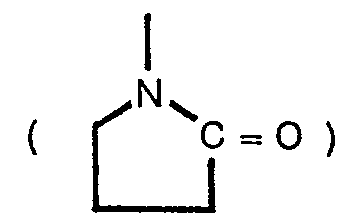
- each R2 is independently hydrogen or methyl;
- R3 is an organic group having a reactive cross-linkable group;
- m represents a weight percent of 75 to 99; and
- n represents a weight percent of 25 to 1;
- Polymers in accordance with this formula do not undergo the undesirable biuret reaction with metal ions to produce undesirable stain at pH above 10. They provide coatings having good physical integrity and good adhesion to layers above and below them in a photographic element.
- In the above formula, R3 can be any organic group having a reactive cross-linkable group, i.e., a monomer which has a functional group which readily reacts with such known cross-linking agents as aldehydes, such as formaldehyde, bisepoxides, halogenated triazines and bis(vinylsulfonyl) group- containing hardeners. In a preferred embodiment, R3 can be a group containing hydroxy, an amino group (primary, secondary or tertiary amino including heterocyclic groups having basic nitrogen atoms such as imidazolyl or pyridyl), an epoxy group, an active methylene group, or mixtures thereof, with the proviso that when R3 is an active methylene group, then n is 1 to 4 weight percent.
- Active methylene groups are well known to those skilled in the art and are methylene groups between two activating groups, e.g., electronegative groups such as carbonyl. Such methylene groups exhibit unusual chemical activity and are said to be "active". Examples of compounds containing such groups include malonic esters, acetoacetic esters, such as 2-(acetoacetoxyethyl) methacrylate, cyanoacetic esters and 1,3-diketones as described in U.S. Patents 3,459,790, 3,929,482 and 3,939,130.
- Examples of cross-linkable monomers as described above include:
- 2-hydroxyethyl acrylate
- 2-hydroxyethyl methacrylate
- 1-vinylimidazole
- glycidyl acrylate
- glycidyl methacrylate
- 2-aminoethyl acrylate
- 2-aminoethyl methacrylate
- N-(2-aminoethyl)acrylamide hydrochloride
- N-(3-aminopropyl)methacrylamide hydrochloride
- N-(3-aminopropyl)acrylamide hydrochloride
- N-allylcyanoacetamide
- ethyl methacryloylacetoacetate
- acryloylacetone
- methacryloylacetone
- 2-cyanoacetoxyethyl methacrylate
- N-(2-methacryloyloxyethyl)cyanoacetamide
- ethyl a-acetoacetoxymethacrylate
- 2-acetoacetoxypropyl methacrylate
- 3-acetoacetoxy-2,2-dimethylpropyl methacrylate
- ethyl acryloylacetate
- N-(2-acetoacetoxyethyl)acrylamide
- 3-methacryloyl-2,4-pentadione
- N-(methacryloyloxyethyl)acetoacetamide
- 2-acetoacetoxyethyl methacrylate
- N-t-butyl-N-(2-methacryloyloxyethyl)acetoacetamide
- 2- and 3-acetoacetoxypropyl acrylate
- 2-acetoacetoxyethyl acrylate
- 2-acetoacetoxy-2-methylpropyl methacrylate
- ethyl methacryloylacetate
- N-(3-acetoacetamidopropyl)methacrylamide
- N,N-dimethylacryloylacetamide
- N-cyanoacetyl-N'-methacryloylhydrazine
- N-(3-methacryloyloxypropyl)cyanoacetamide
- N-(2-acetoacetamidoethyl)methacrylamide
- In a preferred embodiment of this invention, m represents a weight percent of 90 to 99 and n represents a weight percent of 10 to 1.
- Other monomers may also be present in the polymers as long as they do not substantially degrade the swellability, stability or other desirable physical properties of the polymer. Such other monomers include various acrylic monomers, acrylates, such as ethyl acrylate, methyl methacrylate, acrylamides such as N-isopropylacrylamide, or acrylonitrile.
- As described above, metal ions are contained either in the dye image-receiving layer or in a layer adjacent thereto. Preferably, the metal ions are located in an adjacent layer. Metal ions most useful in the invention are those which are essentially colorless when incorporated in the image-receiving element, are inert with respect to the silver halide layers, react readily with the released dye to form a complex of the desired hue, are tightly coordinated to the dye in the complex, have a stable oxidation state, and form a dye complex which is stable to heat, light and chemical reagents. Good results are obtained with divalent metal ions such as copper(II), zinc(II), nickel(II), platinum(II), palladium(II) and cobalt(II) ions.
- Depending upon the properties of the particular polymer employed in the dye image-receiving layer, a dye mordant may or may not be needed to mordant the dye. In a preferred embodiment of the invention, a mordant is also employed in the dye image-receiving layer. In another preferred embodiment of the invention, the dye image-receiving layer containing a dye mordant and an adjacent layer containing metal ions both contain a polymer in accordance with the formula described above.
- Polymeric materials included within the above formula may have one or more different monomers as long as they are within the formula definitions. Such polymeric materials include the following:
- Compound 1 Poly(acrylamide-co-N-vinyl-2-pyrrolidone-co-2-acetoacetoxyethyl methacrylate) (weight ratio 19/80/1)
- Compound 2 Poly(N-vinyl-2-pyrrolidone-co-2-acetoacetoxyethyl methacrylate) (weight ratio 99/1)
- Compound 3 Poly(acrylamide-co-2-hydroxyethyl acrylate) (weight ratio 80/20)
- Compound 4 Poly(2-hydroxyethyl methacrylate-co-acrylamide-co-2-acetoacetoxyethyl methacrylate) (weight ratio 50/48/2)
- Compound 5 Poly(acrylamide-co-glycidyl acrylate) (weight ratio 90/10)
- Compound 6 Poly(acrylamide-co-N-methylolacrylamide) (weight ratio 80/20)
- Compound 7 Poly[acrylamide-co-2-(N,N-dimethylamino)ethyl methacrylate] (weight ratio 90/10)
- Compound 8 Poly(acrylamide-co-1-vinylimidazole) (weight ratio 95/5)
- Compound 9 Poly[acrylamide-co-N-(3-aminopropyl)methacrylamide hydrochloride] (weight ratio 90/10)
- Compound 10 Poly[acrylamide-co-N-(3-aminopropyl)methacrylamide hydrochloride] (weight ratio 95/5)
- Compound 11 Poly(acrylamide-co-2-aminoethyl methacrylate hydrochloride) (weight ratio 90/10)
- Compound 12 Poly(acrylamide-co-2-aminoethyl methacrylate hydrochloride) (weight ratio 95/5)
- Compound 13 Poly(N-vinyl-2-pyrrolidone-co-2-aminoethyl methacrylate hydrochloride) (weight ratio 90/10)
- Compound 14 Poly(2-hydroxyethyl acrylate-co-2-aminoethyl methacrylate hydrochloride) (weight ratio 90/10)
- The above polymers can be prepared using conventional addition polymerization techniques well known to those skilled in the art. See, for example, U.S. Patent 3,795,517, column 6, lines 43-58, and the examples disclosed therein.
- The above polymers can also be hardened or cross-linked by reaction with conventional photographic hardeners well known to those skilled in the art. See, for example, Research Disclosure, Item 17643, December, 1978, page 26, paragraph X.
- The photosensitive element described above can be treated, after exposure, in any manner with an alkaline processing composition to effect or initiate development. A preferred method for applying processing composition is by use of a rupturable container or pod which contains the composition.
- The metallizable dye image-providing material is either positive- or negative-working, and is either initially mobile or immobile in the photographic element during processing with an alkaline composition. Examples of initially mobile, positive-working metallizable dye image-providing materials are described in U.S. Patents 3,196,014 and 3,081,167. Examples of negative-working metallizable dye image-providing materials include conventional couplers which react with oxidized aromatic primary amino color developing agents to produce or release a metallizable dye. In a preferred embodiment, the metallizable dye image-providing material is a ballasted, redox dye-releasing (RDR) compound. Such compounds are well known to those skilled in the art and are capable of reacting with oxidized or unoxidized developing agent or electron transfer agent to release a dye. Such nondiffusible RDR's include positive-working and negative-working compounds, as described in U.S. Patents 4,142,891; 4,147,544; 4,148,641; 4,148,642; 4,148,643; 4,195,994; 4,204,870; 4,204,993; and 4,207,104.
- A process for producing a photographic transfer image in color from an imagewise-exposed photosensitive element as described above comprises treating the element with an alkaline processing composition in the presence of a silver halide developing agent to effect development of each of the exposed silver halide emulsion layers. An imagewise distribution of metallizable dye image-providing material is formed as a function of development and at least a portion of such material diffuses to a dye image-receiving layer to provide the transfer image. The dye image-receiving layer has a source of metal ions associated therewith, either in it or in a layer adjacent thereto and the dye image-receiving layer or adjacent layer or both comprises a polymer as described above.
- A photographic element as described above is used to produce positive images in single or multicolors. In a three-color system, each silver halide emulsion layer of the film assembly will have associated therewith a metallizable dye image-providing material which possesses a predominant spectral absorption within the region of the visible spectrum to which said silver halide emulsion is sensitive. The metallizable dye image-providing material associated with each silver halide emulsion layer is contained either in the silver halide emulsion layer itself or in a layer contiguous to the silver halide emulsion layer, i.e., the metallizable dye image-providing material can be coated in a separate layer underneath the silver halide emulsion layer with respect to the exposure direction.
- The concentration of the metallizable dye image-providing material can be varied over a wide range, depending upon the particular compound employed and the results desired. For example, the metallizable dye image-providing material coated in a layer at a concentration of 0.1 to 3 g/m2 has been found to be useful.
- Any mordant is useful in the image-receiving layer as long as the desired function of mordanting or otherwise fixing the dye images is obtained. The particular material chosen will depend upon the dye to be mordanted. Suitable materials are disclosed on pages 80 through 82 of the November 1976 edition of Research Disclosure.
- The term "nondiffusing" used herein has the meaning commonly applied to the term in photography and denotes materials that for all practical purposes do not migrate or wander through organic colloid layers, such as gelatin, in the photographic elements in an alkaline medium, and preferably, when processed in a medium having a pH of 11 or greater. The same meaning is to be attached to the term "immobile". The term "diffusible" has the converse meaning and denotes materials having the property of diffusing effectively through the colloid layers of the photographic elements in an alkaline medium. "Mobile" has the same meaning as "diffusible".
- The term "associated therewith" as used herein means that the materials can be in either the same or different layers, so long as the materials are accessible to one another.
- The following examples are provided to further illustrate the invention.
- Polymeric vehicles within the scope of this invention were evaluated with regard to stain formation by coating a polyethylene-coated paper support with a layer comprising a polymer as shown in Table I below at 2.16 g/m2, the mordant poly(styrene-co-N-benzyl-N,N-dimethyl-N-vinylbenzylammonium chloride-co-divinylbenzene) (weight ratio 49.5:49.5:1) at 2.16 g/m2 and one of the copper salts identified in Table I.
- The reflection density to red, green and blue light was measured on each sample both before and after immersion in a 0.5 N potassium hydroxide solution. The following results were obtained:

- The above results indicate that the polymeric vehicles of this invention containing metal ions have much less color or stain at a high pH and do not undergo the biuret reaction with metal ions as does gelatin.
-
- A) A control receiving element, part of an integral imaging receiver, was prepared by coating the following layers in the order recited on a transparent poly(ethylene terephthalate) film support. Coverages are parenthetically given in g/m2.
- 1) metal ion source of nickel sulfate hexahydrate (0.54), gelatin (1.1) and hardener bis(vinylsulfonyl)methyl ether (0.022);
- 2) image-receiving layer of poly(4-vinylpyridine (2.2), gelatin (2.2) and hardener bis(vinylsulfonyl)methyl ether (0.011);
- 3) reflecting layer of titanium dioxide (20) and gelatin (2.6);
- 4) opaque layer of carbon black (1.9) and gelatin (1.2); and
- 5) overcoat of gelatin (1.2).
- B) Another receiving element was prepared in accordance with this invention which was similar to A) except for layers 1) and 2) as follows:
- 1) metal ion souce of nickel nitrate hexahydrate (0.65), compound 8 (1.1) and formaldehyde hardener (0.022); and
- 2) image-receiving layer of poly(4-vinylpyridine) (2.2), compound 8 (2.2), and formaldehyde hardener (0.022).
- A cover sheet was prepared by coating the following layers in the order recited on a poly(ethylene terephthalate) film support:
- 1) an acid layer comprising poly(n-butyl acrylate-co-acrylic acid) (30:70 weight ratio equivalent to 140 meq. acid/m2); and
- 2) a timing layer comprising a mixture of a) cellulose acetate (40% acetyl) (10.5) and b) poly(styrene-co- maleic anhydride) (50:50 weight ratio) (0.32).
- Samples of the above receiving elements were then processed by rupturing a pod containing:


- The above data indicate that the control element acquired a significant yellow stain as shown by the low reflectance values at 450 nm. The element of the invention, however, did not acquire a yellow biuret stain and was more nearly neutral, as shown by the more nearly equal transmittance values at the three wavelengths.
-
- A) A control receiving element was prepared by coating the following layers in the order recited on a transparent poly(ethylene terephthalate) film support. Coverages are parenthetically given in g/m2.
- 1) metal ion source of nickel sulfate hexahydrate (0.58) and gelatin (1.1);
- 2) image-receiving layer of poly(4-vinylpyridine (2.2), gelatin (2.2) and hardener bis(vinylsulfonyl)methane (0.02);
- 3) reflecting layer of titanium dioxide (19.0) and gelatin (3.0); and
- 4) opaque layer of carbon black (1.9) and gelatin (1.2).
- B) Another receiving element prepared in accordance with this invention which was similar to A) except for layers 1) and 2) as follows:
- 1) metal ion source of nickel sulfate hexahydrate (0.58), compound 8 (1.1) and formaldehyde (0.011); and
- 2) image-receiving layer of poly(4-vinylpyridine (2.2) and compound 8 (2.2).
- C) Another receiving element was prepared similar to A) except that in layer 1, copper sulfate pentahydrate (0.55) was employed instead of the nickel compound.
- D) Another receiving element was prepared similar to B) except that in layer 1, copper sulfate pentahydrate (0.55) was employed instead of the nickel compound.
- A cover sheet was prepared by coating the following layers in the order recited on a poly(ethylene terephthalate) film support:
- 1) an acid layer comprising poly(n-butyl acrylate-co-acrylic acid) (30:70 weight ratio) (equivalent to 140 meq. acid/m2); and
- 2) a timing layer comprising a mixture of a) cellulose acetate (40% acetyl) (10.1) and b) poly(styrene-co- maleic anhydride) (50:50 weight ratio) (0.7) and 5-(2-cyanoethylthio)-1-phenyltetrazole (0.11).
- Samples of the above receiving elements were then processed by rupturing a pod containing:


- The above results show a substantial nickel and copper biuret stain at both 80 seconds and 10.5 minutes when gelatin is used as the vehicle, while a negligible amount of stain was obtained in using Compound 8 in accordance with this invention. Although the stain in elements A and C decreases after one hour as the pH is lowered, due to dissociation of the metal-biuret complex, the short-term stain is a hinderance to viewing and judging an image at that stage of development.
-
- A) A control receiving element was prepared by coating the following layers in the order recited on a transparent poly(ethylene terephthalate) film support. Coverages are parenthetically given in g/m2.
- 1) metal ion source of nickel sulfate hexahydrate (0.58), gelatin (1.8) and bis(vinylsulfonyl)methane (0.01);
- 2) image-receiving layer of poly(4-vinylpyridine (2.2), gelatin (2.2) and hardener bis(vinylsulfonyl)methane (0.02);
- 3) reflecting layer of titanium dioxide (19.0) and gelatin (1.9);
- 4) opaque layer of carbon black (1.9) and gelatin (1.2); and
- 5) overcoat layer of gelatin (1.2).
- B) Another control element prepared similar to A) except that no nickel salt was employed.
- C-H) Receiving elements C, D, E, F, G and H were prepared in accordance with this invention which were similar to A) except for layers 1) and 2) as follows:
- 1) metal ion source of nickel nitrate hexahydrate (0.65), compound according to Table IV (1.1) and formaldehyde (0.02); and
- 2) image-receiving layer of poly(4-vinylpyridine (2.2), compound according to Table IV (2.2) and hardener 1,4-butanediol diglycidyl ether (0.054).
- Samples of the above receiving elements were then processed in the same manner as in Example 3, employing samples of the same cover sheet and processing composition described therein. The percent reflectance was read within 30 seconds and again at 30 minutes on a scanning spectrophotometer and recorded as a function of wavelength as follows:

- The above results show a substantial nickel biuret stain at both 30 seconds (63 and 70% reflectance) and 30 minutes (65 and 72% reflectance) when gelatin is used as the vehicle. The elements employing the compounds in accordance with this invention, however, exhibit minimum stain as shown by a constant and high percent reflectance at the three tabulated wavelengths.
-
- A) A control integral imaging receiver (IIR) was prepared by coating the following layers in the order recited on a transparent poly(ethylene terephthalate) film support. Coverages are parenthetically given in g/m2 unless otherwise stated.
- 1) metal ion source of nickel sulfate hexahydrate (0.58), gelatin (1.8) and bis(vinylsulfonyl)methane (0.01);
- 2) image-receiving layer of poly(4-vinylpyridine (2.2), gelatin (2.2) and hardener bis(vinylsulfonyl)methane (0.02);
- 3) reflecting layer of titanium dioxide (19.0) and gelatin (1.9);
- 4) opaque layer of carbon black (1.9) and gelatin (1.2);
- 5) interlayer of gelatin (1.2);
- 6) blue-sensitive negative silver iodobromide emulsion (1.4 Ag), gelatin (2.2), yellow, positive-working RDR (0.46), reducing agent (0.45) and inhibitor (0.02); and
- 7) overcoat of gelatin (1.3).

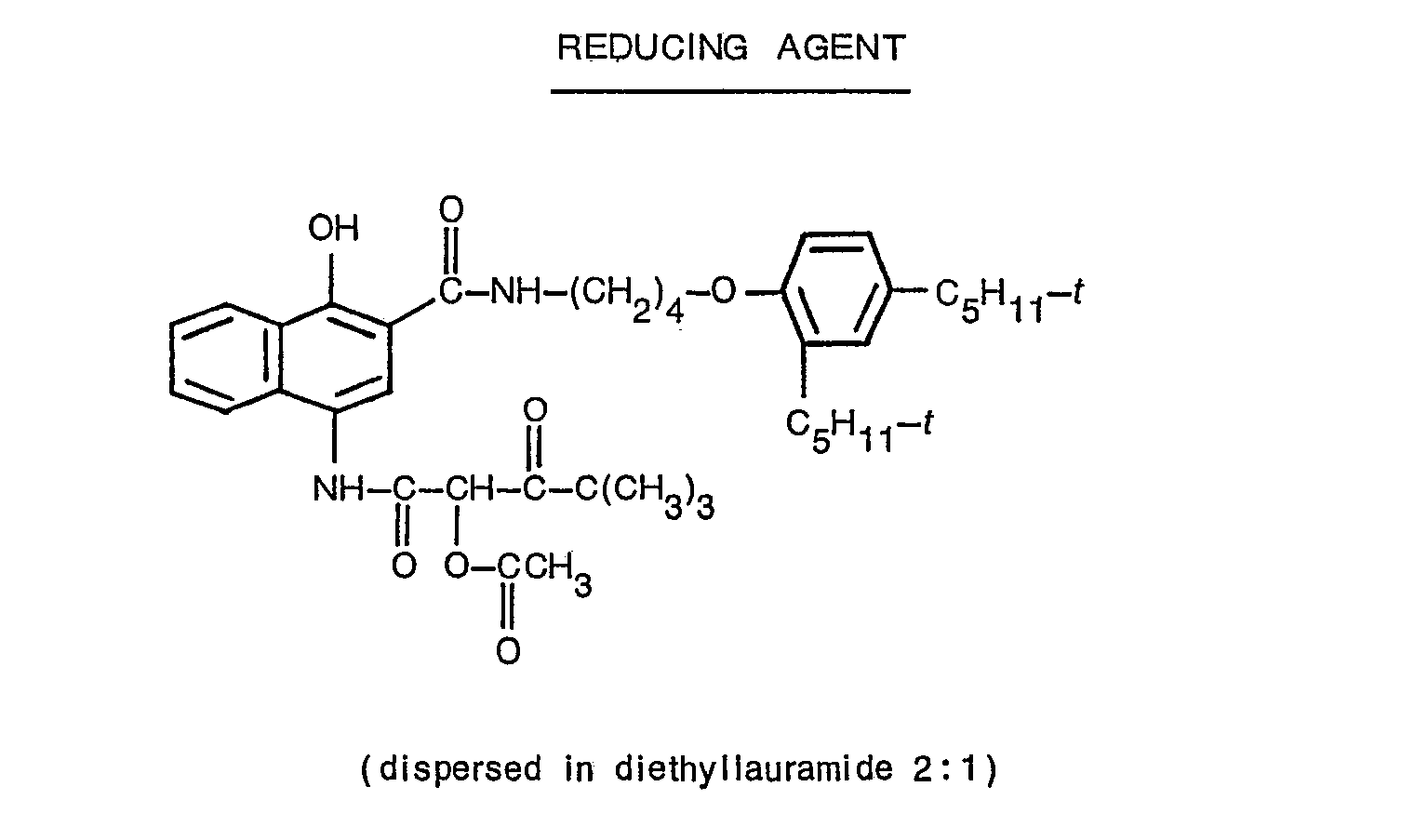

-
- A) except for layers 1) and 2) as follows:
- 1) metal ion source of nickel nitrate hexahydrate (0.65), compound according to Table V (1.1) and formaldehyde (0.02); and
- 2) image-receiving layer of poly(4-vinylpyridine (2.2), compound according to Table V (2.2) and hardener 1,4-butanediol diglycidyl ether (0.054).
- Samples of the above IIR's elements were exposed in a sensitometer through a graduated test object. The exposed samples were then processed by rupturing a pod containing:


- The above results indicate that the vehicles employed in this invention may be directly substituted for gelatin without any substantial loss of sensitometric values.
-
- A) A control receiving element, part of an integral imaging receiver, was prepared by coating the following layers in the order recited on a transparent poly(ethylene terephthalate) film support. Coverages are parenthetically given in g/m2.
- 1) metal ion source of nickel nitrate hexahydrate (0.65), poly(acrylamide) (1.1) and hardener formaldehyde (0.022);
- 2) image-receiving layer of poly(4-vinylpyridine (2.2) and poly(acrylamide) (2.2);
- 3) reflecting layer of titanium dioxide (19) and gelatin (3.0);
- 4) opaque layer of carbon black (1.9) and gelatin (1.2); and
- 5) overcoat of gelatin (1.2).
- B) Another control receiving element was prepared which was similar to A) except for layers 1) and 2) as follows:
- 1) metal ion source of nickel nitrate hexahydrate (0.65), poly(N-vinyl-2-pyrrolidone) (1.1) and formaldehyde hardener (0.022); and
- 2) image-receiving layer of poly(4-vinylpyridine) (2.2) and poly(N-vinyl-2-pyrrolidone) (2.2).
- C) Another receiving element was prepared in accordance with the invention which was similar to A) except for layers 1) and 2) as follows:
- 1) metal ion source of nickel nitrate hexahydrate (0.65), compound 10 (1.1) and formaldehyde hardener (0.011); and
- 2) image-receiving layer of poly(4-vinylpyridine) (2.2) and compound 10 (2.2).
- The Status A reflection densities of these three coatings were measured through the support as follows:

- The above data indicate that the receiver prepared in accordance with this invention had the highest reflectance when compared to receivers having prior art polymers without any cross-linkable monomer. This is, in effect, a measurement of background or "raw stock" density, lower numbers being the most desirable. In addition, there were coating defects observed with the two control coatings. Receiver A had a "rough-surface" appearing opaque layer and black spots were visible through the reflecting layer which accounts for its decrease in reflectance (increased density). Receiver B had a non-uniform "pebbly" appearance and its reflectance was also lower. The receiver in accordance with this invention had the fewest number of coating defects.
- Hardness measurements were made on supports having layers 1) and 2) only of the receiving elements of Example 6. A force in grams was measured for a given diameter stylus to "scribe through" the image-receiving layer wet with water. As the surface hardness increases, more force is required to "open" the surface by scribing. The following results were obtained:

- The above data indicate that the coating in accordance with this invention is much harder in comparison to polymers without any cross-linkable monomer. A harder coating is more desirable to produce a firmer substrate for the other layers to be coated thereover, resulting in fewer coating defects.
with the proviso that when R1 is 2-hydroxyethoxycarbonyl, then R3 is an organic group having a reactive cross-linkable group other than a hydroxyalkoxycarbonyl group.
Claims (5)

Applications Claiming Priority (2)
| Application Number | Priority Date | Filing Date | Title |
|---|---|---|---|
| US310720 | 1981-10-13 | ||
| US06/310,720 US4358524A (en) | 1981-10-13 | 1981-10-13 | Polymeric vehicle for metallizable dye image-receiving layer |
Publications (2)
| Publication Number | Publication Date |
|---|---|
| EP0077064A1 EP0077064A1 (en) | 1983-04-20 |
| EP0077064B1 true EP0077064B1 (en) | 1985-03-27 |
Family
ID=23203820
Family Applications (1)
| Application Number | Title | Priority Date | Filing Date |
|---|---|---|---|
| EP82109403A Expired EP0077064B1 (en) | 1981-10-13 | 1982-10-12 | Photographic element comprising a layer containing a cross-linked polymer |
Country Status (5)
| Country | Link |
|---|---|
| US (1) | US4358524A (en) |
| EP (1) | EP0077064B1 (en) |
| JP (1) | JPS5872941A (en) |
| CA (1) | CA1178468A (en) |
| DE (1) | DE3262813D1 (en) |
Families Citing this family (5)
| Publication number | Priority date | Publication date | Assignee | Title |
|---|---|---|---|---|
| US4415647A (en) * | 1982-09-29 | 1983-11-15 | Eastman Kodak Company | Polymeric vehicle for dye image-receiving layer containing a poly(vinylimidazole) mordant |
| SE461765B (en) * | 1986-07-10 | 1990-03-26 | Haessle Ab | DEVICE FOR RELEASE OF SUBSTANCE |
| US5932404A (en) * | 1996-12-18 | 1999-08-03 | Eastman Kodak Company | Silver halide photographic material containing a polymer with a photographically useful group which is rendered non-diffusible by cross-linking |
| WO2012051153A2 (en) * | 2010-10-11 | 2012-04-19 | Isp Investments Inc. | Lactamic polymers containing an acetoacetate moiety |
| WO2012148533A1 (en) | 2011-04-28 | 2012-11-01 | Isp Investments Inc. | Lactamic polymers containing an acetoacetate moiety |
Family Cites Families (4)
| Publication number | Priority date | Publication date | Assignee | Title |
|---|---|---|---|---|
| JPS5931696B2 (en) * | 1978-03-20 | 1984-08-03 | コニカ株式会社 | Photographic materials for color diffusion transfer method |
| EP0009411B2 (en) * | 1978-09-21 | 1986-11-26 | EASTMAN KODAK COMPANY (a New Jersey corporation) | Photographic recording material containing polymers which coordinate with metal ions |
| US4299895A (en) * | 1978-09-21 | 1981-11-10 | Eastman Kodak Company | Photographic elements containing polymers which coordinate with metal ions |
| US4282305A (en) * | 1979-01-15 | 1981-08-04 | Eastman Kodak Company | Receiving elements for image transfer film units |
-
1981
- 1981-10-13 US US06/310,720 patent/US4358524A/en not_active Expired - Fee Related
-
1982
- 1982-09-03 CA CA000410804A patent/CA1178468A/en not_active Expired
- 1982-10-12 DE DE8282109403T patent/DE3262813D1/en not_active Expired
- 1982-10-12 EP EP82109403A patent/EP0077064B1/en not_active Expired
- 1982-10-13 JP JP57178586A patent/JPS5872941A/en active Pending
Also Published As
| Publication number | Publication date |
|---|---|
| EP0077064A1 (en) | 1983-04-20 |
| DE3262813D1 (en) | 1985-05-02 |
| JPS5872941A (en) | 1983-05-02 |
| CA1178468A (en) | 1984-11-27 |
| US4358524A (en) | 1982-11-09 |
Similar Documents
| Publication | Publication Date | Title |
|---|---|---|
| US4594308A (en) | Photographic element comprising sulfinic acid/imidazole polymer mordant | |
| EP0160947B1 (en) | Photographic element | |
| JPS60122940A (en) | Photographic element | |
| JPH032290B2 (en) | ||
| CA1154446A (en) | Copolymeric mordants and photographic products and processes utilizing same | |
| CA1148010A (en) | Graft copolymers as diffusion control layers in photographic diffusion transfer products | |
| JPS602654B2 (en) | photo assembly | |
| JPH0362249B2 (en) | ||
| US4131469A (en) | Photographic element with polymeric ammonium mordant | |
| EP0077064A1 (en) | Photographic element comprising a layer containing a cross-linked polymer | |
| CA1325692C (en) | Copolymeric mordants and photographic products and processes containing same | |
| US4424326A (en) | Copolymeric mordants | |
| US4359517A (en) | Diffusion transfer products with two timing layers for production of transparencies | |
| US4563411A (en) | Copolymeric mordants and photographic products and processes containing same | |
| US4088499A (en) | Selectively permeable layers for diffusion transfer film units | |
| US4585724A (en) | Image receptor layer comprising polyvinyl imidazole and cationic polymer | |
| EP0078743B1 (en) | Timing layers and auxiliary neutralizing layer for color diffusion transfer photographic recording materials containing positive-working redox dye-releasing compounds | |
| JPS6332179B2 (en) | ||
| US4415647A (en) | Polymeric vehicle for dye image-receiving layer containing a poly(vinylimidazole) mordant | |
| EP0808479B1 (en) | Image-receiving element for diffusion transfer photographic and photothermographic film products | |
| EP0078742B1 (en) | Timing layers for color diffusion transfer photographic recording materials containing positive-working redox dye-releasing compounds | |
| EP0327971B1 (en) | Color diffusion transfer photographic film units | |
| EP0340676B1 (en) | Image-receiving element for diffusion transfer photographic product | |
| US5075197A (en) | Diffusion transfer photographic elements | |
| JPS60214357A (en) | Image receiving element for diffusion transfer method |
Legal Events
| Date | Code | Title | Description |
|---|---|---|---|
| PUAI | Public reference made under article 153(3) epc to a published international application that has entered the european phase |
Free format text: ORIGINAL CODE: 0009012 |
|
| AK | Designated contracting states |
Designated state(s): DE FR GB NL |
|
| 17P | Request for examination filed |
Effective date: 19830225 |
|
| GRAA | (expected) grant |
Free format text: ORIGINAL CODE: 0009210 |
|
| AK | Designated contracting states |
Designated state(s): DE FR GB NL |
|
| REF | Corresponds to: |
Ref document number: 3262813 Country of ref document: DE Date of ref document: 19850502 |
|
| ET | Fr: translation filed | ||
| PLBE | No opposition filed within time limit |
Free format text: ORIGINAL CODE: 0009261 |
|
| STAA | Information on the status of an ep patent application or granted ep patent |
Free format text: STATUS: NO OPPOSITION FILED WITHIN TIME LIMIT |
|
| 26N | No opposition filed | ||
| PGFP | Annual fee paid to national office [announced via postgrant information from national office to epo] |
Ref country code: NL Payment date: 19871031 Year of fee payment: 6 |
|
| PG25 | Lapsed in a contracting state [announced via postgrant information from national office to epo] |
Ref country code: GB Effective date: 19881012 |
|
| PG25 | Lapsed in a contracting state [announced via postgrant information from national office to epo] |
Ref country code: NL Effective date: 19890501 |
|
| NLV4 | Nl: lapsed or anulled due to non-payment of the annual fee | ||
| PG25 | Lapsed in a contracting state [announced via postgrant information from national office to epo] |
Ref country code: FR Free format text: LAPSE BECAUSE OF NON-PAYMENT OF DUE FEES Effective date: 19890630 |
|
| PG25 | Lapsed in a contracting state [announced via postgrant information from national office to epo] |
Ref country code: DE Effective date: 19890701 |
|
| GBPC | Gb: european patent ceased through non-payment of renewal fee | ||
| REG | Reference to a national code |
Ref country code: FR Ref legal event code: ST |