EP0076119A2 - Reinforced acetylene high polymers, process for preparing same and battery having same - Google Patents
Reinforced acetylene high polymers, process for preparing same and battery having same Download PDFInfo
- Publication number
- EP0076119A2 EP0076119A2 EP82305054A EP82305054A EP0076119A2 EP 0076119 A2 EP0076119 A2 EP 0076119A2 EP 82305054 A EP82305054 A EP 82305054A EP 82305054 A EP82305054 A EP 82305054A EP 0076119 A2 EP0076119 A2 EP 0076119A2
- Authority
- EP
- European Patent Office
- Prior art keywords
- high polymer
- acetylene high
- acetylene
- sheet
- reinforced
- Prior art date
- Legal status (The legal status is an assumption and is not a legal conclusion. Google has not performed a legal analysis and makes no representation as to the accuracy of the status listed.)
- Granted
Links
- HSFWRNGVRCDJHI-UHFFFAOYSA-N alpha-acetylene Natural products C#C HSFWRNGVRCDJHI-UHFFFAOYSA-N 0.000 title claims abstract description 280
- 125000002534 ethynyl group Chemical group [H]C#C* 0.000 title claims abstract description 277
- 229920000642 polymer Polymers 0.000 title claims abstract description 257
- 238000004519 manufacturing process Methods 0.000 title description 13
- 239000002657 fibrous material Substances 0.000 claims abstract description 50
- 239000003054 catalyst Substances 0.000 claims abstract description 28
- 238000003490 calendering Methods 0.000 claims abstract description 16
- 238000003825 pressing Methods 0.000 claims abstract description 10
- 230000000379 polymerizing effect Effects 0.000 claims abstract description 3
- 238000000034 method Methods 0.000 claims description 57
- 238000006116 polymerization reaction Methods 0.000 claims description 34
- 239000003960 organic solvent Substances 0.000 claims description 32
- 239000002019 doping agent Substances 0.000 claims description 29
- -1 halogen anion Chemical class 0.000 claims description 28
- 125000004432 carbon atom Chemical group C* 0.000 claims description 25
- 150000001450 anions Chemical group 0.000 claims description 16
- 125000000217 alkyl group Chemical group 0.000 claims description 14
- 125000003118 aryl group Chemical group 0.000 claims description 13
- 229910001914 chlorine tetroxide Inorganic materials 0.000 claims description 13
- 239000003792 electrolyte Substances 0.000 claims description 13
- 239000002904 solvent Substances 0.000 claims description 12
- 239000004020 conductor Substances 0.000 claims description 10
- 229910052757 nitrogen Inorganic materials 0.000 claims description 10
- 125000004435 hydrogen atom Chemical group [H]* 0.000 claims description 9
- 229920000049 Carbon (fiber) Polymers 0.000 claims description 8
- 239000004917 carbon fiber Substances 0.000 claims description 8
- 150000001768 cations Chemical group 0.000 claims description 8
- 239000004745 nonwoven fabric Substances 0.000 claims description 7
- 239000004744 fabric Substances 0.000 claims description 6
- VLTRZXGMWDSKGL-UHFFFAOYSA-M perchlorate Chemical compound [O-]Cl(=O)(=O)=O VLTRZXGMWDSKGL-UHFFFAOYSA-M 0.000 claims description 6
- 229910017048 AsF6 Inorganic materials 0.000 claims description 5
- OKTJSMMVPCPJKN-UHFFFAOYSA-N Carbon Chemical group [C] OKTJSMMVPCPJKN-UHFFFAOYSA-N 0.000 claims description 5
- VNWKTOKETHGBQD-UHFFFAOYSA-N methane Chemical compound C VNWKTOKETHGBQD-UHFFFAOYSA-N 0.000 claims description 5
- 238000002156 mixing Methods 0.000 claims description 5
- 125000004433 nitrogen atom Chemical group N* 0.000 claims description 5
- 125000004430 oxygen atom Chemical group O* 0.000 claims description 5
- 229920000265 Polyparaphenylene Polymers 0.000 claims description 4
- 150000004820 halides Chemical class 0.000 claims description 4
- 229910052760 oxygen Inorganic materials 0.000 claims description 4
- 229910052736 halogen Inorganic materials 0.000 claims description 3
- 238000010298 pulverizing process Methods 0.000 claims description 3
- WVIICGIFSIBFOG-UHFFFAOYSA-N pyrylium Chemical compound C1=CC=[O+]C=C1 WVIICGIFSIBFOG-UHFFFAOYSA-N 0.000 claims description 3
- 125000003903 2-propenyl group Chemical group [H]C([*])([H])C([H])=C([H])[H] 0.000 claims description 2
- 239000006230 acetylene black Substances 0.000 claims description 2
- 239000002253 acid Substances 0.000 claims description 2
- 229910001413 alkali metal ion Inorganic materials 0.000 claims description 2
- 239000006185 dispersion Substances 0.000 claims description 2
- 238000001035 drying Methods 0.000 claims description 2
- 238000004108 freeze drying Methods 0.000 claims description 2
- 125000005843 halogen group Chemical group 0.000 claims description 2
- 229920000128 polypyrrole Polymers 0.000 claims description 2
- 239000012784 inorganic fiber Substances 0.000 claims 3
- 229920005594 polymer fiber Polymers 0.000 claims 3
- 230000000737 periodic effect Effects 0.000 claims 2
- 229910004074 SiF6 Inorganic materials 0.000 claims 1
- 150000002891 organic anions Chemical class 0.000 claims 1
- 150000002892 organic cations Chemical class 0.000 claims 1
- 229910052698 phosphorus Inorganic materials 0.000 claims 1
- 229920000123 polythiophene Polymers 0.000 claims 1
- 229910052717 sulfur Inorganic materials 0.000 claims 1
- YXFVVABEGXRONW-UHFFFAOYSA-N Toluene Chemical compound CC1=CC=CC=C1 YXFVVABEGXRONW-UHFFFAOYSA-N 0.000 description 74
- 239000002131 composite material Substances 0.000 description 53
- 238000007599 discharging Methods 0.000 description 46
- 238000012360 testing method Methods 0.000 description 38
- 239000000047 product Substances 0.000 description 36
- PXHVJJICTQNCMI-UHFFFAOYSA-N Nickel Chemical compound [Ni] PXHVJJICTQNCMI-UHFFFAOYSA-N 0.000 description 33
- 239000000243 solution Substances 0.000 description 23
- 238000006243 chemical reaction Methods 0.000 description 22
- 239000000835 fiber Substances 0.000 description 17
- 229910052759 nickel Inorganic materials 0.000 description 16
- 229910052751 metal Inorganic materials 0.000 description 15
- 239000002184 metal Substances 0.000 description 15
- 238000000465 moulding Methods 0.000 description 15
- 229920006254 polymer film Polymers 0.000 description 15
- 239000012298 atmosphere Substances 0.000 description 14
- IJGRMHOSHXDMSA-UHFFFAOYSA-N nitrogen Substances N#N IJGRMHOSHXDMSA-UHFFFAOYSA-N 0.000 description 14
- 229910052744 lithium Inorganic materials 0.000 description 13
- 239000010935 stainless steel Substances 0.000 description 13
- 229910001220 stainless steel Inorganic materials 0.000 description 13
- WHXSMMKQMYFTQS-UHFFFAOYSA-N Lithium Chemical compound [Li] WHXSMMKQMYFTQS-UHFFFAOYSA-N 0.000 description 12
- 230000000052 comparative effect Effects 0.000 description 12
- 239000011521 glass Substances 0.000 description 12
- 239000002759 woven fabric Substances 0.000 description 12
- 239000007789 gas Substances 0.000 description 11
- 238000002360 preparation method Methods 0.000 description 11
- BASFCYQUMIYNBI-UHFFFAOYSA-N platinum Chemical group [Pt] BASFCYQUMIYNBI-UHFFFAOYSA-N 0.000 description 10
- 230000005611 electricity Effects 0.000 description 9
- 239000003115 supporting electrolyte Substances 0.000 description 9
- 150000001875 compounds Chemical class 0.000 description 8
- 229910001873 dinitrogen Inorganic materials 0.000 description 8
- 239000010408 film Substances 0.000 description 8
- 239000007773 negative electrode material Substances 0.000 description 8
- 239000007772 electrode material Substances 0.000 description 7
- WYURNTSHIVDZCO-UHFFFAOYSA-N Tetrahydrofuran Chemical compound C1CCOC1 WYURNTSHIVDZCO-UHFFFAOYSA-N 0.000 description 6
- 239000000463 material Substances 0.000 description 6
- 150000002739 metals Chemical class 0.000 description 6
- 239000004065 semiconductor Substances 0.000 description 6
- 239000011734 sodium Substances 0.000 description 6
- 238000003756 stirring Methods 0.000 description 6
- VOITXYVAKOUIBA-UHFFFAOYSA-N triethylaluminium Chemical compound CC[Al](CC)CC VOITXYVAKOUIBA-UHFFFAOYSA-N 0.000 description 6
- 239000004809 Teflon Substances 0.000 description 5
- 229920006362 Teflon® Polymers 0.000 description 5
- FPCJKVGGYOAWIZ-UHFFFAOYSA-N butan-1-ol;titanium Chemical compound [Ti].CCCCO.CCCCO.CCCCO.CCCCO FPCJKVGGYOAWIZ-UHFFFAOYSA-N 0.000 description 5
- 239000000203 mixture Substances 0.000 description 5
- 125000004108 n-butyl group Chemical group [H]C([H])([H])C([H])([H])C([H])([H])C([H])([H])* 0.000 description 5
- 239000012299 nitrogen atmosphere Substances 0.000 description 5
- 239000007774 positive electrode material Substances 0.000 description 5
- RUOJZAUFBMNUDX-UHFFFAOYSA-N propylene carbonate Chemical compound CC1COC(=O)O1 RUOJZAUFBMNUDX-UHFFFAOYSA-N 0.000 description 5
- 229910052782 aluminium Inorganic materials 0.000 description 4
- XAGFODPZIPBFFR-UHFFFAOYSA-N aluminium Chemical compound [Al] XAGFODPZIPBFFR-UHFFFAOYSA-N 0.000 description 4
- YHWCPXVTRSHPNY-UHFFFAOYSA-N butan-1-olate;titanium(4+) Chemical compound [Ti+4].CCCC[O-].CCCC[O-].CCCC[O-].CCCC[O-] YHWCPXVTRSHPNY-UHFFFAOYSA-N 0.000 description 4
- 239000008151 electrolyte solution Substances 0.000 description 4
- 230000000977 initiatory effect Effects 0.000 description 4
- 229910001486 lithium perchlorate Inorganic materials 0.000 description 4
- 229910052697 platinum Inorganic materials 0.000 description 4
- 229910052708 sodium Inorganic materials 0.000 description 4
- AKEJUJNQAAGONA-UHFFFAOYSA-N sulfur trioxide Inorganic materials O=S(=O)=O AKEJUJNQAAGONA-UHFFFAOYSA-N 0.000 description 4
- IRPGOXJVTQTAAN-UHFFFAOYSA-N 2,2,3,3,3-pentafluoropropanal Chemical compound FC(F)(F)C(F)(F)C=O IRPGOXJVTQTAAN-UHFFFAOYSA-N 0.000 description 3
- WEVYAHXRMPXWCK-UHFFFAOYSA-N Acetonitrile Chemical compound CC#N WEVYAHXRMPXWCK-UHFFFAOYSA-N 0.000 description 3
- DGAQECJNVWCQMB-PUAWFVPOSA-M Ilexoside XXIX Chemical compound C[C@@H]1CC[C@@]2(CC[C@@]3(C(=CC[C@H]4[C@]3(CC[C@@H]5[C@@]4(CC[C@@H](C5(C)C)OS(=O)(=O)[O-])C)C)[C@@H]2[C@]1(C)O)C)C(=O)O[C@H]6[C@@H]([C@H]([C@@H]([C@H](O6)CO)O)O)O.[Na+] DGAQECJNVWCQMB-PUAWFVPOSA-M 0.000 description 3
- ZMXDDKWLCZADIW-UHFFFAOYSA-N N,N-Dimethylformamide Chemical compound CN(C)C=O ZMXDDKWLCZADIW-UHFFFAOYSA-N 0.000 description 3
- 229910052783 alkali metal Inorganic materials 0.000 description 3
- 150000001340 alkali metals Chemical class 0.000 description 3
- QVGXLLKOCUKJST-UHFFFAOYSA-N atomic oxygen Chemical compound [O] QVGXLLKOCUKJST-UHFFFAOYSA-N 0.000 description 3
- 238000007796 conventional method Methods 0.000 description 3
- 150000002170 ethers Chemical class 0.000 description 3
- CBEQRNSPHCCXSH-UHFFFAOYSA-N iodine monobromide Chemical compound IBr CBEQRNSPHCCXSH-UHFFFAOYSA-N 0.000 description 3
- MHCFAGZWMAWTNR-UHFFFAOYSA-M lithium perchlorate Chemical compound [Li+].[O-]Cl(=O)(=O)=O MHCFAGZWMAWTNR-UHFFFAOYSA-M 0.000 description 3
- 239000013081 microcrystal Substances 0.000 description 3
- 229920001778 nylon Polymers 0.000 description 3
- 239000001301 oxygen Substances 0.000 description 3
- 229920001197 polyacetylene Polymers 0.000 description 3
- 239000011541 reaction mixture Substances 0.000 description 3
- YLQBMQCUIZJEEH-UHFFFAOYSA-N tetrahydrofuran Natural products C=1C=COC=1 YLQBMQCUIZJEEH-UHFFFAOYSA-N 0.000 description 3
- 229920002972 Acrylic fiber Polymers 0.000 description 2
- QGZKDVFQNNGYKY-UHFFFAOYSA-N Ammonia Chemical compound N QGZKDVFQNNGYKY-UHFFFAOYSA-N 0.000 description 2
- 229910021630 Antimony pentafluoride Inorganic materials 0.000 description 2
- IAZDPXIOMUYVGZ-UHFFFAOYSA-N Dimethylsulphoxide Chemical compound CS(C)=O IAZDPXIOMUYVGZ-UHFFFAOYSA-N 0.000 description 2
- UEXCJVNBTNXOEH-UHFFFAOYSA-N Ethynylbenzene Chemical group C#CC1=CC=CC=C1 UEXCJVNBTNXOEH-UHFFFAOYSA-N 0.000 description 2
- FYYHWMGAXLPEAU-UHFFFAOYSA-N Magnesium Chemical compound [Mg] FYYHWMGAXLPEAU-UHFFFAOYSA-N 0.000 description 2
- BAVYZALUXZFZLV-UHFFFAOYSA-N Methylamine Chemical compound NC BAVYZALUXZFZLV-UHFFFAOYSA-N 0.000 description 2
- 239000004677 Nylon Substances 0.000 description 2
- 239000004743 Polypropylene Substances 0.000 description 2
- QAOWNCQODCNURD-UHFFFAOYSA-N Sulfuric acid Chemical compound OS(O)(=O)=O QAOWNCQODCNURD-UHFFFAOYSA-N 0.000 description 2
- VSCWAEJMTAWNJL-UHFFFAOYSA-K aluminium trichloride Chemical compound Cl[Al](Cl)Cl VSCWAEJMTAWNJL-UHFFFAOYSA-K 0.000 description 2
- 238000004458 analytical method Methods 0.000 description 2
- VBVBHWZYQGJZLR-UHFFFAOYSA-I antimony pentafluoride Chemical compound F[Sb](F)(F)(F)F VBVBHWZYQGJZLR-UHFFFAOYSA-I 0.000 description 2
- 239000007864 aqueous solution Substances 0.000 description 2
- YBGKQGSCGDNZIB-UHFFFAOYSA-N arsenic pentafluoride Chemical compound F[As](F)(F)(F)F YBGKQGSCGDNZIB-UHFFFAOYSA-N 0.000 description 2
- 230000015572 biosynthetic process Effects 0.000 description 2
- GDTBXPJZTBHREO-UHFFFAOYSA-N bromine Chemical compound BrBr GDTBXPJZTBHREO-UHFFFAOYSA-N 0.000 description 2
- 229910052794 bromium Inorganic materials 0.000 description 2
- 229910052799 carbon Inorganic materials 0.000 description 2
- 239000006229 carbon black Substances 0.000 description 2
- 150000004649 carbonic acid derivatives Chemical class 0.000 description 2
- 239000007795 chemical reaction product Substances 0.000 description 2
- 150000008280 chlorinated hydrocarbons Chemical class 0.000 description 2
- 230000006866 deterioration Effects 0.000 description 2
- 238000010586 diagram Methods 0.000 description 2
- 230000000694 effects Effects 0.000 description 2
- 239000012776 electronic material Substances 0.000 description 2
- 150000002148 esters Chemical class 0.000 description 2
- 229920001519 homopolymer Polymers 0.000 description 2
- 150000002500 ions Chemical class 0.000 description 2
- 150000002576 ketones Chemical class 0.000 description 2
- HSZCZNFXUDYRKD-UHFFFAOYSA-M lithium iodide Chemical compound [Li+].[I-] HSZCZNFXUDYRKD-UHFFFAOYSA-M 0.000 description 2
- 239000011777 magnesium Substances 0.000 description 2
- 229910052749 magnesium Inorganic materials 0.000 description 2
- TZIHFWKZFHZASV-UHFFFAOYSA-N methyl formate Chemical compound COC=O TZIHFWKZFHZASV-UHFFFAOYSA-N 0.000 description 2
- 150000002825 nitriles Chemical class 0.000 description 2
- JCXJVPUVTGWSNB-UHFFFAOYSA-N nitrogen dioxide Inorganic materials O=[N]=O JCXJVPUVTGWSNB-UHFFFAOYSA-N 0.000 description 2
- QJGQUHMNIGDVPM-UHFFFAOYSA-N nitrogen group Chemical group [N] QJGQUHMNIGDVPM-UHFFFAOYSA-N 0.000 description 2
- 230000001590 oxidative effect Effects 0.000 description 2
- 239000002245 particle Substances 0.000 description 2
- 239000004033 plastic Substances 0.000 description 2
- 229920003023 plastic Polymers 0.000 description 2
- 229920001155 polypropylene Polymers 0.000 description 2
- 229910052700 potassium Inorganic materials 0.000 description 2
- 230000002035 prolonged effect Effects 0.000 description 2
- 150000003839 salts Chemical class 0.000 description 2
- 239000007784 solid electrolyte Substances 0.000 description 2
- XTHPWXDJESJLNJ-UHFFFAOYSA-N sulfurochloridic acid Chemical compound OS(Cl)(=O)=O XTHPWXDJESJLNJ-UHFFFAOYSA-N 0.000 description 2
- 229920002994 synthetic fiber Polymers 0.000 description 2
- 239000012209 synthetic fiber Substances 0.000 description 2
- 238000005406 washing Methods 0.000 description 2
- WSLDOOZREJYCGB-UHFFFAOYSA-N 1,2-Dichloroethane Chemical compound ClCCCl WSLDOOZREJYCGB-UHFFFAOYSA-N 0.000 description 1
- RYHBNJHYFVUHQT-UHFFFAOYSA-N 1,4-Dioxane Chemical compound C1COCCO1 RYHBNJHYFVUHQT-UHFFFAOYSA-N 0.000 description 1
- HZNVUJQVZSTENZ-UHFFFAOYSA-N 2,3-dichloro-5,6-dicyano-1,4-benzoquinone Chemical compound ClC1=C(Cl)C(=O)C(C#N)=C(C#N)C1=O HZNVUJQVZSTENZ-UHFFFAOYSA-N 0.000 description 1
- JWUJQDFVADABEY-UHFFFAOYSA-N 2-methyltetrahydrofuran Chemical compound CC1CCCO1 JWUJQDFVADABEY-UHFFFAOYSA-N 0.000 description 1
- HDEXQZFQDZGFLQ-UHFFFAOYSA-N 4,5-dibromo-3,6-dioxocyclohexa-1,4-diene-1,2-dicarbonitrile Chemical compound BrC1=C(Br)C(=O)C(C#N)=C(C#N)C1=O HDEXQZFQDZGFLQ-UHFFFAOYSA-N 0.000 description 1
- MGWGWNFMUOTEHG-UHFFFAOYSA-N 4-(3,5-dimethylphenyl)-1,3-thiazol-2-amine Chemical compound CC1=CC(C)=CC(C=2N=C(N)SC=2)=C1 MGWGWNFMUOTEHG-UHFFFAOYSA-N 0.000 description 1
- ZCYVEMRRCGMTRW-UHFFFAOYSA-N 7553-56-2 Chemical compound [I] ZCYVEMRRCGMTRW-UHFFFAOYSA-N 0.000 description 1
- KLZUFWVZNOTSEM-UHFFFAOYSA-K Aluminum fluoride Inorganic materials F[Al](F)F KLZUFWVZNOTSEM-UHFFFAOYSA-K 0.000 description 1
- 229910017049 AsF5 Inorganic materials 0.000 description 1
- 229910015844 BCl3 Inorganic materials 0.000 description 1
- 229910001369 Brass Inorganic materials 0.000 description 1
- WKBOTKDWSSQWDR-UHFFFAOYSA-N Bromine atom Chemical compound [Br] WKBOTKDWSSQWDR-UHFFFAOYSA-N 0.000 description 1
- RYGMFSIKBFXOCR-UHFFFAOYSA-N Copper Chemical compound [Cu] RYGMFSIKBFXOCR-UHFFFAOYSA-N 0.000 description 1
- 229920000742 Cotton Polymers 0.000 description 1
- XTHFKEDIFFGKHM-UHFFFAOYSA-N Dimethoxyethane Chemical compound COCCOC XTHFKEDIFFGKHM-UHFFFAOYSA-N 0.000 description 1
- KMTRUDSVKNLOMY-UHFFFAOYSA-N Ethylene carbonate Chemical compound O=C1OCCO1 KMTRUDSVKNLOMY-UHFFFAOYSA-N 0.000 description 1
- KRHYYFGTRYWZRS-UHFFFAOYSA-N Fluorane Chemical compound F KRHYYFGTRYWZRS-UHFFFAOYSA-N 0.000 description 1
- 229910021135 KPF6 Inorganic materials 0.000 description 1
- 229910013462 LiC104 Inorganic materials 0.000 description 1
- 229910001290 LiPF6 Inorganic materials 0.000 description 1
- HBBGRARXTFLTSG-UHFFFAOYSA-N Lithium ion Chemical compound [Li+] HBBGRARXTFLTSG-UHFFFAOYSA-N 0.000 description 1
- NTIZESTWPVYFNL-UHFFFAOYSA-N Methyl isobutyl ketone Chemical compound CC(C)CC(C)=O NTIZESTWPVYFNL-UHFFFAOYSA-N 0.000 description 1
- UIHCLUNTQKBZGK-UHFFFAOYSA-N Methyl isobutyl ketone Natural products CCC(C)C(C)=O UIHCLUNTQKBZGK-UHFFFAOYSA-N 0.000 description 1
- 229910019398 NaPF6 Inorganic materials 0.000 description 1
- GRYLNZFGIOXLOG-UHFFFAOYSA-N Nitric acid Chemical compound O[N+]([O-])=O GRYLNZFGIOXLOG-UHFFFAOYSA-N 0.000 description 1
- 229910021188 PF6 Inorganic materials 0.000 description 1
- 229920003171 Poly (ethylene oxide) Polymers 0.000 description 1
- 239000004698 Polyethylene Substances 0.000 description 1
- 239000011954 Ziegler–Natta catalyst Substances 0.000 description 1
- ZVQOOHYFBIDMTQ-UHFFFAOYSA-N [methyl(oxido){1-[6-(trifluoromethyl)pyridin-3-yl]ethyl}-lambda(6)-sulfanylidene]cyanamide Chemical compound N#CN=S(C)(=O)C(C)C1=CC=C(C(F)(F)F)N=C1 ZVQOOHYFBIDMTQ-UHFFFAOYSA-N 0.000 description 1
- 150000000475 acetylene derivatives Chemical class 0.000 description 1
- 150000007513 acids Chemical class 0.000 description 1
- 239000011149 active material Substances 0.000 description 1
- 239000013543 active substance Substances 0.000 description 1
- 150000001298 alcohols Chemical class 0.000 description 1
- 150000001338 aliphatic hydrocarbons Chemical class 0.000 description 1
- 229910045601 alloy Inorganic materials 0.000 description 1
- 239000000956 alloy Substances 0.000 description 1
- 150000001408 amides Chemical class 0.000 description 1
- 150000001412 amines Chemical class 0.000 description 1
- 229910021529 ammonia Inorganic materials 0.000 description 1
- 239000012300 argon atmosphere Substances 0.000 description 1
- 150000004945 aromatic hydrocarbons Chemical class 0.000 description 1
- JRXXLCKWQFKACW-UHFFFAOYSA-N biphenylacetylene Chemical group C1=CC=CC=C1C#CC1=CC=CC=C1 JRXXLCKWQFKACW-UHFFFAOYSA-N 0.000 description 1
- 239000010951 brass Substances 0.000 description 1
- KVNRLNFWIYMESJ-UHFFFAOYSA-N butyronitrile Chemical compound CCCC#N KVNRLNFWIYMESJ-UHFFFAOYSA-N 0.000 description 1
- 125000005626 carbonium group Chemical group 0.000 description 1
- 239000000919 ceramic Substances 0.000 description 1
- 229910052801 chlorine Inorganic materials 0.000 description 1
- 229920001577 copolymer Polymers 0.000 description 1
- 238000011161 development Methods 0.000 description 1
- BWTZYYGAOGUPFQ-UHFFFAOYSA-N difluoroacetylene Chemical group FC#CF BWTZYYGAOGUPFQ-UHFFFAOYSA-N 0.000 description 1
- 230000003292 diminished effect Effects 0.000 description 1
- 238000005868 electrolysis reaction Methods 0.000 description 1
- 238000002474 experimental method Methods 0.000 description 1
- IAWCIZWLKMTPLL-UHFFFAOYSA-N fluoroethyne Chemical group FC#C IAWCIZWLKMTPLL-UHFFFAOYSA-N 0.000 description 1
- ZRZKFGDGIPLXIB-UHFFFAOYSA-N fluoroform;sulfuric acid Chemical compound FC(F)F.OS(O)(=O)=O ZRZKFGDGIPLXIB-UHFFFAOYSA-N 0.000 description 1
- UQSQSQZYBQSBJZ-UHFFFAOYSA-N fluorosulfonic acid Chemical compound OS(F)(=O)=O UQSQSQZYBQSBJZ-UHFFFAOYSA-N 0.000 description 1
- 229910002804 graphite Inorganic materials 0.000 description 1
- 239000010439 graphite Substances 0.000 description 1
- 150000008282 halocarbons Chemical class 0.000 description 1
- 150000002367 halogens Chemical class 0.000 description 1
- 150000002430 hydrocarbons Chemical group 0.000 description 1
- 229910010272 inorganic material Inorganic materials 0.000 description 1
- 239000011147 inorganic material Substances 0.000 description 1
- 239000011810 insulating material Substances 0.000 description 1
- XMBWDFGMSWQBCA-UHFFFAOYSA-M iodide Chemical compound [I-] XMBWDFGMSWQBCA-UHFFFAOYSA-M 0.000 description 1
- PNDPGZBMCMUPRI-UHFFFAOYSA-N iodine Chemical compound II PNDPGZBMCMUPRI-UHFFFAOYSA-N 0.000 description 1
- 229910052740 iodine Inorganic materials 0.000 description 1
- 239000011630 iodine Substances 0.000 description 1
- 150000002596 lactones Chemical class 0.000 description 1
- 229910001547 lithium hexafluoroantimonate(V) Inorganic materials 0.000 description 1
- 229910001540 lithium hexafluoroarsenate(V) Inorganic materials 0.000 description 1
- 229910001416 lithium ion Inorganic materials 0.000 description 1
- 229910001537 lithium tetrachloroaluminate Inorganic materials 0.000 description 1
- 229910001496 lithium tetrafluoroborate Inorganic materials 0.000 description 1
- 239000012528 membrane Substances 0.000 description 1
- 229910001507 metal halide Inorganic materials 0.000 description 1
- 150000005309 metal halides Chemical class 0.000 description 1
- 239000000178 monomer Substances 0.000 description 1
- SKECXRFZFFAANN-UHFFFAOYSA-N n,n-dimethylmethanethioamide Chemical compound CN(C)C=S SKECXRFZFFAANN-UHFFFAOYSA-N 0.000 description 1
- 229910017604 nitric acid Inorganic materials 0.000 description 1
- 150000002828 nitro derivatives Chemical class 0.000 description 1
- 239000011356 non-aqueous organic solvent Substances 0.000 description 1
- 150000002902 organometallic compounds Chemical class 0.000 description 1
- 239000007800 oxidant agent Substances 0.000 description 1
- VLTRZXGMWDSKGL-UHFFFAOYSA-N perchloric acid Substances OCl(=O)(=O)=O VLTRZXGMWDSKGL-UHFFFAOYSA-N 0.000 description 1
- UHZYTMXLRWXGPK-UHFFFAOYSA-N phosphorus pentachloride Chemical compound ClP(Cl)(Cl)(Cl)Cl UHZYTMXLRWXGPK-UHFFFAOYSA-N 0.000 description 1
- OBCUTHMOOONNBS-UHFFFAOYSA-N phosphorus pentafluoride Chemical compound FP(F)(F)(F)F OBCUTHMOOONNBS-UHFFFAOYSA-N 0.000 description 1
- 229920000728 polyester Polymers 0.000 description 1
- 229920000573 polyethylene Polymers 0.000 description 1
- 239000011148 porous material Substances 0.000 description 1
- 229910001546 potassium hexafluoroantimonate(V) Inorganic materials 0.000 description 1
- 229910001487 potassium perchlorate Inorganic materials 0.000 description 1
- 239000000843 powder Substances 0.000 description 1
- FVSKHRXBFJPNKK-UHFFFAOYSA-N propionitrile Chemical compound CCC#N FVSKHRXBFJPNKK-UHFFFAOYSA-N 0.000 description 1
- MWWATHDPGQKSAR-UHFFFAOYSA-N propyne Chemical group CC#C MWWATHDPGQKSAR-UHFFFAOYSA-N 0.000 description 1
- JUJWROOIHBZHMG-UHFFFAOYSA-O pyridinium Chemical compound C1=CC=[NH+]C=C1 JUJWROOIHBZHMG-UHFFFAOYSA-O 0.000 description 1
- 238000007493 shaping process Methods 0.000 description 1
- ABTOQLMXBSRXSM-UHFFFAOYSA-N silicon tetrafluoride Chemical compound F[Si](F)(F)F ABTOQLMXBSRXSM-UHFFFAOYSA-N 0.000 description 1
- 229910001545 sodium hexafluoroantimonate(V) Inorganic materials 0.000 description 1
- FVAUCKIRQBBSSJ-UHFFFAOYSA-M sodium iodide Inorganic materials [Na+].[I-] FVAUCKIRQBBSSJ-UHFFFAOYSA-M 0.000 description 1
- 229910001488 sodium perchlorate Inorganic materials 0.000 description 1
- BAZAXWOYCMUHIX-UHFFFAOYSA-M sodium perchlorate Chemical compound [Na+].[O-]Cl(=O)(=O)=O BAZAXWOYCMUHIX-UHFFFAOYSA-M 0.000 description 1
- VGTPCRGMBIAPIM-UHFFFAOYSA-M sodium thiocyanate Chemical compound [Na+].[S-]C#N VGTPCRGMBIAPIM-UHFFFAOYSA-M 0.000 description 1
- 238000002798 spectrophotometry method Methods 0.000 description 1
- 238000003860 storage Methods 0.000 description 1
- 239000000126 substance Substances 0.000 description 1
- HXJUTPCZVOIRIF-UHFFFAOYSA-N sulfolane Chemical compound O=S1(=O)CCCC1 HXJUTPCZVOIRIF-UHFFFAOYSA-N 0.000 description 1
- 150000003464 sulfur compounds Chemical class 0.000 description 1
- 239000006228 supernatant Substances 0.000 description 1
- 229920003002 synthetic resin Polymers 0.000 description 1
- 239000000057 synthetic resin Substances 0.000 description 1
- PUGUQINMNYINPK-UHFFFAOYSA-N tert-butyl 4-(2-chloroacetyl)piperazine-1-carboxylate Chemical compound CC(C)(C)OC(=O)N1CCN(C(=O)CCl)CC1 PUGUQINMNYINPK-UHFFFAOYSA-N 0.000 description 1
- UGNWTBMOAKPKBL-UHFFFAOYSA-N tetrachloro-1,4-benzoquinone Chemical compound ClC1=C(Cl)C(=O)C(Cl)=C(Cl)C1=O UGNWTBMOAKPKBL-UHFFFAOYSA-N 0.000 description 1
- NLDYACGHTUPAQU-UHFFFAOYSA-N tetracyanoethylene Chemical group N#CC(C#N)=C(C#N)C#N NLDYACGHTUPAQU-UHFFFAOYSA-N 0.000 description 1
- PCCVSPMFGIFTHU-UHFFFAOYSA-N tetracyanoquinodimethane Chemical compound N#CC(C#N)=C1C=CC(=C(C#N)C#N)C=C1 PCCVSPMFGIFTHU-UHFFFAOYSA-N 0.000 description 1
- 229920005992 thermoplastic resin Polymers 0.000 description 1
- 239000010409 thin film Substances 0.000 description 1
- 150000003613 toluenes Chemical class 0.000 description 1
- 150000003623 transition metal compounds Chemical class 0.000 description 1
- FAQYAMRNWDIXMY-UHFFFAOYSA-N trichloroborane Chemical compound ClB(Cl)Cl FAQYAMRNWDIXMY-UHFFFAOYSA-N 0.000 description 1
Images

Classifications
-
- H—ELECTRICITY
- H01—ELECTRIC ELEMENTS
- H01M—PROCESSES OR MEANS, e.g. BATTERIES, FOR THE DIRECT CONVERSION OF CHEMICAL ENERGY INTO ELECTRICAL ENERGY
- H01M10/00—Secondary cells; Manufacture thereof
- H01M10/36—Accumulators not provided for in groups H01M10/05-H01M10/34
-
- C—CHEMISTRY; METALLURGY
- C08—ORGANIC MACROMOLECULAR COMPOUNDS; THEIR PREPARATION OR CHEMICAL WORKING-UP; COMPOSITIONS BASED THEREON
- C08K—Use of inorganic or non-macromolecular organic substances as compounding ingredients
- C08K7/00—Use of ingredients characterised by shape
- C08K7/02—Fibres or whiskers
-
- C—CHEMISTRY; METALLURGY
- C08—ORGANIC MACROMOLECULAR COMPOUNDS; THEIR PREPARATION OR CHEMICAL WORKING-UP; COMPOSITIONS BASED THEREON
- C08L—COMPOSITIONS OF MACROMOLECULAR COMPOUNDS
- C08L49/00—Compositions of homopolymers or copolymers of compounds having one or more carbon-to-carbon triple bonds; Compositions of derivatives of such polymers
-
- H—ELECTRICITY
- H01—ELECTRIC ELEMENTS
- H01M—PROCESSES OR MEANS, e.g. BATTERIES, FOR THE DIRECT CONVERSION OF CHEMICAL ENERGY INTO ELECTRICAL ENERGY
- H01M4/00—Electrodes
- H01M4/02—Electrodes composed of, or comprising, active material
- H01M4/13—Electrodes for accumulators with non-aqueous electrolyte, e.g. for lithium-accumulators; Processes of manufacture thereof
- H01M4/137—Electrodes based on electro-active polymers
-
- H—ELECTRICITY
- H01—ELECTRIC ELEMENTS
- H01M—PROCESSES OR MEANS, e.g. BATTERIES, FOR THE DIRECT CONVERSION OF CHEMICAL ENERGY INTO ELECTRICAL ENERGY
- H01M4/00—Electrodes
- H01M4/02—Electrodes composed of, or comprising, active material
- H01M4/36—Selection of substances as active materials, active masses, active liquids
- H01M4/60—Selection of substances as active materials, active masses, active liquids of organic compounds
-
- Y—GENERAL TAGGING OF NEW TECHNOLOGICAL DEVELOPMENTS; GENERAL TAGGING OF CROSS-SECTIONAL TECHNOLOGIES SPANNING OVER SEVERAL SECTIONS OF THE IPC; TECHNICAL SUBJECTS COVERED BY FORMER USPC CROSS-REFERENCE ART COLLECTIONS [XRACs] AND DIGESTS
- Y02—TECHNOLOGIES OR APPLICATIONS FOR MITIGATION OR ADAPTATION AGAINST CLIMATE CHANGE
- Y02E—REDUCTION OF GREENHOUSE GAS [GHG] EMISSIONS, RELATED TO ENERGY GENERATION, TRANSMISSION OR DISTRIBUTION
- Y02E60/00—Enabling technologies; Technologies with a potential or indirect contribution to GHG emissions mitigation
- Y02E60/10—Energy storage using batteries
Definitions
- This invention relates to an acetylene high polymer reinforced with a sheet-form product of a fibrous material, and to a process for preparing the reinforced acetylene high polymer. It also relates to a battery having the reinforced acetylene high polymer as at least one electrode.
- a powdery acetylene high polymer prepared by polymerizing acetylene by using a so-called Ziegler-Natta catalyst comprising a transition metal compound and an organometallic compound exhibits an electrical conductivity falling within the semiconductor region and is therefore useful as an electrical and electronic element material.
- this polymer is not fused even if it is heated, and when the polymer is heated in the presence of oxygen, it readily undergoes oxidative deterioration, and this polymer cannot be molded according to conventional methods adopted for thermoplastic resins.
- a solvent capable of dissolving this acetylene high polymer has not be found. Accordingly, only the following two methods have heretofore been adopted for obtaining shaped articles of acetylene high polymers.
- Molded articles prepared by the above-mentioned nethod (A) have a low mechanical strength are difficult to use in many industrial fields.
- Molded articles prepared by the above-mentioned method (B) have a mechanical strength higher than that of the molded articles prepared by the method (A).
- the product of the method (B) is not completely satisfactory in the mechanical strength.
- a re-chargeable secondary battery comprising an acetylene high polymer film obtained by the above-mentioned method (B), which is electrochemically doped, has been reported (Paper Presented at the International Conference on Low Dimensional Synthetic Metals, Hersinger, Denmark, 10-15, August 1980).
- This battery comprises as positive and negative electrodes two acetylene high polymer films having a thickness of, for example, 0.1 mm, which are obtained by the method (B).
- the acetylene high polymer film as the positive electrode is doped with iodine and the acetylene high polymer film as the negative electrode is doped with lithium.
- This electrolytic doping corresponds to the charging step. If a load is connected to the two doped electrodes, the lithium ion is reacted with the iodine ion and an electric power can be taken out.
- the open end voltage (Voc) is 2.8 V and the short circuit current density is 5 mA/cm 2 .
- the open and voltage is 2.5 V and the short circuit current density is about 3 mA/cm 2 .
- acetylene high polymers used for electrodes in these batteries disclosed in the prior art references is a porous acetylene high polymer film prepared by the above-mentioned method ( B ), and these batteries comprising electrodes formed of such acetylene high polymers are not satisfactorily sufficient in the cycle life, the discharge voltage levelness and the charging and discharging characteristics.
- the electrodes prepared according to the conventional method have poor mechanical strengths and, at the repeated charging--discharging test, polyacetylene is partially isolated from the electrode or the polyacetylene film is broken. Therefore, the application fields of batteries comprising as the electrode material acetylene high polymers prepared by the known methods are considerably limited and development of a light-weight, small-size cheap battery excellent in the mechanical strengths of the electrode, the energy density and the discharge voltage levelness is eagerly desired-in the art.
- Some of the inventors of the present invention have already proposed several processes for-preparing an acetylene high polymer having a fibrous microcrystalline (fibril) structure and having a higher mechanical strength, which processes are different from the above-mentioned conventional method, and also several methods for molding this acetylene high polymer (Japanese Unexamined Patent Publications No. 128,419/80, No. 129,404/80, No. 142,030/80, No. 145,710/80, No. 145,711/80 and No. 10,428/81), and also proposed new dopants for an acetylene high polymer (Japanese Unexamined Patent Publications No. 129,424/80, No. 129,425/80, No. 129,426/80, No. 129,427/80, No. 143,702/80 and No. 143,703780).
- Another object of the present invention is to provide a reinforced acetylene high polymer shaped article which is useful as electrical or electronic materials, particularly an electrode material.
- a reinforced acetylene high polymer shaped article which comprises an acetylene high polymer and a sheet-form product of a fibrous material.
- fibrous material used in the present invention there can be mentioned, for example, staple fibers, monofilaments, multifilaments and wires, which are made of organic high polymers and inorganic materials such as carbon, metals, glass and ceramics.
- staple fibers, monofilaments, multifilaments and wires which are made of organic high polymers and inorganic materials such as carbon, metals, glass and ceramics.
- an electrically conductive fibrous material formed by incorporating a metal into a plastic material can also be used as the fibrous material in the present invention.
- the sheet-form product of the fibrous material referred to in the present invention includes, for example, woven or knitted fabrics, non-woven fabrics, nets or screens, which are made of the above-mentioned fibrous material. More specifically, there can be mentioned woven fabrics, non--woven fabrics and nets, which are composed of nylon fibers, polyester fibers, acrylic fibers, cotton fibers, silk fibers, metal wires, metal-plated fibers, carbon fibers, carbon-containing composite fibers, metal-vacuum-deposited fibers, metal-containing synthetic fibers and the like.
- Preferable sheet-form products are nets and screens having a mesh size of 10 to 400 (according to Tyler standard sieve) or a porosity of 30 to 90%, and woven or knitted fabrics, non-woven fabrics and similar products, which have a porosityof 30 to 90%.
- the thickness of the sheet-form product is not critical.
- the reinforced acetylene high polymer shaped article of the present invention can be prepared according to the following processes.
- a sheet-form product of a fibrous material is coated or impregnated with a catalyst solution.
- Acetylene is polymerized in the presence of the catalyst-coated or -impregnated sheet-form product to deposit an acetylene high polymer on the sheet-form product at the polymerization step. It is preferable that the resulting acetylene high polymer deposited on the sheet-form product is pressed or calendered by using press-rollers or calender rollers.
- acetylene is polymerized in the presence of the sheet-form product impregnated with a catalyst solution or dispersion in an organic solvent, and the resulting polyacetylene deposited on the sheet-form product is pressed or calendered in the state where the organic solvent is contained in the sheet-form product.
- the reinforced acetylene high polymer shaped article is prepared by pressing or calendering
- said pressing or calendering may be carried out either in the presence or absence of an organic solvent.
- the reinforced acetylene high polymer shaped article is prepared in the presence of an organic solvent, namely, by the above-mentioned processes ,(1), (2), (3) and (4). This is because a reinforced acetylene high polymer shaped article having more enhanced mechanical strenghts can be prepared by using an organic solvent.
- the acetylene high polymer may be either a homopolymer or a copolymer comprising up to 20 mole % of a comonomer unit.
- the copolymerizable monomer includes, for example, acetylene derivatives having an acetylenic unsaturated bond, such as methylacetylene, phenylacetylene, diphenylacetylene, monofluoroacetylene and perfluoroacetylene.
- An acetylene homopolymer is preferable for use as an electrode material.
- the acetylene high polymer to be integrated with the sheet-form product of the fibrous material be a linear polymer of the conjugated chain type. Any of powdery, fibrous, filmy and swollen (gel-like) polymers can be used, but a highly crystalline polymer having a fibrous microcrystalline (fibril) structure or a lamellar structure is preferred. Highly crystalline acetylene high polymers having a fibrous microcrystalline (fibril) structure or a lamellar structure can be prepared according to methods disclosed in, for example, Makromol. Chem., Rapid Comm., 1, 621 (1980), J. Chem. Phys., 69 (1), 106 (1978), Japanese Unexamined Patent Publications No.
- the "swollen or gel-like acetylene high polymer” used herein means an acetylene high polymer having a fibrous microcrystalline (fibril) structure, which is in the state of being entangled with each other in an organic solvent and thus is swollen with the solvent. This swollen or gel-like polymer is different from a so-called "gel”.
- Preferable acetylene high polymers are of a powdery form, a short fibrous form, or a swollen or gel-like form. Particularly, a powdery acetylene high polymer having an average particle size smaller than 0.5 cm, especially smaller than 0.2 cm, or a short fibrous acetylene high polymer having a length of smaller than 5 cm, especially smaller than 2 cm, is more preferable.
- These acetylene high polymers can be prepared according to the method of Natta et al. [Atti. Acad. Nazl. Linoi Rend. Calsse Sci. Fis. Mat. Nat 25, 3 (1958)], the method of Hatano et al. [J. Polym. Sci.
- 115,305/81 is pulverized into a short fiber having a length smaller than 1 cm.
- shaping is easier than when a filmy acetylene high polymer is used, and the quality of a shaped article is uniform and good.
- the acetylene high polymer used in the present invention may be either amorphous or crystalline, and have an optional cis-trans composition.
- a crystalline acetylene high polymer having a crystalline degree of at least 60 % is preferable.
- the acetylene high polymer combined with the sheet-form product of a fibrous material be subjected to press molding or calender molding.
- This molding may be carried out in the presence or absence of an organic solvent.
- Any of organic solvents unreactive with the acetylene high polymer can be used without any limitation. Ordinarily, aliphatic hydrocarbons, aromatic hydrocarbons, halogenated hydrocarbons, ethers, esters, lactones and alcohols are used. An organic solvent used for polymerization or removal of the catalyst can be used.
- the temperature, at which the press or calender molding is carried out, is not particularly critical, but it is preferred that the molding temperature be not higher than 200°C. In the case where the molding is carried out at a temperature in the range of from room temperature to 200°C, it is preferred that the acetylene high polymer be not contacted with oxygen.
- the press molding or calender molding pressure is not particularly critical, but it is preferred that the molding pressure be at least 10 kg/cm 2 , especially at least 100 kg/cm 2 .
- the calender molding can be accomplished, for example, by supplying the sheet-form product of a fibrous material and an acetylene high polymer to calender rolls and passing them between pressing rolls.
- the amount of the sheet-form product of a fibrous material is in the range of from 10 to 500 parts by weight, preferably 15 to 300 parts by weight and more preferably 20 to 300 parts by weight, per 100 parts by weight of the acetylene high polymer.
- the amount of the organic solvent be in the range of from 10 to 500 parts by weight, more preferably from 20 to 300 parts by weight, per 100 parts by weight of the acetylene high polymer.
- the reinforced acetylene high polymer shaped article, prepared by the above-mentioned processes, is excellent in uniformity and mechanical strengths. Furthermore, according to the above-mentioned processes, the shaped article of a large area can easily be prepared.
- the reinforced acetylene high polymer shaped article of the present invention is useful as an electrical or electronic material, particularly, as an electrode material.
- a battery having as at least one electrode the reinforced acetylene high polymer shaped article of the present invention has improved strengths and battery capacities over those of the electrode of the conventional high polymer, and in case of a primary battery, the following advantages can be attained.
- At least one electrode of such a battery is made from the acetylene high polymer reinforced with the sheet-form product of a fibrous material. It is preferable that the sheet-form product is electrically conductive.
- the electrically conductive fibrous material used has an electrical conductivity of at least 10 -3 ⁇ -1 ⁇ cm -1 , -2 preferably at least 10 -2 ⁇ -1 ⁇ cm -1 , especially preferably at least 1 ⁇ -1 ⁇ cm -1 , at room temperature. If the electrical conductivity is lower than 10 -3 ⁇ -1 ⁇ cm -1 , the battery has poor capacity.
- the electrically conductive sheet-form product of the fibrous material there can be mentioned metal nets and other nets, woven or knitted fabrics and non--woven fabrics, which are composed of metal-plated fibers, carbon fibers, composite carbon fibers, metal-vacuum--deposited fibers and metal-containing synthetic fibers, though applicable materials are not limited to those exemplified above.
- a light-weight, highly electrically conductive fibrous material is preferred.
- An electrically conductive fibrous material formed by incorporating a metal into a plastic material is especially preferred. It is preferable that the sheet-form product of the electrically conductive fibrous material has a mesh size of 10 to 400 (according to the Tyler standard sieve) or a porosity of 30 to 90%.
- Electrically conductive materials which are well known may be used in combination with the sheet-form product of a fibrous material of the present invention for use in a battery.
- Such electrically conductive materials include, for example, acetylene black, carbon black and graphite.
- the sheet-form product may not always be electrically conductive, but may be semiconductor or an insulating material.
- the electrically conductive materials are in the form of a powder and used in an amount of 1 to 5 parts by weight per 100 parts by weight of the acetylene high polymer. When the amount of the electrically conductive material is less than 1 parts by weight, the intended effect cannot be achieved. When this amount exceeds 5 parts by weight, the energy density of the battery is reduced.
- the electrically conductive material is uniformly mixed with the acetylene high polymer by a known procedure using a conventional mixer such as a ball mill.
- This mixing may be carried out either in a dry state or in a wet state, i.e., in the presence of an organic solvent.
- the mixing in a wet state is preferable because of the better battery properties.
- the amount of the organic solvent used in the wet state mixing is in the range of 1 to 10,000 parts by weight, preferably 10 to 1,000 parts by weight and more preferably 100 to 1,000 parts by weight, per 100 parts by weight of the acetylene high polymer.
- the type of the organic solvent is not particularly limited provided that the organic solvent is not reactive with the acetylene high polymer.
- the acetylene high polymer used in the present invention is a semiconductor having an electrical conductivity in the range of from 10 9 to 10 5 ⁇ -1 ⁇ cm -1 . If a product having a higher electrical conductivity is required, the acetylene high polymer is chemically or electrochemically doped.
- the dopant used for chemically doping the acetylene high polymer there can be used various known electron--accepting and electron-donating compounds, for example, (1) halogens, such as iodine, bromine and bromine iodide; (2) metal halides, such as arsenic pentafluoride, antimony pentafluoride, silicon-tetrafluoride, phosphorus pentachloride, phosphorus pentafluoride, aluminum chloride, aluminum bromide and aluminum fluoride, (3) protonic acids, such as sulfuric acid, nitric acid, fluorosulfuric acid, trifluoromethane-sulfuric acid and chlorosulfuric acid; (4) oxidants, such as sulfur trioxide, nitrogen dioxide and difluoro- sulfonyl peroxide; (5) AgClO 4 ; and (6) tetracyanoethylene, tetracyanoquinodimethane, chloranil, 2,3-dich
- anion dopants for example, anions of halides of elements of the group Va such as PF 6 - , SbF 6 - , AsF 6 - and SbCl 6 - , anions of halides of elements of the group IIIa such as BF 4 - , halogen anions such as I - , (I 3 - ), Br and Cl , and perchloric acid anions such as ClO 4 (each of these anions is effective as a dopant for providing a p-type electroconductive acetylene high polymer shaped article), and (2) cation dopants, for example, alkali metal ions such as Li Na and K + , and quaternary ammonium ions such as R 4 N + (R stands for a hydrocarbon group having 1 to 20 carbon atoms) (each of these cations is effective as a dopant for providing
- anion dopants for example, anions of halides of elements of the group Va such as PF 6
- anion and cation dopants include LiPF 6 , LiSbF 6 , LiAsF6 , LiClO 4 , NaI, NaPF 6 , NaSbF 6 , NaClO 4 , KI, KPF 6 , KSbF 6 , KClO 4 , [(n-Bu) 4 N] + (AsF 6 ) - , [(n-Bu) 4 N] + (PF 6 ) - , [(n-Bu) 4 N] + ClO 4 - , [(n-Bu) 4 N] + ⁇ BF 4 - , (Et 4 N) + ⁇ BF 4 - , LiAlCl 4 and LiBF 4 .
- These dopants may be used singly or in combination.
- HF 2 anion As the anion dopant other than those mentioned above, there can be mentioned an HF 2 anion, and as the cation dopant other than those mentioned above, there can be mentioned pyrylium and pyridinium cations represented by the following formula (I): wherein X is an oxygen atom or nitrogen atom, R' is a hydrogen atom, an alkyl group having 1 to 15 carbon atoms or an aryl group having 6 to 15 carbon atoms, R" is a halogen atom, an alkyl group having 1 to 10 carbon atoms or an aryl group having 6 to 15 carbon atoms, m is 0 when X is an oxygen atom or m is 1 when X is a nitrogen atom, and n is 0 or a number of from 1 to 5, and carbonium cations represented by the following formula (II) or (III): or
- R , Rand R 3 are a hydrogen atom (the case where all of R 1 , R 2 and R 3 are hydrogen atoms is excluded), an alkyl group having 1 to 15 carbon atoms, an allyl group, an aryl group having 6 to 15 carbon atoms or a group -OR 5 in which R 5 is an alkyl group having 1 to 10 carbon atoms or an aryl group having 6 to 15 carbon atoms, and R 4 is a hydrogen atom, an alkyl group having 1 to 15 carbon atoms or an aryl group having 6 to 15 carbon atoms.
- the HF 2 - anion is ordinarily obtained by using as a supporting electrolyte a compound (hydrofluoride) represented by the following formula (IV), (V) or (VI) and dissolving it in an appropriate solvent: wherein R' and R" are a hydrogen atom, an alkyl group having 1 to 15 carbon atoms or an aryl group having 6 to 15 carbon atoms, R"' is an alkyl group having 1 to 10 carbon atoms or an aryl group having 6 to 15 carbon atoms, X is an oxygen atom or nitrogen atom, n is 0 or a positive integer of up to 5, and M stands for an alkali metal.
- a compound represented by the formula (IV), (V) or (VI) there can be mentioned H 4 N ⁇ HF 2 , (n-Bu) 4 N ⁇ HF 2 , Na ⁇ HF 2 , K ⁇ HF 2 , LiHF 2 and
- the pyrylium or pyridinium cation represented by the formula (I) is obtained by using as a supporting electrolyte a salt of the cation represented by the formula (I) with an anion such as ClO 4 - , BF 4 - , AlCl 4 - , FeCl 4 - , SnCl 5 - , PF 6 - , PCl 6 - , SbF 6 - , AsF 6 - , CF 3 SO 3 - or HF 2 and dissolving it into an appropriate organic solvent.
- the supporting electrolyte the following compounds can be mentioned:
- carbonium cations are obtained by using a salt (carbonium salt) of the carbonium cation with an anion and dissolving it in an appropriate solvent.
- a salt carbonium salt
- anion there can be mentioned BF 4 - , AlCl 4 - , AlBr 3 Cl - , FeCl 4 - , SnCl 3 - , PF 6 - , PCl 6 - , SbCl 6 - , SbF 6 - , ClO 4 and CF 3 SO 2 - .
- carbonium salts there can be mentioned (C 6 H 5 ) 3 C ⁇ BF 4 , (CH 3 ) 3 C-BF 4 , HCO ⁇ AlCl 4 , HCO-BF 4 and C 6 H 3 CO ⁇ SnCl 3 .
- the amount of the dopant used is 2 to 40 mole %, preferably 4 to 30 mole %, more preferably 5 to 20 mole %, based on the recurring units CH in the acetylene high polymer. If the amount of the dopant doped in the acetylene high polymer is smaller than 2 mole % or larger than 40 mole %, a battery having a sufficiently large discharge capacitance cannot be obtained.
- the electrical conductivity of the acetylene high polymer before doping is about 10 -8 to about 10 -9 ⁇ -1 ⁇ cm 1 in case of the cis-form and about 10 -9 ⁇ -1 ⁇ cm -1 in case of the trans-form, but the electrical conductivity of the electroconductive acetylene high polymer obtained by doping of the dopant is in the range of from about 10-9 to 4 10 4 ⁇ -1 ⁇ cm -1 .
- the electrical conductivity be higher than about 10 -4 ⁇ -1 ⁇ cm -1 , and, when the electroconductive acetylene high polymer is used for an electrode of a secondary electrode, the electrical conductivity may be in the range of from about 10 -9 to about 10 -4 ⁇ -1 ⁇ cm -1 or higher than about 10 -4 ⁇ -1 ⁇ cm -1 .
- the doping amount can freely be controlled by measuring the quantity of electricity flowing during the electrolysis. Doping may be carried out under a constant current or constant voltage condition or under current- and voltage--varying conditions. The doping current and voltage and the doping time vary depending upon the bulk density and area of the acetylene high polymer, the particular dopant, the particular electrolyte and the anisotropy of the electrical conductivity of the intended electroconductive acetylene high polymer.
- An aqueous solution or a non-aqueous solution may be used as the solvent of the electrolyte in the present invention, but a solution of a dopant as mentioned above in a non-aqueous organic solvent is preferred as the solvent of the electrolyte.
- a non-protonic organic solvent having a high dielectric constant is preferred.
- ethers, ketones, nitriles, amines, amides, sulfur compounds, chlorinated hydrocarbons, esters, carbonates and nitro compounds Of these, ethers, ketones, nitriles, chlorinated hydrocarbons and carbonates are preferred.
- tetrahydrofuran 2-methyltetrahydrofuran, 1,4-dioxane, monogrime, acetonitrile, propionitrile, 4-methyl-2-pentanone, butyronitrile, 1,2-dichloroethane, y-butyrolactone, dimethoxyethane, methyl formate, propylene carbonate, ethylene carbonate, dimethyl formamide, dimethyl sulfoxide, dimethyl thioformamide and sulfolane.
- solvents may be used singly or in combination.
- the shaped article of the present invention is used as an electrode of a battery, as the supporting electrolyte and solvent of an electrolyte of a battery, there may be used those mentioned hereinbefore with respect to electrochemical doping, and doping may be carried out under conditions as described hereinbefore.
- a highly ionic conductive organic solid electrolyte comprising polyethylene oxide and NaI or NaSCN or a paste of a mixture of a supporting electrolyte (dopant) and an organic solvent.
- the concentration of the electrolyte used in the battery of the present invention varies depending upon the particular the positive or negative electrode, the charging and discharging conditions, the operation temperature, the particular supporting electrolyte and the particular organic solvent.
- concentration of the supporting electrolyte is ordinarily in the range of from 0.001 to 10 moles/l.
- the composite of the acetylene high polymer or an electrically conductive acetylene high polymer prepared by doping the acetylene high polymer with a dopant, with the sheet-form product of a fibrous material as well as an optional electroconductive material can be used as the active material of (1) a positive electrode, (2) a negative electrode or (3) both positive and negative electrodes in a secondary battery.
- the battery (1) wherein the reinforced acetylene high polymer shaped article is used as a positive electrode includes (a) that of the type wherein the negative electrode active material ion is subject to undoping from the shaped article positive electrode during discharge and (b) that of the type wherein the negative electrode active material ion is subject to doping into the shaped article positive electrode during discharge.
- the negative electrode active material used in the battery of the above-mentioned type (a) includes metals having a Pauling electronegativity value not exceeding 1.6, for example, alkali metals, such as lithium and sodium, aluminum and magnesium. Of these, lithium and sodium are preferable. These metals may be used in the form of a sheet, as in the case of an ordinary lithium battery, or such a sheet may be compression-bonded to a wire net of nickel or stainless steel.
- the secondary battery of the above--mentioned structure (1) wherein the reinforced acetylene high polymer is used as a positive electrode active material there can be mentioned (CH) (positive)/LiCl04 (electrolyte)/Li (negative) and [(CH) +0.06 (ClO 4 ) -0.06 ] x (positive)/LiC10 4 (electrolyte)/Li (negative).
- the reinforced acetylene high polymer shaped article of the present invention is used as one of the positive and negative electrodes in a secondary battery, and a conventional electroconductive high polymer such as poly-(para-phenylene), poly-(2,5-thienylene) or polypyrrole.
- those of the type (l)-(a) wherein another electroconductive high polymer is used as the negative electrode active material those of the type (l)-(b) and those of the type (3) are preferable. More preferable are those of the type (l)-(a) wherein polyparaphenylene is used as the negative electrode active material and those of the type (3).
- the positive electrode active material is made of a composite of an electroconductive acetylene high polymer, an electrically conductive material and the sheet-form product of a fibrous material
- the negative electrode active material is made of a metal having a Pauling electronegativity value not exceeding 1.6.
- the metal used as the negative electrode active substance of the anode there can be mentioned alkali metals such as lithium and sodium, and aluminum and magnesium. Lithium and aluminum or alloys of these metals are preferred.
- the metal may be used in the form of a sheet as in an ordinary lithium battery, or this sheet may be press-bonded to a nickel or stainless steel net.
- the charge-discharge cycle life can be prolonged by the use of the reinforced acetylene high polymer shaped article of the present invention. This is prominent particularly when the reinforced acetylene high polymer shaped article is used as an electrode active material in a secondary battery.
- a separator composed of a porous membrane of glass or a synthetic resin such as polyethylene or polypropylene or a natural fiber paper may be used.
- the acetylene high polymer used in the present invention is gradually oxidized by oxygen and the capacities of the battery are reduced. Accordingly, it is necessary that the battery should be closed to produce a substantially oxygen-free state.
- a battery comprising the shaped article of the present invention as an electrode has a high energy density, a long cycle life, a good voltage levelness and a high charging and discharging efficiency. Furthermore, since the battery of the present invention has a light weight and a small size and the energy density is high, the battery is suitable for a portable appliance, an electric automobile or a gasoline car or as a power storage battery.
- a glass reaction vessel having an inner capacity of 500 ml was charged with 5.1 ml (15.0 millimoles) of titanium tetrabutoxide in a nitrogen atmosphere, and the titanium tetrabutoxide was dissolved in 20.0 ml of toluene and the reaction vessel was cooled to -78°C. Then, 5.4 ml (40 millimoles) of triethyl aluminum was added to the content of the reaction vessel with stirring to form a catalyst solution. The catalyst solution was aged at room temperature for 1 hour and used for the polymerization of the next step.
- an electroconductive fiber a blend of an acrylic fiber and a fine copper wire having an electrical conductivity of 1.7 x 10 -3 ⁇ -1 ⁇ cm -1 and marketed under the tradename of "Sanderlon SS-N" by Nippon Sanmoh Senshoku K.K.
- the nitrogen gas in the reaction vessel was removed by a vacuum pump and, then, purified acetylene gas was introduced under a pressure of 1 atmosphere into the reaction vessel to initiate the polymerization. Simultaneously with initiation of the polymerization, an acetylene high polymer was precipitated on both the coated surfaces of the woven fabric.
- the polymerization reaction was carried out at -78°C for 15 minutes while maintaining the acetylene pressure at 1 atmosphere, and the unreacted acetylene gas was removed by a vacuum pump to stop the polymerization.
- the residual catalyst solution was removed by means of an injector and washing with 100 ml of refined toluene was repeated 6 times while maintaining the temperature at -78°C, and the woven fabric was vacuum-dried at room temperature.
- the acetylene high polymer was uniformly deposited on both the surfaces of the woven fabric.
- the obtained reinforced acetylene high polymer contained 25% by weight of the electroconductive fiber and had a film thickness of 250 ⁇ m and a tensile strength of higher than 2, 000 kg/cm 2 .
- the cis-content of this acetylene high polymer was 89% and the acetylene high polymer was a p-type semiconductor having an electrical conductivity of 2.9 x 10 -8 ⁇ -1 ⁇ cm -1 (as determined by the direct current two-terminal method).
- the polymerization of acetylene was carried out in the same manner as described in Example 1 except that the woven fabric of the electroconductive fiber was not used, whereby an acetylene high polymer film having a thickness of 96 ⁇ m and a cis-content of 92% was obtained.
- the tensile strength of this acetylene high polymer was 420 kg/cm 2 .
- the polymerization of acetylene was carried out in the same manner as described in Example 1 except that a 100- mesh (the ASTM standard) nylon net was used instead of the woven fabric of the electroconductive fiber used in Example 1, whereby a reinforced acetylene high polymer film containing 13% of the nylon net and having a thickness of 270 ⁇ m was obtained.
- the tensile strength of this reinforced acetylene high polymer film was higher than 2,000 kg/cm 2 .
- the formed short fibrous acetylene high polymer was placed on a glass filter and washed sufficiently with about 1 l of toluene to remove the catalyst. As the catalyst was removed, the short fibrous acetylene high polymer contained 52% by weight of toluene.
- the yield of the short fibrous acetylene high polymer obtained according to the above-mentioned polymerization process was 5.7 g, and the high polymer had a cis-content of 76% and an electrical conductivity of 5 . 1 x 10 ⁇ -1 ⁇ cm -1 at room temperature (as determined by the direct current two-terminal method).
- the obtained short fibrous acetylene high polymer was examined by a scanning type electron microscope, it was found that the acetylene high polymer had a structure composed of fibrous microcrystals ° (fibrils) having a diameter of 300 to 400 A.
- a test piece having a width of 0.5 cm and a length of 2.0 cm was cut out from the so-obtained composite sheet of the short fibrous acetylene high polymer and the stainless steel net, and the test piece was mechanically press-bonded to a platinum wire to form a positive electrode.
- Metallic lithium was used as an negative electrode and metallic lithium was used also as a reference electrode, and charging (the quantity of electricity corresponded to the doping amount of 9 mole %) was carried out for 1.2 hours under a 2 constant current (0.5 mA/cm ) by using a propylene carbonate solution containing 1.0 mole/£ of LiClO 4 as an electrolyte solution.
- Example 3 The pressing operation for the preparation of a polymer film was carried out in the same manner as described in Example 3 except that the 100-mesh stainless steel net used in Example 3 was not used. The polymer was scattered and a film was not obtained.
- a molded article of an acetylene high polymer was prepared in the same manner as in Example 3 except that the pressing operation was carried out by using the same mold as that used in Example 5 given hereinafter instead of the stainless steel net used in Example 3.
- the tensile strength of the molded article was 620 kg/cm 2 and the bulk density of the molded article was 0.41 g/cc.
- the repeated charging-discharging test was carried out in the same manner as described in Example 3 except that the so-obtained molded article of the acetylene high polymer was used and the charging time was changed to 1 hour (the quantity of electricity corresponded to the doping amount of 9 mole %).
- the charging-discharging test was repeated 205 times, charging became impossible.
- the molded article of the acetylene high polymer was taken out and examined, it was found that the molded article was broken, and, when a part of the broken molded article was analyzed by the elementary analysis method and infrared spectrophotometric analysis method, it was found that the acetylene high polymer had undergone oxidative deterioration.
- the formed powdery acetylene high polymer was placed on a glass filter, and the catalyst was removed by using about 1 i of tolunene. As the catalyst was removed, the powdery acetylene high polymer contained 47% by weight of toluene. Then, 2 g of this toluene-containing powdery acetylene high polymer was placed on a 100-mesh nickel net (the electrical conductivity was higher than 1 x 10 3 ⁇ -1 . cm -1 ) and pressed under a pressure of 2 ton/cm at room temperature to obtain a composite article having a thickness of 180 ⁇ m, in which the nickel net was interposed between the acetylene high polymer layers. The surface of the composite article had a metallic gloss. The tensile strength of the composite was higher than 2,000 kg/cm 2 .
- test pieces having a width of 0.5 cm and a length of 2.0 cm were cut out from the so-obtained composite article of the acetylene high polymer and the nickel net, and the test pieces were mechanically press-bonded to different platinum wires to form a positive electrode and a negative electrode.
- Charging (the quantity of electricity corresponded to the doping quantity of 9 mole %) was carried out for 2 hours under a constant current (0.5 mA/cm ) by using a tetrahydrofurn solution containing 0.5 mole/l of (Bu 4 N) + (PF 6 ) - as an electrolyte solution.
- the energy density was 290 w ⁇ hr/kg of the acetylene high polymer in the composite article used, and the charging-discharging coulombic efficiency was 86%.
- the ratio of the quantity of electricity des- changed until the voltage was reduced to 1.5 V at the discharging step, to the total quantity of the electric charge discharged was 90%.
- Example 4 The pressing operation for the preparation of a composite article was carried out in the same manner as described in Example 4 except that the 100-mesh nickel net used in Example 4 was not used. The polymer was scattered and a composite article could not be obtained.
- the powdery acetylene high polymer obtained in Example 4 was packed in a mold having a thickness of 10 mm, a length of 100 mm and a width of 50 mm and inserted between chromium-plated ferro sheets, and press molding was carried out at room temperature under a pressure of 1,000 kg/cm 2 while removing toluene, to obtain a composite article having a thickness of 5 mm.
- This composite article was brittle and the tensile strength was 140 kg/cm 2 .
- a battery was constructed by using the composite article as the electrodes, and the charging-discharging test was carried out, in the same manner as in Example 4.
- the charging-discharging test could be repeated only 211 times. It was found that the energy density was 142 w hr/kg and the coulombic efficiency was 42%.
- An one liter capacity glass reaction vessel the inside atmosphere of which was completely substituted by nitrogen gas, was sequentially charged at room temperature with 200 ml of toluene refined according to a customary procedure as the polymerization solvent, and 2.94 millimoles of tetrabutoxy titanium and 7.34 millimoles of tirethyl aluminum as the catalyst, whereby a catalyst solution was formed.
- the catalyst solution was homogeneous.
- the reaction vessel was cooled by liquefied nitrogen, and nitrogen gas in the reaction vessel was removed by a vacuum pump.
- the reaction vessel was cooled to -78°C and refined acetylene gas was blown thereinto under a pressure of 1 atmosphere with stirring by a magnetic stirrer.
- the polymerization reaction was continued for 24 hours while maintaining the acetylene pressure at 1 atmosphere.
- the reaction mixture had a reddish violet color and was gel-like.
- the unreacted acetylene gas was removed, and the reaction product was washed with 200 ml of refined toluene 4 times while maintaining the temperature at -78°C. Even after the washing, the solution was slightly brown and the catalyst could not completely be removed.
- the sheet-like gel-like acetylene high polymer swollen in toluene was composed of uniform chips of entangled fibrous microcrystals, and a powdery or bulky polymer was not formed.
- the gel-like product was packed in a mold having a thickness of 10 mm, a length of 100 mm and a width of 50 mm and inserted between chromium-plated ferro type plates.
- the gelatinous plate was press-molded together with a 150-mesh platinum net (the electrical conductivity was higher than 1 x 10 3 ⁇ -1 ⁇ cm -1 ) at room temperature under a pressure of 500 kg/cm 2 while removing toluene, whereby a composite article having a thickness of 5 mm was obtained.
- the tensile strength of the composite article was higher than 2,000 kg/cm .
- a test piece having a width of 0.5 cm and a length of 2.0 cm was cut out from the composite article prepared according to the above-mentioned method, and the test piece was mechanically press-bonded to a platinum wire to form a positive electrode.
- Doping was carried out under a constant current (10 mA) for 5 hours by using a platinum plate as a negative electrode and a propylene carbonate solution containing 0.5 mole/t of a Li ⁇ BF 4 as the electrolyte. After completion of the doping, the doped acetylene high polymer film was washed repeatedly with propylene carbonate to obtain a composite article comprising a doped acetylene high polymer having a golden metallic gloss.
- composition of the doped acetylene high polymer film of this composite was expressed as [CH(BF 4 ) 0.15 ] x , and the electrical conductivity was 770 ⁇ -1 ⁇ cm -1 (as determined by the direct current four-terminal method).
- a battery was constructed by using the BF 4 - -doped composite article as the positive electrode-active material and lithium as the negative electrode-active material.
- Fig. 1 is a sectional diagram illustrating a battery cell for measuring the characteristics of a button type battery according to one embodiment of the present invention.
- Reference numeral 1 represents an Ni-plated brass vessel
- reference numeral 2 represents a disc-like lithium anode having a diameter of 20 mm
- reference numeral 3 represents a circular porous polypropylene separator having a diameter of 26 mm
- reference numeral 4 represents a circular carbon fiber felt having a diameter of 26 mm
- reference numeral 5 represents a cathode
- reference numeral 6 represents a Teflon sheet with pores having an average diameter of 2 ⁇ m (Fluoropore FP-200 supplied by Sumitomo Denko K.K.)
- reference nuemral 7 represents a Teflon vessel having a circular section
- reference numeral 8 represents a Teflon ring for fixing the positive electrode
- reference numeral 9 represents an Ni lead line.
- the above-mentioned positive electrode-active material (the BF 4 - -doped electroconductive acetylene high polymer) was placed in a recess in the lower portion of the vessel 1, and the porous circular Teflon sheet 6 was piled on the cathode and clamped and fixed by the Teflon ring 8.
- the felt 4 was placed in a recess in the upper portion of the vessel I and piled on the positive electrode, and the felt 4 was impregnated with the electrolyte solution and the lithium negative electrode 2 was placed thereon through the separator 3. Then, the assembly was clamped by the vessel 7 to construct a battery.
- a solution containing 1 mole/£ of Li ' BF 4 in distilled dehydrated propylene carbonate was used as the electrolyte solution.
- the open-circuit voltage of the thus constructed battery was 5.7 V.
- This battery was- subjected to the discharge test under a constant current of 0.3 mA in an argon atmosphere.
- the relation between the discharging time and the voltage was as indicated by curve (a) in Fig. 2.
- a press-molded article of an acetylene high polymer was prepared in the same manner as described in Example 5 except that the platinum net used in Example 5 for the production of the composite article was not used, and the doping was carried out in the same manner as described in Example 5 by using this molded article.
- the curve (b) of Fig. 2 was obtained.
- a 300-ml capacity three-neck flask was charged with 100 ml of toluene, 2 ml of tetrabutoxy titanium and 2 ml of triethyl aluminum in a nitrogen atmosphere, and in the state where the flask was stationarily maintained at -78°C, polymerization of acetylene was carried out for 2 hours under an acetylene gas partial pressure of 1 kg/cm 2 to obtain 5.2 g of a sheet-like acetylene high polymer swollen with toluene. While the temperature was maintained at -78°C, 100 ml of toluene was added to wash the high polymer and the supernatant was withdrawn by means of an injector.
- a battery was prepared and tested in the same manner as described in Example 3 by using the composite article obtained by the above-mentioned method.
- the charging-discharging test could be repeated 565 times. From the results of the charging-discharging test of the first cycle, it was found that the energy density was 720 w'hr/kg and the charging-discharging coulombic efficiency was 94%.
- the press-molding was carried out in the same manner as described in Example 6 except that the carbon fiber woven fabric used in Example 6 was not used. The polymer was scattered and a molded article could not be obtained.
- the press-molding of the acetylene high polymer was carried out in the same manner as described in Example 6 except that the mold used in Example 5 was used instead of the carbon fiber woven fabric used in Example 6 for production of the composite.
- the battery test was carried out in the same manner as described in Example 6 by using the obtained molded article.
- the charging-discharging test could be repeated only 225 times.
- the energy density was 510 w hr/kg and the charging-discharging coulombic efficiency was 67%.
- the polymerization reaction was carried out at -78°C for 15 minutes while maintaining the acetylene pressure at 1 atmosphere, and the unreacted acetylene gas was removed by a vacuum pump to stop the polymerization.
- the residual catalyst solution was removed by means of an injector and washed with 100 ml of refined toluene 6 times while maintaining the temperature at -78°C, and the net was vacuum-dried at room temperature.
- the acetylene high polymer was uniformly deposited on both the surfaces of the nickel net.
- the so prepared composite article was calendered at room temperature by two rolls (the roll gap was 0.4 mm and the roll diameter was 3 inches) under a pressure of 5 00 kg/cm 2 .
- the obtained reinforced acetylene high polymer contained 25% by weight of the nickel net and had a film thickness of 250 um and a tensile strength higher than 2 ,000 kg/cm 2 .
- the cis-content of this acetylene high polymer was 89% and the acetylene high polymer was a p-type semiconductor having an electrical conductivity of 2.9 x 10 -8 ⁇ -1 ⁇ cm -1 (as determined by the direct current two--terminal method).
- Example 2 Polymerization of acetylene was carried out in the same manner as described in Example 1 except that the same nickel net as used in Example 4.was used instead of the electroconductive fiber woven fabric used in Example 1, to obtain a reinforced acetylene high polymer containing 25% by weight of the nickel net and having a film thickness of 250 ⁇ m.
- the tensile strength of the acetylene high polymer was higher than 2,000 kg/cm 2.
- the cis-content of this acetylene high polymer was 89%, and the acetylene high polymer was a p-type semiconductor having an electric conductance of 2.9 x 10 -3 ⁇ -1 ⁇ cm -1 .
- the battery test was carried out in the same manner as described in Example 4 except that the composite article obtained by the above-mentioned method was.used.
- the charging-discharging test could be repeated 388 times. From the results of the charging-discharging test of the first cycle, it was found that the energy density was 620.w hr/kg and the charging-discharging coulombic efficiency was 81%.
- An acetylene high polymer was prepared in the same manner as described in Example 8 except that the nickel net used in Example 8 for the production of the composite was not used, whereby a acetylene high polymer film having a tensile strength of 420 kg/cm 2 was obtained.
- a battery was prepared and tested in the same manner as described in Example 8 by using this acetylene high polymer film. The charging-discharging test could be repeated only 87 times. The energy density was 390 w ' hr/kg and the charging-discharging coulombic efficiency was 61%.
- An one liter capacity glass reaction vessel the inside atmosphere of which was completely substituted by nitrogen gas, was sequentially charged at room temperature with a 100-mesh stainless steel net, 100 ml of toluene refined according to a customary procedure as the polymerization solvent, and 4.41 millimoles of tetrabutoxy titanium and 11.01 millimoles of triethyl aluminum as the catalyst, whereby a catalyst solution was formed.
- the catalyst solution was homogeneous.
- the reaction vessel was cooled by liquefied nitrogen, and nitrogen gas in the reaction vessel was removed by a vacuum pump.
- the reaction vessel was cooled to -78°C and refined acetylene gas was blown thereinto under a pressure of 1 atmosphere in the state where the catalyst solution was kept stationary.
- the polymerization reaction was continued for 10 hours while maintaining the acetylene pressure at 1 atmosphere.
- the reaction mixture had a reddish violet color and was gel-like.
- the unreacted acetylene gas was removed, and the reaction product was washed with 200 ml of refined toluene 4 times while maintaining the temperature at -78°C to obtain a swollen acetylene high polymer sheet having a thickness of about 0.5 cm and containing the stainless steel net.
- This acetylene high polymer swollen in toluene was composed of uniformly entangled fibrous microcrystals 0 (fibrils) having a size of 300 to 500 A, and a powdery or bulky polymer was not formed.
- the swollen acetylene high polymer sheet containing the stainless steel net was interposed between chromium--plated ferro type plates and was preliminarily pressed at room temperature under a pressure of 100 kg/cm , and the preliminarily pressed polymer was then pressed under a pressure of 15 ton/cm 2 to obtain a uniform and flexible composite article having a reddish brown metallic gloss and a thickness of 230 ⁇ m.
- the composite article was vacuum-dried at room temperature for 5 hours.
- the tensile strength of the obtained composite was higher than 2,000 kg/cm 2 , and the composite article contained 43% by weight of the stainless steel net.
- a battery was prepared and tested in the same manner as described in Example 3 by using the composite article obtained by the above-mentioned method.
- the charging-discharging test could be repeated 803 times. From the results of the charging-discharging test of the first cycle, it was found that the energy density was 745 w ' hr/kg and the charging-discharging coulombic efficiency was 97.6%.
- An acetylene high polymer was prepared and press--molded in the same manner as described in Example 9 except that the stainless steel net used in Example 9 for the production of the composite was not used.
- a battery was prepared and tested in the same manner as described in Example 9 by using the so-obtained molded article. The charging-discharging test could be repeated only 233 times. The energy density was 550 w.hr/kg and the charging-discharging coulombic efficiency was 72%.
- An acetylene high polymer composite article was prepared in the same manner as described in Example 4 except that a nickel sheet having a thickness of 200 ⁇ m was used instead of the 100 mesh nickel net.
- a battery was constructed by using the composite article as the electrodes, and the charging-discharging test was carried out in the same manner as described in Example 4.
- the charging-discharging test could be repeated only 363 times. It was found that the energy density was 256 w ⁇ hr/kg and the coulombic efficiency was 76%.
- a battery was constructed by using the composite article as the electrodes, and the charging-discharging test was carried out, in the same manner as described in Example 4.
- the voltage characteristics at the 750th discharging were the same as those at the first discharging. It was found that the energy density was 285 w ' hr/kg of the acetylene high polymer in the composite article, and the coulombic efficiency was 88%.
Landscapes
- Chemical & Material Sciences (AREA)
- Chemical Kinetics & Catalysis (AREA)
- Electrochemistry (AREA)
- General Chemical & Material Sciences (AREA)
- Health & Medical Sciences (AREA)
- Medicinal Chemistry (AREA)
- Polymers & Plastics (AREA)
- Organic Chemistry (AREA)
- Engineering & Computer Science (AREA)
- Manufacturing & Machinery (AREA)
- Materials Engineering (AREA)
- Battery Electrode And Active Subsutance (AREA)
- Secondary Cells (AREA)
Abstract
Description
- This invention relates to an acetylene high polymer reinforced with a sheet-form product of a fibrous material, and to a process for preparing the reinforced acetylene high polymer. It also relates to a battery having the reinforced acetylene high polymer as at least one electrode.
- It is known that a powdery acetylene high polymer prepared by polymerizing acetylene by using a so-called Ziegler-Natta catalyst comprising a transition metal compound and an organometallic compound exhibits an electrical conductivity falling within the semiconductor region and is therefore useful as an electrical and electronic element material. However, this polymer is not fused even if it is heated, and when the polymer is heated in the presence of oxygen, it readily undergoes oxidative deterioration, and this polymer cannot be molded according to conventional methods adopted for thermoplastic resins. Furthermore, a solvent capable of dissolving this acetylene high polymer has not be found. Accordingly, only the following two methods have heretofore been adopted for obtaining shaped articles of acetylene high polymers.
- (A) A powdery low crystalline acetylene high polymer having no fibrous microcrystalline (fibril) structure is compression-molded by using a mold.
- (B) Under specific polymerization conditions, polymerization is carried out to prepare a highly crystalline acetylene high polymer of a film form having a fibrous microcrystalline (fibril) structure (see Japanese Examined Patent Publication No. 32,581/73).
- Molded articles prepared by the above-mentioned nethod (A) have a low mechanical strength are difficult to use in many industrial fields. Molded articles prepared by the above-mentioned method (B) have a mechanical strength higher than that of the molded articles prepared by the method (A). However, the product of the method (B) is not completely satisfactory in the mechanical strength.
- It also is known that when this powdery low crystalline acetylene high polymer having no fibrous microcrystalline structure is treated with an electron-accepting compound (electron acceptor) such as BF3 , BCl3 , HCl, Cl2 , SO2 , N02 , HCN, 02 or NO, the electrical conductivity is increased about 1,000 times figures at the highest, and in contrast, when this powdery acetylene polymer is treated with an electron-donating compound (electron donor) such as ammonia or methylamine, the electrical conductivity is reduced to about 1/10,000 in an extreme case [D.J. Berets et al., Trans. Farady Soc:, 64, 823 (1968)].
- Furthermore, it is known that a highly crystalline acetylene high polymer having a lamellar structure is obtained under specific polymerization conditions [Makromol. Chem., Rapid Comm., 1, 621 (1980)]. It also is known that when a thin film of an acetylene high polymer prepared by the above-mentioned method (B) is chemically doped with an electron-accepting compound such as I2 , Cl2 , Br2 , ICl, IBr, AsF5 , SbF5 or PF6 or an electron-donating compound such as Na, K or Li, the electrical conductivity of the acetylene high polymer can freely be controlled within a broad range of from 10 -9 to 10 3 Ω-1 ·cm-1 [J. C. S. Chem. Commu., 578 (1977), Phys. Rev. Lett., 39, 1098 (1977), J. Am. Chem. Soc., 100, 1013 (1978) and J. Chem. Phys., 69, 5098 (1978)]. It has already been proposed that this doped acetylene high polymer film, is used as a material of a positive electrode of a primary battery [Molecular Metals, NATO Conference Series, Series VI, 471-489 (1978)].
- In addition to the above-mentioned chemical doping method, there has already been developed a method in which a p-type or n-type electrically conductive acetylene high polymer is prepared by electrochemically doping an acetylene high polymer with an anion such as ClO4 -, PF6 -, AsF6 -, AsF4 , CF3SO3 - or BF4 - or a cation such as R'4N+ (R' stands for an alkyl group) [J.C.S. Chem. Commu., 1979, 594, C & EN Jan. 26, 39 (1981) and J.C.S. Chem. Commu., 1981, 317]. A re-chargeable secondary battery comprising an acetylene high polymer film obtained by the above-mentioned method (B), which is electrochemically doped, has been reported (Paper Presented at the International Conference on Low Dimensional Synthetic Metals, Hersinger, Denmark, 10-15, August 1980). This battery comprises as positive and negative electrodes two acetylene high polymer films having a thickness of, for example, 0.1 mm, which are obtained by the method (B). When this battery is immersed in a tetrahydrofuran solution containing lithium iodide and is connected to a 9-V direct current power source, the acetylene high polymer film as the positive electrode is doped with iodine and the acetylene high polymer film as the negative electrode is doped with lithium. This electrolytic doping corresponds to the charging step. If a load is connected to the two doped electrodes, the lithium ion is reacted with the iodine ion and an electric power can be taken out. In this case, the open end voltage (Voc) is 2.8 V and the short circuit current density is 5 mA/cm2. When a tetrahydrofuran solution containing lithium perchlorate is used as the electrolyte, the open and voltage is 2.5 V and the short circuit current density is about 3 mA/cm2.
- Since the above-mentioned battery is formed by using as the electrode material an acetylene high polymer which is capable of providing a light-weight and small-size battery, this battery has attracted attentions as a cheap battery having a high energy density, the weight and size of which can easily be diminished. Each of acetylene high polymers used for electrodes in these batteries disclosed in the prior art references is a porous acetylene high polymer film prepared by the above-mentioned method (B), and these batteries comprising electrodes formed of such acetylene high polymers are not satisfactorily sufficient in the cycle life, the discharge voltage levelness and the charging and discharging characteristics. Moreover, the electrodes prepared according to the conventional method have poor mechanical strengths and, at the repeated charging--discharging test, polyacetylene is partially isolated from the electrode or the polyacetylene film is broken. Therefore, the application fields of batteries comprising as the electrode material acetylene high polymers prepared by the known methods are considerably limited and development of a light-weight, small-size cheap battery excellent in the mechanical strengths of the electrode, the energy density and the discharge voltage levelness is eagerly desired-in the art.
- Some of the inventors of the present invention have already proposed several processes for-preparing an acetylene high polymer having a fibrous microcrystalline (fibril) structure and having a higher mechanical strength, which processes are different from the above-mentioned conventional method, and also several methods for molding this acetylene high polymer (Japanese Unexamined Patent Publications No. 128,419/80, No. 129,404/80, No. 142,030/80, No. 145,710/80, No. 145,711/80 and No. 10,428/81), and also proposed new dopants for an acetylene high polymer (Japanese Unexamined Patent Publications No. 129,424/80, No. 129,425/80, No. 129,426/80, No. 129,427/80, No. 143,702/80 and No. 143,703780).
- However, when acetylene high polymers prepared by the known methods are used for certain purposes, for example, as electrode materials (J.C.S. Chem. Commu., 1979, 594), the mechanical strengths are not always satisfactory.
- It is a primary object of the present invention to provide a reinforced acetylene high polymer shaped article having enhanced mechanical strengths.
- Another object of the present invention is to provide a reinforced acetylene high polymer shaped article which is useful as electrical or electronic materials, particularly an electrode material.
- Other objects and advantages will be apparent from the following description.
- In accordance with the present invention, there is provided a reinforced acetylene high polymer shaped article which comprises an acetylene high polymer and a sheet-form product of a fibrous material.
-
- Fig. 1 is a sectional diagram illustrating an electrolytic cell for measuring the characteristics of a button type primary battery provided with a positive electrode made of the reinforced acetylene high polymer of the present invention; and
- Fig. 2 shows discharge curves illustrating the relations between the discharge time and the voltage, which are observed in primary battery.according to the present invention (curve a) and in primary battery of a comparative example (curve b).
- As the fibrous material used in the present invention, there can be mentioned, for example, staple fibers, monofilaments, multifilaments and wires, which are made of organic high polymers and inorganic materials such as carbon, metals, glass and ceramics. Furthermore, an electrically conductive fibrous material formed by incorporating a metal into a plastic material can also be used as the fibrous material in the present invention.
- The sheet-form product of the fibrous material referred to in the present invention includes, for example, woven or knitted fabrics, non-woven fabrics, nets or screens, which are made of the above-mentioned fibrous material. More specifically, there can be mentioned woven fabrics, non--woven fabrics and nets, which are composed of nylon fibers, polyester fibers, acrylic fibers, cotton fibers, silk fibers, metal wires, metal-plated fibers, carbon fibers, carbon-containing composite fibers, metal-vacuum-deposited fibers, metal-containing synthetic fibers and the like. Preferable sheet-form products are nets and screens having a mesh size of 10 to 400 (according to Tyler standard sieve) or a porosity of 30 to 90%, and woven or knitted fabrics, non-woven fabrics and similar products, which have a
porosityof 30 to 90%. The thickness of the sheet-form product is not critical. - The reinforced acetylene high polymer shaped article of the present invention can be prepared according to the following processes.
- (1) A sheet-form product of a fibrous material is coated or impregnated with a catalyst solution. Acetylene is polymerized in the presence of the catalyst-coated or -impregnated sheet-form product to deposit an acetylene high polymer on the sheet-form product at the polymerization step. It is preferable that the resulting acetylene high polymer deposited on the sheet-form product is pressed or calendered by using press-rollers or calender rollers. It is possible that acetylene is polymerized in the presence of the sheet-form product impregnated with a catalyst solution or dispersion in an organic solvent, and the resulting polyacetylene deposited on the sheet-form product is pressed or calendered in the state where the organic solvent is contained in the sheet-form product.
- (2) A swollen or gel-like acetylene high polymer containing an organic solvent and a sheet-form product of a fibrous material are superposed upon another and the superposed assembly is pressed or calendered.
- (3) A swollen or gel-like acetylene high polymer containing a solvent is mechanically pulverized, the resulting powdery or short fibrous acetylene high polymer is superposed on the sheet-form product of a fibrous material and the superposed assembly is subjected to pressing or calendering.
- (4) A powdery or short fibrous acetylene high polymer containing an organic solvent is superposed on the fibrous material and the superposed assembly is pressed or calendered.
- (5) A powdery or short fibrous acetylene high polymer free of an organic solvent is superposed on the sheet-form product of a fibrous material and the superposed assembly is pressed or calendered.
- (6) An acetylene high polymer obtained by drying or freeze-drying a swollen or gel-like acetylene high polymer is mechanically pulverized and the formed powdery or short fibrous acetylene high polymer and the sheet-form product of a fibrous material are pressed or calendered.
- In the case where the reinforced acetylene high polymer shaped article is prepared by pressing or calendering, said pressing or calendering may be carried out either in the presence or absence of an organic solvent. However, it is preferable that the reinforced acetylene high polymer shaped article is prepared in the presence of an organic solvent, namely, by the above-mentioned processes ,(1), (2), (3) and (4). This is because a reinforced acetylene high polymer shaped article having more enhanced mechanical strenghts can be prepared by using an organic solvent.
- The acetylene high polymer may be either a homopolymer or a copolymer comprising up to 20 mole % of a comonomer unit. The copolymerizable monomer includes, for example, acetylene derivatives having an acetylenic unsaturated bond, such as methylacetylene, phenylacetylene, diphenylacetylene, monofluoroacetylene and perfluoroacetylene. An acetylene homopolymer is preferable for use as an electrode material.
- It is preferred that the acetylene high polymer to be integrated with the sheet-form product of the fibrous material be a linear polymer of the conjugated chain type. Any of powdery, fibrous, filmy and swollen (gel-like) polymers can be used, but a highly crystalline polymer having a fibrous microcrystalline (fibril) structure or a lamellar structure is preferred. Highly crystalline acetylene high polymers having a fibrous microcrystalline (fibril) structure or a lamellar structure can be prepared according to methods disclosed in, for example, Makromol. Chem., Rapid Comm., 1, 621 (1980), J. Chem. Phys., 69 (1), 106 (1978), Japanese Unexamined Patent Publications No. 128,419/80, No. 129,404/80, No. 142,030/80, No. 145,710/80, No. 145,711/80 and No. 10,428/81 and Japanese Patent Application No. 34,687/80.
- The "swollen or gel-like acetylene high polymer" used herein means an acetylene high polymer having a fibrous microcrystalline (fibril) structure, which is in the state of being entangled with each other in an organic solvent and thus is swollen with the solvent. This swollen or gel-like polymer is different from a so-called "gel".
- Preferable acetylene high polymers are of a powdery form, a short fibrous form, or a swollen or gel-like form. Particularly, a powdery acetylene high polymer having an average particle size smaller than 0.5 cm, especially smaller than 0.2 cm, or a short fibrous acetylene high polymer having a length of smaller than 5 cm, especially smaller than 2 cm, is more preferable. These acetylene high polymers can be prepared according to the method of Natta et al. [Atti. Acad. Nazl. Linoi Rend. Calsse Sci. Fis. Mat. Nat 25, 3 (1958)], the method of Hatano et al. [J. Polym. Sci. 51, 526 (1961)], the method of Tsuchida et al. [J. Polym. Sc. A2, 3347 (1964)], the method of Pez (U.S. Patent No. 4,228,060) and the method proposed by some of the inventors of the present invention (Japanese Unexamined Patent Publications No. 129,404/80 and No. 145,710/80). Applicable methods are not limited to the methods mentioned above. Moreover, there is advantageously adopted a method in which a swollen acetylene high polymer film prepared according to the method proposed by some of the inventors of the present invention in Japanese Unexamined Patent Publication No. 115,305/81 is pulverized into a short fiber having a length smaller than 1 cm. In the case where a powdery acetylene high polymer is used, shaping is easier than when a filmy acetylene high polymer is used, and the quality of a shaped article is uniform and good.
- The acetylene high polymer used in the present invention may be either amorphous or crystalline, and have an optional cis-trans composition. A crystalline acetylene high polymer having a crystalline degree of at least 60% is preferable.
- It is preferable that the acetylene high polymer combined with the sheet-form product of a fibrous material be subjected to press molding or calender molding. This molding may be carried out in the presence or absence of an organic solvent. However, it is preferred that the molding be carried out in the presence of an organic solvent, because a reinforced acetylene high polymer having a higher mechanical strength is obtained.
- Any of organic solvents unreactive with the acetylene high polymer can be used without any limitation. Ordinarily, aliphatic hydrocarbons, aromatic hydrocarbons, halogenated hydrocarbons, ethers, esters, lactones and alcohols are used. An organic solvent used for polymerization or removal of the catalyst can be used.
- The temperature, at which the press or calender molding is carried out, is not particularly critical, but it is preferred that the molding temperature be not higher than 200°C. In the case where the molding is carried out at a temperature in the range of from room temperature to 200°C, it is preferred that the acetylene high polymer be not contacted with oxygen. The press molding or calender molding pressure is not particularly critical, but it is preferred that the molding pressure be at least 10 kg/cm2, especially at least 100 kg/cm2. The calender molding can be accomplished, for example, by supplying the sheet-form product of a fibrous material and an acetylene high polymer to calender rolls and passing them between pressing rolls.
- The amount of the sheet-form product of a fibrous material is in the range of from 10 to 500 parts by weight, preferably 15 to 300 parts by weight and more preferably 20 to 300 parts by weight, per 100 parts by weight of the acetylene high polymer.
- When an organic solvent is used, it is preferable that the amount of the organic solvent be in the range of from 10 to 500 parts by weight, more preferably from 20 to 300 parts by weight, per 100 parts by weight of the acetylene high polymer.
- The reinforced acetylene high polymer shaped article, prepared by the above-mentioned processes, is excellent in uniformity and mechanical strengths. Furthermore, according to the above-mentioned processes, the shaped article of a large area can easily be prepared.
- The reinforced acetylene high polymer shaped article of the present invention is useful as an electrical or electronic material, particularly, as an electrode material.
- A battery having as at least one electrode the reinforced acetylene high polymer shaped article of the present invention has improved strengths and battery capacities over those of the electrode of the conventional high polymer, and in case of a primary battery, the following advantages can be attained.
-
- (1) The discharge capacity is increased.
- (2) The voltage levelness is improved.
- (3) The self-discharge is reduced.
- (1) The energy density is increased.
- (2) The voltage levelness is improved.
- (3) The self-discharge is reduced.
- (4) The cycle life is prolonged.
- At least one electrode of such a battery is made from the acetylene high polymer reinforced with the sheet-form product of a fibrous material. It is preferable that the sheet-form product is electrically conductive.
- The electrically conductive fibrous material used has an electrical conductivity of at least 10-3Ω-1·cm-1, -2 preferably at least 10-2 Ω-1·cm-1, especially preferably at least 1 Ω-1·cm-1, at room temperature. If the electrical conductivity is lower than 10-3 Ω-1·cm-1, the battery has poor capacity. As the electrically conductive sheet-form product of the fibrous material, there can be mentioned metal nets and other nets, woven or knitted fabrics and non--woven fabrics, which are composed of metal-plated fibers, carbon fibers, composite carbon fibers, metal-vacuum--deposited fibers and metal-containing synthetic fibers, though applicable materials are not limited to those exemplified above. A light-weight, highly electrically conductive fibrous material is preferred. An electrically conductive fibrous material formed by incorporating a metal into a plastic material is especially preferred. It is preferable that the sheet-form product of the electrically conductive fibrous material has a mesh size of 10 to 400 (according to the Tyler standard sieve) or a porosity of 30 to 90%.
- Electrically conductive materials which are well known may be used in combination with the sheet-form product of a fibrous material of the present invention for use in a battery. Such electrically conductive materials include, for example, acetylene black, carbon black and graphite. When such electrically conductive materials are used, the sheet-form product may not always be electrically conductive, but may be semiconductor or an insulating material. It is preferable that the electrically conductive materials are in the form of a powder and used in an amount of 1 to 5 parts by weight per 100 parts by weight of the acetylene high polymer. When the amount of the electrically conductive material is less than 1 parts by weight, the intended effect cannot be achieved. When this amount exceeds 5 parts by weight, the energy density of the battery is reduced.
- It is preferable that the electrically conductive material is uniformly mixed with the acetylene high polymer by a known procedure using a conventional mixer such as a ball mill. This mixing may be carried out either in a dry state or in a wet state, i.e., in the presence of an organic solvent. The mixing in a wet state is preferable because of the better battery properties. The amount of the organic solvent used in the wet state mixing is in the range of 1 to 10,000 parts by weight, preferably 10 to 1,000 parts by weight and more preferably 100 to 1,000 parts by weight, per 100 parts by weight of the acetylene high polymer. The type of the organic solvent is not particularly limited provided that the organic solvent is not reactive with the acetylene high polymer.
- The acetylene high polymer used in the present invention is a semiconductor having an electrical conductivity in the range of from 10 9 to 10 5 Ω-1·cm-1. If a product having a higher electrical conductivity is required, the acetylene high polymer is chemically or electrochemically doped.
- As the dopant used for chemically doping the acetylene high polymer, there can be used various known electron--accepting and electron-donating compounds, for example, (1) halogens, such as iodine, bromine and bromine iodide; (2) metal halides, such as arsenic pentafluoride, antimony pentafluoride, silicon-tetrafluoride, phosphorus pentachloride, phosphorus pentafluoride, aluminum chloride, aluminum bromide and aluminum fluoride, (3) protonic acids, such as sulfuric acid, nitric acid, fluorosulfuric acid, trifluoromethane-sulfuric acid and chlorosulfuric acid; (4) oxidants, such as sulfur trioxide, nitrogen dioxide and difluoro- sulfonyl peroxide; (5) AgClO4; and (6) tetracyanoethylene, tetracyanoquinodimethane, chloranil, 2,3-dichloro-5,6--dicyanoparabenzoquinone and 2,3-dibromo-5,6-dicyanopara- benzoquinone.
- As the dopant used for electrochemically doping the acetylene high polymer, there can be used (1) anion dopants, for example, anions of halides of elements of the group Va such as PF6 -, SbF6 -, AsF6 - and SbCl6 -, anions of halides of elements of the group IIIa such as BF4 -, halogen anions such as I-, (I3 -), Br and Cl , and perchloric acid anions such as ClO4 (each of these anions is effective as a dopant for providing a p-type electroconductive acetylene high polymer shaped article), and (2) cation dopants, for example, alkali metal ions such as Li Na and K+, and quaternary ammonium ions such as R4N+ (R stands for a hydrocarbon group having 1 to 20 carbon atoms) (each of these cations is effective as a dopant for providing an n-type electroconductive acetylene high polymer shaped article).
- Specific examples of the anion and cation dopants include LiPF6 , LiSbF6 , LiAsF6 , LiClO4 , NaI, NaPF6 , NaSbF6 , NaClO4 , KI, KPF6 , KSbF6 , KClO4 , [(n-Bu)4N]+ (AsF6)-, [(n-Bu)4N]+ (PF6)-, [(n-Bu)4N]+ ClO4 -, [(n-Bu)4N]+·BF4 -, (Et4N)+ ·BF4 -, LiAlCl4 and LiBF4. These dopants may be used singly or in combination.
- As the anion dopant other than those mentioned above, there can be mentioned an HF2 anion, and as the cation dopant other than those mentioned above, there can be mentioned pyrylium and pyridinium cations represented by the following formula (I):


- wherein R , Rand R3 are a hydrogen atom (the case where all of R1, R2 and R3 are hydrogen atoms is excluded), an alkyl group having 1 to 15 carbon atoms, an allyl group, an aryl group having 6 to 15 carbon atoms or a group -OR5 in which R5 is an alkyl group having 1 to 10 carbon atoms or an aryl group having 6 to 15 carbon atoms, and R4 is a hydrogen atom, an alkyl group having 1 to 15 carbon atoms or an aryl group having 6 to 15 carbon atoms.
- The HF2 - anion is ordinarily obtained by using as a supporting electrolyte a compound (hydrofluoride) represented by the following formula (IV), (V) or (VI) and dissolving it in an appropriate solvent:



- The pyrylium or pyridinium cation represented by the formula (I) is obtained by using as a supporting electrolyte a salt of the cation represented by the formula (I) with an anion such as ClO4 -, BF4 -, AlCl4 -, FeCl4 -, SnCl5 -, PF6 -, PCl6 -, SbF6 -, AsF6 -, CF3SO3 - or HF2 and dissolving it into an appropriate organic solvent. As specific examples of the supporting electrolyte, the following compounds can be mentioned:


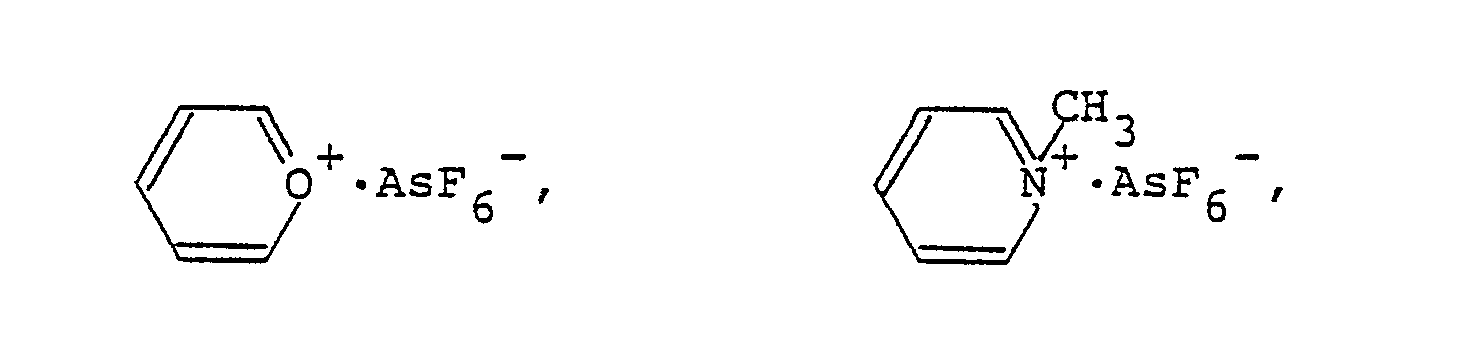


- As specific examples of the carbonium cation represented by the formula (II) or (III), there can be mentioned (C6H3)3C+, (CH3)3C+,

- These carbonium cations are obtained by using a salt (carbonium salt) of the carbonium cation with an anion and dissolving it in an appropriate solvent. As typical instances of the anion to be used, there can be mentioned BF4 -, AlCl4 -, AlBr3Cl-, FeCl4 -, SnCl3 -, PF6 -, PCl6 -, SbCl6 -, SbF6 -, ClO4 and CF3SO2 -. As specific examples of the carbonium salts, there can be mentioned (C6H5)3C·BF4 , (CH3)3C-BF4 , HCO·AlCl4 , HCO-BF4 and C6H3CO·SnCl3.
- The amount of the dopant used is 2 to 40 mole %, preferably 4 to 30 mole %, more preferably 5 to 20 mole %, based on the recurring units CH in the acetylene high polymer. If the amount of the dopant doped in the acetylene high polymer is smaller than 2 mole % or larger than 40 mole %, a battery having a sufficiently large discharge capacitance cannot be obtained.
- The electrical conductivity of the acetylene high polymer before doping is about 10-8 to about 10-9 Ω-1·cm1 in case of the cis-form and about 10-9 Ω-1·cm-1 in case of the trans-form, but the electrical conductivity of the electroconductive acetylene high polymer obtained by doping of the dopant is in the range of from about 10-9 to 4 104 Ω -1·cm-1. When the electroconductive acetylene high polymer obtained by doping of the dopant is used for an electrode of a primary battery, it is preferred that the electrical conductivity be higher than about 10-4 Ω-1·cm-1, and, when the electroconductive acetylene high polymer is used for an electrode of a secondary electrode, the electrical conductivity may be in the range of from about 10-9 to about 10-4Ω-1·cm-1 or higher than about 10-4Ω-1·cm-1.
- The doping amount can freely be controlled by measuring the quantity of electricity flowing during the electrolysis. Doping may be carried out under a constant current or constant voltage condition or under current- and voltage--varying conditions. The doping current and voltage and the doping time vary depending upon the bulk density and area of the acetylene high polymer, the particular dopant, the particular electrolyte and the anisotropy of the electrical conductivity of the intended electroconductive acetylene high polymer.
- An aqueous solution or a non-aqueous solution may be used as the solvent of the electrolyte in the present invention, but a solution of a dopant as mentioned above in a non-aqueous organic solvent is preferred as the solvent of the electrolyte. A non-protonic organic solvent having a high dielectric constant is preferred. For example, there may be used ethers, ketones, nitriles, amines, amides, sulfur compounds, chlorinated hydrocarbons, esters, carbonates and nitro compounds. Of these, ethers, ketones, nitriles, chlorinated hydrocarbons and carbonates are preferred. As typical instances, there can be mentioned tetrahydrofuran, 2-methyltetrahydrofuran, 1,4-dioxane, monogrime, acetonitrile, propionitrile, 4-methyl-2-pentanone, butyronitrile, 1,2-dichloroethane, y-butyrolactone, dimethoxyethane, methyl formate, propylene carbonate, ethylene carbonate, dimethyl formamide, dimethyl sulfoxide, dimethyl thioformamide and sulfolane. These solvents may be used singly or in combination.
- When the shaped article of the present invention is used as an electrode of a battery, as the supporting electrolyte and solvent of an electrolyte of a battery, there may be used those mentioned hereinbefore with respect to electrochemical doping, and doping may be carried out under conditions as described hereinbefore.
- In the battery of the present invention, instead of the above-mentioned electrolytes, there can be used a highly ionic conductive organic solid electrolyte comprising polyethylene oxide and NaI or NaSCN or a paste of a mixture of a supporting electrolyte (dopant) and an organic solvent.
- The concentration of the electrolyte used in the battery of the present invention varies depending upon the particular the positive or negative electrode, the charging and discharging conditions, the operation temperature, the particular supporting electrolyte and the particular organic solvent. However, the concentration of the supporting electrolyte is ordinarily in the range of from 0.001 to 10 moles/ℓ.
- The composite of the acetylene high polymer or an electrically conductive acetylene high polymer prepared by doping the acetylene high polymer with a dopant, with the sheet-form product of a fibrous material as well as an optional electroconductive material can be used as the active material of (1) a positive electrode, (2) a negative electrode or (3) both positive and negative electrodes in a secondary battery.
- The battery (1) wherein the reinforced acetylene high polymer shaped article is used as a positive electrode includes (a) that of the type wherein the negative electrode active material ion is subject to undoping from the shaped article positive electrode during discharge and (b) that of the type wherein the negative electrode active material ion is subject to doping into the shaped article positive electrode during discharge.
- The negative electrode active material used in the battery of the above-mentioned type (a) includes metals having a Pauling electronegativity value not exceeding 1.6, for example, alkali metals, such as lithium and sodium, aluminum and magnesium. Of these, lithium and sodium are preferable. These metals may be used in the form of a sheet, as in the case of an ordinary lithium battery, or such a sheet may be compression-bonded to a wire net of nickel or stainless steel.
- As examples of the secondary battery of the above--mentioned structure (1) wherein the reinforced acetylene high polymer is used as a positive electrode active material, there can be mentioned (CH) (positive)/LiCl04 (electrolyte)/Li (negative) and [(CH)+0.06(ClO4)-0.06]x (positive)/LiC104 (electrolyte)/Li (negative). Examples of the secondary battery of the above-mentioned structure (3) wherein the reinforced acetylene high polymer is used as both positive and negative electrode active materials, there can be mentioned [(CH)+0.024(ClO4)-0.024]x (positive)/(n-Bu4N)+·(ClO4)- (electrolyte)/ [(n-Bu4N) +0.024 (CH) -0.024 (negative), [(CH+0.06 (PF6)-0.06 ]x (positive)/(n-Bu4N)+·(PF6)- (electrolyte)/ [(n-Bu4N)+0.06(CH)-0.06] (negative), [(CH)+0.050(ClO4)-0.050]x (positive)/(n-Bu4N)+·(ClO4)- (supporting electrolyte)/ [(CH)+0.020(ClO4)-0.020]x (negative), [(n-Bu4N)+0.02(CH)-0.02]x (positive)/(n-Bu4N)+·(ClO4)- (supporting electrolyte)/[(n-Bu4N)+0.07(CH)-0.07]x (negative) and [(CH)+0·010 (I3)-0.010](positive)/NaI (solid electrolyte)/[(CH)-0.010(Na)+0.010]x (negative). Incidentally, (CH) x designates the acetylene high polymer shaped article.
- It is possible that the reinforced acetylene high polymer shaped article of the present invention is used as one of the positive and negative electrodes in a secondary battery, and a conventional electroconductive high polymer such as poly-(para-phenylene), poly-(2,5-thienylene) or polypyrrole.
- Among the above-mentioned secondary batteries, those of the type (l)-(a) wherein another electroconductive high polymer is used as the negative electrode active material, those of the type (l)-(b) and those of the type (3) are preferable. More preferable are those of the type (l)-(a) wherein polyparaphenylene is used as the negative electrode active material and those of the type (3).
- As a typical example of a primary battery, there can be mentioned a battery wherein the positive electrode active material is made of a composite of an electroconductive acetylene high polymer, an electrically conductive material and the sheet-form product of a fibrous material, and the negative electrode active material is made of a metal having a Pauling electronegativity value not exceeding 1.6. As the metal used as the negative electrode active substance of the anode, there can be mentioned alkali metals such as lithium and sodium, and aluminum and magnesium. Lithium and aluminum or alloys of these metals are preferred. The metal may be used in the form of a sheet as in an ordinary lithium battery, or this sheet may be press-bonded to a nickel or stainless steel net.
- The charge-discharge cycle life can be prolonged by the use of the reinforced acetylene high polymer shaped article of the present invention. This is prominent particularly when the reinforced acetylene high polymer shaped article is used as an electrode active material in a secondary battery.
- In the present invention, if necessary, a separator composed of a porous membrane of glass or a synthetic resin such as polyethylene or polypropylene or a natural fiber paper may be used.
- The acetylene high polymer used in the present invention is gradually oxidized by oxygen and the capacities of the battery are reduced. Accordingly, it is necessary that the battery should be closed to produce a substantially oxygen-free state.
- A battery comprising the shaped article of the present invention as an electrode has a high energy density, a long cycle life, a good voltage levelness and a high charging and discharging efficiency. Furthermore, since the battery of the present invention has a light weight and a small size and the energy density is high, the battery is suitable for a portable appliance, an electric automobile or a gasoline car or as a power storage battery.
- The present invention will now be described in detail with reference to the following Examples that by no means limit the scope of the invention.
- A glass reaction vessel having an inner capacity of 500 ml was charged with 5.1 ml (15.0 millimoles) of titanium tetrabutoxide in a nitrogen atmosphere, and the titanium tetrabutoxide was dissolved in 20.0 ml of toluene and the reaction vessel was cooled to -78°C. Then, 5.4 ml (40 millimoles) of triethyl aluminum was added to the content of the reaction vessel with stirring to form a catalyst solution. The catalyst solution was aged at room temperature for 1 hour and used for the polymerization of the next step.
- A glass reaction vessel having an inner capacity of 500 ml, the inner atmosphere of which was substituted by nitrogen, was charged with a woven fabric of an electroconductive fiber (a blend of an acrylic fiber and a fine copper wire having an electrical conductivity of 1.7 x 10 -3 Ω-1 · cm-1 and marketed under the tradename of "Sanderlon SS-N" by Nippon Sanmoh Senshoku K.K.), and the reaction vessel was cooled to -78°C and both the surfaces of the woven fabric were uniformly coated with the above-mentioned catalyst solution. Then, the nitrogen gas in the reaction vessel was removed by a vacuum pump and, then, purified acetylene gas was introduced under a pressure of 1 atmosphere into the reaction vessel to initiate the polymerization. Simultaneously with initiation of the polymerization, an acetylene high polymer was precipitated on both the coated surfaces of the woven fabric. The polymerization reaction was carried out at -78°C for 15 minutes while maintaining the acetylene pressure at 1 atmosphere, and the unreacted acetylene gas was removed by a vacuum pump to stop the polymerization. In the nitrogen gas atmosphere, the residual catalyst solution was removed by means of an injector and washing with 100 ml of refined toluene was repeated 6 times while maintaining the temperature at -78°C, and the woven fabric was vacuum-dried at room temperature. The acetylene high polymer was uniformly deposited on both the surfaces of the woven fabric. The obtained reinforced acetylene high polymer contained 25% by weight of the electroconductive fiber and had a film thickness of 250 µm and a tensile strength of higher than 2,000 kg/cm2. The cis-content of this acetylene high polymer was 89% and the acetylene high polymer was a p-type semiconductor having an electrical conductivity of 2.9 x 10⁻⁸ Ω-1·cm-1 (as determined by the direct current two-terminal method).
- The polymerization of acetylene was carried out in the same manner as described in Example 1 except that the woven fabric of the electroconductive fiber was not used, whereby an acetylene high polymer film having a thickness of 96 µm and a cis-content of 92% was obtained. The tensile strength of this acetylene high polymer was 420 kg/cm2.
- The polymerization of acetylene was carried out in the same manner as described in Example 1 except that a 100- mesh (the ASTM standard) nylon net was used instead of the woven fabric of the electroconductive fiber used in Example 1, whereby a reinforced acetylene high polymer film containing 13% of the nylon net and having a thickness of 270 µm was obtained. The tensile strength of this reinforced acetylene high polymer film was higher than 2,000 kg/cm2.
- An one liter capacity glass autoclave equipped with a vane-type mechanical stirrer was charged with 200 ml of toluene, 2 ml (5.9 millimoles) of tetrabutoxy titanium and 2 ml (14.6 millimoles) of triethyl aluminum in a nitrogen atmosphere, and polymerization of acetylene was carried out at a polymerization temperature of -20°C under an acetylene partial pressure of 0.9 kg/cm2 with stirring for 2 hours. Simultaneously with initiation of the introduction of acetylene gas, formation of a reddish violet acetylene high polymer in the form of a short fiber having a length of about 1 mm was started. After completion of the polymerization, the formed short fibrous acetylene high polymer was placed on a glass filter and washed sufficiently with about 1 ℓ of toluene to remove the catalyst. As the catalyst was removed, the short fibrous acetylene high polymer contained 52% by weight of toluene. Then, 2 g of the toluene-containing short fibrous acetylene high polymer was placed on a 100-mesh stainless steel net (the electrical conductivity was 1 x 10³ Ω-1·cm-1 or higher) having an area of 100 cm2 and pressed at room temperature under a pressure of 1,000 kg/cm2 and then deaerated in vacuo, to obtain a composite sheet of the acetylene high polymer and the stainless steel net having a thickness of 150 µm, having a structure such that the stainless steel net was interposed between the layers of the acetylene high polymer. The surface of the composite sheet had a metallic gloss, and the tensile strength of the composite sheet was higher than 2,000 kg/cm .
- The yield of the short fibrous acetylene high polymer obtained according to the above-mentioned polymerization process was 5.7 g, and the high polymer had a cis-content of 76% and an electrical conductivity of 5.1 x 10 Ω-1·cm-1 at room temperature (as determined by the direct current two-terminal method). When the obtained short fibrous acetylene high polymer was examined by a scanning type electron microscope, it was found that the acetylene high polymer had a structure composed of fibrous microcrystals ° (fibrils) having a diameter of 300 to 400 A.
- A test piece having a width of 0.5 cm and a length of 2.0 cm was cut out from the so-obtained composite sheet of the short fibrous acetylene high polymer and the stainless steel net, and the test piece was mechanically press-bonded to a platinum wire to form a positive electrode. Metallic lithium was used as an negative electrode and metallic lithium was used also as a reference electrode, and charging (the quantity of electricity corresponded to the doping amount of 9 mole %) was carried out for 1.2 hours under a 2 constant current (0.5 mA/cm ) by using a propylene carbonate solution containing 1.0 mole/£ of LiClO4 as an electrolyte solution. Immediately after termination of the charging, discharging was carried out under a constant current (0.5 mA/cm2), and when the voltage was reduced to 2.5 V, the charging was carried out again under the same conditions as described above. This charging-discharging cycle was repeated 620 times. The voltage characteristics at the 620th discharging were the same as those at the first discharging.
- From the results of the charging-discharging test of the first cycle, it was found that the energy density was 740 wehr/kg of the acetylene high polymer in the composite sheet used, and the charging-discharging coulombic efficiency was 97%. The ratio of the quantity of electricity discharged until the voltage was reduced to 3 V at the discharging step, to the total quantity of the electricity discharged, was 91%.
- The pressing operation for the preparation of a polymer film was carried out in the same manner as described in Example 3 except that the 100-mesh stainless steel net used in Example 3 was not used. The polymer was scattered and a film was not obtained.
- A molded article of an acetylene high polymer was prepared in the same manner as in Example 3 except that the pressing operation was carried out by using the same mold as that used in Example 5 given hereinafter instead of the stainless steel net used in Example 3.
- The tensile strength of the molded article was 620 kg/cm2 and the bulk density of the molded article was 0.41 g/cc.
- The repeated charging-discharging test was carried out in the same manner as described in Example 3 except that the so-obtained molded article of the acetylene high polymer was used and the charging time was changed to 1 hour (the quantity of electricity corresponded to the doping amount of 9 mole %). When the charging-discharging test was repeated 205 times, charging became impossible. When the molded article of the acetylene high polymer was taken out and examined, it was found that the molded article was broken, and, when a part of the broken molded article was analyzed by the elementary analysis method and infrared spectrophotometric analysis method, it was found that the acetylene high polymer had undergone oxidative deterioration.
- From the results of the charging-discharging test of the first cycle, it was found that the energy density was 570 w.hr/kg of the acetylene high polymer and the charging and discharging coulombic efficiency was 74%. The ratio of the quantity of electricity discharged until the voltage was reduced to 3 V at the discharging step, to the total quantity of the electricity discharged was 66%.
- An one liter capacity glass autoclave equipped with a vane-type mechanical stirrer, as used in Example 3, was charged with 500 ml of toluene, 0.2 ml (0.59 millimole) of tetrabutoxy titanium and 2 ml (14.6 millimoles) of triethyl aluminum, and polymerization was carried out with stirring under an acetylene partial pressure of 1.6 kg/cm2 at a polymerization temperature of 30°C. Simultaneously with initiation of the introduction acetylene gas, formation of a black powdery acetylene high polymer having a particle size of 0.1 mm was started. After completion of the polymerization, the formed powdery acetylene high polymer was placed on a glass filter, and the catalyst was removed by using about 1 i of tolunene. As the catalyst was removed, the powdery acetylene high polymer contained 47% by weight of toluene. Then, 2 g of this toluene-containing powdery acetylene high polymer was placed on a 100-mesh nickel net (the electrical conductivity was higher than 1 x 10³Ω-1. cm-1) and pressed under a pressure of 2 ton/cm at room temperature to obtain a composite article having a thickness of 180 µm, in which the nickel net was interposed between the acetylene high polymer layers. The surface of the composite article had a metallic gloss. The tensile strength of the composite was higher than 2,000 kg/cm2.
- Two test pieces having a width of 0.5 cm and a length of 2.0 cm were cut out from the so-obtained composite article of the acetylene high polymer and the nickel net, and the test pieces were mechanically press-bonded to different platinum wires to form a positive electrode and a negative electrode. Charging (the quantity of electricity corresponded to the doping quantity of 9 mole %) was carried out for 2 hours under a constant current (0.5 mA/cm ) by using a tetrahydrofurn solution containing 0.5 mole/ℓ of (Bu4N)+(PF6)- as an electrolyte solution. Immediately after termination of the charging, discharging was carried out under a constant current (0.5 mA/cm 2), and when the voltage was reduced to 1 V, the charging was carried out again under the same conditions as described above. This charging-discharging cycle was repeated 730 times. The voltage characteristics at the 730th discharging were the same as those at the first discharging.
- It was found that the energy density was 290 w·hr/kg of the acetylene high polymer in the composite article used, and the charging-discharging coulombic efficiency was 86%. The ratio of the quantity of electricity des- changed until the voltage was reduced to 1.5 V at the discharging step, to the total quantity of the electric charge discharged was 90%.
- The pressing operation for the preparation of a composite article was carried out in the same manner as described in Example 4 except that the 100-mesh nickel net used in Example 4 was not used. The polymer was scattered and a composite article could not be obtained.
- The powdery acetylene high polymer obtained in Example 4 was packed in a mold having a thickness of 10 mm, a length of 100 mm and a width of 50 mm and inserted between chromium-plated ferro sheets, and press molding was carried out at room temperature under a pressure of 1,000 kg/cm2 while removing toluene, to obtain a composite article having a thickness of 5 mm. This composite article was brittle and the tensile strength was 140 kg/cm2.
- A battery was constructed by using the composite article as the electrodes, and the charging-discharging test was carried out, in the same manner as in Example 4. The charging-discharging test could be repeated only 211 times. It was found that the energy density was 142 w hr/kg and the coulombic efficiency was 42%.
- An one liter capacity glass reaction vessel, the inside atmosphere of which was completely substituted by nitrogen gas, was sequentially charged at room temperature with 200 ml of toluene refined according to a customary procedure as the polymerization solvent, and 2.94 millimoles of tetrabutoxy titanium and 7.34 millimoles of tirethyl aluminum as the catalyst, whereby a catalyst solution was formed. The catalyst solution was homogeneous. The reaction vessel was cooled by liquefied nitrogen, and nitrogen gas in the reaction vessel was removed by a vacuum pump.
- The reaction vessel was cooled to -78°C and refined acetylene gas was blown thereinto under a pressure of 1 atmosphere with stirring by a magnetic stirrer. In the initial stage of the polymerization, the entire reaction mixture became gelatinous and stirring became difficult. The polymerization reaction was continued for 24 hours while maintaining the acetylene pressure at 1 atmosphere. The reaction mixture had a reddish violet color and was gel-like. After completion of the polymerization, the unreacted acetylene gas was removed, and the reaction product was washed with 200 ml of refined toluene 4 times while maintaining the temperature at -78°C. Even after the washing, the solution was slightly brown and the catalyst could not completely be removed. The sheet-like gel-like acetylene high polymer swollen in toluene was composed of uniform chips of entangled fibrous microcrystals, and a powdery or bulky polymer was not formed.
- A part of the uniform gel-like product was taken out and dried, and the amount of the acetylene high polymer in the gel-like product was measured. It was found that the gel-like product contained 10% by weight of the acetylene high polymer.
- The gel-like product was packed in a mold having a thickness of 10 mm, a length of 100 mm and a width of 50 mm and inserted between chromium-plated ferro type plates. The gelatinous plate was press-molded together with a 150-mesh platinum net (the electrical conductivity was higher than 1 x 10³ Ω -1·cm-1) at room temperature under a pressure of 500 kg/cm2 while removing toluene, whereby a composite article having a thickness of 5 mm was obtained. The tensile strength of the composite article was higher than 2,000 kg/cm .
- A test piece having a width of 0.5 cm and a length of 2.0 cm was cut out from the composite article prepared according to the above-mentioned method, and the test piece was mechanically press-bonded to a platinum wire to form a positive electrode. Doping was carried out under a constant current (10 mA) for 5 hours by using a platinum plate as a negative electrode and a propylene carbonate solution containing 0.5 mole/t of a Li·BF4 as the electrolyte. After completion of the doping, the doped acetylene high polymer film was washed repeatedly with propylene carbonate to obtain a composite article comprising a doped acetylene high polymer having a golden metallic gloss. From the results of the elementary analysis, it was found that the composition of the doped acetylene high polymer film of this composite was expressed as [CH(BF4)0.15]x , and the electrical conductivity was 770 Ω-1 ·cm-1 (as determined by the direct current four-terminal method).
- A battery was constructed by using the BF4 --doped composite article as the positive electrode-active material and lithium as the negative electrode-active material.
- Fig. 1 is a sectional diagram illustrating a battery cell for measuring the characteristics of a button type battery according to one embodiment of the present invention.
- Reference numeral 1 represents an Ni-plated brass vessel,
reference numeral 2 represents a disc-like lithium anode having a diameter of 20 mm,reference numeral 3 represents a circular porous polypropylene separator having a diameter of 26 mm, reference numeral 4 represents a circular carbon fiber felt having a diameter of 26 mm, reference numeral 5 represents a cathode, reference numeral 6 represents a Teflon sheet with pores having an average diameter of 2 µm (Fluoropore FP-200 supplied by Sumitomo Denko K.K.),reference nuemral 7 represents a Teflon vessel having a circular section,reference numeral 8 represents a Teflon ring for fixing the positive electrode, and reference numeral 9 represents an Ni lead line. - The above-mentioned positive electrode-active material (the BF4 --doped electroconductive acetylene high polymer) was placed in a recess in the lower portion of the vessel 1, and the porous circular Teflon sheet 6 was piled on the cathode and clamped and fixed by the
Teflon ring 8. The felt 4 was placed in a recess in the upper portion of the vessel I and piled on the positive electrode, and the felt 4 was impregnated with the electrolyte solution and the lithiumnegative electrode 2 was placed thereon through theseparator 3. Then, the assembly was clamped by thevessel 7 to construct a battery. A solution containing 1 mole/£ of Li'BF4 in distilled dehydrated propylene carbonate was used as the electrolyte solution. - The open-circuit voltage of the thus constructed battery was 5.7 V.
- This battery was- subjected to the discharge test under a constant current of 0.3 mA in an argon atmosphere. The relation between the discharging time and the voltage was as indicated by curve (a) in Fig. 2.
- A press-molded article of an acetylene high polymer was prepared in the same manner as described in Example 5 except that the platinum net used in Example 5 for the production of the composite article was not used, and the doping was carried out in the same manner as described in Example 5 by using this molded article. When the discharge test of the primary battery was carried out by using the obtained doped acetylene high polymer, the curve (b) of Fig. 2 was obtained.
- A 300-ml capacity three-neck flask was charged with 100 ml of toluene, 2 ml of tetrabutoxy titanium and 2 ml of triethyl aluminum in a nitrogen atmosphere, and in the state where the flask was stationarily maintained at -78°C, polymerization of acetylene was carried out for 2 hours under an acetylene gas partial pressure of 1 kg/cm2 to obtain 5.2 g of a sheet-like acetylene high polymer swollen with toluene. While the temperature was maintained at -78°C, 100 ml of toluene was added to wash the high polymer and the supernatant was withdrawn by means of an injector. This operation was repeated 7 times to remove the catalyst. Then, the acetylene high polymer was transferred into a 500-ml capacity separable flask equipped with a mechanical stirrer, and 300 ml of toluene was added and the stirrer was rotated at -78°C in a nitrogen atmosphere to effect pulverization and obtain an acetylene high polymer in the form of a short fiber having a length of 1 mm. Then, 0.5 g of a small piece of this high polymer was placed on a carbon fiber woven fabric (the electrical conductivity was 2lQ -1·cm-1) and pressing was carried out at room temperature under a pressure of 1 ton/cm2 to obtain a flexible composite film having a metallic gloss. The tensile strength of the composite film was 1,740 kg/cm2.
- A battery was prepared and tested in the same manner as described in Example 3 by using the composite article obtained by the above-mentioned method. The charging-discharging test could be repeated 565 times. From the results of the charging-discharging test of the first cycle, it was found that the energy density was 720 w'hr/kg and the charging-discharging coulombic efficiency was 94%.
- The press-molding was carried out in the same manner as described in Example 6 except that the carbon fiber woven fabric used in Example 6 was not used. The polymer was scattered and a molded article could not be obtained.
- The press-molding of the acetylene high polymer was carried out in the same manner as described in Example 6 except that the mold used in Example 5 was used instead of the carbon fiber woven fabric used in Example 6 for production of the composite. The battery test was carried out in the same manner as described in Example 6 by using the obtained molded article. The charging-discharging test could be repeated only 225 times. The energy density was 510 w hr/kg and the charging-discharging coulombic efficiency was 67%.
- of 1 liter was charged with 0.2 ml (0.59 millimole) of titanium tetrabutoxide in a nitrogen atmosphere, and the titanium tetrabutoxide was dissolved in 500 ml of toluene and the reaction vessel was cooled to -78°C. Then, 2 ml (l4.6 millimoles) of triethyl aluminum was added to the content of the reaction vessel with stirring to form a catalyst solution. The catalyst solution was aged at room temperature for 1 hour and used for the subsequent polymerization stage.
- A glass reaction vessel having an inner capacity of 500 ml, the inner atmosphere of which was substituted by nitrogen, was charged with the same nickel net as used in Example 4, and the reaction vessel was cooled to -78°C and both the surfaces of the net were uniformly coated with the above-mentioned catalyst solution. Then, the nitrogen gas in the reaction vessel was removed by a vacuum pump and purified acetylene gas was introduced under a pressure of 1 atmosphere into the reaction vessel to initiate the polymerization. Simultaneously with initiation of the polymerization, an acetylene high polymer was precipitated on both the coated surfaces of the 100-mesh nickel net. The polymerization reaction was carried out at -78°C for 15 minutes while maintaining the acetylene pressure at 1 atmosphere, and the unreacted acetylene gas was removed by a vacuum pump to stop the polymerization. In the nitrogen gas atmosphere, the residual catalyst solution was removed by means of an injector and washed with 100 ml of refined toluene 6 times while maintaining the temperature at -78°C, and the net was vacuum-dried at room temperature. The acetylene high polymer was uniformly deposited on both the surfaces of the nickel net.
- The so prepared composite article was calendered at room temperature by two rolls (the roll gap was 0.4 mm and the roll diameter was 3 inches) under a pressure of 500 kg/cm2. The obtained reinforced acetylene high polymer contained 25% by weight of the nickel net and had a film thickness of 250 um and a tensile strength higher than 2,000 kg/cm2. The cis-content of this acetylene high polymer was 89% and the acetylene high polymer was a p-type semiconductor having an electrical conductivity of 2.9 x 10⁻⁸ Ω-1·cm-1 (as determined by the direct current two--terminal method).
- Polymerization of acetylene was carried out in the same manner as described in Example 1 except that the same nickel net as used in Example 4.was used instead of the electroconductive fiber woven fabric used in Example 1, to obtain a reinforced acetylene high polymer containing 25% by weight of the nickel net and having a film thickness of 250 µm. The tensile strength of the acetylene high polymer was higher than 2,000 kg/cm2. The cis-content of this acetylene high polymer was 89%, and the acetylene high polymer was a p-type semiconductor having an electric conductance of 2.9 x 10⁻³ Ω-1·cm-1.
- The battery test was carried out in the same manner as described in Example 4 except that the composite article obtained by the above-mentioned method was.used. The charging-discharging test could be repeated 388 times. From the results of the charging-discharging test of the first cycle, it was found that the energy density was 620.w hr/kg and the charging-discharging coulombic efficiency was 81%.
- An acetylene high polymer was prepared in the same manner as described in Example 8 except that the nickel net used in Example 8 for the production of the composite was not used, whereby a acetylene high polymer film having a tensile strength of 420 kg/cm2 was obtained. A battery was prepared and tested in the same manner as described in Example 8 by using this acetylene high polymer film. The charging-discharging test could be repeated only 87 times. The energy density was 390 w'hr/kg and the charging-discharging coulombic efficiency was 61%.
- An one liter capacity glass reaction vessel, the inside atmosphere of which was completely substituted by nitrogen gas, was sequentially charged at room temperature with a 100-mesh stainless steel net, 100 ml of toluene refined according to a customary procedure as the polymerization solvent, and 4.41 millimoles of tetrabutoxy titanium and 11.01 millimoles of triethyl aluminum as the catalyst, whereby a catalyst solution was formed. The catalyst solution was homogeneous. The reaction vessel was cooled by liquefied nitrogen, and nitrogen gas in the reaction vessel was removed by a vacuum pump.
- The reaction vessel was cooled to -78°C and refined acetylene gas was blown thereinto under a pressure of 1 atmosphere in the state where the catalyst solution was kept stationary. The polymerization reaction was continued for 10 hours while maintaining the acetylene pressure at 1 atmosphere. The reaction mixture had a reddish violet color and was gel-like. After completion of the polymerization, the unreacted acetylene gas was removed, and the reaction product was washed with 200 ml of refined toluene 4 times while maintaining the temperature at -78°C to obtain a swollen acetylene high polymer sheet having a thickness of about 0.5 cm and containing the stainless steel net. This acetylene high polymer swollen in toluene was composed of uniformly entangled fibrous microcrystals 0 (fibrils) having a size of 300 to 500 A, and a powdery or bulky polymer was not formed.
- The swollen acetylene high polymer sheet containing the stainless steel net was interposed between chromium--plated ferro type plates and was preliminarily pressed at room temperature under a pressure of 100 kg/cm , and the preliminarily pressed polymer was then pressed under a pressure of 15 ton/cm2 to obtain a uniform and flexible composite article having a reddish brown metallic gloss and a thickness of 230 µm. The composite article was vacuum-dried at room temperature for 5 hours. The tensile strength of the obtained composite was higher than 2,000 kg/cm2, and the composite article contained 43% by weight of the stainless steel net.
- A battery was prepared and tested in the same manner as described in Example 3 by using the composite article obtained by the above-mentioned method. The charging-discharging test could be repeated 803 times. From the results of the charging-discharging test of the first cycle, it was found that the energy density was 745 w'hr/kg and the charging-discharging coulombic efficiency was 97.6%.
- An acetylene high polymer was prepared and press--molded in the same manner as described in Example 9 except that the stainless steel net used in Example 9 for the production of the composite was not used. A battery was prepared and tested in the same manner as described in Example 9 by using the so-obtained molded article. The charging-discharging test could be repeated only 233 times. The energy density was 550 w.hr/kg and the charging-discharging coulombic efficiency was 72%.
- An acetylene high polymer composite article was prepared in the same manner as described in Example 4 except that a nickel sheet having a thickness of 200 µm was used instead of the 100 mesh nickel net.
- A battery was constructed by using the composite article as the electrodes, and the charging-discharging test was carried out in the same manner as described in Example 4. The charging-discharging test could be repeated only 363 times. It was found that the energy density was 256 w·hr/kg and the coulombic efficiency was 76%.
- 20.8 g of the acetylene high polymer containing 52% by weight of toluene, obtained in Example 4, 0.5 g of a powdery carbon black having an electrical conductivity of 21Ω -1. cm-1 and 20 ml of toluene were mixed together in a ball mill. The mixture was placed on a 100 mesh nickel net, and pressed together under a pressure of 300 kg/cm2 at room temperature. Therefore, the pressed product was deaerated under vacuum to obtain a composite article. The composite article had a tensile strength of at least 2,000 kg/cm2.
- A battery was constructed by using the composite article as the electrodes, and the charging-discharging test was carried out, in the same manner as described in Example 4. The voltage characteristics at the 750th discharging were the same as those at the first discharging. It was found that the energy density was 285 w'hr/kg of the acetylene high polymer in the composite article, and the coulombic efficiency was 88%.
Claims (62)


Applications Claiming Priority (6)
| Application Number | Priority Date | Filing Date | Title |
|---|---|---|---|
| JP15064781A JPS5852337A (en) | 1981-09-25 | 1981-09-25 | Reinforced acetylene high polymer |
| JP150647/81 | 1981-09-25 | ||
| JP8882382A JPS58206658A (en) | 1982-05-27 | 1982-05-27 | Production method of reinforced acetylene polymer with excellent mechanical strength |
| JP88823/82 | 1982-05-27 | ||
| JP57088824A JPS58206066A (en) | 1982-05-27 | 1982-05-27 | battery |
| JP88824/82 | 1982-05-27 |
Publications (3)
| Publication Number | Publication Date |
|---|---|
| EP0076119A2 true EP0076119A2 (en) | 1983-04-06 |
| EP0076119A3 EP0076119A3 (en) | 1983-06-01 |
| EP0076119B1 EP0076119B1 (en) | 1986-07-23 |
Family
ID=27305920
Family Applications (1)
| Application Number | Title | Priority Date | Filing Date |
|---|---|---|---|
| EP82305054A Expired EP0076119B1 (en) | 1981-09-25 | 1982-09-24 | Reinforced acetylene high polymers, process for preparing same and battery having same |
Country Status (3)
| Country | Link |
|---|---|
| US (1) | US4560633A (en) |
| EP (1) | EP0076119B1 (en) |
| DE (1) | DE3272163D1 (en) |
Cited By (7)
| Publication number | Priority date | Publication date | Assignee | Title |
|---|---|---|---|---|
| US4463071A (en) * | 1983-11-30 | 1984-07-31 | Allied Corporation | Secondary batteries using room-temperature molten non-aqueous electrolytes containing 1,2,3-trialkylimidazolium halides or 1,3-dialkylimidazolium halide |
| EP0124875A1 (en) * | 1983-05-04 | 1984-11-14 | Showa Denko Kabushiki Kaisha | Battery having an electrode made of a polymeric compound with conjugated double bonds |
| EP0141371A1 (en) * | 1983-10-26 | 1985-05-15 | Showa Denko Kabushiki Kaisha | Secondary Battery |
| US4528254A (en) * | 1983-11-30 | 1985-07-09 | Allied Corporation | Conjugated polymer battery containing organosulfur solvent |
| EP0136635A3 (en) * | 1983-09-21 | 1986-12-30 | Hitachi, Ltd. | Secondary cell |
| EP0239846A1 (en) * | 1986-03-21 | 1987-10-07 | Hoechst Aktiengesellschaft | Flexible and electrically conducting composite materials, process for their preparation and their use |
| EP0219063A3 (en) * | 1985-10-09 | 1989-03-22 | Sanyo Electric Co., Ltd. | Electrically conductive material and secondary battery using the electrically conductive material |
Families Citing this family (13)
| Publication number | Priority date | Publication date | Assignee | Title |
|---|---|---|---|---|
| DE3607378A1 (en) * | 1986-03-06 | 1987-09-10 | Basf Ag | ELECTROCHEMICAL SECONDARY ELEMENT WITH AT LEAST ONE POLYMER ELECTRODE |
| US5075990A (en) * | 1986-09-11 | 1991-12-31 | International Paper Company | Battery separator fabric method for manufacturing |
| US4824745A (en) * | 1987-02-25 | 1989-04-25 | Bridgestone Corporation | Electric cell comprising a polymeric material film electrode having a collection integrated therewith |
| US4814242A (en) * | 1987-10-13 | 1989-03-21 | Allied-Signal Inc. | Elastomeric binders for battery electrodes |
| JP2001118570A (en) * | 1999-10-19 | 2001-04-27 | Nec Corp | Method for manufacturing electrode for polymer secondary battery |
| JP5443690B2 (en) * | 2005-01-06 | 2014-03-19 | ルトガース,ザ ステート ユニヴァーシティ オブ ニュージャーシィ | Electrochemical self-assembled battery |
| US8017263B2 (en) * | 2006-01-24 | 2011-09-13 | Sony Corporation | Separator and battery |
| WO2013154724A1 (en) | 2012-04-13 | 2013-10-17 | PolyJoule, Inc. | Devices and methods including polyacetylenes |
| US9692039B2 (en) | 2012-07-24 | 2017-06-27 | Quantumscape Corporation | Nanostructured materials for electrochemical conversion reactions |
| WO2015130831A1 (en) | 2014-02-25 | 2015-09-03 | Quantumscape Corporation | Hybrid electrodes with both intercalation and conversion materials |
| WO2016025866A1 (en) | 2014-08-15 | 2016-02-18 | Quantumscape Corporation | Doped conversion materials for secondary battery cathodes |
| US10847780B2 (en) * | 2016-09-16 | 2020-11-24 | Pacesetter, Inc. | Battery electrode and methods of making |
| CN110041700B (en) * | 2019-05-17 | 2021-05-25 | 金旸(厦门)新材料科技有限公司 | Carbon fiber reinforced nylon material, preparation raw material, preparation method and application thereof |
Family Cites Families (10)
| Publication number | Priority date | Publication date | Assignee | Title |
|---|---|---|---|---|
| US3192071A (en) * | 1960-12-27 | 1965-06-29 | Union Carbide Corp | Dry cell electrodes containing fibrous graphite and process of making same |
| US3185590A (en) * | 1961-01-06 | 1965-05-25 | North American Aviation Inc | Lightweight secondary battery |
| FR1519729A (en) * | 1967-02-20 | 1968-04-05 | Centre Nat Rech Scient | electrodes based on organic semiconductors and electrochemical generators using such electrodes |
| US3639174A (en) * | 1970-04-22 | 1972-02-01 | Du Pont | Voltaic cells with lithium-aluminum alloy anode and nonaqueous solvent electrolyte system |
| US3933722A (en) * | 1973-04-20 | 1976-01-20 | General Electric Company | Meet extrudable polyacetylene copolymer blends |
| US4228060A (en) * | 1978-11-03 | 1980-10-14 | Allied Chemical Corporation | Polymerization of acetylene |
| GB2058096B (en) * | 1979-03-29 | 1983-04-20 | Showa Denko Kk | Process for preparing gel-like composition of acetylene high polymer and process for fabrication thereof |
| US4375427A (en) * | 1979-12-13 | 1983-03-01 | Allied Corporation | Thermoplastic conductive polymers |
| US4321114A (en) * | 1980-03-11 | 1982-03-23 | University Patents, Inc. | Electrochemical doping of conjugated polymers |
| US4333996A (en) * | 1980-09-29 | 1982-06-08 | Union Carbide Corporation | Solid state cell in which an inert nonconductive material is dispersed in the cathode |
-
1982
- 1982-09-24 EP EP82305054A patent/EP0076119B1/en not_active Expired
- 1982-09-24 DE DE8282305054T patent/DE3272163D1/en not_active Expired
-
1985
- 1985-02-27 US US06/705,861 patent/US4560633A/en not_active Expired - Fee Related
Cited By (8)
| Publication number | Priority date | Publication date | Assignee | Title |
|---|---|---|---|---|
| EP0124875A1 (en) * | 1983-05-04 | 1984-11-14 | Showa Denko Kabushiki Kaisha | Battery having an electrode made of a polymeric compound with conjugated double bonds |
| EP0136635A3 (en) * | 1983-09-21 | 1986-12-30 | Hitachi, Ltd. | Secondary cell |
| US4879192A (en) * | 1983-09-21 | 1989-11-07 | Hitachi Ltd. | Secondary cell |
| EP0141371A1 (en) * | 1983-10-26 | 1985-05-15 | Showa Denko Kabushiki Kaisha | Secondary Battery |
| US4463071A (en) * | 1983-11-30 | 1984-07-31 | Allied Corporation | Secondary batteries using room-temperature molten non-aqueous electrolytes containing 1,2,3-trialkylimidazolium halides or 1,3-dialkylimidazolium halide |
| US4528254A (en) * | 1983-11-30 | 1985-07-09 | Allied Corporation | Conjugated polymer battery containing organosulfur solvent |
| EP0219063A3 (en) * | 1985-10-09 | 1989-03-22 | Sanyo Electric Co., Ltd. | Electrically conductive material and secondary battery using the electrically conductive material |
| EP0239846A1 (en) * | 1986-03-21 | 1987-10-07 | Hoechst Aktiengesellschaft | Flexible and electrically conducting composite materials, process for their preparation and their use |
Also Published As
| Publication number | Publication date |
|---|---|
| EP0076119B1 (en) | 1986-07-23 |
| US4560633A (en) | 1985-12-24 |
| EP0076119A3 (en) | 1983-06-01 |
| DE3272163D1 (en) | 1986-08-28 |
Similar Documents
| Publication | Publication Date | Title |
|---|---|---|
| US4560633A (en) | Reinforced high polymers, process for preparing same and battery having same | |
| US4544615A (en) | Battery having electrode made of polymeric compound having conjugated double bonds | |
| US4537843A (en) | Secondary battery | |
| US4496640A (en) | Battery having acetylene high polymer electrode | |
| Tsutsumi et al. | Preparation of polyaniline-poly (p-styrenesulfonic acid) composite by post-polymerization and application as positive active material for a rechargeable lithium battery | |
| Kim et al. | Polymer electrolytes based on acrylonitrile‐methyl methacrylate‐styrene terpolymers for rechargeable lithium‐polymer batteries | |
| JPS5942784A (en) | battery | |
| JPH0530026B2 (en) | ||
| JPS5840781A (en) | Secondary battery | |
| EP0113658B1 (en) | Process for the purification of acetylene polymers | |
| JP2501821B2 (en) | Secondary battery | |
| JPS59203375A (en) | secondary battery | |
| JPS5971268A (en) | battery | |
| JPS593870A (en) | battery | |
| JPS59211971A (en) | Cell | |
| JPH0373992B2 (en) | ||
| JPS59112584A (en) | battery | |
| JPS5951483A (en) | battery | |
| JPS5854554A (en) | battery | |
| JPS58206078A (en) | Battery | |
| JPS6010570A (en) | secondary battery | |
| JPS5838465A (en) | Secondary cell | |
| JPS5971267A (en) | battery | |
| JPS59226473A (en) | secondary battery | |
| JPH0527232B2 (en) |
Legal Events
| Date | Code | Title | Description |
|---|---|---|---|
| PUAI | Public reference made under article 153(3) epc to a published international application that has entered the european phase |
Free format text: ORIGINAL CODE: 0009012 |
|
| PUAL | Search report despatched |
Free format text: ORIGINAL CODE: 0009013 |
|
| 17P | Request for examination filed |
Effective date: 19821011 |
|
| AK | Designated contracting states |
Designated state(s): BE CH DE FR GB IT LI NL |
|
| AK | Designated contracting states |
Designated state(s): BE CH DE FR GB IT LI NL |
|
| GRAA | (expected) grant |
Free format text: ORIGINAL CODE: 0009210 |
|
| AK | Designated contracting states |
Kind code of ref document: B1 Designated state(s): BE CH DE FR GB IT LI NL |
|
| REF | Corresponds to: |
Ref document number: 3272163 Country of ref document: DE Date of ref document: 19860828 |
|
| ET | Fr: translation filed | ||
| ITF | It: translation for a ep patent filed | ||
| PGFP | Annual fee paid to national office [announced via postgrant information from national office to epo] |
Ref country code: NL Payment date: 19860930 Year of fee payment: 5 |
|
| PLBE | No opposition filed within time limit |
Free format text: ORIGINAL CODE: 0009261 |
|
| STAA | Information on the status of an ep patent application or granted ep patent |
Free format text: STATUS: NO OPPOSITION FILED WITHIN TIME LIMIT |
|
| 26N | No opposition filed | ||
| PG25 | Lapsed in a contracting state [announced via postgrant information from national office to epo] |
Ref country code: LI Effective date: 19870930 Ref country code: CH Effective date: 19870930 Ref country code: BE Effective date: 19870930 |
|
| BERE | Be: lapsed |
Owner name: HITACHI LTD Effective date: 19870930 Owner name: SHOWA DENKO K.K. Effective date: 19870930 |
|
| PG25 | Lapsed in a contracting state [announced via postgrant information from national office to epo] |
Ref country code: NL Effective date: 19880401 |
|
| NLV4 | Nl: lapsed or anulled due to non-payment of the annual fee | ||
| REG | Reference to a national code |
Ref country code: CH Ref legal event code: PL |
|
| PGFP | Annual fee paid to national office [announced via postgrant information from national office to epo] |
Ref country code: GB Payment date: 19900803 Year of fee payment: 9 |
|
| PGFP | Annual fee paid to national office [announced via postgrant information from national office to epo] |
Ref country code: FR Payment date: 19900919 Year of fee payment: 9 |
|
| PGFP | Annual fee paid to national office [announced via postgrant information from national office to epo] |
Ref country code: DE Payment date: 19901031 Year of fee payment: 9 |
|
| PG25 | Lapsed in a contracting state [announced via postgrant information from national office to epo] |
Ref country code: GB Effective date: 19910924 |
|
| GBPC | Gb: european patent ceased through non-payment of renewal fee | ||
| PG25 | Lapsed in a contracting state [announced via postgrant information from national office to epo] |
Ref country code: FR Effective date: 19920529 |
|
| PG25 | Lapsed in a contracting state [announced via postgrant information from national office to epo] |
Ref country code: DE Effective date: 19920602 |
|
| REG | Reference to a national code |
Ref country code: FR Ref legal event code: ST |