EP0073636B2 - Photographic elements containing ballasted couplers - Google Patents
Photographic elements containing ballasted couplers Download PDFInfo
- Publication number
- EP0073636B2 EP0073636B2 EP19820304461 EP82304461A EP0073636B2 EP 0073636 B2 EP0073636 B2 EP 0073636B2 EP 19820304461 EP19820304461 EP 19820304461 EP 82304461 A EP82304461 A EP 82304461A EP 0073636 B2 EP0073636 B2 EP 0073636B2
- Authority
- EP
- European Patent Office
- Prior art keywords
- group
- coupler
- coupling
- couplers
- dye
- Prior art date
- Legal status (The legal status is an assumption and is not a legal conclusion. Google has not performed a legal analysis and makes no representation as to the accuracy of the status listed.)
- Expired
Links
- 238000005859 coupling reaction Methods 0.000 claims description 36
- 230000008878 coupling Effects 0.000 claims description 34
- 238000010168 coupling process Methods 0.000 claims description 34
- -1 silver halide Chemical class 0.000 claims description 32
- 229910052709 silver Inorganic materials 0.000 claims description 24
- 239000004332 silver Substances 0.000 claims description 24
- 239000000839 emulsion Substances 0.000 claims description 20
- 239000003795 chemical substances by application Substances 0.000 claims description 19
- 229910052739 hydrogen Inorganic materials 0.000 claims description 17
- 239000001257 hydrogen Substances 0.000 claims description 17
- 125000004432 carbon atom Chemical group C* 0.000 claims description 12
- 125000000217 alkyl group Chemical group 0.000 claims description 10
- 150000001875 compounds Chemical class 0.000 claims description 9
- 125000004435 hydrogen atom Chemical group [H]* 0.000 claims description 8
- 125000002947 alkylene group Chemical group 0.000 claims description 7
- 125000003118 aryl group Chemical group 0.000 claims description 7
- NINIDFKCEFEMDL-UHFFFAOYSA-N Sulfur Chemical group [S] NINIDFKCEFEMDL-UHFFFAOYSA-N 0.000 claims description 4
- 125000000732 arylene group Chemical group 0.000 claims description 4
- QVGXLLKOCUKJST-UHFFFAOYSA-N atomic oxygen Chemical group [O] QVGXLLKOCUKJST-UHFFFAOYSA-N 0.000 claims description 4
- 229910052736 halogen Inorganic materials 0.000 claims description 4
- 150000002367 halogens Chemical class 0.000 claims description 4
- 229910052760 oxygen Inorganic materials 0.000 claims description 4
- 239000001301 oxygen Substances 0.000 claims description 4
- 239000005864 Sulphur Chemical group 0.000 claims description 3
- PTFYQSWHBLOXRZ-UHFFFAOYSA-N imidazo[4,5-e]indazole Chemical compound C1=CC2=NC=NC2=C2C=NN=C21 PTFYQSWHBLOXRZ-UHFFFAOYSA-N 0.000 claims description 3
- JEXVQSWXXUJEMA-UHFFFAOYSA-N pyrazol-3-one Chemical compound O=C1C=CN=N1 JEXVQSWXXUJEMA-UHFFFAOYSA-N 0.000 claims description 3
- MCSKRVKAXABJLX-UHFFFAOYSA-N pyrazolo[3,4-d]triazole Chemical compound N1=NN=C2N=NC=C21 MCSKRVKAXABJLX-UHFFFAOYSA-N 0.000 claims description 3
- KJCVRFUGPWSIIH-UHFFFAOYSA-N 1-naphthol Chemical compound C1=CC=C2C(O)=CC=CC2=C1 KJCVRFUGPWSIIH-UHFFFAOYSA-N 0.000 claims 1
- ISWSIDIOOBJBQZ-UHFFFAOYSA-N Phenol Chemical compound OC1=CC=CC=C1 ISWSIDIOOBJBQZ-UHFFFAOYSA-N 0.000 claims 1
- 239000000975 dye Substances 0.000 description 30
- WEVYAHXRMPXWCK-UHFFFAOYSA-N Acetonitrile Chemical compound CC#N WEVYAHXRMPXWCK-UHFFFAOYSA-N 0.000 description 24
- WYURNTSHIVDZCO-UHFFFAOYSA-N Tetrahydrofuran Chemical compound C1CCOC1 WYURNTSHIVDZCO-UHFFFAOYSA-N 0.000 description 24
- 239000007787 solid Substances 0.000 description 23
- RTZKZFJDLAIYFH-UHFFFAOYSA-N Diethyl ether Chemical compound CCOCC RTZKZFJDLAIYFH-UHFFFAOYSA-N 0.000 description 22
- 239000010410 layer Substances 0.000 description 21
- 239000000243 solution Substances 0.000 description 20
- 238000011160 research Methods 0.000 description 18
- QTBSBXVTEAMEQO-UHFFFAOYSA-N Acetic acid Chemical compound CC(O)=O QTBSBXVTEAMEQO-UHFFFAOYSA-N 0.000 description 15
- OKKJLVBELUTLKV-UHFFFAOYSA-N Methanol Chemical compound OC OKKJLVBELUTLKV-UHFFFAOYSA-N 0.000 description 15
- ZMXDDKWLCZADIW-UHFFFAOYSA-N N,N-Dimethylformamide Chemical compound CN(C)C=O ZMXDDKWLCZADIW-UHFFFAOYSA-N 0.000 description 15
- 239000003054 catalyst Substances 0.000 description 15
- 239000000203 mixture Substances 0.000 description 14
- 238000002360 preparation method Methods 0.000 description 14
- 239000000047 product Substances 0.000 description 14
- VEXZGXHMUGYJMC-UHFFFAOYSA-N Hydrochloric acid Chemical compound Cl VEXZGXHMUGYJMC-UHFFFAOYSA-N 0.000 description 13
- YLQBMQCUIZJEEH-UHFFFAOYSA-N tetrahydrofuran Natural products C=1C=COC=1 YLQBMQCUIZJEEH-UHFFFAOYSA-N 0.000 description 12
- 238000000921 elemental analysis Methods 0.000 description 9
- 239000000543 intermediate Substances 0.000 description 9
- 0 **c1ccc(*)cc1 Chemical compound **c1ccc(*)cc1 0.000 description 8
- UFHFLCQGNIYNRP-UHFFFAOYSA-N Hydrogen Chemical compound [H][H] UFHFLCQGNIYNRP-UHFFFAOYSA-N 0.000 description 8
- 238000001914 filtration Methods 0.000 description 8
- 238000003756 stirring Methods 0.000 description 8
- NGNBDVOYPDDBFK-UHFFFAOYSA-N 2-[2,4-di(pentan-2-yl)phenoxy]acetyl chloride Chemical compound CCCC(C)C1=CC=C(OCC(Cl)=O)C(C(C)CCC)=C1 NGNBDVOYPDDBFK-UHFFFAOYSA-N 0.000 description 7
- XEKOWRVHYACXOJ-UHFFFAOYSA-N Ethyl acetate Chemical compound CCOC(C)=O XEKOWRVHYACXOJ-UHFFFAOYSA-N 0.000 description 7
- KDLHZDBZIXYQEI-UHFFFAOYSA-N Palladium Chemical compound [Pd] KDLHZDBZIXYQEI-UHFFFAOYSA-N 0.000 description 7
- 238000011161 development Methods 0.000 description 7
- 239000000706 filtrate Substances 0.000 description 7
- 238000012545 processing Methods 0.000 description 7
- XLYOFNOQVPJJNP-UHFFFAOYSA-N water Substances O XLYOFNOQVPJJNP-UHFFFAOYSA-N 0.000 description 7
- BQCADISMDOOEFD-UHFFFAOYSA-N Silver Chemical compound [Ag] BQCADISMDOOEFD-UHFFFAOYSA-N 0.000 description 6
- HEMHJVSKTPXQMS-UHFFFAOYSA-M Sodium hydroxide Chemical compound [OH-].[Na+] HEMHJVSKTPXQMS-UHFFFAOYSA-M 0.000 description 6
- 230000000903 blocking effect Effects 0.000 description 6
- 238000006243 chemical reaction Methods 0.000 description 6
- 238000001953 recrystallisation Methods 0.000 description 6
- FYSNRJHAOHDILO-UHFFFAOYSA-N thionyl chloride Chemical compound ClS(Cl)=O FYSNRJHAOHDILO-UHFFFAOYSA-N 0.000 description 6
- YXFVVABEGXRONW-UHFFFAOYSA-N Toluene Chemical compound CC1=CC=CC=C1 YXFVVABEGXRONW-UHFFFAOYSA-N 0.000 description 5
- 238000010521 absorption reaction Methods 0.000 description 5
- 150000001412 amines Chemical group 0.000 description 5
- MHDVGSVTJDSBDK-UHFFFAOYSA-N dibenzyl ether Chemical compound C=1C=CC=CC=1COCC1=CC=CC=C1 MHDVGSVTJDSBDK-UHFFFAOYSA-N 0.000 description 5
- 238000005406 washing Methods 0.000 description 5
- IJGRMHOSHXDMSA-UHFFFAOYSA-N Atomic nitrogen Chemical compound N#N IJGRMHOSHXDMSA-UHFFFAOYSA-N 0.000 description 4
- LFQSCWFLJHTTHZ-UHFFFAOYSA-N Ethanol Chemical compound CCO LFQSCWFLJHTTHZ-UHFFFAOYSA-N 0.000 description 4
- KWYUFKZDYYNOTN-UHFFFAOYSA-M Potassium hydroxide Chemical compound [OH-].[K+] KWYUFKZDYYNOTN-UHFFFAOYSA-M 0.000 description 4
- 239000002253 acid Substances 0.000 description 4
- 238000001035 drying Methods 0.000 description 4
- 150000002148 esters Chemical class 0.000 description 4
- 239000012044 organic layer Substances 0.000 description 4
- SCVFZCLFOSHCOH-UHFFFAOYSA-M potassium acetate Chemical compound [K+].CC([O-])=O SCVFZCLFOSHCOH-UHFFFAOYSA-M 0.000 description 4
- 230000005855 radiation Effects 0.000 description 4
- 230000009257 reactivity Effects 0.000 description 4
- 239000002904 solvent Substances 0.000 description 4
- 238000001228 spectrum Methods 0.000 description 4
- 125000001424 substituent group Chemical group 0.000 description 4
- WFDIJRYMOXRFFG-UHFFFAOYSA-N Acetic anhydride Chemical compound CC(=O)OC(C)=O WFDIJRYMOXRFFG-UHFFFAOYSA-N 0.000 description 3
- 241001479434 Agfa Species 0.000 description 3
- YMWUJEATGCHHMB-UHFFFAOYSA-N Dichloromethane Chemical compound ClCCl YMWUJEATGCHHMB-UHFFFAOYSA-N 0.000 description 3
- 108010010803 Gelatin Proteins 0.000 description 3
- JLTDJTHDQAWBAV-UHFFFAOYSA-N N,N-dimethylaniline Chemical compound CN(C)C1=CC=CC=C1 JLTDJTHDQAWBAV-UHFFFAOYSA-N 0.000 description 3
- 125000003277 amino group Chemical group 0.000 description 3
- 239000007864 aqueous solution Substances 0.000 description 3
- 238000004061 bleaching Methods 0.000 description 3
- 239000012230 colorless oil Substances 0.000 description 3
- 238000003810 ethyl acetate extraction Methods 0.000 description 3
- 239000008273 gelatin Substances 0.000 description 3
- 229920000159 gelatin Polymers 0.000 description 3
- 235000019322 gelatine Nutrition 0.000 description 3
- 235000011852 gelatine desserts Nutrition 0.000 description 3
- 239000005457 ice water Substances 0.000 description 3
- 238000000034 method Methods 0.000 description 3
- VLKZOEOYAKHREP-UHFFFAOYSA-N n-Hexane Chemical compound CCCCCC VLKZOEOYAKHREP-UHFFFAOYSA-N 0.000 description 3
- 230000007935 neutral effect Effects 0.000 description 3
- 238000000655 nuclear magnetic resonance spectrum Methods 0.000 description 3
- 238000010992 reflux Methods 0.000 description 3
- FVAUCKIRQBBSSJ-UHFFFAOYSA-M sodium iodide Chemical compound [Na+].[I-] FVAUCKIRQBBSSJ-UHFFFAOYSA-M 0.000 description 3
- 239000000725 suspension Substances 0.000 description 3
- 238000001665 trituration Methods 0.000 description 3
- 239000001043 yellow dye Substances 0.000 description 3
- 150000005207 1,3-dihydroxybenzenes Chemical class 0.000 description 2
- CWLKGDAVCFYWJK-UHFFFAOYSA-N 3-aminophenol Chemical class NC1=CC=CC(O)=C1 CWLKGDAVCFYWJK-UHFFFAOYSA-N 0.000 description 2
- XRZDIHADHZSFBB-UHFFFAOYSA-N 3-oxo-n,3-diphenylpropanamide Chemical class C=1C=CC=CC=1NC(=O)CC(=O)C1=CC=CC=C1 XRZDIHADHZSFBB-UHFFFAOYSA-N 0.000 description 2
- CSCPPACGZOOCGX-UHFFFAOYSA-N Acetone Chemical compound CC(C)=O CSCPPACGZOOCGX-UHFFFAOYSA-N 0.000 description 2
- XDTMQSROBMDMFD-UHFFFAOYSA-N Cyclohexane Chemical compound C1CCCCC1 XDTMQSROBMDMFD-UHFFFAOYSA-N 0.000 description 2
- CSNNHWWHGAXBCP-UHFFFAOYSA-L Magnesium sulfate Chemical compound [Mg+2].[O-][S+2]([O-])([O-])[O-] CSNNHWWHGAXBCP-UHFFFAOYSA-L 0.000 description 2
- BAVYZALUXZFZLV-UHFFFAOYSA-N Methylamine Chemical compound NC BAVYZALUXZFZLV-UHFFFAOYSA-N 0.000 description 2
- JUJWROOIHBZHMG-UHFFFAOYSA-N Pyridine Chemical compound C1=CC=NC=C1 JUJWROOIHBZHMG-UHFFFAOYSA-N 0.000 description 2
- SMWDFEZZVXVKRB-UHFFFAOYSA-N Quinoline Chemical compound N1=CC=CC2=CC=CC=C21 SMWDFEZZVXVKRB-UHFFFAOYSA-N 0.000 description 2
- VYPSYNLAJGMNEJ-UHFFFAOYSA-N Silicium dioxide Chemical compound O=[Si]=O VYPSYNLAJGMNEJ-UHFFFAOYSA-N 0.000 description 2
- 230000002378 acidificating effect Effects 0.000 description 2
- 238000005904 alkaline hydrolysis reaction Methods 0.000 description 2
- VSCWAEJMTAWNJL-UHFFFAOYSA-K aluminium trichloride Chemical compound Cl[Al](Cl)Cl VSCWAEJMTAWNJL-UHFFFAOYSA-K 0.000 description 2
- 125000003368 amide group Chemical group 0.000 description 2
- 125000004397 aminosulfonyl group Chemical group NS(=O)(=O)* 0.000 description 2
- 229940051880 analgesics and antipyretics pyrazolones Drugs 0.000 description 2
- 125000001797 benzyl group Chemical group [H]C1=C([H])C([H])=C(C([H])=C1[H])C([H])([H])* 0.000 description 2
- 230000015572 biosynthetic process Effects 0.000 description 2
- 125000003917 carbamoyl group Chemical group [H]N([H])C(*)=O 0.000 description 2
- 238000001816 cooling Methods 0.000 description 2
- KOUAQOCYMAENKN-UHFFFAOYSA-N ethyl 2-bromohexanoate Chemical compound CCCCC(Br)C(=O)OCC KOUAQOCYMAENKN-UHFFFAOYSA-N 0.000 description 2
- 238000005984 hydrogenation reaction Methods 0.000 description 2
- LOCAIGRSOJUCTB-UHFFFAOYSA-N indazol-3-one Chemical class C1=CC=C2C(=O)N=NC2=C1 LOCAIGRSOJUCTB-UHFFFAOYSA-N 0.000 description 2
- 238000002329 infrared spectrum Methods 0.000 description 2
- 230000031700 light absorption Effects 0.000 description 2
- 125000005647 linker group Chemical group 0.000 description 2
- 239000000463 material Substances 0.000 description 2
- 150000004780 naphthols Chemical class 0.000 description 2
- 229910052757 nitrogen Inorganic materials 0.000 description 2
- CTSLXHKWHWQRSH-UHFFFAOYSA-N oxalyl chloride Chemical compound ClC(=O)C(Cl)=O CTSLXHKWHWQRSH-UHFFFAOYSA-N 0.000 description 2
- 150000002989 phenols Chemical class 0.000 description 2
- 235000011056 potassium acetate Nutrition 0.000 description 2
- BWHMMNNQKKPAPP-UHFFFAOYSA-L potassium carbonate Chemical compound [K+].[K+].[O-]C([O-])=O BWHMMNNQKKPAPP-UHFFFAOYSA-L 0.000 description 2
- 238000000746 purification Methods 0.000 description 2
- 239000011541 reaction mixture Substances 0.000 description 2
- 239000000741 silica gel Substances 0.000 description 2
- 229910002027 silica gel Inorganic materials 0.000 description 2
- 230000003595 spectral effect Effects 0.000 description 2
- 239000003381 stabilizer Substances 0.000 description 2
- 239000007858 starting material Substances 0.000 description 2
- 125000005420 sulfonamido group Chemical group S(=O)(=O)(N*)* 0.000 description 2
- ILKZXYARHQNMEF-UHFFFAOYSA-N (4-azaniumyl-3-methylphenyl)-ethyl-(2-methoxyethyl)azanium;4-methylbenzenesulfonate Chemical compound CC1=CC=C(S(O)(=O)=O)C=C1.CC1=CC=C(S(O)(=O)=O)C=C1.COCCN(CC)C1=CC=C(N)C(C)=C1 ILKZXYARHQNMEF-UHFFFAOYSA-N 0.000 description 1
- WSLDOOZREJYCGB-UHFFFAOYSA-N 1,2-Dichloroethane Chemical compound ClCCCl WSLDOOZREJYCGB-UHFFFAOYSA-N 0.000 description 1
- NARNFDJIIYAEGN-UHFFFAOYSA-N 1-(4-cyanophenyl)-3-(2-hydroxy-4-nitrophenyl)urea Chemical compound OC1=CC([N+]([O-])=O)=CC=C1NC(=O)NC1=CC=C(C#N)C=C1 NARNFDJIIYAEGN-UHFFFAOYSA-N 0.000 description 1
- SAVMNSHHXUMFRQ-UHFFFAOYSA-N 1-[bis(ethenylsulfonyl)methoxy-ethenylsulfonylmethyl]sulfonylethene Chemical compound C=CS(=O)(=O)C(S(=O)(=O)C=C)OC(S(=O)(=O)C=C)S(=O)(=O)C=C SAVMNSHHXUMFRQ-UHFFFAOYSA-N 0.000 description 1
- ZUYKJZQOPXDNOK-UHFFFAOYSA-N 2-(ethylamino)-2-thiophen-2-ylcyclohexan-1-one;hydrochloride Chemical class Cl.C=1C=CSC=1C1(NCC)CCCCC1=O ZUYKJZQOPXDNOK-UHFFFAOYSA-N 0.000 description 1
- OBETXYAYXDNJHR-UHFFFAOYSA-N 2-Ethylhexanoic acid Chemical compound CCCCC(CC)C(O)=O OBETXYAYXDNJHR-UHFFFAOYSA-N 0.000 description 1
- VUGOTOYGNLHWPK-UHFFFAOYSA-N 2-hydroxybenzenesulfonyl chloride Chemical compound OC1=CC=CC=C1S(Cl)(=O)=O VUGOTOYGNLHWPK-UHFFFAOYSA-N 0.000 description 1
- GLHJTXNOMRAWFJ-UHFFFAOYSA-N 3-chloro-4-[[1-[2,6-dichloro-4-(dimethylsulfamoyl)phenyl]-5-oxo-4h-pyrazol-3-yl]amino]benzenesulfonyl fluoride Chemical compound ClC1=CC(S(=O)(=O)N(C)C)=CC(Cl)=C1N1C(=O)CC(NC=2C(=CC(=CC=2)S(F)(=O)=O)Cl)=N1 GLHJTXNOMRAWFJ-UHFFFAOYSA-N 0.000 description 1
- VPWNQTHUCYMVMZ-UHFFFAOYSA-N 4,4'-sulfonyldiphenol Chemical compound C1=CC(O)=CC=C1S(=O)(=O)C1=CC=C(O)C=C1 VPWNQTHUCYMVMZ-UHFFFAOYSA-N 0.000 description 1
- UWPJWCBDMZHMTN-UHFFFAOYSA-N 4-(4-phenylmethoxyphenyl)sulfonylphenol Chemical compound C1=CC(O)=CC=C1S(=O)(=O)C(C=C1)=CC=C1OCC1=CC=CC=C1 UWPJWCBDMZHMTN-UHFFFAOYSA-N 0.000 description 1
- XTBFKMDOQMQYPP-UHFFFAOYSA-N 4-n,4-n-diethylbenzene-1,4-diamine;hydron;chloride Chemical compound Cl.CCN(CC)C1=CC=C(N)C=C1 XTBFKMDOQMQYPP-UHFFFAOYSA-N 0.000 description 1
- QZHXKQKKEBXYRG-UHFFFAOYSA-N 4-n-(4-aminophenyl)benzene-1,4-diamine Chemical compound C1=CC(N)=CC=C1NC1=CC=C(N)C=C1 QZHXKQKKEBXYRG-UHFFFAOYSA-N 0.000 description 1
- BRTDEKQMIKCPKH-UHFFFAOYSA-N 4-phenylmethoxybenzenesulfonyl chloride Chemical compound C1=CC(S(=O)(=O)Cl)=CC=C1OCC1=CC=CC=C1 BRTDEKQMIKCPKH-UHFFFAOYSA-N 0.000 description 1
- KONNKNHQEUEYPZ-UHFFFAOYSA-N 5-(2-chloro-5-nitroanilino)-2-(2,4,6-trichlorophenyl)-4h-pyrazol-3-one Chemical compound [O-][N+](=O)C1=CC=C(Cl)C(NC=2CC(=O)N(N=2)C=2C(=CC(Cl)=CC=2Cl)Cl)=C1 KONNKNHQEUEYPZ-UHFFFAOYSA-N 0.000 description 1
- UPULOMQHYQDNNT-UHFFFAOYSA-N 5h-1,3-oxazol-2-one Chemical class O=C1OCC=N1 UPULOMQHYQDNNT-UHFFFAOYSA-N 0.000 description 1
- CSGQJHQYWJLPKY-UHFFFAOYSA-N CITRAZINIC ACID Chemical compound OC(=O)C=1C=C(O)NC(=O)C=1 CSGQJHQYWJLPKY-UHFFFAOYSA-N 0.000 description 1
- OKTJSMMVPCPJKN-UHFFFAOYSA-N Carbon Chemical group [C] OKTJSMMVPCPJKN-UHFFFAOYSA-N 0.000 description 1
- IWDCLRJOBJJRNH-UHFFFAOYSA-N Cc(cc1)ccc1O Chemical compound Cc(cc1)ccc1O IWDCLRJOBJJRNH-UHFFFAOYSA-N 0.000 description 1
- NPXOKRUENSOPAO-UHFFFAOYSA-N Raney nickel Chemical compound [Al].[Ni] NPXOKRUENSOPAO-UHFFFAOYSA-N 0.000 description 1
- 229910000564 Raney nickel Inorganic materials 0.000 description 1
- 229960001413 acetanilide Drugs 0.000 description 1
- 125000002777 acetyl group Chemical group [H]C([H])([H])C(*)=O 0.000 description 1
- 150000001260 acyclic compounds Chemical class 0.000 description 1
- 125000003545 alkoxy group Chemical group 0.000 description 1
- 150000001408 amides Chemical class 0.000 description 1
- 125000006294 amino alkylene group Chemical group 0.000 description 1
- 238000004458 analytical method Methods 0.000 description 1
- 239000002216 antistatic agent Substances 0.000 description 1
- 125000004104 aryloxy group Chemical group 0.000 description 1
- 238000009835 boiling Methods 0.000 description 1
- MCQRPQCQMGVWIQ-UHFFFAOYSA-N boron;methylsulfanylmethane Chemical compound [B].CSC MCQRPQCQMGVWIQ-UHFFFAOYSA-N 0.000 description 1
- SHZIWNPUGXLXDT-UHFFFAOYSA-N caproic acid ethyl ester Natural products CCCCCC(=O)OCC SHZIWNPUGXLXDT-UHFFFAOYSA-N 0.000 description 1
- 125000001951 carbamoylamino group Chemical group C(N)(=O)N* 0.000 description 1
- 229920006265 cellulose acetate-butyrate film Polymers 0.000 description 1
- 239000007795 chemical reaction product Substances 0.000 description 1
- 239000003153 chemical reaction reagent Substances 0.000 description 1
- 238000003776 cleavage reaction Methods 0.000 description 1
- 239000011248 coating agent Substances 0.000 description 1
- 238000000576 coating method Methods 0.000 description 1
- 230000000295 complement effect Effects 0.000 description 1
- 238000006482 condensation reaction Methods 0.000 description 1
- 230000021615 conjugation Effects 0.000 description 1
- 239000000470 constituent Substances 0.000 description 1
- 239000012043 crude product Substances 0.000 description 1
- 239000013078 crystal Substances 0.000 description 1
- 238000002425 crystallisation Methods 0.000 description 1
- 230000008025 crystallization Effects 0.000 description 1
- 150000001923 cyclic compounds Chemical class 0.000 description 1
- BGTOWKSIORTVQH-UHFFFAOYSA-N cyclopentanone Chemical class O=C1CCCC1 BGTOWKSIORTVQH-UHFFFAOYSA-N 0.000 description 1
- POULHZVOKOAJMA-UHFFFAOYSA-M dodecanoate Chemical compound CCCCCCCCCCCC([O-])=O POULHZVOKOAJMA-UHFFFAOYSA-M 0.000 description 1
- 230000000694 effects Effects 0.000 description 1
- JQQZIRFEGUUJBP-UHFFFAOYSA-N ethyl 2-bromotetradecanoate Chemical compound CCCCCCCCCCCCC(Br)C(=O)OCC JQQZIRFEGUUJBP-UHFFFAOYSA-N 0.000 description 1
- 239000000284 extract Substances 0.000 description 1
- 238000009472 formulation Methods 0.000 description 1
- 125000000623 heterocyclic group Chemical group 0.000 description 1
- 150000002431 hydrogen Chemical class 0.000 description 1
- 230000007062 hydrolysis Effects 0.000 description 1
- 238000006460 hydrolysis reaction Methods 0.000 description 1
- 125000002887 hydroxy group Chemical group [H]O* 0.000 description 1
- 150000002466 imines Chemical class 0.000 description 1
- 125000001841 imino group Chemical group [H]N=* 0.000 description 1
- 238000010348 incorporation Methods 0.000 description 1
- QNXSIUBBGPHDDE-UHFFFAOYSA-N indan-1-one Chemical class C1=CC=C2C(=O)CCC2=C1 QNXSIUBBGPHDDE-UHFFFAOYSA-N 0.000 description 1
- 239000001013 indophenol dye Substances 0.000 description 1
- 239000003112 inhibitor Substances 0.000 description 1
- 239000011229 interlayer Substances 0.000 description 1
- 150000002576 ketones Chemical class 0.000 description 1
- 239000000314 lubricant Substances 0.000 description 1
- 229910052943 magnesium sulfate Inorganic materials 0.000 description 1
- 235000019341 magnesium sulphate Nutrition 0.000 description 1
- 239000006224 matting agent Substances 0.000 description 1
- FKUJACXGZVGADB-UHFFFAOYSA-N methyl 2-bromododecanoate Chemical compound CCCCCCCCCCC(Br)C(=O)OC FKUJACXGZVGADB-UHFFFAOYSA-N 0.000 description 1
- 125000002496 methyl group Chemical group [H]C([H])([H])* 0.000 description 1
- FZERHIULMFGESH-UHFFFAOYSA-N methylenecarboxanilide Natural products CC(=O)NC1=CC=CC=C1 FZERHIULMFGESH-UHFFFAOYSA-N 0.000 description 1
- 210000004088 microvessel Anatomy 0.000 description 1
- 239000003607 modifier Substances 0.000 description 1
- AJDUTMFFZHIJEM-UHFFFAOYSA-N n-(9,10-dioxoanthracen-1-yl)-4-[4-[[4-[4-[(9,10-dioxoanthracen-1-yl)carbamoyl]phenyl]phenyl]diazenyl]phenyl]benzamide Chemical compound O=C1C2=CC=CC=C2C(=O)C2=C1C=CC=C2NC(=O)C(C=C1)=CC=C1C(C=C1)=CC=C1N=NC(C=C1)=CC=C1C(C=C1)=CC=C1C(=O)NC1=CC=CC2=C1C(=O)C1=CC=CC=C1C2=O AJDUTMFFZHIJEM-UHFFFAOYSA-N 0.000 description 1
- 125000000449 nitro group Chemical group [O-][N+](*)=O 0.000 description 1
- 239000003921 oil Substances 0.000 description 1
- 239000003960 organic solvent Substances 0.000 description 1
- 238000000643 oven drying Methods 0.000 description 1
- 150000004989 p-phenylenediamines Chemical class 0.000 description 1
- 230000020477 pH reduction Effects 0.000 description 1
- 150000007965 phenolic acids Chemical class 0.000 description 1
- DOIRQSBPFJWKBE-UHFFFAOYSA-N phthalic acid di-n-butyl ester Natural products CCCCOC(=O)C1=CC=CC=C1C(=O)OCCCC DOIRQSBPFJWKBE-UHFFFAOYSA-N 0.000 description 1
- 239000004014 plasticizer Substances 0.000 description 1
- 239000004848 polyfunctional curative Substances 0.000 description 1
- 229910000027 potassium carbonate Inorganic materials 0.000 description 1
- 125000002924 primary amino group Chemical group [H]N([H])* 0.000 description 1
- UMJSCPRVCHMLSP-UHFFFAOYSA-N pyridine Natural products COC1=CC=CN=C1 UMJSCPRVCHMLSP-UHFFFAOYSA-N 0.000 description 1
- 150000003839 salts Chemical class 0.000 description 1
- 230000007017 scission Effects 0.000 description 1
- ZUNKMNLKJXRCDM-UHFFFAOYSA-N silver bromoiodide Chemical compound [Ag].IBr ZUNKMNLKJXRCDM-UHFFFAOYSA-N 0.000 description 1
- 235000009518 sodium iodide Nutrition 0.000 description 1
- 239000000126 substance Substances 0.000 description 1
- 229910052717 sulfur Inorganic materials 0.000 description 1
- 239000011593 sulfur Substances 0.000 description 1
- 238000012360 testing method Methods 0.000 description 1
- 238000004876 x-ray fluorescence Methods 0.000 description 1
Classifications
-
- G—PHYSICS
- G03—PHOTOGRAPHY; CINEMATOGRAPHY; ANALOGOUS TECHNIQUES USING WAVES OTHER THAN OPTICAL WAVES; ELECTROGRAPHY; HOLOGRAPHY
- G03C—PHOTOSENSITIVE MATERIALS FOR PHOTOGRAPHIC PURPOSES; PHOTOGRAPHIC PROCESSES, e.g. CINE, X-RAY, COLOUR, STEREO-PHOTOGRAPHIC PROCESSES; AUXILIARY PROCESSES IN PHOTOGRAPHY
- G03C7/00—Multicolour photographic processes or agents therefor; Regeneration of such processing agents; Photosensitive materials for multicolour processes
- G03C7/30—Colour processes using colour-coupling substances; Materials therefor; Preparing or processing such materials
- G03C7/32—Colour coupling substances
- G03C7/3212—Couplers characterised by a group not in coupling site, e.g. ballast group, as far as the coupling rest is not specific
Definitions
- This invention relates to photographic elements containing ballasted couplers.
- Images are commonly obtained in the photographic art by a coupling reaction between the development product of a silver halide developing agent (i.e., oxidized aromatic primary amino developing agent) and a color forming compound commonly referred to as a coupler.
- the dyes produced by coupling are indoaniline, azomethine, indamine or indophenol dyes, depending upon the chemical composition of the coupler and the developing agent.
- the subtractive process of color formation is ordinarily employed in multicolor photographic elements and the resulting image dyes are usually cyan, magenta and yellow dyes which are formed in or adjacent silver halide layers sensitive to radiation complementary to the radiation absorbed by the image dye; i.e., silver halide emulsions sensitive to red, green and blue radiation.
- couplers which form cyan dyes upon reaction with oxidized color developing agents are phenols and naphthols.
- Representative couplers are described in the following patents and publications: U.S. Patents 2,772,162; 2,895,826; 3,002,836; 3,034,892; 2,474,293; 2,423,730; 2,367,531; 3,041,236 and "Farbkuppler-ein Literaturubersicht", published in Agfa Mitannonen, Band II, pp. 156-175 (1961).
- Preferred couplers which form magenta dyes upon reaction with oxidized color developing agent are pyrazolones, pyrazolotriazoles, pyrazolobenzimidazoles and indazolones.
- Representative couplers are described in such patents and publications as U.S. Patents 2,600,788; 2,369,489; 2,343,703; 2,311,082; 2,673,801; 3,152,896; 3,519,429; 3,061,432; 3,062,653; 3,725,067; 2,908,573 and "Farbkuppler-eine Literaturubersicht", published in Agfa Mitannonen, Band II, pp. 126-156 (1961).
- Couplers which form yellow dyes upon reaction with oxidized color developing agent are acylacetanilides such as benzoylacetanilides and pivalylacetanilides.
- Representative couplers are described in the following patents and publications: U.S. Patents 2,875,057; 2,407,210; 3,265,506; 2,298,443; 3,048,194; 3,447,928 and "Farbkuppler-eine Literaturubersicht", published in Agfa Mitannonen, Band II, pp. 112-126 (1961).
- Couplers which form black or neutral dyes upon reaction with oxidized color developing agent.
- Representative couplers are resorcinols and m-aminophenols such as are described in U.S. Patents 1,939,231; 2,181,944; 2,333,106; 4,126,461; German OLS 2,644,194 and German OLS 2,650,764.
- Couplers Also known are compounds which react with oxidized color developing agent in the same way as couplers but which do not yield a dye. Such compounds are employed to modify the photographic image by competing with dye-forming coupler for oxidized color developing agent or by releasing a photographic reagent, such as a development inhibitor, as a result of the coupling reaction. While many such compounds are not commonly referred to as couplers, it is convenient to consider them as such in view of the similarities in the ways they and couplers react during photographic processing. For the purposes of the present invention, they are considered couplers. Representative couplers are described in such patents and published patent applications as U.S.
- Couplers When intended for incorporation in photographic elements, couplers are commonly dispersed therein with the aid of a high boiling organic solvent, referred to as a coupler solvent. Couplers are rendered nondiffusible in photographic elements, and compatible with coupler solvents, by including in the coupler molecule a group referred to as a ballast group. This group is located on the coupler in a position other than the coupling position and imparts to the coupler sufficient bulk to render the coupler nondiffusible in the element as coated and during processing. It will be appreciated that the size and nature of the ballast group will depend upon the bulk of the unballasted coupler and the presence of other substituents on the coupler.
- a photographic element comprising a support, a photographic silver halide emulsion and associated therewith a non-diffusible photographic coupler which reacts with oxidized colour developing agent to give a compound which may or may not be an image dye, characterized in that the coupler contains a coupling group COUP-bonded at a position other than the coupling position to a ballast which is substituted with a hydroxyphenylsulfonyl or hydroxyphenylsulfinyl group.
- the coupling group COUP- of the couplers used in the photographic elements of the invention can be any coupling group known or used in the art to form a colored or colorless reaction product with oxidized color developing agent.
- the ballast group of the couplers used in the invention can be any ballast, or portion thereof, which is substituted with a hydroxyphenylsulfonyl group or hydroxyphenylsulfinyl group with the exception of couplers of the formula: wherein
- ballast groups used in the invention am substituted with a group of the structural formula: where
- the substituted group can be joined to the coupling group COUP- at any position, other than the coupling position, where ballast groups commonly are joined.
- the coupling position of the coupling group can be unsubstituted, or substituted with a coupling off group which can modify the equivalency of the coupler, its reactivity, its dispersibility or which, upon release from the coupler, interacts with other components of the element.
- the coupling group can include substituents in other positions.
- ballast groups used in the invention have the structural formula: wherein
- the bivalent linking group represented by L L 2 and L 3 can be any of the groups found in ballast groups, such as alkylene of up to 10 carbon atoms, arylene of 6 to 10 carbon atoms, heterocyclene of 5 to 10 carbon atoms, may include oxygen, sulfur, amino, amido, sulfonamido, carbamoyl, sulfamoyl, and combinations of such linking groups, e.g. alkarylene, aralkylene, aminoarylene, aminoalkylene, amidoarylene, amidoalkylene, ureido, alkarylamido, amidoarylsulfamoyl, aminoarylamido and aminoarylsulfamoylalkyl.
- ballast groups such as alkylene of up to 10 carbon atoms, arylene of 6 to 10 carbon atoms, heterocyclene of 5 to 10 carbon atoms, may include oxygen, sulfur, amino, amido, sulfonamido, carbamo
- the hydroxy group in structural formulae II and III is in the para position.
- alkyl, alkylene, aryl, arylene and heterocyclene groups can be unsubstituted or substituted with one or more groups such as halogen, nitro, amino, carboxy, alkyl, alkoxy, aryl, aryloxy, heterocyclyl, carbamoyl, amido, sulfamoyl and sulfonamido.
- common yellow dye-forming couplers are acylacetanilides such as pivalylacetanilides and benzoylacetanilides.
- Common magenta dye-forming couplers are pyrazolones, pyrazolotriazoles, pyrazolobenzimidazoles and indazolones.
- Common cyan dye-forming couplers are phenols and naphthols, common neutral dye-forming couplers are resorcinols and m-aminophenols.
- Couplers are acyclic and cyclic compounds in which the active position, corresponding to the coupling position, is adjacent to or in conjugation with a carbon group or an imino group, such as a- or y-substituted ketones or imines, e.g. cyclopentanones, cyclohexanones, indanones, indanoimines, oxyindoles and oxazolinones.
- These couplers can form the coupling group COUP in the above formulae. Structures of representative coupling groups are shown below.
- Z represents hydrogen or coupling-off group and the unsatisfied bond, or bonds, indicates the preferred position, or positions, at which there can be attached the remainder of the molecule shown in the above structures; it being recognized that the coupling group can contain other substituents.
- Typical suitable coupling groups that can be used in the photographic elements of the invention are set out below.
- (B represents a blocking group capable of being removed during processing, e.g., by alkaline cleavage or coupling)
- ballasts of general structures B 1 through B 6 where Y is -OH.
- Cyan dye-forming couplers used in the invention including the following; the group Y in B 2 , B 3 and B 4 being -OH:
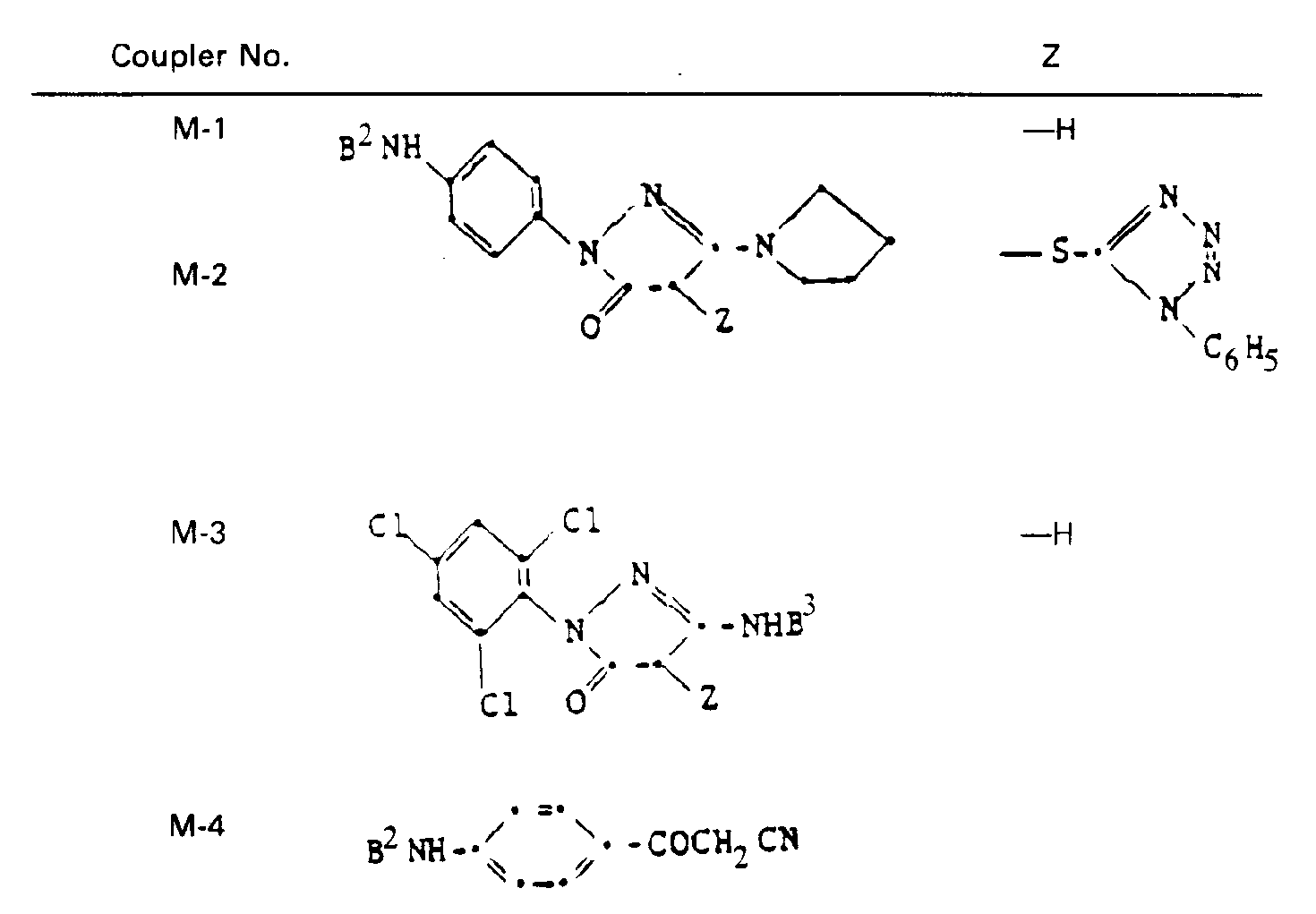
- Magenta dye-forming couplers used in the invention including the following, the group Y in B 2 or B 3 being OH:
- Yellow dye-forming couplers used in the invention include the following, the group Y in B 1 , B 2 or B 6 being -OH:
- Noncolor forming couplers used in the invention include the following:
- Couplers used in the invention can be prepared by attaching a blocked hydroxyphenylsulfonyl or blocked hydroxyphenylsulfinyl group directly to the coupling group or by attaching such a group to the remainder of the ballast group after which the ballast group is attached to the coupling group. Thereafter the blocking group is removed. Conventional condensation reactions can be employed in joining the various groups which ultimately form the coupler. For many of the couplers used in the invention it is convenient to provide the hydroxyphenylsulfonyl group using a 4,4'-sulfonyldiphenol mono ether (e.g. benzyl ether) or mono ester (e.g.
- acetyl ester Conventional reaction techniques can be employed to attach such a compound to the remainder of the ballast group and the thus formed ballast group to the coupling group. Thereafter, the blocking group can be removed by hydrogenation (in the case of the ether) or alkaline hydrolysis (in the case of an ester).
- the coupler, or the remainder of the ballast group has an amino group available for reaction, it is convenient to react that amino group with a blocked hydroxybenzenesulfonyl chloride after which the blocking group is removed.
- couplers used in the invention can be used in the ways and for the purposes that nondiffusible couplers are used in the photographic art.
- the couplers are incorporated in silver halide emulsions and the emulsions coated on a support to form the photographic elements of the invention.
- the couplers can be incorporated in photographic layers adjacent a silver halide emulsion layer where, during development, the coupler will be in reactive association with development products such as oxidized color developing agent.
- the term "associated therewith" signifies that the coupler is in the silver halide emulsion or in an adjacent location where, during processing, it will come into reactive association with silver halide development products.
- the photographic elements of the invention can be single color elements or multicolor elements.
- Multicolor elements contain dye image-forming units sensitive to each of the three primary regions of the spectrum.
- Each unit can be comprised of a single emulsion layer or of multiple emulsion layers sensitive to a given region of the spectrum.
- the layers of the photographic element, including the layers of the image-forming units, can be arranged in various orders as known in the art.
- the emulsions sensitive to each of the three primary regions of the spectrum can be disposed as a single segmented layer, e.g., as by the use of microvessels as described in Belgian Patent 881,513.
- a typical multicolor photographic element of the invention comprises a support bearing a cyan dye image-forming unit comprised of at least one red-sensitive silver halide emulsion layer having associated therewith at least one cyan dye-forming coupler, a magenta dye image-forming unit comprising at least one green-sensitive silver halide emulsion layer having associated therewith at least one magenta dye-forming coupler and a yellow dye image-forming unit comprising at least one blue-sensitive silver halide emulsion layer having associated therewith at least one yellow dye-forming coupler, at least one of the couplers in the element being a coupler as described above.
- the element can contain additional layers, such as filter layers, interlayers, overcoat layers, subbing layers, and the like.
- the silver halide emulsions employed in the photographic elements of this invention can be either negative-working or positive-working. Suitable emulsions and their preparation are described in 'Research Disclosure' Sections I and II and the publications cited therein. Suitable vehicles for the emulsion layers and other layers of elements of this invention are described in Research Disclosure Section IX and the publications cited therein.
- couplers used in the invention can be used. These couplers can be incorporated in the elements and emulsions as described in Research Disclosure Section VII, paragraph C and the publications cited therein.
- the photographic elements of this invention or individual layers thereof can contain brighteners (see Research Disclosure Section V), antifoggants and stabilizers (see Research Disclosure Section VI), antistian agents and image dye stabilizer (see Research Disclosure Section VII, paragraphs I and J), light absorbing and scattering materials (see Research Disclosure Section VIII), hardeners (see Research Disclosure Section XI), plasticizers and lubricants (see Research Disclosure Section XII), antistatic agents (see Research Disclosure Section XIII), matting agents (see Research Disclosure Section XVI) and development modifiers (see Research Disclosure Section XXI).
- brighteners see Research Disclosure Section V
- antifoggants and stabilizers see Research Disclosure Section VI
- antistian agents and image dye stabilizer see Research Disclosure Section VII, paragraphs I and J
- light absorbing and scattering materials see Research Disclosure Section VIII
- hardeners see Research Disclosure Section XI
- plasticizers and lubricants see Research Disclosure Section XII
- antistatic agents see Research Disclosure Section XIII
- matting agents see Research Disclosure
- the photographic elements of the invention can be coated on a variety of supports as described in Research Disclosure Section XVII and the references described therein.
- Photographic elements of the invention can be exposed to actinic radiation, typically in the visible region of the spectrum, to form a latent image as described in Research Disclosure Section XVIII and then processed to form a visible dye image as described in Research Disclosure Section XIX.
- Processing to form a visible dye image includes the step of contacting the element with a color developing agent to reduce deveopable silver halide and oxidize the color developing agent. Oxidized color developing agent in turn reacts with the coupler to yield a dye.
- Preferred color developing agents are p-phenylene diamines.
- 4-amino-N,N-diethyl-aniline hydrochloride 4-amino-3-methyl-N,N-diethylniline hydrochloride, 4-amino-3-methyl-N(ethyl-N-(3-(methanesulfonamido) ethylaniline sulfate hydrate, 4-amino-3-methyl-N-ethyl-N-(3-hydroxyethylaniline sulfate, 4-amino-3-(3-(methanesulfonamido)ethyl-N,N-diethyl-aniline hydrochloride and 4-amino-N-ethyl-N-(2-methoxy ethyl)-m-toluidine di-p-toluene sulfonic acid.
- this processing step leads to a negative image.
- this step can be preceded by developing exposed silver halide with a non-chromogenic developing agent without forming a dye, and then uniformly fogging the element to render unexposed silver halide developable.
- a direct positive emulsion can be employed to obtain a positive image.
- This phenolic acid was acetylated by dissolving in 70 ml acetic anhydride and 7 ml concentrated surfuric acid, stirring 30 minutes at 20°C., then on a steam bath for 30 minutes, cooling, and pouring into 81 water.
- Refluxing 35 g (0.07 mol) of this acid in excess thionyl chloride for 5 h and concentrating yielded a colorless oil, which on trituration in ligroin gave 22 g white solid (B 2 CI, Y OAc), mp 66-69°C.
- ballast group containing an amine function may be attached according to Scheme III:
- Photographic elements of this invention and control elements were prepared and tested according to the procedures described below.
- All photographic elements were prepared by coating a cellulose acetate butyrate film support with a photosensitive layer containing a silver bromo-iodide emulsion at 0.91 g Ag/m 2 (when the coupler is 4-equivalent) or 0.46 g Ag/m 2 (when the coupler is 2-equivalent), gelatin at 3.78 g/m 2 , and one of the couplers identified in Table I dispersed in one-half its weight of the coupler solvent described and coated at 1.62 x 10- 3 moles/m 2 .
- the photosensitive layer was overcoated with a layer containing gelatin at 1.08 g/m 2 and bis-vinyl-sulfonylmethyl ether at 1.75 weight percent based on total gelatin.
- Samples of each element were imagewise exposed through a graduated-density test object and processed at 40°C employing one of three color developing solutions identified below then stopped, bleached, fixed and washed.
- magenta dye images were produced which were evaluated by plotting dye density vs. log exposure sensitometric curves and recording the maximum dye density (D max ) and gamma (y) i.e., the contrast determined by the slope of the straight line portion of the curve. Additionally, dye hues were evaluated from spectrophotometric curves by measuring the maximum absorption peak ( ⁇ max ) normalized to a density of 1.0 and the half band width (HBW). Halfband width is the width, in nanometers, of the spectrophotometric curve at one-half the difference between maximum density and stain.
- top- band width (TBW) and bottom-band width (BBW) of the curve were measured at three-fourths and one-fourth, respectively, of the normalized density.
- Curve shape factor (CSF) equals 100 x TbW/HBW and provides a ratio of the width near the top and bottom of the absorption curve. The greater this ratio, the steeper are the sides of the absorption peak, and the more efficient is the dye's absorption of light in its spectral region.
- couplers of this invention have enhanced activity, which results in increased maximum dye density and gamma.
- many of the dyes formed from couplers of this invention have absorption maxima at desirably longer wavelengths and have broader half band widths and larger curve shape factors, resulting in more efficient spectral absorption.
- Photographic elements containing additional couplers were prepared, processed and evaluated as described above in connection with Examples 1-14. The results are reported in Table II below.
- photographic elements were prepared as described above in connection with Examples 1-14. Four samples from each element were exposed as described above. One pair of the exposed elements was developed in developer D-2, described above, and the other pair was developed in this developer to which had been added 1.5 g/i of the soluble competing coupler citrazinic acid. The remaining processing for one element from each pair was stopping, bleaching, fixing and washing while for the second element from each pair the bleaching step was omitted so that the developed silver remained in the element. For those elements in which the silver remained, the amount of developed silver, in g/m 2 , was determined by x-ray fluorescence analysis and plotted against exposure. For those elements from which the developed silver had been removed, dye density vs exposure curves were generated.
- the couplers employed had the following structure:
Landscapes
- Physics & Mathematics (AREA)
- General Physics & Mathematics (AREA)
- Silver Salt Photography Or Processing Solution Therefor (AREA)
- Nitrogen Condensed Heterocyclic Rings (AREA)
Description
- This invention relates to photographic elements containing ballasted couplers.
- Images are commonly obtained in the photographic art by a coupling reaction between the development product of a silver halide developing agent (i.e., oxidized aromatic primary amino developing agent) and a color forming compound commonly referred to as a coupler. The dyes produced by coupling are indoaniline, azomethine, indamine or indophenol dyes, depending upon the chemical composition of the coupler and the developing agent. The subtractive process of color formation is ordinarily employed in multicolor photographic elements and the resulting image dyes are usually cyan, magenta and yellow dyes which are formed in or adjacent silver halide layers sensitive to radiation complementary to the radiation absorbed by the image dye; i.e., silver halide emulsions sensitive to red, green and blue radiation.
- Since this is a mature art, the patent and technical literature is replete with references to compounds which can be used as couplers for the formation of photographic images. Preferred couplers which form cyan dyes upon reaction with oxidized color developing agents are phenols and naphthols. Representative couplers are described in the following patents and publications: U.S. Patents 2,772,162; 2,895,826; 3,002,836; 3,034,892; 2,474,293; 2,423,730; 2,367,531; 3,041,236 and "Farbkuppler-ein Literaturubersicht", published in Agfa Mitteilungen, Band II, pp. 156-175 (1961).
- US patent application serial no. 85 140 (filed 15 October 1979), priority document of EP-A-0 028 099 (published on 6 May 1981) describes photographic couplers which form cyan dyes having particularly desirable hues of narrow bandwidth. inter alia the document discloses couplers having the general formula:
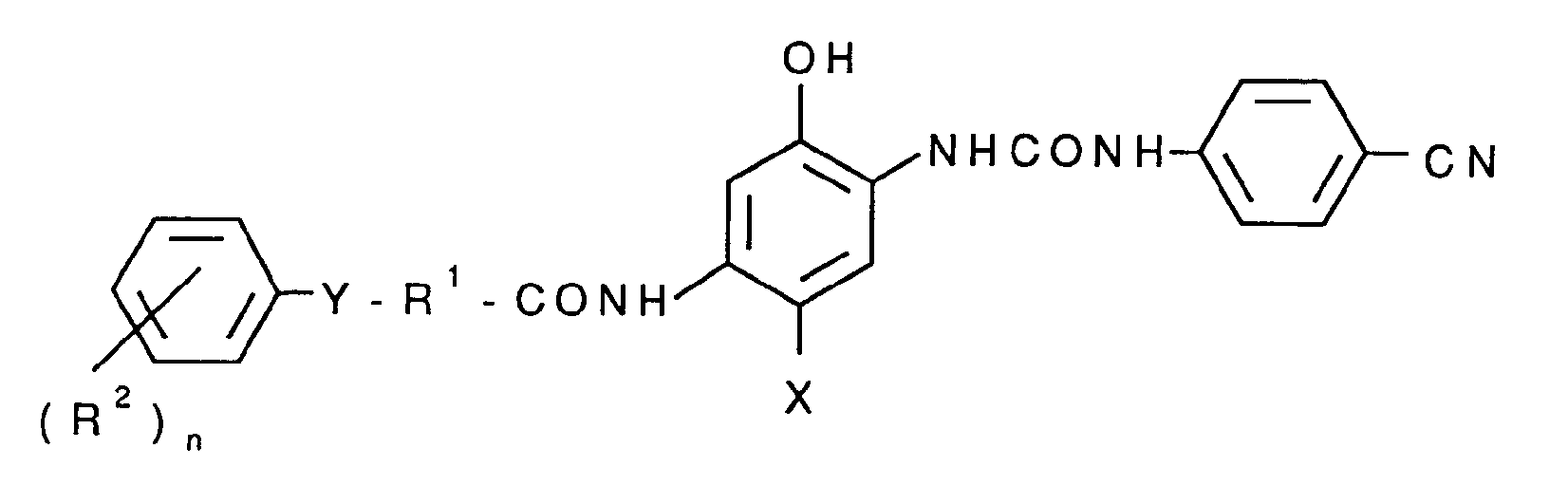
- R2 is a hydroxyphenylsulphonyl group;
- X is hydrogen or a coupling-off group;
- Y is oxygen or sulphur,
- R1 is a branched alkylene group of 2 to 20 carbon atoms; and
- n is 1 to 3.
- Preferred couplers which form magenta dyes upon reaction with oxidized color developing agent are pyrazolones, pyrazolotriazoles, pyrazolobenzimidazoles and indazolones. Representative couplers are described in such patents and publications as U.S. Patents 2,600,788; 2,369,489; 2,343,703; 2,311,082; 2,673,801; 3,152,896; 3,519,429; 3,061,432; 3,062,653; 3,725,067; 2,908,573 and "Farbkuppler-eine Literaturubersicht", published in Agfa Mitteilungen, Band II, pp. 126-156 (1961).
- Couplers which form yellow dyes upon reaction with oxidized color developing agent are acylacetanilides such as benzoylacetanilides and pivalylacetanilides. Representative couplers are described in the following patents and publications: U.S. Patents 2,875,057; 2,407,210; 3,265,506; 2,298,443; 3,048,194; 3,447,928 and "Farbkuppler-eine Literaturubersicht", published in Agfa Mitteilungen, Band II, pp. 112-126 (1961).
- Also known are couplers which form black or neutral dyes upon reaction with oxidized color developing agent. Representative couplers are resorcinols and m-aminophenols such as are described in U.S. Patents 1,939,231; 2,181,944; 2,333,106; 4,126,461; German OLS 2,644,194 and German OLS 2,650,764.
- Also known are compounds which react with oxidized color developing agent in the same way as couplers but which do not yield a dye. Such compounds are employed to modify the photographic image by competing with dye-forming coupler for oxidized color developing agent or by releasing a photographic reagent, such as a development inhibitor, as a result of the coupling reaction. While many such compounds are not commonly referred to as couplers, it is convenient to consider them as such in view of the similarities in the ways they and couplers react during photographic processing. For the purposes of the present invention, they are considered couplers. Representative couplers are described in such patents and published patent applications as U.S. Patents 3,632,345; 3,928,041; 3,938,996; 3.958,993; 3,961,959; 4,010,035; 4,029,503; 4,046,574; 4,049,455; 4,052,213; 4,063,950; 4,075,021; 4,121,934; 4,157,916; 4,171,223; 4,186,012 and 4,187,110; U.K. Patent Specifications 1,445,797; 1,504,094; 1,536,341 and 2,032,914A; Germany OLS's 2,448,063; 2,552,505; 2,610,546 and 2,617,310; and Belgian Patent 839,083.
- When intended for incorporation in photographic elements, couplers are commonly dispersed therein with the aid of a high boiling organic solvent, referred to as a coupler solvent. Couplers are rendered nondiffusible in photographic elements, and compatible with coupler solvents, by including in the coupler molecule a group referred to as a ballast group. This group is located on the coupler in a position other than the coupling position and imparts to the coupler sufficient bulk to render the coupler nondiffusible in the element as coated and during processing. It will be appreciated that the size and nature of the ballast group will depend upon the bulk of the unballasted coupler and the presence of other substituents on the coupler.
- Although numerous couplers are known in the art, there is a continuing problem to improve, or optimize for particular applications, many properties of the coupler and the resultant dye.
- It is an object of this invention to provide novel photographic elements that contain couplers that have improved stability, reactivity and compatibility with other components in the photographic element, the dyes derived from such couplers having efficient light absorption and good stability and hue.
- Such can be accomplished by a photographic element comprising a support, a photographic silver halide emulsion and associated therewith a non-diffusible photographic coupler which reacts with oxidized colour developing agent to give a compound which may or may not be an image dye, characterized in that the coupler contains a coupling group COUP-bonded at a position other than the coupling position to a ballast which is substituted with a hydroxyphenylsulfonyl or hydroxyphenylsulfinyl group.
- Although substituents of formula

- The coupling group COUP- of the couplers used in the photographic elements of the invention can be any coupling group known or used in the art to form a colored or colorless reaction product with oxidized color developing agent. The ballast group of the couplers used in the invention can be any ballast, or portion thereof, which is substituted with a hydroxyphenylsulfonyl group or hydroxyphenylsulfinyl group with the exception of couplers of the formula:

- R2 is a hydroxyphenylsulphonyl group;
- X is hydrogen or a coupling-off group;
- Y is oxygen or sulphur,
- R1 is a branched alkylene group of 2 to 20 carbon atoms; and
- n is 1 to 3.
- Preferred ballast groups used in the invention am substituted with a group of the structural formula:

- p is 1 or 2; and
- q is 1 to 3.
- The substituted group can be joined to the coupling group COUP- at any position, other than the coupling position, where ballast groups commonly are joined. The coupling position of the coupling group can be unsubstituted, or substituted with a coupling off group which can modify the equivalency of the coupler, its reactivity, its dispersibility or which, upon release from the coupler, interacts with other components of the element. The coupling group can include substituents in other positions.
- Particularly preferred ballast groups used in the invention have the structural formula:

- I, m and n are each individually 0 or 1, at least one of I, m and n being 1;
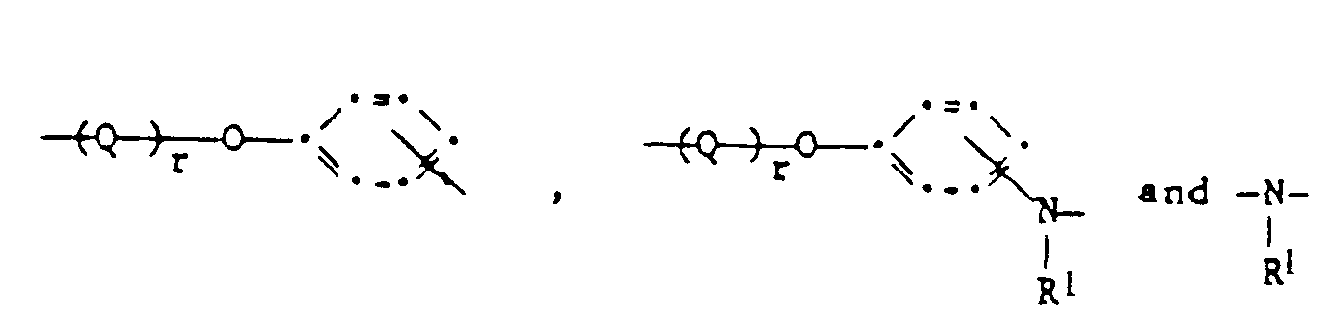
- L1 represents a bivalent group selected from

- L2 represents a bivalent group selected from

- L3 represents a bivalent group selected from

- wherein the combination of L1, L2 and/or L3 forms a ballast group;
- R1 and R3 are each individually hydrogen, alkyl of 1 to 20 carbon atoms or aryl of 6 to 20 carbon atoms
- R2 is hydrogen or one or more halogen, alkyl or alkoxy substituents;
- X is -O- or -S-;

- r is 0 or 1; and
- s is 0 or 10.
- The bivalent linking group represented by L L2 and L3 can be any of the groups found in ballast groups, such as alkylene of up to 10 carbon atoms, arylene of 6 to 10 carbon atoms, heterocyclene of 5 to 10 carbon atoms, may include oxygen, sulfur, amino, amido, sulfonamido, carbamoyl, sulfamoyl, and combinations of such linking groups, e.g. alkarylene, aralkylene, aminoarylene, aminoalkylene, amidoarylene, amidoalkylene, ureido, alkarylamido, amidoarylsulfamoyl, aminoarylamido and aminoarylsulfamoylalkyl.
- Particularly preferred couplers used in the invention have the structural formula:

- L4 represents a bivalent group selected from


- COUP, R1, R2, R3, r and s are as defined above.
- In an especially preferred embodiment, the hydroxy group in structural formulae II and III is in the para position.
- In the above structural formulae the alkyl, alkylene, aryl, arylene and heterocyclene groups can be unsubstituted or substituted with one or more groups such as halogen, nitro, amino, carboxy, alkyl, alkoxy, aryl, aryloxy, heterocyclyl, carbamoyl, amido, sulfamoyl and sulfonamido.
- As indicated above, common yellow dye-forming couplers are acylacetanilides such as pivalylacetanilides and benzoylacetanilides. Common magenta dye-forming couplers are pyrazolones, pyrazolotriazoles, pyrazolobenzimidazoles and indazolones. Common cyan dye-forming couplers are phenols and naphthols, common neutral dye-forming couplers are resorcinols and m-aminophenols. Common non-dye-forming couplers are acyclic and cyclic compounds in which the active position, corresponding to the coupling position, is adjacent to or in conjugation with a carbon group or an imino group, such as a- or y-substituted ketones or imines, e.g. cyclopentanones, cyclohexanones, indanones, indanoimines, oxyindoles and oxazolinones. These couplers can form the coupling group COUP in the above formulae. Structures of representative coupling groups are shown below. In these structures Z represents hydrogen or coupling-off group and the unsatisfied bond, or bonds, indicates the preferred position, or positions, at which there can be attached the remainder of the molecule shown in the above structures; it being recognized that the coupling group can contain other substituents. Typical suitable coupling groups that can be used in the photographic elements of the invention are set out below.
- Cyan dye-forming coupling groups:

- Magenta dye-forming coupling groups:
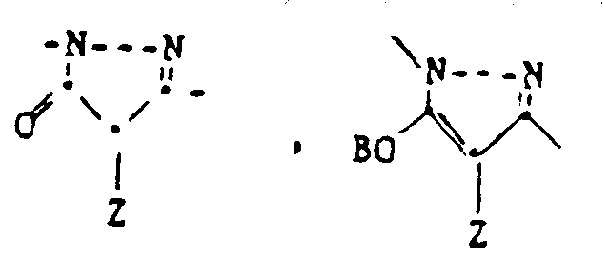
- (B represents a blocking group capable of being removed during processing, e.g., by alkaline cleavage or coupling)

- Yellow dye-forming coupling groups:

- Non-dye-forming coupling groups:


- Neutral dye-forming coupling groups:

- Specific couplers used in the invention, which are shown below, contain ballasts of general structures B1 through B6, where Y is -OH.


- Cyan dye-forming couplers used in the invention including the following; the group Y in B2, B3 and B4 being -OH:


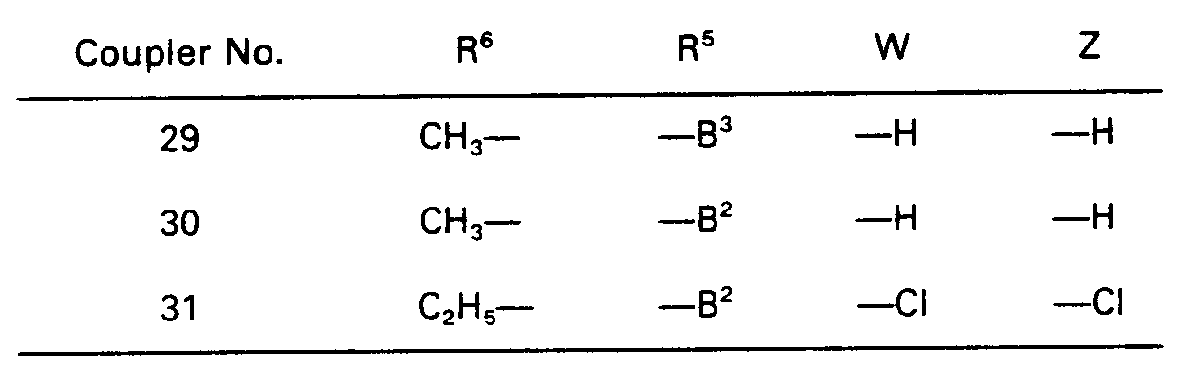
- Magenta dye-forming couplers used in the invention including the following, the group Y in B2 or B3 being OH:


- Yellow dye-forming couplers used in the invention include the following, the group Y in B1, B2 or B6 being -OH:


- Noncolor forming couplers used in the invention include the following:


- Couplers used in the invention can be prepared by attaching a blocked hydroxyphenylsulfonyl or blocked hydroxyphenylsulfinyl group directly to the coupling group or by attaching such a group to the remainder of the ballast group after which the ballast group is attached to the coupling group. Thereafter the blocking group is removed. Conventional condensation reactions can be employed in joining the various groups which ultimately form the coupler. For many of the couplers used in the invention it is convenient to provide the hydroxyphenylsulfonyl group using a 4,4'-sulfonyldiphenol mono ether (e.g. benzyl ether) or mono ester (e.g. acetyl ester.) Conventional reaction techniques can be employed to attach such a compound to the remainder of the ballast group and the thus formed ballast group to the coupling group. Thereafter, the blocking group can be removed by hydrogenation (in the case of the ether) or alkaline hydrolysis (in the case of an ester). When the coupler, or the remainder of the ballast group, has an amino group available for reaction, it is convenient to react that amino group with a blocked hydroxybenzenesulfonyl chloride after which the blocking group is removed.
- The couplers used in the invention can be used in the ways and for the purposes that nondiffusible couplers are used in the photographic art.
- Typically, the couplers are incorporated in silver halide emulsions and the emulsions coated on a support to form the photographic elements of the invention. Alternatively, the couplers can be incorporated in photographic layers adjacent a silver halide emulsion layer where, during development, the coupler will be in reactive association with development products such as oxidized color developing agent. Thus, as used herein, the term "associated therewith" signifies that the coupler is in the silver halide emulsion or in an adjacent location where, during processing, it will come into reactive association with silver halide development products.
- The photographic elements of the invention can be single color elements or multicolor elements. Multicolor elements contain dye image-forming units sensitive to each of the three primary regions of the spectrum. Each unit can be comprised of a single emulsion layer or of multiple emulsion layers sensitive to a given region of the spectrum. The layers of the photographic element, including the layers of the image-forming units, can be arranged in various orders as known in the art. In an alternative format, the emulsions sensitive to each of the three primary regions of the spectrum can be disposed as a single segmented layer, e.g., as by the use of microvessels as described in Belgian Patent 881,513.
- A typical multicolor photographic element of the invention comprises a support bearing a cyan dye image-forming unit comprised of at least one red-sensitive silver halide emulsion layer having associated therewith at least one cyan dye-forming coupler, a magenta dye image-forming unit comprising at least one green-sensitive silver halide emulsion layer having associated therewith at least one magenta dye-forming coupler and a yellow dye image-forming unit comprising at least one blue-sensitive silver halide emulsion layer having associated therewith at least one yellow dye-forming coupler, at least one of the couplers in the element being a coupler as described above. The element can contain additional layers, such as filter layers, interlayers, overcoat layers, subbing layers, and the like.
- In the following discussion of suitable materials for use in the emulsions used in the invention, reference will be made to Research Disclosure, December 1978, Item 17643. This publication will be identified hereafter by the term "Research Disclosure".
- The silver halide emulsions employed in the photographic elements of this invention can be either negative-working or positive-working. Suitable emulsions and their preparation are described in 'Research Disclosure' Sections I and II and the publications cited therein. Suitable vehicles for the emulsion layers and other layers of elements of this invention are described in Research Disclosure Section IX and the publications cited therein.
- In addition to the couplers used in the invention, additional couplers as described in Research Disclosure Section VII, paragraphs D, E, F and G and the publications cited therein can be used. These couplers can be incorporated in the elements and emulsions as described in Research Disclosure Section VII, paragraph C and the publications cited therein.
- The photographic elements of this invention or individual layers thereof, can contain brighteners (see Research Disclosure Section V), antifoggants and stabilizers (see Research Disclosure Section VI), antistian agents and image dye stabilizer (see Research Disclosure Section VII, paragraphs I and J), light absorbing and scattering materials (see Research Disclosure Section VIII), hardeners (see Research Disclosure Section XI), plasticizers and lubricants (see Research Disclosure Section XII), antistatic agents (see Research Disclosure Section XIII), matting agents (see Research Disclosure Section XVI) and development modifiers (see Research Disclosure Section XXI).
- The photographic elements of the invention can be coated on a variety of supports as described in Research Disclosure Section XVII and the references described therein.
- Photographic elements of the invention can be exposed to actinic radiation, typically in the visible region of the spectrum, to form a latent image as described in Research Disclosure Section XVIII and then processed to form a visible dye image as described in Research Disclosure Section XIX. Processing to form a visible dye image includes the step of contacting the element with a color developing agent to reduce deveopable silver halide and oxidize the color developing agent. Oxidized color developing agent in turn reacts with the coupler to yield a dye.
- Preferred color developing agents are p-phenylene diamines. Especially preferred are 4-amino-N,N-diethyl-aniline hydrochloride, 4-amino-3-methyl-N,N-diethylniline hydrochloride, 4-amino-3-methyl-N(ethyl-N-(3-(methanesulfonamido) ethylaniline sulfate hydrate, 4-amino-3-methyl-N-ethyl-N-(3-hydroxyethylaniline sulfate, 4-amino-3-(3-(methanesulfonamido)ethyl-N,N-diethyl-aniline hydrochloride and 4-amino-N-ethyl-N-(2-methoxy ethyl)-m-toluidine di-p-toluene sulfonic acid.
- With negative working silver halide this processing step leads to a negative image. To obtain a positive (or reversal) image, this step can be preceded by developing exposed silver halide with a non-chromogenic developing agent without forming a dye, and then uniformly fogging the element to render unexposed silver halide developable. Alternatively, a direct positive emulsion can be employed to obtain a positive image.
- Development is followed by the conventional steps of bleaching and fixing, or bleach-fixing, to remove silver and silver halide, washing and drying.
- The following examples are included for a further understanding of this invention.
- To a solution of 90 g (0.31 mol) methyl 2-bromododecanoate and 104.4 g (0.31 mol) 4,4'-sulfonyl-diphenol monobenzyl ether in 0.35 I dry acetone were added 1 g sodium iodide and 214.2 g (1.55 mol) potassium carbonate. After refluxing the mixture 20 h, solids were removed by filtration and the filtrate concentrated to a waxy solid. Recrystallization from methanol gave a white solid (B20CH3, Y = OBz), mp 73-75°C, with the correct elemental analysis and expected NMR spectrum. A solution of 120 g (0.21 mol) of this product in 0.8 I dimethylformamide was added with stirring to 0.5 I of 2.3 mol aqueous potassium hydroxide solution, water was added and the cloudy solution stirred 0.5 h before pouring into acidic ice-water. The resulting solid was collected, dissolved in dichloromethane, and the solution washed, dried over magnesium sulfate, and concentrated. Recrystallization from acetonitrile yielded 67 g white solid (B20H, Y = OBz), mp 119-121 °C, with the expected NMR spectrum and elemental analysis. This acid was converted to the acid chloride by dissolving 67 g (0.12 mol) in 0.4 I thionyl chloride and stirring 5 h. Excess thionyl chloride was removed under vacuum and the product recrystallized from dry acetonitrile to give a white solid (B2CI, Y = OBz), mp 84-85°C, with the expected NMR spectrum and elemental analysis.
- A solution of 455 g (0.82 mol), B20CH3, Y = OBz in 1.6 I tetrahydrofuran and 0.4 I acetic acid was hydrogenated 12 h at 50 psi and 50°C over 45 g 5% palladium on charcoal catalyst. The catalyst was removed by filtration and the concentrated filtrate drowned in water. An ethyl acetate solution of resulting white solid was washed, dried, concentrated, and the product recrystallized from acetonitrile to give 340 g (0.74 mol) white solid (B20CH3, Y = OH), 63-65°C with the expected elemental analysis. Hydrolysis of this ester was accomplished by slowly adding an aqueous solution containing 40 g (1 mol) sodium hydroxide to a stirred solution of the ester in 1 I dimethylformamide, stirring 2 h then pouring into acidified ice-water. The resulting gummy solid dissolved in ethyl acetate was washed with dilute hydrochloric acid, dried, and concentrated. Recrystallization from acetonitrile yielded a white solid (B20H, Y = OH), mp 116-117°C. This phenolic acid was acetylated by dissolving in 70 ml acetic anhydride and 7 ml concentrated surfuric acid, stirring 30 minutes at 20°C., then on a steam bath for 30 minutes, cooling, and pouring into 81 water. The product was recrystallized from methanol to give a white solid (B20H, Y = OAc), mp 73-75°C. Refluxing 35 g (0.07 mol) of this acid in excess thionyl chloride for 5 h and concentrating yielded a colorless oil, which on trituration in ligroin gave 22 g white solid (B2CI, Y = OAc), mp 66-69°C.
- The procedural steps were similar to those for preparation of B3CI in Preparative Example 1, except that ethyl 2-bromotetradecanoate was the starting material. Intermediates included white solids B30CH2CH3, Y = OBz (mp 55-61 °C); B30H, Y = OBz (mp 117-118°C); and B3CI, Y = OBz (mp 81-84°C).
- The procedural steps were similar to those for preparation of B3CI in Preparative Example 1, except that ethyl 2-bromohexanoate was the starting material. Intermediates included white solids B'OCH2CH3, Y = OBz (mp 102-105°C); B1OH, Y = OBz (mp 147.5-148.5°C); and BlCI, Y = OBz (mp40°C).
- A solution of 10.2 g (0.029 mol) methyl 2-p-nitrophenoxy)dodecanoate in 100 ml tetrahydrofuran was shaken 6 h under 40 psi hydrogen in the presence of 0.7 g 10% palladium on charcoal catalyst to reduce the nitro group. Then 6.3 ml (0.04 mol) N,N-dimethylaniline and 8.2 g (0.029 mol) p-benzyloxybenzenesulfonyl chloride were added and the mixture stirred 15 hours at 20°C. The catalyst was removed by filtration and the filtrate poured into cold dilute hydrochloric acid. Ethyl acetate extraction, washing, drying, concentration, and purification through silica gel yielded 14 g colorless oil (B40CH3, Y = OBz). This was dissolved in 60 ml tetrahydrofuran and 40 ml methanol, stirred 0.5 h with 20 ml aqueous sodium hydroxide solution and poured into cold dilute hydrochloric acid. Ethyl acetate extraction, washing, drying, concentration, ligroin trituration yielded 12 g white crystals (B40H, Y = OBz), mp 100-101°C, with the correct elemental analysis. To a stirred solution of 10 g (0.018 mol) of this acid in 50 ml tetrahydrofuran was added 1.8 ml (0.022 mol) oxalyl chloride and 5 drops dimethyl formamide. After 1.5 h concentration gave 0.018 mol of brown oil B4CI, Y = OBz.
- To a solution of 24 g (0.043 mol) acid chloride B2CI, Y = OBz in 400 ml tetrahydrofuran was a 40% aqueous solution containing 10 g (0.125 mol) methylamine. After 0.5 h stirring, the mixture was poured over acidified ice-water, extracted with diethyl ether, and the organic layer washed, dried and concentrated to yield, after further purification on a 50:50 silica gel/Fluorisil (trade mark) column, a clear colorless oil (B2NHCH3, Y = OBz). Reduction was accomplished by refluxing 16 g (0.029 mol) of this amide product and 16 mi 2 M borane-methyl sulfide complex in 400 ml tetrahydrofuran for 3 h. The cooled reaction mixture was slowly acidified with 50% hydrochloric acid solution, then extracted with diethyl ether. Acidification and concentration of the washed and dried organic layer gave 14 g of white solid (B5H.HCI, Y = OH).
- Final steps in the synthetis of couplers used in this invention generally involved the attachment of the ballast group and the removal of the ballast blocking group, if any. For example, in Scheme I an amino-substituted coupling group, COUP-NH2, is allowed to react with an acid chloride ballast group and the resulting intermediate is converted to the desired coupler by hydrogenation to remove the benzyl group.

- Where the blocking group is acetyl, as in Scheme II, it is removed by alkaline hydrolysis:

- Alternatively, if the coupler is substituted with an acidic function, a ballast group containing an amine function may be attached according to Scheme III:

- A suspension of 5.4 g (0.018 mol) 2-(p-cyanophenylureido)-5-nitrophenol in 200 ml tetrahydrofuran was shaken overnight under 40 psi hydrogen with 1.6 10% palladium on charcoal catalyst and 0.3 ml acetic acid. Then 0.018 mol of the acid chloride B4CI prepared in Preparative Example 5 and 6.8 ml dimethylaniline were added under nitrogen and the mixture stirred 0.5 h before removing the catalyst by filtration and pouring the filtrate into cold dilute hydrochloric acid. Ethyl acetate extraction, washing, drying, concentration, and crystallization from acetonitrile yielded 10.2 g of the pale white solid benzyl ether of the desired coupler. A solution of this product in 100 ml tetrahydrofuran was shaken for 15 hours under 40 psi hydrogen with 2.5 g 10% palladium on charcoal catalyst and 0.5 ml acetic acid. The catalyst was removed by filtration and the reduction product concentrated and crystallized from acetonitrile to give 6.1 g white solid coupler C-8, mp 103-106°C, with an infrared spectrum and elemental analysis consistent with the desired structure.
- A solution of 50 g (0.115 mol) 3-(2-chloro-5-nitroanilino)-1-(2,4,6-trichlorophenyl)-2-pyrazolin-5-one in dimethylformamide and tetrahydrofuran was reduced with 35 psi hydrogen and Raney nickel catalyst. Removal of the catalyst by filtration and concentration of the filtrate gave 21 g (0.052 mol) light yellow solid 3-(2-chloro-5-aminoaniiino-1-(2,4,6-trichiorophenyi)-2-pyrazoiin-5-one. To an acetic acid solution containing 6.9 g (0.017 mol) of this amine and 9.5 g potassium acetate was added, in small portions, 9.5 g (0.019 mol) of the acid chloride B2CI prepared in Example 2. After stirring 15 hours, the mixture was concentrated to a third of its volume, poured into a large volume of water and extracted with diethyl ether. The organic layers were washed, dried, concentrated, and crystallized from methanol to give 14 g (0.016 mol) buff-colored solid acetate ester of the desired coupler, mp 115-116°C. To a solution of this product in dimethylformamide stirred under nitrogen was added an aqueous solution containing 2 g potassium hydroxide. After 15 minutes the mixture was acidified with hydrochloric acid, poured into dilute hydrochloric acid, extracted with diethyl ether, washed, dried, concentrated, and crystallized from methanol to give 9.2 g white crystalline coupler M-28, mp 127-130°C.
- A suspension of 10 g (0.035 mol) 6-methyl-3-[3-(p-nitrophenyl)-propyl]-1 H-pyrazole[3,2-c]-5-triazole in 300 ml tetrahydrofuran was shaken about 2 h at 25°C with 35 psi hydrogen and a palladium on charcoal catalyst. Removal of the catalyst, concentration of the filtrate, and recrystallization from acetonitrile gave a buff-colored solid amine, mp 194-6°C. To a stirred acetic acid solution of 7.6 g (0.03 mol) of this amine product and 2 g potassium acetate was added, in small portions, 16.7 g (0.03 mol) of the acid chloride B2CI prepared in Preparative Example 1. After stirring 15 h, the mixture was poured into a large volume of water, extracted with diethyl ether, and the combined extracts then washed, dried, and concentrated to give the white solid benzyl ether of the desired coupler, mp 122-124°C. A concentrated solution of 7 g (0.009 mol) of the product in tetrahydrofuran was shaken 2 h under 40 psi hydrogen with a mixture of palladium on charcoal catalyst in ethanol. Removal of the catalyst by filtration, concentration, and recrystallization from acetonitrile gave 5.5 g cream-colored solid coupler M-8, mp 170-172°C, with an infrared spectrum and elemental analysis consistent with the desired compound.
- A mixture of 8 g (0.015 mol) 3-(2-chloro-4-fluorosulfonylanilino)-1-(2,6-dichloro-4-dimethylsulfamoyl phenyl)-2-pyrazolin-5-one and 5.5 g aluminum chloride in 175 ml 1,2-dichloroethane was refluxed 15 minutes. After cooling to 20°C, 7.25 g (0.015 mol) of the amine salt B5H.HCI prepared in Example 6 in 25 ml pyridine was added and the mixture refluxed 2 h. Then a mixture of hydrochloric acid, ice, and diethyl ether was added and the organic layer washed, dried, concentrated, and triturated with hexane to give 14.2 g light tan solid coupler M-32 with the correct elemental analysis.
- To a solution of 57.8 g (0.095 mol) α-pivalyl-α-[4-(p-benzyloxyphenylsulfonyl)-phenoxy]-2-chloro-5-amino acetanilide and 13 g quinoline, cooled to 0°C, was added in one portion 45 g (0.095 mol) of the acid chloride B1 CI prepared in Preparative Example 4. After stirring 1 h the reaction mixture was poured into 3 I cold water to produce 98 g (after oven drying) crude product. Recrystallization from toluene yielded 84.5 g (0.018 mol) white crystalline dibenzyl ether of the desired coupler. A suspension of 10.4 g (0.01 mol) of this product in 200 ml ethanol and 200 ml tetrahydrofuran was shaken 3 h under 35 psi hydrogen with palladium on charcoal catalyst. Removal of catalyst by filtration concentration of the filtrate and trituration in hot cyclohexane gave a good yield of coupler Y-1 with the correct elemental analysis.
- Photographic elements of this invention and control elements were prepared and tested according to the procedures described below.
- All photographic elements were prepared by coating a cellulose acetate butyrate film support with a photosensitive layer containing a silver bromo-iodide emulsion at 0.91 g Ag/m2 (when the coupler is 4-equivalent) or 0.46 g Ag/m2 (when the coupler is 2-equivalent), gelatin at 3.78 g/m2, and one of the couplers identified in Table I dispersed in one-half its weight of the coupler solvent described and coated at 1.62 x 10⁻³ moles/m2. The photosensitive layer was overcoated with a layer containing gelatin at 1.08 g/m2 and bis-vinyl-sulfonylmethyl ether at 1.75 weight percent based on total gelatin.
- Samples of each element were imagewise exposed through a graduated-density test object and processed at 40°C employing one of three color developing solutions identified below then stopped, bleached, fixed and washed.
- In each element, well-defined, magenta dye images were produced which were evaluated by plotting dye density vs. log exposure sensitometric curves and recording the maximum dye density (Dmax) and gamma (y) i.e., the contrast determined by the slope of the straight line portion of the curve. Additionally, dye hues were evaluated from spectrophotometric curves by measuring the maximum absorption peak (λmax) normalized to a density of 1.0 and the half band width (HBW). Halfband width is the width, in nanometers, of the spectrophotometric curve at one-half the difference between maximum density and stain. Similarly, the top- band width (TBW) and bottom-band width (BBW) of the curve were measured at three-fourths and one-fourth, respectively, of the normalized density. Curve shape factor (CSF) equals 100 x TbW/HBW and provides a ratio of the width near the top and bottom of the absorption curve. The greater this ratio, the steeper are the sides of the absorption peak, and the more efficient is the dye's absorption of light in its spectral region.
- All results are recorded in Table I.
- These results show that couplers of this invention have enhanced activity, which results in increased maximum dye density and gamma. In addition many of the dyes formed from couplers of this invention have absorption maxima at desirably longer wavelengths and have broader half band widths and larger curve shape factors, resulting in more efficient spectral absorption.
-

- 1) Comparison Couplers


- (2) Coupler Solvents:
- CS-1 - 1,4-Cyclohexylenedimethylene bis(2-ethyl-hexanoate)
- CS-2 - Tri-cresyl phosphate
- CS-3 - Dibutyl phthalate
- CS-4 - 2,4-Di-t-pentylphenol
- (3) Developer Formulations:

- Photographic elements containing additional couplers were prepared, processed and evaluated as described above in connection with Examples 1-14. The results are reported in Table II below.

- For each of the couplers identified below, photographic elements were prepared as described above in connection with Examples 1-14. Four samples from each element were exposed as described above. One pair of the exposed elements was developed in developer D-2, described above, and the other pair was developed in this developer to which had been added 1.5 g/i of the soluble competing coupler citrazinic acid. The remaining processing for one element from each pair was stopping, bleaching, fixing and washing while for the second element from each pair the bleaching step was omitted so that the developed silver remained in the element. For those elements in which the silver remained, the amount of developed silver, in g/m2 , was determined by x-ray fluorescence analysis and plotted against exposure. For those elements from which the developed silver had been removed, dye density vs exposure curves were generated. From the plots for pairs of elements developed with the same developer composition there was plotted, for each exposure step, dye density vs developed silver. The slope of the line for the elements developed in the absence of a competing coupler (Yo in Table III, below) is a measure of the efficiency with which the coupler forms dye; the greater the slope the more efficient the coupler. The slope of the line for the elements developed in the presence of the competing coupler (Yc in Table III, below) is a measure of the reactivity of the coupler, the greater the slope, the more reactive the coupler.
- The couplers employed had the following structure:


- It is apparent from the values for Yo and Yc in Table III that the couplers used in the invention react more efficiently with oxidized developer to form image dye, in the presence or absence of a competing coupler, than do those couplers with ballasts not used in this invention.
Claims (8)






Applications Claiming Priority (2)
| Application Number | Priority Date | Filing Date | Title |
|---|---|---|---|
| US29608681A | 1981-08-25 | 1981-08-25 | |
| US296086 | 1981-08-25 |
Publications (3)
| Publication Number | Publication Date |
|---|---|
| EP0073636A1 EP0073636A1 (en) | 1983-03-09 |
| EP0073636B1 EP0073636B1 (en) | 1987-03-18 |
| EP0073636B2 true EP0073636B2 (en) | 1992-09-09 |
Family
ID=23140546
Family Applications (1)
| Application Number | Title | Priority Date | Filing Date |
|---|---|---|---|
| EP19820304461 Expired EP0073636B2 (en) | 1981-08-25 | 1982-08-24 | Photographic elements containing ballasted couplers |
Country Status (3)
| Country | Link |
|---|---|
| EP (1) | EP0073636B2 (en) |
| JP (1) | JPS5842045A (en) |
| DE (1) | DE3275761D1 (en) |
Families Citing this family (68)
| Publication number | Priority date | Publication date | Assignee | Title |
|---|---|---|---|---|
| JPS59177553A (en) * | 1983-03-28 | 1984-10-08 | Fuji Photo Film Co Ltd | Silver halide color photosensitive material |
| US4548899A (en) * | 1983-11-02 | 1985-10-22 | Konishiroku Photo Industry Co., Ltd. | Silver halide color photographic material |
| JPS6165246A (en) * | 1984-09-06 | 1986-04-03 | Fuji Photo Film Co Ltd | Silver halide color photographic sensitive material |
| JPS61120154A (en) * | 1984-11-15 | 1986-06-07 | Konishiroku Photo Ind Co Ltd | Silver halide color photographic sensitive material |
| AU4743985A (en) * | 1984-09-14 | 1986-04-10 | Konishiroku Photo Industry Co., Ltd. | Silver halide photographic material with magenta coupler |
| US5278038A (en) * | 1985-04-22 | 1994-01-11 | Konishiroku Photo Industry Co., Ltd. | Light-sensitive silver halide color photographic material |
| JPH0812388B2 (en) * | 1985-04-22 | 1996-02-07 | コニカ株式会社 | Silver halide color photographic light-sensitive material |
| JPS61250645A (en) | 1985-04-30 | 1986-11-07 | Konishiroku Photo Ind Co Ltd | Silver halide photographic sensitive material |
| JPS61251852A (en) | 1985-04-30 | 1986-11-08 | Konishiroku Photo Ind Co Ltd | Method for processing silver halide color photographic sensitive material |
| JPS61255342A (en) | 1985-05-09 | 1986-11-13 | Fuji Photo Film Co Ltd | Silver halide color photographic sensitive material |
| AU590563B2 (en) | 1985-05-16 | 1989-11-09 | Konishiroku Photo Industry Co., Ltd. | Method for color-developing a silver halide color photographic light-sensitive material |
| JPH0711695B2 (en) | 1985-09-25 | 1995-02-08 | 富士写真フイルム株式会社 | Processing method of silver halide color light-sensitive material for photography |
| DE3535247A1 (en) * | 1985-10-03 | 1987-04-09 | Agfa Gevaert Ag | COLOR PHOTOGRAPHIC RECORDING MATERIAL WITH EASILY DISPERSIBLE COLOR COUPLERS |
| JPS62123461A (en) * | 1985-11-22 | 1987-06-04 | Fuji Photo Film Co Ltd | Image forming method |
| JPH0715568B2 (en) | 1986-01-20 | 1995-02-22 | コニカ株式会社 | Silver halide color photographic light-sensitive material |
| JPH0743523B2 (en) * | 1986-01-24 | 1995-05-15 | 富士写真フイルム株式会社 | Color image forming method |
| WO1987004533A1 (en) * | 1986-01-23 | 1987-07-30 | Fuji Photo Film Company Limited | Process for forming colored image |
| JPH0621949B2 (en) * | 1986-01-23 | 1994-03-23 | 富士写真フイルム株式会社 | Color image forming method |
| JPH0654375B2 (en) * | 1986-01-24 | 1994-07-20 | 富士写真フイルム株式会社 | Color image forming method |
| EP0231861B1 (en) * | 1986-01-27 | 1993-07-28 | Fuji Photo Film Co., Ltd. | Method for processing silver halide color photographic material for prints |
| JPS62175753A (en) * | 1986-01-29 | 1987-08-01 | Fuji Photo Film Co Ltd | Color image forming method |
| JPS62175752A (en) * | 1986-01-29 | 1987-08-01 | Fuji Photo Film Co Ltd | Method for processing silver halide color photographic sensitive material |
| US4853318A (en) * | 1986-02-17 | 1989-08-01 | Fuji Photo Film Co., Ltd. | Process for processing silver halide color photographic material using a developer comprising substantially no benzyl alcohol |
| JPS62189463A (en) * | 1986-02-17 | 1987-08-19 | Fuji Photo Film Co Ltd | Method for processing silver halide color photographic sensitive material |
| US4774167A (en) * | 1986-02-24 | 1988-09-27 | Fuji Photo Film Co., Ltd. | Method for processing silver halide color photographic materials wherein the color developer contains low concentrations of benzyl alcohol, hydroxylamine and sulfite |
| US4851326A (en) * | 1986-02-24 | 1989-07-25 | Fuji Photo Film Co., Ltd. | Method for processing silver halide color photographic materials using developer substantially free of bromide and benzyl alcohol |
| JPH077194B2 (en) * | 1986-05-19 | 1995-01-30 | 富士写真フイルム株式会社 | Color image forming method and silver halide color photographic light-sensitive material |
| US4851327A (en) | 1986-07-17 | 1989-07-25 | Fuji Photo Film Co., Ltd. | Photographic color photosensitive material with two layer reflective support |
| JPH06105346B2 (en) | 1986-11-07 | 1994-12-21 | 富士写真フイルム株式会社 | Processing method of silver halide color photographic light-sensitive material |
| GB8630304D0 (en) * | 1986-12-18 | 1987-01-28 | Kodak Ltd | Photographic acetanilide couplers |
| JPH01108546A (en) | 1987-10-22 | 1989-04-25 | Fuji Photo Film Co Ltd | Silver halide color photographic sensitive material |
| US5110713A (en) * | 1987-10-30 | 1992-05-05 | Fuji Photo Film Co., Ltd. | Method for processing silver halide color photographic material |
| JPH0833628B2 (en) | 1987-12-15 | 1996-03-29 | 富士写真フイルム株式会社 | Silver halide color photographic light-sensitive material |
| EP0359169B1 (en) * | 1988-09-14 | 1995-07-26 | Eastman Kodak Company | Photographic recording material comprising magenta coupler and a chalcogenazolium salt |
| EP0435334B1 (en) | 1989-12-29 | 1997-11-05 | Fuji Photo Film Co., Ltd. | Silver halide color photographic material containing yellow colored cyan coupler |
| EP0440195B1 (en) | 1990-01-31 | 1997-07-30 | Fuji Photo Film Co., Ltd. | Silver halide color photographic material |
| JPH04445A (en) | 1990-04-17 | 1992-01-06 | Fuji Photo Film Co Ltd | Processing method for silver halide color photosensitive material |
| EP0458131B1 (en) | 1990-05-09 | 1997-08-06 | Fuji Photo Film Co., Ltd. | Photographic processing composition and processing method using the same |
| DE69131785T2 (en) | 1990-08-20 | 2000-05-11 | Fuji Photo Film Co., Ltd. | Data-preserving photographic film product and method for producing a color image |
| JPH0559787A (en) * | 1991-02-25 | 1993-03-09 | Maeda Corp | Execution method of infilling type steel concrete column |
| JP2681419B2 (en) * | 1991-02-18 | 1997-11-26 | 富士写真フイルム株式会社 | Silver halide photographic material |
| EP0562476B1 (en) | 1992-03-19 | 2000-10-04 | Fuji Photo Film Co., Ltd. | Method for preparing a silver halide photographic emulsion |
| EP0563708B1 (en) | 1992-03-19 | 2000-06-21 | Fuji Photo Film Co., Ltd. | Process for preparing a silver halide photographic emulsion |
| JP2777949B2 (en) | 1992-04-03 | 1998-07-23 | 富士写真フイルム株式会社 | Silver halide color photographic materials |
| JP3101848B2 (en) | 1992-05-15 | 2000-10-23 | 富士写真フイルム株式会社 | Silver halide color photographic materials |
| EP0571030B1 (en) * | 1992-05-20 | 1998-08-12 | Eastman Kodak Company | Photographic material having contiguous red layers |
| US5407791A (en) | 1993-01-18 | 1995-04-18 | Fuji Photo Film Co., Ltd. | Silver halide photographic material |
| DE69424983T2 (en) | 1993-11-24 | 2000-10-19 | Fuji Photo Film Co., Ltd. | Photographic processing composition and processing method |
| US5476760A (en) | 1994-10-26 | 1995-12-19 | Eastman Kodak Company | Photographic emulsions of enhanced sensitivity |
| DE19604988A1 (en) * | 1996-02-12 | 1997-08-14 | Bayer Ag | Hydrogenation of halonitroaromatic compounds |
| FR2746391B1 (en) | 1996-03-22 | 1998-04-17 | Oreal | COSMETIC COMPOSITIONS BASED ON PYRAZOLIN-4,5-DIONES, NEW PYRAZOLIN-4,5 DIONES, METHODS OF PREPARATION AND USES |
| FR2746308B1 (en) * | 1996-03-22 | 1998-04-30 | Oreal | KERATINIC FIBER DYEING COMPOSITIONS CONTAINING IMIDAZOLO-AZOLES; THEIR USE IN DYEING AS COUPLERS; DYEING PROCESS |
| FR2746310B1 (en) | 1996-03-22 | 1998-06-12 | Oreal | KERATINIC FIBER DYEING COMPOSITIONS CONTAINING PYRAZOLIN-3,5-DIONE; THEIR USE FOR DYEING AS COUPLERS, DYEING METHOD |
| FR2746307B1 (en) | 1996-03-22 | 1998-04-30 | Oreal | KERATINIC FIBER DYEING COMPOSITIONS CONTAINING PYRROLO-AZOLES; USE AS COUPLERS; DYEING PROCESS |
| FR2746306B1 (en) | 1996-03-22 | 1998-04-30 | Oreal | KERATINIC FIBER DYEING COMPOSITIONS CONTAINING PYRAZOLO-AZOLES; THEIR USE FOR DYEING AS COUPLERS, DYEING METHOD |
| FR2746309B1 (en) | 1996-03-22 | 1998-04-17 | Oreal | COMPOSITION FOR DYEING KERATIN FIBERS CONTAINING PYRAZOLOPYRIMIDINEOXO; THEIR USE FOR DYEING AS COUPLER, DYEING PROCESSES |
| JP3584119B2 (en) | 1996-04-05 | 2004-11-04 | 富士写真フイルム株式会社 | Silver halide color photographic materials |
| FR2772379B1 (en) | 1997-12-16 | 2000-02-11 | Oreal | DYE COMPOSITIONS OF KERATINIC FIBERS CONTAINING PYRAZOLO-AZOLES; THEIR USE FOR DYING AS AN OXIDIZING BASE, DYING PROCESS; NEW PYRAZOLO-AZOLES |
| FR2786092B1 (en) | 1998-11-20 | 2002-11-29 | Oreal | KERATINIC FIBER OXIDATION DYE COMPOSITION AND DYEING METHOD USING THE SAME |
| FR2786094B1 (en) | 1998-11-20 | 2001-01-12 | Oreal | KERATINIC FIBER OXIDATION DYE COMPOSITION AND DYEING METHOD USING THE SAME |
| AU5567600A (en) | 1999-06-22 | 2001-01-09 | Lion Corporation | Hairdye composition |
| FR2805737B1 (en) | 2000-03-06 | 2003-01-03 | Oreal | KERATINIC FIBER OXIDATION DYE COMPOSITION AND DYEING METHOD USING THE SAME |
| FR2806299B1 (en) | 2000-03-14 | 2002-12-20 | Oreal | COMPOSITIONS FOR DYEING KERATINIC FIBERS CONTAINING PYRROLIDINYL GROUPED PARAPHENYLENEDIAMINE DERIVATIVES |
| JP4369876B2 (en) | 2004-03-23 | 2009-11-25 | 富士フイルム株式会社 | Silver halide photosensitive material and photothermographic material |
| US20060057512A1 (en) | 2004-09-14 | 2006-03-16 | Fuji Photo Film Co., Ltd. | Photothermographic material |
| JP2007051193A (en) | 2005-08-17 | 2007-03-01 | Fujifilm Corp | Ink composition, inkjet recording method, printed matter, planographic printing plate manufacturing method, and planographic printing plate |
| JP5106285B2 (en) | 2008-07-16 | 2012-12-26 | 富士フイルム株式会社 | Photocurable composition, ink composition, and ink jet recording method using the ink composition |
| JP2010077228A (en) | 2008-09-25 | 2010-04-08 | Fujifilm Corp | Ink composition, inkjet recording method and printed material |
Family Cites Families (4)
| Publication number | Priority date | Publication date | Assignee | Title |
|---|---|---|---|---|
| GB1474128A (en) * | 1973-11-28 | 1977-05-18 | Eastman Kodak Co | Photographic multilayer silver halide colour materials |
| JPS516551A (en) * | 1974-07-05 | 1976-01-20 | Fuji Photo Film Co Ltd | KARAASHASHIN KANKOZAIRYO |
| JPS5930261B2 (en) * | 1978-08-29 | 1984-07-26 | 富士写真フイルム株式会社 | Silver halide photographic material |
| JPS5930262B2 (en) * | 1978-11-14 | 1984-07-26 | 富士写真フイルム株式会社 | Silver halide photographic material |
-
1982
- 1982-08-24 DE DE8282304461T patent/DE3275761D1/en not_active Expired
- 1982-08-24 EP EP19820304461 patent/EP0073636B2/en not_active Expired
- 1982-08-25 JP JP14752182A patent/JPS5842045A/en active Granted
Also Published As
| Publication number | Publication date |
|---|---|
| EP0073636A1 (en) | 1983-03-09 |
| EP0073636B1 (en) | 1987-03-18 |
| JPS5842045A (en) | 1983-03-11 |
| DE3275761D1 (en) | 1987-04-23 |
| JPH0551889B2 (en) | 1993-08-03 |
Similar Documents
| Publication | Publication Date | Title |
|---|---|---|
| EP0073636B1 (en) | Photographic elements containing ballasted couplers | |
| US4443536A (en) | Nondiffusible photographic couplers and photographic elements and processes employing same | |
| EP0080355B1 (en) | Photographic elements containing aryloxy substituted photographic couplers | |
| US4333999A (en) | Cyan dye-forming couplers | |
| EP0034951B1 (en) | Photographic emulsions and elements containing blocked 5-pyrazolone magenta dye-forming couplers | |
| US4775616A (en) | Cyan dye-forming couplers and photographic materials containing same | |
| EP0028099B1 (en) | Photographic couplers, emulsions, materials and processes | |
| US4684604A (en) | Oxidative release of photographically useful groups from hydrazide compounds | |
| US4310618A (en) | Silver halide photographic material and process utilizing blocked dye-forming couplers | |
| JP2774130B2 (en) | Photographic materials containing cyan dye-forming couplers | |
| US5272043A (en) | Photographic material and process comprising DIR coupler | |
| US4157919A (en) | Silver halide emulsions containing yellow-dye-forming couplers | |
| US4728599A (en) | Sterically hindered phenolic ester photographic coupler dispersion addenda and photographic elements employing same | |
| JPH071383B2 (en) | Photographic element containing cyan dye-forming coupler | |
| US4871652A (en) | Photographic silver halide material and process | |
| US5234800A (en) | Photographic material and process comprising wash-out naphtholic coupler | |
| US4199361A (en) | Color photographic light-sensitive element | |
| US5250399A (en) | Photographic material and process comprising a universal coupler | |
| US5385816A (en) | Photographic silver halide color materials with sulfonylhydrazine color developer | |
| US4232114A (en) | Color photographic light-sensitive elements containing anti-color fogging agents | |
| US5352570A (en) | Method and photographic material and process comprising a benzotriazole compound | |
| EP0403018A2 (en) | Photographic elements containing removable couplers | |
| US5091291A (en) | Alkyl substituted photographic couplers and photographic elements and processes employing same | |
| EP0600563B1 (en) | Yellow couplers having an aryloxy coupling-off group which contains an orthopolarizable functional group | |
| US5382502A (en) | Hydroxyquinoline cyan couplers and their process of production |
Legal Events
| Date | Code | Title | Description |
|---|---|---|---|
| PUAI | Public reference made under article 153(3) epc to a published international application that has entered the european phase |
Free format text: ORIGINAL CODE: 0009012 |
|
| AK | Designated contracting states |
Designated state(s): CH DE FR GB LI |
|
| 17P | Request for examination filed |
Effective date: 19830822 |
|
| GRAA | (expected) grant |
Free format text: ORIGINAL CODE: 0009210 |
|
| AK | Designated contracting states |
Kind code of ref document: B1 Designated state(s): CH DE FR GB LI |
|
| REF | Corresponds to: |
Ref document number: 3275761 Country of ref document: DE Date of ref document: 19870423 |
|
| ET | Fr: translation filed | ||
| PLBI | Opposition filed |
Free format text: ORIGINAL CODE: 0009260 |
|
| 26 | Opposition filed |
Opponent name: AGFA-GEVAERT AG, LEVERKUSEN Effective date: 19870912 |
|
| PUAH | Patent maintained in amended form |
Free format text: ORIGINAL CODE: 0009272 |
|
| STAA | Information on the status of an ep patent application or granted ep patent |
Free format text: STATUS: PATENT MAINTAINED AS AMENDED |
|
| 27A | Patent maintained in amended form |
Effective date: 19920909 |
|
| AK | Designated contracting states |
Kind code of ref document: B2 Designated state(s): CH DE FR GB LI |
|
| REG | Reference to a national code |
Ref country code: CH Ref legal event code: AEN |
|
| ET3 | Fr: translation filed ** decision concerning opposition | ||
| APAC | Appeal dossier modified |
Free format text: ORIGINAL CODE: EPIDOS NOAPO |
|
| APAC | Appeal dossier modified |
Free format text: ORIGINAL CODE: EPIDOS NOAPO |
|
| PGFP | Annual fee paid to national office [announced via postgrant information from national office to epo] |
Ref country code: GB Payment date: 19990702 Year of fee payment: 18 |
|
| PGFP | Annual fee paid to national office [announced via postgrant information from national office to epo] |
Ref country code: FR Payment date: 19990802 Year of fee payment: 18 |
|
| PGFP | Annual fee paid to national office [announced via postgrant information from national office to epo] |
Ref country code: DE Payment date: 19990831 Year of fee payment: 18 |
|
| PGFP | Annual fee paid to national office [announced via postgrant information from national office to epo] |
Ref country code: CH Payment date: 19991021 Year of fee payment: 18 |
|
| PG25 | Lapsed in a contracting state [announced via postgrant information from national office to epo] |
Ref country code: GB Free format text: LAPSE BECAUSE OF NON-PAYMENT OF DUE FEES Effective date: 20000824 |
|
| PG25 | Lapsed in a contracting state [announced via postgrant information from national office to epo] |
Ref country code: LI Free format text: LAPSE BECAUSE OF NON-PAYMENT OF DUE FEES Effective date: 20000831 Ref country code: CH Free format text: LAPSE BECAUSE OF NON-PAYMENT OF DUE FEES Effective date: 20000831 |
|
| REG | Reference to a national code |
Ref country code: CH Ref legal event code: PL |
|
| GBPC | Gb: european patent ceased through non-payment of renewal fee |
Effective date: 20000824 |
|
| PG25 | Lapsed in a contracting state [announced via postgrant information from national office to epo] |
Ref country code: FR Free format text: LAPSE BECAUSE OF NON-PAYMENT OF DUE FEES Effective date: 20010430 |
|
| PG25 | Lapsed in a contracting state [announced via postgrant information from national office to epo] |
Ref country code: DE Free format text: LAPSE BECAUSE OF NON-PAYMENT OF DUE FEES Effective date: 20010501 |
|
| REG | Reference to a national code |
Ref country code: FR Ref legal event code: ST |
|
| APAH | Appeal reference modified |
Free format text: ORIGINAL CODE: EPIDOSCREFNO |