EP0073562B1 - Herbicidal triazole ureas - Google Patents
Herbicidal triazole ureas Download PDFInfo
- Publication number
- EP0073562B1 EP0073562B1 EP82303611A EP82303611A EP0073562B1 EP 0073562 B1 EP0073562 B1 EP 0073562B1 EP 82303611 A EP82303611 A EP 82303611A EP 82303611 A EP82303611 A EP 82303611A EP 0073562 B1 EP0073562 B1 EP 0073562B1
- Authority
- EP
- European Patent Office
- Prior art keywords
- alkyl
- och
- compound
- compounds
- methyl
- Prior art date
- Legal status (The legal status is an assumption and is not a legal conclusion. Google has not performed a legal analysis and makes no representation as to the accuracy of the status listed.)
- Expired
Links
- -1 triazole ureas Chemical class 0.000 title claims description 24
- 230000002363 herbicidal effect Effects 0.000 title claims description 10
- 235000013877 carbamide Nutrition 0.000 title description 4
- 150000001875 compounds Chemical class 0.000 claims description 72
- RAHZWNYVWXNFOC-UHFFFAOYSA-N sulfur dioxide Inorganic materials O=S=O RAHZWNYVWXNFOC-UHFFFAOYSA-N 0.000 claims description 43
- 229910052801 chlorine Inorganic materials 0.000 claims description 42
- 229910052794 bromium Inorganic materials 0.000 claims description 39
- 239000000203 mixture Substances 0.000 claims description 39
- 125000004178 (C1-C4) alkyl group Chemical group 0.000 claims description 33
- 238000000034 method Methods 0.000 claims description 33
- 229910052739 hydrogen Inorganic materials 0.000 claims description 29
- 229910052731 fluorine Inorganic materials 0.000 claims description 26
- 239000007787 solid Substances 0.000 claims description 21
- JCXJVPUVTGWSNB-UHFFFAOYSA-N nitrogen dioxide Inorganic materials O=[N]=O JCXJVPUVTGWSNB-UHFFFAOYSA-N 0.000 claims description 20
- 125000006273 (C1-C3) alkyl group Chemical group 0.000 claims description 16
- 125000000956 methoxy group Chemical group [H]C([H])([H])O* 0.000 claims description 16
- 229910002092 carbon dioxide Inorganic materials 0.000 claims description 15
- 125000003342 alkenyl group Chemical group 0.000 claims description 14
- 125000000304 alkynyl group Chemical group 0.000 claims description 13
- 125000002023 trifluoromethyl group Chemical group FC(F)(F)* 0.000 claims description 13
- 125000000217 alkyl group Chemical group 0.000 claims description 12
- 125000004429 atom Chemical group 0.000 claims description 11
- 125000004432 carbon atom Chemical group C* 0.000 claims description 11
- 125000006274 (C1-C3)alkoxy group Chemical group 0.000 claims description 8
- 125000000229 (C1-C4)alkoxy group Chemical group 0.000 claims description 8
- 125000004200 2-methoxyethyl group Chemical group [H]C([H])([H])OC([H])([H])C([H])([H])* 0.000 claims description 8
- RMRFFCXPLWYOOY-UHFFFAOYSA-N allyl radical Chemical compound [CH2]C=C RMRFFCXPLWYOOY-UHFFFAOYSA-N 0.000 claims description 7
- 125000002147 dimethylamino group Chemical group [H]C([H])([H])N(*)C([H])([H])[H] 0.000 claims description 7
- 239000003085 diluting agent Substances 0.000 claims description 6
- XSXHWVKGUXMUQE-UHFFFAOYSA-N osmium dioxide Inorganic materials O=[Os]=O XSXHWVKGUXMUQE-UHFFFAOYSA-N 0.000 claims description 5
- 239000004094 surface-active agent Substances 0.000 claims description 5
- 125000004206 2,2,2-trifluoroethyl group Chemical group [H]C([H])(*)C(F)(F)F 0.000 claims description 4
- NYPVXGVUZMQSDH-UHFFFAOYSA-N 2-[(1-methyl-5-methylsulfanyl-1,2,4-triazol-3-yl)carbamoylsulfamoyl]benzoic acid Chemical compound CN1C(SC)=NC(NC(=O)NS(=O)(=O)C=2C(=CC=CC=2)C(O)=O)=N1 NYPVXGVUZMQSDH-UHFFFAOYSA-N 0.000 claims description 4
- 239000007788 liquid Substances 0.000 claims description 4
- 229910052760 oxygen Inorganic materials 0.000 claims description 4
- 125000001997 phenyl group Chemical group [H]C1=C([H])C([H])=C(*)C([H])=C1[H] 0.000 claims description 4
- 229910052717 sulfur Inorganic materials 0.000 claims description 4
- 125000003903 2-propenyl group Chemical group [H]C([*])([H])C([H])=C([H])[H] 0.000 claims description 3
- DBTDEFJAFBUGPP-UHFFFAOYSA-N Methanethial Chemical compound S=C DBTDEFJAFBUGPP-UHFFFAOYSA-N 0.000 claims description 3
- 125000003302 alkenyloxy group Chemical group 0.000 claims description 3
- 125000005133 alkynyloxy group Chemical group 0.000 claims description 3
- 229910052799 carbon Inorganic materials 0.000 claims description 3
- ACAGUSXMNYHBMJ-UHFFFAOYSA-N methyl 2-[(5-methoxy-1-methyl-1,2,4-triazol-3-yl)carbamoylsulfamoyl]benzoate Chemical compound COC(=O)C1=CC=CC=C1S(=O)(=O)NC(=O)NC1=NN(C)C(OC)=N1 ACAGUSXMNYHBMJ-UHFFFAOYSA-N 0.000 claims description 3
- 125000004372 methylthioethyl group Chemical group [H]C([H])([H])SC([H])([H])C([H])([H])* 0.000 claims description 3
- 125000004092 methylthiomethyl group Chemical group [H]C([H])([H])SC([H])([H])* 0.000 claims description 3
- 125000006340 pentafluoro ethyl group Chemical group FC(F)(F)C(F)(F)* 0.000 claims description 3
- 125000004169 (C1-C6) alkyl group Chemical group 0.000 claims description 2
- JLVBMSHQLPEGES-UHFFFAOYSA-N 2-[(5-ethyl-1-methyl-1,2,4-triazol-3-yl)carbamoylsulfamoyl]benzoic acid Chemical compound CN1C(CC)=NC(NC(=O)NS(=O)(=O)C=2C(=CC=CC=2)C(O)=O)=N1 JLVBMSHQLPEGES-UHFFFAOYSA-N 0.000 claims description 2
- WDDNZKLBCOIZHZ-UHFFFAOYSA-N 2-[(5-ethylsulfanyl-1-methyl-1,2,4-triazol-3-yl)carbamoylsulfamoyl]benzoic acid Chemical compound CN1C(SCC)=NC(NC(=O)NS(=O)(=O)C=2C(=CC=CC=2)C(O)=O)=N1 WDDNZKLBCOIZHZ-UHFFFAOYSA-N 0.000 claims description 2
- 239000003153 chemical reaction reagent Substances 0.000 claims description 2
- 125000004786 difluoromethoxy group Chemical group [H]C(F)(F)O* 0.000 claims description 2
- 125000006232 ethoxy propyl group Chemical group [H]C([H])([H])C([H])([H])OC([H])([H])C([H])([H])C([H])([H])* 0.000 claims description 2
- 125000005448 ethoxyethyl group Chemical group [H]C([H])([H])C([H])([H])OC([H])([H])C([H])([H])* 0.000 claims description 2
- 125000001153 fluoro group Chemical group F* 0.000 claims description 2
- 125000000876 trifluoromethoxy group Chemical group FC(F)(F)O* 0.000 claims description 2
- 125000006526 (C1-C2) alkyl group Chemical group 0.000 claims 1
- MSYVJJINVHZQIH-UHFFFAOYSA-N 1-(2-chlorophenyl)sulfonyl-3-(5-methoxy-1-methyl-1,2,4-triazol-3-yl)urea Chemical compound CN1C(OC)=NC(NC(=O)NS(=O)(=O)C=2C(=CC=CC=2)Cl)=N1 MSYVJJINVHZQIH-UHFFFAOYSA-N 0.000 claims 1
- YUICYKAEIJRIBG-UHFFFAOYSA-N 1-[2-(dimethylsulfamoyl)phenyl]sulfonyl-3-(5-methyl-1h-1,2,4-triazol-3-yl)urea Chemical compound CN(C)S(=O)(=O)C1=CC=CC=C1S(=O)(=O)NC(=O)NC1=NNC(C)=N1 YUICYKAEIJRIBG-UHFFFAOYSA-N 0.000 claims 1
- 230000002152 alkylating effect Effects 0.000 claims 1
- CPRRHERYRRXBRZ-SRVKXCTJSA-N methyl n-[(2s)-1-[[(2s)-1-hydroxy-3-[(3s)-2-oxopyrrolidin-3-yl]propan-2-yl]amino]-4-methyl-1-oxopentan-2-yl]carbamate Chemical compound COC(=O)N[C@@H](CC(C)C)C(=O)N[C@H](CO)C[C@@H]1CCNC1=O CPRRHERYRRXBRZ-SRVKXCTJSA-N 0.000 claims 1
- 125000006412 propinylene group Chemical group [H]C#CC([H])([H])* 0.000 claims 1
- YMWUJEATGCHHMB-UHFFFAOYSA-N Dichloromethane Chemical compound ClCCl YMWUJEATGCHHMB-UHFFFAOYSA-N 0.000 description 42
- WEVYAHXRMPXWCK-UHFFFAOYSA-N Acetonitrile Chemical compound CC#N WEVYAHXRMPXWCK-UHFFFAOYSA-N 0.000 description 36
- 239000000460 chlorine Substances 0.000 description 33
- 125000002496 methyl group Chemical group [H]C([H])([H])* 0.000 description 31
- 239000002904 solvent Substances 0.000 description 28
- 239000000243 solution Substances 0.000 description 25
- 238000006243 chemical reaction Methods 0.000 description 22
- RTZKZFJDLAIYFH-UHFFFAOYSA-N Diethyl ether Chemical compound CCOCC RTZKZFJDLAIYFH-UHFFFAOYSA-N 0.000 description 21
- YBBRCQOCSYXUOC-UHFFFAOYSA-N sulfuryl dichloride Chemical compound ClS(Cl)(=O)=O YBBRCQOCSYXUOC-UHFFFAOYSA-N 0.000 description 21
- QTBSBXVTEAMEQO-UHFFFAOYSA-N Acetic acid Chemical compound CC(O)=O QTBSBXVTEAMEQO-UHFFFAOYSA-N 0.000 description 20
- 239000000047 product Substances 0.000 description 19
- ZMXDDKWLCZADIW-UHFFFAOYSA-N N,N-Dimethylformamide Chemical compound CN(C)C=O ZMXDDKWLCZADIW-UHFFFAOYSA-N 0.000 description 18
- 238000002360 preparation method Methods 0.000 description 18
- 239000000543 intermediate Substances 0.000 description 17
- 239000001257 hydrogen Substances 0.000 description 16
- 241000196324 Embryophyta Species 0.000 description 15
- 229940124530 sulfonamide Drugs 0.000 description 15
- 150000003456 sulfonamides Chemical class 0.000 description 15
- 239000000463 material Substances 0.000 description 14
- ZAMOUSCENKQFHK-UHFFFAOYSA-N Chlorine atom Chemical compound [Cl] ZAMOUSCENKQFHK-UHFFFAOYSA-N 0.000 description 13
- 239000004615 ingredient Substances 0.000 description 13
- WKBOTKDWSSQWDR-UHFFFAOYSA-N Bromine atom Chemical compound [Br] WKBOTKDWSSQWDR-UHFFFAOYSA-N 0.000 description 11
- 0 C1CC=*CC1 Chemical compound C1CC=*CC1 0.000 description 11
- 230000015572 biosynthetic process Effects 0.000 description 11
- GDTBXPJZTBHREO-UHFFFAOYSA-N bromine Substances BrBr GDTBXPJZTBHREO-UHFFFAOYSA-N 0.000 description 11
- 150000002431 hydrogen Chemical class 0.000 description 11
- 238000003786 synthesis reaction Methods 0.000 description 11
- YTPLMLYBLZKORZ-UHFFFAOYSA-N Thiophene Chemical compound C=1C=CSC=1 YTPLMLYBLZKORZ-UHFFFAOYSA-N 0.000 description 10
- 239000000725 suspension Substances 0.000 description 10
- CSCPPACGZOOCGX-UHFFFAOYSA-N Acetone Chemical compound CC(C)=O CSCPPACGZOOCGX-UHFFFAOYSA-N 0.000 description 9
- XEKOWRVHYACXOJ-UHFFFAOYSA-N Ethyl acetate Chemical compound CCOC(C)=O XEKOWRVHYACXOJ-UHFFFAOYSA-N 0.000 description 9
- KWYUFKZDYYNOTN-UHFFFAOYSA-M Potassium hydroxide Chemical compound [OH-].[K+] KWYUFKZDYYNOTN-UHFFFAOYSA-M 0.000 description 9
- 238000001914 filtration Methods 0.000 description 9
- 238000009472 formulation Methods 0.000 description 9
- 239000008187 granular material Substances 0.000 description 9
- 244000075634 Cyperus rotundus Species 0.000 description 8
- OAKJQQAXSVQMHS-UHFFFAOYSA-N Hydrazine Chemical compound NN OAKJQQAXSVQMHS-UHFFFAOYSA-N 0.000 description 8
- VEXZGXHMUGYJMC-UHFFFAOYSA-N Hydrochloric acid Chemical compound Cl VEXZGXHMUGYJMC-UHFFFAOYSA-N 0.000 description 8
- 238000005481 NMR spectroscopy Methods 0.000 description 8
- YGYAWVDWMABLBF-UHFFFAOYSA-N Phosgene Chemical compound ClC(Cl)=O YGYAWVDWMABLBF-UHFFFAOYSA-N 0.000 description 8
- WYURNTSHIVDZCO-UHFFFAOYSA-N Tetrahydrofuran Chemical compound C1CCOC1 WYURNTSHIVDZCO-UHFFFAOYSA-N 0.000 description 8
- 241000209140 Triticum Species 0.000 description 8
- 235000021307 Triticum Nutrition 0.000 description 8
- 229960000583 acetic acid Drugs 0.000 description 8
- 239000004009 herbicide Substances 0.000 description 8
- 239000002245 particle Substances 0.000 description 8
- BWHMMNNQKKPAPP-UHFFFAOYSA-L potassium carbonate Chemical compound [K+].[K+].[O-]C([O-])=O BWHMMNNQKKPAPP-UHFFFAOYSA-L 0.000 description 8
- 238000003756 stirring Methods 0.000 description 8
- 239000000126 substance Substances 0.000 description 8
- BUXTXUBQAKIQKS-UHFFFAOYSA-N sulfuryl diisocyanate Chemical class O=C=NS(=O)(=O)N=C=O BUXTXUBQAKIQKS-UHFFFAOYSA-N 0.000 description 8
- 238000011282 treatment Methods 0.000 description 8
- XLYOFNOQVPJJNP-UHFFFAOYSA-N water Substances O XLYOFNOQVPJJNP-UHFFFAOYSA-N 0.000 description 8
- VFWCMGCRMGJXDK-UHFFFAOYSA-N 1-chlorobutane Chemical compound CCCCCl VFWCMGCRMGJXDK-UHFFFAOYSA-N 0.000 description 7
- 235000007320 Avena fatua Nutrition 0.000 description 7
- 244000058871 Echinochloa crus-galli Species 0.000 description 7
- 235000010469 Glycine max Nutrition 0.000 description 7
- 244000068988 Glycine max Species 0.000 description 7
- 238000005660 chlorination reaction Methods 0.000 description 7
- 150000002540 isothiocyanates Chemical class 0.000 description 7
- 150000003839 salts Chemical class 0.000 description 7
- 239000002689 soil Substances 0.000 description 7
- 238000012360 testing method Methods 0.000 description 7
- 229930192474 thiophene Natural products 0.000 description 7
- IJGRMHOSHXDMSA-UHFFFAOYSA-N Atomic nitrogen Chemical compound N#N IJGRMHOSHXDMSA-UHFFFAOYSA-N 0.000 description 6
- QGJOPFRUJISHPQ-UHFFFAOYSA-N Carbon disulfide Chemical compound S=C=S QGJOPFRUJISHPQ-UHFFFAOYSA-N 0.000 description 6
- YXFVVABEGXRONW-UHFFFAOYSA-N Toluene Chemical compound CC1=CC=CC=C1 YXFVVABEGXRONW-UHFFFAOYSA-N 0.000 description 6
- 239000004480 active ingredient Substances 0.000 description 6
- 238000007792 addition Methods 0.000 description 6
- 238000001704 evaporation Methods 0.000 description 6
- 239000005457 ice water Substances 0.000 description 6
- 238000005406 washing Methods 0.000 description 6
- KLSJWNVTNUYHDU-UHFFFAOYSA-N Amitrole Chemical compound NC1=NC=NN1 KLSJWNVTNUYHDU-UHFFFAOYSA-N 0.000 description 5
- 244000152970 Digitaria sanguinalis Species 0.000 description 5
- 235000010823 Digitaria sanguinalis Nutrition 0.000 description 5
- IAZDPXIOMUYVGZ-UHFFFAOYSA-N Dimethylsulphoxide Chemical compound CS(C)=O IAZDPXIOMUYVGZ-UHFFFAOYSA-N 0.000 description 5
- XSQUKJJJFZCRTK-UHFFFAOYSA-N Urea Chemical compound NC(N)=O XSQUKJJJFZCRTK-UHFFFAOYSA-N 0.000 description 5
- 239000002585 base Substances 0.000 description 5
- 230000006378 damage Effects 0.000 description 5
- 239000012442 inert solvent Substances 0.000 description 5
- 238000006138 lithiation reaction Methods 0.000 description 5
- 239000011541 reaction mixture Substances 0.000 description 5
- 241000894007 species Species 0.000 description 5
- 238000005507 spraying Methods 0.000 description 5
- 150000003568 thioethers Chemical class 0.000 description 5
- 239000008096 xylene Substances 0.000 description 5
- GHBGCSIFUKEXTC-UHFFFAOYSA-N 1-methyl-5-methylsulfanyl-1,2,4-triazol-3-amine Chemical compound CSC1=NC(N)=NN1C GHBGCSIFUKEXTC-UHFFFAOYSA-N 0.000 description 4
- 240000006995 Abutilon theophrasti Species 0.000 description 4
- 244000075850 Avena orientalis Species 0.000 description 4
- 244000037364 Cinnamomum aromaticum Species 0.000 description 4
- 235000014489 Cinnamomum aromaticum Nutrition 0.000 description 4
- 235000005853 Cyperus esculentus Nutrition 0.000 description 4
- 240000008853 Datura stramonium Species 0.000 description 4
- 235000001602 Digitaria X umfolozi Nutrition 0.000 description 4
- 235000017898 Digitaria ciliaris Nutrition 0.000 description 4
- 235000005476 Digitaria cruciata Nutrition 0.000 description 4
- 235000006830 Digitaria didactyla Nutrition 0.000 description 4
- 235000005804 Digitaria eriantha ssp. eriantha Nutrition 0.000 description 4
- 235000014716 Eleusine indica Nutrition 0.000 description 4
- PXGOKWXKJXAPGV-UHFFFAOYSA-N Fluorine Chemical compound FF PXGOKWXKJXAPGV-UHFFFAOYSA-N 0.000 description 4
- 240000001549 Ipomoea eriocarpa Species 0.000 description 4
- 235000005146 Ipomoea eriocarpa Nutrition 0.000 description 4
- MZRVEZGGRBJDDB-UHFFFAOYSA-N N-Butyllithium Chemical compound [Li]CCCC MZRVEZGGRBJDDB-UHFFFAOYSA-N 0.000 description 4
- CTQNGGLPUBDAKN-UHFFFAOYSA-N O-Xylene Chemical compound CC1=CC=CC=C1C CTQNGGLPUBDAKN-UHFFFAOYSA-N 0.000 description 4
- 240000007594 Oryza sativa Species 0.000 description 4
- 235000007164 Oryza sativa Nutrition 0.000 description 4
- JUJWROOIHBZHMG-UHFFFAOYSA-N Pyridine Chemical compound C1=CC=NC=C1 JUJWROOIHBZHMG-UHFFFAOYSA-N 0.000 description 4
- 241001355178 Setaria faberi Species 0.000 description 4
- 241000209072 Sorghum Species 0.000 description 4
- 235000011684 Sorghum saccharatum Nutrition 0.000 description 4
- 235000005373 Uvularia sessilifolia Nutrition 0.000 description 4
- 241001506766 Xanthium Species 0.000 description 4
- 240000008042 Zea mays Species 0.000 description 4
- 235000005824 Zea mays ssp. parviglumis Nutrition 0.000 description 4
- 235000002017 Zea mays subsp mays Nutrition 0.000 description 4
- 238000005804 alkylation reaction Methods 0.000 description 4
- 238000009835 boiling Methods 0.000 description 4
- 235000005822 corn Nutrition 0.000 description 4
- 230000008020 evaporation Effects 0.000 description 4
- 239000011737 fluorine Substances 0.000 description 4
- 239000012362 glacial acetic acid Substances 0.000 description 4
- 238000010438 heat treatment Methods 0.000 description 4
- 239000012948 isocyanate Substances 0.000 description 4
- 238000002844 melting Methods 0.000 description 4
- 230000008018 melting Effects 0.000 description 4
- HVQWYKPSNHGIDD-UHFFFAOYSA-N methyl 2-isocyanatosulfonylbenzoate Chemical compound COC(=O)C1=CC=CC=C1S(=O)(=O)N=C=O HVQWYKPSNHGIDD-UHFFFAOYSA-N 0.000 description 4
- 238000002156 mixing Methods 0.000 description 4
- 239000008188 pellet Substances 0.000 description 4
- 229910000027 potassium carbonate Inorganic materials 0.000 description 4
- 239000000843 powder Substances 0.000 description 4
- 238000001556 precipitation Methods 0.000 description 4
- 235000009566 rice Nutrition 0.000 description 4
- LPXPTNMVRIOKMN-UHFFFAOYSA-M sodium nitrite Chemical compound [Na+].[O-]N=O LPXPTNMVRIOKMN-UHFFFAOYSA-M 0.000 description 4
- 150000003460 sulfonic acids Chemical class 0.000 description 4
- VZGDMQKNWNREIO-UHFFFAOYSA-N tetrachloromethane Chemical compound ClC(Cl)(Cl)Cl VZGDMQKNWNREIO-UHFFFAOYSA-N 0.000 description 4
- FYSNRJHAOHDILO-UHFFFAOYSA-N thionyl chloride Chemical compound ClS(Cl)=O FYSNRJHAOHDILO-UHFFFAOYSA-N 0.000 description 4
- 150000003852 triazoles Chemical class 0.000 description 4
- ZWEHNKRNPOVVGH-UHFFFAOYSA-N 2-Butanone Chemical compound CCC(C)=O ZWEHNKRNPOVVGH-UHFFFAOYSA-N 0.000 description 3
- KTFDYVNEGTXQCV-UHFFFAOYSA-N 2-Thiophenesulfonamide Chemical class NS(=O)(=O)C1=CC=CS1 KTFDYVNEGTXQCV-UHFFFAOYSA-N 0.000 description 3
- QGZKDVFQNNGYKY-UHFFFAOYSA-N Ammonia Chemical compound N QGZKDVFQNNGYKY-UHFFFAOYSA-N 0.000 description 3
- 241000209764 Avena fatua Species 0.000 description 3
- UHOVQNZJYSORNB-UHFFFAOYSA-N Benzene Chemical compound C1=CC=CC=C1 UHOVQNZJYSORNB-UHFFFAOYSA-N 0.000 description 3
- 244000201986 Cassia tora Species 0.000 description 3
- 235000014552 Cassia tora Nutrition 0.000 description 3
- 229920000742 Cotton Polymers 0.000 description 3
- 235000016854 Cyperus rotundus Nutrition 0.000 description 3
- LFQSCWFLJHTTHZ-UHFFFAOYSA-N Ethanol Chemical compound CCO LFQSCWFLJHTTHZ-UHFFFAOYSA-N 0.000 description 3
- UFHFLCQGNIYNRP-UHFFFAOYSA-N Hydrogen Chemical compound [H][H] UFHFLCQGNIYNRP-UHFFFAOYSA-N 0.000 description 3
- KFZMGEQAYNKOFK-UHFFFAOYSA-N Isopropanol Chemical compound CC(C)O KFZMGEQAYNKOFK-UHFFFAOYSA-N 0.000 description 3
- OKKJLVBELUTLKV-UHFFFAOYSA-N Methanol Chemical compound OC OKKJLVBELUTLKV-UHFFFAOYSA-N 0.000 description 3
- 235000011999 Panicum crusgalli Nutrition 0.000 description 3
- ZMANZCXQSJIPKH-UHFFFAOYSA-N Triethylamine Chemical compound CCN(CC)CC ZMANZCXQSJIPKH-UHFFFAOYSA-N 0.000 description 3
- ISAKRJDGNUQOIC-UHFFFAOYSA-N Uracil Chemical class O=C1C=CNC(=O)N1 ISAKRJDGNUQOIC-UHFFFAOYSA-N 0.000 description 3
- 208000027418 Wounds and injury Diseases 0.000 description 3
- 230000002378 acidificating effect Effects 0.000 description 3
- 125000003545 alkoxy group Chemical group 0.000 description 3
- 125000003118 aryl group Chemical group 0.000 description 3
- 125000004421 aryl sulphonamide group Chemical group 0.000 description 3
- UENWRTRMUIOCKN-UHFFFAOYSA-N benzyl thiol Chemical compound SCC1=CC=CC=C1 UENWRTRMUIOCKN-UHFFFAOYSA-N 0.000 description 3
- IULFXBLVJIPESI-UHFFFAOYSA-N bis(methylsulfanyl)methylidenecyanamide Chemical compound CSC(SC)=NC#N IULFXBLVJIPESI-UHFFFAOYSA-N 0.000 description 3
- 239000012267 brine Substances 0.000 description 3
- 230000003197 catalytic effect Effects 0.000 description 3
- 239000012141 concentrate Substances 0.000 description 3
- 238000006193 diazotization reaction Methods 0.000 description 3
- 150000002148 esters Chemical class 0.000 description 3
- 208000014674 injury Diseases 0.000 description 3
- YULJOLNCWNSZKV-UHFFFAOYSA-N methyl 2-[(3-methylsulfanyl-1h-1,2,4-triazol-5-yl)carbamoylsulfamoyl]benzoate Chemical compound COC(=O)C1=CC=CC=C1S(=O)(=O)NC(=O)NC1=NC(SC)=NN1 YULJOLNCWNSZKV-UHFFFAOYSA-N 0.000 description 3
- VLKZOEOYAKHREP-UHFFFAOYSA-N n-Hexane Chemical compound CCCCCC VLKZOEOYAKHREP-UHFFFAOYSA-N 0.000 description 3
- 229910052757 nitrogen Inorganic materials 0.000 description 3
- 239000004033 plastic Substances 0.000 description 3
- DWJMBQYORXLGAE-UHFFFAOYSA-N pyridine-2-sulfonamide Chemical compound NS(=O)(=O)C1=CC=CC=N1 DWJMBQYORXLGAE-UHFFFAOYSA-N 0.000 description 3
- 238000010992 reflux Methods 0.000 description 3
- 230000004044 response Effects 0.000 description 3
- 239000004576 sand Substances 0.000 description 3
- HPALAKNZSZLMCH-UHFFFAOYSA-M sodium;chloride;hydrate Chemical compound O.[Na+].[Cl-] HPALAKNZSZLMCH-UHFFFAOYSA-M 0.000 description 3
- 239000007921 spray Substances 0.000 description 3
- YLQBMQCUIZJEEH-UHFFFAOYSA-N tetrahydrofuran Natural products C=1C=COC=1 YLQBMQCUIZJEEH-UHFFFAOYSA-N 0.000 description 3
- IMNIMPAHZVJRPE-UHFFFAOYSA-N triethylenediamine Chemical compound C1CN2CCN1CC2 IMNIMPAHZVJRPE-UHFFFAOYSA-N 0.000 description 3
- 239000004563 wettable powder Substances 0.000 description 3
- XGWWZKBCQLBJNH-UHFFFAOYSA-N 3-methylsulfanyl-1h-1,2,4-triazol-5-amine Chemical compound CSC1=NN=C(N)N1 XGWWZKBCQLBJNH-UHFFFAOYSA-N 0.000 description 2
- CRSLWSVXSWZHOO-UHFFFAOYSA-N 5-methoxy-1-methyl-1,2,4-triazol-3-amine Chemical compound COC1=NC(N)=NN1C CRSLWSVXSWZHOO-UHFFFAOYSA-N 0.000 description 2
- DLFVBJFMPXGRIB-UHFFFAOYSA-N Acetamide Chemical compound CC(N)=O DLFVBJFMPXGRIB-UHFFFAOYSA-N 0.000 description 2
- 235000013479 Amaranthus retroflexus Nutrition 0.000 description 2
- 244000237956 Amaranthus retroflexus Species 0.000 description 2
- NLXLAEXVIDQMFP-UHFFFAOYSA-N Ammonia chloride Chemical compound [NH4+].[Cl-] NLXLAEXVIDQMFP-UHFFFAOYSA-N 0.000 description 2
- PAYRUJLWNCNPSJ-UHFFFAOYSA-N Aniline Chemical compound NC1=CC=CC=C1 PAYRUJLWNCNPSJ-UHFFFAOYSA-N 0.000 description 2
- 241000219310 Beta vulgaris subsp. vulgaris Species 0.000 description 2
- KZMGYPLQYOPHEL-UHFFFAOYSA-N Boron trifluoride etherate Chemical compound FB(F)F.CCOCC KZMGYPLQYOPHEL-UHFFFAOYSA-N 0.000 description 2
- 244000056139 Brassica cretica Species 0.000 description 2
- 235000003351 Brassica cretica Nutrition 0.000 description 2
- 235000003343 Brassica rupestris Nutrition 0.000 description 2
- 229910021591 Copper(I) chloride Inorganic materials 0.000 description 2
- 235000012827 Digitaria sp Nutrition 0.000 description 2
- AEMRFAOFKBGASW-UHFFFAOYSA-N Glycolic acid Chemical compound OCC(O)=O AEMRFAOFKBGASW-UHFFFAOYSA-N 0.000 description 2
- 241000219146 Gossypium Species 0.000 description 2
- 240000007218 Ipomoea hederacea Species 0.000 description 2
- 235000003403 Limnocharis flava Nutrition 0.000 description 2
- JRNVZBWKYDBUCA-UHFFFAOYSA-N N-chlorosuccinimide Chemical compound ClN1C(=O)CCC1=O JRNVZBWKYDBUCA-UHFFFAOYSA-N 0.000 description 2
- UFWIBTONFRDIAS-UHFFFAOYSA-N Naphthalene Chemical compound C1=CC=CC2=CC=CC=C21 UFWIBTONFRDIAS-UHFFFAOYSA-N 0.000 description 2
- 241001268782 Paspalum dilatatum Species 0.000 description 2
- WCUXLLCKKVVCTQ-UHFFFAOYSA-M Potassium chloride Chemical compound [Cl-].[K+] WCUXLLCKKVVCTQ-UHFFFAOYSA-M 0.000 description 2
- 235000017016 Setaria faberi Nutrition 0.000 description 2
- 240000006410 Sida spinosa Species 0.000 description 2
- CDBYLPFSWZWCQE-UHFFFAOYSA-L Sodium Carbonate Chemical compound [Na+].[Na+].[O-]C([O-])=O CDBYLPFSWZWCQE-UHFFFAOYSA-L 0.000 description 2
- WQDUMFSSJAZKTM-UHFFFAOYSA-N Sodium methoxide Chemical compound [Na+].[O-]C WQDUMFSSJAZKTM-UHFFFAOYSA-N 0.000 description 2
- 240000002439 Sorghum halepense Species 0.000 description 2
- 235000021536 Sugar beet Nutrition 0.000 description 2
- DTQVDTLACAAQTR-UHFFFAOYSA-N Trifluoroacetic acid Chemical compound OC(=O)C(F)(F)F DTQVDTLACAAQTR-UHFFFAOYSA-N 0.000 description 2
- 238000006959 Williamson synthesis reaction Methods 0.000 description 2
- 244000067505 Xanthium strumarium Species 0.000 description 2
- 238000005054 agglomeration Methods 0.000 description 2
- 230000002776 aggregation Effects 0.000 description 2
- 230000001476 alcoholic effect Effects 0.000 description 2
- 229910052784 alkaline earth metal Inorganic materials 0.000 description 2
- 150000008052 alkyl sulfonates Chemical class 0.000 description 2
- 230000029936 alkylation Effects 0.000 description 2
- 238000005576 amination reaction Methods 0.000 description 2
- HAMNKKUPIHEESI-UHFFFAOYSA-N aminoguanidine Chemical compound NNC(N)=N HAMNKKUPIHEESI-UHFFFAOYSA-N 0.000 description 2
- 239000003472 antidiabetic agent Substances 0.000 description 2
- 229940125708 antidiabetic agent Drugs 0.000 description 2
- 239000000010 aprotic solvent Substances 0.000 description 2
- 229960000892 attapulgite Drugs 0.000 description 2
- CSKNSYBAZOQPLR-UHFFFAOYSA-N benzenesulfonyl chloride Chemical class ClS(=O)(=O)C1=CC=CC=C1 CSKNSYBAZOQPLR-UHFFFAOYSA-N 0.000 description 2
- QKSKPIVNLNLAAV-UHFFFAOYSA-N bis(2-chloroethyl) sulfide Chemical compound ClCCSCCCl QKSKPIVNLNLAAV-UHFFFAOYSA-N 0.000 description 2
- 125000000484 butyl group Chemical group [H]C([*])([H])C([H])([H])C([H])([H])C([H])([H])[H] 0.000 description 2
- 239000004202 carbamide Substances 0.000 description 2
- 239000000969 carrier Substances 0.000 description 2
- MVPPADPHJFYWMZ-UHFFFAOYSA-N chlorobenzene Chemical compound ClC1=CC=CC=C1 MVPPADPHJFYWMZ-UHFFFAOYSA-N 0.000 description 2
- 238000009833 condensation Methods 0.000 description 2
- 230000005494 condensation Effects 0.000 description 2
- OXBLHERUFWYNTN-UHFFFAOYSA-M copper(I) chloride Chemical compound [Cu]Cl OXBLHERUFWYNTN-UHFFFAOYSA-M 0.000 description 2
- 229940045803 cuprous chloride Drugs 0.000 description 2
- 239000012973 diazabicyclooctane Substances 0.000 description 2
- 239000000539 dimer Substances 0.000 description 2
- USIUVYZYUHIAEV-UHFFFAOYSA-N diphenyl ether Chemical compound C=1C=CC=CC=1OC1=CC=CC=C1 USIUVYZYUHIAEV-UHFFFAOYSA-N 0.000 description 2
- KCIDZIIHRGYJAE-YGFYJFDDSA-L dipotassium;[(2r,3r,4s,5r,6r)-3,4,5-trihydroxy-6-(hydroxymethyl)oxan-2-yl] phosphate Chemical class [K+].[K+].OC[C@H]1O[C@H](OP([O-])([O-])=O)[C@H](O)[C@@H](O)[C@H]1O KCIDZIIHRGYJAE-YGFYJFDDSA-L 0.000 description 2
- 230000002349 favourable effect Effects 0.000 description 2
- 239000012530 fluid Substances 0.000 description 2
- 238000005243 fluidization Methods 0.000 description 2
- 235000013305 food Nutrition 0.000 description 2
- 238000000227 grinding Methods 0.000 description 2
- 125000001475 halogen functional group Chemical group 0.000 description 2
- 125000005843 halogen group Chemical group 0.000 description 2
- 150000002391 heterocyclic compounds Chemical class 0.000 description 2
- 125000004435 hydrogen atom Chemical group [H]* 0.000 description 2
- 230000002218 hypoglycaemic effect Effects 0.000 description 2
- 230000002401 inhibitory effect Effects 0.000 description 2
- PNDPGZBMCMUPRI-UHFFFAOYSA-N iodine Chemical compound II PNDPGZBMCMUPRI-UHFFFAOYSA-N 0.000 description 2
- 238000002955 isolation Methods 0.000 description 2
- ZCSHNCUQKCANBX-UHFFFAOYSA-N lithium diisopropylamide Chemical compound [Li+].CC(C)[N-]C(C)C ZCSHNCUQKCANBX-UHFFFAOYSA-N 0.000 description 2
- 229910052943 magnesium sulfate Inorganic materials 0.000 description 2
- MJGFBOZCAJSGQW-UHFFFAOYSA-N mercury sodium Chemical compound [Na].[Hg] MJGFBOZCAJSGQW-UHFFFAOYSA-N 0.000 description 2
- HDZGCSFEDULWCS-UHFFFAOYSA-N monomethylhydrazine Chemical compound CNN HDZGCSFEDULWCS-UHFFFAOYSA-N 0.000 description 2
- 235000010460 mustard Nutrition 0.000 description 2
- HNHVTXYLRVGMHD-UHFFFAOYSA-N n-butyl isocyanate Chemical compound CCCCN=C=O HNHVTXYLRVGMHD-UHFFFAOYSA-N 0.000 description 2
- BXHKLXANALQFMD-UHFFFAOYSA-N naphthalene;sulfuryl diisocyanate Chemical class O=C=NS(=O)(=O)N=C=O.C1=CC=CC2=CC=CC=C21 BXHKLXANALQFMD-UHFFFAOYSA-N 0.000 description 2
- 231100001184 nonphytotoxic Toxicity 0.000 description 2
- 239000003921 oil Substances 0.000 description 2
- 238000006053 organic reaction Methods 0.000 description 2
- 239000003960 organic solvent Substances 0.000 description 2
- 230000003647 oxidation Effects 0.000 description 2
- 238000007254 oxidation reaction Methods 0.000 description 2
- 229910052625 palygorskite Inorganic materials 0.000 description 2
- ABOYDMHGKWRPFD-UHFFFAOYSA-N phenylmethanesulfonamide Chemical class NS(=O)(=O)CC1=CC=CC=C1 ABOYDMHGKWRPFD-UHFFFAOYSA-N 0.000 description 2
- UHZYTMXLRWXGPK-UHFFFAOYSA-N phosphorus pentachloride Chemical compound ClP(Cl)(Cl)(Cl)Cl UHZYTMXLRWXGPK-UHFFFAOYSA-N 0.000 description 2
- XHXFXVLFKHQFAL-UHFFFAOYSA-N phosphoryl trichloride Chemical compound ClP(Cl)(Cl)=O XHXFXVLFKHQFAL-UHFFFAOYSA-N 0.000 description 2
- SCVFZCLFOSHCOH-UHFFFAOYSA-M potassium acetate Chemical compound [K+].CC([O-])=O SCVFZCLFOSHCOH-UHFFFAOYSA-M 0.000 description 2
- UMJSCPRVCHMLSP-UHFFFAOYSA-N pyridine Natural products COC1=CC=CN=C1 UMJSCPRVCHMLSP-UHFFFAOYSA-N 0.000 description 2
- 239000000376 reactant Substances 0.000 description 2
- 239000012429 reaction media Substances 0.000 description 2
- 229910001023 sodium amalgam Inorganic materials 0.000 description 2
- HEMHJVSKTPXQMS-UHFFFAOYSA-M sodium hydroxide Inorganic materials [OH-].[Na+] HEMHJVSKTPXQMS-UHFFFAOYSA-M 0.000 description 2
- 235000010288 sodium nitrite Nutrition 0.000 description 2
- 239000012258 stirred mixture Substances 0.000 description 2
- 238000003860 storage Methods 0.000 description 2
- 238000006277 sulfonation reaction Methods 0.000 description 2
- HLRAZCPSAAXPNB-UHFFFAOYSA-N sulfuryl dichloride;thiophene Chemical class C=1C=CSC=1.ClS(Cl)(=O)=O HLRAZCPSAAXPNB-UHFFFAOYSA-N 0.000 description 2
- HFOWWBNMJUVIMH-UHFFFAOYSA-N sulfuryl diisothiocyanate Chemical compound S=C=NS(=O)(=O)N=C=S HFOWWBNMJUVIMH-UHFFFAOYSA-N 0.000 description 2
- 150000003577 thiophenes Chemical class 0.000 description 2
- UMGDCJDMYOKAJW-UHFFFAOYSA-N thiourea Chemical compound NC(N)=S UMGDCJDMYOKAJW-UHFFFAOYSA-N 0.000 description 2
- JOXIMZWYDAKGHI-UHFFFAOYSA-N toluene-4-sulfonic acid Chemical compound CC1=CC=C(S(O)(=O)=O)C=C1 JOXIMZWYDAKGHI-UHFFFAOYSA-N 0.000 description 2
- WYRSGXAIHNMKOL-UHFFFAOYSA-N $l^{1}-sulfanylethane Chemical compound CC[S] WYRSGXAIHNMKOL-UHFFFAOYSA-N 0.000 description 1
- QSLPNSWXUQHVLP-UHFFFAOYSA-N $l^{1}-sulfanylmethane Chemical compound [S]C QSLPNSWXUQHVLP-UHFFFAOYSA-N 0.000 description 1
- MOJHRSXMOXAOKK-UHFFFAOYSA-N (1-aminotriazol-4-yl)methanol Chemical compound NN1C=C(CO)N=N1 MOJHRSXMOXAOKK-UHFFFAOYSA-N 0.000 description 1
- JYEUMXHLPRZUAT-UHFFFAOYSA-N 1,2,3-triazine Chemical compound C1=CN=NN=C1 JYEUMXHLPRZUAT-UHFFFAOYSA-N 0.000 description 1
- 150000000178 1,2,4-triazoles Chemical class 0.000 description 1
- PVPTUASRAVWKGX-UHFFFAOYSA-N 1,2-dihydrotriazol-3-amine Chemical compound NN1NNC=C1 PVPTUASRAVWKGX-UHFFFAOYSA-N 0.000 description 1
- KEQGZUUPPQEDPF-UHFFFAOYSA-N 1,3-dichloro-5,5-dimethylimidazolidine-2,4-dione Chemical compound CC1(C)N(Cl)C(=O)N(Cl)C1=O KEQGZUUPPQEDPF-UHFFFAOYSA-N 0.000 description 1
- OCJBOOLMMGQPQU-UHFFFAOYSA-N 1,4-dichlorobenzene Chemical compound ClC1=CC=C(Cl)C=C1 OCJBOOLMMGQPQU-UHFFFAOYSA-N 0.000 description 1
- IUOZPYYXZYMRIJ-UHFFFAOYSA-N 1,5-dimethyl-1,2,4-triazol-3-amine Chemical compound CC1=NC(N)=NN1C IUOZPYYXZYMRIJ-UHFFFAOYSA-N 0.000 description 1
- AKDLOHWMYMAHFF-UHFFFAOYSA-N 1-(2,6-dimethoxypyrimidin-4-yl)-3-(4-methylphenyl)sulfonylurea Chemical compound COC1=NC(OC)=CC(NC(=O)NS(=O)(=O)C=2C=CC(C)=CC=2)=N1 AKDLOHWMYMAHFF-UHFFFAOYSA-N 0.000 description 1
- BWTDMJVMUHJKSZ-UHFFFAOYSA-N 1-[2-(dimethylsulfamoyl)phenyl]sulfonyl-3-(5-methoxy-1-methyl-1,2,4-triazol-3-yl)urea Chemical compound CN1C(OC)=NC(NC(=O)NS(=O)(=O)C=2C(=CC=CC=2)S(=O)(=O)N(C)C)=N1 BWTDMJVMUHJKSZ-UHFFFAOYSA-N 0.000 description 1
- OGMBXKYJNLWIIG-UHFFFAOYSA-N 1-aminotriazole-4-thiol Chemical compound NN1C=C(S)N=N1 OGMBXKYJNLWIIG-UHFFFAOYSA-N 0.000 description 1
- VTULJCFJIIAAIS-UHFFFAOYSA-N 2-(2-sulfobenzoyl)oxycarbonylbenzenesulfonic acid Chemical compound OS(=O)(=O)C1=CC=CC=C1C(=O)OC(=O)C1=CC=CC=C1S(O)(=O)=O VTULJCFJIIAAIS-UHFFFAOYSA-N 0.000 description 1
- MHEUVHGNASECCX-UHFFFAOYSA-N 2-[(1,5-dimethyl-1,2,4-triazol-3-yl)carbamoylsulfamoyl]benzoic acid Chemical compound CN1C(C)=NC(NC(=O)NS(=O)(=O)C=2C(=CC=CC=2)C(O)=O)=N1 MHEUVHGNASECCX-UHFFFAOYSA-N 0.000 description 1
- YIQSFDVQAVKECG-UHFFFAOYSA-N 2-[(1-ethyl-5-methylsulfanyl-1,2,4-triazol-3-yl)carbamoylsulfamoyl]benzoic acid Chemical compound N1=C(SC)N(CC)N=C1NC(=O)NS(=O)(=O)C1=CC=CC=C1C(O)=O YIQSFDVQAVKECG-UHFFFAOYSA-N 0.000 description 1
- PMGFHEJUUBDCLU-UHFFFAOYSA-N 2-aminoguanidine;nitric acid Chemical compound O[N+]([O-])=O.NN=C(N)N PMGFHEJUUBDCLU-UHFFFAOYSA-N 0.000 description 1
- VRVRGVPWCUEOGV-UHFFFAOYSA-N 2-aminothiophenol Chemical compound NC1=CC=CC=C1S VRVRGVPWCUEOGV-UHFFFAOYSA-N 0.000 description 1
- JCCBZCMSYUSCFM-UHFFFAOYSA-N 2-chlorobenzenesulfonamide Chemical class NS(=O)(=O)C1=CC=CC=C1Cl JCCBZCMSYUSCFM-UHFFFAOYSA-N 0.000 description 1
- IPNJAXGQPBLGQA-UHFFFAOYSA-N 2-methyl-5-methylsulfanyl-1,2,4-triazol-3-amine Chemical compound CSC=1N=C(N)N(C)N=1 IPNJAXGQPBLGQA-UHFFFAOYSA-N 0.000 description 1
- GWJSQKNYHPYZRN-UHFFFAOYSA-N 2-methylpropane-2-sulfonamide Chemical class CC(C)(C)S(N)(=O)=O GWJSQKNYHPYZRN-UHFFFAOYSA-N 0.000 description 1
- WUTBRBBUURJOOS-UHFFFAOYSA-N 2-nitro-n-(oxomethylidene)benzenesulfonamide Chemical compound [O-][N+](=O)C1=CC=CC=C1S(=O)(=O)N=C=O WUTBRBBUURJOOS-UHFFFAOYSA-N 0.000 description 1
- KDNIOKSLVIGAAN-UHFFFAOYSA-N 2-sulfamoylbenzoic acid Chemical class NS(=O)(=O)C1=CC=CC=C1C(O)=O KDNIOKSLVIGAAN-UHFFFAOYSA-N 0.000 description 1
- JSIAIROWMJGMQZ-UHFFFAOYSA-N 2h-triazol-4-amine Chemical class NC1=CNN=N1 JSIAIROWMJGMQZ-UHFFFAOYSA-N 0.000 description 1
- XCMISAPCWHTVNG-UHFFFAOYSA-N 3-bromothiophene Chemical compound BrC=1C=CSC=1 XCMISAPCWHTVNG-UHFFFAOYSA-N 0.000 description 1
- JUHWLXRDVSBGOO-UHFFFAOYSA-N 3-methoxy-1h-1,2,4-triazol-5-amine Chemical compound COC1=NNC(N)=N1 JUHWLXRDVSBGOO-UHFFFAOYSA-N 0.000 description 1
- HDISWTZGPVZBLP-UHFFFAOYSA-N 3-sulfamoylthiophene-2-sulfinic acid Chemical compound NS(=O)(=O)C=1C=CSC=1S(O)=O HDISWTZGPVZBLP-UHFFFAOYSA-N 0.000 description 1
- NNPKTEYAZSRKAG-UHFFFAOYSA-N 3-thiophen-3-ylsulfanylthiophene Chemical compound C1=CSC=C1SC=1C=CSC=1 NNPKTEYAZSRKAG-UHFFFAOYSA-N 0.000 description 1
- PSTGSSGTRNEEBA-UHFFFAOYSA-N 4-methyltriazol-1-amine Chemical compound CC1=CN(N)N=N1 PSTGSSGTRNEEBA-UHFFFAOYSA-N 0.000 description 1
- FVIOVHFXJBIFGF-UHFFFAOYSA-N 5-(trifluoromethyl)triazol-1-amine Chemical compound NN1N=NC=C1C(F)(F)F FVIOVHFXJBIFGF-UHFFFAOYSA-N 0.000 description 1
- RGAHLGMMSVAQRQ-UHFFFAOYSA-N 5-ethyltriazol-1-amine Chemical compound CCC1=CN=NN1N RGAHLGMMSVAQRQ-UHFFFAOYSA-N 0.000 description 1
- 235000004135 Amaranthus viridis Nutrition 0.000 description 1
- VHUUQVKOLVNVRT-UHFFFAOYSA-N Ammonium hydroxide Chemical compound [NH4+].[OH-] VHUUQVKOLVNVRT-UHFFFAOYSA-N 0.000 description 1
- KHBQMWCZKVMBLN-UHFFFAOYSA-N Benzenesulfonamide Chemical class NS(=O)(=O)C1=CC=CC=C1 KHBQMWCZKVMBLN-UHFFFAOYSA-N 0.000 description 1
- BVKZGUZCCUSVTD-UHFFFAOYSA-M Bicarbonate Chemical class OC([O-])=O BVKZGUZCCUSVTD-UHFFFAOYSA-M 0.000 description 1
- LSNNMFCWUKXFEE-UHFFFAOYSA-M Bisulfite Chemical compound OS([O-])=O LSNNMFCWUKXFEE-UHFFFAOYSA-M 0.000 description 1
- 244000078782 Brassica arvensis Species 0.000 description 1
- 235000008427 Brassica arvensis Nutrition 0.000 description 1
- 235000004977 Brassica sinapistrum Nutrition 0.000 description 1
- 241000209202 Bromus secalinus Species 0.000 description 1
- 241001148727 Bromus tectorum Species 0.000 description 1
- AVGZCRUPHYIUBD-UHFFFAOYSA-N C=CN1OCCO1 Chemical compound C=CN1OCCO1 AVGZCRUPHYIUBD-UHFFFAOYSA-N 0.000 description 1
- FVOPZJNBJUNNFK-QPJJXVBHSA-N CC(C(C)N=C)/C(/S)=C\N Chemical compound CC(C(C)N=C)/C(/S)=C\N FVOPZJNBJUNNFK-QPJJXVBHSA-N 0.000 description 1
- IJASGMAZLQFQTI-UHFFFAOYSA-N CC(C)(C)NS(=O)=O Chemical class CC(C)(C)NS(=O)=O IJASGMAZLQFQTI-UHFFFAOYSA-N 0.000 description 1
- KXDHJXZQYSOELW-UHFFFAOYSA-M Carbamate Chemical compound NC([O-])=O KXDHJXZQYSOELW-UHFFFAOYSA-M 0.000 description 1
- 235000009344 Chenopodium album Nutrition 0.000 description 1
- 235000005484 Chenopodium berlandieri Nutrition 0.000 description 1
- 235000009332 Chenopodium rubrum Nutrition 0.000 description 1
- KZBUYRJDOAKODT-UHFFFAOYSA-N Chlorine Chemical compound ClCl KZBUYRJDOAKODT-UHFFFAOYSA-N 0.000 description 1
- RYGMFSIKBFXOCR-UHFFFAOYSA-N Copper Chemical compound [Cu] RYGMFSIKBFXOCR-UHFFFAOYSA-N 0.000 description 1
- XZMCDFZZKTWFGF-UHFFFAOYSA-N Cyanamide Chemical compound NC#N XZMCDFZZKTWFGF-UHFFFAOYSA-N 0.000 description 1
- BWGNESOTFCXPMA-UHFFFAOYSA-N Dihydrogen disulfide Chemical compound SS BWGNESOTFCXPMA-UHFFFAOYSA-N 0.000 description 1
- 206010053759 Growth retardation Diseases 0.000 description 1
- 244000020551 Helianthus annuus Species 0.000 description 1
- 235000003222 Helianthus annuus Nutrition 0.000 description 1
- 240000005979 Hordeum vulgare Species 0.000 description 1
- 235000007340 Hordeum vulgare Nutrition 0.000 description 1
- DGAQECJNVWCQMB-PUAWFVPOSA-M Ilexoside XXIX Chemical compound C[C@@H]1CC[C@@]2(CC[C@@]3(C(=CC[C@H]4[C@]3(CC[C@@H]5[C@@]4(CC[C@@H](C5(C)C)OS(=O)(=O)[O-])C)C)[C@@H]2[C@]1(C)O)C)C(=O)O[C@H]6[C@@H]([C@H]([C@@H]([C@H](O6)CO)O)O)O.[Na+] DGAQECJNVWCQMB-PUAWFVPOSA-M 0.000 description 1
- 241000207783 Ipomoea Species 0.000 description 1
- 235000021506 Ipomoea Nutrition 0.000 description 1
- 241001300479 Macroptilium Species 0.000 description 1
- 240000004658 Medicago sativa Species 0.000 description 1
- 235000017587 Medicago sativa ssp. sativa Nutrition 0.000 description 1
- LSDPWZHWYPCBBB-UHFFFAOYSA-N Methanethiol Chemical compound SC LSDPWZHWYPCBBB-UHFFFAOYSA-N 0.000 description 1
- FXHOOIRPVKKKFG-UHFFFAOYSA-N N,N-Dimethylacetamide Chemical compound CN(C)C(C)=O FXHOOIRPVKKKFG-UHFFFAOYSA-N 0.000 description 1
- SECXISVLQFMRJM-UHFFFAOYSA-N N-Methylpyrrolidone Chemical compound CN1CCCC1=O SECXISVLQFMRJM-UHFFFAOYSA-N 0.000 description 1
- LHWZJRSUCVOMAE-UHFFFAOYSA-N OC([SH]=NS(C1=NC=CC=C1)(=O)=O)=S Chemical compound OC([SH]=NS(C1=NC=CC=C1)(=O)=O)=S LHWZJRSUCVOMAE-UHFFFAOYSA-N 0.000 description 1
- 241000209049 Poa pratensis Species 0.000 description 1
- 241000700159 Rattus Species 0.000 description 1
- 244000275012 Sesbania cannabina Species 0.000 description 1
- 241000533293 Sesbania emerus Species 0.000 description 1
- 235000002834 Sida rhombifolia Nutrition 0.000 description 1
- KEAYESYHFKHZAL-UHFFFAOYSA-N Sodium Chemical compound [Na] KEAYESYHFKHZAL-UHFFFAOYSA-N 0.000 description 1
- 229940100389 Sulfonylurea Drugs 0.000 description 1
- NINIDFKCEFEMDL-UHFFFAOYSA-N Sulfur Chemical compound [S] NINIDFKCEFEMDL-UHFFFAOYSA-N 0.000 description 1
- MUMGGOZAMZWBJJ-DYKIIFRCSA-N Testostosterone Chemical compound O=C1CC[C@]2(C)[C@H]3CC[C@](C)([C@H](CC4)O)[C@@H]4[C@@H]3CCC2=C1 MUMGGOZAMZWBJJ-DYKIIFRCSA-N 0.000 description 1
- 241001506773 Xanthium sp. Species 0.000 description 1
- OEJCCWIXUKNQRW-UHFFFAOYSA-N [Li]C=1C=CSC=1 Chemical compound [Li]C=1C=CSC=1 OEJCCWIXUKNQRW-UHFFFAOYSA-N 0.000 description 1
- PNNCWTXUWKENPE-UHFFFAOYSA-N [N].NC(N)=O Chemical group [N].NC(N)=O PNNCWTXUWKENPE-UHFFFAOYSA-N 0.000 description 1
- 230000001133 acceleration Effects 0.000 description 1
- 150000001242 acetic acid derivatives Chemical class 0.000 description 1
- 239000002253 acid Substances 0.000 description 1
- 150000007513 acids Chemical class 0.000 description 1
- 239000011149 active material Substances 0.000 description 1
- 239000000654 additive Substances 0.000 description 1
- 239000003905 agrochemical Substances 0.000 description 1
- 239000003513 alkali Substances 0.000 description 1
- 150000001350 alkyl halides Chemical class 0.000 description 1
- 150000001351 alkyl iodides Chemical class 0.000 description 1
- 150000001408 amides Chemical class 0.000 description 1
- 150000001412 amines Chemical class 0.000 description 1
- 229910021529 ammonia Inorganic materials 0.000 description 1
- 235000019270 ammonium chloride Nutrition 0.000 description 1
- 239000000908 ammonium hydroxide Substances 0.000 description 1
- 238000005915 ammonolysis reaction Methods 0.000 description 1
- 238000004458 analytical method Methods 0.000 description 1
- 239000007900 aqueous suspension Substances 0.000 description 1
- 239000012298 atmosphere Substances 0.000 description 1
- QVGXLLKOCUKJST-UHFFFAOYSA-N atomic oxygen Chemical compound [O] QVGXLLKOCUKJST-UHFFFAOYSA-N 0.000 description 1
- 150000008331 benzenesulfonamides Chemical class 0.000 description 1
- 150000005524 benzylchlorides Chemical class 0.000 description 1
- 239000006227 byproduct Substances 0.000 description 1
- DKVNPHBNOWQYFE-UHFFFAOYSA-N carbamodithioic acid Chemical compound NC(S)=S DKVNPHBNOWQYFE-UHFFFAOYSA-N 0.000 description 1
- 125000003917 carbamoyl group Chemical group [H]N([H])C(*)=O 0.000 description 1
- 239000003054 catalyst Substances 0.000 description 1
- 238000003889 chemical engineering Methods 0.000 description 1
- 239000012320 chlorinating reagent Substances 0.000 description 1
- 125000001309 chloro group Chemical group Cl* 0.000 description 1
- XTHPWXDJESJLNJ-UHFFFAOYSA-N chlorosulfonic acid Substances OS(Cl)(=O)=O XTHPWXDJESJLNJ-UHFFFAOYSA-N 0.000 description 1
- WRJWRGBVPUUDLA-UHFFFAOYSA-N chlorosulfonyl isocyanate Chemical compound ClS(=O)(=O)N=C=O WRJWRGBVPUUDLA-UHFFFAOYSA-N 0.000 description 1
- 238000004440 column chromatography Methods 0.000 description 1
- 238000001816 cooling Methods 0.000 description 1
- 229910052802 copper Inorganic materials 0.000 description 1
- 239000010949 copper Substances 0.000 description 1
- 230000007797 corrosion Effects 0.000 description 1
- 238000005260 corrosion Methods 0.000 description 1
- 239000013078 crystal Substances 0.000 description 1
- 125000004093 cyano group Chemical group *C#N 0.000 description 1
- 230000018044 dehydration Effects 0.000 description 1
- 238000006297 dehydration reaction Methods 0.000 description 1
- 230000000994 depressogenic effect Effects 0.000 description 1
- 239000003599 detergent Substances 0.000 description 1
- 239000012954 diazonium Substances 0.000 description 1
- 150000001989 diazonium salts Chemical class 0.000 description 1
- 229940117389 dichlorobenzene Drugs 0.000 description 1
- ZOKYZTUQSVAKHS-UHFFFAOYSA-N dimethoxymethylidenecyanamide Chemical compound COC(OC)=NC#N ZOKYZTUQSVAKHS-UHFFFAOYSA-N 0.000 description 1
- 125000000118 dimethyl group Chemical group [H]C([H])([H])* 0.000 description 1
- 238000006073 displacement reaction Methods 0.000 description 1
- 238000004090 dissolution Methods 0.000 description 1
- 150000002019 disulfides Chemical class 0.000 description 1
- 229940079593 drug Drugs 0.000 description 1
- 239000003814 drug Substances 0.000 description 1
- 238000001035 drying Methods 0.000 description 1
- 239000000428 dust Substances 0.000 description 1
- 230000000694 effects Effects 0.000 description 1
- 239000004495 emulsifiable concentrate Substances 0.000 description 1
- 239000003995 emulsifying agent Substances 0.000 description 1
- 239000000839 emulsion Substances 0.000 description 1
- 150000002170 ethers Chemical class 0.000 description 1
- CJTDBBPQNDKTLR-UHFFFAOYSA-N ethyl 2-cyanoethanimidate Chemical compound CCOC(=N)CC#N CJTDBBPQNDKTLR-UHFFFAOYSA-N 0.000 description 1
- 125000001495 ethyl group Chemical group [H]C([H])([H])C([H])([H])* 0.000 description 1
- PLVWUINOWYHRAA-UHFFFAOYSA-N ethyl n-cyanoethanimidate Chemical compound CCOC(C)=NC#N PLVWUINOWYHRAA-UHFFFAOYSA-N 0.000 description 1
- MWIGGUZSIJZLJM-UHFFFAOYSA-N ethyl n-cyanomethanimidate Chemical compound CCOC=NC#N MWIGGUZSIJZLJM-UHFFFAOYSA-N 0.000 description 1
- ATZIPACKTBIFAX-UHFFFAOYSA-N ethyl propanimidate;hydrochloride Chemical compound Cl.CCOC(=N)CC ATZIPACKTBIFAX-UHFFFAOYSA-N 0.000 description 1
- 238000004880 explosion Methods 0.000 description 1
- 238000000605 extraction Methods 0.000 description 1
- 239000000706 filtrate Substances 0.000 description 1
- 238000005187 foaming Methods 0.000 description 1
- 229940110436 fortesta Drugs 0.000 description 1
- 239000000446 fuel Substances 0.000 description 1
- BUMMKRXCNQSTLO-UHFFFAOYSA-N furan;sulfuryl diisocyanate Chemical class C=1C=COC=1.O=C=NS(=O)(=O)N=C=O BUMMKRXCNQSTLO-UHFFFAOYSA-N 0.000 description 1
- IVYXFVRAYLWSRS-UHFFFAOYSA-N furan;sulfuryl diisothiocyanate Chemical compound C=1C=COC=1.S=C=NS(=O)(=O)N=C=S IVYXFVRAYLWSRS-UHFFFAOYSA-N 0.000 description 1
- 239000001963 growth medium Substances 0.000 description 1
- 231100000001 growth retardation Toxicity 0.000 description 1
- 150000004820 halides Chemical class 0.000 description 1
- 229910052736 halogen Inorganic materials 0.000 description 1
- 150000002367 halogens Chemical class 0.000 description 1
- 150000002429 hydrazines Chemical class 0.000 description 1
- 150000004679 hydroxides Chemical class 0.000 description 1
- DOUHZFSGSXMPIE-UHFFFAOYSA-N hydroxidooxidosulfur(.) Chemical compound [O]SO DOUHZFSGSXMPIE-UHFFFAOYSA-N 0.000 description 1
- 208000006278 hypochromic anemia Diseases 0.000 description 1
- 238000010348 incorporation Methods 0.000 description 1
- 230000005764 inhibitory process Effects 0.000 description 1
- 239000002917 insecticide Substances 0.000 description 1
- HVTICUPFWKNHNG-UHFFFAOYSA-N iodoethane Chemical compound CCI HVTICUPFWKNHNG-UHFFFAOYSA-N 0.000 description 1
- INQOMBQAUSQDDS-UHFFFAOYSA-N iodomethane Chemical compound IC INQOMBQAUSQDDS-UHFFFAOYSA-N 0.000 description 1
- 150000002513 isocyanates Chemical class 0.000 description 1
- 125000001449 isopropyl group Chemical group [H]C([H])([H])C([H])(*)C([H])([H])[H] 0.000 description 1
- ANYSGBYRTLOUPO-UHFFFAOYSA-N lithium tetramethylpiperidide Chemical compound [Li]N1C(C)(C)CCCC1(C)C ANYSGBYRTLOUPO-UHFFFAOYSA-N 0.000 description 1
- UBJFKNSINUCEAL-UHFFFAOYSA-N lithium;2-methylpropane Chemical compound [Li+].C[C-](C)C UBJFKNSINUCEAL-UHFFFAOYSA-N 0.000 description 1
- XMJHPCRAQCTCFT-UHFFFAOYSA-N methyl chloroformate Chemical compound COC(Cl)=O XMJHPCRAQCTCFT-UHFFFAOYSA-N 0.000 description 1
- 150000004702 methyl esters Chemical class 0.000 description 1
- NXDWNXIWERYDAL-UHFFFAOYSA-N methyl n-cyano-1-methylsulfanylmethanimidate Chemical compound COC(SC)=NC#N NXDWNXIWERYDAL-UHFFFAOYSA-N 0.000 description 1
- 230000002906 microbiologic effect Effects 0.000 description 1
- 230000004048 modification Effects 0.000 description 1
- 238000012986 modification Methods 0.000 description 1
- MJCIIZJHVGLNLG-UHFFFAOYSA-N n-(1-methyl-5-methylsulfanyl-1,2,4-triazol-3-yl)-1-nitro-6-sulfamoylcyclohexa-2,4-diene-1-carboxamide Chemical compound CN1C(SC)=NC(NC(=O)C2(C(C=CC=C2)S(N)(=O)=O)[N+]([O-])=O)=N1 MJCIIZJHVGLNLG-UHFFFAOYSA-N 0.000 description 1
- GJRXIEIMPVZSIR-UHFFFAOYSA-N n-(oxomethylidene)-1-phenylmethanesulfonamide Chemical class O=C=NS(=O)(=O)CC1=CC=CC=C1 GJRXIEIMPVZSIR-UHFFFAOYSA-N 0.000 description 1
- ZFIFHAKCBWOSRN-UHFFFAOYSA-N naphthalene-1-sulfonamide Chemical class C1=CC=C2C(S(=O)(=O)N)=CC=CC2=C1 ZFIFHAKCBWOSRN-UHFFFAOYSA-N 0.000 description 1
- CNPFRJUUCNECKB-UHFFFAOYSA-N naphthalene;sulfuryl diisothiocyanate Chemical compound S=C=NS(=O)(=O)N=C=S.C1=CC=CC2=CC=CC=C21 CNPFRJUUCNECKB-UHFFFAOYSA-N 0.000 description 1
- 230000017074 necrotic cell death Effects 0.000 description 1
- 125000000449 nitro group Chemical group [O-][N+](*)=O 0.000 description 1
- 239000012038 nucleophile Substances 0.000 description 1
- 150000007530 organic bases Chemical class 0.000 description 1
- 239000012044 organic layer Substances 0.000 description 1
- 239000005416 organic matter Substances 0.000 description 1
- 230000001590 oxidative effect Effects 0.000 description 1
- 239000001301 oxygen Substances 0.000 description 1
- 230000020477 pH reduction Effects 0.000 description 1
- 238000004806 packaging method and process Methods 0.000 description 1
- 235000020030 perry Nutrition 0.000 description 1
- 230000002688 persistence Effects 0.000 description 1
- 238000005191 phase separation Methods 0.000 description 1
- 150000002989 phenols Chemical class 0.000 description 1
- BFKZWJPWBGAKLZ-UHFFFAOYSA-N phenyl n-(oxomethylidene)sulfamate Chemical class O=C=NS(=O)(=O)OC1=CC=CC=C1 BFKZWJPWBGAKLZ-UHFFFAOYSA-N 0.000 description 1
- 230000000704 physical effect Effects 0.000 description 1
- 230000019612 pigmentation Effects 0.000 description 1
- 239000002798 polar solvent Substances 0.000 description 1
- 235000011056 potassium acetate Nutrition 0.000 description 1
- 239000001103 potassium chloride Substances 0.000 description 1
- 235000011164 potassium chloride Nutrition 0.000 description 1
- 230000003389 potentiating effect Effects 0.000 description 1
- 239000002244 precipitate Substances 0.000 description 1
- 239000002243 precursor Substances 0.000 description 1
- 230000002265 prevention Effects 0.000 description 1
- LWHFSHFRVOAIAT-UHFFFAOYSA-N propan-2-yl 2-isocyanatosulfonylbenzoate Chemical compound CC(C)OC(=O)C1=CC=CC=C1S(=O)(=O)N=C=O LWHFSHFRVOAIAT-UHFFFAOYSA-N 0.000 description 1
- PKUPOBUITUYYFR-UHFFFAOYSA-N pyridine sulfuryl diisothiocyanate Chemical class C1=CC=NC=C1.S=C=NS(=O)(=O)N=C=S PKUPOBUITUYYFR-UHFFFAOYSA-N 0.000 description 1
- 125000004076 pyridyl group Chemical group 0.000 description 1
- 229910052903 pyrophyllite Inorganic materials 0.000 description 1
- 238000012552 review Methods 0.000 description 1
- 238000007142 ring opening reaction Methods 0.000 description 1
- FARJIADJYLNZSL-UHFFFAOYSA-N s-naphthalen-1-ylthiohydroxylamine Chemical compound C1=CC=C2C(SN)=CC=CC2=C1 FARJIADJYLNZSL-UHFFFAOYSA-N 0.000 description 1
- CVHZOJJKTDOEJC-UHFFFAOYSA-N saccharin Chemical compound C1=CC=C2C(=O)NS(=O)(=O)C2=C1 CVHZOJJKTDOEJC-UHFFFAOYSA-N 0.000 description 1
- 229940081974 saccharin Drugs 0.000 description 1
- 235000019204 saccharin Nutrition 0.000 description 1
- 239000000901 saccharin and its Na,K and Ca salt Substances 0.000 description 1
- 239000002002 slurry Substances 0.000 description 1
- 229910000029 sodium carbonate Inorganic materials 0.000 description 1
- 239000012312 sodium hydride Substances 0.000 description 1
- 229910000104 sodium hydride Inorganic materials 0.000 description 1
- 239000008247 solid mixture Substances 0.000 description 1
- 230000003595 spectral effect Effects 0.000 description 1
- 239000007858 starting material Substances 0.000 description 1
- 230000000638 stimulation Effects 0.000 description 1
- 125000001424 substituent group Chemical group 0.000 description 1
- YROXIXLRRCOBKF-UHFFFAOYSA-N sulfonylurea Chemical class OC(=N)N=S(=O)=O YROXIXLRRCOBKF-UHFFFAOYSA-N 0.000 description 1
- 239000011593 sulfur Substances 0.000 description 1
- 150000008053 sultones Chemical class 0.000 description 1
- 239000004546 suspension concentrate Substances 0.000 description 1
- 230000002194 synthesizing effect Effects 0.000 description 1
- YBRBMKDOPFTVDT-UHFFFAOYSA-N tert-butylamine Chemical compound CC(C)(C)N YBRBMKDOPFTVDT-UHFFFAOYSA-N 0.000 description 1
- 238000010998 test method Methods 0.000 description 1
- VNNLHYZDXIBHKZ-UHFFFAOYSA-N thiophene-2-sulfonyl chloride Chemical class ClS(=O)(=O)C1=CC=CS1 VNNLHYZDXIBHKZ-UHFFFAOYSA-N 0.000 description 1
- BWJZHYWAXLWLTB-UHFFFAOYSA-N thiophene-3-sulfonamide Chemical compound NS(=O)(=O)C=1C=CSC=1 BWJZHYWAXLWLTB-UHFFFAOYSA-N 0.000 description 1
- YSPWSQNKRBSICH-UHFFFAOYSA-N thiophene-3-sulfonyl chloride Chemical compound ClS(=O)(=O)C=1C=CSC=1 YSPWSQNKRBSICH-UHFFFAOYSA-N 0.000 description 1
- 150000003613 toluenes Chemical class 0.000 description 1
- 238000001665 trituration Methods 0.000 description 1
- 229940035893 uracil Drugs 0.000 description 1
- 238000010792 warming Methods 0.000 description 1
- 238000001238 wet grinding Methods 0.000 description 1
- 239000002023 wood Substances 0.000 description 1
- 238000010626 work up procedure Methods 0.000 description 1
- 150000003738 xylenes Chemical class 0.000 description 1
Classifications
-
- C—CHEMISTRY; METALLURGY
- C07—ORGANIC CHEMISTRY
- C07D—HETEROCYCLIC COMPOUNDS
- C07D521/00—Heterocyclic compounds containing unspecified hetero rings
-
- A—HUMAN NECESSITIES
- A01—AGRICULTURE; FORESTRY; ANIMAL HUSBANDRY; HUNTING; TRAPPING; FISHING
- A01N—PRESERVATION OF BODIES OF HUMANS OR ANIMALS OR PLANTS OR PARTS THEREOF; BIOCIDES, e.g. AS DISINFECTANTS, AS PESTICIDES OR AS HERBICIDES; PEST REPELLANTS OR ATTRACTANTS; PLANT GROWTH REGULATORS
- A01N47/00—Biocides, pest repellants or attractants, or plant growth regulators containing organic compounds containing a carbon atom not being member of a ring and having no bond to a carbon or hydrogen atom, e.g. derivatives of carbonic acid
- A01N47/08—Biocides, pest repellants or attractants, or plant growth regulators containing organic compounds containing a carbon atom not being member of a ring and having no bond to a carbon or hydrogen atom, e.g. derivatives of carbonic acid the carbon atom having one or more single bonds to nitrogen atoms
- A01N47/28—Ureas or thioureas containing the groups >N—CO—N< or >N—CS—N<
- A01N47/36—Ureas or thioureas containing the groups >N—CO—N< or >N—CS—N< containing the group >N—CO—N< directly attached to at least one heterocyclic ring; Thio analogues thereof
-
- C—CHEMISTRY; METALLURGY
- C07—ORGANIC CHEMISTRY
- C07D—HETEROCYCLIC COMPOUNDS
- C07D249/00—Heterocyclic compounds containing five-membered rings having three nitrogen atoms as the only ring hetero atoms
- C07D249/02—Heterocyclic compounds containing five-membered rings having three nitrogen atoms as the only ring hetero atoms not condensed with other rings
- C07D249/08—1,2,4-Triazoles; Hydrogenated 1,2,4-triazoles
- C07D249/10—1,2,4-Triazoles; Hydrogenated 1,2,4-triazoles with hetero atoms or with carbon atoms having three bonds to hetero atoms with at the most one bond to halogen, e.g. ester or nitrile radicals, directly attached to ring carbon atoms
- C07D249/14—Nitrogen atoms
Definitions
- This invention relates to triazole ureas and in particular their use as agricultural chemicals and particularly as herbicides.
- French Patent No. 1,468,747 discloses the following para-substituted phenylsulfonamides, useful as antidiabetic agents:
- EP-A-30,142 and EP-A-15,683 we have disclosed arylsulfonylureas wherein the non-arylated urea nitrogen atom is substituted by a six-membered nitrogen-containing heterocycle, which optionally is fused to a five-membered ring.
- herbicides A wide variety of materials useful for killing, or inhibiting (controlling) the growth of undesired vegetation is available; such materials are commonly referred to as herbicides. The need exists, however, for still more effective herbicides that destroy or retard weeds without causing significant damage to useful crops.
- This invention relates to novel compounds of Formula I, suitable agricultural compositions containing them, and their method of use as pre-emergence and post-emergence herbicides.
- Equation 1 The reaction of Equation 1 is best carried out in inert organic solvents such as methylene chloride, tetrahydrofuran, or acetonitrile at ambient pressure and temperature.
- inert organic solvents such as methylene chloride, tetrahydrofuran, or acetonitrile at ambient pressure and temperature.
- the mode of addition is not critical; however, it is often convenient to add the sulfonylisocyanate or isothiocyanate to a stirred suspension or solution of the aminotriazole. Since such isocyanates and isothiocyanates usually are liquids, their additions can be easily controlled.
- the reaction is generally exothermic.
- the desired product is insoluble in the warm reaction medium and crystallizes from it in pure form.
- Products soluble in the reaction medium are isolated by evaporation of the solvent, trituration of the solid residue with solvents such as 1-chlorobutane or ethyl ether, and filtration.
- X is a good leaving group such as bromine, iodine, chlorine, alkylsulfonate, R 2 OSO 3 ⁇ , or p-toluenesulfonate, and Z, R i , R 2 and R 3 are as previously defined.
- Equation 2 The conditions for reacting the 3-amino-lH-triazole of Formula IV and sulfonylisocyanate or sulfonylisothiocyanate in Equation 2 are similar to that described for the condensation involving triazole II in Equation 1, however it is desirable to have an equimolar amount of sulfonylisocyanate react with triazole IV.
- the alkylation reaction illustrated in Equation 2 between the sulfonylurea intermediate V and R 2 X is preferably carried out in the presence of an alkaline material and preferably in the presence of a solvent.
- Suitable alkaline materials include, for example, the alkali and alkaline earth metal carbonates, bicarbonates, acetates, and hydroxides such as potassium carbonate, sodium carbonate, potassium carbonate, potassium acetate, sodium and potassium hydroxide.
- Suitable solvents include inert aprotic solvents such as acetone, methyl ethyl ketone, acetonitrile, methylene chloride, dimethylformamide, dimethylacetamide, and dimethylsulfoxide.
- the alkylation reaction conditions of Equation 2 vary according to the nature of the reactants, the base and solvent present. Usually, the reaction is facilitated by the application of heat (between 45° and 128°) however, lower reaction temperatures may be desirable in some instances as will be readily apparent to one skilled in the art.
- the N-(alkylaminocarbonyl)pyridinesulfonamide can be prepared, as described in USSN 966,258, by the reaction of a pyridinesulfonamide, an alkyl isocyanate and an anhydrous base in an anhydrous solvent.
- DABCO 1,4-diaza[2.2.2]bicyclooct
- naphthalene sulfonylisocyanates IX can be obtained from the corresponding sulfonamides VIII. Reaction conditions for the phosgenation would be the same as that for the thiophene sulfonamides in Equation 3.
- phenyloxysulfonylisocyanates of Formula XI are readily prepared from the corresponding phenols of Formula X as taught in U.S. 4,191,553 and as shown in Equation 5. Reaction of X with chlorosulfonyl- isocyanate in a high boiling solvent, for example, dichlorobenzene, toluene or xylene, will produce the sulfonylisocyanate of Formula XI.
- Pyridine sulfonylisothiocyanates can be prepared according to the procedure taught by K. Dickere and E. Kuhle in U.S. Patent 3,346,590.
- a suitable pyridinesulfonyliminodithiocarbonate is reacted with phosgene in the presence of a solvent such as toluene or xylene.
- the substituted sulfonamide is dissolved in dimethylformamide (DMF) with an equivalent amount of carbon disulfide and two equivalents of potassium hydroxide are added portionwise at room temperature.
- the mixture is stirred for 1-8 hours and diluted with ethyl acetate, ethyl ether or similar aprotic solvent to cause the dipotassium salt of the dithiocarbamic acid to precipitate.
- the salt is isolated, dried and suspended in an inert solvent such as xylene, benzene, carbon tetrachloride or methylene chloride.
- Phosgene is added to the stirred suspension at or below room temperature and the mixture stirred for 1-3 hours.
- a chloroformic ester e.g. methyl chloroformate
- phosphorous pentachloride sulfuryl chloride or thionyl chloride
- the sulfonylisothiocyanate which is formed is usually soluble in the solvent and is isolated by filtering off the insoluble potassium chloride and concentrating the filtrate.
- These isothiocyanates tend to be unstable and dimerize readily, (Equation 7), however, the dimers can be used in the same manner as the parent isothiocyanates for the purposes of this invention.
- naphthalene sulfonylisothiocyanate intermediate XIV may also be prepared from the sulfonamide VIII according to Equation 8 and following similar reaction conditions as that in Equation 6. These isothiocyanates may also be unstable and dimerize, however, these dimers can be used in the same way as the parent isothiocyanates for the purpose of the invention.
- benzenesulfonyl chlorides are best made by diazotization of the appropriate aniline with sodium nitrite in HCI, followed by reaction of the diazonium salt with sulfur dioxide and cuprous chloride in acetic acid according to the teaching of H. L. Yale and F. Sowinski,J. Org. Chem. 25, 1824 (1960).
- the preparation of pyridyl sulfonyl chlorides is described in Chem. Abs. 88, 190603 m (1978).
- the synthesis of pyridylsulfonamides is described in G. Machek, Monatsch 2, 84 (1939); L. Thunus and C. L. Lapiere, Ann. Farn. 33, 663 (1975), and EP-A-13,480.
- Equation 9 describes the procedure for making aryl and naphthalene intermediates of Formula III when R 7 and R 14 are S(O) n R 13 .
- the thioether of Formula XVb may be prepared from the appropriate 2-aminothiophenol or aminothionaphthalene and an alkyl halide as described in the literature, e.g., R. N. Prasad et al., Can. J. Chem. 44, 1247 (1966). The formation of the sulfonamide XVd is accomplished in the following manner.
- a solution of the thioether of Formula XVb in a mixture of concentrated hydrochloric acid and glacial acetic acid is treated with a solution of sodium nitrite in water at -5° to 0°. After stirring for 10-15 minutes at 0° to insure complete diazotization, this solution is added to a mixture of an excess of sulfur dioxide and a catalytic amount of cuprous chloride in glacial acetic acid at 0-5°. The temperature is kept at 0 ⁇ 5° for 1/4to 1 hour and is then raised to 20-25° and held at that temperature for 2-4 hours. This solution is then poured into a large excess of ice water.
- the sulfonyl chloride products can be isolated by filtration or by extraction into solvent such as ethyl ether or methylene chloride followed by evaporation of the solvent.
- step (9b) The amination described in step (9b) is conveniently carried out by treating a solution of the sulfonyl chloride with an excess of anhydrous ammonia in a solvent such as ethyl ether or methylene chloride at 0-25°. If the product sulfonamide is insoluble, it may be isolated by filtration followed by washing out the salts with water. If the product sulfonamide is soluble in the reaction solution, it may be isolated by filtering off the precipitated ammonium chloride and evaporating the solvent.
- a solvent such as ethyl ether or methylene chloride
- Synthesis of thiophene sulfonamides of Formula Xvle and XVlf may be accomplished by the method outlined in Equation 11.
- the sulfonyl chlorides of Formula XVIa are described by H. D. Hartough in "The Chemistry of Heterocyclic Compounds," v. 3, Interscience Publishers, Inc., N.Y. 1952. These may be converted to the corresponding N-t-butyl sulfonamides XVIb by admixture with at least twice the equivalent amount of t-butylamine in an inert solvent, such as ether, filtration of the amine hydrochloride, and evaporation of the solvent.
- an inert solvent such as ether
- the compounds of Formula XVIc may be prepared as shown in Equation (11 b) by adding an equimolar quantity of the appropriate disulfide (R 13 S) 2 , allowing the mixture to warm to room temperature, washing the mixture with acidic brine, and evaporation of the solvent.
- the lithiation mixture in order to prepare the compounds of Formula XVId, may be treated with an equimolar quantity of sulfur dioxide, allowing the mixture to warm to room temperature, filtration of the solid precipitate, dissolution of this salt in ethanol and adding an equimolar amount of the appropriate alkyl iodide.
- This alkylation step may be carried out at temperatures of 25 to 78°.
- the cooled reaction mixture may be diluted with dilute aqueous hydrochloric acid to precipitate the product XVId.
- the t-butyl sulfonamides of Formula XVIc and XVId may be converted to the compounds of Formulae XVIe and XVIf, respectively, by heating in methanol containing at least an equimolar quantity of hydrochloric acid, followed by concentration of the reaction mixture and precipitation of the product with ether.
- Equation (12a) The reaction of Equation (12a) is accomplished by mixing equimolar quantities of the appropriate halide XVIg with an equimolar quantity of benzyl mercaptan in a polar solvent, such as dimethylformamide, containing an equimolar amount of a strong base, such as sodium methoxide or sodium hydride, heating at a temperature between 50 and 120°, and isolating the product by precipitation with ice-water and washing with hexane.
- the sulfides of Formula XVlh are converted to the sulfonyl chlorides XVIi as shown in Equation (12b) by contacting with at least three equivalents of chlorine in acetic acid according to the procedure of R. F. Langler, Can.
- Compounds of Formulae XVllb (Equation 13) wherein R 13 and R 17 are as previously defined may be prepared by adding twice the equimolar amount of chlorosulfonic acid, diluted in an inert solvent, such as dichloromethane, to the appropriate 3-thienyl sulfide XVlla at temperatures between -30° and 25°, washing the mixture with ice-water and evaporating the solvent. These may be converted to the appropriate compounds of Formula XVllc by treatment with ammonia.
- an inert solvent such as dichloromethane
- the sulfides of Formula XVllc may be oxidized to compounds of Formula XVlld.
- Equation 11 may be applied in making compounds of Formula XVlld.
- the 2-halo and 5-halo isomers may be separated by column chromatography.
- Precursors to the required thiophene sulfonyl chlorides and sulfonamides are prepared by a variety of synthetic routes depending on the chemical properties of the substituent and its position on the thiophene ring.
- Direct sulfonation or chlorosulfonation to sulfonic acid or sulfonyl chloride derivatives can be carried out according to the references cited in "Thiophene and its Derivatives," H. D. Hartough, Interscience, New York, 1952.
- the structure of sulfonation products of 3-alkyl thiophenes has been reported as uncertain. Nuclear magnetic resonance studies indicate the chlorosulfonation occurs predominantly at the 2- rather than the 5-position.
- Sulfonic acids are readily converted to sulfonyl chlorides, using methods well known in the art, by chlorinating agents such as phosphorus pentachloride, phosphorus oxychloride or thionyl chloride.
- chlorinating agents such as phosphorus pentachloride, phosphorus oxychloride or thionyl chloride.
- a mixture of sulfuryl chloride in dimethylformamide can also be used to prepare thiophenesulfonyl chlorides of active thiophene intermediates according to the method of E. Testa et al., Helv. Chim. Acta., 47, 766 (1963).
- Equation 15 shows the preparation of sulfamyl thiophene sulfonamides via lithiated intermediates.
- 3-bromothiophene is converted to 3-lithiothiophene at -78° in an inert solvent such as tetrahydrofuran and the mixture is then contacted with sulfur dioxide.
- the resultant lithio sulfinate is stirred at room temperature in acetic acid or aqueous 2-propanol with N-chlorosuccinimide to yield the 3-thiophenesulfonyl chloride IXXb.
- This product is then contacted with an amine, HNR 10 R 11 wherein R 10 and R 11 are as previously defined.
- Equation 16 The synthesis of other intermediates via lithiation is shown in Equation 16, wherein R 18 is optionally Cl, Br, C 1 -C 4 alkyl, C 3 alkenyl or OCH 3 .
- Equation 16 The reactions described in Equation 16 are carried out in the same manner as those described in Equation 15 as would be expected by one skilled in the art. Displacement of activated halogen atoms from the thiophene nucleus by benzyl mercaptan and chlorination of the resulting product is also a useful route to intermediates for compounds of this invention as illustration by Equation 17.
- the reaction of benzyl mercaptan with a halothiophene, wherein the halo atom is susceptible to replacement by a nucleophile is best carried out in an inert polar, high boiling solvent such as dimethylformamide or N-methylpyrrolidone at reflux in the presence of a copper catalyst over six to forty- eight hours.
- the thioether intermediate XXlb is converted to the sulfonyl chloride XXlc by passing chlorine gas into aqueous hydrochloric acid or acetic acid solution or suspension of XXIb.
- Disulfides such as structure XXII reported by Henriksen and Autruys, Acta. Chem. Scands., 24, 2629 (1970), are also useful intermediates for conversion to sulfonyl chlorides as shown in Equation 18.
- Equation 18 The chlorination shown in Equation 18 is carried out in the same manner as described for the chlorination of structure XXlb.
- o-alkoxymethyl nitrobenzenes XXVb are in turn prepared via "Williamson Synthesis", according to Equations 20a or 20b.
- o-alkoxymethyl methylbenzenesulfonyl chlorides can be obtained from an appropriately substituted a-hydroxy-o-toluenesulfonic acid-a-sultone, XXVd, via ring-opening reaction with an alkoxide anion as depicted in Equations 20c and 20d.
- Reaction 20c is closely related to the alkylation of acyloxides and acetamide with sultones as disclosed by J. H. Helberger et al., Ann., 565 22 (1949). Conversion of the sulfonic acid salt to the sulfonyl chloride is then carried out according to the teaching of Org. Synthesis, Coll. Vol. IV, 846, 693.
- Benzenesulfonamides of Formula XXVIb can also be derived from compound XXVIa as illustrated in Equation 21.
- the o-alkoxyethylbenzenesulfonamides of Formula XXVIIb can be prepared from the appropriate benzenesulfonyl chlorides of Formula XXVIla via lithiation chemistry as shown in Equation 22. Reactions of this type are well known in the literature and have been reviewed in Organic Reactions, Vol. 26, Gschwend, H. W. and Rodriguez, H. R., John Wiley and Sons, Inc., New York, 1979.
- esters Preparation of o-sulfamylbenzoic acid esters, from saccharin or sulfobenzoic acid anhydride is well known in the art, e.g., B. Loev and M. Kormendy, J. Org. Chem. 27, 1703 (1962).
- the esters can be readily reduced to the esters with diborane in a suitable organic solvent, e.g., tetrahydrofuran, in the presence of fifteen fold excess of boron trifluoride etherate under reflux for 18 hours, as described by R. P. Graber and M. B. Meyers, J. Org. Chem., 26, 4773 (1961).
- the naphthalene sulfonamides may be prepared from the sulfonyl chlorides XXVlllb (Equation 23) as described in "Preparative Organic Chemistry", ed. G. Hilgetag and A. Martini, J. Wiley and Sons, New York (1972).
- the sulfonyl chlorides may be prepared by chlorination of the sulfonic acids XXVllla by methods described by Hilgetag and Martini, op. cit. The preparation of these acids is described in the art. These compounds may be further transferred by methods known in the art to yield other disclosed sulfonic acids.
- the desired sulfamyl naphthalene sulfonamides can be prepared by methods analogous to those taught in European Patent 23,141.
- the benzylsulfonamides of Formula XXIXd are most easily prepared as shown in Equation 24.
- the appropriately substituted toluene derivatives of Formula XXIXa are brominated and then reacted with thiourea to give the thiouronium salts of Formula XXIXb.
- Preparation of the sulfonyl chlorides of Formula XXIXc is readily accomplished by oxidation/chlorination of XXIXb [for the preparation and oxidative chlorination ofthiouronium salts see: T. B. Johnson and J. M. Sprague, J. Am. Chem.
- the benzyl chlorides of Formula XXIXe can be converted to the benzylsulfonamides of Formula XXIXd as shown in Equation 25.
- Trifluoromethyl 3-aminotriazole can be obtained by thermal dehydration of the hydrazide of trifluoroacetic acid.
- Method A Methyl iodide (0.6 ml) was added by syringe at ambient temperature to a stirred mixture of 0.8 grams (0.0022 mole) of methyl 2 -[ (5-methylthio-lH-1,2,4-triazol-3-yl)aminocarbonyl]aminosulfonyl- benzoate and 0.6 grams of potassium carbonate in 30 ml of acetone in a 100 ml RB single neck flask. The mixture was stirred at room temperature overnight. The reaction mixture was then poured into 250 ml of ice water and acidified to pH 3 ⁇ 4 with glacial acetic acid.
- Method B To 1.0 gram (0.0069 mole) of3-amino-1-methyl-5-methylthio-1H-1,2,4-triazole stirring in 15 ml of dry methylene chloride, 3.0 grams of 2-(methoxycarbonyl)benzenesulfonylisocyanate was added at ambient temperature and a cloudy solution immediately formed followed by precipitation of a white solid. The white suspension was stirred at room temperature overnight. Chlorobutane (4 ml) was added to the mixture and the white solid filtered, washed with methylene chloride followed by a chlorobutane wash, yield 2.0 g, m.p. 198-200° (recrystallized from acetonitrile). The spectral characteristics and melting points were identical to the solid obtained in Method A. A mixed melting point was not depressed.
- aqueous acidic mixture was extracted with 1:1 mixture of ethyl ether/ethyl acetate and the extract washed with brine, dried (MgS0 4 ), and evaporated to yield a white solid residue which was suspended in acetonitrile and filtered, yield 0.3 grams, m.p. 188-191°.
- Methylhydrazine (98%, 6.30 g, 0.136 mol) was added dropwise to a solution of dimethyl-N-cyanothio- imidocarbonate (17.3 g, 0.133 mol, prepared according to procedure given in D. M. Wieland, Ph. D. Thesis, 1971, pp. 123-124.) in acetonitrile (35 ml) at -5-0° with stirring under nitrogen.
- the reaction mixture was allowed to warm to room temperature and stirred for 2 days. Isolation of the product by filtration and washing with acetonitrile gave 12.7 g of a white powder, m.p. 177-180°.
- Useful formulations of the compounds of Formula I can be prepared in conventional ways. They include dusts, granules, pellets, solutions, suspensions, emulsions, wettable powders, emulsifiable concentrates and the like. Many of these may be applied directly. Sprayable formulations can be extended in suitable media and used at spray volumes of from a few liters to several hundred liters per hectare. High strength compositions are primarily used as intermediates for further formulation.
- the formulations broadly, contain about 0.1 % to 99% by weight of active ingredient(s) and at least one of (a) about 0.1 % to 20% surfactant(s) and (b) about 1% to 99.9% solid or liquid diluent(s). More specifically, they will contain these ingredients in the following approximate proportions:
- Typical solid diluents are described in Watkins, et al., "Handbook of Insecticide Dust Diluents and Carriers", 2nd Ed., Dorland Books, Caldwell, New Jersey, but other solids, either mined or manufactured, may be used. The more absorptive diluents are preferred for wettable powders and the denser ones for dusts.
- Typical liquid diluents and solvents are described in Marsden, “Solvents Guide,” 2nd Ed., Interscience, New York, 1950. Solubility under 0.1% is preferred for suspension concentrates; solution concentrates are preferably stable against phase separation at 0°C.
- compositions are well known. Solutions are prepared by simply mixing the ingredients. Fine solid compositions are made by blending and, usually, grinding as in a hammer or fluid energy mill. Suspensions are prepared by wet milling (see, for example, Littler, U.S. Patent 3,060,084). Granules and pellets may be made by spraying the active material upon preformed granular carriers or by agglomeration techniques. See J. E. Browning, "Agglomeration”, Chemical Engineering, December 4, 1967, pp. 147ff. and “Perry's Chemical Engineer's Handbook", 5th Ed., McGraw-Hill, New York, 1973, pp. 8-57ff.
- the ingredients are blended, hammer-milled until all the solids are essentially under 30 microns, reblended, and packaged.
- the ingredients are blended, coarsely hammer-milled and then air-milled to produce particles essentially all below 10 microns in diameter.
- the product is reblended before packaging.
- a slurry of wettable powder containing ⁇ 25% solids is sprayed on the surface of attapulgite granules in a double-cone blender. The granules are dried and packaged.
- the ingredients are blended, hammer-milled and then moistened with about 12% water.
- the mixture is extruded as cylinders about 3 mm diameter which are cut to produce pellets about 3 mm long. These may be used directly after drying, or the dried pellets may be crushed to pass a U.S.S. No. 20 sieve (0.84 mm openings).
- the granules held on a U.S.S. No. 40 sieve (0.42 mm openings) may be packaged for use and the fines recycled.
- the ingredients are ground together in a sand mill until the solid particles have been reduced to under about 5 microns.
- the resulting thick suspension may be applied directly, but preferably after being extended with oils or emulsified in water.
- the ingredients are thoroughly blended. After grinding in a hammer-mill to produce particles essentially all below 100 microns, the material is reblended and sifted through a U.S.S. No. 50 sieve (0.3 mm opening) and packaged.
- the active ingredient is dissolved in the solvent and the solution is sprayed upon dedusted granules in a double cone blender. After spraying of the solution has been completed, the blender is allowed to run for a short period and then the granules are packaged.
- the ingredients are blended and ground together in a sand mill to produce particles essentially all under 5 microns in size.
- the salt is added directly to the water with stirring to produce the solution, which may then be packaged for use.
- the active ingredient is dissolved in a solvent and the solution is sprayed upon dedusted granules in a double-cone blender. After spraying of the solution has been completed, the material is warmed to evaporate the solvent. The material is allowed to cool and then packaged.
- the ingredients are blended and milled to pass through a 100 mesh screen.
- This material is then added to a fluid bed granulator, the air flow is adjusted to gently fluidize the material, and a fine spray of water is sprayed onto the fluidized material.
- the fluidization and spraying are continued until granules of the desired size range are made.
- the spraying is stopped, but fluidization is continued, optionally with heat, until the water content is reduced to the desired level, generally less than 1%.
- the material is then discharged, screened to the desired size range, generally 14-100 mesh (1410-149 microns), and packaged for use.
- the ingredients are blended and ground in a hammer-mill to produce a material essentially all passing a U.S.S. No. 50 screen (0.3 mm opening).
- the concentrate may be formulated further if necessary.
- the ingredients are blended and ground in a hammer-mill to produce particles essentially all below 100 microns.
- the material is sifted through a U.S.S. No. 50 screen and then packaged.
- the ingredients are thoroughly blended, coarsely hammer-milled and then air-milled to produce particles essentially all below 10 microns in size.
- the material isreblended and then packaged.
- the ingredients are combined and ground together in a sand mill to produce particles essentially all below 5 microns.
- the product can be used directly, extended with oils, or emulsified in water.
- the active ingredient is blended with attapulgite and then passed through a hammer-mill to produce particles substantially all below 200 microns.
- the ground concentrate is then blended with powdered pyrophyllite until homogeneous.
- the compounds of the present invention have herbicidal activity. They have utility for broad-spectrum pre- and/or post-emergence weed control in areas where complete control of all vegetation is desired, such as around fuel storage tanks, ammunition depots, industrial storage areas, parking lots, drive-in theaters, around billboards, highway and railroad structures. In addition, some of the compounds are useful for the selective control of weeds in certain crops, including wheat and soybeans.
- the rates of application for the compounds of the invention are determined by a number of factors, including their use as selective or general herbicides, the crop species involved, the types of weeds to be controlled, weather conditions, formulations selected, mode of application, amount of foliage present, etc.
- the subject compounds should be applied at levels of around 0.125 to 10 kg/ha, the lower rates being suggested for use on lighter soils and/or those having a low organic matter content, or for situations where only short-term persistence is required.
- the compounds of the invention may be used in combination with any other commercial herbicide, examples of which are those of the triazine, triazole, uracil, urea, amide, diphenylether, carbamate and bipyridylium types.
- cotton having five leaves including cotyledonary ones
- bush beans with the third trifoliate leaf expanding crabgrass, barnyardgrass and wild oats with two leaves, cassia with three leaves (including cotyledonary ones), morningglory and cocklebur with four leaves (including the cotyledonary ones), sorghum and corn with four leaves, soybean with two cotyledonary leaves, rice with three leaves, wheat with one leaf, and nutsedge with three to five leaves were sprayed.
- Treated plants and controls were maintained in a greenhouse for sixteen days, whereupon all species were compared to controls and visually rated for response to treatment.
- the ratings for the compounds tested by this procedure are presented in Table A.
- the compounds tested demonstrate good control of nutsedge, especially in pre-emergence application.
- the results show one compound to be relatively tolerant to soybeans, and a few to be tolerant to wheat.
- Two plastic bulb pans were filled with fertilized and limed Fallsington silt loam soil.
- One pan was planted with corn, sorghum, Kentucky bluegrass and several grassy weeds.
- the other pan was planted with cotton, soybeans, purple nutsedge (Cyperus rotundus), and several broadleaf weeds.
- the following grassy and broadleaf weeds were planted: crabgrass (Digitaria sanguinalis), barnyardgrass (Echinochloa crusgalli), wild oats (Avena fatua), johnsongrass (Sorghum halepense), dallisgrass (Paspalum dilatatum), giant foxtail (Setaria faberii), cheatgrass (Bromus secalinus), mustard (Brassica arvensis), cocklebur (Xanthium pensylvanicum), pigweed (Amaranthus retroflexus), morningglory (Ipomoea hederacea), cassia (Cassia tora), teaweed (Sida spinosa), velvetleaf (Abutilon theophrasti), and jimsonweed (Datura stramonium).
- a 12.5 cm diameter plastic pot was also filled with prepared soil and planted with rice and wheat. Another 12.5 cm pot was planted with sugarbeets. The above four containers were treated pre
- test chemicals dissolved in a non-phytotoxic solvent, were applied in an overall spray to the foliage and surrounding soil of selected plant species.
- plants were observed for rapid burn injury.
- Approximately fourteen days after treatment all species were visually compared to untreated controls and rated for response to treatment.
- the rating system was as described previously for Test A. The data are presented in Table C.
- the compounds tested by this procedure are highly active post-emergence herbicides.
Landscapes
- Chemical & Material Sciences (AREA)
- Organic Chemistry (AREA)
- Life Sciences & Earth Sciences (AREA)
- Agronomy & Crop Science (AREA)
- Pest Control & Pesticides (AREA)
- Plant Pathology (AREA)
- Health & Medical Sciences (AREA)
- Engineering & Computer Science (AREA)
- Dentistry (AREA)
- General Health & Medical Sciences (AREA)
- Wood Science & Technology (AREA)
- Zoology (AREA)
- Environmental Sciences (AREA)
- Plural Heterocyclic Compounds (AREA)
- Agricultural Chemicals And Associated Chemicals (AREA)
Description
- This invention relates to triazole ureas and in particular their use as agricultural chemicals and particularly as herbicides.
- U.S. Patent 4,127,405 teaches compounds which are useful for controlling weeds in wheat having the formula:

- wherein
- R1 is

- R3 and R6 are independently hydrogen, fluorine, chlorine, bromine, iodine, alkyl of 1-4 carbon atoms, alkoxy of 1-4 carbon atoms, nitro, trifluoromethyl, cyano, CH3S(O)n- or CH3CH2S(O)n―;
- R4 is hydrogen, fluorine, chlorine, bromine or methyl;
- Rs is hydrogen, fluorine, chlorine, bromine, methyl or methoxy;
- R7 is hydrogen, fluorine, chlorine, bromine, alkyl of 1-2 carbon atoms or alkoxy of 1-2 carbon atoms;
- R8 is hydrogen, methyl, chlorine or bromine;
- R9 and R10 are independently hydrogen, methyl, chlorine or bromine;
- W and Q are independently oxygen or sulfur;
- n is 0, 1 or 2;
- X is hydrogen, chlorine, bromine, methyl, ethyl, alkoxy of 1-3 carbon atoms, trifluoromethyl, CH3S-or CH3OCH2―; and
- Y is methyl or methoxy; or their agriculturally suitable salts; provided that:
- (a) when R5 is other than hydrogen, at least one of R3, R4, R6 and R7 is other than hydrogen and at least two of R3, R4, R6 and R7 must be hydrogen;
- (b) when R5 is hydrogen and all of R3, R4, R6 and R7 are other than hydrogen, then all of R3, R4, R6 and R7 must be either chlorine or methyl; and
- (c) when R3 and R7 are both hydrogen, at least one of R4, R5 or R6 must be hydrogen.
- R1 is
- French Patent No. 1,468,747 discloses the following para-substituted phenylsulfonamides, useful as antidiabetic agents:

- wherein
- R = H, halogen, CF3 or alkyl.
- Logemann et al., Chem Ab., 53, 18052g (1959), disclose a number of sulfonamides, including uracil derivatives and those having the formula:

- R is butyl, phenyl or

and - R1 is hydrogen or methyl.
- When tested for hypoglycemic effect in rats (oral doses of 25 mg/100 g), the compounds in which R is butyl and phenyl were most potent. The others were of low potency or inactive.
- Wojciechowski, J. Acta. Polon. Pharm. 19, p. 121-5 (1962) [Chem. Ab., 59 1633 e] describes the synthesis of N-[(2,6-dimethoxypyrimidin-4-yl)aminocarbonyl]-4-methylbenzenesulfonamide:

- In EP-A-30,142 and EP-A-15,683 we have disclosed arylsulfonylureas wherein the non-arylated urea nitrogen atom is substituted by a six-membered nitrogen-containing heterocycle, which optionally is fused to a five-membered ring.
- Netherlands Patent 121,788, published September 15, 1966, teaches the preparation of compounds of Formula (i), and their use as general or selective herbicides,

- R1 and R2 may independently be alkyl of 1-4 carbon atoms; and
- R3 and R4 may independently be hydrogen, chlorine or alkyl of 1-4 carbon atoms.
- Compounds of Formula (ii), and their use as antidiabetic agents, are reported in J. Drug. Res. 6, 123 (1974),

- R is pyridyl.
- The presence of undesired vegetation causes substantial damage to useful crops, especially agricultural products that satisfy man's basic food needs, such as soybeans, barley, wheat, and the like. The current population explosion and concomitant world food shortage demand improvements in the efficiency of producing these crops. Prevention or minimizing the loss of a portion of valuable crops by killing, or inhibiting the growth of undesired vegetation is one way of improving this efficiency.
- A wide variety of materials useful for killing, or inhibiting (controlling) the growth of undesired vegetation is available; such materials are commonly referred to as herbicides. The need exists, however, for still more effective herbicides that destroy or retard weeds without causing significant damage to useful crops.
- This invention relates to novel compounds of Formula I, suitable agricultural compositions containing them, and their method of use as pre-emergence and post-emergence herbicides.

- wherein
- R1 is H, C1―C4 alkyl, C3―C4 alkenyl, C3―C4 alkynyl, SR4, ORs, CH2OR6, CH2CH2OR6, N(CH3)2, CF3, CF2CF3, Cl, NHCH3, N(CH3)2, CH(OCH3)2 or

- R2 is C1―C4 alkyl, C3―C4 alkenyl, C3―C4 alkynyl, CH2OCH3, CH2CH2OCH3, CH2SCH3, CH2CH2SCH3 or C1―C4 alkyl substituted with 1-3 F atoms;
- R3 is H or CH3;
- R4 is C1―C4 alkyl, C3-C4 alkenyl, C3-C4 alkynyl, CH2CO2R6 or CH(CH3)CO2R6;
- R5 is C1―C4 alkyl, C3-C4 alkenyl, C3-C4 alkynyl, CH2C02R6, CH(CH3)CO2R6 or CH2CF3;
- R6 is C1―C4 alkyl;
- W is O or S;
- Z is


- R7 is H, C1―C4 alkyl, C1―C4 alkoxy, F, C(O)NR21R22, Cl, Br, N02, CF3, CO2R9, SO2NR10R11, C(O)SR10, SO2N(OCH3)CH3, QSO2R12, S(O)nR13, CH2CO2R20, CH(CH3)CO2R20, CH2S(O)nR13, CH(CH3)S(O)nR13, C3―C4 alkenyloxy, C3―C4 alkynyloxy, C1-C2 alkyl substituted with either OCH3 or OC2HS, or C1―C3 alkoxy substituted with either a) 1-5 atoms of Cl, Br or F or b) OCH3 or OC2H5;
- R8 is H, F, Cl, Br, CF3, NO2, C1―C3 alkyl or C1―C3 alkoxy;
- R9 is C1―C6 alkyl, CH2CH2OCH3, CH2CH2OCH2CH3, CH2CH2CH2OCH2CH3, C3-C6 alkenyl, C3―C6 alkynyl or C1―C3 alkyl substituted with 1-3 atoms of CI or F;
- R10 and R11 are independently C1―C3 alkyl;
- R12 is C1―C4 alkyl, CH2CH2OCH3, CH2CH2CH2OCH3 or C1―C4 alkyl substituted with 1-3 atoms of F, Cl or Br;
- R13 is C1―C4 alkyl, allyl, C1―C3 alkyl substituted with 1-5 atoms of F, CI or Br;
- n is 0, 1 or 2;
- Q is O or NCH3;
- R14 is H, CH3, OCH3, F, Cl, Br, N02, SO2NR10R11, SO2N(OCH3)CH3, OSO2R12 or S(O)nR13;
- R15 is H, Cl, Br, CH3, OCH3 or NO2;
- R16 is H, C1―C4 alkyl, C1―C4 alkoxy, F, CI, Br, CF3, CO2R20, SO2NR10R11, S02N(OCH3)CH3 or S(O)nR13;
- R17 is H, F, Cl, Br, CH3 or OCH3;
- W' is O or S;
- R18 is H, C1―C4 alkyl, C1―C4 alkoxy, F, Cl, Br, NO2, CO2R20, SO2NR10R11, SO2N(OCH3)CH3 or S(O)nR13;
- R19 is Cl, NO2, CF3, CO2R9, S02N(OCH3)CH3, SO2NR10R11, QSO2R12, S(O)nR13 or C1―C3 alkoxy substituted with 1-5 atoms of CI or F;
- R20 is C1―C4 alkyl, CH2CH2OCH3, CH2CH2Cl or CH2CH=CH2;
- R21 is C1―C3 alkyl or C6H5;
- R22 is C1―C3 alkyl; and
- R21 and R22 may be taken together to be

- R1 is H, C1―C4 alkyl, C3―C4 alkenyl, C3―C4 alkynyl, SR4, ORs, CH2OR6, CH2CH2OR6, N(CH3)2, CF3, CF2CF3, Cl, NHCH3, N(CH3)2, CH(OCH3)2 or
-
- (1) the total number of carbon atoms of R10 and R11 is less than or equal to 4; (2) the total number of carbon atoms of R1 and R2 is less than or equal to 6;
- (3) when W' is 0, then R18 is H, Cl, Br, CH3 or CO2R20;
- (4) when W' is 0 and R18 is H, Cl, Br or CH3, then Z is

- (5) when W is S, then R3 is H;
- (6) when R7 is H, then R8 is H; and
- (7) R14 and R15 may not both be N02.
- Preferred for reasons of higher herbicidal activity or more favorable ease of synthesis are:
- (1) Compounds of Formula I wherein
W is 0 and R3 is H. - (2) Compounds of Preferred 1 where
- Z is


- W' is S;
- R19 is CO2CH3, SO2N(CH3)2 or SO2CH3; and
- R15 and R17 are H.
- Z is
- (3) Compounds of Preferred 2 where
- Z is


- Z is
- (4) Compounds of Preferred 3 where
- R1 is C1―C2 alkyl, SR4, ORs, CH2OCH3, N(CH3)2 or Cl;
- R2 is C1―C2 alkyl, CH2CF3, CH2CH=CH2 or CH2C=CH; and
- R4 and R5 are independently CH3 or C2H5.
- (5) Compounds of Preferred 4 where Z is
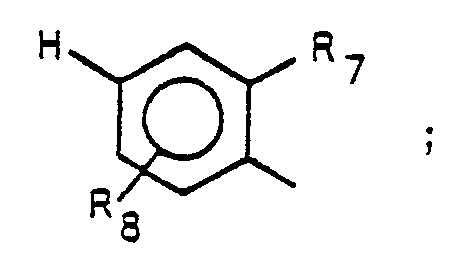
- R7 is other than H; and
- R8 is H, F, Cl, Br, CF3, CH3 or OCH3.
- (6) Compounds of Preferred 5 where
- R7 is Cl, NO2, CO2R9, SO2NR10R11 or OSO2R12;
- Rs is H;
- R9 is C1-C3 alkyl, CH2CH=CH2, CH2CH2OCH3 or CH2CH2Cl;
- R10 and R11 are independently C1-C2 alkyl; and
- R12 and R13 are independently C1-C3 alkyl.
- (7) Compounds of Preferred 6 where Rg, R10, R11, R12 and R13 are CH3.
- Specifically preferred for reasons of their highest herbicidal activity and/or most favorable ease of synthesis are:
- 2-[[(5-methylthio-1-methyl-1H-1,2,4-triazol-3-yl)aminocarbonyl]aminosulfonyl]benzoic acid, methyl ester;
- 2-[[(5-ethylthio-1-methyl-1 H-1,2,4-triazol-3-yl)aminocarbonyl]aminosulfonyl]benzoic acid, methyl ester;
- 2-[[(5-ethyl-1-methyl-1H-1,2,4-triazol-3-yl)aminocarbonyl]aminosulfonyl]benzoicacid, methyl ester;
- 2-[[(5-methoxy-1-methyl-1H-1,2,4-triazol-3-yl)aminocarbonyl]aminosulfonyl]benzoic acid, methyl ester;
- N-[(5-methoxy-1-methyl-1H-1,2,4-triazol-3-yl)aminocarbonyl]-2-chlorobenbenzenesulfonamide; and
- N-[(5-methoxy-1-methyl-1 H-1,2,4-triazol-3-yl)aminocarbonyl]-N',N'-dimethyl-1,2-benzenedisulfonamide.
- Many ofthe compounds of Formula I can be prepared by reacting an appropriate 3-amino-1 ,2,4-triazole of Formula II with an appropriately substituted sulfonylisocyanate or isothiocyanate of Formula III, as shown in Equation 1.
-
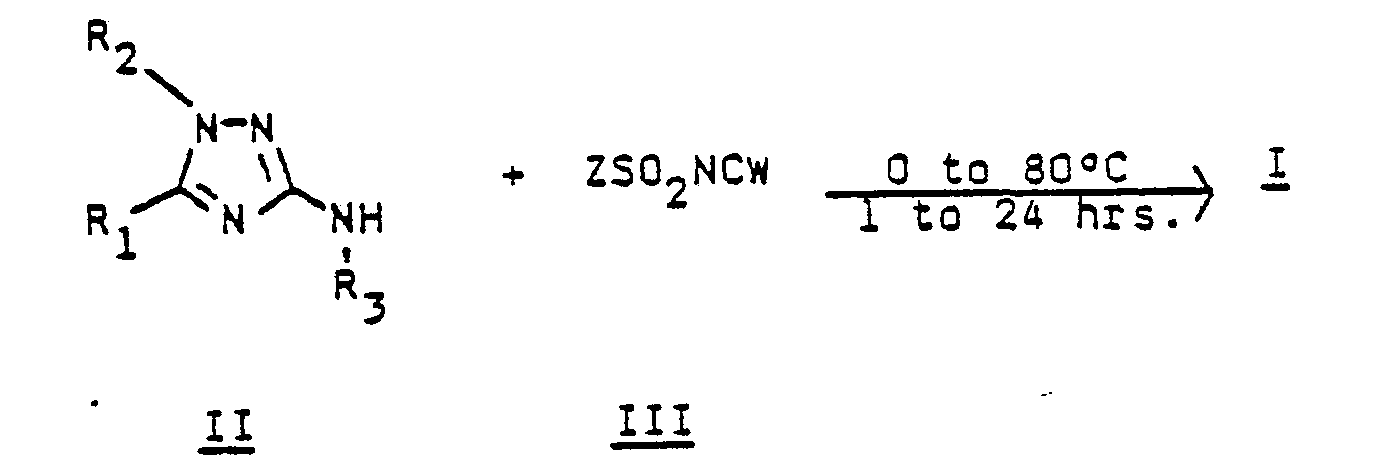
- Z, R1, R2, R3 and W are as previously defined. The reaction of Equation 1 is best carried out in inert organic solvents such as methylene chloride, tetrahydrofuran, or acetonitrile at ambient pressure and temperature. The mode of addition is not critical; however, it is often convenient to add the sulfonylisocyanate or isothiocyanate to a stirred suspension or solution of the aminotriazole. Since such isocyanates and isothiocyanates usually are liquids, their additions can be easily controlled.
- The reaction is generally exothermic. In some cases, the desired product is insoluble in the warm reaction medium and crystallizes from it in pure form. Products soluble in the reaction medium are isolated by evaporation of the solvent, trituration of the solid residue with solvents such as 1-chlorobutane or ethyl ether, and filtration.
- An alternate method for synthesizing compounds of Formula I in which W = 0 is illustrated in Equation 2. An appropriate sulfonylisocyanate of Formula III is allowed to react with an appropriate 3-amino-1H-1,2,4-triazole of Formula IV to give an intermediate urea of Formula V which is then alkylated with a reagent of Formula R2X to yield compounds of Formula I:

- X is a good leaving group such as bromine, iodine, chlorine, alkylsulfonate, R2OSO3 Θ, or p-toluenesulfonate, and Z, Ri, R2 and R3 are as previously defined.
- The conditions for reacting the 3-amino-lH-triazole of Formula IV and sulfonylisocyanate or sulfonylisothiocyanate in Equation 2 are similar to that described for the condensation involving triazole II in Equation 1, however it is desirable to have an equimolar amount of sulfonylisocyanate react with triazole IV.
- The alkylation reaction illustrated in Equation 2 between the sulfonylurea intermediate V and R2X (wherein X is a good leaving group such as bromine, iodine, chlorine, alkylsulfonate, R2OSO3Θ, or p-toluenesulfonate) is preferably carried out in the presence of an alkaline material and preferably in the presence of a solvent. Suitable alkaline materials, include, for example, the alkali and alkaline earth metal carbonates, bicarbonates, acetates, and hydroxides such as potassium carbonate, sodium carbonate, potassium carbonate, potassium acetate, sodium and potassium hydroxide. Other organic bases such as pyridine and triethylamine may also be used. Suitable solvents include inert aprotic solvents such as acetone, methyl ethyl ketone, acetonitrile, methylene chloride, dimethylformamide, dimethylacetamide, and dimethylsulfoxide. The alkylation reaction conditions of Equation 2 vary according to the nature of the reactants, the base and solvent present. Usually, the reaction is facilitated by the application of heat (between 45° and 128°) however, lower reaction temperatures may be desirable in some instances as will be readily apparent to one skilled in the art.
- The intermediate aryl sulfonylisocyanates of Formula III (W = O) can be prepared by reacting the corresponding aryl sulfonamides with phosgene in the presence of n-butyl isocyanate at reflux in a solvent such as chlorobenzene or xylenes, according to the procedure of H. Ulrich and A. A. Y. Sayigh, Newer Methods of Preparative Organic Chemistry, Vol. VI, p. 223-241, Academic Press, New York and London, W. Forest Ed., or by the methods taught in U.S. Patent 4,127,405 (1978), U.S. 4,238,671 (1980) and EP-A-23,141.
- The intermediate pyridyl sulfonylisocyanates of Formula III (W = O) can be prepared by reacting an N-(alkylaminocarbonyl)pyridinesulfonamide with phosgene as described in EP-A-13,480, to which the reader is referred for further information. The N-(alkylaminocarbonyl)pyridinesulfonamide can be prepared, as described in USSN 966,258, by the reaction of a pyridinesulfonamide, an alkyl isocyanate and an anhydrous base in an anhydrous solvent.
- Similarly, the preparation of the furan sulfonyl isocyanates is described in U.S. Patent 4,127,405 (1978); the thiophene and naphthalene sulfonylisocyanates can be prepared as shown in Equations 3 and 4 respectively, wherein R14, R15, R17 and R18 are as previously defined.

- A mixture of the appropriate sulfonamide, e.g., an 2-alkoxycarbonyl-3-thiophene sulfonamide VI such as the methyl ester, which is known in the art, an alkyl isocyanate such as butyl isocyanate and a catalytic amount of 1,4-diaza[2.2.2]bicyclooctane (DABCO) in xylene or other inert solvent of sufficiently high boiling point (e.g. >135°C) is heated to approximately 130-1500C. Phosgene is added to the mixture until an excess of phosgene is present as indicated by a drop in the boiling point. After the mixture is cooled and filtered to remove a small amount of insoluble by-products, the solvent and alkyl isocyanate are distilled off in-vacuo leaving a residue which is the crude sulfonyl isocyanate VII.
-

- The preparations of naphthalene sulfonylisocyanates IX can be obtained from the corresponding sulfonamides VIII. Reaction conditions for the phosgenation would be the same as that for the thiophene sulfonamides in Equation 3.
- The phenyloxysulfonylisocyanates of Formula XI are readily prepared from the corresponding phenols of Formula X as taught in U.S. 4,191,553 and as shown in Equation 5. Reaction of X with chlorosulfonyl- isocyanate in a high boiling solvent, for example, dichlorobenzene, toluene or xylene, will produce the sulfonylisocyanate of Formula XI.

- Arylsulfonylisothiocyanates of Formula III (W = S) can be prepared by treatment of sulfonamides with carbon disulfide and potassium hydroxide followed by reaction of the dipotassium salt with phosgene according to the teaching of K. Hartke, Arch. Pharm. 229, 174 (1966).
- Pyridine sulfonylisothiocyanates can be prepared according to the procedure taught by K. Dickere and E. Kuhle in U.S. Patent 3,346,590. A suitable pyridinesulfonyliminodithiocarbonate is reacted with phosgene in the presence of a solvent such as toluene or xylene.
- The thiophene and furan sulfonylisothiocyanate intermediates of Formula XIII prepared according to Equations 6 and 7 are useful for the preparation of compounds of Formula I where W = S.

- The substituted sulfonamide is dissolved in dimethylformamide (DMF) with an equivalent amount of carbon disulfide and two equivalents of potassium hydroxide are added portionwise at room temperature. The mixture is stirred for 1-8 hours and diluted with ethyl acetate, ethyl ether or similar aprotic solvent to cause the dipotassium salt of the dithiocarbamic acid to precipitate. The salt is isolated, dried and suspended in an inert solvent such as xylene, benzene, carbon tetrachloride or methylene chloride. Phosgene is added to the stirred suspension at or below room temperature and the mixture stirred for 1-3 hours. In place of phosgene, a chloroformic ester (e.g. methyl chloroformate), phosphorous pentachloride, sulfuryl chloride or thionyl chloride can be used.
- The sulfonylisothiocyanate which is formed is usually soluble in the solvent and is isolated by filtering off the insoluble potassium chloride and concentrating the filtrate. These isothiocyanates tend to be unstable and dimerize readily, (Equation 7), however, the dimers can be used in the same manner as the parent isothiocyanates for the purposes of this invention.

- The naphthalene sulfonylisothiocyanate intermediate XIV may also be prepared from the sulfonamide VIII according to Equation 8 and following similar reaction conditions as that in Equation 6. These isothiocyanates may also be unstable and dimerize, however, these dimers can be used in the same way as the parent isothiocyanates for the purpose of the invention.


- The preparation of sulfonamides from ammonium hydroxide and sulfonyl chloride is widely reported in the literature, e.g., Crossley et al., J. Am. Chem. Soc. 60, 2223 (1938). Certain sulfonyl chlorides are best prepared by chlorosulfonation of a substituted aromatic in carbon tetrachloride according to the teaching of H. T. Clarke et al., Org. Synth., coll. Vol. 1, 2nd Ed., 1941, p. 85. Other benzenesulfonyl chlorides are best made by diazotization of the appropriate aniline with sodium nitrite in HCI, followed by reaction of the diazonium salt with sulfur dioxide and cuprous chloride in acetic acid according to the teaching of H. L. Yale and F. Sowinski,J. Org. Chem. 25, 1824 (1960). The preparation of pyridyl sulfonyl chlorides is described in Chem. Abs. 88, 190603 m (1978).
- Preparations of the aryl sulfonamides are given in U.S. Patents 4,127,405 (1978) wherein R7 = H, C1―C4 alkoxy, F, C, Br, N02, CF3; EP-A-7687 wherein R7 = CO2R9, CO2NR21R22, C(O)SR10; EP-A-23,141 (R7 = SO2NR10R11, SO2N(OCH3)CH3); EP-A-23,422 (R7 = OCF3, OCHF2, OCF2CF2H, S(O)nR13 where R13 is fluorinated alkyl); EP-A-44,209 (R7= CH2CO2R20, CH(CH3)CO2R20, CH2S(O)nR13, CH(CH3)S(O)nR13); EP-A-44,212 (R7 = QSO2R12 where Q = O or NCH3); EP-A-44,807 (R7 = C3―C4 alkenyloxy, C1-C3 alkoxy substituted with OCH3 or OC2H5, S(O)nR13 where R13 = allyl); and EP-A-44,808 (R7 = C1-C3 alkoxy substituted with 1-5 atoms of Cl, Br or F). The arylsulfonamides wherein R7 = C3-C4 alkynyloxy may be prepared by methods taught in EP-A-44,807. The synthesis of pyridylsulfonamides is described in G. Machek, Monatsch 2, 84 (1939); L. Thunus and C. L. Lapiere, Ann. Farn. 33, 663 (1975), and EP-A-13,480.
- Equation 9 describes the procedure for making aryl and naphthalene intermediates of Formula III when R7 and R14 are S(O)nR13. The thioether of Formula XVb may be prepared from the appropriate 2-aminothiophenol or aminothionaphthalene and an alkyl halide as described in the literature, e.g., R. N. Prasad et al., Can. J. Chem. 44, 1247 (1966). The formation of the sulfonamide XVd is accomplished in the following manner.
-

- A solution of the thioether of Formula XVb in a mixture of concentrated hydrochloric acid and glacial acetic acid is treated with a solution of sodium nitrite in water at -5° to 0°. After stirring for 10-15 minutes at 0° to insure complete diazotization, this solution is added to a mixture of an excess of sulfur dioxide and a catalytic amount of cuprous chloride in glacial acetic acid at 0-5°. The temperature is kept at 0―5° for 1/4to 1 hour and is then raised to 20-25° and held at that temperature for 2-4 hours. This solution is then poured into a large excess of ice water. The sulfonyl chloride products can be isolated by filtration or by extraction into solvent such as ethyl ether or methylene chloride followed by evaporation of the solvent.
- The amination described in step (9b) is conveniently carried out by treating a solution of the sulfonyl chloride with an excess of anhydrous ammonia in a solvent such as ethyl ether or methylene chloride at 0-25°. If the product sulfonamide is insoluble, it may be isolated by filtration followed by washing out the salts with water. If the product sulfonamide is soluble in the reaction solution, it may be isolated by filtering off the precipitated ammonium chloride and evaporating the solvent.
- Sulfonamides of Formula XVc wherein A' = aryl may also be prepared from the appropriate chlorobenzenesulfonamides (synthesis taught in U.S. 4,127,405) as shown in Equation 10. Heating an equimolar mixture of the appropriate solfonamide and mercaptan in the presence of two equivalents of base will yield XVc following acidic work-up. As in Equation 9, the sulfonamides XVd can be prepared by oxidation of XVc.

- Synthesis of thiophene sulfonamides of Formula Xvle and XVlf may be accomplished by the method outlined in Equation 11. The sulfonyl chlorides of Formula XVIa are described by H. D. Hartough in "The Chemistry of Heterocyclic Compounds," v. 3, Interscience Publishers, Inc., N.Y. 1952. These may be converted to the corresponding N-t-butyl sulfonamides XVIb by admixture with at least twice the equivalent amount of t-butylamine in an inert solvent, such as ether, filtration of the amine hydrochloride, and evaporation of the solvent. The lithiation of thiophenes and of aromatic N-t-butylsulfonamides with n-butyllithium, t-butyllithium, lithium diisopropylamide and lithium 2,2,6,6-tetramethyl piperidide is reviewed by H. W. Gschwend and H. R. Rodriguez in Org. React., 26, 1 (1979), and is generally carried out by cooling to -78° a solution of twice the equimolar amount of base kept under an inert atmosphere, in an ethereal solvent such as diethyl ether or THF, and adding a solution of the compound of Formula XVIb. The compounds of Formula XVIc may be prepared as shown in Equation (11 b) by adding an equimolar quantity of the appropriate disulfide (R13S)2, allowing the mixture to warm to room temperature, washing the mixture with acidic brine, and evaporation of the solvent.


- Alternatively, as shown in Equation (11c), in order to prepare the compounds of Formula XVId, the lithiation mixture may be treated with an equimolar quantity of sulfur dioxide, allowing the mixture to warm to room temperature, filtration of the solid precipitate, dissolution of this salt in ethanol and adding an equimolar amount of the appropriate alkyl iodide. This alkylation step may be carried out at temperatures of 25 to 78°. The cooled reaction mixture may be diluted with dilute aqueous hydrochloric acid to precipitate the product XVId. The t-butyl sulfonamides of Formula XVIc and XVId may be converted to the compounds of Formulae XVIe and XVIf, respectively, by heating in methanol containing at least an equimolar quantity of hydrochloric acid, followed by concentration of the reaction mixture and precipitation of the product with ether.
- An alternate preparation of the thiophene sulfonamides of Formula XVIf is described in Equation 12.


- X = CI or Br and R13 and R17 are as previously defined.
- The reaction of Equation (12a) is accomplished by mixing equimolar quantities of the appropriate halide XVIg with an equimolar quantity of benzyl mercaptan in a polar solvent, such as dimethylformamide, containing an equimolar amount of a strong base, such as sodium methoxide or sodium hydride, heating at a temperature between 50 and 120°, and isolating the product by precipitation with ice-water and washing with hexane. The sulfides of Formula XVlh are converted to the sulfonyl chlorides XVIi as shown in Equation (12b) by contacting with at least three equivalents of chlorine in acetic acid according to the procedure of R. F. Langler, Can. J. Chem., 54,498 (1976). The sulfonyl chlorides can be precipitated by the addition of ice-water to the chlorination mixture. Ammonolysis of thiophene sulfonyl chlorides gives XVIf.
- Compounds of Formulae XVllb (Equation 13) wherein R13 and R17 are as previously defined may be prepared by adding twice the equimolar amount of chlorosulfonic acid, diluted in an inert solvent, such as dichloromethane, to the appropriate 3-thienyl sulfide XVlla at temperatures between -30° and 25°, washing the mixture with ice-water and evaporating the solvent. These may be converted to the appropriate compounds of Formula XVllc by treatment with ammonia.
- The sulfides of Formula XVllc may be oxidized to compounds of Formula XVlld.
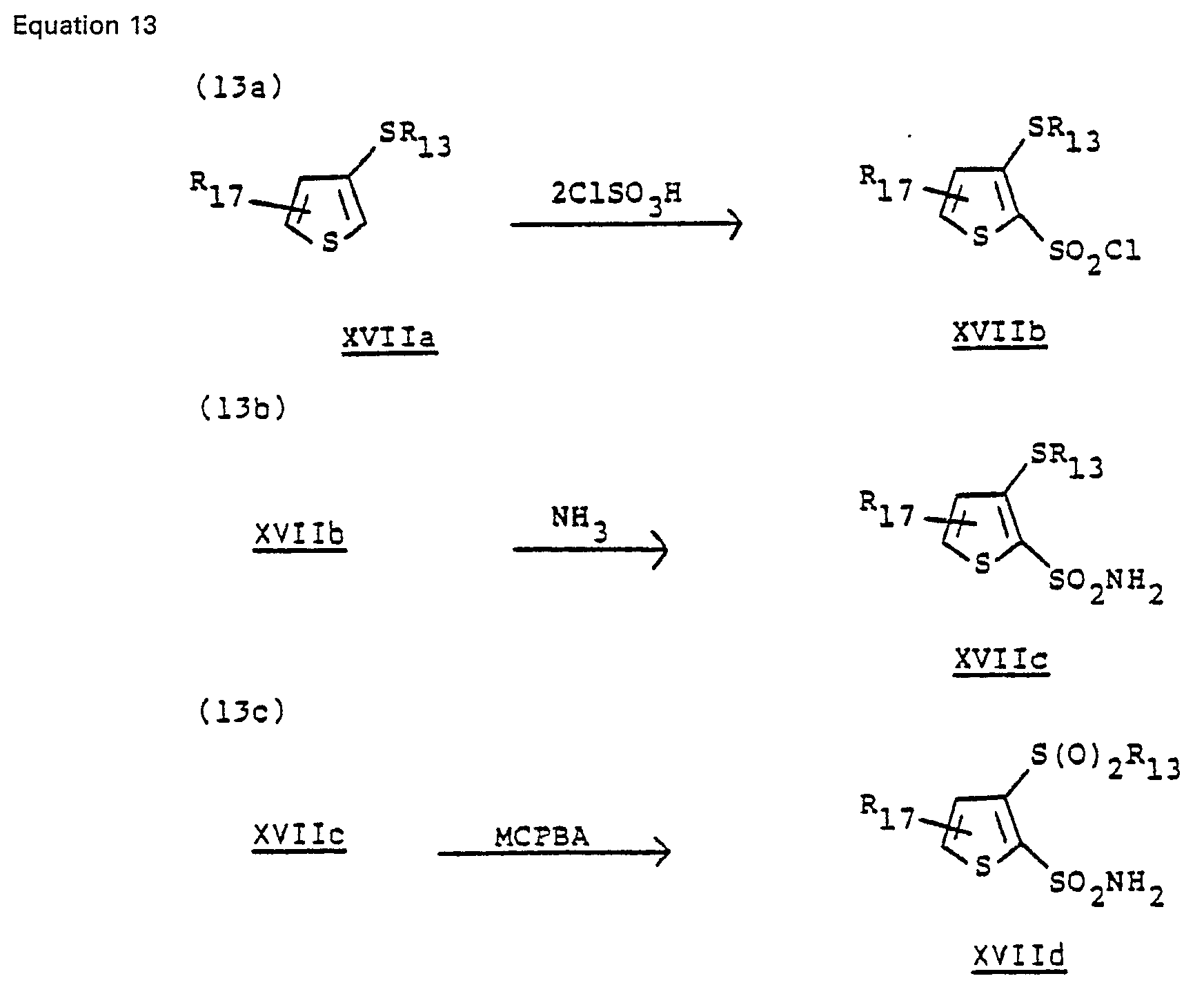
- Also, the methods described in Equation 11 may be applied in making compounds of Formula XVlld.
- According to the method outlined in Equation 14, compounds of Formulae XVlllf and XVlllh can be prepared, wherein R'17 equals H, chlorine, or bromine, X = chlorine, bromine and R13 is as previously defined. Starting with sulfonyl chlorides of Formula XVIlla, the dihalo-compounds may be partially dehalogenated by contacting with two equivalents of 5% sodium amalgam in an alcoholic or aqueous alcoholic solution at 25 to 78°, followed by acidification of the products of Formulae XVllle and XVlllg wherein R'17 = CI or Br. The 2-halo and 5-halo isomers may be separated by column chromatography. The totally dehalogenated compounds where R'17 = H, may be prepared by using three or more equivalents of the sodium amalgam in the reaction. These compounds may be converted to XVlllf and XVlllh as previously described.


- Precursors to the required thiophene sulfonyl chlorides and sulfonamides are prepared by a variety of synthetic routes depending on the chemical properties of the substituent and its position on the thiophene ring.
- Direct sulfonation or chlorosulfonation to sulfonic acid or sulfonyl chloride derivatives can be carried out according to the references cited in "Thiophene and its Derivatives," H. D. Hartough, Interscience, New York, 1952. The structure of sulfonation products of 3-alkyl thiophenes has been reported as uncertain. Nuclear magnetic resonance studies indicate the chlorosulfonation occurs predominantly at the 2- rather than the 5-position.
- Sulfonic acids are readily converted to sulfonyl chlorides, using methods well known in the art, by chlorinating agents such as phosphorus pentachloride, phosphorus oxychloride or thionyl chloride. A mixture of sulfuryl chloride in dimethylformamide can also be used to prepare thiophenesulfonyl chlorides of active thiophene intermediates according to the method of E. Testa et al., Helv. Chim. Acta., 47, 766 (1963).
- Other intermediates can be prepared via lithiation reactions. A review of this chemistry appears in Organic Reactions, Vol. 26, Gschwind, H. W. and Rodriguez, H. R., John Wiley and Sons, Inc., New York, 1979. Examples of the application of this chemistry to the preparation of intermediates used here is shown in the following equations.
- Equation 15 shows the preparation of sulfamyl thiophene sulfonamides via lithiated intermediates.

- As shown in Equation 15, 3-bromothiophene is converted to 3-lithiothiophene at -78° in an inert solvent such as tetrahydrofuran and the mixture is then contacted with sulfur dioxide. The resultant lithio sulfinate is stirred at room temperature in acetic acid or aqueous 2-propanol with N-chlorosuccinimide to yield the 3-thiophenesulfonyl chloride IXXb. This product is then contacted with an amine, HNR10R11 wherein R10 and R11 are as previously defined. The 3-thiophenesulfonamide IXXc, thus formed is reacted with butyl lithium at -40 to 0°C followed by sulfur dioxide to form the lithio 3-sulfamyl-2-thiophenesulfinate IXXd which is converted to the sulfonyl chloride as described above. Conversion of this sulfonyl chloride to the sulfonamide and sulfonylisocyanate is carried out as previously described.
- The synthesis of other intermediates via lithiation is shown in Equation 16, wherein R18 is optionally Cl, Br, C1-C4 alkyl, C3 alkenyl or OCH3.

- The reactions described in Equation 16 are carried out in the same manner as those described in Equation 15 as would be expected by one skilled in the art. Displacement of activated halogen atoms from the thiophene nucleus by benzyl mercaptan and chlorination of the resulting product is also a useful route to intermediates for compounds of this invention as illustration by Equation 17.

- The reaction of benzyl mercaptan with a halothiophene, wherein the halo atom is susceptible to replacement by a nucleophile, is best carried out in an inert polar, high boiling solvent such as dimethylformamide or N-methylpyrrolidone at reflux in the presence of a copper catalyst over six to forty- eight hours. The thioether intermediate XXlb is converted to the sulfonyl chloride XXlc by passing chlorine gas into aqueous hydrochloric acid or acetic acid solution or suspension of XXIb.
- Disulfides such as structure XXII, reported by Henriksen and Autruys, Acta. Chem. Scands., 24, 2629 (1970), are also useful intermediates for conversion to sulfonyl chlorides as shown in Equation 18.
-
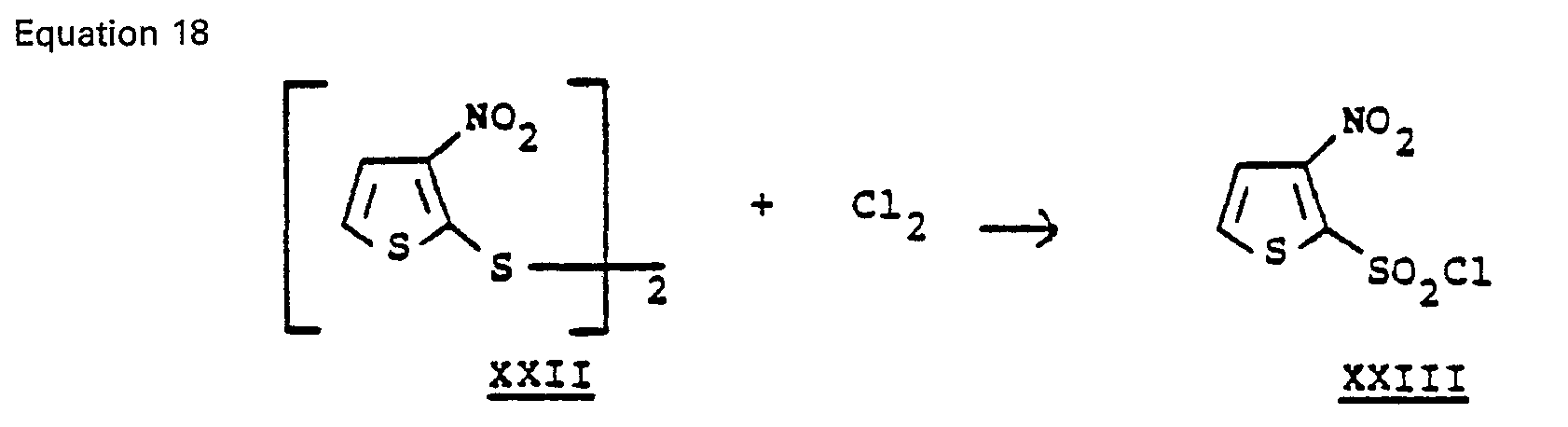
- The chlorination shown in Equation 18 is carried out in the same manner as described for the chlorination of structure XXlb.
- Alternatively, the diazotization reaction of thiophene amines to sulfonyl chlorides such as structure XXIV shown in Equation 19 are carried out according to the general procedure of H. L. Yale and F. Sowinski, J. Org. Chem., 25, 1824 (1960).
-

- The o-alkoxymethyl nitrobenzenes XXVb are in turn prepared via "Williamson Synthesis", according to Equations 20a or 20b.

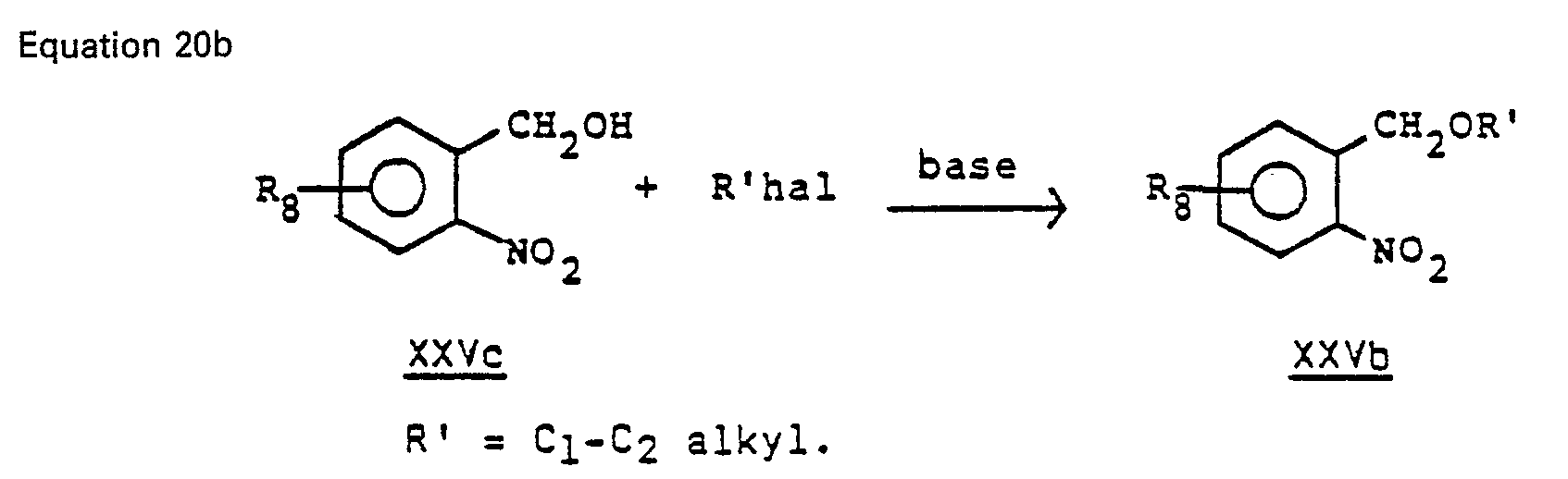
- "Williamson Synthesis" has been widely used for the preparation of ethers as reviewed by W. Theilheimer, Syn. Methods of Org. Chem., Vol. VII, p. 112.
- Alternatively, o-alkoxymethyl methylbenzenesulfonyl chlorides, XXVf, can be obtained from an appropriately substituted a-hydroxy-o-toluenesulfonic acid-a-sultone, XXVd, via ring-opening reaction with an alkoxide anion as depicted in Equations 20c and 20d.

- Reaction 20c is closely related to the alkylation of acyloxides and acetamide with sultones as disclosed by J. H. Helberger et al., Ann., 565 22 (1949). Conversion of the sulfonic acid salt to the sulfonyl chloride is then carried out according to the teaching of Org. Synthesis, Coll. Vol. IV, 846, 693.
- Benzenesulfonamides of Formula XXVIb can also be derived from compound XXVIa as illustrated in Equation 21.

- The o-alkoxyethylbenzenesulfonamides of Formula XXVIIb can be prepared from the appropriate benzenesulfonyl chlorides of Formula XXVIla via lithiation chemistry as shown in Equation 22. Reactions of this type are well known in the literature and have been reviewed in Organic Reactions, Vol. 26, Gschwend, H. W. and Rodriguez, H. R., John Wiley and Sons, Inc., New York, 1979.

- Preparation of o-sulfamylbenzoic acid esters, from saccharin or sulfobenzoic acid anhydride is well known in the art, e.g., B. Loev and M. Kormendy, J. Org. Chem. 27, 1703 (1962). The esters can be readily reduced to the esters with diborane in a suitable organic solvent, e.g., tetrahydrofuran, in the presence of fifteen fold excess of boron trifluoride etherate under reflux for 18 hours, as described by R. P. Graber and M. B. Meyers, J. Org. Chem., 26, 4773 (1961).
- Most generally, the naphthalene sulfonamides may be prepared from the sulfonyl chlorides XXVlllb (Equation 23) as described in "Preparative Organic Chemistry", ed. G. Hilgetag and A. Martini, J. Wiley and Sons, New York (1972). The sulfonyl chlorides may be prepared by chlorination of the sulfonic acids XXVllla by methods described by Hilgetag and Martini, op. cit. The preparation of these acids is described in the art. These compounds may be further transferred by methods known in the art to yield other disclosed sulfonic acids.

- The desired sulfamyl naphthalene sulfonamides can be prepared by methods analogous to those taught in European Patent 23,141.
- The benzylsulfonamides of Formula XXIXd are most easily prepared as shown in Equation 24. The appropriately substituted toluene derivatives of Formula XXIXa are brominated and then reacted with thiourea to give the thiouronium salts of Formula XXIXb. Preparation of the sulfonyl chlorides of Formula XXIXc is readily accomplished by oxidation/chlorination of XXIXb [for the preparation and oxidative chlorination ofthiouronium salts see: T. B. Johnson and J. M. Sprague, J. Am. Chem. Soc., 58, 1348 (1936); ibid., 59, 1837, 2439 (1937); ibid., 61, 176 (1939)]. Amination of XXIXc wil give the sulfonamides of Formula XXIXd.
-


- Alternatively, the benzyl chlorides of Formula XXIXe can be converted to the benzylsulfonamides of Formula XXIXd as shown in Equation 25.

- Phosgenation of XXIXd to the corresponding benzylsulfonylisocyanates of Formula XXIXf proceeds readily as shown in Equation 26. (See Equation 3 for complete details.)

- Preparations of 3-amino-1,2,4-triazoles are known in the art and 1,2,4-triazoles are reviewed in The Chemistry of Heterocyclic Compounds "Triazoles 1,2,4" (John Wiley & Sons, New York, 1981 Commonly used starting materials containing nitrogen are N-aminoguanidine, hydrazine, alkylhydrazines, cyanamide, ethyl cyanoacetimidate, dimethyl cyanodithioimidocarbonate, dimethyl cyanoimidocarbonate, ethoxy- methylenecyanamide, and acylhydrazines. Some literature syntheses are illustrated below. Using these techniques or suitable modifications that would be apparent to one skilled in the art, the 3-amino-1,2,4-triazole intermediates can be readily prepared.
- Heating equimolar amounts of ethyl propionimidate hydrochloride and N-aminoguanidine- nitrate in pyridine gives 3-amino-ethyltriazole; German Patent 1,073,499 (1960); Berichte, 96, 1064 (1963).

- Condensation of hydrazine with ethyl N-cyanoacetimidate yields 3-amino-5-methyltriazole; Journal of Organic Chemistry, 28, 1816 (1963).

- Trifluoromethyl 3-aminotriazole can be obtained by thermal dehydration of the hydrazide of trifluoroacetic acid. Zh. Obshch. Khim., 39, 2525 (1969); Chemical Abstracts, 72: 78954v (1970).

- U.S. Patent 2,835,581 (1958) teaches the preparation of 3-amino-5-(hydroxymethyl)triazole from N-aminoguanidine and glycolic acid and British Patent 736,568 (1955) describes the synthesis of 3-amino-5-mercaptotriazole.

- Condensing hydrazine with dimethyl cyanodithioimidocarbonate in acetonitrile gives 3-amino-5-methyl- thio-1,2,4-triazole while reaction of hydrazine with dimethyl N-cyanoimidocarbonate produces 3-amino-5-methoxy-1,2,4-triazole; Journal of Organic Chemistry, 39, 1522 (1974).

- Reaction of substituted hydrazines with N-cyanothioimidocarbonates (prepared according to the procedure given in D. M. Wieland, Ph.D. Thesis, 1971, pp. 123-124) yields disubstituted aminotriazoles as shown below.

- The following examples teach the preparation of compounds of this invention in more detail. Unless otherwise indicated, all parts are by weight and temperatures in °C.
- To a mixture of 5.0 grams (0.0385 mole) 3-amino-5-methylthio-1H-1,2,4-triazole (Aldrich Chemicals) and 75 ml of dry methylene chloride stirring in a 200 ml RB single neck flask, 10.5 grams of 2-(methoxycarbonyl)benzenesulfonylisocyanate was added at ambient temperature; a clear solution gradually formed. After stirring overnight at room temperature, the white solid which precipitated was filtered and washed with methylene chloride, yield 11.7 grams, m.p. 147―153°.
- NMR (tfa-D): δ 2.85 (s, 3H, SCH3), 4.10 (s, 3H, CO2CH3), 7.60―8.55 (m, ArH). IR (Nujol): 3.0-3.20 (NH), 5.75 (C=O), 6.20 (C=N) microns.
- Method A: Methyl iodide (0.6 ml) was added by syringe at ambient temperature to a stirred mixture of 0.8 grams (0.0022 mole) of methyl 2-[(5-methylthio-lH-1,2,4-triazol-3-yl)aminocarbonyl]aminosulfonyl- benzoate and 0.6 grams of potassium carbonate in 30 ml of acetone in a 100 ml RB single neck flask. The mixture was stirred at room temperature overnight. The reaction mixture was then poured into 250 ml of ice water and acidified to pH 3―4 with glacial acetic acid. After extracting the aqueous mixture with 1:1 mixture of ethyl acetate and ethyl ether, the organic layer was washed with brine dried (MgS04), filtered, and the solvent evaporated to dryness to yield a white solid residue which was suspended in acetonitrile, filtered, and recrystallized from the acetonitrile; yield 0.3 g, m.p. 198-200°.
- NMR (tfa-D): 5 2.95 (s, 3H, SCH3), 4.0 (s, 3H, CH3), 4.15 (s, 3H, C02CH3), 7.808.60 (m, ArH). IR (Nujol): 5.75-5.85 (C=O), 6.30 (C=N), 13.10, 13.55 microns.
- Method B: To 1.0 gram (0.0069 mole) of3-amino-1-methyl-5-methylthio-1H-1,2,4-triazole stirring in 15 ml of dry methylene chloride, 3.0 grams of 2-(methoxycarbonyl)benzenesulfonylisocyanate was added at ambient temperature and a cloudy solution immediately formed followed by precipitation of a white solid. The white suspension was stirred at room temperature overnight. Chlorobutane (4 ml) was added to the mixture and the white solid filtered, washed with methylene chloride followed by a chlorobutane wash, yield 2.0 g, m.p. 198-200° (recrystallized from acetonitrile). The spectral characteristics and melting points were identical to the solid obtained in Method A. A mixed melting point was not depressed.
- At 0°, 6.5 grams of methyl hydrazine was added dropwise to a stirred suspension of 20.0 grams (0.137 mole) dimethyl cyanodithioimidocarbonate in 35 ml of acetonitrile. A yellow solution immediately formed after the addition followed by precipitation of a white solid. The ice bath was removed, and upon warming to room temperature a yellow solution formed which was stirred at room temperature overnight. After stirring overnight, a solid precipitated which was filtered, washed with cold acetonitrile, followed by 1-chlorobutane, yield 8.5 grams, m.p. 104-1090. The literature [Journal of Organic Chemistry, 39, 1522 (1974)] reported a similar melting point of 103-106° for the title compound, however, a different isomeric structure was assigned to the compound (5-amino-1-methyl-3-methylthio-1H-1,2,4-triazole). The assignment of 3-amino-1-methyl-5-methylthio-1H-1,2,4-triazole as the correct structure was verified by X-ray crystal structure analysis.
- In 20 ml of acetonitrile at room temperature 0.63 grams of 3-amino-1,5-dimethyl-1H-1,2,4-triazole [Journal of Organic Chemistry, 39, 1522 (1974)] and 1.49 grams of 2-(methoxycarbonyl)benzenesulfonyl- isocyanate were stirred for 12 hours. The white solid which precipitated was filtered and washed with ether to yield 1.3 grams of the title product melting at 175-178°.
- A mixture of 0.7 grams (0.00486 mole) of 3-amino-1-methyl-5-methylthio-1H-1,2,4-triazole and 4.0 grams of 2-(isopropoxycarbonyl)benzenesulfonylisocyanate was stirred in 12 ml of dry methylene chloride at ambient temperature overnight. After addition of 4 ml of 1-chlorobutane, a white solid precipitated which was filtered, washed with 1-chlorobutane and dried, yield 1.3 grams, m.p. 192-194°.
- NMR (tfa-D): 6 1.55 (d, 6H, 2CH3), 2.90 (s, 3H, SCH3), 3.95 (s, 3H, N-CH3), 4.90-5.40 (m, 1H, CO2CH), 7.60―8.50 (m's, ArH). IR (Nujol): 2.95 (NH), 5.75 (C=O), 6.30 (C=N), 13.10, 13.50 microns.
- After the addition of 3.0 grams 2-nitrobenzenesulfonylisocyanate to 0.7 grams (0.00486 mole) 3-amino-1-methyl-5-methylthio-1H-1,2,4-triazole stirring in 15 ml of dry methylene chloride, a solid precipitated and the suspension was stirred at room temperature overnight. The solid was filtered and washed with 1-chlorobutane to yield 1.6 grams of product, m.p. 210-213°.
- NMR (tfa-D): δ 2.90 (s, 3H, SCH3), 4.00 (s, 3H, N-CH3), 7.85-8.60 (m, ArH). IR (Nujol): 3.0-3.20 (NH), 5.80 (C=O), 6.25 (C=N), 12.70, 13.45, 13.60 microns.
- To a stirred mixture of 1.0 gram (0.0027 mole) of methyl 2-[(5-methylthio-1H-1,2,4-triazol-3-yl)aminocarbonyl]aminosulfonylbenzoate and 0.7' grams of potassium carbonate in 30 ml of acetone at room temperature, 0.8 ml of ethyl iodide was added by way of syringe and the resulting white suspension stirred 3 days. The mixture was poured into 250 ml of ice water and acidified to pH 3-4 with glacial acetic acid. The aqueous acidic mixture was extracted with 1:1 mixture of ethyl ether/ethyl acetate and the extract washed with brine, dried (MgS04), and evaporated to yield a white solid residue which was suspended in acetonitrile and filtered, yield 0.3 grams, m.p. 188-191°.
- NMR (tfa-D): 6 1.45 (t, 3H, CH3), 2.80 (s, 3H, SCH3), 4.05 (s, 3H, CO2CH3), 4.25 (q, 2H, CH2), 7.60―8.45 (m, ArH).
- Methylhydrazine (98%, 6.30 g, 0.136 mol) was added dropwise to a solution of dimethyl-N-cyanothio- imidocarbonate (17.3 g, 0.133 mol, prepared according to procedure given in D. M. Wieland, Ph. D. Thesis, 1971, pp. 123-124.) in acetonitrile (35 ml) at -5-0° with stirring under nitrogen. The reaction mixture was allowed to warm to room temperature and stirred for 2 days. Isolation of the product by filtration and washing with acetonitrile gave 12.7 g of a white powder, m.p. 177-180°.
- NMR (DSO/CDCI3): 6 3.35 (s, N-CH3), 3.95 (s, O-CH3); and 5.0 (broad, NH2).
- To a solution of 2-(methoxycarbonyl)benzenesulfonylisocyanate (80%, 1.41 g, 4.7 mmol) in methylene chloride (10 ml) at room temperature under nitrogen was added 3-amino-5-methoxy-1-methyl-1H-1,2,4-triazole (0.50 g, 3.9 mmol). DABCO (catalytic amount) was added, and the reaction mixture was stirred for 3 days. Isolation of the product by filtration and washing with methylene chloride gave 1.05 g of a white powder, m.p. 177-180°.
- NMR (CDCI3/DMSO): 5 3.5 (s, N-CH3); 3.9 (s, CO2CH3); 4.1 (s, O-CH3); 7.5-7.8 (m, Ar-H); 8.1-8.4 (m, Ar-H); 9.7 (broad, NH); and 11.0 (broad, NH).
- IR (KBr) 3150 (NH), 1740 (c=o), 1700 (c=o), 1600, 1530, 1475, 1420, 1360 (SO2), 1340, 1295, 1260, 1180 (SO2), 1115 and 1050 cm-1.
- By application of one or more of the procedures of Examples I-IX and/or the methods described above and using the appropriate reactants, the compunds of Tables 1 to 18 can be prepared.


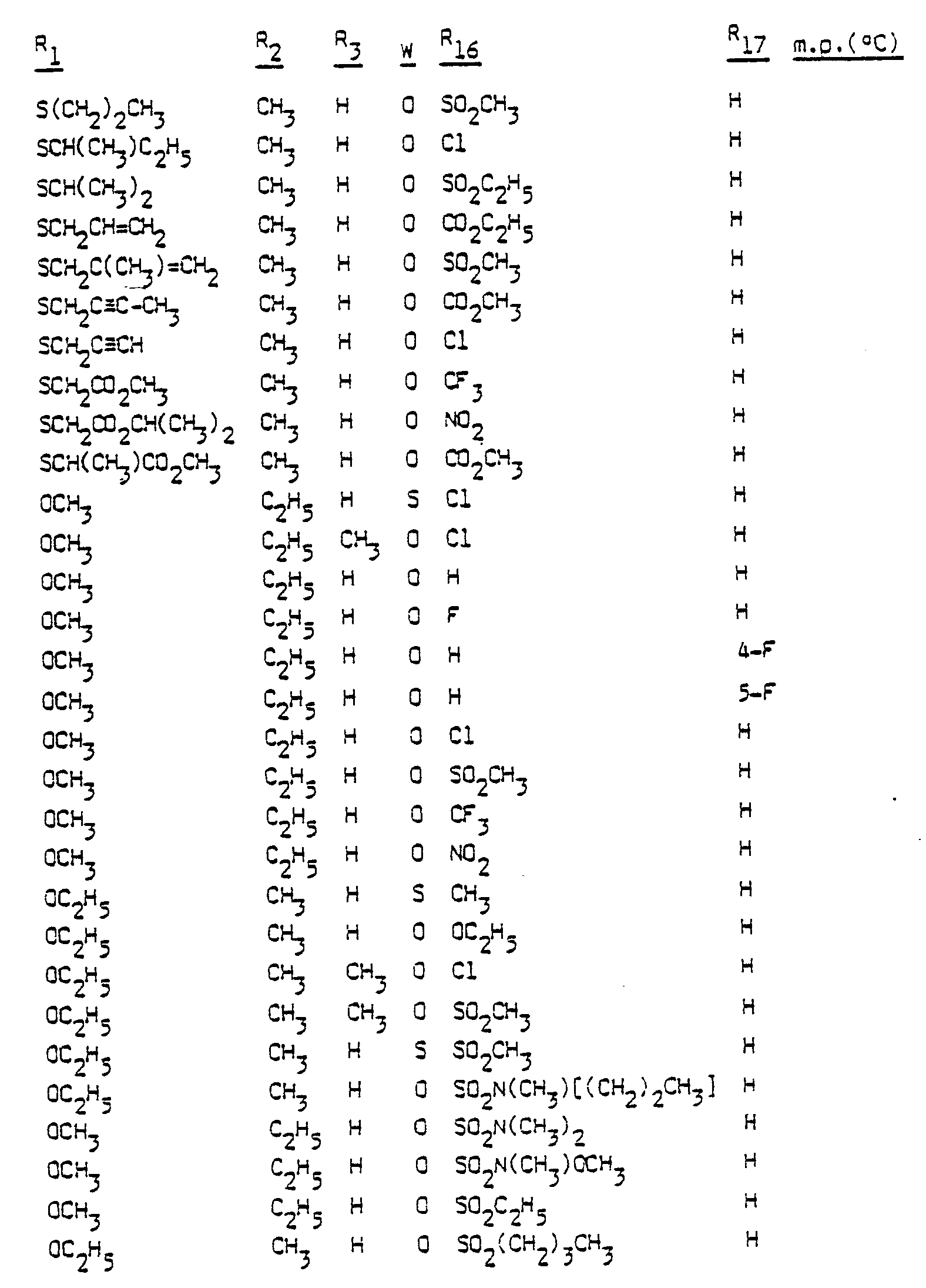


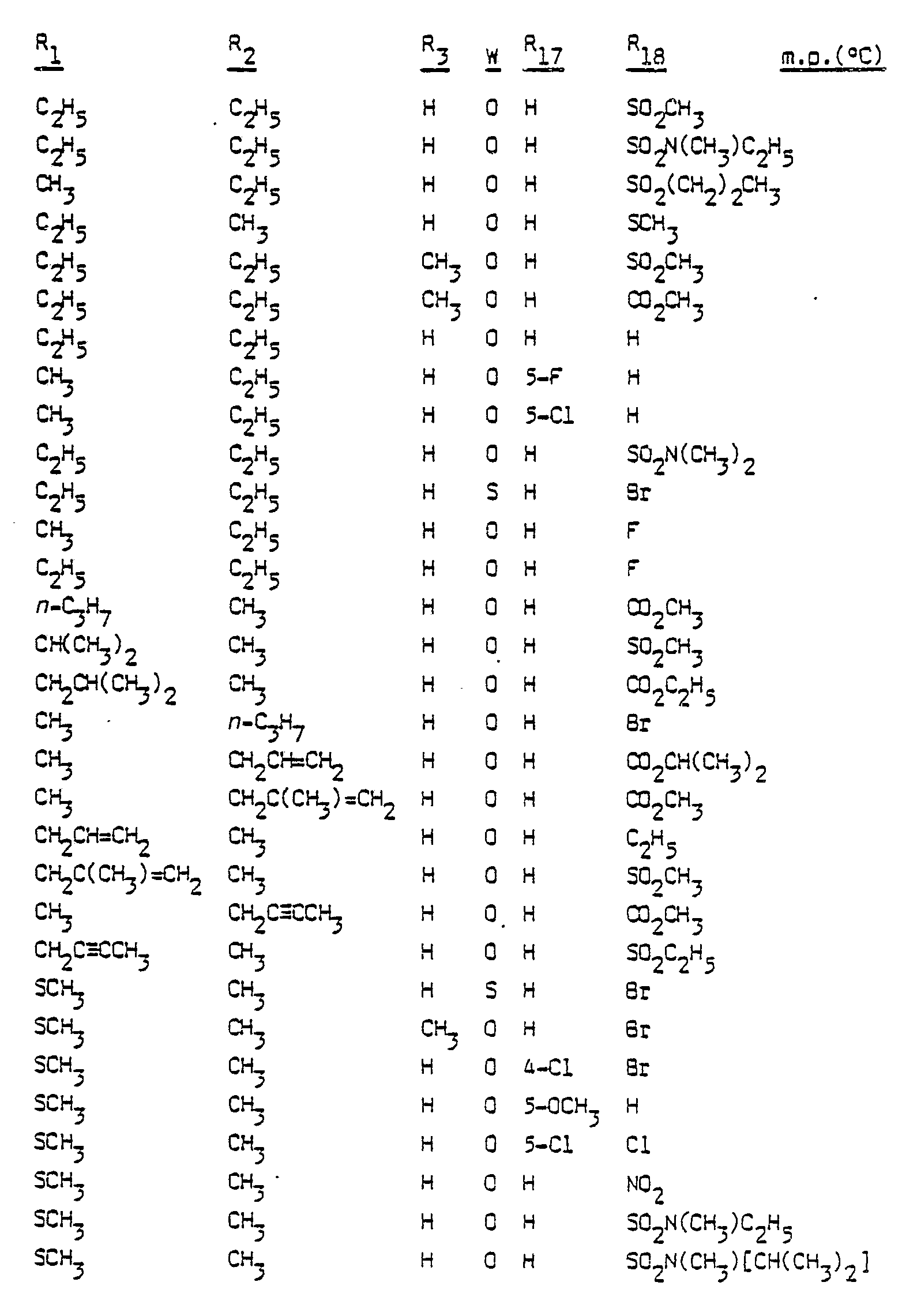


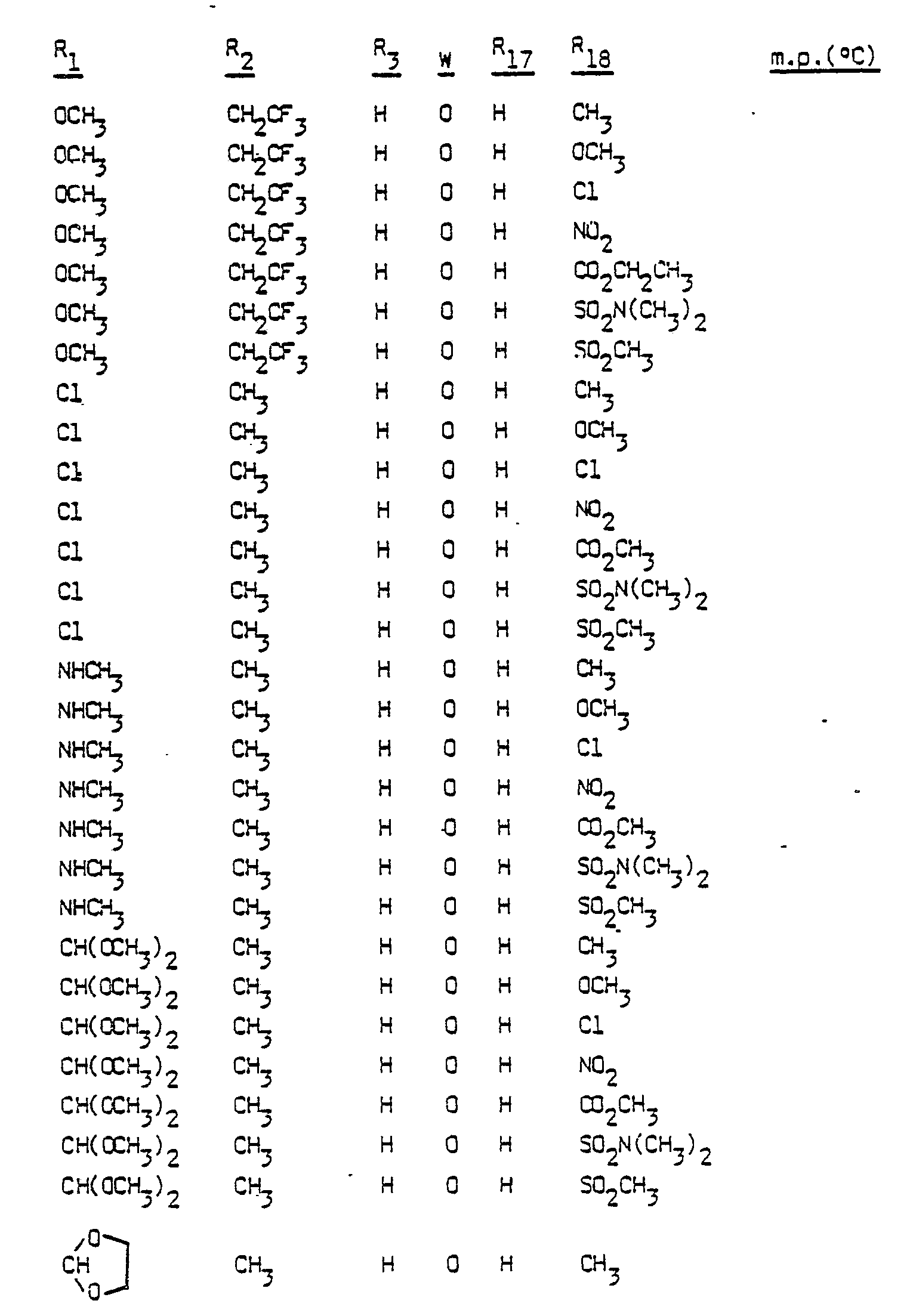
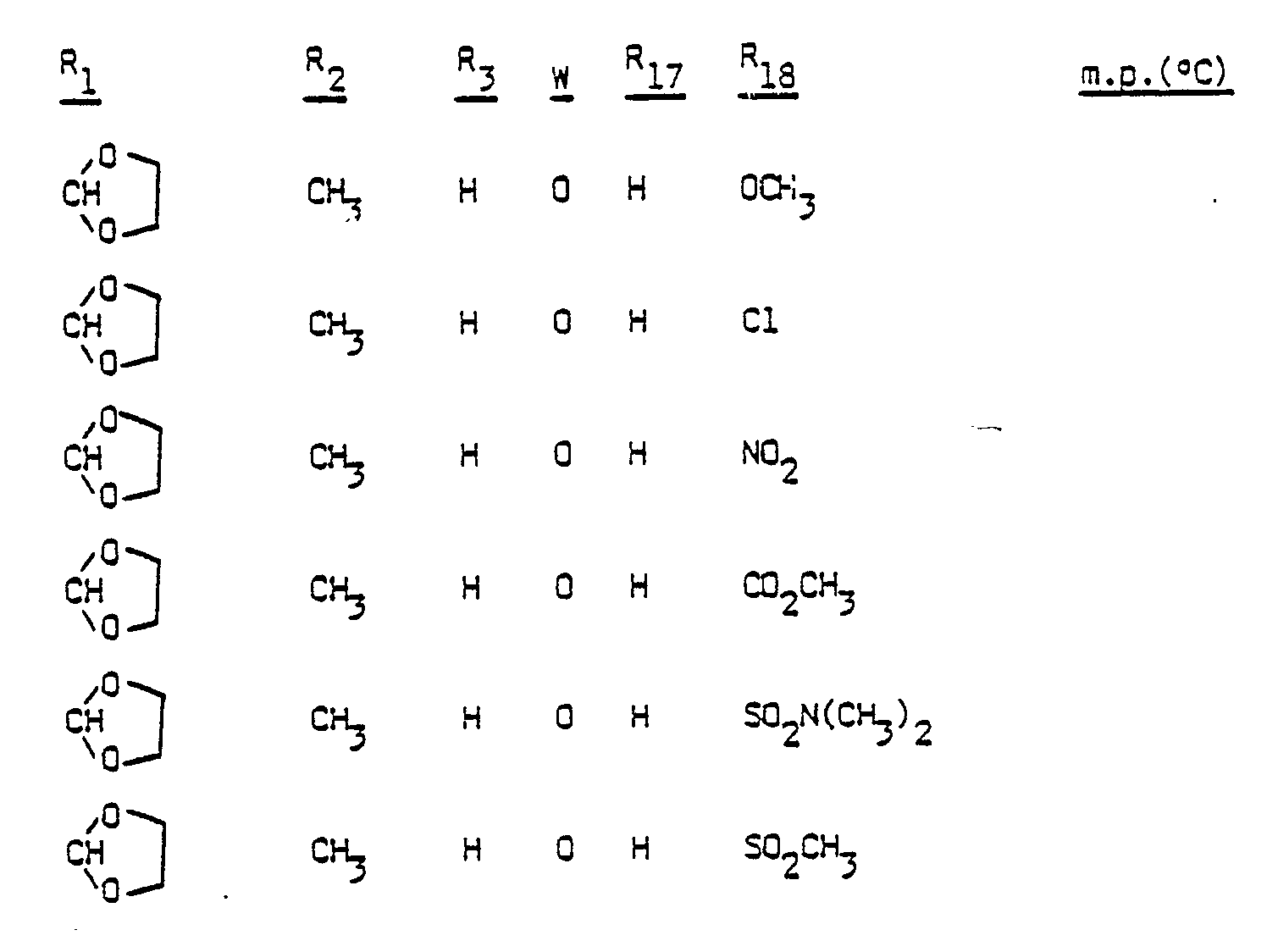


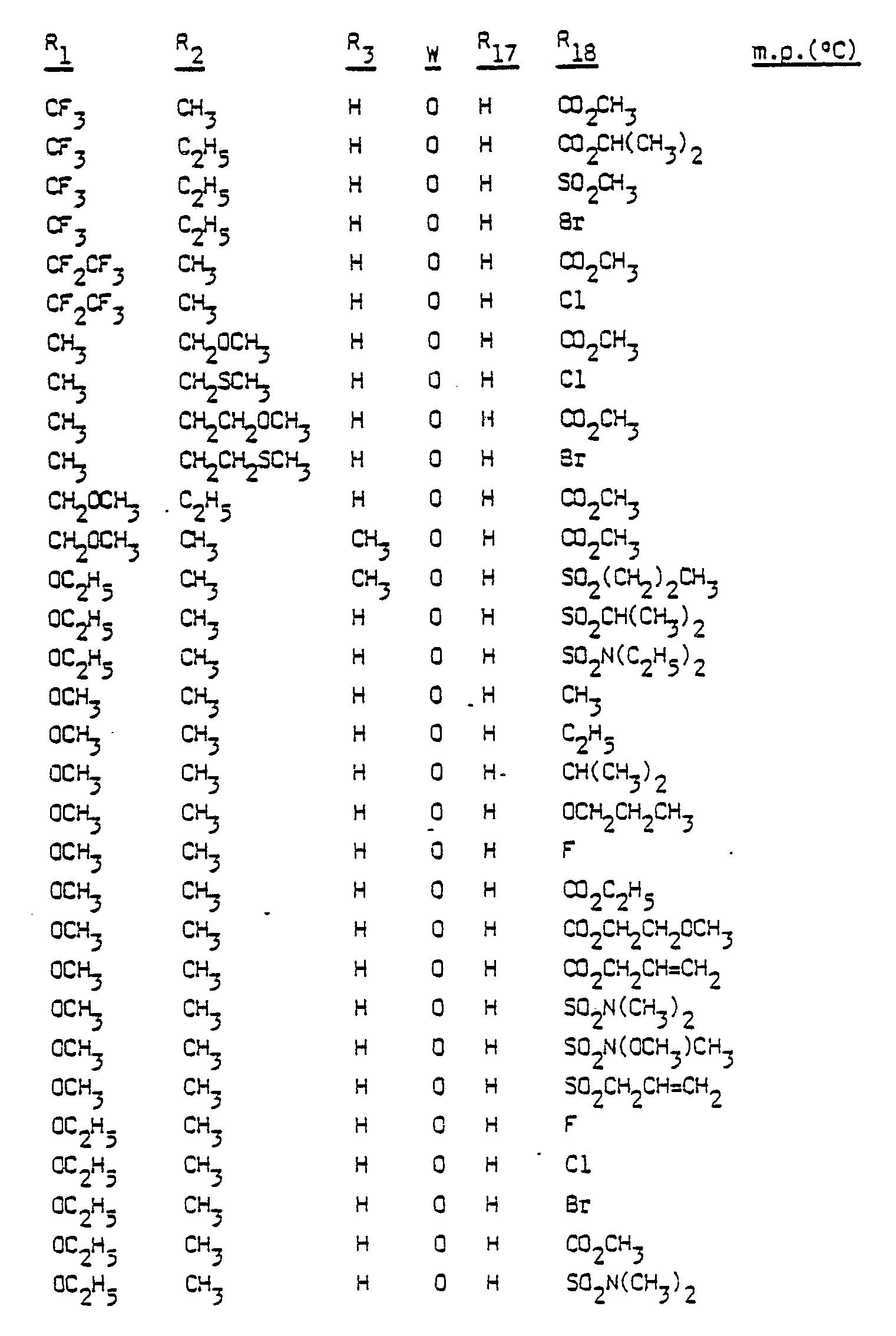


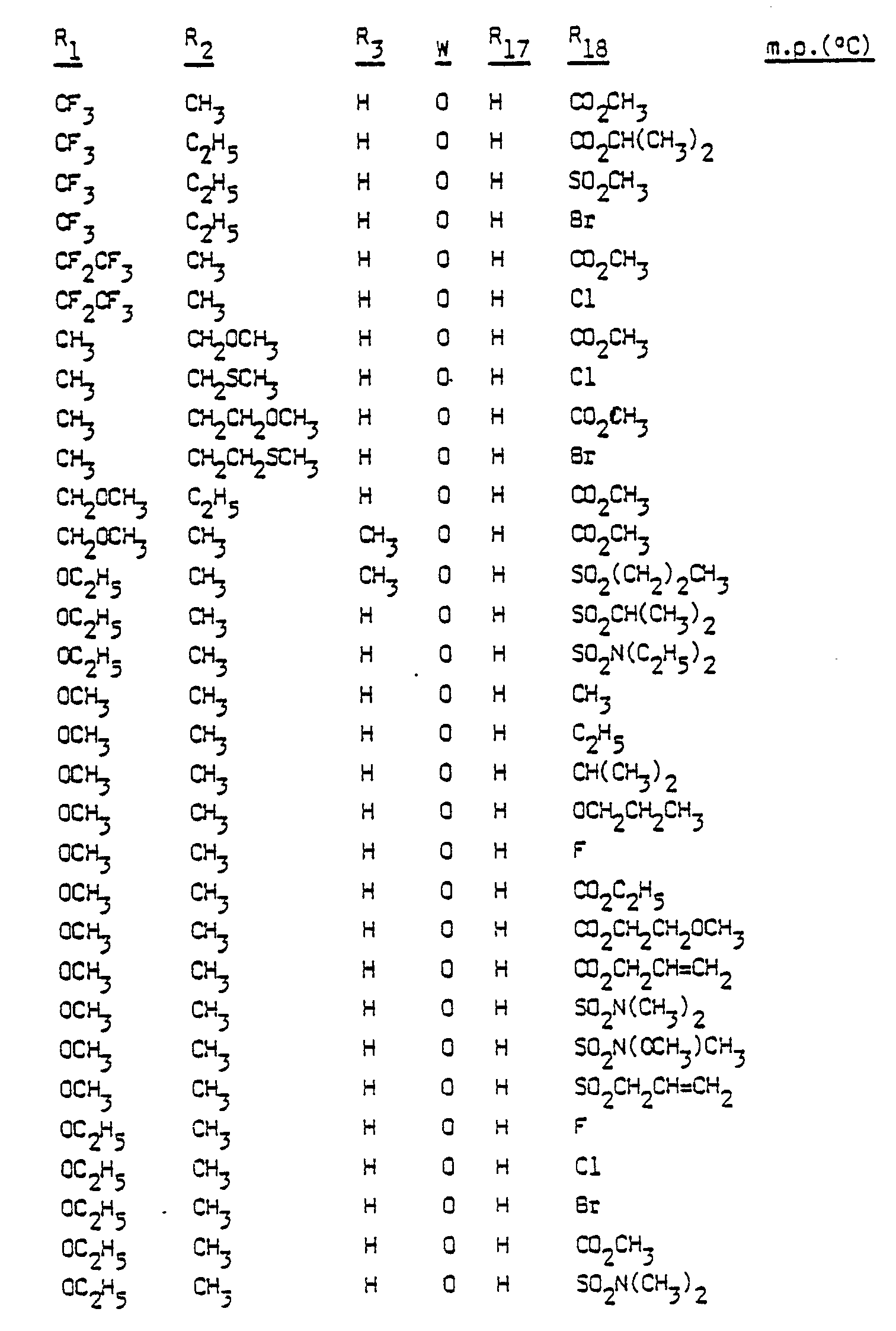


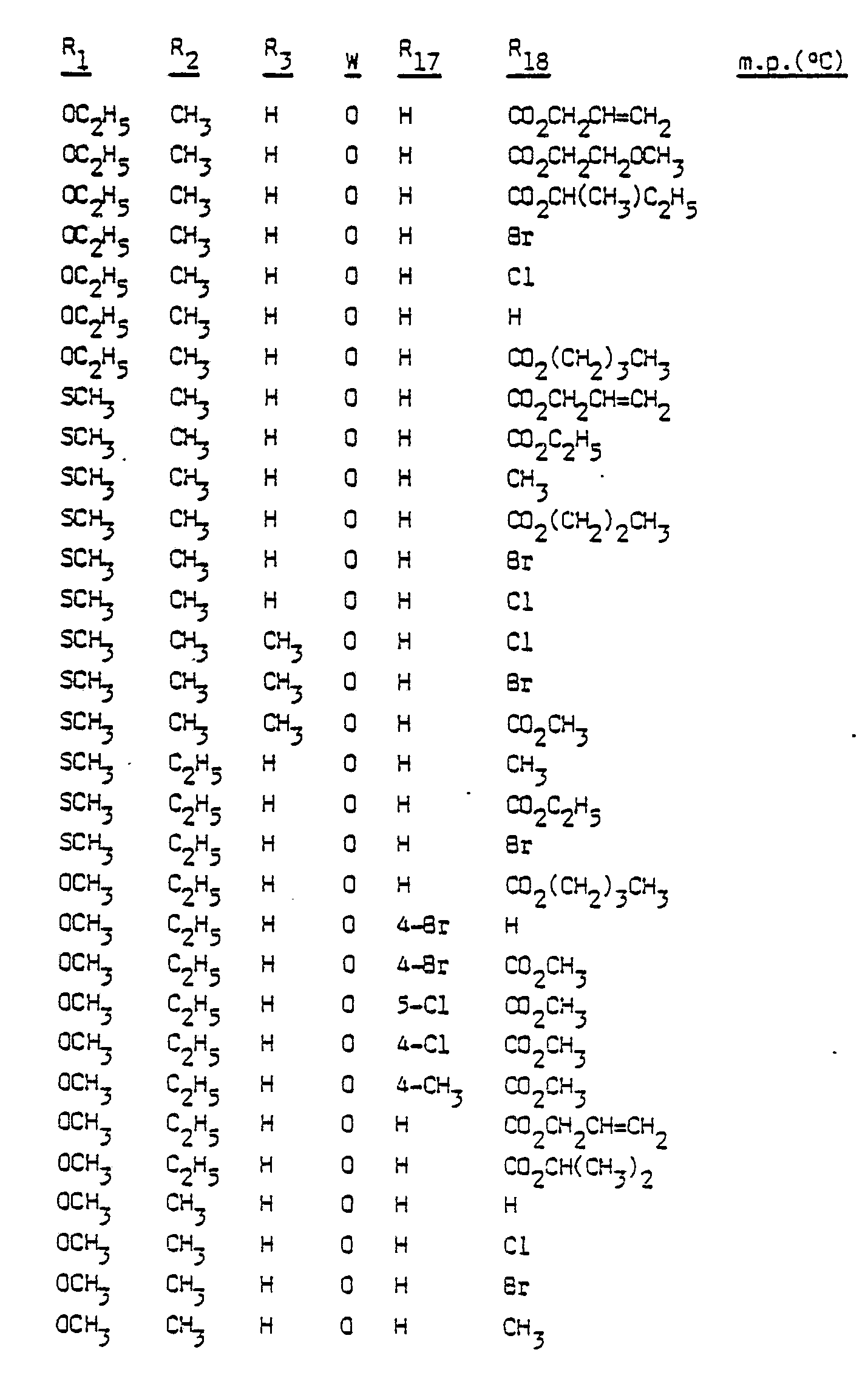


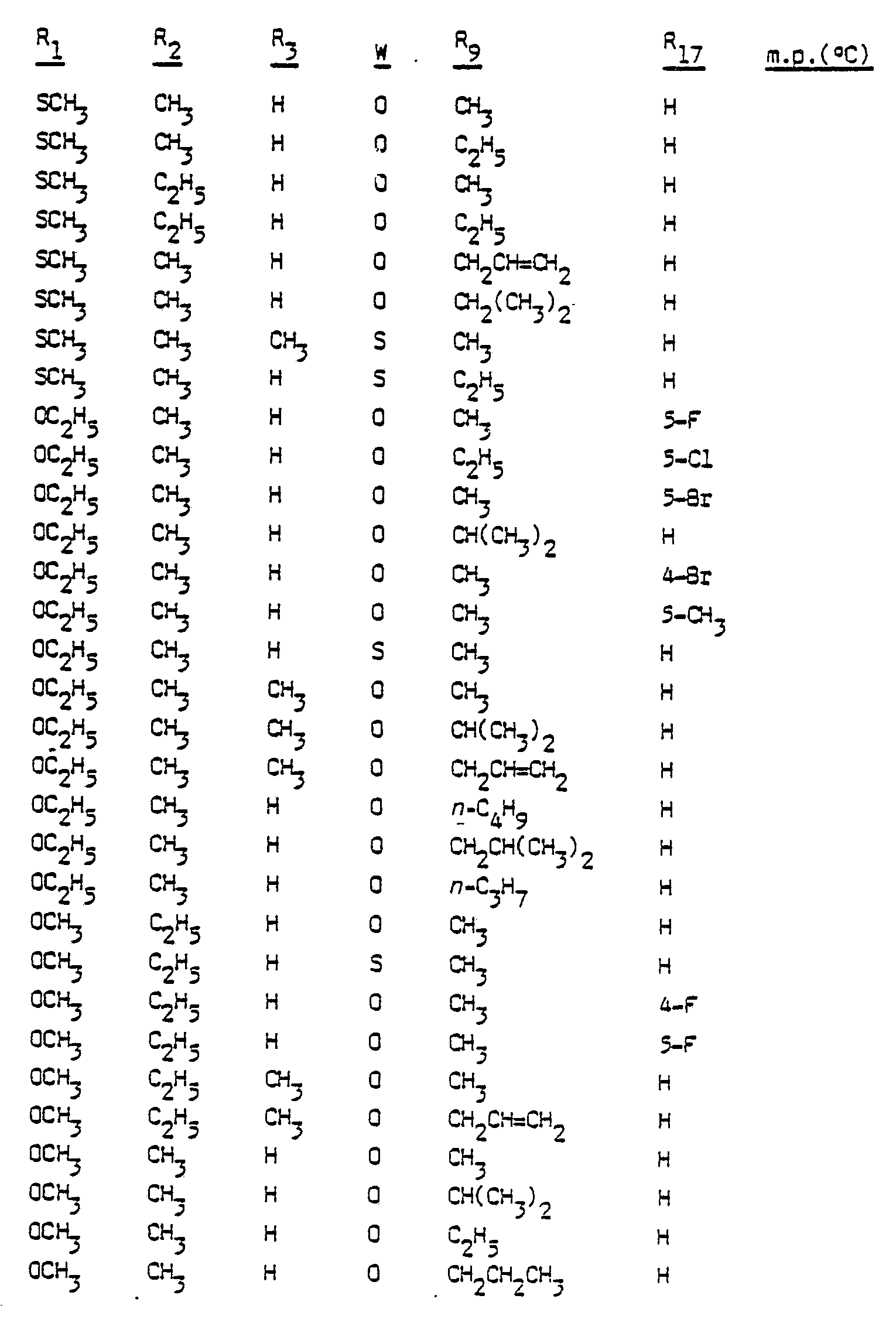


- Useful formulations of the compounds of Formula I can be prepared in conventional ways. They include dusts, granules, pellets, solutions, suspensions, emulsions, wettable powders, emulsifiable concentrates and the like. Many of these may be applied directly. Sprayable formulations can be extended in suitable media and used at spray volumes of from a few liters to several hundred liters per hectare. High strength compositions are primarily used as intermediates for further formulation. The formulations, broadly, contain about 0.1 % to 99% by weight of active ingredient(s) and at least one of (a) about 0.1 % to 20% surfactant(s) and (b) about 1% to 99.9% solid or liquid diluent(s). More specifically, they will contain these ingredients in the following approximate proportions:

- Lower or higher levels of active ingredient can, of course, be present depending on the intended use and the physical properties of the compound. Higher ratios of surfactant to active ingredient are sometimes desirable, and are achieved by incorporation into the formulation or by tank mixing.
- Typical solid diluents are described in Watkins, et al., "Handbook of Insecticide Dust Diluents and Carriers", 2nd Ed., Dorland Books, Caldwell, New Jersey, but other solids, either mined or manufactured, may be used. The more absorptive diluents are preferred for wettable powders and the denser ones for dusts. Typical liquid diluents and solvents are described in Marsden, "Solvents Guide," 2nd Ed., Interscience, New York, 1950. Solubility under 0.1% is preferred for suspension concentrates; solution concentrates are preferably stable against phase separation at 0°C. "McCutcheon's Detergents and Emulsifiers Annual", MC Publishing Corp., Ridgewood, New Jersey, as well as Sisely and Wood, "Encyclopedia of Surface Active Agents", Chemical Publishing Co., Inc., New York, 1964, list surfactants and recommended uses. All formulations can contain minor amounts of additives to reduce foaming, caking, corrosion, microbiological growth, etc.
- The methods of making such compositions are well known. Solutions are prepared by simply mixing the ingredients. Fine solid compositions are made by blending and, usually, grinding as in a hammer or fluid energy mill. Suspensions are prepared by wet milling (see, for example, Littler, U.S. Patent 3,060,084). Granules and pellets may be made by spraying the active material upon preformed granular carriers or by agglomeration techniques. See J. E. Browning, "Agglomeration", Chemical Engineering, December 4, 1967, pp. 147ff. and "Perry's Chemical Engineer's Handbook", 5th Ed., McGraw-Hill, New York, 1973, pp. 8-57ff.
- For further information regarding the art of formulation, see for example:
- H. M. Loux, U.S. Patent 3,235,361, February 15, 1966, Col. 6, line 16 through Col. 7, line 19 and Examples 10 through 41;
- R. W. Luckenbaugh, U.S. Patent 3,309,192, March 14, 1967, Col. 5, line 43 through Col. 7, line 62 and Examples 8, 12, 15, 39, 41, 52, 53, 58, 132, 138-140, 162-164, 166, 167 and 169―182;
- H. Gysin and E. Knusli, U.S. Patent 2,891,855, June 23,1959, Col. 3, line 66 through Col. 5, line 17 and Examples 1-4;
- G. C. Klingman, "Weed Control as a Science", John Wiley & Sons, Inc., New York, 1961, pp. 81-96; and
- J. D. Fryer and S. A. Evans, "Weed Control Handbook", 5th Ed., Blackwell Scientific Publications, Oxford, 1968, pp. 101-103.
- In the following examples, all parts are by weight unless otherwise indicated.
-

- The ingredients are blended, hammer-milled until all the solids are essentially under 30 microns, reblended, and packaged.
-

-

- A slurry of wettable powder containing ≈25% solids is sprayed on the surface of attapulgite granules in a double-cone blender. The granules are dried and packaged.
-

-

- The ingredients are ground together in a sand mill until the solid particles have been reduced to under about 5 microns. The resulting thick suspension may be applied directly, but preferably after being extended with oils or emulsified in water.
-

- The ingredients are thoroughly blended. After grinding in a hammer-mill to produce particles essentially all below 100 microns, the material is reblended and sifted through a U.S.S. No. 50 sieve (0.3 mm opening) and packaged.
-

- The active ingredient is dissolved in the solvent and the solution is sprayed upon dedusted granules in a double cone blender. After spraying of the solution has been completed, the blender is allowed to run for a short period and then the granules are packaged.
-

- The ingredients are blended and ground together in a sand mill to produce particles essentially all under 5 microns in size.
-

- The salt is added directly to the water with stirring to produce the solution, which may then be packaged for use.
-

- The active ingredient is dissolved in a solvent and the solution is sprayed upon dedusted granules in a double-cone blender. After spraying of the solution has been completed, the material is warmed to evaporate the solvent. The material is allowed to cool and then packaged.
-

- The ingredients are blended and milled to pass through a 100 mesh screen. This material is then added to a fluid bed granulator, the air flow is adjusted to gently fluidize the material, and a fine spray of water is sprayed onto the fluidized material. The fluidization and spraying are continued until granules of the desired size range are made. The spraying is stopped, but fluidization is continued, optionally with heat, until the water content is reduced to the desired level, generally less than 1%. The material is then discharged, screened to the desired size range, generally 14-100 mesh (1410-149 microns), and packaged for use.
-

- The ingredients are blended and ground in a hammer-mill to produce a material essentially all passing a U.S.S. No. 50 screen (0.3 mm opening). The concentrate may be formulated further if necessary.
-

- The ingredients are blended and ground in a hammer-mill to produce particles essentially all below 100 microns. The material is sifted through a U.S.S. No. 50 screen and then packaged.
-

- The ingredients are thoroughly blended, coarsely hammer-milled and then air-milled to produce particles essentially all below 10 microns in size. The material isreblended and then packaged.
-

-

- The active ingredient is blended with attapulgite and then passed through a hammer-mill to produce particles substantially all below 200 microns. The ground concentrate is then blended with powdered pyrophyllite until homogeneous.
- The compounds of the present invention have herbicidal activity. They have utility for broad-spectrum pre- and/or post-emergence weed control in areas where complete control of all vegetation is desired, such as around fuel storage tanks, ammunition depots, industrial storage areas, parking lots, drive-in theaters, around billboards, highway and railroad structures. In addition, some of the compounds are useful for the selective control of weeds in certain crops, including wheat and soybeans.
- The rates of application for the compounds of the invention are determined by a number of factors, including their use as selective or general herbicides, the crop species involved, the types of weeds to be controlled, weather conditions, formulations selected, mode of application, amount of foliage present, etc. In general terms, the subject compounds should be applied at levels of around 0.125 to 10 kg/ha, the lower rates being suggested for use on lighter soils and/or those having a low organic matter content, or for situations where only short-term persistence is required.
- The compounds of the invention may be used in combination with any other commercial herbicide, examples of which are those of the triazine, triazole, uracil, urea, amide, diphenylether, carbamate and bipyridylium types.
- The herbicidal properties of the subject compounds were discovered in a number of greenhouse tests. The test procedures and results follow.
- Seeds of crabgrass (Digitaria sp.), barnyardgrass (Echinochloa crusgalli), wild oats (Avena fatua), cassia (Cassia tora), morningglory (Ipomoea sp.), cocklebur (Xanthium sp.), sorghum, corn, soybean, rice, wheat and nutsedge tubers (Cyperus rotundus) were planted in a growth medium and treated pre-emergence with the chemicals dissolved in a non-phytotoxic solvent. At the same time, cotton having five leaves (including cotyledonary ones), bush beans with the third trifoliate leaf expanding, crabgrass, barnyardgrass and wild oats with two leaves, cassia with three leaves (including cotyledonary ones), morningglory and cocklebur with four leaves (including the cotyledonary ones), sorghum and corn with four leaves, soybean with two cotyledonary leaves, rice with three leaves, wheat with one leaf, and nutsedge with three to five leaves were sprayed. Treated plants and controls were maintained in a greenhouse for sixteen days, whereupon all species were compared to controls and visually rated for response to treatment.
- The ratings are based on a numerical scale extending from 0 = no injury, to 10 = complete kill. The accompanying descriptive symbols have the following meanings:
- A = growth acceleration;
- C = chlorosis or necrosis;
- E = emergence inhibition;
- G = growth retardation;
- H = formative effects;
- P = terminal bud injury;
- U = unusual pigmentation;
- X = axillary stimulation; and
- 6Y = abscised buds or flowers.
- The ratings for the compounds tested by this procedure are presented in Table A. The compounds tested demonstrate good control of nutsedge, especially in pre-emergence application. The results show one compound to be relatively tolerant to soybeans, and a few to be tolerant to wheat.


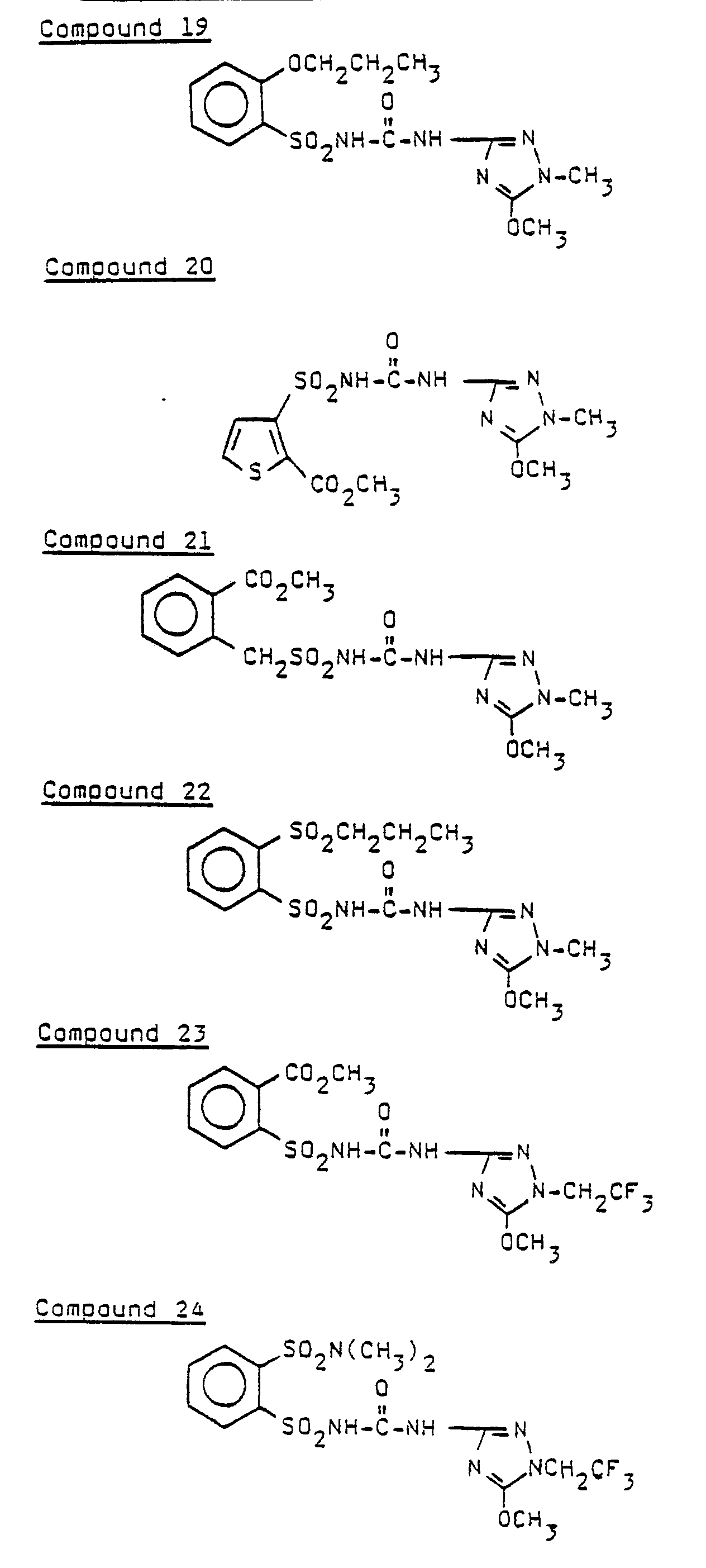
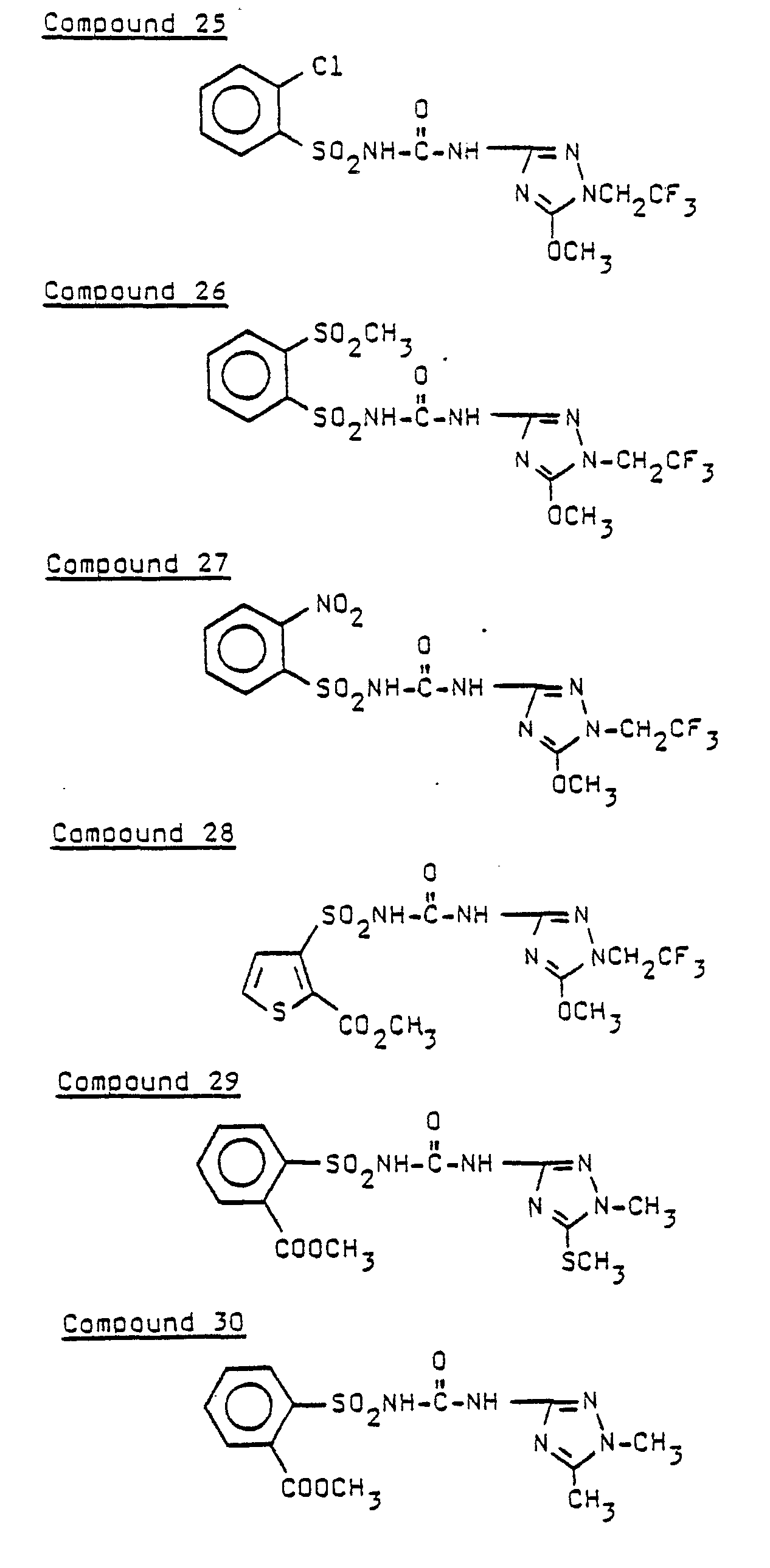


- Two plastic bulb pans were filled with fertilized and limed Fallsington silt loam soil. One pan was planted with corn, sorghum, Kentucky bluegrass and several grassy weeds. The other pan was planted with cotton, soybeans, purple nutsedge (Cyperus rotundus), and several broadleaf weeds. The following grassy and broadleaf weeds were planted: crabgrass (Digitaria sanguinalis), barnyardgrass (Echinochloa crusgalli), wild oats (Avena fatua), johnsongrass (Sorghum halepense), dallisgrass (Paspalum dilatatum), giant foxtail (Setaria faberii), cheatgrass (Bromus secalinus), mustard (Brassica arvensis), cocklebur (Xanthium pensylvanicum), pigweed (Amaranthus retroflexus), morningglory (Ipomoea hederacea), cassia (Cassia tora), teaweed (Sida spinosa), velvetleaf (Abutilon theophrasti), and jimsonweed (Datura stramonium). A 12.5 cm diameter plastic pot was also filled with prepared soil and planted with rice and wheat. Another 12.5 cm pot was planted with sugarbeets. The above four containers were treated pre-emergence with several test compounds within the scope of the invention.
- Twenty-eight days after treatment, the plants were evaluated and visually rated for response to the chemical treatments utilizing the rating system described previously for TestA. The data are summarized in Table B.


- The test chemicals, dissolved in a non-phytotoxic solvent, were applied in an overall spray to the foliage and surrounding soil of selected plant species. One day after treatment, plants were observed for rapid burn injury. Approximately fourteen days after treatment, all species were visually compared to untreated controls and rated for response to treatment. The rating system was as described previously for Test A. The data are presented in Table C.
- All plant species were seeded in Woodstown sandy loam soil and grown in a greenhouse. The following species were grown in soil contained in plastic pots (25 cm diameter by 13 cm deep): soybeans, cotton, alfalfa, corn, rice, wheat, sorghum, velvetleaf (Abutilon theophrasti), sesbania (Sesbania exaltata), Cassia (Cassia tora), morningglory (Ipomoea hederacea), jimsonweed (Datura stramonium), cocklebur (Xanthium pensylvanicum), crabgrass (Digitaria sp.), nutsedge (Cyperus rotundus), barnyardgrass (Echinochloa crusgalli), giant foxtail (Setaria faberii) and wild oats (Avena fatua). The following species were grown in soil in a paper cup (12 cm diameter by 13 cm deep): sunflower, sugarbeets, and mustard. All plants were sprayed approximately 14 days after planting.
- The compounds tested by this procedure are highly active post-emergence herbicides.


wherein
Claims (18)


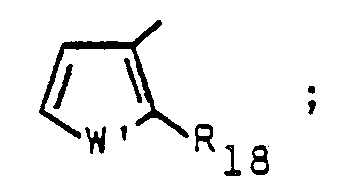



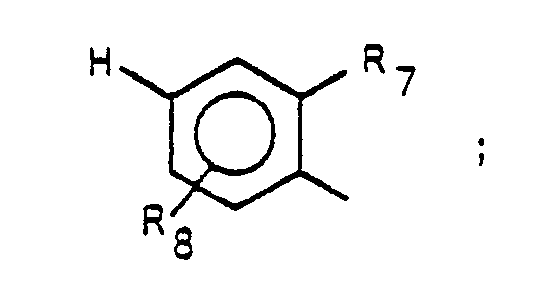


wherein

wherein
wherein
Applications Claiming Priority (8)
| Application Number | Priority Date | Filing Date | Title |
|---|---|---|---|
| US28217381A | 1981-07-10 | 1981-07-10 | |
| US28217481A | 1981-07-10 | 1981-07-10 | |
| US282174 | 1981-07-10 | ||
| US282173 | 1981-07-10 | ||
| US06/382,711 US4421550A (en) | 1981-07-10 | 1982-05-28 | Herbicidal triazole ureas |
| US382711 | 1982-05-28 | ||
| US38287782A | 1982-06-01 | 1982-06-01 | |
| US382877 | 1982-06-01 |
Publications (3)
| Publication Number | Publication Date |
|---|---|
| EP0073562A2 EP0073562A2 (en) | 1983-03-09 |
| EP0073562A3 EP0073562A3 (en) | 1983-04-20 |
| EP0073562B1 true EP0073562B1 (en) | 1988-11-09 |
Family
ID=27501318
Family Applications (1)
| Application Number | Title | Priority Date | Filing Date |
|---|---|---|---|
| EP82303611A Expired EP0073562B1 (en) | 1981-07-10 | 1982-07-09 | Herbicidal triazole ureas |
Country Status (9)
| Country | Link |
|---|---|
| EP (1) | EP0073562B1 (en) |
| AU (1) | AU550945B2 (en) |
| BR (1) | BR8204002A (en) |
| DE (1) | DE3279206D1 (en) |
| DK (1) | DK310882A (en) |
| ES (1) | ES8307769A1 (en) |
| GR (1) | GR76545B (en) |
| NZ (1) | NZ201227A (en) |
| PL (1) | PL237391A1 (en) |
Families Citing this family (15)
| Publication number | Priority date | Publication date | Assignee | Title |
|---|---|---|---|---|
| EP0103537B1 (en) * | 1982-07-16 | 1987-07-08 | Ciba-Geigy Ag | N-arylsulfonyl-n'-triazolyl urea |
| AU575335B2 (en) * | 1983-08-05 | 1988-07-28 | E.I. Du Pont De Nemours And Company | Benzene sulfonamides |
| EP0158600B1 (en) * | 1984-04-11 | 1991-04-03 | Ciba-Geigy Ag | Process for selectively combating weeds in crops |
| US4689069A (en) * | 1984-08-08 | 1987-08-25 | E. I. Du Pont De Nemours And Company | Herbicidal acetylenic pyrimidines and triazines |
| US4659369A (en) | 1984-08-27 | 1987-04-21 | E. I. Du Pont De Nemours And Company | Herbicidal acetals and ketals |
| CA1257262A (en) * | 1985-05-20 | 1989-07-11 | George Levitt | Herbicidal thiophenesulfonamides |
| US4877440A (en) * | 1985-05-29 | 1989-10-31 | E. I. Du Pont De Nemours And Company | Thiophenesulfonamide herbicides |
| US4743290A (en) * | 1986-04-21 | 1988-05-10 | E. I. Du Pont De Nemours And Company | Thiophenesulfonamide herbicides |
| DE3816703A1 (en) * | 1988-05-17 | 1989-11-30 | Hoechst Ag | HETEROCYCLICALLY SUBSTITUTED PHENOXYSULFONYL UREAS, METHOD FOR THE PRODUCTION THEREOF AND THEIR USE AS HERBICIDES OR PLANT GROWTH REGULATORS |
| ATE135004T1 (en) * | 1991-01-25 | 1996-03-15 | Ciba Geigy Ag | SULFONYL UREAS AS HERBICIDES |
| US5519148A (en) * | 1991-01-25 | 1996-05-21 | Ciba-Geigy Corporation | Sulfonylureas |
| EP0558445A1 (en) * | 1992-02-20 | 1993-09-01 | Ciba-Geigy Ag | Sulfonylureas as herbicides |
| WO1993017015A1 (en) | 1992-02-21 | 1993-09-02 | Ciba-Geigy Ag | Sulfonylureas as herbicides |
| BR9305922A (en) | 1992-02-21 | 1997-08-26 | Ciba Geigy Ag | Sulphonylureas used as herbicides |
| CN106699676A (en) * | 2016-12-30 | 2017-05-24 | 宁夏蓝博思化学技术有限公司 | Preparation method of 3-amino-1-methyl-5-methylthio-1,2,4-triazole |
Citations (2)
| Publication number | Priority date | Publication date | Assignee | Title |
|---|---|---|---|---|
| US4127405A (en) * | 1976-04-07 | 1978-11-28 | E. I. Du Pont De Nemours And Company | Herbicidal sulfonamides |
| EP0015683A1 (en) * | 1979-02-22 | 1980-09-17 | E.I. Du Pont De Nemours And Company | Herbicidal sulfonamides, and preparation and use thereof |
Family Cites Families (2)
| Publication number | Priority date | Publication date | Assignee | Title |
|---|---|---|---|---|
| US4265900A (en) * | 1979-10-29 | 1981-05-05 | Mcneilab, Inc. | N-Aryl-N'-imidazol-2-ylureas |
| DK172396B1 (en) * | 1979-11-30 | 1998-05-18 | Du Pont | Thiophene carboxylic acid derivatives, means for controlling the growth of undesirable vegetation, method for controlling undesirable vegetation and intermediates for the preparation of the mentioned derivatives |
-
1982
- 1982-07-07 AU AU85709/82A patent/AU550945B2/en not_active Ceased
- 1982-07-09 ES ES513880A patent/ES8307769A1/en not_active Expired
- 1982-07-09 DE DE8282303611T patent/DE3279206D1/en not_active Expired
- 1982-07-09 BR BR8204002A patent/BR8204002A/en unknown
- 1982-07-09 NZ NZ20122782A patent/NZ201227A/en unknown
- 1982-07-09 GR GR68703A patent/GR76545B/el unknown
- 1982-07-09 DK DK310882A patent/DK310882A/en not_active Application Discontinuation
- 1982-07-09 PL PL23739182A patent/PL237391A1/en unknown
- 1982-07-09 EP EP82303611A patent/EP0073562B1/en not_active Expired
Patent Citations (2)
| Publication number | Priority date | Publication date | Assignee | Title |
|---|---|---|---|---|
| US4127405A (en) * | 1976-04-07 | 1978-11-28 | E. I. Du Pont De Nemours And Company | Herbicidal sulfonamides |
| EP0015683A1 (en) * | 1979-02-22 | 1980-09-17 | E.I. Du Pont De Nemours And Company | Herbicidal sulfonamides, and preparation and use thereof |
Also Published As
| Publication number | Publication date |
|---|---|
| EP0073562A2 (en) | 1983-03-09 |
| DE3279206D1 (en) | 1988-12-15 |
| ES513880A0 (en) | 1983-08-01 |
| PL237391A1 (en) | 1984-01-30 |
| AU550945B2 (en) | 1986-04-10 |
| ES8307769A1 (en) | 1983-08-01 |
| EP0073562A3 (en) | 1983-04-20 |
| NZ201227A (en) | 1985-11-08 |
| BR8204002A (en) | 1983-07-05 |
| GR76545B (en) | 1984-08-10 |
| DK310882A (en) | 1983-01-11 |
| AU8570982A (en) | 1983-01-13 |
Similar Documents
| Publication | Publication Date | Title |
|---|---|---|
| EP0035893B1 (en) | Herbicidal benzene- and pyridine-sulfonamide derivatives | |
| EP0125864B1 (en) | Herbicidal sulfonamides | |
| EP0030138B1 (en) | Herbicidal sulfonamides, and compositions, preparation and use thereof | |
| EP0045196B1 (en) | Herbicidal benzothiophene and benzofuran sulfonamides | |
| EP0064804B1 (en) | Thiophene herbicides | |
| EP0051465B1 (en) | Herbicidal sulfonamides | |
| EP0044210B1 (en) | Herbicidal sulfonamides | |
| US4421550A (en) | Herbicidal triazole ureas | |
| EP0041404A2 (en) | Herbicidal thiophenesulfonamides | |
| EP0048143A1 (en) | Herbicidal sulfonamides | |
| EP0015683B1 (en) | Herbicidal sulfonamides, and preparation and use thereof | |
| EP0204513B1 (en) | Herbicidal sulfonamides | |
| EP0057546A2 (en) | Sulfonylurea N-oxides | |
| EP0161905B1 (en) | Herbicidal halopyrimidines | |
| EP0073562A2 (en) | Herbicidal triazole ureas | |
| EP0051466B1 (en) | Herbicidal sulfonamides | |
| EP0070698B1 (en) | Herbicidal indole sulfonamides | |
| EP0152286B1 (en) | Herbicidal pyrazole sulfonylureas | |
| EP0203679A2 (en) | Herbicidal sulfonamides | |
| EP0074282B1 (en) | Herbicidal alkyl sulfones | |
| US4589909A (en) | Benzofuran and benzothiophene sulfonamides | |
| US4425155A (en) | Herbicidal sulfonamide N-oxides | |
| EP0166516B1 (en) | Novel phenyl-subsituted sulfonamides | |
| EP0101308A2 (en) | Alkyl sulfonyl sulfonamides | |
| EP0058476A2 (en) | Fused (1,2,4) oxadiazolylidenebenzenesulfonamides and their use as herbicides and plant growth regulants |
Legal Events
| Date | Code | Title | Description |
|---|---|---|---|
| PUAI | Public reference made under article 153(3) epc to a published international application that has entered the european phase |
Free format text: ORIGINAL CODE: 0009012 |
|
| PUAL | Search report despatched |
Free format text: ORIGINAL CODE: 0009013 |
|
| AK | Designated contracting states |
Designated state(s): AT BE CH DE FR GB IT LI LU NL SE |
|
| AK | Designated contracting states |
Designated state(s): AT BE CH DE FR GB IT LI LU NL SE |
|
| 17P | Request for examination filed |
Effective date: 19830630 |
|
| GRAA | (expected) grant |
Free format text: ORIGINAL CODE: 0009210 |
|
| AK | Designated contracting states |
Kind code of ref document: B1 Designated state(s): CH DE FR GB IT LI NL SE |
|
| ITF | It: translation for a ep patent filed | ||
| REF | Corresponds to: |
Ref document number: 3279206 Country of ref document: DE Date of ref document: 19881215 |
|
| ET | Fr: translation filed | ||
| PGFP | Annual fee paid to national office [announced via postgrant information from national office to epo] |
Ref country code: SE Payment date: 19890626 Year of fee payment: 8 |
|
| PGFP | Annual fee paid to national office [announced via postgrant information from national office to epo] |
Ref country code: CH Payment date: 19890720 Year of fee payment: 8 |
|
| PGFP | Annual fee paid to national office [announced via postgrant information from national office to epo] |
Ref country code: NL Payment date: 19890731 Year of fee payment: 8 |
|
| PLBE | No opposition filed within time limit |
Free format text: ORIGINAL CODE: 0009261 |
|
| STAA | Information on the status of an ep patent application or granted ep patent |
Free format text: STATUS: NO OPPOSITION FILED WITHIN TIME LIMIT |
|
| 26N | No opposition filed | ||
| PGFP | Annual fee paid to national office [announced via postgrant information from national office to epo] |
Ref country code: FR Payment date: 19900525 Year of fee payment: 9 |
|
| PGFP | Annual fee paid to national office [announced via postgrant information from national office to epo] |
Ref country code: DE Payment date: 19900528 Year of fee payment: 9 |
|
| PGFP | Annual fee paid to national office [announced via postgrant information from national office to epo] |
Ref country code: GB Payment date: 19900629 Year of fee payment: 9 |
|
| PG25 | Lapsed in a contracting state [announced via postgrant information from national office to epo] |
Ref country code: SE Effective date: 19900710 |
|
| ITTA | It: last paid annual fee | ||
| PG25 | Lapsed in a contracting state [announced via postgrant information from national office to epo] |
Ref country code: LI Effective date: 19900731 Ref country code: CH Effective date: 19900731 |
|
| PG25 | Lapsed in a contracting state [announced via postgrant information from national office to epo] |
Ref country code: NL Effective date: 19910201 |
|
| NLV4 | Nl: lapsed or anulled due to non-payment of the annual fee | ||
| REG | Reference to a national code |
Ref country code: CH Ref legal event code: PL |
|
| PG25 | Lapsed in a contracting state [announced via postgrant information from national office to epo] |
Ref country code: GB Effective date: 19910709 |
|
| GBPC | Gb: european patent ceased through non-payment of renewal fee | ||
| PG25 | Lapsed in a contracting state [announced via postgrant information from national office to epo] |
Ref country code: FR Effective date: 19920331 |
|
| PG25 | Lapsed in a contracting state [announced via postgrant information from national office to epo] |
Ref country code: DE Effective date: 19920401 |
|
| REG | Reference to a national code |
Ref country code: FR Ref legal event code: ST |
|
| EUG | Se: european patent has lapsed |
Ref document number: 82303611.6 Effective date: 19910402 |