EP0073456B1 - Tetraazaannulene cobalt complex compounds and method for preparation thereof - Google Patents
Tetraazaannulene cobalt complex compounds and method for preparation thereof Download PDFInfo
- Publication number
- EP0073456B1 EP0073456B1 EP19820107755 EP82107755A EP0073456B1 EP 0073456 B1 EP0073456 B1 EP 0073456B1 EP 19820107755 EP19820107755 EP 19820107755 EP 82107755 A EP82107755 A EP 82107755A EP 0073456 B1 EP0073456 B1 EP 0073456B1
- Authority
- EP
- European Patent Office
- Prior art keywords
- group
- reaction
- formula
- general formula
- tetraazaannulene
- Prior art date
- Legal status (The legal status is an assumption and is not a legal conclusion. Google has not performed a legal analysis and makes no representation as to the accuracy of the status listed.)
- Expired
Links
- 238000000034 method Methods 0.000 title claims description 46
- -1 cobalt complex compounds Chemical class 0.000 title claims description 45
- 238000002360 preparation method Methods 0.000 title description 3
- 150000001875 compounds Chemical class 0.000 claims description 56
- 150000004987 o-phenylenediamines Chemical class 0.000 claims description 39
- 125000003545 alkoxy group Chemical group 0.000 claims description 37
- 125000004435 hydrogen atom Chemical group [H]* 0.000 claims description 36
- 125000004209 (C1-C8) alkyl group Chemical group 0.000 claims description 26
- 150000001869 cobalt compounds Chemical class 0.000 claims description 22
- 125000002496 methyl group Chemical group [H]C([H])([H])* 0.000 claims description 13
- 125000005843 halogen group Chemical group 0.000 claims description 11
- 125000000449 nitro group Chemical group [O-][N+](*)=O 0.000 claims description 9
- 125000004453 alkoxycarbonyl group Chemical group 0.000 claims description 8
- 125000004093 cyano group Chemical group *C#N 0.000 claims description 7
- 125000006273 (C1-C3) alkyl group Chemical group 0.000 claims description 6
- 125000004890 (C1-C6) alkylamino group Chemical group 0.000 claims description 6
- 125000003178 carboxy group Chemical group [H]OC(*)=O 0.000 claims description 6
- 125000004169 (C1-C6) alkyl group Chemical group 0.000 claims description 5
- 125000004442 acylamino group Chemical group 0.000 claims description 4
- 125000004423 acyloxy group Chemical group 0.000 claims description 4
- 125000003917 carbamoyl group Chemical group [H]N([H])C(*)=O 0.000 claims description 4
- 125000002887 hydroxy group Chemical group [H]O* 0.000 claims description 4
- 125000003277 amino group Chemical group 0.000 claims description 2
- 125000004663 dialkyl amino group Chemical group 0.000 claims 1
- ZMXDDKWLCZADIW-UHFFFAOYSA-N N,N-Dimethylformamide Chemical compound CN(C)C=O ZMXDDKWLCZADIW-UHFFFAOYSA-N 0.000 description 76
- OKKJLVBELUTLKV-UHFFFAOYSA-N Methanol Chemical compound OC OKKJLVBELUTLKV-UHFFFAOYSA-N 0.000 description 60
- 239000000243 solution Substances 0.000 description 47
- 239000002904 solvent Substances 0.000 description 32
- 239000003054 catalyst Substances 0.000 description 27
- 239000013078 crystal Substances 0.000 description 18
- 238000010438 heat treatment Methods 0.000 description 18
- 229910052757 nitrogen Inorganic materials 0.000 description 17
- 125000000956 methoxy group Chemical group [H]C([H])([H])O* 0.000 description 13
- 238000009835 boiling Methods 0.000 description 12
- ZBYYWKJVSFHYJL-UHFFFAOYSA-L cobalt(2+);diacetate;tetrahydrate Chemical compound O.O.O.O.[Co+2].CC([O-])=O.CC([O-])=O ZBYYWKJVSFHYJL-UHFFFAOYSA-L 0.000 description 12
- 230000000694 effects Effects 0.000 description 12
- GEYOCULIXLDCMW-UHFFFAOYSA-N 1,2-phenylenediamine Chemical compound NC1=CC=CC=C1N GEYOCULIXLDCMW-UHFFFAOYSA-N 0.000 description 10
- 238000001914 filtration Methods 0.000 description 10
- QVGXLLKOCUKJST-UHFFFAOYSA-N atomic oxygen Chemical compound [O] QVGXLLKOCUKJST-UHFFFAOYSA-N 0.000 description 8
- 229910052760 oxygen Inorganic materials 0.000 description 8
- 239000001301 oxygen Substances 0.000 description 8
- BASFCYQUMIYNBI-UHFFFAOYSA-N platinum Chemical compound [Pt] BASFCYQUMIYNBI-UHFFFAOYSA-N 0.000 description 8
- 239000003495 polar organic solvent Substances 0.000 description 8
- 238000004458 analytical method Methods 0.000 description 7
- 238000001819 mass spectrum Methods 0.000 description 7
- 238000001429 visible spectrum Methods 0.000 description 7
- 125000004178 (C1-C4) alkyl group Chemical group 0.000 description 6
- 238000005259 measurement Methods 0.000 description 6
- XSZYBMMYQCYIPC-UHFFFAOYSA-N 4,5-dimethyl-1,2-phenylenediamine Chemical compound CC1=CC(N)=C(N)C=C1C XSZYBMMYQCYIPC-UHFFFAOYSA-N 0.000 description 4
- XKRFYHLGVUSROY-UHFFFAOYSA-N Argon Chemical compound [Ar] XKRFYHLGVUSROY-UHFFFAOYSA-N 0.000 description 4
- 229910052697 platinum Inorganic materials 0.000 description 4
- IWFHBRFJOHTIPU-UHFFFAOYSA-N 4,5-dichlorobenzene-1,2-diamine Chemical compound NC1=CC(Cl)=C(Cl)C=C1N IWFHBRFJOHTIPU-UHFFFAOYSA-N 0.000 description 3
- BXIXXXYDDJVHDL-UHFFFAOYSA-N 4-Chloro-ortho-phenylenediamine Chemical compound NC1=CC=C(Cl)C=C1N BXIXXXYDDJVHDL-UHFFFAOYSA-N 0.000 description 3
- AGAHETWGCFCMDK-UHFFFAOYSA-N 4-methoxybenzene-1,2-diamine Chemical compound COC1=CC=C(N)C(N)=C1 AGAHETWGCFCMDK-UHFFFAOYSA-N 0.000 description 3
- IAZDPXIOMUYVGZ-UHFFFAOYSA-N Dimethylsulphoxide Chemical compound CS(C)=O IAZDPXIOMUYVGZ-UHFFFAOYSA-N 0.000 description 3
- 230000003197 catalytic effect Effects 0.000 description 3
- 125000001495 ethyl group Chemical group [H]C([H])([H])C([H])([H])* 0.000 description 3
- 229910021397 glassy carbon Inorganic materials 0.000 description 3
- 125000006606 n-butoxy group Chemical group 0.000 description 3
- 125000004108 n-butyl group Chemical group [H]C([H])([H])C([H])([H])C([H])([H])C([H])([H])* 0.000 description 3
- 125000004123 n-propyl group Chemical group [H]C([H])([H])C([H])([H])C([H])([H])* 0.000 description 3
- PATPNLZGDVFGNU-UHFFFAOYSA-N 4,5-diamino-2-methylbenzoic acid Chemical compound CC1=CC(N)=C(N)C=C1C(O)=O PATPNLZGDVFGNU-UHFFFAOYSA-N 0.000 description 2
- DGRGLKZMKWPMOH-UHFFFAOYSA-N 4-methylbenzene-1,2-diamine Chemical compound CC1=CC=C(N)C(N)=C1 DGRGLKZMKWPMOH-UHFFFAOYSA-N 0.000 description 2
- RAUWPNXIALNKQM-UHFFFAOYSA-N 4-nitro-1,2-phenylenediamine Chemical compound NC1=CC=C([N+]([O-])=O)C=C1N RAUWPNXIALNKQM-UHFFFAOYSA-N 0.000 description 2
- 0 COC(CC(C(N)=C1)N*)=C1OC Chemical compound COC(CC(C(N)=C1)N*)=C1OC 0.000 description 2
- HEDRZPFGACZZDS-UHFFFAOYSA-N Chloroform Chemical compound ClC(Cl)Cl HEDRZPFGACZZDS-UHFFFAOYSA-N 0.000 description 2
- SECXISVLQFMRJM-UHFFFAOYSA-N N-Methylpyrrolidone Chemical compound CN1CCCC1=O SECXISVLQFMRJM-UHFFFAOYSA-N 0.000 description 2
- QAOWNCQODCNURD-UHFFFAOYSA-N Sulfuric acid Chemical compound OS(O)(=O)=O QAOWNCQODCNURD-UHFFFAOYSA-N 0.000 description 2
- 150000001298 alcohols Chemical class 0.000 description 2
- 125000000217 alkyl group Chemical group 0.000 description 2
- 229910052786 argon Inorganic materials 0.000 description 2
- 150000001868 cobalt Chemical class 0.000 description 2
- XLJKHNWPARRRJB-UHFFFAOYSA-N cobalt(2+) Chemical compound [Co+2] XLJKHNWPARRRJB-UHFFFAOYSA-N 0.000 description 2
- 150000004292 cyclic ethers Chemical class 0.000 description 2
- 230000007547 defect Effects 0.000 description 2
- 239000008151 electrolyte solution Substances 0.000 description 2
- 125000003754 ethoxycarbonyl group Chemical group C(=O)(OCC)* 0.000 description 2
- 239000007789 gas Substances 0.000 description 2
- GNOIPBMMFNIUFM-UHFFFAOYSA-N hexamethylphosphoric triamide Chemical compound CN(C)P(=O)(N(C)C)N(C)C GNOIPBMMFNIUFM-UHFFFAOYSA-N 0.000 description 2
- QAOWNCQODCNURD-UHFFFAOYSA-M hydrogensulfate Chemical compound OS([O-])(=O)=O QAOWNCQODCNURD-UHFFFAOYSA-M 0.000 description 2
- 125000003253 isopropoxy group Chemical group [H]C([H])([H])C([H])(O*)C([H])([H])[H] 0.000 description 2
- 125000003935 n-pentoxy group Chemical group [H]C([H])([H])C([H])([H])C([H])([H])C([H])([H])C([H])([H])O* 0.000 description 2
- 125000003506 n-propoxy group Chemical group [H]C([H])([H])C([H])([H])C([H])([H])O* 0.000 description 2
- 150000002989 phenols Chemical class 0.000 description 2
- BWHMMNNQKKPAPP-UHFFFAOYSA-L potassium carbonate Chemical compound [K+].[K+].[O-]C([O-])=O BWHMMNNQKKPAPP-UHFFFAOYSA-L 0.000 description 2
- 239000007858 starting material Substances 0.000 description 2
- 125000000229 (C1-C4)alkoxy group Chemical group 0.000 description 1
- RGJXMMUQTCONEI-UHFFFAOYSA-N 3,4-diaminobenzamide Chemical compound NC(=O)C1=CC=C(N)C(N)=C1 RGJXMMUQTCONEI-UHFFFAOYSA-N 0.000 description 1
- HEMGYNNCNNODNX-UHFFFAOYSA-N 3,4-diaminobenzoic acid Chemical compound NC1=CC=C(C(O)=O)C=C1N HEMGYNNCNNODNX-UHFFFAOYSA-N 0.000 description 1
- VWLLPPSBBHDXHK-UHFFFAOYSA-N 3,4-diaminobenzonitrile Chemical compound NC1=CC=C(C#N)C=C1N VWLLPPSBBHDXHK-UHFFFAOYSA-N 0.000 description 1
- SKIUVOVOIJBJPN-UHFFFAOYSA-N 4,5-dimethoxybenzene-1,2-diamine Chemical compound COC1=CC(N)=C(N)C=C1OC SKIUVOVOIJBJPN-UHFFFAOYSA-N 0.000 description 1
- AEPYIICGYIUTCV-UHFFFAOYSA-N 4-n,4-n-dimethylbenzene-1,2,4-triamine Chemical compound CN(C)C1=CC=C(N)C(N)=C1 AEPYIICGYIUTCV-UHFFFAOYSA-N 0.000 description 1
- LZBTYKXJZJLWPE-OWSWKLJJSA-N C1C=CC(/C2=C/Nc(cccc3)c3/N=C/C(/c3ccccc3)=C\Nc3ccccc3/N=C2)=CC1 Chemical compound C1C=CC(/C2=C/Nc(cccc3)c3/N=C/C(/c3ccccc3)=C\Nc3ccccc3/N=C2)=CC1 LZBTYKXJZJLWPE-OWSWKLJJSA-N 0.000 description 1
- FBLUDWCTNCWSPJ-RMKNXTFCSA-N COc(cc1)ccc1/C(/C=O)=C/N Chemical compound COc(cc1)ccc1/C(/C=O)=C/N FBLUDWCTNCWSPJ-RMKNXTFCSA-N 0.000 description 1
- 229910021580 Cobalt(II) chloride Inorganic materials 0.000 description 1
- 229910021584 Cobalt(II) iodide Inorganic materials 0.000 description 1
- RGHNJXZEOKUKBD-SQOUGZDYSA-M D-gluconate Chemical compound OC[C@@H](O)[C@@H](O)[C@H](O)[C@@H](O)C([O-])=O RGHNJXZEOKUKBD-SQOUGZDYSA-M 0.000 description 1
- FEWJPZIEWOKRBE-JCYAYHJZSA-N Dextrotartaric acid Chemical compound OC(=O)[C@H](O)[C@@H](O)C(O)=O FEWJPZIEWOKRBE-JCYAYHJZSA-N 0.000 description 1
- MYMOFIZGZYHOMD-UHFFFAOYSA-N Dioxygen Chemical compound O=O MYMOFIZGZYHOMD-UHFFFAOYSA-N 0.000 description 1
- KFSLWBXXFJQRDL-UHFFFAOYSA-N Peracetic acid Chemical compound CC(=O)OO KFSLWBXXFJQRDL-UHFFFAOYSA-N 0.000 description 1
- NINIDFKCEFEMDL-UHFFFAOYSA-N Sulfur Chemical compound [S] NINIDFKCEFEMDL-UHFFFAOYSA-N 0.000 description 1
- 150000001350 alkyl halides Chemical class 0.000 description 1
- 229940075397 calomel Drugs 0.000 description 1
- GVPFVAHMJGGAJG-UHFFFAOYSA-L cobalt dichloride Chemical compound [Cl-].[Cl-].[Co+2] GVPFVAHMJGGAJG-UHFFFAOYSA-L 0.000 description 1
- IEXXNGVQCLMTKU-UHFFFAOYSA-H cobalt(2+);2-hydroxypropane-1,2,3-tricarboxylate Chemical compound [Co+2].[Co+2].[Co+2].[O-]C(=O)CC(O)(CC([O-])=O)C([O-])=O.[O-]C(=O)CC(O)(CC([O-])=O)C([O-])=O IEXXNGVQCLMTKU-UHFFFAOYSA-H 0.000 description 1
- VPUKOWSPRKCWBV-UHFFFAOYSA-L cobalt(2+);2-hydroxypropanoate Chemical compound [Co+2].CC(O)C([O-])=O.CC(O)C([O-])=O VPUKOWSPRKCWBV-UHFFFAOYSA-L 0.000 description 1
- ZOTKGJBKKKVBJZ-UHFFFAOYSA-L cobalt(2+);carbonate Chemical compound [Co+2].[O-]C([O-])=O ZOTKGJBKKKVBJZ-UHFFFAOYSA-L 0.000 description 1
- AVWLPUQJODERGA-UHFFFAOYSA-L cobalt(2+);diiodide Chemical compound [Co+2].[I-].[I-] AVWLPUQJODERGA-UHFFFAOYSA-L 0.000 description 1
- MULYSYXKGICWJF-UHFFFAOYSA-L cobalt(2+);oxalate Chemical compound [Co+2].[O-]C(=O)C([O-])=O MULYSYXKGICWJF-UHFFFAOYSA-L 0.000 description 1
- QAHREYKOYSIQPH-UHFFFAOYSA-L cobalt(II) acetate Chemical compound [Co+2].CC([O-])=O.CC([O-])=O QAHREYKOYSIQPH-UHFFFAOYSA-L 0.000 description 1
- 229910000001 cobalt(II) carbonate Inorganic materials 0.000 description 1
- BZRRQSJJPUGBAA-UHFFFAOYSA-L cobalt(ii) bromide Chemical compound Br[Co]Br BZRRQSJJPUGBAA-UHFFFAOYSA-L 0.000 description 1
- FCEOGYWNOSBEPV-FDGPNNRMSA-N cobalt;(z)-4-hydroxypent-3-en-2-one Chemical compound [Co].C\C(O)=C\C(C)=O.C\C(O)=C\C(C)=O FCEOGYWNOSBEPV-FDGPNNRMSA-N 0.000 description 1
- 230000000052 comparative effect Effects 0.000 description 1
- 238000002484 cyclic voltammetry Methods 0.000 description 1
- 125000002933 cyclohexyloxy group Chemical group C1(CCCCC1)O* 0.000 description 1
- 125000004915 dibutylamino group Chemical group C(CCC)N(CCCC)* 0.000 description 1
- 125000001664 diethylamino group Chemical group [H]C([H])([H])C([H])([H])N(*)C([H])([H])C([H])([H])[H] 0.000 description 1
- ZOMNIUBKTOKEHS-UHFFFAOYSA-L dimercury dichloride Chemical compound Cl[Hg][Hg]Cl ZOMNIUBKTOKEHS-UHFFFAOYSA-L 0.000 description 1
- 229960001760 dimethyl sulfoxide Drugs 0.000 description 1
- 229910001882 dioxygen Inorganic materials 0.000 description 1
- 125000004914 dipropylamino group Chemical group C(CC)N(CCC)* 0.000 description 1
- 125000001301 ethoxy group Chemical group [H]C([H])([H])C([H])([H])O* 0.000 description 1
- GQHXIJFHBJFZQZ-UHFFFAOYSA-N ethyl 2-(3,4-diaminophenyl)acetate Chemical compound CCOC(=O)CC1=CC=C(N)C(N)=C1 GQHXIJFHBJFZQZ-UHFFFAOYSA-N 0.000 description 1
- NUJBTXFFJUGENN-UHFFFAOYSA-N ethyl 3,4-diaminobenzoate Chemical compound CCOC(=O)C1=CC=C(N)C(N)=C1 NUJBTXFFJUGENN-UHFFFAOYSA-N 0.000 description 1
- 238000002474 experimental method Methods 0.000 description 1
- 239000000446 fuel Substances 0.000 description 1
- 229940050410 gluconate Drugs 0.000 description 1
- 125000003707 hexyloxy group Chemical group [H]C([H])([H])C([H])([H])C([H])([H])C([H])([H])C([H])([H])C([H])([H])O* 0.000 description 1
- 230000003301 hydrolyzing effect Effects 0.000 description 1
- 125000002510 isobutoxy group Chemical group [H]C([H])([H])C([H])(C([H])([H])[H])C([H])([H])O* 0.000 description 1
- 125000000959 isobutyl group Chemical group [H]C([H])([H])C([H])(C([H])([H])[H])C([H])([H])* 0.000 description 1
- 125000001449 isopropyl group Chemical group [H]C([H])([H])C([H])(*)C([H])([H])[H] 0.000 description 1
- 238000004519 manufacturing process Methods 0.000 description 1
- 229910052751 metal Inorganic materials 0.000 description 1
- 239000002184 metal Substances 0.000 description 1
- 150000007522 mineralic acids Chemical class 0.000 description 1
- 239000000203 mixture Substances 0.000 description 1
- 125000003136 n-heptyl group Chemical group [H]C([H])([H])C([H])([H])C([H])([H])C([H])([H])C([H])([H])C([H])([H])C([H])([H])* 0.000 description 1
- 125000001298 n-hexoxy group Chemical group [H]C([H])([H])C([H])([H])C([H])([H])C([H])([H])C([H])([H])C([H])([H])O* 0.000 description 1
- 125000001280 n-hexyl group Chemical group C(CCCCC)* 0.000 description 1
- 125000006608 n-octyloxy group Chemical group 0.000 description 1
- 125000000740 n-pentyl group Chemical group [H]C([H])([H])C([H])([H])C([H])([H])C([H])([H])C([H])([H])* 0.000 description 1
- PVWOIHVRPOBWPI-UHFFFAOYSA-N n-propyl iodide Chemical compound CCCI PVWOIHVRPOBWPI-UHFFFAOYSA-N 0.000 description 1
- 150000007524 organic acids Chemical class 0.000 description 1
- 235000005985 organic acids Nutrition 0.000 description 1
- 125000001997 phenyl group Chemical group [H]C1=C([H])C([H])=C(*)C([H])=C1[H] 0.000 description 1
- 230000000704 physical effect Effects 0.000 description 1
- 229910000027 potassium carbonate Inorganic materials 0.000 description 1
- 238000000746 purification Methods 0.000 description 1
- 239000011541 reaction mixture Substances 0.000 description 1
- 239000000126 substance Substances 0.000 description 1
- 229910052717 sulfur Inorganic materials 0.000 description 1
- 239000011593 sulfur Substances 0.000 description 1
- 238000011282 treatment Methods 0.000 description 1
- XLYOFNOQVPJJNP-UHFFFAOYSA-N water Substances O XLYOFNOQVPJJNP-UHFFFAOYSA-N 0.000 description 1
Classifications
-
- C—CHEMISTRY; METALLURGY
- C07—ORGANIC CHEMISTRY
- C07D—HETEROCYCLIC COMPOUNDS
- C07D257/00—Heterocyclic compounds containing rings having four nitrogen atoms as the only ring hetero atoms
- C07D257/10—Heterocyclic compounds containing rings having four nitrogen atoms as the only ring hetero atoms condensed with carbocyclic rings or ring systems
Definitions
- This invention relates to a tetraazaannutene cobalt complex compound (hereinafter referred to Co-TAA) useful as an oxygen reduction catalyst and a method for the preparation of the Co-TAA.
- Co-TAA tetraazaannutene cobalt complex compound
- the Co-TAA having the formula (VII) is reported as an oxygen reduction catalyst having a high activity in F. Beck et al, Z. Naturforsch. 28a, 1009-1021 (1973), and DE-OS 20 46 354.
- the catalyst life of the Co-TAA of the formula (VII) is short and although the catalyst activity is high compared with other conventional catalysts, from the practical viewpoint a further catalyst is desired whose activity is as close as possible to the theoretical value.
- the Co-TAA having the formula (VIII) is reported in Y. Nishida et al, Bulletin of the Chemical Society of Japan, Vol. 50 (9), 2485-2486 (1977). There is no description relating to the oxygen reduction catalyst properties of the Co-TAA of the formula (VIII) in the report.
- the inventors of this invention have produced the Co-TAA of the formula (VIII) to measure the catalytic properties, and found that the catalyst activity is insufficient though the catalyst life is long.
- Another object of this invention is to provide a novel method for preparing the stated cobalt- tetraazaannulene derivatives which may be carried out easily and provides the desired compounds in higher yields than the known processes.
- Co-TAA of this invention of the formula (I) include;
- R 1 , R 2 and R 3 include a hydrogen atom, a methoxy group, an ethoxy group, a n-propoxy group, an isopropoxy group, a n-butoxy group, an iso-butoxy group, a n-pentyloxy group, a n-hexyloxy group, a n-heptyloxy group, a n-octyloxy group, a methyl group, an ethyl group, a n-propyl group, an iso-propyl group, a n-butyl group, an iso-butyl group, a n-pentyl group, a n-hexyl group, a n-heptyl group and a n-octyl group.
- Preferred Co-TAA of this invention is the compound of the formula (I) where one or two of R 1 , R 2 and R 3 are methoxy groups, for example, one or two of R 1 , R 2 and R 3 are methoxy groups and the other group or groups are hydrogen atoms, R 1 is a methoxy group and R 2 and R 3 are the same and C 4-8 alkoxy groups, R 1 is a methoxy group and R 2 and R 3 are the same and C 1-4 alkyl groups, R 1 is a C 4-8 alkoxy group and R 2 and R 3 are both methoxy groups, R 1 is a C 1-4 alkyl group and R 2 and R 3 are both methoxy groups, and all of R 1 , R 2 and R 3 are methoxy groups; the compound of the formula (I) where one or two of R 1 , R 2 and R 3 are methyl groups and the other group or groups are C 1-4 alkyl groups or C 4 - 8 alkoxy groups, for example, R 1 is a methyl
- Co-TAA having a high catalyst activity and a longer catalyst life
- Co-TAA having higher catalyst activity of this invention include
- R 4 , R 5 , R 6 and n are the same as defined in the formula (II);
- R 7 is a C 1 - 6 alkyl group; and
- R 8 and Rg each independently is a C 1 - 6 alkyl group.
- the Co-TAA of the formula (II) can be obtained by reacting a ⁇ - alkoxy - a - arylacrolein of the general formula (III) with an o-phenylenediamine derivative of the general formula (IV) to prepare a tetraazaannulene derivative of the formula (V), and then reacting the tetraazaannulene derivative (V) with a cobalt compound.
- the reaction (A) between the ⁇ - alkoxy - a - arylacrolein (III) and the o-phenylenediamine derivative (IV) can be carried out at 50°C-250°C either in the absence of a solvent or in the presence of a solvent.
- the reaction (A) is carried out in the presence of a solvent at around the boiling point of the solvent employed.
- n in the formula (III) of the ⁇ - alkoxy - a - arylacroleins which can be employed in the reaction (A) is one.
- Preferred R 4 in the formula (III) of the ⁇ - alkoxy - a - arylacroleins which can be employed in the reaction (A) is in the para position.
- Exemplary ⁇ - alkoxy - a - arylacroleins (III) which can be employed in the reaction (A) include ⁇ - ethoxy - a - phenylacrolein, ⁇ - ethoxy - a - (p - nitrophenyl)acrolein, ⁇ - ethoxy - a - (p - methoxyphenyl)acrolein, ⁇ - ethoxy - a - (p - tolyl)acrolein, ⁇ - ethoxy - a - [p - (n - butyl)-phenyl]acrolein, ⁇ - ethoxy - a - (p - cyanophenyl)acrolein, ⁇ - ethoxy - a - (p - chlorophenyl)acrolein, ⁇ - ethoxy - a - (p
- Preferred R 4 in the formula (III) of the ⁇ - alkoxy - a - arylacroleins which can be employed in the reaction (A) is a hydrogen atom, a methoxy group, a methyl group, a halogen atom, a nitro group, a cyano group or a carboxyl group.
- preferred ⁇ - alkoxy - a - arylacroleins (III) include ⁇ - ethoxy - a - phenylacrolein, ⁇ - ethoxy - a - (p - nitrophenyl)acrolein, ⁇ - ethoxy - a - (p - methoxyphenyl)-acrolein, ⁇ - ethoxy - a - (p - tolyl)acrolein, ⁇ - ethoxy - a - (p - cyanophenyl)acrolein, ⁇ - ethoxy - a - (p - chlorophenyl)acrolein, ⁇ - ethoxy - a - (p - bromophenyl)acrolein and ⁇ - ethoxy - a - (p - carboxyphenyl)acrolein.
- Exemplary o-phenylenediamine derivatives (IV) which can be employed in the reaction (A) include o-phenylenediamine, 4 - (C 1-8 alkoxy) - o - phenylenediamines, 4 - (C 1-8 alkyl) - o - phenylenediamines, 4,5 - di C 1-8 alkyl - o - phenylenediamine, 4,5 - dichloro - o - phenylenediamine, 4 - nitro - o - phenylenediamine, 4 - chloro - o - phenylenediamine, 4 - carbamoyl - o - phenylenediamine, 4 - carboxy - o - phenylenediamine, 4 - cyano - o - phenylenediamine, 4 - dimethylamino - o - phenylenedi
- Preferred R 5 and R 6 in the o-phenylenediamine derivatives (IV) which can be employed in the reaction (A) include a hydrogen atom, a methoxy group, a methyl group, a halogen atom, a nitro group and a carboxyl group.
- preferred o-phenylenediamine derivatives (IV) include o-phenyienediamine, 4 - methyl - o - phenylenediamine, 4 - chloro - o - phenylenediamine, 4,5 - dimethyl - o - phenylenediamine, 4,5 - dichloro - o - phenylenediamine, 4 - nitro - o - phenylenediamine, 4 - methoxy - o - phenylenediamine and 4 - carboxy - 5 - methyl - o - phenylenediamine.
- the solvents which can be employed in the reaction (A) include alcohols, phenols, cyclic ethers and non-proton polar organic solvents such as N,N - dimethylformamide, di-methyl sulfoxide, hexamethylphosphorictriamide and N - methylpyrrolidone.
- the reaction (A) can be preferably carried out in the presence of the non-proton (aprotic) polar organic solvent at around the boiling point of the solvent employed because the desired compounds of the formula (V) can be obtained as pure crystals in a higher yield when the reaction solution is cooled.
- the reaction (B) between the tetraazaannulene derivative of the formula (V) as obtained in the reaction (A) and a cobalt compound can be carried out in the presence of a solvent at 50°C-250°C.
- the reaction (B) is carried out at around the boiling point of the solvent employed.
- cobalt compounds which can be employed in the reaction (B) include cobalt salts of organic acids such as cobalt (II) carbonate, cobalt (II) acetate, cobalt (II) lactate, cobalt (II) oxalate, cobalt (II) citrate, cobalt (II) tartarate and cobalt (II) gluconate; cobalt salts of inorganic acids such as cobalt (II) chloride, cobalt (II) bromide and cobalt (II) iodide; and cobalt complex salts such as cobalt (II) acetylacetonate.
- organic acids such as cobalt (II) carbonate, cobalt (II) acetate, cobalt (II) lactate, cobalt (II) oxalate, cobalt (II) citrate, cobalt (II) tartarate and cobalt (II) glucon
- the solvents which can be employed in the reaction (B) include alcohols, phenols, cyclic ethers and non-proton polar organic solvents such as N,N - dimethylformamide, dimethyl sulfoxide, hexamethylphosphorictriamide and N - methylpyrrolidone.
- the reaction (B) can be preferably carried out in the presence of the non-proton polar organic solvent at around the boiling point of the solvent employed because the products of the formula (II) can be obtained in the pure form in a higher yield.
- the Co-TAA of the formula (II) can be obtained by reacting a ⁇ - alkoxy - a - arylacrolein of the general formula (III) with an o-phenylenediamine derivative of the general formula (IV) in the presence of a cobalt compound.
- the reaction (C) among the ⁇ - alkoxy - a - arylacrolein (III), the o-phenylenediamine derivative (IV) and the cobalt compound can be carried out at 50°C-250°C either in the absence of a solvent or in the presence of a solvent.
- the reaction (C) is carried out in the presence of a solvent at around the boiling point of the solvent employed.
- the mol ratio of the (3 - aikoxy - a - arylacrolein (III): the o-phenylenediamine derivative (IV): the cobalt compound which can be employed in the reaction (C) is 2:2:1.
- Preferred n in the ⁇ - alkexy - a - arylacroleins of the formula (lll) which can be employed in the reaction (C) is one.
- Preferred R 4 in the ⁇ - alkoxy - a - arylacroleins of the formula (III) which can be employed in the reaction (C) is in the para position.
- Preferred R 4 in the ? - alkoxy - a - arylacroleins of the formula (III) which can be employed in the reaction (C) includes a hydrogen atom, a methoxy group, a methyl group, a halogen atom, a nitro group and a cyano group.
- preferred (3 - alkoxy - a - arylacroleins (III) which can be employed in the reaction (C) include (3 - ethoxy - a - phenylacrolein, ⁇ - ethoxy - a - (p - nitrophenyl)acrolein, ⁇ - ethoxy - a - (p - methoxyphenyl)acrolein, ⁇ - ethoxy - a - (p - tolyl)acrolein, ⁇ - ethoxy - a - (p - cyanophenyl)acrolein, ⁇ - ethoxy - a - (p - chlorophenyl)acrolein and ⁇ - ethoxy - a - (p - bromophenyl)acrolein.
- Exemplary o-phenylenediamine derivatives (IV) which can be employed in the reaction (C) include the same o-phenylenediamines as those employed in the reaction (A) of Method 1.
- Exemplary cobalt compounds and the solvents which can be employed in the reaction (C) include the same as those employed in the reaction (B) of Method 1.
- the reaction (C) can be preferably carried out in the presence of the non-proton polar organic solvent at around the boiling point of the solvent employed because the products of the formula (II) can be obtained in the pure form in a higher yield. Further, the yield of the products obtained in Method 2 is higher than that of Method 1.
- the Co-TAA of the formula (II) can be obtained by reacting a ⁇ - N,N - dialkylamino - a - arylacrolein of the general formula (VI) with an o-phenylenediamine derivative of the general formula (IV) to prepare a tetraazaannulene derivative of the formula (V), and reacting the tetraazaannulene derivative with a cobalt compound.
- the reaction (D) between the ⁇ - N,N - dialkylamino - a - arylacrolein (VI) and the o-phenylenediamine derivative (IV) can be carried out at 50°C-250°C either in the absence of or in the presence of a solvent.
- the reaction (D) is carried out in the presence of a solvent at around the boiling point of the solvent employed.
- Preferred n in the ⁇ - N,N - dialkylamino - a arylacrolein of the formula (VI) which can be employed in the reaction (D) is one.
- Preferred R 4 in the ⁇ - N,N - dialkylamino - ⁇ - arylacrolein of the formula (VI) which can be employed in the reaction (D) is in the para position.
- Exemplary ⁇ - N,N - dialkylamino - a - arylacroleins (VI) which can be employed in the reaction (D) include ⁇ - dimethylamino - a - phenylacrolein, ⁇ - dimethylamino - a - [p - (C 1-8 alkoxy)-phenyl]acroleins, ⁇ - dimethylamino - a - [p - (C 1-8 alkyl)phenyl]acroleins, ⁇ - dimethylamino - a - (p - nitrophenyl)acrolein, ⁇ - dimethylamino - ⁇ - [p - (dimethylamino)phenyl]acrolein, ⁇ - dimethylamino - a - (p - cyanophenyl)acrolein, ⁇ - dimethylamino - a - (p
- Preferred R 8 and Rg in the ⁇ - N,N - dialkylamino - a - arylacroleins (VI) which can be employed in the reaction (D) include a methyl group, an ethyl group, a n-propyl group and a n-butyl group.
- the ⁇ - N,N - dialkylamino - a - arylacroleins of the general formula (VI) can be produced by referring to the methods described in Z. Arnold, Collection of Czechoslov. Chem. Commun. Vol. 26, 3051 (1961).
- Exemplary o-phenylenediamine derivatives (IV) which can be employed in the reaction (D) include the same o-phenylenediamines as those employed in the reaction (A) of Method 1.
- Preferred R 5 and R 6 in the o-phenylenediamine derivatives (IV) which can be employed in the reaction (D) include a hydrogen atom, a C 1 _ 8 alkoxy group, a halogen atom and a C 1 _ 8 alkyl group.
- the solvents which can be employed in the reaction (D) include the same solvents as those employed in the reaction (A) of Method 1.
- the reaction (D) can be preferably carried out in the presence of the non-proton polar organic solvent at around the boiling point of the solvent employed because the compounds of the formula (V) can be obtained in the pure form in a higher yield.
- the reaction (E) between the tetraazaannulene derivative of the formula (V) as obtained in the reaction (D) and a cobalt compound can be carried out in the presence of a solvent at 50°C-250°C.
- the reaction (E) is carried out at around the boiling point of the solvent employed.
- the cobalt compounds and the solvents which can be employed in the reaction (E) include the same as those employed in the reaction (B) of Method 1.
- the reaction (E) can be preferably carried out in the presence of the non-proton polar organic solvent at around the boiling point of the solvent employed because the products of the formula (II) can be obtained in the pure form in a higher yield.
- the Co-TAA of the formula (II) can be obtained by reacting a ⁇ - N,N - dialkylamino - a - arylacrolein of the general formula (VI) with an o-phenylenediamine derivative of the formula (IV) in the presence of a cobalt compound.
- the reaction (F) among the ⁇ - N,N - dialkylamino - a - arylacrolein (VI), the o-phenylenediamine derivative (IV) and the cobalt compound can be carried out at 50°C-250°C either in the absence of or in the presence of a solvent.
- the reaction (F) is carried out in the presence of a solvent at around the boiling point of the solvent employed.
- the mol ratio of the ⁇ - N,N - dialkylamino - a - arylacrolein (VI): the o-phenylenediamine derivative (IV): the cobalt compound which can be employed in the reaction (F) is 2:2:1.
- Preferred n in the ⁇ - N,N - dialkylamino - a - arylacroleins (VI) which can be employed in the reaction (F) is one.
- Preferred R 4 in the ⁇ - N,N - dialkylamino - a - arylacroleins (VI) which can be employed in the reaction (F) is in the para position.
- Exemplary ⁇ - N,N - dialkylamino - a - arylacroleins (VI) which can be employed in the reaction (F) include the same acroleins as those employed in the reaction (D) of Method 3.
- Preferred R 4 in the ⁇ - N,N - dialkylamino - a - arylacroleins of the formula (VI) which can be employed in the reaction (F) is a hydrogen atom, a C 1 _ 8 alkoxy group, a C 1 _ 8 alkyl group, a halogen atom, a nitro group, a cyano group or an ethoxycarbonyl group.
- Preferred R a and Rg in the ⁇ - N,N - dialkylamino - a - arylacroleins (VI) which can be employed in the reaction (F) include a methyl group, an ethyl group, a n-propyl group and a n-butyl group.
- Exemplary o-phenylenediamine derivative (IV) which can be employed in the reaction (F) include the same o-phenylenediamines as those employed in the reaction (D) of Method 3.
- Preferred R 5 and R 6 in the o-phenylenediamine derivatives (IV) which can be employed in the reaction (F) include a hydrogen atom, a C 1 _ 8 alkoxy group, a C 1 _ 8 alkyl group and a halogen atom.
- Exemplary cobalt compounds and the solvents which can be employed in the reaction (F) include the same as those employed in the reaction (E) of Method 3.
- the reaction (F) can be preferably carried out in the presence of the non-proton polar organic solvent at around the boiling point of the solvent employed because the products of the formula (II) can be obtained in the pure form in a higher yield. Further, the yield of the products obtained in Method 4 is higher than that of Method 3.
- novel compound (I) of this invention can be prepared by reacting the ⁇ - C 1 _ 8 alkoxy - a - (p - hydroxyphenyl)acrolein with an o-phenylenediamine derivative (IV) where R 5 and R 6 each independently is a hydrogen atom, a C 1 _ 8 alkoxy group or a C 1 _ 8 alkyl group in the presence of a cobalt compound, and reacting the compound obtained with a C 1 _ 8 alkyl halide.
- the reaction (G) between the ⁇ - C 1 _ 8 alkoxy a - (p - hydroxyphenyl)acrolein, the o-phenylenediamine derivative (IV) and the cobalt compound can be carried out under the same reaction conditions as those of the reaction (F).
- the reaction between the compound as obtained in the reaction (G) and the C 1 - 8 alkyl halide can be carried out in the presence of a solvent for the compound at 25°C ⁇ 100°C.
- the products are confirmed as the Co-TAA of the formula (I) or the formula (II), or the tetraazaannulene derivatives of the formula (V) by the value of physical properties such as elementary analysis, Mass spectra and visible spectra of the products obtained.
- the Co-TAA of the formulae (I) and (II) are useful as an oxygen reduction catalyst and the tetraazaannulene derivatives of the formula. (V) are useful as the intermediate of the Co-TAA.
- the crystals have the following physical values.
- the crystals have the following physical values.
- the crystals have the following physical values.
- the crystals have the following physical values.
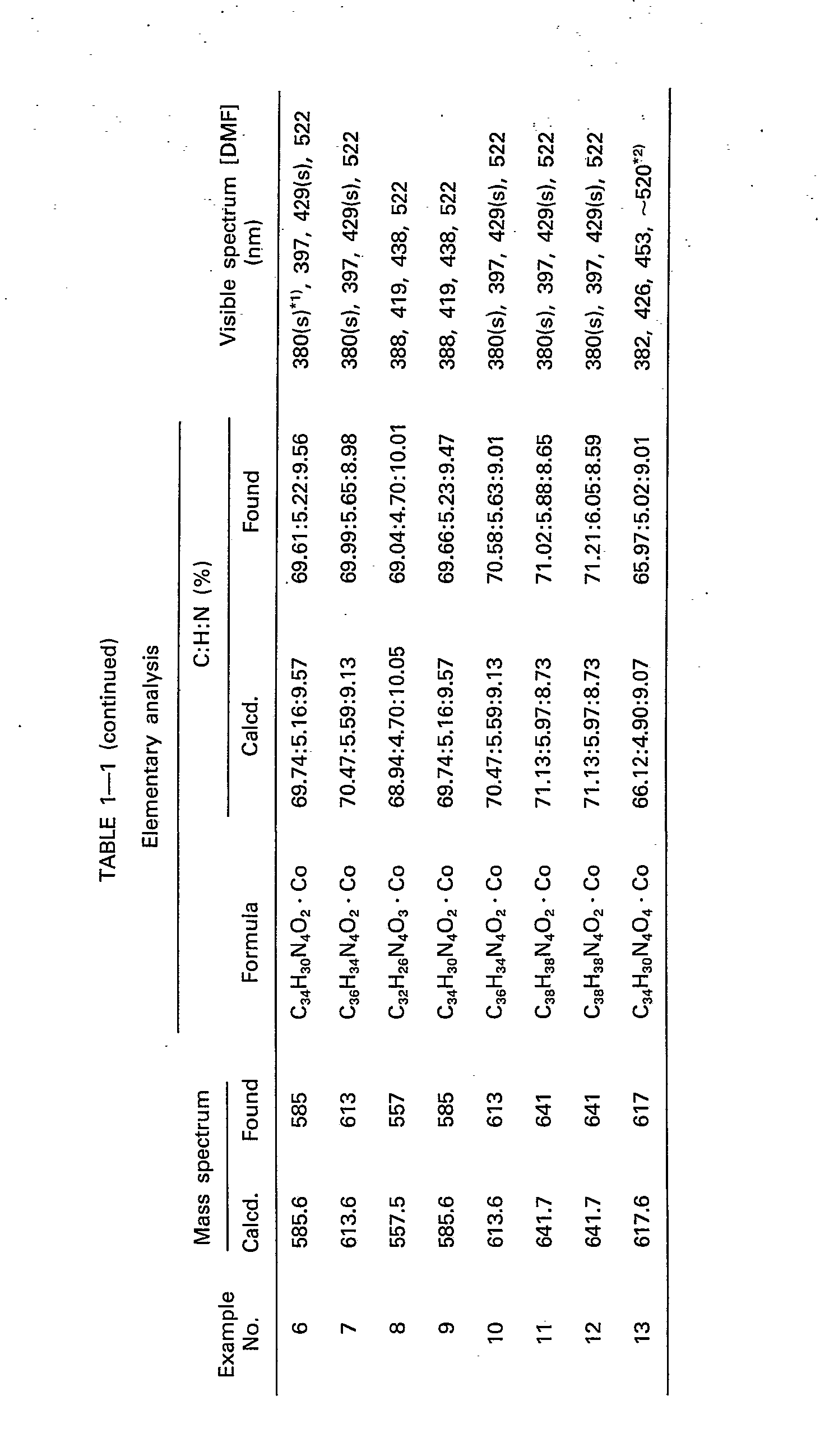
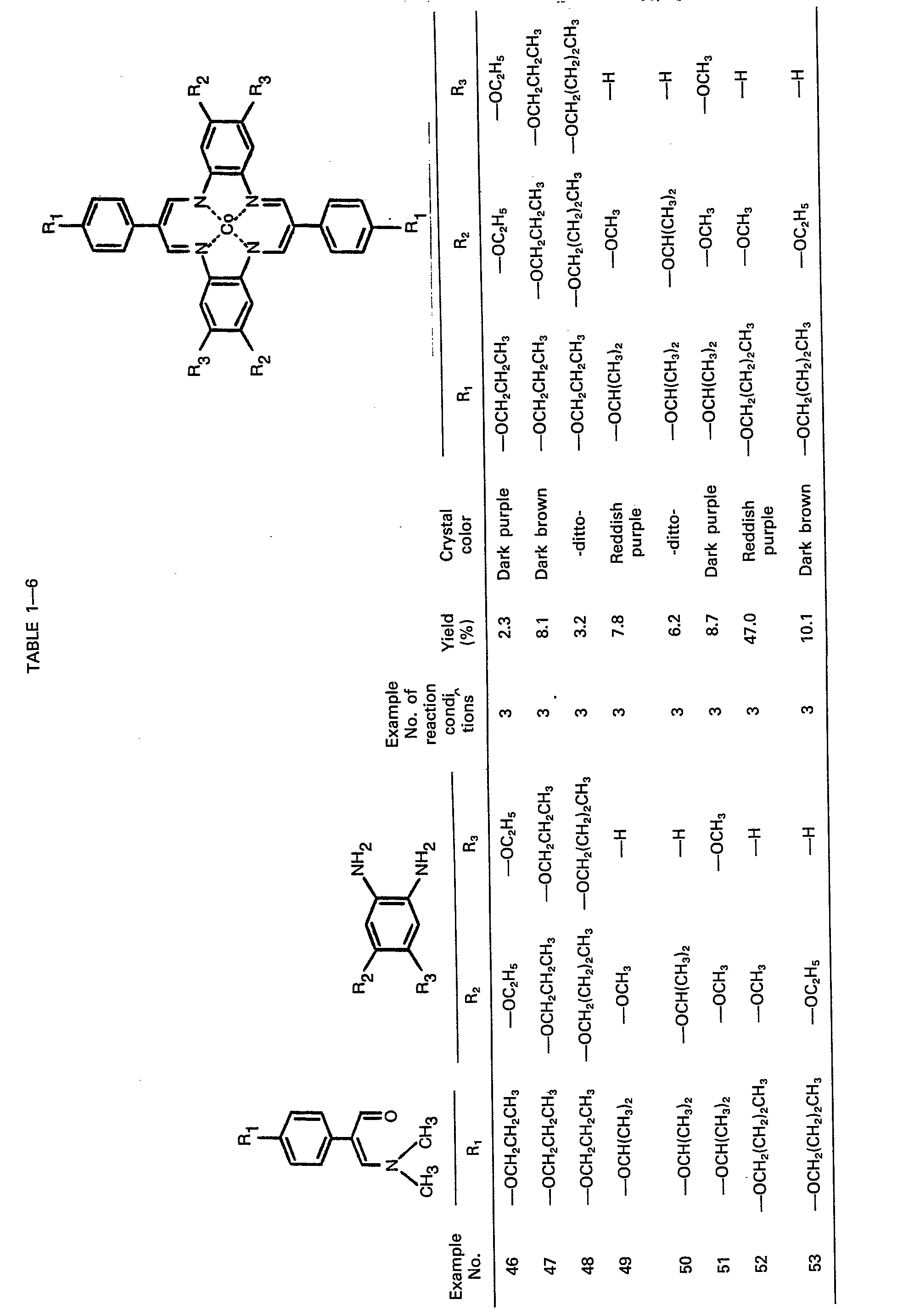
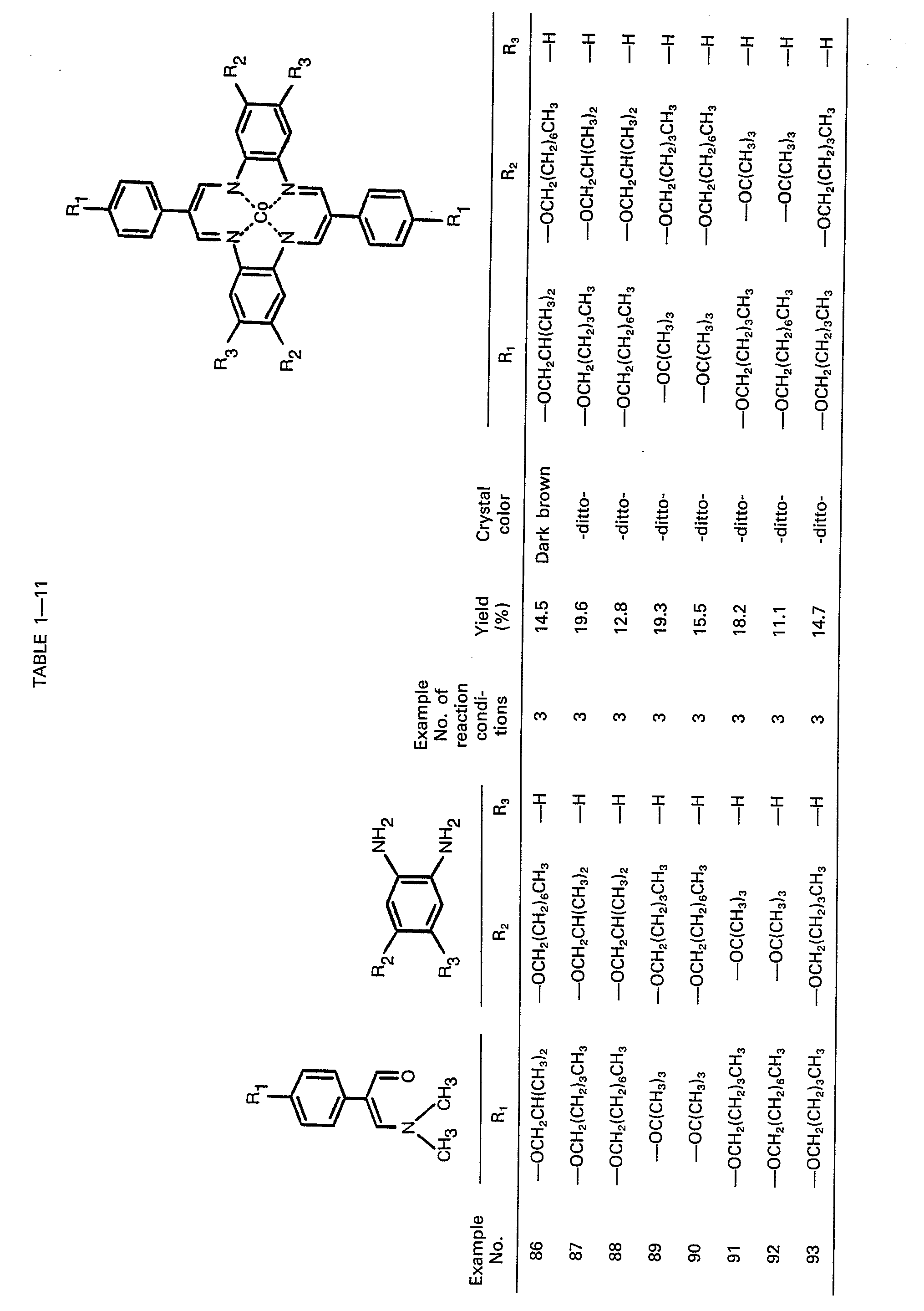
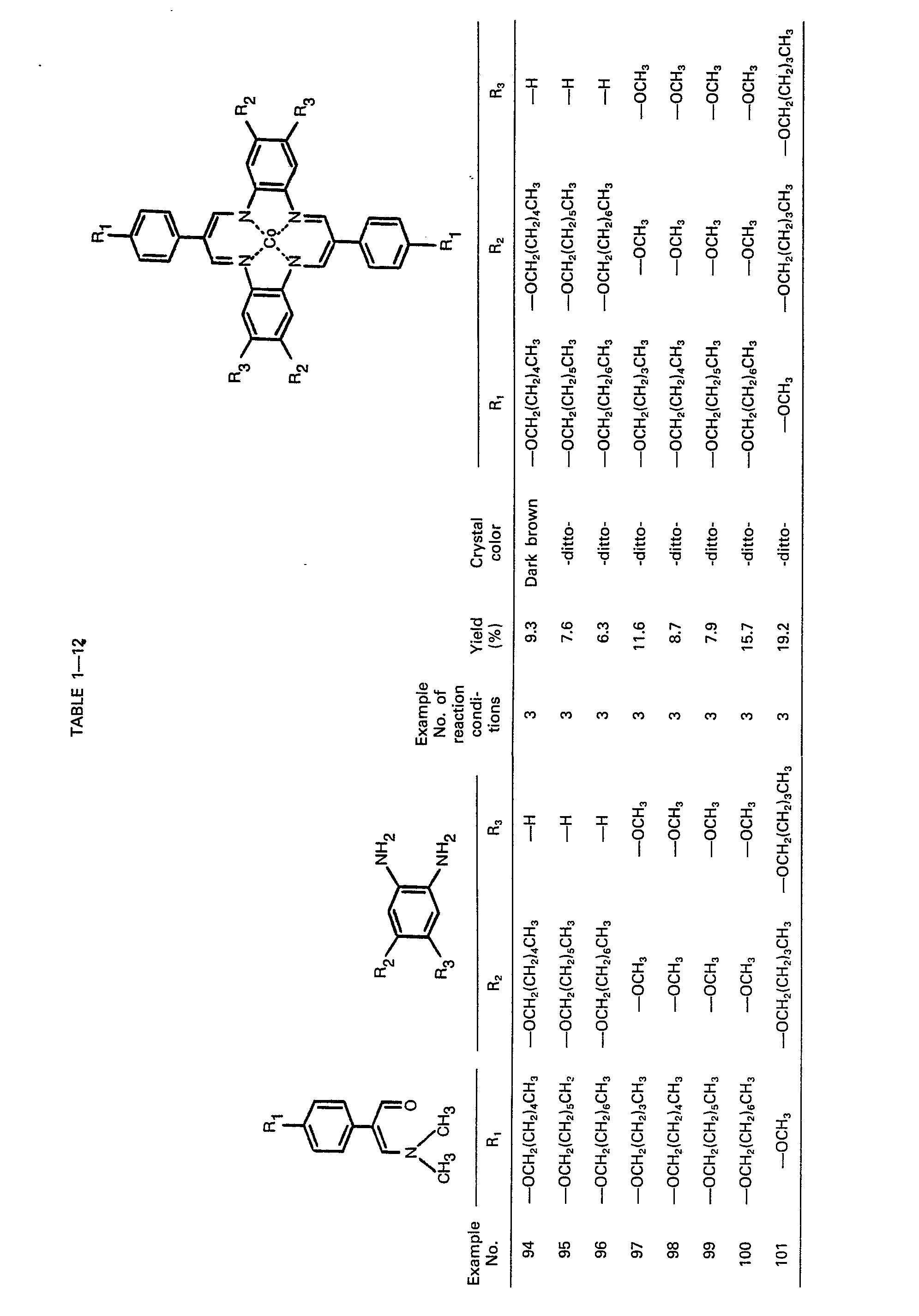
- Co-TAA of this invention was prepared by the methods as shown in Table 1. The results are also shown in Table 1.
- the measurement was carried out by introducing a high-purity oxygen gas into the electrolytic solution and recording the electric current generated by varying the voltage from +800 mV to -600 mV at a velocity of 25 mV/sec.
- the catalyst activity was evaluated by the generated electric current value at +375 mV. The measurement was repeated 10 times and the catalyst life was evaluated by the tenth measurement result, that is, the tenth catalyst activity. The measurement results are shown in Table 2.
- the catalyst activity and the catalyst life of Co-TAA having the formula (VII) were measured by the ⁇ same methods as those of this invention.
- the Co-TAA has a catalyst activity of 145 ⁇ A/cm 2 and a catalyst life of 30 L tA/cm 2 .
Landscapes
- Chemical & Material Sciences (AREA)
- Organic Chemistry (AREA)
- Catalysts (AREA)
Description
- This invention relates to a tetraazaannutene cobalt complex compound (hereinafter referred to Co-TAA) useful as an oxygen reduction catalyst and a method for the preparation of the Co-TAA.
- Various kinds of oxygen reduction catalysts have been known. Especially, platinum has been well known as an oxygen reduction catalyst because of the superior catalytic properties. However, it is difficult to practically employ platininum as a catalyst in a fuel battery because platinum is expensive and a rare metal. Therefore, the development of new catalysts having a low oxygen reduction voltage and a high catalytic activity have been desired and made. However, catalysts which can take the place of platinum have not been found.
- The Co-TAA having the formula (VII);

- Further, the Co-TAA having the formula (VIII);

- A method for the preparation of the Co-TAA is described in Y. Nishida et al, Journal of Coordination Chemistry, Vol. 9, 161-166 (1979). This method, however, has the defect that the reaction procedures and the after-treatments are difficult due to the use of sulfur and acetyl hydroperoxide in the production of the starting material, that is, dithiolium hydrogensulfate. Further, this method has such defects that the yields of the tetraazaannulene and the Co-TAA are low, that the purity of the Co-TAA is also low and that the purification of the Co-TAA is difficult.
- It is therefore an object of this invention to provide a novel Co-TAA whose activity is as high or higher than that of the known compounds, which, however, shows a sufficiently long catalyst life.
- Another object of this invention is to provide a novel method for preparing the stated cobalt- tetraazaannulene derivatives which may be carried out easily and provides the desired compounds in higher yields than the known processes.
- According to the present invention there are provided tetraazaannulene cobalt complex compounds having the general formula (I)

- R1, R2 and R3 each independently is a hydrogen atom, a C1-8 alkoxy group or a C1-8 alkyl group but in case of one of R1, R2 and R3 being a hydrogen atom the other two groups are not hydrogen atoms at the same time, and when R1 is a methyl group R2 and R3 are not hydrogen atoms at the same time.
- Suitable examples of Co-TAA of this invention of the formula (I) include;
- (1) R1 is a C1-8 alkoxy group,
- (2) R1 and R2 each independently is a C1-8 alkoxy group,
- (3) R1 and R2 each independently is a C1-8 alkoxy group and R3 is a hydrogen atom,
- (4) each of R1, R2 and R3 independently is a C1-8 alkoxy group,
- (5) R1 is a C1-8 alkoxy group and R2 and R3 are the same and C1-8 alkoxy groups,
- (6) R1 is a C1-8 alkoxy group and R2 and R3 are both hydrogen atoms,
- (7) R1 is a C1-8 alkoxy group and R2 and R3 each independently is a C1-8 alkyl group,
- (8) R1 is a C1-8 alkoxy group and R2 and R3 are the same and C1-8 alkyl groups,
- (9) R1 is a C1-8 alkyl group,
- (10) R1 is a C1-8 alkyl group and R2 and R3 each independently is a C1-8 alkoxy group,
- (11) R1 is a C1-8 alkyl group and R2 and R3 are the same and C1-8 alkoxy groups,
- (12) each of R1, R2 and R3 independently is a C1-8 alkyl group,
- (13) R1 is a C1-8 alkyl group and R2 and R3 are the same and C1-8 alkyl groups,
- (14) R1 is a C2-8 alkyl group and R2 and R3 are both hydrogen atoms,
- (15) R1 is a hydrogen atom,
- (16) R1 is a hydrogen atom and R2 is a C1-8 alkoxy group,
- (17) R1 is a hydrogen atom and R2 and R3 each independently is a C1-8 alkoxy group,
- (18) R1 is a hydrogen atom and R2 and R3 are the same and C1-8 alkoxy groups,
- (19) R1 and R3 are both hydrogen atoms and R2 is a C1-8 alkoxy group,
- (20) R1 is a hydrogen atom and R2 is a C1-8 alkyl group,
- (21) R1 is a hydrogen atom and R2 and R3 each independently is a C1-8alkyl group,
- (22) R1 is a hydrogen atom and R2 and R3 are the same and C1-8 alkyl groups, and
- (23) R1 and R3 are both hydrogen atoms and R2 is a C1-8 alkyl group.
- Preferred R1, R2 and R3 include a hydrogen atom, a methoxy group, an ethoxy group, a n-propoxy group, an isopropoxy group, a n-butoxy group, an iso-butoxy group, a n-pentyloxy group, a n-hexyloxy group, a n-heptyloxy group, a n-octyloxy group, a methyl group, an ethyl group, a n-propyl group, an iso-propyl group, a n-butyl group, an iso-butyl group, a n-pentyl group, a n-hexyl group, a n-heptyl group and a n-octyl group.
- Preferred Co-TAA of this invention is the compound of the formula (I) where one or two of R1, R2 and R3 are methoxy groups, for example, one or two of R1, R2 and R3 are methoxy groups and the other group or groups are hydrogen atoms, R1 is a methoxy group and R2 and R3 are the same and C4-8 alkoxy groups, R1 is a methoxy group and R2 and R3 are the same and C1-4 alkyl groups, R1 is a C4-8 alkoxy group and R2 and R3 are both methoxy groups, R1 is a C1-4 alkyl group and R2 and R3 are both methoxy groups, and all of R1, R2 and R3 are methoxy groups; the compound of the formula (I) where one or two of R1, R2 and R3 are methyl groups and the other group or groups are C1-4 alkyl groups or C4-8 alkoxy groups, for example, R1 is a methyl group and R2 and R3 are the same and C1-4 alkyl groups or C4-8 alkoxy group, and R2 and R3 are both methyl groups and R1 is a C1-4 alkyl group or a C4-8 alkoxy group; the compound of the formula (I) where R1, R2 and R3 are all methyl groups; the compound of the formula (I) where R, and R2 are the same and C4-8 alkoxy groups and R3 is a hydrogen atom; the compound of the formula (I) where R1 is a C1-4 alkoxy group and R2 and R3 are the same and C1-4 alkyl groups; or the compound of the formula (I) where R1, R2 and R3 are all n-butoxy groups.
- More specifically, preferred examples of the Co-TAA having a high catalyst activity and a longer catalyst life include


- Preferred examples of the Co-TAA having higher catalyst activity of this invention include


- The Co-TAA including the novel Co-TAA of this invention, which can be represented by the general formula (II);

- R4 is a hydrogen atom, a C1-8 alkoxy group, a C1-a alkyl group, a halogen atom, a nitro group, a cyano group, a C1-8 acyloxy group, a hydroxyl group, a carboxyl group, a C1-8 alkoxycarbonyl group, a carbamoyl group, a N,N-di C1-6 alkylamino group, a C1-8 acylamino group, a C1-8 alkoxycarbonyl C1-3 alkyl group, a N,N-di C1-6 alkylamino C1-3 alkyl group, or an amino group; n is integer of 1 to 5; and
- R5 and R6 each independently is a hydrogen atom, a C1-8 alkoxy group, a C1-8 alkyl group, a halogen atom, a nitro group, a cyano group, a C1-8 acyloxyl group, a hydroxyl group, a carboxyl group, a C1-8 alkoxycarbonyl group, a carbamoyl group, a N,N-di C1-6 alkylamino group, a C1-8 alkoxycarbonyl C1-3 alkyl group, or a C1-8 acylamino group; can be obtained by the following five methods.
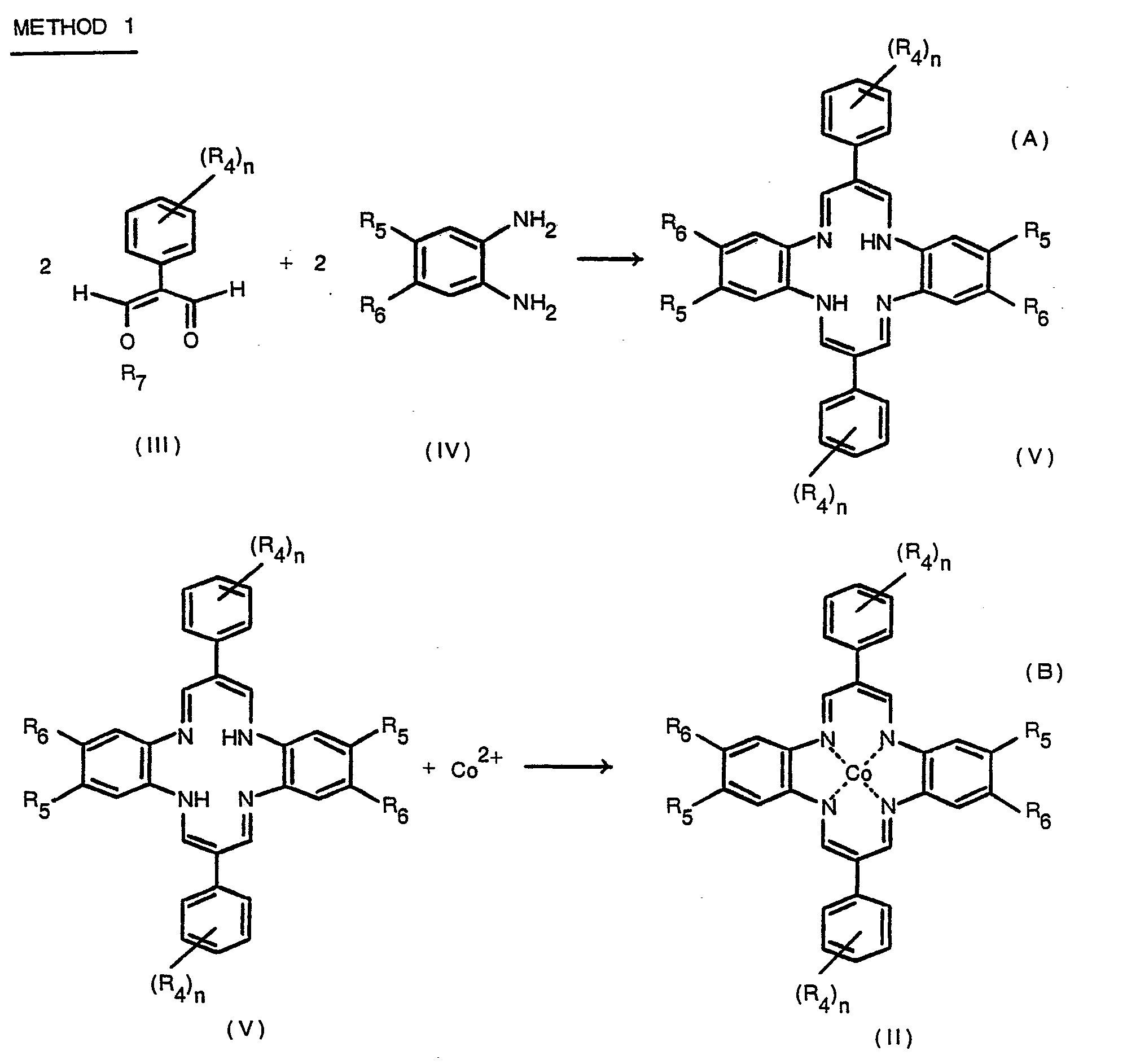


- In the above described formulae (III), (IV), (V) and (VI), R4, R5, R6 and n are the same as defined in the formula (II); R7 is a C1-6 alkyl group; and R8 and Rg each independently is a C1-6 alkyl group.
- According to Method 1, the Co-TAA of the formula (II) can be obtained by reacting a β - alkoxy - a - arylacrolein of the general formula (III) with an o-phenylenediamine derivative of the general formula (IV) to prepare a tetraazaannulene derivative of the formula (V), and then reacting the tetraazaannulene derivative (V) with a cobalt compound.
- The reaction (A) between the β - alkoxy - a - arylacrolein (III) and the o-phenylenediamine derivative (IV) can be carried out at 50°C-250°C either in the absence of a solvent or in the presence of a solvent. Preferably, the reaction (A) is carried out in the presence of a solvent at around the boiling point of the solvent employed.
- Preferably n in the formula (III) of the β - alkoxy - a - arylacroleins which can be employed in the reaction (A) is one.
- Preferred R4 in the formula (III) of the β - alkoxy - a - arylacroleins which can be employed in the reaction (A) is in the para position.
- Exemplary β - alkoxy - a - arylacroleins (III) which can be employed in the reaction (A) include β - ethoxy - a - phenylacrolein, β - ethoxy - a - (p - nitrophenyl)acrolein, β - ethoxy - a - (p - methoxyphenyl)acrolein, β - ethoxy - a - (p - tolyl)acrolein, β - ethoxy - a - [p - (n - butyl)-phenyl]acrolein, β - ethoxy - a - (p - cyanophenyl)acrolein, β - ethoxy - a - (p - chlorophenyl)acrolein, β - ethoxy - a - (p - bromophenyl)acrolein, β - ethoxy - a - [p - (ethoxycarbonyl)phenyl]acrolein, β - ethoxy - α - (p - -carboxyphenyl)acrolein,[3 -ethoxy α - (p - -carbamoylphenyl)acrolein,[3 β-ethoxy α - (p - hydroxyphenyl)acrolein, β(3 - ethoxy - a - [p - (N,N - dimethylaminomethyl)phenyl]acrolein, β - ethoxy - a - [p - (N,N - dimethylamino)phenyl]acrolein, β - ethoxy - a - [p - (ethoxycarbonylmethyl)phenyl]acrolein and the similar acroleins as described above, whose β-position of the acroleins is a methoxy group, a n-propoxy group, an isopropoxy group, a n-butoxy group, a n-pentyloxy group, a hexyloxy group or a cyclohexyloxy group.
- Preferred R4 in the formula (III) of the β - alkoxy - a - arylacroleins which can be employed in the reaction (A) is a hydrogen atom, a methoxy group, a methyl group, a halogen atom, a nitro group, a cyano group or a carboxyl group. Accordingly, preferred β - alkoxy - a - arylacroleins (III) include β - ethoxy - a - phenylacrolein, β - ethoxy - a - (p - nitrophenyl)acrolein, β - ethoxy - a - (p - methoxyphenyl)-acrolein, β - ethoxy - a - (p - tolyl)acrolein, β - ethoxy - a - (p - cyanophenyl)acrolein, β - ethoxy - a - (p - chlorophenyl)acrolein, β - ethoxy - a - (p - bromophenyl)acrolein and β - ethoxy - a - (p - carboxyphenyl)acrolein.
- The β - alkoxy - a - arylacroleins of the general formula (III) can be obtained by hydrolyzing the β - N,N - dialkylamino - a - arylacrolein of the general formula (VI) and reacting the compound obtained with a C1-6 alkyl halide. The methods for preparing the β - alkoxy - a - arylacroleins (III) are easier than those for preparing dithiolium hydrogensulfate which is the starting material of known methods. Therefore, there is a good possibility that the method of this invention will be able to provide various kinds of the Co-TAA.
- Exemplary o-phenylenediamine derivatives (IV) which can be employed in the reaction (A) include o-phenylenediamine, 4 - (C1-8 alkoxy) - o - phenylenediamines, 4 - (C1-8 alkyl) - o - phenylenediamines, 4,5 - di C1-8 alkyl - o - phenylenediamine, 4,5 - dichloro - o - phenylenediamine, 4 - nitro - o - phenylenediamine, 4 - chloro - o - phenylenediamine, 4 - carbamoyl - o - phenylenediamine, 4 - carboxy - o - phenylenediamine, 4 - cyano - o - phenylenediamine, 4 - dimethylamino - o - phenylenediamine, 4,5 di C1-8 alkoxy - o - phenylenediamine, 4 - ethoxycarbonylmethyl - o - phenylenediamine, 4 - carboxy - 5 - methyl - o - phenylenediamine and 4 - ethoxycarbonyl - o - phenylenediamine.
- Preferred R5 and R6 in the o-phenylenediamine derivatives (IV) which can be employed in the reaction (A) include a hydrogen atom, a methoxy group, a methyl group, a halogen atom, a nitro group and a carboxyl group. Accordingly, preferred o-phenylenediamine derivatives (IV) include o-phenyienediamine, 4 - methyl - o - phenylenediamine, 4 - chloro - o - phenylenediamine, 4,5 - dimethyl - o - phenylenediamine, 4,5 - dichloro - o - phenylenediamine, 4 - nitro - o - phenylenediamine, 4 - methoxy - o - phenylenediamine and 4 - carboxy - 5 - methyl - o - phenylenediamine.
- The solvents which can be employed in the reaction (A) include alcohols, phenols, cyclic ethers and non-proton polar organic solvents such as N,N - dimethylformamide, di-methyl sulfoxide, hexamethylphosphorictriamide and N - methylpyrrolidone. The reaction (A) can be preferably carried out in the presence of the non-proton (aprotic) polar organic solvent at around the boiling point of the solvent employed because the desired compounds of the formula (V) can be obtained as pure crystals in a higher yield when the reaction solution is cooled.
- The reaction (B) between the tetraazaannulene derivative of the formula (V) as obtained in the reaction (A) and a cobalt compound can be carried out in the presence of a solvent at 50°C-250°C. Preferably, the reaction (B) is carried out at around the boiling point of the solvent employed.
- Exemplary cobalt compounds which can be employed in the reaction (B) include cobalt salts of organic acids such as cobalt (II) carbonate, cobalt (II) acetate, cobalt (II) lactate, cobalt (II) oxalate, cobalt (II) citrate, cobalt (II) tartarate and cobalt (II) gluconate; cobalt salts of inorganic acids such as cobalt (II) chloride, cobalt (II) bromide and cobalt (II) iodide; and cobalt complex salts such as cobalt (II) acetylacetonate.
- The solvents which can be employed in the reaction (B) include alcohols, phenols, cyclic ethers and non-proton polar organic solvents such as N,N - dimethylformamide, dimethyl sulfoxide, hexamethylphosphorictriamide and N - methylpyrrolidone. The reaction (B) can be preferably carried out in the presence of the non-proton polar organic solvent at around the boiling point of the solvent employed because the products of the formula (II) can be obtained in the pure form in a higher yield.
- According to Method 2, the Co-TAA of the formula (II) can be obtained by reacting a β - alkoxy - a - arylacrolein of the general formula (III) with an o-phenylenediamine derivative of the general formula (IV) in the presence of a cobalt compound.
- The reaction (C) among the β - alkoxy - a - arylacrolein (III), the o-phenylenediamine derivative (IV) and the cobalt compound can be carried out at 50°C-250°C either in the absence of a solvent or in the presence of a solvent. Preferably, the reaction (C) is carried out in the presence of a solvent at around the boiling point of the solvent employed.
- The mol ratio of the (3 - aikoxy - a - arylacrolein (III): the o-phenylenediamine derivative (IV): the cobalt compound which can be employed in the reaction (C) is 2:2:1.
- Preferred n in the β - alkexy - a - arylacroleins of the formula (lll) which can be employed in the reaction (C) is one.
- Preferred R4 in the β - alkoxy - a - arylacroleins of the formula (III) which can be employed in the reaction (C) is in the para position.
- Exemplary β - alkoxy - a - arylacroleins (Ill) which can be employed in the reaction (C) include the same acroleins as those employed in the reaction (A) of Method 1.
- Preferred R4 in the ? - alkoxy - a - arylacroleins of the formula (III) which can be employed in the reaction (C) includes a hydrogen atom, a methoxy group, a methyl group, a halogen atom, a nitro group and a cyano group. Accordingly, preferred (3 - alkoxy - a - arylacroleins (III) which can be employed in the reaction (C) include (3 - ethoxy - a - phenylacrolein, β - ethoxy - a - (p - nitrophenyl)acrolein, β - ethoxy - a - (p - methoxyphenyl)acrolein, β - ethoxy - a - (p - tolyl)acrolein, β - ethoxy - a - (p - cyanophenyl)acrolein, β - ethoxy - a - (p - chlorophenyl)acrolein and β - ethoxy - a - (p - bromophenyl)acrolein.
- Exemplary o-phenylenediamine derivatives (IV) which can be employed in the reaction (C) include the same o-phenylenediamines as those employed in the reaction (A) of Method 1.
- Preferred R5 and R6 in the o-phenylenediamine derivative (IV) which can be employed in the reaction (C) include a hydrogen atom, a methoxy group, a methyl group and a halogen atom. Accordingly, preferred o-phenylenediamine derivatives (IV) include o-phenylenediamine, 4 - methyl - o - phenylenediamine, 4 - chloro - o - phenylenediamine, 4,5 - dimethyl - o - phenylenediamine, 4,5 - dichloro - o - phenylenediamine and 4 - methoxy - o - phenylenediamine.
- Exemplary cobalt compounds and the solvents which can be employed in the reaction (C) include the same as those employed in the reaction (B) of Method 1.
- The reaction (C) can be preferably carried out in the presence of the non-proton polar organic solvent at around the boiling point of the solvent employed because the products of the formula (II) can be obtained in the pure form in a higher yield. Further, the yield of the products obtained in Method 2 is higher than that of Method 1.
- According to Method 3, the Co-TAA of the formula (II) can be obtained by reacting a β - N,N - dialkylamino - a - arylacrolein of the general formula (VI) with an o-phenylenediamine derivative of the general formula (IV) to prepare a tetraazaannulene derivative of the formula (V), and reacting the tetraazaannulene derivative with a cobalt compound.
- The reaction (D) between the β - N,N - dialkylamino - a - arylacrolein (VI) and the o-phenylenediamine derivative (IV) can be carried out at 50°C-250°C either in the absence of or in the presence of a solvent. Preferably, the reaction (D) is carried out in the presence of a solvent at around the boiling point of the solvent employed.
- Preferred n in the β - N,N - dialkylamino - a arylacrolein of the formula (VI) which can be employed in the reaction (D) is one.
- Preferred R4 in the β - N,N - dialkylamino - α - arylacrolein of the formula (VI) which can be employed in the reaction (D) is in the para position.
- Exemplary β - N,N - dialkylamino - a - arylacroleins (VI) which can be employed in the reaction (D) include β - dimethylamino - a - phenylacrolein, β - dimethylamino - a - [p - (C1-8 alkoxy)-phenyl]acroleins, β - dimethylamino - a - [p - (C1-8 alkyl)phenyl]acroleins, β - dimethylamino - a - (p - nitrophenyl)acrolein, β - dimethylamino - α - [p - (dimethylamino)phenyl]acrolein, β - dimethylamino - a - (p - cyanophenyl)acrolein, β - dimethylamino - a - (p - chlorophenyl)acrolein, β - dimethylamino - a - [p - (ethoxycarbonylmethyl)phenyl]acrolein, β - dimethylamino - a - (p - carboxyphenyl)acrolein, β - dimethylamino - a - (p - carbamoylphenyl)acrolein, β - dimethylamino - a - (p - hydroxyphenyl)acrolein, β - dimethylamino - a - [p - (ethoxycarbonyl)phenyl]acrolein and the similar acroleins as described above, where in β-position of the acroleins is a diethylamino group, a dipropylamino group, a dibutylamino group, a (N - methyl,N - ethyl)amino group or a (N - methyl,N - butyl)amino group.
- Preferred R4 in the β - N,N - dialkylamino - a - arylacroleins (VI) which can be employed in the reaction (D) is a hydrogen atom, a C1_8 alkoxy group, a C1_8 alkyl group, a nitro group or an ethoxycarbonyl group.
- Preferred R8 and Rg in the β - N,N - dialkylamino - a - arylacroleins (VI) which can be employed in the reaction (D) include a methyl group, an ethyl group, a n-propyl group and a n-butyl group.
- The β - N,N - dialkylamino - a - arylacroleins of the general formula (VI) can be produced by referring to the methods described in Z. Arnold, Collection of Czechoslov. Chem. Commun. Vol. 26, 3051 (1961).
- Exemplary o-phenylenediamine derivatives (IV) which can be employed in the reaction (D) include the same o-phenylenediamines as those employed in the reaction (A) of Method 1.
- Preferred R5 and R6 in the o-phenylenediamine derivatives (IV) which can be employed in the reaction (D) include a hydrogen atom, a C1_8 alkoxy group, a halogen atom and a C1_8 alkyl group.
- The solvents which can be employed in the reaction (D) include the same solvents as those employed in the reaction (A) of Method 1. The reaction (D) can be preferably carried out in the presence of the non-proton polar organic solvent at around the boiling point of the solvent employed because the compounds of the formula (V) can be obtained in the pure form in a higher yield.
- The reaction (E) between the tetraazaannulene derivative of the formula (V) as obtained in the reaction (D) and a cobalt compound can be carried out in the presence of a solvent at 50°C-250°C. Preferably, the reaction (E) is carried out at around the boiling point of the solvent employed.
- The cobalt compounds and the solvents which can be employed in the reaction (E) include the same as those employed in the reaction (B) of Method 1.
- The reaction (E) can be preferably carried out in the presence of the non-proton polar organic solvent at around the boiling point of the solvent employed because the products of the formula (II) can be obtained in the pure form in a higher yield.
- According to Method 4, the Co-TAA of the formula (II) can be obtained by reacting a β - N,N - dialkylamino - a - arylacrolein of the general formula (VI) with an o-phenylenediamine derivative of the formula (IV) in the presence of a cobalt compound.
- The reaction (F) among the β - N,N - dialkylamino - a - arylacrolein (VI), the o-phenylenediamine derivative (IV) and the cobalt compound can be carried out at 50°C-250°C either in the absence of or in the presence of a solvent. Preferably, the reaction (F) is carried out in the presence of a solvent at around the boiling point of the solvent employed.
- The mol ratio of the β - N,N - dialkylamino - a - arylacrolein (VI): the o-phenylenediamine derivative (IV): the cobalt compound which can be employed in the reaction (F) is 2:2:1.
- Preferred n in the β - N,N - dialkylamino - a - arylacroleins (VI) which can be employed in the reaction (F) is one.
- Preferred R4 in the β - N,N - dialkylamino - a - arylacroleins (VI) which can be employed in the reaction (F) is in the para position.
- Exemplary β - N,N - dialkylamino - a - arylacroleins (VI) which can be employed in the reaction (F) include the same acroleins as those employed in the reaction (D) of Method 3.
- Preferred R4 in the β - N,N - dialkylamino - a - arylacroleins of the formula (VI) which can be employed in the reaction (F) is a hydrogen atom, a C1_8 alkoxy group, a C1_8 alkyl group, a halogen atom, a nitro group, a cyano group or an ethoxycarbonyl group.
- Preferred Ra and Rg in the β - N,N - dialkylamino - a - arylacroleins (VI) which can be employed in the reaction (F) include a methyl group, an ethyl group, a n-propyl group and a n-butyl group.
- Exemplary o-phenylenediamine derivative (IV) which can be employed in the reaction (F) include the same o-phenylenediamines as those employed in the reaction (D) of Method 3.
- Preferred R5 and R6 in the o-phenylenediamine derivatives (IV) which can be employed in the reaction (F) include a hydrogen atom, a C1_8 alkoxy group, a C1_8 alkyl group and a halogen atom.
- Exemplary cobalt compounds and the solvents which can be employed in the reaction (F) include the same as those employed in the reaction (E) of Method 3.
- The reaction (F) can be preferably carried out in the presence of the non-proton polar organic solvent at around the boiling point of the solvent employed because the products of the formula (II) can be obtained in the pure form in a higher yield. Further, the yield of the products obtained in Method 4 is higher than that of Method 3.
- The novel compound (I) of this invention can be prepared by reacting the β - C1_8 alkoxy - a - (p - hydroxyphenyl)acrolein with an o-phenylenediamine derivative (IV) where R5 and R6 each independently is a hydrogen atom, a C1_8 alkoxy group or a C1_8 alkyl group in the presence of a cobalt compound, and reacting the compound obtained with a C1_8 alkyl halide. (Method 5) The reaction (G) between the β - C1_8 alkoxy a - (p - hydroxyphenyl)acrolein, the o-phenylenediamine derivative (IV) and the cobalt compound can be carried out under the same reaction conditions as those of the reaction (F). The reaction between the compound as obtained in the reaction (G) and the C1-8 alkyl halide can be carried out in the presence of a solvent for the compound at 25°C―100°C.
- In each of Method 1-5, the products are confirmed as the Co-TAA of the formula (I) or the formula (II), or the tetraazaannulene derivatives of the formula (V) by the value of physical properties such as elementary analysis, Mass spectra and visible spectra of the products obtained.
- The Co-TAA of the formulae (I) and (II) are useful as an oxygen reduction catalyst and the tetraazaannulene derivatives of the formula. (V) are useful as the intermediate of the Co-TAA.
- The following examples illustrate the present invention in more detail.
-

- In 20 ml of N,N-dimethylformamide were dissolved 5 millimol (540 mg) of o-phenylenediamine and 2.5 millimol (623 mg) of cobalt (II) acetate tetrahydrate, and the solution was heated at 120°C for 30 minutes. The solution was added with 5 millimol (1025 mg) of β - dimethylamino a - (p - methoxyphenyl)acrolein and refluxed under heating for 3 hours. The reaction solution was cooled, filtered, washed with methanol and dried to give dark purple crystals in a yield of 60.0%.
- The crystals have the following physical values.
- Mass spectrum:

- Elementary analysis:

- Visible spectrum (nm) [in DMF]:
- 380(s)*, 397, 429(s) and 522
- *:(s) means a shoulder of a peak.
-

- In 10 ml of N,N-dimethylformamide were dissolved 2.5 millimol (270 mg) of o-phenylenediamine and 1.25 millimol (312 mg) of cobalt (II) acetate tetrahydrate, and the solution was heated at 120°C for 30 minutes. Then, the solution was added with 2.5 millimol (612.5 mg) of β - dimethylamino - a - (p - n - butoxyphenyl)acrolein and refluxed under heating for 3 hours. The reaction solution was cooled, filtered, washed with methanol and dried to give dark purple crystals in a yield of 45.4%.
- The crystals have the following physical values.
- Mass spectrum:


- Visible spectrum (nm) [in DMF]:
- 380(s)*, 397, 429(s) and 522
- *:(s) means a shoulder of a peak.
-

- In 10 ml of N,N-dimethylformamide were dissolved 2.5 millimol (420 mg) of 4,5 - dimethoxy - o - phenylenediamine, 1.25 millimol (312 mg) of cobalt (II) acetate tetrahydrate and 2.5 millimol (513 mg) of β - dimethylamino - a - (p - methoxyphenyl)acrolein, and the solution was refluxed under heating in an argon gas atmosphere for 5 hours. The reaction solution was cooled, filtered, washed with methanol and dried to give dark purple crystals in a yield of 17.0%.
- The crystals have the following physical values.
- Mass spectrum:

- Elementary analysis:

- Visible spectrum (nm) [in DMF]:
- 384, 395(s)*, 430, 457 and 525
- *:(s) means a shoulder of a peak.
-

- In 20 ml of N,N-dimethylformamide were dissolved 5 millimol (690 mg) of 4 - methoxy - o - phenylenediamine and 2.5 millimol (625 mg) of cobalt (II) acetate tetrahydrate, and the solution was heated at 120°C for 30 minutes. Then, the solution was added with 5 millimol (955 mg) of β - dimethylamino - a - (p - hydroxyphenyl)acrolein, and refluxed under heating in an argon gas atmosphere for 5 hours. The teaction solution was cooled and added with methanol to precipitated crystals. The crystals were separated by filtration, washed with methanol and dried. The yield was 7.5%.

- In 10 ml of N,N-dimethylformamide was dissolved the crystals obtained in Step 1. To the solution obtained were added 6 times amount of propyl iodide based on the millimol of the crystals and 6 times amount of potassium carbonate based on the millimol of the crystals. Then, the mixture was stirred at 25°C for 12 hours. To the reaction mixture was added excess of water to precipitated crystals. The crystals were obtained by filtration, washed with methanol and dried to give dark purple crystals in a yield of 50%.
- The crystals have the following physical values.
- Mass spectrum:

- Elementary analysis:

- Visible spectrum (nm) [in DMF]:
- 399, 420(s)*, 443(s), 388(s) and 520
- *:(s) means a shoulder of a peak.
-

- In 10 ml of N,N-dimethylformamide were dissolved 2.5 millimol (473 mg) of β - dimethylamino - a - (p - methylphenyl)acrolein, 1.25 millimol (312 mg) of cobalt (II) acetate tetrahydrate and 2.5 millimol (340 mg) of 4,5 - dimethyl - o - phenylenediamine, and the solution was refluxed under heating for 5 hours. The reaction solution was cooled, filtered, washed with methanol and dried to give brown crystals in a yield of 68.8%.
- The crystals have the following physical values.
- Mass spectrum:

- Elementary analysis:

- Visible spectrum (nm) [in DMF]:
- 384, 398, 423, 440(s)* and 524
- *:(s) means a shoulder of a peak.
- Co-TAA of this invention was prepared by the methods as shown in Table 1. The results are also shown in Table 1.
-








- The oxygen reduction catalyst activities of Co-TAA as obtained in Examples 1,3,8,19,93,96,126,140, 154, 168, 188 and 198 were measured. The measurement was carried out in accordance with the cyclic voltammetry method by using a potentiostat.
- In 1 I of chloroform or 1 I of N,N-dimethylformamide was dissolved 800 mg of Co-TAA, and into the solution was dipped a Glassy Carbon (trade name; product of Tokai Denkyoku Seizo K.K.) whose surface was mirror-plane finished for 30 minutes. The Glassy Carbon was taken out from the solution and left to stand to dryness. The treated glassy carbon was employed as a cathode electrode. A platinum coil was employed as an anode electrode and a calomel electrode was employed as a reference electrode. The electrolyte solution was 1 N sulfuric acid and the measurement temperature was 25°C.
- The measurement was carried out by introducing a high-purity oxygen gas into the electrolytic solution and recording the electric current generated by varying the voltage from +800 mV to -600 mV at a velocity of 25 mV/sec.
- The catalyst activity was evaluated by the generated electric current value at +375 mV. The measurement was repeated 10 times and the catalyst life was evaluated by the tenth measurement result, that is, the tenth catalyst activity. The measurement results are shown in Table 2.

- The catalyst activity and the catalyst life of Co-TAA having the formula (VII) were measured by the βsame methods as those of this invention. The Co-TAA has a catalyst activity of 145 µA/cm2 and a catalyst life of 30 LtA/cm2.
-

- In 25 ml of N,N-dimethylformamide were dissolved 0.02 mol of a β - ethoxy - a - arylacrolein and 0.02 mol of an o-phenylenediamine derivative as set forth in Table 3. The solution was refluxed under heating for 5 hours. The reaction solution was cooled to 25°C to give a compound. The compound obtained was separated by filtration, washed with methanol and dried. The yield is shown in Table 3. All the compounds were confirmed as tetraazaannulene derivatives.


- In 10 ml of N,N-dimethylformamide were dissolved 5 millimol of each of the tetraazaannulene derivatives obtained in Step 1 and 5 millimol of cobalt (II) acetate tetrahydrate, and the solution was refluxed under heating for 5 hours. The reaction solution was cooled to 25°C to give a compound. The compound was filtered, washed with methanol and dried. All the compounds were obtained at a yield of 90-95%, and identified as Co-TAA having the formula (II') by elementary analysis, the mass spectra and visible spectra thereof.
-

- In 25 ml of N,N-dimethylformamide were dissolved 0.02 mol of a β - alkoxy - a - phenylacrolein as set forth in Table 4 and 2.16 g (0.02 mol) of o-phenylenediamine, and the solution was refluxed under heating for 5 hours. The reaction solution was cooled to 25°C to give a compound. The compound obtained was separated by filtration, washed with methanol and dried. The yield is shown in Table 4. All the compounds were confirmed as the tetraazaannulene derivative.

-

- In 20 ml of N,N-dimethylformamide were dissolved 5 millimol of an o-phenylenediamine derivative as set forth in Table 5 and 623 mg (2.5 millimol) of cobalt (II) acetate tetrahydrate, and the solution was heated at 120°C. The solution was added with 5 millimol of a β - ethoxy - a - arylacrolein as set forth in Table 5 and refluxed under heating for 5 hours. The reaction solution was cooled, filtered, washed with methanol and dried to give a compound at a yield as shown in Table 5. All the compounds were confirmed as Co-TAA.

- The same procedures as described in Experiment No. 1 of Example 213 were repeated except that a β - ethoxy - a - arylacrolein as set forth in Table 6 was employed instead of the β - ethoxy - a - phenylacrolein. All the compounds obtained were confirmed as Co-TAA. The yield of Co-TAA is shown in Table 6.

-

- In 20 ml of N,N-dimethylformamide were dissolved 5 millimol (540 mg) of o-phenylenediamine and 2.5 millimol (623 mg) of cobalt (II) acetate tetrahydrate, and the solution was heated to 120°C. Then, the solution was added with 5 millimol of a β - alkoxy - a - phenylacrolein as set forth in Table 7, and refluxed under heating for 5 hours. The reaction solution was cooled, filtered, washed with methanol and dried to give a compound at a yield as shown in Table 7. All the compounds were confirmed as Co-TAA.

-

- In 30 ml of N,N-dimethylformamide were dissolved 0.02 mol of a β - dimethylamino - a - arylacrolein and 0.02 mol of an o-phenylenediamine derivative as set forth in Table 8, and the solution was refluxed under heating for 5 hours. The reaction solution was cooled to 25°C to separate a compound. The compound obtained was separated by filtration, washed with methanol and dried under reduced pressure. The yield is shown in Table 8. All the compounds were confirmed as tetraazaannulene derivatives.


- In 10 ml of N,N-dimethylformamide were dissolved 5 millimol of each of the tetraazaannulene derivatives obtained and 5 ml of cobalt (II) acetate tetrahydrate, and the solution was refluxed under heating for 5 hours. The reaction solution was cooled to 25°C to give a compound. The compound obtained was separated by filtration, washed with methanol and dried. All the compounds were obtained at a yield of 90-95%, and confirmed as Co-TAA.
-

- In 30 ml of N,N-dimethylformamide were dissolved 0.02 mol of a β - dialkylamino - a - phenylacrolein as set forth in Table 9 and 2.16 g (0.02 mol) of o-phenylenediamine, and the solution was refluxed under heating for 5 hours. The reaction solution was cooled to 25°C to give a compound. The compound obtained was separated by filtration, washed with methanol and dried under reduced pressure. The yield is shown in Table 9. All the compounds were confirmed as the tetraazaannulene derivative.

- In N,N-dimethylformamide were dissolved the tetraazaannulene obtained and the equimolar amount of cobalt (II) acetate tetrahydrate, and the solution was refluxed under heating for 5 hours. The reaction solution was cooled to 25°C to give a compound. The compound obtained was separated by filtration, washed with methanol and dried. All the compounds were obtained in a yield of 90-95%, and confirmed as Co-TAA.
-

- In 20 ml of N,N-dimethylformamide were dissolved 5 millimol of an o-phenylenediamine derivative as set forth in Table 10 and 623 mg (2.5 millimol) of cobalt (II) acetate tetrahydrate, and the solution was heated at 120°C for 30 minutes. The solution was added with 5 millimol of a β - dimethylamino - a - arylacrolein as set forth in Table 10, and refluxed under heating for 5 hours. The reaction solution was cooled, filtered, washed with methanol and dried to give a compound. The yield is shown in Table 10. All the compounds were confirmed as Co-TAA.

-

- In 20 ml of N,N-dimethylformamide were dissolved 5 millimol (540 mg) of o-phenylenediamine and 2.5 millimol (623 mg) of cobalt (II) acetate tetrahydrate, and the solution was heated at 120°C for 30 minutes. The solution was added with 5 millimol of a β - dialkylamino - a - phenylacrolein as set forth in Table 11, and refluxed under heating for 3 hours. The reaction solution was cooled, filtered, washed with methanol and dried to give a compound at a yield as shown in Table 11. All the compound obtained were confirmed as Co-TAA.

-

- In 25 ml of N,N-dimethylformamide were dissolved 0.02 mol of a β - ethoxy - a - arylacrolein and 0.02 mol of an o-phenylenediamine derivative as set forth in Table 12, and the solution was refluxed under heating for 5 hours. The reaction solution was cooled to 25°C to give a compound. The compound obtained was separated by filtration, washed with methanol and dried. The yield is shown in Table 12. All the compounds were confirmed as tetraazaannulene derivatives.

-

- In 25 ml of N,N-dimethylformamide were dissolved 0.02 mol of a β - dimethylamino - a - arylacrolein and 0.02 mol of an o-phenylenediamine derivative as set forth in Table 13, and the solution was refluxed under heating for 5 hours. The reaction solution was cooled to 25°C to give a compound. The compound obtained was separated by filtration, washed with methanol and dried. The yield is shown in Table 13. All the compounds were confirmed as tetraazaannulene derivatives.

Claims (11)


Applications Claiming Priority (6)
| Application Number | Priority Date | Filing Date | Title |
|---|---|---|---|
| JP56132438A JPS5832891A (en) | 1981-08-24 | 1981-08-24 | Novel tetraazaannulene cobalt complex |
| JP132438/81 | 1981-08-24 | ||
| JP13631581A JPS5838298A (en) | 1981-08-31 | 1981-08-31 | Preparation of cobalt compound of tetraazaannulene |
| JP136315/81 | 1981-08-31 | ||
| JP136313/81 | 1981-08-31 | ||
| JP13631381A JPS5838297A (en) | 1981-08-31 | 1981-08-31 | Preparation of cobalt compound of tetraazaannulene |
Publications (2)
| Publication Number | Publication Date |
|---|---|
| EP0073456A1 EP0073456A1 (en) | 1983-03-09 |
| EP0073456B1 true EP0073456B1 (en) | 1985-11-27 |
Family
ID=27316499
Family Applications (1)
| Application Number | Title | Priority Date | Filing Date |
|---|---|---|---|
| EP19820107755 Expired EP0073456B1 (en) | 1981-08-24 | 1982-08-24 | Tetraazaannulene cobalt complex compounds and method for preparation thereof |
Country Status (2)
| Country | Link |
|---|---|
| EP (1) | EP0073456B1 (en) |
| DE (1) | DE3267697D1 (en) |
Families Citing this family (1)
| Publication number | Priority date | Publication date | Assignee | Title |
|---|---|---|---|---|
| US5358704A (en) * | 1993-09-30 | 1994-10-25 | Bristol-Myers Squibb | Hepatobiliary tetraazamacrocyclic magnetic resonance contrast agents |
Family Cites Families (2)
| Publication number | Priority date | Publication date | Assignee | Title |
|---|---|---|---|---|
| US3936445A (en) * | 1973-07-04 | 1976-02-03 | Badische Anilin- & Soda-Fabrik Aktiengesellschaft | Process for the production of iron complexes of tetraazaannulenes |
| DE2740170C2 (en) * | 1977-05-17 | 1982-02-04 | Tabushi, Iwao, Kyoto | Alkyl substituted cyclic tetraalkylene tetramines |
-
1982
- 1982-08-24 EP EP19820107755 patent/EP0073456B1/en not_active Expired
- 1982-08-24 DE DE8282107755T patent/DE3267697D1/en not_active Expired
Also Published As
| Publication number | Publication date |
|---|---|
| EP0073456A1 (en) | 1983-03-09 |
| DE3267697D1 (en) | 1986-01-09 |
Similar Documents
| Publication | Publication Date | Title |
|---|---|---|
| US4465630A (en) | Tetraazaannulene cobalt complex compounds and method for preparation therefor | |
| JPH05508420A (en) | Supports for amperometric sensors consisting of mono-, bis- or tris(4,4'-substituted 2,2'-bipyridine) iron, ruthenium, osmium or vanadium complexes | |
| Saalfrank et al. | A rectangular zinc cluster and a rectangular nickel cluster that exhibits ferromagnetic coupling | |
| JP6523335B2 (en) | Porphyrin molecular catalysts for selective electrochemical reduction of CO2 to CO | |
| CN111334817B (en) | A kind of electrochemical synthesis method of 2-substituted benzothiazole compounds | |
| SU1574173A3 (en) | Method of obtaining derivatives of resazurin or resorufin as tautomers | |
| US6437130B1 (en) | Pyridine derivative and its complex | |
| Ikeda et al. | Syntheses of benzilic acids through electrochemical reductive carboxylation of benzophenones in the presence of carbon dioxide. | |
| EP0073456A1 (en) | Tetraazaannulene cobalt complex compounds and method for preparation thereof | |
| JPS62298590A (en) | Manufacture of 2,3,6,7-tetrachloronaphthalene-1,4,5, 8-tetracarboxylic acid diimide and tetrachloronaphthalenetetracarboxylic acid derivatives | |
| Enomoto et al. | Synthesis, Structure, and Properties of Hexaaryl [3] radialenes. | |
| US4017533A (en) | Diaminomaleonitrile derivatives and processes for preparing the same | |
| US5021592A (en) | Redox-active centers | |
| KR100203233B1 (en) | Method for preparing astaxanthin | |
| CN112778375B (en) | Amphiphilic chiral platinum complex, self-assembled temperature-sensitive single-component luminescent material and application thereof | |
| CA1187834A (en) | Method for the preparation of narwedine-type dienones and their derivatives | |
| CN116332964B (en) | Synthesis method of bidentate pyrazolyl nitrogen heterocyclic palladium carbene compound | |
| Yuan et al. | P [double bond, length as m-dash] O-containing dibenzopentaarenes: facile synthesis, structures and optoelectronic properties | |
| US4904787A (en) | Method for producing 2,4-dihydroxyquinoline derivatives | |
| JPH0469353A (en) | Production of tetrachloro-1,4-benzoquinone | |
| CN110372567B (en) | A class of sulfonyl-containing chain-like cyclic dipeptide derivatives and preparation method thereof | |
| JPS607623B2 (en) | 1-Carbamoyl-5-fluorouracil derivative and method for producing the same | |
| SE433747B (en) | PROCEDURE FOR PREPARING 3-AMINO-RIFAMYCIN S AND SV | |
| US20050159596A1 (en) | Cyclic compounds and their use as complex ligands | |
| Laćan et al. | Electrochemical Synthesis of Keto and Enol Forms of Tetraketones of the Type 3, 4-Diaroyl-2, 5-hexanedione by Oxidative Dimerization of Aroylacetones |
Legal Events
| Date | Code | Title | Description |
|---|---|---|---|
| PUAI | Public reference made under article 153(3) epc to a published international application that has entered the european phase |
Free format text: ORIGINAL CODE: 0009012 |
|
| 17P | Request for examination filed |
Effective date: 19820916 |
|
| AK | Designated contracting states |
Designated state(s): DE FR GB |
|
| GRAA | (expected) grant |
Free format text: ORIGINAL CODE: 0009210 |
|
| AK | Designated contracting states |
Designated state(s): DE FR GB |
|
| REF | Corresponds to: |
Ref document number: 3267697 Country of ref document: DE Date of ref document: 19860109 |
|
| ET | Fr: translation filed | ||
| PLBE | No opposition filed within time limit |
Free format text: ORIGINAL CODE: 0009261 |
|
| STAA | Information on the status of an ep patent application or granted ep patent |
Free format text: STATUS: NO OPPOSITION FILED WITHIN TIME LIMIT |
|
| 26N | No opposition filed | ||
| PGFP | Annual fee paid to national office [announced via postgrant information from national office to epo] |
Ref country code: FR Payment date: 19990810 Year of fee payment: 18 |
|
| PGFP | Annual fee paid to national office [announced via postgrant information from national office to epo] |
Ref country code: GB Payment date: 19990818 Year of fee payment: 18 |
|
| PGFP | Annual fee paid to national office [announced via postgrant information from national office to epo] |
Ref country code: DE Payment date: 19990827 Year of fee payment: 18 |
|
| PG25 | Lapsed in a contracting state [announced via postgrant information from national office to epo] |
Ref country code: GB Free format text: LAPSE BECAUSE OF NON-PAYMENT OF DUE FEES Effective date: 20000824 |
|
| GBPC | Gb: european patent ceased through non-payment of renewal fee |
Effective date: 20000824 |
|
| PG25 | Lapsed in a contracting state [announced via postgrant information from national office to epo] |
Ref country code: FR Free format text: LAPSE BECAUSE OF NON-PAYMENT OF DUE FEES Effective date: 20010430 |
|
| PG25 | Lapsed in a contracting state [announced via postgrant information from national office to epo] |
Ref country code: DE Free format text: LAPSE BECAUSE OF NON-PAYMENT OF DUE FEES Effective date: 20010501 |
|
| REG | Reference to a national code |
Ref country code: FR Ref legal event code: ST |