EP0071197B1 - Heterocyclic multifunctional amine adducts and curable compositions containing the same - Google Patents
Heterocyclic multifunctional amine adducts and curable compositions containing the same Download PDFInfo
- Publication number
- EP0071197B1 EP0071197B1 EP82106629A EP82106629A EP0071197B1 EP 0071197 B1 EP0071197 B1 EP 0071197B1 EP 82106629 A EP82106629 A EP 82106629A EP 82106629 A EP82106629 A EP 82106629A EP 0071197 B1 EP0071197 B1 EP 0071197B1
- Authority
- EP
- European Patent Office
- Prior art keywords
- compound
- carbon atoms
- substituted
- formula
- alkyl
- Prior art date
- Legal status (The legal status is an assumption and is not a legal conclusion. Google has not performed a legal analysis and makes no representation as to the accuracy of the status listed.)
- Expired
Links
- 239000000203 mixture Substances 0.000 title claims abstract description 52
- 150000001412 amines Chemical class 0.000 title description 5
- 125000000623 heterocyclic group Chemical group 0.000 title description 4
- 150000001875 compounds Chemical class 0.000 claims abstract description 28
- 125000004432 carbon atom Chemical group C* 0.000 claims abstract description 19
- 229920000768 polyamine Polymers 0.000 claims abstract description 16
- 238000000034 method Methods 0.000 claims abstract description 14
- 125000000217 alkyl group Chemical group 0.000 claims abstract description 13
- 125000001931 aliphatic group Chemical group 0.000 claims abstract description 12
- 150000002576 ketones Chemical class 0.000 claims abstract description 12
- 125000002915 carbonyl group Chemical group [*:2]C([*:1])=O 0.000 claims abstract description 10
- 125000003118 aryl group Chemical group 0.000 claims abstract description 7
- 125000001997 phenyl group Chemical group [H]C1=C([H])C([H])=C(*)C([H])=C1[H] 0.000 claims abstract description 6
- 125000003277 amino group Chemical group 0.000 claims abstract description 5
- UFHFLCQGNIYNRP-UHFFFAOYSA-N Hydrogen Chemical compound [H][H] UFHFLCQGNIYNRP-UHFFFAOYSA-N 0.000 claims abstract description 4
- 125000003178 carboxy group Chemical group [H]OC(*)=O 0.000 claims abstract description 4
- 239000001257 hydrogen Substances 0.000 claims abstract description 4
- 229910052739 hydrogen Inorganic materials 0.000 claims abstract description 4
- 125000003545 alkoxy group Chemical group 0.000 claims abstract description 3
- 239000011203 carbon fibre reinforced carbon Substances 0.000 claims abstract description 3
- 229920000647 polyepoxide Polymers 0.000 claims description 22
- 239000003822 epoxy resin Substances 0.000 claims description 21
- 239000000835 fiber Substances 0.000 claims description 10
- 150000001299 aldehydes Chemical class 0.000 claims description 9
- 238000006243 chemical reaction Methods 0.000 claims description 9
- -1 thixotropes Substances 0.000 claims description 8
- XLYOFNOQVPJJNP-UHFFFAOYSA-N water Substances O XLYOFNOQVPJJNP-UHFFFAOYSA-N 0.000 claims description 8
- OKTJSMMVPCPJKN-UHFFFAOYSA-N Carbon Chemical compound [C] OKTJSMMVPCPJKN-UHFFFAOYSA-N 0.000 claims description 6
- 239000003054 catalyst Substances 0.000 claims description 6
- 150000004985 diamines Chemical class 0.000 claims description 6
- 150000002391 heterocyclic compounds Chemical class 0.000 claims description 6
- 239000010439 graphite Substances 0.000 claims description 5
- 229910002804 graphite Inorganic materials 0.000 claims description 5
- 238000010438 heat treatment Methods 0.000 claims description 5
- 239000002244 precipitate Substances 0.000 claims description 5
- 238000001816 cooling Methods 0.000 claims description 4
- 238000001035 drying Methods 0.000 claims description 4
- 239000002184 metal Substances 0.000 claims description 4
- 229910052751 metal Inorganic materials 0.000 claims description 4
- 239000004848 polyfunctional curative Substances 0.000 claims description 4
- 239000002904 solvent Substances 0.000 claims description 4
- 239000004094 surface-active agent Substances 0.000 claims description 4
- 150000001728 carbonyl compounds Chemical class 0.000 claims description 3
- 229920001971 elastomer Polymers 0.000 claims description 3
- 239000000806 elastomer Substances 0.000 claims description 3
- 238000001914 filtration Methods 0.000 claims description 3
- 229920000098 polyolefin Polymers 0.000 claims description 3
- 229920000742 Cotton Polymers 0.000 claims description 2
- KWYHDKDOAIKMQN-UHFFFAOYSA-N N,N,N',N'-tetramethylethylenediamine Chemical compound CN(C)CCN(C)C KWYHDKDOAIKMQN-UHFFFAOYSA-N 0.000 claims description 2
- 239000000654 additive Substances 0.000 claims description 2
- 229920003235 aromatic polyamide Polymers 0.000 claims description 2
- 229920000728 polyester Polymers 0.000 claims description 2
- 239000012744 reinforcing agent Substances 0.000 claims 3
- 206010013647 Drowning Diseases 0.000 claims 1
- 239000003365 glass fiber Substances 0.000 claims 1
- 238000011065 in-situ storage Methods 0.000 claims 1
- 239000002759 woven fabric Substances 0.000 claims 1
- 239000002131 composite material Substances 0.000 abstract description 4
- 229910052799 carbon Inorganic materials 0.000 abstract description 2
- 238000004519 manufacturing process Methods 0.000 abstract description 2
- 125000002485 formyl group Chemical class [H]C(*)=O 0.000 abstract 2
- 125000002777 acetyl group Chemical group [H]C([H])([H])C(*)=O 0.000 abstract 1
- 150000001721 carbon Chemical group 0.000 abstract 1
- 229920005989 resin Polymers 0.000 description 23
- 239000011347 resin Substances 0.000 description 23
- ZWEHNKRNPOVVGH-UHFFFAOYSA-N 2-Butanone Chemical compound CCC(C)=O ZWEHNKRNPOVVGH-UHFFFAOYSA-N 0.000 description 22
- CSCPPACGZOOCGX-UHFFFAOYSA-N Acetone Chemical compound CC(C)=O CSCPPACGZOOCGX-UHFFFAOYSA-N 0.000 description 18
- 239000007795 chemical reaction product Substances 0.000 description 18
- LNEPOXFFQSENCJ-UHFFFAOYSA-N haloperidol Chemical compound C1CC(O)(C=2C=CC(Cl)=CC=2)CCN1CCCC(=O)C1=CC=C(F)C=C1 LNEPOXFFQSENCJ-UHFFFAOYSA-N 0.000 description 15
- JOXIMZWYDAKGHI-UHFFFAOYSA-N toluene-4-sulfonic acid Chemical compound CC1=CC=C(S(O)(=O)=O)C=C1 JOXIMZWYDAKGHI-UHFFFAOYSA-N 0.000 description 13
- YFOOEYJGMMJJLS-UHFFFAOYSA-N 1,8-diaminonaphthalene Chemical compound C1=CC(N)=C2C(N)=CC=CC2=C1 YFOOEYJGMMJJLS-UHFFFAOYSA-N 0.000 description 12
- 239000003795 chemical substances by application Substances 0.000 description 9
- 239000004593 Epoxy Substances 0.000 description 8
- 239000000047 product Substances 0.000 description 8
- 238000010992 reflux Methods 0.000 description 8
- KUBDPQJOLOUJRM-UHFFFAOYSA-N 2-(chloromethyl)oxirane;4-[2-(4-hydroxyphenyl)propan-2-yl]phenol Chemical compound ClCC1CO1.C=1C=C(O)C=CC=1C(C)(C)C1=CC=C(O)C=C1 KUBDPQJOLOUJRM-UHFFFAOYSA-N 0.000 description 7
- YRKCREAYFQTBPV-UHFFFAOYSA-N acetylacetone Chemical compound CC(=O)CC(C)=O YRKCREAYFQTBPV-UHFFFAOYSA-N 0.000 description 6
- IISBACLAFKSPIT-UHFFFAOYSA-N bisphenol A Chemical compound C=1C=C(O)C=CC=1C(C)(C)C1=CC=C(O)C=C1 IISBACLAFKSPIT-UHFFFAOYSA-N 0.000 description 6
- 238000007796 conventional method Methods 0.000 description 6
- 239000000463 material Substances 0.000 description 6
- 230000002787 reinforcement Effects 0.000 description 6
- XFNJVJPLKCPIBV-UHFFFAOYSA-N trimethylenediamine Chemical compound NCCCN XFNJVJPLKCPIBV-UHFFFAOYSA-N 0.000 description 6
- 239000011521 glass Substances 0.000 description 5
- BRLQWZUYTZBJKN-UHFFFAOYSA-N Epichlorohydrin Chemical compound ClCC1CO1 BRLQWZUYTZBJKN-UHFFFAOYSA-N 0.000 description 4
- ISWSIDIOOBJBQZ-UHFFFAOYSA-N Phenol Chemical compound OC1=CC=CC=C1 ISWSIDIOOBJBQZ-UHFFFAOYSA-N 0.000 description 4
- 239000000178 monomer Substances 0.000 description 4
- 229920003986 novolac Polymers 0.000 description 4
- 239000007787 solid Substances 0.000 description 4
- 125000000391 vinyl group Chemical group [H]C([*])=C([H])[H] 0.000 description 4
- 229920002554 vinyl polymer Polymers 0.000 description 4
- 229920000049 Carbon (fiber) Polymers 0.000 description 3
- MQJKPEGWNLWLTK-UHFFFAOYSA-N Dapsone Chemical compound C1=CC(N)=CC=C1S(=O)(=O)C1=CC=C(N)C=C1 MQJKPEGWNLWLTK-UHFFFAOYSA-N 0.000 description 3
- WSFSSNUMVMOOMR-UHFFFAOYSA-N Formaldehyde Chemical compound O=C WSFSSNUMVMOOMR-UHFFFAOYSA-N 0.000 description 3
- VYPSYNLAJGMNEJ-UHFFFAOYSA-N Silicium dioxide Chemical compound O=[Si]=O VYPSYNLAJGMNEJ-UHFFFAOYSA-N 0.000 description 3
- 239000002253 acid Substances 0.000 description 3
- 238000004132 cross linking Methods 0.000 description 3
- 239000003431 cross linking reagent Substances 0.000 description 3
- 125000004435 hydrogen atom Chemical group [H]* 0.000 description 3
- 229920000642 polymer Polymers 0.000 description 3
- 238000006116 polymerization reaction Methods 0.000 description 3
- 239000011541 reaction mixture Substances 0.000 description 3
- 230000000717 retained effect Effects 0.000 description 3
- 238000003756 stirring Methods 0.000 description 3
- 238000003860 storage Methods 0.000 description 3
- 239000000126 substance Substances 0.000 description 3
- GEYOCULIXLDCMW-UHFFFAOYSA-N 1,2-phenylenediamine Chemical compound NC1=CC=CC=C1N GEYOCULIXLDCMW-UHFFFAOYSA-N 0.000 description 2
- XQUPVDVFXZDTLT-UHFFFAOYSA-N 1-[4-[[4-(2,5-dioxopyrrol-1-yl)phenyl]methyl]phenyl]pyrrole-2,5-dione Chemical compound O=C1C=CC(=O)N1C(C=C1)=CC=C1CC1=CC=C(N2C(C=CC2=O)=O)C=C1 XQUPVDVFXZDTLT-UHFFFAOYSA-N 0.000 description 2
- KWOLFJPFCHCOCG-UHFFFAOYSA-N Acetophenone Chemical compound CC(=O)C1=CC=CC=C1 KWOLFJPFCHCOCG-UHFFFAOYSA-N 0.000 description 2
- IJGRMHOSHXDMSA-UHFFFAOYSA-N Atomic nitrogen Chemical compound N#N IJGRMHOSHXDMSA-UHFFFAOYSA-N 0.000 description 2
- WDSOGUZGZSUBBB-UHFFFAOYSA-N CC1(C)NCCCN1 Chemical compound CC1(C)NCCCN1 WDSOGUZGZSUBBB-UHFFFAOYSA-N 0.000 description 2
- QOYINWMUFFDLBI-UHFFFAOYSA-N CCC(C)(N1)Nc2cccc3cccc1c23 Chemical compound CCC(C)(N1)Nc2cccc3cccc1c23 QOYINWMUFFDLBI-UHFFFAOYSA-N 0.000 description 2
- VTYYLEPIZMXCLO-UHFFFAOYSA-L Calcium carbonate Chemical compound [Ca+2].[O-]C([O-])=O VTYYLEPIZMXCLO-UHFFFAOYSA-L 0.000 description 2
- QSJXEFYPDANLFS-UHFFFAOYSA-N Diacetyl Chemical compound CC(=O)C(C)=O QSJXEFYPDANLFS-UHFFFAOYSA-N 0.000 description 2
- RTZKZFJDLAIYFH-UHFFFAOYSA-N Diethyl ether Chemical compound CCOCC RTZKZFJDLAIYFH-UHFFFAOYSA-N 0.000 description 2
- LFQSCWFLJHTTHZ-UHFFFAOYSA-N Ethanol Chemical compound CCO LFQSCWFLJHTTHZ-UHFFFAOYSA-N 0.000 description 2
- 239000004606 Fillers/Extenders Substances 0.000 description 2
- OAKJQQAXSVQMHS-UHFFFAOYSA-N Hydrazine Chemical compound NN OAKJQQAXSVQMHS-UHFFFAOYSA-N 0.000 description 2
- VEXZGXHMUGYJMC-UHFFFAOYSA-N Hydrochloric acid Chemical compound Cl VEXZGXHMUGYJMC-UHFFFAOYSA-N 0.000 description 2
- OWYWGLHRNBIFJP-UHFFFAOYSA-N Ipazine Chemical compound CCN(CC)C1=NC(Cl)=NC(NC(C)C)=N1 OWYWGLHRNBIFJP-UHFFFAOYSA-N 0.000 description 2
- QAOWNCQODCNURD-UHFFFAOYSA-N Sulfuric acid Chemical compound OS(O)(=O)=O QAOWNCQODCNURD-UHFFFAOYSA-N 0.000 description 2
- 229920001577 copolymer Polymers 0.000 description 2
- 238000007334 copolymerization reaction Methods 0.000 description 2
- PGRHXDWITVMQBC-UHFFFAOYSA-N dehydroacetic acid Chemical compound CC(=O)C1C(=O)OC(C)=CC1=O PGRHXDWITVMQBC-UHFFFAOYSA-N 0.000 description 2
- QGBSISYHAICWAH-UHFFFAOYSA-N dicyandiamide Chemical compound NC(N)=NC#N QGBSISYHAICWAH-UHFFFAOYSA-N 0.000 description 2
- GYZLOYUZLJXAJU-UHFFFAOYSA-N diglycidyl ether Chemical class C1OC1COCC1CO1 GYZLOYUZLJXAJU-UHFFFAOYSA-N 0.000 description 2
- 125000003700 epoxy group Chemical group 0.000 description 2
- 150000002148 esters Chemical class 0.000 description 2
- 238000001704 evaporation Methods 0.000 description 2
- 239000000945 filler Substances 0.000 description 2
- VOZRXNHHFUQHIL-UHFFFAOYSA-N glycidyl methacrylate Chemical compound CC(=C)C(=O)OCC1CO1 VOZRXNHHFUQHIL-UHFFFAOYSA-N 0.000 description 2
- LEQAOMBKQFMDFZ-UHFFFAOYSA-N glyoxal Chemical compound O=CC=O LEQAOMBKQFMDFZ-UHFFFAOYSA-N 0.000 description 2
- CATSNJVOTSVZJV-UHFFFAOYSA-N heptan-2-one Chemical compound CCCCCC(C)=O CATSNJVOTSVZJV-UHFFFAOYSA-N 0.000 description 2
- 239000004615 ingredient Substances 0.000 description 2
- 239000012948 isocyanate Substances 0.000 description 2
- 150000002513 isocyanates Chemical class 0.000 description 2
- VNWKTOKETHGBQD-UHFFFAOYSA-N methane Chemical compound C VNWKTOKETHGBQD-UHFFFAOYSA-N 0.000 description 2
- 125000002496 methyl group Chemical group [H]C([H])([H])* 0.000 description 2
- 229910052757 nitrogen Inorganic materials 0.000 description 2
- 125000004430 oxygen atom Chemical group O* 0.000 description 2
- 229920003192 poly(bis maleimide) Polymers 0.000 description 2
- 235000013824 polyphenols Nutrition 0.000 description 2
- 230000005855 radiation Effects 0.000 description 2
- 239000012779 reinforcing material Substances 0.000 description 2
- 239000011342 resin composition Substances 0.000 description 2
- SMQUZDBALVYZAC-UHFFFAOYSA-N salicylaldehyde Chemical compound OC1=CC=CC=C1C=O SMQUZDBALVYZAC-UHFFFAOYSA-N 0.000 description 2
- 150000003457 sulfones Chemical class 0.000 description 2
- KUCOHFSKRZZVRO-UHFFFAOYSA-N terephthalaldehyde Chemical compound O=CC1=CC=C(C=O)C=C1 KUCOHFSKRZZVRO-UHFFFAOYSA-N 0.000 description 2
- 239000003039 volatile agent Substances 0.000 description 2
- 238000005406 washing Methods 0.000 description 2
- WZCQRUWWHSTZEM-UHFFFAOYSA-N 1,3-phenylenediamine Chemical compound NC1=CC=CC(N)=C1 WZCQRUWWHSTZEM-UHFFFAOYSA-N 0.000 description 1
- AZQWKYJCGOJGHM-UHFFFAOYSA-N 1,4-benzoquinone Chemical compound O=C1C=CC(=O)C=C1 AZQWKYJCGOJGHM-UHFFFAOYSA-N 0.000 description 1
- 150000005208 1,4-dihydroxybenzenes Chemical class 0.000 description 1
- XMNIXWIUMCBBBL-UHFFFAOYSA-N 2-(2-phenylpropan-2-ylperoxy)propan-2-ylbenzene Chemical compound C=1C=CC=CC=1C(C)(C)OOC(C)(C)C1=CC=CC=C1 XMNIXWIUMCBBBL-UHFFFAOYSA-N 0.000 description 1
- QTWJRLJHJPIABL-UHFFFAOYSA-N 2-methylphenol;3-methylphenol;4-methylphenol Chemical compound CC1=CC=C(O)C=C1.CC1=CC=CC(O)=C1.CC1=CC=CC=C1O QTWJRLJHJPIABL-UHFFFAOYSA-N 0.000 description 1
- WVRNUXJQQFPNMN-VAWYXSNFSA-N 3-[(e)-dodec-1-enyl]oxolane-2,5-dione Chemical compound CCCCCCCCCC\C=C\C1CC(=O)OC1=O WVRNUXJQQFPNMN-VAWYXSNFSA-N 0.000 description 1
- FAUAZXVRLVIARB-UHFFFAOYSA-N 4-[[4-[bis(oxiran-2-ylmethyl)amino]phenyl]methyl]-n,n-bis(oxiran-2-ylmethyl)aniline Chemical compound C1OC1CN(C=1C=CC(CC=2C=CC(=CC=2)N(CC2OC2)CC2OC2)=CC=1)CC1CO1 FAUAZXVRLVIARB-UHFFFAOYSA-N 0.000 description 1
- ADAHGVUHKDNLEB-UHFFFAOYSA-N Bis(2,3-epoxycyclopentyl)ether Chemical compound C1CC2OC2C1OC1CCC2OC21 ADAHGVUHKDNLEB-UHFFFAOYSA-N 0.000 description 1
- 229930185605 Bisphenol Natural products 0.000 description 1
- LCFVJGUPQDGYKZ-UHFFFAOYSA-N Bisphenol A diglycidyl ether Chemical compound C=1C=C(OCC2OC2)C=CC=1C(C)(C)C(C=C1)=CC=C1OCC1CO1 LCFVJGUPQDGYKZ-UHFFFAOYSA-N 0.000 description 1
- ZOXJGFHDIHLPTG-UHFFFAOYSA-N Boron Chemical compound [B] ZOXJGFHDIHLPTG-UHFFFAOYSA-N 0.000 description 1
- DETLTZYXZWIXIB-UHFFFAOYSA-N CC(C)(N1)Nc2c3c1cccc3ccc2 Chemical compound CC(C)(N1)Nc2c3c1cccc3ccc2 DETLTZYXZWIXIB-UHFFFAOYSA-N 0.000 description 1
- ZPIYUOPMFREBHH-UHFFFAOYSA-N CC(CNc1c2c(N)cccc2ccc1)(C(CNc1c2c(N)cccc2ccc1)c1ccccc1)c1ccccc1 Chemical compound CC(CNc1c2c(N)cccc2ccc1)(C(CNc1c2c(N)cccc2ccc1)c1ccccc1)c1ccccc1 ZPIYUOPMFREBHH-UHFFFAOYSA-N 0.000 description 1
- 0 CC(OC*1)=C[C@@]1O Chemical compound CC(OC*1)=C[C@@]1O 0.000 description 1
- CFVMRYVZRLGIOS-UHFFFAOYSA-N CC(c(cc1)cc(OC)c1O)Nc1ccccc1N Chemical compound CC(c(cc1)cc(OC)c1O)Nc1ccccc1N CFVMRYVZRLGIOS-UHFFFAOYSA-N 0.000 description 1
- IGFILMGXSDBQNN-UHFFFAOYSA-N CCCCC(CC)(N1)Nc2c3c1cccc3ccc2 Chemical compound CCCCC(CC)(N1)Nc2c3c1cccc3ccc2 IGFILMGXSDBQNN-UHFFFAOYSA-N 0.000 description 1
- 229920013683 Celanese Polymers 0.000 description 1
- XZMCDFZZKTWFGF-UHFFFAOYSA-N Cyanamide Chemical compound NC#N XZMCDFZZKTWFGF-UHFFFAOYSA-N 0.000 description 1
- 239000004287 Dehydroacetic acid Substances 0.000 description 1
- SXRSQZLOMIGNAQ-UHFFFAOYSA-N Glutaraldehyde Chemical compound O=CCCCC=O SXRSQZLOMIGNAQ-UHFFFAOYSA-N 0.000 description 1
- 239000005909 Kieselgur Substances 0.000 description 1
- PEEHTFAAVSWFBL-UHFFFAOYSA-N Maleimide Chemical compound O=C1NC(=O)C=C1 PEEHTFAAVSWFBL-UHFFFAOYSA-N 0.000 description 1
- QRPPHQKAFFVJET-UHFFFAOYSA-N NC(C=CCC1=CC=C2)=C1C2=N Chemical compound NC(C=CCC1=CC=C2)=C1C2=N QRPPHQKAFFVJET-UHFFFAOYSA-N 0.000 description 1
- 239000004721 Polyphenylene oxide Substances 0.000 description 1
- 229920002472 Starch Polymers 0.000 description 1
- 229920004890 Triton X-100 Polymers 0.000 description 1
- 229920006311 Urethane elastomer Polymers 0.000 description 1
- 150000007513 acids Chemical class 0.000 description 1
- 239000000853 adhesive Substances 0.000 description 1
- 230000001070 adhesive effect Effects 0.000 description 1
- WNLRTRBMVRJNCN-UHFFFAOYSA-L adipate(2-) Chemical compound [O-]C(=O)CCCCC([O-])=O WNLRTRBMVRJNCN-UHFFFAOYSA-L 0.000 description 1
- 150000001298 alcohols Chemical class 0.000 description 1
- 150000004984 aromatic diamines Chemical class 0.000 description 1
- 230000000712 assembly Effects 0.000 description 1
- 238000000429 assembly Methods 0.000 description 1
- QVGXLLKOCUKJST-UHFFFAOYSA-N atomic oxygen Chemical compound [O] QVGXLLKOCUKJST-UHFFFAOYSA-N 0.000 description 1
- MIAUJDCQDVWHEV-UHFFFAOYSA-N benzene-1,2-disulfonic acid Chemical compound OS(=O)(=O)C1=CC=CC=C1S(O)(=O)=O MIAUJDCQDVWHEV-UHFFFAOYSA-N 0.000 description 1
- WURBFLDFSFBTLW-UHFFFAOYSA-N benzil Chemical compound C=1C=CC=CC=1C(=O)C(=O)C1=CC=CC=C1 WURBFLDFSFBTLW-UHFFFAOYSA-N 0.000 description 1
- KBWLNCUTNDKMPN-UHFFFAOYSA-N bis(oxiran-2-ylmethyl) hexanedioate Chemical compound C1OC1COC(=O)CCCCC(=O)OCC1CO1 KBWLNCUTNDKMPN-UHFFFAOYSA-N 0.000 description 1
- 229920001400 block copolymer Polymers 0.000 description 1
- 229910052796 boron Inorganic materials 0.000 description 1
- 229910000019 calcium carbonate Inorganic materials 0.000 description 1
- 239000001506 calcium phosphate Substances 0.000 description 1
- 229910000389 calcium phosphate Inorganic materials 0.000 description 1
- 235000011010 calcium phosphates Nutrition 0.000 description 1
- 150000001735 carboxylic acids Chemical class 0.000 description 1
- 239000001913 cellulose Substances 0.000 description 1
- 229920002678 cellulose Polymers 0.000 description 1
- 239000000919 ceramic Substances 0.000 description 1
- 239000011248 coating agent Substances 0.000 description 1
- 238000000576 coating method Methods 0.000 description 1
- 230000008878 coupling Effects 0.000 description 1
- 238000010168 coupling process Methods 0.000 description 1
- 238000005859 coupling reaction Methods 0.000 description 1
- 229930003836 cresol Natural products 0.000 description 1
- 238000007766 curtain coating Methods 0.000 description 1
- 239000011353 cycloaliphatic epoxy resin Substances 0.000 description 1
- 235000019258 dehydroacetic acid Nutrition 0.000 description 1
- 229940061632 dehydroacetic acid Drugs 0.000 description 1
- 238000004821 distillation Methods 0.000 description 1
- 238000005516 engineering process Methods 0.000 description 1
- 150000002170 ethers Chemical class 0.000 description 1
- 238000001125 extrusion Methods 0.000 description 1
- 239000004744 fabric Substances 0.000 description 1
- 239000011152 fibreglass Substances 0.000 description 1
- 125000003055 glycidyl group Chemical group C(C1CO1)* 0.000 description 1
- 229940015043 glyoxal Drugs 0.000 description 1
- 229920000578 graft copolymer Polymers 0.000 description 1
- FXHGMKSSBGDXIY-UHFFFAOYSA-N heptanal Chemical compound CCCCCCC=O FXHGMKSSBGDXIY-UHFFFAOYSA-N 0.000 description 1
- WBHYULJZMTYFPR-UHFFFAOYSA-N hexanedioic acid;7-oxabicyclo[4.1.0]heptan-5-ol Chemical compound OC1CCCC2OC12.OC1CCCC2OC12.OC(=O)CCCCC(O)=O WBHYULJZMTYFPR-UHFFFAOYSA-N 0.000 description 1
- 238000004128 high performance liquid chromatography Methods 0.000 description 1
- 239000012943 hotmelt Substances 0.000 description 1
- 239000004434 industrial solvent Substances 0.000 description 1
- 239000012442 inert solvent Substances 0.000 description 1
- 229910052500 inorganic mineral Inorganic materials 0.000 description 1
- 239000005340 laminated glass Substances 0.000 description 1
- 239000004849 latent hardener Substances 0.000 description 1
- 239000007788 liquid Substances 0.000 description 1
- 239000012263 liquid product Substances 0.000 description 1
- 229940018564 m-phenylenediamine Drugs 0.000 description 1
- 229910044991 metal oxide Inorganic materials 0.000 description 1
- 150000004706 metal oxides Chemical class 0.000 description 1
- 150000002739 metals Chemical class 0.000 description 1
- WSFSSNUMVMOOMR-NJFSPNSNSA-N methanone Chemical compound O=[14CH2] WSFSSNUMVMOOMR-NJFSPNSNSA-N 0.000 description 1
- 239000010445 mica Substances 0.000 description 1
- 229910052618 mica group Inorganic materials 0.000 description 1
- 239000011707 mineral Substances 0.000 description 1
- 238000012986 modification Methods 0.000 description 1
- 230000004048 modification Effects 0.000 description 1
- 238000000465 moulding Methods 0.000 description 1
- QJGQUHMNIGDVPM-UHFFFAOYSA-N nitrogen group Chemical group [N] QJGQUHMNIGDVPM-UHFFFAOYSA-N 0.000 description 1
- 150000007524 organic acids Chemical class 0.000 description 1
- 235000005985 organic acids Nutrition 0.000 description 1
- JJVNINGBHGBWJH-UHFFFAOYSA-N ortho-vanillin Chemical compound COC1=CC=CC(C=O)=C1O JJVNINGBHGBWJH-UHFFFAOYSA-N 0.000 description 1
- 239000007800 oxidant agent Substances 0.000 description 1
- 229910052760 oxygen Inorganic materials 0.000 description 1
- 239000001301 oxygen Substances 0.000 description 1
- 150000005052 perimidines Chemical class 0.000 description 1
- 239000004014 plasticizer Substances 0.000 description 1
- 229920000570 polyether Polymers 0.000 description 1
- 229920001228 polyisocyanate Polymers 0.000 description 1
- 239000005056 polyisocyanate Substances 0.000 description 1
- 230000000379 polymerizing effect Effects 0.000 description 1
- 238000011084 recovery Methods 0.000 description 1
- 239000012262 resinous product Substances 0.000 description 1
- 239000000377 silicon dioxide Substances 0.000 description 1
- 239000008107 starch Substances 0.000 description 1
- 235000019698 starch Nutrition 0.000 description 1
- 150000005846 sugar alcohols Polymers 0.000 description 1
- 125000004434 sulfur atom Chemical group 0.000 description 1
- 229920003002 synthetic resin Polymers 0.000 description 1
- 239000000057 synthetic resin Substances 0.000 description 1
- 150000003512 tertiary amines Chemical class 0.000 description 1
- 229920001169 thermoplastic Polymers 0.000 description 1
- 239000013008 thixotropic agent Substances 0.000 description 1
- 238000011282 treatment Methods 0.000 description 1
- QORWJWZARLRLPR-UHFFFAOYSA-H tricalcium bis(phosphate) Chemical compound [Ca+2].[Ca+2].[Ca+2].[O-]P([O-])([O-])=O.[O-]P([O-])([O-])=O QORWJWZARLRLPR-UHFFFAOYSA-H 0.000 description 1
- MWOOGOJBHIARFG-UHFFFAOYSA-N vanillin Chemical compound COC1=CC(C=O)=CC=C1O MWOOGOJBHIARFG-UHFFFAOYSA-N 0.000 description 1
- 235000012141 vanillin Nutrition 0.000 description 1
- FGQOOHJZONJGDT-UHFFFAOYSA-N vanillin Natural products COC1=CC(O)=CC(C=O)=C1 FGQOOHJZONJGDT-UHFFFAOYSA-N 0.000 description 1
Classifications
-
- C—CHEMISTRY; METALLURGY
- C07—ORGANIC CHEMISTRY
- C07D—HETEROCYCLIC COMPOUNDS
- C07D405/00—Heterocyclic compounds containing both one or more hetero rings having oxygen atoms as the only ring hetero atoms, and one or more rings having nitrogen as the only ring hetero atom
- C07D405/02—Heterocyclic compounds containing both one or more hetero rings having oxygen atoms as the only ring hetero atoms, and one or more rings having nitrogen as the only ring hetero atom containing two hetero rings
- C07D405/04—Heterocyclic compounds containing both one or more hetero rings having oxygen atoms as the only ring hetero atoms, and one or more rings having nitrogen as the only ring hetero atom containing two hetero rings directly linked by a ring-member-to-ring-member bond
-
- C—CHEMISTRY; METALLURGY
- C07—ORGANIC CHEMISTRY
- C07D—HETEROCYCLIC COMPOUNDS
- C07D235/00—Heterocyclic compounds containing 1,3-diazole or hydrogenated 1,3-diazole rings, condensed with other rings
- C07D235/02—Heterocyclic compounds containing 1,3-diazole or hydrogenated 1,3-diazole rings, condensed with other rings condensed with carbocyclic rings or ring systems
- C07D235/04—Benzimidazoles; Hydrogenated benzimidazoles
- C07D235/06—Benzimidazoles; Hydrogenated benzimidazoles with only hydrogen atoms, hydrocarbon or substituted hydrocarbon radicals, directly attached in position 2
- C07D235/08—Radicals containing only hydrogen and carbon atoms
-
- C—CHEMISTRY; METALLURGY
- C07—ORGANIC CHEMISTRY
- C07D—HETEROCYCLIC COMPOUNDS
- C07D235/00—Heterocyclic compounds containing 1,3-diazole or hydrogenated 1,3-diazole rings, condensed with other rings
- C07D235/02—Heterocyclic compounds containing 1,3-diazole or hydrogenated 1,3-diazole rings, condensed with other rings condensed with carbocyclic rings or ring systems
- C07D235/04—Benzimidazoles; Hydrogenated benzimidazoles
- C07D235/18—Benzimidazoles; Hydrogenated benzimidazoles with aryl radicals directly attached in position 2
-
- C—CHEMISTRY; METALLURGY
- C07—ORGANIC CHEMISTRY
- C07D—HETEROCYCLIC COMPOUNDS
- C07D235/00—Heterocyclic compounds containing 1,3-diazole or hydrogenated 1,3-diazole rings, condensed with other rings
- C07D235/02—Heterocyclic compounds containing 1,3-diazole or hydrogenated 1,3-diazole rings, condensed with other rings condensed with carbocyclic rings or ring systems
- C07D235/04—Benzimidazoles; Hydrogenated benzimidazoles
- C07D235/20—Two benzimidazolyl-2 radicals linked together directly or via a hydrocarbon or substituted hydrocarbon radical
-
- C—CHEMISTRY; METALLURGY
- C07—ORGANIC CHEMISTRY
- C07D—HETEROCYCLIC COMPOUNDS
- C07D239/00—Heterocyclic compounds containing 1,3-diazine or hydrogenated 1,3-diazine rings
- C07D239/02—Heterocyclic compounds containing 1,3-diazine or hydrogenated 1,3-diazine rings not condensed with other rings
- C07D239/04—Heterocyclic compounds containing 1,3-diazine or hydrogenated 1,3-diazine rings not condensed with other rings having no double bonds between ring members or between ring members and non-ring members
-
- C—CHEMISTRY; METALLURGY
- C07—ORGANIC CHEMISTRY
- C07D—HETEROCYCLIC COMPOUNDS
- C07D239/00—Heterocyclic compounds containing 1,3-diazine or hydrogenated 1,3-diazine rings
- C07D239/70—Heterocyclic compounds containing 1,3-diazine or hydrogenated 1,3-diazine rings condensed with carbocyclic rings or ring systems
-
- C—CHEMISTRY; METALLURGY
- C08—ORGANIC MACROMOLECULAR COMPOUNDS; THEIR PREPARATION OR CHEMICAL WORKING-UP; COMPOSITIONS BASED THEREON
- C08G—MACROMOLECULAR COMPOUNDS OBTAINED OTHERWISE THAN BY REACTIONS ONLY INVOLVING UNSATURATED CARBON-TO-CARBON BONDS
- C08G18/00—Polymeric products of isocyanates or isothiocyanates
- C08G18/06—Polymeric products of isocyanates or isothiocyanates with compounds having active hydrogen
- C08G18/28—Polymeric products of isocyanates or isothiocyanates with compounds having active hydrogen characterised by the compounds used containing active hydrogen
- C08G18/30—Low-molecular-weight compounds
- C08G18/32—Polyhydroxy compounds; Polyamines; Hydroxyamines
- C08G18/3225—Polyamines
- C08G18/3253—Polyamines being in latent form
- C08G18/3256—Reaction products of polyamines with aldehydes or ketones
-
- C—CHEMISTRY; METALLURGY
- C08—ORGANIC MACROMOLECULAR COMPOUNDS; THEIR PREPARATION OR CHEMICAL WORKING-UP; COMPOSITIONS BASED THEREON
- C08G—MACROMOLECULAR COMPOUNDS OBTAINED OTHERWISE THAN BY REACTIONS ONLY INVOLVING UNSATURATED CARBON-TO-CARBON BONDS
- C08G59/00—Polycondensates containing more than one epoxy group per molecule; Macromolecules obtained by polymerising compounds containing more than one epoxy group per molecule using curing agents or catalysts which react with the epoxy groups
- C08G59/18—Macromolecules obtained by polymerising compounds containing more than one epoxy group per molecule using curing agents or catalysts which react with the epoxy groups ; e.g. general methods of curing
- C08G59/40—Macromolecules obtained by polymerising compounds containing more than one epoxy group per molecule using curing agents or catalysts which react with the epoxy groups ; e.g. general methods of curing characterised by the curing agents used
- C08G59/50—Amines
- C08G59/5046—Amines heterocyclic
- C08G59/5053—Amines heterocyclic containing only nitrogen as a heteroatom
- C08G59/5073—Amines heterocyclic containing only nitrogen as a heteroatom having two nitrogen atoms in the ring
-
- C—CHEMISTRY; METALLURGY
- C08—ORGANIC MACROMOLECULAR COMPOUNDS; THEIR PREPARATION OR CHEMICAL WORKING-UP; COMPOSITIONS BASED THEREON
- C08K—Use of inorganic or non-macromolecular organic substances as compounding ingredients
- C08K5/00—Use of organic ingredients
- C08K5/16—Nitrogen-containing compounds
- C08K5/34—Heterocyclic compounds having nitrogen in the ring
- C08K5/3442—Heterocyclic compounds having nitrogen in the ring having two nitrogen atoms in the ring
-
- C—CHEMISTRY; METALLURGY
- C08—ORGANIC MACROMOLECULAR COMPOUNDS; THEIR PREPARATION OR CHEMICAL WORKING-UP; COMPOSITIONS BASED THEREON
- C08K—Use of inorganic or non-macromolecular organic substances as compounding ingredients
- C08K5/00—Use of organic ingredients
- C08K5/16—Nitrogen-containing compounds
- C08K5/34—Heterocyclic compounds having nitrogen in the ring
- C08K5/3442—Heterocyclic compounds having nitrogen in the ring having two nitrogen atoms in the ring
- C08K5/3462—Six-membered rings
- C08K5/3465—Six-membered rings condensed with carbocyclic rings
Definitions
- This invention relates to heterocyclic multifunctional amine adducts, methods of preparing the same, curable compositions containing the same and methods of curing the same.
- Polymerized resins are employed for many commercial and military applications. These compositions provide lightweight products which have a high strength to weight ratio and good durability. Polymerized compositions are employed for many end uses which include molding compounds, adhesives, laminates made by bonding layers of impregnated reinforcement together and other such molded products. Particularly important is the use of polymerized epoxy resin in combination with reinforcements for aircraft and aerospace applications. These specific articles generally require very smooth .surfaces combined with high temperature strength and resistance to stress fatigue. Applications include aircraft tail assemblies, leading edges and fairings. Polyepoxides, phenolics, isocyanates and bismaleimides represent examples of polymers which are cured by combining them with catalysts or hardeners to yield cured or cross-linked compositions.
- Typical hardeners or cross-linking agents which cure epoxy prepolymers are aliphatic and aromatic polyamines.
- These reaction products which are used as a curing agent are Schiff's bases, which are either complex liquid products or resinous products.
- the use of these Schiff's bases as a curing agent requires a curing procedure which takes as long as six hours at 180°C.
- Suzuki et al, US-A-3,950,451 discloses a hardenable composition of an epoxy compound and a hardener produced by coupling a phenol, a diamine, formaldehyde or a functional derivative thereof and an alkylphenol.
- US-A-3 600 362 refers to curing agents for epoxy resins which are produced by reacting an excess of an aromatic polyamine with an aldehyde. These curing agents have a complex undetermined structure and are obtained in the form of a high viscosity resinous liquid. Obviously these reaction products are no definite chemical compounds, but rather a mixture of different compounds having different compositions.
- DE-A-14 95 175 certain reaction products of ⁇ - or y-amino alcohols with carbonyl compounds having the structure of oxygen and nitrogen containing 5- or 6-ring heterocyclic compounds are used as curing agents. Furthermore, DE-A 18 14 832 refers to the production of Schiff's bases which may be reacted with mono- and polyisocyanates.
- one object of the invention is to provide a curative agent which will produce curable compositions having excellent physical and mechanical properties.
- Another object of the invention is to provide curable compositions having excellent physical and mechanical properties.
- Another object of the invention is to provide a process for curing such compositions.
- a further object of this invention is to provide curable compositions which can be used in conjunction with fillers, reinforcements and extenders to yield a composite structure.
- the present invention provides novel heterocyclic compounds which are represented by either of the general formulae (I) or (II) wherein
- novel heterocyclic compounds are produced by heating at least one aromatic or aliphatic polyamine compound with at least one carbonyl containing compound while maintaining the carbonyl to diamine ratio at 1:1 or in slight excess of the carbonyl compound, wherein the aromatic or aliphatic polyamine compound is selected from aliphatic polyamines having 2-20 carbon atoms corresponding to the formula (III) wherein A, R 3 and R 4 are as defined in claim 1, or from the group consisting of and the carbonyl containing compound is selected from the group consisting of aldehydes and ketones, wherein said aldehydes correspond to the formula (IV) wherein R is as above defined and wherein said ketones correspond to the formula (V) wherein R 1 and R 2 are as above defined.
- aldehydes examples include terephtalaldehyde, glyoxal, glutaraldehyde, glycoxylic acid, salicylaldehyde, vanillin and o-vanillin and heptaldehyde.
- ketones examples include 2,4-pentanedione; 2,3-butanedione; benzil; 1,3-cydohexanedione; acetone; 2-butanone; 2-heptanone; dehydroacetic acid and acetophenone.
- a suitable polyamine of the formula: is eg.
- the heterocyclic diamine adducts of this invention may be prepared by reacting the corresponding polyamine compound having at least two amine groups, with the corresponding aldehyde or ketone at a temperature between room temperature and about 250°F, (727°C), for convenience higher temperatures are preferred for increased speed of reaction, most preferably, at reflux temperature of the particular reaction mixture.
- Any inert solvent, which will dissolve the reaction components can be used, for examples, alcohols such as ethanol or conventional industrial solvents such as methyl cellusolve.
- a catalyst may be present so as to increase the reaction rate.
- Any acid may be used, e.g. mineral acids such as hydrochloric acid or sulfuric acid and organic acids such as benzene disulfonic acid or p-toluenesulfonic acid.
- the heterocyclic diamine adduct may be recovered from the reaction mixture by cooling the same and recovering the precipitated product and then washing and/or drying the same.
- the reaction mixture may be drowned in water, the precipitated reaction product recovered by filtration and then washing and drying the precipitate.
- the heterocyclic diamine adduct may be produced as a solution by adding excess carbonyl-containing compound upon completion of the reaction.
- Mixtures of polyamine compounds, mixtures of aldehydes, mixtures of ketones and/or mixtures of aldehydes, and ketones may be used in the reaction to advantageously vary the properties of the heterocyclic diamine adduct.
- Particularly preferred diamine adducts are those produced from 1,8-diamino-naphthalene and 1,3-diamino-propane.
- novel heterocyclic diamine adducts of this invention find particular use as curative agents in curable resin compositions.
- any resin reactive with an active hydrogen atom can be cured by the novel diamine adducts.
- Illustrative of such resins are the epoxy resins, phenolics, bismaleimide resins, isocyanates. Of particular importance are the epoxy resins.
- Epoxy resins are compounds which contain an oxygen atom connected to two adjacent carbon atoms.
- a variety of epoxy resins are known and commercially available. Among the important groups of epoxy resins are those based on bisphenol A (4,4'-isopropylidene diphenol) and epichlorohydrin, novolacs and epichlorhydrin, aliphatic diepoxy ethers, aliphatic diepoxy esters, cycloaliphatic diepoxides, and 4,4'- methane dianiline and epichlorohydrin.
- Epoxy resins of the type of diglycidyl ethers of bisphenol A are most easily available under trade names of Epon 828, Epon 1001, Epon 1002, Epon 1004, Epon 1007 from Shell Chemical Co. They are also available from Dow Chemical Co. with DER 331 as an example, or from Ciba Products Co. with Araldite 6010 as an example, or Celanese Epi Rez with Epi Rez 510 as an example. Their chemical structure corresponds to the formula: wherein n is the degree of the polymerization.
- Novolac type epoxy resins are obtained by reacting novolacs, which are reaction products of phenol and formaldehyde, with epichlorohydrin and correspond to the general formula: wherein R is and n is the degree of polymerization. Cresol may be substituted in place of phenol to form the corresponding novolacs, of which an example is the ECN series from Ciba.
- Aliphatic ether type epoxy resins are of the general formula: wherein R is a divalent alkyl group. While the formula shows two epoxy groups present, epoxy resins with more or less than two epoxy groups per molecule are also useful.
- An example of aliphatic ester type epoxy resin is diglycidyl adipate.
- Cycloaliphatic type epoxy resins are those which contain oxygen atom attached to two adjacent carbon atoms which are part of ring containing other carbon, nitrogen and sulfur atoms.
- Examples of cycloaliphatic type epoxy resins are bis (2,3-epoxycyclohexanol) adipate and bis (2,3-epoxycyclopentyl) ether.
- a commercially available cycloaliphatic epoxy resin CY 178 from Ciba Products Co. is bis (2,3 epoxy -4- methylcyclohexanol) adipate.
- An epoxy resin of the type of tetraglycidyl methane diamiline is available from Ciba Geigy under the trade name MY 720 and corresponds to the formula: This resin is particularly preferred as it forms the basis of curable compositions of great utility in the aircraft and aerospace industry, e.g., structural composites of glass or graphite fibers.
- Epoxy resins can also be prepared by copolymerization of unsaturated epoxy compounds such as glycidyl methacrylate with other vinyl monomers.
- the copolymerization conditions can be controlled to obtain polymers of widely different molecular weight, e.g., 2,000 to 100,000.
- vinyl polymerization techniques are well-known and conventional.
- the epoxy content of the copolymers can be controlled by using an appropriate amount of vinyl epoxy monomer, e.g., glycidyl methacrylate, relative to the amount of other monomer or monomers used.
- the curable compositions of the present invention comprise a resin reactive with an active hydrogen atom, e.g., an epoxy resin, and the heterocyclic multifunctional amine adduct of this invention.
- the heterocyclic multifunctional amine adduct can be used in any amount in the curable composition, however, it is preferred to have a ratio of hydrogen equivalents of the adduct to reactive sites of the resin of 0.1-1.0, most preferably, the stoichiometric ratio or slightly thereunder. Additionally, mixtures of heterocyclic diamine adducts can be used as well as mixtures of resins, bearing in mind the desired stoichiometric ratio of active hydrogens and reactive sites.
- ingredients may be included in the curable composition to advantageously influence the properties thereof.
- a surfactant may be added, in amounts conventional in the art, to reduce the surface tension of the mixture.
- Illustrative of such surfactants are the siloxane-oxyalkylene block copolymers and vinyl silane- oxyalkylene graft copolymers and Triton X100 (Rohm & Haas -an octylphenoxy polyethoxyphenol surfactant).
- a thixotropic agent may be added, in amounts conventional in the art, to control composition viscosity.
- the thixotropes may also function as fillers or extenders.
- Illustrative of such materials are mica, calcium carbonate, calcium phosphate, silica, glass, metal oxides, cellulose, starch, clays and diatomaceous earth.
- Catalysts may also be added, in conventional amounts, to provide a controlled and predictable composition cure rate.
- Catalysts can be from the family of latent hardeners such as boron trihalide complexes and dicyandiamide.
- flexibilizing agents or elastomeric compounds which may precipitate out as a second phase, may be incorporated into the composition to impart viscosity control along with producing increased toughness in the cured composition and thus inhibit fatigue and crack propagation.
- flexibilizers or elastomers are acrylonitrile-butadiene copolymers, urethane elastomers and thermoplastic polymers, in general.
- Curing of the composition is achieved by exposing the composition to sufficient energy to cause curing or cross-linking.
- the energy source may be heat or high energy radiation such as microwave radiation.
- the composition is brought to a temperature of 350°F (177°C) or higher for 1 hour or more.
- Conventional post-cure treatments are also applicable to the composition of this invention.
- the curable composition Prior to curing or cross-linking, the curable composition can be applied to a reinforcing material.
- a reinforcing material may be in the form of woven, knitted or unidirectional parallel threads; filaments; yarns; or unwoven fibers made from either continuous or staple fibers.
- These reinforcements can be of organic or inorganic origin. Illustrative of such reinforcements are cotton, paper, fiberglass, polyesters, polyaramids, polyolefins, graphite, ceramics, metals and metal derivatives.
- Such reinforced compositions can be assembled as laminae to form a composite article which is subsequently cured.
- the resin composition can be applied to such reinforcements by techniques conventional in the art such as inpregnation, curtain coating, doctoring hot metal extrusion or callendering.
- the reaction product may be isolated neat by evaporating off the excess methyl ethyl ketone and water, or it may be diluted further with acetone or more methyl ethyl ketone, mixed with other ingredients and used in a solvent coating application.
- MY 720 N,N,N',N'-tetraglycidyl-4,4'-diaminodiphenyl methane, made by Ciba Geigy Corp.
- MY 720 N,N,N',N'-tetraglycidyl-4,4'-diaminodiphenyl methane, made by Ciba Geigy Corp.
- 38.6 grams of the reaction product produced according to Example 3 is mixed in thoroughly by stirring.
- the mixture is cooled to below 120°F (49°C) and 1 gram of dicyandiamide (product of American Cyanamid) is mixed in.
- the mixture is roller milled and the resulting hot meltable resin system which is 100% solids (contains no volatiles) is coated on 7781 style woven glass, by conventional techniques, made into a 10 ply laminate and vacuum bag autoclave cured for H hours at 350°F (177°C) by conventional techniques. No post cure was given.
- the uncured preimpregnated material had good initial tack and drape and retained it for at least 10 days storage at room temperature.
- reaction product 16 grams of the reaction product, according to Example 1, is made by heating 11.9 grams of 1,8-diaminonaphthalene, .06 gram of p-toluenesulfonic acid and 339 grams of methyl ethyl ketone at near reflux for 30 minutes. The solution is cooled to under 140°F (60°C) and the following are added with stirring:
- the mixture is ball milled 2 hours, and results in a resin mixture of about 50% solids.
- the resin pick-up is about 35% and 37%, respectively.
- These are made into laminates and vacuum bag autoclave cured for hrs. at 350°F (177°C) using standard industry methods. No post cure was given. The following were the properties of the laminate:
- the uncured preimpregnated material had good initial tack and drape and retained it for at least 10 days storage at room temperature.
- the uncured preimpregnated material had good initial tack and drape and retained it for at least 10 days storage at room temperature.
- reaction product of 1,8-diamino-naphthalene with acetone produced by the same procedure as in Example 1 only substituting acetone in place of methylethylketone, 30.5 grams of ERL 4206 (a cycloaliphatic epoxy made by Union Carbide), and 41.2 grams of 4,4'-bismaleimidodiplenylmethane are stirred and heated at 260°F (127°C) for 20 minutes.
- a flinear prepolymer is formed from the maleimide and the reaction product of the 1,8-diaminonaphthalene with acetone and the reaction progress is monitored by High Pressure Liquid Chromatography as the reaction product peak disappears.
- the resin is cooled to about 150°F (66°C) and 20 grams of additional 4,4'-bismaleimidodiphenylmethane and 8 grams of the reaction product according to Example 2 were mixed in, followed by 0.4 gram of dicumyl peroxide at under 120°F (49°C). The mixture was roller milled thoroughly.
- This resin was hot melt coated on to 7781 style woven glass and Thornel T300 3K 12s by 12s square weave woven graphite, made into laminates, given a 2 hr., 375°F (190°C) vacuum bag autoclave cure, using conventional techniques, followed by a free standing 16 hr, 500°F (260°C) post cure for the woven graphite laminate and a 4 hr, 475°F (246°C) post cure for the glass laminate.
Landscapes
- Chemical & Material Sciences (AREA)
- Organic Chemistry (AREA)
- Health & Medical Sciences (AREA)
- Chemical Kinetics & Catalysis (AREA)
- Medicinal Chemistry (AREA)
- Polymers & Plastics (AREA)
- Epoxy Resins (AREA)
- Phenolic Resins Or Amino Resins (AREA)
- Plural Heterocyclic Compounds (AREA)
- Nitrogen Condensed Heterocyclic Rings (AREA)
- Compositions Of Macromolecular Compounds (AREA)
- Reinforced Plastic Materials (AREA)
- Macromolecular Compounds Obtained By Forming Nitrogen-Containing Linkages In General (AREA)
- Macromonomer-Based Addition Polymer (AREA)
Abstract
Description
- This invention relates to heterocyclic multifunctional amine adducts, methods of preparing the same, curable compositions containing the same and methods of curing the same.
- Polymerized resins are employed for many commercial and military applications. These compositions provide lightweight products which have a high strength to weight ratio and good durability. Polymerized compositions are employed for many end uses which include molding compounds, adhesives, laminates made by bonding layers of impregnated reinforcement together and other such molded products. Particularly important is the use of polymerized epoxy resin in combination with reinforcements for aircraft and aerospace applications. These specific articles generally require very smooth .surfaces combined with high temperature strength and resistance to stress fatigue. Applications include aircraft tail assemblies, leading edges and fairings. Polyepoxides, phenolics, isocyanates and bismaleimides represent examples of polymers which are cured by combining them with catalysts or hardeners to yield cured or cross-linked compositions. Typical hardeners or cross-linking agents which cure epoxy prepolymers are aliphatic and aromatic polyamines. Smith et al, US-A-3,032,526, discloses the curing of a glycidyl polyether of a dihydric phenol with the reaction product of m-phenylenediamine and a dialkyl ketone. These reaction products which are used as a curing agent are Schiff's bases, which are either complex liquid products or resinous products. The use of these Schiff's bases as a curing agent requires a curing procedure which takes as long as six hours at 180°C. Ramos, US-A-3,398,211, discloses synthetic resins derived from diglycidylethers of polyhydric alcohols interacting with diamines or hydroquinones and 1,4-cyclohexadiene dioxide. Labana et al, US-A-3,714,120, discloses accelerators which are used to catalyze the curing of bisphenol A-epoxy type resins by aromatic diamines. Montesano, US-A-3,316,191, discloses the curing of epoxy resins with tertiary amines in the presence of converters such as dodecenyl succinic anhydride. Kehr, US-A-3,171,830, discloses a cross-linking process for solid olefin polymers containing carbonyl groups by subjecting said polymers to the action of hydrazine or a polyamine compound. Suzuki et al, US-A-3,950,451, discloses a hardenable composition of an epoxy compound and a hardener produced by coupling a phenol, a diamine, formaldehyde or a functional derivative thereof and an alkylphenol. Current technology uses diamino diphenyl sulfone which is commonly referred to as DDS for curing epoxy resins to yield good mechanical properties of the cured part at elevated temperatures, e.g., Chemical Abstracts 89: 44579 m (Aponyi et al, Natl. SAMPE Symp. Exhib. 1978, 23, 479-89). However, sulfones, in general, result in a cross-linked composition which has poor wet strength after being subjected to a wet or high humidity water environment. Also, the cured compositions utilizing sulfones as the cross-linking agent have brittle failure characteristics or what is commonly described as a lack of toughness. This problem has been overcome to some extent by the addition of plasticizers, flexibilizers or elastomers which when admixed with the polymerizing resin increase fatigue resistance or brittle failure to some degree. These additives when used in combination with DDS cross-linking agent and a N,N,N,N'-tetraglycidyl-4,4'-diaminodiphenyl methane represent the current state of the art. A need therefore continues to exist for curative agents which will yield materials having excellent physical and mechanical properties.
- US-A-3 600 362 refers to curing agents for epoxy resins which are produced by reacting an excess of an aromatic polyamine with an aldehyde. These curing agents have a complex undetermined structure and are obtained in the form of a high viscosity resinous liquid. Obviously these reaction products are no definite chemical compounds, but rather a mixture of different compounds having different compositions.
- According to DE-A-14 95 175 certain reaction products of β- or y-amino alcohols with carbonyl compounds having the structure of oxygen and nitrogen containing 5- or 6-ring heterocyclic compounds are used as curing agents. Furthermore, DE-A 18 14 832 refers to the production of Schiff's bases which may be reacted with mono- and polyisocyanates.
- None of the above-stated known products shows a chemical structure which is similar to the specific compounds of the present invention.
- Accordingly, one object of the invention is to provide a curative agent which will produce curable compositions having excellent physical and mechanical properties.
- Another object of the invention is to provide curable compositions having excellent physical and mechanical properties.
- Another object of the invention is to provide a process for curing such compositions.
- A further object of this invention is to provide curable compositions which can be used in conjunction with fillers, reinforcements and extenders to yield a composite structure.
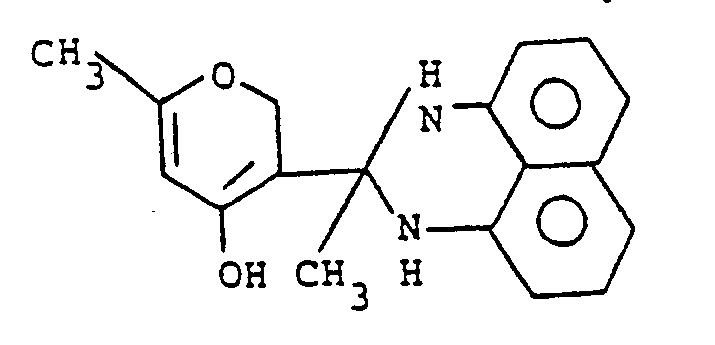
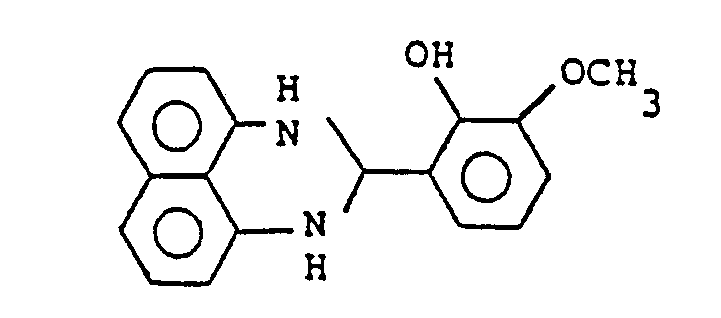
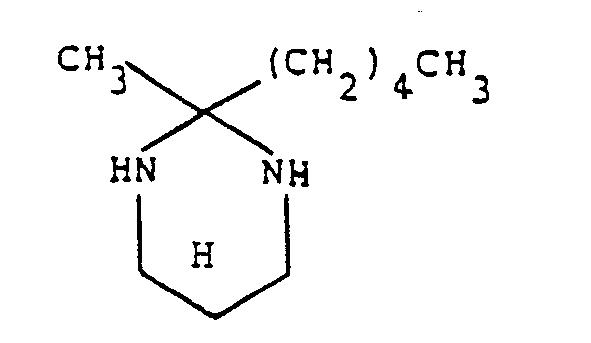
- The present invention provides novel heterocyclic compounds which are represented by either of the general formulae (I) or (II)

- R represents alkyl of 1-20 carbon atoms, which may be branched or unbranched; -COOH; or phenyl which may be unsubstituted or substituted with -OH or alkoxy of 1-5 carbon atoms, and
- R1 and R2 independently represent alkyl of 1-20 carbon atoms which may be branched or unbranched, or phenyl; or
- R1 and R2 may together form a cycloaliphatic ring; or R1 and R2 may together form an O-heterocyclic ring which may be substituted with alkyl of 1-5 carbon atoms, -OH, or wherein R, R1 and R2 are independently selected from the group consisting of


- It is common knowledge that amines react with ketones to form Schiff's bases or ketamines, e.g.,

- In contrast thereto according to the present process novel heterocyclic compounds are produced by heating at least one aromatic or aliphatic polyamine compound with at least one carbonyl containing compound while maintaining the carbonyl to diamine ratio at 1:1 or in slight excess of the carbonyl compound, wherein the aromatic or aliphatic polyamine compound is selected from aliphatic polyamines having 2-20 carbon atoms corresponding to the formula (III)


- Examples of such aldehydes are terephtalaldehyde, glyoxal, glutaraldehyde, glycoxylic acid, salicylaldehyde, vanillin and o-vanillin and heptaldehyde.
- Examples of such ketones are 2,4-pentanedione; 2,3-butanedione; benzil; 1,3-cydohexanedione; acetone; 2-butanone; 2-heptanone; dehydroacetic acid and acetophenone.
- A suitable polyamine of the formula:

- The heterocyclic diamine adducts of this invention may be prepared by reacting the corresponding polyamine compound having at least two amine groups, with the corresponding aldehyde or ketone at a temperature between room temperature and about 250°F, (727°C), for convenience higher temperatures are preferred for increased speed of reaction, most preferably, at reflux temperature of the particular reaction mixture.
- Any inert solvent, which will dissolve the reaction components can be used, for examples, alcohols such as ethanol or conventional industrial solvents such as methyl cellusolve.
- A catalyst may be present so as to increase the reaction rate. Any acid may be used, e.g. mineral acids such as hydrochloric acid or sulfuric acid and organic acids such as benzene disulfonic acid or p-toluenesulfonic acid.
- The heterocyclic diamine adduct may be recovered from the reaction mixture by cooling the same and recovering the precipitated product and then washing and/or drying the same. Alternatively, the reaction mixture may be drowned in water, the precipitated reaction product recovered by filtration and then washing and drying the precipitate. Advantageously, the heterocyclic diamine adduct may be produced as a solution by adding excess carbonyl-containing compound upon completion of the reaction.
- Mixtures of polyamine compounds, mixtures of aldehydes, mixtures of ketones and/or mixtures of aldehydes, and ketones may be used in the reaction to advantageously vary the properties of the heterocyclic diamine adduct.
- Particularly preferred diamine adducts are those produced from 1,8-diamino-naphthalene and 1,3-diamino-propane.
- The novel heterocyclic diamine adducts of this invention find particular use as curative agents in curable resin compositions. In particular, any resin reactive with an active hydrogen atom can be cured by the novel diamine adducts. Illustrative of such resins are the epoxy resins, phenolics, bismaleimide resins, isocyanates. Of particular importance are the epoxy resins.
- Epoxy resins are compounds which contain an oxygen atom connected to two adjacent carbon atoms. A variety of epoxy resins are known and commercially available. Among the important groups of epoxy resins are those based on bisphenol A (4,4'-isopropylidene diphenol) and epichlorohydrin, novolacs and epichlorhydrin, aliphatic diepoxy ethers, aliphatic diepoxy esters, cycloaliphatic diepoxides, and 4,4'- methane dianiline and epichlorohydrin.
- Epoxy resins of the type of diglycidyl ethers of bisphenol A are most easily available under trade names of Epon 828, Epon 1001, Epon 1002, Epon 1004, Epon 1007 from Shell Chemical Co. They are also available from Dow Chemical Co. with DER 331 as an example, or from Ciba Products Co. with Araldite 6010 as an example, or Celanese Epi Rez with Epi Rez 510 as an example. Their chemical structure corresponds to the formula:

- Novolac type epoxy resins are obtained by reacting novolacs, which are reaction products of phenol and formaldehyde, with epichlorohydrin and correspond to the general formula:


- Aliphatic ether type epoxy resins are of the general formula:

- Cycloaliphatic type epoxy resins are those which contain oxygen atom attached to two adjacent carbon atoms which are part of ring containing other carbon, nitrogen and sulfur atoms. Examples of cycloaliphatic type epoxy resins are bis (2,3-epoxycyclohexanol) adipate and bis (2,3-epoxycyclopentyl) ether. A commercially available cycloaliphatic epoxy resin CY 178 from Ciba Products Co. is bis (2,3 epoxy -4- methylcyclohexanol) adipate.
- An epoxy resin of the type of tetraglycidyl methane diamiline is available from Ciba Geigy under the trade name MY 720 and corresponds to the formula:

- Epoxy resins can also be prepared by copolymerization of unsaturated epoxy compounds such as glycidyl methacrylate with other vinyl monomers. The copolymerization conditions can be controlled to obtain polymers of widely different molecular weight, e.g., 2,000 to 100,000. Such vinyl polymerization techniques are well-known and conventional. The epoxy content of the copolymers can be controlled by using an appropriate amount of vinyl epoxy monomer, e.g., glycidyl methacrylate, relative to the amount of other monomer or monomers used. The curable compositions of the present invention comprise a resin reactive with an active hydrogen atom, e.g., an epoxy resin, and the heterocyclic multifunctional amine adduct of this invention. The heterocyclic multifunctional amine adduct can be used in any amount in the curable composition, however, it is preferred to have a ratio of hydrogen equivalents of the adduct to reactive sites of the resin of 0.1-1.0, most preferably, the stoichiometric ratio or slightly thereunder. Additionally, mixtures of heterocyclic diamine adducts can be used as well as mixtures of resins, bearing in mind the desired stoichiometric ratio of active hydrogens and reactive sites.
- Other ingredients may be included in the curable composition to advantageously influence the properties thereof.
- A surfactant may be added, in amounts conventional in the art, to reduce the surface tension of the mixture. Illustrative of such surfactants are the siloxane-oxyalkylene block copolymers and vinyl silane- oxyalkylene graft copolymers and Triton X100 (Rohm & Haas -an octylphenoxy polyethoxyphenol surfactant).
- A thixotropic agent may be added, in amounts conventional in the art, to control composition viscosity. The thixotropes may also function as fillers or extenders. Illustrative of such materials are mica, calcium carbonate, calcium phosphate, silica, glass, metal oxides, cellulose, starch, clays and diatomaceous earth.
- Suitable catalysts may also be added, in conventional amounts, to provide a controlled and predictable composition cure rate. Catalysts can be from the family of latent hardeners such as boron trihalide complexes and dicyandiamide.
- In addition, flexibilizing agents or elastomeric compounds, which may precipitate out as a second phase, may be incorporated into the composition to impart viscosity control along with producing increased toughness in the cured composition and thus inhibit fatigue and crack propagation. Illustrative of such flexibilizers or elastomers are acrylonitrile-butadiene copolymers, urethane elastomers and thermoplastic polymers, in general.
- Curing of the composition is achieved by exposing the composition to sufficient energy to cause curing or cross-linking. The energy source may be heat or high energy radiation such as microwave radiation. Typically the composition is brought to a temperature of 350°F (177°C) or higher for 1 hour or more. Conventional post-cure treatments are also applicable to the composition of this invention.
- Prior to curing or cross-linking, the curable composition can be applied to a reinforcing material. Such reinforcing materials may be in the form of woven, knitted or unidirectional parallel threads; filaments; yarns; or unwoven fibers made from either continuous or staple fibers. These reinforcements can be of organic or inorganic origin. Illustrative of such reinforcements are cotton, paper, fiberglass, polyesters, polyaramids, polyolefins, graphite, ceramics, metals and metal derivatives. Such reinforced compositions can be assembled as laminae to form a composite article which is subsequently cured. The resin composition can be applied to such reinforcements by techniques conventional in the art such as inpregnation, curtain coating, doctoring hot metal extrusion or callendering.
- Having generally described this invention, a further understanding can be obtained by reference to certain specific examples which are provided herein for purposes of illustration.
-

- Into a flask, equipped with a stirrer, reflux condenser, thermometer well and addition port, is placed 152.8 grams (about a 6% excess) of methyl ethyl ketone and 0.8 gram of p-toluenesulfonic acid. The solution is stirred and 158.2 grams of 1,8-diamino-naphthalene is added over 30 minutes with sufficient cooling to allow the temperature to reach reflux (176°F, 80°C) at the end of the addition. The solution is then refluxed an additional 30 minutes. The yield is essentially quantitative. The reaction product may be isolated neat by evaporating off the excess methyl ethyl ketone and water, or it may be diluted further with acetone or more methyl ethyl ketone, mixed with other ingredients and used in a solvent coating application.
-

- Into a beaker equipped with a stirrer and thermomenter is placed 1,000 ml of methyl cellusolve, 84.8 grams of terephthalaldehyde and 200 grams of 1,8-diaminonaphthalene. The mixture is heated and stirred to about 175°F (80°C) where a solution occurs. Then 0.4 gram of p-toluenesulfonic acid is added and stirring and heating are continued at 200-240°F (93-116°C) for H hours during which time the product precipitates out. The mixture is cooled, drowned into 3-4 times the volume of water, collected and dried in a 230°F (110°C) oven. The recovery is 244 gram (93% yield).
-

- Into a flash, equipped with a stirrer, reflux condenser, thermometer well and addition port, is placed 66.7 grams 2,4-pentanedione and 1.0 gram of p-toluenesulfonic acid. 200 grams 1,8-diamino-naphthalene are added and the mixture is refluxed (pot temperature about 100°C) and stirred for 2) hours. It is then poured hot into trays and dried overnight at 230°F (110°C) to remove water and excess dione. The yield is essentially quantitative.
-

- Into a flask, equipped with a stirrer, reflux condenser and addition port, is placed 58.1 grams of acetone and 0.3 gram of p-toluenesulfonic acid. 74.1 grams of 1,3-diamino-propane is added over 20 minutes with sufficient cooling such that the solution is at reflux (about 106°) at the end of the addition. The solution is refluxed an additional Is hours. The yield is essentially quantitative. Water contained in the product may be removed by distillation, if necessary.
-

- 600 ml of acetone, 1 gram of paratoluenesulfonic acid and 200 grams of 1,2-diamino-benzene are stirred at reflux for 4 hours, cooled, drowned in 2,500 ml of water, and the solid is collected and dried in a 180°F (82°C) oven. The yield is essentially quantitative.
- In a similar manner, the following reaction products were prepared from the indicated components.


- 66 grams of MY 720 (N,N,N',N'-tetraglycidyl-4,4'-diaminodiphenyl methane, made by Ciba Geigy Corp.) is heated to about 140°F (60°C) and 38.6 grams of the reaction product produced according to Example 3 is mixed in thoroughly by stirring. The mixture is cooled to below 120°F (49°C) and 1 gram of dicyandiamide (product of American Cyanamid) is mixed in. The mixture is roller milled and the resulting hot meltable resin system which is 100% solids (contains no volatiles) is coated on 7781 style woven glass, by conventional techniques, made into a 10 ply laminate and vacuum bag autoclave cured for H hours at 350°F (177°C) by conventional techniques. No post cure was given. The following were the properties of the laminate:

- The uncured preimpregnated material had good initial tack and drape and retained it for at least 10 days storage at room temperature.
- 16 grams of the reaction product, according to Example 1, is made by heating 11.9 grams of 1,8-diaminonaphthalene, .06 gram of p-toluenesulfonic acid and 339 grams of methyl ethyl ketone at near reflux for 30 minutes. The solution is cooled to under 140°F (60°C) and the following are added with stirring:

- The mixture is ball milled 2 hours, and results in a resin mixture of about 50% solids. 7781 style woven glass and Thornel T300 3K 12s by 12: square weave woven graphite cloth strips are solution coated with this resin using conventional techniques and the solvent is flashed off for 10 minutes at 190°F (88°C) in a circulating air oven. The resin pick-up is about 35% and 37%, respectively. These are made into laminates and vacuum bag autoclave cured for


- The uncured preimpregnated material had good initial tack and drape and retained it for at least 10 days storage at room temperature.
- This is the same resin system in Example 23, only a hot meltable version thereof, i.e. 100% solids- no volatiles. Warm together to about 140°F:


- The uncured preimpregnated material had good initial tack and drape and retained it for at least 10 days storage at room temperature.
-

- that is, the reaction product of 1,8-diamino-naphthalene with acetone, produced by the same procedure as in Example 1 only substituting acetone in place of methylethylketone, 30.5 grams of ERL 4206 (a cycloaliphatic epoxy made by Union Carbide), and 41.2 grams of 4,4'-bismaleimidodiplenylmethane are stirred and heated at 260°F (127°C) for 20 minutes. A flinear prepolymer is formed from the maleimide and the reaction product of the 1,8-diaminonaphthalene with acetone and the reaction progress is monitored by High Pressure Liquid Chromatography as the reaction product peak disappears. The resin is cooled to about 150°F (66°C) and 20 grams of additional 4,4'-bismaleimidodiphenylmethane and 8 grams of the reaction product according to Example 2 were mixed in, followed by 0.4 gram of dicumyl peroxide at under 120°F (49°C). The mixture was roller milled thoroughly. This resin was hot melt coated on to 7781 style woven glass and Thornel T300 3K 12s by 12s square weave woven graphite, made into laminates, given a 2 hr., 375°F (190°C) vacuum bag autoclave cure, using conventional techniques, followed by a free standing 16 hr, 500°F (260°C) post cure for the woven graphite laminate and a 4 hr, 475°F (246°C) post cure for the glass laminate. The following were the laminate properties:

- Having now fully described this invention, it will be apparent to one of ordinary skill in the art that many changes and modifications can be made thereto without departing from the spirit or scope of the invention set forth herein.
Claims (13)









Priority Applications (1)
| Application Number | Priority Date | Filing Date | Title |
|---|---|---|---|
| AT82106629T ATE31303T1 (en) | 1981-07-27 | 1982-07-22 | HETEROCYCLIC MULTIFUNCTIONAL AMINE ADUCT AND CURABLE COMPOSITIONS CONTAINING THEM. |
Applications Claiming Priority (2)
| Application Number | Priority Date | Filing Date | Title |
|---|---|---|---|
| US286897 | 1981-07-27 | ||
| US06/286,897 US4427802A (en) | 1981-07-27 | 1981-07-27 | Heterocyclic multifunctional amine adducts and curable compositions containing the same |
Publications (2)
| Publication Number | Publication Date |
|---|---|
| EP0071197A1 EP0071197A1 (en) | 1983-02-09 |
| EP0071197B1 true EP0071197B1 (en) | 1987-12-09 |
Family
ID=23100637
Family Applications (1)
| Application Number | Title | Priority Date | Filing Date |
|---|---|---|---|
| EP82106629A Expired EP0071197B1 (en) | 1981-07-27 | 1982-07-22 | Heterocyclic multifunctional amine adducts and curable compositions containing the same |
Country Status (5)
| Country | Link |
|---|---|
| US (1) | US4427802A (en) |
| EP (1) | EP0071197B1 (en) |
| JP (2) | JPS5865716A (en) |
| AT (1) | ATE31303T1 (en) |
| DE (1) | DE3277813D1 (en) |
Families Citing this family (25)
| Publication number | Priority date | Publication date | Assignee | Title |
|---|---|---|---|---|
| US4427802A (en) * | 1981-07-27 | 1984-01-24 | Hexcel Corporation | Heterocyclic multifunctional amine adducts and curable compositions containing the same |
| US4636535A (en) * | 1983-08-01 | 1987-01-13 | American Cyanamid Company | Curable epoxy resin compositions |
| US4572870A (en) * | 1984-08-09 | 1986-02-25 | E. I. Du Pont De Nemours And Company | Chlorosulfonated ethylene vinyl acetate polymer coating composition |
| GB8521845D0 (en) * | 1985-09-03 | 1985-10-09 | Permabond Adhesives | Initiator compositions |
| US5264525A (en) * | 1986-08-28 | 1993-11-23 | National Starch And Chemical Investment Holding Corporation | Initiator compositions for two part acrylic adhesives |
| US4861832A (en) * | 1988-04-04 | 1989-08-29 | Lord Corporation | Flexible epoxy film from an epoxy resin reacted with a ketimine/amine terminated butadiene/acrylonitrile copolymer blend |
| EP0417043A3 (en) * | 1989-09-07 | 1992-09-30 | Ciba-Geigy Ag | Curing agents and accelerators for epoxy- and isocyanate resins |
| DE4434165A1 (en) * | 1994-09-24 | 1996-03-28 | Cassella Ag | Hair dye |
| US5464702A (en) * | 1994-10-07 | 1995-11-07 | Ciba-Geigy Corporation | High performance epoxy resin systems containing trimethylquinoline oligomers |
| GB2332202A (en) * | 1997-12-09 | 1999-06-16 | Courtaulds Coatings | Curable epoxy resin compositions |
| US6261675B1 (en) | 1999-03-23 | 2001-07-17 | Hexcel Corporation | Core-crush resistant fabric and prepreg for fiber reinforced composite sandwich structures |
| US6599632B1 (en) | 2001-04-18 | 2003-07-29 | Edge Structural Composites, Llc | Composite system and method for reinforcement of existing structures |
| US6489414B1 (en) * | 2001-06-06 | 2002-12-03 | Equistar Chemicals, Lp | Chelating pyrimidines as ligands for single-site olefin polymerization catalysts |
| GB2389581A (en) * | 2002-06-12 | 2003-12-17 | Viaxxel Biotech Gmbh | Hydrogenated pyrimidines and their use as inhibitors of deoxyhypusine-synthase or hypusination of eIF-5A |
| US7008555B2 (en) * | 2003-05-22 | 2006-03-07 | Applied Poleramic Inc. | Epoxy resin curing agents and epoxy resin compositions |
| JP4831980B2 (en) * | 2005-02-25 | 2011-12-07 | 富士フイルム株式会社 | Cellulose ester film, polarizing plate, liquid crystal display device, and method for producing cellulose ester film |
| US20080160219A1 (en) * | 2005-02-25 | 2008-07-03 | Fujifilm Corporation | Cellulose Ester Film. Polarizing Plate and Liquid-Crystal Display Device |
| GB201004940D0 (en) | 2010-03-24 | 2010-05-12 | Hexcel Composites Ltd | Novel curing agents |
| EP4464193A3 (en) | 2017-10-27 | 2025-01-22 | Nike Innovate C.V. | Articles of footwear including a coated bladder |
| EP4353465A3 (en) | 2019-02-27 | 2024-07-31 | Nike Innovate C.V. | An article of footwear comprising a bladder having a printed layer |
| EP3924431B1 (en) | 2019-03-18 | 2022-07-06 | Nike Innovate C.V. | Colorant solvent system, methods of use, and articles |
| JP7682178B2 (en) | 2019-12-10 | 2025-05-23 | ハンツマン・アドバンスド・マテリアルズ・アメリカズ・エルエルシー | CURABLE RESIN COMPOSITIONS CONTAINING ALIPHATIC POLYKETONE Tougheners AND COMPOSITES MADE THEREFROM - Patent application |
| DE112021003032A5 (en) * | 2020-05-29 | 2023-03-16 | Technische Universität Bergakademie Freiberg | Perimidine derivatives and their use |
| CN114195966A (en) * | 2021-11-24 | 2022-03-18 | 大连理工大学 | Porous polyketal amine with large specific surface area and preparation method and application thereof |
| CN115557899B (en) * | 2022-09-30 | 2024-03-08 | 福州大学 | Epoxy resin curing accelerator and preparation method thereof |
Citations (1)
| Publication number | Priority date | Publication date | Assignee | Title |
|---|---|---|---|---|
| US3032526A (en) * | 1958-07-07 | 1962-05-01 | Gen Aniline & Film Corp | Condensation product of m-phenylenediamine and a dialkyl ketone epoxy resin composition containing same, and process of curing |
Family Cites Families (20)
| Publication number | Priority date | Publication date | Assignee | Title |
|---|---|---|---|---|
| CA749989A (en) | 1967-01-03 | T. Holm Roy | Process for curing polyepoxides and compositions | |
| DE1495175A1 (en) * | 1964-04-28 | 1968-12-12 | Brueggemann Kg Sprit U Chem Fa | Process for the cold curing of epoxy resin precursors |
| DE1814832B2 (en) * | 1968-12-14 | 1979-02-08 | Bayer Ag, 5090 Leverkusen | Process for the preparation of ketimines containing hydroxymethyl groups |
| US3600362A (en) * | 1969-06-12 | 1971-08-17 | Furane Plastics | Epoxy resin cured with liquid resinous amine curing agents |
| NL7114237A (en) * | 1970-10-23 | 1972-04-25 | ||
| US3950451A (en) | 1971-02-27 | 1976-04-13 | Asahi Denka Kogyo K.K. | Hardenable epoxy resin composition |
| US3907623A (en) | 1973-04-04 | 1975-09-23 | Ppg Industries Inc | Polymer curing system |
| CH597200A5 (en) * | 1974-10-31 | 1978-03-31 | Ciba Geigy Ag | |
| US4017438A (en) | 1974-12-16 | 1977-04-12 | Ppg Industries, Inc. | Ketimine-blocked primary amine group-containing cationic electrodepositable resins |
| CA1111598A (en) | 1976-01-14 | 1981-10-27 | Joseph R. Marchetti | Amine acide salt-containing polymers for cationic electrodeposition |
| US4101497A (en) | 1976-12-03 | 1978-07-18 | The United States Of America As Represented By The Secretary Of The Navy | Sealant-primer coating |
| DE2654871C3 (en) | 1976-12-03 | 1984-10-04 | Schering AG, 1000 Berlin und 4709 Bergkamen | Polyvinyl chloride plastisols with improved adhesion |
| GB1584296A (en) * | 1976-12-07 | 1981-02-11 | Kanebo Ltd | 2-substituted benzimidazole compounds |
| US4087413A (en) * | 1977-03-07 | 1978-05-02 | The Dow Chemical Company | Crosslinked, linear, acylated polyalkylenepolyamines and process therefor |
| US4195152A (en) | 1977-08-01 | 1980-03-25 | Henkel Corporation | N-Alkyl polyamines and curing of epoxy resins therewith |
| DE2739313A1 (en) * | 1977-09-01 | 1979-03-15 | Bayer Ag | CYCLOAMINALE, A PROCESS FOR THEIR MANUFACTURING AND THEIR USE |
| US4148950A (en) | 1978-04-07 | 1979-04-10 | Ameron, Inc. | Epoxy surfacer cements containing polyamine-ketimine mixtures |
| DE2922176C3 (en) | 1979-05-31 | 1995-11-09 | Akzo Gmbh | Water-curable polyisocyanate or polyepoxide mixtures |
| US4427802A (en) * | 1981-07-27 | 1984-01-24 | Hexcel Corporation | Heterocyclic multifunctional amine adducts and curable compositions containing the same |
| US4599413A (en) * | 1981-07-27 | 1986-07-08 | Hexcel Corporation | Perimidene and benzimidazole derivatives useful in curable compositions |
-
1981
- 1981-07-27 US US06/286,897 patent/US4427802A/en not_active Expired - Lifetime
-
1982
- 1982-07-22 DE DE8282106629T patent/DE3277813D1/en not_active Expired
- 1982-07-22 AT AT82106629T patent/ATE31303T1/en not_active IP Right Cessation
- 1982-07-22 EP EP82106629A patent/EP0071197B1/en not_active Expired
- 1982-07-27 JP JP57131082A patent/JPS5865716A/en active Granted
-
1990
- 1990-05-28 JP JP2138157A patent/JPH0320366A/en active Granted
Patent Citations (1)
| Publication number | Priority date | Publication date | Assignee | Title |
|---|---|---|---|---|
| US3032526A (en) * | 1958-07-07 | 1962-05-01 | Gen Aniline & Film Corp | Condensation product of m-phenylenediamine and a dialkyl ketone epoxy resin composition containing same, and process of curing |
Also Published As
| Publication number | Publication date |
|---|---|
| EP0071197A1 (en) | 1983-02-09 |
| JPH05423B2 (en) | 1993-01-05 |
| ATE31303T1 (en) | 1987-12-15 |
| DE3277813D1 (en) | 1988-01-21 |
| JPS5865716A (en) | 1983-04-19 |
| US4427802A (en) | 1984-01-24 |
| JPH0320366A (en) | 1991-01-29 |
| JPH0427981B2 (en) | 1992-05-13 |
Similar Documents
| Publication | Publication Date | Title |
|---|---|---|
| US4427802A (en) | Heterocyclic multifunctional amine adducts and curable compositions containing the same | |
| US4510272A (en) | Bis-maleimide-epoxy compositions and prepregs | |
| US4517321A (en) | Preimpregnated reinforcements and high strength composites therefrom | |
| US4691025A (en) | Bismaleimides and prepreg resins therefrom | |
| EP0253600B1 (en) | Bismaleimide formulations containing olefinic ether modifiers | |
| US4661559A (en) | Impact resistant matrix resins for advanced composites | |
| US4414269A (en) | Solvent resistant polysulfone and polyethersulfone compositions | |
| US4661604A (en) | Monofunctional crosslinking imidophenols | |
| EP0379468B1 (en) | Curable epoxy resin composition containing a thermoplastic resin having phenolic end groups | |
| AU592965B2 (en) | Curable epoxy resin compositions | |
| JPS60155223A (en) | Thermoplastic modified epoxy composition | |
| US4362860A (en) | Addition curing polystyryl pyridine | |
| US4599413A (en) | Perimidene and benzimidazole derivatives useful in curable compositions | |
| US4760106A (en) | Impact resistant matrix resins for advanced composites | |
| US4876325A (en) | Polyimide resin from bis-imide, polyphenol and dicyandiamide | |
| US4756954A (en) | Epoxy resin laminating varnish and laminates prepared therefrom | |
| EP0133281A2 (en) | Curable fibre reinforced epoxy resin composition | |
| JP2709731B2 (en) | Epoxy resin composed of aromatic diamine curing agent | |
| CA2034969A1 (en) | Process for preparing thermoset composite articles | |
| US3914512A (en) | Polyepoxy resin-diaryl dianhydride laminating resins and laminates | |
| US5244719A (en) | Prepreg with improved room temperature storage stability | |
| JPS6017288B2 (en) | Heat-resistant epoxy resin composition | |
| US3301814A (en) | Process for curing polyepoxides with substituted phthalocyanines and resulting products | |
| US3219515A (en) | Adhesive compositions and preparation thereof | |
| JPH072975A (en) | Epoxy resin composition and prepreg |
Legal Events
| Date | Code | Title | Description |
|---|---|---|---|
| PUAI | Public reference made under article 153(3) epc to a published international application that has entered the european phase |
Free format text: ORIGINAL CODE: 0009012 |
|
| AK | Designated contracting states |
Designated state(s): AT BE CH DE FR GB IT LI LU NL SE |
|
| 17P | Request for examination filed |
Effective date: 19830628 |
|
| GRAA | (expected) grant |
Free format text: ORIGINAL CODE: 0009210 |
|
| ITF | It: translation for a ep patent filed | ||
| AK | Designated contracting states |
Kind code of ref document: B1 Designated state(s): AT BE CH DE FR GB IT LI LU NL SE |
|
| REF | Corresponds to: |
Ref document number: 31303 Country of ref document: AT Date of ref document: 19871215 Kind code of ref document: T |
|
| REF | Corresponds to: |
Ref document number: 3277813 Country of ref document: DE Date of ref document: 19880121 |
|
| ET | Fr: translation filed | ||
| PLBE | No opposition filed within time limit |
Free format text: ORIGINAL CODE: 0009261 |
|
| STAA | Information on the status of an ep patent application or granted ep patent |
Free format text: STATUS: NO OPPOSITION FILED WITHIN TIME LIMIT |
|
| 26N | No opposition filed | ||
| ITTA | It: last paid annual fee | ||
| EPTA | Lu: last paid annual fee | ||
| EAL | Se: european patent in force in sweden |
Ref document number: 82106629.7 |
|
| PGFP | Annual fee paid to national office [announced via postgrant information from national office to epo] |
Ref country code: GB Payment date: 19980818 Year of fee payment: 17 |
|
| PGFP | Annual fee paid to national office [announced via postgrant information from national office to epo] |
Ref country code: NL Payment date: 19980819 Year of fee payment: 17 |
|
| PGFP | Annual fee paid to national office [announced via postgrant information from national office to epo] |
Ref country code: SE Payment date: 19980820 Year of fee payment: 17 Ref country code: FR Payment date: 19980820 Year of fee payment: 17 |
|
| PGFP | Annual fee paid to national office [announced via postgrant information from national office to epo] |
Ref country code: BE Payment date: 19980828 Year of fee payment: 17 |
|
| PGFP | Annual fee paid to national office [announced via postgrant information from national office to epo] |
Ref country code: LU Payment date: 19980903 Year of fee payment: 17 |
|
| PGFP | Annual fee paid to national office [announced via postgrant information from national office to epo] |
Ref country code: AT Payment date: 19980916 Year of fee payment: 17 |
|
| PGFP | Annual fee paid to national office [announced via postgrant information from national office to epo] |
Ref country code: CH Payment date: 19980923 Year of fee payment: 17 |
|
| PGFP | Annual fee paid to national office [announced via postgrant information from national office to epo] |
Ref country code: DE Payment date: 19980928 Year of fee payment: 17 |
|
| PG25 | Lapsed in a contracting state [announced via postgrant information from national office to epo] |
Ref country code: LU Free format text: LAPSE BECAUSE OF NON-PAYMENT OF DUE FEES Effective date: 19990722 Ref country code: GB Free format text: LAPSE BECAUSE OF NON-PAYMENT OF DUE FEES Effective date: 19990722 Ref country code: AT Free format text: LAPSE BECAUSE OF NON-PAYMENT OF DUE FEES Effective date: 19990722 |
|
| PG25 | Lapsed in a contracting state [announced via postgrant information from national office to epo] |
Ref country code: SE Free format text: THE PATENT HAS BEEN ANNULLED BY A DECISION OF A NATIONAL AUTHORITY Effective date: 19990730 |
|
| PG25 | Lapsed in a contracting state [announced via postgrant information from national office to epo] |
Ref country code: LI Free format text: LAPSE BECAUSE OF NON-PAYMENT OF DUE FEES Effective date: 19990731 Ref country code: FR Free format text: THE PATENT HAS BEEN ANNULLED BY A DECISION OF A NATIONAL AUTHORITY Effective date: 19990731 Ref country code: CH Free format text: LAPSE BECAUSE OF NON-PAYMENT OF DUE FEES Effective date: 19990731 Ref country code: BE Free format text: LAPSE BECAUSE OF NON-PAYMENT OF DUE FEES Effective date: 19990731 |
|
| BERE | Be: lapsed |
Owner name: HEXCEL CORP. Effective date: 19990731 |
|
| PG25 | Lapsed in a contracting state [announced via postgrant information from national office to epo] |
Ref country code: NL Free format text: LAPSE BECAUSE OF NON-PAYMENT OF DUE FEES Effective date: 20000201 |
|
| GBPC | Gb: european patent ceased through non-payment of renewal fee |
Effective date: 19990722 |
|
| REG | Reference to a national code |
Ref country code: CH Ref legal event code: PL |
|
| EUG | Se: european patent has lapsed |
Ref document number: 82106629.7 |
|
| NLV4 | Nl: lapsed or anulled due to non-payment of the annual fee |
Effective date: 20000201 |
|
| PG25 | Lapsed in a contracting state [announced via postgrant information from national office to epo] |
Ref country code: DE Free format text: LAPSE BECAUSE OF NON-PAYMENT OF DUE FEES Effective date: 20000503 |
|
| REG | Reference to a national code |
Ref country code: FR Ref legal event code: ST |