EP0068876B1 - Oxoindolizine and oxoindolizinium dyes and processes for their preparation - Google Patents
Oxoindolizine and oxoindolizinium dyes and processes for their preparation Download PDFInfo
- Publication number
- EP0068876B1 EP0068876B1 EP82303381A EP82303381A EP0068876B1 EP 0068876 B1 EP0068876 B1 EP 0068876B1 EP 82303381 A EP82303381 A EP 82303381A EP 82303381 A EP82303381 A EP 82303381A EP 0068876 B1 EP0068876 B1 EP 0068876B1
- Authority
- EP
- European Patent Office
- Prior art keywords
- carbon atoms
- hydrogen
- alkyl
- bromine
- chlorine
- Prior art date
- Legal status (The legal status is an assumption and is not a legal conclusion. Google has not performed a legal analysis and makes no representation as to the accuracy of the status listed.)
- Expired
Links
- 238000000034 method Methods 0.000 title claims description 15
- 239000000975 dye Substances 0.000 title description 117
- 238000002360 preparation method Methods 0.000 title description 17
- 230000008569 process Effects 0.000 title description 2
- 125000004432 carbon atom Chemical group C* 0.000 claims description 280
- -1 pyridine compound Chemical class 0.000 claims description 167
- 125000000217 alkyl group Chemical group 0.000 claims description 96
- 239000001257 hydrogen Substances 0.000 claims description 61
- 229910052739 hydrogen Inorganic materials 0.000 claims description 61
- 125000003118 aryl group Chemical group 0.000 claims description 52
- JUJWROOIHBZHMG-UHFFFAOYSA-N pyridine Substances C1=CC=NC=C1 JUJWROOIHBZHMG-UHFFFAOYSA-N 0.000 claims description 44
- 150000001875 compounds Chemical class 0.000 claims description 40
- 125000003917 carbamoyl group Chemical group [H]N([H])C(*)=O 0.000 claims description 36
- WKBOTKDWSSQWDR-UHFFFAOYSA-N Bromine atom Chemical compound [Br] WKBOTKDWSSQWDR-UHFFFAOYSA-N 0.000 claims description 34
- ZAMOUSCENKQFHK-UHFFFAOYSA-N Chlorine atom Chemical compound [Cl] ZAMOUSCENKQFHK-UHFFFAOYSA-N 0.000 claims description 34
- GDTBXPJZTBHREO-UHFFFAOYSA-N bromine Substances BrBr GDTBXPJZTBHREO-UHFFFAOYSA-N 0.000 claims description 34
- 229910052794 bromium Inorganic materials 0.000 claims description 34
- 239000000460 chlorine Substances 0.000 claims description 34
- 229910052801 chlorine Inorganic materials 0.000 claims description 34
- UMJSCPRVCHMLSP-UHFFFAOYSA-N pyridine Natural products COC1=CC=CN=C1 UMJSCPRVCHMLSP-UHFFFAOYSA-N 0.000 claims description 34
- UFHFLCQGNIYNRP-UHFFFAOYSA-N Hydrogen Chemical compound [H][H] UFHFLCQGNIYNRP-UHFFFAOYSA-N 0.000 claims description 31
- 125000001424 substituent group Chemical group 0.000 claims description 31
- 125000004093 cyano group Chemical group *C#N 0.000 claims description 29
- 125000002252 acyl group Chemical group 0.000 claims description 27
- 125000004435 hydrogen atom Chemical group [H]* 0.000 claims description 23
- 125000003545 alkoxy group Chemical group 0.000 claims description 21
- 125000004423 acyloxy group Chemical group 0.000 claims description 20
- HOBCFUWDNJPFHB-UHFFFAOYSA-N indolizine Chemical compound C1=CC=CN2C=CC=C21 HOBCFUWDNJPFHB-UHFFFAOYSA-N 0.000 claims description 20
- 229910052736 halogen Inorganic materials 0.000 claims description 16
- 150000002367 halogens Chemical class 0.000 claims description 16
- 150000001450 anions Chemical class 0.000 claims description 13
- 125000002924 primary amino group Chemical group [H]N([H])* 0.000 claims description 11
- 125000004122 cyclic group Chemical group 0.000 claims description 9
- 125000004429 atom Chemical group 0.000 claims description 8
- 125000004397 aminosulfonyl group Chemical group NS(=O)(=O)* 0.000 claims description 7
- 125000005518 carboxamido group Chemical group 0.000 claims description 7
- 229910052757 nitrogen Inorganic materials 0.000 claims description 7
- 125000004076 pyridyl group Chemical group 0.000 claims description 7
- 125000005420 sulfonamido group Chemical group S(=O)(=O)(N*)* 0.000 claims description 6
- 239000007800 oxidant agent Substances 0.000 claims description 5
- 230000001590 oxidative effect Effects 0.000 claims description 5
- 125000001797 benzyl group Chemical group [H]C1=C([H])C([H])=C(C([H])=C1[H])C([H])([H])* 0.000 claims description 4
- 239000007795 chemical reaction product Substances 0.000 claims description 4
- 125000005605 benzo group Chemical group 0.000 claims description 3
- 229910052799 carbon Inorganic materials 0.000 claims description 3
- 125000002887 hydroxy group Chemical group [H]O* 0.000 claims description 3
- 150000002478 indolizines Chemical class 0.000 claims 1
- 125000002496 methyl group Chemical group [H]C([H])([H])* 0.000 description 31
- 125000001495 ethyl group Chemical group [H]C([H])([H])C([H])([H])* 0.000 description 28
- 125000001997 phenyl group Chemical group [H]C1=C([H])C([H])=C(*)C([H])=C1[H] 0.000 description 28
- 125000001436 propyl group Chemical group [H]C([*])([H])C([H])([H])C([H])([H])[H] 0.000 description 25
- 238000006243 chemical reaction Methods 0.000 description 24
- 239000011248 coating agent Substances 0.000 description 23
- 238000000576 coating method Methods 0.000 description 23
- 125000003438 dodecyl group Chemical group [H]C([H])([H])C([H])([H])C([H])([H])C([H])([H])C([H])([H])C([H])([H])C([H])([H])C([H])([H])C([H])([H])C([H])([H])C([H])([H])C([H])([H])* 0.000 description 22
- GGRQLKPIJPFWEZ-UHFFFAOYSA-N cycloprop-2-en-1-one Chemical class O=C1C=C1 GGRQLKPIJPFWEZ-UHFFFAOYSA-N 0.000 description 21
- 125000002704 decyl group Chemical group [H]C([H])([H])C([H])([H])C([H])([H])C([H])([H])C([H])([H])C([H])([H])C([H])([H])C([H])([H])C([H])([H])C([H])([H])* 0.000 description 20
- 125000001570 methylene group Chemical group [H]C([H])([*:1])[*:2] 0.000 description 19
- YXFVVABEGXRONW-UHFFFAOYSA-N Toluene Chemical compound CC1=CC=CC=C1 YXFVVABEGXRONW-UHFFFAOYSA-N 0.000 description 18
- 125000001624 naphthyl group Chemical group 0.000 description 18
- 0 *c1cccnc1 Chemical compound *c1cccnc1 0.000 description 16
- 239000002904 solvent Substances 0.000 description 15
- 125000000753 cycloalkyl group Chemical group 0.000 description 14
- ITMCEJHCFYSIIV-UHFFFAOYSA-M triflate Chemical compound [O-]S(=O)(=O)C(F)(F)F ITMCEJHCFYSIIV-UHFFFAOYSA-M 0.000 description 14
- RTZKZFJDLAIYFH-UHFFFAOYSA-N Diethyl ether Chemical compound CCOCC RTZKZFJDLAIYFH-UHFFFAOYSA-N 0.000 description 13
- ISWSIDIOOBJBQZ-UHFFFAOYSA-N phenol group Chemical group C1(=CC=CC=C1)O ISWSIDIOOBJBQZ-UHFFFAOYSA-N 0.000 description 12
- PAYRUJLWNCNPSJ-UHFFFAOYSA-N Aniline Chemical compound NC1=CC=CC=C1 PAYRUJLWNCNPSJ-UHFFFAOYSA-N 0.000 description 11
- 230000002411 adverse Effects 0.000 description 11
- 238000010521 absorption reaction Methods 0.000 description 10
- 125000002777 acetyl group Chemical group [H]C([H])([H])C(*)=O 0.000 description 10
- 230000003287 optical effect Effects 0.000 description 10
- 125000001501 propionyl group Chemical group O=C([*])C([H])([H])C([H])([H])[H] 0.000 description 10
- WFDIJRYMOXRFFG-UHFFFAOYSA-N Acetic anhydride Chemical compound CC(=O)OC(C)=O WFDIJRYMOXRFFG-UHFFFAOYSA-N 0.000 description 9
- SNRUBQQJIBEYMU-UHFFFAOYSA-N Dodecane Natural products CCCCCCCCCCCC SNRUBQQJIBEYMU-UHFFFAOYSA-N 0.000 description 9
- 125000005428 anthryl group Chemical group [H]C1=C([H])C([H])=C2C([H])=C3C(*)=C([H])C([H])=C([H])C3=C([H])C2=C1[H] 0.000 description 9
- 125000000484 butyl group Chemical group [H]C([*])([H])C([H])([H])C([H])([H])C([H])([H])[H] 0.000 description 9
- 150000002431 hydrogen Chemical class 0.000 description 9
- 125000004458 methylaminocarbonyl group Chemical group [H]N(C(*)=O)C([H])([H])[H] 0.000 description 9
- 239000000376 reactant Substances 0.000 description 9
- 239000011541 reaction mixture Substances 0.000 description 9
- HEDRZPFGACZZDS-UHFFFAOYSA-N Chloroform Chemical compound ClC(Cl)Cl HEDRZPFGACZZDS-UHFFFAOYSA-N 0.000 description 8
- 125000000623 heterocyclic group Chemical group 0.000 description 8
- 239000000203 mixture Substances 0.000 description 8
- ZCYVEMRRCGMTRW-UHFFFAOYSA-N 7553-56-2 Chemical compound [I] ZCYVEMRRCGMTRW-UHFFFAOYSA-N 0.000 description 7
- PXGOKWXKJXAPGV-UHFFFAOYSA-N Fluorine Chemical compound FF PXGOKWXKJXAPGV-UHFFFAOYSA-N 0.000 description 7
- 125000004414 alkyl thio group Chemical group 0.000 description 7
- 125000006260 ethylaminocarbonyl group Chemical group [H]N(C(*)=O)C([H])([H])C([H])([H])[H] 0.000 description 7
- 229910052731 fluorine Inorganic materials 0.000 description 7
- 239000011737 fluorine Substances 0.000 description 7
- IJKXJZJLJSCTHE-UHFFFAOYSA-N indolizin-1-ol Chemical class C1=CC=CC2=C(O)C=CN21 IJKXJZJLJSCTHE-UHFFFAOYSA-N 0.000 description 7
- 239000011630 iodine Substances 0.000 description 7
- 229910052740 iodine Inorganic materials 0.000 description 7
- 150000003222 pyridines Chemical class 0.000 description 7
- 125000003944 tolyl group Chemical group 0.000 description 7
- XLYOFNOQVPJJNP-UHFFFAOYSA-N water Substances O XLYOFNOQVPJJNP-UHFFFAOYSA-N 0.000 description 7
- FKNQCJSGGFJEIZ-UHFFFAOYSA-N 4-methylpyridine Chemical compound CC1=CC=NC=C1 FKNQCJSGGFJEIZ-UHFFFAOYSA-N 0.000 description 6
- CSCPPACGZOOCGX-UHFFFAOYSA-N Acetone Chemical compound CC(C)=O CSCPPACGZOOCGX-UHFFFAOYSA-N 0.000 description 6
- 125000003342 alkenyl group Chemical group 0.000 description 6
- 125000004453 alkoxycarbonyl group Chemical group 0.000 description 6
- 150000002085 enols Chemical group 0.000 description 6
- 238000010438 heat treatment Methods 0.000 description 6
- 150000002500 ions Chemical class 0.000 description 6
- 150000003839 salts Chemical class 0.000 description 6
- 125000005023 xylyl group Chemical group 0.000 description 6
- 238000005481 NMR spectroscopy Methods 0.000 description 5
- 239000011230 binding agent Substances 0.000 description 5
- 239000002131 composite material Substances 0.000 description 5
- 125000000468 ketone group Chemical group 0.000 description 5
- 238000004949 mass spectrometry Methods 0.000 description 5
- 125000001434 methanylylidene group Chemical group [H]C#[*] 0.000 description 5
- 239000012429 reaction media Substances 0.000 description 5
- 125000003696 stearoyl group Chemical group O=C([*])C([H])([H])C([H])([H])C([H])([H])C([H])([H])C([H])([H])C([H])([H])C([H])([H])C([H])([H])C([H])([H])C([H])([H])C([H])([H])C([H])([H])C([H])([H])C([H])([H])C([H])([H])C([H])([H])C([H])([H])[H] 0.000 description 5
- 229920003048 styrene butadiene rubber Polymers 0.000 description 5
- NPOLTJNFAQNEAA-UHFFFAOYSA-N 2,3-bis(4-methoxyphenyl)cycloprop-2-en-1-one Chemical compound C1=CC(OC)=CC=C1C(C1=O)=C1C1=CC=C(OC)C=C1 NPOLTJNFAQNEAA-UHFFFAOYSA-N 0.000 description 4
- IJGRMHOSHXDMSA-UHFFFAOYSA-N Atomic nitrogen Chemical compound N#N IJGRMHOSHXDMSA-UHFFFAOYSA-N 0.000 description 4
- ZMXDDKWLCZADIW-UHFFFAOYSA-N N,N-Dimethylformamide Chemical compound CN(C)C=O ZMXDDKWLCZADIW-UHFFFAOYSA-N 0.000 description 4
- NQRYJNQNLNOLGT-UHFFFAOYSA-N Piperidine Chemical compound C1CCNCC1 NQRYJNQNLNOLGT-UHFFFAOYSA-N 0.000 description 4
- 239000002253 acid Substances 0.000 description 4
- 125000005110 aryl thio group Chemical group 0.000 description 4
- 239000003054 catalyst Substances 0.000 description 4
- 238000001914 filtration Methods 0.000 description 4
- XMBWDFGMSWQBCA-UHFFFAOYSA-N hydrogen iodide Chemical compound I XMBWDFGMSWQBCA-UHFFFAOYSA-N 0.000 description 4
- 125000004356 hydroxy functional group Chemical group O* 0.000 description 4
- 238000003384 imaging method Methods 0.000 description 4
- 125000004433 nitrogen atom Chemical group N* 0.000 description 4
- 229920000139 polyethylene terephthalate Polymers 0.000 description 4
- 239000005020 polyethylene terephthalate Substances 0.000 description 4
- 239000000047 product Substances 0.000 description 4
- BGUWFUQJCDRPTL-UHFFFAOYSA-N pyridine-4-carbaldehyde Chemical compound O=CC1=CC=NC=C1 BGUWFUQJCDRPTL-UHFFFAOYSA-N 0.000 description 4
- 238000003756 stirring Methods 0.000 description 4
- HXCKJAPEUYDDNL-UHFFFAOYSA-N 1-hydroxy-2,3-diphenylindolizine-7-carboxylic acid Chemical compound OC1=C2C=C(C(=O)O)C=CN2C(C=2C=CC=CC=2)=C1C1=CC=CC=C1 HXCKJAPEUYDDNL-UHFFFAOYSA-N 0.000 description 3
- XNWFRZJHXBZDAG-UHFFFAOYSA-N 2-METHOXYETHANOL Chemical compound COCCO XNWFRZJHXBZDAG-UHFFFAOYSA-N 0.000 description 3
- CPELXLSAUQHCOX-UHFFFAOYSA-M Bromide Chemical compound [Br-] CPELXLSAUQHCOX-UHFFFAOYSA-M 0.000 description 3
- VEXZGXHMUGYJMC-UHFFFAOYSA-M Chloride anion Chemical compound [Cl-] VEXZGXHMUGYJMC-UHFFFAOYSA-M 0.000 description 3
- YMWUJEATGCHHMB-UHFFFAOYSA-N Dichloromethane Chemical compound ClCCl YMWUJEATGCHHMB-UHFFFAOYSA-N 0.000 description 3
- AFVFQIVMOAPDHO-UHFFFAOYSA-N Methanesulfonic acid Chemical compound CS(O)(=O)=O AFVFQIVMOAPDHO-UHFFFAOYSA-N 0.000 description 3
- JLTDJTHDQAWBAV-UHFFFAOYSA-N N,N-dimethylaniline Chemical compound CN(C)C1=CC=CC=C1 JLTDJTHDQAWBAV-UHFFFAOYSA-N 0.000 description 3
- 125000005236 alkanoylamino group Chemical group 0.000 description 3
- 125000004390 alkyl sulfonyl group Chemical group 0.000 description 3
- 229910052782 aluminium Inorganic materials 0.000 description 3
- XAGFODPZIPBFFR-UHFFFAOYSA-N aluminium Chemical compound [Al] XAGFODPZIPBFFR-UHFFFAOYSA-N 0.000 description 3
- 125000001204 arachidyl group Chemical group [H]C([*])([H])C([H])([H])C([H])([H])C([H])([H])C([H])([H])C([H])([H])C([H])([H])C([H])([H])C([H])([H])C([H])([H])C([H])([H])C([H])([H])C([H])([H])C([H])([H])C([H])([H])C([H])([H])C([H])([H])C([H])([H])C([H])([H])C([H])([H])[H] 0.000 description 3
- QVGXLLKOCUKJST-UHFFFAOYSA-N atomic oxygen Chemical compound [O] QVGXLLKOCUKJST-UHFFFAOYSA-N 0.000 description 3
- 125000004063 butyryl group Chemical group O=C([*])C([H])([H])C([H])([H])C([H])([H])[H] 0.000 description 3
- 125000002915 carbonyl group Chemical group [*:2]C([*:1])=O 0.000 description 3
- OPQARKPSCNTWTJ-UHFFFAOYSA-L copper(ii) acetate Chemical compound [Cu+2].CC([O-])=O.CC([O-])=O OPQARKPSCNTWTJ-UHFFFAOYSA-L 0.000 description 3
- DOUHZFSGSXMPIE-UHFFFAOYSA-N hydroxidooxidosulfur(.) Chemical compound [O]SO DOUHZFSGSXMPIE-UHFFFAOYSA-N 0.000 description 3
- 239000004922 lacquer Substances 0.000 description 3
- 125000000400 lauroyl group Chemical group O=C([*])C([H])([H])C([H])([H])C([H])([H])C([H])([H])C([H])([H])C([H])([H])C([H])([H])C([H])([H])C([H])([H])C([H])([H])C([H])([H])[H] 0.000 description 3
- 238000004519 manufacturing process Methods 0.000 description 3
- 125000000740 n-pentyl group Chemical group [H]C([H])([H])C([H])([H])C([H])([H])C([H])([H])C([H])([H])* 0.000 description 3
- 125000004957 naphthylene group Chemical group 0.000 description 3
- 229910052760 oxygen Inorganic materials 0.000 description 3
- 239000001301 oxygen Substances 0.000 description 3
- 125000000951 phenoxy group Chemical group [H]C1=C([H])C([H])=C(O*)C([H])=C1[H] 0.000 description 3
- 125000000843 phenylene group Chemical group C1(=C(C=CC=C1)*)* 0.000 description 3
- 125000002572 propoxy group Chemical group [*]OC([H])([H])C(C([H])([H])[H])([H])[H] 0.000 description 3
- 239000011347 resin Substances 0.000 description 3
- 229920005989 resin Polymers 0.000 description 3
- 239000007787 solid Substances 0.000 description 3
- JOXIMZWYDAKGHI-UHFFFAOYSA-M toluene-4-sulfonate Chemical compound CC1=CC=C(S([O-])(=O)=O)C=C1 JOXIMZWYDAKGHI-UHFFFAOYSA-M 0.000 description 3
- 239000001043 yellow dye Substances 0.000 description 3
- RYHBNJHYFVUHQT-UHFFFAOYSA-N 1,4-Dioxane Chemical compound C1COCCO1 RYHBNJHYFVUHQT-UHFFFAOYSA-N 0.000 description 2
- UNAFXEYXNXVISI-UHFFFAOYSA-N 1-hydroxy-2,3-bis(4-methoxyphenyl)indolizine-7-carbaldehyde Chemical compound C1=CC(OC)=CC=C1C1=C(C=2C=CC(OC)=CC=2)N2C=CC(C=O)=CC2=C1O UNAFXEYXNXVISI-UHFFFAOYSA-N 0.000 description 2
- IYOLBCISBMJFCV-UHFFFAOYSA-N 1-hydroxy-2,3-diphenylindolizine-7-carbonitrile Chemical compound N12C=CC(C#N)=CC2=C(O)C(C=2C=CC=CC=2)=C1C1=CC=CC=C1 IYOLBCISBMJFCV-UHFFFAOYSA-N 0.000 description 2
- WSIPKIMFRDZTFK-UHFFFAOYSA-N 2-[(4-methoxyphenyl)methyl]-3-phenylcycloprop-2-en-1-one Chemical compound C1=CC(OC)=CC=C1CC(C1=O)=C1C1=CC=CC=C1 WSIPKIMFRDZTFK-UHFFFAOYSA-N 0.000 description 2
- BSKHPKMHTQYZBB-UHFFFAOYSA-N 2-methylpyridine Chemical compound CC1=CC=CC=N1 BSKHPKMHTQYZBB-UHFFFAOYSA-N 0.000 description 2
- LSBDFXRDZJMBSC-UHFFFAOYSA-N 2-phenylacetamide Chemical compound NC(=O)CC1=CC=CC=C1 LSBDFXRDZJMBSC-UHFFFAOYSA-N 0.000 description 2
- OIPHWUPMXHQWLR-UHFFFAOYSA-N 2-pyridin-3-ylacetonitrile Chemical compound N#CCC1=CC=CN=C1 OIPHWUPMXHQWLR-UHFFFAOYSA-N 0.000 description 2
- NURQLCJSMXZBPC-UHFFFAOYSA-N 3,4-dimethylpyridine Chemical compound CC1=CC=NC=C1C NURQLCJSMXZBPC-UHFFFAOYSA-N 0.000 description 2
- HWWYDZCSSYKIAD-UHFFFAOYSA-N 3,5-dimethylpyridine Chemical compound CC1=CN=CC(C)=C1 HWWYDZCSSYKIAD-UHFFFAOYSA-N 0.000 description 2
- WEGYGNROSJDEIW-UHFFFAOYSA-N 3-Acetylpyridine Chemical compound CC(=O)C1=CC=CN=C1 WEGYGNROSJDEIW-UHFFFAOYSA-N 0.000 description 2
- MFEIKQPHQINPRI-UHFFFAOYSA-N 3-Ethylpyridine Chemical compound CCC1=CC=CN=C1 MFEIKQPHQINPRI-UHFFFAOYSA-N 0.000 description 2
- ITQTTZVARXURQS-UHFFFAOYSA-N 3-methylpyridine Chemical compound CC1=CC=CN=C1 ITQTTZVARXURQS-UHFFFAOYSA-N 0.000 description 2
- RUKJCCIJLIMGEP-ONEGZZNKSA-N 4-dimethylaminocinnamaldehyde Chemical compound CN(C)C1=CC=C(\C=C\C=O)C=C1 RUKJCCIJLIMGEP-ONEGZZNKSA-N 0.000 description 2
- RGHHSNMVTDWUBI-UHFFFAOYSA-N 4-hydroxybenzaldehyde Chemical compound OC1=CC=C(C=O)C=C1 RGHHSNMVTDWUBI-UHFFFAOYSA-N 0.000 description 2
- PGTNRTSSGWYWPJ-UHFFFAOYSA-M 4-methylbenzenesulfonate;1-methyl-4-pyridin-4-ylpyridin-1-ium Chemical compound CC1=CC=C(S([O-])(=O)=O)C=C1.C1=C[N+](C)=CC=C1C1=CC=NC=C1 PGTNRTSSGWYWPJ-UHFFFAOYSA-M 0.000 description 2
- OKTJSMMVPCPJKN-UHFFFAOYSA-N Carbon Chemical compound [C] OKTJSMMVPCPJKN-UHFFFAOYSA-N 0.000 description 2
- XDTMQSROBMDMFD-UHFFFAOYSA-N Cyclohexane Chemical compound C1CCCCC1 XDTMQSROBMDMFD-UHFFFAOYSA-N 0.000 description 2
- OTMSDBZUPAUEDD-UHFFFAOYSA-N Ethane Chemical compound CC OTMSDBZUPAUEDD-UHFFFAOYSA-N 0.000 description 2
- 239000000020 Nitrocellulose Substances 0.000 description 2
- VMHLLURERBWHNL-UHFFFAOYSA-M Sodium acetate Chemical compound [Na+].CC([O-])=O VMHLLURERBWHNL-UHFFFAOYSA-M 0.000 description 2
- PPBRXRYQALVLMV-UHFFFAOYSA-N Styrene Chemical compound C=CC1=CC=CC=C1 PPBRXRYQALVLMV-UHFFFAOYSA-N 0.000 description 2
- WYURNTSHIVDZCO-UHFFFAOYSA-N Tetrahydrofuran Chemical compound C1CCOC1 WYURNTSHIVDZCO-UHFFFAOYSA-N 0.000 description 2
- FJWGYAHXMCUOOM-QHOUIDNNSA-N [(2s,3r,4s,5r,6r)-2-[(2r,3r,4s,5r,6s)-4,5-dinitrooxy-2-(nitrooxymethyl)-6-[(2r,3r,4s,5r,6s)-4,5,6-trinitrooxy-2-(nitrooxymethyl)oxan-3-yl]oxyoxan-3-yl]oxy-3,5-dinitrooxy-6-(nitrooxymethyl)oxan-4-yl] nitrate Chemical compound O([C@@H]1O[C@@H]([C@H]([C@H](O[N+]([O-])=O)[C@H]1O[N+]([O-])=O)O[C@H]1[C@@H]([C@@H](O[N+]([O-])=O)[C@H](O[N+]([O-])=O)[C@@H](CO[N+]([O-])=O)O1)O[N+]([O-])=O)CO[N+](=O)[O-])[C@@H]1[C@@H](CO[N+]([O-])=O)O[C@@H](O[N+]([O-])=O)[C@H](O[N+]([O-])=O)[C@H]1O[N+]([O-])=O FJWGYAHXMCUOOM-QHOUIDNNSA-N 0.000 description 2
- YRKCREAYFQTBPV-UHFFFAOYSA-N acetylacetone Chemical compound CC(=O)CC(C)=O YRKCREAYFQTBPV-UHFFFAOYSA-N 0.000 description 2
- 238000013019 agitation Methods 0.000 description 2
- 150000001299 aldehydes Chemical class 0.000 description 2
- 125000003282 alkyl amino group Chemical group 0.000 description 2
- 125000005115 alkyl carbamoyl group Chemical group 0.000 description 2
- 125000005422 alkyl sulfonamido group Chemical group 0.000 description 2
- 238000004458 analytical method Methods 0.000 description 2
- 125000001769 aryl amino group Chemical group 0.000 description 2
- 125000005129 aryl carbonyl group Chemical group 0.000 description 2
- AGEZXYOZHKGVCM-UHFFFAOYSA-N benzyl bromide Chemical class BrCC1=CC=CC=C1 AGEZXYOZHKGVCM-UHFFFAOYSA-N 0.000 description 2
- 125000003178 carboxy group Chemical group [H]OC(*)=O 0.000 description 2
- MVPPADPHJFYWMZ-UHFFFAOYSA-N chlorobenzene Chemical compound ClC1=CC=CC=C1 MVPPADPHJFYWMZ-UHFFFAOYSA-N 0.000 description 2
- 238000009833 condensation Methods 0.000 description 2
- 230000005494 condensation Effects 0.000 description 2
- 238000006482 condensation reaction Methods 0.000 description 2
- ZYGHJZDHTFUPRJ-UHFFFAOYSA-N coumarin Chemical compound C1=CC=C2OC(=O)C=CC2=C1 ZYGHJZDHTFUPRJ-UHFFFAOYSA-N 0.000 description 2
- 239000013078 crystal Substances 0.000 description 2
- JHIVVAPYMSGYDF-UHFFFAOYSA-N cyclohexanone Chemical compound O=C1CCCCC1 JHIVVAPYMSGYDF-UHFFFAOYSA-N 0.000 description 2
- 125000004663 dialkyl amino group Chemical group 0.000 description 2
- NZZIMKJIVMHWJC-UHFFFAOYSA-N dibenzoylmethane Chemical compound C=1C=CC=CC=1C(=O)CC(=O)C1=CC=CC=C1 NZZIMKJIVMHWJC-UHFFFAOYSA-N 0.000 description 2
- GGSUCNLOZRCGPQ-UHFFFAOYSA-N diethylaniline Chemical compound CCN(CC)C1=CC=CC=C1 GGSUCNLOZRCGPQ-UHFFFAOYSA-N 0.000 description 2
- 238000005516 engineering process Methods 0.000 description 2
- IIEWJVIFRVWJOD-UHFFFAOYSA-N ethyl cyclohexane Natural products CCC1CCCCC1 IIEWJVIFRVWJOD-UHFFFAOYSA-N 0.000 description 2
- 125000002541 furyl group Chemical group 0.000 description 2
- JYVHOGDBFNJNMR-UHFFFAOYSA-N hexane;hydrate Chemical compound O.CCCCCC JYVHOGDBFNJNMR-UHFFFAOYSA-N 0.000 description 2
- 239000000463 material Substances 0.000 description 2
- QSHDDOUJBYECFT-UHFFFAOYSA-N mercury Chemical compound [Hg] QSHDDOUJBYECFT-UHFFFAOYSA-N 0.000 description 2
- 229910052753 mercury Inorganic materials 0.000 description 2
- YNBADRVTZLEFNH-UHFFFAOYSA-N methyl nicotinate Chemical compound COC(=O)C1=CC=CN=C1 YNBADRVTZLEFNH-UHFFFAOYSA-N 0.000 description 2
- 230000004048 modification Effects 0.000 description 2
- 238000012986 modification Methods 0.000 description 2
- AHAXISXGFCFQGE-UHFFFAOYSA-N n-oxoformamide Chemical class O=CN=O AHAXISXGFCFQGE-UHFFFAOYSA-N 0.000 description 2
- 229920001220 nitrocellulos Polymers 0.000 description 2
- 229910017464 nitrogen compound Inorganic materials 0.000 description 2
- SUSQOBVLVYHIEX-UHFFFAOYSA-N phenylacetonitrile Chemical compound N#CCC1=CC=CC=C1 SUSQOBVLVYHIEX-UHFFFAOYSA-N 0.000 description 2
- 229920000642 polymer Polymers 0.000 description 2
- 229920002451 polyvinyl alcohol Polymers 0.000 description 2
- 238000012545 processing Methods 0.000 description 2
- 239000012264 purified product Substances 0.000 description 2
- 125000004309 pyranyl group Chemical group O1C(C=CC=C1)* 0.000 description 2
- QJZUKDFHGGYHMC-UHFFFAOYSA-N pyridine-3-carbaldehyde Chemical compound O=CC1=CC=CN=C1 QJZUKDFHGGYHMC-UHFFFAOYSA-N 0.000 description 2
- GHMLBKRAJCXXBS-UHFFFAOYSA-N resorcinol Chemical compound OC1=CC=CC(O)=C1 GHMLBKRAJCXXBS-UHFFFAOYSA-N 0.000 description 2
- 239000001632 sodium acetate Substances 0.000 description 2
- 235000017281 sodium acetate Nutrition 0.000 description 2
- 238000010183 spectrum analysis Methods 0.000 description 2
- 239000007858 starting material Substances 0.000 description 2
- 125000004079 stearyl group Chemical group [H]C([*])([H])C([H])([H])C([H])([H])C([H])([H])C([H])([H])C([H])([H])C([H])([H])C([H])([H])C([H])([H])C([H])([H])C([H])([H])C([H])([H])C([H])([H])C([H])([H])C([H])([H])C([H])([H])C([H])([H])C([H])([H])[H] 0.000 description 2
- 239000000126 substance Substances 0.000 description 2
- 125000000999 tert-butyl group Chemical group [H]C([H])([H])C(*)(C([H])([H])[H])C([H])([H])[H] 0.000 description 2
- WRTMQOHKMFDUKX-UHFFFAOYSA-N triiodide Chemical compound I[I-]I WRTMQOHKMFDUKX-UHFFFAOYSA-N 0.000 description 2
- 238000010792 warming Methods 0.000 description 2
- NXTWSFMDEYDXBJ-UHFFFAOYSA-N (5-tert-butyl-7-methyl-3-oxo-2-phenyl-2H-indolizin-1-yl) trifluoromethanesulfonate Chemical compound O=C1N2C(C(C)(C)C)=CC(C)=CC2=C(OS(=O)(=O)C(F)(F)F)C1C1=CC=CC=C1 NXTWSFMDEYDXBJ-UHFFFAOYSA-N 0.000 description 1
- OHHZNKLBMAXKRK-UHFFFAOYSA-N 1-[2-(2-oxo-3h-indolizin-1-yl)ethenyl]-3h-indolizin-2-one Chemical group C1=CC=CN2CC(=O)C(C=CC3=C4C=CC=CN4CC3=O)=C21 OHHZNKLBMAXKRK-UHFFFAOYSA-N 0.000 description 1
- XWPVVPWSOPRFEO-UHFFFAOYSA-M 1-benzyl-4-pyridin-4-ylpyridin-1-ium;bromide Chemical compound [Br-].C=1C=C(C=2C=CN=CC=2)C=C[N+]=1CC1=CC=CC=C1 XWPVVPWSOPRFEO-UHFFFAOYSA-M 0.000 description 1
- PRAKGLZRXDKASB-UHFFFAOYSA-N 1-hydroxy-2,3-diphenylindolizine-6-carboxamide Chemical compound N12C=C(C(=O)N)C=CC2=C(O)C(C=2C=CC=CC=2)=C1C1=CC=CC=C1 PRAKGLZRXDKASB-UHFFFAOYSA-N 0.000 description 1
- AZNJWMOKKPDDJP-UHFFFAOYSA-N 1-hydroxy-2,3-diphenylindolizine-7-carboxamide Chemical compound OC1=C2C=C(C(=O)N)C=CN2C(C=2C=CC=CC=2)=C1C1=CC=CC=C1 AZNJWMOKKPDDJP-UHFFFAOYSA-N 0.000 description 1
- KPASDNYRGUGSGM-UHFFFAOYSA-N 1-hydroxy-n-propylnaphthalene-2-carboxamide Chemical compound C1=CC=CC2=C(O)C(C(=O)NCCC)=CC=C21 KPASDNYRGUGSGM-UHFFFAOYSA-N 0.000 description 1
- KSKKMVUKGMSIEQ-UHFFFAOYSA-N 1-methyl-2-(2-pyridin-4-ylethenyl)pyridin-1-ium Chemical compound C[N+]1=CC=CC=C1C=CC1=CC=NC=C1 KSKKMVUKGMSIEQ-UHFFFAOYSA-N 0.000 description 1
- XETHUYLPOULFPF-UHFFFAOYSA-N 1-methylindolizine Chemical compound C1=CC=CC2=C(C)C=CN21 XETHUYLPOULFPF-UHFFFAOYSA-N 0.000 description 1
- LLSKXGRDUPMXLC-UHFFFAOYSA-N 1-phenylpiperidine Chemical compound C1CCCCN1C1=CC=CC=C1 LLSKXGRDUPMXLC-UHFFFAOYSA-N 0.000 description 1
- WMQUKDQWMMOHSA-UHFFFAOYSA-N 1-pyridin-4-ylethanone Chemical compound CC(=O)C1=CC=NC=C1 WMQUKDQWMMOHSA-UHFFFAOYSA-N 0.000 description 1
- MACBYZDFJNXEJD-UHFFFAOYSA-N 2,2-dimethyl-5-(1-oxo-2,3-diphenylindolizin-7-ylidene)-1,3-dioxane-4,6-dione Chemical compound O=C1OC(C)(C)OC(=O)C1=C1C=C(C(=O)C(=C2C=3C=CC=CC=3)C=3C=CC=CC=3)N2C=C1 MACBYZDFJNXEJD-UHFFFAOYSA-N 0.000 description 1
- ILMMSAVBFQSGBD-UHFFFAOYSA-N 2,3-bis(2,2-diphenylethenyl)cycloprop-2-en-1-one Chemical compound C=1C=CC=CC=1C(C=1C=CC=CC=1)=CC=1C(=O)C=1C=C(C=1C=CC=CC=1)C1=CC=CC=C1 ILMMSAVBFQSGBD-UHFFFAOYSA-N 0.000 description 1
- BKLVSSYBPNMGQX-UHFFFAOYSA-N 2,3-bis(2,4-dimethoxyphenyl)cycloprop-2-en-1-one Chemical compound COC1=CC(OC)=CC=C1C(C1=O)=C1C1=CC=C(OC)C=C1OC BKLVSSYBPNMGQX-UHFFFAOYSA-N 0.000 description 1
- YBTWMWYKWCZKJR-UHFFFAOYSA-N 2,3-bis(2,4-dimethylphenyl)cycloprop-2-en-1-one Chemical compound CC1=CC(C)=CC=C1C(C1=O)=C1C1=CC=C(C)C=C1C YBTWMWYKWCZKJR-UHFFFAOYSA-N 0.000 description 1
- HNZCKLRKUSACEZ-UHFFFAOYSA-N 2,3-bis(2,5-dimethoxyphenyl)cycloprop-2-en-1-one Chemical compound COC1=CC=C(OC)C(C=2C(C=2C=2C(=CC=C(OC)C=2)OC)=O)=C1 HNZCKLRKUSACEZ-UHFFFAOYSA-N 0.000 description 1
- ZCGQKIMKRDUVQF-UHFFFAOYSA-N 2,3-bis(2,5-dimethylphenyl)cycloprop-2-en-1-one Chemical compound CC1=CC=C(C)C(C=2C(C=2C=2C(=CC=C(C)C=2)C)=O)=C1 ZCGQKIMKRDUVQF-UHFFFAOYSA-N 0.000 description 1
- WODBNBNNCMLHFW-UHFFFAOYSA-N 2,3-bis(2-methoxynaphthalen-1-yl)cycloprop-2-en-1-one Chemical compound C1=CC=C2C(C3=C(C3=O)C3=C4C=CC=CC4=CC=C3OC)=C(OC)C=CC2=C1 WODBNBNNCMLHFW-UHFFFAOYSA-N 0.000 description 1
- VGBCZCQNHZBGSM-UHFFFAOYSA-N 2,3-bis(2-methyl-5-propan-2-ylphenyl)cycloprop-2-en-1-one Chemical compound CC(C)C1=CC=C(C)C(C=2C(C=2C=2C(=CC=C(C=2)C(C)C)C)=O)=C1 VGBCZCQNHZBGSM-UHFFFAOYSA-N 0.000 description 1
- ZNVPHFRWFSMVHB-UHFFFAOYSA-N 2,3-bis(2-phenylprop-1-enyl)cycloprop-2-en-1-one Chemical compound C=1C=CC=CC=1C(C)=CC(C1=O)=C1C=C(C)C1=CC=CC=C1 ZNVPHFRWFSMVHB-UHFFFAOYSA-N 0.000 description 1
- RTPLYWORCDXZJV-UHFFFAOYSA-N 2,3-bis(4-butoxyphenyl)cycloprop-2-en-1-one Chemical compound C1=CC(OCCCC)=CC=C1C(C1=O)=C1C1=CC=C(OCCCC)C=C1 RTPLYWORCDXZJV-UHFFFAOYSA-N 0.000 description 1
- ISSXXELDWLQIOO-UHFFFAOYSA-N 2,3-bis(4-methoxyphenyl)-7-pyridin-4-ylindolizin-1-ol Chemical compound C1=CC(OC)=CC=C1C1=C(C=2C=CC(OC)=CC=2)N2C=CC(C=3C=CN=CC=3)=CC2=C1O ISSXXELDWLQIOO-UHFFFAOYSA-N 0.000 description 1
- ITSWNIMHMQBVRN-UHFFFAOYSA-N 2,3-bis(4-methylphenyl)cycloprop-2-en-1-one Chemical compound C1=CC(C)=CC=C1C(C1=O)=C1C1=CC=C(C)C=C1 ITSWNIMHMQBVRN-UHFFFAOYSA-N 0.000 description 1
- XYDCYWOOZUVWCD-UHFFFAOYSA-N 2,3-bis(4-phenoxyphenyl)cycloprop-2-en-1-one Chemical compound O=C1C(C=2C=CC(OC=3C=CC=CC=3)=CC=2)=C1C(C=C1)=CC=C1OC1=CC=CC=C1 XYDCYWOOZUVWCD-UHFFFAOYSA-N 0.000 description 1
- HNAISDRWPIORDV-UHFFFAOYSA-N 2,3-bis(4-tert-butylphenyl)cycloprop-2-en-1-one Chemical compound C1=CC(C(C)(C)C)=CC=C1C(C1=O)=C1C1=CC=C(C(C)(C)C)C=C1 HNAISDRWPIORDV-UHFFFAOYSA-N 0.000 description 1
- NTMRJWUXEXNROG-UHFFFAOYSA-N 2,3-dipropylcycloprop-2-en-1-one Chemical compound CCCC1=C(CCC)C1=O NTMRJWUXEXNROG-UHFFFAOYSA-N 0.000 description 1
- DKCPKDPYUFEZCP-UHFFFAOYSA-N 2,6-di-tert-butylphenol Chemical compound CC(C)(C)C1=CC=CC(C(C)(C)C)=C1O DKCPKDPYUFEZCP-UHFFFAOYSA-N 0.000 description 1
- PNPSHGOITDBLKD-UHFFFAOYSA-N 2-(1-oxo-2,3-diphenylindolizin-7-ylidene)-1,3-diphenylpropane-1,3-dione Chemical compound C=1C=CC=CC=1C(=O)C(=C1C=C2N(C(=C(C2=O)C=2C=CC=CC=2)C=2C=CC=CC=2)C=C1)C(=O)C1=CC=CC=C1 PNPSHGOITDBLKD-UHFFFAOYSA-N 0.000 description 1
- DAFCCZOODWRTDV-UHFFFAOYSA-N 2-(1-oxo-2,3-diphenylindolizin-7-ylidene)-2-phenylacetamide Chemical compound C=1C=CC=CC=1C(C(=O)N)=C(C=1)C=CN2C=1C(=O)C(C=1C=CC=CC=1)=C2C1=CC=CC=C1 DAFCCZOODWRTDV-UHFFFAOYSA-N 0.000 description 1
- HYCWIJZERCAWNF-UHFFFAOYSA-N 2-(1-oxo-2,3-diphenylindolizin-7-ylidene)acetaldehyde Chemical compound C=1C(=CC=O)C=CN2C=1C(=O)C(C=1C=CC=CC=1)=C2C1=CC=CC=C1 HYCWIJZERCAWNF-UHFFFAOYSA-N 0.000 description 1
- ZJYVHHYJIICNNW-UHFFFAOYSA-N 2-(1-oxo-2,3-diphenylindolizin-7-ylidene)propanedinitrile Chemical compound O=C1C2=CC(=C(C#N)C#N)C=CN2C(C=2C=CC=CC=2)=C1C1=CC=CC=C1 ZJYVHHYJIICNNW-UHFFFAOYSA-N 0.000 description 1
- AMTRITXGXLNNSS-UHFFFAOYSA-N 2-(2,4-dimethoxyphenyl)-3-(2,4-dimethylphenyl)cycloprop-2-en-1-one Chemical compound COC1=CC(OC)=CC=C1C(C1=O)=C1C1=CC=C(C)C=C1C AMTRITXGXLNNSS-UHFFFAOYSA-N 0.000 description 1
- SLGBGCIRXSGLAU-UHFFFAOYSA-N 2-(2,4-dimethoxyphenyl)-3-phenylcycloprop-2-en-1-one Chemical compound COC1=CC(OC)=CC=C1C(C1=O)=C1C1=CC=CC=C1 SLGBGCIRXSGLAU-UHFFFAOYSA-N 0.000 description 1
- DCCRHYJHCXBXCK-UHFFFAOYSA-N 2-(2,4-dimethylphenyl)-3-phenylcycloprop-2-en-1-one Chemical compound CC1=CC(C)=CC=C1C(C1=O)=C1C1=CC=CC=C1 DCCRHYJHCXBXCK-UHFFFAOYSA-N 0.000 description 1
- PTOFMDJCTXBGLQ-UHFFFAOYSA-N 2-(2,5-dimethoxyphenyl)-3-phenylcycloprop-2-en-1-one Chemical compound COC1=CC=C(OC)C(C=2C(C=2C=2C=CC=CC=2)=O)=C1 PTOFMDJCTXBGLQ-UHFFFAOYSA-N 0.000 description 1
- HMMBETJOOWWVLM-UHFFFAOYSA-N 2-(2,5-dimethylphenyl)-3-phenylcycloprop-2-en-1-one Chemical compound CC1=CC=C(C)C(C=2C(C=2C=2C=CC=CC=2)=O)=C1 HMMBETJOOWWVLM-UHFFFAOYSA-N 0.000 description 1
- SGZMEHULROLILN-UHFFFAOYSA-N 2-(2,6-diphenylpyran-4-ylidene)acetaldehyde Chemical compound C=1C(=CC=O)C=C(C=2C=CC=CC=2)OC=1C1=CC=CC=C1 SGZMEHULROLILN-UHFFFAOYSA-N 0.000 description 1
- IOGDUKZJZZWEJZ-UHFFFAOYSA-N 2-(2-methoxynaphthalen-1-yl)-3-(4-methoxyphenyl)cycloprop-2-en-1-one Chemical compound C1=CC(OC)=CC=C1C(C1=O)=C1C1=C(OC)C=CC2=CC=CC=C12 IOGDUKZJZZWEJZ-UHFFFAOYSA-N 0.000 description 1
- KTGDICHJNYXCPS-UHFFFAOYSA-N 2-(2-methoxynaphthalen-1-yl)-3-phenylcycloprop-2-en-1-one Chemical compound COC1=CC=C2C=CC=CC2=C1C(C1=O)=C1C1=CC=CC=C1 KTGDICHJNYXCPS-UHFFFAOYSA-N 0.000 description 1
- BUKLBBQPASZVNZ-UHFFFAOYSA-N 2-(3-oxo-1,2-diphenylindolizin-7-ylidene)-2-phenylacetonitrile Chemical compound O=C1N2C=CC(=C(C#N)C=3C=CC=CC=3)C=C2C(C=2C=CC=CC=2)=C1C1=CC=CC=C1 BUKLBBQPASZVNZ-UHFFFAOYSA-N 0.000 description 1
- JCQAGYRCOLLIRY-UHFFFAOYSA-N 2-(4-butoxyphenyl)-3-phenylcycloprop-2-en-1-one Chemical compound C1=CC(OCCCC)=CC=C1C(C1=O)=C1C1=CC=CC=C1 JCQAGYRCOLLIRY-UHFFFAOYSA-N 0.000 description 1
- QWIIPRYMQRDLQI-UHFFFAOYSA-N 2-(4-methoxyphenyl)-3-phenylcycloprop-2-en-1-one Chemical compound C1=CC(OC)=CC=C1C(C1=O)=C1C1=CC=CC=C1 QWIIPRYMQRDLQI-UHFFFAOYSA-N 0.000 description 1
- DGPBVJWCIDNDPN-UHFFFAOYSA-N 2-(dimethylamino)benzaldehyde Chemical compound CN(C)C1=CC=CC=C1C=O DGPBVJWCIDNDPN-UHFFFAOYSA-N 0.000 description 1
- DVJIBORISXRGIL-UHFFFAOYSA-N 2-[(2-hydroxyphenyl)methylideneamino]ethyl octadecanoate Chemical compound C(CCCCCCCCCCCCCCCCC)(=O)OCCN=CC1=C(C=CC=C1)O DVJIBORISXRGIL-UHFFFAOYSA-N 0.000 description 1
- KUSVSTVWTBNBEE-UHFFFAOYSA-N 2-[2,3-bis(4-methoxyphenyl)-1-oxoindolizin-7-ylidene]-1,3-diphenylpropane-1,3-dione Chemical compound C1=CC(OC)=CC=C1C(N1C=C2)=C(C=3C=CC(OC)=CC=3)C(=O)C1=CC2=C(C(=O)C=1C=CC=CC=1)C(=O)C1=CC=CC=C1 KUSVSTVWTBNBEE-UHFFFAOYSA-N 0.000 description 1
- VPYDYCHWWHBLLR-UHFFFAOYSA-N 2-cyano-n-(2-hydroxyphenyl)acetamide Chemical compound OC1=CC=CC=C1NC(=O)CC#N VPYDYCHWWHBLLR-UHFFFAOYSA-N 0.000 description 1
- HXQAYDDAWJCHOK-UHFFFAOYSA-N 2-methyl-2,4-diphenylchromen-1-ium;perchlorate Chemical compound [O-]Cl(=O)(=O)=O.C=1C(C)(C=2C=CC=CC=2)[OH+]C2=CC=CC=C2C=1C1=CC=CC=C1 HXQAYDDAWJCHOK-UHFFFAOYSA-N 0.000 description 1
- DKJFSVIHOOLBKY-UHFFFAOYSA-M 2-methyl-4,6-diphenylpyrylium;perchlorate Chemical compound [O-]Cl(=O)(=O)=O.[O+]=1C(C)=CC(C=2C=CC=CC=2)=CC=1C1=CC=CC=C1 DKJFSVIHOOLBKY-UHFFFAOYSA-M 0.000 description 1
- CQFKOWTUWPCERT-UHFFFAOYSA-N 2-methylidene-3,5-dihydroindolizin-1-one Chemical compound C1C=CC=C2C(=O)C(=C)CN21 CQFKOWTUWPCERT-UHFFFAOYSA-N 0.000 description 1
- KCVHSHVADLBPNM-UHFFFAOYSA-N 2-methylpyrylium Chemical compound CC1=CC=CC=[O+]1 KCVHSHVADLBPNM-UHFFFAOYSA-N 0.000 description 1
- IWNXSYOIVWMSLX-UHFFFAOYSA-N 2-octadecoxyphenol Chemical compound CCCCCCCCCCCCCCCCCCOC1=CC=CC=C1O IWNXSYOIVWMSLX-UHFFFAOYSA-N 0.000 description 1
- DOZDNVVZGYZYEW-UHFFFAOYSA-N 2-phenyl-3-(2,4,6-trimethylphenyl)cycloprop-2-en-1-one Chemical compound CC1=CC(C)=CC(C)=C1C(C1=O)=C1C1=CC=CC=C1 DOZDNVVZGYZYEW-UHFFFAOYSA-N 0.000 description 1
- WPGHPGAUFIJVJF-UHFFFAOYSA-N 3,5-dichloropyridine Chemical compound ClC1=CN=CC(Cl)=C1 WPGHPGAUFIJVJF-UHFFFAOYSA-N 0.000 description 1
- KMJOENRSNIWNPW-UHFFFAOYSA-N 3,5-dihydroindolizine-1,2-dione Chemical compound C1C=CC=C2C(=O)C(=O)CN21 KMJOENRSNIWNPW-UHFFFAOYSA-N 0.000 description 1
- GLDXJFBJTRWOMW-UHFFFAOYSA-N 3-(3-oxo-1,2-diphenylindolizin-7-ylidene)pentane-2,4-dione Chemical compound C12=CC(=C(C(C)=O)C(=O)C)C=CN2C(=O)C(C=2C=CC=CC=2)=C1C1=CC=CC=C1 GLDXJFBJTRWOMW-UHFFFAOYSA-N 0.000 description 1
- UAHIUUYFJNUKQG-UHFFFAOYSA-N 3-[(1-hydroxy-2,3-diphenylindolizin-7-yl)methylidene]pentane-2,4-dione;sodium Chemical compound [Na].OC1=C2C=C(C=C(C(=O)C)C(C)=O)C=CN2C(C=2C=CC=CC=2)=C1C1=CC=CC=C1 UAHIUUYFJNUKQG-UHFFFAOYSA-N 0.000 description 1
- XLJIBIMOEWAYJN-UHFFFAOYSA-N 3-[2-(1-oxo-2,3-diphenylindolizin-7-ylidene)ethenyl]pentane-2,4-dione Chemical compound C=1C(=C=CC(C(=O)C)C(C)=O)C=CN2C=1C(=O)C(C=1C=CC=CC=1)=C2C1=CC=CC=C1 XLJIBIMOEWAYJN-UHFFFAOYSA-N 0.000 description 1
- BMYNFMYTOJXKLE-UHFFFAOYSA-N 3-azaniumyl-2-hydroxypropanoate Chemical compound NCC(O)C(O)=O BMYNFMYTOJXKLE-UHFFFAOYSA-N 0.000 description 1
- UUCLVSDUMKMBSM-UHFFFAOYSA-N 3-benzylpyridine Chemical compound C=1C=CN=CC=1CC1=CC=CC=C1 UUCLVSDUMKMBSM-UHFFFAOYSA-N 0.000 description 1
- NYPYPOZNGOXYSU-UHFFFAOYSA-N 3-bromopyridine Chemical compound BrC1=CC=CN=C1 NYPYPOZNGOXYSU-UHFFFAOYSA-N 0.000 description 1
- PWRBCZZQRRPXAB-UHFFFAOYSA-N 3-chloropyridine Chemical compound ClC1=CC=CN=C1 PWRBCZZQRRPXAB-UHFFFAOYSA-N 0.000 description 1
- CVLLWNKVEDKXSZ-UHFFFAOYSA-N 3-hydroxy-1,2-diphenylindolizine-7-carbaldehyde Chemical compound C1(=CC=CC=C1)C=1C(=C(N2C=CC(=CC12)C=O)O)C1=CC=CC=C1 CVLLWNKVEDKXSZ-UHFFFAOYSA-N 0.000 description 1
- RMGSNQRFWAADSO-UHFFFAOYSA-N 3-oxo-2-(1-oxo-2,3-diphenylindolizin-7-ylidene)-n,3-diphenylpropanamide Chemical compound C=1C=CC=CC=1C(=O)C(=C1C=C2N(C(=C(C2=O)C=2C=CC=CC=2)C=2C=CC=CC=2)C=C1)C(=O)NC1=CC=CC=C1 RMGSNQRFWAADSO-UHFFFAOYSA-N 0.000 description 1
- XRZDIHADHZSFBB-UHFFFAOYSA-N 3-oxo-n,3-diphenylpropanamide Chemical compound C=1C=CC=CC=1NC(=O)CC(=O)C1=CC=CC=C1 XRZDIHADHZSFBB-UHFFFAOYSA-N 0.000 description 1
- ZUGAIMFLQLPTKB-UHFFFAOYSA-N 3-pyridin-3-ylpropan-1-ol Chemical compound OCCCC1=CC=CN=C1 ZUGAIMFLQLPTKB-UHFFFAOYSA-N 0.000 description 1
- GZPHSAQLYPIAIN-UHFFFAOYSA-N 3-pyridinecarbonitrile Chemical compound N#CC1=CC=CN=C1 GZPHSAQLYPIAIN-UHFFFAOYSA-N 0.000 description 1
- XIIVBURSIWWDEO-UHFFFAOYSA-N 33985-71-6 Chemical compound C1CCC2=CC(C=O)=CC3=C2N1CCC3 XIIVBURSIWWDEO-UHFFFAOYSA-N 0.000 description 1
- MWVTWFVJZLCBMC-UHFFFAOYSA-N 4,4'-bipyridine Chemical compound C1=NC=CC(C=2C=CN=CC=2)=C1 MWVTWFVJZLCBMC-UHFFFAOYSA-N 0.000 description 1
- BGNGWHSBYQYVRX-UHFFFAOYSA-N 4-(dimethylamino)benzaldehyde Chemical compound CN(C)C1=CC=C(C=O)C=C1 BGNGWHSBYQYVRX-UHFFFAOYSA-N 0.000 description 1
- XCQFZIFIUMBSAO-UHFFFAOYSA-N 4-(dimethylamino)naphthalene-1-carbaldehyde Chemical compound C1=CC=C2C(N(C)C)=CC=C(C=O)C2=C1 XCQFZIFIUMBSAO-UHFFFAOYSA-N 0.000 description 1
- OHKBVLWPESSWKC-UHFFFAOYSA-N 4-[(4-chlorophenyl)methyl]pyridine Chemical compound C1=CC(Cl)=CC=C1CC1=CC=NC=C1 OHKBVLWPESSWKC-UHFFFAOYSA-N 0.000 description 1
- MGFJDEHFNMWYBD-OWOJBTEDSA-N 4-[(e)-2-pyridin-4-ylethenyl]pyridine Chemical group C=1C=NC=CC=1/C=C/C1=CC=NC=C1 MGFJDEHFNMWYBD-OWOJBTEDSA-N 0.000 description 1
- DBOLXXRVIFGDTI-UHFFFAOYSA-N 4-benzylpyridine Chemical compound C=1C=NC=CC=1CC1=CC=CC=C1 DBOLXXRVIFGDTI-UHFFFAOYSA-N 0.000 description 1
- VJXRKZJMGVSXPX-UHFFFAOYSA-N 4-ethylpyridine Chemical compound CCC1=CC=NC=C1 VJXRKZJMGVSXPX-UHFFFAOYSA-N 0.000 description 1
- YSFLBAOTXXAXPX-UHFFFAOYSA-N 4-hydroxy-3-octadecylnaphthalene-2-carboxamide Chemical compound C1=CC=C2C=C(C(N)=O)C(CCCCCCCCCCCCCCCCCC)=C(O)C2=C1 YSFLBAOTXXAXPX-UHFFFAOYSA-N 0.000 description 1
- CJXMVKYNVIGQBS-OWOJBTEDSA-N 4-hydroxycinnamaldehyde Chemical compound OC1=CC=C(\C=C\C=O)C=C1 CJXMVKYNVIGQBS-OWOJBTEDSA-N 0.000 description 1
- UEDPRYVNZACCPS-UHFFFAOYSA-N 4-methyl-2,2-diphenylchromen-1-ium;perchlorate Chemical compound [O-]Cl(=O)(=O)=O.[OH+]1C2=CC=CC=C2C(C)=CC1(C=1C=CC=CC=1)C1=CC=CC=C1 UEDPRYVNZACCPS-UHFFFAOYSA-N 0.000 description 1
- IBDCHGJXDLAGGO-UHFFFAOYSA-M 4-methyl-2,6-diphenylpyrylium;perchlorate Chemical compound [O-]Cl(=O)(=O)=O.C=1C(C)=CC(C=2C=CC=CC=2)=[O+]C=1C1=CC=CC=C1 IBDCHGJXDLAGGO-UHFFFAOYSA-M 0.000 description 1
- DLHIWICUHMLKPM-UHFFFAOYSA-M 4-methyl-2,6-diphenylthiopyrylium;perchlorate Chemical compound [O-]Cl(=O)(=O)=O.C=1C(C)=CC(C=2C=CC=CC=2)=[S+]C=1C1=CC=CC=C1 DLHIWICUHMLKPM-UHFFFAOYSA-M 0.000 description 1
- KHPZBHXUKFGUEH-UHFFFAOYSA-N 4-methyl-2,6-dithiophen-2-ylpyrylium Chemical compound C=1C(C)=CC(C=2SC=CC=2)=[O+]C=1C1=CC=CS1 KHPZBHXUKFGUEH-UHFFFAOYSA-N 0.000 description 1
- NWTAEQOHYWZABD-UHFFFAOYSA-M 4-methylbenzenesulfonate;1-methyl-4-(2-pyridin-4-ylethenyl)pyridin-1-ium Chemical compound CC1=CC=C(S([O-])(=O)=O)C=C1.C1=C[N+](C)=CC=C1C=CC1=CC=NC=C1 NWTAEQOHYWZABD-UHFFFAOYSA-M 0.000 description 1
- BXRFQSNOROATLV-UHFFFAOYSA-N 4-nitrobenzaldehyde Chemical compound [O-][N+](=O)C1=CC=C(C=O)C=C1 BXRFQSNOROATLV-UHFFFAOYSA-N 0.000 description 1
- BPZLJEPVRFXCCA-UHFFFAOYSA-N 6-[2-(4-nitrophenyl)ethenyl]-2,3-diphenylindolizin-1-ol Chemical compound N12C=C(C=CC=3C=CC(=CC=3)[N+]([O-])=O)C=CC2=C(O)C(C=2C=CC=CC=2)=C1C1=CC=CC=C1 BPZLJEPVRFXCCA-UHFFFAOYSA-N 0.000 description 1
- RIBLSSVJUNBAFI-UHFFFAOYSA-N 7-(4-oxonaphthalen-1-ylidene)-1,2-diphenylindolizin-3-one Chemical compound O=C1N2C=CC(=C3C4=CC=CC=C4C(=O)C=C3)C=C2C(C=2C=CC=CC=2)=C1C1=CC=CC=C1 RIBLSSVJUNBAFI-UHFFFAOYSA-N 0.000 description 1
- CRYVNXYMXNNUAX-UHFFFAOYSA-M 7-(dimethylamino)-2,3-bis(4-methoxyphenyl)indolizin-4-ium-1-one;iodide Chemical compound [I-].C1=CC(OC)=CC=C1C(C(C1=CC(=CC=[N+]11)N(C)C)=O)=C1C1=CC=C(OC)C=C1 CRYVNXYMXNNUAX-UHFFFAOYSA-M 0.000 description 1
- DSKLHGXNKCIILR-UHFFFAOYSA-M 7-[(2,6-diphenylpyran-4-ylidene)methyl]-2,3-diphenylindolizin-4-ium-1-one;perchlorate Chemical compound [O-]Cl(=O)(=O)=O.[N+]12=CC=C(C=C3C=C(OC(=C3)C=3C=CC=CC=3)C=3C=CC=CC=3)C=C2C(=O)C(C=2C=CC=CC=2)=C1C1=CC=CC=C1 DSKLHGXNKCIILR-UHFFFAOYSA-M 0.000 description 1
- XCMJZEBUVZQNKR-UHFFFAOYSA-N 7-[2-(2,6-diphenylpyran-4-ylidene)ethylidene]-2,3-diphenylindolizin-4-ium-1-ol perchlorate Chemical compound C1=CC=C(C=C1)C2=CC(=CC=C3C=C[N+]4=C(C(=C(C4=C3)O)C5=CC=CC=C5)C6=CC=CC=C6)C=C(O2)C7=CC=CC=C7.[O-]Cl(=O)(=O)=O XCMJZEBUVZQNKR-UHFFFAOYSA-N 0.000 description 1
- ZAHCABNDGPCUDP-UHFFFAOYSA-N 7-[2-(4-nitrophenyl)ethenyl]-2,3-diphenylindolizin-1-ol;sodium Chemical compound [Na].N12C=CC(C=CC=3C=CC(=CC=3)[N+]([O-])=O)=CC2=C(O)C(C=2C=CC=CC=2)=C1C1=CC=CC=C1 ZAHCABNDGPCUDP-UHFFFAOYSA-N 0.000 description 1
- JAHZYAFNKIQVMQ-UHFFFAOYSA-N 7-[2-[2,3-bis(4-methoxyphenyl)-1-oxoindolizin-7-ylidene]ethylidene]-2,3-bis(4-methoxyphenyl)indolizin-1-one Chemical compound C1=CC(OC)=CC=C1C(N1C=C2)=C(C=3C=CC(OC)=CC=3)C(=O)C1=CC2=CC=C1C=C(C(=O)C(=C2C=3C=CC(OC)=CC=3)C=3C=CC(OC)=CC=3)N2C=C1 JAHZYAFNKIQVMQ-UHFFFAOYSA-N 0.000 description 1
- 239000004342 Benzoyl peroxide Substances 0.000 description 1
- OMPJBNCRMGITSC-UHFFFAOYSA-N Benzoylperoxide Chemical compound C=1C=CC=CC=1C(=O)OOC(=O)C1=CC=CC=C1 OMPJBNCRMGITSC-UHFFFAOYSA-N 0.000 description 1
- ROFVEXUMMXZLPA-UHFFFAOYSA-N Bipyridyl Chemical compound N1=CC=CC=C1C1=CC=CC=N1 ROFVEXUMMXZLPA-UHFFFAOYSA-N 0.000 description 1
- MZECXVZKWZPJBE-SSZFMOIBSA-N CC(C1=O)=C(N)N(C=C2)C1=C/C2=C(/C=C1C)\c(cccc2)c2C1=O Chemical compound CC(C1=O)=C(N)N(C=C2)C1=C/C2=C(/C=C1C)\c(cccc2)c2C1=O MZECXVZKWZPJBE-SSZFMOIBSA-N 0.000 description 1
- NNIVSFFDUWYRPL-DTQAZKPQSA-N CC(C1=O)=C(NC)N(C=C2)C1=C/C2=C(\C=C(c1c2cccc1)OC)/C2=O Chemical compound CC(C1=O)=C(NC)N(C=C2)C1=C/C2=C(\C=C(c1c2cccc1)OC)/C2=O NNIVSFFDUWYRPL-DTQAZKPQSA-N 0.000 description 1
- MHDGOTJDRVMYCC-UHFFFAOYSA-N CN(C)C1=CCCC=C1 Chemical compound CN(C)C1=CCCC=C1 MHDGOTJDRVMYCC-UHFFFAOYSA-N 0.000 description 1
- QIIYYBORODZNQC-JZJYNLBNSA-N COc(cc1)ccc1C(C1=O)=C(c(cc2)ccc2OC)N(C=C2)C1=C/C2=C(/C=O)\I Chemical compound COc(cc1)ccc1C(C1=O)=C(c(cc2)ccc2OC)N(C=C2)C1=C/C2=C(/C=O)\I QIIYYBORODZNQC-JZJYNLBNSA-N 0.000 description 1
- GYUOSFUPJGKGGG-UHFFFAOYSA-N Cl(=O)(=O)(=O)[O-].CC1=CC([SH+]C2=CC=CC=C12)(C1=CC=CC=C1)C1=CC=CC=C1 Chemical compound Cl(=O)(=O)(=O)[O-].CC1=CC([SH+]C2=CC=CC=C12)(C1=CC=CC=C1)C1=CC=CC=C1 GYUOSFUPJGKGGG-UHFFFAOYSA-N 0.000 description 1
- NFQGMTIPLDWETO-UHFFFAOYSA-N Cl(=O)(=O)(=O)[O-].COC1=CC=C(C=C1)C1([SH+]C2=CC=CC=C2C(=C1)C)C1=CC=CC=C1 Chemical compound Cl(=O)(=O)(=O)[O-].COC1=CC=C(C=C1)C1([SH+]C2=CC=CC=C2C(=C1)C)C1=CC=CC=C1 NFQGMTIPLDWETO-UHFFFAOYSA-N 0.000 description 1
- RYGMFSIKBFXOCR-UHFFFAOYSA-N Copper Chemical compound [Cu] RYGMFSIKBFXOCR-UHFFFAOYSA-N 0.000 description 1
- JPVYNHNXODAKFH-UHFFFAOYSA-N Cu2+ Chemical compound [Cu+2] JPVYNHNXODAKFH-UHFFFAOYSA-N 0.000 description 1
- RWSOTUBLDIXVET-UHFFFAOYSA-N Dihydrogen sulfide Chemical class S RWSOTUBLDIXVET-UHFFFAOYSA-N 0.000 description 1
- 108010010803 Gelatin Proteins 0.000 description 1
- VEXZGXHMUGYJMC-UHFFFAOYSA-N Hydrochloric acid Chemical compound Cl VEXZGXHMUGYJMC-UHFFFAOYSA-N 0.000 description 1
- 229930194542 Keto Natural products 0.000 description 1
- ZYVXHFWBYUDDBM-UHFFFAOYSA-N N-methylnicotinamide Chemical compound CNC(=O)C1=CC=CN=C1 ZYVXHFWBYUDDBM-UHFFFAOYSA-N 0.000 description 1
- 241001313099 Pieris napi Species 0.000 description 1
- VYPSYNLAJGMNEJ-UHFFFAOYSA-N Silicium dioxide Chemical compound O=[Si]=O VYPSYNLAJGMNEJ-UHFFFAOYSA-N 0.000 description 1
- 238000002441 X-ray diffraction Methods 0.000 description 1
- RHEDJGAWVAVEJJ-UHFFFAOYSA-M [7-[2-(2,6-diphenylpyran-4-ylidene)ethylidene]-2,3-diphenylindolizin-4-ium-1-yl] acetate perchlorate Chemical compound Cl(=O)(=O)(=O)[O-].C1(=CC=CC=C1)C1=C(C2=CC(C=C[N+]2=C1C1=CC=CC=C1)=CC=C1C=C(OC(=C1)C1=CC=CC=C1)C1=CC=CC=C1)OC(C)=O RHEDJGAWVAVEJJ-UHFFFAOYSA-M 0.000 description 1
- DYRDKSSFIWVSNM-UHFFFAOYSA-N acetoacetanilide Chemical compound CC(=O)CC(=O)NC1=CC=CC=C1 DYRDKSSFIWVSNM-UHFFFAOYSA-N 0.000 description 1
- 125000005091 alkenylcarbonylamino group Chemical group 0.000 description 1
- 125000005083 alkoxyalkoxy group Chemical group 0.000 description 1
- 125000004466 alkoxycarbonylamino group Chemical group 0.000 description 1
- 125000005194 alkoxycarbonyloxy group Chemical group 0.000 description 1
- 125000004448 alkyl carbonyl group Chemical group 0.000 description 1
- 125000005153 alkyl sulfamoyl group Chemical group 0.000 description 1
- 125000002947 alkylene group Chemical group 0.000 description 1
- 125000000732 arylene group Chemical group 0.000 description 1
- 125000004104 aryloxy group Chemical group 0.000 description 1
- POJOORKDYOPQLS-UHFFFAOYSA-L barium(2+) 5-chloro-2-[(2-hydroxynaphthalen-1-yl)diazenyl]-4-methylbenzenesulfonate Chemical compound [Ba+2].C1=C(Cl)C(C)=CC(N=NC=2C3=CC=CC=C3C=CC=2O)=C1S([O-])(=O)=O.C1=C(Cl)C(C)=CC(N=NC=2C3=CC=CC=C3C=CC=2O)=C1S([O-])(=O)=O POJOORKDYOPQLS-UHFFFAOYSA-L 0.000 description 1
- 125000003785 benzimidazolyl group Chemical group N1=C(NC2=C1C=CC=C2)* 0.000 description 1
- 125000001164 benzothiazolyl group Chemical group S1C(=NC2=C1C=CC=C2)* 0.000 description 1
- 125000004541 benzoxazolyl group Chemical group O1C(=NC2=C1C=CC=C2)* 0.000 description 1
- 235000019400 benzoyl peroxide Nutrition 0.000 description 1
- 239000004305 biphenyl Substances 0.000 description 1
- 239000001045 blue dye Substances 0.000 description 1
- ODWXUNBKCRECNW-UHFFFAOYSA-M bromocopper(1+) Chemical compound Br[Cu+] ODWXUNBKCRECNW-UHFFFAOYSA-M 0.000 description 1
- 125000004106 butoxy group Chemical group [*]OC([H])([H])C([H])([H])C(C([H])([H])[H])([H])[H] 0.000 description 1
- 150000001768 cations Chemical class 0.000 description 1
- 150000008280 chlorinated hydrocarbons Chemical class 0.000 description 1
- 239000008199 coating composition Substances 0.000 description 1
- 229920001577 copolymer Polymers 0.000 description 1
- 229910052802 copper Inorganic materials 0.000 description 1
- 239000010949 copper Substances 0.000 description 1
- 229910001431 copper ion Inorganic materials 0.000 description 1
- ORTQZVOHEJQUHG-UHFFFAOYSA-L copper(II) chloride Chemical compound Cl[Cu]Cl ORTQZVOHEJQUHG-UHFFFAOYSA-L 0.000 description 1
- 229960000956 coumarin Drugs 0.000 description 1
- 235000001671 coumarin Nutrition 0.000 description 1
- 230000001808 coupling effect Effects 0.000 description 1
- 239000012043 crude product Substances 0.000 description 1
- 229940076286 cupric acetate Drugs 0.000 description 1
- DGJMPUGMZIKDRO-UHFFFAOYSA-N cyanoacetamide Chemical compound NC(=O)CC#N DGJMPUGMZIKDRO-UHFFFAOYSA-N 0.000 description 1
- 125000000113 cyclohexyl group Chemical group [H]C1([H])C([H])([H])C([H])([H])C([H])(*)C([H])([H])C1([H])[H] 0.000 description 1
- 230000018044 dehydration Effects 0.000 description 1
- 238000006297 dehydration reaction Methods 0.000 description 1
- WUKCIMDJTPDCMA-UHFFFAOYSA-N diethyl 2-(1-oxo-2,3-diphenylindolizin-7-ylidene)propanedioate Chemical compound C=1C(=C(C(=O)OCC)C(=O)OCC)C=CN2C=1C(=O)C(C=1C=CC=CC=1)=C2C1=CC=CC=C1 WUKCIMDJTPDCMA-UHFFFAOYSA-N 0.000 description 1
- HPNMFZURTQLUMO-UHFFFAOYSA-N diethylamine Chemical compound CCNCC HPNMFZURTQLUMO-UHFFFAOYSA-N 0.000 description 1
- VMMLSJNPNVTYMN-UHFFFAOYSA-N dinitromethylbenzene Chemical compound [O-][N+](=O)C([N+]([O-])=O)C1=CC=CC=C1 VMMLSJNPNVTYMN-UHFFFAOYSA-N 0.000 description 1
- HCIBTBXNLVOFER-UHFFFAOYSA-N diphenylcyclopropenone Chemical compound O=C1C(C=2C=CC=CC=2)=C1C1=CC=CC=C1 HCIBTBXNLVOFER-UHFFFAOYSA-N 0.000 description 1
- 238000000921 elemental analysis Methods 0.000 description 1
- 125000003754 ethoxycarbonyl group Chemical group C(=O)(OCC)* 0.000 description 1
- IVKROBSCHMXXLB-UHFFFAOYSA-N ethyl 1-hydroxy-2,3-diphenylindolizine-8-carboxylate Chemical compound OC1=C2C(C(=O)OCC)=CC=CN2C(C=2C=CC=CC=2)=C1C1=CC=CC=C1 IVKROBSCHMXXLB-UHFFFAOYSA-N 0.000 description 1
- RPWXYCRIAGBAGY-UHFFFAOYSA-N ethyl 2-pyridin-3-ylacetate Chemical compound CCOC(=O)CC1=CC=CN=C1 RPWXYCRIAGBAGY-UHFFFAOYSA-N 0.000 description 1
- NWKFECICNXDNOQ-UHFFFAOYSA-N flavylium Chemical compound C1=CC=CC=C1C1=CC=C(C=CC=C2)C2=[O+]1 NWKFECICNXDNOQ-UHFFFAOYSA-N 0.000 description 1
- 125000002485 formyl group Chemical group [H]C(*)=O 0.000 description 1
- 108700039708 galantide Proteins 0.000 description 1
- 239000008273 gelatin Substances 0.000 description 1
- 229920000159 gelatin Polymers 0.000 description 1
- 235000019322 gelatine Nutrition 0.000 description 1
- 235000011852 gelatine desserts Nutrition 0.000 description 1
- 229920001519 homopolymer Polymers 0.000 description 1
- 125000005113 hydroxyalkoxy group Chemical group 0.000 description 1
- 125000003406 indolizinyl group Chemical group C=1(C=CN2C=CC=CC12)* 0.000 description 1
- PNDPGZBMCMUPRI-UHFFFAOYSA-N iodine Chemical compound II PNDPGZBMCMUPRI-UHFFFAOYSA-N 0.000 description 1
- 125000001449 isopropyl group Chemical group [H]C([H])([H])C([H])(*)C([H])([H])[H] 0.000 description 1
- DZFWNZJKBJOGFQ-UHFFFAOYSA-N julolidine Chemical compound C1CCC2=CC=CC3=C2N1CCC3 DZFWNZJKBJOGFQ-UHFFFAOYSA-N 0.000 description 1
- 150000002576 ketones Chemical class 0.000 description 1
- CUONGYYJJVDODC-UHFFFAOYSA-N malononitrile Chemical compound N#CCC#N CUONGYYJJVDODC-UHFFFAOYSA-N 0.000 description 1
- GXHFUVWIGNLZSC-UHFFFAOYSA-N meldrum's acid Chemical compound CC1(C)OC(=O)CC(=O)O1 GXHFUVWIGNLZSC-UHFFFAOYSA-N 0.000 description 1
- 229910052751 metal Inorganic materials 0.000 description 1
- 239000002184 metal Substances 0.000 description 1
- 125000001160 methoxycarbonyl group Chemical group [H]C([H])([H])OC(*)=O 0.000 description 1
- QJGORPAFGMBSNT-UHFFFAOYSA-N methyl 2,3-bis(4-tert-butylphenyl)-1-hydroxyindolizine-7-carboxylate Chemical compound OC1=C2C=C(C(=O)OC)C=CN2C(C=2C=CC(=CC=2)C(C)(C)C)=C1C1=CC=C(C(C)(C)C)C=C1 QJGORPAFGMBSNT-UHFFFAOYSA-N 0.000 description 1
- ANGDWNBGPBMQHW-UHFFFAOYSA-N methyl cyanoacetate Chemical compound COC(=O)CC#N ANGDWNBGPBMQHW-UHFFFAOYSA-N 0.000 description 1
- 229960001238 methylnicotinate Drugs 0.000 description 1
- FJLBFSROUSIWMA-UHFFFAOYSA-N metyrapone Chemical compound C=1C=CN=CC=1C(C)(C)C(=O)C1=CC=CN=C1 FJLBFSROUSIWMA-UHFFFAOYSA-N 0.000 description 1
- 238000012544 monitoring process Methods 0.000 description 1
- 238000003541 multi-stage reaction Methods 0.000 description 1
- MKBJKYKKMRSDPO-UHFFFAOYSA-N n-(2,6-dihydroxyphenyl)-2-pentoxybenzamide Chemical compound CCCCCOC1=CC=CC=C1C(=O)NC1=C(O)C=CC=C1O MKBJKYKKMRSDPO-UHFFFAOYSA-N 0.000 description 1
- IXYIESPOQSFFAA-UHFFFAOYSA-N n-(2,6-dihydroxyphenyl)benzamide Chemical compound OC1=CC=CC(O)=C1NC(=O)C1=CC=CC=C1 IXYIESPOQSFFAA-UHFFFAOYSA-N 0.000 description 1
- HTVPAACTHAQQAS-UHFFFAOYSA-N n-(2-hydroxy-4-methylphenyl)acetamide Chemical compound CC(=O)NC1=CC=C(C)C=C1O HTVPAACTHAQQAS-UHFFFAOYSA-N 0.000 description 1
- CXEDDDFHDJEKAW-UHFFFAOYSA-N n-(4-methoxyphenyl)-4,4-dimethyl-3-oxopentanamide Chemical compound COC1=CC=C(NC(=O)CC(=O)C(C)(C)C)C=C1 CXEDDDFHDJEKAW-UHFFFAOYSA-N 0.000 description 1
- AJDUTMFFZHIJEM-UHFFFAOYSA-N n-(9,10-dioxoanthracen-1-yl)-4-[4-[[4-[4-[(9,10-dioxoanthracen-1-yl)carbamoyl]phenyl]phenyl]diazenyl]phenyl]benzamide Chemical compound O=C1C2=CC=CC=C2C(=O)C2=C1C=CC=C2NC(=O)C(C=C1)=CC=C1C(C=C1)=CC=C1N=NC(C=C1)=CC=C1C(C=C1)=CC=C1C(=O)NC1=CC=CC2=C1C(=O)C1=CC=CC=C1C2=O AJDUTMFFZHIJEM-UHFFFAOYSA-N 0.000 description 1
- HNLJTZUJURZMTN-UHFFFAOYSA-N n-[2-(2-acetamidophenyl)ethyl]-1-hydroxynaphthalene-2-carboxamide Chemical compound CC(=O)NC1=CC=CC=C1CCNC(=O)C1=CC=C(C=CC=C2)C2=C1O HNLJTZUJURZMTN-UHFFFAOYSA-N 0.000 description 1
- NCYVXEGFNDZQCU-UHFFFAOYSA-N nikethamide Chemical compound CCN(CC)C(=O)C1=CC=CN=C1 NCYVXEGFNDZQCU-UHFFFAOYSA-N 0.000 description 1
- 125000000449 nitro group Chemical group [O-][N+](*)=O 0.000 description 1
- 239000003960 organic solvent Substances 0.000 description 1
- XLYOFNOQVPJJNP-UHFFFAOYSA-O oxonium Chemical compound [OH3+] XLYOFNOQVPJJNP-UHFFFAOYSA-O 0.000 description 1
- CJXMVKYNVIGQBS-UHFFFAOYSA-N p-hydroxycinnamaldehyde Natural products OC1=CC=C(C=CC=O)C=C1 CJXMVKYNVIGQBS-UHFFFAOYSA-N 0.000 description 1
- RUVINXPYWBROJD-UHFFFAOYSA-N para-methoxyphenyl Natural products COC1=CC=C(C=CC)C=C1 RUVINXPYWBROJD-UHFFFAOYSA-N 0.000 description 1
- 235000011837 pasties Nutrition 0.000 description 1
- 239000003208 petroleum Substances 0.000 description 1
- 125000003367 polycyclic group Chemical group 0.000 description 1
- 239000001294 propane Substances 0.000 description 1
- 125000004742 propyloxycarbonyl group Chemical group 0.000 description 1
- 230000005588 protonation Effects 0.000 description 1
- BBFCIBZLAVOLCF-UHFFFAOYSA-N pyridin-1-ium;bromide Chemical compound Br.C1=CC=NC=C1 BBFCIBZLAVOLCF-UHFFFAOYSA-N 0.000 description 1
- GPHQHTOMRSGBNZ-UHFFFAOYSA-N pyridine-4-carbonitrile Chemical compound N#CC1=CC=NC=C1 GPHQHTOMRSGBNZ-UHFFFAOYSA-N 0.000 description 1
- 125000000714 pyrimidinyl group Chemical group 0.000 description 1
- WVIICGIFSIBFOG-UHFFFAOYSA-N pyrylium Chemical compound C1=CC=[O+]C=C1 WVIICGIFSIBFOG-UHFFFAOYSA-N 0.000 description 1
- 239000001044 red dye Substances 0.000 description 1
- 238000011160 research Methods 0.000 description 1
- GSMVXZUBBCEROW-UHFFFAOYSA-N selenopyran-1-ium Chemical compound C1=CC=[se+]C=C1 GSMVXZUBBCEROW-UHFFFAOYSA-N 0.000 description 1
- 239000000741 silica gel Substances 0.000 description 1
- 229910002027 silica gel Inorganic materials 0.000 description 1
- 229910052709 silver Inorganic materials 0.000 description 1
- 239000004332 silver Substances 0.000 description 1
- 239000002002 slurry Substances 0.000 description 1
- 238000001228 spectrum Methods 0.000 description 1
- 238000003860 storage Methods 0.000 description 1
- 125000003107 substituted aryl group Chemical group 0.000 description 1
- 238000003786 synthesis reaction Methods 0.000 description 1
- YLQBMQCUIZJEEH-UHFFFAOYSA-N tetrahydrofuran Natural products C=1C=COC=1 YLQBMQCUIZJEEH-UHFFFAOYSA-N 0.000 description 1
- 238000001931 thermography Methods 0.000 description 1
- 125000003396 thiol group Chemical class [H]S* 0.000 description 1
- OKYDCMQQLGECPI-UHFFFAOYSA-N thiopyrylium Chemical compound C1=CC=[S+]C=C1 OKYDCMQQLGECPI-UHFFFAOYSA-N 0.000 description 1
- 125000001425 triazolyl group Chemical group 0.000 description 1
- 125000000391 vinyl group Chemical group [H]C([*])=C([H])[H] 0.000 description 1
- 229920002554 vinyl polymer Polymers 0.000 description 1
Classifications
-
- C—CHEMISTRY; METALLURGY
- C07—ORGANIC CHEMISTRY
- C07D—HETEROCYCLIC COMPOUNDS
- C07D471/00—Heterocyclic compounds containing nitrogen atoms as the only ring hetero atoms in the condensed system, at least one ring being a six-membered ring with one nitrogen atom, not provided for by groups C07D451/00 - C07D463/00
- C07D471/02—Heterocyclic compounds containing nitrogen atoms as the only ring hetero atoms in the condensed system, at least one ring being a six-membered ring with one nitrogen atom, not provided for by groups C07D451/00 - C07D463/00 in which the condensed system contains two hetero rings
- C07D471/04—Ortho-condensed systems
-
- C—CHEMISTRY; METALLURGY
- C09—DYES; PAINTS; POLISHES; NATURAL RESINS; ADHESIVES; COMPOSITIONS NOT OTHERWISE PROVIDED FOR; APPLICATIONS OF MATERIALS NOT OTHERWISE PROVIDED FOR
- C09B—ORGANIC DYES OR CLOSELY-RELATED COMPOUNDS FOR PRODUCING DYES, e.g. PIGMENTS; MORDANTS; LAKES
- C09B23/00—Methine or polymethine dyes, e.g. cyanine dyes
-
- C—CHEMISTRY; METALLURGY
- C09—DYES; PAINTS; POLISHES; NATURAL RESINS; ADHESIVES; COMPOSITIONS NOT OTHERWISE PROVIDED FOR; APPLICATIONS OF MATERIALS NOT OTHERWISE PROVIDED FOR
- C09B—ORGANIC DYES OR CLOSELY-RELATED COMPOUNDS FOR PRODUCING DYES, e.g. PIGMENTS; MORDANTS; LAKES
- C09B57/00—Other synthetic dyes of known constitution
-
- C—CHEMISTRY; METALLURGY
- C09—DYES; PAINTS; POLISHES; NATURAL RESINS; ADHESIVES; COMPOSITIONS NOT OTHERWISE PROVIDED FOR; APPLICATIONS OF MATERIALS NOT OTHERWISE PROVIDED FOR
- C09B—ORGANIC DYES OR CLOSELY-RELATED COMPOUNDS FOR PRODUCING DYES, e.g. PIGMENTS; MORDANTS; LAKES
- C09B69/00—Dyes not provided for by a single group of this subclass
- C09B69/02—Dyestuff salts, e.g. salts of acid dyes with basic dyes
- C09B69/06—Dyestuff salts, e.g. salts of acid dyes with basic dyes of cationic dyes with organic acids or with inorganic complex acids
-
- G—PHYSICS
- G03—PHOTOGRAPHY; CINEMATOGRAPHY; ANALOGOUS TECHNIQUES USING WAVES OTHER THAN OPTICAL WAVES; ELECTROGRAPHY; HOLOGRAPHY
- G03C—PHOTOSENSITIVE MATERIALS FOR PHOTOGRAPHIC PURPOSES; PHOTOGRAPHIC PROCESSES, e.g. CINE, X-RAY, COLOUR, STEREO-PHOTOGRAPHIC PROCESSES; AUXILIARY PROCESSES IN PHOTOGRAPHY
- G03C1/00—Photosensitive materials
- G03C1/72—Photosensitive compositions not covered by the groups G03C1/005 - G03C1/705
- G03C1/73—Photosensitive compositions not covered by the groups G03C1/005 - G03C1/705 containing organic compounds
Definitions
- This invention relates to new oxoindolizine and oxoindolizinium dyes and to their preparation.
- Dyes useful in imaging materials are well known in the photographic art. However, of the various types of dyes available or described in the prior art, no class is known which offers the combined advantages of wide absorption ranges and ease of preparation without the need for complex multistep reactions.
- a method of preparing an oxoindolizine or an oxoindolizinium dye compound which comprises reacting (A) a pyridine compound having hydrogen atoms on the carbon atoms ortho to the heterocyclic nitrogen atom with (B) a disubstituted cyclopropenone compound, and, if substituents in the pyridine compound are not such that the reaction product is the desired dye compound, reacting the said reaction product with a color-forming compound to give the desired dye compound.
- the new oxoindolizine and oxoindolizinium dyes provided by this invention are useful in laser recording and reading applications. Some of these dyes are also useful as image dyes in photothermography and thermography.
- Oxoindolizine and oxoindolizinium dyes described herein include methyleneoxoindolizine, (4- oxoarylene)oxoindolizine, bis-oxoindolizine, bis(oxoindolizinyl) ethylene, (2- and 4-amino-arylene)-oxoindolizine and pyridiniumoxoindolizine dyes. These dyes may be in their keto or enol form, but are also provided in their various isomeric and tautomeric forms.
- Oxoindolizine dyes according to this invention in their keto form, have the following structure: wherein
- Oxoindolizinium dyes according to this invention in their keto form, have the following structure: wherein
- Aryl groups which are suitable for use as R 1 , R 2 , R 6 or R 7 substituents include, for example, unsubstituted or substituted phenyl tolyl, xylyl, methoxyphenyl, 4-t-butylphenyl, anisyl, naphthyl or methoxynaphthyl.
- acyl groups which are suitable for use as R 4 and R 9 substituents include acetyl, propionyl, 2-ethylhexanoyl and stearoyl.
- acyloxy groups which are suitable for use as R 4 and R 9 substituents include acetoxy, propionoxy, butyroxy and lauroyloxy.
- Examples of carboalkoxy and aminocarbonyl groups which are suitable for use as R 4 and R 9 substituents include, respectively, carbomethoxy, carboethoxy and carbobutoxy, and unsubstituted aminocarbonyl or methylaminocarbonyl, dimethylaminocarbonyl and ethylaminocarbonyl.
- X anions are methanesulfonate, trifluoromethanesulfonate, paratoluenesulfonate, bromide, chloride, iodide and sulfinate.
- R 5 and R 10 substituents are such that they have no adverse affect upon the desired dye properties of the described oxoindolizine and oxoindolizinium compounds.
- Useful R 3 and R B groups are, for example
- X ⁇ is an anion, for example, methanesulfonate, trifluoromethanesulfonate, para-toluenesulfonate, bromide, chloride, iodide; and sulfinate.
- enol herein means an enol from the keto form of the dye as well as an enol produced by a protonation reaction or other reaction.
- typical enols are represented by the formula: wherein X ⁇ , R 3 , R 6 , R 7 , R B , R 9 and R 10 are as defined above and R a is hydrogen or acyl.
- acyl herein means alkylcarbonyl containing 2 to 20 carbon atoms and arylcarbonyl, such as arylcarbonyl containing 7 to 20 carbon atoms.
- aryl means unsubstituted or substituted aryl containing 6 to 20 carbon atoms, such as phenyl, tolyl, xylyl, naphthyl, and methoxyphenyl.
- the preparations of oxoindolizine and oxoindolizinium dyes of the invention do not involve complicated reaction steps as do the preparations of prior art dyes.
- the oxoindolizine and oxoindolizinium dyes of this invention are prepared by
- a useful pyridine compound does not contain a substituent in the 2- and 6-position on the pyridine ring.
- Pyridine compounds do not form oxoindolizine or oxoindolizinium dyes when substituted in the 2- or 6-position, that is in the positions next to the ring nitrogen atom.
- oxoindolizine and oxoindolizinium dyes herein are alternatively named as indolizinone compounds.
- pyridine compounds are useful in forming a dye compound of this invention.
- Examples of useful pyridine compounds are represented by the formula: wherein
- Alkyl groups which are suitable for use as R 11 , R 12 and R 13 substituents include, for example, methyl, ethyl, decyl and dodecyl.
- Acyl groups which are suitable for use as R 11 and R 12 substituents include acetyl, propionyl, 2-ethylhexanoyl, stearoyl and lauroyl.
- carboalkoxy and aminocarbonyl groups which are useful as R 11 substituents include, respectively, carbomethoxy, carboethoxy and carbobutoxy, and unsubstituted aminocarbonyl or methylaminocarbonyl, dimethylaminocarbonyl and ethylaminocarbonyl.
- Acyloxy groups which are suitable for use as R" substituents include acetoxy, propionoxy, butyroxy and lauroyloxy.
- Aryl groups which are suitable for use as R 14 and R 15 substituents include, for example, unsubstituted and substituted phenyl, naphthyl or anthryl, such as methoxyphenyl and methoxynaphthyl.
- Aralkenyl groups which are suitable for use as R 14 and R 15 substituents include for example, 2,2-diphenylvinyl, 2-phenylvinyl, 2-naphthylvinyl and 2-methyl-(2-phenylvinyl).
- Alkyl groups which are suitable for use as R 14 and R 15 substituents include methyl, ethyl, propyl, decyl and lauryl.
- R 14 and R 15 cyclic structure is 2,3-pentamethylene.
- the aryl group of R 14 and R 15 is unsubstituted or substituted by one or more groups such as:
- the described cyclopropenones are prepared by processes known in the organic synthesis art.
- cyclopropenone compounds may be spectrally sensitized using procedures and compounds known in the photographic art, such as described in U.S. Patent No. 4,128,422.
- the color-forming compound may, for example, be a photographic color-forming coupler as used in silver halide color photography.
- Especially useful phenolic, aniline and active methylene couplers for forming dyes according to this invention are those which are known to be useful in the photographic art for producing dye images.
- phenolic coupler herein means a phenolic or naphtholic compound which forms a dye by reaction with a described oxoindolizine or oxoindolizinium compound.
- aniline coupler herein means an aniline compound or related derivative which forms a dye by reaction with a described oxoindolizine or oxoindolizinium compound.
- R 23 , R 24 , R 27 or R 34 are alkyl
- the alkyl is unsubstituted or substituted by, for example, hydroxy, halogen, cyano, alkoxy containing 1 to 6 carbon atoms, alkoxyalkoxy containing 2 to 8 carbon atoms, hydroxyalkoxy containing 1 to 4 carbon atoms, succinimido, glutarimido, phenylcarbamoyloxy, phthalimido, phthalimidino, 2-pyrrolidono, cyclohexyl, phenoxy, phenyl or phenyl substituted by alkyl containing 1 to 6 carbon atoms, alkoxy containing 1 to 6 carbon atoms, halogen, alkanoylamino containing 1 to 6 carbon atoms, alkoxycarbonyl containing 2 to 6 carbon atoms; sulfamoyl; alkylsulfamoyl containing 1 to 6 carbon atoms; vinylsulf
- cycloalkyl herein means an unsubstituted cycloalkyl group or a cycloalkyl group containing substituents that do not adversely affect an oxoindolizine or oxoindolizinium dye according to the invention.
- the cycloalkyl group for example, contains 3 to 7 carbon atoms and is unsubstituted or substituted by one or two groups selected from alkyl containing 1 to 4 carbon atoms, hydroxyl, alkoxy containing 1 to 4 carbon atoms, phenyl or phenyl containing an alkyl group containing 1 to 4 carbon atoms, alkoxy containing 1 to 4 carbon atoms, halogen, alkanoylamino, cyano and alkoxycarbonyl, such as alkoxycarbonyl containing 1 to 4 carbon atoms.
- Preferred active methylene couplers are ketomethylene couplers.
- Other useful active methylene couplers include those known to be useful in the photographic art, such as pyrazalinone and coumarin couplers.
- ketomethylene couplers examples are represented by the formula: wherein:
- Ketocarboxamides are examples of especially useful ketomethylene couplers for forming dyes according to the invention.
- Examples of useful ketocarboxamides are represented by the formula: wherein:
- alkyl flavylium salts and alkyl pyrylium salts, such as described in U.S. Patents 3,141,770 and 3,250,615.
- methylene couplers examples include the following:
- ⁇ herein means a phenyl group.
- alkyl indolizinonium salts represented by the formula: wherein
- indolizinols (IA), indolizinones (IB) and indolizinonium (IC) ions are represented by the formulas: and wherein:
- Such indolizinols (IA), indolizinones (IB) and indolizinonium (IC) ions are prepared by reacting a cyclopropenone with a pyridine compound as described.
- oxoindolizine dyes according to the invention are formed by the reaction of a phenolic coupler with an appropriate oxoindolizine.
- useful oxoindolizine dyes that are formed by reaction of phenolic couplers with a suitable oxoindolizine are represented by the formulas: wherein:
- alkyl groups which are suitable for use as R 68 to and including R 75 substituents include, where conforming to the above carbon length descriptions, methyl, ethyl straight or branched chain propyl, butyl, decyl, dodecyl and eicosyl.
- Acyl groups which are suitable for use as an R 68 substituent include acetyl, propionyl, 2-ethylhexanoyl and stearoyl.
- carboalkoxy and aminocarbonyl groups which are suitable for use as an R 68 substituent include, respectively, carbomethoxy, carboethoxy and carbobutoxy, and unsubstituted aminocarbonyl or methylaminocarbonyl, dimethylaminocarbonyl, and ethylaminocarbonyl.
- Acyloxy groups which are suitable for use as an R 68 substituent include acetoxy, propionoxy, butyroxy and lauroyloxy.
- aryl groups which are suitable for use as R 70 to and including R 75 substituents are unsubstituted and substituted groups such as phenyl, tolyl, xylyl, methoxyphenyl, 4-t-butylphenyl, anisyl, naphthyl and methoxynaphthyl.
- alkoxy groups which are suitable for use as R 72 to and including R 75 substituents are methoxy, ethoxy and propoxy.
- oxoindolizine dyes prepared from phenolic couplers are those derived from resorcinolic couplers.
- Resorcinolic couplers form compounds wherein R 75 is hydroxy.
- oxoindolizine dyes prepared from phenolic couplers are as follows:
- Oxoindolizinium dyes according to the invention are also formed from reaction of an aniline coupler with an oxoindolizine compound.
- Such dyes are represented by the structural formulae: wherein
- ⁇ max values in nanometers (nm) are reported in parentheses. In instances where two ⁇ max values are reported, both value intensities are approximately equal.
- oxoindolizine dyes according to the invention are formed from the reaction of an active methylene coupler with a suitable oxoindolizine compound.
- oxoindolizines are dyes formed from the reaction of ketomethylene couplers, methylpyrylium couplers and methylindolizinium couplers with appropriate oxoindolizine compounds.
- useful indolizinone dyes formed from active methylene couplers are represented by the formula: wherein:
- oxoindolizinium dyes formed from active methylene couplers are represented by the formula: wherein
- oxoindolizinium dyes formed from such active methylene couplers are as follows:
- Another class of oxoindolizine dyes according to the invention is represented by the formula: wherein:
- aryl groups which are suitable for use as R 108 or R 109 substituents include unsubstituted or substituted phenyl, naphthyl and anthryl.
- alkyl groups which are suitable for use as R 108 or R 109 substituents include methyl, ethyl, propyl, t-butyl, decyl, lauryl and eicosyl.
- oxoindolizine dyes according to the formula containing R 110 and R 108 , the oxoindolizine moiety represents a group completing an organic chromophore to produce the desired dye. Examples of such compounds are:
- Aryl groups which are suitable for use as R 112 and R 113 substituents include unsubstituted or substituted phenyl, naphthyl, anthryl, methoxyphenyl and methoxynaphthyl.
- Examples of aralkenyl groups which are suitable for use as R 112 and R 113 substituents include 2,2-diphenylvinyl, 2-phenylvinyl, 2-naphthylvinyl and 2-methyl-(2-phenylvinyl).
- Alkyl groups which are suitable for use as R 112 to and including R 117a include methyl, ethyl, propyl, t-butyl, decyl and lauryl.
- a further class of dyes according to the invention is represented by the structural formula: wherein
- Optimum methods for preparation of dyes according to the invention will vary, depending upon the desired dye, the starting material, the cyclopropenone, the color-forming coupler, the pyridine compound, solvents present, reaction temperature, concentration of reactants and catalyst present.
- the cyclopropenone and pyridine compounds are mixed in about stoichiometric concentrations. However, it is often useful to mix the reactants with an excess of the pyridine compound to provide better yields or different isomers.
- the reactants for forming a dye according to the invention can be mixed in a suitable reaction medium.
- a suitable reaction medium such as an organic solvent or medium that forms a coatable composition, for subsequent utilization of the dye which is formed.
- a reaction medium which comprises a solvent for the reactants is most useful.
- a useful solvent includes, for example, pyridine, chlorinated hydrocarbons, such as methylene chloride and chlorobenzene, toluene, dioxane, and tetrahydrofuran. Pyridine and some pyridine related solvents, such as 4-picoline, are especially useful in producing isomers.
- the reactants are mixed at room temperature (about 19°C) and then heated to within the range of about 50 to about 150°C. The optimum reaction temperature will be influenced by the choice of solvent, the particular reactants, the desired dye, and other described factors.
- a dye according to the invention is formed by the reaction of a cyclopropenone with a pyridine compound and suitable color-forming compound, such as a color-forming coupler
- a reaction be carried out in chemical association with an appropriate oxidant, such as elemental iodine, oxygen, copper bromide, copper chloride, copper acetate, benzoyl peroxide or copper acetyacetonate.
- concentration of oxidant will vary, depending upon the particular reactants, processing conditions, desired dye, and reaction medium.
- An oxidant is especially useful in the reaction of a cyclopropenone with a pyridine compound and an active methylene coupler.
- the condensation is generally carried out in a solvent.
- concentration of reactants is generally about stoichiometric. However, an excess of pyridine or picoline is often useful.
- the reaction temperature is generally within the range of 0°C to 95°C.
- the reaction is preferably carried out in chemical association with an oxidant, such as copper ions or air.
- An especially useful method according to the invention comprises preparation of a dye represented by the structure (XXI) comprising reacting a compound represented by the structure wherein
- Such compounds include, for example, pyrylium, flavylium, dimethylamino benzaldehyde and cinnimaldehyde compounds.
- reactants (XII) and (XXIV) are reacted in about equimolar proportions in a suitable solvent, such as acetic anhydride, with or without a catalyst, such as piperidine or sodium acetate, at a temperature within the range of about 20°C to about 140°C.
- a suitable solvent such as acetic anhydride
- a catalyst such as piperidine or sodium acetate
- the resulting dye crystallizes from the medium or is precipitated by addition of a non-solvent, such as water, ethyl ether or cyclohexane.
- a non-solvent such as water, ethyl ether or cyclohexane.
- An example of such a method according to the invention is a method of preparing a dye represented by the formula
- Another method of preparing dyes according to the invention comprises reacting an indolizinol represented by the formula: N herein
- oxoindolizine and oxoindolizinium dyes within Structures I and II are useful in imaging, such as in photothermographic imaging or in laser recording and reading applications.
- Especially useful dyes according to the invention are compounds that are image dyes or, alternatively, are capable of forming image dyes. Selection of an optimum indolizinone or indolizinium dye will depend upon such factors as the desired use, processing conditions, desired image, particular components with the dye, exposure means to form an image, and stability of the dye.
- a 95 percent yield of the desired dye was obtained based on the starting cyclopropenone.
- the dye was chromatographed on silica gel to provide a purified product.
- the maximum absorption of the dye was at 605 nm in chloroform solution.
- the structure of the dye was confirmed by mass spectroscopy, nuclear magnetic resonance and infrared analysis.
- yellow dyes were prepared by a modification of the procedure described in Example 4. The modification consisted of substituting the particular pyridine needed to obtain the desired dye for the 4- formyl pyridine described in Example 4. Structures were confirmed by mass spectrometry, nuclear magnetic resonance and elemental analysis. Examples of the yellow dyes prepared are as follows:
- Oxoindolizine and oxoindolizinium dyes for use in an optical disc were selected to provide the desired characteristics for laser writing and reading including among other characteristics, the desired solubility, absorption and stability characteristics.
- an optical disc for laser writing and reading was prepared by coating, on a support designed for an optical disc, a layer of an amorphous composition comprising a binder, such as cellulose nitrate, and an oxoindolizine or oxoindolizinium dye having an absorption at a wavelength at which the laser was tuned, such as a wavelength in the range of about 300 to about 1000 nanometers.
- Optical discs were prepared by techniques described in, for example, "Disc-Storage Technology" by Robert M. White, Scientific American, August 1980, beginning at page 138, and Research Disclosure, November, 1978, Item No. 17522.
- the dyes of Examples 12,13 and 14 were individually incorporated in a coating composition containing cellulose nitrate (binder) and cyclohexanone (solvent).
- the resulting compositions were coated on optical disc supports containing a reflective metal layer, such as aluminum.
- the resulting optical discs were imagewise exposed to a laser emitting at 800 nanometers pulsed at 10 MHz and a 50% duty cycle in a 30 KHz bandwidth to provide an image on each optical disc. Reading from the exposed optical discs was by monitoring the feedback from the same laser.
- the following dyes were tested in the video discs:
- a solution was prepared containing 525 mg of poly(ethylene-co-1,4-cyclohexylenedimethylene-1-methyl-2,4-benzenedisulfonamide) (binder), 400 mg of 1-methyl-4-(4-pyridyl)pyridinium-para-toluenesulfonate (pyridine compound) and 9.980 g of 2-methoxyethanol (solvent).
- the polysulfonamide binder and quaternary salt (pyridine compound) were dissolved in the 2-methoxyethanol by gentle agitation at room temperature (19°C).
- a clear lacquer solution resulted which was coated on a poly(ethylene terephthalate) film support at a wet coating thickness of 0.125 mm. The coating was dried by heating the material to about 24°C for 30 minutes in a stream of air.
- a second solution was prepared by dissolving 525 g of poly(styrene-co-butadiene) (KRO-3, which is a trade name of and available from Phillips Petroleum Company, U.S.A.), in 9.98 g of toluene with 40 mgof1-phenyl-2-(para-methoxy-phenyl)cyclopropenone (photosensitive cyclopropenone compound).
- Solution was produced by stirring at 22°C for several hours.
- a clear lacquer solution resulted which was coated directly over the first layer containing the pyridine compound.
- a wet coating thickness of 0.125 mm was applied.
- the resulting composite two-layer element was dried by warming to 45°C for 30 minutes.
- the resulting element was exposed to a 250 watt mercury lamp for 20 seconds at a distance of 7.6 cm.
- the desired dye was produced by heating the element, after exposure, to 150°C for 3 seconds on a heated aluminum block. A brilliant red dye was formed which had a maximum absorption at 535 nm.
- a coating solution was prepared by dissolving 0.500 g of the polysulfonamide binder as described in Example 15 and 500 mg of 4-azastyryl-1-methyl-pyridinium para-toluenesulfonate (pyridine compound) in 10 g of 2-methoxyethanol (solvent). Solution was produced by stirring at room temperature (19°C). A clear lacquer solution resulted which was coated on a poly(ethylene terephthalate) film support by means of a doctor blade to produce a wet coating thickness of 0.125 mm. The resulting coating was dried by heating the coating to about 24°C for 30 minutes in a steam of air.
- a second solution was prepared by dissolving 25 mg of phenylanisyl -cyclopropenone and 0.50 g of poly(styrene-co-butadiene) resin in 10.0 g of toluene.
- a clear solution which resulted upon stirring the mixture for 3 hours at room temperature (19°C) was coated directly over the first layer containing the pyridine compound.
- a wet coating thickness of 0.125 mm was applied by means of a doctor blade.
- the composite two-layer element was dried by warming the resulting coating to about 24°C for 30 minutes in a stream of air. A brilliant clear transparent film was obtained.
- Example 15 The resulting element was imagewise exposed and then heated as described in Example 15. A blue dye was formed which had a maximum absorption at 575 nm.
- a coating solution was prepared by dissolving 0.50 g of poly(styrene-co-butadiene) resin and 125 mg of 4,4'-dipyridylethylene (pyridine compound) in 10.0 g of toluene (solvent).
- a clear solution which resulted upon stirring at room temperature (19°C) was coated on a poly(ethylene terephthalate) film support containing a gelatin subbing layer at a wet coating thickness of 0.125 mm. The resulting coating was dried by heating to 24°C for 30 minutes.
- a second layer was coated over the layer containing the pyridine compound. This second layer was prepared from a coating solution produced by dissolving 0.50 g of poly(vinyl alcohol) in 9.50 g of water.
- the composition containing the poly(vinyl alcohol) was coated at a wet coating thickness of 0.125 mm over the first layer.
- the resulting composite film was dried by heating to 24°C for 30 minutes.
- a top layer was prepared by coating a solution containing 125 mg of photosensitive phenylanisyl cyclopropenone and 0.50 g of poly(styrene-co-butadiene) dissolved in 10.0 g of toluene.
- the top layer was coated at a wet coating thickness of 0.125 mm.
- the resulting composite film was dried for 30 minutes at 24°C in an air stream.
- the composite film was imagewise exposed for 40 seconds and then heated as described in Example 15.
- a dye was produced which had a maximum absorption in the infrared region of the electromagnetic spectrum at 815 nm.
- a coating solution was prepared by dissolving .50 g of poly(styrene-co-butadiene) resin, 40 mg of o,p-dianisylcyclopropenone (photosensitive cyclopropenone), and 40 mg of 1,2-bis(4-pyridyl)ethylene (pyridine compound) in 10.0 g of toluene.
- the solution was coated on a poly(ethylene terephthalate) film support at a wet coating thickness of 0.125 mm.
- the coating was dried by standing at 24°C for two hours.
- the resulting element was exposed to a 250 watt mercury lamp for 20 seconds at a distance of 7.6 cm through a mask to produce a developable image in the photographic element.
- the desired dye was produced by heating the element, after exposure, to 150°C for 10 seconds on a heated aluminum block. An infrared dye was formed in the film with a maximum absorbtion at 830 nm.
Landscapes
- Chemical & Material Sciences (AREA)
- Organic Chemistry (AREA)
- Inorganic Chemistry (AREA)
- Engineering & Computer Science (AREA)
- Materials Engineering (AREA)
- Physics & Mathematics (AREA)
- General Physics & Mathematics (AREA)
- Nitrogen Condensed Heterocyclic Rings (AREA)
- Non-Silver Salt Photosensitive Materials And Non-Silver Salt Photography (AREA)
- Indole Compounds (AREA)
- Nitrogen And Oxygen Or Sulfur-Condensed Heterocyclic Ring Systems (AREA)
Description
- This invention relates to new oxoindolizine and oxoindolizinium dyes and to their preparation.
- Dyes useful in imaging materials are well known in the photographic art. However, of the various types of dyes available or described in the prior art, no class is known which offers the combined advantages of wide absorption ranges and ease of preparation without the need for complex multistep reactions.
- Attempts have been made to react cyclopropenones with heteroaromatic nitrogen compounds as described in, for example, "Reaction of Cyclopropenones With Hetero aromatic Nitrogen Compounds" by J. W. Lown and K. Matsumoto, Canadian Journal of Chemistry, Vol. 49,1971, pages 1165-1175. However, such attempts did not produce oxoindolizine or oxoindolizinium dyes.
- In accordance with the present invention there is provided a method of preparing an oxoindolizine or an oxoindolizinium dye compound which comprises reacting (A) a pyridine compound having hydrogen atoms on the carbon atoms ortho to the heterocyclic nitrogen atom with (B) a disubstituted cyclopropenone compound, and, if substituents in the pyridine compound are not such that the reaction product is the desired dye compound, reacting the said reaction product with a color-forming compound to give the desired dye compound.
- None of the known classes of dyes involve preparation by means of a simple reaction of a cyclopropenone with a pyridine compound nor do they involve reactions of (1) color-forming couplers with (2) products derived from reaction of photosensitive cyclopropenones with pyridine compounds. This invention provides dyes which are easily synthesized and which have a variety of uses in imaging technology.
- The new oxoindolizine and oxoindolizinium dyes provided by this invention are useful in laser recording and reading applications. Some of these dyes are also useful as image dyes in photothermography and thermography.
- Oxoindolizine and oxoindolizinium dyes described herein include methyleneoxoindolizine, (4- oxoarylene)oxoindolizine, bis-oxoindolizine, bis(oxoindolizinyl) ethylene, (2- and 4-amino-arylene)-oxoindolizine and pyridiniumoxoindolizine dyes. These dyes may be in their keto or enol form, but are also provided in their various isomeric and tautomeric forms.
- Oxoindolizine dyes according to this invention, in their keto form, have the following structure:

- R1 and R2 are individually straight or branched chain alkyl containing 1 to 18, preferably 1 to 10 carbon atoms; substituted or unsubstituted aryl containing 6 to 20 carbon atoms; or polystyryl having appended indolizine or indolizinium groups, or combinations thereof;
- R3 is a divalent group which, with the oxoindolizinone nucleus, completes an organic chromophore;
- R4 is hydrogen; alkyl containing 1 to 18 carbon atoms; cyano; acyl containing 2 to 20 carbon-atoms; carboalkoxy containing 2 to 18 carbon atoms; aminocarbonyl containing 1 to 18 carbon atoms; acyloxy containing 2 to 18 carbon atoms; bromine or chlorine; and
- R5 is hydrogen; chlorine; bromine or alkyl containing 1 to 18 carbon atoms.
- Oxoindolizinium dyes according to this invention, in their keto form, have the following structure:

- - Xe is an anion, preferably an acid anion;
- R6 and R7 are individually straight or branched chain alkyl containing 1 to 18, preferably 1 to 10 carbon atoms; substituted or unsubstituted aryl containing 6 to 20 carbon atoms; or polystyryl having appended indolizine or indolizinium groups or combinations thereof;
- R8 is a monovalent group which, with the oxoindolizinium nucleus, completes an organic chromophore;
- R9 is hydrogen; alkyl containing 1 to 18 carbon atoms; cyano; acyl containing 2 to 20 carbon atoms; carboalkoxy containing 2 to 18 carbon atoms; aminocarbonyl containing 1 to 18 carbon atoms; acyloxy containing 2 to 18 carbon atoms, bromine or chlorine; and
- R10 is hydrogen; chlorine, bromine or alkyl containing 1 to 18 carbon atoms, Alkyl groups which are suitable for use as R1, R2, R4, R5, R6, R7, R9 or R10 substituents include, for example, methyl, ethyl and straight or branched chain propyl, butyl, amyl, decyl, dodecyl or lauryl.
- Aryl groups which are suitable for use as R1, R2, R6 or R7 substituents include, for example, unsubstituted or substituted phenyl tolyl, xylyl, methoxyphenyl, 4-t-butylphenyl, anisyl, naphthyl or methoxynaphthyl.
- Examples of acyl groups which are suitable for use as R4 and R9 substituents include acetyl, propionyl, 2-ethylhexanoyl and stearoyl.
- Examples of acyloxy groups which are suitable for use as R4 and R9 substituents include acetoxy, propionoxy, butyroxy and lauroyloxy.
- Examples of carboalkoxy and aminocarbonyl groups which are suitable for use as R4 and R9 substituents include, respectively, carbomethoxy, carboethoxy and carbobutoxy, and unsubstituted aminocarbonyl or methylaminocarbonyl, dimethylaminocarbonyl and ethylaminocarbonyl.
- Examples of X anions are methanesulfonate, trifluoromethanesulfonate, paratoluenesulfonate, bromide, chloride, iodide and sulfinate.
- The R5 and R10 substituents, as defined above, are such that they have no adverse affect upon the desired dye properties of the described oxoindolizine and oxoindolizinium compounds.
- Useful R3 and RB groups are, for example
- a) substituted or unsubstituted heterocyclyl or heterocyclylidene groups optionally appended through methine and polymethine groups, such as i) indolizine and indolizinium groups illustrated by structures (I) and (II) appended directly as the respective R3 and R8 groups or appended through a substituted or unsubstituted methine or polymethine chain, such as containing 1 to 6 methine groups, ii) pyridylidene, iii) pyranyl, iv) pyranylidene, v) thiopyranyl, vi) thiopyranylidene, and vii) julolidyl; including the onium salts of such heterocyclyl and heterocyclylidene groups, such as the immonium, oxonium and sulfonium salts; and the acid addition salt derivatives of such heterocyclyl and heterocyclylidene groups;
- b) substituted and unsubstituted aminoarylmethine and hydroxyarylmethine, including their tautomers, such as represented by the formula: (Z)(A)(D) wherein
- Z is a methine or polymethine group, such as containing 1 to 6 methine groups;
- A is a substituted or unsubstituted aromatic group, such as arylene containing 6 to 20 carbon atoms, for example, phenylene, phenylidene, naphthylene, and naphthylidene; and
- D is ―OR129, ―NR130R131, =O, or =NR132 wherein R129 is a monovalent cation, preferably hydrogen, R130 and R131 are independently selected from hydrogen, substituted or unsubstituted alkyl, such as alkyl containing 1 to 20 carbon atoms, alkenyl, such as alkenyl containing 2 to 20 carbon atoms, and aryl, such as aryl containing 6 to 20 carbon atoms, including phenyl and tolyl; or, R130 and R131 taken together with (A) form a polycyclic heterocyclic group, such as a 9-julolidyl group;
- R132 is alkyl, such as alkyl containing 1 to 20 carbon atoms or aryl such as aryl containing 6 to 20 carbon atoms;
- c) a methylene group substituted with at least one, preferably two electronegative groups, such as acyl, cyano, aryl, alkoxycarbonyl, and aminocarbonyl groups; and
- d) a formyl group.
- X⊖ is an anion, for example, methanesulfonate, trifluoromethanesulfonate, para-toluenesulfonate, bromide, chloride, iodide; and sulfinate.
- The term "enol" herein means an enol from the keto form of the dye as well as an enol produced by a protonation reaction or other reaction. For example, typical enols are represented by the formula:

- The term "acyl" herein means alkylcarbonyl containing 2 to 20 carbon atoms and arylcarbonyl, such as arylcarbonyl containing 7 to 20 carbon atoms.
- The term "aryl" means unsubstituted or substituted aryl containing 6 to 20 carbon atoms, such as phenyl, tolyl, xylyl, naphthyl, and methoxyphenyl.
- As noted above, the preparations of oxoindolizine and oxoindolizinium dyes of the invention do not involve complicated reaction steps as do the preparations of prior art dyes.
- - The oxoindolizine and oxoindolizinium dyes of this invention are prepared by
- 1) reaction of a cyclopropenone compound with a pyridine compound, or
- 2) reaction of a cyclopropenone compound with a pyridine compound and then with a color-forming compound, or
- 3) a condensation reaction. The term "condensation reaction" herein means a dehydration involving, for example, an active methylene and a carbonyl group.
- A useful pyridine compound does not contain a substituent in the 2- and 6-position on the pyridine ring. Pyridine compounds do not form oxoindolizine or oxoindolizinium dyes when substituted in the 2- or 6-position, that is in the positions next to the ring nitrogen atom.
- The oxoindolizine and oxoindolizinium dyes herein are alternatively named as indolizinone compounds.
- Many pyridine compounds are useful in forming a dye compound of this invention. Examples of useful pyridine compounds are represented by the formula:

- R11 is hydrogen; alkyl containing 1 to 18 carbon atoms; cyano; acyl containing 2 to 20 carbon atoms; carboalkoxy containing 2 to 18 carbon atoms; aminocarbonyl containing 1 to 18 carbon atoms; acyloxy containing 2 to 18 carbon atoms; bromine or chlorine;
- R12 is hydrogen; alkyl containing 1 to 18 carbon atoms; cyano; acyl containing to to 20 carbon atoms; benzyl or pyridyl; and
- R13 is hydrogen; chlorine; bromine or alkyl contfaining 1 to 18 carbon atoms.
- Alkyl groups which are suitable for use as R11, R12 and R13 substituents include, for example, methyl, ethyl, decyl and dodecyl.
- Acyl groups which are suitable for use as R11 and R12 substituents include acetyl, propionyl, 2-ethylhexanoyl, stearoyl and lauroyl.
- Examples of carboalkoxy and aminocarbonyl groups which are useful as R11 substituents include, respectively, carbomethoxy, carboethoxy and carbobutoxy, and unsubstituted aminocarbonyl or methylaminocarbonyl, dimethylaminocarbonyl and ethylaminocarbonyl.
- Acyloxy groups which are suitable for use as R" substituents include acetoxy, propionoxy, butyroxy and lauroyloxy.
- Examples of useful pyridine compounds for preparation of dyes according to the invention are:
- P-1 4,4'-Dipyridylethylene :

- P-2 1-Methyl-4-(4-pyridyl)pyridinium-p-toluenesulfonate :

- P-3

- P-4 4-Picoline:

- P-5 4-Formylpyridine (also known as 4-pyridinecarboxaldehyde) :

- P-6 4-(4-Azastyryl)-1-methylpyridinium p-toluene sulfonate:

- P-7 4-Acetylpyridine:

- P-8 3-Acetylpyridine:

- P-9 3-Benzylpyridine :

- P-10 4-Benzylpyridine :

- P-11 3-Bromopyridine:

- P-12 4-(p-chlorobenzyl)pyridine:

- P-13 3-Chloropyridine:

- P-14 3-Cyanopyridine:

- P-15 3,5-Dichloropyridine:

- P-16 N,N-diethylnicotinamide:

- P-17 3-Ethylpyridine:

- P-18 4-Ethylpyridine:

- P-19 Ethyl-3-pyridylacetate :

- P-20 3,4-Lutidine:

- P-21 3,5-Lutidine:

- P-22 2-Methyl-1,2-di-3-pyridyl-1-oxo-propane:

- P-23 N-methylnicotinamide:

- P-24 Methyl nicotinate :

- P-25 3-Picoline:


- P-26 3-Formylpyridine (also known as 3-Pyridinecarboxaldehyde):

- P-27 3-Cyanomethylpyridine (also known as 3-Pyridylacetonitrile) :

- P-28 3-(3-pyridyl)-1-propanol:

- P-29 Trans-1-(3-pyridyl)-2-(4-pyridyl)ethylene:

- P-30 4-Cyanopyridine:

- P-31 1-Benzyl-4-(4-pyridyl)pyridinium bromide:

- Many cyclopropenone compounds are useful for preparing dyes according to the invention. Examples of useful cyclopropenones are represented by the formula:
(IV)
- R14 and R15 are individually aryl containing 6 to 20 carbon atoms; aralkenyl containing 6 to 20 carbon atoms; alkyl containing 1 to 18, preferably 1 to 10 carbon atoms; or R14 and R15 together represent the carbon atoms necessary to complete a 7- or 8-member cyclic structure.
- Aryl groups which are suitable for use as R14 and R15 substituents include, for example, unsubstituted and substituted phenyl, naphthyl or anthryl, such as methoxyphenyl and methoxynaphthyl.
- Aralkenyl groups which are suitable for use as R14 and R15 substituents include for example, 2,2-diphenylvinyl, 2-phenylvinyl, 2-naphthylvinyl and 2-methyl-(2-phenylvinyl).
- Alkyl groups which are suitable for use as R14 and R15 substituents include methyl, ethyl, propyl, decyl and lauryl.
- An example of an R14 and R15 cyclic structure is 2,3-pentamethylene.
- The aryl group of R14 and R15 is unsubstituted or substituted by one or more groups such as:
- 1) alkyl or alkoxy containing 1 to 5 carbon atoms, for example, methyl, ethyl, propyl, isopropyl, butyl, methoxy, ethoxy, propoxy and butoxy;
- 2) nitro;
- 3) aryloxy containing 6 to 10 carbon atoms, such as phenoxy and naphthoxy;
- 4) halogen, for example, chlorine, fluorine, iodine and bromine;
- 5) a homopolymer or copolymer to which the aryl group is attached as a pendant moiety with the polymer having at least one repeating unit represented by the formula:

- R16 is a lower alkylene group containing from 1 to 5 carbon atoms; and
- z is at least a portion of the number of repeating units in a polymer chain, such as 10 to 1000.
- Examples of useful cyclopropenone compounds, some of which are described in U.S. Patent No. 4,128,422, are:
- 2,3-diphenylcyclopropenone
- 2-(2-methoxynaphthyl)-3-phenylcyclopropenone
- 2-(2-methoxynaphthyl)-3-(4-methoxyphenyl)cyclopropenone
- 2,3-bis(2-methoxynaphthyl)cyclopropenone
- 2,3-bis(2,4-dimethylphenyl)cyclopropenone
- 2,3-bis(4-n-butoxyphenyl)cyclopropenone
- 2,3-bis(4-methoxyphenyl)cyclopropenone
- poly[styrene-co-4-(2-phenylcyclopropenonyl)styrene]
- 2,3-bis(4-phenoxyphenyl)cyclopropenone
- 2-(4-n-butoxyphenyl)-3-phenylcyclopropenone
- 2-(2,5-dimethylphenyl)-3-phenylcyclopropenone
- 2-(4-methoxyphenyl)-3-phenylcyclopropenone
- 2-(2,4-dimethoxyphenyl)-3-phenylcyclopropenone
- 2,3-bis(2,4-dimethoxyphenyl)cyclopropenone
- 2,3-bis(2-methyl-5-isopropylphenyl)cyclopropenone
- 2,3-bis(3-nitrophenyl)eyclopropenone
- 2,3-bis(2,5-dimethylphenyl)cyclopropenone
- 2,3-bis(4-methylphenyl)cyclopropenone
- 2,3-di-n-propylcyclopropenone
- 2,3-pentamethylenecyclopropenone
- 2-(2,4-dimethoxyphenyl)-3-(2,4-dimethylphenyl)-cyclopropenone
- 2,3-bis(2,5-dimethoxyphenyl)cyclopropenone
- 2-(2,4,6-trimethylphenyl)-3-phenylcyclopropenone
- 2-phenyl-3-(2,5-dimethoxyphenyl)cyclopropenone
- 2-phenyl-3-(2,4-dimethylphenyl)cyclopropenone
- 2,3-bis(2,2-diphenylvinyl)cyclopropenone
- 2,3-bis(2-methyl-2-phenylvinyl)cyclopropenone
- The described cyclopropenones are prepared by processes known in the organic synthesis art.
- The cyclopropenone compounds may be spectrally sensitized using procedures and compounds known in the photographic art, such as described in U.S. Patent No. 4,128,422.
- The color-forming compound may, for example, be a photographic color-forming coupler as used in silver halide color photography.
- Especially useful phenolic, aniline and active methylene couplers for forming dyes according to this invention are those which are known to be useful in the photographic art for producing dye images.
- The term "phenolic coupler" herein means a phenolic or naphtholic compound which forms a dye by reaction with a described oxoindolizine or oxoindolizinium compound.
- Examples of useful phenolic couplers are represented by the formula:

- Rb, R17, R18, R19 and R20 individually represent substituents which do not adversely affect the desired indolizinone and indolizinium dyes, such as by altering the solubility or desired dye hue, and individually represent substituents that are useful in phenolic couplers in the photographic art, such as described in, for example, U.S. Patent No. 3,620,747. In Structure V at least one of R17, R20 and RI is hydrogen. For example, Rb, R17 and R18 are individually hydrogen; hydroxyl; alkyl containing 1 to 22 carbon atoms, such as methyl, ethyl, propyl and decyl; aryl containing 6 to 20 carbon atoms, such as phenyl and tolyl; amino; carboxamido; sulfonamido; sulfamyl; carbamyl; halogen; such as chlorine, fluorine, bromine and iodine; and alkoxy containing 1 to 18 carbon atoms, such as methoxy, ethoxy and propoxy;
- R19 and R20 are individually hydrogen, alkyl containing 1 to 22 carbon atoms, such as methyl, ethyl, propyl and decyl; aryl containing 6 to 20 carbon atoms, such as phenyl and tolyl; amino; carboxamido; sulfonamido, sulfamyl; carbamyl; halogen, such as chlorine, fluorine, bromine and iodine; and alkoxy containing 1 to 18 carbon atoms, such as methoxy, ethoxy and propoxy; or R19 and R20 taken together represent the atoms necessary to complete a benzo group which is unsubstituted or substituted by at least one of the groups given for R17;
- Examples of useful phenolic couplers are:
- C-1 2-Acetylamino-5-methylphenol

- C-2 2-[α-(4'-tert.-amylphenoxy)butyrylamino]-5-methyl-1-phenol

- C-3 2-cyanoacetamidophenol

- C-4 2-(2-stearoyloxyethyl)iminomethylphenol

- C-5 2-octadecyloxyphenol

- C-6 2-perfluorobutyramido-5-propionamidophenol

- C-7 2-octadecyl aminocarbonyl-1-naphthol

- C-8 2-(2-sulfonoxy-4-stearoylamino anilinocarbonyl)-1-naphthol

- C-9 2-(propylaminocarbonyl)-1-naphthol

- C-10 2-[a-(4-tert-amylphenoxy)butyryl amino] phenol

- C-11 2-(N-methylan ilinocarbonyl)-1-naphthol

- C-12 2-[2-(2-acetamidophenyl)ethyl aminocarbonyl]-1-naphthol

- C-13 2-(4-tert-butylbenzamido resorcinol

- C-14 resorcinol

- C-15 2-(2-amyloxybenzamido)resorcinol

- C-16 bis-4,4' -resorcinyl sulfide

- C-17 2-propinoamidoresorcinol
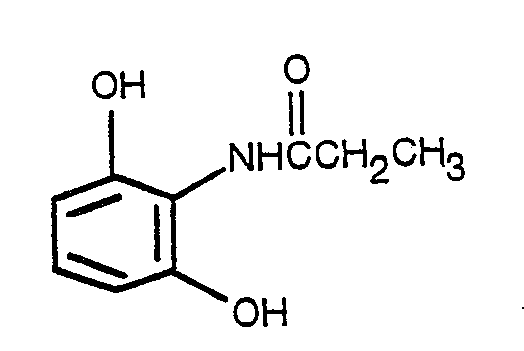
- C-18 2-benzamidoresorcinol

- C-19 2,6-di-tert-butylphenol

- The term."aniline coupler" herein means an aniline compound or related derivative which forms a dye by reaction with a described oxoindolizine or oxoindolizinium compound.
- Examples of useful aniline couplers and derivatives thereof useful in forming oxoindolizine and oxoindolizinium dyes according to the invention are represented by the formulas:
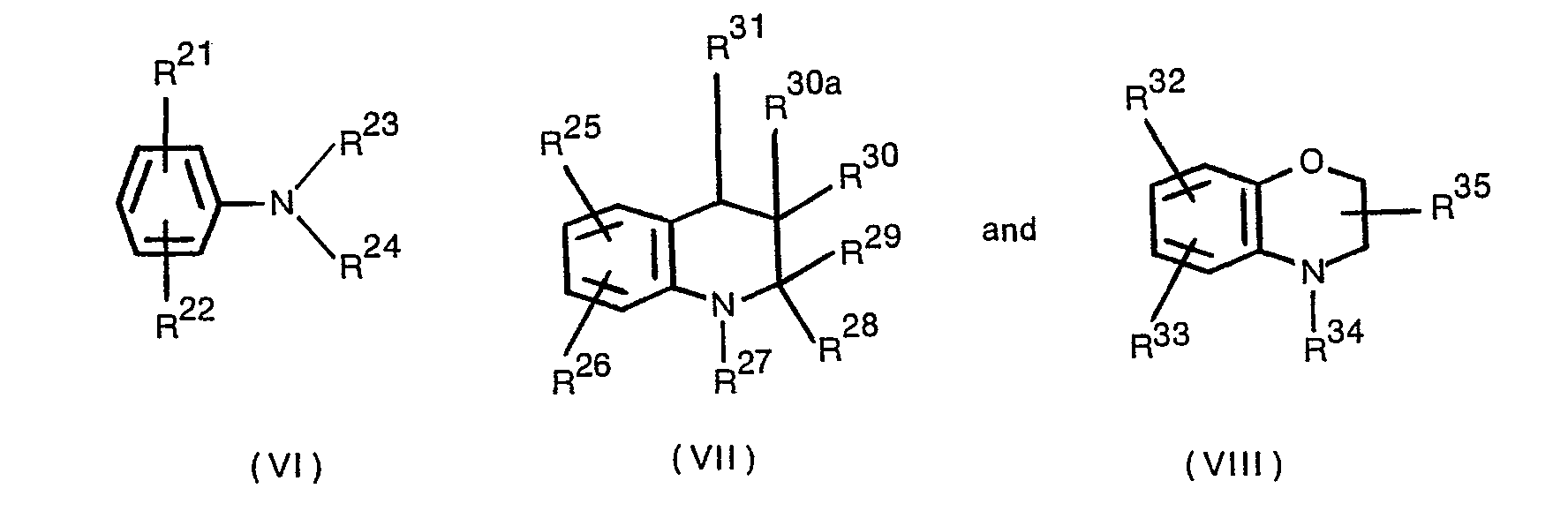
- R21, R22, R25, R26, R32 and R13 are individually hydrogen; fluorine; chlorine; bromine; alkyl containing 1 to 6 carbon atoms; cycloalkyl containing 3 to 10 carbon atoms; alkoxy containing 1 to 4 carbon atoms; phenoxy; alkylthio, such as alkylthio containing 1 to 4 carbon atoms; arylthio, such as arylthio containing 6 to 20 carbon atoms; and groups represented by the formula ―NH―X―R36 in which X is ―CO―, ―COO or -SO2
- R23, R24, R27 and R34 are individually selected from hydrogen; cycloalkyl, such as cycloalkyl containing 6 to 20 carbon atoms; straight or branched alkenyl containing 2 to 10 carbon atoms; alkyl containing 1 to 18 carbon atoms, or R23 and R24 together represent the atoms necessary to complete a 5- or 6-member heterocyclic ring with the nitrogen atom to which they are bonded, such as atoms completing a pentamethylene, ethyleneoxyethylene or ethylenesulfonylethylene group which forms a ring or a julolidyl group; or
- R23 and R24 individually can be ―S―R37; wherein
- R37 is alkyl containing 1 to 6 carbon atoms, phenyl, phenyl substituted with halogen, alkoxy containing 1 to 6 carbon atoms, alkanoylamino containing 1 to 6 carbon atoms, cyano or lower alkoxycarbonyl, pyridyl, pyrimidinyl, benzoxazolyl, benzimidazolyl, benzothiazolyl, triazolyl; SO2R39; ―COOR40; ―OXR41; ―NH―X―R42; ―X―R43; ―OCO―R44; ―CONR45R46; ―SO2NHR47; ―SO2NR48R49; R28, R29, R30, R30a, R31 and R35 are individually selected from hydrogen and alkyl containing 1 to 6 carbon atoms;
- R36 is alkyl containing 1 to 6 carbon atoms or alkyl substituted by a group that does not adversely affect the desired indolizinone or indolizinium dye, such as halogen, hydroxy, phenoxy, aryl, such as aryl containing 6 to 20 carbon atoms, cyano, cycloalkyl, such as cycloalkyl containing 6 to 12 carbon atoms, alkylsulfonyl containing 1 to 6 carbon atoms, alkylthio containing 1 to 6 carbon atoms, alkanoyloxy containing 1 to 6 carbon atoms and alkoxy containing 1 to 6 carbon atoms; when X is ―CO―, then R36 is also selected from hydrogen, amino, alkenyl containing 2 to 6 carbon atoms, alkylamino containing 1 to 6 carbon atoms, alkylcarbamoyl containing 1 to 6 carbon atoms, dialkylamino containing 2 to 12 carbon atoms, arylamino containing 6 to 12 carbon atoms, aryl containing 6 to 20 carbon atoms and furyl.
- When R23, R24, R27 or R34 are alkyl, the alkyl is unsubstituted or substituted by, for example, hydroxy, halogen, cyano, alkoxy containing 1 to 6 carbon atoms, alkoxyalkoxy containing 2 to 8 carbon atoms, hydroxyalkoxy containing 1 to 4 carbon atoms, succinimido, glutarimido, phenylcarbamoyloxy, phthalimido, phthalimidino, 2-pyrrolidono, cyclohexyl, phenoxy, phenyl or phenyl substituted by alkyl containing 1 to 6 carbon atoms, alkoxy containing 1 to 6 carbon atoms, halogen, alkanoylamino containing 1 to 6 carbon atoms, alkoxycarbonyl containing 2 to 6 carbon atoms; sulfamoyl; alkylsulfamoyl containing 1 to 6 carbon atoms; vinylsulfonyl; acrylamido; alkylsulfonamido, such as alkylsulfonamido containing 1 to 6 carbon atoms; phenylsulfonamido; alkoxycarbonylamino containing 1 to 6 carbon atoms; alkyl- carbamoyloxy containing 1 to 6 carbon atoms; alkoxycarbonyloxy containing 1 to 6 carbon atoms; alkenylcarbonylamino containing 3 to 6 carbon atoms; groups represented by the formula;


- R 39, R40, R41, R42, R43 and R44 are individually selected from unsubstituted alkyl containing 1 to 6 carbon atoms and alkyl containing 1 to 6 carbon atoms substituted by at least one group that does not adversely affect the desired oxoindolizine or oxoindolizinium dye, such as halogen, hydroxy, phenoxy, aryl containing 6 to 20 carbon atoms, cyano, cycloalkyl containing 6 to 12 carbon atoms, alkylsulfonyl containing 1 to 6 carbon atoms, alkylthio containing 1 to 6 carbon atoms, alkanoyloxy containing 1 to 6 carbon atoms; and alkoxy containing 1 to 6 carbon atoms, and when X is -CO-, then R41, R42 and R43 are also individually selected from hydrogen, amino, alkenyl containing 2 to 6 carbon atoms, alkylamino containing 1 to 6 carbon atoms, alkyl carbamoyl containing 2 to 6 carbon atoms, dialkylamino containing 2 to 6 carbon atoms, arylamino containing 6 to 20 carbon atoms, aryl containing 6 to 20 carbon atoms or furyl;
- R 45, R 46, R47, R48 and R49 are individually selected from hydrogen, unsubstituted alkyl containing 1 to 6 carbon atoms and alkyl containing 1 to 6 carbon atoms substituted by at least one group that does not adversely affect the desired oxoindolizine or oxoindolizinium dye, such as halogen, hydroxy, phenoxy, aryl containing 6 to 20 carbon atoms, cyano, cycloalkyl containing 6 to 12 carbon atoms, alkylsulfonyl containing 1 to 6 carbon atoms, alkylthio containing 1 to 6 carbon atoms, alkanoyloxy containing 1 to 6 carbon atoms and alkoxy containing 1 to 6 carbon atoms, cyano, alkanoyloxy containing 1 to 6 carbon atoms, phenoxy, phenoxy substituted by at least one of alkyl containing 1 to 6 carbon atoms, alkoxy containing 1 to 6 carbon atoms, and halogen.
- The term "cycloalkyl" herein means an unsubstituted cycloalkyl group or a cycloalkyl group containing substituents that do not adversely affect an oxoindolizine or oxoindolizinium dye according to the invention. The cycloalkyl group, for example, contains 3 to 7 carbon atoms and is unsubstituted or substituted by one or two groups selected from alkyl containing 1 to 4 carbon atoms, hydroxyl, alkoxy containing 1 to 4 carbon atoms, phenyl or phenyl containing an alkyl group containing 1 to 4 carbon atoms, alkoxy containing 1 to 4 carbon atoms, halogen, alkanoylamino, cyano and alkoxycarbonyl, such as alkoxycarbonyl containing 1 to 4 carbon atoms.
- Examples of useful aniline couplers are as follows:
- AN-1 N,N-dimethylaniline
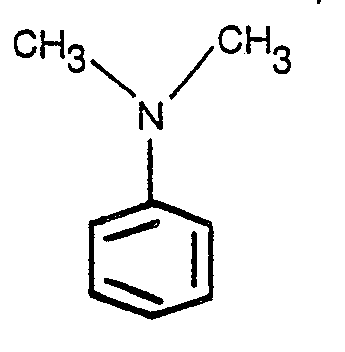
- AN-2 julolidine

- AN-3 N,N-diethylaniline

- AN-4 N-phenylpiperidine

- Examples of useful active methylene couplers for forming dyes according to the invention are represented by the formula:

- Y1 and Y2 are the same or different electronegative groups, such as aryl containing 6 to 20 carbon atoms, such as phenyl and naphthyl; cyano; acyl containing 2 to 18 carbon atoms, such as acetyl, propionyl and butyryl; carboalkoxy containing 1 to 18 carbon atoms, such as carbomethoxy, carboethoxy, carbobutoxy and carboamyloxy; aminocarbonyl containing 1 to 18 carbon atoms, such as unsubstituted aminocarbonyl, methylaminocarbonyl, dimethylaminocarbonyl and ethylaminocarbonyl; or oxo-, thio- or selenopyrylium; or oxoindolizinium; or y2 is hydrogen; and
- Y3 is hydrogen or halogen, such as chlorine, bromine and iodine.
- Preferred active methylene couplers are ketomethylene couplers. Other useful active methylene couplers include those known to be useful in the photographic art, such as pyrazalinone and coumarin couplers.
- Examples of preferred ketomethylene couplers are represented by the formula:

- A5 and A6 are individually alkyl containing 1 to 18 carbon atoms, such as methyl, ethyl, propyl and amyl; aryl containing 6 to 14 carbon atoms, such as phenyl, naphthyl and anthryl; hydroxy; alkoxy, such as alkoxy containing 1 to 6 carbon atoms; amino; substituted amino; or thiol.
- Ketocarboxamides are examples of especially useful ketomethylene couplers for forming dyes according to the invention. Examples of useful ketocarboxamides are represented by the formula:

- A7 and A8 are individually alkyl containing 1 to 18 carbon atoms, such as methyl, ethyl, propyl, butyl, amyl, decyl and stearyl; and aryl containing 6 to 14 carbon atoms, such as phenyl, naphthyl, and anthryl; carbonyl; amino or vinyl.
- Other particularly useful active methylene couplers are alkyl flavylium salts and alkyl pyrylium salts, such as described in U.S. Patents 3,141,770 and 3,250,615.
- Examples of useful methylene couplers include the following:
- M-1 2,6-Diphenyl-4-methylpyrylium perchlorate

- M-2 2,4-Diphenyl-6-methylpyrylium perchlorate

- M-3 2,6-Diphenyl-4-methylthiopyrylium perchlorate

- M-4 4-Methyl-2-phenylflavylium perchlorate

- M-5 2-Methyl-4-phenylflavylium perchlorate

- M-6 4-Methyl-2-phenylthioflavylium perchlorate

- M-7 2,6-di-(2-thiopheneyl)-4-methylpyrylium fluoborate

- M-8 2-(4-methoxyphenyl)-4-methylthioflavylium perchlorate

- M-9 2,4-pentanedione

- M-10 dibenzoylmethane

- M-11 1-anilino-3-phenyl-1,3-propanedione

- M-12

- M-13 1-tert-butyl-3-(4-methoxy anilino)-1,3-propanedione

- M-14 malononitrile

- M-15 phenylacetonitrile

- M-16 phenylacetamide

- M-17 N-phenyl acetylacetamide

- M-18 bis-nitrophenylmethane
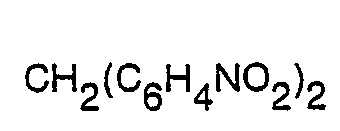

- M-19 methyl cyanoacetate

- M-20 2,2-dimethyl-m-dioxane-4,6-dione

- M-21 cyanoacetamide

- The designation φ herein means a phenyl group.
- Other particularly useful active methylene couplers are alkyl indolizinonium salts represented by the formula:

- R50 and R51 are individually aryl containing 6 to 14 carbon atoms, such as phenyl, naphthyl, anthryl, methoxyphenyl and methoxynaphthyl; aralkenyl containing 6 to 14 carbon atoms, such as 2,2-diphenylvinyl, 2-phenylvinyl, 2-naphthylvinyl and 2-methyl(2-phenylvinyl); alkyl containing 1 to 20 carbon atoms, such as methyl, ethyl, propyl, decyl and lauryl; or R50 and R51 together represent the carbon atoms necessary to complete a 7- or 8-member cyclic structure; and
- R52 is a substituent which does not interfere with the coupling action of the indolizinium salt and does not adversely affect the desired properties of a resulting oxoindolizinium or oxoindolizine dye, such as hydrogen; carboxyl; alkyl containing 1 to 18 carbon atoms, for example, methyl, ethyl, propyl and dodecyl; cyano; and, aryl containing 6 to 20 carbon atoms, such as phenyl and xylyl;
- X⊖ is an anion as defined above, such as CF3SO3⊖, Br⊖ and BF4⊖.
- Another method of preparation of oxoindolizine and oxoindolizinium dyes within Structures I and II comprises condensation of suitable indolizinols, indolizinones or indolizinonium ions with active -CH= compounds which complete an organic chromophore. such indolizinols (IA), indolizinones (IB) and indolizinonium (IC) ions are represented by the formulas:


- X⊖ is an anion as defined above;
- R53, R54, R58, R59, R63 and R14 are individually aryl containing 6 to 14 carbon atoms, such as phenyl, naphthyl, anthryl, methoxyphenyl and methoxynaphthyl; aralkenyl containing 6 to 14 carbon atoms, such as 2,2-diphenylvinyl, 2-phenylvinyl, 2-naphthylvinyl and 2-methyl-(2-phenylvinyl), alkyl containing 1 to 18 carbon atoms, such as methyl, ethyl, propyl, decyl and octadecyl; or R53 and R54, R58 and R59, and R63 and R64 together represent the carbon atoms necessary to complete a 7- or 8-member cyclic structure;
- R55 R60 and R65 are individually hydrogen, alkyl containing 1 to 18 carbon atoms, such as methyl, ethyl, and dodecyl; cyano; acyl containing 2 to 18 carbon atoms, such as acetyl, propionyl, 2-ethylhexanoyl and stearoyl; carboalkoxy containing 1 to 18 carbon atoms, such as carbomethoxy, carboethoxy and carbobutoxy; aminocarbonyl, such as unsubstituted aminocarbonyl, methylaminocarbonyl, dimethylaminocarbonyl and ethylaminocarbonyl; acyloxy containing 2 to 18 carbon atoms, such as acetoxy, propionoxy, butyroxy and lauroyloxy; bromine and chlorine;
- R56 is hydrogen; alkyl containing 1 to 18 carbon atoms, such as methyl, ethyl, propyl and dodecyl; acyl containing 2 to 18 carbon atoms, such as acetyl, propionyl, butyryl and lauryl; benzyl or pyridyl;
- R57, R62 and R67 are individually hydrogen; chlorine; bromine; or, alkyl containing 1 to 18 carbon atoms, such as methyl, ethyl, propyl and dodecyl;
- R61 is alkyl containing 1 to 18 carbon atoms, such as methyl, ethyl, propyl, butyl and decyl; and
- R66 is alkyl containing 1 to 18 carbon atoms; hydrogen; carbonyl; alkoxycarbonyl, such as methoxycarbonyl, ethoxycarbonyl and propoxycarbonyl; cyano; and carboxamido.
- Such indolizinols (IA), indolizinones (IB) and indolizinonium (IC) ions are prepared by reacting a cyclopropenone with a pyridine compound as described.
- The term "active -CH= compounds" herein means aldehyde and ketone compounds which are capable of condensing with the active methylene of the indolizinonium ion (IC) and which have electropositive or electronegative substituents which complete a chromophore with the indolizinonium ion (IC). The term "active -CH= compounds" includes active methylene compounds that are capable of condensing with indolizinols (IA) or indolizinones (IB) to complete a chromophore. Examples of useful "active -CH= compounds" are as follows:
- 1,2-diphenyl-7-formyl-3-indolizinol

- 7-formylmethylidene-2,3-diphenyl-1(7H)-indolizinone

- 1,2-diphenyl-7-methyl-3-indolizinonium trifluoromethane sulfonate

- 7-cyanomethyl-2,3-diphenyl-1-indolizinonium trifluoromethane sulfonate

- 2,3-diphenyl-6-methyl-1-indolizinonium trifluoromethane sulfonate

- p-dimethylaminocinnamaldehyde
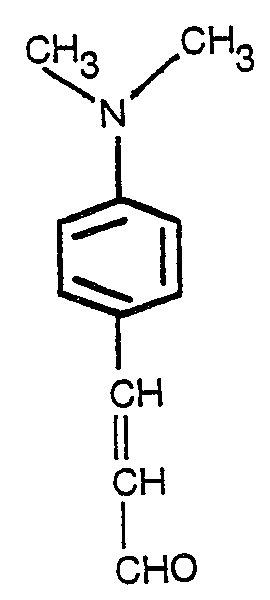
- p-hydroxybenzaldehyde

- p-hydroxycinnamaldehyde

- 1-dimethylamino-4-formyl naphthalene
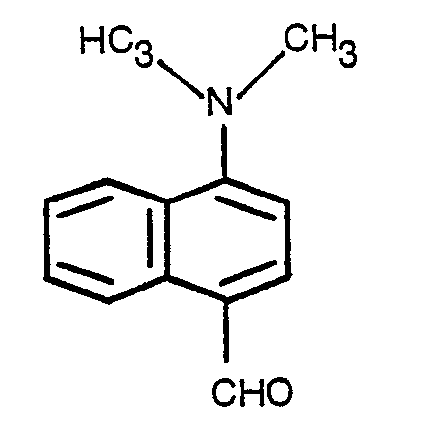
- p-nitrobenzaldehyde

- 4-dimethylaminobenzaldehyde

- 1,2-dimethyl-6-formyl-1,2,3-tetrahydroquinoline

- 2,6-diphenyl-4-formylmethylidene(4H)pyran

- 9-formyljulolidine

- 1-chloroethyl-6-formyl-2,2,4,7-tetramethyl-1,2,3,4-tetrahydroquinotine
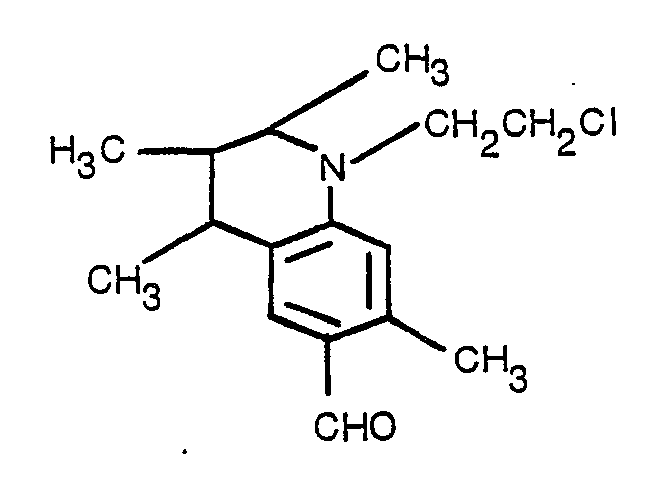
- Many oxoindolizine dyes according to the invention are formed by the reaction of a phenolic coupler with an appropriate oxoindolizine. Examples of useful oxoindolizine dyes that are formed by reaction of phenolic couplers with a suitable oxoindolizine are represented by the formulas:

- R68 is hydrogen or a substituent that does not adversely affect desired dye properties, such as alkyl containing 1 to 18 carbon atoms; cyano; acyl containing 2 to 20 carbon atoms; carboalkoxy containing 2 to 18 carbon atoms; aminocarbonyl containing 1 to 18 carbon atoms; acyloxy containing 2 to 18 carbon atoms; bromine or chlorine;
- R69 is hydrogen or a substituent that does not adversely affect desired dye properties, such as chlorine, bromine or alkyl containing 1 to 18 carbon atoms;
- R70 and R71 are individually alkyl, containing 1 to 18, preferably 1 to 10 carbon atoms, or aryl containing 6 to 20 carbon atoms;
- R72 and R73 are individually hydrogen; alkyl containing 1 to 22 carbon atoms; aryl containing 6 to 20 carbon atoms; amino; carboxamido; sulfonamido; sulfamyl; carbamyl; halogen, including chlorine, fluorine, bromine and iodine; alkoxy containing 1 to 18 carbon atoms, or R72 and R73 together represent the atoms necessary to complete a benzo group which is unsubstituted or substituted by at least one of the groups given above for R17; and
- R74 and R75 are individually hydrogen; hydroxy; alkyl containing 1 to 22 carbon atoms; aryl containing 6 to 20 carbon atoms; amino; carboxamido; sulfonamido; sulfamyl; carbamyl; halogen, including chlorine, fluorine, bromine and iodine; or alkoxy containing 1 to 18 carbon atoms.
- Examples of alkyl groups which are suitable for use as R68 to and including R75 substituents include, where conforming to the above carbon length descriptions, methyl, ethyl straight or branched chain propyl, butyl, decyl, dodecyl and eicosyl.
- Acyl groups which are suitable for use as an R68 substituent include acetyl, propionyl, 2-ethylhexanoyl and stearoyl.
- Examples of carboalkoxy and aminocarbonyl groups which are suitable for use as an R68 substituent include, respectively, carbomethoxy, carboethoxy and carbobutoxy, and unsubstituted aminocarbonyl or methylaminocarbonyl, dimethylaminocarbonyl, and ethylaminocarbonyl.
- Acyloxy groups which are suitable for use as an R68 substituent include acetoxy, propionoxy, butyroxy and lauroyloxy.
- Examples of aryl groups which are suitable for use as R70 to and including R75 substituents are unsubstituted and substituted groups such as phenyl, tolyl, xylyl, methoxyphenyl, 4-t-butylphenyl, anisyl, naphthyl and methoxynaphthyl.
- Examples of alkoxy groups which are suitable for use as R72 to and including R75 substituents are methoxy, ethoxy and propoxy.
- An example of a useful class of oxoindolizine dyes prepared from phenolic couplers are those derived from resorcinolic couplers. Resorcinolic couplers form compounds wherein R75 is hydroxy.
- Examples of oxoindolizine dyes prepared from phenolic couplers are as follows:
- 1,2-diphenyl-7-(4-oxo-2-hydroxy-1-phenylidene)-3-(7H)-indol izinone

- 1,2-diphenyl-7-(4-oxo-1-naphthylidene)-3(7H)-indolizinone

- 1,2-diphenyl-6-methyl-7-(4-oxo-1-phenylidene)-3(7H)-indolizinone
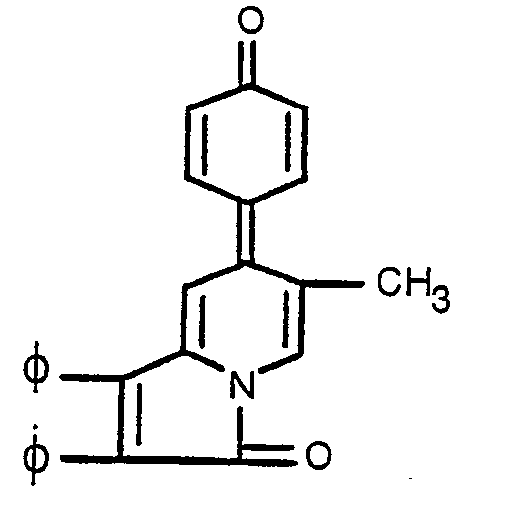
- 2,3-d iphenyl-6-formyl-7-(4-oxo-1-phenylidene)-1-(7H)-indolizinone

- 6-diethylaminocarbonyl-2,3-diphenyl-(4-oxo-1-phenylidene)-1(7H)-indolizinone

- 1,2-diphenyl-ethyl-7-(4-oxo-1-phenylidene)-3(7H)-indolizinone

- 6-cyanomethyl-1,2-diphenyl-7-(4-oxo-1-phenylidene)-3(7H)-indolizinone

- 1,2-diphenyl-6-(3-hydroxypropyl)-7-(4-oxo-1-phenylidene)-3(7H)-indolizinone

- 1,2-diphenyl-6-ethoxycarbonylmethyl-6-(4-oxo-1-phenylidene)-3(7H)-indolizinone

- 6,8-dimethyl-1,2-diphenyl-7-(4-oxo-1-plienylidene)-3(7H)-indolizinone

- 2,3-diphenyl-6-methylaminocarbonyl-7-(4-oxo-1-phenylidene)-1(7H)-indolizinone

- 2,3-diphenyl-6-methoxycarbonyl-7-(4-oxo-1-phenylidene)-1(7H)-indolizinone

- 2,3-diphenyl-6-[2-methyl-2-(3-pyridyl)-propionyl-7-(4-oxo-1-phenylidene)]-1(7H)-indolizinone

- . 1,2-bis{6,6'-[2,3-diphenyl-7-(4-oxo-1-phenylidene)-1(7H)-indolizinonyl]-2-methyl-1-oxopropane

- 6-acetyl-2,3-diphenyl-7-(4-oxo-phenylidene)-1(7H)-indolizinone

- 6-benzyl-1,2-diphenyl-7-(4-oxo-1-phenylidene)-3(7H)-indolizinone

- 6-chloro-1,2-diphenyl-7-(4-oxo-1-phenylidene)-3(7H)-indolizinone

- 6-cyano-2,3-diphenyl-7-(4roxo-1-phenylidene)-1(7H)-indolizinone

- 6-(4-azastyryl)-1,2-diphenyl-7-(4-oxo-1-phenylidene)-3(7H)-indolizinone

- 2,3-diphenyl-7-(2-hydroxy-4-oxo-3-pivalamido-1-phenylidene)-1(7H)-indolizinone

- 6-(4-azastyryl)-7-[3-(4-tert-butylbenzamido)-2-hydroxy-4-oxo-1-phenylidene]-1,2-diphenyl-3(7N)-indolizinone

- 7-[3-(4-tert-butylbenzamido)-2-hydfoxy-4-oxo-1-phenylidene)]-1,2-diphenyl-(3-hydroxypropyl)-3-(7H)-indolizinone

- 7-[3-(4-tert-butylbenzamido)-2-hydroxy-4-oxo-1-phenylidene]-6-carbomethoxy-2,3-diphenyl-1(7H)-indolizinone

- 7-[3-(4-tert-butylbenzamido)-2-hydroxy-4-oxo-1-phenylidene] - 2,3-diphenyl-6-methylcarbamyl-1(7H )-indolizinon
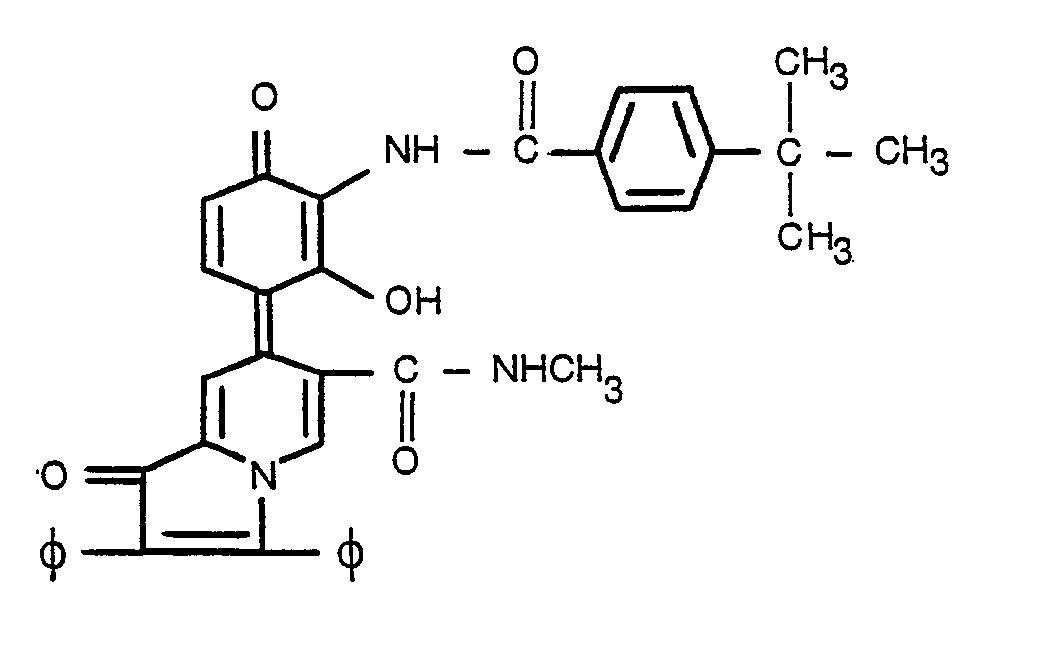
- 7-[3-(4-tert-butylbenzamido)-2-hydroxy-4-oxo-1-phenylidene]-1,2-diphenyl-6-methyl-3(7H)-indolizinone

- 7-[3-(4-tert-butyl benzamido)-2-hydroxy-4-oxo-1-phenylidene]-6,8-dimethyl-1,2-diphenyl-3(7H)-indolizinone

- 7-[3-(4-tert-butylbenzamido)-2-hydroxy-4-oxo-1-phenylidene]-6-diethylcarbamyl-2,3-diphenyl-1(7H)-indolizinone

- 6-benzyl-7-[3-(4-tert-butylbenzamido)-2-hydroxy-4-oxo-1-phenylidene)-1,2-diphenyl-3(7H)-indolizinone

- 1,2-bis-{6,6'-(7-[3-(4-tert-butylbenzamido)-2-hydroxy-4-oxo-1-phenylidene]}-2,3-diphenyl-1(7H)-indolizinonyl-}2-methyl-1-oxo-propane

- 2,3-diphenyl-7-[3-(4-tert-buty lbrnzamido)-2-hydroxy-4-oxo-1-phenylidene]-1(7H)-indolizinone

- 7-[3,5-di-tert-butyl-4-oxo-1-phenylidene]-1,2-di-(4-methoxyphenyl)-3(7H)-indolizinone

- 7-[3,5-di-tert-butyl-4-oxo-1-phenylidene]-2,3-di-n-propyl-1(7H)-indolizinone

- Further examples of oxoindolizine dyes prepared from phenolic couplers are listed below. Where available, λmax values, in nanometers (nm), are reported in parentheses:


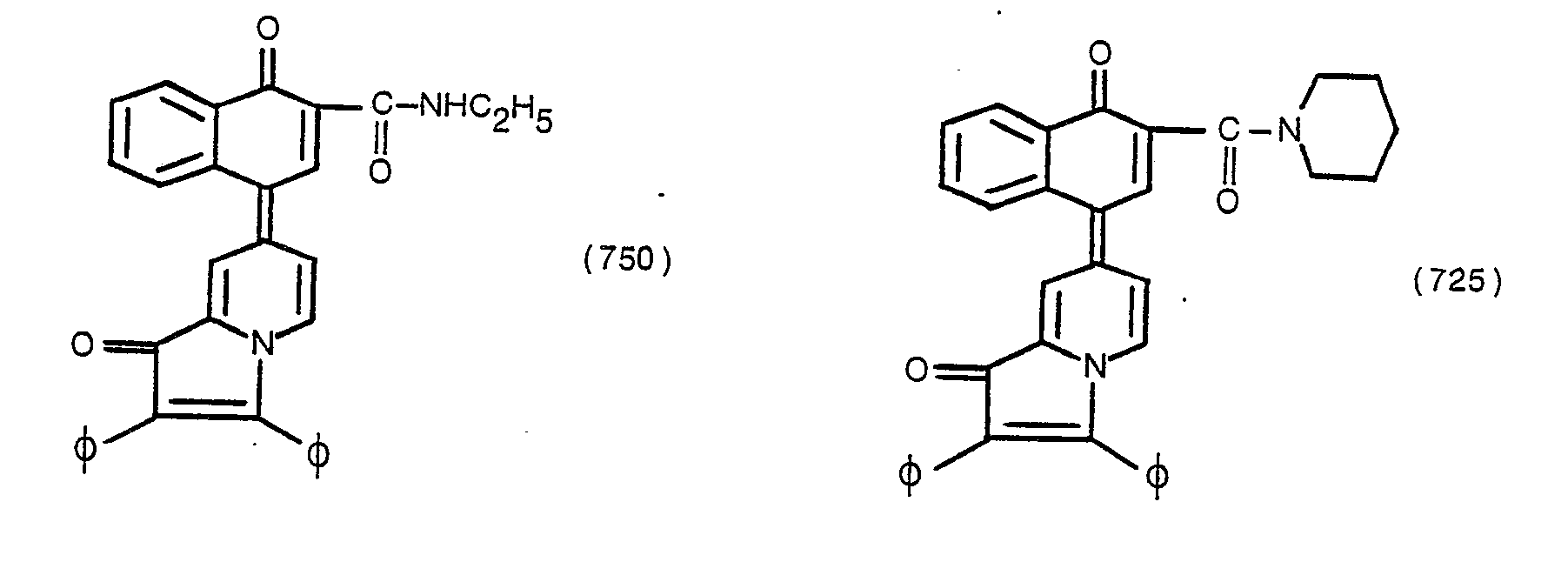


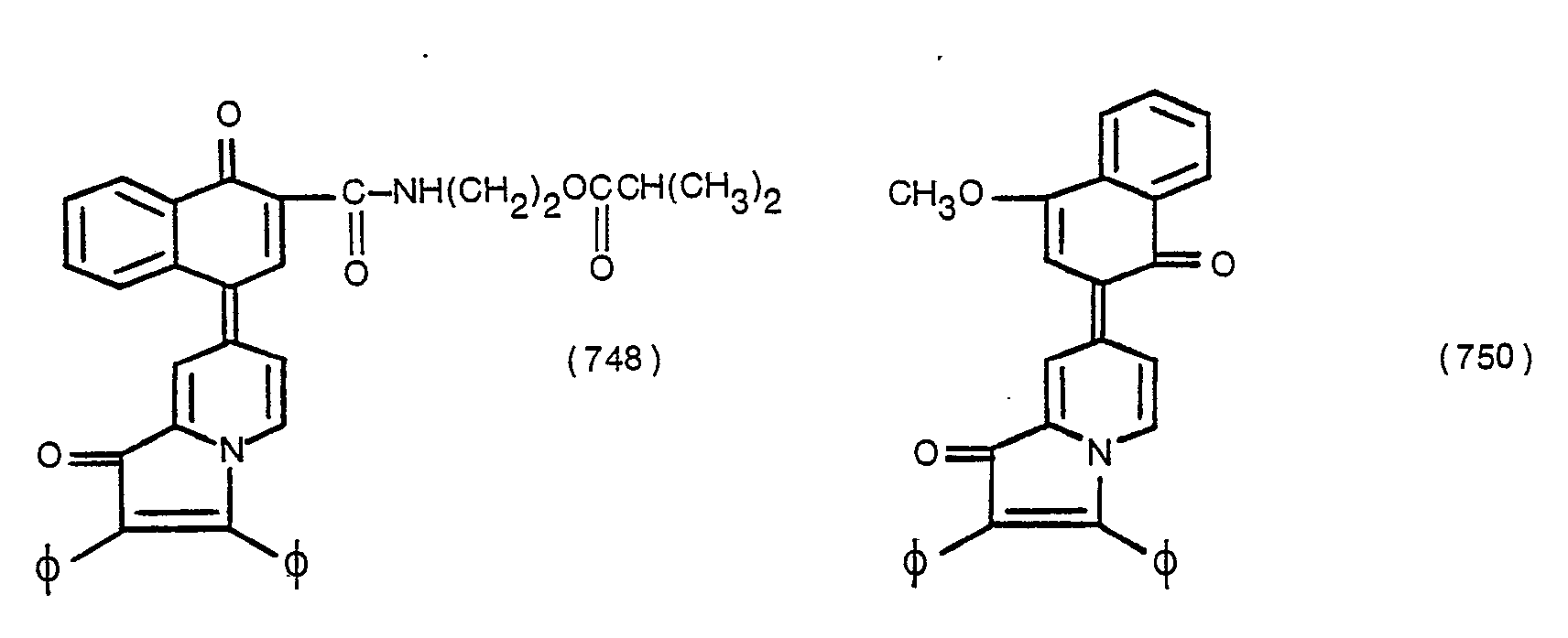


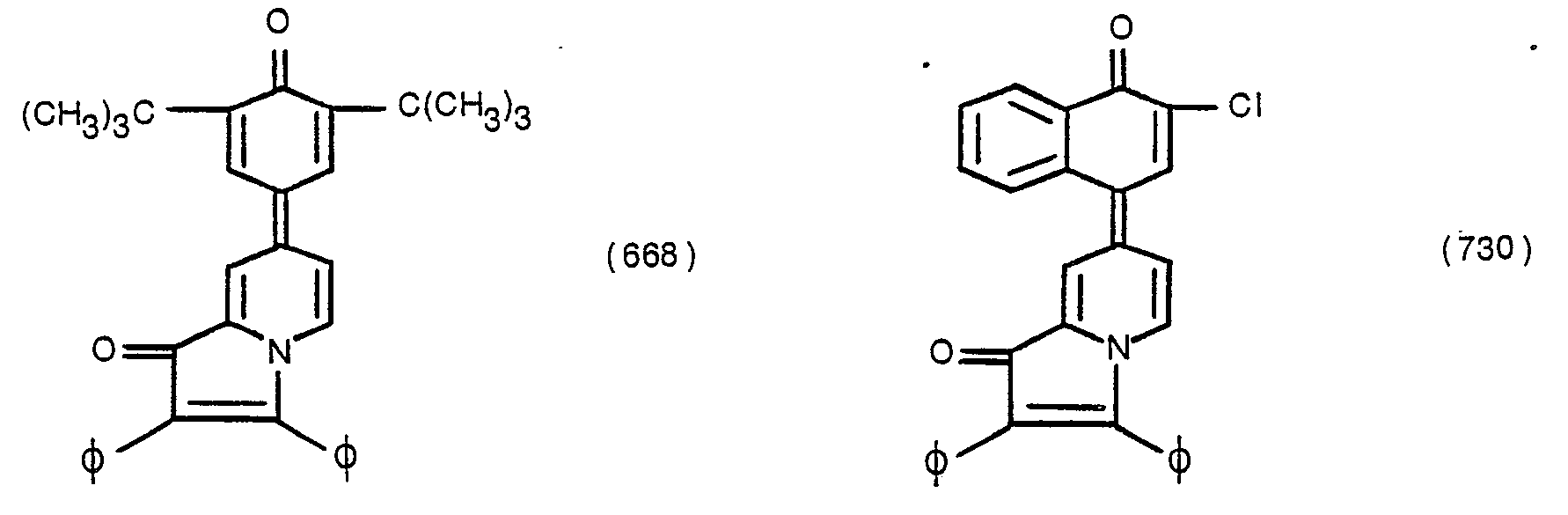


- Oxoindolizinium dyes according to the invention are also formed from reaction of an aniline coupler with an oxoindolizine compound. Such dyes are represented by the structural formulae:

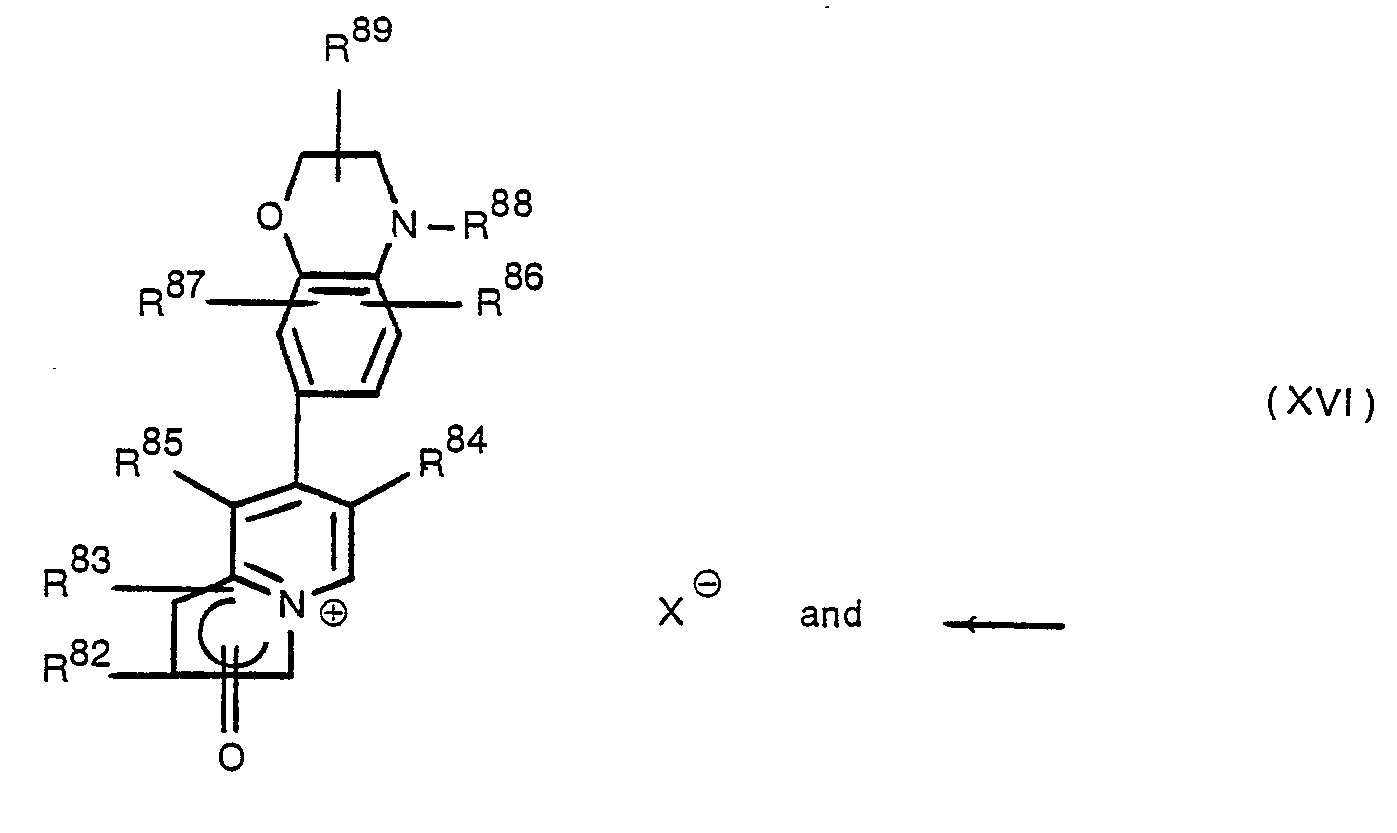

- R76, R77, R82, R83, R90 and R91 are individually aryl containing 6 to 14 carbon atoms, such as phenyl, naphthyl, anthryl, methoxyphenyl and methoxynaphthyl, aralkenyl containing 6 to 14 carbon atoms, such as 2,2-diphenylvinyl, 2-phenylvinyl, 2-naphthylvinyl and 2-methyl-(2-phenylvinyl); alkyl containing 1 to 18 carbon atoms, such as methyl, ethyl, propyl, decyl and eicosyl; or R76 and R77, R82 and R83, R90 and R 91 together represent the carbon atoms necessary to complete a 7- or 8-member cyclic structure,
- R78, R84 and R92 are individually hydrogen, alkyl containing 1 to 18 carbon atoms, such as methyl, ethyl, and dodecyl; cyano; acyl containing 2 to 18 carbon atoms, such as acetyl, propionyl, 2-ethylhexanoyl and stearoyl; carboalkoxy containing 2 to 18 carbon atoms such as carbomethoxy, carboethoxy and carbobutoxy; aminocarbonyl, methylaminocarbonyl, dimethylaminocarbonyl and ethylaminocarbonyl; acyloxy containing 2 to 18 carbon atoms, such as acetoxy, propionoxy, butyroxy and lauroyloxy; bromine and chlorine;
- R79, R85 and R93 are individually hydrogen; chlorine; bromine; or, alkyl containing 1 to 18 carbon atoms, such as methyl, ethyl, propyl and dodecyl;
- R80, R81, R88 and R94 are individually hydrogen or substituents that do not adversely affect the desired indolizinium dye, such as alkyl containing 1 to 18 carbon atoms, such as methyl, ethyl, propyl, decyl, and lauryl; cycloalkyl, such as cycloalkyl containing 6 to 20 carbon atoms; straight or branched chain alkenyl containing 2 to 10 carbon atoms; or R80 and R81 together represent the atoms necessary to complete a 5- or 6-member heterocyclic ring with the nitrogen atom to which they are bonded, such as atoms completing a pentamethylene, ethyleneoxyethylene or ethylenesulfonylethylene group which forms a ring, or a julolidyl group;
- R99, R100, R86, R87, R101 and R102 are individually hydrogen; fluorine; chlorine; bromine; alkyl containing 1 to 6 carbon atoms; cycloalkyl containing 5 to 12 carbon atoms; alkoxy containing 1 to 4 carbon atoms; phenoxy; alkylthio, such as alkylthio containing 1 to 4 carbon atoms; arylthio, such as arylthio containing 6 to 20 carbon atoms; and groups represented by the formula―NH―XR36 in which X is―CO―,―COO― or -S02-, wherein R36 is as defined above; and
- R89, R95, R96, R97 R97a and R98 are individually hydrogen and alkyl containing 1 to 6 carbon atoms; and
- X⊖ is an anion as defined above, such as CF3SO3⊖, BF4⊖ and Br⊖.
- Examples of related oxoindolizinium and oxoindolizine dyes are:
- 7-(2-N,N-diethylamino-1-ethenyl)-2,3-di-(4-methoxyphenyl)-1-oxoindolizinium fluoborate

- 7-(2-N,N-diethylamino-1-ethenyl)-1,2-diphenyl-3-oxoindolizinium iodide

- 2,3-di-(4-methoxyphenyl)-7-dimethylamino-1-oxoindolizinium iodide

- Further examples of oxoindolizinium dyes are listed below. Where available, λmax values, in nanometers (nm), are reported in parentheses. In instances where two λmax values are reported, both value intensities are approximately equal.


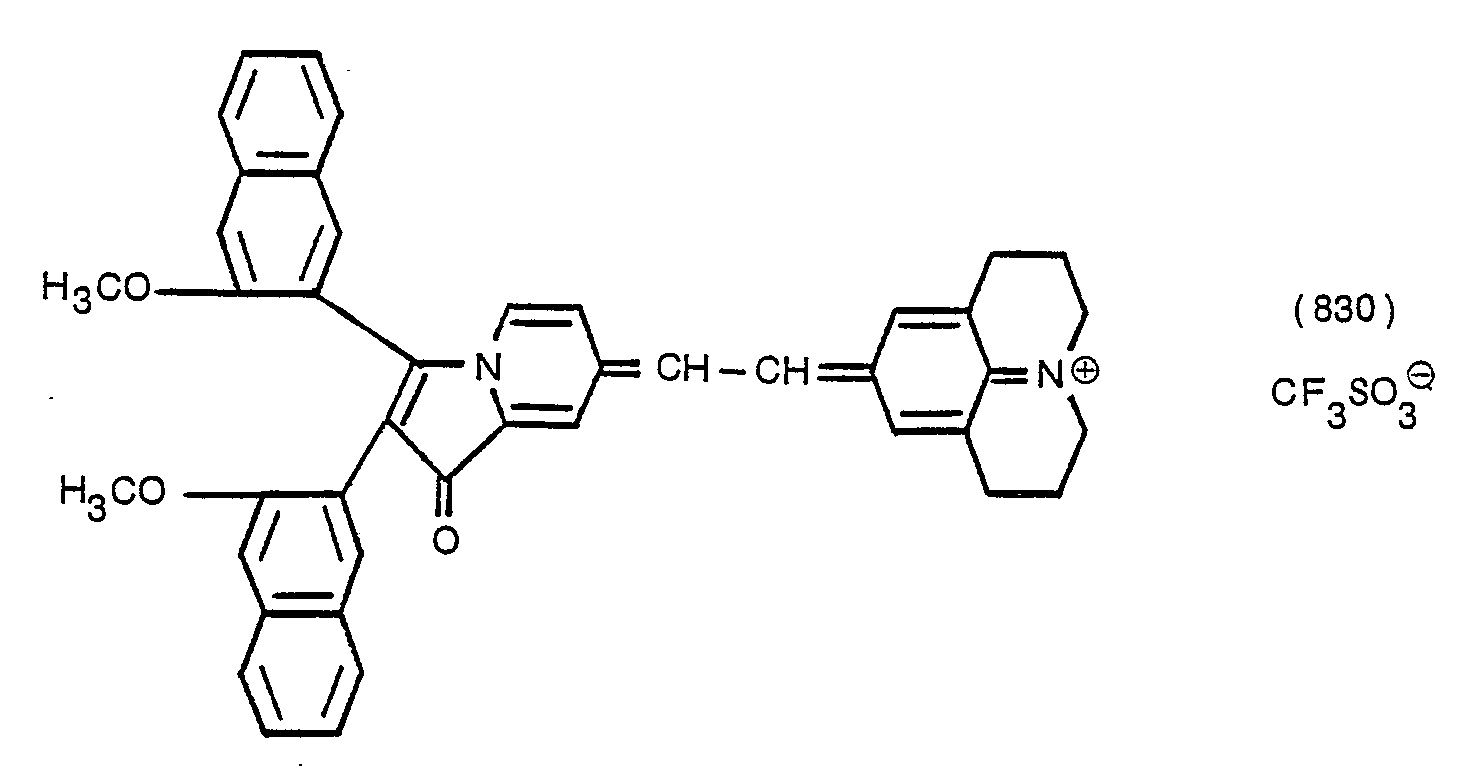


- Many useful oxoindolizine dyes according to the invention are formed from the reaction of an active methylene coupler with a suitable oxoindolizine compound. Especially useful oxoindolizines are dyes formed from the reaction of ketomethylene couplers, methylpyrylium couplers and methylindolizinium couplers with appropriate oxoindolizine compounds. Examples of useful indolizinone dyes formed from active methylene couplers are represented by the formula:

- R103 and R104 are individually aryl containing 6 to 20 carbon atoms, such as phenyl, naphthyl, anthryl, methoxyphenyl and methoxynaphthyl; aralkenyl containing 6 to 20 carbon atoms, such as 2,2-diphenylvinyl, 2-phenylvinyl, 2-naphthylvinyl and 2-methyl-(2-phenylvinyl); alkyl containing 1 to 18 carbon atoms, such as methyl, ethyl, propyl, decyl and lauryl; or R103 and R104 together represent the carbon atoms necessary to complete a 7- or 8-member cyclic structure;
- R105 and R106 are individually electronegative groups, such as aryl containing 6 to 20 carbon atoms, such as phenyl and naphthyl; cyano; acyl containing 2 to 18 carbon atoms, such as acetyl, propionyl and butyryl; carboalkoxy containing 2 to 18 carbon atoms, such as carbomethoxy, carboamyloxy and carbobutoxy; aminocarbonyl containing 2 to 18 carbon atoms such as unsubstituted aminocarbonyl, methylaminocarbonyl, dimethylaminocarbonyl and ethylaminocarbonyl; and R105 is alternatively hydrogen.
- Examples of oxoindolizine dyes formed from active methylene couplers are shown below. Where available, λmax values, in nanometers (nm), are reported in parentheses:
- 7-(diacetylmethylidene)-1,2-diphenyl-3-(7H)-indolizinone

- 7-(dibenzoylmethylidene)-2,3-diphenyl-1-(7H)-indolizinone

- 7-(anilinocarbonyl benzoylmethylidene)-2,3-diphenyl-1(7H)-indolizinone

- 6-cyano-7-(diacetylmethylidene)-2,3-diphenyl)-1(7H)-indolizinone
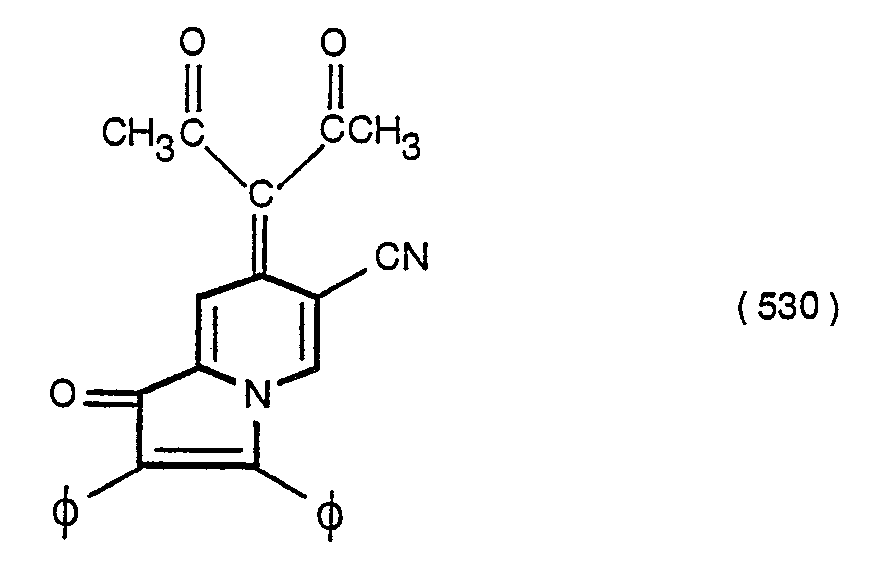
- 7-(dicyanomethylidene)-2,3-diphenyl-1(7H)-indolizinone

- 7-(1-cyano-1-phenylmethylidene)-1,2-diphenyl-3(7H)-indolizinone

- 7-(1-aminocarbonyl-1-phenylmethylidene)2,3-diphenyl-1(7H)-indolizinone

- 7-(dicarboethoxymethylidene)-2,3-diphenyl-1(7H)-indolizinone

- 2,3-diphenyl-7-(2,2-dimethyl-4,6-dioxo-1,3-dioxanylidene)-1(7H)-indolizinone


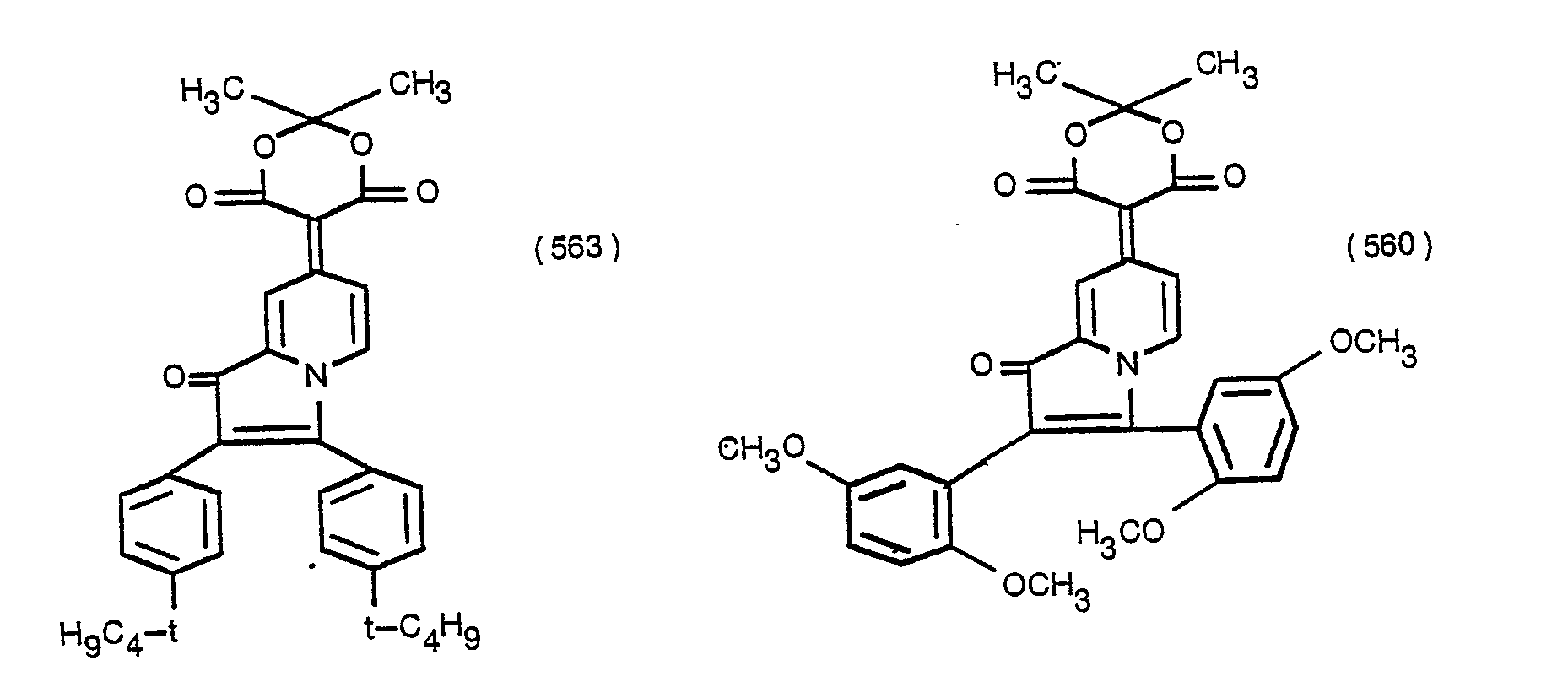


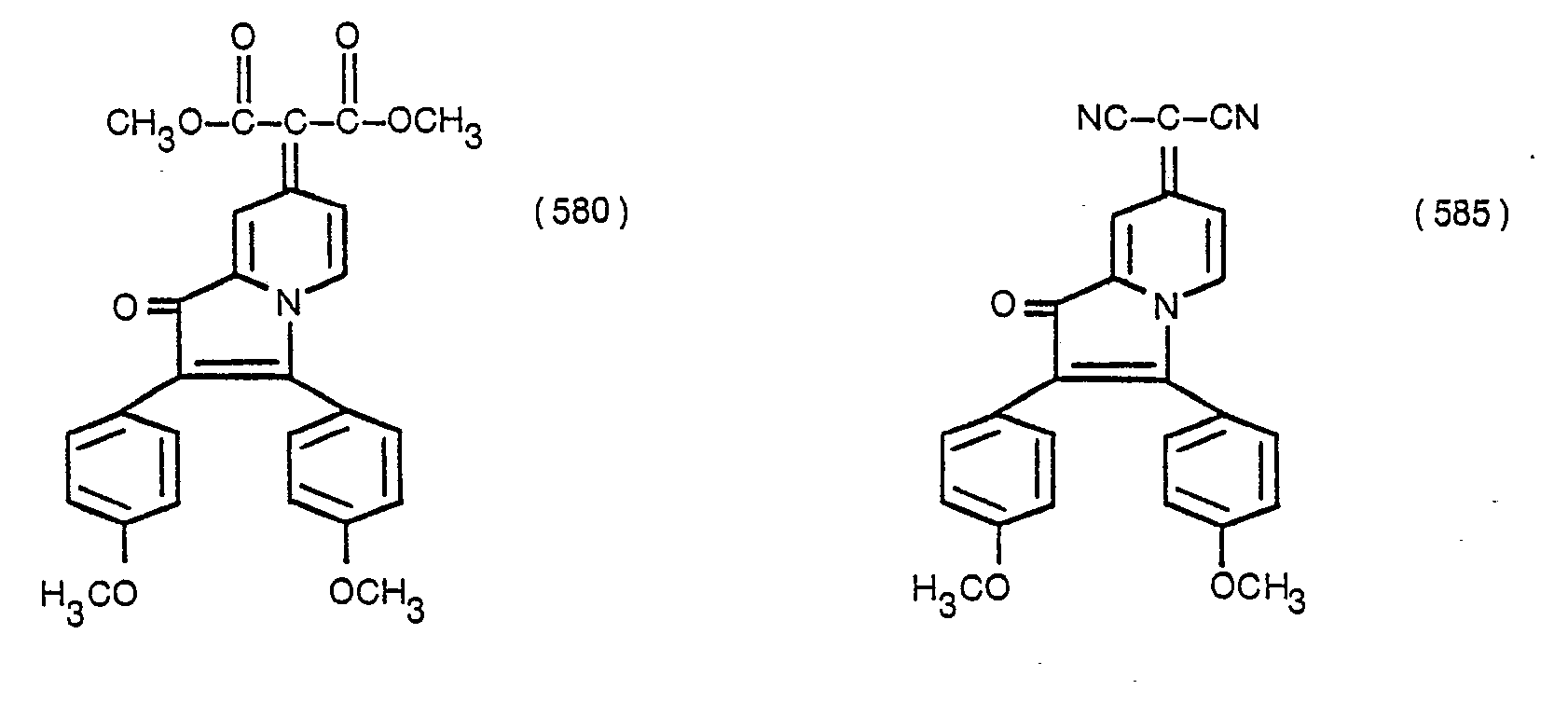


- Examples of oxoindolizinium dyes formed from active methylene couplers are represented by the formula:

- X⊖ is an anion as defined above;
- R108 and R109 are individually the same as R103 and R104; and
- Z represents the atoms necessary to complete a chromophore, such as the carbon, hydrogen, oxygen and nitrogen atoms necessary to complete a heterocyclic group, such as a pyranylidene, indolizinylidene, thiopyranylidene, selenopyranylidene, coumarinylidene, or pyrazolinonylidene group.
- Examples of oxoindolizinium dyes formed from such active methylene couplers are as follows:
- 2,3-diphenyl-7-[(2,6-diphenyl-4-pyranylidene)methyl]-1-oxoindolizinium perchlorate

- 2,3-diphenyl-7-[(2,3-diphenyl-7-1(7H)-indolizinonylidene)methyl]-1-indolizinonium trifluoromethane sulfonate

- 2,3-diphenyl-7-[(2,6-diphenyl-4-thiopyranylidene)methyl]-1-indolizinonium trifluoromethane sulfonate


- Another class of oxoindolizine dyes according to the invention is represented by the formula:

- R108 and R109 are individually aryl containing 6 to 14 carbon atoms; or, alkyl containing 1 to 20 carbon atoms;
- R110 is CH, phenylene or naphthylene;
- R111 is phenylene or naphthylene; and
- n and m are individually 0 or 1.
- Examples of aryl groups which are suitable for use as R108 or R109 substituents include unsubstituted or substituted phenyl, naphthyl and anthryl.
- Examples of alkyl groups which are suitable for use as R108 or R109 substituents include methyl, ethyl, propyl, t-butyl, decyl, lauryl and eicosyl.
- In oxoindolizine dyes according to the formula containing R110 and R108, the oxoindolizine moiety represents a group completing an organic chromophore to produce the desired dye. Examples of such compounds are:
- 1,2-bis[7-(1,2-diphenyl-3(7H)-indolizinonylidene)] ethane

- 1,4-bis[7-(1,2-diphenyl-3(7H)-indolizinonylidene]-2,5-cyclohexadiene
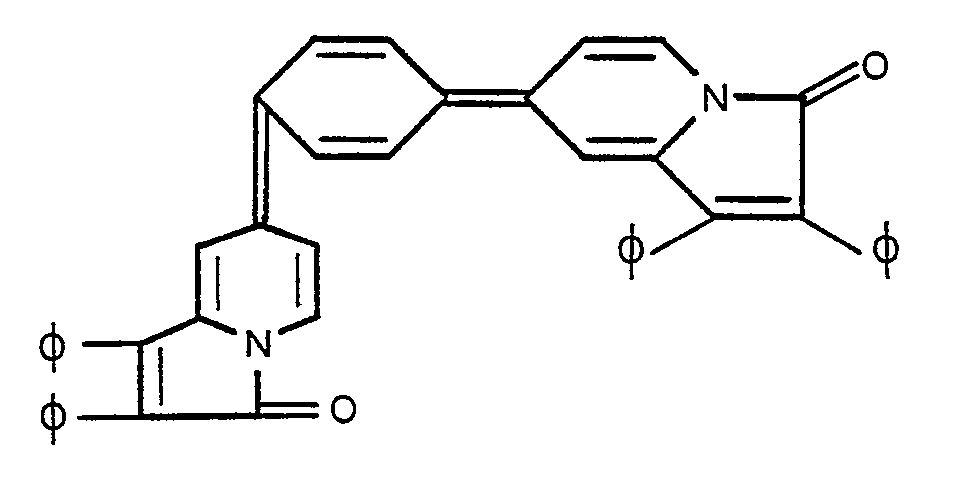
- 1,4-bis-(7-(1,2-diphenyl-3(7H)-indolizinonylidene)]-2,3-benzo-2,5-cyclohexadiene

- 7,7'-bis[i,2-di-n-propyl-3(7H)-indolizonylidene]

- 7,7'-bis-[1,2-pentamethylene-3(7H)-indolizonylidene]

- 1,2-bis-[2,3-di-(4-methoxyphenyl)-1(7H)-indolizinonylidene] ethane


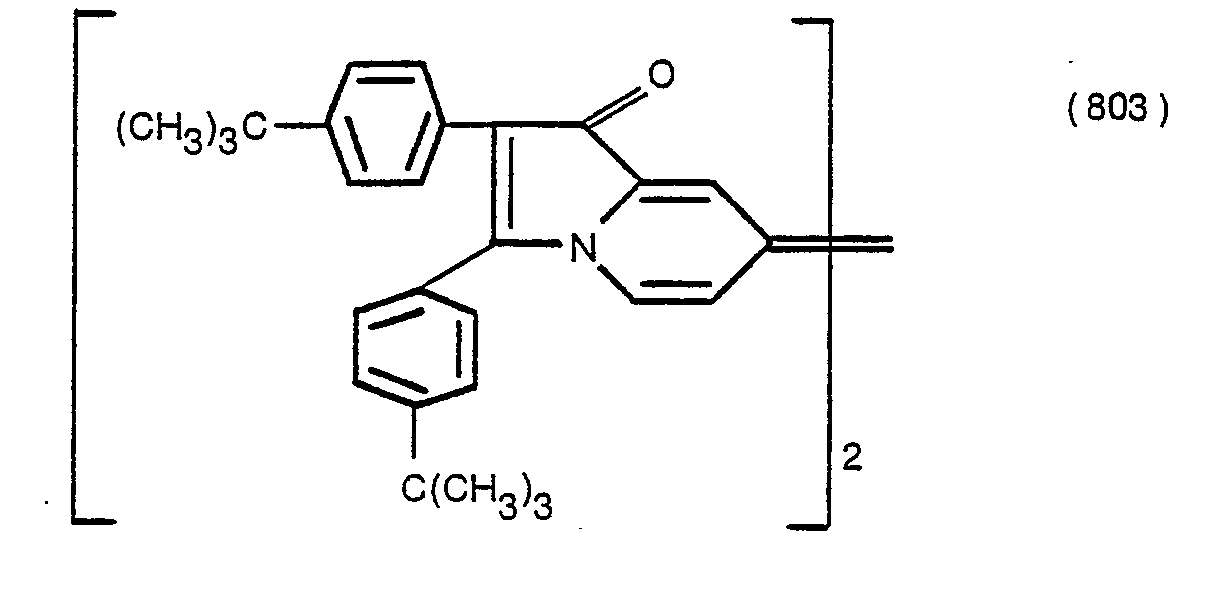


- Examples of other dyes within the above structures (I) and (II) are as follows:
- N-benzyl-4-{7-[2,3-di(4-methoxyphenyl)-3-indolizinolyl] pyridinium bromide

- 7-[4-(N-benrylpyridyiidene)]-2,3-diphenyl-1-hydroxy indolizinium chloride

- 7-[4-(N-benzylpyridylidene)]-2,3-diphenyl-1-indolizinone


- Another class of dyes according to the invention is represented by the formula:

- X8 is an anion as defined above, preferably an acid anion such as methanesulfonate, trifluoromethanesulfonate, para-toluenesulfonate BF4 6 bromide, chloride, iodide and sulfinate;
- R112 and R113 are individually aryl covntaining 6 to 20 carbon atoms; aralkenyl containing 6 to 20 carbon atoms, and alkyl containing 1 to 20 carbon atoms; or R112 and R113 together represent the carbon atoms necessary to complete a 7- or 8-member cyclic structure;
- R114, R115, R116, R117 and R117a are individually hydrogen; alkyl containing 1 to 18 carbon atoms; phenyl; cyano; carboxy; carboxamide; and carboalkoxy, containing 2 to 18 carbon atoms; at least one of R114, R115, R116, R117 and R117a is hydrogen;
- R118 is an electropositive or an electronegative group necessary to complete a chromophore, such as amino, anilino, nitrophenyl, quino, pyranyl, pyridyl, indolizinyl, julolidyl and thiopyranyl;
- p, q, r, s and t are individually 0 or 1; any free bonds being satisfied by hydrogen or unsaturated bonding as required.
- Aryl groups which are suitable for use as R112 and R113 substituents include unsubstituted or substituted phenyl, naphthyl, anthryl, methoxyphenyl and methoxynaphthyl.
- Examples of aralkenyl groups which are suitable for use as R112 and R113 substituents include 2,2-diphenylvinyl, 2-phenylvinyl, 2-naphthylvinyl and 2-methyl-(2-phenylvinyl).
- Alkyl groups which are suitable for use as R112 to and including R117a include methyl, ethyl, propyl, t-butyl, decyl and lauryl.
- Examples of compounds within this class are as follows:
- 7-(2-(4-N,N-dimethylaminophenyl-1-ethenyl]-2,3-diphenyl-1-indolizinonium fluoroborate

- 2,3-diphenyl-7-[2-(9-julolidyl)-1-ethenyl]-1-indolizinonium trifluoromethane sulfonate

- 2,3-diphenyl-7-[3-(2,3-diphenyl-4(4H)-pyranylidene-1-propenyl]-1-indolizinonium perchtorate

- 7-[2-(4-N,N-dimethylaminonaphthyl)-1-ethenyl]-2,3-diphenyl-1-indolizinonium fluoroborate

- 7-[4-(4-dimethylaminophenyl)-1-butadienyl]-1,2-diphenyl-3-indolizinonium trifluoromethane sulfonate
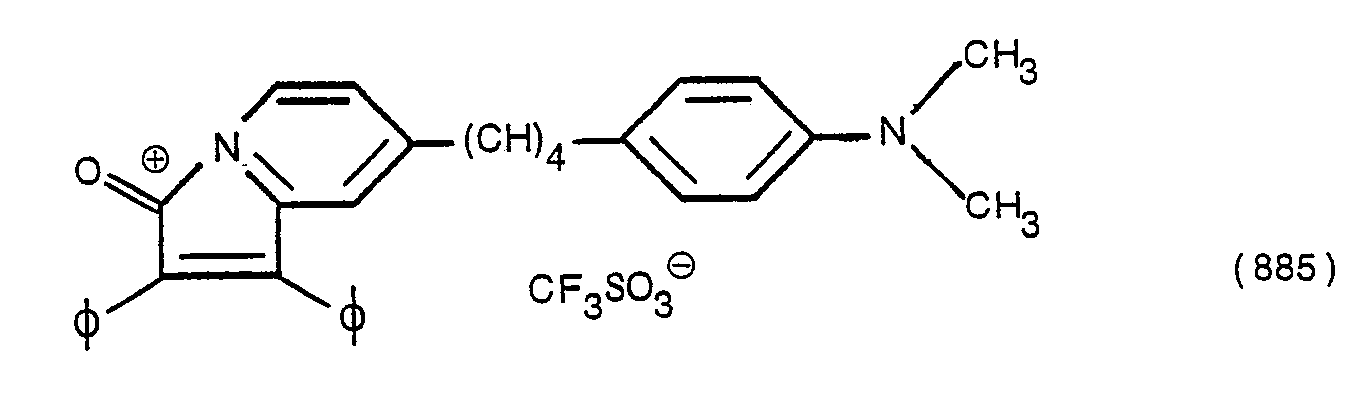
- -(3,5-di-tert-butyl-4-oxo-1-phenylidene)-2-[7-(2,3-diphenyl-1-(7H)-indolizinonylidene)] ethane

- 2,3-diphenyl-7-[2-(4-nitrophenyl)-1-ethenyl]-1-indolizinol sodium salt

- 2,3-diphenyl-7-[2-(2,6-diphenyl-4-(4H)-pyranylidene)-1-ethylidene]-1-hydroxy-(7H)-indolizinium perchlorate

- 2,3-diphenyl-7-[2-(2,6-diphenyl-4-(4H)-pyranylidene)-1-ethylidene]-1-acetoxy-(7H)-indolizinium perchlorate

- 7-(2,2-diacetyl-1-ethenyl)-2,3-diphenyl-1-indolizinol sodium salt

- 2,3-diphenyl-6-[2-(4-nitrophenyl)-1-ethenyl]-1-indolizinol

- 1-[7-(2,3-diphenyl-1-(7H)-indolizinonylidene)]-2-[4-(2,6-diphenyl-4(4H)-pyranylidene)]-ethane

- 7-(3,3-diacetyl-1-propenylidene)-2,3-diphenyl-1-(7H)-indolizinone

- 7-[1-cyano-2-(4-dimethylaminophenyl)-1-ethenyl]-1,2-diphenyl-3-indolizinonium trifluoromethane sulfonate

- 1,2-di-tert-butylphenyl-7-[4-(4-dimethylaminophenyl)-1-(1,3-butadienyl)] - 3-indolizonium trifluoromethane sulfonate

- 2,3-diphenyl-7-4-(2,6-diphenyl-4(4H)-pyranylidene)-2-(2-butenyl)-1-indolizinonium trifluoromethane sulfonate

- Additional compounds of this class are shown below in Tables I and II:


- A further class of dyes according to the invention is represented by the structural formula:
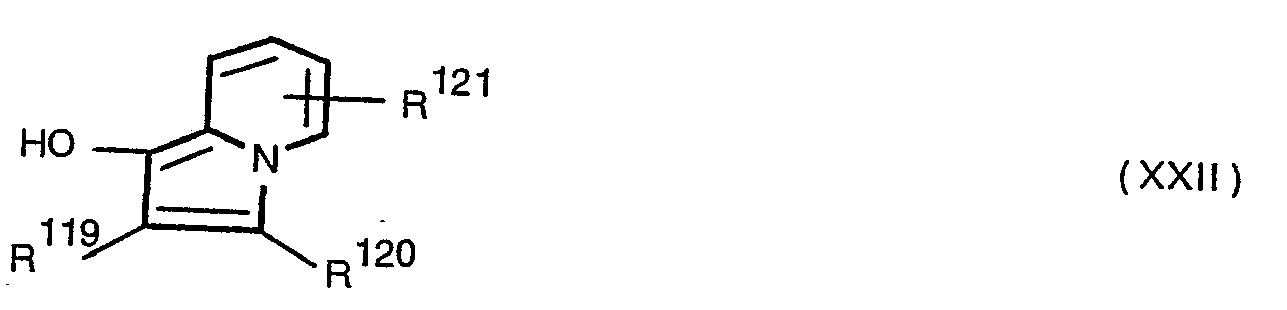
- R119 and R120 are individually aryl containing 6 to 20 carbon atoms, such as phenyl and naphthyl; or, alkyl containing 1 to 18 carbon atoms, such as methyl, ethyl, propyl, decyl and lauryl;
- R121 is cyano, carboxy, formyl, acyl containing 2 to 18 carbon atoms, such as acetyl, propionyl and lauroyl; carboalkoxy containing 2 to 18 carbon atoms, such as carbomethoxy, carboethoxy and carbobutoxy; or aminocarbonyl containing 1 to 18 carbon atoms, such as unsubstituted aminocarbonyl, methylaminocarbonyl and dimethylaminocarbonyl which enables the compound to be a dye.
- The compounds in this class are shown in the enol form, rather than the keto form. Examples of compounds within this class are as follows:
- 7-cyano-2,3-diphenyl-1-indolizinol

- 7-formyl-2,3-di-(4-methoxyphenyl)-1-indolizinol

- 6-aminocarbonyl-2,3-diphenyl-1-indolizinol

- 8-carboethoxy-2,3-diphenyl-1-indolizinol

- 7-carboxy-2,3-diphenyl-1-indolizinol
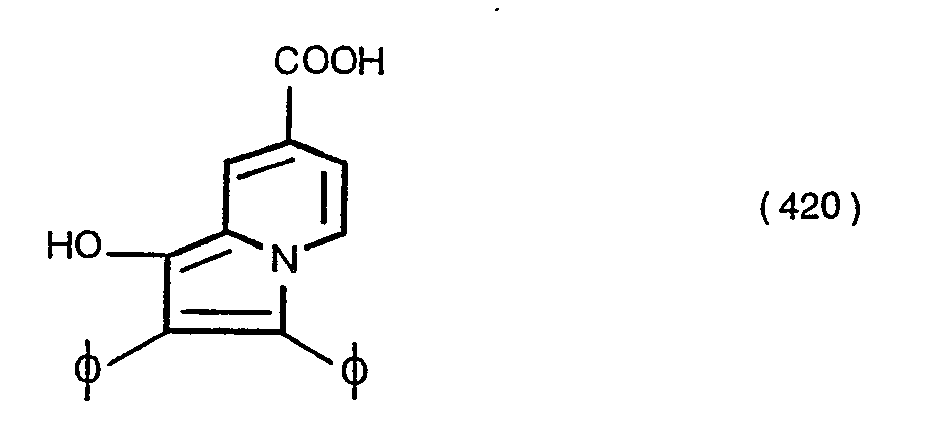
- Optimum methods for preparation of dyes according to the invention will vary, depending upon the desired dye, the starting material, the cyclopropenone, the color-forming coupler, the pyridine compound, solvents present, reaction temperature, concentration of reactants and catalyst present. The cyclopropenone and pyridine compounds are mixed in about stoichiometric concentrations. However, it is often useful to mix the reactants with an excess of the pyridine compound to provide better yields or different isomers.
- The reactants for forming a dye according to the invention can be mixed in a suitable reaction medium. For example, the cyclopropenone and pyridine compounds are mixed in an appropriate reaction medium, such as an organic solvent or medium that forms a coatable composition, for subsequent utilization of the dye which is formed.
- A reaction medium which comprises a solvent for the reactants is most useful. A useful solvent includes, for example, pyridine, chlorinated hydrocarbons, such as methylene chloride and chlorobenzene, toluene, dioxane, and tetrahydrofuran. Pyridine and some pyridine related solvents, such as 4-picoline, are especially useful in producing isomers. The reactants are mixed at room temperature (about 19°C) and then heated to within the range of about 50 to about 150°C. The optimum reaction temperature will be influenced by the choice of solvent, the particular reactants, the desired dye, and other described factors.
- When a dye according to the invention is formed by the reaction of a cyclopropenone with a pyridine compound and suitable color-forming compound, such as a color-forming coupler, it is preferred that the reaction be carried out in chemical association with an appropriate oxidant, such as elemental iodine, oxygen, copper bromide, copper chloride, copper acetate, benzoyl peroxide or copper acetyacetonate. The concentration of oxidant will vary, depending upon the particular reactants, processing conditions, desired dye, and reaction medium. An oxidant is especially useful in the reaction of a cyclopropenone with a pyridine compound and an active methylene coupler.
- In preparing an oxoindolizine dye by the reaction of pyridine compound with a cyclopropenone compound, the condensation is generally carried out in a solvent. The concentration of reactants is generally about stoichiometric. However, an excess of pyridine or picoline is often useful. The reaction temperature is generally within the range of 0°C to 95°C. The reaction is preferably carried out in chemical association with an oxidant, such as copper ions or air.
- An especially useful method according to the invention comprises preparation of a dye represented by the structure (XXI) comprising reacting a compound represented by the structure

- Xe, R50, R5' and R52 are as defined above,
- R112 and R123 are individually hydrogen or substituents that do not adversely affect the oxoindolizinium dye, such as alkyl containing 1 to 20 carbon atoms, for example, methyl, ethyl, propyl, butyl, decyl and lauryl; aryl containing 6 to 20 carbon atoms, such as phenyl, tolyl, and naphthyl; or a heterocyclic group, such as pyridyl and julolidyl; and at least one of R122 and R123 is a monovalent group which completes a chromophore as defined.
- Such compounds include, for example, pyrylium, flavylium, dimethylamino benzaldehyde and cinnimaldehyde compounds. These reactants (XII) and (XXIV) are reacted in about equimolar proportions in a suitable solvent, such as acetic anhydride, with or without a catalyst, such as piperidine or sodium acetate, at a temperature within the range of about 20°C to about 140°C. The resulting dye crystallizes from the medium or is precipitated by addition of a non-solvent, such as water, ethyl ether or cyclohexane. An example of such a method according to the invention is a method of preparing a dye represented by the formula:

- (1) reacting a compound represented by the formula:


- Another method of preparing dyes according to the invention comprises reacting an indolizinol represented by the formula:

- R124 and R125 are individually aryl containing 6 to 14 carbon atoms, such as phenyl, xylyl, methoxyphenyl and naphthyl; or, alkyl containing 1 to 20 carbon atoms, such as methyl, ethyl, propyl, decyl and lauryl;
- R126 is hydrogen, cyano, carboxy, formyl, acyl containing 2 to 18 carbon atoms, such as acetyl, propionyl, and lauroyl; carboalkoxy containing 2 to 10 carbon atoms, such as carbomethoxy, carboethoxy and carbobutoxy; or aminocarbonyl containing 1 to 18 carbon atoms, such as unsubstituted aminocarbonyl, methylaminocarbonyl and dimethylaminocarbonyl; and alkyl containing 1 to 18 carbon atoms, such as methyl, ethoxy, propyl, butyl, decyl and lauryl;
- R127 is hydrogen or alkyl containing 1 to 4 carbon atoms, such as methyl, ethyl, propyl and butyl;
- R128 is alkyl containing 1 to 18 carbon atoms, such as methyl, ethyl, propyl, butyl, decyl and lauryl; or aryl containing 6 to 14 carbon atoms, such as phenyl, tolyl, xylyl and naphthyl;
- Many oxoindolizine and oxoindolizinium dyes within Structures I and II are useful in imaging, such as in photothermographic imaging or in laser recording and reading applications. Especially useful dyes according to the invention are compounds that are image dyes or, alternatively, are capable of forming image dyes. Selection of an optimum indolizinone or indolizinium dye will depend upon such factors as the desired use, processing conditions, desired image, particular components with the dye, exposure means to form an image, and stability of the dye.
- The following examples are included for a further understanding of the invention.
- A solution (10 percent by weight) of 2,3-di(4-tertiarybutylphenyl) cyclopropenone, in 4-picoline (pyridine compound), was prepared containing a trace of cupric acetate (catalyst). The solution was sparged with a stream of air to provide agitation and excess oxygen. The solution was heated on a steam bath-to 80°C to 95°C for 15 minutes. A pasty cyan-colored slurry resulted. The resulting mixture was filtered to remove excess picoline, and the colored solids washed with acetone. The solids were dried under vacuum to remove the acetone-washed solvent. A 25 percent yield of the desired dye was obtained based on the cyclopropenone starting material. The dye had a maximum absorption at 695 nm in chloroform solution. The structure was confirmed by mass spectroscopy, nuclear magnetic resonance, infrared spectral analysis and x-ray diffraction.
- Equimolar amounts of benzyl bromide and 4,4'-di-pyridine were dissolved in N,N-dimethylformamide to form approximately a 10 percent by weight solution. The solution was heated for 10 minutes on a steam bath at 95°C to form the quaternary salt of bipyridine. The reaction mixture was cooled slightly, and an equimolar amount of 2,3-di-(4-methoxyphenyl) cyclopropenone was added to the solution. The reaction mixture was heated for 15 minutes and quenched in excess cold water. A solution of 48 percent hydrobromic acid was added to the water-N,N-dimethylformamide solution to precipitate the desired dye product. The precipitated dye was removed by filtration and dried under vacuum. The dye had a maximum absorption density at 535 nm in chloroform solution. The desired dye structure was confirmed by mass spectroscopy, nuclear magnetic resonance and infrared spectral analysis.
- A 10 percent solution of 2,3-di(4-methoxyphenyl) cyclopropenone in pyridine was refluxed under nitrogen for 15 minutes. The resulting solution was cooled slightly, and an equivalent amount of dibenzoylmethane based on the cyclopropenone was added to the green solution. The reaction mixture was refluxed for 60 minutes. The resulting reaction mixture was again cooled, and four equivalents of iodine dissolved in a small amount of pyridine was added to the reaction mixture. The mixture was further heated at 90°C on a steam bath for 15 minutes. The bright blue solution was quenched by pouring it into cold excess dilute hydrochloric acid. The desired dye precipitated and was removed from the solution by filtering. A 95 percent yield of the desired dye was obtained based on the starting cyclopropenone. The dye was chromatographed on silica gel to provide a purified product. The maximum absorption of the dye was at 605 nm in chloroform solution. The structure of the dye was confirmed by mass spectroscopy, nuclear magnetic resonance and infrared analysis.
- Equivalent amounts of 4-formylpyridine and 2,3-di(4-methoxyphenyl) cyclopropenone were dissolved in sufficient para-dioxane to form approximately a 10 percent solution. The mixture was refluxed at 102°C under nitrogen for 2 hours. Sufficient water was then added to the reaction mixture to bring it to the cloud point at 80°C. The reaction mixture was then cooled to room temperature, and the product allowed to crystallize. The crystals were collected by filtration, and washed with a small amount of water. The dried crystals were the desired dye. The dye was produced in a 95 percent yield based on the amount of cyclopropenone. The yellow dye had a maximum absorption of 435 nm in chloroform solution. The structure of the dye was confirmed by mass spectroscopy, nuclear magnetic resonance and infrared analysis.
- Other yellow dyes were prepared by a modification of the procedure described in Example 4. The modification consisted of substituting the particular pyridine needed to obtain the desired dye for the 4- formyl pyridine described in Example 4. Structures were confirmed by mass spectrometry, nuclear magnetic resonance and elemental analysis. Examples of the yellow dyes prepared are as follows:
-

-

-

-

- Equivalent amounts of 4-dimethylaminocinnamaldehyde and 1,2-di(tert-butylphenyl-7-methyl-3- indolizinonyl trifluoromethane sulfonate were dissolved in acetic anhydride to form approximately a 10 percent solution. The reaction mixture was heated at 70-90°C for five minutes, cooled to room temperature and diluted with diethyl ether and the resulting product collected by filtration. The crude product was recrystallized from acetone to furnish the desired dye.
- A 10% solution of 1,2-diphenyl-1-indolizinonium triiodide in dimethylaniline was warmed at 70―90°C for 10 minutes. The resulting solution was cooled and diluted with diethyl ether and the resulting solid redissolved in acetone. The desired dye was precipitated by the addition of dilute fluoboric acid to the solution.
- A 10% solution of 2,3-diphenyl-1-indolizinonium triiodide in pyridine was treated with two equivalents of anhydrous diethyl amine and heated at 70―90°C for 15 minutes. The reaction mixture was cooled and poured into diethyl ether and filtered to furnish the crude dye. The dye was washed thoroughly with water to remove soluble salts to furnish purified product.
- Oxoindolizine and oxoindolizinium dyes for use in an optical disc were selected to provide the desired characteristics for laser writing and reading including among other characteristics, the desired solubility, absorption and stability characteristics.
- In each of the examples an optical disc for laser writing and reading was prepared by coating, on a support designed for an optical disc, a layer of an amorphous composition comprising a binder, such as cellulose nitrate, and an oxoindolizine or oxoindolizinium dye having an absorption at a wavelength at which the laser was tuned, such as a wavelength in the range of about 300 to about 1000 nanometers. Optical discs were prepared by techniques described in, for example, "Disc-Storage Technology" by Robert M. White, Scientific American, August 1980, beginning at page 138, and Research Disclosure, November, 1978, Item No. 17522.
- The dyes of Examples 12,13 and 14 were individually incorporated in a coating composition containing cellulose nitrate (binder) and cyclohexanone (solvent). The resulting compositions were coated on optical disc supports containing a reflective metal layer, such as aluminum. The resulting optical discs were imagewise exposed to a laser emitting at 800 nanometers pulsed at 10 MHz and a 50% duty cycle in a 30 KHz bandwidth to provide an image on each optical disc. Reading from the exposed optical discs was by monitoring the feedback from the same laser. The following dyes were tested in the video discs:

- An image was recorded and read on each of the optical discs. The recording power at the discs was 12 mW in each case.
- A solution was prepared containing 525 mg of poly(ethylene-co-1,4-cyclohexylenedimethylene-1-methyl-2,4-benzenedisulfonamide) (binder), 400 mg of 1-methyl-4-(4-pyridyl)pyridinium-para-toluenesulfonate (pyridine compound) and 9.980 g of 2-methoxyethanol (solvent). The polysulfonamide binder and quaternary salt (pyridine compound) were dissolved in the 2-methoxyethanol by gentle agitation at room temperature (19°C). A clear lacquer solution resulted which was coated on a poly(ethylene terephthalate) film support at a wet coating thickness of 0.125 mm. The coating was dried by heating the material to about 24°C for 30 minutes in a stream of air.
- A second solution was prepared by dissolving 525 g of poly(styrene-co-butadiene) (KRO-3, which is a trade name of and available from Phillips Petroleum Company, U.S.A.), in 9.98 g of toluene with 40 mgof1-phenyl-2-(para-methoxy-phenyl)cyclopropenone (photosensitive cyclopropenone compound). Solution was produced by stirring at 22°C for several hours. A clear lacquer solution resulted which was coated directly over the first layer containing the pyridine compound. A wet coating thickness of 0.125 mm was applied. The resulting composite two-layer element was dried by warming to 45°C for 30 minutes. The resulting element was exposed to a 250 watt mercury lamp for 20 seconds at a distance of 7.6 cm. The desired dye was produced by heating the element, after exposure, to 150°C for 3 seconds on a heated aluminum block. A brilliant red dye was formed which had a maximum absorption at 535 nm.
- A coating solution was prepared by dissolving 0.500 g of the polysulfonamide binder as described in Example 15 and 500 mg of 4-azastyryl-1-methyl-pyridinium para-toluenesulfonate (pyridine compound) in 10 g of 2-methoxyethanol (solvent). Solution was produced by stirring at room temperature (19°C). A clear lacquer solution resulted which was coated on a poly(ethylene terephthalate) film support by means of a doctor blade to produce a wet coating thickness of 0.125 mm. The resulting coating was dried by heating the coating to about 24°C for 30 minutes in a steam of air.
- A second solution was prepared by dissolving 25 mg of phenylanisyl -cyclopropenone and 0.50 g of poly(styrene-co-butadiene) resin in 10.0 g of toluene. A clear solution which resulted upon stirring the mixture for 3 hours at room temperature (19°C) was coated directly over the first layer containing the pyridine compound. A wet coating thickness of 0.125 mm was applied by means of a doctor blade. The composite two-layer element was dried by warming the resulting coating to about 24°C for 30 minutes in a stream of air. A brilliant clear transparent film was obtained.
- The resulting element was imagewise exposed and then heated as described in Example 15. A blue dye was formed which had a maximum absorption at 575 nm.
- A coating solution was prepared by dissolving 0.50 g of poly(styrene-co-butadiene) resin and 125 mg of 4,4'-dipyridylethylene (pyridine compound) in 10.0 g of toluene (solvent). A clear solution which resulted upon stirring at room temperature (19°C) was coated on a poly(ethylene terephthalate) film support containing a gelatin subbing layer at a wet coating thickness of 0.125 mm. The resulting coating was dried by heating to 24°C for 30 minutes. A second layer was coated over the layer containing the pyridine compound. This second layer was prepared from a coating solution produced by dissolving 0.50 g of poly(vinyl alcohol) in 9.50 g of water. The composition containing the poly(vinyl alcohol) was coated at a wet coating thickness of 0.125 mm over the first layer. The resulting composite film was dried by heating to 24°C for 30 minutes. A top layer was prepared by coating a solution containing 125 mg of photosensitive phenylanisyl cyclopropenone and 0.50 g of poly(styrene-co-butadiene) dissolved in 10.0 g of toluene. The top layer was coated at a wet coating thickness of 0.125 mm. The resulting composite film was dried for 30 minutes at 24°C in an air stream. The composite film was imagewise exposed for 40 seconds and then heated as described in Example 15. A dye was produced which had a maximum absorption in the infrared region of the electromagnetic spectrum at 815 nm.
- A coating solution was prepared by dissolving .50 g of poly(styrene-co-butadiene) resin, 40 mg of o,p-dianisylcyclopropenone (photosensitive cyclopropenone), and 40 mg of 1,2-bis(4-pyridyl)ethylene (pyridine compound) in 10.0 g of toluene. The solution was coated on a poly(ethylene terephthalate) film support at a wet coating thickness of 0.125 mm. The coating was dried by standing at 24°C for two hours. The resulting element was exposed to a 250 watt mercury lamp for 20 seconds at a distance of 7.6 cm through a mask to produce a developable image in the photographic element. The desired dye was produced by heating the element, after exposure, to 150°C for 10 seconds on a heated aluminum block. An infrared dye was formed in the film with a maximum absorbtion at 830 nm.
with an aldehyde or ketone represented by the formula

with an active methylene coupler, such as represented by formula (IX). The indolizinol represented by formula (XXV) and the active methylene coupler are reacted in about equimolar proportions in a suitable solvent, such as acetic anhydride, preferably with a catalyst, such as piperidine or sodium acetate, at a temperature within the range of 20°C to 140°C. The resulting dye crystallizes from the reaction medium and is preferably precipitated by the addition of a non-solvent, such as water, ethyl ether or cyclohexane.
Claims (6)


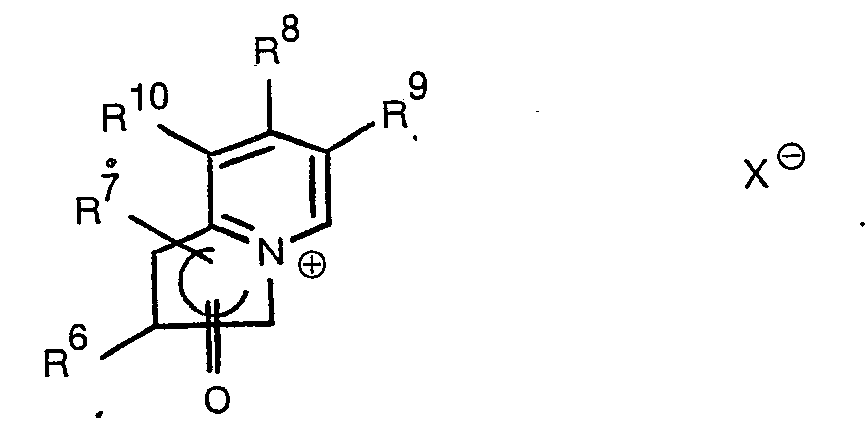


Applications Claiming Priority (2)
| Application Number | Priority Date | Filing Date | Title |
|---|---|---|---|
| US27802281A | 1981-06-29 | 1981-06-29 | |
| US278022 | 1981-06-29 |
Publications (2)
| Publication Number | Publication Date |
|---|---|
| EP0068876A1 EP0068876A1 (en) | 1983-01-05 |
| EP0068876B1 true EP0068876B1 (en) | 1985-04-03 |
Family
ID=23063368
Family Applications (1)
| Application Number | Title | Priority Date | Filing Date |
|---|---|---|---|
| EP82303381A Expired EP0068876B1 (en) | 1981-06-29 | 1982-06-28 | Oxoindolizine and oxoindolizinium dyes and processes for their preparation |
Country Status (4)
| Country | Link |
|---|---|
| EP (1) | EP0068876B1 (en) |
| JP (1) | JPS5817164A (en) |
| CA (1) | CA1211112A (en) |
| DE (1) | DE3262866D1 (en) |
Families Citing this family (2)
| Publication number | Priority date | Publication date | Assignee | Title |
|---|---|---|---|---|
| GB9224004D0 (en) * | 1992-11-16 | 1993-01-06 | Minnesota Mining & Mfg | Photochemical generation of dyes |
| JP4702730B2 (en) * | 1999-12-02 | 2011-06-15 | 株式会社林原生物化学研究所 | Styryl dye |
-
1982
- 1982-05-26 CA CA000403778A patent/CA1211112A/en not_active Expired
- 1982-06-28 DE DE8282303381T patent/DE3262866D1/en not_active Expired
- 1982-06-28 EP EP82303381A patent/EP0068876B1/en not_active Expired
- 1982-06-29 JP JP11091782A patent/JPS5817164A/en active Granted
Non-Patent Citations (1)
| Title |
|---|
| None * |
Also Published As
| Publication number | Publication date |
|---|---|
| EP0068876A1 (en) | 1983-01-05 |
| DE3262866D1 (en) | 1985-05-09 |
| CA1211112A (en) | 1986-09-09 |
| JPS5817164A (en) | 1983-02-01 |
| JPH0342307B2 (en) | 1991-06-26 |
Similar Documents
| Publication | Publication Date | Title |
|---|---|---|
| EP0068880B1 (en) | Photographic elements capable of providing oxoindolizine and oxoindolizinium dye compounds | |
| US3758309A (en) | -pyrazolo(3,2-c)-s-triazole silver halide emulsions containing sensitizing dyes derived from a 1h | |
| US4197080A (en) | Radiation-cleavable nondiffusible compounds and photographic elements and processes employing them | |
| JP2614862B2 (en) | Elements containing infrared absorbing dyes | |
| US3423207A (en) | Solubilized styryl dyes | |
| JPS6021189B2 (en) | Methine 4-nitrobenzylidene dye base | |
| JPS61162044A (en) | Photographic element | |
| US3932415A (en) | Pyrylium dyes having a fused rigidized nitrogen-containing ring | |
| JP2975761B2 (en) | Optical recording medium using photochromic material and its composition | |
| EP0342810A2 (en) | Cyanine dyes and preparation thereof | |
| EP0068876A1 (en) | Oxoindolizine and oxoindolizinium dyes and processes for their preparation | |
| EP0292322A2 (en) | Dyes suitable for sensitization of photoconductive systems | |
| JPH03103476A (en) | Metal-containing indoaniline based compound | |
| US4341894A (en) | Sensitizers for photoconductive compositions | |
| US4577024A (en) | Oxoindolizine and oxoindolizinium compounds useful as dyes | |
| US3694216A (en) | Silver halide emulsions containing methine dyes with 1h,5h-pyrazolo-(1,2-a)pyrazole - 1,3(2h),5,7(6h) - tetrone nucleus | |
| El-Hamd | Some new fused heterocyclic cyanine dyes with ring junction heteroatom | |
| US5405968A (en) | Polyketomethine dyes | |
| JPH0798934B2 (en) | Photochromic material and optical recording medium | |
| JP2881538B2 (en) | Indolizine dyes and method for improving solubility | |
| JPH09183913A (en) | Pyrrolo (2,1-a)isoquinoline dye | |
| JPS60118749A (en) | Photostabilized cyanine coloring matter and its manufacture | |
| JPH0134464B2 (en) | ||
| Abd El‐Aal et al. | Syntheses and electronic absorption spectra of some new penta‐and di‐methine cyanine dyes | |
| JPH0442428B2 (en) |
Legal Events
| Date | Code | Title | Description |
|---|---|---|---|
| PUAI | Public reference made under article 153(3) epc to a published international application that has entered the european phase |
Free format text: ORIGINAL CODE: 0009012 |
|
| AK | Designated contracting states |
Designated state(s): BE DE FR GB IT NL |
|
| 17P | Request for examination filed |
Effective date: 19830214 |
|
| ITF | It: translation for a ep patent filed | ||
| GRAA | (expected) grant |
Free format text: ORIGINAL CODE: 0009210 |
|
| AK | Designated contracting states |
Designated state(s): BE DE FR GB IT NL |
|
| RIN2 | Information on inventor provided after grant (corrected) |
Free format text: FLETCHER, JR., GEORGE LELAND * BENDER, STEVEN LEE * WADSWORTH, DONALD HAROLD |
|
| REF | Corresponds to: |
Ref document number: 3262866 Country of ref document: DE Date of ref document: 19850509 |
|
| ET | Fr: translation filed | ||
| PLBE | No opposition filed within time limit |
Free format text: ORIGINAL CODE: 0009261 |
|
| STAA | Information on the status of an ep patent application or granted ep patent |
Free format text: STATUS: NO OPPOSITION FILED WITHIN TIME LIMIT |
|
| 26N | No opposition filed | ||
| PGFP | Annual fee paid to national office [announced via postgrant information from national office to epo] |
Ref country code: DE Payment date: 19890606 Year of fee payment: 8 |
|
| ITTA | It: last paid annual fee | ||
| PGFP | Annual fee paid to national office [announced via postgrant information from national office to epo] |
Ref country code: BE Payment date: 19890809 Year of fee payment: 8 |
|
| PGFP | Annual fee paid to national office [announced via postgrant information from national office to epo] |
Ref country code: GB Payment date: 19900530 Year of fee payment: 9 |
|
| PGFP | Annual fee paid to national office [announced via postgrant information from national office to epo] |
Ref country code: FR Payment date: 19900611 Year of fee payment: 9 |
|
| PG25 | Lapsed in a contracting state [announced via postgrant information from national office to epo] |
Ref country code: BE Effective date: 19900630 |
|
| PGFP | Annual fee paid to national office [announced via postgrant information from national office to epo] |
Ref country code: NL Payment date: 19900630 Year of fee payment: 9 |
|
| BERE | Be: lapsed |
Owner name: EASTMAN KODAK CY Effective date: 19900630 |
|
| PG25 | Lapsed in a contracting state [announced via postgrant information from national office to epo] |
Ref country code: DE Effective date: 19910301 |
|
| PG25 | Lapsed in a contracting state [announced via postgrant information from national office to epo] |
Ref country code: GB Effective date: 19910628 |
|
| PG25 | Lapsed in a contracting state [announced via postgrant information from national office to epo] |
Ref country code: NL Effective date: 19920101 |
|
| NLV4 | Nl: lapsed or anulled due to non-payment of the annual fee | ||
| GBPC | Gb: european patent ceased through non-payment of renewal fee | ||
| PG25 | Lapsed in a contracting state [announced via postgrant information from national office to epo] |
Ref country code: FR Effective date: 19920228 |
|
| REG | Reference to a national code |
Ref country code: FR Ref legal event code: ST |