EP0068326A2 - Bis-phenol phosphates as clarifiers for polyolefin resins - Google Patents
Bis-phenol phosphates as clarifiers for polyolefin resins Download PDFInfo
- Publication number
- EP0068326A2 EP0068326A2 EP82105308A EP82105308A EP0068326A2 EP 0068326 A2 EP0068326 A2 EP 0068326A2 EP 82105308 A EP82105308 A EP 82105308A EP 82105308 A EP82105308 A EP 82105308A EP 0068326 A2 EP0068326 A2 EP 0068326A2
- Authority
- EP
- European Patent Office
- Prior art keywords
- bis
- carbon atoms
- group
- phosphite
- alkyl
- Prior art date
- Legal status (The legal status is an assumption and is not a legal conclusion. Google has not performed a legal analysis and makes no representation as to the accuracy of the status listed.)
- Granted
Links
- 0 CC(c(cc(CC**)cc1**)c1OC=O)c(cc(**)cc1**)c1OOON Chemical compound CC(c(cc(CC**)cc1**)c1OC=O)c(cc(**)cc1**)c1OOON 0.000 description 8
Classifications
-
- C—CHEMISTRY; METALLURGY
- C08—ORGANIC MACROMOLECULAR COMPOUNDS; THEIR PREPARATION OR CHEMICAL WORKING-UP; COMPOSITIONS BASED THEREON
- C08K—Use of inorganic or non-macromolecular organic substances as compounding ingredients
- C08K5/00—Use of organic ingredients
- C08K5/49—Phosphorus-containing compounds
- C08K5/51—Phosphorus bound to oxygen
- C08K5/52—Phosphorus bound to oxygen only
- C08K5/527—Cyclic esters
-
- C—CHEMISTRY; METALLURGY
- C07—ORGANIC CHEMISTRY
- C07F—ACYCLIC, CARBOCYCLIC OR HETEROCYCLIC COMPOUNDS CONTAINING ELEMENTS OTHER THAN CARBON, HYDROGEN, HALOGEN, OXYGEN, NITROGEN, SULFUR, SELENIUM OR TELLURIUM
- C07F9/00—Compounds containing elements of Groups 5 or 15 of the Periodic Table
- C07F9/02—Phosphorus compounds
- C07F9/547—Heterocyclic compounds, e.g. containing phosphorus as a ring hetero atom
- C07F9/6564—Heterocyclic compounds, e.g. containing phosphorus as a ring hetero atom having phosphorus atoms, with or without nitrogen, oxygen, sulfur, selenium or tellurium atoms, as ring hetero atoms
- C07F9/6571—Heterocyclic compounds, e.g. containing phosphorus as a ring hetero atom having phosphorus atoms, with or without nitrogen, oxygen, sulfur, selenium or tellurium atoms, as ring hetero atoms having phosphorus and oxygen atoms as the only ring hetero atoms
- C07F9/657163—Heterocyclic compounds, e.g. containing phosphorus as a ring hetero atom having phosphorus atoms, with or without nitrogen, oxygen, sulfur, selenium or tellurium atoms, as ring hetero atoms having phosphorus and oxygen atoms as the only ring hetero atoms the ring phosphorus atom being bound to at least one carbon atom
- C07F9/657181—Heterocyclic compounds, e.g. containing phosphorus as a ring hetero atom having phosphorus atoms, with or without nitrogen, oxygen, sulfur, selenium or tellurium atoms, as ring hetero atoms having phosphorus and oxygen atoms as the only ring hetero atoms the ring phosphorus atom being bound to at least one carbon atom the ring phosphorus atom and, at least, one ring oxygen atom being part of a (thio)phosphonic acid derivative
-
- C—CHEMISTRY; METALLURGY
- C07—ORGANIC CHEMISTRY
- C07F—ACYCLIC, CARBOCYCLIC OR HETEROCYCLIC COMPOUNDS CONTAINING ELEMENTS OTHER THAN CARBON, HYDROGEN, HALOGEN, OXYGEN, NITROGEN, SULFUR, SELENIUM OR TELLURIUM
- C07F9/00—Compounds containing elements of Groups 5 or 15 of the Periodic Table
- C07F9/02—Phosphorus compounds
- C07F9/547—Heterocyclic compounds, e.g. containing phosphorus as a ring hetero atom
- C07F9/6564—Heterocyclic compounds, e.g. containing phosphorus as a ring hetero atom having phosphorus atoms, with or without nitrogen, oxygen, sulfur, selenium or tellurium atoms, as ring hetero atoms
- C07F9/6571—Heterocyclic compounds, e.g. containing phosphorus as a ring hetero atom having phosphorus atoms, with or without nitrogen, oxygen, sulfur, selenium or tellurium atoms, as ring hetero atoms having phosphorus and oxygen atoms as the only ring hetero atoms
- C07F9/6574—Esters of oxyacids of phosphorus
- C07F9/65744—Esters of oxyacids of phosphorus condensed with carbocyclic or heterocyclic rings or ring systems
-
- C—CHEMISTRY; METALLURGY
- C07—ORGANIC CHEMISTRY
- C07F—ACYCLIC, CARBOCYCLIC OR HETEROCYCLIC COMPOUNDS CONTAINING ELEMENTS OTHER THAN CARBON, HYDROGEN, HALOGEN, OXYGEN, NITROGEN, SULFUR, SELENIUM OR TELLURIUM
- C07F9/00—Compounds containing elements of Groups 5 or 15 of the Periodic Table
- C07F9/02—Phosphorus compounds
- C07F9/547—Heterocyclic compounds, e.g. containing phosphorus as a ring hetero atom
- C07F9/6564—Heterocyclic compounds, e.g. containing phosphorus as a ring hetero atom having phosphorus atoms, with or without nitrogen, oxygen, sulfur, selenium or tellurium atoms, as ring hetero atoms
- C07F9/6578—Heterocyclic compounds, e.g. containing phosphorus as a ring hetero atom having phosphorus atoms, with or without nitrogen, oxygen, sulfur, selenium or tellurium atoms, as ring hetero atoms having phosphorus and sulfur atoms with or without oxygen atoms, as ring hetero atoms
-
- C—CHEMISTRY; METALLURGY
- C08—ORGANIC MACROMOLECULAR COMPOUNDS; THEIR PREPARATION OR CHEMICAL WORKING-UP; COMPOSITIONS BASED THEREON
- C08K—Use of inorganic or non-macromolecular organic substances as compounding ingredients
- C08K5/00—Use of organic ingredients
- C08K5/49—Phosphorus-containing compounds
- C08K5/51—Phosphorus bound to oxygen
- C08K5/53—Phosphorus bound to oxygen bound to oxygen and to carbon only
- C08K5/5317—Phosphonic compounds, e.g. R—P(:O)(OR')2
- C08K5/5333—Esters of phosphonic acids
- C08K5/5357—Esters of phosphonic acids cyclic
Definitions
- Low density polyethylene has been known for many years to have a crystalline structure. Additional crystalline polymers such as high-density polyethylene, isotactic polypropylene, poly-1-butene, and poly-4-methylpentene have become available as a result of the development of the so-called stereospecific Ziegler-Natta catalyst system for the polymerization of alphaolefins.
- Such crystalline polymers possess special properties, not available in amorphous polymers, which are of steadily increasing commercial interest and importance. Certain properties of these crystalline polymers, particularly optical and strength properties, and processing characteristics, depend to a very significant extent upon the polymer microstructure.
- Certain additives promote the formation of smaller, more numerous spherulites in crystalline polymers.
- Use of such crystallization modifiers has the distinct and important advantage that their effect is not limited to plastic articles of thin cross-section; a more favorable microstructure forms throughout the entire mass of the polymer.
- crystallites As a crystalline polymer cools from the molten state, crystallites begin to form below the melting point, as supercooling progresses. The crystallites cluster about central nuclei, to form spherulites which grow radially outward by addition of more crystallites as crystallization proceeds. Since the spherulites are birefringent, their growth can be readily observed with a polarizing microscope equipped with a hot stage.
- This improvement is attributed to the smaller, more numerous spherulites promoted by nucleation, in the case of the polymeric additives, and by rapid cooling, which minimizes spherulite size in the case of quenching.
- Certain inorganic additives such as very fine silica, also show some nucleating effect in crystalline polymers.
- metal salts of organic acids include sodium, magnesium, calcium, aluminum and titanium.
- the organic acid portion of the salt can be chosen from a variety of mono- or di-carboxylic acids. Examples of suitable monobasic acids are benzoic, cyclohexane, carboxylic, diphenyl acetic, and isonicotinic acids. Dicarboxylic acids such as succinic, adipic, sebacic, and phthalic acids give salts of similar activity.
- the efficiency of the nucleating agents varies with the choice of metal and acid used. Some of the more promising compounds are effective at concentrations well below 0. 5% by weight.
- Wijga No. 3,207,735 suggests cyclic monocarboxylic acids having the carboxyl group attached to a carbon atom of a five to six membered ring, and the corresponding anhydrides, referred to as "benzoic acid type compounds".
- the improvement is said to be obtained when the benzoic acid type compound is present as a liquid, dissolved or thoroughly dispersed in the polymer melt prior to the final crystallization thereof by cooling.
- Wijga No. 3,207,736 suggests aliphatic, cycloaliphatic, and aromatic dicarboxylic or higher polycarboxylic acids and corresponding anhydrides.
- Wijga No. 3,207,738 suggests terminal aliphatic monocarboxylic acids substituted with carbocyclic groups, also referred to as arylalkanoic acid-type compounds.
- K. Yamamoto Japanese.patent No. 15, 185/69 of July 15, 1969 discloses polypropylene compositions of regulated molecular weight containing organotin compounds as molecular weight modifying agents and esters of acids of phosphorus to prevent discoloration. All the disclosed esters are aliphatic esters, for example, dibutyl phosphite, dilauryl phosphite, triethyl phosphate, tributyl phosphate, and bis(2-ethylhexyl phosphate).
- K. Shirayama Japanese patent No. 12, 903/71 of April 2, 1971 discloses crystalline polypropylene compositions of improved transparency and stiffness containing diphenylphosphinic acid represented by the formula or its magnesium, calcium, sodium, or aluminum salts as a nucleating agent.
- R 5 is a hydrogen atom or an alkyl group having one to eighteen carbon atoms
- R 3 is selected from the group consisting of an alkyl group having one to eighteen carbon atoms, and R 4
- R 4 is a hydrogen atom or a metal atom equivalent M 1/a where a is the valence of the metal atom M.
- the compounds as prepared usually give off an unpleasant odor during processing, due perhaps to the presence of a phenol impurity, which is difficult to remove.
- a further improvement in clarity is obtained by using in combination with a phenyl phosphate clarifier as above defined from 0.3 to 3 parts by weight per part by weight of phenyl phosphate compound of a metal compound selected from metal salts of non-nitrogenous monocarboxylic acids having six to eighteen carbon atoms, metal oxides, metal hydroxides, metal chlorides, and metal carbonates.
- the amount of metal compound so used will not usually exceed 1 part per 100 parts of olefin polymer.
- the linking group R must form a ring including the phosphorus group:
- These compounds are useful to improve clarity of polyolefin resin compositions in an amount within the range from 0. 005 to 5 parts by weight per 100 parts of resin.
- the invention further provides a-olefin polymer compositions having improved clarity comprising a polymer of an a-olefin having two to six carbon atoms and an amount to improve clarity of at least one bis-phenol phosphate, phosphonate or phosphinate having the formula: wherein:
- n is the valence of the metal atom M, ranging from one to about four.
- the invention further provides stabilizer compositions for improving the clarity of polymers of a-olefins having two to six carbon atoms, comprising a heat or light stabilizer for a-olefin polymers and a compound of Formula Ia) above.
- the compounds of the invention are phosphates of the formula: wherein R, R 1 , R 2 , m, n and M are as in Formula I.
- the compounds of the invention are phosphinates of the formula: wherein R, R 1 , R 2 , n and M are..as in Formula I.
- These compounds V are known, shown in Japanese patent No. 41,009/73, and Kogaku Kogyo Jiho No. 1423 dated February 15, 1972, and are prepared by the following procedure:
- the compounds IV can be prepared by the same procedure, substituting a bisphenol:
- the compounds II can be prepared by the following procedure:
- R alkylidene include methylidene, ethylidene, propylidene, isopropylidene, butylidene, isobutylidene, sec- butylidene, tert-butylidene, amylidene, hexylidene, heptylidene, octylidene, isooctylidene, 2-ethyl hexylidene, nonylidene and decylidene; cyclohexylidene, cycloheptylidene, methyl cyclo- hexylidene, ethyl cyclohexylidene, and cyclooctylidene.
- R 1 and R 2 , R 3 and R 4 alkyl include methyl, ethyl, propyl, isopropyl, n-butyl, isobutyl, sec-butyl, t-butyl, amyl, t-amyl, hexyl, heptyl, octyl, 2-ethylhexyl, t-octyl, nonyl, decyl, undecyl, dodecyl, tridecyl, tetradecyl, pentadecyl, hexadecyl, heptadecyl and octadecyl.
- R 1 and R 2 , R 3 and R 4 cycloalkyl include cyclopropyl, cyclobutyl, cyclopentyl, methylcyclopentyl, cyclohexyl, methylcyclohexyl, cycloheptyl, cyclooctyl and cyclododecyl.
- Exemplary M monovalent metals include Li, Na, Ki;
- exemplary bivalent metals include Be, Ca, Sr, Ba, Zn, and Cd;
- Exemplary trivalent and tetravalent metals include Al, Ge, Sn, Pb, Ti, Zr, Sb, Cr, Bi, Mo, Mn, Fe, Co and Ni.
- the alkali metals such as Li, Na and K and the alkaline earth metals such as Mg, Ca, Sr and Ba are preferred.
- the a-olefin polymers whose clarity is improved in accordance with this invention by,incorporating therein a bis- phenol phosphoric acid or phosphonic acid metal salt are homopolymers and copolymers of a-olefins, including polyethylene, polypropylene, polybutene-1, poly-3-methylbutene, poly-4-methylpentene, 1, 2-polybutadiene; copolymers of ethylene in major proportions with minor proportions of propylene, 1-butene, 1-hexene, vinyl acetate and vinyl chloride; copolymers of propylene in major proportions with minor proportions of ethylene, 1-butene, or vinyl chloride; and copolymers of butylene, 3-methyl butene, 4-methyl pentene, and 1, 2-butadiene with minor proportions of such monomers.
- the bis-phenol phosphate, phosphonate and phosphinate compounds according to this invention are clarifiers but not olefin polymer heat and/or light stabilizers.
- the bis-phenol phosphate, phosphonate and phosphinate compounds according to this invention do not adversely affect heat and light stability of a-olefin polymers, and can be used together with known heat and light stabilizers for a-olefin polymers in conventional concentrations.
- the bis-phenol phosphate, phosphonate and phosphinate compounds can be combined with conventional heat stabilizers such as phenolic antioxidants, polyvalent metal salts or organic acids, organic phosphites, thioethers and other known heat stabilizers, thereby constituting light and heat stabilizer compositions of the invention.
- conventional heat stabilizers such as phenolic antioxidants, polyvalent metal salts or organic acids, organic phosphites, thioethers and other known heat stabilizers, thereby constituting light and heat stabilizer compositions of the invention.
- the phenolic antioxidant contains one or more phenolic hydroxyl groups, and one or more phenolic nuclei, and can contain from about eight to aboutthree hundred carbon atoms.
- the phenolic nucleus can contain an oxyor thio ether group.
- the alkyl-substituted phenols and polynuclear phenols because of their molecular weight, have a higher boiling point, and therefore are preferred because of their lower volatility.
- the alkyl group or groups including any alkylene groups between phenol nuclei preferably aggregate at least four carbon atoms. The longer the alkyl or alkylene chain, the better the compatibility with polypropylene, inasmuch as the phenolic compound then acquires more of an aliphatic hydrocarbon character, and therefore there is no upper limit on the number of alkyl carbon atoms.
- the compound will not have more than about eighteen carbon atoms in an alkyl, alicyclidene and alkylene group, and a total of not over about fifty carbon atoms.
- the compounds may have from one to four alkyl radicals per phenol nucleus.
- the phenol contains at least one and preferably at least two phenolic hydroxyls, the two or more hydroxyls being in the same ring, if there is only one.
- the rings can be linked by thio or oxyether groups, or by alkylene, alicyclidene or arylidene groups.
- the monocyclic phenols which can be employed have the structure:
- the polycyclic phenol phenol is one having at least two aromatic nuclei linked by a polyvalent linking radical, as defined by the formula: wherein
- Ar is a phenolic nucleus which can be a phenyl or a polycarbocyclic group having condensed or separate phenyl rings; each Ar group contains at least one free phenolic hydroxyl group up to a total of five.
- the Ar rings can also include additional rings connected by additional linking nuclei of the type Y, for example, Ar-Y-Ar-Y-Ar.
- n 1 and n 2 are numbers from one to five, and n 1 and n 2 are numbers of one or greater, and preferably from one to four.
- the aromatic nucleus Ar can, in addition to phenolic hydroxyl groups, include one or more inert substituents.
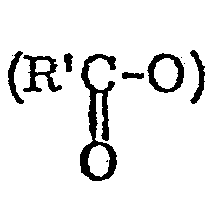
- inert substituents include hydrogen, halogen atoms, e. g., chlorine, bromine and fluorine; organic radicals containing from one to about thirty carbon atoms, such as alkyl, aryl, alkaryl, aralkyl, cycloalkenyl, cycloalkyl, alkoxy, aryloxy and acyloxy where R' is aryl, alkyl or cycloalkyl, or thiohydrocarbon groups having from one to about thirty carbon atoms, and carboxyl groups.
- each aromatic nucleus will not have more than about eighteen carbon atoms in any hydrocarbon substituent group.
- the Ar group can have from one to four substituent groups per nucleus.
- Typical aromatic nuclei include phenyl, naphthyl, phenanthryl, triphenylenyl, anthracenyl, pyrenyl, chrysenyl, and fluoroenyl groups.
- the polyhydric polycyclic phenol has the structure: wherein
- the hydroxyl groups are located ortho and/or para to Y.
- Exemplary Y groups are alkylene , alkylidene, and alkenylene; arylene, alkyl arylene, arylalkylene; cycloalkylene, cycloalkylidene; and oxa-and thia-substituted such groups; tetrahydrofuranes, esters and triazino groups.
- the Y groups are usually bi, tri, or tetravalent, connecting two three or four Ar groups. However, higher valency Y groups connecting more than four Ar groups, can also be used. According to their constitution, the Y groups can be assigned to subgenera as follows:
- phenols Although the relation of effectiveness to chemical structure is insufficiently understood, many of the most effective phenols have Y groups of subgenus 1), and accordingly this is preferred. Some of these phenols can be prepared by the alkylation of phenols or alkyl phenols with polyunsaturated hydrocarbons such as dicyclopentadiene or butadiene.
- phenols include guaiacol, resorcinol monoacetate, vanillin, butyl salicylate, 2, 6-di-tert-butyl-4-methyl phenol, 2-tert-butyl-4-methoxy phenol, 2,4-dinonyl bis-(2-tertiary-butylphenol), 2,2'-methylene-bis-(4-methyl-6-(1'-methyl-cyclohexyl)-phenol), 2, 6-bis-(2'-hydroxy-3'-tertiarybutyl-5'-methylbenzyl)-4-methylphenol, 4,4'-bis-(2-tertiarybutyl-5-methyl-phenol), 2,2'-bis-(4-hydroxy-phenyl) butane, ethylene bis-(p-cresol), 4,4'-oxobis-phenol, 4,4'-oxobis-(3-methyl-5-isopropyl-phenol), 4, 4'-oxobis-(3-methyl-phenol), 2,2'-ox
- Exemplary polyhydric phenols are orcinol, propyl gallate, catechol, resorcinol, 4-octyl-resorcinol, 4-dodecyl- resorcinol, 4-octadecyl-catechol, 4-isooctyl-phloroglucinol, pyrogallol, hexahydroxybenzene, 4-isohexylcatechol, 2,6-di- tertiary-butyl-resorcinol, 2,6-di-isopropyl-phloroalucinol.
- Exemplary polyhydric polycyclic phenols are methylene bis-(2,6-di-tertiary-butyl-phenol), 2,2-bis-(4-hydroxy phenyl)-propane, methylene-bis-(p-cresol), 4,4'-benzylidene bis (2-tertiary-butyl-5-methyl-phenol), 4,4'-cyclo-hexylidene 2,2'-isobutylene-bis-(4-nonylphenol), 2,4-bis-(4-hydroxy-3-t-butyl-phenoxy)-6-(n-octylthio)-1, 3, 5-triazine, 2,4,6-tris-(4-hydroxy-3-t-butyl-phenoxy)-1,3,5-triazine, 2,2'-bis-(3-t-butyl-4-hydroxyphenyl) thiazolo-(5,4-d) thiazole, 2,2'-bis-(3-methyl-5-t-butyl
- a particularly desirable class of polyhydric polycyclic phenols are the dicyclopentadiene polyphenols, which are of the type: in which
- the polyhydric polycyclic phenols used in the invention can also be condensation products of phenols or alkylphenols with hydrocarbons having a bicyclic ring structure and a double bond or two or more double bonds, such as a-pinene, ⁇ -pinene, dipentene, limonene, vinylcyclohexene, dicyclopentadiene, allo-ocimene, isoprene and butadiene.
- These condensation products are usually obtained under acidic conditions in the form of more or less complex mixtures of monomeric and polymeric compounds. However, it is usually not necessary to isolate the individual constituents. The entire reaction product, merely freed from the acidic condensation catalyst and unchanged starting material, can be used with excellent results.
- the organic acid When the stabilizer composition is used in conjunction with a polyvalent metal salt of an organic acid, the organic acid will ordinarily have from about six to about twenty-four carbon atoms.
- the polyvalent metal can be any metal of Group II of the Periodic Table, such as. zinc, calcium, cadmium, barium, magnesium and strontium.
- the alkali metal salts and heavy metal salts such as lead salts are unsatisfactory.
- the acid can be any organic non-nitrogenous monocarboxylic acid having from six to twenty-four carbon atoms.
- the aliphatic, aromatic, alicyclic and oxygen-containing heterocyclic organic acids are operable as a class.
- aliphatic acid any open chain carboxylic acid, substituted, if desired, with nonreactive groups, such as halogen, sulfur and hydroxyl.
- alicyclic it will be understood that there is intended any cyclic acid in which the ring is nonaromatic and composed solely of carbon atoms, and such acids may if desired have inert, nonreactive substituents such as halogen, hydroxyl, alkyl radicals, alkenyl radicals and other carbocyclic ring structures condensed therewith.
- the oxygen-containing heterocyclic compounds can be aromatic or nonaromatic and can include oxygen and carbon in the ring structure, such as alkyl-substituted furoic acid.
- the aromatic acids likewise can have nonreactive ring substituents such as halogen, alkyl and alkenyl groups, and other saturated or aromatic rings condensed therewith.
- acids- which can be used in the form of their metal salts there can be mentioned the following: hexoic acid, 2-ethylhexoic acid, n-octoic acid, isooctoic acid, capric acid, undecylic acid, lauric acid, myristic acid, palmitic acid, margaric.
- the water-insoluble salts are preferred, because they are not leached out when the plastic is in contact with water.
- these salts are not known, they are made by the usual types of reactions, such as by mixing the acid, or anhydride with the corresponding oxide or hydroxide of the metal in a liquid solvent, and heating, if necessary, until salt formation is complete.
- organic triphosphites and acid phosphites can be employed, of which the following are exemplary.
- the organic triphosphite can be any organic phosphite having three or more organic radicals attached to phosphorus through oxygen.
- the acid phosphite can be any organic phosphite having one or two organic radicals attached to phosphorus through oxygen. These radicals can be monovalent radicals, in the case of the triphosphites, diphosphites and monophisphites.
- organic triphosphites in which the radicals are monovalent radicals can be defined by the formula: in which the radicals are monovalent radicals can be defined by the formula: in which
- the acid phosphites are defined by the same formula, but one or two of R 1 , R 2 and R 3 is hydrogen or a cation of a metal or ammonium.
- organic triphosphites having a bivalent organic radical forming a heterocyclic ring with the phosphorus of the type: in which
- organic triphosphites are mixed heterocyclic-open chain phosphites of the type:
- More complex triphosphites are formed from trivalent organic radicals, of the type: in which
- a particularly useful class of complex triphosphites are the tetraoxadiphosphaspiro undecanes of the formula: where
- R i and R 2 are also hydrogen or a cation.
- organic triphosphites and acid phosphites have a bicyclic aromatic group attached to phosphorus through oxygen, with no or one or more phenolic hydroxyl groups on either or both of the aromatic rings. These phosphites are characterized by the formula; or in which
- Ar is a mono or bicyclic aromatic nucleus and m is an integer of from 0 to about 5.
- Z is one or a plurality of organic . radicals as defined above for R to R 6 , taken singly or together in sufficient number to satisfy the valences of the two phosphite oxygen atoms.
- One or both Z radicals is also hydrogen, in the case of the acid phosphites, and can include additional bicyclic aromatic groups of the type (HO) m -Ar.
- the cation in the case of acid phosphites can be a metal, such as an alkali metal, for instance, sodium, potassium or lithium; an alkaline earth metal, for instance, barium, calcium, or a nontoxic polyvalent metal, such as magnesium, tin and zinc.
- a metal such as an alkali metal, for instance, sodium, potassium or lithium
- an alkaline earth metal for instance, barium, calcium
- a nontoxic polyvalent metal such as magnesium, tin and zinc.
- triphosphites and acid phosphites will not have more than about sixty carbon atoms.
- triphosphites are monophenyl di-2-ethylhexyl phosphite, diphenyl mono-2-ethylhexyl phosphite, di-isooctyl monotolyl phosphite, tri-2-ethylhexyl phosphite, phenyl dicyclohexyl phosphite, phenyl diethyl phosphite, triphenyl phosphite, tricresyl phosphite, tri(dimethylphenyl) phosphite, trioctadecyl phosphite, triisooctyl phosphite, tridodecyl phosphite, isooctyl diphenyl phosphite, diisooctyl phenyl phosphite, tri(t-octylphenyl
- Exemplary pentaerythritol triphosphites are 3, 9-diphenoxy-2,4,8,10-tetraoxa-3,9-diphosphaspiro-(5,5)-undecane (diphenyl-pentaerythritol diphosphite), 3,9-di(decyloxy)-2,4,8, 10-tetraoxa-3,9-diphosphaspiro (5,5)-undecane, 3,9-di (isodecyloxy)-2,4, 8, 10-tetraoxa-3, 9-diphosphaspiro-(5, 5)-undecane, 3,9-di(octadecyloxy)-2,4,8,10-tetraoxa-3,9- diphosphaspiro-(5,5)-undecane, 3-phenoxy-9-isodecyloxy-2,4,8,10-tetraoxa-3, 9-diphosphaspiro-(5, 5)-undecane
- Exemplary of the bis aryl triphosphites are: bis(4,4'-thio-bis(2-tertiary-butyl-5-methyl-phenol)) isooctyl phosphite, mono(4,4'-thio-bis(2-tertiary-butyl-5-methyl-phenol)) di-phenyl phosphite, tri-(4,4'-n-butylidene-bis(2-tertiary-butyl-5-methylphenol)) phosphite, (4,4'-benzylidene-bis(2-tertiary-butyl-5-methyl-phenol)) diphenyl phosphite, isooctyl 2,2'-bis(-para- hydroxyphenyl) propane phosphite, decyl 4,4'-n-butylidene-bis (2-tertiary-butyl-5-methylphenol) phosphite, tri-4,4'-thio-bis (2-
- Exemplary acid phosphites are di(phenyl) phosphite, monophenyl phosphite, mono(diphenyl) phosphite, dicresyl phosphite, di-(o-isooctylphenyl) phosphite, di(p-ethylhexylphenyl) phosphite, di(p-t-octylphenyl) phosphite, di(dimethylphenyl) phosphite, di-n-butyl phosphite, di-2-ethylhexyl phosphite, mono-2-ethylhexylphosphite, diisooctyl phosphite, monoisooctyl phosphite, monododecyl phosphite, 2-ethylhexyl phenyl phosphi
- Exemplary of the bis aryl acid phosphites are: bis(4,4'-thio-bis(2-tertiary-butyl-5-methylphenol)) phosphite, (4,4'-thio-bis(2-tertiary-butyl-5-methylphenol)) phenyl phosphite, bis(4,4'-n-butylidene-bis(2-tertiary-butyl-5-methylphenol)) phosphite, mono(4,4'-benzylidene-bis(2-tertiary-butyl-5-methylphenol)) phosphite, mono(2,2'-bis-(parahydroxyphenyl) propane) phosphite, mono(4, 4'-butylidene-bis(2-tertiary-butyl-5-methylphenol) phosphite, bis(4,4'-thio-bis(2-tertiary-butyl-5-methylphenol)) phosphite, mono-2-
- the thiodipropionic acid ester has the following formula: in which R 1 is an organic radical selected from the group consisting of hydrocarbon radicals such as alkyl, alkenyl, aryl, cycloalkyl and mixed alkyl aryl and mixed alkyl cycloalkyl radicals; hydroxyalkyl and hydroxyalkyloxyalkylene radicals; and esters thereof with aliphatic carboxylic acids; and Y is selected from the group consisting of (a) hydrogen, (b) a second R radical R 2 , which can be the same as or different from the R 1 radical, (c) a polymeric chain of n thiodipropionic acid ester units: where Z is hydrogen, R 2 or M, n is the number of thiodipropionic acid ester units in the chain, and X is a bivalent hydrocarbon group of the type of R,,that is, alkylene, alkenylene, cycloalkylene, mixed alkylene-arylene and
- the molecular weights of the R and Y radicals are taken such that with the remainder of the molecule the thiodipropionic ester has a total of from about ten to about sixty carbon atoms per sulfur atom.
- n 1 can range upwards from 1, but there is no upper limit on n 1 except as is imposed by the ratio of carbon atoms, as stated below.
- the total number of carbon atoms per sulfur atom is within the range from about ten to about sixty.
- the R radical of these esters is important in furnishing compatibility with the polymer.
- the Y radical is desirably a different radical, R 2 or M or a polymer, where R is rather low in molecular weight, so as to compensate for this in obtaining the optimum compatibility and nonvolatility.
- R is a metal
- the thiodipropionic acid ester furnishes the beneficial properties of the polyvalent metal salt which is described above..
- the aryl, alkyl, alkenyl, and cycloalkyl groups may, if desired, contain inert, nonreactive substituents such as halogen and other carbocyclic and heterocyclic ring structures condensed therewith.
- Typical R radicals are, for example, methyl, ethyl, propyl, isopropyl, butyl, isobutyl, t-butyl, amyl, isoamyl, n-octyl, isooctyl, 2-ethyl hexyl, t-octyl, decyl, dodecyl, octadecyl, allyl, hexenyl, linoleyl, ricinoleyl, oleyl, phenyl, xylyl, tolyl, ethylphenyl, naphthyl, cyclohexyl, benzyl, cyclopentyl, methylcyclohexyl, ethylcyclohexyl, and naphthenyl, hydroxyethyl, hydroxypropyl, glyceryl, sorbityl, pentaerythrity
- Typical X radicals are alkylene radicals such as ethylene, tetramethylene, hexamethylene, decamethylene, alkyl-substituted alkylene radicals such as 1,2-propylene, arylene radicals such as phenylene methylenephenylene dimethylene phenylene and alicyclylene such as cyclohexylene and cyclopentylene
- thiodipropionic acid esters which can be used, there can be mentioned the following: monolauryl thiodipropionic acid, dilauryl thiodipropionate, butyl stearyl thiodipropionate, 2-ethylhexyl lauryl thiodipropianate, di-2-ethylhexyl-thiodipropionate, diisodecyl thiodipropionate, isodecyl phenyl thiodipropionate, benzyl lauryl thiodipropionate, benzyl phenyl thiodipropionate, the diester of mixed coconut fatty alcohols and thiodipropionic acid, the diester of mixed tallow fatty alcohols and thiodipropionic acid, the acid ester of mixed cottonseed oil fatty alcohols and thiodipropionic acid, the acid ester of
- esters are for the most part known compounds, but where they are not available, they are readily prepared by esterification of thiodipropionic acid and the corresponding alcohol.
- Examples of conventional light stabilizers that can be included with bis-phenol phosphates, phosphonates and phosphinates of the invention include hydroxybenzophenones such as 2-hydroxy-4-methoxybenzophenone, 2-hydroxy-4-n-octoxy benzophenone, and 2,4-dihydroxybenzophenone; benzotriazoles such as 2-(2-hydroxy-5-methylphenyl) benzotriazoles, 2-(2-hydroxy-3-t-butyl-5-methylphenyl)-5-chloro benzotriazole, 2-(2-hydroxy-3,5-di-t-butyl phenyl)-5-chloro benzotriazole, and 2-(2-hydroxy-3,5-di-t-amyl phenyl) benzotriazole; benzoates such as phenyl salicylate, and 2, 4-di-t-butyl phenyl-3,5-di-t-butyi-4-hydroxy phenylbenzoate; nickel compounds such as nickel-2, 2
- the bis-phenol phosphate, phosphonate and phosphinate compounds according to this invention and any desired heat and light stabilizers for a-olefin polymers can be formulated as a stabilizer composition and marketed as such, if desired in solution in an inert solvent, or formulated as a simple mixture for incorporation into the olefin polymer by the polymer manufacturer or converter.
- the clarifier compounds and any other stabilizers can also be individually incorporated in the polymer.
- the incorporation is by any suitable mixing equipment, such as a mill, a Banbury mixer, or an extruder- pelletizer system. Mixing is continued until the resin composition is substantially uniform, and can be removed to shaping equipment for fabrication into desired products, such as by calendering, extrusion, or injection-molding.
- the a-olefin polymer can be converted into any physical form, including (for example) filaments, yarns, films, sheets, molded articles, latex, and foam.
- the stabilizer systems of the invention are readily rendered in solid particulate form, comprising a blend of:
- residues are alkyl residues with 1 to 18 carbon atoms, those which contain 1 to 8 carbon atoms are preferred. In residues in which the alkyl, aryl, alkaryl etc. residue contains 1 to 30 carbon atoms,those residues which contain 1 to 18 carbon atoms are preferred.
- Aryl residues contain at least 6 and alkaryl and aralkyl residues at least 7 carbon atoms.
- Polypropylene compositions were prepared having the following formulation:
- the ingredients were kneaded at 180°C for five minutes on a two-roll mill, and the compression-molded for five minutes at 180°C and 250 kg/cm 2 , then cooled to 60°C rapidly to give specimens 1. 0 mm thick.
- Control 3 is the best compound in Table 2 of Ohzeki et al patent No. 4,258,142, and is superior to conventional clarifiers such as Al-tri(p-t-butyl benzoate).
- the difference in the results shown in Table I above and in Table 2 of U. S. patent No. 4,258,142 is due to the amount added; the amount above is 0.2 part, and the amount in U. S. patent No. 4,258,142 is 0.3 part.
- Control 3 gave off an odor during processing caused by a small amount of unreacted phenol impurity.
- the compounds of this invention however, gave off no odor during processing.
- Polypropylene resin compositions were prepared having the following formulation:
- the ingredients were mixed for five minutes in a mixing and grinding machine, extruded and pelletized by an extruder at 220 to 250°C, rate of rotation 20 rpm, and then converted to a sheet of 100 x 40 x 1 mm by injection-molding at 220 to 250°C, under an injection pressure of 475 kg/cm 2 and a molding pressure of 570 kg/cm 2 , with a cooling time of ten to thirty seconds.
- Low-density polyethylene resin compositions were prepared to the following formulation:
- the ingredients were kneaded at 60°C for five minutes on a two-roll mill, and then compression-molded for five minutes at 160°C and 200 kg/cm 2 , and cooled rapidly to 60°C to obtain specimens 1 mm thick.
- the haze value of the specimens was determined according to ASTM D-1003-61, and the results are shown in Table III.
- Polybutene resin compositions were prepared to the following formulation:
- the ingredients were kneaded on a two-roll mill at 130°C for five minutes and compression-molded for five minutes at 160°C and 200 kg/cm 2 , then cooling to 60°C, thus preparing specimens 1. 0 mm thick.
- compositions were prepared from syndiotactic polybutadiene-1, 2, to the following formulation:
- Linear low density polyethylene compositions were prepared to the following formulation:
- the ingredients were kneaded at 140°C for five minutes on a two-roll mill, then compression-molded for five minutes at 150°C and 200 kg/cm 2 , and cooled rapidly to 60°C, to obtain specimens 1.0 mm thick.
- Polypropylene compositions were prepared having the following formulation:
- the ingredients were kneaded at 180°C for five minutes on a two-roll mill, and then compression-molded for five minutes at 180°C and 250 kg/cm 2 , then cooled to 60°C rapidly, to give specimens 1. 0 mm thick.
Landscapes
- Chemical & Material Sciences (AREA)
- Organic Chemistry (AREA)
- Health & Medical Sciences (AREA)
- Life Sciences & Earth Sciences (AREA)
- Biochemistry (AREA)
- General Health & Medical Sciences (AREA)
- Molecular Biology (AREA)
- Chemical Kinetics & Catalysis (AREA)
- Medicinal Chemistry (AREA)
- Polymers & Plastics (AREA)
- Compositions Of Macromolecular Compounds (AREA)
- Addition Polymer Or Copolymer, Post-Treatments, Or Chemical Modifications (AREA)
Abstract

- R is selected from the group consisting of a carbon-to-carbon bond; thio sulfur-S-; and alkylidene
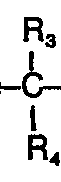
- R3 and R. are selected from the group consisting of hydrogen, alkyl having from one to about eighteen carbon atoms, and cycloalkyl, including cycloalkylidene in which R3 and R. are taken together as part of a cycloalkylene ring, having from three to about twelve carbon atoms;
- R, and R2 are each selected from the group consisting of hydrogen, alkyl having from one to about eighteen carbon atoms;
- and cycloalkyl having from three to about twelve carbon atoms;

Description
- Low density polyethylene has been known for many years to have a crystalline structure. Additional crystalline polymers such as high-density polyethylene, isotactic polypropylene, poly-1-butene, and poly-4-methylpentene have become available as a result of the development of the so-called stereospecific Ziegler-Natta catalyst system for the polymerization of alphaolefins.
- Such crystalline polymers possess special properties, not available in amorphous polymers, which are of steadily increasing commercial interest and importance. Certain properties of these crystalline polymers, particularly optical and strength properties, and processing characteristics, depend to a very significant extent upon the polymer microstructure.
- According to C.J. Kuhre et al SPE Journal, 20, 1113 - 1119 (1964), rapid cooling from the molten state promotes a favorable microstructure by producing small spherulites and leads to improved clarity and toughness for polypropylene. However, quenching is, in general, applicable with maximum effect only to plastic. fabricated with relatively thin section thickness, such as film or thin sheet. While some advantage can be gained in terms of improved microstructure by rapid cooling of plastic articles of relatively thick section, the effect is restricted by heat transfer limitations mainly to the surface shell of the plastic.
- Certain additives promote the formation of smaller, more numerous spherulites in crystalline polymers. Use of such crystallization modifiers has the distinct and important advantage that their effect is not limited to plastic articles of thin cross-section; a more favorable microstructure forms throughout the entire mass of the polymer.
- As a crystalline polymer cools from the molten state, crystallites begin to form below the melting point, as supercooling progresses. The crystallites cluster about central nuclei, to form spherulites which grow radially outward by addition of more crystallites as crystallization proceeds. Since the spherulites are birefringent, their growth can be readily observed with a polarizing microscope equipped with a hot stage.
- Addition of small amounts of finely-ground, higher- melting polymers, such as polytetrafluoroethylene, nylon, polyhexamethylene terephthalate, or isotactic polyethylene in low-density polyethylene, and nylons 610 or 66 in nylon 11, result in improved transparency, similar to the improvement obtained by rapid quenching of thin films. This improvement is attributed to the smaller, more numerous spherulites promoted by nucleation, in the case of the polymeric additives, and by rapid cooling, which minimizes spherulite size in the case of quenching.
- Certain inorganic additives, such as very fine silica, also show some nucleating effect in crystalline polymers. There are a number of other substances which are highly effective as nucleating agents in polypropylene.
- Another example of these new nucleating agents are the metal salts of organic acids. Metals whose carboxylic acid salts are effective include sodium, magnesium, calcium, aluminum and titanium. The organic acid portion of the salt can be chosen from a variety of mono- or di-carboxylic acids. Examples of suitable monobasic acids are benzoic, cyclohexane, carboxylic, diphenyl acetic, and isonicotinic acids. Dicarboxylic acids such as succinic, adipic, sebacic, and phthalic acids give salts of similar activity. The efficiency of the nucleating agents varies with the choice of metal and acid used. Some of the more promising compounds are effective at concentrations well below 0. 5% by weight.
- Kuhre et al summarize the disclosures of P. Wijga in U.S. patents Nos. 3,207,735, 3,207,736, and 3,207,738, and M. Wales in U S. patents Nos. 3,207,737 and 3,207,739, all patented September 21, 1966.
- Wijga No. 3,207,735 suggests cyclic monocarboxylic acids having the carboxyl group attached to a carbon atom of a five to six membered ring, and the corresponding anhydrides, referred to as "benzoic acid type compounds". The improvement is said to be obtained when the benzoic acid type compound is present as a liquid, dissolved or thoroughly dispersed in the polymer melt prior to the final crystallization thereof by cooling.
- Wijga No. 3,207,736 suggests aliphatic, cycloaliphatic, and aromatic dicarboxylic or higher polycarboxylic acids and corresponding anhydrides.
- Wijga No. 3,207,738 suggests terminal aliphatic monocarboxylic acids substituted with carbocyclic groups, also referred to as arylalkanoic acid-type compounds.
- Wales No. 3,207,737 suggests salts of aluminum with certain carboxylic or polycarboxylic acids.
- Wales No. 3,207,739 suggests salts of sodium and, to a lesser degree, other metals from Groups Ia and IIa of the Periodic Table, with certain carboxylic and polycarboxylic acids.
- R. Harrington, U. S. patent No. 3,274,014 patented September 20, 1966 discloses yarn compositions have incorporated a small amount of a metal monoalkyl or monoaryl phosphate, metal dialkyl phosphate, metal alkyl phosphonate, metal alkyl (alkyl phosphonate), or metal dialkyl phosphite resistant to ultraviolet light. Nothing is disclosed as to any effect on clarity or crystallization behavior of the yarn polymers, and since the yarns can be pigmented any such effect could have been overlooked.
- K. Yamamoto Japanese.patent No. 15, 185/69 of July 15, 1969 discloses polypropylene compositions of regulated molecular weight containing organotin compounds as molecular weight modifying agents and esters of acids of phosphorus to prevent discoloration. All the disclosed esters are aliphatic esters, for example, dibutyl phosphite, dilauryl phosphite, triethyl phosphate, tributyl phosphate, and bis(2-ethylhexyl phosphate).
- K. Shirayama Japanese patent No. 12, 903/71 of April 2, 1971 discloses crystalline polypropylene compositions of improved transparency and stiffness containing diphenylphosphinic acid represented by the formula


- However, the compounds as prepared usually give off an unpleasant odor during processing, due perhaps to the presence of a phenol impurity, which is difficult to remove.
- Also in accordance with this invention, a further improvement in clarity is obtained by using in combination with a phenyl phosphate clarifier as above defined from 0.3 to 3 parts by weight per part by weight of phenyl phosphate compound of a metal compound selected from metal salts of non-nitrogenous monocarboxylic acids having six to eighteen carbon atoms, metal oxides, metal hydroxides, metal chlorides, and metal carbonates. The amount of metal compound so used will not usually exceed 1 part per 100 parts of olefin polymer.
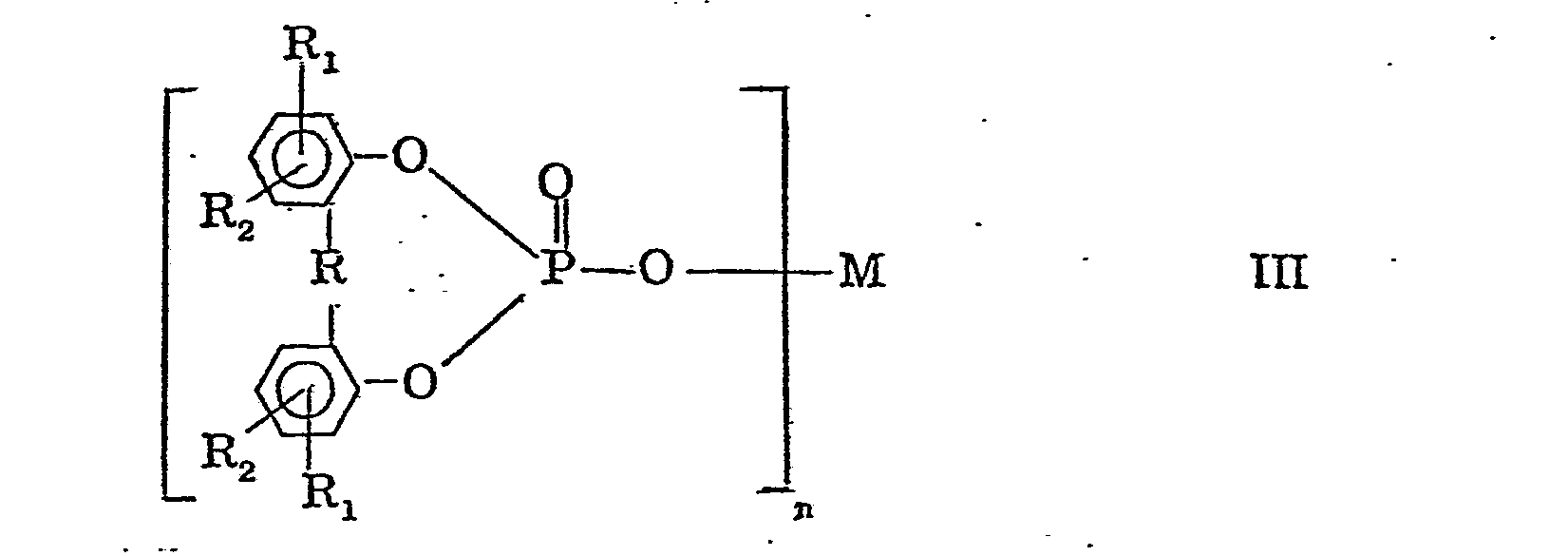
- In accordance with the present invention, bis-phenol phosphates, phosphonates and phosphinates are provided, represented by the formula:

- R is selected from the group consisting of a carbon-to-carbon bond; thio sulfur ―S―; and alkylidene

- R1 and R2 are each selected from the group consisting of hydrogen, alkyl having from one to about eighteen carbon atoms; and cycloalkyl having from three to about twelve carbon atoms;

- M is a metal atom which can be monovalent or polyvalent; and n is the valence of the metal atom M, ranging from one to about four;
- The linking group R must form a ring including the phosphorus group:

- So far as is presently known, only a carbon-to-carbon bond, thiosulfur and alkylidene form such rings.
- These compounds are useful to improve clarity of polyolefin resin compositions in an amount within the range from 0. 005 to 5 parts by weight per 100 parts of resin.
- These compounds have no odor, and are more effective, weight for weight, than the compounds of the Ohzeki et al patent No. 4,258,142.
- The invention further provides a-olefin polymer compositions having improved clarity comprising a polymer of an a-olefin having two to six carbon atoms and an amount to improve clarity of at least one bis-phenol phosphate, phosphonate or phosphinate having the formula:

- R- is selected from the group consisting of a carbon-to-carbon bond; thio sulfur ―S―; and alkylidene

- R1 and R2 are each selected from the group consisting of hydrogen, alkyl having from one to about eighteen carbon atoms; and cycloalkyl having from three to about twelve carbon atoms;
- t is 0 or 1;
- m is 0 or 1;
- M is a metal atom; and
- n is the valence of the metal atom M, ranging from one to about four.
- The invention further provides stabilizer compositions for improving the clarity of polymers of a-olefins having two to six carbon atoms, comprising a heat or light stabilizer for a-olefin polymers and a compound of Formula Ia) above.
- It will be apparent that when t= 0 and m = 1, the compounds of the invention are phosphonates of the formula:

- When t = 1 and m = 1, the compounds of the invention are phosphates of the formula:
- It will also be apparent that when t is 1 and m = 0, the compounds of the invention are phosphonates of the formula:

- When m = 0 and t = 0, the compounds of the invention are phosphinates of the formula:


- These are not however known as clarifiers for polyolefin resin compositions.
- The compounds IV can be prepared by the same procedure, substituting a bisphenol:

- The compounds II can be prepared by the following procedure:

- Exemplary R alkylidene include methylidene, ethylidene, propylidene, isopropylidene, butylidene, isobutylidene, sec- butylidene, tert-butylidene, amylidene, hexylidene, heptylidene, octylidene, isooctylidene, 2-ethyl hexylidene, nonylidene and decylidene; cyclohexylidene, cycloheptylidene, methyl cyclo- hexylidene, ethyl cyclohexylidene, and cyclooctylidene.
- Exemplary R1 and R2, R3 and R4 alkyl include methyl, ethyl, propyl, isopropyl, n-butyl, isobutyl, sec-butyl, t-butyl, amyl, t-amyl, hexyl, heptyl, octyl, 2-ethylhexyl, t-octyl, nonyl, decyl, undecyl, dodecyl, tridecyl, tetradecyl, pentadecyl, hexadecyl, heptadecyl and octadecyl.
- Exemplary R1 and R2, R3 and R4 cycloalkyl include cyclopropyl, cyclobutyl, cyclopentyl, methylcyclopentyl, cyclohexyl, methylcyclohexyl, cycloheptyl, cyclooctyl and cyclododecyl.
- Exemplary M monovalent metals include Li, Na, Ki; exemplary bivalent metals include Be, Ca, Sr, Ba, Zn, and Cd;
- Exemplary trivalent and tetravalent metals include Al, Ge, Sn, Pb, Ti, Zr, Sb, Cr, Bi, Mo, Mn, Fe, Co and Ni. Among these metals, the alkali metals such as Li, Na and K and the alkaline earth metals such as Mg, Ca, Sr and Ba are preferred.
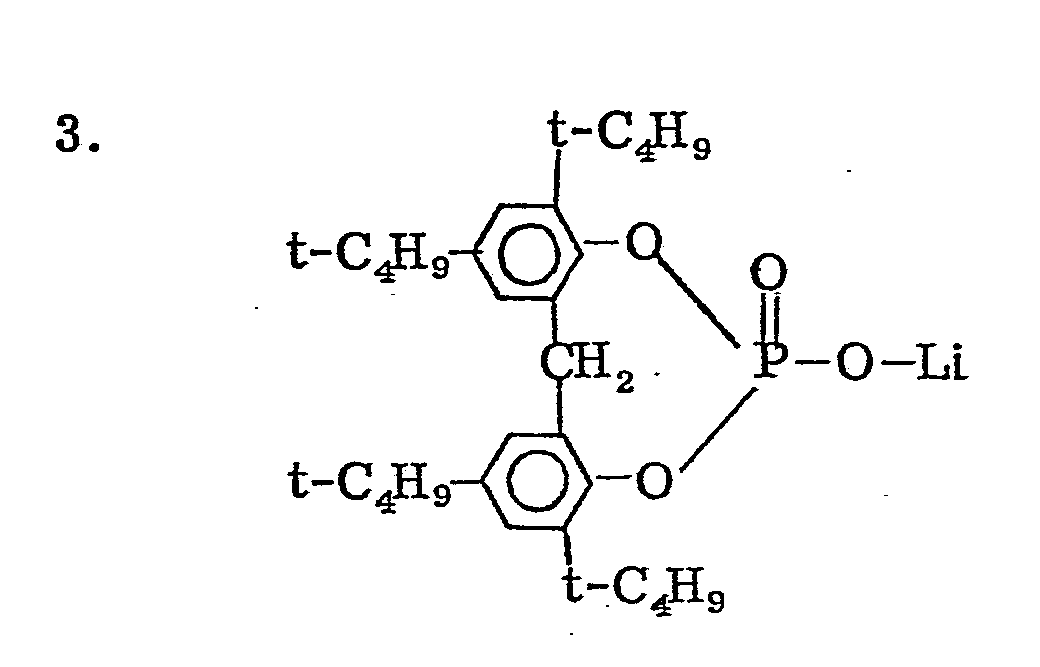
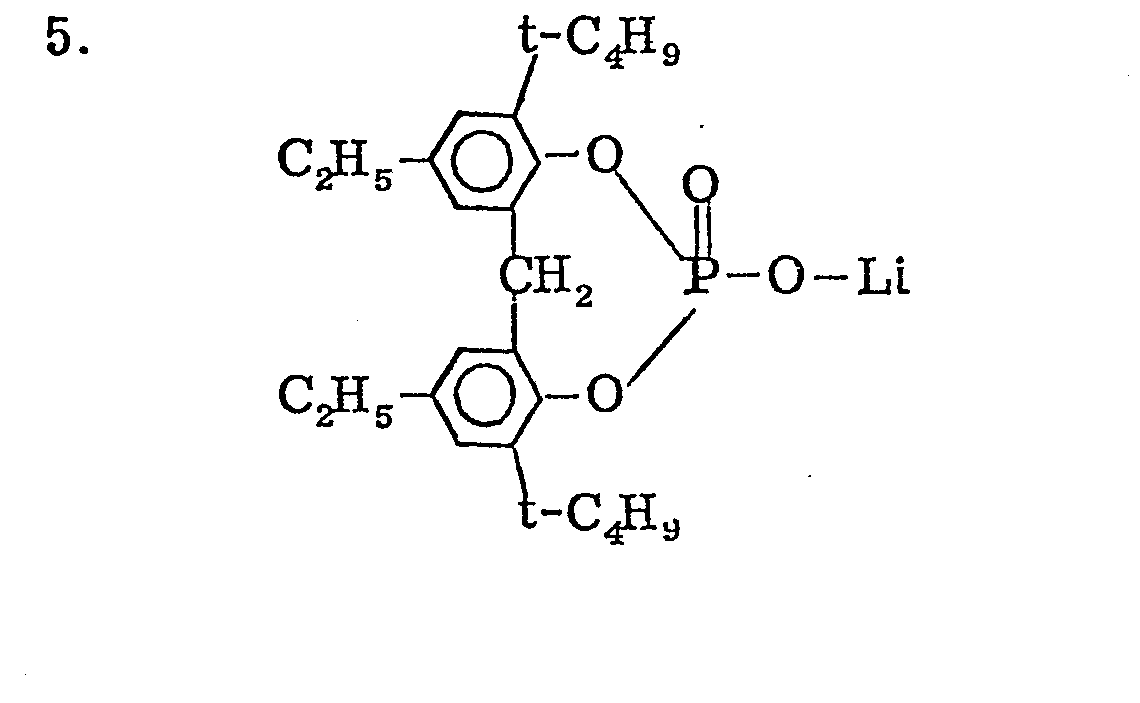
- Typical examples of compounds of the above formula I are as follows:
-





-


- The a-olefin polymers whose clarity is improved in accordance with this invention by,incorporating therein a bis- phenol phosphoric acid or phosphonic acid metal salt are homopolymers and copolymers of a-olefins, including polyethylene, polypropylene, polybutene-1, poly-3-methylbutene, poly-4-methylpentene, 1, 2-polybutadiene; copolymers of ethylene in major proportions with minor proportions of propylene, 1-butene, 1-hexene, vinyl acetate and vinyl chloride; copolymers of propylene in major proportions with minor proportions of ethylene, 1-butene, or vinyl chloride; and copolymers of butylene, 3-methyl butene, 4-methyl pentene, and 1, 2-butadiene with minor proportions of such monomers.
- The bis-phenol phosphate, phosphonate and phosphinate compounds according to this invention are clarifiers but not olefin polymer heat and/or light stabilizers. However, the bis-phenol phosphate, phosphonate and phosphinate compounds according to this invention do not adversely affect heat and light stability of a-olefin polymers, and can be used together with known heat and light stabilizers for a-olefin polymers in conventional concentrations.
- The bis-phenol phosphate, phosphonate and phosphinate compounds can be combined with conventional heat stabilizers such as phenolic antioxidants, polyvalent metal salts or organic acids, organic phosphites, thioethers and other known heat stabilizers, thereby constituting light and heat stabilizer compositions of the invention.
- The phenolic antioxidant contains one or more phenolic hydroxyl groups, and one or more phenolic nuclei, and can contain from about eight to aboutthree hundred carbon atoms. In addition, the phenolic nucleus can contain an oxyor thio ether group.
- The alkyl-substituted phenols and polynuclear phenols, because of their molecular weight, have a higher boiling point, and therefore are preferred because of their lower volatility. There can be one or a plurality of alkyl groups of one or more carbon atoms. The alkyl group or groups including any alkylene groups between phenol nuclei preferably aggregate at least four carbon atoms. The longer the alkyl or alkylene chain, the better the compatibility with polypropylene, inasmuch as the phenolic compound then acquires more of an aliphatic hydrocarbon character, and therefore there is no upper limit on the number of alkyl carbon atoms. Usually, from the standpoint of availability, the compound will not have more than about eighteen carbon atoms in an alkyl, alicyclidene and alkylene group, and a total of not over about fifty carbon atoms. The compounds may have from one to four alkyl radicals per phenol nucleus.
- The phenol contains at least one and preferably at least two phenolic hydroxyls, the two or more hydroxyls being in the same ring, if there is only one. In the case of bicyclic phenols, the rings can be linked by thio or oxyether groups, or by alkylene, alicyclidene or arylidene groups.
- The monocyclic phenols which can be employed have the structure:

- R is selected from the group consisting of hydrogen; halogen; and organic radicals containing from one to about thirty carbon atoms, such as alkyl, aryl, alkenyl, alkaryl, aralkyl, cycloalkenyl, cycloalkyl, alkoxy, and acyl

- X1 and X2 are integers from one to four, and the sum of X1 and X2 does not exceed six.
- ) The polycyclic phenol phenol is one having at least two aromatic nuclei linked by a polyvalent linking radical, as defined by the formula:

- Y is a polyvalent linking group selected from the group consisting of oxygen; carbonyl; sulfur; sulfinyl; aromatic, aliphatic and cycloaliphatic hydrocarbon groups; and oxyhydro- carbon, thiohydrocarbon and heterocyclic groups. The linking group can have from one up to twenty carbon atoms.
- Ar is a phenolic nucleus which can be a phenyl or a polycarbocyclic group having condensed or separate phenyl rings; each Ar group contains at least one free phenolic hydroxyl group up to a total of five. The Ar rings can also include additional rings connected by additional linking nuclei of the type Y, for example, Ar-Y-Ar-Y-Ar.
- m1 and m2 are numbers from one to five, and n1 and n2 are numbers of one or greater, and preferably from one to four.
- The aromatic nucleus Ar can, in addition to phenolic hydroxyl groups, include one or more inert substituents. Examples of such inert substituents include hydrogen, halogen atoms, e. g., chlorine, bromine and fluorine; organic radicals containing from one to about thirty carbon atoms, such as alkyl, aryl, alkaryl, aralkyl, cycloalkenyl, cycloalkyl, alkoxy, aryloxy and acyloxy

- Typical aromatic nuclei include phenyl, naphthyl, phenanthryl, triphenylenyl, anthracenyl, pyrenyl, chrysenyl, and fluoroenyl groups.
- When Ar is a benzene nucleus, the polyhydric polycyclic phenol has the structure:

- R1, R2 and R3 are inert substituent groups as described in the previous paragraph;
- m1 and m3 are integers from one to a maximum of five;
- m2 is an integer from one to a maximum of four;
- X1 and X3 are integers from zero to four, and
- x2 is an integer from zero to three;
- y1 is an integer from zero to about six and
- y2 is an integer from one to five, preferably one or two.
- Preferably, the hydroxyl groups are located ortho and/or para to Y.
- Exemplary Y groups are alkylene , alkylidene, and alkenylene; arylene, alkyl arylene, arylalkylene; cycloalkylene, cycloalkylidene; and oxa-and thia-substituted such groups; tetrahydrofuranes, esters and triazino groups. The Y groups are usually bi, tri, or tetravalent, connecting two three or four Ar groups. However, higher valency Y groups connecting more than four Ar groups, can also be used. According to their constitution, the Y groups can be assigned to subgenera as follows:
- 1) Y groups where at least one carbon in a chain or cyclic arrangement connect the aromatic groups, such as:


- 2) Y groups where only atoms other than carbon link the aromatic rings, such as -O-, -S-,

- 3) Y groups made up of more than a single atom including both carbon and other atoms linking the aromatic nuclei, such as:




- Although the relation of effectiveness to chemical structure is insufficiently understood, many of the most effective phenols have Y groups of subgenus 1), and accordingly this is preferred. Some of these phenols can be prepared by the alkylation of phenols or alkyl phenols with polyunsaturated hydrocarbons such as dicyclopentadiene or butadiene.
- Representative phenols include guaiacol, resorcinol monoacetate, vanillin, butyl salicylate, 2, 6-di-tert-butyl-4-methyl phenol, 2-tert-butyl-4-methoxy phenol, 2,4-dinonyl bis-(2-tertiary-butylphenol), 2,2'-methylene-bis-(4-methyl-6-(1'-methyl-cyclohexyl)-phenol), 2, 6-bis-(2'-hydroxy-3'-tertiarybutyl-5'-methylbenzyl)-4-methylphenol, 4,4'-bis-(2-tertiarybutyl-5-methyl-phenol), 2,2'-bis-(4-hydroxy-phenyl) butane, ethylene bis-(p-cresol), 4,4'-oxobis-phenol, 4,4'-oxobis-(3-methyl-5-isopropyl-phenol), 4, 4'-oxobis-(3-methyl-phenol), 2,2'-oxobis-(4-dodecyl-phenol), 2,2'-oxobis-(4-methyl-5-tertiary-butyl-phenol), 4,4'-thio-bis-phenol; 4,4'-thio-bis-(3-methyl-6-tertiary-butyl-phenol), 2,2'-thio-bis-(4-methyl-6-tertiary-butyl-phenol), 4,4'-n-butylidene-(2-t-butyl-5-methylphenol), 2,2'-methylene-bis-(4-methyl-6-(1'-methyl-cyclohexyl)-phenol), 4,4'-cyclohexylene bis-(2-tertiary-butyl-phenol), 2,6- bis-(2' -hydroxy-3' -t-butyl-5'-methyl-benzyl)-4-methyl-phenol, 4,4'-oxobis (naphthalene-1,5-diol), 1,3'-bis-(naphthalene-2,5- diol) propane, and 2,2'-butylene bis-(naphthalene-2,7-diol), (3-methyl-5-tert-butyl-4-hydroxyphenyl)-4'-hydroxy-phenyl) propane, 2,2'-methylene-bis-(4-methyl-5-isopropylphenol), 2,2'-methylene-bis-(4-methyl-5-isopropylphenol), 2,2'-methylene-bis-(5-tert-butyl-4-chlorophenol), (3,5-di-tert-butyl-4-hydroxyphenyl)- (4' -hydroxyphenyl) ethane, (2-hydroxy-phenyl)-(3',5'-di-tert-butyl-4',4-hydroxyphenyl) ethane, 2,2'-methylene- bis-(4-octylphenol), 4,4'-propylene-bis-(2-tert-butyl-phenol), phenol, 2,3,4,5-tetradecyl phenol, tetrahydro-α-naphthol, o-, m- and p-cresol, o-, m- and p-phenylphenol, o-, m- and p-xylenols, the carvenols, symmetrical xylenol, thymol, o-, m-and p-nonylphenol, o-, m- and p-dodecyl-phenol, and o-, m-and p-octyl-phenol, o-, and m-tert-butyl-p-hydroxy-anisole, p-n-decyloxy-phenol, p-n-decyloxy-cresol, nonyl-n-decyloxy-cresol, eugenol, isceugenol, glyceryl monosalicylate, methyl-p-hydroxy-cinnamate, 4-benzyloxy-phenol, p-acetylaminophenol, p-stearyl-aminophenol, methyl-p-hydroxybenzoate, p-dichlorobenzoyl-aminophenol, p-hydroxysalicyl anilide, stearyl-(3,5-di-methyl-4-hydroxy-benzyl) thioglycolate, stearyl-β-(4-hydroxy-3,5-di-t-butylphenyl) propionate, distearyl-3,5-di-t-butyl-4-hydroxybenzylphosphonate, and distearyl (4-hydroxy-3-methyl-5-t-butyl) benzylmalonate.
- Exemplary polyhydric phenols are orcinol, propyl gallate, catechol, resorcinol, 4-octyl-resorcinol, 4-dodecyl- resorcinol, 4-octadecyl-catechol, 4-isooctyl-phloroglucinol, pyrogallol, hexahydroxybenzene, 4-isohexylcatechol, 2,6-di- tertiary-butyl-resorcinol, 2,6-di-isopropyl-phloroalucinol.
- Exemplary polyhydric polycyclic phenols are methylene bis-(2,6-di-tertiary-butyl-phenol), 2,2-bis-(4-hydroxy phenyl)-propane, methylene-bis-(p-cresol), 4,4'-benzylidene bis (2-tertiary-butyl-5-methyl-phenol), 4,4'-cyclo-hexylidene 2,2'-isobutylene-bis-(4-nonylphenol), 2,4-bis-(4-hydroxy-3-t-butyl-phenoxy)-6-(n-octylthio)-1, 3, 5-triazine, 2,4,6-tris-(4-hydroxy-3-t-butyl-phenoxy)-1,3,5-triazine, 2,2'-bis-(3-t-butyl-4-hydroxyphenyl) thiazolo-(5,4-d) thiazole, 2,2'-bis-(3-methyl-5-t-butyl-4-hydroxyphenyl) thiazolo-(5,4-d)-thiazole, 4,4'-bis-(4-hydroxyphenyl) pentanoic acid octadecyl ester, cyclopentylene-4,4' -bis-phenol, 2-ethylbutylene-4,4'-bisphenol, 4,4'-cyclooctylene-bis-(2-cyclohexylphenol), β,β-thiodiethanol- bis-(3-tert-butyl-4-hydroxyphenoxy acetate), 1,4-butanedio- bis-(3-tert-butyl-4-hydroxyphenoxy acetate), pentaerythritol tetra-(4-hydroxyphenol propionate), 2,4,4'-tri-hydroxy benzophenone, bis-(2-tert-butyl-3-hydroxy-5-methylphenyl) sulfide, bis-(2-tert-butyl-4-hydroxy-5-methylphenyl) sulfide, bis-(2-tert-butyl-4-hydroxy-5-methylphenyl )sulfoxide, bis-(3-ethyl-5-tert-butyl-4-hydroxybenzyl) sulfide, bis-(2-hydroxy-4-methyl-6-tert-butyl-phenyl) sulfide, 4,4'-bis-(4-hydroxyphenol) pentanoic acid octadecyl thiopropionate ester, 1,1, 3-tris-(2'-methyl-4-hydroxy-5'-tert-butylphenyl) butane, 1,1,3-tris-(1-methyl-3-hydroxy-4-tert-butylphenyl) butane, 1,8-bis-(2-hydroxy-5-methylbenzoyl-n-octane, 2,2'-ethylene- bis-[4'-(3-tert-butyl-4-hydroxyphenyl)-thiazole], 1-methyl-3-(3-methyl-5-tert-butyl-4-hydroxybenzyl)-naphthalene, 2,2'-(2-butene)-bis-(4-methoxy-6-tert-butylphenol)-bis-[3,3-bis-(4-hydroxy-3-t-butylphenyl) butyric acid] glycol ester, 4,4'-butylidene-bis-(6-t-butyl-m-cresol), 1,1,3-tris-(2-methyl-4-hydroxy-5-t-butylphenyl) butane, 1,3,5-tris-(3, 5-di-t-butyl-4-hydroxybenzyl)-2,4, 6-trimethylbenzene, tetrakis [methylene-3 (3,5-di-t-butyl-4-hydroxyphenyl)propionate] methane, 1,3,5- tris-(3,5-di-t-butyl-4-hydroxybenzyl) isocyanurate, 1,3,5-tris-(3,5-di-t-butyl-4-hydroxyphenyl) propionyl-oxyethyl isocyanurate, 2-octylthio-4,6-di-(4-hydroxy-3,5-di-t-butyl) phenoxy-1,3,5-triazine, 4,4'-thiobis-(6-t-butyl-m-cresol) and pentaerythritol hydroxyphenyl propionate.
- A particularly desirable class of polyhydric polycyclic phenols are the dicyclopentadiene polyphenols, which are of the type:

- R1 and R2 are lower alkyl, and can be the same or different, and
- n is the number of the groups enclosed by the brackets, and is usually from 1 to about 5. These are described in U.S. patent No. 3,567, 683, dated March 2, 1971 to Spacht. A commercially available member of this class is Wingstay L, exemplified by dicyclopentadiene tri-(2-tert-butyl-4-methyl-phenol) of the formula:

- The polyhydric polycyclic phenols used in the invention can also be condensation products of phenols or alkylphenols with hydrocarbons having a bicyclic ring structure and a double bond or two or more double bonds, such as a-pinene, β-pinene, dipentene, limonene, vinylcyclohexene, dicyclopentadiene, allo-ocimene, isoprene and butadiene. These condensation products are usually obtained under acidic conditions in the form of more or less complex mixtures of monomeric and polymeric compounds. However, it is usually not necessary to isolate the individual constituents. The entire reaction product, merely freed from the acidic condensation catalyst and unchanged starting material, can be used with excellent results. While the exact structure of these phenolic condensation products is uncertain, the Y groups linking the phenolic nuclei all fall into the preferred subgenus 1. For method of preparation, see e.g., U. S. patent No. 3,124,555, U.S. patent No. 3,242,135, and British patent No. 961,504.
- When the stabilizer composition is used in conjunction with a polyvalent metal salt of an organic acid, the organic acid will ordinarily have from about six to about twenty-four carbon atoms. The polyvalent metal can be any metal of Group II of the Periodic Table, such as. zinc, calcium, cadmium, barium, magnesium and strontium. The alkali metal salts and heavy metal salts such as lead salts are unsatisfactory. The acid can be any organic non-nitrogenous monocarboxylic acid having from six to twenty-four carbon atoms. The aliphatic, aromatic, alicyclic and oxygen-containing heterocyclic organic acids are operable as a class. By the term "aliphatic acid" is meant any open chain carboxylic acid, substituted, if desired, with nonreactive groups, such as halogen, sulfur and hydroxyl. By the term "alicyclic" it will be understood that there is intended any cyclic acid in which the ring is nonaromatic and composed solely of carbon atoms, and such acids may if desired have inert, nonreactive substituents such as halogen, hydroxyl, alkyl radicals, alkenyl radicals and other carbocyclic ring structures condensed therewith. The oxygen-containing heterocyclic compounds can be aromatic or nonaromatic and can include oxygen and carbon in the ring structure, such as alkyl-substituted furoic acid. The aromatic acids likewise can have nonreactive ring substituents such as halogen, alkyl and alkenyl groups, and other saturated or aromatic rings condensed therewith.
- As exemplary of the acids-which can be used in the form of their metal salts there can be mentioned the following: hexoic acid, 2-ethylhexoic acid, n-octoic acid, isooctoic acid, capric acid, undecylic acid, lauric acid, myristic acid, palmitic acid, margaric. acid, stearic acid, oleic acid, ricinoleic acid, behenic acid, chlorocaproic acid, hydroxy capric acid, benzoic acid, phenylacetic acid, butyl benzoic acid, ethyl benzoic acid, propyl benzoic acid, hexyl benzoic acid, salicylic acid, naphthoic acid, 1-naphthalene acetic acid, orthobenzoyl benzoic acid, naphthenic acids derived from petroleum, abietic acid, dihydroabietic acid, hexahydrobenzoic acid, and methyl furoic acid.
- The water-insoluble salts are preferred, because they are not leached out when the plastic is in contact with water. Where these salts are not known, they are made by the usual types of reactions, such as by mixing the acid, or anhydride with the corresponding oxide or hydroxide of the metal in a liquid solvent, and heating, if necessary, until salt formation is complete.
- A variety of organic triphosphites and acid phosphites can be employed, of which the following are exemplary.
- The organic triphosphite can be any organic phosphite having three or more organic radicals attached to phosphorus through oxygen. The acid phosphite can be any organic phosphite having one or two organic radicals attached to phosphorus through oxygen. These radicals can be monovalent radicals, in the case of the triphosphites, diphosphites and monophisphites.
- The organic triphosphites in which the radicals are monovalent radicals can be defined by the formula:

- R1, R2 and R3 are selected from the group consisting of alkyl, alkenyl, aryl, alkaryl, aralkyl, and cycloalkyl groups having from one to about thirty carbon atoms.
- The acid phosphites are defined by the same formula, but one or two of R1, R2 and R3 is hydrogen or a cation of a metal or ammonium.
- Also included are the organic triphosphites having a bivalent organic radical forming a heterocyclic ring with the phosphorus of the type:

- R4 is a bivalent organic radical selected from the group consisting of alkylene, arylene, aralkylene, alkarylene and cycloalkylene radicals having from two to about thirty carbon atoms, and R5 is a monovalent organic radical as defined above in the case of R1, R2 and R3;
- R5 is hydrogen or a cation, in the case of the acid phosphites.
- Also useful organic triphosphites are mixed heterocyclic-open chain phosphites of the type:

- More complex triphosphites are formed from trivalent organic radicals, of the type:

- R6 is a trivalent organic radical of any of the types of R1 to R5, inclusive, as defined above.
- A particularly useful class of complex triphosphites are the tetraoxadiphosphaspiro undecanes of the formula:

- R1 and R2 are selected from the group consisting of aryl, alkyl, aryloxyethyl, alkyloxyethyl, aryloxyethoxyethyl, alkyloxyethoxyethyl and alkyloxypolyethoxyethyl having from about 1 to about 30 carbon atoms.
- In the case of the acid phosphites, one or both of Ri and R2 is also hydrogen or a cation.
- An especially preferred class of organic triphosphites and acid phosphites have a bicyclic aromatic group attached to phosphorus through oxygen, with no or one or more phenolic hydroxyl groups on either or both of the aromatic rings. These phosphites are characterized by the formula;


- Ar is a mono or bicyclic aromatic nucleus and m is an integer of from 0 to about 5. Z is one or a plurality of organic . radicals as defined above for R to R6, taken singly or together in sufficient number to satisfy the valences of the two phosphite oxygen atoms.
- One or both Z radicals is also hydrogen, in the case of the acid phosphites, and can include additional bicyclic aromatic groups of the type (HO)m-Ar.
- The cation in the case of acid phosphites can be a metal, such as an alkali metal, for instance, sodium, potassium or lithium; an alkaline earth metal, for instance, barium, calcium, or a nontoxic polyvalent metal, such as magnesium, tin and zinc.
- Usually, the triphosphites and acid phosphites will not have more than about sixty carbon atoms.
- Exemplary triphosphites are monophenyl di-2-ethylhexyl phosphite, diphenyl mono-2-ethylhexyl phosphite, di-isooctyl monotolyl phosphite, tri-2-ethylhexyl phosphite, phenyl dicyclohexyl phosphite, phenyl diethyl phosphite, triphenyl phosphite, tricresyl phosphite, tri(dimethylphenyl) phosphite, trioctadecyl phosphite, triisooctyl phosphite, tridodecyl phosphite, isooctyl diphenyl phosphite, diisooctyl phenyl phosphite, tri(t-octylphenyl) phosphite, tri-(t-nonylphenyl) phosphite, benzyl methyl isopropyl phosphite, butyl dicresyl phosphite, isooctyl di(octylphenyl) phosphite, di(2-ethylhexyl) (isooctylphenyl) phosphite, tri (2-cyclohexylphenyl) phosphite), tri-a-naphthyl phosphite, tri (phenylphenyl) phosphite, tri(2-phenylethyl) phosphite, ethylene phenyl phosphite, ethylene t-butyl phosphite, ethylene isohexyl phosphite, ethylene isooctyl phosphite, ethylene cyclohexyl phosphite, 2-phenoxy-1,3,2-dioxaphosphorinane, 2-butoxy-1,3,2-dioxyphosphorinane, 2-octoxy-5,5-dimethyl-dioxaphosphorinane, and 2-cyclohexyloxy-5,5-diethyl dioxaphosphorinane.
- Exemplary pentaerythritol triphosphites are 3, 9-diphenoxy-2,4,8,10-tetraoxa-3,9-diphosphaspiro-(5,5)-undecane (diphenyl-pentaerythritol diphosphite), 3,9-di(decyloxy)-2,4,8, 10-tetraoxa-3,9-diphosphaspiro (5,5)-undecane, 3,9-di (isodecyloxy)-2,4, 8, 10-tetraoxa-3, 9-diphosphaspiro-(5, 5)-undecane, 3,9-di(octadecyloxy)-2,4,8,10-tetraoxa-3,9- diphosphaspiro-(5,5)-undecane, 3-phenoxy-9-isodecyloxy-2,4,8,10-tetraoxa-3, 9-diphosphaspiro-(5, 5)-undecane, 3, 9-di (methoxy)-2,4,8,10-tetraoxa-3, 9-diphosphaspiro- (5, 5)-undecane, 3,9-di(lauryloxy)-2, 4, 8, 10-tetraoxa-3,9-diphosphaspiro-(5,5)-undecane, 3,9-di-p-tolyloxy-2,4,8, 10-tetraoxa-3, 9-diphosphaspiro-(5,5)-undecane, 3, 9-di(methoxyethyloxy)-2,4, 8,10-tetraoxa-3,9-diphosphaspiro-(5, 5)-undecane, 3-methoxyethyloxy-9-isodecyloxy-2,4,8,10-tetraoxa-3,9-diphosphaspiro-(5,5)-undecane, 3,9-di(ethoxyethyloxy-)-2,4,8, 10-tetraoxa-3,9- diphosphaspiro-(5,5)-undecane, 3,9-di(butoxyethyloxy)-2,4,8, 10-tetraoxa-3, 9-diphosphaspiro-(5, 5)-undecane, 3-methoxyethyloxy-9-butoxy-ethyloxy-2, 4, 8, 10-tetraoxa-3, 9- diphosphaspiro-(5,5)-undecane, 3,9-di(methoxyethoxyethyloxy)-2,4,8,10-tetraoxa-3,9-diphosphaspiro-(5,5)-undecane, 3,9-di-(butoxyethoxyethyloxy)-2,4, 8,10-tetraoxa-3, 9-diphosphaspiro-(5, 5)-undecane, 3, 9-di(methoxyethoxyethoxyethyloxy)-2,4,8,10-tetraoxa-3,9-diphosphaspiro-(5,5)-undecane, 3,9-di(methoxy (polyethoxy)ethyloxy)-2,4,8,10-tetraoxa-3,9-diphosphaspiro-(5, 5)-undecane where the (polyethoxy) ethyloxy group has an average molecular weight of 350),3,9-di(methoxy(polyethoxy) ethyloxy)-2,4,8, 10-tetraoxa-3,9-diphosphaspiro-(5,5)-undecane (where the (polyethoxy) ethyloxy group has an average molecular weight of 550).
- Exemplary of the bis aryl triphosphites are: bis(4,4'-thio-bis(2-tertiary-butyl-5-methyl-phenol)) isooctyl phosphite, mono(4,4'-thio-bis(2-tertiary-butyl-5-methyl-phenol)) di-phenyl phosphite, tri-(4,4'-n-butylidene-bis(2-tertiary-butyl-5-methylphenol)) phosphite, (4,4'-benzylidene-bis(2-tertiary-butyl-5-methyl-phenol)) diphenyl phosphite, isooctyl 2,2'-bis(-para- hydroxyphenyl) propane phosphite, decyl 4,4'-n-butylidene-bis (2-tertiary-butyl-5-methylphenol) phosphite, tri-4,4'-thio-bis (2-tertiary-butyl-5-methylphenol) phosphite, 2-ethylhexyl-2,2'-methylene-bis(4-methyl-6,1'-methylcyclohexyl) phenol phosphite, tri(2,2'-bis-(para-hydroxyphenyl) propane) phosphite, tri(4,4'-thio-bis(2-tertiary-butyl-5-methyl-phenol) phosphite, isooctyl-(2, 6-bis(2'-hydroxy-3,5-dinonylbenzyl)-4-nonyl phenyl)) phosphite, tetra-tridecyl-4,4'-n-butylidene-bis(2-tertiary-butyl-5-methylphenyl) diphosphite, tetra-isooctyl-4,4'-thio-bis (2-tertiary-butyl-5-methylphenyl) diphosphite, 2,2'-methylene- bis(4-methyl-6,1'-methyl cyclohexyl phenyl) polyphosphite, isooctyl-4,4'-isopropylidene-bis-phenyl polyphosphite, 2-ethylhexyl-2,2'-methylene-bis(4-methyl-6,1'-methyl-cyclohexyl) phenyl triphosphite, tetra-tridecyl-4,4'-oxydiphenyl diphosphite, tetra-n-dodecyl-4,4'-n-butylidene bis (2-tertiarybutyl-5-methylphenyl) diphosphite, tetra-tridecyl-4,4'-isopropylidene bisphenyl diphosphite, hexa-tridecyl butane-1, 1, 3- tris(2'-methyl-5'-tertiary-butylphenyl-4') triphosphite.
- Exemplary acid phosphites are di(phenyl) phosphite, monophenyl phosphite, mono(diphenyl) phosphite, dicresyl phosphite, di-(o-isooctylphenyl) phosphite, di(p-ethylhexylphenyl) phosphite, di(p-t-octylphenyl) phosphite, di(dimethylphenyl) phosphite, di-n-butyl phosphite, di-2-ethylhexyl phosphite, mono-2-ethylhexylphosphite, diisooctyl phosphite, monoisooctyl phosphite, monododecyl phosphite, 2-ethylhexyl phenyl phosphite, 2-ethylhexyl-(n-octylphenyl) phosphite, monocyclohexyl phosphite, dicyclohexyl phosphite, di(2-cyclohexyl phenyl) phosphite, di-a-naphthyl phosphite, diphenyl phenyl phosphite, di(diphenyl) phosphite, di-(2-phenyl ethyl) phosphite, dibenzyl phosphite, monobenzyl phosphite, n-butyl cresyl phosphite and didodecyl phosphite, cresyl phosphite, t-octylphenyl phosphite, ethylene phosphite, butyl cresyl phosphite, isooctyl monotolyl phosphite and phenyl cyclohexyl phosphite.
- Exemplary of the bis aryl acid phosphites are: bis(4,4'-thio-bis(2-tertiary-butyl-5-methylphenol)) phosphite, (4,4'-thio-bis(2-tertiary-butyl-5-methylphenol)) phenyl phosphite, bis(4,4'-n-butylidene-bis(2-tertiary-butyl-5-methylphenol)) phosphite, mono(4,4'-benzylidene-bis(2-tertiary-butyl-5-methylphenol)) phosphite, mono(2,2'-bis-(parahydroxyphenyl) propane) phosphite, mono(4, 4'-butylidene-bis(2-tertiary-butyl-5-methylphenol) phosphite, bis(4,4'-thio-bis(2-tertiary-butyl-5-methylphenol)) phosphite, mono-2-ethylhexyl-mono-2,2'-methylene-bis(4-methyl-6,1'-methylcyclohexyl) phenol phosphite, bis (2,2' -bis(para-hydroxyphenyl)propane) phosphite, monoisooctyl- mono(4,4'-thio-bis(2-tertiary-butyl-5-methylphenal)) phosphite, isooctyl-(2,6-bis(2'-hydroxy-3, 5-dinonylbenzyl)-4-nonylphenyl)) phosphite, tri-tridecyl-4,4'-n-butylidene-bis(2-tertiary-butyl-5-methylphenyl) diphosphite, triisooctyl-4,4'-thio-bis(2-tertiary-butyl-5-methylphenyl) diphosphite, bis(2,2'-methylene- bis(4-methyl-6, 1'-methyl cyclohexyl phenyl)) phosphite, isooctyl-4,4'-isopropylidene-bis-phenyl phosphite, monophenyl mono(2,2'-methylene-bis(4-methyl-6,1'-methyl-cyclohexyl)) triphosphite, di-tridecyl-4,4'-oxydiphenyl diphosphite, di-n-dodecyl-4,4'-n-butylidene-bis(2-tertiary-butyl-5-methylphenyl) diphosphite, di-tridecyl-4,4'-isopropylidene bisphenyl diphosphite, tetra-tridecyl butane-1,1,3-tris(2'-methyl-5-tertiary-butylphenyl-4)-triphosphite.
- The thiodipropionic acid ester has the following formula:


- The molecular weights of the R and Y radicals are taken such that with the remainder of the molecule the thiodipropionic ester has a total of from about ten to about sixty carbon atoms per sulfur atom.
- Accordingly, the various thiodipropionic acid ester species coming within the above-designated categories within the general formula can be defined as follows:


- In the above formulae R1 and R2, M, X and Z are the same as before and the value of n1 can range upwards from 1, but there is no upper limit on n1 except as is imposed by the ratio of carbon atoms, as stated below. In the polymer (c), as in the other forms of thiodipropionic acid esters, the total number of carbon atoms per sulfur atom is within the range from about ten to about sixty.
- The R radical of these esters is important in furnishing compatibility with the polymer. The Y radical is desirably a different radical, R2 or M or a polymer, where R is rather low in molecular weight, so as to compensate for this in obtaining the optimum compatibility and nonvolatility. Where Y is a metal, the thiodipropionic acid ester furnishes the beneficial properties of the polyvalent metal salt which is described above..
- The aryl, alkyl, alkenyl, and cycloalkyl groups may, if desired, contain inert, nonreactive substituents such as halogen and other carbocyclic and heterocyclic ring structures condensed therewith.
- Typical R radicals are, for example, methyl, ethyl, propyl, isopropyl, butyl, isobutyl, t-butyl, amyl, isoamyl, n-octyl, isooctyl, 2-ethyl hexyl, t-octyl, decyl, dodecyl, octadecyl, allyl, hexenyl, linoleyl, ricinoleyl, oleyl, phenyl, xylyl, tolyl, ethylphenyl, naphthyl, cyclohexyl, benzyl, cyclopentyl, methylcyclohexyl, ethylcyclohexyl, and naphthenyl, hydroxyethyl, hydroxypropyl, glyceryl, sorbityl, pentaerythrityl, and polyoxyalkylene radicals such as those derived from diethylene glycol, triethylene glycol, polyoxypropylene glycol, polyoxyethylene glycol, and polyoxypropyleneoxyethylene glycol, and esters thereof with any of the organic acids named below in the discussion of the polyvalent metal salts, including in addition those organic acids having from two to five carbon atoms, such as acetic, propionic, butyric and valeric acids.
- Typical X radicals are alkylene radicals such as ethylene, tetramethylene, hexamethylene, decamethylene, alkyl-substituted alkylene radicals such as 1,2-propylene,


- As exemplary of the thiodipropionic acid esters which can be used, there can be mentioned the following: monolauryl thiodipropionic acid, dilauryl thiodipropionate, butyl stearyl thiodipropionate, 2-ethylhexyl lauryl thiodipropianate, di-2-ethylhexyl-thiodipropionate, diisodecyl thiodipropionate, isodecyl phenyl thiodipropionate, benzyl lauryl thiodipropionate, benzyl phenyl thiodipropionate, the diester of mixed coconut fatty alcohols and thiodipropionic acid, the diester of mixed tallow fatty alcohols and thiodipropionic acid, the acid ester of mixed cottonseed oil fatty alcohols and thiodipropionic acid, the acid ester of mixed soyabean oil fatty alcohols and thiodipropionic acid, cyclohexyl nonyl thiodipropionate, monooleyl thiodipropionic acid, hydroxyethyl lauryl thiodipropionate, monoglyceryl thiodipropionic acid, glyceryl monostearate monothiodipropionate, sorbityl isodecyl thiodipropionate, the polyester of diethylene glycol and thiodipropionic acid, the polyester of triethylene glycol and thiodipropionic acid, the polyester of hexamethylene glycol and thiodipropionic acid, the polyester of pentaerythritol and thiodipropionic acid, the polyester of octamethylene glycol and thiodipropionic acid, the polyester of p-dibenzyl alcohol and thiodipropionic acid, ethylbenzyl lauryl thiodipropionate, strontium stearyl thiodipropionate, magnesium oleyl thiodipropionate, calcium dodecyl- benzyl thiodipropionate, and mono(dodecylbenzyl) thiodipropionic acid.
- These esters are for the most part known compounds, but where they are not available, they are readily prepared by esterification of thiodipropionic acid and the corresponding alcohol.
- Also useful are:
- (1) Thioalkanoic acid amides of Tokuno et al Japanese patent No. 16,286/68 having the formula:

- (2) Thioalkanoic acid amides of 1, 3, 5-triazines of Ozeki et al Japanese patent No. 20,366/68 having the formula:

- (3) Bis-thioalkanoic acid amides of Yamamoto et al Japanese patent No. 23,765/68 having the formula:

- (4) Bis-thioalkylanoic acid amides of Ozeki et al Japanese patent No. 26,184/69 having the formula:

- (5) Bis-alkylene thioalkanoic acid amides of Ozeki Japanese patent No. 31,464/69 having the formula:

- (6) Thioalkanoic acid amide derivatives of Minagawa etal, published Japanese application No.. 106,484/74 having the formula:

- (7) Alkylene bis-thioalkanoic acid amides of U. S. patent No. 4,279,805 to Ohzeki et al, patented July 21, 1981, having the general formula:

- R1 is alkyl having from one to about fifty carbon atoms;
- R2 is alkylene having from one to about three carbon atoms; and
- R3 is alkylene having from about two to about twelve carbon atoms.
- Examples of conventional light stabilizers that can be included with bis-phenol phosphates, phosphonates and phosphinates of the invention include hydroxybenzophenones such as 2-hydroxy-4-methoxybenzophenone, 2-hydroxy-4-n-octoxy benzophenone, and 2,4-dihydroxybenzophenone; benzotriazoles such as 2-(2-hydroxy-5-methylphenyl) benzotriazoles, 2-(2-hydroxy-3-t-butyl-5-methylphenyl)-5-chloro benzotriazole, 2-(2-hydroxy-3,5-di-t-butyl phenyl)-5-chloro benzotriazole, and 2-(2-hydroxy-3,5-di-t-amyl phenyl) benzotriazole; benzoates such as phenyl salicylate, and 2, 4-di-t-butyl phenyl-3,5-di-t-butyi-4-hydroxy phenylbenzoate; nickel compounds such as nickel-2, 2'-thiobis (4-t-octyl phenolate), and nickel-monoethyl (3,5-di-t-butyl-4-hydroxybenzyl) phosphonate; substituted acrylonitriles such as methyl-α-cyano-β-methyl-β-(p-methoxy phenyl) acrylate; oxalic anilides such as N-2-ethyl phenyl-N'-2-ethoxy-5-t-butyl phenyl oxalic diamide and N-2-ethyl phenyl-N'-2-ethoxyphenyl oxalic diamide; and 2, 2, 6, 6-tetraalkyl piperidines such as bis-(2, 2, 6, 6-tetramethyl-4-piperidyl) sebacate.
- The bis-phenol phosphate, phosphonate and phosphinate compounds according to this invention and any desired heat and light stabilizers for a-olefin polymers can be formulated as a stabilizer composition and marketed as such, if desired in solution in an inert solvent, or formulated as a simple mixture for incorporation into the olefin polymer by the polymer manufacturer or converter. The clarifier compounds and any other stabilizers can also be individually incorporated in the polymer. The incorporation is by any suitable mixing equipment, such as a mill, a Banbury mixer, or an extruder- pelletizer system. Mixing is continued until the resin composition is substantially uniform, and can be removed to shaping equipment for fabrication into desired products, such as by calendering, extrusion, or injection-molding.
- The a-olefin polymer can be converted into any physical form, including (for example) filaments, yarns, films, sheets, molded articles, latex, and foam.
- A sufficient amount of the bis-phenol phosphate, phosphonate or phosphlnate or combination thereof with a heat and/or light stabilizer a-olefin used to improve the resistance of the polymer to improve clarity and resist deterioration in physical properties, including, for example, discoloration, reduction in melt viscosity and embrittlement, under the conditions to which the polymer will be subjected. Very small amounts are usually adequate. Amounts within the range from about 0. 005 to about 10% total stabilizers including from about 0. 005 to about 5% bis- phenol phosphate, phosphonate or phosphinate by weight of the polymer are satisfactory. Preferably, from 0. 01 to 2% bis-phenol phosphate, phosphonate or phosphinate is employed for optimum improvement in clarity.
- Inasmuch as all components are solids, the stabilizer systems of the invention are readily rendered in solid particulate form, comprising a blend of:
- (a) bis-phenot phosphate, phosphonate or phosphinate in an amount of from about 10 to about 35 parts by weight; and optionally;
- (b) a phenolic antioxidant in an amount from about 10 to about 35 parts by weight; and/or
- (c) other heat or light stabilizers in an amount of from about 10 to about 3 5 parts by weight.
- As far in the above formula the residues are alkyl residues with 1 to 18 carbon atoms, those which contain 1 to 8 carbon atoms are preferred. In residues in which the alkyl, aryl, alkaryl etc. residue contains 1 to 30 carbon atoms,those residues which contain 1 to 18 carbon atoms are preferred. Aryl residues contain at least 6 and alkaryl and aralkyl residues at least 7 carbon atoms.
- The following Examples represent preferred embodiments of a-olefin polymer compositions whose clarity is improved by the bis-phenol phosphate, phosphonate and phosphinate compounds shown by formula in the Tables.
- Polypropylene compositions were prepared having the following formulation:

- The ingredients were kneaded at 180°C for five minutes on a two-roll mill, and the compression-molded
for five minutes at 180°C and 250 kg/cm2, then cooled to 60°C rapidly to give specimens 1. 0 mm thick. - The haze value according to ASTM D-1003-61, and Izod impact value at 20°C were determined for each specimen, and the results are shown in Table 1.


- It is apparent from the above results that the bis-phenol phosphates, phosphonates and phosphinates of the invention are superior to the Controls.
- Control 3 is the best compound in Table 2 of Ohzeki et al patent No. 4,258,142, and is superior to conventional clarifiers such as Al-tri(p-t-butyl benzoate). The difference in the results shown in Table I above and in Table 2 of U. S. patent No. 4,258,142 is due to the amount added; the amount above is 0.2 part, and the amount in U. S. patent No. 4,258,142 is 0.3 part. This shows that the compounds of this invention can improve the clarity of polyolefins in a smaller amount than the Ohzeki et al compounds. Moreover, Control 3 gave off an odor during processing caused by a small amount of unreacted phenol impurity. The compounds of this invention, however, gave off no odor during processing.
- Polypropylene resin compositions were prepared having the following formulation:

- The ingredients were mixed for five minutes in a mixing and grinding machine, extruded and pelletized by an extruder at 220 to 250°C, rate of rotation 20 rpm, and then converted to a sheet of 100 x 40 x 1 mm by injection-molding at 220 to 250°C, under an injection pressure of 475 kg/cm2 and a molding pressure of 570 kg/cm2, with a cooling time of ten to thirty seconds.
- The haze value and Izod impact strength value were determined, and the results obtained are shown in Table II.


- The data show the bis-phenol phosphates and phosphonates of the invention are superior to the Controls.
- Low-density polyethylene resin compositions were prepared to the following formulation:

- The ingredients were kneaded at 60°C for five minutes on a two-roll mill, and then compression-molded for five minutes at 160°C and 200 kg/cm2, and cooled rapidly to 60°C to obtain specimens 1 mm thick.
- The haze value of the specimens was determined according to ASTM D-1003-61, and the results are shown in Table III.


- The data show the bis-phenol phosphates and phosphonates of the invention are superior to the Controls.
- Polybutene resin compositions were prepared to the following formulation:

- The ingredients were kneaded on a two-roll mill at 130°C for five minutes and compression-molded for five minutes at 160°C and 200 kg/cm2, then cooling to 60°C, thus preparing specimens 1. 0 mm thick.
- The haze value of these specimens was measured according to ASTM D-1003-61, and the results are shown in Table IV.


- The data show the bis-phenol phosphates and phosphonates of the invention are superior to the Controls.
- Compositions were prepared from syndiotactic polybutadiene-1, 2, to the following formulation:

- The ingredients were kneaded at 180°C for five minutes on a two-roll mill, and then compression-molded for five minutes at 180°C and 250 kg/cm2, then cooled to 60°C rapidly, to give specimens 1. 0 mm thick. The haze value of these specimens was measured according to ASTM D-1003-61, and the results are shown in Table V.

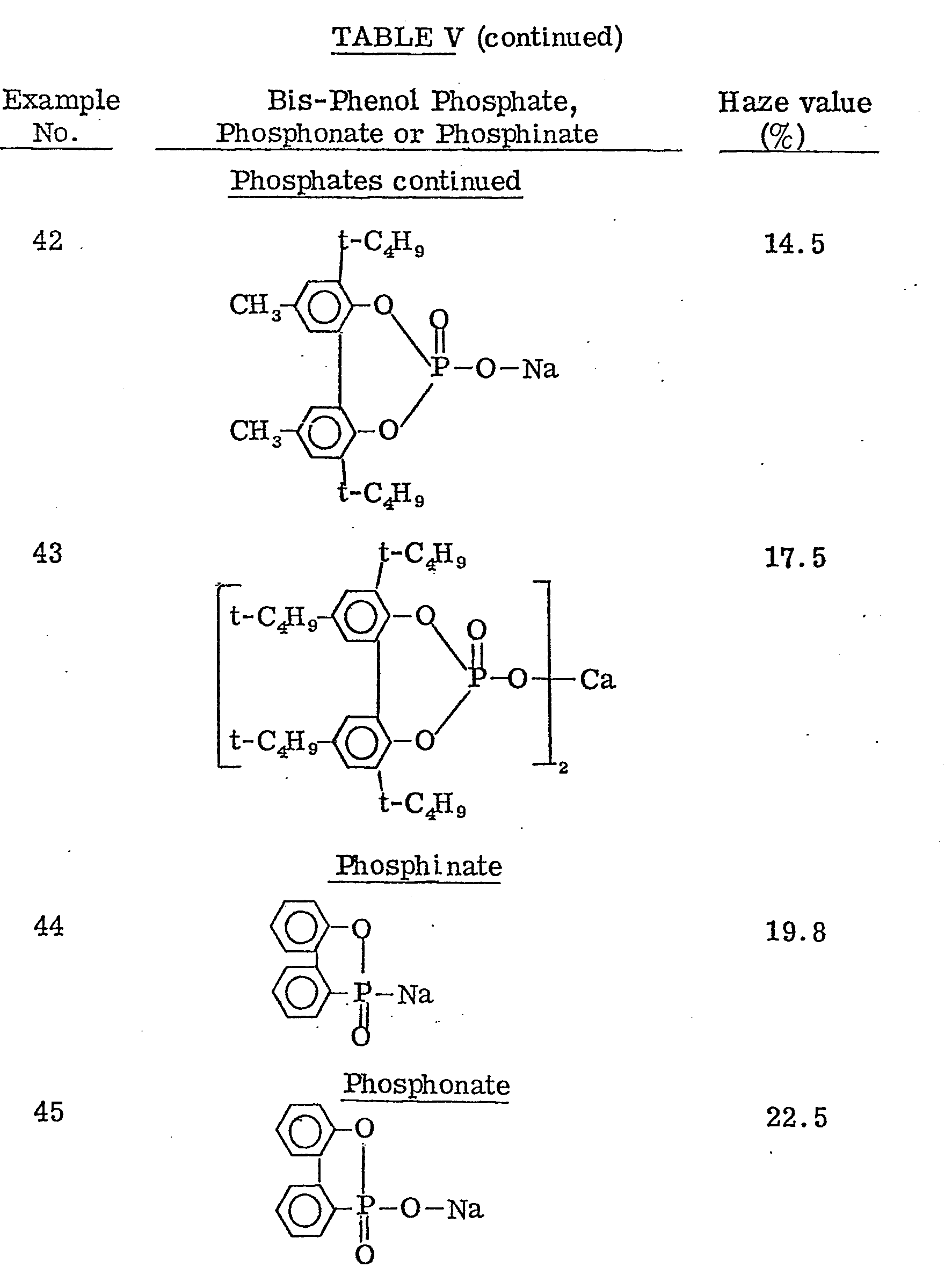
- The data show the bis-phenol phosphates, phosphonates and phosphinates of the invention are superior to the Controls.
- Linear low density polyethylene compositions were prepared to the following formulation:

- The ingredients were kneaded at 140°C for five minutes on a two-roll mill, then compression-molded for five minutes at 150°C and 200 kg/cm2, and cooled rapidly to 60°C, to obtain specimens 1.0 mm thick.
- The haze value of these specimens was measured according to ASTM D-1003-61, and the results are shown in Table VI.


- The data show the bis-phenol phosphates of the invention are superior to the Controls.
- Polypropylene compositions were prepared having the following formulation:

- The ingredients were kneaded at 180°C for five minutes on a two-roll mill, and then compression-molded for five minutes at 180°C and 250 kg/cm2, then cooled to 60°C rapidly, to give specimens 1. 0 mm thick.
- The haze value according to ASTMD-1003-61 and Izod impact value at 20°C were determined for each specimen, and the results are shown in Table VII.


Claims (8)


Priority Applications (1)
| Application Number | Priority Date | Filing Date | Title |
|---|---|---|---|
| AT82105308T ATE18053T1 (en) | 1981-06-25 | 1982-06-16 | BIS-PHENOL PHOSPHATE AS A CLEARING AGENT FOR POLYOLEFIN RESINS. |
Applications Claiming Priority (2)
| Application Number | Priority Date | Filing Date | Title |
|---|---|---|---|
| JP98816/81 | 1981-06-25 | ||
| JP56098816A JPS581736A (en) | 1981-06-25 | 1981-06-25 | Polyolefin resin composition |
Publications (3)
| Publication Number | Publication Date |
|---|---|
| EP0068326A2 true EP0068326A2 (en) | 1983-01-05 |
| EP0068326A3 EP0068326A3 (en) | 1983-05-25 |
| EP0068326B1 EP0068326B1 (en) | 1986-02-19 |
Family
ID=14229839
Family Applications (1)
| Application Number | Title | Priority Date | Filing Date |
|---|---|---|---|
| EP82105308A Expired EP0068326B1 (en) | 1981-06-25 | 1982-06-16 | Bis-phenol phosphates as clarifiers for polyolefin resins |
Country Status (5)
| Country | Link |
|---|---|
| US (1) | US4463113A (en) |
| EP (1) | EP0068326B1 (en) |
| JP (1) | JPS581736A (en) |
| AT (1) | ATE18053T1 (en) |
| DE (1) | DE3269154D1 (en) |
Cited By (8)
| Publication number | Priority date | Publication date | Assignee | Title |
|---|---|---|---|---|
| EP0265196A3 (en) * | 1986-10-21 | 1988-11-09 | Eastman Kodak Company | The stabilization of dye images produced in photographic materials |
| EP0255693A3 (en) * | 1986-08-01 | 1989-09-20 | Chisso Corporation | High stiffness ethylene-propylene block copolymer compositions |
| EP0312976A3 (en) * | 1987-10-20 | 1990-08-01 | Idemitsu Kosan Company Limited | Styrene-based resin composition and process for production of moldings |
| EP0446358A4 (en) * | 1989-07-11 | 1992-06-17 | Mitsui Toatsu Chemicals Inc. | Polypropylene resin composition |
| EP0280297A3 (en) * | 1987-02-26 | 1992-12-23 | Chisso Corporation | High stiffness propylene polymer composition |
| WO1996016115A1 (en) * | 1994-11-22 | 1996-05-30 | Exxon Chemical Patents Inc. | Coextrusion process for ethylene based polymers and compositions therefor |
| WO2011048955A1 (en) | 2009-10-23 | 2011-04-28 | 株式会社Adeka | Polyolefin resin composition |
| TWI728311B (en) * | 2018-02-13 | 2021-05-21 | 日商Adeka股份有限公司 | Nucleating agent, polyolefin resin composition using it and its molded product |
Families Citing this family (94)
| Publication number | Priority date | Publication date | Assignee | Title |
|---|---|---|---|---|
| JPH0674364B2 (en) * | 1985-05-22 | 1994-09-21 | 三井東圧化学株式会社 | Propylene block copolymer composition |
| JPS62209151A (en) * | 1986-03-10 | 1987-09-14 | Chisso Corp | Propylene polymer composition |
| JPS6337152A (en) * | 1986-08-01 | 1988-02-17 | Chisso Corp | High-rigidity ethylene-propylene block copolymer composition |
| JPS6337148A (en) * | 1986-08-01 | 1988-02-17 | Chisso Corp | High-rigidity propylene homopolymer composition |
| JPS6347209U (en) * | 1986-09-10 | 1988-03-30 | ||
| JPS6369853A (en) * | 1986-09-12 | 1988-03-29 | Mitsubishi Petrochem Co Ltd | Propylene polymer composition |
| JPS63264650A (en) * | 1987-04-21 | 1988-11-01 | Chisso Corp | Polyolefin composition |
| US4820772A (en) * | 1987-04-20 | 1989-04-11 | Chisso Corporation | Polyolefin composition |
| JPH0273837A (en) * | 1988-09-09 | 1990-03-13 | Adeka Argus Chem Co Ltd | Crystalline polymer material composition |
| JPH0627226B2 (en) * | 1988-10-11 | 1994-04-13 | チッソ株式会社 | Crystalline propylene polymer composition and container using the same |
| JP2812972B2 (en) * | 1989-02-02 | 1998-10-22 | 出光興産株式会社 | Styrene resin composition and method for producing molded article |
| JPH041233A (en) * | 1990-04-19 | 1992-01-06 | Chisso Corp | Method for dispersing phosphate compound |
| JP3195434B2 (en) * | 1991-09-10 | 2001-08-06 | 第一製薬株式会社 | Drug-filled syringe formulation |
| JP3046428B2 (en) * | 1991-12-05 | 2000-05-29 | 旭電化工業株式会社 | Crystalline synthetic resin composition |
| AU661422B1 (en) * | 1994-02-01 | 1995-07-20 | Daiichi Sankyo Company, Limited | Medicated syringe preparation |
| US5869154A (en) * | 1996-03-21 | 1999-02-09 | Fort James Corporation | Resin composition having special colors and decoration added thereto |
| JPH11178888A (en) * | 1997-12-22 | 1999-07-06 | Asahi Denka Kogyo Kk | Drug-filled formulation |
| JP3989098B2 (en) * | 1998-08-21 | 2007-10-10 | 株式会社Adeka | Crystalline polymer material composition |
| US6534574B1 (en) | 2001-03-24 | 2003-03-18 | Milliken & Company | Highly nucleated thermoplastic articles |
| US6541554B2 (en) * | 2001-05-17 | 2003-04-01 | Milliken & Company | Low-shrink polypropylene fibers |
| US6656404B2 (en) * | 2001-05-17 | 2003-12-02 | Milliken & Company | Methods of making low-shrink polypropylene fibers |
| US6559211B2 (en) | 2001-05-23 | 2003-05-06 | Milliken & Company | Highly versatile thermoplastic nucleators |
| JP5041636B2 (en) | 2001-07-12 | 2012-10-03 | 株式会社Adeka | Antimicrobial composition for medical devices |
| EP1423262B1 (en) | 2001-07-31 | 2020-07-08 | Avery Dennison Corporation | Conformable holographic labels |
| KR20030032605A (en) * | 2001-10-19 | 2003-04-26 | 씨제이 주식회사 | Protease obtained from Vibrio metschinikovii derivatives and thereof detergent compositions |
| US20030134082A1 (en) * | 2001-12-21 | 2003-07-17 | Morin Brian G. | Carpet comprising a low-shrink backing of polypropylene tape fibers |
| US20030134118A1 (en) * | 2001-12-21 | 2003-07-17 | Morin Brian G. | Low-shrink polypropylene tape fibers |
| US6998081B2 (en) * | 2001-12-21 | 2006-02-14 | Milliken & Company | Method of producing low-shrink polypropylene tape fibers |
| JP2003261720A (en) * | 2002-03-08 | 2003-09-19 | Sumitomo Chem Co Ltd | Phosphate ester nucleating agent and its application |
| JP4495387B2 (en) * | 2002-03-19 | 2010-07-07 | 住友化学株式会社 | Polyolefin resin composition |
| US7129323B2 (en) | 2002-06-14 | 2006-10-31 | Milliken & Company | Bimolecular nucleation methods for thermoplastics |
| US20050197435A1 (en) * | 2002-06-14 | 2005-09-08 | Dotson Darin L. | Polymer additive compositions for bimolecular nucleation in thermoplastics |
| ATE396472T1 (en) | 2002-06-26 | 2008-06-15 | Avery Dennison Corp | LENGTH-ORIENTED POLYMERIC FILMS |
| US6887567B2 (en) * | 2002-11-02 | 2005-05-03 | Milliken & Company | Low-shrink polypropylene tape fibers comprising high amounts of nucleating agents |
| US20040084802A1 (en) * | 2002-11-02 | 2004-05-06 | Morin Brian G. | Method of producing low-shrink polypropylene tape fibers comprising high amounts of nucleating agents |
| US6863976B2 (en) * | 2002-11-16 | 2005-03-08 | Milliken & Company | Polypropylene monofilament and tape fibers exhibiting certain creep-strain characteristics and corresponding crystalline configurations |
| US6759124B2 (en) * | 2002-11-16 | 2004-07-06 | Milliken & Company | Thermoplastic monofilament fibers exhibiting low-shrink, high tenacity, and extremely high modulus levels |
| US20040096639A1 (en) * | 2002-11-16 | 2004-05-20 | Morin Brian G. | Uniform production methods for colored and non-colored polypropylene fibers |
| US20040096621A1 (en) * | 2002-11-17 | 2004-05-20 | Dai Weihua Sonya | High denier textured polypropylene fibers and yarns |
| US7041368B2 (en) * | 2002-11-17 | 2006-05-09 | Milliken & Company | High speed spinning procedures for the manufacture of high denier polypropylene fibers and yarns |
| US20040152815A1 (en) * | 2002-11-17 | 2004-08-05 | Morin Brian G. | High speed spinning procedures for the manufacture of low denier polypropylene fibers and yarns |
| US20040116015A1 (en) * | 2002-12-17 | 2004-06-17 | Hayes Heather J. | Fluorochemical-containing textile finishes that exhibit wash-durable soil release and moisture wicking properties |
| US7781539B2 (en) | 2003-02-21 | 2010-08-24 | Metabolix Inc. | PHA blends |
| JP4299585B2 (en) * | 2003-05-26 | 2009-07-22 | 日本バルカー工業株式会社 | Rubber composition and use thereof |
| EP1627005A1 (en) * | 2003-05-28 | 2006-02-22 | DSM IP Assets B.V. | Polyester composition comprising polybutylene terephthalate resin |
| JP3909846B2 (en) * | 2003-08-01 | 2007-04-25 | 株式会社Adeka | Crystal nucleating agent composition, production method thereof, and crystalline polymer composition containing the crystal nucleating agent composition |
| US20050038157A1 (en) * | 2003-08-12 | 2005-02-17 | Christopher Kochanowicz | Low density polyethylene articles exhibiting significantly decreased warpage at reduced cooling times |
| US20050046065A1 (en) * | 2003-08-30 | 2005-03-03 | Cowan Martin E. | Thermoplastic fibers exhibiting durable high color strength characteristics |
| US20050048281A1 (en) * | 2003-08-30 | 2005-03-03 | Royer Joseph R. | Thermoplastic fibers exhibiting durable high color strength characteristics |
| US6849330B1 (en) | 2003-08-30 | 2005-02-01 | Milliken & Company | Thermoplastic fibers exhibiting durable high color strength characteristics |
| JP4640753B2 (en) | 2003-12-08 | 2011-03-02 | 株式会社Adeka | Vinyl chloride resin composition |
| ES2315737T3 (en) * | 2003-12-30 | 2009-04-01 | Metabolix, Inc. | NUCLEANT AGENTS. |
| US20060079613A1 (en) * | 2004-10-13 | 2006-04-13 | Rob Hanssen | Blended nucleating agent compositions and methods |
| US7786203B2 (en) * | 2005-09-16 | 2010-08-31 | Milliken & Company | Polymer compositions comprising nucleating or clarifying agents and articles made using such compositions |
| JP2009527586A (en) * | 2006-02-21 | 2009-07-30 | チバ ホールディング インコーポレーテッド | Aromatic phosphate ester flame retardant composition |
| US7659336B2 (en) | 2006-03-08 | 2010-02-09 | Milliken & Company | Nucleating agent additive compositions and methods |
| BRPI0711963B1 (en) | 2006-06-14 | 2019-09-17 | Avery Dennison Corporation | COMFORTABLE AND HIGHLESS MACHINE DIRECTED ORIENTATION LABELS AND LABELS, AND PREPARATION PROCESSES |
| US9636895B2 (en) | 2006-06-20 | 2017-05-02 | Avery Dennison Corporation | Multilayered polymeric film for hot melt adhesive labeling and label stock and label thereof |
| US7491762B2 (en) * | 2006-07-03 | 2009-02-17 | Milliken & Company | Compositions comprising metal salts of hexahydrophthalic acid and methods of employing such compositions in polyolefin resins |
| JP5579436B2 (en) | 2006-07-17 | 2014-08-27 | エーブリー デニソン コーポレイション | Asymmetric multilayer polymer film and label stock and label thereof |
| US20080171834A1 (en) * | 2006-12-19 | 2008-07-17 | Kien-Mun Tang | Thermoplastic and nucleating agent compositions and methods |
| JP5388263B2 (en) | 2007-09-04 | 2014-01-15 | 株式会社Adeka | Master batch for polyolefin resin nucleating agent |
| US8546473B2 (en) | 2008-05-16 | 2013-10-01 | Adeka Corporation | Polyolefin resin composition |
| JP5361041B2 (en) * | 2008-08-28 | 2013-12-04 | 株式会社Adeka | Crystal nucleating agent and polyolefin resin composition containing the same |
| JP5361043B2 (en) * | 2008-09-24 | 2013-12-04 | 株式会社Adeka | Crystal nucleating agent and polyolefin resin composition containing the same |
| JP5603561B2 (en) * | 2009-04-06 | 2014-10-08 | 株式会社Adeka | Polyolefin resin composition |
| KR101588343B1 (en) | 2008-08-28 | 2016-01-25 | 가부시키가이샤 아데카 | Polyolefin resin composition |
| EP2424929B1 (en) | 2009-04-30 | 2013-04-17 | Milliken & Company | Nucleating agent and thermoplastic compositions comprising the same |
| WO2011086582A2 (en) | 2010-01-15 | 2011-07-21 | Reliance Industries Limited | Nucleating agents for polyolefins based on metal salts |
| CA2789683C (en) | 2010-02-15 | 2018-06-12 | Mallinckrodt Llc | Syringe products and related methods and uses |
| US9243127B2 (en) | 2012-06-14 | 2016-01-26 | Adeka Corporation | Method for producing nucleator masterbatch |
| US9676532B2 (en) | 2012-08-15 | 2017-06-13 | Avery Dennison Corporation | Packaging reclosure label for high alcohol content products |
| CN104755538B (en) | 2012-08-17 | 2018-08-31 | Cj 第一制糖株式会社 | Bio-Based Rubber Modifiers for Polymer Blends |
| EP2906628B1 (en) | 2012-10-15 | 2017-07-26 | Saudi Basic Industries Corporation | Polyethylene compositions comprising polypropylene |
| EP3004225A1 (en) | 2013-05-30 | 2016-04-13 | Metabolix, Inc. | Recyclate blends |
| WO2015149029A1 (en) | 2014-03-27 | 2015-10-01 | Metabolix, Inc. | Highly filled polymer systems |
| US11459488B2 (en) | 2014-06-02 | 2022-10-04 | Avery Dennison Corporation | Films with enhanced scuff resistance, clarity, and conformability |
| WO2016078974A1 (en) | 2014-11-20 | 2016-05-26 | Sabic Global Technologies B.V. | Polypropylene compositions |
| US9994695B2 (en) | 2014-11-25 | 2018-06-12 | Milliken & Company | Process for extruding polypropylene |
| US9994692B2 (en) | 2014-11-25 | 2018-06-12 | Milliken & Company | Process for extruding polypropylene |
| WO2017009193A1 (en) | 2015-07-13 | 2017-01-19 | Sabic Global Technologies B.V. | Composition comprising heterophasic propylene copolymer |
| JP6885667B2 (en) | 2015-08-20 | 2021-06-16 | 株式会社Adeka | Resin additive composition and synthetic resin composition using the same |
| CN108026340A (en) | 2015-09-09 | 2018-05-11 | Sabic环球技术有限责任公司 | polyolefin composition |
| EP3420027B1 (en) | 2016-02-22 | 2019-10-23 | SABIC Global Technologies B.V. | Composition comprising heterophasic propylene copolymer |
| JP6790230B2 (en) * | 2016-08-11 | 2020-11-25 | ミリケン・アンド・カンパニーMilliken & Company | Additive composition and polymer composition containing it |
| US20190284217A1 (en) * | 2016-10-26 | 2019-09-19 | Adeka Corporation | Novel compound, composition including same, olefin-based resin composition, molded article thereof, and method for improving impact resistance of molded article |
| CN112449647A (en) * | 2018-07-27 | 2021-03-05 | 株式会社Adeka | Additive composition, polyolefin resin composition containing same, method for producing polyolefin resin composition, and molded article thereof |
| BR112021013408A2 (en) * | 2019-01-21 | 2021-09-14 | Adeka Corporation | NUCLEATING AGENT COMPOSITION, OLEFIN-BASED RESIN COMPOSITION, MOLDED ARTICLE THEREOF AND METHOD FOR PRODUCTION OF OLEFIN-BASED RESIN COMPOSITION |
| US11667778B2 (en) | 2019-01-23 | 2023-06-06 | Milliken & Company | Thermoplastic composition |
| WO2020169402A1 (en) | 2019-02-18 | 2020-08-27 | Sabic Global Technologies B.V. | Composition comprising heterophasic propylene copolymer |
| US20230009252A1 (en) * | 2019-12-18 | 2023-01-12 | Adeka Corporation | Resin composition, molded article thereof, and method for producing said resin composition |
| US20230124644A1 (en) | 2020-03-27 | 2023-04-20 | Adeka Corporation | Nucleating agent, resin composition, method for producing resin composition, and molded article |
| WO2022014686A1 (en) * | 2020-07-15 | 2022-01-20 | 株式会社Adeka | Additive composition, resin composition containing same, and molded article of said resin composition |
| WO2026012954A1 (en) | 2024-07-09 | 2026-01-15 | Sabic Global Technologies B.V. | Polypropylene composition |
Family Cites Families (2)
| Publication number | Priority date | Publication date | Assignee | Title |
|---|---|---|---|---|
| US3395112A (en) * | 1965-09-15 | 1968-07-30 | Argus Chem | Nickel organophosphites and polyolefin resin stabilization therewith |
| IT1130965B (en) * | 1979-03-19 | 1986-06-18 | Sanko Kaihatsu Kagaku Kenk | FLAME RETARDANT AGENT |
-
1981
- 1981-06-25 JP JP56098816A patent/JPS581736A/en active Granted
-
1982
- 1982-05-20 US US06/379,821 patent/US4463113A/en not_active Expired - Fee Related
- 1982-06-16 EP EP82105308A patent/EP0068326B1/en not_active Expired
- 1982-06-16 AT AT82105308T patent/ATE18053T1/en not_active IP Right Cessation
- 1982-06-16 DE DE8282105308T patent/DE3269154D1/en not_active Expired
Cited By (10)
| Publication number | Priority date | Publication date | Assignee | Title |
|---|---|---|---|---|
| EP0255693A3 (en) * | 1986-08-01 | 1989-09-20 | Chisso Corporation | High stiffness ethylene-propylene block copolymer compositions |
| EP0265196A3 (en) * | 1986-10-21 | 1988-11-09 | Eastman Kodak Company | The stabilization of dye images produced in photographic materials |
| EP0280297A3 (en) * | 1987-02-26 | 1992-12-23 | Chisso Corporation | High stiffness propylene polymer composition |
| EP0312976A3 (en) * | 1987-10-20 | 1990-08-01 | Idemitsu Kosan Company Limited | Styrene-based resin composition and process for production of moldings |
| EP0446358A4 (en) * | 1989-07-11 | 1992-06-17 | Mitsui Toatsu Chemicals Inc. | Polypropylene resin composition |
| WO1996016115A1 (en) * | 1994-11-22 | 1996-05-30 | Exxon Chemical Patents Inc. | Coextrusion process for ethylene based polymers and compositions therefor |
| AU704255B2 (en) * | 1994-11-22 | 1999-04-15 | Exxon Chemical Patents Inc. | Coextrusion process for ethylene based polymers and compositions therefor |
| WO2011048955A1 (en) | 2009-10-23 | 2011-04-28 | 株式会社Adeka | Polyolefin resin composition |
| TWI728311B (en) * | 2018-02-13 | 2021-05-21 | 日商Adeka股份有限公司 | Nucleating agent, polyolefin resin composition using it and its molded product |
| RU2758474C1 (en) * | 2018-02-13 | 2021-10-28 | Адэка Корпорейшн | Crystallisation nucleator, polyolefin-based resin composition containing the nucleator, and moulded product made therefrom |
Also Published As
| Publication number | Publication date |
|---|---|
| JPS581736A (en) | 1983-01-07 |
| ATE18053T1 (en) | 1986-03-15 |
| DE3269154D1 (en) | 1986-03-27 |
| EP0068326B1 (en) | 1986-02-19 |
| EP0068326A3 (en) | 1983-05-25 |
| JPS638980B2 (en) | 1988-02-25 |
| US4463113A (en) | 1984-07-31 |
Similar Documents
| Publication | Publication Date | Title |
|---|---|---|
| EP0068326B1 (en) | Bis-phenol phosphates as clarifiers for polyolefin resins | |
| EP0038876B1 (en) | 2,6-di-tertiary butyl phenyl pentaerythritol spiro bis-phosphites enhancing the stability to heat and light of synthetic resins, stabilizer compositions comprising phenolic antioxidants and such phosphites, and synthetic resin compositions containing the same | |
| US4684679A (en) | Polyacetal resin compositions having improved resistance to deterioration when exposed to light and containing alkylidene bis(benzotriazolyl phenols) | |
| US4812498A (en) | Polycarbonate resin compositions having improved resistance to deterioration when exposed to light and containing alkylidene bis(benzotriazolyl phenols) | |
| US4210577A (en) | Stabilizers for synthetic polymers comprising 2,2,6,6-tetramethyl-4-piperidyl carboxylic acid ester, phosphonic acid ester and phenol | |
| US4371651A (en) | Stabilizer compositions and polyvinyl halide resin compositions containing 1,3-dicarbonyl compounds | |
| EP0209126B1 (en) | Hydrocarbyl(polyphenol)-poly(2,2,6,6-tetramethyl piperidyl-1,3,5-triazines) as stabilizers for synthetic polymer compositions | |
| US4673701A (en) | Alkylidene bisphenol phosphites and phosphates having 2,2,6,6-tetramethyl piperidinyl groups and synthetic resin composition | |
| EP0065655B1 (en) | Polymeric light stabilizers having at least one 2,2,6,6-tetraalkyl piperidyl group and synthetic resin compositions containing the same | |
| EP0184203B1 (en) | Vinyl benzyl 2,2,6,6-tetramethyl piperidines | |
| EP0081688B1 (en) | Poly(piperidylamine) alkanes and synthetic resin compositions stabilized thereby | |
| US4279805A (en) | Alkylene-bis-thioalkanoic acid amide stabilizers for synthetic resins and synthetic resin compositions containing the same | |
| US4481317A (en) | Hindered bisphenol diphosphonites and stabilized synthetic resin compositions containing the same | |
| EP0074598A2 (en) | Synthetic resin compositions containing 2,2,6,6-tetramethyl piperidinyl triazines | |
| US4381360A (en) | 1,3-Dicarbonyl compounds and polyvinyl halide resin compositions containing the same | |
| US4670492A (en) | Cyclic bis and tris phosphites and stabilized synthetic resin compositions | |
| US4499220A (en) | Copolymer light stabilizers having at least one 2,2,6,6-tetraalkyl piperidyl group and synthetic resin compositions containing the same | |
| EP0073386B1 (en) | Synthetic resin compositions containing 2,2,6,6-tetramethyl piperidyl ethers | |
| EP0040286B1 (en) | Polyvinyl halide resin compositions containing 1,3 dicarbonyl compounds | |
| EP0128229B1 (en) | Hindered bisphenol diphosphonites and stabilized synthetic resin compositions containing the same | |
| US4469828A (en) | Alkylthiopropionyl hydrazino triazines and synthetic resin compositions | |
| EP0095031B1 (en) | N,n,n-tris(2,2,6,6,-tetramethyl-4-piperidone ketal)-1,3,5-triazines and synthetic resin compositions | |
| EP0081235B1 (en) | Alkylthiopropionyl hydrazino triazines and synthetic resin compositions | |
| EP0213484B1 (en) | Alpha-hydroxy-beta-2,2,6,6-tetramethyl piperidyl ethylene oxiranes as light and heat stabilizers for polyvinyl chloride resins | |
| EP0118578B1 (en) | Polyethers containing 2,2,6,6-tetramethyl piperidinyl carboxylic acid ester groups and synthetic resin compositions |
Legal Events
| Date | Code | Title | Description |
|---|---|---|---|
| PUAI | Public reference made under article 153(3) epc to a published international application that has entered the european phase |
Free format text: ORIGINAL CODE: 0009012 |
|
| AK | Designated contracting states |
Designated state(s): AT BE CH DE FR GB IT LI NL SE |
|
| PUAL | Search report despatched |
Free format text: ORIGINAL CODE: 0009013 |
|
| AK | Designated contracting states |
Designated state(s): AT BE CH DE FR GB IT LI NL SE |
|
| 17P | Request for examination filed |
Effective date: 19831111 |
|
| GRAA | (expected) grant |
Free format text: ORIGINAL CODE: 0009210 |
|
| AK | Designated contracting states |
Designated state(s): AT BE CH DE FR GB IT LI NL SE |
|
| PG25 | Lapsed in a contracting state [announced via postgrant information from national office to epo] |
Ref country code: IT Free format text: LAPSE BECAUSE OF FAILURE TO SUBMIT A TRANSLATION OF THE DESCRIPTION OR TO PAY THE FEE WITHIN THE PRESCRIBED TIME-LIMIT;WARNING: LAPSES OF ITALIAN PATENTS WITH EFFECTIVE DATE BEFORE 2007 MAY HAVE OCCURRED AT ANY TIME BEFORE 2007. THE CORRECT EFFECTIVE DATE MAY BE DIFFERENT FROM THE ONE RECORDED. Effective date: 19860219 Ref country code: AT Effective date: 19860219 |
|
| REF | Corresponds to: |
Ref document number: 18053 Country of ref document: AT Date of ref document: 19860315 Kind code of ref document: T |
|
| PG25 | Lapsed in a contracting state [announced via postgrant information from national office to epo] |
Ref country code: SE Effective date: 19860228 |
|
| ET | Fr: translation filed | ||
| REF | Corresponds to: |
Ref document number: 3269154 Country of ref document: DE Date of ref document: 19860327 |
|
| PLBE | No opposition filed within time limit |
Free format text: ORIGINAL CODE: 0009261 |
|
| STAA | Information on the status of an ep patent application or granted ep patent |
Free format text: STATUS: NO OPPOSITION FILED WITHIN TIME LIMIT |
|
| 26N | No opposition filed | ||
| BERE | Be: lapsed |
Owner name: ADEKA ARGUS CHEMICAL CO. LTD. Effective date: 19870630 |
|
| PG25 | Lapsed in a contracting state [announced via postgrant information from national office to epo] |
Ref country code: BE Effective date: 19890630 |
|
| PGFP | Annual fee paid to national office [announced via postgrant information from national office to epo] |
Ref country code: GB Payment date: 20010601 Year of fee payment: 20 |
|
| PGFP | Annual fee paid to national office [announced via postgrant information from national office to epo] |
Ref country code: FR Payment date: 20010621 Year of fee payment: 20 |
|
| PGFP | Annual fee paid to national office [announced via postgrant information from national office to epo] |
Ref country code: NL Payment date: 20010627 Year of fee payment: 20 |
|
| PGFP | Annual fee paid to national office [announced via postgrant information from national office to epo] |
Ref country code: CH Payment date: 20010710 Year of fee payment: 20 |
|
| PGFP | Annual fee paid to national office [announced via postgrant information from national office to epo] |
Ref country code: DE Payment date: 20010726 Year of fee payment: 20 |
|
| REG | Reference to a national code |
Ref country code: GB Ref legal event code: IF02 |
|
| PG25 | Lapsed in a contracting state [announced via postgrant information from national office to epo] |
Ref country code: LI Free format text: LAPSE BECAUSE OF EXPIRATION OF PROTECTION Effective date: 20020615 Ref country code: GB Free format text: LAPSE BECAUSE OF EXPIRATION OF PROTECTION Effective date: 20020615 Ref country code: CH Free format text: LAPSE BECAUSE OF EXPIRATION OF PROTECTION Effective date: 20020615 |
|
| PG25 | Lapsed in a contracting state [announced via postgrant information from national office to epo] |
Ref country code: NL Free format text: LAPSE BECAUSE OF EXPIRATION OF PROTECTION Effective date: 20020616 |
|
| REG | Reference to a national code |
Ref country code: GB Ref legal event code: PE20 Effective date: 20020615 |
|
| REG | Reference to a national code |
Ref country code: CH Ref legal event code: PL |
|
| NLV7 | Nl: ceased due to reaching the maximum lifetime of a patent |
Effective date: 20020616 |