EP0067457B1 - Lactone and process for production thereof - Google Patents
Lactone and process for production thereof Download PDFInfo
- Publication number
- EP0067457B1 EP0067457B1 EP82105304A EP82105304A EP0067457B1 EP 0067457 B1 EP0067457 B1 EP 0067457B1 EP 82105304 A EP82105304 A EP 82105304A EP 82105304 A EP82105304 A EP 82105304A EP 0067457 B1 EP0067457 B1 EP 0067457B1
- Authority
- EP
- European Patent Office
- Prior art keywords
- condensation product
- decarboxylation condensation
- formula
- reaction
- lactone
- Prior art date
- Legal status (The legal status is an assumption and is not a legal conclusion. Google has not performed a legal analysis and makes no representation as to the accuracy of the status listed.)
- Expired
Links
- 150000002596 lactones Chemical class 0.000 title claims description 22
- 238000000034 method Methods 0.000 title claims description 14
- 238000004519 manufacturing process Methods 0.000 title description 3
- 238000006114 decarboxylation reaction Methods 0.000 claims description 64
- KWYUFKZDYYNOTN-UHFFFAOYSA-M Potassium hydroxide Chemical group [OH-].[K+] KWYUFKZDYYNOTN-UHFFFAOYSA-M 0.000 claims description 26
- 238000006243 chemical reaction Methods 0.000 claims description 20
- 239000003054 catalyst Substances 0.000 claims description 13
- 238000006482 condensation reaction Methods 0.000 claims description 12
- FKBMTBAXDISZGN-UHFFFAOYSA-N 5-methyl-3a,4,5,6,7,7a-hexahydro-2-benzofuran-1,3-dione Chemical compound C1C(C)CCC2C(=O)OC(=O)C12 FKBMTBAXDISZGN-UHFFFAOYSA-N 0.000 claims description 10
- OKTJSMMVPCPJKN-UHFFFAOYSA-N Carbon Chemical group [C] OKTJSMMVPCPJKN-UHFFFAOYSA-N 0.000 claims description 9
- HEMHJVSKTPXQMS-UHFFFAOYSA-M Sodium hydroxide Chemical compound [OH-].[Na+] HEMHJVSKTPXQMS-UHFFFAOYSA-M 0.000 claims description 9
- 229910052799 carbon Inorganic materials 0.000 claims description 9
- 125000002496 methyl group Chemical group [H]C([H])([H])* 0.000 claims description 8
- 238000010438 heat treatment Methods 0.000 claims description 6
- QXBYUPMEYVDXIQ-UHFFFAOYSA-N 4-methyl-3a,4,5,6,7,7a-hexahydro-2-benzofuran-1,3-dione Chemical compound CC1CCCC2C(=O)OC(=O)C12 QXBYUPMEYVDXIQ-UHFFFAOYSA-N 0.000 claims description 5
- -1 alkali metal alkoxide Chemical class 0.000 claims description 5
- ULKLGIFJWFIQFF-UHFFFAOYSA-N 5K8XI641G3 Chemical compound CCC1=NC=C(C)N1 ULKLGIFJWFIQFF-UHFFFAOYSA-N 0.000 claims description 3
- 150000008044 alkali metal hydroxides Chemical class 0.000 claims description 3
- 229910052783 alkali metal Inorganic materials 0.000 claims description 2
- 150000001412 amines Chemical group 0.000 claims 2
- 229910001860 alkaline earth metal hydroxide Inorganic materials 0.000 claims 1
- 229910000287 alkaline earth metal oxide Inorganic materials 0.000 claims 1
- 229910052698 phosphorus Inorganic materials 0.000 claims 1
- 239000011574 phosphorus Substances 0.000 claims 1
- 239000007859 condensation product Substances 0.000 description 54
- CURLTUGMZLYLDI-UHFFFAOYSA-N Carbon dioxide Chemical compound O=C=O CURLTUGMZLYLDI-UHFFFAOYSA-N 0.000 description 16
- 125000003178 carboxy group Chemical group [H]OC(*)=O 0.000 description 15
- 238000004458 analytical method Methods 0.000 description 14
- 239000000203 mixture Substances 0.000 description 14
- 239000002904 solvent Substances 0.000 description 14
- 239000002253 acid Substances 0.000 description 13
- 150000001875 compounds Chemical class 0.000 description 13
- XLYOFNOQVPJJNP-ZSJDYOACSA-N Heavy water Chemical compound [2H]O[2H] XLYOFNOQVPJJNP-ZSJDYOACSA-N 0.000 description 10
- 229910002092 carbon dioxide Inorganic materials 0.000 description 10
- 230000009102 absorption Effects 0.000 description 9
- 238000010521 absorption reaction Methods 0.000 description 9
- 238000001228 spectrum Methods 0.000 description 9
- XLYOFNOQVPJJNP-UHFFFAOYSA-N water Substances O XLYOFNOQVPJJNP-UHFFFAOYSA-N 0.000 description 9
- MUTGBJKUEZFXGO-OLQVQODUSA-N (3as,7ar)-3a,4,5,6,7,7a-hexahydro-2-benzofuran-1,3-dione Chemical compound C1CCC[C@@H]2C(=O)OC(=O)[C@@H]21 MUTGBJKUEZFXGO-OLQVQODUSA-N 0.000 description 8
- 239000001569 carbon dioxide Substances 0.000 description 7
- WYURNTSHIVDZCO-UHFFFAOYSA-N Tetrahydrofuran Chemical compound C1CCOC1 WYURNTSHIVDZCO-UHFFFAOYSA-N 0.000 description 6
- 230000000052 comparative effect Effects 0.000 description 6
- 238000000655 nuclear magnetic resonance spectrum Methods 0.000 description 6
- 238000005481 NMR spectroscopy Methods 0.000 description 5
- 125000002723 alicyclic group Chemical group 0.000 description 5
- 125000000596 cyclohexenyl group Chemical class C1(=CCCCC1)* 0.000 description 5
- CSCPPACGZOOCGX-UHFFFAOYSA-N Acetone Chemical compound CC(C)=O CSCPPACGZOOCGX-UHFFFAOYSA-N 0.000 description 4
- CTQNGGLPUBDAKN-UHFFFAOYSA-N O-Xylene Chemical compound CC1=CC=CC=C1C CTQNGGLPUBDAKN-UHFFFAOYSA-N 0.000 description 4
- FEWJPZIEWOKRBE-UHFFFAOYSA-N Tartaric Acid Chemical compound [H+].[H+].[O-]C(=O)C(O)C(O)C([O-])=O FEWJPZIEWOKRBE-UHFFFAOYSA-N 0.000 description 4
- 150000008065 acid anhydrides Chemical class 0.000 description 4
- 238000005259 measurement Methods 0.000 description 4
- 239000000047 product Substances 0.000 description 4
- 239000008096 xylene Substances 0.000 description 4
- MFYSUUPKMDJYPF-UHFFFAOYSA-N 2-[(4-methyl-2-nitrophenyl)diazenyl]-3-oxo-n-phenylbutanamide Chemical compound C=1C=CC=CC=1NC(=O)C(C(=O)C)N=NC1=CC=C(C)C=C1[N+]([O-])=O MFYSUUPKMDJYPF-UHFFFAOYSA-N 0.000 description 3
- OFOBLEOULBTSOW-UHFFFAOYSA-N Malonic acid Chemical compound OC(=O)CC(O)=O OFOBLEOULBTSOW-UHFFFAOYSA-N 0.000 description 3
- 125000000113 cyclohexyl group Chemical group [H]C1([H])C([H])([H])C([H])([H])C([H])(*)C([H])([H])C1([H])[H] 0.000 description 3
- IAZDPXIOMUYVGZ-UHFFFAOYSA-N dimethyl sulfoxide Natural products CS(C)=O IAZDPXIOMUYVGZ-UHFFFAOYSA-N 0.000 description 3
- 238000007142 ring opening reaction Methods 0.000 description 3
- YLQBMQCUIZJEEH-UHFFFAOYSA-N tetrahydrofuran Natural products C=1C=COC=1 YLQBMQCUIZJEEH-UHFFFAOYSA-N 0.000 description 3
- 238000005406 washing Methods 0.000 description 3
- IAZDPXIOMUYVGZ-WFGJKAKNSA-N Dimethyl sulfoxide Chemical compound [2H]C([2H])([2H])S(=O)C([2H])([2H])[2H] IAZDPXIOMUYVGZ-WFGJKAKNSA-N 0.000 description 2
- ZKEVGLUAKGKGMO-UHFFFAOYSA-N Spirodilactone Chemical compound O1C(=O)CCC21C1=CC=CC=C1C(=O)O2 ZKEVGLUAKGKGMO-UHFFFAOYSA-N 0.000 description 2
- 238000000862 absorption spectrum Methods 0.000 description 2
- 229910052784 alkaline earth metal Inorganic materials 0.000 description 2
- 150000001342 alkaline earth metals Chemical class 0.000 description 2
- 125000004432 carbon atom Chemical group C* 0.000 description 2
- 239000003795 chemical substances by application Substances 0.000 description 2
- 239000004927 clay Substances 0.000 description 2
- 150000001991 dicarboxylic acids Chemical class 0.000 description 2
- 239000003822 epoxy resin Substances 0.000 description 2
- LNEPOXFFQSENCJ-UHFFFAOYSA-N haloperidol Chemical compound C1CC(O)(C=2C=CC(Cl)=CC=2)CCN1CCCC(=O)C1=CC=C(F)C=C1 LNEPOXFFQSENCJ-UHFFFAOYSA-N 0.000 description 2
- 238000002329 infrared spectrum Methods 0.000 description 2
- 238000004811 liquid chromatography Methods 0.000 description 2
- 238000001819 mass spectrum Methods 0.000 description 2
- 125000001434 methanylylidene group Chemical group [H]C#[*] 0.000 description 2
- 229920000647 polyepoxide Polymers 0.000 description 2
- 239000000843 powder Substances 0.000 description 2
- 238000000746 purification Methods 0.000 description 2
- 229920001187 thermosetting polymer Polymers 0.000 description 2
- RIOQSEWOXXDEQQ-UHFFFAOYSA-N triphenylphosphine Chemical compound C1=CC=CC=C1P(C=1C=CC=CC=1)C1=CC=CC=C1 RIOQSEWOXXDEQQ-UHFFFAOYSA-N 0.000 description 2
- RYHBNJHYFVUHQT-UHFFFAOYSA-N 1,4-Dioxane Chemical compound C1COCCO1 RYHBNJHYFVUHQT-UHFFFAOYSA-N 0.000 description 1
- GQHTUMJGOHRCHB-UHFFFAOYSA-N 2,3,4,6,7,8,9,10-octahydropyrimido[1,2-a]azepine Chemical compound C1CCCCN2CCCN=C21 GQHTUMJGOHRCHB-UHFFFAOYSA-N 0.000 description 1
- FALRKNHUBBKYCC-UHFFFAOYSA-N 2-(chloromethyl)pyridine-3-carbonitrile Chemical compound ClCC1=NC=CC=C1C#N FALRKNHUBBKYCC-UHFFFAOYSA-N 0.000 description 1
- UEKHVFDHZRFETL-UHFFFAOYSA-N 3-(5-methyl-1,2,4-oxadiazol-3-yl)benzaldehyde Chemical compound O1C(C)=NC(C=2C=C(C=O)C=CC=2)=N1 UEKHVFDHZRFETL-UHFFFAOYSA-N 0.000 description 1
- WXYTXCXWNITTLN-UHFFFAOYSA-N 3-methylcyclohexane-1,2-dicarboxylic acid Chemical compound CC1CCCC(C(O)=O)C1C(O)=O WXYTXCXWNITTLN-UHFFFAOYSA-N 0.000 description 1
- YWVFNWVZBAWOOY-UHFFFAOYSA-N 4-methylcyclohexane-1,2-dicarboxylic acid Chemical compound CC1CCC(C(O)=O)C(C(O)=O)C1 YWVFNWVZBAWOOY-UHFFFAOYSA-N 0.000 description 1
- 0 CC(C*C1)CC(C(C2C3CC*(C)CC2)OC3=O)=C1C(O)=O Chemical compound CC(C*C1)CC(C(C2C3CC*(C)CC2)OC3=O)=C1C(O)=O 0.000 description 1
- XDTMQSROBMDMFD-UHFFFAOYSA-N Cyclohexane Chemical compound C1CCCCC1 XDTMQSROBMDMFD-UHFFFAOYSA-N 0.000 description 1
- WQDUMFSSJAZKTM-UHFFFAOYSA-N Sodium methoxide Chemical compound [Na+].[O-]C WQDUMFSSJAZKTM-UHFFFAOYSA-N 0.000 description 1
- 150000001340 alkali metals Chemical class 0.000 description 1
- 150000004703 alkoxides Chemical class 0.000 description 1
- 150000008064 anhydrides Chemical class 0.000 description 1
- RQPZNWPYLFFXCP-UHFFFAOYSA-L barium dihydroxide Chemical compound [OH-].[OH-].[Ba+2] RQPZNWPYLFFXCP-UHFFFAOYSA-L 0.000 description 1
- 239000006227 byproduct Substances 0.000 description 1
- AXCZMVOFGPJBDE-UHFFFAOYSA-L calcium dihydroxide Chemical compound [OH-].[OH-].[Ca+2] AXCZMVOFGPJBDE-UHFFFAOYSA-L 0.000 description 1
- 239000000920 calcium hydroxide Substances 0.000 description 1
- 229910001861 calcium hydroxide Inorganic materials 0.000 description 1
- 239000011203 carbon fibre reinforced carbon Substances 0.000 description 1
- 125000002915 carbonyl group Chemical group [*:2]C([*:1])=O 0.000 description 1
- 125000003262 carboxylic acid ester group Chemical class [H]C([H])([*:2])OC(=O)C([H])([H])[*:1] 0.000 description 1
- 239000007795 chemical reaction product Substances 0.000 description 1
- 229920001577 copolymer Polymers 0.000 description 1
- ZFTFAPZRGNKQPU-UHFFFAOYSA-N dicarbonic acid Chemical compound OC(=O)OC(O)=O ZFTFAPZRGNKQPU-UHFFFAOYSA-N 0.000 description 1
- 238000006471 dimerization reaction Methods 0.000 description 1
- XXBDWLFCJWSEKW-UHFFFAOYSA-N dimethylbenzylamine Chemical compound CN(C)CC1=CC=CC=C1 XXBDWLFCJWSEKW-UHFFFAOYSA-N 0.000 description 1
- 239000006185 dispersion Substances 0.000 description 1
- 238000010828 elution Methods 0.000 description 1
- 150000002148 esters Chemical class 0.000 description 1
- 238000001914 filtration Methods 0.000 description 1
- 239000012634 fragment Substances 0.000 description 1
- 125000000524 functional group Chemical group 0.000 description 1
- GAEKPEKOJKCEMS-UHFFFAOYSA-N gamma-valerolactone Chemical compound CC1CCC(=O)O1 GAEKPEKOJKCEMS-UHFFFAOYSA-N 0.000 description 1
- 150000004679 hydroxides Chemical class 0.000 description 1
- 239000012535 impurity Substances 0.000 description 1
- 125000000686 lactone group Chemical group 0.000 description 1
- VTHJTEIRLNZDEV-UHFFFAOYSA-L magnesium dihydroxide Chemical compound [OH-].[OH-].[Mg+2] VTHJTEIRLNZDEV-UHFFFAOYSA-L 0.000 description 1
- 239000000347 magnesium hydroxide Substances 0.000 description 1
- 229910001862 magnesium hydroxide Inorganic materials 0.000 description 1
- 238000004949 mass spectrometry Methods 0.000 description 1
- VYKXQOYUCMREIS-UHFFFAOYSA-N methylhexahydrophthalic anhydride Chemical compound C1CCCC2C(=O)OC(=O)C21C VYKXQOYUCMREIS-UHFFFAOYSA-N 0.000 description 1
- FZPXKEPZZOEPGX-UHFFFAOYSA-N n,n-dibutylaniline Chemical compound CCCCN(CCCC)C1=CC=CC=C1 FZPXKEPZZOEPGX-UHFFFAOYSA-N 0.000 description 1
- 230000003472 neutralizing effect Effects 0.000 description 1
- 239000003960 organic solvent Substances 0.000 description 1
- 238000012856 packing Methods 0.000 description 1
- 239000002245 particle Substances 0.000 description 1
- 150000003018 phosphorus compounds Chemical class 0.000 description 1
- 238000010992 reflux Methods 0.000 description 1
- 229920005989 resin Polymers 0.000 description 1
- 239000011347 resin Substances 0.000 description 1
- DCKVNWZUADLDEH-UHFFFAOYSA-N sec-butyl acetate Chemical compound CCC(C)OC(C)=O DCKVNWZUADLDEH-UHFFFAOYSA-N 0.000 description 1
- 239000007787 solid Substances 0.000 description 1
- 229940035637 spectrum-4 Drugs 0.000 description 1
- LXMSZDCAJNLERA-ZHYRCANASA-N spironolactone Chemical class C([C@@H]1[C@]2(C)CC[C@@H]3[C@@]4(C)CCC(=O)C=C4C[C@H]([C@@H]13)SC(=O)C)C[C@@]21CCC(=O)O1 LXMSZDCAJNLERA-ZHYRCANASA-N 0.000 description 1
- 229960002256 spironolactone Drugs 0.000 description 1
- 239000007858 starting material Substances 0.000 description 1
- 238000003756 stirring Methods 0.000 description 1
- 229940014800 succinic anhydride Drugs 0.000 description 1
Images



Classifications
-
- C—CHEMISTRY; METALLURGY
- C07—ORGANIC CHEMISTRY
- C07D—HETEROCYCLIC COMPOUNDS
- C07D307/00—Heterocyclic compounds containing five-membered rings having one oxygen atom as the only ring hetero atom
- C07D307/77—Heterocyclic compounds containing five-membered rings having one oxygen atom as the only ring hetero atom ortho- or peri-condensed with carbocyclic rings or ring systems
- C07D307/87—Benzo [c] furans; Hydrogenated benzo [c] furans
- C07D307/88—Benzo [c] furans; Hydrogenated benzo [c] furans with one oxygen atom directly attached in position 1 or 3
Definitions
- This invention relates to a lactone and a process for producing said lactone by carrying out a decarboxylation condensation reaction of a saturated alicyclic 1,2-dicarboxylic acid anhydride.
- This spirolactone structurally has two lactone rings in the molecule.
- this compound When reacted with water, this compound is rearranged, as shown by the following equation, to be converted into a dibasic acid (4- ketopimelic acid) of the formula (11) having a number of functional groups of 2 which is equal to those of ordinary dicarboxylic acid anhydrides.
- DE-B-1 142 863 relates to a process for preparing alicyclic lactones of the cyclohexane and cyclohexene series. Such compounds can be used, together with cyclic acid anhydrides, as curing agents for thermosetting epoxy resins.
- the object of this invention is to provide a lactone which is obtained by a decarboxylation condensation reaction, and to provide a process for production thereof.
- This invention provides a lactone of the formula: wherein the two methyl groups are bonded to the carbon at the 3-, 4-, 5- or 6-position and to the carbon at the 9-, 10, 11- or 12-position, respectively.
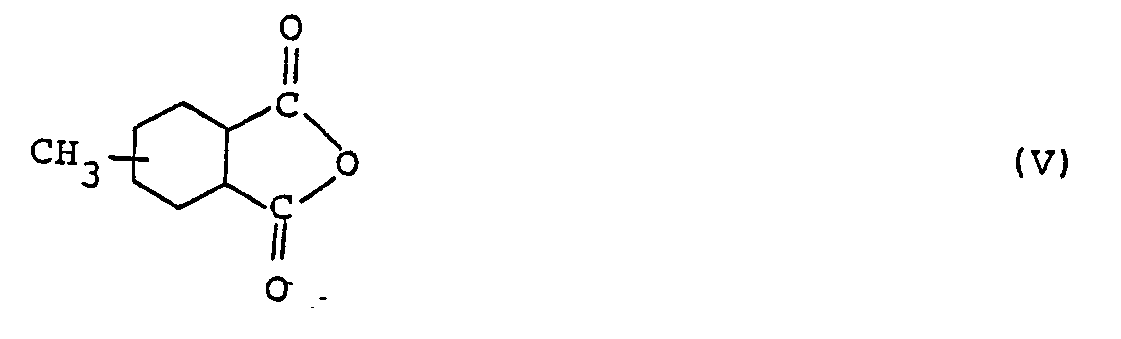
- This invention provides also a process for producing a lactone of the formula which comprises conducting a decarboxylation condensation reaction of 3-methylhexahydrophthalic acid anhydride and/or 4-methylhexahydrophthalic acid anhydride of the formula in the presence of a basic catalyst with heating.
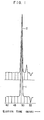
- Fig. 1 shows chromatograms obtained by analyzing the decarboxylation condensation product (A) and the reaction solution in Comparative Example 1 by high-speed liquid chromatography (hereinafter abbreviated as "HLC”);
- Fig. 2 shows a mass spectrum of the decarboxylation condensation product (A);
- Fig. 3 shows nuclear magnetic resonance spectra (hereinafter abbreviated as "NMR spectra") of the decarboxylation condensation product (A);
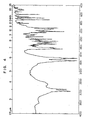
- Fig. 4 shows an infrared absorption spectrum of the decarboxylation condensation product (A);
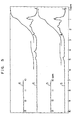
- Fig. 5 shows NMR spectra of the decarboxylation condensation product (B) in Example 1; and
- Fig. 6 shows NMR spectra of the decarboxylation condensation product (C) in Example 2.
- the lactone represented by the formula (III) is characterized by having a lactone ring fused together with a cyclohexane ring; having a cyclohexene ring with an unsaturated double bond attached to said lactone ring; and having a carboxyl group joined to said cyclohexene ring.
- said lactone When hydrolyzed, said lactone is converted into an oxydicarboxylic acid represented by the formula: and therefore it is greatly different from the aforesaid spirodilactone and the compounds bearing no methyl groups.
- lactones represented by the formula (III) can effectively be used, for example, as curing agents for thermosetting resins such as epoxy resins.
- the lactone of this invention represented by the formula (III) can be obtained, for example, by conducting a reaction (a decarboxylation condensation reaction) of a saturated alicyclic 1,2-dicarboxylic acid anhydride of the following formula: in the presence of a basic catalyst with heating.
- Examples of the saturated alicyclic 1,2-dicarboxylic acid anhydride represented by the above formula (V) are 3-methylhexahydrophthalic anhydride and 4-methylhexahydrophthalic anhydride. These may be used alone or as a mixture thereof. Dicarboxylic acids formed by ring opening of these acid anhydrides may also be used as starting material. However, in this case, the reaction temperature should be elevated because said dicarboxylic acids are converted into their acid anhydrides and then undergo the decarboxylation condensation reaction.
- the basic catalyst there may be used, for example, amine compounds such as 1,8-diazabicyclo-[5,4,0]undecene-7 (hereinafter abbreviated as "DBU"), 2-ethyl-4-methylimidazole, dibutylaniline and benzyldimethylamine; phosphorus compounds such as triphenylphosphine and hexamethylphospha- triamide; alkali metal hydroxides such as KOH and NaOH; alkoxides of alkali metals such as NaOCH 3 ; hydroxides of alkaline earth metals such as Mg(OH) 2 , Ca(OH) 2 and Ba(OH) 2 ; and oxides of alkaline earth metals such as MgO, CaO and BaO.
- strongly basic catalysts such as DBU, 2-ethyl-4-methylimidazole, KOH and NaOH.
- the amount of these catalysts to be used is preferably 0.1 % by weight or more based on the aforesaid saturated alicyclic 1,2-dicarboxylic anhydride. When it is less than 0.1 % by weight, the reaction becomes slow.
- the catalyst amount is not particularly limited when it is 0.1 % by weight or more but in usual, 5% by weight or less is sufficient.
- the reaction temperature is preferably 160° to 250°C. When it is lower than 160°C, the reaction becomes slow. On the other hand, when it is too high, the product is seriously coloured and by-products having high molecular weights tend to be formed; therefore it is preferable not exceeding 250°C.
- the reaction may be effected in an organic solvent.
- the basic catalyst may remain in the mixture obtained by the decarboxylation condensation reaction.
- the catalyst can be removed by a usual procedure, for. example, a method comprising neutralizing said mixture by adding activated clay (acid clay) with heating or after the addition of a solvent, and then filtering the resulting mixture, or a method comprising dissolving the reaction product in a solvent. immiscible with water and then washing it with water.
- the method comprising washing with water is preferred because said dicarboxylic acid can be removed simultaneously with the removal of the catalyst.
- novel lactone of this invention does not undergo the ring-opening of the lactone ring at 60° to 70°C.
- the lactone of the formula (III), i.e., the decarboxylation condensation product produced according to this invention has one lactone ring, one carboxyl group and at least one double bond (newly introduced into the carbon ring), which are easily identified from mass spectrum, NMR spectrum, IR spectrum and the KMn0 4 qualitative reaction.
- the decarboxylation condensation product (A) was identified as a compound represented by the formula: from the following analyses.
- HLC high-speed liquid chromatography
- Fig. 1 shows an analysis result for the decarboxylation condensation product (A) and the chromatogram 2 that for the reaction solution. Although these chromatograms were measured separately, these are shown in Fig. 1 one over the other on the same elution time scale. In the chromatograms 1 and 2, the negative absorptions are due to impurities in tetrahydrofuran.
- the decarboxylation condensation product (A) does not contain the starting hexahydrophthalic anhydride. It can also be seen that the decarboxylation condensation product (A) has a higher molecular weight than does hexahydrophthalic anhydride.
- the molecular weight of the decarboxylation condensation product (A) was measured by using a mass spectrographic apparatus. The obtained spectrum is shown in Fig. 2. A parent peak is at a specific charge of 264, and hence the molecular weight of the decarboxylation condensation product (A) is 264.
- decarboxylation condensation product (A) is the decarboxylation dimerization product of hexahydrophthalic anhydride and is a compound with a molecular weight of 264 having the rational formula C 15 H 20 0 4 -Next, nuclear magnetic resonance (hereinafter abbreviated as "NMR") analysis results for the decarboxylation condensation product (A) are shown in Fig. 3.
- NMR nuclear magnetic resonance
- the peak at 4.77 ppm coincides with the absorption peak for protons of methine at the a-position in a carboxylic acid ester observed with y-valerolactone,sec-butyl acetate and the like, and the amount of protons obtained from the integrated intensity of the peak at 4.77 ppm is 1/20th of the total amount of protons contained in the decarboxylation condensation product (A). That is to say, it can be seen that the decarboxylation condensation product (A) has one intramolecular ester, i.e., one lactone ring.
- the acid value was measured with potassium hydroxide. As a result, the acid value was found to be 214.5 (KOH mg/I g of sample). This value is in good agreement with the theoretical acid value of 212.3 for a compound with a molecular weight of 264.3 having one carboxyl group.
- the obtained decarboxylation condensation product (A) is found to have a structure represented by the above formula (VI).
- the infrared absorption spectrum (obtained by the KBr method) of the decarboxylation condensation product (A) is shown in Fig. 4. Strong absorptions due to the carbonyl group are observed at 1750 cm- 1 and 1690 -1 .
- a reaction was effected in exactly the same manner as in Comparative Example 1, except that 4-methyl-hexahydrophthalic anhydride was substituted for the hexahydrophthalic anhydride used in Comparative Example 1, to obtain a light-yellow resinous condensation product which was solid at ordinary temperatures.
- the thus obtained condensation product was soluble in xylene.
- This condensation product was repeatedly washed with water in a condition of its xylene solution by means of a separating funnel to remove a catalyst DBU, after which the xylene was removed under reduced pressure to obtain 84.3 g of a light-yellow resinous decarboxylation condensation product (B). The evolution of carbon dioxide gas was observed during the reaction.
- the decarboxylation condensation product (B) was identified as a compound represented by the formula: wherein the numerals 1 to 12 show positions of the carbon atoms in the cyclohexane ring and the cyclohexene ring, and the two methyl groups are bonded to the carbon at the 4- or 5-position and to the carbon at the 10- or 11-position, respectively.
- the decarboxylation condensation product (B) is theoretically considered to be a mixture of four kinds of structural isomers (in which two methyl groups are individually bonded at the 4- and 10-positions, the 4- and 11-positions, the 5- and 10-positions, and the 5- and 11-positions, respectively).
- these structural isomers of course, have the same rational formula, molecular weight and acid value, and it is substantially impossible to separate the structural isomers in the mixture thereof from one another. Therefore, the decarboxylation condensation product (B) is understood to be a single compound represented by the formula (VII).
- Fig. 5 the spectrum 5 is that of the decarboxylation condensation product (B) measured in d s -DMSO solvent
- the spectrum 6 is that of the product (B) measured after addition of heavy water to the solvent.
- the peak due to protons of a carboxyl group is very broad and appears to be absent. This is because the decarboxylation condensation product (B) is a mixture of structural isomers.
- the spectrum 6 was obtained, and in the spectrum 6, the presence of a carboxyl group is clearly observed.
- the acid value was measured with potassium hydroxide. As a result, the acid value was found to be 196 (KOH mg/I g of sample). This value is in good agreement with the theoretical acid value of 192 for a compound with a molecular weight of 292.4 having one carboxyl group.
- a reaction and purification were carried out in the same manner as in Example 1, except that a mixture consisting of 60% by weight of 4-methylhexahydrophthalic anhydride and 40% by weight of 3-methylhexahydrophthalic anhydride was used in place of 4-methylhexahydrophthalic anhydride used in Example 1, to obtain 83.4 g of a light-yellow resinous decarboxylation condensation product (C). The evolution of carbon dioxide gas was observed during the reaction.
- C light-yellow resinous decarboxylation condensation product
- the decarboxylation condensation product (C) was identified as a compound represented by the formula: wherein the numerals 1 to 12 show positions of the carbon atoms in the cyclohexane ring and the cyclohexene ring, and the two methyl groups are bonded to the carbon at the 3-, 4-, 5- and 6-position and to the carbon at the 9-, 10-, 11- or 12-position, respectively. From the positions at which the methyl groups are bonded, the decarboxylation condensation product (C) is theoretically considered to be a mixture of 16 kinds of structural isomers. However, all of these structural isomers have the same rational formula, molecular weight and acid value, and it is substantially impossible to separate the structural isomers in the mixtures thereof from one another. Therefore, the decarboxylation condensation product (C) is understood to be a single compound represented by the formula [IX].
- Fig. 6 the spectrum 7 is that of the decarboxylation condensation product (C) measured in d 6 -DMSO solvent.
- the spectrum 8 is that of the condensation product (C) measured after addition of heavy water to the solvent. From these results, the presence of a carboxyl group is revealed as in Example 1.
- the acid value was measured with potassium hydroxide.
- the acid value was found to be 198 (KOH mg/I g of sample). This value is in good agreement with the theoretical acid value of 192 for a compound with a molecular weight of 292.4 having one carboxyl group.
Landscapes
- Chemical & Material Sciences (AREA)
- Organic Chemistry (AREA)
- Low-Molecular Organic Synthesis Reactions Using Catalysts (AREA)
- Heterocyclic Carbon Compounds Containing A Hetero Ring Having Oxygen Or Sulfur (AREA)
Description
- This invention relates to a lactone and a process for producing said lactone by carrying out a decarboxylation condensation reaction of a saturated alicyclic 1,2-dicarboxylic acid anhydride.
- As a lactone derived from a decarboxylic acid anhydride by a decarboxylation condensation reaction, there has so far been reported only spirodilactone represented by the formula:

- This spirolactone structurally has two lactone rings in the molecule. When reacted with water, this compound is rearranged, as shown by the following equation, to be converted into a dibasic acid (4- ketopimelic acid) of the formula (11) having a number of functional groups of 2 which is equal to those of ordinary dicarboxylic acid anhydrides.

- DE-B-1 142 863 relates to a process for preparing alicyclic lactones of the cyclohexane and cyclohexene series. Such compounds can be used, together with cyclic acid anhydrides, as curing agents for thermosetting epoxy resins.
- The object of this invention is to provide a lactone which is obtained by a decarboxylation condensation reaction, and to provide a process for production thereof.
- This invention provides a lactone of the formula:

- This invention provides also a process for producing a lactone of the formula


- In the attached drawings, Fig. 1 shows chromatograms obtained by analyzing the decarboxylation condensation product (A) and the reaction solution in Comparative Example 1 by high-speed liquid chromatography (hereinafter abbreviated as "HLC"); Fig. 2 shows a mass spectrum of the decarboxylation condensation product (A); Fig. 3 shows nuclear magnetic resonance spectra (hereinafter abbreviated as "NMR spectra") of the decarboxylation condensation product (A); Fig. 4 shows an infrared absorption spectrum of the decarboxylation condensation product (A); Fig. 5 shows NMR spectra of the decarboxylation condensation product (B) in Example 1; and Fig. 6 shows NMR spectra of the decarboxylation condensation product (C) in Example 2.
- The lactone represented by the formula (III) is characterized by having a lactone ring fused together with a cyclohexane ring; having a cyclohexene ring with an unsaturated double bond attached to said lactone ring; and having a carboxyl group joined to said cyclohexene ring. When hydrolyzed, said lactone is converted into an oxydicarboxylic acid represented by the formula:

- The lactones represented by the formula (III) can effectively be used, for example, as curing agents for thermosetting resins such as epoxy resins.
- The lactone of this invention represented by the formula (III) can be obtained, for example, by conducting a reaction (a decarboxylation condensation reaction) of a saturated alicyclic 1,2-dicarboxylic acid anhydride of the following formula:

- Examples of the saturated alicyclic 1,2-dicarboxylic acid anhydride represented by the above formula (V) are 3-methylhexahydrophthalic anhydride and 4-methylhexahydrophthalic anhydride. These may be used alone or as a mixture thereof. Dicarboxylic acids formed by ring opening of these acid anhydrides may also be used as starting material. However, in this case, the reaction temperature should be elevated because said dicarboxylic acids are converted into their acid anhydrides and then undergo the decarboxylation condensation reaction.
- As the basic catalyst, there may be used, for example, amine compounds such as 1,8-diazabicyclo-[5,4,0]undecene-7 (hereinafter abbreviated as "DBU"), 2-ethyl-4-methylimidazole, dibutylaniline and benzyldimethylamine; phosphorus compounds such as triphenylphosphine and hexamethylphospha- triamide; alkali metal hydroxides such as KOH and NaOH; alkoxides of alkali metals such as NaOCH3; hydroxides of alkaline earth metals such as Mg(OH)2, Ca(OH)2 and Ba(OH)2; and oxides of alkaline earth metals such as MgO, CaO and BaO. As particularly preferable catalysts, there may be exemplified strongly basic catalysts such as DBU, 2-ethyl-4-methylimidazole, KOH and NaOH.
- The amount of these catalysts to be used is preferably 0.1 % by weight or more based on the aforesaid saturated alicyclic 1,2-dicarboxylic anhydride. When it is less than 0.1 % by weight, the reaction becomes slow. The catalyst amount is not particularly limited when it is 0.1 % by weight or more but in usual, 5% by weight or less is sufficient.
- The reaction temperature is preferably 160° to 250°C. When it is lower than 160°C, the reaction becomes slow. On the other hand, when it is too high, the product is seriously coloured and by-products having high molecular weights tend to be formed; therefore it is preferable not exceeding 250°C.
- The reaction may be effected in an organic solvent.
- Since carbon dioxide is produced during the above-mentioned reaction, the progress of the decarboxylation condensation reaction can be known. The basic catalyst may remain in the mixture obtained by the decarboxylation condensation reaction. The catalyst can be removed by a usual procedure, for. example, a method comprising neutralizing said mixture by adding activated clay (acid clay) with heating or after the addition of a solvent, and then filtering the resulting mixture, or a method comprising dissolving the reaction product in a solvent. immiscible with water and then washing it with water. Particularly, when the mixture having undergone the reaction contains 3- and/or 4-methylhexahydrophthalic acid, the method comprising washing with water is preferred because said dicarboxylic acid can be removed simultaneously with the removal of the catalyst.
- When unreacted saturated alicyclic 1,2-dicarboxylic acid anhydride remains, it can be removed by heating the mixture having undergone the reaction together with additional water in a solvent such as tetrahydrofuran or dioxane at 60° to 70°C to subject said acid anhydride to ring-opening and convert it into the dicarboxylic acid, distilling off the solvent, and then washing the residue with water. However, the lactone of the formula (111) of this invention may be used without particular purification.
- The novel lactone of this invention does not undergo the ring-opening of the lactone ring at 60° to 70°C.
- The lactone of the formula (III), i.e., the decarboxylation condensation product produced according to this invention has one lactone ring, one carboxyl group and at least one double bond (newly introduced into the carbon ring), which are easily identified from mass spectrum, NMR spectrum, IR spectrum and the KMn04 qualitative reaction.
- This invention is further explained below in more detail referring to Examples.
- Into a 200 ml four-necked flask equipped with a stirrer, a thermometer and a reflux condenser was charged 100 g of hexahydrophthalic anhydride

- The decarboxylation condensation product (A) was identified as a compound represented by the formula:

- Column: Packing GELKO A-120 [a trade name, manufactured by Hitachi Chemical Co., Ltd., porous styrene-divinylbenzene copolymer particles, exclusive limit 5 x 10³]. Two columns having an inside diameter of 8 mm and a length of 50 cm were connected in series.
- Solvent: Tetrahydrofuran
- Flow rate of solvent: 0.6 ml/min
- Column pressure: 30 kg/cm2
- Detector: Differential refractometer
- The results of the above-mentioned analysis are shown in Fig. 1. In Fig. 1, the chromatogram 1 shows an analysis result for the decarboxylation condensation product (A) and the
chromatogram 2 that for the reaction solution. Although these chromatograms were measured separately, these are shown in Fig. 1 one over the other on the same elution time scale. In thechromatograms 1 and 2, the negative absorptions are due to impurities in tetrahydrofuran. In thechromatogram 2, the weak absorption is due to hexahydrophthalic anhydride, and from the fact that this absorption is not observed in the chromatogram 1, it can be seen that the decarboxylation condensation product (A) does not contain the starting hexahydrophthalic anhydride. It can also be seen that the decarboxylation condensation product (A) has a higher molecular weight than does hexahydrophthalic anhydride. - Next, elementary analysis results for the obtained decarboxylation condensation product (A) are shown in Table 1.

- From these measurement results, the empirical formula was determined to be C15.0H20.3O4.1. When these values are compared with the values in C16H2006, i.e., twice the values in the rational formula (C8HI003) of hexahydrophthalic anhydride, it can be seen that said empirical formula clearly lacks 1 mole of CO2,
- That is to say, it can be seen that 2 moles of the hexahydrophthalic anhydride was converted into the decarboxylation condensation product (A) with release of 1 mole of carbon dioxide gas by the decarboxylation condensation reaction.
- In order to confirm the HLC and elementary analysis results, the molecular weight of the decarboxylation condensation product (A) was measured by using a mass spectrographic apparatus. The obtained spectrum is shown in Fig. 2. A parent peak is at a specific charge of 264, and hence the molecular weight of the decarboxylation condensation product (A) is 264. That is to say it can be seen that decarboxylation condensation product (A) is the decarboxylation dimerization product of hexahydrophthalic anhydride and is a compound with a molecular weight of 264 having the rational formula C15H2004-Next, nuclear magnetic resonance (hereinafter abbreviated as "NMR") analysis results for the decarboxylation condensation product (A) are shown in Fig. 3. In Fig. 3, the
spectrum 3 is the result of measurement in d6-DMSO (dimethylsulfoxide) solvent. A broad peak is observed in the place centering at a 5 value of 12.0 ppm. There are observed: - a singlet at 12.0 ppm

- a singlet at 4.77 ppm

- The peak at 4.77 ppm coincides with the absorption peak for protons of methine at the a-position in a carboxylic acid ester observed with y-valerolactone,sec-butyl acetate and the like, and the amount of protons obtained from the integrated intensity of the peak at 4.77 ppm is 1/20th of the total amount of protons contained in the decarboxylation condensation product (A). That is to say, it can be seen that the decarboxylation condensation product (A) has one intramolecular ester, i.e., one lactone ring.
- In order to confirm the presence of a carboxyl group and its amount, the acid value was measured with potassium hydroxide. As a result, the acid value was found to be 214.5 (KOH mg/I g of sample). This value is in good agreement with the theoretical acid value of 212.3 for a compound with a molecular weight of 264.3 having one carboxyl group.
- By a qualitative test, the presence of an unsaturated bond was investigated with KMn04. An acetone solution of KMn04 was added dropwise to an acetone solution of the decarboxylation condensation product (A), and the resulting solution was allowed to stand at room temperature for 2 hours to find that the color of the solution changed from pink to brown. This fact indicates that the decarboxylation condensation product (A)has an unsaturated bond.
- . From the analysis results described above and the fact that the reaction is a decarboxylation reaction, the obtained decarboxylation condensation product (A) is found to have a structure represented by the above formula (VI).
- The fact that the NMR spectra had no clearing peak at 4.5 to 6 ppm indicates that the unsaturated bond is a tetra-substituted carbon-carbon bond C=C (an unsaturated carbon-carbon double bond). From the fact that the mass spectrometry results indicate the presence of a strong fragment at a specific charge of 138, the structure of the decarboxylation condensation product is also found to be represented by the formula (VI).
- The infrared absorption spectrum (obtained by the KBr method) of the decarboxylation condensation product (A) is shown in Fig. 4. Strong absorptions due to the carbonyl group are observed at 1750 cm-1 and 1690-1.
- A reaction was effected in exactly the same manner as in Comparative Example 1, except that 4-methyl-hexahydrophthalic anhydride was substituted for the hexahydrophthalic anhydride used in Comparative Example 1, to obtain a light-yellow resinous condensation product which was solid at ordinary temperatures. Unlike the decarboxylation condensation product (A), the thus obtained condensation product was soluble in xylene. This condensation product was repeatedly washed with water in a condition of its xylene solution by means of a separating funnel to remove a catalyst DBU, after which the xylene was removed under reduced pressure to obtain 84.3 g of a light-yellow resinous decarboxylation condensation product (B). The evolution of carbon dioxide gas was observed during the reaction.
- The decarboxylation condensation product (B) was identified as a compound represented by the formula:

- From the positions at which the methyl groups are bonded, the decarboxylation condensation product (B) is theoretically considered to be a mixture of four kinds of structural isomers (in which two methyl groups are individually bonded at the 4- and 10-positions, the 4- and 11-positions, the 5- and 10-positions, and the 5- and 11-positions, respectively). However, these structural isomers, of course, have the same rational formula, molecular weight and acid value, and it is substantially impossible to separate the structural isomers in the mixture thereof from one another. Therefore, the decarboxylation condensation product (B) is understood to be a single compound represented by the formula (VII).
- Analysis results for the decarboxylation condensation product (B) are shown below. Elementary analysis results for the obtained decarboxylation condensation product (B) are shown in Table 2.

- From these measurement results, the empirical formula was determined to be C17.0H24.3O4.1. When these values are compared with the values in C18H2406, i.e., twice the values in the rational formula (C9H12O3) of 4-methylhexahydrophthalic anhydride, it can be seen that said empirical formula clearly lacks 1 mole of CO2,
- That is to say, it can be seen that 2 moles of the 4-methylhexahydrophthalic anhydride was converted into the condensation product (B) with release of 1 mole of carbon dioxide gas by the decarboxylation reaction.
- Next, the results of NMR analysis are shown in Fig. 5. In Fig. 5, the
spectrum 5 is that of the decarboxylation condensation product (B) measured in ds-DMSO solvent, and thespectrum 6 is that of the product (B) measured after addition of heavy water to the solvent. In thespectrum 5, the peak due to protons of a carboxyl group is very broad and appears to be absent. This is because the decarboxylation condensation product (B) is a mixture of structural isomers. However, when heavy water was added to the solvent, thespectrum 6 was obtained, and in thespectrum 6, the presence of a carboxyl group is clearly observed. A reason why the peak for protons of methine at the a-position in the lactone ring in the place centering at a 6 value of 4.9 ppm does not appear as a single peak but appears as a plurality of overlapped peaks, is that the decarboxylation condensation product (B) is a mixture of structural isomers. - Further, in order to confirm the presence of a carboxyl group and the molecular weight of the decarboxylation condensation product (B), the acid value was measured with potassium hydroxide. As a result, the acid value was found to be 196 (KOH mg/I g of sample). This value is in good agreement with the theoretical acid value of 192 for a compound with a molecular weight of 292.4 having one carboxyl group.
- The above-mentioned analysis results together with the results obtained in Comparative Example 1 indicate that the structure of the obtained decarboxylation condensation product (B) is typified by the above formula (VII).
- A reaction and purification were carried out in the same manner as in Example 1, except that a mixture consisting of 60% by weight of 4-methylhexahydrophthalic anhydride and 40% by weight of 3-methylhexahydrophthalic anhydride was used in place of 4-methylhexahydrophthalic anhydride used in Example 1, to obtain 83.4 g of a light-yellow resinous decarboxylation condensation product (C). The evolution of carbon dioxide gas was observed during the reaction.
- The decarboxylation condensation product (C) was identified as a compound represented by the formula:

- Next, analysis results for the decarboxylation condensation product (C) are shown below.
- Elementary analysis results for the obtained decarboxylation product (C) are shown in Table 3.

- From these measurement results, the empirical formula was determined to be C17.0H24.6O4.1. When these values are compared with the values in C18H24O6, i.e., twice the values in the rational formula (C9H12O3) of 4-methylhexahydrophthalic anhydride and 3=methylhexahydrophthalic anhydride, it can be seen that said empirical formula clearly lacks 1 mole of C02.
- That is to say, it can be seen that 2 moles of the mixture of 4-methylhexahydrophthalic anhydride and 3-methylhexahydrophthalic anhydride was converted into the condensation product (C) with release of 1 mole of carbon dioxide gas by the decarboxylation condensation reaction.
- Next, the results of NMR analysis are shown in Fig. 6. In Fig. 6, the
spectrum 7 is that of the decarboxylation condensation product (C) measured in d6-DMSO solvent. - a. No absorption appeared at 12.4 ppm.
However, exchange with heavy water resulted in appearance of an absorption at 4.3 ppm, so that the presence of COOH could be confirmed.
- b. An absorption (somewhat broad) appeared at 4.87 ppm.
- The
spectrum 8 is that of the condensation product (C) measured after addition of heavy water to the solvent. From these results, the presence of a carboxyl group is revealed as in Example 1. - The IR spectrum showed strong absorptions due to the carboxyl group at 1750 cm-1 and 1690 cm-1.
- Further, in order to confirm the presence of the carboxyl group and the molecular weight of the decarboxylation condensation product (C), the acid value was measured with potassium hydroxide.
- As a result, the acid value was found to be 198 (KOH mg/I g of sample). This value is in good agreement with the theoretical acid value of 192 for a compound with a molecular weight of 292.4 having one carboxyl group.
- The above-mentioned analysis results together with the results obtained in Comparative Example 1 and Example 1 indicate that the obtained decarboxylation condensation product (C) is a compound represented by the above formula [IX].
four overlapped peaks at 1.0 to 2.5 ppm


Claims (6)

Applications Claiming Priority (4)
| Application Number | Priority Date | Filing Date | Title |
|---|---|---|---|
| JP9416481A JPS5924153B2 (en) | 1981-06-17 | 1981-06-17 | Method for producing decarboxylated condensate of saturated alicyclic-1,2-dicarboxylic anhydride |
| JP94164/81 | 1981-06-17 | ||
| JP70921/82 | 1982-04-27 | ||
| JP7092182A JPS6028832B2 (en) | 1982-04-27 | 1982-04-27 | New lactone compounds and epoxy resin curing agents |
Publications (2)
| Publication Number | Publication Date |
|---|---|
| EP0067457A1 EP0067457A1 (en) | 1982-12-22 |
| EP0067457B1 true EP0067457B1 (en) | 1985-05-15 |
Family
ID=26412041
Family Applications (1)
| Application Number | Title | Priority Date | Filing Date |
|---|---|---|---|
| EP82105304A Expired EP0067457B1 (en) | 1981-06-17 | 1982-06-16 | Lactone and process for production thereof |
Country Status (3)
| Country | Link |
|---|---|
| US (1) | US4491667A (en) |
| EP (1) | EP0067457B1 (en) |
| DE (1) | DE3263516D1 (en) |
Families Citing this family (2)
| Publication number | Priority date | Publication date | Assignee | Title |
|---|---|---|---|---|
| DE3416293A1 (en) * | 1984-05-03 | 1985-11-07 | Bayer Ag, 5090 Leverkusen | Annellated furanone, process for its manufacture and its use in medicinal products |
| US5173548A (en) * | 1987-12-12 | 1992-12-22 | Nippon Steel Chemical Co., Ltd. | Epoxy-modified hydrocarbon resins |
Family Cites Families (3)
| Publication number | Priority date | Publication date | Assignee | Title |
|---|---|---|---|---|
| US2007813A (en) * | 1935-07-09 | x--- x x x x | ||
| US2731475A (en) * | 1951-12-03 | 1956-01-17 | Phillips Petroleum Co | Method of producing lactones |
| DE1142863B (en) * | 1961-02-07 | 1963-01-31 | Bayer Ag | Process for the preparation of alicyclic lactones of the cyclohexane or cyclohexene series |
-
1982
- 1982-06-14 US US06/388,244 patent/US4491667A/en not_active Expired - Fee Related
- 1982-06-16 EP EP82105304A patent/EP0067457B1/en not_active Expired
- 1982-06-16 DE DE8282105304T patent/DE3263516D1/en not_active Expired
Also Published As
| Publication number | Publication date |
|---|---|
| US4491667A (en) | 1985-01-01 |
| EP0067457A1 (en) | 1982-12-22 |
| DE3263516D1 (en) | 1985-06-20 |
Similar Documents
| Publication | Publication Date | Title |
|---|---|---|
| Jolad et al. | Structures of zeylenol and zeylena, constituents of Uvaria zeylanica (Annonaceae) | |
| Ikawa et al. | Preparation and regioselective Diels–Alder reactions of borylbenzynes: Synthesis of functionalized arylboronates | |
| US4491667A (en) | Hexahydrophthalides | |
| Kojima et al. | Stereocontrolled synthesis of clerodin homolog: A synthetic approach to structure-activity relationships | |
| Siddiqui et al. | Studies on the chemical constituents of Azadirachta indica A. Juss (Meliaceae), Part VII | |
| Boese et al. | Cobalt‐Mediated [2+ 2+ 2] Cycloadditions of Alkynes to the Imidazole 4, 5‐Double Bond. First Synthesis of the 3a, 7a‐Dihydrobenzimidazole Nucleus and Its Preliminary Chemistry Including a Novel Quinoline Construction | |
| JPH0261956B2 (en) | ||
| US3917710A (en) | Preparation of phytone via the addition of dimethylketene to 4,8-dimethyl-12-oxotridecanal | |
| JPS6136852B2 (en) | ||
| Lehr et al. | Synthesis of enantiomerically pure bay-region 3, 4-diol 1, 2-epoxide diastereomers and other derivatives of the potent carcinogen dibenz [c, h] acridine | |
| EP0006355B1 (en) | Mixed anhydride steroid intermediate and process for preparing steroid intermediates | |
| US2552567A (en) | Dienophilic addition products of ketals of cyclic chlorocarbon ketones | |
| CN115611906A (en) | Tetra (bromoethoxy) anthracene-group-containing glycoluril molecular clip, and preparation method and application thereof | |
| Baruah et al. | Germacranolides of Inula eupatorioides. 2. Absolute configuration of the ineupatorolides | |
| Li et al. | An efficient iodine-catalysed Knoevenagel condensation reaction in the presence of acetic anhydride | |
| US4528396A (en) | Dicyclopentadiene derived ester compounds | |
| US4095030A (en) | Isomerization of diacyloxyolefins | |
| RU2224749C2 (en) | Method for treatment of isoquinoline | |
| US3109040A (en) | Preparation of terminally unsaturated olefins from aliphatic carboxylic acids | |
| Li et al. | Clerodane diterpenoids, long chain esters of coumaric acid and other compounds from Baccharis myrsinites | |
| CN113979970A (en) | Preparation method of cationic epoxy resin 3, 4-epoxy cyclohexyl methyl-3 ',4' -epoxy cyclohexyl formate | |
| Piacenza | Nucleophilic substitution with inversion of alcohol configuration with the reagent complex triphenylphosphine-diethyl azodicarboxylate-carboxylic acid. A convenient preparation of epicholesterol | |
| Kintzel et al. | Anthracenol [2, 3‐C: 6, 7‐c′] difuran, a new monomer for diels—alder polyaddition reactions | |
| EP0077635B1 (en) | Substituted esters and alcohols | |
| Rislove et al. | Improved preparation of etioporphyrin I |
Legal Events
| Date | Code | Title | Description |
|---|---|---|---|
| PUAI | Public reference made under article 153(3) epc to a published international application that has entered the european phase |
Free format text: ORIGINAL CODE: 0009012 |
|
| AK | Designated contracting states |
Designated state(s): CH DE FR GB LI NL |
|
| 17P | Request for examination filed |
Effective date: 19830426 |
|
| GRAA | (expected) grant |
Free format text: ORIGINAL CODE: 0009210 |
|
| AK | Designated contracting states |
Designated state(s): CH DE FR GB LI NL |
|
| REF | Corresponds to: |
Ref document number: 3263516 Country of ref document: DE Date of ref document: 19850620 |
|
| ET | Fr: translation filed | ||
| PLBE | No opposition filed within time limit |
Free format text: ORIGINAL CODE: 0009261 |
|
| STAA | Information on the status of an ep patent application or granted ep patent |
Free format text: STATUS: NO OPPOSITION FILED WITHIN TIME LIMIT |
|
| 26N | No opposition filed | ||
| PGFP | Annual fee paid to national office [announced via postgrant information from national office to epo] |
Ref country code: GB Payment date: 19900615 Year of fee payment: 9 |
|
| PGFP | Annual fee paid to national office [announced via postgrant information from national office to epo] |
Ref country code: FR Payment date: 19900621 Year of fee payment: 9 |
|
| PGFP | Annual fee paid to national office [announced via postgrant information from national office to epo] |
Ref country code: CH Payment date: 19900625 Year of fee payment: 9 |
|
| PGFP | Annual fee paid to national office [announced via postgrant information from national office to epo] |
Ref country code: NL Payment date: 19900630 Year of fee payment: 9 |
|
| PGFP | Annual fee paid to national office [announced via postgrant information from national office to epo] |
Ref country code: DE Payment date: 19900724 Year of fee payment: 9 |
|
| PG25 | Lapsed in a contracting state [announced via postgrant information from national office to epo] |
Ref country code: GB Effective date: 19910616 |
|
| PG25 | Lapsed in a contracting state [announced via postgrant information from national office to epo] |
Ref country code: LI Effective date: 19910630 Ref country code: CH Effective date: 19910630 |
|
| PG25 | Lapsed in a contracting state [announced via postgrant information from national office to epo] |
Ref country code: NL Effective date: 19920101 |
|
| GBPC | Gb: european patent ceased through non-payment of renewal fee | ||
| NLV4 | Nl: lapsed or anulled due to non-payment of the annual fee | ||
| PG25 | Lapsed in a contracting state [announced via postgrant information from national office to epo] |
Ref country code: FR Effective date: 19920228 |
|
| REG | Reference to a national code |
Ref country code: CH Ref legal event code: PL |
|
| PG25 | Lapsed in a contracting state [announced via postgrant information from national office to epo] |
Ref country code: DE Effective date: 19920401 |
|
| REG | Reference to a national code |
Ref country code: FR Ref legal event code: ST |