EP0067342A1 - Process for the preparation of 2-chloro-1,3-dimethoxybenzene - Google Patents
Process for the preparation of 2-chloro-1,3-dimethoxybenzene Download PDFInfo
- Publication number
- EP0067342A1 EP0067342A1 EP82104696A EP82104696A EP0067342A1 EP 0067342 A1 EP0067342 A1 EP 0067342A1 EP 82104696 A EP82104696 A EP 82104696A EP 82104696 A EP82104696 A EP 82104696A EP 0067342 A1 EP0067342 A1 EP 0067342A1
- Authority
- EP
- European Patent Office
- Prior art keywords
- dimethoxybenzene
- chloro
- preparation
- chlorinating agent
- reaction
- Prior art date
- Legal status (The legal status is an assumption and is not a legal conclusion. Google has not performed a legal analysis and makes no representation as to the accuracy of the status listed.)
- Withdrawn
Links
- 238000000034 method Methods 0.000 title claims abstract description 33
- UZVLJTGFCKYUBF-UHFFFAOYSA-N 2-chloro-1,3-dimethoxybenzene Chemical compound COC1=CC=CC(OC)=C1Cl UZVLJTGFCKYUBF-UHFFFAOYSA-N 0.000 title claims abstract description 20
- 238000002360 preparation method Methods 0.000 title claims abstract description 14
- DPZNOMCNRMUKPS-UHFFFAOYSA-N 1,3-Dimethoxybenzene Chemical compound COC1=CC=CC(OC)=C1 DPZNOMCNRMUKPS-UHFFFAOYSA-N 0.000 claims abstract description 26
- 239000012320 chlorinating reagent Substances 0.000 claims abstract description 16
- 150000001875 compounds Chemical class 0.000 claims abstract description 4
- RTZKZFJDLAIYFH-UHFFFAOYSA-N Diethyl ether Chemical group CCOCC RTZKZFJDLAIYFH-UHFFFAOYSA-N 0.000 claims description 38
- JRNVZBWKYDBUCA-UHFFFAOYSA-N N-chlorosuccinimide Chemical group ClN1C(=O)CCC1=O JRNVZBWKYDBUCA-UHFFFAOYSA-N 0.000 claims description 10
- 239000000460 chlorine Substances 0.000 claims description 10
- 229910052801 chlorine Inorganic materials 0.000 claims description 10
- VZGDMQKNWNREIO-UHFFFAOYSA-N tetrachloromethane Chemical group ClC(Cl)(Cl)Cl VZGDMQKNWNREIO-UHFFFAOYSA-N 0.000 claims description 8
- 239000002904 solvent Substances 0.000 claims description 7
- VHHHONWQHHHLTI-UHFFFAOYSA-N hexachloroethane Chemical group ClC(Cl)(Cl)C(Cl)(Cl)Cl VHHHONWQHHHLTI-UHFFFAOYSA-N 0.000 claims description 6
- DOJXGHGHTWFZHK-UHFFFAOYSA-N Hexachloroacetone Chemical group ClC(Cl)(Cl)C(=O)C(Cl)(Cl)Cl DOJXGHGHTWFZHK-UHFFFAOYSA-N 0.000 claims description 5
- 125000004432 carbon atom Chemical group C* 0.000 claims description 5
- 125000001309 chloro group Chemical group Cl* 0.000 claims description 2
- 238000007796 conventional method Methods 0.000 claims description 2
- 238000006243 chemical reaction Methods 0.000 abstract description 22
- 239000007858 starting material Substances 0.000 abstract description 5
- ZGVZZXAFLMJEJV-UHFFFAOYSA-N 2-(1,2-benzoxazol-3-yloxy)acetic acid Chemical class C1=CC=C2C(OCC(=O)O)=NOC2=C1 ZGVZZXAFLMJEJV-UHFFFAOYSA-N 0.000 abstract description 3
- SYTLRIRYZMOMIO-UHFFFAOYSA-N lithium;1,3-dimethoxybenzene-2-ide Chemical compound [Li+].COC1=CC=CC(OC)=[C-]1 SYTLRIRYZMOMIO-UHFFFAOYSA-N 0.000 abstract description 3
- 230000015572 biosynthetic process Effects 0.000 abstract 1
- 238000003786 synthesis reaction Methods 0.000 abstract 1
- VLKZOEOYAKHREP-UHFFFAOYSA-N n-Hexane Chemical compound CCCCCC VLKZOEOYAKHREP-UHFFFAOYSA-N 0.000 description 12
- MZRVEZGGRBJDDB-UHFFFAOYSA-N N-Butyllithium Chemical compound [Li]CCCC MZRVEZGGRBJDDB-UHFFFAOYSA-N 0.000 description 10
- 239000011541 reaction mixture Substances 0.000 description 10
- XTHFKEDIFFGKHM-UHFFFAOYSA-N Dimethoxyethane Chemical compound COCCOC XTHFKEDIFFGKHM-UHFFFAOYSA-N 0.000 description 9
- ZAMOUSCENKQFHK-UHFFFAOYSA-N Chlorine atom Chemical compound [Cl] ZAMOUSCENKQFHK-UHFFFAOYSA-N 0.000 description 8
- YXFVVABEGXRONW-UHFFFAOYSA-N Toluene Chemical compound CC1=CC=CC=C1 YXFVVABEGXRONW-UHFFFAOYSA-N 0.000 description 6
- 239000000203 mixture Substances 0.000 description 5
- XLYOFNOQVPJJNP-UHFFFAOYSA-N water Substances O XLYOFNOQVPJJNP-UHFFFAOYSA-N 0.000 description 5
- 229950005499 carbon tetrachloride Drugs 0.000 description 4
- 238000010992 reflux Methods 0.000 description 4
- CSNNHWWHGAXBCP-UHFFFAOYSA-L Magnesium sulfate Chemical compound [Mg+2].[O-][S+2]([O-])([O-])[O-] CSNNHWWHGAXBCP-UHFFFAOYSA-L 0.000 description 3
- 229910052799 carbon Inorganic materials 0.000 description 3
- AASUFOVSZUIILF-UHFFFAOYSA-N diphenylmethanone;sodium Chemical compound [Na].C=1C=CC=CC=1C(=O)C1=CC=CC=C1 AASUFOVSZUIILF-UHFFFAOYSA-N 0.000 description 3
- 239000000284 extract Substances 0.000 description 3
- PFEOZHBOMNWTJB-UHFFFAOYSA-N 3-methylpentane Chemical compound CCC(C)CC PFEOZHBOMNWTJB-UHFFFAOYSA-N 0.000 description 2
- 0 CC1CC(*)=C=CC1 Chemical compound CC1CC(*)=C=CC1 0.000 description 2
- VEXZGXHMUGYJMC-UHFFFAOYSA-N Hydrochloric acid Chemical compound Cl VEXZGXHMUGYJMC-UHFFFAOYSA-N 0.000 description 2
- ATUOYWHBWRKTHZ-UHFFFAOYSA-N Propane Chemical compound CCC ATUOYWHBWRKTHZ-UHFFFAOYSA-N 0.000 description 2
- FAPWRFPIFSIZLT-UHFFFAOYSA-M Sodium chloride Chemical compound [Na+].[Cl-] FAPWRFPIFSIZLT-UHFFFAOYSA-M 0.000 description 2
- WYURNTSHIVDZCO-UHFFFAOYSA-N Tetrahydrofuran Chemical compound C1CCOC1 WYURNTSHIVDZCO-UHFFFAOYSA-N 0.000 description 2
- 230000003276 anti-hypertensive effect Effects 0.000 description 2
- 239000008346 aqueous phase Substances 0.000 description 2
- -1 chloro compound Chemical class 0.000 description 2
- MVPPADPHJFYWMZ-UHFFFAOYSA-N chlorobenzene Chemical compound ClC1=CC=CC=C1 MVPPADPHJFYWMZ-UHFFFAOYSA-N 0.000 description 2
- 238000004587 chromatography analysis Methods 0.000 description 2
- HJSLFCCWAKVHIW-UHFFFAOYSA-N cyclohexane-1,3-dione Chemical compound O=C1CCCC(=O)C1 HJSLFCCWAKVHIW-UHFFFAOYSA-N 0.000 description 2
- 239000002934 diuretic Substances 0.000 description 2
- 230000001882 diuretic effect Effects 0.000 description 2
- 238000001704 evaporation Methods 0.000 description 2
- 230000008020 evaporation Effects 0.000 description 2
- 239000007789 gas Substances 0.000 description 2
- 229910052739 hydrogen Inorganic materials 0.000 description 2
- 239000012442 inert solvent Substances 0.000 description 2
- QWTDNUCVQCZILF-UHFFFAOYSA-N isopentane Chemical compound CCC(C)C QWTDNUCVQCZILF-UHFFFAOYSA-N 0.000 description 2
- VNWKTOKETHGBQD-UHFFFAOYSA-N methane Chemical compound C VNWKTOKETHGBQD-UHFFFAOYSA-N 0.000 description 2
- BWHMMNNQKKPAPP-UHFFFAOYSA-L potassium carbonate Chemical compound [K+].[K+].[O-]C([O-])=O BWHMMNNQKKPAPP-UHFFFAOYSA-L 0.000 description 2
- 238000001953 recrystallisation Methods 0.000 description 2
- 239000007787 solid Substances 0.000 description 2
- 230000003424 uricosuric effect Effects 0.000 description 2
- QQAHAGNPDBPSJP-UHFFFAOYSA-N 1,1,1,2,2,3,3,3-octachloropropane Chemical compound ClC(Cl)(Cl)C(Cl)(Cl)C(Cl)(Cl)Cl QQAHAGNPDBPSJP-UHFFFAOYSA-N 0.000 description 1
- RKVAJLMJTGTGRC-UHFFFAOYSA-N 1,1,1,2,2,3,3,4,4,4-decachlorobutane Chemical compound ClC(Cl)(Cl)C(Cl)(Cl)C(Cl)(Cl)C(Cl)(Cl)Cl RKVAJLMJTGTGRC-UHFFFAOYSA-N 0.000 description 1
- RYHBNJHYFVUHQT-UHFFFAOYSA-N 1,4-Dioxane Chemical compound C1COCCO1 RYHBNJHYFVUHQT-UHFFFAOYSA-N 0.000 description 1
- XQZWIXHLIYYUJB-UHFFFAOYSA-N 2,2-dichlorocyclohexane-1,3-dione Chemical compound ClC1(Cl)C(=O)CCCC1=O XQZWIXHLIYYUJB-UHFFFAOYSA-N 0.000 description 1
- MPMMSSVCYMTOTI-UHFFFAOYSA-N 2-[(7-chloro-1,2-benzoxazol-3-yl)oxy]acetic acid Chemical class C1=CC=C2C(OCC(=O)O)=NOC2=C1Cl MPMMSSVCYMTOTI-UHFFFAOYSA-N 0.000 description 1
- SWZVJOLLQTWFCW-UHFFFAOYSA-N 2-chlorobenzene-1,3-diol Chemical compound OC1=CC=CC(O)=C1Cl SWZVJOLLQTWFCW-UHFFFAOYSA-N 0.000 description 1
- WDRFYIPWHMGQPN-UHFFFAOYSA-N 2-chloroisoindole-1,3-dione Chemical compound C1=CC=C2C(=O)N(Cl)C(=O)C2=C1 WDRFYIPWHMGQPN-UHFFFAOYSA-N 0.000 description 1
- MLRHIIWKFRKPJB-UHFFFAOYSA-N 2-ethoxy-1,1-dimethoxyethane Chemical compound CCOCC(OC)OC MLRHIIWKFRKPJB-UHFFFAOYSA-N 0.000 description 1
- OTMSDBZUPAUEDD-UHFFFAOYSA-N Ethane Chemical compound CC OTMSDBZUPAUEDD-UHFFFAOYSA-N 0.000 description 1
- VYPSYNLAJGMNEJ-UHFFFAOYSA-N Silicium dioxide Chemical compound O=[Si]=O VYPSYNLAJGMNEJ-UHFFFAOYSA-N 0.000 description 1
- PMZURENOXWZQFD-UHFFFAOYSA-L Sodium Sulfate Chemical compound [Na+].[Na+].[O-]S([O-])(=O)=O PMZURENOXWZQFD-UHFFFAOYSA-L 0.000 description 1
- 150000001335 aliphatic alkanes Chemical class 0.000 description 1
- 238000004458 analytical method Methods 0.000 description 1
- 244000309464 bull Species 0.000 description 1
- 239000001273 butane Substances 0.000 description 1
- RBHJBMIOOPYDBQ-UHFFFAOYSA-N carbon dioxide;propan-2-one Chemical compound O=C=O.CC(C)=O RBHJBMIOOPYDBQ-UHFFFAOYSA-N 0.000 description 1
- 125000002915 carbonyl group Chemical group [*:2]C([*:1])=O 0.000 description 1
- 239000007795 chemical reaction product Substances 0.000 description 1
- 239000007810 chemical reaction solvent Substances 0.000 description 1
- 238000005660 chlorination reaction Methods 0.000 description 1
- OSVXSBDYLRYLIG-UHFFFAOYSA-N chlorine dioxide Inorganic materials O=Cl=O OSVXSBDYLRYLIG-UHFFFAOYSA-N 0.000 description 1
- 238000007033 dehydrochlorination reaction Methods 0.000 description 1
- 238000009795 derivation Methods 0.000 description 1
- 239000003480 eluent Substances 0.000 description 1
- ZKQFHRVKCYFVCN-UHFFFAOYSA-N ethoxyethane;hexane Chemical compound CCOCC.CCCCCC ZKQFHRVKCYFVCN-UHFFFAOYSA-N 0.000 description 1
- 239000000706 filtrate Substances 0.000 description 1
- 125000004435 hydrogen atom Chemical group [H]* 0.000 description 1
- 239000005457 ice water Substances 0.000 description 1
- 238000002955 isolation Methods 0.000 description 1
- 239000007788 liquid Substances 0.000 description 1
- 230000011987 methylation Effects 0.000 description 1
- 238000007069 methylation reaction Methods 0.000 description 1
- IJDNQMDRQITEOD-UHFFFAOYSA-N n-butane Chemical compound CCCC IJDNQMDRQITEOD-UHFFFAOYSA-N 0.000 description 1
- OFBQJSOFQDEBGM-UHFFFAOYSA-N n-pentane Natural products CCCCC OFBQJSOFQDEBGM-UHFFFAOYSA-N 0.000 description 1
- 229910000027 potassium carbonate Inorganic materials 0.000 description 1
- 239000001294 propane Substances 0.000 description 1
- 238000000746 purification Methods 0.000 description 1
- 230000035484 reaction time Effects 0.000 description 1
- 229930195734 saturated hydrocarbon Natural products 0.000 description 1
- 238000007086 side reaction Methods 0.000 description 1
- 239000000741 silica gel Substances 0.000 description 1
- 229910002027 silica gel Inorganic materials 0.000 description 1
- 239000011780 sodium chloride Substances 0.000 description 1
- 229910052938 sodium sulfate Inorganic materials 0.000 description 1
- 235000011152 sodium sulphate Nutrition 0.000 description 1
- 238000001228 spectrum Methods 0.000 description 1
- YLQBMQCUIZJEEH-UHFFFAOYSA-N tetrahydrofuran Natural products C=1C=COC=1 YLQBMQCUIZJEEH-UHFFFAOYSA-N 0.000 description 1
- 230000009466 transformation Effects 0.000 description 1
- 238000001665 trituration Methods 0.000 description 1
Classifications
-
- C—CHEMISTRY; METALLURGY
- C07—ORGANIC CHEMISTRY
- C07C—ACYCLIC OR CARBOCYCLIC COMPOUNDS
- C07C41/00—Preparation of ethers; Preparation of compounds having groups, groups or groups
- C07C41/01—Preparation of ethers
- C07C41/18—Preparation of ethers by reactions not forming ether-oxygen bonds
- C07C41/22—Preparation of ethers by reactions not forming ether-oxygen bonds by introduction of halogens; by substitution of halogen atoms by other halogen atoms
Definitions
- the present invention relates to a novel, efficient and relatively inexpensive process for the preparation of 2-chloro-1,3-dimethoxybenzene. More particularly, the present invention relates to a short, technically simple process for the preparation of 2-chloro-1,3-dimethoxybenzene involving lithiating 1,3-dimethoxybenzene to [2,6-dimethoxyphenyl]lithium and contacting the lithio derivative with a chlorinating agent.
- polychloroalkane refers to an alkane, i.e., a straight or branched chain saturated hydrocarbon, having the empirical formula C n H 2n+2 wherein n is 1 to 6 such as methane, ethane, propane, butane, 2-methylbutane, 3-methylpentane and the like, in which the hydrogen atoms have been replaced by chlorine atoms, such as tetrachloromethane, hexachloroethane, octachloro- propane, decachlorobutane, 1,1,1,2,3,3,4,4,4-nonachloro-2-trichloromethylbutane,1,1,1,2,2,4,5,5,6,6,6-undeca- chloro-3-trichloromethylpentane and the like.
- polychloroalkanone refers to a polychloroalkane having 3 to 6 carbon atoms in which a dichloromethylene moiety is replaced by a carbonyl function such as hexachloro- propan-2-one, octachlorobutan-2-one,1,1,1,3,4,4,4- heptachloro-3-trichloromethylbutan-2-one,1,1,1,3,4,4,5,5,5- nonachloro-3-trichloromethylpentan-2-one and the like.
- 1,3-dimethoxybenzene 1 is converted to the 2-lithio derivative, [2,6-dimethoxyphenyl]-lithium 2 by conventional methods well known in the art.
- 1,3-dimethoxybenzene dissolved in a suitable solvent, such as diethyl ether or 1,2-dimethoxyethane is treated with a slight excess of n-butlyllithium and the reaction mixture is either allowed to stand at ambient temperature for, for example, about one to 16 hours, or heated under reflux for about the same time period to complete the conversion. See, for example, K-H.
- the lithio derivation 2 is transformed to 2-chloro--1,3-dimethoxybenzene by treatment with a chlorinating agent.
- chlorinating agents there may be mentioned chlorine, N-chloroimides such as N-chlorosuccinimide, N-chloro- phthalimide and the like and polychloroalkanes having 1 to 6 carbon atoms and polychloroalkanones having 3 to 6 carbon atoms, such as those hereinbefore defined.
- N-chloroimides N-chlorosuccinimide is preferred.
- polychloroalkanes tetrachloromethane and hexachloroethane are preferred.
- polychloroalkanones hexa- chloropropan-2-one is preferred. Hexachloroethane is most preferred.
- Suitable inert solvents include ethereal solvents, such as, for example diethyl ether, tetrahydrofuran, dioxane, 1,2-dimethoxyethane, dimethoxyethoxyethane and the like.
- the preferred solvent is diethyl ether.
- the relative molar amounts of lithio derivative 2, as defined by the initial molar amount of 1,3-dimethoxybenzene 3, and chlorinating agents are not narrowly critical and excess chlorinating agent may be employed. Generally, small molar excess of the chlorinating agent in the order of about 5 to 10 % is preferred to promote the conversion of 2 to 3 without causing purification problems. When chlorine is employed as the chlorinating agent, however, it is desirable to limit the molar excess of chlorine to about 10 % to avoid possible complicating side-reactions.
- reaction temperature is also not narrowly critical, it is preferred to perform the conversion of 2 to 3 at a temperature at which the reaction proceeds to completion at a convenient rate.
- the reaction proceeds at a convenient rate at a temperature within the range of about 35°C to 75°C, a most convenient rate being attained at a temperature of about 55°C.
- polychloroalkanes are utilized, the reaction proceeds at a convenient rate at a temperature within the range of about -80°C to about 35°C, a most convenient rate being attained at a reaction temperature of about 25°C.
- the conversion proceeds at a convenient rate at a temperature within the range of about -75°C to about 25°C, a most convenient rate being attained at a . temperature of about 0°C.
- a convenient reaction rate is attained at a temperature within the range of about 30°C to 50°C, a most convenient rate being attained at a temperature at about 50°C.
- 2-Chloro-1,3-dimethoxybenzene is useful as a starting material for the preparation of 7-chloro-1,2-benzisoxazoloxyacetic acids and derivatives thereof, which show diuretic, uricosuric and antihypertensive properties, as described in published EP Patent Application No. 000 26 66.
- reaction mixture is allowed to warm to room temperature and is stirred at room temperature overnight.
- the reaction mixture is cooled to 5°C and water (50 ml) is added.
- the layers are separated and the ether layer is washed with water (50 ml).
- the aqueous phase is extracted with ether (50 ml) and the combined organic extracts are dried over anhydrous magnesium sulfate, filtered and evaporated. Recrystallization of the residue from hexane (60 ml) yields 2-chloro-1,3-dimethoxybenzene (12.3 g, 71.5 %), mp 71°-73°C (reported mp 69°C-71°C, P. Kovacic and M.E. Kurtz, ibid. page 2465).
- reaction mixture is stirred at about -70°C for one hour and allowed to warm to room temperature over a two-hour period.
- the -reaction mixture is cooled to 0°C and ice water (50 ml) and 3N hydrochloric acid (75 ml) are added.
- Toluene (150 ml) is added.
- the mixture is filtered and the layers are separated.
- the aqueous layer is extracted with toluene (60 ml) and the combined organic fractions are washed with 5 % sodium chloride solution (100 ml), dried over anhydrous potassium carbonate, filtered and concentrated to afford an oil (20 g).
- Gas chromatographic analysis of the oil indicated that it contained predominantly 2-chloro-1,3-dimethoxybenzene together with minimum amounts of starting material, 1,3-dimethoxybenzene.
- the gas-liquid chromatogram of the gum showed that it contained predominantly the desired 2-chloro compound.
Landscapes
- Chemical & Material Sciences (AREA)
- Organic Chemistry (AREA)
- Chemical Kinetics & Catalysis (AREA)
- Organic Low-Molecular-Weight Compounds And Preparation Thereof (AREA)
Abstract
An improved process for the preparation of 2-chloro-1,3-dimethoxybenzene involving the conversion of 1,3-dimethoxybenzene to [2,6-dimethoxyphenyl]-lithium and the reaction of this compound with a chlorinating agent is disclosed. 2-Chloro-1,3-dimethoxybenzene is useful as starting material for the synthesis of pharmacologically valuable 1,2-benzisoxazoloxy acetic acids.
Description
- The present invention relates to a novel, efficient and relatively inexpensive process for the preparation of 2-chloro-1,3-dimethoxybenzene. More particularly, the present invention relates to a short, technically simple process for the preparation of 2-chloro-1,3-dimethoxybenzene involving lithiating 1,3-dimethoxybenzene to [2,6-dimethoxyphenyl]lithium and contacting the lithio derivative with a chlorinating agent.
- The commercial feasibility of processes for the preparation of pharmacologically valuable compounds depends, for the most part, upon the availability and cost of the starting material or materials thereof. For example, the commercial feasibility of the process described in published European Patent Application No. 0 002 666 for the preparation of certain diuretic, uricosuric and antihypertensive 1,2-benzisoxazoloxyacetic acids and derivatives thereof depends, in part, upon the availability and cost of 2-chloro--1,3-dimethoxybenzene, see the following reaction scheme according to the cited EP patent application:


- A process for the preparation of 2-chloro-1,3-dimethoxybenzene was disclosed by N. Schamp in Bull. Chem. Soc. Belges, 73, 35 (1964); Chem. Abs., 60, 7945h (1964) and P. Kovacic and M.E. Kurz in J. Org. Chem., 31, 2459 (1966). This process, however, involves three steps from commercially available cyclohexane-1,3-dione, namely, the chlorination of cyclohexane-1,3-dione followed by dehydrochlorination of the resulting 2,2-dichlorocyclohexane-1,3-dione to 2-chloro-1,3-dihydroxybenzene, as described by N. Schamp, and methylation thereof to 2-chloro-1,3-dirmethcxybenzene,as described by P. Kovacic and M.E. Kurz, and thus would apparently furnish the desired chloro compound with difficulty and in relatively low yield, even if the individual steps proceed in relatively high yield, see the following reaction scheme II:

- The economics of a process for the preparation of 2-chloro-1,3-dimethoxybenzene would be substantially improved and the availability of this compound for the preparation of pharmacologically important 1,2-benzisoxazoloxyacetic acids would be materially increased if a shorter, technically simpler and more efficient method than that described in the aforementioned references were available. The present invention involves such a short, technically simple and apparently more efficient and less costly process for the preparation of 2-chloro-1,3-dimethoxy-benzene, which comprises the reaction stepts according to the following reaction scheme III:

- As used throughout the specification and appended claims, the terms "polychloroalkane" refers to an alkane, i.e., a straight or branched chain saturated hydrocarbon, having the empirical formula CnH2n+2 wherein n is 1 to 6 such as methane, ethane, propane, butane, 2-methylbutane, 3-methylpentane and the like, in which the hydrogen atoms have been replaced by chlorine atoms, such as tetrachloromethane, hexachloroethane, octachloro- propane, decachlorobutane, 1,1,1,2,3,3,4,4,4-nonachloro-2-trichloromethylbutane,1,1,1,2,2,4,5,5,6,6,6-undeca- chloro-3-trichloromethylpentane and the like. The term "polychloroalkanone" refers to a polychloroalkane having 3 to 6 carbon atoms in which a dichloromethylene moiety is replaced by a carbonyl function such as hexachloro- propan-2-one, octachlorobutan-2-one,1,1,1,3,4,4,4- heptachloro-3-trichloromethylbutan-2-one,1,1,1,3,4,4,5,5,5- nonachloro-3-trichloromethylpentan-2-one and the like.
- In the process of the present invention for the preparation of 2-chloro-1,3-dimethoxybenzene as illustrated in Reaction Scheme III, readily available 1,3-dimethoxybenzene 1 is converted to the 2-lithio derivative, [2,6-dimethoxyphenyl]-lithium 2 by conventional methods well known in the art. Typically, 1,3-dimethoxybenzene dissolved in a suitable solvent, such as diethyl ether or 1,2-dimethoxyethane, is treated with a slight excess of n-butlyllithium and the reaction mixture is either allowed to stand at ambient temperature for, for example, about one to 16 hours, or heated under reflux for about the same time period to complete the conversion. See, for example, K-H. Boltze, et al., Ann. Chem., 709, 63 (1967). Generally without isolation, the lithio derivation 2 is transformed to 2-chloro--1,3-dimethoxybenzene by treatment with a chlorinating agent. Among chlorinating agents, there may be mentioned chlorine, N-chloroimides such as N-chlorosuccinimide, N-chloro- phthalimide and the like and polychloroalkanes having 1 to 6 carbon atoms and polychloroalkanones having 3 to 6 carbon atoms, such as those hereinbefore defined. Of the N-chloroimides, N-chlorosuccinimide is preferred. Of the polychloroalkanes, tetrachloromethane and hexachloroethane are preferred. Of the polychloroalkanones, hexa- chloropropan-2-one is preferred. Hexachloroethane is most preferred.
- The transformation of the lithio derivative 2 to the desired chlorobenzene 3 is suitably performed in an inert solvent. Suitable inert solvents include ethereal solvents, such as, for example diethyl ether, tetrahydrofuran, dioxane, 1,2-dimethoxyethane, dimethoxyethoxyethane and the like. The preferred solvent is diethyl ether.
- The relative molar amounts of lithio derivative 2, as defined by the initial molar amount of 1,3-dimethoxybenzene 3, and chlorinating agents are not narrowly critical and excess chlorinating agent may be employed. Generally, small molar excess of the chlorinating agent in the order of about 5 to 10 % is preferred to promote the conversion of 2 to 3 without causing purification problems. When chlorine is employed as the chlorinating agent, however, it is desirable to limit the molar excess of chlorine to about 10 % to avoid possible complicating side-reactions.
- While the reaction temperature is also not narrowly critical, it is preferred to perform the conversion of 2 to 3 at a temperature at which the reaction proceeds to completion at a convenient rate. When and N-chloroimides are employed as the chlorinating agent, the reaction proceeds at a convenient rate at a temperature within the range of about 35°C to 75°C, a most convenient rate being attained at a temperature of about 55°C. When polychloroalkanes are utilized, the reaction proceeds at a convenient rate at a temperature within the range of about -80°C to about 35°C, a most convenient rate being attained at a reaction temperature of about 25°C. When polychloroalkanones are chosen as the chlorinating agent, the conversion proceeds at a convenient rate at a temperature within the range of about -75°C to about 25°C, a most convenient rate being attained at a . temperature of about 0°C. In the case of chlorine, i.e., when gaseous chlorine is used as the chlorinating agent, a convenient reaction rate is attained at a temperature within the range of about 30°C to 50°C, a most convenient rate being attained at a temperature at about 50°C.
- 2-Chloro-1,3-dimethoxybenzene is useful as a starting material for the preparation of 7-chloro-1,2-benzisoxazoloxyacetic acids and derivatives thereof, which show diuretic, uricosuric and antihypertensive properties, as described in published EP Patent Application No. 000 26 66.
- The following example is for illustrative purposes only and is not to be construed as limiting the invention described herein in any way whatsoever.
- To a solution of 1,3-dimethoxybenzene (13.8 g) in 1,2-dimethoxyethane (100 ml) is added 2.6M n-butyllithium (40 ml). After 40 minutes, N-chlorosuccinimide (13.5 g) is added and the reaction temperature is maintained below 55°C by means of an ice-bath. After an additional 45 minutes, the reaction mixture is poured into water and extracted with ether. Evaporation of the organic extract affords an oil which is chromatographed on silica gel (125 g), eluting with 20 % ether-hexane. Evaporation of the eluents affords an oil which crystallized on standing. Recrystallization from hexane gives 2-chloro-1,3-dimethoxybenzene, mp 62°-64°C.
- ANALYSIS:
- Calculated for C8H9ClO2: 55.66 % C 5.25 %H 20.54 % Cl Found: 55.75 % C 5.20 %H 20.24 % Cl
- Gaseous chlorine is condensed in a receptacle immersed in a dry ice-acetone bath until 2.5 ml is collected. The bath is removed and the chlorine is allowed to evaporate into a solution of [2,6-dimethoxyphenyl_7lithium in 1,2-dimethoxyethane, prepared by adding 2.6M n-butyllithium (10 ml) to 1,3-dimethoxybenzene (6.9 g) dissolved in dimethoxyethane (50 ml) maintained at less than 50°C by means of an ice-bath and permitting the resulting solution to stand for 40 minutes. After one hour, the reaction mixture is poured into water and extracted with ether. The ethereal extracts are dried, filtered and evaporated to afford an oil. A comparison of the proton magnetic resonance spectrum of the oil with that of authentic 2-chloro-1,3-dimethoxybenzene prepared by Method (a) indicated that the reaction product contained 62 % of the 2-chloro compound.
- To a solution of 1,3-dimethoxybenzene (13.8 g) in dry ether (50 ml, freshly distilled from sodium benzophenone ketyl) is added dropwise 2.4M n-butyllithium (50 ml) at 5°C over five minutes. After the addition is complete, -the mixture is heated under reflux for two and one-half hours and then cooled to -2°C. To the cooled mixture is added dropwise a solution of hexachloroethane (30.9 g) in dry ether (80 ml) over 23 minutes, during which time the reaction temperature increased to 14°C.
- After this addition is complete, the reaction mixture is allowed to warm to room temperature and is stirred at room temperature overnight. The reaction mixture is cooled to 5°C and water (50 ml) is added. The layers are separated and the ether layer is washed with water (50 ml). The aqueous phase is extracted with ether (50 ml) and the combined organic extracts are dried over anhydrous magnesium sulfate, filtered and evaporated. Recrystallization of the residue from hexane (60 ml) yields 2-chloro-1,3-dimethoxybenzene (12.3 g, 71.5 %), mp 71°-73°C (reported mp 69°C-71°C, P. Kovacic and M.E. Kurtz, ibid. page 2465).
- Variations of the basic process involving reaction times, reaction temperatures and reaction solvents did not materially alter the overall results of the method.
- To a solution of 1,3-dimethoxybenzene (13.8 g) in dry ether (50 ml, freshly distilled over sodium benzophenone ketyl) is added dropwise 2.2M n-butyllithium over a period of 15 minutes, maintaining the reaction temperature at 31°C. After the addition is complete, the . reaction mixture is heated under reflux for two hours and stirred at room temperature overnight. The reaction mixture is cooled to -75° to -78°C and a solution of carbon tetrachloride (10.6 ml) in dry ether (20 ml) is added dropwise over a period of 1 hour and 15 minutes, maintaining the reaction temperature at less than -65°C. After the addition is complete, the reaction mixture is stirred at about -70°C for one hour and allowed to warm to room temperature over a two-hour period. The -reaction mixture is cooled to 0°C and ice water (50 ml) and 3N hydrochloric acid (75 ml) are added. Toluene (150 ml) is added. The mixture is filtered and the layers are separated. The aqueous layer is extracted with toluene (60 ml) and the combined organic fractions are washed with 5 % sodium chloride solution (100 ml), dried over anhydrous potassium carbonate, filtered and concentrated to afford an oil (20 g). Gas chromatographic analysis of the oil indicated that it contained predominantly 2-chloro-1,3-dimethoxybenzene together with minimum amounts of starting material, 1,3-dimethoxybenzene.
- Ether (60 ml) and hexane (20 ml) are added to the oil. The resulting solid is collected. Gas chromatographic analysis of the solid indicates that it also contains predominantly 2-chloro-1,3-dimethoxybenzene together with lesser amounts of the starting 1,3-dimethoxybenzene.
- To a solution of 1,3-dimethoxybenzene (13.8 g) in dry ether (50 ml, freshly distilled from sodium benzophenone ketyl) is added dropwise 2.4M n-butyllithium (50 ml) at 5°C over five minutes. After the addition is complete, the mixture is heated under reflux for two and one-half hours and then cooled to -65°C. To the cooled mixture is added dropwise a solution of hexachloroacetone (19.8 ml) in dry ether (50 ml) over one hour. The reaction mixture is allowed to warm to 0°C and after one hour, water (50 ml) is added and the combined aqueous phases are extracted with ether. The combined ether fractions are dried over anhydrous magnesium sulfate and filtered. The filtrate is washed with 15 % sodium sulfate solution, dried over anhydrous magnesium sulfate, filtered and evaporated. Trituration of the residue with hexane (41 ml) affords 2-chloro-1,3-dimethoxybenzene (8.6 g, 50 %) as a gum.
- The gas-liquid chromatogram of the gum showed that it contained predominantly the desired 2-chloro compound.
Claims (12)
1. A process for the preparation of 2-chloro-1,3-dimethoxybenzene of the formula 3

which comprises converting 1,3-dimethoxybenzene of the formula 1
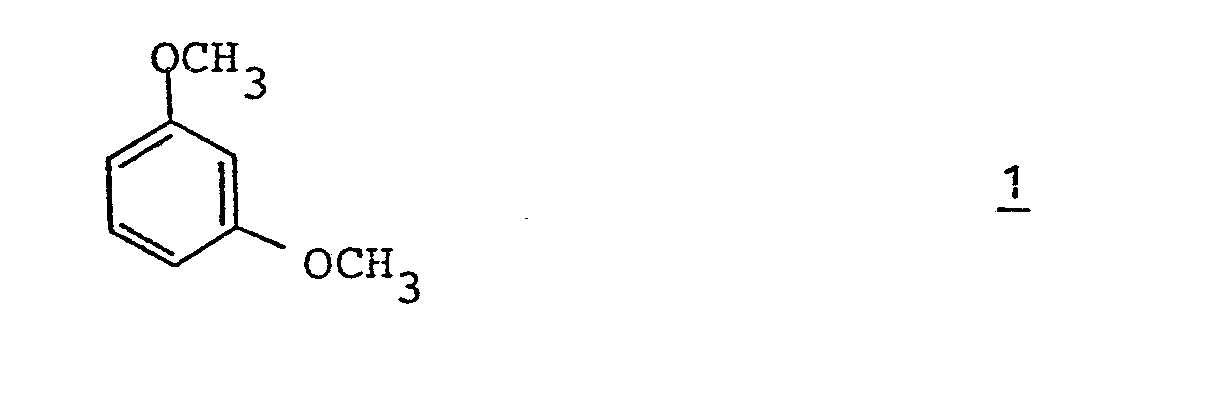
by conventional methods to the 2-lithio derivative of the formula 2

and contacting this compound with a chlorinating agent.
2. The process of claim 1 wherein the chlorinating agent is chlorine.
3. The process of claim 1 wherein the chlorinating agent is an N-chloroimide.
4. The process of claim 1 wherein the N-chloroimide is N-chlorosuccinimide.
5. The process of claim 1 wherein the chlorinating agent is a polychloroalkane having 1 to 6 carbon atoms.
6. The process of claim 5 wherein the polychloroalkane is carbon tetrachloride.
7. The process of claim 5 wherein the polychloroalkane is hexachloroethane.
8. The process of claim 1 wherein the chlorinating agent is a pclychloroalkanone having 3 to 6 carbon atoms.
9. The process of claim 8 wherein the polychloroalkanone is hexachloracetone.
10. The process of claim 1 wherein the process is performed in the presence of a solvent.
11. The process of claim 10 wherein the solvent is an ethereal solvent.
12. The process of claim 11 wherein the ethereal solvent is diethyl ether.
Applications Claiming Priority (2)
| Application Number | Priority Date | Filing Date | Title |
|---|---|---|---|
| US27042681A | 1981-06-04 | 1981-06-04 | |
| US270426 | 1981-06-04 |
Publications (1)
| Publication Number | Publication Date |
|---|---|
| EP0067342A1 true EP0067342A1 (en) | 1982-12-22 |
Family
ID=23031285
Family Applications (1)
| Application Number | Title | Priority Date | Filing Date |
|---|---|---|---|
| EP82104696A Withdrawn EP0067342A1 (en) | 1981-06-04 | 1982-05-28 | Process for the preparation of 2-chloro-1,3-dimethoxybenzene |
Country Status (2)
| Country | Link |
|---|---|
| EP (1) | EP0067342A1 (en) |
| JP (1) | JPS58929A (en) |
Cited By (2)
| Publication number | Priority date | Publication date | Assignee | Title |
|---|---|---|---|---|
| EP0572918A1 (en) * | 1992-06-01 | 1993-12-08 | Air Products And Chemicals, Inc. | Process for selectively ortho-fluorinating substituted aromatic compounds |
| US8372636B2 (en) | 1996-05-31 | 2013-02-12 | Board Of Trustees Of The University Of Illinois | Yeast cell surface display of proteins and uses thereof |
-
1982
- 1982-05-28 EP EP82104696A patent/EP0067342A1/en not_active Withdrawn
- 1982-06-03 JP JP57094146A patent/JPS58929A/en active Pending
Non-Patent Citations (2)
| Title |
|---|
| CHEMICAL ABSTRACTS, vol. 74, no. 23, 7 June 1971, Columbus, Ohio, (USA) O. COLLERA ZUNIGA et al.: "Synthesis of aromatic derivatives with alkyl substituents via organolithium intermediates" page 422, column 2, abstract no. 125032w; & Bol. Inst. Quim. Univ. Nac. Auton. Mex., vol. 22, 1970, pages 152 to 176 * |
| JUSTUS LIEBIGS, "Annalen der Chemie" vol. 709, 1967, VERLAG CHEMIE, Weinheim/Bergstr. K.H. BOLTZE et al., "]ber 2-substituierte Resorcindimethyl{ther", pages 63 to 69 * |
Cited By (2)
| Publication number | Priority date | Publication date | Assignee | Title |
|---|---|---|---|---|
| EP0572918A1 (en) * | 1992-06-01 | 1993-12-08 | Air Products And Chemicals, Inc. | Process for selectively ortho-fluorinating substituted aromatic compounds |
| US8372636B2 (en) | 1996-05-31 | 2013-02-12 | Board Of Trustees Of The University Of Illinois | Yeast cell surface display of proteins and uses thereof |
Also Published As
| Publication number | Publication date |
|---|---|
| JPS58929A (en) | 1983-01-06 |
Similar Documents
| Publication | Publication Date | Title |
|---|---|---|
| CA2105655A1 (en) | Multicyclic tertiary amine polyaromatic squalene synthetase inhibitors | |
| Johnson et al. | A convenient large-scale preparation of benzobarrelene | |
| Creary et al. | Reaction of. alpha.-keto triflates with sodium methoxide | |
| US6297410B1 (en) | Process for the preparation of cyclopropylacetylene | |
| Meyers et al. | A total asymmetric synthesis of (+)-ar-Turmerone | |
| Zonov et al. | Transformation of perfluorinated benzocycloalkenes and alkylbenzenes to their carbonyl derivatives under the action of CF3COOH/SbF5 | |
| US4579981A (en) | Process for the preparation of 2-chloro-1,3-dimethoxybenzene | |
| US3879449A (en) | 1-Phenyl-4-hydroxy-1-buten-3-ones and esters thereof | |
| Scott et al. | Aliphatic diazo ketones. A modified synthesis requiring minimal diazomethane | |
| Nickon et al. | Synthesis of the bridgehead ketol, 3, 3-dimethyl-1-hydroxynorbornan-2-one | |
| Houllemare et al. | Use of phenylselenium trichloride for simple and rapid preparation of α-phenylselanyl aldehydes and ketones | |
| HU190628B (en) | Process for preparing 3-vinyl-substituted 2,2-dimethyl-cyclopropane-1-carboxylic acids and and their esters | |
| JP4418048B2 (en) | Process for producing 13-cis-retinoic acid | |
| Henderson Jr et al. | Preparation of Alkyl Chlorophosphines | |
| JPH10265441A5 (en) | ||
| JP2890856B2 (en) | Method for producing quadratic acid | |
| Filler et al. | Polyfluoroaralkylamines: an improved synthesis of 4, 5, 6, 7-tetrafluoroindole | |
| Linstead et al. | CCLXVI.—Investigations of the olefinic acids. Part III. Homologues of teraconic, terebic, and pyroterebic acids. Further evidence of the effect of two γ-alkyl groups on three-carbon tautomerism | |
| HU214086B (en) | Process for producing 3-isoxazolecarboxylic acid and intermediates thereof | |
| Hell et al. | Reaction of cyclopropane carboxylic acid derivatives with sulphur tetrafluoride—an example of a diastereoselective ring opening | |
| EP0005145B1 (en) | Process for preparing 5-(2-bromoethylidene)-2(3h)-4a-methyl-4,4a,5,6,7,8-hexahydronaphthalene-2-one and 5-ethenyl-2(3h)-4a-methyl-4,4a,7,8-tetrahydronaphthalene-2-one therefrom by dehydrobromination | |
| CA1042019A (en) | Processes for the preparation of cyclic aldehydes | |
| Nace et al. | Nor steroids. X. Synthesis of A-nor steroids via the Dieckmann condensation | |
| JPS59110649A (en) | Manufacture of alpha-vinylpropionic acid ester | |
| JPS59222430A (en) | Fluorocyclopropane derivative |
Legal Events
| Date | Code | Title | Description |
|---|---|---|---|
| PUAI | Public reference made under article 153(3) epc to a published international application that has entered the european phase |
Free format text: ORIGINAL CODE: 0009012 |
|
| AK | Designated contracting states |
Designated state(s): CH DE FR GB LI |
|
| 17P | Request for examination filed |
Effective date: 19830504 |
|
| STAA | Information on the status of an ep patent application or granted ep patent |
Free format text: STATUS: THE APPLICATION HAS BEEN WITHDRAWN |
|
| 18W | Application withdrawn |
Withdrawal date: 19840519 |
|
| RIN1 | Information on inventor provided before grant (corrected) |
Inventor name: LEE, THOMAS BING KIN, DR. Inventor name: SHUTSKE, GREGORY MICHAEL Inventor name: JOBIN, GREGORY MICHAEL |