EP0066782B1 - Coating plastic substrates with minerals - Google Patents
Coating plastic substrates with minerals Download PDFInfo
- Publication number
- EP0066782B1 EP0066782B1 EP82104583A EP82104583A EP0066782B1 EP 0066782 B1 EP0066782 B1 EP 0066782B1 EP 82104583 A EP82104583 A EP 82104583A EP 82104583 A EP82104583 A EP 82104583A EP 0066782 B1 EP0066782 B1 EP 0066782B1
- Authority
- EP
- European Patent Office
- Prior art keywords
- powder
- flame
- weight
- mineral
- nylon
- Prior art date
- Legal status (The legal status is an assumption and is not a legal conclusion. Google has not performed a legal analysis and makes no representation as to the accuracy of the status listed.)
- Expired
Links
- 229910052500 inorganic mineral Inorganic materials 0.000 title claims description 24
- 239000011707 mineral Substances 0.000 title claims description 24
- 229920003023 plastic Polymers 0.000 title claims description 24
- 239000004033 plastic Substances 0.000 title claims description 24
- 238000000576 coating method Methods 0.000 title claims description 21
- 239000000758 substrate Substances 0.000 title claims description 20
- 239000011248 coating agent Substances 0.000 title claims description 15
- 239000000843 powder Substances 0.000 claims description 49
- 239000004677 Nylon Substances 0.000 claims description 20
- 229910052751 metal Inorganic materials 0.000 claims description 20
- 239000002184 metal Substances 0.000 claims description 20
- 229920001778 nylon Polymers 0.000 claims description 20
- 239000000203 mixture Substances 0.000 claims description 17
- 239000002245 particle Substances 0.000 claims description 16
- 239000003822 epoxy resin Substances 0.000 claims description 14
- 229920000647 polyepoxide Polymers 0.000 claims description 14
- 238000010285 flame spraying Methods 0.000 claims description 5
- 238000000034 method Methods 0.000 claims description 4
- PNEYBMLMFCGWSK-UHFFFAOYSA-N aluminium oxide Inorganic materials [O-2].[O-2].[O-2].[Al+3].[Al+3] PNEYBMLMFCGWSK-UHFFFAOYSA-N 0.000 description 22
- 229910052593 corundum Inorganic materials 0.000 description 21
- 229910001845 yogo sapphire Inorganic materials 0.000 description 21
- VYPSYNLAJGMNEJ-UHFFFAOYSA-N Silicium dioxide Chemical compound O=[Si]=O VYPSYNLAJGMNEJ-UHFFFAOYSA-N 0.000 description 17
- GWEVSGVZZGPLCZ-UHFFFAOYSA-N Titan oxide Chemical compound O=[Ti]=O GWEVSGVZZGPLCZ-UHFFFAOYSA-N 0.000 description 14
- MCMNRKCIXSYSNV-UHFFFAOYSA-N Zirconium dioxide Chemical compound O=[Zr]=O MCMNRKCIXSYSNV-UHFFFAOYSA-N 0.000 description 14
- 239000004593 Epoxy Substances 0.000 description 12
- QDOXWKRWXJOMAK-UHFFFAOYSA-N dichromium trioxide Chemical compound O=[Cr]O[Cr]=O QDOXWKRWXJOMAK-UHFFFAOYSA-N 0.000 description 12
- -1 etc. Substances 0.000 description 12
- 229910021332 silicide Inorganic materials 0.000 description 11
- CPLXHLVBOLITMK-UHFFFAOYSA-N Magnesium oxide Chemical compound [Mg]=O CPLXHLVBOLITMK-UHFFFAOYSA-N 0.000 description 10
- 239000011651 chromium Substances 0.000 description 10
- 239000000377 silicon dioxide Substances 0.000 description 9
- 229910052681 coesite Inorganic materials 0.000 description 8
- 229910052906 cristobalite Inorganic materials 0.000 description 8
- 229910052682 stishovite Inorganic materials 0.000 description 8
- 229910052905 tridymite Inorganic materials 0.000 description 8
- 229910003468 tantalcarbide Inorganic materials 0.000 description 7
- XLOMVQKBTHCTTD-UHFFFAOYSA-N Zinc monoxide Chemical compound [Zn]=O XLOMVQKBTHCTTD-UHFFFAOYSA-N 0.000 description 6
- 229910045601 alloy Inorganic materials 0.000 description 6
- 239000000956 alloy Substances 0.000 description 6
- 229910026551 ZrC Inorganic materials 0.000 description 5
- OTCHGXYCWNXDOA-UHFFFAOYSA-N [C].[Zr] Chemical compound [C].[Zr] OTCHGXYCWNXDOA-UHFFFAOYSA-N 0.000 description 5
- 239000011230 binding agent Substances 0.000 description 5
- 239000000395 magnesium oxide Substances 0.000 description 5
- LTPBRCUWZOMYOC-UHFFFAOYSA-N Beryllium oxide Chemical compound O=[Be] LTPBRCUWZOMYOC-UHFFFAOYSA-N 0.000 description 4
- OKTJSMMVPCPJKN-UHFFFAOYSA-N Carbon Chemical compound [C] OKTJSMMVPCPJKN-UHFFFAOYSA-N 0.000 description 4
- UQSXHKLRYXJYBZ-UHFFFAOYSA-N Iron oxide Chemical compound [Fe]=O UQSXHKLRYXJYBZ-UHFFFAOYSA-N 0.000 description 4
- 229910000963 austenitic stainless steel Inorganic materials 0.000 description 4
- 239000000919 ceramic Substances 0.000 description 4
- CJNBYAVZURUTKZ-UHFFFAOYSA-N hafnium(IV) oxide Inorganic materials O=[Hf]=O CJNBYAVZURUTKZ-UHFFFAOYSA-N 0.000 description 4
- 239000010955 niobium Substances 0.000 description 4
- ZKATWMILCYLAPD-UHFFFAOYSA-N niobium pentoxide Chemical compound O=[Nb](=O)O[Nb](=O)=O ZKATWMILCYLAPD-UHFFFAOYSA-N 0.000 description 4
- 229920000642 polymer Polymers 0.000 description 4
- 239000007921 spray Substances 0.000 description 4
- 229910000906 Bronze Inorganic materials 0.000 description 3
- 239000010974 bronze Substances 0.000 description 3
- CETPSERCERDGAM-UHFFFAOYSA-N ceric oxide Chemical compound O=[Ce]=O CETPSERCERDGAM-UHFFFAOYSA-N 0.000 description 3
- 229910000422 cerium(IV) oxide Inorganic materials 0.000 description 3
- 229910052804 chromium Inorganic materials 0.000 description 3
- 239000008199 coating composition Substances 0.000 description 3
- 229910002804 graphite Inorganic materials 0.000 description 3
- 239000010439 graphite Substances 0.000 description 3
- JEIPFZHSYJVQDO-UHFFFAOYSA-N iron(III) oxide Inorganic materials O=[Fe]O[Fe]=O JEIPFZHSYJVQDO-UHFFFAOYSA-N 0.000 description 3
- 150000001247 metal acetylides Chemical class 0.000 description 3
- 150000002739 metals Chemical class 0.000 description 3
- 229910052750 molybdenum Inorganic materials 0.000 description 3
- 229910001120 nichrome Inorganic materials 0.000 description 3
- 235000013824 polyphenols Nutrition 0.000 description 3
- 229910052761 rare earth metal Inorganic materials 0.000 description 3
- 229910052715 tantalum Inorganic materials 0.000 description 3
- ZCUFMDLYAMJYST-UHFFFAOYSA-N thorium dioxide Chemical compound O=[Th]=O ZCUFMDLYAMJYST-UHFFFAOYSA-N 0.000 description 3
- 239000010936 titanium Substances 0.000 description 3
- XLYOFNOQVPJJNP-UHFFFAOYSA-N water Substances O XLYOFNOQVPJJNP-UHFFFAOYSA-N 0.000 description 3
- 239000011787 zinc oxide Substances 0.000 description 3
- IJGRMHOSHXDMSA-UHFFFAOYSA-N Atomic nitrogen Chemical compound N#N IJGRMHOSHXDMSA-UHFFFAOYSA-N 0.000 description 2
- 229910052582 BN Inorganic materials 0.000 description 2
- 229910001018 Cast iron Inorganic materials 0.000 description 2
- JHWNWJKBPDFINM-UHFFFAOYSA-N Laurolactam Chemical compound O=C1CCCCCCCCCCCN1 JHWNWJKBPDFINM-UHFFFAOYSA-N 0.000 description 2
- 229910000943 NiAl Inorganic materials 0.000 description 2
- 229920000571 Nylon 11 Polymers 0.000 description 2
- 229920000299 Nylon 12 Polymers 0.000 description 2
- NPXOKRUENSOPAO-UHFFFAOYSA-N Raney nickel Chemical compound [Al].[Ni] NPXOKRUENSOPAO-UHFFFAOYSA-N 0.000 description 2
- 229910004369 ThO2 Inorganic materials 0.000 description 2
- 230000001464 adherent effect Effects 0.000 description 2
- 239000000853 adhesive Substances 0.000 description 2
- 230000001070 adhesive effect Effects 0.000 description 2
- 238000005422 blasting Methods 0.000 description 2
- 239000003795 chemical substances by application Substances 0.000 description 2
- VNNRSPGTAMTISX-UHFFFAOYSA-N chromium nickel Chemical compound [Cr].[Ni] VNNRSPGTAMTISX-UHFFFAOYSA-N 0.000 description 2
- 238000001816 cooling Methods 0.000 description 2
- KUNSUQLRTQLHQQ-UHFFFAOYSA-N copper tin Chemical compound [Cu].[Sn] KUNSUQLRTQLHQQ-UHFFFAOYSA-N 0.000 description 2
- 239000000835 fiber Substances 0.000 description 2
- YBMRDBCBODYGJE-UHFFFAOYSA-N germanium dioxide Chemical compound O=[Ge]=O YBMRDBCBODYGJE-UHFFFAOYSA-N 0.000 description 2
- AMWRITDGCCNYAT-UHFFFAOYSA-L hydroxy(oxo)manganese;manganese Chemical compound [Mn].O[Mn]=O.O[Mn]=O AMWRITDGCCNYAT-UHFFFAOYSA-L 0.000 description 2
- MRELNEQAGSRDBK-UHFFFAOYSA-N lanthanum oxide Inorganic materials [O-2].[O-2].[O-2].[La+3].[La+3] MRELNEQAGSRDBK-UHFFFAOYSA-N 0.000 description 2
- 239000000463 material Substances 0.000 description 2
- 238000002844 melting Methods 0.000 description 2
- 230000008018 melting Effects 0.000 description 2
- 239000011733 molybdenum Substances 0.000 description 2
- PXHVJJICTQNCMI-UHFFFAOYSA-N nickel Substances [Ni] PXHVJJICTQNCMI-UHFFFAOYSA-N 0.000 description 2
- 229910052755 nonmetal Inorganic materials 0.000 description 2
- KTUFCUMIWABKDW-UHFFFAOYSA-N oxo(oxolanthaniooxy)lanthanum Chemical compound O=[La]O[La]=O KTUFCUMIWABKDW-UHFFFAOYSA-N 0.000 description 2
- ISWSIDIOOBJBQZ-UHFFFAOYSA-N phenol group Chemical group C1(=CC=CC=C1)O ISWSIDIOOBJBQZ-UHFFFAOYSA-N 0.000 description 2
- 239000004417 polycarbonate Substances 0.000 description 2
- 229920000515 polycarbonate Polymers 0.000 description 2
- 229920000036 polyvinylpyrrolidone Polymers 0.000 description 2
- 239000001267 polyvinylpyrrolidone Substances 0.000 description 2
- 235000013855 polyvinylpyrrolidone Nutrition 0.000 description 2
- 150000002910 rare earth metals Chemical class 0.000 description 2
- 230000002787 reinforcement Effects 0.000 description 2
- 229910052710 silicon Inorganic materials 0.000 description 2
- 239000010703 silicon Substances 0.000 description 2
- 239000002904 solvent Substances 0.000 description 2
- 238000005507 spraying Methods 0.000 description 2
- 229920001169 thermoplastic Polymers 0.000 description 2
- 239000004416 thermosoftening plastic Substances 0.000 description 2
- XOLBLPGZBRYERU-UHFFFAOYSA-N tin dioxide Chemical compound O=[Sn]=O XOLBLPGZBRYERU-UHFFFAOYSA-N 0.000 description 2
- 229910052719 titanium Inorganic materials 0.000 description 2
- 229910003470 tongbaite Inorganic materials 0.000 description 2
- 229910052721 tungsten Inorganic materials 0.000 description 2
- INZDTEICWPZYJM-UHFFFAOYSA-N 1-(chloromethyl)-4-[4-(chloromethyl)phenyl]benzene Chemical compound C1=CC(CCl)=CC=C1C1=CC=C(CCl)C=C1 INZDTEICWPZYJM-UHFFFAOYSA-N 0.000 description 1
- QYEXBYZXHDUPRC-UHFFFAOYSA-N B#[Ti]#B Chemical compound B#[Ti]#B QYEXBYZXHDUPRC-UHFFFAOYSA-N 0.000 description 1
- 229910015245 B4Si Inorganic materials 0.000 description 1
- ZOXJGFHDIHLPTG-UHFFFAOYSA-N Boron Chemical compound [B] ZOXJGFHDIHLPTG-UHFFFAOYSA-N 0.000 description 1
- PZNSFCLAULLKQX-UHFFFAOYSA-N Boron nitride Chemical compound N#B PZNSFCLAULLKQX-UHFFFAOYSA-N 0.000 description 1
- 229910019878 Cr3Si Inorganic materials 0.000 description 1
- 239000004641 Diallyl-phthalate Substances 0.000 description 1
- BRLQWZUYTZBJKN-UHFFFAOYSA-N Epichlorohydrin Chemical compound ClCC1CO1 BRLQWZUYTZBJKN-UHFFFAOYSA-N 0.000 description 1
- LFQSCWFLJHTTHZ-UHFFFAOYSA-N Ethanol Chemical compound CCO LFQSCWFLJHTTHZ-UHFFFAOYSA-N 0.000 description 1
- 241000588731 Hafnia Species 0.000 description 1
- 229910003862 HfB2 Inorganic materials 0.000 description 1
- UFHFLCQGNIYNRP-UHFFFAOYSA-N Hydrogen Chemical compound [H][H] UFHFLCQGNIYNRP-UHFFFAOYSA-N 0.000 description 1
- FUJCRWPEOMXPAD-UHFFFAOYSA-N Li2O Inorganic materials [Li+].[Li+].[O-2] FUJCRWPEOMXPAD-UHFFFAOYSA-N 0.000 description 1
- 229910020968 MoSi2 Inorganic materials 0.000 description 1
- ZOKXTWBITQBERF-UHFFFAOYSA-N Molybdenum Chemical compound [Mo] ZOKXTWBITQBERF-UHFFFAOYSA-N 0.000 description 1
- 229910019802 NbC Inorganic materials 0.000 description 1
- 229910020044 NbSi2 Inorganic materials 0.000 description 1
- 229910018487 Ni—Cr Inorganic materials 0.000 description 1
- 229920002302 Nylon 6,6 Polymers 0.000 description 1
- 229910019142 PO4 Inorganic materials 0.000 description 1
- OAICVXFJPJFONN-UHFFFAOYSA-N Phosphorus Chemical compound [P] OAICVXFJPJFONN-UHFFFAOYSA-N 0.000 description 1
- 239000004962 Polyamide-imide Substances 0.000 description 1
- 239000004695 Polyether sulfone Substances 0.000 description 1
- 239000004642 Polyimide Substances 0.000 description 1
- 239000004721 Polyphenylene oxide Substances 0.000 description 1
- 239000004734 Polyphenylene sulfide Substances 0.000 description 1
- XUIMIQQOPSSXEZ-UHFFFAOYSA-N Silicon Chemical compound [Si] XUIMIQQOPSSXEZ-UHFFFAOYSA-N 0.000 description 1
- 229910004448 Ta2C Inorganic materials 0.000 description 1
- 229910004217 TaSi2 Inorganic materials 0.000 description 1
- 229910052776 Thorium Inorganic materials 0.000 description 1
- 229910009871 Ti5Si3 Inorganic materials 0.000 description 1
- 229910033181 TiB2 Inorganic materials 0.000 description 1
- 229910034327 TiC Inorganic materials 0.000 description 1
- 229910008814 WSi2 Inorganic materials 0.000 description 1
- 229910007948 ZrB2 Inorganic materials 0.000 description 1
- 229910006247 ZrS2 Inorganic materials 0.000 description 1
- DHKHKXVYLBGOIT-UHFFFAOYSA-N acetaldehyde Diethyl Acetal Natural products CCOC(C)OCC DHKHKXVYLBGOIT-UHFFFAOYSA-N 0.000 description 1
- 125000002777 acetyl group Chemical class [H]C([H])([H])C(*)=O 0.000 description 1
- 239000004676 acrylonitrile butadiene styrene Substances 0.000 description 1
- 229920000180 alkyd Polymers 0.000 description 1
- 150000004645 aluminates Chemical class 0.000 description 1
- 229910052782 aluminium Inorganic materials 0.000 description 1
- XAGFODPZIPBFFR-UHFFFAOYSA-N aluminium Chemical compound [Al] XAGFODPZIPBFFR-UHFFFAOYSA-N 0.000 description 1
- 150000008064 anhydrides Chemical class 0.000 description 1
- 238000005452 bending Methods 0.000 description 1
- QUDWYFHPNIMBFC-UHFFFAOYSA-N bis(prop-2-enyl) benzene-1,2-dicarboxylate Chemical compound C=CCOC(=O)C1=CC=CC=C1C(=O)OCC=C QUDWYFHPNIMBFC-UHFFFAOYSA-N 0.000 description 1
- IISBACLAFKSPIT-UHFFFAOYSA-N bisphenol A Chemical compound C=1C=C(O)C=CC=1C(C)(C)C1=CC=C(O)C=C1 IISBACLAFKSPIT-UHFFFAOYSA-N 0.000 description 1
- 229910052796 boron Inorganic materials 0.000 description 1
- VWZIXVXBCBBRGP-UHFFFAOYSA-N boron;zirconium Chemical compound B#[Zr]#B VWZIXVXBCBBRGP-UHFFFAOYSA-N 0.000 description 1
- 229910052799 carbon Inorganic materials 0.000 description 1
- 239000011195 cermet Substances 0.000 description 1
- ZCDOYSPFYFSLEW-UHFFFAOYSA-N chromate(2-) Chemical class [O-][Cr]([O-])(=O)=O ZCDOYSPFYFSLEW-UHFFFAOYSA-N 0.000 description 1
- IVMYJDGYRUAWML-UHFFFAOYSA-N cobalt(ii) oxide Chemical class [Co]=O IVMYJDGYRUAWML-UHFFFAOYSA-N 0.000 description 1
- 238000002485 combustion reaction Methods 0.000 description 1
- 239000011246 composite particle Substances 0.000 description 1
- 150000001875 compounds Chemical class 0.000 description 1
- 239000007859 condensation product Substances 0.000 description 1
- 229920001577 copolymer Polymers 0.000 description 1
- 238000004132 cross linking Methods 0.000 description 1
- 230000008021 deposition Effects 0.000 description 1
- 150000004985 diamines Chemical class 0.000 description 1
- AJNVQOSZGJRYEI-UHFFFAOYSA-N digallium;oxygen(2-) Chemical compound [O-2].[O-2].[O-2].[Ga+3].[Ga+3] AJNVQOSZGJRYEI-UHFFFAOYSA-N 0.000 description 1
- XUCJHNOBJLKZNU-UHFFFAOYSA-M dilithium;hydroxide Chemical compound [Li+].[Li+].[OH-] XUCJHNOBJLKZNU-UHFFFAOYSA-M 0.000 description 1
- KZHJGOXRZJKJNY-UHFFFAOYSA-N dioxosilane;oxo(oxoalumanyloxy)alumane Chemical compound O=[Si]=O.O=[Si]=O.O=[Al]O[Al]=O.O=[Al]O[Al]=O.O=[Al]O[Al]=O KZHJGOXRZJKJNY-UHFFFAOYSA-N 0.000 description 1
- 150000003959 diselenides Chemical class 0.000 description 1
- 239000006185 dispersion Substances 0.000 description 1
- 150000002019 disulfides Chemical class 0.000 description 1
- GNTDGMZSJNCJKK-UHFFFAOYSA-N divanadium pentaoxide Chemical compound O=[V](=O)O[V](=O)=O GNTDGMZSJNCJKK-UHFFFAOYSA-N 0.000 description 1
- NLQFUUYNQFMIJW-UHFFFAOYSA-N dysprosium(III) oxide Inorganic materials O=[Dy]O[Dy]=O NLQFUUYNQFMIJW-UHFFFAOYSA-N 0.000 description 1
- 230000000694 effects Effects 0.000 description 1
- 238000005516 engineering process Methods 0.000 description 1
- VQCBHWLJZDBHOS-UHFFFAOYSA-N erbium(III) oxide Inorganic materials O=[Er]O[Er]=O VQCBHWLJZDBHOS-UHFFFAOYSA-N 0.000 description 1
- 239000000945 filler Substances 0.000 description 1
- CMIHHWBVHJVIGI-UHFFFAOYSA-N gadolinium(III) oxide Inorganic materials [O-2].[O-2].[O-2].[Gd+3].[Gd+3] CMIHHWBVHJVIGI-UHFFFAOYSA-N 0.000 description 1
- 229910001195 gallium oxide Inorganic materials 0.000 description 1
- 229910052732 germanium Inorganic materials 0.000 description 1
- GNPVGFCGXDBREM-UHFFFAOYSA-N germanium atom Chemical compound [Ge] GNPVGFCGXDBREM-UHFFFAOYSA-N 0.000 description 1
- 239000011521 glass Substances 0.000 description 1
- 239000003365 glass fiber Substances 0.000 description 1
- 230000005484 gravity Effects 0.000 description 1
- WHJFNYXPKGDKBB-UHFFFAOYSA-N hafnium;methane Chemical compound C.[Hf] WHJFNYXPKGDKBB-UHFFFAOYSA-N 0.000 description 1
- LNEPOXFFQSENCJ-UHFFFAOYSA-N haloperidol Chemical compound C1CC(O)(C=2C=CC(Cl)=CC=2)CCN1CCCC(=O)C1=CC=C(F)C=C1 LNEPOXFFQSENCJ-UHFFFAOYSA-N 0.000 description 1
- 150000004678 hydrides Chemical class 0.000 description 1
- 229910052739 hydrogen Inorganic materials 0.000 description 1
- 239000001257 hydrogen Substances 0.000 description 1
- 229910052742 iron Inorganic materials 0.000 description 1
- XEEYBQQBJWHFJM-UHFFFAOYSA-N iron Substances [Fe] XEEYBQQBJWHFJM-UHFFFAOYSA-N 0.000 description 1
- 239000002923 metal particle Substances 0.000 description 1
- 229910052752 metalloid Inorganic materials 0.000 description 1
- UNASZPQZIFZUSI-UHFFFAOYSA-N methylidyneniobium Chemical compound [Nb]#C UNASZPQZIFZUSI-UHFFFAOYSA-N 0.000 description 1
- 229910052961 molybdenite Inorganic materials 0.000 description 1
- CWQXQMHSOZUFJS-UHFFFAOYSA-N molybdenum disulfide Chemical compound S=[Mo]=S CWQXQMHSOZUFJS-UHFFFAOYSA-N 0.000 description 1
- 229910052982 molybdenum disulfide Inorganic materials 0.000 description 1
- 229910052863 mullite Inorganic materials 0.000 description 1
- PLDDOISOJJCEMH-UHFFFAOYSA-N neodymium oxide Inorganic materials [O-2].[O-2].[O-2].[Nd+3].[Nd+3] PLDDOISOJJCEMH-UHFFFAOYSA-N 0.000 description 1
- 229910052759 nickel Inorganic materials 0.000 description 1
- 229910000480 nickel oxide Inorganic materials 0.000 description 1
- 229910052758 niobium Inorganic materials 0.000 description 1
- 229910000484 niobium oxide Inorganic materials 0.000 description 1
- URLJKFSTXLNXLG-UHFFFAOYSA-N niobium(5+);oxygen(2-) Chemical compound [O-2].[O-2].[O-2].[O-2].[O-2].[Nb+5].[Nb+5] URLJKFSTXLNXLG-UHFFFAOYSA-N 0.000 description 1
- 150000004767 nitrides Chemical class 0.000 description 1
- 229910052757 nitrogen Inorganic materials 0.000 description 1
- 230000003647 oxidation Effects 0.000 description 1
- 238000007254 oxidation reaction Methods 0.000 description 1
- 229910052574 oxide ceramic Inorganic materials 0.000 description 1
- 239000011224 oxide ceramic Substances 0.000 description 1
- SIWVEOZUMHYXCS-UHFFFAOYSA-N oxo(oxoyttriooxy)yttrium Chemical compound O=[Y]O[Y]=O SIWVEOZUMHYXCS-UHFFFAOYSA-N 0.000 description 1
- GNRSAWUEBMWBQH-UHFFFAOYSA-N oxonickel Chemical compound [Ni]=O GNRSAWUEBMWBQH-UHFFFAOYSA-N 0.000 description 1
- BPUBBGLMJRNUCC-UHFFFAOYSA-N oxygen(2-);tantalum(5+) Chemical compound [O-2].[O-2].[O-2].[O-2].[O-2].[Ta+5].[Ta+5] BPUBBGLMJRNUCC-UHFFFAOYSA-N 0.000 description 1
- 235000021317 phosphate Nutrition 0.000 description 1
- 150000003013 phosphoric acid derivatives Chemical class 0.000 description 1
- 230000000704 physical effect Effects 0.000 description 1
- 229920000090 poly(aryl ether) Polymers 0.000 description 1
- 229920002492 poly(sulfone) Polymers 0.000 description 1
- 229920002312 polyamide-imide Polymers 0.000 description 1
- 229920000728 polyester Polymers 0.000 description 1
- 229920006393 polyether sulfone Polymers 0.000 description 1
- 229920001721 polyimide Polymers 0.000 description 1
- 229920006380 polyphenylene oxide Polymers 0.000 description 1
- 229920000069 polyphenylene sulfide Polymers 0.000 description 1
- 239000011118 polyvinyl acetate Substances 0.000 description 1
- 229920002689 polyvinyl acetate Polymers 0.000 description 1
- 239000004800 polyvinyl chloride Substances 0.000 description 1
- 229920000915 polyvinyl chloride Polymers 0.000 description 1
- 239000000047 product Substances 0.000 description 1
- 230000001737 promoting effect Effects 0.000 description 1
- 238000005204 segregation Methods 0.000 description 1
- 150000004760 silicates Chemical class 0.000 description 1
- 239000004616 structural foam Substances 0.000 description 1
- GUVRBAGPIYLISA-UHFFFAOYSA-N tantalum atom Chemical compound [Ta] GUVRBAGPIYLISA-UHFFFAOYSA-N 0.000 description 1
- 229910001936 tantalum oxide Inorganic materials 0.000 description 1
- PBCFLUZVCVVTBY-UHFFFAOYSA-N tantalum pentoxide Inorganic materials O=[Ta](=O)O[Ta](=O)=O PBCFLUZVCVVTBY-UHFFFAOYSA-N 0.000 description 1
- 229920001187 thermosetting polymer Polymers 0.000 description 1
- 150000003568 thioethers Chemical class 0.000 description 1
- OGIDPMRJRNCKJF-UHFFFAOYSA-N titanium oxide Inorganic materials [Ti]=O OGIDPMRJRNCKJF-UHFFFAOYSA-N 0.000 description 1
- MTPVUVINMAGMJL-UHFFFAOYSA-N trimethyl(1,1,2,2,2-pentafluoroethyl)silane Chemical compound C[Si](C)(C)C(F)(F)C(F)(F)F MTPVUVINMAGMJL-UHFFFAOYSA-N 0.000 description 1
- 239000010937 tungsten Substances 0.000 description 1
- 238000009736 wetting Methods 0.000 description 1
- 229910052845 zircon Inorganic materials 0.000 description 1
- 229910052726 zirconium Inorganic materials 0.000 description 1
- GFQYVLUOOAAOGM-UHFFFAOYSA-N zirconium(iv) silicate Chemical compound [Zr+4].[O-][Si]([O-])([O-])[O-] GFQYVLUOOAAOGM-UHFFFAOYSA-N 0.000 description 1
Classifications
-
- C—CHEMISTRY; METALLURGY
- C08—ORGANIC MACROMOLECULAR COMPOUNDS; THEIR PREPARATION OR CHEMICAL WORKING-UP; COMPOSITIONS BASED THEREON
- C08J—WORKING-UP; GENERAL PROCESSES OF COMPOUNDING; AFTER-TREATMENT NOT COVERED BY SUBCLASSES C08B, C08C, C08F, C08G or C08H
- C08J7/00—Chemical treatment or coating of shaped articles made of macromolecular substances
- C08J7/04—Coating
- C08J7/06—Coating with compositions not containing macromolecular substances
-
- C—CHEMISTRY; METALLURGY
- C08—ORGANIC MACROMOLECULAR COMPOUNDS; THEIR PREPARATION OR CHEMICAL WORKING-UP; COMPOSITIONS BASED THEREON
- C08J—WORKING-UP; GENERAL PROCESSES OF COMPOUNDING; AFTER-TREATMENT NOT COVERED BY SUBCLASSES C08B, C08C, C08F, C08G or C08H
- C08J7/00—Chemical treatment or coating of shaped articles made of macromolecular substances
- C08J7/04—Coating
- C08J7/0427—Coating with only one layer of a composition containing a polymer binder
-
- C—CHEMISTRY; METALLURGY
- C08—ORGANIC MACROMOLECULAR COMPOUNDS; THEIR PREPARATION OR CHEMICAL WORKING-UP; COMPOSITIONS BASED THEREON
- C08J—WORKING-UP; GENERAL PROCESSES OF COMPOUNDING; AFTER-TREATMENT NOT COVERED BY SUBCLASSES C08B, C08C, C08F, C08G or C08H
- C08J7/00—Chemical treatment or coating of shaped articles made of macromolecular substances
- C08J7/04—Coating
- C08J7/043—Improving the adhesiveness of the coatings per se, e.g. forming primers
-
- C—CHEMISTRY; METALLURGY
- C08—ORGANIC MACROMOLECULAR COMPOUNDS; THEIR PREPARATION OR CHEMICAL WORKING-UP; COMPOSITIONS BASED THEREON
- C08J—WORKING-UP; GENERAL PROCESSES OF COMPOUNDING; AFTER-TREATMENT NOT COVERED BY SUBCLASSES C08B, C08C, C08F, C08G or C08H
- C08J7/00—Chemical treatment or coating of shaped articles made of macromolecular substances
- C08J7/04—Coating
- C08J7/046—Forming abrasion-resistant coatings; Forming surface-hardening coatings
-
- C—CHEMISTRY; METALLURGY
- C09—DYES; PAINTS; POLISHES; NATURAL RESINS; ADHESIVES; COMPOSITIONS NOT OTHERWISE PROVIDED FOR; APPLICATIONS OF MATERIALS NOT OTHERWISE PROVIDED FOR
- C09D—COATING COMPOSITIONS, e.g. PAINTS, VARNISHES OR LACQUERS; FILLING PASTES; CHEMICAL PAINT OR INK REMOVERS; INKS; CORRECTING FLUIDS; WOODSTAINS; PASTES OR SOLIDS FOR COLOURING OR PRINTING; USE OF MATERIALS THEREFOR
- C09D1/00—Coating compositions, e.g. paints, varnishes or lacquers, based on inorganic substances
-
- C—CHEMISTRY; METALLURGY
- C23—COATING METALLIC MATERIAL; COATING MATERIAL WITH METALLIC MATERIAL; CHEMICAL SURFACE TREATMENT; DIFFUSION TREATMENT OF METALLIC MATERIAL; COATING BY VACUUM EVAPORATION, BY SPUTTERING, BY ION IMPLANTATION OR BY CHEMICAL VAPOUR DEPOSITION, IN GENERAL; INHIBITING CORROSION OF METALLIC MATERIAL OR INCRUSTATION IN GENERAL
- C23C—COATING METALLIC MATERIAL; COATING MATERIAL WITH METALLIC MATERIAL; SURFACE TREATMENT OF METALLIC MATERIAL BY DIFFUSION INTO THE SURFACE, BY CHEMICAL CONVERSION OR SUBSTITUTION; COATING BY VACUUM EVAPORATION, BY SPUTTERING, BY ION IMPLANTATION OR BY CHEMICAL VAPOUR DEPOSITION, IN GENERAL
- C23C4/00—Coating by spraying the coating material in the molten state, e.g. by flame, plasma or electric discharge
- C23C4/04—Coating by spraying the coating material in the molten state, e.g. by flame, plasma or electric discharge characterised by the coating material
-
- Y—GENERAL TAGGING OF NEW TECHNOLOGICAL DEVELOPMENTS; GENERAL TAGGING OF CROSS-SECTIONAL TECHNOLOGIES SPANNING OVER SEVERAL SECTIONS OF THE IPC; TECHNICAL SUBJECTS COVERED BY FORMER USPC CROSS-REFERENCE ART COLLECTIONS [XRACs] AND DIGESTS
- Y10—TECHNICAL SUBJECTS COVERED BY FORMER USPC
- Y10T—TECHNICAL SUBJECTS COVERED BY FORMER US CLASSIFICATION
- Y10T428/00—Stock material or miscellaneous articles
- Y10T428/31504—Composite [nonstructural laminate]
- Y10T428/31511—Of epoxy ether
-
- Y—GENERAL TAGGING OF NEW TECHNOLOGICAL DEVELOPMENTS; GENERAL TAGGING OF CROSS-SECTIONAL TECHNOLOGIES SPANNING OVER SEVERAL SECTIONS OF THE IPC; TECHNICAL SUBJECTS COVERED BY FORMER USPC CROSS-REFERENCE ART COLLECTIONS [XRACs] AND DIGESTS
- Y10—TECHNICAL SUBJECTS COVERED BY FORMER USPC
- Y10T—TECHNICAL SUBJECTS COVERED BY FORMER US CLASSIFICATION
- Y10T428/00—Stock material or miscellaneous articles
- Y10T428/31504—Composite [nonstructural laminate]
- Y10T428/31725—Of polyamide
- Y10T428/31739—Nylon type
Definitions
- the present invention relates to flame spraying mineral coatings onto plastic substrates and compositions suitable therefor.
- a simple technique for coating surfaces with metal or ceramic is by flame spraying, employing either powder or wire.
- flame spraying employing either powder or wire.
- special problems are encountered.
- the sprayed metal contracts and may warp or distort the plastic.
- the coating sometimes fails to adhere uniformly.
- the plastic substrate may melt from the material being sprayed and lose its shape, or the plastic surface may burn or decompose.
- plastic substrates can be flame sprayed with a mineral powder which has been admixed with small amounts of nylon and epoxy polymers, also advantageously in powder form.
- powder particles in finely sub-divided form are contacted with a binder or adhesive, mixed and dried, the agglomerates which form being composed of sub-particles of the individual components and being screened to recover particles of a particular size.
- the resulting agglomerates can be flame sprayed in conventional manner onto the substrate.
- the coating can range in thickness from about 25 pm to 5 mm or greater.
- the coating can serve as an undercoat onto which other mineral coatings can be flame sprayed.
- the coating can serve as an undercoat onto which other mineral coatings can be flame sprayed.
- the substrate can comprise substantially all plastics, thermoplastic as well as thermoset, e.g. nylon, polyphenylene oxide, polycarbonate, polyaryl ether, acetal, polysulfone, polyethersulfone, polyester, polyimide, polyamide-imide, polyphenylene sulfide, phenolic, alkyd, diallyl phthalate, epoxy, ABS, etc., as well as mixtures thereof. They may be used per se or with fillers, reinforcements, and the like, e.g. glass fiber, graphite, silica, etc.
- the plastic does not distort or significantly soften below 93°C.
- the coating composition comprises 50 to 98% and preferably about 85 to 95% by weight of a flame sprayable powder, 1 to 25% and preferably about 2.5 to 7.5% weight of a nylon powder and 1 to 25% and preferably 2.5% to 7.5% weight of an epoxy resin powder, i.e. preferably approximately equal'weights of nylon and epoxy.
- the coating composition advantageously comprises 70 to 98%, and preferably 95% by weight of a flame sprayable metal powder, 1 to 15% and preferably 2.5% by weight of a nylon powder and 1 to 15% and preferably 2.5% by weight of an epoxy resin powder; i.e. preferably approximately equal weights of nylon and epoxy.
- the coating composition advantageously comprises 50 to 98%, and preferably 85% by weight of a flame sprayable nonmetal powder, 1 to 25% and preferably 7.5% by weight of a nylon powder and 1 to 25% and preferably 7.5% by weight of an epoxy resin powder, i.e. preferably approximately equal weights of nylon and epoxy.
- the mineral powder can be any of those described in U.S. Patent No. 3,617,358, issued in the name of Charles J. Dittrich on Nov. 2, 1971, the disclosure of which is incorporated herein by reference. These include, but are not limited to, the conventional metals, alloys or mixtures of metals used in this art as well as: Oxides, as for example refractory oxides, such as alumina Al 2 O 3 , beryllia BeO, ceria CeO 2 , chromia Cr 2 0 3 , cobalt oxides CoO, gallium oxide Ga 2 0 3 , hafnia Hf0 2 , magnesia MgO, nickel oxide NiO, tantalum oxide Ta 2 O 5 , thoria ThO 2 , titania TiO 2 , yttrium oxide Y 2 O 3 , zirconia ZrO 2 , vanadium oxide V 2 O 5 , niobium oxide NbO, manganese oxide MnO
- Borides such as TiB 2 , ZrB 2 , HfB or HfB 2 , borides of V, borides of Nb, borides of Ta, borides of Cr, borides of Mo, borides of W, borides of the rare earth metals;
- Metalloid elements such as boron, silicon, germanium;
- Cermets such as WC/Co, W 2 C/Co, WC+W 2 C/Co, Cr/Al 2 O 3 , Ni 2/3 Al 2 O 3 , NiAl/Al 2 O 3 , NiAl/ZrO 2 , Co/ZrO 2 , Cr/Cr 3 C 22 O 3 , Co/TiC, NilTiC, Co/WC+TiC, TiC/NiCr, Cr+Mo/Al 2 O 3 , Ni, Fe and/or their alloys, Cu and/or its alloys such as aluminum bronze, phosphor bronze, etc., with the disulfides or diselenides of Mo, W, Nb, Ta, Ti, or V, or boron nitride for self-lubricating coatings with very low friction coefficient;
- Cermets for instance those containing a metal and a carbide as the refractory phase, which also contain free carbon, such as high purity graphite or the like, which will effectively reduce or prevent oxidation of the carbide phase and reduce solutioning of the carbide phase un the metal binder phase;
- the mineral powders whether single materials, mixtures and/or agglomerates are desirably no more than 140 mesh in size. Larger particles result in a poorer quality of coating and may even result in interruption of the spraying operation.
- the mineral powder particles are no more than 325 mesh but are at least 1 pm small particles being too fine to be properly propelled to the substrate.
- the composite particles desirably range in size from 5 to 180 ⁇ m of which the mineral subparticles are less than 100 pm and the nylon and epoxy particles less than 80 pm.
- the nylon powder can be nylon 6, 6/6, 6/10 or 6/12 or a thermoplastic polyamide-polymide although nylon 11 and/or nylon 12 are particularly suitable. Copolymers are also permissible.
- the melting point of the polymer is advantageously above about 120°C and preferably above about 150°C.
- the particle size is 5 ⁇ m to 80 ⁇ m and preferably 20 ⁇ m to 65 ⁇ m.
- the particle size of the epoxy resin is 5 ⁇ m to 80 pm and preferably 5 pm to 45 pm.
- the melting point and curing temperature of the epoxy resin are advantageously above 100°C and preferably above 120°C.
- Epoxy polymers which can be employed include condensation products of bis-phenol-A and epichlorhydrin which can be cross-linked with polyfunctional agents such as di-carboxylic acids or anhydrides, diamines, or the like.
- Representative epoxy resins are described in Encyclopedia of Polymer Science and Technology by Mark et a( Vol. 6 (1967) pages 213 to 219 and cross-linking curing agents are described at pages 222 to 238, the disclosures of which are incorporated herein by reference.
- the powder particles may simply be physically mixed. However, there may be a tendency to segregation so it is desirable to form agglomerates of the several powders employing binders or adhesives which may be present in up to 100% by weight of the total of mineral, nylon and epoxy powders, advantageously less than 50% and preferably less than 25%.
- binders or adhesives which may be present in up to 100% by weight of the total of mineral, nylon and epoxy powders, advantageously less than 50% and preferably less than 25%.
- the binder it is preferably added as a solution or dispersion so as to wet all particles fully, the moist mass is dried to remove the solvent and the residue is mixed to break the agglomerates into smaller particles desirably less than 180 ⁇ m and preferably less than 150 pm.
- agglomerates it is advantageous to use smaller subparticles of the mineral, nylon and epoxy resin.
- Suitable binders include polyvinyl pyrrolidone, polyvinyl acetate, polyvinyl chloride, phenolics, and the like.
- Suitable solvents include water, alcohol, naphtha, and the like.
- the plastic surface which is being sprayed is first prepared by grit blasting to produce better adhesion with the coating, although this is not always essential. Thereafter the powder mixture or aggregate is then flame sprayed in conventional manner employing a suitable gun such as sold by Metco as Type 3MB or 7MB plasma flame spray gun or Type 5P or 6P combustion flame spray gun.
- a suitable gun such as sold by Metco as Type 3MB or 7MB plasma flame spray gun or Type 5P or 6P combustion flame spray gun.
- the coating may be sprayed to any desired thickness but if it is intended as an undercoat for a subsequent overcoat of conventional type, i.e. mineral without nylon and epoxy, the undercoat should range from 25 pm to 2 mm in thickness, preferably from 100 to 500 pm.
- an overcoat when provided, it may comprise any of the minerals hereinabove set forth, applied in conventional manner and thickness. However, because of the undercoat far better adhesion and less distortion results than in the absence of the undercoat.
- a plastic panel molded of polycarbonate reinforced structural foam was prepared for coating by blasting with a grit of Al 2 O 3 . Then the panel was flame sprayed with the agglomerated particles to a thickness of 150 pm Flame spraying was effected using a plasma flame made up of nitrogen and hydrogen supplied to a Metco Type 7BM plasma flame gun employing the following parameters
- a glass fiber-reinforced phenolic substrate was flame sprayed with a powder agglomerate differing only in that it was composed of 90% by weight of austenitic stainless steel and 5% of each of nylon and epoxy.
- the resulting surface was well bonded, could be as thick as desired and exhibited good lubricity, impact resistance and very low porosity, although its smoother surface was not as receptive for overcoating with flame sprayed metal.
- the bond strength is shown in the following table:
- Panels of 3.1 mm thickness were flame sprayed to a thickness of 0.25 mm with the agglomerates of Example 1 and then overcoated with flame sprayed nichrome to a thickness of 0.25 mm.
- the physical properties of the panels are set forth in Table IV.
- Graphite fiber reinforced epoxy tubes were flame sprayed to a thickness of 0,25 mm with the agglomerates of Example 3 and then overcoated with flame sprayed alumina-titania ceramic to a thickness of 0,25 mm.
- the ceramic was tightly bonded to the substrate and did not spall off or crack on cooling from the spraying temperature to room temperature.
Landscapes
- Chemical & Material Sciences (AREA)
- Organic Chemistry (AREA)
- Chemical Kinetics & Catalysis (AREA)
- Medicinal Chemistry (AREA)
- Polymers & Plastics (AREA)
- Health & Medical Sciences (AREA)
- Engineering & Computer Science (AREA)
- Materials Engineering (AREA)
- Mechanical Engineering (AREA)
- Plasma & Fusion (AREA)
- Physics & Mathematics (AREA)
- Metallurgy (AREA)
- Inorganic Chemistry (AREA)
- Life Sciences & Earth Sciences (AREA)
- Wood Science & Technology (AREA)
- Coating By Spraying Or Casting (AREA)
- Laminated Bodies (AREA)
- Pharmaceuticals Containing Other Organic And Inorganic Compounds (AREA)
- Nozzles (AREA)
- Paints Or Removers (AREA)
- Application Of Or Painting With Fluid Materials (AREA)
Description
- The present invention relates to flame spraying mineral coatings onto plastic substrates and compositions suitable therefor.
- Many mechanical parts in automobiles and airplanes have special mineral coatings such as metal or ceramic for special properties such as hardness, wear resistance, etc. Such coatings are provided on parts such as gears, pulleys, shafts, and the like, made of metal. However, the metal part itself is often just a carrier for the coating and could be replaced by lighter weight, often easier to fabricate, plastic if it were possible suitably to coat the plastic.
- A simple technique for coating surfaces with metal or ceramic is by flame spraying, employing either powder or wire. When attempting to flame spray onto plastic, however, special problems are encountered. Upon cooling, the sprayed metal contracts and may warp or distort the plastic. The coating sometimes fails to adhere uniformly. The plastic substrate may melt from the material being sprayed and lose its shape, or the plastic surface may burn or decompose.
- It is accordingly an object of the invention to provide flame sprayed mineral coatings on plastic surfaces which are strongly adherent and true, and to provide compositions suitable therefor.
- In accordance with the present invention it has been found that plastic substrates can be flame sprayed with a mineral powder which has been admixed with small amounts of nylon and epoxy polymers, also advantageously in powder form. Advantageously the powder particles in finely sub-divided form are contacted with a binder or adhesive, mixed and dried, the agglomerates which form being composed of sub-particles of the individual components and being screened to recover particles of a particular size.
- The resulting agglomerates, or less desirably the initial powder mixture itself, can be flame sprayed in conventional manner onto the substrate. The coating can range in thickness from about 25 pm to 5 mm or greater.
- In accordance with another aspect of the invention the coating can serve as an undercoat onto which other mineral coatings can be flame sprayed. Thus if one wanted to overcoat ten plastic gears each with a different but commercially available metal coating, a single base coat will suffice for all.
- The substrate can comprise substantially all plastics, thermoplastic as well as thermoset, e.g. nylon, polyphenylene oxide, polycarbonate, polyaryl ether, acetal, polysulfone, polyethersulfone, polyester, polyimide, polyamide-imide, polyphenylene sulfide, phenolic, alkyd, diallyl phthalate, epoxy, ABS, etc., as well as mixtures thereof. They may be used per se or with fillers, reinforcements, and the like, e.g. glass fiber, graphite, silica, etc. Advantageously the plastic does not distort or significantly soften below 93°C.
- The coating composition comprises 50 to 98% and preferably about 85 to 95% by weight of a flame sprayable powder, 1 to 25% and preferably about 2.5 to 7.5% weight of a nylon powder and 1 to 25% and preferably 2.5% to 7.5% weight of an epoxy resin powder, i.e. preferably approximately equal'weights of nylon and epoxy.
- When the mineral in the coating is a metal, the coating composition advantageously comprises 70 to 98%, and preferably 95% by weight of a flame sprayable metal powder, 1 to 15% and preferably 2.5% by weight of a nylon powder and 1 to 15% and preferably 2.5% by weight of an epoxy resin powder; i.e. preferably approximately equal weights of nylon and epoxy.
- When the mineral in the coating is a nonmetal, e.g. an oxide ceramic or a carbide, the coating composition advantageously comprises 50 to 98%, and preferably 85% by weight of a flame sprayable nonmetal powder, 1 to 25% and preferably 7.5% by weight of a nylon powder and 1 to 25% and preferably 7.5% by weight of an epoxy resin powder, i.e. preferably approximately equal weights of nylon and epoxy.
- The mineral powder can be any of those described in U.S. Patent No. 3,617,358, issued in the name of Ferdinand J. Dittrich on Nov. 2, 1971, the disclosure of which is incorporated herein by reference. These include, but are not limited to, the conventional metals, alloys or mixtures of metals used in this art as well as: Oxides, as for example refractory oxides, such as alumina Al2O3, beryllia BeO, ceria CeO2, chromia Cr203, cobalt oxides CoO, gallium oxide Ga203, hafnia Hf02, magnesia MgO, nickel oxide NiO, tantalum oxide Ta2O5, thoria ThO2, titania TiO2, yttrium oxide Y2O3, zirconia ZrO2, vanadium oxide V2O5, niobium oxide NbO, manganese oxide MnO, iron oxide Fe203, zinc oxide ZnO; complex aluminates such as BaO, Al2O3, i.e. BaO · Al2O3, CoO · Al2O3, Gd2O3 · Al2O3, K2O · Al2O3, Li2O · Al2O3, MgO · Al2O3, NiO · Al2O3, Sr2O3 · Al2O3, SrO · Al2O3, SrO · 2Al2O3, 2Y2O3 ·Al2O3, ZnO · Al2O3; zirconates such as CaO · ZrO2, SrO · Zro2; titanates such as Al2O3 · TiO2, 2BaO · TiO2, HfO2 · TiO2, 2MgO · TiO, SrO · TiO2; chromates, such as CaO - Cr2O3, CeO - Cr2O3, MgO · Cr2O3, FeO · Cr2O3; phosphates such as Al2O3 · P2O5, 3BaO · P2O5, 3CaO · P2O5, 3SrO · P2O5; and other mixed oxides, such as La2O3 · Fe2O3, MgO · Fe2O3, 2MgO · GeO2, CaO · HfO2, La2O3 · 2HfO2, Nd2O3 · 2HfO2, 6BaO ·Nb2O5, Dy2O3 · Nb2O5, 2MgO · SnO2, BaO · ThO2, SrO · UO3, CaO · UO3, CeO2 ·Cr2O3; silicates such as 3Al2O3 ·2SiO2 (mullite), BaO · 2SiO2, BaO · Al2O3SiO2, BaO - TiO2 · SiO2, 2CaO · SiO2, Cr2O3 · SiO2, Er2O3· SiO2, ZrO2 · SiO2 (zircon), 2MgO · SiO2, ZrO · ZrO2 · SiO2; carbides, such as titanium carbide TiC, zirconium carbide ZrC, hafnium carbide HfC, vanadium carbide VC, niobium carbide NbC, tantalum carbides TaC, Ta2C, chromium carbides Cr3C2, Cr7C3, Cr23C6, molybdenum carbides M02C, MoC, tungsten carbides WC, W2C, thorium carbides ThC, ThC2; complex carbides, such as WC+W2C; ZrC+TiC, HfC; NbC, TaC, or VC+TiC+HfC, TaC, NbC, or VC; VC+NbC, TaC, or HfC; HfC+TaC or NbC; HbC+TaC; WC+TaC, NbC, ZrC, TiC; WC+TiC or ZrC; TiC+Cr3C2; TiC+M02C;
- Borides, such as TiB2, ZrB2, HfB or HfB2, borides of V, borides of Nb, borides of Ta, borides of Cr, borides of Mo, borides of W, borides of the rare earth metals;
- Silicides, such as silices of Ti, e.g. Ti5Si3
- Silicides of Zr, e.g. Zr6Sr5
- Silicides of Hf, e.g. HfsSi3
- Silicides of V, e.g. V3Si or VSi3
- Silicides of Nb, e.g. NbsSr3 or NbSi2
- Silicides of Ta, e.g. TasSi or TaSi2
- Silicides of Mo, e.g. MoSi2
- Silicides of W, e.g. WSi2
- Silicides of Cr, e.g. Cr3Si or Cr3Si2
- Silicides of B, e.g. B4Si or B6Si
- Silicides of the rare earth metals;
- Nitrides such as boron nitrides and silicon nitrides
- Sulfides such as MgS, BaS, GrS, TiS, ZrS, ZrS2, HfS, VS, V2S3, CrS, MoS2, WS2, the various rare earth sulfides;
- Metalloid elements such as boron, silicon, germanium;
- Cermets, such as WC/Co, W2C/Co, WC+W2C/Co, Cr/Al2O3, Ni2/3Al2O3, NiAl/Al2O3, NiAl/ZrO2, Co/ZrO2, Cr/Cr3C22O3, Co/TiC, NilTiC, Co/WC+TiC, TiC/NiCr, Cr+Mo/Al2O3, Ni, Fe and/or their alloys, Cu and/or its alloys such as aluminum bronze, phosphor bronze, etc., with the disulfides or diselenides of Mo, W, Nb, Ta, Ti, or V, or boron nitride for self-lubricating coatings with very low friction coefficient;
- Cermets which contain an active metal from the group composed of Ti, Zr, Ta, Cr, etc., or hydrides or other compounds or alloys of these active metals, which will alloy with the metal phase of the cermet and promote adhesion of the metal phase to the refractory phase by promoting wetting of the surface of the refractory phase;
- Cermets, for instance those containing a metal and a carbide as the refractory phase, which also contain free carbon, such as high purity graphite or the like, which will effectively reduce or prevent oxidation of the carbide phase and reduce solutioning of the carbide phase un the metal binder phase;
- The mineral powders whether single materials, mixtures and/or agglomerates are desirably no more than 140 mesh in size. Larger particles result in a poorer quality of coating and may even result in interruption of the spraying operation. Advantageously, the mineral powder particles are no more than 325 mesh but are at least 1 pm small particles being too fine to be properly propelled to the substrate.
- · The composite particles desirably range in size from 5 to 180 µm of which the mineral subparticles are less than 100 pm and the nylon and epoxy particles less than 80 pm.
- The nylon powder can be nylon 6, 6/6, 6/10 or 6/12 or a thermoplastic polyamide-polymide although nylon 11 and/or nylon 12 are particularly suitable. Copolymers are also permissible. The melting point of the polymer is advantageously above about 120°C and preferably above about 150°C. The particle size is 5 µm to 80 µm and preferably 20 µm to 65 µm.
- The particle size of the epoxy resin is 5 µm to 80 pm and preferably 5 pm to 45 pm. The melting point and curing temperature of the epoxy resin are advantageously above 100°C and preferably above 120°C.
- Epoxy polymers which can be employed include condensation products of bis-phenol-A and epichlorhydrin which can be cross-linked with polyfunctional agents such as di-carboxylic acids or anhydrides, diamines, or the like. Representative epoxy resins are described in Encyclopedia of Polymer Science and Technology by Mark et a( Vol. 6 (1967) pages 213 to 219 and cross-linking curing agents are described at pages 222 to 238, the disclosures of which are incorporated herein by reference.
- The powder particles may simply be physically mixed. However, there may be a tendency to segregation so it is desirable to form agglomerates of the several powders employing binders or adhesives which may be present in up to 100% by weight of the total of mineral, nylon and epoxy powders, advantageously less than 50% and preferably less than 25%. To make the maximum use of the binder it is preferably added as a solution or dispersion so as to wet all particles fully, the moist mass is dried to remove the solvent and the residue is mixed to break the agglomerates into smaller particles desirably less than 180 µm and preferably less than 150 pm. Obviously where agglomerates are employed it is advantageous to use smaller subparticles of the mineral, nylon and epoxy resin.
- Suitable binders include polyvinyl pyrrolidone, polyvinyl acetate, polyvinyl chloride, phenolics, and the like. Suitable solvents include water, alcohol, naphtha, and the like.
- Advantageously the plastic surface which is being sprayed is first prepared by grit blasting to produce better adhesion with the coating, although this is not always essential. Thereafter the powder mixture or aggregate is then flame sprayed in conventional manner employing a suitable gun such as sold by Metco as Type 3MB or 7MB plasma flame spray gun or Type 5P or 6P combustion flame spray gun. The coating may be sprayed to any desired thickness but if it is intended as an undercoat for a subsequent overcoat of conventional type, i.e. mineral without nylon and epoxy, the undercoat should range from 25 pm to 2 mm in thickness, preferably from 100 to 500 pm.
- When an overcoat is to be provided, it may comprise any of the minerals hereinabove set forth, applied in conventional manner and thickness. However, because of the undercoat far better adhesion and less distortion results than in the absence of the undercoat.
- The invention will be further described in the following illustrative examples wherein all parts are by weight unless otherwise expressed. Parts could of course be expressed in volume, the specific gravity of nylon 12, for example, being about 1, that of epoxy resin being about 1.2 and that of mineral varying but being about 8 in Example 1, for instance.
- 950 grams of a powder of 5 to 74 pm composed of a austenitic stainless steel alloy are blended with 25 grams of nylon 11 powder, identified as Rilsan@ 11 ES15-10 and having a softening point of about 186°C and 25 grams of an epoxy resin powder, identified as Ferro@ VE102 and having a softening point of 93°C.
- To the mixture there are added 30 grams of polyvinyl pyrrolidone dissolved in sufficient water to bring the solution to a total volume of 200 ml (15%). The mixture is stirred while heated to 82°C to drive off the water. The agglomerated particles are shaken until they fall through a 100 mesh sieve, i.e. openings of 149 µm. 800 grams of agglomerated particles are recovered.
- A plastic panel molded of polycarbonate reinforced structural foam was prepared for coating by blasting with a grit of Al2O3. Then the panel was flame sprayed with the agglomerated particles to a thickness of 150 pm Flame spraying was effected using a plasma flame made up of nitrogen and hydrogen supplied to a Metco Type 7BM plasma flame gun employing the following parameters
- GE Nozzle
- #2 Powder Port
- Pressures 50 N2/50H2, 3,3 bar
- flows 150 N2/5H2 (CFH)
- 350 amp; 65-75 volts
- 2,3 kg/h
- 12,5 cm spray distance
- 37 carrier flow (0,3 m3/h)
- air vibrator 1 bar
- parallel coolers 5 bar
- Aluminum-bronze, nickel chromium and austenitic stainless steel also gave strongly adherent overcoats.
- The following table shows the strength of the bond between the substrate and undercoat for a variety of substrates flame sprayed as just described:

- In similar manner a glass fiber-reinforced phenolic substrate was flame sprayed with a powder agglomerate differing only in that it was composed of 90% by weight of austenitic stainless steel and 5% of each of nylon and epoxy. The resulting surface was well bonded, could be as thick as desired and exhibited good lubricity, impact resistance and very low porosity, although its smoother surface was not as receptive for overcoating with flame sprayed metal.
- The bond strength is shown in the following table:

- In generally similar manner two different substrates were preheated to 93°C and then flame sprayed with agglomerates of the austenitic stainless steel with different amounts of nylon and epoxy to different thicknesses, followed by overcoating with flame sprayed cast iron. The results obtained are shown in Table III.
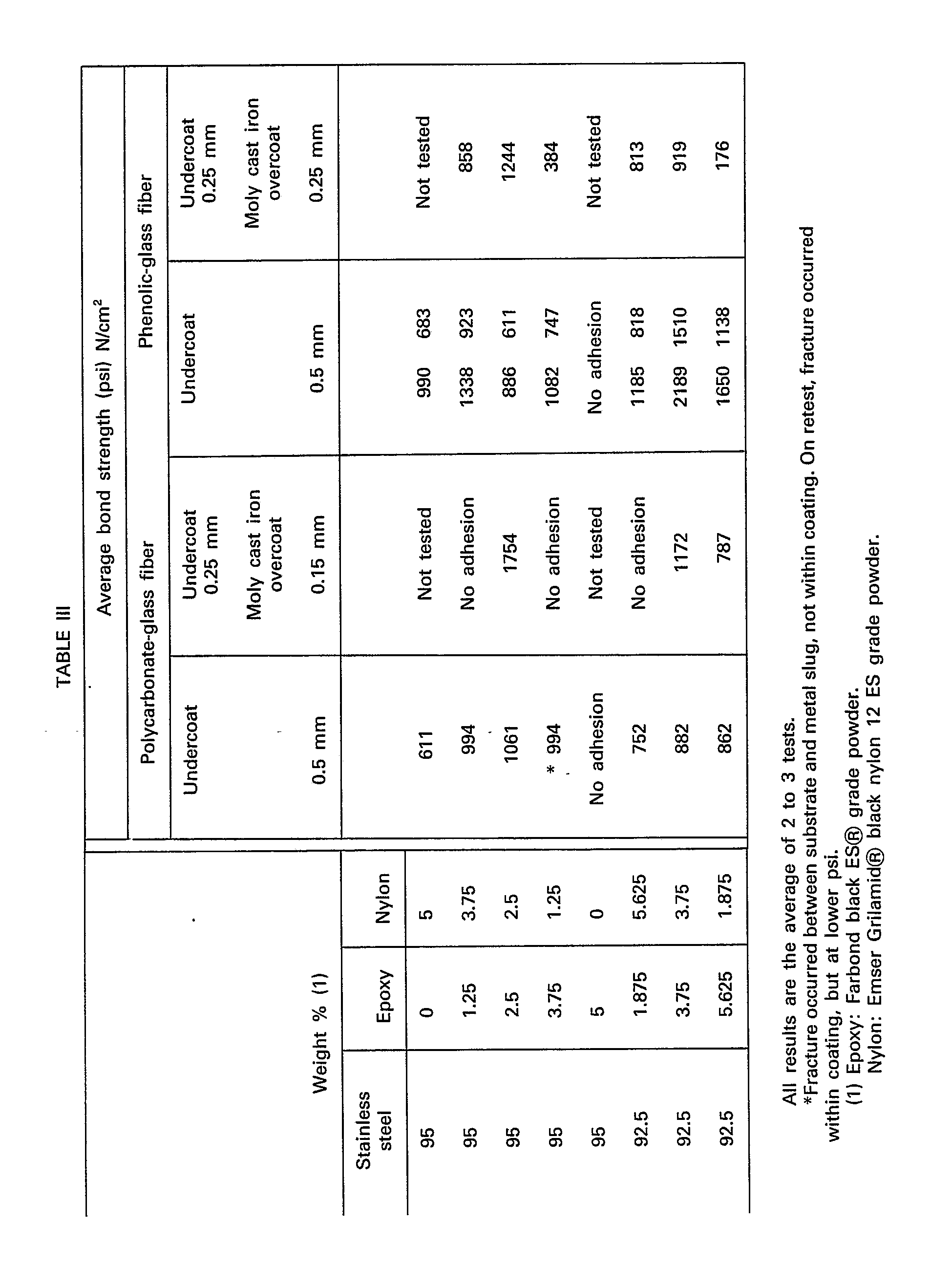
- Panels of 3.1 mm thickness were flame sprayed to a thickness of 0.25 mm with the agglomerates of Example 1 and then overcoated with flame sprayed nichrome to a thickness of 0.25 mm. The physical properties of the panels are set forth in Table IV.

- These data show that the application of the undercoat with the nichrome overcoat imparts added stiffness to plastic panels, giving coated panels at 93-132°C the same resistance to bending as uncoated panels at room temperature. The stiffening effect is roughly comparable to that brought about by electroplated metal on plastic, or fiber reinforcement of plastic.
- Graphite fiber reinforced epoxy tubes were flame sprayed to a thickness of 0,25 mm with the agglomerates of Example 3 and then overcoated with flame sprayed alumina-titania ceramic to a thickness of 0,25 mm. The ceramic was tightly bonded to the substrate and did not spall off or crack on cooling from the spraying temperature to room temperature.
Claims (10)
Applications Claiming Priority (2)
| Application Number | Priority Date | Filing Date | Title |
|---|---|---|---|
| US269437 | 1981-06-02 | ||
| US06/269,437 US4388373A (en) | 1981-06-02 | 1981-06-02 | Coating plastic substrates with minerals |
Publications (3)
| Publication Number | Publication Date |
|---|---|
| EP0066782A2 EP0066782A2 (en) | 1982-12-15 |
| EP0066782A3 EP0066782A3 (en) | 1983-02-16 |
| EP0066782B1 true EP0066782B1 (en) | 1987-01-07 |
Family
ID=23027247
Family Applications (1)
| Application Number | Title | Priority Date | Filing Date |
|---|---|---|---|
| EP82104583A Expired EP0066782B1 (en) | 1981-06-02 | 1982-05-26 | Coating plastic substrates with minerals |
Country Status (5)
| Country | Link |
|---|---|
| US (1) | US4388373A (en) |
| EP (1) | EP0066782B1 (en) |
| JP (1) | JPS5813666A (en) |
| CA (1) | CA1184685A (en) |
| DE (2) | DE66782T1 (en) |
Families Citing this family (20)
| Publication number | Priority date | Publication date | Assignee | Title |
|---|---|---|---|---|
| DE3419856C1 (en) * | 1984-05-28 | 1986-03-13 | Hoechst Ag, 6230 Frankfurt | Process for improving the wetting behavior of the surface of molded plastic parts for process engineering applications |
| DE3421157A1 (en) * | 1984-06-07 | 1985-12-12 | Ernst Leitz Wetzlar Gmbh, 6330 Wetzlar | PLASTIC-BASED COMPOSITE FOR PROSTHETIC PURPOSES |
| BR8703527A (en) * | 1986-07-11 | 1988-03-22 | Perkin Elmer Corp | COMPOSITE THERMAL ASPERSION POWDER TO PRODUCE ANTI-SCALING COATINGS, PROCESS TO PRODUCE SUCH COATINGS AND MARITIME STRUCTURE |
| IT1215707B (en) * | 1988-01-15 | 1990-02-22 | Hoechst Sara Spa | PROCESS FOR THE PREPARATION OF POWDER PAINTS TO OBTAIN UNIFORMLY OPAQUE OR SATIN FINISHED SURFACES. |
| US5286812A (en) * | 1988-02-19 | 1994-02-15 | University Of Massachusetts | High performance blends of aromatic polyimides with aromatic polyethersulfones |
| DE3905655C2 (en) * | 1989-02-24 | 2000-10-12 | Bosch Gmbh Robert | Control device |
| US4962137A (en) * | 1989-03-22 | 1990-10-09 | The Dow Chemical Company | Flame sprayable epoxy coating compositions |
| US4997704A (en) * | 1989-06-02 | 1991-03-05 | Technetics Corporation | Plasma-arc ceramic coating of non-conductive surfaces |
| US5236972A (en) * | 1989-07-05 | 1993-08-17 | The United States Of America As Represented By The Secretary Of The Air Force | Thermoplastic powder slurry for fiber impregnation and film formation |
| US5126205A (en) * | 1990-05-09 | 1992-06-30 | The Perkin-Elmer Corporation | Powder of plastic and treated mineral |
| US5660934A (en) * | 1994-12-29 | 1997-08-26 | Spray-Tech, Inc. | Clad plastic particles suitable for thermal spraying |
| US6024824A (en) | 1997-07-17 | 2000-02-15 | 3M Innovative Properties Company | Method of making articles in sheet form, particularly abrasive articles |
| IT1307298B1 (en) * | 1999-12-20 | 2001-10-30 | Ct Sviluppo Materiali Spa | PROCEDURE FOR THE PREPARATION OF LOW DENSITY COMPONENTS, CONSUBSTRATED IF ANY COMPOSITE WITH METAL OR POLYMER MATRIX, |
| DE10233830A1 (en) * | 2002-07-25 | 2004-02-12 | Creavis Gesellschaft Für Technologie Und Innovation Mbh | Method for preparation of self cleaning surfaces by application and fixing of particles to the surface useful for production of films, shaped parts, objects subjected to high dirt and water loads, especially in outdoor sports |
| CN101309758A (en) * | 2005-01-10 | 2008-11-19 | 埃克希姆公司 | Powder Thermal Spray Compositions |
| WO2008060405A2 (en) * | 2006-11-09 | 2008-05-22 | Xiom Corporation | Epoxy and thermoplastic powdered thermal spray compositions |
| DE102008019331A1 (en) * | 2008-04-16 | 2009-10-22 | Rolls-Royce Deutschland Ltd & Co Kg | Inlet seal for compressor of gas-turbine engine, has open-porous metallic sponge with filling material made of heat resistant duroplastic synthetic resin infiltrated in open-porous cavities of metallic sponge |
| GB0807261D0 (en) * | 2008-04-21 | 2008-05-28 | Accentus Plc | An article and a method of making an article |
| CN113493889A (en) * | 2021-04-20 | 2021-10-12 | 遵义中铂硬质合金有限责任公司 | Drill bit with wear-resistant hard alloy coating and preparation method |
| CN115850921A (en) * | 2022-12-16 | 2023-03-28 | 上海第二工业大学 | Method for preparing epoxy resin composite material by utilizing waste fan blades |
Family Cites Families (10)
| Publication number | Priority date | Publication date | Assignee | Title |
|---|---|---|---|---|
| US3449280A (en) * | 1960-04-27 | 1969-06-10 | Minnesota Mining & Mfg | Adhesive composition containing high molecular weight polyamides,epoxy resins and curing agents |
| NL260804A (en) * | 1961-02-03 | 1964-05-11 | Onderzoeksinstituut Research Nv | Method for the preparation of pigmented synthetic linear polyamides and products made therefrom |
| US3874921A (en) * | 1967-02-06 | 1975-04-01 | Judson P Todd | Weldable primer compositions and processes employing same |
| CH482753A (en) * | 1967-09-11 | 1969-12-15 | Ciba Geigy | Thermosetting molding compounds |
| US3542711A (en) * | 1967-11-06 | 1970-11-24 | Shell Oil Co | Process for preparing polyepoxide/thermoplastic resin fluidized bed coating compositions and resulting products |
| CH505869A (en) * | 1969-03-17 | 1971-04-15 | Inventa Ag | Process for the production of thermosetting, powdery plastic coating compositions |
| US3723165A (en) * | 1971-10-04 | 1973-03-27 | Metco Inc | Mixed metal and high-temperature plastic flame spray powder and method of flame spraying same |
| FR2204674A1 (en) * | 1972-11-01 | 1974-05-24 | Du Pont | |
| LU71231A1 (en) * | 1974-11-04 | 1976-09-06 | ||
| JPS5244852A (en) * | 1975-10-07 | 1977-04-08 | Nippon Paint Co Ltd | Thermosetting powder coating compositions |
-
1981
- 1981-06-02 US US06/269,437 patent/US4388373A/en not_active Expired - Lifetime
-
1982
- 1982-04-29 CA CA000401993A patent/CA1184685A/en not_active Expired
- 1982-05-26 DE DE198282104583T patent/DE66782T1/en active Pending
- 1982-05-26 DE DE8282104583T patent/DE3274990D1/en not_active Expired
- 1982-05-26 EP EP82104583A patent/EP0066782B1/en not_active Expired
- 1982-06-02 JP JP57093267A patent/JPS5813666A/en active Pending
Also Published As
| Publication number | Publication date |
|---|---|
| DE3274990D1 (en) | 1987-02-12 |
| EP0066782A2 (en) | 1982-12-15 |
| CA1184685A (en) | 1985-03-26 |
| US4388373A (en) | 1983-06-14 |
| DE66782T1 (en) | 1983-09-15 |
| EP0066782A3 (en) | 1983-02-16 |
| JPS5813666A (en) | 1983-01-26 |
Similar Documents
| Publication | Publication Date | Title |
|---|---|---|
| US4388373A (en) | Coating plastic substrates with minerals | |
| US4594106A (en) | Spraying materials containing ceramic needle fiber and composite materials spray-coated with such spraying materials | |
| US5070587A (en) | Roll for use in heat treating furnace and method of producing the same | |
| US4526618A (en) | Abrasion resistant coating composition | |
| EP1970462B1 (en) | Low stress metallic based coating | |
| US3927223A (en) | Method of forming refractory oxide coatings | |
| WO2019148162A1 (en) | Cold spray metallic coating and methods | |
| US3617358A (en) | Flame spray powder and process | |
| EP0178648B1 (en) | Undercoat composition and composite molded articles produced usin said compositon | |
| JP2001287312A (en) | Fiber reinforced composite material and method for coating the same | |
| WO2001046324A2 (en) | Erosion-resistant coatings for organic matrix composites | |
| CA1052929A (en) | Flame-sprayable flexible wires | |
| EP0426485B1 (en) | Powder coating compositions | |
| US5695883A (en) | Carbon member having a metal spray coating | |
| EP0157231B1 (en) | Aluminum and yttrium oxide coated thermal spray powder | |
| Alonso et al. | Erosion protection of carbon—epoxy composites by plasma-sprayed coatings | |
| US5126205A (en) | Powder of plastic and treated mineral | |
| JP2988281B2 (en) | Ceramic / metal composite powder for thermal spraying and method for forming thermal spray coating | |
| EP0379995A1 (en) | Powder of plastic and treated mineral | |
| JPH0733567A (en) | Carbon material having non-oxide ceramic sprayed coating and method for producing the same | |
| JPH05209259A (en) | Member for molten metal bath with coating film excellent in corrosion resistance to molten metal and exfoliation resistance and its production | |
| JPS6156313B2 (en) | ||
| EP0419209A2 (en) | Boron nitride composition | |
| JPS57134561A (en) | Self-cleanable coating layer | |
| JPS6156312B2 (en) |
Legal Events
| Date | Code | Title | Description |
|---|---|---|---|
| PUAI | Public reference made under article 153(3) epc to a published international application that has entered the european phase |
Free format text: ORIGINAL CODE: 0009012 |
|
| PUAL | Search report despatched |
Free format text: ORIGINAL CODE: 0009013 |
|
| 17P | Request for examination filed |
Effective date: 19820528 |
|
| AK | Designated contracting states |
Designated state(s): DE FR GB IT |
|
| AK | Designated contracting states |
Designated state(s): DE FR GB IT |
|
| ITCL | It: translation for ep claims filed |
Representative=s name: BARZANO' E ZANARDO MILANO S.P.A. |
|
| DET | De: translation of patent claims | ||
| EL | Fr: translation of claims filed | ||
| ITF | It: translation for a ep patent filed | ||
| GRAA | (expected) grant |
Free format text: ORIGINAL CODE: 0009210 |
|
| RAP1 | Party data changed (applicant data changed or rights of an application transferred) |
Owner name: THE PERKIN-ELMER CORPORATION |
|
| AK | Designated contracting states |
Kind code of ref document: B1 Designated state(s): DE FR GB IT |
|
| REF | Corresponds to: |
Ref document number: 3274990 Country of ref document: DE Date of ref document: 19870212 |
|
| ET | Fr: translation filed | ||
| PLBE | No opposition filed within time limit |
Free format text: ORIGINAL CODE: 0009261 |
|
| STAA | Information on the status of an ep patent application or granted ep patent |
Free format text: STATUS: NO OPPOSITION FILED WITHIN TIME LIMIT |
|
| 26N | No opposition filed | ||
| ITTA | It: last paid annual fee | ||
| PGFP | Annual fee paid to national office [announced via postgrant information from national office to epo] |
Ref country code: FR Payment date: 19950411 Year of fee payment: 14 |
|
| PGFP | Annual fee paid to national office [announced via postgrant information from national office to epo] |
Ref country code: DE Payment date: 19950425 Year of fee payment: 14 |
|
| PGFP | Annual fee paid to national office [announced via postgrant information from national office to epo] |
Ref country code: GB Payment date: 19950428 Year of fee payment: 14 |
|
| PG25 | Lapsed in a contracting state [announced via postgrant information from national office to epo] |
Ref country code: GB Effective date: 19960526 |
|
| GBPC | Gb: european patent ceased through non-payment of renewal fee |
Effective date: 19960526 |
|
| PG25 | Lapsed in a contracting state [announced via postgrant information from national office to epo] |
Ref country code: FR Effective date: 19970131 |
|
| PG25 | Lapsed in a contracting state [announced via postgrant information from national office to epo] |
Ref country code: DE Effective date: 19970201 |
|
| REG | Reference to a national code |
Ref country code: FR Ref legal event code: ST |