EP0064837A1 - Alkaline battery having a paper separator - Google Patents
Alkaline battery having a paper separator Download PDFInfo
- Publication number
- EP0064837A1 EP0064837A1 EP82302182A EP82302182A EP0064837A1 EP 0064837 A1 EP0064837 A1 EP 0064837A1 EP 82302182 A EP82302182 A EP 82302182A EP 82302182 A EP82302182 A EP 82302182A EP 0064837 A1 EP0064837 A1 EP 0064837A1
- Authority
- EP
- European Patent Office
- Prior art keywords
- fibres
- paper
- alkali
- battery
- polyolefinic
- Prior art date
- Legal status (The legal status is an assumption and is not a legal conclusion. Google has not performed a legal analysis and makes no representation as to the accuracy of the status listed.)
- Granted
Links
- 239000011230 binding agent Substances 0.000 claims abstract description 29
- 230000003014 reinforcing effect Effects 0.000 claims abstract description 18
- 239000003513 alkali Substances 0.000 claims abstract description 17
- 229920002451 polyvinyl alcohol Polymers 0.000 claims abstract description 14
- 239000004372 Polyvinyl alcohol Substances 0.000 claims abstract description 13
- 238000000034 method Methods 0.000 claims abstract description 13
- 229920000297 Rayon Polymers 0.000 claims abstract description 6
- 239000002964 rayon Substances 0.000 claims abstract description 6
- 239000004677 Nylon Substances 0.000 claims abstract description 4
- 229920001778 nylon Polymers 0.000 claims abstract description 4
- 239000004800 polyvinyl chloride Substances 0.000 claims abstract description 4
- 229920000915 polyvinyl chloride Polymers 0.000 claims abstract description 4
- 239000000203 mixture Substances 0.000 claims description 8
- 230000008569 process Effects 0.000 claims description 8
- 239000000835 fiber Substances 0.000 claims description 7
- 238000001035 drying Methods 0.000 claims description 5
- 238000011282 treatment Methods 0.000 claims description 3
- KWYUFKZDYYNOTN-UHFFFAOYSA-M Potassium hydroxide Chemical compound [OH-].[K+] KWYUFKZDYYNOTN-UHFFFAOYSA-M 0.000 description 13
- -1 polyethylene Polymers 0.000 description 7
- 239000011148 porous material Substances 0.000 description 7
- 239000000463 material Substances 0.000 description 6
- 229920000098 polyolefin Polymers 0.000 description 6
- 238000003825 pressing Methods 0.000 description 6
- 239000004698 Polyethylene Substances 0.000 description 5
- 229920000573 polyethylene Polymers 0.000 description 5
- 239000003792 electrolyte Substances 0.000 description 4
- 239000000126 substance Substances 0.000 description 4
- 229920002994 synthetic fiber Polymers 0.000 description 4
- 239000000945 filler Substances 0.000 description 3
- 230000000704 physical effect Effects 0.000 description 3
- 239000004094 surface-active agent Substances 0.000 description 3
- PWHULOQIROXLJO-UHFFFAOYSA-N Manganese Chemical compound [Mn] PWHULOQIROXLJO-UHFFFAOYSA-N 0.000 description 2
- 239000004743 Polypropylene Substances 0.000 description 2
- 239000002253 acid Substances 0.000 description 2
- 230000008901 benefit Effects 0.000 description 2
- 230000015572 biosynthetic process Effects 0.000 description 2
- 239000003795 chemical substances by application Substances 0.000 description 2
- 239000002657 fibrous material Substances 0.000 description 2
- 229910052748 manganese Inorganic materials 0.000 description 2
- 239000011572 manganese Substances 0.000 description 2
- 229920001155 polypropylene Polymers 0.000 description 2
- 229920003043 Cellulose fiber Polymers 0.000 description 1
- 239000012670 alkaline solution Substances 0.000 description 1
- 230000004075 alteration Effects 0.000 description 1
- 206010061592 cardiac fibrillation Diseases 0.000 description 1
- 230000015556 catabolic process Effects 0.000 description 1
- 210000004027 cell Anatomy 0.000 description 1
- 238000006243 chemical reaction Methods 0.000 description 1
- 239000011248 coating agent Substances 0.000 description 1
- 238000000576 coating method Methods 0.000 description 1
- 238000007596 consolidation process Methods 0.000 description 1
- 238000006731 degradation reaction Methods 0.000 description 1
- 210000001787 dendrite Anatomy 0.000 description 1
- 238000013461 design Methods 0.000 description 1
- 230000001627 detrimental effect Effects 0.000 description 1
- 230000000694 effects Effects 0.000 description 1
- 238000002474 experimental method Methods 0.000 description 1
- 230000002600 fibrillogenic effect Effects 0.000 description 1
- 230000002209 hydrophobic effect Effects 0.000 description 1
- 238000005470 impregnation Methods 0.000 description 1
- 238000010348 incorporation Methods 0.000 description 1
- 239000011256 inorganic filler Substances 0.000 description 1
- 229910003475 inorganic filler Inorganic materials 0.000 description 1
- 238000003780 insertion Methods 0.000 description 1
- 230000037431 insertion Effects 0.000 description 1
- 108700005457 microfibrillar Proteins 0.000 description 1
- 238000012986 modification Methods 0.000 description 1
- 230000004048 modification Effects 0.000 description 1
- 239000007787 solid Substances 0.000 description 1
- 239000000243 solution Substances 0.000 description 1
- 238000005507 spraying Methods 0.000 description 1
- 238000012360 testing method Methods 0.000 description 1
Classifications
-
- H—ELECTRICITY
- H01—ELECTRIC ELEMENTS
- H01M—PROCESSES OR MEANS, e.g. BATTERIES, FOR THE DIRECT CONVERSION OF CHEMICAL ENERGY INTO ELECTRICAL ENERGY
- H01M50/00—Constructional details or processes of manufacture of the non-active parts of electrochemical cells other than fuel cells, e.g. hybrid cells
- H01M50/40—Separators; Membranes; Diaphragms; Spacing elements inside cells
- H01M50/409—Separators, membranes or diaphragms characterised by the material
- H01M50/44—Fibrous material
-
- H—ELECTRICITY
- H01—ELECTRIC ELEMENTS
- H01M—PROCESSES OR MEANS, e.g. BATTERIES, FOR THE DIRECT CONVERSION OF CHEMICAL ENERGY INTO ELECTRICAL ENERGY
- H01M50/00—Constructional details or processes of manufacture of the non-active parts of electrochemical cells other than fuel cells, e.g. hybrid cells
- H01M50/40—Separators; Membranes; Diaphragms; Spacing elements inside cells
- H01M50/409—Separators, membranes or diaphragms characterised by the material
- H01M50/411—Organic material
- H01M50/414—Synthetic resins, e.g. thermoplastics or thermosetting resins
- H01M50/417—Polyolefins
-
- H—ELECTRICITY
- H01—ELECTRIC ELEMENTS
- H01M—PROCESSES OR MEANS, e.g. BATTERIES, FOR THE DIRECT CONVERSION OF CHEMICAL ENERGY INTO ELECTRICAL ENERGY
- H01M50/00—Constructional details or processes of manufacture of the non-active parts of electrochemical cells other than fuel cells, e.g. hybrid cells
- H01M50/40—Separators; Membranes; Diaphragms; Spacing elements inside cells
- H01M50/489—Separators, membranes, diaphragms or spacing elements inside the cells, characterised by their physical properties, e.g. swelling degree, hydrophilicity or shut down properties
- H01M50/491—Porosity
-
- H—ELECTRICITY
- H01—ELECTRIC ELEMENTS
- H01M—PROCESSES OR MEANS, e.g. BATTERIES, FOR THE DIRECT CONVERSION OF CHEMICAL ENERGY INTO ELECTRICAL ENERGY
- H01M50/00—Constructional details or processes of manufacture of the non-active parts of electrochemical cells other than fuel cells, e.g. hybrid cells
- H01M50/40—Separators; Membranes; Diaphragms; Spacing elements inside cells
- H01M50/489—Separators, membranes, diaphragms or spacing elements inside the cells, characterised by their physical properties, e.g. swelling degree, hydrophilicity or shut down properties
- H01M50/494—Tensile strength
-
- H—ELECTRICITY
- H01—ELECTRIC ELEMENTS
- H01M—PROCESSES OR MEANS, e.g. BATTERIES, FOR THE DIRECT CONVERSION OF CHEMICAL ENERGY INTO ELECTRICAL ENERGY
- H01M2300/00—Electrolytes
- H01M2300/0002—Aqueous electrolytes
- H01M2300/0014—Alkaline electrolytes
-
- Y—GENERAL TAGGING OF NEW TECHNOLOGICAL DEVELOPMENTS; GENERAL TAGGING OF CROSS-SECTIONAL TECHNOLOGIES SPANNING OVER SEVERAL SECTIONS OF THE IPC; TECHNICAL SUBJECTS COVERED BY FORMER USPC CROSS-REFERENCE ART COLLECTIONS [XRACs] AND DIGESTS
- Y02—TECHNOLOGIES OR APPLICATIONS FOR MITIGATION OR ADAPTATION AGAINST CLIMATE CHANGE
- Y02E—REDUCTION OF GREENHOUSE GAS [GHG] EMISSIONS, RELATED TO ENERGY GENERATION, TRANSMISSION OR DISTRIBUTION
- Y02E60/00—Enabling technologies; Technologies with a potential or indirect contribution to GHG emissions mitigation
- Y02E60/10—Energy storage using batteries
Definitions
- This invention relates to a battery separator paper for use in an alkaline battery, for example an alkaline manganese battery (paper for this purpose is sometimes also referred to as battery component paper).
- Such a separator may be made from a porous or microporous single or multiple layered electrically non-conductive non-woven fibrous material.
- the material used for the separator should desirably have the following properties:-
- One widely used type of conventional alkaline battery separator comprises one or more layers of non-woven fibrous material.
- a wet-laid paper made from cellulose fibres, either alone or in a blend with synthetic fibres, e.g. polyolefin fibres, might at first sight be thought to afford a route to a cheaper battery paper.
- synthetic fibres e.g. polyolefin fibres
- a good alkaline battery separator paper may be made from a blend of polyolefin synthetic pulp fibres and other fibres without heat bonding if an alkali-resistant hydrophilic binder is used to bond the fibres together. No filler need be used.
- battery separator paper for use in an alkaline battery, comprising a blend of polyolefinic synthetic pulp fibres and alkali-resistant fibres which are effective to reinforce the polyolefinic fibres, characterized in that the synthetic pulp fibres are not substantially heat bonded to each other or to the reinforcing fibres but are bonded to each other and the reinforcing fibres by means of an alkali-resistant hydrophilic binder which is present in an amount additional to any such binder which may have been present in said synthetic pulp fibres or the reinforcing fibres.
- the invention also resides in a battery separator made using battery paper according to said first aspect of the invention and in an alkaline battery incorporating such a separator.
- polyolefinic synthetic pulp fibres polyolefinic fibres of the kind specially produced for use in papermaking and which exhibit a high degree of fibrillation (in contrast to chopped staple fibres).
- Suitable fibres for example are those supplied under the names “Pulpex” by Solvay, “SWP” by Crown Zellerbach, "Hostapulp” by Hoechst and “Ferlosa” by Montedison.
- the polyolefin fibres are preferably polyethylene fibres but polypropylene fibres may be used. Polyethylene fibres have so far been found to afford better pore size characteristics.
- the maximum temperature which the web reaches in drying or other treatment must be carefully controlled so as to be below the softening temperature range of the fibres being used.
- the web temperature should be sufficiently below the softening threshold of the lowest softening fibres in the web to prevent heat bonding of the fibres. It is difficult to measure web temperature precisely and so it is convenient to refer to drying cylinder surface temperatures which should normally be maintained at least 10-20°C below the softening threshold. A temperature at least 30 0 C below the softening threshold has so far been found preferable.
- the softening temperature range for polyethylene synthetic pulp is usually about 125-130°C.
- the softening range is about 160-165°C and so the web temperature should desirably not exceed about 130 C., although higher temperatures may be tolerated.
- the polyolefinic synthetic pulp is present in an amount of from about 30% to about 85% by weight of the total fibre content of the paper.
- the added binder i.e. the binder additional to any binder material present in the synthetic pulp fibres or the reinforcing fibres as supplied, is present in an amount of at least about 2% by weight based on the total weight of the web.
- the preferred binder is polyvinyl alcohol, in which case the added binder amount is preferably around 5-15% by weight, based on the total weight of the web.
- the paper preferably incorporates a small amount of a wet-strength agent.
- the density of the present paper is increased by pressing.
- the preferred density is in the range from 0.170 g cm -3 to 0.335 g cm -3 .
- the maximum pore diameter and air resistance of the paper may vary widely, as will be seen from the Examples hereafter. This is advantageous because the battery maker is provided with a wider variety of papers having different properties thus giving a wider scope for battery design.
- the total grammage of the separator is preferably in the range 30 to 100 gm -2 and more preferably in the range 60-100 gm-2 which may be made up, for example of 3 x 20 gm -2 sheets or 2 x 50 g cm -3 sheets or may be a single sheet of that grammage.
- a number of sheets of battery paper of nominal grammage 90 gm -2 were prepared on a standard laboratory sheet machine from 0.5% consistency stock comprising 70% polyethylene fibres ("Pulpex A” marketed by Solvay), 30% polyvinyl alcohol fibres (“Mewlon F” marketed by Unitakei Ltd.), and a wet strength agent (“Kymene” marketed by Hercules) added in an amount of 2% based on the total fibre content.
- Example 1 illustrates the use of a different furnish from that used in Example 1.
- the paper was also tested for stability in potassium hydroxide as described in Example 1 above and was found to be stable.
Landscapes
- Chemical & Material Sciences (AREA)
- Chemical Kinetics & Catalysis (AREA)
- Electrochemistry (AREA)
- General Chemical & Material Sciences (AREA)
- Cell Separators (AREA)
- Secondary Cells (AREA)
Abstract
Description
- This invention relates to a battery separator paper for use in an alkaline battery, for example an alkaline manganese battery (paper for this purpose is sometimes also referred to as battery component paper).
- Such a separator may be made from a porous or microporous single or multiple layered electrically non-conductive non-woven fibrous material. The material used for the separator should desirably have the following properties:-
- 1. Porous nature which will allow a low internal resistance within the battery whilst maintaining the required storage and service life (these characteristics are to some extent incompatible in that whereas the presence of pores affords the conductivity necessary for low internal resistance, they also give rise to the danger of shorting as a result of dendritic growth through the pores which reduces battery life - it is therefore necessary to select a suitable compromise).
- 2. The chemical strength to withstand stresses arising during assembly of the battery, for example folding and insertion into a battery can.
- 3. Dimensional stability in an alkaline environment.
- 4. Wettability by the electrolyte.
- 5. Absorbency with respect to the electrolyte.
- 6. Resistance to degradation by electrolyte or other battery chemicals.
- For certain types of alkaline battery, in which a separator of preformed shape is employed, it is in addition desirable that the separator material should be heat sealable, so as to facilitate the preforming operation.
- One widely used type of conventional alkaline battery separator comprises one or more layers of non-woven fibrous material.
- This conventional material utilises expensive synthetic fibres and, by virtue of the forming process is expensive to produce.
- A wet-laid paper made from cellulose fibres, either alone or in a blend with synthetic fibres, e.g. polyolefin fibres, might at first sight be thought to afford a route to a cheaper battery paper. However, although such paper has absorbency, it has a high shrinkage in alkaline solution.
- Proposals have been made to form an alkaline battery separator from a paper web formed by conventional papermaking techniques from a blend of polyolefin synthetic pulp fibres and other synthetic fibres, see for example UK Patent Application No. 2057028A, which also requires the presence of an alkali-resistant inorganic filler, and UK Patent Application No. 2034365A. Heat bonding is either a preferred or essential feature of these proposals and would be expected to be a drawback in view of the difficulty of controlling the degree of heat bonding so as to achieve reproducible separator properties.
- Papers derived from a blend of polyolefin synthetic pulp fibres and other synthetic fibres have also been proposed for separators of acid batteries. However it should be appreciated that conventional lead-acid and secondary alkaline battery systems have certain components such as electrodes, electrolytes, separators, etc., which, though commonly named, are distinctly different entities having different functions and are required to have different physical and chemical properties.
- It has now been found that a good alkaline battery separator paper may be made from a blend of polyolefin synthetic pulp fibres and other fibres without heat bonding if an alkali-resistant hydrophilic binder is used to bond the fibres together. No filler need be used.
- According to a first aspect of the invention, there is provided battery separator paper for use in an alkaline battery, comprising a blend of polyolefinic synthetic pulp fibres and alkali-resistant fibres which are effective to reinforce the polyolefinic fibres, characterized in that the synthetic pulp fibres are not substantially heat bonded to each other or to the reinforcing fibres but are bonded to each other and the reinforcing fibres by means of an alkali-resistant hydrophilic binder which is present in an amount additional to any such binder which may have been present in said synthetic pulp fibres or the reinforcing fibres.
- According to a second aspect of the invention, there is provided a process for forming a battery separator paper for use in an alkaline battery, comprising the steps of forming a wet-laid paper web from a blend of polyolefinic synthetic pulp fibres and alkali-resistant fibres which are effective to reinforce the polyolefinic fibres, and drying the web thus formed, characterized in that in applying heat to dry or otherwise treat the web, the conditions are such that the synthetic pulp fibres do not become substantially heat bonded to each other or to the reinforcing fibres and in that an alkali-resistant hydrophilic binder is incorporated in the web in an amount additional to any such binder which may already be present in said synthetic pulp fibres or the reinforcing fibres.
- The invention also resides in a battery separator made using battery paper according to said first aspect of the invention and in an alkaline battery incorporating such a separator.
- By "polyolefinic synthetic pulp fibres" is meant polyolefinic fibres of the kind specially produced for use in papermaking and which exhibit a high degree of fibrillation (in contrast to chopped staple fibres). Suitable fibres, for example are those supplied under the names "Pulpex" by Solvay, "SWP" by Crown Zellerbach, "Hostapulp" by Hoechst and "Ferlosa" by Montedison. The polyolefin fibres are preferably polyethylene fibres but polypropylene fibres may be used. Polyethylene fibres have so far been found to afford better pore size characteristics.
- Since polyolefins are hydrophobic in nature, it is necessary for synthetic pulp fibres to be specially modified to make them water-dispersible. Such modification may take the form of a coating of hydrophilic material on each fibre.. The hydrophilic material may be a chemical of the kind used in papermaking binders - hence the emphasis above on the presence or incorporation of additional binder.
- The reinforcing fibres are preferably polyvinyl alcohol fibres, although rayon, PVC, nylon or other chemically resistant fibres may be used. The reinforcing fibres are conveniently chopped staple fibres, but in principle need not be. The reinforcing fibres may be chopped staple polyolefinic fibres.
- As stated above, it is important to avoid heat bonding in making the present battery paper. This has been found to result in alteration of the microfibrillar structure of the web - the individual fibres shrivel as they are heated causing the pore size to increase. This then encourages dendrite growth in the battery and also increases the hydrophobicity of the separator. A further disadvantage is that in any event a heat consolidation step is difficult to control and thus reproducible separator properties are difficult to achieve. In contrast, use of a binder for bonding permits relatively easy control of web properties.
- In order to ensure that heat bonding does not occur, the maximum temperature which the web reaches in drying or other treatment must be carefully controlled so as to be below the softening temperature range of the fibres being used. Clearly the web temperature should be sufficiently below the softening threshold of the lowest softening fibres in the web to prevent heat bonding of the fibres. It is difficult to measure web temperature precisely and so it is convenient to refer to drying cylinder surface temperatures which should normally be maintained at least 10-20°C below the softening threshold. A temperature at least 300C below the softening threshold has so far been found preferable. The softening temperature range for polyethylene synthetic pulp is usually about 125-130°C. For paper made from such pulp drying acylinder temperatures should preferably not exceed about 95°C, although higher temperatures,say up to about 105°C, may be usable. Should it be found that heat bonding is occurring the skilled man will have no difficulty in establishing by routine experiment a temperature at which heat bonding no longer occurs, particularly in view of the guidance given above.
- For polypropylene, the softening range is about 160-165°C and so the web temperature should desirably not exceed about 130 C., although higher temperatures may be tolerated.
- Preferably the polyolefinic synthetic pulp is present in an amount of from about 30% to about 85% by weight of the total fibre content of the paper.
- Preferably, the added binder, i.e. the binder additional to any binder material present in the synthetic pulp fibres or the reinforcing fibres as supplied, is present in an amount of at least about 2% by weight based on the total weight of the web. The preferred binder is polyvinyl alcohol, in which case the added binder amount is preferably around 5-15% by weight, based on the total weight of the web.
- Preferably the binder is incorporated in the web by size press application, although other methods may be employed, for example gravure roll application, spraying or impregnation. At least a proportion of the binder may be added to the stock before web formation.
- It may also be desirable to add a surfactant to enhance the wettability of the separator. The surfactant should be selected so as not to inhibit the chemical reactions which take place within the battery cells. The surfactant is preferably added with the binder,to the stock before web formation or subsequently to the dry sheet.
- The paper preferably incorporates a small amount of a wet-strength agent.
- It has been found that the use of a filler, either as a loading or fibre inclusion, is not required in the present separator paper. However, such a filler may if desired be employed, provided it is not detrimental to the separator properties.
- Preferably the density of the present paper is increased by pressing. The preferred density is in the range from 0.170 g cm-3 to 0.335 g cm-3.
- The maximum pore diameter and air resistance of the paper may vary widely, as will be seen from the Examples hereafter. This is advantageous because the battery maker is provided with a wider variety of papers having different properties thus giving a wider scope for battery design.
- The separator may comprise one ply of the present paper, or more than one ply. In the latter case the plies are preferably of the same paper, but need not be. An advantage of a multiply separator is that each ply may have a large pore size so as to afford good conductivity and a low internal resistance, since the presence of several plies means that coincidence of large holes (which might promote shorting) is avoided. The plies may be separately formed on a Fourdrinier papermachine or a Rotiformer or may be made in one step by the use of, for example, a secondary headbox.
- The total grammage of the separator is preferably in the range 30 to 100 gm -2 and more preferably in the range 60-100 gm-2 which may be made up, for example of 3 x 20 gm -2 sheets or 2 x 50 g cm-3 sheets or may be a single sheet of that grammage.
- By suitably choosing the grammage, density, fibre furnish and the binder, a separator paper of good handleability and desired physical properties (e.g. absorbency, porosity etc.) can be obtained. Guidance as to this choice may be obtained from the Examples given later.
- The present battery paper affords the advantages of cheapness, and, when converted into a separator and used in an alkaline battery affords good.storage and shelf life, and good discharge rate.
- The invention will now be illustrated by reference to the following examples.
- A number of sheets of battery paper of nominal grammage 90 gm-2 were prepared on a standard laboratory sheet machine from 0.5% consistency stock comprising 70% polyethylene fibres ("Pulpex A" marketed by Solvay), 30% polyvinyl alcohol fibres ("Mewlon F" marketed by Unitakei Ltd.), and a wet strength agent ("Kymene" marketed by Hercules) added in an amount of 2% based on the total fibre content.
- The resulting sheets were pressed in the wet state and then subjected to three different pressing treatments using laboratory pressing equipment to produce sheets of low, medium and high density. In all three cases the sheet was then dried on a rotary drier (at a surface temperature of approximately 95oC). A laboratory size press was then used to add polyvinyl alcohol binder to give a 15% dry pick up (the binder used was that supplied as "Mowiol 4-98" by Hoechst Aktiengesellschaft in 10% solids content solution. The physical properties of each sheet were tested in all three cases to give the following results as shown in Table 1.
-

- The dimensional stability of each paper in 30% potassium hydroxide solution at 70°C for 48 hours was also tested (this is intended to afford an indication of how the paper would withstand an alkaline environment over a long period of time when incorporated in a battery). In each case the papers were found to be stable.
- This Example illustrates the use of a different furnish from that used in Example 1.
- The battery paper was made in the same way as the low density paper in Example 1 except that the furnish used consisted of 85% polyethylene fibres with 15% polyvinyl alcohol fibres. The physical properties of the resulting sheet are shown in Table 2.
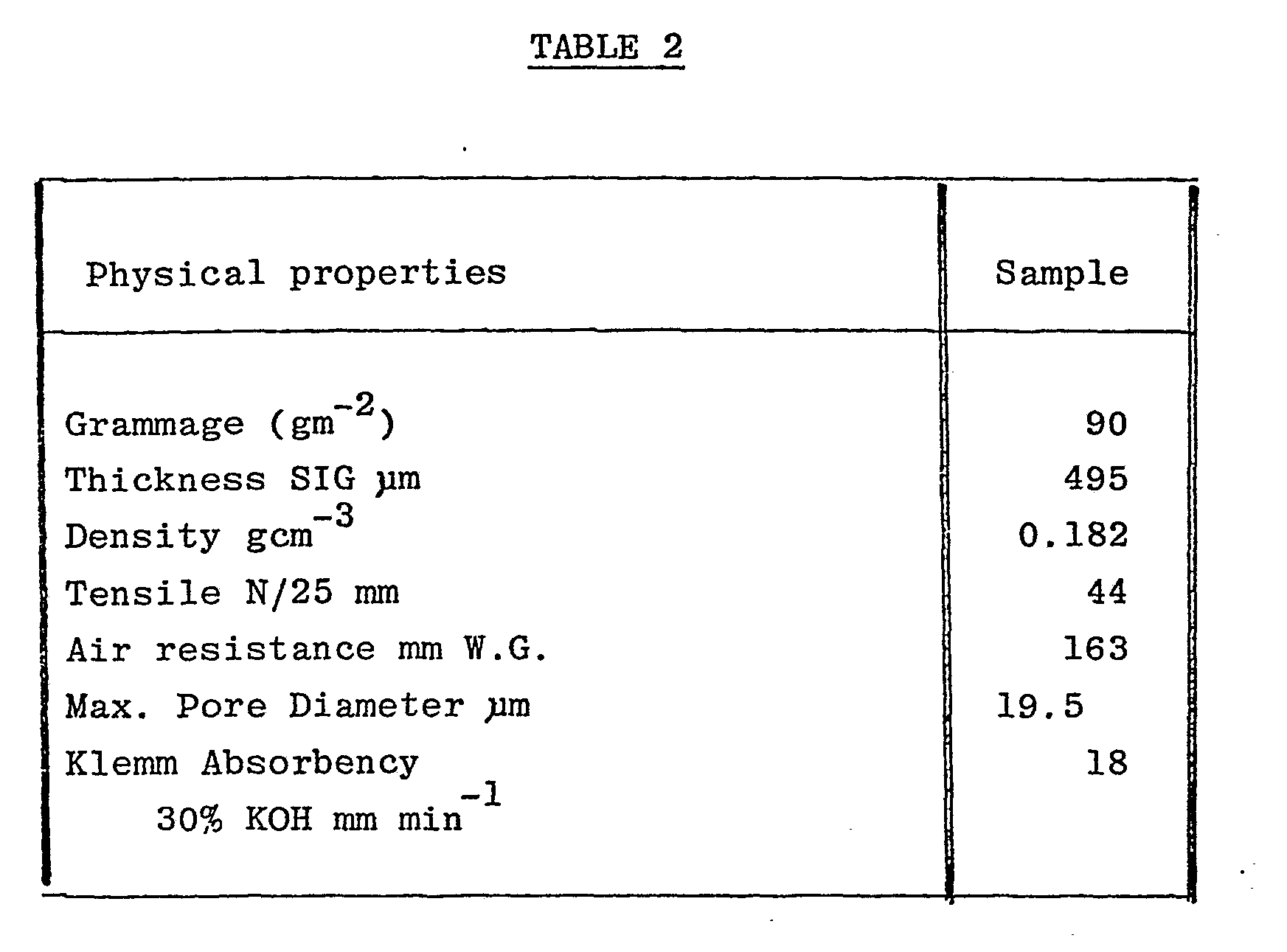
- The paper was also tested for stability in potassium hydroxide as described in Example 1 above and was found to be stable.
- This example illustrates the use of papers of different grammage and varying density. The procedure was generally as described in Example 1 and the results are shown in Table 3.

- Each sheet was also tested for stability in potassium hydroxide as described in Example 1 above and in each case it was found to be stable.
- This example illustrates the use of different reinforcing fibres and different furnishes.
- The procedure was generally as described in Example 1 except that rayon was used in place of polyvinyl alcohol fibres and in combination with polyvinyl alcohol fibres.
- The following furnishes were tested :

- The results are shown in Table 4.

- Each sheet was also tested for stability in potassium hydroxide as described in Example 1 above and in each case it was found to be stable.
- This example illustrates the effect of wet pressing on density and pore size.
- A furnish of 30% Pulpex A and 70% 6 mm 1.5 den rayon was made into two samples and one subjected to light pressing and the other to more heavy pressing.
- The results are shown in Table 5.

- Each sheet was also tested for stability in potassium hydroxide as described in Example 1 above and in each case it was found to be stable.
- When papers produced as described in the above examples were incorporated into test alkaline manganese batteries, they were found to function satisfactorily.
Claims (15)
Priority Applications (1)
| Application Number | Priority Date | Filing Date | Title |
|---|---|---|---|
| AT82302182T ATE20988T1 (en) | 1981-04-28 | 1982-04-28 | ALKALINE BATTERY WITH PAPER SEPARATOR. |
Applications Claiming Priority (2)
| Application Number | Priority Date | Filing Date | Title |
|---|---|---|---|
| GB8113114 | 1981-04-28 | ||
| GB8113114 | 1981-04-28 |
Publications (2)
| Publication Number | Publication Date |
|---|---|
| EP0064837A1 true EP0064837A1 (en) | 1982-11-17 |
| EP0064837B1 EP0064837B1 (en) | 1986-07-23 |
Family
ID=10521441
Family Applications (1)
| Application Number | Title | Priority Date | Filing Date |
|---|---|---|---|
| EP82302182A Expired EP0064837B1 (en) | 1981-04-28 | 1982-04-28 | Alkaline battery having a paper separator |
Country Status (3)
| Country | Link |
|---|---|
| EP (1) | EP0064837B1 (en) |
| AT (1) | ATE20988T1 (en) |
| DE (1) | DE3272109D1 (en) |
Cited By (6)
| Publication number | Priority date | Publication date | Assignee | Title |
|---|---|---|---|---|
| EP0228603A1 (en) * | 1985-12-27 | 1987-07-15 | Kuraray Co., Ltd. | Separators for alkaline dry batteries |
| EP0246862A1 (en) * | 1986-05-19 | 1987-11-25 | W.R. Grace & Co.-Conn. | Sheet materials, their production and their use as battery separators |
| EP0322169A3 (en) * | 1987-12-21 | 1990-08-08 | Entek Manufacturing Inc. | Microporous filaments and fibers, process of making same, and articles made therefrom |
| EP0401076A1 (en) * | 1989-05-16 | 1990-12-05 | SAFT (inscrite au Registre du Commerce sous le numéro 343 588 737) | Nickel-cadmium accumulator with reduced maintenance |
| EP0756340A1 (en) * | 1995-07-27 | 1997-01-29 | Pall Corporation | Resilient battery separator |
| WO2008075348A1 (en) * | 2006-12-18 | 2008-06-26 | Power Paper Ltd | Battery separator |
Citations (8)
| Publication number | Priority date | Publication date | Assignee | Title |
|---|---|---|---|---|
| US3918994A (en) * | 1973-11-28 | 1975-11-11 | Johns Manville | Battery plate retainer mat and method of manufacture |
| FR2342155A1 (en) * | 1976-02-26 | 1977-09-23 | Montedison Spa | LEATHER-LIKE MATERIALS AND PROCESS FOR THEIR PREPARATION |
| US4078123A (en) * | 1976-12-23 | 1978-03-07 | Varta Batterie Aktiengesellschaft | Spiral-wrapped multi-layer cell separator |
| GB1530961A (en) * | 1975-01-20 | 1978-11-01 | Tokyo Shibaura Electric Co | Rechargeable nickel-zinc battery |
| GB2020086A (en) * | 1978-04-26 | 1979-11-07 | Mitsui Petrochemical Ind | Battery separator its preparation and its use |
| GB2034365A (en) * | 1978-11-09 | 1980-06-04 | Dexter Corp | Nonwoven fibrous substrate for battery separator |
| GB2057028A (en) * | 1979-07-13 | 1981-03-25 | Grace W R & Co | Membrane for use as a battery interseparator or separator |
| GB2078769A (en) * | 1980-06-30 | 1982-01-13 | Texon Inc | Battery Separator Material and Method of Forming the Same |
-
1982
- 1982-04-28 EP EP82302182A patent/EP0064837B1/en not_active Expired
- 1982-04-28 DE DE8282302182T patent/DE3272109D1/en not_active Expired
- 1982-04-28 AT AT82302182T patent/ATE20988T1/en active
Patent Citations (8)
| Publication number | Priority date | Publication date | Assignee | Title |
|---|---|---|---|---|
| US3918994A (en) * | 1973-11-28 | 1975-11-11 | Johns Manville | Battery plate retainer mat and method of manufacture |
| GB1530961A (en) * | 1975-01-20 | 1978-11-01 | Tokyo Shibaura Electric Co | Rechargeable nickel-zinc battery |
| FR2342155A1 (en) * | 1976-02-26 | 1977-09-23 | Montedison Spa | LEATHER-LIKE MATERIALS AND PROCESS FOR THEIR PREPARATION |
| US4078123A (en) * | 1976-12-23 | 1978-03-07 | Varta Batterie Aktiengesellschaft | Spiral-wrapped multi-layer cell separator |
| GB2020086A (en) * | 1978-04-26 | 1979-11-07 | Mitsui Petrochemical Ind | Battery separator its preparation and its use |
| GB2034365A (en) * | 1978-11-09 | 1980-06-04 | Dexter Corp | Nonwoven fibrous substrate for battery separator |
| GB2057028A (en) * | 1979-07-13 | 1981-03-25 | Grace W R & Co | Membrane for use as a battery interseparator or separator |
| GB2078769A (en) * | 1980-06-30 | 1982-01-13 | Texon Inc | Battery Separator Material and Method of Forming the Same |
Non-Patent Citations (2)
| Title |
|---|
| CHEMICAL ABSTRACTS, vol. 85, no. 4, 23rd August 1976, page 156, no. 49124s, Columbus, Ohio, USA & JP - A - 76 00623 (FUJI ELECTROCHEMICAL CO., LTD.) 06-01-1976 * |
| CHEMICAL ABSTRACTS, vol. 89, no. 18, 30th October 1978, page 156, no. 149492g, Columbus, Ohio, USA & JP - A - 78 65931 (KANAI, HIROYUKI) 12-06-1978 * |
Cited By (11)
| Publication number | Priority date | Publication date | Assignee | Title |
|---|---|---|---|---|
| EP0228603A1 (en) * | 1985-12-27 | 1987-07-15 | Kuraray Co., Ltd. | Separators for alkaline dry batteries |
| US4746586A (en) * | 1985-12-27 | 1988-05-24 | Kuraray Company Limited | Separators for alkaline dry batteries |
| EP0246862A1 (en) * | 1986-05-19 | 1987-11-25 | W.R. Grace & Co.-Conn. | Sheet materials, their production and their use as battery separators |
| US4734344A (en) * | 1986-05-19 | 1988-03-29 | W. R. Grace & Co. | Battery separator |
| AU592178B2 (en) * | 1986-05-19 | 1990-01-04 | W.R. Grace & Co.-Conn. | Sheet material suitable for use as a battery separator |
| EP0322169A3 (en) * | 1987-12-21 | 1990-08-08 | Entek Manufacturing Inc. | Microporous filaments and fibers, process of making same, and articles made therefrom |
| EP0401076A1 (en) * | 1989-05-16 | 1990-12-05 | SAFT (inscrite au Registre du Commerce sous le numéro 343 588 737) | Nickel-cadmium accumulator with reduced maintenance |
| WO1990014695A3 (en) * | 1989-05-16 | 1990-12-27 | Accumulateurs Fixes | Reduced maintenance nickel-cadmium accumulator |
| EP0756340A1 (en) * | 1995-07-27 | 1997-01-29 | Pall Corporation | Resilient battery separator |
| US5645956A (en) * | 1995-07-27 | 1997-07-08 | Pall Corporation | Resilient battery separator |
| WO2008075348A1 (en) * | 2006-12-18 | 2008-06-26 | Power Paper Ltd | Battery separator |
Also Published As
| Publication number | Publication date |
|---|---|
| EP0064837B1 (en) | 1986-07-23 |
| ATE20988T1 (en) | 1986-08-15 |
| DE3272109D1 (en) | 1986-08-28 |
Similar Documents
| Publication | Publication Date | Title |
|---|---|---|
| US5389471A (en) | Wettable battery separator for alkaline batteries | |
| US9614249B2 (en) | Separator for non-aqueous electrolyte secondary battery and non-aqueous electrolyte secondary battery | |
| US5298348A (en) | Battery separator for nickel/metal hydride batteries | |
| AU640264B2 (en) | Battery separator | |
| US4734344A (en) | Battery separator | |
| US6495286B2 (en) | Glass fiber separators for lead-acid batteries | |
| CA1195727A (en) | Lead acid battery, separator therefor | |
| US4205122A (en) | Battery separator and method for battery separation | |
| US4279979A (en) | Nonwoven fibrous substrate for battery separator | |
| KR20220151235A (en) | Porous sheet | |
| US4387144A (en) | Battery separator material | |
| US4746586A (en) | Separators for alkaline dry batteries | |
| EP0616379B1 (en) | Process for preparing a bulky synthetic pulp sheet useful as a separator for sealed-type lead batteries. | |
| AU714243B2 (en) | Glass fiber separators for batteries | |
| EP0064837B1 (en) | Alkaline battery having a paper separator | |
| JPH04229950A (en) | Storage battery isolating plate for reunion type storage battery | |
| EP0015970B2 (en) | Battery separator material | |
| JP7812016B1 (en) | Porous sheet, separator for electrochemical element, and electrochemical element | |
| JPH10312785A (en) | Alkaline battery separator | |
| JPH10106529A (en) | Battery separator | |
| JP2021163604A (en) | Lithium ion secondary battery |
Legal Events
| Date | Code | Title | Description |
|---|---|---|---|
| PUAI | Public reference made under article 153(3) epc to a published international application that has entered the european phase |
Free format text: ORIGINAL CODE: 0009012 |
|
| 17P | Request for examination filed |
Effective date: 19820510 |
|
| AK | Designated contracting states |
Designated state(s): AT BE CH DE FR GB IT LI LU NL SE |
|
| GRAA | (expected) grant |
Free format text: ORIGINAL CODE: 0009210 |
|
| AK | Designated contracting states |
Kind code of ref document: B1 Designated state(s): AT BE CH DE FR GB IT LI LU NL SE |
|
| PG25 | Lapsed in a contracting state [announced via postgrant information from national office to epo] |
Ref country code: AT Effective date: 19860723 |
|
| REF | Corresponds to: |
Ref document number: 20988 Country of ref document: AT Date of ref document: 19860815 Kind code of ref document: T |
|
| ITF | It: translation for a ep patent filed | ||
| PG25 | Lapsed in a contracting state [announced via postgrant information from national office to epo] |
Ref country code: SE Effective date: 19860731 |
|
| REF | Corresponds to: |
Ref document number: 3272109 Country of ref document: DE Date of ref document: 19860828 |
|
| ET | Fr: translation filed | ||
| PG25 | Lapsed in a contracting state [announced via postgrant information from national office to epo] |
Ref country code: LU Free format text: LAPSE BECAUSE OF NON-PAYMENT OF DUE FEES Effective date: 19870430 |
|
| PGFP | Annual fee paid to national office [announced via postgrant information from national office to epo] |
Ref country code: NL Payment date: 19870430 Year of fee payment: 6 |
|
| PLBE | No opposition filed within time limit |
Free format text: ORIGINAL CODE: 0009261 |
|
| STAA | Information on the status of an ep patent application or granted ep patent |
Free format text: STATUS: NO OPPOSITION FILED WITHIN TIME LIMIT |
|
| 26N | No opposition filed | ||
| PG25 | Lapsed in a contracting state [announced via postgrant information from national office to epo] |
Ref country code: GB Effective date: 19880428 |
|
| PG25 | Lapsed in a contracting state [announced via postgrant information from national office to epo] |
Ref country code: LI Effective date: 19880430 Ref country code: CH Effective date: 19880430 |
|
| BERE | Be: lapsed |
Owner name: THE WIGGINS TEAPE GROUP LTD Effective date: 19880430 |
|
| PG25 | Lapsed in a contracting state [announced via postgrant information from national office to epo] |
Ref country code: NL Effective date: 19881101 |
|
| NLV4 | Nl: lapsed or anulled due to non-payment of the annual fee | ||
| GBPC | Gb: european patent ceased through non-payment of renewal fee | ||
| PG25 | Lapsed in a contracting state [announced via postgrant information from national office to epo] |
Ref country code: FR Free format text: LAPSE BECAUSE OF NON-PAYMENT OF DUE FEES Effective date: 19881229 |
|
| REG | Reference to a national code |
Ref country code: CH Ref legal event code: PL |
|
| PG25 | Lapsed in a contracting state [announced via postgrant information from national office to epo] |
Ref country code: DE Effective date: 19890103 |
|
| REG | Reference to a national code |
Ref country code: FR Ref legal event code: ST |
|
| PG25 | Lapsed in a contracting state [announced via postgrant information from national office to epo] |
Ref country code: BE Effective date: 19890430 |