EP0064826B1 - Arithmetic unit in a data processing system with rounding of floating point results - Google Patents
Arithmetic unit in a data processing system with rounding of floating point results Download PDFInfo
- Publication number
- EP0064826B1 EP0064826B1 EP19820302080 EP82302080A EP0064826B1 EP 0064826 B1 EP0064826 B1 EP 0064826B1 EP 19820302080 EP19820302080 EP 19820302080 EP 82302080 A EP82302080 A EP 82302080A EP 0064826 B1 EP0064826 B1 EP 0064826B1
- Authority
- EP
- European Patent Office
- Prior art keywords
- bit
- bits
- floating point
- round
- carry
- Prior art date
- Legal status (The legal status is an assumption and is not a legal conclusion. Google has not performed a legal analysis and makes no representation as to the accuracy of the status listed.)
- Expired
Links
Images



Classifications
-
- G—PHYSICS
- G06—COMPUTING OR CALCULATING; COUNTING
- G06F—ELECTRIC DIGITAL DATA PROCESSING
- G06F7/00—Methods or arrangements for processing data by operating upon the order or content of the data handled
- G06F7/38—Methods or arrangements for performing computations using exclusively denominational number representation, e.g. using binary, ternary, decimal representation
- G06F7/48—Methods or arrangements for performing computations using exclusively denominational number representation, e.g. using binary, ternary, decimal representation using non-contact-making devices, e.g. tube, solid state device; using unspecified devices
- G06F7/52—Multiplying; Dividing
- G06F7/523—Multiplying only
- G06F7/527—Multiplying only in serial-parallel fashion, i.e. one operand being entered serially and the other in parallel
- G06F7/5272—Multiplying only in serial-parallel fashion, i.e. one operand being entered serially and the other in parallel with row wise addition of partial products
-
- G—PHYSICS
- G06—COMPUTING OR CALCULATING; COUNTING
- G06F—ELECTRIC DIGITAL DATA PROCESSING
- G06F7/00—Methods or arrangements for processing data by operating upon the order or content of the data handled
- G06F7/38—Methods or arrangements for performing computations using exclusively denominational number representation, e.g. using binary, ternary, decimal representation
- G06F7/48—Methods or arrangements for performing computations using exclusively denominational number representation, e.g. using binary, ternary, decimal representation using non-contact-making devices, e.g. tube, solid state device; using unspecified devices
- G06F7/483—Computations with numbers represented by a non-linear combination of denominational numbers, e.g. rational numbers, logarithmic number system or floating-point numbers
-
- G—PHYSICS
- G06—COMPUTING OR CALCULATING; COUNTING
- G06F—ELECTRIC DIGITAL DATA PROCESSING
- G06F7/00—Methods or arrangements for processing data by operating upon the order or content of the data handled
- G06F7/38—Methods or arrangements for performing computations using exclusively denominational number representation, e.g. using binary, ternary, decimal representation
- G06F7/48—Methods or arrangements for performing computations using exclusively denominational number representation, e.g. using binary, ternary, decimal representation using non-contact-making devices, e.g. tube, solid state device; using unspecified devices
- G06F7/52—Multiplying; Dividing
- G06F7/535—Dividing only
-
- G—PHYSICS
- G06—COMPUTING OR CALCULATING; COUNTING
- G06F—ELECTRIC DIGITAL DATA PROCESSING
- G06F2207/00—Indexing scheme relating to methods or arrangements for processing data by operating upon the order or content of the data handled
- G06F2207/38—Indexing scheme relating to groups G06F7/38 - G06F7/575
- G06F2207/3804—Details
- G06F2207/386—Special constructional features
- G06F2207/3896—Bit slicing
-
- G—PHYSICS
- G06—COMPUTING OR CALCULATING; COUNTING
- G06F—ELECTRIC DIGITAL DATA PROCESSING
- G06F2207/00—Indexing scheme relating to methods or arrangements for processing data by operating upon the order or content of the data handled
- G06F2207/535—Indexing scheme relating to groups G06F7/535 - G06F7/5375
- G06F2207/5352—Non-restoring division not covered by G06F7/5375
-
- G—PHYSICS
- G06—COMPUTING OR CALCULATING; COUNTING
- G06F—ELECTRIC DIGITAL DATA PROCESSING
- G06F7/00—Methods or arrangements for processing data by operating upon the order or content of the data handled
- G06F7/38—Methods or arrangements for performing computations using exclusively denominational number representation, e.g. using binary, ternary, decimal representation
- G06F7/48—Methods or arrangements for performing computations using exclusively denominational number representation, e.g. using binary, ternary, decimal representation using non-contact-making devices, e.g. tube, solid state device; using unspecified devices
- G06F7/483—Computations with numbers represented by a non-linear combination of denominational numbers, e.g. rational numbers, logarithmic number system or floating-point numbers
- G06F7/487—Multiplying; Dividing
- G06F7/4873—Dividing
-
- G—PHYSICS
- G06—COMPUTING OR CALCULATING; COUNTING
- G06F—ELECTRIC DIGITAL DATA PROCESSING
- G06F7/00—Methods or arrangements for processing data by operating upon the order or content of the data handled
- G06F7/38—Methods or arrangements for performing computations using exclusively denominational number representation, e.g. using binary, ternary, decimal representation
- G06F7/48—Methods or arrangements for performing computations using exclusively denominational number representation, e.g. using binary, ternary, decimal representation using non-contact-making devices, e.g. tube, solid state device; using unspecified devices
- G06F7/499—Denomination or exception handling, e.g. rounding or overflow
- G06F7/49905—Exception handling
- G06F7/4991—Overflow or underflow
-
- G—PHYSICS
- G06—COMPUTING OR CALCULATING; COUNTING
- G06F—ELECTRIC DIGITAL DATA PROCESSING
- G06F7/00—Methods or arrangements for processing data by operating upon the order or content of the data handled
- G06F7/38—Methods or arrangements for performing computations using exclusively denominational number representation, e.g. using binary, ternary, decimal representation
- G06F7/48—Methods or arrangements for performing computations using exclusively denominational number representation, e.g. using binary, ternary, decimal representation using non-contact-making devices, e.g. tube, solid state device; using unspecified devices
- G06F7/499—Denomination or exception handling, e.g. rounding or overflow
- G06F7/49942—Significance control
- G06F7/49947—Rounding
-
- G—PHYSICS
- G06—COMPUTING OR CALCULATING; COUNTING
- G06F—ELECTRIC DIGITAL DATA PROCESSING
- G06F7/00—Methods or arrangements for processing data by operating upon the order or content of the data handled
- G06F7/38—Methods or arrangements for performing computations using exclusively denominational number representation, e.g. using binary, ternary, decimal representation
- G06F7/48—Methods or arrangements for performing computations using exclusively denominational number representation, e.g. using binary, ternary, decimal representation using non-contact-making devices, e.g. tube, solid state device; using unspecified devices
- G06F7/499—Denomination or exception handling, e.g. rounding or overflow
- G06F7/49994—Sign extension
Definitions
- This invention relates generally to data processing systems which utilize floating-point arithmetic units and more particularly, to an improved technique for "rounding" floating point calculations.
- data processing systems may employ "fixed point notation" wherein the radix point is placed immediately to the right of the least significant bit or placed immediately to the right of the sign bit before the first information bit.
- Calculations upon the mantissa may be performed by operating on groups of bits (i.e. "bit slices") of the mantissa words involved, the computation for each bit slice producing a "carry” bit to be added to the adjacent bit slice until the calculation is completed for the entire word.
- bit slices groups of bits (i.e. "bit slices") of the mantissa words involved, the computation for each bit slice producing a "carry” bit to be added to the adjacent bit slice until the calculation is completed for the entire word.
- bit slices groups of bits (i.e. "bit slices" of the mantissa words involved, the computation for each bit slice producing a "carry” bit to be added to the adjacent bit slice until the calculation is completed for the entire word.
- overall mantissa words having 32 bits may use eight 4-bit slice logic units in such calculations.
- a "round" bit is then computed and added to the last bit slice as discussed below, the round bit being determined by a plurality of bits, often referred to as "guard" bits, which form a particular coded word which must be suitably decoded to produce the round bit.
- the round bit is usually calculated by parallel-acting logic following the overall computation and then added to the least significant bit of the unrounded floating point result at the appropriate carry bit location, an operation which can be thought of as an effective multiplexing operation, i.e. the round bit being inserted during the rounding cycle instead of the associated carry bit.
- the unrounded floating point result comprises 32 bits and is then rounded to a final result having 24 bits.
- the unbiased rounding algorithm uses the eight bits of least significance to determine how to round the final 24-bit result.
- the insertion of the round bit to the completed floating point computation result by effective multiplexing techniques adds additional time to all of the calculations required for the mantissa calculations It is desirable to devise techniques to save this time.
- the invention thus relates, on the one hand, to a data processing system as set forth in the introductory part of claim 1 and which is, in accordance with the invention, characterised in that the rounding bit generated by the logic circuit is applied to one of the carry look-ahead units so as also to be added in substantially simultaneously to the carry input of the least significant of the first modules.
- the invention relates to a method for performing unbiased rounding as set forth in the introductory part of claim 6 and which is, in accordance with the invention, characterised in that the round bit determined by the parallel-acting logic is inserted directly as a carry bit at the least significant bit of the first portion of the unrounded floating point result to produce the rounded floating point result.
- a portion of an existing "look ahead" stage i.e. that stage normally used to generate the carry bit which is to be added to the least significant bit slice of the unrounded floating point result
- the round bit then being added as the carry bit in the least significant bit of the unrounding floating point result in parallel with all the other carry bits calculated by the remaining parallel look ahead stages.
- each of the 4-bit slices effectively produces a carry (CRY) bit which is supplied to the next adjacent 4-bit slice, e.g. bit slice 0-3 is effectively supplied with the carry bit CRY4 from the 4-bit slice 4-7, the latter slice is supplied with CRY8 from 4-bit slice 8-11, and so on.
- CRY carry
- the CRY 31 bit is supplied from microcode, while the CRYO bit is the carry bit for the final overall floating point result.
- the carry bits are actually generated in parallel with the 4-bit computations in each of the 4-bit microprocessor slice logic unit, the parallel carry bit calculations being performed in the look ahead carry generator units 11A, 11B and 11C as shown in Fig. 3.
- the overall computation is performed substantially simultaneously to form the unrounded 32-bit result.
- the round bit is then added during the next cycle (the round cycle) of the floating point computation, after the arithmetic operation has been completed, by appropriately decoding the guard bits to generate the round bit and then adding the round bit to bit 23 (effectively as CRY24 bit), which latter process can be achieved by using effective multiplexing techniques, for example.
- a certain amount of time is required for performing the multiplexing operation, and such time increases the overall data processing time for all operations. It is desirable to avoid such.added processing time by reducing the time needed to generate and insert the round bit, as described below, in accordance with the invention.
- the logic circuitry of the invention utilizes an additional section of look ahead generator stage 11A and associated circuitry 12, 13 and 14 for generating the round bit and for adding the round bit (as an effective CRY24 bit) in parallel with the generation and insertion of the other carry bits.
- the guard bits (D24-31) are supplied to appropriate gating logic 13, shown in Fig 4 to produce the RNDB bit.
- Such bit is then utilized in the round enable logic 12 and 14, shown in Fig 4 which produce the ROUND bit, the latter being supplied to the CRY24 look ahead generator 11A, and thence, to the specific 4-bit slice unit 10C which produces the least significant four bits (bits 20-30) of the (24-bit) floating point result as the final step in the arithmetic operation.
- the rounding of the floating-point result is accomplished without adding a time interval required for the effective multiplexing of the round bit into CRY24 as required when using conventional techniques.
Landscapes
- Engineering & Computer Science (AREA)
- Physics & Mathematics (AREA)
- General Physics & Mathematics (AREA)
- Mathematical Analysis (AREA)
- Mathematical Optimization (AREA)
- Pure & Applied Mathematics (AREA)
- Computational Mathematics (AREA)
- Theoretical Computer Science (AREA)
- Computing Systems (AREA)
- General Engineering & Computer Science (AREA)
- Nonlinear Science (AREA)
- Complex Calculations (AREA)
- Executing Machine-Instructions (AREA)
Description
- This invention relates generally to data processing systems which utilize floating-point arithmetic units and more particularly, to an improved technique for "rounding" floating point calculations.
- The representation of numbers in data processing sytems, particularly non-integer numbers, requires the introduction of a radix point into the rotation. For example, data processing systems may employ "fixed point notation" wherein the radix point is placed immediately to the right of the least significant bit or placed immediately to the right of the sign bit before the first information bit.
- A further option is often referred to as "floating point notation" in which the numbers are represented by a sign, an exponent, and a mantissa. Such technique is described in many texts, one example being "Computer Architecture", Caxton C Foster, Van Nostrand Reinhold Co, New York 1976,
pages 16 et seq. - Calculations upon the mantissa may be performed by operating on groups of bits (i.e. "bit slices") of the mantissa words involved, the computation for each bit slice producing a "carry" bit to be added to the adjacent bit slice until the calculation is completed for the entire word. For example, overall mantissa words having 32 bits may use eight 4-bit slice logic units in such calculations.
- If each bit slice is permitted to produce its "carry" bit only after the operation for such bit slice has occured and the carry bit is then added to the next bit slice, the overall calculation time is considerably longer than desired. In order to reduce the overall calculation time, techniques for effectively computing the carry bits ahead of time, i.e. so-called "look ahead" carry bit techniques have been devised wherein the various carry bits are computed in parallel and simultaneously with the bit slice computation operations. Such techniques have been used for many years and are well known to those in the art.
- After the overall computation has been completed, a "round" bit is then computed and added to the last bit slice as discussed below, the round bit being determined by a plurality of bits, often referred to as "guard" bits, which form a particular coded word which must be suitably decoded to produce the round bit. The round bit is usually calculated by parallel-acting logic following the overall computation and then added to the least significant bit of the unrounded floating point result at the appropriate carry bit location, an operation which can be thought of as an effective multiplexing operation, i.e. the round bit being inserted during the rounding cycle instead of the associated carry bit. For example, when using 32-bit words, the unrounded floating point result comprises 32 bits and is then rounded to a final result having 24 bits. In such cases, the unbiased rounding algorithm uses the eight bits of least significance to determine how to round the final 24-bit result. However, the insertion of the round bit to the completed floating point computation result by effective multiplexing techniques adds additional time to all of the calculations required for the mantissa calculations It is desirable to devise techniques to save this time.
- It is already known (US 3 842 250) to avoid a rounding delay in the case of an adder/subtractor producing a scaled sum such as 2(A±B). Parallel-acting logic is used to determine the carry-in bit in such a way that the scaled result is correctly rounded in most cases but not all cases. The object is to restrict the number of adder stages to the number of result bits. The present invention is, in contrast, applicable to the more demanding case where a substantial number of guard bits are used, e.g. 8 guard bits, to ensure that results are not put in error by cumulative rounding effects, and where the result must always (not nearly always) be correctly rounded in accordance with the generated guard bits.
- The invention thus relates, on the one hand, to a data processing system as set forth in the introductory part of
claim 1 and which is, in accordance with the invention, characterised in that the rounding bit generated by the logic circuit is applied to one of the carry look-ahead units so as also to be added in substantially simultaneously to the carry input of the least significant of the first modules. - On the other hand, the invention relates to a method for performing unbiased rounding as set forth in the introductory part of
claim 6 and which is, in accordance with the invention, characterised in that the round bit determined by the parallel-acting logic is inserted directly as a carry bit at the least significant bit of the first portion of the unrounded floating point result to produce the rounded floating point result. Preferably a portion of an existing "look ahead" stage (i.e. that stage normally used to generate the carry bit which is to be added to the least significant bit slice of the unrounded floating point result) is used for the round bit calculation, the round bit then being added as the carry bit in the least significant bit of the unrounding floating point result in parallel with all the other carry bits calculated by the remaining parallel look ahead stages. - The invention will be described in more detail, by way of example, with reference to the accompanying drawings, in which:
- Fig 1 shows a block diagram of an arithmetic unit for performing arithmetic calculations;
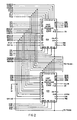
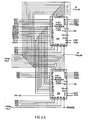
- Figs 2 to 2D show specific 4-bit microprocessor slice logic units used in mantissa calculations;
- Fig 3 shows specific look-ahead logic units for computing the carry bits for mantissa calculations; and
- Fig 4 shows specific logic units for use in computing the round bit for mantissa calculations in accordance with the invention.
- The invention disclosed herein can be best described in the context of a particular data processing system, such as that disclosed in
EP 0 039 227. A broad block diagram of the arithmetic logic unit (ALU) used therein is shown in Fig 154 of the application which is reproduced herein in Fig 1. Specific logic diagrams required to understand the invention described herein are shown here in Figs 2-4. In such system, as is conventional for 32-bit mantissa calculations, the computation is made in four-bit slices as shown by the eight microprocessor four-bit slice logic unit 10A-10H. Two 4-bit values are operated on, and a 1-bit carry value is added to the result of this operation to produce the 4-bit output (DS-outputs). Thus the slice units produce an unrounded floating point result formed as the following 4-bit slices shown below: -
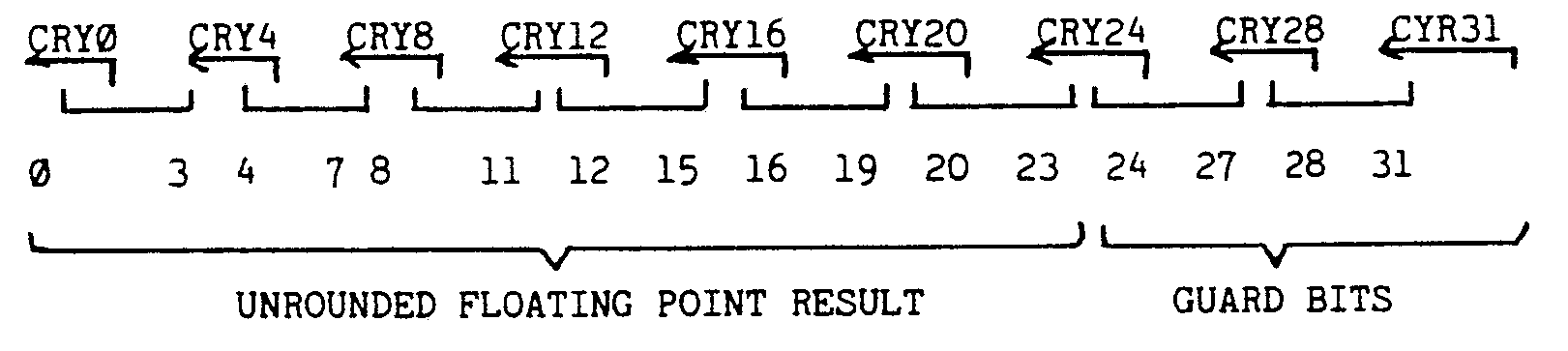
- As can be seen in the above diagram, in the 32-bit calculated word the 24 bits forming the six more significant 4-bit slices (bits 0-23) produce the unrounded floating point result, while the eight bits forming the two less significant 4-bit groups (bit 24-31) represent the bits which are used to determine the "round" bit, referred to as the "guard" bits. In each instance, each of the 4-bit slices effectively produces a carry (CRY) bit which is supplied to the next adjacent 4-bit slice, e.g. bit slice 0-3 is effectively supplied with the carry bit CRY4 from the 4-bit slice 4-7, the latter slice is supplied with CRY8 from 4-bit slice 8-11, and so on. The
CRY 31 bit is supplied from microcode, while the CRYO bit is the carry bit for the final overall floating point result. In order to save time in the computation the carry bits are actually generated in parallel with the 4-bit computations in each of the 4-bit microprocessor slice logic unit, the parallel carry bit calculations being performed in the look ahead carry generator units 11A, 11B and 11C as shown in Fig. 3. Thus, during such arithmetic operation cycle, the overall computation, is performed substantially simultaneously to form the unrounded 32-bit result. - In conventional floating point computation techniques the round bit is then added during the next cycle (the round cycle) of the floating point computation, after the arithmetic operation has been completed, by appropriately decoding the guard bits to generate the round bit and then adding the round bit to bit 23 (effectively as CRY24 bit), which latter process can be achieved by using effective multiplexing techniques, for example. A certain amount of time is required for performing the multiplexing operation, and such time increases the overall data processing time for all operations. It is desirable to avoid such.added processing time by reducing the time needed to generate and insert the round bit, as described below, in accordance with the invention.
- The logic circuitry of the invention utilizes an additional section of look ahead generator stage 11A and associated
circuitry logic
Claims (8)
Priority Applications (5)
| Application Number | Priority Date | Filing Date | Title |
|---|---|---|---|
| DE8484200991T DE3278889D1 (en) | 1981-04-23 | 1982-04-23 | Arithmetic unit in data processing system with exponent overflow/underflow detection |
| DE8484200987T DE3277788D1 (en) | 1981-04-23 | 1982-04-23 | Arithmetic unit in data processing system with bit-extension circuitry |
| DE8282302080T DE3278700D1 (en) | 1981-04-23 | 1982-04-23 | Arithmetic unit in a data processing system with rounding of floating point results |
| AT82302080T ATE35332T1 (en) | 1981-04-23 | 1982-04-23 | ARITHMETIC UNIT WITH ROUNDING OF FLOATING-POINT RESULTS IN A DATA PROCESSING SYSTEM. |
| AT84200987T ATE31225T1 (en) | 1981-04-23 | 1982-04-23 | ARITHMETIC UNIT WITH BIT PROPAGATION CIRCUIT IN A DATA PROCESSING SYSTEM. |
Applications Claiming Priority (6)
| Application Number | Priority Date | Filing Date | Title |
|---|---|---|---|
| US256923 | 1981-04-23 | ||
| US06/256,772 US4405992A (en) | 1981-04-23 | 1981-04-23 | Arithmetic unit for use in data processing systems |
| US256726 | 1981-04-23 | ||
| US06/256,726 US4442498A (en) | 1981-04-23 | 1981-04-23 | Arithmetic unit for use in data processing systems |
| US256772 | 1981-04-23 | ||
| US06/256,923 US4429370A (en) | 1981-04-23 | 1981-04-23 | Arithmetic unit for use in a data processing system for computing exponent results and detecting overflow and underflow conditions thereof |
Related Child Applications (4)
| Application Number | Title | Priority Date | Filing Date |
|---|---|---|---|
| EP84200987A Division-Into EP0137525B1 (en) | 1981-04-23 | 1982-04-23 | Arithmetic unit in data processing system with bit-extension circuitry |
| EP84200987A Division EP0137525B1 (en) | 1981-04-23 | 1982-04-23 | Arithmetic unit in data processing system with bit-extension circuitry |
| EP19840200991 Division-Into EP0137526B1 (en) | 1981-04-23 | 1982-04-23 | Arithmetic unit in data processing system with exponent overflow/underflow detection |
| EP19840200991 Division EP0137526B1 (en) | 1981-04-23 | 1982-04-23 | Arithmetic unit in data processing system with exponent overflow/underflow detection |
Publications (3)
| Publication Number | Publication Date |
|---|---|
| EP0064826A2 EP0064826A2 (en) | 1982-11-17 |
| EP0064826A3 EP0064826A3 (en) | 1983-01-26 |
| EP0064826B1 true EP0064826B1 (en) | 1988-06-22 |
Family
ID=27400985
Family Applications (3)
| Application Number | Title | Priority Date | Filing Date |
|---|---|---|---|
| EP19820302080 Expired EP0064826B1 (en) | 1981-04-23 | 1982-04-23 | Arithmetic unit in a data processing system with rounding of floating point results |
| EP84200987A Expired EP0137525B1 (en) | 1981-04-23 | 1982-04-23 | Arithmetic unit in data processing system with bit-extension circuitry |
| EP19840200991 Expired EP0137526B1 (en) | 1981-04-23 | 1982-04-23 | Arithmetic unit in data processing system with exponent overflow/underflow detection |
Family Applications After (2)
| Application Number | Title | Priority Date | Filing Date |
|---|---|---|---|
| EP84200987A Expired EP0137525B1 (en) | 1981-04-23 | 1982-04-23 | Arithmetic unit in data processing system with bit-extension circuitry |
| EP19840200991 Expired EP0137526B1 (en) | 1981-04-23 | 1982-04-23 | Arithmetic unit in data processing system with exponent overflow/underflow detection |
Country Status (3)
| Country | Link |
|---|---|
| EP (3) | EP0064826B1 (en) |
| AU (1) | AU549632B2 (en) |
| CA (1) | CA1175572A (en) |
Families Citing this family (3)
| Publication number | Priority date | Publication date | Assignee | Title |
|---|---|---|---|---|
| US4562553A (en) * | 1984-03-19 | 1985-12-31 | Analogic Corporation | Floating point arithmetic system and method with rounding anticipation |
| US4879676A (en) * | 1988-02-29 | 1989-11-07 | Mips Computer Systems, Inc. | Method and apparatus for precise floating point exceptions |
| JP3076046B2 (en) * | 1989-01-31 | 2000-08-14 | 日本電気株式会社 | Exception detection circuit |
Family Cites Families (5)
| Publication number | Priority date | Publication date | Assignee | Title |
|---|---|---|---|---|
| US3699326A (en) * | 1971-05-05 | 1972-10-17 | Honeywell Inf Systems | Rounding numbers expressed in 2{40 s complement notation |
| US3842250A (en) * | 1973-08-29 | 1974-10-15 | Sperry Rand Corp | Circuit for implementing rounding in add/subtract logic networks |
| US4282581A (en) * | 1979-10-15 | 1981-08-04 | Sperry Corporation | Automatic overflow/imminent overflow detector |
| US4295203A (en) * | 1979-11-09 | 1981-10-13 | Honeywell Information Systems Inc. | Automatic rounding of floating point operands |
| EP0039227A3 (en) | 1980-04-25 | 1982-09-01 | Data General Corporation | Data processing system |
-
1982
- 1982-04-16 AU AU82695/82A patent/AU549632B2/en not_active Ceased
- 1982-04-22 CA CA000401467A patent/CA1175572A/en not_active Expired
- 1982-04-23 EP EP19820302080 patent/EP0064826B1/en not_active Expired
- 1982-04-23 EP EP84200987A patent/EP0137525B1/en not_active Expired
- 1982-04-23 EP EP19840200991 patent/EP0137526B1/en not_active Expired
Also Published As
| Publication number | Publication date |
|---|---|
| EP0137525A3 (en) | 1985-07-03 |
| EP0137526B1 (en) | 1988-08-10 |
| EP0137526A3 (en) | 1985-05-15 |
| EP0137525B1 (en) | 1987-12-02 |
| EP0064826A3 (en) | 1983-01-26 |
| CA1175572A (en) | 1984-10-02 |
| AU8269582A (en) | 1982-10-28 |
| EP0137525A2 (en) | 1985-04-17 |
| EP0064826A2 (en) | 1982-11-17 |
| AU549632B2 (en) | 1986-02-06 |
| EP0137526A2 (en) | 1985-04-17 |
Similar Documents
| Publication | Publication Date | Title |
|---|---|---|
| US5790446A (en) | Floating point multiplier with reduced critical paths using delay matching techniques | |
| US4168530A (en) | Multiplication circuit using column compression | |
| US4442498A (en) | Arithmetic unit for use in data processing systems | |
| EP0018519B1 (en) | Multiplier apparatus having a carry-save/propagate adder | |
| EP0158530B1 (en) | Nonrestoring divider | |
| US6549926B1 (en) | SRT divider having several bits of each partial remainder one-hot encoded to minimize the logic levels needed to estimate quotient bits | |
| US5943251A (en) | Adder which handles multiple data with different data types | |
| EP0075745B1 (en) | Method and apparatus for division | |
| US4429370A (en) | Arithmetic unit for use in a data processing system for computing exponent results and detecting overflow and underflow conditions thereof | |
| EP0206762A2 (en) | Digital electronic multiplier circuits | |
| Hickmann et al. | A parallel IEEE P754 decimal floating-point multiplier | |
| US5144576A (en) | Signed digit multiplier | |
| US5721697A (en) | Performing tree additions via multiplication | |
| US5944776A (en) | Fast carry-sum form booth encoder | |
| US4405992A (en) | Arithmetic unit for use in data processing systems | |
| US5734599A (en) | Performing a population count using multiplication | |
| EP0643352A1 (en) | Self-checking complementary adder unit | |
| EP0670061B1 (en) | Enhanced fast multiplier | |
| US6282557B1 (en) | Low latency fused multiply-adder | |
| JPH10143355A (en) | Microprocessor capable of multiplying operand of various formats highly efficiently and its arithmetic method | |
| US5661674A (en) | Divide to integer | |
| EP0534760A2 (en) | High speed multiplier device | |
| US6421699B1 (en) | Method and system for a speedup of a bit multiplier | |
| EP0137525B1 (en) | Arithmetic unit in data processing system with bit-extension circuitry | |
| US6732135B1 (en) | Method and apparatus for accumulating partial quotients in a digital processor |
Legal Events
| Date | Code | Title | Description |
|---|---|---|---|
| PUAI | Public reference made under article 153(3) epc to a published international application that has entered the european phase |
Free format text: ORIGINAL CODE: 0009012 |
|
| AK | Designated contracting states |
Designated state(s): AT BE CH DE FR GB IT LU NL SE |
|
| PUAL | Search report despatched |
Free format text: ORIGINAL CODE: 0009013 |
|
| AK | Designated contracting states |
Designated state(s): AT BE CH DE FR GB IT LI LU NL SE |
|
| 17P | Request for examination filed |
Effective date: 19830314 |
|
| GRAA | (expected) grant |
Free format text: ORIGINAL CODE: 0009210 |
|
| AK | Designated contracting states |
Kind code of ref document: B1 Designated state(s): AT BE CH DE FR GB IT LI LU NL SE |
|
| PG25 | Lapsed in a contracting state [announced via postgrant information from national office to epo] |
Ref country code: NL Effective date: 19880622 Ref country code: LI Effective date: 19880622 Ref country code: IT Free format text: LAPSE BECAUSE OF FAILURE TO SUBMIT A TRANSLATION OF THE DESCRIPTION OR TO PAY THE FEE WITHIN THE PRESCRIBED TIME-LIMIT;WARNING: LAPSES OF ITALIAN PATENTS WITH EFFECTIVE DATE BEFORE 2007 MAY HAVE OCCURRED AT ANY TIME BEFORE 2007. THE CORRECT EFFECTIVE DATE MAY BE DIFFERENT FROM THE ONE RECORDED. Effective date: 19880622 Ref country code: CH Effective date: 19880622 Ref country code: BE Effective date: 19880622 Ref country code: AT Effective date: 19880622 |
|
| REF | Corresponds to: |
Ref document number: 35332 Country of ref document: AT Date of ref document: 19880715 Kind code of ref document: T |
|
| PG25 | Lapsed in a contracting state [announced via postgrant information from national office to epo] |
Ref country code: SE Effective date: 19880630 |
|
| REF | Corresponds to: |
Ref document number: 3278700 Country of ref document: DE Date of ref document: 19880728 |
|
| ET | Fr: translation filed | ||
| REG | Reference to a national code |
Ref country code: CH Ref legal event code: PL |
|
| NLV1 | Nl: lapsed or annulled due to failure to fulfill the requirements of art. 29p and 29m of the patents act | ||
| PLBE | No opposition filed within time limit |
Free format text: ORIGINAL CODE: 0009261 |
|
| STAA | Information on the status of an ep patent application or granted ep patent |
Free format text: STATUS: NO OPPOSITION FILED WITHIN TIME LIMIT |
|
| PG25 | Lapsed in a contracting state [announced via postgrant information from national office to epo] |
Ref country code: LU Free format text: LAPSE BECAUSE OF NON-PAYMENT OF DUE FEES Effective date: 19890430 |
|
| 26N | No opposition filed | ||
| PGFP | Annual fee paid to national office [announced via postgrant information from national office to epo] |
Ref country code: DE Payment date: 19980323 Year of fee payment: 17 |
|
| PGFP | Annual fee paid to national office [announced via postgrant information from national office to epo] |
Ref country code: FR Payment date: 19990317 Year of fee payment: 18 |
|
| PG25 | Lapsed in a contracting state [announced via postgrant information from national office to epo] |
Ref country code: DE Free format text: LAPSE BECAUSE OF NON-PAYMENT OF DUE FEES Effective date: 20000201 |
|
| PG25 | Lapsed in a contracting state [announced via postgrant information from national office to epo] |
Ref country code: FR Free format text: LAPSE BECAUSE OF NON-PAYMENT OF DUE FEES Effective date: 20001229 |
|
| REG | Reference to a national code |
Ref country code: FR Ref legal event code: ST |
|
| PGFP | Annual fee paid to national office [announced via postgrant information from national office to epo] |
Ref country code: GB Payment date: 20010326 Year of fee payment: 20 |
|
| REG | Reference to a national code |
Ref country code: GB Ref legal event code: IF02 |
|
| PG25 | Lapsed in a contracting state [announced via postgrant information from national office to epo] |
Ref country code: GB Free format text: LAPSE BECAUSE OF EXPIRATION OF PROTECTION Effective date: 20020422 |
|
| REG | Reference to a national code |
Ref country code: GB Ref legal event code: PE20 Effective date: 20020422 |