EP0063947B1 - Filler for liquid chromatography - Google Patents
Filler for liquid chromatography Download PDFInfo
- Publication number
- EP0063947B1 EP0063947B1 EP82302134A EP82302134A EP0063947B1 EP 0063947 B1 EP0063947 B1 EP 0063947B1 EP 82302134 A EP82302134 A EP 82302134A EP 82302134 A EP82302134 A EP 82302134A EP 0063947 B1 EP0063947 B1 EP 0063947B1
- Authority
- EP
- European Patent Office
- Prior art keywords
- filler
- hemoglobin
- weight
- copolymer
- hba
- Prior art date
- Legal status (The legal status is an assumption and is not a legal conclusion. Google has not performed a legal analysis and makes no representation as to the accuracy of the status listed.)
- Expired
Links
Images
Classifications
-
- B—PERFORMING OPERATIONS; TRANSPORTING
- B01—PHYSICAL OR CHEMICAL PROCESSES OR APPARATUS IN GENERAL
- B01D—SEPARATION
- B01D15/00—Separating processes involving the treatment of liquids with solid sorbents; Apparatus therefor
- B01D15/08—Selective adsorption, e.g. chromatography
-
- B—PERFORMING OPERATIONS; TRANSPORTING
- B01—PHYSICAL OR CHEMICAL PROCESSES OR APPARATUS IN GENERAL
- B01J—CHEMICAL OR PHYSICAL PROCESSES, e.g. CATALYSIS OR COLLOID CHEMISTRY; THEIR RELEVANT APPARATUS
- B01J20/00—Solid sorbent compositions or filter aid compositions; Sorbents for chromatography; Processes for preparing, regenerating or reactivating thereof
- B01J20/22—Solid sorbent compositions or filter aid compositions; Sorbents for chromatography; Processes for preparing, regenerating or reactivating thereof comprising organic material
- B01J20/26—Synthetic macromolecular compounds
-
- B—PERFORMING OPERATIONS; TRANSPORTING
- B01—PHYSICAL OR CHEMICAL PROCESSES OR APPARATUS IN GENERAL
- B01J—CHEMICAL OR PHYSICAL PROCESSES, e.g. CATALYSIS OR COLLOID CHEMISTRY; THEIR RELEVANT APPARATUS
- B01J39/00—Cation exchange; Use of material as cation exchangers; Treatment of material for improving the cation exchange properties
- B01J39/08—Use of material as cation exchangers; Treatment of material for improving the cation exchange properties
- B01J39/16—Organic material
- B01J39/18—Macromolecular compounds
- B01J39/20—Macromolecular compounds obtained by reactions only involving unsaturated carbon-to-carbon bonds
-
- B—PERFORMING OPERATIONS; TRANSPORTING
- B01—PHYSICAL OR CHEMICAL PROCESSES OR APPARATUS IN GENERAL
- B01J—CHEMICAL OR PHYSICAL PROCESSES, e.g. CATALYSIS OR COLLOID CHEMISTRY; THEIR RELEVANT APPARATUS
- B01J39/00—Cation exchange; Use of material as cation exchangers; Treatment of material for improving the cation exchange properties
- B01J39/26—Cation exchangers for chromatographic processes
Definitions
- This invention relates to a method for separating hemoglobin variants by subjecting a hemoglobin sample to liquid chromatography using a filler, the separating mechanism of which is based on its ion exchanging activity.
- US-A-4139684 describes synthetic macroporous ion-exchanging materials for use in the isolation' and chromatographic separation of sensitive compounds of biological origin.
- the materials are obtained by the ternary copolymerisation of hydrophilic monomers containing non-ionogenous groups (such as hydroxyalkyl(meth)acrylates and (meth)acrylamides), monomers containing ionogenous groups (such as (meth)acrylic acid) and cross-linking agents which are monomers having at least two (meth)acryloyl.
- the only cross-linking agents disclosed contain only two double bonds and no mention is made of separating hemoglobin variants.
- US-A-3957741 discloses crosslinked porous beads for use in chromatography and prepared by the copolymerization of an acrylic monomer containing a hydroxy or amino group and a cross-linking agent.
- EP-A-6199 describes a hydrophilic separating carrier which can be produced by the copolymerisation of pentaerythritol dimethacrylate and a methacrylate monomer which has a hydrophilic group or group convertible thereto.
- US-A-4238196 proposes the use, as inert substrate for a chromatographic carrier, of a resin copolymer of styrene or methacrylic acid and divinylbenzene.
- Hb Human adult hemoglobin
- HbA o Human adult hemoglobin
- hemoglobin variants differ in primary structure from normal hemoglobin (HbA o ), or result from the combining of a sugar with HbA o . It has been found that the separation and determination of these hemoglobin variants is important as a measure of a diseased condition. For example, assay of HbF is essential for diagnosing hereditary hyper-HbF, and checking of an increase or decrease in HbA iC is essential for the treatment of diabetes.
- a component called HbA 2 like HbF, is hereditary, and it has been found that a hemoglobin variant called acetylated hemoglobin (Ac, Hb) is formed as a result of administering a drug containing an acetyl group, such aspirin. From a medical viewpoint, therefore, it has become increasingly important to assay these hemoglobin variants.
- a method for separating hemoglobin variants which comprises subjecting a hemoglobin sample to liquid chromatography using a filler consisting essentially of a hydrophilic ion-exchanger copolymer obtained by copolymerizing a mixture of (A) 5 to 90% by weight of at least one polymerizable monomer selected from acrylic acid, methacrylic acid, crotonic acid and maleic acid, (B) 10 to 95% by weight of at least one crosslinkable polymerizable monomer, selected from tetramethylolmethane tri-and tetraacrylates and -methacrylates, trimethylolethane triacrylates and trimethacrylates, and dipentaerythritol hexaacrylate and hexamethacrylate, and optionally tetraethylene glycol dimethacrylate, and (C) 0 to 85% by weight of at least one monomer selected from N,N-dimethylacrylamide, N,N-di
- the copolymer used in this invention is an ion exchanger having ion-exchanging activity because of the presence of units derived from the carboxyl-containing polymerizable monomer (A). If the proportion of the monofunctional monomer (A) containing a carboxyl group is too small, the ion-exchange ability of the resulting copolymer is reduced. Hence, the monomer (A) should be present in a proportion of at least 5% by weight in the monomeric mixture.
- the crosslinkable and polymerizable monomer (B) used in this invention contains at least three polymerizable double bonds per molecule, and is present in a proportion of 10 to 95% by weight in the monomeric mixture.
- the proportion of the monomer (B) should be at least 10% by weight.
- the monomeric mixture used in this invention may contain up to 85% by weight of the monomer (C).
- All of the monomers from which are prepared the copolymer used as a filler in the method of this invention have a hydrophobic parameter of not more than 2.3.
- the "hydrophobic parameter” is the logarithm of the ratio of the solubility. of a compound in octyl alcohol to that in water. It can be determined experimentally or it can be calculated by the method described in Chapter 3 of R. F. Rekker, "The Hydrophobic Fragmental Constant” (Elsevier Scientific Publishing Co., 1977)). This provides the filler with an excellent separating ability in the separation of hemoglobin variants.
- hydrophobic parameters of some of the monomers used to provide the filler are given in parentheses below:
- the monomeric mixture can be polymerized by conventional methods such as suspension, emulsion, solution, and bulk polymerization techniques.
- the suspension-polymerization technique is preferred in this invention because the resulting polymer particles can be directly used as the chromatographic filler.
- Conventional solvents such as water, ethanol and benzene can be used in the polymerization. If the suspension polymerization is carried out in the presence of a small amount of an organic solvent capable of dissolving the monomers but incapable of dissolving the polymer, such as toluene, the resulting copolymer particles are porous and therefore, a filler can be obtained which has an increased area of contact with the moving phase.
- the filler composed of the hydrophilic ion exchanger copolymer is placed in a column in customary manner and used as the stationary phase in liquid chromatographic analyses. It shows an analyzing behavior based on its ion-exchanging mechanism in liquid chromatography.
- the copolymer is obtained as particles, those having a desired particle size are selected for use as the filler.
- bulk copolymer is obtained, it is pulverized to the desired particle size.
- a coated filler obtained by coating the surface of a suitable core material such as glass spheres with the resulting copolymer may be used as the stationary phase. It is necessary that at least that part of the stationary phase which makes contact with the moving phase should be constructed of the ion-exchanger copolymer.
- the filler has an excellent ability to analyze and separate hemoglobin variants, which have been difficult to separate heretofore, by liquid chromatography with a high accuracy within short periods of time, and its mechanical strength is excellent.
- the separation of the hemoglobin variants in accordance with this invention can be performed by connecting a column filled with the aforesaid hydrophilic ion exchanger to a liquid chromatographic device, preferably a high-performance liquid chromatographic device, and charging the hemoglobin sample onto the column and passing an eluent therethrough in accordance with a usual technique of separation and determination by liquid chromatography.
- a liquid chromatographic device preferably a high-performance liquid chromatographic device
- the optimum eluting conditions should be determined, but generally it is preferred to use an aqueous solution having a pH of 5.0 to 10.0 and an ionic strength of at least 0.01 as an eluent.
- Hemoglobin variants separate in the order of HbA,a, HbA,b, HbF, HbA,c, HbA o and HbA 2 .
- the detection of hemoglobin variants is carried out by using visible light having a wavelength of 415 nm.
- the method of this invention makes it possible to separate and assay hemoglobin variants within short periods of time with a high level of accuracy.
- Examples 1,4 and 5 illustrate the method of the present invention, while Examples 2, 3 and 6 illustrate the preparation of hydrophilic ion-exchanger copolymers suitable for use in the separation of hemoglobin variants.
- a 2-liter separable flask equipped with a condenser, a stirrer, a thermometer and a dropping funnel was charged with a mixture consisting of 400 ml of a 4% by weight aqueous solution of polyvinyl alcohol, 40 g of tetraethylene glycol dimethacrylate, 10 g of tetramethylolmethane triacrylate, 50 g of methacrylic acid, 40 g of toluene and 1.5 g of benzoyl peroxide. With stirring at 400 rpm, the mixture was heated to 80°C, and reacted at this temperature for 10 hours.
- the polymerization product was washed with hot water and acetone to give spherical polymer particles having a diameter of 5 to 20 um. Particles having 8 to 12 um were selected, and dispersed in 800 ml of deionized water. The dispersed particles were filled in a stainless steel column, 7.9 mm in diameter and 3.0 cm in length, by sending deionized water at a rate of 1.6 ml/min. The filled column was connected to a high-performance liquid chromatographic device (Shimadzu-Du Pont High-Performance Liquid Chromatograph Model 830, a trademark), and used in the following analysis.
- a high-performance liquid chromatographic device Shiadzu-Du Pont High-Performance Liquid Chromatograph Model 830, a trademark
- a hemoglobin solution was prepared by hemolyzing 50 ⁇ l of blood from a normal healthy person or a diabetic patient by mixing it with 1 cc of deionized water.
- liquid A pH 6.5
- liquid B obtained by dissolving NaCI in the liquid A to a concentration of 3%.
- a 1 a, A l b, A l c and A o components were fractionated over the course of more than about 2 hours by ion-exchange column chromatography using a liquid chromatographic filler (Biorex-70, a product of Bio-Rad Laboratories, U.S.A.) well known in the art. Each of the fractions was analyzed by high-performance liquid chromatography under the same conditions as described above. It was determined that A 1 a, A l b, A l c, A o and A 2 correspond respectively to the peaks 2, 3, 5, 6 and 7 in the chromatogram of Figure 1. The peak 4 was found to be ascribable to HbF as a result of determination using a blood sample obtained from a fetus.
- the amount of HbA 1 c determined by the baseline method was 3.2% for the blood of the normal healthy person and 5.9% for the blood of the diabetic patient.
- Example 2 The same procedure as in Example 1 was followed except that in the production of the copolymer, 36 g of tetraethylene glycol dimethacrylate, 10 g of tetramethylolmethane triacrylate and 5 g of methacrylic acid were used as the monomers and 40 g of isoamyl alcohol, as the organic solvent.
- Example 1 The procedure of Example 1 was followed except that 50 g of trimethylolethane trimethacrylate and 15 g of crotonic acid were used as the monomers and 40 g of toluene, as the organic solvent.
- Example 2 By using the same column, device and eluting conditions as in Example 1, an aqueous solution obtained by mixing blood of a neonate with 20 times its volume of deionized water to hemolyze it was analyzed. The chromatogram shown in Figure 2 was obtained. The peak 4 in the chromatogram was ascribable to HbF, showing very sharp separation.
- Example 3 The same filler and column as used in Example 3 were used, and the filled column was connected to the same high-performance liquid chromatographic device as in Example 1.
- the same sample as in Example 1 was analyzed. Elution was performed by passing a mixture of 10% of the liquid A in Example 1 and 90% of the liquid B in Example 1 for 5 minutes, and then replaced by the liquid B.
- the resulting chromatogram is shown in Figure 3.
- Curve A is the chromatogram of blood of a normal healthy person, and curve B, the chromatogram of the blood of a diabetic patient.
- the peak 5 was ascribable to HbA,c, and the peak 6, to HbA o . It is seen that HbA 1 c could be separated within short periods of time.
- a filled column was produced in the same way as in Example 1 except that in the preparation of the copolymer, a mixture consisting of 20 g of acrylic acid, 50 g of tetramethylolmethane tetraacrylate, 10 g of 2-hydroxyethyl methacrylate and 1.5 g of benzoyl peroxide was used.
Landscapes
- Chemical & Material Sciences (AREA)
- Chemical Kinetics & Catalysis (AREA)
- Analytical Chemistry (AREA)
- Organic Chemistry (AREA)
- Treatment Of Liquids With Adsorbents In General (AREA)
- Investigating Or Analysing Biological Materials (AREA)
- Solid-Sorbent Or Filter-Aiding Compositions (AREA)
Description
- This invention relates to a method for separating hemoglobin variants by subjecting a hemoglobin sample to liquid chromatography using a filler, the separating mechanism of which is based on its ion exchanging activity.
- It has been known to use an ion-exchange resin obtained by the copolymerization of methacrylic acid and divinylbenzene as a filler for liquid chromatography. If this filler is used in liquid chromatographic separation of a biological material such as proteins, enzymes and amino acids, its components may remain adsorbed to the hydrophobic divinylbenzene portion of the filler. This creates the problem that long periods of time are required for analyzing the material, or the analysis fails because of the inability of the desired components to be eluted from the filler. If the amount of divinylbenzene to be copolymerized is decreased in an attempt to solve the problem, the resulting copolymer is not strong enough for use as a filler for liquid chromatography.
- US-A-4139684 describes synthetic macroporous ion-exchanging materials for use in the isolation' and chromatographic separation of sensitive compounds of biological origin. The materials are obtained by the ternary copolymerisation of hydrophilic monomers containing non-ionogenous groups (such as hydroxyalkyl(meth)acrylates and (meth)acrylamides), monomers containing ionogenous groups (such as (meth)acrylic acid) and cross-linking agents which are monomers having at least two (meth)acryloyl. The only cross-linking agents disclosed contain only two double bonds and no mention is made of separating hemoglobin variants.
- US-A-3957741 discloses crosslinked porous beads for use in chromatography and prepared by the copolymerization of an acrylic monomer containing a hydroxy or amino group and a cross-linking agent.
- EP-A-6199 describes a hydrophilic separating carrier which can be produced by the copolymerisation of pentaerythritol dimethacrylate and a methacrylate monomer which has a hydrophilic group or group convertible thereto.
- US-A-4238196 proposes the use, as inert substrate for a chromatographic carrier, of a resin copolymer of styrene or methacrylic acid and divinylbenzene.
- Human adult hemoglobin (to be abbreviated Hb) is a protein having a molecular weight of about 68,000 which exists in such a form that four hemes are bonded to one globin protein. When normal human Hb is electrophoresed at a pH of 8.6, not only is Hb, or HbAo, constituting 90 to 95% of the entire Hb sample separated, but also HbF and HbA1c having a slightly lower rate of mobility than HbAo are separated afterwards, and subsequently HbA1a and HbA,b are separated. Thus, the presence of these hemoglobin variants is determined. The presence of HbA1d and HbA1e have also been ascertained from a more elaborate electrophoretic test. These hemoglobin variants differ in primary structure from normal hemoglobin (HbAo), or result from the combining of a sugar with HbAo. It has been found that the separation and determination of these hemoglobin variants is important as a measure of a diseased condition. For example, assay of HbF is essential for diagnosing hereditary hyper-HbF, and checking of an increase or decrease in HbAiC is essential for the treatment of diabetes. A component called HbA2, like HbF, is hereditary, and it has been found that a hemoglobin variant called acetylated hemoglobin (Ac, Hb) is formed as a result of administering a drug containing an acetyl group, such as aspirin. From a medical viewpoint, therefore, it has become increasingly important to assay these hemoglobin variants.
- Up to date, however, no method has been proposed which can separate and determine these hemoglobin variants within short periods of time with a high accuracy.
- According to this invention, there is provided a method for separating hemoglobin variants which comprises subjecting a hemoglobin sample to liquid chromatography using a filler consisting essentially of a hydrophilic ion-exchanger copolymer obtained by copolymerizing a mixture of (A) 5 to 90% by weight of at least one polymerizable monomer selected from acrylic acid, methacrylic acid, crotonic acid and maleic acid, (B) 10 to 95% by weight of at least one crosslinkable polymerizable monomer, selected from tetramethylolmethane tri-and tetraacrylates and -methacrylates, trimethylolethane triacrylates and trimethacrylates, and dipentaerythritol hexaacrylate and hexamethacrylate, and optionally tetraethylene glycol dimethacrylate, and (C) 0 to 85% by weight of at least one monomer selected from N,N-dimethylacrylamide, N,N-dimethylmethacrylamide, 2-hydroxyethyl acrylate, 2-hydroxyethyl methacrylate, glycidyl acrylate and glycidyl methacrylate.
- The copolymer used in this invention is an ion exchanger having ion-exchanging activity because of the presence of units derived from the carboxyl-containing polymerizable monomer (A). If the proportion of the monofunctional monomer (A) containing a carboxyl group is too small, the ion-exchange ability of the resulting copolymer is reduced. Hence, the monomer (A) should be present in a proportion of at least 5% by weight in the monomeric mixture.
- The crosslinkable and polymerizable monomer (B) used in this invention contains at least three polymerizable double bonds per molecule, and is present in a proportion of 10 to 95% by weight in the monomeric mixture.
- If the proportion of the monomer (B) is too small, the density of crosslinkages in the resulting copolymer decreases, and its mechanical strength is not high enough to withstand high pressures when it is used as a filler for high-performance liquid chromatography. Accordingly, the proportion of the monomer (B) should be at least 10% by weight.
- The monomeric mixture used in this invention may contain up to 85% by weight of the monomer (C).
- All of the monomers from which are prepared the copolymer used as a filler in the method of this invention have a hydrophobic parameter of not more than 2.3. (The "hydrophobic parameter" is the logarithm of the ratio of the solubility. of a compound in octyl alcohol to that in water. It can be determined experimentally or it can be calculated by the method described in
Chapter 3 of R. F. Rekker, "The Hydrophobic Fragmental Constant" (Elsevier Scientific Publishing Co., 1977)). This provides the filler with an excellent separating ability in the separation of hemoglobin variants. It has been found in accordance with this invention that, for example, divinylbenzene customarily used as a cross-linking agent in the production of ion exchangers has a hydrophobic parameter of 3.8, and the use of an ion exchanger containing units derived from divinylbenzene as a filler cannot produce the effects attained by this invention. In order to prevent the undesirable adsorption of hydrophilic materials to the filler during use, it is preferred that all of the monomers (A), (B) and (C) have hydrophobic parameters of not more than 0. - The hydrophobic parameters of some of the monomers used to provide the filler are given in parentheses below:
- monomers (A); acrylic acid (-2.3), methacrylic acid (-1.9), crotonic acid (-1.9), and maleic acid (-5.7);
- monomers (B); tetra-methylolmethane triacrylate (-0.73), tetramethylolmethane tri-methacrylate (0.59), tetramethylolmethane tetraacrylate (0.24), tetramethylolmethane tetramethacrylate (0.20), trimethylolethane triacrylate (0.88), trimethylolethane trimethyacrylate (2.20), dipentaerythritol hexaacrylate (-0.09) and tetraethylene glycol dimethacrylate (-0.30); and
- monomers (C); N,N-dimethylmethacrylamide (-0.88), 2-hydroxyethyl methacrylate (-0.41), and glycidyl methacrylate (-0.48).
- The monomeric mixture can be polymerized by conventional methods such as suspension, emulsion, solution, and bulk polymerization techniques. The suspension-polymerization technique is preferred in this invention because the resulting polymer particles can be directly used as the chromatographic filler. Conventional solvents such as water, ethanol and benzene can be used in the polymerization. If the suspension polymerization is carried out in the presence of a small amount of an organic solvent capable of dissolving the monomers but incapable of dissolving the polymer, such as toluene, the resulting copolymer particles are porous and therefore, a filler can be obtained which has an increased area of contact with the moving phase.
- The filler composed of the hydrophilic ion exchanger copolymer is placed in a column in customary manner and used as the stationary phase in liquid chromatographic analyses. It shows an analyzing behavior based on its ion-exchanging mechanism in liquid chromatography. When the copolymer is obtained as particles, those having a desired particle size are selected for use as the filler. When bulk copolymer is obtained, it is pulverized to the desired particle size. A coated filler obtained by coating the surface of a suitable core material such as glass spheres with the resulting copolymer may be used as the stationary phase. It is necessary that at least that part of the stationary phase which makes contact with the moving phase should be constructed of the ion-exchanger copolymer.
- The filler has an excellent ability to analyze and separate hemoglobin variants, which have been difficult to separate heretofore, by liquid chromatography with a high accuracy within short periods of time, and its mechanical strength is excellent.
- The separation of the hemoglobin variants in accordance with this invention can be performed by connecting a column filled with the aforesaid hydrophilic ion exchanger to a liquid chromatographic device, preferably a high-performance liquid chromatographic device, and charging the hemoglobin sample onto the column and passing an eluent therethrough in accordance with a usual technique of separation and determination by liquid chromatography. The optimum eluting conditions should be determined, but generally it is preferred to use an aqueous solution having a pH of 5.0 to 10.0 and an ionic strength of at least 0.01 as an eluent.
- Hemoglobin variants separate in the order of HbA,a, HbA,b, HbF, HbA,c, HbAo and HbA2. By varying the eluting conditions, it is possible to separate a certain hemoglobin variant as a sharp chromatographic peak and the other hemoglobin variants and normal hemoglobin as aggregate peaks. This enables the desired hemoglobin variant to be assayed effectively within a short period of time. Preferably, the detection of hemoglobin variants is carried out by using visible light having a wavelength of 415 nm.
- The method of this invention makes it possible to separate and assay hemoglobin variants within short periods of time with a high level of accuracy.
- Of the Examples which follow, Examples 1,4 and 5 illustrate the method of the present invention, while Examples 2, 3 and 6 illustrate the preparation of hydrophilic ion-exchanger copolymers suitable for use in the separation of hemoglobin variants.
- A 2-liter separable flask equipped with a condenser, a stirrer, a thermometer and a dropping funnel was charged with a mixture consisting of 400 ml of a 4% by weight aqueous solution of polyvinyl alcohol, 40 g of tetraethylene glycol dimethacrylate, 10 g of tetramethylolmethane triacrylate, 50 g of methacrylic acid, 40 g of toluene and 1.5 g of benzoyl peroxide. With stirring at 400 rpm, the mixture was heated to 80°C, and reacted at this temperature for 10 hours. After cooling, the polymerization product was washed with hot water and acetone to give spherical polymer particles having a diameter of 5 to 20 um. Particles having 8 to 12 um were selected, and dispersed in 800 ml of deionized water. The dispersed particles were filled in a stainless steel column, 7.9 mm in diameter and 3.0 cm in length, by sending deionized water at a rate of 1.6 ml/min. The filled column was connected to a high-performance liquid chromatographic device (Shimadzu-Du Pont High-Performance Liquid Chromatograph Model 830, a trademark), and used in the following analysis.
- As a sample, 10 µl of a hemoglobin solution was prepared by hemolyzing 50 µl of blood from a normal healthy person or a diabetic patient by mixing it with 1 cc of deionized water.
- The solution was injected into the filled column by a microsyringe. As eluents, there were used a liquid A (pH 6.5) which was a mixture of 30% of 0.1 N disodium phosphate and 70% of 0.1 N monopotassium phosphate and a liquid B obtained by dissolving NaCI in the liquid A to a concentration of 3%.
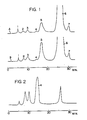
- Elution of the column was started by using 100% liquid A, and just after injection of the sample, the composition of the eluent was changed by adding liquid B to liquid A at a rate of 5% per minute. The resulting chromatogram is shown in Figure 1. The detection was performed by using visible light having a wavelength of 415 nm. In Figure 1, the curves A and B refer respectively to the chromatograms of the blood of the normal healthy person and that of the diabetic patient.
- Then, A1a, Alb, Alc and Ao components were fractionated over the course of more than about 2 hours by ion-exchange column chromatography using a liquid chromatographic filler (Biorex-70, a product of Bio-Rad Laboratories, U.S.A.) well known in the art. Each of the fractions was analyzed by high-performance liquid chromatography under the same conditions as described above. It was determined that A1a, Alb, Alc, Ao and A2 correspond respectively to the
peaks peak 4 was found to be ascribable to HbF as a result of determination using a blood sample obtained from a fetus. - The amount of HbA1c determined by the baseline method was 3.2% for the blood of the normal healthy person and 5.9% for the blood of the diabetic patient.
- The same procedure as in Example 1 was followed except that in the production of the copolymer, 36 g of tetraethylene glycol dimethacrylate, 10 g of tetramethylolmethane triacrylate and 5 g of methacrylic acid were used as the monomers and 40 g of isoamyl alcohol, as the organic solvent.
- The procedure of Example 1 was followed except that 50 g of trimethylolethane trimethacrylate and 15 g of crotonic acid were used as the monomers and 40 g of toluene, as the organic solvent.
- By using the same column, device and eluting conditions as in Example 1, an aqueous solution obtained by mixing blood of a neonate with 20 times its volume of deionized water to hemolyze it was analyzed. The chromatogram shown in Figure 2 was obtained. The
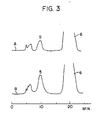
peak 4 in the chromatogram was ascribable to HbF, showing very sharp separation. - The same filler and column as used in Example 3 were used, and the filled column was connected to the same high-performance liquid chromatographic device as in Example 1. The same sample as in Example 1 was analyzed. Elution was performed by passing a mixture of 10% of the liquid A in Example 1 and 90% of the liquid B in Example 1 for 5 minutes, and then replaced by the liquid B. The resulting chromatogram is shown in Figure 3. Curve A is the chromatogram of blood of a normal healthy person, and curve B, the chromatogram of the blood of a diabetic patient. The
peak 5 was ascribable to HbA,c, and thepeak 6, to HbAo. It is seen that HbA1c could be separated within short periods of time. - A filled column was produced in the same way as in Example 1 except that in the preparation of the copolymer, a mixture consisting of 20 g of acrylic acid, 50 g of tetramethylolmethane tetraacrylate, 10 g of 2-hydroxyethyl methacrylate and 1.5 g of benzoyl peroxide was used.
Claims (2)
Applications Claiming Priority (4)
| Application Number | Priority Date | Filing Date | Title |
|---|---|---|---|
| JP64812/81 | 1981-04-27 | ||
| JP56064812A JPS57178157A (en) | 1981-04-27 | 1981-04-27 | Packing agent for liquid chromatograph |
| JP99451/81 | 1981-06-25 | ||
| JP56099451A JPS58760A (en) | 1981-06-25 | 1981-06-25 | Separation of catabolic hemoglobin |
Publications (3)
| Publication Number | Publication Date |
|---|---|
| EP0063947A2 EP0063947A2 (en) | 1982-11-03 |
| EP0063947A3 EP0063947A3 (en) | 1983-04-13 |
| EP0063947B1 true EP0063947B1 (en) | 1987-08-12 |
Family
ID=26405911
Family Applications (1)
| Application Number | Title | Priority Date | Filing Date |
|---|---|---|---|
| EP82302134A Expired EP0063947B1 (en) | 1981-04-27 | 1982-04-26 | Filler for liquid chromatography |
Country Status (4)
| Country | Link |
|---|---|
| US (1) | US4468330A (en) |
| EP (1) | EP0063947B1 (en) |
| CA (1) | CA1203944A (en) |
| DE (1) | DE3276929D1 (en) |
Cited By (1)
| Publication number | Priority date | Publication date | Assignee | Title |
|---|---|---|---|---|
| DE19958308C2 (en) * | 1999-01-18 | 2002-06-06 | Hoermann Kg Antriebstechnik | Method and control for controlling a drive device for a building or an enclosure |
Families Citing this family (19)
| Publication number | Priority date | Publication date | Assignee | Title |
|---|---|---|---|---|
| JPS60231613A (en) * | 1984-04-28 | 1985-11-18 | Terumo Corp | Method for separating humoral component, separation material and separation apparatus therefor |
| FR2578439B1 (en) * | 1985-03-05 | 1989-09-15 | Commissariat Energie Atomique | SOLID SUPPORT CAPABLE OF FIXING A BIOLOGICAL SUBSTANCE, ITS PREPARATION METHOD AND ITS USE FOR PLASMATIC PURIFICATION |
| DE3609021A1 (en) * | 1985-03-25 | 1986-09-25 | Bio-Rad Laboratories, Inc., Richmond, Calif. | CHROMATOGRAPHIC SEPARATION MEDIUM FOR FAST ANALYSIS OF SMALL SAMPLES |
| EP0198395A3 (en) * | 1985-04-09 | 1989-04-12 | Mitsubishi Kasei Corporation | Separating agent for mixed solution |
| US4606825A (en) * | 1985-04-22 | 1986-08-19 | J. T. Baker Chemical Company | Purification of immunoglobulin G |
| GB2184732B (en) * | 1985-12-26 | 1990-07-11 | Showa Denko Kk | Active support substance and adsorbent for chromatography |
| US4802981A (en) * | 1987-11-04 | 1989-02-07 | Oros Systems Limited | Automatic chromatography apparatus |
| US5283123A (en) * | 1989-05-03 | 1994-02-01 | Carter Deborah H | Adsorption material and method |
| DE59100319D1 (en) * | 1990-06-15 | 1993-09-30 | Basf Ag | Process for removing or enriching heavy metal ions from aqueous solution. |
| JP2800509B2 (en) * | 1990-11-30 | 1998-09-21 | 株式会社日立製作所 | Liquid chromatograph |
| US5460970A (en) * | 1993-05-18 | 1995-10-24 | Summa Health System | Separation of acetaldehyde-induced hemoglobin (Hb A1-AcH) |
| US6150507A (en) * | 1995-03-23 | 2000-11-21 | Biopure Corporation | Method for producing a purified hemoglobin product |
| US5691453A (en) * | 1995-06-07 | 1997-11-25 | Biopure Corporation | Separation of polymerized hemoglobin from unpolymerized hemoglobin on hydroxyapatite using HPLC |
| DE69936920T2 (en) * | 1998-06-12 | 2008-05-15 | Waters Investments Ltd., New Castle | NEW POROUS ION EXCHANGE RESINS FOR SOLID PHASE EXTRACTION AND CHROMATOGRAPHY |
| JP2001324487A (en) * | 2000-03-09 | 2001-11-22 | Showa Denko Kk | Packing for reverse-phase liquid chromatography, and method for manufacturing the same |
| US6533939B2 (en) | 2000-03-09 | 2003-03-18 | Showa Denko Kabushiki Kaisha | Packing agent for reversed phase liquid chromatography and production process thereof |
| FR2884253B1 (en) * | 2005-04-08 | 2007-06-22 | Univ Lille Sciences Tech | FUNCTIONALIZABLE MONOLITHIC MATERIALS |
| US7691263B1 (en) * | 2005-05-20 | 2010-04-06 | Brigham Young University | Monolithic column technology for liquid chromatography |
| US20110240541A1 (en) * | 2010-04-06 | 2011-10-06 | Binghe Gu | Monolithic column technology for liquid chromatography |
Family Cites Families (12)
| Publication number | Priority date | Publication date | Assignee | Title |
|---|---|---|---|---|
| US3767600A (en) * | 1968-08-30 | 1973-10-23 | Rohm & Haas | Porous polymers with ionic functional groups based on polyfunctional methacrylates |
| DE1816380A1 (en) * | 1968-12-21 | 1970-12-17 | Merck Anlagen Gmbh | Means for gel chromatography and processes for their preparation |
| US3957741A (en) * | 1974-01-17 | 1976-05-18 | California Institute Of Technology | Crosslinked, porous, polyacrylate beads |
| CS171962B1 (en) * | 1974-02-01 | 1976-11-29 | ||
| US4036788A (en) * | 1975-02-11 | 1977-07-19 | Plastomedical Sciences, Inc. | Anionic hydrogels based on heterocyclic N-vinyl monomers |
| JPS5858026B2 (en) * | 1976-06-25 | 1983-12-23 | 昭和電工株式会社 | Packing material for chromatography and its manufacturing method |
| US4128706A (en) * | 1976-11-09 | 1978-12-05 | Toyo Soda Manufacturing Co., Ltd. | Carrier for liquid chromatography |
| DE2827109C2 (en) * | 1977-06-24 | 1986-10-30 | Asahi Kasei Kogyo K.K., Osaka | Method and device for the separation of organic compounds from plasma proteins of the blood |
| JPS54160300A (en) * | 1978-06-08 | 1979-12-18 | Toyo Soda Mfg Co Ltd | Hydrophilic separating carrier and making method thereof |
| US4243534A (en) * | 1979-01-25 | 1981-01-06 | Becton, Dickinson And Company | Blood separation |
| US4238196A (en) * | 1979-11-01 | 1980-12-09 | Isolab, Inc. | Methods to determine a diagnostic indicator of blood sugar conditions, and, liquid chromatographic columns therefor (cyanide free) |
| WO1990007066A2 (en) * | 1988-12-13 | 1990-06-28 | Rudolf Tanner | Connecting element for form-fitting connection |
-
1982
- 1982-04-23 US US06/371,491 patent/US4468330A/en not_active Expired - Lifetime
- 1982-04-26 CA CA000401649A patent/CA1203944A/en not_active Expired
- 1982-04-26 DE DE8282302134T patent/DE3276929D1/en not_active Expired
- 1982-04-26 EP EP82302134A patent/EP0063947B1/en not_active Expired
Cited By (1)
| Publication number | Priority date | Publication date | Assignee | Title |
|---|---|---|---|---|
| DE19958308C2 (en) * | 1999-01-18 | 2002-06-06 | Hoermann Kg Antriebstechnik | Method and control for controlling a drive device for a building or an enclosure |
Also Published As
| Publication number | Publication date |
|---|---|
| EP0063947A3 (en) | 1983-04-13 |
| CA1203944A (en) | 1986-04-29 |
| EP0063947A2 (en) | 1982-11-03 |
| US4468330A (en) | 1984-08-28 |
| DE3276929D1 (en) | 1987-09-17 |
Similar Documents
| Publication | Publication Date | Title |
|---|---|---|
| US4468330A (en) | Filler for liquid chromatography useful for separating a hemoglobin variant in blood | |
| Tiselius et al. | Protein chromatography on calcium phosphate columns | |
| Wilson et al. | Separation of the valyl-leucyl-and valyl-glutamyl-polypeptide chains of horse globin by fractional precipitation and column chromatography | |
| SU1311631A3 (en) | Tip for liquid chromatography | |
| US4447328A (en) | Filler for liquid chromatography and method for separating water-soluble substances using said filler | |
| GB2024829A (en) | Method and Product for Separation of Glycoproteins | |
| EP0315187A1 (en) | Separation of hemoglobin A2 from hemoglobin mixture | |
| Fahey et al. | Characterization of anti-thyroglobulin factors in human serum | |
| US5292818A (en) | Method for producing a carrier for cation exchange liquid chromatography and a method for determining glycosylated hemoglobins using the carrier | |
| JPH0140953B2 (en) | ||
| JPH0115024B2 (en) | ||
| JP4231165B2 (en) | Packing for liquid chromatography | |
| JPH03255360A (en) | Separation and determination of glycohemoglobin | |
| JPH087198B2 (en) | Quantitative method for glycated hemoglobin | |
| JP4758529B2 (en) | Packing agent for liquid chromatography and measuring method using the same | |
| JPS60213863A (en) | Crosslinked copolymer for separation of hemoglobin | |
| Benson | [2] Improved ion-exchange resins | |
| US4980058A (en) | Separation of hemoglobin A2 from hemoglobin mixture | |
| JPS6359463B2 (en) | ||
| EP0596106B1 (en) | Process for preparing carrier for cation exchange liquid chromatography and method of quantitatively determining glycosylated hemoglobin using said carrier | |
| JPS6359464B2 (en) | ||
| CA1145737A (en) | Filling composition for use in liquid chromatography | |
| JP2004083561A (en) | Ion exchanger for separating lipoproteins and method for separating lipoproteins using the same | |
| JPH10227780A (en) | Method and apparatus for measuring glycated hemoglobin | |
| RU2038597C1 (en) | Method for determining glycosylated hemoglobin in blood |
Legal Events
| Date | Code | Title | Description |
|---|---|---|---|
| PUAI | Public reference made under article 153(3) epc to a published international application that has entered the european phase |
Free format text: ORIGINAL CODE: 0009012 |
|
| AK | Designated contracting states |
Designated state(s): DE FR GB IT NL |
|
| PUAL | Search report despatched |
Free format text: ORIGINAL CODE: 0009013 |
|
| AK | Designated contracting states |
Designated state(s): DE FR GB IT NL |
|
| 17P | Request for examination filed |
Effective date: 19830823 |
|
| ITF | It: translation for a ep patent filed | ||
| GRAA | (expected) grant |
Free format text: ORIGINAL CODE: 0009210 |
|
| AK | Designated contracting states |
Kind code of ref document: B1 Designated state(s): DE FR GB IT NL |
|
| REF | Corresponds to: |
Ref document number: 3276929 Country of ref document: DE Date of ref document: 19870917 |
|
| ET | Fr: translation filed | ||
| PLBE | No opposition filed within time limit |
Free format text: ORIGINAL CODE: 0009261 |
|
| STAA | Information on the status of an ep patent application or granted ep patent |
Free format text: STATUS: NO OPPOSITION FILED WITHIN TIME LIMIT |
|
| 26N | No opposition filed | ||
| ITTA | It: last paid annual fee | ||
| PGFP | Annual fee paid to national office [announced via postgrant information from national office to epo] |
Ref country code: FR Payment date: 19960410 Year of fee payment: 15 |
|
| PGFP | Annual fee paid to national office [announced via postgrant information from national office to epo] |
Ref country code: GB Payment date: 19960417 Year of fee payment: 15 |
|
| PGFP | Annual fee paid to national office [announced via postgrant information from national office to epo] |
Ref country code: DE Payment date: 19960429 Year of fee payment: 15 |
|
| PGFP | Annual fee paid to national office [announced via postgrant information from national office to epo] |
Ref country code: NL Payment date: 19960430 Year of fee payment: 15 |
|
| PG25 | Lapsed in a contracting state [announced via postgrant information from national office to epo] |
Ref country code: GB Effective date: 19970426 |
|
| PG25 | Lapsed in a contracting state [announced via postgrant information from national office to epo] |
Ref country code: NL Effective date: 19971101 |
|
| GBPC | Gb: european patent ceased through non-payment of renewal fee |
Effective date: 19970426 |
|
| PG25 | Lapsed in a contracting state [announced via postgrant information from national office to epo] |
Ref country code: FR Free format text: LAPSE BECAUSE OF NON-PAYMENT OF DUE FEES Effective date: 19971231 |
|
| PG25 | Lapsed in a contracting state [announced via postgrant information from national office to epo] |
Ref country code: DE Free format text: LAPSE BECAUSE OF NON-PAYMENT OF DUE FEES Effective date: 19980101 |
|
| NLV4 | Nl: lapsed or anulled due to non-payment of the annual fee |
Effective date: 19971101 |
|
| REG | Reference to a national code |
Ref country code: FR Ref legal event code: ST |