EP0063909B1 - Debranching enzyme product, preparation and use thereof - Google Patents
Debranching enzyme product, preparation and use thereof Download PDFInfo
- Publication number
- EP0063909B1 EP0063909B1 EP82302001A EP82302001A EP0063909B1 EP 0063909 B1 EP0063909 B1 EP 0063909B1 EP 82302001 A EP82302001 A EP 82302001A EP 82302001 A EP82302001 A EP 82302001A EP 0063909 B1 EP0063909 B1 EP 0063909B1
- Authority
- EP
- European Patent Office
- Prior art keywords
- ncib
- debranching enzyme
- enzyme
- debranching
- starch
- Prior art date
- Legal status (The legal status is an assumption and is not a legal conclusion. Google has not performed a legal analysis and makes no representation as to the accuracy of the status listed.)
- Expired
Links
- 108090000790 Enzymes Proteins 0.000 title claims abstract description 110
- 102000004190 Enzymes Human genes 0.000 title claims abstract description 110
- 238000002360 preparation method Methods 0.000 title claims description 8
- 108010073178 Glucan 1,4-alpha-Glucosidase Proteins 0.000 claims abstract description 33
- 102100022624 Glucoamylase Human genes 0.000 claims abstract description 32
- 229920002472 Starch Polymers 0.000 claims abstract description 31
- 235000019698 starch Nutrition 0.000 claims abstract description 31
- 239000008107 starch Substances 0.000 claims abstract description 30
- WQZGKKKJIJFFOK-GASJEMHNSA-N Glucose Chemical compound OC[C@H]1OC(O)[C@H](O)[C@@H](O)[C@@H]1O WQZGKKKJIJFFOK-GASJEMHNSA-N 0.000 claims description 33
- 230000000694 effects Effects 0.000 claims description 29
- 108090000637 alpha-Amylases Proteins 0.000 claims description 28
- 238000000034 method Methods 0.000 claims description 27
- 239000000047 product Substances 0.000 claims description 26
- 239000008121 dextrose Substances 0.000 claims description 22
- 241000193830 Bacillus <bacterium> Species 0.000 claims description 15
- 239000007787 solid Substances 0.000 claims description 14
- OWEGMIWEEQEYGQ-UHFFFAOYSA-N 100676-05-9 Natural products OC1C(O)C(O)C(CO)OC1OCC1C(O)C(O)C(O)C(OC2C(OC(O)C(O)C2O)CO)O1 OWEGMIWEEQEYGQ-UHFFFAOYSA-N 0.000 claims description 12
- GUBGYTABKSRVRQ-PICCSMPSSA-N Maltose Natural products O[C@@H]1[C@@H](O)[C@H](O)[C@@H](CO)O[C@@H]1O[C@@H]1[C@@H](CO)OC(O)[C@H](O)[C@H]1O GUBGYTABKSRVRQ-PICCSMPSSA-N 0.000 claims description 12
- 108010019077 beta-Amylase Proteins 0.000 claims description 12
- 239000003795 chemical substances by application Substances 0.000 claims description 11
- 235000020357 syrup Nutrition 0.000 claims description 11
- 239000006188 syrup Substances 0.000 claims description 11
- 229920001218 Pullulan Polymers 0.000 claims description 10
- 239000004373 Pullulan Substances 0.000 claims description 10
- 235000019423 pullulan Nutrition 0.000 claims description 10
- 239000008103 glucose Substances 0.000 claims description 8
- 238000011534 incubation Methods 0.000 claims description 7
- IJGRMHOSHXDMSA-UHFFFAOYSA-N Atomic nitrogen Chemical compound N#N IJGRMHOSHXDMSA-UHFFFAOYSA-N 0.000 claims description 6
- 239000008351 acetate buffer Substances 0.000 claims description 6
- OKTJSMMVPCPJKN-UHFFFAOYSA-N Carbon Chemical compound [C] OKTJSMMVPCPJKN-UHFFFAOYSA-N 0.000 claims description 5
- 229910052799 carbon Inorganic materials 0.000 claims description 5
- 230000000984 immunochemical effect Effects 0.000 claims description 5
- 239000000413 hydrolysate Substances 0.000 claims description 4
- 230000015572 biosynthetic process Effects 0.000 claims description 3
- 229910052757 nitrogen Inorganic materials 0.000 claims description 3
- 235000015097 nutrients Nutrition 0.000 claims description 3
- 150000003839 salts Chemical class 0.000 claims description 3
- 238000011084 recovery Methods 0.000 claims description 2
- 230000007062 hydrolysis Effects 0.000 abstract description 8
- 238000006460 hydrolysis reaction Methods 0.000 abstract description 8
- 241001134780 Bacillus acidopullulyticus Species 0.000 abstract description 4
- 229940088598 enzyme Drugs 0.000 description 90
- 239000000758 substrate Substances 0.000 description 19
- 238000000855 fermentation Methods 0.000 description 15
- 230000004151 fermentation Effects 0.000 description 15
- 239000000243 solution Substances 0.000 description 14
- 229920000945 Amylopectin Polymers 0.000 description 13
- 239000002609 medium Substances 0.000 description 11
- XLYOFNOQVPJJNP-UHFFFAOYSA-N water Chemical compound O XLYOFNOQVPJJNP-UHFFFAOYSA-N 0.000 description 10
- 238000006243 chemical reaction Methods 0.000 description 9
- KRKNYBCHXYNGOX-UHFFFAOYSA-N citric acid Chemical compound OC(=O)CC(O)(C(O)=O)CC(O)=O KRKNYBCHXYNGOX-UHFFFAOYSA-N 0.000 description 9
- 235000008504 concentrate Nutrition 0.000 description 9
- 239000012141 concentrate Substances 0.000 description 9
- 239000011541 reaction mixture Substances 0.000 description 9
- 239000000872 buffer Substances 0.000 description 8
- 210000004027 cell Anatomy 0.000 description 8
- 229920002774 Maltodextrin Polymers 0.000 description 7
- 239000005913 Maltodextrin Substances 0.000 description 7
- 239000008367 deionised water Substances 0.000 description 7
- 229910021641 deionized water Inorganic materials 0.000 description 7
- 239000007788 liquid Substances 0.000 description 7
- 229940035034 maltodextrin Drugs 0.000 description 7
- 108010028688 Isoamylase Proteins 0.000 description 6
- HEMHJVSKTPXQMS-UHFFFAOYSA-M Sodium hydroxide Chemical compound [OH-].[Na+] HEMHJVSKTPXQMS-UHFFFAOYSA-M 0.000 description 6
- 239000000203 mixture Substances 0.000 description 6
- 229920001817 Agar Polymers 0.000 description 5
- 239000008272 agar Substances 0.000 description 5
- 102000004139 alpha-Amylases Human genes 0.000 description 5
- 235000010633 broth Nutrition 0.000 description 5
- 239000000126 substance Substances 0.000 description 5
- CSCPPACGZOOCGX-UHFFFAOYSA-N Acetone Chemical compound CC(C)=O CSCPPACGZOOCGX-UHFFFAOYSA-N 0.000 description 4
- 108060003951 Immunoglobulin Proteins 0.000 description 4
- 229940024171 alpha-amylase Drugs 0.000 description 4
- 239000007640 basal medium Substances 0.000 description 4
- 238000005119 centrifugation Methods 0.000 description 4
- 229910000397 disodium phosphate Inorganic materials 0.000 description 4
- 102000018358 immunoglobulin Human genes 0.000 description 4
- 239000012528 membrane Substances 0.000 description 4
- 244000005700 microbiome Species 0.000 description 4
- 102000004169 proteins and genes Human genes 0.000 description 4
- 108090000623 proteins and genes Proteins 0.000 description 4
- 241000894006 Bacteria Species 0.000 description 3
- QAOWNCQODCNURD-UHFFFAOYSA-N Sulfuric acid Chemical compound OS(O)(=O)=O QAOWNCQODCNURD-UHFFFAOYSA-N 0.000 description 3
- 240000008042 Zea mays Species 0.000 description 3
- 235000002017 Zea mays subsp mays Nutrition 0.000 description 3
- 238000005273 aeration Methods 0.000 description 3
- 238000010790 dilution Methods 0.000 description 3
- 239000012895 dilution Substances 0.000 description 3
- 238000001962 electrophoresis Methods 0.000 description 3
- 238000004128 high performance liquid chromatography Methods 0.000 description 3
- 238000000760 immunoelectrophoresis Methods 0.000 description 3
- 238000011081 inoculation Methods 0.000 description 3
- 239000007981 phosphate-citrate buffer Substances 0.000 description 3
- NLKNQRATVPKPDG-UHFFFAOYSA-M potassium iodide Chemical compound [K+].[I-] NLKNQRATVPKPDG-UHFFFAOYSA-M 0.000 description 3
- 230000000644 propagated effect Effects 0.000 description 3
- 239000006228 supernatant Substances 0.000 description 3
- 239000000725 suspension Substances 0.000 description 3
- 238000000108 ultra-filtration Methods 0.000 description 3
- ZCYVEMRRCGMTRW-UHFFFAOYSA-N 7553-56-2 Chemical compound [I] ZCYVEMRRCGMTRW-UHFFFAOYSA-N 0.000 description 2
- 229920000936 Agarose Polymers 0.000 description 2
- CURLTUGMZLYLDI-UHFFFAOYSA-N Carbon dioxide Chemical compound O=C=O CURLTUGMZLYLDI-UHFFFAOYSA-N 0.000 description 2
- 229920001353 Dextrin Polymers 0.000 description 2
- 239000004375 Dextrin Substances 0.000 description 2
- 241000283973 Oryctolagus cuniculus Species 0.000 description 2
- 235000005824 Zea mays ssp. parviglumis Nutrition 0.000 description 2
- 238000003556 assay Methods 0.000 description 2
- 230000001580 bacterial effect Effects 0.000 description 2
- 229940041514 candida albicans extract Drugs 0.000 description 2
- 238000011109 contamination Methods 0.000 description 2
- 235000005822 corn Nutrition 0.000 description 2
- 235000019425 dextrin Nutrition 0.000 description 2
- 230000002255 enzymatic effect Effects 0.000 description 2
- 239000000706 filtrate Substances 0.000 description 2
- 239000000499 gel Substances 0.000 description 2
- 230000001900 immune effect Effects 0.000 description 2
- 230000003053 immunization Effects 0.000 description 2
- 239000012133 immunoprecipitate Substances 0.000 description 2
- 229910052740 iodine Inorganic materials 0.000 description 2
- 239000011630 iodine Substances 0.000 description 2
- 238000004519 manufacturing process Methods 0.000 description 2
- 230000000813 microbial effect Effects 0.000 description 2
- 229920001542 oligosaccharide Polymers 0.000 description 2
- 150000002482 oligosaccharides Chemical class 0.000 description 2
- 238000000746 purification Methods 0.000 description 2
- 239000012266 salt solution Substances 0.000 description 2
- 241000894007 species Species 0.000 description 2
- 230000001954 sterilising effect Effects 0.000 description 2
- 238000004659 sterilization and disinfection Methods 0.000 description 2
- 239000001117 sulphuric acid Substances 0.000 description 2
- 235000011149 sulphuric acid Nutrition 0.000 description 2
- 238000012360 testing method Methods 0.000 description 2
- 239000012137 tryptone Substances 0.000 description 2
- 239000012138 yeast extract Substances 0.000 description 2
- GHCZTIFQWKKGSB-UHFFFAOYSA-N 2-hydroxypropane-1,2,3-tricarboxylic acid;phosphoric acid Chemical compound OP(O)(O)=O.OC(=O)CC(O)(C(O)=O)CC(O)=O GHCZTIFQWKKGSB-UHFFFAOYSA-N 0.000 description 1
- 241000194108 Bacillus licheniformis Species 0.000 description 1
- UXVMQQNJUSDDNG-UHFFFAOYSA-L Calcium chloride Chemical compound [Cl-].[Cl-].[Ca+2] UXVMQQNJUSDDNG-UHFFFAOYSA-L 0.000 description 1
- BVKZGUZCCUSVTD-UHFFFAOYSA-L Carbonate Chemical compound [O-]C([O-])=O BVKZGUZCCUSVTD-UHFFFAOYSA-L 0.000 description 1
- 229920002261 Corn starch Polymers 0.000 description 1
- 229920002271 DEAE-Sepharose Polymers 0.000 description 1
- DKNPRRRKHAEUMW-UHFFFAOYSA-N Iodine aqueous Chemical compound [K+].I[I-]I DKNPRRRKHAEUMW-UHFFFAOYSA-N 0.000 description 1
- 239000005909 Kieselgur Substances 0.000 description 1
- 241000588915 Klebsiella aerogenes Species 0.000 description 1
- 241000588747 Klebsiella pneumoniae Species 0.000 description 1
- 241000533950 Leucojum Species 0.000 description 1
- 240000003183 Manihot esculenta Species 0.000 description 1
- 235000016735 Manihot esculenta subsp esculenta Nutrition 0.000 description 1
- 108010009736 Protein Hydrolysates Proteins 0.000 description 1
- 241000589516 Pseudomonas Species 0.000 description 1
- 101000994199 Pseudomonas amyloderamosa Isoamylase Proteins 0.000 description 1
- 229920002684 Sepharose Polymers 0.000 description 1
- VYPSYNLAJGMNEJ-UHFFFAOYSA-N Silicium dioxide Chemical compound O=[Si]=O VYPSYNLAJGMNEJ-UHFFFAOYSA-N 0.000 description 1
- 235000019764 Soybean Meal Nutrition 0.000 description 1
- 238000010793 Steam injection (oil industry) Methods 0.000 description 1
- 235000016383 Zea mays subsp huehuetenangensis Nutrition 0.000 description 1
- 238000002835 absorbance Methods 0.000 description 1
- 239000002671 adjuvant Substances 0.000 description 1
- GZCGUPFRVQAUEE-SLPGGIOYSA-N aldehydo-D-glucose Chemical compound OC[C@@H](O)[C@@H](O)[C@H](O)[C@@H](O)C=O GZCGUPFRVQAUEE-SLPGGIOYSA-N 0.000 description 1
- BFNBIHQBYMNNAN-UHFFFAOYSA-N ammonium sulfate Chemical compound N.N.OS(O)(=O)=O BFNBIHQBYMNNAN-UHFFFAOYSA-N 0.000 description 1
- 229910052921 ammonium sulfate Inorganic materials 0.000 description 1
- 239000001166 ammonium sulphate Substances 0.000 description 1
- 235000011130 ammonium sulphate Nutrition 0.000 description 1
- 238000005571 anion exchange chromatography Methods 0.000 description 1
- WQZGKKKJIJFFOK-VFUOTHLCSA-N beta-D-glucose Chemical compound OC[C@H]1O[C@@H](O)[C@H](O)[C@@H](O)[C@@H]1O WQZGKKKJIJFFOK-VFUOTHLCSA-N 0.000 description 1
- GUBGYTABKSRVRQ-QUYVBRFLSA-N beta-maltose Chemical compound OC[C@H]1O[C@H](O[C@H]2[C@H](O)[C@@H](O)[C@H](O)O[C@@H]2CO)[C@H](O)[C@@H](O)[C@@H]1O GUBGYTABKSRVRQ-QUYVBRFLSA-N 0.000 description 1
- 238000005842 biochemical reaction Methods 0.000 description 1
- 239000004327 boric acid Substances 0.000 description 1
- 239000001110 calcium chloride Substances 0.000 description 1
- 229910001628 calcium chloride Inorganic materials 0.000 description 1
- 235000011089 carbon dioxide Nutrition 0.000 description 1
- 238000005277 cation exchange chromatography Methods 0.000 description 1
- 150000001768 cations Chemical class 0.000 description 1
- 229920002301 cellulose acetate Polymers 0.000 description 1
- 239000003153 chemical reaction reagent Substances 0.000 description 1
- 230000000052 comparative effect Effects 0.000 description 1
- 239000000356 contaminant Substances 0.000 description 1
- NKLPQNGYXWVELD-UHFFFAOYSA-M coomassie brilliant blue Chemical compound [Na+].C1=CC(OCC)=CC=C1NC1=CC=C(C(=C2C=CC(C=C2)=[N+](CC)CC=2C=C(C=CC=2)S([O-])(=O)=O)C=2C=CC(=CC=2)N(CC)CC=2C=C(C=CC=2)S([O-])(=O)=O)C=C1 NKLPQNGYXWVELD-UHFFFAOYSA-M 0.000 description 1
- 239000008120 corn starch Substances 0.000 description 1
- 210000000805 cytoplasm Anatomy 0.000 description 1
- 230000000593 degrading effect Effects 0.000 description 1
- 230000001419 dependent effect Effects 0.000 description 1
- 238000003745 diagnosis Methods 0.000 description 1
- 238000010828 elution Methods 0.000 description 1
- 238000006047 enzymatic hydrolysis reaction Methods 0.000 description 1
- 238000001704 evaporation Methods 0.000 description 1
- 230000008020 evaporation Effects 0.000 description 1
- 230000001747 exhibiting effect Effects 0.000 description 1
- 238000000605 extraction Methods 0.000 description 1
- 239000000835 fiber Substances 0.000 description 1
- 238000001914 filtration Methods 0.000 description 1
- 238000004108 freeze drying Methods 0.000 description 1
- 230000002538 fungal effect Effects 0.000 description 1
- 239000011521 glass Substances 0.000 description 1
- 238000010438 heat treatment Methods 0.000 description 1
- 230000003301 hydrolyzing effect Effects 0.000 description 1
- 238000002649 immunization Methods 0.000 description 1
- 230000002163 immunogen Effects 0.000 description 1
- 239000002198 insoluble material Substances 0.000 description 1
- 238000001155 isoelectric focusing Methods 0.000 description 1
- 238000002955 isolation Methods 0.000 description 1
- 238000012423 maintenance Methods 0.000 description 1
- 235000009973 maize Nutrition 0.000 description 1
- FDZZZRQASAIRJF-UHFFFAOYSA-M malachite green Chemical compound [Cl-].C1=CC(N(C)C)=CC=C1C(C=1C=CC=CC=1)=C1C=CC(=[N+](C)C)C=C1 FDZZZRQASAIRJF-UHFFFAOYSA-M 0.000 description 1
- 229940107698 malachite green Drugs 0.000 description 1
- VZCYOOQTPOCHFL-UPHRSURJSA-N maleic acid Chemical compound OC(=O)\C=C/C(O)=O VZCYOOQTPOCHFL-UPHRSURJSA-N 0.000 description 1
- 238000000386 microscopy Methods 0.000 description 1
- 230000000877 morphologic effect Effects 0.000 description 1
- 239000006916 nutrient agar Substances 0.000 description 1
- 230000000414 obstructive effect Effects 0.000 description 1
- 230000003287 optical effect Effects 0.000 description 1
- 238000002135 phase contrast microscopy Methods 0.000 description 1
- 239000008363 phosphate buffer Substances 0.000 description 1
- 238000006116 polymerization reaction Methods 0.000 description 1
- 238000001556 precipitation Methods 0.000 description 1
- 238000011085 pressure filtration Methods 0.000 description 1
- 238000012545 processing Methods 0.000 description 1
- 230000001737 promoting effect Effects 0.000 description 1
- 210000001938 protoplast Anatomy 0.000 description 1
- 238000011160 research Methods 0.000 description 1
- 238000012216 screening Methods 0.000 description 1
- 239000002002 slurry Substances 0.000 description 1
- 150000003384 small molecules Chemical class 0.000 description 1
- 238000002415 sodium dodecyl sulfate polyacrylamide gel electrophoresis Methods 0.000 description 1
- 239000002689 soil Substances 0.000 description 1
- 239000004455 soybean meal Substances 0.000 description 1
- 238000001694 spray drying Methods 0.000 description 1
- 229910001220 stainless steel Inorganic materials 0.000 description 1
- 239000010935 stainless steel Substances 0.000 description 1
- 239000008223 sterile water Substances 0.000 description 1
- 235000000346 sugar Nutrition 0.000 description 1
- 150000008163 sugars Chemical class 0.000 description 1
- 239000008399 tap water Substances 0.000 description 1
- 235000020679 tap water Nutrition 0.000 description 1
- VZCYOOQTPOCHFL-UHFFFAOYSA-N trans-butenedioic acid Natural products OC(=O)C=CC(O)=O VZCYOOQTPOCHFL-UHFFFAOYSA-N 0.000 description 1
- 238000010626 work up procedure Methods 0.000 description 1
Images

Classifications
-
- C—CHEMISTRY; METALLURGY
- C12—BIOCHEMISTRY; BEER; SPIRITS; WINE; VINEGAR; MICROBIOLOGY; ENZYMOLOGY; MUTATION OR GENETIC ENGINEERING
- C12N—MICROORGANISMS OR ENZYMES; COMPOSITIONS THEREOF; PROPAGATING, PRESERVING, OR MAINTAINING MICROORGANISMS; MUTATION OR GENETIC ENGINEERING; CULTURE MEDIA
- C12N9/00—Enzymes; Proenzymes; Compositions thereof; Processes for preparing, activating, inhibiting, separating or purifying enzymes
- C12N9/14—Hydrolases (3)
- C12N9/24—Hydrolases (3) acting on glycosyl compounds (3.2)
- C12N9/2402—Hydrolases (3) acting on glycosyl compounds (3.2) hydrolysing O- and S- glycosyl compounds (3.2.1)
- C12N9/2405—Glucanases
- C12N9/2451—Glucanases acting on alpha-1,6-glucosidic bonds
-
- C—CHEMISTRY; METALLURGY
- C12—BIOCHEMISTRY; BEER; SPIRITS; WINE; VINEGAR; MICROBIOLOGY; ENZYMOLOGY; MUTATION OR GENETIC ENGINEERING
- C12Y—ENZYMES
- C12Y302/00—Hydrolases acting on glycosyl compounds, i.e. glycosylases (3.2)
- C12Y302/01—Glycosidases, i.e. enzymes hydrolysing O- and S-glycosyl compounds (3.2.1)
- C12Y302/01003—Glucan 1,4-alpha-glucosidase (3.2.1.3), i.e. glucoamylase
-
- C—CHEMISTRY; METALLURGY
- C12—BIOCHEMISTRY; BEER; SPIRITS; WINE; VINEGAR; MICROBIOLOGY; ENZYMOLOGY; MUTATION OR GENETIC ENGINEERING
- C12N—MICROORGANISMS OR ENZYMES; COMPOSITIONS THEREOF; PROPAGATING, PRESERVING, OR MAINTAINING MICROORGANISMS; MUTATION OR GENETIC ENGINEERING; CULTURE MEDIA
- C12N9/00—Enzymes; Proenzymes; Compositions thereof; Processes for preparing, activating, inhibiting, separating or purifying enzymes
- C12N9/14—Hydrolases (3)
- C12N9/24—Hydrolases (3) acting on glycosyl compounds (3.2)
- C12N9/2402—Hydrolases (3) acting on glycosyl compounds (3.2) hydrolysing O- and S- glycosyl compounds (3.2.1)
- C12N9/2405—Glucanases
- C12N9/2408—Glucanases acting on alpha -1,4-glucosidic bonds
- C12N9/2411—Amylases
- C12N9/2428—Glucan 1,4-alpha-glucosidase (3.2.1.3), i.e. glucoamylase
-
- C—CHEMISTRY; METALLURGY
- C12—BIOCHEMISTRY; BEER; SPIRITS; WINE; VINEGAR; MICROBIOLOGY; ENZYMOLOGY; MUTATION OR GENETIC ENGINEERING
- C12N—MICROORGANISMS OR ENZYMES; COMPOSITIONS THEREOF; PROPAGATING, PRESERVING, OR MAINTAINING MICROORGANISMS; MUTATION OR GENETIC ENGINEERING; CULTURE MEDIA
- C12N9/00—Enzymes; Proenzymes; Compositions thereof; Processes for preparing, activating, inhibiting, separating or purifying enzymes
- C12N9/14—Hydrolases (3)
- C12N9/24—Hydrolases (3) acting on glycosyl compounds (3.2)
- C12N9/2402—Hydrolases (3) acting on glycosyl compounds (3.2) hydrolysing O- and S- glycosyl compounds (3.2.1)
- C12N9/2405—Glucanases
- C12N9/2451—Glucanases acting on alpha-1,6-glucosidic bonds
- C12N9/2457—Pullulanase (3.2.1.41)
-
- C—CHEMISTRY; METALLURGY
- C12—BIOCHEMISTRY; BEER; SPIRITS; WINE; VINEGAR; MICROBIOLOGY; ENZYMOLOGY; MUTATION OR GENETIC ENGINEERING
- C12P—FERMENTATION OR ENZYME-USING PROCESSES TO SYNTHESISE A DESIRED CHEMICAL COMPOUND OR COMPOSITION OR TO SEPARATE OPTICAL ISOMERS FROM A RACEMIC MIXTURE
- C12P19/00—Preparation of compounds containing saccharide radicals
- C12P19/16—Preparation of compounds containing saccharide radicals produced by the action of an alpha-1, 6-glucosidase, e.g. amylose, debranched amylopectin
-
- C—CHEMISTRY; METALLURGY
- C12—BIOCHEMISTRY; BEER; SPIRITS; WINE; VINEGAR; MICROBIOLOGY; ENZYMOLOGY; MUTATION OR GENETIC ENGINEERING
- C12Y—ENZYMES
- C12Y302/00—Hydrolases acting on glycosyl compounds, i.e. glycosylases (3.2)
- C12Y302/01—Glycosidases, i.e. enzymes hydrolysing O- and S-glycosyl compounds (3.2.1)
- C12Y302/01041—Pullulanase (3.2.1.41)
Definitions
- This invention is within the field of enzymes for the enzymatic conversion of starch to sugars. More specifically, the present invention relates to a novel debranching enzyme capable of hydrolyzing alpha-1,6-glycosidic bonds in amylopectin and pullulan. This novel enzyme may be classified as a debranching enzyme of the pullulanase type. The invention is also directed towards a process for preparing the novel debranching enzyme and to the use thereof for the conversion of starch into dextrose and/or maltose containing starch hydrolysates, such as dextrose and maltose syrups.
- the process generally adopted for enzyme-enzyme hydrolysis of starch encompasses the sequential steps of liquefaction and saccharification, the former being catalysed by an alpha-amylase, such as the thermostable B. licheniformis alpha-amylase, e.g. TERMAMYL@ supplied by NOVO Industri A/S, Denmark, and the saccharification to dextrose (D-glucose) being effected in the presence of a glucoamylase, usually of fungal origin, such as AMG-150 L, also obtainable from the above named company.
- the dextrose syrup producer aims at obtaining the highest possible yield of dextrose with the least possible expenditure of enzymes and of energy.
- the highest dextrose level attainable by the conventional process starting with a 30-40 percent (by weight) starch suspension and saccharifying at 30 percent dry solids (D.S.), is about 96 percent (by weight) dextrose (96 DX).
- the reasons why the conventional starch conversion process does not proceed appreciably beyond that limit are essentially twofold.
- amylopectin (which constitutes about 80% of the majority of industrially important starches, including that of corn or maize), exhibits a branched chain structure in that it contains a significant number of alpha-1,6-glycosidic bonds.
- amylopectin is only partially degraded by alpha-amylase because alpha-amylase is practically devoid of alpha-1,6-glucosidase activity
- substantial hydrolysis of the branched oligosaccharides including alpha-limit dextrins occurs in the subsequent saccharification step catalyzed by glucoamylase which also hydrolyses alpha-1,6-glycosidic links.
- beta-amylases Like the alpha-amylases, beta-amylases are only capable of partially degrading amylopectin, in that hydrolysis thereof stops as an 1,6-alpha-branch point is approached.
- a debranching enzyme such as pullulanase or isoamylase
- a substantial increase in maltose content can be achieved as disclosed in British Patent No. 1.144.950 and U.S. Patent No. 3,677,896.
- saccharification temperatures above 55°C are not feasible due to the heat lability of the debranching enzymes, whereby the risk of bacterial contamination is substantially increased.
- the invention resides in the surprising discovery that a novel debranching enzyme of the pullulanase type having such properties is produced by newly discovered microorganisms as the genus Bacillus belonging to the taxonomic group as hereinafter defined.
- a debranching enzyme product which comprises a debranching enzyme of the pullulanase type, characterized in that the enzyme product exhibits immunochemical properties at least partially identical to those of the debranching enzyme derived from the Bacillus strain NCIB 11607; has an activity optimum measured by incubation for 30 minutes in acetate buffer (0.05 M) at pH 4-5 of at least 60°C, a pH optimum in the range of from 3.5 to 5.5 as determined by incubation for 30 minutes in acetate buffer (0.05 M) at 60°C, and a residual activity after 72 hours at 60°C as measured in a dextrose solution (30% dextrose by weight) at pH 5 of at least 50%.
- the debranching enzyme product may be in solid or liquid form and will generally have an activity in the range of from 10 to 350,000 pullulanase units (as hereinafter defined) per g.
- the activity of the debranching enzyme product is in the range of from 100 to 15,000 pullulanase units per g.
- a process for the preparation of a debranching enzyme product in accordance with the first aspect comprises the cultivation in a suitable nutrient medium containing carbon and nitrogen sources and inorganic salts of a Bacillus strain, followed by recovery of the debranching enzyme product, characterized in that the Bacillus strain is selected from NCIB 11607, NCIB 11610, NCIB 11611, NCIB 11636, NCIB 11637 and NCIB 11639, and mutants thereof having the same properties.
- the Bacillus acidopullulyticus strain is selected from the group consisting of NCIB 11607, NCIB 11610, NCIB 11638, and NCIB 11647. Most preferred strains are mutant strains NCIB 11638 and NCIB 11647.
- a process for converting starch into syrups containing dextrose and/or maltose comprises conducting the saccharification of starch or starch hydrolysates in the presence of an enzymme system which comprises effective amounts of the debranching enzyme product according to the first aspect of the present invention and a saccharifying enzyme selected from the group consisting of glucoamylase and betamylase; optionally but preferably the saccharification is preceded by a liquefaction step to form a starch hydrolysate.
- the dry solids content of the starch hydrolysate is at least 30 percent by weight, the saccharification thereof being conducted in the pH-range of from 3.5 to 5.5 at a temperature in the range of from 55°C to 65°C and preferably not more than 63°C.
- Preferred dosages of glucoamylase and beta-amylase are in the range of from 0.05 to 0.5 AG units and from 0.005 to 0.3 beta-amylase units, respectively, the preferred dosage of debranching enzyme being in the range of from 0.005 to 5 pullulanase units (as hereinafter defined), per g of dry solids in the starch hydrolysate.
- the saccharifying enzyme is glucoamylase, whereby starch is converted into high DX dextrose syrup.
- the microorganisms are the microorganisms.
- the microorganisms productive of the debranching enzyme of the present invention were selected by means of their ability to grow on a basal medium prepared by aseptic admixture of equal volumes of tryptone solution (1 percent) and a salt solution of the following composition: the pH of the salt solution being adjusted to 3 with sulphuric acid (10N) prior to heat sterilization. The pH of the final basal medium was 4.8-5.2.
- Agar substrates were prepared from the basal medium containing pullulan or amylopectin (0.5 percent), with or without yeast extract (1 percent). Icubation was conducted at 30°C-37°C. Pullulanase activity was detected as clearing zones following precipitation of pullulan by covering the agar plates with acetone. Debranching of amylopectin was detected as zones of hydrolysis exhibiting a strong blue colour with iodine-potassium iodide reagent.
- the newly discovered microorganisms of the invention are aerobic, rod shaped and endospore forming bacteria. They therefore belong to the genus Bacillus.
- the morphology of the new debranching enzyme producing strains indicates that they belong to the morphological group I of the genus Bacillus.
- a type culture of the new taxonomic group is NCIB 11607.
- Bacillus species are known producers of pullulan-hydrolysing enzymes (Progress in Industrial Microbiology, vol. 15 (1979), and Morgan F. J., Adams K. R., and Priest F. G.: J. Appl. Bacteriol. 46 p. 291 (1979)).
- None of the known species of Bacillus produce a pullulanase retaining its activity at 60°C at pH below 5.0.
- One pullulanase unit is defined as the amount of enzyme which under standard conditions (temperature 60°C and pH 5.0) hydrolyses pullulan at a rate corresponding to the formation of reducing groups equivalent to 1 ⁇ mole of glucose per minute.
- a 4 percent by weight solution (1 ml) of pullulan (supplied by Sigma Chemical Co.) in acetate buffer (0.1 M. pH 5) is preheated for 10 minutes at 60°C followed by addition of a solution (1 ml) of the enzyme dissolved in deionized water at a concentration corresponding to 0.04-0.15 PU per ml.
- the reaction is stopped after 30 minutes by addition of carbonate buffer, pH 10 (3 ml of 0.5 M).
- the concentration of reducing groups liberated is then determined by means of the Somogyi-Nelson method (J. Biol. Chem. 153 (1944) 375-80; Ibid. 160 (1945) 61-68).
- a Bacillus strain capable of producing the debranching enzyme of the present invention is usually propagated on a solid substrate prior to its cultivation under aerobic conditions in a suitable fermentation medium.
- Both media contain assimilable sources of carbon (e.g. glucose for liquid and amylopectin for solid media), a basal salt composition (vide supra) comprising e.g. ammonium sulphate as the nitrogen source, together with growth promoting nutrients, such as yeast extract and/or corn steep liquor (liquid medium) or tryptone (solid substrate).
- the fermentation is typically conducted at slightly elevated temperature, generally in the range of from 30°C to 35°C and at a pH below 6, preferably in the range of 5.0-6.0 and preferably kept approximately constant by automatic means.
- the enzyme is excreted into the medium.
- the ensuing fermentation broth may be freed of bacterial cells, debris therefrom together with other solids, for example by centrifugation.
- the supernatant containing the enzyme may be further clarified, for example by filtration or centrifugation, and then concentrated as required, for example by ultrafiltration or in an evaporator under reduced pressure to give a concentrate which, if desired, may be taken to dryness, for example by lyophilization or spray-drying.
- the resulting crude enzyme product exhibits an activity in the range of from 100 to 15,000 PU per gram.
- the debranching enzyme of the present invention may be purified from a crude enzyme product, such as the concentrate obtained in Example 2 hereinafter, for example by a combination of cation and anion exchange chromatography.
- CM-Sepharose CL-6B was equilibrated with a phosphate-citrate buffer (0.05 M Na 2 HP0 4 titrated with 0.05 M citric acid to pH 4.5).
- the enzyme concentrate was diluted with water to the same conductivity as the equilibrating buffer and the pH was adjusted to 4.5.
- the sample was then applied to the column, whereby the enzyme was completely absorbed.
- Elution was conducted with the same buffer linearly admixed in a gradient mixer with 0.05 M solution of Na 2 HP0 4 so as to provide a gradient in pH.
- the fractions were analysed for pullulanase activity by the method described hereinbefore and for protein content by the Lowry method (J. Biol. Chem. 193 (1951) 256), and fractions showing enzyme activity were pooled.
- a column of DEAE-Sepharose CL-6B was equilibrated with phosphate-citrate buffer (0.01 M Na 2 HP0 4 titrated with 0.01 M citric acid to pH 6.5).
- the pool was diluted to the same conductivity as the equilibrating buffer, adjusted to pH 6.5, and then applied to the column.
- the completely adsorbed enzyme was eluted with the same buffer admixed with phosphate-citrate buffer (0.15 M Na 2 HP0 4 titrated to pH 6.5 with 0.15 M citric acid), thereby yielding a linear gradient in buffer concentration.
- Fractions were collected and analysed as before. The peak fractions showed a specific activity of about 350,000 PU/g.
- thermostability of the enzyme in glucose syrup (ca. 30 percent D.S.) a solution of the enzyme product prepared in the following Example 1 was dissolved in dionised water to give a solution containing 3 PU per ml. Aliquots (1 ml) of this solution were mixed with 1 ml of 0.1 M citrate-phosphate buffer and glucose (0.8 g).
- optical density at 610 nm is compared with that of a blank run with heat inactivated enzyme.
- Monospecific antiserum was generated by immunizing rabbits with purified debranching enzyme according to the method described by N. H. Axelsen et al., A Manual of Quantitative Immunoelectrophoresis (Oslo 1973) chap. 23.
- the debranching enzyme was prepared by cultivating the strain NCIB 11638 (cf. Example 1 hereinafter provided) and purified as described above.
- the immunogen (0.5 ml of a solution containing 18 PU per ml, corresponding to 0.15 mg of protein per ml) was mixed with Freund's adjuvant (0.5 ml) and injected subcutaneously into rabbits every second week. Antiserum was obtained after a total immunization period of 8 weeks and immunoglobulin was prepared therefrom as described by N. H. Axelsen et al., supra.
- the second plate was used for detecting the enzyme by means of an overlayer technique.
- the plate was covered with a gel containing pullulan and agarose (1 percent of each) in maleate buffer (0.1 M, pH 5). After incubation for 2 hours at 50°C the remaining pullulan was precipitated with acetone whereby a clearing zone indicating pullulan hydrolysis became visible.
- Comparison of the two electropherograms showed that the clearing zone and the stained immunoprecipitate were superimposable, thus demonstrating the monospecificity of the immunoglobulin generated against the debranching enzyme produced by the strain NCIB 11638.
- the immunological properties of the debranching enzyme derived from each of the other deposited strains were compared with those of the enzyme from NCIB 11638 by crossed immunoelectrophoresis, using the above prepared immunoglobulin as reference antiserum.
- the immunograms so obtained demonstrated the identity or partial identity with respect to immunochemical properties of all specimens of debranching enzyme investigated.
- the strain NCIB 11638 (which is a mutant of NCIB 11607) was propagated on agar slants for 2 days at 37°C.
- the agar medium was prepared from the basal medium (p.9) by addition of amylopectin (0.5 percent of Snow Flake waxy starch CPC) and 2 percent Bacto-agar (Difco).
- the cells were suspended in sterile water and transferred to a 2 liter laboratory fermentor (Eschweiler, Kiel, West Germany) containing 1 liter of the following medium:
- the pH was adjusted to 5.5 prior to autoclaving at 130°C for 30 minutes.
- Glucose was autoclaved separately and added to a final concentration of 1 percent.
- substrate exchange was initiated at a dilution rate of 0.03 hour-'. After a further 36 hours steady state fermentation conditions were reached at a cell density of about 4 g of dry cells per litre (corresponding to an absorbance of 8 at 450 nm). The pullulanase activity was 7.5 PU per ml.
- the fermentation was conducted in a stainless steel pilot fermentor (total capacity 550 litres, 70 cm diameter) provided with two 6-blade, 24 cm diameter, turbine agitators and with accessories required for continuous fermentation, including equipment for the maintenance of constant pH and temperature.
- the fermentor was charged with a medium (300 litres) of the following composition:
- the pH of the medium was adjusted to 5.8 with sodium hydroxide solution.
- the starch was liquefied by raising the temperature gradually from 60°C to 90°C in the course of 50 minutes followed by sterilization at 121°C for 60 minutes.
- the fermentation was conducted at 29°C-31°C, the agitator speed being 100 r.p.m. and the aeration rate 150 standard liters per minute at a pressure of 0.5 bar.
- a sterile medium of the same composition as above and prepared in the same manner was fed continuously to the culture at a rate of 15 liters per hour. When a volume of 375 liters was reached, automatic withdrawal of culture liquid was initiated. Approximately 30 hours after inoculation vigorous growth was observed by microscopy and as indicated by increased generation of CO 2 ,
- the fermentation medium had the following composition:
- the pH was adjusted to 4.0 before autoclaving at 130°C for 60 minutes.
- the cells were removed as described in Example 1.
- the supernatant was filtered on a Whatman GFA glass filter (11 cm) and then concentrated to 200 ml on an Amicon DC 2 hollow fibre module provided with an H1P10 membrane. Turbidity was removed on the GFA filter and the filtrate further concentrated on the Amicon module using a 202-DDS 600 membrane (DDS, Copenhagen, Denmark) to yield offinal concentrate (30 ml) with an activity of 65 PU/ml.
- the concentrate was stored deepfrozen.
- This suspension was continuously pumped through a jet cooker (Hydro-Thermal Corp. Milwaukee) where it was heated to 105°C by direct steam injection and maintained at 105°C for five minutes.
- the liquefied starch suspension was flash-cooled and pumped over into a saccharification tank where it was held for about 1 hour at 95°C.
- the pH of the liquefied starch was adjusted to 4.0 to 95°C to stop the reaction and the batch was then, spray-dried without purification.
- the DE of the spray-dried maltodextrin was 6.
- Substrates for saccharification were prepared by redissolving suitable amounts of this maltodextrin in deionized water and making up to approximately 30 percent D.S. Aliquots of this substrate were then taken and heated to 60°C and the pH adjusted to 4.8. Different amounts of debranching enzyme were then added together with glucoamylase (Amyloglucosidase Novo 150, 150 AG units/ml). The reaction mixtures were sampled at set time intervals and the % dextrose in each sample determined by HPLC. The following results were obtained:
- a spray-dried maltodextrin substrate with a DE of 5 was prepared according to the method described in Example 5.
- the reaction mixtures were sampled and analysed as in Example 1.
- the dry substance (D.S.) during saccharification was 31 percent.
- a 35 percent D.S. (DE 6) substrate was prepared by dissolving a portion of the maltodextrin prepared as described in Example 5 in deionized water. Aliquots of this substrate were taken and heated to 60°C and the pH adjusted to 4.3 and 4.8.
- Substrates with different dry solids contents were prepared by dissolving 100 g of the DE 6 maltodextrin from Example 5 in different amounts of deionized water and adjusting the pH's to 4.6 at 60°C. 0.113 AG/g D.S. of glucoamylase and 1 PU/g D.S. of debranching enzyme were added. The reaction mixtures were sampled and analyzed as in Example 5. The following results were obtained:
- a further batch of spray-dried maltodextrin with a DE of 5.0 was prepared according to the procedure outlined in Example 5.
- Substrates for saccharification were prepared by redissolving suitable amounts of this maltodextrin in deionized water and making up to approximately 30 percent. Aliquots of this substrate were then heated to 60°C and the pH adjusted to 5.0.
- debranching enzyme can be used together with beta-amylase to produce extra-high maltose syrups.
Landscapes
- Chemical & Material Sciences (AREA)
- Life Sciences & Earth Sciences (AREA)
- Organic Chemistry (AREA)
- Health & Medical Sciences (AREA)
- Engineering & Computer Science (AREA)
- Zoology (AREA)
- Wood Science & Technology (AREA)
- Genetics & Genomics (AREA)
- Bioinformatics & Cheminformatics (AREA)
- Biochemistry (AREA)
- General Engineering & Computer Science (AREA)
- General Health & Medical Sciences (AREA)
- Microbiology (AREA)
- Biotechnology (AREA)
- Molecular Biology (AREA)
- Biomedical Technology (AREA)
- Medicinal Chemistry (AREA)
- General Chemical & Material Sciences (AREA)
- Chemical Kinetics & Catalysis (AREA)
- Preparation Of Compounds By Using Micro-Organisms (AREA)
- Enzymes And Modification Thereof (AREA)
- Medicines Containing Material From Animals Or Micro-Organisms (AREA)
- Micro-Organisms Or Cultivation Processes Thereof (AREA)
- Fodder In General (AREA)
- Breeding Of Plants And Reproduction By Means Of Culturing (AREA)
- Detergent Compositions (AREA)
- Immobilizing And Processing Of Enzymes And Microorganisms (AREA)
- Compounds Of Unknown Constitution (AREA)
- Jellies, Jams, And Syrups (AREA)
- Saccharide Compounds (AREA)
Abstract
Description
- . This invention is within the field of enzymes for the enzymatic conversion of starch to sugars. More specifically, the present invention relates to a novel debranching enzyme capable of hydrolyzing alpha-1,6-glycosidic bonds in amylopectin and pullulan. This novel enzyme may be classified as a debranching enzyme of the pullulanase type. The invention is also directed towards a process for preparing the novel debranching enzyme and to the use thereof for the conversion of starch into dextrose and/or maltose containing starch hydrolysates, such as dextrose and maltose syrups.
- During the past decade the all-enzymatic hydrolysis of starch to syrups has gained wide and steadily increasing acceptance within the starch processing industry. On a world-wide basis the present enzymatic production of dextrose syrup from starch is estimated to exceed 3 million tons (calculated as dry substance) per annum compared with about 0.4 million tons ten years ago.
- The process generally adopted for enzyme-enzyme hydrolysis of starch encompasses the sequential steps of liquefaction and saccharification, the former being catalysed by an alpha-amylase, such as the thermostable B. licheniformis alpha-amylase, e.g. TERMAMYL@ supplied by NOVO Industri A/S, Denmark, and the saccharification to dextrose (D-glucose) being effected in the presence of a glucoamylase, usually of fungal origin, such as AMG-150 L, also obtainable from the above named company. Obviously, the dextrose syrup producer aims at obtaining the highest possible yield of dextrose with the least possible expenditure of enzymes and of energy.
- The highest dextrose level attainable by the conventional process, starting with a 30-40 percent (by weight) starch suspension and saccharifying at 30 percent dry solids (D.S.), is about 96 percent (by weight) dextrose (96 DX). The reasons why the conventional starch conversion process does not proceed appreciably beyond that limit are essentially twofold.
- Firstly, amylopectin (which constitutes about 80% of the majority of industrially important starches, including that of corn or maize), exhibits a branched chain structure in that it contains a significant number of alpha-1,6-glycosidic bonds. Whereas amylopectin is only partially degraded by alpha-amylase because alpha-amylase is practically devoid of alpha-1,6-glucosidase activity, substantial hydrolysis of the branched oligosaccharides including alpha-limit dextrins occurs in the subsequent saccharification step catalyzed by glucoamylase which also hydrolyses alpha-1,6-glycosidic links. However, the latter reaction proceeds at a considerably lower rate than the corresponding hydrolysis of alpha-1,4-bonds, whereby complete saccharification is impeded. Attempts to remedy the situation by adding more glucoamylase collides with a second obstructive feature (apart from incurring higher enzyme costs), namely the ability of glucoamylase also to catalyze dextrose polymerization (the so-called reversionary reaction).
- It should be mentioned in passing that an increase of starch conversion from about 96 DX to about 98 DX (which for certain uses of dextrose is regarded as a highly significant improvement) entailing thereby a reduction in the content of non-dextrose contaminants by about 50 percent, can be achieved by employing a relatively high level of glucoamylase combined with a dilution of the substrate to about 15 percent D.S., vide U.S. Patent No. 4,017,363. However, the subsequent concentration of such a dextrose solution to the higher conventional dry solids levels is energy consuming.
- The prior art has suggested employment of glucoamylase and a debranching enzyme simultaneously to obtain a significant increase in dextrose level, the rationale being that debranching enzymes have been shown to efficiently hydrolyse specific types of alpha-1,6-glycosidic bonds occurring in branched chain oligosaccharides, and certain alpha-limit dextrins. In this respect reference is made to U.S. Patent No. 3,897,305 disclosing the combined use of glucoamylase and Aerobacter aerogenes (Klebsiella pneumoniae) pullulanase, whereby a significant increase in DX of up to 2 percent can be achieved for syrups containing at least 30 percent D.S. Similar results have been demonstrated for the combined action of glucoamylase and another debranching enzyme, viz. Pseudomonas amyloderamosa isoamylase as described in British Patent Application No. 8107287.
- However, in the first instance practically no saving of glucoamylase is achieved because the pH optimum of K. pneumoniae pullulanase makes it mandatory to conduct the saccharification at a relatively high pH (5,5-6) whereat the activity of glucoamylase is dramatically reduced.
- The same problem is not encountered with the isoamylase which has a pH optimum much closer to that of glucoamylase, whereby the dosage of the latter can be substantially reduced (by about 50 percent), simultaneously with the attainment of an increase in DX value of 1-2 percent. However, a serious drawback of the isoamylase process (and actually shared by the known pullulanase process as well) is the heat lability of the debranching enzymes known in the art. This has meant that heretofore no saccharification in the presence of debranching enzyme has been technically feasible above about 55°C, whereas glucoamylase per se is adequately stable even at 60°C at which temperature level the risk of microbial contamination of substrates is significantly reduced as compared with lower temperatures.
- Obstacles akin to those described hereinbefore have been encountered in the conversion of starch to high maltose syrup by means of beta-amylases. Like the alpha-amylases, beta-amylases are only capable of partially degrading amylopectin, in that hydrolysis thereof stops as an 1,6-alpha-branch point is approached. By combining the action of beta-amylase with that of a debranching enzyme, such as pullulanase or isoamylase, a substantial increase in maltose content can be achieved as disclosed in British Patent No. 1.144.950 and U.S. Patent No. 3,677,896. However, again saccharification temperatures above 55°C are not feasible due to the heat lability of the debranching enzymes, whereby the risk of bacterial contamination is substantially increased.
- It is an object of the present invention to obviate the shortcomings of the debranching enzymes known heretofore by furnishing a novel debranching enzyme having a temperature stability comparable to that of glucoamylase, and furthermore, possessing a pH optimum close to that of glucoamylase.
- The invention resides in the surprising discovery that a novel debranching enzyme of the pullulanase type having such properties is produced by newly discovered microorganisms as the genus Bacillus belonging to the taxonomic group as hereinafter defined.
- According to the first aspect of the present invention there is provided a debranching enzyme product, which comprises a debranching enzyme of the pullulanase type, characterized in that the enzyme product exhibits immunochemical properties at least partially identical to those of the debranching enzyme derived from the Bacillus strain NCIB 11607; has an activity optimum measured by incubation for 30 minutes in acetate buffer (0.05 M) at pH 4-5 of at least 60°C, a pH optimum in the range of from 3.5 to 5.5 as determined by incubation for 30 minutes in acetate buffer (0.05 M) at 60°C, and a residual activity after 72 hours at 60°C as measured in a dextrose solution (30% dextrose by weight) at pH 5 of at least 50%.
- The debranching enzyme product may be in solid or liquid form and will generally have an activity in the range of from 10 to 350,000 pullulanase units (as hereinafter defined) per g.
- In a preferred embodiment of the present invention the activity of the debranching enzyme product is in the range of from 100 to 15,000 pullulanase units per g.
- According to a further aspect of the present invention there is provided a process for the preparation of a debranching enzyme product in accordance with the first aspect, which process comprises the cultivation in a suitable nutrient medium containing carbon and nitrogen sources and inorganic salts of a Bacillus strain, followed by recovery of the debranching enzyme product, characterized in that the Bacillus strain is selected from NCIB 11607, NCIB 11610, NCIB 11611, NCIB 11636, NCIB 11637 and NCIB 11639, and mutants thereof having the same properties.
- In a preferred embodiment of preparing the debranching enzyme product of this invention the Bacillus acidopullulyticus strain is selected from the group consisting of NCIB 11607, NCIB 11610, NCIB 11638, and NCIB 11647. Most preferred strains are mutant strains NCIB 11638 and NCIB 11647.
- According to another aspect of the present invention there is provided a process for converting starch into syrups containing dextrose and/or maltose, which process comprises conducting the saccharification of starch or starch hydrolysates in the presence of an enzymme system which comprises effective amounts of the debranching enzyme product according to the first aspect of the present invention and a saccharifying enzyme selected from the group consisting of glucoamylase and betamylase; optionally but preferably the saccharification is preceded by a liquefaction step to form a starch hydrolysate.
- In a preferred mode of using the debranching enzyme of this invention the dry solids content of the starch hydrolysate is at least 30 percent by weight, the saccharification thereof being conducted in the pH-range of from 3.5 to 5.5 at a temperature in the range of from 55°C to 65°C and preferably not more than 63°C. Preferred dosages of glucoamylase and beta-amylase are in the range of from 0.05 to 0.5 AG units and from 0.005 to 0.3 beta-amylase units, respectively, the preferred dosage of debranching enzyme being in the range of from 0.005 to 5 pullulanase units (as hereinafter defined), per g of dry solids in the starch hydrolysate.
- In an additional preferred mode the saccharifying enzyme is glucoamylase, whereby starch is converted into high DX dextrose syrup.
- Isolation: The microorganisms productive of the debranching enzyme of the present invention were selected by means of their ability to grow on a basal medium prepared by aseptic admixture of equal volumes of tryptone solution (1 percent) and a salt solution of the following composition:

- Agar substrates were prepared from the basal medium containing pullulan or amylopectin (0.5 percent), with or without yeast extract (1 percent). Icubation was conducted at 30°C-37°C. Pullulanase activity was detected as clearing zones following precipitation of pullulan by covering the agar plates with acetone. Debranching of amylopectin was detected as zones of hydrolysis exhibiting a strong blue colour with iodine-potassium iodide reagent.
- A number of microbial isolates from natural sources, particularly from soil samples, were selected according to the above screening procedure and, when subjected to further tests as hereinafter described, shown to produce the enyzme of the present invention. Examples of such cultures and mutants thereof were deposited with the National Collection of Industrial Bacteria, Torry Research Station, Aberdeen, Scotland and accorded the reference numbers indicated in the following table I.

- The newly discovered microorganisms of the invention are aerobic, rod shaped and endospore forming bacteria. They therefore belong to the genus Bacillus.
- Their properties do not fit any of the recognized species of the genus Bacillus as described in Bergey's Manual (Vlllth Edition, Williams and Wilkins, Baltimore, 1974), or the monograph: The Genus Bacillus, by Gordon, Heynes and Pang, Agriculture Handbook No. 427, US Department of Agriculture, 1973. The present inventors therefore classify them as a new taxonomic group to which the name Bacillus acidopullulyticus has been accorded.
- The diagnosis of this novel taxonomic group is as follows:
- Morphology:
- Vegetative cells: Rods with a diameter of 0.6-1 micron. Swollen cells of protoplast character are frequently observed and seem to be stable during several hours of submerged fermentation.
- Spores: Cylindrical to ellipsoid, central to subterminal, sporangia not swollen. In phase contrast microscopy the spores are difficult to distinguish from unstainable globules which may be present in the protoplasm. Contrary to these globules the spores are stained by malachite green.
- Biochemical reactions:


- The morphology of the new debranching enzyme producing strains indicates that they belong to the morphological group I of the genus Bacillus.
- A type culture of the new taxonomic group is NCIB 11607.
- Other representative strains of the group are NCIB 11610, 11611, 11636 and 11637, and 11639.
- A variety of Bacillus species are known producers of pullulan-hydrolysing enzymes (Progress in Industrial Microbiology, vol. 15 (1979), and Morgan F. J., Adams K. R., and Priest F. G.: J. Appl. Bacteriol. 46 p. 291 (1979)). However, none of the known species of Bacillus produce a pullulanase retaining its activity at 60°C at pH below 5.0.
- Hence, according to an additional aspect of the present invention there is provided a biologically pure culture of a bacterium belonging to the novel taxonomic group of Bacillus acidopullulyticus as hereinbefore defined.
- One pullulanase unit (PU) is defined as the amount of enzyme which under standard conditions (
temperature 60°C and pH 5.0) hydrolyses pullulan at a rate corresponding to the formation of reducing groups equivalent to 1 µ mole of glucose per minute. - A 4 percent by weight solution (1 ml) of pullulan (supplied by Sigma Chemical Co.) in acetate buffer (0.1 M. pH 5) is preheated for 10 minutes at 60°C followed by addition of a solution (1 ml) of the enzyme dissolved in deionized water at a concentration corresponding to 0.04-0.15 PU per ml. The reaction is stopped after 30 minutes by addition of carbonate buffer, pH 10 (3 ml of 0.5 M). The concentration of reducing groups liberated is then determined by means of the Somogyi-Nelson method (J. Biol. Chem. 153 (1944) 375-80; Ibid. 160 (1945) 61-68).
- A Bacillus strain capable of producing the debranching enzyme of the present invention is usually propagated on a solid substrate prior to its cultivation under aerobic conditions in a suitable fermentation medium. Both media contain assimilable sources of carbon (e.g. glucose for liquid and amylopectin for solid media), a basal salt composition (vide supra) comprising e.g. ammonium sulphate as the nitrogen source, together with growth promoting nutrients, such as yeast extract and/or corn steep liquor (liquid medium) or tryptone (solid substrate). The fermentation is typically conducted at slightly elevated temperature, generally in the range of from 30°C to 35°C and at a pH below 6, preferably in the range of 5.0-6.0 and preferably kept approximately constant by automatic means. The enzyme is excreted into the medium.
- The ensuing fermentation broth, usually containing from about 0.1 to about 50 PU per ml, may be freed of bacterial cells, debris therefrom together with other solids, for example by centrifugation. The supernatant containing the enzyme may be further clarified, for example by filtration or centrifugation, and then concentrated as required, for example by ultrafiltration or in an evaporator under reduced pressure to give a concentrate which, if desired, may be taken to dryness, for example by lyophilization or spray-drying. Typically, the resulting crude enzyme product exhibits an activity in the range of from 100 to 15,000 PU per gram.
- The debranching enzyme of the present invention may be purified from a crude enzyme product, such as the concentrate obtained in Example 2 hereinafter, for example by a combination of cation and anion exchange chromatography.
- A column of CM-Sepharose CL-6B was equilibrated with a phosphate-citrate buffer (0.05 M Na2HP04 titrated with 0.05 M citric acid to pH 4.5). The enzyme concentrate was diluted with water to the same conductivity as the equilibrating buffer and the pH was adjusted to 4.5. The sample was then applied to the column, whereby the enzyme was completely absorbed. Elution was conducted with the same buffer linearly admixed in a gradient mixer with 0.05 M solution of Na2HP04 so as to provide a gradient in pH. The fractions were analysed for pullulanase activity by the method described hereinbefore and for protein content by the Lowry method (J. Biol. Chem. 193 (1951) 256), and fractions showing enzyme activity were pooled.
- A column of DEAE-Sepharose CL-6B was equilibrated with phosphate-citrate buffer (0.01 M Na2HP04 titrated with 0.01 M citric acid to pH 6.5). The pool was diluted to the same conductivity as the equilibrating buffer, adjusted to pH 6.5, and then applied to the column. The completely adsorbed enzyme was eluted with the same buffer admixed with phosphate-citrate buffer (0.15 M Na2HP04 titrated to pH 6.5 with 0.15 M citric acid), thereby yielding a linear gradient in buffer concentration. Fractions were collected and analysed as before. The peak fractions showed a specific activity of about 350,000 PU/g. In sodium dodecyl sulphate polyacrylamide gel electrophoresis (S. G. Braun et al., J. Virology vol. 10 (1972) 221) the contents of the fraction with highest activity exhibited in single protein band corresponding to MW about 100,000 Dalton. The protein has a pl of 5.0 as determined by isoelectric focusing on "LKB Ampholine PAG" plates (following the instructions given by LKB-Produkter AB, Sweden).
- The dependence of the activity of the debranching enzyme of this invention on pH in the range of 3.5-5.5 at different temperature levels was determined by the method for determination of pullulanase activity described above, using a reaction mixture of which pH and temperature were adjusted to predetermined values. Reference is now made to the attached drawing graphically illustrating the relative activity plotted against pH at 55°C, 60°C and 65°C, respectively.
- To determine the thermostability of the enzyme in glucose syrup (ca. 30 percent D.S.) a solution of the enzyme product prepared in the following Example 1 was dissolved in dionised water to give a solution containing 3 PU per ml. Aliquots (1 ml) of this solution were mixed with 1 ml of 0.1 M citrate-phosphate buffer and glucose (0.8 g).
- After incubation of samples for 3 days at 50°C and 60°C the residual activity was determined by means of the assay for amylopectin debranching activity. A comparative test was conducted with Pseudomonas isoamylase (Hayashibara Biochemical Laboratories, Japan, containing 500,000 isoamylase units (IA) per g) diluted to 300 IA per ml.
- The results are presented in the following table II.

- Hydrolysis of the alpha-1,6-bonds of amylopectin causes an increase in the colour intensity (as measured at 610 nm) of the blue iodine-amylopectin complex. This increase is dependent on the amount of alpha-1,6-bonds hydrolysed.
- The enzyme solution (1 ml), diluted in deionized water to a concentration corresponding to 1-2 PU and 20-40 IA per ml for debranching enzyme and isoamylase, respectively, is mixed with acetate buffer (1 ml of 0.5 M, pH 4.5) and a 1 percent solution (5 ml) of amylopectin (CPC, SNOWFLAKE 04201 starch). The mixture is incubated for 30 minutes at 50°C. An aliquot (0.5 m1) is mixed with 15 ml of 0.02 N H2SO4 and 0.5 ml of iodine solution (0.01 M iodine in 0.2 percent potassium iodide).
- After 15 minutes at room temperature the optical density at 610 nm is compared with that of a blank run with heat inactivated enzyme.
- Monospecific antiserum was generated by immunizing rabbits with purified debranching enzyme according to the method described by N. H. Axelsen et al., A Manual of Quantitative Immunoelectrophoresis (Oslo 1973) chap. 23. The debranching enzyme was prepared by cultivating the strain NCIB 11638 (cf. Example 1 hereinafter provided) and purified as described above.
- The immunogen (0.5 ml of a solution containing 18 PU per ml, corresponding to 0.15 mg of protein per ml) was mixed with Freund's adjuvant (0.5 ml) and injected subcutaneously into rabbits every second week. Antiserum was obtained after a total immunization period of 8 weeks and immunoglobulin was prepared therefrom as described by N. H. Axelsen et al., supra.
- Two samples of the crude debranching enzyme product derived from the same strain (NCIB 11638), e.g. as obtained according to Example 1 hereinafter (each sample containing 10 PU per ml), were subjected to crossed immunoelectrophoresis according to the same authors (chap. 3) First dimension: 1 percent agarose in TRIS-boric acid buffer (20 mM, pH 8.6); electrophoresis at 15°C, 8 volts per cm for 2 hours. Second dimension: Same agaraose gel as above containing the immunoglobulin (100 pl); electrophoresis at 15°C, 1 volt per cm for 16 hours.
- One plate, stained with Coomassie Brilliant Blue, gave a single peak of immunoprecipitate. The second plate was used for detecting the enzyme by means of an overlayer technique. The plate was covered with a gel containing pullulan and agarose (1 percent of each) in maleate buffer (0.1 M, pH 5). After incubation for 2 hours at 50°C the remaining pullulan was precipitated with acetone whereby a clearing zone indicating pullulan hydrolysis became visible. Comparison of the two electropherograms showed that the clearing zone and the stained immunoprecipitate were superimposable, thus demonstrating the monospecificity of the immunoglobulin generated against the debranching enzyme produced by the strain NCIB 11638.
- The immunological properties of the debranching enzyme derived from each of the other deposited strains were compared with those of the enzyme from NCIB 11638 by crossed immunoelectrophoresis, using the above prepared immunoglobulin as reference antiserum. The immunograms so obtained demonstrated the identity or partial identity with respect to immunochemical properties of all specimens of debranching enzyme investigated. With respect to the meaning of the terms "immunochemical identity" and "partial immunochemical identity", reference is made to the above cited monograph by N. H. Axelsen et al., chapters 10 and 11, respectively.
- The following examples are presented as illustrative embodiments of this invention and are not intended as specific limitations thereof.
- The strain NCIB 11638 (which is a mutant of NCIB 11607) was propagated on agar slants for 2 days at 37°C. The agar medium was prepared from the basal medium (p.9) by addition of amylopectin (0.5 percent of Snow Flake waxy starch CPC) and 2 percent Bacto-agar (Difco).
- The cells were suspended in sterile water and transferred to a 2 liter laboratory fermentor (Eschweiler, Kiel, West Germany) containing 1 liter of the following medium:

- The pH was adjusted to 5.5 prior to autoclaving at 130°C for 30 minutes. Glucose was autoclaved separately and added to a final concentration of 1 percent.
- During the cultivation pH was kept at 5.5±0.2 by addition of sulphuric acid (2 percent solution). The temperature was 30.0±0.1°C, and the aeration rate 650 ml per minute (± 10 percent).
- After 22 hours of cultivation, substrate exchange was initiated at a dilution rate of 0.03 hour-'. After a further 36 hours steady state fermentation conditions were reached at a cell density of about 4 g of dry cells per litre (corresponding to an absorbance of 8 at 450 nm). The pullulanase activity was 7.5 PU per ml.
- During 6 days of steady state continuous fermentation, 4,000 ml of culture liquid was collected in a chilled flask. The cells were removed by centrifugation for 30 minutes at 2,300 rpm, and the supernatant, containing 5.1 PU per ml, was concentrated by ultrafiltration through a G-600 membrane using a standard laboratory outfit (supplied by Sartorius). The volume of this concentrate (800 ml) was further reduced in a Buchi rotating evaporator at 45°C. The final concentrate (76 ml) so obtained was frozen and lyophilized, thereby yielding a dry powdered product (6.8 g) having an activity of 1150 PU per g.
- The fermentation was conducted in a stainless steel pilot fermentor (total capacity 550 litres, 70 cm diameter) provided with two 6-blade, 24 cm diameter, turbine agitators and with accessories required for continuous fermentation, including equipment for the maintenance of constant pH and temperature. The fermentor was charged with a medium (300 litres) of the following composition:

- The pH of the medium was adjusted to 5.8 with sodium hydroxide solution. The starch was liquefied by raising the temperature gradually from 60°C to 90°C in the course of 50 minutes followed by sterilization at 121°C for 60 minutes.
- A culture of the strain NCIB 11647, grown for 4 days in a Fernbach culture flask on the same nutrient agar substrate as used in Example 1, was used for inoculation of 300 litres of medium. The fermentation was conducted at 29°C-31°C, the agitator speed being 100 r.p.m. and the aeration rate 150 standard liters per minute at a pressure of 0.5 bar. Starting at 33.5 hours after inoculation, a sterile medium of the same composition as above and prepared in the same manner was fed continuously to the culture at a rate of 15 liters per hour. When a volume of 375 liters was reached, automatic withdrawal of culture liquid was initiated. Approximately 30 hours after inoculation vigorous growth was observed by microscopy and as indicated by increased generation of CO2,
- Collection of culture broth commenced at a culture age of 73 hours. The debranching enzyme activity had then increased to above 10 PU per ml. During the period of from 115 hours to 210 hours an approximately steady state was maintained at an enzyme concentration corresponding to between 50 and 76 PU per ml, the pH of the broth varying between 5.4 and 5.9.
- All subsequent operations were conducted at pH 5.5-5.7. The fermentation broth collected during 110 hours (1650 liters) was filtered on a rotary vacuum filter (2.5 m2) coated with diatomaceous earth filter aid. The filtrate was concentrated and freed from low molecular weight compounds by ultrafiltration using a DDS (7 m2) module (supplied by DDS, Copenhagen, Denmark) provided with a cellulose acetate membrane, type 600. The final concentrate (70 liters) contained 9.4 percent dry substance.
- Further concentration (to a volume of 21 liters), was effected in a rotary vacuum evaporator. An additional pressure filtration, using the same filter aid as above, gave an enzyme concentrate (15.5 kg, containing 28.8 percent dry substance) with an activity of 1500 PU per g.
- The strains were propagated and the fermentations conducted in the same manner as that described in Example 1. Maltose (0.5 percent) was used instead of glucose as the carbon source. Mean values of other parameters of the fermentations will appear from the following Table 1.

- The culture broths were collected and the debranching enzyme products were recovered essentially as described in Example 1. Details of the work-up procedure will appear from the following Table 2.

- Propagation of strain NCIB 11639, incubation and fermentation was conducted as described in Example 1.
- The fermentation medium had the following composition:
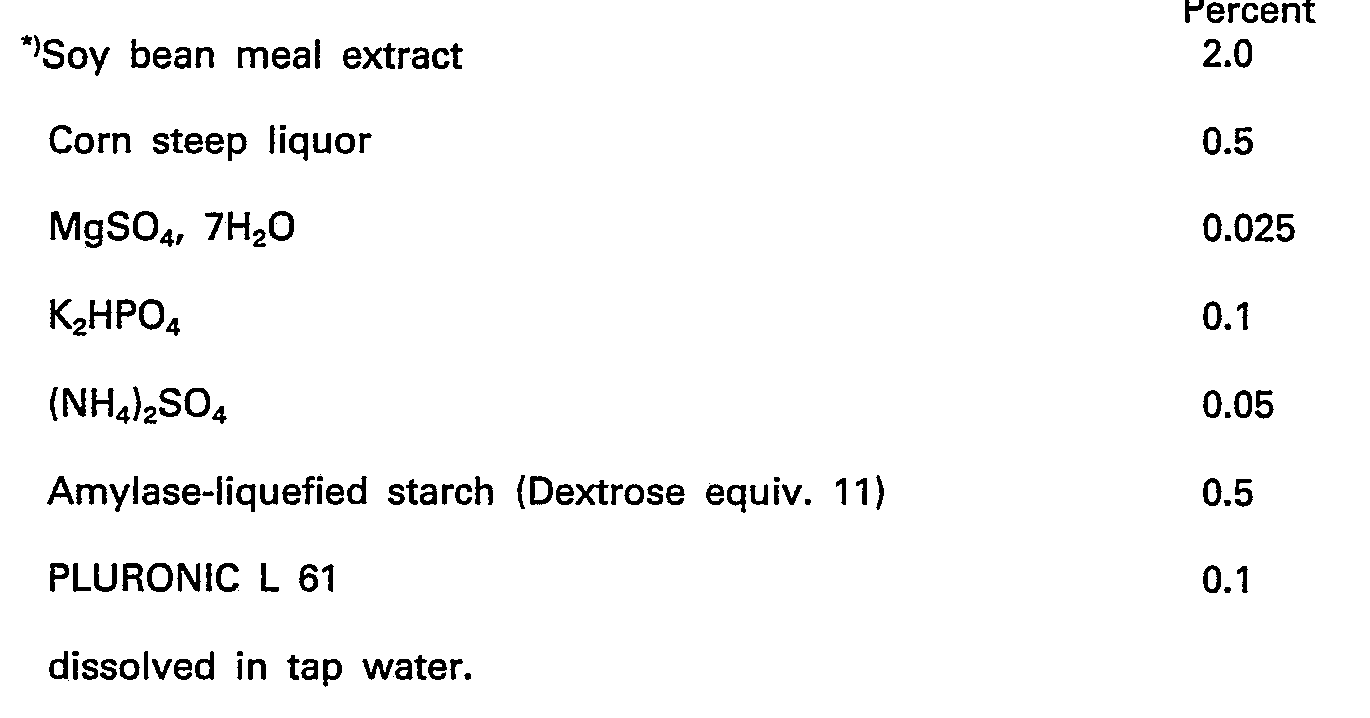
- "Extraction of soy bean meal solubles at pH 4.5 and 50°C for 4 hours. Insoluble material was removed by centrifugation.
- The pH was adjusted to 4.0 before autoclaving at 130°C for 60 minutes.
- During the cultivation pH was kept at 5.6±0.1 by addition of a sodium hydroxide solution (2 percent). The temperature was 30.0±0.1°C and the aeration rate 320 mi/min at a stirrer speed of 530-565 rpm. The fermentation was run continuously at a dilution rate of 0.03-0.05 hr-1 for 186 hours when collection of over-flowing culture liquid was started. Culture liquid (5100 ml, 0.47 PU/ml) was collected over dry ice for an additional 97 hours under the following conditions:

- The cells were removed as described in Example 1. The supernatant was filtered on a Whatman GFA glass filter (11 cm) and then concentrated to 200 ml on an Amicon DC 2 hollow fibre module provided with an H1P10 membrane. Turbidity was removed on the GFA filter and the filtrate further concentrated on the Amicon module using a 202-DDS 600 membrane (DDS, Copenhagen, Denmark) to yield offinal concentrate (30 ml) with an activity of 65 PU/ml. The concentrate was stored deepfrozen.
- 100 kg of corn starch (Globe@ 03430, CPC) were slurried with tap water containing 100 ppm Ca++ and the volume adjusted to 225 liters. The pH was adjusted to 6.3 and 135 g of TERMAMYL@ 60 L (NOVO Industri A/B, Denmark) were added.
- This suspension was continuously pumped through a jet cooker (Hydro-Thermal Corp. Milwaukee) where it was heated to 105°C by direct steam injection and maintained at 105°C for five minutes. The liquefied starch suspension was flash-cooled and pumped over into a saccharification tank where it was held for about 1 hour at 95°C.
- The pH of the liquefied starch was adjusted to 4.0 to 95°C to stop the reaction and the batch was then, spray-dried without purification. The DE of the spray-dried maltodextrin was 6.
- Substrates for saccharification were prepared by redissolving suitable amounts of this maltodextrin in deionized water and making up to approximately 30 percent D.S. Aliquots of this substrate were then taken and heated to 60°C and the pH adjusted to 4.8. Different amounts of debranching enzyme were then added together with glucoamylase (Amyloglucosidase Novo 150, 150 AG units/ml). The reaction mixtures were sampled at set time intervals and the % dextrose in each sample determined by HPLC. The following results were obtained:

- These results indicate that when debranching enzyme is used together with glucoamylase, the same dextrose level can be obtained with half the glucoamylase dosage used in the control when a debranching enzyme dosage of 0.1 PU/g D.S. is used.
- if the debranching enzyme dosage is increased the maximum obtainable dextrose level also increases.
- Aliquots of the substrate prepared as in Example were heated to 55 or 60°C and the pH adjusted to 4.9. An amount of glucoamylase corresponding to 0.113 AG/g D.S. and an amount of debranching enzyme corresponding to 1.2 PU/g D.S. were added. The reaction mixtures were sampled and analyzed as in Example 5.
- The following results were obtained:

- These results confirm that the debranching enzyme is sufficiently heat stable to be used at 60°C.
- A spray-dried maltodextrin substrate with a DE of 5 was prepared according to the method described in Example 5.
- Aliquots of this substrate were heated to 60, 62.5 and 65°C and the pH adjusted to 4.9. An amount of glucoamylase corresponding to 0.113 AG/g D.S. and an amount of debranching enzyme corresponding to 1 PU/g D.S. were added. Control saccharifications to which an amount of glucoamylase corresponding to 0.225 AG/g D.S. had been added, but without debranching enzyme, were also included.
- The reaction mixtures were sampled and analysed as in Example 1. The dry substance (D.S.) during saccharification was 31 percent.

- These results indicate that saccharification with debranching enzyme and glucoamylase may be carried out at 60-62.5°C. At 65°C the results are inferior, which may be due to glucoamylase instability at that temperature.
- Aliquots of the substrate prepared as in Example were heated to 60°C and the pH adjusted to 4.5, and 4.8. An amount of glucoamylase corresponding to 0.113 AG/g D.S. and an amount of debranching enzyme corresponding to 1 PU/g D.S. were added. The reaction mixtures were sampled and analyzed as in Example 5. The following results were obtained:

- These results indicate that similar results can be obtained when saccharifying at pH 4.5 and 4.8. Example 9
- A 35 percent D.S. (DE 6) substrate was prepared by dissolving a portion of the maltodextrin prepared as described in Example 5 in deionized water. Aliquots of this substrate were taken and heated to 60°C and the pH adjusted to 4.3 and 4.8.
- An amount of glucoamylase corresponding to 0.113 AG/g D.S. and an amount of purified debranching enzyme (120 PU/mg protein) corresponding to 1 PU/g D.S. was added. The reaction mixtures were sampled and analyzed as in Example 5. The following results were obtained:

- These results indicate that similar dextrose levels can be obtained when saccharification is started at pH 4.3 or 4.8.
- Substrates with different dry solids contents were prepared by dissolving 100 g of the DE 6 maltodextrin from Example 5 in different amounts of deionized water and adjusting the pH's to 4.6 at 60°C. 0.113 AG/g D.S. of glucoamylase and 1 PU/g D.S. of debranching enzyme were added. The reaction mixtures were sampled and analyzed as in Example 5. The following results were obtained:

- In a control saccharification without debranching enzyme, the maximum dextrose that could be obtained with this substrate at 60°C, pH 4.5 and 0.225 AG units/g D.S. glucoamylase, and at 30 percent D.S., was 96.3. This means that saccharification may be carried out at a higher solids level when debranching enzyme is used to achieve the same dextrose level so that energy requirements for evaporation will be considerably less.
- A further batch of spray-dried maltodextrin with a DE of 5.0 was prepared according to the procedure outlined in Example 5.
- Substrates for saccharification were prepared by redissolving suitable amounts of this maltodextrin in deionized water and making up to approximately 30 percent. Aliquots of this substrate were then heated to 60°C and the pH adjusted to 5.0.
- 600 g/ton D.S. beta-amylase (Biozyme M II-Amano Pharmaceutical Co., Ltd, Nagoya, Japan, containing 33.4 beta-amylase units per g) and different amounts of debranching enzyme were added and the reaction mixtures sampled after 72 hours. The percent maltose was determined by HPLC. The following results were obtained.

- These results indicate that when debranching enzyme is used in combination with beta-amylase, considerably higher maltose levels can be obtained.
- 114 g of Tapioca starch were slurried with 886 ml of deionized water to which had been added 0.5 g calcium chloride. The slurry was cooked by heating to approximately 100°C and then cooled to 50°C. The pH was adjusted to 5.7 and 0.56 g of Biozyme M II and an amount of debranching enzyme corresponding to 2 PU/g D.S. were added. The pH was kept constant at 5.5. The reaction mixture was sampled and analyzed by HPLC.
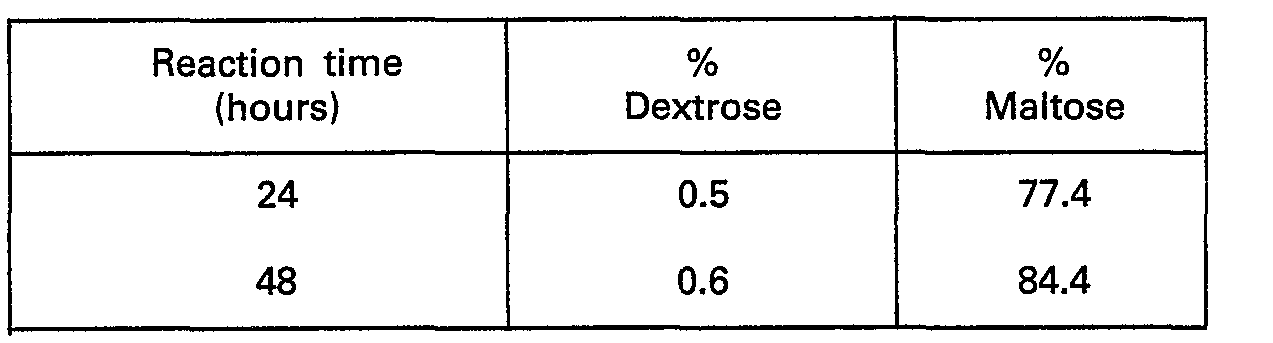
- This demonstrates that debranching enzyme can be used together with beta-amylase to produce extra-high maltose syrups.
Claims (11)
Priority Applications (1)
| Application Number | Priority Date | Filing Date | Title |
|---|---|---|---|
| AT82302001T ATE28216T1 (en) | 1981-04-20 | 1982-04-19 | ENZYME PRODUCT CAPABLE OF SIDE CHAIN CLEAVAGE. |
Applications Claiming Priority (2)
| Application Number | Priority Date | Filing Date | Title |
|---|---|---|---|
| US25595281A | 1981-04-20 | 1981-04-20 | |
| US255952 | 1981-04-20 |
Publications (3)
| Publication Number | Publication Date |
|---|---|
| EP0063909A1 EP0063909A1 (en) | 1982-11-03 |
| EP0063909B1 true EP0063909B1 (en) | 1987-07-08 |
| EP0063909B2 EP0063909B2 (en) | 1990-09-12 |
Family
ID=22970517
Family Applications (1)
| Application Number | Title | Priority Date | Filing Date |
|---|---|---|---|
| EP82302001A Expired - Lifetime EP0063909B2 (en) | 1981-04-20 | 1982-04-19 | Debranching enzyme product, preparation and use thereof |
Country Status (18)
| Country | Link |
|---|---|
| EP (1) | EP0063909B2 (en) |
| JP (2) | JPS57174089A (en) |
| KR (1) | KR890002413B1 (en) |
| AT (1) | ATE28216T1 (en) |
| AU (1) | AU548122B2 (en) |
| BE (1) | BE892904A (en) |
| CA (1) | CA1199292A (en) |
| CH (1) | CH659825A5 (en) |
| DE (1) | DE3276707D1 (en) |
| DK (1) | DK153569C (en) |
| ES (2) | ES8307291A1 (en) |
| FI (1) | FI79345C (en) |
| FR (1) | FR2504148A1 (en) |
| GB (1) | GB2097405B (en) |
| IE (1) | IE53031B1 (en) |
| IN (1) | IN155660B (en) |
| IT (1) | IT1190780B (en) |
| MX (1) | MX174149B (en) |
Cited By (10)
| Publication number | Priority date | Publication date | Assignee | Title |
|---|---|---|---|---|
| EP0140410A1 (en) * | 1983-09-11 | 1985-05-08 | Gist-Brocades N.V. | Novel enzyme product and its use in the saccharification of starch |
| EP0158435A3 (en) * | 1984-03-07 | 1987-05-20 | Agency Of Industrial Science & Technology Ministry Of International Trade & Industry | Thermostable pullulanase possessing a wide operating ph and process for production thereof |
| EP0242075A1 (en) * | 1986-04-16 | 1987-10-21 | Imperial Chemical Industries Plc | Debranching enzyme |
| EP0405283A3 (en) * | 1989-06-26 | 1991-03-06 | Enzyme Bio-Systems Ltd. | Novel thermoduric and aciduric pullulanase enzyme and method for its production |
| US5055403A (en) * | 1989-06-26 | 1991-10-08 | Enzyme Bio-Systems, Ltd. | Thermoduric and aciduric pullulanase enzyme and method for its production |
| EP0561090A1 (en) * | 1992-03-19 | 1993-09-22 | Roquette Frˬres | Process for the preparation of poor-digestible polysaccharides, possibly hydrogenated |
| US5316924A (en) * | 1992-02-28 | 1994-05-31 | Research Development Corporation Of Japan | Pullulanase, methods of producing pullulanase and methods of saccharification of starch using pullulanase |
| BE1006483A3 (en) * | 1992-12-28 | 1994-09-13 | Solvay | Pullulanase, micro-organisms producing same, methods for preparing saidpullulanase, uses and formulations comprising same |
| US5486469A (en) * | 1991-03-15 | 1996-01-23 | Novo Nordisk A/S | Thermostable Fervidobacterium pullulanases |
| US5721127A (en) * | 1992-12-28 | 1998-02-24 | Genencor International, Inc. | Pullulanase |
Families Citing this family (69)
| Publication number | Priority date | Publication date | Assignee | Title |
|---|---|---|---|---|
| JPS58183092A (en) * | 1982-04-19 | 1983-10-26 | ノボ・インダストリ・アクテイ−ゼルスカブ | Debranching enzyme product |
| CA1211314A (en) * | 1983-05-20 | 1986-09-16 | William F. Line | Production of dextrose and maltose syrups using an enzyme derived from rice |
| US4673633A (en) * | 1984-06-28 | 1987-06-16 | Cooperbiomedical, Inc. | Method of determining cystic fibrosis ciliostatic factor |
| US4628028A (en) * | 1985-05-23 | 1986-12-09 | Cpc International Inc. | Novel thermostable pullulanase enzyme and method for its production |
| US5234823A (en) * | 1986-06-30 | 1993-08-10 | Novo Industri A/S | Chimeric enzymes |
| CA2186592C (en) | 1994-03-29 | 2008-02-19 | Helle Outtrup | Alkaline bacillus amylase |
| AR000862A1 (en) | 1995-02-03 | 1997-08-06 | Novozymes As | VARIANTS OF A MOTHER-AMYLASE, A METHOD TO PRODUCE THE SAME, A DNA STRUCTURE AND A VECTOR OF EXPRESSION, A CELL TRANSFORMED BY SUCH A DNA STRUCTURE AND VECTOR, A DETERGENT ADDITIVE, DETERGENT COMPOSITION, A COMPOSITION FOR AND A COMPOSITION FOR THE ELIMINATION OF |
| EP0904360B1 (en) | 1996-04-30 | 2013-07-31 | Novozymes A/S | alpha-AMYLASE MUTANTS |
| AU9434398A (en) | 1997-10-13 | 1999-05-03 | Novo Nordisk A/S | Alpha-amylase mutants |
| EP2386568B1 (en) | 1997-10-30 | 2014-08-06 | Novozymes A/S | Alpha-amylase mutants |
| DE69942995D1 (en) | 1998-02-27 | 2011-01-13 | Novozymes As | MALTOGENIC ALPHA-AMYLASE VARIANTS |
| ES2618608T3 (en) | 1999-03-30 | 2017-06-21 | Novozymes A/S | Alpha-amylase variants |
| ES2532606T3 (en) | 1999-03-31 | 2015-03-30 | Novozymes A/S | Polypeptides with alkaline alpha-amylase activity and nucleic acids encoding them |
| WO2000060058A2 (en) | 1999-03-31 | 2000-10-12 | Novozymes A/S | Polypeptides having alkaline alpha-amylase activity and nucleic acids encoding same |
| EP1263942B1 (en) | 2000-03-08 | 2013-11-06 | Novozymes A/S | Variants with altered properties |
| CA2702204C (en) | 2000-08-01 | 2011-09-06 | Novozymes A/S | Alpha-amylase mutants with altered properties |
| EP1975229A3 (en) | 2000-10-13 | 2009-03-18 | Novozymes A/S | Alpha-amylase variant with altered properties |
| US7498158B2 (en) | 2001-05-15 | 2009-03-03 | Novozymes A/S | Alpha-amylase variant with altered properties |
| AU2004252572B2 (en) | 2003-06-25 | 2011-09-08 | Novozymes A/S | Polypeptides having alpha-amylase activity and polypeptides encoding same |
| EP3620523A3 (en) | 2004-07-05 | 2020-08-19 | Novozymes A/S | Alpha-amylase variants with altered properties |
| EP1797179A1 (en) | 2004-08-02 | 2007-06-20 | Novozymes A/S | Maltogenic alpha-amylase variants |
| US20080280328A1 (en) | 2005-11-18 | 2008-11-13 | Novozymes A/S | Glucoamylase Variants |
| EP2215110B1 (en) | 2007-11-05 | 2025-07-16 | Danisco US Inc. | Alpha-amylase variants with altered properties |
| JP5520828B2 (en) | 2007-11-05 | 2014-06-11 | ダニスコ・ユーエス・インク | Bacillus sp. TS-23 alpha-amylase variants with altered characteristics |
| CA2713582C (en) | 2008-02-04 | 2017-02-21 | Danisco Us Inc. | Ts23 alpha-amylase variants with altered properties |
| WO2009149130A2 (en) | 2008-06-06 | 2009-12-10 | Danisco Us Inc. | Geobacillus stearothermophilus alpha-amylase (amys) variants with improved properties |
| EP2337837B2 (en) | 2008-09-25 | 2016-10-26 | Danisco US Inc. | Alpha-amylase blends and methods for using said blends |
| CA2757343A1 (en) | 2009-04-01 | 2010-10-07 | Danisco Us Inc. | Compositions and methods comprising alpha-amylase variants with altered properties |
| US8545907B2 (en) | 2009-08-07 | 2013-10-01 | Danisco Us Inc. | Alpha-amylase blend for starch processing and method of use thereof |
| EP2516640A2 (en) | 2009-12-22 | 2012-10-31 | Novozymes A/S | Pullulanase variants and uses thereof |
| AU2011203460B2 (en) | 2010-01-04 | 2014-09-18 | Novozymes A/S | Alpha-amylase variants and polynucleotides encoding same |
| EP2357220A1 (en) | 2010-02-10 | 2011-08-17 | The Procter & Gamble Company | Cleaning composition comprising amylase variants with high stability in the presence of a chelating agent |
| MX369096B (en) | 2010-02-10 | 2019-10-29 | Novozymes As | Variants and compositions comprising variants with high stability in presence of a chelating agent. |
| ES2834102T3 (en) | 2011-06-30 | 2021-06-16 | Novozymes As | Alpha-amylase variants |
| CA2849401A1 (en) | 2011-09-29 | 2013-04-04 | Danisco Us Inc. | Liquefaction and saccharification of granular starch at high concentration |
| CA2852603C (en) | 2011-10-17 | 2025-10-07 | Novozymes A/S | Alpha-amylase variants and polynucleotides encoding same |
| MX355356B (en) | 2011-10-17 | 2018-04-17 | Novozymes As | Alpha-amylase variants and polynucleotides encoding same. |
| EP2831259A1 (en) | 2012-03-28 | 2015-02-04 | Danisco US Inc. | Method for making high maltose syrup |
| MX2015001818A (en) | 2012-08-16 | 2015-05-07 | Danisco Inc | Process for producing glucose from starch employing the aspergillus clavatus alpha-amylase and a pullulanase. |
| WO2014092960A1 (en) | 2012-12-11 | 2014-06-19 | Danisco Us Inc. | Trichoderma reesei host cells expressing a glucoamylase from aspergillus fumigatus and methods of use thereof |
| US20160010128A1 (en) | 2012-12-20 | 2016-01-14 | Danisco Us Inc. | Method of using alpha-amylase from aspergillus terreus and pullulanase for saccharification |
| CN105339494B (en) | 2013-07-17 | 2020-04-17 | 诺维信公司 | Pullulanase chimeras and polynucleotides encoding same |
| US10030237B2 (en) | 2014-01-22 | 2018-07-24 | Novozymes A/S | Pullulanase variants and polynucleotides encoding same |
| WO2015143144A1 (en) | 2014-03-19 | 2015-09-24 | Novozymes A/S | Method for enhancing activity of an x143 polypeptide |
| EP3129478B1 (en) | 2014-04-10 | 2019-03-27 | Novozymes A/S | Alpha-amylase variants and polynucleotides encoding same |
| CN106795505A (en) | 2014-10-23 | 2017-05-31 | 诺维信公司 | Glucoamylase variant and their polynucleotides of coding |
| WO2016087327A1 (en) | 2014-12-01 | 2016-06-09 | Novozymes A/S | Polypeptides having pullulanase activity comprising the x25, x45 and cbm41 domains |
| DK3362574T3 (en) | 2015-10-14 | 2021-10-11 | Novozymes As | Glucoamylase variants and polynucleotides encoding them |
| CN119120430A (en) | 2015-12-30 | 2024-12-13 | 诺维信公司 | Enzyme variants and polynucleotides encoding them |
| CN109415421B (en) | 2016-05-03 | 2023-02-28 | 诺维信公司 | Alpha-amylase variants and polynucleotides encoding same |
| US11186833B2 (en) | 2016-05-09 | 2021-11-30 | Novozymes A/S | Variant polypeptides with improved performance and use of the same |
| EP3825399A1 (en) | 2016-06-30 | 2021-05-26 | Danisco US Inc. | Aspartic proteases |
| EP3272767B1 (en) | 2016-07-21 | 2020-11-25 | Fornia BioSolutions, Inc. | G24 glucoamylase compositions and methods |
| WO2018017105A1 (en) | 2016-07-21 | 2018-01-25 | Fornia Biosolutions, Inc. | G24 glucoamylase compositions and methods |
| EP3487995B1 (en) | 2016-07-21 | 2021-05-26 | Novozymes A/S | Serine protease variants and polynucleotides encoding same |
| WO2018015304A1 (en) | 2016-07-21 | 2018-01-25 | Novozymes A/S | Serine protease variants and polynucleotides encoding same |
| US9598680B1 (en) | 2016-08-05 | 2017-03-21 | Fornia Biosolutions, Inc. | G16 glucoamylase compositions and methods |
| CN110177873A (en) | 2016-11-29 | 2019-08-27 | 诺维信公司 | Alpha-amylase variants and the polynucleotides that it is encoded |
| EP4644560A3 (en) | 2016-12-21 | 2026-04-08 | International N&H Denmark ApS | Methods of using thermostable serine proteases |
| WO2018169784A1 (en) | 2017-03-15 | 2018-09-20 | Dupont Nutrition Biosciences Aps | Trypsin-like serine proteases and uses thereof cross-reference to related application |
| WO2018169780A1 (en) | 2017-03-15 | 2018-09-20 | Dupont Nutrition Biosciences Aps | Methods of using an archaeal serine protease |
| CN110651048A (en) | 2017-04-11 | 2020-01-03 | 诺维信公司 | Glucoamylase variants and polynucleotides encoding them |
| BR112020003866A2 (en) | 2017-08-30 | 2020-09-08 | Novozymes A/S | process for producing a fermentation product, and, composition. |
| ES2954431T3 (en) | 2017-12-08 | 2023-11-22 | Novozymes As | Alpha-amylase variants and polynucleotides that encode them |
| MX2020005458A (en) | 2017-12-08 | 2020-08-27 | Novozymes As | Alpha-amylase variants and polynucleotides encoding same. |
| CN112105729B (en) | 2018-04-09 | 2024-05-14 | 诺维信公司 | Polypeptides having alpha-amylase activity and polynucleotides encoding the same |
| CN111757931B (en) | 2018-12-21 | 2023-11-28 | 福尼亚生物处理股份有限公司 | Variant G6P G7P glucoamylase compositions and methods |
| CA3122942A1 (en) | 2019-03-21 | 2020-09-24 | Novozymes A/S | Alpha-amylase variants and polynucleotides encoding same |
| CA3166233A1 (en) | 2020-02-10 | 2021-08-19 | Sarah Schultheis ELLIOTT | Alpha-amylase variants and polynucleotides encoding same |
Family Cites Families (7)
| Publication number | Priority date | Publication date | Assignee | Title |
|---|---|---|---|---|
| US3565765A (en) * | 1966-12-27 | 1971-02-23 | Cpc International Inc | Preparation of high maltose conversion products |
| US3827940A (en) * | 1968-04-01 | 1974-08-06 | Hayashibara Co | Preparation of alpha-1,6-glucosidase |
| JPS543937B1 (en) * | 1968-11-18 | 1979-02-28 | ||
| JPS543938B1 (en) * | 1968-11-26 | 1979-02-28 | ||
| JPS529739B1 (en) * | 1969-04-09 | 1977-03-18 | ||
| JPS536232B2 (en) * | 1974-01-11 | 1978-03-06 | ||
| US4011139A (en) * | 1974-11-26 | 1977-03-08 | Standard Brands Incorporated | Process for producing α-1,6 glucosidases using thermophilic microorganisms |
-
1981
- 1981-06-10 JP JP56088319A patent/JPS57174089A/en active Granted
-
1982
- 1982-04-19 BE BE6/47645A patent/BE892904A/en not_active IP Right Cessation
- 1982-04-19 AU AU82808/82A patent/AU548122B2/en not_active Ceased
- 1982-04-19 IT IT20806/82A patent/IT1190780B/en active
- 1982-04-19 EP EP82302001A patent/EP0063909B2/en not_active Expired - Lifetime
- 1982-04-19 AT AT82302001T patent/ATE28216T1/en not_active IP Right Cessation
- 1982-04-19 KR KR8201726A patent/KR890002413B1/en not_active Expired
- 1982-04-19 DE DE8282302001T patent/DE3276707D1/en not_active Expired
- 1982-04-19 DK DK172882A patent/DK153569C/en not_active IP Right Cessation
- 1982-04-19 GB GB8211280A patent/GB2097405B/en not_active Expired
- 1982-04-19 CA CA000401249A patent/CA1199292A/en not_active Expired
- 1982-04-19 FI FI821355A patent/FI79345C/en not_active IP Right Cessation
- 1982-04-19 IE IE907/82A patent/IE53031B1/en not_active IP Right Cessation
- 1982-04-19 ES ES511504A patent/ES8307291A1/en not_active Expired
- 1982-04-20 MX MX026679A patent/MX174149B/en unknown
- 1982-04-20 CH CH2393/82A patent/CH659825A5/en not_active IP Right Cessation
- 1982-04-20 FR FR8206786A patent/FR2504148A1/en active Granted
- 1982-04-20 IN IN434/CAL/82A patent/IN155660B/en unknown
-
1983
- 1983-03-14 ES ES520561A patent/ES520561A0/en active Granted
-
1985
- 1985-08-09 JP JP60174391A patent/JPS6143994A/en active Pending
Cited By (16)
| Publication number | Priority date | Publication date | Assignee | Title |
|---|---|---|---|---|
| EP0140410A1 (en) * | 1983-09-11 | 1985-05-08 | Gist-Brocades N.V. | Novel enzyme product and its use in the saccharification of starch |
| EP0158435A3 (en) * | 1984-03-07 | 1987-05-20 | Agency Of Industrial Science & Technology Ministry Of International Trade & Industry | Thermostable pullulanase possessing a wide operating ph and process for production thereof |
| EP0242075A1 (en) * | 1986-04-16 | 1987-10-21 | Imperial Chemical Industries Plc | Debranching enzyme |
| EP0405283A3 (en) * | 1989-06-26 | 1991-03-06 | Enzyme Bio-Systems Ltd. | Novel thermoduric and aciduric pullulanase enzyme and method for its production |
| US5055403A (en) * | 1989-06-26 | 1991-10-08 | Enzyme Bio-Systems, Ltd. | Thermoduric and aciduric pullulanase enzyme and method for its production |
| US5486469A (en) * | 1991-03-15 | 1996-01-23 | Novo Nordisk A/S | Thermostable Fervidobacterium pullulanases |
| US5316924A (en) * | 1992-02-28 | 1994-05-31 | Research Development Corporation Of Japan | Pullulanase, methods of producing pullulanase and methods of saccharification of starch using pullulanase |
| US5620871A (en) * | 1992-03-19 | 1997-04-15 | Roquette Ferres | Process for preparing optionally hydrogenated indigestible polysaccharides |
| EP0561090A1 (en) * | 1992-03-19 | 1993-09-22 | Roquette Frˬres | Process for the preparation of poor-digestible polysaccharides, possibly hydrogenated |
| FR2688800A1 (en) * | 1992-03-19 | 1993-09-24 | Roquette Freres | PROCESS FOR THE PREPARATION OF LOW DIGESTIBLE POLYSACCHARIDES, POSSIBLY HYDROGENIC. |
| BE1006483A3 (en) * | 1992-12-28 | 1994-09-13 | Solvay | Pullulanase, micro-organisms producing same, methods for preparing saidpullulanase, uses and formulations comprising same |
| US5721127A (en) * | 1992-12-28 | 1998-02-24 | Genencor International, Inc. | Pullulanase |
| US5721128A (en) * | 1992-12-28 | 1998-02-24 | Genencor International, Inc. | Process for the production of novel pullulanase |
| US5731174A (en) * | 1992-12-28 | 1998-03-24 | Genecor International, Inc. | Process for the saccharification of starch |
| US5736375A (en) * | 1992-12-28 | 1998-04-07 | Genencor International, Inc. | Expression system for novel pullulanase |
| US5817498A (en) * | 1992-12-28 | 1998-10-06 | Genencor International, Inc. | Pullulanase producing microrganisms |
Also Published As
| Publication number | Publication date |
|---|---|
| FR2504148A1 (en) | 1982-10-22 |
| FI79345C (en) | 1989-12-11 |
| JPS57174089A (en) | 1982-10-26 |
| IE820907L (en) | 1982-10-20 |
| CA1199292A (en) | 1986-01-14 |
| MX174149B (en) | 1994-04-25 |
| FR2504148B1 (en) | 1984-05-18 |
| DE3276707D1 (en) | 1987-08-13 |
| EP0063909A1 (en) | 1982-11-03 |
| ES8500994A1 (en) | 1984-11-01 |
| ES511504A0 (en) | 1983-06-16 |
| GB2097405A (en) | 1982-11-03 |
| AU8280882A (en) | 1982-10-28 |
| ES520561A0 (en) | 1984-11-01 |
| ATE28216T1 (en) | 1987-07-15 |
| DK172882A (en) | 1982-12-29 |
| FI821355L (en) | 1982-10-21 |
| DK153569C (en) | 1988-12-05 |
| IT8220806A0 (en) | 1982-04-19 |
| CH659825A5 (en) | 1987-02-27 |
| KR890002413B1 (en) | 1989-07-03 |
| JPS6143994A (en) | 1986-03-03 |
| IT1190780B (en) | 1988-02-24 |
| FI79345B (en) | 1989-08-31 |
| BE892904A (en) | 1982-10-19 |
| ES8307291A1 (en) | 1983-06-16 |
| AU548122B2 (en) | 1985-11-21 |
| GB2097405B (en) | 1984-08-15 |
| IN155660B (en) | 1985-02-16 |
| EP0063909B2 (en) | 1990-09-12 |
| FI821355A0 (en) | 1982-04-19 |
| KR830010192A (en) | 1983-12-26 |
| DK153569B (en) | 1988-07-25 |
| IE53031B1 (en) | 1988-05-11 |
| JPS6225036B2 (en) | 1987-06-01 |
Similar Documents
| Publication | Publication Date | Title |
|---|---|---|
| EP0063909B2 (en) | Debranching enzyme product, preparation and use thereof | |
| US4560651A (en) | Debranching enzyme product, preparation and use thereof | |
| US4284722A (en) | Heat and acid-stable alpha-amylase enzymes and processes for producing the same | |
| EP0171218B1 (en) | Enzymatic hydrolysis of granular starch directly to glucose | |
| US4604355A (en) | Maltogenic amylase enzyme, preparation and use thereof | |
| US3565765A (en) | Preparation of high maltose conversion products | |
| WO1992002614A1 (en) | Novel thermostable pullulanases | |
| WO1990011352A1 (en) | NOVEL HYPERTHERMOSTABLE α-AMYLASE | |
| US4642288A (en) | Process for producing thermostable alpha-amylases by culturing micro-organisms at elevated temperatures | |
| CA1304030C (en) | .beta.-AMYLASE ENZYME PRODUCT, PREPARATION AND USE THEREOF | |
| CA2019756C (en) | Novel thermoduric and aciduric pullulanese enzyme and method for its production | |
| US6184001B1 (en) | Thermostable cyclodextrin glycosyl transferase and processes using it | |
| CA1081633A (en) | Heat and acid-stable alpha-amylase enzymes and processes for producing the same | |
| US6100073A (en) | Acid-stable and thermo-stable enzymes derived from sulfolobus species | |
| EP0169920A1 (en) | Process for thermally stable alpha-amylase production | |
| US3806419A (en) | Preparing pullulanase enzyme | |
| US6355467B1 (en) | Saccharification enzymes from hyperthermophilic bacteria and processes for their production | |
| JPS6225037B2 (en) | ||
| JP2691354B2 (en) | Novel α-amylase, method for producing the same and method for producing saccharide using the same |
Legal Events
| Date | Code | Title | Description |
|---|---|---|---|
| PUAI | Public reference made under article 153(3) epc to a published international application that has entered the european phase |
Free format text: ORIGINAL CODE: 0009012 |
|
| AK | Designated contracting states |
Designated state(s): AT DE NL |
|
| 17P | Request for examination filed |
Effective date: 19830405 |
|
| GRAA | (expected) grant |
Free format text: ORIGINAL CODE: 0009210 |
|
| AK | Designated contracting states |
Kind code of ref document: B1 Designated state(s): AT DE NL |
|
| REF | Corresponds to: |
Ref document number: 28216 Country of ref document: AT Date of ref document: 19870715 Kind code of ref document: T |
|
| REF | Corresponds to: |
Ref document number: 3276707 Country of ref document: DE Date of ref document: 19870813 |
|
| PLBI | Opposition filed |
Free format text: ORIGINAL CODE: 0009260 |
|
| 26 | Opposition filed |
Opponent name: GIST-BROCADES N.V. Effective date: 19880408 |
|
| NLR1 | Nl: opposition has been filed with the epo |
Opponent name: GIST-BROCADES N.V. |
|
| PUAH | Patent maintained in amended form |
Free format text: ORIGINAL CODE: 0009272 |
|
| STAA | Information on the status of an ep patent application or granted ep patent |
Free format text: STATUS: PATENT MAINTAINED AS AMENDED |
|
| 27A | Patent maintained in amended form |
Effective date: 19900912 |
|
| AK | Designated contracting states |
Kind code of ref document: B2 Designated state(s): AT DE NL |
|
| NLR2 | Nl: decision of opposition | ||
| NLR3 | Nl: receipt of modified translations in the netherlands language after an opposition procedure | ||
| PGFP | Annual fee paid to national office [announced via postgrant information from national office to epo] |
Ref country code: AT Payment date: 19970414 Year of fee payment: 16 |
|
| PG25 | Lapsed in a contracting state [announced via postgrant information from national office to epo] |
Ref country code: AT Free format text: LAPSE BECAUSE OF NON-PAYMENT OF DUE FEES Effective date: 19980419 |
|
| PGFP | Annual fee paid to national office [announced via postgrant information from national office to epo] |
Ref country code: DE Payment date: 20010409 Year of fee payment: 20 |
|
| PGFP | Annual fee paid to national office [announced via postgrant information from national office to epo] |
Ref country code: NL Payment date: 20010430 Year of fee payment: 20 |
|
| PG25 | Lapsed in a contracting state [announced via postgrant information from national office to epo] |
Ref country code: NL Free format text: LAPSE BECAUSE OF EXPIRATION OF PROTECTION Effective date: 20020419 |
|
| NLV7 | Nl: ceased due to reaching the maximum lifetime of a patent |
Effective date: 20020419 |