EP0063374A1 - Substituted biphenyl compounds - Google Patents
Substituted biphenyl compounds Download PDFInfo
- Publication number
- EP0063374A1 EP0063374A1 EP82103273A EP82103273A EP0063374A1 EP 0063374 A1 EP0063374 A1 EP 0063374A1 EP 82103273 A EP82103273 A EP 82103273A EP 82103273 A EP82103273 A EP 82103273A EP 0063374 A1 EP0063374 A1 EP 0063374A1
- Authority
- EP
- European Patent Office
- Prior art keywords
- biphenyl
- methyl
- mole
- reaction mixture
- fluoro
- Prior art date
- Legal status (The legal status is an assumption and is not a legal conclusion. Google has not performed a legal analysis and makes no representation as to the accuracy of the status listed.)
- Granted
Links
- ZUOUZKKEUPVFJK-UHFFFAOYSA-N diphenyl Chemical class C1=CC=CC=C1C1=CC=CC=C1 ZUOUZKKEUPVFJK-UHFFFAOYSA-N 0.000 title description 5
- -1 [1,1-biphenyl]-3-ylmethyl compounds Chemical class 0.000 claims abstract description 14
- 125000001153 fluoro group Chemical group F* 0.000 claims description 11
- OKKJLVBELUTLKV-UHFFFAOYSA-N methanol Natural products OC OKKJLVBELUTLKV-UHFFFAOYSA-N 0.000 claims description 9
- 239000004305 biphenyl Substances 0.000 claims description 7
- 125000001475 halogen functional group Chemical group 0.000 claims description 3
- WKBOTKDWSSQWDR-UHFFFAOYSA-N Bromine atom Chemical group [Br] WKBOTKDWSSQWDR-UHFFFAOYSA-N 0.000 claims description 2
- 125000001246 bromo group Chemical group Br* 0.000 claims description 2
- 125000001309 chloro group Chemical group Cl* 0.000 claims description 2
- 125000002887 hydroxy group Chemical group [H]O* 0.000 claims description 2
- GZUXJHMPEANEGY-UHFFFAOYSA-N bromomethane Chemical compound BrC GZUXJHMPEANEGY-UHFFFAOYSA-N 0.000 claims 2
- UTCWKKQFHHVEPP-UHFFFAOYSA-N 1-(bromomethyl)-2-methyl-3-phenylbenzene Chemical compound CC1=C(CBr)C=CC=C1C1=CC=CC=C1 UTCWKKQFHHVEPP-UHFFFAOYSA-N 0.000 claims 1
- 229940102396 methyl bromide Drugs 0.000 claims 1
- 150000001875 compounds Chemical class 0.000 abstract description 8
- 229910052731 fluorine Inorganic materials 0.000 abstract description 6
- 229910052801 chlorine Inorganic materials 0.000 abstract description 4
- 239000002917 insecticide Substances 0.000 abstract description 3
- PQIOSYKVBBWRRI-UHFFFAOYSA-N methylphosphonyl difluoride Chemical group CP(F)(F)=O PQIOSYKVBBWRRI-UHFFFAOYSA-N 0.000 abstract 2
- 239000011541 reaction mixture Substances 0.000 description 39
- RTZKZFJDLAIYFH-UHFFFAOYSA-N Diethyl ether Chemical compound CCOCC RTZKZFJDLAIYFH-UHFFFAOYSA-N 0.000 description 33
- LFQSCWFLJHTTHZ-UHFFFAOYSA-N Ethanol Chemical compound CCO LFQSCWFLJHTTHZ-UHFFFAOYSA-N 0.000 description 23
- XLYOFNOQVPJJNP-UHFFFAOYSA-N water Substances O XLYOFNOQVPJJNP-UHFFFAOYSA-N 0.000 description 20
- WYURNTSHIVDZCO-UHFFFAOYSA-N Tetrahydrofuran Chemical compound C1CCOC1 WYURNTSHIVDZCO-UHFFFAOYSA-N 0.000 description 16
- 238000010992 reflux Methods 0.000 description 16
- 238000000034 method Methods 0.000 description 15
- 239000000203 mixture Substances 0.000 description 15
- PCLIMKBDDGJMGD-UHFFFAOYSA-N N-bromosuccinimide Chemical compound BrN1C(=O)CCC1=O PCLIMKBDDGJMGD-UHFFFAOYSA-N 0.000 description 14
- 239000000706 filtrate Substances 0.000 description 14
- 239000000243 solution Substances 0.000 description 14
- VEXZGXHMUGYJMC-UHFFFAOYSA-N Hydrochloric acid Chemical compound Cl VEXZGXHMUGYJMC-UHFFFAOYSA-N 0.000 description 11
- VLKZOEOYAKHREP-UHFFFAOYSA-N n-Hexane Chemical compound CCCCCC VLKZOEOYAKHREP-UHFFFAOYSA-N 0.000 description 10
- VZGDMQKNWNREIO-UHFFFAOYSA-N tetrachloromethane Chemical compound ClC(Cl)(Cl)Cl VZGDMQKNWNREIO-UHFFFAOYSA-N 0.000 description 10
- UHOVQNZJYSORNB-UHFFFAOYSA-N Benzene Chemical compound C1=CC=CC=C1 UHOVQNZJYSORNB-UHFFFAOYSA-N 0.000 description 9
- YXFVVABEGXRONW-UHFFFAOYSA-N Toluene Chemical compound CC1=CC=CC=C1 YXFVVABEGXRONW-UHFFFAOYSA-N 0.000 description 9
- 238000001228 spectrum Methods 0.000 description 9
- HEDRZPFGACZZDS-UHFFFAOYSA-N Chloroform Chemical compound ClC(Cl)Cl HEDRZPFGACZZDS-UHFFFAOYSA-N 0.000 description 8
- YLQBMQCUIZJEEH-UHFFFAOYSA-N tetrahydrofuran Natural products C=1C=COC=1 YLQBMQCUIZJEEH-UHFFFAOYSA-N 0.000 description 8
- 239000012044 organic layer Substances 0.000 description 7
- CSNNHWWHGAXBCP-UHFFFAOYSA-L Magnesium sulfate Chemical compound [Mg+2].[O-][S+2]([O-])([O-])[O-] CSNNHWWHGAXBCP-UHFFFAOYSA-L 0.000 description 6
- VYPSYNLAJGMNEJ-UHFFFAOYSA-N Silicium dioxide Chemical compound O=[Si]=O VYPSYNLAJGMNEJ-UHFFFAOYSA-N 0.000 description 6
- FAPWRFPIFSIZLT-UHFFFAOYSA-M Sodium chloride Chemical class [Na+].[Cl-] FAPWRFPIFSIZLT-UHFFFAOYSA-M 0.000 description 6
- HEMHJVSKTPXQMS-UHFFFAOYSA-M Sodium hydroxide Chemical compound [OH-].[Na+] HEMHJVSKTPXQMS-UHFFFAOYSA-M 0.000 description 6
- 239000007787 solid Substances 0.000 description 6
- RTFPTPXBTIUISM-UHFFFAOYSA-N 1-(bromomethyl)-3-phenylbenzene Chemical class BrCC1=CC=CC(C=2C=CC=CC=2)=C1 RTFPTPXBTIUISM-UHFFFAOYSA-N 0.000 description 5
- 125000001495 ethyl group Chemical group [H]C([H])([H])C([H])([H])* 0.000 description 5
- 239000000741 silica gel Substances 0.000 description 5
- 229910002027 silica gel Inorganic materials 0.000 description 5
- UJBOOUHRTQVGRU-UHFFFAOYSA-N 3-methylcyclohexan-1-one Chemical compound CC1CCCC(=O)C1 UJBOOUHRTQVGRU-UHFFFAOYSA-N 0.000 description 4
- UIIMBOGNXHQVGW-UHFFFAOYSA-M Sodium bicarbonate Chemical compound [Na+].OC([O-])=O UIIMBOGNXHQVGW-UHFFFAOYSA-M 0.000 description 4
- NINIDFKCEFEMDL-UHFFFAOYSA-N Sulfur Chemical compound [S] NINIDFKCEFEMDL-UHFFFAOYSA-N 0.000 description 4
- 238000004440 column chromatography Methods 0.000 description 4
- 238000004821 distillation Methods 0.000 description 4
- 239000000284 extract Substances 0.000 description 4
- 239000012280 lithium aluminium hydride Substances 0.000 description 4
- 239000012279 sodium borohydride Substances 0.000 description 4
- 229910000033 sodium borohydride Inorganic materials 0.000 description 4
- 239000011593 sulfur Substances 0.000 description 4
- 229910052717 sulfur Inorganic materials 0.000 description 4
- NPDIDUXTRAITDE-UHFFFAOYSA-N 1-methyl-3-phenylbenzene Chemical group CC1=CC=CC(C=2C=CC=CC=2)=C1 NPDIDUXTRAITDE-UHFFFAOYSA-N 0.000 description 3
- QTBSBXVTEAMEQO-UHFFFAOYSA-N Acetic acid Chemical compound CC(O)=O QTBSBXVTEAMEQO-UHFFFAOYSA-N 0.000 description 3
- CSCPPACGZOOCGX-UHFFFAOYSA-N Acetone Chemical class CC(C)=O CSCPPACGZOOCGX-UHFFFAOYSA-N 0.000 description 3
- YMWUJEATGCHHMB-UHFFFAOYSA-N Dichloromethane Chemical compound ClCCl YMWUJEATGCHHMB-UHFFFAOYSA-N 0.000 description 3
- XEKOWRVHYACXOJ-UHFFFAOYSA-N Ethyl acetate Chemical compound CCOC(C)=O XEKOWRVHYACXOJ-UHFFFAOYSA-N 0.000 description 3
- XEEYBQQBJWHFJM-UHFFFAOYSA-N Iron Chemical compound [Fe] XEEYBQQBJWHFJM-UHFFFAOYSA-N 0.000 description 3
- FYYHWMGAXLPEAU-UHFFFAOYSA-N Magnesium Chemical compound [Mg] FYYHWMGAXLPEAU-UHFFFAOYSA-N 0.000 description 3
- KWYUFKZDYYNOTN-UHFFFAOYSA-M Potassium hydroxide Chemical compound [OH-].[K+] KWYUFKZDYYNOTN-UHFFFAOYSA-M 0.000 description 3
- PMZURENOXWZQFD-UHFFFAOYSA-L Sodium Sulfate Chemical compound [Na+].[Na+].[O-]S([O-])(=O)=O PMZURENOXWZQFD-UHFFFAOYSA-L 0.000 description 3
- 239000007864 aqueous solution Substances 0.000 description 3
- 239000012259 ether extract Substances 0.000 description 3
- 238000001704 evaporation Methods 0.000 description 3
- 230000008020 evaporation Effects 0.000 description 3
- 239000011737 fluorine Substances 0.000 description 3
- WVDDGKGOMKODPV-UHFFFAOYSA-N hydroxymethyl benzene Natural products OCC1=CC=CC=C1 WVDDGKGOMKODPV-UHFFFAOYSA-N 0.000 description 3
- 239000010410 layer Substances 0.000 description 3
- 229910052943 magnesium sulfate Inorganic materials 0.000 description 3
- 235000019341 magnesium sulphate Nutrition 0.000 description 3
- NLKNQRATVPKPDG-UHFFFAOYSA-M potassium iodide Chemical compound [K+].[I-] NLKNQRATVPKPDG-UHFFFAOYSA-M 0.000 description 3
- 229920006395 saturated elastomer Polymers 0.000 description 3
- 229910052938 sodium sulfate Inorganic materials 0.000 description 3
- 235000011152 sodium sulphate Nutrition 0.000 description 3
- 239000012258 stirred mixture Substances 0.000 description 3
- QAOWNCQODCNURD-UHFFFAOYSA-N sulfuric acid Substances OS(O)(=O)=O QAOWNCQODCNURD-UHFFFAOYSA-N 0.000 description 3
- BGTLHJPGBIVQLJ-UHFFFAOYSA-N (2-methyl-3-phenylphenyl)methanol Chemical compound CC1=C(CO)C=CC=C1C1=CC=CC=C1 BGTLHJPGBIVQLJ-UHFFFAOYSA-N 0.000 description 2
- VODBTCPLHMEMAS-UHFFFAOYSA-N (3-amino-2-methylphenyl)methanol;hydrochloride Chemical group Cl.CC1=C(N)C=CC=C1CO VODBTCPLHMEMAS-UHFFFAOYSA-N 0.000 description 2
- WVKFJUYXMBJNKD-UHFFFAOYSA-N (3-iodo-2-methylphenyl)methanol Chemical compound CC1=C(I)C=CC=C1CO WVKFJUYXMBJNKD-UHFFFAOYSA-N 0.000 description 2
- VFIQBQAZDAFZKR-UHFFFAOYSA-N 1-(3-chlorophenyl)-3-methylcyclohexan-1-ol Chemical compound C1C(C)CCCC1(O)C1=CC=CC(Cl)=C1 VFIQBQAZDAFZKR-UHFFFAOYSA-N 0.000 description 2
- BUIPKDFUVKLJTF-UHFFFAOYSA-N 1-fluoro-2-(3-methylphenyl)benzene Chemical compound CC1=CC=CC(C=2C(=CC=CC=2)F)=C1 BUIPKDFUVKLJTF-UHFFFAOYSA-N 0.000 description 2
- JJYPMNFTHPTTDI-UHFFFAOYSA-N 3-methylaniline Chemical class CC1=CC=CC(N)=C1 JJYPMNFTHPTTDI-UHFFFAOYSA-N 0.000 description 2
- IIZVERXSSGEDTK-UHFFFAOYSA-N 5-(2-fluorophenyl)-3-methylcyclohex-2-en-1-ol Chemical compound C1C(C)=CC(O)CC1C1=CC=CC=C1F IIZVERXSSGEDTK-UHFFFAOYSA-N 0.000 description 2
- HFLMFOSJYVLCQL-UHFFFAOYSA-N 5-(2-fluorophenyl)-3-methylcyclohex-2-en-1-one Chemical compound C1C(C)=CC(=O)CC1C1=CC=CC=C1F HFLMFOSJYVLCQL-UHFFFAOYSA-N 0.000 description 2
- DLFVBJFMPXGRIB-UHFFFAOYSA-N Acetamide Chemical compound CC(N)=O DLFVBJFMPXGRIB-UHFFFAOYSA-N 0.000 description 2
- XKRFYHLGVUSROY-UHFFFAOYSA-N Argon Chemical compound [Ar] XKRFYHLGVUSROY-UHFFFAOYSA-N 0.000 description 2
- CURLTUGMZLYLDI-UHFFFAOYSA-N Carbon dioxide Chemical compound O=C=O CURLTUGMZLYLDI-UHFFFAOYSA-N 0.000 description 2
- PXGOKWXKJXAPGV-UHFFFAOYSA-N Fluorine Chemical compound FF PXGOKWXKJXAPGV-UHFFFAOYSA-N 0.000 description 2
- KDLHZDBZIXYQEI-UHFFFAOYSA-N Palladium Chemical compound [Pd] KDLHZDBZIXYQEI-UHFFFAOYSA-N 0.000 description 2
- JUJWROOIHBZHMG-UHFFFAOYSA-N Pyridine Chemical compound C1=CC=NC=C1 JUJWROOIHBZHMG-UHFFFAOYSA-N 0.000 description 2
- CDBYLPFSWZWCQE-UHFFFAOYSA-L Sodium Carbonate Chemical compound [Na+].[Na+].[O-]C([O-])=O CDBYLPFSWZWCQE-UHFFFAOYSA-L 0.000 description 2
- VMHLLURERBWHNL-UHFFFAOYSA-M Sodium acetate Chemical compound [Na+].CC([O-])=O VMHLLURERBWHNL-UHFFFAOYSA-M 0.000 description 2
- UIIMBOGNXHQVGW-DEQYMQKBSA-M Sodium bicarbonate-14C Chemical compound [Na+].O[14C]([O-])=O UIIMBOGNXHQVGW-DEQYMQKBSA-M 0.000 description 2
- CEHQWCFLTWFAOL-UHFFFAOYSA-N [3-(2-methylphenyl)phenyl]methanol Chemical compound CC1=CC=CC=C1C1=CC=CC(CO)=C1 CEHQWCFLTWFAOL-UHFFFAOYSA-N 0.000 description 2
- 125000003545 alkoxy group Chemical group 0.000 description 2
- 125000000217 alkyl group Chemical group 0.000 description 2
- 238000006243 chemical reaction Methods 0.000 description 2
- 238000001816 cooling Methods 0.000 description 2
- HPNMFZURTQLUMO-UHFFFAOYSA-N diethylamine Chemical compound CCNCC HPNMFZURTQLUMO-UHFFFAOYSA-N 0.000 description 2
- 238000010828 elution Methods 0.000 description 2
- MOMORSVRSWLPKH-UHFFFAOYSA-N ethyl 6-(2-fluorophenyl)-2-methyl-4-oxocyclohex-2-ene-1-carboxylate Chemical compound C1C(=O)C=C(C)C(C(=O)OCC)C1C1=CC=CC=C1F MOMORSVRSWLPKH-UHFFFAOYSA-N 0.000 description 2
- XYIBRDXRRQCHLP-UHFFFAOYSA-N ethyl acetoacetate Chemical compound CCOC(=O)CC(C)=O XYIBRDXRRQCHLP-UHFFFAOYSA-N 0.000 description 2
- 239000012065 filter cake Substances 0.000 description 2
- 238000010438 heat treatment Methods 0.000 description 2
- JYVHOGDBFNJNMR-UHFFFAOYSA-N hexane;hydrate Chemical compound O.CCCCCC JYVHOGDBFNJNMR-UHFFFAOYSA-N 0.000 description 2
- 239000005457 ice water Substances 0.000 description 2
- KERAQDGNPUOGFF-UHFFFAOYSA-N methyl 3-(2,3,4,5,6-pentafluorophenyl)benzoate Chemical compound COC(=O)C1=CC=CC(C=2C(=C(F)C(F)=C(F)C=2F)F)=C1 KERAQDGNPUOGFF-UHFFFAOYSA-N 0.000 description 2
- 238000002360 preparation method Methods 0.000 description 2
- 239000001632 sodium acetate Substances 0.000 description 2
- 235000017281 sodium acetate Nutrition 0.000 description 2
- 229910000030 sodium bicarbonate Inorganic materials 0.000 description 2
- 235000017557 sodium bicarbonate Nutrition 0.000 description 2
- 239000011780 sodium chloride Substances 0.000 description 2
- LPXPTNMVRIOKMN-UHFFFAOYSA-M sodium nitrite Chemical compound [Na+].[O-]N=O LPXPTNMVRIOKMN-UHFFFAOYSA-M 0.000 description 2
- AKHNMLFCWUSKQB-UHFFFAOYSA-L sodium thiosulfate Chemical compound [Na+].[Na+].[O-]S([O-])(=O)=S AKHNMLFCWUSKQB-UHFFFAOYSA-L 0.000 description 2
- 235000019345 sodium thiosulphate Nutrition 0.000 description 2
- 125000001424 substituent group Chemical group 0.000 description 2
- 239000000725 suspension Substances 0.000 description 2
- HTSABYAWKQAHBT-UHFFFAOYSA-N trans 3-methylcyclohexanol Natural products CC1CCCC(O)C1 HTSABYAWKQAHBT-UHFFFAOYSA-N 0.000 description 2
- QJANIQCEDPJNLO-UHFFFAOYSA-N (2-methyl-3-nitrophenyl)methanol Chemical compound CC1=C(CO)C=CC=C1[N+]([O-])=O QJANIQCEDPJNLO-UHFFFAOYSA-N 0.000 description 1
- PAAZPARNPHGIKF-UHFFFAOYSA-N 1,2-dibromoethane Chemical compound BrCCBr PAAZPARNPHGIKF-UHFFFAOYSA-N 0.000 description 1
- LOPZCXLKNQVLLT-UHFFFAOYSA-N 1,3-difluoro-2-methyl-4-phenylbenzene Chemical compound CC1=C(F)C=CC(C=2C=CC=CC=2)=C1F LOPZCXLKNQVLLT-UHFFFAOYSA-N 0.000 description 1
- OGFAWKRXZLGJSK-UHFFFAOYSA-N 1-(2,4-dihydroxyphenyl)-2-(4-nitrophenyl)ethanone Chemical compound OC1=CC(O)=CC=C1C(=O)CC1=CC=C([N+]([O-])=O)C=C1 OGFAWKRXZLGJSK-UHFFFAOYSA-N 0.000 description 1
- GUXRLULKFQOZJU-UHFFFAOYSA-N 1-(bromomethyl)-3-(2-fluorophenyl)benzene Chemical compound FC1=CC=CC=C1C1=CC=CC(CBr)=C1 GUXRLULKFQOZJU-UHFFFAOYSA-N 0.000 description 1
- IJYJYBHESXAIDP-UHFFFAOYSA-N 1-(bromomethyl)-3-(3-chlorophenyl)benzene Chemical compound ClC1=CC=CC(C=2C=C(CBr)C=CC=2)=C1 IJYJYBHESXAIDP-UHFFFAOYSA-N 0.000 description 1
- MBTFNFODAQPJNE-UHFFFAOYSA-N 1-(bromomethyl)-3-(3-methylphenyl)benzene Chemical compound CC1=CC=CC(C=2C=C(CBr)C=CC=2)=C1 MBTFNFODAQPJNE-UHFFFAOYSA-N 0.000 description 1
- QSSXJPIWXQTSIX-UHFFFAOYSA-N 1-bromo-2-methylbenzene Chemical compound CC1=CC=CC=C1Br QSSXJPIWXQTSIX-UHFFFAOYSA-N 0.000 description 1
- JRGGUPZKKTVKOV-UHFFFAOYSA-N 1-bromo-3-chlorobenzene Chemical compound ClC1=CC=CC(Br)=C1 JRGGUPZKKTVKOV-UHFFFAOYSA-N 0.000 description 1
- UVXXXPUFDFKYEE-UHFFFAOYSA-N 1-chloro-3-(3-methylphenyl)benzene Chemical compound CC1=CC=CC(C=2C=C(Cl)C=CC=2)=C1 UVXXXPUFDFKYEE-UHFFFAOYSA-N 0.000 description 1
- GVEDOIATHPCYGS-UHFFFAOYSA-N 1-methyl-3-(3-methylphenyl)benzene Chemical compound CC1=CC=CC(C=2C=C(C)C=CC=2)=C1 GVEDOIATHPCYGS-UHFFFAOYSA-N 0.000 description 1
- GEMLIOXWQRDDOA-UHFFFAOYSA-N 2,4-difluoro-3-methylaniline Chemical compound CC1=C(F)C=CC(N)=C1F GEMLIOXWQRDDOA-UHFFFAOYSA-N 0.000 description 1
- XVNJBDKWBSRNOE-UHFFFAOYSA-N 2-(3-bromophenyl)-4,4-dimethyl-5h-1,3-oxazole Chemical compound CC1(C)COC(C=2C=C(Br)C=CC=2)=N1 XVNJBDKWBSRNOE-UHFFFAOYSA-N 0.000 description 1
- ZWDVQMVZZYIAHO-UHFFFAOYSA-N 2-fluorobenzaldehyde Chemical compound FC1=CC=CC=C1C=O ZWDVQMVZZYIAHO-UHFFFAOYSA-N 0.000 description 1
- JUEZYTFQWZACEL-UHFFFAOYSA-N 2-nitrosoacetamide Chemical compound NC(=O)CN=O JUEZYTFQWZACEL-UHFFFAOYSA-N 0.000 description 1
- VXUIDVTXKZPLSS-UHFFFAOYSA-N 4,4-dimethyl-2-[3-(2-methylphenyl)phenyl]-5h-1,3-oxazole Chemical compound CC1=CC=CC=C1C1=CC=CC(C=2OCC(C)(C)N=2)=C1 VXUIDVTXKZPLSS-UHFFFAOYSA-N 0.000 description 1
- RXQNKKRGJJRMKD-UHFFFAOYSA-N 5-bromo-2-methylaniline Chemical compound CC1=CC=C(Br)C=C1N RXQNKKRGJJRMKD-UHFFFAOYSA-N 0.000 description 1
- 239000004342 Benzoyl peroxide Substances 0.000 description 1
- OMPJBNCRMGITSC-UHFFFAOYSA-N Benzoylperoxide Chemical compound C=1C=CC=CC=1C(=O)OOC(=O)C1=CC=CC=C1 OMPJBNCRMGITSC-UHFFFAOYSA-N 0.000 description 1
- CPELXLSAUQHCOX-UHFFFAOYSA-M Bromide Chemical compound [Br-] CPELXLSAUQHCOX-UHFFFAOYSA-M 0.000 description 1
- ZAMOUSCENKQFHK-UHFFFAOYSA-N Chlorine atom Chemical compound [Cl] ZAMOUSCENKQFHK-UHFFFAOYSA-N 0.000 description 1
- RYGMFSIKBFXOCR-UHFFFAOYSA-N Copper Chemical compound [Cu] RYGMFSIKBFXOCR-UHFFFAOYSA-N 0.000 description 1
- 239000007818 Grignard reagent Substances 0.000 description 1
- 239000005909 Kieselgur Substances 0.000 description 1
- 238000006000 Knoevenagel condensation reaction Methods 0.000 description 1
- PHSPJQZRQAJPPF-UHFFFAOYSA-N N-alpha-Methylhistamine Chemical compound CNCCC1=CN=CN1 PHSPJQZRQAJPPF-UHFFFAOYSA-N 0.000 description 1
- ZCQWOFVYLHDMMC-UHFFFAOYSA-N Oxazole Chemical compound C1=COC=N1 ZCQWOFVYLHDMMC-UHFFFAOYSA-N 0.000 description 1
- DWAQJAXMDSEUJJ-UHFFFAOYSA-M Sodium bisulfite Chemical compound [Na+].OS([O-])=O DWAQJAXMDSEUJJ-UHFFFAOYSA-M 0.000 description 1
- QAOWNCQODCNURD-UHFFFAOYSA-L Sulfate Chemical compound [O-]S([O-])(=O)=O QAOWNCQODCNURD-UHFFFAOYSA-L 0.000 description 1
- HEDRZPFGACZZDS-MICDWDOJSA-N Trichloro(2H)methane Chemical compound [2H]C(Cl)(Cl)Cl HEDRZPFGACZZDS-MICDWDOJSA-N 0.000 description 1
- XTNRHLDLGNQMCW-UHFFFAOYSA-N acetic acid;1,1'-biphenyl Chemical compound CC(O)=O.C1=CC=CC=C1C1=CC=CC=C1 XTNRHLDLGNQMCW-UHFFFAOYSA-N 0.000 description 1
- WETWJCDKMRHUPV-UHFFFAOYSA-N acetyl chloride Chemical compound CC(Cl)=O WETWJCDKMRHUPV-UHFFFAOYSA-N 0.000 description 1
- 239000012346 acetyl chloride Substances 0.000 description 1
- 229910052786 argon Inorganic materials 0.000 description 1
- 239000012300 argon atmosphere Substances 0.000 description 1
- 150000003935 benzaldehydes Chemical class 0.000 description 1
- 235000019400 benzoyl peroxide Nutrition 0.000 description 1
- 235000019445 benzyl alcohol Nutrition 0.000 description 1
- 230000015572 biosynthetic process Effects 0.000 description 1
- 235000010290 biphenyl Nutrition 0.000 description 1
- 239000001569 carbon dioxide Substances 0.000 description 1
- 229910002092 carbon dioxide Inorganic materials 0.000 description 1
- 239000000460 chlorine Substances 0.000 description 1
- 239000002026 chloroform extract Substances 0.000 description 1
- ZCDOYSPFYFSLEW-UHFFFAOYSA-N chromate(2-) Chemical compound [O-][Cr]([O-])(=O)=O ZCDOYSPFYFSLEW-UHFFFAOYSA-N 0.000 description 1
- GESZGOQOLBACSZ-UHFFFAOYSA-N copper(1+);1,2,3,4,5-pentafluorobenzene-6-ide Chemical compound [Cu+].FC1=[C-]C(F)=C(F)C(F)=C1F GESZGOQOLBACSZ-UHFFFAOYSA-N 0.000 description 1
- 239000012043 crude product Substances 0.000 description 1
- 230000018044 dehydration Effects 0.000 description 1
- 238000006297 dehydration reaction Methods 0.000 description 1
- 238000006356 dehydrogenation reaction Methods 0.000 description 1
- 238000006193 diazotization reaction Methods 0.000 description 1
- 239000003480 eluent Substances 0.000 description 1
- 239000000839 emulsion Substances 0.000 description 1
- 125000001301 ethoxy group Chemical group [H]C([H])([H])C([H])([H])O* 0.000 description 1
- 239000012467 final product Substances 0.000 description 1
- 150000004795 grignard reagents Chemical class 0.000 description 1
- IXCSERBJSXMMFS-UHFFFAOYSA-N hydrogen chloride Substances Cl.Cl IXCSERBJSXMMFS-UHFFFAOYSA-N 0.000 description 1
- 229910000041 hydrogen chloride Inorganic materials 0.000 description 1
- 239000012535 impurity Substances 0.000 description 1
- 229910052742 iron Inorganic materials 0.000 description 1
- 239000007791 liquid phase Substances 0.000 description 1
- 239000011777 magnesium Substances 0.000 description 1
- 229910052749 magnesium Inorganic materials 0.000 description 1
- QSHDDOUJBYECFT-UHFFFAOYSA-N mercury Chemical compound [Hg] QSHDDOUJBYECFT-UHFFFAOYSA-N 0.000 description 1
- 229910052753 mercury Inorganic materials 0.000 description 1
- 125000000956 methoxy group Chemical group [H]C([H])([H])O* 0.000 description 1
- NPXOIGSBRLCOSD-UHFFFAOYSA-N methyl 3-iodobenzoate Chemical compound COC(=O)C1=CC=CC(I)=C1 NPXOIGSBRLCOSD-UHFFFAOYSA-N 0.000 description 1
- 125000002496 methyl group Chemical group [H]C([H])([H])* 0.000 description 1
- 230000004048 modification Effects 0.000 description 1
- 238000012986 modification Methods 0.000 description 1
- 239000012299 nitrogen atmosphere Substances 0.000 description 1
- VQTGUFBGYOIUFS-UHFFFAOYSA-N nitrosylsulfuric acid Chemical compound OS(=O)(=O)ON=O VQTGUFBGYOIUFS-UHFFFAOYSA-N 0.000 description 1
- ANRQGKOBLBYXFM-UHFFFAOYSA-M phenylmagnesium bromide Chemical class Br[Mg]C1=CC=CC=C1 ANRQGKOBLBYXFM-UHFFFAOYSA-M 0.000 description 1
- 239000000047 product Substances 0.000 description 1
- 239000002728 pyrethroid Substances 0.000 description 1
- UMJSCPRVCHMLSP-UHFFFAOYSA-N pyridine Natural products COC1=CC=CN=C1 UMJSCPRVCHMLSP-UHFFFAOYSA-N 0.000 description 1
- 239000012047 saturated solution Substances 0.000 description 1
- 238000000926 separation method Methods 0.000 description 1
- 229910000029 sodium carbonate Inorganic materials 0.000 description 1
- 235000010267 sodium hydrogen sulphite Nutrition 0.000 description 1
- 235000010288 sodium nitrite Nutrition 0.000 description 1
- 239000002904 solvent Substances 0.000 description 1
- 238000003756 stirring Methods 0.000 description 1
- 239000000126 substance Substances 0.000 description 1
- 238000003786 synthesis reaction Methods 0.000 description 1
- CZDYPVPMEAXLPK-UHFFFAOYSA-N tetramethylsilane Chemical compound C[Si](C)(C)C CZDYPVPMEAXLPK-UHFFFAOYSA-N 0.000 description 1
- 239000012485 toluene extract Substances 0.000 description 1
- 238000010792 warming Methods 0.000 description 1
Classifications
-
- A—HUMAN NECESSITIES
- A01—AGRICULTURE; FORESTRY; ANIMAL HUSBANDRY; HUNTING; TRAPPING; FISHING
- A01N—PRESERVATION OF BODIES OF HUMANS OR ANIMALS OR PLANTS OR PARTS THEREOF; BIOCIDES, e.g. AS DISINFECTANTS, AS PESTICIDES OR AS HERBICIDES; PEST REPELLANTS OR ATTRACTANTS; PLANT GROWTH REGULATORS
- A01N53/00—Biocides, pest repellants or attractants, or plant growth regulators containing cyclopropane carboxylic acids or derivatives thereof
Definitions
- the present invention is concerned with substituted biphenyl compounds.
- novel pyrethroid insecticides are claimed.
- the present invention provides intermediate substituted biphenyl compounds that are obtained in the synthesis of certain of the novel insecticides.
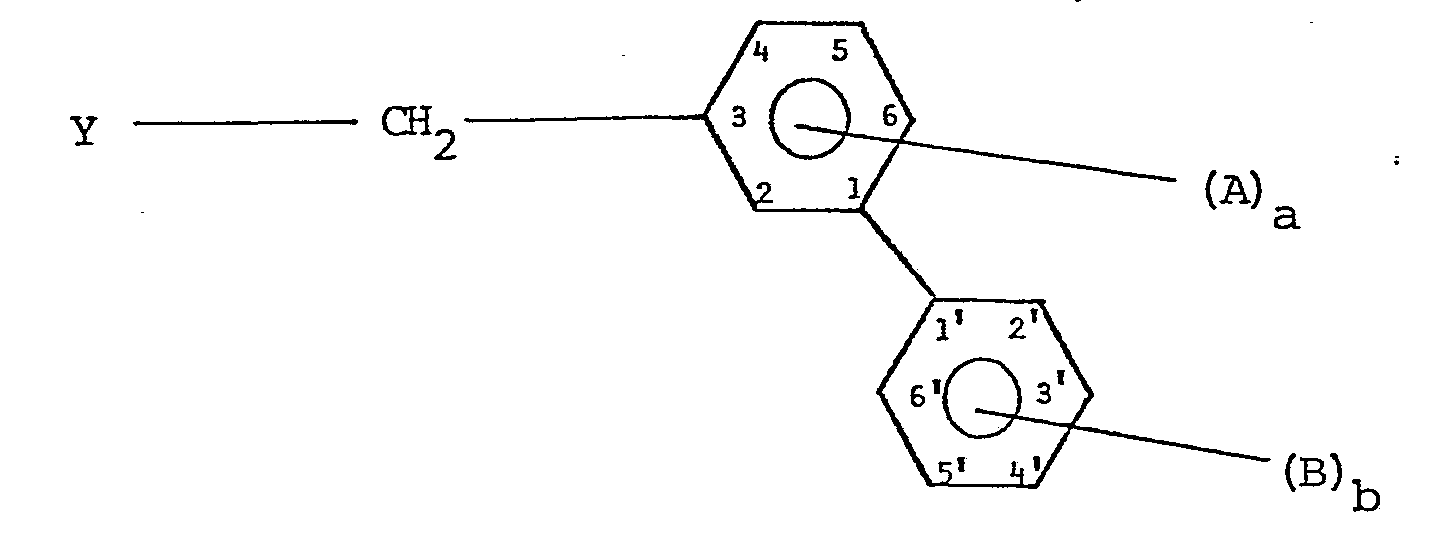
- the compounds of the present invention have the formula in which Y is a bromine atom or a hydroxy group and
- the C l-6 alkyl and alkoxy residues be methyl, ethyl, methoxy or ethoxy. It is also preferred, having regard to the properties desired in the final product, that a be 0, especially when b is 1 and B is in the 2'-position, preferably 2'-fluoro or 2'-methyl. If b is 2 or more, B is preferably fluorine. When b is 0, A is preferably fluorine or chlorine, especially fluorine. 2-Methyl[1,1'-biphenyl]-3-ylmethyl compounds are attractive.
- the compounds of the invention are obtained by one or more of several different methods, depending on the specific compounds desired. These methods A-G, are described below.
- a substituted [1,1'-biphenyl] -3 -ylmethyl alcohol prepared by one of these methods, can be converted into the corresponding substituted [1,1'-biphenyl]-3-ylmethyl bromide by treating a solution of the alcohol in ether with phosphorus tribromide or phosphorus pentabromide.
- a substituted [1,1-biphenyl]-3-ylmethyl bromide can be converted into the corresponding alcohol by first treating the bromide with sodium acetate in acetic acid, and then treating the thus produced biphenyl acetate with sodium hydroxide in methanol.
- 3-Bromomethyl[1,1'-biphenyl] compounds with (A) substituents are prepared by modification of a diazotization reaction.
- the appropriately substituted meta-toluidine is converted to an acetamide, and this is treated with nitrosyl sulfuric acid to give the corresponding nitrosoacetamide, which is subsequently decomposed in benzene to the substituted 3-methylbiphenyl.
- Treatment with N-bromosuccinimide gives the 3-bromomethyl compound.
- the reaction mixture was stirred for 2 hours at 0°. The reaction mixture was then allowed to warm to room temperature and then heated under reflux for 1.5 hours. The reaction mixture was cooled and washed twice with water, twice with aqueous 10% sodium carbonate, twice with water, twice with aqueous 5% sodium bicarbonate, twice with water, and then with aqueous saturated sodium chloride solution. The organic layer was separated, dried over magnesium sulfate and filtered. The filtrate was evaporated under reduced pressure to a solid residue. The residue was purified by column chromatography on silica gel to give 2,4-difluoro-3-methyl[l,l'-biphenyl] (2.2 g) as an oil.
- 3-Bromomethyl[1,1'-biphenyl] compounds are in general prepared by an extension of the Knoevenagel condensation of ethyl acetoacetate with substituted benzaldehydes.
- the resultant ⁇ , ⁇ -unsaturated methyl ketone is reduced with sodium borohydride to the alcohol, which is simultaneously dehydrated and dehydrogenated with either sulfur or palladium on charcoal, followed by treatment with N-bromosuccinimide.
- the ethyl ⁇ , ⁇ -diacetyl- ⁇ -2-fluorophenylglutarate was heated under vacuum at 160-180°/10-15 mm for 1 hr, eliminating carbon dioxide and ethanol and producing 5-(2-fluorophenyl)-3-methyl-4-earbethoxy-2-cyclohexen-1-one.
- the crude product was distilled under reduced pressure to give 5-(2-fluorophenyl)-3-methyl-4-carbethoxy-2-cyclohexen-1-one (57.3 g); bp, 155-162°/1.2 mm.
- B ring substituted 3-bromomethyl[1,1'-biphenyl] compounds are prepared by the reaction of an appropriately substituted phenyl magnesium bromide with a 3-methylcyclohexanone, followed by dehydration and dehydrogenation with sulfur or palladium on charcoal, to give a substituted 3-methyl[1,1'-biphenyl], which is then treated with N-bromosuccinimide.
- magnesium turnings (6.4 g, 0.26 mole) were flame-dried, the containing glassware was cooled, and 3-bromochlorobenzene (50 g, 0.26 mole), in 50 ml of diethyl ether was added. As the reaction began, an additional 200 ml of diethyl ether was added, and the reaction mixture was heated under reflux for 0.5 hour. To the refluxing reaction mixture was added dropwise, during a 0.5 hour period, 3-methylcyclohexanone (29.2 g, 0.26 mole) in 100 ml of diethyl ether.
- reaction mixture was heated under reflux for an additional 0.5 hour, then poured into 500 ml of ice-water containing 50 ml of hydrochloric acid.
- the mixture was extracted with three 200 ml portions of diethyl ether.
- the combined extract was washed twice with 100 ml portions of an aqueous solution saturated with sodium chloride. After separation, the organic layer was dried over sodium sulfate and filtered.
- the filtrate was evaporated under reduced pressure to an oil.
- the oil was purified by distillation using a Kugelrohr distilling system at 85°/0.05 mm for 2.5 hours to give 1-(3-chlorophenyl)-3-methylcyclohexan-1-ol (25 g).
- 3-(2,3,4,5,6-Pentafluorophenyl)benzyl alcohol was prepared as follows: Under an argon atmosphere, methyl 3-iodobenzoate (2.3 g, 0.009 mole) and 2,3,4,5,6-pentafluorophenyl copper (2.0 g, 0.009 mole) were added to 50 ml of toluene. The stirred reaction mixture was heated under reflux for 2 hours, then cooled to room temperature. The mixture was filtered and the filtrate evaporated under reduced pressure to a residual solid. The solid was recrystallized from methanol to give methyl 3-(2,3,4, 5,6-pentafluorophenyl)benzoate (2.6 g); mp, 104-106°.
- 3-Bromomethyl-3'-methyl[1,1'-biphenyl] was prepared by treating 3,3'-dimethyl[1,1'-biphenyl] (20.0 g, 0.11 mole) with N-bromosuccinimide (18.9 g, 0.11 mole) in the presence of 0.1 g of benzoyl peroxide in 130 ml of carbon tetrachloride. Irradiation of the reaction mixture with white light afforded 3-bromomethyl-3'-methyl- t1,1'-biphenyl] (4.5 g). The nmr and the ir spectra were consistent with the proposed structure.
- 3-(2-Methylphenyl)benzyl alcohol was prepared as follows: Under a nitrogen atmosphere a stirred mixture of magnesium turnings (3.0 g, 0.12 mole) and 10 ml of 1,2-dibromoethane in 100 ml of dry tetrahydrofuran was heated to 30°. To the stirred mixture was added dropwise 4,5-dihydro-4,4-dimethyl-2-(3-bromophenyl)oxazole (26.9 g, 0.11 mole) in 50 ml of dry tetrahydrofuran. Upon complete addition, the reaction mixture was heated at reflux for 1.5 hours.
- the so-prepared Grignard reagent was cooled, placed in a dropping funnel, and added dropwise at 0° to a stirred solution of 2-bromo- toluene (18.1 g, 0.11 mole) and 0.5 g of bis(1,3-di- phenylphosphino)propanenickel(II) chromate in 150 ml of dry tetrahydrofuran. The temperature of the reaction mixture was maintained at 0° throughout the addition.
- 2-Methyl[1,1'-biphenyl]-3-methanol was prepared as follows: To 100 ml of stirred 50% aqueous ethanol was added 2-methyl-3-nitrobenzyl alcohol (41.8 g, 0.25 mole) and 85.0 grams of iron powder. The mixture was brought to reflux, and 5.2 ml of concentrated hydrochloric acid was slowly added. Upon complete addition, the reaction mixture was stirred under reflux for 2 hours. The reaction mixture was then made just basic with ethanolic 15% potassium hydroxide. The hot mixture was filtered through diatomaceous earth to remove the iron. The filter cake was washed with ethanol. The filtrate was acidified with hydrogen chloride, then allowed to stand at room temperature for 16 hours. The ethanol was removed by evaporation under reduced pressure.
Landscapes
- Life Sciences & Earth Sciences (AREA)
- Agronomy & Crop Science (AREA)
- Pest Control & Pesticides (AREA)
- Plant Pathology (AREA)
- Health & Medical Sciences (AREA)
- Engineering & Computer Science (AREA)
- Dentistry (AREA)
- General Health & Medical Sciences (AREA)
- Wood Science & Technology (AREA)
- Zoology (AREA)
- Environmental Sciences (AREA)
- Organic Low-Molecular-Weight Compounds And Preparation Thereof (AREA)
- Agricultural Chemicals And Associated Chemicals (AREA)
- Detergent Compositions (AREA)
Abstract

Description
- The present invention is concerned with substituted biphenyl compounds.
- In the specification of our copending application No. 80900040.9, from which the present application is divided, novel pyrethroid insecticides are claimed. The present invention provides intermediate substituted biphenyl compounds that are obtained in the synthesis of certain of the novel insecticides.
- The compounds of the present invention have the formula

- (i) b is 0, a is 1, 2, 3 or 4 and when a is 1, A is (2 or 6)-halo, 4-chloro, 4-fluoro, 5-fluoro, 2-(C1-6 alkyl) or 2-trifluoromethyl when a is 2, A is fluoro, (2 and 4)-chloro, or (2 and 4)-bromo, and when a is 3 or 4, A is fluoro; or
- (ii) a is 0, b is 1, 2, 3, 4 or 5 and when b is 1, B is chloro, bromo or fluoro, (2' or 3')-(Cl-6 alkyl), (2' or 3')-trifluoromethyl, or (2' or 3')-(C1-6 alkoxy), when b is 2, B is fluoro, (2' and 4')-chloro, or (2' and 4')-bromo, and when b is 3, 4 or 5, B is fluoro.
- It is preferred that the Cl-6 alkyl and alkoxy residues be methyl, ethyl, methoxy or ethoxy. It is also preferred, having regard to the properties desired in the final product, that a be 0, especially when b is 1 and B is in the 2'-position, preferably 2'-fluoro or 2'-methyl. If b is 2 or more, B is preferably fluorine. When b is 0, A is preferably fluorine or chlorine, especially fluorine. 2-Methyl[1,1'-biphenyl]-3-ylmethyl compounds are attractive.
- The compounds of the invention are obtained by one or more of several different methods, depending on the specific compounds desired. These methods A-G, are described below. In addition, a substituted [1,1'-biphenyl]-3-ylmethyl alcohol, prepared by one of these methods, can be converted into the corresponding substituted [1,1'-biphenyl]-3-ylmethyl bromide by treating a solution of the alcohol in ether with phosphorus tribromide or phosphorus pentabromide. Similarly, a substituted [1,1-biphenyl]-3-ylmethyl bromide can be converted into the corresponding alcohol by first treating the bromide with sodium acetate in acetic acid, and then treating the thus produced biphenyl acetate with sodium hydroxide in methanol. These techniques are already known.
- Unless otherwise indicated, all temperatures are in degrees Celsius and pressures are in millimeters of mercury. Proton chemical shifts, taken from nmr spectra in CDC13, are reported in ppm with respect to tetramethylsilane.
- 3-Bromomethyl[1,1'-biphenyl] compounds with (A) substituents are prepared by modification of a diazotization reaction. Thus, the appropriately substituted meta-toluidine is converted to an acetamide, and this is treated with nitrosyl sulfuric acid to give the corresponding nitrosoacetamide, which is subsequently decomposed in benzene to the substituted 3-methylbiphenyl. Treatment with N-bromosuccinimide gives the 3-bromomethyl compound.
- For example, to a stirred solution of 2,4-difluoro-3-methylaniline (24.3 g, 0.17 mole) in pyridine (14.1 ml, 0.19 mole) was slowly added acetyl chloride (13.3 ml, 0.19 mole). Upon complete addition, the reaction mixture was stirred at room temperature for 3 hours, then heated for one hour. The reaction mixture was extracted four times with diethyl ether. The combined extracts were washed three times with water, twice with aqueous 2% hydrochloric acid, water, then aqueous 5% sodium bicarbonate, water, and aqueous saturated sodium chloride solution, in that order. The organic layer was dried over magnesium
- sulfate and filtered. The filtrate was evaporated under reduced pressure, leaving as a solid residue 2,4-difluoro-3-methylacetanilide (27.4 g).
- To a stirred solution of 2,4-difluoro-3-methylacetanilide (13.7 g, 0.074 mole) in 300 ml of benzene was added sodium acetate (12.1 g, 0.148 mole). The mixture was cooled to 5°, and nitrosyl hydrogen sulfate (9.4 g, 0.074 mole) was added in one portion.
- The reaction mixture was stirred for 2 hours at 0°. The reaction mixture was then allowed to warm to room temperature and then heated under reflux for 1.5 hours. The reaction mixture was cooled and washed twice with water, twice with aqueous 10% sodium carbonate, twice with water, twice with aqueous 5% sodium bicarbonate, twice with water, and then with aqueous saturated sodium chloride solution. The organic layer was separated, dried over magnesium sulfate and filtered. The filtrate was evaporated under reduced pressure to a solid residue. The residue was purified by column chromatography on silica gel to give 2,4-difluoro-3-methyl[l,l'-biphenyl] (2.2 g) as an oil.
- A stirred solution of 2,4-difluoro-3-methyl[1,1'-biphenyl] (2.2 g, 0.011 mole) and N-bromosuccinimide (1.9 g, 0.011 mole) in 100 ml of carbon tetrachloride was irradiated with a 250-watt infrared lamp for 4 hours. The reaction mixture was allowed to reflux from the heat of the lamp. The reaction mixture was then filtered, and the filter cake was washed with three portions of carbon tetrachloride. The washes and filtrate were combined and evaporated under reduced pressure to give 3-bromo-methyl-2,4-difluoro[l,l'-biphenyl] (3.5 g) as an oil whose nmr spectrum was consistent with that expected for the named compound.
- In addition to those substituted [1,11-biphenyl]-3-ylmethyl compounds listed in the Table as capable of preparation by this method, 3-bromomethyl-5-fluoro, 3-bromomethyl-6-bromo, and 3-bromomethyl-2,4-dibromo[l,l'-biphenyl] are also prepared by method A.
- 3-Bromomethyl[1,1'-biphenyl] compounds, especially those with B substituents, are in general prepared by an extension of the Knoevenagel condensation of ethyl acetoacetate with substituted benzaldehydes. The resultant α, β-unsaturated methyl ketone is reduced with sodium borohydride to the alcohol, which is simultaneously dehydrated and dehydrogenated with either sulfur or palladium on charcoal, followed by treatment with N-bromosuccinimide.
- For example, with stirring, 2-fluorobenzaldehyde (30.0 g, 0.24 mole), ethyl acetoacetate (63.0 g, 0.48 mole), 1 ml of diethylamine, and 15 ml of ethanol were combined. The exotherm was controlled by cooling the mixture for approximately 2 minutes in an ice bath. The reaction mixture was then stirred at room temperature for 5 days. Each day an additional 1 ml of an ethanolic solution containing 20% diethylamine was added. After 5 days, the solvent was removed from the reaction mixture by evaporation under reduced pressure to give ethyl a,a-diacetyl-β-2-fluorophenylglutarate.
- The ethyl α, α-diacetyl-β-2-fluorophenylglutarate was heated under vacuum at 160-180°/10-15 mm for 1 hr, eliminating carbon dioxide and ethanol and producing 5-(2-fluorophenyl)-3-methyl-4-earbethoxy-2-cyclohexen-1-one. The crude product was distilled under reduced pressure to give 5-(2-fluorophenyl)-3-methyl-4-carbethoxy-2-cyclohexen-1-one (57.3 g); bp, 155-162°/1.2 mm.
- To 5-(2-fluorophenyl)-3-methyl-4-carbethoxy-2-cyclohexen-1-one (57.3 g, 0.21 mole) was added a solution of sodium hydroxide (11.5 g, 0.29 mole) in 35 ml of ethanol and 80 ml of water. The stirred reaction mixture was heated under reflux for 8 hours. The ethanol was removed by evaporation under reduced pressure, and the residue was extracted with diethyl ether. The ether extract was dried over sodium sulfate and filtered. The filtrate was evaporated under reduced pressure to give 5-(2-fluorophenyl)-3-methyl-2-cyclohexen-1-one (42.3 g).
- To a stirred mixture of sodium borohydride (2.0 g, 0.05 mole) in 400 ml of ethanol was added in one portion 5-(2-fluorophenyl)-3-methyl-2-cyclohexen-1-one (42.3 g, 0.21 mole) in 50 ml of ethanol. The reaction mixture was heated under reflux for 16 hours. An additional 2.0 g of sodium borohydride was then added to the reaction mixture and heating under reflux continued for an additional 2 hours. Again, 2.0 g of sodium borohydride was added to the reaction mixture and heating under reflux continued for a 2 hour period. The reaction mixture was stirred with ice, then acidified with aqueous 10% hydrochloric acid. The mixture was extracted with diethyl ether, and the ether extract was washed with an aqueous solution saturated with sodium bicarbonate. The organic layer was dried with sodium sulfate and filtered. The filtrate was evaporated under reduced pressure to give 5-(2-fluorophenyl)-3-methyl-2-cyclohexen-1-ol (41.2 g) as an oil.
- A mixture of 5-(2-fluorophenyl)-3-methyl-2-cyclohexen-1-ol (16.6 g, 0.08 mole) and sulfur (7.8 g, 0.24 mole) was heated at 180-230° for 7.5 hours. The reaction mixture then stood at room temperature for approximately 60 hours before it'was distilled under reduced pressure to give 2'-fluoro-3-methyl[1,1'-biphenyl].
- A mixture of 2'-fluoro-3-methyl[1,1'-biphenyl] (1.1 g, 0.006 mole) and N-bromosuccinimide (1.1 g, 0.006 mole) in 11 ml of carbon tetrachloride was irradiated with white light to afford 3-bromomethyl-2'-fluoro[1,1'-biphenyl] (1.3 g). The nmr spectrum was consistent with that expected for the named compound.
- In addition to those substituted [1,11-biphenyl]-3-ylmethyl compounds listed in the Table as capable of preparation by this method, 3-bromomethyl-2-halo, 3-bromomethyl-2-trifluoromethyl, 3-bromomethyl-2'-bromo, 3-bromomethyl-3'-bromo, 3-bromomethyl-4'-bromo, 3-bromomethyl-2'-trifluoromethyl, 3-bromomethyl-3'-lower alkoxy and 3-bromomethyl-2',4'-dibromo[1,1'-biphenyl) are also prepared by method B.
- Optionally, B ring substituted 3-bromomethyl[1,1'-biphenyl] compounds are prepared by the reaction of an appropriately substituted phenyl magnesium bromide with a 3-methylcyclohexanone, followed by dehydration and dehydrogenation with sulfur or palladium on charcoal, to give a substituted 3-methyl[1,1'-biphenyl], which is then treated with N-bromosuccinimide.
- For example, magnesium turnings (6.4 g, 0.26 mole) were flame-dried, the containing glassware was cooled, and 3-bromochlorobenzene (50 g, 0.26 mole), in 50 ml of diethyl ether was added. As the reaction began, an additional 200 ml of diethyl ether was added, and the reaction mixture was heated under reflux for 0.5 hour. To the refluxing reaction mixture was added dropwise, during a 0.5 hour period, 3-methylcyclohexanone (29.2 g, 0.26 mole) in 100 ml of diethyl ether. Upon complete addition, the reaction mixture was heated under reflux for an additional 0.5 hour, then poured into 500 ml of ice-water containing 50 ml of hydrochloric acid. The mixture was extracted with three 200 ml portions of diethyl ether. The combined extract was washed twice with 100 ml portions of an aqueous solution saturated with sodium chloride. After separation, the organic layer was dried over sodium sulfate and filtered. The filtrate was evaporated under reduced pressure to an oil. The oil was purified by distillation using a Kugelrohr distilling system at 85°/0.05 mm for 2.5 hours to give 1-(3-chlorophenyl)-3-methylcyclohexan-1-ol (25 g).
- A mixture of 1-(3-chlorophenyl)-3-methylcyclo- hexan-1-ol (25.0 g, 0.11 mole) and sulfur (7.1 g, 0.22 mole) was heated at 250° for 4.5 hours. The reaction mixture then stood at room temperature for approximately. 60 hours, and then it was distilled under reduced pressure to give 19.5 grams of distillate; bp, 150-165°/10 mm. The distillate was chromatographed on silica gel, elution with hexane. The eluent was evaporated under reduced pressure to give 3'-chloro-3-methylf1,1'-biphenyl] (17.0 g) as an oil. The nmr and the ir spectra of the oil were consistent with the proposed structure.
- 3'-Chloro-3-methyl[1,1'-biphenyl] (7.0 g, 0.035 mole) and N-bromosuccinimide (6.4 g, 0.035 mole) in 100 ml of carbon tetrachloride were irradiated for 4 hours with white light to afford 3-bromomethyl-3'-chloro[1,1'-biphenyl] (9.2 g). The nmr spectrum was consistent with that expected for the named compound.
- 3-(2,3,4,5,6-Pentafluorophenyl)benzyl alcohol was prepared as follows: Under an argon atmosphere, methyl 3-iodobenzoate (2.3 g, 0.009 mole) and 2,3,4,5,6-pentafluorophenyl copper (2.0 g, 0.009 mole) were added to 50 ml of toluene. The stirred reaction mixture was heated under reflux for 2 hours, then cooled to room temperature. The mixture was filtered and the filtrate evaporated under reduced pressure to a residual solid. The solid was recrystallized from methanol to give methyl 3-(2,3,4, 5,6-pentafluorophenyl)benzoate (2.6 g); mp, 104-106°.
- To a stirred suspension of 0.5 g of lithium aluminum hydride in 50 ml of dry tetrahydrofuran, cooled to -78°, was added dropwise methyl 3-(2,3,4,5,6-pentafluorophenyl)benzoate (2.6 g, 0.009 mole) in 50 ml of dry tetrahydrofuran. Upon complete addition, the reaction mixture was stirred while warming to room temperature.
- A solution of 10% water in tetrahydrofuran was then added dropwise to the reaction mixture to destroy excess lithium aluminum hydride. An additional 50 ml of water was then added, and the liquid phases separated. The aqueous layer was washed with two 50 ml portions of diethyl ether. The ether washes were combined with the organic layer from the reaction mixture and dried. The mixture was filtered and the filtrate evaporated under reduced pressure to give 3-(2,3,4,5,6-pentafluorophenyl)-benzyl alcohol (3.0 g) as an oil, which solidified on standing. The ir spectrum was consistent with the proposed structure. Method E
- 3-Bromomethyl-3'-methyl[1,1'-biphenyl] was prepared by treating 3,3'-dimethyl[1,1'-biphenyl] (20.0 g, 0.11 mole) with N-bromosuccinimide (18.9 g, 0.11 mole) in the presence of 0.1 g of benzoyl peroxide in 130 ml of carbon tetrachloride. Irradiation of the reaction mixture with white light afforded 3-bromomethyl-3'-methyl- t1,1'-biphenyl] (4.5 g). The nmr and the ir spectra were consistent with the proposed structure.
- 3-(2-Methylphenyl)benzyl alcohol was prepared as follows: Under a nitrogen atmosphere a stirred mixture of magnesium turnings (3.0 g, 0.12 mole) and 10 ml of 1,2-dibromoethane in 100 ml of dry tetrahydrofuran was heated to 30°. To the stirred mixture was added dropwise 4,5-dihydro-4,4-dimethyl-2-(3-bromophenyl)oxazole (26.9 g, 0.11 mole) in 50 ml of dry tetrahydrofuran. Upon complete addition, the reaction mixture was heated at reflux for 1.5 hours. The so-prepared Grignard reagent was cooled, placed in a dropping funnel, and added dropwise at 0° to a stirred solution of 2-bromo- toluene (18.1 g, 0.11 mole) and 0.5 g of bis(1,3-di- phenylphosphino)propanenickel(II) chromate in 150 ml of dry tetrahydrofuran. The temperature of the reaction mixture was maintained at 0° throughout the addition.
- Upon complete addition, the temperature was allowed to rise to 15°, and the reaction mixture was stirred for 16 hours, then heated under reflux for approximately 24 hours. The reaction mixture was cooled and poured into 500 ml of water. The resultant emulsion was broken by pouring small amounts of the mixture into 1000 ml portions of water. Each portion was extracted with two 200 ml portions of toluene. The combined toluene extracts were evaporated under reduced pressure to afford 25 g of oily residue. The combined water layers were divided into three parts, and to each part was added 10 ml of 6N hydrochloric acid. Each part was extracted with toluene. The combined extracts were evaporated under reduced pressure to give an additional 8.8 g of oily residue. The residues were combined and impurities removed by distillation using a Kugelrohr distilling system. The residue was purified by column chromatography on silica gel, producing 4,5-dihydro-4,4-dimethyl-2-[(2'-methyl[1,1'-biphenyl]-3-yl)oxazole (7.2 g).
- A stirred solution of 10.5 g 4,5-dihydro-4,4-dimethyl-2-(2'-methyl[1,1'-biphenyl]-3-yl)oxazole and 17.8 ml of concentrated sulfuric acid in 250 ml of ethanol was heated at reflux for 16 hours. The reaction mixture was cooled to room temperature and poured into 150 ml of water. The mixture was treated with 250 ml of aqueous 5% sodium bicarbonate and extracted four times with 250 ml portions of diethyl ether. The combined ether extracts were dried over magnesium sulfate and filtered. The filtrate was evaporated under reduced pressure to a residue. The residue was taken up in 150 ml of methylene chloride and filtered. The filtrate was evaporated under reduced pressure, and the solid residue was purified by column chromatography on silica gel to produce ethyl (2'-methyl[1,i'-biphenyl]-3-carboxylate (4.7 g).
- To a stirred suspension of 0.6 g of lithium aluminum hydride in 50 ml of dry tetrahydrofuran was added dropwise, during a 20 minute period, 4.7 g of ethyl (2'-methyl-[1,1'-biphenyl])-3-carboxylate in 10 ml of tetrahydrofuran. Upon complete addition, the reaction mixture was heated under reflux for 1.5 hour, then cooled to room temperature. Excess lithium aluminum hydride was destroyed by the addition of a few drops of ethyl acetate. The reaction mixture was poured into water and the mixture extracted with ether. The extract was dried over magnesium sulfate and filtered. The filtrate was evap- porated under reduced pressure to any oily residue of 3-(2-methylphenyl)benzyl alcohol (3.1 g). The ir spectrum of the product was consistent with that expected. Method G
- 2-Methyl[1,1'-biphenyl]-3-methanol was prepared as follows: To 100 ml of stirred 50% aqueous ethanol was added 2-methyl-3-nitrobenzyl alcohol (41.8 g, 0.25 mole) and 85.0 grams of iron powder. The mixture was brought to reflux, and 5.2 ml of concentrated hydrochloric acid was slowly added. Upon complete addition, the reaction mixture was stirred under reflux for 2 hours. The reaction mixture was then made just basic with ethanolic 15% potassium hydroxide. The hot mixture was filtered through diatomaceous earth to remove the iron. The filter cake was washed with ethanol. The filtrate was acidified with hydrogen chloride, then allowed to stand at room temperature for 16 hours. The ethanol was removed by evaporation under reduced pressure. Hexane was added to the residue, and the water-hexane azeotrope was removed by distillation. The addition of hexane and the subsequent removal of the water-hexane azeotrope by distillation was repeated three times. The 3-hydroxymethyl-2-methylaniline hydrochloride residue thus obtained was used as follows.
- A stirred solution of 3-hydroxymethyl-2-methylaniline hydrochloride (43.4 g, 0.25 mole) and 17.2 ml of concentrated sulfuric acid in ice-water was cooled to 0°C, and a solution of sodium nitrite (17.3 g, 0.25 mole) in water was added dropwise. Upon complete addition, the reaction mixture was stirred for an additional 0.5 hour, then an additional 8 ml of concentrated sulfuric acid was added dropwise. With the temperature maintained at 0°, a solution of potassium iodide (49.8 g, 0.30 mole) in water was added dropwise to the reaction mixture, followed by the addition of 0.1 gram of copper powder. The reaction mixture was slowly warmed to 70° where it stirred for 1 hour. The reaction mixture was then allowed to stand for 18 hours while cooling to room temperature. The reaction mixture was then taken up in water and extracted with chloroform. The chloroform extract was washed with an aqueous saturated solution of sodium bisulfite, then with water. The chloroform layer was dried and filtered. The filtrate was evaporated under reduced pressure to give 3-iodo-2-methylbenzyl alcohol (15.2 g) as a dark solid.
- In a photoreactor was placed 3-iodo-2-methylbenzyl alcohol (5.0 g, 0.02 mole) and 800 ml of benzene. To this was added sodium thiosulfate (5.0 g, 0.04 mole) in 15 ml of water. The mixture was purged with argon for 30 minutes, then irradiated with a 200-watt medium-pressure ultraviolet lamp for 36.5 hours. The reaction mixture was then transferred to a separatory funnel. The photoreactor was washed with approximately 20 ml each of water, chloroform, and acetone. These washes were added to the separatory funnel. The organic layer was washed with aqueous 0.5M sodium thiosulfate, then with an aqueous solution saturated with sodium chloride. The organic layer was then dried and filtered. The filtrate was evaporated under reduced pressure to an oily residue. The residue was purified by column chromatography on silica gel, elution with 1:1 hexane: chloroform, to give 2-methyl[1,1'-biphenyl]-3-methanol (2.4 g). The nmr and ir spectra were consistent with that expected for the named compound.


Claims (5)
Priority Applications (1)
| Application Number | Priority Date | Filing Date | Title |
|---|---|---|---|
| DE8080900040T DE2965684D1 (en) | 1978-12-04 | 1979-11-09 | Insecticidal cyclopropanecarboxylates from substituted (1,1'-biphenyl)-3-ylmethyl compounds |
Applications Claiming Priority (2)
| Application Number | Priority Date | Filing Date | Title |
|---|---|---|---|
| US05/966,405 US4214004A (en) | 1978-12-04 | 1978-12-04 | Insecticidal cyclopropanecarboxylates from substituted [1,1'-biphenyl]-3-ylmethyl compounds |
| US966405 | 1997-11-07 |
Related Parent Applications (3)
| Application Number | Title | Priority Date | Filing Date |
|---|---|---|---|
| EP80900040A Division EP0020685B1 (en) | 1978-12-04 | 1979-11-09 | Insecticidal cyclopropanecarboxylates from substituted (1,1'-biphenyl)-3-ylmethyl compounds |
| EP80900040A Division-Into EP0020685B1 (en) | 1978-12-04 | 1979-11-09 | Insecticidal cyclopropanecarboxylates from substituted (1,1'-biphenyl)-3-ylmethyl compounds |
| EP80900040.9 Division | 1979-11-09 |
Publications (2)
| Publication Number | Publication Date |
|---|---|
| EP0063374A1 true EP0063374A1 (en) | 1982-10-27 |
| EP0063374B1 EP0063374B1 (en) | 1984-02-22 |
Family
ID=25511348
Family Applications (2)
| Application Number | Title | Priority Date | Filing Date |
|---|---|---|---|
| EP82103273A Expired EP0063374B1 (en) | 1978-12-04 | 1979-11-09 | Substituted biphenyl compounds |
| EP80900040A Expired EP0020685B1 (en) | 1978-12-04 | 1979-11-09 | Insecticidal cyclopropanecarboxylates from substituted (1,1'-biphenyl)-3-ylmethyl compounds |
Family Applications After (1)
| Application Number | Title | Priority Date | Filing Date |
|---|---|---|---|
| EP80900040A Expired EP0020685B1 (en) | 1978-12-04 | 1979-11-09 | Insecticidal cyclopropanecarboxylates from substituted (1,1'-biphenyl)-3-ylmethyl compounds |
Country Status (20)
| Country | Link |
|---|---|
| US (1) | US4214004A (en) |
| EP (2) | EP0063374B1 (en) |
| JP (2) | JPS6128653B2 (en) |
| AR (1) | AR228245A1 (en) |
| AU (1) | AU526973B2 (en) |
| BR (1) | BR7908936A (en) |
| CA (1) | CA1140574A (en) |
| DD (2) | DD147665A5 (en) |
| DK (1) | DK161141C (en) |
| EG (1) | EG13820A (en) |
| ES (1) | ES486547A1 (en) |
| GR (1) | GR74124B (en) |
| GT (1) | GT197960870A (en) |
| HU (2) | HU182486B (en) |
| IE (1) | IE49208B1 (en) |
| IL (1) | IL58744A (en) |
| MX (2) | MX5998E (en) |
| TR (1) | TR20753A (en) |
| WO (1) | WO1980001163A1 (en) |
| ZA (1) | ZA796583B (en) |
Cited By (1)
| Publication number | Priority date | Publication date | Assignee | Title |
|---|---|---|---|---|
| WO2012150221A2 (en) | 2011-05-04 | 2012-11-08 | Bayer Cropscience Ag | Novel halogenated benzyl alcohol esters of cyclopropane carboxylic acid as pest control agents |
Families Citing this family (25)
| Publication number | Priority date | Publication date | Assignee | Title |
|---|---|---|---|---|
| DE2819788A1 (en) * | 1978-05-05 | 1979-11-08 | Bayer Ag | Benzyl esters with fluorine-substituted ether and / or thioether groups and their use as insecticides |
| US4329518A (en) * | 1979-09-18 | 1982-05-11 | Fmc Corporation | Insecticidal [1,1'-biphenyl]-3-ylmethyl esters |
| US4668792A (en) * | 1978-12-04 | 1987-05-26 | Fmc Corporation | Intermediates to insecticidal [1,1'-biphenyl]-3-ylmethyl esters |
| US4341796A (en) * | 1979-06-25 | 1982-07-27 | Fmc Corporation | Control of acarids with biphenylmethyl perhaloalkylvinylcyclopropanecarboxylates |
| US4402973A (en) * | 1980-10-02 | 1983-09-06 | Fmc Corporation | Insecticidal (1,1'-biphenyl)-3-ylmethyl esters |
| US4473709A (en) * | 1980-07-14 | 1984-09-25 | Fmc Corporation | Pyrethroid intermediates and process |
| US4426524A (en) | 1980-09-02 | 1984-01-17 | Fmc Corporation | Heterocyclic substituted benzyl alcohol, insecticidal ester derivatives, and intermediates |
| US4339457A (en) * | 1980-10-20 | 1982-07-13 | Fmc Corporation | 3-(Pyrrol-1-yl)phenylmethyl esters and intermediates |
| US4507317A (en) * | 1981-04-30 | 1985-03-26 | Fmc Corporation | Acaricidal 2,2'-bridged[1,1'-biphenyl]-3-ylmethyl esters |
| US4433182A (en) * | 1981-04-30 | 1984-02-21 | Fmc Corporation | Insecticidal 2,2'-bridged[1,1'-biphenyl]-3-ylmethyl esters |
| US4451484A (en) * | 1981-04-30 | 1984-05-29 | Fmc Corporation | Insecticidal 2,2'-bridged[1,1'-biphenyl]-3-ylmethyl esters |
| US4536591A (en) * | 1981-05-21 | 1985-08-20 | Fmc Corporation | Insecticidal [1,1'-biphenyl]-3-ylmethyl esters |
| US4423234A (en) * | 1982-05-17 | 1983-12-27 | Fmc Corporation | Copper-catalyzed biaromatic coupling process |
| US4493844A (en) * | 1982-08-19 | 1985-01-15 | Fmc Corporation | Insecticidal 2,2'-bridged(1,1'-biphenyl)-3-ylmethyl carboxamides |
| USH49H (en) | 1983-01-10 | 1986-04-01 | Fmc Corporation | Process for producing 3-(2-chloro-3,3,3-trifluoro-1-propenyl)-2,2-dimethylcyclopropanecarboxylates |
| US4552892A (en) * | 1983-03-11 | 1985-11-12 | Fmc Corporation | Acaricidal difluoroethenylcyclopropanecarboxylates |
| EP0152450B1 (en) * | 1983-08-19 | 1989-05-03 | FMC Corporation | Catalyzed grignard coupling process |
| US4465879A (en) * | 1983-08-19 | 1984-08-14 | Fmc Corporation | Process to insecticide intermediate |
| US4818273A (en) * | 1983-11-14 | 1989-04-04 | The Dow Chemical Company | Substituted 1,2,4-triazolo[1,5-a]pyrimidine-2-sulfonamides, compositions containing them, and their utility as herbicides |
| DE3343092A1 (en) * | 1983-11-29 | 1985-06-05 | Bayer Ag, 5090 Leverkusen | WATER-SOLUBLE PESTICIDAL FORMULATION |
| US4740637A (en) * | 1984-07-26 | 1988-04-26 | Fmc Corporation | Process for hydroxymethylation |
| CA1284665C (en) * | 1984-07-26 | 1991-06-04 | Eric George Delmar | Process for hydroxymethylation |
| US6276050B1 (en) | 1998-07-20 | 2001-08-21 | Emhart Inc. | Riveting system and process for forming a riveted joint |
| CN104560053B (en) * | 2014-12-24 | 2016-09-14 | 北京八亿时空液晶科技股份有限公司 | Liquid crystal compound containing 1,3-difluoro-2-methylbenzene structure and preparation method thereof |
| CN114560772B (en) * | 2022-02-14 | 2023-07-28 | 南昌大学 | A kind of synthetic method of 3-methyl-2-nitrobenzoic acid |
Citations (1)
| Publication number | Priority date | Publication date | Assignee | Title |
|---|---|---|---|---|
| US4130657A (en) * | 1977-10-20 | 1978-12-19 | Fmc Corporation | [1,1'-Biphenyl]-3-ylmethyl 3-(2,2-dihaloethenyl)-2,2-dimethylcyclopropanecarboxylates |
Family Cites Families (9)
| Publication number | Priority date | Publication date | Assignee | Title |
|---|---|---|---|---|
| US3156715A (en) * | 1962-09-18 | 1964-11-10 | Robert N Haszeldine | Polyfluorinated organo-mercury compounds and their preparation |
| US4053639A (en) * | 1964-01-24 | 1977-10-11 | The Boots Company Limited | Therapeutically active phenylalkane derivatives |
| GB1140748A (en) * | 1966-06-23 | 1969-01-22 | Ici Ltd | New carboxylic acid derivatives |
| CS167886B2 (en) * | 1968-06-06 | 1976-05-28 | ||
| BE794926A (en) | 1971-04-23 | 1973-08-02 | Shell Int Research | BIOLOGICALLY ACTIVE COMPOSITIONS |
| US4024163A (en) * | 1972-05-25 | 1977-05-17 | National Research Development Corporation | Insecticides |
| US3987197A (en) * | 1972-08-17 | 1976-10-19 | Boehringer Ingelheim Gmbh | 3-(2'-fluoro-4-biphenylyl)-butyric acid and salts thereof |
| JPS5238030B2 (en) * | 1973-02-06 | 1977-09-27 | ||
| DE2528958A1 (en) * | 1975-06-28 | 1977-01-13 | Merck Patent Gmbh | ARALIPHATIC DIHALOGUE COMPOUNDS AND METHOD FOR THEIR PRODUCTION |
-
1978
- 1978-12-04 US US05/966,405 patent/US4214004A/en not_active Expired - Lifetime
-
1979
- 1979-11-08 CA CA000339499A patent/CA1140574A/en not_active Expired
- 1979-11-09 BR BRPI7908936-4A patent/BR7908936A/en not_active IP Right Cessation
- 1979-11-09 WO PCT/US1979/000971 patent/WO1980001163A1/en not_active Ceased
- 1979-11-09 JP JP55500106A patent/JPS6128653B2/ja not_active Expired
- 1979-11-09 EP EP82103273A patent/EP0063374B1/en not_active Expired
- 1979-11-09 EP EP80900040A patent/EP0020685B1/en not_active Expired
- 1979-11-15 IE IE2188/79A patent/IE49208B1/en not_active IP Right Cessation
- 1979-11-19 IL IL58744A patent/IL58744A/en not_active IP Right Cessation
- 1979-11-27 GR GR60609A patent/GR74124B/el unknown
- 1979-11-28 MX MX798508U patent/MX5998E/en unknown
- 1979-11-30 AU AU53347/79A patent/AU526973B2/en not_active Ceased
- 1979-11-30 HU HU79FE1060A patent/HU182486B/en not_active IP Right Cessation
- 1979-11-30 HU HU824084A patent/HU189627B/en not_active IP Right Cessation
- 1979-12-03 TR TR20753A patent/TR20753A/en unknown
- 1979-12-03 ES ES486547A patent/ES486547A1/en not_active Expired
- 1979-12-03 EG EG718/79A patent/EG13820A/en active
- 1979-12-03 GT GT197960870A patent/GT197960870A/en unknown
- 1979-12-03 AR AR279128A patent/AR228245A1/en active
- 1979-12-04 DD DD79217352A patent/DD147665A5/en unknown
- 1979-12-04 DD DD79220174A patent/DD157332A5/en unknown
- 1979-12-04 ZA ZA796583A patent/ZA796583B/en unknown
-
1980
- 1980-08-01 DK DK332980A patent/DK161141C/en not_active IP Right Cessation
-
1984
- 1984-03-23 MX MX834184A patent/MX8341A/en unknown
- 1984-09-11 JP JP59188982A patent/JPS6094927A/en active Granted
Patent Citations (1)
| Publication number | Priority date | Publication date | Assignee | Title |
|---|---|---|---|---|
| US4130657A (en) * | 1977-10-20 | 1978-12-19 | Fmc Corporation | [1,1'-Biphenyl]-3-ylmethyl 3-(2,2-dihaloethenyl)-2,2-dimethylcyclopropanecarboxylates |
Non-Patent Citations (3)
| Title |
|---|
| CHEMICAL ABSTRACTS, vol. 82, no. 17, 28th April 1975, abstract no. 111763p, Columbus, Ohio, USA & JP - A - 74 101 360 (NIPPON SHINYAKU CO., LTD.) 25-09-1974 * |
| CHEMICAL ABSTRACTS, vol. 82, no. 17, 28th April 1975, abstract no. 111764q, Columbus, Ohio, USA & JP - A - 74 101 361 (NIPPON SHINYAKU CO., LTD.) 25-09-1974 * |
| JOURNAL OF THE AMERICAN CHEMICAL SOCIETY, vol. 80, no. 3, 12th February 1958, pages 573-575 * |
Cited By (1)
| Publication number | Priority date | Publication date | Assignee | Title |
|---|---|---|---|---|
| WO2012150221A2 (en) | 2011-05-04 | 2012-11-08 | Bayer Cropscience Ag | Novel halogenated benzyl alcohol esters of cyclopropane carboxylic acid as pest control agents |
Also Published As
| Publication number | Publication date |
|---|---|
| AU5334779A (en) | 1980-06-12 |
| ZA796583B (en) | 1981-06-24 |
| DK332980A (en) | 1980-08-01 |
| DD147665A5 (en) | 1981-04-15 |
| AU526973B2 (en) | 1983-02-10 |
| EP0020685A1 (en) | 1981-01-07 |
| GR74124B (en) | 1984-06-06 |
| MX5998E (en) | 1984-09-18 |
| JPS6094927A (en) | 1985-05-28 |
| DD157332A5 (en) | 1982-11-03 |
| JPS6128653B2 (en) | 1986-07-01 |
| MX8341A (en) | 1993-07-01 |
| WO1980001163A1 (en) | 1980-06-12 |
| BR7908936A (en) | 1981-06-30 |
| HU189627B (en) | 1986-07-28 |
| DK161141B (en) | 1991-06-03 |
| GT197960870A (en) | 1981-05-26 |
| HU182486B (en) | 1984-01-30 |
| EG13820A (en) | 1983-03-31 |
| TR20753A (en) | 1982-06-24 |
| EP0063374B1 (en) | 1984-02-22 |
| IL58744A (en) | 1983-06-15 |
| JPS56500065A (en) | 1981-01-22 |
| IE792188L (en) | 1980-06-04 |
| IE49208B1 (en) | 1985-08-21 |
| DK161141C (en) | 1991-11-18 |
| US4214004A (en) | 1980-07-22 |
| AR228245A1 (en) | 1983-02-15 |
| IL58744A0 (en) | 1980-02-29 |
| ES486547A1 (en) | 1980-09-16 |
| EP0020685A4 (en) | 1981-07-16 |
| EP0020685B1 (en) | 1983-06-15 |
| JPH0222741B2 (en) | 1990-05-21 |
| CA1140574A (en) | 1983-02-01 |
Similar Documents
| Publication | Publication Date | Title |
|---|---|---|
| EP0063374B1 (en) | Substituted biphenyl compounds | |
| EP0032121B1 (en) | Substituted tetrafluorobenzyl alcohols and halides | |
| Stevens et al. | Benzocyclobutenones as synthons for the synthesis of C-11 oxygenated diterpenoids. Application to the total synthesis of (.+-.)-taxodione | |
| Parham et al. | The reaction of dichlorocarbene with 2, 3-Chromene and 3, 4-Chromene | |
| JPS6217583B2 (en) | ||
| EP0143153A2 (en) | Insecticidal 1,1'-Biphenyl -3-ylmethyl esters, their production and use and compositions containing them | |
| JPH0341039A (en) | New compound | |
| Fuji et al. | Chemistry of carbanions stabilized by sulfur. 1. Chemistry of 1, 3-oxathianes. Synthesis and conformation of 2-substituted 1, 3-oxathianes | |
| US3981920A (en) | Method for preparing cyclopentenone derivatives | |
| JPH08310987A (en) | Intermediate for producing insecticide | |
| SU649311A3 (en) | Method of obtaining alkyl-derivatives of prostanic acid | |
| US4229353A (en) | (2,2-Disubstituted vinyl)γ-butyrolactones | |
| IE49209B1 (en) | Substituted biphenyl compounds | |
| US4212830A (en) | Process for preparing insect pheromones | |
| Plummer et al. | Pyrethroid insecticides derived from substituted biphenyl‐3‐ylmethanols | |
| Yamanaka et al. | Reactions of polyfluoro-2-alkynoic acids with bifunctional hetero nucleophiles leading to polyfluoroalkylated heterocycles | |
| US3935271A (en) | Unsaturated aliphatic ketones | |
| Cason et al. | Preparation of Pure Secondary Bromides | |
| US4071542A (en) | Synthesis of hydroxycyclopenten-1-ones | |
| JP4826863B2 (en) | Method for producing 4-substituted cyclohexanone derivative | |
| Kobayashi et al. | Synthesis of (±)-dendrotrifidiol and its naturally occurring analogs | |
| US4032577A (en) | Unsaturated ketones | |
| JPS61106537A (en) | Production of cyclopentylacetic acid ester | |
| SU940641A3 (en) | Process for producing 1-prop-1-inyl-3-phenoxybenzyl alcohol | |
| US3978093A (en) | Synthesis of hydroxycyclopenten-1-ones |
Legal Events
| Date | Code | Title | Description |
|---|---|---|---|
| PUAI | Public reference made under article 153(3) epc to a published international application that has entered the european phase |
Free format text: ORIGINAL CODE: 0009012 |
|
| 17P | Request for examination filed |
Effective date: 19820419 |
|
| AC | Divisional application: reference to earlier application |
Ref document number: 20685 Country of ref document: EP |
|
| AK | Designated contracting states |
Designated state(s): CH DE FR GB LU NL |
|
| GRAA | (expected) grant |
Free format text: ORIGINAL CODE: 0009210 |
|
| AC | Divisional application: reference to earlier application |
Ref document number: 20685 Country of ref document: EP |
|
| AK | Designated contracting states |
Designated state(s): CH DE FR GB LU NL |
|
| REF | Corresponds to: |
Ref document number: 2966719 Country of ref document: DE Date of ref document: 19840329 |
|
| ET | Fr: translation filed | ||
| PLBE | No opposition filed within time limit |
Free format text: ORIGINAL CODE: 0009261 |
|
| STAA | Information on the status of an ep patent application or granted ep patent |
Free format text: STATUS: NO OPPOSITION FILED WITHIN TIME LIMIT |
|
| 26N | No opposition filed | ||
| EPTA | Lu: last paid annual fee | ||
| PGFP | Annual fee paid to national office [announced via postgrant information from national office to epo] |
Ref country code: NL Payment date: 19960924 Year of fee payment: 18 |
|
| PGFP | Annual fee paid to national office [announced via postgrant information from national office to epo] |
Ref country code: GB Payment date: 19961009 Year of fee payment: 18 |
|
| PGFP | Annual fee paid to national office [announced via postgrant information from national office to epo] |
Ref country code: LU Payment date: 19961101 Year of fee payment: 18 |
|
| PGFP | Annual fee paid to national office [announced via postgrant information from national office to epo] |
Ref country code: FR Payment date: 19961211 Year of fee payment: 19 |
|
| PGFP | Annual fee paid to national office [announced via postgrant information from national office to epo] |
Ref country code: DE Payment date: 19961227 Year of fee payment: 18 |
|
| PGFP | Annual fee paid to national office [announced via postgrant information from national office to epo] |
Ref country code: CH Payment date: 19970123 Year of fee payment: 18 |
|
| PG25 | Lapsed in a contracting state [announced via postgrant information from national office to epo] |
Ref country code: LU Free format text: LAPSE BECAUSE OF NON-PAYMENT OF DUE FEES Effective date: 19971109 Ref country code: GB Free format text: LAPSE BECAUSE OF NON-PAYMENT OF DUE FEES Effective date: 19971109 |
|
| PG25 | Lapsed in a contracting state [announced via postgrant information from national office to epo] |
Ref country code: CH Free format text: LAPSE BECAUSE OF NON-PAYMENT OF DUE FEES Effective date: 19971130 |
|
| PG25 | Lapsed in a contracting state [announced via postgrant information from national office to epo] |
Ref country code: NL Free format text: LAPSE BECAUSE OF NON-PAYMENT OF DUE FEES Effective date: 19980601 |
|
| GBPC | Gb: european patent ceased through non-payment of renewal fee |
Effective date: 19971109 |
|
| REG | Reference to a national code |
Ref country code: CH Ref legal event code: PL |
|
| PG25 | Lapsed in a contracting state [announced via postgrant information from national office to epo] |
Ref country code: DE Free format text: LAPSE BECAUSE OF NON-PAYMENT OF DUE FEES Effective date: 19980801 |
|
| NLV4 | Nl: lapsed or anulled due to non-payment of the annual fee |
Effective date: 19980601 |
|
| PG25 | Lapsed in a contracting state [announced via postgrant information from national office to epo] |
Ref country code: FR Free format text: LAPSE BECAUSE OF NON-PAYMENT OF DUE FEES Effective date: 19990730 |
|
| REG | Reference to a national code |
Ref country code: FR Ref legal event code: ST |