EP0062793B1 - Spray buff reactant and application thereof - Google Patents
Spray buff reactant and application thereof Download PDFInfo
- Publication number
- EP0062793B1 EP0062793B1 EP82102413A EP82102413A EP0062793B1 EP 0062793 B1 EP0062793 B1 EP 0062793B1 EP 82102413 A EP82102413 A EP 82102413A EP 82102413 A EP82102413 A EP 82102413A EP 0062793 B1 EP0062793 B1 EP 0062793B1
- Authority
- EP
- European Patent Office
- Prior art keywords
- floor surface
- film
- solution
- floor
- buffing
- Prior art date
- Legal status (The legal status is an assumption and is not a legal conclusion. Google has not performed a legal analysis and makes no representation as to the accuracy of the status listed.)
- Expired
Links
- 239000007921 spray Substances 0.000 title description 12
- 239000000376 reactant Substances 0.000 title 1
- 238000000034 method Methods 0.000 claims abstract description 16
- 238000004132 cross linking Methods 0.000 claims abstract description 13
- 239000004615 ingredient Substances 0.000 claims abstract description 12
- 239000006193 liquid solution Substances 0.000 claims abstract description 8
- LYCAIKOWRPUZTN-UHFFFAOYSA-N Ethylene glycol Chemical compound OCCO LYCAIKOWRPUZTN-UHFFFAOYSA-N 0.000 claims description 9
- 239000000203 mixture Substances 0.000 claims description 9
- LFQSCWFLJHTTHZ-UHFFFAOYSA-N Ethanol Chemical compound CCO LFQSCWFLJHTTHZ-UHFFFAOYSA-N 0.000 claims description 6
- 239000003795 chemical substances by application Substances 0.000 claims description 4
- WXMKPNITSTVMEF-UHFFFAOYSA-M sodium benzoate Chemical compound [Na+].[O-]C(=O)C1=CC=CC=C1 WXMKPNITSTVMEF-UHFFFAOYSA-M 0.000 claims description 4
- 235000010234 sodium benzoate Nutrition 0.000 claims description 4
- 239000004299 sodium benzoate Substances 0.000 claims description 4
- 150000001412 amines Chemical class 0.000 claims description 3
- MTHSVFCYNBDYFN-UHFFFAOYSA-N diethylene glycol Chemical compound OCCOCCO MTHSVFCYNBDYFN-UHFFFAOYSA-N 0.000 claims description 3
- 239000003906 humectant Substances 0.000 claims description 3
- -1 nonylphenoxy Chemical group 0.000 claims description 3
- 238000005507 spraying Methods 0.000 claims description 3
- 239000004094 surface-active agent Substances 0.000 claims description 3
- 239000003021 water soluble solvent Substances 0.000 claims description 3
- 150000007974 melamines Chemical class 0.000 claims description 2
- 229920000642 polymer Polymers 0.000 claims description 2
- 125000003178 carboxy group Chemical group [H]OC(*)=O 0.000 claims 1
- 125000002887 hydroxy group Chemical group [H]O* 0.000 claims 1
- 239000000565 sealant Substances 0.000 claims 1
- 238000004519 manufacturing process Methods 0.000 abstract description 2
- 239000001993 wax Substances 0.000 description 12
- 239000003431 cross linking reagent Substances 0.000 description 6
- 230000008901 benefit Effects 0.000 description 3
- 229920000098 polyolefin Polymers 0.000 description 3
- 230000009467 reduction Effects 0.000 description 3
- DSEKYWAQQVUQTP-XEWMWGOFSA-N (2r,4r,4as,6as,6as,6br,8ar,12ar,14as,14bs)-2-hydroxy-4,4a,6a,6b,8a,11,11,14a-octamethyl-2,4,5,6,6a,7,8,9,10,12,12a,13,14,14b-tetradecahydro-1h-picen-3-one Chemical compound C([C@H]1[C@]2(C)CC[C@@]34C)C(C)(C)CC[C@]1(C)CC[C@]2(C)[C@H]4CC[C@@]1(C)[C@H]3C[C@@H](O)C(=O)[C@@H]1C DSEKYWAQQVUQTP-XEWMWGOFSA-N 0.000 description 2
- QGZKDVFQNNGYKY-UHFFFAOYSA-N Ammonia Chemical compound N QGZKDVFQNNGYKY-UHFFFAOYSA-N 0.000 description 2
- QVGXLLKOCUKJST-UHFFFAOYSA-N atomic oxygen Chemical group [O] QVGXLLKOCUKJST-UHFFFAOYSA-N 0.000 description 2
- 238000012423 maintenance Methods 0.000 description 2
- JDSHMPZPIAZGSV-UHFFFAOYSA-N melamine Chemical group NC1=NC(N)=NC(N)=N1 JDSHMPZPIAZGSV-UHFFFAOYSA-N 0.000 description 2
- 239000007787 solid Substances 0.000 description 2
- VBICKXHEKHSIBG-UHFFFAOYSA-N 1-monostearoylglycerol Chemical compound CCCCCCCCCCCCCCCCCC(=O)OCC(O)CO VBICKXHEKHSIBG-UHFFFAOYSA-N 0.000 description 1
- 244000060011 Cocos nucifera Species 0.000 description 1
- 244000180278 Copernicia prunifera Species 0.000 description 1
- 235000010919 Copernicia prunifera Nutrition 0.000 description 1
- 239000004971 Cross linker Substances 0.000 description 1
- VGGSQFUCUMXWEO-UHFFFAOYSA-N Ethene Chemical compound C=C VGGSQFUCUMXWEO-UHFFFAOYSA-N 0.000 description 1
- 239000005977 Ethylene Substances 0.000 description 1
- 241001553290 Euphorbia antisyphilitica Species 0.000 description 1
- DCXXMTOCNZCJGO-UHFFFAOYSA-N Glycerol trioctadecanoate Natural products CCCCCCCCCCCCCCCCCC(=O)OCC(OC(=O)CCCCCCCCCCCCCCCCC)COC(=O)CCCCCCCCCCCCCCCCC DCXXMTOCNZCJGO-UHFFFAOYSA-N 0.000 description 1
- 241000238631 Hexapoda Species 0.000 description 1
- 239000004166 Lanolin Substances 0.000 description 1
- 229920000877 Melamine resin Polymers 0.000 description 1
- 241001465754 Metazoa Species 0.000 description 1
- 235000009134 Myrica cerifera Nutrition 0.000 description 1
- 235000009421 Myristica fragrans Nutrition 0.000 description 1
- 240000005125 Myrtus communis Species 0.000 description 1
- 235000013418 Myrtus communis Nutrition 0.000 description 1
- 244000061457 Solanum nigrum Species 0.000 description 1
- 239000002253 acid Substances 0.000 description 1
- 150000001336 alkenes Chemical class 0.000 description 1
- 229910021529 ammonia Inorganic materials 0.000 description 1
- 235000013871 bee wax Nutrition 0.000 description 1
- 239000012166 beeswax Substances 0.000 description 1
- 230000009286 beneficial effect Effects 0.000 description 1
- 239000011230 binding agent Substances 0.000 description 1
- 229910052799 carbon Inorganic materials 0.000 description 1
- 125000004432 carbon atom Chemical group C* 0.000 description 1
- 238000004140 cleaning Methods 0.000 description 1
- 229940110456 cocoa butter Drugs 0.000 description 1
- 235000019868 cocoa butter Nutrition 0.000 description 1
- 239000003240 coconut oil Substances 0.000 description 1
- 235000019864 coconut oil Nutrition 0.000 description 1
- 150000001875 compounds Chemical class 0.000 description 1
- 229920001577 copolymer Polymers 0.000 description 1
- 235000012343 cottonseed oil Nutrition 0.000 description 1
- 239000003599 detergent Substances 0.000 description 1
- 239000000839 emulsion Substances 0.000 description 1
- 239000000835 fiber Substances 0.000 description 1
- 238000009408 flooring Methods 0.000 description 1
- 238000009472 formulation Methods 0.000 description 1
- 238000000227 grinding Methods 0.000 description 1
- 235000019388 lanolin Nutrition 0.000 description 1
- 229940039717 lanolin Drugs 0.000 description 1
- 239000001115 mace Substances 0.000 description 1
- 239000004579 marble Substances 0.000 description 1
- 239000000463 material Substances 0.000 description 1
- 239000004200 microcrystalline wax Substances 0.000 description 1
- 235000019808 microcrystalline wax Nutrition 0.000 description 1
- 239000003595 mist Substances 0.000 description 1
- 239000000178 monomer Substances 0.000 description 1
- JRZJOMJEPLMPRA-UHFFFAOYSA-N olefin Natural products CCCCCCCC=C JRZJOMJEPLMPRA-UHFFFAOYSA-N 0.000 description 1
- 239000012188 paraffin wax Substances 0.000 description 1
- 235000019809 paraffin wax Nutrition 0.000 description 1
- 239000002245 particle Substances 0.000 description 1
- 235000019271 petrolatum Nutrition 0.000 description 1
- 238000005498 polishing Methods 0.000 description 1
- QQONPFPTGQHPMA-UHFFFAOYSA-N propylene Natural products CC=C QQONPFPTGQHPMA-UHFFFAOYSA-N 0.000 description 1
- 125000004805 propylene group Chemical group [H]C([H])([H])C([H])([*:1])C([H])([H])[*:2] 0.000 description 1
- 229920005989 resin Polymers 0.000 description 1
- 239000011347 resin Substances 0.000 description 1
- 230000031070 response to heat Effects 0.000 description 1
- 239000002904 solvent Substances 0.000 description 1
- 235000012424 soybean oil Nutrition 0.000 description 1
- 239000003549 soybean oil Substances 0.000 description 1
- 239000012177 spermaceti Substances 0.000 description 1
- 229940084106 spermaceti Drugs 0.000 description 1
- 239000003760 tallow Substances 0.000 description 1
- 235000013311 vegetables Nutrition 0.000 description 1
- XLYOFNOQVPJJNP-UHFFFAOYSA-N water Substances O XLYOFNOQVPJJNP-UHFFFAOYSA-N 0.000 description 1
Images
Classifications
-
- C—CHEMISTRY; METALLURGY
- C09—DYES; PAINTS; POLISHES; NATURAL RESINS; ADHESIVES; COMPOSITIONS NOT OTHERWISE PROVIDED FOR; APPLICATIONS OF MATERIALS NOT OTHERWISE PROVIDED FOR
- C09G—POLISHING COMPOSITIONS; SKI WAXES
- C09G1/00—Polishing compositions
- C09G1/06—Other polishing compositions
- C09G1/14—Other polishing compositions based on non-waxy substances
- C09G1/16—Other polishing compositions based on non-waxy substances on natural or synthetic resins
-
- A—HUMAN NECESSITIES
- A47—FURNITURE; DOMESTIC ARTICLES OR APPLIANCES; COFFEE MILLS; SPICE MILLS; SUCTION CLEANERS IN GENERAL
- A47L—DOMESTIC WASHING OR CLEANING; SUCTION CLEANERS IN GENERAL
- A47L11/00—Machines for cleaning floors, carpets, furniture, walls, or wall coverings
- A47L11/02—Floor surfacing or polishing machines
- A47L11/10—Floor surfacing or polishing machines motor-driven
- A47L11/14—Floor surfacing or polishing machines motor-driven with rotating tools
- A47L11/145—Floor surfacing or polishing machines motor-driven with rotating tools with supply of cleaning agents
-
- A—HUMAN NECESSITIES
- A47—FURNITURE; DOMESTIC ARTICLES OR APPLIANCES; COFFEE MILLS; SPICE MILLS; SUCTION CLEANERS IN GENERAL
- A47L—DOMESTIC WASHING OR CLEANING; SUCTION CLEANERS IN GENERAL
- A47L11/00—Machines for cleaning floors, carpets, furniture, walls, or wall coverings
- A47L11/40—Parts or details of machines not provided for in groups A47L11/02 - A47L11/38, or not restricted to one of these groups, e.g. handles, arrangements of switches, skirts, buffers, levers
- A47L11/4036—Parts or details of the surface treating tools
- A47L11/4038—Disk shaped surface treating tools
-
- A—HUMAN NECESSITIES
- A47—FURNITURE; DOMESTIC ARTICLES OR APPLIANCES; COFFEE MILLS; SPICE MILLS; SUCTION CLEANERS IN GENERAL
- A47L—DOMESTIC WASHING OR CLEANING; SUCTION CLEANERS IN GENERAL
- A47L11/00—Machines for cleaning floors, carpets, furniture, walls, or wall coverings
- A47L11/40—Parts or details of machines not provided for in groups A47L11/02 - A47L11/38, or not restricted to one of these groups, e.g. handles, arrangements of switches, skirts, buffers, levers
- A47L11/4063—Driving means; Transmission means therefor
- A47L11/4069—Driving or transmission means for the cleaning tools
Definitions
- This invention relates generally to treatment of polished and unpolished floor surfaces, and more particularly concerns the production of improved film surfaces on floors.
- the present invention provides for a method of producing a toughened, mar-resistant floor film, comprising the steps of applying to an already formed floor surface film a liquid solution containing a polymerized film forming agent and a cross-linking ingredient, and buffing said floor surface film with said solution thereon in moist condition to heat the solution and surface film and produce cross-linking of said agent with the floor surface film to harden said film, said cross-linking ingredient being selected from methylated melamine and sodium benzoate.
- the present invention also provides for a liquid solution for use in producing a toughened, mar-resistant floor film as by application to a floor surface and buffing at elevated temperature to produce cross-linking with the floor surface, said solution having the following composition:
- the invention involves the spray-buffing (for example mist spray application of the product onto a polished floor followed by immediate buffing to a dry condition with a machine driven floor maintenance pad) of a specially formulated compound containing a cross-linking agent onto and into an in-service film.
- Cross-linking is achieved in the in-service film by virtue of the presence of the cross-linker in the spray buffing product and frictional heat derived from the power driven floor cleaning and polishing pad.
- High speed spray buffing produces the beneficial effects described below faster than conventional speed spray buffing units and procedures, but the composition gives improved benefits, even while using conventional procedures.
- An overall benefit is the extension of the service life of the in-service film coupled with overall improved performance during its life and a reduction in the frequency of needed spray buffing (when compared to conventional spray buffing products).
- cross-link product's use does not have the drawbacks of conventional spray-buff products wherein removal difficulties and reduction of slip resistance levels are many times produced.
- the described spray-buff composition contains polymeric ingredients in the family of floor finish ingredients, and the final spray-buff composition is meant for the maintenance of in-service floor finish films.
- the preferred cross-linking agent may also be incorporated into other basic types of otherwise conventional spray-buff products, e.g., water-emulsion, wax-based products, with and without solvent fractions.
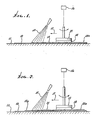
- a layer of in-service floor finish 10 is shown on floor 11, layer 10 for example consisting of a conventional polished finish such as polymeric finish or floor wax, which was previously applied to the floor.
- a liquid solution is applied to the layer 10, as by spraying the solution downwardly into the air, as at 12, above the layer 10, so that solution droplets collect on the layer 10 as at 13.
- the solution contains an ingredient capable of producing cross-linking (as by oxygen group bridging) of the ingredient with the floor surface, i.e.
- Pad 14 typically consists of non-woven fiber and resinous binder in which abrasive particles may or may not be distributed, and having exposed edges that rub against the solid surfaces layer 10 to produce heat as the rotor rotates, as for example at speeds in excess of 1,000 rpm.
- the resultant tough film is shown at 13a, cross-linked with layer 10.
- liquid solution ranging in total solids from 2% to 40% consists essentially of:
- wax and polyolefin materials are waxes and mixtures of waxes of vegetable, animal or synthetic origin including carnauba, candelilla, montan, lanolin, cocoa butter, cottonseed, stearin, Japan, bayberry, myrtle, mace, palm kernel, beeswax, spermaceti, Chinese insect, tallow among the natural waxes and Fischer-Tropsch and hydrogenated coconut and soybean oil waxes among the synthetic waxes, as well as emulsifiable polyolefin waxes, particularly of olefin monomers having 2 or 3 carbon atoms i.e. ethylene and propylene in major proportion.
- Ethylene- and propylene-acid copolymers are also suitable, as are paraffin and microcrystalline waxes, both oxidized and unoxidized, ceresin and ozokerite waxes.
- “Waxes” include polyolefins of low, medium and high molecular weight which are emulsifiable e.g. from waxes to high polymers or are supplied as latexes, etc. Poly-Em products.
- Suitable resin fractions are identified in j) above.
- the cross-linking agent is methylated melamine, its weight percent is typically about 4.0; whereas if the cross-linking agent is sodium benzoate, its weight percent is typically about 1.5.
- the solution preferably also includes a small amount of ammonia, i.e. about 0.60 weight percent when the cross-linking agent consists of the melamine, and about 0.25 when the cross-linking agent consists of sodium benzoate.
- the water soluble solvent preferably consists of glycol ether;
- the surfactant preferably consists of nonylphenoxy poly-(ethyleneoxy) ethanol;
- the volatile amine preferably consists of 2-amino-2-methyl propanol-1, and the humectant preferably consists of ethylene glycol.
- Cross-linking between oxygen groups such as OH- and COOH- is believed to occur at buffing temperatures in excess of 49°C, and preferably in excess of 66°C, i.e. 77-82°C.
- Fig. 2 is the same as Fig. 1, except that a second application of solution 21 is shown as sprayed on completed film 13a, as referred to above.
- the collected droplets of solution 21 are buffed in the same manner as described above, to produce a tough film 21a cross-linked with film 13a, wherein 13a is further cross-linked.
- Solution 21 consists of any of the described formulas.
Landscapes
- Chemical & Material Sciences (AREA)
- Organic Chemistry (AREA)
- Application Of Or Painting With Fluid Materials (AREA)
- Agricultural Chemicals And Associated Chemicals (AREA)
- Treatments Of Macromolecular Shaped Articles (AREA)
Abstract
Description
- This invention relates generally to treatment of polished and unpolished floor surfaces, and more particularly concerns the production of improved film surfaces on floors.
- There is continuing need for floor film surfaces produced by spray buffing and characterized by extension of in-service life coupled with reduction in the frequency of required spray buffing (as compared to conventional spray buffing products).
- The present invention provides for a method of producing a toughened, mar-resistant floor film, comprising the steps of applying to an already formed floor surface film a liquid solution containing a polymerized film forming agent and a cross-linking ingredient, and buffing said floor surface film with said solution thereon in moist condition to heat the solution and surface film and produce cross-linking of said agent with the floor surface film to harden said film, said cross-linking ingredient being selected from methylated melamine and sodium benzoate.
- The present invention also provides for a liquid solution for use in producing a toughened, mar-resistant floor film as by application to a floor surface and buffing at elevated temperature to produce cross-linking with the floor surface, said solution having the following composition:

- Basically, the invention involves the spray-buffing (for example mist spray application of the product onto a polished floor followed by immediate buffing to a dry condition with a machine driven floor maintenance pad) of a specially formulated compound containing a cross-linking agent onto and into an in-service film. Cross-linking is achieved in the in-service film by virtue of the presence of the cross-linker in the spray buffing product and frictional heat derived from the power driven floor cleaning and polishing pad. High speed spray buffing produces the beneficial effects described below faster than conventional speed spray buffing units and procedures, but the composition gives improved benefits, even while using conventional procedures. An overall benefit is the extension of the service life of the in-service film coupled with overall improved performance during its life and a reduction in the frequency of needed spray buffing (when compared to conventional spray buffing products). Treatment of uncoated floor surfaces, particularly in the masonry family, for example terrazzo, marble, clays, etc., is also possible with the invention. Observed improvements as regards improved performance and extension of service life are listed as follows:
- a) Film toughening as evidenced by improved scuff and scratch resistance
- b) Improved detergent and water resistance
- c) Improved powdering resistance
- d) Improved heel mark resistance
- e) Improved overall gloss
- In addition, it is found that it is possible to overcoat the spray buffed film of the invention with additional coats of floor finish, thereby upgrading gloss still further, but more importantly thereby providing fresh crosslinkable sites on the floor.
- Further, it is noted that the "cross-link" product's use does not have the drawbacks of conventional spray-buff products wherein removal difficulties and reduction of slip resistance levels are many times produced.
- The described spray-buff composition contains polymeric ingredients in the family of floor finish ingredients, and the final spray-buff composition is meant for the maintenance of in-service floor finish films. The preferred cross-linking agent may also be incorporated into other basic types of otherwise conventional spray-buff products, e.g., water-emulsion, wax-based products, with and without solvent fractions.
- These and other objects and advantages of the invention, as well as the details of an illustrative embodiment, will be more fully understood from the following description and drawings, in which:
- Fig. 1 is an elevation showing spray buffing of an applied formulation, in accordance with the invention; and
- Fig. 2 is another view like Fig. 1.
- Referring first to Fig. 1, a layer of in-
service floor finish 10 is shown onfloor 11,layer 10 for example consisting of a conventional polished finish such as polymeric finish or floor wax, which was previously applied to the floor. In order to produce the tough, and more mar-resistant floor film, in accordance with the invention, a liquid solution is applied to thelayer 10, as by spraying the solution downwardly into the air, as at 12, above thelayer 10, so that solution droplets collect on thelayer 10 as at 13. The solution contains an ingredient capable of producing cross-linking (as by oxygen group bridging) of the ingredient with the floor surface, i.e. the surface oflayer 10, and in instances of uncoated flooring the surface at 11, in response to heat produced as a result of high speed buffing of the solution droplets onlayer 10 orsurface 11. Such heat is produced by frictional rubbing of the abrasive or non-abrasive buffing pad 14 onlayer 10 to which the solution droplets have been applied, as by spraying. A rotor carrying the pad is indicated at 15, and the high speed rotary drive for the rotor is indicated at 16. As the rotor is rotated, it is traveled over the droplet area, as shown byarrow 17. Pad 14 typically consists of non-woven fiber and resinous binder in which abrasive particles may or may not be distributed, and having exposed edges that rub against thesolid surfaces layer 10 to produce heat as the rotor rotates, as for example at speeds in excess of 1,000 rpm. The resultant tough film is shown at 13a, cross-linked withlayer 10. - In accordance with the invention, the liquid solution ranging in total solids from 2% to 40% consists essentially of:

- Among suitable wax and polyolefin materials are waxes and mixtures of waxes of vegetable, animal or synthetic origin including carnauba, candelilla, montan, lanolin, cocoa butter, cottonseed, stearin, Japan, bayberry, myrtle, mace, palm kernel, beeswax, spermaceti, Chinese insect, tallow among the natural waxes and Fischer-Tropsch and hydrogenated coconut and soybean oil waxes among the synthetic waxes, as well as emulsifiable polyolefin waxes, particularly of olefin monomers having 2 or 3 carbon atoms i.e. ethylene and propylene in major proportion. Ethylene- and propylene-acid copolymers are also suitable, as are paraffin and microcrystalline waxes, both oxidized and unoxidized, ceresin and ozokerite waxes.
- "Waxes" include polyolefins of low, medium and high molecular weight which are emulsifiable e.g. from waxes to high polymers or are supplied as latexes, etc. Poly-Em products.
- Suitable resin fractions are identified in j) above.
- If the cross-linking agent is methylated melamine, its weight percent is typically about 4.0; whereas if the cross-linking agent is sodium benzoate, its weight percent is typically about 1.5. Further, the solution preferably also includes a small amount of ammonia, i.e. about 0.60 weight percent when the cross-linking agent consists of the melamine, and about 0.25 when the cross-linking agent consists of sodium benzoate. In either case, the water soluble solvent preferably consists of glycol ether; the surfactant preferably consists of nonylphenoxy poly-(ethyleneoxy) ethanol; the volatile amine preferably consists of 2-amino-2-methyl propanol-1, and the humectant preferably consists of ethylene glycol. Cross-linking between oxygen groups such as OH- and COOH- is believed to occur at buffing temperatures in excess of 49°C, and preferably in excess of 66°C, i.e. 77-82°C.
- The ingredients and their functions in the solution composition are listed as follows:

-

-


-

- Fig. 2 is the same as Fig. 1, except that a second application of
solution 21 is shown as sprayed on completedfilm 13a, as referred to above. The collected droplets ofsolution 21 are buffed in the same manner as described above, to produce atough film 21a cross-linked withfilm 13a, wherein 13a is further cross-linked.Solution 21 consists of any of the described formulas.
Claims (13)


Priority Applications (1)
| Application Number | Priority Date | Filing Date | Title |
|---|---|---|---|
| AT82102413T ATE14083T1 (en) | 1981-04-13 | 1982-03-23 | SPRAY POLISHING REAGENT AND ITS USE. |
Applications Claiming Priority (2)
| Application Number | Priority Date | Filing Date | Title |
|---|---|---|---|
| US253300 | 1981-04-13 | ||
| US06/253,300 US4363835A (en) | 1981-04-13 | 1981-04-13 | Spray buff reactant and application thereof |
Publications (2)
| Publication Number | Publication Date |
|---|---|
| EP0062793A1 EP0062793A1 (en) | 1982-10-20 |
| EP0062793B1 true EP0062793B1 (en) | 1985-07-03 |
Family
ID=22959693
Family Applications (1)
| Application Number | Title | Priority Date | Filing Date |
|---|---|---|---|
| EP82102413A Expired EP0062793B1 (en) | 1981-04-13 | 1982-03-23 | Spray buff reactant and application thereof |
Country Status (4)
| Country | Link |
|---|---|
| US (1) | US4363835A (en) |
| EP (1) | EP0062793B1 (en) |
| AT (1) | ATE14083T1 (en) |
| DE (1) | DE3264509D1 (en) |
Families Citing this family (4)
| Publication number | Priority date | Publication date | Assignee | Title |
|---|---|---|---|---|
| US4526815A (en) * | 1981-04-13 | 1985-07-02 | Tp Industrial, Inc. | Floor polishes particularly receptive to high speed and very high speed spray or dry buffing |
| US4630407A (en) * | 1984-05-29 | 1986-12-23 | Rhodes Lynn R | Method for finishing a thermoplastic coating |
| CA2371246C (en) | 1999-04-28 | 2008-12-02 | Ecolab Inc. | Polymer surface coating made by coalescing polymer particulate with a coalescing agent |
| EP1184435A1 (en) * | 2000-08-28 | 2002-03-06 | Asahi Glass Company Ltd. | Floor polishing compound |
Family Cites Families (10)
| Publication number | Priority date | Publication date | Assignee | Title |
|---|---|---|---|---|
| NL283498A (en) * | 1961-09-22 | |||
| US3481910A (en) * | 1965-10-04 | 1969-12-02 | Eastman Kodak Co | Reaction products of unsaturated dicarboxylic acids,anhydrides,esters with degraded poly - alpha - olefin polymers |
| US3413252A (en) * | 1966-05-11 | 1968-11-26 | Fmc Corp | Floor polish compositions |
| US3541045A (en) * | 1968-03-07 | 1970-11-17 | Hercules Inc | Coating composition |
| US3669892A (en) * | 1969-01-29 | 1972-06-13 | Minnesota Mining & Mfg | Aerosol spray cleaner-polish |
| US3992335A (en) * | 1969-11-14 | 1976-11-16 | Airwick Industries, Inc. | Self-shining floor care compositions |
| US4046726A (en) * | 1975-12-22 | 1977-09-06 | The Richardson Company | Floor finish composition and components thereof |
| US4069538A (en) * | 1976-07-01 | 1978-01-24 | Fallen Burke R | Drive disc and pad assembly for floor buffer |
| US4122576A (en) * | 1977-07-11 | 1978-10-31 | The National Super Service Company | High-speed floor treating machine |
| US4284668A (en) * | 1979-08-27 | 1981-08-18 | Tough-Guard, Inc. | Paint sealant with Teflon T.F.E |
-
1981
- 1981-04-13 US US06/253,300 patent/US4363835A/en not_active Expired - Lifetime
-
1982
- 1982-03-23 DE DE8282102413T patent/DE3264509D1/en not_active Expired
- 1982-03-23 AT AT82102413T patent/ATE14083T1/en active
- 1982-03-23 EP EP82102413A patent/EP0062793B1/en not_active Expired
Also Published As
| Publication number | Publication date |
|---|---|
| US4363835A (en) | 1982-12-14 |
| DE3264509D1 (en) | 1985-08-08 |
| EP0062793A1 (en) | 1982-10-20 |
| ATE14083T1 (en) | 1985-07-15 |
Similar Documents
| Publication | Publication Date | Title |
|---|---|---|
| US4963432A (en) | One step polishing wiper | |
| US4508634A (en) | Aqueous skin cleaner composition comprising propylene carbonate | |
| EP0638680B1 (en) | Nonwoven surface treating articles and methods of making and using same | |
| RU2377115C2 (en) | Method and device to process hard surfaces and floor surface-processing machine | |
| JPH0314666A (en) | Low-density nonwoven fiber-like surface-treated article | |
| US3071479A (en) | Combination polishing and cleaning composition | |
| CN1139687C (en) | Treating agent for water-proof rag and the water-proof rag | |
| JPH0671705B2 (en) | Grinding wheel | |
| AU636415B2 (en) | Abrasive elements | |
| WO1997027004A1 (en) | Method of increasing lubricity of snow ski bases | |
| US4704429A (en) | Floor polishes particularly receptive to high speed and very high speed spray or dry buffing | |
| US4284668A (en) | Paint sealant with Teflon T.F.E | |
| EP0062793A1 (en) | Spray buff reactant and application thereof | |
| EP0469750B1 (en) | Rotatable disc device and method for removing surface coverings | |
| US4537802A (en) | Floor finishing, cleaning and burnishing compositions containing ucon polymers, and method of use | |
| US4414360A (en) | Spray buff reactant and application thereof | |
| CN101175602B (en) | Method and tool for hard surface maintenance and method of making same | |
| US4526815A (en) | Floor polishes particularly receptive to high speed and very high speed spray or dry buffing | |
| US2062671A (en) | Process and compound for polishing plastics | |
| JPH02269791A (en) | Buffing composition | |
| US3639316A (en) | Composition for reducing friction on coated abrasive cloth | |
| US5565516A (en) | Finishing compositions | |
| US3282665A (en) | Composition for cleaning and lubricating abrasive surfaces | |
| JPH01178223A (en) | Floor pad with dry finishing coat | |
| US3102010A (en) | Durable rotative abrasive structure and method of making the same |
Legal Events
| Date | Code | Title | Description |
|---|---|---|---|
| PUAI | Public reference made under article 153(3) epc to a published international application that has entered the european phase |
Free format text: ORIGINAL CODE: 0009012 |
|
| AK | Designated contracting states |
Designated state(s): AT BE CH DE FR GB IT LU NL SE |
|
| 17P | Request for examination filed |
Effective date: 19830330 |
|
| GRAA | (expected) grant |
Free format text: ORIGINAL CODE: 0009210 |
|
| AK | Designated contracting states |
Designated state(s): AT BE CH DE FR GB IT LI LU NL SE |
|
| PG25 | Lapsed in a contracting state [announced via postgrant information from national office to epo] |
Ref country code: NL Effective date: 19850703 Ref country code: LI Effective date: 19850703 Ref country code: IT Free format text: LAPSE BECAUSE OF FAILURE TO SUBMIT A TRANSLATION OF THE DESCRIPTION OR TO PAY THE FEE WITHIN THE PRESCRIBED TIME-LIMIT;WARNING: LAPSES OF ITALIAN PATENTS WITH EFFECTIVE DATE BEFORE 2007 MAY HAVE OCCURRED AT ANY TIME BEFORE 2007. THE CORRECT EFFECTIVE DATE MAY BE DIFFERENT FROM THE ONE RECORDED. Effective date: 19850703 Ref country code: FR Free format text: THE PATENT HAS BEEN ANNULLED BY A DECISION OF A NATIONAL AUTHORITY Effective date: 19850703 Ref country code: CH Effective date: 19850703 Ref country code: BE Effective date: 19850703 Ref country code: AT Effective date: 19850703 |
|
| REF | Corresponds to: |
Ref document number: 14083 Country of ref document: AT Date of ref document: 19850715 Kind code of ref document: T |
|
| PG25 | Lapsed in a contracting state [announced via postgrant information from national office to epo] |
Ref country code: SE Effective date: 19850730 |
|
| REF | Corresponds to: |
Ref document number: 3264509 Country of ref document: DE Date of ref document: 19850808 |
|
| REG | Reference to a national code |
Ref country code: CH Ref legal event code: PL |
|
| NLV1 | Nl: lapsed or annulled due to failure to fulfill the requirements of art. 29p and 29m of the patents act | ||
| EN | Fr: translation not filed | ||
| PG25 | Lapsed in a contracting state [announced via postgrant information from national office to epo] |
Ref country code: LU Free format text: LAPSE BECAUSE OF NON-PAYMENT OF DUE FEES Effective date: 19860331 |
|
| PLBE | No opposition filed within time limit |
Free format text: ORIGINAL CODE: 0009261 |
|
| STAA | Information on the status of an ep patent application or granted ep patent |
Free format text: STATUS: NO OPPOSITION FILED WITHIN TIME LIMIT |
|
| 26N | No opposition filed | ||
| GBPC | Gb: european patent ceased through non-payment of renewal fee | ||
| PG25 | Lapsed in a contracting state [announced via postgrant information from national office to epo] |
Ref country code: DE Effective date: 19861202 |
|
| PG25 | Lapsed in a contracting state [announced via postgrant information from national office to epo] |
Ref country code: GB Effective date: 19881121 |