EP0061340B1 - New pharmaceutical compositions containing guanidinopyrimidines - Google Patents
New pharmaceutical compositions containing guanidinopyrimidines Download PDFInfo
- Publication number
- EP0061340B1 EP0061340B1 EP82301477A EP82301477A EP0061340B1 EP 0061340 B1 EP0061340 B1 EP 0061340B1 EP 82301477 A EP82301477 A EP 82301477A EP 82301477 A EP82301477 A EP 82301477A EP 0061340 B1 EP0061340 B1 EP 0061340B1
- Authority
- EP
- European Patent Office
- Prior art keywords
- compound
- pharmaceutically acceptable
- amino
- formula
- acid addition
- Prior art date
- Legal status (The legal status is an assumption and is not a legal conclusion. Google has not performed a legal analysis and makes no representation as to the accuracy of the status listed.)
- Expired
Links
- 239000008194 pharmaceutical composition Substances 0.000 title claims description 4
- FRQBQBUHPNYTGS-UHFFFAOYSA-N 2-pyrimidin-2-ylguanidine Chemical class NC(N)=NC1=NC=CC=N1 FRQBQBUHPNYTGS-UHFFFAOYSA-N 0.000 title 1
- 150000001875 compounds Chemical class 0.000 claims description 29
- 150000003839 salts Chemical class 0.000 claims description 14
- 239000002253 acid Substances 0.000 claims description 12
- 239000000203 mixture Substances 0.000 claims description 11
- ZRALSGWEFCBTJO-UHFFFAOYSA-N Guanidine Chemical compound NC(N)=N ZRALSGWEFCBTJO-UHFFFAOYSA-N 0.000 claims description 10
- 230000001882 diuretic effect Effects 0.000 claims description 10
- 125000002924 primary amino group Chemical group [H]N([H])* 0.000 claims description 7
- 231100000252 nontoxic Toxicity 0.000 claims description 6
- 230000003000 nontoxic effect Effects 0.000 claims description 6
- CHJJGSNFBQVOTG-UHFFFAOYSA-N N-methyl-guanidine Natural products CNC(N)=N CHJJGSNFBQVOTG-UHFFFAOYSA-N 0.000 claims description 5
- SWSQBOPZIKWTGO-UHFFFAOYSA-N dimethylaminoamidine Natural products CN(C)C(N)=N SWSQBOPZIKWTGO-UHFFFAOYSA-N 0.000 claims description 5
- 238000000034 method Methods 0.000 claims description 5
- 239000002934 diuretic Substances 0.000 claims description 4
- 125000000449 nitro group Chemical group [O-][N+](*)=O 0.000 claims description 4
- 238000002360 preparation method Methods 0.000 claims description 4
- 239000003937 drug carrier Substances 0.000 claims description 3
- 125000001475 halogen functional group Chemical group 0.000 claims description 3
- 239000003960 organic solvent Substances 0.000 claims description 3
- PUEDUUOKNDSVDR-UHFFFAOYSA-N 2-(5-amino-6-chloropyrimidin-4-yl)guanidine Chemical compound NC(=N)NC1=NC=NC(Cl)=C1N PUEDUUOKNDSVDR-UHFFFAOYSA-N 0.000 claims description 2
- XNFYAKPMJUIMJH-UHFFFAOYSA-N 2-(5,6-diaminopyrimidin-4-yl)guanidine Chemical compound NC(=N)NC1=NC=NC(N)=C1N XNFYAKPMJUIMJH-UHFFFAOYSA-N 0.000 claims 1
- WKBOTKDWSSQWDR-UHFFFAOYSA-N Bromine atom Chemical compound [Br] WKBOTKDWSSQWDR-UHFFFAOYSA-N 0.000 claims 1
- ZAMOUSCENKQFHK-UHFFFAOYSA-N Chlorine atom Chemical compound [Cl] ZAMOUSCENKQFHK-UHFFFAOYSA-N 0.000 claims 1
- GDTBXPJZTBHREO-UHFFFAOYSA-N bromine Substances BrBr GDTBXPJZTBHREO-UHFFFAOYSA-N 0.000 claims 1
- 229910052794 bromium Inorganic materials 0.000 claims 1
- 229910052801 chlorine Inorganic materials 0.000 claims 1
- 239000000460 chlorine Substances 0.000 claims 1
- 239000003814 drug Substances 0.000 claims 1
- 229940124597 therapeutic agent Drugs 0.000 claims 1
- 230000000694 effects Effects 0.000 description 11
- OKKJLVBELUTLKV-UHFFFAOYSA-N Methanol Chemical compound OC OKKJLVBELUTLKV-UHFFFAOYSA-N 0.000 description 9
- LFQSCWFLJHTTHZ-UHFFFAOYSA-N Ethanol Chemical compound CCO LFQSCWFLJHTTHZ-UHFFFAOYSA-N 0.000 description 7
- 238000006243 chemical reaction Methods 0.000 description 7
- 239000004480 active ingredient Substances 0.000 description 6
- 239000002585 base Substances 0.000 description 6
- XLYOFNOQVPJJNP-UHFFFAOYSA-N water Substances O XLYOFNOQVPJJNP-UHFFFAOYSA-N 0.000 description 5
- XNWFRZJHXBZDAG-UHFFFAOYSA-N 2-METHOXYETHANOL Chemical compound COCCO XNWFRZJHXBZDAG-UHFFFAOYSA-N 0.000 description 4
- 241000700159 Rattus Species 0.000 description 4
- 239000004615 ingredient Substances 0.000 description 4
- 239000007787 solid Substances 0.000 description 4
- DKINVRYXRGSDEP-UHFFFAOYSA-N 2-(6-amino-5-nitropyrimidin-4-yl)guanidine Chemical compound NC(=N)NC1=NC=NC(N)=C1[N+]([O-])=O DKINVRYXRGSDEP-UHFFFAOYSA-N 0.000 description 3
- DGAQECJNVWCQMB-PUAWFVPOSA-M Ilexoside XXIX Chemical compound C[C@@H]1CC[C@@]2(CC[C@@]3(C(=CC[C@H]4[C@]3(CC[C@@H]5[C@@]4(CC[C@@H](C5(C)C)OS(=O)(=O)[O-])C)C)[C@@H]2[C@]1(C)O)C)C(=O)O[C@H]6[C@@H]([C@H]([C@@H]([C@H](O6)CO)O)O)O.[Na+] DGAQECJNVWCQMB-PUAWFVPOSA-M 0.000 description 3
- 239000007868 Raney catalyst Substances 0.000 description 3
- NPXOKRUENSOPAO-UHFFFAOYSA-N Raney nickel Chemical compound [Al].[Ni] NPXOKRUENSOPAO-UHFFFAOYSA-N 0.000 description 3
- 229910000564 Raney nickel Inorganic materials 0.000 description 3
- 239000003054 catalyst Substances 0.000 description 3
- 230000002950 deficient Effects 0.000 description 3
- 238000002156 mixing Methods 0.000 description 3
- 238000010992 reflux Methods 0.000 description 3
- 229910052708 sodium Inorganic materials 0.000 description 3
- 239000011734 sodium Substances 0.000 description 3
- HIVHLUQUOWCUMU-UHFFFAOYSA-N 2-(5-aminopyrimidin-4-yl)guanidine Chemical class NC(=N)NC1=NC=NC=C1N HIVHLUQUOWCUMU-UHFFFAOYSA-N 0.000 description 2
- AWPFVRGTQDHJSW-UHFFFAOYSA-N 2-(5-nitropyrimidin-4-yl)guanidine Chemical class NC(=N)NC1=NC=NC=C1[N+]([O-])=O AWPFVRGTQDHJSW-UHFFFAOYSA-N 0.000 description 2
- QCQCHGYLTSGIGX-GHXANHINSA-N 4-[[(3ar,5ar,5br,7ar,9s,11ar,11br,13as)-5a,5b,8,8,11a-pentamethyl-3a-[(5-methylpyridine-3-carbonyl)amino]-2-oxo-1-propan-2-yl-4,5,6,7,7a,9,10,11,11b,12,13,13a-dodecahydro-3h-cyclopenta[a]chrysen-9-yl]oxy]-2,2-dimethyl-4-oxobutanoic acid Chemical compound N([C@@]12CC[C@@]3(C)[C@]4(C)CC[C@H]5C(C)(C)[C@@H](OC(=O)CC(C)(C)C(O)=O)CC[C@]5(C)[C@H]4CC[C@@H]3C1=C(C(C2)=O)C(C)C)C(=O)C1=CN=CC(C)=C1 QCQCHGYLTSGIGX-GHXANHINSA-N 0.000 description 2
- OKTJSMMVPCPJKN-UHFFFAOYSA-N Carbon Chemical compound [C] OKTJSMMVPCPJKN-UHFFFAOYSA-N 0.000 description 2
- JZUFKLXOESDKRF-UHFFFAOYSA-N Chlorothiazide Chemical compound C1=C(Cl)C(S(=O)(=O)N)=CC2=C1NCNS2(=O)=O JZUFKLXOESDKRF-UHFFFAOYSA-N 0.000 description 2
- RTZKZFJDLAIYFH-UHFFFAOYSA-N Diethyl ether Chemical compound CCOCC RTZKZFJDLAIYFH-UHFFFAOYSA-N 0.000 description 2
- 229940097420 Diuretic Drugs 0.000 description 2
- 241001465754 Metazoa Species 0.000 description 2
- KDLHZDBZIXYQEI-UHFFFAOYSA-N Palladium Chemical compound [Pd] KDLHZDBZIXYQEI-UHFFFAOYSA-N 0.000 description 2
- FAPWRFPIFSIZLT-UHFFFAOYSA-M Sodium chloride Chemical compound [Na+].[Cl-] FAPWRFPIFSIZLT-UHFFFAOYSA-M 0.000 description 2
- QAOWNCQODCNURD-UHFFFAOYSA-N Sulfuric acid Chemical compound OS(O)(=O)=O QAOWNCQODCNURD-UHFFFAOYSA-N 0.000 description 2
- FNYLWPVRPXGIIP-UHFFFAOYSA-N Triamterene Chemical compound NC1=NC2=NC(N)=NC(N)=C2N=C1C1=CC=CC=C1 FNYLWPVRPXGIIP-UHFFFAOYSA-N 0.000 description 2
- 230000004071 biological effect Effects 0.000 description 2
- 229910052799 carbon Inorganic materials 0.000 description 2
- 125000001309 chloro group Chemical group Cl* 0.000 description 2
- 239000007903 gelatin capsule Substances 0.000 description 2
- 229960002003 hydrochlorothiazide Drugs 0.000 description 2
- 239000007788 liquid Substances 0.000 description 2
- 230000000144 pharmacologic effect Effects 0.000 description 2
- 229960001288 triamterene Drugs 0.000 description 2
- 0 *C1NC=NC(NC(N)=N)=C1* Chemical compound *C1NC=NC(NC(N)=N)=C1* 0.000 description 1
- KKDHGQHQMRSXIC-UHFFFAOYSA-N 2-(2-aminopyrimidin-4-yl)guanidine Chemical class NC(=N)NC1=CC=NC(N)=N1 KKDHGQHQMRSXIC-UHFFFAOYSA-N 0.000 description 1
- JGCSYLXSOPEQLN-UHFFFAOYSA-N 2-(5,6-diaminopyrimidin-4-yl)guanidine;sulfuric acid Chemical compound OS(O)(=O)=O.NC(N)=NC1=NC=NC(N)=C1N JGCSYLXSOPEQLN-UHFFFAOYSA-N 0.000 description 1
- VUBXYBUXZYNQIA-UHFFFAOYSA-N 2-(5-nitropyrimidin-2-yl)guanidine Chemical compound NC(N)=NC1=NC=C([N+]([O-])=O)C=N1 VUBXYBUXZYNQIA-UHFFFAOYSA-N 0.000 description 1
- NVXIVMWEFRBTLI-UHFFFAOYSA-N 2-(6-chloro-5-nitropyrimidin-4-yl)guanidine Chemical compound NC(=N)NC1=NC=NC(Cl)=C1[N+]([O-])=O NVXIVMWEFRBTLI-UHFFFAOYSA-N 0.000 description 1
- ZGCKCFFZSPZCPE-UHFFFAOYSA-N 2-[2-(dimethylamino)pyrimidin-4-yl]guanidine Chemical compound CN(C)C1=NC=CC(NC(N)=N)=N1 ZGCKCFFZSPZCPE-UHFFFAOYSA-N 0.000 description 1
- CHVSSWRHLONGJZ-UHFFFAOYSA-N 4,6-dibromopyrimidin-5-amine Chemical compound NC1=C(Br)N=CN=C1Br CHVSSWRHLONGJZ-UHFFFAOYSA-N 0.000 description 1
- HCTISZQLTGAYOX-UHFFFAOYSA-N 4,6-dichloro-5-nitropyrimidine Chemical compound [O-][N+](=O)C1=C(Cl)N=CN=C1Cl HCTISZQLTGAYOX-UHFFFAOYSA-N 0.000 description 1
- NIGDWBHWHVHOAD-UHFFFAOYSA-N 4,6-dichloropyrimidin-5-amine Chemical compound NC1=C(Cl)N=CN=C1Cl NIGDWBHWHVHOAD-UHFFFAOYSA-N 0.000 description 1
- 150000005696 4-halopyrimidines Chemical class 0.000 description 1
- NOYDQGFVFOQSAJ-UHFFFAOYSA-N 5-nitropyrimidine Chemical class [O-][N+](=O)C1=CN=CN=C1 NOYDQGFVFOQSAJ-UHFFFAOYSA-N 0.000 description 1
- COVZYZSDYWQREU-UHFFFAOYSA-N Busulfan Chemical compound CS(=O)(=O)OCCCCOS(C)(=O)=O COVZYZSDYWQREU-UHFFFAOYSA-N 0.000 description 1
- OTMSDBZUPAUEDD-UHFFFAOYSA-N Ethane Chemical compound CC OTMSDBZUPAUEDD-UHFFFAOYSA-N 0.000 description 1
- VEXZGXHMUGYJMC-UHFFFAOYSA-N Hydrochloric acid Chemical compound Cl VEXZGXHMUGYJMC-UHFFFAOYSA-N 0.000 description 1
- CPELXLSAUQHCOX-UHFFFAOYSA-N Hydrogen bromide Chemical compound Br CPELXLSAUQHCOX-UHFFFAOYSA-N 0.000 description 1
- GRYLNZFGIOXLOG-UHFFFAOYSA-N Nitric acid Chemical class O[N+]([O-])=O GRYLNZFGIOXLOG-UHFFFAOYSA-N 0.000 description 1
- 235000019502 Orange oil Nutrition 0.000 description 1
- ZLMJMSJWJFRBEC-UHFFFAOYSA-N Potassium Chemical compound [K] ZLMJMSJWJFRBEC-UHFFFAOYSA-N 0.000 description 1
- 229940122767 Potassium sparing diuretic Drugs 0.000 description 1
- 230000002378 acidificating effect Effects 0.000 description 1
- 239000003708 ampul Substances 0.000 description 1
- 230000037396 body weight Effects 0.000 description 1
- 125000001246 bromo group Chemical group Br* 0.000 description 1
- 238000009903 catalytic hydrogenation reaction Methods 0.000 description 1
- 239000007795 chemical reaction product Substances 0.000 description 1
- 239000000039 congener Substances 0.000 description 1
- 238000007796 conventional method Methods 0.000 description 1
- 239000012043 crude product Substances 0.000 description 1
- 235000005911 diet Nutrition 0.000 description 1
- 230000037213 diet Effects 0.000 description 1
- 239000000839 emulsion Substances 0.000 description 1
- MDKXBBPLEGPIRI-UHFFFAOYSA-N ethoxyethane;methanol Chemical compound OC.CCOCC MDKXBBPLEGPIRI-UHFFFAOYSA-N 0.000 description 1
- 238000002474 experimental method Methods 0.000 description 1
- 239000000706 filtrate Substances 0.000 description 1
- 238000001914 filtration Methods 0.000 description 1
- 125000001153 fluoro group Chemical group F* 0.000 description 1
- 235000013305 food Nutrition 0.000 description 1
- 239000012458 free base Substances 0.000 description 1
- 239000008187 granular material Substances 0.000 description 1
- 125000002795 guanidino group Chemical group C(N)(=N)N* 0.000 description 1
- 125000005843 halogen group Chemical group 0.000 description 1
- -1 hydrochloric Chemical class 0.000 description 1
- IXCSERBJSXMMFS-UHFFFAOYSA-N hydrogen chloride Substances Cl.Cl IXCSERBJSXMMFS-UHFFFAOYSA-N 0.000 description 1
- 229910000041 hydrogen chloride Inorganic materials 0.000 description 1
- 238000005984 hydrogenation reaction Methods 0.000 description 1
- 125000002346 iodo group Chemical group I* 0.000 description 1
- 210000003734 kidney Anatomy 0.000 description 1
- 239000006194 liquid suspension Substances 0.000 description 1
- 239000007937 lozenge Substances 0.000 description 1
- 150000007522 mineralic acids Chemical class 0.000 description 1
- TUIARYVFXLMHBS-UHFFFAOYSA-N n,n-dichloropyrimidin-2-amine Chemical compound ClN(Cl)C1=NC=CC=N1 TUIARYVFXLMHBS-UHFFFAOYSA-N 0.000 description 1
- 230000001452 natriuretic effect Effects 0.000 description 1
- 229910000510 noble metal Inorganic materials 0.000 description 1
- 239000010502 orange oil Substances 0.000 description 1
- 150000007524 organic acids Chemical class 0.000 description 1
- 235000005985 organic acids Nutrition 0.000 description 1
- MUMZUERVLWJKNR-UHFFFAOYSA-N oxoplatinum Chemical compound [Pt]=O MUMZUERVLWJKNR-UHFFFAOYSA-N 0.000 description 1
- 229910052763 palladium Inorganic materials 0.000 description 1
- 239000008188 pellet Substances 0.000 description 1
- 239000000825 pharmaceutical preparation Substances 0.000 description 1
- 230000003285 pharmacodynamic effect Effects 0.000 description 1
- 229910003446 platinum oxide Inorganic materials 0.000 description 1
- 229910052700 potassium Inorganic materials 0.000 description 1
- 239000011591 potassium Substances 0.000 description 1
- 239000003286 potassium sparing diuretic agent Substances 0.000 description 1
- 229940097241 potassium-sparing diuretic Drugs 0.000 description 1
- 239000000843 powder Substances 0.000 description 1
- 239000000047 product Substances 0.000 description 1
- 239000012521 purified sample Substances 0.000 description 1
- 125000000714 pyrimidinyl group Chemical group 0.000 description 1
- 239000011780 sodium chloride Substances 0.000 description 1
- 239000000126 substance Substances 0.000 description 1
- 238000006467 substitution reaction Methods 0.000 description 1
- 239000000829 suppository Substances 0.000 description 1
- 239000006188 syrup Substances 0.000 description 1
- 235000020357 syrup Nutrition 0.000 description 1
- 239000003826 tablet Substances 0.000 description 1
- LMBFAGIMSUYTBN-MPZNNTNKSA-N teixobactin Chemical compound C([C@H](C(=O)N[C@@H]([C@@H](C)CC)C(=O)N[C@@H](CO)C(=O)N[C@H](CCC(N)=O)C(=O)N[C@H]([C@@H](C)CC)C(=O)N[C@@H]([C@@H](C)CC)C(=O)N[C@@H](CO)C(=O)N[C@H]1C(N[C@@H](C)C(=O)N[C@@H](C[C@@H]2NC(=N)NC2)C(=O)N[C@H](C(=O)O[C@H]1C)[C@@H](C)CC)=O)NC)C1=CC=CC=C1 LMBFAGIMSUYTBN-MPZNNTNKSA-N 0.000 description 1
- 230000032258 transport Effects 0.000 description 1
- 238000001665 trituration Methods 0.000 description 1
- 210000002700 urine Anatomy 0.000 description 1
- 238000005303 weighing Methods 0.000 description 1
Classifications
-
- C—CHEMISTRY; METALLURGY
- C07—ORGANIC CHEMISTRY
- C07D—HETEROCYCLIC COMPOUNDS
- C07D239/00—Heterocyclic compounds containing 1,3-diazine or hydrogenated 1,3-diazine rings
- C07D239/02—Heterocyclic compounds containing 1,3-diazine or hydrogenated 1,3-diazine rings not condensed with other rings
- C07D239/24—Heterocyclic compounds containing 1,3-diazine or hydrogenated 1,3-diazine rings not condensed with other rings having three or more double bonds between ring members or between ring members and non-ring members
- C07D239/28—Heterocyclic compounds containing 1,3-diazine or hydrogenated 1,3-diazine rings not condensed with other rings having three or more double bonds between ring members or between ring members and non-ring members with hetero atoms or with carbon atoms having three bonds to hetero atoms with at the most one bond to halogen, directly attached to ring carbon atoms
- C07D239/32—One oxygen, sulfur or nitrogen atom
- C07D239/42—One nitrogen atom
-
- A—HUMAN NECESSITIES
- A61—MEDICAL OR VETERINARY SCIENCE; HYGIENE
- A61P—SPECIFIC THERAPEUTIC ACTIVITY OF CHEMICAL COMPOUNDS OR MEDICINAL PREPARATIONS
- A61P7/00—Drugs for disorders of the blood or the extracellular fluid
- A61P7/10—Antioedematous agents; Diuretics
-
- C—CHEMISTRY; METALLURGY
- C07—ORGANIC CHEMISTRY
- C07D—HETEROCYCLIC COMPOUNDS
- C07D239/00—Heterocyclic compounds containing 1,3-diazine or hydrogenated 1,3-diazine rings
- C07D239/02—Heterocyclic compounds containing 1,3-diazine or hydrogenated 1,3-diazine rings not condensed with other rings
- C07D239/24—Heterocyclic compounds containing 1,3-diazine or hydrogenated 1,3-diazine rings not condensed with other rings having three or more double bonds between ring members or between ring members and non-ring members
- C07D239/28—Heterocyclic compounds containing 1,3-diazine or hydrogenated 1,3-diazine rings not condensed with other rings having three or more double bonds between ring members or between ring members and non-ring members with hetero atoms or with carbon atoms having three bonds to hetero atoms with at the most one bond to halogen, directly attached to ring carbon atoms
- C07D239/46—Two or more oxygen, sulphur or nitrogen atoms
- C07D239/48—Two nitrogen atoms
-
- C—CHEMISTRY; METALLURGY
- C07—ORGANIC CHEMISTRY
- C07D—HETEROCYCLIC COMPOUNDS
- C07D239/00—Heterocyclic compounds containing 1,3-diazine or hydrogenated 1,3-diazine rings
- C07D239/02—Heterocyclic compounds containing 1,3-diazine or hydrogenated 1,3-diazine rings not condensed with other rings
- C07D239/24—Heterocyclic compounds containing 1,3-diazine or hydrogenated 1,3-diazine rings not condensed with other rings having three or more double bonds between ring members or between ring members and non-ring members
- C07D239/28—Heterocyclic compounds containing 1,3-diazine or hydrogenated 1,3-diazine rings not condensed with other rings having three or more double bonds between ring members or between ring members and non-ring members with hetero atoms or with carbon atoms having three bonds to hetero atoms with at the most one bond to halogen, directly attached to ring carbon atoms
- C07D239/46—Two or more oxygen, sulphur or nitrogen atoms
- C07D239/50—Three nitrogen atoms
Definitions
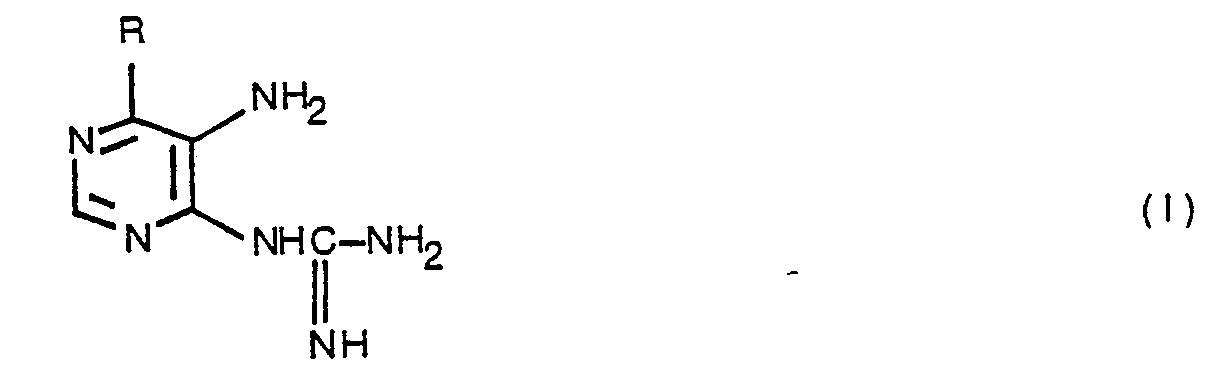
- This invention comprises new pharmaceutical compositions whose active ingredients are chemical compounds whose basic structures have a pyrimidine ring with a guanidino substituent at the 4-position and either an amino or nitro group at the 5-position.
- the dosage unit compositions of this invention have diuretic activity and, more precisely, naturetic activity. Also part of this invention is a series of new 5-amino-4-guanidinopyrimidines.
- a subgeneric group of compounds of this invention are those of structure I in which either R is chloro or amino.
- Pharmaceutical dosage units of this invention comprise as the active ingredient a compound of the formula: in which R is as described above and R 1 is amino or nitro, or a pharmaceutically acceptable acid addition salt thereof.
- the salts are prepared conveniently by mixing a lower alkanol solution of the base with an excess of the acid such as with reacting the base in methanol with hydrogen chloride in ethyl ether.
- the chemical compounds related to this invention are prepared either by replacement of the reactive 4- halo substituent on a 5-amino or nitro-4-halopyrimidine by guanidine or, in case of the 5-amino series, by catalytic hydrogenation of a 5-nitro-guanidinopyrimidine.
- guanidine in at least one molar equivalent, is reacted with the desired 4-halopyrimidine in a suitable organic solvent such as methanol or ethanol usually at reflux temperature until the reaction is complete.
- a suitable hydrogenation catalyst known to be effective for hydrogenating nitro groups in an organic solvent may be used.
- Such catalysts are Raney nickel or a noble metal catalyst such as platinum oxide or palladium. Raney nickel in 2-methoxyethanol is often used.
- the compounds of the formula II have diuretic activity which can be demonstrated in standard pharmacological tests. More specifically these compounds have naturetic activity in the sodium deficient rat test. Generally naturetic activity was demonstrated in this test at 30 mg/kg with these new compounds. Standard diuretic compounds such as hydrochlorothiazide or triamterene show activity at 5 or 15 mg/kg respectively.
- Oral doses of the compounds selected from the range of about 10-50 mg/kg have a natriuretic activity, most-pronounced without limiting side effects at a dose selected from the range of 15-30 mg/kg, depending on the activity of the active ingredient as noted.
- the 5-nitro-4-guanidinopyrimidine series also demonstrates a potassium sparing effect together with enhanced naturetic activity.
- compositions of this invention containing a compound of Formula 11 which has diuretic activity are prepared in conventional dosage unit forms by combining the chemical compound, or a pharmaceutically acceptable acid addition salt thereof, with a nontoxic pharmaceutical carrier according to accepted procedures in a nontoxic amount sufficient to produce the desired pharmacodynamic activity in a subject, animal or human.
- the compositions will contain the active ingredient in an active but nontoxic quantity selected from 75 mg to 500 mg of active base ingredient per dose unit for example adapted for oral administration, but this quantity depends on the specific biological activity desired, the activity of the compound and the condition of the patient.
- a wide variety of pharmaceutical forms can be employed.
- a solid carrier for oral administration the preparation can be tableted, placed in a hard gelatin capsule in powder or pellet form, or in the form of a suppository, trouche or lozenge.
- the amount of solid carrier will vary widely but preferably will be from about 25 mg to about 1 g.
- a liquid carrier the preparation will be in the form of a syrup, emulsion, soft gelatin capsule, sterile injectable liquid such as an ampul, or an aqueous or nonaqueous liquid suspension.
- the pharmaceutical preparations are made following the conventional techniques of the pharmaceutical chemist involving mixing, granulating and compressing when necessary, or variously mixing and dissolving the ingredients as appropriate to give the desired end product.
- the method of producing diuretic activity comprises administering internally to a subject in need of such activity a compound of Formula II or a pharmaceutically acceptable acid addition salt thereof, usually combined with a pharmaceutical carrier, in a nontoxic amount sufficient to produce said activity as described above.
- the route of administration may be any route which effectively transports the active compound to the site of action which is to be affected within the kidney such as orally or parenterally.
- equal oral doses will be administered several times such as 2-5 times a day with the daily dosage regimen being selected from about 150 mg to about 1.5 g.
- 6-Amino-4-guanidino-5-nitropyrimidine and its hydrochloride salt to be used as an active ingredient are prepared by the method described by J. A. Carbon, J. Org. Chem. 26 459 (1961).
- Other 5-nitro- pyrimidines are prepared by the reactions described in that publication and in the above examples such as the following:
- the first two ingredients are mixed and wet granulated.
- the granules are dried, mixed with the remaining ingredients and compressed into scored tablets which are administered to a patient in need of diuretic activity from 2-5 times daily.
Landscapes
- Chemical & Material Sciences (AREA)
- Organic Chemistry (AREA)
- Health & Medical Sciences (AREA)
- Medicinal Chemistry (AREA)
- Engineering & Computer Science (AREA)
- Diabetes (AREA)
- Chemical Kinetics & Catalysis (AREA)
- General Chemical & Material Sciences (AREA)
- Bioinformatics & Cheminformatics (AREA)
- Nuclear Medicine, Radiotherapy & Molecular Imaging (AREA)
- Hematology (AREA)
- Pharmacology & Pharmacy (AREA)
- Life Sciences & Earth Sciences (AREA)
- Animal Behavior & Ethology (AREA)
- General Health & Medical Sciences (AREA)
- Public Health (AREA)
- Veterinary Medicine (AREA)
- Pharmaceuticals Containing Other Organic And Inorganic Compounds (AREA)
- Medicines That Contain Protein Lipid Enzymes And Other Medicines (AREA)
Description
- This invention comprises new pharmaceutical compositions whose active ingredients are chemical compounds whose basic structures have a pyrimidine ring with a guanidino substituent at the 4-position and either an amino or nitro group at the 5-position. The dosage unit compositions of this invention have diuretic activity and, more precisely, naturetic activity. Also part of this invention is a series of new 5-amino-4-guanidinopyrimidines.
- Few amino-4-guanidinopyrimidines are known to the art; E. Buehler et al., Chem. Ber. 99 2997 (1966). This publication describes a 2-dimethylamino-4-guanidinopyrimidine. 6-Amino-5-nitro-4-guanidinopyrimidine is described as a chemical intermediate in J. A. Carbon, J. Org. Chem. 26 455 (1961). None of these publications suggest the substitution pattern of the structures of the 5-amino-4-guanidino- pyrimidines of this invention or the biological activity of these and of the corresponding 5-nitro-4- guanidinopyrimidines.
- The new compounds of this invention are represented by the following structural formula:

- R is halo, that is fluoro, chloro, bromo or iodo, or amino.
- A subgeneric group of compounds of this invention are those of structure I in which either R is chloro or amino.
- Pharmaceutical dosage units of this invention comprise as the active ingredient a compound of the formula:
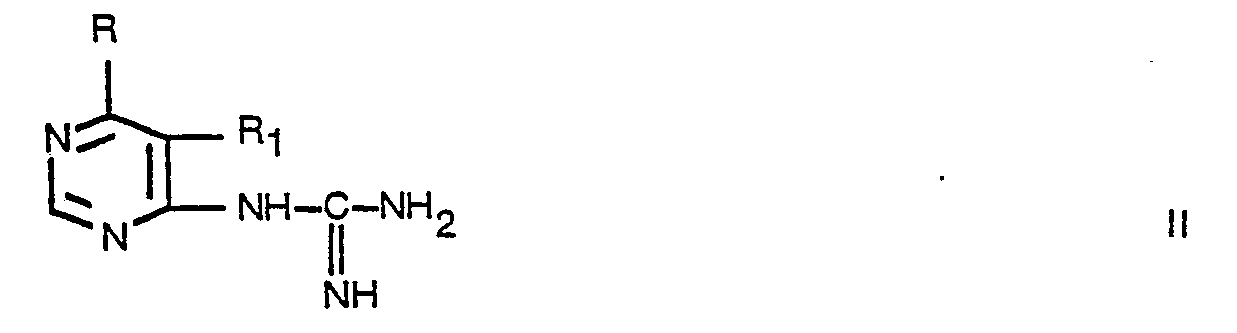
- Also included in this invention are the pharmaceutically acceptable acid addition salts of the bases of the structural formulas I above formed by reaction with nontoxic inorganic or organic acids such as hydrochloric, hydrobromic, hydriodic, sulfuric, phosphoric, sulfamic, ethane disulfonic, methane sulfonic, acetic, maleic or nitric acids. The salts are prepared conveniently by mixing a lower alkanol solution of the base with an excess of the acid such as with reacting the base in methanol with hydrogen chloride in ethyl ether.
- The chemical compounds related to this invention are prepared either by replacement of the reactive 4- halo substituent on a 5-amino or nitro-4-halopyrimidine by guanidine or, in case of the 5-amino series, by catalytic hydrogenation of a 5-nitro-guanidinopyrimidine. In the former reaction, guanidine in at least one molar equivalent, is reacted with the desired 4-halopyrimidine in a suitable organic solvent such as methanol or ethanol usually at reflux temperature until the reaction is complete. In the second reaction a suitable hydrogenation catalyst known to be effective for hydrogenating nitro groups in an organic solvent may be used. Such catalysts are Raney nickel or a noble metal catalyst such as platinum oxide or palladium. Raney nickel in 2-methoxyethanol is often used.
- The compounds of the formula II have diuretic activity which can be demonstrated in standard pharmacological tests. More specifically these compounds have naturetic activity in the sodium deficient rat test. Generally naturetic activity was demonstrated in this test at 30 mg/kg with these new compounds. Standard diuretic compounds such as hydrochlorothiazide or triamterene show activity at 5 or 15 mg/kg respectively.
- Following is the protocol of the sodium deficient rat test and representative results using compounds of this invention as active ingredients.
- Normal male rats weighing 175-203 g are placed on a sodium deficient diet for a period of 5 days. On the morning of the 5th day food is removed for the duration of the experiment. On day 6, water is also removed and the rats are loaded with 3.0 ml of 0.85% sodium chloride (s.c.) and 5 ml of water (p.o.). There are 8 animals in the control group and in each test group. The test compound is given orally. Urine samples are collected 6 hours after dosing.

- In the same pharmacological procedure a well known diuretic compound, hydrochlorothiazide gave the following results:

- The potassium sparing diuretic, triamterene, gave the following results:

- Oral doses of the compounds selected from the range of about 10-50 mg/kg (indicating weight of base/body weight) have a natriuretic activity, most-pronounced without limiting side effects at a dose selected from the range of 15-30 mg/kg, depending on the activity of the active ingredient as noted.
- The 5-nitro-4-guanidinopyrimidine series also demonstrates a potassium sparing effect together with enhanced naturetic activity.
- The pharmaceutical compositions of this invention containing a compound of Formula 11 which has diuretic activity are prepared in conventional dosage unit forms by combining the chemical compound, or a pharmaceutically acceptable acid addition salt thereof, with a nontoxic pharmaceutical carrier according to accepted procedures in a nontoxic amount sufficient to produce the desired pharmacodynamic activity in a subject, animal or human. The compositions will contain the active ingredient in an active but nontoxic quantity selected from 75 mg to 500 mg of active base ingredient per dose unit for example adapted for oral administration, but this quantity depends on the specific biological activity desired, the activity of the compound and the condition of the patient.
- A wide variety of pharmaceutical forms can be employed. Thus, if a solid carrier for oral administration is used the preparation can be tableted, placed in a hard gelatin capsule in powder or pellet form, or in the form of a suppository, trouche or lozenge. The amount of solid carrier will vary widely but preferably will be from about 25 mg to about 1 g. If a liquid carrier is used, the preparation will be in the form of a syrup, emulsion, soft gelatin capsule, sterile injectable liquid such as an ampul, or an aqueous or nonaqueous liquid suspension.
- The pharmaceutical preparations are made following the conventional techniques of the pharmaceutical chemist involving mixing, granulating and compressing when necessary, or variously mixing and dissolving the ingredients as appropriate to give the desired end product.
- The method of producing diuretic activity comprises administering internally to a subject in need of such activity a compound of Formula II or a pharmaceutically acceptable acid addition salt thereof, usually combined with a pharmaceutical carrier, in a nontoxic amount sufficient to produce said activity as described above. The route of administration may be any route which effectively transports the active compound to the site of action which is to be affected within the kidney such as orally or parenterally. Advantageously, equal oral doses will be administered several times such as 2-5 times a day with the daily dosage regimen being selected from about 150 mg to about 1.5 g.
- The following examples are designed solely to illustrate the preparation and use of the compounds of this invention. The temperatures are Centigrade. The doses outlined herein are in terms of the base form of the compounds of the Formula II. Other variations of these examples will be obvious to those skilled in the art.
- A mixture of 5.70 g (0.0289 mole) of 6-amino-4-guanidino-5-nitropyrimidine and 500 ml of 2-methoxyethanol was hydrogenated over Raney nickel at 60° for 20 min. at 3.10 KPS. The warm mixture was filtered and concentrated; the brown residue was slurried in a warm mixture of 2-methoxyethanol and water then made acidic with 10% sulfuric acid. The cooled mixture was filtered. THe solid was washed with water and ethanol to give 6.2 g (81 %) of 5,6-diamino-4-guanidinopyrimidine sulfate. A purified sample was prepared by hot trituration of the crude product with 50% aqueous 2-methoxyethanol followed by methanol wash to give a product with mp 305° (dec.)

- A mixture of 6.87 g (0.0419 mole) of 4,6-dichloro-5-aminopyrimidine and absolute ethanol containing a large excess of guanidine free base was heated at reflux overnight. The solution was cooled to room temperature, filtered and the filtrate concentrated to an orange oil which was triturated with water giving a solid which was separated by filtration and dried to 0.74 g (9.5%) of 5-amino-6-chloro-4-guanidinopyrimidine. The hydrochloride salt was prepared in methanol-ether, mp 230°.

- Repeating this reaction with 4,6-dibromo-5-amino-pyrimidine prepared as is the dichloroamino- pyrimidine gives 5-amino-6-bromo-4-guanidinopyrmidine hydrobromide. Other 6-halo congeners are made by variations of these reactions.
- 6-Amino-4-guanidino-5-nitropyrimidine and its hydrochloride salt to be used as an active ingredient are prepared by the method described by J. A. Carbon, J. Org. Chem. 26 459 (1961). Other 5-nitro- pyrimidines are prepared by the reactions described in that publication and in the above examples such as the following:
- A mixture of 10 g of 4,6-dichloro-5-nitropyrimidine in ethanol is reacted at reflux for three days with a slight excess of guanidine to give 6-chloro-4-guanidino-5-nitropyrimidine.

- The first two ingredients are mixed and wet granulated. The granules are dried, mixed with the remaining ingredients and compressed into scored tablets which are administered to a patient in need of diuretic activity from 2-5 times daily.
Claims (9)



Applications Claiming Priority (2)
| Application Number | Priority Date | Filing Date | Title |
|---|---|---|---|
| US247049 | 1981-03-24 | ||
| US06/247,049 US4336255A (en) | 1981-03-24 | 1981-03-24 | Pharmaceutical compositions containing guanidinopyrimidines |
Publications (2)
| Publication Number | Publication Date |
|---|---|
| EP0061340A1 EP0061340A1 (en) | 1982-09-29 |
| EP0061340B1 true EP0061340B1 (en) | 1985-06-19 |
Family
ID=22933342
Family Applications (1)
| Application Number | Title | Priority Date | Filing Date |
|---|---|---|---|
| EP82301477A Expired EP0061340B1 (en) | 1981-03-24 | 1982-03-23 | New pharmaceutical compositions containing guanidinopyrimidines |
Country Status (5)
| Country | Link |
|---|---|
| US (1) | US4336255A (en) |
| EP (1) | EP0061340B1 (en) |
| JP (1) | JPS57169418A (en) |
| DE (1) | DE3264222D1 (en) |
| IE (1) | IE52905B1 (en) |
Families Citing this family (1)
| Publication number | Priority date | Publication date | Assignee | Title |
|---|---|---|---|---|
| GR71929B (en) * | 1979-11-13 | 1983-08-19 | Ici Ltd |
Family Cites Families (4)
| Publication number | Priority date | Publication date | Assignee | Title |
|---|---|---|---|---|
| US2422887A (en) * | 1947-06-24 | Pyrimidine compound and processes | ||
| US2295563A (en) * | 1941-07-30 | 1942-09-15 | Gen Electric | Diazine derivatives |
| BE490235A (en) * | 1948-07-21 | |||
| US3284188A (en) * | 1963-04-12 | 1966-11-08 | Toyo Koatsu Ind Inc | Method and composition for suppressing the nitrification of ammonium nitrogen in soil |
-
1981
- 1981-03-24 US US06/247,049 patent/US4336255A/en not_active Expired - Fee Related
-
1982
- 1982-03-18 JP JP57044427A patent/JPS57169418A/en active Granted
- 1982-03-23 EP EP82301477A patent/EP0061340B1/en not_active Expired
- 1982-03-23 IE IE666/82A patent/IE52905B1/en unknown
- 1982-03-23 DE DE8282301477T patent/DE3264222D1/en not_active Expired
Non-Patent Citations (2)
| Title |
|---|
| JOURNAL OF MEDICINAL CHEMISTRY, vol. 17, no. 1, 1974, pages 75-99, Washington (USA); E.F. ELSLAGER et al.: "Synthesis and antimalarial effects of 1-(3,4-Dichlorophenyl)-3-(4-((1-ethyl-3-piperidyl)amino)-6-methyl-2-pyrimidinyl)guanidine and related substances" * |
| JOURNAL OF ORGANIC CHEMISTRY, vol. 26, 1961, pages 455-61, Washington (USA); H.A. CARBON: "Heterocyclic compounds containing adjacent nitro and guanidino groups. A novel rearrangement of 4-Amino-5-nitro-6-quanidino-(and 6-ureido) pyrimidine" * |
Also Published As
| Publication number | Publication date |
|---|---|
| DE3264222D1 (en) | 1985-07-25 |
| JPH0416444B2 (en) | 1992-03-24 |
| EP0061340A1 (en) | 1982-09-29 |
| IE820666L (en) | 1982-09-24 |
| JPS57169418A (en) | 1982-10-19 |
| US4336255A (en) | 1982-06-22 |
| IE52905B1 (en) | 1988-04-13 |
Similar Documents
| Publication | Publication Date | Title |
|---|---|---|
| JPS624387B2 (en) | ||
| IE57424B1 (en) | Furo-(3,4-c)-pyridine derivatives,preparation thereof and therapeutic compositions containing the same | |
| JPH0222758B2 (en) | ||
| DE2647095A1 (en) | NEW SUBSTITUTED 4-AMINOPYRAZOLES, THE METHOD OF MANUFACTURING THEREOF AND MEDICINAL PRODUCTS | |
| KR0150649B1 (en) | Sulfonanilide derivative and medicine | |
| JPS5869812A (en) | Blood sugar level depressing agent | |
| IL30782A (en) | Amino guanidines | |
| US4351770A (en) | Preparation of N(2-pyrrolidinylmethyl)2-methoxy-5-benzenesulfonamidobenzamides | |
| JPS6318591B2 (en) | ||
| US4336255A (en) | Pharmaceutical compositions containing guanidinopyrimidines | |
| EP0066774B1 (en) | 1,4,9,10-tetrahydropyrazolo(4,3-e)pyrido(3,2-b)(1,4)diazepin-10-ones, process for their preparation and medicinal preparations containing them | |
| JPH0372061B2 (en) | ||
| EP0062439B1 (en) | Guanidinopyrimidines | |
| CA1153376A (en) | Antidepressant agent | |
| US3970753A (en) | Imidazo[1,2-a]pyridines | |
| US3969518A (en) | Inhibiting xanthine oxidase with 3-haloalkyl substituted benzothiadiazine-1,1-dioxides | |
| US3009910A (en) | 2, 4-disulfamyl-aniline derivatives | |
| US5071849A (en) | Dihydropyrimidothiazine derivatives | |
| US3760081A (en) | Method of treatment | |
| PL141942B1 (en) | Process for preparing novel,basic oxime ethers | |
| US3697531A (en) | N,n{40 -alkylenebis(pyridine-carboxamides) | |
| GB2131021A (en) | Antipsychotic benzoxazines | |
| IE42710B1 (en) | Substituted piperazine derivative,its preparation and compositions containing it | |
| IE41667B1 (en) | Substituted phenylpiperazine compounds and pharmaceutical uses thereof | |
| GB2100261A (en) | Aminophenylalkylamine derivatives, a process for their preparation and their use as pharmaceuticals |
Legal Events
| Date | Code | Title | Description |
|---|---|---|---|
| PUAI | Public reference made under article 153(3) epc to a published international application that has entered the european phase |
Free format text: ORIGINAL CODE: 0009012 |
|
| 17P | Request for examination filed |
Effective date: 19820401 |
|
| AK | Designated contracting states |
Designated state(s): BE CH DE FR GB IT LI LU NL SE |
|
| R17P | Request for examination filed (corrected) |
Effective date: 19821015 |
|
| ITF | It: translation for a ep patent filed | ||
| GRAA | (expected) grant |
Free format text: ORIGINAL CODE: 0009210 |
|
| AK | Designated contracting states |
Designated state(s): BE CH DE FR GB IT LI LU NL SE |
|
| REF | Corresponds to: |
Ref document number: 3264222 Country of ref document: DE Date of ref document: 19850725 |
|
| ET | Fr: translation filed | ||
| PG25 | Lapsed in a contracting state [announced via postgrant information from national office to epo] |
Ref country code: LU Free format text: LAPSE BECAUSE OF NON-PAYMENT OF DUE FEES Effective date: 19860331 |
|
| PLBE | No opposition filed within time limit |
Free format text: ORIGINAL CODE: 0009261 |
|
| STAA | Information on the status of an ep patent application or granted ep patent |
Free format text: STATUS: NO OPPOSITION FILED WITHIN TIME LIMIT |
|
| 26N | No opposition filed | ||
| PGFP | Annual fee paid to national office [announced via postgrant information from national office to epo] |
Ref country code: LU Payment date: 19890109 Year of fee payment: 8 |
|
| PGFP | Annual fee paid to national office [announced via postgrant information from national office to epo] |
Ref country code: SE Payment date: 19900227 Year of fee payment: 9 |
|
| PGFP | Annual fee paid to national office [announced via postgrant information from national office to epo] |
Ref country code: GB Payment date: 19900228 Year of fee payment: 9 |
|
| PGFP | Annual fee paid to national office [announced via postgrant information from national office to epo] |
Ref country code: FR Payment date: 19900314 Year of fee payment: 9 |
|
| PGFP | Annual fee paid to national office [announced via postgrant information from national office to epo] |
Ref country code: CH Payment date: 19900320 Year of fee payment: 9 |
|
| PGFP | Annual fee paid to national office [announced via postgrant information from national office to epo] |
Ref country code: DE Payment date: 19900327 Year of fee payment: 9 |
|
| ITTA | It: last paid annual fee | ||
| PGFP | Annual fee paid to national office [announced via postgrant information from national office to epo] |
Ref country code: NL Payment date: 19900331 Year of fee payment: 9 |
|
| PGFP | Annual fee paid to national office [announced via postgrant information from national office to epo] |
Ref country code: BE Payment date: 19900911 Year of fee payment: 9 |
|
| PG25 | Lapsed in a contracting state [announced via postgrant information from national office to epo] |
Ref country code: GB Effective date: 19910323 |
|
| PG25 | Lapsed in a contracting state [announced via postgrant information from national office to epo] |
Ref country code: SE Effective date: 19910324 |
|
| PG25 | Lapsed in a contracting state [announced via postgrant information from national office to epo] |
Ref country code: LI Effective date: 19910331 Ref country code: CH Effective date: 19910331 Ref country code: BE Effective date: 19910331 |
|
| BERE | Be: lapsed |
Owner name: SMITHKLINE BECKMAN CORP. Effective date: 19910331 |
|
| PG25 | Lapsed in a contracting state [announced via postgrant information from national office to epo] |
Ref country code: NL Effective date: 19911001 |
|
| NLV4 | Nl: lapsed or anulled due to non-payment of the annual fee | ||
| GBPC | Gb: european patent ceased through non-payment of renewal fee | ||
| PG25 | Lapsed in a contracting state [announced via postgrant information from national office to epo] |
Ref country code: FR Effective date: 19911129 |
|
| REG | Reference to a national code |
Ref country code: CH Ref legal event code: PL |
|
| PG25 | Lapsed in a contracting state [announced via postgrant information from national office to epo] |
Ref country code: DE Effective date: 19920101 |
|
| REG | Reference to a national code |
Ref country code: FR Ref legal event code: ST |
|
| EUG | Se: european patent has lapsed |
Ref document number: 82301477.4 Effective date: 19911009 |