EP0061329A2 - Process for improving the compatibility of a polyamine dispersant with fluorocarbons by reaction with an oxidising agent - Google Patents
Process for improving the compatibility of a polyamine dispersant with fluorocarbons by reaction with an oxidising agent Download PDFInfo
- Publication number
- EP0061329A2 EP0061329A2 EP82301443A EP82301443A EP0061329A2 EP 0061329 A2 EP0061329 A2 EP 0061329A2 EP 82301443 A EP82301443 A EP 82301443A EP 82301443 A EP82301443 A EP 82301443A EP 0061329 A2 EP0061329 A2 EP 0061329A2
- Authority
- EP
- European Patent Office
- Prior art keywords
- polyamine
- dispersant
- oxidizing agent
- reaction
- acid
- Prior art date
- Legal status (The legal status is an assumption and is not a legal conclusion. Google has not performed a legal analysis and makes no representation as to the accuracy of the status listed.)
- Granted
Links
Classifications
-
- C—CHEMISTRY; METALLURGY
- C08—ORGANIC MACROMOLECULAR COMPOUNDS; THEIR PREPARATION OR CHEMICAL WORKING-UP; COMPOSITIONS BASED THEREON
- C08F—MACROMOLECULAR COMPOUNDS OBTAINED BY REACTIONS ONLY INVOLVING CARBON-TO-CARBON UNSATURATED BONDS
- C08F8/00—Chemical modification by after-treatment
-
- C—CHEMISTRY; METALLURGY
- C10—PETROLEUM, GAS OR COKE INDUSTRIES; TECHNICAL GASES CONTAINING CARBON MONOXIDE; FUELS; LUBRICANTS; PEAT
- C10M—LUBRICATING COMPOSITIONS; USE OF CHEMICAL SUBSTANCES EITHER ALONE OR AS LUBRICATING INGREDIENTS IN A LUBRICATING COMPOSITION
- C10M149/00—Lubricating compositions characterised by the additive being a macromolecular compound containing nitrogen
- C10M149/02—Macromolecular compounds obtained by reactions only involving carbon-to-carbon unsaturated bonds
- C10M149/06—Macromolecular compounds obtained by reactions only involving carbon-to-carbon unsaturated bonds containing monomers having an unsaturated radical bound to an amido or imido group
-
- C—CHEMISTRY; METALLURGY
- C10—PETROLEUM, GAS OR COKE INDUSTRIES; TECHNICAL GASES CONTAINING CARBON MONOXIDE; FUELS; LUBRICANTS; PEAT
- C10M—LUBRICATING COMPOSITIONS; USE OF CHEMICAL SUBSTANCES EITHER ALONE OR AS LUBRICATING INGREDIENTS IN A LUBRICATING COMPOSITION
- C10M159/00—Lubricating compositions characterised by the additive being of unknown or incompletely defined constitution
- C10M159/12—Reaction products
- C10M159/16—Reaction products obtained by Mannich reactions
-
- C—CHEMISTRY; METALLURGY
- C10—PETROLEUM, GAS OR COKE INDUSTRIES; TECHNICAL GASES CONTAINING CARBON MONOXIDE; FUELS; LUBRICANTS; PEAT
- C10M—LUBRICATING COMPOSITIONS; USE OF CHEMICAL SUBSTANCES EITHER ALONE OR AS LUBRICATING INGREDIENTS IN A LUBRICATING COMPOSITION
- C10M2215/00—Organic non-macromolecular compounds containing nitrogen as ingredients in lubricant Compositions
- C10M2215/02—Amines, e.g. polyalkylene polyamines; Quaternary amines
- C10M2215/04—Amines, e.g. polyalkylene polyamines; Quaternary amines having amino groups bound to acyclic or cycloaliphatic carbon atoms
-
- C—CHEMISTRY; METALLURGY
- C10—PETROLEUM, GAS OR COKE INDUSTRIES; TECHNICAL GASES CONTAINING CARBON MONOXIDE; FUELS; LUBRICANTS; PEAT
- C10M—LUBRICATING COMPOSITIONS; USE OF CHEMICAL SUBSTANCES EITHER ALONE OR AS LUBRICATING INGREDIENTS IN A LUBRICATING COMPOSITION
- C10M2215/00—Organic non-macromolecular compounds containing nitrogen as ingredients in lubricant Compositions
- C10M2215/02—Amines, e.g. polyalkylene polyamines; Quaternary amines
- C10M2215/04—Amines, e.g. polyalkylene polyamines; Quaternary amines having amino groups bound to acyclic or cycloaliphatic carbon atoms
- C10M2215/042—Amines, e.g. polyalkylene polyamines; Quaternary amines having amino groups bound to acyclic or cycloaliphatic carbon atoms containing hydroxy groups; Alkoxylated derivatives thereof
-
- C—CHEMISTRY; METALLURGY
- C10—PETROLEUM, GAS OR COKE INDUSTRIES; TECHNICAL GASES CONTAINING CARBON MONOXIDE; FUELS; LUBRICANTS; PEAT
- C10M—LUBRICATING COMPOSITIONS; USE OF CHEMICAL SUBSTANCES EITHER ALONE OR AS LUBRICATING INGREDIENTS IN A LUBRICATING COMPOSITION
- C10M2215/00—Organic non-macromolecular compounds containing nitrogen as ingredients in lubricant Compositions
- C10M2215/08—Amides [having hydrocarbon substituents containing less than thirty carbon atoms]
-
- C—CHEMISTRY; METALLURGY
- C10—PETROLEUM, GAS OR COKE INDUSTRIES; TECHNICAL GASES CONTAINING CARBON MONOXIDE; FUELS; LUBRICANTS; PEAT
- C10M—LUBRICATING COMPOSITIONS; USE OF CHEMICAL SUBSTANCES EITHER ALONE OR AS LUBRICATING INGREDIENTS IN A LUBRICATING COMPOSITION
- C10M2215/00—Organic non-macromolecular compounds containing nitrogen as ingredients in lubricant Compositions
- C10M2215/08—Amides [having hydrocarbon substituents containing less than thirty carbon atoms]
- C10M2215/082—Amides [having hydrocarbon substituents containing less than thirty carbon atoms] containing hydroxyl groups; Alkoxylated derivatives
-
- C—CHEMISTRY; METALLURGY
- C10—PETROLEUM, GAS OR COKE INDUSTRIES; TECHNICAL GASES CONTAINING CARBON MONOXIDE; FUELS; LUBRICANTS; PEAT
- C10M—LUBRICATING COMPOSITIONS; USE OF CHEMICAL SUBSTANCES EITHER ALONE OR AS LUBRICATING INGREDIENTS IN A LUBRICATING COMPOSITION
- C10M2215/00—Organic non-macromolecular compounds containing nitrogen as ingredients in lubricant Compositions
- C10M2215/086—Imides [having hydrocarbon substituents containing less than thirty carbon atoms]
-
- C—CHEMISTRY; METALLURGY
- C10—PETROLEUM, GAS OR COKE INDUSTRIES; TECHNICAL GASES CONTAINING CARBON MONOXIDE; FUELS; LUBRICANTS; PEAT
- C10M—LUBRICATING COMPOSITIONS; USE OF CHEMICAL SUBSTANCES EITHER ALONE OR AS LUBRICATING INGREDIENTS IN A LUBRICATING COMPOSITION
- C10M2215/00—Organic non-macromolecular compounds containing nitrogen as ingredients in lubricant Compositions
- C10M2215/14—Containing carbon-to-nitrogen double bounds, e.g. guanidines, hydrazones, semicarbazones
-
- C—CHEMISTRY; METALLURGY
- C10—PETROLEUM, GAS OR COKE INDUSTRIES; TECHNICAL GASES CONTAINING CARBON MONOXIDE; FUELS; LUBRICANTS; PEAT
- C10M—LUBRICATING COMPOSITIONS; USE OF CHEMICAL SUBSTANCES EITHER ALONE OR AS LUBRICATING INGREDIENTS IN A LUBRICATING COMPOSITION
- C10M2215/00—Organic non-macromolecular compounds containing nitrogen as ingredients in lubricant Compositions
- C10M2215/22—Heterocyclic nitrogen compounds
-
- C—CHEMISTRY; METALLURGY
- C10—PETROLEUM, GAS OR COKE INDUSTRIES; TECHNICAL GASES CONTAINING CARBON MONOXIDE; FUELS; LUBRICANTS; PEAT
- C10M—LUBRICATING COMPOSITIONS; USE OF CHEMICAL SUBSTANCES EITHER ALONE OR AS LUBRICATING INGREDIENTS IN A LUBRICATING COMPOSITION
- C10M2215/00—Organic non-macromolecular compounds containing nitrogen as ingredients in lubricant Compositions
- C10M2215/22—Heterocyclic nitrogen compounds
- C10M2215/221—Six-membered rings containing nitrogen and carbon only
-
- C—CHEMISTRY; METALLURGY
- C10—PETROLEUM, GAS OR COKE INDUSTRIES; TECHNICAL GASES CONTAINING CARBON MONOXIDE; FUELS; LUBRICANTS; PEAT
- C10M—LUBRICATING COMPOSITIONS; USE OF CHEMICAL SUBSTANCES EITHER ALONE OR AS LUBRICATING INGREDIENTS IN A LUBRICATING COMPOSITION
- C10M2215/00—Organic non-macromolecular compounds containing nitrogen as ingredients in lubricant Compositions
- C10M2215/22—Heterocyclic nitrogen compounds
- C10M2215/223—Five-membered rings containing nitrogen and carbon only
- C10M2215/224—Imidazoles
-
- C—CHEMISTRY; METALLURGY
- C10—PETROLEUM, GAS OR COKE INDUSTRIES; TECHNICAL GASES CONTAINING CARBON MONOXIDE; FUELS; LUBRICANTS; PEAT
- C10M—LUBRICATING COMPOSITIONS; USE OF CHEMICAL SUBSTANCES EITHER ALONE OR AS LUBRICATING INGREDIENTS IN A LUBRICATING COMPOSITION
- C10M2215/00—Organic non-macromolecular compounds containing nitrogen as ingredients in lubricant Compositions
- C10M2215/22—Heterocyclic nitrogen compounds
- C10M2215/225—Heterocyclic nitrogen compounds the rings containing both nitrogen and oxygen
-
- C—CHEMISTRY; METALLURGY
- C10—PETROLEUM, GAS OR COKE INDUSTRIES; TECHNICAL GASES CONTAINING CARBON MONOXIDE; FUELS; LUBRICANTS; PEAT
- C10M—LUBRICATING COMPOSITIONS; USE OF CHEMICAL SUBSTANCES EITHER ALONE OR AS LUBRICATING INGREDIENTS IN A LUBRICATING COMPOSITION
- C10M2215/00—Organic non-macromolecular compounds containing nitrogen as ingredients in lubricant Compositions
- C10M2215/22—Heterocyclic nitrogen compounds
- C10M2215/225—Heterocyclic nitrogen compounds the rings containing both nitrogen and oxygen
- C10M2215/226—Morpholines
-
- C—CHEMISTRY; METALLURGY
- C10—PETROLEUM, GAS OR COKE INDUSTRIES; TECHNICAL GASES CONTAINING CARBON MONOXIDE; FUELS; LUBRICANTS; PEAT
- C10M—LUBRICATING COMPOSITIONS; USE OF CHEMICAL SUBSTANCES EITHER ALONE OR AS LUBRICATING INGREDIENTS IN A LUBRICATING COMPOSITION
- C10M2215/00—Organic non-macromolecular compounds containing nitrogen as ingredients in lubricant Compositions
- C10M2215/24—Organic non-macromolecular compounds containing nitrogen as ingredients in lubricant Compositions having hydrocarbon substituents containing thirty or more carbon atoms, e.g. nitrogen derivatives of substituted succinic acid
- C10M2215/26—Amines
-
- C—CHEMISTRY; METALLURGY
- C10—PETROLEUM, GAS OR COKE INDUSTRIES; TECHNICAL GASES CONTAINING CARBON MONOXIDE; FUELS; LUBRICANTS; PEAT
- C10M—LUBRICATING COMPOSITIONS; USE OF CHEMICAL SUBSTANCES EITHER ALONE OR AS LUBRICATING INGREDIENTS IN A LUBRICATING COMPOSITION
- C10M2215/00—Organic non-macromolecular compounds containing nitrogen as ingredients in lubricant Compositions
- C10M2215/24—Organic non-macromolecular compounds containing nitrogen as ingredients in lubricant Compositions having hydrocarbon substituents containing thirty or more carbon atoms, e.g. nitrogen derivatives of substituted succinic acid
- C10M2215/28—Amides; Imides
-
- C—CHEMISTRY; METALLURGY
- C10—PETROLEUM, GAS OR COKE INDUSTRIES; TECHNICAL GASES CONTAINING CARBON MONOXIDE; FUELS; LUBRICANTS; PEAT
- C10M—LUBRICATING COMPOSITIONS; USE OF CHEMICAL SUBSTANCES EITHER ALONE OR AS LUBRICATING INGREDIENTS IN A LUBRICATING COMPOSITION
- C10M2215/00—Organic non-macromolecular compounds containing nitrogen as ingredients in lubricant Compositions
- C10M2215/24—Organic non-macromolecular compounds containing nitrogen as ingredients in lubricant Compositions having hydrocarbon substituents containing thirty or more carbon atoms, e.g. nitrogen derivatives of substituted succinic acid
- C10M2215/30—Heterocyclic compounds
-
- C—CHEMISTRY; METALLURGY
- C10—PETROLEUM, GAS OR COKE INDUSTRIES; TECHNICAL GASES CONTAINING CARBON MONOXIDE; FUELS; LUBRICANTS; PEAT
- C10M—LUBRICATING COMPOSITIONS; USE OF CHEMICAL SUBSTANCES EITHER ALONE OR AS LUBRICATING INGREDIENTS IN A LUBRICATING COMPOSITION
- C10M2217/00—Organic macromolecular compounds containing nitrogen as ingredients in lubricant compositions
- C10M2217/02—Macromolecular compounds obtained from nitrogen containing monomers by reactions only involving carbon-to-carbon unsaturated bonds
- C10M2217/022—Macromolecular compounds obtained from nitrogen containing monomers by reactions only involving carbon-to-carbon unsaturated bonds containing monomers having an unsaturated radical bound to an amino group
-
- C—CHEMISTRY; METALLURGY
- C10—PETROLEUM, GAS OR COKE INDUSTRIES; TECHNICAL GASES CONTAINING CARBON MONOXIDE; FUELS; LUBRICANTS; PEAT
- C10M—LUBRICATING COMPOSITIONS; USE OF CHEMICAL SUBSTANCES EITHER ALONE OR AS LUBRICATING INGREDIENTS IN A LUBRICATING COMPOSITION
- C10M2217/00—Organic macromolecular compounds containing nitrogen as ingredients in lubricant compositions
- C10M2217/02—Macromolecular compounds obtained from nitrogen containing monomers by reactions only involving carbon-to-carbon unsaturated bonds
- C10M2217/022—Macromolecular compounds obtained from nitrogen containing monomers by reactions only involving carbon-to-carbon unsaturated bonds containing monomers having an unsaturated radical bound to an amino group
- C10M2217/023—Macromolecular compounds obtained from nitrogen containing monomers by reactions only involving carbon-to-carbon unsaturated bonds containing monomers having an unsaturated radical bound to an amino group the amino group containing an ester bond
-
- C—CHEMISTRY; METALLURGY
- C10—PETROLEUM, GAS OR COKE INDUSTRIES; TECHNICAL GASES CONTAINING CARBON MONOXIDE; FUELS; LUBRICANTS; PEAT
- C10M—LUBRICATING COMPOSITIONS; USE OF CHEMICAL SUBSTANCES EITHER ALONE OR AS LUBRICATING INGREDIENTS IN A LUBRICATING COMPOSITION
- C10M2217/00—Organic macromolecular compounds containing nitrogen as ingredients in lubricant compositions
- C10M2217/02—Macromolecular compounds obtained from nitrogen containing monomers by reactions only involving carbon-to-carbon unsaturated bonds
- C10M2217/024—Macromolecular compounds obtained from nitrogen containing monomers by reactions only involving carbon-to-carbon unsaturated bonds containing monomers having an unsaturated radical bound to an amido or imido group
-
- C—CHEMISTRY; METALLURGY
- C10—PETROLEUM, GAS OR COKE INDUSTRIES; TECHNICAL GASES CONTAINING CARBON MONOXIDE; FUELS; LUBRICANTS; PEAT
- C10M—LUBRICATING COMPOSITIONS; USE OF CHEMICAL SUBSTANCES EITHER ALONE OR AS LUBRICATING INGREDIENTS IN A LUBRICATING COMPOSITION
- C10M2217/00—Organic macromolecular compounds containing nitrogen as ingredients in lubricant compositions
- C10M2217/04—Macromolecular compounds from nitrogen-containing monomers obtained otherwise than by reactions only involving carbon-to-carbon unsaturated bonds
- C10M2217/046—Polyamines, i.e. macromoleculars obtained by condensation of more than eleven amine monomers
-
- C—CHEMISTRY; METALLURGY
- C10—PETROLEUM, GAS OR COKE INDUSTRIES; TECHNICAL GASES CONTAINING CARBON MONOXIDE; FUELS; LUBRICANTS; PEAT
- C10M—LUBRICATING COMPOSITIONS; USE OF CHEMICAL SUBSTANCES EITHER ALONE OR AS LUBRICATING INGREDIENTS IN A LUBRICATING COMPOSITION
- C10M2217/00—Organic macromolecular compounds containing nitrogen as ingredients in lubricant compositions
- C10M2217/06—Macromolecular compounds obtained by functionalisation op polymers with a nitrogen containing compound
-
- C—CHEMISTRY; METALLURGY
- C10—PETROLEUM, GAS OR COKE INDUSTRIES; TECHNICAL GASES CONTAINING CARBON MONOXIDE; FUELS; LUBRICANTS; PEAT
- C10N—INDEXING SCHEME ASSOCIATED WITH SUBCLASS C10M RELATING TO LUBRICATING COMPOSITIONS
- C10N2040/00—Specified use or application for which the lubricating composition is intended
- C10N2040/25—Internal-combustion engines
-
- C—CHEMISTRY; METALLURGY
- C10—PETROLEUM, GAS OR COKE INDUSTRIES; TECHNICAL GASES CONTAINING CARBON MONOXIDE; FUELS; LUBRICANTS; PEAT
- C10N—INDEXING SCHEME ASSOCIATED WITH SUBCLASS C10M RELATING TO LUBRICATING COMPOSITIONS
- C10N2040/00—Specified use or application for which the lubricating composition is intended
- C10N2040/25—Internal-combustion engines
- C10N2040/251—Alcohol-fuelled engines
-
- C—CHEMISTRY; METALLURGY
- C10—PETROLEUM, GAS OR COKE INDUSTRIES; TECHNICAL GASES CONTAINING CARBON MONOXIDE; FUELS; LUBRICANTS; PEAT
- C10N—INDEXING SCHEME ASSOCIATED WITH SUBCLASS C10M RELATING TO LUBRICATING COMPOSITIONS
- C10N2040/00—Specified use or application for which the lubricating composition is intended
- C10N2040/25—Internal-combustion engines
- C10N2040/255—Gasoline engines
-
- C—CHEMISTRY; METALLURGY
- C10—PETROLEUM, GAS OR COKE INDUSTRIES; TECHNICAL GASES CONTAINING CARBON MONOXIDE; FUELS; LUBRICANTS; PEAT
- C10N—INDEXING SCHEME ASSOCIATED WITH SUBCLASS C10M RELATING TO LUBRICATING COMPOSITIONS
- C10N2040/00—Specified use or application for which the lubricating composition is intended
- C10N2040/25—Internal-combustion engines
- C10N2040/255—Gasoline engines
- C10N2040/28—Rotary engines
Definitions
- This invention relates to lubricating oil crankcase compositions, concentrates thereof, and methods for improving the operation of internal combustion engines, by reducing the tendancy of polyamine-dispersant compositions to attack fluorohydrocarbon-type engine seals. More particularly, the invention comprises a lubricating oil composition which may be used in engines to prevent discoloration and decomposition of fluorocarbon engine seals.
- Fluorocarbon compositions are commonly used in forming flexible engine seals used in assembling internal combustion engines.
- the seals are used to prevent leakage of lubricants at the point where moving parts such as crankshafts leave the engine. Any substantial leak of lubricant from internal combustion engine crankcases is undesirable.
- engine seals prepared from fluorocarbon compositions are subject to mechanical deterioration, dimensional deterioration, discoloration, crazing, and swelling when used in engines containing lubricating oils having polyamine dispersants.
- the polyamine-containing dispersants interact with the fluorocarbon seals altering the underlying polymeric structure causing the seal composition to absorb oil.
- the mechanical strength and dimensional integrity of the seal deteriorates until the seal fails to adequately prevent leakage of lubricant from crankcases.
- the primary object of this invention is to prevent the deterioration of flurorcarbon engine seals in the presence of polyamine dispersants. Another object of this invention is to prevent leakage of lubricant from crankcases. A further object of the invention is to provide an improved polyamine dispersant having adequate dispersancy and substantially no affect on fluorocarbon engine seals. A further object of the invention is to passivate polyamine-containing dispersants to fluorocarbon compositions.
- polyamine dispersants can be passivated to fluorocarbon compositions by the controlled oxidation of the polyamine dispersant.
- the controlled oxidation of the polyamine dispersant such that the molecular weight of the dispersant composition or the polyamine substituent is not substantially degraded, produces the passivation affect.
- the mildly oxidized polyamine moieties no longer cause any substantial deterioration of fluorocarbon seals.
- oxidation of polyamine dispersants reduces dispersancy.
- the highly-polar polyamine moiety in combination with the non-polar, oil soluble moiety of the dispersant, combines with deposit precursors to prevent formation of sludge and varnish. Any deterioration or degradation of the polyamine structure or hydrocarbon oil soluble moiety reduces the ability of polyamine additive to suspend sludge and varnish precursors. Accordingly, the oxidation of polyamine dispersants has been avoided in processes for the preparation of polyamine dispersants.
- United States Patent Nos. 2,806,860; 3,316,177; 4,098,585; and 4,203,730 and others each teach the oxidation or epoxidation of polymeric oil-soluble hydrocarbon carboxylic acid compounds prior to the reaction of the carboxylic acid moiety with a polyamine compound to form a dispersant. These compositions suffer from the disadvantage that the polyamine moiety remains highly basic and potentially destructive to fluorocarbon seals.
- the improved dispersants of this invention comprise the reaction of a polyamine dispersant and an oxidizing agent.
- Oxidizing agents which can be used to mildly oxidize the polyamine moiety of the polyamine dispersants of this invention are conventional oxidizing agents capable of releasing atomic or molecular oxygen under oxidizing conditions.
- oxidizing agents which can be used under suitable conditions of temperature, concentration and pressure, without substantial degradation of the polyamine or the molecular weight of the dispersant composition, include oxygen, oxygen-containing gases, air, sulfur oxides such as sulfur dioxide, sulfur trioxide, etc.; nitrogen oxides including nitrogen dioxide, nitrogen trioxide, nitrogen pentoxide, etc.; peroxides such as hydrogen peroxide, sodium peroxide; percarboxylic acids such as perbenzoic acid, and ozone.
- Suitable oxidizing agents are the oxygen-containing gases such as various mixtures of oxygen, air, inert gases such as carbon dioxide, noble gases such as argon, helium, etc., nitrogen, natural gas, etc. Air, air with added oxygen, or air diluted with inert gases or with a portion of the oxygen removed, resulting in a reduced oxygen concentration, are preferred agents for the oxidation of the polyamine moieties for reasons of economy, availability, and safety.
- Oil-dispersible polyamine dispersants which can be mildly oxidized in the present invention to prevent fluorocarbon seal attack include an oil-solubilizing group containing at least about 40 carbon atoms directly or indirectly bonded to the polar polyamine group.
- the dispersant may contain more than one of either of such groups per molecule, as will be apparent from the description hereinafter.
- Polymers containing an oil-solubilizing group e.g., a pendant alkyl group having at least about 8 carbon atoms
- a polar group for example, interpolymers of decyl methacrylate, vinyl decyl ether or a relatively high molecular weight olefin with aminoalkyl acrylates, aminoalkyl acrylamides or poly-(oxyalkylene)-substituted alkyl acrylates, as well as copolymers of styrene, alkyl maleates and maleic acid amides or imides, are referred to hereinafter as polymeric polyamine dispersants and examples thereof are disclosed in the following U.S. Patents: which are incorporated by reference herein.
- carboxylic-polyamine and Mannich-polyamine dispersants are preferred dispersants for mild oxidation for reason of economy and high dispersancy.
- the carboxylic polyamine dispersants which will be described first, are those disclosed (for example) in the above-mentioned U.S. Patents 3,219,666 and 3,272,746 which also describe a large number of methods for their preparation.
- the polyamine group therein is derived from compounds characterized by a radical of the structure: wherein the two remaining valences of nitrogen are satisfied by hydrogen, amino or organic radicals bonded to said nitrogen atom through direct carbon-to-nitrogen linkages. These compounds include aliphatic, aromatic, heterocyclic and carbocyclic amines.
- Polyamines are preferred for preparing the carboxylic polyamine dispersant.
- the polyamines are alkylene polyamines (and mixtures thereof) including those having the formula: wherein n is an integer between 1 and about 10, preferably between 2 and 8; each A can be independently hydrogen or a hydrocarbon or hydroxy-substituted hydrocarbon radical which can be derived from an alkylene oxide compound, having up to about 30 atoms; and R is a divalent hydrocarbon radical having from about 1 to about 18 carbons.
- A can be an aliphatic radical of up to about 10 carbon atoms which may be substituted with one or two hydroxy groups, and R is a lower alkylene radical having 1-10, preferably 2-6, carbon atoms.
- Preferred polyamines are the alkylene polyamines wherein each A is hydrogen.
- alkylene polyamines include methylene polyamines, ethylene polyamines, butylene polyamines, propylene polyamines, pentylene polyamines, hexylene polyamines and heptylene polyamines. The higher homologs of such amines and related aminoalkyl-substituted piperazines are also included.
- polyamines include ethylene diamine, triethylene tetramine, tris(2-aminoethyl)amine, propylene diamine, trimethylene diamine, hexamethylene diamine, decamethylene diamine, octamethylene diamine, di(heptamethylene)triamine, tripropylene tetramine, tetraethylene pentamine, trimethylene diamine, pentaethylene hexamine, di(trimethylene)triamine, 2-heptyl-3-(2-aminopropyl)imidazoline, l,3-bis-(2-aminoethyl)imidazoline, 1-(2-aminopropyl)-piperazine, l,4-bis(2-aminoethyl)-piperazine and 2-methyl-l(2-aminobutyl)-piperazine. Higher homologs, obtained by condensing two or more of the above-illustrated alkylene amines, are also useful, as are the polyoxy
- ethylene polyamines examples of which are mentioned above, are especially useful for reasons of cost and effectiveness.
- Such polyamines are described in detail under the heading "Diamines and Higher Amines" in Kirk-Othmer, Encyclopedia of Chemical Technology, Second Edition, Vol. 7, pp. 22-39. They are prepared most conveniently by the reaction of an alkylene chloride with ammonia or by reaction of an ethylene imine with a ring-opening reagent such as ammonia. These reactions result in the production of the somewhat complex mixtures of alkylene polyamines, including cyclic condensation products such as piperazines. Because of their availability, these mixtures are particularly useful in preparing the nitrogen-bridged dispersant. Satisfactory products can also be obtained by the use of pure alkylene polyamines.
- Hydroxy polyamines e.g., alkylene polyamines having one or more hydroxyalkyl substituents which can be derived from alkylene oxide on the nitrogen atoms, are also useful in preparing the nitrogen-bridged dispersant.
- Preferred hydroxyalkyl-substituted alkylene polyamines are those in which the hydroxyalkyl group has less than about 10 carbon atoms.
- hydroxyalkyl-substituted polyamines examples include N-(2-hydroxyethyl)ethylene diamine, N,N'-bis(2-hydroxyethyl)ethylene diamine, l-(2-hydroxyethyl)piperazone, monohydroxypropyl-substituted diethylene triamine, dihydroxypropyltetraethylene pentamine and N-(3-hydroxybutyl)tetramethylene diamine.
- Higher homologs obtained by condensation of the above-illustrated hydroxyalkyl-substituted alkylene amines through amino radicals or through hydroxy radicals are likewise useful.
- the source of the acyl radical in the carboxylic polyamine dispersant is an acylating agent comprising a carboxylic acid-producing compound containing a hydrocarbon or substituted hydrocarbon substituent which has at least about 40 and preferably at least about 50 carbon atoms.
- carboxylic acid-producing compound is meant an acid, anhydride, acid halide, ester, amide, imide, amidine or the like; the acids and anhydrides are preferred.
- the carboxylic acid-producing compound is usually prepared by the reaction (more fully described hereinafter) of a relatively low molecular weight carboxylic acid or derivative thereof with a hydrocarbon source containing at least about 40 and preferably at least about 50 carbon atoms.
- the hydrocarbon source is usually aliphatic and should be substantially saturated, i.e., at least about 95% of the total number of carbon-to-carbon covalent linkages should be saturated. It should also be substantially free from pendant groups containing more than about six aliphatic carbon atoms. It may be a substituted hydrocarbon source; by "substituted” is meant sources containing substituents which do not alter significantly their character or reactivity.
- Examples are halide, hydroxy, ether, keto, carboxy, ester (especially lower carboalkoxy), amide, nitro, cyano, sulfoxy and sulfone radicals.
- the substituents, if present, generally comprise no more than about 10% by weight of the hydrocarbon source.
- the preferred hydrocarbon sources are those derived from substantially saturated petroleum fractions and olefin polymers, particularly polymers of monoolefins having from 2 to about 30 carbon atoms.
- the hydrocarbon source may be derived from a polymer of ethylene, propene, 1-butene, isobutene, 1-octene, 3-cyclohexyl-l-butene, 2-butene, 3-pentene or the like.
- interpolymers of olefins such as those illustrated above with other polymerizable olefinic substances such as styrene, chloroprene, isoprene, p-methylstyrene, piperylene and the like.
- these interpolymers should contain at least about 80%, preferably at least about 95%, on a weight basis of units derived from the aliphatic monoolefins.
- Another suitable hydrocarbon source comprises saturated aliphatic hydrocarbons such as highly refined high molecular weight white oils or synthetic alkanes.
- the hydrocarbon source should contain an activating polar radical to facilitate its reaction with the low molecular weight acid-producing compounds.
- the preferred activating radicals are halogen atoms, especially chlorine, but other suitable radicals include sulfide, disulfide, nitro, mercaptan, ketone and aldehyde groups.
- the olefin polymers having a number average molecular weight between about 600 and about 5000 are preferred, although higher polymers having molecular weights from about 10,000 to about 100,000 or higher can be used.
- Especially suitable as hydrocarbon sources are isobutene polymers within the prescribed molecular weight range, and chlorinated derivatives thereof.
- any one of a number of known reactions may be employed for the preparation of the carboxylic acid-producing compounds.
- an alcohol of the desired molecular weight may be oxidized with potassium permanganate, nitric acid or a similar oxidizing agent; a halogenated olefin polymer may be reacted with a ketene; an ester of an active hydrogencontaining acid, such as acetoacetic acid, may be converted to its sodium derivative and the sodium derivative reacted with a halogenated high molecular weight hydrocarbon such as brominated wax or brominated polyisobutene; a high molecular weight olefin may be ozonized; a methyl ketone of the desired molecular weight may be oxidized by means of the haloform reaction; an organometallic derivative of a halogenated hydrocarbon may be reacted with carbon dioxide; a halogenated hydrocarbon or olefin polymer may be converted to a nitrile, which is
- an olefin polymer or its halogenated derivative may undergo a reaction with an unsaturated carboxylic acid or derivative thereof such as acrylic acid, methacrylic acid, maleic acid, maleic anhydride, fumaric acid, itaconic acid, itaconic anhydride, citraconic acid, citraconic anhydride, mesaconic acid, glutaconic acid, chloromaleic acid, aconitic acid, crotonic acid, methylcrotonic acid, sorbic acid, 3-hexenoic acid, 10-decenoic acid, 2-pentene-l,3,5-tricarboxylic acid, and the like, or with a halogen- substituted carboxylic acid or derivative thereof.
- an unsaturated carboxylic acid or derivative thereof such as acrylic acid, methacrylic acid, maleic acid, maleic anhydride, fumaric acid, itaconic acid, itaconic anhydride, citraconic acid, citraconic anhydride, mesaconic acid,
- the reaction leading to its formation involves merely heating the two reactants at a temperature from about 100° to about 200°C.
- the substituted succinic acid or anhydride thus obtained may, if desired, be converted to the corresponding acid halide by reaction with known halogenating agents such as phosphorus trichloride, phosphorus pentachloride or thionyl chloride.
- the hydrocarbon-substituted succinic anhydride or acid, or other carboxylic acid-producing compound, and the alkylene polyamine or other polyamine-containing reagent are heated to a temperature above about 80°C., preferably from about 100° to about 250°C.
- the product thus obtained has predominantly amide, imide and/or amidine linkages (containing acyl or acylamidoyl groups).
- the process may in some instances be carried out at a temperature below 80°C. to produce a product having predominantly salt linkages (containing acyloxy groups).
- a diluent such as mineral oil, benzene, toluene, naphtha or the like is often desirable to facilitate control of the reaction temperature.
- the relative proportions of the carboxylic acid-producing compound and the alkylene polyamine or the like are such that at least about one-half the stoichiometrically equivalent amount of polyamine is used for each equivalent of carboxylic acid-producing compounds.
- the equivalent weight of the alkylene polyamine is based upon the number of amine radicals therein, and the equivalent weight of the carboxylic acid-producing compound is based on the number of acidic or potentially acidic radicals.
- the Mannich polyamine dispersants are those disclosed, for example, in the above-mentioned United States Patents 3,316,972 and 3,544,420, which also describe convenient methods for their preparation.
- the source of the oil soluble group in the Mannich polyamine dispersant is an alkylated hydroxy aromatic compound comprising the reaction product of an olefinic polymer, an aromatic compound containing at least one hydroxy group.
- the alkyl substituted hydroxy aromatic compound is usually prepared by the alkylation of the hydroxy aromatic compound in well known procedures with an alkylation agent which would provide to the hydroxy aromatic substantial oil-solubility, which substituent is commonly derived from a polyolefin having at least about 40 carbon atoms.
- the hydrocarbon source is substantially aliphatic.
- the hydrocarbon source should also be substantially free from a quantity of pendant groups that would reduce oil solubility. Examples of acceptable groups are halide, hydroxy, ether, carboxy, ester, amide, nitro, cyano, etc.
- the substituents at present generally comprise no more than about 10 weight percent of the hydrocarbon source.
- the preferred hydrocarbon sources are those derived from substantially saturated petroleum fractions and olefin polymers, preferably polymers of monoolefins having from 2 to 30 carbon atoms.
- the hydrocarbon source may be derived from ethylene, propene, 1-butene, isobutene, 1-octene, 1-methyl-cyclohexene, 2-butene, 3-pentene, etc.
- co-polymers of olefins described above with other polymerizable olefinic substances such as styrene, etc. In general these inert polymers should contain at least 80 percent, preferably about 95 percent, of units derived from the aliphatic monoolefins to preserve oil solubility.
- the hydrocarbon source generally contains at least 40 and preferably 50 carbon atoms to provide substantial oil solubility to the dispersant.
- the olefin polymers having a number average molecular weight between about 300-5,000 are preferred for reasons of easy reactivity and low cost; however, higher polymers can be used.
- Especially suitable hydrocarbon sources are polyisobutylene polymers.
- the Mannich reaction is carried out by reacting the substituted hydroxy aromatic compound with an aldehyde and a polyamine.
- the Mannich polyamine can be treated with aliphatic acids, and boric acid compounds to improve processability and additive performance.
- the substituted hydroxy aromatic compound is contacted with from about 0.1-10 moles of polyamine and 0.1-10 moles of aldehyde per mole of alkyl substituted hydroxy aromatic compound.
- the reactants are mixed and heated to a temperature of above about 80°C to initiate the reaction.
- the reaction is carried out at a temperature from about 100 to about 250°C.
- the product thus obtained has predominantly benzylamine linkage between the aromatic compound and the polyamine.
- the reaction can be carried out in inert diluent such as mineral oil, benzene, toluene, naphtha, lingroin, or other inert solvents to facilitate control of viscosity, temperature, and reaction rate.
- inert diluent such as mineral oil, benzene, toluene, naphtha, lingroin, or other inert solvents to facilitate control of viscosity, temperature, and reaction rate.
- Any conventional formaldehyde yielding reagent is useful for the preparation of Mannich polyamine dispersants.
- formaldehyde yielding reagents are trioxane, paraformalde, trioxymethylene, aqueous formalin, gaseous formaldehyde, etc.
- the polyamines useful for preparing the Mannich polyamine dispersants are the same as those useful for preparing the carboxylic polyamine dispersants described above.
- the fluorocarbon passivated polyamine dispersants of this invention can be made by the reaction of the polyamine dispersant with an oxidizing agent or by preparing the polyamine dispersant from a polyamine which has been mildly oxidized with an oxidizing agent.
- the polyamine or the polyamine dispersant having nitrogen to hydrogen bonds is oxidized to an extent to prevent deterioration of fluorocarbon compositions.
- the oxidation of polyamine or polyamine dispersants can be performed by contacting the dispersant under oxidizing conditions with about 0.1 to 10.0 moles and greater of the oxidizing agent per mole of the dispersant.
- the reaction can be conducted neat or in a solvent that can be used to form the dispersant.
- the reaction mixture can be heated to a temperature of about ambient (27°C) to 800°C for a period of time of about 1 to 48 hours depending on the oxidizing agent used, molar ratio, and purity of reactants.
- strong oxidizing agents such as ozone, sulfur trioxide, peroxides, etc. require less strenuous oxidizing conditions and reduced amounts of oxidizing agent and can be added in a diluted form.
- the oxidation can be controlled to prevent degradation by continually measuring the TBN of the product as described in ASTM, D-664 or ASTM, D-2896. Generally about a 90% decrease, preferably a 50% decrease in TBN indicates a product with substantial dispersancy and is not destructive to fluorocarbon seals.
- the preferred oxidizing agent is an oxygen-containing gas such as air. Stronger oxidants are more difficult to control. Other oxidants produce sulfur, nitrogen, etc. containing compounds which can be deleterious to the oxidized product properties in some instances. These oxidants produce useable compositions, but the compositions are somewhat less effective.
- Oxidations of the polyamine dispersants by oxygen-containing gases can be carried out at a temperature of about 60°C to 600°C depending on the oxygen concentration and flow rate.
- flow rates of 1-100 standard cubic feet per hour (SCFH) per mole of polyamine dispersant are used.
- the oxidation can be carried out at a temperature of about 60° to 300°C with no substantial degradation depending on oxidizing agent and concentration.
- the oxidation process apparently produces a variety of polyamine modifications including nitroso, nitrite, moieties, etc., and hydrocarbon modifications including carbonyls, carboxyls, vicinyl hydroxyls, etc.
- the polyamine dispersant can be oxidized neat or preferably in a solution.
- useful solvents are polyalkenes; aliphatic solvents such as hexane, heptane, pentane, lingroin, petroleum ether, etc.; aromatic solvents such as benzene, toluene, xylene, and Cg+ aromatic streams.
- the air oxidations can be carried out at reduced, ambient, or elevated pressures in well-stirred glass, stainless steel or other oxidation resistant vessels. Reaction temperatures from about 60°C to about 600°C can be used. At temperatures used for the oxidation the reaction can be carried out in a period from about 1 to about 48 hours. Preferably with mild conditions 24-hour oxidation time is sufficient for complete oxidation.
- a Mannich polyamine dispersant prepared from a polyisobutylene-substituted phenol, formaldehyde, tetraethylene pentamine and oleic acid.
- a Mannich dispersant heated to 375°F and stirred at 325 rpm was passed air at a rate of 1600 c.c. per minute. The product, TBN, and viscosity were monitored as a function of time.
Landscapes
- Chemical & Material Sciences (AREA)
- Chemical Kinetics & Catalysis (AREA)
- General Chemical & Material Sciences (AREA)
- Organic Chemistry (AREA)
- Oil, Petroleum & Natural Gas (AREA)
- Health & Medical Sciences (AREA)
- Medicinal Chemistry (AREA)
- Polymers & Plastics (AREA)
- Emulsifying, Dispersing, Foam-Producing Or Wetting Agents (AREA)
- Lubricants (AREA)
Abstract
Description
- This invention relates to lubricating oil crankcase compositions, concentrates thereof, and methods for improving the operation of internal combustion engines, by reducing the tendancy of polyamine-dispersant compositions to attack fluorohydrocarbon-type engine seals. More particularly, the invention comprises a lubricating oil composition which may be used in engines to prevent discoloration and decomposition of fluorocarbon engine seals.
- Fluorocarbon compositions are commonly used in forming flexible engine seals used in assembling internal combustion engines. The seals are used to prevent leakage of lubricants at the point where moving parts such as crankshafts leave the engine. Any substantial leak of lubricant from internal combustion engine crankcases is undesirable.
- We have discovered that engine seals prepared from fluorocarbon compositions are subject to mechanical deterioration, dimensional deterioration, discoloration, crazing, and swelling when used in engines containing lubricating oils having polyamine dispersants. The polyamine-containing dispersants interact with the fluorocarbon seals altering the underlying polymeric structure causing the seal composition to absorb oil. As the oil content of the seal increases, the mechanical strength and dimensional integrity of the seal deteriorates until the seal fails to adequately prevent leakage of lubricant from crankcases.
- Clearly, a need exists to provide a highly effective polyamine dispersant which provides dispersancy to the oil while at the same time not causing the deterioration of fluorocarbon engine seals and the associated leak of lubricant.
- The primary object of this invention is to prevent the deterioration of flurorcarbon engine seals in the presence of polyamine dispersants. Another object of this invention is to prevent leakage of lubricant from crankcases. A further object of the invention is to provide an improved polyamine dispersant having adequate dispersancy and substantially no affect on fluorocarbon engine seals. A further object of the invention is to passivate polyamine-containing dispersants to fluorocarbon compositions. These and other objects of the invention will be found in the discussion and examples below.
- We have found that polyamine dispersants can be passivated to fluorocarbon compositions by the controlled oxidation of the polyamine dispersant. We have found that the controlled oxidation of the polyamine dispersant, such that the molecular weight of the dispersant composition or the polyamine substituent is not substantially degraded, produces the passivation affect. The mildly oxidized polyamine moieties no longer cause any substantial deterioration of fluorocarbon seals.
- Those skilled in the art have long recognized that oxidation of polyamine dispersants reduces dispersancy. The highly-polar polyamine moiety, in combination with the non-polar, oil soluble moiety of the dispersant, combines with deposit precursors to prevent formation of sludge and varnish. Any deterioration or degradation of the polyamine structure or hydrocarbon oil soluble moiety reduces the ability of polyamine additive to suspend sludge and varnish precursors. Accordingly, the oxidation of polyamine dispersants has been avoided in processes for the preparation of polyamine dispersants.
- United States Patent Nos. 2,806,860; 3,316,177; 4,098,585; and 4,203,730 and others each teach the oxidation or epoxidation of polymeric oil-soluble hydrocarbon carboxylic acid compounds prior to the reaction of the carboxylic acid moiety with a polyamine compound to form a dispersant. These compositions suffer from the disadvantage that the polyamine moiety remains highly basic and potentially destructive to fluorocarbon seals. Briefly the improved dispersants of this invention comprise the reaction of a polyamine dispersant and an oxidizing agent.
- Oxidizing agents which can be used to mildly oxidize the polyamine moiety of the polyamine dispersants of this invention are conventional oxidizing agents capable of releasing atomic or molecular oxygen under oxidizing conditions. Examples of oxidizing agents which can be used under suitable conditions of temperature, concentration and pressure, without substantial degradation of the polyamine or the molecular weight of the dispersant composition, include oxygen, oxygen-containing gases, air, sulfur oxides such as sulfur dioxide, sulfur trioxide, etc.; nitrogen oxides including nitrogen dioxide, nitrogen trioxide, nitrogen pentoxide, etc.; peroxides such as hydrogen peroxide, sodium peroxide; percarboxylic acids such as perbenzoic acid, and ozone. Other suitable oxidizing agents are the oxygen-containing gases such as various mixtures of oxygen, air, inert gases such as carbon dioxide, noble gases such as argon, helium, etc., nitrogen, natural gas, etc. Air, air with added oxygen, or air diluted with inert gases or with a portion of the oxygen removed, resulting in a reduced oxygen concentration, are preferred agents for the oxidation of the polyamine moieties for reasons of economy, availability, and safety.
- Oil-dispersible polyamine dispersants which can be mildly oxidized in the present invention to prevent fluorocarbon seal attack include an oil-solubilizing group containing at least about 40 carbon atoms directly or indirectly bonded to the polar polyamine group.
- The dispersant may contain more than one of either of such groups per molecule, as will be apparent from the description hereinafter.
- Many dispersants of this type are known in the art and are described in various patents. Any of such dispersants are suitable for use in preparing the compositions and performing methods of this invention. The following are illustrative:
- (1) Reaction products of a monocarboxylic acid, a dicarboxylic acid, a polycarboxylic acid, etc. (or derivatives thereof) with nitrogen-containing compounds, such as amines, hereinafter referred to as carboxylic polyamine dispersants, are described in many patents, including the following:which are incorporated by reference herein.

- (2) Reaction products of aliphatic or alicyclic halides containing at least about 40 carbon atoms with amines, preferably polyalkylene polyamines which are hereinafter characterized as alkyl polyamine dispersants and examples thereof are described, for example, in the following U.S. Patents:

- which are incorporated by reference herein. (3) Reaction products of an alkyl phenol or an oxidized olefinic polymer, wherein the alkyl group is oil soluble, with aliphatic aldehydes containing 1-7 carbon atoms (especially formaldehyde and derivatives thereof) and amines (especially alkylene polyamines), characterized as Mannich polyamine dispersants are described in the following U.S. Patents are illustrative:

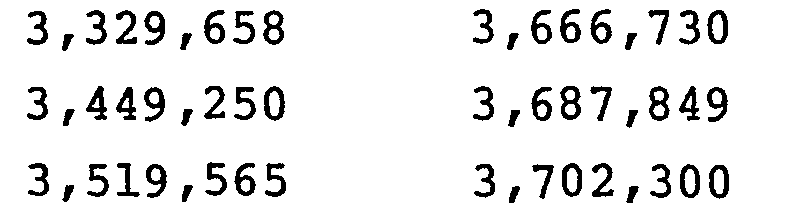
- (4) Polymers containing an oil-solubilizing group (e.g., a pendant alkyl group having at least about 8 carbon atoms) and a polar group, for example, interpolymers of decyl methacrylate, vinyl decyl ether or a relatively high molecular weight olefin with aminoalkyl acrylates, aminoalkyl acrylamides or poly-(oxyalkylene)-substituted alkyl acrylates, as well as copolymers of styrene, alkyl maleates and maleic acid amides or imides, are referred to hereinafter as polymeric polyamine dispersants and examples thereof are disclosed in the following U.S. Patents:
- (5) Products obtained by post-treating the carboxylic polyamine, alkyl polyamine, Mannich polyamine or polymeric polyamine dispersants with such reagents as urea, thiourea, carbon disulfide, aldehydes, ketones, carboxylic acids, hydrocarbon-substituted succinic anhydrides, nitriles, epoxides, boron compounds, phosphorus compounds or the like. Exemplary materials of this kind are described in German published application (OLS) 2,551,256 and in the following U.S. Patents:

- The carboxylic-polyamine and Mannich-polyamine dispersants are preferred dispersants for mild oxidation for reason of economy and high dispersancy.
- The carboxylic polyamine dispersants, which will be described first, are those disclosed (for example) in the above-mentioned U.S. Patents 3,219,666 and 3,272,746 which also describe a large number of methods for their preparation. The polyamine group therein is derived from compounds characterized by a radical of the structure:

- Polyamines are preferred for preparing the carboxylic polyamine dispersant. Among the polyamines are alkylene polyamines (and mixtures thereof) including those having the formula:wherein n is an integer between 1 and about 10, preferably between 2 and 8; each A can be independently hydrogen or a hydrocarbon or hydroxy-substituted hydrocarbon radical which can be derived from an alkylene oxide compound, having up to about 30 atoms; and R is a divalent hydrocarbon radical having from about 1 to about 18 carbons. A can be an aliphatic radical of up to about 10 carbon atoms which may be substituted with one or two hydroxy groups, and R is a lower alkylene radical having 1-10, preferably 2-6, carbon atoms. Preferred polyamines are the alkylene polyamines wherein each A is hydrogen. Such alkylene polyamines include methylene polyamines, ethylene polyamines, butylene polyamines, propylene polyamines, pentylene polyamines, hexylene polyamines and heptylene polyamines. The higher homologs of such amines and related aminoalkyl-substituted piperazines are also included. Specific examples of such polyamines include ethylene diamine, triethylene tetramine, tris(2-aminoethyl)amine, propylene diamine, trimethylene diamine, hexamethylene diamine, decamethylene diamine, octamethylene diamine, di(heptamethylene)triamine, tripropylene tetramine, tetraethylene pentamine, trimethylene diamine, pentaethylene hexamine, di(trimethylene)triamine, 2-heptyl-3-(2-aminopropyl)imidazoline, l,3-bis-(2-aminoethyl)imidazoline, 1-(2-aminopropyl)-piperazine, l,4-bis(2-aminoethyl)-piperazine and 2-methyl-l(2-aminobutyl)-piperazine. Higher homologs, obtained by condensing two or more of the above-illustrated alkylene amines, are also useful, as are the polyoxyalkylene polyamines (e.g., "Jeff- amines").

- The ethylene polyamines, examples of which are mentioned above, are especially useful for reasons of cost and effectiveness. Such polyamines are described in detail under the heading "Diamines and Higher Amines" in Kirk-Othmer, Encyclopedia of Chemical Technology, Second Edition, Vol. 7, pp. 22-39. They are prepared most conveniently by the reaction of an alkylene chloride with ammonia or by reaction of an ethylene imine with a ring-opening reagent such as ammonia. These reactions result in the production of the somewhat complex mixtures of alkylene polyamines, including cyclic condensation products such as piperazines. Because of their availability, these mixtures are particularly useful in preparing the nitrogen-bridged dispersant. Satisfactory products can also be obtained by the use of pure alkylene polyamines.
- Hydroxy polyamines, e.g., alkylene polyamines having one or more hydroxyalkyl substituents which can be derived from alkylene oxide on the nitrogen atoms, are also useful in preparing the nitrogen-bridged dispersant. Preferred hydroxyalkyl-substituted alkylene polyamines are those in which the hydroxyalkyl group has less than about 10 carbon atoms. Examples of such hydroxyalkyl-substituted polyamines include N-(2-hydroxyethyl)ethylene diamine, N,N'-bis(2-hydroxyethyl)ethylene diamine, l-(2-hydroxyethyl)piperazone, monohydroxypropyl-substituted diethylene triamine, dihydroxypropyltetraethylene pentamine and N-(3-hydroxybutyl)tetramethylene diamine. Higher homologs obtained by condensation of the above-illustrated hydroxyalkyl-substituted alkylene amines through amino radicals or through hydroxy radicals are likewise useful.
- The source of the acyl radical in the carboxylic polyamine dispersant is an acylating agent comprising a carboxylic acid-producing compound containing a hydrocarbon or substituted hydrocarbon substituent which has at least about 40 and preferably at least about 50 carbon atoms. By "carboxylic acid-producing compound" is meant an acid, anhydride, acid halide, ester, amide, imide, amidine or the like; the acids and anhydrides are preferred.
- The carboxylic acid-producing compound is usually prepared by the reaction (more fully described hereinafter) of a relatively low molecular weight carboxylic acid or derivative thereof with a hydrocarbon source containing at least about 40 and preferably at least about 50 carbon atoms. The hydrocarbon source is usually aliphatic and should be substantially saturated, i.e., at least about 95% of the total number of carbon-to-carbon covalent linkages should be saturated. It should also be substantially free from pendant groups containing more than about six aliphatic carbon atoms. It may be a substituted hydrocarbon source; by "substituted" is meant sources containing substituents which do not alter significantly their character or reactivity. Examples are halide, hydroxy, ether, keto, carboxy, ester (especially lower carboalkoxy), amide, nitro, cyano, sulfoxy and sulfone radicals. The substituents, if present, generally comprise no more than about 10% by weight of the hydrocarbon source.
- The preferred hydrocarbon sources are those derived from substantially saturated petroleum fractions and olefin polymers, particularly polymers of monoolefins having from 2 to about 30 carbon atoms. Thus, the hydrocarbon source may be derived from a polymer of ethylene, propene, 1-butene, isobutene, 1-octene, 3-cyclohexyl-l-butene, 2-butene, 3-pentene or the like. Also useful are interpolymers of olefins such as those illustrated above with other polymerizable olefinic substances such as styrene, chloroprene, isoprene, p-methylstyrene, piperylene and the like.
- In general, these interpolymers should contain at least about 80%, preferably at least about 95%, on a weight basis of units derived from the aliphatic monoolefins.
- Another suitable hydrocarbon source comprises saturated aliphatic hydrocarbons such as highly refined high molecular weight white oils or synthetic alkanes.
- In many instances, the hydrocarbon source should contain an activating polar radical to facilitate its reaction with the low molecular weight acid-producing compounds. The preferred activating radicals are halogen atoms, especially chlorine, but other suitable radicals include sulfide, disulfide, nitro, mercaptan, ketone and aldehyde groups.
- The olefin polymers having a number average molecular weight between about 600 and about 5000 (as determined by gel permeation chromatography) are preferred, although higher polymers having molecular weights from about 10,000 to about 100,000 or higher can be used. Especially suitable as hydrocarbon sources are isobutene polymers within the prescribed molecular weight range, and chlorinated derivatives thereof.
- Any one of a number of known reactions may be employed for the preparation of the carboxylic acid-producing compounds. Thus, an alcohol of the desired molecular weight may be oxidized with potassium permanganate, nitric acid or a similar oxidizing agent; a halogenated olefin polymer may be reacted with a ketene; an ester of an active hydrogencontaining acid, such as acetoacetic acid, may be converted to its sodium derivative and the sodium derivative reacted with a halogenated high molecular weight hydrocarbon such as brominated wax or brominated polyisobutene; a high molecular weight olefin may be ozonized; a methyl ketone of the desired molecular weight may be oxidized by means of the haloform reaction; an organometallic derivative of a halogenated hydrocarbon may be reacted with carbon dioxide; a halogenated hydrocarbon or olefin polymer may be converted to a nitrile, which is subsequently hydrolyzed. Preferably an olefin polymer or its halogenated derivative may undergo a reaction with an unsaturated carboxylic acid or derivative thereof such as acrylic acid, methacrylic acid, maleic acid, maleic anhydride, fumaric acid, itaconic acid, itaconic anhydride, citraconic acid, citraconic anhydride, mesaconic acid, glutaconic acid, chloromaleic acid, aconitic acid, crotonic acid, methylcrotonic acid, sorbic acid, 3-hexenoic acid, 10-decenoic acid, 2-pentene-l,3,5-tricarboxylic acid, and the like, or with a halogen- substituted carboxylic acid or derivative thereof. This latter reaction is preferred, especially when the acid-producing compounds is unsatured and preferably when it is maleic acid or anhydride. The resulting product is then a hydrocarbon-substituted succinic acid or derivatives thereof. The reaction leading to its formation involves merely heating the two reactants at a temperature from about 100° to about 200°C. The substituted succinic acid or anhydride thus obtained, may, if desired, be converted to the corresponding acid halide by reaction with known halogenating agents such as phosphorus trichloride, phosphorus pentachloride or thionyl chloride.
- For the formation of the carboxylic polyamine dispersant, the hydrocarbon-substituted succinic anhydride or acid, or other carboxylic acid-producing compound, and the alkylene polyamine or other polyamine-containing reagent are heated to a temperature above about 80°C., preferably from about 100° to about 250°C. The product thus obtained has predominantly amide, imide and/or amidine linkages (containing acyl or acylamidoyl groups). The process may in some instances be carried out at a temperature below 80°C. to produce a product having predominantly salt linkages (containing acyloxy groups). The use of a diluent such as mineral oil, benzene, toluene, naphtha or the like is often desirable to facilitate control of the reaction temperature.
- The relative proportions of the carboxylic acid-producing compound and the alkylene polyamine or the like are such that at least about one-half the stoichiometrically equivalent amount of polyamine is used for each equivalent of carboxylic acid-producing compounds. In this regard, it will be noted that the equivalent weight of the alkylene polyamine is based upon the number of amine radicals therein, and the equivalent weight of the carboxylic acid-producing compound is based on the number of acidic or potentially acidic radicals. (Thus, the equivalent weight of a hydrocarbon-substituted succinic acid or anhydride is one-half its molecular weight.) Although a minimum of one-half equivalent of polyamine per equivalent of acylating agent should be used, there does not appear to be an upper limit for the amount of polyamine. If an excess is used, it merely remains in the product unreacted without any apparent adverse effects. Ordinarily, about 1-2 equivalents of polyamine are used per equivalent of acylating agent.
- The Mannich polyamine dispersants are those disclosed, for example, in the above-mentioned United States Patents 3,316,972 and 3,544,420, which also describe convenient methods for their preparation. The source of the oil soluble group in the Mannich polyamine dispersant is an alkylated hydroxy aromatic compound comprising the reaction product of an olefinic polymer, an aromatic compound containing at least one hydroxy group. The alkyl substituted hydroxy aromatic compound is usually prepared by the alkylation of the hydroxy aromatic compound in well known procedures with an alkylation agent which would provide to the hydroxy aromatic substantial oil-solubility, which substituent is commonly derived from a polyolefin having at least about 40 carbon atoms. The hydrocarbon source is substantially aliphatic. However, it should contain at least one unsaturated group. The hydrocarbon source should also be substantially free from a quantity of pendant groups that would reduce oil solubility. Examples of acceptable groups are halide, hydroxy, ether, carboxy, ester, amide, nitro, cyano, etc. The substituents at present generally comprise no more than about 10 weight percent of the hydrocarbon source.
- The preferred hydrocarbon sources are those derived from substantially saturated petroleum fractions and olefin polymers, preferably polymers of monoolefins having from 2 to 30 carbon atoms. The hydrocarbon source may be derived from ethylene, propene, 1-butene, isobutene, 1-octene, 1-methyl-cyclohexene, 2-butene, 3-pentene, etc. Also useful are co-polymers of olefins described above with other polymerizable olefinic substances such as styrene, etc. In general these inert polymers should contain at least 80 percent, preferably about 95 percent, of units derived from the aliphatic monoolefins to preserve oil solubility.
- The hydrocarbon source generally contains at least 40 and preferably 50 carbon atoms to provide substantial oil solubility to the dispersant. The olefin polymers having a number average molecular weight between about 300-5,000 are preferred for reasons of easy reactivity and low cost; however, higher polymers can be used. Especially suitable hydrocarbon sources are polyisobutylene polymers.
- Commonly, the Mannich reaction is carried out by reacting the substituted hydroxy aromatic compound with an aldehyde and a polyamine. The Mannich polyamine can be treated with aliphatic acids, and boric acid compounds to improve processability and additive performance. Commonly, the substituted hydroxy aromatic compound is contacted with from about 0.1-10 moles of polyamine and 0.1-10 moles of aldehyde per mole of alkyl substituted hydroxy aromatic compound. The reactants are mixed and heated to a temperature of above about 80°C to initiate the reaction. Preferably the reaction is carried out at a temperature from about 100 to about 250°C. The product thus obtained has predominantly benzylamine linkage between the aromatic compound and the polyamine. The reaction can be carried out in inert diluent such as mineral oil, benzene, toluene, naphtha, lingroin, or other inert solvents to facilitate control of viscosity, temperature, and reaction rate.
- Any conventional formaldehyde yielding reagent is useful for the preparation of Mannich polyamine dispersants. Examples of such formaldehyde yielding reagents are trioxane, paraformalde, trioxymethylene, aqueous formalin, gaseous formaldehyde, etc.
- The polyamines useful for preparing the Mannich polyamine dispersants are the same as those useful for preparing the carboxylic polyamine dispersants described above.
- In somewhat greater detail, the fluorocarbon passivated polyamine dispersants of this invention can be made by the reaction of the polyamine dispersant with an oxidizing agent or by preparing the polyamine dispersant from a polyamine which has been mildly oxidized with an oxidizing agent.
- In either instance the polyamine or the polyamine dispersant having nitrogen to hydrogen bonds is oxidized to an extent to prevent deterioration of fluorocarbon compositions.
- The oxidation of polyamine or polyamine dispersants can be performed by contacting the dispersant under oxidizing conditions with about 0.1 to 10.0 moles and greater of the oxidizing agent per mole of the dispersant. The reaction can be conducted neat or in a solvent that can be used to form the dispersant. The reaction mixture can be heated to a temperature of about ambient (27°C) to 800°C for a period of time of about 1 to 48 hours depending on the oxidizing agent used, molar ratio, and purity of reactants. To avoid substantial degradation strong oxidizing agents such as ozone, sulfur trioxide, peroxides, etc. require less strenuous oxidizing conditions and reduced amounts of oxidizing agent and can be added in a diluted form. Degrading and nondegrading oxidations are disclosed in U.S. Pat. Nos. 2,806,860; 2,982,728; 3,316,177; 3,153,025; 3,365,499; and 3,544,520. It is important to adjust reaction conditions using the oxidizing agent so that the polyamine moiety and the polyalkenyl substituent become degraded to the extent that the dispersant maintains substantial solubility and dispersancy. In this way the oxidizing agent can introduce oxygen-containing polar functional groups and other molecular changes without substantial degradation.
- The oxidation can be controlled to prevent degradation by continually measuring the TBN of the product as described in ASTM, D-664 or ASTM, D-2896. Generally about a 90% decrease, preferably a 50% decrease in TBN indicates a product with substantial dispersancy and is not destructive to fluorocarbon seals.
- The preferred oxidizing agent is an oxygen-containing gas such as air. Stronger oxidants are more difficult to control. Other oxidants produce sulfur, nitrogen, etc. containing compounds which can be deleterious to the oxidized product properties in some instances. These oxidants produce useable compositions, but the compositions are somewhat less effective.
- Oxidations of the polyamine dispersants by oxygen-containing gases can be carried out at a temperature of about 60°C to 600°C depending on the oxygen concentration and flow rate. Preferably, with air oxidation, flow rates of 1-100 standard cubic feet per hour (SCFH) per mole of polyamine dispersant are used. The oxidation can be carried out at a temperature of about 60° to 300°C with no substantial degradation depending on oxidizing agent and concentration.
- The oxidation process apparently produces a variety of polyamine modifications including nitroso, nitrite, moieties, etc., and hydrocarbon modifications including carbonyls, carboxyls, vicinyl hydroxyls, etc.
- The polyamine dispersant can be oxidized neat or preferably in a solution. Examples of useful solvents are polyalkenes; aliphatic solvents such as hexane, heptane, pentane, lingroin, petroleum ether, etc.; aromatic solvents such as benzene, toluene, xylene, and Cg+ aromatic streams.
- The air oxidations can be carried out at reduced, ambient, or elevated pressures in well-stirred glass, stainless steel or other oxidation resistant vessels. Reaction temperatures from about 60°C to about 600°C can be used. At temperatures used for the oxidation the reaction can be carried out in a period from about 1 to about 48 hours. Preferably with mild conditions 24-hour oxidation time is sufficient for complete oxidation.
- There are many catalysts disclosed in the art for oxidation reactions. These conventional oxidation catalysts can be used to oxidize the compounds in this invention, but the catalysts may remain in the product and produce undesirable effects; preferably the reaction is uncatalyzed.
- Into a 10-liter resin kettle equipped with a stirrer, heater, temperature control and air sparge were placed 4677 gms. of a Mannich polyamine dispersant prepared from a polyisobutylene-substituted phenol, formaldehyde, tetraethylene pentamine and oleic acid. Into the Mannich dispersant, heated to 375°F and stirred at 325 rpm was passed air at a rate of 1600 c.c. per minute. The product, TBN, and viscosity were monitored as a function of time.

- Into a 3-liter, three-neck flask equipped with a stirrer, heater, and air sparge were added 200 gms. of a commercially available succinimide polyamine dispersant (having a TBN = 53.76) which was believed to be prepared from a polyisobutene-substituted succinic anhydride, having a molecular weight about 650, and tetraethylene pentamine. Into the stirred polyamine dispersant at a temperature of 375°F was sparted air at a rate of 2000 ml/min. for 2 hrs. At the end of two hours of air addition the TBN was 17.72.


Claims (11)
Applications Claiming Priority (2)
| Application Number | Priority Date | Filing Date | Title |
|---|---|---|---|
| US06/246,007 US4379064A (en) | 1981-03-20 | 1981-03-20 | Oxidative passivation of polyamine-dispersants |
| US246007 | 1981-03-20 |
Publications (3)
| Publication Number | Publication Date |
|---|---|
| EP0061329A2 true EP0061329A2 (en) | 1982-09-29 |
| EP0061329A3 EP0061329A3 (en) | 1983-07-06 |
| EP0061329B1 EP0061329B1 (en) | 1986-11-05 |
Family
ID=22928969
Family Applications (1)
| Application Number | Title | Priority Date | Filing Date |
|---|---|---|---|
| EP82301443A Expired EP0061329B1 (en) | 1981-03-20 | 1982-03-19 | Process for improving the compatibility of a polyamine dispersant with fluorocarbons by reaction with an oxidising agent |
Country Status (6)
| Country | Link |
|---|---|
| US (1) | US4379064A (en) |
| EP (1) | EP0061329B1 (en) |
| JP (1) | JPS57167727A (en) |
| AU (1) | AU552624B2 (en) |
| CA (1) | CA1188190A (en) |
| DE (1) | DE3274110D1 (en) |
Cited By (2)
| Publication number | Priority date | Publication date | Assignee | Title |
|---|---|---|---|---|
| EP0096972A3 (en) * | 1982-06-07 | 1984-11-21 | Standard Oil Company | Oxidized mannich condensation product |
| EP0297495A3 (en) * | 1987-06-30 | 1989-03-08 | Amoco Corporation | Nitrogen containing dispersants treated with mineral acids and lubricating compositions containing the same |
Families Citing this family (71)
| Publication number | Priority date | Publication date | Assignee | Title |
|---|---|---|---|---|
| US4615826A (en) * | 1983-09-22 | 1986-10-07 | Chevron Research Company | Hydrocarbon soluble nitrogen containing dispersant-fluorophosphoric acid adducts |
| US4747971A (en) * | 1983-09-22 | 1988-05-31 | Chevron Research Company | Hydrocarbon soluble nitrogen containing dispersant - fluorophosphoric acid adducts |
| US4648980A (en) * | 1983-09-22 | 1987-03-10 | Chevron Research Company | Hydrocarbon soluble nitrogen containing dispersant - fluorophosphoric acid adducts |
| US4713190A (en) * | 1985-10-23 | 1987-12-15 | Chevron Research Company | Modified carboxylic amide dispersants |
| US4908145A (en) * | 1987-09-30 | 1990-03-13 | Amoco Corporation | Engine seal compatible dispersants for lubricating oils |
| US4963277A (en) * | 1988-10-20 | 1990-10-16 | Amoco Corporation | Increasing viscosity storage stabiity of Mannich base dispersant/VI-improvers |
| US20040171501A1 (en) * | 2003-02-27 | 2004-09-02 | Leeuwen Jeroen Van | Method for improving elastomer compatibility |
| US9150811B2 (en) | 2010-03-31 | 2015-10-06 | Cherron Oronite Company LLC | Method for improving copper corrosion performance |
| US8933001B2 (en) | 2010-03-31 | 2015-01-13 | Chevron Oronite Company Llc | Method for improving fluorocarbon elastomer seal compatibility |
| US8901050B2 (en) | 2010-03-31 | 2014-12-02 | Chevron Oronite Company Llc | Method for improving copper corrosion performance |
| US8993496B2 (en) | 2010-03-31 | 2015-03-31 | Chevron Oronite Company Llc | Method for improving fluorocarbon elastomer seal compatibility |
| US8716202B2 (en) | 2010-12-14 | 2014-05-06 | Chevron Oronite Company Llc | Method for improving fluorocarbon elastomer seal compatibility |
| JP5832462B2 (en) * | 2013-02-21 | 2015-12-16 | Jx日鉱日石エネルギー株式会社 | Grinding or polishing oil composition, and grinding or polishing method using the oil composition |
| US9657252B2 (en) | 2014-04-17 | 2017-05-23 | Afton Chemical Corporation | Lubricant additives and lubricant compositions having improved frictional characteristics |
| EP2990469B1 (en) | 2014-08-27 | 2019-06-12 | Afton Chemical Corporation | Use in gasoline direct injection engines |
| US10421922B2 (en) | 2015-07-16 | 2019-09-24 | Afton Chemical Corporation | Lubricants with magnesium and their use for improving low speed pre-ignition |
| US10550349B2 (en) | 2015-07-16 | 2020-02-04 | Afton Chemical Corporation | Lubricants with titanium and/or tungsten and their use for improving low speed pre-ignition |
| US10280383B2 (en) | 2015-07-16 | 2019-05-07 | Afton Chemical Corporation | Lubricants with molybdenum and their use for improving low speed pre-ignition |
| US10336959B2 (en) | 2015-07-16 | 2019-07-02 | Afton Chemical Corporation | Lubricants with calcium-containing detergent and their use for improving low speed pre-ignition |
| US10214703B2 (en) | 2015-07-16 | 2019-02-26 | Afton Chemical Corporation | Lubricants with zinc dialkyl dithiophosphate and their use in boosted internal combustion engines |
| SG11201806979XA (en) | 2016-02-25 | 2018-09-27 | Afton Chemical Corp | Lubricants for use in boosted engines |
| US10377963B2 (en) | 2016-02-25 | 2019-08-13 | Afton Chemical Corporation | Lubricants for use in boosted engines |
| US9701921B1 (en) | 2016-04-08 | 2017-07-11 | Afton Chemical Corporation | Lubricant additives and lubricant compositions having improved frictional characteristics |
| US9677026B1 (en) | 2016-04-08 | 2017-06-13 | Afton Chemical Corporation | Lubricant additives and lubricant compositions having improved frictional characteristics |
| US11155764B2 (en) | 2016-05-05 | 2021-10-26 | Afton Chemical Corporation | Lubricants for use in boosted engines |
| US10323205B2 (en) | 2016-05-05 | 2019-06-18 | Afton Chemical Corporation | Lubricant compositions for reducing timing chain stretch |
| US20180171258A1 (en) | 2016-12-16 | 2018-06-21 | Afton Chemical Corporation | Multi-Functional Olefin Copolymers and Lubricating Compositions Containing Same |
| US10443558B2 (en) | 2017-01-18 | 2019-10-15 | Afton Chemical Corporation | Lubricants with calcium and magnesium-containing detergents and their use for improving low-speed pre-ignition and for corrosion resistance |
| US10370615B2 (en) | 2017-01-18 | 2019-08-06 | Afton Chemical Corporation | Lubricants with calcium-containing detergents and their use for improving low-speed pre-ignition |
| US10443011B2 (en) | 2017-01-18 | 2019-10-15 | Afton Chemical Corporation | Lubricants with overbased calcium and overbased magnesium detergents and method for improving low-speed pre-ignition |
| US10513668B2 (en) | 2017-10-25 | 2019-12-24 | Afton Chemical Corporation | Dispersant viscosity index improvers to enhance wear protection in engine oils |
| US11098262B2 (en) | 2018-04-25 | 2021-08-24 | Afton Chemical Corporation | Multifunctional branched polymers with improved low-temperature performance |
| US11459521B2 (en) | 2018-06-05 | 2022-10-04 | Afton Chemical Coporation | Lubricant composition and dispersants therefor having a beneficial effect on oxidation stability |
| US20200277541A1 (en) | 2019-02-28 | 2020-09-03 | Afton Chemical Corporation | Lubricating compositions for diesel particulate filter performance |
| US11066622B2 (en) | 2019-10-24 | 2021-07-20 | Afton Chemical Corporation | Synergistic lubricants with reduced electrical conductivity |
| CA3106593C (en) | 2020-01-29 | 2023-12-19 | Afton Chemical Corporation | Lubricant formulations with silicon-containing compounds |
| US11584898B2 (en) | 2020-08-12 | 2023-02-21 | Afton Chemical Corporation | Polymeric surfactants for improved emulsion and flow properties at low temperatures |
| US11680222B2 (en) | 2020-10-30 | 2023-06-20 | Afton Chemical Corporation | Engine oils with low temperature pumpability |
| US11634655B2 (en) | 2021-03-30 | 2023-04-25 | Afton Chemical Corporation | Engine oils with improved viscometric performance |
| US11753599B2 (en) | 2021-06-04 | 2023-09-12 | Afton Chemical Corporation | Lubricating compositions for a hybrid engine |
| US11479736B1 (en) | 2021-06-04 | 2022-10-25 | Afton Chemical Corporation | Lubricant composition for reduced engine sludge |
| US12529006B2 (en) | 2021-07-21 | 2026-01-20 | Afton Chemical Corporation | Methods of reducing lead corrosion in an internal combustion engine |
| US11608477B1 (en) | 2021-07-31 | 2023-03-21 | Afton Chemical Corporation | Engine oil formulations for low timing chain stretch |
| US11807827B2 (en) | 2022-01-18 | 2023-11-07 | Afton Chemical Corporation | Lubricating compositions for reduced high temperature deposits |
| US11572523B1 (en) | 2022-01-26 | 2023-02-07 | Afton Chemical Corporation | Sulfurized additives with low levels of alkyl phenols |
| KR102826749B1 (en) | 2022-02-21 | 2025-06-27 | 에프톤 케미칼 코포레이션 | Polyalphaolefin phenols with high para-position selectivity |
| CN119053681A (en) | 2022-04-27 | 2024-11-29 | 雅富顿化学公司 | High-sulfur additives for lubricating oil compositions |
| US20230383211A1 (en) | 2022-05-26 | 2023-11-30 | Afton Chemical Corporation | Engine oil formluation for controlling particulate emissions |
| US20240026243A1 (en) | 2022-07-14 | 2024-01-25 | Afton Chemical Corporation | Transmission lubricants containing molybdenum |
| US11970671B2 (en) | 2022-07-15 | 2024-04-30 | Afton Chemical Corporation | Detergent systems for oxidation resistance in lubricants |
| US20240059999A1 (en) | 2022-08-02 | 2024-02-22 | Afton Chemical Corporation | Detergent systems for improved piston cleanliness |
| US12098347B2 (en) | 2022-09-21 | 2024-09-24 | Afton Chemical Corporation | Lubricating composition for fuel efficient motorcycle applications |
| US12024687B2 (en) | 2022-09-27 | 2024-07-02 | Afton Chemical Corporation | Lubricating composition for motorcycle applications |
| US11912955B1 (en) | 2022-10-28 | 2024-02-27 | Afton Chemical Corporation | Lubricating compositions for reduced low temperature valve train wear |
| EP4368687B1 (en) | 2022-11-10 | 2025-06-25 | Afton Chemical Corporation | Corrosion inhibitor and industrial lubricant including the same |
| US12157866B2 (en) | 2022-12-09 | 2024-12-03 | Afton Chemical Corporation | Driveline and transmission fluids for low speed wear and scuffing |
| US12146115B2 (en) | 2022-12-20 | 2024-11-19 | Afton Chemical Corporation | Low ash lubricating compositions for controlling steel corrosion |
| US11926804B1 (en) | 2023-01-31 | 2024-03-12 | Afton Chemical Corporation | Dispersant and detergent systems for improved motor oil performance |
| US12110468B1 (en) | 2023-03-22 | 2024-10-08 | Afton Chemical Corporation | Antiwear systems for improved wear in medium and/or heavy duty diesel engines |
| US12448582B2 (en) | 2023-04-06 | 2025-10-21 | Afton Chemical Corporation | Methods of improving the performance of combustion engine after-treatment devices |
| EP4446398B1 (en) | 2023-04-13 | 2025-12-31 | Afton Chemical Corporation | Lubricant composition for durability and improved fuel savings |
| US12195695B2 (en) | 2023-05-10 | 2025-01-14 | Afton Chemical Corporation | Lubricating oil compositions for improving low-speed pre-ignition |
| US20250002805A1 (en) | 2023-06-23 | 2025-01-02 | Afton Chemical Corporation | Lubricant additives for performance boosting |
| EP4520807A1 (en) | 2023-08-30 | 2025-03-12 | Afton Chemical Corporation | Detergent and dispersant systems for improved steel piston cleanliness in heavy duty lubricants |
| WO2025090369A1 (en) | 2023-10-25 | 2025-05-01 | Afton Chemical Corporation | Additives with high sulfurization for lubricating oil compositions |
| US12291688B1 (en) | 2023-12-12 | 2025-05-06 | Afton Chemical Corporation | Silicon-containing compounds for lubricants |
| US20250197756A1 (en) | 2023-12-18 | 2025-06-19 | Afton Chemical Corporation | Thiophosphate esters as antiwear additives for lubricants |
| US20250230375A1 (en) | 2024-01-12 | 2025-07-17 | Afton Chemical Corporation | Magnesium sulfonate detergent having improved compatibility with friction modifiers |
| US12305142B1 (en) | 2024-02-20 | 2025-05-20 | Afton Chemical Corporation | Industrial lubricant |
| US12378493B1 (en) | 2024-03-27 | 2025-08-05 | Afton Chemical Corporation | Lubricating composition for enhanced fuel economy |
| JP2026009797A (en) | 2024-07-08 | 2026-01-21 | アフトン・ケミカル・コーポレーション | Detergent systems for improved piston cleanliness |
Family Cites Families (11)
| Publication number | Priority date | Publication date | Assignee | Title |
|---|---|---|---|---|
| DE1248643B (en) * | 1959-03-30 | 1967-08-31 | The Lubrizol Corporation, Cleveland, Ohio (V. St. A.) | Process for the preparation of oil-soluble aylated amines |
| US3316177A (en) * | 1964-12-07 | 1967-04-25 | Lubrizol Corp | Functional fluid containing a sludge inhibiting detergent comprising the polyamine salt of the reaction product of maleic anhydride and an oxidized interpolymer of propylene and ethylene |
| US3442808A (en) * | 1966-11-01 | 1969-05-06 | Standard Oil Co | Lubricating oil additives |
| US3452002A (en) * | 1966-12-22 | 1969-06-24 | Exxon Research Engineering Co | Adducts of alkylene imines and carboxylic acids |
| US3541012A (en) * | 1968-04-15 | 1970-11-17 | Lubrizol Corp | Lubricants and fuels containing improved acylated nitrogen additives |
| GB1244435A (en) * | 1968-06-18 | 1971-09-02 | Lubrizol Corp | Oil-soluble graft polymers derived from degraded ethylene-propylene interpolymers |
| US3872019A (en) * | 1972-08-08 | 1975-03-18 | Standard Oil Co | Oil-soluble lubricant bi-functional additives from mannich condensation products of oxidized olefin copolymers, amines and aldehydes |
| US4142980A (en) * | 1977-09-09 | 1979-03-06 | Standard Oil Company (Indiana) | Mannich reaction products made with alkyphenol substituted aliphatic unsaturated carboxylic acids |
| FR2409301A1 (en) * | 1977-11-21 | 1979-06-15 | Orogil | NEW COMPOSITIONS BASED ON ALCENYLSUCCINIMIDES, THEIR PREPARATION PROCESS AND THEIR APPLICATION AS ADDITIVES FOR LUBRICANTS |
| US4170562A (en) * | 1978-02-15 | 1979-10-09 | Standard Oil Company | Phenol modified mannich reaction products from oxidized polymers |
| US4275006A (en) * | 1978-12-04 | 1981-06-23 | Chevron Research Company | Process of preparing dispersant lubricating oil additives |
-
1981
- 1981-03-20 US US06/246,007 patent/US4379064A/en not_active Expired - Fee Related
-
1982
- 1982-03-08 CA CA000397784A patent/CA1188190A/en not_active Expired
- 1982-03-18 JP JP57041772A patent/JPS57167727A/en active Granted
- 1982-03-18 AU AU81684/82A patent/AU552624B2/en not_active Ceased
- 1982-03-19 EP EP82301443A patent/EP0061329B1/en not_active Expired
- 1982-03-19 DE DE8282301443T patent/DE3274110D1/en not_active Expired
Cited By (3)
| Publication number | Priority date | Publication date | Assignee | Title |
|---|---|---|---|---|
| EP0096972A3 (en) * | 1982-06-07 | 1984-11-21 | Standard Oil Company | Oxidized mannich condensation product |
| EP0297495A3 (en) * | 1987-06-30 | 1989-03-08 | Amoco Corporation | Nitrogen containing dispersants treated with mineral acids and lubricating compositions containing the same |
| US4889646A (en) * | 1987-06-30 | 1989-12-26 | Amoco Corporation | Nitrogen containing dispersants treated with mineral acids |
Also Published As
| Publication number | Publication date |
|---|---|
| AU8168482A (en) | 1982-09-23 |
| DE3274110D1 (en) | 1986-12-11 |
| US4379064A (en) | 1983-04-05 |
| JPS57167727A (en) | 1982-10-15 |
| AU552624B2 (en) | 1986-06-12 |
| CA1188190A (en) | 1985-06-04 |
| EP0061329B1 (en) | 1986-11-05 |
| JPH041038B2 (en) | 1992-01-09 |
| EP0061329A3 (en) | 1983-07-06 |
Similar Documents
| Publication | Publication Date | Title |
|---|---|---|
| EP0061329B1 (en) | Process for improving the compatibility of a polyamine dispersant with fluorocarbons by reaction with an oxidising agent | |
| US3632511A (en) | Acylated nitrogen-containing compositions processes for their preparationand lubricants and fuels containing the same | |
| US3865813A (en) | Thiourea-acylated polyamine reaction product | |
| US3272746A (en) | Lubricating composition containing an acylated nitrogen compound | |
| US3219666A (en) | Derivatives of succinic acids and nitrogen compounds | |
| US3433744A (en) | Reaction product of phosphosulfurized hydrocarbon and alkylene polycarboxylic acid or acid derivatives and lubricating oil containing the same | |
| US3783131A (en) | Calcium-containing dispersions and process | |
| US3470098A (en) | Sulfur and chlorine containing ashless dispersant,and lubricating oil containing same | |
| US5476521A (en) | Branched amido-amine dispersant additives (PT-739) | |
| JPH02191537A (en) | Improved amide dispersion additive derived from amide-amine | |
| JPS6020439B2 (en) | Additives useful in oily compositions | |
| US5962378A (en) | Synergistic combinations for use in functional fluid compositions | |
| US5174915A (en) | Medium speed diesel engine lubricating oils | |
| US3932288A (en) | Aminosulfonic acid-heterocyclo propane-amine reaction products and fuels and lubricants containing same | |
| US4940552A (en) | Passivation of polyamine dispersants toward fluorohydrocarbon compositions | |
| US5516444A (en) | Synergistic combinations for use in functional fluid compositions | |
| US5789356A (en) | Synergistic combinations for use in functional fluid compositions | |
| US4889646A (en) | Nitrogen containing dispersants treated with mineral acids | |
| CA1054135A (en) | Sulfurized calcium alkylphenolate compositions | |
| EP0132383B2 (en) | Boration of polyamine dispersants with polyborate esters | |
| US4171270A (en) | Sulfurized overbased calcium alkylphenolate lubricant composition | |
| GB2069505A (en) | Benzotriazole Compositions Dispersible in Compounded Lubricants | |
| US4275006A (en) | Process of preparing dispersant lubricating oil additives | |
| US4031015A (en) | Nitrile-amine reaction products | |
| US4139480A (en) | Multifunctional alternating interpolymer lubricating oil additive |
Legal Events
| Date | Code | Title | Description |
|---|---|---|---|
| PUAI | Public reference made under article 153(3) epc to a published international application that has entered the european phase |
Free format text: ORIGINAL CODE: 0009012 |
|
| AK | Designated contracting states |
Designated state(s): BE DE FR GB IT NL |
|
| PUAL | Search report despatched |
Free format text: ORIGINAL CODE: 0009013 |
|
| AK | Designated contracting states |
Designated state(s): BE DE FR GB IT NL |
|
| 17P | Request for examination filed |
Effective date: 19830825 |
|
| RAP1 | Party data changed (applicant data changed or rights of an application transferred) |
Owner name: AMOCO CORPORATION |
|
| GRAA | (expected) grant |
Free format text: ORIGINAL CODE: 0009210 |
|
| ITF | It: translation for a ep patent filed | ||
| AK | Designated contracting states |
Kind code of ref document: B1 Designated state(s): BE DE FR GB IT NL |
|
| REF | Corresponds to: |
Ref document number: 3274110 Country of ref document: DE Date of ref document: 19861211 |
|
| ET | Fr: translation filed | ||
| PLBE | No opposition filed within time limit |
Free format text: ORIGINAL CODE: 0009261 |
|
| STAA | Information on the status of an ep patent application or granted ep patent |
Free format text: STATUS: NO OPPOSITION FILED WITHIN TIME LIMIT |
|
| 26N | No opposition filed | ||
| ITTA | It: last paid annual fee | ||
| REG | Reference to a national code |
Ref country code: GB Ref legal event code: 732E |
|
| NLS | Nl: assignments of ep-patents |
Owner name: ETHYL CORPORATION TE BATON ROUGE, LOUISIANA, VER. |
|
| PGFP | Annual fee paid to national office [announced via postgrant information from national office to epo] |
Ref country code: FR Payment date: 19940210 Year of fee payment: 13 |
|
| PGFP | Annual fee paid to national office [announced via postgrant information from national office to epo] |
Ref country code: BE Payment date: 19940218 Year of fee payment: 13 |
|
| PGFP | Annual fee paid to national office [announced via postgrant information from national office to epo] |
Ref country code: DE Payment date: 19940224 Year of fee payment: 13 |
|
| PGFP | Annual fee paid to national office [announced via postgrant information from national office to epo] |
Ref country code: GB Payment date: 19940225 Year of fee payment: 13 |
|
| REG | Reference to a national code |
Ref country code: FR Ref legal event code: TP |
|
| ITPR | It: changes in ownership of a european patent |
Owner name: CESSIONE;ETHYL CORPORATION |
|
| PG25 | Lapsed in a contracting state [announced via postgrant information from national office to epo] |
Ref country code: GB Effective date: 19950319 |
|
| PG25 | Lapsed in a contracting state [announced via postgrant information from national office to epo] |
Ref country code: BE Effective date: 19950331 |
|
| PGFP | Annual fee paid to national office [announced via postgrant information from national office to epo] |
Ref country code: NL Payment date: 19950331 Year of fee payment: 14 |
|
| BERE | Be: lapsed |
Owner name: ETHYL CORP. Effective date: 19950331 |
|
| GBPC | Gb: european patent ceased through non-payment of renewal fee |
Effective date: 19950319 |
|
| PG25 | Lapsed in a contracting state [announced via postgrant information from national office to epo] |
Ref country code: FR Free format text: LAPSE BECAUSE OF NON-PAYMENT OF DUE FEES Effective date: 19951130 |
|
| PG25 | Lapsed in a contracting state [announced via postgrant information from national office to epo] |
Ref country code: DE Effective date: 19951201 |
|
| REG | Reference to a national code |
Ref country code: FR Ref legal event code: ST |
|
| PG25 | Lapsed in a contracting state [announced via postgrant information from national office to epo] |
Ref country code: NL Effective date: 19961001 |
|
| NLV4 | Nl: lapsed or anulled due to non-payment of the annual fee |
Effective date: 19961001 |