EP0056824B1 - Therapeutic agent - Google Patents
Therapeutic agent Download PDFInfo
- Publication number
- EP0056824B1 EP0056824B1 EP81100434A EP81100434A EP0056824B1 EP 0056824 B1 EP0056824 B1 EP 0056824B1 EP 81100434 A EP81100434 A EP 81100434A EP 81100434 A EP81100434 A EP 81100434A EP 0056824 B1 EP0056824 B1 EP 0056824B1
- Authority
- EP
- European Patent Office
- Prior art keywords
- venom
- composition
- solution
- test
- mixture
- Prior art date
- Legal status (The legal status is an assumption and is not a legal conclusion. Google has not performed a legal analysis and makes no representation as to the accuracy of the status listed.)
- Expired
Links
- 239000003814 drug Substances 0.000 title description 13
- 229940124597 therapeutic agent Drugs 0.000 title description 4
- 231100000611 venom Toxicity 0.000 claims description 51
- 239000002435 venom Substances 0.000 claims description 47
- 210000001048 venom Anatomy 0.000 claims description 47
- 238000012360 testing method Methods 0.000 claims description 35
- LFQSCWFLJHTTHZ-UHFFFAOYSA-N Ethanol Chemical compound CCO LFQSCWFLJHTTHZ-UHFFFAOYSA-N 0.000 claims description 32
- 206010039073 rheumatoid arthritis Diseases 0.000 claims description 27
- 150000004676 glycans Chemical class 0.000 claims description 25
- 238000000034 method Methods 0.000 claims description 25
- 239000000203 mixture Substances 0.000 claims description 25
- 229920001282 polysaccharide Polymers 0.000 claims description 25
- 239000005017 polysaccharide Substances 0.000 claims description 25
- 239000000243 solution Substances 0.000 claims description 22
- 235000019441 ethanol Nutrition 0.000 claims description 19
- 241000257303 Hymenoptera Species 0.000 claims description 18
- 241000282414 Homo sapiens Species 0.000 claims description 16
- 108090000623 proteins and genes Proteins 0.000 claims description 16
- 239000000284 extract Substances 0.000 claims description 15
- 238000002347 injection Methods 0.000 claims description 15
- 239000007924 injection Substances 0.000 claims description 15
- 102000004169 proteins and genes Human genes 0.000 claims description 15
- 235000000346 sugar Nutrition 0.000 claims description 14
- 210000002966 serum Anatomy 0.000 claims description 13
- 239000002253 acid Substances 0.000 claims description 12
- 239000003153 chemical reaction reagent Substances 0.000 claims description 12
- 150000008163 sugars Chemical class 0.000 claims description 11
- 208000024891 symptom Diseases 0.000 claims description 10
- XLYOFNOQVPJJNP-UHFFFAOYSA-N water Substances O XLYOFNOQVPJJNP-UHFFFAOYSA-N 0.000 claims description 10
- CSCPPACGZOOCGX-UHFFFAOYSA-N Acetone Chemical compound CC(C)=O CSCPPACGZOOCGX-UHFFFAOYSA-N 0.000 claims description 9
- UHOVQNZJYSORNB-UHFFFAOYSA-N Benzene Chemical compound C1=CC=CC=C1 UHOVQNZJYSORNB-UHFFFAOYSA-N 0.000 claims description 9
- PEDCQBHIVMGVHV-UHFFFAOYSA-N Glycerine Chemical compound OCC(O)CO PEDCQBHIVMGVHV-UHFFFAOYSA-N 0.000 claims description 9
- DNIAPMSPPWPWGF-UHFFFAOYSA-N Propylene glycol Chemical compound CC(O)CO DNIAPMSPPWPWGF-UHFFFAOYSA-N 0.000 claims description 9
- RJGDLRCDCYRQOQ-UHFFFAOYSA-N anthrone Chemical compound C1=CC=C2C(=O)C3=CC=CC=C3CC2=C1 RJGDLRCDCYRQOQ-UHFFFAOYSA-N 0.000 claims description 9
- 230000001363 autoimmune Effects 0.000 claims description 8
- AOMZHDJXSYHPKS-DROYEMJCSA-L Amido Black 10B Chemical compound [Na+].[Na+].[O-]S(=O)(=O)C1=CC2=CC(S([O-])(=O)=O)=C(\N=N\C=3C=CC=CC=3)C(O)=C2C(N)=C1\N=N\C1=CC=C(N(=O)=O)C=C1 AOMZHDJXSYHPKS-DROYEMJCSA-L 0.000 claims description 7
- FAPWRFPIFSIZLT-UHFFFAOYSA-M Sodium chloride Chemical compound [Na+].[Cl-] FAPWRFPIFSIZLT-UHFFFAOYSA-M 0.000 claims description 7
- UJOBWOGCFQCDNV-UHFFFAOYSA-N 9H-carbazole Chemical compound C1=CC=C2C3=CC=CC=C3NC2=C1 UJOBWOGCFQCDNV-UHFFFAOYSA-N 0.000 claims description 6
- HEDRZPFGACZZDS-UHFFFAOYSA-N Chloroform Chemical compound ClC(Cl)Cl HEDRZPFGACZZDS-UHFFFAOYSA-N 0.000 claims description 6
- RTZKZFJDLAIYFH-UHFFFAOYSA-N Diethyl ether Chemical compound CCOCC RTZKZFJDLAIYFH-UHFFFAOYSA-N 0.000 claims description 6
- KHIWWQKSHDUIBK-UHFFFAOYSA-N periodic acid Chemical compound OI(=O)(=O)=O KHIWWQKSHDUIBK-UHFFFAOYSA-N 0.000 claims description 6
- 239000011780 sodium chloride Substances 0.000 claims description 6
- 241000567236 Pseudomyrmex Species 0.000 claims description 5
- 238000004458 analytical method Methods 0.000 claims description 5
- 210000004369 blood Anatomy 0.000 claims description 5
- 239000008280 blood Substances 0.000 claims description 5
- 102000003886 Glycoproteins Human genes 0.000 claims description 4
- 108090000288 Glycoproteins Proteins 0.000 claims description 4
- 229910019142 PO4 Inorganic materials 0.000 claims description 4
- 159000000009 barium salts Chemical class 0.000 claims description 4
- 230000004154 complement system Effects 0.000 claims description 4
- 238000000921 elemental analysis Methods 0.000 claims description 4
- 230000007935 neutral effect Effects 0.000 claims description 4
- NBIIXXVUZAFLBC-UHFFFAOYSA-K phosphate Chemical compound [O-]P([O-])([O-])=O NBIIXXVUZAFLBC-UHFFFAOYSA-K 0.000 claims description 4
- 239000010452 phosphate Substances 0.000 claims description 4
- QAOWNCQODCNURD-UHFFFAOYSA-L sulfate group Chemical group S(=O)(=O)([O-])[O-] QAOWNCQODCNURD-UHFFFAOYSA-L 0.000 claims description 4
- 150000007513 acids Chemical class 0.000 claims description 3
- 238000002156 mixing Methods 0.000 claims description 2
- 238000000926 separation method Methods 0.000 claims description 2
- 239000002904 solvent Substances 0.000 claims description 2
- OKTJSMMVPCPJKN-UHFFFAOYSA-N Carbon Chemical compound [C] OKTJSMMVPCPJKN-UHFFFAOYSA-N 0.000 claims 2
- UFHFLCQGNIYNRP-UHFFFAOYSA-N Hydrogen Chemical compound [H][H] UFHFLCQGNIYNRP-UHFFFAOYSA-N 0.000 claims 2
- 239000008351 acetate buffer Substances 0.000 claims 2
- 239000007864 aqueous solution Substances 0.000 claims 2
- QVGXLLKOCUKJST-UHFFFAOYSA-N atomic oxygen Chemical compound [O] QVGXLLKOCUKJST-UHFFFAOYSA-N 0.000 claims 2
- 229910052799 carbon Inorganic materials 0.000 claims 2
- 229910052739 hydrogen Inorganic materials 0.000 claims 2
- 239000001257 hydrogen Substances 0.000 claims 2
- 238000011534 incubation Methods 0.000 claims 2
- 229910052760 oxygen Inorganic materials 0.000 claims 2
- 239000001301 oxygen Substances 0.000 claims 2
- 239000008363 phosphate buffer Substances 0.000 claims 2
- 239000006286 aqueous extract Substances 0.000 claims 1
- AOMZHDJXSYHPKS-UHFFFAOYSA-L disodium 4-amino-5-hydroxy-3-[(4-nitrophenyl)diazenyl]-6-phenyldiazenylnaphthalene-2,7-disulfonate Chemical compound [Na+].[Na+].[O-]S(=O)(=O)C1=CC2=CC(S([O-])(=O)=O)=C(N=NC=3C=CC=CC=3)C(O)=C2C(N)=C1N=NC1=CC=C([N+]([O-])=O)C=C1 AOMZHDJXSYHPKS-UHFFFAOYSA-L 0.000 claims 1
- 239000000499 gel Substances 0.000 description 34
- 239000000902 placebo Substances 0.000 description 15
- 229940068196 placebo Drugs 0.000 description 15
- 239000002244 precipitate Substances 0.000 description 15
- 230000006872 improvement Effects 0.000 description 13
- 239000000463 material Substances 0.000 description 12
- 239000000047 product Substances 0.000 description 11
- 239000003319 ant venom Substances 0.000 description 10
- 229940079593 drug Drugs 0.000 description 9
- 210000001015 abdomen Anatomy 0.000 description 8
- 230000000694 effects Effects 0.000 description 8
- 239000012153 distilled water Substances 0.000 description 7
- 239000012528 membrane Substances 0.000 description 7
- 241000700159 Rattus Species 0.000 description 6
- JYGXADMDTFJGBT-VWUMJDOOSA-N hydrocortisone Chemical compound O=C1CC[C@]2(C)[C@H]3[C@@H](O)C[C@](C)([C@@](CC4)(O)C(=O)CO)[C@@H]4[C@@H]3CCC2=C1 JYGXADMDTFJGBT-VWUMJDOOSA-N 0.000 description 6
- 108010062580 Concanavalin A Proteins 0.000 description 5
- 206010003246 arthritis Diseases 0.000 description 5
- 238000011156 evaluation Methods 0.000 description 5
- 238000004817 gas chromatography Methods 0.000 description 5
- 239000013543 active substance Substances 0.000 description 4
- 230000003110 anti-inflammatory effect Effects 0.000 description 4
- 238000006243 chemical reaction Methods 0.000 description 4
- 238000001962 electrophoresis Methods 0.000 description 4
- 239000012530 fluid Substances 0.000 description 4
- 229920002401 polyacrylamide Polymers 0.000 description 4
- 238000000746 purification Methods 0.000 description 4
- 239000001488 sodium phosphate Substances 0.000 description 4
- 229910000162 sodium phosphate Inorganic materials 0.000 description 4
- 239000006228 supernatant Substances 0.000 description 4
- RYFMWSXOAZQYPI-UHFFFAOYSA-K trisodium phosphate Chemical compound [Na+].[Na+].[Na+].[O-]P([O-])([O-])=O RYFMWSXOAZQYPI-UHFFFAOYSA-K 0.000 description 4
- WFDIJRYMOXRFFG-UHFFFAOYSA-N Acetic anhydride Chemical compound CC(=O)OC(C)=O WFDIJRYMOXRFFG-UHFFFAOYSA-N 0.000 description 3
- WQZGKKKJIJFFOK-QTVWNMPRSA-N D-mannopyranose Chemical compound OC[C@H]1OC(O)[C@@H](O)[C@@H](O)[C@@H]1O WQZGKKKJIJFFOK-QTVWNMPRSA-N 0.000 description 3
- WQZGKKKJIJFFOK-GASJEMHNSA-N Glucose Natural products OC[C@H]1OC(O)[C@H](O)[C@@H](O)[C@@H]1O WQZGKKKJIJFFOK-GASJEMHNSA-N 0.000 description 3
- 230000002917 arthritic effect Effects 0.000 description 3
- 238000003556 assay Methods 0.000 description 3
- 239000008103 glucose Substances 0.000 description 3
- 229960000890 hydrocortisone Drugs 0.000 description 3
- 238000002329 infrared spectrum Methods 0.000 description 3
- 238000002264 polyacrylamide gel electrophoresis Methods 0.000 description 3
- 238000002360 preparation method Methods 0.000 description 3
- 241000894007 species Species 0.000 description 3
- 238000003756 stirring Methods 0.000 description 3
- 238000000108 ultra-filtration Methods 0.000 description 3
- SHZGCJCMOBCMKK-UHFFFAOYSA-N D-mannomethylose Natural products CC1OC(O)C(O)C(O)C1O SHZGCJCMOBCMKK-UHFFFAOYSA-N 0.000 description 2
- 241001507629 Formicidae Species 0.000 description 2
- PNNNRSAQSRJVSB-SLPGGIOYSA-N Fucose Natural products C[C@H](O)[C@@H](O)[C@H](O)[C@H](O)C=O PNNNRSAQSRJVSB-SLPGGIOYSA-N 0.000 description 2
- 241000238631 Hexapoda Species 0.000 description 2
- 241000282412 Homo Species 0.000 description 2
- 206010061218 Inflammation Diseases 0.000 description 2
- SHZGCJCMOBCMKK-DHVFOXMCSA-N L-fucopyranose Chemical compound C[C@@H]1OC(O)[C@@H](O)[C@H](O)[C@@H]1O SHZGCJCMOBCMKK-DHVFOXMCSA-N 0.000 description 2
- OVRNDRQMDRJTHS-CBQIKETKSA-N N-Acetyl-D-Galactosamine Chemical compound CC(=O)N[C@H]1[C@@H](O)O[C@H](CO)[C@H](O)[C@@H]1O OVRNDRQMDRJTHS-CBQIKETKSA-N 0.000 description 2
- OVRNDRQMDRJTHS-UHFFFAOYSA-N N-acelyl-D-glucosamine Natural products CC(=O)NC1C(O)OC(CO)C(O)C1O OVRNDRQMDRJTHS-UHFFFAOYSA-N 0.000 description 2
- MBLBDJOUHNCFQT-UHFFFAOYSA-N N-acetyl-D-galactosamine Natural products CC(=O)NC(C=O)C(O)C(O)C(O)CO MBLBDJOUHNCFQT-UHFFFAOYSA-N 0.000 description 2
- OVRNDRQMDRJTHS-FMDGEEDCSA-N N-acetyl-beta-D-glucosamine Chemical compound CC(=O)N[C@H]1[C@H](O)O[C@H](CO)[C@@H](O)[C@@H]1O OVRNDRQMDRJTHS-FMDGEEDCSA-N 0.000 description 2
- MBLBDJOUHNCFQT-LXGUWJNJSA-N N-acetylglucosamine Natural products CC(=O)N[C@@H](C=O)[C@@H](O)[C@H](O)[C@H](O)CO MBLBDJOUHNCFQT-LXGUWJNJSA-N 0.000 description 2
- 206010067482 No adverse event Diseases 0.000 description 2
- 229920005654 Sephadex Polymers 0.000 description 2
- 229920002684 Sepharose Polymers 0.000 description 2
- 230000003187 abdominal effect Effects 0.000 description 2
- 238000002835 absorbance Methods 0.000 description 2
- 229960001138 acetylsalicylic acid Drugs 0.000 description 2
- 230000004913 activation Effects 0.000 description 2
- 210000003484 anatomy Anatomy 0.000 description 2
- 229940121363 anti-inflammatory agent Drugs 0.000 description 2
- 239000002260 anti-inflammatory agent Substances 0.000 description 2
- 239000000872 buffer Substances 0.000 description 2
- 239000003795 chemical substances by application Substances 0.000 description 2
- 238000004587 chromatography analysis Methods 0.000 description 2
- 208000037265 diseases, disorders, signs and symptoms Diseases 0.000 description 2
- 238000000605 extraction Methods 0.000 description 2
- 229930182830 galactose Natural products 0.000 description 2
- 230000002949 hemolytic effect Effects 0.000 description 2
- 230000004054 inflammatory process Effects 0.000 description 2
- 239000002198 insoluble material Substances 0.000 description 2
- 238000002955 isolation Methods 0.000 description 2
- 238000009533 lab test Methods 0.000 description 2
- 229950006780 n-acetylglucosamine Drugs 0.000 description 2
- 239000000843 powder Substances 0.000 description 2
- 238000001556 precipitation Methods 0.000 description 2
- 238000002203 pretreatment Methods 0.000 description 2
- 239000013014 purified material Substances 0.000 description 2
- 239000000126 substance Substances 0.000 description 2
- 230000001225 therapeutic effect Effects 0.000 description 2
- 238000002560 therapeutic procedure Methods 0.000 description 2
- 231100000419 toxicity Toxicity 0.000 description 2
- 230000001988 toxicity Effects 0.000 description 2
- IAJILQKETJEXLJ-KLVWXMOXSA-N (2s,3r,4r,5r)-2,3,4,5-tetrahydroxy-6-oxohexanoic acid Chemical compound O=C[C@H](O)[C@H](O)[C@@H](O)[C@H](O)C(O)=O IAJILQKETJEXLJ-KLVWXMOXSA-N 0.000 description 1
- JAJIPIAHCFBEPI-UHFFFAOYSA-N 9,10-dioxoanthracene-1-sulfonic acid Chemical compound O=C1C2=CC=CC=C2C(=O)C2=C1C=CC=C2S(=O)(=O)O JAJIPIAHCFBEPI-UHFFFAOYSA-N 0.000 description 1
- 206010001389 Adrenocortical insufficiency acute Diseases 0.000 description 1
- 206010002198 Anaphylactic reaction Diseases 0.000 description 1
- BSYNRYMUTXBXSQ-UHFFFAOYSA-N Aspirin Chemical compound CC(=O)OC1=CC=CC=C1C(O)=O BSYNRYMUTXBXSQ-UHFFFAOYSA-N 0.000 description 1
- 201000004569 Blindness Diseases 0.000 description 1
- 102000000989 Complement System Proteins Human genes 0.000 description 1
- 108010069112 Complement System Proteins Proteins 0.000 description 1
- 150000008448 D-mannosides Chemical class 0.000 description 1
- 241000196324 Embryophyta Species 0.000 description 1
- 206010015150 Erythema Diseases 0.000 description 1
- 241001248531 Euchloe <genus> Species 0.000 description 1
- IAJILQKETJEXLJ-UHFFFAOYSA-N Galacturonsaeure Natural products O=CC(O)C(O)C(O)C(O)C(O)=O IAJILQKETJEXLJ-UHFFFAOYSA-N 0.000 description 1
- 238000004566 IR spectroscopy Methods 0.000 description 1
- 208000024781 Immune Complex disease Diseases 0.000 description 1
- 206010024769 Local reaction Diseases 0.000 description 1
- 241001465754 Metazoa Species 0.000 description 1
- 206010033372 Pain and discomfort Diseases 0.000 description 1
- 241001674762 Pseudomyrmex triplarinus Species 0.000 description 1
- 239000012507 Sephadex™ Substances 0.000 description 1
- 241001290146 Triplaris Species 0.000 description 1
- 101710099833 Venom protein Proteins 0.000 description 1
- 206010000269 abscess Diseases 0.000 description 1
- 208000010981 acute adrenal insufficiency Diseases 0.000 description 1
- 239000002671 adjuvant Substances 0.000 description 1
- 210000004100 adrenal gland Anatomy 0.000 description 1
- 230000002411 adverse Effects 0.000 description 1
- -1 alditol acetates Chemical class 0.000 description 1
- WQZGKKKJIJFFOK-PHYPRBDBSA-N alpha-D-galactose Chemical compound OC[C@H]1O[C@H](O)[C@H](O)[C@@H](O)[C@H]1O WQZGKKKJIJFFOK-PHYPRBDBSA-N 0.000 description 1
- 208000003455 anaphylaxis Diseases 0.000 description 1
- 238000010171 animal model Methods 0.000 description 1
- 239000003435 antirheumatic agent Substances 0.000 description 1
- 239000012062 aqueous buffer Substances 0.000 description 1
- 239000003125 aqueous solvent Substances 0.000 description 1
- 206010003230 arteritis Diseases 0.000 description 1
- 208000006673 asthma Diseases 0.000 description 1
- 230000003608 autoimmunological effect Effects 0.000 description 1
- 230000000721 bacterilogical effect Effects 0.000 description 1
- WQZGKKKJIJFFOK-VFUOTHLCSA-N beta-D-glucose Chemical compound OC[C@H]1O[C@@H](O)[C@H](O)[C@@H](O)[C@@H]1O WQZGKKKJIJFFOK-VFUOTHLCSA-N 0.000 description 1
- 230000003115 biocidal effect Effects 0.000 description 1
- 229910021538 borax Inorganic materials 0.000 description 1
- 230000008859 change Effects 0.000 description 1
- 238000012512 characterization method Methods 0.000 description 1
- 238000004040 coloring Methods 0.000 description 1
- 230000000295 complement effect Effects 0.000 description 1
- 208000018631 connective tissue disease Diseases 0.000 description 1
- 239000000470 constituent Substances 0.000 description 1
- 238000013461 design Methods 0.000 description 1
- 238000010586 diagram Methods 0.000 description 1
- 230000008034 disappearance Effects 0.000 description 1
- 201000010099 disease Diseases 0.000 description 1
- 231100000676 disease causative agent Toxicity 0.000 description 1
- 238000010828 elution Methods 0.000 description 1
- 231100000321 erythema Toxicity 0.000 description 1
- 210000003743 erythrocyte Anatomy 0.000 description 1
- 238000001704 evaporation Methods 0.000 description 1
- 230000008020 evaporation Effects 0.000 description 1
- 238000005194 fractionation Methods 0.000 description 1
- 235000011389 fruit/vegetable juice Nutrition 0.000 description 1
- 238000005227 gel permeation chromatography Methods 0.000 description 1
- 230000002489 hematologic effect Effects 0.000 description 1
- 230000002440 hepatic effect Effects 0.000 description 1
- 229960001660 histamine phosphate Drugs 0.000 description 1
- ZHIBQGJKHVBLJJ-UHFFFAOYSA-N histamine phosphate Chemical compound OP(O)(O)=O.OP(O)(O)=O.NCCC1=CNC=N1 ZHIBQGJKHVBLJJ-UHFFFAOYSA-N 0.000 description 1
- 229940088597 hormone Drugs 0.000 description 1
- 239000005556 hormone Substances 0.000 description 1
- 239000000413 hydrolysate Substances 0.000 description 1
- 238000000338 in vitro Methods 0.000 description 1
- 208000015181 infectious disease Diseases 0.000 description 1
- 230000036512 infertility Effects 0.000 description 1
- 210000003734 kidney Anatomy 0.000 description 1
- 206010025135 lupus erythematosus Diseases 0.000 description 1
- 238000005259 measurement Methods 0.000 description 1
- 238000002483 medication Methods 0.000 description 1
- 238000007431 microscopic evaluation Methods 0.000 description 1
- 201000006417 multiple sclerosis Diseases 0.000 description 1
- 239000006225 natural substrate Substances 0.000 description 1
- 210000000944 nerve tissue Anatomy 0.000 description 1
- 239000002504 physiological saline solution Substances 0.000 description 1
- 229920001223 polyethylene glycol Polymers 0.000 description 1
- 239000003755 preservative agent Substances 0.000 description 1
- 230000009467 reduction Effects 0.000 description 1
- 238000004062 sedimentation Methods 0.000 description 1
- 230000035945 sensitivity Effects 0.000 description 1
- 229910000033 sodium borohydride Inorganic materials 0.000 description 1
- 239000012279 sodium borohydride Substances 0.000 description 1
- 235000010339 sodium tetraborate Nutrition 0.000 description 1
- 230000007928 solubilization Effects 0.000 description 1
- 238000005063 solubilization Methods 0.000 description 1
- 238000010186 staining Methods 0.000 description 1
- 238000010561 standard procedure Methods 0.000 description 1
- 150000003431 steroids Chemical class 0.000 description 1
- 230000004936 stimulating effect Effects 0.000 description 1
- 230000000638 stimulation Effects 0.000 description 1
- 238000010254 subcutaneous injection Methods 0.000 description 1
- 239000007929 subcutaneous injection Substances 0.000 description 1
- 230000008961 swelling Effects 0.000 description 1
- 230000009897 systematic effect Effects 0.000 description 1
- 230000004797 therapeutic response Effects 0.000 description 1
- 210000001519 tissue Anatomy 0.000 description 1
- BSVBQGMMJUBVOD-UHFFFAOYSA-N trisodium borate Chemical compound [Na+].[Na+].[Na+].[O-]B([O-])[O-] BSVBQGMMJUBVOD-UHFFFAOYSA-N 0.000 description 1
- 210000000689 upper leg Anatomy 0.000 description 1
- 238000002562 urinalysis Methods 0.000 description 1
- 238000011179 visual inspection Methods 0.000 description 1
Images



Classifications
-
- A—HUMAN NECESSITIES
- A61—MEDICAL OR VETERINARY SCIENCE; HYGIENE
- A61K—PREPARATIONS FOR MEDICAL, DENTAL OR TOILETRY PURPOSES
- A61K35/00—Medicinal preparations containing materials or reaction products thereof with undetermined constitution
- A61K35/56—Materials from animals other than mammals
- A61K35/63—Arthropods
Definitions
- This invention relates to a composition and method for relieving the symptoms of such auto-immune ailments as rheumatoid arthritis.
- the nature of rheumatoid arthritis is such that one familiar with it would be led to conclude that other auto-immune ailments which also involve symptomatic inflammation of tissues will also respond to treatment using the products according to the present invention.
- Other such auto-immune ailments include asthma, multiple sclerosis (nerve tissue), lupus erythematosus (kidneys), sclerodermata (skin), arteritis, and other somewhat rare ailments classified as connective tissue diseases, or immune complex diseases.
- the present invention works on a second auto-immune ailment, and in view of certain results of laboratory tests in vitro with components of the human body complement system and tests on at least one patient, it is believed that similar auto-immune ailments will also respond to treatment.
- this invention is in the use of an active agent found in an extract of materials from the venom sac of ants of the genes Pseudomyrmex species triplarinus.
- the extract is obtained by crushing the abdomen of the ant.
- the crushed abdomen are then mixed with an aqueous solvent and the resulting solution filtered, purified, and adjusted to provide a concentration effective for injection into a patient.
- the extract containing the therapeutic agent is injected subcutaneously into the patient wherein, apparently without significant side effects, it causes remission of arthritic symptoms and appears to significantly decrease the RA factor (measure of an antibody normally associated with rheumatoid arthritis).
- aqueous saline solution (physiological solution) is normally employed as the carrier as this has been found to be compatable with the extract as well as the human body.
- the human complement system is used as a test of activity of purified substances. The validity of this method of assaying was confirmed by a number of actual tests on humans and rats.
- the ant Pseudomyrmex triplarinus is limited to certain parts of tropical South America. It belongs to a highly specialized group of ants all of which are restricted in their nesting habits to trees of the genus Triplaris which plant group is limited to the American tropics.
- the ant employed in the tests is the worker (sterile female), genus Pseudomyrmex, species triplarinus; sub-family Pseudomyrmicinae, and family Formicidae.
- This sub-family has an unusual evolutionary history. There is no agreement on where it should be placed in the evolution of ants. It clearly belongs to the family Formicidae; which is the ant family. But it is not clear what its ancestral strain is or how its ancestral strain is related to the ancestral strains of other ants.
- the abdomens are separated from the ants.
- the abdomen contains the venom sac.
- a fixed number of separated abdomens are then macerated (stirred, squeezed and crushed) in saline physiological solution to dissolve the soluble parts.
- the mixture is then filtered, removing all insoluble constituents. The result is a solution of portions of the venom and other abdominal juices which are soluble in physiological solution.
- a presently preferred mode of preparing an effective agent involves the following steps: (1) the dissected abdomens are macerated in a saline physiological solution, (2) the result is filtered through a No. 1 gauge filter and the filter is worked three times with physiological solution, (3) the result is diluted with saline physiological solution to a concentration equivalent to the venom from ten ants in one cubic centimeter of solution, (4) controls are taken for bacteriological and microscopic analysis, and (5) after sterility is proven the solution is stored at one to two degrees Centigrade. The solution can be held in sterile ampoules for use.
- Venom was extracted manually from abdominal pouches of the insect, mixed with a physiological saline solution, refrigerated with ice, and shipped to the Dominican Republic of Venezuela. No attempt was made to further purify the extract as temperature stability and other physiochemical characteristics were not well defined. It is believed that early attempts to add preservatives to the venom may have resulted in causing the venom mixture to become inactive.
- venom Both venom and placebo were administered by subcutaneous injection of the upper arm or thigh. Venom was given in increasing single daily doses over several days until a maximum 1 milliliter (ml) dose was achieved according to the following schedule: All injections were administered by laboratory personnel not involved in the evaluation of therapeutic response. Subjects were required to come to the Clinic each day for their injections. Compliance was excellent and no subject deviated from the treatment schedule.
- histamine phosphate (0.1 mg. base-equivalent) was given to the placebo group. Although this preparation did not satisfactorily simulate venom effects, precautions were taken to maintain double blindness by covering injection sites during evaluation and by not advising subjects of the types of side effects they might experience from venom or placebo.
- the four parameters used to determine the existence of active RA were also used to evaluate.
- the age range of the 16 cases receiving venom was 35 to 71 years with a mean of 58 years and of the 14 cases in the placebo group 34 to 74 years with a mean of 54 years.
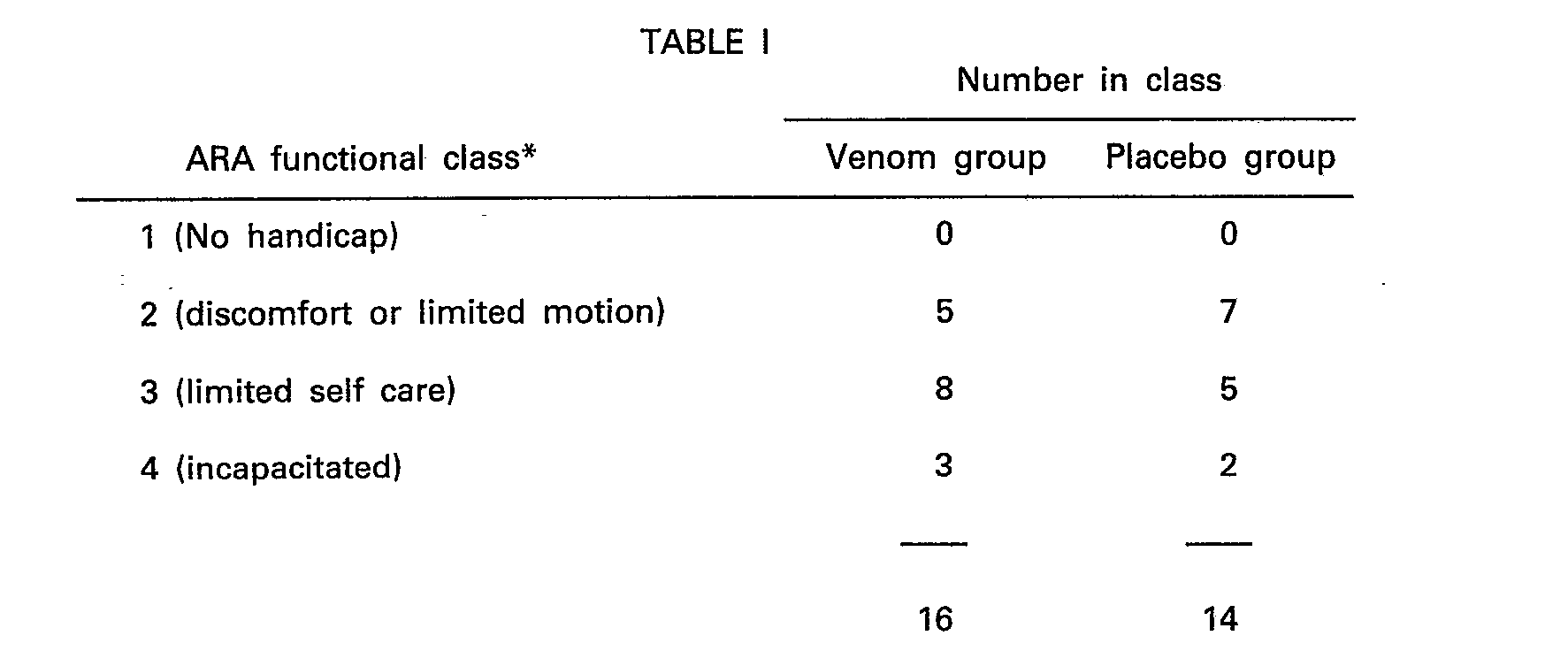
- the venom treated group there were 14 females and 2 males, in the placebo group, 7 females and 7 males. Functional classification of these therapeutic groups is shown in Table I. (Infra page 11).
- Post-Rx II All rheumatological evaluations were done within the week prior to study entry (Pre-Rx), at the termination of the two-week treatment interval (Post-Rx I) and at an interval thereafter (Post-Rx II) which was four weeks after Post-Rx I in the case of some subjects and six weeks in the case of other subjects.
- the Post-Rx II data is combined in the following analysis. The data is summarized in Table II for the parallel venom and placebo groups. Table III is extracted from Table II and provides a summary of the significantly improved parameters. The data indicates that statistically significant improvements occur in grip strength and in the number of clinically active joints in the venom treated group while corresponding improvement does not occur within the placebo treated group.
- the improvement obtained was not obtained immediately at the termination of the injections or, at least, the improvement obtained by that time was not statistically significant.
- the statistically significant improvement was observed at the end of a four or six week period (Post-Rx II) after termination of the injections. Apparently, it takes time for the inflammation to subside and for the body to adjust to the change. It is not yet known for how long the treatment is effective or, more specifically, what the relationship is between time after treatment and level of return of symptoms to pre-treatment levels.
- the extent of improvement in the number of clinically active joints is a measure of the number of joints which at Pre-Rx were degrees, 2, 3 or 4 on the ARA definition of degree of involvement of clinically active joints and which became grades zero or one at Post-Rx II.
- the improvement had to pass over the threshold between degrees 2 and degree 1 in order for it to be recorded as an improvement in the data set forth in the tables.
- a joint which improved from a fourth degree level (severe) to the second degree level (minimal-definitely present, but mild) under the ARA definitions would not be reflected as an improvement in the data in the tables. It is believed that the extent of the improvement obtained by this treatment and its statistical significance would be increased if the analysis took into account all improvement and not just the improvement that passed the threshold between degrees two and one.
- Test were made utilizing rats to show the general anti-inflammatory properties of the subject invention extract and methods for further purifying or using said extract to enhance its effectiveness.
- Rheumatoid arthritis was simulated in Sprague-Dolly rats by injecting an adjuvant, Parrigan-C, into the right foot pad of the rat. Measurements were made along the dorsal ventral axis in millimeters. The untreated left foot was also measured as a standard.
- test are generally considered to simulate rheumatoid arthritis closely enough for the test results to be an indication of the effectiveness of the material being used for use in human beings.
- the tests in fact generally indicate the anti-inflammatory properties of the material being tested.
- the results of the tests show that the subject invention extract not only reduces rheumatoid arthritis symptoms but also reduces the measured RA factor in the blood, and apparently accomplishes these results without increasing the cortisol serum levels in the blood.
- Distilled water is added to dissolve the dry powder, it is centrifuged to eliminate insoluble material, and the supernatant fluid is dialyzed vs. 0.018 M sodium phosphate containing 0.15 M NaCI, pH 7.2 (PBS).
- This preparation which is mostly polysaccharide but contains at least one protein as shown by polyacrylamide gel electrophoresis, may be stored in the lyophilized state, and is reconstituted by adding the desired volume of distilled water.
- the PS had a heterogenous size in native ant venom.
- the smallest moiety that activated serum CI had a MW of ca. 3,000 daltons as determined by gel chromatography.
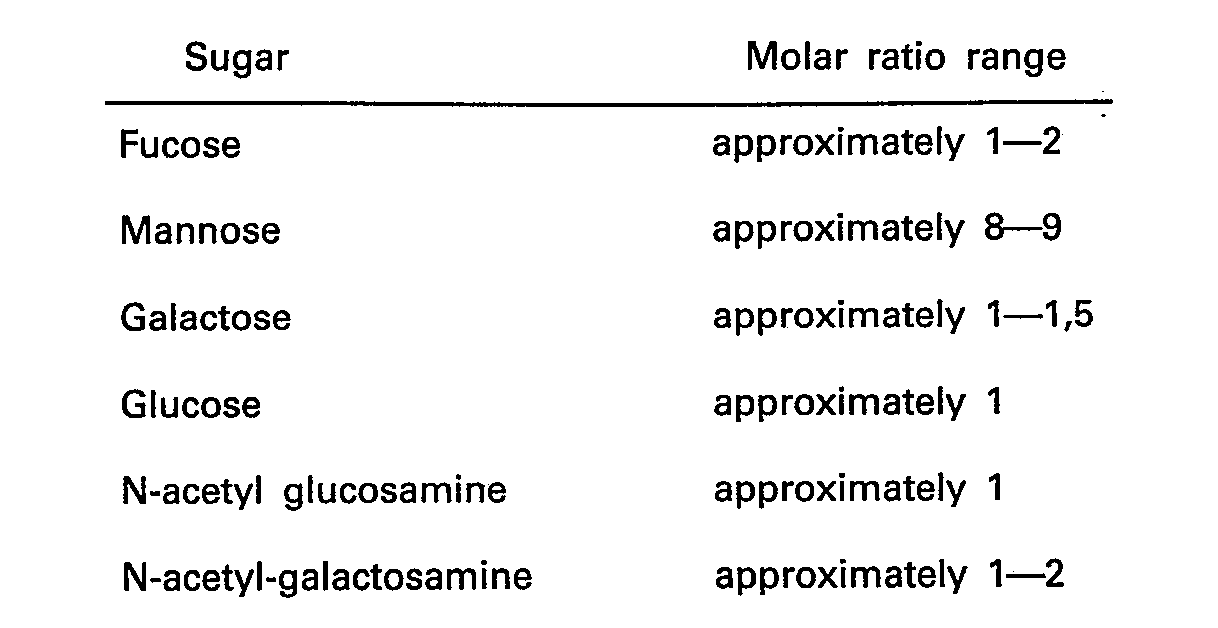
- the PS was not precipitated by barium salts, showing no apparent sulfate groups. The following sugars und the molar ratios were found by gas chromatography: mannose (7.7), fucose (1.8), N-acetylgalactosamine (1.6), galactose (1.4), glucose (1.0), and N-acetylglucosamine (1.0).
- the active factor of the present invention was isolated and the isolated material characterized by electrophoresis separation of components followed by reactions with various known reagents; elemental analysis; IR spectrometry; and solubility; all as set forth below:
- distilled water was added to suspend the material, and it was lyophilized to eliminate the alcohol. Forty-seven milliliters of distilled water were added to dissolve the dry powder, it was centrifuged to eliminate insoluble material, and the supernatant fluid wus dialyzed against 18 nM sodium phosphate containing 150 mM NaCI, pH 7.2 (PBS). Forty-six milliliters (18 pg/ml of uronic acid) were applied to a 2.4x22 cm column containing Sepharose-Con A that was equilibrated with PBS at 25°C.
- the column was first washed with PBS, and the latter (300 ml) was concentrated to 46 ml (7 pg/ml of uronic acid) with an Amicon UM-2 membrane (Amicon Corp., Lexington, Mass.). Then the column was thoroughly washed with 300 ml of 300 nM sodium borate buffer, pH 8.7 (no uronic acid recovered), and eluted with 300 ml of 100 mM oo-methyl-methyl-D-mannoside in PBS. This was concentrated to 46 ml with an Amicon UM-2 membrane, and contained 10.5 ⁇ g/ml of uronic acid. All the above pools were concentrated with an Amicon UM-2 membrane to 10 ml at 4°C.
- gel columns no. 1, 2, and 3 are, respectively: native ant venom, the alcohol precipitate that was lyophilized and solubilized in distilled water, and the product that eluted from the Con-A column. They were stained with Amido Black 10B.
- Gel columns no. 4, 5, and 6 are the same as 1, 2, and 3, but they were stained with periodic acid Schiff reagent (PAS).
- PAS periodic acid Schiff reagent
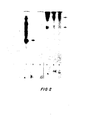
- Most of the venom protein was eliminated by the alcohol precipitation step (gel no. 2).
- the product that eluted from the Con-A column had no detectable protein (gel. no. 3), but contained material that did not enter the gel, and at least 2 diffuse bands which stained with the PAS (gel no. 6), indicating a polysaccharide(s).
- the concentrated fractions within peak PS-I were analyzed for individual sugars by gas chromatography, and compared with the ethanol precipitate of the venom.
- Table 2 shows that 6 sugars were identified: mannose, N-acetylglucosamine, galactose, fucose, N-acetyl-galactosamine, and glucose. Mannose was present in the highest concentration, and glucose the least in concentration.
- the alcohol precipitate of the venom which had all of the polysaccharide and only a small portion of the total protein, also contained the same sugars by gas chromatographic analysis, and approximately the same molar ratios as PS-I. Since the protein(s) that remained after alcohol precipitation of the venom was anodal-migrating in polyacrylamide and did not stain with PAS (Fig. 2, gels no. 2 and no. 5), it is probable that the sugars that were measured by gas chromatography were from the PS and not from a glycoprotein(s).
Landscapes
- Health & Medical Sciences (AREA)
- Life Sciences & Earth Sciences (AREA)
- Insects & Arthropods (AREA)
- Chemical & Material Sciences (AREA)
- Medicinal Chemistry (AREA)
- Pharmacology & Pharmacy (AREA)
- Epidemiology (AREA)
- Animal Behavior & Ethology (AREA)
- General Health & Medical Sciences (AREA)
- Public Health (AREA)
- Veterinary Medicine (AREA)
- Pharmaceuticals Containing Other Organic And Inorganic Compounds (AREA)
Description
- This invention relates to a composition and method for relieving the symptoms of such auto-immune ailments as rheumatoid arthritis. The nature of rheumatoid arthritis is such that one familiar with it would be led to conclude that other auto-immune ailments which also involve symptomatic inflammation of tissues will also respond to treatment using the products according to the present invention. Other such auto-immune ailments include asthma, multiple sclerosis (nerve tissue), lupus erythematosus (kidneys), sclerodermata (skin), arteritis, and other somewhat rare ailments classified as connective tissue diseases, or immune complex diseases.
- There are a number of theories for the etiology of rheumatoid arthritis including the probability that it is an auto-immunological ailment which requires the existance of an antibody or RA factor in the blood. (Note that RA and RF are used interchangeably herein). The presence of the RA factor antibody is well known and widely used as a confirming test for arthritis. A rheumatoid arthritis causative agent has not been isolated.
- Because the present invention works on a second auto-immune ailment, and in view of certain results of laboratory tests in vitro with components of the human body complement system and tests on at least one patient, it is believed that similar auto-immune ailments will also respond to treatment.
- The effect of venom factors from the ant Pseudomyrmex sp. on human complement proteins and the use of the ant venom in the treatment of rheumatoid arthritis has been described in "The Journal of Immunology" Vol. 119 (1977) pp. 1690-8. In respect of information which would enable the products to be prepared the document is however incomplete insofar as the identity of the particular species involved is not disclosed.
- The pain and discomfort due to arthritis is a major disabling factor for large numbers of people. Even without actually curing these diseases, a remission of the symptoms would permit many individuals to lead more profitable and more fulfilling lives.
- In brief, this invention is in the use of an active agent found in an extract of materials from the venom sac of ants of the genes Pseudomyrmex species triplarinus.
- The extract is obtained by crushing the abdomen of the ant. The crushed abdomen are then mixed with an aqueous solvent and the resulting solution filtered, purified, and adjusted to provide a concentration effective for injection into a patient. The extract containing the therapeutic agent is injected subcutaneously into the patient wherein, apparently without significant side effects, it causes remission of arthritic symptoms and appears to significantly decrease the RA factor (measure of an antibody normally associated with rheumatoid arthritis).
- An aqueous saline solution (physiological solution) is normally employed as the carrier as this has been found to be compatable with the extract as well as the human body.
- In order to identify the active agent in the extract, the human complement system is used as a test of activity of purified substances. The validity of this method of assaying was confirmed by a number of actual tests on humans and rats.
- The ant Pseudomyrmex triplarinus is limited to certain parts of tropical South America. It belongs to a highly specialized group of ants all of which are restricted in their nesting habits to trees of the genus Triplaris which plant group is limited to the American tropics.
- More specifically the ant employed in the tests is the worker (sterile female), genus Pseudomyrmex, species triplarinus; sub-family Pseudomyrmicinae, and family Formicidae.
- This sub-family has an unusual evolutionary history. There is no agreement on where it should be placed in the evolution of ants. It clearly belongs to the family Formicidae; which is the ant family. But it is not clear what its ancestral strain is or how its ancestral strain is related to the ancestral strains of other ants.
- It is probably fair to say that, within the context of agreeing that these are indeed ants, they appear to be totally unrelated to the rest of the ants. They are unrelated in the sense that some of their habits and in particular their anatomy diverge pronouncedly from the habits and the anatomy of other ants. This is one of the reasons for the conclusion that the venom of the ants of the triplarinus species of ant, is unrelated to the venom of other insects including the venom of any other group of ants.
- In one method for making a composition for injecting into a patient, the abdomens are separated from the ants. The abdomen contains the venom sac. A fixed number of separated abdomens are then macerated (stirred, squeezed and crushed) in saline physiological solution to dissolve the soluble parts. The mixture is then filtered, removing all insoluble constituents. The result is a solution of portions of the venom and other abdominal juices which are soluble in physiological solution.
- More specifically, a presently preferred mode of preparing an effective agent involves the following steps: (1) the dissected abdomens are macerated in a saline physiological solution, (2) the result is filtered through a No. 1 gauge filter and the filter is worked three times with physiological solution, (3) the result is diluted with saline physiological solution to a concentration equivalent to the venom from ten ants in one cubic centimeter of solution, (4) controls are taken for bacteriological and microscopic analysis, and (5) after sterility is proven the solution is stored at one to two degrees Centigrade. The solution can be held in sterile ampoules for use.
- In a number of early tests, the crushed and filtered abdomen of one hundred ants extracted according to Method I and diluted with physiological solution to provide twenty cubic centimeters (20 c.c.) of mixture was used. The resulting concentration is the content of five venom sacs in one c.c. In an initial series of tests, the injections generally started with an amount of solution containing the venom provided by 0.5 ants. Such an amount is called herein 0.5 UF. Doses were given daily to step the amount up over a period of about ten days to a level where doses are equal to the venom from approximately five to ten ants. At first 0.1 c.c. was injected in the upper arm in order to determine the patient's sensitivity to the venom and to prevent anaphylactic reaction. If no adverse reaction was observed, injections then were administered at regular intervals and increasing doses, starting with 0.5 UF. All injections were administered subcutaneously or intradermically. With good tolerance, doses were given daily for about 10 days, increasing the concentration for the last 5 days to 10 UF daily, according to each individual case. The reaction of the skin to these injections is similar to the reaction of the skin toward a sting from the ant except for the important fact that there is no pain. In particular a little white papilla appears around the injection. After a few minutes, a swelling and bright red coloring occurs. In general, these symptoms are slight and disappear within twenty-four (24) hours. No infection was associated with these injections.
- It has been found that a treatment of 10 days with amounts representing the equivalent of 5 to 10 ants (venom sacs or abdomen) during the last 5 days provides substantial relief or disappearance of arthritic symptoms. In an initial series of tests given in Bolivia, relief in many cases appeared to last over a period of years. Furthermore, in each case, no adverse side effects were observed.
- Arthritis was simulated in rats for testing the anti-inflammatory properties of the extracted material. In addition, a carefully constructed double-blind test was made on humans. Both tests are briefly described. One test was limited to human subjects carefully selected so that all had rheumatoid arthritis according to the American Rheumatism Association criteria. Accordingly, it is believed that substantial utility for treatment of rheumatoid arthritis has been demonstrated. It is believed that arthritis of other forms are sufficiently divergent in etiology (non-auto-immune ailments) that no reasonable prediction can be made as to the utility of this invention for treating gouty and other forms of arthritis. However, test on laboratory animals indicate that the venom is an anti-inflammatory agent.
- To test the potential efficacy of this venom a double-blind clinical trial was undertaken at the Laboratorio Clinico Serrales in Santo Domingo, D. R. This trial was designed by Charles Sisk, M.D., former Director of Medical and Scientific Affaires of the National Arthritic Foundation, and at the time of the test, Associate Professor of Medicine, University of Missouri Medical Center. The principal co-investigator of the study was Harvey Brown, M.D., Professor of Medicine, University of Miami School of Medicine. The trial was conducted during the interval from April 1975 through August 1975.
- A method I extract of venom was used. Venom was extracted manually from abdominal pouches of the insect, mixed with a physiological saline solution, refrigerated with ice, and shipped to the Dominican Republic of Bolivia. No attempt was made to further purify the extract as temperature stability and other physiochemical characteristics were not well defined. It is believed that early attempts to add preservatives to the venom may have resulted in causing the venom mixture to become inactive.
- Thirty subjects were located who all met the United States Food and Drug Administration (FDA) definition (1970) of having active rheumatoid arthritis. The FDA definition requires having greater than a defined level of at least three out of four RA parameters as defined by the American Rheumatism Association (ARA) criteria (1958) for rheumatoid arthritis (RA). The four parameters are listed below. The technique for measuring these parameters and the criteria for meeting the FDA definition of RA disease as set forth in FDA and ARA standards was followed.
- Prior to study entry all subjects on anti-inflammatory medications were instructed to stop this medication for at least three days before beginning the trial. One criteria established before accepting a subject was that the subject could not be on steroid treatment of over 10 mg. prednison-equivalent during the three-month interval before study entry. No subject had received gold salt treatment before or during the trial.
- All subjects were initially randomized to venom-treated and placebo groups in accordance with a double-blind, parallel design. Ten (10) subjects initially randomized to the placebo treatment were subsequently treated with venom thus permitting a crossover comparison of this group.
- Both venom and placebo were administered by subcutaneous injection of the upper arm or thigh. Venom was given in increasing single daily doses over several days until a maximum 1 milliliter (ml) dose was achieved according to the following schedule:

- To simulate both the local and systematic effects of the venom, histamine phosphate (0.1 mg. base-equivalent) was given to the placebo group. Although this preparation did not satisfactorily simulate venom effects, precautions were taken to maintain double blindness by covering injection sites during evaluation and by not advising subjects of the types of side effects they might experience from venom or placebo.
- All pre-treatment evaluations were performed by one of the co-investigators with three exceptions. The three exceptions were examined by a third rheumatologist trained in the United States. All follow-up evaluations were done by one of the co-investigators.
- If patients needed supplementary medication during the study they were given propoxphene and instructed to take it on an as needed basis. They were advised to avoid all other anti-rheumatic medication including aspirin@ and any other aspirin-containing medication.
- The four parameters used to determine the existence of active RA were also used to evaluate.
- a. number of clinically active joints;
- b. erythrocyte sedimentation rate (ESR), as measured by the Westergren method;
- c. duration of morning stiffness; and
- d. grip strength.
- The age range of the 16 cases receiving venom was 35 to 71 years with a mean of 58 years and of the 14 cases in the placebo group 34 to 74 years with a mean of 54 years. In the venom treated group there were 14 females and 2 males, in the placebo group, 7 females and 7 males. Functional classification of these therapeutic groups is shown in Table I. (Infra page 11).
- All rheumatological evaluations were done within the week prior to study entry (Pre-Rx), at the termination of the two-week treatment interval (Post-Rx I) and at an interval thereafter (Post-Rx II) which was four weeks after Post-Rx I in the case of some subjects and six weeks in the case of other subjects. The Post-Rx II data, whether taken at four or six weeks after treatment, is combined in the following analysis. The data is summarized in Table II for the parallel venom and placebo groups. Table III is extracted from Table II and provides a summary of the significantly improved parameters. The data indicates that statistically significant improvements occur in grip strength and in the number of clinically active joints in the venom treated group while corresponding improvement does not occur within the placebo treated group.
- No adverse reactions other than local ones were observed in subjects receiving venom. All subjects received a battery of laboratory tests including tests for toxicity. These included, pre- and post-treatment CBC, urinalysis, clinical chemistries (SMA-12). None of these parameters suggested any hematologic, renal, hepatic or other toxicity. Local reactions consisted of marked induration, heat and erythema at the points of injection. Most of these reactions subsided spontaneously in one or two weeks after discontinuing treatment.
- One subject developed a localized abscess. This responded promptly to antibiotic therapy.
- To confirm that the therapeutic agent of this invention did not obtain its therapeutic properties by acting as a stress agent and stimulating endogenous cortisol product, pre- and post-treatment serum cortisol levels were measured in all cases. No differences of before and after therapy hormone level were observed. This result indicates that the dangerous condition known as "adrenal crisis", which is caused by repeated stimulation of the adrenal glands, is not likely to occur as a result of extended treatment according to the present invention.
- The mean values of the various rheumatological parameters measured during the trial are set forth in Table II. The statistically significant mean values together with their standard deviations are set forth in Table III.
- It might be noted that the improvement obtained was not obtained immediately at the termination of the injections or, at least, the improvement obtained by that time was not statistically significant. The statistically significant improvement was observed at the end of a four or six week period (Post-Rx II) after termination of the injections. Apparently, it takes time for the inflammation to subside and for the body to adjust to the change. It is not yet known for how long the treatment is effective or, more specifically, what the relationship is between time after treatment and level of return of symptoms to pre-treatment levels.
- The extent of improvement in the number of clinically active joints is a measure of the number of joints which at Pre-Rx were degrees, 2, 3 or 4 on the ARA definition of degree of involvement of clinically active joints and which became grades zero or one at Post-Rx II. Thus the improvement had to pass over the threshold between
degrees 2 anddegree 1 in order for it to be recorded as an improvement in the data set forth in the tables. A joint which improved from a fourth degree level (severe) to the second degree level (minimal-definitely present, but mild) under the ARA definitions would not be reflected as an improvement in the data in the tables. It is believed that the extent of the improvement obtained by this treatment and its statistical significance would be increased if the analysis took into account all improvement and not just the improvement that passed the threshold between degrees two and one. - With respect to Table II, it should be noted that the footnoted P levels were made with the appropriate parametric "t" tests for grip strength and for number of clinically active joints.
- Ten of the fourteen individuals in the placebo group were given the venom treatment after termination of the parallel venom and placebo trial. The individuals selected were not selected at random but were those who tended to have the worst symptoms. Thus the results of this crossover trial group cannot be rigorously statistically analyzed. Nonetheless, there was a reduction of number of clinically active joints in the groups of ten subjects from a Pre-Rx mean of 23.9 (std. dev. 12.9) to a post treatment mean of 13.0 (std. dev. 11.9). This suggests a statistically significant difference at the P .05 level. The other rheumatological parameters of this cross-over group did not show a statistically significant degree of improvement.
- *The class definitions are set out more fully in the Observer's Guide issued by the ARA Cooperating Clinic's Committee.


- a.Grip strength: No significant difference between the means of the venom and placebo groups, Pre-Tx.
- b 'Grip strength: The means of the venom and placebo groups, Post-Rx II, show a statistically significant difference; specifically a difference that could arise by chance less often than once in twenty trials (P at .05 level).
- c.Right hand grip strength in the venom group alone; the means of Pre-Rx and Post-Rx II values show a statistically significant difference; i.e. a difference that could arise by chance less often once in one hundred trials (P at .01 level).
- d-Left hand grip strength in the venom group alone: The means of Pre-Rx and Post-Rx II values shows a statistically significant difference; i.e. a difference that could arise by chance less often than once in two hundred trials (P at .005 level).
- e.Number of clinically active joints: No significant difference between the means of the venom and placebo groups, Pre-Rx.
- f.Number of clinically active joints: The means of the venom and placebo groups, Post-Rx II, show a statistically significant difference; specifically a difference that could arise by chance less often than once in twenty trials (P at .05 level).
- g.Number of clinically active joints in the venom group alone: the means of Pre-Rx and Post-Rx II values show a statistically significant difference; i.e. a difference that could arise by chance less often than once in one hundred trials (P at .01 level).
- Test were made utilizing rats to show the general anti-inflammatory properties of the subject invention extract and methods for further purifying or using said extract to enhance its effectiveness.
- Rheumatoid arthritis was simulated in Sprague-Dolly rats by injecting an adjuvant, Parrigan-C, into the right foot pad of the rat. Measurements were made along the dorsal ventral axis in millimeters. The untreated left foot was also measured as a standard.
- These test are generally considered to simulate rheumatoid arthritis closely enough for the test results to be an indication of the effectiveness of the material being used for use in human beings. However, the tests in fact generally indicate the anti-inflammatory properties of the material being tested. The results of the tests show that the subject invention extract not only reduces rheumatoid arthritis symptoms but also reduces the measured RA factor in the blood, and apparently accomplishes these results without increasing the cortisol serum levels in the blood.
- Starting with X ml of extract (Method I (above)) (usually 47 ml, 0.275 mg protein/ml): 9 parts of absolute ethanol are slowly added to 1 part of the extract with constant stirring at 0°C, the mixture is stirred for 1 hr. at 0°C, and centrifuged (Sorval RC2-B, 12,000xg, 30 min, 4°C). The supernatant fluid is discarded, and the precipitate is washed one time with 90 per cent ethanol at 0°C and centrifuged. A small volume of distilled water is added to suspend the material, and it is lyophilized to eliminate the alcohol. Distilled water is added to dissolve the dry powder, it is centrifuged to eliminate insoluble material, and the supernatant fluid is dialyzed vs. 0.018 M sodium phosphate containing 0.15 M NaCI, pH 7.2 (PBS). This preparation, which is mostly polysaccharide but contains at least one protein as shown by polyacrylamide gel electrophoresis, may be stored in the lyophilized state, and is reconstituted by adding the desired volume of distilled water.
- Other methods for further purificution such as (a) Concanavalin a-linked Sepharose Chromatography and (b) ultrafiltration membrane have been successfully used but were not used in the preparation of the material used for this study.
- This analysis is of a polysaccharide which appears to be the most important, if not the only active factor in the therapeutic agent of the present invention.
- The PS had a heterogenous size in native ant venom. The smallest moiety that activated serum CI had a MW of ca. 3,000 daltons as determined by gel chromatography. The PS was not precipitated by barium salts, showing no apparent sulfate groups. The following sugars und the molar ratios were found by gas chromatography: mannose (7.7), fucose (1.8), N-acetylgalactosamine (1.6), galactose (1.4), glucose (1.0), and N-acetylglucosamine (1.0).
- The active factor of the present invention was isolated and the isolated material characterized by electrophoresis separation of components followed by reactions with various known reagents; elemental analysis; IR spectrometry; and solubility; all as set forth below:
-
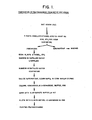
- Fig. 1 is a flow diagram for the purification of Polysaccharide from native ant venom (extracted by Method I).
- Fig. 2. Analysis of the products of the isolation steps for the ant venom polysaccharide, by disc electrophoresis on polyacrylamide gels. The gels are (1) native ant venom (0.275 mg protein/ml, 180 ng/ml of uronic acid), (2) the alcohol precipitate (lyophilized and solubilized in distilled water, 18 pg/ml of uronic acid), and (3) the product that eluted from the Sepharose-Con A (10.5 pg/ml of uronic acid), all stained for proteins with Amido Black 10B. gel nos. 4, 5, and 6 are the same products as 1, 2, and 3, but stained with periodic acid Schiff reagent. The arrows point to the polysaccharide(s) which caused C1 activation and C4 and C2 consumption in serum.
- Fig. 3(A). Elution profile of native ant venom (13.8 mg protein/ml) on Sephadex G-25 at 4°C. Fractions were assayed for protein by absorbance at 280 nm and for sugars with anthrone reagent at 620 nm. Of the 3 anthrone-positive peaks, only I and II caused C4 consumption in normal human serum. Fig.3(b) shows that peak II eluted at the same position after rechromatography-on the same column. Column, 1.1 x70 cm; buffer, 5 nM sodium phosphate, 150 nM NaCI, pH 7.5; flow rate, 6 ml/hr.
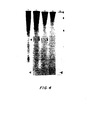
- Fig. 4. Disc electrophoresis of pooled and concentrated fractions within peaks I and II from Fig. 3(A). All gels were stained with periodic acid Schiff (PAS) reagent. Get no. 1, concentrated peak I; gel no. 2, peak I diluted 1:10, gel no. 3, peak I diluted 1:20; gel no. 4, peak I diluted 1:40; gel no. 5, peak II. The arrows point to PAS-positive bands, and demonstrate the heterogeneity of the polysaccharide.
- Fig. 5 is a typical IR Spectra run neat on an alcohol precipitate of ant venom extract.
- Fig. 6 is a typical IR Spectra run neat on an a D-mannoside eluate of Con A column of the alcohol precipitate.
- Nine parts of absolute ethanol were slowly added to 1 part of the venom (47 ml of venom, 0.275 mg protein/ml, 180 pg/mi of uronic acid) with constant stirring at 0°C. A light precipitate formed, the mixture was stirred for 1 hr at 0°C, and centrifuged (Sorvall RC2-B; 12,000xg; 30 min; 4°C). The supernatant fluid was discarded because after evaporation of the alcohol and solubilization in an aqueous buffer, the product did not cause C4 consumption in normal human serum.* The precipitate was washed one time with 90 per cent ethanol at 0°C and centrifuged. A small volume of distilled water was added to suspend the material, and it was lyophilized to eliminate the alcohol. Forty-seven milliliters of distilled water were added to dissolve the dry powder, it was centrifuged to eliminate insoluble material, and the supernatant fluid wus dialyzed against 18 nM sodium phosphate containing 150 mM NaCI, pH 7.2 (PBS). Forty-six milliliters (18 pg/ml of uronic acid) were applied to a 2.4x22 cm column containing Sepharose-Con A that was equilibrated with PBS at 25°C. The column was first washed with PBS, and the latter (300 ml) was concentrated to 46 ml (7 pg/ml of uronic acid) with an Amicon UM-2 membrane (Amicon Corp., Lexington, Mass.). Then the column was thoroughly washed with 300 ml of 300 nM sodium borate buffer, pH 8.7 (no uronic acid recovered), and eluted with 300 ml of 100 mM oo-methyl-methyl-D-mannoside in PBS. This was concentrated to 46 ml with an Amicon UM-2 membrane, and contained 10.5 µg/ml of uronic acid. All the above pools were concentrated with an Amicon UM-2 membrane to 10 ml at 4°C.
- The method for polyacrylamide gel electrophoresis using no stacking gel and 7 per cent separating gel
- *The polysaccharide caused the activation of the first component of complement (C1) in normal human serum, which in turn acts on its two natural substrates C4 and C2. Thus, C4 and/or C2 consumption indirectly shows that C1 was activated.
(Orstein, 1964) (Davis, 1964) is described in the manual of Canalco Co. (Rockville, MD). Gels were stained for protein with C. I.Acid Black 1, constitution No. 20470 (Amido Black 10B) (Greenfield etal, 1971), and for glyco-protein and polysaccharida with periodic acid Schiff reagent (Segrest & Jackson, 1972). Neutral sugars were detected with anthrone reagent (Seifter et al, 1950), hexuronic acids by the carbazole method of Bitter and Muir (1962), and phosphate by the method of Ames and Dubin (1960). - Gas chromatography. To anthrone and uronic acid positive samples was added a fine concentration of 3 N HCI, and they were hydrolyzed at 100°C for 3 hr. The hydrolysate were reduced by sodium borohydride, acetylated with acetic anhydride by standard procedures (Griggs et aI, 1971), and the alditol acetates were analyzed by gas chromatography with a Hewlett-Packard apparatus.
- The products of the purification steps were subjected to electrophoresis on polyacrylamide gels, applying 250 pl/gel. In Fig. 2, gel columns no. 1, 2, and 3 are, respectively: native ant venom, the alcohol precipitate that was lyophilized and solubilized in distilled water, and the product that eluted from the Con-A column. They were stained with Amido Black 10B. Gel columns no. 4, 5, and 6 are the same as 1, 2, and 3, but they were stained with periodic acid Schiff reagent (PAS). Most of the venom protein was eliminated by the alcohol precipitation step (gel no. 2). The product that eluted from the Con-A column had no detectable protein (gel. no. 3), but contained material that did not enter the gel, and at least 2 diffuse bands which stained with the PAS (gel no. 6), indicating a polysaccharide(s).
- Serial slices of varying thickness from top to bottom (Table 1) of 6 unstained gels containing the Con-A eluate were pooled, eluted 48 hr with 2 ml of DGVB++ at 4°C, and concentrated to 0.5 ml with an Amicon UM-2 membrane at 4°C. Equal volumes of each concentrated eluate and normal human serum were incubated at 37°C for 4 hr, and the C4 levels were determined by functional hemolytic assays. Table 1 shows that the product that consumed serum C4 (i.e., activated C1) was in the top 1 to 3 mm, including a portion that did not enter the gel, and also the activity was associated with a second PAS-positive band that entered the gel. Some activity was found between the two major PAS-positive bands which entered the gel, probably indicating that variable quantities of the polysaccharides) did not migrate as a homogeneous band.
- One-hundred milliliters of venom were concentrated to 2 ml by ultrafiltration with an Amicon UM-2 membrane (13.8 mg protein/ml) at 4°C and applied to a 1.1x70 cm column containing Sephadex@ G-25 equilibrated with 5 mM sodium phosphate, 150 mM NaCI, pH 7.5, at 4°C. Individual fractions were assayed for protein by measuring absorbance at 280 nm, for sugars with anthrone reagent, and for the capability to cause consumption of serum C4 by functional hemolytic assays. For the latter, equal volumes of normal human serum and the column fraction were incubated for 4 hr at 37°C, and the titer of C4 was determined. The results in Fig. 3(A) show that 3 anthrone-positive peaks eluted, but only peaks I (PS-I) and 11 (PS-II) were analyzed further because peak III did not cause C4 consumption.
- The anthrone-positive peaks PS-I and PS-II were pooled separately, concentrated by ultrafiltration (Amicon UM-2 membrane) at 4°C, and reapplied to the same column. Both peaks eluted in the same position as before. Thus, peak PS-II was significantly lighter than PS-I (Fig. 3B). The molecular weight was estimated to be 3000 daltons by the method of Andrews (1964). The individual fractions within the peaks were pooled, concentrated, and applied to polyacrylamide gels. Figure 4 (gel no. 1) shows that concentrated PS-I was heterogeneous, and individual bands were not distinguishable after staining the gel was PAS. Gels no. 2, 3, and 4 are concentrated PS-I diluted in saline 1: 10, 1:20, and 1:40 respectively. Much of PS-I did not enter the gel or remained in the top portions, and in addition, a diffuse more anodal band is shown in gels no. 1, 2, and 3 (arrows). PS-II (gel no. 5) also was heterogeneous in the gel. A portion of the PS remained on the top of the gel, and 2 bands (arrows) were distinguishable within the gel.
- The concentrated fractions within peak PS-I (Fig. 3A) were analyzed for individual sugars by gas chromatography, and compared with the ethanol precipitate of the venom. Table 2 shows that 6 sugars were identified: mannose, N-acetylglucosamine, galactose, fucose, N-acetyl-galactosamine, and glucose. Mannose was present in the highest concentration, and glucose the least in concentration.
- The alcohol precipitate of the venom, which had all of the polysaccharide and only a small portion of the total protein, also contained the same sugars by gas chromatographic analysis, and approximately the same molar ratios as PS-I. Since the protein(s) that remained after alcohol precipitation of the venom was anodal-migrating in polyacrylamide and did not stain with PAS (Fig. 2, gels no. 2 and no. 5), it is probable that the sugars that were measured by gas chromatography were from the PS and not from a glycoprotein(s).
- In addition to the neutral sugars, a high content of hexuronic acid also was present in both PS-I and the alcohol precipitate, which explains the source of the net negative charge of the polysaccharide.
- In other preliminary chemical assays with PS-1 and the alcohol precipitate, they were not precipitated by barium salts, showing no apparent sulfate groups, and they were negative for phosphate content (Ames & Dubin, 1960).
- An IR spectrograph was run on neat purified material. As would be expected, only three major peak were obtained. These are tabulated in Table 3.
- The purified material eluted from the Sepharose-Con A column and the alcohol precipitate (before purification in the Sepharose@-Con A column) from three separate lots of venom extract were sent to Galbraith Laboratories, Inc., Knoxville, Tenn, for elemental analysis. The results are tabulated in Table 4.
- To 3 ml of native ant venom (Lot 080678-WA) was added 27 ml of ice-cold absolute ethyl alcohol with stirring at 0°C to precipitate the active polysaccharide. A light precipitate formed, and the material was centrifuged in 6 tubes containing 5 ml each (International PR-2, 2000
RPM 10 min, 0°C). The ethanol was decanted, the six precipitates were dispersed at the bottom of each tube, and 5 ml of the following solvents were added: acetone, benzene, chloroform, anhydrous ethyl ether, propylene glycol, or glycerol. After mixing, the solubility of the precipitates was determined by visual inspection, at 25°C. - The results tabulated in Table 5 wherein insoluble means at least substantially insoluble; most of the material was apparently not dissolved. Soluble means most of the material appeared to be in solution.


Claims (9)

Priority Applications (2)
| Application Number | Priority Date | Filing Date | Title |
|---|---|---|---|
| EP81100434A EP0056824B1 (en) | 1981-01-22 | 1981-01-22 | Therapeutic agent |
| DE8181100434T DE3170230D1 (en) | 1981-01-22 | 1981-01-22 | Therapeutic agent |
Applications Claiming Priority (1)
| Application Number | Priority Date | Filing Date | Title |
|---|---|---|---|
| EP81100434A EP0056824B1 (en) | 1981-01-22 | 1981-01-22 | Therapeutic agent |
Publications (2)
| Publication Number | Publication Date |
|---|---|
| EP0056824A1 EP0056824A1 (en) | 1982-08-04 |
| EP0056824B1 true EP0056824B1 (en) | 1985-05-02 |
Family
ID=8187540
Family Applications (1)
| Application Number | Title | Priority Date | Filing Date |
|---|---|---|---|
| EP81100434A Expired EP0056824B1 (en) | 1981-01-22 | 1981-01-22 | Therapeutic agent |
Country Status (2)
| Country | Link |
|---|---|
| EP (1) | EP0056824B1 (en) |
| DE (1) | DE3170230D1 (en) |
Cited By (1)
| Publication number | Priority date | Publication date | Assignee | Title |
|---|---|---|---|---|
| DE102006000672A1 (en) * | 2006-01-03 | 2007-07-05 | Halbritter, Andres Ludovico, Dr. | Production of a biocatalyst from natural source, useful e.g. to increase the growth of organisms, comprises producing a biocatalyst from ants, allocating the biocatalyst in an alcohol, and separating the biocatalyst |
Family Cites Families (1)
| Publication number | Priority date | Publication date | Assignee | Title |
|---|---|---|---|---|
| US4247540A (en) * | 1979-01-31 | 1981-01-27 | Gunter Holzmann | Therapeutic agent |
-
1981
- 1981-01-22 EP EP81100434A patent/EP0056824B1/en not_active Expired
- 1981-01-22 DE DE8181100434T patent/DE3170230D1/en not_active Expired
Cited By (1)
| Publication number | Priority date | Publication date | Assignee | Title |
|---|---|---|---|---|
| DE102006000672A1 (en) * | 2006-01-03 | 2007-07-05 | Halbritter, Andres Ludovico, Dr. | Production of a biocatalyst from natural source, useful e.g. to increase the growth of organisms, comprises producing a biocatalyst from ants, allocating the biocatalyst in an alcohol, and separating the biocatalyst |
Also Published As
| Publication number | Publication date |
|---|---|
| DE3170230D1 (en) | 1985-06-05 |
| EP0056824A1 (en) | 1982-08-04 |
Similar Documents
| Publication | Publication Date | Title |
|---|---|---|
| DE69032833T2 (en) | DIAGNOSIS AND TREATMENT OF INSULIN-DEPENDENT DIABETES MELLITUS | |
| Gregory et al. | The preparation and properties of gastrin | |
| Barranco et al. | Treatment of relapsing polychondritis with dapsone | |
| Berman et al. | The acid mucopolysaccharides of cattle retina | |
| Brown et al. | The dual necessity for delayed hypersensitivity and circulating antibody in the pathogenesis of experimental allergic orchitis in guinea-pigs | |
| Kastin et al. | Extrapigmentary effects of melanocyte-stimulating hormone in amenorrhoeic women | |
| DE2804457A1 (en) | IMMUNE SUPPRESSIVE MEDIUM | |
| DE69110060T2 (en) | SUBSTANCES OF PEPTIDIC NATURE USEFUL IN HUMAN THERAPY. | |
| DE2735411A1 (en) | METHOD FOR PRODUCING ACELLULAR VACCINES AND VACCINES OBTAINED BY THIS PROCESS | |
| BAHN et al. | Histologic criteria for detection of prolactin: lack of prolactin in blood and urine of human subjects | |
| Berenson et al. | Connective tissue macromolecular changes in rats with experimentally induced diabetes and hyperinsulinism | |
| Theakston | An objective approach to antivenom therapy and assessment of first-aid measures in snake bite | |
| US4247540A (en) | Therapeutic agent | |
| JPH02149594A (en) | Anti-inflammatory and analgesic compounds, related compositions, and their production and uses | |
| EP0056824A1 (en) | Therapeutic agent | |
| EP0024941B1 (en) | Water-soluble extract from nonpathogenic aerobic corynebacteria, production thereof and compositions containing the extract | |
| EP0246069B1 (en) | Extracts of nerium species, methods of preparation, and use therefore | |
| MacPherson et al. | Studies on Brain Antigens: VI. Prevention of Experimental Allergic Encephalomyelitis by a Qater-Soluble Spinal Cord Protein, β1-SCP | |
| EP0213072B1 (en) | Treatment of chronic imflammatory disease | |
| Yamamoto et al. | Plasma lipid-lowering and lipogenesis-stimulating actions of ginseng saponins in tumor-bearing rats | |
| US4001396A (en) | Hormonal product extracted from parathyroid gland and process for the preparation thereof | |
| IE46618B1 (en) | Peptide complexes of desoxyribonucleic acid(dna)obtained from dna-containing organisms | |
| Baume et al. | Concentration and partial characterization of human salivary gastrone | |
| US20030118597A1 (en) | Process for production of bee venom as pharmaceutical product which can be used effectively in the treatment of rheumatoid arthritis and viral diseases | |
| Graybill et al. | Immunogenic fractions of Cryptococcus neoformans |
Legal Events
| Date | Code | Title | Description |
|---|---|---|---|
| PUAI | Public reference made under article 153(3) epc to a published international application that has entered the european phase |
Free format text: ORIGINAL CODE: 0009012 |
|
| 17P | Request for examination filed |
Effective date: 19820504 |
|
| AK | Designated contracting states |
Designated state(s): CH DE FR GB SE |
|
| GRAA | (expected) grant |
Free format text: ORIGINAL CODE: 0009210 |
|
| AK | Designated contracting states |
Designated state(s): CH DE FR GB LI SE |
|
| PG25 | Lapsed in a contracting state [announced via postgrant information from national office to epo] |
Ref country code: SE Effective date: 19850530 |
|
| REF | Corresponds to: |
Ref document number: 3170230 Country of ref document: DE Date of ref document: 19850605 |
|
| ET | Fr: translation filed | ||
| PLBE | No opposition filed within time limit |
Free format text: ORIGINAL CODE: 0009261 |
|
| STAA | Information on the status of an ep patent application or granted ep patent |
Free format text: STATUS: NO OPPOSITION FILED WITHIN TIME LIMIT |
|
| 26N | No opposition filed | ||
| REG | Reference to a national code |
Ref country code: GB Ref legal event code: 732 |
|
| REG | Reference to a national code |
Ref country code: CH Ref legal event code: PUE Owner name: XONEX LABORATORIES, INC. |
|
| REG | Reference to a national code |
Ref country code: FR Ref legal event code: TP |
|
| PGFP | Annual fee paid to national office [announced via postgrant information from national office to epo] |
Ref country code: FR Payment date: 19890130 Year of fee payment: 9 |
|
| PGFP | Annual fee paid to national office [announced via postgrant information from national office to epo] |
Ref country code: GB Payment date: 19890131 Year of fee payment: 9 |
|
| PGFP | Annual fee paid to national office [announced via postgrant information from national office to epo] |
Ref country code: DE Payment date: 19890325 Year of fee payment: 9 |
|
| PGFP | Annual fee paid to national office [announced via postgrant information from national office to epo] |
Ref country code: CH Payment date: 19890414 Year of fee payment: 9 |
|
| PG25 | Lapsed in a contracting state [announced via postgrant information from national office to epo] |
Ref country code: GB Effective date: 19900122 |
|
| PG25 | Lapsed in a contracting state [announced via postgrant information from national office to epo] |
Ref country code: LI Effective date: 19900131 Ref country code: CH Effective date: 19900131 |
|
| GBPC | Gb: european patent ceased through non-payment of renewal fee | ||
| PG25 | Lapsed in a contracting state [announced via postgrant information from national office to epo] |
Ref country code: FR Effective date: 19900928 |
|
| REG | Reference to a national code |
Ref country code: CH Ref legal event code: PL |
|
| PG25 | Lapsed in a contracting state [announced via postgrant information from national office to epo] |
Ref country code: DE Effective date: 19901002 |
|
| REG | Reference to a national code |
Ref country code: FR Ref legal event code: ST |