EP0055920B1 - Process for the continuous recovery of acetonitrile - Google Patents
Process for the continuous recovery of acetonitrile Download PDFInfo
- Publication number
- EP0055920B1 EP0055920B1 EP81306095A EP81306095A EP0055920B1 EP 0055920 B1 EP0055920 B1 EP 0055920B1 EP 81306095 A EP81306095 A EP 81306095A EP 81306095 A EP81306095 A EP 81306095A EP 0055920 B1 EP0055920 B1 EP 0055920B1
- Authority
- EP
- European Patent Office
- Prior art keywords
- acetonitrile
- azeotrope
- water
- pressure
- mixture
- Prior art date
- Legal status (The legal status is an assumption and is not a legal conclusion. Google has not performed a legal analysis and makes no representation as to the accuracy of the status listed.)
- Expired
Links
Images
Classifications
-
- C—CHEMISTRY; METALLURGY
- C07—ORGANIC CHEMISTRY
- C07C—ACYCLIC OR CARBOCYCLIC COMPOUNDS
- C07C253/00—Preparation of carboxylic acid nitriles
- C07C253/32—Separation; Purification; Stabilisation; Use of additives
- C07C253/34—Separation; Purification
-
- C—CHEMISTRY; METALLURGY
- C07—ORGANIC CHEMISTRY
- C07C—ACYCLIC OR CARBOCYCLIC COMPOUNDS
- C07C255/00—Carboxylic acid nitriles
-
- Y—GENERAL TAGGING OF NEW TECHNOLOGICAL DEVELOPMENTS; GENERAL TAGGING OF CROSS-SECTIONAL TECHNOLOGIES SPANNING OVER SEVERAL SECTIONS OF THE IPC; TECHNICAL SUBJECTS COVERED BY FORMER USPC CROSS-REFERENCE ART COLLECTIONS [XRACs] AND DIGESTS
- Y10—TECHNICAL SUBJECTS COVERED BY FORMER USPC
- Y10S—TECHNICAL SUBJECTS COVERED BY FORMER USPC CROSS-REFERENCE ART COLLECTIONS [XRACs] AND DIGESTS
- Y10S203/00—Distillation: processes, separatory
- Y10S203/03—Acrylonitrile
Definitions
- This invention relates to a process for the continuous recovery of acetonitrile.
- acetonitrile In the production of acrylonitrile by the catalytic ammoxidation of propylene with ammonia and oxygen, a crude acetonitrile byproduct is produced.
- This material normally it composed of, on a weight basis, about 52% acetonitrile, 43.6% water, 2.5% HCN, 0.5% acrylonitrile and 1.3% other organics such as oxazole, allyl alcohol, acetone and propionitrile.
- the crude acetonitrile is first distilled to drive off HCN. Then, the HCN-free material is distilled to produce an acetonitrile/ water azeotrope containing about 25% water, which in turn is then slurried with anhydrous calcium chloride. The anhydrous calcium chloride takes up most of the water in the azeotrope to produce an acetonitrile/water mixture containing about 3% to 5% water, which in turn is distilled to produce a pure acetonitrile product.
- the present invention provides a novel technique for continuously recovering highly pure acetonitrile from crude acetonitrile containing acetonitrile, water, HCN and heavy organics, the process comprising:
- crude acetonitrile is processed to recover highly pure acetonitrile as a valuable byproduct.
- highly pure acetonitrile is meant acetonitrile having a purity of at least 95%.
- acetonitrile can be produced by the present invention with purities as high as 99.9%, the balance being water and extremely small amounts of organics.
- the crude acetonitrile which is processed in accordance with the present invention is any acetonitrile/water mixture containing at least 15% water.
- the process of the invention is applicable to the processing of various water/acetonitrile azeotropes.
- the invention finds broadest application in the processing of the crude acetonitrile streams produced by the ammoxidation of propylene with oxygen and ammonia to form acrylonitrile.
- crude acetonitrile streams normally contain about 52% acetonitrile, 43.6% water, 0.5% acrylonitrile 2.5% HCN and 1.3% other minor impurities such as oxazole, allyl alcohol, acetone and propionitrile.
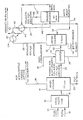
- Crude acetonitrile recovered from an acrylonitrile plant and having the above compositon can be conveniently processed by the present invention in accordance with the flow scheme illustrated in the figure.
- the crude acetonitrile is fed via inlet line 10 to a crude acetonitrile holding tank 12.
- Sulfuric acid is charged via line 14 into crude acetonitrile tank 12 to acidify the crude acetonitrile to a pH of about 7 to stabilize the cyanohydrins and neutralize free ammonia.
- the neutralized crude acetonitrile is charged via line 14 into heads column 16 wherein it is distilled at a pressure of about 18 psia (1.26 kg/cm 2 ) to three phases.
- the light components in the crude acetonitrile namely HCN, acrylonitrile, oxazole and acetone, are withdrawn from heads column 16 as a vapor draw and discharged to incineration via line 18.
- Water is recovered from the bottom of heads column 16 and discharged via line 20 to waste.
- a first acetonitrile/water azeotrope containing about "70% acetonitrile, 30% water, 500 ppm HCN and very small amounts of heavy organics is recovered as a side draw.
- the first acetonitrile/water azeotrope is then transferred via line 22 to digester 24.
- An HCN digester comprising an aqueous solution of sodium hydroxide and formaldehyde is added via line 26 to digester 24 so that the HCN in the first azeotrope is destroyed. This technique of digesting HCN is more thoroughly described in our U.S.
- Patent 4,328,075 Into digester 24 via line 28 is also charged another acetonitrile/water azeotrope (third azeotrope), this azeotrope containing about 22% water.
- the HCN-free acetonitrile/water mixture passing out of digester 24 is charged via line 30 into drying column 32.
- a stream comprising acetonitrile containing a small amount of heavy impurities is also charged into drying column 32 via line 34.
- the acetonitrile/water mixture therein is distilled at a pressure below one atmosphere, e.g. 3.4 psia (0.238 kg/cm 2 ), to produce a bottoms produce comprising water and heavy organics which are discharged to waste via line 36, and a gaseous top draw comprising a second acetonitrile/water azeotrope, the second azeotrope containing about 10% water.
- the second acetonitrile/water azeotrope is charged via line 38 into condenser 40 where it is condensed, passed via line 42 through heat exchanger 44 where it is heated, and then charged via line 46 into produce column 48.
- the second acetonitrile/water azeotrope is distilled at high pressure, e.g. 50 psia (3.50 kg/cm 2 ) into three phases.
- a bottoms product comprising acetonitrile containing heavy impurities is withdrawn from the bottom of product column 48 and recycled via line 34 to drying column 32.
- a third acetonitrile/water azeotrope is withdrawn from the top of product column 48 and recycled via line 28 to digester 24 where it is mixed with the head acetonitrile/water azeotrope produced in heads column 16. Because product . column 48 is operated at high pressure, all of the water in the second acetonitrile/water azeotrope charged into product column 48 is recovered in the overhead stream of product column 48, i.e. the third acetonitrile/water azeotrope, leaving high purity acetonitrile in the product column. This high purity acetonitrile (99.8 weight percent acetonitrile) is drawn off column 48 as a liquid sidestream via line 50, and after cooling in heat exchanger 44 is discharged as product via line 52.
- This high purity acetonitrile 99.8 weight percent acetonitrile
- the pressures in the heads columns, drying columns and product column can be 15 to 25 psia (1.05-1.75 kg/cm 2 ), 0.1 to 10 psia (.007-.7 kg/cm 2 ) and 15 to 100 psia (1.05-7 kg/cm 2 ), respectively, with the pressure in the product column preferably being at least 5 psi (0.35 kg/cm 2 ) greater than the pressure in the heads column.
- the pressures in the heads, drying and product columns are 16 to 20 psia (1.12-1.40 kg/cm 2 ), 3 to 4 psia (0.21-0.28 kg/cm 2 ) and 40 to 55 psia (2.8-3.85 kg/cm 2 ), respectively.
- the abbreviation "psia” means pounds per square inch absolute and the abbreviation “psig” means pounds per square inch gauge. The metric value is to be read in a corresponding manner.
Landscapes
- Chemical & Material Sciences (AREA)
- Organic Chemistry (AREA)
- Organic Low-Molecular-Weight Compounds And Preparation Thereof (AREA)
Description
- This invention relates to a process for the continuous recovery of acetonitrile.
- In the production of acrylonitrile by the catalytic ammoxidation of propylene with ammonia and oxygen, a crude acetonitrile byproduct is produced. This material normally it composed of, on a weight basis, about 52% acetonitrile, 43.6% water, 2.5% HCN, 0.5% acrylonitrile and 1.3% other organics such as oxazole, allyl alcohol, acetone and propionitrile.
- Traditionally, this crude acetonitrile byproduct has simply been disposed of by incineration. More recently, however, it has been processed so as to recover acetonitrile as a valuable byproduct.
- In this processing, the crude acetonitrile is first distilled to drive off HCN. Then, the HCN-free material is distilled to produce an acetonitrile/ water azeotrope containing about 25% water, which in turn is then slurried with anhydrous calcium chloride. The anhydrous calcium chloride takes up most of the water in the azeotrope to produce an acetonitrile/water mixture containing about 3% to 5% water, which in turn is distilled to produce a pure acetonitrile product.
- The process for recovering the acetonitrile pro- dues a relatively large amount of waste calcium chloride which must be disposed of and further is accomplished in a batch operation which leads to various operational difficulties.
- Accordingly, it is an object of the present invention to provide a new technique for recovering acetonitrile from a crude acetonitrile process stream which is simple and straight-forward to carry out and can be conducted on a continuous basis.
- This and other objects are accomplished by the present invention, which is based on the discovery that acetonitrile in 99+% purity can be recovered by a continuous distillation procedure carried out in three stages at three different pressures.
- Accordingly, the present invention provides a novel technique for continuously recovering highly pure acetonitrile from crude acetonitrile containing acetonitrile, water, HCN and heavy organics, the process comprising:
- (1) distilling the crude acetonitrile in a first distillation zone at a first pressure at or above 1 atmosphere to remove HCN therefrom and produce a first acetonitrile/water azeotrope and a first bottoms product containing water,
- (2) distilling the first azeotrope in a second distillation zone at a second pressure less than 1 atmosphere to separate the first azeotrope into a second bottoms product containing water and a second acetonitrile/water azeotrope having a greater acetonitrile concentration than the first azeotrope, and
- (3) distilling the second acetonitrile/water azeotrope in a third distillation zone at a third pressure above the first pressure to produce a third acetonitrile/water azeotrope containing substantially all of the water in the second azeotrope, a third bottoms product comprising acetonitrile and heavy organics and a sidestream comprising the highly pure acetonitrile.
- The invention will now be described in more detail with reference to the single figure of the accompanying drawing, which is a schematic representation of an embodiment of the present invention.
- , In accordance with the present invention, crude acetonitrile is processed to recover highly pure acetonitrile as a valuable byproduct. By "highly pure" acetonitrile is meant acetonitrile having a purity of at least 95%. Normally, acetonitrile can be produced by the present invention with purities as high as 99.9%, the balance being water and extremely small amounts of organics. The crude acetonitrile which is processed in accordance with the present invention is any acetonitrile/water mixture containing at least 15% water. Thus, the process of the invention is applicable to the processing of various water/acetonitrile azeotropes. The invention, however, finds broadest application in the processing of the crude acetonitrile streams produced by the ammoxidation of propylene with oxygen and ammonia to form acrylonitrile. As indicated above, such crude acetonitrile streams normally contain about 52% acetonitrile, 43.6% water, 0.5% acrylonitrile 2.5% HCN and 1.3% other minor impurities such as oxazole, allyl alcohol, acetone and propionitrile.
- Crude acetonitrile recovered from an acrylonitrile plant and having the above compositon can be conveniently processed by the present invention in accordance with the flow scheme illustrated in the figure. In accordance with this system, the crude acetonitrile is fed via
inlet line 10 to a crudeacetonitrile holding tank 12. Sulfuric acid is charged vialine 14 intocrude acetonitrile tank 12 to acidify the crude acetonitrile to a pH of about 7 to stabilize the cyanohydrins and neutralize free ammonia. - After acidification, the neutralized crude acetonitrile is charged via
line 14 intoheads column 16 wherein it is distilled at a pressure of about 18 psia (1.26 kg/cm2) to three phases. The light components in the crude acetonitrile, namely HCN, acrylonitrile, oxazole and acetone, are withdrawn fromheads column 16 as a vapor draw and discharged to incineration vialine 18. Water is recovered from the bottom ofheads column 16 and discharged vialine 20 to waste. A first acetonitrile/water azeotrope containing about "70% acetonitrile, 30% water, 500 ppm HCN and very small amounts of heavy organics is recovered as a side draw. - The first acetonitrile/water azeotrope is then transferred via
line 22 todigester 24. An HCN digester comprising an aqueous solution of sodium hydroxide and formaldehyde is added vialine 26 to digester 24 so that the HCN in the first azeotrope is destroyed. This technique of digesting HCN is more thoroughly described in our U.S. - Patent 4,328,075: Into
digester 24 vialine 28 is also charged another acetonitrile/water azeotrope (third azeotrope), this azeotrope containing about 22% water. - The HCN-free acetonitrile/water mixture passing out of
digester 24 is charged vialine 30 intodrying column 32. In addition, a stream comprising acetonitrile containing a small amount of heavy impurities is also charged intodrying column 32 vialine 34. Indrying column 32, the acetonitrile/water mixture therein is distilled at a pressure below one atmosphere, e.g. 3.4 psia (0.238 kg/cm2), to produce a bottoms produce comprising water and heavy organics which are discharged to waste vialine 36, and a gaseous top draw comprising a second acetonitrile/water azeotrope, the second azeotrope containing about 10% water. - The second acetonitrile/water azeotrope is charged via
line 38 intocondenser 40 where it is condensed, passed vialine 42 throughheat exchanger 44 where it is heated, and then charged vialine 46 intoproduce column 48. Inproduct column 48, the second acetonitrile/water azeotrope is distilled at high pressure, e.g. 50 psia (3.50 kg/cm2) into three phases. A bottoms product comprising acetonitrile containing heavy impurities is withdrawn from the bottom ofproduct column 48 and recycled vialine 34 to dryingcolumn 32. A third acetonitrile/water azeotrope is withdrawn from the top ofproduct column 48 and recycled vialine 28 todigester 24 where it is mixed with the head acetonitrile/water azeotrope produced inheads column 16. Because product .column 48 is operated at high pressure, all of the water in the second acetonitrile/water azeotrope charged intoproduct column 48 is recovered in the overhead stream ofproduct column 48, i.e. the third acetonitrile/water azeotrope, leaving high purity acetonitrile in the product column. This high purity acetonitrile (99.8 weight percent acetonitrile) is drawn offcolumn 48 as a liquid sidestream vialine 50, and after cooling inheat exchanger 44 is discharged as product vialine 52. - From the above, it can be seen that the present invention very simply and easily produces high purity acetonitrile by distillation without using calcium chloride to remove water. Thus, waste disposal problems associated with the prior art techniques are largely eliminated.
- Although only a single embodiment of the invention has been described above, many modifications can be made without departing from the spirit and scope of the invention. For example, instead of an aqueous solution of sodium hydroxide and formaldehyde, any other chemical which will destroy HCN without adversely affecting the acetonitrile product can be used as the HCN digester fed to digester 24. In addition, other pressures than those described above can be used in the three distillation columns of the invention. For example, the pressures in the heads columns, drying columns and product column can be 15 to 25 psia (1.05-1.75 kg/cm2), 0.1 to 10 psia (.007-.7 kg/cm2) and 15 to 100 psia (1.05-7 kg/cm2), respectively, with the pressure in the product column preferably being at least 5 psi (0.35 kg/cm2) greater than the pressure in the heads column. More preferably, the pressures in the heads, drying and product columns are 16 to 20 psia (1.12-1.40 kg/cm2), 3 to 4 psia (0.21-0.28 kg/cm2) and 40 to 55 psia (2.8-3.85 kg/cm2), respectively. The abbreviation "psia" means pounds per square inch absolute and the abbreviation "psig" means pounds per square inch gauge. The metric value is to be read in a corresponding manner.
Claims (10)
Applications Claiming Priority (2)
| Application Number | Priority Date | Filing Date | Title |
|---|---|---|---|
| US06/222,196 US4362603A (en) | 1981-01-02 | 1981-01-02 | Continuous acetonitrile recovery process |
| US222196 | 1988-07-21 |
Publications (3)
| Publication Number | Publication Date |
|---|---|
| EP0055920A2 EP0055920A2 (en) | 1982-07-14 |
| EP0055920A3 EP0055920A3 (en) | 1982-09-22 |
| EP0055920B1 true EP0055920B1 (en) | 1985-02-13 |
Family
ID=22831273
Family Applications (1)
| Application Number | Title | Priority Date | Filing Date |
|---|---|---|---|
| EP81306095A Expired EP0055920B1 (en) | 1981-01-02 | 1981-12-23 | Process for the continuous recovery of acetonitrile |
Country Status (10)
| Country | Link |
|---|---|
| US (1) | US4362603A (en) |
| EP (1) | EP0055920B1 (en) |
| KR (1) | KR880000891B1 (en) |
| AT (1) | AT375066B (en) |
| BR (1) | BR8108531A (en) |
| DE (1) | DE3168979D1 (en) |
| ES (1) | ES508434A0 (en) |
| IN (1) | IN159808B (en) |
| MX (1) | MX158763A (en) |
| RO (1) | RO83616B (en) |
Families Citing this family (36)
| Publication number | Priority date | Publication date | Assignee | Title |
|---|---|---|---|---|
| DE3334321A1 (en) * | 1983-09-22 | 1985-04-11 | Lentia GmbH Chem. u. pharm. Erzeugnisse - Industriebedarf, 8000 München | Process for the purification of crude acetonitrile with the recovery of pure prussic acid |
| AT379380B (en) * | 1983-09-27 | 1985-12-27 | Chemie Linz Ag | METHOD FOR DESTRUCTING TIED AND, IF NECESSARY, FREE BLUE ACID AND ACRYLNITRILE IN RAW ACETONITRILE |
| CA2136235C (en) * | 1992-05-21 | 2004-04-20 | Barry W. Himes | Method for purification of acetonitrile |
| US5426208A (en) * | 1992-05-21 | 1995-06-20 | Cryodyne Technologies, Inc. | Method of purification of acetonitrile |
| US5346595A (en) * | 1993-02-23 | 1994-09-13 | Alliedsignal Inc. | Process for the purification of a pentafluoroethane azeotrope |
| TW402583B (en) * | 1996-04-10 | 2000-08-21 | Standard Oil Co | Purification of acetonitrile by a distillative recovery/ion exchange resin treatment process |
| DE69707848T2 (en) * | 1997-07-08 | 2002-04-04 | The Standard Oil Company, Chicago | Process for the purification of acetonitrile |
| CN1105099C (en) * | 1997-08-05 | 2003-04-09 | 标准石油公司 | Purification of acetonitrile by distillative recovery/ion exchange resin treatment process |
| DE69906848T2 (en) * | 1998-02-23 | 2003-10-30 | The Standard Oil Company, Chicago | Purification and extraction of acetonitrile |
| US6843890B1 (en) * | 1999-07-23 | 2005-01-18 | The Standard Oil Company | Purification and recovery of acetonitrile from waste solvent acetonitrile |
| US6395142B1 (en) | 1999-10-14 | 2002-05-28 | Chemcycles, Inc. | Method and apparatus for purifying low grade acetonitrile and other constituents from hazardous waste |
| US6706474B1 (en) * | 2000-06-27 | 2004-03-16 | Board Of Trustees Of The University Of Illinois | Nucleic acid enzyme biosensors for ions |
| BR0112548B1 (en) * | 2000-07-18 | 2012-07-10 | method for the purification of crude acetonitrile. | |
| US6890719B2 (en) | 2002-05-10 | 2005-05-10 | The Board Of Trustess Of The University Of Illinois | Fluorescence based biosensor |
| US7211674B2 (en) * | 2003-01-07 | 2007-05-01 | Ineos Usa Llc | Process for the recovery of oxazole |
| WO2005044783A2 (en) * | 2003-11-04 | 2005-05-19 | Lonza Ag | Acetonitrile recycling process |
| US7892734B2 (en) * | 2005-08-11 | 2011-02-22 | The Board Of Trustees Of The University Of Illinois | Aptamer based colorimetric sensor systems |
| US7799554B2 (en) * | 2006-03-16 | 2010-09-21 | The Board Of Trustees Of The University Of Illinois | Lateral flow devices |
| US8415461B2 (en) * | 2007-01-19 | 2013-04-09 | The Board Of Trustees Of The University Of Illinois | Amphiphilic substances and functionalized lipid vesicles including the same |
| US8058415B2 (en) * | 2007-04-24 | 2011-11-15 | The Board Of Trustees Of The University Of Illinois | Aptamer- and nucleic acid enzyme-based systems for simultaneous detection of multiple analytes |
| WO2009012309A2 (en) * | 2007-07-16 | 2009-01-22 | The Board Of Trustees Of The University Of Illinois | Nucleic acid based fluorescent sensor for divalent copper ion detection |
| US8568690B2 (en) * | 2007-07-31 | 2013-10-29 | The Board Of Trustees Of The University Of Illinois | MRI contrast agents and high-throughput screening by MRI |
| WO2009045632A2 (en) | 2007-08-10 | 2009-04-09 | The Board Of Trustees Of The University Of Illinois | Nucleic acid based fluorescent sensor for mercury detection |
| US20090090894A1 (en) * | 2007-10-05 | 2009-04-09 | Bin Wang | Separation and extraction system |
| US20100105039A1 (en) * | 2008-06-03 | 2010-04-29 | Yi Lu | Label-free colorimetric detection |
| US8062893B2 (en) | 2008-10-10 | 2011-11-22 | The Board Of Trustees Of The University Of Illinois | Fluorescent sensor for mercury |
| US8815156B2 (en) | 2010-07-19 | 2014-08-26 | Andalyze, Inc. | Sensor housing and reagent chemistry |
| CN103224456B (en) * | 2013-04-08 | 2015-04-22 | 江苏九天高科技股份有限公司 | Process and device for refining acetonitrile with a pervaporation method |
| CN109704990B (en) * | 2017-10-26 | 2022-02-01 | 中国石油化工股份有限公司 | Refining method of high-purity acetonitrile |
| CN109704991A (en) * | 2017-10-26 | 2019-05-03 | 中国石油化工股份有限公司 | Acetonitrile combinations object |
| CA3119604C (en) | 2018-11-13 | 2023-09-26 | Ascend Performance Materials Operations Llc | Process for recovering acetonitrile from acrylonitrile waste streams |
| CN111574404B (en) * | 2020-06-02 | 2022-11-22 | 抚顺顺能化工有限公司 | Refining method and refining device for high-purity acetonitrile |
| CN115968367A (en) * | 2020-09-03 | 2023-04-14 | 奥升德功能材料运营有限公司 | Method for recovering acetonitrile |
| TWI802983B (en) | 2020-09-04 | 2023-05-21 | 美商阿散德性能材料營運公司 | Acetonitrile separation process |
| EP4291548A1 (en) | 2021-02-11 | 2023-12-20 | Ascend Performance Materials Operations LLC | Acetonitrile separation process |
| US12577198B2 (en) | 2021-12-20 | 2026-03-17 | Ascend Performance Materials Operations Llc | Acetonitrile separation process |
Family Cites Families (8)
| Publication number | Priority date | Publication date | Assignee | Title |
|---|---|---|---|---|
| FR1323299A (en) * | 1961-05-27 | 1963-04-05 | Chemie Linz Ag | Process for the continuous recovery of acrylonitrile and acetonitrile |
| CA669119A (en) * | 1961-05-27 | 1963-08-20 | Schonbeck Rupert | Process for the continuous recovery of acrylonitrile and acetonitrile |
| US3451899A (en) * | 1965-12-21 | 1969-06-24 | Badger Co | Purification of acetonitrile by an azeotropic distillation method |
| GB1239460A (en) * | 1967-11-08 | 1971-07-14 | ||
| DE1920083A1 (en) * | 1969-04-21 | 1970-01-29 | Lentia Gmbh | Continuously separating acrylonitrile and acetonitrile - from propylene/nh3/02 reaction prods |
| BE791286A (en) * | 1971-11-17 | 1973-03-01 | Snam Progetti | ACRYLONITRILE PURIFICATION PROCESS |
| DD106638A1 (en) * | 1973-04-02 | 1974-06-20 | ||
| US4308108A (en) * | 1979-03-28 | 1981-12-29 | Asahi Kasei Kogyo Kabushiki Kaisha | Process for purification of crude acetonitrile |
-
1981
- 1981-01-02 US US06/222,196 patent/US4362603A/en not_active Expired - Lifetime
- 1981-12-23 EP EP81306095A patent/EP0055920B1/en not_active Expired
- 1981-12-23 IN IN802/DEL/81A patent/IN159808B/en unknown
- 1981-12-23 DE DE8181306095T patent/DE3168979D1/en not_active Expired
- 1981-12-30 RO RO106212A patent/RO83616B/en unknown
- 1981-12-30 BR BR8108531A patent/BR8108531A/en not_active IP Right Cessation
- 1981-12-30 ES ES508434A patent/ES508434A0/en active Granted
- 1981-12-30 KR KR1019810005227A patent/KR880000891B1/en not_active Expired
-
1982
- 1982-01-04 MX MX190839A patent/MX158763A/en unknown
- 1982-01-04 AT AT0000582A patent/AT375066B/en not_active IP Right Cessation
Also Published As
| Publication number | Publication date |
|---|---|
| US4362603A (en) | 1982-12-07 |
| RO83616A (en) | 1984-06-21 |
| DE3168979D1 (en) | 1985-03-28 |
| ATA582A (en) | 1983-11-15 |
| KR830007525A (en) | 1983-10-21 |
| ES8304928A1 (en) | 1983-03-16 |
| EP0055920A3 (en) | 1982-09-22 |
| KR880000891B1 (en) | 1988-05-30 |
| MX158763A (en) | 1989-03-13 |
| IN159808B (en) | 1987-06-06 |
| BR8108531A (en) | 1982-10-19 |
| RO83616B (en) | 1984-08-30 |
| EP0055920A2 (en) | 1982-07-14 |
| AT375066B (en) | 1984-06-25 |
| ES508434A0 (en) | 1983-03-16 |
Similar Documents
| Publication | Publication Date | Title |
|---|---|---|
| US4362603A (en) | Continuous acetonitrile recovery process | |
| US4314077A (en) | Method for the production of urea and purification of water | |
| US4672142A (en) | Process for making 1,2-dichloroethane | |
| US4430162A (en) | Process for purification of crude acetonitrile | |
| EP0390577B1 (en) | Purification and preparation processes for methyl methacrylate | |
| EP0055607B1 (en) | Process for recovery of olefinic nitriles | |
| JP4182608B2 (en) | Separation and recovery of hydrogen chloride and water | |
| US4225394A (en) | Reclamation of spent glycol by treatment with alkali metal hydroxide and distillation | |
| US4539077A (en) | Process for the preparation of urea | |
| US3004829A (en) | Hydrogen fluoride process | |
| US4747914A (en) | Process for the purification of 1,2-dichloroethane | |
| US3451899A (en) | Purification of acetonitrile by an azeotropic distillation method | |
| KR20000005874A (en) | Process for working up crude, liquid vinyl acetate | |
| US5276183A (en) | Process and plant for the production of urea | |
| US4665205A (en) | Process for preparing tetrahydrofuran | |
| US3458406A (en) | Removal of methyl and ethyl acetate from vinyl acetate | |
| US5271918A (en) | Furnace gas - sulfuric acid contact process for HF manufacture | |
| US4207256A (en) | Treatment of water vapor generated in concentrating an aqueous urea solution | |
| CA2293319C (en) | Method for producing highly pure aqueous hydroxylamine solutions | |
| US7045111B1 (en) | High yield co-production of anhydrous hydrogen bromide and sodium bisulfate | |
| US4008241A (en) | Nicotinamide production | |
| EP0662856A1 (en) | Recovery of phenol from low concentrations with sodium sulfate | |
| US3397240A (en) | Process for the monohalogenation of acetone | |
| SE506070C2 (en) | Process for the purification of gaseous hydrogen chloride | |
| EP1636178B1 (en) | Method for making caprolactam |
Legal Events
| Date | Code | Title | Description |
|---|---|---|---|
| PUAI | Public reference made under article 153(3) epc to a published international application that has entered the european phase |
Free format text: ORIGINAL CODE: 0009012 |
|
| AK | Designated contracting states |
Designated state(s): BE CH DE FR GB IT LU NL SE |
|
| PUAL | Search report despatched |
Free format text: ORIGINAL CODE: 0009013 |
|
| AK | Designated contracting states |
Designated state(s): BE CH DE FR GB IT LU NL SE |
|
| 17P | Request for examination filed |
Effective date: 19830224 |
|
| ITF | It: translation for a ep patent filed | ||
| GRAA | (expected) grant |
Free format text: ORIGINAL CODE: 0009210 |
|
| AK | Designated contracting states |
Designated state(s): BE CH DE FR GB IT LI LU NL SE |
|
| REF | Corresponds to: |
Ref document number: 3168979 Country of ref document: DE Date of ref document: 19850328 |
|
| ET | Fr: translation filed | ||
| PLBE | No opposition filed within time limit |
Free format text: ORIGINAL CODE: 0009261 |
|
| STAA | Information on the status of an ep patent application or granted ep patent |
Free format text: STATUS: NO OPPOSITION FILED WITHIN TIME LIMIT |
|
| PG25 | Lapsed in a contracting state [announced via postgrant information from national office to epo] |
Ref country code: LU Free format text: LAPSE BECAUSE OF NON-PAYMENT OF DUE FEES Effective date: 19851231 |
|
| 26N | No opposition filed | ||
| PG25 | Lapsed in a contracting state [announced via postgrant information from national office to epo] |
Ref country code: SE Effective date: 19871224 |
|
| PG25 | Lapsed in a contracting state [announced via postgrant information from national office to epo] |
Ref country code: LI Effective date: 19871231 Ref country code: CH Effective date: 19871231 |
|
| REG | Reference to a national code |
Ref country code: CH Ref legal event code: PL |
|
| ITTA | It: last paid annual fee | ||
| EUG | Se: european patent has lapsed |
Ref document number: 81306095.1 Effective date: 19880913 |
|
| PGFP | Annual fee paid to national office [announced via postgrant information from national office to epo] |
Ref country code: FR Payment date: 19951212 Year of fee payment: 15 |
|
| PGFP | Annual fee paid to national office [announced via postgrant information from national office to epo] |
Ref country code: BE Payment date: 19960109 Year of fee payment: 15 |
|
| PG25 | Lapsed in a contracting state [announced via postgrant information from national office to epo] |
Ref country code: BE Effective date: 19961231 |
|
| BERE | Be: lapsed |
Owner name: THE STANDARD OIL CY Effective date: 19961231 |
|
| PG25 | Lapsed in a contracting state [announced via postgrant information from national office to epo] |
Ref country code: FR Effective date: 19970829 |
|
| REG | Reference to a national code |
Ref country code: FR Ref legal event code: ST |
|
| PGFP | Annual fee paid to national office [announced via postgrant information from national office to epo] |
Ref country code: NL Payment date: 20000929 Year of fee payment: 20 |
|
| PGFP | Annual fee paid to national office [announced via postgrant information from national office to epo] |
Ref country code: GB Payment date: 20001107 Year of fee payment: 20 |
|
| PGFP | Annual fee paid to national office [announced via postgrant information from national office to epo] |
Ref country code: DE Payment date: 20001222 Year of fee payment: 20 |
|
| PG25 | Lapsed in a contracting state [announced via postgrant information from national office to epo] |
Ref country code: GB Free format text: LAPSE BECAUSE OF EXPIRATION OF PROTECTION Effective date: 20011222 |
|
| PG25 | Lapsed in a contracting state [announced via postgrant information from national office to epo] |
Ref country code: NL Free format text: LAPSE BECAUSE OF EXPIRATION OF PROTECTION Effective date: 20011223 |
|
| REG | Reference to a national code |
Ref country code: GB Ref legal event code: PE20 Effective date: 20011222 |
|
| NLV7 | Nl: ceased due to reaching the maximum lifetime of a patent |
Effective date: 20011223 |