EP0054864B1 - Reflector lamp module for photoflash array - Google Patents
Reflector lamp module for photoflash array Download PDFInfo
- Publication number
- EP0054864B1 EP0054864B1 EP81110356A EP81110356A EP0054864B1 EP 0054864 B1 EP0054864 B1 EP 0054864B1 EP 81110356 A EP81110356 A EP 81110356A EP 81110356 A EP81110356 A EP 81110356A EP 0054864 B1 EP0054864 B1 EP 0054864B1
- Authority
- EP
- European Patent Office
- Prior art keywords
- reflector
- cavity
- planar
- lamp
- flashlamp
- Prior art date
- Legal status (The legal status is an assumption and is not a legal conclusion. Google has not performed a legal analysis and makes no representation as to the accuracy of the status listed.)
- Expired
Links
- 239000002985 plastic film Substances 0.000 claims description 2
- 229920006255 plastic film Polymers 0.000 claims description 2
- 239000000463 material Substances 0.000 claims 1
- 238000000034 method Methods 0.000 description 4
- 238000004806 packaging method and process Methods 0.000 description 3
- 239000004033 plastic Substances 0.000 description 3
- 229920003023 plastic Polymers 0.000 description 3
- 229920001169 thermoplastic Polymers 0.000 description 3
- 239000004416 thermosoftening plastic Substances 0.000 description 3
- 230000004308 accommodation Effects 0.000 description 1
- 238000003491 array Methods 0.000 description 1
- 230000000694 effects Effects 0.000 description 1
- 230000008030 elimination Effects 0.000 description 1
- 238000003379 elimination reaction Methods 0.000 description 1
- 239000011521 glass Substances 0.000 description 1
- 239000004922 lacquer Substances 0.000 description 1
- 238000012986 modification Methods 0.000 description 1
- 230000004048 modification Effects 0.000 description 1
- 239000004800 polyvinyl chloride Substances 0.000 description 1
- 229920000915 polyvinyl chloride Polymers 0.000 description 1
- 238000007666 vacuum forming Methods 0.000 description 1
Images

Classifications
-
- G—PHYSICS
- G03—PHOTOGRAPHY; CINEMATOGRAPHY; ANALOGOUS TECHNIQUES USING WAVES OTHER THAN OPTICAL WAVES; ELECTROGRAPHY; HOLOGRAPHY
- G03B—APPARATUS OR ARRANGEMENTS FOR TAKING PHOTOGRAPHS OR FOR PROJECTING OR VIEWING THEM; APPARATUS OR ARRANGEMENTS EMPLOYING ANALOGOUS TECHNIQUES USING WAVES OTHER THAN OPTICAL WAVES; ACCESSORIES THEREFOR
- G03B15/00—Special procedures for taking photographs; Apparatus therefor
- G03B15/02—Illuminating scene
- G03B15/03—Combinations of cameras with lighting apparatus; Flash units
- G03B15/04—Combinations of cameras with non-electronic flash apparatus; Non-electronic flash units
- G03B15/0442—Constructional details of the flash apparatus; Arrangement of lamps, reflectors, or the like
Definitions
- This invention relates to photoflash units and, more particularly to compact reflector-lamp modules and multilamp photoflash arrays having a multiplicity of such reflector-lamp modules in close-nested relationship.
- multilamp photoflash units may be characterized as either cube or linear array configurations.
- Cube unit configurations are illustrated by US-A-3,730,669, referred to as magicube.
- a linear array configuration is depicted in US-A-3,857,667, referred to as a flashbar, and planar array configurations are shown in US-A-3,894,226 and 4,017,728, referred to as a flip flash.
- all of the above-mentioned multilamp photoflash units employ self-contained reflectors of a substantially parabolic design.
- An example is shown in US-A-3,609,332.
- a point source located at the focal point of a parabolic reflector has a high forward reflecting capability and provides a light beam which is substantially parallel and of a width equal to the reflector opening.
- a flashlamp is not a point source but rather a relatively large light source.
- the light is not reflected as a parallel light beam but rather is dispensed in a manner such that the light intensity is greater at a center region of a photographic zone than at the zones surrounding the center zone.
- the center zone of a photographic area tends to exhibit overexposure characteristics while the surrounding zones tend to be normal or underexposed.
- the method of measuring light distribution across the photgraphic zone is by comparing the light output in the center to the average output of 5° zone between 15° and 20° inside the perimeter of the picture area.
- prior art lamp reflector modules have provided a distribution between 1.6:1 and 2:1. This means that the center has nearly twice the exposure of the edge; this is nearly a full f-stop setting on the camera lens.
- a distribution ratio of 1:1 is desired; however, even a bare (unreflected) lamp will provide a distribution of about 1.3:1 because of the cosine law of light distribution. Elimination of a focusing reflector, of course, results in a significant loss of light output. Hence, in practice, a lamp-reflector system providing a 1.3:1 ratio of light distribution would be a significant improvement in light uniformity while retaining a degree of output enhancement.
- US-A-3,860,809 describes a lamp-reflector combination wherein the ratio of the width of the reflector opening-to-lamp envelope diameter is from about 1.2 to 2. Further the reflector is described as having an arcuate rear wall portion that is in nested relationship with the lamp envelope and has substantially flat outwardly diverging sidewall segments.
- US-A-3,991,308 shows a reflector having a cylindrical central portion and flat side portions.
- US-A-3,267,272 shows a reflector with a substantially V-shaped cross-section.
- the simplest and least costly method of producing reflectors is by thermo-vacuum-forming of thin, thermoplastic film. With reduced ratios of reflector opening-to-lamp diameter, however, excessive thinning of the rear portion of the reflector results.
- the aforementioned planar rear section design with single flat sides exaggerates the problem even further; for example, we have observed plastic thinning at the corners of the cavity walls whereby the minimum thickness is less than 10% of the maximum thickness. The smaller the reflector opening-to-lamp diameter or, conversely, the larger the lamp diameter-to- reflector opening, the greater the plastic thinning.
- US-A-3,454,756 shows a multilamp photoflash unit comprising a reflector having a plurality of lamp-receiving cavities each having a planar rear wall section joined to a pair of oppositely disposed sidewall sections defining a front reflector opening width, and a flashlamp having a tubular envelope disposed within each of said cavities with said envelope contiguous to said planar rear wall section and said oppositely disposed wall sections.
- This known structure is box-like and rectangular in cross-section, i.e. the sidewalls are vertically arranged with respect to the rear wall. It is disadvantageous to have a ratio of reflector opening width to flashlamp diameter of 1 as it is the case with the said prior art; this is so because there is no angle of divergence between the two sidewalls flanking the rear wall and, hence, the light output is affected.
- a further disadvantage is to be seen in the fact that, when thermo-vaccum- forming the body frame of the known unit out of a thin, thermoplastic film is carried out, excessive thinning of the rear portion of the reflector results. The said problem is enhanced in cases in which monoplanar sidewalls are provided, as it is the case with the said known embodiment.
- the object of the present invention is to provide an improved multilamp photoflash unit in accordance with the last-mentioned publication having a more compact reflector opening-to-lamp diameter ratio with improved structural integrity and light output and being economical to fabricate and providing enhanced packaging capabilities.
- a multilamp photoflash unit comprising a reflector and the further features mentioned above as taken from the last-mentioned publication by adding the features that said sidewall sections of each cavity are biplanar and consist each of a pair of longitudinal planar segments joined to form an obtuse angle between the reflective surfaces thereof within the cavity, and that the ratio of said reflector opening width with respect to the flashlamp diameter is less than about 1.2.
- This cavity configuration and narrow reflector opening with respect to lamp diameter is to enhance light distribution while providing acceptable light output.
- the improved distribution is due to the use of a non-focusing reflector arrangement, and the light loss expected to result therefrom is compensated for by the larger lamp (with respect to reflector size) and the planar rear wall section.
- a light-transmitting front portion of the housing means is attached to the back portion and covers the cavity openings to enclose the lamps.
- the housing back portion is a formed sheet of plastic film with the cavities formed therein. With the defined planar rear wall and biplanar sidewalls, plastic thinning of each cavity wall is reduced, whereby the minimum thickness is greater than one-quarter the maximum thickness, thereby maintaining structural integrity.
- the front portion of the housing means is substantially planar and contiguous with the front surfaces of the plurality of lamp envelope.
- FIGS. 1 and 2 illustrate a multilamp photoflash unit which includes a housing member 7, a multiplicity of flashlamps 9 disposed within the housing member 7 and a printed circuit board 11 positioned to extend into the housing member 7.
- the printed circuit board 11 includes terminals 11 electrically coupled to the flashlamps 9 and provides for external access of electrical energy to the flashlamps 9 within the housing member 7.
- the housing member 7 has a back portion 13 formed to provide a plurality of cavities 15 disposed in a planar array facing in one direction, in this embodiment.
- Each of the cavities 15 is or has affixed thereto a reflective surface 16 which includes a planar rear wall section 17 and a pair of oppositely-disposed bi- planar side wall sections 19 and 21.
- the bi-planar side sections 19 and 21 are affixed to and extend outwardly from the planar rear section 17 to form a reflective surface opening 23.
- This printed circuit board 11 Positionally located to contact, or join, the back portion 13 of the housing member 7 is the printed circuit board 11. This printed circuit board 11 extends inwardly of at least a portion of the multiplicity of cavities 15 and provides electrical access thereto from an energy source external to the housing member 7.
- each flashlamp 9 has a tubular envelope disposed within each of the cavities 15 contiguous to the reflective surface 16, and the longitudinal axis of each lamp envelope is disposed parallel to the longitudinal axis of the reflector cavity.
- Each of the flashlamps 9 includes a pair of lead wires 27 which are formed for connection to the printed circuit board 11 and serve to provide a path for energization of the flashlamp 9 by way of the printed circuit board 11.
- the housing member 7 includes a light-transmitting front portion 29 which is attached to the back section 13.
- This substantially planar front portion 29 covers openings 23 and encloses the flashlamps 9 within the cavities 15.
- the front portion 29 has a rearwardly directed web 31 which encloses and protects the connections of the lead wires 27 of the flashlamps 9 to the printed circuit board 11.
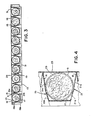
- FIG. 3 A cross-sectional view of a multilamp photoflash unit having a horizontal linear array of aligned cavities 15 each containing a flashlamp 9 is illustrated in FIG. 3.
- a single reflector or lamp module is shown in FIG. 4.
- each of the cavities 15 has a reflective surface 16 contiguous to the flashlamps 9 and is formed to provide a reflective surface opening 23.
- the reflective surface 16 of the cavities 15 includes a planar rear wall section 17.
- the above-mentioned planar rear wall section 17 has a recessed lower portion 17a for accommodation of projections (not shown) from the. printed circuit board 11.
- Each of these bi-planar sidewall sections 19 and 21 includes a pair of juxtaposed longitudinal planar segments 19a and 19b and 21a a and 21b which may be but not necessarily need be of the same size.
- the segments 19a and 19b are joined to form an obtuse angle between the surfaces thereof within the cavity, and the segments 21a a and 21 are joined in like manner.
- Each lamp is then nested in a respective reflector, as best shown in FIG.
- tubular lamp envelope having portions contiguous with the rear wall section 17 and all of the sidewall planar segments 19a, 19b, 21a and 21b.
- aperture plane of each reflector cavity represented by the position of the front housing portion 29, is substantially contiguous with the front surface of each lamp envelope 9, as shown in FIGS. 7 and 4.
- the bi-planar sidewall sections 19 and 21 extend outwardly from the planar rear wall section 17 to form the reflective surface opening 23. Moreover, this reflective surface opening 23 for each of the cavities 15 has a width dimension such that the ratio thereof to the diameter of a flashlamp 9 is less than about 1.2.
- thermovacuumforming technique utilizing a thin, thermoplastic film. Also, it has been found that thermovacuumforming to provide a planar rear wall section 17 and a reflector opening-to-depth ratio of less than about 1.2 tends to cause excessive thinning of the sidewall corners forming the rear wall section 17.
- the reflector cavities were thermo-vacuum-formed in a sheet of polyvinyl chloride with a maximum wall thickness of 0.38 mm (15 mils).
- the height of each reflector cavity was about 28.6 mm (1-1/8 inch).
- the width of each reflector opening was about 9.4 mm (0.370 inch), and the outside diameter of each lamp envelope (lacquer coated glass) was about 8.13 mm (0.320 inch) to 8.38 mm (0.330 inch).
- the ratio of reflector width opening-to-lamp diameter was about 1.16 to 1.12.
- the typical maximum and minimum wall thicknesses for each cavity were about 0.35 mm (14 mils) and 0.10 mm (4 mils), respectively.
- the light distribution was about 1.3:1 and the total light output was about 330 zonal lumenseconds.
- a multilamp photoflash unit which includes a plurality of cavities aligned in a single plane with each cavity including a reflective surface having a width of reflective surface opening to flashlamp diameter ratio of less than about 1.2.
- the unit not only provides an enhanced uniformity and increased intensity of light on a photographic exposure area, due to the minimized ratio of reflector opening to lamp diameter together with a planar rear wall section, but the unit also provides greatly improved packaging capability in reduced space, while retaining structural integrity, due to the bi-planar sidewall configuration.
Landscapes
- Physics & Mathematics (AREA)
- General Physics & Mathematics (AREA)
- Stroboscope Apparatuses (AREA)
Description
- This invention relates to photoflash units and, more particularly to compact reflector-lamp modules and multilamp photoflash arrays having a multiplicity of such reflector-lamp modules in close-nested relationship.
- Generally, multilamp photoflash units may be characterized as either cube or linear array configurations. Cube unit configurations are illustrated by US-A-3,730,669, referred to as magicube. A linear array configuration is depicted in US-A-3,857,667, referred to as a flashbar, and planar array configurations are shown in US-A-3,894,226 and 4,017,728, referred to as a flip flash.
- Significantly, all of the above-mentioned multilamp photoflash units employ self-contained reflectors of a substantially parabolic design. An example is shown in US-A-3,609,332. As is well known, a point source located at the focal point of a parabolic reflector has a high forward reflecting capability and provides a light beam which is substantially parallel and of a width equal to the reflector opening. However, a flashlamp is not a point source but rather a relatively large light source. As a result, the light is not reflected as a parallel light beam but rather is dispensed in a manner such that the light intensity is greater at a center region of a photographic zone than at the zones surrounding the center zone. Thus, the center zone of a photographic area tends to exhibit overexposure characteristics while the surrounding zones tend to be normal or underexposed.
- As known in the art, the method of measuring light distribution across the photgraphic zone is by comparing the light output in the center to the average output of 5° zone between 15° and 20° inside the perimeter of the picture area. To our knowledge, prior art lamp reflector modules have provided a distribution between 1.6:1 and 2:1. This means that the center has nearly twice the exposure of the edge; this is nearly a full f-stop setting on the camera lens.
- Ideally, a distribution ratio of 1:1 is desired; however, even a bare (unreflected) lamp will provide a distribution of about 1.3:1 because of the cosine law of light distribution. Elimination of a focusing reflector, of course, results in a significant loss of light output. Hence, in practice, a lamp-reflector system providing a 1.3:1 ratio of light distribution would be a significant improvement in light uniformity while retaining a degree of output enhancement.
- A further consideration in the improvement of photoflash unit design is the provision of a compact reflector-lamp module to facilitate closer lamp spacing for a reduced package volume. US-A-3,860,809 describes a lamp-reflector combination wherein the ratio of the width of the reflector opening-to-lamp envelope diameter is from about 1.2 to 2. Further the reflector is described as having an arcuate rear wall portion that is in nested relationship with the lamp envelope and has substantially flat outwardly diverging sidewall segments. US-A-3,991,308 shows a reflector having a cylindrical central portion and flat side portions. US-A-3,267,272 shows a reflector with a substantially V-shaped cross-section.
- We have found that the arcuate, cylindrical and V-shaped rear portions of the reflector cavities are comparatively disadvantageous with respect to light output in very reduced (compact) ratios of relfector opening-to-lamp diameter. More specifically, a planar rear segment has been found to provide a gain in zonal lumen output US-A-3,508,040 shows a reflector with a planar back portion and a pair of single planar side portions.
- The simplest and least costly method of producing reflectors is by thermo-vacuum-forming of thin, thermoplastic film. With reduced ratios of reflector opening-to-lamp diameter, however, excessive thinning of the rear portion of the reflector results. The aforementioned planar rear section design with single flat sides exaggerates the problem even further; for example, we have observed plastic thinning at the corners of the cavity walls whereby the minimum thickness is less than 10% of the maximum thickness. The smaller the reflector opening-to-lamp diameter or, conversely, the larger the lamp diameter-to- reflector opening, the greater the plastic thinning.
- Finally, US-A-3,454,756 shows a multilamp photoflash unit comprising a reflector having a plurality of lamp-receiving cavities each having a planar rear wall section joined to a pair of oppositely disposed sidewall sections defining a front reflector opening width, and a flashlamp having a tubular envelope disposed within each of said cavities with said envelope contiguous to said planar rear wall section and said oppositely disposed wall sections.
- This known structure is box-like and rectangular in cross-section, i.e. the sidewalls are vertically arranged with respect to the rear wall. It is disadvantageous to have a ratio of reflector opening width to flashlamp diameter of 1 as it is the case with the said prior art; this is so because there is no angle of divergence between the two sidewalls flanking the rear wall and, hence, the light output is affected. A further disadvantage is to be seen in the fact that, when thermo-vaccum- forming the body frame of the known unit out of a thin, thermoplastic film is carried out, excessive thinning of the rear portion of the reflector results. The said problem is enhanced in cases in which monoplanar sidewalls are provided, as it is the case with the said known embodiment.
- The object of the present invention is to provide an improved multilamp photoflash unit in accordance with the last-mentioned publication having a more compact reflector opening-to-lamp diameter ratio with improved structural integrity and light output and being economical to fabricate and providing enhanced packaging capabilities.
- This is achieved in accordance with the invention by a multilamp photoflash unit comprising a reflector and the further features mentioned above as taken from the last-mentioned publication by adding the features that said sidewall sections of each cavity are biplanar and consist each of a pair of longitudinal planar segments joined to form an obtuse angle between the reflective surfaces thereof within the cavity, and that the ratio of said reflector opening width with respect to the flashlamp diameter is less than about 1.2.
- One effect of this cavity configuration and narrow reflector opening with respect to lamp diameter is to enhance light distribution while providing acceptable light output. The improved distribution is due to the use of a non-focusing reflector arrangement, and the light loss expected to result therefrom is compensated for by the larger lamp (with respect to reflector size) and the planar rear wall section.
- Preferably a light-transmitting front portion of the housing means is attached to the back portion and covers the cavity openings to enclose the lamps. When disposed in a unidirectional planar array, particularly a horizontal linear array, the peripheries of adjacent cavity openings are substantially contiguous, and a compact, close-nested package results. Typically the housing back portion is a formed sheet of plastic film with the cavities formed therein. With the defined planar rear wall and biplanar sidewalls, plastic thinning of each cavity wall is reduced, whereby the minimum thickness is greater than one-quarter the maximum thickness, thereby maintaining structural integrity. Further, in the compact package, the front portion of the housing means is substantially planar and contiguous with the front surfaces of the plurality of lamp envelope.
-
- FIG. 1 is a perspective view of a preferred embodiment of a multilamp photoflash unit embodying the invention;
- FIG. 2 is an exploded view of the embodiment of FIG. 1;
- FIG. 3 is a planar sectional view of FIG. 1 taken along the lines 3-3; and
- FIG. 4 is an enlarged view of a single reflective surface and flashlamp of FIG. 3.
- For a better understanding of the present invention, together with other and further objects, advantages and capabilities thereof, reference is made to the following disclosure and appended claims in conjunction with the accompanying drawings.
- Referring to the drawings, FIGS. 1 and 2 illustrate a multilamp photoflash unit which includes a housing member 7, a multiplicity of
flashlamps 9 disposed within the housing member 7 and a printed circuit board 11 positioned to extend into the housing member 7. The printed circuit board 11 includes terminals 11 electrically coupled to theflashlamps 9 and provides for external access of electrical energy to theflashlamps 9 within the housing member 7. - In more detail, the housing member 7 has a
back portion 13 formed to provide a plurality ofcavities 15 disposed in a planar array facing in one direction, in this embodiment. Each of thecavities 15 is or has affixed thereto areflective surface 16 which includes a planarrear wall section 17 and a pair of oppositely-disposed bi- planarside wall sections bi-planar side sections rear section 17 to form areflective surface opening 23. - Positionally located to contact, or join, the
back portion 13 of the housing member 7 is the printed circuit board 11. This printed circuit board 11 extends inwardly of at least a portion of the multiplicity ofcavities 15 and provides electrical access thereto from an energy source external to the housing member 7. - Also, each
flashlamp 9 has a tubular envelope disposed within each of thecavities 15 contiguous to thereflective surface 16, and the longitudinal axis of each lamp envelope is disposed parallel to the longitudinal axis of the reflector cavity. Each of theflashlamps 9 includes a pair oflead wires 27 which are formed for connection to the printed circuit board 11 and serve to provide a path for energization of theflashlamp 9 by way of the printed circuit board 11. - Further, the housing member 7 includes a light-transmitting
front portion 29 which is attached to theback section 13. This substantiallyplanar front portion 29 coversopenings 23 and encloses theflashlamps 9 within thecavities 15. Moreover, thefront portion 29 has a rearwardly directedweb 31 which encloses and protects the connections of thelead wires 27 of theflashlamps 9 to the printed circuit board 11. - Referring again to the housing member 7, a cross-sectional view of a multilamp photoflash unit having a horizontal linear array of aligned
cavities 15 each containing aflashlamp 9 is illustrated in FIG. 3. A single reflector or lamp module is shown in FIG. 4. - Although not evident from the diagrammatic illustration of FIG. 3, each of the
cavities 15 has areflective surface 16 contiguous to theflashlamps 9 and is formed to provide areflective surface opening 23. - Also, the
reflective surface 16 of thecavities 15 includes a planarrear wall section 17. In the particular embodiment of FIG. 2, it is to be noted that the above-mentioned planarrear wall section 17 has a recessed lower portion 17a for accommodation of projections (not shown) from the. printed circuit board 11. - Joined to and extending outwardly from the planar
rear wall section 17 of each of thecavities 15 is a pair of oppositely disposed bi-planarside wall sections bi-planar sidewall sections planar segments segments rear wall section 17 and all of the sidewallplanar segments front housing portion 29, is substantially contiguous with the front surface of eachlamp envelope 9, as shown in FIGS. 7 and 4. - The
bi-planar sidewall sections rear wall section 17 to form thereflective surface opening 23. Moreover, this reflective surface opening 23 for each of thecavities 15 has a width dimension such that the ratio thereof to the diameter of aflashlamp 9 is less than about 1.2. - It has been found that the simplest and least costly method of producing the above-mentioned housing member back
portion 13 having a plurality ofcavities 15 is a thermovacuumforming technique utilizing a thin, thermoplastic film. Also, it has been found that thermovacuumforming to provide a planarrear wall section 17 and a reflector opening-to-depth ratio of less than about 1.2 tends to cause excessive thinning of the sidewall corners forming therear wall section 17. - However, this undesired excessive thinning of the rear portion of the reflector cavity is greatly reduced by providing the biplanar oppositely disposed
side sections biplanar side sections cavities 15 are achieved. - In a specific implementation, such as illustrated in the drawings, the reflector cavities were thermo-vacuum-formed in a sheet of polyvinyl chloride with a maximum wall thickness of 0.38 mm (15 mils). The height of each reflector cavity was about 28.6 mm (1-1/8 inch). The width of each reflector opening was about 9.4 mm (0.370 inch), and the outside diameter of each lamp envelope (lacquer coated glass) was about 8.13 mm (0.320 inch) to 8.38 mm (0.330 inch). Hence, the ratio of reflector width opening-to-lamp diameter was about 1.16 to 1.12. The typical maximum and minimum wall thicknesses for each cavity were about 0.35 mm (14 mils) and 0.10 mm (4 mils), respectively. Upon flashing each lamp in the reflector array, the light distribution was about 1.3:1 and the total light output was about 330 zonal lumenseconds.
- While there has been shown and described what is at present considered the preferred embodiments of the invention, it will be obvious to those skilled in the art that various changes and modifications may be made therein without departing from the scope of the invention as defined by the appended claims.
- A multilamp photoflash unit has been provided which includes a plurality of cavities aligned in a single plane with each cavity including a reflective surface having a width of reflective surface opening to flashlamp diameter ratio of less than about 1.2. The unit not only provides an enhanced uniformity and increased intensity of light on a photographic exposure area, due to the minimized ratio of reflector opening to lamp diameter together with a planar rear wall section, but the unit also provides greatly improved packaging capability in reduced space, while retaining structural integrity, due to the bi-planar sidewall configuration.
Claims (6)
Applications Claiming Priority (2)
| Application Number | Priority Date | Filing Date | Title |
|---|---|---|---|
| US06/217,721 US4371913A (en) | 1980-12-18 | 1980-12-18 | Reflector lamp module for photoflash array |
| US217721 | 1988-07-11 |
Publications (3)
| Publication Number | Publication Date |
|---|---|
| EP0054864A2 EP0054864A2 (en) | 1982-06-30 |
| EP0054864A3 EP0054864A3 (en) | 1982-09-29 |
| EP0054864B1 true EP0054864B1 (en) | 1986-04-16 |
Family
ID=22812225
Family Applications (1)
| Application Number | Title | Priority Date | Filing Date |
|---|---|---|---|
| EP81110356A Expired EP0054864B1 (en) | 1980-12-18 | 1981-12-11 | Reflector lamp module for photoflash array |
Country Status (5)
| Country | Link |
|---|---|
| US (1) | US4371913A (en) |
| EP (1) | EP0054864B1 (en) |
| JP (1) | JPS57129425A (en) |
| CA (1) | CA1181727A (en) |
| DE (1) | DE3174428D1 (en) |
Families Citing this family (3)
| Publication number | Priority date | Publication date | Assignee | Title |
|---|---|---|---|---|
| JPS57162202A (en) * | 1981-03-30 | 1982-10-06 | Fuji Photo Optical Co Ltd | Bar-shaped electronic light emitting device |
| US4581682A (en) * | 1985-03-06 | 1986-04-08 | Gte Products Corporation | Prismatic sympathetic flash barriers |
| US6270228B1 (en) | 1999-03-31 | 2001-08-07 | Astron Systems, Inc. | Studio lighting system |
Family Cites Families (7)
| Publication number | Priority date | Publication date | Assignee | Title |
|---|---|---|---|---|
| US3454756A (en) * | 1966-07-14 | 1969-07-08 | Tokyo Shibaura Electric Co | Flash bulb magazine |
| NL7016259A (en) * | 1970-11-06 | 1972-05-09 | ||
| US3860809A (en) * | 1973-07-17 | 1975-01-14 | Westinghouse Electric Corp | Photoflash lamp-reflector module and miniature multiflash units for photographic cameras |
| NL7313364A (en) * | 1973-09-28 | 1975-04-02 | Philips Nv | FLASH LAMP UNIT. |
| US4155110A (en) * | 1977-09-01 | 1979-05-15 | Gte Sylvania, Incorporated | Reflector-lamp module for photoflash array |
| US4136377A (en) * | 1978-02-16 | 1979-01-23 | Gte Sylvania Incorporated | Foldable photoflash lamp unit |
| US4243371A (en) * | 1978-03-13 | 1981-01-06 | General Electric Company | Flash lamp array construction |
-
1980
- 1980-12-18 US US06/217,721 patent/US4371913A/en not_active Expired - Fee Related
-
1981
- 1981-12-10 CA CA000391984A patent/CA1181727A/en not_active Expired
- 1981-12-11 DE DE8181110356T patent/DE3174428D1/en not_active Expired
- 1981-12-11 EP EP81110356A patent/EP0054864B1/en not_active Expired
- 1981-12-17 JP JP56202579A patent/JPS57129425A/en active Pending
Also Published As
| Publication number | Publication date |
|---|---|
| EP0054864A3 (en) | 1982-09-29 |
| US4371913A (en) | 1983-02-01 |
| DE3174428D1 (en) | 1986-05-22 |
| EP0054864A2 (en) | 1982-06-30 |
| CA1181727A (en) | 1985-01-29 |
| JPS57129425A (en) | 1982-08-11 |
Similar Documents
| Publication | Publication Date | Title |
|---|---|---|
| US3598984A (en) | Photoflash lamp array | |
| US4356538A (en) | Photographic lighting apparatus | |
| US4304479A (en) | Photographic lighting apparatus | |
| JP2004349628A (en) | Semiconductor light emitting device and photographing lighting device using the same | |
| US5999751A (en) | Flash device and reflector for flash discharge tube | |
| EP0054864B1 (en) | Reflector lamp module for photoflash array | |
| US4136378A (en) | Photoflash lamp array having reflector at rear of transparent circuit board | |
| EP1564586B1 (en) | Reflector for electronic flashing device and electronic flashing device | |
| US3614412A (en) | Photoflash lamp assembly | |
| US3993896A (en) | Compact multiflash unit having protective cover component with integral light controlling means | |
| US6381415B1 (en) | Flash apparatus and camera using the same | |
| US5852751A (en) | Strobe light and image recorder containing that strobe light | |
| US4462063A (en) | Photoflash unit having optical system including aspheric lens to enhance light output | |
| JP4207521B2 (en) | Surface light source device | |
| JPS6286340A (en) | Lighting fixture for photography | |
| CA1135671A (en) | Flashlamp disk containing internal reflectors | |
| US4155110A (en) | Reflector-lamp module for photoflash array | |
| US4399490A (en) | Opaque reflector for multilamp photoflash array | |
| US6088543A (en) | Optical transmission element, and illumination device employing this optical transmission element | |
| US3597602A (en) | Photoflash reflector suitable for flashcube | |
| EP0055410B1 (en) | Photoflash unit with reflector recesses for circuit board switches | |
| US3272067A (en) | Copying apparatus | |
| US4385888A (en) | Vacuum-formed housing array | |
| JP2002250960A (en) | Lighting equipment | |
| US4281363A (en) | Multilamp photoflash unit with reflective-protective circuit board element |
Legal Events
| Date | Code | Title | Description |
|---|---|---|---|
| PUAI | Public reference made under article 153(3) epc to a published international application that has entered the european phase |
Free format text: ORIGINAL CODE: 0009012 |
|
| 17P | Request for examination filed |
Effective date: 19811211 |
|
| AK | Designated contracting states |
Designated state(s): BE DE FR GB IT NL |
|
| PUAL | Search report despatched |
Free format text: ORIGINAL CODE: 0009013 |
|
| AK | Designated contracting states |
Designated state(s): BE DE FR GB IT NL |
|
| GRAA | (expected) grant |
Free format text: ORIGINAL CODE: 0009210 |
|
| AK | Designated contracting states |
Kind code of ref document: B1 Designated state(s): BE DE FR GB IT NL |
|
| PG25 | Lapsed in a contracting state [announced via postgrant information from national office to epo] |
Ref country code: IT Free format text: LAPSE BECAUSE OF FAILURE TO SUBMIT A TRANSLATION OF THE DESCRIPTION OR TO PAY THE FEE WITHIN THE PRESCRIBED TIME-LIMIT;WARNING: LAPSES OF ITALIAN PATENTS WITH EFFECTIVE DATE BEFORE 2007 MAY HAVE OCCURRED AT ANY TIME BEFORE 2007. THE CORRECT EFFECTIVE DATE MAY BE DIFFERENT FROM THE ONE RECORDED. Effective date: 19860416 |
|
| REF | Corresponds to: |
Ref document number: 3174428 Country of ref document: DE Date of ref document: 19860522 |
|
| ET | Fr: translation filed | ||
| PG25 | Lapsed in a contracting state [announced via postgrant information from national office to epo] |
Ref country code: BE Effective date: 19861231 |
|
| PLBE | No opposition filed within time limit |
Free format text: ORIGINAL CODE: 0009261 |
|
| STAA | Information on the status of an ep patent application or granted ep patent |
Free format text: STATUS: NO OPPOSITION FILED WITHIN TIME LIMIT |
|
| 26N | No opposition filed | ||
| BERE | Be: lapsed |
Owner name: GTE PRODUCTS CORP. Effective date: 19861231 |
|
| PG25 | Lapsed in a contracting state [announced via postgrant information from national office to epo] |
Ref country code: NL Effective date: 19870701 |
|
| NLV4 | Nl: lapsed or anulled due to non-payment of the annual fee | ||
| GBPC | Gb: european patent ceased through non-payment of renewal fee | ||
| PG25 | Lapsed in a contracting state [announced via postgrant information from national office to epo] |
Ref country code: FR Free format text: LAPSE BECAUSE OF NON-PAYMENT OF DUE FEES Effective date: 19870831 |
|
| PG25 | Lapsed in a contracting state [announced via postgrant information from national office to epo] |
Ref country code: DE Effective date: 19870901 |
|
| REG | Reference to a national code |
Ref country code: FR Ref legal event code: ST |
|
| PG25 | Lapsed in a contracting state [announced via postgrant information from national office to epo] |
Ref country code: GB Free format text: LAPSE BECAUSE OF NON-PAYMENT OF DUE FEES Effective date: 19881121 |