EP0053876A1 - Transparent polyamides - Google Patents
Transparent polyamides Download PDFInfo
- Publication number
- EP0053876A1 EP0053876A1 EP81305198A EP81305198A EP0053876A1 EP 0053876 A1 EP0053876 A1 EP 0053876A1 EP 81305198 A EP81305198 A EP 81305198A EP 81305198 A EP81305198 A EP 81305198A EP 0053876 A1 EP0053876 A1 EP 0053876A1
- Authority
- EP
- European Patent Office
- Prior art keywords
- mole percent
- total
- present
- aminocyclohexyl
- methane
- Prior art date
- Legal status (The legal status is an assumption and is not a legal conclusion. Google has not performed a legal analysis and makes no representation as to the accuracy of the status listed.)
- Granted
Links
- 239000004952 Polyamide Substances 0.000 title claims abstract description 19
- 229920002647 polyamide Polymers 0.000 title claims abstract description 19
- NAQMVNRVTILPCV-UHFFFAOYSA-N hexane-1,6-diamine Chemical compound NCCCCCCN NAQMVNRVTILPCV-UHFFFAOYSA-N 0.000 claims abstract description 38
- QQVIHTHCMHWDBS-UHFFFAOYSA-N isophthalic acid Chemical compound OC(=O)C1=CC=CC(C(O)=O)=C1 QQVIHTHCMHWDBS-UHFFFAOYSA-N 0.000 claims abstract description 24
- KKEYFWRCBNTPAC-UHFFFAOYSA-N Terephthalic acid Chemical compound OC(=O)C1=CC=C(C(O)=O)C=C1 KKEYFWRCBNTPAC-UHFFFAOYSA-N 0.000 claims abstract description 20
- 239000002253 acid Substances 0.000 claims abstract description 15
- 150000007513 acids Chemical class 0.000 claims abstract description 14
- DZIHTWJGPDVSGE-UHFFFAOYSA-N 4-[(4-aminocyclohexyl)methyl]cyclohexan-1-amine Chemical compound C1CC(N)CCC1CC1CCC(N)CC1 DZIHTWJGPDVSGE-UHFFFAOYSA-N 0.000 claims abstract description 13
- 150000001412 amines Chemical class 0.000 claims abstract description 11
- DYLIWHYUXAJDOJ-OWOJBTEDSA-N (e)-4-(6-aminopurin-9-yl)but-2-en-1-ol Chemical compound NC1=NC=NC2=C1N=CN2C\C=C\CO DYLIWHYUXAJDOJ-OWOJBTEDSA-N 0.000 claims abstract description 10
- 229920005989 resin Polymers 0.000 claims abstract description 10
- 239000011347 resin Substances 0.000 claims abstract description 10
- 238000000465 moulding Methods 0.000 claims abstract description 7
- 239000000155 melt Substances 0.000 claims abstract description 4
- 229920000642 polymer Polymers 0.000 description 16
- 238000000034 method Methods 0.000 description 13
- 239000000203 mixture Substances 0.000 description 12
- XLYOFNOQVPJJNP-UHFFFAOYSA-N water Substances O XLYOFNOQVPJJNP-UHFFFAOYSA-N 0.000 description 12
- 150000004985 diamines Chemical class 0.000 description 9
- 238000006116 polymerization reaction Methods 0.000 description 8
- QTBSBXVTEAMEQO-UHFFFAOYSA-N Acetic acid Chemical compound CC(O)=O QTBSBXVTEAMEQO-UHFFFAOYSA-N 0.000 description 6
- 238000002360 preparation method Methods 0.000 description 6
- 239000000243 solution Substances 0.000 description 6
- 238000010521 absorption reaction Methods 0.000 description 5
- 229920001577 copolymer Polymers 0.000 description 5
- 150000003839 salts Chemical class 0.000 description 5
- 239000002904 solvent Substances 0.000 description 5
- 239000012266 salt solution Substances 0.000 description 4
- PFANXOISJYKQRP-UHFFFAOYSA-N 2-tert-butyl-4-[1-(5-tert-butyl-4-hydroxy-2-methylphenyl)butyl]-5-methylphenol Chemical compound C=1C(C(C)(C)C)=C(O)C=C(C)C=1C(CCC)C1=CC(C(C)(C)C)=C(O)C=C1C PFANXOISJYKQRP-UHFFFAOYSA-N 0.000 description 3
- OKKJLVBELUTLKV-UHFFFAOYSA-N Methanol Chemical compound OC OKKJLVBELUTLKV-UHFFFAOYSA-N 0.000 description 3
- 229960000583 acetic acid Drugs 0.000 description 3
- 239000004205 dimethyl polysiloxane Substances 0.000 description 3
- 235000013870 dimethyl polysiloxane Nutrition 0.000 description 3
- 239000000839 emulsion Substances 0.000 description 3
- 239000012362 glacial acetic acid Substances 0.000 description 3
- 229920000435 poly(dimethylsiloxane) Polymers 0.000 description 3
- HHJJPFYGIRKQOM-UHFFFAOYSA-N sodium;oxido-oxo-phenylphosphanium Chemical compound [Na+].[O-][P+](=O)C1=CC=CC=C1 HHJJPFYGIRKQOM-UHFFFAOYSA-N 0.000 description 3
- 150000003504 terephthalic acids Chemical class 0.000 description 3
- 229920006029 tetra-polymer Polymers 0.000 description 3
- OFOBLEOULBTSOW-UHFFFAOYSA-N Malonic acid Chemical compound OC(=O)CC(O)=O OFOBLEOULBTSOW-UHFFFAOYSA-N 0.000 description 2
- 239000003963 antioxidant agent Substances 0.000 description 2
- 238000009835 boiling Methods 0.000 description 2
- 238000006243 chemical reaction Methods 0.000 description 2
- 238000001125 extrusion Methods 0.000 description 2
- 239000012760 heat stabilizer Substances 0.000 description 2
- 239000000178 monomer Substances 0.000 description 2
- -1 polydimethylsiloxane Polymers 0.000 description 2
- SCVFZCLFOSHCOH-UHFFFAOYSA-M potassium acetate Chemical compound [K+].CC([O-])=O SCVFZCLFOSHCOH-UHFFFAOYSA-M 0.000 description 2
- 238000012360 testing method Methods 0.000 description 2
- IJGRMHOSHXDMSA-UHFFFAOYSA-N Atomic nitrogen Chemical compound N#N IJGRMHOSHXDMSA-UHFFFAOYSA-N 0.000 description 1
- 238000012695 Interfacial polymerization Methods 0.000 description 1
- 239000004677 Nylon Substances 0.000 description 1
- 239000012963 UV stabilizer Substances 0.000 description 1
- 239000000654 additive Substances 0.000 description 1
- 125000000217 alkyl group Chemical group 0.000 description 1
- 238000000137 annealing Methods 0.000 description 1
- 239000002518 antifoaming agent Substances 0.000 description 1
- 230000003078 antioxidant effect Effects 0.000 description 1
- 239000007864 aqueous solution Substances 0.000 description 1
- 230000015556 catabolic process Effects 0.000 description 1
- 150000001805 chlorine compounds Chemical class 0.000 description 1
- 229920006026 co-polymeric resin Polymers 0.000 description 1
- 230000006835 compression Effects 0.000 description 1
- 238000007906 compression Methods 0.000 description 1
- 238000009833 condensation Methods 0.000 description 1
- 230000005494 condensation Effects 0.000 description 1
- 238000006731 degradation reaction Methods 0.000 description 1
- 229910001873 dinitrogen Inorganic materials 0.000 description 1
- 239000006185 dispersion Substances 0.000 description 1
- 230000000694 effects Effects 0.000 description 1
- 239000003063 flame retardant Substances 0.000 description 1
- 238000010528 free radical solution polymerization reaction Methods 0.000 description 1
- 239000011521 glass Substances 0.000 description 1
- 238000010438 heat treatment Methods 0.000 description 1
- 238000007654 immersion Methods 0.000 description 1
- 229910052500 inorganic mineral Inorganic materials 0.000 description 1
- 238000004519 manufacturing process Methods 0.000 description 1
- 238000002844 melting Methods 0.000 description 1
- 230000008018 melting Effects 0.000 description 1
- 239000011707 mineral Substances 0.000 description 1
- 229920001778 nylon Polymers 0.000 description 1
- 150000007524 organic acids Chemical class 0.000 description 1
- 239000003960 organic solvent Substances 0.000 description 1
- 239000008188 pellet Substances 0.000 description 1
- 239000000049 pigment Substances 0.000 description 1
- 239000004014 plasticizer Substances 0.000 description 1
- 229920006122 polyamide resin Polymers 0.000 description 1
- 235000011056 potassium acetate Nutrition 0.000 description 1
- 239000012744 reinforcing agent Substances 0.000 description 1
- 239000011833 salt mixture Substances 0.000 description 1
- 238000007493 shaping process Methods 0.000 description 1
- 239000000126 substance Substances 0.000 description 1
- 239000012745 toughening agent Substances 0.000 description 1
- 238000004260 weight control Methods 0.000 description 1
- 230000004584 weight gain Effects 0.000 description 1
- 235000019786 weight gain Nutrition 0.000 description 1
Classifications
-
- C—CHEMISTRY; METALLURGY
- C08—ORGANIC MACROMOLECULAR COMPOUNDS; THEIR PREPARATION OR CHEMICAL WORKING-UP; COMPOSITIONS BASED THEREON
- C08G—MACROMOLECULAR COMPOUNDS OBTAINED OTHERWISE THAN BY REACTIONS ONLY INVOLVING UNSATURATED CARBON-TO-CARBON BONDS
- C08G69/00—Macromolecular compounds obtained by reactions forming a carboxylic amide link in the main chain of the macromolecule
- C08G69/02—Polyamides derived from amino-carboxylic acids or from polyamines and polycarboxylic acids
- C08G69/26—Polyamides derived from amino-carboxylic acids or from polyamines and polycarboxylic acids derived from polyamines and polycarboxylic acids
- C08G69/265—Polyamides derived from amino-carboxylic acids or from polyamines and polycarboxylic acids derived from polyamines and polycarboxylic acids from at least two different diamines or at least two different dicarboxylic acids
Definitions
- This invention relates to polyamide compositions and more particularly to polyamides that are moldable into transparent articles.
- Another proposed method uses a combination of terephthalic acid and isophthalic acid as the dicarboxylic acid.component, and polycondensing them with hexamethylene diamine containing alkyl groups.
- polyamides obtained by this method have poor resistance to organic solvents such as methanol.
- Still another proposed method uses selected amounts of bis(p-aminocyclohexyl)methane, hexamethylene diamine, terephthalic acid and isophthalic acid to make a copolymer (U.S. Patent 3,597,400).
- the melt viscosity of such copolymers is still high, and the copolymers result in articles having undesirable dimensional changes in some solvents and undesirable water absorption levels.
- a polyamide molding resin consisting essentially of a polycondensate composed of units of
- the polyamide molding resins of this invention exhibit melt viscosities at 280°C of less than 30,000 poise, preferably less than 20,000 poise, measured at a shear stress of 10 dynes/cm 2 .
- the polyamides can be prepared by known polymer condensation methods in the composition ratios mentioned above. In order to form high polymers the total moles of the acids employed should equal the total moles of the diamines employed.
- Bis(p-aminocyclohexyl)methane (PACM hereinafter) used as one of the diamine components in this invention is usually a mixture of stereoisomers.
- the ratio of these isomers is important. At least 59% by weight of the PACM. should be either the trans, trans or cis, trans isomer. When this is the case, the heat distortion temperature is surprisingly higher when over 59% of either isomer is present.
- isophthalic acid and terephthalic acid derivatives thereof, such as the chlorides, may be used to prepare the polymers.
- the polymerization may be performed in accordance with known polymerization:techniques, such as melt polymerization, solution polymerization and interfacial polymerization techniques, but it is preferred to conduct the polymerization in accordance with melt polymerization procedures.
- This procedure produces polyamides having high molecular weights.
- PACM, hexamethylene diamine, terephthalic acid and isophthalic acid are mixed in such amounts that the ratio of the diamine components and the dicarboxylic acid components will be substantially equimolar and that the composition of these four monomers will satisfy the mole percents recited above.
- the components are heated at temperatures higher than the melting point of the resulting polyamide but lower than the degradation temperature thereof. Because of the volatility of the hexamethylene diamine, a slight excess is usually employed in the mix.
- the heating temperature is in the range of 170 to 300°C.
- the pressure can be in the range of from atmospheric pressure to 300 psig.
- the method of addition of starting monomers is not critical.
- salts of a combination of the diamines and acids can be made and mixed. It is also possible to disperse a mixture of the diamines in water, add a prescribed amount of a mixture of acids to the dispersion at an elevated temperature to form a solution of a mixture of nylon salts, and subject the solution to the polymerization.
- a monovalent amine or, preferably, an organic acid may be added as viscosity adjuster to a mixture of starting salts or an aqueous solution thereof.
- polyamides of this invention various conventional additives, such as heat stabilizers, UV stabilizers, glass or mineral reinforcing agents, toughening agents, flame retardants, plasticizers, antioxidants and pigments either before or after the polymerization.
- additives such as heat stabilizers, UV stabilizers, glass or mineral reinforcing agents, toughening agents, flame retardants, plasticizers, antioxidants and pigments either before or after the polymerization.
- the polyamides of the present invention possess excellent transparency, chemical resistance, heat stability and melt shapeability, and hence are valuable in the preparation of various shaped and molded articles such as films, plates, pipes, rods and containers of various types.
- the copolymer resins were prepared in an autoclave by reacting the aqueous salt solutions of the respective resins at a temperature normally below 300°C and a pressure normally below 300 psig for a suitable time, usually about two hours. When most of the water was evaporated, the pressure was gradually bled to atmospheric and the reaction was allowed to continue under vacuum until the desired molecular weight was attained. If lower molecular weight is desired, the final stage of the reaction can be carried out at atmospheric conditions rather than under vacuum.
- 6I refers to hexamethylene diamine (HMD) and isophthalic acid (I) units
- 6T refers to HMD and terephthalic acid (T) units
- PACM I refers to units of PACM and I
- PACM T refers to units of PACM and T
- HMD hexamethylene diamine
- water 82.03% HMD
- bis(p-aminocyclohexyl)-methane containing over 59% cis, trans isomer and containing 20% trans, trans isomer.
- the mixture was heated and 41.2 lb of isophthalic and 17.7 lb of terephthalic acids were added.
- the pH of the solution was adjusted to 8.62 with small amounts of HMD.
- the salt mixture was then charged into an autoclave.
- the mixture was heated to 175°C and subjected to a pressure of 180 psig.
- the water was slowly bled off while maintaining the pressure at 180 psig until the solution was concentrated enough and the temperature of the batch reached 226°C.
- the pressure was then slowly reduced to atmospheric and vacuum was applied.
- the batch temperature was then allowed to rise to about 270°C.
- the autoclave was pressured with nitrogen gas and the polymer was extruded into cylindrical strand, quenched in water, and cut into pellets.
- the tetrapolymer contained 70% isophthalic acid and 30% terephthalic acid, for a total of 100% acid; and 96.5% HMD, and 3.5% PACM, for a total of 100% diamine.
- This polymer was prepared as in the above example.
- Example 2 To 140 lb of water were added 46.5 lb HMD (concentration 82.03%) and 5.25 lb of the same bis-(p-aminocyclohexyl)methane used in Example 1.. The mixture was heated and 41.2 lb isophthalic and 17.7 lb terephthalic acids were added. The pH was then adjusted to 8.60 with small amounts of HMD. To the salt solution were added 49 grams of sodium phenylphosphinate, 97 grams of 4,4'-butylidenebis(6-tert-butyl-m-cresol), 20 ml of a 10% emulsion of polydimethylsiloxane, and 14 ml of glacial acetic acid.
- the salt charge was prepared as above using 140 lb water, 44.2 lb of hexamethylene diamine (concentration 81.45%), and 10.5 lb of the same bis(p-aminocyclohexyl)methane used in Example 1.
- the diamines were reacted with 41.2 lb isophthalic acid and 17.7 lb terephthalic acids and pH adjusted to 8.50.
- To the salt solution were added 49 grams of sodium phenylphosphinate, 97 grams of 4,4'-butyl- idenebis(6-tert-butyl-m-cresol), 20 ml of a 10% emulsion of polydimethylsiloxane, and 14 ml of glacial acetic acid.
- This polymer is the same as the polymer of Example 1 except that the PACM used contained about 48%.trans, t-rans isomer and 40% cis, trans isomer.
- Controls A and B are representative of U.S. Patent 3,597,400.
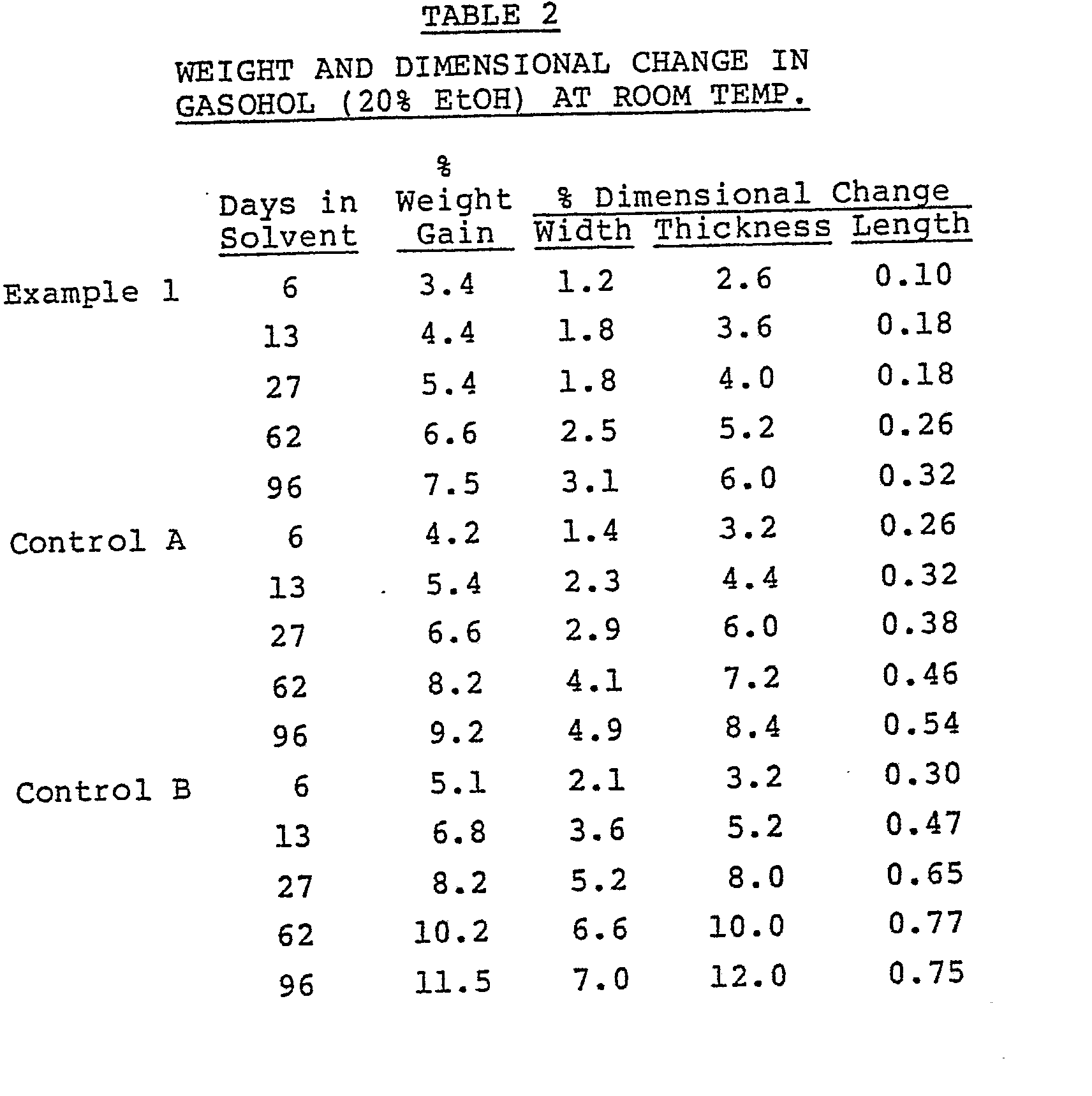
- Weight and dimensional change in various solvents were determined by immersing molded bars (12,7x1.27x0.64cm - 5"xl/2"xl/4") of the copolymers in the solvent for the time indicated and measuring the weight and dimensions periodically.
- Moisture absorption data were obtained by measuring the weight gain after immersion of samples in boiling water or boiling water containing potassium acetate (1.25 kg KAC/1 k g H 2 0) for 24 hours.
- Example 1 The polymer of Example 1 exhibited less moisture absorption than Controls A or B.
- the required amount of resin is poured into the heated barrel from a test tube and compacted using hand pressure.
- the piston is then installed and lowered (by means of the Instron crosshead) to just make contact with the polymer and a timer started. After 180 seconds, the polymer is compressed (at speed of 1 inch per minute) until polymer exits the orifice; the piston is then stopped. After an additional period of 120 seconds (total time 300 seconds) a series of extrusions at different piston speeds is made and the force required to extrude at each speed is recorded. The shear stress, shear rate and apparent melt viscosity are then calculated from this data.
- the apparent melt viscosity of the polymer of Example 1 was lower than that of the polymers of Controls A and B, thus showing that the polymer of Example 1 is easier to process in a molding machine and easier to remove from the autoclave during manufacture.
- HDT Heat Distortion Temperature
Landscapes
- Chemical & Material Sciences (AREA)
- Health & Medical Sciences (AREA)
- Chemical Kinetics & Catalysis (AREA)
- Medicinal Chemistry (AREA)
- Polymers & Plastics (AREA)
- Organic Chemistry (AREA)
- Polyamides (AREA)
Abstract
- a) 60-90 mole percent isophthalic acid, based on total acids present;
- b) 10-40 mole percent terephthalic acid, based on total acids present;
- c) 98-92 mole percent hexamethylene diamine, based on total amines present; and
- d) bis(p-aminocyclohexyl)methane the mole percent of which is between a lower limit of 2 mole percent of the total amines present and an upper limit which is 1/11 of the mole percent of a) present, and in which at least 59 percent by weight of the bis(p-aminocyclohexyl)-methane is either the trans, trans isomer or the cis, trans isomer, and having a melt viscosity at 280°C of less than 30,000 poises, can be used to provide transparent molded articles.
Description
- This invention relates to polyamide compositions and more particularly to polyamides that are moldable into transparent articles.
- Heretofore several methods for preparing transparent polyamides for use in articles such as films, pipes, rods and containers have been proposed. One such method proposes using bis(p-aminocyclohexyl)-methane as the diamine component and polycondensing it with isophthalic acid (U.S. Patent No. 2,696,482). Although polyamides obtained by this method are excellent in transparency, they have high melt viscosities, resulting in difficulty in shaping molded articles.
- Another proposed method uses a combination of terephthalic acid and isophthalic acid as the dicarboxylic acid.component, and polycondensing them with hexamethylene diamine containing alkyl groups. However, polyamides obtained by this method have poor resistance to organic solvents such as methanol.
- Still another proposed method uses selected amounts of bis(p-aminocyclohexyl)methane, hexamethylene diamine, terephthalic acid and isophthalic acid to make a copolymer (U.S. Patent 3,597,400). However, the melt viscosity of such copolymers is still high, and the copolymers result in articles having undesirable dimensional changes in some solvents and undesirable water absorption levels.
- It is the purpose of this invention to provide a polyamide resin of low melt viscosity that produces transparent articles having low dimensional change in solvents and low water absorption levels.
- A polyamide molding resin consisting essentially of a polycondensate composed of units of
- a) 60-90 mole percent isophthalic acid, based on total acids present;
- b) 10-40 mole percent terephthalic acid, based on total acids present;
- c) 98-92 mole percent hexamethylene diamine based on total amines present; and
- d) bis(p-aminocyclohexyl)methane in which the mole percent present is between a lower limit of 2 mole percent of the total amines present and an ' upper mole percent limit which is 1/11 of the mole percent of a) present, and in which at least 59 percent by weight of the bis(p-aminocyclohexyl)-methane is either the trans, trans isomer or the cis, trans isomer,
- provided the amount of acids a) and b) together comprise about 100 mole percent and provided the amount of amines c) and d) together comprise about 100 mole percent, said polyamide having a melt viscosity at 280°C of less than 30,000 poises.
- The polyamide molding resins of this invention exhibit melt viscosities at 280°C of less than 30,000 poise, preferably less than 20,000 poise, measured at a shear stress of 10 dynes/cm2.
- The polyamides can be prepared by known polymer condensation methods in the composition ratios mentioned above. In order to form high polymers the total moles of the acids employed should equal the total moles of the diamines employed.
- Bis(p-aminocyclohexyl)methane (PACM hereinafter) used as one of the diamine components in this invention is usually a mixture of stereoisomers. In the present invention the ratio of these isomers is important. At least 59% by weight of the PACM. should be either the trans, trans or cis, trans isomer. When this is the case, the heat distortion temperature is surprisingly higher when over 59% of either isomer is present.
- In addition to isophthalic acid and terephthalic acid, derivatives thereof, such as the chlorides, may be used to prepare the polymers.
- The polymerization may be performed in accordance with known polymerization:techniques, such as melt polymerization, solution polymerization and interfacial polymerization techniques, but it is preferred to conduct the polymerization in accordance with melt polymerization procedures. This procedure produces polyamides having high molecular weights. In melt polymerization, PACM, hexamethylene diamine, terephthalic acid and isophthalic acid are mixed in such amounts that the ratio of the diamine components and the dicarboxylic acid components will be substantially equimolar and that the composition of these four monomers will satisfy the mole percents recited above. The components are heated at temperatures higher than the melting point of the resulting polyamide but lower than the degradation temperature thereof. Because of the volatility of the hexamethylene diamine, a slight excess is usually employed in the mix. The heating temperature is in the range of 170 to 300°C. The pressure can be in the range of from atmospheric pressure to 300 psig.
- The method of addition of starting monomers is not critical. For example, salts of a combination of the diamines and acids can be made and mixed. It is also possible to disperse a mixture of the diamines in water, add a prescribed amount of a mixture of acids to the dispersion at an elevated temperature to form a solution of a mixture of nylon salts, and subject the solution to the polymerization.
- If desired, a monovalent amine or, preferably, an organic acid, may be added as viscosity adjuster to a mixture of starting salts or an aqueous solution thereof.
- It is also possible to add to the polyamides of this invention various conventional additives, such as heat stabilizers, UV stabilizers, glass or mineral reinforcing agents, toughening agents, flame retardants, plasticizers, antioxidants and pigments either before or after the polymerization.
- The polyamides of the present invention possess excellent transparency, chemical resistance, heat stability and melt shapeability, and hence are valuable in the preparation of various shaped and molded articles such as films, plates, pipes, rods and containers of various types.
- This invention will be explained more detailedly hereinbelow by referring to examples.
- The copolymer resins were prepared in an autoclave by reacting the aqueous salt solutions of the respective resins at a temperature normally below 300°C and a pressure normally below 300 psig for a suitable time, usually about two hours. When most of the water was evaporated, the pressure was gradually bled to atmospheric and the reaction was allowed to continue under vacuum until the desired molecular weight was attained. If lower molecular weight is desired, the final stage of the reaction can be carried out at atmospheric conditions rather than under vacuum.
- 6I refers to hexamethylene diamine (HMD) and isophthalic acid (I) units, 6T refers to HMD and terephthalic acid (T) units, PACM I refers to units of PACM and I, and PACM T refers to units of PACM and T
- To 140 lb of water were added 48.8 lb of a solution of hexamethylene diamine (HMD) in water (82.03% HMD) and 2.6 lb of bis(p-aminocyclohexyl)-methane containing over 59% cis, trans isomer and containing 20% trans, trans isomer. The mixture was heated and 41.2 lb of isophthalic and 17.7 lb of terephthalic acids were added. The pH of the solution was adjusted to 8.62 with small amounts of HMD. To the salt solution were added 49 grams of sodium phenylphosphinate heat stabilizer, 97 grams of 4,4'-butylidenebis(6-tert-butyl-m-cresol) antioxidant, 20 ml of a 10% emulsion of dimethylpolysiloxane as antifoaming agent, and 14 ml of glacial acetic acid for molecular weight control. The temperature of the solution was maintained at 70-80°C.
- The salt mixture was then charged into an autoclave. The mixture was heated to 175°C and subjected to a pressure of 180 psig. The water was slowly bled off while maintaining the pressure at 180 psig until the solution was concentrated enough and the temperature of the batch reached 226°C. The pressure was then slowly reduced to atmospheric and vacuum was applied. The batch temperature was then allowed to rise to about 270°C. When the desired molecular weight was attained the autoclave was pressured with nitrogen gas and the polymer was extruded into cylindrical strand, quenched in water, and cut into pellets.
- In terms of individual acids and diamines employed the tetrapolymer contained 70% isophthalic acid and 30% terephthalic acid, for a total of 100% acid; and 96.5% HMD, and 3.5% PACM, for a total of 100% diamine.
- This polymer was prepared as in the above example.
- To 140 lb of water were added 46.5 lb HMD (concentration 82.03%) and 5.25 lb of the same bis-(p-aminocyclohexyl)methane used in Example 1..The mixture was heated and 41.2 lb isophthalic and 17.7 lb terephthalic acids were added. The pH was then adjusted to 8.60 with small amounts of HMD. To the salt solution were added 49 grams of sodium phenylphosphinate, 97 grams of 4,4'-butylidenebis(6-tert-butyl-m-cresol), 20 ml of a 10% emulsion of polydimethylsiloxane, and 14 ml of glacial acetic acid.
- The salt charge was prepared as above using 140 lb water, 44.2 lb of hexamethylene diamine (concentration 81.45%), and 10.5 lb of the same bis(p-aminocyclohexyl)methane used in Example 1. The diamines were reacted with 41.2 lb isophthalic acid and 17.7 lb terephthalic acids and pH adjusted to 8.50. To the salt solution were added 49 grams of sodium phenylphosphinate, 97 grams of 4,4'-butyl- idenebis(6-tert-butyl-m-cresol), 20 ml of a 10% emulsion of polydimethylsiloxane, and 14 ml of glacial acetic acid.
- This polymer is the same as the polymer of Example 1 except that the PACM used contained about 48%.trans, t-rans isomer and 40% cis, trans isomer.
- Controls A and B are representative of U.S. Patent 3,597,400.
- Weight and dimensional change in various solvents were determined by immersing molded bars (12,7x1.27x0.64cm - 5"xl/2"xl/4") of the copolymers in the solvent for the time indicated and measuring the weight and dimensions periodically.
- Results are as follows in Tables 1-5.



- Moisture absorption data were obtained by measuring the weight gain after immersion of samples in boiling water or boiling water containing potassium acetate (1.25 kg KAC/1 kg H20) for 24 hours.
- Results are shown in Table 6.

- The polymer of Example 1 exhibited less moisture absorption than Controls A or B.
- Dried samples were tested in a constant rate rheometer at 280°C. The force required to extrude resin was measured at a series of predetermined piston speeds varying from 10 inches (25 cm) per minute to 0.02 inch (0.5mm) per minute, and shear stress, shear rate and apparent melt viscosity are then calculated.
- The constant rate rheometer consists of a heated extrusion assembly equipped with a piston which can be driven at predetermined speeds by means of an Instron tester. The force required to extrude the resin through the orifice is measured by a compression load cell and recorded. A 0.0468-inch (0.119cm) orifice having an L/D=16 was used for all samples.
- The required amount of resin is poured into the heated barrel from a test tube and compacted using hand pressure. The piston is then installed and lowered (by means of the Instron crosshead) to just make contact with the polymer and a timer started. After 180 seconds, the polymer is compressed (at speed of 1 inch per minute) until polymer exits the orifice; the piston is then stopped. After an additional period of 120 seconds (total time 300 seconds) a series of extrusions at different piston speeds is made and the force required to extrude at each speed is recorded. The shear stress, shear rate and apparent melt viscosity are then calculated from this data.
- For any given shear stress value, the apparent melt viscosity of the polymer of Example 1 was lower than that of the polymers of Controls A and B, thus showing that the polymer of Example 1 is easier to process in a molding machine and easier to remove from the autoclave during manufacture.
- Heat Distortion Temperature (HDT) was determined by annealing the polymer at 100°C for 30 mins prior to testing, according to ASTM D-648.
- The heat distortion temperatures of the product of Control C and of the product of Example 1 were determined and compared as .follows: 455KPa 1.82 MPa (66 psi)stress (264 psi) stress Control C 125°C 123°C Example 1 132°C 124°C
- This data shows that the tetrapolymer made from PACM used in Example 1 (over 59% requisite isomer) has a higher HDT compared to a polymer made from PACM used in Control C.
Claims (3)
Applications Claiming Priority (4)
| Application Number | Priority Date | Filing Date | Title |
|---|---|---|---|
| US20864880A | 1980-11-20 | 1980-11-20 | |
| US208648 | 1980-11-20 | ||
| US06/255,740 US4369305A (en) | 1980-11-20 | 1981-04-20 | Polyamide molding resin from PACM having specific stereo isomer ratio |
| US255740 | 1981-04-20 |
Publications (2)
| Publication Number | Publication Date |
|---|---|
| EP0053876A1 true EP0053876A1 (en) | 1982-06-16 |
| EP0053876B1 EP0053876B1 (en) | 1988-09-28 |
Family
ID=26903363
Family Applications (1)
| Application Number | Title | Priority Date | Filing Date |
|---|---|---|---|
| EP81305198A Expired EP0053876B1 (en) | 1980-11-20 | 1981-10-30 | Transparent polyamides |
Country Status (4)
| Country | Link |
|---|---|
| US (1) | US4369305A (en) |
| EP (1) | EP0053876B1 (en) |
| CA (1) | CA1167996A (en) |
| DE (1) | DE3176890D1 (en) |
Cited By (12)
| Publication number | Priority date | Publication date | Assignee | Title |
|---|---|---|---|---|
| EP0159310A3 (en) * | 1984-04-20 | 1987-12-23 | Monsanto Company | Hollow copolyamide article |
| FR2606416A1 (en) * | 1986-11-11 | 1988-05-13 | Inventa Ag | TRANSPARENT COPOLYAMIDES AND THEIR USE FOR THE SIETING OF OPTICAL FIBERS AND THE MANUFACTURE OF MOLDED OBJECTS |
| EP0290342A2 (en) | 1987-05-07 | 1988-11-09 | Elf Atochem S.A. | Thermoplastic compositions in powder form on the basis of polyamides, their preparation process and their use for coating of metallic substrats |
| EP0271308A3 (en) * | 1986-12-09 | 1988-12-14 | Mitsubishi Chemical Industries Limited | Transparent copolyamide |
| EP0229731A3 (en) * | 1986-01-17 | 1989-10-25 | E.I. Du Pont De Nemours And Company | Reinforced composites |
| FR2635329A1 (en) * | 1986-08-26 | 1990-02-16 | Inventa Ag | AMORPHOUS COPOLYAMIDES AND USES THEREOF |
| EP0423473A3 (en) * | 1989-10-20 | 1991-09-11 | Huels Aktiengesellschaft | Alcohols and boiling water resitant mouldings |
| EP0667367A3 (en) * | 1994-02-10 | 1996-04-10 | Basf Ag | Partially aromatic copolyamid mouldings with higher crystallinity. |
| US5684120A (en) * | 1995-02-01 | 1997-11-04 | Ems-Inventa Ag | Colorless, transparent copolyamides, their preparation, and molded articles made from these copolyamides, their blends or alloys |
| US7133209B2 (en) | 2003-02-25 | 2006-11-07 | Degussa Ag | Transparent molding composition for optical applications |
| DE102008002599A1 (en) | 2008-06-24 | 2009-12-31 | Evonik Degussa Gmbh | Component with cover layer of a PA613 molding compound |
| EP2957598A1 (en) * | 2014-06-20 | 2015-12-23 | Ems-Patent Ag | Composite containing a matrix material composed of an amorphous polyamide and its use |
Families Citing this family (12)
| Publication number | Priority date | Publication date | Assignee | Title |
|---|---|---|---|---|
| US4826955A (en) * | 1988-01-21 | 1989-05-02 | Allied-Signal Inc. | Amorphous copolyamide article of manufacture with moisture-insensitive oxygen barrier properties |
| DE4310970A1 (en) * | 1993-04-03 | 1994-10-06 | Huels Chemische Werke Ag | Colorless and transparent, amorphous polyamide molding compounds with good resistance to stress cracking and impact resistance |
| US6153677A (en) * | 1993-12-23 | 2000-11-28 | Ems-Inventa Ag | Flame-retardant thermoplastic polyamide molding composition and article molded therefrom |
| US5773558A (en) * | 1995-02-01 | 1998-06-30 | Ems-Inventa Ag | Transparent, colorless, amorphous polyamides and molded articles |
| US5886087A (en) * | 1995-02-01 | 1999-03-23 | Ems-Inventa Ag | Transparent, colorless, amorphous polyamides and molded articles |
| CH688624A5 (en) | 1995-02-01 | 1997-12-15 | Inventa Ag | Amorphous polyamide molding materials and fittings. |
| CA2162430A1 (en) * | 1995-02-01 | 1996-08-02 | Ems-Inventa Ag | Transparent, colorless, amorphous polyamides and molded articles |
| US6008288A (en) * | 1995-02-01 | 1999-12-28 | Ems-Inventa Ag | Transparent, colorless, amorphous polyamides and molded articles |
| US6500559B2 (en) | 1998-05-04 | 2002-12-31 | Cryovac, Inc. | Multiple layer film with amorphous polyamide layer |
| WO2002048239A1 (en) * | 2000-12-11 | 2002-06-20 | Asahi Kasei Kabushiki Kaisha | Polyamide |
| DE10224947B4 (en) * | 2002-06-05 | 2006-07-06 | Ems Chemie Ag | Transparent polyamide molding compounds with improved transparency, chemical resistance and dynamic loading capacity |
| EP1826229A1 (en) * | 2006-02-27 | 2007-08-29 | Arkema France | Amorphous copolyamides comprising p-bis(aminocyclohexyl)methane and terephtalic acid |
Citations (4)
| Publication number | Priority date | Publication date | Assignee | Title |
|---|---|---|---|---|
| CH481056A (en) * | 1965-06-09 | 1969-11-15 | Du Pont | Process for the separation of a product enriched in the trans, trans isomer from a mixture of stereoisomers of bis (p-aminocyclohexyl) methane |
| US3597400A (en) * | 1968-07-02 | 1971-08-03 | Toyo Rayon Co Ltd | Synthetic linear transparent polyamides |
| DE2034541A1 (en) * | 1970-07-11 | 1972-01-20 | Bayer | Thermoplastic transparent polyamides -frombis-(4-amino-cyclohexyl) - - methane and 3-ethyl-1,10-decane dicarboxylic acid |
| DE2743483A1 (en) * | 1977-09-28 | 1979-04-05 | Bayer Ag | Transparent polyamide with improved mechanical properties - obtd. by polycondensation of hexa:methylene di:amine and alkyl isophthalate(s) |
Family Cites Families (8)
| Publication number | Priority date | Publication date | Assignee | Title |
|---|---|---|---|---|
| US2494563A (en) * | 1947-01-08 | 1950-01-17 | Du Pont | Bis (4-aminocyclohexyl) methane |
| US2585163A (en) * | 1950-03-25 | 1952-02-12 | Du Pont | Synthetic linear polyamides |
| US2696482A (en) * | 1951-07-19 | 1954-12-07 | Du Pont | Transparent synthetic linear polyamide and process for producing same |
| DE1595354C3 (en) * | 1966-10-18 | 1978-12-07 | Basf Ag | Process for the production of polyamides |
| DE1769040B2 (en) * | 1968-03-23 | 1975-08-07 | Dynamit Nobel Ag, 5210 Troisdorf | Thermoplastic polyamide molding compounds |
| US4207411A (en) * | 1975-12-22 | 1980-06-10 | Phillips Petroleum Company | Copolyamide of branched C10 diamine, bis(4-aminocyclohexyl)-alkane, isophthalic acid and terephthalic acid |
| US4264762A (en) * | 1978-10-24 | 1981-04-28 | Basf Aktiengesellschaft | Glass-clear nylons from 3,3'-dimethyl PACM |
| US4232145A (en) * | 1978-12-18 | 1980-11-04 | Inventa Ag Fur Forschung Und Patentverwertung, Zurich | Injection moldable glass clear transparent polyamide |
-
1981
- 1981-04-20 US US06/255,740 patent/US4369305A/en not_active Expired - Lifetime
- 1981-10-30 DE DE8181305198T patent/DE3176890D1/en not_active Expired
- 1981-10-30 EP EP81305198A patent/EP0053876B1/en not_active Expired
- 1981-11-19 CA CA000390468A patent/CA1167996A/en not_active Expired
Patent Citations (4)
| Publication number | Priority date | Publication date | Assignee | Title |
|---|---|---|---|---|
| CH481056A (en) * | 1965-06-09 | 1969-11-15 | Du Pont | Process for the separation of a product enriched in the trans, trans isomer from a mixture of stereoisomers of bis (p-aminocyclohexyl) methane |
| US3597400A (en) * | 1968-07-02 | 1971-08-03 | Toyo Rayon Co Ltd | Synthetic linear transparent polyamides |
| DE2034541A1 (en) * | 1970-07-11 | 1972-01-20 | Bayer | Thermoplastic transparent polyamides -frombis-(4-amino-cyclohexyl) - - methane and 3-ethyl-1,10-decane dicarboxylic acid |
| DE2743483A1 (en) * | 1977-09-28 | 1979-04-05 | Bayer Ag | Transparent polyamide with improved mechanical properties - obtd. by polycondensation of hexa:methylene di:amine and alkyl isophthalate(s) |
Cited By (13)
| Publication number | Priority date | Publication date | Assignee | Title |
|---|---|---|---|---|
| EP0159310A3 (en) * | 1984-04-20 | 1987-12-23 | Monsanto Company | Hollow copolyamide article |
| EP0229731A3 (en) * | 1986-01-17 | 1989-10-25 | E.I. Du Pont De Nemours And Company | Reinforced composites |
| FR2635329A1 (en) * | 1986-08-26 | 1990-02-16 | Inventa Ag | AMORPHOUS COPOLYAMIDES AND USES THEREOF |
| FR2606416A1 (en) * | 1986-11-11 | 1988-05-13 | Inventa Ag | TRANSPARENT COPOLYAMIDES AND THEIR USE FOR THE SIETING OF OPTICAL FIBERS AND THE MANUFACTURE OF MOLDED OBJECTS |
| EP0271308A3 (en) * | 1986-12-09 | 1988-12-14 | Mitsubishi Chemical Industries Limited | Transparent copolyamide |
| EP0290342A2 (en) | 1987-05-07 | 1988-11-09 | Elf Atochem S.A. | Thermoplastic compositions in powder form on the basis of polyamides, their preparation process and their use for coating of metallic substrats |
| EP0423473A3 (en) * | 1989-10-20 | 1991-09-11 | Huels Aktiengesellschaft | Alcohols and boiling water resitant mouldings |
| EP0667367A3 (en) * | 1994-02-10 | 1996-04-10 | Basf Ag | Partially aromatic copolyamid mouldings with higher crystallinity. |
| US5688901A (en) * | 1994-02-10 | 1997-11-18 | Basf Aktiengesellschaft | Partly aromatic copolyamide molding materials having high crystallinity |
| US5684120A (en) * | 1995-02-01 | 1997-11-04 | Ems-Inventa Ag | Colorless, transparent copolyamides, their preparation, and molded articles made from these copolyamides, their blends or alloys |
| US7133209B2 (en) | 2003-02-25 | 2006-11-07 | Degussa Ag | Transparent molding composition for optical applications |
| DE102008002599A1 (en) | 2008-06-24 | 2009-12-31 | Evonik Degussa Gmbh | Component with cover layer of a PA613 molding compound |
| EP2957598A1 (en) * | 2014-06-20 | 2015-12-23 | Ems-Patent Ag | Composite containing a matrix material composed of an amorphous polyamide and its use |
Also Published As
| Publication number | Publication date |
|---|---|
| CA1167996A (en) | 1984-05-22 |
| EP0053876B1 (en) | 1988-09-28 |
| US4369305A (en) | 1983-01-18 |
| DE3176890D1 (en) | 1988-11-03 |
Similar Documents
| Publication | Publication Date | Title |
|---|---|---|
| EP0053876B1 (en) | Transparent polyamides | |
| DE2642244C2 (en) | Process for the production of crystal clear, transparent copolyamides and their use for the production of moldings | |
| US3597400A (en) | Synthetic linear transparent polyamides | |
| JP3190373B2 (en) | Amorphous copolyamide, method for producing the same, and method for producing molded member | |
| US4740582A (en) | Homogeneous, flexible block copolyetheramide having oxyalkylene units | |
| US4018746A (en) | Transparent copolyamides from m-xylylene diamine, an aliphatic diamine and terephthalic acid | |
| EP0070001A1 (en) | Polyamide blends | |
| EP0025828B1 (en) | Process for the production of polyether(ester) amides and their use | |
| DE2802989A1 (en) | HYDROLYSIS-RESISTANT COPOLYAETHERESTERAMIDE | |
| JPS6310168B2 (en) | ||
| US3294758A (en) | Amorphous polyamides from a mixture of an alkyl substituted aliphatic diamine and unsubstituted aliphatic diamine | |
| FI85278C (en) | Process for the preparation of copolyamides based on hex amethylenediamine, adipic acid, possibly at least one other short chain di carboxylic acid and a dimeric acid | |
| JPS6411657B2 (en) | ||
| US4087481A (en) | Amorphous copolyamide from aliphatic/aromatic dicarboxylic acid and arylene diisocyanate mixture | |
| US4072665A (en) | Polyamide from arylene diamine, isophthalic acid and alkylene dicarboxylic acid | |
| US4581440A (en) | Homogeneous block copolyetheramides flexible at low temperatures | |
| US5093421A (en) | Copolymer polyamide resin | |
| US3992360A (en) | Transparent polyamides from 1,3-bis-(aminomethyl)-cyclohexane and aliphatic amino carboxylic acid | |
| GB1558800A (en) | Polyaminde terpolymers | |
| US4717763A (en) | Block copolyetheramides flexible at low temperatures | |
| US4410684A (en) | Aromatic copolyamides containing ether linkages | |
| US3627736A (en) | Polyamides from isophorone diamine, hexamethylene diamine, isophthalic acid and terephthalic acid | |
| US4565849A (en) | Polyamide elastomer from carboxy terminated polyamide and polyoxy-2-methyl-1,3-propylene diol | |
| GB1588526A (en) | Elastomeric copolyesteramides | |
| US3776890A (en) | Polyamides from 2-(4-aminocyclohexyl)-1,1-dimethylethylamine or 2-(4-amino-phenyl)-1,1-dimethylethylamine |
Legal Events
| Date | Code | Title | Description |
|---|---|---|---|
| PUAI | Public reference made under article 153(3) epc to a published international application that has entered the european phase |
Free format text: ORIGINAL CODE: 0009012 |
|
| 17P | Request for examination filed |
Effective date: 19811030 |
|
| AK | Designated contracting states |
Designated state(s): BE CH DE FR GB IT NL |
|
| GRAA | (expected) grant |
Free format text: ORIGINAL CODE: 0009210 |
|
| AK | Designated contracting states |
Kind code of ref document: B1 Designated state(s): BE CH DE FR GB IT LI NL |
|
| ITF | It: translation for a ep patent filed | ||
| REF | Corresponds to: |
Ref document number: 3176890 Country of ref document: DE Date of ref document: 19881103 |
|
| ET | Fr: translation filed | ||
| PLBI | Opposition filed |
Free format text: ORIGINAL CODE: 0009260 |
|
| 26 | Opposition filed |
Opponent name: BAYER AG, LEVERKUSEN KONZERNVERWALTUNG RP PATENTAB Effective date: 19890621 |
|
| NLR1 | Nl: opposition has been filed with the epo |
Opponent name: BAYER AG |
|
| ITTA | It: last paid annual fee | ||
| PLBN | Opposition rejected |
Free format text: ORIGINAL CODE: 0009273 |
|
| STAA | Information on the status of an ep patent application or granted ep patent |
Free format text: STATUS: OPPOSITION REJECTED |
|
| 27O | Opposition rejected |
Effective date: 19911212 |
|
| NLR2 | Nl: decision of opposition | ||
| PGFP | Annual fee paid to national office [announced via postgrant information from national office to epo] |
Ref country code: FR Payment date: 20001010 Year of fee payment: 20 |
|
| PGFP | Annual fee paid to national office [announced via postgrant information from national office to epo] |
Ref country code: DE Payment date: 20001023 Year of fee payment: 20 |
|
| PGFP | Annual fee paid to national office [announced via postgrant information from national office to epo] |
Ref country code: GB Payment date: 20001025 Year of fee payment: 20 |
|
| PGFP | Annual fee paid to national office [announced via postgrant information from national office to epo] |
Ref country code: NL Payment date: 20001026 Year of fee payment: 20 Ref country code: CH Payment date: 20001026 Year of fee payment: 20 |
|
| PGFP | Annual fee paid to national office [announced via postgrant information from national office to epo] |
Ref country code: BE Payment date: 20001215 Year of fee payment: 20 |
|
| BE20 | Be: patent expired |
Free format text: 20011030 E.I. *DU PONT DE NEMOURS AND CY |
|
| PG25 | Lapsed in a contracting state [announced via postgrant information from national office to epo] |
Ref country code: LI Free format text: LAPSE BECAUSE OF EXPIRATION OF PROTECTION Effective date: 20011029 Ref country code: GB Free format text: LAPSE BECAUSE OF EXPIRATION OF PROTECTION Effective date: 20011029 Ref country code: CH Free format text: LAPSE BECAUSE OF EXPIRATION OF PROTECTION Effective date: 20011029 |
|
| PG25 | Lapsed in a contracting state [announced via postgrant information from national office to epo] |
Ref country code: NL Free format text: LAPSE BECAUSE OF EXPIRATION OF PROTECTION Effective date: 20011030 |
|
| REG | Reference to a national code |
Ref country code: GB Ref legal event code: PE20 Effective date: 20011029 |
|
| REG | Reference to a national code |
Ref country code: CH Ref legal event code: PL |
|
| NLV7 | Nl: ceased due to reaching the maximum lifetime of a patent |
Effective date: 20011030 |