EP0051434A1 - Electrode layer formation - Google Patents
Electrode layer formation Download PDFInfo
- Publication number
- EP0051434A1 EP0051434A1 EP81305088A EP81305088A EP0051434A1 EP 0051434 A1 EP0051434 A1 EP 0051434A1 EP 81305088 A EP81305088 A EP 81305088A EP 81305088 A EP81305088 A EP 81305088A EP 0051434 A1 EP0051434 A1 EP 0051434A1
- Authority
- EP
- European Patent Office
- Prior art keywords
- carbon
- electrode layer
- salt
- ptfe
- active
- Prior art date
- Legal status (The legal status is an assumption and is not a legal conclusion. Google has not performed a legal analysis and makes no representation as to the accuracy of the status listed.)
- Withdrawn
Links
- 230000015572 biosynthetic process Effects 0.000 title description 9
- 150000003839 salts Chemical class 0.000 claims abstract description 31
- 238000000034 method Methods 0.000 claims abstract description 25
- 239000000463 material Substances 0.000 claims abstract description 12
- OKTJSMMVPCPJKN-UHFFFAOYSA-N Carbon Chemical compound [C] OKTJSMMVPCPJKN-UHFFFAOYSA-N 0.000 claims description 53
- 229910052799 carbon Inorganic materials 0.000 claims description 49
- 239000002245 particle Substances 0.000 claims description 31
- 229920001343 polytetrafluoroethylene Polymers 0.000 claims description 27
- FAPWRFPIFSIZLT-UHFFFAOYSA-M Sodium chloride Chemical group [Na+].[Cl-] FAPWRFPIFSIZLT-UHFFFAOYSA-M 0.000 claims description 14
- BASFCYQUMIYNBI-UHFFFAOYSA-N platinum Chemical compound [Pt] BASFCYQUMIYNBI-UHFFFAOYSA-N 0.000 claims description 13
- -1 polytetrafluorethylene Polymers 0.000 claims description 8
- 239000003054 catalyst Substances 0.000 claims description 7
- 239000010970 precious metal Substances 0.000 claims description 7
- 239000011780 sodium chloride Substances 0.000 claims description 7
- 229910052697 platinum Inorganic materials 0.000 claims description 6
- 238000000151 deposition Methods 0.000 abstract description 7
- 239000007772 electrode material Substances 0.000 abstract 1
- 239000004810 polytetrafluoroethylene Substances 0.000 description 26
- 239000003513 alkali Substances 0.000 description 23
- 239000002253 acid Substances 0.000 description 18
- HEMHJVSKTPXQMS-UHFFFAOYSA-M Sodium hydroxide Chemical compound [OH-].[Na+] HEMHJVSKTPXQMS-UHFFFAOYSA-M 0.000 description 12
- QVGXLLKOCUKJST-UHFFFAOYSA-N atomic oxygen Chemical compound [O] QVGXLLKOCUKJST-UHFFFAOYSA-N 0.000 description 12
- 239000000203 mixture Substances 0.000 description 12
- 239000001301 oxygen Substances 0.000 description 12
- 229910052760 oxygen Inorganic materials 0.000 description 12
- XLYOFNOQVPJJNP-UHFFFAOYSA-N water Substances O XLYOFNOQVPJJNP-UHFFFAOYSA-N 0.000 description 11
- 239000006229 carbon black Substances 0.000 description 10
- 238000001914 filtration Methods 0.000 description 9
- 238000005406 washing Methods 0.000 description 9
- HEDRZPFGACZZDS-UHFFFAOYSA-N Chloroform Chemical compound ClC(Cl)Cl HEDRZPFGACZZDS-UHFFFAOYSA-N 0.000 description 8
- 239000000243 solution Substances 0.000 description 7
- KWYUFKZDYYNOTN-UHFFFAOYSA-M Potassium hydroxide Chemical compound [OH-].[K+] KWYUFKZDYYNOTN-UHFFFAOYSA-M 0.000 description 6
- LFQSCWFLJHTTHZ-UHFFFAOYSA-N Ethanol Chemical compound CCO LFQSCWFLJHTTHZ-UHFFFAOYSA-N 0.000 description 5
- VEXZGXHMUGYJMC-UHFFFAOYSA-N Hydrochloric acid Chemical compound Cl VEXZGXHMUGYJMC-UHFFFAOYSA-N 0.000 description 5
- UFHFLCQGNIYNRP-UHFFFAOYSA-N Hydrogen Chemical compound [H][H] UFHFLCQGNIYNRP-UHFFFAOYSA-N 0.000 description 5
- 238000001035 drying Methods 0.000 description 5
- 239000012065 filter cake Substances 0.000 description 5
- PXHVJJICTQNCMI-UHFFFAOYSA-N Nickel Chemical compound [Ni] PXHVJJICTQNCMI-UHFFFAOYSA-N 0.000 description 4
- 239000006185 dispersion Substances 0.000 description 4
- 230000009467 reduction Effects 0.000 description 4
- 235000011121 sodium hydroxide Nutrition 0.000 description 4
- 239000001257 hydrogen Substances 0.000 description 3
- 229910052739 hydrogen Inorganic materials 0.000 description 3
- 238000003475 lamination Methods 0.000 description 3
- 239000007788 liquid Substances 0.000 description 3
- 238000002360 preparation method Methods 0.000 description 3
- BQCADISMDOOEFD-UHFFFAOYSA-N Silver Chemical compound [Ag] BQCADISMDOOEFD-UHFFFAOYSA-N 0.000 description 2
- 150000007513 acids Chemical class 0.000 description 2
- 239000007864 aqueous solution Substances 0.000 description 2
- 239000010425 asbestos Substances 0.000 description 2
- 238000009835 boiling Methods 0.000 description 2
- 239000006227 byproduct Substances 0.000 description 2
- 239000011248 coating agent Substances 0.000 description 2
- 238000000576 coating method Methods 0.000 description 2
- 230000001143 conditioned effect Effects 0.000 description 2
- 230000003750 conditioning effect Effects 0.000 description 2
- 230000008021 deposition Effects 0.000 description 2
- 230000000694 effects Effects 0.000 description 2
- 239000007789 gas Substances 0.000 description 2
- 239000010439 graphite Substances 0.000 description 2
- 229910002804 graphite Inorganic materials 0.000 description 2
- 239000012528 membrane Substances 0.000 description 2
- 229910052759 nickel Inorganic materials 0.000 description 2
- 229910052895 riebeckite Inorganic materials 0.000 description 2
- 229910052709 silver Inorganic materials 0.000 description 2
- 239000004332 silver Substances 0.000 description 2
- 238000012360 testing method Methods 0.000 description 2
- 239000000080 wetting agent Substances 0.000 description 2
- 239000004215 Carbon black (E152) Substances 0.000 description 1
- KZBUYRJDOAKODT-UHFFFAOYSA-N Chlorine Chemical compound ClCl KZBUYRJDOAKODT-UHFFFAOYSA-N 0.000 description 1
- ZAMOUSCENKQFHK-UHFFFAOYSA-N Chlorine atom Chemical compound [Cl] ZAMOUSCENKQFHK-UHFFFAOYSA-N 0.000 description 1
- 229920000557 Nafion® Polymers 0.000 description 1
- 239000004809 Teflon Substances 0.000 description 1
- 229920006362 Teflon® Polymers 0.000 description 1
- RTAQQCXQSZGOHL-UHFFFAOYSA-N Titanium Chemical compound [Ti] RTAQQCXQSZGOHL-UHFFFAOYSA-N 0.000 description 1
- 230000001464 adherent effect Effects 0.000 description 1
- 229910052782 aluminium Inorganic materials 0.000 description 1
- XAGFODPZIPBFFR-UHFFFAOYSA-N aluminium Chemical compound [Al] XAGFODPZIPBFFR-UHFFFAOYSA-N 0.000 description 1
- 238000004458 analytical method Methods 0.000 description 1
- 239000011260 aqueous acid Substances 0.000 description 1
- 239000002585 base Substances 0.000 description 1
- 239000002802 bituminous coal Substances 0.000 description 1
- 239000012267 brine Substances 0.000 description 1
- 239000003575 carbonaceous material Substances 0.000 description 1
- 238000005341 cation exchange Methods 0.000 description 1
- 239000003518 caustics Substances 0.000 description 1
- 238000006243 chemical reaction Methods 0.000 description 1
- 239000000460 chlorine Substances 0.000 description 1
- 229910052801 chlorine Inorganic materials 0.000 description 1
- 230000001427 coherent effect Effects 0.000 description 1
- 238000002485 combustion reaction Methods 0.000 description 1
- 238000005336 cracking Methods 0.000 description 1
- 230000005518 electrochemistry Effects 0.000 description 1
- 239000003792 electrolyte Substances 0.000 description 1
- 230000005592 electrolytic dissociation Effects 0.000 description 1
- 238000005516 engineering process Methods 0.000 description 1
- 238000000605 extraction Methods 0.000 description 1
- 239000000835 fiber Substances 0.000 description 1
- 238000009472 formulation Methods 0.000 description 1
- 229930195733 hydrocarbon Natural products 0.000 description 1
- 150000002430 hydrocarbons Chemical class 0.000 description 1
- 230000002209 hydrophobic effect Effects 0.000 description 1
- 229910052500 inorganic mineral Inorganic materials 0.000 description 1
- 238000004519 manufacturing process Methods 0.000 description 1
- 229910052751 metal Inorganic materials 0.000 description 1
- 239000002184 metal Substances 0.000 description 1
- 235000010755 mineral Nutrition 0.000 description 1
- 239000011707 mineral Substances 0.000 description 1
- 238000002156 mixing Methods 0.000 description 1
- 229910000510 noble metal Inorganic materials 0.000 description 1
- 150000002926 oxygen Chemical class 0.000 description 1
- 238000007747 plating Methods 0.000 description 1
- 230000010287 polarization Effects 0.000 description 1
- 239000011148 porous material Substances 0.000 description 1
- 238000010992 reflux Methods 0.000 description 1
- 238000004062 sedimentation Methods 0.000 description 1
- 229910001388 sodium aluminate Inorganic materials 0.000 description 1
- GCLGEJMYGQKIIW-UHFFFAOYSA-H sodium hexametaphosphate Chemical compound [Na]OP1(=O)OP(=O)(O[Na])OP(=O)(O[Na])OP(=O)(O[Na])OP(=O)(O[Na])OP(=O)(O[Na])O1 GCLGEJMYGQKIIW-UHFFFAOYSA-H 0.000 description 1
- HPALAKNZSZLMCH-UHFFFAOYSA-M sodium;chloride;hydrate Chemical compound O.[Na+].[Cl-] HPALAKNZSZLMCH-UHFFFAOYSA-M 0.000 description 1
- 239000007858 starting material Substances 0.000 description 1
- 238000005979 thermal decomposition reaction Methods 0.000 description 1
- 239000010936 titanium Substances 0.000 description 1
- 229910052719 titanium Inorganic materials 0.000 description 1
- 238000009827 uniform distribution Methods 0.000 description 1
- 235000013311 vegetables Nutrition 0.000 description 1
Classifications
-
- H—ELECTRICITY
- H01—ELECTRIC ELEMENTS
- H01M—PROCESSES OR MEANS, e.g. BATTERIES, FOR THE DIRECT CONVERSION OF CHEMICAL ENERGY INTO ELECTRICAL ENERGY
- H01M4/00—Electrodes
- H01M4/86—Inert electrodes with catalytic activity, e.g. for fuel cells
- H01M4/90—Selection of catalytic material
- H01M4/92—Metals of platinum group
-
- C—CHEMISTRY; METALLURGY
- C01—INORGANIC CHEMISTRY
- C01B—NON-METALLIC ELEMENTS; COMPOUNDS THEREOF; METALLOIDS OR COMPOUNDS THEREOF NOT COVERED BY SUBCLASS C01C
- C01B32/00—Carbon; Compounds thereof
- C01B32/30—Active carbon
- C01B32/354—After-treatment
- C01B32/378—Purification
-
- C—CHEMISTRY; METALLURGY
- C25—ELECTROLYTIC OR ELECTROPHORETIC PROCESSES; APPARATUS THEREFOR
- C25B—ELECTROLYTIC OR ELECTROPHORETIC PROCESSES FOR THE PRODUCTION OF COMPOUNDS OR NON-METALS; APPARATUS THEREFOR
- C25B11/00—Electrodes; Manufacture thereof not otherwise provided for
-
- H—ELECTRICITY
- H01—ELECTRIC ELEMENTS
- H01M—PROCESSES OR MEANS, e.g. BATTERIES, FOR THE DIRECT CONVERSION OF CHEMICAL ENERGY INTO ELECTRICAL ENERGY
- H01M4/00—Electrodes
- H01M4/86—Inert electrodes with catalytic activity, e.g. for fuel cells
- H01M4/8663—Selection of inactive substances as ingredients for catalytic active masses, e.g. binders, fillers
- H01M4/8668—Binders
-
- H—ELECTRICITY
- H01—ELECTRIC ELEMENTS
- H01M—PROCESSES OR MEANS, e.g. BATTERIES, FOR THE DIRECT CONVERSION OF CHEMICAL ENERGY INTO ELECTRICAL ENERGY
- H01M4/00—Electrodes
- H01M4/86—Inert electrodes with catalytic activity, e.g. for fuel cells
- H01M4/88—Processes of manufacture
- H01M4/8817—Treatment of supports before application of the catalytic active composition
- H01M4/8821—Wet proofing
-
- H—ELECTRICITY
- H01—ELECTRIC ELEMENTS
- H01M—PROCESSES OR MEANS, e.g. BATTERIES, FOR THE DIRECT CONVERSION OF CHEMICAL ENERGY INTO ELECTRICAL ENERGY
- H01M4/00—Electrodes
- H01M4/86—Inert electrodes with catalytic activity, e.g. for fuel cells
- H01M4/88—Processes of manufacture
- H01M4/8825—Methods for deposition of the catalytic active composition
- H01M4/8842—Coating using a catalyst salt precursor in solution followed by evaporation and reduction of the precursor
-
- H—ELECTRICITY
- H01—ELECTRIC ELEMENTS
- H01M—PROCESSES OR MEANS, e.g. BATTERIES, FOR THE DIRECT CONVERSION OF CHEMICAL ENERGY INTO ELECTRICAL ENERGY
- H01M4/00—Electrodes
- H01M4/86—Inert electrodes with catalytic activity, e.g. for fuel cells
- H01M4/96—Carbon-based electrodes
-
- Y—GENERAL TAGGING OF NEW TECHNOLOGICAL DEVELOPMENTS; GENERAL TAGGING OF CROSS-SECTIONAL TECHNOLOGIES SPANNING OVER SEVERAL SECTIONS OF THE IPC; TECHNICAL SUBJECTS COVERED BY FORMER USPC CROSS-REFERENCE ART COLLECTIONS [XRACs] AND DIGESTS
- Y02—TECHNOLOGIES OR APPLICATIONS FOR MITIGATION OR ADAPTATION AGAINST CLIMATE CHANGE
- Y02E—REDUCTION OF GREENHOUSE GAS [GHG] EMISSIONS, RELATED TO ENERGY GENERATION, TRANSMISSION OR DISTRIBUTION
- Y02E60/00—Enabling technologies; Technologies with a potential or indirect contribution to GHG emissions mitigation
- Y02E60/30—Hydrogen technology
- Y02E60/50—Fuel cells
Definitions
- the separator characteristically can be a substantially hydraulically impermeable membrane, e.g., a hydraulically impermeable cation exchange membrane such as the commercially available NAFION ° manufactured by E. I. du Pont de Nemours & Company.
- the separator can be a porous diaphragm, e.g, asbestos, which can be in the form of vacuum deposited fibers or asbestos paper sheet as are well known in the art.
- the anode can be a valve metal, e.g., titanium, provided with a noble metal coating to yield what is known in the art as a dimensionally stable anode.
- the oxygen (air) cathodes contain catalyst particles such as precious metal particles; or they can contain carbon particles, e.g., active carbon, having a high internal porosity, carbon black, graphite, etc.; or they can contain such carbon particles containing precious metal catalyst, e.g., silver, platinum, etc., deposited in and/or on said carbon particles.
- catalyst particles such as precious metal particles
- carbon particles e.g., active carbon, having a high internal porosity, carbon black, graphite, etc.
- precious metal catalyst e.g., silver, platinum, etc.
- electrode layers e.g., active layers for gas electrodes, such as oxygen or air cathodes
- a filter medium e.g., paper
- depositing particulate electrode layer material on said salt consolidating said electrode layer material/salt filter by heat and/or pressure, and thereafter dissolving said salt to effect removal of the electrode layer in the filter cake form.
- This filter cake can then be dried and pressed.
- the electrode layer salt bed filtration process of this invention is particularly useful in making thin gas electrode active layers, such as thin oxygen (air) cathode active layers.
- thin active cathode layers contain less than about 25 milligrams of PTFE/carbon (with or without precious metal catalyst) per cm 2. More usually, such oxygen cathode active layers when prepared by the salt bed filtration- procedure of this invention have an area density of PTFE/carbon (with or without catalyst) of less than about 20 milligrams per c m 2
- the active carbon particles Prior to electrode layer formation by the salt bed filtration process of this invention, the active carbon particles are preferably deashed (conditioned) by the method described and claimed in U.S. Patent Application Serial No. 202,580 (Docket 3194), filed in the name of Frank Solomon on October 31, 1980, and entitled "Active Carbon Conditioning Process.”
- This deashing procedure involves separately contacting the active carbon particles with an alkali at elevated temperatures and with an acid at ambient temperatures and results in active carbon particles .of increased surface area and reduced ash content, viz., usually having B.E.T. surface areas of 1000 m 2 /g and higher and containing less than 4 weight percent ash.
- Active carbon which can be used in accordance with this invention encompasses a variety of materials which, in general, encompass a variety of amorphous carbonaceous materials, generally of vegetable origin which contain inorganic residue, e.g., noncarbonaceous oxides collectively designed as ash.
- the active carbon starting material is "RB" carbon which is a form of commercially available active carbon manufactured by Calgon, a division of Merck, and is made from bituminous coal by known procedures.. This material can contain as much as approximately 23 percent of various oxides and components which can be collectively classified as ash. Typical analysis of the ash contained in RB carbon is as follows:
- the deashing does not totally remove the ash content from the active carbon but results in a substantial reduction thereof, viz., from about 70 to 80 percent or more of the ash is removed by the process of this invention.
- the initial stage of deashing consitutes contacting the active particles as obtained, e.g, RB carbon as mentioned above, with either an acid or an alkali followed by contact with the other.
- the alkali material such as sodium hydroxide, potassium hydroxide, etc.
- the alkali material is maintained at elevated temperatures ranging from about 90 0 to about 140°C and several contacting steps are used over time periods of, e.g., 0.5 to 24 hours, followed by one or more intermittent water washing step(s).
- the thus treated active carbon is contacted with an acid, such as hydrochloric acid, for similar extended time periods at ambient temperatures.
- an acid such as hydrochloric acid
- the active carbon particles can optionally be dried. However, drying is not required in accordance with this invention.
- the alkali is employed in the form of an aqueous solution containing from 28 to 55, and more usually from 35 to 45 weight percent alkali based on total solution.
- the acid content of the aqueous acid solution customarily ranges from 10 to 30 weight percent and more usually from 15 to 25 weight percent acid based on total solution.
- RB active carbon was ball milled for 2 to 6 hours, and more usually approximately 4 hours to reduce its particle size to from about 5 microns to about 30 microns.
- the alkali washing stage is performed in several individual washing steps using a hot (100° to 130°C) alkali solution.
- the alkali is neutralized using one or more water washing step(s) to remove the alkali prior to the acid wash stage.
- the acid washing stage can be accomplished in several discrete washing steps rather than all at one time.
- the contact with acid can be accomplished at lower temperatures for longer periods of time.
- the acid wash can be conducted overnight (approximately 16 hours) at room temperature.
- the active carbon particles are subjected to a water washing to remove the acid followed by drying.
- the acid stage can be conducted at elevated temperatures using a Soxhlet extration constant reflux apparatus, e.g., using HCl, HBr, etc., at 110° to 130°C for about 0.5 hr., viz., constant boiling mineral acids, each having its respective boiling range. While many acids may suitably be employed, the acid of choice is hydrochloric acid.
- the sequential deashing or conditioning pretreatment results in substantial reduction of the aforementioned ash content of the active carbon particles.
- active carbon having an initial B.E.T. surface area of 600 to 1500 m 2 /g (square meters per gram) of carbon and pretreating it with alkali and acid in accordance with this invention, reductions of ash content from about 12 weight percent to not more than about 4 weight percent have been accomplished.
- the thus preferably deashed (conditioned) active carbon particles have an average particle size of about 1 to about 30 microns and are now ready for deposition of catalyst and formulation with PTFE in preparation for active layer formation by salt bed filtration according to the process of this invention.
- the deashed active carbon particles are formulated with PTFE by contacting an aqueous dispersion of PTFE with carbon particles (with or without an added precious metal deposited on and/or within the pores thereof) to form a PTFE/carbon mix; removing the liquid from the carbon-PTFE particulate mixture; drying said particulate mixture; and chopping said dried particulate mixture.
- the chopped active carbon-PTFE particulate mixture is extracted with chloroform before formation of the active layer by salt bed filtration. This is done by treating said chopped mixture with chloroform or other organic liquid capable of extracting (removing) the wetting agent used to disperse PTFE in water in the first instance (preferably in a Soxhlet extractor).
- Active layer sheets made from the extracted material have better voltage than untreated sheets when subjected to high current density, viz., about 300 + milliamperes/cm 2 : By “better voltage” is meant less electrode polarization.
- the extracted carbon-PTFE particles are then ready for formation into a self-sustaining, coherent active laye sheet by the salt bed filtration procedure of this invention.
- the chloroform extraction is preferred, it can be omitted in which case the dried, chopped carbon-PTFE particulate mixture is filtered directly on the filter paper containing the salt bed.
- the salt bed is prepared by depositing a soluble salt, e.g., sodium chloride, on filter paper or other layered filter media.
- a soluble salt e.g., sodium chloride
- the salt can be impregnated on the filter paper to obtain a salt laden surface for deposition of the carbon-PTFE.
- the active carbon-PTFE mix is dispersed in alcohol.
- the alcohol dispersion of carbon-PTFE is then placed upon a salt (e.g., sodium chloride) impregnated filter medium, e.g., filter paper, or one having a bed of a soluble salt, preferably a water-soluble salt (e.g., sodium chloride) thereon and an alcohol dispersion of carbon-PTFE mix is filtered on the salt bed/filter paper.
- a salt e.g., sodium chloride
- the active electrode layer can be deposited upon the filter paper by sedimentation, filtration or a combination of the two.
- the wet electrode layer is then dried at about 100°C and under light pressure to avoid mud-cracking.
- the filter paper is then separated from the newly formed layer using water to dissolve the salt and thus separate the layers.
- the carbon-PTFE layer is then removed from the filter paper and redried.
- PTFE mixes with any form of carbon e.g., active carbon, carbon black, graphite, etc.
- active carbon e.g., active carbon, carbon black, graphite, etc.
- carbon black is employed as defined in an article entitled "FUNDAMENTALS OF CARBON BLACK TECHNOLOGY” by Frank Spinelli appearing in the AMERICAN INK MAKER, August, 1970.
- Carbon black is a generic term referring to a family of industrial carbons which includes lamp blacks, channel blacks, furnace blacks and thermal blacks, e.g., acetylene carbon black. In general, carbon black is made by incomplete combustion or thermal decomposition of a liquid or gaseous hydrocarbon.
- RB carbon Commercially available "RB carbon” was found to have an ash content of approximately 12 percent as received. This "RB carbon” was treated in 38 percent KOH for 16 hours at-1150C then washed several times with water and found to contain 5.6 percent ash content after a subsequent furnace operation. The alkali treated "RB carbon” was then treated (immersed) for 16 hours at toom temperature in 1:1 aqueous hydrochloric' acid (20 percent concentration) and washed several times with water. The resulting ash content had been reduced to 2.8 percent. "RB carbon,” deashed as above, was platinized, provided with platinum catalyst in accordance with the procedure set forth and described in U.S.
- Patent 4,044,193 using 200 grams per liter solution of H 3 Pt(S0 3 ) 2 0H solution as a source of platinum for the deashed active carbon. Sufficient platinum is applied to yield deashed "RB" active carbon having a ratio of 3 grams deashed "RB” active carbon per gram of platinum.
- the active carbon was provided with a discontinuous coating of smaller adherent PTFE particles ("Teflonated”) using du Pont “Teflon 30" aqueous dispersion and 80 percent platinized “RB” active carbon and 20 percent PTFE.
- Teflonated smaller adherent PTFE particles
- RB platinized active carbon
- the thus PTFE discontinuously coated active carbon particles were then washed with water, and it was noted that this water washing failed to remove wetting agent in as much as no sudsing occurred in the wash water.
- a conductive, hydrophobic wetproofing (backing) layer was made containing PTFE and carbon black in accordance with the procedure described and claimed in U.S. Patent Application Serial No. 202,575 (Docket 3252), filed on October 31, 1980, in the name of Frank Solomon and entitled "Electrode Backing Layer and Method of Preparing.” 'Basically, this procedure involves the preparation of cohesive, self-sustaining electrode backing layers by a method comprising mixing from 5 to 50 weight parts of polytetrafluoroethylene (PTFE) having a particle size ranging from 0.05 to 0.5 micron with from 95 to about 50 weight parts of carbon black of a particle size ranging from about 50 to about 3000 angstroms and a density of about 1.95 grams per cubic centimeter, to produce an electrode backing layer having enhanced electrical conductivity compared to backing layers made from PTFE alone.
- PTFE polytetrafluoroethylene
- the active layer prepared by salt bed filtration as described herein was then laminated to the PTFE-carbon black backing sheet prepared as described above and to a silver-plated, symmetrical, nickel screen current distributor.
- the current distributor was a 0.005-inch diameter nickel woven wire mesh having a 0.0003-inch thick silver plating and a 50 x 50 woven strand arrangement, viz., 50 warp and 50 fill strands per inch.
- the distributor was positioned on one side of the backing sheet while the other side of the backing was placed on the active layer.
- the lamination was performed in a hydraulic press at 100° to 130°C and using pressures of 1.5 to 8.5 tons per in for 3 to 10 minutes.
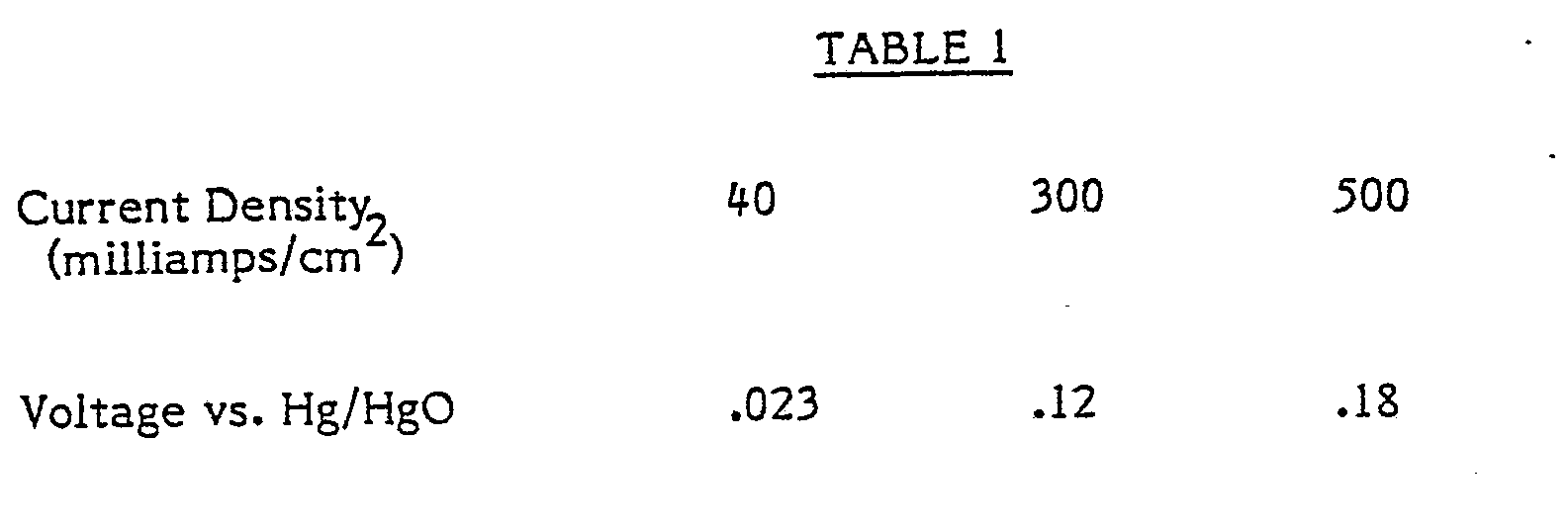
- the laminate was then placed in a test (half) cell for testing against an inert counter electrode and a Hg/HgO standard reference electrode in an electrolyte of 4 molar aqueous sodium hydroxide plus 2 molar NaAl0 2 at 60°C with an air flow of 4 times the theoretical requirement for an air cathode and at the current density as tabulated below to yield the observed voltages.
Landscapes
- Chemical & Material Sciences (AREA)
- Chemical Kinetics & Catalysis (AREA)
- Electrochemistry (AREA)
- General Chemical & Material Sciences (AREA)
- Engineering & Computer Science (AREA)
- Organic Chemistry (AREA)
- Materials Engineering (AREA)
- Manufacturing & Machinery (AREA)
- Metallurgy (AREA)
- Inorganic Chemistry (AREA)
- Composite Materials (AREA)
- Inert Electrodes (AREA)
Abstract
This disclosure is directed to a process for forming an electrode layer by depositing a soluble salt on a filter medium, depositing electrode layer material on said salt, consolidating said electrode material and thereafter dissolving said salt.
Description
- Within the field of electrochemistry, there is a well-known electrolytic cell called a chlor-alkali cell. Such cells are divided by a separator into anode and cathode compartments. The separator characteristically can be a substantially hydraulically impermeable membrane, e.g., a hydraulically impermeable cation exchange membrane such as the commercially available NAFION ° manufactured by E. I. du Pont de Nemours & Company. Alternatively, the separator can be a porous diaphragm, e.g, asbestos, which can be in the form of vacuum deposited fibers or asbestos paper sheet as are well known in the art. The anode can be a valve metal, e.g., titanium, provided with a noble metal coating to yield what is known in the art as a dimensionally stable anode.
- In this cell, an electric current is passed through a concentrated brine (sodium chloride) aqueous solution to produce chlorine gas and caustic soda (sodium hydroxide) by electrolytic dissociation of the sodium chloride in water. An unwanted by-product of this reaction is production of hydrogen gas at the cathode of the chlor-alkali cell. It has been estimated that as much as 25 percent of the electrical energy needed to operate chlor-alkali cells is consumed by the formation of hydrogen gas at the cell cathode.
- Among various attempts to reduce this electric power. loss have been the development of the so-called oxygen (air) cathodes, which cathodes eliminate the formation of hydrogen at the cathode by instead reducing oxygen to form hydroxyl ions. The reduction of oxygen instead of the formation of the by-product hydrogen requires less electric power. Hence, it can be seen that electric power savings of as much as 25 percent can be achieved in the operation of the chlor-alkali cells by eliminating the formation of hydrogen at the cathode.
- Characteristically, the oxygen (air) cathodes contain catalyst particles such as precious metal particles; or they can contain carbon particles, e.g., active carbon, having a high internal porosity, carbon black, graphite, etc.; or they can contain such carbon particles containing precious metal catalyst, e.g., silver, platinum, etc., deposited in and/or on said carbon particles. The presence of the precious metal in conjunction with the carbon enhances the activity of the carbon to form hydroxyl ions from the oxygen supplied at the cathode in the chlor-alkali cell.
- According to the present invention, it has been discovered that electrode layers, e.g., active layers for gas electrodes, such as oxygen or air cathodes, can be prepared readily by a procedure involving depositing a soluble salt or other material on a filter medium, e.g., paper, depositing particulate electrode layer material on said salt, consolidating said electrode layer material/salt filter by heat and/or pressure, and thereafter dissolving said salt to effect removal of the electrode layer in the filter cake form. This filter cake can then be dried and pressed.
- The electrode layer salt bed filtration process of this invention is particularly useful in making thin gas electrode active layers, such as thin oxygen (air) cathode active layers. Characteristically such thin active cathode layers contain less than about 25 milligrams of PTFE/carbon (with or without precious metal catalyst) per cm2. More usually, such oxygen cathode active layers when prepared by the salt bed filtration- procedure of this invention have an area density of PTFE/carbon (with or without catalyst) of less than about 20 milligrams per cm 2
- In the operation of chlor-alkali cells, e.g., using oxygen (air) cathodes having carbon and PTFE present therein, there has been a trend to increase the current density at which the chlor-alkali cell operates. The purpose of increasing current density is to increase the productivity of the cell, thus reducing the number of cells required to produce a given amount of chlorine and caustic. This substantially reduces the capital cost of a chlor-alkali plant. Moreover, the use of such high current densities, i.e., 300 plus milliamps per cm2, is increasing in battery applications, e.g., in aluminum air batteries. As will be noted from the example below, oxygen cathodes containing an active layer prepared by the salt bed filtration process of this invention are capable of use at high current densities and still yield reasonably low operating voltage.
- Prior to electrode layer formation by the salt bed filtration process of this invention, the active carbon particles are preferably deashed (conditioned) by the method described and claimed in U.S. Patent Application Serial No. 202,580 (Docket 3194), filed in the name of Frank Solomon on October 31, 1980, and entitled "Active Carbon Conditioning Process." This deashing procedure involves separately contacting the active carbon particles with an alkali at elevated temperatures and with an acid at ambient temperatures and results in active carbon particles .of increased surface area and reduced ash content, viz., usually having B.E.T. surface areas of 1000 m2/g and higher and containing less than 4 weight percent ash.
- Active carbon which can be used in accordance with this invention encompasses a variety of materials which, in general, encompass a variety of amorphous carbonaceous materials, generally of vegetable origin which contain inorganic residue, e.g., noncarbonaceous oxides collectively designed as ash.
- In accordance with a preferred embodiment, the active carbon starting material is "RB" carbon which is a form of commercially available active carbon manufactured by Calgon, a division of Merck, and is made from bituminous coal by known procedures..This material can contain as much as approximately 23 percent of various oxides and components which can be collectively classified as ash. Typical analysis of the ash contained in RB carbon is as follows:

- The deashing does not totally remove the ash content from the active carbon but results in a substantial reduction thereof, viz., from about 70 to 80 percent or more of the ash is removed by the process of this invention.
- The initial stage of deashing consitutes contacting the active particles as obtained, e.g, RB carbon as mentioned above, with either an acid or an alkali followed by contact with the other. For example, during the base contacting stage, the alkali material, such as sodium hydroxide, potassium hydroxide, etc., is maintained at elevated temperatures ranging from about 900 to about 140°C and several contacting steps are used over time periods of, e.g., 0.5 to 24 hours, followed by one or more intermittent water washing step(s).
- Then the thus treated active carbon is contacted with an acid, such as hydrochloric acid, for similar extended time periods at ambient temperatures. Between the alkali and acid contacting phases, the active carbon particles can optionally be dried. However, drying is not required in accordance with this invention.
- Usually, the alkali is employed in the form of an aqueous solution containing from 28 to 55, and more usually from 35 to 45 weight percent alkali based on total solution.
- The acid content of the aqueous acid solution customarily ranges from 10 to 30 weight percent and more usually from 15 to 25 weight percent acid based on total solution.
- Prior to contact with the alkali solution, it has been found desirable to first comminute, e.g., ball mill or otherwise divide up the active carbon particles as purchased. For example, RB active carbon was ball milled for 2 to 6 hours, and more usually approximately 4 hours to reduce its particle size to from about 5 microns to about 30 microns.
- Usually the alkali washing stage is performed in several individual washing steps using a hot (100° to 130°C) alkali solution. After the alkali washing has been completed, the alkali is neutralized using one or more water washing step(s) to remove the alkali prior to the acid wash stage.
- Similarly, the acid washing stage can be accomplished in several discrete washing steps rather than all at one time. Additionally, the contact with acid can be accomplished at lower temperatures for longer periods of time. For example, the acid wash can be conducted overnight (approximately 16 hours) at room temperature. As with the alkali contact stage preferably after the acid contact, the active carbon particles are subjected to a water washing to remove the acid followed by drying. Alternatively, the acid stage can be conducted at elevated temperatures using a Soxhlet extration constant reflux apparatus, e.g., using HCl, HBr, etc., at 110° to 130°C for about 0.5 hr., viz., constant boiling mineral acids, each having its respective boiling range. While many acids may suitably be employed, the acid of choice is hydrochloric acid.
- The sequential deashing or conditioning pretreatment results in substantial reduction of the aforementioned ash content of the active carbon particles. Typically, when utilizing active carbon having an initial B.E.T. surface area of 600 to 1500 m2/g (square meters per gram) of carbon and pretreating it with alkali and acid in accordance with this invention, reductions of ash content from about 12 weight percent to not more than about 4 weight percent have been accomplished.
- The thus preferably deashed (conditioned) active carbon particles have an average particle size of about 1 to about 30 microns and are now ready for deposition of catalyst and formulation with PTFE in preparation for active layer formation by salt bed filtration according to the process of this invention.
- The deashed active carbon particles are formulated with PTFE by contacting an aqueous dispersion of PTFE with carbon particles (with or without an added precious metal deposited on and/or within the pores thereof) to form a PTFE/carbon mix; removing the liquid from the carbon-PTFE particulate mixture; drying said particulate mixture; and chopping said dried particulate mixture. According to a preferred embodiment of this invention, the chopped active carbon-PTFE particulate mixture is extracted with chloroform before formation of the active layer by salt bed filtration. This is done by treating said chopped mixture with chloroform or other organic liquid capable of extracting (removing) the wetting agent used to disperse PTFE in water in the first instance (preferably in a Soxhlet extractor). Active layer sheets made from the extracted material have better voltage than untreated sheets when subjected to high current density, viz., about 300+ milliamperes/cm2: By "better voltage" is meant less electrode polarization.
- The extracted carbon-PTFE particles are then ready for formation into a self-sustaining, coherent active laye sheet by the salt bed filtration procedure of this invention. Although the chloroform extraction is preferred, it can be omitted in which case the dried, chopped carbon-PTFE particulate mixture is filtered directly on the filter paper containing the salt bed.
- The salt bed is prepared by depositing a soluble salt, e.g., sodium chloride, on filter paper or other layered filter media. Alternatively, the salt can be impregnated on the filter paper to obtain a salt laden surface for deposition of the carbon-PTFE. The active carbon-PTFE mix is dispersed in alcohol. The alcohol dispersion of carbon-PTFE is then placed upon a salt (e.g., sodium chloride) impregnated filter medium, e.g., filter paper, or one having a bed of a soluble salt, preferably a water-soluble salt (e.g., sodium chloride) thereon and an alcohol dispersion of carbon-PTFE mix is filtered on the salt bed/filter paper. Uniform distribution is assured when a tall column of alcohol is above the filter and the mix is stirred in at the top. With very fine materials, the active electrode layer can be deposited upon the filter paper by sedimentation, filtration or a combination of the two. The wet electrode layer is then dried at about 100°C and under light pressure to avoid mud-cracking. The filter paper is then separated from the newly formed layer using water to dissolve the salt and thus separate the layers. The carbon-PTFE layer is then removed from the filter paper and redried.
- While the discussion above was specific in terms of illustrating the preparation of an active layer for an oxygen (air) cathode, it will be apparent to those skilled in the art that the salt bed filtration procedure of this invention can be utilized to make a wide variety of electrode layers.
- According to a preferred embodiment, when the process of the present invention is used to make oxygen cathode active layers, PTFE mixes with any form of carbon, e.g., active carbon, carbon black, graphite, etc., are employed. The term carbon black as used herein is employed as defined in an article entitled "FUNDAMENTALS OF CARBON BLACK TECHNOLOGY" by Frank Spinelli appearing in the AMERICAN INK MAKER, August, 1970. Carbon black is a generic term referring to a family of industrial carbons which includes lamp blacks, channel blacks, furnace blacks and thermal blacks, e.g., acetylene carbon black. In general, carbon black is made by incomplete combustion or thermal decomposition of a liquid or gaseous hydrocarbon.
- The invention will be illustrated in further detail in the example which follows in which all parts, ratios and percents are by weight, unless otherwise indicated.
- Commercially available "RB carbon" was found to have an ash content of approximately 12 percent as received. This "RB carbon" was treated in 38 percent KOH for 16 hours at-1150C then washed several times with water and found to contain 5.6 percent ash content after a subsequent furnace operation. The alkali treated "RB carbon" was then treated (immersed) for 16 hours at toom temperature in 1:1 aqueous hydrochloric' acid (20 percent concentration) and washed several times with water. The resulting ash content had been reduced to 2.8 percent. "RB carbon," deashed as above, was platinized, provided with platinum catalyst in accordance with the procedure set forth and described in U.S. Patent 4,044,193 using 200 grams per liter solution of H3Pt(S03)20H solution as a source of platinum for the deashed active carbon. Sufficient platinum is applied to yield deashed "RB" active carbon having a ratio of 3 grams deashed "RB" active carbon per gram of platinum.
- After platinizing, the active carbon was provided with a discontinuous coating of smaller adherent PTFE particles ("Teflonated") using du Pont "Teflon 30" aqueous dispersion and 80 percent platinized "RB" active carbon and 20 percent PTFE. The thus PTFE discontinuously coated active carbon particles were then washed with water, and it was noted that this water washing failed to remove wetting agent in as much as no sudsing occurred in the wash water.
- After drying, this mix was chopped in a coffee blender, i.e., type Varco, Inc., Model 228 1.00 and extracted with chloroform (CHC13) in a Soxhlet apparatus for a 16-hour period overnight. The extracted particles were then. dried, dispersed in alcohol and filtered onto a bed of sodium chloride on filter paper in the manner set forth hereinabove. After drying, the active layer filter cake was removed from the filter paper by dissolving the salt bed. The filter cake has a catalyzed carbon-PTFE area density of 15 milligrams/cm2. The filter cake was then dried and pressed at 0.25 tons/in2 and 110°C to obtain the active layer ready for lamination to yield a laminated oxygen cathode.
- Separately a conductive, hydrophobic wetproofing (backing) layer was made containing PTFE and carbon black in accordance with the procedure described and claimed in U.S. Patent Application Serial No. 202,575 (Docket 3252), filed on October 31, 1980, in the name of Frank Solomon and entitled "Electrode Backing Layer and Method of Preparing." 'Basically, this procedure involves the preparation of cohesive, self-sustaining electrode backing layers by a method comprising mixing from 5 to 50 weight parts of polytetrafluoroethylene (PTFE) having a particle size ranging from 0.05 to 0.5 micron with from 95 to about 50 weight parts of carbon black of a particle size ranging from about 50 to about 3000 angstroms and a density of about 1.95 grams per cubic centimeter, to produce an electrode backing layer having enhanced electrical conductivity compared to backing layers made from PTFE alone. The wetproofing layer was now ready for lamination.
- The active layer prepared by salt bed filtration as described herein was then laminated to the PTFE-carbon black backing sheet prepared as described above and to a silver-plated, symmetrical, nickel screen current distributor. The current distributor was a 0.005-inch diameter nickel woven wire mesh having a 0.0003-inch thick silver plating and a 50 x 50 woven strand arrangement, viz., 50 warp and 50 fill strands per inch. The distributor was positioned on one side of the backing sheet while the other side of the backing was placed on the active layer. The lamination was performed in a hydraulic press at 100° to 130°C and using pressures of 1.5 to 8.5 tons per in for 3 to 10 minutes.
- The laminate was then placed in a test (half) cell for testing against an inert counter electrode and a Hg/HgO standard reference electrode in an electrolyte of 4 molar aqueous sodium hydroxide plus 2 molar NaAl02 at 60°C with an air flow of 4 times the theoretical requirement for an air cathode and at the current density as tabulated below to yield the observed voltages.
Claims (8)
1. A process of forming an electrode layer, characterized in
that a soluble salt is deposited on a filter medium, electrode layer material is then deposited on the salt, the electrode layer material is consolidated and the salt is then dissolved.
that a soluble salt is deposited on a filter medium, electrode layer material is then deposited on the salt, the electrode layer material is consolidated and the salt is then dissolved.
2. A process as claimed in claim 1, wherein the salt is sodium chloride.
3. A process as claimed in claim 1 or 2, wherein the electrode layer material comprises carbon particles in admixture with polytetrafluorethylene particles.
4. A process as claimed in claim 3, wherein the carbon particles have a B.E.T. surface area of 500 m2/g or higher and contain less than about 4 weight percent ash.
5. A process as claimed in claim 3 or 4, wherein the carbon particles contain precious metal catalyst.
6. A process as claimed in claim 5, wherein the precious metal is platinum.
7. A process as claimed in claim 3, wherein the carbon particles are active carbon particles having a particle size ranging from about 1 to about 30 microns.
8. An electrode layer when formed by a process according to any of the preceding claims.
Applications Claiming Priority (2)
| Application Number | Priority Date | Filing Date | Title |
|---|---|---|---|
| US202584 | 1980-10-31 | ||
| US06/202,584 US4338181A (en) | 1980-10-31 | 1980-10-31 | Electrode containing extraction treated particles |
Publications (1)
| Publication Number | Publication Date |
|---|---|
| EP0051434A1 true EP0051434A1 (en) | 1982-05-12 |
Family
ID=22750491
Family Applications (1)
| Application Number | Title | Priority Date | Filing Date |
|---|---|---|---|
| EP81305088A Withdrawn EP0051434A1 (en) | 1980-10-31 | 1981-10-28 | Electrode layer formation |
Country Status (2)
| Country | Link |
|---|---|
| US (1) | US4338181A (en) |
| EP (1) | EP0051434A1 (en) |
Families Citing this family (4)
| Publication number | Priority date | Publication date | Assignee | Title |
|---|---|---|---|---|
| US4379772A (en) * | 1980-10-31 | 1983-04-12 | Diamond Shamrock Corporation | Method for forming an electrode active layer or sheet |
| US4957661A (en) * | 1988-09-30 | 1990-09-18 | The United States Of America As Represented By The United States National Aeronautics And Space Administration | Graphite fluoride fiber polymer composite material |
| US7318374B2 (en) | 2003-01-21 | 2008-01-15 | Victor Guerrero | Wire cloth coffee filtering systems |
| US7461587B2 (en) | 2004-01-21 | 2008-12-09 | Victor Guerrero | Beverage container with wire cloth filter |
Citations (4)
| Publication number | Priority date | Publication date | Assignee | Title |
|---|---|---|---|---|
| US3474600A (en) * | 1967-09-22 | 1969-10-28 | Pittsburgh Activated Carbon Co | Bonded carbon article |
| GB1257452A (en) * | 1969-02-07 | 1971-12-22 | ||
| GB1488945A (en) * | 1974-03-19 | 1977-10-19 | Nippon Shinyaku Co Ltd | Method of restoring the sterilization effect of silver-activated carbon |
| GB2012100A (en) * | 1977-12-28 | 1979-07-18 | Electrochem Energieconversie | Porous electrode |
Family Cites Families (6)
| Publication number | Priority date | Publication date | Assignee | Title |
|---|---|---|---|---|
| US2891921A (en) * | 1955-09-22 | 1959-06-23 | Du Pont | Stabilization of polytetrafluoroethylene filler slurries |
| US3682859A (en) * | 1969-06-20 | 1972-08-08 | Liquid Nitrogen Processing | Free-flowing tetrafluoroethylene polymer composition and process of producing the same |
| US3980612A (en) * | 1975-04-11 | 1976-09-14 | E. I. Du Pont De Nemours And Company | Process for reducing filler loss during polytetrafluoroethylene agglomeration |
| US4177159A (en) * | 1978-06-28 | 1979-12-04 | United Technologies Corporation | Catalytic dry powder material for fuel cell electrodes comprising fluorocarbon polymer and precatalyzed carbon |
| US4185131A (en) * | 1978-06-28 | 1980-01-22 | United Technologies Corporation | Screen printing method for making an electrochemical cell electrode |
| US4235748A (en) * | 1979-02-28 | 1980-11-25 | Yardney Electric Corporation | Method of making improved hydrogenation catalyst |
-
1980
- 1980-10-31 US US06/202,584 patent/US4338181A/en not_active Expired - Lifetime
-
1981
- 1981-10-28 EP EP81305088A patent/EP0051434A1/en not_active Withdrawn
Patent Citations (4)
| Publication number | Priority date | Publication date | Assignee | Title |
|---|---|---|---|---|
| US3474600A (en) * | 1967-09-22 | 1969-10-28 | Pittsburgh Activated Carbon Co | Bonded carbon article |
| GB1257452A (en) * | 1969-02-07 | 1971-12-22 | ||
| GB1488945A (en) * | 1974-03-19 | 1977-10-19 | Nippon Shinyaku Co Ltd | Method of restoring the sterilization effect of silver-activated carbon |
| GB2012100A (en) * | 1977-12-28 | 1979-07-18 | Electrochem Energieconversie | Porous electrode |
Also Published As
| Publication number | Publication date |
|---|---|
| US4338181A (en) | 1982-07-06 |
Similar Documents
| Publication | Publication Date | Title |
|---|---|---|
| US4500647A (en) | Three layer laminated matrix electrode | |
| US4456521A (en) | Three layer laminate | |
| US4379772A (en) | Method for forming an electrode active layer or sheet | |
| US4354958A (en) | Fibrillated matrix active layer for an electrode | |
| US4518705A (en) | Three layer laminate | |
| CA1190183A (en) | Non-bleeding gas electrode having plural porous layers | |
| US4440617A (en) | Non-bleeding electrode | |
| US4364806A (en) | Gas electrode shutdown procedure | |
| EP1925695B1 (en) | Oxygen gas diffusion cathode for sodium chloride electrolysis | |
| JP4522033B2 (en) | Gas diffusion cathode containing carbon-supported rhodium sulfide catalyst, membrane electrode assembly and electrochemical cell containing the cathode, and uses thereof | |
| US4364805A (en) | Gas electrode operation | |
| Matsuki et al. | Oxygen reduction electrocatalysis on some manganese oxides | |
| EP0051433A1 (en) | One pass process for forming electrode backing sheet | |
| US4382875A (en) | Extraction treatment | |
| US4337139A (en) | Fluorinated carbon electrode | |
| US4377496A (en) | Gas diffusion electrode and process | |
| US4379034A (en) | Start-up procedure for oxygen electrode | |
| CA1208168A (en) | Producing electrode active layer from active carbon particles and fibrillated polytetrafluoroethylene | |
| EP0051437A1 (en) | Asymmetric current distributor | |
| US4379077A (en) | Active carbon conditioning process | |
| US4468362A (en) | Method of preparing an electrode backing layer | |
| US4338181A (en) | Electrode containing extraction treated particles | |
| US9118082B2 (en) | Oxygen-consuming electrode and process for the production thereof | |
| US9163318B2 (en) | Oxygen-consuming electrode and process for production thereof | |
| EP0052446B1 (en) | Partially-fluorinated carbon particles for use as electrodes |
Legal Events
| Date | Code | Title | Description |
|---|---|---|---|
| PUAI | Public reference made under article 153(3) epc to a published international application that has entered the european phase |
Free format text: ORIGINAL CODE: 0009012 |
|
| AK | Designated contracting states |
Designated state(s): AT BE CH DE FR GB IT LI LU NL SE |
|
| 17P | Request for examination filed |
Effective date: 19820922 |
|
| STAA | Information on the status of an ep patent application or granted ep patent |
Free format text: STATUS: THE APPLICATION IS DEEMED TO BE WITHDRAWN |
|
| 18D | Application deemed to be withdrawn |
Effective date: 19840503 |
|
| RIN1 | Information on inventor provided before grant (corrected) |
Inventor name: SOLOMON, FRANK |