EP0050061A2 - Method of reducing undesirable activities of biological and pharmaceutical products - Google Patents
Method of reducing undesirable activities of biological and pharmaceutical products Download PDFInfo
- Publication number
- EP0050061A2 EP0050061A2 EP81401468A EP81401468A EP0050061A2 EP 0050061 A2 EP0050061 A2 EP 0050061A2 EP 81401468 A EP81401468 A EP 81401468A EP 81401468 A EP81401468 A EP 81401468A EP 0050061 A2 EP0050061 A2 EP 0050061A2
- Authority
- EP
- European Patent Office
- Prior art keywords
- products
- amphiphile
- nonionic surfactant
- triton
- plasma
- Prior art date
- Legal status (The legal status is an assumption and is not a legal conclusion. Google has not performed a legal analysis and makes no representation as to the accuracy of the status listed.)
- Granted
Links
Classifications
-
- A—HUMAN NECESSITIES
- A61—MEDICAL OR VETERINARY SCIENCE; HYGIENE
- A61K—PREPARATIONS FOR MEDICAL, DENTAL OR TOILETRY PURPOSES
- A61K35/00—Medicinal preparations containing materials or reaction products thereof with undetermined constitution
- A61K35/12—Materials from mammals; Compositions comprising non-specified tissues or cells; Compositions comprising non-embryonic stem cells; Genetically modified cells
- A61K35/14—Blood; Artificial blood
- A61K35/16—Blood plasma; Blood serum
-
- A—HUMAN NECESSITIES
- A61—MEDICAL OR VETERINARY SCIENCE; HYGIENE
- A61K—PREPARATIONS FOR MEDICAL, DENTAL OR TOILETRY PURPOSES
- A61K38/00—Medicinal preparations containing peptides
-
- A—HUMAN NECESSITIES
- A61—MEDICAL OR VETERINARY SCIENCE; HYGIENE
- A61K—PREPARATIONS FOR MEDICAL, DENTAL OR TOILETRY PURPOSES
- A61K39/00—Medicinal preparations containing antigens or antibodies
-
- A—HUMAN NECESSITIES
- A61—MEDICAL OR VETERINARY SCIENCE; HYGIENE
- A61L—METHODS OR APPARATUS FOR STERILISING MATERIALS OR OBJECTS IN GENERAL; DISINFECTION, STERILISATION OR DEODORISATION OF AIR; CHEMICAL ASPECTS OF BANDAGES, DRESSINGS, ABSORBENT PADS OR SURGICAL ARTICLES; MATERIALS FOR BANDAGES, DRESSINGS, ABSORBENT PADS OR SURGICAL ARTICLES
- A61L2/00—Disinfection or sterilisation of materials or objects, in general; Accessories therefor
- A61L2/02—Disinfection or sterilisation of materials or objects, in general; Accessories therefor using physical processes
- A61L2/04—Heat
-
- A—HUMAN NECESSITIES
- A61—MEDICAL OR VETERINARY SCIENCE; HYGIENE
- A61L—METHODS OR APPARATUS FOR STERILISING MATERIALS OR OBJECTS IN GENERAL; DISINFECTION, STERILISATION OR DEODORISATION OF AIR; CHEMICAL ASPECTS OF BANDAGES, DRESSINGS, ABSORBENT PADS OR SURGICAL ARTICLES; MATERIALS FOR BANDAGES, DRESSINGS, ABSORBENT PADS OR SURGICAL ARTICLES
- A61L2/00—Disinfection or sterilisation of materials or objects, in general; Accessories therefor
- A61L2/16—Disinfection or sterilisation of materials or objects, in general; Accessories therefor using chemical substances
- A61L2/18—Liquid substances
-
- A—HUMAN NECESSITIES
- A61—MEDICAL OR VETERINARY SCIENCE; HYGIENE
- A61L—METHODS OR APPARATUS FOR STERILISING MATERIALS OR OBJECTS IN GENERAL; DISINFECTION, STERILISATION OR DEODORISATION OF AIR; CHEMICAL ASPECTS OF BANDAGES, DRESSINGS, ABSORBENT PADS OR SURGICAL ARTICLES; MATERIALS FOR BANDAGES, DRESSINGS, ABSORBENT PADS OR SURGICAL ARTICLES
- A61L2103/00—Materials or objects being the target of disinfection or sterilisation
- A61L2103/05—Living organisms or biological materials
Definitions
- This invention relates to a method of reducing or suppressing undesirable activities like pyrogenicity, hepatitis infectivity and clotting activation of biological and pharmaceutical products, including plasma, plasma derivatives and products thereof, or of products for treating them, like sterile filters, chromatographic materials, etc.
- P yrogens are lipopolysaccharides (LPS) derived from the outer cell wall of gram-negative bacteria. They are toxic materials which are also known as endotoxins to distinguish them from toxic substances synthesized and excreted by the intact bacterium. Pyrogens have numerous biologic activities which include the production of fever, activation of clotting mechanisms and induction of shock. Consequently, it is essential that pyrogenic substances be removed and that the causative bacteria be rendered innocuous by sterilization or other such treatment of the final biological or pharmaceutical product.
- LPS lipopolysaccharides
- Prior methods for such inactivation or destruction of pyrogens comprise extensive treatment with heat, acid or alkali, filtration of insoluble pyrogens, or removal by adsorption with gels, ion-exchange resins and various other such adsorbent materials. Most of these methods are burdensome, time consuming, or destructive of the protein due to the rigorousness of the treatment.
- hepatitis B antigen HB s Ag
- HB s Ag hepatitis B antigen
- the combination of ultraviolet light and fpropionolactone may be helpful in inactivating the virus in certain plasma products.
- j3-propiono- lactone has carcinogenic properties.
- non-A, non-B hepatitis Tests for this virus are not yet commercially available for wide-spread screening. This virus closely resembles hepatitis B virus but is antigenically distinguishable. Both hepatitis B virus and non-A, non-B hepa - titis virus appear to have similar structural characteristics and exist as particles containing a DNA core and a lipoprotein membrane.
- biological or pharmaceutical products including plasma, plasma derivatives and products thereof or products for treating them, are subjected to prolonged contact with a solution or suspension of from about 0.25% to about 10% by weight of a non-denaturing amphiphile.
- non-denaturing means non-protein-denaturing.
- the subject treatment of the products causes irreversible destruction of endotoxins and if any destroys thromboplastic-like coagulation activating substances and substantially reduces the infectivity of hepatitis viruses (B and non-A, non-B). These effects are produced without substantially altering the activity of product constituents, for example plasma proteins.
- amphiphile is meant to define a substance containing both hydrophilic watersoluble and hydrophobic water-insoluble groups. Amphiphiles are generally classified into various groups and frequently into the anionic, cationic, ampholytic and non-ionic surfactants. The following are well-known commercially available amphiphiles :
- Ethylene oxide-propylene oxide condensates such as described in U.S. Patent 2,674,619 ; Oxyethylated alkylphenol (Triton X-100); Partial esters of C 12-22 fatty acids (e.g. lauric, palmitic, stearic and oleic acids) and hexitol anhydrides (e.g. hexitans and hexides) (Spans) such as described in U.S.
- the nonionic surfactants are preferred amphiphiles for use in this invention.
- the most preferred amphiphiles are the nonionic surfactants having a high water solubility and selected from the group consisting of substances having the general formula RC 6 H 4 .(OC 2 H 4 ) n OH wherein R is octyl or nonyl and n is at least 3.
- a most preferred substance of the foregoing general formula is octyl phenoxy polyethoxy ethanol.
- Surfactants of the latter type are available commercially from Rohm & Haas Co.
- Triton X e.g., Triton X-100, Triton X-165, Triton X-205, Triton X-305 and Triton X-405.
- Triton N-100 Another such nonionic surfactant is nonyl phenoxy polyethoxy ethanol which is available commercially under the trademark "Triton N-100".
- amphiphiles are the salts of bile acids such as sodium cholate and sodium deoxycholate.
- Treatment of the biological and pharmaceutical products with the amphiphile can be carried out at any stage in the production sequence.
- the treatment is carried out following the last step at which contamination with pyrogens is likely to occur.
- it may be necessary to subject the product to a further depyrogenation treatment in accordance with the method of this invention.
- the method of the invention also is useful for reworking biological and pharmaceutical products that have become pyrogenic in a normal production run.
- the period of time during which the biological and pharmaceutical products are contacted with the amphiphile should be sufficient to depyrogenate the product. Generally, a period of from about 30 minutes to about four hours at a temperature of from about 4°C to about 37°C is adequate to provide the desired depyrogenation.
- Treatment of the plasma protein product with the amphiphile can be carried out at any stage in the production process for destroying endotoxin or infectivity of hepatitis virus and preventing of clotting activation.
- the amphiphile can be added to the starting material or it can be added at some later step in the production sequence.
- amphiphile In the case of therapeutic plasma protein products it will generally be desirable to remove the amphiphile following the prolonged contact with the plasma protein product. In the case of non-therapeutic plasma protein products it will generally be unnecessary to remove the amphiphile. For example, blood plasma and blood fractions for administration to human patients would be subjected to a step for ultimate removal of the amphiphile following the prolonged contact whereas clinical sera for diagnostic purposes generally would not require such removal. Removal of the amphiphile can be carried out by various precipitation steps in which the plasma proteins are precipitated while the amphiphile remains dissolved or suspended in the supernatant. Conventional plasma protein precipitants can be used for this purpose such as, e.g., polyethylene glycol, Pluronic polymers, glycine, ammonium sulfate, alcohol and rivanol.
- plasma protein precipitants can be used for this purpose such as, e.g., polyethylene glycol, Pluronic polymers, glycine, ammonium sulfate, alcohol and riv
- the period of time during which the plasma protein product is contacted with the amphiphile should be sufficient to cause irreversible destruction of endotoxins and/or inactivation of hepatitis viruses. Generally, a period of from about 30 minutes to about 4 hours at a temperature of from about one degree C to about 50°C is adequate to provide the desired destruction of endotoxins and inactivation of hepatitis viruses. It will be appreciated, however, that for non-therapeutic and non-human administration of plasma protein products, the destruction of endotoxins is not critical although the destruction of hepatitis infectivity is important to avoid spread of the virus to the laboratory workers.
- the actual contact of the biological and pharmaceutical products with the amphiphile can be carried out by washing the product with a solution or suspension of the amphiphile or by immersing or soaking the product in such solution or suspension or by admixing the product with such solution or suspension.
- amphiphiles such as sodium deoxycholate have been reported heretofore as able to dissociate or disaggregate endotoxins, the disaggregation has been described as reversible in the presence of the amphiphile tested. These amphiphiles thus have not been previously suggested as able to produce irreversible disaggregation of endotoxins such as to make them practical for the treatment of plasma protein products which are to be used for human administration. See, e.g., the paper by Elizabeth Work, cited hereinbefore.
- the desired plasma protein product is precipitated with protein precipitants, as described above, after treatment with the amphiphile to destroy the endotoxins followed by separation and removal of the amphiphile in the supernatant.
- the present invention is applicable to any biological or pharmaceutical product which because of its intended use in humans or administration to humans for biomedical or therapeutic purposes should be free of pyrogens and otherwise sterile. It is particularly adapted for depyrogenating those products which cannot be adequately depyrogenated by heat or p H adjustments. Many proteinaceous products fall in the latter category due to the potential denaturation or destruction of the active material which can be caused by the prolonged rigorous treatment with heat, acid or alkali. For treatment of such proteinaceous products the amphiphile should be non-protein-denaturing.
- Blood and blood fractions such as antihemophilic factor A (AHF, Factor VIII); prothrombin complex (Factors II, VII, IX and X) ; gamma globulin ; albumin ;
- amphiphiles such as Triton X-100, Tween 80, Nonidet NP-40, and sodium dodecylsulfate have been reported heretofore as able to dissociate or disaggregate the hepatitis virus antigen
- the disaggregation has been described for the purpose of merely dispersing the antigen or for purifying the antigen for its use in preparing vaccines. See, e.g., U.S. Patents 4,118,748 ; 4,118,749 ; 4,164,565 ; and a paper by Johnson et al., J. Lab. C lin, Med. 88 (1), 91-101 (1976).
- treatment of the plasma protein product with the amphiphile under the conditions herein described according to the present invention is to substantially reduce the infectivity of hepatitis viruses in such products whereby the plasma protein product.is itself improved.
- Testing for the presence of hepatitis virus and/or to determine its destruction following treatment of the plasma protein product according to the present invention can be carried out by various conventional laboratory test methods such as reversed passive hemagglu- tination assays, counter-electrophoresis (CEP) and the more recently developed radioimmunoassay (RIA) procedures.
- Solid phase RIA procedures for hepatitis antigen as described in U.S. Patents 3,867,517 and 4,012,494 and commercially available from Abbott Laboratories under the trademark "Ausria” are illustrative of suitable methods. It should be understood, however, that the determination of the presence of hepatitis antigen is limited by the sensitivity of these tests and that negative test results do not rule out the possible presence of the antigen in extremely low, non-detectable levels.
- the present invention is applicable to all types of plasma protein products for therapeutic as well as non-therapeutic uses. Examples of such products are :
- a commercially produced vial (lyophilized) of prothrombin complex (25 units of Factor IX per ml when reconstituted) was reconstituted with ten ml of sterile water.
- Triton X-100 was added to a concentration of 2% and the mixture was incubated ninety minutes at ambient temperature (ca. 20-22°C).
- To nine ml of the above mixture was added 6.0 ml of a 50% solution of polyethylene glycol 4000. The pH was adjusted to 5.7 and the mixture was cooled to below 5°C to precipitate the protein. The mixture was centrifuged and the precipitate was resuspended in sterile water.
- the treated product was tested for pyrogenicity by the LAL test and compared with the original untreated sample and a control which consisted of the aforesaid precipitate of the treated sample to which 40 picograms of endotoxin were added. The following results were observed :
- Clinical diagnostic control sera were analyzed for their various components both before and after treatment with Triton X-100 at a concentration of 2% to destroy endotoxins and substantially reduce hepatitis virus infectivity in accordance with the present invention.
- the following results on the untreated and treated product show that the Triton X-100 treatment has not substantially altered the activity of the various components in the control sera.
- Human growth hormone derived by recombinant DNA techniques from E. Coli strain K12 was treated with 3% Triton X-100 for two hours and reprecipitated with ammonium sulfate.
- the pyrogen level in the product was reduced from 2.2 nanograms/ml in the untreated product to less than lo picograms/ml in the treated product.
- Triton X-100 Various non-therapeutic blood plasma protein products such as fetal bovine serum, bovine albumin and bovine serum which are commonly used as growth media in tissue culture procedures are treated by prolonged contact with 2% Triton X-100 as in the previous examples.
- the Triton X-100 is removed in the supernatant after precipitation of all proteins as in Example 7 and resuspension in appropriate milieu, e.g., balanced salt solution, such as Hank's BSS.
- Triton X-100 When 2% Triton X-100 is added to platelet-poor plasma (double spun plasma) the non-activated partial thromboplastin time (PTT) becomes indefinitely prolonged instead of the usual 200 seconds. This evidences the anticoagulant activity of Triton X-100 in the plasma.
- Samples of blood sera and plasma obtained for laboratory analysis are placed in test tubes containing 2% Triton X-100 and allowed to incubate for 30-120 minutes to inactive potential hepatitis virus.
Landscapes
- Health & Medical Sciences (AREA)
- Life Sciences & Earth Sciences (AREA)
- Public Health (AREA)
- Veterinary Medicine (AREA)
- Epidemiology (AREA)
- Animal Behavior & Ethology (AREA)
- General Health & Medical Sciences (AREA)
- Chemical & Material Sciences (AREA)
- Pharmacology & Pharmacy (AREA)
- Medicinal Chemistry (AREA)
- Immunology (AREA)
- Engineering & Computer Science (AREA)
- Hematology (AREA)
- Mycology (AREA)
- Microbiology (AREA)
- Cell Biology (AREA)
- Developmental Biology & Embryology (AREA)
- General Chemical & Material Sciences (AREA)
- Biomedical Technology (AREA)
- Biotechnology (AREA)
- Chemical Kinetics & Catalysis (AREA)
- Virology (AREA)
- Zoology (AREA)
- Bioinformatics & Cheminformatics (AREA)
- Proteomics, Peptides & Aminoacids (AREA)
- Medicines Containing Material From Animals Or Micro-Organisms (AREA)
- Medicines That Contain Protein Lipid Enzymes And Other Medicines (AREA)
- Medicines Containing Antibodies Or Antigens For Use As Internal Diagnostic Agents (AREA)
Abstract
Description
- This invention relates to a method of reducing or suppressing undesirable activities like pyrogenicity, hepatitis infectivity and clotting activation of biological and pharmaceutical products, including plasma, plasma derivatives and products thereof, or of products for treating them, like sterile filters, chromatographic materials, etc.
- In the development and production of biological and pharmaceutical products and particularly various proteinaceous substances used for biomedical and therapeutic purposes, the problem of contamination with pyrogens (endotoxins) is ever present. For certain products, like products from human plasma,transmission of viral hepatitis, and activation of the coagulation enzymes also make major problems.
- Pyrogens are lipopolysaccharides (LPS) derived from the outer cell wall of gram-negative bacteria. They are toxic materials which are also known as endotoxins to distinguish them from toxic substances synthesized and excreted by the intact bacterium. Pyrogens have numerous biologic activities which include the production of fever, activation of clotting mechanisms and induction of shock. Consequently, it is essential that pyrogenic substances be removed and that the causative bacteria be rendered innocuous by sterilization or other such treatment of the final biological or pharmaceutical product.
- Prior methods for such inactivation or destruction of pyrogens comprise extensive treatment with heat, acid or alkali, filtration of insoluble pyrogens, or removal by adsorption with gels, ion-exchange resins and various other such adsorbent materials. Most of these methods are burdensome, time consuming, or destructive of the protein due to the rigorousness of the treatment.
- Further background on the properties and effects of pyrogens can be had by reference to a paper by Elizabeth Work entitled "Production, Chemistry and Properties of Bacterial Pyrogens and Endotoxins" in "Pyrogens and Fever", Ciba Foundation Symposium, 1971, pp. 23-47, edited by Wolstenholme and Birch, published by Churchill Livingstone ; and a paper by D. C. Morrison and R. J. Ulevitch entitled "The Effects of Bacterial Endotoxins on Host Mediation Systems" in Amer. J. Pathol. 93 (2), 527-601 (1978).
- It is well-known that plasma and products made from plasma may transmit hepatitis. Until recently, interest has focused primarily on hepatitis B antigen (HBsAg) as the offending agent and attempts at eliminating this agent have led to widespread screening of all plasma used in transfusing by a variety of laboratory procedures. While such laboratory screening has apparently decreased the incidence of hepatitis B in patients receiving whole blood transfusions, there has not been significant improvement in the incidence of the disease transmitted from plasma products. Attempts to remove the virus by various adsorption procedures or precipitation techniques, e.g. with polyethylene glycol, have not proven to eliminate infectivity. There is some evidence that the combination of ultraviolet light and fpropionolactone may be helpful in inactivating the virus in certain plasma products. However, there is some apprehension that j3-propiono- lactone has carcinogenic properties.
- While the development of screening tests for hepatitis B has been of limited value in reducing transmission of the disease, the identification of this virus (as well as the hepatitis A virus) has led to the recognition of a third virus which is apparently responsible for the majority of cases of hepatitis transmitted by blood plasma derivatives. This virus is referred to as "non-A, non-B hepatitis". Tests for this virus are not yet commercially available for wide-spread screening. This virus closely resembles hepatitis B virus but is antigenically distinguishable. Both hepatitis B virus and non-A, non-B hepa- titis virus appear to have similar structural characteristics and exist as particles containing a DNA core and a lipoprotein membrane.
- Attempts to prevent activation of clotting enzymes have centered around the addition of classic anticoagulating chemicals such as citrate, EDTA and heparin. While such measures are partially effective, none of these anticoagulants are effective at the early stage of the clotting sequence which is triggered by activation of Factor XII. Activation of clotting factors may still occur because coagulation may be instigated by the presence of phospholipids from blood platelets. Virtually all blood fractions collected today contain thromboplastic-like substances or phospholipids from platelets and platelet derivatives which activate coagulation. Administration of therapeutic blood fractions which contain these phospholipid particles may be potentially dangerous because of their ability to induce unwanted intravascular coagulation.
- In accordance with the present invention, biological or pharmaceutical products, including plasma, plasma derivatives and products thereof or products for treating them, are subjected to prolonged contact with a solution or suspension of from about 0.25% to about 10% by weight of a non-denaturing amphiphile.
- If the product contains proteins, for example in the case of plasma or other plasma protein products, the term "non-denaturing" means non-protein-denaturing. The subject treatment of the products causes irreversible destruction of endotoxins and if any destroys thromboplastic-like coagulation activating substances and substantially reduces the infectivity of hepatitis viruses (B and non-A, non-B). These effects are produced without substantially altering the activity of product constituents, for example plasma proteins.
- As used herein, the term "amphiphile" is meant to define a substance containing both hydrophilic watersoluble and hydrophobic water-insoluble groups. Amphiphiles are generally classified into various groups and frequently into the anionic, cationic, ampholytic and non-ionic surfactants. The following are well-known commercially available amphiphiles :
- Sulphated oxyethylated alkylphenol (Triton W-30)
- Sulphated lauryl ether alcohol ;
- Sodium dodecylbenzenesulfonate (Nacconol NR) ;
- Sodium 2-sulfoethyl oleate (Igepon A) ;
- Sodium N-methyl-N-oleylethanol sulfonate (Igepon T) ;
- Sodium dodecylsulfate ;
- Sodium cholate ;
- Sodium deoxycholate ;
- Sodium dodecylsulfonate ;
- Sodium dodecyl-N-sarconisate.
- Dodecyldimethylbenzylammonium chloride (Triton K-60) ;
- Oxyethylated amines (Ethomeen) ;
- ltrimethylammonium bromide ;

- Tetradecylammonium bromide ;
- Dodecylpyrimidinium chloride ;
- Hexadecyltrimethylammonium chloride.
- Dodecyl β-alanine ;
- N-dodecylaminoethanesulfonic acid
- Palmitoyllysolecithin ;
- Dodecyl-N-betaine.
- Ethylene oxide-propylene oxide condensates (Pluronic block copolymers) such as described in U.S. Patent 2,674,619 ; Oxyethylated alkylphenol (Triton X-100); Partial esters of C12-22 fatty acids (e.g. lauric, palmitic, stearic and oleic acids) and hexitol anhydrides (e.g. hexitans and hexides) (Spans) such as described in U.S. Patents 2,232;820; 2,232,821; 2,303,432; Polyoxyethylated derivatives of said partial esters made by adding poloxyethylene chains to the nonesterified hydroxyls (Tweens, e.g. Tween 80 or Polysorbate 80) such as described in U.S. Patent 2,380,166 :
- Poloxyethylene partial fatty acid esters (Myrj 45) Poloxyethylene fatty alcohol ethers (Brij).
- The nonionic surfactants are preferred amphiphiles for use in this invention. The most preferred amphiphiles are the nonionic surfactants having a high water solubility and selected from the group consisting of substances having the general formula RC6H4.(OC2H4)nOH wherein R is octyl or nonyl and n is at least 3. A most preferred substance of the foregoing general formula is octyl phenoxy polyethoxy ethanol. Surfactants of the latter type are available commercially from Rohm & Haas Co. under the trademark "Triton X", e.g., Triton X-100, Triton X-165, Triton X-205, Triton X-305 and Triton X-405. Another such nonionic surfactant is nonyl phenoxy polyethoxy ethanol which is available commercially under the trademark "Triton N-100".
- Another preferred group of amphiphiles are the salts of bile acids such as sodium cholate and sodium deoxycholate.
- Treatment of the biological and pharmaceutical products with the amphiphile can be carried out at any stage in the production sequence. Preferably, for depyrogenation, the treatment is carried out following the last step at which contamination with pyrogens is likely to occur. In those instances where pyrogen contamination occurs at a production stage following a previous depyrogenation, it may be necessary to subject the product to a further depyrogenation treatment in accordance with the method of this invention. The method of the invention also is useful for reworking biological and pharmaceutical products that have become pyrogenic in a normal production run.
- The period of time during which the biological and pharmaceutical products are contacted with the amphiphile should be sufficient to depyrogenate the product. Generally, a period of from about 30 minutes to about four hours at a temperature of from about 4°C to about 37°C is adequate to provide the desired depyrogenation.
- Testing for the presence of pyrogens and to ensure adequate depyrogenation can be carried out by the standard qualitative fever response test in rabbits for pyrogens or by more recently developed Limulus Lysate (amebocytes) assay procedures for pyrogens (LAL tests) . The latter tests are based on gelling of a pyrogenic preparation in the presence of the lysate of the amebocytes of the horseshoe crab (Limulus polyphemus). See, e.g., U.S. Patent 4,096,09] for a typical LAL test.
- Treatment of the plasma protein product with the amphiphile can be carried out at any stage in the production process for destroying endotoxin or infectivity of hepatitis virus and preventing of clotting activation. The amphiphile can be added to the starting material or it can be added at some later step in the production sequence.
- In the case of therapeutic plasma protein products it will generally be desirable to remove the amphiphile following the prolonged contact with the plasma protein product. In the case of non-therapeutic plasma protein products it will generally be unnecessary to remove the amphiphile. For example, blood plasma and blood fractions for administration to human patients would be subjected to a step for ultimate removal of the amphiphile following the prolonged contact whereas clinical sera for diagnostic purposes generally would not require such removal. Removal of the amphiphile can be carried out by various precipitation steps in which the plasma proteins are precipitated while the amphiphile remains dissolved or suspended in the supernatant. Conventional plasma protein precipitants can be used for this purpose such as, e.g., polyethylene glycol, Pluronic polymers, glycine, ammonium sulfate, alcohol and rivanol.
- The period of time during which the plasma protein product is contacted with the amphiphile should be sufficient to cause irreversible destruction of endotoxins and/or inactivation of hepatitis viruses. Generally, a period of from about 30 minutes to about 4 hours at a temperature of from about one degree C to about 50°C is adequate to provide the desired destruction of endotoxins and inactivation of hepatitis viruses. It will be appreciated, however, that for non-therapeutic and non-human administration of plasma protein products, the destruction of endotoxins is not critical although the destruction of hepatitis infectivity is important to avoid spread of the virus to the laboratory workers.
- The actual contact of the biological and pharmaceutical products with the amphiphile can be carried out by washing the product with a solution or suspension of the amphiphile or by immersing or soaking the product in such solution or suspension or by admixing the product with such solution or suspension.
- Although certain amphiphiles such as sodium deoxycholate have been reported heretofore as able to dissociate or disaggregate endotoxins, the disaggregation has been described as reversible in the presence of the amphiphile tested. These amphiphiles thus have not been previously suggested as able to produce irreversible disaggregation of endotoxins such as to make them practical for the treatment of plasma protein products which are to be used for human administration. See, e.g., the paper by Elizabeth Work, cited hereinbefore. In accordance with the present invention, the desired plasma protein product is precipitated with protein precipitants, as described above, after treatment with the amphiphile to destroy the endotoxins followed by separation and removal of the amphiphile in the supernatant. In such case it has been found that the Lipid A or most active portion of the endotoxin which normally is insoluble in water, remains with the amphiphile in the supernatant. The disaggregation is irreversible and treatment previously not believed to be useful is now rendered practical.
- The present invention is applicable to any biological or pharmaceutical product which because of its intended use in humans or administration to humans for biomedical or therapeutic purposes should be free of pyrogens and otherwise sterile. It is particularly adapted for depyrogenating those products which cannot be adequately depyrogenated by heat or pH adjustments. Many proteinaceous products fall in the latter category due to the potential denaturation or destruction of the active material which can be caused by the prolonged rigorous treatment with heat, acid or alkali. For treatment of such proteinaceous products the amphiphile should be non-protein-denaturing.
- Examples of biological and pharmaceutical products which can be depyrogenated in accordance with the present invention are :
- Blood and blood fractions such as antihemophilic factor A (AHF, Factor VIII); prothrombin complex (Factors II, VII, IX and X) ; gamma globulin ; albumin ;
- Parenteral products such as intravenous solutions ; Biomedical implants such as heart valves ;
- Biological and pharmaceutical products derived from animal origin, e.g., insulin and other hormones, enzymes ;
- Biological products involved in or derived from tissue culture techniques ;
- Vaccines, including subtances derived from ani- mal and microbial sources ;
- Biological products derived from human or animal placenta ;
- Pharmaceutical and drug products in which the crude drug product is produced by fermentation of microorganisms which generate endotoxins ;
- Pharmaceutical and drug products which are processed in equipment having a residue of microbial contamination ;
- Products prepared by recombinant DNA or gene- splicing techniques and in which the products is elaborated by genetically engineered microorganisms such as in E. Coli,e.g., strain K12, or Bacillus subtilis and the like. Examples of such products and the applicable technology can be had by reference to UK Patent Application No. 2,018,778 ; European Patent Applications 6694 and 9930 : Belgian Patent 867,424 ; U.S. Patent 4,190,495 ; and German Offenlegungsschriften 2,848,051; 2,848,052 ? 2,848,053 ; 2,923,927 ; and 2,940,525.
- Further, although certain other amphiphiles such as Triton X-100, Tween 80, Nonidet NP-40, and sodium dodecylsulfate have been reported heretofore as able to dissociate or disaggregate the hepatitis virus antigen, the disaggregation has been described for the purpose of merely dispersing the antigen or for purifying the antigen for its use in preparing vaccines. See, e.g., U.S. Patents 4,118,748 ; 4,118,749 ; 4,164,565 ; and a paper by Johnson et al., J. Lab. Clin, Med. 88 (1), 91-101 (1976). As distinguished from the above, treatment of the plasma protein product with the amphiphile under the conditions herein described according to the present invention is to substantially reduce the infectivity of hepatitis viruses in such products whereby the plasma protein product.is itself improved.
- Testing for the presence of hepatitis virus and/or to determine its destruction following treatment of the plasma protein product according to the present invention can be carried out by various conventional laboratory test methods such as reversed passive hemagglu- tination assays, counter-electrophoresis (CEP) and the more recently developed radioimmunoassay (RIA) procedures. Solid phase RIA procedures for hepatitis antigen as described in U.S. Patents 3,867,517 and 4,012,494 and commercially available from Abbott Laboratories under the trademark "Ausria" are illustrative of suitable methods. It should be understood, however, that the determination of the presence of hepatitis antigen is limited by the sensitivity of these tests and that negative test results do not rule out the possible presence of the antigen in extremely low, non-detectable levels.
- For reducing or suppressing hepatitis infectivity and/or clotting activation, the present invention is applicable to all types of plasma protein products for therapeutic as well as non-therapeutic uses. Examples of such products are :
- Blood and blood fractions such as antihemophilic factor A (AHF, Factor VIII) ; prothrombin complex (Factors II, VII, IX and X) ; gamma globulin ; albumin ; and the like ;
- Clinical diagnostic control sera containing human or animal (e.g., porcine or bovine) plasma protein components (e.g., albumin) ; and
- Placenta plasma proteins.
- The following examples will further illustrate the invention although it will be understood that the invention is not limited to these specific examples.
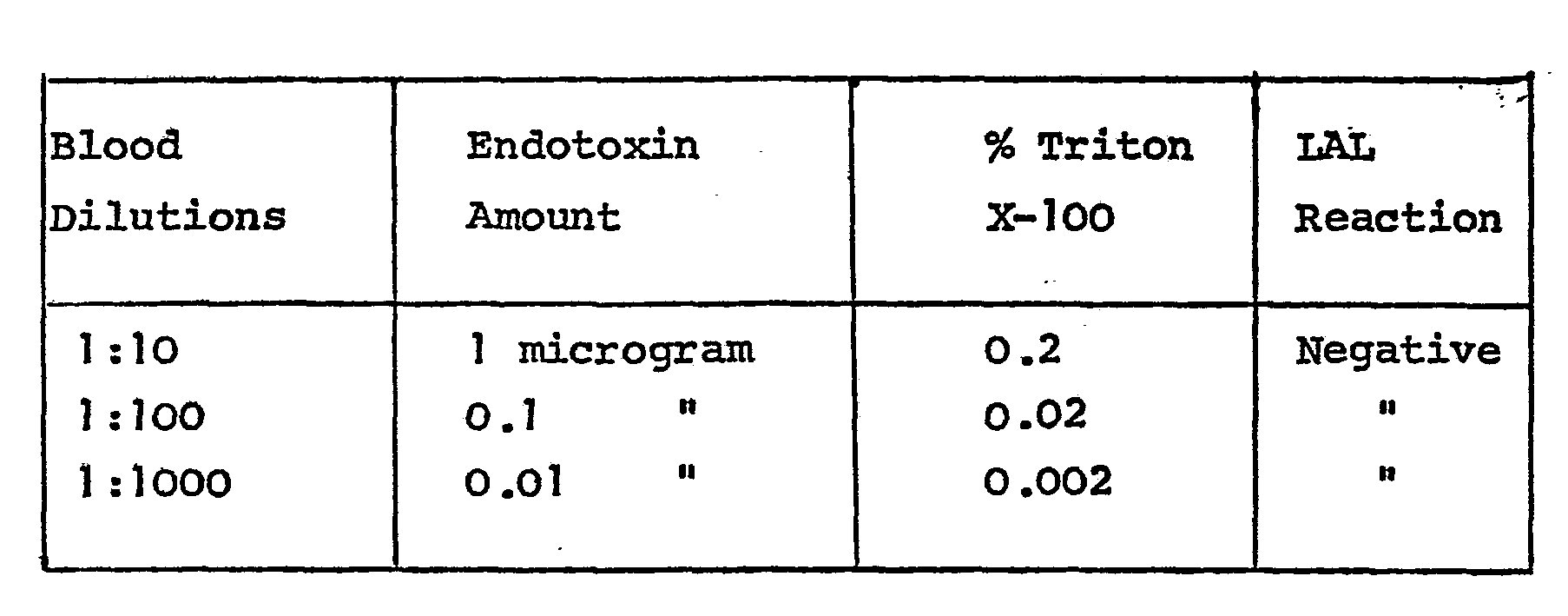
- Whole human blood plasma was diluted 1 : 2 with pyrogemfree water and then spiked with ten micrograms of E. Coli endotoxin. Triton X-100 was added to a concentration of 2% and the mixture was then incubated at 37°C for one hour. Three dilutions of the treated mixture were then made and the dilutions were tested for pyrogenicity by the Limulus Lysate (amebocytes) assay (LAL test) with the following results :
- A commercially produced vial (lyophilized) of prothrombin complex (25 units of Factor IX per ml when reconstituted) was reconstituted with ten ml of sterile water. Triton X-100 was added to a concentration of 2% and the mixture was incubated ninety minutes at ambient temperature (ca. 20-22°C). To nine ml of the above mixture was added 6.0 ml of a 50% solution of polyethylene glycol 4000. The pH was adjusted to 5.7 and the mixture was cooled to below 5°C to precipitate the protein. The mixture was centrifuged and the precipitate was resuspended in sterile water. The treated product was tested for pyrogenicity by the LAL test and compared with the original untreated sample and a control which consisted of the aforesaid precipitate of the treated sample to which 40 picograms of endotoxin were added. The following results were observed :

- Similar depyrogenation of endotoxin-contaminated albumin is obtained by treatment with 2% Triton X-100 as in Examples 1 and 2, above, or with 2% Polysorbate 80.
- Similar depyrogenation of endotoxin-contaminated fibrinogen is obtained by treatment with 2% Triton X-100 as in Examples 1 and 2, above, or with 2% Polysorbate 80.
- Clinical diagnostic control sera were analyzed for their various components both before and after treatment with Triton X-100 at a concentration of 2% to destroy endotoxins and substantially reduce hepatitis virus infectivity in accordance with the present invention. The following results on the untreated and treated product show that the Triton X-100 treatment has not substantially altered the activity of the various components in the control sera.


- The aforesaid analysis was made on Technicon 12/60, 6/60 AutoAnalyzer equipment except as noted for uric acid on a Hycel Mark X.
- Human growth hormone derived by recombinant DNA techniques from E. Coli strain K12, was treated with 3% Triton X-100 for two hours and reprecipitated with ammonium sulfate. The pyrogen level in the product was reduced from 2.2 nanograms/ml in the untreated product to less than lo picograms/ml in the treated product.
- Various therapeutic blood plasma protein products are treated by prolonged contact with a solution of 2% Triton X-100 and subsequently separated from the Triton X-100 by precipitation as follows :
- (a) For the production of AHF, Triton X-100 is added to whole blood plasma prior to the conventional cryo- precipitation step at freezing temperatures of -20°C to -80°C. The Triton X-100 remains in the supernatant while AHF is concentrated in the cryoprecipitate.
- (b) For the production of gamma globulin, Triton X-100 is added to whole blood plasma at the beginning of the Cohn fractionation procedure with cold alcohol according to Method 6. The Triton X-100 remains in the supernatant while gamma globulin is precipitated in Cohn fraction II + III.
- (c) For the production of albumin, Triton X-100 is added to the supernatant after the removal of Cohn fraction II + III in the Cohn fractionation procedure with cold alcohol according to Method 6. The Triton X-100 remains in the supernatant while albumin is precipitated principally in Cohn fraction V.
- (d) For the reworking of pyrogenic albumin, albumin powder is resuspended and Triton X-100 is added to the suspension. Albumin is then reprecipitated with a protein precipitant such as polyethylene glycol, alcohol or ammonium sulfate and Triton X-100 remains in the supernatant.
- Various non-therapeutic blood plasma protein products such as fetal bovine serum, bovine albumin and bovine serum which are commonly used as growth media in tissue culture procedures are treated by prolonged contact with 2% Triton X-100 as in the previous examples. The Triton X-100 is removed in the supernatant after precipitation of all proteins as in Example 7 and resuspension in appropriate milieu, e.g., balanced salt solution, such as Hank's BSS.
- When 2% Triton X-100 is added to platelet-poor plasma (double spun plasma) the non-activated partial thromboplastin time (PTT) becomes indefinitely prolonged instead of the usual 200 seconds. This evidences the anticoagulant activity of Triton X-100 in the plasma.
-
- (a) Whole blood collected in 2% Triton X-100 does not clot for over 12 hours.
- (b) Whole blood collected in 2% sodium cholate does not clot in over 24 hours.
- Samples of blood sera and plasma obtained for laboratory analysis are placed in test tubes containing 2% Triton X-100 and allowed to incubate for 30-120 minutes to inactive potential hepatitis virus.
- Various other examples will be apparent to the person skilled in the art after reading the present disclosure without departing from the spirit and scope of the invention and it is intended that all such examples be included within the scope of the appended claims.
Claims (11)
Priority Applications (1)
| Application Number | Priority Date | Filing Date | Title |
|---|---|---|---|
| AT81401468T ATE16890T1 (en) | 1980-10-06 | 1981-09-22 | METHODS OF REDUCING ADVERSE EFFECTS OF BIOLOGICAL AND PHARMACEUTICAL PRODUCTS. |
Applications Claiming Priority (4)
| Application Number | Priority Date | Filing Date | Title |
|---|---|---|---|
| US06/194,264 US4314997A (en) | 1980-10-06 | 1980-10-06 | Purification of plasma protein products |
| US194263 | 1980-10-06 | ||
| US194264 | 1980-10-06 | ||
| US06/194,263 US4315919A (en) | 1980-10-06 | 1980-10-06 | Depyrogenation process |
Publications (4)
| Publication Number | Publication Date |
|---|---|
| EP0050061A2 true EP0050061A2 (en) | 1982-04-21 |
| EP0050061A3 EP0050061A3 (en) | 1982-08-11 |
| EP0050061B1 EP0050061B1 (en) | 1985-12-11 |
| EP0050061B2 EP0050061B2 (en) | 1990-06-20 |
Family
ID=26889848
Family Applications (1)
| Application Number | Title | Priority Date | Filing Date |
|---|---|---|---|
| EP81401468A Expired - Lifetime EP0050061B2 (en) | 1980-10-06 | 1981-09-22 | Method of reducing undesirable activities of biological and pharmaceutical products |
Country Status (2)
| Country | Link |
|---|---|
| EP (1) | EP0050061B2 (en) |
| DE (1) | DE3173208D1 (en) |
Cited By (32)
| Publication number | Priority date | Publication date | Assignee | Title |
|---|---|---|---|---|
| EP0083999A1 (en) * | 1982-01-04 | 1983-07-20 | Edward Shanbrom | Method of reducing or suppressing undesirable activities of biological pharmaceutical and biomedical products and materials |
| US4481189A (en) * | 1982-04-14 | 1984-11-06 | New York Blood Center Inc. | Process for preparing sterilized plasma and plasma derivatives |
| EP0124044A3 (en) * | 1983-04-29 | 1985-07-31 | Armour Pharmaceutical Company | Process for pasteurizing fibronectin |
| EP0137428A3 (en) * | 1983-10-08 | 1985-08-07 | Behringwerke Aktiengesellschaft | Method for the pasteurization of plasma or concentrates of blood coagulating factors ii,vii, ix an x |
| EP0172716A1 (en) * | 1984-08-14 | 1986-02-26 | Shiley Incorporated | Retarded mineralization of implantable tissue by surface active betaines |
| EP0239859A3 (en) * | 1986-03-31 | 1988-06-22 | New York Blood Center, Inc. | Removal of lipid soluble process chemicals from biological materials by extraction with naturally occurring oils or synthetic substitutes thereof |
| US4764369A (en) * | 1983-07-14 | 1988-08-16 | New York Blood Center Inc. | Undenatured virus-free biologically active protein derivatives |
| US4820805A (en) * | 1983-07-14 | 1989-04-11 | New York Blood Center, Inc. | Undenatured virus-free trialkyl phosphate treated biologically active protein derivatives |
| FR2630115A1 (en) * | 1988-04-14 | 1989-10-20 | Merieux Inst | PROCESS FOR STABILIZING HUMAN ALBUMIN SOLUTIONS AND SOLUTION OBTAINED |
| EP0338515A1 (en) * | 1988-04-19 | 1989-10-25 | Merrell Dow Pharmaceuticals Inc. | Method of preventing aids transmission from blood transfusions |
| EP0278487A3 (en) * | 1987-02-13 | 1990-01-17 | BEHRINGWERKE Aktiengesellschaft | Process for the inactivation of enveloped viri in protein preparations produced in vitro by means of a single cell |
| EP0402205A1 (en) * | 1989-06-08 | 1990-12-12 | Centre Regional De Transfusion Sanguine De Lille | Process for the preparation of purified albumin solutions |
| EP0431074A4 (en) * | 1988-08-09 | 1991-09-11 | Alan I. Rubinstein | Disinfecting blood constituents, corneal and scleral tissue |
| WO1991014439A1 (en) * | 1990-03-20 | 1991-10-03 | Octapharma Ag | Process for producing non-infectious blood plasma |
| EP0519901A3 (en) * | 1991-06-20 | 1993-05-19 | Immuno Aktiengesellschaft | Virus-inactivated blood product |
| EP0530173A3 (en) * | 1991-08-19 | 1993-05-19 | Haemosan Erzeugung Pharmazeutischer Grundstoffe Gmbh | Method for inactivating prions |
| WO1994013329A1 (en) * | 1992-12-16 | 1994-06-23 | Immuno Aktiengesellschaft | Process for preparing a virus-safe biological composition |
| DE4342132C1 (en) * | 1993-12-10 | 1994-11-03 | Octapharma Ag | Process for the preparation of virus-inactivated vitamin K-dependent plasma components, and protein C and protein S-containing compositions by membrane chromatography |
| US5410022A (en) * | 1992-04-24 | 1995-04-25 | Immuno Aktiengesellschaft | Method of producing a factor VIII preparation |
| US5478558A (en) * | 1991-06-20 | 1995-12-26 | Immuno Ag | Method of dissolving venous Thrombi using drug containing activated Protein C |
| US5506112A (en) * | 1991-01-25 | 1996-04-09 | Immuno Aktiengesellschaft | Reagent used for determining factor VIII activity |
| DE19528221A1 (en) * | 1995-08-01 | 1997-02-06 | Blutspendedienst Der Drk Lande | Double virus-inactivated human blood plasma, blood plasma derivatives that can be produced therefrom and methods for their production |
| US5614493A (en) * | 1993-06-18 | 1997-03-25 | Immuno Ag | Use of human protein C for prevention and treatment of depositions of thrombocytes |
| EP0776668A2 (en) | 1995-11-28 | 1997-06-04 | Behringwerke Ag | Process for the removal of aromatic compounds from solutions |
| US5770199A (en) * | 1993-10-06 | 1998-06-23 | Immuno Aktiengesellschaft | Method for virus inactivation in the presence of polyalkylene glycol as well as the pharmaceutical preparation obtained therewith |
| US5808000A (en) * | 1994-07-14 | 1998-09-15 | Immuno Aktiengesellschaft | Virus-safe monomeric human immunoglobulin A and methods for its production |
| WO1998053860A1 (en) * | 1997-05-30 | 1998-12-03 | Shanbrom Technologies, Llc | Disinfection by particle-bound and insolubilized detergents |
| US6270672B1 (en) | 1999-08-06 | 2001-08-07 | Baxter Aktiengesellschaft | Devices and methods for removing pathogens from biological fluids |
| WO2003053477A1 (en) * | 2001-12-21 | 2003-07-03 | Baxter International Inc. | Process for inactivating pathogens in a biological solution |
| US6646108B1 (en) | 1996-01-12 | 2003-11-11 | Baxter Aktiengesellschaft | Process for isolating IgG and IgA |
| US6787520B2 (en) | 1996-08-12 | 2004-09-07 | Dirk Vollenbroich | Inactivating process for lipid envelopped virus, and new antivirus lipopeptides |
| US12258540B2 (en) | 2017-10-30 | 2025-03-25 | Takeda Pharmaceutical Company Limited | Environmentally compatible detergents for inactivation of lipid-enveloped viruses |
Family Cites Families (1)
| Publication number | Priority date | Publication date | Assignee | Title |
|---|---|---|---|---|
| US4086218A (en) * | 1975-04-11 | 1978-04-25 | Edward Shanbrom, Inc. | Method of preserving blood plasma II |
-
1981
- 1981-09-22 EP EP81401468A patent/EP0050061B2/en not_active Expired - Lifetime
- 1981-09-22 DE DE8181401468T patent/DE3173208D1/en not_active Expired
Cited By (47)
| Publication number | Priority date | Publication date | Assignee | Title |
|---|---|---|---|---|
| EP0083999A1 (en) * | 1982-01-04 | 1983-07-20 | Edward Shanbrom | Method of reducing or suppressing undesirable activities of biological pharmaceutical and biomedical products and materials |
| US4481189A (en) * | 1982-04-14 | 1984-11-06 | New York Blood Center Inc. | Process for preparing sterilized plasma and plasma derivatives |
| EP0124044A3 (en) * | 1983-04-29 | 1985-07-31 | Armour Pharmaceutical Company | Process for pasteurizing fibronectin |
| US4764369A (en) * | 1983-07-14 | 1988-08-16 | New York Blood Center Inc. | Undenatured virus-free biologically active protein derivatives |
| US4820805A (en) * | 1983-07-14 | 1989-04-11 | New York Blood Center, Inc. | Undenatured virus-free trialkyl phosphate treated biologically active protein derivatives |
| EP0137428A3 (en) * | 1983-10-08 | 1985-08-07 | Behringwerke Aktiengesellschaft | Method for the pasteurization of plasma or concentrates of blood coagulating factors ii,vii, ix an x |
| EP0172716A1 (en) * | 1984-08-14 | 1986-02-26 | Shiley Incorporated | Retarded mineralization of implantable tissue by surface active betaines |
| US4789545A (en) * | 1986-03-31 | 1988-12-06 | New York Blood Center, Inc. | Removal of lipid soluble process chemicals from biological materials by extraction with naturally occurring oils or synthetic substitutes thereof |
| EP0239859A3 (en) * | 1986-03-31 | 1988-06-22 | New York Blood Center, Inc. | Removal of lipid soluble process chemicals from biological materials by extraction with naturally occurring oils or synthetic substitutes thereof |
| EP0278487A3 (en) * | 1987-02-13 | 1990-01-17 | BEHRINGWERKE Aktiengesellschaft | Process for the inactivation of enveloped viri in protein preparations produced in vitro by means of a single cell |
| FR2630115A1 (en) * | 1988-04-14 | 1989-10-20 | Merieux Inst | PROCESS FOR STABILIZING HUMAN ALBUMIN SOLUTIONS AND SOLUTION OBTAINED |
| EP0341103A1 (en) * | 1988-04-14 | 1989-11-08 | Pasteur Merieux Serums Et Vaccins | Method for stabilizing solutions of human albumin, and solution so obtained |
| US5118794A (en) * | 1988-04-14 | 1992-06-02 | Institut Merieux | Process for stabilizing human albumin solutions and the solution obtained |
| EP0338515A1 (en) * | 1988-04-19 | 1989-10-25 | Merrell Dow Pharmaceuticals Inc. | Method of preventing aids transmission from blood transfusions |
| EP0431074A4 (en) * | 1988-08-09 | 1991-09-11 | Alan I. Rubinstein | Disinfecting blood constituents, corneal and scleral tissue |
| EP0402205A1 (en) * | 1989-06-08 | 1990-12-12 | Centre Regional De Transfusion Sanguine De Lille | Process for the preparation of purified albumin solutions |
| FR2648048A1 (en) * | 1989-06-08 | 1990-12-14 | Lille Transfusion Sanguine | PROCESS FOR THE PREPARATION OF PURIFIED ALBUMIN SOLUTIONS |
| HRP920769A2 (en) * | 1989-06-08 | 1994-04-30 | Centre Regional De Transfusion Sanguine De Lille | Process for the preparation of purified albumin solutions |
| US6022954A (en) * | 1989-06-08 | 2000-02-08 | Centre Regional De Transfusion Sanguine De Lille | Process for the preparation of purified albumin solutions |
| WO1991014439A1 (en) * | 1990-03-20 | 1991-10-03 | Octapharma Ag | Process for producing non-infectious blood plasma |
| US5506112A (en) * | 1991-01-25 | 1996-04-09 | Immuno Aktiengesellschaft | Reagent used for determining factor VIII activity |
| US5614405A (en) * | 1991-06-20 | 1997-03-25 | Immuno Aktiengesellschaft | Method of determining the virus inactivation capacity of an inactivation treatment |
| EP0519901A3 (en) * | 1991-06-20 | 1993-05-19 | Immuno Aktiengesellschaft | Virus-inactivated blood product |
| US5478558A (en) * | 1991-06-20 | 1995-12-26 | Immuno Ag | Method of dissolving venous Thrombi using drug containing activated Protein C |
| US5580962A (en) * | 1991-06-20 | 1996-12-03 | Immuno Aktiengesellschaft | Parenterally administrable drug having thrombolytic activity and containing protein C |
| US5864016A (en) * | 1991-06-20 | 1999-01-26 | Immuno Aktiengesellschaft | Blood product, a method of producing the same and a method of determining the virus inactivation capacity of an inactivation treatment |
| EP0882455A1 (en) * | 1991-06-20 | 1998-12-09 | Immuno Ag | Virus-inactivated blood product |
| EP0530173A3 (en) * | 1991-08-19 | 1993-05-19 | Haemosan Erzeugung Pharmazeutischer Grundstoffe Gmbh | Method for inactivating prions |
| US5633349A (en) * | 1991-08-19 | 1997-05-27 | Reichl; Herwig | Method of inactivating prions (slow viruses) conventional viruses and other infections agents in biological material |
| US5410022A (en) * | 1992-04-24 | 1995-04-25 | Immuno Aktiengesellschaft | Method of producing a factor VIII preparation |
| WO1994013329A1 (en) * | 1992-12-16 | 1994-06-23 | Immuno Aktiengesellschaft | Process for preparing a virus-safe biological composition |
| US5639730A (en) * | 1992-12-16 | 1997-06-17 | Immuno Aktiengesellschaft | Method of producing a virus-safe biological preparation |
| US5614493A (en) * | 1993-06-18 | 1997-03-25 | Immuno Ag | Use of human protein C for prevention and treatment of depositions of thrombocytes |
| US5770199A (en) * | 1993-10-06 | 1998-06-23 | Immuno Aktiengesellschaft | Method for virus inactivation in the presence of polyalkylene glycol as well as the pharmaceutical preparation obtained therewith |
| DE4342132C1 (en) * | 1993-12-10 | 1994-11-03 | Octapharma Ag | Process for the preparation of virus-inactivated vitamin K-dependent plasma components, and protein C and protein S-containing compositions by membrane chromatography |
| US6893856B2 (en) | 1993-12-10 | 2005-05-17 | Octapharma Ag | Process for preparing virus-inactivated factors 1X and X by membrane chromatography |
| US5808000A (en) * | 1994-07-14 | 1998-09-15 | Immuno Aktiengesellschaft | Virus-safe monomeric human immunoglobulin A and methods for its production |
| DE19528221C2 (en) * | 1995-08-01 | 1998-10-22 | Blutspendedienst Der Drk Lande | Process for the production of a virus-safe, therapeutic preparation from human plasma |
| DE19528221A1 (en) * | 1995-08-01 | 1997-02-06 | Blutspendedienst Der Drk Lande | Double virus-inactivated human blood plasma, blood plasma derivatives that can be produced therefrom and methods for their production |
| EP0776668A2 (en) | 1995-11-28 | 1997-06-04 | Behringwerke Ag | Process for the removal of aromatic compounds from solutions |
| US5883256A (en) * | 1995-11-28 | 1999-03-16 | Behringwerke Aktiengesellschaft | Process for removing aromatic heterocyclic compounds product-containing solutions |
| US6646108B1 (en) | 1996-01-12 | 2003-11-11 | Baxter Aktiengesellschaft | Process for isolating IgG and IgA |
| US6787520B2 (en) | 1996-08-12 | 2004-09-07 | Dirk Vollenbroich | Inactivating process for lipid envelopped virus, and new antivirus lipopeptides |
| WO1998053860A1 (en) * | 1997-05-30 | 1998-12-03 | Shanbrom Technologies, Llc | Disinfection by particle-bound and insolubilized detergents |
| US6270672B1 (en) | 1999-08-06 | 2001-08-07 | Baxter Aktiengesellschaft | Devices and methods for removing pathogens from biological fluids |
| WO2003053477A1 (en) * | 2001-12-21 | 2003-07-03 | Baxter International Inc. | Process for inactivating pathogens in a biological solution |
| US12258540B2 (en) | 2017-10-30 | 2025-03-25 | Takeda Pharmaceutical Company Limited | Environmentally compatible detergents for inactivation of lipid-enveloped viruses |
Also Published As
| Publication number | Publication date |
|---|---|
| DE3173208D1 (en) | 1986-01-23 |
| EP0050061B2 (en) | 1990-06-20 |
| EP0050061A3 (en) | 1982-08-11 |
| EP0050061B1 (en) | 1985-12-11 |
Similar Documents
| Publication | Publication Date | Title |
|---|---|---|
| EP0050061B1 (en) | Method of reducing undesirable activities of biological and pharmaceutical products | |
| US4314997A (en) | Purification of plasma protein products | |
| US4315919A (en) | Depyrogenation process | |
| US4534972A (en) | Protein compositions substantially free from infectious agents | |
| CA2034489C (en) | Methods for the inactivation of viruses in viral-contaminated pharmaceutical compositions | |
| DE3280463T2 (en) | Blood-clotting enzyme preparations. | |
| US5118794A (en) | Process for stabilizing human albumin solutions and the solution obtained | |
| US5614405A (en) | Method of determining the virus inactivation capacity of an inactivation treatment | |
| US5099003A (en) | Method of preparing a sterile plasma-protein solution containing fibrinogen and factor xiii | |
| US4591505A (en) | Process for inactivating hepatitis B virus | |
| JP4841018B2 (en) | Final sterilization of biological products | |
| EP0131740B1 (en) | Undenatured virus-free biologically active protein derivatives | |
| US4440679A (en) | Pasteurized therapeutically active protein compositions | |
| US4481189A (en) | Process for preparing sterilized plasma and plasma derivatives | |
| US4470968A (en) | Pasteurized therapeutically active blood coagulation factor concentrates | |
| EP0035204A2 (en) | Pasteurized therapeutically active protein compositions | |
| EP0144709B1 (en) | Heat treatment of plasma fractions | |
| Saba | Prevention of liver reticuloendothelial systemic host defense failure after surgery by intravenous opsonic glycoprotein therapy | |
| EP0083999A1 (en) | Method of reducing or suppressing undesirable activities of biological pharmaceutical and biomedical products and materials | |
| US4720385A (en) | Protein compositions substantially free from infectious agents | |
| CA2052809A1 (en) | Process for producing secretory immunoglobulin a preparations | |
| Ng et al. | Pasteurization of antihemophilic factor and model virus inactivation studies | |
| US4579735A (en) | Process for the pasteurization of human residual plasma | |
| CA1213827A (en) | Process for pasteurizing fibronectin | |
| KR101798386B1 (en) | Caprylate viral deactivation |
Legal Events
| Date | Code | Title | Description |
|---|---|---|---|
| PUAI | Public reference made under article 153(3) epc to a published international application that has entered the european phase |
Free format text: ORIGINAL CODE: 0009012 |
|
| AK | Designated contracting states |
Designated state(s): AT BE CH DE FR GB IT NL SE |
|
| PUAL | Search report despatched |
Free format text: ORIGINAL CODE: 0009013 |
|
| AK | Designated contracting states |
Designated state(s): AT BE CH DE FR GB IT NL SE |
|
| 17P | Request for examination filed |
Effective date: 19821220 |
|
| GRAA | (expected) grant |
Free format text: ORIGINAL CODE: 0009210 |
|
| AK | Designated contracting states |
Designated state(s): AT BE CH DE FR GB IT LI NL SE |
|
| PG25 | Lapsed in a contracting state [announced via postgrant information from national office to epo] |
Ref country code: NL Effective date: 19851211 Ref country code: LI Effective date: 19851211 Ref country code: IT Free format text: LAPSE BECAUSE OF FAILURE TO SUBMIT A TRANSLATION OF THE DESCRIPTION OR TO PAY THE FEE WITHIN THE PRESCRIBED TIME-LIMIT;WARNING: LAPSES OF ITALIAN PATENTS WITH EFFECTIVE DATE BEFORE 2007 MAY HAVE OCCURRED AT ANY TIME BEFORE 2007. THE CORRECT EFFECTIVE DATE MAY BE DIFFERENT FROM THE ONE RECORDED. Effective date: 19851211 Ref country code: CH Effective date: 19851211 Ref country code: BE Effective date: 19851211 Ref country code: AT Effective date: 19851211 |
|
| REF | Corresponds to: |
Ref document number: 16890 Country of ref document: AT Date of ref document: 19851215 Kind code of ref document: T |
|
| ET | Fr: translation filed | ||
| REF | Corresponds to: |
Ref document number: 3173208 Country of ref document: DE Date of ref document: 19860123 |
|
| PG25 | Lapsed in a contracting state [announced via postgrant information from national office to epo] |
Ref country code: SE Effective date: 19860131 |
|
| REG | Reference to a national code |
Ref country code: CH Ref legal event code: PL |
|
| NLV1 | Nl: lapsed or annulled due to failure to fulfill the requirements of art. 29p and 29m of the patents act | ||
| PLBI | Opposition filed |
Free format text: ORIGINAL CODE: 0009260 |
|
| 26 | Opposition filed |
Opponent name: IMMUNO AKTIENGESELLSCHAFT FUER CHEMISCH-MEDIZINISC Effective date: 19860906 |
|
| RAP2 | Party data changed (patent owner data changed or rights of a patent transferred) |
Owner name: NEW YORK BLOOD CENTER, INC. |
|
| RIN2 | Information on inventor provided after grant (corrected) |
Free format text: SHANBROM, EDWARD |
|
| PUAH | Patent maintained in amended form |
Free format text: ORIGINAL CODE: 0009272 |
|
| STAA | Information on the status of an ep patent application or granted ep patent |
Free format text: STATUS: PATENT MAINTAINED AS AMENDED |
|
| 27A | Patent maintained in amended form |
Effective date: 19900620 |
|
| AK | Designated contracting states |
Kind code of ref document: B2 Designated state(s): AT BE CH DE FR GB IT NL SE |
|
| ET3 | Fr: translation filed ** decision concerning opposition | ||
| REG | Reference to a national code |
Ref country code: GB Ref legal event code: 732E |
|
| REG | Reference to a national code |
Ref country code: GB Ref legal event code: 727A |
|
| REG | Reference to a national code |
Ref country code: GB Ref legal event code: 727H |
|
| REG | Reference to a national code |
Ref country code: GB Ref legal event code: SP |
|
| PGFP | Annual fee paid to national office [announced via postgrant information from national office to epo] |
Ref country code: GB Payment date: 20000904 Year of fee payment: 20 |
|
| PGFP | Annual fee paid to national office [announced via postgrant information from national office to epo] |
Ref country code: FR Payment date: 20000918 Year of fee payment: 20 |
|
| PGFP | Annual fee paid to national office [announced via postgrant information from national office to epo] |
Ref country code: DE Payment date: 20001129 Year of fee payment: 20 |
|
| PG25 | Lapsed in a contracting state [announced via postgrant information from national office to epo] |
Ref country code: GB Free format text: LAPSE BECAUSE OF EXPIRATION OF PROTECTION Effective date: 20010921 |
|
| REG | Reference to a national code |
Ref country code: GB Ref legal event code: PE20 Effective date: 20010921 |