EP0049134B1 - Braiding - Google Patents
Braiding Download PDFInfo
- Publication number
- EP0049134B1 EP0049134B1 EP81304448A EP81304448A EP0049134B1 EP 0049134 B1 EP0049134 B1 EP 0049134B1 EP 81304448 A EP81304448 A EP 81304448A EP 81304448 A EP81304448 A EP 81304448A EP 0049134 B1 EP0049134 B1 EP 0049134B1
- Authority
- EP
- European Patent Office
- Prior art keywords
- yarns
- filaments
- lubricant liquid
- braiding
- lubricant
- Prior art date
- Legal status (The legal status is an assumption and is not a legal conclusion. Google has not performed a legal analysis and makes no representation as to the accuracy of the status listed.)
- Expired
Links
- 238000009954 braiding Methods 0.000 title claims description 40
- 239000000314 lubricant Substances 0.000 claims description 53
- 239000007788 liquid Substances 0.000 claims description 40
- 238000000034 method Methods 0.000 claims description 33
- 239000000463 material Substances 0.000 claims description 14
- 239000000203 mixture Substances 0.000 claims description 11
- 206010061592 cardiac fibrillation Diseases 0.000 claims description 9
- 230000002600 fibrillogenic effect Effects 0.000 claims description 9
- RTZKZFJDLAIYFH-UHFFFAOYSA-N Diethyl ether Chemical compound CCOCC RTZKZFJDLAIYFH-UHFFFAOYSA-N 0.000 claims description 7
- 235000014113 dietary fatty acids Nutrition 0.000 claims description 7
- 239000000194 fatty acid Substances 0.000 claims description 7
- 229930195729 fatty acid Natural products 0.000 claims description 7
- 229930195733 hydrocarbon Natural products 0.000 claims description 7
- 150000002430 hydrocarbons Chemical class 0.000 claims description 7
- 150000004665 fatty acids Chemical class 0.000 claims description 6
- 239000011521 glass Substances 0.000 claims description 6
- 239000004215 Carbon black (E152) Substances 0.000 claims description 5
- 229910010272 inorganic material Inorganic materials 0.000 claims description 5
- 239000011147 inorganic material Substances 0.000 claims description 5
- VYPSYNLAJGMNEJ-UHFFFAOYSA-N Silicium dioxide Chemical compound O=[Si]=O VYPSYNLAJGMNEJ-UHFFFAOYSA-N 0.000 claims description 4
- 229920000151 polyglycol Polymers 0.000 claims description 4
- 239000010695 polyglycol Substances 0.000 claims description 4
- OKTJSMMVPCPJKN-UHFFFAOYSA-N Carbon Chemical compound [C] OKTJSMMVPCPJKN-UHFFFAOYSA-N 0.000 claims description 3
- 229910052799 carbon Inorganic materials 0.000 claims description 3
- 239000000919 ceramic Substances 0.000 claims description 2
- 238000010438 heat treatment Methods 0.000 claims description 2
- 229930195734 saturated hydrocarbon Natural products 0.000 claims description 2
- 239000000377 silicon dioxide Substances 0.000 claims description 2
- 239000012777 electrically insulating material Substances 0.000 claims 1
- 238000000576 coating method Methods 0.000 description 8
- 238000009472 formulation Methods 0.000 description 8
- 239000003921 oil Substances 0.000 description 7
- 239000011248 coating agent Substances 0.000 description 6
- 238000004519 manufacturing process Methods 0.000 description 5
- 239000011344 liquid material Substances 0.000 description 4
- 239000007787 solid Substances 0.000 description 4
- 230000015572 biosynthetic process Effects 0.000 description 3
- -1 fatty acid ester Chemical class 0.000 description 3
- LYCAIKOWRPUZTN-UHFFFAOYSA-N Ethylene glycol Chemical compound OCCO LYCAIKOWRPUZTN-UHFFFAOYSA-N 0.000 description 2
- 239000000839 emulsion Substances 0.000 description 2
- 239000000835 fiber Substances 0.000 description 2
- 239000003365 glass fiber Substances 0.000 description 2
- 239000002184 metal Substances 0.000 description 2
- 229920000058 polyacrylate Polymers 0.000 description 2
- 229920000642 polymer Polymers 0.000 description 2
- 229920002545 silicone oil Polymers 0.000 description 2
- 238000004513 sizing Methods 0.000 description 2
- 239000007921 spray Substances 0.000 description 2
- 239000000126 substance Substances 0.000 description 2
- 229940099259 vaseline Drugs 0.000 description 2
- 238000004804 winding Methods 0.000 description 2
- 229920000742 Cotton Polymers 0.000 description 1
- JOYRKODLDBILNP-UHFFFAOYSA-N Ethyl urethane Chemical compound CCOC(N)=O JOYRKODLDBILNP-UHFFFAOYSA-N 0.000 description 1
- 241000408710 Hansa Species 0.000 description 1
- 239000004698 Polyethylene Substances 0.000 description 1
- 229920002472 Starch Polymers 0.000 description 1
- 239000000654 additive Substances 0.000 description 1
- 230000000996 additive effect Effects 0.000 description 1
- 150000003863 ammonium salts Chemical class 0.000 description 1
- 238000000137 annealing Methods 0.000 description 1
- 150000004945 aromatic hydrocarbons Chemical class 0.000 description 1
- 239000002482 conductive additive Substances 0.000 description 1
- 239000003085 diluting agent Substances 0.000 description 1
- 238000006073 displacement reaction Methods 0.000 description 1
- 238000005516 engineering process Methods 0.000 description 1
- 150000002170 ethers Chemical class 0.000 description 1
- WGCNASOHLSPBMP-UHFFFAOYSA-N hydroxyacetaldehyde Natural products OCC=O WGCNASOHLSPBMP-UHFFFAOYSA-N 0.000 description 1
- 230000003993 interaction Effects 0.000 description 1
- 230000001050 lubricating effect Effects 0.000 description 1
- 238000005461 lubrication Methods 0.000 description 1
- 239000010690 paraffinic oil Substances 0.000 description 1
- 230000000704 physical effect Effects 0.000 description 1
- 229920001281 polyalkylene Polymers 0.000 description 1
- 229920000573 polyethylene Polymers 0.000 description 1
- 229920002689 polyvinyl acetate Polymers 0.000 description 1
- 239000011118 polyvinyl acetate Substances 0.000 description 1
- 229920000915 polyvinyl chloride Polymers 0.000 description 1
- 239000004800 polyvinyl chloride Substances 0.000 description 1
- 150000003839 salts Chemical class 0.000 description 1
- 150000004756 silanes Chemical class 0.000 description 1
- 229920005573 silicon-containing polymer Polymers 0.000 description 1
- 239000008149 soap solution Substances 0.000 description 1
- 239000000243 solution Substances 0.000 description 1
- 239000002904 solvent Substances 0.000 description 1
- 238000000638 solvent extraction Methods 0.000 description 1
- 238000005507 spraying Methods 0.000 description 1
- 235000019698 starch Nutrition 0.000 description 1
- 239000008107 starch Substances 0.000 description 1
- 230000003068 static effect Effects 0.000 description 1
- 238000004381 surface treatment Methods 0.000 description 1
- 239000002966 varnish Substances 0.000 description 1
- 239000001993 wax Substances 0.000 description 1
- 239000003871 white petrolatum Substances 0.000 description 1
- 210000002268 wool Anatomy 0.000 description 1
Images
Classifications
-
- D—TEXTILES; PAPER
- D04—BRAIDING; LACE-MAKING; KNITTING; TRIMMINGS; NON-WOVEN FABRICS
- D04C—BRAIDING OR MANUFACTURE OF LACE, INCLUDING BOBBIN-NET OR CARBONISED LACE; BRAIDING MACHINES; BRAID; LACE
- D04C3/00—Braiding or lacing machines
- D04C3/48—Auxiliary devices
-
- D—TEXTILES; PAPER
- D04—BRAIDING; LACE-MAKING; KNITTING; TRIMMINGS; NON-WOVEN FABRICS
- D04C—BRAIDING OR MANUFACTURE OF LACE, INCLUDING BOBBIN-NET OR CARBONISED LACE; BRAIDING MACHINES; BRAID; LACE
- D04C1/00—Braid or lace, e.g. pillow-lace; Processes for the manufacture thereof
- D04C1/02—Braid or lace, e.g. pillow-lace; Processes for the manufacture thereof made from particular materials
Definitions
- This invention relates to braiding, and in particular to a method of forming a braid from inorganic single-yarns.
- Yarns are formed from filaments, or fibres, and are of two basic types: continuous filament and staple filament.
- Silk fibres and extruded man-made organic or inorganic fibres are examples of continuous filaments.
- Each individual filament of a continuous filament yarn is of such length that it extends substantially throughout the entire length of the filament strand.
- Wool and cotton filaments, as well as man-made organic or inorganic fibres, if cut to a short, defined length are examples of staple filaments.
- Individual filaments of typically 20 to 35 cms in length, form the staple filaments, which must be spun (i.e. plied and twisted) together to form a yarn, or cord.
- Yarns used for braiding may be of the continuous or staple filament type, depending on the particular product required.
- Fibrillation is due, for example, to the frictional, tensional and shear stresses encountered by the yarns as they are braided, and is thus predictably more prevalent in staple filament yarns, in lighter weight yarns, and in yarns of more brittle materials, especially inorganic materials. Fibrillation can be reduced by braiding at a lower speed, but the process then becomes progressively more uneconomical, at least for large-scale applications.
- a braid formed from such twisted yarn is considerably more expensive to produce, and is heavier than a braid formed from single-yarn, but may still be more economical than production of a braid at low speed, i.e. at less than about 100 interlacings per minute, from single-yarns.
- the greater expense of twisted-pair- yarn is mainly due to the separate twisting and plying operations on specialised machinery that are required to produce the yarn. If a balanced yarn, i.e. one that will not unravel, is required, these operations are more complex and more expensive.
- Typical overcoating materials are curable organic liquid, such as varnishes, polyvinylchloride polymers, acrylic polymers, silicone polymers, or urethane polymers.
- Application of an overcoat may require pretreatment of the braid with an adhesion-promoting primer.
- Solid waxy substances have long been used to unify yarns and to reduce frictional breakage.
- Wet lubrication with, for example, soap-solutions or hydrocarbon and other oils, as a means of softening and lubricating natural fibres and man-made organic fibres is also well known, and lubricants used in this way are known as size formulations.
- Inorganic yarn materials such as glass, being relatively impervious, are usually given a solid, starch-oil based size coating during their formation and assembly into yarns. Manufacturers typically spray a size formulation solution on to the extruded filaments, and this dries to a finely divided, powdery solid and improves subsequent handling and fabrication operations.
- the size formulation is starch-based and usually contains solid lubricants such as silanes or hydrocarbon waxes.
- Sized continuous filament, inorganic single-yarns are braided for applications that do not require overcoating, but it has been a long-standing problem in producing overcoatable braids of inorganic yarn materials that the level of filament breakage which occurs at modern braiding speeds is sufficient to detract significantly and intolerably from the properties of the coated braid as aforesaid. This problem is especially severe with light to medium weight yarns (less than 600 tex). Variations in size formulations and coating weights have failed to provide satisfactorily overcoatable braid surfaces from inorganic single yarns at machine speeds sufficiently high to be economically viable on a large scale.
- a method of forming a braid from a plurality of substantially untwisted continuous multifilament inorganic single-yarns comprising (i) applying to said single yarns a lubricant liquid to prevent fibrillation caused by breakage, during braiding, of filaments that from the yarns, and (ii) braiding the lubricated yarns on a high speed braiding machine operating at a rate above 100 interlacings per minute.
- lubricant liquid is not restricted to liquids traditionally regarded as lubricants, e.g. liquids that are utilised in metal to metal contact.
- lubricant liquid is to be construed as covering any formulation of liquid or liquids which facilitates the braiding of single-yarns by suppressing displacement or breakage thereof thereby substantially reducing or preventing the occurrence of projecting filament portions.
- Liquids such as the salt of a fatty acid amide and a fatty acid ester, glycol polyalkylene ethers, fatty acid amide plus polyglycol ether, sulphonated fatty acids, fatty acid amides, polyglycol ether sulphates, polyethylene emulsions, acrylic polymers, polyvinyl acetate emulsions, and silicone oils are suitable "lubricant liquids" for use with particular yarns to be braided. Unsatisfactory performance of certain combinations of yarns and lubricants, for example silicone oils on glass fibre yarns, is believed to be due to excessive static electrical generation.
- Such unsatisfactory performance can sometimes be overcome by formulation with electrically conductive additives designed to alter the electrostatic characteristic of the interaction between the liquid and fibre, such additive may be quartenary ammonium salts dissolved in a suitable solvent. This is a matter to be determined by simple trial and error for each particular kind of yarn to be braided.
- the lubricant liquid applied according to the present invention will generally be different from, and in addition to, any material which may be applied for the purpose of which may be applied for the purpose of initially forming the yarns themselves, for example size formulations as described hereinbefore.
- the lubricant liquid material is preferably an oily material having a relative density of at least 0.8 at 20°C.
- the lubricant preferably has a kinematic visocity of from about 3 to about 35 centistokes at 20°C.
- the most preferred lubricant comprises saturated hydrocarbon oils i.e. hydrocarbons containing less than about 5% of aromatic hydrocarbons and having a relative density within the range from 0.8 to 0.9 at 20°C and a kinematic viscosity within the range from about 3 to about 35 centistokes at 20°C.
- saturated hydrocarbon oils i.e. hydrocarbons containing less than about 5% of aromatic hydrocarbons and having a relative density within the range from 0.8 to 0.9 at 20°C and a kinematic viscosity within the range from about 3 to about 35 centistokes at 20°C.
- the lubricant is preferably applied to the yarns at a temperature above about 25°C, the temperature influencing to some extent the amount of lubricant picked up by the yarn.
- the lubricant liquid may be applied alone or in mixtures with other lubricants or diluents to suit each particular case.
- liquid includes formulations which are not liquid or semi-liquid at normal ambient temperature, but which are liquid under the conditions of their application to the yarns and of the braiding operation.
- the primer When it is required to apply a primer to the yarn to promote adhesion of subsequently-applied coatings to the braid, the primer may conveniently be applied, for some yarns, during the winding of the yarn on to the braiding bobbins, preferably in combination with the application of the lubricant material.
- the present invention can be utilised to improve the braiding of substantially any multi-filament yarns which withstand badly the stresses to which they are subjected on braiding machines, and the present invention is therefore particularly useful in connection with low-torsion yarns of materials such as carbon fibre or of brittle, abrasive or fragile materials, such as ceramic, silica, carbon, and glass.
- Yarns containing 300 to 400 filaments per yarn are commonly used. It may be advantageous to form braids from a combination of different types of inorganic materials.
- each yarn may be a combination of filaments of two or more inorganic material types or alternately two or more discrete types of inorganic yarns may be combined.
- At least some, and preferably all, of the single-yarns are less than 600 tex in weight.
- the present invention is applicable when braiding at high speed, because commercially unacceptable levels of filament breakage, leading to fibril formation, would otherwise occur during the braiding of inorganic single yarns.
- high speed' braiding as used herein is understood to be braiding at a speed appreciably greater than 100 interlacings per minute.
- the invention is particularly advantageous at speeds of about 250 interlacings per minute or about 420 interlacings per minute, at which modern braiding machines operate, but it will be appreciated that it is also applicable to even higher speed operation.
- Fibrillation is particularly disadvantageous when the braid is to be overcoated and when a smooth outer finish is required. Where the overcoated braid is to form an electrically insulating sleeving, it will be appreciated that fibrils extending therefrom could give rise to electrical problems.
- lubricant liquid after the braid has been formed, particularly where the braid is to be overcoated. It is known to remove any sizing from a braid, by heat treatment, for example using a flame, and this has been found to be a convenient way of also removing the lubricant liquid. Such a treatment has the associated advantage that any fibrils that may have been produced by the braiding are also removed. Other removal methods, such as solvent extraction, may be used.
- untwisted multi-filament single-yarns are used.
- the term "untwisted” is intended to encompass yarns, whether monofilament or multi-filament, having fewer than about 40 twists per metre, such yarns also being commonly referred to as "low-torsion” yarns or producer's low twist yarns.
- substantially all the yarns utilised in forming the braid may be continuous filament single-yarns, and preferably multi-filament, continuous single yarns, the term "yarns" including rovings.
- Suitable multi-filament yarns can contain any convenient number of individual filaments, 300 to 400 filaments per yarn being conventional.
- the braided yarns can be treated with primer to promote adhesion of any coating to be subsequently applied to the braid, particularly in the case of glass fibre yarns or yarns of other materials to which many types of coating have difficulty in adhering without prior surface treatment of the yarn.
- the lubricant liquid used in the method of the present invention may serve in some cases as the adhesion-promoting primer, with or without additional chemical treatment.
- the braiding of single yarns as opposed to twisting-yarn-pairs has the advantages of surprisingly increasing production efficiency, and reducing cost. Since the single-yarns intrinsically tend to have a greater width to depth ratio than their equivalent twisted-pair-yarns, the resulting braid had a finer hand (i.e. is softer and smoother to the touch) and can be more smoothly coated, resulting in improved characteristics and further contributing to production efficiency. Twisted-pair-yarns are denser in the sense of compactness. They provide a surface veneer with less width and hence, comparatively, are heavier in weight and cannot ordinarily be as smoothly coated.
- the yarns preferably have the lubricant material applied thereto during winding of the yarns on to braiding machine bobbins, which bobbins are subsequently inserted in the braiding machine in the usual way.
- the lubricant liquid may be applied to the yarn either after it leaves the bobbin but before it enters the braider, or during braiding, by means of, for example, a spray nozzle.
- the amount of lubricant liquid material to be applied, and the other operating conditions are adjusted to suit the yarn being braided.
- Pick-up of about 2% to 6%, preferably at least about 3%, of lubricant liquid by weight, based on the dry weight of the yarn, is preferred for glass filament yarns using an oily hydrocarbon lubricant, for example.
- the lubricant may be applied to the fibres in any suitable way, one convenient method involving the use of a "licking" roller rotating in a bath of a lubricant liquid material (preferably warmed to a temperature above 25°C), whereby the yarn touches against the "licking" roller to pick up a coating of the lubricant.
- a bobbin wound with the yarn may be partially or totally immersed in the lubricant liquid.
- the amount of lubricant picked up by the yarn may in any event be adjusted by mechanical or pneumatic means if desired.
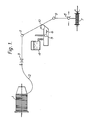
- the already-sized yarn 2 is unwound from a bobbin 1 on which it is supplied and is fed through a braking and tensioning device 3. From there it passes, via a guide member 11, to contact a licking roller 10 and thence to guides 9 and 8.
- the guide 8 moves to and fro as indicated by the arrows to distribute the yarn to the braiding machine bobbin 7 in the usual way.
- the yarn contacts the licking roller 10 that is partly immersed in a bath of lubricant liquid material and which is rotating in a direction counter to the direction of movement of the yarn, as indicated by the curved arrow.
- the lubricant material is maintained at a suitable temperature, for example 30°C, by control means illustrated by a heater 6 and a thermometer 5.
- An adequate level of the lubricant liquid is maintained by a reservoir 4.
- the braiding machine bobbins containing the wet lubricated yarns are then placed on the spindles of a braiding machine, and the yarn is transformed into braids on a braiding machine in the usual way, with a substantially reduced degree of filament breakage compared with unlubri- cated sized single-yarns or even in some cases with twisted-pair-yarns.
- Sized glass filament single-yarns identified by the manufacturer's No. EC9 102 Z 20 (ECG 49 1/ 0 0.5 Z) were wound on to braiding bobbins in the manner generally described above with reference to Figure 1, using a suitable braking tension determined by the usual criteria.
- the yarn was wound at a linear speed of 200 to 300 metres per minute, and was coated with the aforementioned lubricant hydrocarbon oil MPW 2H (from ETS Z Moulins) at a temperature of 30°C, the licking roller having a diameter of 60 mm and rotating at a speed of 10 revolutions per minute.
- the glass filament yarn picked up 3% by weight of the lubricant, based on the yarn dry weight, and was successfully braided on a braiding machine operating at 420 yarn interlacings per minute. After annealing and de-sizing by flame treatment, the braid was found to be substantially free of the lubricant liquid and substantially free of projecting filament ends, and was considered to be quite satisfactory for application of further coatings in known manner.
- the aforementioned single yarn was able to be used in place of twisted equivalent yarns EC9 34X x 35 150 (ECG 15 C 1/3 3.8 S).
- Example 1 The method of Example 1 was repeated, except that the MPW 2H oil was replaced as lubricant by the Codex Vaseline oil known as "SIDEPALINE 316" (from S.T.E. Chimiques de Gerland). Satisfactory results were again achieved, despite a tendency for a slightly increased occurrence of projecting filament ends.
- Example 1 The method of Example 1 was repeated with the lubricant replaced by a blend of polyglycol ether and condensed fatty acids known as DU-RAN KG (from Hansa Werke). Acceptable results were again achieved, although the level of projecting filament ends was noticeably higher than in Example 1.
Landscapes
- Engineering & Computer Science (AREA)
- Textile Engineering (AREA)
- Manufacturing & Machinery (AREA)
- Braiding, Manufacturing Of Bobbin-Net Or Lace, And Manufacturing Of Nets By Knotting (AREA)
- Treatments For Attaching Organic Compounds To Fibrous Goods (AREA)
Description
- This invention relates to braiding, and in particular to a method of forming a braid from inorganic single-yarns.
- Yarns are formed from filaments, or fibres, and are of two basic types: continuous filament and staple filament. Silk fibres and extruded man-made organic or inorganic fibres are examples of continuous filaments. Each individual filament of a continuous filament yarn is of such length that it extends substantially throughout the entire length of the filament strand. Wool and cotton filaments, as well as man-made organic or inorganic fibres, if cut to a short, defined length, are examples of staple filaments. Individual filaments, of typically 20 to 35 cms in length, form the staple filaments, which must be spun (i.e. plied and twisted) together to form a yarn, or cord. Yarns used for braiding may be of the continuous or staple filament type, depending on the particular product required.
- Braiding on modern machines is carried out at a speed, typically of about 250 or 420 yarn interlacings (or picks) per minute, and braiding at such speeds can cause breakage of the filaments, which results in the formation of fibrils, or whiskers, that project laterally from the braid. Fibrillation is due, for example, to the frictional, tensional and shear stresses encountered by the yarns as they are braided, and is thus predictably more prevalent in staple filament yarns, in lighter weight yarns, and in yarns of more brittle materials, especially inorganic materials. Fibrillation can be reduced by braiding at a lower speed, but the process then becomes progressively more uneconomical, at least for large-scale applications. Conventionally, fibrillation is minimised by twisting yarn filaments together, to form twisted-pair-yarns for example. A braid formed from such twisted yarn is considerably more expensive to produce, and is heavier than a braid formed from single-yarn, but may still be more economical than production of a braid at low speed, i.e. at less than about 100 interlacings per minute, from single-yarns. The greater expense of twisted-pair- yarn is mainly due to the separate twisting and plying operations on specialised machinery that are required to produce the yarn. If a balanced yarn, i.e. one that will not unravel, is required, these operations are more complex and more expensive. Furthermore, a greater quantity of filaments is required for twisted yarn than for single-yarn because of the loss of yarn length that occurs on twisting, and because the width-to-depth ratio is much less for twisted-pair-yarns, which requires that a greater density of filaments is used to obtain an equivalent braiding surface for overcoating.
- For many applications fibrillation is not objectionable, and in some instances is encouraged as preferable, but this is not the case for braids which are to be overcoated, particularly where a smooth outer surface is required; Overcoating may be carried out, for example, to enhance the electrical, thermal, or other physical properties of the braid. Broken continuous filaments, or staple filaments that have become untwisted, tend to project laterally from the braid and interfere with the overcoating process, thereby detracting from the physical or aesthetic properties of the braid. Since a continuous filament yarn inherently contains appreciably fewer ends than a staple filament yarn, the former type is preferably used for braids that are to be overcoated, and particularly for braids formed of inorganic material. Typical overcoating materials are curable organic liquid, such as varnishes, polyvinylchloride polymers, acrylic polymers, silicone polymers, or urethane polymers. Application of an overcoat may require pretreatment of the braid with an adhesion-promoting primer.
- Solid waxy substances have long been used to unify yarns and to reduce frictional breakage. Wet lubrication with, for example, soap-solutions or hydrocarbon and other oils, as a means of softening and lubricating natural fibres and man-made organic fibres is also well known, and lubricants used in this way are known as size formulations. Inorganic yarn materials such as glass, being relatively impervious, are usually given a solid, starch-oil based size coating during their formation and assembly into yarns. Manufacturers typically spray a size formulation solution on to the extruded filaments, and this dries to a finely divided, powdery solid and improves subsequent handling and fabrication operations. The size formulation is starch-based and usually contains solid lubricants such as silanes or hydrocarbon waxes.
- Sized continuous filament, inorganic single-yarns are braided for applications that do not require overcoating, but it has been a long-standing problem in producing overcoatable braids of inorganic yarn materials that the level of filament breakage which occurs at modern braiding speeds is sufficient to detract significantly and intolerably from the properties of the coated braid as aforesaid. This problem is especially severe with light to medium weight yarns (less than 600 tex). Variations in size formulations and coating weights have failed to provide satisfactorily overcoatable braid surfaces from inorganic single yarns at machine speeds sufficiently high to be economically viable on a large scale.
- In accordance with one aspect of the present invention, there is provided a method of forming a braid from a plurality of substantially untwisted continuous multifilament inorganic single-yarns, comprising (i) applying to said single yarns a lubricant liquid to prevent fibrillation caused by breakage, during braiding, of filaments that from the yarns, and (ii) braiding the lubricated yarns on a high speed braiding machine operating at a rate above 100 interlacings per minute.
- It is to be understood that the term "lubricant liquid" is not restricted to liquids traditionally regarded as lubricants, e.g. liquids that are utilised in metal to metal contact. The term "lubricant liquid" is to be construed as covering any formulation of liquid or liquids which facilitates the braiding of single-yarns by suppressing displacement or breakage thereof thereby substantially reducing or preventing the occurrence of projecting filament portions. Liquids such as the salt of a fatty acid amide and a fatty acid ester, glycol polyalkylene ethers, fatty acid amide plus polyglycol ether, sulphonated fatty acids, fatty acid amides, polyglycol ether sulphates, polyethylene emulsions, acrylic polymers, polyvinyl acetate emulsions, and silicone oils are suitable "lubricant liquids" for use with particular yarns to be braided. Unsatisfactory performance of certain combinations of yarns and lubricants, for example silicone oils on glass fibre yarns, is believed to be due to excessive static electrical generation. Such unsatisfactory performance can sometimes be overcome by formulation with electrically conductive additives designed to alter the electrostatic characteristic of the interaction between the liquid and fibre, such additive may be quartenary ammonium salts dissolved in a suitable solvent. This is a matter to be determined by simple trial and error for each particular kind of yarn to be braided.
- The lubricant liquid applied according to the present invention will generally be different from, and in addition to, any material which may be applied for the purpose of which may be applied for the purpose of initially forming the yarns themselves, for example size formulations as described hereinbefore.
- It will be appreciated that, although applying a lubricant liquid in accordance with the present invention greatly reduces the amount of filament breakage, and hence fibrillation, that occurs during braiding of the inorganic single yarns, a certain, insignificant amount of fibrillation may still occur. References to the braid being "substantially free from", or to the lubricant "substantially preventing", projecting individual filament portions will be understood by persons familiar with the field of braiding technology. It is impracticable to specify exactly what is an acceptable level of projecting filament portions but the normal criteria in this field for judging satisfactory braid surfaces, subsequent coating quality, and performance of the overcoated braid, will readily enable suitably skilled workers to determine whether the occurrence of projecting filament portions has been suppressed to an acceptable degree.
- The lubricant liquid material is preferably an oily material having a relative density of at least 0.8 at 20°C. The lubricant preferably has a kinematic visocity of from about 3 to about 35 centistokes at 20°C.
- The most preferred lubricant comprises saturated hydrocarbon oils i.e. hydrocarbons containing less than about 5% of aromatic hydrocarbons and having a relative density within the range from 0.8 to 0.9 at 20°C and a kinematic viscosity within the range from about 3 to about 35 centistokes at 20°C. These preferred hydrocarbons are known commercially as "paraffinic oils" or "Codex Vaseline" or "semi-white and white Vaseline oils".
- The lubricant is preferably applied to the yarns at a temperature above about 25°C, the temperature influencing to some extent the amount of lubricant picked up by the yarn.
- The lubricant liquid may be applied alone or in mixtures with other lubricants or diluents to suit each particular case. It will also be understood that the term "liquid" includes formulations which are not liquid or semi-liquid at normal ambient temperature, but which are liquid under the conditions of their application to the yarns and of the braiding operation.
- When it is required to apply a primer to the yarn to promote adhesion of subsequently-applied coatings to the braid, the primer may conveniently be applied, for some yarns, during the winding of the yarn on to the braiding bobbins, preferably in combination with the application of the lubricant material.
- The present invention can be utilised to improve the braiding of substantially any multi-filament yarns which withstand badly the stresses to which they are subjected on braiding machines, and the present invention is therefore particularly useful in connection with low-torsion yarns of materials such as carbon fibre or of brittle, abrasive or fragile materials, such as ceramic, silica, carbon, and glass. Yarns containing 300 to 400 filaments per yarn are commonly used. It may be advantageous to form braids from a combination of different types of inorganic materials. Thus, each yarn may be a combination of filaments of two or more inorganic material types or alternately two or more discrete types of inorganic yarns may be combined.
- At least some, and preferably all, of the single-yarns are less than 600 tex in weight.
- The present invention is applicable when braiding at high speed, because commercially unacceptable levels of filament breakage, leading to fibril formation, would otherwise occur during the braiding of inorganic single yarns. The term "high speed' braiding as used herein is understood to be braiding at a speed appreciably greater than 100 interlacings per minute. The invention is particularly advantageous at speeds of about 250 interlacings per minute or about 420 interlacings per minute, at which modern braiding machines operate, but it will be appreciated that it is also applicable to even higher speed operation.
- Fibrillation is particularly disadvantageous when the braid is to be overcoated and when a smooth outer finish is required. Where the overcoated braid is to form an electrically insulating sleeving, it will be appreciated that fibrils extending therefrom could give rise to electrical problems.
- It is preferable to remove the lubricant liquid after the braid has been formed, particularly where the braid is to be overcoated. It is known to remove any sizing from a braid, by heat treatment, for example using a flame, and this has been found to be a convenient way of also removing the lubricant liquid. Such a treatment has the associated advantage that any fibrils that may have been produced by the braiding are also removed. Other removal methods, such as solvent extraction, may be used.
- It is a significant commercial advantage of the present invention that untwisted multi-filament single-yarns are used. The term "untwisted" is intended to encompass yarns, whether monofilament or multi-filament, having fewer than about 40 twists per metre, such yarns also being commonly referred to as "low-torsion" yarns or producer's low twist yarns.
- In practising the present invention, substantially all the yarns utilised in forming the braid may be continuous filament single-yarns, and preferably multi-filament, continuous single yarns, the term "yarns" including rovings. Suitable multi-filament yarns can contain any convenient number of individual filaments, 300 to 400 filaments per yarn being conventional.
- The braided yarns, if desired, can be treated with primer to promote adhesion of any coating to be subsequently applied to the braid, particularly in the case of glass fibre yarns or yarns of other materials to which many types of coating have difficulty in adhering without prior surface treatment of the yarn. Indeed the lubricant liquid used in the method of the present invention may serve in some cases as the adhesion-promoting primer, with or without additional chemical treatment.
- The braiding of single yarns as opposed to twisting-yarn-pairs has the advantages of surprisingly increasing production efficiency, and reducing cost. Since the single-yarns intrinsically tend to have a greater width to depth ratio than their equivalent twisted-pair-yarns, the resulting braid had a finer hand (i.e. is softer and smoother to the touch) and can be more smoothly coated, resulting in improved characteristics and further contributing to production efficiency. Twisted-pair-yarns are denser in the sense of compactness. They provide a surface veneer with less width and hence, comparatively, are heavier in weight and cannot ordinarily be as smoothly coated.
- The yarns preferably have the lubricant material applied thereto during winding of the yarns on to braiding machine bobbins, which bobbins are subsequently inserted in the braiding machine in the usual way. Alternatively, but less preferably, the lubricant liquid may be applied to the yarn either after it leaves the bobbin but before it enters the braider, or during braiding, by means of, for example, a spray nozzle.
- The amount of lubricant liquid material to be applied, and the other operating conditions are adjusted to suit the yarn being braided. Pick-up of about 2% to 6%, preferably at least about 3%, of lubricant liquid by weight, based on the dry weight of the yarn, is preferred for glass filament yarns using an oily hydrocarbon lubricant, for example. The lubricant may be applied to the fibres in any suitable way, one convenient method involving the use of a "licking" roller rotating in a bath of a lubricant liquid material (preferably warmed to a temperature above 25°C), whereby the yarn touches against the "licking" roller to pick up a coating of the lubricant. However, other methods such as spraying or complete submersion of the yarn in the lubricant material can be used. Alternatively, a bobbin wound with the yarn may be partially or totally immersed in the lubricant liquid. The amount of lubricant picked up by the yarn may in any event be adjusted by mechanical or pneumatic means if desired.
- Several embodiments of the methods of the present invention, and braids formed thereby, will now be described, by way of example, with reference to Figure 1 of the accompanying drawing, which shows, in diagrammatic form, steps in the production of the braid.
- Referring to Figure 1, the already-sized yarn 2 is unwound from a bobbin 1 on which it is supplied and is fed through a braking and tensioning device 3. From there it passes, via a guide member 11, to contact a licking roller 10 and thence to guides 9 and 8. The guide 8 moves to and fro as indicated by the arrows to distribute the yarn to the braiding machine bobbin 7 in the usual way.
- Between the guide members 11 and 9 the yarn contacts the licking roller 10 that is partly immersed in a bath of lubricant liquid material and which is rotating in a direction counter to the direction of movement of the yarn, as indicated by the curved arrow. The lubricant material is maintained at a suitable temperature, for example 30°C, by control means illustrated by a
heater 6 and a thermometer 5. An adequate level of the lubricant liquid is maintained by a reservoir 4. - The braiding machine bobbins containing the wet lubricated yarns are then placed on the spindles of a braiding machine, and the yarn is transformed into braids on a braiding machine in the usual way, with a substantially reduced degree of filament breakage compared with unlubri- cated sized single-yarns or even in some cases with twisted-pair-yarns.
- Specific Examples of the method will now be described in more detail, as a further illustration of the invention.
- Sized glass filament single-yarns identified by the manufacturer's No. EC9 102 Z 20 (ECG 49 1/ 0 0.5 Z) were wound on to braiding bobbins in the manner generally described above with reference to Figure 1, using a suitable braking tension determined by the usual criteria. The yarn was wound at a linear speed of 200 to 300 metres per minute, and was coated with the aforementioned lubricant hydrocarbon oil MPW 2H (from ETS Z Moulins) at a temperature of 30°C, the licking roller having a diameter of 60 mm and rotating at a speed of 10 revolutions per minute.
- Under these conditions, the glass filament yarn picked up 3% by weight of the lubricant, based on the yarn dry weight, and was successfully braided on a braiding machine operating at 420 yarn interlacings per minute. After annealing and de-sizing by flame treatment, the braid was found to be substantially free of the lubricant liquid and substantially free of projecting filament ends, and was considered to be quite satisfactory for application of further coatings in known manner.
- The aforementioned single yarn was able to be used in place of twisted equivalent yarns EC9 34X x 35 150 (ECG 15 C 1/3 3.8 S).
- The method of Example 1 was repeated, except that the MPW 2H oil was replaced as lubricant by the Codex Vaseline oil known as "SIDEPALINE 316" (from S.T.E. Chimiques de Gerland). Satisfactory results were again achieved, despite a tendency for a slightly increased occurrence of projecting filament ends.
- The method of Example 1 was repeated with the lubricant replaced by a blend of polyglycol ether and condensed fatty acids known as DU-RAN KG (from Hansa Werke). Acceptable results were again achieved, although the level of projecting filament ends was noticeably higher than in Example 1.
Claims (21)
Priority Applications (1)
| Application Number | Priority Date | Filing Date | Title |
|---|---|---|---|
| AT81304448T ATE17379T1 (en) | 1980-09-25 | 1981-09-25 | WEAVE. |
Applications Claiming Priority (4)
| Application Number | Priority Date | Filing Date | Title |
|---|---|---|---|
| US190678 | 1980-09-25 | ||
| US06/190,678 US4463652A (en) | 1980-09-25 | 1980-09-25 | High-speed braiding |
| GB8038628 | 1980-12-02 | ||
| GB8038628 | 1980-12-02 |
Publications (2)
| Publication Number | Publication Date |
|---|---|
| EP0049134A1 EP0049134A1 (en) | 1982-04-07 |
| EP0049134B1 true EP0049134B1 (en) | 1986-01-08 |
Family
ID=26277702
Family Applications (1)
| Application Number | Title | Priority Date | Filing Date |
|---|---|---|---|
| EP81304448A Expired EP0049134B1 (en) | 1980-09-25 | 1981-09-25 | Braiding |
Country Status (2)
| Country | Link |
|---|---|
| EP (1) | EP0049134B1 (en) |
| DE (1) | DE3173455D1 (en) |
Citations (1)
| Publication number | Priority date | Publication date | Assignee | Title |
|---|---|---|---|---|
| US2036096A (en) * | 1928-06-18 | 1936-03-31 | Oscar H Pieper | X-ray apparatus |
Family Cites Families (4)
| Publication number | Priority date | Publication date | Assignee | Title |
|---|---|---|---|---|
| US2464536A (en) * | 1946-05-04 | 1949-03-15 | Wingfoot Corp | Cord processing apparatus |
| US3653295A (en) * | 1970-04-30 | 1972-04-04 | Johns Manville | Method of providing a lubricant to braided cord |
| GB1531652A (en) * | 1977-01-22 | 1978-11-08 | Ashaway Line & Twine Mfg | String construction and method of making same |
| US4192663A (en) * | 1978-08-29 | 1980-03-11 | Owens-Corning Fiberglas Corporation | Apparatus for coating glass fibers |
-
1981
- 1981-09-25 DE DE8181304448T patent/DE3173455D1/en not_active Expired
- 1981-09-25 EP EP81304448A patent/EP0049134B1/en not_active Expired
Patent Citations (1)
| Publication number | Priority date | Publication date | Assignee | Title |
|---|---|---|---|---|
| US2036096A (en) * | 1928-06-18 | 1936-03-31 | Oscar H Pieper | X-ray apparatus |
Also Published As
| Publication number | Publication date |
|---|---|
| EP0049134A1 (en) | 1982-04-07 |
| DE3173455D1 (en) | 1986-02-20 |
Similar Documents
| Publication | Publication Date | Title |
|---|---|---|
| US2392805A (en) | Glass fiber strand | |
| US2390370A (en) | Manufacture of glass yarn | |
| US3371877A (en) | Method for packaging multistrand roving | |
| US2272588A (en) | Coating for fibrous glass strands | |
| US5038555A (en) | Twistable chemically treated glass fibers, fabrics and coated articles | |
| US2323684A (en) | Coated glass fiber strand | |
| US2920981A (en) | Metal coated fibers and treatments therefor | |
| US4463652A (en) | High-speed braiding | |
| US3268312A (en) | Method of making coated glass fiber combinations | |
| AU667357B2 (en) | A method for ply-twisting yarns having low levels of finish | |
| US2778764A (en) | Method of sizing glass fibers to form strands | |
| KR920009554B1 (en) | Glass fiber textile strands and improvements thereon | |
| US2778763A (en) | Production of composite glass and asbestos yarn | |
| US5731084A (en) | Zero twist yarn having periodic flat spots | |
| US3679507A (en) | Method of producing a coated glass fiber strand | |
| EP0049134A1 (en) | Braiding | |
| PT81200B (en) | PROCESS FOR THE MANUFACTURE OF FLAT YARNS | |
| US2526483A (en) | Method of minimizing adhesion between rubber insulation layers of electric conductors and the resultant article | |
| US2723208A (en) | Method of sizing mineral fibers with a suspension of a polyamide resin and product produced thereby | |
| US3079664A (en) | Coated glass fiber combinations | |
| US2772987A (en) | Glass composition and metal coated glass fiber | |
| US5756149A (en) | Method and apparatus for lubricating continuous fiber strand winding apparatus | |
| CN1328427C (en) | Filling wind for bobbin twisting | |
| US4877170A (en) | Tubular conduit for transporting traveling textile yarn | |
| US6273952B1 (en) | Applicator for high solids sizing |
Legal Events
| Date | Code | Title | Description |
|---|---|---|---|
| PUAI | Public reference made under article 153(3) epc to a published international application that has entered the european phase |
Free format text: ORIGINAL CODE: 0009012 |
|
| 17P | Request for examination filed |
Effective date: 19811002 |
|
| AK | Designated contracting states |
Designated state(s): AT BE CH DE FR IT LI NL SE |
|
| ITF | It: translation for a ep patent filed | ||
| GRAA | (expected) grant |
Free format text: ORIGINAL CODE: 0009210 |
|
| STAA | Information on the status of an ep patent application or granted ep patent |
Free format text: STATUS: THE PATENT HAS BEEN GRANTED |
|
| AK | Designated contracting states |
Designated state(s): AT BE CH DE FR IT LI NL SE |
|
| PG25 | Lapsed in a contracting state [announced via postgrant information from national office to epo] |
Ref country code: AT Effective date: 19860108 |
|
| REF | Corresponds to: |
Ref document number: 17379 Country of ref document: AT Date of ref document: 19860115 Kind code of ref document: T |
|
| ET | Fr: translation filed | ||
| REF | Corresponds to: |
Ref document number: 3173455 Country of ref document: DE Date of ref document: 19860220 |
|
| PLBI | Opposition filed |
Free format text: ORIGINAL CODE: 0009260 |
|
| 26 | Opposition filed |
Opponent name: EUROCARBON TILBURG B.V. Effective date: 19860908 |
|
| NLR1 | Nl: opposition has been filed with the epo |
Opponent name: EUROCARBON TILBURG B.V. |
|
| REG | Reference to a national code |
Ref country code: CH Ref legal event code: PUE Owner name: THE BENTLEY-HARRIS MANUFACTURING COMPANY |
|
| RAP2 | Party data changed (patent owner data changed or rights of a patent transferred) |
Owner name: BENTLEY-HARRIS MANUFACTURING CO. |
|
| REG | Reference to a national code |
Ref country code: FR Ref legal event code: TP |
|
| NLS | Nl: assignments of ep-patents |
Owner name: BENTLEY-HARRIS MANUFACTURING COMPANY TE LIONVILLE, |
|
| PLBG | Opposition deemed not to have been filed |
Free format text: ORIGINAL CODE: 0009274 |
|
| 26D | Opposition deemed not to have been filed |
Opponent name: EUROCARBON TILBURG B.V. Effective date: 19880526 |
|
| NLXE | Nl: other communications concerning ep-patents (part 3 heading xe) |
Free format text: IN PAT.BUL.23/86,PAGE 2908:THE OPPOSITION SHOULD BE DEEMED NOT TO HAVE BEEN FILED |
|
| ITPR | It: changes in ownership of a european patent |
Owner name: CESSIONE;THE BENTLEY - HARRIS MANUFACTURING COMPAN |
|
| BECN | Be: change of holder's name |
Effective date: 19880706 |
|
| PGFP | Annual fee paid to national office [announced via postgrant information from national office to epo] |
Ref country code: FR Payment date: 19900806 Year of fee payment: 10 |
|
| PGFP | Annual fee paid to national office [announced via postgrant information from national office to epo] |
Ref country code: BE Payment date: 19900814 Year of fee payment: 10 |
|
| PGFP | Annual fee paid to national office [announced via postgrant information from national office to epo] |
Ref country code: CH Payment date: 19900815 Year of fee payment: 10 |
|
| PGFP | Annual fee paid to national office [announced via postgrant information from national office to epo] |
Ref country code: SE Payment date: 19900816 Year of fee payment: 10 |
|
| PGFP | Annual fee paid to national office [announced via postgrant information from national office to epo] |
Ref country code: DE Payment date: 19900829 Year of fee payment: 10 |
|
| ITTA | It: last paid annual fee | ||
| PGFP | Annual fee paid to national office [announced via postgrant information from national office to epo] |
Ref country code: NL Payment date: 19900930 Year of fee payment: 10 |
|
| PG25 | Lapsed in a contracting state [announced via postgrant information from national office to epo] |
Ref country code: SE Effective date: 19910926 |
|
| PG25 | Lapsed in a contracting state [announced via postgrant information from national office to epo] |
Ref country code: LI Effective date: 19910930 Ref country code: CH Effective date: 19910930 Ref country code: BE Effective date: 19910930 |
|
| BERE | Be: lapsed |
Owner name: BENTLEY-HARRIS MFG CO. Effective date: 19910930 |
|
| PG25 | Lapsed in a contracting state [announced via postgrant information from national office to epo] |
Ref country code: NL Effective date: 19920401 |
|
| NLV4 | Nl: lapsed or anulled due to non-payment of the annual fee | ||
| PG25 | Lapsed in a contracting state [announced via postgrant information from national office to epo] |
Ref country code: FR Effective date: 19920529 |
|
| REG | Reference to a national code |
Ref country code: CH Ref legal event code: PL |
|
| PG25 | Lapsed in a contracting state [announced via postgrant information from national office to epo] |
Ref country code: DE Effective date: 19920602 |
|
| REG | Reference to a national code |
Ref country code: FR Ref legal event code: ST |
|
| EUG | Se: european patent has lapsed |
Ref document number: 81304448.4 Effective date: 19920408 |
|
| RIN2 | Information on inventor provided after grant (corrected) |
Inventor name: MONGET, PIERRE Inventor name: NAFFRECHOUX, ETIENNE |