EP0049120B1 - Phenethylether derivatives, process for preparing same and uses thereof in combatting tobacco beetles and in augmenting or enhancing the aroma of perfumes, colognes and perfumed articles - Google Patents
Phenethylether derivatives, process for preparing same and uses thereof in combatting tobacco beetles and in augmenting or enhancing the aroma of perfumes, colognes and perfumed articles Download PDFInfo
- Publication number
- EP0049120B1 EP0049120B1 EP81304424A EP81304424A EP0049120B1 EP 0049120 B1 EP0049120 B1 EP 0049120B1 EP 81304424 A EP81304424 A EP 81304424A EP 81304424 A EP81304424 A EP 81304424A EP 0049120 B1 EP0049120 B1 EP 0049120B1
- Authority
- EP
- European Patent Office
- Prior art keywords
- phenethylether
- aroma
- lasioderma serricorne
- sufficient
- derivative
- Prior art date
- Legal status (The legal status is an assumption and is not a legal conclusion. Google has not performed a legal analysis and makes no representation as to the accuracy of the status listed.)
- Expired
Links
- 239000002304 perfume Substances 0.000 title claims description 63
- 241001177117 Lasioderma serricorne Species 0.000 title claims description 45
- 230000002708 enhancing effect Effects 0.000 title claims description 16
- AMOYMEBHYUTMKJ-UHFFFAOYSA-N 2-(2-phenylethoxy)ethylbenzene Chemical class C=1C=CC=CC=1CCOCCC1=CC=CC=C1 AMOYMEBHYUTMKJ-UHFFFAOYSA-N 0.000 title claims description 15
- 230000003190 augmentative effect Effects 0.000 title claims description 15
- 238000004519 manufacturing process Methods 0.000 title claims description 9
- 239000000203 mixture Substances 0.000 claims description 143
- 238000006243 chemical reaction Methods 0.000 claims description 76
- WRMNZCZEMHIOCP-UHFFFAOYSA-N 2-phenylethanol Chemical class OCCC1=CC=CC=C1 WRMNZCZEMHIOCP-UHFFFAOYSA-N 0.000 claims description 75
- LFQSCWFLJHTTHZ-UHFFFAOYSA-N Ethanol Chemical compound CCO LFQSCWFLJHTTHZ-UHFFFAOYSA-N 0.000 claims description 69
- 150000001875 compounds Chemical class 0.000 claims description 63
- HLMIVULQFMULRM-UHFFFAOYSA-N 2-cyclohexyloxyethylbenzene Chemical class C1CCCCC1OCCC1=CC=CC=C1 HLMIVULQFMULRM-UHFFFAOYSA-N 0.000 claims description 61
- 235000002637 Nicotiana tabacum Nutrition 0.000 claims description 51
- 239000003599 detergent Substances 0.000 claims description 51
- DLRJIFUOBPOJNS-UHFFFAOYSA-N phenetole Chemical class CCOC1=CC=CC=C1 DLRJIFUOBPOJNS-UHFFFAOYSA-N 0.000 claims description 45
- 239000007788 liquid Substances 0.000 claims description 39
- 239000000843 powder Substances 0.000 claims description 31
- 229910052739 hydrogen Inorganic materials 0.000 claims description 30
- 239000001257 hydrogen Substances 0.000 claims description 30
- 235000019568 aromas Nutrition 0.000 claims description 29
- 238000000034 method Methods 0.000 claims description 28
- 239000000463 material Substances 0.000 claims description 27
- 229940067107 phenylethyl alcohol Drugs 0.000 claims description 27
- 239000002537 cosmetic Substances 0.000 claims description 24
- 125000002496 methyl group Chemical group [H]C([H])([H])* 0.000 claims description 24
- XLYOFNOQVPJJNP-UHFFFAOYSA-N water Substances O XLYOFNOQVPJJNP-UHFFFAOYSA-N 0.000 claims description 24
- UFHFLCQGNIYNRP-UHFFFAOYSA-N Hydrogen Chemical compound [H][H] UFHFLCQGNIYNRP-UHFFFAOYSA-N 0.000 claims description 23
- 125000000217 alkyl group Chemical group 0.000 claims description 21
- 239000002917 insecticide Substances 0.000 claims description 21
- 230000000391 smoking effect Effects 0.000 claims description 21
- HGCIXCUEYOPUTN-UHFFFAOYSA-N cyclohexene Chemical compound C1CCC=CC1 HGCIXCUEYOPUTN-UHFFFAOYSA-N 0.000 claims description 20
- QAOWNCQODCNURD-UHFFFAOYSA-N Sulfuric acid Chemical compound OS(O)(=O)=O QAOWNCQODCNURD-UHFFFAOYSA-N 0.000 claims description 19
- 239000002979 fabric softener Substances 0.000 claims description 17
- 125000000113 cyclohexyl group Chemical group [H]C1([H])C([H])([H])C([H])([H])C([H])(*)C([H])([H])C1([H])[H] 0.000 claims description 15
- 239000005667 attractant Substances 0.000 claims description 12
- 239000007787 solid Substances 0.000 claims description 12
- 239000003377 acid catalyst Substances 0.000 claims description 11
- 239000003016 pheromone Substances 0.000 claims description 11
- 230000031902 chemoattractant activity Effects 0.000 claims description 10
- 239000002253 acid Substances 0.000 claims description 7
- 125000003342 alkenyl group Chemical group 0.000 claims description 7
- 125000000129 anionic group Chemical group 0.000 claims description 7
- 125000002091 cationic group Chemical group 0.000 claims description 7
- NWUYHJFMYQTDRP-UHFFFAOYSA-N 1,2-bis(ethenyl)benzene;1-ethenyl-2-ethylbenzene;styrene Chemical compound C=CC1=CC=CC=C1.CCC1=CC=CC=C1C=C.C=CC1=CC=CC=C1C=C NWUYHJFMYQTDRP-UHFFFAOYSA-N 0.000 claims description 6
- 230000002411 adverse Effects 0.000 claims description 6
- 229930195733 hydrocarbon Natural products 0.000 claims description 6
- 150000002430 hydrocarbons Chemical class 0.000 claims description 6
- 125000004435 hydrogen atom Chemical group [H]* 0.000 claims description 6
- 150000001298 alcohols Chemical class 0.000 claims description 5
- 150000001299 aldehydes Chemical class 0.000 claims description 5
- 150000002170 ethers Chemical class 0.000 claims description 5
- 150000002576 ketones Chemical class 0.000 claims description 5
- 150000002596 lactones Chemical class 0.000 claims description 5
- 150000002825 nitriles Chemical class 0.000 claims description 5
- 239000003921 oil Substances 0.000 claims description 5
- 239000000341 volatile oil Substances 0.000 claims description 5
- MYRTYDVEIRVNKP-UHFFFAOYSA-N 1,2-Divinylbenzene Chemical compound C=CC1=CC=CC=C1C=C MYRTYDVEIRVNKP-UHFFFAOYSA-N 0.000 claims description 4
- AFVFQIVMOAPDHO-UHFFFAOYSA-N Methanesulfonic acid Chemical compound CS(O)(=O)=O AFVFQIVMOAPDHO-UHFFFAOYSA-N 0.000 claims description 4
- PPBRXRYQALVLMV-UHFFFAOYSA-N Styrene Chemical compound C=CC1=CC=CC=C1 PPBRXRYQALVLMV-UHFFFAOYSA-N 0.000 claims description 4
- 239000002671 adjuvant Substances 0.000 claims description 4
- 239000012438 synthetic essential oil Substances 0.000 claims description 4
- 239000003456 ion exchange resin Substances 0.000 claims description 3
- 229920003303 ion-exchange polymer Polymers 0.000 claims description 3
- 229920001577 copolymer Polymers 0.000 claims description 2
- 229940098779 methanesulfonic acid Drugs 0.000 claims description 2
- JOXIMZWYDAKGHI-UHFFFAOYSA-N toluene-4-sulfonic acid Chemical compound CC1=CC=C(S(O)(=O)=O)C=C1 JOXIMZWYDAKGHI-UHFFFAOYSA-N 0.000 claims description 2
- 241000208125 Nicotiana Species 0.000 claims 2
- 150000002431 hydrogen Chemical class 0.000 claims 1
- 239000007795 chemical reaction product Substances 0.000 description 55
- 244000061176 Nicotiana tabacum Species 0.000 description 49
- 238000004821 distillation Methods 0.000 description 37
- 239000000047 product Substances 0.000 description 36
- RTZKZFJDLAIYFH-UHFFFAOYSA-N Diethyl ether Chemical compound CCOCC RTZKZFJDLAIYFH-UHFFFAOYSA-N 0.000 description 33
- 238000002360 preparation method Methods 0.000 description 32
- 241000238631 Hexapoda Species 0.000 description 29
- 239000000758 substrate Substances 0.000 description 29
- -1 2-(1-methyl- ethoxy)ethyl Chemical group 0.000 description 28
- 230000005923 long-lasting effect Effects 0.000 description 28
- 235000019441 ethanol Nutrition 0.000 description 27
- 239000004744 fabric Substances 0.000 description 24
- 239000003205 fragrance Substances 0.000 description 23
- 239000011248 coating agent Substances 0.000 description 22
- 238000000576 coating method Methods 0.000 description 22
- HEMHJVSKTPXQMS-UHFFFAOYSA-M Sodium hydroxide Chemical compound [OH-].[Na+] HEMHJVSKTPXQMS-UHFFFAOYSA-M 0.000 description 21
- FMPXLXBVYDFXIC-UHFFFAOYSA-N 2-propan-2-yloxyethylbenzene Chemical compound CC(C)OCCC1=CC=CC=C1 FMPXLXBVYDFXIC-UHFFFAOYSA-N 0.000 description 20
- 241001632576 Hyacinthus Species 0.000 description 19
- KFZMGEQAYNKOFK-UHFFFAOYSA-N Isopropanol Chemical compound CC(C)O KFZMGEQAYNKOFK-UHFFFAOYSA-N 0.000 description 19
- 241000220317 Rosa Species 0.000 description 19
- WEFHSZAZNMEWKJ-KEDVMYETSA-N (6Z,8E)-undeca-6,8,10-trien-2-one (6E,8E)-undeca-6,8,10-trien-2-one (6Z,8E)-undeca-6,8,10-trien-3-one (6E,8E)-undeca-6,8,10-trien-3-one (6Z,8E)-undeca-6,8,10-trien-4-one (6E,8E)-undeca-6,8,10-trien-4-one Chemical compound CCCC(=O)C\C=C\C=C\C=C.CCCC(=O)C\C=C/C=C/C=C.CCC(=O)CC\C=C\C=C\C=C.CCC(=O)CC\C=C/C=C/C=C.CC(=O)CCC\C=C\C=C\C=C.CC(=O)CCC\C=C/C=C/C=C WEFHSZAZNMEWKJ-KEDVMYETSA-N 0.000 description 16
- 241000254173 Coleoptera Species 0.000 description 16
- 241000116713 Ferula gummosa Species 0.000 description 16
- 239000004864 galbanum Substances 0.000 description 16
- 238000000655 nuclear magnetic resonance spectrum Methods 0.000 description 16
- 239000000344 soap Substances 0.000 description 16
- YXFVVABEGXRONW-UHFFFAOYSA-N Toluene Chemical compound CC1=CC=CC=C1 YXFVVABEGXRONW-UHFFFAOYSA-N 0.000 description 15
- 239000004615 ingredient Substances 0.000 description 15
- 238000009472 formulation Methods 0.000 description 14
- 238000002329 infrared spectrum Methods 0.000 description 14
- 235000019504 cigarettes Nutrition 0.000 description 13
- 239000002689 soil Substances 0.000 description 12
- WYVAMUWZEOHJOQ-UHFFFAOYSA-N propionic anhydride Chemical compound CCC(=O)OC(=O)CC WYVAMUWZEOHJOQ-UHFFFAOYSA-N 0.000 description 11
- SREAEHMRLYIGSG-UHFFFAOYSA-N 2-(4-methylpentan-2-yloxy)ethylbenzene Chemical compound CC(C)CC(C)OCCC1=CC=CC=C1 SREAEHMRLYIGSG-UHFFFAOYSA-N 0.000 description 9
- 244000305267 Quercus macrolepis Species 0.000 description 9
- 235000012907 honey Nutrition 0.000 description 9
- 238000010992 reflux Methods 0.000 description 9
- 230000000694 effects Effects 0.000 description 8
- 235000013305 food Nutrition 0.000 description 8
- ACIFRAUJARVCBX-UHFFFAOYSA-N 2-but-2-enoxyethylbenzene Chemical compound CC=CCOCCC1=CC=CC=C1 ACIFRAUJARVCBX-UHFFFAOYSA-N 0.000 description 7
- 235000009508 confectionery Nutrition 0.000 description 7
- DNIAPMSPPWPWGF-UHFFFAOYSA-N Propylene glycol Chemical compound CC(O)CO DNIAPMSPPWPWGF-UHFFFAOYSA-N 0.000 description 6
- LPTWEDZIPSKWDG-UHFFFAOYSA-N benzenesulfonic acid;dodecane Chemical compound OS(=O)(=O)C1=CC=CC=C1.CCCCCCCCCCCC LPTWEDZIPSKWDG-UHFFFAOYSA-N 0.000 description 6
- 229920001429 chelating resin Polymers 0.000 description 6
- 238000011109 contamination Methods 0.000 description 6
- FPAFDBFIGPHWGO-UHFFFAOYSA-N dioxosilane;oxomagnesium;hydrate Chemical compound O.[Mg]=O.[Mg]=O.[Mg]=O.O=[Si]=O.O=[Si]=O.O=[Si]=O.O=[Si]=O FPAFDBFIGPHWGO-UHFFFAOYSA-N 0.000 description 6
- 229920000728 polyester Polymers 0.000 description 6
- 239000000126 substance Substances 0.000 description 6
- 239000002781 deodorant agent Substances 0.000 description 5
- 235000013355 food flavoring agent Nutrition 0.000 description 5
- 238000002156 mixing Methods 0.000 description 5
- 0 CC1CCC(*)CC1 Chemical compound CC1CCC(*)CC1 0.000 description 4
- LYCAIKOWRPUZTN-UHFFFAOYSA-N Ethylene glycol Chemical compound OCCO LYCAIKOWRPUZTN-UHFFFAOYSA-N 0.000 description 4
- XBDQKXXYIPTUBI-UHFFFAOYSA-M Propionate Chemical compound CCC([O-])=O XBDQKXXYIPTUBI-UHFFFAOYSA-M 0.000 description 4
- 239000012298 atmosphere Substances 0.000 description 4
- 239000000969 carrier Substances 0.000 description 4
- 239000003729 cation exchange resin Substances 0.000 description 4
- 239000005454 flavour additive Substances 0.000 description 4
- 235000019198 oils Nutrition 0.000 description 4
- 239000004094 surface-active agent Substances 0.000 description 4
- 235000019505 tobacco product Nutrition 0.000 description 4
- UHOVQNZJYSORNB-UHFFFAOYSA-N Benzene Chemical compound C1=CC=CC=C1 UHOVQNZJYSORNB-UHFFFAOYSA-N 0.000 description 3
- 229920000742 Cotton Polymers 0.000 description 3
- XEKOWRVHYACXOJ-UHFFFAOYSA-N Ethyl acetate Chemical compound CCOC(C)=O XEKOWRVHYACXOJ-UHFFFAOYSA-N 0.000 description 3
- YCKRFDGAMUMZLT-UHFFFAOYSA-N Fluorine atom Chemical compound [F] YCKRFDGAMUMZLT-UHFFFAOYSA-N 0.000 description 3
- 240000008415 Lactuca sativa Species 0.000 description 3
- 235000003228 Lactuca sativa Nutrition 0.000 description 3
- 239000002216 antistatic agent Substances 0.000 description 3
- 229910052785 arsenic Inorganic materials 0.000 description 3
- RQNWIZPPADIBDY-UHFFFAOYSA-N arsenic atom Chemical compound [As] RQNWIZPPADIBDY-UHFFFAOYSA-N 0.000 description 3
- 239000003054 catalyst Substances 0.000 description 3
- 239000003795 chemical substances by application Substances 0.000 description 3
- 238000001816 cooling Methods 0.000 description 3
- 230000003292 diminished effect Effects 0.000 description 3
- 239000003792 electrolyte Substances 0.000 description 3
- 238000001704 evaporation Methods 0.000 description 3
- 230000008020 evaporation Effects 0.000 description 3
- 239000000796 flavoring agent Substances 0.000 description 3
- 235000019634 flavors Nutrition 0.000 description 3
- 239000011737 fluorine Substances 0.000 description 3
- 229910052731 fluorine Inorganic materials 0.000 description 3
- 239000013505 freshwater Substances 0.000 description 3
- JLYXXMFPNIAWKQ-GNIYUCBRSA-N gamma-hexachlorocyclohexane Chemical compound Cl[C@H]1[C@H](Cl)[C@@H](Cl)[C@@H](Cl)[C@H](Cl)[C@H]1Cl JLYXXMFPNIAWKQ-GNIYUCBRSA-N 0.000 description 3
- 239000000499 gel Substances 0.000 description 3
- 238000010438 heat treatment Methods 0.000 description 3
- 239000010410 layer Substances 0.000 description 3
- 229960002809 lindane Drugs 0.000 description 3
- 239000004745 nonwoven fabric Substances 0.000 description 3
- 239000012044 organic layer Substances 0.000 description 3
- 239000004033 plastic Substances 0.000 description 3
- 229920003023 plastic Polymers 0.000 description 3
- 239000002002 slurry Substances 0.000 description 3
- 229910052708 sodium Inorganic materials 0.000 description 3
- 239000011734 sodium Substances 0.000 description 3
- 239000013042 solid detergent Substances 0.000 description 3
- 235000019640 taste Nutrition 0.000 description 3
- VDLRDJDQEWBKCK-UHFFFAOYSA-N 1-(2-cyclohexyloxyethyl)-4-methylbenzene Chemical compound C1=CC(C)=CC=C1CCOC1CCCCC1 VDLRDJDQEWBKCK-UHFFFAOYSA-N 0.000 description 2
- WMPPDTMATNBGJN-UHFFFAOYSA-N 2-phenylethylbromide Chemical compound BrCCC1=CC=CC=C1 WMPPDTMATNBGJN-UHFFFAOYSA-N 0.000 description 2
- XPCTZQVDEJYUGT-UHFFFAOYSA-N 3-hydroxy-2-methyl-4-pyrone Chemical compound CC=1OC=CC(=O)C=1O XPCTZQVDEJYUGT-UHFFFAOYSA-N 0.000 description 2
- WVYWICLMDOOCFB-UHFFFAOYSA-N 4-methyl-2-pentanol Chemical compound CC(C)CC(C)O WVYWICLMDOOCFB-UHFFFAOYSA-N 0.000 description 2
- GHBSPIPJMLAMEP-UHFFFAOYSA-N 6-pentyloxan-2-one Chemical compound CCCCCC1CCCC(=O)O1 GHBSPIPJMLAMEP-UHFFFAOYSA-N 0.000 description 2
- ZAFNJMIOTHYJRJ-UHFFFAOYSA-N Diisopropyl ether Chemical compound CC(C)OC(C)C ZAFNJMIOTHYJRJ-UHFFFAOYSA-N 0.000 description 2
- 108010010803 Gelatin Proteins 0.000 description 2
- KDXKERNSBIXSRK-UHFFFAOYSA-N Lysine Natural products NCCCCC(N)C(O)=O KDXKERNSBIXSRK-UHFFFAOYSA-N 0.000 description 2
- 239000004472 Lysine Substances 0.000 description 2
- OFBQJSOFQDEBGM-UHFFFAOYSA-N Pentane Chemical compound CCCCC OFBQJSOFQDEBGM-UHFFFAOYSA-N 0.000 description 2
- CDBYLPFSWZWCQE-UHFFFAOYSA-L Sodium Carbonate Chemical compound [Na+].[Na+].[O-]C([O-])=O CDBYLPFSWZWCQE-UHFFFAOYSA-L 0.000 description 2
- FAPWRFPIFSIZLT-UHFFFAOYSA-M Sodium chloride Chemical class [Na+].[Cl-] FAPWRFPIFSIZLT-UHFFFAOYSA-M 0.000 description 2
- 239000004480 active ingredient Substances 0.000 description 2
- 239000000654 additive Substances 0.000 description 2
- 239000003463 adsorbent Substances 0.000 description 2
- 229910052783 alkali metal Inorganic materials 0.000 description 2
- HUMNYLRZRPPJDN-UHFFFAOYSA-N benzaldehyde Chemical compound O=CC1=CC=CC=C1 HUMNYLRZRPPJDN-UHFFFAOYSA-N 0.000 description 2
- 230000015572 biosynthetic process Effects 0.000 description 2
- 239000002775 capsule Substances 0.000 description 2
- 239000004927 clay Substances 0.000 description 2
- 238000005354 coacervation Methods 0.000 description 2
- 239000006071 cream Substances 0.000 description 2
- HPXRVTGHNJAIIH-UHFFFAOYSA-N cyclohexanol Chemical compound OC1CCCCC1 HPXRVTGHNJAIIH-UHFFFAOYSA-N 0.000 description 2
- 238000010410 dusting Methods 0.000 description 2
- RRAFCDWBNXTKKO-UHFFFAOYSA-N eugenol Chemical compound COC1=CC(CC=C)=CC=C1O RRAFCDWBNXTKKO-UHFFFAOYSA-N 0.000 description 2
- 239000008273 gelatin Substances 0.000 description 2
- 229920000159 gelatin Polymers 0.000 description 2
- 235000019322 gelatine Nutrition 0.000 description 2
- 235000011852 gelatine desserts Nutrition 0.000 description 2
- 239000003676 hair preparation Substances 0.000 description 2
- WGCNASOHLSPBMP-UHFFFAOYSA-N hydroxyacetaldehyde Natural products OCC=O WGCNASOHLSPBMP-UHFFFAOYSA-N 0.000 description 2
- 230000000749 insecticidal effect Effects 0.000 description 2
- 239000004922 lacquer Substances 0.000 description 2
- XMGQYMWWDOXHJM-UHFFFAOYSA-N limonene Chemical compound CC(=C)C1CCC(C)=CC1 XMGQYMWWDOXHJM-UHFFFAOYSA-N 0.000 description 2
- 239000006210 lotion Substances 0.000 description 2
- 229910052943 magnesium sulfate Inorganic materials 0.000 description 2
- 235000019341 magnesium sulphate Nutrition 0.000 description 2
- 230000003287 optical effect Effects 0.000 description 2
- 238000000926 separation method Methods 0.000 description 2
- 239000002453 shampoo Substances 0.000 description 2
- 239000002904 solvent Substances 0.000 description 2
- 230000000475 sunscreen effect Effects 0.000 description 2
- 239000000516 sunscreening agent Substances 0.000 description 2
- 238000003786 synthesis reaction Methods 0.000 description 2
- 235000012222 talc Nutrition 0.000 description 2
- DYLIWHYUXAJDOJ-OWOJBTEDSA-N (e)-4-(6-aminopurin-9-yl)but-2-en-1-ol Chemical compound NC1=NC=NC2=C1N=CN2C\C=C\CO DYLIWHYUXAJDOJ-OWOJBTEDSA-N 0.000 description 1
- HNAGHMKIPMKKBB-UHFFFAOYSA-N 1-benzylpyrrolidine-3-carboxamide Chemical compound C1C(C(=O)N)CCN1CC1=CC=CC=C1 HNAGHMKIPMKKBB-UHFFFAOYSA-N 0.000 description 1
- IPGSPXKLIPOGON-UHFFFAOYSA-N 1-tert-butyl-3-methoxybenzene Chemical compound COC1=CC=CC(C(C)(C)C)=C1 IPGSPXKLIPOGON-UHFFFAOYSA-N 0.000 description 1
- DAVFJRVIVZOKKS-UHFFFAOYSA-N 2-(4-methylphenyl)ethanol Chemical compound CC1=CC=C(CCO)C=C1 DAVFJRVIVZOKKS-UHFFFAOYSA-N 0.000 description 1
- WCASXYBKJHWFMY-NSCUHMNNSA-N 2-Buten-1-ol Chemical compound C\C=C\CO WCASXYBKJHWFMY-NSCUHMNNSA-N 0.000 description 1
- 125000004974 2-butenyl group Chemical group C(C=CC)* 0.000 description 1
- MNNZINNZIQVULG-UHFFFAOYSA-N 2-chloroethylbenzene Chemical compound ClCCC1=CC=CC=C1 MNNZINNZIQVULG-UHFFFAOYSA-N 0.000 description 1
- BYDRTKVGBRTTIT-UHFFFAOYSA-N 2-methylprop-2-en-1-ol Chemical compound CC(=C)CO BYDRTKVGBRTTIT-UHFFFAOYSA-N 0.000 description 1
- XYUWGADPPOLCNU-UHFFFAOYSA-N 3-phenylpent-2-enal Chemical compound O=CC=C(CC)C1=CC=CC=C1 XYUWGADPPOLCNU-UHFFFAOYSA-N 0.000 description 1
- YZRXRLLRSPQHDK-UHFFFAOYSA-N 6-Hexyltetrahydro-2H-pyran-2-one Chemical compound CCCCCCC1CCCC(=O)O1 YZRXRLLRSPQHDK-UHFFFAOYSA-N 0.000 description 1
- PQDRXUSSKFWCFA-UHFFFAOYSA-N 8-methyl-5-propan-2-ylnona-6,8-dien-2-one Chemical compound CC(=O)CCC(C(C)C)C=CC(C)=C PQDRXUSSKFWCFA-UHFFFAOYSA-N 0.000 description 1
- RZVAJINKPMORJF-UHFFFAOYSA-N Acetaminophen Chemical compound CC(=O)NC1=CC=C(O)C=C1 RZVAJINKPMORJF-UHFFFAOYSA-N 0.000 description 1
- KWOLFJPFCHCOCG-UHFFFAOYSA-N Acetophenone Natural products CC(=O)C1=CC=CC=C1 KWOLFJPFCHCOCG-UHFFFAOYSA-N 0.000 description 1
- 235000001674 Agaricus brunnescens Nutrition 0.000 description 1
- YPZUZOLGGMJZJO-UHFFFAOYSA-N Ambronide Chemical compound C1CC2C(C)(C)CCCC2(C)C2C1(C)OCC2 YPZUZOLGGMJZJO-UHFFFAOYSA-N 0.000 description 1
- NPBVQXIMTZKSBA-UHFFFAOYSA-N Chavibetol Natural products COC1=CC=C(CC=C)C=C1O NPBVQXIMTZKSBA-UHFFFAOYSA-N 0.000 description 1
- ABIKNKURIGPIRJ-UHFFFAOYSA-N DL-4-hydroxy caproic acid Chemical compound CCC(O)CCC(O)=O ABIKNKURIGPIRJ-UHFFFAOYSA-N 0.000 description 1
- 241000196324 Embryophyta Species 0.000 description 1
- YIKYNHJUKRTCJL-UHFFFAOYSA-N Ethyl maltol Chemical compound CCC=1OC=CC(=O)C=1O YIKYNHJUKRTCJL-UHFFFAOYSA-N 0.000 description 1
- ICMAFTSLXCXHRK-UHFFFAOYSA-N Ethyl pentanoate Chemical compound CCCCC(=O)OCC ICMAFTSLXCXHRK-UHFFFAOYSA-N 0.000 description 1
- 239000005770 Eugenol Substances 0.000 description 1
- 241001177160 Lasioderma Species 0.000 description 1
- HYMLWHLQFGRFIY-UHFFFAOYSA-N Maltol Natural products CC1OC=CC(=O)C1=O HYMLWHLQFGRFIY-UHFFFAOYSA-N 0.000 description 1
- 241000234479 Narcissus Species 0.000 description 1
- 235000011203 Origanum Nutrition 0.000 description 1
- 241001529744 Origanum Species 0.000 description 1
- 239000004698 Polyethylene Substances 0.000 description 1
- 239000004793 Polystyrene Substances 0.000 description 1
- UVMRYBDEERADNV-UHFFFAOYSA-N Pseudoeugenol Natural products COC1=CC(C(C)=C)=CC=C1O UVMRYBDEERADNV-UHFFFAOYSA-N 0.000 description 1
- 235000001466 Ribes nigrum Nutrition 0.000 description 1
- 241001312569 Ribes nigrum Species 0.000 description 1
- UIIMBOGNXHQVGW-UHFFFAOYSA-M Sodium bicarbonate Chemical class [Na+].OC([O-])=O UIIMBOGNXHQVGW-UHFFFAOYSA-M 0.000 description 1
- 239000002250 absorbent Substances 0.000 description 1
- 230000002745 absorbent Effects 0.000 description 1
- 150000007513 acids Chemical class 0.000 description 1
- 150000001348 alkyl chlorides Chemical group 0.000 description 1
- 229940072049 amyl acetate Drugs 0.000 description 1
- 238000004458 analytical method Methods 0.000 description 1
- PGMYKACGEOXYJE-UHFFFAOYSA-N anhydrous amyl acetate Natural products CCCCCOC(C)=O PGMYKACGEOXYJE-UHFFFAOYSA-N 0.000 description 1
- 239000001387 apium graveolens Substances 0.000 description 1
- 125000003118 aryl group Chemical group 0.000 description 1
- 230000003416 augmentation Effects 0.000 description 1
- 238000010533 azeotropic distillation Methods 0.000 description 1
- 239000002585 base Substances 0.000 description 1
- 239000003139 biocide Substances 0.000 description 1
- 238000009835 boiling Methods 0.000 description 1
- AQNQQHJNRPDOQV-UHFFFAOYSA-N bromocyclohexane Chemical compound BrC1CCCCC1 AQNQQHJNRPDOQV-UHFFFAOYSA-N 0.000 description 1
- OBNCKNCVKJNDBV-UHFFFAOYSA-N butanoic acid ethyl ester Natural products CCCC(=O)OCC OBNCKNCVKJNDBV-UHFFFAOYSA-N 0.000 description 1
- 125000004432 carbon atom Chemical group C* 0.000 description 1
- 239000003518 caustics Substances 0.000 description 1
- 229920002678 cellulose Polymers 0.000 description 1
- 239000001913 cellulose Substances 0.000 description 1
- 235000019506 cigar Nutrition 0.000 description 1
- 239000001926 citrus aurantium l. subsp. bergamia wright et arn. oil Substances 0.000 description 1
- 229940119429 cocoa extract Drugs 0.000 description 1
- 239000012141 concentrate Substances 0.000 description 1
- 238000007796 conventional method Methods 0.000 description 1
- 230000006378 damage Effects 0.000 description 1
- 238000000354 decomposition reaction Methods 0.000 description 1
- USIUVYZYUHIAEV-UHFFFAOYSA-N diphenyl ether Chemical compound C=1C=CC=CC=1OC1=CC=CC=C1 USIUVYZYUHIAEV-UHFFFAOYSA-N 0.000 description 1
- 238000007598 dipping method Methods 0.000 description 1
- 238000009826 distribution Methods 0.000 description 1
- 239000000428 dust Substances 0.000 description 1
- 235000013399 edible fruits Nutrition 0.000 description 1
- 229940093503 ethyl maltol Drugs 0.000 description 1
- 229960002217 eugenol Drugs 0.000 description 1
- 238000001914 filtration Methods 0.000 description 1
- 239000012467 final product Substances 0.000 description 1
- 239000000834 fixative Substances 0.000 description 1
- 238000004508 fractional distillation Methods 0.000 description 1
- 125000000457 gamma-lactone group Chemical group 0.000 description 1
- WCASXYBKJHWFMY-UHFFFAOYSA-N gamma-methylallyl alcohol Natural products CC=CCO WCASXYBKJHWFMY-UHFFFAOYSA-N 0.000 description 1
- MNWFXJYAOYHMED-UHFFFAOYSA-M heptanoate Chemical compound CCCCCCC([O-])=O MNWFXJYAOYHMED-UHFFFAOYSA-M 0.000 description 1
- 239000004009 herbicide Substances 0.000 description 1
- 229910052500 inorganic mineral Inorganic materials 0.000 description 1
- 125000001449 isopropyl group Chemical group [H]C([H])([H])C([H])(*)C([H])([H])[H] 0.000 description 1
- 229940043353 maltol Drugs 0.000 description 1
- 235000010755 mineral Nutrition 0.000 description 1
- 239000011707 mineral Substances 0.000 description 1
- 239000003607 modifier Substances 0.000 description 1
- UNFUYWDGSFDHCW-UHFFFAOYSA-N monochlorocyclohexane Chemical compound ClC1CCCCC1 UNFUYWDGSFDHCW-UHFFFAOYSA-N 0.000 description 1
- 239000001627 myristica fragrans houtt. fruit oil Substances 0.000 description 1
- 235000019645 odor Nutrition 0.000 description 1
- 150000002894 organic compounds Chemical class 0.000 description 1
- 239000003960 organic solvent Substances 0.000 description 1
- 239000005022 packaging material Substances 0.000 description 1
- QNGNSVIICDLXHT-UHFFFAOYSA-N para-ethylbenzaldehyde Natural products CCC1=CC=C(C=O)C=C1 QNGNSVIICDLXHT-UHFFFAOYSA-N 0.000 description 1
- 238000003921 particle size analysis Methods 0.000 description 1
- 239000000575 pesticide Substances 0.000 description 1
- 125000001997 phenyl group Chemical group [H]C1=C([H])C([H])=C(*)C([H])=C1[H] 0.000 description 1
- 231100000614 poison Toxicity 0.000 description 1
- 229920001467 poly(styrenesulfonates) Polymers 0.000 description 1
- 229920000573 polyethylene Polymers 0.000 description 1
- 229920002223 polystyrene Polymers 0.000 description 1
- 238000004237 preparative chromatography Methods 0.000 description 1
- 239000000376 reactant Substances 0.000 description 1
- 229920006395 saturated elastomer Polymers 0.000 description 1
- 229910000029 sodium carbonate Inorganic materials 0.000 description 1
- 239000011973 solid acid Substances 0.000 description 1
- 239000007921 spray Substances 0.000 description 1
- 238000005507 spraying Methods 0.000 description 1
- 230000001954 sterilising effect Effects 0.000 description 1
- 239000004575 stone Substances 0.000 description 1
- 229920002994 synthetic fiber Polymers 0.000 description 1
- 239000003440 toxic substance Substances 0.000 description 1
- 235000015112 vegetable and seed oil Nutrition 0.000 description 1
- 239000003643 water by type Substances 0.000 description 1
Images





Classifications
-
- C—CHEMISTRY; METALLURGY
- C11—ANIMAL OR VEGETABLE OILS, FATS, FATTY SUBSTANCES OR WAXES; FATTY ACIDS THEREFROM; DETERGENTS; CANDLES
- C11B—PRODUCING, e.g. BY PRESSING RAW MATERIALS OR BY EXTRACTION FROM WASTE MATERIALS, REFINING OR PRESERVING FATS, FATTY SUBSTANCES, e.g. LANOLIN, FATTY OILS OR WAXES; ESSENTIAL OILS; PERFUMES
- C11B9/00—Essential oils; Perfumes
- C11B9/0026—Essential oils; Perfumes compounds containing an alicyclic ring not condensed with another ring
- C11B9/0038—Essential oils; Perfumes compounds containing an alicyclic ring not condensed with another ring the ring containing more than six carbon atoms
-
- A—HUMAN NECESSITIES
- A01—AGRICULTURE; FORESTRY; ANIMAL HUSBANDRY; HUNTING; TRAPPING; FISHING
- A01N—PRESERVATION OF BODIES OF HUMANS OR ANIMALS OR PLANTS OR PARTS THEREOF; BIOCIDES, e.g. AS DISINFECTANTS, AS PESTICIDES OR AS HERBICIDES; PEST REPELLANTS OR ATTRACTANTS; PLANT GROWTH REGULATORS
- A01N31/00—Biocides, pest repellants or attractants, or plant growth regulators containing organic oxygen or sulfur compounds
- A01N31/04—Oxygen or sulfur attached to an aliphatic side-chain of a carbocyclic ring system
-
- A—HUMAN NECESSITIES
- A01—AGRICULTURE; FORESTRY; ANIMAL HUSBANDRY; HUNTING; TRAPPING; FISHING
- A01N—PRESERVATION OF BODIES OF HUMANS OR ANIMALS OR PLANTS OR PARTS THEREOF; BIOCIDES, e.g. AS DISINFECTANTS, AS PESTICIDES OR AS HERBICIDES; PEST REPELLANTS OR ATTRACTANTS; PLANT GROWTH REGULATORS
- A01N31/00—Biocides, pest repellants or attractants, or plant growth regulators containing organic oxygen or sulfur compounds
- A01N31/06—Oxygen or sulfur directly attached to a cycloaliphatic ring system
-
- C—CHEMISTRY; METALLURGY
- C07—ORGANIC CHEMISTRY
- C07C—ACYCLIC OR CARBOCYCLIC COMPOUNDS
- C07C43/00—Ethers; Compounds having groups, groups or groups
- C07C43/02—Ethers
- C07C43/03—Ethers having all ether-oxygen atoms bound to acyclic carbon atoms
- C07C43/14—Unsaturated ethers
- C07C43/164—Unsaturated ethers containing six-membered aromatic rings
-
- C—CHEMISTRY; METALLURGY
- C07—ORGANIC CHEMISTRY
- C07C—ACYCLIC OR CARBOCYCLIC COMPOUNDS
- C07C43/00—Ethers; Compounds having groups, groups or groups
- C07C43/02—Ethers
- C07C43/03—Ethers having all ether-oxygen atoms bound to acyclic carbon atoms
- C07C43/14—Unsaturated ethers
- C07C43/164—Unsaturated ethers containing six-membered aromatic rings
- C07C43/166—Unsaturated ethers containing six-membered aromatic rings having unsaturation outside the aromatic rings
-
- C—CHEMISTRY; METALLURGY
- C07—ORGANIC CHEMISTRY
- C07C—ACYCLIC OR CARBOCYCLIC COMPOUNDS
- C07C43/00—Ethers; Compounds having groups, groups or groups
- C07C43/02—Ethers
- C07C43/03—Ethers having all ether-oxygen atoms bound to acyclic carbon atoms
- C07C43/14—Unsaturated ethers
- C07C43/164—Unsaturated ethers containing six-membered aromatic rings
- C07C43/168—Unsaturated ethers containing six-membered aromatic rings containing six-membered aromatic rings and other rings
-
- C—CHEMISTRY; METALLURGY
- C11—ANIMAL OR VEGETABLE OILS, FATS, FATTY SUBSTANCES OR WAXES; FATTY ACIDS THEREFROM; DETERGENTS; CANDLES
- C11B—PRODUCING, e.g. BY PRESSING RAW MATERIALS OR BY EXTRACTION FROM WASTE MATERIALS, REFINING OR PRESERVING FATS, FATTY SUBSTANCES, e.g. LANOLIN, FATTY OILS OR WAXES; ESSENTIAL OILS; PERFUMES
- C11B9/00—Essential oils; Perfumes
- C11B9/0061—Essential oils; Perfumes compounds containing a six-membered aromatic ring not condensed with another ring
-
- C—CHEMISTRY; METALLURGY
- C11—ANIMAL OR VEGETABLE OILS, FATS, FATTY SUBSTANCES OR WAXES; FATTY ACIDS THEREFROM; DETERGENTS; CANDLES
- C11D—DETERGENT COMPOSITIONS; USE OF SINGLE SUBSTANCES AS DETERGENTS; SOAP OR SOAP-MAKING; RESIN SOAPS; RECOVERY OF GLYCEROL
- C11D3/00—Other compounding ingredients of detergent compositions covered in group C11D1/00
- C11D3/50—Perfumes
-
- D—TEXTILES; PAPER
- D06—TREATMENT OF TEXTILES OR THE LIKE; LAUNDERING; FLEXIBLE MATERIALS NOT OTHERWISE PROVIDED FOR
- D06M—TREATMENT, NOT PROVIDED FOR ELSEWHERE IN CLASS D06, OF FIBRES, THREADS, YARNS, FABRICS, FEATHERS OR FIBROUS GOODS MADE FROM SUCH MATERIALS
- D06M13/00—Treating fibres, threads, yarns, fabrics or fibrous goods made from such materials, with non-macromolecular organic compounds; Such treatment combined with mechanical treatment
- D06M13/005—Compositions containing perfumes; Compositions containing deodorants
Definitions
- the present invention also proposes a new process for preparing cyclohexyl phenethylether derivatives according to the reaction: wherein R 1 , R 2 , R 3 , R 4 and R 6 are the same or different hydrogen or methyl; wherein one of R 61 or R 62 is R 6 and the other of R 61 or R 62 is hydrogen; with the proviso that when one of R 2 , R 3 and R 4 is methyl the other two of R 2 , R 3 and R 4 are hydrogen which reaction is carried out under specific conditions as indicated infra.
- the phenethylether derivatives (in which R 5 does not represent C 3 secondary alkyl) of our invention are capable of augmenting or enhancing the dry green, hyacinth, rose, fruity and galbanum aromas of perfumes, perfumed articles and colognes of our invention.
- R 5 does not represent C 3 secondary alkyl
- the phenethylether derivatives (in which R 5 does not represent C 3 secondary alkyl) of our invention are capable of augmenting or enhancing the dry green, hyacinth, rose, fruity and galbanum aromas of perfumes, perfumed articles and colognes of our invention.
- the "perfumed insecticide-pheromone" compositions of our invention are the "perfumed insecticide-pheromone" compositions of our invention.
- Figure 1 (D) is the GLC profile for fraction 12 of the distillation product of the reaction product of this example containing the compound having the structure:
- Figure 22(A) represents the NMR spectrum for peak 14 of the GLC profile of figure 21 containing the compound having the structure:
- Figure 22(B) is the infra-red spectrum for peak 14 of figure 21 which is the GLC profile for the reaction product of this example containing the compound having the structure:
- a cosmetic powder is prepared by mixing in a ball mill 100 grams of talcum powder with 0.25 grams of the perfume composition prepared according to Example X. It has an excellent floral aroma.
- Concentrated liquid detergents (lysine salt of n-dodecylbenzene sulfonic acid as more specifically described in U.S. Patent No. 3,948,818 issued on April 6, 1976) with floral aroma nuances and rose,.
- galbanum and hyacinth-like top notes are prepared containing 0.10%, 0.15% and 0.20% of the fragrance prepared according to Example X. They are prepared by adding and homogeneously mixing the appropriate quantity of fragrance formulation prepared according to Example X in the liquid detergent.
- the detergents all possess excellent floral aromas with dry green, hyacinth, rose and galbanum nuances, the intensity increasing with greater concentrations of perfume composition prepared according to Example X.
- a detergent is prepared from the following ingredients according to Example I of Canadian Patent No. 1,007,948:
- This detergent is a "phosphate-free" detergent. A total of 100 grams of this detergent is admixed with 0.15 grams of the honey based perfume of Example X. Each of the detergent samples have an excellent honey-like, dry green, hyacinth, rose and galbanum aroma.
- This composition is added to an aqueous laundrying bath at a concentration of 0.20% (weight) at a temperature of 55°C, water hardness 7 grains per gallon and a pH of 10.0.
- Polyester and mixed polyester/cotton fabrics are laundered in the bath for a period of 10 minutes after which the fabrics are thoroughly rinsed with fresh water and dried at ambient temperatures.
- the fabrics are provided with a soil release finish.
- the head space above the fabrics has a pleasant faint aroma which can be described as hyacinth, rose and galbanum and also rather long-lasting (about 3 days).
- a cosmetic powder is prepared by admixing in a ball mill, 100 grams of talcum powder with 0.25 grams of phenethyl cyclohexylether prepared according to either of Examples I(A) or I(B).
- the resulting cosmetic powder has an excellent dry green, hyacinth, rose, galbanum, rich and full-bodied floral fragrance which is very long-lasting.
- Concentrated liquid detergents (lysine salt of n-dodecylbenzene sulfonic acid as more specifically described in U.S. Patent No. 3,948,818 issued on April 6, 1976) with dry green, hyacinth, rose, galbanum, rich and full-bodied floral aroma are prepared containing 0.10%, 0.15%, 0.20% and 0.25% of cyclohexyl phenethylether prepared according to either of Example I(A) or I(B). They are prepared by adding and homogeneously admixing the appropriate quantity of phenethyl cyclohexylether in the liquid detergent. The detergents all possess intense, long-lasting dry green, hyacinth, rose, galbanum and generally floral aroma characteristics.
- Cyclohexyl phenethylether prepared according to either of Example I(A) or I(B) is incorporated into colognes at concentrations of 2.0%, 2.5%, 3.0%, 3.5%, 4.0% and 4.5% in 80%, 85%, 90% and 95% aqueous food grade ethanol; and into handkerchief perfumes at concentrations of 15%, 20%, 25% and 30% (in 80%, 90%, and 95% aqueous ethanol).
- Distinctive dry green, hyacinth, rose, galbanum, rich and full-bodied floral aroma nuances which are very long-lasting on dry-out (54 hours) are imparted to the colognes and to the handkerchief perfumes at the various above levels indicated.
- Concentrated liquid detergents (lysine salt of n-dodecylbenzene sulfonic acid as more specifically described in U.S. Patent No. 3,948,818 issued on April 6, 1976) with floral aroma nuances and green, galbanum-like and fruity top notes are prepared containing 0.10%, 0.15% and 0.20% of the fragrance prepared according to Example XXIV. They are prepared by adding and homogeneously mixing the appropriate quantity of fragrance formulation prepared according to Example XXIV in the liquid detergent. The detergents all possess excellent floral aromas with green, galbanum-like and fruity nuances, the intensity increasing with greater concentrations of perfume composition prepared according to Example XXIV.
- Example I Utilizing the procedure of Example I at column 15 of U.S. Patent No. 3,632,396, a non-woven cloth substrate useful as a dryer-added fabric softening article of manufacture is prepared wherein the substrate, the substrate coating and the outer coating and the perfuming material are as follows:
- the soil release ether "D" is defined according to Table II on page 15 of United Kingdom Patent No. 1,498,520.
- This composition is added to an aqueous laundrying bath at a concentration of 0.20% (weight) at a temperature of 55°C, water hardness 7 grains per gallon and a pH of 10.0.
- Polyester and mixed polyester/cotton fabrics are laundered in the bath for a period of 10 minutes after which the fabrics are thoroughly rinsed with fresh water and dried at ambient temperatures.
- the fabrics are provided with a soil release finish.
- the head space above the fabrics has a pleasant faint aroma which can be described as floral, green, galbanum-like and fruity and also rather long-lasting (about 3 days).
- a cosmetic powder is prepared by admixing in a ball mill 100 grams of talcum powder with 0.25 grams of cyclohexyl hydrotropylether prepared according to Example II.
- the resulting cosmetic powder has an excellent green, floral, galbanum-like and fruity aroma which is very long-lasting.
- Cyclohexyl hydrotropyl ether prepared according to Example II is incorporated into colognes at concentrations of 2.0%, 2.5%, 3.0%, 3.5%, 4.0% and 4.5% in 80%, 85%, 90% and 95% aqueous food grade ethanol; and into handkerchief perfumes at concentrations of 15%, 20%, 25% and 30% (in 80%, 90% and 95% aqueous ethanol).
- Distinctive floral, green, galbanum-like and fruity aroma nuances which are very long-lasting on dry-out (46 hours) are imparted to the colognes and to the handkerchief perfumes at the various levels indicated above.
- a cosmetic powder is prepared by mixing in a ball mill 100 grams of talcum powder with 0.25 grams of one of the perfume compositions prepared according to Example XXXVIII. Each of the perfume compositions has an excellent floral aroma.
- a detergent is prepared from the following ingredients according to Example I of Canadian Patent No. 1,007,948:
- This detergent is a "phosphate-free" detergent. A total of 100 grams of this detergent is admixed with 0.15 gram samples of each of the three honey based perfumes of Example XXXVIII. Each of the detergent samples has excellent floral, honey-like aromas.
- Example I Utilizing the procedure of Example I at column 15 of U.S. Patent No. 3,632,296, a non-woven cloth substrate useful as a dryer-added fabric softening article of manufacture is prepared wherein the substrate, the substrate coating and the outer coating and the perfuming material are as follows:
- the soil release ether "D" is defined according to Table II on page 15 of United Kingdom Patent No. 1,498,520.
- This composition is prepared by admixing all of the ingredients exclusive of soil release ether “D” and agitating the mixture until all electrolytes are dissolved. Soil release ether “D” is then admixed with the solution in the form of a dry powder which passes through a 150 mesh standard sieve. The resulting composition is in the liquid state and is easily pourable. The composition is found not to redden on contact with plastic bottles, does not gel with water and has an aroma as set forth in Table II of Example XLIV which lasts for several weeks when exposed to the atmosphere.
- compositions are added to an aqueous laundrying bath at concentrations of 0.20% (weight) each at a temperature of 55°C, water hardness 7 grains per gallon and a pH of 10.0.
- Polyester and mixed polyester/cotton fabrics are laundered in the bath for a period of 10 minutes after which the fabrics are thoroughly rinsed with fresh water and dried at ambient temperatures.
- the fabrics are provided with a soil release finish.
- the head space above the fabrics have pleasant aromas as described in Table II of Example XLIV and are also rather long-lasting (about 3 days).
- Concentrated liquid detergents (lysine salt of n-dodecylbenzene sulfonic acid as more specifically described in U.S. Patent No. 3,948,818 issued on April 6, 1976) with aromas as set forth in Table II of Example XLIV are prepared containing 0.10%, 0.15%, 0.20% and 0.25% of the phenethylether derivatives as set forth in Table II of Example XLIV. They are prepared by adding and homogeneously admixing the appropriate quantities of phenethylether derivatives in the liquid detergent. The detergents all possess intense and long-lasting aromas as set forth in Table II of Example XLIV.
- Phenethylether derivatives as set forth in Table II of Example XLIV are incorporated into colognes at concentrations of 2.0%, 2.5%, 3.0%, 3.5%, 4.0% and 4.5% in 80%, 85%, 90% and 95% aqueous food grade ethanol; and into handkerchief perfumes at concentrations of 15%, 20%, 25% and 30% (in 80%, 90% and 95% aqueous ethanol solutions).
- Distinctive aromas as set forth in Table II of Example XLIV which are very long-lasting on dry-out (44 hours) are imparted to the colognes and to the handkerchief perfumes at the various above levels indicated.
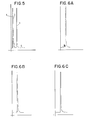
- Figure 5 is the GLC profile for the reaction product of Example I(B) resulting from the reaction of cyclohexene and phenethyl alcohol.
- the peak designated by the numeral "1" is the peak indicating unreacted cyclohexene.
- the peak designated by the numeral "3" represents the peak for the reaction product of Example I(B), cyclohexyl phenethylether.
- Figure 17 is the GLC profile for the crude reaction product of Example V of isopropanol and phenylethyl alcohol having the structure:
- the peak indicated by the reference numeral "12" represents the phenylethyl alcohol ether having- the structure:
- Figure 21 is the GLC profile for the reaction product of Example VI.
- the reaction product of Example VI contains four compounds:
- the peak on the GLC profile indicated by the reference numeral "13" is the peak for phenylethyl alcohol having the structure:
Landscapes
- Chemical & Material Sciences (AREA)
- Organic Chemistry (AREA)
- Life Sciences & Earth Sciences (AREA)
- Engineering & Computer Science (AREA)
- Wood Science & Technology (AREA)
- Chemical Kinetics & Catalysis (AREA)
- Oil, Petroleum & Natural Gas (AREA)
- Pest Control & Pesticides (AREA)
- Agronomy & Crop Science (AREA)
- Plant Pathology (AREA)
- Health & Medical Sciences (AREA)
- Dentistry (AREA)
- General Health & Medical Sciences (AREA)
- Zoology (AREA)
- Environmental Sciences (AREA)
- Textile Engineering (AREA)
- Fats And Perfumes (AREA)
- Organic Low-Molecular-Weight Compounds And Preparation Thereof (AREA)
Description
- The present invention relates to phenethylether derivatives, process for preparing same and uses thereof in combatting tobacco beetles and in augmenting or enhancing the aroma of perfumes, colognes and perfumed articles.
- According to the first aspect of the present invention there is provided a phenalkylether derivative characterised in that it is at least one phenethylether having the structure:


- According to the second aspect of the present invention there is provided a process for augmenting or enhancing the aroma of a consumable material selected from the group consisting of pheromones, insecticides, perfumes, solid or liquid anionic, cationic, nonionic or zwitterionic detergents, fabric softener compositions, dryer-added fabric softener articles, cosmetic powders, and colognes comprising the step of adding to an appropriate base an aroma-augmenting or enhancing quantity of at least one compound in accordance with the first aspect of the present invention.
- According to a third aspect of the present invention there is provided a method of attracting and destroying Lasioderma serricorne (F.) comprising applying to an area contaminated with said Lasioderma serricorne (F.) at least one compound in accordance with the first aspect of the present invention modified in that R5 may represent C3 secondary alkyl, said attractant being applied to said area in an amount sufficient to attract said Lasioderma serricorne (F.).
- According to a fourth aspect of the present invention there is provided a perfume composition comprising an aroma augmenting quantity of at least one cyclohexyl phenethylether derivative defined according to the structure:

- The invention also provides specific uses of specific aforesaid phenalkylether derivatives.
- In this regard, attention is directed to Toxic Substances Control Act (TSCA), Chemical Substance Inventory; Volume II, May 1979 at page 163 where there is a reference to benzene, (2-(1-methyl- ethoxy)ethyl) - (68039-47-4) C11H16O.
- The present invention proposes the use of phenethylether derivatives defined according to the structure:


- The phenethylether derivatives (in which R5 does not represent C3 secondary alkyl) of our invention are capable of augmenting or enhancing the dry green, hyacinth, rose, fruity and galbanum aromas of perfumes, perfumed articles and colognes of our invention. Of course, as part of the perfumed articles of our invention, there are the "perfumed insecticide-pheromone" compositions of our invention.
- The phenethylether derivatives of our invention (in which R5 does not represent C3 secondary alkyl) are capable of augmenting or enhancing the sweet, honey-like, rich, slightly fruity, hay, tobacco-like aromas and tastes both prior to and on smoking and Virginia tobacco-like aroma on smoking in smoking tobaccos and in cigarette articles containing such smoking tobaccos.
- The destruction of the Lasioderma serricorne (F.) insects can be achieved by distributing the phenethylether pheromonal attractants in the contaminated area at separate individual places, namely, by means of catch trees. These are impregnated with the attractants which may, if desired, act as insecticides too; or one or more of the phenethylether derivatives may be augmented by one or more additional insecticides whereupon the catch trees are sprayed with another insecticide either before or after the insects have gathered at the catch tree (whatever insects are still alive after contact with said phenethylether derivatives). Instead of using one or more phenethylether derivatives taken alone or taken together with another insecticide, one may also use a chemical sterilizing compound. Further, the catch tree may be treated with other chemicals which can be burned. Another possible method for destroying insects with one or more of the phenethylether derivatives of our invention makes use of the disturbance or perturbance theory. Instead of physically destroying the insects with either high concentrations of one or more of the phenethylether derivatives of our invention or by using one or more of the phenethylethers of our invention followed by additional insecticide, it is also possible to combine one or more of the phenethylether derivatives of our invention physically with one or more additional stronger insecticides before using. Thus, it is possible now to spray a combination of one or more phenethylethers which have pleasant aromas in combination with insecticides whose original aroma(s) are covered using one or more of the phenethylether(s) in certain centrally located areas or in the form of rows in the contaminated area. Furthermore, one or more of the phenethylethers can be mixed with the usual solid or liquid carriers or with biocides such as stronger insecticides, pesticides or herbicides. The mixture may contain surface active agents to obtain a better distribution or adherence to the plants.
- The cyclohexyl phenethylether derivatives of our invention may be prepared according to a conventional method by reacting cyclohexanol with beta phenylethyl alcohol derivatives such as beta phenylethyl alcohol in the presence of an acid such as sulfuric acid according to the reaction:


- Furthermore, more efficiently and of lower cost is the carrying out of a process of reacting a beta phenylethyl alcohol derivative with cyclohexene in the presence of specific acid catalysts under specific conditions according to the reaction:

- The temperature of reaction may vary from 90°C up to about 180°C at from 1 atmosphere pressure up to 100 atmospheres pressure. Higher temperatures of reaction require higher pressures of reaction.
- The mole ratio of phenethyl alcohol derivative to cyclohexene may vary from 1:1 up to about 1:2.
- Various acid catalysts can be used including mineral acids such as sulfuric acid or methane sulfonic acid or para-toluene sulfonic acid; or the acid catalyst may be a solid acid catalyst such as a sulfonated copolymer of styrene and divinyl benzene (e.g., "Amberlyst® 15" manufactured by the Rohm & Haas Corporation of Philadelphia, Pennsylvania) or an acid clay such as an activated clay adsorbent such as Filtrol® 105 having the following properties:
-

- The weight ratio of acid catalyst to phenylethyl alcohol derivative may vary from about 2 wt.% up to about 20 wt.%.
- The time of reaction is primarily a function of four variables:
- 1. temperature of reaction
- 2. conversion desired
- 3. particular acid catalyst utilized and
- 4. concentration of acid catalyst in the reaction mass.
- In general, higher temperatures of reaction give rise to a shorter required time of reaction, but too high a temperature of reaction (e.g., greater than about 180°C) and/or too long a time of reaction causes a diminution of conversion due to product decomposition. In general, higher concentration of acid catalyst in the reaction mass gives rise to shorter time periods of reaction for a given conversion to the desired cyclohexyl phenethylether derivative. Thus, in general, a time of reaction may vary from about 1 hour up to about 48 hours.
- Notwithstanding the pheromonal and insecticidal activity of the cyclohexyl phenethylether derivatives of our invention, the cyclohexyl phenethylethers of our invention can be used to contribute long lasting dry green, hyacinth, rose, fruity and galbanum aromas which are unexpectedly full and rich for a very long period of time to perfumes, perfumed articles and colognes. As olfactory agents, the cyclohexyl phenethylether derivatives of our invention can be formulated into or used as components of a "perfume composition" or can be used as components of a "perfumed article" or the perfume composition may be added to "perfumed articles".
- Examples of the compounds prepared according to the process of our invention, the phenylethyl alcohol derivatives reactant for producing such compound and the olfactory properties of such compounds are set forth in Table I below:

- The alkyl and/or alkenyl phenethylethers of our invention may be prepared by reacting β-phenylethyl alcohol with an appropriate C3 or C6 lower secondary alkanol or a C4 alkenol in the presence of an acid such as sulfuric acid according to the reaction:

- Alternatively, sodium phenethyl alcoholate may be reacted with a C3 or C, secondary alkyl chloride or a C4 alkenyl chloride or a sodium alkyl alcoholate or a sodium alkenyl alcoholate may be reacted with A-phenylethyl chloride or β-phenylethyl bromide by means of a "Williamson" synthesis, conventional in the organic chemistry art.
- A novel aspect of our invention lies in the preparation of the isopropyl phenethylether of our invention having the structure:

- When isopropyl alcohol is reacted with phenylethyl alcohol, not all of the phenylethyl alcohol wil react and thus, a mixture of phenylethyl alcohol having the structure:


- Another aspect of our invention involves the production of the isopropyl phenethylether. In reacting the phenylethyl alcohol having the structure:


- The resulting mixture of isopropyl phenethylether and phenylethyl alcohol propionate may then be easily separated by fractional separation to yield substantially pure isopropyl phenethylether in high yields. In forming the mixture of isopropyl phenethylether and phenylethyl alcohol propionate from the mixture of isopropyl phenethylether and phenylethyl alcohol with propionic anhydride, it is preferred to carry out the reaction at reflux conditions in the presence of an easily separatable solvent which is inert to the reaction mass such as toluene. The foregoing reaction sequence is illustrated as follows:

- Notwithstanding the pheromonal and insecticidal activity of the alkyl and/or alkenyl phenethylethers of our invention, the alkyl and/or alkenyl phenethylethers of our invention can be used to contribute long-lasting green, fruity, floral, hyacinth-like rosy, rose-hyacinth-like; galbanum-like, cassis-like and narcissus-like aromas with hyacinth/honey aromas on dry-out and with peppery and mushroomy undertones which are unexpectedly full and rich for very long periods of time, to perfumes, perfumed articles and colognes.
- As olfactory agents, the alkyl and/or alkenyl phenethylethers of our invention can be formulated into or used as components of a "perfume composition" or can be used as components of a "perfumed article" or the perfume composition may be added to "perfumed articles".
- The term "perfume composition" is used herein to mean a mixture of organic compounds including, for example, alcohols, aldehydes, ketones, nitriles, ethers in addition to and other than the alkyl and alkenyl phenethylethers of our invention, lactones, natural essential oils, synthetic essential oils and frequently hydrocarbons which are admixed so that the combined odors of the individual components produce a pleasant or desired fragrance. Such perfume compositions usually contain (a) the main note or the "bouquet" or foundation stone of the composition; (b) modifiers which round off and accompany the main note; (c) fixatives which include odorous substances which lend a particular note to the perfume throughout all states of evaporation, and substances which retard evaporation; and (d) top notes which are usually low-boiling, fresh-smelling materials.
- In perfume compositions, the individual component will contribute its particular olfactory characteristics, but the overall effect of the perfume composition will be the sum of the effects of each of the ingredients. Thus, the cyclohexyl and/or alkyl and/or alkenyl phenethylethers of our invention can be used to alter the aroma characteristics of a perfume composition, for example, by highlighting or moderating the olfactory reaction contributed by another ingredient in the composition. Furthermore, the alkyl and/or alkenyl phenethylethers of our invention can be used in combination with the cyclohexyl phenethylethers. The amount of alkyl and/or alkenyl phenethylethers that may be used in conjunction with the cyclohexyl phenethylethers may vary from about 1:99 up to about 99:1 whereby very interesting hyacinth-like, rosy, rose-hyacinth-like, galbanum-like aromas with cassis-like, narcissus-like peppery and mushroomy undertones are achieved.
- The amount of cyclohexyl and/or alkyl and/or alkenyl phenethylether of our invention which will be effective in perfume compositions depends upon many factors, including the other ingredients, their amounts and the effects which are desired. It has been found that perfume compositions containing as little as 0.05% of the alkyl and/or alkenyl phenethylether of our invention taken alone or in combination with the cyclohexyl phenethylether, or even less can be used to impart long lasting, interesting, very strong, green, fruity, floral, hyacinth-like, rosy, rose-hyacinth-like, galbanum-like, cassis-like and narcissus aromas to soaps, liquid and solid cationic, nonionic, anionic and zwitterionic detergents, cosmetic powders, liquid and solid fabric softeners, dryer-added fabric softener articles, optical brightener compositions and other products. The amount employed can range up to 50% or more and will depend upon considerations of cost, nature of the end product and the effect desired on the finished product and particular fragrance sought.
- The alkyl and/or alkenyl phenethylethers of our invention can be used alone or in a perfume composition as an olfactory component in detergents and soaps, space odorants and deodorants; perfumes; colognes, toilet waters; bath salts; hair preparations such as lacquers, brilliantines, pomades and shampoos; cosmetic preparations such as creams, deodorants, hand lotions and sun screens; powders such as talcs, dusting powders, face powder and the like. When used as an olfactory component of a perfumed article, as little as 0.01% of the alkyl and/or alkenyl phenethylether taken alone or in combination with cyclohexyl phenethylether will suffice to impart an interesting, long-lasting, green, fruity, floral, hyacinth-like, rosy, rose-hyacinth-like, galbanum-like, cassis and narcissus-like aroma. Generally no more than 0.5% is required in the perfumed article.
- It has also been found that perfume compositions containing as little as 0.05% of one or a mixture of the cyclohexyl phenethylether derivatives of our invention or even less can be used to impart long lasting, interesting, very strong, dry green, hyacinth, rose, fruity and galbanum aromas to soaps, liquid and solid cationic, non-ionic, anionic and zwitterionic detergents, cosmetic powders, liquid and solid fabric softeners, dryer-added fabric softener articles, optical brightener compositions and other products. The amount employed can range up to 50% or more and will depend upon considerations of cost, nature of the end product and the effect desired on the finished product and particular fragrance sought.
- One or more of the cyclohexyl phenethylether derivatives of our invention can be used alone or in combination with one another or in a perfume composition as an olfactory component in detergents and soaps, space odorants and deodorants; perfumes, colognes, toilet water; bath salts; hair preparations such as lacquers, brilliantines, pomades and shampoos; cosmetic preparations such as creams, deodorants, hand lotions and sun screens; powders such as talcs, dusting powders, face powder and the like. When used as an olfactory component of a perfumed article, as little as 0.01% of one or a mixture of cyclohexyl phenethylether derivatives will suffice to impart an interesting long-lasting dry green, hyacinth, rose, fruity and/or galbanum aroma. Generally no more than 0.5% is required in the perfumed article.
- In addition, the perfume composition can contain a vehicle or carrier for the alkyl and/or alkenyl phenethylether alone or in combination with the cyclohexyl phenethylether in combination with still other ingredients. The vehicle can be a liquid such as an alcohol such as ethanol, a glycol such as propylene glycol or the like. The carrier can be an adsorbent solid such as a gum or components for encapsulating the composition such as gelatin which can be used to form a capsule wall surrounding the perfume oil by means of coacervation.
- In addition, the perfume composition can contain a vehicle or carrier for the phenethylether derivatives taken alone or taken in combination with other ingredients. The vehicle can be a liquid such as an alcohol such as ethanol, a glycol such as propylene glycol, or the like. The carrier can be an absorbent solid such as a gum or components for encapsulating the composition such as gelatin which can be used to form a capsule wall surrounding the perfume oil by means of coacervation.
- This invention further provides improved tobacco additives and methods whereby various desirable sweet, honey-like, rich, slightly fruity, Virginia tobacco-like and hay tobacco-like flavor and aroma characteristics may be imparted to smoking tobacco products and may be readily varied and controlled to produce the desired uniform flavoring characteristics.
- In carrying out this aspect of our invention, we add to smoking tobacco materials or a suitable substitute therefor (e.g., dried lettuce leaves) an aroma and flavor additive containing as an active ingredient one or more of the phenethylether derivatives of our invention.
- In addition to the phenethylether derivatives of our invention, other flavoring and aroma additives may be added to the smoking tobacco material or substitute therefor either separately or in mixture with the phenethylether derivatives as follows:
- I. Synthetic materials:
- Beta-ethyl-cinnamaldehyde;
- Eugenol;
- Dipentene;
- jB-damascone;
- /}-damascenone;
- Maltol;
- Ethyl maltol;
- Delta undecalactone;
- Delta decalactone;
- Benzaldehyde;
- Amyl acetate;
- Ethyl butyrate;
- Ethyl valerate;
- Ethyl acetate;
- 2-hexenol-1,2-methyl-5-isopropyl-1,3-nonadiene-8-one;
- 2-methyl-5-isopropyl acetophenone;
- 2-hydroxy-2,5,5,8a-tetramethyt-1-(2-hydroxyethyi)-decahydronaphthatone;
- Dodecahydro-3a,6,6,9a-tetramethyl naphtho-(2,1-b)-furan;
- 4-hydroxy hexanoic acid, gamma lactone;
- Polyisoprenoid hydrocarbons defined in Example V of U.S. Patent No. 3,589,372, issued on June 29, 1971.
-
- Celery seed oil;
- Coffee extract;
- Bergamot oil;
- Cocoa extract;
- Nutmeg oil; and
- Origanum oil.
- An aroma and flavoring concentrate containing one or more of the phenethylether derivatives of our invention and if desired, one or more of the above indicated additional flavoring additives may be added to smoking tobacco material, to the filter or to the leaf or paper wrapper. The smoking tobacco material may be shredded, cured, cased and blended tobacco material or reconstituted tobacco material or tobacco substitutes (e.g., lettuce leaves) or mixtures thereof. The proportions of flavoring additives may be varied in accordance with taste but insofar as the augmentation or the enhancement or the imparting of the sweet, honey-like, fruity, Virginia tobacco-like notes are concerned, we have found that satisfactory results are obtained if the proportion by weight of the sum total of phenethylether derivatives to smoking tobacco material is between 250 ppm and 1,500 ppm (0.025%-0.15%) of the active ingredients to the smoking tobacco material. We have further found that satisfactory results are obtained if the proportion by weight of the sum total of phenethylether derivatives used to flavoring material is between 2,500 and 10,000 ppm (0.25%-1.0%).
- Any convenient method for incorporating the phenethylether derivatives in the tobacco product may be employed. Thus, the phenethylether derivatives taken alone or along with other flavoring additives may be dissolved in a suitable solvent such as ethanol, n-pentane, diethyl ether and/or other volatile organic solvents and the resulting solution may be either sprayed on the cured, cased and blended tobacco material or the tobacco material may be dipped into such solution. Under certain circumstances, a solution of the phenethylether derivatives taken alone or taken further together with other flavoring additives as set forth above may be applied by means of a suitable applicator such as a brush or roller on the paper or leaf wrapper for the smoking product, or it may be applied to the filter by either spraying or dipping or coating.
- Furthermore, it will be apparent that only a portion of the tobacco or substitute therefor need be treated and the thus treated tobacco may be blended with other tobaccos before the ultimate tobacco product is formed. In such cases, the tobacco treated may have the phenethylether derivative in excess of the amounts or concentrations above indicated so that when blended with other tobaccos, the final product will have the percentage within the indicated range.
- In accordance with one specific example of our invention, an aged, cured and shredded domestic burley tobacco is spread with a 20% ethyl alcohol solution of phenethyl cyclohexylether in an amount to provide a tobacco composition containing 800 ppm by weight of cyclohexyl phenethylether on a dry basis. Thereafter, the alcohol is removed by evaporation and the tobacco is manufactured into cigarettes by the usual techniques. The cigarette, when treated as indicated has a desired and pleasing aroma which is detectable in the main and side streams when the cigarette is smoked. This aroma is described as being sweet, rich, floral, fruity, honey-like and Virginia tobacco-like.
- While our invention is particularly useful in the manufacture of smoking tobacco, such as cigarette tobacco, cigar tobacco and pipe tobacco, other tobacco products formed from sheeted tobacco dust or fines may also be used. Likewise, the phenethylether derivatives of our invention can be incorporated with materials such as filter tip materials, seam paste, packaging materials and the like which are used along with tobacco to form a product adapted for smoking. Furthermore, the phenethylether derivatives of our invention can be added to certain tobacco substitutes of natural or synthetic origin (e.g., dried lettuce leaves and cellulose derivatives) and, accordingly, by the term "tobacco" as used throughout this specification is meant any composition intended for human consumption by smoking or otherwise, whether composed of tobacco plant parts or substitute materials, or both.
- It will thus be apparent that one or more of the phenethylether derivatives of our invention can be utilized to alter, modify, augment or enhance the aroma of a wide variety of consumable materials including fragrance formulations, colognes, pheromones, smoking tobaccos, smoking tobacco articles, insecticides and perfumed articles in general.
- The following examples serve to illustrate our invention and this invention is to be considered restricted thereto only as indicated in the appended claims.
- All parts and percentages given herein are by weight unless otherwise specified.
- The words "Amberlyst", 'Goodloe", "Neodol" and "Adogen" are Trade Marks.
-

- Into a 2 liter reaction vessel equipped with stirrer, thermometer, heating mantle and overhead condenser with azeotrope takeoff apparatus, is placed 488 grams of beta-phenylethyl alcohol; 440 grams of cyclohexanol and 100 grams of concentrated sulfuric acid. The reaction mass is then heated to a temperature of 115°C and maintained at a temperature in the range of 104-1270C at reflux while azeotropically removing 80 ml water, for a period of 3 hours. At the end of the 3 hour period, a sample is analyzed by means of GLC analysis (conditions: 180°C isothermal using an SE-30 packed column). Figure 1 (A) is the GLC profile of the reaction product at this point.
- The resulting reaction mass is then distilled on a 1' x 29/42 distillation column yielding the following fractions:

- Figure 1(B) is the GLC profile for
fraction 8 of the distillation product of the reaction product of this example which contains phenethyl cyclohexylether having the structure:
- Figure 1 (C) is the GLC profile for
fraction 10 of the distillation product of the reaction product of this example containing the compound having the structure:
- Figure 1 (D) is the GLC profile for
fraction 12 of the distillation product of the reaction product of this example containing the compound having the structure:
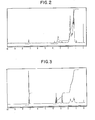
- Figure 2 is the NMR spectrum for peak "A" of the GLC profile of Figure 1 (A) which consists of the compound having the structure:

- Figure 3 is the NMR spectrum for peak "B" of the GLC profile of Figure 1 (A) containing the compound having the structure:

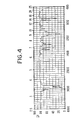
- Figure 4 is the infra-red spectrum for peak "B" of the GLC profile of Figure 1 (A) containing the compound having the structure:

-

- Phenethyl alcohol (1487 grams; 12.2 moles) and
Amberlyst® 15 catalyst (a sulfonated phenyl polyethylene ion exchange resin manufactured by the Rohm & Haas Corporation of Philadelphia, Pennsylvania (85.4 grams)) are heated to 110°C. 1000 grams (12.2 moles) of cyclohexene is added drop-wise to the reaction mass over a period of 4.5 hours while maintaining the reaction mass at 110°C. During the addition of the cyclohexene, residual water (23 ml) is removed by azeotropic distillation through a water separating trap. The reaction mass is stirred at 110°C for an additional 5.25 hours. At this point in time, the reaction mass is cooled and the catalyst is removed by filtration. The organic solution is washed with 400 grams of 30% sodium hydroxide and then distilled through a 1

- Fractions 11-22 contain phenylethyl cyclohexyl ether having a purity of greater than 99%.
- Figure 5 is the GLC profile for the reaction product immediately after the sodium hydroxide wash and prior to distillation.
- Figure 6(A) is the GLC profile for
fraction 7 of the distillation product of the reaction product of Example I(B) containing the compound having the structure:
- Figure 6(B) is the GLC profile for
fraction 10 of the distillation product of the reaction product of Example I(B) containing the compound having the structure:
- Figure 6(C) is the GLC profile for fraction 22 of the distillation product of the reaction product of Example I(B) containing the compound having the structure:

-

- Into a stirred slurry of 408 grams of betamethylphenylethyl alcohol and 25 grams of Amberlyst® 15 (a polysulfonated polystyrene cation exchange resin manufactured by the Rohm & Haas Company of Philadelphia, Pennsylvania) maintained at 110°C is added 246 grams of cyclohexene over a 2.75 hour period. The reaction mass is aged at 110°C for an additional two hours whereupon it is cooled and filtered. The solution is then heated at reflux with 80 grams of 30% aqueous sodium hydroxide. The reaction mass is then cooled and washed with one liter of water. The organic layer is then separated from the aqueous layer and distilled and fractions rich in product are then fractionated through a 12" x 1" Goodloe packed column to yield the following fractions:

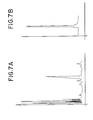
- Figure 7(A) is the GLC profile of the crude reaction product (conditions: 1/8" x 10' 10% SE-30 packed column operated at 180°C isothermal).
- Figure 7(B) is the GLC profile for
fraction 8 of the distillation product (conditions: 1/8" x 10' SE-30 packed column; programmed at 220°C isothermal). - Figure 8 is the NMR spectrum for
fraction 6 of the distillation product as set forth above. - Figure 9 is the infra-red spectrum for
fraction 6 of the distillation product as set forth above. - The resulting product has a floral, green, galbanum-like fruity aroma.
-

- 246 grams of cyclohexene is added to a stirred slurry of p-methyl phenyl beta ethanol (408 grams) and 25 grams of Amberlyst@ 15 cation exchange resin maintained at 110°C, over a 2 hour period. The reaction mass is then aged at 110°C for an additional 3 hours whereupon it is cooled and filtered. The resulting solution is then heated at reflux with 80 grams of 30% aqueous sodium hydroxide. The reaction mass is then cooled and the resulting organic layer is washed with 1 liter of water. The organic layer is separated from the reaction mass and distilled through a 1 t" x 12" Goodloe packed column to afford the following fractions:

- Figure 10(A) is the GLC profile of the crude reaction product (conditions: 1/8" x 10' 10% SE-30 packed column programmed at 120-220°C at 16°C per minute).
- Figure 10(B) is the GLC profile for
fraction 8 of the foregoing distillation (conditions: 1/8" x 10' 10% SE-30 packed column programmed at 220°C isothermal). - Figure 11 is the NMR spectrum for
fraction 10 of the foregoing distillation. - Figure 12 is the infra-red spectrum for
fraction 10 of the foregoing distillation. - The resulting product having the structure:

-

- Into a 3 liter reaction vessel equipped with stirrer, thermometer, reflux condenser and heating mantle is placed 732 grams of phenylether alcohol, 1052 grams of 4-methyl-2-pentanol and 100 grams of concentrated (93%) sulfuric acid. The reaction mass is heated to reflux and water is continuously taken off through a Bidwell trap. The reaction mass is refluxed for a period of 14 hours.
- At the end of the reaction, the reaction mass is quenched with 3 liters of water, washed with aqueous sodium carbonate (saturated) and then with saturated sodium chloride (aqueous).
- The reaction mass is then brushed over followed by fractional distillation to yield the following fractions:

- Figure 13 is the GLC profile for the crude reaction product produced according to this example containing the compound having the structure:

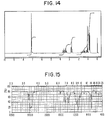
- Figure 14 is the NMR spectrum for the reaction product of this example containing the compound having the structure:
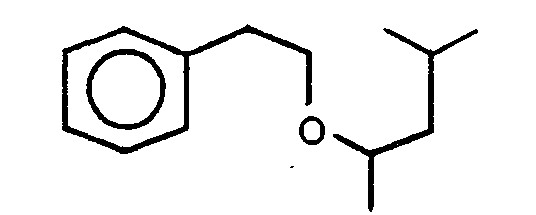
- Figure 15 is the infra-red spectrum for the reaction product of this example containing the compound having the structure:

-

- Into a 10 liter reaction vessel equipped with stirrer, thermometer, reflux condenser and heating mantle is placed 1428 grams of 4-methyl-2-pentanol; 915 grams of phenylethyl alcohol and 500 grams of sulfuric acid. The reaction mass is heated to reflux (105°C) and refluxed for a period of 2 hours.
- Figure 16 is the GLC profile for the crude reaction mass.
-

- Into a 10 liter reaction flask is placed 1440 grams of isopropyl alcohol and 732 grams of phenylethyl alcohol. Over a period of 1 hour, a solution of 270 grams of sulfuric acid and 30 ml water is added slowly. At the end of the addition of the sulfuric acid solution, the reaction mass is heated to reflux and the reaction mass is refluxed for a period of 4 hours. At the end of the 4 hour period, three liters of water is added to the reaction mass and the reaction mass is neutralized with 50% sodium hydroxide. One liter of toluene is added and the toluene layer is separated from the aqueous layer.
- To the toluene mixture is added 260 grams of propionic anhydride and the propionic anhydride/toluene/phenylethyl alcohol/isopropyl phenethylether mixture is then refluxed for a period of 30 minutes. The reaction mass is then cooled down and one liter of water is added thereto. The reaction mass is then washed with 50% caustic followed by saturated sodium chloride and then neutralized with saturated sodium bicarbonate.
- The reaction mass is then distilled yielding the following fractions:


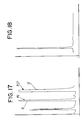
- Figure 17 is the GLC profile for the crude reaction product of this example prior to propionic anhydride reaction containing the compounds having the structures:

- Figure 18 is the GLC profile for
fraction 4 of the distillation product of the reaction product of this example after reaction with propionic anhydride, containing the compound having the structure:
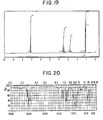
- Figure 19 is the NMR spectrum for the reaction product of this example after distillation containing the compound having the structure:

- Figure 20 is the infra-red spectrum for the reaction product of this example after distillation after reaction with propionic anhydride containing the compound having the structure:

-

- Crotyl alcohol (216 grams) is slowly added to a stirred slurry of phenylethyl alcohol (366 grams) and Amberlyst® 15 (cation exchange resin manufactured by the Rohm & Haas Company, Philadelphia, Pennsylvania; an acid cation exchange resin which is sulfonated polystyrene) at 100°C. The reaction mass is aged at 100°C for a period of 5 hours whereupon the solution is cooled and filtered. The organic solution is washed with 25% aqueous sodium hydroxide. The GLC profile of the crude reaction product is set forth in Figure 21 (conditions: 10% SE-30 packed column programmed at 120-220°C at 8°C per minute).
Peak 13 is the peak for phenylethyl alcohol;peak 14 is the peak for the 1-methallyl phenethylether;peak 15 is the peak for 2-butenyl phenethylether (cis and trans isomers). - A portion of the product is isolated by GLC preparative chromatography.
- Figure 22(A) represents the NMR spectrum for
peak 14 of the GLC profile of figure 21 containing the compound having the structure:
- Figure 22(B) is the infra-red spectrum for
peak 14 of figure 21 which is the GLC profile for the reaction product of this example containing the compound having the structure:
- Figure 23(AO is the NMR spectrum for
peak 15 of figure 21 which is the GLC profile for the reaction product of this example. containing the compounds having the structures:
- Figure 23(B) is the infra-red spectrum for
peak 15 of figure 21 which is the GLC profile of the reaction product of this example containing the compounds having the structures:
- Field tests are made each time using 100 male and 100 female Lasioderma serricorne (F.) cigarette beetles. The beetles were released at a certain distance from the source of attraction which was treated with cyclohexyl phenethylether prepared according to either of Example I(A) or I(B). Further, felled trees having already been contaminated with the respective beetles are positioned at both sides of the starting point. After a certain period of time, the amount of insects gathered at the source of attraction was determined thus indicating the effectiveness of the pheromonal mixture according to the invention.
- Field tests with Lasioderma serricorne (F.) are made whereby the distance between the starting point and the source of attraction is 50 meters. Four independent field tests were made whereby 42% of the male beetles and 46% of the female beetles gathered at each catch tree. The concentration of insects at the catch tree was 55% of the male insects and 58% of the female insects. In all these tests the catch tree was impregnated with a 0.7% ethanolic solution of cyclohexyl phenethylether (7 gm cyclohexyl phenethylether per 92 gm of 95% aqueous ethanol).
- During two consecutive days several felled oak trees surrounding a field of tobacco plants were treated with 250 mg of phenethyl cyclohexylether in 1.0% ethanolic solution. These trees were exposed in an area which was contaminated with Lasioderma serricorne (F.). After 3 to 4 days, 100 beetles per square meter were observed on the logs. Other untreated logs or trees in the direct neighborhood of the treated logs or trees showed very few (about 12) insects per square meter on the average while other trees at a distance of 10 to 20 meters showed no contamination.
- In a large test field, mixtures of cyclohexyl phenethylether in admixture with different DDT preparations, fluorine-containing mixtures and arsenic-containing mixtures as well as hexachloro-cyclohexane were used. These mixtures contained also small amounts of surface-active agents and carriers. The mixtures were applied to catch trees namely logs of oak trees in an area of tobacco plants contaminated with Lasioderma serricorne (F.). The distance between the catch trees was always 200 meters. After 8 days there was no contamination either in the tobacco fields or around the oak trees. About 92% of the Lasioderma serricorne (F.). insects were destroyed. Surprisingly, it was found that after the fourth days, the attracting effect was not diminished in spite of dead insects being present. Furthermore, in those areas where cyclohexyl phenethylether was used alone, the average number of insects destroyed was about 80% which in itself is surprising. Thus, the cyclohexyl phenethylether not only acts as a pheromone but also as an insecticide. Furthermore, the entire area wherein the cyclohexyl phenethylether was used had a faint pleasant floral aroma covering any adverse and aesthetically displeasing aroma of any other insecticides that were used.
- The following mixture is prepared:

- The cyclohexyl phenethylether prepared according to either of Example I(A) or I(B) imparts the dry green, hyacinth, rose, galbanum-like aroma to this honey fragrance while giving it a very warm undertone and imparting a very long-lasting floral top note to this fragrance.
- A cosmetic powder is prepared by mixing in a
ball mill 100 grams of talcum powder with 0.25 grams of the perfume composition prepared according to Example X. It has an excellent floral aroma. - Concentrated liquid detergents (lysine salt of n-dodecylbenzene sulfonic acid as more specifically described in U.S. Patent No. 3,948,818 issued on April 6, 1976) with floral aroma nuances and rose,. galbanum and hyacinth-like top notes are prepared containing 0.10%, 0.15% and 0.20% of the fragrance prepared according to Example X. They are prepared by adding and homogeneously mixing the appropriate quantity of fragrance formulation prepared according to Example X in the liquid detergent. The detergents all possess excellent floral aromas with dry green, hyacinth, rose and galbanum nuances, the intensity increasing with greater concentrations of perfume composition prepared according to Example X.
- The composition prepared according to Example X is incorporated into a cologne at concentration of 2.0%, 2.5%, 3.0%, 4.0%, 4.5% and 5.0% in 80%, 85%, 90% and 95% aqueous food grade ethanol; and into handkerchief perfumes at concentrations of 15%, 20% and 30% (in 80%, 85% and 95% aqueous food grade ethanol). A distinctive and definitive dry green, hyacinth, rose, galbanum, rich and full-bodied floral aroma is imporated to the cologne and to the handkerchief perfume at all levels indicated.
- 100 grams of soap chips are mixed with 1 gram of the formulation of Example X until a homogeneous composition is obtained. The homogeneous composition is heated under three atmospheres pressure at 180°C for a period of three hours and the resulting liquid is placed into soap molds. The resulting soap cakes, on cooling, manifest excellent floral aromas with dry green, hyacinth, rose and galbanum nuances that are very long-lasting.
- A detergent is prepared from the following ingredients according to Example I of Canadian Patent No. 1,007,948:

- This detergent is a "phosphate-free" detergent. A total of 100 grams of this detergent is admixed with 0.15 grams of the honey based perfume of Example X. Each of the detergent samples have an excellent honey-like, dry green, hyacinth, rose and galbanum aroma.
- Utilizing the procedure of Example I at
column 15 of U.S. Patent No. 3,632,396, a non-woven cloth substrate useful as a dryer-added fabric softening article of manufacture is prepared wherein the substrate, the substrate coating and the outer coating and the perfuming material are as follows: - 1. a water "dissolvable" paper ("Dissolvo Paper");
- 2. Adogen 448 (m.p. about 140°F) as the substrate coating; and
- 3. an outer coating having the following formulation (m.p. about 150°F.):
- 57% C20-22 HAPS
- 22% isopropyl alcohol
- 20% antistatic agent
- 1% of cyclohexyl phenethylether produced according to either of Example I(A) or I(B)
- A fabric softening composition prepared as set forth above having a dry green, hyacinth, rose galbanum and generally floral aroma characteristic consists of a substrate having a weight of about 3 grams per 100 square inches, a substrate coating of about 1.85 grams per 100 square inches of substrate and an outer coating of about 1.4 grams per 100 square inches of substrate, thereby providing a total aromatized substrate and outer coating weight ratio of about 1:1 by weight of the substrate. A pleasant floral aroma is imparted in a pleasant manner to the head space in the dryer on operation thereof using the said dryer-added fabric softening non-woven fabric. HAPS is 3-(N-alkyl-N,N-dimethylammonium)-2-hydroxy propane-1-sulfonate, in which the alkyl group is a mixture of from 20-22 carbon atoms (see US Patent Specification No. 3632396,
column 5,lines 60 to 65). - A liquid detergent composition prepared according to Example IV of United Kingdom Patent No. 1,498,520 whereby the following ingredients are admixed:
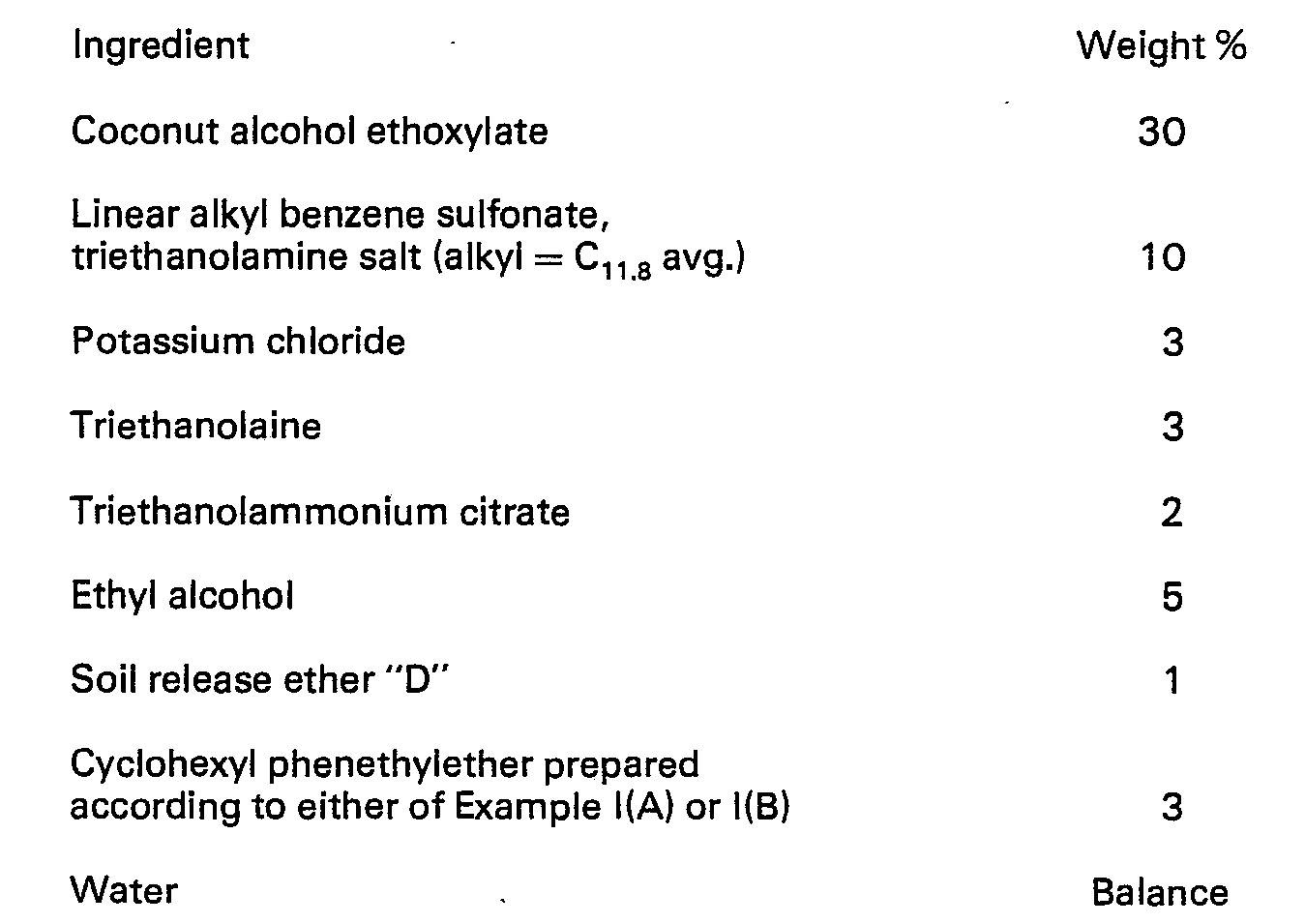
- The soil release either "D" is defined according to Table II on
page 15 of United Kingdom Patent No. 1,498,520. - This composition is prepared by admixing all of the ingredients exclusive of soil release ether "D" and agitating the mixture until all electrolytes are dissolved.
- Soil release ether "D" is then admixed wtih the solution in the form of a dry powder which passes through a 150 mesh standard sieve. The resulting composition is in the liquid state and is easily pourable. The composition is found not to redden on contact with plastic bottles, does not gel when diluted with water and has a long-lasting aroma which can be described as dry green, hyacinth, rose, galbanum and rich and rather long-lasting. Indeed, the aroma lasts for several weeks when exposed to the atmosphere.
- This composition is added to an aqueous laundrying bath at a concentration of 0.20% (weight) at a temperature of 55°C,
water hardness 7 grains per gallon and a pH of 10.0. Polyester and mixed polyester/cotton fabrics are laundered in the bath for a period of 10 minutes after which the fabrics are thoroughly rinsed with fresh water and dried at ambient temperatures. The fabrics are provided with a soil release finish. The head space above the fabrics has a pleasant faint aroma which can be described as hyacinth, rose and galbanum and also rather long-lasting (about 3 days). - A cosmetic powder is prepared by admixing in a ball mill, 100 grams of talcum powder with 0.25 grams of phenethyl cyclohexylether prepared according to either of Examples I(A) or I(B). The resulting cosmetic powder has an excellent dry green, hyacinth, rose, galbanum, rich and full-bodied floral fragrance which is very long-lasting.
- Concentrated liquid detergents (lysine salt of n-dodecylbenzene sulfonic acid as more specifically described in U.S. Patent No. 3,948,818 issued on April 6, 1976) with dry green, hyacinth, rose, galbanum, rich and full-bodied floral aroma are prepared containing 0.10%, 0.15%, 0.20% and 0.25% of cyclohexyl phenethylether prepared according to either of Example I(A) or I(B). They are prepared by adding and homogeneously admixing the appropriate quantity of phenethyl cyclohexylether in the liquid detergent. The detergents all possess intense, long-lasting dry green, hyacinth, rose, galbanum and generally floral aroma characteristics.
- Cyclohexyl phenethylether prepared according to either of Example I(A) or I(B) is incorporated into colognes at concentrations of 2.0%, 2.5%, 3.0%, 3.5%, 4.0% and 4.5% in 80%, 85%, 90% and 95% aqueous food grade ethanol; and into handkerchief perfumes at concentrations of 15%, 20%, 25% and 30% (in 80%, 90%, and 95% aqueous ethanol). Distinctive dry green, hyacinth, rose, galbanum, rich and full-bodied floral aroma nuances which are very long-lasting on dry-out (54 hours) are imparted to the colognes and to the handkerchief perfumes at the various above levels indicated.
- Field tests are made each time using 100 male and 100 female Lasioderma serricorne (F.) cigarette beetles. The beetles were released at a certain distance from the source of attraction which was treated with one of the cyclohexyl phenethylether derivatives prepared according to either Example 11 or III. Further, felled trees having already been contaminated with the respective beetles are positioned at both sides of the starting point. After a certain period of time, the amount of insects gathered at the source of attraction was determined thus indicating the effectiveness of the pheromonal mixture according to the invention.
- Field tests with Lasioderma serricorne (F.). are made whereby the distance between the starting point and the source of attraction is 50 meters. Four independent field tests were made whereby 42% of the male beetles and 46% of the female beetles gathered at each catch tree. The concentration of insects at the catch tree was 55% of the male insects and 58% of the female insects. In all these tests the catch tree was impregnated with a 0.7% ethanolic solution of one of the cyclohexyl phenethylether derivatives of either Example II or III (7 grams of cyclohexyl phenethylether derivative per 92 grams of 95% aqueous ethanol).
- During two consecutive days, several felled oak trees surrounding a field of tobacco plants were treated with 250 mg of one of the phenethyl cyclohexylether derivatives of either Example II or III in 1.0% ethanolic solution. These trees were exposed in an area which was contaminated with Lasioderma serricorne (F.). After 3 to 4 days, 100 beetles per square meter were observed on the logs. Other untreated logs or trees in the direct neighborhood of the treated logs or trees showed very few (about 12) insects per square meter on the average while other trees at a distance of 10 to 20 meters showed no contamination.
- In a large test field, mixtures of one of the cyclohexyl phenethylether derivatives of Example II or III in admixture with different DDT preparations, fluorine-containing mixtures and arsenic-containing mixtures as well as hexachloro-cyclohexane were used. These mixtures contained also small amounts of surface active agents and carriers. The mixtures were applied to catch trees namely logs of oak trees in an area of tobacco plants contaminated with Lasioderma serricorne (F.). The distance between the catch trees was always 200 meters. After 8 days there was no contamination either in the tobacco fields or around the oak trees. About 92% of the Lasioderma serricorne (F.). insects were destroyed. Surprisingly, it was found that after the fourth day, the attracting effect was not diminished in spite of dead insects being present. Furthermore, in those areas where one of the cyclohexyl phenethylether derivatives of Example II or III was used alone, the average number of insects destroyed was about 80% which in itself is surprising. Thus, one of the cyclohexyl phenethylether derivatives of Example II or III not only acts as a pheromone but also as an insecticide. Furthermore, the entire area wherein one of the cyclohexyl phenethylether derivatives of Example II or III was used had a faint, pleasant aroma (floral in the case of the cyclohexyl phenethylether derivative of Example II and fruity in the case of the cyclohexyl phenethylether derivative of Example III) covering any adverse and aesthetically displeasing aroma of any other insecticides that were used.
- The following mixture is prepared:

- The cyclohexyl hydrotropyl ether prepared according to Example II imparts the floral, green, galbanum-like and fruity aroma to this honey fragrance while giving it a very warm undertone and imparting a very long-lasting floral top note to this fragrance.
- A cosmetic powder is prepared by mixing in a
ball mill 100 grams of talcum powder with 0.25 grams of the perfume composition prepared according to Example XXIV. It has an excellent floral aroma. - Concentrated liquid detergents (lysine salt of n-dodecylbenzene sulfonic acid as more specifically described in U.S. Patent No. 3,948,818 issued on April 6, 1976) with floral aroma nuances and green, galbanum-like and fruity top notes are prepared containing 0.10%, 0.15% and 0.20% of the fragrance prepared according to Example XXIV. They are prepared by adding and homogeneously mixing the appropriate quantity of fragrance formulation prepared according to Example XXIV in the liquid detergent. The detergents all possess excellent floral aromas with green, galbanum-like and fruity nuances, the intensity increasing with greater concentrations of perfume composition prepared according to Example XXIV.
- The composition prepared according to Example XXIV is incorporated into a cologne at concentrations of 2.0% 2.5%, 3.0%, 4.0%, 4.5% and 5.0% in 80%, 85%, 90%, and 95% aqueous food grade ethanol and into handkerchief perfumes at concentraions of 15%, 20% and 30% (in 80%, 85% and 95% aqueous good grade ethanol). A distinctive and definitive green, galbanum-like, fruity and full-bodied floral aroma is imparted to each of the colognes and to each of the handkerchief perfumes at all levels indicated.
- 100 grams of soap chips are mixed with 1 gram of the formulation of Example XXIV until a homogeneous composition is obtained. The homogeneous composition is heated under three atmospheres pressure at 180°C for a period of three hours and the resulting liquid is placed into soap molds. The resulting soap cakes, on cooling, manifest excellent floral aromas with green, galbanum-like and fruity nuances that are very long-lasting.
- A detergent is prepared from the following ingredients according to Example I of Canadian Patent No. 1,007,948:

- This detergent is a "phosphate-free" detergent. A total of 100 grams of this detergent is admixed with 0.15 grams of the honey based perfume of Example XXIV. Each of the detergent samples has an excellent floral honey-like, green galbanum-like and fruity aroma.
- Utilizing the procedure of Example I at
column 15 of U.S. Patent No. 3,632,396, a non-woven cloth substrate useful as a dryer-added fabric softening article of manufacture is prepared wherein the substrate, the substrate coating and the outer coating and the perfuming material are as follows: - 1. a water "dissolvable" paper ("Dissolvo Paper");
- 2. Adogen 448 (m.p. about 140°F.) as the substrate coating; and
- 3. an outer coating having the following formulation (m.p. about 150°F.):
- 57% C20-22 HAPS
- 22% isopropyl alcohol
- 20% antistatic agent
- 1% cyclohexyl hydrotropyl ether prepared according to Example II
- A fabric softening composition prepared as set forth above having a green, galbanum-like and fruity and generally floral aroma characteristic consists of a substrate having a weight of about 3 grams per 100 square inches, a substrate coating of about 1.85 grams per 100 square inches of substrate and an outer coating of about 1.4 grams per 100 square inches of substrate, thereby providing a total aromatized substrate and outer coating weight ratio of about 1 : 1 by weight of the substrate. A pleasant floral aroma is imparted in a pleasant manner to the head space in the dryer on operation thereof using the said dryer-added fabric softening non-woven fabric.
- A liquid detergent composition prepared according to Example IV of United Kingdom Patent No. 1,498,520 whereby the following ingredients are admixed:

- The soil release ether "D" is defined according to Table II on
page 15 of United Kingdom Patent No. 1,498,520. - This composition is prepared by admixing all of the ingredients exclusive of soil release ether "D" and agitating the mixture until all electrolytes are dissolved. Soil release ether "D" is then admixed with the solution in the form of a dry powder which passes through a 150 mesh standard sieve. The resulting composition is in the liquid state and is easily pourable. The composition is found not to redden on contact with plastic bottles, does not gel when diluted with water and has a long-lasting aroma which can be described as green, galbanum-like, fruity and rich floral and rather long-lasting. Indeed, the aroma lasts for several weeks when exposed to the atmosphere.
- This composition is added to an aqueous laundrying bath at a concentration of 0.20% (weight) at a temperature of 55°C,
water hardness 7 grains per gallon and a pH of 10.0. Polyester and mixed polyester/cotton fabrics are laundered in the bath for a period of 10 minutes after which the fabrics are thoroughly rinsed with fresh water and dried at ambient temperatures. The fabrics are provided with a soil release finish. The head space above the fabrics has a pleasant faint aroma which can be described as floral, green, galbanum-like and fruity and also rather long-lasting (about 3 days). - A cosmetic powder is prepared by admixing in a
ball mill 100 grams of talcum powder with 0.25 grams of cyclohexyl hydrotropylether prepared according to Example II. The resulting cosmetic powder has an excellent green, floral, galbanum-like and fruity aroma which is very long-lasting. - Concentrated liquid detergents (lysine sale of n-dodecylbenzene sulfonic acid as more specifically described in U.S. Patent No. 3,948,818 issued on April 6, 1976) with floral, green, galbanum-like and fruity aromas are prepared containing 0.10%, 0.15%, 0.20% and 0.25% of cyclohexyl hydrotropyl ether prepared according to Example II. They are prepared by adding and homogeneously admixing the appropriate quantity of cyclohexyl hydrotropyl ether in the liquid detergent. The detergents all possess intense, long-lasting floral, green, galbanum-like and fruity aroma characteristics.
- Cyclohexyl hydrotropyl ether prepared according to Example II is incorporated into colognes at concentrations of 2.0%, 2.5%, 3.0%, 3.5%, 4.0% and 4.5% in 80%, 85%, 90% and 95% aqueous food grade ethanol; and into handkerchief perfumes at concentrations of 15%, 20%, 25% and 30% (in 80%, 90% and 95% aqueous ethanol). Distinctive floral, green, galbanum-like and fruity aroma nuances. which are very long-lasting on dry-out (46 hours) are imparted to the colognes and to the handkerchief perfumes at the various levels indicated above.
- Field tests are made each time using 100 male and 100 female Lasioderma serricorne (F.). cigarette beetles. The beetles were released at a certain distance from the source of attraction which was treated with either of 1,3-dimethylbutyl phenethylether prepared according to Example IV(A), isopropyl phenethylether prepared according to Example V or the mixture of 2-butenyl phenethylether and 1-methallyl phenethylether prepared according to Example VI. Further, felled trees having already been contaminated with the respective beetles are positioned at both sides of the starting point. After a certain period of time the amount of insects gathered at the source of attraction was determined thus indicating the effectiveness of the pheromonal mixtures according to the invention.
- Fields tests with Lasioderma serricorne (F.) are made whereby the distance between the starting point and the source of attraction is 50 meters. Four independent field tests were made whereby 42% of the male beetles and 46% of the female beetles gathered at each catch tree. The concentration of insects at the catch tree was 58% of the male insects and 59% of the female insects. In all these tests the catch tree was impregnated with 0.7% ethanolic solutions of one of the following materials:
- (a) 1,3-dimethylbutyl phenethylether prepared according to Example IV(A)
- (b) isopropyl phenethylether prepared according to Example V
- (c) a mixture of 2-butentyl phenethylether and 1-methallyl phenethylether prepared according to Example VI
- During two consecutive days several felled oak trees surrounding a field of tobacco plants were treated with 250 mg of:
- (a) 1,3-dimethylbutyl phenethylether prepared according to Example IV(A)
- (b) isopropyl phenethylether prepared according to Example V
- (c) a mixture of 2-butenyl phenethylether and 1-methallyl phenethylether prepared according to Example VI
- In a large test field, mixtures of either:
- (a) 1,3-dimethylbutyl phenethylether prepared according to Example IV(A)
- (b) isopropyl phenethylether prepared according to Example V
- (c) a mixture of 2-butentyl phenethylether and 1-methallyl phenethylether prepared according to Example VI
- The following mixture is prepared:

- (a) 1,3-dimethylbutyl phenethylether prepared according to Example IV(A) or
- (b) isopropyl phenethylether prepared according to Example V; or
- (c) The mixture of 2-butenyl phenethylether and 1-methallyl phenethylether prepared according to Example VI 30.0
- The 1,3-dimethylbutyl phenethylether prepared according to Example (IV)A) imparts the fruity, floral, hyacinth, rose aroma to this honey fragrance while giving it a very warm undertone in imparting a very long-lasting rose top note to this fragrance.
- The isopropyl phenethylether prepared according to Example V imparts the strong green, floral, fruity, hyacinth aroma with a slight peppery, mushroom undertone to this honey fragrance.
- The mixture of 2-butenyl phenethylether and 1-methallyl phenethylether produced according to Example VI imparts the green, floral aroma to this honey fragrance.
- A cosmetic powder is prepared by mixing in a
ball mill 100 grams of talcum powder with 0.25 grams of one of the perfume compositions prepared according to Example XXXVIII. Each of the perfume compositions has an excellent floral aroma. - Concentrated liquid detergents (lysine sale of n-dodecylbenzene sulfonic acid as more specifically described in U.S. Patent No. 3,948,818 issued on April 6, 1976) with floral aroma nuances are prepared containing 0.10%, 0.15% and 0.20% of each of the fragrances prepared according to Example XXXVIII. They are prepared by adding and homogeneously admixing the appropriate quantity of one of the three fragrance formulations prepared according to Example XXXVIII in the liquid detergents. The detergents all possess excellent floral aromas, the intensity increasing with greater concentrations of perfume composition prepared according to Example XXXVIII.
- The compositions prepared according to Example XXXVIII are incorporated into colognes at concentrations of 2.0%, 2.5%, 3.0%, 4.0%, 4.5% and 5.0% in 80%, 85%, 90% and 95% aqueous food grade ethanol; and into handkerchief perfumes at concentrations of 15%, 20% and 30% (in 80%, 85% and 95% aqueous food grade ethanol). Distinctive and definitive strong, floral aromas are impared to the colognes and to the handkerchief perfumes at all levels indicated.
- 100 grams of soap chips are mixed with 1 gram of each of the formulations of Example XXXVIII until homogeneous compositions are obtained. The homogeneous compositions are each heated under three atmospheres pressure at 180°C for periods of 3 hours and the resulting liquids are placed into soap molds. The resulting soap cakes, on cooling, manifest excellent floral aromas that are very long-lasting.
- A detergent is prepared from the following ingredients according to Example I of Canadian Patent No. 1,007,948:

- This detergent is a "phosphate-free" detergent. A total of 100 grams of this detergent is admixed with 0.15 gram samples of each of the three honey based perfumes of Example XXXVIII. Each of the detergent samples has excellent floral, honey-like aromas.
- Utilizing the procedure of Example I at
column 15 of U.S. Patent No. 3,632,296, a non-woven cloth substrate useful as a dryer-added fabric softening article of manufacture is prepared wherein the substrate, the substrate coating and the outer coating and the perfuming material are as follows: - 1. a water "dissolvable" paper ("Dissolvo Paper");
- 2. Adogen 448 (m.p. about 140°F) as the substrate coating; and
- 3. an outer coating having the following formulation (m.p. about 150°F):
- 57% C20-22 HAPS
- 22% isopropyl alcohol
- 20% antistatic agent
- 1% of the phenethylether substances as set forth in Table II below.
- A liquid detergent composition prepared according to Example IV of United Kingdom Patent No. 1,498,520 whereby the following ingredients are admixed:

- The soil release ether "D" is defined according to Table II on
page 15 of United Kingdom Patent No. 1,498,520. - This composition is prepared by admixing all of the ingredients exclusive of soil release ether "D" and agitating the mixture until all electrolytes are dissolved. Soil release ether "D" is then admixed with the solution in the form of a dry powder which passes through a 150 mesh standard sieve. The resulting composition is in the liquid state and is easily pourable. The composition is found not to redden on contact with plastic bottles, does not gel with water and has an aroma as set forth in Table II of Example XLIV which lasts for several weeks when exposed to the atmosphere.
- The foregoing compositions are added to an aqueous laundrying bath at concentrations of 0.20% (weight) each at a temperature of 55°C,
water hardness 7 grains per gallon and a pH of 10.0. Polyester and mixed polyester/cotton fabrics are laundered in the bath for a period of 10 minutes after which the fabrics are thoroughly rinsed with fresh water and dried at ambient temperatures. The fabrics are provided with a soil release finish. The head space above the fabrics have pleasant aromas as described in Table II of Example XLIV and are also rather long-lasting (about 3 days). - Cosmetic powders are prepared by admixing in a
ball mill 100 grams of talcum powder with 0.25 grams of the phenethylether derivative as set forth in Table II of Example XLIV. The resulting cosmetic powders have aromas as set forth in Table II of Example XLIV which are very long-lasting. - Concentrated liquid detergents (lysine salt of n-dodecylbenzene sulfonic acid as more specifically described in U.S. Patent No. 3,948,818 issued on April 6, 1976) with aromas as set forth in Table II of Example XLIV are prepared containing 0.10%, 0.15%, 0.20% and 0.25% of the phenethylether derivatives as set forth in Table II of Example XLIV. They are prepared by adding and homogeneously admixing the appropriate quantities of phenethylether derivatives in the liquid detergent. The detergents all possess intense and long-lasting aromas as set forth in Table II of Example XLIV.
- Phenethylether derivatives as set forth in Table II of Example XLIV are incorporated into colognes at concentrations of 2.0%, 2.5%, 3.0%, 3.5%, 4.0% and 4.5% in 80%, 85%, 90% and 95% aqueous food grade ethanol; and into handkerchief perfumes at concentrations of 15%, 20%, 25% and 30% (in 80%, 90% and 95% aqueous ethanol solutions). Distinctive aromas as set forth in Table II of Example XLIV which are very long-lasting on dry-out (44 hours) are imparted to the colognes and to the handkerchief perfumes at the various above levels indicated.
- A tobacco mixture is produced by admixing the following ingredients:
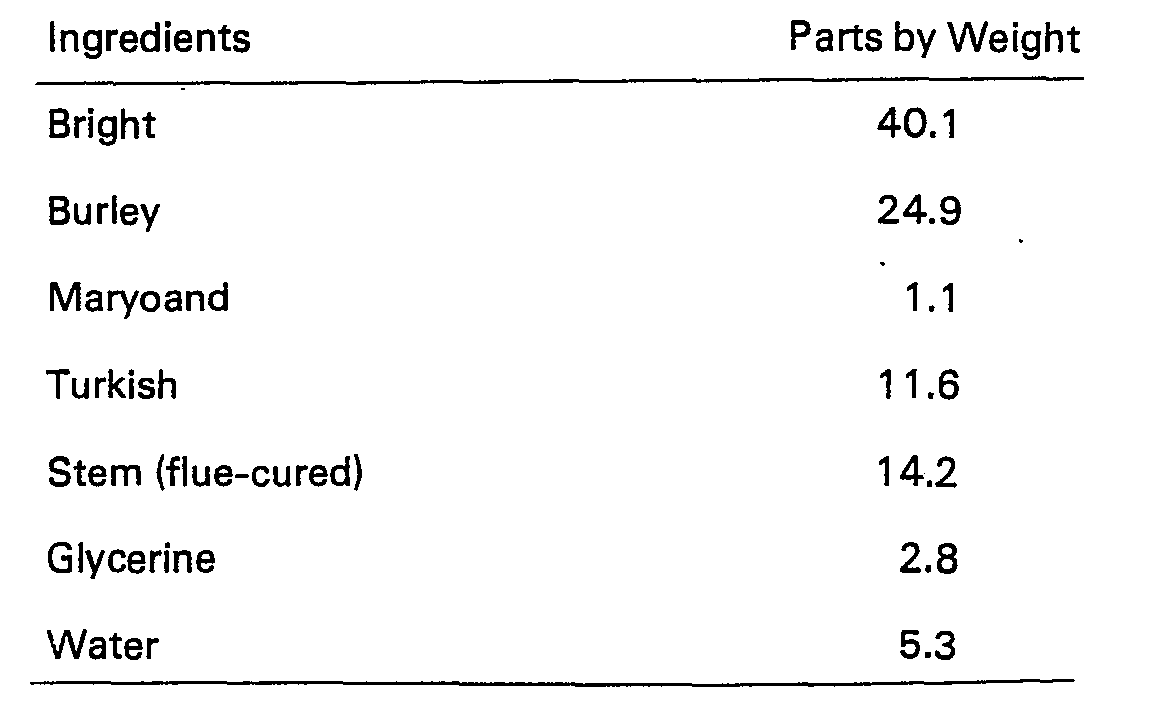
- The following flavor formulation is prepared.

- The above stated tobacco flavor formulation is applied at the rate of 0.1 % to all of the cigarettes produced using the above tobacco formulation. Half of the cigarettes are then treated with 500 or 1000 ppm of each of the phenethylether derivatives produced according to Examples I(A)-VI. The control cigarettes not containing any of the phenethylethers produced according to the processes of Examples I(A)-VI and the experimental cigarettes which contain the phenethylethers produced according to the processes of Examples I(A)-VI are evaluated by paired comparison and the results are as follows:
- The experimental cigarettes are found to have more body and to be, on smoking, more tobacco-like, more aromatic, sweet, fruity and Virginia tobacco-like with sweet, rich, honey-like and fruity nuances. The tobacco of the experimental cigarettes prior to smoking has a sweet, rich, honey-like, fruity and hay tobacco-like aroma. The products of Examples I-VI, particularly the products of Example I, enhance the tobacco-like taste and aroma of the blended cigarettes imparting to them honey-like and fruity tobacco notes.
-
- Figure 1 (A) is the GLC profile for the reaction product of Example I(A) at the end of the reaction and just prior to distillation.
- Figure 1 (B) is the GLC profile for
fraction 8 of the distillation product of the reaction of Example I(A) which contains phenethyl cyclohexylether having the structure:
- Figure 1 (C) is the GLC profile for
fraction 10 of the distillation product of the reaction product of Example I(A) containing the compound having the structure:
- Figure 1 (D) is the GLC profile for
fraction 12 of the distillation product of the reaction product of Example I(A) containing the compound having the structure:
- Figure 2 is the NMR spectrum for peak "A" of the GLC profile of Figure I(A) which consists of the compound having the structure:

- Figure 3 is the NMR spectrum for peak "B" of the GLC profile of Figure I(A) containing the compound having the structure:

- Figure 4 is the infra-red spectrum for peak "B" of the GLC profile of Figure I(A) containing the compound having the structure:

- Figure 5 is the GLC profile for the reaction product of Example I(B) containing the compound having the structure:

- Figure 6(A) is the GLC profile for
fraction 7 of the distillation product of the reaction product of Example I(B) containing the compound having the structure:
- Figure 6(B) is the GLC profile for
fraction 10 of the distillation product of the reaction product of Example I(B) containing the compound having the structure:
- Figure 6(C) is the GLC profile for fraction 22 of the distillation product of the reaction product of Example I(B) containing the compound having the structure:

- Figure 7(A) is the GLC profile of the crude reaction product prior to distillation of Example II containing the compound having the structure:

- Figure 7(B) is the GLC profile for
fraction 8 of the distillation product of the reaction product of Example II containing the compound having the structure:
- Figure 8 is the NMR spectrum for
fraction 6 of the distillation product of the reaction product of Example II containing the compound having the structure:
- Figure 9 is the infra-red spectrum for
fraction 6 of the distillation product of the reaction product of Example II containing the compound having the structure:
- Figure 10(A) is the GLC profile for the crude reaction product prior to distillation of Example III containing the compound having the structure:

- Figure 10(B) is the GLC profile for
fraction 8 of the distillation product of the reaction product of Example III containing the compound having the structure:
- Figure 11 is the NMR spectrum for
fraction 10 of the distillation product of the reaction product of Example III containing the compound having the structure:
- Figure 12 is the infra-red spectrum for
fraction 10 of the distillation product of the reaction product of Example III containing the compound having the structure:
- Figure 13 is the GLC profile for the crude reaction product produced according to Example IV(A) containing the compound having the structure:

- Figure 14 is the NMR spectrum for the reaction product of Example IV(A) containing the compound having the structure:

- Figure 15 is the infra-red spectrum for the reaction product of Example IV(A) containing the compound having the structure:

- Figure 16 is the GLC profile for the crude reaction product of Example IV(B) containing the compound having the structure:

- Figure 17 is the GLC profile for the crude reaction product of Example V prior to propionic anhydride reaction containing the compounds having the structures:

- Figure 18 is the GLC profile for
fraction 4 of the distillation product of the reaction product of Example V after reaction with propionic anhydride, containing the compound having the structure:
- Figure 19 is the NMR spectrum for the reaction product of Example V after distillation containing the compound having the structure:

- Figure 20 is the infra-red spectrum for the reaction product of Example V after distillation after reaction with propionic anhydride containing the compound having the structure:

- Figure 21 is the GLC profile of the reaction product of Example VI containing the compounds having the structures:
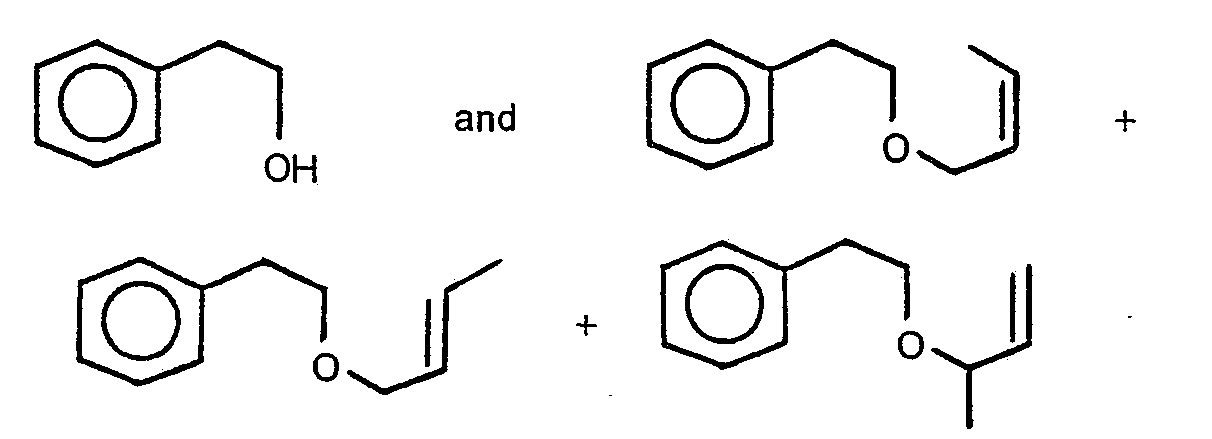
- Figure 22(A) represents the NMR spectrum for
peak 14 of the GLC profile of Figure 21 containing the compound having the structure:
- Figure 22(B) is the infra-red spectrum for
peak 14 of Figure 21 which is the GLC profile for the reaction product of Example VI, containing the compound having the structure: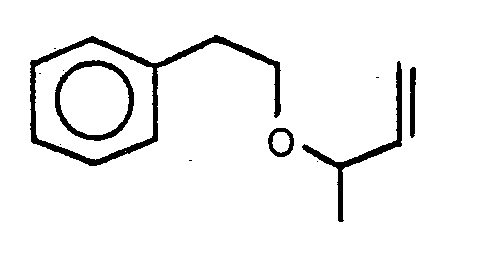
- Figure 23(A) is the NMR spectrum for
peak 15 of Figure 21 which is the GLC profile for the reaction product of Example VI, containing the compounds having the structures:
- Figure 23(B) is the infra-red spectrum for
peak 15 of Figure 21 which is the GLC profile for Example VI containing the compounds having the structures:
- Figure 5 is the GLC profile for the reaction product of Example I(B) resulting from the reaction of cyclohexene and phenethyl alcohol.
- The peak designated by the numeral "1" is the peak indicating unreacted cyclohexene.
- The peak designated by the numeral "2" in the GLC profile is the peak which represents phenylethyl alcohol.
- The peak designated by the numeral "3" represents the peak for the reaction product of Example I(B), cyclohexyl phenethylether.
- The conditions for this GLC profile obtention are 220°C isothermal using a 1/8" x 10' SE-30 column.
- Figure 17 is the GLC profile for the crude reaction product of Example V of isopropanol and phenylethyl alcohol having the structure:
-


- The peak indicated by the reference numeral "11" represents phenylethyl alcohol having the structure:

- The peak indicated by the reference numeral "12" represents the phenylethyl alcohol ether having- the structure:

- These two compounds virtually impossible to separate by distillation and require reaction with propionic anhydride followed by separation of the resultant phenylethyl alcohol isopropyl ether and phenylethyl alcohol propionate having the structure:

- Figure 21 is the GLC profile for the reaction product of Example VI. The reaction product of Example VI contains four compounds:
- phenylethyl alcohol having the structure:

- 2-butenyl phenylethylether, cis-isomer and trans-isomer having the structures:

- phenylethyl methallylether having the structure:

- The peak on the GLC profile indicated by the reference numeral "13" is the peak for phenylethyl alcohol having the structure:

- The peak on the GLC profile of Figure 21 indicated by the reference numeral "14" is the peak for the phenylethylether of methallyl alcohol having the structure:

- The peak on Figure 21, the GLC profile, indicated by the reference numeral "15" is the peak for the phenylethylether of 2-butenyl, both the "cis" and "trans" isomers having the structures:

(7 grams of phenethylether derivative per 92 grams of 95% aqueous ethanol).
in 1.0% ethanolic solution. These trees were exposed in an area which was contaminated with Lasioderma serricorne (F.). After 3 to 4 days, 115 beetles per square meter were observed on the logs. Other untreated Jogs or trees in the direct neighborhood of the treated logs or trees showed very few (about 12) insects per square meter on the average while other trees at a distance of 10 to 20 meters showed no contamination.
in admixture with different DDT preparations, fluorine-containing mixture and arsenic-containing mixtures as well as hexachloro-cyclohexane were used. These mixtures contained also small amounts of surface-active agents and carriers. The mixtures were applied to catch trees namely logs of oak trees in an area of tobacco plants contaminated with Lasioderma serricome (F.). The distance between the catch trees was always 200 meters. After 8 days there was no contamination either in the tobacco fields or around the oak trees. About 93% of the Lasioderma serricorne (F.). insects were destroyed. Surprisingly, it was found that after the fourth day, the attracting effect was not diminished in spite of the dead insects being present. Furthermore, in those areas where the phenethylether derivatives of either Examples IV(A), V or Vl was used alone, the average number of insects destroyed was about 78% which in itself is surprising. Thus, the phenethylether derivatives of either Examples IV(A), V or VI not only act as pheromones but also as insecticides. Furthermore, the entire area wherein the phenethylether derivatives of either Example IV(A), V or VI were used had faint, pleasant, floral aromas covering any adverse and aesthetically displeasing aromas of any other insecticides that were used.
Fabric softening compositions prepared as set forth above having aroma profiles as set forth in Table II below each consist of a substrate having a weight of about 3 grams per 100 square inches, a substrate coating of about 1.85 grams per 100 square inches of substrate and an outer coating of about 1.4 grams per 100 square inches of substrate, thereby providing a total aromatized substrate and outer coating weight ratio of about 1:1. Aromas are imparted in a pleasant manner to the head space in the dryer on operation thereof using said dryer-added fabric softening non-woven fabric.
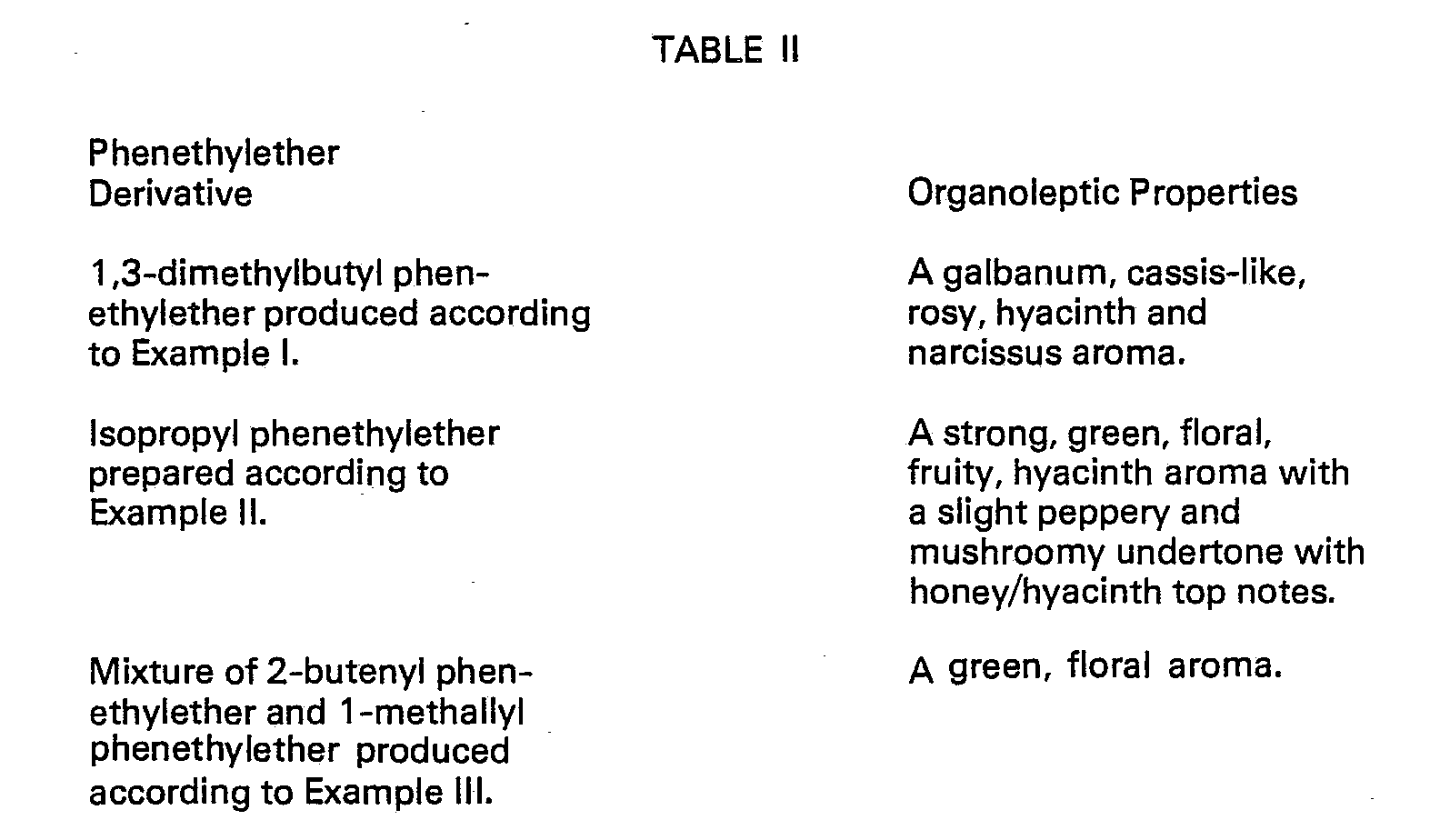
Claims (27)


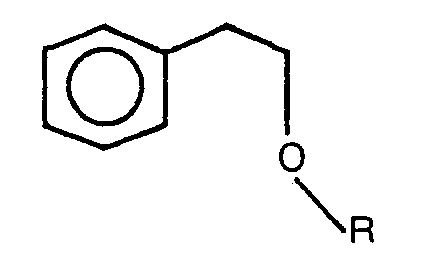
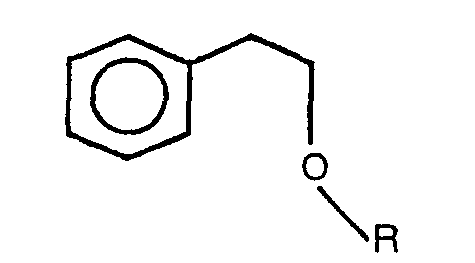

Applications Claiming Priority (6)
| Application Number | Priority Date | Filing Date | Title |
|---|---|---|---|
| US192238 | 1980-09-30 | ||
| US06/192,238 US4306096A (en) | 1980-09-30 | 1980-09-30 | Cyclohexyl phenethylether |
| US06/235,844 US4324923A (en) | 1980-09-30 | 1981-02-19 | Cyclohexyl phenethylether derivative |
| US06/238,750 US4328206A (en) | 1981-02-27 | 1981-02-27 | Method of attracting and destroying tobacco beetles with alkyl phenethylethers |
| US235844 | 1988-08-24 | ||
| US238750 | 1994-05-05 |
Publications (2)
| Publication Number | Publication Date |
|---|---|
| EP0049120A1 EP0049120A1 (en) | 1982-04-07 |
| EP0049120B1 true EP0049120B1 (en) | 1985-01-16 |
Family
ID=27393015
Family Applications (1)
| Application Number | Title | Priority Date | Filing Date |
|---|---|---|---|
| EP81304424A Expired EP0049120B1 (en) | 1980-09-30 | 1981-09-24 | Phenethylether derivatives, process for preparing same and uses thereof in combatting tobacco beetles and in augmenting or enhancing the aroma of perfumes, colognes and perfumed articles |
Country Status (2)
| Country | Link |
|---|---|
| EP (1) | EP0049120B1 (en) |
| DE (1) | DE3168340D1 (en) |
Families Citing this family (1)
| Publication number | Priority date | Publication date | Assignee | Title |
|---|---|---|---|---|
| CA2051469A1 (en) * | 1990-09-27 | 1992-03-28 | Leslie A. Cohen | Polymer composition which masks odor |
-
1981
- 1981-09-24 DE DE8181304424T patent/DE3168340D1/en not_active Expired
- 1981-09-24 EP EP81304424A patent/EP0049120B1/en not_active Expired
Non-Patent Citations (1)
| Title |
|---|
| Toxic Substances Control Act, Chemical Substance Inventory, Vol. II, May 1979, page 163 * |
Also Published As
| Publication number | Publication date |
|---|---|
| EP0049120A1 (en) | 1982-04-07 |
| DE3168340D1 (en) | 1985-02-28 |
Similar Documents
| Publication | Publication Date | Title |
|---|---|---|
| EP0377274B1 (en) | Adamantane derivatives, process for their preparation, compositions containing them and their use as organoleptics and deodorants | |
| US4376068A (en) | Use of isomeric farnesene product-by-process for augmenting or enhancing the aroma of perfume compositions, colognes and perfumed articles | |
| EP1213277A1 (en) | Alkyl-substituted derivatives of 4,5,6,7-tetrahydro-4-indane and their use in perfume compositions | |
| US4303555A (en) | Use of mixture of aliphatic C10 branched olefins in augmenting or enhancing the aroma of perfumes, and/or perfumed articles | |
| US5358930A (en) | 2-ethoxy-4-formyl phenyl ester of propionic acid and use in augmenting or enhancing the aroma of perfume compositions, colognes and perfumed articles | |
| JPH0688926B2 (en) | Ketone isomer mixture, process for producing the same and composition thereof | |
| US4324923A (en) | Cyclohexyl phenethylether derivative | |
| US4390444A (en) | Use of isomeric mixtures of farnesene for augmenting or enhancing the aroma of detergent compositions | |
| US4306096A (en) | Cyclohexyl phenethylether | |
| US4139484A (en) | Process for altering, modifying or enhancing the aroma of detergents with substituted bicyclooctene derivatives | |
| EP0051404A1 (en) | Norbornyl ethers, their preparation and their use in augmenting the aroma of a consumable material, cloth or fabric | |
| US4328206A (en) | Method of attracting and destroying tobacco beetles with alkyl phenethylethers | |
| EP0049120A1 (en) | Phenethylether derivatives, process for preparing same and uses thereof in combatting tobacco beetles and in augmenting or enhancing the aroma of perfumes, colognes and perfumed articles | |
| US4337180A (en) | Use of cyclohexyl phenethylether in augmenting or enhancing the aroma of perfumes and colognes | |
| US4339344A (en) | Use of mixture of aliphatic C10 -branched olefins in augmenting or enhancing the aroma of perfumes and/or perfumed articles | |
| US4362657A (en) | Use of cyclohexyl phenethylether derivative in augmenting or enhancing the aromas of perfumes and colognes | |
| US4366078A (en) | Process for augmenting or enhancing the aroma of detergents using dimerized isoamylene composition | |
| DE3415067C2 (en) | Use of 1-phenylpentene-4-one-1 and its methyl homologues to enhance or enhance the aroma of perfume compositions, colognes and perfumed articles | |
| US4512919A (en) | 2-Methoxy-4-(2-methylpropenyl) phenyl ester of isobutyric acid, and use in augmenting or enhancing aroma of perfume compositions, colognes and perfumed articles | |
| US4371715A (en) | Process for preparing cyclohexyl phenethylether derivatives | |
| US4374746A (en) | Cyclohexyl phenethylether derivatives, process for preparing same and uses thereof in combatting tobacco beetles and in augmenting or enhancing the aroma of perfumes, colognes and perfumed articles | |
| US4357319A (en) | Alkenyl phenethylethers and uses thereof in combatting tobacco beetles | |
| US5527768A (en) | Use of 1-benzyl cyclohexanol in augmenting, enhancing or imparting aromas in or to perfume compositions, perfumed articles and colognes and, optionally, simultaneously repelling insects | |
| US4582634A (en) | Use in augmenting or enhancing the aroma of perfume compositions, colognes and perfumed articles of 1-phenylpenten-4-one-1 and methyl homologues thereof | |
| US4343791A (en) | Cyclohexyl phenethylether derivatives for combatting tobacco beetles |
Legal Events
| Date | Code | Title | Description |
|---|---|---|---|
| PUAI | Public reference made under article 153(3) epc to a published international application that has entered the european phase |
Free format text: ORIGINAL CODE: 0009012 |
|
| AK | Designated contracting states |
Designated state(s): CH DE FR GB NL |
|
| 17P | Request for examination filed |
Effective date: 19820506 |
|
| GRAA | (expected) grant |
Free format text: ORIGINAL CODE: 0009210 |
|
| AK | Designated contracting states |
Designated state(s): CH DE FR GB LI NL |
|
| REF | Corresponds to: |
Ref document number: 3168340 Country of ref document: DE Date of ref document: 19850228 |
|
| ET | Fr: translation filed | ||
| PLBE | No opposition filed within time limit |
Free format text: ORIGINAL CODE: 0009261 |
|
| STAA | Information on the status of an ep patent application or granted ep patent |
Free format text: STATUS: NO OPPOSITION FILED WITHIN TIME LIMIT |
|
| 26N | No opposition filed | ||
| PGFP | Annual fee paid to national office [announced via postgrant information from national office to epo] |
Ref country code: NL Payment date: 19950817 Year of fee payment: 15 |
|
| PG25 | Lapsed in a contracting state [announced via postgrant information from national office to epo] |
Ref country code: NL Effective date: 19970401 |
|
| NLV4 | Nl: lapsed or anulled due to non-payment of the annual fee |
Effective date: 19970401 |
|
| PGFP | Annual fee paid to national office [announced via postgrant information from national office to epo] |
Ref country code: DE Payment date: 19970825 Year of fee payment: 17 |
|
| PGFP | Annual fee paid to national office [announced via postgrant information from national office to epo] |
Ref country code: CH Payment date: 19980825 Year of fee payment: 18 |
|
| PG25 | Lapsed in a contracting state [announced via postgrant information from national office to epo] |
Ref country code: DE Free format text: LAPSE BECAUSE OF NON-PAYMENT OF DUE FEES Effective date: 19990701 |
|
| PG25 | Lapsed in a contracting state [announced via postgrant information from national office to epo] |
Ref country code: LI Free format text: LAPSE BECAUSE OF NON-PAYMENT OF DUE FEES Effective date: 19990930 Ref country code: CH Free format text: LAPSE BECAUSE OF NON-PAYMENT OF DUE FEES Effective date: 19990930 |
|
| REG | Reference to a national code |
Ref country code: CH Ref legal event code: PL |
|
| PGFP | Annual fee paid to national office [announced via postgrant information from national office to epo] |
Ref country code: FR Payment date: 20000823 Year of fee payment: 20 |
|
| PGFP | Annual fee paid to national office [announced via postgrant information from national office to epo] |
Ref country code: GB Payment date: 20000825 Year of fee payment: 20 |
|
| PG25 | Lapsed in a contracting state [announced via postgrant information from national office to epo] |
Ref country code: GB Free format text: LAPSE BECAUSE OF EXPIRATION OF PROTECTION Effective date: 20010923 |
|
| REG | Reference to a national code |
Ref country code: GB Ref legal event code: PE20 Effective date: 20010923 |