EP0049064B1 - Recovery of vanadium - Google Patents
Recovery of vanadium Download PDFInfo
- Publication number
- EP0049064B1 EP0049064B1 EP81304110A EP81304110A EP0049064B1 EP 0049064 B1 EP0049064 B1 EP 0049064B1 EP 81304110 A EP81304110 A EP 81304110A EP 81304110 A EP81304110 A EP 81304110A EP 0049064 B1 EP0049064 B1 EP 0049064B1
- Authority
- EP
- European Patent Office
- Prior art keywords
- vanadium
- solution
- acid
- hydrogen peroxide
- oxidation
- Prior art date
- Legal status (The legal status is an assumption and is not a legal conclusion. Google has not performed a legal analysis and makes no representation as to the accuracy of the status listed.)
- Expired
Links
- LEONUFNNVUYDNQ-UHFFFAOYSA-N vanadium atom Chemical compound [V] LEONUFNNVUYDNQ-UHFFFAOYSA-N 0.000 title claims description 98
- 229910052720 vanadium Inorganic materials 0.000 title claims description 91
- 238000011084 recovery Methods 0.000 title description 5
- 239000000243 solution Substances 0.000 claims description 117
- MHAJPDPJQMAIIY-UHFFFAOYSA-N Hydrogen peroxide Chemical compound OO MHAJPDPJQMAIIY-UHFFFAOYSA-N 0.000 claims description 109
- FHHJDRFHHWUPDG-UHFFFAOYSA-N peroxysulfuric acid Chemical compound OOS(O)(=O)=O FHHJDRFHHWUPDG-UHFFFAOYSA-N 0.000 claims description 76
- 230000003647 oxidation Effects 0.000 claims description 45
- 238000007254 oxidation reaction Methods 0.000 claims description 45
- 238000000034 method Methods 0.000 claims description 36
- XEEYBQQBJWHFJM-UHFFFAOYSA-N Iron Chemical compound [Fe] XEEYBQQBJWHFJM-UHFFFAOYSA-N 0.000 claims description 34
- 239000007800 oxidant agent Substances 0.000 claims description 25
- 230000001590 oxidative effect Effects 0.000 claims description 24
- 230000008569 process Effects 0.000 claims description 24
- QAOWNCQODCNURD-UHFFFAOYSA-N Sulfuric acid Chemical compound OS(O)(=O)=O QAOWNCQODCNURD-UHFFFAOYSA-N 0.000 claims description 23
- 238000006243 chemical reaction Methods 0.000 claims description 23
- 235000011149 sulphuric acid Nutrition 0.000 claims description 19
- 239000001117 sulphuric acid Substances 0.000 claims description 19
- 229910052742 iron Inorganic materials 0.000 claims description 17
- 239000002253 acid Substances 0.000 claims description 10
- 239000003929 acidic solution Substances 0.000 claims description 10
- 239000007864 aqueous solution Substances 0.000 claims description 9
- 230000004044 response Effects 0.000 claims description 5
- 229910052697 platinum Inorganic materials 0.000 claims description 4
- 150000003512 tertiary amines Chemical class 0.000 claims description 4
- 229910052709 silver Inorganic materials 0.000 claims description 3
- 229910052770 Uranium Inorganic materials 0.000 description 16
- JFALSRSLKYAFGM-UHFFFAOYSA-N uranium(0) Chemical compound [U] JFALSRSLKYAFGM-UHFFFAOYSA-N 0.000 description 16
- 230000006698 induction Effects 0.000 description 14
- 150000001412 amines Chemical class 0.000 description 13
- CWYNVVGOOAEACU-UHFFFAOYSA-N Fe2+ Chemical compound [Fe+2] CWYNVVGOOAEACU-UHFFFAOYSA-N 0.000 description 8
- 238000000638 solvent extraction Methods 0.000 description 8
- UUUGYDOQQLOJQA-UHFFFAOYSA-L vanadyl sulfate Chemical compound [V+2]=O.[O-]S([O-])(=O)=O UUUGYDOQQLOJQA-UHFFFAOYSA-L 0.000 description 8
- 238000000605 extraction Methods 0.000 description 7
- 238000012544 monitoring process Methods 0.000 description 7
- PSDQQCXQSWHCRN-UHFFFAOYSA-N vanadium(4+) Chemical compound [V+4] PSDQQCXQSWHCRN-UHFFFAOYSA-N 0.000 description 7
- ZOKXTWBITQBERF-UHFFFAOYSA-N Molybdenum Chemical compound [Mo] ZOKXTWBITQBERF-UHFFFAOYSA-N 0.000 description 6
- 239000003153 chemical reaction reagent Substances 0.000 description 6
- 239000012535 impurity Substances 0.000 description 6
- 229910052750 molybdenum Inorganic materials 0.000 description 6
- 239000011733 molybdenum Substances 0.000 description 6
- BASFCYQUMIYNBI-UHFFFAOYSA-N platinum Chemical compound [Pt] BASFCYQUMIYNBI-UHFFFAOYSA-N 0.000 description 6
- 238000010924 continuous production Methods 0.000 description 5
- 229910052500 inorganic mineral Inorganic materials 0.000 description 5
- 229910052751 metal Inorganic materials 0.000 description 5
- 239000002184 metal Substances 0.000 description 5
- 239000011707 mineral Substances 0.000 description 5
- 239000002904 solvent Substances 0.000 description 5
- XTEGARKTQYYJKE-UHFFFAOYSA-M Chlorate Chemical compound [O-]Cl(=O)=O XTEGARKTQYYJKE-UHFFFAOYSA-M 0.000 description 4
- 238000004458 analytical method Methods 0.000 description 4
- 230000008859 change Effects 0.000 description 4
- 230000006872 improvement Effects 0.000 description 4
- 238000002386 leaching Methods 0.000 description 4
- 239000000203 mixture Substances 0.000 description 4
- 150000002978 peroxides Chemical class 0.000 description 4
- 238000012360 testing method Methods 0.000 description 4
- BZSXEZOLBIJVQK-UHFFFAOYSA-N 2-methylsulfonylbenzoic acid Chemical compound CS(=O)(=O)C1=CC=CC=C1C(O)=O BZSXEZOLBIJVQK-UHFFFAOYSA-N 0.000 description 3
- VZDYWEUILIUIDF-UHFFFAOYSA-J cerium(4+);disulfate Chemical compound [Ce+4].[O-]S([O-])(=O)=O.[O-]S([O-])(=O)=O VZDYWEUILIUIDF-UHFFFAOYSA-J 0.000 description 3
- 238000007429 general method Methods 0.000 description 3
- 150000002739 metals Chemical class 0.000 description 3
- 239000002244 precipitate Substances 0.000 description 3
- 238000001556 precipitation Methods 0.000 description 3
- 238000004448 titration Methods 0.000 description 3
- 239000002699 waste material Substances 0.000 description 3
- GOLCXWYRSKYTSP-UHFFFAOYSA-N Arsenious Acid Chemical compound O1[As]2O[As]1O2 GOLCXWYRSKYTSP-UHFFFAOYSA-N 0.000 description 2
- 229910021607 Silver chloride Inorganic materials 0.000 description 2
- 230000002378 acidificating effect Effects 0.000 description 2
- 229910045601 alloy Inorganic materials 0.000 description 2
- 239000000956 alloy Substances 0.000 description 2
- 230000008485 antagonism Effects 0.000 description 2
- 229960002594 arsenic trioxide Drugs 0.000 description 2
- 230000015556 catabolic process Effects 0.000 description 2
- 238000000354 decomposition reaction Methods 0.000 description 2
- 238000006731 degradation reaction Methods 0.000 description 2
- 238000007865 diluting Methods 0.000 description 2
- 230000002452 interceptive effect Effects 0.000 description 2
- 238000004519 manufacturing process Methods 0.000 description 2
- XTAZYLNFDRKIHJ-UHFFFAOYSA-N n,n-dioctyloctan-1-amine Chemical compound CCCCCCCCN(CCCCCCCC)CCCCCCCC XTAZYLNFDRKIHJ-UHFFFAOYSA-N 0.000 description 2
- 239000000047 product Substances 0.000 description 2
- 230000009467 reduction Effects 0.000 description 2
- 230000001105 regulatory effect Effects 0.000 description 2
- 239000004332 silver Substances 0.000 description 2
- HKZLPVFGJNLROG-UHFFFAOYSA-M silver monochloride Chemical compound [Cl-].[Ag+] HKZLPVFGJNLROG-UHFFFAOYSA-M 0.000 description 2
- 239000007858 starting material Substances 0.000 description 2
- 238000003860 storage Methods 0.000 description 2
- 125000005287 vanadyl group Chemical group 0.000 description 2
- VEXZGXHMUGYJMC-UHFFFAOYSA-M Chloride anion Chemical compound [Cl-] VEXZGXHMUGYJMC-UHFFFAOYSA-M 0.000 description 1
- VTLYFUHAOXGGBS-UHFFFAOYSA-N Fe3+ Chemical compound [Fe+3] VTLYFUHAOXGGBS-UHFFFAOYSA-N 0.000 description 1
- 229910000628 Ferrovanadium Inorganic materials 0.000 description 1
- 229920002472 Starch Polymers 0.000 description 1
- QAOWNCQODCNURD-UHFFFAOYSA-L Sulfate Chemical compound [O-]S([O-])(=O)=O QAOWNCQODCNURD-UHFFFAOYSA-L 0.000 description 1
- 238000005903 acid hydrolysis reaction Methods 0.000 description 1
- 235000019647 acidic taste Nutrition 0.000 description 1
- 150000007513 acids Chemical class 0.000 description 1
- 239000008346 aqueous phase Substances 0.000 description 1
- 238000010923 batch production Methods 0.000 description 1
- 230000015572 biosynthetic process Effects 0.000 description 1
- 229940075397 calomel Drugs 0.000 description 1
- 239000003729 cation exchange resin Substances 0.000 description 1
- 229940023913 cation exchange resins Drugs 0.000 description 1
- 239000003638 chemical reducing agent Substances 0.000 description 1
- 239000003795 chemical substances by application Substances 0.000 description 1
- 238000005260 corrosion Methods 0.000 description 1
- 230000007797 corrosion Effects 0.000 description 1
- 238000001514 detection method Methods 0.000 description 1
- 239000003085 diluting agent Substances 0.000 description 1
- 238000010790 dilution Methods 0.000 description 1
- 239000012895 dilution Substances 0.000 description 1
- ZOMNIUBKTOKEHS-UHFFFAOYSA-L dimercury dichloride Chemical compound Cl[Hg][Hg]Cl ZOMNIUBKTOKEHS-UHFFFAOYSA-L 0.000 description 1
- 230000000694 effects Effects 0.000 description 1
- 238000004945 emulsification Methods 0.000 description 1
- 238000002474 experimental method Methods 0.000 description 1
- 229910001447 ferric ion Inorganic materials 0.000 description 1
- 238000010438 heat treatment Methods 0.000 description 1
- 229930195733 hydrocarbon Natural products 0.000 description 1
- 150000002430 hydrocarbons Chemical class 0.000 description 1
- XMBWDFGMSWQBCA-UHFFFAOYSA-N hydrogen iodide Chemical compound I XMBWDFGMSWQBCA-UHFFFAOYSA-N 0.000 description 1
- 230000007062 hydrolysis Effects 0.000 description 1
- 238000006460 hydrolysis reaction Methods 0.000 description 1
- 230000001771 impaired effect Effects 0.000 description 1
- 238000005342 ion exchange Methods 0.000 description 1
- 239000003456 ion exchange resin Substances 0.000 description 1
- 229920003303 ion-exchange polymer Polymers 0.000 description 1
- PNXOJQQRXBVKEX-UHFFFAOYSA-N iron vanadium Chemical compound [V].[Fe] PNXOJQQRXBVKEX-UHFFFAOYSA-N 0.000 description 1
- 239000003350 kerosene Substances 0.000 description 1
- 239000000463 material Substances 0.000 description 1
- 238000005259 measurement Methods 0.000 description 1
- 238000005272 metallurgy Methods 0.000 description 1
- 239000003607 modifier Substances 0.000 description 1
- ZQJAONQEOXOVNR-UHFFFAOYSA-N n,n-di(nonyl)nonan-1-amine Chemical compound CCCCCCCCCN(CCCCCCCCC)CCCCCCCCC ZQJAONQEOXOVNR-UHFFFAOYSA-N 0.000 description 1
- 238000006386 neutralization reaction Methods 0.000 description 1
- 125000005385 peroxodisulfate group Chemical group 0.000 description 1
- VKJKEPKFPUWCAS-UHFFFAOYSA-M potassium chlorate Chemical compound [K+].[O-]Cl(=O)=O VKJKEPKFPUWCAS-UHFFFAOYSA-M 0.000 description 1
- 239000012286 potassium permanganate Substances 0.000 description 1
- 238000005086 pumping Methods 0.000 description 1
- 238000001179 sorption measurement Methods 0.000 description 1
- 238000004611 spectroscopical analysis Methods 0.000 description 1
- 238000010561 standard procedure Methods 0.000 description 1
- 235000019698 starch Nutrition 0.000 description 1
- 239000008107 starch Substances 0.000 description 1
- 239000011550 stock solution Substances 0.000 description 1
- 229910021653 sulphate ion Inorganic materials 0.000 description 1
- XLYOFNOQVPJJNP-UHFFFAOYSA-N water Substances O XLYOFNOQVPJJNP-UHFFFAOYSA-N 0.000 description 1
Images


Classifications
-
- C—CHEMISTRY; METALLURGY
- C22—METALLURGY; FERROUS OR NON-FERROUS ALLOYS; TREATMENT OF ALLOYS OR NON-FERROUS METALS
- C22B—PRODUCTION AND REFINING OF METALS; PRETREATMENT OF RAW MATERIALS
- C22B34/00—Obtaining refractory metals
- C22B34/20—Obtaining niobium, tantalum or vanadium
- C22B34/22—Obtaining vanadium
-
- C—CHEMISTRY; METALLURGY
- C01—INORGANIC CHEMISTRY
- C01G—COMPOUNDS CONTAINING METALS NOT COVERED BY SUBCLASSES C01D OR C01F
- C01G31/00—Compounds of vanadium
-
- C—CHEMISTRY; METALLURGY
- C22—METALLURGY; FERROUS OR NON-FERROUS ALLOYS; TREATMENT OF ALLOYS OR NON-FERROUS METALS
- C22B—PRODUCTION AND REFINING OF METALS; PRETREATMENT OF RAW MATERIALS
- C22B3/00—Extraction of metal compounds from ores or concentrates by wet processes
- C22B3/20—Treatment or purification of solutions, e.g. obtained by leaching
- C22B3/26—Treatment or purification of solutions, e.g. obtained by leaching by liquid-liquid extraction using organic compounds
- C22B3/28—Amines
- C22B3/282—Aliphatic amines
-
- Y—GENERAL TAGGING OF NEW TECHNOLOGICAL DEVELOPMENTS; GENERAL TAGGING OF CROSS-SECTIONAL TECHNOLOGIES SPANNING OVER SEVERAL SECTIONS OF THE IPC; TECHNICAL SUBJECTS COVERED BY FORMER USPC CROSS-REFERENCE ART COLLECTIONS [XRACs] AND DIGESTS
- Y02—TECHNOLOGIES OR APPLICATIONS FOR MITIGATION OR ADAPTATION AGAINST CLIMATE CHANGE
- Y02P—CLIMATE CHANGE MITIGATION TECHNOLOGIES IN THE PRODUCTION OR PROCESSING OF GOODS
- Y02P10/00—Technologies related to metal processing
- Y02P10/20—Recycling
Definitions
- the present invention relates to improvements in the recovery of vanadium from an aqueous acidic solution thereof and in particular to the oxidation of the vanadium in such a process.
- the known mineral reserves of vanadium in the world are comparatively small, one of the main mineral sources being uranium/vanadium ores such as carnotite which has the imperical formula which are of importance not only for their vanadium content but also for their uranium.
- the mineral is generally ground and contacted with a sulphuric acid lixiviant, although other mineral acids could be employed if desired, during which period of contact the uranium and vanadium are leached into solution.
- the solution contains uranium in the U (VI) oxidation state and the vanadium in the vanadium (IV) oxidation state.
- the mixed metal solution is contacted with an amine dissolved in a water-immiscible solvent such as kerosene or similar mixtures of hydrocarbons or with selected ion exchange resins, and the uranium is prefentially extracted, leaving the vanadium in solution.
- a water-immiscible solvent such as kerosene or similar mixtures of hydrocarbons or with selected ion exchange resins
- Further sources of vanadium include residues and wastes and scrap alloys from which vanadium can be brought into solution by acid leaching. It has been recognised that a convenient method of subsequently removing the vanadium would comprise its oxidation to the V (V) oxidation state followed by extraction from an acidic solution using an amine solvent extraction or cation exchange resins, or by precipitation.
- a further reagent that has been tested in the USA is hydrogen peroxide.
- it can be capable of oxidising vanadium (IV) to V(V) in aqueous solutions having acidities suitable for the subsequent solvent or ion exchange extraction of vanadium therefrom, despite various disclosures in, for example, a paper by G. Kakabadse and H. T. Wilson entitled "The reduction of hydrogen peroxide” that hydrogen peroxide is decomposed by vanadium (V) and the latter is to at least some extent, reduced to V (IV), visibly proceeding via a peroxovanadium intermediate.
- a process for the oxidation of vanadium to V (V) which substantially minimises or eliminates hold-up times for the reaction, thereby permitting the process to be incorporated in a continuous process for extracting vanadium from an aqueous acidic solution thereof, and particularly, from solutions obtained by acid leaching of carnotite ore or similar ores.
- a process for the oxidation of vanadium to oxidation state V in which oxidant is introduced into an aqueous acidic solution of vanadium in an oxidation state lower than V at a temperature of from 0 to 80°C and oxidant is maintained in solution until at least some of the vanadium has been oxidised to the oxidation state V, characterised by employing as oxidant an aqueous acidic solution of peroxomonosulphuric acid containing hydrogen peroxide in an amount of less than one mole of hydrogen peroxide per mole of peroxomonosulphuric acid.
- This interference or antagonism manifests itself as an induction period during which period introduction of further amounts of a similar Caro's Acid solution serves merely to prolong the time taken for complete oxidation of the vanadium to occur, and to waste the Caro's Acid. It will be seen therefore, that under some conditions, the hydrogen peroxide is interfering with the peroxomonosulphuric acid oxidation in some way that is not fully understood at the moment. We have found that the induction period varies with the mole ratio of peroxomonosulphuric acid to hydrogen peroxide.
- H 2 SO,,:H 2 0 2 By control of manufacture of the solution so as to generate high mole ratio's such as above 6:1 and conveniently from 8:1 to 20:1, H 2 SO,,:H 2 0 2 , the induction period can be substantially eliminated. Depending on the apparatus in which the process is carried out, an induction period of as long as a few minutes can be tolerated so that in such circumstances, mole ratios of H 2 SO s : hydrogen peroxide of from 1:1 to 6:1 can also be of practical value, albeit slightly less conveniently than above 6:1.
- the process can comprise first measuring the vanadium and other metal contents in a sample of the solution, and based upon that, introducing a predetermined amount of oxidant, normally at least 75% and generally in the range of 100% to 250% the stoichiometric amount of Caro's Acid (ignoring the H 2 0 2 content) and especially from 100% to 120% of the stoichiometric amount where the mole ratio H 2 SO 5 :H 2 0 2 is 8:1 or higher.
- a predetermined amount of oxidant normally at least 75% and generally in the range of 100% to 250% the stoichiometric amount of Caro's Acid (ignoring the H 2 0 2 content) and especially from 100% to 120% of the stoichiometric amount where the mole ratio H 2 SO 5 :H 2 0 2 is 8:1 or higher.
- One especially advantageous feature of a process according to at least some embodiments of the present invention is that the introduction of oxidant can be controlled easily and conveniently by, and on the basis of, monitoring the electrochemical potential (E h ) of the vanadium-containing solution.
- E h detector is located in the treatment vessel containing the solution into which oxidant is to be introduced and in practice due allowance is made for the aforementioned induction period when the Caro's Acid used is such that a measurable induction period exists, such as by introducing the Caro's Acid solution periodically by increments after a steady E h has been attained following production of the preceding increment.
- the vanadium-containing solution can be treated continuously, employing a control method based on E h detection even when there is an induction period, by for example, siting the E h monitor downstream of the point of introduction of the Caro's Acid so as to ensure a flow time between the introduction point and the monitor that is longer than any induction period, possibly employing more than one state each comprising a point of introduction of Caro's Acid and subsequent monitoring, it is much more convenient and accurate and a much quicker response to any change in vanadium (IV) concentration can be achieved in a continuous process by employing a Caro's Acid solution so made that there is substantially no induction period.
- the response to the monitored E h reading can be manually controlled, for example, in a batch process by the process operator reducing the rate of inflow of Caro's Acid when a predetermined potential has been reached, such 75 to 100 mV below the potential indicating complete vanadium oxidation to V (V) measured by the aforementioned electrodes, and stopping the inflow when the E h reading indicating complete oxidation to V (V), e.g. 825 to 875 mV (Le. the cut-off potential) is reached, and subsequently, checking the potential, such as after a few minutes to see whether the reading had fallen and if it had introducing further Caro's Acid solution to re-obtain the desired potential.
- a predetermined potential such 75 to 100 mV below the potential indicating complete vanadium oxidation to V (V) measured by the aforementioned electrodes
- One method of determining an end point for the Caro's Acid introduction is to plot a) the figure obtained by dividing the measured incremental change in E h of the vanadium solution (E) by the incremental volume of oxidant solution introduced (V) which caused that change in E,, against b) the total volume of oxidant solution introduced into a given sample of the vanadium solution.
- a sharp peak generally in the region of about 800 to 900 mV measured with a Pt-Ag/AgCI electrode system indicates the end point for vanadium oxidation to V(V).
- a similar procedure can be adopted when the process is continuous by employing a plurality of points of inflow of Caro's Acid and E h monitoring stations located alternately along the flow path, and so spaced to take into account any induction period.
- the monitored E h reading can be employed so as to control automatically the inflow of Caro's Acid.
- automatic control is much simpler when there is no induction period, for example when the mole ratio of H 2 S0 5 :H 2 0 2 is at least 8:1, in that the signal from the E h monitor can be used to control the valve or the metering pump or other means regulating the flow of Caro's Acid to the treatment vessel or pipe or alternatively, control the flow of both reagents to the Caro's Acid generator when the Caro's Acid solution is generated in the amount required and instantaneously, on demand.
- the Caro's Acid solution that there is no induction period, when using it, only a single E h monitor is needed in a continuous process.
- the Caro's Acid can be produced rapidly by pumping the starting materials into a cooled reaction vessel with a storage capacity equivalent to about half an hour to an hour's product requirement, thereby avoiding the disadvantageous and well-known gradual decomposition of peroxomonosulphuric acid to hydrogen peroxide and sulphuric acid which occurs upon storage for prolonged periods.
- aqueous hydrogen peroxide solutions of 60-75% and especially 65-70% by weight, by virtue of their ready availability, but higher concentrations such as up to 85% by weight are equally suitable.
- the hydrogen peroxide solutions are often used in conjunction with at least 90 and frequently 92 to 98% by weight sulphuric acid solutions.
- the reagents are preferably employed in a mole ratio of sulphuric acid to hydrogen peroxide selected within the range of at least 2.5:1 to 4:1 to give an H 2 SO 5 :H 2 0 2 mole ratio in the product of at least 6:1.
- a mole ratio of sulphuric acid to hydrogen peroxide selected within the range of at least 2.5:1 to 4:1 to give an H 2 SO 5 :H 2 0 2 mole ratio in the product of at least 6:1.
- the resultant Caro's Acid solution oxidises vanadium with substantially no induction period, and is thus ideally suited for use in a continuous process for vanadium oxidation.
- the ratio of H 2 SO 4 :H 2 0 2 introduced changes in the range 4:1 to 2.5:1, then the extent of choice within the specified ranges of 92-98 % and 60-75 % changes also, to attain an H 2 SO 5 :H 2 0 2 ratio of at least 6:1.
- the H 2 SO 4 is preferably 95 % at least and/or the hydrogen peroxide is preferably at least 70 %.
- solvent extraction of uranium and/or vanadium from aqueous acidic solutions thereof is usually effected at a temperature of about 50°C or lower, and often within 10°C of the subsisting solution temperature or ambient in order to minimise solvent losses and degradation.
- Caro's Acid is a rapid and effective oxidant at all temperatures at which solvent extraction is currently contemplated, i.e. generally from 10°C upwards, so that, for example, uranium barren liquor from a solvent extraction stage, in the treatment of carnotite ore can normally be treated with Caro's Acid without any temperature adjustment. Consequently, not only does the present invention provide a rapid and controllable reaction which can employ minimal oxidant, but it also avoids the use of ever more costly heating. A higher temperature, e.g. up to 80°C may be used though, if desired.
- the vanadium-containing solution is adjusted to a pH in the range of from pH 1 to 3, prior to and/or during oxidation, such a pH range representing the pH at which a subsequent solvent extraction using amines can readily be effected.
- a pH range representing the pH at which a subsequent solvent extraction using amines can readily be effected.
- the suitability of Caro's Acid in the preceding stage was demonstrated by contacting the amine solution with a vanadium solution oxidised with Caro's Acid to 850 mV for 20 days at 50°C at the end of which there was no detectable amine degradation.
- the amines that can be used to extract the vanadium subsequently include those which have hitherto been used or described for the extraction of metals in a high oxidation state from aqueous solution.
- Such amines are normally tertiary amines with a molecular weight in excess of 180 and often in the range of 300 to 450, especially tricaprylamine or mixtures containing it (commercially available under the mark ALAMtNE@336 from General Mills Inc., USA) trioctylamine and trinonylamine.
- Such amines can be used with various diluents and modifiers as will be apparent to the skilled artisan.
- the pH of the vanadium solution is preferably maintained at pH2 or below, such as from pH1 to pH2 during and after oxidation so as to avoid iron precipitation.
- downward adjustment of the pH to pH2 or lower can be achieved by addition of a mineral acid, especially sulphuric acid, before or during oxidation, but generally when Caro's Acid is employed added acid during oxidation is not required, in many cases the oxidised solution having a pH in the range pH1 to pH1.5.
- the process of the present invention is well suited to the treatment of any oxidisable vanadium-containing solution, particularly dilute solutions, many of such solutions containing from 0.1 to 10 gpl vanadium, although concentrations outside the range can be treated.
- the solution can also contain other metallic impurities such as iron, uranium and molybdenum, but where such impurities are present in an appreciable amount in an oxidation state that is oxidisable by Caro's Acid, then allowance must be made for that in determining the amount of Caro's Acid to introduce, and any reference to stoichiometric amount naturally is calculated on the basis of all the oxidisable metals, including vanadium.
- the aforementioned tertiary amines tend to extract vanadium more efficiently from aqueous solutions having a higher rather than a lower pH in the aforementioned range and thus it can be advantageous to adjust the solution during or after oxidation, to a pH or from pH 1.5 to 2.0, preferably 1.8 to 2.0.
- a vanadium solution 2.5 g/I as V 2 0 5 ) containing iron, (10 g/l, 53% ferrous
- hydrogen peroxide or Caro's Acid containing H 2 SO 5 and H 2 O 2 in a mole ratio of about 8:1
- the Caro's Acid oxidised smoothly at pH 1.9 whereas it was necessary to lower the pH to 1.75 when hydrogen peroxide was used, otherwise a precipitate occurred.
- subsequent vanadium extraction by the amine was markedly (about 20%) less efficient.
- the process in some preferred embodiments comprises the batch or continuous treatment of a vanadium-containing solution which has been obtained by leaching carnotite ore with aqueous sulphuric acid and from which uranium has been stripped, by monitoring the electropotential of the solution and based upon the monitoring automatically or manually causing the introduction therein of Caro's Acid solution, containing H 2 SO 5 :H 2 O 2 in a mole ratio of at least 8:1 to cease when the oxidation potential for V (IV)/V (V) has been reached and thereafter extracting the oxidised solution with a tertiary amine solvent extractant until at least some of the vanadium has been extracted.
- oxidation is effected in a continuous manner
- the introduction of Caro's Acid is controlled automatically and subsequent amine extraction is also continuous.
- Stock aqueous vanadium (IV)-containing solutions employed in Examples 1-15 were prepared by dissolving vanadyl sulphate in aqueous sulphuric acid and adjusting the pH of the solution to that specified in Table 1 by addition as appropriate of further sulphuric acid.
- a 25 ml aliquot of solution was introduced into a beaker equipped with stirrer and a platinum spade electrode and silver/silver chloride reference electrode.
- the vanadium contents of the stock solutions were determined by atomic adsorption spectroscopy.
- Caro's Acid solutions were prepared having the composition specified in Table 1 by reaction between aqueous hydrogen peroxide and concentrated sulphuric acid, (98% by weight) followed by dilution with demineralised water to a concentration of about 1% by weight of H 2 SO 5 .
- the H 2 SO 5 and H 2 O 2 contents of the diluted solutions were measured and the resultant ratio is specified in Table 1.
- the analysis for H 2 SO 5 was carried out by reaction with arsenious oxide and back titration with ceric sulphate and analysis for H 2 0 2 by titration with ceric sulphate.
- the volume of Caro's Acid solution required to oxidise all the vanadium in solution from the (IV) to the (V) oxidation state was calculated, i.e. 100% of the stoichiometric amount, on the basis solely of H 2 SO I in solution, making no allowance for the H 2 0 2 , and that volume was introduced into the vanadyl sulphate solution.
- the electropotential (E h ) of the solution was plotted continuously using a chart recorder and the graphs obtained in Examples 2, 5, 8, 10 and 14 of E,, against time form Figure 1 hereof.
- V vanadium
- the proportion of vanadium present in the final solution as vanadium (V) was determined by analytical method in which hydrogen peroxide was first shown to be absent by using starch/iodide paper and then vanadium (V) was reduced with known and excess amount of iron (II), and the latter is back titrated with ceric sulphate.
- a solution of vanadyl sulphate in sulphuric acid having a pH of 2.0 and a concentration of 1.16 gpl., expressed as vanadium was prepared in the manner of examples 1-15, and an aliquot of 20 ml of solution contacted with an aqeous solution of sodium chlorate having a concentration of 0.01 moles per litre.
- the vanadyl solution was stirred with 20 ml of the sodium chlorate, which represents 2.5 times the stoichiometric amount of oxidant, and the mixture was stored at 22° (ambient laboratory temperature).
- the solution for comparisons 3a to 3d were made by Method A by first adding the hydrogen peroxide to the vanadium IV solution, then diluting it to about 90 ml with DMW including any added impurity and finally adjusting the pH with sulphuric acid, whereas the solutions for comparisons 3e to 3h were made by Method B by first diluting the vanadyl sulphate solution to about 90 ml, together with any impurity, then adjusting to just below the desired pH with sulphuric acid, thirdly, introducing the hydrogen peroxide, and finally, checking the volume and pH and making any necessary minor adjustments.
- the vanadyl sulphate solution employed was prepared by the method described for Examples 1 to 15 and has a pH of 2 and an initial concentration of 1.09 gpl vanadium.
- a 20 ml aliquot of the solution was titrated at ambient temperature against an aqueous Caro's Acid solution which was analysed by the standard methods and contained 1.01 % H 2 SO s , 0.027% H 2 0 2 prepared using an initial mole ratio of H 2 SO 4 , H 2 O 2 of 3:1 and then diluted.
- the equipment was the same as in the preceding Examples.
- the potential (E h ) was measured after the introduction of each portion of oxidant and the results plotted in Figure 2. Salient readings are shown in Table III hereinbelow.
- Example 16 Repetition of Example 16 with solutions containing as impurity iron, molybdenum or uranium at 10 mg per litre produced substantially identical graphs to that obtained from Example 16, slightly less oxidant, about 6%, being needed in the presence of the iron.
- Example 17 the general method of Example 16 was followed but instead of the synthetic solution of vanadyl sulphate; a commercial sulphate solution was employed which on analysis was found to contain 8.8 gpl iron, of which a major proportion was ferrous, 1.1 gpl vanadium and minor amounts of inter alia uranium and molybdenum.
- the solution had an initial pH of 1.25.
- a 10 ml aliquot of the solution was diluted to 20 ml with DMW and titrated against a Caro's acid solution containing 1.03% H 2 SO 5 and 0.03% H 2 0 2 . Salient readings of the potential are shown in Table IV below
- Example 17 a further 10 ml aliquot of the commercial solution of Example 17 was contacted with Stoichiometric amount in the one of three Caro's Acid solutions determined by the second end point of Example 17, i.e. approx. 7 ⁇ 10 -4 moles of H 2 SO 5 and having the mole ratio of H 2 SO S to H 2 0 2 given in Table V.
- the general method employed, and the potential and conversion of vanadium IV to vanadium V and determined, were all as in Examples 1-15, and the results summarised in Table V.
- Examples 18 and 19 confirm that at least substantially complete conversion of vanadium IV to vanadium V had occurred using the amount determined by the end point in Example 17.
- Example 20 by Comparison with Examples 7 to 9 demonstrates that the interference between H 2 0 2 and H 2 SO s was less apparent in the presence of a substantial amount of ferrous iron initially than in its absence. The reason for such an improvement is not fully understood, but it may be related to the iron.
- Example 21 a Caro's Acid solution containing H 2 SO 5 to H 2 0 2 in a mole ratio of greater than 10:1 was used and in comparison 22, Technical grade hydrogen peroxide 50% w/w from Interox America diluted to 10 % w/w. The oxidant was titrated into the vanadium solution at 25°C. The potentials of the solutions were measured and the plots are shown in Figures 3 and 4 respectively appended hereto.
Landscapes
- Chemical & Material Sciences (AREA)
- Engineering & Computer Science (AREA)
- Organic Chemistry (AREA)
- Mechanical Engineering (AREA)
- Manufacturing & Machinery (AREA)
- Materials Engineering (AREA)
- Metallurgy (AREA)
- Inorganic Chemistry (AREA)
- Life Sciences & Earth Sciences (AREA)
- Environmental & Geological Engineering (AREA)
- General Life Sciences & Earth Sciences (AREA)
- Geochemistry & Mineralogy (AREA)
- Geology (AREA)
- Inorganic Compounds Of Heavy Metals (AREA)
- Manufacture And Refinement Of Metals (AREA)
Description
- The present invention relates to improvements in the recovery of vanadium from an aqueous acidic solution thereof and in particular to the oxidation of the vanadium in such a process.
- The known mineral reserves of vanadium in the world are comparatively small, one of the main mineral sources being uranium/vanadium ores such as carnotite which has the imperical formula

- Various methods for the oxidation of vanadium in aqueous solution have been described, and a few have even been put into commercial practice. In general, in acidic conditions, it is necessary to employ a reagent that is a strong oxidising agent. Thus, for example, P. H. Tedesco et al in the Anales Asoc. Quim. Argentina 65, pages 45-51 in a paper entitled "Recovery of vanadium from a uranium ore by liquid-liquid extractions with amines" advocate the use of potassium chlorate. However, we have found that the use of chlorate suffers from the inevitable disadvantage that after several recycles of the lixiviant there is a build-up of chloride in solution with its concommitant corrosion and waste discharge problems, but of even more significance is the fact that, in practice, the reaction cannot be controlled easily. At temperatures within about 10-15°C of the subsisting temperature of the stripped aqueous phase leaving the uranium extraction stage, the rate of oxidation of vanadium is rather slow, a holding time of up to 6 hours being required when only a small excess of chlorate is employed. Moreover, if control of the dosage of oxidant is made on the basis of measurement of the electrochemical potential of the aqueous solution, there is a considerable likelihood of over-dosing, thereby not only wasting the reagent, but also leaving in solution a residual amount of oxidant that can be taken up by the amine and degrade the amine solvent extractants in the subsequent vanadium extraction stage, as has been recognised in "Solvent Extraction, Principles and Application to Process Metallurgy (Part II)" on page 597, by G. M. Ritcey and A. W. Ashbrook, published by Elsevier in 1979.
- A further reagent that has been tested in the USA is hydrogen peroxide. We have found that it can be capable of oxidising vanadium (IV) to V(V) in aqueous solutions having acidities suitable for the subsequent solvent or ion exchange extraction of vanadium therefrom, despite various disclosures in, for example, a paper by G. Kakabadse and H. T. Wilson entitled "The reduction of hydrogen peroxide" that hydrogen peroxide is decomposed by vanadium (V) and the latter is to at least some extent, reduced to V (IV), visibly proceeding via a peroxovanadium intermediate. Broadly, we have found in one series of tests on synthetic solutions that it was possible in many instances to oxidise about two thirds of the V (IV) using hydrogen peroxide, but it required at ambient temperature, about a ten fold excess of hydrogen peroxide over the stoichiometric amount, and a holding time of about a day or longer, and that at hydrogen peroxide usages of about twice the stoichiometric amount at ambient temperature and a final pH of about 3, conversion to V (V) of only about 20-25% occured after about an hour by which time no free hydrogen peroxide remained in solution. In other series of tests, conversions to V (V) of about 60% were achieved at
pH 2 and hydrogen peroxide usages in the region of 1.1 to 2.2 times the stoichiometric amount after an hour, but similar tests in which adjustment to the desired pH was the last step yielded much worse results, so that the process appeared to be very pH sensitive and to need a long holding time of an hour at least. This confirms that the inter-relationship between the many various vanadium-containing species that can be present in aqueous acidic solutions into which hydrogen peroxide has been introduced is very complex and not readily susceptible to accurate forecasting. The situation is further complicated when the oxidation is effected in the presence of a substantial amount of iron, as can be the case when the vanadium solution has been obtained from ores or from ferro-vanadium alloys. Although iron is also a recognised decomposition agent for hydrogen peroxide, its presence alters to some extent the problems of oxidising vanadium outlined hereinbefore, but a considerable excess amount of hydrogen peroxide is still needed. Furthermore, addition of more than the optimum amount of hydrogen peroxide can result in the reduction of the electropotential of the aqueous solution, i.e. the hydrogen peroxide reassuming a role of reductant, which naturally can lead to operating difficulties. Moreover, when using hydrogen peroxide, we have observed a tendency for an insoluble vanadium and iron-containing precipitate to form sometimes. Formation of the precipitate is to be avoided in that it can lead to emulsification problems in any subsequent solvent extraction stage, and it also inevitably reduces the selective recovery of vanadium, but adjustment of the conditions to prevent the precipitation leads to impaired efficiency in the subsequent vanadium recovery. It will be seen therefore, that the aforementioned processes suffering one or more disadvantages so that an improvement in the provision of a rapid and convenient method for oxidising vanadium to V (V) that has generally applicability is still needed. - It is an object of the present invention to provide a process for the oxidation of vanadium, and especially vanadium (IV), to V (V) at aqueous acidic conditions which avoids the introduction of more corrosive materials and which permits a substantially complete oxidation of the vanadium. In at least some embodiments there is provided a process for the oxidation of vanadium to V (V) which substantially minimises or eliminates hold-up times for the reaction, thereby permitting the process to be incorporated in a continuous process for extracting vanadium from an aqueous acidic solution thereof, and particularly, from solutions obtained by acid leaching of carnotite ore or similar ores.
- According to the present invention there is provided a process for the oxidation of vanadium to oxidation state V in which oxidant is introduced into an aqueous acidic solution of vanadium in an oxidation state lower than V at a temperature of from 0 to 80°C and oxidant is maintained in solution until at least some of the vanadium has been oxidised to the oxidation state V, characterised by employing as oxidant an aqueous acidic solution of peroxomonosulphuric acid containing hydrogen peroxide in an amount of less than one mole of hydrogen peroxide per mole of peroxomonosulphuric acid. By the use of such an oxidant, we have found that under convenient operating conditions, the hold-up time is at most a few minutes and can be substantially nil under various preferred conditions specified hereinafter.
- In general, the various methods of producing peroxomonosulphuric acid on a commercial scale and, in particular, acid hydrolysis of peroxodisulphuric acid or a peroxodisulphate and reaction between hydrogen peroxide and sulphuric acid produce solutions containing inevitably a certain proportion of hydrogen peroxide. These solutions are often called Caro's Acid solutions. Notwithstanding the fact that hydrogen peroxide, by itself, can be used to oxidise a major proportion of the vanadium to the V (V) oxidation state, its presence in the Caro's Acid solution tends to interfere with the reaction between the vanadium and the peroxomonosulphuric acid. This interference or antagonism manifests itself as an induction period during which period introduction of further amounts of a similar Caro's Acid solution serves merely to prolong the time taken for complete oxidation of the vanadium to occur, and to waste the Caro's Acid. It will be seen therefore, that under some conditions, the hydrogen peroxide is interfering with the peroxomonosulphuric acid oxidation in some way that is not fully understood at the moment. We have found that the induction period varies with the mole ratio of peroxomonosulphuric acid to hydrogen peroxide. By control of manufacture of the solution so as to generate high mole ratio's such as above 6:1 and conveniently from 8:1 to 20:1, H2SO,,:H202, the induction period can be substantially eliminated. Depending on the apparatus in which the process is carried out, an induction period of as long as a few minutes can be tolerated so that in such circumstances, mole ratios of H2SOs: hydrogen peroxide of from 1:1 to 6:1 can also be of practical value, albeit slightly less conveniently than above 6:1.
- The process can comprise first measuring the vanadium and other metal contents in a sample of the solution, and based upon that, introducing a predetermined amount of oxidant, normally at least 75% and generally in the range of 100% to 250% the stoichiometric amount of Caro's Acid (ignoring the H202 content) and especially from 100% to 120% of the stoichiometric amount where the mole ratio H2SO5:H202 is 8:1 or higher.
- One especially advantageous feature of a process according to at least some embodiments of the present invention is that the introduction of oxidant can be controlled easily and conveniently by, and on the basis of, monitoring the electrochemical potential (Eh) of the vanadium-containing solution. In the case of batch reactions the Eh detector is located in the treatment vessel containing the solution into which oxidant is to be introduced and in practice due allowance is made for the aforementioned induction period when the Caro's Acid used is such that a measurable induction period exists, such as by introducing the Caro's Acid solution periodically by increments after a steady Eh has been attained following production of the preceding increment. Although the vanadium-containing solution can be treated continuously, employing a control method based on Eh detection even when there is an induction period, by for example, siting the Eh monitor downstream of the point of introduction of the Caro's Acid so as to ensure a flow time between the introduction point and the monitor that is longer than any induction period, possibly employing more than one state each comprising a point of introduction of Caro's Acid and subsequent monitoring, it is much more convenient and accurate and a much quicker response to any change in vanadium (IV) concentration can be achieved in a continuous process by employing a Caro's Acid solution so made that there is substantially no induction period.
- We have found that it is preferable to oxidise the solution to a potential reading of over 700 mV and that 825 to 875 mV as measured by platinum, silver/silver chloride electrodes at a pH of about 1 to 2 indicates not only that all or substantially all the vanadium has been oxidised to V (V) but also that not more than an insubstantial amount of peroxoacid remains in solution. Corresponding ranges exist for other electrodes used, such as the standard platinum/calomel electrodes. It will be recognised that the response to the monitored Eh reading can be manually controlled, for example, in a batch process by the process operator reducing the rate of inflow of Caro's Acid when a predetermined potential has been reached, such 75 to 100 mV below the potential indicating complete vanadium oxidation to V (V) measured by the aforementioned electrodes, and stopping the inflow when the Eh reading indicating complete oxidation to V (V), e.g. 825 to 875 mV (Le. the cut-off potential) is reached, and subsequently, checking the potential, such as after a few minutes to see whether the reading had fallen and if it had introducing further Caro's Acid solution to re-obtain the desired potential. One method of determining an end point for the Caro's Acid introduction is to plot a) the figure obtained by dividing the measured incremental change in Eh of the vanadium solution (E) by the incremental volume of oxidant solution introduced (V) which caused that change in E,, against b) the total volume of oxidant solution introduced into a given sample of the vanadium solution. A sharp peak generally in the region of about 800 to 900 mV measured with a Pt-Ag/AgCI electrode system indicates the end point for vanadium oxidation to V(V). A similar procedure can be adopted when the process is continuous by employing a plurality of points of inflow of Caro's Acid and Eh monitoring stations located alternately along the flow path, and so spaced to take into account any induction period.
- Advantageously, however, the monitored Eh reading can be employed so as to control automatically the inflow of Caro's Acid. In either a batch or a continuous process, of course, automatic control is much simpler when there is no induction period, for example when the mole ratio of H2S05:H202 is at least 8:1, in that the signal from the Eh monitor can be used to control the valve or the metering pump or other means regulating the flow of Caro's Acid to the treatment vessel or pipe or alternatively, control the flow of both reagents to the Caro's Acid generator when the Caro's Acid solution is generated in the amount required and instantaneously, on demand. By so selecting the Caro's Acid solution that there is no induction period, when using it, only a single Eh monitor is needed in a continuous process.
- In view of the advantages of supplying a Caro's Acid solution having a high mole ratio of peroxomonosulphuric acid to hydrogen peroxide, it is highly desirable to produce the Caro's Acid solution by reaction between concentrated sulphuric acid or oleum and concentrated hydrogen peroxide, since such a reaction can be readily controlled to generate the Caro's Acid solution having the preferred characteristics by control in combination of the mole ratio of sulphuric acid to hydrogen peroxide and selection of the appropriate concentrations of starting materials. By virtue of the speed of the reaction, the Caro's Acid can be produced rapidly by pumping the starting materials into a cooled reaction vessel with a storage capacity equivalent to about half an hour to an hour's product requirement, thereby avoiding the disadvantageous and well-known gradual decomposition of peroxomonosulphuric acid to hydrogen peroxide and sulphuric acid which occurs upon storage for prolonged periods. It is particularly convenient to employ aqueous hydrogen peroxide solutions of 60-75% and especially 65-70% by weight, by virtue of their ready availability, but higher concentrations such as up to 85% by weight are equally suitable. The hydrogen peroxide solutions are often used in conjunction with at least 90 and frequently 92 to 98% by weight sulphuric acid solutions. The reagents are preferably employed in a mole ratio of sulphuric acid to hydrogen peroxide selected within the range of at least 2.5:1 to 4:1 to give an H2SO5:H202 mole ratio in the product of at least 6:1. When such reagents are so selected in such a mole ratio the resultant Caro's Acid solution oxidises vanadium with substantially no induction period, and is thus ideally suited for use in a continuous process for vanadium oxidation. As the ratio of H2SO4:H202 introduced changes in the range 4:1 to 2.5:1, then the extent of choice within the specified ranges of 92-98 % and 60-75 % changes also, to attain an H2SO5:H202 ratio of at least 6:1. Thus at 4:1 all combinations can be used whereas by 2.5:1, the H2SO4 is preferably 95 % at least and/or the hydrogen peroxide is preferably at least 70 %. Where a subsequent neutralisation of the oxidised solution is required, a combination selected in the range of mole ratio of 2.5:1 to 3:1, 70-75 % hydrogen peroxide and 97/98 % sulphuric acid is advantageous, whereas with 93/94 % sulphuric acid and 70-75 % hydrogen peroxide a very attractive range of mole ratios is 3:1 to 3.5:1.
- It will be recognised that solvent extraction of uranium and/or vanadium from aqueous acidic solutions thereof is usually effected at a temperature of about 50°C or lower, and often within 10°C of the subsisting solution temperature or ambient in order to minimise solvent losses and degradation. Most conveniently, we have found that Caro's Acid is a rapid and effective oxidant at all temperatures at which solvent extraction is currently contemplated, i.e. generally from 10°C upwards, so that, for example, uranium barren liquor from a solvent extraction stage, in the treatment of carnotite ore can normally be treated with Caro's Acid without any temperature adjustment. Consequently, not only does the present invention provide a rapid and controllable reaction which can employ minimal oxidant, but it also avoids the use of ever more costly heating. A higher temperature, e.g. up to 80°C may be used though, if desired.
- In general, the vanadium-containing solution is adjusted to a pH in the range of from
pH 1 to 3, prior to and/or during oxidation, such a pH range representing the pH at which a subsequent solvent extraction using amines can readily be effected. The suitability of Caro's Acid in the preceding stage was demonstrated by contacting the amine solution with a vanadium solution oxidised with Caro's Acid to 850 mV for 20 days at 50°C at the end of which there was no detectable amine degradation. - The amines that can be used to extract the vanadium subsequently include those which have hitherto been used or described for the extraction of metals in a high oxidation state from aqueous solution. Such amines are normally tertiary amines with a molecular weight in excess of 180 and often in the range of 300 to 450, especially tricaprylamine or mixtures containing it (commercially available under the mark ALAMtNE@336 from General Mills Inc., USA) trioctylamine and trinonylamine. Such amines can be used with various diluents and modifiers as will be apparent to the skilled artisan. In practice, where the vanadium solution has been obtained by leaching an ore, it often will contain a substantial concentration of iron and in such circumstances the pH of the vanadium solution is preferably maintained at pH2 or below, such as from pH1 to pH2 during and after oxidation so as to avoid iron precipitation. Where needed, downward adjustment of the pH to pH2 or lower can be achieved by addition of a mineral acid, especially sulphuric acid, before or during oxidation, but generally when Caro's Acid is employed added acid during oxidation is not required, in many cases the oxidised solution having a pH in the range pH1 to pH1.5.
- The process of the present invention is well suited to the treatment of any oxidisable vanadium-containing solution, particularly dilute solutions, many of such solutions containing from 0.1 to 10 gpl vanadium, although concentrations outside the range can be treated. The solution can also contain other metallic impurities such as iron, uranium and molybdenum, but where such impurities are present in an appreciable amount in an oxidation state that is oxidisable by Caro's Acid, then allowance must be made for that in determining the amount of Caro's Acid to introduce, and any reference to stoichiometric amount naturally is calculated on the basis of all the oxidisable metals, including vanadium. It will be recognised though, that allowance for example, for the oxidation of ferrous to ferric ion occurs automatically when the Caro's Acid is introduced in response to the electropotential of the solution, and the selected Caro's Acid has a ratio of H2SOS to H202 high enough for the Caro's Acid to oxidise vanadium with substantially no induction period.
- The aforementioned tertiary amines tend to extract vanadium more efficiently from aqueous solutions having a higher rather than a lower pH in the aforementioned range and thus it can be advantageous to adjust the solution during or after oxidation, to a pH or from pH 1.5 to 2.0, preferably 1.8 to 2.0. When a vanadium solution (2.5 g/I as V205) containing iron, (10 g/l, 53% ferrous) was oxidised with hydrogen peroxide or Caro's Acid containing H2SO5 and H2O2 in a mole ratio of about 8:1 the Caro's Acid oxidised smoothly at pH 1.9 whereas it was necessary to lower the pH to 1.75 when hydrogen peroxide was used, otherwise a precipitate occurred. At the lower pH, subsequent vanadium extraction by the amine was markedly (about 20%) less efficient.
- In broad outline, the process in some preferred embodiments comprises the batch or continuous treatment of a vanadium-containing solution which has been obtained by leaching carnotite ore with aqueous sulphuric acid and from which uranium has been stripped, by monitoring the electropotential of the solution and based upon the monitoring automatically or manually causing the introduction therein of Caro's Acid solution, containing H2SO5:H2O2 in a mole ratio of at least 8:1 to cease when the oxidation potential for V (IV)/V (V) has been reached and thereafter extracting the oxidised solution with a tertiary amine solvent extractant until at least some of the vanadium has been extracted. Preferably, oxidation is effected in a continuous manner, the introduction of Caro's Acid is controlled automatically and subsequent amine extraction is also continuous.
- Having described the invention in general terms, specific embodiments will now be described by way of example only.
- Stock aqueous vanadium (IV)-containing solutions employed in Examples 1-15 were prepared by dissolving vanadyl sulphate in aqueous sulphuric acid and adjusting the pH of the solution to that specified in Table 1 by addition as appropriate of further sulphuric acid. In each example a 25 ml aliquot of solution was introduced into a beaker equipped with stirrer and a platinum spade electrode and silver/silver chloride reference electrode. The vanadium contents of the stock solutions were determined by atomic adsorption spectroscopy.
- Caro's Acid solutions were prepared having the composition specified in Table 1 by reaction between aqueous hydrogen peroxide and concentrated sulphuric acid, (98% by weight) followed by dilution with demineralised water to a concentration of about 1% by weight of H2SO5. The H2SO5 and H2O2 contents of the diluted solutions were measured and the resultant ratio is specified in Table 1. The analysis for H2SO5 was carried out by reaction with arsenious oxide and back titration with ceric sulphate and analysis for H202 by titration with ceric sulphate.
- The volume of Caro's Acid solution required to oxidise all the vanadium in solution from the (IV) to the (V) oxidation state was calculated, i.e. 100% of the stoichiometric amount, on the basis solely of H2SOI in solution, making no allowance for the H202, and that volume was introduced into the vanadyl sulphate solution. The electropotential (Eh) of the solution was plotted continuously using a chart recorder and the graphs obtained in Examples 2, 5, 8, 10 and 14 of E,, against time form Figure 1 hereof. The proportion of vanadium present in the final solution as vanadium (V) was determined by analytical method in which hydrogen peroxide was first shown to be absent by using starch/iodide paper and then vanadium (V) was reduced with known and excess amount of iron (II), and the latter is back titrated with ceric sulphate.
- In Table 1, concentrations of H2SOi and H202 are expressed as weight %, and have been rounded, whereas the quoted mole ratio of H2SO5:H202 was calculated using the non-rounded figures.


- From Table 1 and Figure 1 it can be seen clearly that by supplying Caro's Acid solution having high mole ratio's of H2SO5 to H2O2, substantially quantitative oxidation of the vanadium (IV) occurred and that the electropotential (Eh) of the solution rose smoothly to a peak above the potential of V (IV) V (V). However, when a somewhat lower mole ratio was used, for example, about 4:1 or lower, two effects were noticeable. First, a distinctive peaking in the plot of potential against time occurred and secondly, the overall proportion of vanadium oxidised was significantly less than 100%. Both observations are consistent with the belief that hydrogen peroxide was interfering with the vanadium oxidation, possibly by interacting with vanadium (V) to form a complex that decomposes to vanadium (IV).
- In this comparison, a solution of vanadyl sulphate in sulphuric acid having a pH of 2.0 and a concentration of 1.16 gpl., expressed as vanadium, was prepared in the manner of examples 1-15, and an aliquot of 20 ml of solution contacted with an aqeous solution of sodium chlorate having a concentration of 0.01 moles per litre. The vanadyl solution was stirred with 20 ml of the sodium chlorate, which represents 2.5 times the stoichiometric amount of oxidant, and the mixture was stored at 22° (ambient laboratory temperature). The potential of the solution was monitored as in Examples 1 to 15, and the results indicated that oxidation proceeded slowly and incompletely, the potential having risen to only 620 after 30 minutes and 680 after 4.5 hours. The maximum potential was reached after twenty four hours, but at 800 was still lower than that required for 100% oxidation to vanadium V. This comparison clearly demonstrates disadvantages in seeking to apply sodium chlorate.
- In
comparison 2, a further 20 ml aliquot of vanadyl sulphate solution (1.012 gpl vanadium, pH2) was titrated at ambient temperature with an aqueous solution of peroxydisulphuric acid from which had been removed peroxomonosulphuric acid by introduction therein of a calculated amount of arsenious oxide. The resulting treated solution was then analysed for peroxydisulphuric content by reaction with an N/100 iron (II) solution and back titration against N/100 potassium permanganate. The theoretical amount to oxidise all the vanadium in the 20 ml aliquot to vanadium (V) was 2.5 ml of the peroxydisulphuric acid solution. In practice, 14 ml of solution was added gradually, equivalent to 5.75 times the stoichiometric amount, but the potential of the solution as measured by the apparatus of Examples 1 to 15 was only 600 mV. Three days later, the potential had still reached only 710 mV. This experiment clearly discloses that peroxydisulphuric acid suffers from several major disadvantages for the present purpose, even though it has an extremely high oxidation potential, and also that any effectiveness may have been due to hydrolysis to peroxomonosulphuric acid. - In these comparisons, the effectiveness of hydrogen peroxide to oxidise vanadium (IV) to (V) was tested. In each test, a 50 ml aliquot of a stock Vanadyl sulphate solution was diluted with a calculated amount of hydrogen peroxide and sulphuric acid, and where applicable an aqueous solution of a molybdenum, uranium or iron solution to achieve the pH, and at a temperature indicated in Table II. "Peroxide ratio" in Table II is the ratio of the amount of hydrogen peroxide added to the stoichiometric amount needed to oxidise the vanadyl.
- The solution for comparisons 3a to 3d were made by Method A by first adding the hydrogen peroxide to the vanadium IV solution, then diluting it to about 90 ml with DMW including any added impurity and finally adjusting the pH with sulphuric acid, whereas the solutions for comparisons 3e to 3h were made by Method B by first diluting the vanadyl sulphate solution to about 90 ml, together with any impurity, then adjusting to just below the desired pH with sulphuric acid, thirdly, introducing the hydrogen peroxide, and finally, checking the volume and pH and making any necessary minor adjustments.
- The solutions were maintained at the given temperature until the colour change to yellow indicated that all the peroxide had reacted. The results are summarised in Table II. The results that were obtained in the presence of 10 mg/l molybdenum, uranium or iron were often the same or very similar to those obtained in impurity free solutions except using method A at
pH 1, where the conversion was often higher in solutions containing iron.
- From Table II, it can be seen that the conversion to vanadium (V) effected by hydrogen peroxide is sensitive to pH, and to the method by which the solutions were formed. Furthermore, it will be observed that in several cases, doubling the peroxide ratio did not lead to a significant improvement in peroxide conversion. However, since these results demonstrate that hydrogen peroxide does oxidise vanadium(IV), it emphasises the surprising antagonism between hydrogen peroxide and peroxymonosulphuric acid.
- In this example, the vanadyl sulphate solution employed was prepared by the method described for Examples 1 to 15 and has a pH of 2 and an initial concentration of 1.09 gpl vanadium. A 20 ml aliquot of the solution was titrated at ambient temperature against an aqueous Caro's Acid solution which was analysed by the standard methods and contained 1.01 % H2SOs, 0.027% H202 prepared using an initial mole ratio of H2SO4, H2O2 of 3:1 and then diluted. The equipment was the same as in the preceding Examples. The potential (Eh) was measured after the introduction of each portion of oxidant and the results plotted in Figure 2. Salient readings are shown in Table III hereinbelow.

- From Table III and Figure 2, it can be seen that a very well defined end point occurred at a point in the range of 2.7 to 2.8 mls of oxidant added, such that the introduction of oxidant solution could be controlled by monitoring the potential, and that by comparison between the measured end point and the calculated amount the reaction required approximately a stoichiometric amount of H2SO5.
- Repetition of Example 16 with solutions containing as impurity iron, molybdenum or uranium at 10 mg per litre produced substantially identical graphs to that obtained from Example 16, slightly less oxidant, about 6%, being needed in the presence of the iron.
- In Example 17 the general method of Example 16 was followed but instead of the synthetic solution of vanadyl sulphate; a commercial sulphate solution was employed which on analysis was found to contain 8.8 gpl iron, of which a major proportion was ferrous, 1.1 gpl vanadium and minor amounts of inter alia uranium and molybdenum. The solution had an initial pH of 1.25. A 10 ml aliquot of the solution was diluted to 20 ml with DMW and titrated against a Caro's acid solution containing 1.03% H2SO5 and 0.03% H202. Salient readings of the potential are shown in Table IV below
-
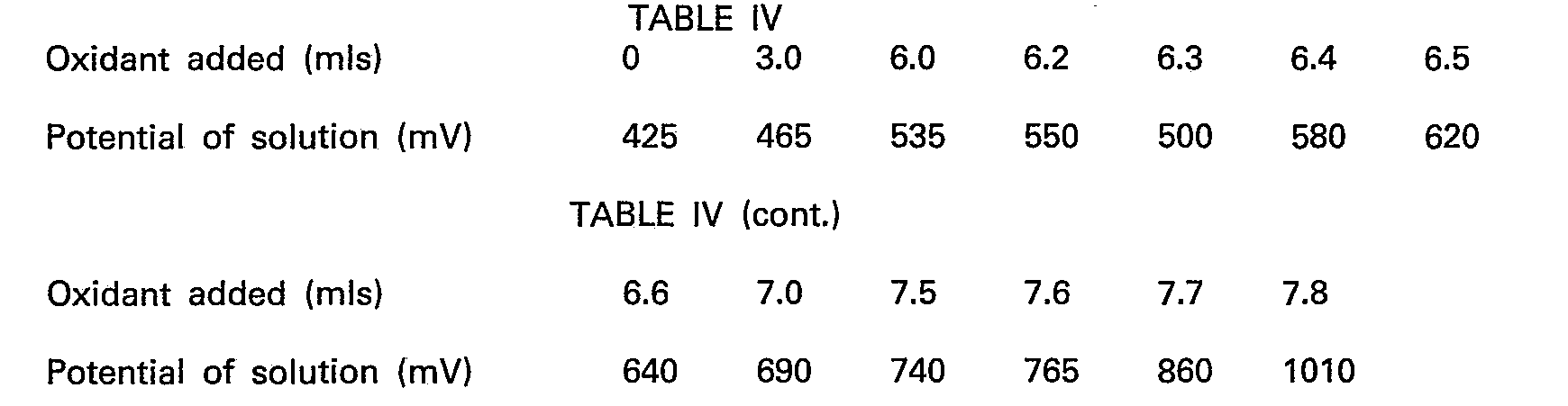
- From Table IV it can be seen that even in the presence of an overwhelming amount of iron, a very clear vanadium IV/vanadium (V) end point occurs at about 7.7 mls oxidant added and that by determining the difference between that and the ferrous/ferric end point at about 6.45 mis, very little more (about 5%) than the stoichiometric amount of H2SOS was employed in oxidising the vanadium. In practice, it will be seen that the reaction can again be readily controlled by monitoring the potential, and in response thereto regulating the introduction of the oxidant.
- In each of these Examples, a further 10 ml aliquot of the commercial solution of Example 17 was contacted with Stoichiometric amount in the one of three Caro's Acid solutions determined by the second end point of Example 17, i.e. approx. 7×10⁻⁴ moles of H2SO5 and having the mole ratio of H2SOS to H202 given in Table V. The general method employed, and the potential and conversion of vanadium IV to vanadium V and determined, were all as in Examples 1-15, and the results summarised in Table V.

- Examples 18 and 19 confirm that at least substantially complete conversion of vanadium IV to vanadium V had occurred using the amount determined by the end point in Example 17.
- Example 20 by Comparison with Examples 7 to 9 demonstrates that the interference between H202 and H2SOs was less apparent in the presence of a substantial amount of ferrous iron initially than in its absence. The reason for such an improvement is not fully understood, but it may be related to the iron.
- In this Example and Comparison, the general method of Example 16 was followed using a vanadium solution that had an initial pH of 1.36, an iron content of 7.7 g/I of which 4.08 g/l was ferrous iron, a vanadium content of 6.9 g/l, 40 mg/l molybdenum and trace uranium. In Example 21, a Caro's Acid solution containing H2SO5 to H202 in a mole ratio of greater than 10:1 was used and in comparison 22, Technical grade hydrogen peroxide 50% w/w from Interox America diluted to 10 % w/w. The oxidant was titrated into the vanadium solution at 25°C. The potentials of the solutions were measured and the plots are shown in Figures 3 and 4 respectively appended hereto.
- From Figure 4 it can be seen that with hydrogen peroxide, the potential peaks at about 700 mV whereas from Figure 3 with Caro's Acid of very low hydrogen peroxide content a smoothly increasing curve was obtained. In addition, Figure 3 shows a very clear end point for oxidation of the vanadium, whereas the corresponding end point in Figure 4, the comparison, is barely detectable.
Claims (8)
Priority Applications (1)
| Application Number | Priority Date | Filing Date | Title |
|---|---|---|---|
| AT81304110T ATE12524T1 (en) | 1980-09-27 | 1981-09-08 | PROCESS FOR OBTAINING VANADIUM. |
Applications Claiming Priority (2)
| Application Number | Priority Date | Filing Date | Title |
|---|---|---|---|
| GB8031308 | 1980-09-27 | ||
| GB8031308 | 1980-09-27 |
Publications (2)
| Publication Number | Publication Date |
|---|---|
| EP0049064A1 EP0049064A1 (en) | 1982-04-07 |
| EP0049064B1 true EP0049064B1 (en) | 1985-04-03 |
Family
ID=10516348
Family Applications (1)
| Application Number | Title | Priority Date | Filing Date |
|---|---|---|---|
| EP81304110A Expired EP0049064B1 (en) | 1980-09-27 | 1981-09-08 | Recovery of vanadium |
Country Status (13)
| Country | Link |
|---|---|
| EP (1) | EP0049064B1 (en) |
| JP (1) | JPS5792150A (en) |
| AR (1) | AR225969A1 (en) |
| AT (1) | ATE12524T1 (en) |
| AU (1) | AU531834B2 (en) |
| BR (1) | BR8106174A (en) |
| CA (1) | CA1178062A (en) |
| DE (1) | DE3169691D1 (en) |
| ES (1) | ES8307301A1 (en) |
| FI (1) | FI71350C (en) |
| NO (1) | NO156532C (en) |
| OA (1) | OA06909A (en) |
| ZA (1) | ZA816353B (en) |
Cited By (1)
| Publication number | Priority date | Publication date | Assignee | Title |
|---|---|---|---|---|
| DE3521092A1 (en) * | 1984-06-13 | 1985-12-19 | VA.NI.M. S.r.l., Novara | METHOD FOR SEPARATING METAL COMPOUNDS BY REDUCTION |
Families Citing this family (6)
| Publication number | Priority date | Publication date | Assignee | Title |
|---|---|---|---|---|
| US4978511A (en) * | 1985-01-03 | 1990-12-18 | Union Oil Company Of California | Methods for selectively recovering vanadium from phosphoric acid and vanadium sources |
| US4851199A (en) * | 1985-01-03 | 1989-07-25 | Union Oil Company Of California | Methods for recovering vanadium from phosphoric acid and vanadium sources |
| RU2187570C1 (en) * | 2000-12-13 | 2002-08-20 | Институт химии твердого тела Уральского Отделения РАН | Method of vanadium separation from solutions |
| CN102260792B (en) * | 2011-07-25 | 2012-12-05 | 张国茂 | Method for extracting vanadium by heap leaching and adding concentrated sulfuric acid and additive in vanadium-containing stone coal |
| CN115747492B (en) * | 2022-10-27 | 2025-06-03 | 有研资源环境技术研究院(北京)有限公司 | A method for comprehensive recovery of vanadium and low-concentration molybdenum in stone coal acid leaching solution |
| CN116656950B (en) * | 2023-05-26 | 2026-03-20 | 河北欣芮再生资源利用有限公司 | A method for leaching and separating vanadium, molybdenum, nickel, and aluminum from deoiled waste catalysts |
Family Cites Families (8)
| Publication number | Priority date | Publication date | Assignee | Title |
|---|---|---|---|---|
| US1020312A (en) * | 1910-12-22 | 1912-03-12 | American Vanadium Co | Process for recovery of vanadium. |
| US3252756A (en) * | 1962-07-12 | 1966-05-24 | Kerr Mc Gee Oil Ind Inc | Oxidation and recovery of vanadium values from acidic aqueous media |
| US3305322A (en) * | 1963-12-23 | 1967-02-21 | Hazen Research | Vanadium recovery process employing so2 gas as the oxidizer |
| FR1602405A (en) * | 1968-06-11 | 1970-11-23 | ||
| US3836476A (en) * | 1971-10-04 | 1974-09-17 | Kerr Mc Gee Chem Corp | Simultaneous recovery of vanadium and uranium from oxidized wet process acid |
| GB1594851A (en) * | 1977-05-16 | 1981-08-05 | Interox Chemicals Ltd | Extraction of zinc |
| US4212849A (en) * | 1978-01-13 | 1980-07-15 | Kerr-Mcgee Corporation | Simultaneous extraction and recovery of uranium and vanadium from wet process acids |
| US4225396A (en) * | 1978-10-10 | 1980-09-30 | Kerr-Mcgee Corporation | Vanadium and uranium oxidation by controlled potential electrolysis |
-
1981
- 1981-09-08 EP EP81304110A patent/EP0049064B1/en not_active Expired
- 1981-09-08 AT AT81304110T patent/ATE12524T1/en not_active IP Right Cessation
- 1981-09-08 DE DE8181304110T patent/DE3169691D1/en not_active Expired
- 1981-09-14 ZA ZA816353A patent/ZA816353B/en unknown
- 1981-09-15 CA CA000385910A patent/CA1178062A/en not_active Expired
- 1981-09-16 FI FI812898A patent/FI71350C/en not_active IP Right Cessation
- 1981-09-21 AU AU75517/81A patent/AU531834B2/en not_active Ceased
- 1981-09-25 NO NO813264A patent/NO156532C/en unknown
- 1981-09-25 ES ES505802A patent/ES8307301A1/en not_active Expired
- 1981-09-25 BR BR8106174A patent/BR8106174A/en unknown
- 1981-09-26 OA OA57504A patent/OA06909A/en unknown
- 1981-09-28 JP JP56153512A patent/JPS5792150A/en active Granted
- 1981-11-18 AR AR286808A patent/AR225969A1/en active
Cited By (1)
| Publication number | Priority date | Publication date | Assignee | Title |
|---|---|---|---|---|
| DE3521092A1 (en) * | 1984-06-13 | 1985-12-19 | VA.NI.M. S.r.l., Novara | METHOD FOR SEPARATING METAL COMPOUNDS BY REDUCTION |
Also Published As
| Publication number | Publication date |
|---|---|
| AU7551781A (en) | 1982-07-15 |
| NO813264L (en) | 1982-03-29 |
| FI812898L (en) | 1982-03-28 |
| CA1178062A (en) | 1984-11-20 |
| FI71350C (en) | 1986-12-19 |
| BR8106174A (en) | 1982-06-15 |
| FI71350B (en) | 1986-09-09 |
| DE3169691D1 (en) | 1985-05-09 |
| JPS5792150A (en) | 1982-06-08 |
| AR225969A1 (en) | 1982-05-14 |
| JPH0156129B2 (en) | 1989-11-29 |
| NO156532C (en) | 1987-10-07 |
| ES505802A0 (en) | 1983-06-16 |
| EP0049064A1 (en) | 1982-04-07 |
| NO156532B (en) | 1987-06-29 |
| ES8307301A1 (en) | 1983-06-16 |
| OA06909A (en) | 1983-05-31 |
| ZA816353B (en) | 1982-09-29 |
| AU531834B2 (en) | 1983-09-08 |
| ATE12524T1 (en) | 1985-04-15 |
Similar Documents
| Publication | Publication Date | Title |
|---|---|---|
| Berka et al. | Newer Redox Titrants: International Series of Monographs in Analytical Chemistry | |
| Morais et al. | Recovery of europium by chemical reduction of a commercial solution of europium and gadolinium chlorides | |
| Wise et al. | Spectrophotometric determination of vandium (v) with benzohydroxamic acid and 1-hexanol | |
| US6168766B1 (en) | Process for leaching copper from copper sulfide using bacteria | |
| Moldoveanu et al. | Separation of cerium from solution by oxidative precipitation with hydrogen peroxide: The reaction mechanism | |
| US4107261A (en) | Process for the separation of platinum group metals | |
| EP0049064A1 (en) | Recovery of vanadium | |
| JP4207959B2 (en) | Method for separating and purifying high-purity silver chloride and method for producing high-purity silver using the same | |
| US5228903A (en) | Method for stripping metals in solvent extraction | |
| Altansukh et al. | Gold recovery from waste printed circuit boards by advanced hydrometallurgical processing | |
| US4229422A (en) | Metal extraction | |
| Cos-Castillo et al. | A comprehensive mechanistic analysis of silver dissolution with the monoethanolamine-copper-ammonium system and the development of a novel leaching technology | |
| JPS6214018B2 (en) | ||
| Amjad et al. | Kinetics of the oxidation of thiourea by vanadium (V) in perchlorate media | |
| US4526762A (en) | Recovery of vanadium from acidic solutions thereof | |
| CN119563041A (en) | Methods for treating manganese-containing materials | |
| US4277454A (en) | Methods for the control of excessive corrosion in phosphoric acid circuits | |
| Diehl et al. | Ferricyanide Titration of Cobalt Using Ethylenediamine | |
| Eccles et al. | The extraction of copper (II) and iron (III) from chloride and sulphate solutions with LIX 64N in kerosene | |
| US4368073A (en) | Use of the sodium salt of 2-mercaptopyridine-N-oxide to separate gold from acidic solutions | |
| Colborn, RP* & Nicol | An investigation into the kinetics and mechanism of the oxidation of iron (II) by oxygen in aqueous chloride solutions | |
| US4269621A (en) | Use of heavy metal chelates of 2-mercaptopyridine-N-oxide to separate selected precious metals from acidic solutions | |
| Marchenko et al. | Analysis of the Possibility of Using Carbamide for Separation of U and Pu in Extractive Processing of SNF | |
| AU781000B2 (en) | Control of lead nitrate addition in gold recovery | |
| Darbinyan et al. | THE STUDY OF THE INTERACTION BETWEEN GOLD (III) AND 2-(3-AZEPAN-1-YL)-2-HYDROXYPROPYLTHIOACETIC ACID BY MEANS OF POTENTIOMETRIC AND AMPEROMETRIC TITRATION METHODS |
Legal Events
| Date | Code | Title | Description |
|---|---|---|---|
| PUAI | Public reference made under article 153(3) epc to a published international application that has entered the european phase |
Free format text: ORIGINAL CODE: 0009012 |
|
| AK | Designated contracting states |
Designated state(s): AT BE DE FR GB IT NL SE |
|
| 17P | Request for examination filed |
Effective date: 19821007 |
|
| ITF | It: translation for a ep patent filed | ||
| GRAA | (expected) grant |
Free format text: ORIGINAL CODE: 0009210 |
|
| AK | Designated contracting states |
Designated state(s): AT BE DE FR GB IT NL SE |
|
| REF | Corresponds to: |
Ref document number: 12524 Country of ref document: AT Date of ref document: 19850415 Kind code of ref document: T |
|
| REF | Corresponds to: |
Ref document number: 3169691 Country of ref document: DE Date of ref document: 19850509 |
|
| ET | Fr: translation filed | ||
| PLBE | No opposition filed within time limit |
Free format text: ORIGINAL CODE: 0009261 |
|
| STAA | Information on the status of an ep patent application or granted ep patent |
Free format text: STATUS: NO OPPOSITION FILED WITHIN TIME LIMIT |
|
| 26N | No opposition filed | ||
| REG | Reference to a national code |
Ref country code: FR Ref legal event code: CA |
|
| PG25 | Lapsed in a contracting state [announced via postgrant information from national office to epo] |
Ref country code: SE Effective date: 19890909 |
|
| PGFP | Annual fee paid to national office [announced via postgrant information from national office to epo] |
Ref country code: AT Payment date: 19890928 Year of fee payment: 9 |
|
| ITTA | It: last paid annual fee | ||
| PGFP | Annual fee paid to national office [announced via postgrant information from national office to epo] |
Ref country code: DE Payment date: 19891127 Year of fee payment: 9 |
|
| PGFP | Annual fee paid to national office [announced via postgrant information from national office to epo] |
Ref country code: GB Payment date: 19900810 Year of fee payment: 10 |
|
| PGFP | Annual fee paid to national office [announced via postgrant information from national office to epo] |
Ref country code: FR Payment date: 19900831 Year of fee payment: 10 |
|
| PGFP | Annual fee paid to national office [announced via postgrant information from national office to epo] |
Ref country code: BE Payment date: 19900903 Year of fee payment: 10 |
|
| PG25 | Lapsed in a contracting state [announced via postgrant information from national office to epo] |
Ref country code: AT Effective date: 19900908 |
|
| PG25 | Lapsed in a contracting state [announced via postgrant information from national office to epo] |
Ref country code: DE Effective date: 19910601 |
|
| PG25 | Lapsed in a contracting state [announced via postgrant information from national office to epo] |
Ref country code: GB Effective date: 19910908 |
|
| PG25 | Lapsed in a contracting state [announced via postgrant information from national office to epo] |
Ref country code: BE Effective date: 19910930 |
|
| BERE | Be: lapsed |
Owner name: INTEROX CHEMICALS LTD Effective date: 19910930 |
|
| GBPC | Gb: european patent ceased through non-payment of renewal fee | ||
| PG25 | Lapsed in a contracting state [announced via postgrant information from national office to epo] |
Ref country code: FR Effective date: 19920529 |
|
| REG | Reference to a national code |
Ref country code: FR Ref legal event code: ST |
|
| EUG | Se: european patent has lapsed |
Ref document number: 81304110.0 Effective date: 19900521 |
|
| PGFP | Annual fee paid to national office [announced via postgrant information from national office to epo] |
Ref country code: NL Payment date: 19970930 Year of fee payment: 17 |
|
| PG25 | Lapsed in a contracting state [announced via postgrant information from national office to epo] |
Ref country code: NL Free format text: LAPSE BECAUSE OF NON-PAYMENT OF DUE FEES Effective date: 19990401 |
|
| NLV4 | Nl: lapsed or anulled due to non-payment of the annual fee |
Effective date: 19990401 |