EP0047576B1 - A method of manufacturing a composite material - Google Patents
A method of manufacturing a composite material Download PDFInfo
- Publication number
- EP0047576B1 EP0047576B1 EP81303195A EP81303195A EP0047576B1 EP 0047576 B1 EP0047576 B1 EP 0047576B1 EP 81303195 A EP81303195 A EP 81303195A EP 81303195 A EP81303195 A EP 81303195A EP 0047576 B1 EP0047576 B1 EP 0047576B1
- Authority
- EP
- European Patent Office
- Prior art keywords
- filaments
- thermoplastic polymer
- composite material
- manufacturing
- polymer
- Prior art date
- Legal status (The legal status is an assumption and is not a legal conclusion. Google has not performed a legal analysis and makes no representation as to the accuracy of the status listed.)
- Expired
Links
- 239000002131 composite material Substances 0.000 title claims description 55
- 238000004519 manufacturing process Methods 0.000 title claims description 23
- 229920001169 thermoplastic Polymers 0.000 claims description 64
- 239000002904 solvent Substances 0.000 claims description 24
- 229920000642 polymer Polymers 0.000 claims description 21
- 230000006835 compression Effects 0.000 claims description 15
- 238000007906 compression Methods 0.000 claims description 15
- OKTJSMMVPCPJKN-UHFFFAOYSA-N Carbon Chemical compound [C] OKTJSMMVPCPJKN-UHFFFAOYSA-N 0.000 claims description 13
- 229910052799 carbon Inorganic materials 0.000 claims description 12
- 125000003118 aryl group Chemical group 0.000 claims description 8
- 230000003014 reinforcing effect Effects 0.000 claims description 8
- 239000004696 Poly ether ether ketone Substances 0.000 claims description 5
- 229920002530 polyetherether ketone Polymers 0.000 claims description 5
- 229920000570 polyether Polymers 0.000 claims description 4
- 229920002492 poly(sulfone) Polymers 0.000 claims description 3
- 239000004642 Polyimide Substances 0.000 claims description 2
- 238000001816 cooling Methods 0.000 claims description 2
- 239000004417 polycarbonate Substances 0.000 claims description 2
- 229920000515 polycarbonate Polymers 0.000 claims description 2
- 229920001721 polyimide Polymers 0.000 claims description 2
- 238000004804 winding Methods 0.000 claims description 2
- 239000004721 Polyphenylene oxide Substances 0.000 claims 1
- 238000000034 method Methods 0.000 description 14
- 239000011159 matrix material Substances 0.000 description 10
- 239000000835 fiber Substances 0.000 description 8
- YMWUJEATGCHHMB-UHFFFAOYSA-N Dichloromethane Chemical compound ClCCl YMWUJEATGCHHMB-UHFFFAOYSA-N 0.000 description 6
- 238000009792 diffusion process Methods 0.000 description 6
- 229920001187 thermosetting polymer Polymers 0.000 description 4
- 239000004634 thermosetting polymer Substances 0.000 description 4
- 239000004744 fabric Substances 0.000 description 3
- 238000005470 impregnation Methods 0.000 description 3
- 238000000465 moulding Methods 0.000 description 3
- 239000003960 organic solvent Substances 0.000 description 3
- 238000001704 evaporation Methods 0.000 description 2
- 239000011521 glass Substances 0.000 description 2
- 238000010348 incorporation Methods 0.000 description 2
- 239000000463 material Substances 0.000 description 2
- 238000003860 storage Methods 0.000 description 2
- 229910052582 BN Inorganic materials 0.000 description 1
- ZOXJGFHDIHLPTG-UHFFFAOYSA-N Boron Chemical compound [B] ZOXJGFHDIHLPTG-UHFFFAOYSA-N 0.000 description 1
- PZNSFCLAULLKQX-UHFFFAOYSA-N Boron nitride Chemical compound N#B PZNSFCLAULLKQX-UHFFFAOYSA-N 0.000 description 1
- 229910000831 Steel Inorganic materials 0.000 description 1
- 230000002411 adverse Effects 0.000 description 1
- PNEYBMLMFCGWSK-UHFFFAOYSA-N aluminium oxide Inorganic materials [O-2].[O-2].[O-2].[Al+3].[Al+3] PNEYBMLMFCGWSK-UHFFFAOYSA-N 0.000 description 1
- 230000003466 anti-cipated effect Effects 0.000 description 1
- 229910052796 boron Inorganic materials 0.000 description 1
- 230000015556 catabolic process Effects 0.000 description 1
- 238000005336 cracking Methods 0.000 description 1
- 238000002425 crystallisation Methods 0.000 description 1
- 238000006731 degradation reaction Methods 0.000 description 1
- 230000002939 deleterious effect Effects 0.000 description 1
- 238000001035 drying Methods 0.000 description 1
- 239000003822 epoxy resin Substances 0.000 description 1
- 230000009477 glass transition Effects 0.000 description 1
- 229910002804 graphite Inorganic materials 0.000 description 1
- 239000010439 graphite Substances 0.000 description 1
- 238000002844 melting Methods 0.000 description 1
- 230000008018 melting Effects 0.000 description 1
- 229910052751 metal Inorganic materials 0.000 description 1
- 239000002184 metal Substances 0.000 description 1
- 150000002739 metals Chemical class 0.000 description 1
- 229920000647 polyepoxide Polymers 0.000 description 1
- 239000011160 polymer matrix composite Substances 0.000 description 1
- 239000004810 polytetrafluoroethylene Substances 0.000 description 1
- 229920001343 polytetrafluoroethylene Polymers 0.000 description 1
- 239000011208 reinforced composite material Substances 0.000 description 1
- 230000002787 reinforcement Effects 0.000 description 1
- 229920005989 resin Polymers 0.000 description 1
- 239000011347 resin Substances 0.000 description 1
- 230000000717 retained effect Effects 0.000 description 1
- 238000007493 shaping process Methods 0.000 description 1
- HBMJWWWQQXIZIP-UHFFFAOYSA-N silicon carbide Chemical compound [Si+]#[C-] HBMJWWWQQXIZIP-UHFFFAOYSA-N 0.000 description 1
- 229910010271 silicon carbide Inorganic materials 0.000 description 1
- 238000000935 solvent evaporation Methods 0.000 description 1
- 238000005507 spraying Methods 0.000 description 1
- 239000010959 steel Substances 0.000 description 1
- 239000011800 void material Substances 0.000 description 1
Classifications
-
- B—PERFORMING OPERATIONS; TRANSPORTING
- B32—LAYERED PRODUCTS
- B32B—LAYERED PRODUCTS, i.e. PRODUCTS BUILT-UP OF STRATA OF FLAT OR NON-FLAT, e.g. CELLULAR OR HONEYCOMB, FORM
- B32B27/00—Layered products comprising a layer of synthetic resin
- B32B27/12—Layered products comprising a layer of synthetic resin next to a fibrous or filamentary layer
-
- C—CHEMISTRY; METALLURGY
- C08—ORGANIC MACROMOLECULAR COMPOUNDS; THEIR PREPARATION OR CHEMICAL WORKING-UP; COMPOSITIONS BASED THEREON
- C08J—WORKING-UP; GENERAL PROCESSES OF COMPOUNDING; AFTER-TREATMENT NOT COVERED BY SUBCLASSES C08B, C08C, C08F, C08G or C08H
- C08J5/00—Manufacture of articles or shaped materials containing macromolecular substances
- C08J5/04—Reinforcing macromolecular compounds with loose or coherent fibrous material
- C08J5/0405—Reinforcing macromolecular compounds with loose or coherent fibrous material with inorganic fibres
- C08J5/042—Reinforcing macromolecular compounds with loose or coherent fibrous material with inorganic fibres with carbon fibres
-
- B—PERFORMING OPERATIONS; TRANSPORTING
- B32—LAYERED PRODUCTS
- B32B—LAYERED PRODUCTS, i.e. PRODUCTS BUILT-UP OF STRATA OF FLAT OR NON-FLAT, e.g. CELLULAR OR HONEYCOMB, FORM
- B32B27/00—Layered products comprising a layer of synthetic resin
- B32B27/28—Layered products comprising a layer of synthetic resin comprising synthetic resins not wholly covered by any one of the sub-groups B32B27/30 - B32B27/42
- B32B27/285—Layered products comprising a layer of synthetic resin comprising synthetic resins not wholly covered by any one of the sub-groups B32B27/30 - B32B27/42 comprising polyethers
-
- D—TEXTILES; PAPER
- D04—BRAIDING; LACE-MAKING; KNITTING; TRIMMINGS; NON-WOVEN FABRICS
- D04H—MAKING TEXTILE FABRICS, e.g. FROM FIBRES OR FILAMENTARY MATERIAL; FABRICS MADE BY SUCH PROCESSES OR APPARATUS, e.g. FELTS, NON-WOVEN FABRICS; COTTON-WOOL; WADDING ; NON-WOVEN FABRICS FROM STAPLE FIBRES, FILAMENTS OR YARNS, BONDED WITH AT LEAST ONE WEB-LIKE MATERIAL DURING THEIR CONSOLIDATION
- D04H3/00—Non-woven fabrics formed wholly or mainly of yarns or like filamentary material of substantial length
- D04H3/002—Inorganic yarns or filaments
-
- D—TEXTILES; PAPER
- D04—BRAIDING; LACE-MAKING; KNITTING; TRIMMINGS; NON-WOVEN FABRICS
- D04H—MAKING TEXTILE FABRICS, e.g. FROM FIBRES OR FILAMENTARY MATERIAL; FABRICS MADE BY SUCH PROCESSES OR APPARATUS, e.g. FELTS, NON-WOVEN FABRICS; COTTON-WOOL; WADDING ; NON-WOVEN FABRICS FROM STAPLE FIBRES, FILAMENTS OR YARNS, BONDED WITH AT LEAST ONE WEB-LIKE MATERIAL DURING THEIR CONSOLIDATION
- D04H3/00—Non-woven fabrics formed wholly or mainly of yarns or like filamentary material of substantial length
- D04H3/08—Non-woven fabrics formed wholly or mainly of yarns or like filamentary material of substantial length characterised by the method of strengthening or consolidating
- D04H3/12—Non-woven fabrics formed wholly or mainly of yarns or like filamentary material of substantial length characterised by the method of strengthening or consolidating with filaments or yarns secured together by chemical or thermo-activatable bonding agents, e.g. adhesives, applied or incorporated in liquid or solid form
-
- B—PERFORMING OPERATIONS; TRANSPORTING
- B29—WORKING OF PLASTICS; WORKING OF SUBSTANCES IN A PLASTIC STATE IN GENERAL
- B29C—SHAPING OR JOINING OF PLASTICS; SHAPING OF MATERIAL IN A PLASTIC STATE, NOT OTHERWISE PROVIDED FOR; AFTER-TREATMENT OF THE SHAPED PRODUCTS, e.g. REPAIRING
- B29C70/00—Shaping composites, i.e. plastics material comprising reinforcements, fillers or preformed parts, e.g. inserts
- B29C70/68—Shaping composites, i.e. plastics material comprising reinforcements, fillers or preformed parts, e.g. inserts by incorporating or moulding on preformed parts, e.g. inserts or layers, e.g. foam blocks
- B29C70/685—Shaping composites, i.e. plastics material comprising reinforcements, fillers or preformed parts, e.g. inserts by incorporating or moulding on preformed parts, e.g. inserts or layers, e.g. foam blocks by laminating inserts between two plastic films or plates
- B29C70/687—Shaping composites, i.e. plastics material comprising reinforcements, fillers or preformed parts, e.g. inserts by incorporating or moulding on preformed parts, e.g. inserts or layers, e.g. foam blocks by laminating inserts between two plastic films or plates the inserts being oriented, e.g. nets or meshes
-
- B—PERFORMING OPERATIONS; TRANSPORTING
- B32—LAYERED PRODUCTS
- B32B—LAYERED PRODUCTS, i.e. PRODUCTS BUILT-UP OF STRATA OF FLAT OR NON-FLAT, e.g. CELLULAR OR HONEYCOMB, FORM
- B32B2262/00—Composition or structural features of fibres which form a fibrous or filamentary layer or are present as additives
- B32B2262/10—Inorganic fibres
- B32B2262/106—Carbon fibres, e.g. graphite fibres
Definitions
- This invention relates to a method of manufacturing composite materials and in particular to a method of manufacturing composite materials comprising reinforcing filaments enclosed in a matrix of a thermoplastic polymer.
- thermosetting polymer which comprise reinforcing filaments enclosed in a matrix of a thermosetting polymer.
- one particularly useful composite material comprises reinforcing filaments of carbon enclosed in a matrix of an epoxy resin.
- such composite materials have been extremely useful in replacing certain metals as constructional materials in the engineering industry, they do nevertheless suffer from certain disadvantages which makes their manufacture troublesome. For instance, there are storage problems associated with thermosetting polymers prior to their incorporation into a matrix since they tend to have finite shelf lives and sometimes require to be stored in a refrigerated environment. Additionally after a thermosetting polymer has been heated to an appropriate temperature, it hardens permanently, thereby effectively precluding its further shaping by deformation.
- thermoplastic polymers do not have these storage problems since they already have high molecular weights and additionally are thermoformable so that they can be reworked many times after their initial moulding at temperature.
- thermoplastic polymers have certain attractions as a replacement for thermosetting polymers as a matrix material in filament reinforced composite materials.
- One route for the manufacture of such composite materials entails impregnating the reinforcing filaments with a solution of the thermoplastic polymer in a suitable solvent. The solvent is then evaporated off and moulding carried out to provide the resultant composite material.
- Composite materials manufactured by such a method suffer from several disadvantages.
- U.K. Patent No. 1,570,000 describes a somewhat similar method of manufacture of a composite material, differing in that the filaments are impregnated with a solution of a thermoplastic polymer in a suitable solvent and the solvent evaporated off prior to the impregnated filaments being interleaved between films of a second thermoplastic polymer. Then as in the previous method, the resultant sandwich structure is subjected to heat and pressure to cause the thermoplastic polymer films to flow after which the assembly is cooled under pressure to avoid distortion of the resultant composite material.
- thermoplastic polymer used for the films may have desirable properties as a matrix material
- incorporation of a relatively large amount of a different thermoplastic polymer in that matrix may have a deleterious effect upon the properties of the resultant composite material.
- a method of manufacturing a composite material comprises the steps of applying a first high temperature resistant thermoplastic polymer to a layer or layers of reinforcing filaments in an amount sufficient only to lightly bind said filaments together, forming a structure of the or each layer or layers of the thus bound filaments and sheets of a second high temperature resistant polymer so that the or each layer of bound filaments is interposed between sheets of said second thermoplastic polymer, compressing said structure at a temperature at which said first thermoplastic polymer does not thermally decompose and at which second thermoplastic polymer is mobile, maintaining said compression at said temperature for sufficient time for said second thermoplastic polymer to impregnate said layer or layers of bound filaments and for at least a major portion of said first thermoplastic polymer to diffuse into said second thermoplastic polymer, cooling the thus formed composite material under compression in order to avoid any distortion thereof and subsequently discontinuing said compression.
- a convenient method of applying the first thermoplastic polymer to the filaments is to dissolve the polymer in a suitable solvent, apply that solution to the fibres and subsequently evaporate off the solvent.
- the filaments could be interposed between two thin sheets of the first thermoplastic polymer and the assembly compressed at or above the glass transition temperature of the polymer so as to directly apply the polymer to the filaments.
- An alternative method could be to pass the filaments through a heated fluidised bed containing the powdered polymer.
- the first thermoplastic polymer it is desirable to apply the first thermoplastic polymer to the filaments when those filaments are in a given configuration so that when the filaments are formed into a structure with the sheets of the second thermoplastic polymer, that configuration is retained.
- the filaments may be easily handled without losing their initial general configuration.
- the first thermoplastic polymer may be a polycarbonate, a polysulphone, a polyethersulphone of a polyimide, these being polymers which have high temperature resistance and are capable of lightly binding the filaments together. They are moreover readily soluble in a number of organic solvents which makes it possible to apply them to the filaments by the previously mentioned solvent route.
- the second thermoplastic polymer may be an aromatic polyether polymer.
- the preferred aromatic polyether polymer is an aromatic polyetheretherketone which is marketed by ICI Limited under the name "Peek". This aromatic polyetheretherketone differs from a large number of other thermoplastic polymers such as polysulphones and polyethersulphones in that it is capable of a high degree of crystallisation. Thus a figure of 48% crystallinity has been reported. This degree of crystallinity imparts to the polymer enhanced mechanical properties and a high degree of resistance to the common solvents. Moreover it has a melting point of 334°C which makes it suitable for high temperature applications.
- the structure of filaments bound by the first thermoplastic polymer and the sheets of the second thermoplastic polymer is compressed at a pressure, for instance 14 MN/m 2 , which is sufficient to result in the impregnation of the bound filaments by the second thermoplastic polymer. If the first thermoplastic polymer is a polyethersulphone und the second thermoplastic polymer is "Peek" then this compression may be carried out at a temperature of approximately 400°C. In order for the major portion of the first thermoplastic polymer, to diffuse into the second, the application of heat and pressure is preferably maintained for at least one hour. In fact we have found that adequate diffusion usually occurs if the pressure and heat are maintained for approximately two hours.
- thermoplastic polymer The diffusion of the first thermoplastic polymer into the second ensures that in the resultant composite material, a large proportion of the polymer which is in contact with the filaments is in fact the second thermoplastic polymer.
- a further advantage of such diffusion is that if the first thermoplastic polymer is readily soluble in organic solvents and the second thermoplastic polymer is not, then the resultant composite material will be less prone to organic solvent attack than composite materials in which diffusion is limited or non-existent.
- the filaments may be of any of the types which are commonly used for reinforcement in composite materials. Thus mention may be made of filaments of glass, graphite, steel, silicon carbide, alumina, boron, boron nitride etc. However we prefer to utilise filaments of carbon.
- the filaments moreover may be aligned in any desired configuration prior to the application of the first thermoplastic polymer to them.
- align the filaments so that they are unidirectional, other configurations may be utilised.
- prepregs Whilst the method of the present invention may be utilised in the manufacture of finished articles, it may also be used in the manufacture of prepregs.
- prepregs comprise composite material portions which may be subsequently grouped together and subjected to heat and pressure in order to fuse them together and form them into a finished article.
- Tygafluor a non-porous PTFE/glass cloth known as Tygafluor ("Tygafluor” is a registered trademark) was attached to a flat 270 mm square flat mandrel. Carbon fibre (Toray 3000 90A) was then wound over the mandrel at 36 turns per 25.4 mm. Polyethersulphone (Grade 100P and manufactured by ICI limited) was dissolved in methylene chloride and the solution was sprayed on to the wound fibres until a total amount of 0.8 grams of the polyethersulphone had been applied to the fibres adjacent the Tygafluor cloth.
- the resultant composite material was found to contain 67% by volume of carbon fibre and was completely void free. It has a flexural strength of 1.79 GN/m 2 and a flexural modulus of 138 GN/m 2 giving a composite breaking strain of 1.30%.
- Example 1 was repeated with the exception that the stack was compression moulded at 400°C and 14 MN/m 2 pressure for only f hour.
- the resultant composite material contained 67% by volume of carbon fibre. It had a flexural strength of 1.62 GN/m 2 and a flexural modulus of 143 GN/ M 2 giving a breaking strain of 1.13%.
- Example 1 was repeated with the exception that the stack was compression moulded at 400°C and 13 MN/M2 pressure for one hour.
- the resultant composite material contained 67% by volume of carbon fibre. It had a flexural strength of 1.63 GN/m 2 and a flexural modulus of 141 GN/m 2 giving a breaking strain of 1.16%.
- Example 1 was repeated using Courtaulds XAS 3000 filament tow carbon fibre instead of the Toray 3000 90A.
- the resultant composite material contained 68% by volume of the carbon fibre. It had a flexural strength of 2.22 GN/m 2 and it has a flexural modulus of 147 GN/ M 2 giving a breaking strain of 1.51 %.
- Example 1 In order to demonstrate the superior properties of composite materials produced in accordance with the method of the present invention, the properties of samples of composite materials produced by the conventional solvent route were compared with those of the composite material of .
- Example 1 The conventional solvent route entails dissolving the matrix polymer in a suitable solvent, impregnating fibres with the resultant solution, evaporating off the solvent and subsequently moulding under temperature and pressure to produce the required shape.
- the test pieces produced by the conventional route were of the same dimensions as that produced in Example 1.
- thermoplastic polymers Although the method of the present invention has been described with references to composite materials produced from particular thermoplastic polymers, it will be appreciated that it is not restricted to these polymers and is generally applicable to all high temperature resistant thermoplastic polymers.
Landscapes
- Chemical & Material Sciences (AREA)
- Engineering & Computer Science (AREA)
- Chemical Kinetics & Catalysis (AREA)
- Inorganic Chemistry (AREA)
- Textile Engineering (AREA)
- Manufacturing & Machinery (AREA)
- Health & Medical Sciences (AREA)
- Medicinal Chemistry (AREA)
- Polymers & Plastics (AREA)
- Organic Chemistry (AREA)
- General Chemical & Material Sciences (AREA)
- Materials Engineering (AREA)
- Reinforced Plastic Materials (AREA)
- Laminated Bodies (AREA)
Description
- This invention relates to a method of manufacturing composite materials and in particular to a method of manufacturing composite materials comprising reinforcing filaments enclosed in a matrix of a thermoplastic polymer.
- It has long been common practice to manufacture composite materials which comprise reinforcing filaments enclosed in a matrix of a thermosetting polymer. Thus one particularly useful composite material comprises reinforcing filaments of carbon enclosed in a matrix of an epoxy resin. Whilst such composite materials have been extremely useful in replacing certain metals as constructional materials in the engineering industry, they do nevertheless suffer from certain disadvantages which makes their manufacture troublesome. For instance, there are storage problems associated with thermosetting polymers prior to their incorporation into a matrix since they tend to have finite shelf lives and sometimes require to be stored in a refrigerated environment. Additionally after a thermosetting polymer has been heated to an appropriate temperature, it hardens permanently, thereby effectively precluding its further shaping by deformation.
- Thermoplastic polymers do not have these storage problems since they already have high molecular weights and additionally are thermoformable so that they can be reworked many times after their initial moulding at temperature. Thus thermoplastic polymers have certain attractions as a replacement for thermosetting polymers as a matrix material in filament reinforced composite materials. However, there are difficulties in producing a composite material which comprises reinforcing filaments enclosed in a matrix of a thermoplastic polymer. One route for the manufacture of such composite materials entails impregnating the reinforcing filaments with a solution of the thermoplastic polymer in a suitable solvent. The solvent is then evaporated off and moulding carried out to provide the resultant composite material. Composite materials manufactured by such a method suffer from several disadvantages. For instance, it is very difficult to completely evaporate off the polymer solvent. Some trapping of the solvent may occur with the result that the composite material is, to a certain extent, porous. This reduces its strength and sometimes leads to the accelerated thermal degradation of the polymer if the composite material is subjected in use to elevated temperatures. Another disadvantage is that it is not usually possible to accurately monitor the actual amount of polymer which is impregnated into the filaments. Some resin usually runs off the filaments with the result that the final polymer content of the composite material is lower than anticipated.
- In U.K. Patent No. 1,485,586 there is described a method of manufacturing a composite material in which filaments are interleaved between films of a thermoplastic polymer and the resultant sandwich structure subjected to heat and pressure so that the polymer flows and impregnates the filaments. This method has the advantage of not requiring the use of a solvent and consequently avoids the pitfalls associated with solvent use. However, if the polymer is of high viscosity at the temperatures usually employed in this type of method, then difficulty is encountered in achieving a satisfactory level of impregnation of the filaments by the polymer. Consequently the resultant composite material has a low filament level per unit volume of composite material, thereby adversely affecting its mechanical properties.
- U.K. Patent No. 1,570,000 describes a somewhat similar method of manufacture of a composite material, differing in that the filaments are impregnated with a solution of a thermoplastic polymer in a suitable solvent and the solvent evaporated off prior to the impregnated filaments being interleaved between films of a second thermoplastic polymer. Then as in the previous method, the resultant sandwich structure is subjected to heat and pressure to cause the thermoplastic polymer films to flow after which the assembly is cooled under pressure to avoid distortion of the resultant composite material. The teachings of U.K. Patent No. 1,570,000 are directed to impregnation of the filaments with a thermoplastic polymer so that there is a polymer pick-up by the filaments which, after solvent evaporation, amounts to 16 to 40% by weight. Unfortunately this means that whilst the method permits the use of films of high viscosity thermoplastic polymers, the resultant composite material is prone to solvent attack, even if the thermoplastic polymer of the film is of low solvent solubility. Thus the thermoplastic polymer originally applied in solvent solution is prone to solvent attack, thereby leading to increased likelihood of stress-cracking occurring in the composite material. A further disadvantage of this method is that whilst the thermoplastic polymer used for the films may have desirable properties as a matrix material, the incorporation of a relatively large amount of a different thermoplastic polymer in that matrix may have a deleterious effect upon the properties of the resultant composite material.
- It is an object of the present invention to provide a method of manufacturing a composite material wherein the aforementioned difficulties in manufacturing filament reinforced, thermoplastic polymer matrix composite materials are substantially avoided.
- According to the present invention, a method of manufacturing a composite material comprises the steps of applying a first high temperature resistant thermoplastic polymer to a layer or layers of reinforcing filaments in an amount sufficient only to lightly bind said filaments together, forming a structure of the or each layer or layers of the thus bound filaments and sheets of a second high temperature resistant polymer so that the or each layer of bound filaments is interposed between sheets of said second thermoplastic polymer, compressing said structure at a temperature at which said first thermoplastic polymer does not thermally decompose and at which second thermoplastic polymer is mobile, maintaining said compression at said temperature for sufficient time for said second thermoplastic polymer to impregnate said layer or layers of bound filaments and for at least a major portion of said first thermoplastic polymer to diffuse into said second thermoplastic polymer, cooling the thus formed composite material under compression in order to avoid any distortion thereof and subsequently discontinuing said compression.
- We have found that in order to lightly bind the filaments together, it is necessary to apply sufficient of the first high temperature resistant thermoplastic polymer to increase the weight of the filaments by up to 5%.
- A convenient method of applying the first thermoplastic polymer to the filaments is to dissolve the polymer in a suitable solvent, apply that solution to the fibres and subsequently evaporate off the solvent. There are however other methods of application. Thus for example the filaments could be interposed between two thin sheets of the first thermoplastic polymer and the assembly compressed at or above the glass transition temperature of the polymer so as to directly apply the polymer to the filaments. An alternative method could be to pass the filaments through a heated fluidised bed containing the powdered polymer.
- It is desirable to apply the first thermoplastic polymer to the filaments when those filaments are in a given configuration so that when the filaments are formed into a structure with the sheets of the second thermoplastic polymer, that configuration is retained. This being so, we prefer to apply the first thermoplastic polymer by winding the filaments on to a mandrel so that they adopt the desired configuration, spraying a solution of the first thermoplastic polymer on to the wound filaments, evaporating off the solvent and finally removing the filaments from the mandrel. We have found that if this procedure is carried out, the filaments may be easily handled without losing their initial general configuration.
- The first thermoplastic polymer may be a polycarbonate, a polysulphone, a polyethersulphone of a polyimide, these being polymers which have high temperature resistance and are capable of lightly binding the filaments together. They are moreover readily soluble in a number of organic solvents which makes it possible to apply them to the filaments by the previously mentioned solvent route.
- The second thermoplastic polymer may be an aromatic polyether polymer. The preferred aromatic polyether polymer is an aromatic polyetheretherketone which is marketed by ICI Limited under the name "Peek". This aromatic polyetheretherketone differs from a large number of other thermoplastic polymers such as polysulphones and polyethersulphones in that it is capable of a high degree of crystallisation. Thus a figure of 48% crystallinity has been reported. This degree of crystallinity imparts to the polymer enhanced mechanical properties and a high degree of resistance to the common solvents. Moreover it has a melting point of 334°C which makes it suitable for high temperature applications.
- The structure of filaments bound by the first thermoplastic polymer and the sheets of the second thermoplastic polymer is compressed at a pressure, for instance 14 MN/m2, which is sufficient to result in the impregnation of the bound filaments by the second thermoplastic polymer. If the first thermoplastic polymer is a polyethersulphone und the second thermoplastic polymer is "Peek" then this compression may be carried out at a temperature of approximately 400°C. In order for the major portion of the first thermoplastic polymer, to diffuse into the second, the application of heat and pressure is preferably maintained for at least one hour. In fact we have found that adequate diffusion usually occurs if the pressure and heat are maintained for approximately two hours.
- The diffusion of the first thermoplastic polymer into the second ensures that in the resultant composite material, a large proportion of the polymer which is in contact with the filaments is in fact the second thermoplastic polymer. This means that if the mechanical properties of the second thermoplastic polymer are superior to those of the first thermoplastic polymer, then direct bonding between the filaments and the second thermoplastic polymer will result in a composite material having mechanical properties superior to those of a composite material in which the majority of the polymer in contact with the filaments is the first thermoplastic polymer. A further advantage of such diffusion is that if the first thermoplastic polymer is readily soluble in organic solvents and the second thermoplastic polymer is not, then the resultant composite material will be less prone to organic solvent attack than composite materials in which diffusion is limited or non-existent.
- The filaments may be of any of the types which are commonly used for reinforcement in composite materials. Thus mention may be made of filaments of glass, graphite, steel, silicon carbide, alumina, boron, boron nitride etc. However we prefer to utilise filaments of carbon.
- The filaments moreover may be aligned in any desired configuration prior to the application of the first thermoplastic polymer to them. Thus although we prefer to align the filaments so that they are unidirectional, other configurations may be utilised. For instance in certain circumstances, it may be desirable to utilise filaments which are in the form of a woven cloth or mat.
- Whilst the method of the present invention may be utilised in the manufacture of finished articles, it may also be used in the manufacture of prepregs. Thus prepregs comprise composite material portions which may be subsequently grouped together and subjected to heat and pressure in order to fuse them together and form them into a finished article.
- The following examples will serve to illustrate the invention:-
- A release layer of a non-porous PTFE/glass cloth known as Tygafluor ("Tygafluor" is a registered trademark) was attached to a flat 270 mm square flat mandrel. Carbon fibre (Toray 3000 90A) was then wound over the mandrel at 36 turns per 25.4 mm. Polyethersulphone (Grade 100P and manufactured by ICI limited) was dissolved in methylene chloride and the solution was sprayed on to the wound fibres until a total amount of 0.8 grams of the polyethersulphone had been applied to the fibres adjacent the Tygafluor cloth. After allowing the coated fibres to dry in air at room temperature overnight, it was found that they were lightly bound by the polyethersulphone so that they could be removed from the mandrel and cut into 16 unidirectional pieces measuring 1 13mmx44.5 mm without losing their fibre orientation. The sixteen pieces were then further dried at 125°C in order to ensure complete removal of the methylene chloride from the polyethersulphone. It was found after drying that the application of the polyethersulphone to the carbon fibres had increased their weight by 4.5%.
- Eight of the unidirectional pieces were taken and each one was sandwiched between two 50 µm thick sheets of high temperature resistant aromatic polyetheretherketone polymer which is marketed by ICI limited under the name "Peek". The resultant sandwich structures were then formed into a stack containing eight of the unidirectional pieces of lightly bonded carbon fibre and sixteen sheets of "Peek". The stack was then compression moulded for two hours at 400°C and 14 MN/m2 pressure and then allowed to cool to room temperature before compression was discontinued.
- The resultant composite material was found to contain 67% by volume of carbon fibre and was completely void free. It has a flexural strength of 1.79 GN/m2 and a flexural modulus of 138 GN/m2 giving a composite breaking strain of 1.30%.
- Example 1 was repeated with the exception that the stack was compression moulded at 400°C and 14 MN/m2 pressure for only f hour.
- The resultant composite material contained 67% by volume of carbon fibre. It had a flexural strength of 1.62 GN/m2 and a flexural modulus of 143 GN/M 2 giving a breaking strain of 1.13%.
- Example 1 was repeated with the exception that the stack was compression moulded at 400°C and 13 MN/M2 pressure for one hour.
- The resultant composite material contained 67% by volume of carbon fibre. It had a flexural strength of 1.63 GN/m2 and a flexural modulus of 141 GN/m2 giving a breaking strain of 1.16%.
- It will be seen therefore from Examples 1 to 3 to the time during which the stack is maintained under compression and temperature has an important bearing on the flexural strength and breaking strain of the resultant composite material Thus we believe that this is due to the fact that the compression and temperature results in the diffusion of polyethersulphone from the carbon fibres into the polyetheretherketone matrix material. Thus to ensure that a composite material is produced with an adequate degree of diffusion, we prefer that compression of the stack at temperature should be maintained for at least an hour.
- Example 1 was repeated using Courtaulds XAS 3000 filament tow carbon fibre instead of the Toray 3000 90A.
- The resultant composite material contained 68% by volume of the carbon fibre. It had a flexural strength of 2.22 GN/m2 and it has a flexural modulus of 147 GN/M 2 giving a breaking strain of 1.51 %.
- In order to demonstrate the superior properties of composite materials produced in accordance with the method of the present invention, the properties of samples of composite materials produced by the conventional solvent route were compared with those of the composite material of.Example 1. The conventional solvent route entails dissolving the matrix polymer in a suitable solvent, impregnating fibres with the resultant solution, evaporating off the solvent and subsequently moulding under temperature and pressure to produce the required shape. The test pieces produced by the conventional route were of the same dimensions as that produced in Example 1.
- The results obtained were as follows:
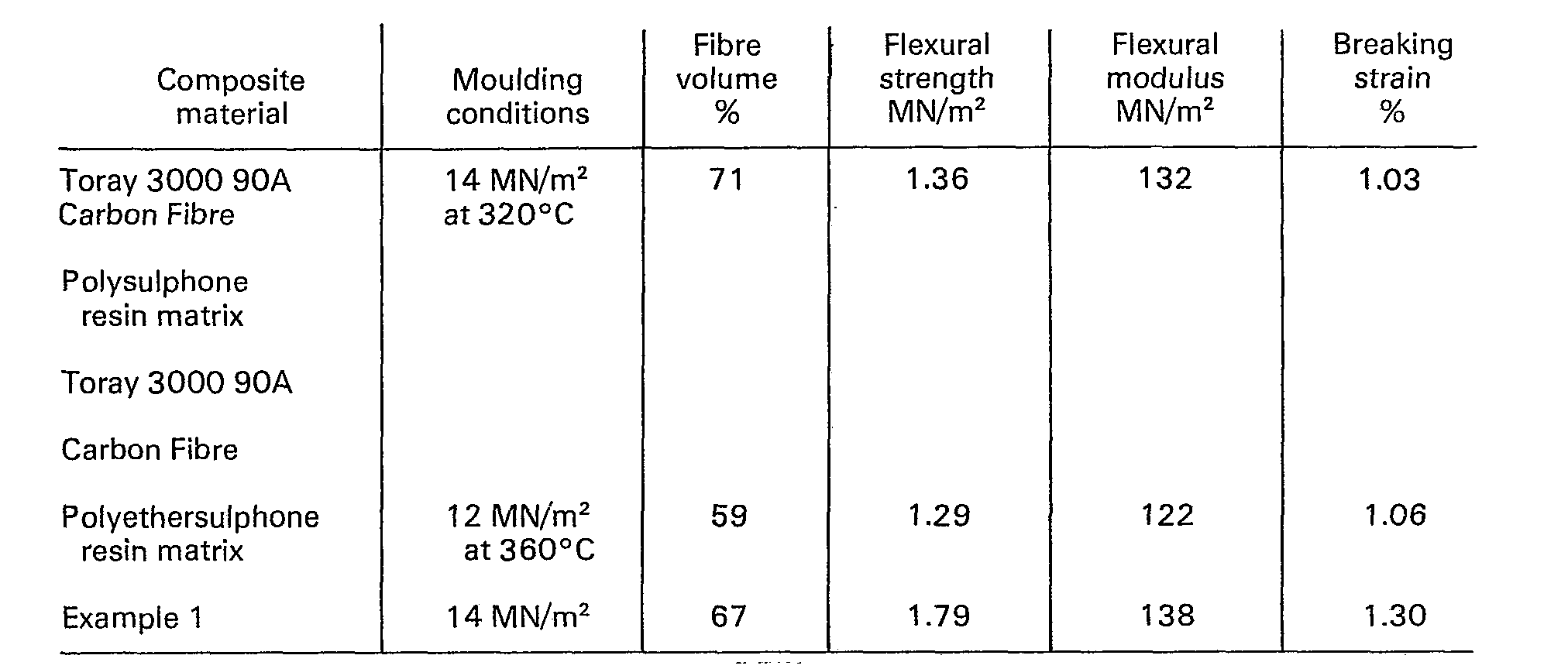
- It will be seen therefore that the flexural strength, flexural modulus and breaking strain of the composite material of Example 1 are superior to those of composite materials produced by the conventional solvent route.
- Although the method of the present invention has been described with references to composite materials produced from particular thermoplastic polymers, it will be appreciated that it is not restricted to these polymers and is generally applicable to all high temperature resistant thermoplastic polymers.
Claims (10)
Applications Claiming Priority (2)
| Application Number | Priority Date | Filing Date | Title |
|---|---|---|---|
| GB8029268 | 1980-09-10 | ||
| GB8029268A GB2083779A (en) | 1980-09-10 | 1980-09-10 | A method of manufacturing a composite material |
Publications (3)
| Publication Number | Publication Date |
|---|---|
| EP0047576A2 EP0047576A2 (en) | 1982-03-17 |
| EP0047576A3 EP0047576A3 (en) | 1983-08-17 |
| EP0047576B1 true EP0047576B1 (en) | 1985-02-20 |
Family
ID=10515996
Family Applications (1)
| Application Number | Title | Priority Date | Filing Date |
|---|---|---|---|
| EP81303195A Expired EP0047576B1 (en) | 1980-09-10 | 1981-07-13 | A method of manufacturing a composite material |
Country Status (6)
| Country | Link |
|---|---|
| US (1) | US4380523A (en) |
| EP (1) | EP0047576B1 (en) |
| JP (1) | JPS6047111B2 (en) |
| DE (1) | DE3169034D1 (en) |
| GB (1) | GB2083779A (en) |
| SU (1) | SU1321362A3 (en) |
Families Citing this family (24)
| Publication number | Priority date | Publication date | Assignee | Title |
|---|---|---|---|---|
| DE3301346A1 (en) * | 1983-01-18 | 1984-07-19 | Basf Ag, 6700 Ludwigshafen | SOLUTION OF POLYETHERSULPHONE IN AN ORGANIC SOLVENT AND THEIR USE |
| US4565619A (en) * | 1983-02-18 | 1986-01-21 | The Foxboro Company | Composite electrode structure |
| GB8306989D0 (en) * | 1983-03-14 | 1983-04-20 | Ae Plc | Composition of matter |
| US4640861A (en) * | 1984-06-07 | 1987-02-03 | E. I. Du Pont De Nemours And Company | Fiber reinforced thermoplastic material |
| GB8519297D0 (en) * | 1985-07-31 | 1985-09-04 | Smith Tech Dev | Laminate production |
| JPS6235403U (en) * | 1985-08-09 | 1987-03-02 | ||
| IT1188547B (en) * | 1986-02-05 | 1988-01-14 | Tecnocompositi Spa | FLEXIBLE COLUMN IN COMPOSITE MATERIAL |
| US4869855A (en) * | 1986-05-02 | 1989-09-26 | Allied Signal Inc. | Method of manufacturing molded articles |
| DE3742833A1 (en) * | 1987-12-17 | 1989-07-13 | Basf Ag | METHOD FOR PRODUCING FIBER COMPOSITES |
| EP0330960A3 (en) * | 1988-03-04 | 1990-07-11 | General Electric Company | Method of forming a fiber-reinforced thermoplastic article |
| FR2630967B1 (en) * | 1988-05-09 | 1993-12-10 | Atochem | PROCESS FOR THE MANUFACTURE OF LONG FIBER REINFORCED THERMOPLASTIC RESINS |
| JPH06336B2 (en) * | 1989-02-09 | 1994-01-05 | 日東紡績株式会社 | Preform for molding fiber-reinforced plastic and method for producing the same |
| US5264060A (en) * | 1992-01-22 | 1993-11-23 | Aluminum Company Of America | Method for pultruding fiber-reinforced thermoplastic stock |
| US5409651A (en) * | 1993-10-06 | 1995-04-25 | Atkins & Pearce, Inc. | Method of forming tubular parts |
| US5393929A (en) * | 1993-11-23 | 1995-02-28 | Junkosha Co. Ltd. | Electrical insulation and articles thereof |
| FR2725934B1 (en) * | 1994-10-21 | 1997-01-10 | Europ Propulsion | PROCESS FOR THE PREPARATION OF TUBES OF COMPOSITE MATERIAL WITH HIGH MECHANICAL AND TRIBOLOGICAL CHARACTERISTICS |
| US6148865A (en) * | 1996-12-02 | 2000-11-21 | A & P Technology, Inc. | Braided sleeve, tubular article and method of manufacturing the tubular article |
| US6250193B1 (en) | 1996-12-02 | 2001-06-26 | A & P Technology, Inc. | Braided structure with elastic bias strands |
| AUPR949401A0 (en) * | 2001-12-14 | 2002-01-24 | Australian Defence Apparel Pty Ltd. | Hard armour panels or plates and production method therefor |
| US7648607B2 (en) * | 2005-08-17 | 2010-01-19 | Innegrity, Llc | Methods of forming composite materials including high modulus polyolefin fibers |
| DE102006042999B3 (en) * | 2006-09-14 | 2007-10-25 | Federal-Mogul Deva Gmbh | Method for manufacturing a sliding bearing component, comprises winding reinforcing element on multi-edged winding core under addition of plastic resin forming the plastic matrix and forming segments between the edges of the winding body |
| US20090309260A1 (en) * | 2008-06-12 | 2009-12-17 | Kenneth Herbert Keuchel | Method of delivering a thermoplastic and/or crosslinking resin to a composite laminate structure |
| ES2560784T3 (en) | 2010-04-29 | 2016-02-22 | Parker Hannifin Manufacturing Belgium | Method for manufacturing a composite ring, compound ring, use of the ring in a sealing assembly and sealing assembly |
| US10773468B2 (en) | 2017-08-14 | 2020-09-15 | The Boeing Company | Hybrid non-woven composite part |
Family Cites Families (13)
| Publication number | Priority date | Publication date | Assignee | Title |
|---|---|---|---|---|
| US2523022A (en) * | 1949-12-31 | 1950-09-19 | Gen Electric | Reinforced asbestos tape and process of making same |
| US3556922A (en) * | 1968-08-27 | 1971-01-19 | Du Pont | Fiber-resin composite of polyamide and inorganic fibers |
| GB1361189A (en) * | 1970-11-12 | 1974-07-24 | Ici Ltd | Thermoplastic compositions |
| US3765998A (en) * | 1971-01-11 | 1973-10-16 | Allied Chem | Shapable fiber-reinforced low molecular weight polyethylene terephthalate |
| US3863758A (en) * | 1971-11-02 | 1975-02-04 | Hercules Inc | Molding compositions |
| US3790432A (en) * | 1971-12-30 | 1974-02-05 | Nasa | Reinforced polyquinoxaline gasket and method of preparing the same |
| US3915781A (en) * | 1974-02-28 | 1975-10-28 | United Technologies Corp | Resin bonded composite articles and process for fabrication thereof |
| JPS5116225A (en) * | 1974-07-31 | 1976-02-09 | Hitachi Metals Ltd | NIJUDOKISHIKIWAKUAWASESOCHI |
| GB1485586A (en) | 1976-01-13 | 1977-09-14 | Rolls Royce | Method of manufacturing composite material |
| GB1570000A (en) * | 1976-06-10 | 1980-06-25 | Nat Res Dev | Thermoplastics materials |
| JPS5310109A (en) * | 1976-07-16 | 1978-01-30 | Babcock Hitachi Kk | Protective trap system for vacuum pump |
| US4131625A (en) * | 1976-10-28 | 1978-12-26 | The United States Of America As Represented By The Secretary Of The Air Force | 4,4'-Bis(3-ethynylphenoxy)diphenylsulfone |
| JPS53132080A (en) * | 1977-04-23 | 1978-11-17 | Agency Of Ind Science & Technol | Long fiberglass reinforced thermoplastic resin sheet |
-
1980
- 1980-09-10 GB GB8029268A patent/GB2083779A/en not_active Withdrawn
-
1981
- 1981-07-13 EP EP81303195A patent/EP0047576B1/en not_active Expired
- 1981-07-13 DE DE8181303195T patent/DE3169034D1/en not_active Expired
- 1981-07-16 US US06/283,976 patent/US4380523A/en not_active Expired - Fee Related
- 1981-09-10 SU SU813332301A patent/SU1321362A3/en active
- 1981-09-10 JP JP56143144A patent/JPS6047111B2/en not_active Expired
Also Published As
| Publication number | Publication date |
|---|---|
| SU1321362A3 (en) | 1987-06-30 |
| JPS5780046A (en) | 1982-05-19 |
| US4380523A (en) | 1983-04-19 |
| EP0047576A2 (en) | 1982-03-17 |
| GB2083779A (en) | 1982-03-31 |
| EP0047576A3 (en) | 1983-08-17 |
| JPS6047111B2 (en) | 1985-10-19 |
| DE3169034D1 (en) | 1985-03-28 |
Similar Documents
| Publication | Publication Date | Title |
|---|---|---|
| US4380523A (en) | Method of manufacturing a composite material | |
| US4445951A (en) | Method of manufacturing composite materials | |
| US6139942A (en) | Resin composition, a fiber reinforced material having a partially impregnated resin and composites made therefrom | |
| EP0216518B1 (en) | Fiber having thermoplastic resin coating | |
| TWI311593B (en) | Porous polymeric membrane toughened composites | |
| US4741873A (en) | Method for forming rigid composite preforms | |
| EP3199674B1 (en) | Composite material comprising thermoset resin fibres | |
| AU644253B2 (en) | piber reinforced porous sheets | |
| EP0714869B1 (en) | Carbon fiber-reinforced carbon composite material and process for the preparation thereof | |
| EP0963286B1 (en) | Improvements in or relating to moulding methods | |
| JP5158778B2 (en) | Epoxy resin impregnated yarn and its use for producing preforms | |
| US4624886A (en) | Reinforced fibre products | |
| EP0326409B1 (en) | Hybrid yarn, unidirectional hybrid prepreg and laminated material thereof | |
| GB2114055A (en) | Manufacturing fibre-reinforced composites | |
| IE914263A1 (en) | Matrix composites in which the matrix contains¹polybenzoxazole or polybenzothiazole | |
| US5194106A (en) | Method of making fiber reinforced porous sheets | |
| JP4392863B2 (en) | Low density composite article and method for producing the same | |
| JP2997087B2 (en) | High performance aramid matrix composites | |
| JPH04161450A (en) | Method for forming formed body of composite material | |
| EP0319346A2 (en) | Interply-hybridized laminated material | |
| JPH01148547A (en) | Symmetrical hybrid laminate |
Legal Events
| Date | Code | Title | Description |
|---|---|---|---|
| PUAI | Public reference made under article 153(3) epc to a published international application that has entered the european phase |
Free format text: ORIGINAL CODE: 0009012 |
|
| AK | Designated contracting states |
Designated state(s): DE FR GB IT NL SE |
|
| PUAL | Search report despatched |
Free format text: ORIGINAL CODE: 0009013 |
|
| AK | Designated contracting states |
Designated state(s): DE FR GB IT NL SE |
|
| 17P | Request for examination filed |
Effective date: 19830831 |
|
| ITF | It: translation for a ep patent filed | ||
| GRAA | (expected) grant |
Free format text: ORIGINAL CODE: 0009210 |
|
| AK | Designated contracting states |
Designated state(s): DE FR GB IT NL SE |
|
| REF | Corresponds to: |
Ref document number: 3169034 Country of ref document: DE Date of ref document: 19850328 |
|
| ET | Fr: translation filed | ||
| PLBI | Opposition filed |
Free format text: ORIGINAL CODE: 0009260 |
|
| 26 | Opposition filed |
Opponent name: BASF AKTIENGESELLSCHAFT Effective date: 19850614 |
|
| NLR1 | Nl: opposition has been filed with the epo |
Opponent name: BASF AKTIENGESELLSCHAFT |
|
| RAP2 | Party data changed (patent owner data changed or rights of a patent transferred) |
Owner name: ROLLS-ROYCE PLC |
|
| NLT1 | Nl: modifications of names registered in virtue of documents presented to the patent office pursuant to art. 16 a, paragraph 1 |
Owner name: ROLLS-ROYCE PLC TE LONDEN, GROOT-BRITTANNIE. |
|
| PLBN | Opposition rejected |
Free format text: ORIGINAL CODE: 0009273 |
|
| STAA | Information on the status of an ep patent application or granted ep patent |
Free format text: STATUS: OPPOSITION REJECTED |
|
| 27O | Opposition rejected |
Effective date: 19890809 |
|
| NLR2 | Nl: decision of opposition | ||
| PGFP | Annual fee paid to national office [announced via postgrant information from national office to epo] |
Ref country code: FR Payment date: 19900611 Year of fee payment: 10 |
|
| PGFP | Annual fee paid to national office [announced via postgrant information from national office to epo] |
Ref country code: GB Payment date: 19900614 Year of fee payment: 10 |
|
| PGFP | Annual fee paid to national office [announced via postgrant information from national office to epo] |
Ref country code: SE Payment date: 19900615 Year of fee payment: 10 |
|
| PGFP | Annual fee paid to national office [announced via postgrant information from national office to epo] |
Ref country code: DE Payment date: 19900629 Year of fee payment: 10 |
|
| ITTA | It: last paid annual fee | ||
| PGFP | Annual fee paid to national office [announced via postgrant information from national office to epo] |
Ref country code: NL Payment date: 19900731 Year of fee payment: 10 |
|
| PG25 | Lapsed in a contracting state [announced via postgrant information from national office to epo] |
Ref country code: GB Effective date: 19910713 |
|
| PG25 | Lapsed in a contracting state [announced via postgrant information from national office to epo] |
Ref country code: SE Effective date: 19910714 |
|
| PG25 | Lapsed in a contracting state [announced via postgrant information from national office to epo] |
Ref country code: NL Effective date: 19920201 |
|
| GBPC | Gb: european patent ceased through non-payment of renewal fee | ||
| NLV4 | Nl: lapsed or anulled due to non-payment of the annual fee | ||
| PG25 | Lapsed in a contracting state [announced via postgrant information from national office to epo] |
Ref country code: FR Effective date: 19920331 |
|
| PG25 | Lapsed in a contracting state [announced via postgrant information from national office to epo] |
Ref country code: DE Effective date: 19920401 |
|
| REG | Reference to a national code |
Ref country code: FR Ref legal event code: ST |
|
| EUG | Se: european patent has lapsed |
Ref document number: 81303195.2 Effective date: 19920210 |
|
| APAH | Appeal reference modified |
Free format text: ORIGINAL CODE: EPIDOSCREFNO |