EP0045958B2 - Ferrite stainless steel sheets having excellent workability and process for producing the same - Google Patents
Ferrite stainless steel sheets having excellent workability and process for producing the same Download PDFInfo
- Publication number
- EP0045958B2 EP0045958B2 EP81106203A EP81106203A EP0045958B2 EP 0045958 B2 EP0045958 B2 EP 0045958B2 EP 81106203 A EP81106203 A EP 81106203A EP 81106203 A EP81106203 A EP 81106203A EP 0045958 B2 EP0045958 B2 EP 0045958B2
- Authority
- EP
- European Patent Office
- Prior art keywords
- rolling
- hot
- ain
- stainless steel
- annealing
- Prior art date
- Legal status (The legal status is an assumption and is not a legal conclusion. Google has not performed a legal analysis and makes no representation as to the accuracy of the status listed.)
- Expired - Lifetime
Links
Images


Classifications
-
- C—CHEMISTRY; METALLURGY
- C21—METALLURGY OF IRON
- C21D—MODIFYING THE PHYSICAL STRUCTURE OF FERROUS METALS; GENERAL DEVICES FOR HEAT TREATMENT OF FERROUS OR NON-FERROUS METALS OR ALLOYS; MAKING METAL MALLEABLE, e.g. BY DECARBURISATION OR TEMPERING
- C21D9/00—Heat treatment, e.g. annealing, hardening, quenching or tempering, adapted for particular articles; Furnaces therefor
- C21D9/46—Heat treatment, e.g. annealing, hardening, quenching or tempering, adapted for particular articles; Furnaces therefor for sheet metals
-
- C—CHEMISTRY; METALLURGY
- C21—METALLURGY OF IRON
- C21D—MODIFYING THE PHYSICAL STRUCTURE OF FERROUS METALS; GENERAL DEVICES FOR HEAT TREATMENT OF FERROUS OR NON-FERROUS METALS OR ALLOYS; MAKING METAL MALLEABLE, e.g. BY DECARBURISATION OR TEMPERING
- C21D8/00—Modifying the physical properties of ferrous metals or ferrous alloys by deformation combined with, or followed by, heat treatment
- C21D8/02—Modifying the physical properties of ferrous metals or ferrous alloys by deformation combined with, or followed by, heat treatment during manufacturing of plates or strips
- C21D8/04—Modifying the physical properties of ferrous metals or ferrous alloys by deformation combined with, or followed by, heat treatment during manufacturing of plates or strips to produce plates or strips for drawing, e.g. for deep-drawing
Definitions
- the present invention relates to ferrite stainless steel sheets of thin gauge, particularly ferrite stainless steel sheets having excellent workability with simplified production procedures, and to a process for producing same.
- the conventional production process for ferrite stainless steel sheets for example SUS430 series, comprises box annealing a hot rolled steel strip for 2 hours or longer at a temperature ranging from 800 to 850°C or continuous annealing for a short period of time at a temperature ranging from 900 to 1100°C, cold rolling the annealed steel strip and final annealing.
- the technical significance of the annealing of hot rolled steel strips in the conventional art is that: (1) it can reduce the problem of ridging which usually occurs during the press forming of the sheet; (2) it can improve the deep-drawability of the sheet (the deep-drawability is commonly represented by r, and 1.0 or larger of r represents satisfactory deep-drawability); and (3) it can improve cold workability (the ferrite stainless steel "as-hot-rolled" is very hard and very difficult to perform cold rolling.)
- JP-A-54-11827 discloses a method of producing ferrite stainless steel plates with less ridging. It is the purpose of JP-A-54-11827 to prevent ridging through a proper rolling of a slab of ferritic stainless steel prior to crystallization of the most part of austenite phase by heating thereof at a temperature of A5 of more.
- a SUS430 steel slab is hot rolled with a total reduction of more than 80% in a temperature range of from 1250°C to 900°C. The hot rolled steel sheet is annealed and then cold rolled.
- the annealing of hot rolled steel material is to destroy, through recrystallization, the ⁇ 110>//RD texture which is formed during the hot rolling.
- the present inventors have made studies and experiments on the recrystallization in ferrite stainless steels during hot rolling and the ridging in the products, and found the following facts in the relation between the recrystallization behavior and the ridging.
- a steel slab containing not less than 0.08% sol.A! and not less than 70 ppmN is hot rolled with a total reduction of at least 80%, more preferably at least 90%, with at least 35% reduction being performed by one or more passes, in a temperature range of from 900 to 1150°C preferably from 1000 to 1100°C an excellent ridging property can be obtained even without the annealing step subsequent to the hot rolling.
- the rvalue which is an index of the deep-drawability
- N the amount of AIN precipitation in the hot rolled steel sheets under the as-rolled condition
- a larger amount of N as AIN will give a higher r value.
- a hot rolled steel sheet with 30 ppm N as AIN will give a r value of 1.0
- a similar sheet with 50 ppm N as AIN will give a r value of 1.2
- a similar sheet with 65 ppm N as AIN will give a r value of 1.4.
- the annealing will precipitate AIN to increase the r value.
- the r value in the direction with an angle of 45° with respect to the rolling direction shows the lowest value
- the r value in the same direction shows the highest value. Therefore, the mechanism of improving the r value in the present invention is completely different from the conventional arts.
- the AIN may be precipitated prior to the start of hot rolling or may be precipitated during the hot rolling.
- the heating temperature is preferably not higher than 1200°C, because the AIN will be almost completely dissolved in solid solution at 1200°C.
- the amount of the AIN precipitation varies depending on the contents of AI, N and C in the steel. For example, if the slab heating temperature is defined to be 1100°C, it is possible to ensure 30 ppm or more N as AIN precipitation during slab heating if the slap contains 70 to 150 ppm N, 0.04 to 0.07%C and not lower than 0.08% AI.
- the precipitation may be effected during rough rolling or during the transient stage from the rough rolling to the finishing rolling.
- sol.Al As regards the material hardness as cold rolling property before the cold rolling, recent cold rolling techniques have made it possible to cold roll a material having a high degree of hardness under the as-hot rolled condition.
- sol.Al when 0.08% or more of sol.Al is added to the steel, similar softening effects can be attained as when the hot rolled steel is annealed, as shown in Fig. 3.
- sol.AI even when sol.AI is added in amounts higher than 0.5% no substantial additional effect can be obtained. Therefore, the upper limit of the sol.Al addition is set at 0.5% in the present invention.
- the mechanism of softening of the hot rolled steel material by the addition of AI is not yet dear, but it is assumed that the addition of AI may accelerate the ⁇ , transformation during hot rolling resulting in the prevention of the formation of hard phases, such as martensite, which commonly exist in the conventional SUS 430 hot rolled strip.
- the grain size prior to the start of hot rolling is made as small as possible, the recrystallization is produced during hot rolling, and hot rolling is performed at temperatures as low as possible and with as large a reduction as possible to produce fine recrystallized grains.
- the ridging property can be improved even without even without annealing the hot rolled material
- the r value can be improved by maintaining the required amount of AIN precipitation under the as-hot-rolled condition
- the cold workability can be improved by maintaining the content of sol.Al at suitable amounts.
- test pieces of 25 mm in thickness, 70 mm in width and 100 mm in length were taken from a continuously cast steel slab of 180 mm in thickness having a chemical composition shown in Table 1. Although the sol. AI content of this slab is outside the range according to the invention, this experiment is still effective for determining the hot rolling conditions of the present invention.
- the slab is heated at 1350°C for 30 minutes, and extracted into air.
- the material temperature at the central portion in thickness
- the test pieces were subjected to four pass hot rolling of ⁇ 15 mm ⁇ 9 mm-+5 mm-*3.7 mm.
- Fig.4(a) The relation between the material temperatures at the time when the total reduction reached 80% (after three passes, 5 mm in thickness) and the starting temperature of the hot rolling is shown in Fig.4(a), from where it can be taken that the starting temperature range of from 1150°C to 1025°C provides a material temperature not lower than 900°C after the total reduction of 80%, thus satisfying the hot rolling condition of the present invention.
- the hot rolled steel strips thus obtained were subjected to the following two cold rolling procedures to obtain final sheets of 0.7 mm in thickness.
- the ridging property is evaluated by the surface roughness produced when 16% tension strain is placed onto test pieces (JIS No. 5) taken in the rolling direction.
- the general tendency of high ridging values in this example is due to the fact that the high temperature- heating of 1350°C caused the grains in the test pieces to abnormally grow. Needless to say, this abnormal grain growth can be avoided if the heating temperature is maintained at not higher than 1100°C, and therefore the ridging property may be generally improved.
- SUS 430 stainless steel slabs of 200 mm in thickness having a chemical composition shown in Table 2 were heated at 1100°C for 2 hours, and immediately hot rolled to 20 mm in thickness by a four-pass schedule of 30%, 36%, 52% and 55% (total reduction: 95.5%).
- the material temperature at the stage when the material was rolled to 20 mm was 1000°C, which was in the preferable range of the hot rolling condition according to the present invention.
- the materials were further subjected to seven-pass hot rolling to obtain hot rolled sheets of 3.7 mm in thickness.
- the analysis of these hot rolled sheets showed that N as AIN was in the range of from 5 ppm to 65 ppm as shown in Table 2.
- the hot rolled sheets thus obtained were subjected to the following two procedures of cold rolling to obtain a final thickness of 0.7 mm.
- the r value is 1.0 or higher, and when the N as AIN content is 65 ppm or higher the r value is 1.40 or higher. While in the case of Procedure 2 the r value has no definite corelation with the analysis of N as AIN in the hot rolled sheet randomly varies from 1.0 to 1.30.
- r (r o + 2r 46 + r 90 )/4 where r o represents the r value in the direction at 0° to the direction, r 46 represents the r value in the direction at 45° to the rolling direction, and r 90 represents the r value in the direction at 90° to the rolling direction.
- the material temperature at the time when the material was rolled to 25 mm was 950°C. All of the above rolling conditions with different reduction distributions are within the scope of the present invention (total reduction: not less than 80%, rolling temperature:1100°C to 950°C). Although the sol. AI content of the slabs is outside the range according to the invention, this experiment is still effective for investigating the effects of reductions by individual rolling passes.
- the hot rolled materials for the procedure 1 of rolling without intermediate annealing were immediately subjected to finishing hot rolling in seven passes to obtain 3.7 mm hot rolled sheets, while the hot rolled materials for the procedure 2 of cold rolling with intermediate box annealing were left in air to be cooled to 850°C and subjected to finishing hot rolling in seven passes to obtain 3.7 mm hot rolled sheets.
- These two groups of hot rolled steel sheets were respective) subjected to the procedures 1 and 2 set forth below to obtain 0.7 mm cold rolled sheets.
- Fig. 6 shows, the relation between the reduction distribution in rough rolling and the ridging.
- procedure 2 as the train restoration due to the finishing rolling temperature is large, the static recrystalization is promoted by the annealing of the hot rolled steel sheets so that the effect of the reduction distribution in the rough rolling is relatively small, while in the case of the procedure 1, a larger reduction by one pass can produce a better ridging property.
- the finishing hot rolling is performed at relatively lower temperatures, increased loads are imposed onto the rolling rolls, resulting in the occurence of the so-called scale damage on the surface of the hot rolled steel sheet.
- the finishing hot rolling is perfomed at relatively high temperatures, so that the load on the rolls is smaller, hence causing no scale damage, and resulting in good surface quality.
- ferrite stainless steels having good workability can be advantageously produced by the present invention.
Landscapes
- Chemical & Material Sciences (AREA)
- Engineering & Computer Science (AREA)
- Physics & Mathematics (AREA)
- Thermal Sciences (AREA)
- Crystallography & Structural Chemistry (AREA)
- Mechanical Engineering (AREA)
- Materials Engineering (AREA)
- Metallurgy (AREA)
- Organic Chemistry (AREA)
- Heat Treatment Of Sheet Steel (AREA)
Description
- The present invention relates to ferrite stainless steel sheets of thin gauge, particularly ferrite stainless steel sheets having excellent workability with simplified production procedures, and to a process for producing same.
- The conventional production process for ferrite stainless steel sheets, for example SUS430 series, comprises box annealing a hot rolled steel strip for 2 hours or longer at a temperature ranging from 800 to 850°C or continuous annealing for a short period of time at a temperature ranging from 900 to 1100°C, cold rolling the annealed steel strip and final annealing. The technical significance of the annealing of hot rolled steel strips in the conventional art is that: (1) it can reduce the problem of ridging which usually occurs during the press forming of the sheet; (2) it can improve the deep-drawability of the sheet (the deep-drawability is commonly represented by r, and 1.0 or larger of r represents satisfactory deep-drawability); and (3) it can improve cold workability (the ferrite stainless steel "as-hot-rolled" is very hard and very difficult to perform cold rolling.)
- Therefore, in the conventional arts of production of ferrite stainless steel sheets, the annealing of the hot rolled sheet has long been considered to be essential.
- JP-A-54-11827 discloses a method of producing ferrite stainless steel plates with less ridging. It is the purpose of JP-A-54-11827 to prevent ridging through a proper rolling of a slab of ferritic stainless steel prior to crystallization of the most part of austenite phase by heating thereof at a temperature of A5 of more. A SUS430 steel slab is hot rolled with a total reduction of more than 80% in a temperature range of from 1250°C to 900°C. The hot rolled steel sheet is annealed and then cold rolled.
- It is an object of the present invention to provide a process for producing a ferrite stainless steel sheet having excellent workability in which the necessity of annealing the hot rolled steel sheet is eliminated. It is a further object of the invention to provide such a hot rolled ferrite steel sheet. These objects are achieved by the process and steel sheet according to the invention. The invention is characterised by the features of the claims.
- Regarding the ridging problem, it has been found by the present inventors that a similar or better improvement of the ridging property as compared with the conventional art can be obtained when the hot rolling is performed under such a condition that the total reduction in a temperature range of from 1150 to 900°C is 80% or more without a subsequent annealing. In the conventional arts, the annealing of hot rolled steel material is to destroy, through recrystallization, the <110>//RD texture which is formed during the hot rolling. Therefore, as taught by JP-A-45-34016, in which the finishing hot rolling is done with a reduction of at least 50% at relatively low temperatures, the restoration or recrystallization of the grains during hot rolling is delayed so as to increase strain accumulation prior to the annealing of the hot rolled material, thereby promoting the static recrystallization during annealing.
- The present inventors have made studies and experiments on the recrystallization in ferrite stainless steels during hot rolling and the ridging in the products, and found the following facts in the relation between the recrystallization behavior and the ridging. Thus, it has been found that when a steel slab containing not less than 0.08% sol.A! and not less than 70 ppmN is hot rolled with a total reduction of at least 80%, more preferably at least 90%, with at least 35% reduction being performed by one or more passes, in a temperature range of from 900 to 1150°C preferably from 1000 to 1100°C an excellent ridging property can be obtained even without the annealing step subsequent to the hot rolling.
- The present invention will be described in more detail with reference to the attached drawings.
- Fig. 1 shows the relation between the hot rolling temperature and reduction by one pass rolling and the recrystallization rate during the hot rolling (sample: SUS 430 stainless steel). The per cent in the figure represents the recrystallization area ratio.
- Fig. 2 shows the relation between the recrystallization area ratio and the total reduction in a multiple-pass hot rolling at 1100°C (sample: SUS 430 stainless steel).
- Fig. 3 shows the relation between the hardness under the as-hot-rolled condition and the sol. At content in the hot rolled steel sheet.
- Fig.4(a) shows the relation between the starting temperature of hot rolling and the material temperature after three of rolling
total reduction 80%). - Fig. 4(b) shows the relation between the starting temperature of hot rolling and the ridging property.
- Fig. 5 shows the relation between the N as AIN content under the as-hot-rolled condition and the value of final products.
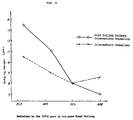
- Fig. 6 shows the relation between the reduction by one pass in the last half of the rough rolling and the ridging height.
- As shown in Fig. 1, when the hot rolling is performed in the temperature range of from 900 to 1150°C with reduction of 80% or more by one pass the steel is recrystallized and refined during the hot rolling, and as shown in Fig. 2 when the hot rolling is performed stepwise in several passes, the probability of recrystallization is reduced, but as the total reduction increases, recrystallization is more easily produced and a total reduction of at least 90% or higher will produce almost 100% recrystallization. It has been further discovered that when the total reduction is 80% or higher and at least one pass, preferably in the last half of the rolling schedule, brings about a 35% or greater reduction, recrystallization is promoted and similarly excellent ridging property can be obtained without subsequent annealing. It has been also found that if recrystallization is caused under the same condition, a lower hot rolling temperature will give a finer recrystallized grain during the hot rolling, thus further improving the ridging property.
- However, when the hot rolling temperature is lower than 900°C, recrystallization is not satisfactory, while on the other hand, when the temperature is above 1150°C. recrystallization is satisfactory, but the recrystallized grains are too coarse to give an adequate ridging property.
- As regards the rvalue which is an index of the deep-drawability, it has been found by the present inventors that the r value has a close correlation with the amount of AIN precipitation in the hot rolled steel sheets under the as-rolled condition (hereinafter called N as AIN), and a larger amount of N as AIN will give a higher r value. For example, a hot rolled steel sheet with 30 ppm N as AIN will give a r value of 1.0, a similar sheet with 50 ppm N as AIN will give a r value of 1.2, and a similar sheet with 65 ppm N as AIN will give a r value of 1.4. In the conventional arts where the hot rolled steel sheet is subsequently annealed, hen the steel contains AI, the annealing will precipitate AIN to increase the r value. In this case, however, the r value in the direction with an angle of 45° with respect to the rolling direction shows the lowest value, while in the present invention, the r value in the same direction shows the highest value. Therefore, the mechanism of improving the r value in the present invention is completely different from the conventional arts.
- In order to maintain the AIN precipitates in the hot rolled steel sheet under the as-hot rolled condition, the AIN may be precipitated prior to the start of hot rolling or may be precipitated during the hot rolling. When the AIN is precipitated prior to the start of hot rolling, the heating temperature is preferably not higher than 1200°C, because the AIN will be almost completely dissolved in solid solution at 1200°C. The amount of the AIN precipitation varies depending on the contents of AI, N and C in the steel. For example, if the slab heating temperature is defined to be 1100°C, it is possible to ensure 30 ppm or more N as AIN precipitation during slab heating if the slap contains 70 to 150 ppm N, 0.04 to 0.07%C and not lower than 0.08% AI. As stated just before, it is possible to precipitate the AIN during the hot rolling. However, when the rolling is performed in a continuous hot rolling mill composed of rough rolling stands and finishing rolling stands, the finishing rolling is completed in several ten seconds so that it is difficult to effect the precipitation during the short time of finishing rolling. In such a case, the precipitation may be effected during rough rolling or during the transient stage from the rough rolling to the finishing rolling.
- As regards the material hardness as cold rolling property before the cold rolling, recent cold rolling techniques have made it possible to cold roll a material having a high degree of hardness under the as-hot rolled condition. However, it has been found by the present inventors that when 0.08% or more of sol.Al is added to the steel, similar softening effects can be attained as when the hot rolled steel is annealed, as shown in Fig. 3. However, even when sol.AI is added in amounts higher than 0.5% no substantial additional effect can be obtained. Therefore, the upper limit of the sol.Al addition is set at 0.5% in the present invention.
- The mechanism of softening of the hot rolled steel material by the addition of AI is not yet dear, but it is assumed that the addition of AI may accelerate the γ→α, transformation during hot rolling resulting in the prevention of the formation of hard phases, such as martensite, which commonly exist in the conventional SUS 430 hot rolled strip. According to the present invention, as described hereinbefore the grain size prior to the start of hot rolling is made as small as possible, the recrystallization is produced during hot rolling, and hot rolling is performed at temperatures as low as possible and with as large a reduction as possible to produce fine recrystallized grains. In this way, the ridging property can be improved even without even without annealing the hot rolled material, the r value can be improved by maintaining the required amount of AIN precipitation under the as-hot-rolled condition, and the cold workability can be improved by maintaining the content of sol.Al at suitable amounts.
- The present invention will be better understood from the following description of experiments.
- In order to determine the effects of the slab heating temperature and the hot rolling temperature separately, test pieces of 25 mm in thickness, 70 mm in width and 100 mm in length were taken from a continuously cast steel slab of 180 mm in thickness having a chemical composition shown in Table 1. Although the sol. AI content of this slab is outside the range according to the invention, this experiment is still effective for determining the hot rolling conditions of the present invention. The slab is heated at 1350°C for 30 minutes, and extracted into air. When the material temperature (at the central portion in thickness) reached various temperatures ranging from 1250°C to 850°C, the test pieces were subjected to four pass hot rolling of →15 mm→9 mm-+5 mm-*3.7 mm.
- The relation between the material temperatures at the time when the total reduction reached 80% (after three passes, 5 mm in thickness) and the starting temperature of the hot rolling is shown in Fig.4(a), from where it can be taken that the starting temperature range of from 1150°C to 1025°C provides a material temperature not lower than 900°C after the total reduction of 80%, thus satisfying the hot rolling condition of the present invention. The hot rolled steel strips thus obtained were subjected to the following two cold rolling procedures to obtain final sheets of 0.7 mm in thickness.
- Cold rolling (3.7 mm-0.7 mm)→continuous annealing (830°Cx2 minutes)
- Box annealing (850°Cx6 hours)→cold rolling (3.7 mm-0.7 mm)→continuous annealing (830°Cx2 minutes)
- As shown in Fig. 4(b), when the hot rolling is performed with a total reduction of 80% in a temperature range of from 900 to 1150°C, a similar or better ridging property can be obtained as compared with the conventional arts in which the hot rolled material is annealed.
- The ridging property is evaluated by the surface roughness produced when 16% tension strain is placed onto test pieces (JIS No. 5) taken in the rolling direction.
- The general tendency of high ridging values in this example is due to the fact that the high temperature- heating of 1350°C caused the grains in the test pieces to abnormally grow. Needless to say, this abnormal grain growth can be avoided if the heating temperature is maintained at not higher than 1100°C, and therefore the ridging property may be generally improved.

- SUS 430 stainless steel slabs of 200 mm in thickness having a chemical composition shown in Table 2 were heated at 1100°C for 2 hours, and immediately hot rolled to 20 mm in thickness by a four-pass schedule of 30%, 36%, 52% and 55% (total reduction: 95.5%). The material temperature at the stage when the material was rolled to 20 mm was 1000°C, which was in the preferable range of the hot rolling condition according to the present invention. Then the materials were further subjected to seven-pass hot rolling to obtain hot rolled sheets of 3.7 mm in thickness. The analysis of these hot rolled sheets showed that N as AIN was in the range of from 5 ppm to 65 ppm as shown in Table 2. It is shown that when the sol.AI content is more than about 0.08%, the N as AIN content is 30 ppm or higher. Therefore, the N as AIN content and the sol.AI content are in a positive correlation to each other. The hot rolled sheets thus obtained were subjected to the following two procedures of cold rolling to obtain a final thickness of 0.7 mm.
- Cold rolling (3.7 mm-+0.7 mm)→continuous annealing (830°Cx2 minutes)
- Box annealing (850°Cx6 hours)→cold rolling (3.7 mm→0.7 mm)→continuous annealing (830°Cx2 minutes)
- The relation between the r values of the cold rolled products thus obtained by the above procedures and the N as AIN contents in the hot rolled sheet is shown in Fig. 5.
- As shown, in the case of the
Procedure 1, when the N as AIN content is 30 ppm or higher, the r value is 1.0 or higher, and when the N as AIN content is 65 ppm or higher the r value is 1.40 or higher. While in the case of Procedure 2 the r value has no definite corelation with the analysis of N as AIN in the hot rolled sheet randomly varies from 1.0 to 1.30. - The r values in this example were determined by the following formula:

- When subjected to
Procedure 1, the r46 value is highest, while when treated by Procedure 2, the r45 value is lowest This indicates that the mechanism of the r value formation in the present invention is completely different from that in the procedure, with intermediate annealing.
- In order investigate the effects of reductions by individual passes in a multiple-pass rolling, continuously cast slabs of 200 mm in thickness having chemical compositions as shown in Table 3 were heated at 1100°C for 2 hours, and rolled to 25 mm by the following four types of rolling schedules.
- 1) 5-pass hot rolling 20°→27.7%→40%→40%→40% (total reduction=87.5%)
- 2) 6-pass hot rolling 20°→27.7%→35%→35%→35% (total reduction=87.5%)
- 3) 6-pass hot rolling 20→31%→31%→31%→31%→31% (total reduction=87.5%)
- 4) 7-pass hot rolling 20%→28%→26%→26%→26.5%→26%→26% (total reduction=87.5%)
- In all of the above cases, the material temperature at the time when the material was rolled to 25 mm was 950°C. All of the above rolling conditions with different reduction distributions are within the scope of the present invention (total reduction: not less than 80%, rolling temperature:1100°C to 950°C). Although the sol. AI content of the slabs is outside the range according to the invention, this experiment is still effective for investigating the effects of reductions by individual rolling passes.
- The hot rolled materials for the
procedure 1 of rolling without intermediate annealing were immediately subjected to finishing hot rolling in seven passes to obtain 3.7 mm hot rolled sheets, while the hot rolled materials for the procedure 2 of cold rolling with intermediate box annealing were left in air to be cooled to 850°C and subjected to finishing hot rolling in seven passes to obtain 3.7 mm hot rolled sheets. These two groups of hot rolled steel sheets were respective) subjected to theprocedures 1 and 2 set forth below to obtain 0.7 mm cold rolled sheets. - The material obtained by finishing rolling immediately after rough rolling was used
- Cold rolling (3.7 mm-+0.7 mm)→continuous annealing (830°Cx2 minutes)
- The material obtained by rough hot rolling cooling in air to 850°C and then finishing hot rolling was used
- Box annealing (850°Cx6 hours)→cold rolling (3.7 mm→0.7 mm)→continuous annealing (830°Cx2 minutes)

- Fig. 6 shows, the relation between the reduction distribution in rough rolling and the ridging. In the case of procedure 2, as the train restoration due to the finishing rolling temperature is large, the static recrystalization is promoted by the annealing of the hot rolled steel sheets so that the effect of the reduction distribution in the rough rolling is relatively small, while in the case of the
procedure 1, a larger reduction by one pass can produce a better ridging property. Since in the conventional art the finishing hot rolling is performed at relatively lower temperatures, increased loads are imposed onto the rolling rolls, resulting in the occurence of the so-called scale damage on the surface of the hot rolled steel sheet. In the present invention, the finishing hot rolling is perfomed at relatively high temperatures, so that the load on the rolls is smaller, hence causing no scale damage, and resulting in good surface quality. - As can be taken from the foregoing description of the present invention, ferrite stainless steels having good workability can be advantageously produced by the present invention.
Claims (3)
Applications Claiming Priority (2)
| Application Number | Priority Date | Filing Date | Title |
|---|---|---|---|
| JP108813/80 | 1980-08-09 | ||
| JP55108813A JPS59576B2 (en) | 1980-08-09 | 1980-08-09 | Manufacturing method of ferritic stainless thin steel sheet with excellent workability |
Publications (4)
| Publication Number | Publication Date |
|---|---|
| EP0045958A2 EP0045958A2 (en) | 1982-02-17 |
| EP0045958A3 EP0045958A3 (en) | 1982-04-07 |
| EP0045958B1 EP0045958B1 (en) | 1985-03-20 |
| EP0045958B2 true EP0045958B2 (en) | 1991-12-11 |
Family
ID=14494142
Family Applications (1)
| Application Number | Title | Priority Date | Filing Date |
|---|---|---|---|
| EP81106203A Expired - Lifetime EP0045958B2 (en) | 1980-08-09 | 1981-08-07 | Ferrite stainless steel sheets having excellent workability and process for producing the same |
Country Status (8)
| Country | Link |
|---|---|
| US (1) | US4394188A (en) |
| EP (1) | EP0045958B2 (en) |
| JP (1) | JPS59576B2 (en) |
| KR (1) | KR850001011B1 (en) |
| BR (1) | BR8105105A (en) |
| DE (1) | DE3169384D1 (en) |
| ES (1) | ES504640A0 (en) |
| MX (1) | MX7674E (en) |
Families Citing this family (7)
| Publication number | Priority date | Publication date | Assignee | Title |
|---|---|---|---|---|
| JPS6045689B2 (en) * | 1982-02-19 | 1985-10-11 | 川崎製鉄株式会社 | Method for manufacturing cold rolled steel sheet with excellent press formability |
| JPS58158648A (en) * | 1982-03-16 | 1983-09-20 | Canon Inc | Photoconductive material |
| US5133205A (en) * | 1990-11-13 | 1992-07-28 | Mannesmann Aktiengesellschaft | System and process for forming thin flat hot rolled steel strip |
| CA2139522C (en) * | 1994-01-11 | 2008-03-18 | Michael F. Mcguire | Continuous method for producing final gauge stainless steel product |
| JP2772237B2 (en) * | 1994-03-29 | 1998-07-02 | 川崎製鉄株式会社 | Method for producing ferritic stainless steel strip with small in-plane anisotropy |
| DE102005063058B3 (en) * | 2005-12-29 | 2007-05-24 | Thyssenkrupp Nirosta Gmbh | Producing cold rolled strip of ferritic stainless steel comprises controlled cooling before cold rolling |
| KR101921595B1 (en) * | 2016-12-13 | 2018-11-26 | 주식회사 포스코 | Ferritic stainless steel having excellent ridging property and excellent in surface quality and method of manufacturing the same |
Family Cites Families (13)
| Publication number | Priority date | Publication date | Assignee | Title |
|---|---|---|---|---|
| US2851384A (en) * | 1953-07-03 | 1958-09-09 | Armco Steel Corp | Process of diminishing of ridging in 17-chrome stainless steel |
| US2808353A (en) * | 1953-09-22 | 1957-10-01 | Sharon Steel Corp | Method of making deep drawing stainless steel |
| US3067072A (en) * | 1960-11-07 | 1962-12-04 | Sharon Steel Corp | Method of annealing type 430 stainless steel |
| US3128211A (en) * | 1961-08-14 | 1964-04-07 | Armco Steel Corp | Process for minimizing ridging in chromium steels |
| DE1433713B2 (en) * | 1963-11-09 | 1970-02-19 | Fried. Krupp Hüttenwerke AG, 4630 Bochum | Process for the production of roping-free chrome sheet |
| DE1222520B (en) * | 1964-12-28 | 1966-08-11 | Suedwestfalen Ag Stahlwerke | Process to avoid the formation of grooves and to improve the mechanical and technological properties of cold-rolled, rust-resistant, ferritic strips with 14 to 20% chromium |
| US3607246A (en) * | 1969-02-26 | 1971-09-21 | Allegheny Ludlum Steel | Ferritic stainless steel |
| US3684589A (en) * | 1970-10-02 | 1972-08-15 | United States Steel Corp | Method for producing a minimum-ridging type 430 stainless steel |
| US3850703A (en) * | 1971-07-14 | 1974-11-26 | Allegheny Ludlum Ind Inc | Stainless steel of improved ductility |
| JPS5144888A (en) * | 1974-10-15 | 1976-04-16 | Sharp Kk | |
| US3997373A (en) * | 1975-01-13 | 1976-12-14 | Allegheny Ludlum Industries, Inc. | Ferritic stainless steel having high anisotropy |
| JPS52806A (en) * | 1975-02-20 | 1977-01-06 | Dai Ichi Kogyo Seiyaku Co Ltd | Preparation of ester |
| JPS525616A (en) * | 1975-07-03 | 1977-01-17 | Nippon Steel Corp | Stainless steel material for western tablewares |
-
1980
- 1980-08-09 JP JP55108813A patent/JPS59576B2/en not_active Expired
-
1981
- 1981-08-06 US US06/290,713 patent/US4394188A/en not_active Expired - Lifetime
- 1981-08-07 BR BR8105105A patent/BR8105105A/en unknown
- 1981-08-07 DE DE8181106203T patent/DE3169384D1/en not_active Expired
- 1981-08-07 EP EP81106203A patent/EP0045958B2/en not_active Expired - Lifetime
- 1981-08-07 ES ES504640A patent/ES504640A0/en active Granted
- 1981-08-08 KR KR1019810002901A patent/KR850001011B1/en not_active Expired
- 1981-08-10 MX MX81100755U patent/MX7674E/en unknown
Also Published As
| Publication number | Publication date |
|---|---|
| BR8105105A (en) | 1982-04-27 |
| JPS5735634A (en) | 1982-02-26 |
| EP0045958A2 (en) | 1982-02-17 |
| MX7674E (en) | 1990-07-23 |
| EP0045958B1 (en) | 1985-03-20 |
| DE3169384D1 (en) | 1985-04-25 |
| KR850001011B1 (en) | 1985-07-18 |
| KR830006447A (en) | 1983-09-24 |
| JPS59576B2 (en) | 1984-01-07 |
| ES8205267A1 (en) | 1982-06-01 |
| EP0045958A3 (en) | 1982-04-07 |
| US4394188A (en) | 1983-07-19 |
| ES504640A0 (en) | 1982-06-01 |
Similar Documents
| Publication | Publication Date | Title |
|---|---|---|
| EP0050356B1 (en) | Method for producing ferritic stainless steel sheets or strips containing aluminum | |
| JPH1150211A (en) | Thick cold rolled steel sheet excellent in deep drawing workability and method for producing the same | |
| EP0071270B1 (en) | Process for producing an austenitic stainless steel sheet or strip | |
| EP0045958B1 (en) | Ferrite stainless steel sheets having excellent workability and process for producing the same | |
| EP0019289B1 (en) | Process for producing grain-oriented silicon steel strip | |
| US4551182A (en) | Process for producing deep-drawing cold rolled steel sheets and strips | |
| JPH0694574B2 (en) | Method for producing ferrite type stainless steel sheet with excellent press formability | |
| US4373971A (en) | Process for the production of ferritic stainless steel sheets or strips and products produced by said process | |
| JPH11302739A (en) | Method for producing ferritic stainless steel with excellent surface properties and low anisotropy | |
| JPS5943824A (en) | Manufacture of cold rolled steel plate for press forming | |
| JP2003073741A (en) | Method for manufacturing ferritic stainless steels sheet superior in workability | |
| JPS62161919A (en) | Manufacture of hard sheet steel for can excellent in drawability and minimized in anisotropy | |
| JPH07118754A (en) | Method for producing ferritic stainless steel sheet with excellent living property | |
| JPS6234803B2 (en) | ||
| JPH08295943A (en) | Method for producing ferritic stainless steel sheet having excellent cold rolled surface properties | |
| JPS6024325A (en) | Production of ferritic stainless steel plate having less ridging and excellent formability | |
| JPS6320889B2 (en) | ||
| JP3806983B2 (en) | Cold-rolled steel sheet material for deep drawing with excellent ridging resistance after cold rolling and annealing | |
| JP3222048B2 (en) | Manufacturing method of high purity ferritic stainless steel sheet with excellent ridging characteristics | |
| KR910003878B1 (en) | Method of manufacturing original surface for soft surface treatment by continuous annealing | |
| JP2612453B2 (en) | Method for producing hot-rolled mild steel sheet with excellent drawability | |
| JPH04371528A (en) | Production of cold rolled steel sheet for deep drawing | |
| JP2824532B2 (en) | Manufacturing method of cold rolled steel sheet with excellent hardenability | |
| JPH0132291B2 (en) | ||
| JP2516441B2 (en) | Manufacturing method of non-oriented electrical steel sheet with excellent ridging resistance |
Legal Events
| Date | Code | Title | Description |
|---|---|---|---|
| PUAI | Public reference made under article 153(3) epc to a published international application that has entered the european phase |
Free format text: ORIGINAL CODE: 0009012 |
|
| PUAL | Search report despatched |
Free format text: ORIGINAL CODE: 0009013 |
|
| AK | Designated contracting states |
Designated state(s): DE FR GB IT SE |
|
| AK | Designated contracting states |
Designated state(s): DE FR GB IT SE |
|
| 17P | Request for examination filed |
Effective date: 19820503 |
|
| ITF | It: translation for a ep patent filed | ||
| GRAA | (expected) grant |
Free format text: ORIGINAL CODE: 0009210 |
|
| AK | Designated contracting states |
Designated state(s): DE FR GB IT SE |
|
| REF | Corresponds to: |
Ref document number: 3169384 Country of ref document: DE Date of ref document: 19850425 |
|
| ET | Fr: translation filed | ||
| PLBI | Opposition filed |
Free format text: ORIGINAL CODE: 0009260 |
|
| 26 | Opposition filed |
Opponent name: THYSSEN EDELSTAHLWERKE AG Effective date: 19851212 |
|
| ITF | It: translation for a ep patent filed | ||
| ITTA | It: last paid annual fee | ||
| PUAH | Patent maintained in amended form |
Free format text: ORIGINAL CODE: 0009272 |
|
| STAA | Information on the status of an ep patent application or granted ep patent |
Free format text: STATUS: PATENT MAINTAINED AS AMENDED |
|
| 27A | Patent maintained in amended form |
Effective date: 19911211 |
|
| AK | Designated contracting states |
Kind code of ref document: B2 Designated state(s): DE FR GB IT SE |
|
| ET3 | Fr: translation filed ** decision concerning opposition | ||
| EAL | Se: european patent in force in sweden |
Ref document number: 81106203.3 |
|
| PGFP | Annual fee paid to national office [announced via postgrant information from national office to epo] |
Ref country code: GB Payment date: 19960729 Year of fee payment: 16 |
|
| PGFP | Annual fee paid to national office [announced via postgrant information from national office to epo] |
Ref country code: FR Payment date: 19960809 Year of fee payment: 16 |
|
| PGFP | Annual fee paid to national office [announced via postgrant information from national office to epo] |
Ref country code: SE Payment date: 19960815 Year of fee payment: 16 |
|
| PGFP | Annual fee paid to national office [announced via postgrant information from national office to epo] |
Ref country code: DE Payment date: 19960816 Year of fee payment: 16 |
|
| PG25 | Lapsed in a contracting state [announced via postgrant information from national office to epo] |
Ref country code: GB Free format text: LAPSE BECAUSE OF NON-PAYMENT OF DUE FEES Effective date: 19970807 |
|
| PG25 | Lapsed in a contracting state [announced via postgrant information from national office to epo] |
Ref country code: SE Free format text: LAPSE BECAUSE OF NON-PAYMENT OF DUE FEES Effective date: 19970808 |
|
| GBPC | Gb: european patent ceased through non-payment of renewal fee |
Effective date: 19970807 |
|
| PG25 | Lapsed in a contracting state [announced via postgrant information from national office to epo] |
Ref country code: FR Free format text: LAPSE BECAUSE OF NON-PAYMENT OF DUE FEES Effective date: 19980430 |
|
| PG25 | Lapsed in a contracting state [announced via postgrant information from national office to epo] |
Ref country code: DE Free format text: LAPSE BECAUSE OF NON-PAYMENT OF DUE FEES Effective date: 19980501 |
|
| EUG | Se: european patent has lapsed |
Ref document number: 81106203.3 |
|
| REG | Reference to a national code |
Ref country code: FR Ref legal event code: ST |