EP0045934B1 - Wholly aromatic polyamide fiber and film and process for preparation thereof - Google Patents
Wholly aromatic polyamide fiber and film and process for preparation thereof Download PDFInfo
- Publication number
- EP0045934B1 EP0045934B1 EP81106088A EP81106088A EP0045934B1 EP 0045934 B1 EP0045934 B1 EP 0045934B1 EP 81106088 A EP81106088 A EP 81106088A EP 81106088 A EP81106088 A EP 81106088A EP 0045934 B1 EP0045934 B1 EP 0045934B1
- Authority
- EP
- European Patent Office
- Prior art keywords
- group
- shaped article
- fiber
- wholly aromatic
- set forth
- Prior art date
- Legal status (The legal status is an assumption and is not a legal conclusion. Google has not performed a legal analysis and makes no representation as to the accuracy of the status listed.)
- Expired
Links
- 239000000835 fiber Substances 0.000 title claims description 36
- 239000004760 aramid Substances 0.000 title claims description 31
- 229920003235 aromatic polyamide Polymers 0.000 title claims description 31
- 238000000034 method Methods 0.000 title claims description 31
- 238000002360 preparation method Methods 0.000 title claims description 5
- 229920000642 polymer Polymers 0.000 claims description 24
- 238000007493 shaping process Methods 0.000 claims description 20
- 125000003118 aryl group Chemical group 0.000 claims description 15
- 238000007334 copolymerization reaction Methods 0.000 claims description 7
- 150000004820 halides Chemical class 0.000 claims description 5
- 229910052751 metal Inorganic materials 0.000 claims description 5
- 239000002184 metal Substances 0.000 claims description 5
- 230000000737 periodic effect Effects 0.000 claims description 5
- 125000000217 alkyl group Chemical group 0.000 claims description 4
- 150000001408 amides Chemical class 0.000 claims description 4
- 239000003960 organic solvent Substances 0.000 claims description 4
- 125000002777 acetyl group Chemical group [H]C([H])([H])C(*)=O 0.000 claims description 2
- 125000003545 alkoxy group Chemical group 0.000 claims description 2
- 125000003710 aryl alkyl group Chemical group 0.000 claims description 2
- 125000004432 carbon atom Chemical group C* 0.000 claims description 2
- 125000004093 cyano group Chemical group *C#N 0.000 claims description 2
- 125000005843 halogen group Chemical group 0.000 claims description 2
- 125000002029 aromatic hydrocarbon group Chemical group 0.000 claims 1
- 239000000243 solution Substances 0.000 description 46
- XLYOFNOQVPJJNP-UHFFFAOYSA-N water Substances O XLYOFNOQVPJJNP-UHFFFAOYSA-N 0.000 description 19
- 238000009987 spinning Methods 0.000 description 18
- 230000001112 coagulating effect Effects 0.000 description 13
- 239000000203 mixture Substances 0.000 description 12
- QAOWNCQODCNURD-UHFFFAOYSA-N Sulfuric acid Chemical compound OS(O)(=O)=O QAOWNCQODCNURD-UHFFFAOYSA-N 0.000 description 11
- 239000002904 solvent Substances 0.000 description 11
- SECXISVLQFMRJM-UHFFFAOYSA-N N-Methylpyrrolidone Chemical compound CN1CCCC1=O SECXISVLQFMRJM-UHFFFAOYSA-N 0.000 description 9
- 238000010438 heat treatment Methods 0.000 description 8
- 230000000704 physical effect Effects 0.000 description 8
- 239000002798 polar solvent Substances 0.000 description 8
- IAZDPXIOMUYVGZ-UHFFFAOYSA-N Dimethylsulphoxide Chemical compound CS(C)=O IAZDPXIOMUYVGZ-UHFFFAOYSA-N 0.000 description 6
- VEXZGXHMUGYJMC-UHFFFAOYSA-N Hydrochloric acid Chemical compound Cl VEXZGXHMUGYJMC-UHFFFAOYSA-N 0.000 description 6
- 150000004984 aromatic diamines Chemical class 0.000 description 6
- AXCZMVOFGPJBDE-UHFFFAOYSA-L calcium dihydroxide Chemical compound [OH-].[OH-].[Ca+2] AXCZMVOFGPJBDE-UHFFFAOYSA-L 0.000 description 6
- 239000000920 calcium hydroxide Substances 0.000 description 6
- 229910001861 calcium hydroxide Inorganic materials 0.000 description 6
- 229910001507 metal halide Inorganic materials 0.000 description 6
- 150000005309 metal halides Chemical class 0.000 description 6
- 150000003839 salts Chemical class 0.000 description 6
- 238000002166 wet spinning Methods 0.000 description 6
- VEXZGXHMUGYJMC-UHFFFAOYSA-M Chloride anion Chemical compound [Cl-] VEXZGXHMUGYJMC-UHFFFAOYSA-M 0.000 description 5
- ZMXDDKWLCZADIW-UHFFFAOYSA-N N,N-Dimethylformamide Chemical compound CN(C)C=O ZMXDDKWLCZADIW-UHFFFAOYSA-N 0.000 description 5
- 238000013019 agitation Methods 0.000 description 5
- 229910000039 hydrogen halide Inorganic materials 0.000 description 5
- 239000012433 hydrogen halide Substances 0.000 description 5
- 229910017053 inorganic salt Inorganic materials 0.000 description 5
- TWRXJAOTZQYOKJ-UHFFFAOYSA-L Magnesium chloride Chemical compound [Mg+2].[Cl-].[Cl-] TWRXJAOTZQYOKJ-UHFFFAOYSA-L 0.000 description 4
- VSCWAEJMTAWNJL-UHFFFAOYSA-K aluminium trichloride Chemical compound Cl[Al](Cl)Cl VSCWAEJMTAWNJL-UHFFFAOYSA-K 0.000 description 4
- -1 for example Polymers 0.000 description 4
- 238000010528 free radical solution polymerization reaction Methods 0.000 description 4
- KWGKDLIKAYFUFQ-UHFFFAOYSA-M lithium chloride Chemical compound [Li+].[Cl-] KWGKDLIKAYFUFQ-UHFFFAOYSA-M 0.000 description 4
- 238000005259 measurement Methods 0.000 description 4
- 239000012299 nitrogen atmosphere Substances 0.000 description 4
- 238000006116 polymerization reaction Methods 0.000 description 4
- 239000000843 powder Substances 0.000 description 4
- JIAARYAFYJHUJI-UHFFFAOYSA-L zinc dichloride Chemical compound [Cl-].[Cl-].[Zn+2] JIAARYAFYJHUJI-UHFFFAOYSA-L 0.000 description 4
- MGLZGLAFFOMWPB-UHFFFAOYSA-N 2-chloro-1,4-phenylenediamine Chemical compound NC1=CC=C(N)C(Cl)=C1 MGLZGLAFFOMWPB-UHFFFAOYSA-N 0.000 description 3
- UXVMQQNJUSDDNG-UHFFFAOYSA-L Calcium chloride Chemical compound [Cl-].[Cl-].[Ca+2] UXVMQQNJUSDDNG-UHFFFAOYSA-L 0.000 description 3
- LYCAIKOWRPUZTN-UHFFFAOYSA-N Ethylene glycol Chemical compound OCCO LYCAIKOWRPUZTN-UHFFFAOYSA-N 0.000 description 3
- FXHOOIRPVKKKFG-UHFFFAOYSA-N N,N-Dimethylacetamide Chemical compound CN(C)C(C)=O FXHOOIRPVKKKFG-UHFFFAOYSA-N 0.000 description 3
- 239000012298 atmosphere Substances 0.000 description 3
- 239000006227 byproduct Substances 0.000 description 3
- 239000001110 calcium chloride Substances 0.000 description 3
- 229910001628 calcium chloride Inorganic materials 0.000 description 3
- 229920001577 copolymer Polymers 0.000 description 3
- 238000002425 crystallisation Methods 0.000 description 3
- 230000008025 crystallization Effects 0.000 description 3
- 238000004090 dissolution Methods 0.000 description 3
- 230000000694 effects Effects 0.000 description 3
- 239000012770 industrial material Substances 0.000 description 3
- 239000000178 monomer Substances 0.000 description 3
- 229920003366 poly(p-phenylene terephthalamide) Polymers 0.000 description 3
- 239000000126 substance Substances 0.000 description 3
- LXEJRKJRKIFVNY-UHFFFAOYSA-N terephthaloyl chloride Chemical compound ClC(=O)C1=CC=C(C(Cl)=O)C=C1 LXEJRKJRKIFVNY-UHFFFAOYSA-N 0.000 description 3
- 238000005406 washing Methods 0.000 description 3
- AVQQQNCBBIEMEU-UHFFFAOYSA-N 1,1,3,3-tetramethylurea Chemical compound CN(C)C(=O)N(C)C AVQQQNCBBIEMEU-UHFFFAOYSA-N 0.000 description 2
- CBCKQZAAMUWICA-UHFFFAOYSA-N 1,4-phenylenediamine Chemical compound NC1=CC=C(N)C=C1 CBCKQZAAMUWICA-UHFFFAOYSA-N 0.000 description 2
- PAMIQIKDUOTOBW-UHFFFAOYSA-N 1-methylpiperidine Chemical compound CN1CCCCC1 PAMIQIKDUOTOBW-UHFFFAOYSA-N 0.000 description 2
- ZBMISJGHVWNWTE-UHFFFAOYSA-N 3-(4-aminophenoxy)aniline Chemical compound C1=CC(N)=CC=C1OC1=CC=CC(N)=C1 ZBMISJGHVWNWTE-UHFFFAOYSA-N 0.000 description 2
- RTZKZFJDLAIYFH-UHFFFAOYSA-N Diethyl ether Chemical compound CCOCC RTZKZFJDLAIYFH-UHFFFAOYSA-N 0.000 description 2
- 239000004952 Polyamide Substances 0.000 description 2
- FAPWRFPIFSIZLT-UHFFFAOYSA-M Sodium chloride Chemical compound [Na+].[Cl-] FAPWRFPIFSIZLT-UHFFFAOYSA-M 0.000 description 2
- 239000000654 additive Substances 0.000 description 2
- ZCCIPPOKBCJFDN-UHFFFAOYSA-N calcium nitrate Chemical compound [Ca+2].[O-][N+]([O-])=O.[O-][N+]([O-])=O ZCCIPPOKBCJFDN-UHFFFAOYSA-N 0.000 description 2
- 238000001125 extrusion Methods 0.000 description 2
- GNOIPBMMFNIUFM-UHFFFAOYSA-N hexamethylphosphoric triamide Chemical compound CN(C)P(=O)(N(C)C)N(C)C GNOIPBMMFNIUFM-UHFFFAOYSA-N 0.000 description 2
- 229910000041 hydrogen chloride Inorganic materials 0.000 description 2
- IXCSERBJSXMMFS-UHFFFAOYSA-N hydrogen chloride Substances Cl.Cl IXCSERBJSXMMFS-UHFFFAOYSA-N 0.000 description 2
- 239000004973 liquid crystal related substance Substances 0.000 description 2
- 229910001629 magnesium chloride Inorganic materials 0.000 description 2
- 238000004519 manufacturing process Methods 0.000 description 2
- 238000002156 mixing Methods 0.000 description 2
- 238000006386 neutralization reaction Methods 0.000 description 2
- 230000010355 oscillation Effects 0.000 description 2
- 229920002647 polyamide Polymers 0.000 description 2
- 229920005604 random copolymer Polymers 0.000 description 2
- 238000000926 separation method Methods 0.000 description 2
- 239000011592 zinc chloride Substances 0.000 description 2
- 235000005074 zinc chloride Nutrition 0.000 description 2
- ONDPHDOFVYQSGI-UHFFFAOYSA-N zinc nitrate Chemical compound [Zn+2].[O-][N+]([O-])=O.[O-][N+]([O-])=O ONDPHDOFVYQSGI-UHFFFAOYSA-N 0.000 description 2
- BNGXYYYYKUGPPF-UHFFFAOYSA-M (3-methylphenyl)methyl-triphenylphosphanium;chloride Chemical compound [Cl-].CC1=CC=CC(C[P+](C=2C=CC=CC=2)(C=2C=CC=CC=2)C=2C=CC=CC=2)=C1 BNGXYYYYKUGPPF-UHFFFAOYSA-M 0.000 description 1
- ZZPLGBZOTXYEQS-UHFFFAOYSA-N 2,3-dichlorobenzene-1,4-dicarbonyl chloride Chemical compound ClC(=O)C1=CC=C(C(Cl)=O)C(Cl)=C1Cl ZZPLGBZOTXYEQS-UHFFFAOYSA-N 0.000 description 1
- MSWAXXJAPIGEGZ-UHFFFAOYSA-N 2-chlorobenzene-1,4-dicarbonyl chloride Chemical compound ClC(=O)C1=CC=C(C(Cl)=O)C(Cl)=C1 MSWAXXJAPIGEGZ-UHFFFAOYSA-N 0.000 description 1
- LFQSCWFLJHTTHZ-UHFFFAOYSA-N Ethanol Chemical compound CCO LFQSCWFLJHTTHZ-UHFFFAOYSA-N 0.000 description 1
- 238000012696 Interfacial polycondensation Methods 0.000 description 1
- 238000012695 Interfacial polymerization Methods 0.000 description 1
- 229920003369 Kevlar® 49 Polymers 0.000 description 1
- 229910021586 Nickel(II) chloride Inorganic materials 0.000 description 1
- 229910021627 Tin(IV) chloride Inorganic materials 0.000 description 1
- 239000007864 aqueous solution Substances 0.000 description 1
- 230000015572 biosynthetic process Effects 0.000 description 1
- 238000009835 boiling Methods 0.000 description 1
- 229910001622 calcium bromide Inorganic materials 0.000 description 1
- WGEFECGEFUFIQW-UHFFFAOYSA-L calcium dibromide Chemical compound [Ca+2].[Br-].[Br-] WGEFECGEFUFIQW-UHFFFAOYSA-L 0.000 description 1
- 229910052799 carbon Inorganic materials 0.000 description 1
- 239000007795 chemical reaction product Substances 0.000 description 1
- 239000003795 chemical substances by application Substances 0.000 description 1
- 150000001805 chlorine compounds Chemical class 0.000 description 1
- 239000000701 coagulant Substances 0.000 description 1
- 238000005345 coagulation Methods 0.000 description 1
- 230000015271 coagulation Effects 0.000 description 1
- 238000004891 communication Methods 0.000 description 1
- 238000009792 diffusion process Methods 0.000 description 1
- 238000001035 drying Methods 0.000 description 1
- 239000011521 glass Substances 0.000 description 1
- 230000009477 glass transition Effects 0.000 description 1
- 150000008282 halocarbons Chemical class 0.000 description 1
- 229920001519 homopolymer Polymers 0.000 description 1
- 238000002955 isolation Methods 0.000 description 1
- OTCKOJUMXQWKQG-UHFFFAOYSA-L magnesium bromide Chemical compound [Mg+2].[Br-].[Br-] OTCKOJUMXQWKQG-UHFFFAOYSA-L 0.000 description 1
- 229910001623 magnesium bromide Inorganic materials 0.000 description 1
- 239000000155 melt Substances 0.000 description 1
- 238000002844 melting Methods 0.000 description 1
- 230000008018 melting Effects 0.000 description 1
- 230000003472 neutralizing effect Effects 0.000 description 1
- QMMRZOWCJAIUJA-UHFFFAOYSA-L nickel dichloride Chemical compound Cl[Ni]Cl QMMRZOWCJAIUJA-UHFFFAOYSA-L 0.000 description 1
- 239000000049 pigment Substances 0.000 description 1
- 230000001737 promoting effect Effects 0.000 description 1
- 239000011541 reaction mixture Substances 0.000 description 1
- 230000003014 reinforcing effect Effects 0.000 description 1
- 239000011780 sodium chloride Substances 0.000 description 1
- 239000007790 solid phase Substances 0.000 description 1
- 239000003381 stabilizer Substances 0.000 description 1
- 229910001631 strontium chloride Inorganic materials 0.000 description 1
- AHBGXTDRMVNFER-UHFFFAOYSA-L strontium dichloride Chemical compound [Cl-].[Cl-].[Sr+2] AHBGXTDRMVNFER-UHFFFAOYSA-L 0.000 description 1
- HPGGPRDJHPYFRM-UHFFFAOYSA-J tin(iv) chloride Chemical compound Cl[Sn](Cl)(Cl)Cl HPGGPRDJHPYFRM-UHFFFAOYSA-J 0.000 description 1
- 239000006097 ultraviolet radiation absorber Substances 0.000 description 1
- 238000005303 weighing Methods 0.000 description 1
Images

Classifications
-
- C—CHEMISTRY; METALLURGY
- C08—ORGANIC MACROMOLECULAR COMPOUNDS; THEIR PREPARATION OR CHEMICAL WORKING-UP; COMPOSITIONS BASED THEREON
- C08J—WORKING-UP; GENERAL PROCESSES OF COMPOUNDING; AFTER-TREATMENT NOT COVERED BY SUBCLASSES C08B, C08C, C08F, C08G or C08H
- C08J5/00—Manufacture of articles or shaped materials containing macromolecular substances
- C08J5/18—Manufacture of films or sheets
-
- C—CHEMISTRY; METALLURGY
- C08—ORGANIC MACROMOLECULAR COMPOUNDS; THEIR PREPARATION OR CHEMICAL WORKING-UP; COMPOSITIONS BASED THEREON
- C08G—MACROMOLECULAR COMPOUNDS OBTAINED OTHERWISE THAN BY REACTIONS ONLY INVOLVING UNSATURATED CARBON-TO-CARBON BONDS
- C08G69/00—Macromolecular compounds obtained by reactions forming a carboxylic amide link in the main chain of the macromolecule
- C08G69/02—Polyamides derived from amino-carboxylic acids or from polyamines and polycarboxylic acids
- C08G69/26—Polyamides derived from amino-carboxylic acids or from polyamines and polycarboxylic acids derived from polyamines and polycarboxylic acids
- C08G69/32—Polyamides derived from amino-carboxylic acids or from polyamines and polycarboxylic acids derived from polyamines and polycarboxylic acids from aromatic diamines and aromatic dicarboxylic acids with both amino and carboxylic groups aromatically bound
-
- D—TEXTILES; PAPER
- D01—NATURAL OR MAN-MADE THREADS OR FIBRES; SPINNING
- D01F—CHEMICAL FEATURES IN THE MANUFACTURE OF ARTIFICIAL FILAMENTS, THREADS, FIBRES, BRISTLES OR RIBBONS; APPARATUS SPECIALLY ADAPTED FOR THE MANUFACTURE OF CARBON FILAMENTS
- D01F6/00—Monocomponent artificial filaments or the like of synthetic polymers; Manufacture thereof
- D01F6/78—Monocomponent artificial filaments or the like of synthetic polymers; Manufacture thereof from copolycondensation products
- D01F6/80—Monocomponent artificial filaments or the like of synthetic polymers; Manufacture thereof from copolycondensation products from copolyamides
- D01F6/805—Monocomponent artificial filaments or the like of synthetic polymers; Manufacture thereof from copolycondensation products from copolyamides from aromatic copolyamides
-
- C—CHEMISTRY; METALLURGY
- C08—ORGANIC MACROMOLECULAR COMPOUNDS; THEIR PREPARATION OR CHEMICAL WORKING-UP; COMPOSITIONS BASED THEREON
- C08J—WORKING-UP; GENERAL PROCESSES OF COMPOUNDING; AFTER-TREATMENT NOT COVERED BY SUBCLASSES C08B, C08C, C08F, C08G or C08H
- C08J2377/00—Characterised by the use of polyamides obtained by reactions forming a carboxylic amide link in the main chain; Derivatives of such polymers
- C08J2377/10—Polyamides derived from aromatically bound amino and carboxyl groups of amino carboxylic acids or of polyamines and polycarboxylic acids
Definitions
- This invention relates to high-tenacity wholly aromatic polyamide fiber and film having a very high modulus and a process for the preparation thereof.
- wholly aromatic polyamides have a high melting point and a high glass transition point and they are excellent in physical and chemical properties such as heat resistance, flame resistance, flame retardancy and chemical resistance. Accordingly, they are very valuable as various shaped articles such as fibers and films. It also is known that among wholly aromatic polyamides, a para-oriented polymer, for example, poly(p-phenylene terephthalamide), gives a fiber or film having especially high tenacity and a high modulus. Such high-tenacity and high-modulus shaped articles have widely been used as industrial materials.
- the modulus In high-tenacity high-modulus wholly aromatic polyamides which have been marketed and are now being developed, the modulus is about 300 to about 550 g/d. It is said that the modulus that should be possessed by high-capacity wholly aromatic polyamide fibers which are eagerly desired at present is at least 650 g/d, preferably at least 700 g/d.
- Keviar--49 registered Trade Mark
- Du Pont Co Du Pont Co. This Kevlar-49 registered Trade Mark is prepared through the following spinning and heat treatment steps.
- a high-concentration liquid crystal dope comprising poly-(p-phenylene terephthalamide) and sulfuric acid is subjected to dry-jet wet spinning using water or dilute sulfuric acid as a coagulating bath (see Japanese Patent Publication No. 14,170/80).
- the as-spun filaments formed by the above dry-jet wet spinning is heat-treated under tension at 250 to 600°C (see Japanese Patent Publication No. 14,167/80).
- a spinning dope by forming a polymer solution by low temperature solution polymerization of an aromatic diamine and an aromatic diacid chloride in an amide type polar solvent and neutralizing hydrogen chloride formed as a by-product with, for example, Ca(OH) 2' has already been practiced for production of meta-oriented polyamide shaped articles (see Japanese Patent Publication No. 16,027/60). Furthermore, a process in which the above method is applied to the preparation of para-oriented polyamides obtained from a combination of specific monomers and the resulting spinning dope is subjected to wet spinning and hot drawing to obtain high modulus fibers having a modulus of at least 300 g/d has already been proposed (see Japanese Patent Application Laid-Open Specification No. 136,916/76).
- a shaped article composed of a wholly aromatic copolyamide consisting essentially of recurring units represented by at least one of the following general formulae: and wherein Ar" Ar 2 and Ar 3 , which may be the same or different, stand for divalent aromatic hydrocarbon radicals selected from and in which the X's, which may be the same or different, represent a halogeno group, an alkyl group, an aralkyl group, an aromatic group, an alkoxy group, an acetyl group or a cyano group, n is an integer of from 1 to 3, and Y is in which R' is an alkyl group having up to 5 carbon atoms, and the copolymerization ratio expressed by the molar ratio of the total aromatic residues of Ar 1 , Ar z and Ar 3 falls within a square region (the hatched region) formed by connecting points P, Q, R and S in order through straight lines illustrated in a triangular coordinate of Fig. 1, said wholly aromatic copolyamide
- the shaped article may be in the form of a fiber having a tensile modulus of at least 650 g/d, preferably at least 700g/d and more preferably at least 750 g/d as measured at room temperature and preferably having a tensile strength of at least 18 g/d as measured at room temperature.
- the shaped article may also be in the form of a film having a tensile modulus of at least 1,800 kg/mm 2 as measured at room temperature.
- a process for preparing a shaped article such as a fiber or a film composed of the above-defined wholly aromatic polyamide which comprises the steps of:
- the wholly aromatic polyamide of the present invention consists essentially of recurring units represented by the following general formula: and/or
- Ar l , Ar and Ar 3 which may be the same or different, are selected from the above-mentioned group (a) and/or the above-mentioned group (b) and/or the above-mentioned group (c).
- the composition of the total of the groups Ar 1 , Ar 2 and/or Ar 3 must fall within the hatched region indicated in Fig. 1.
- the copolymer having the above-mentioned structure specified in the present invention can be prepared from various combinations of monomers, that is, at least one aromatic diamine and at least one aromatic diacid chloride.
- aromatic diacid chloride there are preferably used terephthaloyl dichloride, monochloroterephthaloyl dichloride and dichloroterephthaloyl dichloride. Of these, terephthaloyl dichloride is especially preferred.
- aromatic diamine preferably combined with the above-mentioned aromatic diacid chloride
- aromatic diamine mixture comprising 3,4'-diaminodiphenyl ether and o-chloro-p-phenylene diamine
- aromatic diamine mixture comprising 3,4'-diaminodiphenyl ether, o-chloro-p-phenylene diamine and p-phenylene diamine.
- the wholly aromatic polyamide constituting the shaped article of the present invention should have a copolymerization ratio defined by the square region formed by connecting points P, Q, R and S in a triangular coordinate of Fig. 1 in order through straight lines, that is, the hatched region in Fig. 1. Only if this requirement of the copolymerization ratio is satisfied, the intended fiber and film having high tenacity and Young's modulus and other desired characteristics can be obtained.
- the obtained fiber is poor in the physical properties, and the spinnability and drawability are degraded. Moreover, the stability of the starting spinning solution is bad and a fiber is not obtained from this spinning solution smoothly in good conditions. Furthermore, the stability of the starting dope for formation of a film is also degraded, and the resulting film is poor in its physical properties.
- the kind, number and proportion of each of Ar" Ar 2 and Ar 3 may optionally be changed within the above-mentioned range of the composition, whereby the intended fiber or film can be obtained.
- the intrinsic viscosity of the wholly aromatic polyamide which is a measure of the average molecular weight of the obtained polymer, should be at least 1.5 and preferably at least 2.5.
- the intrinsic viscosity (ninh) referred to in the present specification is a value determined by isolating a polymer from a polymerization reaction mixture or starting a spinning dope and conducting measurement on a solution containing 0.5 g of the polymer in 100 ml of concentrated sulfuric acid at 30°C. ' - ⁇ - . -Of course, minor amounts of additives such as a pigment, a delustering agent, a stabilizer and an ultra-violet absorber may be incorporated into the aromatic polyamide of the present invention.
- the wholly aromatic polyamide of the present invention having recurring units represented by the above general formula (A) and/or (B) can be prepared by any known processes, for example, the melt polymerization process, the solid phase polymerization process, the interfacial polymerization process, the solution polymerization process and combinations thereof.
- the interfacial polycondensation process see Japanese Patent Publication No. 13,247/72
- the oligomer polymerization process Japanese Patent Publication No. 10,863/72
- the low temperature solution polymerization process Japanese Patent Publication No. 14,399/60
- the copolymer solution to be used for shaping in the present invention can be prepared according to any of the following two methods.
- HMPA hexamethylphosphoramide
- NMP N-methylpyrrolidone
- DMA N,N-dimethylacetamide
- DMSO dimethylsulfoxide
- NMP N,N-dimethylformamide
- TNU N,N,N',N'-tetramethylurea
- NMP, DMA, DMSO and mixtures thereof are preferably used.
- a small amount of a halide of a metal of the Group I or Group II of the Periodic Table be added to a spinning solution formed by dissolving the aromatic polyamide in an organic polar solvent such as mentioned above so as to improve the solubility.
- Lithium chloride, calcium chloride and magnesium bromide are preferably used. These metal halides may be used either alone or in combination.
- a hydrogen halide preferably hydrogen chloride, may be incorporated into the solution.
- the wholly aromatic polyamide be sufficiently finely divided prior to the re-dissolving operation. It also is preferred that a wholly aromatic polyamide having a low degree of crystallization be used.
- Mixing of the wholly aromatic polyamide with the above-mentioned organic polar solvent is preferably accomplished by sufficiently admixing them with each other at an appropriate temperature prior to dissolution, as disclosed in Japanese Patent Publication No. 4,461/73. After this homogeneous admixing, the mixture is heated at an appropriate temperature to promote dissolution.
- This appropriate heating temperature varies depending upon the chemical composition of the aromatic polyamide, the kind of solvent, the mixing ratio and the content of the above-mentioned metal halide and/or hydrogen halide, but this heating temperature is ordinarily in the range of from 0 to 150°C.
- the content of the wholly aromatic polyamide in the spinning dope is preferably in the range of from 2 to 20% by weight and especially preferably in the range of from 4 to 15% by weight, though such preferred range varies to some extent depending upon the content of the above-mentioned metal halide and/or hydrogen halide. It is preferred that the content of the halide of a metal of the Group I and/or Group II of the Periodic Table be in the range of from 0.2% to 10% by weight based on the total weight of the solution. Ordinarily, the higher is the content of the metal halide, the more improved are the solubility, the dissolution speed and the solution stability and the more increased is the viscosity of the solution. For example, if the content of the metal halide exceeds 10% by weight, the coagulating property at the spinning step tends to be degraded.
- the known wet shaping method or dry shaping method may be adopted as the shaping method.
- a water bath or aqueous solution of an organic polar solvent, main-. tained at 0 to 100°C, may be used as a bath for coagulating the above-mentioned wholly aromatic polyamide dope.
- a lower alcohol both, an ethylene glycol bath and an aqueous bath thereof, a salt water bath or a halogenated hydrocarbon bath may be used as the coagulating bath.
- the temperature of the coagulating bath may be in the range of from 0°C to the boiling point (under atmospheric pressure) of the coagulating bath. It is preferred that the concentration of the organic polar solvent in the bath be not more than 50% by weight, especially not more than 30% by weight, based on the total weight of the bath. According to the composition of the wholly aromatic polyamide or the kind or content of the metal halide and/or hydrogen halide when such is contained in the spinning dope, it sometimes happens that reverse diffusion of the coagulating bath into the extruded filament becomes excessive to render the texture of the extruded filament brittle and the subsequent heat treatment cannot be performed smoothly.
- a coagulating bath comprising, in addition to the solvent and water, at leastone inorganic salt selected from the group consisting of lithium chloride, sodium chloride, calcium chloride, magnesium chloride, zinc chloride, strontium chloride, aluminum chloride, stannic chloride, nickel chloride, calcium bromide, calcium nitrate, zinc nitrate and aluminum nitrate be used.
- inorganic salt varies to some extent depending upon the composition of the spinning solution, prominent effects can ordinarily be attained when the inorganic salt is incorporated in a total amount (as calculated as the anhydrous salt) of at least 2 moles in 1 liter of water.
- the foregoing inorganic salts may be used alone or in combination.
- chlorides such as magnesium chloride, calcium chloride, zinc chloride and aluminum chloride are especially preferred.
- Wet shaping can be accomplished by extruding the shaping dope into the above-mentioned coagulating bath through nozzle holes, slits, orifices or dies.
- nozzle holes, slits, orifices or dies There may be adopted a so-called dry-jet wet shaping method in which the shaping dope is once extruded into a gaseous medium through the above-mentioned extrusion holes or orifices and is then introduced into the coagulating bath.
- aqueous coagulating bath containing or not containing the above-mentioned inorganic salt is used as a first bath and a wet spinning method, the semi-dry semi-wet spinning method and the flow tension spinning method are preferably adopted.
- a flow pipe or the like may be used if necessary.
- an aqueous coagulating bath containing or not containing the above-mentioned inorganic salt is used as a first bath and a water bath is used as a second bath for promoting removal of the coagulating agent and coagulation and for washing away the salt from the shaped article when the salt contained in the first bath is left on the shaped article.
- Dry shaping is accomplished by extruding the above-mentioned wholly aromatic polyamide dope into a heating atmosphere through a nozzle hole or slit die.
- the shaped article obtained by wet shaping or dry shaping is washed with water or hot water and/or an organic solvent to remove the shaping solvent, additives, reaction products, solubilizing agent and the like. Thereafter, the washed shaped article is subjected to stretching.
- the stretching temperature may appropriately be chosen after due consideration of the molecular structure of the wholly aromatic polyamide and the intended properties of the resulting shaped article.
- the stretching temperature may be chosen in the range of from 300 to 700°C in the case of a fiber and in the range of 95 to 700°C in the case of a film. Stretching may be performed according to the one-stage or multi-stage method, and the overall stretch ratio is at least 1.5 and ordinarily in the range of from 1.5 to 15.
- the stretched shaped article is treated in an atmosphere maintained at a temperature higher than 250°C or in a solvent (or a solvent-water mixture) maintained at an appropriate temperature for several seconds to scores of minutes in the relaxed state or under slight tension, the physical properties can be improved.
- the obtained shaped article of the present invention has the following physical properties.
- the tensile modulus is at least 650 g/d, preferably at least 700 g/d and more preferably at least 750 g/d, as measured at room temperature.
- the tensile modulus can be raised up to approximately 2,000 g/d.
- the tensile strength is at least 18 g/d and preferably at least 20 g/d, as measured at room temperature.
- the tensile strength can be raised up to approximately 50 g/d.
- the tensile modulus is at least 1,800 Kg/mm 2 , preferably at least 2,000 Kg/mm 2 and more preferably at least 2,200 Kg/mm 2 , as measured at room temperature.
- the tensile modulus can be raised up to approximately 5,000 Kg/mm 2 .
- the tensile strength is preferably at least 45 Kg/mm 2 and more preferably at least 55 Kg/mm 2 .
- the shaped articles of the present invention is valuable as industrial materials such as fibers, ropes and films, especially those for which a high modulus is required. It is surprising that a modulus tenacity as high as that of a shaped article obtained by liquid crystal spinning and heat treatment of poly-(p-phenylene terephthalamide) can be manifested by virtue of the specific composition ratio of the special skeleton structure of the wholly aromatic polyamide of the present invention. It has been considered that the modulus of a random copolymer is reduced as the number of copolymerized components is increased or the copolymerization ratio of a modifying comonomer or monomers is increased. In view of this accepted concept, it would be quite surprising that such a high modulus as mentioned above can be attained according to the present invention.
- the intrinsic viscosity was determined by isolating a polymer from a polymer solution and conducting the measurement on a polymer solution in concentrated sulfuric acid at a polymer concentration of 0.5 g/100 ml at a temperature of 30°C as described hereinbefore.
- the tensile characteristics of fibers were determined on multifilaments or monofilaments by using an "Instron” (registered Trade Mark) tester.
- the physical properties were obtained from a load-elongation curve determined by the measurement using an Instron tester under the same conditions as described above with respect to multifilaments.
- the denier of the monofilaments was determined from an inherent resonance oscillation number determined by oscillating the filaments under tension while changing the oscillation number.
- the tensile characteristics of films were determined on a specimen having a width of 1 cm and a length of 10 cm by using an Instron tester at a grip separation ' speed of 10 cm/min, and physical properties were obtained from the load-elongation curve.
- the neutralized solution was filtered, deaerated and extruded into an aqueous coagulating bath through a spinneret having 5 orifices, each having a diameter of 0.3 mm, at a spinneret temperature of 120°C and an extrusion speed of 5 m/min according to the semi-dry semi-wet spinning method.
- the spun fiber was sufficiently washed in a multi-staged water washing bath, dried and stretched at various hot plate temperatures indicated in Table 1.
- the physical properties of the stretched fibers as multifilaments were measured to obtain results shown in Table 1.
- the neutralized solution was filtered, deaerated and spun by using a spinneret having 12 orifices, each having a diameter of 0.3 mm, in the same manner as described in Example 1, and the spun fiber was stretched at a stretch ratio of 11 on a hot plate maintained at 500°C.
- the obtained fiber was characterized by a total filament fineness of 29.3 denier, a strength of 28.2 g/d, an elongation of 3.9% and a Young's modulus of 830 g/d.
- the neutralized solution was spun by using a spinneret having 5 orifices, each having a diameter of 0.3 mm, in the same manner as described in Example 1.
- the spun fiber was stretched at a stretch ratio of 14.3 on a hot plate maintained at 510°C.
- the obtained fiber was characterized by a total filament fineness of 9.1 denier, a strength of 22.0 g/d, an elongation of 3.0% and a Young's modulus of 860 g/d.
- the neutralized solution was spun in the same manner as described in Example 1 and stretched at a stretch ratio of 9.5 on a hot plate maintained at 510°C.
- the obtained fiber was characterized by a single filament fineness of 1.69 denier, a strength of 26.4 g/d, an elongation of 3.4% and a Young's modulus of 923 g/d.
- Example 4 The neutralized solution obtained in Example 4 was maintained at 120°C and was cast on a glass sheet maintained at 110°C by means of a doctor knife. The solvent was removed from the cast solution at 160°C in a hot air drier, and removal of the solvent was further conducted in a water bath maintained at room temperature to obtain a homogeneous and transparent film.
- the film was dried while keeping the length constant and was then stretched uniaxially at a stretch ratio of 3 in an atmosphere maintained at 400°C in an electric furnace by using a film tenter.
- the physical properties of the obtained film as measured in the stretching direction thereof were a strength of 61 Kg/mm 2 , an elongation of 8% and a Young's modulus of 1,800 Kg/mm 2 , and the thickness of the film was 23 microns.
Landscapes
- Chemical & Material Sciences (AREA)
- Engineering & Computer Science (AREA)
- Chemical Kinetics & Catalysis (AREA)
- Organic Chemistry (AREA)
- Manufacturing & Machinery (AREA)
- Health & Medical Sciences (AREA)
- Medicinal Chemistry (AREA)
- Polymers & Plastics (AREA)
- Materials Engineering (AREA)
- General Chemical & Material Sciences (AREA)
- Textile Engineering (AREA)
- Artificial Filaments (AREA)
- Polyamides (AREA)
Description
- This invention relates to high-tenacity wholly aromatic polyamide fiber and film having a very high modulus and a process for the preparation thereof.
- It is known that wholly aromatic polyamides have a high melting point and a high glass transition point and they are excellent in physical and chemical properties such as heat resistance, flame resistance, flame retardancy and chemical resistance. Accordingly, they are very valuable as various shaped articles such as fibers and films. It also is known that among wholly aromatic polyamides, a para-oriented polymer, for example, poly(p-phenylene terephthalamide), gives a fiber or film having especially high tenacity and a high modulus. Such high-tenacity and high-modulus shaped articles have widely been used as industrial materials.
- In the field of industrial materials, wholly aromatic polyamide shaped articles having further improved characteristics have been desired under the stimulus of the above-mentioned high-tenacity and high-modulus fibers. More specifically, high-tenacity wholly aromatic polyamide fibers are now desired mainly as fibers for reinforcing light communication cables or ropes to be used for special purposes.
- In high-tenacity high-modulus wholly aromatic polyamides which have been marketed and are now being developed, the modulus is about 300 to about 550 g/d. It is said that the modulus that should be possessed by high-capacity wholly aromatic polyamide fibers which are eagerly desired at present is at least 650 g/d, preferably at least 700 g/d.
- As the fiber having such a very high modulus, there can be mentioned "Keviar"--49 (registered Trade Mark) manufactured and supplied by Du Pont Co. This Kevlar-49 registered Trade Mark is prepared through the following spinning and heat treatment steps.
- A high-concentration liquid crystal dope comprising poly-(p-phenylene terephthalamide) and sulfuric acid is subjected to dry-jet wet spinning using water or dilute sulfuric acid as a coagulating bath (see Japanese Patent Publication No. 14,170/80).
- The as-spun filaments formed by the above dry-jet wet spinning is heat-treated under tension at 250 to 600°C (see Japanese Patent Publication No. 14,167/80).
- In this process, however, sulfuric acid which is very dangerous and highly corrosive is used as a solvent and special steps of isolating, washing and drying the polymer and dissolving the dried polymer into concentrated sulfuric acid are inevitably adopted.
- Preparation of a spinning dope by forming a polymer solution by low temperature solution polymerization of an aromatic diamine and an aromatic diacid chloride in an amide type polar solvent and neutralizing hydrogen chloride formed as a by-product with, for example, Ca(OH)2' has already been practiced for production of meta-oriented polyamide shaped articles (see Japanese Patent Publication No. 16,027/60). Furthermore, a process in which the above method is applied to the preparation of para-oriented polyamides obtained from a combination of specific monomers and the resulting spinning dope is subjected to wet spinning and hot drawing to obtain high modulus fibers having a modulus of at least 300 g/d has already been proposed (see Japanese Patent Application Laid-Open Specification No. 136,916/76).
- It is a primary object of the present invention to provide wholly aromatic polyamide fibers and films which have the desired high modulus and which can be produced advantageously by spinning a solution of a wholly aromatic polyamide in an organic solvent.
- Other objects and advantages of the present invention will be apparent from the following description.
- In one aspect of the present invention, there is provided a shaped article composed of a wholly aromatic copolyamide consisting essentially of recurring units represented by at least one of the following general formulae:


and the copolymerization ratio expressed by the molar ratio of the total aromatic residues of Ar1, Arz and Ar3 falls within a square region (the hatched region) formed by connecting points P, Q, R and S in order through straight lines illustrated in a triangular coordinate of Fig. 1, said wholly aromatic copolyamide having an intrinsic viscosity of at least 1.5. - The shaped article may be in the form of a fiber having a tensile modulus of at least 650 g/d, preferably at least 700g/d and more preferably at least 750 g/d as measured at room temperature and preferably having a tensile strength of at least 18 g/d as measured at room temperature. The shaped article may also be in the form of a film having a tensile modulus of at least 1,800 kg/mm2 as measured at room temperature.
- In another aspect of the present invention, there is provided a process for preparing a shaped article such as a fiber or a film composed of the above-defined wholly aromatic polyamide, which comprises the steps of:
- subjecting a polymer solution comprising the above-defined wholly aromatic copolyamide, a halide of a metal of Group I or Group 11 of the Periodic Table and an amide type organic solvent to wet shaping or dry shaping; and then,
- stretching the resulting shaped article at an elevated temperature at a stretch ratio of at least 1.5. The stretching is preferably carried out at a temperature of 300 to 700°C in the case where the shaped article is fiber, and at a temperature of 95 to 700°C in the case where the shaped article is a film.
- The wholly aromatic polyamide of the present invention consists essentially of recurring units represented by the following general formula:


- The copolymer having the above-mentioned structure specified in the present invention can be prepared from various combinations of monomers, that is, at least one aromatic diamine and at least one aromatic diacid chloride. As the aromatic diacid chloride, there are preferably used terephthaloyl dichloride, monochloroterephthaloyl dichloride and dichloroterephthaloyl dichloride. Of these, terephthaloyl dichloride is especially preferred.
- As the aromatic diamine preferably combined with the above-mentioned aromatic diacid chloride, there can be mentioned an aromatic diamine mixture comprising 3,4'-diaminodiphenyl ether and o-chloro-p-phenylene diamine and an aromatic diamine mixture comprising 3,4'-diaminodiphenyl ether, o-chloro-p-phenylene diamine and p-phenylene diamine.
- The wholly aromatic polyamide constituting the shaped article of the present invention should have a copolymerization ratio defined by the square region formed by connecting points P, Q, R and S in a triangular coordinate of Fig. 1 in order through straight lines, that is, the hatched region in Fig. 1. Only if this requirement of the copolymerization ratio is satisfied, the intended fiber and film having high tenacity and Young's modulus and other desired characteristics can be obtained.
- When the copolymerization ratio is outside the hatched region shown in Fig. 1, the obtained fiber is poor in the physical properties, and the spinnability and drawability are degraded. Moreover, the stability of the starting spinning solution is bad and a fiber is not obtained from this spinning solution smoothly in good conditions. Furthermore, the stability of the starting dope for formation of a film is also degraded, and the resulting film is poor in its physical properties.
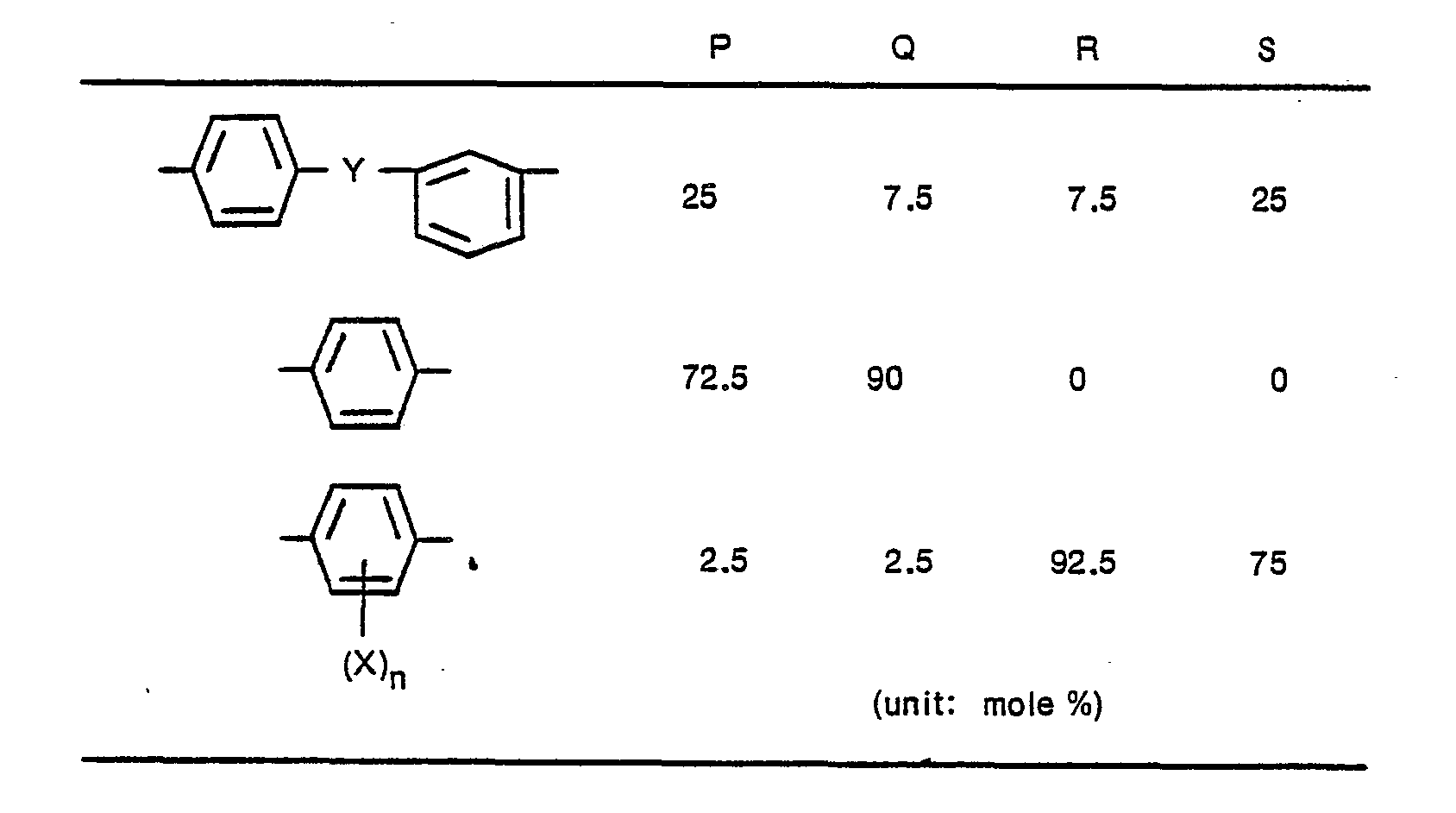
- The points P, Q, R and S referred to in the present specification represent the following points.
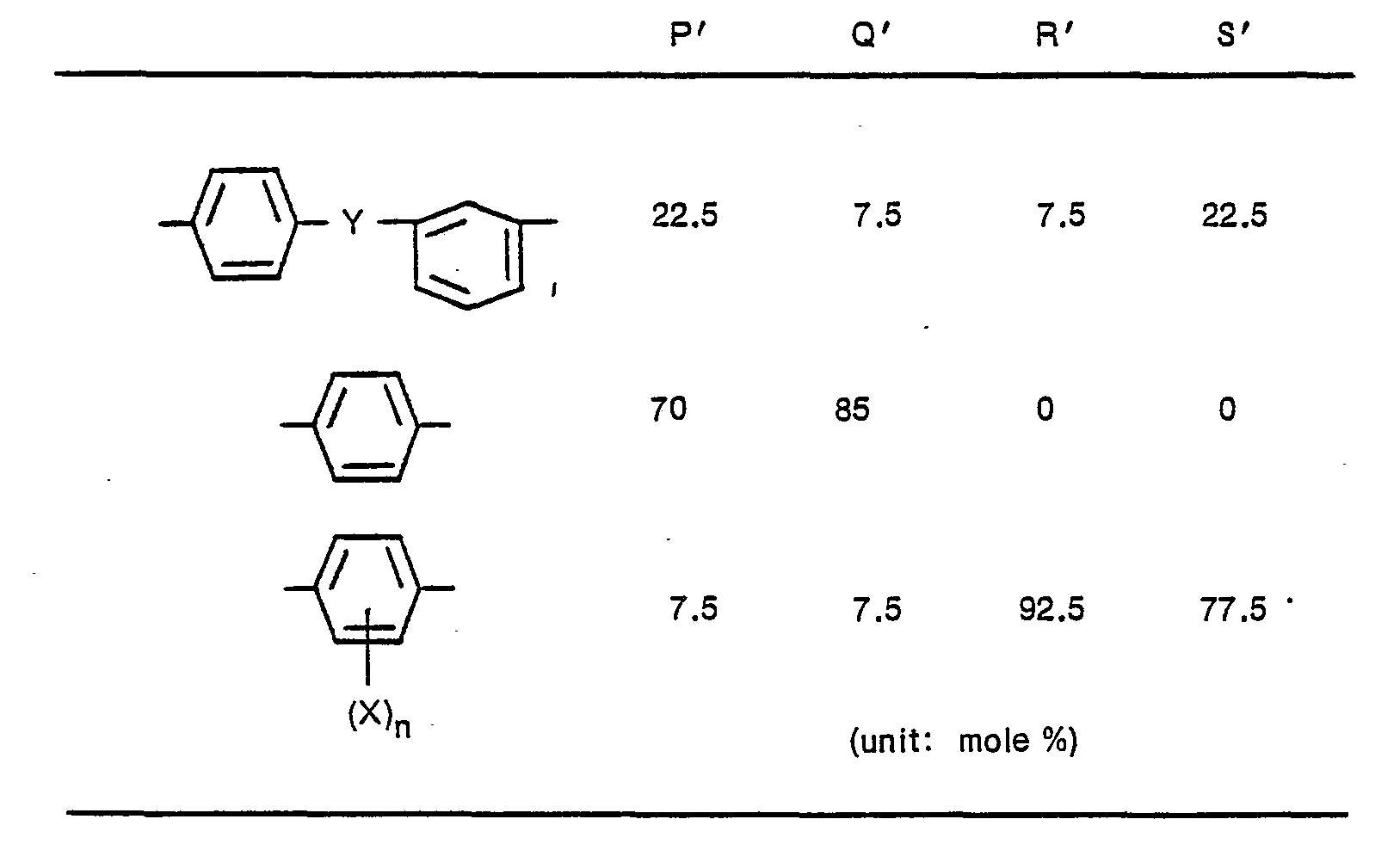
- The points P', Q', R' and S' defining a preferred copolymerization ratio are as follows.
- In the wholly aromatic polyamide used in the present invention, the kind, number and proportion of each of Ar" Ar2 and Ar3 may optionally be changed within the above-mentioned range of the composition, whereby the intended fiber or film can be obtained.
- Another important condition of the present invention is that the intrinsic viscosity of the wholly aromatic polyamide, which is a measure of the average molecular weight of the obtained polymer, should be at least 1.5 and preferably at least 2.5. The intrinsic viscosity (ninh) referred to in the present specification is a value determined by isolating a polymer from a polymerization reaction mixture or starting a spinning dope and conducting measurement on a solution containing 0.5 g of the polymer in 100 ml of concentrated sulfuric acid at 30°C. ' -―- . -Of course, minor amounts of additives such as a pigment, a delustering agent, a stabilizer and an ultra-violet absorber may be incorporated into the aromatic polyamide of the present invention.
- The wholly aromatic polyamide of the present invention having recurring units represented by the above general formula (A) and/or (B) can be prepared by any known processes, for example, the melt polymerization process, the solid phase polymerization process, the interfacial polymerization process, the solution polymerization process and combinations thereof. Among these processes, the interfacial polycondensation process (see Japanese Patent Publication No. 13,247/72), the oligomer polymerization process (Japanese Patent Publication No. 10,863/72) and the low temperature solution polymerization process (Japanese Patent Publication No. 14,399/60) are preferred, and when it is desired to obtain a polymer having a high molecular weight, the low temperature solution polymerization process is especially preferred.
- The copolymer solution to be used for shaping in the present invention can be prepared according to any of the following two methods.
- (1) A wholly aromatic polyamide prepared according to the above-mentioned process is mixed with an amide type organic polar solvent and a halide of a metal of the Group I and/or Group II of the Periodic Table and/or a hydrogen halide as a solubilizing agent at an appropriate ratio to form a shaping dope.
- (2) An aromatic diamine and an aromatic diacid chloride are polycondensed in an organic polar solvent and HCI in the obtained polymer solution is neutralized with Ca(OH)2 or the like, whereby a shaping dope is obtained without isolation of the polymer.
- As the organic polar solvent used in the present invention, there can be mentioned hexamethylphosphoramide (HMPA), N-methylpyrrolidone (NMP), N,N-dimethylacetamide (DMA), dimethylsulfoxide (DMSO), N-methyl caprolatam, N-methylpiperidine, N,N-dimethylformamide (DMF), N,N,N',N'-tetramethylurea (TMU) and mixtures thereof. Among these solvents, NMP, DMA, DMSO and mixtures thereof are preferably used.
- In order to improve the stability at high temperatures, it is preferred that a small amount of a halide of a metal of the Group I or Group II of the Periodic Table be added to a spinning solution formed by dissolving the aromatic polyamide in an organic polar solvent such as mentioned above so as to improve the solubility. Lithium chloride, calcium chloride and magnesium bromide are preferably used. These metal halides may be used either alone or in combination. When it is desired to reduce the viscosity of the solution to an appropriate level, a hydrogen halide, preferably hydrogen chloride, may be incorporated into the solution.
- In the case where a spinning dope is prepared by a re-dissolving process, it is preferred that the wholly aromatic polyamide be sufficiently finely divided prior to the re-dissolving operation. It also is preferred that a wholly aromatic polyamide having a low degree of crystallization be used. Mixing of the wholly aromatic polyamide with the above-mentioned organic polar solvent is preferably accomplished by sufficiently admixing them with each other at an appropriate temperature prior to dissolution, as disclosed in Japanese Patent Publication No. 4,461/73. After this homogeneous admixing, the mixture is heated at an appropriate temperature to promote dissolution. This appropriate heating temperature varies depending upon the chemical composition of the aromatic polyamide, the kind of solvent, the mixing ratio and the content of the above-mentioned metal halide and/or hydrogen halide, but this heating temperature is ordinarily in the range of from 0 to 150°C.
- The content of the wholly aromatic polyamide in the spinning dope is preferably in the range of from 2 to 20% by weight and especially preferably in the range of from 4 to 15% by weight, though such preferred range varies to some extent depending upon the content of the above-mentioned metal halide and/or hydrogen halide. It is preferred that the content of the halide of a metal of the Group I and/or Group II of the Periodic Table be in the range of from 0.2% to 10% by weight based on the total weight of the solution. Ordinarily, the higher is the content of the metal halide, the more improved are the solubility, the dissolution speed and the solution stability and the more increased is the viscosity of the solution. For example, if the content of the metal halide exceeds 10% by weight, the coagulating property at the spinning step tends to be degraded.
- The known wet shaping method or dry shaping method may be adopted as the shaping method.
- In the wet shaping method, a water bath or aqueous solution of an organic polar solvent, main-. tained at 0 to 100°C, may be used as a bath for coagulating the above-mentioned wholly aromatic polyamide dope. Furthermore, a lower alcohol both, an ethylene glycol bath and an aqueous bath thereof, a salt water bath or a halogenated hydrocarbon bath may be used as the coagulating bath.
- The temperature of the coagulating bath may be in the range of from 0°C to the boiling point (under atmospheric pressure) of the coagulating bath. It is preferred that the concentration of the organic polar solvent in the bath be not more than 50% by weight, especially not more than 30% by weight, based on the total weight of the bath. According to the composition of the wholly aromatic polyamide or the kind or content of the metal halide and/or hydrogen halide when such is contained in the spinning dope, it sometimes happens that reverse diffusion of the coagulating bath into the extruded filament becomes excessive to render the texture of the extruded filament brittle and the subsequent heat treatment cannot be performed smoothly. In this case, it is preferred that a coagulating bath comprising, in addition to the solvent and water, at leastone inorganic salt selected from the group consisting of lithium chloride, sodium chloride, calcium chloride, magnesium chloride, zinc chloride, strontium chloride, aluminum chloride, stannic chloride, nickel chloride, calcium bromide, calcium nitrate, zinc nitrate and aluminum nitrate be used.
- Although a preferred content of such inorganic salt varies to some extent depending upon the composition of the spinning solution, prominent effects can ordinarily be attained when the inorganic salt is incorporated in a total amount (as calculated as the anhydrous salt) of at least 2 moles in 1 liter of water.
- The foregoing inorganic salts may be used alone or in combination. Among the foregoing inorganic salts, chlorides such as magnesium chloride, calcium chloride, zinc chloride and aluminum chloride are especially preferred.
- Wet shaping can be accomplished by extruding the shaping dope into the above-mentioned coagulating bath through nozzle holes, slits, orifices or dies. There may be adopted a so-called dry-jet wet shaping method in which the shaping dope is once extruded into a gaseous medium through the above-mentioned extrusion holes or orifices and is then introduced into the coagulating bath.
- In the present invention, there may preferably be adopted a method in which an aqueous coagulating bath containing or not containing the above-mentioned inorganic salt is used as a first bath and a wet spinning method, the semi-dry semi-wet spinning method and the flow tension spinning method are preferably adopted. A flow pipe or the like may be used if necessary.
- In the present invention, there may preferably be adopted a method in which an aqueous coagulating bath containing or not containing the above-mentioned inorganic salt is used as a first bath and a water bath is used as a second bath for promoting removal of the coagulating agent and coagulation and for washing away the salt from the shaped article when the salt contained in the first bath is left on the shaped article.
- Dry shaping is accomplished by extruding the above-mentioned wholly aromatic polyamide dope into a heating atmosphere through a nozzle hole or slit die.
- The shaped article obtained by wet shaping or dry shaping is washed with water or hot water and/or an organic solvent to remove the shaping solvent, additives, reaction products, solubilizing agent and the like. Thereafter, the washed shaped article is subjected to stretching.
- The stretching temperature may appropriately be chosen after due consideration of the molecular structure of the wholly aromatic polyamide and the intended properties of the resulting shaped article. Usually, the stretching temperature may be chosen in the range of from 300 to 700°C in the case of a fiber and in the range of 95 to 700°C in the case of a film. Stretching may be performed according to the one-stage or multi-stage method, and the overall stretch ratio is at least 1.5 and ordinarily in the range of from 1.5 to 15. When the stretched shaped article is treated in an atmosphere maintained at a temperature higher than 250°C or in a solvent (or a solvent-water mixture) maintained at an appropriate temperature for several seconds to scores of minutes in the relaxed state or under slight tension, the physical properties can be improved.
- The obtained shaped article of the present invention has the following physical properties.
- The tensile modulus is at least 650 g/d, preferably at least 700 g/d and more preferably at least 750 g/d, as measured at room temperature. The tensile modulus can be raised up to approximately 2,000 g/d. Furthermore, the tensile strength is at least 18 g/d and preferably at least 20 g/d, as measured at room temperature. The tensile strength can be raised up to approximately 50 g/d.
- The tensile modulus is at least 1,800 Kg/mm2, preferably at least 2,000 Kg/mm2 and more preferably at least 2,200 Kg/mm2, as measured at room temperature. The tensile modulus can be raised up to approximately 5,000 Kg/mm2. Furthermore, the tensile strength is preferably at least 45 Kg/mm2 and more preferably at least 55 Kg/mm2.
- As will be apparent from the foregoing description, a solvent, handling of which is dangerous, such as concentrated sulfuric acid, need not be used for the spinning dope or at intermediate steps of the shaping process in the process of the present invention, and the corrosive action of concentrated sulfuric acid or the like need not be taken into account. Therefore, the intended high-tenacity wholly aromatic polyamide shaped article having a very high modulus can be prepared very easily according to the present invention.
- The shaped articles of the present invention is valuable as industrial materials such as fibers, ropes and films, especially those for which a high modulus is required. It is surprising that a modulus tenacity as high as that of a shaped article obtained by liquid crystal spinning and heat treatment of poly-(p-phenylene terephthalamide) can be manifested by virtue of the specific composition ratio of the special skeleton structure of the wholly aromatic polyamide of the present invention. It has been considered that the modulus of a random copolymer is reduced as the number of copolymerized components is increased or the copolymerization ratio of a modifying comonomer or monomers is increased. In view of this accepted concept, it would be quite surprising that such a high modulus as mentioned above can be attained according to the present invention.
- Excellent properties of the fiber of the present invention are manifested through the spinning and heat treatment steps, though complete physical elucidation has not been made. In case of a homopolymer or regular copolymer, crystallization is considerably advanced in the state of an as-spun yarn, and orientation is very difficult at the subsequent stretching step, In contrast, in case of the random copolymer constituting the fiber of the present invention, the degree of crystallization before the stretching step is low and orientation at the stretching step is very easy. This will be apparent from the actual stretching operation and from the results of measurement of various physical characteristics.
- The present invention will now be described in detail with reference to the following Examples. In the Examples, the intrinsic viscosity (q inh) was determined by isolating a polymer from a polymer solution and conducting the measurement on a polymer solution in concentrated sulfuric acid at a polymer concentration of 0.5 g/100 ml at a temperature of 30°C as described hereinbefore.
- The tensile characteristics of fibers were determined on multifilaments or monofilaments by using an "Instron" (registered Trade Mark) tester.
- . In the case of multifilaments, a specimen having a length of 5 cm was drawn at a grip separation speed of 5 cm/min, and the strength, elongation and initial modulus were obtained from a load-elongation curve. The denier of the multifilaments was determined by weighing a certain length of the sample (under a tension of 0.1 g/d).
- In the case of monofilaments, the physical properties were obtained from a load-elongation curve determined by the measurement using an Instron tester under the same conditions as described above with respect to multifilaments. The denier of the monofilaments was determined from an inherent resonance oscillation number determined by oscillating the filaments under tension while changing the oscillation number.
- The tensile characteristics of films were determined on a specimen having a width of 1 cm and a length of 10 cm by using an Instron tester at a grip separation 'speed of 10 cm/min, and physical properties were obtained from the load-elongation curve.
- In a dry nitrogen atmosphere, 11.492 g of o-chloro-p-phenylene diamine (hereinafter referred to as "CPA" for brevity) and 7.186 g'of 3,4'-diaminodiphenyi ether (hereinafter referred to as "3,4'-ODA" for brevity) were dissolved in 543.5 g of N-methyl-2-pyrrolidone (hereinafter referred to as "NMP" for brevity). The solution was maintained at 20°C and 24.310 g of a powder of terephthaloyl chloride (hereinafter referred to as "TPC" for brevity) was added to the solution under violent agitation. Then, the temperature was maintained at 60°C and agitation was continued. The viscosity was gradually increased and a transparent, highly viscous solution was obtained.
- After about 1 hour, 8.74 g of calcium hydroxide were added to the solution to neutralize hydrochloric acid formed as a by-product, whereby a highly viscous, transparent solution was obtained.
- A part of the solution was sampled and mixed with water, and the precipitated polymer was separated, washed with water and dried and the ηinh value was measured. It was found that the ninh value of the polymer was 3.44.
- The neutralized solution was filtered, deaerated and extruded into an aqueous coagulating bath through a spinneret having 5 orifices, each having a diameter of 0.3 mm, at a spinneret temperature of 120°C and an extrusion speed of 5 m/min according to the semi-dry semi-wet spinning method.
- Then, the spun fiber was sufficiently washed in a multi-staged water washing bath, dried and stretched at various hot plate temperatures indicated in Table 1. The physical properties of the stretched fibers as multifilaments were measured to obtain results shown in Table 1.

- In a dry nitrogen atmosphere, 2.226 g of p-phenylene diamine (hereinafter referred to as "PPD" for brevity), 7.338 g of CPA and 6.181 g of 3,4'-ODA were dissolved in 553.5 g of NMP, and 20.916 g of a powder of TPC were added to the solution under agitation at room temperature. The viscosity of the solution was gradually increased, and a homogeneous, transparent, highly viscous solution was obtained.
- After about 1 hour, 7.52 g of powdery calcium hydroxide were added to the solution to neutralize hydrochloric acid formed as a by-product, whereby a highly viscous, transparent solution was obtained. A part of the solution was sampled and mixed with water, and the precipitated polymer was separated, washed with water and dried. The ηinh value of the polymer was measured. It was found that the 17inh value was 3.58.
- The neutralized solution was filtered, deaerated and spun by using a spinneret having 12 orifices, each having a diameter of 0.3 mm, in the same manner as described in Example 1, and the spun fiber was stretched at a stretch ratio of 11 on a hot plate maintained at 500°C. The obtained fiber was characterized by a total filament fineness of 29.3 denier, a strength of 28.2 g/d, an elongation of 3.9% and a Young's modulus of 830 g/d.
- In a dry nitrogen atmosphere, 3.312 g of of PPD, 5.824 g of CPA and 6.133 g of 3,4'-ODA were dissolved in 542.5 g of NMP, and 20.755 g of a powder of TPC were added to the solution under agitation at room temperature. The viscosity of the solution was gradually increased and a highly viscous, transparent solution was obtained.
- After 1 hour, 7.46 g of a powdery calcium hydroxide were added to the solution to effect neutralization, whereby a highly viscous, transparent solution was obtained.
- A part of the solution was sampled and mixed with water, and the precipitated polymer was isolated, washed with water and dried. The 17inh value of the polymer was measured. It was found that the 17inh value was 3.04.
- The neutralized solution was spun by using a spinneret having 5 orifices, each having a diameter of 0.3 mm, in the same manner as described in Example 1. The spun fiber was stretched at a stretch ratio of 14.3 on a hot plate maintained at 510°C. The obtained fiber was characterized by a total filament fineness of 9.1 denier, a strength of 22.0 g/d, an elongation of 3.0% and a Young's modulus of 860 g/d.
- In a dry nitrogen atmosphere, 5.606 g of PPD, 2.218 g of CPA and 7.266 g of 3,4'-ODA were dissolved in 543.0 g of NMP, and 21.087 g of a powder of TPC were added to the solution under agitation at room temperature to obtain a homogeneous, transparent, highly viscous solution.
- After about 1 hour, 7.5 g of calcium hydroxide were added to the solution to effect neutralization, whereby a highly viscous, transparent solution was obtained. A part of the solution was sampled and mixed with water, and the precipitated polymer was isolated, washed with water and dried. The ηinh value of the polymer was measured. It was found that the ηinh value was 3.56.
- The neutralized solution was spun in the same manner as described in Example 1 and stretched at a stretch ratio of 9.5 on a hot plate maintained at 510°C. The obtained fiber was characterized by a single filament fineness of 1.69 denier, a strength of 26.4 g/d, an elongation of 3.4% and a Young's modulus of 923 g/d.
- The neutralized solution obtained in Example 4 was maintained at 120°C and was cast on a glass sheet maintained at 110°C by means of a doctor knife. The solvent was removed from the cast solution at 160°C in a hot air drier, and removal of the solvent was further conducted in a water bath maintained at room temperature to obtain a homogeneous and transparent film.
- The film was dried while keeping the length constant and was then stretched uniaxially at a stretch ratio of 3 in an atmosphere maintained at 400°C in an electric furnace by using a film tenter.
- The physical properties of the obtained film as measured in the stretching direction thereof were a strength of 61 Kg/mm2, an elongation of 8% and a Young's modulus of 1,800 Kg/mm2, and the thickness of the film was 23 microns.
Claims (9)




and the copolymerization ratio expressed by the molar ratio of the total aromatic residues of Ar,, Ar2 and Ar3 falls within the hatched region formed by connecting the following points P, Q, R and S in order, said points being defined as follows, the unit being mole %:

Applications Claiming Priority (2)
| Application Number | Priority Date | Filing Date | Title |
|---|---|---|---|
| JP10774980A JPS5734125A (en) | 1980-08-07 | 1980-08-07 | Fully aromatic polyamide fiber and film and their production |
| JP107749/80 | 1980-08-07 |
Publications (2)
| Publication Number | Publication Date |
|---|---|
| EP0045934A1 EP0045934A1 (en) | 1982-02-17 |
| EP0045934B1 true EP0045934B1 (en) | 1984-12-05 |
Family
ID=14466988
Family Applications (1)
| Application Number | Title | Priority Date | Filing Date |
|---|---|---|---|
| EP81106088A Expired EP0045934B1 (en) | 1980-08-07 | 1981-08-04 | Wholly aromatic polyamide fiber and film and process for preparation thereof |
Country Status (4)
| Country | Link |
|---|---|
| US (1) | US4507467A (en) |
| EP (1) | EP0045934B1 (en) |
| JP (1) | JPS5734125A (en) |
| DE (1) | DE3167607D1 (en) |
Families Citing this family (21)
| Publication number | Priority date | Publication date | Assignee | Title |
|---|---|---|---|---|
| US4758651A (en) * | 1986-03-19 | 1988-07-19 | Akzo Nv | Amorphous aromatic copolyamide, a process for the preparation thereof, and shaped object |
| ZA873833B (en) * | 1986-05-30 | 1989-01-25 | Du Pont | High modulus poly-p-phenylene terephthalamide fiber |
| US4883634A (en) * | 1986-05-30 | 1989-11-28 | E. I. Du Pont De Nemours And Company | Process for manufacturing a high modulus poly-p-phenylene terephthalamide fiber |
| US4914180A (en) * | 1988-09-30 | 1990-04-03 | Hoechst Celanese Corporation | Polyamides prepared from 2-(3-aminophenyl)-2-(4-aminophenyl) hexafluoro propane |
| US4980446A (en) * | 1989-03-16 | 1990-12-25 | E. I. Du Pont De Nemours And Company | Melt-processible aromatic containing copolyamide from 3,4'-bis (amino phenyl)ether |
| US5459231A (en) * | 1990-03-30 | 1995-10-17 | E. I. Du Pont De Nemours And Company | Drawable high tensile strength aramids |
| DE4138872B4 (en) * | 1990-03-30 | 2005-12-29 | E.I. Du Pont De Nemours And Co., Wilmington | Stretchable aramids of high tensile strength |
| US5266672A (en) * | 1991-07-02 | 1993-11-30 | Hoechst Aktiengesellschaft | Aromatic copolyaide from diamino benzanilide |
| US5346985A (en) * | 1991-09-30 | 1994-09-13 | E. I. Du Pont De Nemours And Company | Drawable high tensile strength aramids |
| JPH0641305A (en) * | 1991-10-25 | 1994-02-15 | Internatl Business Mach Corp <Ibm> | Polyamic acid and polyimide from fluorinated reactant |
| US5310861A (en) * | 1992-06-19 | 1994-05-10 | E. I. Du Pont De Nemours And Company | Drawable high tensile strength aramids |
| DE4241509B4 (en) * | 1992-12-10 | 2007-04-26 | E.I. Dupont De Nemours And Co., Wilmington | Stretchable aramids of high tensile strength |
| DE4334004A1 (en) * | 1993-10-06 | 1995-04-13 | Hoechst Ag | Aramid fibers of high strength and high titer, process for their production and their use |
| US5543492A (en) * | 1995-03-06 | 1996-08-06 | E. I. Du Pont De Nemours And Company | Hydrolysis-resistant aramids |
| KR0171994B1 (en) * | 1995-07-13 | 1999-03-30 | 구광시 | Aromatic polyamide, optical anisotropic dope, and its composition and its preparation process |
| RU2163609C1 (en) * | 2000-05-30 | 2001-02-27 | Иванов Владимир Михайлович | Method of synthesis of poly-para-phenyleneterephthalamide and its copolymers |
| DE60336140D1 (en) * | 2002-06-27 | 2011-04-07 | Teijin Aramid Bv | METHOD FOR PRODUCING SYNTHETIC ORGANIC FIBERS HAVING A HIGH STRENGTH AND / OR A HIGH MODULE FROM AROMATIC HETEROCYCLIC STIFF POLYMERS |
| CN101876092B (en) * | 2010-07-16 | 2012-07-04 | 四川辉腾科技有限公司 | Method for producing polymetaphenylene isophthamide spinning solution |
| KR101596065B1 (en) * | 2011-04-08 | 2016-02-29 | 코오롱인더스트리 주식회사 | Composition for Aramid and Aramid Product Manufactured Using The Same |
| US9278495B2 (en) | 2011-08-03 | 2016-03-08 | Milliken & Company | Rubber reinforced article with high modulus, rectangular cross-section fibers |
| US9267566B2 (en) | 2012-01-17 | 2016-02-23 | Milliken & Company | Polyester/nylon 6 fibers for rubber reinforcement |
Family Cites Families (4)
| Publication number | Priority date | Publication date | Assignee | Title |
|---|---|---|---|---|
| US3817941A (en) * | 1967-12-27 | 1974-06-18 | Du Pont | Wholly aromatic carbocyclic poly-carbonamide fiber having initial modulus in excess of 170 gpd and orientation angle of up to 40 grad |
| AU500143B2 (en) * | 1974-12-27 | 1979-05-10 | Teijin Ltd | Fiber or film-forming copolyamide |
| DE2554932A1 (en) * | 1975-12-06 | 1977-06-08 | Bayer Ag | SEMIPERMEABLE MEMBRANES MADE OF COPOLYAMIDES |
| JPS55115428A (en) * | 1979-02-26 | 1980-09-05 | Teijin Ltd | Aromatic compolyamide and preparation thereof |
-
1980
- 1980-08-07 JP JP10774980A patent/JPS5734125A/en active Granted
-
1981
- 1981-08-04 DE DE8181106088T patent/DE3167607D1/en not_active Expired
- 1981-08-04 EP EP81106088A patent/EP0045934B1/en not_active Expired
-
1983
- 1983-08-29 US US06/527,377 patent/US4507467A/en not_active Expired - Lifetime
Also Published As
| Publication number | Publication date |
|---|---|
| US4507467A (en) | 1985-03-26 |
| DE3167607D1 (en) | 1985-01-17 |
| JPH0134254B2 (en) | 1989-07-18 |
| JPS5734125A (en) | 1982-02-24 |
| EP0045934A1 (en) | 1982-02-17 |
Similar Documents
| Publication | Publication Date | Title |
|---|---|---|
| US4507467A (en) | Wholly aromatic halogenated polyamide fiber and film | |
| CA1070447A (en) | Aromatic copolyamides shaped articles therefrom and processes for producing said copolyamides and shaped articles | |
| US6569987B1 (en) | Process for producing meta-aromatic polyamide fiber | |
| US5646234A (en) | Production of fibers or films using specific forming solutions and the fibers of films obtainable thereby | |
| JPS6139976B2 (en) | ||
| WO2001061086A1 (en) | Meta-form wholly aromatic polyamide fiber and process for producing the same | |
| KR0171994B1 (en) | Aromatic polyamide, optical anisotropic dope, and its composition and its preparation process | |
| US5643518A (en) | Process for preparing fibers of soluble wholly aromatic polyamides | |
| EP0011785B1 (en) | Aromatic polyamide composition and processes for preparing film and fiber therefrom | |
| JPH0874123A (en) | Method for producing meta-aramid fiber | |
| EP0426049B1 (en) | Wholly aromatic copolyamide and shaped article thereof | |
| EP0441338B1 (en) | Wholly aromatic polyamide | |
| US5003036A (en) | Yarn with improved hydrolytic stability from aromatic polyamide comprising chloroterephthalamide units | |
| US3801528A (en) | Novel polymers and dopes of aromatic polyamides containing a stilbene radical | |
| EP0553755B1 (en) | Fibres of an aromatic copolyamide and their use | |
| US5128440A (en) | Wholly aromatic polyamide from alkylsulfonyl aromatic diamine | |
| JPH0680775A (en) | Preparation of m-aramid for fiber formation | |
| EP0553756B1 (en) | Aromatic copolyamides, process for their preparation and molded articles therefrom | |
| JP2996867B2 (en) | Method for producing wholly aromatic polyamide molded article | |
| JP2001114889A (en) | Method for producing meta-type aromatic polyamide solution | |
| JPH05125183A (en) | Copolyamide and its production | |
| US5037596A (en) | Process for making fibers with improved hydrolytic stability | |
| JPH0617310A (en) | Preparation of fiber from meta-aramide | |
| JPH04337324A (en) | Aromatic copolyamide and its manufacture | |
| KR910004707B1 (en) | Production process of aromatic polyamide fibers |
Legal Events
| Date | Code | Title | Description |
|---|---|---|---|
| PUAI | Public reference made under article 153(3) epc to a published international application that has entered the european phase |
Free format text: ORIGINAL CODE: 0009012 |
|
| AK | Designated contracting states |
Designated state(s): DE FR GB NL |
|
| 17P | Request for examination filed |
Effective date: 19820420 |
|
| RBV | Designated contracting states (corrected) |
Designated state(s): DE GB NL |
|
| GRAA | (expected) grant |
Free format text: ORIGINAL CODE: 0009210 |
|
| AK | Designated contracting states |
Designated state(s): DE GB NL |
|
| REF | Corresponds to: |
Ref document number: 3167607 Country of ref document: DE Date of ref document: 19850117 |
|
| PLBE | No opposition filed within time limit |
Free format text: ORIGINAL CODE: 0009261 |
|
| STAA | Information on the status of an ep patent application or granted ep patent |
Free format text: STATUS: NO OPPOSITION FILED WITHIN TIME LIMIT |
|
| 26N | No opposition filed | ||
| PGFP | Annual fee paid to national office [announced via postgrant information from national office to epo] |
Ref country code: GB Payment date: 19980624 Year of fee payment: 18 |
|
| PGFP | Annual fee paid to national office [announced via postgrant information from national office to epo] |
Ref country code: NL Payment date: 19980730 Year of fee payment: 18 |
|
| PGFP | Annual fee paid to national office [announced via postgrant information from national office to epo] |
Ref country code: DE Payment date: 19980930 Year of fee payment: 18 |
|
| PG25 | Lapsed in a contracting state [announced via postgrant information from national office to epo] |
Ref country code: GB Free format text: LAPSE BECAUSE OF NON-PAYMENT OF DUE FEES Effective date: 19990804 |
|
| PG25 | Lapsed in a contracting state [announced via postgrant information from national office to epo] |
Ref country code: NL Free format text: LAPSE BECAUSE OF NON-PAYMENT OF DUE FEES Effective date: 20000301 |
|
| GBPC | Gb: european patent ceased through non-payment of renewal fee |
Effective date: 19990804 |
|
| NLV4 | Nl: lapsed or anulled due to non-payment of the annual fee |
Effective date: 20000301 |
|
| PG25 | Lapsed in a contracting state [announced via postgrant information from national office to epo] |
Ref country code: DE Free format text: LAPSE BECAUSE OF NON-PAYMENT OF DUE FEES Effective date: 20000601 |