EP0045717B1 - New cephalosporin derivatives, their production and their use - Google Patents
New cephalosporin derivatives, their production and their use Download PDFInfo
- Publication number
- EP0045717B1 EP0045717B1 EP81810288A EP81810288A EP0045717B1 EP 0045717 B1 EP0045717 B1 EP 0045717B1 EP 81810288 A EP81810288 A EP 81810288A EP 81810288 A EP81810288 A EP 81810288A EP 0045717 B1 EP0045717 B1 EP 0045717B1
- Authority
- EP
- European Patent Office
- Prior art keywords
- compound
- formula
- methyl
- vinyl
- diethoxycarbonyl
- Prior art date
- Legal status (The legal status is an assumption and is not a legal conclusion. Google has not performed a legal analysis and makes no representation as to the accuracy of the status listed.)
- Expired
Links
- 238000004519 manufacturing process Methods 0.000 title claims abstract description 8
- 229930186147 Cephalosporin Natural products 0.000 title description 7
- 229940124587 cephalosporin Drugs 0.000 title description 7
- 150000001780 cephalosporins Chemical class 0.000 title description 7
- 150000001875 compounds Chemical class 0.000 claims description 60
- 238000000034 method Methods 0.000 claims description 40
- -1 1-methyl-1,2,3,4-tetrazol-5-yl Chemical group 0.000 claims description 25
- 125000000391 vinyl group Chemical group [H]C([*])=C([H])[H] 0.000 claims description 25
- 229920002554 vinyl polymer Polymers 0.000 claims description 25
- 229910052739 hydrogen Inorganic materials 0.000 claims description 19
- 239000001257 hydrogen Substances 0.000 claims description 19
- 125000000066 S-methyl group Chemical group [H]C([H])([H])S* 0.000 claims description 17
- 125000001589 carboacyl group Chemical group 0.000 claims description 12
- IKWLIQXIPRUIDU-ZCFIWIBFSA-N (6r)-8-oxo-5-thia-1-azabicyclo[4.2.0]oct-2-ene-2-carboxylic acid Chemical compound OC(=O)C1=CCS[C@@H]2CC(=O)N12 IKWLIQXIPRUIDU-ZCFIWIBFSA-N 0.000 claims description 9
- 150000003839 salts Chemical class 0.000 claims description 9
- 150000002431 hydrogen Chemical class 0.000 claims description 8
- UFHFLCQGNIYNRP-UHFFFAOYSA-N Hydrogen Chemical compound [H][H] UFHFLCQGNIYNRP-UHFFFAOYSA-N 0.000 claims description 7
- 125000004453 alkoxycarbonyl group Chemical group 0.000 claims description 7
- 125000004093 cyano group Chemical group *C#N 0.000 claims description 7
- 150000002148 esters Chemical class 0.000 claims description 7
- 125000000449 nitro group Chemical group [O-][N+](*)=O 0.000 claims description 7
- 125000003277 amino group Chemical group 0.000 claims description 5
- 125000000623 heterocyclic group Chemical group 0.000 claims description 5
- QAOWNCQODCNURD-UHFFFAOYSA-N Sulfuric acid Chemical compound OS(O)(=O)=O QAOWNCQODCNURD-UHFFFAOYSA-N 0.000 claims description 4
- 125000004435 hydrogen atom Chemical group [H]* 0.000 claims description 4
- 239000001117 sulphuric acid Substances 0.000 claims description 4
- 235000011149 sulphuric acid Nutrition 0.000 claims description 4
- 125000002924 primary amino group Chemical group [H]N([H])* 0.000 claims description 3
- 125000004190 benzothiazol-2-yl group Chemical group [H]C1=C([H])C([H])=C2N=C(*)SC2=C1[H] 0.000 claims description 2
- 125000002887 hydroxy group Chemical group [H]O* 0.000 claims description 2
- 125000000956 methoxy group Chemical group [H]C([H])([H])O* 0.000 claims description 2
- 125000004178 (C1-C4) alkyl group Chemical group 0.000 claims 1
- HOKIDJSKDBPKTQ-GLXFQSAKSA-N cephalosporin C Chemical compound S1CC(COC(=O)C)=C(C(O)=O)N2C(=O)[C@@H](NC(=O)CCC[C@@H](N)C(O)=O)[C@@H]12 HOKIDJSKDBPKTQ-GLXFQSAKSA-N 0.000 abstract description 35
- 230000020176 deacylation Effects 0.000 abstract description 12
- 238000005947 deacylation reaction Methods 0.000 abstract description 12
- HSHGZXNAXBPPDL-HZGVNTEJSA-N 7beta-aminocephalosporanic acid Chemical class S1CC(COC(=O)C)=C(C([O-])=O)N2C(=O)[C@@H]([NH3+])[C@@H]12 HSHGZXNAXBPPDL-HZGVNTEJSA-N 0.000 abstract description 8
- 239000002253 acid Substances 0.000 abstract description 6
- 150000007513 acids Chemical class 0.000 abstract description 2
- CSCPPACGZOOCGX-UHFFFAOYSA-N Acetone Chemical compound CC(C)=O CSCPPACGZOOCGX-UHFFFAOYSA-N 0.000 description 44
- OKKJLVBELUTLKV-UHFFFAOYSA-N Methanol Chemical compound OC OKKJLVBELUTLKV-UHFFFAOYSA-N 0.000 description 30
- 239000000243 solution Substances 0.000 description 26
- 239000000203 mixture Substances 0.000 description 19
- XLYOFNOQVPJJNP-UHFFFAOYSA-N water Substances O XLYOFNOQVPJJNP-UHFFFAOYSA-N 0.000 description 19
- XEKOWRVHYACXOJ-UHFFFAOYSA-N Ethyl acetate Chemical compound CCOC(C)=O XEKOWRVHYACXOJ-UHFFFAOYSA-N 0.000 description 18
- HEMHJVSKTPXQMS-UHFFFAOYSA-M Sodium hydroxide Chemical compound [OH-].[Na+] HEMHJVSKTPXQMS-UHFFFAOYSA-M 0.000 description 15
- 239000002244 precipitate Substances 0.000 description 14
- YMWUJEATGCHHMB-UHFFFAOYSA-N Dichloromethane Chemical compound ClCCl YMWUJEATGCHHMB-UHFFFAOYSA-N 0.000 description 11
- 239000000047 product Substances 0.000 description 10
- 159000000000 sodium salts Chemical group 0.000 description 9
- 239000002904 solvent Substances 0.000 description 9
- UBOXGVDOUJQMTN-UHFFFAOYSA-N 1,1,2-trichloroethane Chemical compound ClCC(Cl)Cl UBOXGVDOUJQMTN-UHFFFAOYSA-N 0.000 description 7
- 125000000217 alkyl group Chemical group 0.000 description 7
- 238000006243 chemical reaction Methods 0.000 description 7
- 125000002496 methyl group Chemical group [H]C([H])([H])* 0.000 description 7
- 239000000706 filtrate Substances 0.000 description 6
- UHZYTMXLRWXGPK-UHFFFAOYSA-N phosphorus pentachloride Chemical compound ClP(Cl)(Cl)(Cl)Cl UHZYTMXLRWXGPK-UHFFFAOYSA-N 0.000 description 6
- BWHMMNNQKKPAPP-UHFFFAOYSA-L potassium carbonate Chemical compound [K+].[K+].[O-]C([O-])=O BWHMMNNQKKPAPP-UHFFFAOYSA-L 0.000 description 6
- 239000000843 powder Substances 0.000 description 6
- XOHZHMUQBFJTNH-UHFFFAOYSA-N 1-methyl-2h-tetrazole-5-thione Chemical compound CN1N=NN=C1S XOHZHMUQBFJTNH-UHFFFAOYSA-N 0.000 description 5
- NTIZESTWPVYFNL-UHFFFAOYSA-N Methyl isobutyl ketone Chemical compound CC(C)CC(C)=O NTIZESTWPVYFNL-UHFFFAOYSA-N 0.000 description 5
- JLTDJTHDQAWBAV-UHFFFAOYSA-N N,N-dimethylaniline Chemical compound CN(C)C1=CC=CC=C1 JLTDJTHDQAWBAV-UHFFFAOYSA-N 0.000 description 5
- 238000001816 cooling Methods 0.000 description 5
- LIKFHECYJZWXFJ-UHFFFAOYSA-N dimethyldichlorosilane Chemical compound C[Si](C)(Cl)Cl LIKFHECYJZWXFJ-UHFFFAOYSA-N 0.000 description 5
- ODUCDPQEXGNKDN-UHFFFAOYSA-N nitroxyl Chemical compound O=N ODUCDPQEXGNKDN-UHFFFAOYSA-N 0.000 description 5
- 150000003254 radicals Chemical class 0.000 description 5
- 238000003756 stirring Methods 0.000 description 5
- QPFMBZIOSGYJDE-UHFFFAOYSA-N 1,1,2,2-tetrachloroethane Chemical compound ClC(Cl)C(Cl)Cl QPFMBZIOSGYJDE-UHFFFAOYSA-N 0.000 description 4
- QGZKDVFQNNGYKY-UHFFFAOYSA-N Ammonia Chemical compound N QGZKDVFQNNGYKY-UHFFFAOYSA-N 0.000 description 4
- DGAQECJNVWCQMB-PUAWFVPOSA-M Ilexoside XXIX Chemical compound C[C@@H]1CC[C@@]2(CC[C@@]3(C(=CC[C@H]4[C@]3(CC[C@@H]5[C@@]4(CC[C@@H](C5(C)C)OS(=O)(=O)[O-])C)C)[C@@H]2[C@]1(C)O)C)C(=O)O[C@H]6[C@@H]([C@H]([C@@H]([C@H](O6)CO)O)O)O.[Na+] DGAQECJNVWCQMB-PUAWFVPOSA-M 0.000 description 4
- LRHPLDYGYMQRHN-UHFFFAOYSA-N N-Butanol Chemical compound CCCCO LRHPLDYGYMQRHN-UHFFFAOYSA-N 0.000 description 4
- JUJWROOIHBZHMG-UHFFFAOYSA-N Pyridine Chemical compound C1=CC=NC=C1 JUJWROOIHBZHMG-UHFFFAOYSA-N 0.000 description 4
- UIIMBOGNXHQVGW-UHFFFAOYSA-M Sodium bicarbonate Chemical compound [Na+].OC([O-])=O UIIMBOGNXHQVGW-UHFFFAOYSA-M 0.000 description 4
- 239000006071 cream Substances 0.000 description 4
- RAXXELZNTBOGNW-UHFFFAOYSA-N imidazole Natural products C1=CNC=N1 RAXXELZNTBOGNW-UHFFFAOYSA-N 0.000 description 4
- LQNUZADURLCDLV-UHFFFAOYSA-N nitrobenzene Chemical compound [O-][N+](=O)C1=CC=CC=C1 LQNUZADURLCDLV-UHFFFAOYSA-N 0.000 description 4
- 239000000376 reactant Substances 0.000 description 4
- 239000011734 sodium Substances 0.000 description 4
- 229910052708 sodium Inorganic materials 0.000 description 4
- XUTQHTOXGKVJPN-XCGJVMPOSA-N (6r)-7-amino-3-[(1-methyltetrazol-5-yl)sulfanylmethyl]-8-oxo-5-thia-1-azabicyclo[4.2.0]oct-2-ene-2-carboxylic acid Chemical compound CN1N=NN=C1SCC1=C(C(O)=O)N2C(=O)C(N)[C@H]2SC1 XUTQHTOXGKVJPN-XCGJVMPOSA-N 0.000 description 3
- 238000005160 1H NMR spectroscopy Methods 0.000 description 3
- WEVYAHXRMPXWCK-UHFFFAOYSA-N Acetonitrile Chemical compound CC#N WEVYAHXRMPXWCK-UHFFFAOYSA-N 0.000 description 3
- VHUUQVKOLVNVRT-UHFFFAOYSA-N Ammonium hydroxide Chemical compound [NH4+].[OH-] VHUUQVKOLVNVRT-UHFFFAOYSA-N 0.000 description 3
- ZAFNJMIOTHYJRJ-UHFFFAOYSA-N Diisopropyl ether Chemical compound CC(C)OC(C)C ZAFNJMIOTHYJRJ-UHFFFAOYSA-N 0.000 description 3
- LFQSCWFLJHTTHZ-UHFFFAOYSA-N Ethanol Chemical compound CCO LFQSCWFLJHTTHZ-UHFFFAOYSA-N 0.000 description 3
- UIHCLUNTQKBZGK-UHFFFAOYSA-N Methyl isobutyl ketone Natural products CCC(C)C(C)=O UIHCLUNTQKBZGK-UHFFFAOYSA-N 0.000 description 3
- 229910052783 alkali metal Inorganic materials 0.000 description 3
- 235000011114 ammonium hydroxide Nutrition 0.000 description 3
- 239000012043 crude product Substances 0.000 description 3
- SHZIWNPUGXLXDT-UHFFFAOYSA-N ethyl hexanoate Chemical compound CCCCCC(=O)OCC SHZIWNPUGXLXDT-UHFFFAOYSA-N 0.000 description 3
- 238000000855 fermentation Methods 0.000 description 3
- 230000004151 fermentation Effects 0.000 description 3
- 238000001914 filtration Methods 0.000 description 3
- 229940043265 methyl isobutyl ketone Drugs 0.000 description 3
- 229910000027 potassium carbonate Inorganic materials 0.000 description 3
- HZWLVUKHUSRPCG-OOARYINLSA-M sodium;(6r,7r)-3-(acetyloxymethyl)-7-[[(5r)-5-azaniumyl-5-carboxylatopentanoyl]amino]-8-oxo-5-thia-1-azabicyclo[4.2.0]oct-2-ene-2-carboxylate Chemical class [Na+].S1CC(COC(=O)C)=C(C([O-])=O)N2C(=O)[C@@H](NC(=O)CCC[C@@H]([NH3+])C([O-])=O)[C@@H]12 HZWLVUKHUSRPCG-OOARYINLSA-M 0.000 description 3
- 239000007858 starting material Substances 0.000 description 3
- YXIWHUQXZSMYRE-UHFFFAOYSA-N 1,3-benzothiazole-2-thiol Chemical compound C1=CC=C2SC(S)=NC2=C1 YXIWHUQXZSMYRE-UHFFFAOYSA-N 0.000 description 2
- ITTXGKOHFZJUEX-UHFFFAOYSA-N 3-(ethoxymethylidene)pentane-2,4-dione Chemical compound CCOC=C(C(C)=O)C(C)=O ITTXGKOHFZJUEX-UHFFFAOYSA-N 0.000 description 2
- KDCGOANMDULRCW-UHFFFAOYSA-N 7H-purine Chemical compound N1=CNC2=NC=NC2=C1 KDCGOANMDULRCW-UHFFFAOYSA-N 0.000 description 2
- 0 C*N[C@@](*)(C1SCC(*)=C(*)N11)C1=O Chemical compound C*N[C@@](*)(C1SCC(*)=C(*)N11)C1=O 0.000 description 2
- CURLTUGMZLYLDI-UHFFFAOYSA-N Carbon dioxide Chemical compound O=C=O CURLTUGMZLYLDI-UHFFFAOYSA-N 0.000 description 2
- HEDRZPFGACZZDS-UHFFFAOYSA-N Chloroform Chemical compound ClC(Cl)Cl HEDRZPFGACZZDS-UHFFFAOYSA-N 0.000 description 2
- 238000005481 NMR spectroscopy Methods 0.000 description 2
- KYQCOXFCLRTKLS-UHFFFAOYSA-N Pyrazine Chemical compound C1=CN=CC=N1 KYQCOXFCLRTKLS-UHFFFAOYSA-N 0.000 description 2
- KAESVJOAVNADME-UHFFFAOYSA-N Pyrrole Chemical compound C=1C=CNC=1 KAESVJOAVNADME-UHFFFAOYSA-N 0.000 description 2
- SMWDFEZZVXVKRB-UHFFFAOYSA-N Quinoline Chemical compound N1=CC=CC2=CC=CC=C21 SMWDFEZZVXVKRB-UHFFFAOYSA-N 0.000 description 2
- 229910021529 ammonia Inorganic materials 0.000 description 2
- 239000000908 ammonium hydroxide Substances 0.000 description 2
- 239000003242 anti bacterial agent Substances 0.000 description 2
- 229940088710 antibiotic agent Drugs 0.000 description 2
- 239000012736 aqueous medium Substances 0.000 description 2
- 239000008346 aqueous phase Substances 0.000 description 2
- IOJUPLGTWVMSFF-UHFFFAOYSA-N benzothiazole Chemical compound C1=CC=C2SC=NC2=C1 IOJUPLGTWVMSFF-UHFFFAOYSA-N 0.000 description 2
- 230000015572 biosynthetic process Effects 0.000 description 2
- MVPPADPHJFYWMZ-UHFFFAOYSA-N chlorobenzene Chemical compound ClC1=CC=CC=C1 MVPPADPHJFYWMZ-UHFFFAOYSA-N 0.000 description 2
- 238000004587 chromatography analysis Methods 0.000 description 2
- JHIVVAPYMSGYDF-UHFFFAOYSA-N cyclohexanone Chemical compound O=C1CCCCC1 JHIVVAPYMSGYDF-UHFFFAOYSA-N 0.000 description 2
- 238000001704 evaporation Methods 0.000 description 2
- 230000008020 evaporation Effects 0.000 description 2
- 150000002391 heterocyclic compounds Chemical class 0.000 description 2
- 230000007062 hydrolysis Effects 0.000 description 2
- 238000006460 hydrolysis reaction Methods 0.000 description 2
- 239000000543 intermediate Substances 0.000 description 2
- 239000000463 material Substances 0.000 description 2
- MCSAJNNLRCFZED-UHFFFAOYSA-N nitroethane Chemical compound CC[N+]([O-])=O MCSAJNNLRCFZED-UHFFFAOYSA-N 0.000 description 2
- LYGJENNIWJXYER-UHFFFAOYSA-N nitromethane Chemical compound C[N+]([O-])=O LYGJENNIWJXYER-UHFFFAOYSA-N 0.000 description 2
- 239000012074 organic phase Substances 0.000 description 2
- 239000003791 organic solvent mixture Substances 0.000 description 2
- 239000012071 phase Substances 0.000 description 2
- 125000001997 phenyl group Chemical group [H]C1=C([H])C([H])=C(*)C([H])=C1[H] 0.000 description 2
- PBMFSQRYOILNGV-UHFFFAOYSA-N pyridazine Chemical compound C1=CC=NN=C1 PBMFSQRYOILNGV-UHFFFAOYSA-N 0.000 description 2
- 239000011541 reaction mixture Substances 0.000 description 2
- 229910000030 sodium bicarbonate Inorganic materials 0.000 description 2
- 235000017557 sodium bicarbonate Nutrition 0.000 description 2
- 239000011343 solid material Substances 0.000 description 2
- LMBFAGIMSUYTBN-MPZNNTNKSA-N teixobactin Chemical compound C([C@H](C(=O)N[C@@H]([C@@H](C)CC)C(=O)N[C@@H](CO)C(=O)N[C@H](CCC(N)=O)C(=O)N[C@H]([C@@H](C)CC)C(=O)N[C@@H]([C@@H](C)CC)C(=O)N[C@@H](CO)C(=O)N[C@H]1C(N[C@@H](C)C(=O)N[C@@H](C[C@@H]2NC(=N)NC2)C(=O)N[C@H](C(=O)O[C@H]1C)[C@@H](C)CC)=O)NC)C1=CC=CC=C1 LMBFAGIMSUYTBN-MPZNNTNKSA-N 0.000 description 2
- VZGDMQKNWNREIO-UHFFFAOYSA-N tetrachloromethane Chemical compound ClC(Cl)(Cl)Cl VZGDMQKNWNREIO-UHFFFAOYSA-N 0.000 description 2
- VMLVYIHCFRPOJZ-JLOHTSLTSA-N (6r)-7-amino-3-(1,3-benzothiazol-2-ylsulfanylmethyl)-8-oxo-5-thia-1-azabicyclo[4.2.0]oct-2-ene-2-carboxylic acid Chemical compound C1=CC=C2SC(SCC=3CS[C@@H]4C(C(N4C=3C(O)=O)=O)N)=NC2=C1 VMLVYIHCFRPOJZ-JLOHTSLTSA-N 0.000 description 1
- YTUNICCSPPTMJY-URYLQHRCSA-N (6r)-7-amino-3-[(2-methyl-5,6-dioxo-1h-1,2,4-triazin-3-yl)sulfanylmethyl]-8-oxo-5-thia-1-azabicyclo[4.2.0]oct-2-ene-2-carboxylic acid Chemical compound CN1NC(=O)C(=O)N=C1SCC1=C(C(O)=O)N2C(=O)C(N)[C@H]2SC1 YTUNICCSPPTMJY-URYLQHRCSA-N 0.000 description 1
- UGUHFDPGDQDVGX-UHFFFAOYSA-N 1,2,3-thiadiazole Chemical compound C1=CSN=N1 UGUHFDPGDQDVGX-UHFFFAOYSA-N 0.000 description 1
- HTJMXYRLEDBSLT-UHFFFAOYSA-N 1,2,4,5-tetrazine Chemical compound C1=NN=CN=N1 HTJMXYRLEDBSLT-UHFFFAOYSA-N 0.000 description 1
- BBVIDBNAYOIXOE-UHFFFAOYSA-N 1,2,4-oxadiazole Chemical compound C=1N=CON=1 BBVIDBNAYOIXOE-UHFFFAOYSA-N 0.000 description 1
- YGTAZGSLCXNBQL-UHFFFAOYSA-N 1,2,4-thiadiazole Chemical compound C=1N=CSN=1 YGTAZGSLCXNBQL-UHFFFAOYSA-N 0.000 description 1
- UDGKZGLPXCRRAM-UHFFFAOYSA-N 1,2,5-thiadiazole Chemical compound C=1C=NSN=1 UDGKZGLPXCRRAM-UHFFFAOYSA-N 0.000 description 1
- WSLDOOZREJYCGB-UHFFFAOYSA-N 1,2-Dichloroethane Chemical compound ClCCCl WSLDOOZREJYCGB-UHFFFAOYSA-N 0.000 description 1
- MBIZXFATKUQOOA-UHFFFAOYSA-N 1,3,4-thiadiazole Chemical compound C1=NN=CS1 MBIZXFATKUQOOA-UHFFFAOYSA-N 0.000 description 1
- RYHBNJHYFVUHQT-UHFFFAOYSA-N 1,4-Dioxane Chemical compound C1COCCO1 RYHBNJHYFVUHQT-UHFFFAOYSA-N 0.000 description 1
- OCJBOOLMMGQPQU-UHFFFAOYSA-N 1,4-dichlorobenzene Chemical compound ClC1=CC=C(Cl)C=C1 OCJBOOLMMGQPQU-UHFFFAOYSA-N 0.000 description 1
- QWENRTYMTSOGBR-UHFFFAOYSA-N 1H-1,2,3-Triazole Chemical compound C=1C=NNN=1 QWENRTYMTSOGBR-UHFFFAOYSA-N 0.000 description 1
- HYZJCKYKOHLVJF-UHFFFAOYSA-N 1H-benzimidazole Chemical compound C1=CC=C2NC=NC2=C1 HYZJCKYKOHLVJF-UHFFFAOYSA-N 0.000 description 1
- YMRIDJQAEZFTSC-UHFFFAOYSA-N 2,3-dihydro-1h-tetrazole Chemical compound N1NC=NN1 YMRIDJQAEZFTSC-UHFFFAOYSA-N 0.000 description 1
- CYDMWODXMKXBAB-UHFFFAOYSA-N 2-(1,3,4-thiadiazol-2-yl)acetamide Chemical compound NC(=O)CC1=NN=CS1 CYDMWODXMKXBAB-UHFFFAOYSA-N 0.000 description 1
- OBTZDIRUQWFRFZ-UHFFFAOYSA-N 2-(5-methylfuran-2-yl)-n-(4-methylphenyl)quinoline-4-carboxamide Chemical compound O1C(C)=CC=C1C1=CC(C(=O)NC=2C=CC(C)=CC=2)=C(C=CC=C2)C2=N1 OBTZDIRUQWFRFZ-UHFFFAOYSA-N 0.000 description 1
- UMWWHOXOVPIGFD-UHFFFAOYSA-N 2-methyl-3-sulfanylidene-1,2,4-triazinane-5,6-dione Chemical compound CN1NC(=O)C(=O)N=C1S UMWWHOXOVPIGFD-UHFFFAOYSA-N 0.000 description 1
- NSPMIYGKQJPBQR-UHFFFAOYSA-N 4H-1,2,4-triazole Chemical compound C=1N=CNN=1 NSPMIYGKQJPBQR-UHFFFAOYSA-N 0.000 description 1
- OPGUZRRLMQSMAQ-UHFFFAOYSA-N 5-(4-methoxyphenyl)-1-phenylbenzimidazole Chemical compound C1=CC(OC)=CC=C1C1=CC=C(N(C=N2)C=3C=CC=CC=3)C2=C1 OPGUZRRLMQSMAQ-UHFFFAOYSA-N 0.000 description 1
- NLXLAEXVIDQMFP-UHFFFAOYSA-N Ammonium chloride Substances [NH4+].[Cl-] NLXLAEXVIDQMFP-UHFFFAOYSA-N 0.000 description 1
- DKPFZGUDAPQIHT-UHFFFAOYSA-N Butyl acetate Natural products CCCCOC(C)=O DKPFZGUDAPQIHT-UHFFFAOYSA-N 0.000 description 1
- OKKJLVBELUTLKV-MZCSYVLQSA-N Deuterated methanol Chemical compound [2H]OC([2H])([2H])[2H] OKKJLVBELUTLKV-MZCSYVLQSA-N 0.000 description 1
- OIFBSDVPJOWBCH-UHFFFAOYSA-N Diethyl carbonate Chemical compound CCOC(=O)OCC OIFBSDVPJOWBCH-UHFFFAOYSA-N 0.000 description 1
- CTQNGGLPUBDAKN-UHFFFAOYSA-N O-Xylene Chemical compound CC1=CC=CC=C1C CTQNGGLPUBDAKN-UHFFFAOYSA-N 0.000 description 1
- ZCQWOFVYLHDMMC-UHFFFAOYSA-N Oxazole Chemical compound C1=COC=N1 ZCQWOFVYLHDMMC-UHFFFAOYSA-N 0.000 description 1
- PCNDJXKNXGMECE-UHFFFAOYSA-N Phenazine Natural products C1=CC=CC2=NC3=CC=CC=C3N=C21 PCNDJXKNXGMECE-UHFFFAOYSA-N 0.000 description 1
- ZLMJMSJWJFRBEC-UHFFFAOYSA-N Potassium Chemical compound [K] ZLMJMSJWJFRBEC-UHFFFAOYSA-N 0.000 description 1
- WTKZEGDFNFYCGP-UHFFFAOYSA-N Pyrazole Chemical compound C=1C=NNC=1 WTKZEGDFNFYCGP-UHFFFAOYSA-N 0.000 description 1
- CZPWVGJYEJSRLH-UHFFFAOYSA-N Pyrimidine Chemical compound C1=CN=CN=C1 CZPWVGJYEJSRLH-UHFFFAOYSA-N 0.000 description 1
- KEAYESYHFKHZAL-UHFFFAOYSA-N Sodium Chemical class [Na] KEAYESYHFKHZAL-UHFFFAOYSA-N 0.000 description 1
- VMHLLURERBWHNL-UHFFFAOYSA-M Sodium acetate Chemical compound [Na+].CC([O-])=O VMHLLURERBWHNL-UHFFFAOYSA-M 0.000 description 1
- UIIMBOGNXHQVGW-DEQYMQKBSA-M Sodium bicarbonate-14C Chemical compound [Na+].O[14C]([O-])=O UIIMBOGNXHQVGW-DEQYMQKBSA-M 0.000 description 1
- FAPWRFPIFSIZLT-UHFFFAOYSA-M Sodium chloride Chemical class [Na+].[Cl-] FAPWRFPIFSIZLT-UHFFFAOYSA-M 0.000 description 1
- FZWLAAWBMGSTSO-UHFFFAOYSA-N Thiazole Chemical compound C1=CSC=N1 FZWLAAWBMGSTSO-UHFFFAOYSA-N 0.000 description 1
- 125000002777 acetyl group Chemical group [H]C([H])([H])C(*)=O 0.000 description 1
- 239000013543 active substance Substances 0.000 description 1
- 125000001931 aliphatic group Chemical group 0.000 description 1
- 150000001338 aliphatic hydrocarbons Chemical class 0.000 description 1
- 150000001340 alkali metals Chemical class 0.000 description 1
- 150000001336 alkenes Chemical class 0.000 description 1
- 125000003342 alkenyl group Chemical group 0.000 description 1
- 125000000304 alkynyl group Chemical group 0.000 description 1
- 150000001408 amides Chemical class 0.000 description 1
- 125000004103 aminoalkyl group Chemical group 0.000 description 1
- 239000007864 aqueous solution Substances 0.000 description 1
- 150000004945 aromatic hydrocarbons Chemical class 0.000 description 1
- 125000003118 aryl group Chemical group 0.000 description 1
- 238000010533 azeotropic distillation Methods 0.000 description 1
- 125000001797 benzyl group Chemical group [H]C1=C([H])C([H])=C(C([H])=C1[H])C([H])([H])* 0.000 description 1
- 230000003115 biocidal effect Effects 0.000 description 1
- 238000009835 boiling Methods 0.000 description 1
- KVNRLNFWIYMESJ-UHFFFAOYSA-N butyronitrile Chemical compound CCCC#N KVNRLNFWIYMESJ-UHFFFAOYSA-N 0.000 description 1
- 125000005242 carbamoyl alkyl group Chemical group 0.000 description 1
- 229910052799 carbon Inorganic materials 0.000 description 1
- 239000001569 carbon dioxide Substances 0.000 description 1
- 229910002092 carbon dioxide Inorganic materials 0.000 description 1
- 125000002915 carbonyl group Chemical group [*:2]C([*:1])=O 0.000 description 1
- 125000003178 carboxy group Chemical group [H]OC(*)=O 0.000 description 1
- 125000004181 carboxyalkyl group Chemical group 0.000 description 1
- 150000001733 carboxylic acid esters Chemical class 0.000 description 1
- 239000003153 chemical reaction reagent Substances 0.000 description 1
- 239000003795 chemical substances by application Substances 0.000 description 1
- 150000001805 chlorine compounds Chemical class 0.000 description 1
- 238000007796 conventional method Methods 0.000 description 1
- 238000002425 crystallisation Methods 0.000 description 1
- 238000001212 derivatisation Methods 0.000 description 1
- 229940117389 dichlorobenzene Drugs 0.000 description 1
- LTMHNWPUDSTBKD-UHFFFAOYSA-N diethyl 2-(ethoxymethylidene)propanedioate Chemical compound CCOC=C(C(=O)OCC)C(=O)OCC LTMHNWPUDSTBKD-UHFFFAOYSA-N 0.000 description 1
- ZZVUWRFHKOJYTH-UHFFFAOYSA-N diphenhydramine Chemical group C=1C=CC=CC=1C(OCCN(C)C)C1=CC=CC=C1 ZZVUWRFHKOJYTH-UHFFFAOYSA-N 0.000 description 1
- 238000001035 drying Methods 0.000 description 1
- 150000002170 ethers Chemical class 0.000 description 1
- JKFAIQOWCVVSKC-UHFFFAOYSA-N furazan Chemical compound C=1C=NON=1 JKFAIQOWCVVSKC-UHFFFAOYSA-N 0.000 description 1
- 239000007789 gas Substances 0.000 description 1
- 229910052736 halogen Inorganic materials 0.000 description 1
- 230000002140 halogenating effect Effects 0.000 description 1
- 150000002367 halogens Chemical class 0.000 description 1
- FUZZWVXGSFPDMH-UHFFFAOYSA-N hexanoic acid Chemical compound CCCCCC(O)=O FUZZWVXGSFPDMH-UHFFFAOYSA-N 0.000 description 1
- 239000012442 inert solvent Substances 0.000 description 1
- ZLTPDFXIESTBQG-UHFFFAOYSA-N isothiazole Chemical compound C=1C=NSC=1 ZLTPDFXIESTBQG-UHFFFAOYSA-N 0.000 description 1
- CTAPFRYPJLPFDF-UHFFFAOYSA-N isoxazole Chemical compound C=1C=NOC=1 CTAPFRYPJLPFDF-UHFFFAOYSA-N 0.000 description 1
- 150000002576 ketones Chemical class 0.000 description 1
- 230000007935 neutral effect Effects 0.000 description 1
- 150000002825 nitriles Chemical class 0.000 description 1
- 125000006502 nitrobenzyl group Chemical group 0.000 description 1
- 239000003960 organic solvent Substances 0.000 description 1
- WCPAKWJPBJAGKN-UHFFFAOYSA-N oxadiazole Chemical compound C1=CON=N1 WCPAKWJPBJAGKN-UHFFFAOYSA-N 0.000 description 1
- CQDAMYNQINDRQC-UHFFFAOYSA-N oxatriazole Chemical compound C1=NN=NO1 CQDAMYNQINDRQC-UHFFFAOYSA-N 0.000 description 1
- 229910052700 potassium Inorganic materials 0.000 description 1
- 239000011591 potassium Substances 0.000 description 1
- 159000000001 potassium salts Chemical class 0.000 description 1
- 238000001556 precipitation Methods 0.000 description 1
- FVSKHRXBFJPNKK-UHFFFAOYSA-N propionitrile Chemical compound CCC#N FVSKHRXBFJPNKK-UHFFFAOYSA-N 0.000 description 1
- 125000006239 protecting group Chemical group 0.000 description 1
- CPNGPNLZQNNVQM-UHFFFAOYSA-N pteridine Chemical compound N1=CN=CC2=NC=CN=C21 CPNGPNLZQNNVQM-UHFFFAOYSA-N 0.000 description 1
- UMJSCPRVCHMLSP-UHFFFAOYSA-N pyridine Natural products COC1=CC=CN=C1 UMJSCPRVCHMLSP-UHFFFAOYSA-N 0.000 description 1
- JWVCLYRUEFBMGU-UHFFFAOYSA-N quinazoline Chemical compound N1=CN=CC2=CC=CC=C21 JWVCLYRUEFBMGU-UHFFFAOYSA-N 0.000 description 1
- 238000010992 reflux Methods 0.000 description 1
- 230000000630 rising effect Effects 0.000 description 1
- 229910052701 rubidium Inorganic materials 0.000 description 1
- 238000007086 side reaction Methods 0.000 description 1
- 239000001632 sodium acetate Substances 0.000 description 1
- 235000017281 sodium acetate Nutrition 0.000 description 1
- OUHLMDFGPKSIAL-UHFFFAOYSA-M sodium;1-methyl-1,3,4-triaza-2-azanidacyclopent-3-ene-5-thione Chemical compound [Na+].CN1N=NN=C1[S-] OUHLMDFGPKSIAL-UHFFFAOYSA-M 0.000 description 1
- 239000007787 solid Substances 0.000 description 1
- 239000011877 solvent mixture Substances 0.000 description 1
- 150000003536 tetrazoles Chemical class 0.000 description 1
- 238000006177 thiolation reaction Methods 0.000 description 1
- 125000004665 trialkylsilyl group Chemical group 0.000 description 1
- 125000002023 trifluoromethyl group Chemical group FC(F)(F)* 0.000 description 1
- 238000010792 warming Methods 0.000 description 1
- 239000008096 xylene Substances 0.000 description 1
Classifications
-
- C—CHEMISTRY; METALLURGY
- C07—ORGANIC CHEMISTRY
- C07D—HETEROCYCLIC COMPOUNDS
- C07D501/00—Heterocyclic compounds containing 5-thia-1-azabicyclo [4.2.0] octane ring systems, i.e. compounds containing a ring system of the formula:, e.g. cephalosporins; Such ring systems being further condensed, e.g. 2,3-condensed with an oxygen-, nitrogen- or sulfur-containing hetero ring
- C07D501/14—Compounds having a nitrogen atom directly attached in position 7
- C07D501/16—Compounds having a nitrogen atom directly attached in position 7 with a double bond between positions 2 and 3
- C07D501/18—7-Aminocephalosporanic or substituted 7-aminocephalosporanic acids
-
- C—CHEMISTRY; METALLURGY
- C07—ORGANIC CHEMISTRY
- C07D—HETEROCYCLIC COMPOUNDS
- C07D501/00—Heterocyclic compounds containing 5-thia-1-azabicyclo [4.2.0] octane ring systems, i.e. compounds containing a ring system of the formula:, e.g. cephalosporins; Such ring systems being further condensed, e.g. 2,3-condensed with an oxygen-, nitrogen- or sulfur-containing hetero ring
- C07D501/14—Compounds having a nitrogen atom directly attached in position 7
- C07D501/16—Compounds having a nitrogen atom directly attached in position 7 with a double bond between positions 2 and 3
- C07D501/20—7-Acylaminocephalosporanic or substituted 7-acylaminocephalosporanic acids in which the acyl radicals are derived from carboxylic acids
- C07D501/24—7-Acylaminocephalosporanic or substituted 7-acylaminocephalosporanic acids in which the acyl radicals are derived from carboxylic acids with hydrocarbon radicals, substituted by hetero atoms or hetero rings, attached in position 3
Definitions
- 7-Aminocephalosporanic acid derivatives are key intermediates for the production of a wide variety of semi-synthetic cephalosporin antibiotics.
- One method for their production involves the deacylation of corresponding 7-acylaminocephalosporanic acids, which may have been produced directly by fermentation, or may be derivatives of fermentation products.
- a well-known deacylation method involves the so-called iminohalide/iminoether route, in which the carbonyl group in the 7-amido linkage is converted in to an iminohalide by treatment with a halogenating agent such as phosphorous pentachloride; the amino halide is then converted into an imino ether with an alcohol and the imino ether is readily split by hydrolysis to form the free 7-aminocephalosporanic acid.
- a halogenating agent such as phosphorous pentachloride
- the derivatives of formula A may readily be deacylated, for example by the imino halide/imino ether route, to form 7-ACA or salts or esters thereof.
- One major advantage of this method is that the formation of the compounds of formula A may be accomplished readily in Cephalosporin C culture filtrates thus avoiding the need to isolate Cephalosporin C which is laborious.
- a further advantage is that the reagents employed to produce the derivative of formula A are stable to aqueous hydrolysis and need not therefore be employed in great excess, in contrast to other known processes in which the amino group of the cephalosporin side is protected prior to the deacylation step, for example by reaction with acid chlorides. The avoidance of such excesses minimises side reactions and thus increases yields.
- polar olefines may be used in the method of converting Cephalosporin C to 7-ACA.
- the polar olefine method has quite general applicability not only to Cephalosporin C itself but to other known cephalosporins having an aminoadipoyl side chain, for example the cephamycins.
- the polar olefins are well suited, for example sufficiently stable, for further derivatisation, in particular at the 3-substituent, more particularly by thiolation, prior to the deacylation step.
- the present invention concerns a novel class of polar olefines of formula I, in which either R 4 is a group R 5 -CO-O, in which R s is lower alkyl, amino, mono- or di-(lower alkyl) amino, or ⁇ -methoxy- ⁇ -( ⁇ -hydroxyphenyl) vinyl, in which the hydroxy group may be esterified with sulphuric acid, or R 4 is a group R 6 -S-, in which R 6 is a heterocycle, R 3 is hydrogen or methoxy, R, and R 2 , wich may be the same or different, are either lower alkanoyl when R 4 is CH 3 -CO-O; or hydrogen, nitro, cyano, (C 1-4 ) alkanoyl or (C 1-4 ) alkoxycarbonyl, when R 4 is other than CH 3 -CO-O-, and the radicals R 8 , which may be the same or different, each signifies hydrogen or the residue of an este
- a compound of formula la in which R 3 , R 5 and R 8 are as defined above, and R2 and R 1 ', which may be the same or different, each signifies either lower alkanoyl when R 5 is CH 3 -; or hydrogen, nitro, cyano, lower alkanoyl or lower alkoxycarbonyl when R 5 is other than CH 3 -, may be produced by reacting a compound of formula II, in which R 3 , R 5 and R 8 are as defined above, with a compound of formula III, in which R 1 ' and R2 are as defined above, and R 7 is hydrogen or lower alkyl.
- a compound of the formula Ib in which R 1 , R 2 , R 3 , R 6 and R 8 are as defined above, may be produced by reacting a compound of formula Ic, in which R i , R 2 , R 3 , R s and R a are as defined above, with a compound of formula IV, in which R 6 is as defined above.
- Process b) forms part of the present invention.
- Process a) is suitably effected in an inert solvent or solvent mixture, e.g. in an aqueous medium or in a mixture of water and a water-miscible solvent, such as an alkanol, e.g. ethanol, or acetone, preferably in water.
- the reaction is conveniently effected at a temperature of from 5° to 50°C, preferably 10° to 40°C, in particular at room temperature.
- the compound of formula II may conveniently be employed, when one or both of the radicals R 8 are hydrogen, in free acid form or in salt form, for example alkali metal salt form, e.g. in mono- or di-sodium salt form.
- Process b) is suitably effected in aqueous solution, preferably working under neutral or weakly acid or alkaline conditions, more particularly from pH 4 to 9, in particular pH 6.5.
- the aqueous medium may suitably contain a hydrophilic, organic solvent, for example acetone, and the reaction may conveniently be effected at a temperature of from 20°C to 100°C, preferably 50° to 70°.
- Process b) may alternatively be effected in an inert organic solvent or solvent mixture; for example aliphatic or aromatic hydrocarbons, amides, ethers, ketones, carboxylic acid esters, aliphatic or aromatic halohydrocarbons, nitro-hydrocarbons and nitriles, come into question.
- an inert organic solvent or solvent mixture for example aliphatic or aromatic hydrocarbons, amides, ethers, ketones, carboxylic acid esters, aliphatic or aromatic halohydrocarbons, nitro-hydrocarbons and nitriles, come into question.
- solvents are toulene, xylene, dioxane, methyl isobutyl ketone, cyclohexanone, butyl acetate, diethyl carbonate, 1,2-dichloroethane, carbon tetrachloride, chloroform, 1,1,1- or 1,1,2-trichloroethane, 1,1,2,2-tetrachloroethane, chlorobenzene, dichlorobenzene, nitromethane, nitroethane, nitrobenzene, propionitrile, and butyronitrile, preferably 1,1,2-trichloroethane, 1,1,2,2-tetrachloroethane, methyl isobutyl ketone, nitrobenzene, nitromethane or nitroethane.
- the solvent is chosen such that the reactants are soluble at the desired reaction temperature.
- the process is suitably effected at 50° to 180°C.
- process b) may be effected without a solvent, the two reactants then being well mixed and heated to the reaction temperature, in most cases a clear melt (or solution) then being formed.
- the molecular ratio of the reactants is not critical but generally the compound of formula IV is employed in equimolar or slightly excess quantities; preferably 1 to 3, more preferably 1 to 1.5 molar equivalents of the compound IV are employed per molar equivalent of the compound lc.
- the reactants may be employed in free form or in the form of salts, for example alkali metal salts, e.g. sodium or potassium salts.
- resulting compounds of formula I may, if desired, be isolated and purified in conventional manner.
- compounds of formula I in which one or both of R 8 are hydrogen may be converted into salt forms, e.g. alkali metal, such as potassium or sodium salt forms; in conventional manner, or vice versa.
- the ester grouping(s) formed by the radical(s) R e may be any conventional ester protecting group employed in cephalosporin chemistry, in particular in deacylation processes for the production of 7-ACA or derivatives thereof.
- Preferred esters include the trialkylsilyl, dialkylchlorosilyl, benzhydryl and nitrobenzyl esters.
- the groups R 8 , and the groups R, and R 2 are suitably the same.
- one may be hydrogen and the other, for example, lower alkanoyl.
- the term "lower" when applied to alkyl groups or groups containing alkyl groups means C 1-4 . e.g. C 1 - 2 , particularly C 1 .
- the compounds of formula I are, as indicated, useful as intermediates for the production of 7-ACA derivatives of formula V, in which R 3 , R 4 and R 8 are as defined above, and salts of the compounds in which R 8 is hydrogen.
- the compounds I may be converted into compounds V by well-known deacylation methods such as the iminohalide/iminoether route described above.
- the compounds of formula V are themselves, of course, key starting materials for a wide range of known, highly active cephalosporin antibiotics.
- a further aspect of the present invention is a process for converting a compound of formula VI, in which R 3 , R 5 and R 8 are as defined above, into a compound of formula V, stated above and wherein R 4 is R e -S- with R 6 being as defined above, which comprises protecting the free amino group in the 7-aminoadipoyl side chain of the compound of formula VI to obtain a compound of formula la (i.e.
- R, and R 2 may be the same or different and each signifies (C 1-4 ) alkanoyl when R s is-CH 3 or hydrogen, nitro, cyano, (C 1-4 ) alkanoyl or (C 1-4 ) alkoxycarbonyl when R 5 is other than CH a -), thiolating at the 3-position and deacylating at the 7 amino group.
- the groups R 1 and R 2 may be alkanoyl, e.g. acetyl. Alternatively, they may be hydrogen. Alternatively, they may be nitro. Alternatively, they may be cyano. Finally, they may be alkoxycarbonyl.
- R 4 may for example be: pyrrole, oxazole, isoxazole, thiazole, isothiazole, pyrazole, imidazole, 1,2,3-oxadiazole, 1,2,4-oxadiazole, 1,2,5-oxadiazole, 1,2,3-thiadiazole, 1,2,4-thiadiazole, 1,2,5-thiadiazole, 1,3,4-thiadiazole, 1,2,3-triazole, 1,2,4-triazole, oxatriazole, tetrazole, pyridine, pyridazine, pyrimidine, pyrazine, 1,2,4,5-tetrazine, benzthiazole, benzimidazole, purine, pteridine
- the heterocycle may be unsubstituted. Alternatively, it may be mono- or poly-substituted for example by lower alkyl, lower alkenyl, lower alkynyl, benzyl, aryl (for example phenyl or substituted phenyl), halogen, trifluoromethyl, amino, carboxy, carbamoyl, carbalkoxy, lower aminoalkyl, lower carboxyalkyl, lower carbalkoxy alkyl, or lower carbamoylalkyl.
- heterocycle may suitably be 2-methyl-3-pyrazole, 2-methyl-3-imidazole, 1-methyl-1,2,3-triazole-5, 3,5-dimethyl-1,2,3-triazole-4, 4-methyl-1,2,4-triazole-5, 3-methyl-1,2,3-triazole-4, 5-methyl-1,2,3-oxadiazole-4, 1,2,4-oxadiazole-3, 3-methyl-1,2,4-oxadiazole-5, 3-methyl-1,2,5-oxadiazole-4, 3-methyl-1,2,4-thiadiazole-5, 1,3,4-thiadiazole-5, 2-methyl-1,3,4-thiadiazole-5, 2-(N-methylacetamido)-1,3,4-thiadiazole-5, 5-tetrazole, 1-methyltetrazole-5, 1-carboxymethyltetrazole-5, 1-(2-dimethylaminoethyl)tetrazole-5, 1,2,3,4-oxatriazole-5, 2-pyridine, 2-methyl-1
- the compounds of formula IV, for use in process b), are known or may be produced in conventional manner from available starting materials, for example as described in Heterocyclic Compounds, Robert C. Elderfield (John Wiley & Sons, N.Y.) or The Chemistry of Heterocyclic Compounds, Weissberger et al. (John Wiley & Sons, N.Y.).
- the compound dihydro-1,2,4-triazin-3-thiol may be produced analogously to the method described by K. H. Ongania (Dissertation, Innsbruck 1972).
- the compound of formula IV for use in process b) contains a free amino group, this should preferably be protected prior to the reaction, the protecting group in the resultant product being removable in conventional manner.
- the resulting partially oily precipitate is extracted with a mixture of ethyl acetate and acetone (5:1) and the extract is freed of solvent and the residue digested with acetonitrile.
- the resulting solid material is isolated and dried at 40° in vacuo to obtain the heading compound as a light beige, substantially pure, powder. M.P. >165° (decomp.).
- the heading compound may also be isolated in the form of its sodium salt by taking up the evaporation residue in acetone and adding a solution of sodium ethyl hexoate in acetone or a methanolic solution of sodium acetate, filtering and drying at 50°.
- the residue is taken up in 70 ml of acetone, filtered from undissolved material and mixed with a solution of sodium ethyl hexoate in acetone whereupon a voluminous precipitate forms.
- the precipitate is filtered, washed with acetone and dried at 50° in vacuo to obtain the heading compound in the form of a substantially pure, light beige-yellow powder, m.p. >175° (decomp).
- N-[(2,2-diethoxycarbonyl)vinyl]cephalosporin C are mixed with 1.75 g of 5-mercapto-1-methyl-1,2,3,4-tetrazole.
- the mixture is warmed to 140 0 and maintained at this temperature for 15 minutes.
- the darkly coloured melt is taken up in 200 ml of acetone, freed by filtration from undissolved material and the filtrate is mixed with a solution of sodiumethylhexoate in acetone (1.7 g) in 30 ml).
- the resulting precipitate is isolated, washed with acetone and dried at 60° in vacuo to obtain the heading compound, m.p. >175° (decomp.).
- N-[(2,2-diethoxycarbonyl)vinyl]cephalosporin C together with 1.75 g of 5-mercapto-1-methyl-1,2,3,4-tetrazole are dissolved in 100 ml of 1,1-2-trichloroethane and the solution is brought to boiling. After 50 minutes reflux, the solution is evaporated to remove substantially the solvent, the residue is taken up in 200 ml of acetone and the acetonic solution is worked up as in Example 5 to obtain the heading compound, m.p. >175° (decomp.).
- N-[(2,2-Diethoxycarbonyl)vinyl]cephalosporin C are mixed well with 2 g of sodium-1-methyl-1,2,3,4-tetrazol-5-thiolate.
- the powder mixture is then heated for 15 minutes at 140°, whereupon a darkly coloured melt is formed. This is digested with acetone after cooling and the solid material is isolated, washed with acetone and dried in vacuo to obtain the heading compound, m.p. >175° (decomp.).
- N-[(2,2-Diethoxycarbonyl)vinyl]cephalosporin C and 2-mercaptobenzothiazole are reacted and worked up in a molecular ratio of 1:1.5 in the same manner as in Examples 5 and 6 to obtain the heading compound, m.p. >180° (decomp.).
- the reaction solution is poured into 60 ml of pre-cooled methanol (-20°), the temperature then rising to about +5°.
- the pH value of the solution is adjusted to 3.5 with semi-concentrated ammonia, whereupon the product precipitates out.
- the precipitate is filtered off, washed with water and methanol and dried in vacuo at 50°.
- the thus obtained light cream powder constitutes the pure heading compound, m.p. >225° (decomp.).
- the thus obtained product has a content of about 60% of the heading compound.
- This crude product can be purified by usual methods (crystallisation, chromatography, etc.) or may be used directly for deacylation.
- the mixture is stirred for a further 45 minutes at -6° to -10° and then poured into 120 ml of methanol precooled to -20°. After addition of 20 ml of water, the pH value is adjusted to 3.5 by addition of ammonia solution (25%) and the precipitate is filtered off. The precipitate is washed each time with 50 ml of water and methanol and dried at 50° in vacuo to obtain the heading compound as a pure cream product, m.p. >225° (decomp.).
Landscapes
- Chemical & Material Sciences (AREA)
- Organic Chemistry (AREA)
- Cephalosporin Compounds (AREA)
- Organic Low-Molecular-Weight Compounds And Preparation Thereof (AREA)
- Fats And Perfumes (AREA)
- Control Of Transmission Device (AREA)
- Buffer Packaging (AREA)
- Transition And Organic Metals Composition Catalysts For Addition Polymerization (AREA)
- Low-Molecular Organic Synthesis Reactions Using Catalysts (AREA)
Abstract
Description
- 7-Aminocephalosporanic acid derivatives are key intermediates for the production of a wide variety of semi-synthetic cephalosporin antibiotics. One method for their production involves the deacylation of corresponding 7-acylaminocephalosporanic acids, which may have been produced directly by fermentation, or may be derivatives of fermentation products. A well-known deacylation method involves the so-called iminohalide/iminoether route, in which the carbonyl group in the 7-amido linkage is converted in to an iminohalide by treatment with a halogenating agent such as phosphorous pentachloride; the amino halide is then converted into an imino ether with an alcohol and the imino ether is readily split by hydrolysis to form the free 7-aminocephalosporanic acid. This process as applied to cephalosporin C has been described for example in British Patent 1,041,985.
- In an earlier application (DOS 3,002,659), we have described a highly advantageous improvement in the method for converting Cephalosporin C to 7-ACA which involves the initial formation of Cephalosporin C derivatives of formula A;

- The derivatives of formula A may readily be deacylated, for example by the imino halide/imino ether route, to form 7-ACA or salts or esters thereof. One major advantage of this method is that the formation of the compounds of formula A may be accomplished readily in Cephalosporin C culture filtrates thus avoiding the need to isolate Cephalosporin C which is laborious. A further advantage is that the reagents employed to produce the derivative of formula A are stable to aqueous hydrolysis and need not therefore be employed in great excess, in contrast to other known processes in which the amino group of the cephalosporin side is protected prior to the deacylation step, for example by reaction with acid chlorides. The avoidance of such excesses minimises side reactions and thus increases yields. We designate the derivatives of formula A as polar olefines and, therefor, the method is designated the Polar Olefine Method.
- We have now surprisingly found that other polar olefines may be used in the method of converting Cephalosporin C to 7-ACA. We have also surprisingly found that the polar olefine method has quite general applicability not only to Cephalosporin C itself but to other known cephalosporins having an aminoadipoyl side chain, for example the cephamycins. Finally, we have discovered that the polar olefins are well suited, for example sufficiently stable, for further derivatisation, in particular at the 3-substituent, more particularly by thiolation, prior to the deacylation step.
- In one aspect, therefore, the present invention concerns a novel class of polar olefines of formula I,

- Compounds of formula I may be produced by processes a) and b).
- In process a) a compound of formula la,


- In process b) a compound of the formula Ib,


- Process b) forms part of the present invention.
- Process a) is suitably effected in an inert solvent or solvent mixture, e.g. in an aqueous medium or in a mixture of water and a water-miscible solvent, such as an alkanol, e.g. ethanol, or acetone, preferably in water. The reaction is conveniently effected at a temperature of from 5° to 50°C, preferably 10° to 40°C, in particular at room temperature. The compound of formula II may conveniently be employed, when one or both of the radicals R8 are hydrogen, in free acid form or in salt form, for example alkali metal salt form, e.g. in mono- or di-sodium salt form.
- Process b) is suitably effected in aqueous solution, preferably working under neutral or weakly acid or alkaline conditions, more particularly from pH 4 to 9, in particular pH 6.5. The aqueous medium may suitably contain a hydrophilic, organic solvent, for example acetone, and the reaction may conveniently be effected at a temperature of from 20°C to 100°C, preferably 50° to 70°.
- Process b) may alternatively be effected in an inert organic solvent or solvent mixture; for example aliphatic or aromatic hydrocarbons, amides, ethers, ketones, carboxylic acid esters, aliphatic or aromatic halohydrocarbons, nitro-hydrocarbons and nitriles, come into question. Specific examples of suitable solvents are toulene, xylene, dioxane, methyl isobutyl ketone, cyclohexanone, butyl acetate, diethyl carbonate, 1,2-dichloroethane, carbon tetrachloride, chloroform, 1,1,1- or 1,1,2-trichloroethane, 1,1,2,2-tetrachloroethane, chlorobenzene, dichlorobenzene, nitromethane, nitroethane, nitrobenzene, propionitrile, and butyronitrile, preferably 1,1,2-trichloroethane, 1,1,2,2-tetrachloroethane, methyl isobutyl ketone, nitrobenzene, nitromethane or nitroethane. Preferably the solvent is chosen such that the reactants are soluble at the desired reaction temperature. The process is suitably effected at 50° to 180°C.
- Alternatively, process b) may be effected without a solvent, the two reactants then being well mixed and heated to the reaction temperature, in most cases a clear melt (or solution) then being formed.
- The molecular ratio of the reactants is not critical but generally the compound of formula IV is employed in equimolar or slightly excess quantities; preferably 1 to 3, more preferably 1 to 1.5 molar equivalents of the compound IV are employed per molar equivalent of the compound lc. The reactants may be employed in free form or in the form of salts, for example alkali metal salts, e.g. sodium or potassium salts.
- The resulting compounds of formula I may, if desired, be isolated and purified in conventional manner. Where required, compounds of formula I in which one or both of R8 are hydrogen may be converted into salt forms, e.g. alkali metal, such as potassium or sodium salt forms; in conventional manner, or vice versa.
- In the compounds of formula I, the ester grouping(s) formed by the radical(s) Re may be any conventional ester protecting group employed in cephalosporin chemistry, in particular in deacylation processes for the production of 7-ACA or derivatives thereof. Preferred esters include the trialkylsilyl, dialkylchlorosilyl, benzhydryl and nitrobenzyl esters. The groups R8, and the groups R, and R2, are suitably the same. Alternatively, one may be hydrogen and the other, for example, lower alkanoyl. As used herein, the term "lower" when applied to alkyl groups or groups containing alkyl groups, means C1-4. e.g. C1-2, particularly C1.
- The compounds of formula I are, as indicated, useful as intermediates for the production of 7-ACA derivatives of formula V,

- The compounds I may be converted into compounds V by well-known deacylation methods such as the iminohalide/iminoether route described above. The compounds of formula V are themselves, of course, key starting materials for a wide range of known, highly active cephalosporin antibiotics.
- A further aspect of the present invention is a process for converting a compound of formula VI,
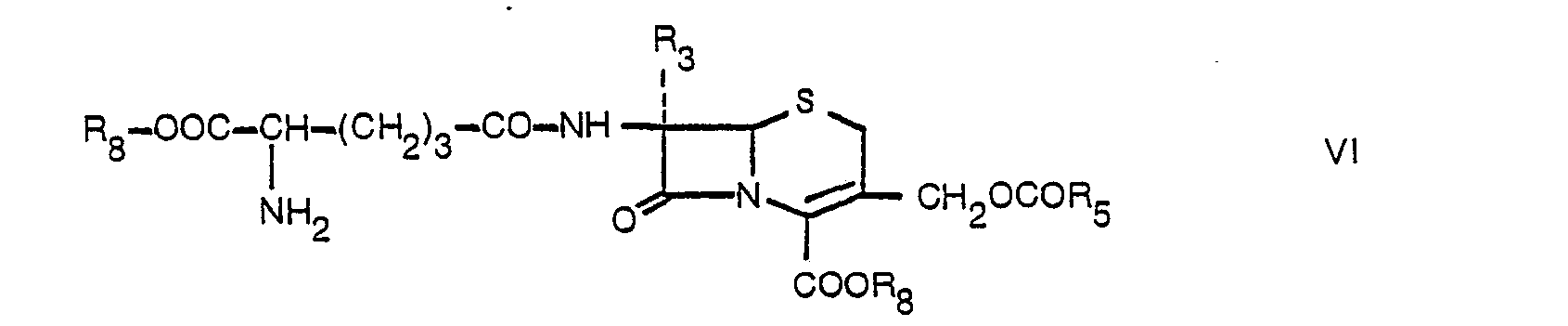
- In the compounds of formula I, the groups R1 and R2 may be alkanoyl, e.g. acetyl. Alternatively, they may be hydrogen. Alternatively, they may be nitro. Alternatively, they may be cyano. Finally, they may be alkoxycarbonyl.
- The preferred significances for R4 will of course be dictated by the desired product of formula V, or, ultimately, the desired cephalosporin antibiotic to be produced therefrom. These are of course known products. When R4 is-S-R6, the heterocycle R6 may for example be: pyrrole, oxazole, isoxazole, thiazole, isothiazole, pyrazole, imidazole, 1,2,3-oxadiazole, 1,2,4-oxadiazole, 1,2,5-oxadiazole, 1,2,3-thiadiazole, 1,2,4-thiadiazole, 1,2,5-thiadiazole, 1,3,4-thiadiazole, 1,2,3-triazole, 1,2,4-triazole, oxatriazole, tetrazole, pyridine, pyridazine, pyrimidine, pyrazine, 1,2,4,5-tetrazine, benzthiazole, benzimidazole, purine, pteridine, quinoline, quinazoline, tetrazolo-[1,5,6]pyridazine. The heterocycle may be unsubstituted. Alternatively, it may be mono- or poly-substituted for example by lower alkyl, lower alkenyl, lower alkynyl, benzyl, aryl (for example phenyl or substituted phenyl), halogen, trifluoromethyl, amino, carboxy, carbamoyl, carbalkoxy, lower aminoalkyl, lower carboxyalkyl, lower carbalkoxy alkyl, or lower carbamoylalkyl.
- In particular the heterocycle may suitably be 2-methyl-3-pyrazole, 2-methyl-3-imidazole, 1-methyl-1,2,3-triazole-5, 3,5-dimethyl-1,2,3-triazole-4, 4-methyl-1,2,4-triazole-5, 3-methyl-1,2,3-triazole-4, 5-methyl-1,2,3-oxadiazole-4, 1,2,4-oxadiazole-3, 3-methyl-1,2,4-oxadiazole-5, 3-methyl-1,2,5-oxadiazole-4, 3-methyl-1,2,4-thiadiazole-5, 1,3,4-thiadiazole-5, 2-methyl-1,3,4-thiadiazole-5, 2-(N-methylacetamido)-1,3,4-thiadiazole-5, 5-tetrazole, 1-methyltetrazole-5, 1-carboxymethyltetrazole-5, 1-(2-dimethylaminoethyl)tetrazole-5, 1,2,3,4-oxatriazole-5, 2-pyridine, 2-pyrimidine, 4-pyridine, 3-pyridazine, 2-pyrazine, 2-carbamoylmethyl-1,3,4-thiadiazole, 2-carbamoylmethyl-1,3,4-oxadiazole-5, 2-carbamoylmethyl-1,3,4-oxadiazole-5, 1-carbamoylmethyl-1,2,3,4-tetrazole-5, protected 1-(a-aminoethyl)tetrazole-5, 1-(β-carboxyethyl)tetrazole-5, 2,5-dihydro-6-hydroxy-2-methyl-5-oxo-1,2,4-triazine-3, 4,5-dihydro-6-hydroxy-4-methyl-5-oxo-1,2,4-triazine-3, 1,3,5-triazine-2, benzimidazole-2, benzothiazole-2, benzoxazole-2 and tetrazolo-[1,5,6]pyridazine-6.
- The compounds of formula IV, for use in process b), are known or may be produced in conventional manner from available starting materials, for example as described in Heterocyclic Compounds, Robert C. Elderfield (John Wiley & Sons, N.Y.) or The Chemistry of Heterocyclic Compounds, Weissberger et al. (John Wiley & Sons, N.Y.). The compound dihydro-1,2,4-triazin-3-thiol may be produced analogously to the method described by K. H. Ongania (Dissertation, Innsbruck 1972). When the compound of formula IV for use in process b) contains a free amino group, this should preferably be protected prior to the reaction, the protecting group in the resultant product being removable in conventional manner.
- The following examples, in which all temperatures are in degrees Centrigrade, illustrate the invention.
- 9.5 g of Cephalosporin C monosodium salt dihydrate are dissolved in water and the pH is adjusted to 8 by addition of 2N NaOH. 4 g of 3-ethoxymethylenepentan-2,4-dione are added, whereupon the pH value immediately begins to drop. By continuous addition of 2N NaOH the pH value is held at about 8. After about 30 minutes the pH value of the solution is adjusted to 2 and the reaction mixture is extracted with n-butanol. The organic phase is dried and the solvent is evaporated off. The residue is rubbed with diisopropylether and dried in vacuo to obtain the heading compound, m.p. >100° (decomp.).
- 1 litre of a conventionally obtained culture filtrate of a Cephalosporin C fermentation (content of active substance 13 g/I) is adjusted to pH 8 by addition of 2N NaOH. 15 ml of 3-ethoxymethylene-pentan-2,4-dione are added, with stirring, whereby the pH value is maintained at 8 by continuous addition of NaOH. After about 30 minutes there is no further fall in pH value even without addition of NaOH. The pH value is then adjusted to 2 and the mixture is extracted with n-butanol. The organic phase is substantially evaporated and the residue is taken up in 300 ml of acetone. The monosodium salt is precipitated out by addition of 5 g of sodiumethylhexoate (dissolved in 50 ml of acetone). The salt is isolated by filtration and dried in vacuo. M.P. >160-179 (decomp.).
- 11.7 g of N-[(2,2-diethoxycarbonyl)vinyl]-cephalosporin C and 3.5 g of 2,5-dihydro-6-hydroxy-5-oxo-2-methyl-1,2,4-triazin-3-thiol are suspended in 100 ml of water. The pH value of the mixture is adjusted to 6.5 by addition of sodium bicarbonate, whereupon a clear solution results. The solution is warmed to 60° and stirred at this temperature for 6 hours whereupon the pH value remains at 6.5. The mixture is then cooled to room temperature and its pH value is adjusted to 2 by addition of semi-concentrated sulphuric acid. The resulting partially oily precipitate is extracted with a mixture of ethyl acetate and acetone (5:1) and the extract is freed of solvent and the residue digested with acetonitrile. The resulting solid material is isolated and dried at 40° in vacuo to obtain the heading compound as a light beige, substantially pure, powder. M.P. >165° (decomp.). 1 H-NMR (MeOH-d4): σ = 9.30 (q, 1 H, -CO-NH-); 8,10 (d, 1 H, >N-CH =); 5.70 (1 H, H7); 5.00 (1 H, H6); 4.20 (4H, O-CH2-); 3.70 (s, 3H, NCH3); 3.65 (q, 2H, S-CH2); 1.30 (2t, 6H, -CH2-CH3).
- The heading compound may also be isolated in the form of its sodium salt by taking up the evaporation residue in acetone and adding a solution of sodium ethyl hexoate in acetone or a methanolic solution of sodium acetate, filtering and drying at 50°.
- 5.85 g of N-[(2,2-diethoxycarbonyl)vinyl]-cephalosporin C together with 1.35 g of 1-methyl-5-mercaptotetrazole are suspended in 70 ml of water. The pH value is adjusted to 6.5 with solid sodium bicarbonate whereupon a clear solution results. This solution is stirred for 5 hours at 60-70° and then cooled to room temperature. The pH is adjusted to 5 with dilute sulphuric acid and the acid phase, from which an oily precipitate separates out, is extracted with a mixture of ethyl acetate/acetone (5:1). The extract is washed with saturated sodium chloride solution and then evaporated. The residue is taken up in 70 ml of acetone, filtered from undissolved material and mixed with a solution of sodium ethyl hexoate in acetone whereupon a voluminous precipitate forms. The precipitate is filtered, washed with acetone and dried at 50° in vacuo to obtain the heading compound in the form of a substantially pure, light beige-yellow powder, m.p. >175° (decomp). 1 H-NHR (MeOH-ds): = 9.20 (q, 1H,= C - N - H,J = 8 Hz, J = 16 Hz); 8,00 (d, 1 H, I =C-H, = J = 16 Hz); 5.50 (d, 1H, H7, J = 5Hz); 4.95 (d, 1H, H6, J = 5 Hz); 4.20 (m, 7H, 2x-OCH2-, C3-CH2-S-, >N-C-COOH); 3.98 (s, 3H, N-CH3); 3.60 (q, 2H, S-CH2-, J = 18 Hz); 2.40-1.60 (2m, 6H, -CH2-CH2); 1.33 and 1.28 (2t, 6H, 2x-ethyl-CH3, J = 7Hz).
- 5.85 g of N-[(2,2-diethoxycarbonyl)vinyl]cephalosporin C are mixed with 1.75 g of 5-mercapto-1-methyl-1,2,3,4-tetrazole. The mixture is warmed to 1400 and maintained at this temperature for 15 minutes. After cooling, the darkly coloured melt is taken up in 200 ml of acetone, freed by filtration from undissolved material and the filtrate is mixed with a solution of sodiumethylhexoate in acetone (1.7 g) in 30 ml). The resulting precipitate is isolated, washed with acetone and dried at 60° in vacuo to obtain the heading compound, m.p. >175° (decomp.).
- 5.85 g N-[(2,2-diethoxycarbonyl)vinyl]cephalosporin C together with 1.75 g of 5-mercapto-1-methyl-1,2,3,4-tetrazole are dissolved in 100 ml of 1,1-2-trichloroethane and the solution is brought to boiling. After 50 minutes reflux, the solution is evaporated to remove substantially the solvent, the residue is taken up in 200 ml of acetone and the acetonic solution is worked up as in Example 5 to obtain the heading compound, m.p. >175° (decomp.).
- 5.85 g N-[(2,2-Diethoxycarbonyl)vinyl]cephalosporin C are mixed well with 2 g of sodium-1-methyl-1,2,3,4-tetrazol-5-thiolate. The powder mixture is then heated for 15 minutes at 140°, whereupon a darkly coloured melt is formed. This is digested with acetone after cooling and the solid material is isolated, washed with acetone and dried in vacuo to obtain the heading compound, m.p. >175° (decomp.).
- 6.07 g of the sodium salt of N-[(2,2-diethoxycarbonyl)]vinyl]-cephalosporin C are mixed well with 1.75 g of 5-mercapto-1-methyl-1,2,3,4-tetrazole and the mixture is treated as in Example 7 to obtain the heading compound, m.p. >175° (decomp.).
- N-[(2,2-Diethoxycarbonyl)vinyl]cephalosporin C and 2-mercaptobenzothiazole are reacted and worked up in a molecular ratio of 1:1.5 in the same manner as in Examples 5 and 6 to obtain the heading compound, m.p. >180° (decomp.).
- 7 g of 7-[N-(2,2-diethoxycarbonyl)vinyl]adipinamido-3-[(1-methyl-1,2,3,4-tetrazol-5-yl)thiomethyl]-ceph-3-em-4-carboxylic acid sodium salt are suspended in 40 ml of dried methylene dichloride. 11 ml of dimethyl aniline are added at room temperature followed by 10 ml of dimethyldichlorosilane, whereupon the temperature increases to about 33° and a clear solution forms. After 10 minutes, the mixture is cooled to -10° and 3 g of phosphorous pentachloride are added whereupon the temperature rises to about -5°. After 40 minutes stirring at -5°, the reaction solution is poured into 60 ml of pre-cooled methanol (-20°), the temperature then rising to about +5°. After addition of 10 ml of water, the pH value of the solution is adjusted to 3.5 with semi-concentrated ammonia, whereupon the product precipitates out. The precipitate is filtered off, washed with water and methanol and dried in vacuo at 50°. The thus obtained light cream powder constitutes the pure heading compound, m.p. >225° (decomp.).
1H-NMR (D20, K2-CO3): 6 = 5.05 (d, 1H, H7, J=5Hz); 4.80 (d, 1H, Hs, J=5Hz); 4.20 (q, 2H, C3-CH2-S-, J=13Hz); 4.05 (s, 3H, N-CH3); 3,55 (q, 2H, -C2-CH2, J=18Hz). - 7 g of 7-[N-(2,2-diethyloxycarbonyl)vinyl]adipinamido-3-[(2,5-dihydro-6-hydroxy-5-oxo-2-methyl-1,2,4-triazin-3-yl)thiomethyl]ceph-3-em-4-carboxylic acid sodium salt are suspended in 40 ml of methylene- dichloride. 1.5 ml of dimethylaniline and 8.8 ml of dimethyldichlorosilane are added, whereupon the temperature rises to 37° and a clear solution forms. After 10 minutes the mixture is cooled to -10° and 2.6 g of phosphorous pentachloride are added, whereupon the temperature increases to -5°.-The mixture is stirred at this temperature for 14 minutes and is then poured into 60 ml of pre-cooled dry methanol (-20°), the temperature then increasing to about +5°. 10 ml of water are then added and finally the pH value of the solution is adjusted to 3.5 with semi-concentrated ammonia, whereupon the heading compound precipitates out. The precipitate is filtered, washed with water and methanol and dried in vacuo at 50° to obtain the heading compound, m.p. >195° (decomp.).
1H-NMR (D20, K2CO3): 5 = 5.40 (d, 1H, H,, J=5Hz); 5.00 (d, 1H, H6, J=5Hz); 4.20 (q, 2H, C3-CH2-S-, J=13Hz); 3.65 (s, 3H, H-CH3); 3.55 (q, 2H, C2-CHZ-S-, J=18Hz). - 1 litre of a Cephalosporin C culture filtrate (13 Cephalosporin C/litre) is reacted with ethoxymethylenemalonic acid ester in the manner described in DOS 3,002,659. The reaction mixture is adjusted to pH 2 and extracted twice with 500 ml of methylisobutylketone. The extract is freed from water by azeotropic distillation in vacuo and is evaporated to about 250 ml. 5 g of 1-methyl-5-mercaptotetrazol are added and the mixture is refluxed for 40 minutes. The solvent is removed in vacuo and the residue is taken up in 300 ml of acetone and freed from insolubles. The filtrate is mixed with sodium ethylhexoate solution in acetone until precipitation is complete. The precipitate is filtered, washed with acetone and dried in vacuo at 50°.
- The thus obtained product has a content of about 60% of the heading compound. This crude product can be purified by usual methods (crystallisation, chromatography, etc.) or may be used directly for deacylation.
- Starting with 1 litre of culture filtrate (Cephalosporin C content = 13 g/I), the method is carried out as described under a) until removal of the methyl isobutyl ketones. The thus obtained oily residue can then either be directly used for deacylation or be digested with ethyl acetate/diisopropylether, whereupon the heading compound is obtained in the form of an amorphous powder of about 50% purity. This can be purified by conventional methods (chromatography, etc.).
- 15 g of the crude product obtained under a) (content about 60%) of 7-[N-(2,2-diethoxycarbonyl)vinyll-3-[(1-methyl-1,2,3,4-tetrazol-5-yl)thiomethyl]ceph-3-em-4-carboxylic acid sodium salt) are suspended in 80 ml of dichloromethane and mixed with 22 ml of dimethylaniline. 20 ml of dimethyldichlorosilane are added with slight cooling and after 15 minutes the resulting clear solution is cooled to -10° and 6 g of phosphorous pentachloride are added. The mixture is stirred for a further 45 minutes at -6° to -10° and then poured into 120 ml of methanol precooled to -20°. After addition of 20 ml of water, the pH value is adjusted to 3.5 by addition of ammonia solution (25%) and the precipitate is filtered off. The precipitate is washed each time with 50 ml of water and methanol and dried at 50° in vacuo to obtain the heading compound as a pure cream product, m.p. >225° (decomp.).
- The evaporation residue after removal of methylisobutylketones is dissolved in 100 ml of methylene- dichloride and mixed with 35 ml dimethylaniline. 25 ml of dimethyldichlorosilane are added with light cooling and the mixture is stirred at room temperature for 15 minutes. The mixture is cooled to -10° and 8 g of phosphorous pentachloride are added. The mixture is stirred for a further 45 minutes at -10° and is poured into 180 ml of methanol pre-cooled to -20°. After addition of 30 ml of water the pH value is adjusted to 3.5 with ammonium hydroxide solution (25%). The precipitate is fiitered off, washed with water and methanol and dried at 50° in vacuo. The thus-obtained cream product constitutes pure heading compound, m.p. >225° (decomp).
- The method is carried out essentially as described under c) or d) to obtain the heading compound in the form of a cream powder, m.p. >225° (decomp.).
NMR (D20, K2CO3): δ = 5.05 (d, 1 H, J=5HZ, H7); 4.80 (d, 1 H, J=5Hz, H6); 4.20 (q, 2H, J=13Hz, C3-CH2-S-); 4.05 (s,3H, N-CH3); 3.55 (q, 2H, J=18Hz, C2-CH2-). - 21.4 g of 7-[N-(2,2-diethoxycarbonyl)vinyl]adipinamido-3-[(benzothiazo)-2-yl)thiomethyl]ceph-3-em-4-carboxylic acid sodium salt are suspended in 120 ml of methylene dichloride and 33 ml of dimethyl aniline are added. 28 ml of dimethyl dichlorosilane are added with slight cooling and the mixture is stirred at room temperature for 15 minutes, whereupon a clear solution results. This is cooled to -10° and 10 g of phosphorous pentachloride are added. After 45 minutes stirring at -6° to -10° the solution is poured in 180 ml of methanol pre-cooled to -20° 30 ml of water are added and the pH value of the solution is adjusted to 3 with 25% ammonium hydroxide. The resulting precipitate is filtered off, washed with water and methanol and dried in vacuo at 60°. The resulting product constitutes pure heading compound, m.p. >225°-230° (decomp.).
- NMR (D20, K2CO3): 5 = 7.8-7.0 (m, 4H, Aryl-Protonen); 5.20 (d, 1 H, J=5Hz, Z7); 5.00 (d, 1 H, J=5Hz, Hs); 4.40 (q, 2H, J=13Hz, C3-CH2-S-); 3.45 (q, 2H, J=18Hz, 2-CH2
- The necessary N-[(2,2-diethoxycarbonyl)vinyl]cephalosporin C employed as starting material can be obtained in the following manner:
- 14.2 g of Cephalosporin C monosodium salt dihydrate are dissolved in 30 ml of water. To the resulting mixture, 2.52 g of sodium bicarbonate are added, with stirring, in small portions. After gas evolution has ceased, the residual carbon dioxide is removed from the solution by warming to about 35°. 10 ml of water are added followed by 5.7 g of ethoxymethylenemalonic acid diethyl ester, dissolved in 15 ml of acetone. After 6 hours stirring at room temperature, the acetone is evaporated off. The aqueous phase is extracted with ethyl acetate. The aqueous phase is adjusted to pH 2 and extracted again with ethyl acetate. The ethyl acetate phase is washed with water and dried. After removal of the solvent, the residue is rubbed with diisopropylether and dried in a desiccator, to obtain the heading compound, m.p. about 80° (decomp.).
Claims (5)


Applications Claiming Priority (6)
| Application Number | Priority Date | Filing Date | Title |
|---|---|---|---|
| AT399980 | 1980-08-01 | ||
| AT3999/80 | 1980-08-01 | ||
| AT576780A AT373600B (en) | 1980-11-26 | 1980-11-26 | METHOD FOR PRODUCING NEW CEPHALOSPORINE DERIVATIVES |
| AT5767/80 | 1980-11-26 | ||
| AT581980A AT373601B (en) | 1980-11-28 | 1980-11-28 | METHOD FOR PRODUCING NEW CEPHALOSPORINE DERIVATIVES |
| AT5819/80 | 1980-11-28 |
Publications (3)
| Publication Number | Publication Date |
|---|---|
| EP0045717A2 EP0045717A2 (en) | 1982-02-10 |
| EP0045717A3 EP0045717A3 (en) | 1982-11-10 |
| EP0045717B1 true EP0045717B1 (en) | 1985-09-25 |
Family
ID=27149750
Family Applications (1)
| Application Number | Title | Priority Date | Filing Date |
|---|---|---|---|
| EP81810288A Expired EP0045717B1 (en) | 1980-08-01 | 1981-07-16 | New cephalosporin derivatives, their production and their use |
Country Status (15)
| Country | Link |
|---|---|
| EP (1) | EP0045717B1 (en) |
| JP (1) | JPH02160791A (en) |
| AT (1) | ATE15803T1 (en) |
| AU (1) | AU553682B2 (en) |
| CA (1) | CA1177064A (en) |
| DE (1) | DE3172432D1 (en) |
| DK (1) | DK341781A (en) |
| ES (3) | ES8305774A1 (en) |
| FI (1) | FI78703C (en) |
| IE (1) | IE51464B1 (en) |
| IL (1) | IL63469A (en) |
| NZ (1) | NZ197896A (en) |
| PH (1) | PH22763A (en) |
| PT (1) | PT73455B (en) |
| YU (1) | YU44104B (en) |
Cited By (3)
| Publication number | Priority date | Publication date | Assignee | Title |
|---|---|---|---|---|
| RU2208644C2 (en) * | 1997-04-22 | 2003-07-20 | Дсм Гист Б.В. | Method for preparing n-deacylated cephalosporin |
| RU2208643C2 (en) * | 1997-04-22 | 2003-07-20 | Дсм Гист Б.В. | Method for preparing n-deacylated cephalosporin |
| RU2221046C2 (en) * | 2000-01-21 | 2004-01-10 | Государственный научный центр антибиотиков | Method for preparing semi-synthetic aminopenicillins, aminocephalosporins or their n-substituted derivatives |
Families Citing this family (2)
| Publication number | Priority date | Publication date | Assignee | Title |
|---|---|---|---|---|
| AT378774B (en) * | 1982-08-06 | 1985-09-25 | Biochemie Gmbh | METHOD FOR DEACYLATING PENICILLINES AND CEPHALOSPORINES |
| IT1286520B1 (en) * | 1996-12-03 | 1998-07-15 | Antibioticos Spa | PROCEDURE FOR THE PREPARATION OF INTERMEDIATES USEFUL IN THE SYNTHESIS OF CEPHALOSPORIN |
Family Cites Families (1)
| Publication number | Priority date | Publication date | Assignee | Title |
|---|---|---|---|---|
| AT367060B (en) * | 1979-01-25 | 1982-05-25 | Biochemie Gmbh | METHOD FOR PRODUCING NEW CEPHALOSPORINE DERIVATIVES |
-
1981
- 1981-07-16 DE DE8181810288T patent/DE3172432D1/en not_active Expired
- 1981-07-16 EP EP81810288A patent/EP0045717B1/en not_active Expired
- 1981-07-16 AT AT81810288T patent/ATE15803T1/en not_active IP Right Cessation
- 1981-07-24 FI FI812331A patent/FI78703C/en not_active IP Right Cessation
- 1981-07-30 NZ NZ197896A patent/NZ197896A/en unknown
- 1981-07-30 AU AU73579/81A patent/AU553682B2/en not_active Ceased
- 1981-07-30 DK DK341781A patent/DK341781A/en not_active Application Discontinuation
- 1981-07-30 CA CA000382868A patent/CA1177064A/en not_active Expired
- 1981-07-30 ES ES504448A patent/ES8305774A1/en not_active Expired
- 1981-07-30 IL IL63469A patent/IL63469A/en unknown
- 1981-07-30 YU YU1885/81A patent/YU44104B/en unknown
- 1981-07-31 IE IE1763/81A patent/IE51464B1/en unknown
- 1981-07-31 PH PH25992A patent/PH22763A/en unknown
- 1981-07-31 PT PT73455A patent/PT73455B/en unknown
-
1982
- 1982-07-13 ES ES513928A patent/ES8306486A1/en not_active Expired
- 1982-07-13 ES ES513929A patent/ES8305775A1/en not_active Expired
-
1989
- 1989-11-22 JP JP1304540A patent/JPH02160791A/en active Pending
Cited By (3)
| Publication number | Priority date | Publication date | Assignee | Title |
|---|---|---|---|---|
| RU2208644C2 (en) * | 1997-04-22 | 2003-07-20 | Дсм Гист Б.В. | Method for preparing n-deacylated cephalosporin |
| RU2208643C2 (en) * | 1997-04-22 | 2003-07-20 | Дсм Гист Б.В. | Method for preparing n-deacylated cephalosporin |
| RU2221046C2 (en) * | 2000-01-21 | 2004-01-10 | Государственный научный центр антибиотиков | Method for preparing semi-synthetic aminopenicillins, aminocephalosporins or their n-substituted derivatives |
Also Published As
| Publication number | Publication date |
|---|---|
| EP0045717A2 (en) | 1982-02-10 |
| ES504448A0 (en) | 1983-04-16 |
| JPH02160791A (en) | 1990-06-20 |
| PT73455B (en) | 1983-02-28 |
| ES513929A0 (en) | 1983-04-16 |
| FI812331L (en) | 1982-02-02 |
| IL63469A (en) | 1985-06-30 |
| DE3172432D1 (en) | 1985-10-31 |
| ES513928A0 (en) | 1983-06-01 |
| YU44104B (en) | 1990-02-28 |
| IL63469A0 (en) | 1981-10-30 |
| EP0045717A3 (en) | 1982-11-10 |
| ATE15803T1 (en) | 1985-10-15 |
| NZ197896A (en) | 1985-02-28 |
| AU553682B2 (en) | 1986-07-24 |
| IE51464B1 (en) | 1986-12-24 |
| ES8306486A1 (en) | 1983-06-01 |
| YU188581A (en) | 1983-12-31 |
| DK341781A (en) | 1982-02-02 |
| PT73455A (en) | 1981-08-01 |
| PH22763A (en) | 1988-12-12 |
| ES8305774A1 (en) | 1983-04-16 |
| ES8305775A1 (en) | 1983-04-16 |
| FI78703C (en) | 1989-09-11 |
| AU7357981A (en) | 1982-02-04 |
| CA1177064A (en) | 1984-10-30 |
| IE811763L (en) | 1982-02-01 |
| FI78703B (en) | 1989-05-31 |
Similar Documents
| Publication | Publication Date | Title |
|---|---|---|
| EP0286145A2 (en) | 3-Heterocyclylthiomethyl cephalosporins | |
| US4482710A (en) | Process for preparing 3-alkoxymethylcephalosporin derivatives | |
| EP0074268A2 (en) | Improvements in or relating to thieno and furopyridinium-substituted cephalosporin derivatives | |
| EP0175814B1 (en) | Process for preparing cephem derivatives | |
| US4316024A (en) | Dioxo piperazine compounds | |
| US5567813A (en) | Process for preparing cephalosporin compounds from reactive organic acid derivatives | |
| US4695639A (en) | Thiazole derivatives | |
| CS247080B2 (en) | Production method of cefemderivatives | |
| EP0045717A2 (en) | New cephalosporin derivatives, their production and their use | |
| EP1268488B1 (en) | A process for preparing cephalosporin derivatives using new thiazole compound | |
| KR880001775B1 (en) | Process for preparing derivatives of cephalosporins substituted in 3 position by a thiomethyl heterocycle group | |
| EP0019067B1 (en) | 5,10-dioxo-5,10-dihydrodiimidazo(1,5-a,1',5'-d)pyrazine-1,6-dicarboxylic acid and a process for producing imidazoledicarboxylic acid amido-derivatives | |
| EP0023045B1 (en) | Imidazolecarboxylic acid derivatives of penicillins and cephalosporins | |
| GB1582960A (en) | Chemical synthesis of -lactam derivatives | |
| KR0129567B1 (en) | Method for preparing cephalosporin compound from reactive organic acid derivative | |
| US3704297A (en) | 7 - (1,4 - cyclohexadienylacylamido)cephalosporanic acids and related compounds | |
| CA1102309A (en) | PROCESS FOR PRODUCING 7-¬D(-)-.alpha.-(4-ETHYL-2,3-DIOXO -1-PIPERAZINECARBOXAMIDO)-.alpha.-(4-HYDROXYPHENYL) ACETAM IDO|-3-¬5-(1-METHYL-1,2,3,4-TETRAZOLYL)THIOMETHYL) -.DELTA.3-CEPHEM-4-CARBOXYLIC ACID AND A PHARMACEUTICALL Y ACCEPTABLE SALT THEREOF AND AN INTERMEDIATE THEREOF | |
| US3840532A (en) | Process for cleaving cephalosporin compounds | |
| US5162522A (en) | Method for producing cephem compounds | |
| US4665168A (en) | Cephalosporin intermediate | |
| GB2193213A (en) | 6-trifluoromethyl-1H-benzotriazol-1-yl diphenylphosphate and its use in preparing cephalosporin derivatives | |
| KR790001175B1 (en) | Process for preparing 7-amino cephalosporanic acid and their derivatives | |
| PL132001B1 (en) | Process for preparing novel derivatives of cephalosporins | |
| CA1071621A (en) | Process for preparing 7-aminocephalosporanic acid derivatives | |
| US4826972A (en) | Method for preparing crystalline cephalosporin derivative |
Legal Events
| Date | Code | Title | Description |
|---|---|---|---|
| PUAI | Public reference made under article 153(3) epc to a published international application that has entered the european phase |
Free format text: ORIGINAL CODE: 0009012 |
|
| 17P | Request for examination filed |
Effective date: 19810718 |
|
| AK | Designated contracting states |
Designated state(s): AT BE CH DE FR GB IT LU NL SE |
|
| PUAL | Search report despatched |
Free format text: ORIGINAL CODE: 0009013 |
|
| AK | Designated contracting states |
Designated state(s): AT BE CH DE FR GB IT LU NL SE |
|
| ITF | It: translation for a ep patent filed | ||
| GRAA | (expected) grant |
Free format text: ORIGINAL CODE: 0009210 |
|
| AK | Designated contracting states |
Designated state(s): AT BE CH DE FR GB IT LI LU NL SE |
|
| REF | Corresponds to: |
Ref document number: 15803 Country of ref document: AT Date of ref document: 19851015 Kind code of ref document: T |
|
| REF | Corresponds to: |
Ref document number: 3172432 Country of ref document: DE Date of ref document: 19851031 |
|
| ET | Fr: translation filed | ||
| PLBE | No opposition filed within time limit |
Free format text: ORIGINAL CODE: 0009261 |
|
| STAA | Information on the status of an ep patent application or granted ep patent |
Free format text: STATUS: NO OPPOSITION FILED WITHIN TIME LIMIT |
|
| PG25 | Lapsed in a contracting state [announced via postgrant information from national office to epo] |
Ref country code: LU Free format text: LAPSE BECAUSE OF NON-PAYMENT OF DUE FEES Effective date: 19860731 |
|
| 26N | No opposition filed | ||
| PGFP | Annual fee paid to national office [announced via postgrant information from national office to epo] |
Ref country code: DE Payment date: 19890613 Year of fee payment: 9 |
|
| PGFP | Annual fee paid to national office [announced via postgrant information from national office to epo] |
Ref country code: LU Payment date: 19890614 Year of fee payment: 9 Ref country code: FR Payment date: 19890614 Year of fee payment: 9 Ref country code: BE Payment date: 19890614 Year of fee payment: 9 |
|
| PGFP | Annual fee paid to national office [announced via postgrant information from national office to epo] |
Ref country code: SE Payment date: 19890619 Year of fee payment: 9 |
|
| PGFP | Annual fee paid to national office [announced via postgrant information from national office to epo] |
Ref country code: GB Payment date: 19890630 Year of fee payment: 9 |
|
| PGFP | Annual fee paid to national office [announced via postgrant information from national office to epo] |
Ref country code: AT Payment date: 19890703 Year of fee payment: 9 |
|
| PGFP | Annual fee paid to national office [announced via postgrant information from national office to epo] |
Ref country code: NL Payment date: 19890731 Year of fee payment: 9 |
|
| PGFP | Annual fee paid to national office [announced via postgrant information from national office to epo] |
Ref country code: CH Payment date: 19891027 Year of fee payment: 9 |
|
| PG25 | Lapsed in a contracting state [announced via postgrant information from national office to epo] |
Ref country code: GB Effective date: 19900716 Ref country code: AT Effective date: 19900716 |
|
| PG25 | Lapsed in a contracting state [announced via postgrant information from national office to epo] |
Ref country code: SE Effective date: 19900717 |
|
| PG25 | Lapsed in a contracting state [announced via postgrant information from national office to epo] |
Ref country code: LI Effective date: 19900731 Ref country code: CH Effective date: 19900731 Ref country code: BE Effective date: 19900731 |
|
| BERE | Be: lapsed |
Owner name: BIOCHEMIE G.M.B.H. Effective date: 19900731 |
|
| PG25 | Lapsed in a contracting state [announced via postgrant information from national office to epo] |
Ref country code: NL Effective date: 19910201 |
|
| GBPC | Gb: european patent ceased through non-payment of renewal fee | ||
| NLV4 | Nl: lapsed or anulled due to non-payment of the annual fee | ||
| REG | Reference to a national code |
Ref country code: CH Ref legal event code: PL |
|
| PG25 | Lapsed in a contracting state [announced via postgrant information from national office to epo] |
Ref country code: FR Effective date: 19910329 |
|
| PG25 | Lapsed in a contracting state [announced via postgrant information from national office to epo] |
Ref country code: DE Effective date: 19910403 |
|
| REG | Reference to a national code |
Ref country code: FR Ref legal event code: ST |
|
| EUG | Se: european patent has lapsed |
Ref document number: 81810288.1 Effective date: 19910402 |