EP0043323A1 - A non aqueous cell comprising a cathode comprising the reaction product of Bi2O3 and WO3 - Google Patents
A non aqueous cell comprising a cathode comprising the reaction product of Bi2O3 and WO3 Download PDFInfo
- Publication number
- EP0043323A1 EP0043323A1 EP81401037A EP81401037A EP0043323A1 EP 0043323 A1 EP0043323 A1 EP 0043323A1 EP 81401037 A EP81401037 A EP 81401037A EP 81401037 A EP81401037 A EP 81401037A EP 0043323 A1 EP0043323 A1 EP 0043323A1
- Authority
- EP
- European Patent Office
- Prior art keywords
- reaction product
- cell
- cathode
- trioxide
- cathode material
- Prior art date
- Legal status (The legal status is an assumption and is not a legal conclusion. Google has not performed a legal analysis and makes no representation as to the accuracy of the status listed.)
- Withdrawn
Links
Images

Classifications
-
- H—ELECTRICITY
- H01—ELECTRIC ELEMENTS
- H01M—PROCESSES OR MEANS, e.g. BATTERIES, FOR THE DIRECT CONVERSION OF CHEMICAL ENERGY INTO ELECTRICAL ENERGY
- H01M4/00—Electrodes
- H01M4/02—Electrodes composed of, or comprising, active material
- H01M4/36—Selection of substances as active materials, active masses, active liquids
- H01M4/48—Selection of substances as active materials, active masses, active liquids of inorganic oxides or hydroxides
- H01M4/485—Selection of substances as active materials, active masses, active liquids of inorganic oxides or hydroxides of mixed oxides or hydroxides for inserting or intercalating light metals, e.g. LiTi2O4 or LiTi2OxFy
-
- H—ELECTRICITY
- H01—ELECTRIC ELEMENTS
- H01M—PROCESSES OR MEANS, e.g. BATTERIES, FOR THE DIRECT CONVERSION OF CHEMICAL ENERGY INTO ELECTRICAL ENERGY
- H01M4/00—Electrodes
- H01M4/02—Electrodes composed of, or comprising, active material
- H01M4/62—Selection of inactive substances as ingredients for active masses, e.g. binders, fillers
-
- H—ELECTRICITY
- H01—ELECTRIC ELEMENTS
- H01M—PROCESSES OR MEANS, e.g. BATTERIES, FOR THE DIRECT CONVERSION OF CHEMICAL ENERGY INTO ELECTRICAL ENERGY
- H01M6/00—Primary cells; Manufacture thereof
- H01M6/14—Cells with non-aqueous electrolyte
- H01M6/16—Cells with non-aqueous electrolyte with organic electrolyte
-
- Y—GENERAL TAGGING OF NEW TECHNOLOGICAL DEVELOPMENTS; GENERAL TAGGING OF CROSS-SECTIONAL TECHNOLOGIES SPANNING OVER SEVERAL SECTIONS OF THE IPC; TECHNICAL SUBJECTS COVERED BY FORMER USPC CROSS-REFERENCE ART COLLECTIONS [XRACs] AND DIGESTS
- Y02—TECHNOLOGIES OR APPLICATIONS FOR MITIGATION OR ADAPTATION AGAINST CLIMATE CHANGE
- Y02E—REDUCTION OF GREENHOUSE GAS [GHG] EMISSIONS, RELATED TO ENERGY GENERATION, TRANSMISSION OR DISTRIBUTION
- Y02E60/00—Enabling technologies; Technologies with a potential or indirect contribution to GHG emissions mitigation
- Y02E60/10—Energy storage using batteries
Definitions
- the invention relates to a nonaqueous cell utilizing a highly active metal anode, a cathode which comprises the thermal reaction product of bismuth trioxide (Bi 2 0 3 ) and tungsten trioxide (W0 3 ) and a liquid organic electrolyte such as 3-methyl-2-oxazolidone in conjunction with a cosolvent and a selected solute.
- a highly active metal anode a cathode which comprises the thermal reaction product of bismuth trioxide (Bi 2 0 3 ) and tungsten trioxide (W0 3 ) and a liquid organic electrolyte such as 3-methyl-2-oxazolidone in conjunction with a cosolvent and a selected solute.
- the invention is directed to a new solid cathode material for electrochemical cell systems which comprises the thermal reaction product of bismuth trioxide and tungsten trioxide.
- the mole ratio of bismuth trioxide to tungsten trioxide can vary between.about 1:3 and about 3:1.
- the mixture of the bismuth trioxide and tungsten trioxide can be heated to above 800°C, preferably between about 825°C and about 925°C for a time sufficient to insure reaction.
- the proportions of the bismuth trioxide and tungsten trioxide can vary with the preferred proportion being two moles of tungsten trioxide to one mole of bismuth trioxide.
- the solid cathode material formed by the thermal reaction of bismuth trioxide and tungsten trioxide has been found to be ideally suited for use in nonaqueous cell systems.
- binders e.g., polytetrafluoroethylene, polyethylene, polysulfone, polypropylene and poly amide
- conductive agents e.g., carbonaceous material such as carbon or graphite and metal powders.
- Useful highly active metal anode materials include aluminum, the alkali metals, alkaline earth metals and alloys of alkali metals or alkaline earth metals with each other and other metals.
- alloy as used herein and in the appended claims is intended to include mixtures, solid solutions, such as lithium-magnesium, and intermetallic compounds, such as lithium monoaluminide.
- the preferred anode materials are lithium, sodium, potassium, calcium and alloys thereof.
- Useful organic solvents employed alone or mixed with one or more other solvents for use in this invention include the following classes of compounds:
- the preferred solvents are sulfolane; crotonitrile; nitrobenzene; tetrahydrofuran; methyl-substituted tetrahydrofuran; 1,3-dioxolane; 3-methyl - 2-oxazolidone; propylene carbonate; Y-butyrolactone; ethylene glycol sulfite; dimethylsulfite; dimethyl sulfoxide; and 1,1- and 1,2-dimethoxyethane.
- sulfolane Of the preferred solvents, the best are sulfolane; 3-methyl-2-oxazolidone; propylene carbonate; 1,1- and 1,2-dimethoxyethane; and 1,3-dioxolane because they appear more chemically inert to battery components and have wide liquid ranges, and especially because they permit highly efficient utilization of the cathode materials.
- the best electrolyte for use in this invention is a 3-methyl-2-oxazolidone-based electrolyte.
- Liquid organic 3-methyl-2-oxazolidone material, (3Me20x) is an excellent nonaqueous solventnbecause of its high dielectric constant, chemical inertness to battery components, wide liquid range and low toxicity.
- the low viscosity cosolvents which can be used along with 3Me20x include tetrahydrofuran (THF), methyl-substituted tetrahydrofuran (Met-THF), dioxolane (DIOX), dimethoxyethane (DME), propylene carbonate (PC), dimethyl isoxazole (DMI), diethyl carbonate (DEC), ethylene glycol sulfite (EGS), dioxane, dimethyl sulfite (DMS) or the like.
- Dimethoxyethane (DME), dioxolane (DIOX) and propylene carbonate (PC) are preferred cosolvents because of their compatibility with metal salts dissolved in liquid 3Me20x and their chemical inertness to cell components.
- the total amount of the low viscosity cosolvent added could be between about 20% and about 80% based on total solvent volume, i.e., exclusive of solute, so as to lower the viscosity to a level suitable for use in a high drain cell.
- the ionizing solute for use in the invention may be a simple or double salt or mixtures thereof, which will produce an ionically-conductive solution when dissolved in one or more solvents.
- Preferred solutes are complexes of inorganic or organic Lewis acids and inorganic ionizable salts.
- the only requirements for utility are that the salts, whether simple or complex, be compatible with the solvent or solvents being employed and that they-yield a solution which is sufficiently ionically conductive.
- the Lewis or electronic concept of acids and bases many substances which contain no active hydrogen can act as acids or acceptors of electron doublets.
- the basic concept is set forth in the chemical literature (Journal of the Franklin Institute, Vol. 226 - July/December 1938, pages 293-313 by G.N. Lewis).
- Typical Lewis acids suitable for use in the present invention include aluminum fluoride, aluminum bromide, aluminum chloride, antimony pentachloride, zirconium tetrachloride, phosphorus pentachloride, boron fluoride, boron chloride and boron bromide.
- Ionizable salts useful in combination with the Lewis acids include lithium fluoride, lithium chloride, lithium bromide, lithium sulfide, sodium fluoride, sodium chloride, sodium bromide, potassium fluoride, potassium chloride and potassium bromide.
- double salts formed by a Lewis acid and an inorganic ionizable salt may be used as such or the individual components may be added to the solvent separately to form the double salt or the resulting ions in situ.
- One such double salt for example, is that formed by the combination of aluminum chloride and lithium chloride to yield lithium aluminum tetrachloride.
- a flat-type cell was constructed utilizing a stainless steel base having therein a shallow depression into which the cell contents were placed and over which a stainless steel cap was placed to close the cell.
- the contents of each sample cell consisted of a 15.0 mm diameter lithium disc (0.114 g) having a total thickness of 1.27 mm, about 1.5 ml of an electrolyte consisting of about 40 vol.% dioxolane, about 30 vol.% dimethoxyethane (DME), about 30 vol.% 3Me20x plus about 0.1% dimethylisoxazole (DMI) and containing 1 M LiCF 3 SO 3 , a 22.2 mm diameter porous nonwoven polypropylene separator (0.25 mm thick) which adsorbed some of the electrolyte and 0.541 gram of a cathode mix compressed to form a cathode.
- DME dimethoxyethane
- DMI dimethylisoxazole
- the cathode mix consisted of 90% by weight of the reaction product of Bi 2 0 3 + 2W0 3 and 10% by weight lead.
- the cell was discharged across a 15 k-ohm load and the voltage observed with time is shown as the curve in Figure 1.
- the cell was discharged across a 1 k-ohm load (pulse discharge) for two seconds and the voltage observed is shown as the points identified as "X" in Figure 1.
- a flat-type cell was constructed as in Example I except that the cathode mix (0.499 gram) consisted of 90% by weight of the reaction product of Bi 2 0 3 + 2WO 3 and 10% by weight graphite. The cell was tested as described in Example I and the data obtained are shown in Figure 2.
- a flat-type cell was constructed as in Example I except that the cathode mix (0.498 gram) consisted of 85.5% by weight of the reaction product of Bi 2 0 3 + 2W0 3 , 10% by weight of graphite, and 4.5% by weight Si0 2 .
- the cell was tested as described in Example I and the data obtained are shown in Figure 3.
- a flat-type cell was constructed as in Example I except that the cathode mix (0.441 gram) consisted of 85.5% by weight of the reaction product of Bi 2 0 3 + 2WO 3 , 10% by weight of lead and 4.5% by weight of Si0 2 .
- the cell was tested as described in Example I and the data obtained are shown in Figure 4.
Landscapes
- Chemical & Material Sciences (AREA)
- Chemical Kinetics & Catalysis (AREA)
- Electrochemistry (AREA)
- General Chemical & Material Sciences (AREA)
- Engineering & Computer Science (AREA)
- Manufacturing & Machinery (AREA)
- Inorganic Chemistry (AREA)
- Primary Cells (AREA)
- Secondary Cells (AREA)
- Battery Electrode And Active Subsutance (AREA)
Abstract
The invention deals with a cathode comprising the reaction product of Bi2O3 and WO3.
<??>This solid cathode material comprising the thermal reaction product of bismuth trioxide and tungsten trioxide is used in electro-chemical cell systems in combination with a highly active metal anode and a liquid organic electrolyte such as 3-methyl-2-oxazolidone.
Description
- The invention relates to a nonaqueous cell utilizing a highly active metal anode, a cathode which comprises the thermal reaction product of bismuth trioxide (Bi203) and tungsten trioxide (W03) and a liquid organic electrolyte such as 3-methyl-2-oxazolidone in conjunction with a cosolvent and a selected solute.
- The development of high energy battery systems requires the compatibility of an electrolyte possessing desirable electrochemical properties with highly reactive anode materials, such as lithium, sodium, and the like and the efficient use of high energy density cathode materials. The use of aqueous electolytes is precluded in these systems since the anode materials are sufficiently active to react with water chemically. It has, therefore, been necessary in order to realize the high energy density obtainable through use of these highly reactive anodes and high energy density cathodes to turn to the investigation of nonaqueous etectrolyte sytems and more-particularly to nonaqueous organic electrolyte systems. A large number of nonaqueous organic electrolyte solutions is taught in the art which can be used for many battery systems.
- Although a large number of known solid cathode materials is suitable for nonaqueous cell systems, there is always a need for new solid cathode materials to help fill the demand created by the large number of battery-powered devices being marketed. For example, the toy industry has recently embarked upon a program of marketing a multiplicity of computerized games some of which are educational in nature. Many of these devices require portable power sources and, therefore, any new cell system would be welcomed.
- It is an object of the present invention to provide a new solid cathode cathode material for nonaqueous cell systems.
- It is another object of the present invention to provide a new nonaqueous cell system employing a new solid cathode material consisting of the thermal reaction product of bismuth trioxide and tungsten trioxide.
- It is another object of the present invention to provide a new nonaqueous cell system employing an active metal anode, an organic electrolyte based on 3-methyl-2-oxazolidone and an active cathode consisting of the thermal reaction product of bismuth trioxide and tungsten trioxide.
- The invention is directed to a new solid cathode material for electrochemical cell systems which comprises the thermal reaction product of bismuth trioxide and tungsten trioxide.
- Preferably, the mole ratio of bismuth trioxide to tungsten trioxide can vary between.about 1:3 and about 3:1.
- Preferably, the mixture of the bismuth trioxide and tungsten trioxide can be heated to above 800°C, preferably between about 825°C and about 925°C for a time sufficient to insure reaction. The proportions of the bismuth trioxide and tungsten trioxide can vary with the preferred proportion being two moles of tungsten trioxide to one mole of bismuth trioxide. Although not wanting to be bound by theory- it is believed that the following reaction occurs:

- The solid cathode material formed by the thermal reaction of bismuth trioxide and tungsten trioxide has been found to be ideally suited for use in nonaqueous cell systems.
- If desired, other components may be added to the cathode material such as binders, conductive agents, and the like. Suitable binders would be polytetrafluoroethylene, polyethylene, polysulfone, polypropylene and poly amide, and conductive agents would be a carbonaceous material such as carbon or graphite and metal powders.
- Useful highly active metal anode materials include aluminum, the alkali metals, alkaline earth metals and alloys of alkali metals or alkaline earth metals with each other and other metals. The term "alloy" as used herein and in the appended claims is intended to include mixtures, solid solutions, such as lithium-magnesium, and intermetallic compounds, such as lithium monoaluminide. The preferred anode materials are lithium, sodium, potassium, calcium and alloys thereof.
- Useful organic solvents employed alone or mixed with one or more other solvents for use in this invention include the following classes of compounds:
- Alkylene nitriles: e.g., crotonitrile (liquid range -51.1°C. to 120°C.)
- Trialkyl borates: e.g., trimethyl borate, (CH30)3B (liquid range -29.3 to 67°C.)
- Tetraalkyl silicates: e.g., tetramethyl silicate, (CH30)4Si (boiling point 121°C.)
- Nitroalkanes: e.g., nitromethane, CH3N02 (liquid range -17 to 100.8°C.)
- Alkylnitriles: e.g., acetonitrile, CH3CN (liquid range -45 to 81.6°C.)
- Dialkylamides: e.g., dimethylformamide, HCON(CH3)2 (liquid range -60.48 to 149°C.)
- Lactams: e.g., N-methylpyrrolidone,

- Tetraalkylureas: e.g., tetramethylurea,

- Monocarboxylic acid esters: e.g.,ethyl acetate (liquid range -83.6 to 77.06°C.)
- Orthoesters: e.g., trimethylorthoformate, HC(OCH3)3 (boiling point 103°C.)
- Lactones: e.g., γ-(gamma)butyrolactone,

- Dialkyl carbonates: e.g., dimethyl carbonate, OC(OCH3)2 (
liquid range 2 to 90°C.) - Alkylene carbonates: e.g., propylene carbonate,

- Monoethers: e.g., diethyl ether (liquid range -116 to 34.5°C.)
- Polyethers: e.g., 1,1- and 1,2-dimethoxyethane (liquid ranges -113.2 to 64.5°C. and -58 to 83°C., respectively)
- Cyclic ethers: e.g., tetrahydrofuran (liquid range -65 to 67°C.); 1,3-dioxolane (liquid range -95 to 78°C.)
- Nitroaromatics: e.g., nitrobenzene (liquid range 5.7 to 210.8°C.)
- Aromatic carboxylic acid halides: e.g., benzoyl chloride (liquid range 0 to 197°C.); benzoyl bromide (liquid range-24 to 218°C.)
- Aromatic sulfonic acid halides: e.g., benzene sulfonyl chloride (liquid range 14.5 to 251°C.)
- Aromatic phosphonic acid dihalides: e.g., benzene phosphonyl dichloride (boiling point 258°C.)
- Aromatic thiophosphonic acid dihalides: e.g., benzene thiophosphonyl dichloride (boiling point 124°C. at 5 mm.)
- Cyclic sulfones: e.g., sulfolane,

- Alkyl sulfonic acid halides: e.g., methanesulfonyl chloride (boiling point 161°C.)
- Alkyl carboxylic acid halides: e.g., acetyl chloride (liquid range -112 to 50.9°C.); acetyl bromide (liquid range -96 to 76°C.); propionyl chloride (liquid range -94 to 80°C.)
- Saturated heterocyclics: e.g., tetrahydrothiophene (liquid range -96 to 121°C.); 3-methyl-2-oxazolidone (melting point 15.9°C.)
- Dialkyl sulfamic acid halides: e.g., dimethyl sulfamyl chloride (boiling point 80°C..at 16 mm.)
- Alkyl halosulfonates: e.g., ethyl chlorosulfonate (boiling point 151°C.)
- Unsaturated heterocyclic carboxylic acid halides: eg.,2-furoyl chloride. (liquid range -2 to 173°C.)
- Five-membered unsaturated heterocyclics: e.g., 3,5-dimethylisoxazole (boiling point 140°C.); 1-methylpyrrole (boiling point 114°C.); 2,4-dimethylthiazole (boiling point 144°C.); furan (liquid range -85.65 to 31.36°C.)
- Esters and/or halides of dibasic carboxylic acids: e.g. ethyl oxalyl chloride (boiling point 135°C.)
- Mixed alkyl sulfonic acid halides and carboxylic acid halides: e.g., chlorosulfonyl acetyl chloride (boiling point 98°C. at 10 mm.)
- Dialkyl sulfoxides: e.g., dimethyl sulfoxide (liquid range 18.4 to 189°C.)
- Dialkyl sulfates: e.g., dimethylsulfate (liquid range -31.75 to 188.5°C.)
- Dialkyl sulfites: e.g., dimethylsulfite (boiling point 126°C.)
- Alkylene sulfites: e.g., ethylene glycol sulfite (liquid range -11 to 173°C.)
- Halogenated alkanes: e.g., methylene chloride (liquid range -
95to 40°C.) 1,3-dichloropropane (liquid range -99.5 to 120.4°C.) - Of the above, the preferred solvents are sulfolane; crotonitrile; nitrobenzene; tetrahydrofuran; methyl-substituted tetrahydrofuran; 1,3-dioxolane; 3-methyl-2-oxazolidone; propylene carbonate; Y-butyrolactone; ethylene glycol sulfite; dimethylsulfite; dimethyl sulfoxide; and 1,1- and 1,2-dimethoxyethane. Of the preferred solvents,.the best are sulfolane; 3-methyl-2-oxazolidone; propylene carbonate; 1,1- and 1,2-dimethoxyethane; and 1,3-dioxolane because they appear more chemically inert to battery components and have wide liquid ranges, and especially because they permit highly efficient utilization of the cathode materials.
- The best electrolyte for use in this invention is a 3-methyl-2-oxazolidone-based electrolyte. Liquid organic 3-methyl-2-oxazolidone material, (3Me20x)

- However, it has been found that when metal salts are dissolved in liquid 3Me20x for the purpose of improving the.conductivity of 3Me20x, the viscosity of the solution may be too high for its efficient use as an electrolyte for some nonaqueous cell applications other than those requiring very low current drains. Thus, in some applications in accordance with this invention, the addition of a low viscosity cosolvent would be desirable if 3Me20x is to be used as an electrolyte for nonaqueous cells which can operate or perform at a high energy density level.
- The low viscosity cosolvents which can be used along with 3Me20x include tetrahydrofuran (THF), methyl-substituted tetrahydrofuran (Met-THF), dioxolane (DIOX), dimethoxyethane (DME), propylene carbonate (PC), dimethyl isoxazole (DMI), diethyl carbonate (DEC), ethylene glycol sulfite (EGS), dioxane, dimethyl sulfite (DMS) or the like. Dimethoxyethane (DME), dioxolane (DIOX) and propylene carbonate (PC) are preferred cosolvents because of their compatibility with metal salts dissolved in liquid 3Me20x and their chemical inertness to cell components. Specifically, the total amount of the low viscosity cosolvent added could be between about 20% and about 80% based on total solvent volume, i.e., exclusive of solute, so as to lower the viscosity to a level suitable for use in a high drain cell.
- The ionizing solute for use in the invention may be a simple or double salt or mixtures thereof, which will produce an ionically-conductive solution when dissolved in one or more solvents. Preferred solutes are complexes of inorganic or organic Lewis acids and inorganic ionizable salts. The only requirements for utility are that the salts, whether simple or complex, be compatible with the solvent or solvents being employed and that they-yield a solution which is sufficiently ionically conductive. According to the Lewis or electronic concept of acids and bases, many substances which contain no active hydrogen can act as acids or acceptors of electron doublets. The basic concept is set forth in the chemical literature (Journal of the Franklin Institute, Vol. 226 - July/December 1938, pages 293-313 by G.N. Lewis).
- A suggested reaction mechanism for the manner in which these complexes function in a solvent is described in detail in U. S. Patent No. 3,542,602 wherein it is suggested that the complex or double salt formed between the Lewis acid and the ionizable salt yields an entity which is more stable than either of the components alone.
- Typical Lewis acids suitable for use in the present invention include aluminum fluoride, aluminum bromide, aluminum chloride, antimony pentachloride, zirconium tetrachloride, phosphorus pentachloride, boron fluoride, boron chloride and boron bromide.
- Ionizable salts useful in combination with the Lewis acids include lithium fluoride, lithium chloride, lithium bromide, lithium sulfide, sodium fluoride, sodium chloride, sodium bromide, potassium fluoride, potassium chloride and potassium bromide.
- It will be obvious to those skilled in the art that the double salts formed by a Lewis acid and an inorganic ionizable salt may be used as such or the individual components may be added to the solvent separately to form the double salt or the resulting ions in situ. One such double salt, for example, is that formed by the combination of aluminum chloride and lithium chloride to yield lithium aluminum tetrachloride.
-
- Figure 1 contains data showing the discharge characteristics of the cell disclosed and described in Example 1.
- Figure 2 contains data showing the discharge characteristics of the cell disclosed and described in Example 2.
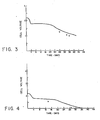
- Figure 3 contains data showing the discharge characteristics of two cells disclosed and described in Example 3.
- Figure 4 contains data showing the discharge characteristics of the cell disclosed and described in Example 4.
- A flat-type cell was constructed utilizing a stainless steel base having therein a shallow depression into which the cell contents were placed and over which a stainless steel cap was placed to close the cell. The contents of each sample cell consisted of a 15.0 mm diameter lithium disc (0.114 g) having a total thickness of 1.27 mm, about 1.5 ml of an electrolyte consisting of about 40 vol.% dioxolane, about 30 vol.% dimethoxyethane (DME), about 30 vol.% 3Me20x plus about 0.1% dimethylisoxazole (DMI) and containing 1 M LiCF3SO3, a 22.2 mm diameter porous nonwoven polypropylene separator (0.25 mm thick) which adsorbed some of the electrolyte and 0.541 gram of a cathode mix compressed to form a cathode. The cathode mix consisted of 90% by weight of the reaction product of Bi203 + 2W03 and 10% by weight lead. The cell was discharged across a 15 k-ohm load and the voltage observed with time is shown as the curve in Figure 1. In addition, at various time intervals, the cell was discharged across a 1 k-ohm load (pulse discharge) for two seconds and the voltage observed is shown as the points identified as "X" in Figure 1.
- A flat-type cell was constructed as in Example I except that the cathode mix (0.499 gram) consisted of 90% by weight of the reaction product of Bi203 + 2WO3 and 10% by weight graphite. The cell was tested as described in Example I and the data obtained are shown in Figure 2.
- A flat-type cell was constructed as in Example I except that the cathode mix (0.498 gram) consisted of 85.5% by weight of the reaction product of Bi203 + 2W03, 10% by weight of graphite, and 4.5% by weight Si02. The cell was tested as described in Example I and the data obtained are shown in Figure 3.
- A flat-type cell was constructed as in Example I except that the cathode mix (0.441 gram) consisted of 85.5% by weight of the reaction product of Bi203 + 2WO3, 10% by weight of lead and 4.5% by weight of Si02. The cell was tested as described in Example I and the data obtained are shown in Figure 4.
- While the present invention has been described with reference to many particular details thereof, it is not intended that these details shall be construed as limiting the scope of this invention.
Claims (7)
1. A solid cathode material for nonaqueous cells comprising the reaction product of bismuth trioxide and tungsten trioxide.
2. The solid cathode material of claim 1 wherein the mole ratio of bismuth trioxide to tungsten trioxide is between about 1:3 and about 3:1.
3. The solid cathode material of claim 1. or 2 wherein a conductive agent is added.
4. The solid cathode material of claim 1 or 2 wherein a binder is added..
5. A nonaqueous cell comprising an active metal anode, an organic electrolyte solution and a solid cathode material comprising the reaction product of bismuth trioxide and tungsten trioxide.
6. The nonaqueous cell of claim 5 wherein the mole ratio of bismuth trioxide to tungsten trioxide is between about 1:3 and about 3:1. 0
7. The nonaqueous cell of claim 5 wherein at least one material selected from the group consisting of graphite, carbon, lead, polytetrafluoroethylene, polyethylene, polysulfone, polypropylene and polyamide is added to the solid cathode material.
Applications Claiming Priority (2)
| Application Number | Priority Date | Filing Date | Title |
|---|---|---|---|
| US163630 | 1980-06-27 | ||
| US06/163,630 US4298665A (en) | 1980-06-27 | 1980-06-27 | Cathode comprising the reaction product of Bi2 O3 and WO3 |
Publications (1)
| Publication Number | Publication Date |
|---|---|
| EP0043323A1 true EP0043323A1 (en) | 1982-01-06 |
Family
ID=22590865
Family Applications (1)
| Application Number | Title | Priority Date | Filing Date |
|---|---|---|---|
| EP81401037A Withdrawn EP0043323A1 (en) | 1980-06-27 | 1981-06-26 | A non aqueous cell comprising a cathode comprising the reaction product of Bi2O3 and WO3 |
Country Status (3)
| Country | Link |
|---|---|
| US (1) | US4298665A (en) |
| EP (1) | EP0043323A1 (en) |
| JP (1) | JPS5787072A (en) |
Cited By (2)
| Publication number | Priority date | Publication date | Assignee | Title |
|---|---|---|---|---|
| FR2613139A1 (en) * | 1987-03-27 | 1988-09-30 | Eveready Battery Inc | NON-AQUEOUS BATTERIES IMPROVED BY BI2O3 / LI, CONTAINING 3-METHYL-2-OXAZOLIDONE ELECTROLYTE |
| CN109650873A (en) * | 2018-12-10 | 2019-04-19 | 合肥学院 | A kind of Ca-W mixing and doping Bi2O3Method for preparing solid electrolyte |
Families Citing this family (3)
| Publication number | Priority date | Publication date | Assignee | Title |
|---|---|---|---|---|
| FR2550388B1 (en) * | 1983-08-03 | 1985-12-27 | Gipelec | POSITIVE ACTIVE MATERIAL FOR ELECTROCHEMICAL GENERATORS AND ELECTROCHEMICAL GENERATORS USING THE SAME |
| JPS61206167A (en) * | 1985-03-11 | 1986-09-12 | Nippon Telegr & Teleph Corp <Ntt> | Lithium secondary battery |
| US6849360B2 (en) | 2002-06-05 | 2005-02-01 | Eveready Battery Company, Inc. | Nonaqueous electrochemical cell with improved energy density |
Citations (3)
| Publication number | Priority date | Publication date | Assignee | Title |
|---|---|---|---|---|
| US3877988A (en) * | 1973-03-21 | 1975-04-15 | Mallory & Co Inc P R | Lithium-metal telluride organic electrolyte cell |
| US4158723A (en) * | 1977-10-14 | 1979-06-19 | Saft-Societe Des Accumulateurs Fixes Et De Traction | High specific energy battery |
| GB2035671A (en) * | 1978-11-22 | 1980-06-18 | Saft Leclanche | Solid positive active material for high specific energy electric cells |
Family Cites Families (3)
| Publication number | Priority date | Publication date | Assignee | Title |
|---|---|---|---|---|
| US3873369A (en) * | 1973-05-14 | 1975-03-25 | Du Pont | Tungsten oxide-containing cathode for non-aqueous galvanic cell |
| US3915740A (en) * | 1974-02-07 | 1975-10-28 | Electrochimica Corp | Galvanic cell |
| DE2516704C3 (en) * | 1975-04-16 | 1981-07-02 | Varta Batterie Ag, 3000 Hannover | Galvanic element with a negative electrode made of light metal, a non-aqueous electrolyte and a positive electrode |
-
1980
- 1980-06-27 US US06/163,630 patent/US4298665A/en not_active Expired - Lifetime
-
1981
- 1981-06-26 EP EP81401037A patent/EP0043323A1/en not_active Withdrawn
- 1981-06-26 JP JP56099534A patent/JPS5787072A/en active Pending
Patent Citations (3)
| Publication number | Priority date | Publication date | Assignee | Title |
|---|---|---|---|---|
| US3877988A (en) * | 1973-03-21 | 1975-04-15 | Mallory & Co Inc P R | Lithium-metal telluride organic electrolyte cell |
| US4158723A (en) * | 1977-10-14 | 1979-06-19 | Saft-Societe Des Accumulateurs Fixes Et De Traction | High specific energy battery |
| GB2035671A (en) * | 1978-11-22 | 1980-06-18 | Saft Leclanche | Solid positive active material for high specific energy electric cells |
Cited By (3)
| Publication number | Priority date | Publication date | Assignee | Title |
|---|---|---|---|---|
| FR2613139A1 (en) * | 1987-03-27 | 1988-09-30 | Eveready Battery Inc | NON-AQUEOUS BATTERIES IMPROVED BY BI2O3 / LI, CONTAINING 3-METHYL-2-OXAZOLIDONE ELECTROLYTE |
| CN109650873A (en) * | 2018-12-10 | 2019-04-19 | 合肥学院 | A kind of Ca-W mixing and doping Bi2O3Method for preparing solid electrolyte |
| CN109650873B (en) * | 2018-12-10 | 2021-07-06 | 合肥学院 | A kind of preparation method of Ca-W mixed doped Bi2O3 solid electrolyte |
Also Published As
| Publication number | Publication date |
|---|---|
| JPS5787072A (en) | 1982-05-31 |
| US4298665A (en) | 1981-11-03 |
Similar Documents
| Publication | Publication Date | Title |
|---|---|---|
| US4163829A (en) | Metallic reducing additives for solid cathodes for use in nonaqueous cells | |
| EP0049082B1 (en) | Cathode for non-aqueous cell and non-aqueous cell including same | |
| US4489144A (en) | Isoxazole derivative additive in organic electrolytes of nonaqueous cells employing solid cathodes | |
| CA2459111C (en) | Direct addition of beta-aminoenones in organic electrolytes of nonaqueous cells employing solid cathodes | |
| EP0042765B1 (en) | Use of a solid cathode material in a non-aqueous cell and non-aqueous cell containing that cathode material | |
| US4218523A (en) | Nonaqueous electrochemical cell | |
| US4142028A (en) | Nonaqueous cells utilizing aluminum, magnesium, and calcium anodes in amide-based electrolytes | |
| GB2154051A (en) | Organic electrolyte for nonaqueous cells | |
| US4444855A (en) | Non-aqueous electrochemical cell | |
| US4390604A (en) | Complex metal sulfide cathodes for nonaqueous cells | |
| US4301220A (en) | Nonaqueous cell with cathode comprising the reaction product of bismuth trioxide and molybdenum trioxide | |
| US4399204A (en) | Solid cathode comprising a lead fluoride/tin fluoride compound | |
| US4385103A (en) | Nonaqueous cell having an antimony trisulfide cathode | |
| US4536456A (en) | Tellurium-containing cathodes for nonaqueous cells | |
| US4367266A (en) | Cathode collectors for nonaqueous cell having a metal oxide catalyst | |
| EP0094733B1 (en) | Sulfide-containing cathode for nonaqueous cells | |
| US4049892A (en) | Non-aqueous cell having as cathode a mixture of lead dioxide and lead monoxide and/or lead particles | |
| US4298665A (en) | Cathode comprising the reaction product of Bi2 O3 and WO3 | |
| US4048402A (en) | Non-aqueous cell having a cathode of lead monoxide-coated lead dioxide particles | |
| US4048403A (en) | Non-aqueous lead dioxide cell having a unipotential discharge voltage | |
| EP0110344A1 (en) | Nonaqueous cells | |
| US4327159A (en) | Non-aqueous electrochemical cell | |
| US4327160A (en) | Non-aqueous cell | |
| KR810000365B1 (en) | Non-aqueous battery using liquid organic electrolyte | |
| GB1592289A (en) | Lead oxide electric cell |
Legal Events
| Date | Code | Title | Description |
|---|---|---|---|
| PUAI | Public reference made under article 153(3) epc to a published international application that has entered the european phase |
Free format text: ORIGINAL CODE: 0009012 |
|
| AK | Designated contracting states |
Designated state(s): CH DE FR GB LI |
|
| RAP1 | Party data changed (applicant data changed or rights of an application transferred) |
Owner name: UNION CARBIDE CORPORATION |
|
| 17P | Request for examination filed |
Effective date: 19820621 |
|
| STAA | Information on the status of an ep patent application or granted ep patent |
Free format text: STATUS: THE APPLICATION HAS BEEN WITHDRAWN |
|
| 18W | Application withdrawn |
Withdrawal date: 19840706 |
|
| RIN1 | Information on inventor provided before grant (corrected) |
Inventor name: EVANS, WILLIAM PHILIP Inventor name: LEGER, VIOLETA ZILIONIS |