EP0042411B1 - Feedback fifo for cyclic data acquisition - Google Patents
Feedback fifo for cyclic data acquisition Download PDFInfo
- Publication number
- EP0042411B1 EP0042411B1 EP81900244A EP81900244A EP0042411B1 EP 0042411 B1 EP0042411 B1 EP 0042411B1 EP 81900244 A EP81900244 A EP 81900244A EP 81900244 A EP81900244 A EP 81900244A EP 0042411 B1 EP0042411 B1 EP 0042411B1
- Authority
- EP
- European Patent Office
- Prior art keywords
- fifo
- sequence
- buffer
- register
- persistence
- Prior art date
- Legal status (The legal status is an assumption and is not a legal conclusion. Google has not performed a legal analysis and makes no representation as to the accuracy of the status listed.)
- Expired
Links
- 125000004122 cyclic group Chemical group 0.000 title abstract description 7
- 239000000872 buffer Substances 0.000 claims abstract description 36
- 230000002688 persistence Effects 0.000 claims abstract description 31
- 230000004044 response Effects 0.000 claims description 6
- 230000001351 cycling effect Effects 0.000 claims description 2
- 230000003213 activating effect Effects 0.000 claims 1
- 230000002401 inhibitory effect Effects 0.000 claims 1
- 230000006870 function Effects 0.000 abstract description 16
- 230000001419 dependent effect Effects 0.000 abstract description 3
- 238000005481 NMR spectroscopy Methods 0.000 description 7
- 238000000034 method Methods 0.000 description 7
- 238000006243 chemical reaction Methods 0.000 description 6
- 239000000523 sample Substances 0.000 description 6
- 238000002474 experimental method Methods 0.000 description 4
- 238000012546 transfer Methods 0.000 description 4
- 230000000694 effects Effects 0.000 description 3
- 230000005284 excitation Effects 0.000 description 3
- 230000015654 memory Effects 0.000 description 3
- 238000012544 monitoring process Methods 0.000 description 3
- 230000008569 process Effects 0.000 description 3
- 230000002829 reductive effect Effects 0.000 description 3
- 238000005070 sampling Methods 0.000 description 3
- 230000009466 transformation Effects 0.000 description 3
- 238000012935 Averaging Methods 0.000 description 2
- 238000010586 diagram Methods 0.000 description 2
- 230000000977 initiatory effect Effects 0.000 description 2
- 238000005259 measurement Methods 0.000 description 2
- 238000001208 nuclear magnetic resonance pulse sequence Methods 0.000 description 2
- 230000008520 organization Effects 0.000 description 2
- 230000036961 partial effect Effects 0.000 description 2
- 238000012545 processing Methods 0.000 description 2
- 230000009467 reduction Effects 0.000 description 2
- 230000001052 transient effect Effects 0.000 description 2
- 230000004075 alteration Effects 0.000 description 1
- 238000004458 analytical method Methods 0.000 description 1
- 238000013459 approach Methods 0.000 description 1
- 238000003491 array Methods 0.000 description 1
- 230000002457 bidirectional effect Effects 0.000 description 1
- 238000004891 communication Methods 0.000 description 1
- 239000002131 composite material Substances 0.000 description 1
- 230000008878 coupling Effects 0.000 description 1
- 238000010168 coupling process Methods 0.000 description 1
- 238000005859 coupling reaction Methods 0.000 description 1
- 238000000354 decomposition reaction Methods 0.000 description 1
- 230000003111 delayed effect Effects 0.000 description 1
- 230000009977 dual effect Effects 0.000 description 1
- 230000010365 information processing Effects 0.000 description 1
- 238000003780 insertion Methods 0.000 description 1
- 230000037431 insertion Effects 0.000 description 1
- 238000007689 inspection Methods 0.000 description 1
- 230000000737 periodic effect Effects 0.000 description 1
- 230000002093 peripheral effect Effects 0.000 description 1
- 230000002085 persistent effect Effects 0.000 description 1
- 230000003252 repetitive effect Effects 0.000 description 1
- 230000000717 retained effect Effects 0.000 description 1
- 230000002441 reversible effect Effects 0.000 description 1
- 230000036962 time dependent Effects 0.000 description 1
- 230000000007 visual effect Effects 0.000 description 1
Images

Classifications
-
- G—PHYSICS
- G01—MEASURING; TESTING
- G01R—MEASURING ELECTRIC VARIABLES; MEASURING MAGNETIC VARIABLES
- G01R33/00—Arrangements or instruments for measuring magnetic variables
- G01R33/20—Arrangements or instruments for measuring magnetic variables involving magnetic resonance
- G01R33/28—Details of apparatus provided for in groups G01R33/44 - G01R33/64
Definitions
- This invention pertains to a sequence buffer, it could be used for cyclic instrument control and data acquisition and particularly to the data acquisition and control aspects of time domain data acquisition.
- FT-NMR spectroscopy is acutely dependent upon modern real time data acquisition methods.
- a computer based system is dictated by the multiple requirements for control of the spin excitation process, monitoring of system operating parameters, response to operator intervention, acquisition of time domain data, time averaging of such data, Fourier transformation operations on the data and subsequent data reduction. Accordingly, considerable burden is placed upon any single processing unit to accommodate all of these functions while maintaining the necessary data acquisition rate with required synchrony.
- the most recent prior art approach to this problem segregates functions in a multiple processor system linked by a common bus and sharing access to a common memory.
- One of such processors is a special purpose acquisition processor dedicated to commanding the pulse sequence of the spectrometer, monitoring the spectrometer parameters, commanding data conversion by the ADC, and performing time averaging operations on the acquired data.
- the general purpose processor functions as a host interpreting keyboard commands for general operating purpose and serving to operate upon frequency domain data for desired data reduction, performing Fourier transformation of the time averaged data to the frequency domain, and performing display and output operation.
- the various functions are accommodated by linked but otherwise independent processors. To assure synchrony in the acquisition of time domain data and to satisfy the various demands upon it, the system is structured upon a priority interrupt organization.
- This system is especially characterized in the manner in which the acquisition processor, by its structural coupling with the spectrometer, avoids overlap between spectrometer control and data acquisition functions. This is accomplished in part by stacking a series of commands in an advancing sequence buffer.
- the advancing sequence buffer comprises a plurality of serially communicating registers for advancing a sequence of digital words toward an output buffer.
- the advancing sequence buffer is known as a "first in-first out” or FIFO buffer).
- Each command word comprises an operation portion and a persistence time portion.
- the internal FIFO advance signal is then controlled by a timing means which decodes the persistence time portion and maintains the currently active command word at the output register of the FIFO for the specified persistence time.
- the Fifo content is then advanced.
- This technique permits the acquisition processor to accommodate certain of its nonsy- nchronous functions during the autonomous operation of the FIFO. More important, the synchrony of commands to the spectrometer is carefully preserved during the operational discharge of FIFO content.
- This apparatus is the subject of GB-A-2021780.
- the above-referenced apparatus preserves synchrony and frees the acquisition processor only for the period jointly defined by the number of command words accommodated by the FIFO and by the respective persistence times of such words. Because the number of transient waveforms may be large, the number of samples defining each waveform also quite large, and the number of excitation and auxiliary commands indefinite, the above-described prior art apparatus requires frequent servicing of the FIFO by the acquisition processor. Consequently, the interrupt rate at the acquisition processor, although reduced (over a conventional priority interrupt organized system), may still be quite high and require substantial penalty in the software for accommodating the various levels of priority required.
- Sequence buffers which operate on a first in-first out principle have been known in the computer art for many years for processing serial words strings for input-output operations. Such applications have been addressed to such aspects as matching disparate information processing rates of the digital processor and the communicating peripheral device for strings of arbitrary length.
- Shift registers are another class of apparatus in which a number of parallel bits are subject to serial advance or retard. Shift registers are also known in a form wherein the output is fed back to the input of the register to sequentially process the individual bits of a digital word. These structures are employed for parallel to serial transformation, arithmetic operation or single bit string manipulation in the prior art.
- the apparatus described above can be summarised as a sequence buffer comprising an input register, an output register, and a plurality of intermediate registers disposed sequentially between said input register and said output register, each said register adapted to hold a digital word, each said digital word comprising a plurality of bits, means for normally concurrently transferring the content of each said input and intermediate register to registers adjacent thereto in discrete steps toward and into said output register and persistence control means responsive to a persistence portion of the digital word transferred to said output register for retaining the content of said sequence buffer for an interval of time determined by said persistence portion.
- the invention is characterised by feedback means communicating with said output register for returning each said digital word transferred there into to said input register whereby the sequence of digital words defined by the initial content of said sequence buffer is preserved and said transferring is controllably cycled through said sequence buffer; and sequence counter means for counting the number of times the complete sequential content of said sequence buffer has been transferred into said output register and returned to said input register and means for halting the cycling of said sequence buffer after a predetemrined number of times.
- US-A-4176400 discloses feedback control means in connection with closed end buffers and multi-level, multibit shift registers and dynamic memories.
- a method of controlling the operational states of a data acquisition instrument which method uses the buffer structure of the present invention is the subject of European Patent Application 86 106 426.9.
- Fig. 1 exemplifies the present invention applied to the data acquisition and control functions of a modern Fourier transform NMR spectrometer 1.
- the latter apparatus is broadly and symbolically typified by a sample of matter 2 for analysis subject to a magnetic field provided by magnet 3 and magnet controller 3'.
- One or more RF transmitters 4 and associated modulators and pulse formers 5 are connected to a probe assembly 6 through a multiplexer 7.
- Wave forms of the transient resonances are digitized by ADC 9.
- Instrumental variables such as sample temperature, magnetic field-frequency lock conditions and the like are also monitored and may be altered under computer control to maintain desired constant conditions.
- a computer or system of processors 20 is also provided to automatically acquire and evaluate incoming information from the spectrometer 1 and as well to issue outgoing signals to maintain desired instrumental conditions and to control the data acquisition sequence.
- this may require responding to temperature and field frequency lock conditions, gating on and off the transmitter and receiver, modulating transmitter signals to realize pulse sequences having desired properties for exciting resonance in the sample, initiating digitization of the resonant signal at precisely defined intervals and strobing the result of such digitization to the processor system 20.
- Communication between the processor 20 and its environment comprises input-out (1/0) bus 22.
- the prototypical data acquisition system must communicate with mass storage, for example disc memory 24 for storage of large data arrays, operating system, library and program requirements.
- mass storage for example disc memory 24 for storage of large data arrays, operating system, library and program requirements.
- hard copy output must eventually be generated as symbolized by plotter 25 or like device; visual display 26 allows monitoring of the progress of the experiment during acquisition to correct errors, select operating conditions, or to alter the course of the experiment as appropriate after early inspection of the data.
- Keyboard 23 is also connected to the I/ 0 bus 22 to provide means to carry out desired alterations of the course of the experiment, to schedule sequences of operations, provide required numerical parameters and the like.
- a plurality of separate functions as represented by the above discussion are accommodated by requiring the computer to respond to each function according to some predetermined priority hierarchy.
- a key stroke on keyboard 23 may generate a low priority signal to which the attention of the computer may be delayed without loss of data for some period because the human intervenor does not generate data through the keyboard at a rate requiring more immediate attention.
- disc file 24 may require the computer to respond within some tens of microseconds for acceptance of data from the disc file or like mass storage.
- Response to "data ready for input" conditions from the ADC 9 may demand a response time substantially shorter than the inverse sampling rate which could reach magnitudes of order 10 MHz.
- the central member of this functional block is FIFO register 30 and associated control logic 32.
- the FIFO is a known sequence buffer which has an input register 34 and an output register 36.
- a sequence of digital words presented to the FIFO 30 are stored in successive locations of the FIFO and FIFO control logic 32 generates command pulses which advance the content of the successive FIFO addresses from input buffer 34 to output buffer 36.
- Such control logic also generates status signals and controls input to the buffer 30.
- the digital word processed by FIFO 30 comprises a command, or state portion to select the state of spectrometer 1 and a persistence portion which specifies the duration of the selected state.
- timer logic 42 receives the persistence portion of the word from data path 46A and initiates a count down in response thereto and at the conclusion of the persistence interval issues a countdown complete signal to FIFO control logic 32.
- the currently active state is terminated and the content of the FIFO is advanced introducing the next sequential work to output register 36, thus initiating a new state and persistence interval at the output register 36.
- output register 36 communicates via data path 46B directly or through an appropriate interface 40 with spectrometer 1.
- logic sub unit 44 includes means for counting the number of times a full sequence of command words rotates through output buffer 36.
- Logic 45 processes initialization of the rotation count from bus 22 and provides the necessary status signals to reflect the condition of the system. Where the entire sequence is retained within the FIFO this feature permits repetition of the sequence for a preset number of resonance excitations, terminating the present measurement.
- Alternative means for terminating the FIFO operation through a halt command is realized by insertion of an appropriately coded control word which is interpreted by timer logic 42 to halt the FIFO and set a status bit to so indicate to the data acquisition logic.
- sequence length is assumed to be less than the maximum FIFO capacity.
- maximum FIFO capacity is not necessarily a multiple of a particular selected repetitive command sequence.
- the invention is easily understood on such an assumption, the general case requires a variable length sequence of command words to accommodate flexibility of experiments. This can be accomplished with a conventional FIFO structure but a limitation is introduced in the form of the propagation time from the input register of the FIFO to the end-of-queue, or first available address of the FIFO.
- a variable length FIFO is preferred. A representative such device is symbolically described in Fig. 1 and 2.
- the FIFO length is initialized by data received on input 22 which is latched in a portion 50 of FIFO control logic 32 to define a pointer to the FIFO address which is to receive input and to disable FIFO words not comprehended between the output register and the selected input address.
- FIFO 30 and FIFO control 32 are substantially conventional in organization except that the FIFO is adapted by straightforward gating means (input address pointer logic 52 and input word multiplexer 52') to provide selectable length under control of the processor during the initialization and cyclic operation.
- the FIFO control 32 issues a strobe pulse to the FIFO 30 to advance the sequence of words by transferring each word to the next adjacent FIFO address.
- the strobe pulse is commanded from a countdown timer contained within persistence logic 42.
- Persistence logic 42 decodes the persistence portion of the command word as it is strobed to output register 36 and initiates a countdown. When the countdown reaches zero, a signal to FIFO control 32 initiates the next FIFO advance strobe pulse.
- Persistence logic 42 also detects a legal halt (for example, a maximum or a minimum persistence time code) and sets a FIFO halt flag to so inform the processor.
- a simple example is apparent in the use of the repetition feature completely to specify in a single word the entre set of commands to an ADC to initiate data conversion and the precise repetition frequency thereof.
- the waveform In digitization of a complex waveform for Fourier decomposition, the waveform must be sampled a large number of times at precisely spaced intervals). This significantly improves the capability of the data acquisi- tion/control structure of GB-A-2021780 in that non-redundant and cyclic operations may be conveniently joined. For example, it may be desired to repetitively execute a subset of states within a given measurement.
- the simple repetition of the data conversion operation described above may include in some instances a more complex subset of instructions including data conversion of a single point, such subset to be repeated for the large number of discrete data points necessary to characterize the desired time domain data.
- FIG. 3a there is shown one representative choice of format for a 32 bit FIFO output word ultimately directed to output register 36.
- a persistence interval is specified with a timing count subfield comprising 10 bits and a time base subfield of 4 bits.
- the time base subfield supplies a power of ten which multiplies the timing count subfield.
- the particular word division and bit allocation is illustrative only).
- the remaining group of 18 bits are divided between specifying both the state of the apparatus and the number of repetitions.
- the allocation. of bits for state specification is dependent upon the possible number of distinctive substates which are concurrently compatible.
- an FT-NMR system is susceptible to a very few concurrently specified substates which this basis, easily divided into two independent command groups along the lines of Table 1 (the commands of Table 1 are illustrative only and a detailed explanation thereof is not essential to understanding the present invention.
- a 5 bit subfield is sufficient to specify any one of the desired operands.
- Fig. 3a illustrates such a choice wherein one bit of a 5 bit operand sub-field is available to designate either of two such command groups.
- the remaining 4 bits can specify up to 16 combinations of the 8 substates available in either group.
- a limited degree of microprog- rammability is available while a substantial area for non-compatible substate superpositions (errors) is eliminated.
- FIG. 3(b) An intermediate choice is shown in Fig. 3(b) where a 10-bit operand field is shown.
- a bit- for-function allocation for each of the 8 substates there is available a bit- for-function allocation for each of the 8 substates, a group designation bit and an extra bit which could be used to expand the number of groups or the number of functions.
- a selected operand may well be included in more than one group of operands.
- a pulse is ordinarily delivered to command the ADC as, 5 for example, to reset the ADC, to initiate the conversion and the like, while the persistence interval in that circumstance may be interpreted by the apparatus as an interval between pulses.
- timing subfield may reside in the next adjacent word with respect to the output register.
- Another embodiment of the FIFO based systems described above lacks a persistence time decoding structure but realizes the persistence selection result from a repetition function.
- the repetition field is in effect the time counter and the time base is supplied by the processor clock available over bus 22, or preferably a faster internal FIFO clock.
- the treatment of the control word as either discrete repetitions or as a state continuously persisting for an interval of n time units is selected in accord with a prescribed bit of the command word and implemented within the interface 40.
- repetition is realized in conjunction with a latched output register 36 wherein register 36 is loaded, the repeat command is decoded (as by a logic unit analogous to unit 42) and the reverse transfer accomplished while the output buffer content is maintained.
- the repetition count field initializes a countdown circuit which maintains the prescribed state in output register 36 until the countdown is complete. At that point, the next strobe pulse advances the sequence of control words transferring the next output word to the output register.
Landscapes
- Physics & Mathematics (AREA)
- Condensed Matter Physics & Semiconductors (AREA)
- General Physics & Mathematics (AREA)
- Other Investigation Or Analysis Of Materials By Electrical Means (AREA)
- Complex Calculations (AREA)
- Executing Machine-Instructions (AREA)
Abstract
Description
- This invention pertains to a sequence buffer, it could be used for cyclic instrument control and data acquisition and particularly to the data acquisition and control aspects of time domain data acquisition.
- One application of such apparatus is to Fourier transform NMR spectroscopy. FT-NMR spectroscopy is acutely dependent upon modern real time data acquisition methods. A computer based system is dictated by the multiple requirements for control of the spin excitation process, monitoring of system operating parameters, response to operator intervention, acquisition of time domain data, time averaging of such data, Fourier transformation operations on the data and subsequent data reduction. Accordingly, considerable burden is placed upon any single processing unit to accommodate all of these functions while maintaining the necessary data acquisition rate with required synchrony.
- The most recent prior art approach to this problem segregates functions in a multiple processor system linked by a common bus and sharing access to a common memory. One of such processors is a special purpose acquisition processor dedicated to commanding the pulse sequence of the spectrometer, monitoring the spectrometer parameters, commanding data conversion by the ADC, and performing time averaging operations on the acquired data. The general purpose processor functions as a host interpreting keyboard commands for general operating purpose and serving to operate upon frequency domain data for desired data reduction, performing Fourier transformation of the time averaged data to the frequency domain, and performing display and output operation. The various functions are accommodated by linked but otherwise independent processors. To assure synchrony in the acquisition of time domain data and to satisfy the various demands upon it, the system is structured upon a priority interrupt organization. This system is especially characterized in the manner in which the acquisition processor, by its structural coupling with the spectrometer, avoids overlap between spectrometer control and data acquisition functions. This is accomplished in part by stacking a series of commands in an advancing sequence buffer. (The advancing sequence buffer comprises a plurality of serially communicating registers for advancing a sequence of digital words toward an output buffer. Thus the advancing sequence buffer is known as a "first in-first out" or FIFO buffer). Each command word comprises an operation portion and a persistence time portion. The internal FIFO advance signal is then controlled by a timing means which decodes the persistence time portion and maintains the currently active command word at the output register of the FIFO for the specified persistence time. At the termination of the currently active persistence interval, the Fifo content is then advanced. This technique permits the acquisition processor to accommodate certain of its nonsy- nchronous functions during the autonomous operation of the FIFO. More important, the synchrony of commands to the spectrometer is carefully preserved during the operational discharge of FIFO content. This apparatus is the subject of GB-A-2021780.
- The above-referenced apparatus preserves synchrony and frees the acquisition processor only for the period jointly defined by the number of command words accommodated by the FIFO and by the respective persistence times of such words. Because the number of transient waveforms may be large, the number of samples defining each waveform also quite large, and the number of excitation and auxiliary commands indefinite, the above-described prior art apparatus requires frequent servicing of the FIFO by the acquisition processor. Consequently, the interrupt rate at the acquisition processor, although reduced (over a conventional priority interrupt organized system), may still be quite high and require substantial penalty in the software for accommodating the various levels of priority required.
- Sequence buffers which operate on a first in-first out principle have been known in the computer art for many years for processing serial words strings for input-output operations. Such applications have been addressed to such aspects as matching disparate information processing rates of the digital processor and the communicating peripheral device for strings of arbitrary length.
- Shift registers are another class of apparatus in which a number of parallel bits are subject to serial advance or retard. Shift registers are also known in a form wherein the output is fed back to the input of the register to sequentially process the individual bits of a digital word. These structures are employed for parallel to serial transformation, arithmetic operation or single bit string manipulation in the prior art.
- The apparatus described above can be summarised as a sequence buffer comprising an input register, an output register, and a plurality of intermediate registers disposed sequentially between said input register and said output register, each said register adapted to hold a digital word, each said digital word comprising a plurality of bits, means for normally concurrently transferring the content of each said input and intermediate register to registers adjacent thereto in discrete steps toward and into said output register and persistence control means responsive to a persistence portion of the digital word transferred to said output register for retaining the content of said sequence buffer for an interval of time determined by said persistence portion.
- The invention is characterised by feedback means communicating with said output register for returning each said digital word transferred there into to said input register whereby the sequence of digital words defined by the initial content of said sequence buffer is preserved and said transferring is controllably cycled through said sequence buffer; and sequence counter means for counting the number of times the complete sequential content of said sequence buffer has been transferred into said output register and returned to said input register and means for halting the cycling of said sequence buffer after a predetemrined number of times. US-A-4176400 discloses feedback control means in connection with closed end buffers and multi-level, multibit shift registers and dynamic memories.
- A method of controlling the operational states of a data acquisition instrument which method uses the buffer structure of the present invention is the subject of European Patent Application 86 106 426.9.
- Examples of the invention will now be described with reference to the accompanying drawings in which:
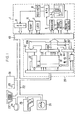
- Fig. 1 is a block diagram of a data acquisition system employing the invention.
- Fig. 2 is a block diagram of one embodiment of the FIFO of the present invention.
- Fig. 3a shows one choice of FIFO output word format for an NMR system.
- Fig. 3b shows another choice of FIFO output word format for an NMR data system.
- Fig. 1 exemplifies the present invention applied to the data acquisition and control functions of a modern Fourier
transform NMR spectrometer 1. The latter apparatus is broadly and symbolically typified by a sample of matter 2 for analysis subject to a magnetic field provided by magnet 3 and magnet controller 3'. One ormore RF transmitters 4 and associated modulators andpulse formers 5 are connected to a probe assembly 6 through amultiplexer 7. Areceiver 8, also multiplexed to the probe 6, detects resonant signals induced in the sample 2. Wave forms of the transient resonances are digitized by ADC 9. Instrumental variables such as sample temperature, magnetic field-frequency lock conditions and the like are also monitored and may be altered under computer control to maintain desired constant conditions. - A computer or system of
processors 20 is also provided to automatically acquire and evaluate incoming information from thespectrometer 1 and as well to issue outgoing signals to maintain desired instrumental conditions and to control the data acquisition sequence. By way of example, this may require responding to temperature and field frequency lock conditions, gating on and off the transmitter and receiver, modulating transmitter signals to realize pulse sequences having desired properties for exciting resonance in the sample, initiating digitization of the resonant signal at precisely defined intervals and strobing the result of such digitization to theprocessor system 20. - Communication between the
processor 20 and its environment comprises input-out (1/0)bus 22. In addition to controlling the data source (spectrometer 1) and reading data generated by the data source, the prototypical data acquisition system must communicate with mass storage, forexample disc memory 24 for storage of large data arrays, operating system, library and program requirements. In addition, hard copy output must eventually be generated as symbolized byplotter 25 or like device;visual display 26 allows monitoring of the progress of the experiment during acquisition to correct errors, select operating conditions, or to alter the course of the experiment as appropriate after early inspection of the data. Keyboard 23 is also connected to the I/ 0bus 22 to provide means to carry out desired alterations of the course of the experiment, to schedule sequences of operations, provide required numerical parameters and the like. - A plurality of separate functions as represented by the above discussion are accommodated by requiring the computer to respond to each function according to some predetermined priority hierarchy. Thus a key stroke on keyboard 23 may generate a low priority signal to which the attention of the computer may be delayed without loss of data for some period because the human intervenor does not generate data through the keyboard at a rate requiring more immediate attention. On the other hand,
disc file 24 may require the computer to respond within some tens of microseconds for acceptance of data from the disc file or like mass storage. Response to "data ready for input" conditions from the ADC 9 may demand a response time substantially shorter than the inverse sampling rate which could reach magnitudes oforder 10 MHz. Commands to initiate sampling of a wave form U(t) at precise values of time, t, require very high priority to assure availability of the computer to establish control of the variable t within the desired tolerance (of the order of tens of nanoseconds). All of these diverse hierarchical functions are achieved bypriority interrupt system 28 responsive to interrupt signals originating in an external device and transmitted over the I/O bus 22. In response to any interrupt of higher priority than the task currently in progress, software operates to store the status of the system and initiate the present higher priority task at the conclusion of which the next lower priority task is resumed. Thus, a considerable number of steps are required at each interrupt. As thus described, this corresponds to a conventionally organized data acquisition system. If the interrupt rate for a certain class of interrupts can be reduced those tasks can be accepted from the routine stream of interrupt activity. Thus the burden for interrupt service and the concomitant housekeeping activities required is strongly reduced forcomputer system 20. - This is accomplished by a portion of the
control interface 29 as hereinafter described. The central member of this functional block is FIFOregister 30 and associatedcontrol logic 32. The FIFO is a known sequence buffer which has aninput register 34 and anoutput register 36. A sequence of digital words presented to theFIFO 30 are stored in successive locations of the FIFO andFIFO control logic 32 generates command pulses which advance the content of the successive FIFO addresses frominput buffer 34 tooutput buffer 36. Such control logic also generates status signals and controls input to thebuffer 30. - As in the previously referenced GB-A--2021780 the digital word processed by
FIFO 30 comprises a command, or state portion to select the state ofspectrometer 1 and a persistence portion which specifies the duration of the selected state. Thus,timer logic 42 receives the persistence portion of the word fromdata path 46A and initiates a count down in response thereto and at the conclusion of the persistence interval issues a countdown complete signal toFIFO control logic 32. At that point the currently active state is terminated and the content of the FIFO is advanced introducing the next sequential work tooutput register 36, thus initiating a new state and persistence interval at theoutput register 36. As in the prior art, output register 36 communicates viadata path 46B directly or through anappropriate interface 40 withspectrometer 1. - The datum currently resident in
output register 36 is transferred to inputregister 34 overdata path logic sub unit 44. This permits complex sequences of commands to be accommodated within a FIFO of modest maximum capacity. As one of its functionslogic sub unit 44 includes means for counting the number of times a full sequence of command words rotates throughoutput buffer 36.Logic 45 processes initialization of the rotation count frombus 22 and provides the necessary status signals to reflect the condition of the system. Where the entire sequence is retained within the FIFO this feature permits repetition of the sequence for a preset number of resonance excitations, terminating the present measurement. Alternative means for terminating the FIFO operation through a halt command is realized by insertion of an appropriately coded control word which is interpreted bytimer logic 42 to halt the FIFO and set a status bit to so indicate to the data acquisition logic. - It has been noted above that the sequence length is assumed to be less than the maximum FIFO capacity. It will also be noted that the maximum FIFO capacity is not necessarily a multiple of a particular selected repetitive command sequence. Although the invention is easily understood on such an assumption, the general case requires a variable length sequence of command words to accommodate flexibility of experiments. This can be accomplished with a conventional FIFO structure but a limitation is introduced in the form of the propagation time from the input register of the FIFO to the end-of-queue, or first available address of the FIFO. In view of the above considerations, a variable length FIFO is preferred. A representative such device is symbolically described in Fig. 1 and 2. The FIFO length is initialized by data received on
input 22 which is latched in aportion 50 ofFIFO control logic 32 to define a pointer to the FIFO address which is to receive input and to disable FIFO words not comprehended between the output register and the selected input address.FIFO 30 andFIFO control 32 are substantially conventional in organization except that the FIFO is adapted by straightforward gating means (inputaddress pointer logic 52 and input word multiplexer 52') to provide selectable length under control of the processor during the initialization and cyclic operation. During ordinary (cyclic) operation theFIFO control 32 issues a strobe pulse to theFIFO 30 to advance the sequence of words by transferring each word to the next adjacent FIFO address. The strobe pulse is commanded from a countdown timer contained withinpersistence logic 42.Persistence logic 42 decodes the persistence portion of the command word as it is strobed to output register 36 and initiates a countdown. When the countdown reaches zero, a signal toFIFO control 32 initiates the next FIFO advance strobe pulse.Persistence logic 42 also detects a legal halt (for example, a maximum or a minimum persistence time code) and sets a FIFO halt flag to so inform the processor. - The implementation of a sequence of control words which exceeds the maximum capacity of the FIFO requires partial operation in a non- feedback mode more fully described in GB-A-2021780. Thus, operation in this partial non- feedback mode does not result in transfer of the content of output register 36 to the FIFO input to maintain the sequence. In this mode, imminent FIFO underflow is indicated by a status bit which initiates an interrupt to the
processor 20 for reloading theFIFO 30 with the next required word of the command word sequence. In this mode of operation the control word repetition feature is operative to reduce the interrupt rate by maximizing in theFIFO 30 the number of discrete command steps to be realized by thespectrometer 1. A simple example is apparent in the use of the repetition feature completely to specify in a single word the entre set of commands to an ADC to initiate data conversion and the precise repetition frequency thereof. (In digitization of a complex waveform for Fourier decomposition, the waveform must be sampled a large number of times at precisely spaced intervals). This significantly improves the capability of the data acquisi- tion/control structure of GB-A-2021780 in that non-redundant and cyclic operations may be conveniently joined. For example, it may be desired to repetitively execute a subset of states within a given measurement. The simple repetition of the data conversion operation described above may include in some instances a more complex subset of instructions including data conversion of a single point, such subset to be repeated for the large number of discrete data points necessary to characterize the desired time domain data. - Turning now to Fig. 3a, there is shown one representative choice of format for a 32 bit FIFO output word ultimately directed to
output register 36. A persistence interval is specified with a timing count subfield comprising 10 bits and a time base subfield of 4 bits. The time base subfield supplies a power of ten which multiplies the timing count subfield. (The particular word division and bit allocation is illustrative only). The remaining group of 18 bits are divided between specifying both the state of the apparatus and the number of repetitions. The allocation. of bits for state specification is dependent upon the possible number of distinctive substates which are concurrently compatible. Ordinarily, an FT-NMR system is susceptible to a very few concurrently specified substates which this basis, easily divided into two independent command groups along the lines of Table 1 (the commands of Table 1 are illustrative only and a detailed explanation thereof is not essential to understanding the present invention. A 5 bit subfield is sufficient to specify any one of the desired operands. Fig. 3a illustrates such a choice wherein one bit of a 5 bit operand sub-field is available to designate either of two such command groups. The remaining 4 bits can specify up to 16 combinations of the 8 substates available in either group. Thus, a limited degree of microprog- rammability is available while a substantial area for non-compatible substate superpositions (errors) is eliminated. In the prior art a 16-bit subfield was allocated to the specification of output commands. In such case the functions were allocated on a dedicated bit-per state basis permitting the concurrent specification of up to 16 substates from the 16-bit field where in fact nearly all of the 216_1 possible composite states would be meaningless. For a general apparatus such a large field is, of course, appropriate, although it is not optimum where a substantial portion of mathematically possible combinations, here 2's- 1, are not physically compatible.
- An intermediate choice is shown in Fig. 3(b) where a 10-bit operand field is shown. In such case, and assuming a multiple command group division similar to Table I, there is available a bit- for-function allocation for each of the 8 substates, a group designation bit and an extra bit which could be used to expand the number of groups or the number of functions. In this format a selected operand may well be included in more than one group of operands.
- These format choices for the command, or state portion of the word determine the field available for the repetition count field. For the short command field of Fig. 3(a), a larger repetition field is available. Thus, a 13-bit repetition field permits specifying that the current state be repeated up to 2'3-1 times in addition to the initial statement of the operand. A repetition of zero implies that the currently stated operand is not repeated at the end of the corresponding persistence interval, and the FIFO content is then advanced to deliver the next sequential word to the output register. These long repetition count situations are useful for specifying a corresponding number of successive identical state commands, e.g., conversion commands to the ADC for sampling a time-dependent wave form at precisely delineated intervals, as specified by the persistence interval. It should be noted that for ADC command purposes a pulse is ordinarily delivered to command the ADC as, 5 for example, to reset the ADC, to initiate the conversion and the like, while the persistence interval in that circumstance may be interpreted by the apparatus as an interval between pulses.
- For the longer command field of Fig. 3(b) the repetition count field is abbreviated in length requiring a logarithmic-linear interpretation. A repetition mode select bit designates whether the 6-bit repetition field, n=O, 1...2"-1 specifies 0 to 63 repetitions, or on the other hand, the selection bit may designate that n is interpreted as 2k-m for long repetition counts, where k is some convenient maximum exponent and m is the desired number of bits (k>m).
- The several portions or subfields described above do not necessarily reside in the same word. For example, the timing subfield may reside in the next adjacent word with respect to the output register.
- Another embodiment of the FIFO based systems described above lacks a persistence time decoding structure but realizes the persistence selection result from a repetition function. The repetition field is in effect the time counter and the time base is supplied by the processor clock available over
bus 22, or preferably a faster internal FIFO clock. The treatment of the control word as either discrete repetitions or as a state continuously persisting for an interval of n time units is selected in accord with a prescribed bit of the command word and implemented within theinterface 40. - In one embodiment initialization may take the form of initializing one of dual countdown registers, the remaining one being currently active. At the conclusion of the currently active countdown, the countdown=0 and repetition bit in the active state will gate the second countdown on the first countdown off. Where no repetition bit is encountered, the sequence is advanced in straightforward fashion at the termination of the currently active state.
- Another embodiment for achieving persistence selection from repetition is realized in a more general type of sequence buffer wherein bidirectional internal transfer means are provided for either advancing the FIFO content toward the
output register 36 or alternatively, transferring the content in the opposite direction by at least one address increment prior to advancing the sequence again toward the output register. In this form, repetition is realized in conjunction with a latchedoutput register 36 whereinregister 36 is loaded, the repeat command is decoded (as by a logic unit analogous to unit 42) and the reverse transfer accomplished while the output buffer content is maintained. In this realization, the repetition count field initializes a countdown circuit which maintains the prescribed state inoutput register 36 until the countdown is complete. At that point, the next strobe pulse advances the sequence of control words transferring the next output word to the output register. Because the word now transferred to output register 36 is the same word previously shifted intooutput register 36 then returned to the last FIFO address, a countdown flag set by the countdown circuit causes a double transfer forward. Thus, the repeated command is transferred to the feedback path to inputbuffer 34 for maintaining the sequence. - Although an NMR spectrometer has been selected as the illustrative example for the present invention it will be obvious that any data acquisition system which must issue periodic commands and accept aperiodic interrupts may use the present invention profitably.
Claims (4)
Applications Claiming Priority (2)
| Application Number | Priority Date | Filing Date | Title |
|---|---|---|---|
| US06/107,106 US4375676A (en) | 1979-12-26 | 1979-12-26 | Feedback FIFO for cyclic data acquisition and instrument control |
| US107106 | 1998-06-30 |
Related Child Applications (1)
| Application Number | Title | Priority Date | Filing Date |
|---|---|---|---|
| EP86106426.9 Division-Into | 1986-05-12 |
Publications (3)
| Publication Number | Publication Date |
|---|---|
| EP0042411A1 EP0042411A1 (en) | 1981-12-30 |
| EP0042411A4 EP0042411A4 (en) | 1984-05-29 |
| EP0042411B1 true EP0042411B1 (en) | 1987-10-28 |
Family
ID=22314871
Family Applications (2)
| Application Number | Title | Priority Date | Filing Date |
|---|---|---|---|
| EP81900244A Expired EP0042411B1 (en) | 1979-12-26 | 1980-12-08 | Feedback fifo for cyclic data acquisition |
| EP86106426A Expired EP0201900B1 (en) | 1979-12-26 | 1980-12-08 | Re-entrant fifo for cyclic data acquisition |
Family Applications After (1)
| Application Number | Title | Priority Date | Filing Date |
|---|---|---|---|
| EP86106426A Expired EP0201900B1 (en) | 1979-12-26 | 1980-12-08 | Re-entrant fifo for cyclic data acquisition |
Country Status (5)
| Country | Link |
|---|---|
| US (1) | US4375676A (en) |
| EP (2) | EP0042411B1 (en) |
| JP (1) | JPS56501855A (en) |
| DE (2) | DE3072203T2 (en) |
| WO (1) | WO1981001881A1 (en) |
Families Citing this family (7)
| Publication number | Priority date | Publication date | Assignee | Title |
|---|---|---|---|---|
| US4525673A (en) * | 1979-12-26 | 1985-06-25 | Varian Associates, Inc. | NMR spectrometer incorporating a re-entrant FIFO |
| DE3582877D1 (en) * | 1985-01-16 | 1991-06-20 | Varian Associates | MULTIPLE BUFFER MEMORY FOR DETECTING THE MAGNETIC CORE RESONANCE SIGNALS. |
| US4718004A (en) * | 1985-02-25 | 1988-01-05 | Honeywell Inc. | Sample data acquisition system using microprocessor controlled sequence having FIFO buffer, DAM controller |
| JP2776785B2 (en) * | 1995-12-27 | 1998-07-16 | 日本電気アイシーマイコンシステム株式会社 | Serial data transfer device |
| JP3815948B2 (en) * | 2000-04-20 | 2006-08-30 | シャープ株式会社 | FIFO memory control circuit |
| US7053614B2 (en) * | 2004-04-08 | 2006-05-30 | Varian, Inc. | Optimized channel controller for NMR apparatus |
| DE102014211137A1 (en) * | 2014-06-11 | 2015-12-17 | Siemens Aktiengesellschaft | magnetic resonance device |
Family Cites Families (10)
| Publication number | Priority date | Publication date | Assignee | Title |
|---|---|---|---|---|
| US3293616A (en) * | 1963-07-03 | 1966-12-20 | Ibm | Computer instruction sequencing and control system |
| US3593306A (en) * | 1969-07-25 | 1971-07-13 | Bell Telephone Labor Inc | Apparatus for reducing memory fetches in program loops |
| US3674998A (en) * | 1970-03-04 | 1972-07-04 | Varian Associates | Method and apparatus for automatic phase control in a fourier analyzed readout of impulse resonance data |
| US3792444A (en) * | 1972-09-18 | 1974-02-12 | R Spinner | Data communication system |
| US4063310A (en) * | 1973-07-25 | 1977-12-13 | Pye Limited | Sampler control system for chromatograph analytical apparatus |
| GB1580787A (en) * | 1976-04-14 | 1980-12-03 | Mansfield P | Nuclear magnetic resonance apparatus and methods |
| US4065714A (en) * | 1976-06-21 | 1977-12-27 | Varian Associates, Inc. | Pulsed RF excited spectrometer having improved pulse width control |
| US4097920A (en) * | 1976-12-13 | 1978-06-27 | Rca Corporation | Hardware control for repeating program loops in electronic computers |
| US4176400A (en) * | 1977-08-10 | 1979-11-27 | Teletype Corporation | Buffer storage and control |
| US4191919A (en) * | 1978-05-22 | 1980-03-04 | Varian Associates, Inc. | Fast NMR acquisition processor |
-
1979
- 1979-12-26 US US06/107,106 patent/US4375676A/en not_active Expired - Lifetime
-
1980
- 1980-12-08 DE DE8686106426T patent/DE3072203T2/en not_active Expired - Lifetime
- 1980-12-08 DE DE8181900244T patent/DE3072046D1/en not_active Expired
- 1980-12-08 EP EP81900244A patent/EP0042411B1/en not_active Expired
- 1980-12-08 JP JP81500446A patent/JPS56501855A/ja active Pending
- 1980-12-08 EP EP86106426A patent/EP0201900B1/en not_active Expired
- 1980-12-08 WO PCT/US1980/001661 patent/WO1981001881A1/en not_active Ceased
Also Published As
| Publication number | Publication date |
|---|---|
| DE3072203T2 (en) | 1993-01-21 |
| US4375676A (en) | 1983-03-01 |
| EP0201900B1 (en) | 1992-08-19 |
| WO1981001881A1 (en) | 1981-07-09 |
| EP0042411A1 (en) | 1981-12-30 |
| EP0042411A4 (en) | 1984-05-29 |
| DE3072203D1 (en) | 1992-09-24 |
| EP0201900A2 (en) | 1986-11-20 |
| EP0201900A3 (en) | 1988-08-31 |
| DE3072046D1 (en) | 1987-12-03 |
| JPS56501855A (en) | 1981-12-17 |
Similar Documents
| Publication | Publication Date | Title |
|---|---|---|
| US4191919A (en) | Fast NMR acquisition processor | |
| US4481608A (en) | Reentrant asynchronous FIFO | |
| US5027348A (en) | Method and apparatus for dynamic data block length adjustment | |
| US4519028A (en) | CPU with multi-stage mode register for defining CPU operating environment including charging its communications protocol | |
| US5581482A (en) | Performance monitor for digital computer system | |
| US4525673A (en) | NMR spectrometer incorporating a re-entrant FIFO | |
| KR19990066930A (en) | Parallel Processing Integrated Circuit Tester | |
| US20180054209A1 (en) | ADC controller With Temporal Separation | |
| US4375676A (en) | Feedback FIFO for cyclic data acquisition and instrument control | |
| EP0010191A1 (en) | Data processing apparatus including an I/O monitor circuit | |
| WO2000025143A1 (en) | Integrated circuit tester with disk-based data streaming | |
| US20030105609A1 (en) | System and method for generating waveforms using waveform segment queues | |
| EP0979417A1 (en) | Single pass doublet mode intergrated circuit tester | |
| US4559636A (en) | Time-measuring adapter for logic analyzer | |
| US4514822A (en) | Device for data acquisition | |
| EP0553080B1 (en) | High speed tester and method of providing successive loops of data signals at a predetermined clock rate | |
| EP0378071A2 (en) | Multiprocessor controller having shared control store | |
| US5544092A (en) | Method and apparatus for configuring an integrated circuit | |
| EP1735632B1 (en) | Optimized channel controller for nmr apparatus | |
| US6321352B1 (en) | Integrated circuit tester having a disk drive per channel | |
| CA1236579A (en) | Waveform memory circuit | |
| Gladney | A simple time-sharing monitor system for laboratory automation | |
| US4764894A (en) | Multiple FIFO NMR acquisition system | |
| US4849924A (en) | Event counting prescaler | |
| US4760377A (en) | Decompaction of stored data in automatic test systems |
Legal Events
| Date | Code | Title | Description |
|---|---|---|---|
| PUAI | Public reference made under article 153(3) epc to a published international application that has entered the european phase |
Free format text: ORIGINAL CODE: 0009012 |
|
| AK | Designated contracting states |
Designated state(s): DE FR GB |
|
| 17P | Request for examination filed |
Effective date: 19811030 |
|
| GRAA | (expected) grant |
Free format text: ORIGINAL CODE: 0009210 |
|
| AK | Designated contracting states |
Kind code of ref document: B1 Designated state(s): DE FR GB |
|
| REF | Corresponds to: |
Ref document number: 3072046 Country of ref document: DE Date of ref document: 19871203 |
|
| ET | Fr: translation filed | ||
| PLBE | No opposition filed within time limit |
Free format text: ORIGINAL CODE: 0009261 |
|
| STAA | Information on the status of an ep patent application or granted ep patent |
Free format text: STATUS: NO OPPOSITION FILED WITHIN TIME LIMIT |
|
| 26N | No opposition filed | ||
| REG | Reference to a national code |
Ref country code: GB Ref legal event code: 746 |
|
| PGFP | Annual fee paid to national office [announced via postgrant information from national office to epo] |
Ref country code: DE Payment date: 19921222 Year of fee payment: 13 |
|
| REG | Reference to a national code |
Ref country code: FR Ref legal event code: DL |
|
| PG25 | Lapsed in a contracting state [announced via postgrant information from national office to epo] |
Ref country code: DE Effective date: 19940901 |
|
| PGFP | Annual fee paid to national office [announced via postgrant information from national office to epo] |
Ref country code: FR Payment date: 19951114 Year of fee payment: 16 |
|
| PG25 | Lapsed in a contracting state [announced via postgrant information from national office to epo] |
Ref country code: FR Effective date: 19970829 |
|
| REG | Reference to a national code |
Ref country code: FR Ref legal event code: ST |
|
| PGFP | Annual fee paid to national office [announced via postgrant information from national office to epo] |
Ref country code: GB Payment date: 19991118 Year of fee payment: 20 |
|
| PG25 | Lapsed in a contracting state [announced via postgrant information from national office to epo] |
Ref country code: GB Free format text: LAPSE BECAUSE OF EXPIRATION OF PROTECTION Effective date: 20001207 |
|
| REG | Reference to a national code |
Ref country code: GB Ref legal event code: PE20 Effective date: 20001207 |