EP0041300B1 - Process for the dry fractionation of oils and fats having a steep dilatation/temperature line and use of the fractionated fats in margarines and shortenings - Google Patents
Process for the dry fractionation of oils and fats having a steep dilatation/temperature line and use of the fractionated fats in margarines and shortenings Download PDFInfo
- Publication number
- EP0041300B1 EP0041300B1 EP81200569A EP81200569A EP0041300B1 EP 0041300 B1 EP0041300 B1 EP 0041300B1 EP 81200569 A EP81200569 A EP 81200569A EP 81200569 A EP81200569 A EP 81200569A EP 0041300 B1 EP0041300 B1 EP 0041300B1
- Authority
- EP
- European Patent Office
- Prior art keywords
- fats
- oil
- oils
- fractionation
- triglycerides
- Prior art date
- Legal status (The legal status is an assumption and is not a legal conclusion. Google has not performed a legal analysis and makes no representation as to the accuracy of the status listed.)
- Expired
Links
- 239000003925 fat Substances 0.000 title claims abstract description 52
- 235000019197 fats Nutrition 0.000 title claims abstract description 52
- 238000005194 fractionation Methods 0.000 title claims abstract description 31
- 238000000034 method Methods 0.000 title claims abstract description 25
- 230000008569 process Effects 0.000 title claims abstract description 21
- 235000014593 oils and fats Nutrition 0.000 title claims abstract description 11
- 235000013310 margarine Nutrition 0.000 title claims description 24
- 238000004904 shortening Methods 0.000 title 1
- 239000000203 mixture Substances 0.000 claims abstract description 33
- 150000003626 triacylglycerols Chemical class 0.000 claims abstract description 18
- 235000019482 Palm oil Nutrition 0.000 claims abstract description 15
- 239000002540 palm oil Substances 0.000 claims abstract description 15
- 239000003346 palm kernel oil Substances 0.000 claims abstract description 12
- 235000019865 palm kernel oil Nutrition 0.000 claims abstract description 12
- 238000002156 mixing Methods 0.000 claims abstract description 6
- DCXXMTOCNZCJGO-UHFFFAOYSA-N tristearoylglycerol Chemical compound CCCCCCCCCCCCCCCCCC(=O)OCC(OC(=O)CCCCCCCCCCCCCCCCC)COC(=O)CCCCCCCCCCCCCCCCC DCXXMTOCNZCJGO-UHFFFAOYSA-N 0.000 claims description 28
- 239000003921 oil Substances 0.000 claims description 13
- 235000019198 oils Nutrition 0.000 claims description 13
- PHYFQTYBJUILEZ-IUPFWZBJSA-N triolein Chemical compound CCCCCCCC\C=C/CCCCCCCC(=O)OCC(OC(=O)CCCCCCC\C=C/CCCCCCCC)COC(=O)CCCCCCC\C=C/CCCCCCCC PHYFQTYBJUILEZ-IUPFWZBJSA-N 0.000 claims description 12
- 238000002844 melting Methods 0.000 claims description 10
- 230000008018 melting Effects 0.000 claims description 10
- 239000007788 liquid Substances 0.000 claims description 8
- 239000008346 aqueous phase Substances 0.000 claims description 4
- 238000002360 preparation method Methods 0.000 claims description 4
- 239000003760 tallow Substances 0.000 claims description 3
- 239000010480 babassu oil Substances 0.000 claims description 2
- 239000003240 coconut oil Substances 0.000 claims description 2
- 235000019864 coconut oil Nutrition 0.000 claims description 2
- -1 lard Substances 0.000 claims description 2
- 230000001804 emulsifying effect Effects 0.000 claims 1
- 239000012071 phase Substances 0.000 claims 1
- 230000001747 exhibiting effect Effects 0.000 abstract 1
- 239000003264 margarine Substances 0.000 description 8
- 239000000047 product Substances 0.000 description 7
- 239000002904 solvent Substances 0.000 description 6
- 239000000194 fatty acid Substances 0.000 description 5
- 238000002425 crystallisation Methods 0.000 description 4
- 230000008025 crystallization Effects 0.000 description 4
- 235000019486 Sunflower oil Nutrition 0.000 description 3
- 238000005054 agglomeration Methods 0.000 description 3
- 230000002776 aggregation Effects 0.000 description 3
- 150000001336 alkenes Chemical class 0.000 description 3
- 238000001816 cooling Methods 0.000 description 3
- 235000014113 dietary fatty acids Nutrition 0.000 description 3
- 229930195729 fatty acid Natural products 0.000 description 3
- 150000004665 fatty acids Chemical class 0.000 description 3
- 238000001914 filtration Methods 0.000 description 3
- 229940116364 hard fat Drugs 0.000 description 3
- 238000000926 separation method Methods 0.000 description 3
- 239000002600 sunflower oil Substances 0.000 description 3
- LFQSCWFLJHTTHZ-UHFFFAOYSA-N Ethanol Chemical compound CCO LFQSCWFLJHTTHZ-UHFFFAOYSA-N 0.000 description 2
- 239000003054 catalyst Substances 0.000 description 2
- 235000014541 cooking fats Nutrition 0.000 description 2
- 239000000839 emulsion Substances 0.000 description 2
- 239000012467 final product Substances 0.000 description 2
- 238000004806 packaging method and process Methods 0.000 description 2
- 239000000843 powder Substances 0.000 description 2
- 235000020183 skimmed milk Nutrition 0.000 description 2
- 239000007787 solid Substances 0.000 description 2
- 239000007790 solid phase Substances 0.000 description 2
- PXHVJJICTQNCMI-UHFFFAOYSA-N Nickel Chemical compound [Ni] PXHVJJICTQNCMI-UHFFFAOYSA-N 0.000 description 1
- 235000019485 Safflower oil Nutrition 0.000 description 1
- 235000018936 Vitellaria paradoxa Nutrition 0.000 description 1
- 239000005862 Whey Substances 0.000 description 1
- 102000007544 Whey Proteins Human genes 0.000 description 1
- 108010046377 Whey Proteins Proteins 0.000 description 1
- 125000001931 aliphatic group Chemical group 0.000 description 1
- OENHQHLEOONYIE-UKMVMLAPSA-N all-trans beta-carotene Natural products CC=1CCCC(C)(C)C=1/C=C/C(/C)=C/C=C/C(/C)=C/C=C/C=C(C)C=CC=C(C)C=CC1=C(C)CCCC1(C)C OENHQHLEOONYIE-UKMVMLAPSA-N 0.000 description 1
- 239000007864 aqueous solution Substances 0.000 description 1
- OGBUMNBNEWYMNJ-UHFFFAOYSA-N batilol Chemical class CCCCCCCCCCCCCCCCCCOCC(O)CO OGBUMNBNEWYMNJ-UHFFFAOYSA-N 0.000 description 1
- 230000008901 benefit Effects 0.000 description 1
- TUPZEYHYWIEDIH-WAIFQNFQSA-N beta-carotene Natural products CC(=C/C=C/C=C(C)/C=C/C=C(C)/C=C/C1=C(C)CCCC1(C)C)C=CC=C(/C)C=CC2=CCCCC2(C)C TUPZEYHYWIEDIH-WAIFQNFQSA-N 0.000 description 1
- 235000013734 beta-carotene Nutrition 0.000 description 1
- 239000011648 beta-carotene Substances 0.000 description 1
- 229960002747 betacarotene Drugs 0.000 description 1
- 229910052799 carbon Inorganic materials 0.000 description 1
- 125000004432 carbon atom Chemical group C* 0.000 description 1
- 239000002826 coolant Substances 0.000 description 1
- 235000005687 corn oil Nutrition 0.000 description 1
- 239000002285 corn oil Substances 0.000 description 1
- 239000013078 crystal Substances 0.000 description 1
- 230000001419 dependent effect Effects 0.000 description 1
- 238000007865 diluting Methods 0.000 description 1
- 230000000694 effects Effects 0.000 description 1
- 238000004817 gas chromatography Methods 0.000 description 1
- 230000036541 health Effects 0.000 description 1
- 238000005984 hydrogenation reaction Methods 0.000 description 1
- 230000006872 improvement Effects 0.000 description 1
- 238000010348 incorporation Methods 0.000 description 1
- PNDPGZBMCMUPRI-UHFFFAOYSA-N iodine Chemical compound II PNDPGZBMCMUPRI-UHFFFAOYSA-N 0.000 description 1
- 235000020778 linoleic acid Nutrition 0.000 description 1
- OYHQOLUKZRVURQ-IXWMQOLASA-N linoleic acid Natural products CCCCC\C=C/C\C=C\CCCCCCCC(O)=O OYHQOLUKZRVURQ-IXWMQOLASA-N 0.000 description 1
- 238000004519 manufacturing process Methods 0.000 description 1
- 239000000155 melt Substances 0.000 description 1
- 230000006911 nucleation Effects 0.000 description 1
- 238000010899 nucleation Methods 0.000 description 1
- 238000005086 pumping Methods 0.000 description 1
- 239000002994 raw material Substances 0.000 description 1
- 230000000630 rising effect Effects 0.000 description 1
- 235000005713 safflower oil Nutrition 0.000 description 1
- 239000003813 safflower oil Substances 0.000 description 1
- 150000003839 salts Chemical class 0.000 description 1
- 239000000243 solution Substances 0.000 description 1
- 230000006641 stabilisation Effects 0.000 description 1
- 238000011105 stabilization Methods 0.000 description 1
- 238000003756 stirring Methods 0.000 description 1
- 239000004094 surface-active agent Substances 0.000 description 1
- UFTFJSFQGQCHQW-UHFFFAOYSA-N triformin Chemical compound O=COCC(OC=O)COC=O UFTFJSFQGQCHQW-UHFFFAOYSA-N 0.000 description 1
- XLYOFNOQVPJJNP-UHFFFAOYSA-N water Substances O XLYOFNOQVPJJNP-UHFFFAOYSA-N 0.000 description 1
- 239000010497 wheat germ oil Substances 0.000 description 1
- OENHQHLEOONYIE-JLTXGRSLSA-N β-Carotene Chemical compound CC=1CCCC(C)(C)C=1\C=C\C(\C)=C\C=C\C(\C)=C\C=C\C=C(/C)\C=C\C=C(/C)\C=C\C1=C(C)CCCC1(C)C OENHQHLEOONYIE-JLTXGRSLSA-N 0.000 description 1
Classifications
-
- C—CHEMISTRY; METALLURGY
- C11—ANIMAL OR VEGETABLE OILS, FATS, FATTY SUBSTANCES OR WAXES; FATTY ACIDS THEREFROM; DETERGENTS; CANDLES
- C11B—PRODUCING, e.g. BY PRESSING RAW MATERIALS OR BY EXTRACTION FROM WASTE MATERIALS, REFINING OR PRESERVING FATS, FATTY SUBSTANCES, e.g. LANOLIN, FATTY OILS OR WAXES; ESSENTIAL OILS; PERFUMES
- C11B7/00—Separation of mixtures of fats or fatty oils into their constituents, e.g. saturated oils from unsaturated oils
- C11B7/0075—Separation of mixtures of fats or fatty oils into their constituents, e.g. saturated oils from unsaturated oils by differences of melting or solidifying points
-
- A—HUMAN NECESSITIES
- A23—FOODS OR FOODSTUFFS; TREATMENT THEREOF, NOT COVERED BY OTHER CLASSES
- A23D—EDIBLE OILS OR FATS, e.g. MARGARINES, SHORTENINGS OR COOKING OILS
- A23D7/00—Edible oil or fat compositions containing an aqueous phase, e.g. margarines
-
- A—HUMAN NECESSITIES
- A23—FOODS OR FOODSTUFFS; TREATMENT THEREOF, NOT COVERED BY OTHER CLASSES
- A23D—EDIBLE OILS OR FATS, e.g. MARGARINES, SHORTENINGS OR COOKING OILS
- A23D7/00—Edible oil or fat compositions containing an aqueous phase, e.g. margarines
- A23D7/001—Spread compositions
Definitions
- the present invention relates to a process for the dry fractionation of oils and fats which at least in part of their dilatation/temperature curve has a steep course.
- a steep dilatation line means that over a short temperature range the fat concerned displays a great difference in the amount of crystallized triglycerides. Consequently, if it is wished to fractionate such fats in order to prepare fractions having precisely specified properties, extremely accurate control of the temperature at which the fractionation takes place is necessary.
- a fractionation temperature that is a little too high will result in a considerably lower yield of stearin being obtained; a fractionation temperature a little too low can be of very substantial influence upon the composition of the stearin fraction then obtained in too great an amount.
- the fractionation of fats having a steep dilatation/temperature curve is especially a problem with industrial processes which take place on a large scale.
- Difficulties are especially encountered when fats derived from fatty acids having a relatively short chain, i.e. a chain containing 12-14 carbon atoms, such as coconut oil, palmkernel oil and babassu oil, are subjected to dry fractionation. Separation of the stearin fraction from the olein fraction by filtration is almost impossible and complicated press techniques have to be applied to achieve an effecient separation of said fractions.
- such fats before they are fractionated, are mixed with triglycerides of a nature such that in the temperature range in which it is wished to carry out the fractionation the difference in dilatation values of the mixture diminishes substantially. Consequently, in the temperature range mentioned the added triglycerides will have to have an amount of solid phase such that they can exert a substantial influence upon the steepness of the dilatation line of the mixture.
- the triglycerides added are of a nature such that during the fractionation the added triglycerides crystallize out earlier and thus form nuclei on which the triglycerides of the fats have the steep dilatation curve can crystallize, because it is so that the fats having a steep dilatation curve generally crystallize in the form of very fine crystals which barely grow even when remaining a very long time under the crystallization conditions applied.
- the triglycerides to be added to the "steep fats" before the fractionation have a difference in dilatation values at 15 and 25°C not exceeding 600 mm 3 /25 grammes, and have a higher slip melting point than the said oils or fats.
- These triglycerides may consist of palm oil, lard, tallow and also hydrogenated and/or fractionated derivatives thereof.
- the weight ratio between the fats of the first and the second kind can vary between (10-90):(90-10), preferably between (20-80):(80:20) and ideally between (40:60) and (60:40).
- Palmkernel oil Fractionation of palmkernel oil it has appeared to be particularly attractive to carry out the process in the presence of palm oil.
- a mixture of for example 20-80 parts by weight of palm oil and 80-20 parts by weight of palmkernel oil yields a stearin fraction that is eminently suitable for the preparation ⁇ of margarines, low calorie margarines, bakery fats and cooking fats.
- the fat mixture that can be used for such products can consist of oils and fats having a lower melting point that the stearin fraction obtained by co-fractionating the steep fat and said added triglycerides, as well as of other fractions of oils and fats.
- the weight ratio between on one hand the stearin fraction obtained by co-fractionation and, on the other hand, the oil having a lower melting point can vary, depending on the desired manner of packaging (normally, margarines packaged in beakers are softer than those packaged in wrappers) and also is dependent on the weight ratio between fats which have been fractionated together and also the temperature at which the fractionation took place.
- the co-fractionation can be carried out under the conditions usual for dry fractionation, which will be illustrated in the Examples, at temperatures ranging from 18-35°C and preferably from 20-28 0 C.
- JP-A-77117307 It is known from JP-A-77117307 to subject a mixture of fats consisting of shea fat and palm oil to wet co-fractionation involving the use of a specific alcohol as a solvent.
- margarine fats can be prepared containing neither hydrogenated nor interesterified oils and fats.
- the stearin fractions obtained according to the present invention are used in amounts varying from 5 to 50% of the fat mixture, along with 95-50% of an oil that is liquid at room temperature or a mixture of oils liquid at room temperature with one or more higher melting fats.
- the liquid oil used is therefore preferably an oil or oil mixture rich in linoleic acid radicals, such as sunflower oil, safflower oil, corn oil, wheat germ oil, etc.
- Fat mixtures thus prepared are pre-eminently suitable for incorporation in products which are filled into beakers in pourable form.
- health margarines for example can be prepared which have at 10°C a hardness of not more than 400 to 500 g/cm 2 and at 20°C a hardness of at least 50 g/cm 2 (after 3 weeks).
- the oleins obtained according to the process of the invention can likewise be used in margarines, low calorie margarines, bakery fats and cooking fats; preferably such olefins are used in hdyrogenated form.
- a fat mixture can be used consisting of 5-20% by weight of completely or almost completely hydrogenated oleins along with 95-80% by weight of an oil liquid at room temperature, for example sunflower oil.
- partially hydrogenated olefins are used by preference, along with a fat mixture such that the product is obtained with a hardness of 900-2600 g/cm 2 at 10°C and of 100-500 g/cm 2 at 20°C.
- One of the ways in which the partially hydrogenated oleins can be obtained is by hydrogenation in the presence of a sulphurated nickel catalyst under the usual conditions until oleins having a trans-fatty acid content of 5 to 15% by weight have been formed.
- 10-50% by weight of partially hydrogenated olefins can be used, preferably along with oils liquid at room temperature, fats having a melting point of 25-39°C and fats having a melting point of 40-48°C.
- the weight ratios and kind of various fats to be used will be determined by the desired properties of the final product, the availability and cost price of the raw materials and also workability and taste thereof.
- Palm oil and palm kernel oil were dry-fractionated, i.e. from the melt that is to say without solvent or an aqueous solution containing a surface-active agent.
- the agglomeration was carried out as follows:
- the diameter of the cylindrical part of the conical kettle was 120 mm (volume 1000 cm 3 ). After agglomeration or working in the conical kettle the oleins were separated from stearins by filtration.
- Effective co-fractionation was established by analysing the fractions for properties like iodine, values, solid contents, fatty acid and triglyceride compositions to ascertain that the proportions of the fat components of the fat blend subjected to co-fractionation were reflected in the isolated solid phases.
- the fatty acid composition of the stearin fraction obtained by fractionating a mixture of 40% of palm oil (PO) and 60% of palmkernel oil (PK) was analysed by gaschromatography and compared with a 40/60 mixture of stearins obtained by fractionating separately palm oil and palmkernel oil.
- the oleins from Examples III and IV were hydrogenated in the usual manner with a nickel-on-kieselguhr catalyst to complete saturation.
- the hard fat obtained from the olein of Example III had a melting point of 55°C; the hard fat from the olein of Example IV had a melting point of 52°C.
- Margarine fats were prepared from both hard fats by mixing 12.9% of hard fat with 87.1% of sunflower oil.
- margarine fat 83.2% by weight of margarine fat was mixed with 0.1% by weight of monoglycerides of completely hydrogenated palm oil, 0.18% by weight of phosphatide and 0.1 % by weight of ⁇ -carotene.
- An aqueous phase was prepared by mixing 15.82% by weight of water with 0.6% by weight of skimmilk solids.
- Margarine was prepared by making a pre-emulsion of margarine fat and aqueous phase and pumping it into a votator A-unit at a temperature of 39°C, where cooling to 7°C took place; subsequently cooling to 5°C was effected in a second votator A-unit, and in an uncooled crystallization vessel provided with a stirrer crystallization took place with the temperature rising to 13°C, at which temperature the emulsion obtained was filled into containers in which the product further stiffened to spreadable consistency.
- Three margarines for packaging in wrappers were prepared from a margarine fat and an aqueous phase which contained, calculated on the final product, 0.2% of skimmilk powder, 0.3% of whey powder and 1% of salt.
- Each of the three fat mixtures contained an olein from Example III, hydrogenated to 31 °C. This olein was hydrogenated at a temperature of 180°C with a sulphurated nickel-on-kieselguhr catalyst to the melting point indicated. The trans-fatty acid content of the olein was then 9%.
- Example IX The hydrogenated olein used in Example IX was in addition randomly interesterified.
- Table D shows the compositions and the properties.
- the hardness of margarines was measured by the method developed by Haighton, as described in J.A.O.C.S. 36 (1959) pages 345-348.
Landscapes
- Chemical & Material Sciences (AREA)
- Life Sciences & Earth Sciences (AREA)
- Engineering & Computer Science (AREA)
- Oil, Petroleum & Natural Gas (AREA)
- Food Science & Technology (AREA)
- Polymers & Plastics (AREA)
- Chemical Kinetics & Catalysis (AREA)
- Wood Science & Technology (AREA)
- Organic Chemistry (AREA)
- Fats And Perfumes (AREA)
- Edible Oils And Fats (AREA)
Abstract
Description
- The present invention relates to a process for the dry fractionation of oils and fats which at least in part of their dilatation/temperature curve has a steep course. A steep dilatation line means that over a short temperature range the fat concerned displays a great difference in the amount of crystallized triglycerides. Consequently, if it is wished to fractionate such fats in order to prepare fractions having precisely specified properties, extremely accurate control of the temperature at which the fractionation takes place is necessary. A fractionation temperature that is a little too high will result in a considerably lower yield of stearin being obtained; a fractionation temperature a little too low can be of very substantial influence upon the composition of the stearin fraction then obtained in too great an amount. The fractionation of fats having a steep dilatation/temperature curve is especially a problem with industrial processes which take place on a large scale.
- Problems are particularly pronounced when fats have to be fractionated having a difference in dilatation value at 15 and 25°C of at least 800 mm3/25 grammes.
- Difficulties are especially encountered when fats derived from fatty acids having a relatively short chain, i.e. a chain containing 12-14 carbon atoms, such as coconut oil, palmkernel oil and babassu oil, are subjected to dry fractionation. Separation of the stearin fraction from the olein fraction by filtration is almost impossible and complicated press techniques have to be applied to achieve an effecient separation of said fractions.
- According to the present invention, such fats, before they are fractionated, are mixed with triglycerides of a nature such that in the temperature range in which it is wished to carry out the fractionation the difference in dilatation values of the mixture diminishes substantially. Consequently, in the temperature range mentioned the added triglycerides will have to have an amount of solid phase such that they can exert a substantial influence upon the steepness of the dilatation line of the mixture. The triglycerides added are of a nature such that during the fractionation the added triglycerides crystallize out earlier and thus form nuclei on which the triglycerides of the fats have the steep dilatation curve can crystallize, because it is so that the fats having a steep dilatation curve generally crystallize in the form of very fine crystals which barely grow even when remaining a very long time under the crystallization conditions applied. The triglycerides to be added to the "steep fats" before the fractionation have a difference in dilatation values at 15 and 25°C not exceeding 600 mm3/25 grammes, and have a higher slip melting point than the said oils or fats. These triglycerides may consist of palm oil, lard, tallow and also hydrogenated and/or fractionated derivatives thereof.
- The weight ratio between the fats of the first and the second kind can vary between (10-90):(90-10), preferably between (20-80):(80:20) and ideally between (40:60) and (60:40).
- Fractionation of palmkernel oil it has appeared to be particularly attractive to carry out the process in the presence of palm oil. A mixture of for example 20-80 parts by weight of palm oil and 80-20 parts by weight of palmkernel oil yields a stearin fraction that is eminently suitable for the preparation ·of margarines, low calorie margarines, bakery fats and cooking fats.
- The fat mixture that can be used for such products can consist of oils and fats having a lower melting point that the stearin fraction obtained by co-fractionating the steep fat and said added triglycerides, as well as of other fractions of oils and fats. The weight ratio between on one hand the stearin fraction obtained by co-fractionation and, on the other hand, the oil having a lower melting point can vary, depending on the desired manner of packaging (normally, margarines packaged in beakers are softer than those packaged in wrappers) and also is dependent on the weight ratio between fats which have been fractionated together and also the temperature at which the fractionation took place. The co-fractionation can be carried out under the conditions usual for dry fractionation, which will be illustrated in the Examples, at temperatures ranging from 18-35°C and preferably from 20-280C.
- It is known from JP-A-77117307 to subject a mixture of fats consisting of shea fat and palm oil to wet co-fractionation involving the use of a specific alcohol as a solvent.
- The process described in said Japanese publication provides an improvement of a solvent fraction crystallization using an aliphatic, monohydric alcohol as the solvent, whereas the process of the present invention provides a different solution, i.e. the addition of specific triglycerides to steep fats which have to be fractionated, using a different technique, i.e. dry fractionation. In wet fractionation the efficiency of the separation of the fractions obtained is high due to the diluting effect of the solvent on the occluded olein. Moreover, the stearin is usually washed with cold solvent. Consequently, when a wet fractionation is considered, it is not required to apply co-fractionation, since such technique does not provide any substantial benefit.
- By making use of stearins which have been obtained by co-fractionation according to the present invention, margarine fats can be prepared containing neither hydrogenated nor interesterified oils and fats. Preferably the stearin fractions obtained according to the present invention are used in amounts varying from 5 to 50% of the fat mixture, along with 95-50% of an oil that is liquid at room temperature or a mixture of oils liquid at room temperature with one or more higher melting fats.
- The liquid oil used is therefore preferably an oil or oil mixture rich in linoleic acid radicals, such as sunflower oil, safflower oil, corn oil, wheat germ oil, etc.
- Fat mixtures thus prepared are pre-eminently suitable for incorporation in products which are filled into beakers in pourable form. With such fat mixtures health margarines for example can be prepared which have at 10°C a hardness of not more than 400 to 500 g/cm2 and at 20°C a hardness of at least 50 g/cm2 (after 3 weeks).
- The oleins obtained according to the process of the invention can likewise be used in margarines, low calorie margarines, bakery fats and cooking fats; preferably such olefins are used in hdyrogenated form. For the preparation of products which are filled into beakers in pourable form, for example, a fat mixture can be used consisting of 5-20% by weight of completely or almost completely hydrogenated oleins along with 95-80% by weight of an oil liquid at room temperature, for example sunflower oil.
- For products which can be packaged in wrappers, partially hydrogenated olefins are used by preference, along with a fat mixture such that the product is obtained with a hardness of 900-2600 g/cm2 at 10°C and of 100-500 g/cm2 at 20°C.
- One of the ways in which the partially hydrogenated oleins can be obtained is by hydrogenation in the presence of a sulphurated nickel catalyst under the usual conditions until oleins having a trans-fatty acid content of 5 to 15% by weight have been formed. For the last-mentioned products 10-50% by weight of partially hydrogenated olefins can be used, preferably along with oils liquid at room temperature, fats having a melting point of 25-39°C and fats having a melting point of 40-48°C. The weight ratios and kind of various fats to be used will be determined by the desired properties of the final product, the availability and cost price of the raw materials and also workability and taste thereof.
- The invention will now be explained with the help of the following Examples.
- Mixtures of palm oil and palm kernel oil were dry-fractionated, i.e. from the melt that is to say without solvent or an aqueous solution containing a surface-active agent.
- To that end the mixtures were stabilized for a number of hours at a temperature of 23-28°C and subsequently the oleins were separated from the stearins.
- The process was carried out either according to the process described in NL-A-7700106 (here described as agglomeration) or with the aid of a conical kettle.
- The agglomeration was carried out as follows:
- The fat mixture was dosed at a temperature of 23-28°C into a cylindrical vessel provided with a cylindrical, axially placed rotor and a saucer-shaped base plate; the cylinder was kept at the stabilization temperature by means of a cooling jacket with a suitable cooling medium. The rotor extended the full length of the vessel, was centrally fixed in the base plate and the cover plate and was rotated by means of an electromotor at a speed of 150 rev. per minute. The inside diameter of the cylindrical vessel was 75 mm (volume 210 cm3); the outside diameter of the rotor was 37.5 mm.
- In the conical kettle the process was carried out as follows:
- The fat mixture was dosed at a temperature of 23-25°C into a cylindrical vessel provided with a bottom in the shape of an inverted cone having an angle of 90°. The vessel was provided with a gate stirrer extending the full length of the vessel; stirring was done at a speed of 8 rev. per minute.
- The diameter of the cylindrical part of the conical kettle was 120 mm (volume 1000 cm3). After agglomeration or working in the conical kettle the oleins were separated from stearins by filtration.
- The results were as follows:

- In all cases no nucleation problem was encountered. The stearin fraction could easily be separated from the olein fraction by filtration.
- Effective co-fractionation was established by analysing the fractions for properties like iodine, values, solid contents, fatty acid and triglyceride compositions to ascertain that the proportions of the fat components of the fat blend subjected to co-fractionation were reflected in the isolated solid phases. For example, the fatty acid composition of the stearin fraction obtained by fractionating a mixture of 40% of palm oil (PO) and 60% of palmkernel oil (PK) was analysed by gaschromatography and compared with a 40/60 mixture of stearins obtained by fractionating separately palm oil and palmkernel oil.
- The results were as follows:


- From the above data it is clear that a substantial amount of PK crystallizes along with PO in a proportion which is comparable to the PO/PK proportion in the blend before co-fractionation.
- The oleins from Examples III and IV were hydrogenated in the usual manner with a nickel-on-kieselguhr catalyst to complete saturation. The hard fat obtained from the olein of Example III had a melting point of 55°C; the hard fat from the olein of Example IV had a melting point of 52°C.
- Margarine fats were prepared from both hard fats by mixing 12.9% of hard fat with 87.1% of sunflower oil.
- 83.2% by weight of margarine fat was mixed with 0.1% by weight of monoglycerides of completely hydrogenated palm oil, 0.18% by weight of phosphatide and 0.1 % by weight of β-carotene. An aqueous phase was prepared by mixing 15.82% by weight of water with 0.6% by weight of skimmilk solids. Margarine was prepared by making a pre-emulsion of margarine fat and aqueous phase and pumping it into a votator A-unit at a temperature of 39°C, where cooling to 7°C took place; subsequently cooling to 5°C was effected in a second votator A-unit, and in an uncooled crystallization vessel provided with a stirrer crystallization took place with the temperature rising to 13°C, at which temperature the emulsion obtained was filled into containers in which the product further stiffened to spreadable consistency.
- The properties of the margarines are given in Table B.

- Three margarines for packaging in wrappers were prepared from a margarine fat and an aqueous phase which contained, calculated on the final product, 0.2% of skimmilk powder, 0.3% of whey powder and 1% of salt.
- The process was carried out as described in Examples V and VI, except that the crystallizer was placed between a first and second A-unit, that the last A-unit was followed by an uncooled and unstirred B-unit and that other fat mixtures were used and the temperatures were as follows:
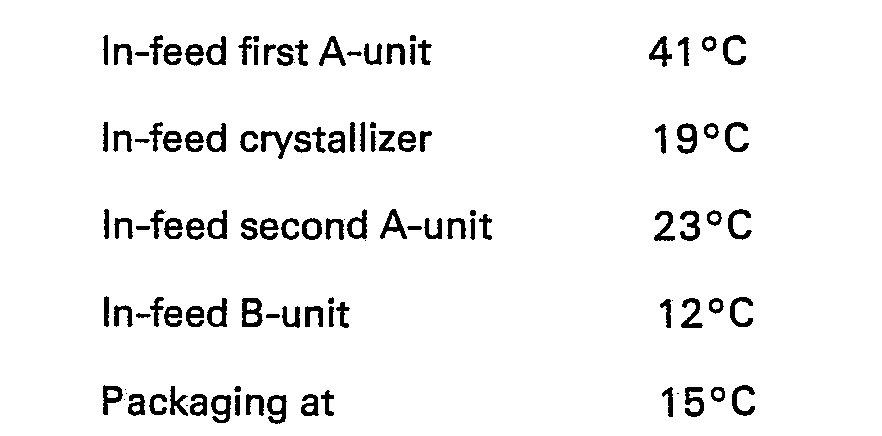
- This time the margarine was not filled into packages in liquid form, but a brick-shaped piece of margarine was extruded and packaged in wrappers.
- Each of the three fat mixtures contained an olein from Example III, hydrogenated to 31 °C. This olein was hydrogenated at a temperature of 180°C with a sulphurated nickel-on-kieselguhr catalyst to the melting point indicated. The trans-fatty acid content of the olein was then 9%.
- The hydrogenated olein used in Example IX was in addition randomly interesterified.
- The results are shown in Table C.

- Margarines were likewise prepared from the stearin obtained in Example IV.
- Except that the compositions of the fat mixtures were altered, the margarines were prepared in the same manner as described in Examples V and VI.
- Table D shows the compositions and the properties.

- The hardness of margarines was measured by the method developed by Haighton, as described in J.A.O.C.S. 36 (1959) pages 345-348.
Claims (12)
Priority Applications (1)
| Application Number | Priority Date | Filing Date | Title |
|---|---|---|---|
| AT81200569T ATE5894T1 (en) | 1980-05-30 | 1981-05-27 | PROCESS FOR DRY FRACTIONATION OF OILS AND FATS WITH A STEEP EXPANSION/TEMPERATURE CURVE AND USE OF THESE FRACTIONATED FATS IN MARGARINES AND SHORTCUTTING. |
Applications Claiming Priority (2)
| Application Number | Priority Date | Filing Date | Title |
|---|---|---|---|
| NL8003142A NL8003142A (en) | 1980-05-30 | 1980-05-30 | PROCESS FOR FRACTIONING OILS AND FATS, AND FAT MIXTURES PREPARED WITH THE FRACTIONS OBTAINED. |
| NL8003142 | 1980-05-30 |
Publications (2)
| Publication Number | Publication Date |
|---|---|
| EP0041300A1 EP0041300A1 (en) | 1981-12-09 |
| EP0041300B1 true EP0041300B1 (en) | 1984-01-18 |
Family
ID=19835386
Family Applications (1)
| Application Number | Title | Priority Date | Filing Date |
|---|---|---|---|
| EP81200569A Expired EP0041300B1 (en) | 1980-05-30 | 1981-05-27 | Process for the dry fractionation of oils and fats having a steep dilatation/temperature line and use of the fractionated fats in margarines and shortenings |
Country Status (8)
| Country | Link |
|---|---|
| US (1) | US4360536A (en) |
| EP (1) | EP0041300B1 (en) |
| JP (1) | JPS5721499A (en) |
| AT (1) | ATE5894T1 (en) |
| CA (1) | CA1150734A (en) |
| DE (1) | DE3161942D1 (en) |
| NL (1) | NL8003142A (en) |
| ZA (1) | ZA813523B (en) |
Cited By (1)
| Publication number | Priority date | Publication date | Assignee | Title |
|---|---|---|---|---|
| CN102257107A (en) * | 2008-12-22 | 2011-11-23 | 日清奥利友集团株式会社 | Fat and method for producing fat |
Families Citing this family (18)
| Publication number | Priority date | Publication date | Assignee | Title |
|---|---|---|---|---|
| NL8101638A (en) | 1981-04-02 | 1982-11-01 | Unilever Nv | LOW-CALORIC PRODUCT ON THE BASIS OF BUTTER FAT. |
| DE3372902D1 (en) * | 1982-11-22 | 1987-09-17 | Unilever Nv | Margarine fat blend |
| US4568556A (en) * | 1983-06-24 | 1986-02-04 | The Procter & Gamble Company | Margarine product and process |
| CH658163A5 (en) * | 1983-10-07 | 1986-10-31 | Nestle Sa | PROCESS FOR PRODUCING EDIBLE FRACTIONS OF FAT MATERIALS AND THEIR USE. |
| GB8430344D0 (en) * | 1984-11-30 | 1985-01-09 | Unilever Plc | Fractionating triglyceride oil |
| CA1301775C (en) * | 1986-06-04 | 1992-05-26 | Karel Petrus Agnes Maria Van Putte | Fractionation of fat blends |
| US5045243A (en) * | 1988-07-01 | 1991-09-03 | Fuji Oil Company, Limited | Method for dry fractionation of fats and oils |
| GB8911819D0 (en) * | 1989-05-23 | 1989-07-12 | Unilever Plc | Counter current dry fractional crystallization |
| US5104678A (en) * | 1990-05-23 | 1992-04-14 | The Procter & Gamble Company | Low saturate frying oil with meat flavor |
| US5113684A (en) * | 1990-10-22 | 1992-05-19 | Connell Limited Partnershp | Electronic braking system for power press die change carriers |
| AU702721B2 (en) * | 1993-09-14 | 1999-03-04 | Unilever Plc | Natural triglyceride fats |
| SK285334B6 (en) * | 2000-06-15 | 2006-11-03 | Unilever Nv | Preparation of a blend of triglycerides, food product containing fat blend and use of the fat blend |
| WO2005063952A1 (en) | 2003-12-26 | 2005-07-14 | Fuji Oil Company, Limited | Method of dry fractionation of fat or oil |
| US7618670B2 (en) * | 2004-06-14 | 2009-11-17 | Premium Vegetable Oils Sdn. Bhd. | Trans free non-hydrogenated hard structural fat and non-hydrogenated hard palm oil fraction component |
| WO2006029139A1 (en) * | 2004-09-07 | 2006-03-16 | Archer-Daniels-Midland Company | Low and no trans fat confections |
| ZA200800989B (en) * | 2005-08-23 | 2009-08-26 | Unilever Plc | Non-hydrogenated hardstock fat |
| BRPI0617550B1 (en) | 2005-09-26 | 2014-10-21 | Unilever Nv | HARD FAT, PROCESS FOR PRODUCTION OF HARD FAT, MARGARINE FAT AND SPREAD |
| ES2671172T3 (en) * | 2007-02-28 | 2018-06-05 | Loders Croklaan B.V. | Process to produce a glyceride composition |
Family Cites Families (11)
| Publication number | Priority date | Publication date | Assignee | Title |
|---|---|---|---|---|
| US782820A (en) * | 1903-01-15 | 1905-02-21 | Jacob E Bloom | Fatty edible preparation. |
| US1058738A (en) * | 1912-08-15 | 1913-04-15 | Carleton Ellis | Hydrogenated edible fat product. |
| US1206954A (en) * | 1914-12-16 | 1916-12-05 | Thomas Bailey Walker | Process of making food products. |
| US1372615A (en) * | 1918-04-24 | 1921-03-22 | Ellis Carleton | Edible-oil material and process of producing same |
| US3048491A (en) * | 1960-03-08 | 1962-08-07 | Corn Products Co | Winterization process |
| US3549386A (en) * | 1968-08-19 | 1970-12-22 | Procter & Gamble | Process for providing winterized mixtures of soybean oil and cottonseed oil |
| USRE30086E (en) | 1972-05-10 | 1979-08-28 | Lever Brothers Company | Plastic emulsion food spread |
| US4006264A (en) * | 1973-10-31 | 1977-02-01 | Cpc International Inc. | Preparation of confectioners' fats |
| GB1580181A (en) | 1976-01-08 | 1980-11-26 | Unilever Ltd | Fat separation process |
| US4161484A (en) * | 1976-01-08 | 1979-07-17 | Lever Bros. Co. | Fractionation of glyceride oils by cooling and under homogeneous agitation |
| US4205095A (en) * | 1976-11-04 | 1980-05-27 | Barr Iain G | Glycerides |
-
1980
- 1980-05-30 NL NL8003142A patent/NL8003142A/en not_active Application Discontinuation
-
1981
- 1981-05-25 CA CA000378206A patent/CA1150734A/en not_active Expired
- 1981-05-26 US US06/266,697 patent/US4360536A/en not_active Expired - Lifetime
- 1981-05-26 ZA ZA00813523A patent/ZA813523B/en unknown
- 1981-05-27 DE DE8181200569T patent/DE3161942D1/en not_active Expired
- 1981-05-27 AT AT81200569T patent/ATE5894T1/en active
- 1981-05-27 EP EP81200569A patent/EP0041300B1/en not_active Expired
- 1981-05-29 JP JP8243281A patent/JPS5721499A/en active Granted
Cited By (1)
| Publication number | Priority date | Publication date | Assignee | Title |
|---|---|---|---|---|
| CN102257107A (en) * | 2008-12-22 | 2011-11-23 | 日清奥利友集团株式会社 | Fat and method for producing fat |
Also Published As
| Publication number | Publication date |
|---|---|
| ATE5894T1 (en) | 1984-02-15 |
| JPS6138958B2 (en) | 1986-09-01 |
| NL8003142A (en) | 1982-01-04 |
| ZA813523B (en) | 1983-01-26 |
| EP0041300A1 (en) | 1981-12-09 |
| US4360536A (en) | 1982-11-23 |
| CA1150734A (en) | 1983-07-26 |
| JPS5721499A (en) | 1982-02-04 |
| DE3161942D1 (en) | 1984-02-23 |
Similar Documents
| Publication | Publication Date | Title |
|---|---|---|
| US4360536A (en) | Process for the dry fractionation of oils and fats having a steep dilatation/temperature line and use of the fractionated fats in margarines and shortenings | |
| EP0041303B1 (en) | Fat blend | |
| Ribeiro et al. | Crystallization modifiers in lipid systems | |
| JP4226654B2 (en) | Crystallization of triglyceride fat | |
| US3658555A (en) | Spreadable fats | |
| EP0041299B1 (en) | Fat blend substantially free of hydrogenated and interesterified fats and use of said fat blend in margarines | |
| CA2030508C (en) | Fat-continuous dispersion and method of preparing such dispersion | |
| EP0089082B1 (en) | Margarine fat blend, and a process for producing said fat blend | |
| Rajah | Fats in food technology | |
| CZ296522B6 (en) | Process for producing fat blend, fat blend and fat product | |
| US4087564A (en) | Fractionated co-randomized fat blend and use | |
| PL197866B1 (en) | Preparation of a blend of triglycerides | |
| Stahl et al. | Structuration of lipid bases with fully hydrogenated crambe oil and sorbitan monostearate for obtaining zero-trans/low sat fats | |
| EP0498487A1 (en) | Improvements in edible fats | |
| EP0805844B1 (en) | Fractionation of triglyceride oils | |
| US4130572A (en) | Physiochemically designed fat compositions from tallow | |
| US4045588A (en) | Margarine fat | |
| US5989618A (en) | Process for preparing a microbiologically stable water in oil spread | |
| CA2186767C (en) | Fractionation of triglyceride oils | |
| US3944585A (en) | Multi-step crystallization and blending process for making physiochemically designed fat compositions from tallow | |
| US4049839A (en) | Physiochemically designed fat compositions from tallow | |
| JP7099001B2 (en) | Oil composition for butter cream | |
| US4205006A (en) | Physiochemically designed fat compositions from tallow and process for making | |
| JPH0669341B2 (en) | Heat-resistant edible oil and fat composition and method for producing the same | |
| JP2022041277A (en) | Oil composition for butter cream |
Legal Events
| Date | Code | Title | Description |
|---|---|---|---|
| PUAI | Public reference made under article 153(3) epc to a published international application that has entered the european phase |
Free format text: ORIGINAL CODE: 0009012 |
|
| 17P | Request for examination filed |
Effective date: 19810527 |
|
| AK | Designated contracting states |
Designated state(s): AT BE CH DE FR GB IT LI NL SE |
|
| RAP1 | Party data changed (applicant data changed or rights of an application transferred) |
Owner name: UNILEVER PLC Owner name: UNILEVER NV |
|
| ITF | It: translation for a ep patent filed | ||
| GRAA | (expected) grant |
Free format text: ORIGINAL CODE: 0009210 |
|
| AK | Designated contracting states |
Designated state(s): AT BE CH DE FR GB IT LI NL SE |
|
| REF | Corresponds to: |
Ref document number: 5894 Country of ref document: AT Date of ref document: 19840215 Kind code of ref document: T |
|
| REF | Corresponds to: |
Ref document number: 3161942 Country of ref document: DE Date of ref document: 19840223 |
|
| ET | Fr: translation filed | ||
| PLBE | No opposition filed within time limit |
Free format text: ORIGINAL CODE: 0009261 |
|
| STAA | Information on the status of an ep patent application or granted ep patent |
Free format text: STATUS: NO OPPOSITION FILED WITHIN TIME LIMIT |
|
| 26N | No opposition filed | ||
| ITPR | It: changes in ownership of a european patent |
Owner name: ASSUNZIONE O VARIAZIONE MANDATO;MODIANO & ASSOCIAT |
|
| PGFP | Annual fee paid to national office [announced via postgrant information from national office to epo] |
Ref country code: FR Payment date: 19920408 Year of fee payment: 12 |
|
| PGFP | Annual fee paid to national office [announced via postgrant information from national office to epo] |
Ref country code: AT Payment date: 19920409 Year of fee payment: 12 |
|
| PGFP | Annual fee paid to national office [announced via postgrant information from national office to epo] |
Ref country code: SE Payment date: 19920413 Year of fee payment: 12 |
|
| PGFP | Annual fee paid to national office [announced via postgrant information from national office to epo] |
Ref country code: DE Payment date: 19920415 Year of fee payment: 12 |
|
| PGFP | Annual fee paid to national office [announced via postgrant information from national office to epo] |
Ref country code: CH Payment date: 19920416 Year of fee payment: 12 |
|
| PGFP | Annual fee paid to national office [announced via postgrant information from national office to epo] |
Ref country code: GB Payment date: 19920428 Year of fee payment: 12 |
|
| ITTA | It: last paid annual fee | ||
| PGFP | Annual fee paid to national office [announced via postgrant information from national office to epo] |
Ref country code: NL Payment date: 19920531 Year of fee payment: 12 |
|
| PGFP | Annual fee paid to national office [announced via postgrant information from national office to epo] |
Ref country code: BE Payment date: 19920623 Year of fee payment: 12 |
|
| PG25 | Lapsed in a contracting state [announced via postgrant information from national office to epo] |
Ref country code: GB Effective date: 19930527 Ref country code: AT Effective date: 19930527 |
|
| PG25 | Lapsed in a contracting state [announced via postgrant information from national office to epo] |
Ref country code: SE Effective date: 19930528 |
|
| PG25 | Lapsed in a contracting state [announced via postgrant information from national office to epo] |
Ref country code: LI Effective date: 19930531 Ref country code: CH Effective date: 19930531 Ref country code: BE Effective date: 19930531 |
|
| BERE | Be: lapsed |
Owner name: UNILEVER N.V. Effective date: 19930531 |
|
| PG25 | Lapsed in a contracting state [announced via postgrant information from national office to epo] |
Ref country code: NL Effective date: 19931201 |
|
| NLV4 | Nl: lapsed or anulled due to non-payment of the annual fee | ||
| GBPC | Gb: european patent ceased through non-payment of renewal fee |
Effective date: 19930527 |
|
| PG25 | Lapsed in a contracting state [announced via postgrant information from national office to epo] |
Ref country code: FR Effective date: 19940131 |
|
| REG | Reference to a national code |
Ref country code: CH Ref legal event code: PL |
|
| PG25 | Lapsed in a contracting state [announced via postgrant information from national office to epo] |
Ref country code: DE Effective date: 19940201 |
|
| REG | Reference to a national code |
Ref country code: FR Ref legal event code: ST |
|
| EUG | Se: european patent has lapsed |
Ref document number: 81200569.2 Effective date: 19931210 |