EP0039573A2 - Improvements in high pressure hydraulic systems - Google Patents
Improvements in high pressure hydraulic systems Download PDFInfo
- Publication number
- EP0039573A2 EP0039573A2 EP81301884A EP81301884A EP0039573A2 EP 0039573 A2 EP0039573 A2 EP 0039573A2 EP 81301884 A EP81301884 A EP 81301884A EP 81301884 A EP81301884 A EP 81301884A EP 0039573 A2 EP0039573 A2 EP 0039573A2
- Authority
- EP
- European Patent Office
- Prior art keywords
- valve
- pressure
- source
- slave unit
- solenoid
- Prior art date
- Legal status (The legal status is an assumption and is not a legal conclusion. Google has not performed a legal analysis and makes no representation as to the accuracy of the status listed.)
- Granted
Links
- 239000012530 fluid Substances 0.000 claims abstract description 37
- 239000000725 suspension Substances 0.000 claims abstract description 15
- 239000013536 elastomeric material Substances 0.000 claims abstract description 6
- 230000001351 cycling effect Effects 0.000 claims description 2
- 238000010276 construction Methods 0.000 abstract description 4
- 230000004048 modification Effects 0.000 description 9
- 238000012986 modification Methods 0.000 description 9
- 238000001125 extrusion Methods 0.000 description 5
- 230000003247 decreasing effect Effects 0.000 description 4
- 230000003068 static effect Effects 0.000 description 3
- 230000000712 assembly Effects 0.000 description 2
- 238000000429 assembly Methods 0.000 description 2
- 239000002131 composite material Substances 0.000 description 1
- 230000000694 effects Effects 0.000 description 1
- 238000004519 manufacturing process Methods 0.000 description 1
- 239000000463 material Substances 0.000 description 1
- 239000002184 metal Substances 0.000 description 1
- 230000000717 retained effect Effects 0.000 description 1
- 238000007789 sealing Methods 0.000 description 1
Images
Classifications
-
- B—PERFORMING OPERATIONS; TRANSPORTING
- B60—VEHICLES IN GENERAL
- B60G—VEHICLE SUSPENSION ARRANGEMENTS
- B60G17/00—Resilient suspensions having means for adjusting the spring or vibration-damper characteristics, for regulating the distance between a supporting surface and a sprung part of vehicle or for locking suspension during use to meet varying vehicular or surface conditions, e.g. due to speed or load
- B60G17/015—Resilient suspensions having means for adjusting the spring or vibration-damper characteristics, for regulating the distance between a supporting surface and a sprung part of vehicle or for locking suspension during use to meet varying vehicular or surface conditions, e.g. due to speed or load the regulating means comprising electric or electronic elements
- B60G17/0152—Resilient suspensions having means for adjusting the spring or vibration-damper characteristics, for regulating the distance between a supporting surface and a sprung part of vehicle or for locking suspension during use to meet varying vehicular or surface conditions, e.g. due to speed or load the regulating means comprising electric or electronic elements characterised by the action on a particular type of suspension unit
-
- B—PERFORMING OPERATIONS; TRANSPORTING
- B60—VEHICLES IN GENERAL
- B60G—VEHICLE SUSPENSION ARRANGEMENTS
- B60G17/00—Resilient suspensions having means for adjusting the spring or vibration-damper characteristics, for regulating the distance between a supporting surface and a sprung part of vehicle or for locking suspension during use to meet varying vehicular or surface conditions, e.g. due to speed or load
- B60G17/02—Spring characteristics, e.g. mechanical springs and mechanical adjusting means
- B60G17/04—Spring characteristics, e.g. mechanical springs and mechanical adjusting means fluid spring characteristics
- B60G17/056—Regulating distributors or valves for hydropneumatic systems
-
- B—PERFORMING OPERATIONS; TRANSPORTING
- B60—VEHICLES IN GENERAL
- B60G—VEHICLE SUSPENSION ARRANGEMENTS
- B60G2400/00—Indexing codes relating to detected, measured or calculated conditions or factors
- B60G2400/50—Pressure
-
- B—PERFORMING OPERATIONS; TRANSPORTING
- B60—VEHICLES IN GENERAL
- B60G—VEHICLE SUSPENSION ARRANGEMENTS
- B60G2500/00—Indexing codes relating to the regulated action or device
- B60G2500/30—Height or ground clearance
-
- B—PERFORMING OPERATIONS; TRANSPORTING
- B60—VEHICLES IN GENERAL
- B60G—VEHICLE SUSPENSION ARRANGEMENTS
- B60G2600/00—Indexing codes relating to particular elements, systems or processes used on suspension systems or suspension control systems
- B60G2600/22—Magnetic elements
- B60G2600/26—Electromagnets; Solenoids
-
- Y—GENERAL TAGGING OF NEW TECHNOLOGICAL DEVELOPMENTS; GENERAL TAGGING OF CROSS-SECTIONAL TECHNOLOGIES SPANNING OVER SEVERAL SECTIONS OF THE IPC; TECHNICAL SUBJECTS COVERED BY FORMER USPC CROSS-REFERENCE ART COLLECTIONS [XRACs] AND DIGESTS
- Y10—TECHNICAL SUBJECTS COVERED BY FORMER USPC
- Y10T—TECHNICAL SUBJECTS COVERED BY FORMER US CLASSIFICATION
- Y10T137/00—Fluid handling
- Y10T137/7722—Line condition change responsive valves
- Y10T137/7837—Direct response valves [i.e., check valve type]
- Y10T137/7876—With external means for opposing bias
-
- Y—GENERAL TAGGING OF NEW TECHNOLOGICAL DEVELOPMENTS; GENERAL TAGGING OF CROSS-SECTIONAL TECHNOLOGIES SPANNING OVER SEVERAL SECTIONS OF THE IPC; TECHNICAL SUBJECTS COVERED BY FORMER USPC CROSS-REFERENCE ART COLLECTIONS [XRACs] AND DIGESTS
- Y10—TECHNICAL SUBJECTS COVERED BY FORMER USPC
- Y10T—TECHNICAL SUBJECTS COVERED BY FORMER US CLASSIFICATION
- Y10T137/00—Fluid handling
- Y10T137/8593—Systems
- Y10T137/87917—Flow path with serial valves and/or closures
- Y10T137/88046—Biased valve with external operator
-
- Y—GENERAL TAGGING OF NEW TECHNOLOGICAL DEVELOPMENTS; GENERAL TAGGING OF CROSS-SECTIONAL TECHNOLOGIES SPANNING OVER SEVERAL SECTIONS OF THE IPC; TECHNICAL SUBJECTS COVERED BY FORMER USPC CROSS-REFERENCE ART COLLECTIONS [XRACs] AND DIGESTS
- Y10—TECHNICAL SUBJECTS COVERED BY FORMER USPC
- Y10T—TECHNICAL SUBJECTS COVERED BY FORMER US CLASSIFICATION
- Y10T137/00—Fluid handling
- Y10T137/8593—Systems
- Y10T137/87917—Flow path with serial valves and/or closures
- Y10T137/88054—Direct response normally closed valve limits direction of flow
Definitions
- This invention relates to high pressure hydraulic systems of the kind in which a slave unit, for example an hydraulic suspension strut of a vehicle hydraulic suspension system, is supplied with fluid under pressure from a source through a control valve assembly which is operative to maintain the slave unit in a desired condition.
- a slave unit for example an hydraulic suspension strut of a vehicle hydraulic suspension system
- a further problem that occurs in hydraulic systems of the kind set forth is that of minimising the force required to operate valves in the control valve assembly, so that, for example, if the valves are solenoid-operated, the current taken by the solenoids will not be excessive.
- control valve assembly comprises two solenoid-operated valves, oppositely acting and arranged in series between the source and the slave unit, each valve being closed to prevent flow through the valve in a direction from the other valve and opened to permit flow in both directions under the control of the solenoid and the pressure differential acting across the valve, and a seating portion on a first valve is of elastomeric material to provide a leakproof seal when that valve is closed.
- control valve assembly comprises first and second solenoid-operated valves, which are oppositely acting and arranged in series with the first valve located between the source and the second valve, and the second valve located between the first valve and the slave unit, each valve being movable into a closed position in which fluid flow through the valve in a direction towards the other valve .
- each valve is substantially prevented, and an open position in which flow in both directions is permitted, movement of each valve between the open and closed positions being controlled by a solenoid and a pressure differential acting across the valve and each valve comprises a seating member, and a valve member for engagement with the seating member, the seating portion of one of the members of the second valve comprising an element of elastomeric material to provide a substantially leakproof seal when that valve is in the closed position.
- the second valve is substantially leakproof, it is operative to prevent fluid leaking back from the slave unit to the source when the first valve is open and the source is inoperative. Further, since the valves allow fluid to leak out of the volume between them, rather than into it, the need for a controlled leak past the non-leakproof valve is obviated. Thus, if one of the valves is held shut by the pressure differential acting across it, a pressure differential across the other valve cannot build up, and that other valve tends to the open position.
- the solenoids are energised in order to move the valves from the closed into the open position, but the solenoids are not sufficiently powerful to open the valves against any significant pressure .differential. This ensures that the elastomeric seal in the second valve is not destroyed by extrusion. Once the valves are open, they remain open while the solenoids are energised irrespective of the direction of fluid flow.
- the pressure differential will determine the position of the valves, and each valve acts as a one-way valve, permitting fluid flow in a direction from the other valve.
- fluid flow between the source and the slave unit is controlled by operation of the solenoids and the pressure differential between the source and the slave unit.
- Energisation and de-energisation of the solenoids is preferably controlled by an electronic control system which may also control operation of the source.
- the source is normally maintained at a low pressure, but when operative it is cycled slowly and continuously over a range of pressures which includes, and exceeds, the range of pressures which occur in the slave unit.
- the solenoids are de-energised so that the second valve is held closed by the slave pressure, and the first valve will be in the open position.
- the solenoid of the first valve is energised, and the source pressure is cycled, so that the first valve is ' held open while the source pressure rises.
- the second valve will act as a one-way valve to permit fluid to flow into the slave unit until either the source pressure falls below the slave pressure to close the second valve, or the solenoid of the first valve is de-energised to close the first valve, with the second valve closing and the first valve opening when the source pressure falls below the slave pressure.
- the solenoid of the second valve is energised and the source pressure cycled, but the second valve will not open until the pressure differential acting across it is sufficiently reduced.
- the second valve opens it is held open by the solenoid, and the resulting flow of fluid into the slave unit closes the first valve.
- the first valve will act as a one-way valve to allow fluid to flow out of the slave unit until the solenoid of the second valve is de-energised to close that valve.
- the source is normally maintained at a high pressure, and when operative is cycled over the same range of pressures as before. Normally the solenoids are de-energised, so that this time the first valve is held closed by the source pressure, and the second valve is open.
- the operation of the system in increasing and decreasing slave pressure will be analogous to that described above, and it will be operative as before to prevent leakage from the slave unit past the second valve if the source is inoperative and loses pressure.
- the first valve also may be made leakproof to ensure that fluid cannot leak from the source into the slave unit.
- the slave unit comprises an hydraulic suspension strut.
- pressure in the strut can be considered as a static pressure, due to the weight of the vehicle, and a dynamic pressure, due to ride movement, superimposed to produce a "ripple" at ride frequency.
- the static pressure will vary due to changes in the loading on the vehicle. Changes in these pressures will cause changes in ride height signals, in response to which the electronic control system manipulates the operation of the source and the control valve assembly to operate a suspension levelling system.
- the pressure source conveniently comprises a manifold for supplying at least two struts simultaneously, for example the suspension struts of a pair of wheels on opposite sides of a vehicle.
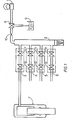
- a three-way valve 8 is interposed between the source 1 and the manifold 2, the valve 8 being adapted to connect the manifold 2 either to the source 1 or to a tank 9 at atmospheric pressure.
- An orifice 10 is interposed in the line between the valve 8 and the manifold 2.
- Each control valve assembly 3, 4, 5 and 6 comprises a pair of solenoid-operated first and second valves 11 and 12 respectively. These are oppositely acting and arranged in series.
- Each valve 11, 12 is movable between a closed position in which fluid flow through the valve in a direction towards the other valve is prevented, but the valve acts as a one-way valve to permit fluid flow in a direction from the other valve, and an open position in which fluid flow in both directions is permitted.
- the solenoid of a valve 11, 12 is de-energised, the pressure differential will determine the position. of the valve, and when the solenoid is energised the valve will tend to open, but may not do so against a significant pressure differential.
- the valve 11, 12 is open and the solenoid is energised, the valve remains open irrespective of the direction of fluid flow.
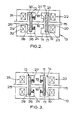
- valves 11, 12 are located in a common housing 13.
- the first valve 11 is located in a first valve cavity 14, which has on one side a connection 15 to the manifold 2, and on the opposite side a connection 16 to the second valve 12.
- a valve member in the form of a metal plate 17 is located in the cavity 14, and is movable into the closed position in which it seats on a seating portion 18 surrounding the connection 16 to prevent fluid flow towards the second valve 12. When the plate 17 is not in contact with the seating portion 18, the first valve 11 is in the open position, in which fluid can flow through the valve in both directions.
- a radial slot 19 is provided on the side 20 of the valve plate 17 remote from the seating portion 18, so that fluid flow is permitted even when the plate 17 engages with the housing portion 21 surrounding the connection 15.
- a solenoid 22 is located on the side of the valve 11 nearer the manifold 2, a solenoid coil 2.3 being energised in order to attract the valve plate 17 away from the closed position.
- the second valve 12 is located in a second valve cavity 24 in the housing, which has a connection 25 to the strut 7 opposite the connection 16 to the first valve 11.
- a valve plate 26 is located in the cavity 24, and is movable into the closed position in which it seats on an elastomeric seating member 27 surrounding the connection 16 to provide a leakproof seal preventing flow of fluid towards the first valve 11.
- the member 27 is preferably of rubber.
- a radial slot 28 is provided on the side 29 of the plate 26 remote from the seating member 27 so that fluid flow is permitted when the plate 26 contacts the housing portion 30 surrounding the connection 25.
- a solenoid 31 is located on the side of the valve 12 nearer the strut 7, a solenoid coil 32 being energised, in order to attract the valve plate 26 away from the closed position.
- control valve assembly may be similar to that illustrated and described in U.K. Patent Application No. GB 2 045 177 A, in which the valves 11 and 12 are located in positions perpendicular to that shown in Figure 2, so that the connections 15 and 25 are parallel, and separate first and second valve cavities are provided in the housing, in which the valve members 17, 26 are located by a rubber seal.
- the solenoids 22, 31 are combined into one solenoid block, with one composite plate forming the pole pieces for both solenoids.
- the three-way valve 8 is used to cycle the pressure in the manifold 2, which is normally low, over a range which includes, _and exceeds, the range of static pressures which occur in any of the struts 7.
- the frequency of the cycle is determined by the size of the orifice 10, and an electronic control system controls the operation of the cycle and the energisation and de-energisation of the solenoids in response to ride height signals.
- the manifold pressure is cycled, and the solenoid 22 of the first valve 11 is energised, which holds the first valve open while the manifold pressure rises.
- the second . valve 12 will act as a one-way valve to permit fluid to flow into the strut.
- the solenoid 22 is de-energised and the first valve 11 closes, and remains closed while the manifold pressure continues its cycle.
- the first valve 11 opens again, and the second valve 12 then closes.
- the electronic control system when the desired strut pressure is reached, the electronic control system allows the manifold pressure to fall immediately the solenoid 22 is de-energised.
- the manifold pressure is cycled, and the solenoid 31 of the second valve 12 is energised, but the valve 12will open only when the pressure differential across it is reduced to an insignificant value.
- the resulting fluid flow into the strut moves the first valve 11 into the closed position, while the second valve remains open due to the solenoid.
- the first valve 11 acts as a one-way valve to allow fluid to flow out of the strut 7.
- the solenoid 31 is de-energised, so that the second valve 12 moves into its closed position.
- control valve assembly shown in Figure 3 is modified for operation in the suspension levelling system if the manifold 2 is normally maintained at a high pressure, and is cycled over the same range of pressures as in the previous embodiment.
- assembly of Figure 3 which is a modification of the assembly of Figure 2, corresponding reference numerals have been applied to corresponding parts.
- an elastomeric seating member 33 similar to member 27 is provided round the connection 16 of the first valve 11. This ensures that high pressure fluid cannot leak into the strut 7 when the first valve 11 is in the closed position.
- the second valve 12 may be provided with a light spring (not shown) to ensure that it moves into the closed position when the solenoid 31 is de-energised.
- the valve plate 26 may be 'so placed that its weight has the same effect.
- the means for cycling the manifold pressure may be modified.
- the pressure source comprises a pump, and the manifold pressure is increased directly by the pump being driven in response to the signals controlling the valve 8.
- the manifold pressure may be decreased by reversal of the pump, in spite of any fluid flow out of the strut.
- the orifice 10 can be omitted.
- the pressure source comprises a continuously driven pump, and the valve 8 and orifice 10 are omitted.
- Flow from the pump is by-passed to the reservoir 9 through a solenoid valve.
- Signals from the electronic control system operate the solenoid valve to close and open the bypass, causing the manifold pressure to increase and decrease respectively.
Landscapes
- Engineering & Computer Science (AREA)
- Mechanical Engineering (AREA)
- Vehicle Body Suspensions (AREA)
- Fluid-Pressure Circuits (AREA)
- Magnetically Actuated Valves (AREA)
Abstract
Description
- This invention relates to high pressure hydraulic systems of the kind in which a slave unit, for example an hydraulic suspension strut of a vehicle hydraulic suspension system, is supplied with fluid under pressure from a source through a control valve assembly which is operative to maintain the slave unit in a desired condition.
- In an hydraulic system of the kind set forth, the problem of controlling leakage past the control valve assembly when the source is inoperative may arise. This problem can be solved by the use of elastomeric seals, but if a valve with such a seal opens against a pressure differential the seal is liable to extrusion. The seal must resist extrusion if it is to have a reasonable life, but as the pressure in the system is raised the seal needs to be made of stiffer material to resist extrusion, and eventually a pressure is reached where the stiffness required reduces the sealing efficiency to an unacceptable level. Pressures above this will be defined as "high pressures".
- A further problem that occurs in hydraulic systems of the kind set forth is that of minimising the force required to operate valves in the control valve assembly, so that, for example, if the valves are solenoid-operated, the current taken by the solenoids will not be excessive.
- In the Specification of our published U.K. Patent Application No. GB 2 045 177 A, we have disclosed a high pressure hydraulic system of the kind set forth in which the control valve assembly comprises two solenoid-operated valves, oppositely acting and arranged in series between the source and the slave unit, each valve being closed to prevent flow through the valve in a direction from the other valve and opened to permit flow in both directions under the control of the solenoid and the pressure differential acting across the valve, and a seating portion on a first valve is of elastomeric material to provide a leakproof seal when that valve is closed.
- In this known construction therefore leakage from the slave unit past the control valve is prevented by the leakproof seal on the first valve, but that seal is able to resist extrusion as the solenoids are not sufficiently powerful to open the valves against a significant pressure differential. However, this construction has the disadvantage that it creates a trapped volume of high pressure fluid between the two valves. To avoid this a small, controlled leak must be provided past the second valve, and the size of the leak may be difficult to control within normal manufacturing tolerances.
- According to our invention in a high pressure hydraulic system of the kind set forth the control valve assembly comprises first and second solenoid-operated valves, which are oppositely acting and arranged in series with the first valve located between the source and the second valve, and the second valve located between the first valve and the slave unit, each valve being movable into a closed position in which fluid flow through the valve in a direction towards the other valve . is substantially prevented, and an open position in which flow in both directions is permitted, movement of each valve between the open and closed positions being controlled by a solenoid and a pressure differential acting across the valve and each valve comprises a seating member, and a valve member for engagement with the seating member, the seating portion of one of the members of the second valve comprising an element of elastomeric material to provide a substantially leakproof seal when that valve is in the closed position.
- Since the second valve is substantially leakproof, it is operative to prevent fluid leaking back from the slave unit to the source when the first valve is open and the source is inoperative. Further, since the valves allow fluid to leak out of the volume between them, rather than into it, the need for a controlled leak past the non-leakproof valve is obviated. Thus, if one of the valves is held shut by the pressure differential acting across it, a pressure differential across the other valve cannot build up, and that other valve tends to the open position.
- Preferably, the solenoids are energised in order to move the valves from the closed into the open position, but the solenoids are not sufficiently powerful to open the valves against any significant pressure .differential. This ensures that the elastomeric seal in the second valve is not destroyed by extrusion. Once the valves are open, they remain open while the solenoids are energised irrespective of the direction of fluid flow.
- When the solenoids are de-energised, the pressure differential will determine the position of the valves, and each valve acts as a one-way valve, permitting fluid flow in a direction from the other valve.
- In operation therefore fluid flow between the source and the slave unit is controlled by operation of the solenoids and the pressure differential between the source and the slave unit. Energisation and de-energisation of the solenoids is preferably controlled by an electronic control system which may also control operation of the source.
- Preferably, the source is normally maintained at a low pressure, but when operative it is cycled slowly and continuously over a range of pressures which includes, and exceeds, the range of pressures which occur in the slave unit. Normally the solenoids are de-energised so that the second valve is held closed by the slave pressure, and the first valve will be in the open position.
- Then, if the pressure in the slave unit is to be increased, the solenoid of the first valve is energised, and the source pressure is cycled, so that the first valve is 'held open while the source pressure rises. When the source pressure exceeds the slave pressure the second valve will act as a one-way valve to permit fluid to flow into the slave unit until either the source pressure falls below the slave pressure to close the second valve, or the solenoid of the first valve is de-energised to close the first valve, with the second valve closing and the first valve opening when the source pressure falls below the slave pressure.
- If the pressure in the slave unit is to be decreased, the solenoid of the second valve is energised and the source pressure cycled, but the second valve will not open until the pressure differential acting across it is sufficiently reduced. When the second valve opens it is held open by the solenoid, and the resulting flow of fluid into the slave unit closes the first valve. When the source pressure falls below the slave pressure the first valve will act as a one-way valve to allow fluid to flow out of the slave unit until the solenoid of the second valve is de-energised to close that valve.
- In a modification the source is normally maintained at a high pressure, and when operative is cycled over the same range of pressures as before. Normally the solenoids are de-energised, so that this time the first valve is held closed by the source pressure, and the second valve is open. The operation of the system in increasing and decreasing slave pressure will be analogous to that described above, and it will be operative as before to prevent leakage from the slave unit past the second valve if the source is inoperative and loses pressure. In this modification the first valve also may be made leakproof to ensure that fluid cannot leak from the source into the slave unit.
- In one embodiment the slave unit comprises an hydraulic suspension strut. In this case pressure in the strut can be considered as a static pressure, due to the weight of the vehicle, and a dynamic pressure, due to ride movement, superimposed to produce a "ripple" at ride frequency. The static pressure will vary due to changes in the loading on the vehicle. Changes in these pressures will cause changes in ride height signals, in response to which the electronic control system manipulates the operation of the source and the control valve assembly to operate a suspension levelling system.
- Such a system will operate as described above, although it should be ensured that the "ripple" in the strut pressure does not affect the operation of the control valve assembly by choosing the appropriate rate of pressure rise and fall of the source pressure cycle.
- In such a suspension system, the pressure source conveniently comprises a manifold for supplying at least two struts simultaneously, for example the suspension struts of a pair of wheels on opposite sides of a vehicle.
- One embodiment of our invention and a modification are illustrated in the accompanying drawings in which:-
- Figure 1 is a layout'of a suspension levelling system for a vehicle;
- Figure 2 is a diagrammatic representation of a control valve assembly for the system of Figure 1; and
- Figure 3 is similar to Figure 2, and shows a modification of the control valve assembly.
- In the suspension levelling system illustrated in Figure 1, hydraulic fluid from an hydraulic pressure source 1, suitably an accumulator, is supplied from a common manifold 2 to two pairs of hydraulic suspension struts through
control valve assemblies 3, 4, 5 and 6. Only one strut 7 is illustrated, and the struts of each pair are arranged to support the wheels of a pair of wheels on opposite sides of the vehicle. - A three-way valve 8 is interposed between the source 1 and the manifold 2, the valve 8 being adapted to connect the manifold 2 either to the source 1 or to a tank 9 at atmospheric pressure. An
orifice 10 is interposed in the line between the valve 8 and the manifold 2. - Each
control valve assembly 3, 4, 5 and 6 comprises a pair of solenoid-operated first andsecond valves valve valve valve - One of the
control valve assemblies 3, 4, 5 or 6 is illustrated diagrammatically in Figure 2. Thevalves common housing 13. Thefirst valve 11 is located in afirst valve cavity 14, which has on one side aconnection 15 to the manifold 2, and on the opposite side aconnection 16 to thesecond valve 12. A valve member in the form of ametal plate 17 is located in thecavity 14, and is movable into the closed position in which it seats on aseating portion 18 surrounding theconnection 16 to prevent fluid flow towards thesecond valve 12. When theplate 17 is not in contact with theseating portion 18, thefirst valve 11 is in the open position, in which fluid can flow through the valve in both directions. Aradial slot 19 is provided on theside 20 of thevalve plate 17 remote from theseating portion 18, so that fluid flow is permitted even when theplate 17 engages with thehousing portion 21 surrounding theconnection 15. Asolenoid 22 is located on the side of thevalve 11 nearer the manifold 2, a solenoid coil 2.3 being energised in order to attract thevalve plate 17 away from the closed position. - Similarly, the
second valve 12 is located in asecond valve cavity 24 in the housing, which has aconnection 25 to the strut 7 opposite theconnection 16 to thefirst valve 11. Avalve plate 26 is located in thecavity 24, and is movable into the closed position in which it seats on anelastomeric seating member 27 surrounding theconnection 16 to provide a leakproof seal preventing flow of fluid towards thefirst valve 11. Themember 27 is preferably of rubber. When theplate 26 is disengaged from theseating member 27 thevalve 12 is in its open position. Aradial slot 28 is provided on theside 29 of theplate 26 remote from theseating member 27 so that fluid flow is permitted when theplate 26 contacts thehousing portion 30 surrounding theconnection 25. Asolenoid 31 is located on the side of thevalve 12 nearer the strut 7, asolenoid coil 32 being energised, in order to attract thevalve plate 26 away from the closed position. - The detailed construction of the control valve assembly may be similar to that illustrated and described in U.K. Patent Application No. GB 2 045 177 A, in which the
valves connections valve members solenoids - In operation, the three-way valve 8 is used to cycle the pressure in the manifold 2, which is normally low, over a range which includes, _and exceeds, the range of static pressures which occur in any of the struts 7.
- The frequency of the cycle is determined by the size of the
orifice 10, and an electronic control system controls the operation of the cycle and the energisation and de-energisation of the solenoids in response to ride height signals. - In an inoperative position, shown in Figure 2, with the manifold pressure low, the solenoids of both valves are de-energised, so that the pressure in the strut 7 will hold the
valve 12 in the closed position, and thevalve 11 which has no pressure differential acting across it since a pressure higher than the manifold pressure cannot be trapped between thevalves second valve 12 will open and thefirst valve 11 will close when the manifold pressure reaches the strut pressure, and when the manifold pressure falls below the strut pressure again thefirst valve 11 will open and thesecond valve 12 will close. - If the pressure in the strut 7 is to be increased, the manifold pressure is cycled, and the
solenoid 22 of thefirst valve 11 is energised, which holds the first valve open while the manifold pressure rises. When the manifold pressure exceeds the strut pressure, the second .valve 12 will act as a one-way valve to permit fluid to flow into the strut. When the desired strut pressure is reached, thesolenoid 22 is de-energised and thefirst valve 11 closes, and remains closed while the manifold pressure continues its cycle. When the manifold pressure falls below the strut pressure thefirst valve 11 opens again, and thesecond valve 12 then closes. - In a modification, when the desired strut pressure is reached, the electronic control system allows the manifold pressure to fall immediately the
solenoid 22 is de-energised. - If the pressure in the strut 7 is to be decreased, the manifold pressure is cycled, and the
solenoid 31 of thesecond valve 12 is energised, but the valve 12will open only when the pressure differential across it is reduced to an insignificant value. The resulting fluid flow into the strut moves thefirst valve 11 into the closed position, while the second valve remains open due to the solenoid. When the manifold pressure falls below the strut pressure thefirst valve 11 acts as a one-way valve to allow fluid to flow out of the strut 7. When the requisite strut pressure is reached, thesolenoid 31 is de-energised, so that thesecond valve 12 moves into its closed position. - The control valve assembly shown in Figure 3 is modified for operation in the suspension levelling system if the manifold 2 is normally maintained at a high pressure, and is cycled over the same range of pressures as in the previous embodiment. In the assembly of Figure 3, which is a modification of the assembly of Figure 2, corresponding reference numerals have been applied to corresponding parts.
- In Figure 3, an
elastomeric seating member 33 similar tomember 27 is provided round theconnection 16 of thefirst valve 11. This ensures that high pressure fluid cannot leak into the strut 7 when thefirst valve 11 is in the closed position. Also, thesecond valve 12 may be provided with a light spring (not shown) to ensure that it moves into the closed position when thesolenoid 31 is de-energised. Alternatively, thevalve plate 26 may be 'so placed that its weight has the same effect. - In the inoperative position shown in Figure 3, the
first valve 11 is closed due to the high manifold pressure, while thesecond valve 12 is in the open position. If, when the source is inoperative, the manifold pressure falls below the strut pressure, thesecond valve 12 will close to ensure that the pressure is retained in the strut. Clearly, operation of this embodiment is analogous to that of the previous embodiment, taking into account the fact that the manifold pressure cycle is reversed. - It will be appreciated that for both these embodiments the means for cycling the manifold pressure may be modified. In one modification (not shown) the pressure source comprises a pump, and the manifold pressure is increased directly by the pump being driven in response to the signals controlling the valve 8. In this case, the manifold pressure may be decreased by reversal of the pump, in spite of any fluid flow out of the strut. In this modification the
orifice 10 can be omitted. - In a second modification (not shown) the pressure source comprises a continuously driven pump, and the valve 8 and
orifice 10 are omitted. Flow from the pump is by-passed to the reservoir 9 through a solenoid valve. Signals from the electronic control system operate the solenoid valve to close and open the bypass, causing the manifold pressure to increase and decrease respectively.
Claims (10)
Applications Claiming Priority (2)
| Application Number | Priority Date | Filing Date | Title |
|---|---|---|---|
| GB8014937 | 1980-05-03 | ||
| GB8014937 | 1980-05-03 |
Publications (3)
| Publication Number | Publication Date |
|---|---|
| EP0039573A2 true EP0039573A2 (en) | 1981-11-11 |
| EP0039573A3 EP0039573A3 (en) | 1982-11-10 |
| EP0039573B1 EP0039573B1 (en) | 1985-06-19 |
Family
ID=10513232
Family Applications (1)
| Application Number | Title | Priority Date | Filing Date |
|---|---|---|---|
| EP81301884A Expired EP0039573B1 (en) | 1980-05-03 | 1981-04-29 | Improvements in high pressure hydraulic systems |
Country Status (6)
| Country | Link |
|---|---|
| US (1) | US4390188A (en) |
| EP (1) | EP0039573B1 (en) |
| JP (1) | JPS56164204A (en) |
| BR (1) | BR8102716A (en) |
| DE (1) | DE3171004D1 (en) |
| GB (1) | GB2076345B (en) |
Cited By (5)
| Publication number | Priority date | Publication date | Assignee | Title |
|---|---|---|---|---|
| EP0110619A1 (en) * | 1982-11-24 | 1984-06-13 | LUCAS INDUSTRIES public limited company | High pressure hydraulic systems |
| FR2549781A1 (en) * | 1983-07-27 | 1985-02-01 | Citroen Sa | ELECTRO-HYDRAULIC HEIGHT CORRECTION FOR MOTOR VEHICLE |
| FR2607571A1 (en) * | 1986-12-02 | 1988-06-03 | Atsugi Motor Parts Co Ltd | TWO SHUTTER VALVE, IN PARTICULAR FOR VEHICLE SUSPENSION SOLENOID VALVE |
| FR2676399A1 (en) * | 1991-05-14 | 1992-11-20 | Bosch Gmbh Robert | DEVICE FOR ADJUSTING THE LEVEL FOR VEHICLES. |
| EP4067127A1 (en) * | 2021-03-31 | 2022-10-05 | BeijingWest Industries Co. Ltd. | Suspension hydraulic lift actuator for axle trim height control |
Families Citing this family (17)
| Publication number | Priority date | Publication date | Assignee | Title |
|---|---|---|---|---|
| DE3402118A1 (en) * | 1984-01-23 | 1985-07-25 | Robert Bosch Gmbh, 7000 Stuttgart | CONTROL VALVE |
| US5254092A (en) * | 1992-09-15 | 1993-10-19 | American Medical Systems, Inc. | Fluid flow check valve |
| WO2000049968A2 (en) * | 1999-02-26 | 2000-08-31 | Kci Licensing, Inc. | Portable pump for use with gradient compression bandage |
| KR100445631B1 (en) * | 2001-07-12 | 2004-08-25 | 삼성전자주식회사 | Slot valve opening and shutting apparatus of semiconductor device fabrication equipment |
| US7751959B2 (en) * | 2005-06-21 | 2010-07-06 | Tenneco Automotive Operating Company Inc. | Semi-active suspension system with anti-roll for a vehicle |
| US8783001B2 (en) * | 2010-12-10 | 2014-07-22 | Tie Not Incorporated | Balloon filling device |
| CN105946991B (en) * | 2016-05-23 | 2018-02-06 | 南京航空航天大学 | It is classified jet-propelled heavy goods vehicles Anti-side-turning device and its method of work |
| US11718363B2 (en) * | 2020-04-29 | 2023-08-08 | Vince Costa | Air suspension system |
| US11904841B2 (en) | 2021-10-12 | 2024-02-20 | DRiV Automotive Inc. | Suspension system integration with advanced driver assistance system |
| US11865887B2 (en) | 2021-10-12 | 2024-01-09 | DRiV Automotive Inc. | Suspension system with incremental roll and pitch stiffness control |
| US11938772B2 (en) | 2021-10-12 | 2024-03-26 | DRiV Automotive Inc. | System for grading filling of a hydraulic suspension system |
| US11919355B2 (en) | 2021-10-12 | 2024-03-05 | DRiV Automotive Inc. | Valve diagnostic systems and methods |
| US12059937B2 (en) | 2021-10-12 | 2024-08-13 | DRiV Automotive Inc. | Suspension system with roll and pitch stiffness deactivation based on road profile information |
| US11865889B2 (en) | 2021-10-12 | 2024-01-09 | DRiV Automotive Inc. | Suspension system with comfort valves between cross-over hydraulic circuits |
| US12168378B2 (en) | 2021-10-12 | 2024-12-17 | DRiV Automotive Inc. | Accumulator check systems and methods |
| US12097739B2 (en) | 2021-10-12 | 2024-09-24 | DRiV Automotive Inc. | Pump rinsing systems and methods |
| US11912092B2 (en) * | 2021-10-12 | 2024-02-27 | DRiV Automotive Inc. | Suspension leak check systems and methods |
Family Cites Families (12)
| Publication number | Priority date | Publication date | Assignee | Title |
|---|---|---|---|---|
| US2294421A (en) * | 1940-03-26 | 1942-09-01 | William A Ray | Valve structure |
| US2860850A (en) * | 1953-05-25 | 1958-11-18 | Garrett Corp | Solenoid valve |
| US2891577A (en) * | 1956-06-18 | 1959-06-23 | Gen Motors Corp | Control device |
| US2882068A (en) * | 1956-10-22 | 1959-04-14 | Gen Motors Corp | Air suspension control system |
| US2929640A (en) * | 1957-05-06 | 1960-03-22 | Gen Motors Corp | Height adjuster for automobile suspension |
| US3183932A (en) * | 1961-07-13 | 1965-05-18 | Pneumo Dynamics Corp | Regulator valve |
| DE1292013B (en) * | 1965-12-14 | 1969-04-03 | Daimler Benz Ag | Height regulator for suspensions working with pressure medium, especially for oil-air suspensions of vehicles |
| US3572746A (en) * | 1968-05-23 | 1971-03-30 | Caterpillar Tractor Co | Vehicle stabilizer |
| US3606365A (en) * | 1969-11-03 | 1971-09-20 | Budd Co | Active suspension system for a vehicle |
| DE2013303A1 (en) * | 1970-03-20 | 1971-09-30 | Robert Bosch Gmbh, 7000 Stuttgart | Closed air suspension system for motor vehicles |
| US3709244A (en) * | 1970-11-04 | 1973-01-09 | H Zadow | Free foil flow control device |
| GB2045177B (en) * | 1979-03-16 | 1982-10-20 | Lucas Industries Ltd | High pressure hydraulic systems |
-
1981
- 1981-04-28 US US06/258,396 patent/US4390188A/en not_active Expired - Fee Related
- 1981-04-29 DE DE8181301884T patent/DE3171004D1/en not_active Expired
- 1981-04-29 GB GB8113197A patent/GB2076345B/en not_active Expired
- 1981-04-29 EP EP81301884A patent/EP0039573B1/en not_active Expired
- 1981-05-04 BR BR8102716A patent/BR8102716A/en unknown
- 1981-05-06 JP JP6808581A patent/JPS56164204A/en active Pending
Cited By (8)
| Publication number | Priority date | Publication date | Assignee | Title |
|---|---|---|---|---|
| EP0110619A1 (en) * | 1982-11-24 | 1984-06-13 | LUCAS INDUSTRIES public limited company | High pressure hydraulic systems |
| EP0110620A1 (en) * | 1982-11-24 | 1984-06-13 | LUCAS INDUSTRIES public limited company | Fluid flow control valve assembly |
| FR2549781A1 (en) * | 1983-07-27 | 1985-02-01 | Citroen Sa | ELECTRO-HYDRAULIC HEIGHT CORRECTION FOR MOTOR VEHICLE |
| EP0133105A1 (en) * | 1983-07-27 | 1985-02-13 | Automobiles Citroen | Electro-hydraulic height adjusting device for a motor vehicle |
| FR2607571A1 (en) * | 1986-12-02 | 1988-06-03 | Atsugi Motor Parts Co Ltd | TWO SHUTTER VALVE, IN PARTICULAR FOR VEHICLE SUSPENSION SOLENOID VALVE |
| FR2676399A1 (en) * | 1991-05-14 | 1992-11-20 | Bosch Gmbh Robert | DEVICE FOR ADJUSTING THE LEVEL FOR VEHICLES. |
| EP4067127A1 (en) * | 2021-03-31 | 2022-10-05 | BeijingWest Industries Co. Ltd. | Suspension hydraulic lift actuator for axle trim height control |
| US12162325B2 (en) | 2021-03-31 | 2024-12-10 | Beijingwest Industries Co., Ltd. | Suspension hydraulic lift actuator for axle trim height control |
Also Published As
| Publication number | Publication date |
|---|---|
| EP0039573B1 (en) | 1985-06-19 |
| EP0039573A3 (en) | 1982-11-10 |
| GB2076345A (en) | 1981-12-02 |
| DE3171004D1 (en) | 1985-07-25 |
| JPS56164204A (en) | 1981-12-17 |
| US4390188A (en) | 1983-06-28 |
| BR8102716A (en) | 1982-01-26 |
| GB2076345B (en) | 1983-11-30 |
Similar Documents
| Publication | Publication Date | Title |
|---|---|---|
| EP0039573B1 (en) | Improvements in high pressure hydraulic systems | |
| EP0017351B1 (en) | Improvements in high pressure hydraulic systems | |
| US2778378A (en) | Combination sequence and locking valve | |
| US4508012A (en) | High pressure hydraulic systems | |
| ES2035321T3 (en) | SOLENOID VALVE SET. | |
| JPS6253412B2 (en) | ||
| US5233910A (en) | Pressure holding valve | |
| US5509787A (en) | Hydraulic actuator for pressure switch of fluidic system | |
| US4789208A (en) | Anti-locking brake modulator with independent input and output solenoid actuated valves including check valve and pressure relief valve | |
| US4944331A (en) | Solenoid valve | |
| US4397477A (en) | High pressure hydraulic systems | |
| US3160076A (en) | Fluid system and relief valve assembly therefor | |
| CN116104825A (en) | A zero-leakage accumulator control circuit and control method for pressure-maintaining and speed-regulating | |
| EP0091373A1 (en) | Three-way control valve | |
| US4446882A (en) | Solenoid-operated valve means for hydraulic systems | |
| US4721345A (en) | Actuator of anti-skid device for motor vehicles | |
| RU2097639C1 (en) | Shutoff valve | |
| JPS60209311A (en) | Hydropneumatic suspension | |
| JPS6025835A (en) | Antilock device of wheel | |
| US4095614A (en) | Liquid level control system | |
| JP2623893B2 (en) | Hydraulic pressure supply device for composite hydraulic circuit | |
| EP0396760A1 (en) | Operation valve device | |
| EP0185441B1 (en) | Improvements in fluid flow control valve means | |
| FI79745C (en) | Hydraulic systems | |
| GB2222445A (en) | Suspension control device |
Legal Events
| Date | Code | Title | Description |
|---|---|---|---|
| PUAI | Public reference made under article 153(3) epc to a published international application that has entered the european phase |
Free format text: ORIGINAL CODE: 0009012 |
|
| AK | Designated contracting states |
Designated state(s): DE FR IT NL |
|
| 17P | Request for examination filed |
Effective date: 19811019 |
|
| R17P | Request for examination filed (corrected) |
Effective date: 19811019 |
|
| PUAL | Search report despatched |
Free format text: ORIGINAL CODE: 0009013 |
|
| RAP1 | Party data changed (applicant data changed or rights of an application transferred) |
Owner name: LUCAS INDUSTRIES PLC |
|
| AK | Designated contracting states |
Designated state(s): DE FR IT NL |
|
| ITF | It: translation for a ep patent filed | ||
| GRAA | (expected) grant |
Free format text: ORIGINAL CODE: 0009210 |
|
| AK | Designated contracting states |
Designated state(s): DE FR IT NL |
|
| REF | Corresponds to: |
Ref document number: 3171004 Country of ref document: DE Date of ref document: 19850725 |
|
| ET | Fr: translation filed | ||
| PLBE | No opposition filed within time limit |
Free format text: ORIGINAL CODE: 0009261 |
|
| STAA | Information on the status of an ep patent application or granted ep patent |
Free format text: STATUS: NO OPPOSITION FILED WITHIN TIME LIMIT |
|
| 26N | No opposition filed | ||
| PGFP | Annual fee paid to national office [announced via postgrant information from national office to epo] |
Ref country code: FR Payment date: 19900321 Year of fee payment: 10 |
|
| PGFP | Annual fee paid to national office [announced via postgrant information from national office to epo] |
Ref country code: DE Payment date: 19900328 Year of fee payment: 10 |
|
| ITTA | It: last paid annual fee | ||
| PGFP | Annual fee paid to national office [announced via postgrant information from national office to epo] |
Ref country code: NL Payment date: 19900430 Year of fee payment: 10 |
|
| PG25 | Lapsed in a contracting state [announced via postgrant information from national office to epo] |
Ref country code: NL Effective date: 19911101 |
|
| NLV4 | Nl: lapsed or anulled due to non-payment of the annual fee | ||
| PG25 | Lapsed in a contracting state [announced via postgrant information from national office to epo] |
Ref country code: FR Effective date: 19911230 |
|
| PG25 | Lapsed in a contracting state [announced via postgrant information from national office to epo] |
Ref country code: DE Effective date: 19920201 |
|
| REG | Reference to a national code |
Ref country code: FR Ref legal event code: ST |