EP0039086B1 - Novel ampicillin esters and production thereof - Google Patents
Novel ampicillin esters and production thereof Download PDFInfo
- Publication number
- EP0039086B1 EP0039086B1 EP81103231A EP81103231A EP0039086B1 EP 0039086 B1 EP0039086 B1 EP 0039086B1 EP 81103231 A EP81103231 A EP 81103231A EP 81103231 A EP81103231 A EP 81103231A EP 0039086 B1 EP0039086 B1 EP 0039086B1
- Authority
- EP
- European Patent Office
- Prior art keywords
- compound
- group
- general formula
- amino group
- ampicillin
- Prior art date
- Legal status (The legal status is an assumption and is not a legal conclusion. Google has not performed a legal analysis and makes no representation as to the accuracy of the status listed.)
- Expired
Links
- AVKUERGKIZMTKX-NJBDSQKTSA-N ampicillin Chemical class C1([C@@H](N)C(=O)N[C@H]2[C@H]3SC([C@@H](N3C2=O)C(O)=O)(C)C)=CC=CC=C1 AVKUERGKIZMTKX-NJBDSQKTSA-N 0.000 title claims description 60
- 238000004519 manufacturing process Methods 0.000 title description 19
- 150000001875 compounds Chemical class 0.000 claims description 101
- 125000003277 amino group Chemical group 0.000 claims description 66
- 229960000723 ampicillin Drugs 0.000 claims description 66
- 150000003839 salts Chemical class 0.000 claims description 62
- 239000002253 acid Substances 0.000 claims description 60
- -1 Ampicillin ester Chemical class 0.000 claims description 45
- VEXZGXHMUGYJMC-UHFFFAOYSA-N Hydrochloric acid Chemical compound Cl VEXZGXHMUGYJMC-UHFFFAOYSA-N 0.000 claims description 43
- 238000000034 method Methods 0.000 claims description 37
- 238000006243 chemical reaction Methods 0.000 claims description 28
- 150000001732 carboxylic acid derivatives Chemical class 0.000 claims description 15
- 150000004753 Schiff bases Chemical group 0.000 claims description 13
- 125000003178 carboxy group Chemical group [H]OC(*)=O 0.000 claims description 13
- 125000001240 enamine group Chemical group 0.000 claims description 12
- 125000004435 hydrogen atom Chemical group [H]* 0.000 claims description 12
- 125000002496 methyl group Chemical group [H]C([H])([H])* 0.000 claims description 10
- 125000001997 phenyl group Chemical group [H]C1=C([H])C([H])=C(*)C([H])=C1[H] 0.000 claims description 9
- 239000002904 solvent Substances 0.000 claims description 9
- 239000002585 base Substances 0.000 claims description 8
- 239000003960 organic solvent Substances 0.000 claims description 8
- 239000003795 chemical substances by application Substances 0.000 claims description 5
- 239000003937 drug carrier Substances 0.000 claims description 3
- 239000008194 pharmaceutical composition Substances 0.000 claims description 3
- 239000002552 dosage form Substances 0.000 claims description 2
- 125000005843 halogen group Chemical group 0.000 claims description 2
- 239000004615 ingredient Substances 0.000 claims description 2
- 150000008064 anhydrides Chemical group 0.000 claims 2
- 150000003840 hydrochlorides Chemical class 0.000 claims 2
- 230000000844 anti-bacterial effect Effects 0.000 claims 1
- XEKOWRVHYACXOJ-UHFFFAOYSA-N Ethyl acetate Chemical compound CCOC(C)=O XEKOWRVHYACXOJ-UHFFFAOYSA-N 0.000 description 63
- YMWUJEATGCHHMB-UHFFFAOYSA-N Dichloromethane Chemical compound ClCCl YMWUJEATGCHHMB-UHFFFAOYSA-N 0.000 description 51
- 239000000203 mixture Substances 0.000 description 37
- 239000007787 solid Substances 0.000 description 27
- FAPWRFPIFSIZLT-UHFFFAOYSA-M Sodium chloride Chemical compound [Na+].[Cl-] FAPWRFPIFSIZLT-UHFFFAOYSA-M 0.000 description 25
- ZMXDDKWLCZADIW-UHFFFAOYSA-N N,N-Dimethylformamide Chemical compound CN(C)C=O ZMXDDKWLCZADIW-UHFFFAOYSA-N 0.000 description 24
- 239000000047 product Substances 0.000 description 22
- WEVYAHXRMPXWCK-UHFFFAOYSA-N Acetonitrile Chemical compound CC#N WEVYAHXRMPXWCK-UHFFFAOYSA-N 0.000 description 21
- KFZMGEQAYNKOFK-UHFFFAOYSA-N Isopropanol Chemical compound CC(C)O KFZMGEQAYNKOFK-UHFFFAOYSA-N 0.000 description 21
- 239000000243 solution Substances 0.000 description 20
- NGHVIOIJCVXTGV-ALEPSDHESA-N 6-aminopenicillanic acid Chemical compound [O-]C(=O)[C@H]1C(C)(C)S[C@@H]2[C@H]([NH3+])C(=O)N21 NGHVIOIJCVXTGV-ALEPSDHESA-N 0.000 description 17
- XLYOFNOQVPJJNP-UHFFFAOYSA-N water Substances O XLYOFNOQVPJJNP-UHFFFAOYSA-N 0.000 description 16
- 150000002148 esters Chemical class 0.000 description 15
- 239000008280 blood Substances 0.000 description 14
- 210000004369 blood Anatomy 0.000 description 14
- 238000002474 experimental method Methods 0.000 description 14
- 239000010410 layer Substances 0.000 description 13
- CSCPPACGZOOCGX-UHFFFAOYSA-N Acetone Chemical compound CC(C)=O CSCPPACGZOOCGX-UHFFFAOYSA-N 0.000 description 12
- RTZKZFJDLAIYFH-UHFFFAOYSA-N Diethyl ether Chemical compound CCOCC RTZKZFJDLAIYFH-UHFFFAOYSA-N 0.000 description 12
- 238000001914 filtration Methods 0.000 description 12
- 239000011780 sodium chloride Substances 0.000 description 12
- 235000015497 potassium bicarbonate Nutrition 0.000 description 11
- 229910000028 potassium bicarbonate Inorganic materials 0.000 description 11
- 239000011736 potassium bicarbonate Substances 0.000 description 11
- TYJJADVDDVDEDZ-UHFFFAOYSA-M potassium hydrogencarbonate Chemical compound [K+].OC([O-])=O TYJJADVDDVDEDZ-UHFFFAOYSA-M 0.000 description 11
- 239000011541 reaction mixture Substances 0.000 description 11
- 229920006395 saturated elastomer Polymers 0.000 description 10
- 239000006188 syrup Substances 0.000 description 10
- 235000020357 syrup Nutrition 0.000 description 10
- VZGDMQKNWNREIO-UHFFFAOYSA-N tetrachloromethane Chemical compound ClC(Cl)(Cl)Cl VZGDMQKNWNREIO-UHFFFAOYSA-N 0.000 description 10
- NGHVIOIJCVXTGV-UHFFFAOYSA-N 6beta-amino-penicillanic acid Natural products OC(=O)C1C(C)(C)SC2C(N)C(=O)N21 NGHVIOIJCVXTGV-UHFFFAOYSA-N 0.000 description 9
- OKKJLVBELUTLKV-UHFFFAOYSA-N Methanol Chemical compound OC OKKJLVBELUTLKV-UHFFFAOYSA-N 0.000 description 9
- ZMANZCXQSJIPKH-UHFFFAOYSA-N Triethylamine Chemical compound CCN(CC)CC ZMANZCXQSJIPKH-UHFFFAOYSA-N 0.000 description 9
- 239000007864 aqueous solution Substances 0.000 description 9
- 239000005457 ice water Substances 0.000 description 9
- 229910052500 inorganic mineral Inorganic materials 0.000 description 9
- ZKUKMWMSYCIYRD-ZXFNITATSA-N lenampicillin Chemical compound O1C(=O)OC(COC(=O)[C@H]2C(S[C@H]3N2C([C@H]3NC(=O)[C@H](N)C=2C=CC=CC=2)=O)(C)C)=C1C ZKUKMWMSYCIYRD-ZXFNITATSA-N 0.000 description 9
- 235000010755 mineral Nutrition 0.000 description 9
- 239000011707 mineral Substances 0.000 description 9
- 229940086066 potassium hydrogencarbonate Drugs 0.000 description 9
- 239000000126 substance Substances 0.000 description 9
- PCLIMKBDDGJMGD-UHFFFAOYSA-N N-bromosuccinimide Chemical compound BrN1C(=O)CCC1=O PCLIMKBDDGJMGD-UHFFFAOYSA-N 0.000 description 8
- 238000002844 melting Methods 0.000 description 8
- 230000008018 melting Effects 0.000 description 8
- LFQSCWFLJHTTHZ-UHFFFAOYSA-N Ethanol Chemical compound CCO LFQSCWFLJHTTHZ-UHFFFAOYSA-N 0.000 description 7
- SOROUYSPFADXSN-SUWVAFIASA-N talampicillin Chemical compound C1([C@@H](N)C(=O)N[C@H]2[C@H]3SC([C@@H](N3C2=O)C(=O)OC2C3=CC=CC=C3C(=O)O2)(C)C)=CC=CC=C1 SOROUYSPFADXSN-SUWVAFIASA-N 0.000 description 7
- 229960002780 talampicillin Drugs 0.000 description 7
- IAZDPXIOMUYVGZ-UHFFFAOYSA-N Dimethylsulphoxide Chemical compound CS(C)=O IAZDPXIOMUYVGZ-UHFFFAOYSA-N 0.000 description 6
- JGSARLDLIJGVTE-MBNYWOFBSA-N Penicillin G Chemical compound N([C@H]1[C@H]2SC([C@@H](N2C1=O)C(O)=O)(C)C)C(=O)CC1=CC=CC=C1 JGSARLDLIJGVTE-MBNYWOFBSA-N 0.000 description 6
- UIIMBOGNXHQVGW-UHFFFAOYSA-M Sodium bicarbonate Chemical compound [Na+].OC([O-])=O UIIMBOGNXHQVGW-UHFFFAOYSA-M 0.000 description 6
- HUMNYLRZRPPJDN-UHFFFAOYSA-N benzaldehyde Chemical compound O=CC1=CC=CC=C1 HUMNYLRZRPPJDN-UHFFFAOYSA-N 0.000 description 6
- KRKNYBCHXYNGOX-UHFFFAOYSA-N citric acid Chemical compound OC(=O)CC(O)(C(O)=O)CC(O)=O KRKNYBCHXYNGOX-UHFFFAOYSA-N 0.000 description 6
- 0 CC(C)(C1*C(O2)=C(N)OC2=O)SC(C(C2)N)N1C2=O Chemical compound CC(C)(C1*C(O2)=C(N)OC2=O)SC(C(C2)N)N1C2=O 0.000 description 5
- 239000002262 Schiff base Substances 0.000 description 5
- 230000002378 acidificating effect Effects 0.000 description 5
- 229960003311 ampicillin trihydrate Drugs 0.000 description 5
- 239000003242 anti bacterial agent Substances 0.000 description 5
- 238000000921 elemental analysis Methods 0.000 description 5
- GVVFCAFBYHYGEE-OGFXRTJISA-N (2r)-2-amino-2-phenylacetyl chloride;hydron;chloride Chemical compound Cl.ClC(=O)[C@H](N)C1=CC=CC=C1 GVVFCAFBYHYGEE-OGFXRTJISA-N 0.000 description 4
- RYHBNJHYFVUHQT-UHFFFAOYSA-N 1,4-Dioxane Chemical compound C1COCCO1 RYHBNJHYFVUHQT-UHFFFAOYSA-N 0.000 description 4
- OZAIFHULBGXAKX-UHFFFAOYSA-N 2,2'-azo-bis-isobutyronitrile Substances N#CC(C)(C)N=NC(C)(C)C#N OZAIFHULBGXAKX-UHFFFAOYSA-N 0.000 description 4
- GWFALVUXAGYMHR-UHFFFAOYSA-N 4-(bromomethyl)-5-methyl-1,3-dioxol-2-one Chemical compound CC=1OC(=O)OC=1CBr GWFALVUXAGYMHR-UHFFFAOYSA-N 0.000 description 4
- PVDNUJWCLUDTSE-UHFFFAOYSA-N 4-(bromomethyl)-5-phenyl-1,3-dioxol-2-one Chemical compound O1C(=O)OC(C=2C=CC=CC=2)=C1CBr PVDNUJWCLUDTSE-UHFFFAOYSA-N 0.000 description 4
- IAZDPXIOMUYVGZ-WFGJKAKNSA-N Dimethyl sulfoxide Chemical compound [2H]C([2H])([2H])S(=O)C([2H])([2H])[2H] IAZDPXIOMUYVGZ-WFGJKAKNSA-N 0.000 description 4
- CSNNHWWHGAXBCP-UHFFFAOYSA-L Magnesium sulfate Chemical compound [Mg+2].[O-][S+2]([O-])([O-])[O-] CSNNHWWHGAXBCP-UHFFFAOYSA-L 0.000 description 4
- 241000699666 Mus <mouse, genus> Species 0.000 description 4
- 229930182555 Penicillin Natural products 0.000 description 4
- SMWDFEZZVXVKRB-UHFFFAOYSA-N Quinoline Chemical compound N1=CC=CC2=CC=CC=C21 SMWDFEZZVXVKRB-UHFFFAOYSA-N 0.000 description 4
- PMZURENOXWZQFD-UHFFFAOYSA-L Sodium Sulfate Chemical compound [Na+].[Na+].[O-]S([O-])(=O)=O PMZURENOXWZQFD-UHFFFAOYSA-L 0.000 description 4
- QAOWNCQODCNURD-UHFFFAOYSA-N Sulfuric acid Chemical compound OS(O)(=O)=O QAOWNCQODCNURD-UHFFFAOYSA-N 0.000 description 4
- WYURNTSHIVDZCO-UHFFFAOYSA-N Tetrahydrofuran Chemical compound C1CCOC1 WYURNTSHIVDZCO-UHFFFAOYSA-N 0.000 description 4
- HEDRZPFGACZZDS-MICDWDOJSA-N Trichloro(2H)methane Chemical compound [2H]C(Cl)(Cl)Cl HEDRZPFGACZZDS-MICDWDOJSA-N 0.000 description 4
- 150000008065 acid anhydrides Chemical class 0.000 description 4
- 238000012474 bioautography Methods 0.000 description 4
- 230000003197 catalytic effect Effects 0.000 description 4
- 150000005676 cyclic carbonates Chemical class 0.000 description 4
- 239000000706 filtrate Substances 0.000 description 4
- 235000011389 fruit/vegetable juice Nutrition 0.000 description 4
- 210000001035 gastrointestinal tract Anatomy 0.000 description 4
- 229910052739 hydrogen Inorganic materials 0.000 description 4
- 230000007062 hydrolysis Effects 0.000 description 4
- 238000006460 hydrolysis reaction Methods 0.000 description 4
- 230000000968 intestinal effect Effects 0.000 description 4
- HQKMJHAJHXVSDF-UHFFFAOYSA-L magnesium stearate Chemical compound [Mg+2].CCCCCCCCCCCCCCCCCC([O-])=O.CCCCCCCCCCCCCCCCCC([O-])=O HQKMJHAJHXVSDF-UHFFFAOYSA-L 0.000 description 4
- 235000019371 penicillin G benzathine Nutrition 0.000 description 4
- 229940056360 penicillin g Drugs 0.000 description 4
- 150000002960 penicillins Chemical class 0.000 description 4
- 239000008363 phosphate buffer Substances 0.000 description 4
- UHZYTMXLRWXGPK-UHFFFAOYSA-N phosphorus pentachloride Chemical compound ClP(Cl)(Cl)(Cl)Cl UHZYTMXLRWXGPK-UHFFFAOYSA-N 0.000 description 4
- 238000010992 reflux Methods 0.000 description 4
- JOXIMZWYDAKGHI-UHFFFAOYSA-N toluene-4-sulfonic acid Chemical compound CC1=CC=C(S(O)(=O)=O)C=C1 JOXIMZWYDAKGHI-UHFFFAOYSA-N 0.000 description 4
- 150000003952 β-lactams Chemical class 0.000 description 4
- BMYNFMYTOJXKLE-UHFFFAOYSA-N 3-azaniumyl-2-hydroxypropanoate Chemical compound NCC(O)C(O)=O BMYNFMYTOJXKLE-UHFFFAOYSA-N 0.000 description 3
- KFZJRSPXJHVSCX-UHFFFAOYSA-N 4-(bromomethyl)-1,3-dioxol-2-one Chemical compound BrCC1=COC(=O)O1 KFZJRSPXJHVSCX-UHFFFAOYSA-N 0.000 description 3
- QTBSBXVTEAMEQO-UHFFFAOYSA-N Acetic acid Chemical compound CC(O)=O QTBSBXVTEAMEQO-UHFFFAOYSA-N 0.000 description 3
- UHOVQNZJYSORNB-UHFFFAOYSA-N Benzene Chemical compound C1=CC=CC=C1 UHOVQNZJYSORNB-UHFFFAOYSA-N 0.000 description 3
- QOSSAOTZNIDXMA-UHFFFAOYSA-N Dicylcohexylcarbodiimide Chemical compound C1CCCCC1N=C=NC1CCCCC1 QOSSAOTZNIDXMA-UHFFFAOYSA-N 0.000 description 3
- 229920002153 Hydroxypropyl cellulose Polymers 0.000 description 3
- GUBGYTABKSRVRQ-QKKXKWKRSA-N Lactose Natural products OC[C@H]1O[C@@H](O[C@H]2[C@H](O)[C@@H](O)C(O)O[C@@H]2CO)[C@H](O)[C@@H](O)[C@H]1O GUBGYTABKSRVRQ-QKKXKWKRSA-N 0.000 description 3
- 241000699670 Mus sp. Species 0.000 description 3
- 238000010521 absorption reaction Methods 0.000 description 3
- 150000007513 acids Chemical class 0.000 description 3
- 150000001408 amides Chemical class 0.000 description 3
- 239000012736 aqueous medium Substances 0.000 description 3
- 125000001797 benzyl group Chemical group [H]C1=C([H])C([H])=C(C([H])=C1[H])C([H])([H])* 0.000 description 3
- 238000001816 cooling Methods 0.000 description 3
- 230000003247 decreasing effect Effects 0.000 description 3
- 150000004820 halides Chemical class 0.000 description 3
- 230000002140 halogenating effect Effects 0.000 description 3
- 239000001257 hydrogen Substances 0.000 description 3
- IXCSERBJSXMMFS-UHFFFAOYSA-N hydrogen chloride Substances Cl.Cl IXCSERBJSXMMFS-UHFFFAOYSA-N 0.000 description 3
- 229910000041 hydrogen chloride Inorganic materials 0.000 description 3
- 239000001863 hydroxypropyl cellulose Substances 0.000 description 3
- 235000010977 hydroxypropyl cellulose Nutrition 0.000 description 3
- 238000001727 in vivo Methods 0.000 description 3
- 239000002198 insoluble material Substances 0.000 description 3
- 239000008101 lactose Substances 0.000 description 3
- 239000007788 liquid Substances 0.000 description 3
- QNGNSVIICDLXHT-UHFFFAOYSA-N para-ethylbenzaldehyde Natural products CCC1=CC=C(C=O)C=C1 QNGNSVIICDLXHT-UHFFFAOYSA-N 0.000 description 3
- ZEMIJUDPLILVNQ-ZXFNITATSA-N pivampicillin Chemical compound C1([C@@H](N)C(=O)N[C@H]2[C@@H]3N(C2=O)[C@H](C(S3)(C)C)C(=O)OCOC(=O)C(C)(C)C)=CC=CC=C1 ZEMIJUDPLILVNQ-ZXFNITATSA-N 0.000 description 3
- 229960003342 pivampicillin Drugs 0.000 description 3
- 125000006239 protecting group Chemical group 0.000 description 3
- 235000017557 sodium bicarbonate Nutrition 0.000 description 3
- 229910000030 sodium bicarbonate Inorganic materials 0.000 description 3
- 238000004611 spectroscopical analysis Methods 0.000 description 3
- NGNBDVOYPDDBFK-UHFFFAOYSA-N 2-[2,4-di(pentan-2-yl)phenoxy]acetyl chloride Chemical compound CCCC(C)C1=CC=C(OCC(Cl)=O)C(C(C)CCC)=C1 NGNBDVOYPDDBFK-UHFFFAOYSA-N 0.000 description 2
- HXXOPVULXOEHTK-UHFFFAOYSA-N 4-methyl-1,3-dioxol-2-one Chemical compound CC1=COC(=O)O1 HXXOPVULXOEHTK-UHFFFAOYSA-N 0.000 description 2
- GUBGYTABKSRVRQ-XLOQQCSPSA-N Alpha-Lactose Chemical compound O[C@@H]1[C@@H](O)[C@@H](O)[C@@H](CO)O[C@H]1O[C@@H]1[C@@H](CO)O[C@H](O)[C@H](O)[C@H]1O GUBGYTABKSRVRQ-XLOQQCSPSA-N 0.000 description 2
- WKBOTKDWSSQWDR-UHFFFAOYSA-N Bromine atom Chemical compound [Br] WKBOTKDWSSQWDR-UHFFFAOYSA-N 0.000 description 2
- OKTJSMMVPCPJKN-UHFFFAOYSA-N Carbon Chemical compound [C] OKTJSMMVPCPJKN-UHFFFAOYSA-N 0.000 description 2
- ZAMOUSCENKQFHK-UHFFFAOYSA-N Chlorine atom Chemical compound [Cl] ZAMOUSCENKQFHK-UHFFFAOYSA-N 0.000 description 2
- FEWJPZIEWOKRBE-JCYAYHJZSA-N Dextrotartaric acid Chemical compound OC(=O)[C@H](O)[C@@H](O)C(O)=O FEWJPZIEWOKRBE-JCYAYHJZSA-N 0.000 description 2
- 241001465754 Metazoa Species 0.000 description 2
- JRNVZBWKYDBUCA-UHFFFAOYSA-N N-chlorosuccinimide Chemical compound ClN1C(=O)CCC1=O JRNVZBWKYDBUCA-UHFFFAOYSA-N 0.000 description 2
- KDLHZDBZIXYQEI-UHFFFAOYSA-N Palladium Chemical compound [Pd] KDLHZDBZIXYQEI-UHFFFAOYSA-N 0.000 description 2
- FEWJPZIEWOKRBE-UHFFFAOYSA-N Tartaric acid Natural products [H+].[H+].[O-]C(=O)C(O)C(O)C([O-])=O FEWJPZIEWOKRBE-UHFFFAOYSA-N 0.000 description 2
- 230000007059 acute toxicity Effects 0.000 description 2
- 231100000403 acute toxicity Toxicity 0.000 description 2
- 125000000217 alkyl group Chemical group 0.000 description 2
- 125000000852 azido group Chemical group *N=[N+]=[N-] 0.000 description 2
- IYNDLOXRXUOGIU-LQDWTQKMSA-M benzylpenicillin potassium Chemical compound [K+].N([C@H]1[C@H]2SC([C@@H](N2C1=O)C([O-])=O)(C)C)C(=O)CC1=CC=CC=C1 IYNDLOXRXUOGIU-LQDWTQKMSA-M 0.000 description 2
- 230000037396 body weight Effects 0.000 description 2
- 238000009835 boiling Methods 0.000 description 2
- GDTBXPJZTBHREO-UHFFFAOYSA-N bromine Substances BrBr GDTBXPJZTBHREO-UHFFFAOYSA-N 0.000 description 2
- 229910052794 bromium Inorganic materials 0.000 description 2
- 239000002775 capsule Substances 0.000 description 2
- RBHJBMIOOPYDBQ-UHFFFAOYSA-N carbon dioxide;propan-2-one Chemical compound O=C=O.CC(C)=O RBHJBMIOOPYDBQ-UHFFFAOYSA-N 0.000 description 2
- 239000001913 cellulose Substances 0.000 description 2
- 229920002678 cellulose Polymers 0.000 description 2
- 239000007795 chemical reaction product Substances 0.000 description 2
- 239000000460 chlorine Substances 0.000 description 2
- 229910052801 chlorine Inorganic materials 0.000 description 2
- 239000003814 drug Substances 0.000 description 2
- 125000004185 ester group Chemical group 0.000 description 2
- 230000002496 gastric effect Effects 0.000 description 2
- 239000008187 granular material Substances 0.000 description 2
- XLYOFNOQVPJJNP-ZSJDYOACSA-N heavy water Substances [2H]O[2H] XLYOFNOQVPJJNP-ZSJDYOACSA-N 0.000 description 2
- XMBWDFGMSWQBCA-UHFFFAOYSA-N hydrogen iodide Chemical compound I XMBWDFGMSWQBCA-UHFFFAOYSA-N 0.000 description 2
- 231100000053 low toxicity Toxicity 0.000 description 2
- 235000019359 magnesium stearate Nutrition 0.000 description 2
- 239000002609 medium Substances 0.000 description 2
- 150000007522 mineralic acids Chemical class 0.000 description 2
- VLKZOEOYAKHREP-UHFFFAOYSA-N n-Hexane Chemical compound CCCCCC VLKZOEOYAKHREP-UHFFFAOYSA-N 0.000 description 2
- 150000007524 organic acids Chemical class 0.000 description 2
- 239000012044 organic layer Substances 0.000 description 2
- 239000000651 prodrug Substances 0.000 description 2
- 229940002612 prodrug Drugs 0.000 description 2
- BDERNNFJNOPAEC-UHFFFAOYSA-N propan-1-ol Chemical compound CCCO BDERNNFJNOPAEC-UHFFFAOYSA-N 0.000 description 2
- 230000001681 protective effect Effects 0.000 description 2
- 238000003756 stirring Methods 0.000 description 2
- 239000003826 tablet Substances 0.000 description 2
- 235000002906 tartaric acid Nutrition 0.000 description 2
- 239000011975 tartaric acid Substances 0.000 description 2
- YLQBMQCUIZJEEH-UHFFFAOYSA-N tetrahydrofuran Natural products C=1C=COC=1 YLQBMQCUIZJEEH-UHFFFAOYSA-N 0.000 description 2
- FYSNRJHAOHDILO-UHFFFAOYSA-N thionyl chloride Chemical compound ClS(Cl)=O FYSNRJHAOHDILO-UHFFFAOYSA-N 0.000 description 2
- 125000005270 trialkylamine group Chemical group 0.000 description 2
- SCOCMPBPLMPDFM-LSDHQDQOSA-N (4e)-4-[hydroxy-(2-methyl-2,3-dihydro-1-benzofuran-5-yl)methylidene]-1-(5-methyl-1,3,4-thiadiazol-2-yl)-5-(3,4,5-trimethoxyphenyl)pyrrolidine-2,3-dione Chemical compound COC1=C(OC)C(OC)=CC(C2C(/C(=O)C(=O)N2C=2SC(C)=NN=2)=C(\O)C=2C=C3CC(C)OC3=CC=2)=C1 SCOCMPBPLMPDFM-LSDHQDQOSA-N 0.000 description 1
- ASOKPJOREAFHNY-UHFFFAOYSA-N 1-Hydroxybenzotriazole Chemical compound C1=CC=C2N(O)N=NC2=C1 ASOKPJOREAFHNY-UHFFFAOYSA-N 0.000 description 1
- YOETUEMZNOLGDB-UHFFFAOYSA-N 2-methylpropyl carbonochloridate Chemical compound CC(C)COC(Cl)=O YOETUEMZNOLGDB-UHFFFAOYSA-N 0.000 description 1
- FVTBEDLKPPVXNH-UHFFFAOYSA-N 3-bromo-7-hydroxy-4-methylchromen-2-one Chemical compound C1=C(O)C=CC2=C1OC(=O)C(Br)=C2C FVTBEDLKPPVXNH-UHFFFAOYSA-N 0.000 description 1
- QYIOFABFKUOIBV-UHFFFAOYSA-N 4,5-dimethyl-1,3-dioxol-2-one Chemical compound CC=1OC(=O)OC=1C QYIOFABFKUOIBV-UHFFFAOYSA-N 0.000 description 1
- XJVMCMVBEREXIE-UHFFFAOYSA-N 4-(chloromethyl)-1,3-dioxol-2-one Chemical compound ClCC1=COC(=O)O1 XJVMCMVBEREXIE-UHFFFAOYSA-N 0.000 description 1
- QCLFSYYUWPUWQR-UHFFFAOYSA-N 4-(chloromethyl)-5-methyl-1,3-dioxol-2-one Chemical compound CC=1OC(=O)OC=1CCl QCLFSYYUWPUWQR-UHFFFAOYSA-N 0.000 description 1
- NFPVRVVXCABZIO-UHFFFAOYSA-N 4-(chloromethyl)-5-phenyl-1,3-dioxol-2-one Chemical compound O1C(=O)OC(C=2C=CC=CC=2)=C1CCl NFPVRVVXCABZIO-UHFFFAOYSA-N 0.000 description 1
- SMTDIEBUWFHPON-UHFFFAOYSA-N 4-(iodomethyl)-5-methyl-1,3-dioxol-2-one Chemical compound CC=1OC(=O)OC=1CI SMTDIEBUWFHPON-UHFFFAOYSA-N 0.000 description 1
- JODXHEZZVYDUPS-UHFFFAOYSA-N 4-methyl-5-phenyl-1,3-dioxol-2-one Chemical compound O1C(=O)OC(C=2C=CC=CC=2)=C1C JODXHEZZVYDUPS-UHFFFAOYSA-N 0.000 description 1
- ZCYVEMRRCGMTRW-UHFFFAOYSA-N 7553-56-2 Chemical compound [I] ZCYVEMRRCGMTRW-UHFFFAOYSA-N 0.000 description 1
- 229930186147 Cephalosporin Natural products 0.000 description 1
- XDTMQSROBMDMFD-UHFFFAOYSA-N Cyclohexane Chemical compound C1CCCCC1 XDTMQSROBMDMFD-UHFFFAOYSA-N 0.000 description 1
- ZGUNAGUHMKGQNY-SSDOTTSWSA-N D-alpha-phenylglycine Chemical compound OC(=O)[C@H](N)C1=CC=CC=C1 ZGUNAGUHMKGQNY-SSDOTTSWSA-N 0.000 description 1
- UFHFLCQGNIYNRP-UHFFFAOYSA-N Hydrogen Chemical compound [H][H] UFHFLCQGNIYNRP-UHFFFAOYSA-N 0.000 description 1
- CPELXLSAUQHCOX-UHFFFAOYSA-N Hydrogen bromide Chemical compound Br CPELXLSAUQHCOX-UHFFFAOYSA-N 0.000 description 1
- ZGUNAGUHMKGQNY-ZETCQYMHSA-N L-alpha-phenylglycine zwitterion Chemical compound OC(=O)[C@@H](N)C1=CC=CC=C1 ZGUNAGUHMKGQNY-ZETCQYMHSA-N 0.000 description 1
- SJRJJKPEHAURKC-UHFFFAOYSA-N N-Methylmorpholine Chemical compound CN1CCOCC1 SJRJJKPEHAURKC-UHFFFAOYSA-N 0.000 description 1
- 108010019160 Pancreatin Proteins 0.000 description 1
- 102000057297 Pepsin A Human genes 0.000 description 1
- 108090000284 Pepsin A Proteins 0.000 description 1
- YGYAWVDWMABLBF-UHFFFAOYSA-N Phosgene Chemical compound ClC(Cl)=O YGYAWVDWMABLBF-UHFFFAOYSA-N 0.000 description 1
- YZCKVEUIGOORGS-IGMARMGPSA-N Protium Chemical compound [1H] YZCKVEUIGOORGS-IGMARMGPSA-N 0.000 description 1
- 229920002472 Starch Polymers 0.000 description 1
- 239000004480 active ingredient Substances 0.000 description 1
- 125000002252 acyl group Chemical group 0.000 description 1
- 150000001298 alcohols Chemical class 0.000 description 1
- 125000003545 alkoxy group Chemical group 0.000 description 1
- 125000000746 allylic group Chemical group 0.000 description 1
- ZGUNAGUHMKGQNY-UHFFFAOYSA-N alpha-phenylglycine Chemical compound OC(=O)C(N)C1=CC=CC=C1 ZGUNAGUHMKGQNY-UHFFFAOYSA-N 0.000 description 1
- 238000010171 animal model Methods 0.000 description 1
- 125000003710 aryl alkyl group Chemical group 0.000 description 1
- 125000003118 aryl group Chemical group 0.000 description 1
- 125000004104 aryloxy group Chemical group 0.000 description 1
- 150000007514 bases Chemical class 0.000 description 1
- 230000009286 beneficial effect Effects 0.000 description 1
- 238000004166 bioassay Methods 0.000 description 1
- 230000015572 biosynthetic process Effects 0.000 description 1
- CJZGTCYPCWQAJB-UHFFFAOYSA-L calcium stearate Chemical compound [Ca+2].CCCCCCCCCCCCCCCCCC([O-])=O.CCCCCCCCCCCCCCCCCC([O-])=O CJZGTCYPCWQAJB-UHFFFAOYSA-L 0.000 description 1
- 239000008116 calcium stearate Substances 0.000 description 1
- 235000013539 calcium stearate Nutrition 0.000 description 1
- BVKZGUZCCUSVTD-UHFFFAOYSA-N carbonic acid Chemical class OC(O)=O BVKZGUZCCUSVTD-UHFFFAOYSA-N 0.000 description 1
- 125000006297 carbonyl amino group Chemical group [H]N([*:2])C([*:1])=O 0.000 description 1
- 239000000969 carrier Substances 0.000 description 1
- 239000003054 catalyst Substances 0.000 description 1
- 235000010980 cellulose Nutrition 0.000 description 1
- YGBFLZPYDUKSPT-MRVPVSSYSA-N cephalosporanic acid Chemical compound S1CC(COC(=O)C)=C(C(O)=O)N2C(=O)C[C@H]21 YGBFLZPYDUKSPT-MRVPVSSYSA-N 0.000 description 1
- 229940124587 cephalosporin Drugs 0.000 description 1
- 150000001780 cephalosporins Chemical class 0.000 description 1
- 125000004122 cyclic group Chemical group 0.000 description 1
- 238000010908 decantation Methods 0.000 description 1
- 230000007547 defect Effects 0.000 description 1
- BNIILDVGGAEEIG-UHFFFAOYSA-L disodium hydrogen phosphate Chemical compound [Na+].[Na+].OP([O-])([O-])=O BNIILDVGGAEEIG-UHFFFAOYSA-L 0.000 description 1
- 229910000397 disodium phosphate Inorganic materials 0.000 description 1
- 235000019800 disodium phosphate Nutrition 0.000 description 1
- 239000008298 dragée Substances 0.000 description 1
- 239000011363 dried mixture Substances 0.000 description 1
- 230000000694 effects Effects 0.000 description 1
- 230000007071 enzymatic hydrolysis Effects 0.000 description 1
- 238000006047 enzymatic hydrolysis reaction Methods 0.000 description 1
- RIFGWPKJUGCATF-UHFFFAOYSA-N ethyl chloroformate Chemical compound CCOC(Cl)=O RIFGWPKJUGCATF-UHFFFAOYSA-N 0.000 description 1
- 238000009472 formulation Methods 0.000 description 1
- 239000007789 gas Substances 0.000 description 1
- 210000004051 gastric juice Anatomy 0.000 description 1
- 229910052736 halogen Inorganic materials 0.000 description 1
- 150000002367 halogens Chemical group 0.000 description 1
- 238000007327 hydrogenolysis reaction Methods 0.000 description 1
- 238000007918 intramuscular administration Methods 0.000 description 1
- 238000011835 investigation Methods 0.000 description 1
- 239000011630 iodine Substances 0.000 description 1
- 229910052740 iodine Inorganic materials 0.000 description 1
- 231100001231 less toxic Toxicity 0.000 description 1
- 238000004811 liquid chromatography Methods 0.000 description 1
- 229910052751 metal Inorganic materials 0.000 description 1
- 239000002184 metal Substances 0.000 description 1
- 239000012046 mixed solvent Substances 0.000 description 1
- ODUCDPQEXGNKDN-UHFFFAOYSA-N nitroxyl Chemical compound O=N ODUCDPQEXGNKDN-UHFFFAOYSA-N 0.000 description 1
- 235000005985 organic acids Nutrition 0.000 description 1
- 229910052763 palladium Inorganic materials 0.000 description 1
- 229940055695 pancreatin Drugs 0.000 description 1
- 238000005192 partition Methods 0.000 description 1
- 229940049954 penicillin Drugs 0.000 description 1
- 229940111202 pepsin Drugs 0.000 description 1
- 239000000825 pharmaceutical preparation Substances 0.000 description 1
- 239000000843 powder Substances 0.000 description 1
- 239000002243 precursor Substances 0.000 description 1
- 238000002360 preparation method Methods 0.000 description 1
- 239000012047 saturated solution Substances 0.000 description 1
- 210000002966 serum Anatomy 0.000 description 1
- 239000001488 sodium phosphate Substances 0.000 description 1
- 239000008107 starch Substances 0.000 description 1
- 235000019698 starch Nutrition 0.000 description 1
- 239000007940 sugar coated tablet Substances 0.000 description 1
- 239000000725 suspension Substances 0.000 description 1
- JOXIMZWYDAKGHI-UHFFFAOYSA-M toluene-4-sulfonate Chemical compound CC1=CC=C(S([O-])(=O)=O)C=C1 JOXIMZWYDAKGHI-UHFFFAOYSA-M 0.000 description 1
- 125000002221 trityl group Chemical group [H]C1=C([H])C([H])=C([H])C([H])=C1C([*])(C1=C(C(=C(C(=C1[H])[H])[H])[H])[H])C1=C([H])C([H])=C([H])C([H])=C1[H] 0.000 description 1
- 239000003021 water soluble solvent Substances 0.000 description 1
Classifications
-
- C—CHEMISTRY; METALLURGY
- C07—ORGANIC CHEMISTRY
- C07D—HETEROCYCLIC COMPOUNDS
- C07D317/00—Heterocyclic compounds containing five-membered rings having two oxygen atoms as the only ring hetero atoms
- C07D317/08—Heterocyclic compounds containing five-membered rings having two oxygen atoms as the only ring hetero atoms having the hetero atoms in positions 1 and 3
- C07D317/10—Heterocyclic compounds containing five-membered rings having two oxygen atoms as the only ring hetero atoms having the hetero atoms in positions 1 and 3 not condensed with other rings
- C07D317/32—Heterocyclic compounds containing five-membered rings having two oxygen atoms as the only ring hetero atoms having the hetero atoms in positions 1 and 3 not condensed with other rings with hetero atoms or with carbon atoms having three bonds to hetero atoms with at the most one bond to halogen, e.g. ester or nitrile radicals, directly attached to ring carbon atoms
- C07D317/34—Oxygen atoms
- C07D317/40—Vinylene carbonate; Substituted vinylene carbonates
-
- C—CHEMISTRY; METALLURGY
- C07—ORGANIC CHEMISTRY
- C07D—HETEROCYCLIC COMPOUNDS
- C07D317/00—Heterocyclic compounds containing five-membered rings having two oxygen atoms as the only ring hetero atoms
- C07D317/08—Heterocyclic compounds containing five-membered rings having two oxygen atoms as the only ring hetero atoms having the hetero atoms in positions 1 and 3
- C07D317/44—Heterocyclic compounds containing five-membered rings having two oxygen atoms as the only ring hetero atoms having the hetero atoms in positions 1 and 3 ortho- or peri-condensed with carbocyclic rings or ring systems
- C07D317/46—Heterocyclic compounds containing five-membered rings having two oxygen atoms as the only ring hetero atoms having the hetero atoms in positions 1 and 3 ortho- or peri-condensed with carbocyclic rings or ring systems condensed with one six-membered ring
- C07D317/48—Methylenedioxybenzenes or hydrogenated methylenedioxybenzenes, unsubstituted on the hetero ring
- C07D317/62—Methylenedioxybenzenes or hydrogenated methylenedioxybenzenes, unsubstituted on the hetero ring with hetero atoms or with carbon atoms having three bonds to hetero atoms with at the most one bond to halogen, e.g. ester or nitrile radicals, directly attached to atoms of the carbocyclic ring
- C07D317/64—Oxygen atoms
-
- C—CHEMISTRY; METALLURGY
- C07—ORGANIC CHEMISTRY
- C07D—HETEROCYCLIC COMPOUNDS
- C07D499/00—Heterocyclic compounds containing 4-thia-1-azabicyclo [3.2.0] heptane ring systems, i.e. compounds containing a ring system of the formula:, e.g. penicillins, penems; Such ring systems being further condensed, e.g. 2,3-condensed with an oxygen-, nitrogen- or sulfur-containing hetero ring
Definitions
- This invention relates to novel Ampicillin esters, processes for their production, and to a pharmaceutical composition comprising such an Ampicillin ester.
- Ampicillin obtained by acylating the amino group of 6-aminopenicillanic acid (6-APA) with ⁇ -aminophenylacetic acid is a synthetic penicillin which is effective in oral administration. Absorption of Ampicillin from the digestive tract, however, is not sufficient, and this necessarily leads to administration of large dosages for obtaining the required concentration in blood, which in turn causes increased side-effects.
- Ampicillin pivaloyloxymethyl ester Pivampicillin; see GB-A-1,215,812)
- Ampicillin phthalidyl ester gives comparable blood Ampicillin concentrations in oral administration to those obtained by intramuscular administration.
- GB-A-1,377,661 describes new oxofuryl ester derivatives of 6-(a-aminophenylacetamido)penicillanic acid, 7-(a-aminophenyl- acetamido)cephalosporanic acid, or 7-(a-aminophenylacetamido)desacetoxycephalosporanic acid.
- GB-A-1,390,754 describes also a new class of esters of penicillins and cephalosporins which, upon oral administration, are absorbed into the bloodstream.
- the acid addition salts of these Ampicillin esters are, for example, salts of these esters with inorganic acids such as hydrochloric acid, hydrobromic acid, hydriodic acid and sulfuric acid, or salts of these with organic acids such as citric acid and tartaric acid.
- the Ampicillin esters of the invention are easily absorbed from the digestive tract, liberate Ampicillin in vivo, and maintain a high Ampicillin concentration in blood over long periods of time.
- Ampicillin (5-methyl-2-oxo-1,3-dioxolen-4-yl)methyl ester hydrochloride and Ampicillin (2-oxo-5-phenyl-1,3-dioxolen-4-yl)methyl ester hydrochloride show an Ampicillin concentration in blood about 3 times as high as that attained by the administration of Ampicillin and about 1.5 times as high as that attained by the administration of Ampicillin phthalidyl ester, and the high Ampicillin concentrations in blood are maintained over a long period of time (see Experiment 1 given hereinbelow).
- test compounds were orally administered in a dose of 50 mg/kg calculated as Ampicillin to four week old mice (ddy, body weight about 20 g, five per group) which had been caused to fast overnight (the amount is equivalent to 0.2 ml of a 5 mg/ml aqueous solution of Ampicillin).
- the blood was taken from the experimental animals periodically, and the concentration of Ampicillin in the serum was measured by a bioassay method.
- the blood Ampicillin level ratio was calculated from the following equation.
- Test compounds Compounds A, B and C in Experiment 1
- test compounds were dissolved to a predetermined concentration in an acidic aqueous medium (simulated gastric juice) having a pH of 1.2 prepared by adding 2.0 g of sodium chloride, 24 ml of 10% hydrochloric acid and 3.2 g of pepsin to 1000 ml of water. While the solution was shaken at 37°C, it was periodically sampled. The sampled solution was subjected to high-speed liquid chromatography using a reversed phase partition column, and the hydrolysis ratio of the compound was determined from a decrease in the peak height of the compound in the chromatogram.
- an acidic aqueous medium simulated gastric juice having a pH of 1.2 prepared by adding 2.0 g of sodium chloride, 24 ml of 10% hydrochloric acid and 3.2 g of pepsin to 1000 ml of water. While the solution was shaken at 37°C, it was periodically sampled. The sampled solution was subjected to high-speed liquid chromatography using a reversed phase partition column, and the hydrolysis ratio of the compound
- Test compounds Compounds A, B and C of Experiment 1
- the acute toxicity values (LD 50 ) of the compounds A and B in Experiment 1 administered as an aqueous solution were measured using the same ddy mice as used in Experiment 1. The results show that the compounds of this invention have low toxicity.
- Prodrugs such as Ampicillin pivaloyloxymethyl ester or Ampicillin phthalidyl ester have been known as orally administrable Ampicillin.
- the ester group of the Ampicillin ester of the invention i.e. 2-oxo-1,3-dioxolen-4-yl methyl group
- ester group of the Ampicillin ester of the invention quite differs from those of the known Ampicillin esters. It is surprising that the Ampicillin esters of the present invention have the aforesaid excellent properties as pharmaceuticals over these known Ampicillin esters.
- the Ampicillin ester or its acid addition salt of the invention can be produced by reacting a compound of the general formula II wherein A represents a protected amino group or a group convertible to an amino group, or its salt at the carboxyl group with a compound of the general formula III wherein R, and R 2 are as defined above, and X represents a halogen atom, and if required, when the resulting compound has the protected amino group or the group convertible to an amino group, eliminating the protecting group from the protected amino group or converting said convertible group to an amino group, and if further required, converting the product to its acid addition salt.
- A represents a protected amino group or a group convertible to an amino group.
- the protected amino group may preferably be an amino group in the form of a salt with a mineral acid, an amino group in the form of a Schiff base, an enamine group, a benzyloxycarbonylamino group, etc.
- preferred protected amino groups are amino groups in the form of salts with mineral acids such as hydrochloric acid and hydrobromic acid, amino groups in the form of Schiff base such as a substituted or unsubstituted benzylideneamino group, and enamine groups of the following formula wherein R 3 , R 4 and R 5 are identical or different and represent an alkyl, aralkyl or aryl group, provided that R 4 may further represent a hydrogen atom and R 5 may further represent an alkoxy, aralkoxy or aryloxy group.
- An example of the group convertible to an amino group is an azido group.
- a compound corresponding to general formula (II) in which A is a free amino group is a compound well known as Ampicillin and readily available commercially.
- the compound of general formula (II) can be produced by converting the free amino group of Ampicillin to the group A (in this case, the group A is desirably a protected amino group).
- the compound of general formula (II) can also be produced by reacting 6-aminopenicillanic acid or its salt at the carboxyl group with a carboxylic acid of the formula (VI) wherein A is as defined hereinabove, or its reactive derivative at the carboxyl group.
- a carboxylic acid of the formula (VI) wherein A is as defined hereinabove, or its reactive derivative at the carboxyl group is described, for example, in US-A-3,120,514.
- the compound of general formula (III) is a novel compound.
- R, and R 2 are as defined above with regard to formula (I), and X represents a halogen, preferably chlorine, bromine and iodine.
- These compounds can be produced by reacting compounds corresponding to formula (III) in which X is a hydrogen atom with halogenating agents, for example allylic halogenating agents such as chlorine, bromine, N-bromosuccinimide and N-chlorosuccinimide.
- halogenating agents for example allylic halogenating agents such as chlorine, bromine, N-bromosuccinimide and N-chlorosuccinimide.
- the compound of general formula (III) is used preferably in an amount of 1 mole or slightly more than 1 mole per mole of the compound of general formula (II).
- the reaction is performed usually in a solvent system consisting substantially of an aprotic inert organic solvent.
- a solvent system consisting substantially of an aprotic inert organic solvent.
- a substantial amount of water or a protonic solvent such as alcohols in the reaction system is undesirable because it induces hydrolysis of the compound of general formula (III).
- preferred aprotic inert organic solvents are dimethyl formamide, dimethyl sulfoxide, acetone, ethyl acetate and mixtures thereof.
- the reaction is performed in the presence of a base.
- the reaction proceeds favorably in the absence of a base.
- Preferred bases to be present in the reaction system or used for formation of the salt include trialkylamines such as triethylamine, and metal hydrogen carbonates such as potassium hydrogen carbonate and sodium hydrogen carbonate.
- the reaction temperature is usually not more than 50°C.
- the resulting compound may sometimes be a compound of general formula (IV) in which A' is a free amino group.
- the resulting product (IV) has the protected amino group or the group convertible to an amino group
- the protected amino group is deprotected, or the convertible group is converted to an amino group.
- reaction conditions in such a step are well known in the field of synthetic penicillins.
- the protective amino group is in the form of a Schiff base such as a substituted or unsubstituted benzylideneamino group
- the resulting reaction mixture containing the compound (IV) is adjusted to a pH of 1-4 in a mixed solvent of water and a water-miscible solvent such as acetonitrile, acetone and dioxane in the presence of an acid such as mineral acids and acetic acid.
- an acid such as mineral acids and acetic acid.
- the reaction mixture is dissolved in a water-soluble solvent, the solution is adjusted with an acid to a pH of 1.5-3.5, and stirred at room temperature or at a lower temperature for several minutes to about an hour. As a result, the protected amino group can be deprotected.
- the reaction product is treated with hydrogen gas in the presence of a hydrogenolysis catalyst such as palladium.
- the Ampicillin ester of general formula (I) or its acid addition salt is formed.
- the acid addition salt is prepared by reacting the Ampicillin ester (having a free amino group) of general formula (I) with an acid, for example an inorganic acid such as hydrochloric acid, hydrobromic acid, hydriodic acid and sulfuric acid or an organic acid such as citric acid or tartaric acid.
- a process for producing the Ampicillin ester of general formula (1) or its acid addition salt which comprises reacting a compound of general formula (II) in which A is a Schiff base group or an enamine group with the compound of general formula (III), and converting the Schiff base group or the enamine group of the product to an amino group, and thereafter if required, converting the product to its acid addition salt; and a process for producing a mineral acid salt (e.g., hydrochloride) of the Ampicillin ester of general formula (I) which comprises reacting a compound of general formula (II) in which A is an amino group in the form of a mineral acid such as a hydrochloride, with the compound of general formula (III).
- a mineral acid salt e.g., hydrochloride
- the Ampicillin ester of general formula (I) or its acid addition salt can be produced by reacting a compound of general formula (V) wherein R, and R 2 are as defined above, or its acid addition salt, with a carboxylic acid of the general formula (VI) wherein A is as defined above, or its reactive derivative at the carboxyl group; thereafter, if required, when the resulting compound has the protected amino group or the group convertible to an amino group, eliminating the protective group from the protected amino group, or converting said convertible group to an amino group, and if further required, converting the product to an acid addition salt thereof.
- R, and R 2 are the same as defined above.
- the compound of general formula (V) can be produced by reacting 6-aminopenicillanic acid or its salt at the carboxyl group with the compound of general formula (III); or by reacting 6-protected aminopenicillanic acid or its salt at the carboxyl group with the compound of general formula (III) and then converting the protected amine group of the reaction product to an amino group.
- the former can be performed preferably by reacting 6-aminopenicillanic acid or its salt at the carboxyl group with an equimolar amount, or a molar excess, of the compound of general formula (III) in an inert organic solvent such as tetrahydrofuran, dioxane or acetone in the optional presence of a base (when 6-aminopenicillanic acid is used, the presence of a base is preferred) at a temperature of from 0°C to room temperature.
- an inert organic solvent such as tetrahydrofuran, dioxane or acetone
- the latter can be performed preferably by reacting 6-protected aminopenicillanic acid such as 6-aminopenicillanic acid having the amino group at the 6-position protected with an acyl group or trityl group, or 6-aminopenicillanic acid having the amino group at the 6-position protected as a Schiff base, or its salt at the carboxyl group, for example 6-phenylacetylaminopenicillanic acid (benzylpenicillin), with the compound of general formula (III) under the same conditions as in the first-mentioned process, thereafter reacting the resulting 6-protected aminopenicillanic acid ester with phosphorus pentachloride and a lower alcohol such as methanol at the temperature of dry ice-acetone in the presence of a basic compound such as N-methylmorpholin, quinoline and triethylamine, and thereafter causing water to act on the resulting imino ether to hydrolyze it.
- 6-protected aminopenicillanic acid such as 6-aminopenici
- the compound of general formula (V) or its acid addition salt is first reacted with the carboxylic acid of general formula (VI) or its reactive derivative.
- the acid addition salt of the compound of general formula (V) may be a mineral acid salt or an organic acid salt, for example such a mineral acid salt as a hydrochloride or hydrobromide, or a such an organic acid salt as a para-toluenesulfonate.
- Acid halides, acid anhydrides and mixed acid anhydrides are preferably used as the reactive derivative of the carboxylic acid of general formula (VI).
- the reaction of the compound of general formula (V) or its acid addition salt with the carboxylic acid of general formula (VI) is carried out in the presence of a dehydrocondensing agent such as dicyclohexyl carbodiimide (DCC) or a mixture of DCC and 1-hydroxybenzotriazole, preferably in a solvent consisting of an aprotic inert organic solvent such as dimethyl formamide, dimethyl sulfoxide, methylene chloride, dioxane and tetrahydrofuran at a temperature of not more than 50°C.
- a dehydrocondensing agent such as dicyclohexyl carbodiimide (DCC) or a mixture of DCC and 1-hydroxybenzotriazole
- reaction of the compound of general formula (V) or its acid addition salt with the reactive derivative of the carboxylic acid of general formula (VI) is carried out preferably in a solvent consisting of an aprotic inert organic solvent such as dimethyl formamide, dimethyl sulfoxide, methylene chloride, dioxane, tetrahydrofurn and acetone at a temperature of not more than 50°C.
- an acid addition salt of the compound expressed by general formula (V) is used, the reaction is preferably carried out in the presence of a base such as triethylamine.
- the reactive derivative of the carboxylic acid of general formula (VI) used in the above reaction is preferably an acid halide such as an acid chloride when the group A in general formula (VI) is a protected amino group in the form of a salt with a mineral acid.
- the acid halide of the compound of general formula (VI) having such a group A can be conveniently produced by treating the compound of general formula (VI) having such a group A with a halogenating agent such as thionyl chloride, phosgene or phosphorus pentachloride because such group A is stable to acids.
- the reactive derivative of the compound of general formula (VI) in which the group A is a protected amino group in the form of a Schiff base or an enamine group is preferably an acid anhydride or mixed acid anhydride.
- This reactive derivative can be produced conveniently by treating a salt, such as a trialkylamine salt, of the carboxylic acid of general formula (VI) in which the group A is such a protected amino group, with, for example, an alkyl haloformate such as ethyl chloroformate and isobutyl chloroformate.
- a process for producing the Ampicillin ester of general formula (I) or its acid addition salt which comprises reacting a compound of general formula (VI) in which A is a Schiff base group or an enamine group with the compound of general formula (V), thereafter converting the Schiff base group or the enamine group (A) of the resulting compound to an amino group and if required, converting the product into its acid addition salt; and a process for producing an acid addition salt, such as a hydrochloride, of the Ampicillin ester of general formula (1) which comprises reacting a compound of general formula (VI) in which A is in the form of an acid addition salt such as a hydrochloride with the compound of general formula (V).
- the Ampicillin of general formula (I) or its acid addition salt can be isolated and purified in a customary manner.
- the Ampicillin ester of general formula (I) or its pharmaceutically acceptable acid addition salt is converted back to Ampicillin in vivo when administered to an animal. Accordingly, this invention also provides an antibacterial agent comprising the Ampicillin ester of general formula (I) or its pharmaceutically acceptable acid addition salt as an active ingredient.
- the antibacterial agent of this invention may consist only of the Ampicillin ester of general formula (I) or its pharmaceutically acceptable acid addition salt, or a mixture of it with a pharmaceutically acceptable carrier.
- the pharmaceutically acceptable carrier may be those carriers which can be used in formulating Ampicillin. Examples are starch, lactose, hydroxypropyl cellulose, crystalline cellulose, magnesium stearate, and calcium stearate.
- the antibacterial agent of the invention is administered orally, for example. It may be in a unit dosage form for oral administration, such as tablet (sugar-coated tablets), capsules, granules and powder.
- the antibacterial agent of this invention is administered to man and other animals in a dose of 1 to 50 mg/kg body weight/day calculated as the Ampicillin ester (I) or its pharmaceutically acceptable salt
- Ampicillin trihydrate (500 mg) was dispersed in 6 ml of dimethyl formamide, and 125 mg of potassium hydrogen carbonate was added. The mixture was cooled to 0°C and stirred. Benzaldehyde (0.25 ml) was added, and the mixture was stirred at 0°C for 2.5 hours. Then, 125 mg of potassium hydrogen carbonate and 320 mg of 4-bromomethyl-5-phenyl-1 ,3-dioxolen-2-one were added, and the mixture was further stirred at 0°C for 3 hours.
- the reaction mixture was poured into ice water and extracted with ethyl acetate.
- the extract was washed three times with ice water.
- the ethyl acetate layer was concentrated under reduced pressure to form a syrup.
- the syrup was dissolved in 4 ml of acetonitrile, and the pH of the solution was adjusted to 2.0 with dilute hydrochloric acid. The solution was then stirred at 0°C for 30 minutes.
- the resulting Ampicillin ester hydrochloride was incubated in 40% mouse blood in pH 7.4 phosphate buffer at 37°C for 10 minutes, and then subjected to bioautography. It was found to be completely converted to Ampicillin.
- Ampicillin trihydrate (500 mg) was dispersed in 6 ml of dimethyl formamide, and 125 mg of potassium bicarbonate was added. The mixture was cooled to 0°C, and 0.25 ml of benzaldehyde was added. The mixture was stirred at 0°C for 2.5 hours. Then, 125 mg of potassium bicarbonate and 250 mg of 4-bromomethyl-5-methyl-1,3-dioxolen-2-one were added, and the mixture was stirred at 0°C for 3 hours. After the reaction, the reaction mixture was poured into ice water. The precipitated solid was extracted with 30 ml of ethyl acetate. The organic layer was washed with 20 ml of water three times, and dried over anhydrous magnesium sulfate. The ethyl acetate was distilled off under reduced pressure to give a yellow syrup.
- the resulting syrupy residue was dissolved in 4 ml of acetonitrile and the solution was adjusted to pH 2.0 with dilute hydrochloric acid. The solution was then stirred at 0°C for 30 minutes. Water (10 ml) was added, and the acetonitrile was distilled off under reduced pressure. The aqueous layer was washed repeatedly with ethyl acetate, and then saturated with sodium chloride. The separated oily substance was extracted with 50 ml of methylene chloride, and washed with a saturated aqueous solution of sodium chloride. The methylene chloride layer was dried over anhydrous sodium sulfate, filtered and concentrated under reduced pressure to one half of its volume. To the solution isopropyl alcohol (30 ml) was added, and the mixture was again concentrated under reduced pressure to give a colorless amorphous solid.
- the resulting Ampicillin ester hydrochloride was incubated in 40% mouse blood in pH 7.4 phosphate buffer at.37°C for 10 minutes, and then subjected to bioautography. It was found to be completely converted to Ampicillin.
- the resulting Ampicillin ester hydrochloride was incubated in 40% mouse blood in pH 7.4 phosphate buffer at 37°C for 10 minutes, and then subjected to bioautography. It was found to be completely converted to Ampicillin.
- Ampicillin trihydrate (2 g) was dispersed in 24 ml of dimethyl formamide, and 500 mg of potassium hydrogen carbonate was added. The mixture was cooled to 0°C, and 1 ml of benzaldehyde was added. The mixture was stirred at 0 to 5°C for 3 hours. To the mixture were added 500 mg of potassium hydrogen carbonate and 1 g of 4-bromomethyl-1 ,3-dioxolen-2-one, and the mixture was stirred at 0 to 5°C for 6 hours.
- the reaction mixture was poured into ice water, and extracted with ethyl acetate.
- the extract was washed with ice water, and the ethyl acetate layer was concentrated under reduced pressure to remove ethyl acetate.
- the resulting syrup was dissolved in 10 ml of acetonitrile. The solution was adjusted to pH 2.0 with dilute hydrochloric acid, and stirred at 0°C for 20 minutes.
- the resulting Ampicillin ester hydrochloride was incubated in 40% mouse blood in pH 7.4 phosphate buffer at 37°C for 10 minutes, and then subjected to bioautography. It was found to be completely converted to Ampicillin.
- Phosphorus pentachloride (5.9 g) was dissolved in dry methylene chloride (30 ml), and 6.3 ml of quinoline was added. The solution was cooled to -30°C with dry ice-acetone. With vigorous stirring, 11 g of the above benzyl-penicillin (2-oxo-5-methyl-1,3-dioxolen-4-yl)methyl ester dissolved in dry methylene chloride (10 ml) was added dropwise, and the mixture was stirred at this temperature for 35 minutes. Propyl alcohol (20 ml) was added dropwise over 5 minutes, and the mixture was stirred for 30 minutes.
- the ethyl acetate layer was washed several times with a saturated aqueous solution of sodium chloride, dried over anhydrous magnesium sulfate and concentrated under reduced pressure to give a yellow syrup.
- the syrup was dissolved in 80 ml of ethyl acetate, and with ice cooling, 5.2 g of p-toluenesulfonic acid was added. The mixture was stirred under ice cooling for 1 hour, whereupon a colorless solid precipitated. The solid was collected by filtration and well washed with ethyl acetate to give 8.3 g (yield 60%) of the title compound.
- the solution was cooled to 0°C and 1 g of potassium hydrogen carbonate and 2.1 g of D-(-)-phenylglycyl chloride hydrochloride were added, and the mixture was stirred at 0°C for 4 hours. After the reaction, the insoluble material was separated by filtration. The resulting syrup was dissolved in water and washed with ethyl acetate. The aqueous layer was saturated with sodium chloride. The separated oily substance was extracted with methylene chloride, washed with a saturated aqueous solution of sodium chloride, and dried over anhydrous sodium sulfate. The dried solution was concentrated under reduced pressure until the amount of methylene chloride decreased to one half.
- the above ingredients were mixed and encapsulated to form a capsule.
- the Ampicillin ester hydrochloride, crystalline cellulose and lactose were mixed, and an ethanol solution of hydroxypropyl cellulose was added. They were kneaded and dried. To the dried mixture was added magnesium stearate. They were mixed and tabulated to form a tablet.
Landscapes
- Chemical & Material Sciences (AREA)
- Organic Chemistry (AREA)
- Pharmaceuticals Containing Other Organic And Inorganic Compounds (AREA)
Description
- This invention relates to novel Ampicillin esters, processes for their production, and to a pharmaceutical composition comprising such an Ampicillin ester.
- Ampicillin (aminobenzylpenicillin) obtained by acylating the amino group of 6-aminopenicillanic acid (6-APA) with α-aminophenylacetic acid is a synthetic penicillin which is effective in oral administration. Absorption of Ampicillin from the digestive tract, however, is not sufficient, and this necessarily leads to administration of large dosages for obtaining the required concentration in blood, which in turn causes increased side-effects.
- To remove such a defect of Ampicillin, an attempt was made to convert Ampicillin to an ester- type derivative thereby improving its absorption from the intestinal tract. For example, Ampicillin pivaloyloxymethyl ester (Pivampicillin; see GB-A-1,215,812), and Ampicillin phthalidyl ester (Talampicillin; see GB-A-1,364,672) gives comparable blood Ampicillin concentrations in oral administration to those obtained by intramuscular administration. GB-A-1,377,661 describes new oxofuryl ester derivatives of 6-(a-aminophenylacetamido)penicillanic acid, 7-(a-aminophenyl- acetamido)cephalosporanic acid, or 7-(a-aminophenylacetamido)desacetoxycephalosporanic acid. GB-A-1,390,754 describes also a new class of esters of penicillins and cephalosporins which, upon oral administration, are absorbed into the bloodstream.
- It is the object of this invention to provide novel Ampicillin esters or their acid addition salts which are more stable in gastric and intestinal juices, have better absorption from the intestinal tract, maintain a high concentration in blood over longer periods of time and are less toxic than known Ampicillin esters such as Talampicillin.
- According to one aspect, these objects and advantages are achieved by Ampicillin esters of the general formula (I)

or their acid addition salt. - Specific examples of preferred Ampicillin esters of general formula (I) are
- Ampicillin(5-methyl-2-oxo-1,3-dioxolen-4-yl)-methyl ester (R, = methyl, R2 = hydrogen),
- Ampicillin (2-oxo-1,3-dioxolen-4-yl)methyl ester (R, and R2 = hydrogen),
- Ampicillin(2-oxo-5-phenyl-1,3-dioxolen-4-yl)-methyl ester (R, = phenyl, R2 = hydrogen),
- Ampicillin(2,3-carbonyldioxy-2-cyclohexen-1-yl)ester (R, and R2 together form the group (̵CH2)̵3).
- The acid addition salts of these Ampicillin esters are, for example, salts of these esters with inorganic acids such as hydrochloric acid, hydrobromic acid, hydriodic acid and sulfuric acid, or salts of these with organic acids such as citric acid and tartaric acid.
- Investigations of the present inventors have shown that the Ampicillin esters or the acid addition salts thereof have very desirable properties as pharmaceuticals.
- Specifically, in oral administration, the Ampicillin esters of the invention are easily absorbed from the digestive tract, liberate Ampicillin in vivo, and maintain a high Ampicillin concentration in blood over long periods of time.
- For example, thirty minutes after oral administration in mice, Ampicillin (5-methyl-2-oxo-1,3-dioxolen-4-yl)methyl ester hydrochloride and Ampicillin (2-oxo-5-phenyl-1,3-dioxolen-4-yl)methyl ester hydrochloride show an Ampicillin concentration in blood about 3 times as high as that attained by the administration of Ampicillin and about 1.5 times as high as that attained by the administration of Ampicillin phthalidyl ester, and the high Ampicillin concentrations in blood are maintained over a long period of time (see Experiment 1 given hereinbelow).
- Such an excellent advantage of the Ampicillin esters of this invention is believed to be due to the fact that while these Ampicillin esters readily undergo enzymatic hydrolysis in vivo, they have resistance to hydrolysis in gastric and intestinal juices.
- The rates of hydrolysis of Ampicillin (5-methyl-2-oxo-1,3-dioxolen-4-yl)methyl ester hydrochloride and Ampicillin (2-oxo-5-phenyl-1,3-dioxolen-4-yl)methyl ester hydrochloride in simulated gastic and intestinal juices are about one half of that of Ampicillin phthalidyl ester (see Experiment 2, (a) and (b) hereinbelow).
- Needless to say, this high chemical stability of the penicillin esters of the invention is very beneficial not only in bulk preparation and pharmaceutical preparation and also in actual administration.
- It is also noted that the Ampicillin esters of the invention have low toxicity (see Experiment 3 hereinbelow).
- Experiments 1 to 3 are described below for demonstrating these advantages of the Ampicillin esters of the invention.
- Experiment 1:
- Test Compounds:
- A. Ampicillin (5-methyl-2-oxo-1,3-dioxolen-4-yl)methyl ester hydrochloride (compounds of the invention)
- B. Ampicillin (2-oxo-5-phenyl-1,3-dioxolen-4-yl)methyl ester hydrochloride (compounds of the invention)
- C. Ampicillin phthalidyl ester hydrochloride (a known compound used as a control; see GB-A-1,364,672)
- D. Ampicillin trihydrate (control)
- Each of the test compounds was orally administered in a dose of 50 mg/kg calculated as Ampicillin to four week old mice (ddy, body weight about 20 g, five per group) which had been caused to fast overnight (the amount is equivalent to 0.2 ml of a 5 mg/ml aqueous solution of Ampicillin). The blood was taken from the experimental animals periodically, and the concentration of Ampicillin in the serum was measured by a bioassay method. The blood Ampicillin level ratio was calculated from the following equation.

-

- The results given in Table 1 clearly show that the compounds of the invention show a high blood Ampicillin level over a longer period of time than the known phthalidyl ester C.
- Experiment 2:
- Each of the test compounds was dissolved to a predetermined concentration in an acidic aqueous medium (simulated gastric juice) having a pH of 1.2 prepared by adding 2.0 g of sodium chloride, 24 ml of 10% hydrochloric acid and 3.2 g of pepsin to 1000 ml of water. While the solution was shaken at 37°C, it was periodically sampled. The sampled solution was subjected to high-speed liquid chromatography using a reversed phase partition column, and the hydrolysis ratio of the compound was determined from a decrease in the peak height of the compound in the chromatogram.
- The results are given in Table 2.

- The procedure of (a) was repeated except that a basic aqueous medium (simulated intestinal juice) having a pH of 7.50 prepared by adding 35.8 g of disodium phosphate. 6.0 ml of 10% hydrochloric acid and 2.8 g of pancreatin to 100 ml of water was used instead of the acidic aqueous medium.
- The results are given in Table 3.

- The results given in Tables 2 and 3 demonstrate that the compounds of this invention have higher chemical stability in acidic and basic conditions than the known phthalidyl ester C.
- The acute toxicity values (LD50) of the compounds A and B in Experiment 1 administered as an aqueous solution were measured using the same ddy mice as used in Experiment 1. The results show that the compounds of this invention have low toxicity.

- Prodrugs such as Ampicillin pivaloyloxymethyl ester or Ampicillin phthalidyl ester have been known as orally administrable Ampicillin. The ester group of the Ampicillin ester of the invention (i.e. 2-oxo-1,3-dioxolen-4-yl methyl group) is shown by a formula below in comparison with those of the known prodrugs.

- It is clear therefore that the ester group of the Ampicillin ester of the invention quite differs from those of the known Ampicillin esters. It is surprising that the Ampicillin esters of the present invention have the aforesaid excellent properties as pharmaceuticals over these known Ampicillin esters.
- According to one process of the invention, the Ampicillin ester or its acid addition salt of the invention can be produced by reacting a compound of the general formula II


and if required, when the resulting compound has the protected amino group or the group convertible to an amino group, eliminating the protecting group from the protected amino group or converting said convertible group to an amino group, and if further required, converting the product to its acid addition salt. - In the above general formula (II), A represents a protected amino group or a group convertible to an amino group. The protected amino group may preferably be an amino group in the form of a salt with a mineral acid, an amino group in the form of a Schiff base, an enamine group, a benzyloxycarbonylamino group, etc. More specifically, preferred protected amino groups are amino groups in the form of salts with mineral acids such as hydrochloric acid and hydrobromic acid, amino groups in the form of Schiff base such as a substituted or unsubstituted benzylideneamino group, and enamine groups of the following formula

- An example of the group convertible to an amino group is an azido group.
- These protective amino groups and convertible groups are well known in the field of chemistry of synthetic penicillins.
- A compound corresponding to general formula (II) in which A is a free amino group is a compound well known as Ampicillin and readily available commercially.
- Accordingly, the compound of general formula (II) can be produced by converting the free amino group of Ampicillin to the group A (in this case, the group A is desirably a protected amino group).
- The compound of general formula (II) can also be produced by reacting 6-aminopenicillanic acid or its salt at the carboxyl group with a carboxylic acid of the formula (VI)

or its reactive derivative at the carboxyl group. Such a process for producing the compound of formula (II) is described, for example, in US-A-3,120,514. - The compound of general formula (III) is a novel compound. In formula (III), R, and R2 are as defined above with regard to formula (I), and X represents a halogen, preferably chlorine, bromine and iodine.
- Examples of the compound of formula (111) are
- 4-chloromethyl-1,3-dioxolen-2-one,
- 4-bromomethyl-1,3-dioxolen-2-one,
- 4-chloromethyl-5-phenyl-1,3-dioxolen-2-one,
- 4-bromomethyl-5-phenyl-1,3-dioxolen-2-one,
- 4-chloromethyl-5-methyl-1,3-dioxolen-2-one,
- 4-bromomethyl-5-methyl-1,3-dioxolen-2-one,
- 4-iodomethyl-5-methyl-1,3-dioxolen-2-one,
- 3-chloro-1,2-carbonyldioxycyclohexene, and
- 3-bromo-1,2-carbonyldioxycyclohexene.
- These compounds can be produced by reacting compounds corresponding to formula (III) in which X is a hydrogen atom with halogenating agents, for example allylic halogenating agents such as chlorine, bromine, N-bromosuccinimide and N-chlorosuccinimide. The compounds of general formula (III) and their production are described in the specification of a patent application filed by the same applicants as the present application on the same date (EP-A-39477).
- The aforesaid process for production in accordance with this invention is carried out by reacting the compound of general formula (II) with the compound of general formula (III).
- In the reaction, the compound of general formula (III) is used preferably in an amount of 1 mole or slightly more than 1 mole per mole of the compound of general formula (II). The reaction is performed usually in a solvent system consisting substantially of an aprotic inert organic solvent. In other words, the presence of a substantial amount of water or a protonic solvent such as alcohols in the reaction system is undesirable because it induces hydrolysis of the compound of general formula (III). Examples of preferred aprotic inert organic solvents are dimethyl formamide, dimethyl sulfoxide, acetone, ethyl acetate and mixtures thereof. Desirably, the reaction is performed in the presence of a base. If, however, a salt at the carboxyl group of the compound of general formula (II) is used, the reaction proceeds favorably in the absence of a base. Preferred bases to be present in the reaction system or used for formation of the salt include trialkylamines such as triethylamine, and metal hydrogen carbonates such as potassium hydrogen carbonate and sodium hydrogen carbonate. The reaction temperature is usually not more than 50°C.
- The above reaction of the compound of formula (II) or its salt with the compound of general formula (III) usually gives a compound of the general formula IV

- When the compound of general formula (II) is in the form of a salt with a mineral acid, and the amount of the base present in the reaction system is in molar excess, the resulting compound may sometimes be a compound of general formula (IV) in which A' is a free amino group.
- When the resulting product (IV) has the protected amino group or the group convertible to an amino group, the protected amino group is deprotected, or the convertible group is converted to an amino group.
- The reaction conditions in such a step are well known in the field of synthetic penicillins. For example, when the protective amino group is in the form of a Schiff base such as a substituted or unsubstituted benzylideneamino group, the resulting reaction mixture containing the compound (IV) is adjusted to a pH of 1-4 in a mixed solvent of water and a water-miscible solvent such as acetonitrile, acetone and dioxane in the presence of an acid such as mineral acids and acetic acid. As a result, the protected amino group is easily hydrolyzed to an amino group at room temperature or at a lower temperature.
- When the protected amino group is in the form of an enamine group, the reaction mixture is dissolved in a water-soluble solvent, the solution is adjusted with an acid to a pH of 1.5-3.5, and stirred at room temperature or at a lower temperature for several minutes to about an hour. As a result, the protected amino group can be deprotected.
- When the group A' is a benzyloxycarbonyl-protected amino group, or an azido group, the reaction product is treated with hydrogen gas in the presence of a hydrogenolysis catalyst such as palladium.
- Thus, the Ampicillin ester of general formula (I) or its acid addition salt is formed. The acid addition salt is prepared by reacting the Ampicillin ester (having a free amino group) of general formula (I) with an acid, for example an inorganic acid such as hydrochloric acid, hydrobromic acid, hydriodic acid and sulfuric acid or an organic acid such as citric acid or tartaric acid.
- According to preferred embodiments of the process of the invention, there are provided a process for producing the Ampicillin ester of general formula (1) or its acid addition salt, which comprises reacting a compound of general formula (II) in which A is a Schiff base group or an enamine group with the compound of general formula (III), and converting the Schiff base group or the enamine group of the product to an amino group, and thereafter if required, converting the product to its acid addition salt; and a process for producing a mineral acid salt (e.g., hydrochloride) of the Ampicillin ester of general formula (I) which comprises reacting a compound of general formula (II) in which A is an amino group in the form of a mineral acid such as a hydrochloride, with the compound of general formula (III).
- According to another process provided by the invention, the Ampicillin ester of general formula (I) or its acid addition salt can be produced by reacting a compound of general formula (V)


- The precursor of general formula (V) and its acid addition salt are novel compounds and form part of the divisional application 82 103 950.0.
- In general formula (V), R, and R2 are the same as defined above.
- Examples of the compound of general formula (V) are
- (2-oxo-1,3-dioxolen-4-yl)methyl 6-aminopenicillanate,
- (5-methyl-2-oxo-1,3-dioxolen-4-yl)methyl 6-aminopenicillanate,
- 2-(oxo-5-phenyl-1,3-dioxolen-4-yl)methyl 6-aminopenicillanate,
- (2,3-carbonyldioxy-2-cyclohexen-1-yl) 6-aminopenicillanate,
- The compound of general formula (V) can be produced by reacting 6-aminopenicillanic acid or its salt at the carboxyl group with the compound of general formula (III); or by reacting 6-protected aminopenicillanic acid or its salt at the carboxyl group with the compound of general formula (III) and then converting the protected amine group of the reaction product to an amino group.
- The former can be performed preferably by reacting 6-aminopenicillanic acid or its salt at the carboxyl group with an equimolar amount, or a molar excess, of the compound of general formula (III) in an inert organic solvent such as tetrahydrofuran, dioxane or acetone in the optional presence of a base (when 6-aminopenicillanic acid is used, the presence of a base is preferred) at a temperature of from 0°C to room temperature.
- The latter can be performed preferably by reacting 6-protected aminopenicillanic acid such as 6-aminopenicillanic acid having the amino group at the 6-position protected with an acyl group or trityl group, or 6-aminopenicillanic acid having the amino group at the 6-position protected as a Schiff base, or its salt at the carboxyl group, for example 6-phenylacetylaminopenicillanic acid (benzylpenicillin), with the compound of general formula (III) under the same conditions as in the first-mentioned process, thereafter reacting the resulting 6-protected aminopenicillanic acid ester with phosphorus pentachloride and a lower alcohol such as methanol at the temperature of dry ice-acetone in the presence of a basic compound such as N-methylmorpholin, quinoline and triethylamine, and thereafter causing water to act on the resulting imino ether to hydrolyze it.
- According to the process of this invention, the compound of general formula (V) or its acid addition salt is first reacted with the carboxylic acid of general formula (VI) or its reactive derivative.
- The acid addition salt of the compound of general formula (V) may be a mineral acid salt or an organic acid salt, for example such a mineral acid salt as a hydrochloride or hydrobromide, or a such an organic acid salt as a para-toluenesulfonate.
- Acid halides, acid anhydrides and mixed acid anhydrides are preferably used as the reactive derivative of the carboxylic acid of general formula (VI).
- The reaction of the compound of general formula (V) or its acid addition salt with the carboxylic acid of general formula (VI) is carried out in the presence of a dehydrocondensing agent such as dicyclohexyl carbodiimide (DCC) or a mixture of DCC and 1-hydroxybenzotriazole, preferably in a solvent consisting of an aprotic inert organic solvent such as dimethyl formamide, dimethyl sulfoxide, methylene chloride, dioxane and tetrahydrofuran at a temperature of not more than 50°C.
- The reaction of the compound of general formula (V) or its acid addition salt with the reactive derivative of the carboxylic acid of general formula (VI) is carried out preferably in a solvent consisting of an aprotic inert organic solvent such as dimethyl formamide, dimethyl sulfoxide, methylene chloride, dioxane, tetrahydrofurn and acetone at a temperature of not more than 50°C. When an acid addition salt of the compound expressed by general formula (V) is used, the reaction is preferably carried out in the presence of a base such as triethylamine.
- The reactive derivative of the carboxylic acid of general formula (VI) used in the above reaction is preferably an acid halide such as an acid chloride when the group A in general formula (VI) is a protected amino group in the form of a salt with a mineral acid. The acid halide of the compound of general formula (VI) having such a group A can be conveniently produced by treating the compound of general formula (VI) having such a group A with a halogenating agent such as thionyl chloride, phosgene or phosphorus pentachloride because such group A is stable to acids.
- The reactive derivative of the compound of general formula (VI) in which the group A is a protected amino group in the form of a Schiff base or an enamine group is preferably an acid anhydride or mixed acid anhydride. This reactive derivative can be produced conveniently by treating a salt, such as a trialkylamine salt, of the carboxylic acid of general formula (VI) in which the group A is such a protected amino group, with, for example, an alkyl haloformate such as ethyl chloroformate and isobutyl chloroformate.
- The reaction between the compound of general formula (V) or its acid addition salt and the carboxylic acid of general formula (VI) or its reactive derivative gives the compound of general formula (IV). When the compound of formula (IV) has a protected amino group or a group convertible to an amino group, the protecting group is removed from the protected amino group, or the convertible group is converted to an amino group and if desired, the product is converted to its acid addition salt. Thus, the Ampicillin ester of general formula (I) or its acid addition salt is formed.
- According to preferred embodiments of the above process, there are provided a process for producing the Ampicillin ester of general formula (I) or its acid addition salt which comprises reacting a compound of general formula (VI) in which A is a Schiff base group or an enamine group with the compound of general formula (V), thereafter converting the Schiff base group or the enamine group (A) of the resulting compound to an amino group and if required, converting the product into its acid addition salt; and a process for producing an acid addition salt, such as a hydrochloride, of the Ampicillin ester of general formula (1) which comprises reacting a compound of general formula (VI) in which A is in the form of an acid addition salt such as a hydrochloride with the compound of general formula (V).
- After the reaction, the Ampicillin of general formula (I) or its acid addition salt can be isolated and purified in a customary manner.
- The Ampicillin ester of general formula (I) or its pharmaceutically acceptable acid addition salt is converted back to Ampicillin in vivo when administered to an animal. Accordingly, this invention also provides an antibacterial agent comprising the Ampicillin ester of general formula (I) or its pharmaceutically acceptable acid addition salt as an active ingredient.
- The antibacterial agent of this invention may consist only of the Ampicillin ester of general formula (I) or its pharmaceutically acceptable acid addition salt, or a mixture of it with a pharmaceutically acceptable carrier.
- The pharmaceutically acceptable carrier may be those carriers which can be used in formulating Ampicillin. Examples are starch, lactose, hydroxypropyl cellulose, crystalline cellulose, magnesium stearate, and calcium stearate.
- The antibacterial agent of the invention is administered orally, for example. It may be in a unit dosage form for oral administration, such as tablet (sugar-coated tablets), capsules, granules and powder.
- The antibacterial agent of this invention is administered to man and other animals in a dose of 1 to 50 mg/kg body weight/day calculated as the Ampicillin ester (I) or its pharmaceutically acceptable salt
- The following Examples illustrate the present invention more specifically.
- In 150 ml of carbon tetrachloride was dissolved 2.4 g of 4-methyl-5-phenyl-1,3-dioxolen-2-one (synthesized by the method described in Liebichs Annalen der Chemie, Vol. 764, pages 116-124, 1972). N-bromosuccinimide (2.9 g) and a catalytic amount of a,a'-azobisisobutyronitrile were added to the solution, and the mixture was heated under reflux for 90 minutes. The reaction mixture was concentrated to one half of its volume, and the insoluble material was separated by filtration. The filtrate was concentrated, and the residue was recrystallized from a mixture of benzene and cyclohexane to give 2.3 g (yield 66%) of colorless needles having a melting point of 90.5 to 91.5°C. This product had the following properties.
- Elemental analysis, molecular formula C10H7BrO3:

NMR (CCl4, δ(ppm)): - 4.35 (-CH2Br, s), 7.40 (benzene ring, s).
- From these data, the product was identified as the title compound.
- Ampicillin trihydrate (500 mg) was dispersed in 6 ml of dimethyl formamide, and 125 mg of potassium hydrogen carbonate was added. The mixture was cooled to 0°C and stirred. Benzaldehyde (0.25 ml) was added, and the mixture was stirred at 0°C for 2.5 hours. Then, 125 mg of potassium hydrogen carbonate and 320 mg of 4-bromomethyl-5-phenyl-1 ,3-dioxolen-2-one were added, and the mixture was further stirred at 0°C for 3 hours.
- After the reaction, the reaction mixture was poured into ice water and extracted with ethyl acetate. The extract was washed three times with ice water. The ethyl acetate layer was concentrated under reduced pressure to form a syrup. The syrup was dissolved in 4 ml of acetonitrile, and the pH of the solution was adjusted to 2.0 with dilute hydrochloric acid. The solution was then stirred at 0°C for 30 minutes.
- Water (10 ml) was added, and the mixture was concentrated under reduced pressure to distill off acetonitrile. The aqueous layer was repeatedly washed with ethyl acetate, and saturated with sodium chloride. The separated oily substance was extracted with 50 ml of methylene chloride, washed with a saturated aqueous solution of sodium chloride and dried over anhydrous sodium sulfate. The dried organic layer was concentrated until the amount of methylene chloride decreased to one half. Isopropyl alcohol (30 ml) was added, and the mixture was again concentrated under reduced pressure to give a colorless solid. The solid was collected by filtration, and washed successively with isopropyl alcohol and ether to give 320 mg (yield 46.4%) of Ampicillin (2-oxo-5-phenyl-1,3-dioxolen-4-yl)methyl ester hydrochloride as a colorless amorphous solid.
Melting point: 140°C (decomp.) - Elemental analysis, molecular formula
- C26H25N3O7S·HCl·2H2O:

- NMR (DMSO-d6, 8(ppm)):
- 1.32 and 1.45 (6H, methyl at the 2-position, s), 4.44 (1 H, proton at the 3-position, s), 5.12 (1 H), benzyl proton, s), 5.31

- 1.32 and 1.45 (6H, methyl at the 2-position, s), 4.44 (1 H, proton at the 3-position, s), 5.12 (1 H), benzyl proton, s), 5.31
- The resulting Ampicillin ester hydrochloride was incubated in 40% mouse blood in pH 7.4 phosphate buffer at 37°C for 10 minutes, and then subjected to bioautography. It was found to be completely converted to Ampicillin.
- In 150 ml of carbon tetrachloride was dissolved 3.42 g of 4,5-dimethyl-1,3-dioxolen-2-one (synthesized by the method described in Tetrahedron Letters, 1972, pages 1701-1704). N-bromosuccinimide (5.34 g) and a catalytic amount of α,α'-azobisisobutyronitrile were added to the solution, and the mixture was heated under reflux for 15 minutes. The reaction mixture was concentrated to one half of its volume, and the insoluble material was removed by filtration. The filtrate was concentrated, and the syrupy residue was distilled under reduced pressure to give 4.2 g (yield 73%) of a colorless liquid having a boiling point of 1 15-120°C/5 mm. The product had the following properties.
- Elemental analysis, molecular formula C5H5BrO3:

- 2.10 (-CH3, s), 4.10 (-CH2Br, s).
- From these data, the product was identified as the title compound.
- Ampicillin trihydrate (500 mg) was dispersed in 6 ml of dimethyl formamide, and 125 mg of potassium bicarbonate was added. The mixture was cooled to 0°C, and 0.25 ml of benzaldehyde was added. The mixture was stirred at 0°C for 2.5 hours. Then, 125 mg of potassium bicarbonate and 250 mg of 4-bromomethyl-5-methyl-1,3-dioxolen-2-one were added, and the mixture was stirred at 0°C for 3 hours. After the reaction, the reaction mixture was poured into ice water. The precipitated solid was extracted with 30 ml of ethyl acetate. The organic layer was washed with 20 ml of water three times, and dried over anhydrous magnesium sulfate. The ethyl acetate was distilled off under reduced pressure to give a yellow syrup.
- The resulting syrupy residue was dissolved in 4 ml of acetonitrile and the solution was adjusted to pH 2.0 with dilute hydrochloric acid. The solution was then stirred at 0°C for 30 minutes. Water (10 ml) was added, and the acetonitrile was distilled off under reduced pressure. The aqueous layer was washed repeatedly with ethyl acetate, and then saturated with sodium chloride. The separated oily substance was extracted with 50 ml of methylene chloride, and washed with a saturated aqueous solution of sodium chloride. The methylene chloride layer was dried over anhydrous sodium sulfate, filtered and concentrated under reduced pressure to one half of its volume. To the solution isopropyl alcohol (30 ml) was added, and the mixture was again concentrated under reduced pressure to give a colorless amorphous solid.
- The solid was collected by filtration and washed with isopropyl alcohol and ether to give 312 mg (yield 50.6%) of Ampicillin (5-methyl-2-oxo-1,3-dioxolen-4-yl)methyl ester hydrochloride as a colorless amorphous solid. The product had the following properties.
- Appearance: Colorless amorphous solid
- Melting point: 145°C (decomp.)
- Elemental analysis, molecular formula C21H23N3O7S·HCl·H2O:

- NMR (DMSO-dg, 8 (ppm)): 1.33 and 1.48 (6H, methyl at the 2-position, s), 2.19

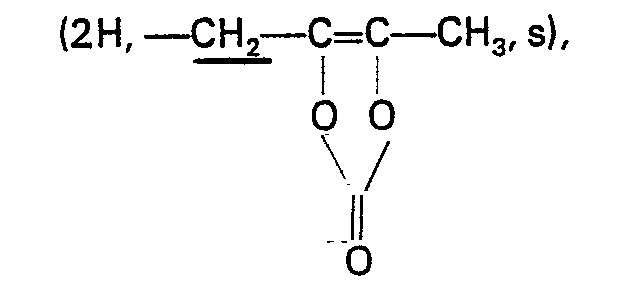

- The resulting Ampicillin ester hydrochloride was incubated in 40% mouse blood in pH 7.4 phosphate buffer at.37°C for 10 minutes, and then subjected to bioautography. It was found to be completely converted to Ampicillin.
- In 80 ml of carbon tetrachloride was dissolved 2.15 g of 1,2-carbonyldioxycyclohexene (synthesized by the method described in Tetrahedron Letters, 1972, pages 1701-1704). N-bromosucinimide (2.3 g) and a catalytic amount of α,α'-azobisisobutyronitrile were added to the solution, and the mixture was heated under reflux for 20 minutes. The reaction mixture was cooled, and filtered. The filtrate was concentrated at a low temperature to give 3.2 g of a pale brown liquid as a residue. The product showed the following properties.
- IR (neat): near 1825 cm-1 (νc=0)
- NMR (CDCl3, δ (ppm)):
- 5.0 (=C-CH-Br, m), 1.3-3.0 (cyclic proton, m). From these data, the product was identified as the title compound.
- By the same method as shown in Example 1, (2), 256 mg of Ampicillin (2,3-carbonyldioxy-2-cyclohexenyl) ester hydrochloride was obtained as a colorless amorphous solid from 2 g of Ampicillin trihydrate and 1 g of 3-bromo-1,2-carbonyldioxycyclohexene (yield 10.2%).
- Appearance: colorless amorphous solid
- Melting point: 140°C (decomp.)
- IR (KBr): 1830 cm-1 (cyclic carbonate), 1780 cm-1 (β-lactam), 1750 cm-1 (ester), 1690 cm-' (amide).
- The resulting Ampicillin ester hydrochloride was incubated in 40% mouse blood in pH 7.4 phosphate buffer at 37°C for 10 minutes, and then subjected to bioautography. It was found to be completely converted to Ampicillin.
- In 200 ml of carbon tetrachloride was dissolved 8.6 g of 4-methyl-1,3-dioxolen-2-one (synthesized by the method described in US-A-3,020,290). N-bromosuccinimide (17.8 g) and a catalytic amount of a,a'-azobisisobutyronitrile were added to the solution, and the mixture was heated under reflux for 90 minutes. The reaction mixture was worked up in the same way as in Example 2 to give 5.2 g (yield 33.6%) of a colorless liquid having a boiling point of 94°C/3 mm. The product had the following properties.
- Elemental analysis, molecular formula C4H3BrO3:

- IR (neat): near 1830 cm-1 (νc=0)
- NMR (CCI4, δ (ppm)):
- 4.10 (-CH2Br, s), 7.00 (=CH-O-, s).
- From these data, the product was identified as the title compound.
- Ampicillin trihydrate (2 g) was dispersed in 24 ml of dimethyl formamide, and 500 mg of potassium hydrogen carbonate was added. The mixture was cooled to 0°C, and 1 ml of benzaldehyde was added. The mixture was stirred at 0 to 5°C for 3 hours. To the mixture were added 500 mg of potassium hydrogen carbonate and 1 g of 4-bromomethyl-1 ,3-dioxolen-2-one, and the mixture was stirred at 0 to 5°C for 6 hours.
- After the reaction, the reaction mixture was poured into ice water, and extracted with ethyl acetate. The extract was washed with ice water, and the ethyl acetate layer was concentrated under reduced pressure to remove ethyl acetate. The resulting syrup was dissolved in 10 ml of acetonitrile. The solution was adjusted to pH 2.0 with dilute hydrochloric acid, and stirred at 0°C for 20 minutes.
- Water (20 ml) was added, and the mixture was concentrated under reduced pressure to remove acetonitrile. The aqueous layer was repeatedly washed with ethyl acetate, and saturated with sodium chloride to precipitate an orange gum-like substance. The aqueous layer was removed by decantation. The gum-like substance was dissolved in methanol, decolorized with activated carbon, cooled to 0°C, and poured into vigorously stirred ether to precipitate a pale orange solid. The solid was collected by filtration, and washed with a mixture of ether and methanol to give 600 mg (yield 26%) of Ampicillin (2-oxo-1,3-dioxolen-4-yl)methyl ester hydrochloride as a pale orange amorphous solid.
- Melting point: 130°C (decomp.)
- IR (KBr): 1835 cm-1 (cyclic carbonate), 1790 cm-1 (β-lactam), 1750 cm-1 (ester), 1690 cm-1 (amide) NMR (D2O, 8 (ppm)): 1.36 (6H, methyl at the 2-position, s), 4.58 (1 H, proton at the 3-position, s), 5.11 1


- The resulting Ampicillin ester hydrochloride was incubated in 40% mouse blood in pH 7.4 phosphate buffer at 37°C for 10 minutes, and then subjected to bioautography. It was found to be completely converted to Ampicillin.
- Ten grams of benzylpenicillin potassium salt was dispersed in 50 ml of dimethyl formamide, and with ice cooling, 520 mg of potassium hydrogen carbonate and 5.2 g of 5-bromomethyl-5-methyl-1,3- dixoien-2-one were added, then the mixture was stirred at 0°C for 4 hours. The reaction mixture was poured into ice water, and the precipitated solid was collected by filtration. It was dissolved in ethyl acetate, washed with a dilute aqueous solution of sodium hydrogen carbonate and then repeatedly with ice water. The ethyl acetate layer was then dried over anhydrous magnesium sulfate, and the solvent was distilled off under reduced pressure. There was obtained 12.5 g (yield 94%) of benzylpenicillin (5-methyl-2-oxo-1,3-dioxolen-4-yl)methyl ester.
- IR (KBr): 1825 cm-1 (cyclic carbonate), 1785 cm-' (β-lactam), 1750 cm-1 (ester), 1670 cm-1 (amide) NMR (CDCl3, δ (ppm)): 1.37 and 1.42 (6H, methyl at the 2-position, s), 2.13
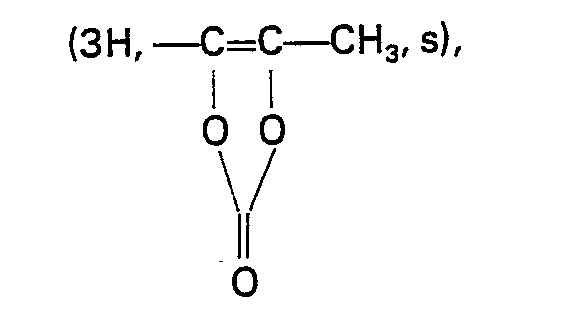

- Phosphorus pentachloride (5.9 g) was dissolved in dry methylene chloride (30 ml), and 6.3 ml of quinoline was added. The solution was cooled to -30°C with dry ice-acetone. With vigorous stirring, 11 g of the above benzyl-penicillin (2-oxo-5-methyl-1,3-dioxolen-4-yl)methyl ester dissolved in dry methylene chloride (10 ml) was added dropwise, and the mixture was stirred at this temperature for 35 minutes. Propyl alcohol (20 ml) was added dropwise over 5 minutes, and the mixture was stirred for 30 minutes. With vigorous stirring, 20 ml of a saturated solution of sodium chloride was added dropwise and the mixture was stirred for about an hour. Then, the methylene chloride layer was separated, washed with saturated sodium chloride solution, dried over anhydrous sodium sulfate and evaporated to dryness to afford a gum. The gum was washed with n-hexane to give 6.6 g (yield 72%) of (5-methyl-2-oxo-1,3-dioxolen-4-yl)methyl 6-amino-penicillanate hydrochloride as a pale yellow amorphous substance.
- Separately, 10 g of D-(-)-phenylglycine was added to 250 ml of methylene chloride. The mixture was cooled to 0°C, and by passing hydrogen chloride gas, the hydrochloride of the phenylglycine was formed. Phosphorus pentachloride (20 g) was added, and the mixture was stirred at 0 to 5°C for 4 hours. The solid precipitated was collected by filtration, and repeatedly washed with methylene chloride to give 13.1 g (yield 90%) of D-(-)-phenylglycyl chloride hydrochloride as a colorless amorphous solid.
- Two-hundred milligrams of the 6-aminopenicillanic acid ester hydrochloride obtained as above was dispersed in 10 ml of methylene chloride, and 50 mg of potassium hydrogen carbonate was added. The mixture was stirred at 0°C for 15 minutes. Then, 110 mg of the acid chloride obtained as above was added, and the mixture was stirred for 2 hours and then for another 2 hours at room temperature.
- After the reaction, the solid was separated by filtration, and the filtrate was concentrated under reduced pressure. The resulting syrup was dissolved in water, and washed with ethyl acetate. The aqueous layer was saturated with sodium chloride, and the separated oily substance was extracted with methylene chloride. The extract was washed with a saturated aqueous solution of sodium chloride and concentrated until the amount of methylene chloride decreased to half. Upon addition of isopropyl alcohol, a colorless solid was precipitated. The solid was collected by filtration and washed with isopropyl alcohol and ether to give 132 mg (yield 54%) of Ampicillin (5-methyl-2-oxo-1,3-dioxolen-4-yl)methyl ester hydrochloride as an amorphous solid.
- The melting point and spectroscopic data of this product were identical with those of the product obtained in Example 2 (2).
- By the same method as shown in Example 5, (2-oxo-5-phenyl-1,3-dioxolen-4-yl)methyl 6-aminopenicillanate hydrochloride was obtained in a yield of. 74% from 4-bromomethyl-5-phenyl-1 ,3-dioxolen-2-one and benzylpenicillin potassium salt.
- From 200 mg of the resulting ester hydrochloride and 95 mg of D-(-)-phenylglycyl chloride hydrochloride, 148 mg (yield 56%) of Ampicillin (2-oxo-5-phenyl-1,3-dioxolen-4-yl)methyl ester hydrochloride was obtained as a colorless amorphous solid.
- The melting point and spectroscopic data of this product were identical with those of the product obtained in Example 1 (2).
- In 100 ml of dimethyl formamide was dissolved 13 g of 6/i-tritylaminopenicillanic acid synthesized by the method described in J. Am. Chem. Soc. 84, 2983 (1963). The solution was cooled to 0 to 5°C, and 3 g of potassium hydrogen carbonate and 6 g of 4-bromomethyl-5-methyl-1,3-dioxolen-2-one were added. The mixture was stirred at the above temperature for 3 hours. After the reaction, the reaction mixture was poured into ice water. The precipitated yellow solid was extracted with 300 ml of ethyl acetate. The ethyl acetate layer was washed several times with a saturated aqueous solution of sodium chloride, dried over anhydrous magnesium sulfate and concentrated under reduced pressure to give a yellow syrup. The syrup was dissolved in 80 ml of ethyl acetate, and with ice cooling, 5.2 g of p-toluenesulfonic acid was added. The mixture was stirred under ice cooling for 1 hour, whereupon a colorless solid precipitated. The solid was collected by filtration and well washed with ethyl acetate to give 8.3 g (yield 60%) of the title compound.
- IR (KBr): 1820 cm-1 (cyclic carbonate), 1780 cm-1 (β-lactam), 1760 cm-' (ester)
- NMR (DMSO-d6, δ (ppm)): 1.40 and 1.59 (6H, methyl at the 2-position, s), 2.12


- Five grams of (5-methyl-2-oxo-1,3-dioxolen-4-yl)methyl 6-aminopenicillanate p-toluenesulfonate was suspended in 300 ml of ethyl acetate. To the suspension was added at 0°C 200 ml of a 2% aqueous solution of sodium hydrogen carbonate cooled with ice. The mixture was vigorously stirred. The ethyl acetate layer was separated, washed with ice water, dried at 0°C over anhydrous magnesium sulfate, and concentrated under reduced pressure to give a pale yellow syrup. The syrup was dissolved in 50 ml of methylene chloride. The solution was cooled to 0°C and 1 g of potassium hydrogen carbonate and 2.1 g of D-(-)-phenylglycyl chloride hydrochloride were added, and the mixture was stirred at 0°C for 4 hours. After the reaction, the insoluble material was separated by filtration. The resulting syrup was dissolved in water and washed with ethyl acetate. The aqueous layer was saturated with sodium chloride. The separated oily substance was extracted with methylene chloride, washed with a saturated aqueous solution of sodium chloride, and dried over anhydrous sodium sulfate. The dried solution was concentrated under reduced pressure until the amount of methylene chloride decreased to one half. Isopropyl alcohol was added, and the mixture was again concentrated under reduced pressure to give a colorless solid. The solid was collected by filtration, and washed with ether to give 2.6 g (yield 51%) of Ampicillin (5-methyl-2-oxo-1,3-dioxolen-4-yl)methyl ester hydrochloride as a colorless amorphous solid.
- The melting point and spectroscopic data of this product were identical with those of the product obtained in Example 2 (2).
-

- The above ingredients were mixed and encapsulated to form a capsule.

- An ethanol solution of the hydroxypropyl cellulose was prepared, and added to the Ampicillin ester hydrochloride and lactose. They were kneaded, extruded through a screen, and dried to form granules.

- The Ampicillin ester hydrochloride, crystalline cellulose and lactose were mixed, and an ethanol solution of hydroxypropyl cellulose was added. They were kneaded and dried. To the dried mixture was added magnesium stearate. They were mixed and tabulated to form a tablet.
and acid addition salts of these esters.
Claims (21)


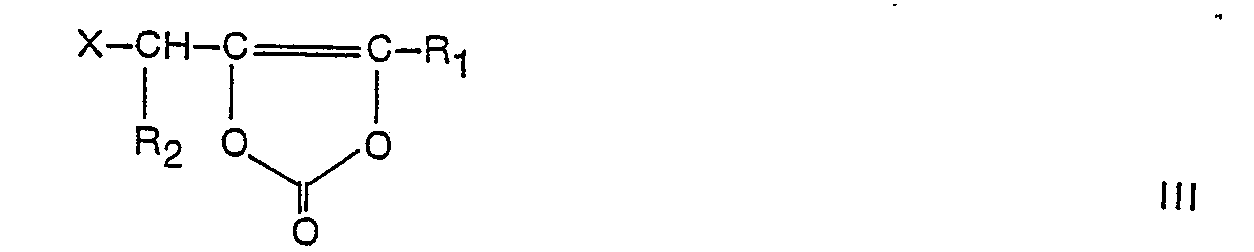


Priority Applications (2)
| Application Number | Priority Date | Filing Date | Title |
|---|---|---|---|
| AT81103231T ATE10846T1 (en) | 1980-04-30 | 1981-04-29 | AMPICILLINESTERS AND THEIR PRODUCTION. |
| DE8282103950T DE3166214D1 (en) | 1980-04-30 | 1981-04-29 | 6-aminopenicillanic acid esters and their use for producing new ampicillin esters |
Applications Claiming Priority (4)
| Application Number | Priority Date | Filing Date | Title |
|---|---|---|---|
| JP55058510A JPS6019908B2 (en) | 1980-04-30 | 1980-04-30 | 1,3-dioxolen-2-one derivative |
| JP58510/80 | 1980-04-30 | ||
| JP68444/80 | 1980-05-22 | ||
| JP6844480A JPS5938954B2 (en) | 1980-05-22 | 1980-05-22 | Ampicillin ester and its manufacturing method |
Related Child Applications (1)
| Application Number | Title | Priority Date | Filing Date |
|---|---|---|---|
| EP82103950.0 Division-Into | 1982-05-06 |
Publications (3)
| Publication Number | Publication Date |
|---|---|
| EP0039086A2 EP0039086A2 (en) | 1981-11-04 |
| EP0039086A3 EP0039086A3 (en) | 1982-02-10 |
| EP0039086B1 true EP0039086B1 (en) | 1984-12-19 |
Family
ID=26399560
Family Applications (2)
| Application Number | Title | Priority Date | Filing Date |
|---|---|---|---|
| EP81103231A Expired EP0039086B1 (en) | 1980-04-30 | 1981-04-29 | Novel ampicillin esters and production thereof |
| EP82103950A Expired EP0061206B1 (en) | 1980-04-30 | 1981-04-29 | 6-aminopenicillanic acid esters and their use for producing new ampicillin esters |
Family Applications After (1)
| Application Number | Title | Priority Date | Filing Date |
|---|---|---|---|
| EP82103950A Expired EP0061206B1 (en) | 1980-04-30 | 1981-04-29 | 6-aminopenicillanic acid esters and their use for producing new ampicillin esters |
Country Status (5)
| Country | Link |
|---|---|
| US (1) | US4389408A (en) |
| EP (2) | EP0039086B1 (en) |
| AU (1) | AU538507B2 (en) |
| CA (1) | CA1212105A (en) |
| DE (1) | DE3167794D1 (en) |
Cited By (1)
| Publication number | Priority date | Publication date | Assignee | Title |
|---|---|---|---|---|
| CN104230878A (en) * | 2014-09-26 | 2014-12-24 | 六安科瑞达新型材料有限公司 | Preparation method of 4-chloromethyl-5-methyl-1,3-dioxole-2-one |
Families Citing this family (12)
| Publication number | Priority date | Publication date | Assignee | Title |
|---|---|---|---|---|
| GR76525B (en) * | 1981-07-13 | 1984-08-10 | Merck & Co Inc | |
| US4654331A (en) * | 1981-07-13 | 1987-03-31 | Merck & Co., Inc. | Oral absorption enhancement of carboxylic acid pharmaceuticals using (5-alkyl-2-oxo-1,3-dioxolen-4-yl)methyl ester group |
| DE3261759D1 (en) * | 1981-07-15 | 1985-02-14 | Kanebo Ltd | Novel ester of 1,1-dioxopenicillanic acid, process for production thereof, and use thereof as beta-lactamase inhibitor |
| JPS5832882A (en) * | 1981-07-18 | 1983-02-25 | Kanebo Ltd | Novel ester of 6-((hexahydro-1h-azepin-1-yl)- methyleneamino)penicillanic acid and its preparation |
| JPS5835190A (en) * | 1981-08-25 | 1983-03-01 | Sankyo Co Ltd | Penem-3-carboxylic acid derivative |
| US4434173A (en) | 1982-08-23 | 1984-02-28 | Pfizer Inc. | Bis-esters of 4,5-di(hydroxymethyl)-2-oxo-1,3-dioxole as antibacterial agents |
| US4448732A (en) * | 1982-09-07 | 1984-05-15 | Pfizer Inc. | 2-Oxo-1,3-dioxol-4-ylmethyl esters of penicillanic acid 1,1-dioxide |
| US4555579A (en) * | 1983-03-24 | 1985-11-26 | E. R. Squibb & Sons, Inc. | Dioxolenylmethyl ester prodrugs of phosphinic acid ace inhibitors |
| US4536393A (en) * | 1983-06-06 | 1985-08-20 | Pfizer Inc. | 6-(Aminomethyl)penicillanic acid 1,1-dioxide esters and intermediates therefor |
| GB2157284B (en) * | 1984-04-11 | 1987-11-04 | Leo Pharm Prod Ltd | 6-b-halopenicillanic acid salts |
| ATE186053T1 (en) * | 1990-08-20 | 1999-11-15 | Suntory Ltd | ANTIBACTERIAL PENEM ESTER DERIVATIVES |
| IL118092A0 (en) * | 1995-05-03 | 1996-09-12 | Smithkline Beecham Plc | Antibacterial compounds their preparation and pharmaceutical compositions containing them |
Family Cites Families (5)
| Publication number | Priority date | Publication date | Assignee | Title |
|---|---|---|---|---|
| GB1215812A (en) | 1967-09-29 | 1970-12-16 | Leo Pharm Prod Ltd | Esters of penicillanic acids |
| US3873521A (en) | 1970-09-17 | 1975-03-25 | Astra Laekemedel Ab | Esters of {60 -amino penicillins |
| GB1377661A (en) * | 1971-06-05 | 1974-12-18 | Yamanouchi Pharma Co Ltd | Oxofuryl ester derivatives of penicillin and cephalosporin |
| GB1364672A (en) | 1971-06-09 | 1974-08-29 | Beecham Group Ltd | Penicillins |
| GB1390754A (en) * | 1971-06-09 | 1975-04-16 | Beecham Group Ltd | Penicillin and cephalosporin esters |
-
1981
- 1981-04-28 CA CA000376376A patent/CA1212105A/en not_active Expired
- 1981-04-29 EP EP81103231A patent/EP0039086B1/en not_active Expired
- 1981-04-29 AU AU69987/81A patent/AU538507B2/en not_active Ceased
- 1981-04-29 EP EP82103950A patent/EP0061206B1/en not_active Expired
- 1981-04-29 DE DE8181103231T patent/DE3167794D1/en not_active Expired
- 1981-12-04 US US06/327,735 patent/US4389408A/en not_active Expired - Lifetime
Cited By (1)
| Publication number | Priority date | Publication date | Assignee | Title |
|---|---|---|---|---|
| CN104230878A (en) * | 2014-09-26 | 2014-12-24 | 六安科瑞达新型材料有限公司 | Preparation method of 4-chloromethyl-5-methyl-1,3-dioxole-2-one |
Also Published As
| Publication number | Publication date |
|---|---|
| EP0039086A2 (en) | 1981-11-04 |
| EP0061206B1 (en) | 1984-09-19 |
| CA1212105A (en) | 1986-09-30 |
| EP0039086A3 (en) | 1982-02-10 |
| US4389408A (en) | 1983-06-21 |
| EP0061206A1 (en) | 1982-09-29 |
| AU538507B2 (en) | 1984-08-16 |
| AU6998781A (en) | 1981-11-05 |
| DE3167794D1 (en) | 1985-01-31 |
Similar Documents
| Publication | Publication Date | Title |
|---|---|---|
| US3697507A (en) | Esters of {60 -aminobenzylpenicillin | |
| US4342693A (en) | 1,3-Dioxolen-2-one derivatives and process for production thereof | |
| US4389408A (en) | Novel ampicillin esters and production thereof | |
| CA1051420A (en) | ESTERS OF .alpha.-SUBSTITUTED AMIDINOPENICILLANIC ACIDS | |
| FI59413B (en) | PROCEDURE FOR FRAMSTATION OF AV 6- (D (-) - ALPHA-AMINO-P-ACETOXIFENYLACETAMIDO) PENICILLANSYRA ANVAENDBAR SAOSOM ANTIBAKTERISKT AEMNE | |
| US3655658A (en) | 7(alpha-amino-alpha-phenylacetamido)-cephalosporanate esters | |
| US4071529A (en) | Derivatives of 6-aminopenicillanic acid | |
| EP0000645B1 (en) | Isopenicillins, processes for their preparation, and compositions containing them | |
| US4089963A (en) | Esters of amidinopenicillanic acids, pharmaceutical preparations and method for treating infectious diseases | |
| KR900007183B1 (en) | Method for preparing penicillin derivative | |
| JPS58213788A (en) | Ampicillin and amoxicillin derivative having alpha-lactamase inhibitor | |
| KR0178957B1 (en) | Penem compounds | |
| PL90581B1 (en) | 6-(methyleneamino)-penicillanic acid derivs[FR2073338A1] | |
| US4416891A (en) | Ester of 6-[(hexahydro-1H-azepin-1-yl)methyleneamino]penicillanic acid, and its use as antibacterial agent | |
| CA1238311A (en) | 6-aminopenicillanic acid esters | |
| US3719668A (en) | Semi-synthetic penicillin esters | |
| US3660575A (en) | Esters of alpha-aminobenzylpenicillin in dosage unit form | |
| PL92491B1 (en) | ||
| US3819643A (en) | Esters of 6-amino penicillanic acid | |
| CA1055929A (en) | ESTERS OF .alpha.-SUBSTITUTED AMIDINOPENICILLANIC ACIDS | |
| US3847913A (en) | Cephalosporanic acid esters | |
| EP0128718B1 (en) | Process for 6-(aminomethyl)penicillanic acid 1,1-dioxide and derivatives thereof | |
| IE51885B1 (en) | 6-(2-aryl-2-(1,1-dioxopenicillanoyloxy-methoxycarbonyl)acetamido)penicillanic acids | |
| US3951957A (en) | Chloromethyl ester of penicillins | |
| EP0186586A2 (en) | Cephem compounds and the production thereof |
Legal Events
| Date | Code | Title | Description |
|---|---|---|---|
| PUAI | Public reference made under article 153(3) epc to a published international application that has entered the european phase |
Free format text: ORIGINAL CODE: 0009012 |
|
| AK | Designated contracting states |
Designated state(s): AT BE CH DE FR GB IT LI LU NL SE |
|
| PUAL | Search report despatched |
Free format text: ORIGINAL CODE: 0009013 |
|
| AK | Designated contracting states |
Designated state(s): AT BE CH DE FR GB IT LI LU NL SE |
|
| 17P | Request for examination filed |
Effective date: 19820219 |
|
| ITF | It: translation for a ep patent filed | ||
| GRAA | (expected) grant |
Free format text: ORIGINAL CODE: 0009210 |
|
| AK | Designated contracting states |
Designated state(s): AT BE CH DE FR GB IT LI LU NL SE |
|
| REF | Corresponds to: |
Ref document number: 10846 Country of ref document: AT Date of ref document: 19850115 Kind code of ref document: T |
|
| REF | Corresponds to: |
Ref document number: 3167794 Country of ref document: DE Date of ref document: 19850131 |
|
| ET | Fr: translation filed | ||
| PLBE | No opposition filed within time limit |
Free format text: ORIGINAL CODE: 0009261 |
|
| STAA | Information on the status of an ep patent application or granted ep patent |
Free format text: STATUS: NO OPPOSITION FILED WITHIN TIME LIMIT |
|
| 26N | No opposition filed | ||
| ITTA | It: last paid annual fee | ||
| PGFP | Annual fee paid to national office [announced via postgrant information from national office to epo] |
Ref country code: AT Payment date: 19940225 Year of fee payment: 14 |
|
| PGFP | Annual fee paid to national office [announced via postgrant information from national office to epo] |
Ref country code: SE Payment date: 19940321 Year of fee payment: 14 |
|
| PGFP | Annual fee paid to national office [announced via postgrant information from national office to epo] |
Ref country code: DE Payment date: 19940324 Year of fee payment: 14 |
|
| PGFP | Annual fee paid to national office [announced via postgrant information from national office to epo] |
Ref country code: LU Payment date: 19940331 Year of fee payment: 14 |
|
| PGFP | Annual fee paid to national office [announced via postgrant information from national office to epo] |
Ref country code: CH Payment date: 19940411 Year of fee payment: 14 |
|
| PGFP | Annual fee paid to national office [announced via postgrant information from national office to epo] |
Ref country code: BE Payment date: 19940413 Year of fee payment: 14 |
|
| PGFP | Annual fee paid to national office [announced via postgrant information from national office to epo] |
Ref country code: FR Payment date: 19940418 Year of fee payment: 14 |
|
| PGFP | Annual fee paid to national office [announced via postgrant information from national office to epo] |
Ref country code: GB Payment date: 19940419 Year of fee payment: 14 |
|
| PGFP | Annual fee paid to national office [announced via postgrant information from national office to epo] |
Ref country code: NL Payment date: 19940430 Year of fee payment: 14 |
|
| EPTA | Lu: last paid annual fee | ||
| EAL | Se: european patent in force in sweden |
Ref document number: 81103231.7 |
|
| PG25 | Lapsed in a contracting state [announced via postgrant information from national office to epo] |
Ref country code: LU Free format text: LAPSE BECAUSE OF NON-PAYMENT OF DUE FEES Effective date: 19950429 Ref country code: GB Effective date: 19950429 Ref country code: AT Effective date: 19950429 |
|
| PG25 | Lapsed in a contracting state [announced via postgrant information from national office to epo] |
Ref country code: SE Effective date: 19950430 Ref country code: LI Effective date: 19950430 Ref country code: CH Effective date: 19950430 Ref country code: BE Effective date: 19950430 |
|
| BERE | Be: lapsed |
Owner name: KANEBO LTD Effective date: 19950430 |
|
| PG25 | Lapsed in a contracting state [announced via postgrant information from national office to epo] |
Ref country code: NL Effective date: 19951101 |
|
| REG | Reference to a national code |
Ref country code: CH Ref legal event code: PL |
|
| PG25 | Lapsed in a contracting state [announced via postgrant information from national office to epo] |
Ref country code: FR Effective date: 19951229 |
|
| NLV4 | Nl: lapsed or anulled due to non-payment of the annual fee |
Effective date: 19951101 |
|
| GBPC | Gb: european patent ceased through non-payment of renewal fee |
Effective date: 19950429 |
|
| PG25 | Lapsed in a contracting state [announced via postgrant information from national office to epo] |
Ref country code: DE Effective date: 19960103 |
|
| EUG | Se: european patent has lapsed |
Ref document number: 81103231.7 |
|
| REG | Reference to a national code |
Ref country code: FR Ref legal event code: ST |